Cambridge A Level Mathematics 9709 — 2012 Oct/Nov Paper 4 · Variant 3
9709/43/O/N/12 · 7 questions · 50 marks · ≈56 min
The question paper and its mark scheme, free to read here and free to download. This is Cambridge’s own paper, exactly as it was sat.
Question paper4 pages
Mark scheme7 pages
Answers below. Sit the paper first if you are practising.
Questions as text
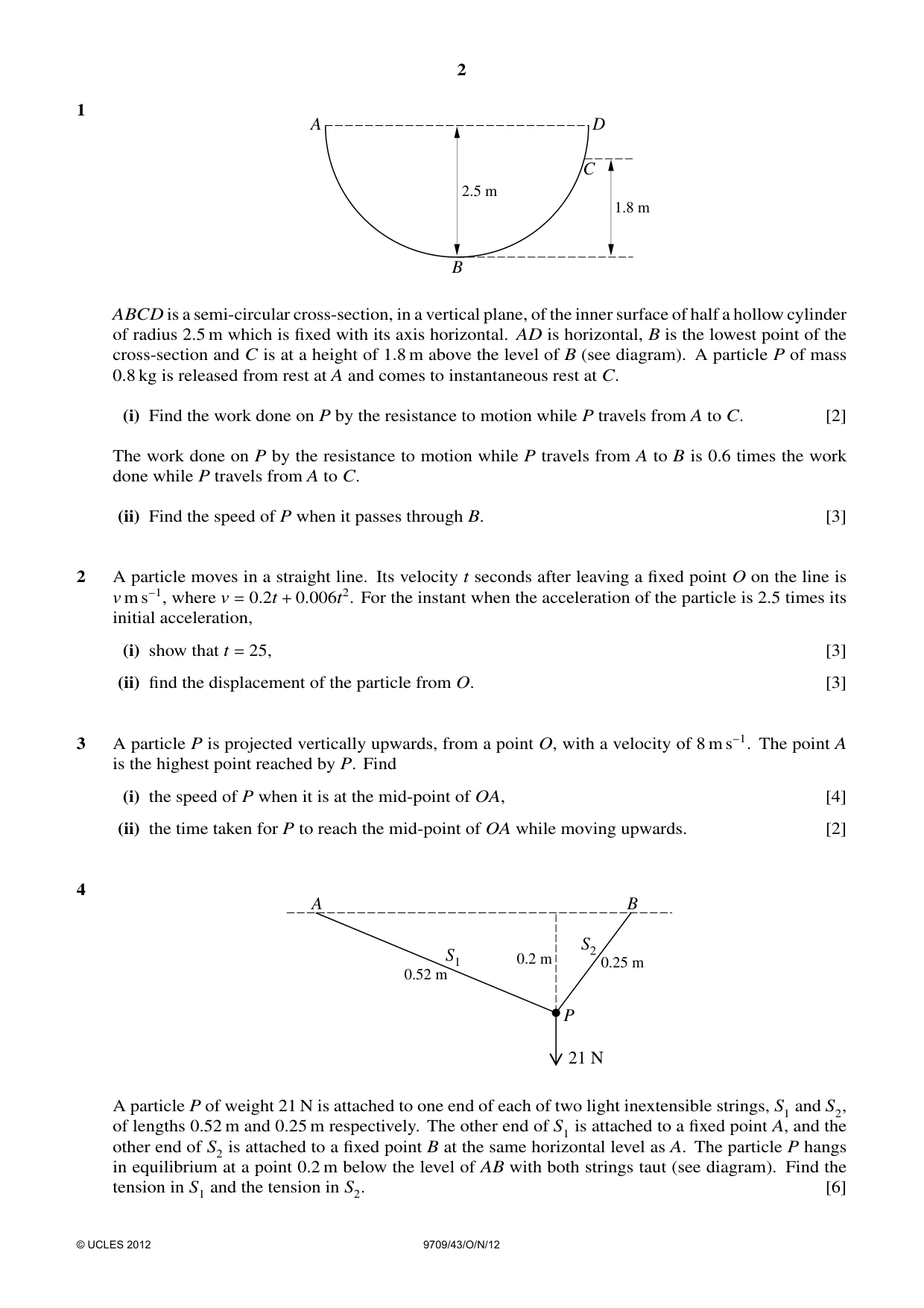
Q1 · A D C 2.5 m 1.8 m B ABCD is a semi-circular cross-section, in a vertical plane, of the…
1 A D C 2.5 m 1.8 m B ABCD is a semi-circular cross-section, in a vertical plane, of the inner surface of half a hollow cylinder of radius 2.5 m which is fixed with its axis horizontal. AD is horizontal, B is the lowest point of the cross-section and C is at a height of 1.8 m above the level of B (see diagram). A particle P of mass 0.8 kg is released from rest at A and comes to instantaneous rest at C. (i) Find the work done on P by the resistance to motion while P travels from A to C. [2] The work done on P by the resistance to motion while P travels from A to B is 0.6 times the work done while P travels from A to C. (ii) Find the speed of P when it passes through B. [3]
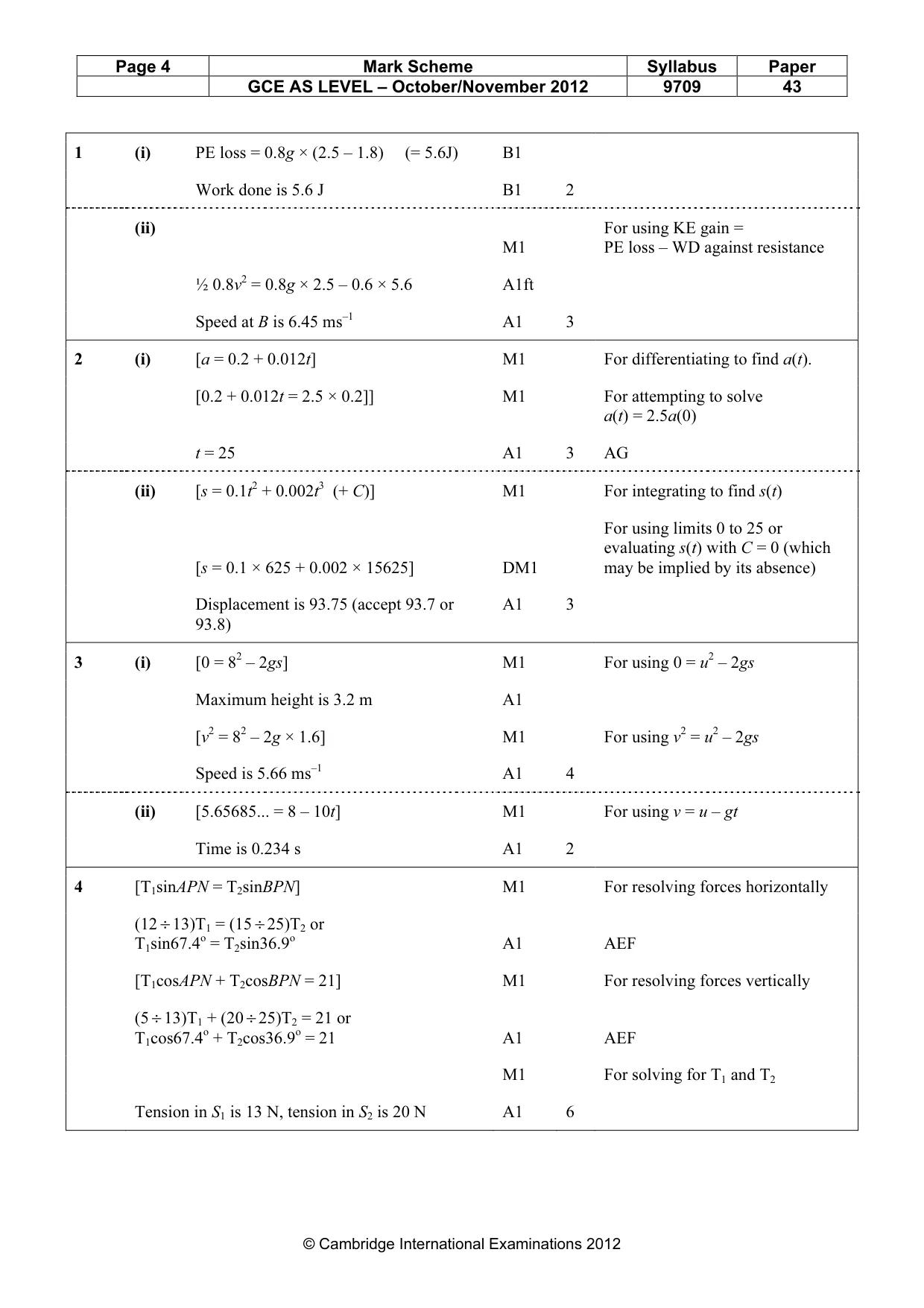
Mark scheme: 1 (i) PE loss = 0.8g × (2.5 – 1.8) (= 5.6J) B1 Work done is 5.6 J B1 2 (ii) For using KE gain = M1 PE loss – WD against resistance ½ 0.8v2 = 0.8g × 2.5 – 0.6 × 5.6 A1ft Speed at B is 6.45 ms–1 A1 3
Q2 · A particle moves in a straight line
2 A particle moves in a straight line. Its velocity t seconds after leaving a fixed point O on the line is v m s−1, where v = 0.2t + 0.006t2. For the instant when the acceleration of the particle is 2.5 times its initial acceleration, (i) show that t = 25, [3] (ii) find the displacement of the particle from O. [3]
Mark scheme: 2 (i) [a = 0.2 + 0.012t] M1 For differentiating to find a(t). [0.2 + 0.012t = 2.5 × 0.2]] M1 For attempting to solve a(t) = 2.5a(0) t = 25 A1 3 AG (ii) [s = 0.1t2 + 0.002t3 (+ C)] M1 For integrating to find s(t) For using limits 0 to 25 or evaluating s(t) with C = 0 (which [s = 0.1 × 625 + 0.002 × 15625] DM1 may be implied by its absence) Displacement is 93.75 (accept 93.7 or A1 3 93.8) 2 2
Q3 · A particle P is projected vertically upwards, from a point O, with a velocity of 8 m s−1
3 A particle P is projected vertically upwards, from a point O, with a velocity of 8 m s−1. The point A is the highest point reached by P. Find (i) the speed of P when it is at the mid-point of OA, [4] (ii) the time taken for P to reach the mid-point of OA while moving upwards. [2]
Mark scheme: 3 (i) [0 = 82 – 2gs] M1 For using 0 = u2 – 2gs Maximum height is 3.2 m A1 [v2 = 82 – 2g × 1.6] M1 For using v2 = u2 – 2gs Speed is 5.66 ms–1 A1 4 (ii) [5.65685... = 8 – 10t] M1 For using v = u – gt Time is 0.234 s A1 2
Q4 · A B S2 S1 0.2 m 0.25 m 0.52 m P 21 N A particle P of weight 21 N is attached to one end…
4 A B S2 S1 0.2 m 0.25 m 0.52 m P 21 N A particle P of weight 21 N is attached to one end of each of two light inextensible strings, S1 and S2, of lengths 0.52 m and 0.25 m respectively. The other end of S1 is attached to a fixed point A, and the other end of S2 is attached to a fixed point B at the same horizontal level as A. The particle P hangs in equilibrium at a point 0.2 m below the level of AB with both strings taut (see diagram). Find the tension in S1 and the tension in S2. [6]
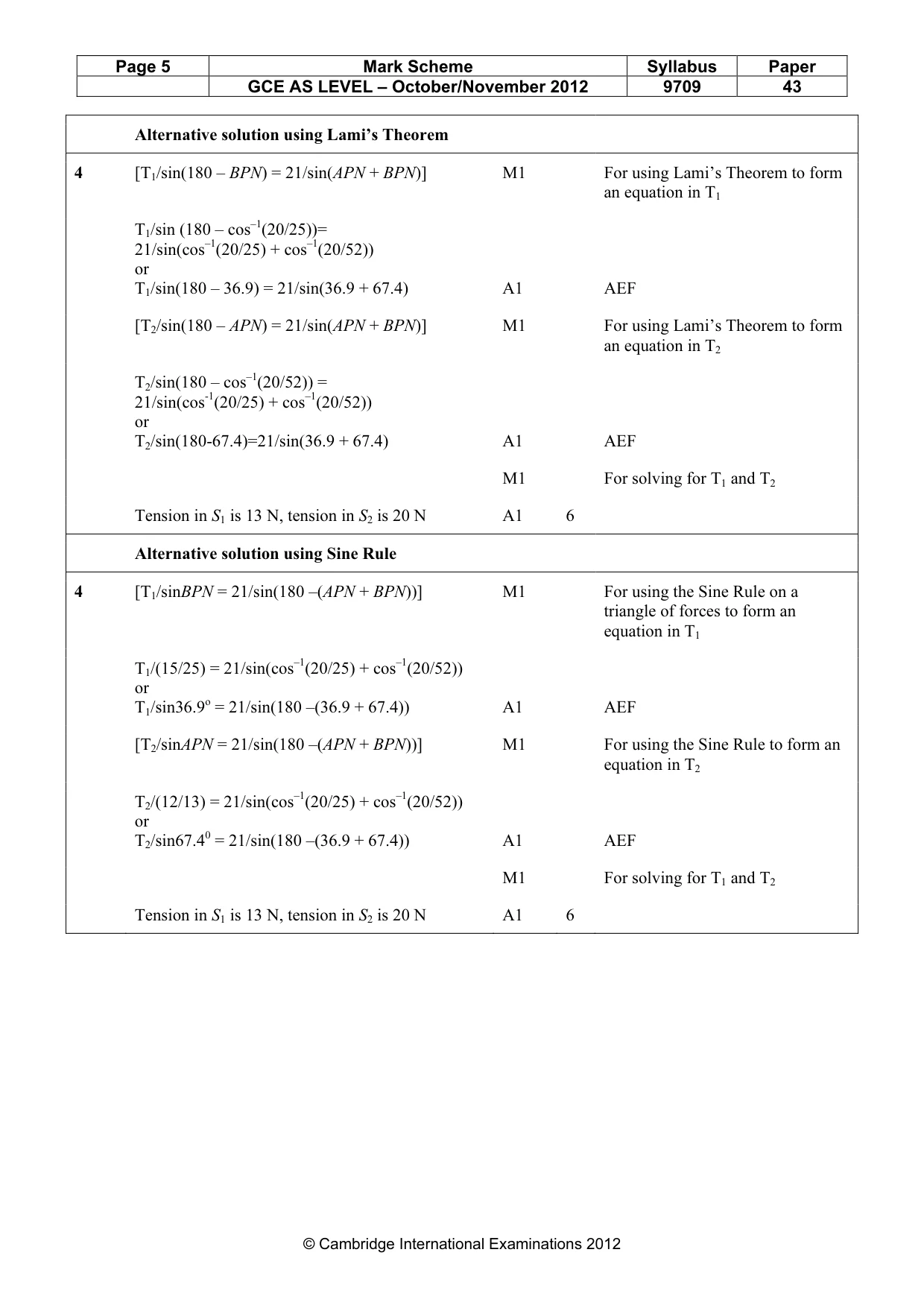
Mark scheme: 4 [T1sinAPN = T2sinBPN] M1 For resolving forces horizontally (12÷13)T1 = (15÷25)T2 or T1sin67.4o = T2sin36.9o A1 AEF [T1cosAPN + T2cosBPN = 21] M1 For resolving forces vertically (5÷13)T1 + (20 ÷25)T2 = 21 or T1cos67.4o + T2cos36.9o = 21 A1 AEF M1 For solving for T1 and T2 Tension in S1 is 13 N, tension in S2 is 20 N A1 6 GCE AS LEVEL – October/November 2012 9709 43 Alternative solution using Lami’s Theorem 4 [T1/sin(180 – BPN) = 21/sin(APN + BPN)] M1 For using Lami’s Theorem to form an equation in T1 T1/sin (180 – cos–1(20/25))= 21/sin(cos–1(20/25) + cos–1(20/52)) or T1/sin(180 – 36.9) = 21/sin(36.9 + 67.4) A1 AEF [T2/sin(180 – APN) = 21/sin(APN + BPN)] M1 For using Lami’s Theorem to form an equation in T2 T2/sin(180 – cos–1(20/52)) = 21/sin(cos-1(20/25) + cos–1(20/52)) or T2/sin(180-67.4)=21/sin(36.9 + 67.4) A1 AEF M1 For solving for T1 and T2 Tension in S1 is 13 N, tension in S2 is 20 N A1 6 Alternative solution using Sine Rule 4 [T1/sinBPN = 21/sin(180 –(APN + BPN))] M1 For using the Sine Rule on a triangle of forces to form an equation in T1 T1/(15/25) = 21/sin(cos–1(20/25) + cos–1(20/52)) or T1/sin36.9o = 21/sin(180 –(36.9 + 67.4)) A1 AEF [T2/sinAPN = 21/sin(180 –(APN + BPN))] M1 For using the Sine Rule to form an equation in T2 T2/(12/13) = 21/sin(cos–1(20/25) + cos–1(20/52)) or T2/sin67.40 = 21/sin(180 –(36.9 + 67.4)) A1 AEF M1 For solving for T1 and T2 Tension in S1 is 13 N, tension in S2 is 20 N A1 6 GCE AS LEVEL – October/November 2012 9709 43 2 2 2 2
Q5 · An object of mass 12 kg slides down a line of greatest slope of a smooth plane inclined…
5 An object of mass 12 kg slides down a line of greatest slope of a smooth plane inclined at 10◦to the horizontal. The object passes through points A and B with speeds 3 m s−1 and 7 m s−1 respectively. (i) Find the increase in kinetic energy of the object as it moves from A to B. [2] (ii) Hence find the distance AB, assuming there is no resisting force acting on the object. [3] The object is now pushed up the plane from B to A, with constant speed, by a horizontal force. (iii) Find the magnitude of this force. [3]
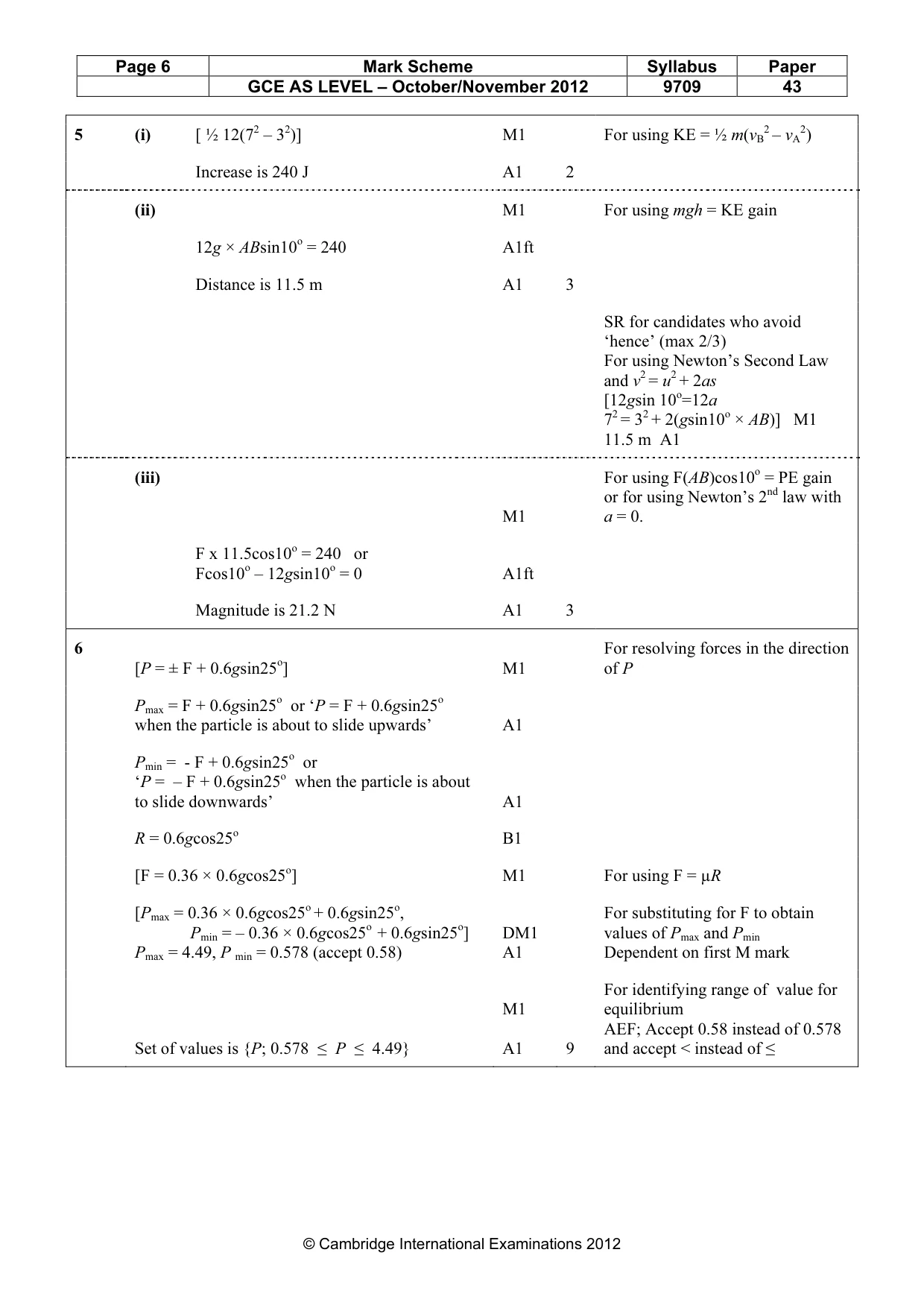
Mark scheme: 2 5 (i) [ ½ 12(72 – 32)] M1 For using KE = ½ m(vB – vA2) Increase is 240 J A1 2 (ii) M1 For using mgh = KE gain 12g × ABsin10o = 240 A1ft Distance is 11.5 m A1 3 SR for candidates who avoid ‘hence’ (max 2/3) For using Newton’s Second Law and v2 = u2 + 2as [12gsin 10o=12a 72 = 32 + 2(gsin10o × AB)] M1 11.5 m A1 (iii) For using F(AB)cos10o = PE gain or for using Newton’s 2nd law with M1 a = 0. F x 11.5cos10o = 240 or Fcos10o – 12gsin10o = 0 A1ft Magnitude is 21.2 N A1 3
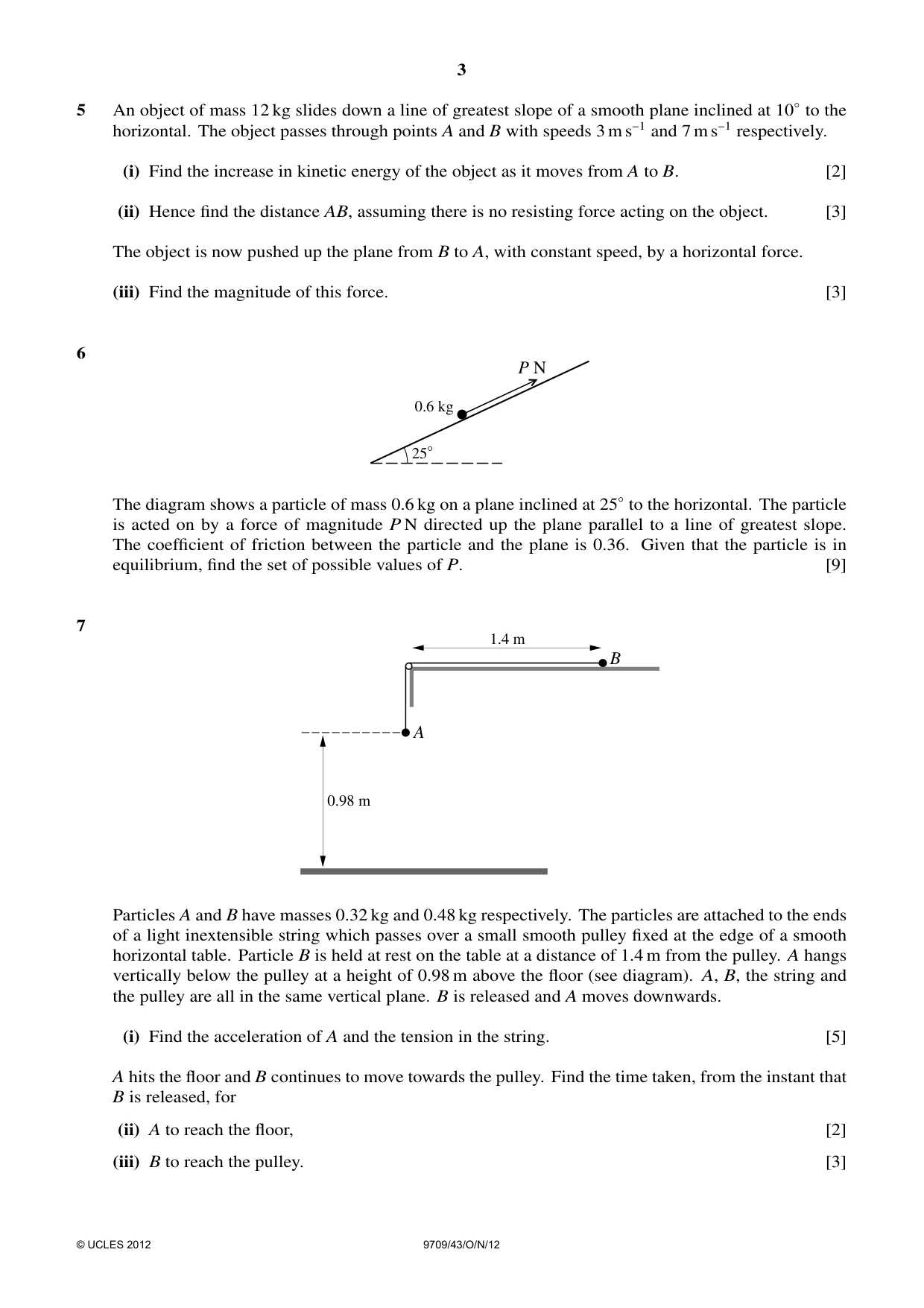
Q6 · P N 0.6 kg 25° The diagram shows a particle of mass 0.6 kg on a plane inclined at 25◦to…
6 P N 0.6 kg 25° The diagram shows a particle of mass 0.6 kg on a plane inclined at 25◦to the horizontal. The particle is acted on by a force of magnitude P N directed up the plane parallel to a line of greatest slope. The coefficient of friction between the particle and the plane is 0.36. Given that the particle is in equilibrium, find the set of possible values of P. [9]
Mark scheme: 6 For resolving forces in the direction [P = ± F + 0.6gsin25o] M1 of P Pmax = F + 0.6gsin25o or ‘P = F + 0.6gsin25o when the particle is about to slide upwards’ A1 Pmin = - F + 0.6gsin25o or ‘P = – F + 0.6gsin25o when the particle is about to slide downwards’ A1 R = 0.6gcos25o B1 [F = 0.36 × 0.6gcos25o] M1 For using F = µR [Pmax = 0.36 × 0.6gcos25o + 0.6gsin25o, For substituting for F to obtain Pmin = – 0.36 × 0.6gcos25o + 0.6gsin25o] DM1 values of Pmax and Pmin Pmax = 4.49, P min = 0.578 (accept 0.58) A1 Dependent on first M mark For identifying range of value for M1 equilibrium AEF; Accept 0.58 instead of 0.578 Set of values is {P; 0.578 ≤ P ≤ 4.49} A1 9 and accept < instead of ≤ GCE AS LEVEL – October/November 2012 9709 43 d
Q7 · 1.4 m B A 0.98 m Particles A and B have masses 0.32 kg and 0.48 kg respectively
7 1.4 m B A 0.98 m Particles A and B have masses 0.32 kg and 0.48 kg respectively. The particles are attached to the ends of a light inextensible string which passes over a small smooth pulley fixed at the edge of a smooth horizontal table. Particle B is held at rest on the table at a distance of 1.4 m from the pulley. A hangs vertically below the pulley at a height of 0.98 m above the floor (see diagram). A, B, the string and the pulley are all in the same vertical plane. B is released and A moves downwards. (i) Find the acceleration of A and the tension in the string. [5] A hits the floor and B continues to move towards the pulley. Find the time taken, from the instant that B is released, for (ii) A to reach the floor, [2] (iii) B to reach the pulley. [3]
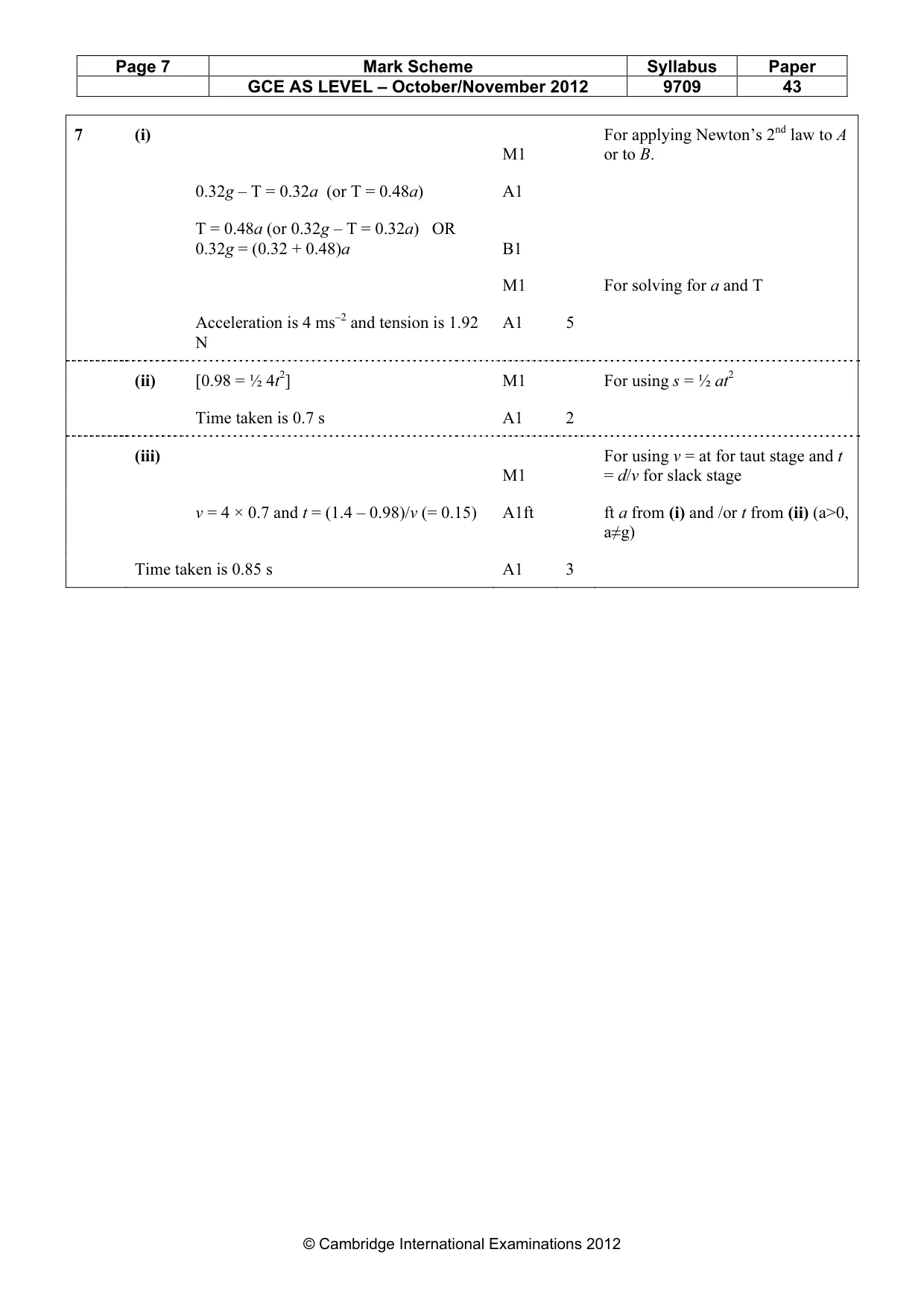
Mark scheme: 7 (i) For applying Newton’s 2nd law to A M1 or to B. 0.32g – T = 0.32a (or T = 0.48a) A1 T = 0.48a (or 0.32g – T = 0.32a) OR 0.32g = (0.32 + 0.48)a B1 M1 For solving for a and T Acceleration is 4 ms–2 and tension is 1.92 A1 5 N (ii) [0.98 = ½ 4t2] M1 For using s = ½ at2 Time taken is 0.7 s A1 2 (iii) For using v = at for taut stage and t M1 = d/v for slack stage v = 4 × 0.7 and t = (1.4 – 0.98)/v (= 0.15) A1ft ft a from (i) and /or t from (ii) (a>0, a≠g) Time taken is 0.85 s A1 3
What was in this paper
The subtopics covered by these 7 questions, and how many questions each got. Open one in a new tab to see every Cambridge question on it.
What you needed in this session
Cambridge’s own grade thresholds for 2012 Oct/Nov, Paper 4 · Variant 3. A higher threshold means an easier paper — the bar moves with how the cohort did.