Cambridge A Level Mathematics 9709 — 2008 May/June Paper 4 · Variant 1
9709/41/M/J/08 · 7 questions · 50 marks · ≈56 min
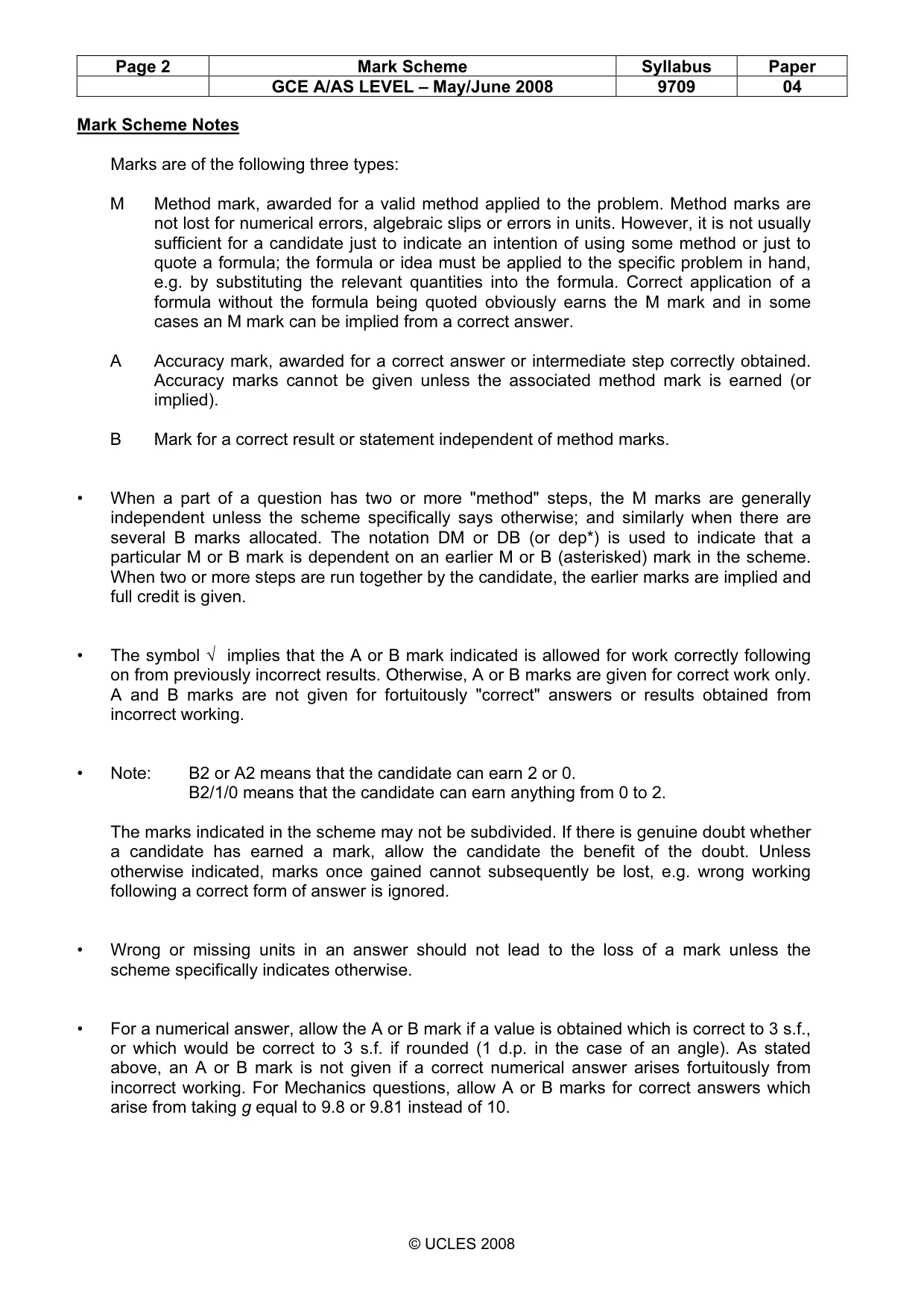
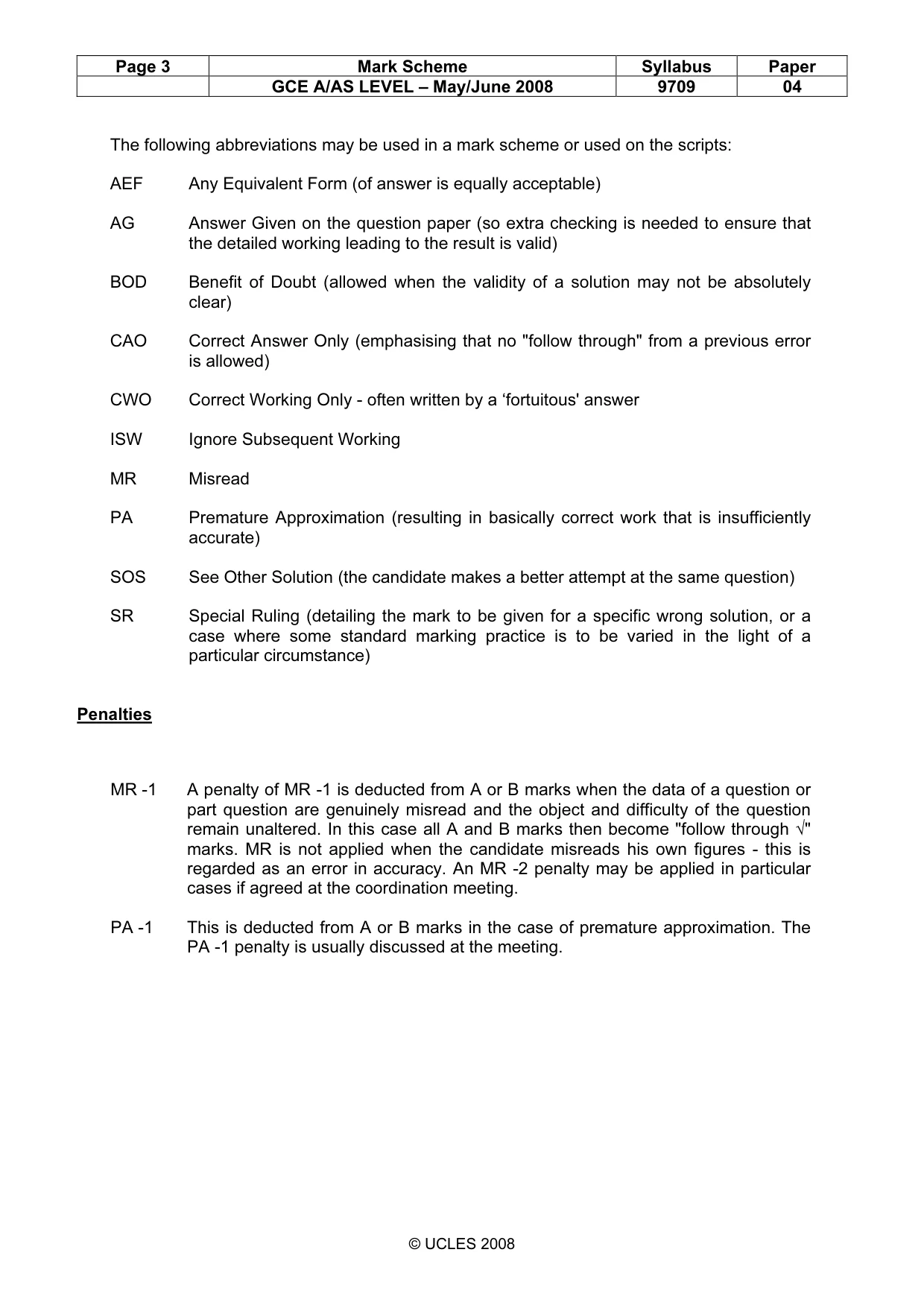
The question paper and its mark scheme, free to read here and free to download. This is Cambridge’s own paper, exactly as it was sat.
Question paper4 pages
Mark scheme6 pages
Answers below. Sit the paper first if you are practising.
Questions as text
Q1 · A particle slides down a smooth plane inclined at an angle of α◦to the horizontal
1 A particle slides down a smooth plane inclined at an angle of α◦to the horizontal. The particle passes through the point A with speed 1.5 m s−1, and 1.2 s later it passes through the point B with speed 4.5 m s−1. Find (i) the acceleration of the particle, [2] (ii) the value of α. [2]
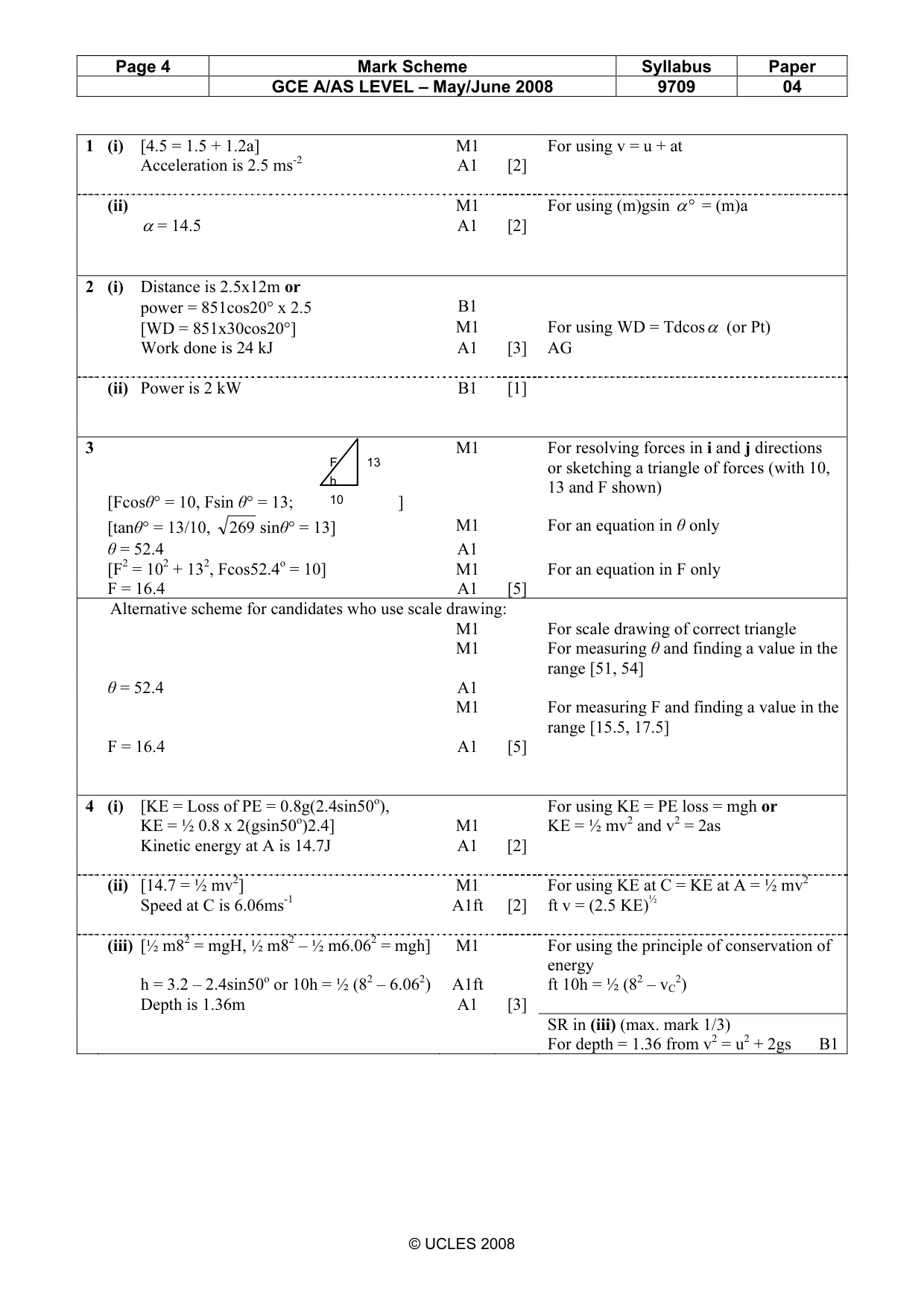
Mark scheme: 1 (i) [4.5 = 1.5 + 1.2a] M1 For using v = u + at Acceleration is 2.5 ms-2 A1 [2] (ii) M1 For using (m)gsin α ° = (m)a α = 14.5 A1 [2]
Q2 · A block is being pulled along a horizontal floor by a rope inclined at 20◦to the horizontal
2 A block is being pulled along a horizontal floor by a rope inclined at 20◦to the horizontal. The tension in the rope is 851 N and the block moves at a constant speed of 2.5 m s−1. (i) Show that the work done on the block in 12 s is approximately 24 kJ. [3] (ii) Hence find the power being applied to the block, giving your answer to the nearest kW. [1]
Mark scheme: 2 (i) Distance is 2.5x12m or power = 851cos20° x 2.5 B1 [WD = 851x30cos20°] M1 For using WD = Tdcosα (or Pt) Work done is 24 kJ A1 [3] AG (ii) Power is 2 kW B1 [1]
Q3 · F N O ° 10 N 13 N Three horizontal forces of magnitudes F N, 13 N and 10 N act at a fixed…
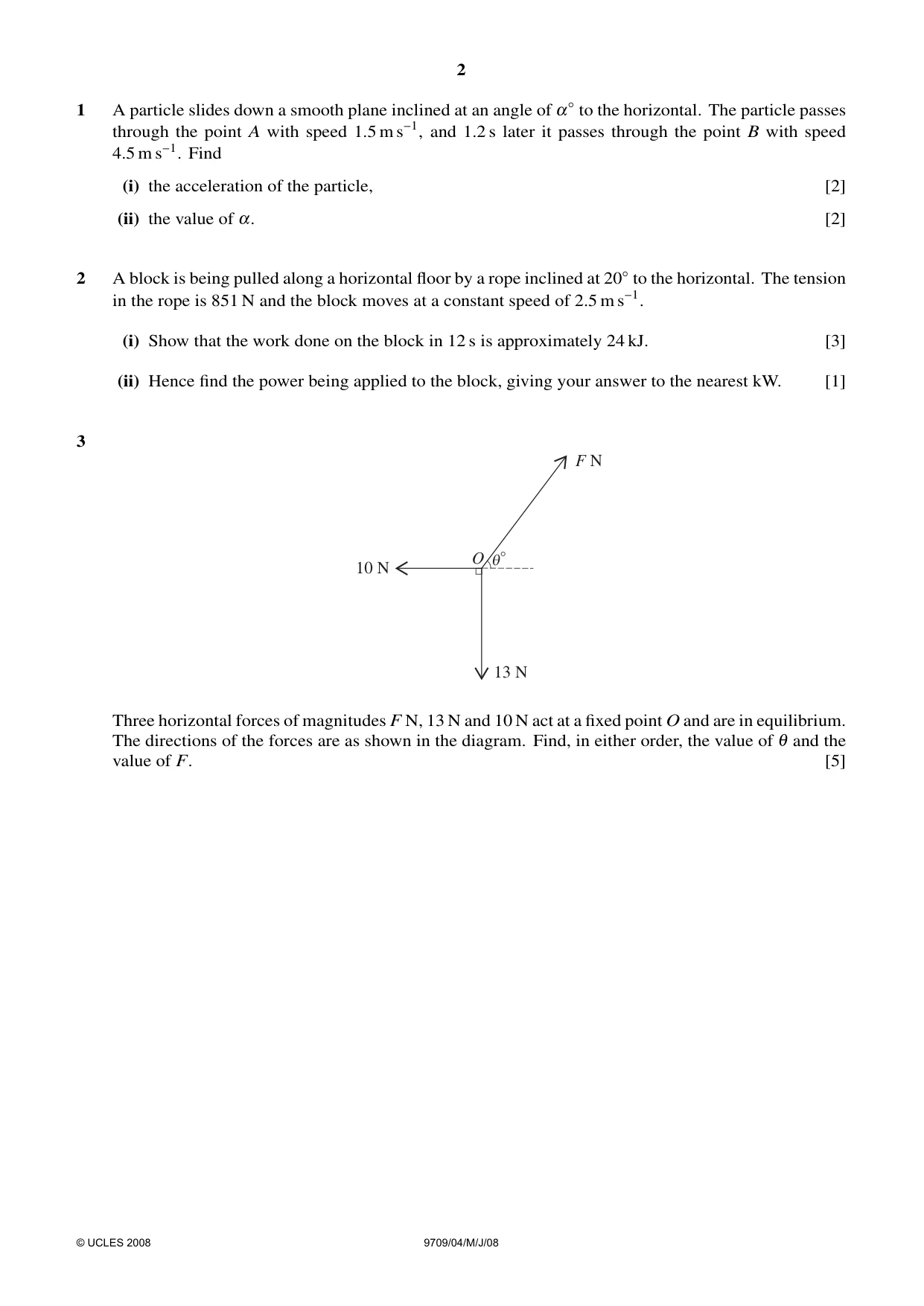
3 F N O ° 10 N 13 N Three horizontal forces of magnitudes F N, 13 N and 10 N act at a fixed point O and are in equilibrium. The directions of the forces are as shown in the diagram. Find, in either order, the value of θ and the value of F. [5]
Mark scheme: 3 M1 For resolving forces in i and j directions F 13 or sketching a triangle of forces (with 10, h 13 and F shown) [Fcosθ° = 10, Fsin θ° = 13; 10 ] [tanθ° = 13/10, 269 sinθ° = 13] M1 For an equation in θ only θ = 52.4 A1 [F2 = 102 + 132, Fcos52.4o = 10] M1 For an equation in F only F = 16.4 A1 [5] Alternative scheme for candidates who use scale drawing: M1 For scale drawing of correct triangle M1 For measuring θ and finding a value in the range [51, 54] θ = 52.4 A1 M1 For measuring F and finding a value in the range [15.5, 17.5] F = 16.4 A1 [5]
Q4 · O 2.4 m 50° A C B OABC is a vertical cross-section of a smooth surface
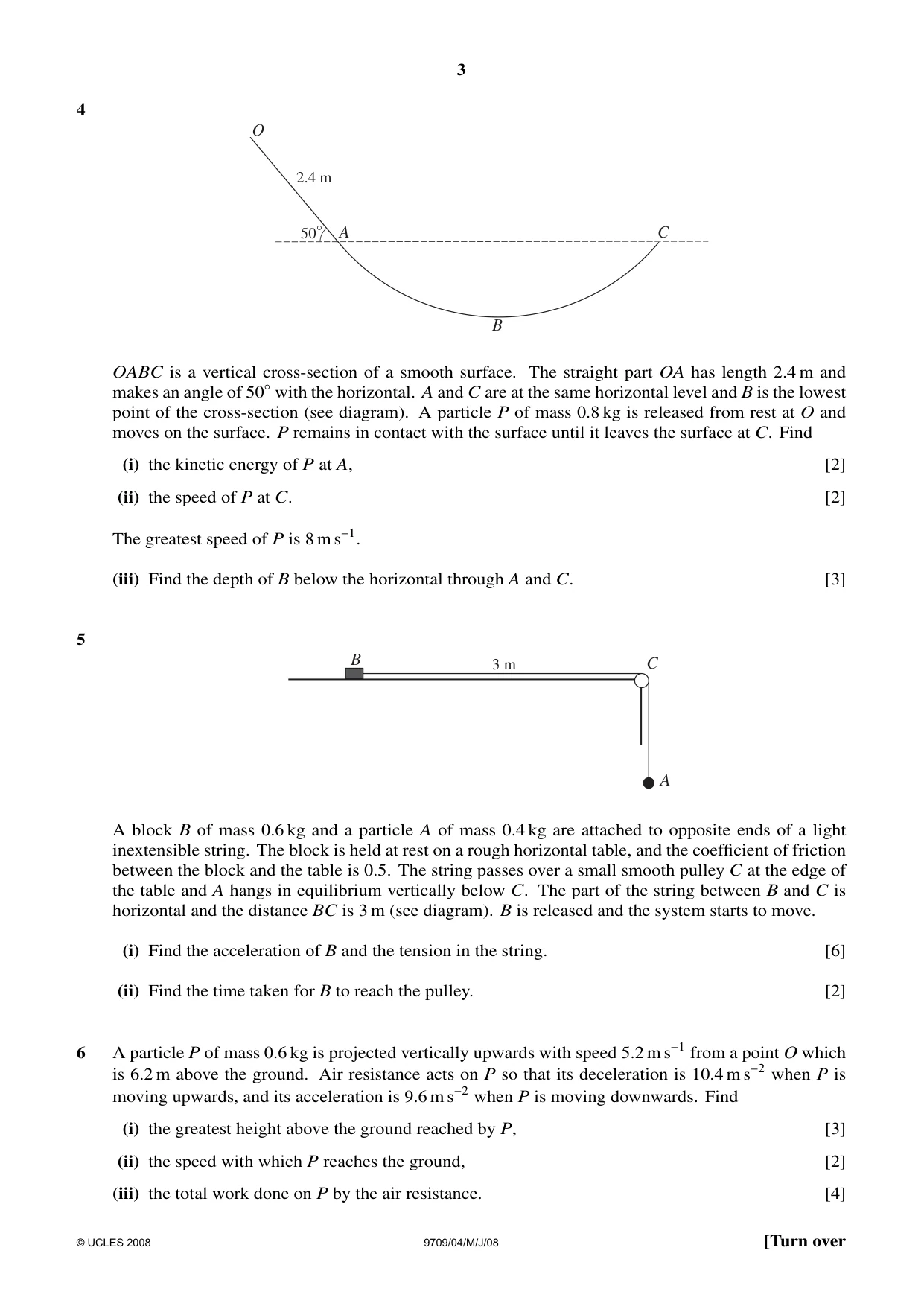
4 O 2.4 m 50° A C B OABC is a vertical cross-section of a smooth surface. The straight part OA has length 2.4 m and makes an angle of 50◦with the horizontal. A and C are at the same horizontal level and B is the lowest point of the cross-section (see diagram). A particle P of mass 0.8 kg is released from rest at O and moves on the surface. P remains in contact with the surface until it leaves the surface at C. Find (i) the kinetic energy of P at A, [2] (ii) the speed of P at C. [2] The greatest speed of P is 8 m s−1. (iii) Find the depth of B below the horizontal through A and C. [3]
Mark scheme: 4 (i) [KE = Loss of PE = 0.8g(2.4sin50o), For using KE = PE loss = mgh or KE = ½ 0.8 x 2(gsin50o)2.4] M1 KE = ½ mv2 and v2 = 2as Kinetic energy at A is 14.7J A1 [2] (ii) [14.7 = ½ mv2] M1 For using KE at C = KE at A = ½ mv2 Speed at C is 6.06ms-1 A1ft [2] ft v = (2.5 KE)½ (iii) [½ m82 = mgH, ½ m82 – ½ m6.062 = mgh] M1 For using the principle of conservation of energy h = 3.2 – 2.4sin50o or 10h = ½ (82 – 6.062) A1ft ft 10h = ½ (82 – vC2) Depth is 1.36m A1 [3] SR in (iii) (max. mark 1/3) For depth = 1.36 from v2 = u2 + 2gs B1 GCE A/AS LEVEL – May/June 2008 9709 04
Q5 · B 3 m C A A block B of mass 0.6 kg and a particle A of mass 0.4 kg are attached to…
5 B 3 m C A A block B of mass 0.6 kg and a particle A of mass 0.4 kg are attached to opposite ends of a light inextensible string. The block is held at rest on a rough horizontal table, and the coefficient of friction between the block and the table is 0.5. The string passes over a small smooth pulley C at the edge of the table and A hangs in equilibrium vertically below C. The part of the string between B and C is horizontal and the distance BC is 3 m (see diagram). B is released and the system starts to move. (i) Find the acceleration of B and the tension in the string. [6] (ii) Find the time taken for B to reach the pulley. [2]
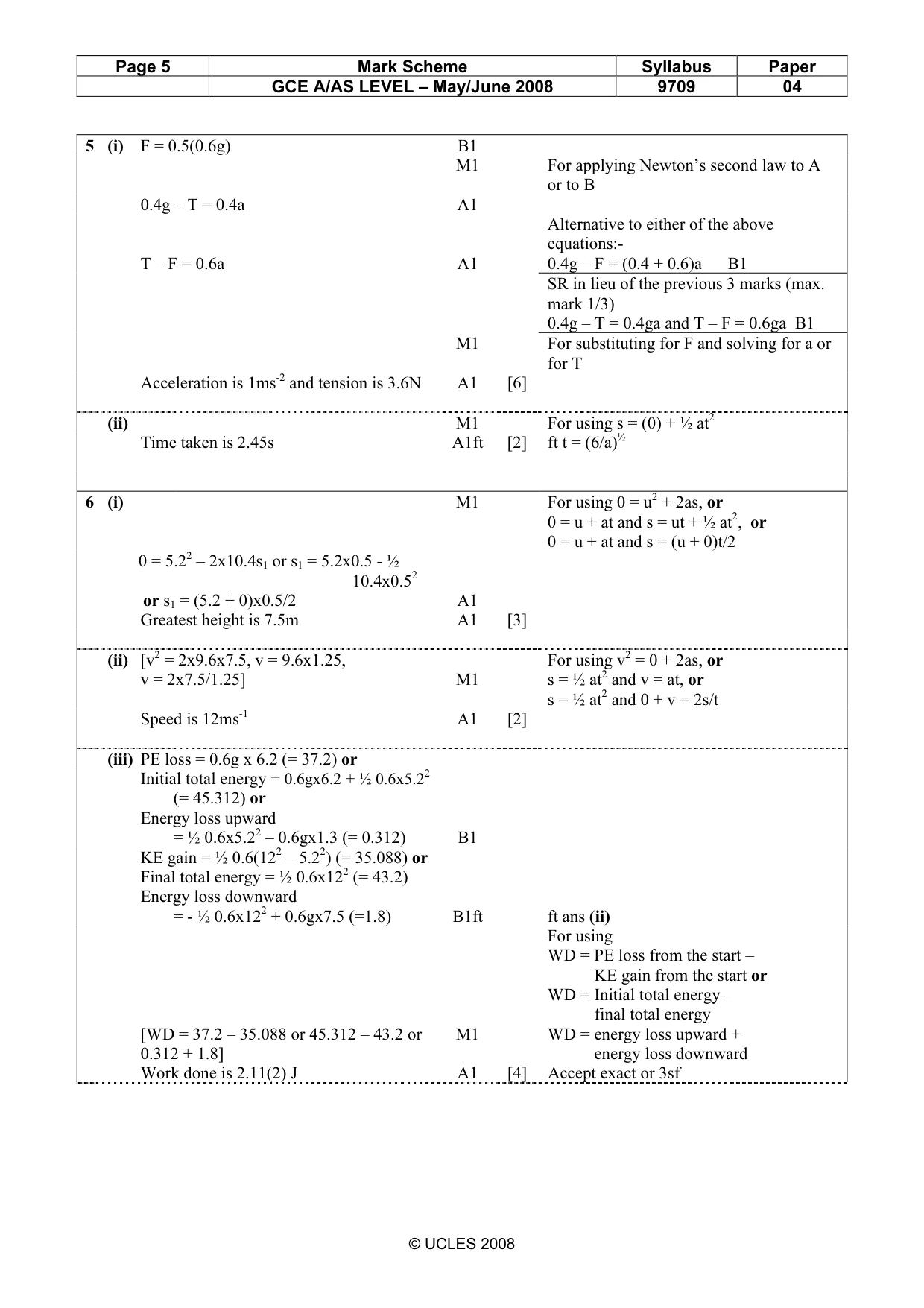
Mark scheme: 5 (i) F = 0.5(0.6g) B1 M1 For applying Newton’s second law to A or to B 0.4g – T = 0.4a A1 Alternative to either of the above equations:- T – F = 0.6a A1 0.4g – F = (0.4 + 0.6)a B1 SR in lieu of the previous 3 marks (max. mark 1/3) 0.4g – T = 0.4ga and T – F = 0.6ga B1 M1 For substituting for F and solving for a or for T Acceleration is 1ms-2 and tension is 3.6N A1 [6] (ii) M1 For using s = (0) + ½ at2 Time taken is 2.45s A1ft [2] ft t = (6/a)½ 2
Q6 · A particle P of mass 0.6 kg is projected vertically upwards with speed 5.2 m s−1 from a…
6 A particle P of mass 0.6 kg is projected vertically upwards with speed 5.2 m s−1 from a point O which is 6.2 m above the ground. Air resistance acts on P so that its deceleration is 10.4 m s−2 when P is moving upwards, and its acceleration is 9.6 m s−2 when P is moving downwards. Find (i) the greatest height above the ground reached by P, [3] (ii) the speed with which P reaches the ground, [2] (iii) the total work done on P by the air resistance. [4]
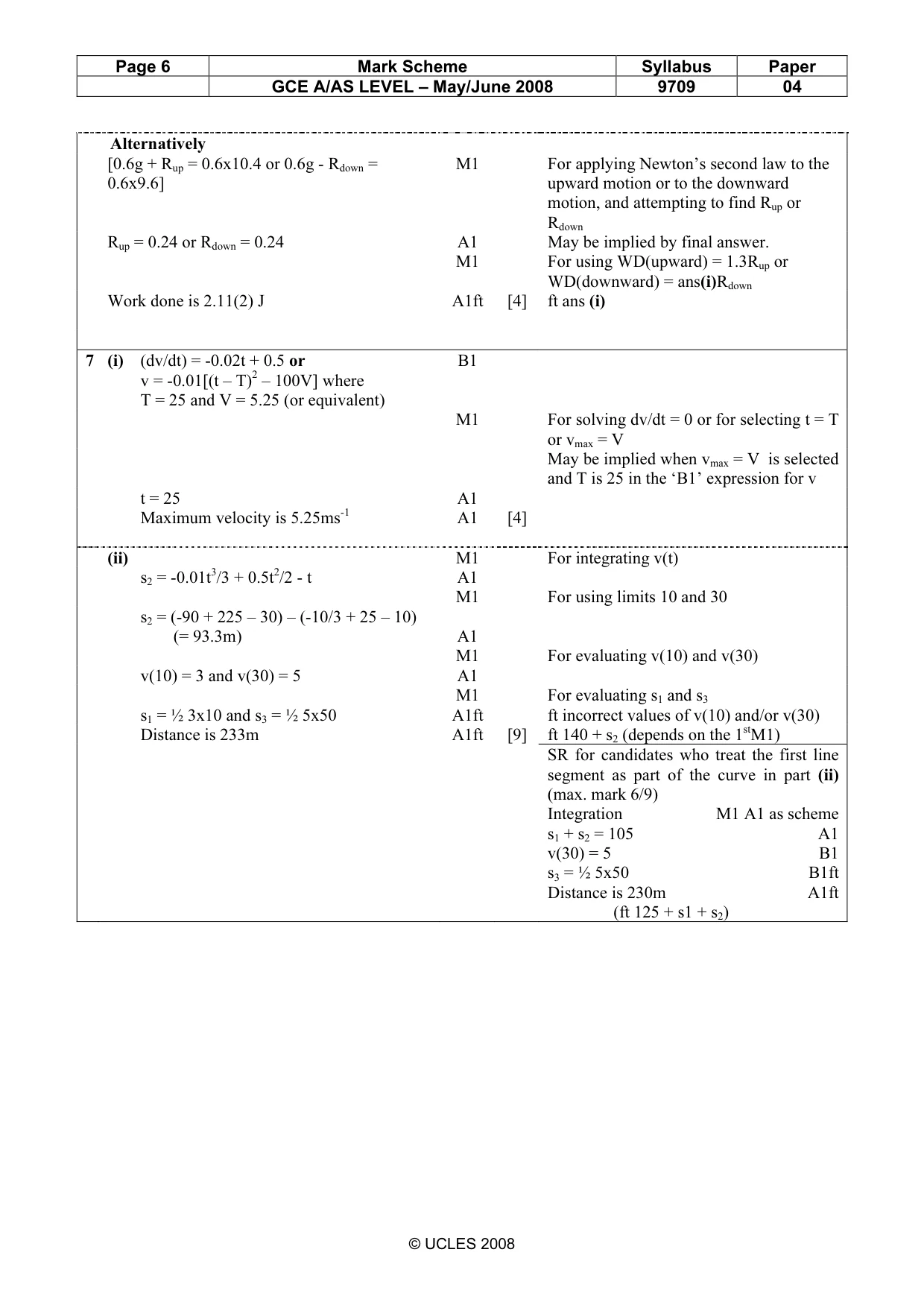
Mark scheme: 6 (i) M1 For using 0 = u2 + 2as, or 0 = u + at and s = ut + ½ at2, or 0 = u + at and s = (u + 0)t/2 0 = 5.22 – 2x10.4s1 or s1 = 5.2x0.5 - ½ 10.4x0.52 or s1 = (5.2 + 0)x0.5/2 A1 Greatest height is 7.5m A1 [3] (ii) [v2 = 2x9.6x7.5, v = 9.6x1.25, For using v2 = 0 + 2as, or v = 2x7.5/1.25] M1 s = ½ at2 and v = at, or s = ½ at2 and 0 + v = 2s/t Speed is 12ms-1 A1 [2] (iii) PE loss = 0.6g x 6.2 (= 37.2) or Initial total energy = 0.6gx6.2 + ½ 0.6x5.22 (= 45.312) or Energy loss upward = ½ 0.6x5.22 – 0.6gx1.3 (= 0.312) B1 KE gain = ½ 0.6(122 – 5.22) (= 35.088) or Final total energy = ½ 0.6x122 (= 43.2) Energy loss downward = - ½ 0.6x122 + 0.6gx7.5 (=1.8) B1ft ft ans (ii) For using WD = PE loss from the start – KE gain from the start or WD = Initial total energy – final total energy [WD = 37.2 – 35.088 or 45.312 – 43.2 or M1 WD = energy loss upward + 0.312 + 1.8] energy loss downward Work done is 2.11(2) J A1 [4] Accept exact or 3sf GCE A/AS LEVEL – May/June 2008 9709 04 Alternatively [0.6g + Rup = 0.6x10.4 or 0.6g - Rdown = M1 For applying Newton’s second law to the 0.6x9.6] upward motion or to the downward motion, and attempting to find Rup or Rdown Rup = 0.24 or Rdown = 0.24 A1 May be implied by final answer. M1 For using WD(upward) = 1.3Rup or WD(downward) = ans(i)Rdown Work done is 2.11(2) J A1ft [4] ft ans (i)
Q7 · V (m s –1) t (s) O 10 30 80 An object P travels from A to B in a time of 80 s
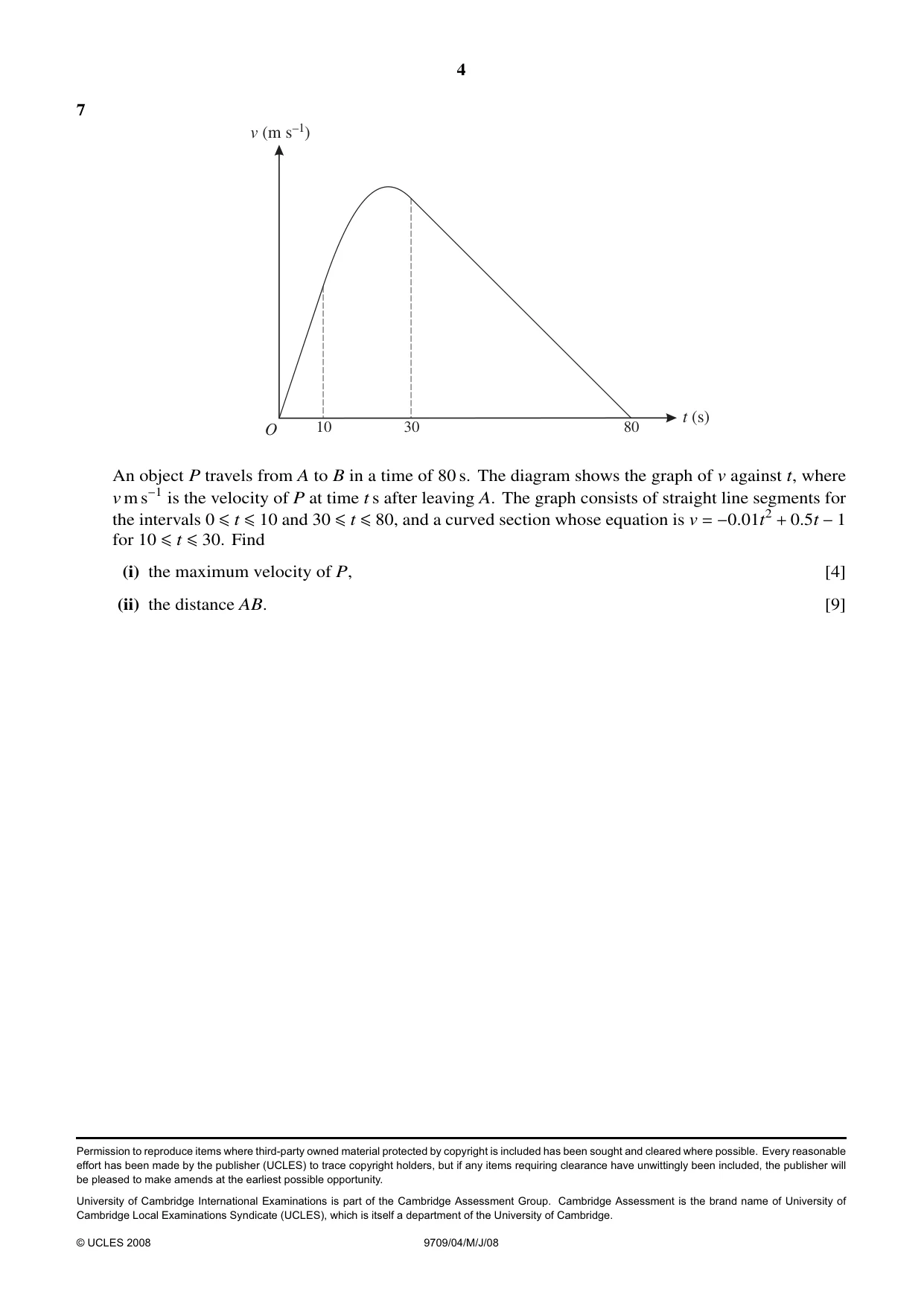
7 v (m s –1) t (s) O 10 30 80 An object P travels from A to B in a time of 80 s. The diagram shows the graph of v against t, where v m s−1 is the velocity of P at time t s after leaving A. The graph consists of straight line segments for the intervals 0 ≤t ≤10 and 30 ≤t ≤80, and a curved section whose equation is v = −0.01t2 + 0.5t −1 for 10 ≤t ≤30. Find (i) the maximum velocity of P, [4] (ii) the distance AB. [9]
Mark scheme: 7 (i) (dv/dt) = -0.02t + 0.5 or B1 v = -0.01[(t – T)2 – 100V] where T = 25 and V = 5.25 (or equivalent) M1 For solving dv/dt = 0 or for selecting t = T or vmax = V May be implied when vmax = V is selected and T is 25 in the ‘B1’ expression for v t = 25 A1 Maximum velocity is 5.25ms-1 A1 [4] (ii) M1 For integrating v(t) s2 = -0.01t3/3 + 0.5t2/2 - t A1 M1 For using limits 10 and 30 s2 = (-90 + 225 – 30) – (-10/3 + 25 – 10) (= 93.3m) A1 M1 For evaluating v(10) and v(30) v(10) = 3 and v(30) = 5 A1 M1 For evaluating s1 and s3 s1 = ½ 3x10 and s3 = ½ 5x50 A1ft ft incorrect values of v(10) and/or v(30) Distance is 233m A1ft [9] ft 140 + s2 (depends on the 1stM1) SR for candidates who treat the first line segment as part of the curve in part (ii) (max. mark 6/9) Integration M1 A1 as scheme s1 + s2 = 105 A1 v(30) = 5 B1 s3 = ½ 5x50 B1ft Distance is 230m A1ft (ft 125 + s1 + s2)
What was in this paper
The subtopics covered by these 7 questions, and how many questions each got. Open one in a new tab to see every Cambridge question on it.
What you needed in this session
Cambridge’s own grade thresholds for 2008 May/June, Paper 4 · Variant 1. A higher threshold means an easier paper — the bar moves with how the cohort did.