Cambridge A Level Mathematics 9709 — 2016 Feb/March Paper 4 · Variant 2
9709/42/F/M/16 · 7 questions · 50 marks · ≈56 min
The question paper and its mark scheme, free to read here and free to download. This is Cambridge’s own paper, exactly as it was sat.
Question paper4 pages
Mark scheme8 pages
Answers below. Sit the paper first if you are practising.
Questions as text
Q1 · A cyclist has mass 85 kg and rides a bicycle of mass 20 kg
1 A cyclist has mass 85 kg and rides a bicycle of mass 20 kg. The cyclist rides along a horizontal road against a total resistance force of 40 N. Find the total work done by the cyclist in increasing his speed from 5 m s−1 to 10 m s−1 while travelling a distance of 50 m. [3]
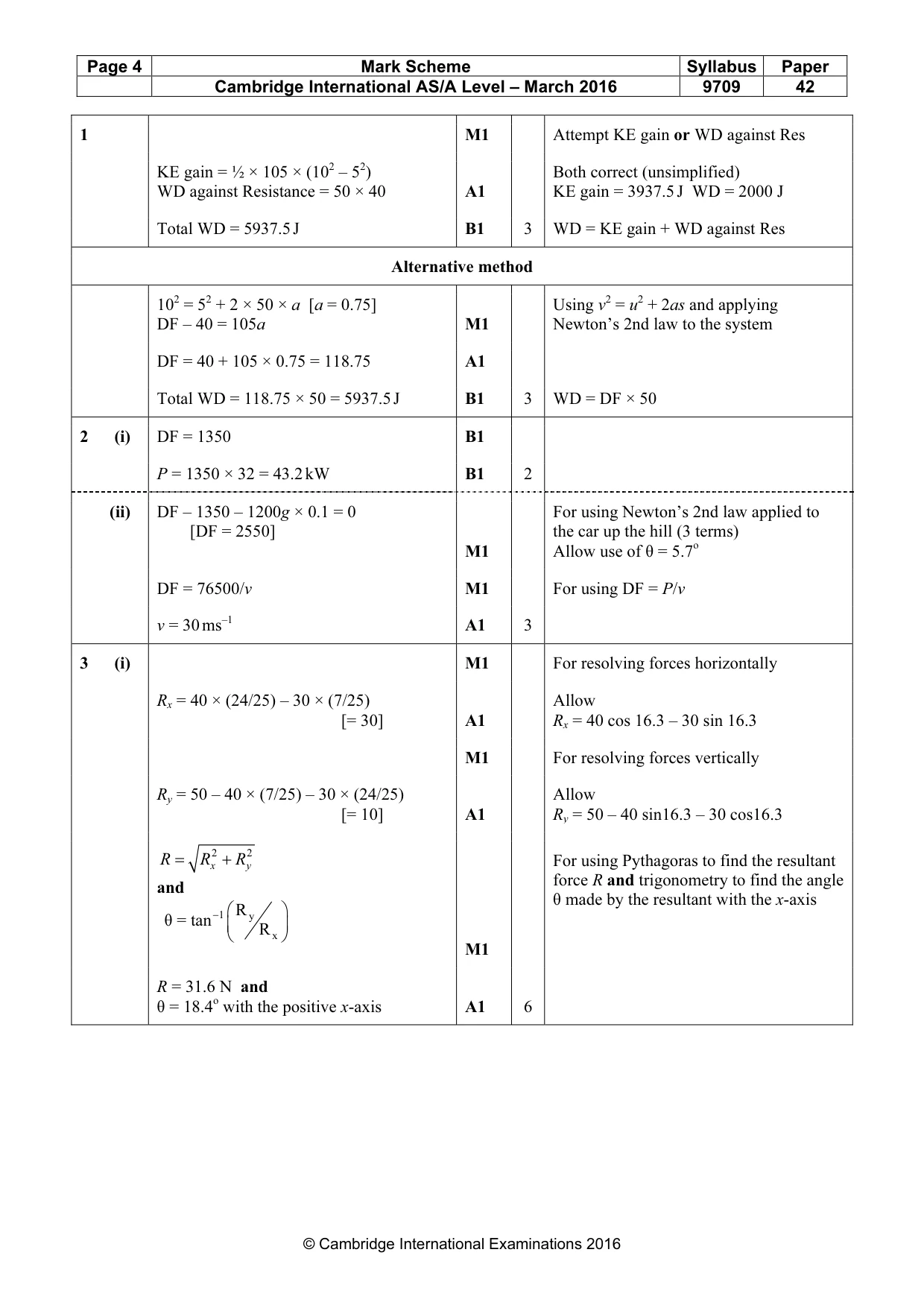
Mark scheme: 1 M1 Attempt KE gain or WD against Res KE gain = ½ × 105 × (102 – 52) Both correct (unsimplified) WD against Resistance = 50 × 40 A1 KE gain = 3937.5 J WD = 2000 J Total WD = 5937.5 J B1 3 WD = KE gain + WD against Res Alternative method 102 = 52 + 2 × 50 × a [a = 0.75] Using v2 = u2 + 2as and applying DF – 40 = 105a M1 Newton’s 2nd law to the system DF = 40 + 105 × 0.75 = 118.75 A1 Total WD = 118.75 × 50 = 5937.5 J B1 3 WD = DF × 50
Q2 · A constant resistance of magnitude 1350 N acts on a car of mass 1200 kg
2 A constant resistance of magnitude 1350 N acts on a car of mass 1200 kg. (i) The car is moving along a straight level road at a constant speed of 32 m s−1. Find, in kW, the rate at which the engine of the car is working. [2] (ii) The car travels at a constant speed up a hill inclined at an angle of 1 to the horizontal, where sin 1 = 0.1, with the engine working at 76.5 kW. Find this speed. [3]
Mark scheme: 2 (i) DF = 1350 B1 P = 1350 × 32 = 43.2 kW B1 2 (ii) DF – 1350 – 1200g × 0.1 = 0 For using Newton’s 2nd law applied to [DF = 2550] the car up the hill (3 terms) M1 Allow use of θ = 5.7o DF = 76500/v M1 For using DF = P/v v = 30 ms–1 A1 3
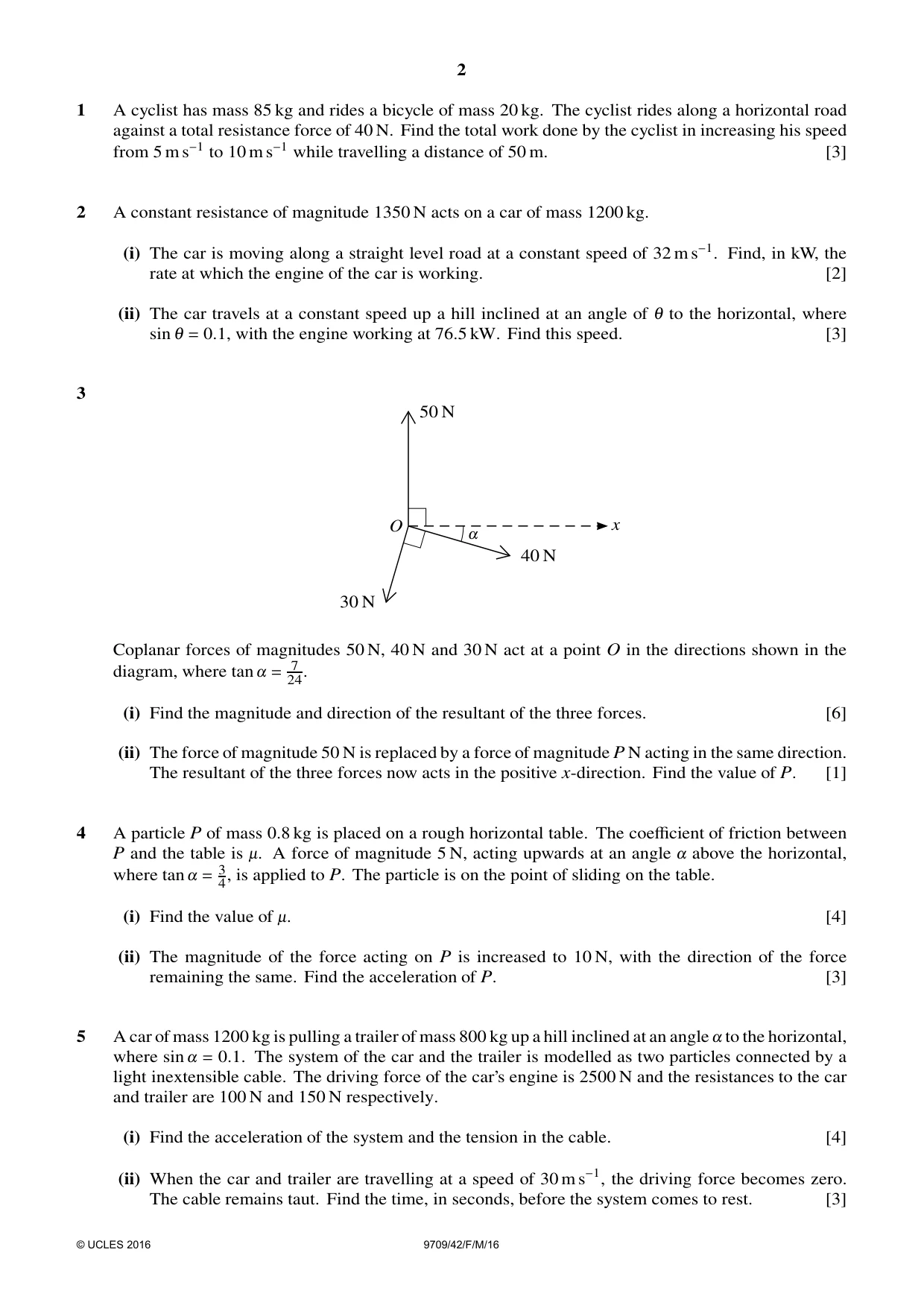
Q3 · 50 N O x !
3 50 N O x ! 40 N 30 N Coplanar forces of magnitudes 50 N, 40 N and 30 N act at a point O in the directions shown in the diagram, where tan ! = 24.7 (i) Find the magnitude and direction of the resultant of the three forces. [6] (ii) The force of magnitude 50 N is replaced by a force of magnitude P N acting in the same direction. The resultant of the three forces now acts in the positive x-direction. Find the value of P. [1]
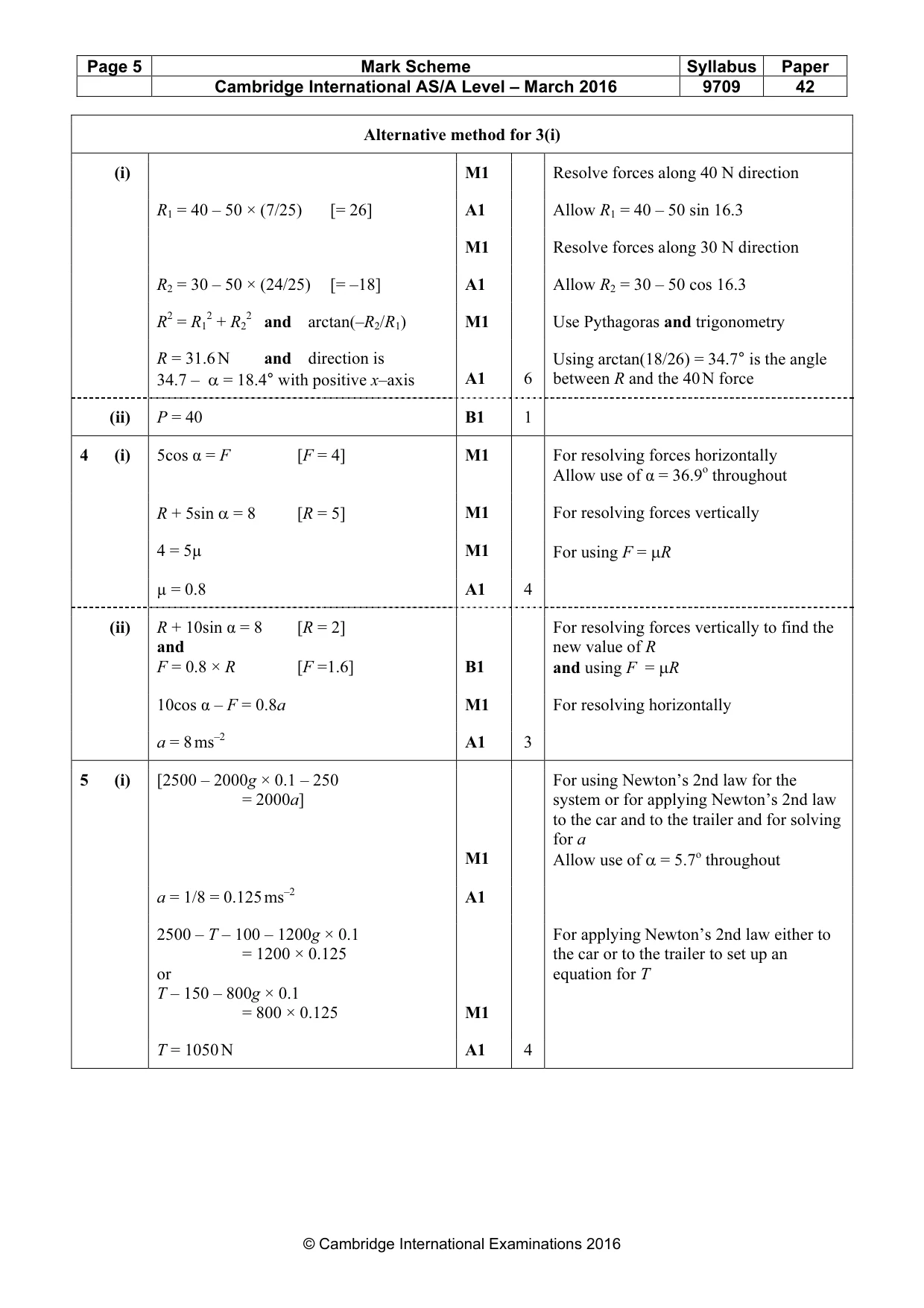
Mark scheme: 3 (i) M1 For resolving forces horizontally Rx = 40 × (24/25) – 30 × (7/25) Allow [= 30] A1 Rx = 40 cos 16.3 – 30 sin 16.3 M1 For resolving forces vertically Ry = 50 – 40 × (7/25) – 30 × (24/25) Allow [= 10] A1 Ry = 50 – 40 sin16.3 – 30 cos16.3 R = Rx2 + R y2 For using Pythagoras to find the resultant and force R and trigonometry to find the angle θ made by the resultant with the x-axis −1 R y θ = tan R x M1 R = 31.6 N and θ = 18.4o with the positive x-axis A1 6 Alternative method for 3(i) (i) M1 Resolve forces along 40 N direction R1 = 40 – 50 × (7/25) [= 26] A1 Allow R1 = 40 – 50 sin 16.3 M1 Resolve forces along 30 N direction R2 = 30 – 50 × (24/25) [= –18] A1 Allow R2 = 30 – 50 cos 16.3 R2 = R12 + R22 and arctan(–R2/R1) M1 Use Pythagoras and trigonometry R = 31.6 N and direction is Using arctan(18/26) = 34.7° is the angle 34.7 – α = 18.4° with positive x–axis A1 6 between R and the 40 N force (ii) P = 40 B1 1
Q4 · A particle P of mass 0.8 kg is placed on a rough horizontal table
4 A particle P of mass 0.8 kg is placed on a rough horizontal table. The coefficient of friction between P and the table is -. A force of magnitude 5 N, acting upwards at an angle ! above the horizontal, where tan ! = 34, is applied to P. The particle is on the point of sliding on the table. (i) Find the value of -. [4] (ii) The magnitude of the force acting on P is increased to 10 N, with the direction of the force remaining the same. Find the acceleration of P. [3]
Mark scheme: 4 (i) 5cos α = F [F = 4] M1 For resolving forces horizontally Allow use of α = 36.9o throughout R + 5sin α = 8 [R = 5] M1 For resolving forces vertically 4 = 5µ M1 For using F = µR µ = 0.8 A1 4 (ii) R + 10sin α = 8 [R = 2] For resolving forces vertically to find the and new value of R F = 0.8 × R [F =1.6] B1 and using F = µR 10cos α – F = 0.8a M1 For resolving horizontally a = 8 ms–2 A1 3
Q5 · A car of mass 1200 kg is pulling a trailer of mass 800 kg up a hill inclined at an angle !
5 A car of mass 1200 kg is pulling a trailer of mass 800 kg up a hill inclined at an angle ! to the horizontal, where sin ! = 0.1. The system of the car and the trailer is modelled as two particles connected by a light inextensible cable. The driving force of the car’s engine is 2500 N and the resistances to the car and trailer are 100 N and 150 N respectively. (i) Find the acceleration of the system and the tension in the cable. [4] (ii) When the car and trailer are travelling at a speed of 30 m s−1, the driving force becomes zero. The cable remains taut. Find the time, in seconds, before the system comes to rest. [3]
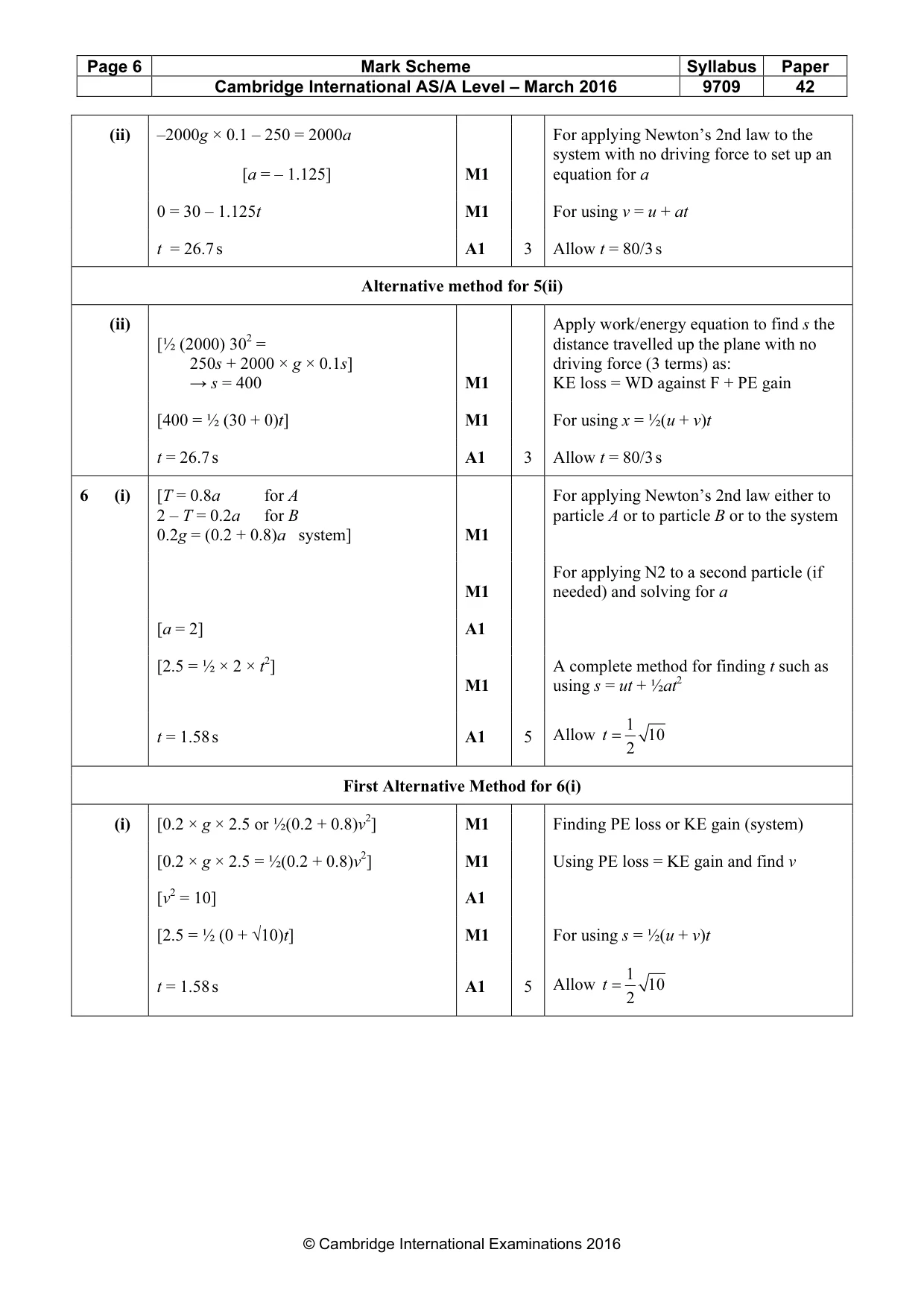
Mark scheme: 5 (i) [2500 – 2000g × 0.1 – 250 For using Newton’s 2nd law for the = 2000a] system or for applying Newton’s 2nd law to the car and to the trailer and for solving for a M1 Allow use of α = 5.7o throughout a = 1/8 = 0.125 ms–2 A1 2500 – T – 100 – 1200g × 0.1 For applying Newton’s 2nd law either to = 1200 × 0.125 the car or to the trailer to set up an or equation for T T – 150 – 800g × 0.1 = 800 × 0.125 M1 T = 1050 N A1 4 (ii) –2000g × 0.1 – 250 = 2000a For applying Newton’s 2nd law to the system with no driving force to set up an [a = – 1.125] M1 equation for a 0 = 30 – 1.125t M1 For using v = u + at t = 26.7 s A1 3 Allow t = 80/3 s Alternative method for 5(ii) (ii) Apply work/energy equation to find s the [½ (2000) 302 = distance travelled up the plane with no 250s + 2000 × g × 0.1s] driving force (3 terms) as: → s = 400 M1 KE loss = WD against F + PE gain [400 = ½ (30 + 0)t] M1 For using x = ½(u + v)t t = 26.7 s A1 3 Allow t = 80/3 s
Q6 · Two particles A and B, of masses 0.8 kg and 0.2 kg respectively, are connected by a light…
6 Two particles A and B, of masses 0.8 kg and 0.2 kg respectively, are connected by a light inextensible string. Particle A is placed on a horizontal surface. The string passes over a small smooth pulley P fixed at the edge of the surface, and B hangs freely. The horizontal section of the string, AP, is of length 2.5 m. The particles are released from rest with both sections of the string taut. (i) Given that the surface is smooth, find the time taken for A to reach the pulley. [5] (ii) Given instead that the surface is rough and the coefficient of friction between A and the surface is 0.1, find the speed of A immediately before it reaches the pulley. [5]
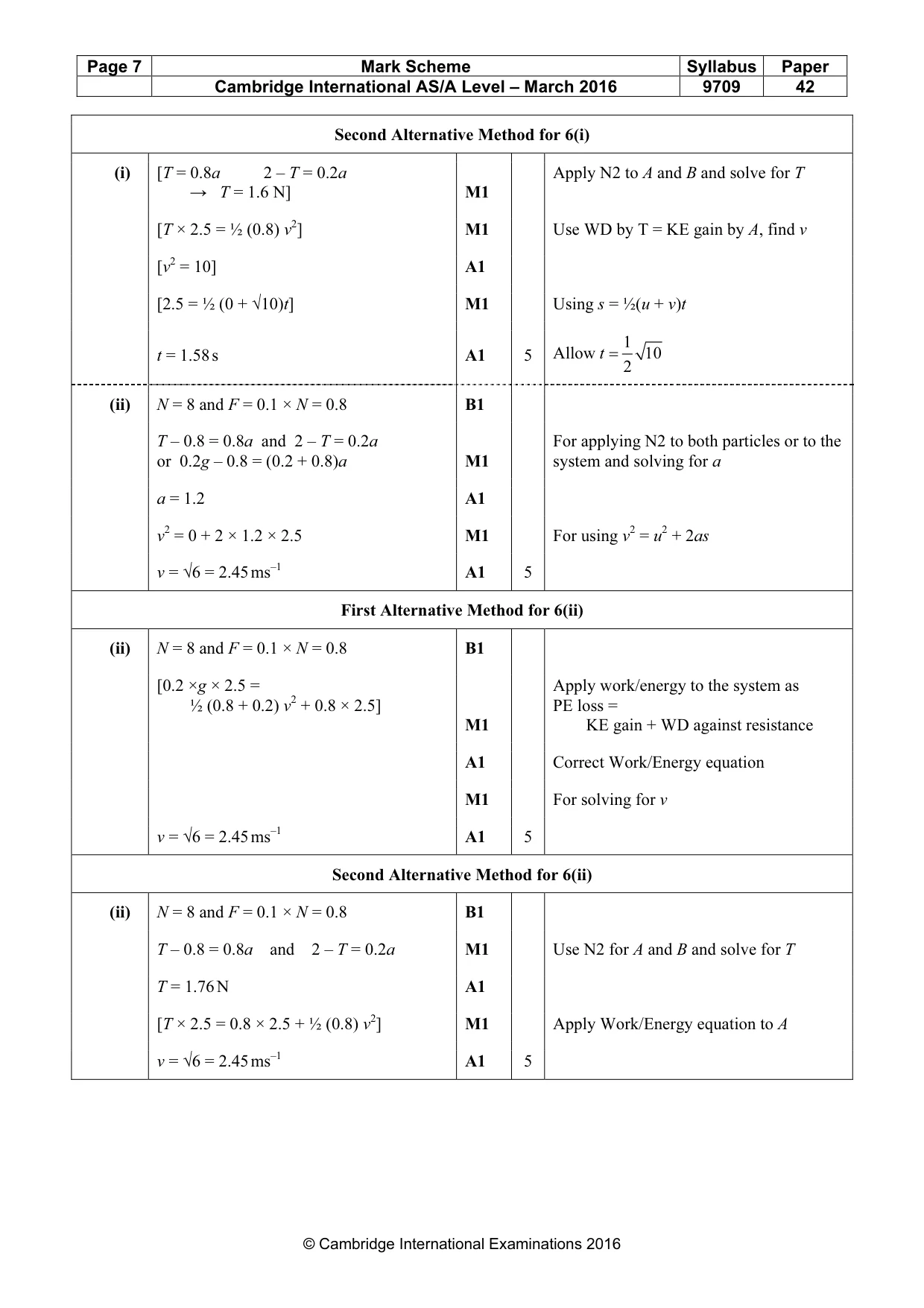
Mark scheme: 6 (i) [T = 0.8a for A For applying Newton’s 2nd law either to 2 – T = 0.2a for B particle A or to particle B or to the system 0.2g = (0.2 + 0.8)a system] M1 For applying N2 to a second particle (if M1 needed) and solving for a [a = 2] A1 [2.5 = ½ × 2 × t2] A complete method for finding t such as M1 using s = ut + ½at2 1 t = 1.58 s A1 5 Allow t = 10 2 First Alternative Method for 6(i) (i) [0.2 × g × 2.5 or ½(0.2 + 0.8)v2] M1 Finding PE loss or KE gain (system) [0.2 × g × 2.5 = ½(0.2 + 0.8)v2] M1 Using PE loss = KE gain and find v [v2 = 10] A1 [2.5 = ½ (0 + √10)t] M1 For using s = ½(u + v)t 1 t = 1.58 s A1 5 Allow t = 10 2 Second Alternative Method for 6(i) (i) [T = 0.8a 2 – T = 0.2a Apply N2 to A and B and solve for T → T = 1.6 N] M1 [T × 2.5 = ½ (0.8) v2] M1 Use WD by T = KE gain by A, find v [v2 = 10] A1 [2.5 = ½ (0 + √10)t] M1 Using s = ½(u + v)t 1 t = 1.58 s A1 5 Allow t = 10 2 (ii) N = 8 and F = 0.1 × N = 0.8 B1 T – 0.8 = 0.8a and 2 – T = 0.2a For applying N2 to both particles or to the or 0.2g – 0.8 = (0.2 + 0.8)a M1 system and solving for a a = 1.2 A1 v2 = 0 + 2 × 1.2 × 2.5 M1 For using v2 = u2 + 2as v = √6 = 2.45 ms–1 A1 5 First Alternative Method for 6(ii) (ii) N = 8 and F = 0.1 × N = 0.8 B1 [0.2 ×g × 2.5 = Apply work/energy to the system as ½ (0.8 + 0.2) v2 + 0.8 × 2.5] PE loss = M1 KE gain + WD against resistance A1 Correct Work/Energy equation M1 For solving for v v = √6 = 2.45 ms–1 A1 5 Second Alternative Method for 6(ii) (ii) N = 8 and F = 0.1 × N = 0.8 B1 T – 0.8 = 0.8a and 2 – T = 0.2a M1 Use N2 for A and B and solve for T T = 1.76 N A1 [T × 2.5 = 0.8 × 2.5 + ½ (0.8) v2] M1 Apply Work/Energy equation to A v = √6 = 2.45 ms–1 A1 5
Q7 · A particle P moves in a straight line
7 A particle P moves in a straight line. The velocity v m s−1 at time t s is given by v = 5t t −2 for 0 ≤t ≤4, v = k for 4 ≤t ≤14, v = 68 −2t for 14 ≤t ≤20, where k is a constant. (i) Find k. [1] (ii) Sketch the velocity-time graph for 0 ≤t ≤20. [3] (iii) Find the set of values of t for which the acceleration of P is positive. [2] (iv) Find the total distance travelled by P in the interval 0 ≤t ≤20. [5]
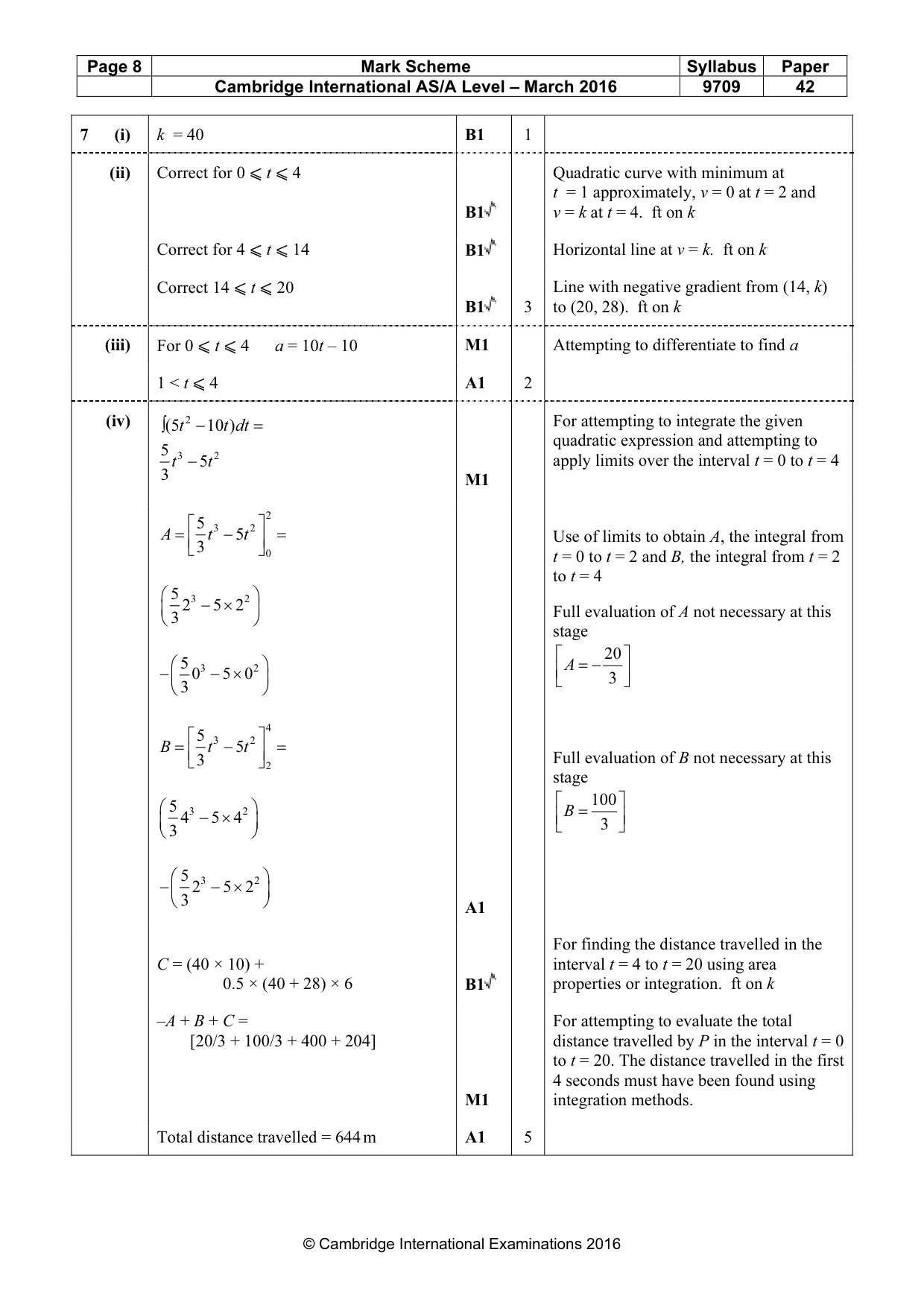
Mark scheme: 7 (i) k = 40 B1 1 (ii) Correct for 0 ⩽ t ⩽ 4 Quadratic curve with minimum at t = 1 approximately, v = 0 at t = 2 and B1 v = k at t = 4. ft on k Correct for 4 ⩽ t ⩽ 14 B1 Horizontal line at v = k. ft on k Correct 14 ⩽ t ⩽ 20 Line with negative gradient from (14, k) B1 3 to (20, 28). ft on k (iii) For 0 ⩽ t ⩽ 4 a = 10t – 10 M1 Attempting to differentiate to find a 1 < t ⩽ 4 A1 2 (iv) ∫ (5t 2 − 10t ) dt = For attempting to integrate the given quadratic expression and attempting to 5 3 2 3t − 5t M1 apply limits over the interval t = 0 to t = 4 2 5 3 2 A = t − 5t = Use of limits to obtain A, the integral from 3 0 t = 0 to t = 2 and B, the integral from t = 2 to t = 4 5 3 2 2 −×5 2 Full evaluation of A not necessary at this 3 stage 20 5 3 2 A = − − 0 −×5 0 3 3 4 5 3 2 B = t − 5t = 3 2 Full evaluation of B not necessary at this stage 100 5 3 2 B = 4 −×5 4 3 3 5 3 2 − 2 −×5 2 3 A1 For finding the distance travelled in the C = (40 × 10) + interval t = 4 to t = 20 using area 0.5 × (40 + 28) × 6 B1 properties or integration. ft on k –A + B + C = For attempting to evaluate the total [20/3 + 100/3 + 400 + 204] distance travelled by P in the interval t = 0 to t = 20. The distance travelled in the first 4 seconds must have been found using M1 integration methods. Total distance travelled = 644 m A1 5
What was in this paper
The subtopics covered by these 7 questions, and how many questions each got. Open one in a new tab to see every Cambridge question on it.
What you needed in this session
Cambridge’s own grade thresholds for 2016 Feb/March, Paper 4 · Variant 2. A higher threshold means an easier paper — the bar moves with how the cohort did.