Cambridge A Level Mathematics 9709 — 2012 Oct/Nov Paper 4 · Variant 2
9709/42/O/N/12 · 7 questions · 50 marks · ≈56 min
The question paper and its mark scheme, free to read here and free to download. This is Cambridge’s own paper, exactly as it was sat.
Question paper4 pages
Mark scheme8 pages
Answers below. Sit the paper first if you are practising.
Questions as text
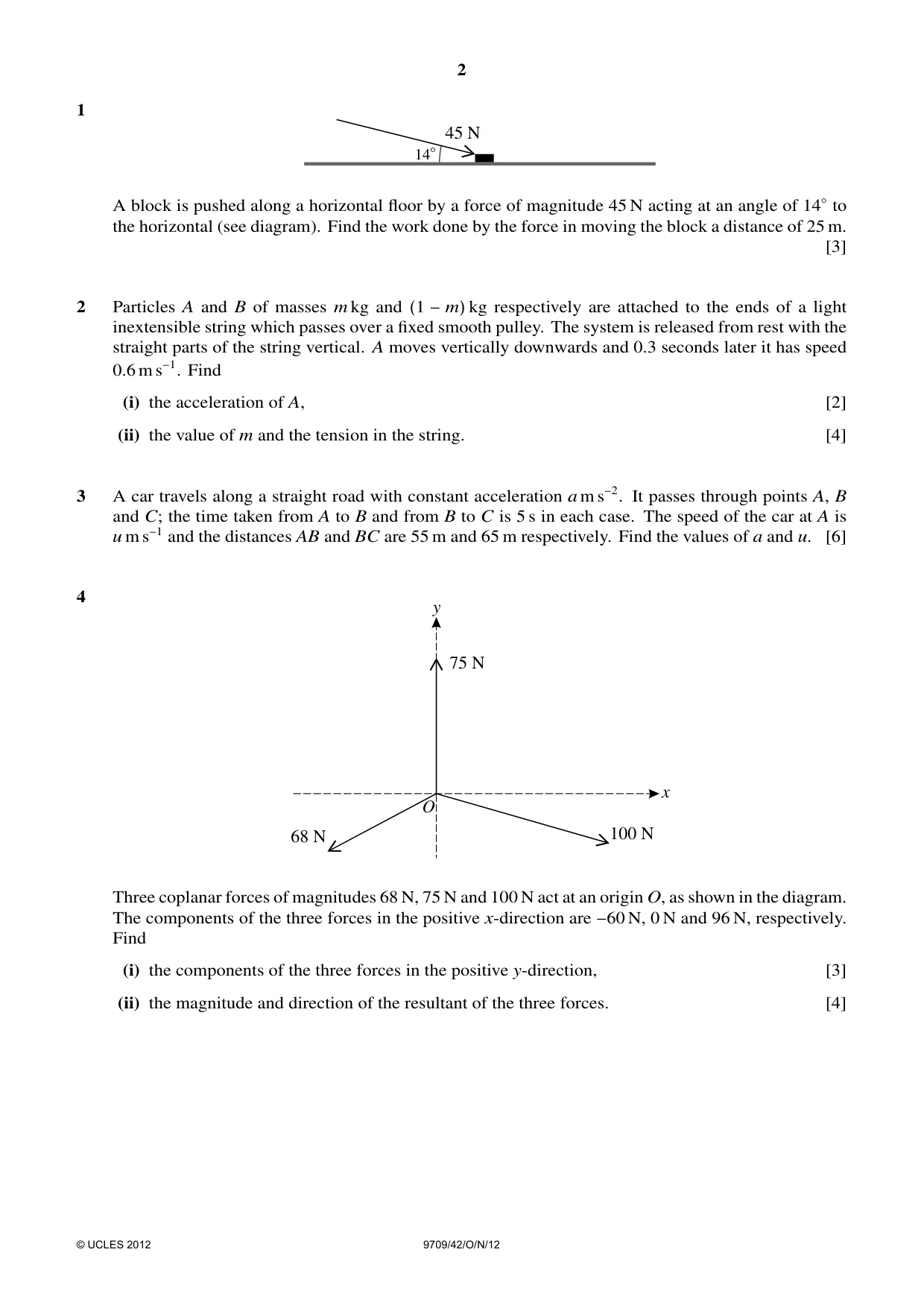
Q1 · 45 N 14° A block is pushed along a horizontal floor by a force of magnitude 45 N acting at…
1 45 N 14° A block is pushed along a horizontal floor by a force of magnitude 45 N acting at an angle of 14◦to the horizontal (see diagram). Find the work done by the force in moving the block a distance of 25 m. [3]
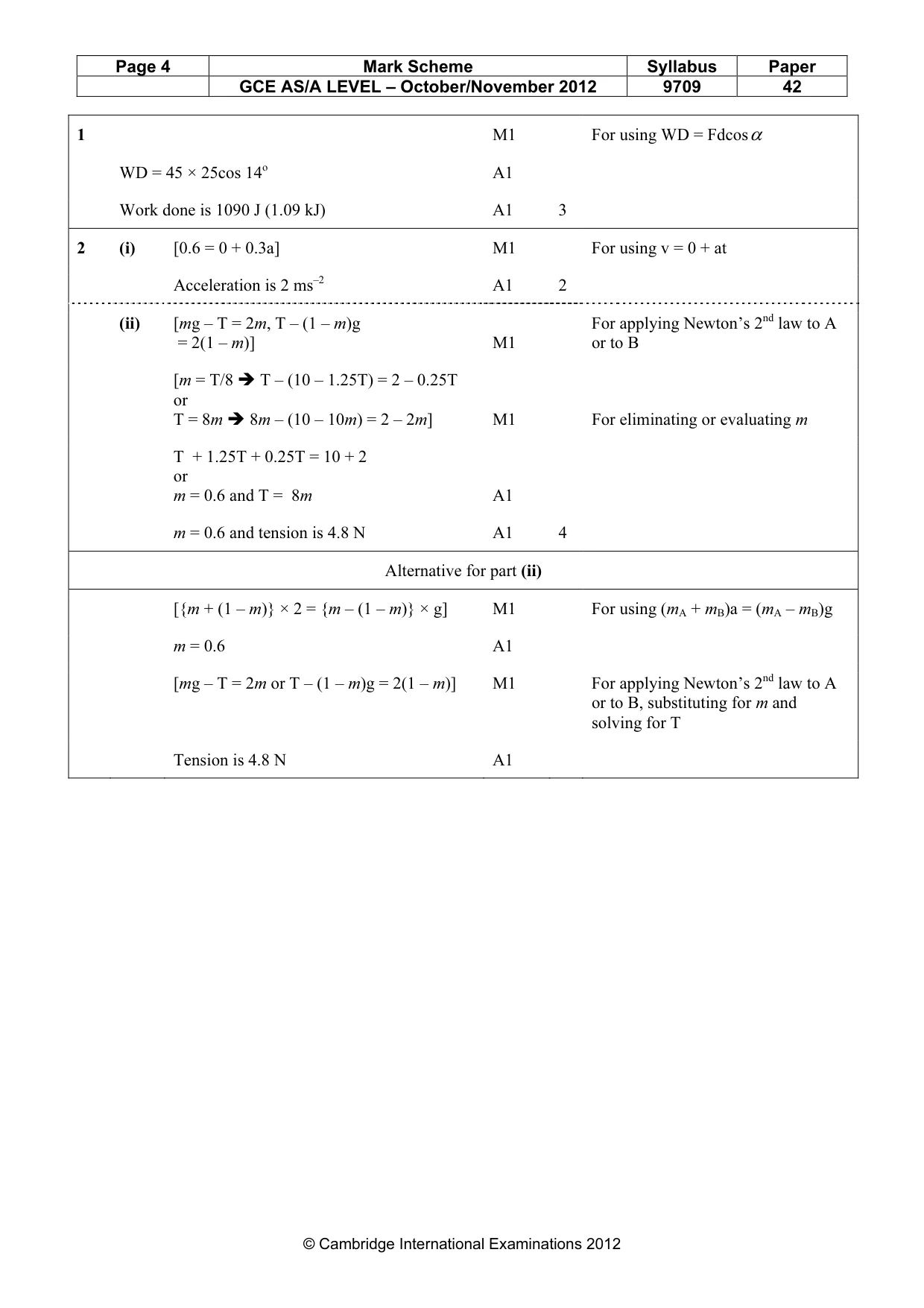
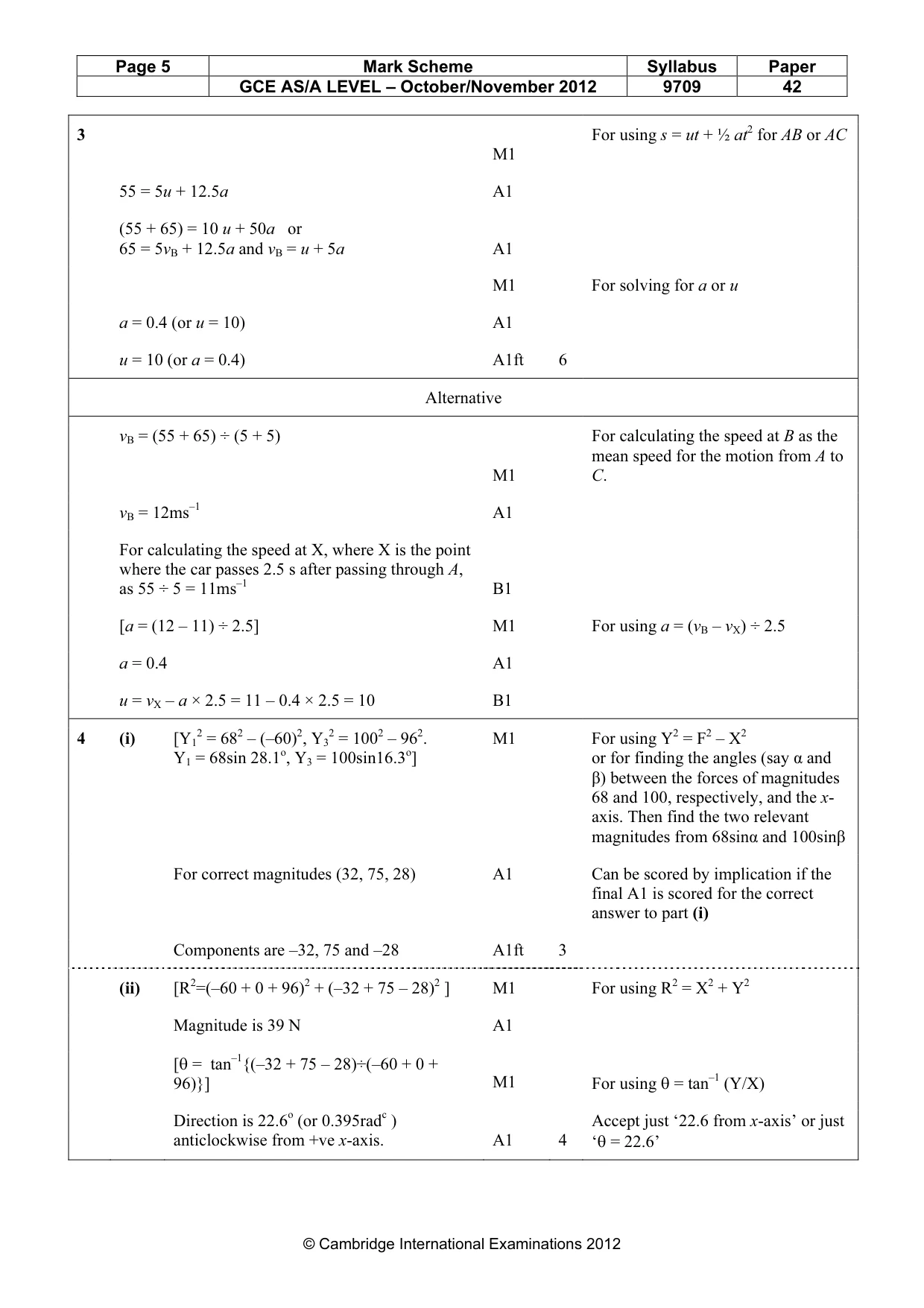
Mark scheme: 1 M1 For using WD = Fdcosα WD = 45 × 25cos 14o A1 Work done is 1090 J (1.09 kJ) A1 3
Q2 · Particles A and B of masses m kg and (1 −m) kg respectively are attached to the ends of a…
2 Particles A and B of masses m kg and (1 −m) kg respectively are attached to the ends of a light inextensible string which passes over a fixed smooth pulley. The system is released from rest with the straight parts of the string vertical. A moves vertically downwards and 0.3 seconds later it has speed 0.6 m s−1. Find (i) the acceleration of A, [2] (ii) the value of m and the tension in the string. [4]
Mark scheme: 2 (i) [0.6 = 0 + 0.3a] M1 For using v = 0 + at Acceleration is 2 ms–2 A1 2 (ii) [mg – T = 2m, T – (1 – m)g For applying Newton’s 2nd law to A = 2(1 – m)] M1 or to B [m = T/8 T – (10 – 1.25T) = 2 – 0.25T or T = 8m 8m – (10 – 10m) = 2 – 2m] M1 For eliminating or evaluating m T + 1.25T + 0.25T = 10 + 2 or m = 0.6 and T = 8m A1 m = 0.6 and tension is 4.8 N A1 4 Alternative for part (ii) [{m + (1 – m)} × 2 = {m – (1 – m)} × g] M1 For using (mA + mB)a = (mA – mB)g m = 0.6 A1 [mg – T = 2m or T – (1 – m)g = 2(1 – m)] M1 For applying Newton’s 2nd law to A or to B, substituting for m and solving for T Tension is 4.8 N A1 GCE AS/A LEVEL – October/November 2012 9709 42 2
Q3 · A car travels along a straight road with constant acceleration am s−2
3 A car travels along a straight road with constant acceleration am s−2. It passes through points A, B and C; the time taken from A to B and from B to C is 5 s in each case. The speed of the car at A is u m s−1 and the distances AB and BC are 55 m and 65 m respectively. Find the values of a and u. [6]
Mark scheme: 3 For using s = ut + ½ at2 for AB or AC M1 55 = 5u + 12.5a A1 (55 + 65) = 10 u + 50a or 65 = 5vB + 12.5a and vB = u + 5a A1 M1 For solving for a or u a = 0.4 (or u = 10) A1 u = 10 (or a = 0.4) A1ft 6 Alternative vB = (55 + 65) ÷ (5 + 5) For calculating the speed at B as the mean speed for the motion from A to M1 C. vB = 12ms–1 A1 For calculating the speed at X, where X is the point where the car passes 2.5 s after passing through A, as 55 ÷ 5 = 11ms–1 B1 [a = (12 – 11) ÷ 2.5] M1 For using a = (vB – vX) ÷ 2.5 a = 0.4 A1 u = vX – a × 2.5 = 11 – 0.4 × 2.5 = 10 B1 2 2 2 2 2 2 2 2 2
Q4 · Y 75 N x O 68 N 100 N Three coplanar forces of magnitudes 68 N, 75 N and 100 N act at an…
4 y 75 N x O 68 N 100 N Three coplanar forces of magnitudes 68 N, 75 N and 100 N act at an origin O, as shown in the diagram. The components of the three forces in the positive x-direction are −60 N, 0 N and 96 N, respectively. Find (i) the components of the three forces in the positive y-direction, [3] (ii) the magnitude and direction of the resultant of the three forces. [4]
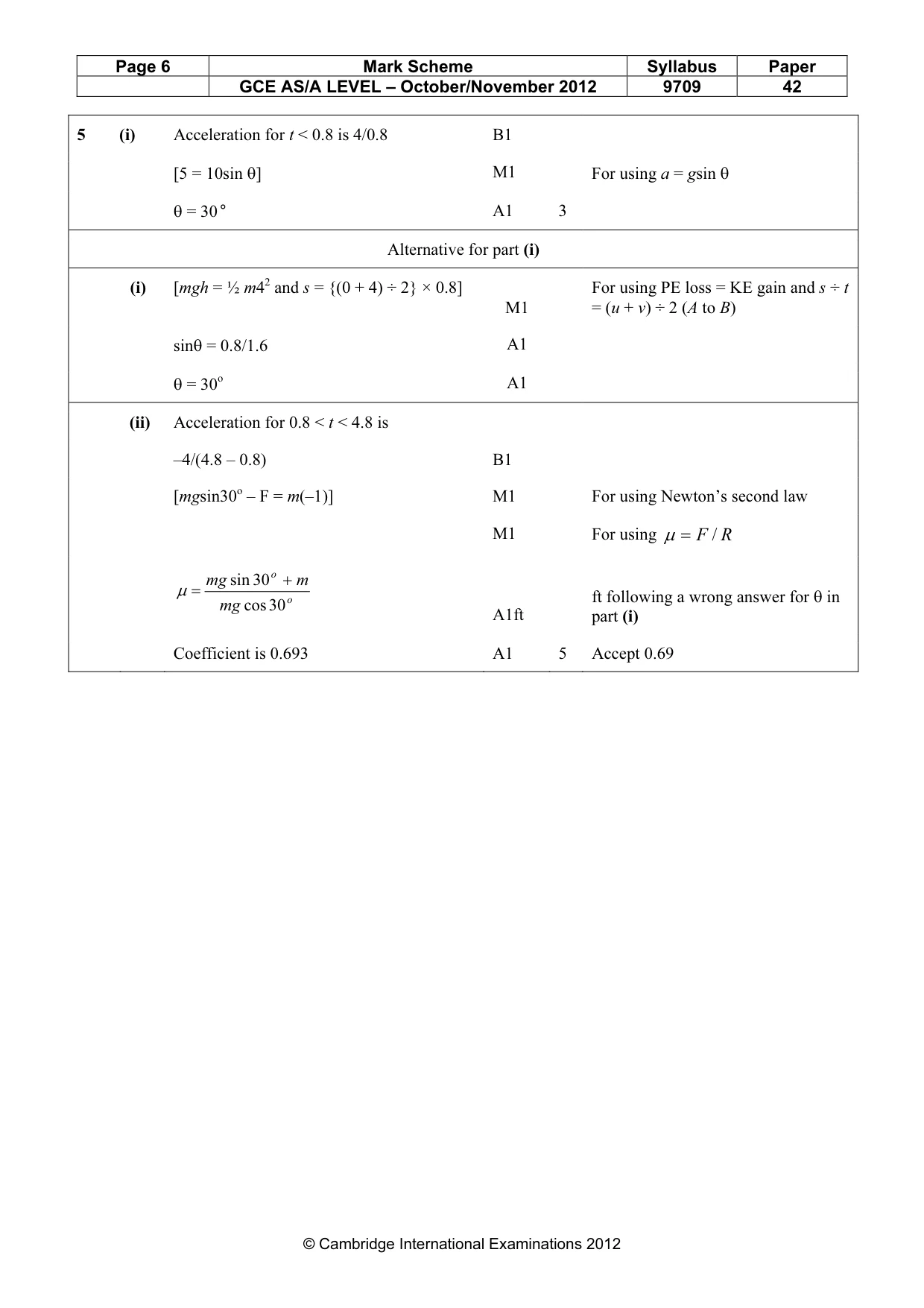
Mark scheme: 2 2 4 (i) [Y1 = 682 – (–60)2, Y3 = 1002 – 962. M1 For using Y2 = F2 – X2 Y1 = 68sin 28.1o, Y3 = 100sin16.3o] or for finding the angles (say α and β) between the forces of magnitudes 68 and 100, respectively, and the x- axis. Then find the two relevant magnitudes from 68sinα and 100sinβ For correct magnitudes (32, 75, 28) A1 Can be scored by implication if the final A1 is scored for the correct answer to part (i) Components are –32, 75 and –28 A1ft 3 (ii) [R2=(–60 + 0 + 96)2 + (–32 + 75 – 28)2 ] M1 For using R2 = X2 + Y2 Magnitude is 39 N A1 [θ = tan–1{(–32 + 75 – 28)÷(–60 + 0 + 96)}] M1 For using θ = tan–1 (Y/X) Direction is 22.6o (or 0.395radc ) Accept just ‘22.6 from x-axis’ or just anticlockwise from +ve x-axis. A1 4 ‘θ = 22.6’ GCE AS/A LEVEL – October/November 2012 9709 42
Q5 · A, B and C are three points on a line of greatest slope of a plane which is inclined at…
5 A, B and C are three points on a line of greatest slope of a plane which is inclined at θ◦to the horizontal, with A higher than B and B higher than C. Between A and B the plane is smooth, and between B and C the plane is rough. A particle P is released from rest on the plane at A and slides down the line ABC. At time 0.8 s after leaving A, the particle passes through B with speed 4 m s−1. (i) Find the value of θ. [3] At time 4.8 s after leaving A, the particle comes to rest at C. (ii) Find the coefficient of friction between P and the rough part of the plane. [5]
Mark scheme: 5 (i) Acceleration for t < 0.8 is 4/0.8 B1 [5 = 10sin θ] M1 For using a = gsin θ θ = 30 ° A1 3 Alternative for part (i) (i) [mgh = ½ m42 and s = {(0 + 4) ÷ 2} × 0.8] For using PE loss = KE gain and s ÷ t M1 = (u + v) ÷ 2 (A to B) sinθ = 0.8/1.6 A1 θ = 30o A1 (ii) Acceleration for 0.8 < t < 4.8 is –4/(4.8 – 0.8) B1 [mgsin30o – F = m(–1)] M1 For using Newton’s second law M1 For using µ = F / R mg sin 30 o + m µ = o ft following a wrong answer for θ in mg cos 30 A1ft part (i) Coefficient is 0.693 A1 5 Accept 0.69 GCE AS/A LEVEL – October/November 2012 9709 42
Q6 · A car of mass 1250 kg moves from the bottom to the top of a straight hill of length 500 m
6 A car of mass 1250 kg moves from the bottom to the top of a straight hill of length 500 m. The top of the hill is 30 m above the level of the bottom. The power of the car’s engine is constant and equal to 30 000 W. The car’s acceleration is 4 m s−2 at the bottom of the hill and is 0.2 m s−2 at the top. The resistance to the car’s motion is 1000 N. Find (i) the car’s gain in kinetic energy, [5] (ii) the work done by the car’s engine. [3]
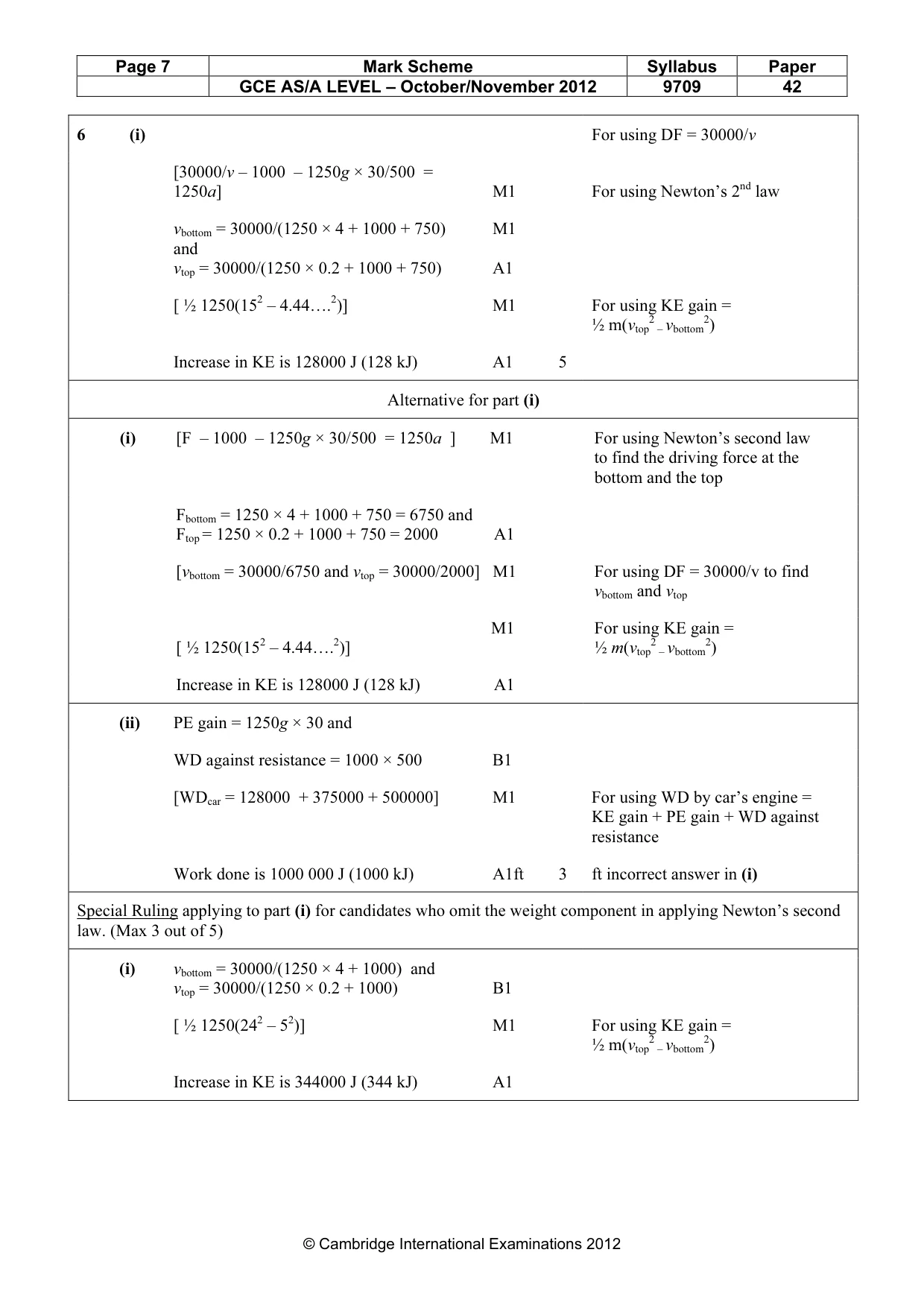
Mark scheme: 6 (i) For using DF = 30000/v [30000/v – 1000 – 1250g × 30/500 = 1250a] M1 For using Newton’s 2nd law vbottom = 30000/(1250 × 4 + 1000 + 750) M1 and vtop = 30000/(1250 × 0.2 + 1000 + 750) A1 [ ½ 1250(152 – 4.44….2)] M1 For using KE gain = 2 ½ m(vtop – vbottom2) Increase in KE is 128000 J (128 kJ) A1 5 Alternative for part (i) (i) [F – 1000 – 1250g × 30/500 = 1250a ] M1 For using Newton’s second law to find the driving force at the bottom and the top Fbottom = 1250 × 4 + 1000 + 750 = 6750 and Ftop = 1250 × 0.2 + 1000 + 750 = 2000 A1 [vbottom = 30000/6750 and vtop = 30000/2000] M1 For using DF = 30000/v to find vbottom and vtop
Q7 · A particle P starts to move from a point O and travels in a straight line
7 A particle P starts to move from a point O and travels in a straight line. The velocity of P is k(60t2 −t3) m s−1 at time t s after leaving O, where k is a constant. The maximum velocity of P is 6.4 m s−1. (i) Show that k = 0.0002. [3] P comes to instantaneous rest at a point A on the line. Find (ii) the distance OA, [5] (iii) the magnitude of the acceleration of P at A, [2] (iv) the speed of P when it subsequently passes through O. [2]
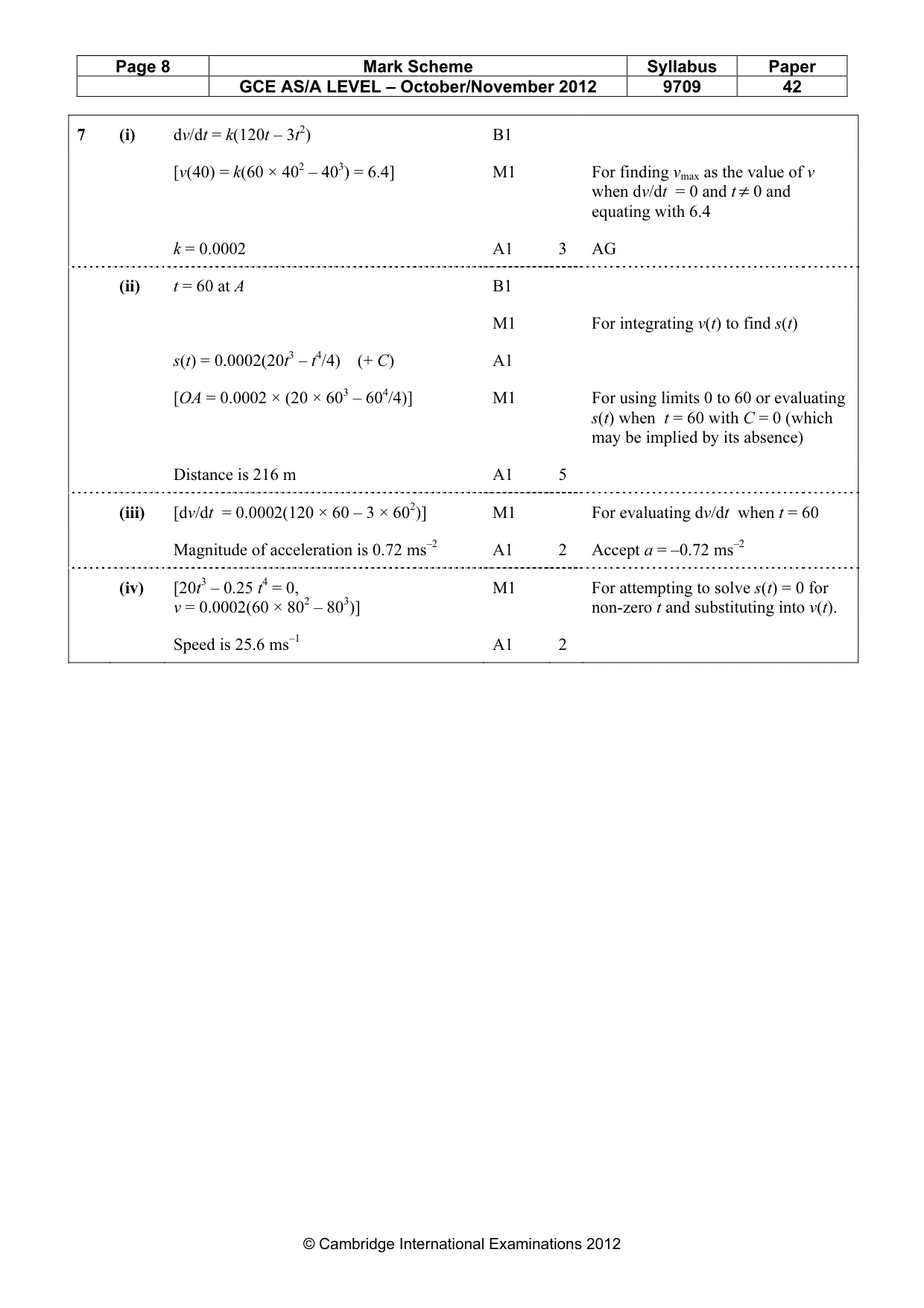
Mark scheme: 7 (i) dv/dt = k(120t – 3t2) B1 [v(40) = k(60 × 402 – 403) = 6.4] M1 For finding vmax as the value of v when dv/dt = 0 and t ≠0 and equating with 6.4 k = 0.0002 A1 3 AG (ii) t = 60 at A B1 M1 For integrating v(t) to find s(t) s(t) = 0.0002(20t3 – t4/4) (+ C) A1 [OA = 0.0002 × (20 × 603 – 604/4)] M1 For using limits 0 to 60 or evaluating s(t) when t = 60 with C = 0 (which may be implied by its absence) Distance is 216 m A1 5 (iii) [dv/dt = 0.0002(120 × 60 – 3 × 602)] M1 For evaluating dv/dt when t = 60 Magnitude of acceleration is 0.72 ms–2 A1 2 Accept a = –0.72 ms–2 (iv) [20t3 – 0.25 t4 = 0, M1 For attempting to solve s(t) = 0 for v = 0.0002(60 × 802 – 803)] non-zero t and substituting into v(t). Speed is 25.6 ms–1 A1 2
What was in this paper
The subtopics covered by these 7 questions, and how many questions each got. Open one in a new tab to see every Cambridge question on it.
What you needed in this session
Cambridge’s own grade thresholds for 2012 Oct/Nov, Paper 4 · Variant 2. A higher threshold means an easier paper — the bar moves with how the cohort did.