Cambridge A Level Mathematics 9709 — 2005 Oct/Nov Paper 4 · Variant 1
9709/41/O/N/05 · 7 questions · 50 marks · ≈56 min
The question paper and its mark scheme, free to read here and free to download. This is Cambridge’s own paper, exactly as it was sat.
Question paper4 pages
Mark scheme6 pages
Answers below. Sit the paper first if you are practising.
Questions as text
Q1 · A car travels in a straight line with constant acceleration a m s−2
1 A car travels in a straight line with constant acceleration a m s−2. It passes the points A, B and C, in this order, with speeds 5 m s−1, 7 m s−1 and 8 m s−1 respectively. The distances AB and BC are d1 m and d2 m respectively. (i) Write down an equation connecting (a) d1 and a, (b) d2 and a. [2] (ii) Hence find d1 in terms of d2. [2]
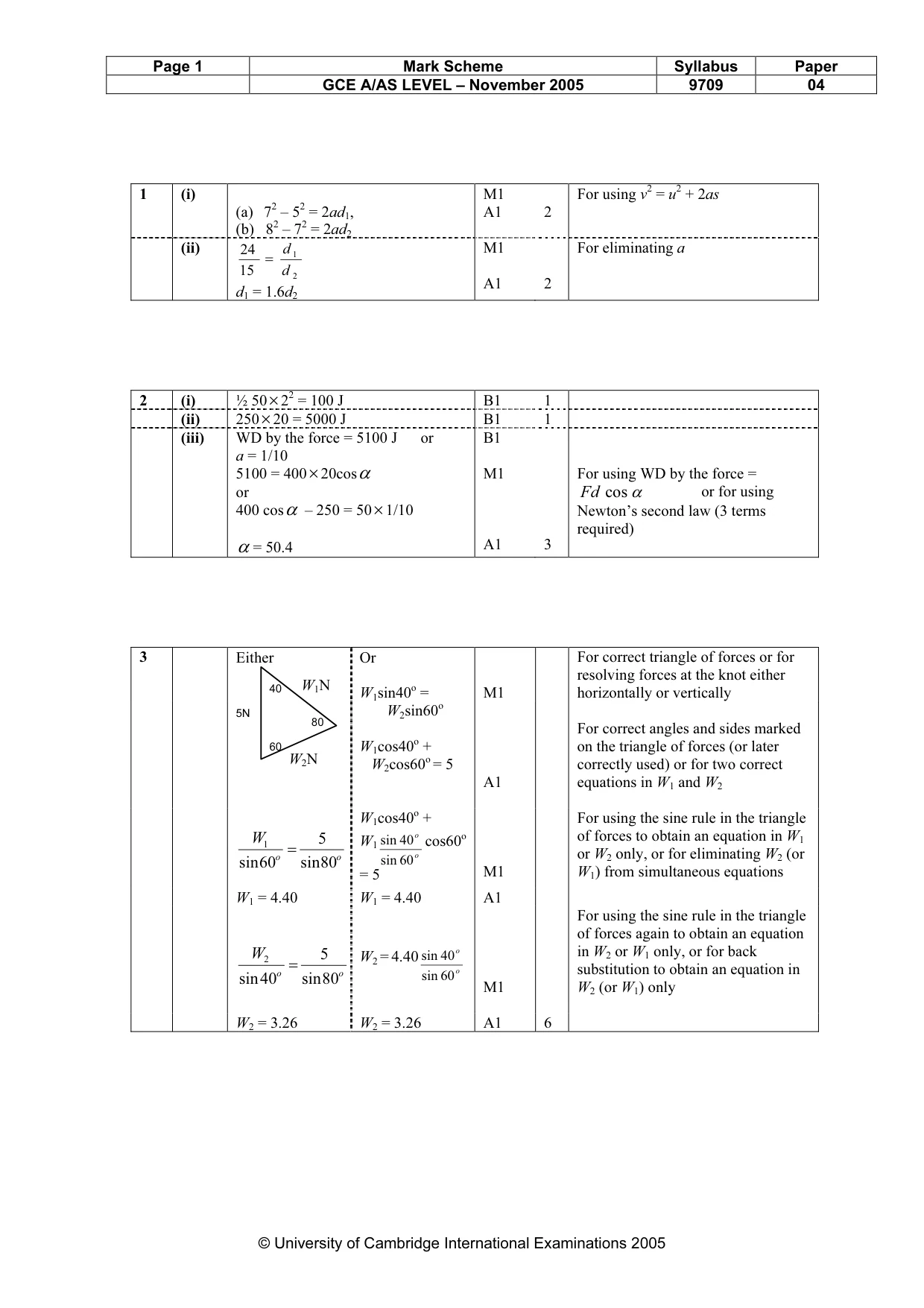
Mark scheme: 1 (i) M1 For using v2 = u2 + 2as (a) 72 – 52 = 2ad1, A1 2 (b) 82 – 72 = 2ad2 (ii) 24 d 1 M1 For eliminating a = 15 d 2 A1 2 d1 = 1.6d2 2
Q2 · A crate of mass 50 kg is dragged along a horizontal floor by a constant force of magnitude…
2 A crate of mass 50 kg is dragged along a horizontal floor by a constant force of magnitude 400 N acting at an angle α◦upwards from the horizontal. The total resistance to motion of the crate has constant magnitude 250 N. The crate starts from rest at the point O and passes the point P with a speed of 2 m s−1. The distance OP is 20 m. For the crate’s motion from O to P, find (i) the increase in kinetic energy of the crate, [1] (ii) the work done against the resistance to the motion of the crate, [1] (iii) the value of α. [3]
Mark scheme: 2 (i) ½ 50×22 = 100 J B1 1 (ii) 250×20 = 5000 J B1 1 (iii) WD by the force = 5100 J or B1 a = 1/10 5100 = 400×20cosα M1 For using WD by the force = or Fd cos α or for using 400 cosα – 250 = 50×1/10 Newton’s second law (3 terms required) α = 50.4 A1 3
Q3 · Each of three light strings has a particle attached to one of its ends
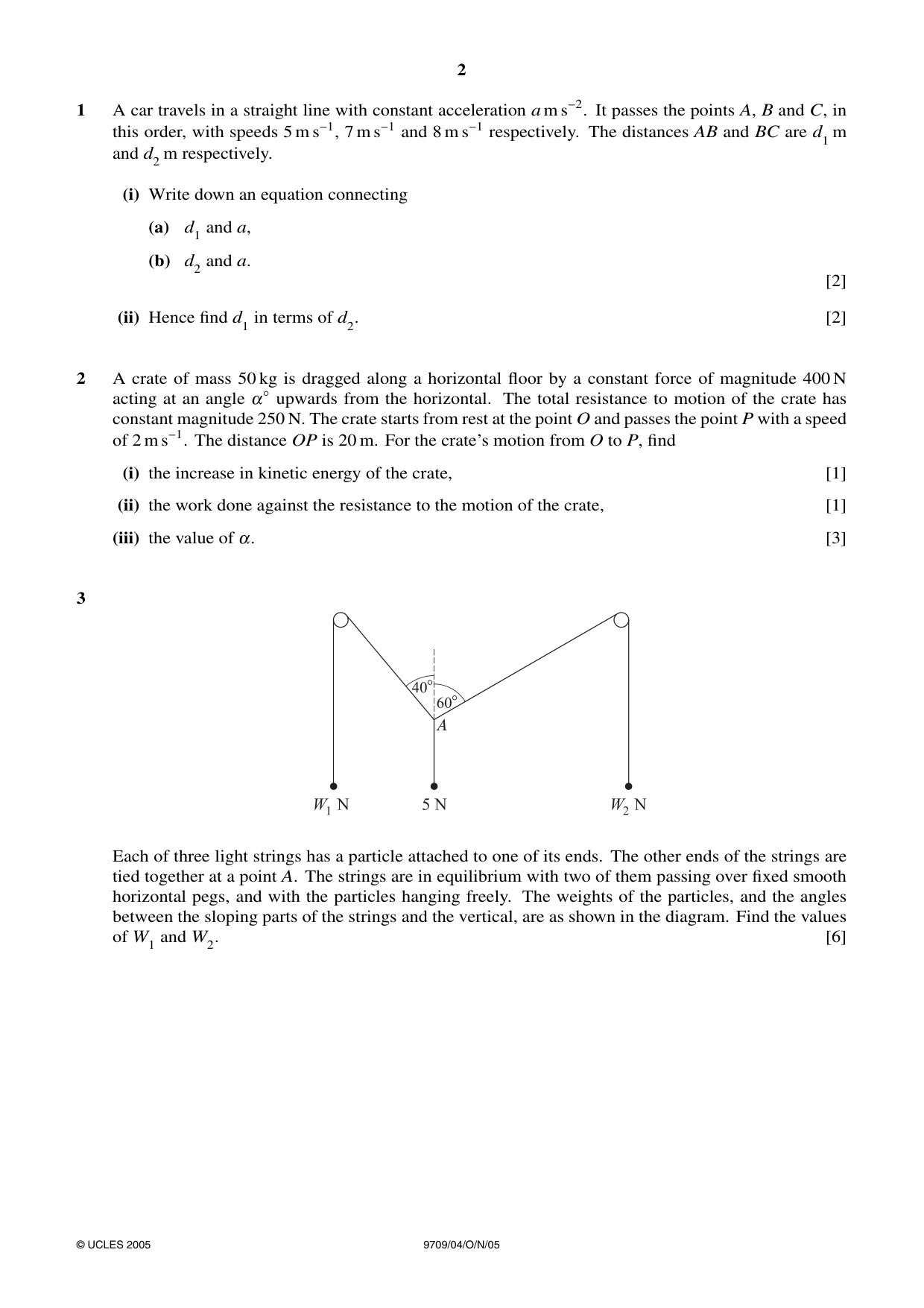
3 Each of three light strings has a particle attached to one of its ends. The other ends of the strings are tied together at a point A. The strings are in equilibrium with two of them passing over fixed smooth horizontal pegs, and with the particles hanging freely. The weights of the particles, and the angles between the sloping parts of the strings and the vertical, are as shown in the diagram. Find the values of W1 and W2. [6]
Mark scheme: 3 Either Or For correct triangle of forces or for resolving forces at the knot either 40 W1NW1N W1sin40o = M1 horizontally or vertically 5N W2sin60o 80 For correct angles and sides marked 60 W1cos40o + on the triangle of forces (or later W2NW2N W2cos60o = 5 correctly used) or for two correct A1 equations in W1 and W2 W1cos40o + For using the sine rule in the triangle W1 5 W1 sin 40 o cos60o of forces to obtain an equation in W1 = or W2 only, or for eliminating W2 (or sin 60o sin 80o sin 60 o = 5 M1 W1) from simultaneous equations W1 = 4.40 W1 = 4.40 A1 For using the sine rule in the triangle of forces again to obtain an equation W2 5 W2 = 4.40 sin 40 o in W2 or W1 only, or for back = o o o substitution to obtain an equation in sin 40 sin 80 sin 60 M1 W2 (or W1) only W2 = 3.26 W2 = 3.26 A1 6 GCE A/AS LEVEL – November 2005 9709 04
Q4 · A stone slab of mass 320 kg rests in equilibrium on rough horizontal ground
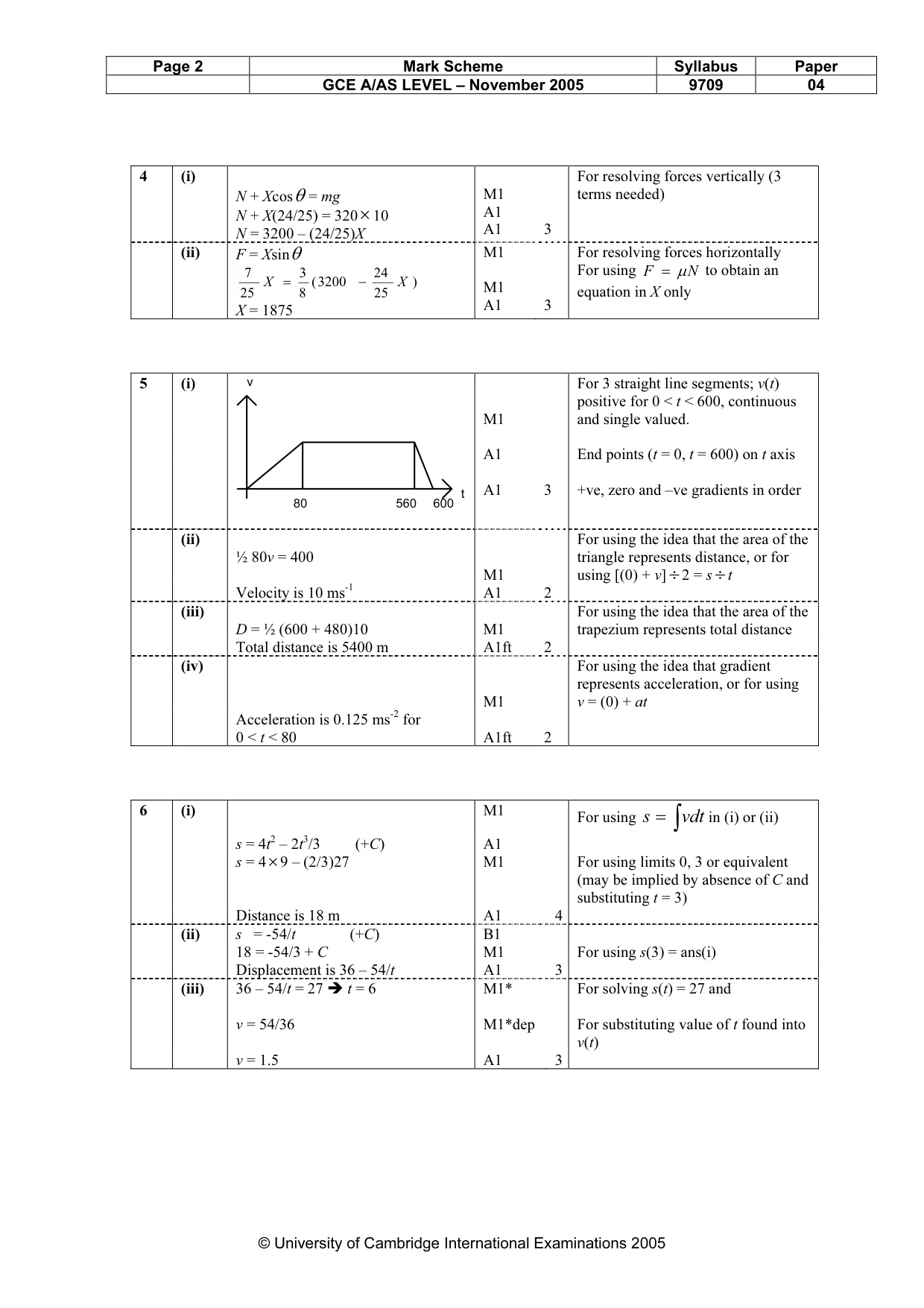
4 A stone slab of mass 320 kg rests in equilibrium on rough horizontal ground. A force of magnitude X N acts upwards on the slab at an angle of θ to the vertical, where tan θ = 7 (see diagram). 24 (i) Find, in terms of X, the normal component of the force exerted on the slab by the ground. [3] (ii) Given that the coefficient of friction between the slab and the ground is 38, find the value of X for which the slab is about to slip. [3]
Mark scheme: 4 (i) For resolving forces vertically (3 N + Xcosθ = mg M1 terms needed) N + X(24/25) = 320× 10 A1 N = 3200 – (24/25)X A1 3 (ii) F = Xsinθ M1 For resolving forces horizontally 7 3 24 For using F = µ N to obtain an X = ( 3200 − X ) 25 8 25 M1 equation in X only X = 1875 A1 3
Q5 · The diagram shows the displacement-time graph for a car’s journey
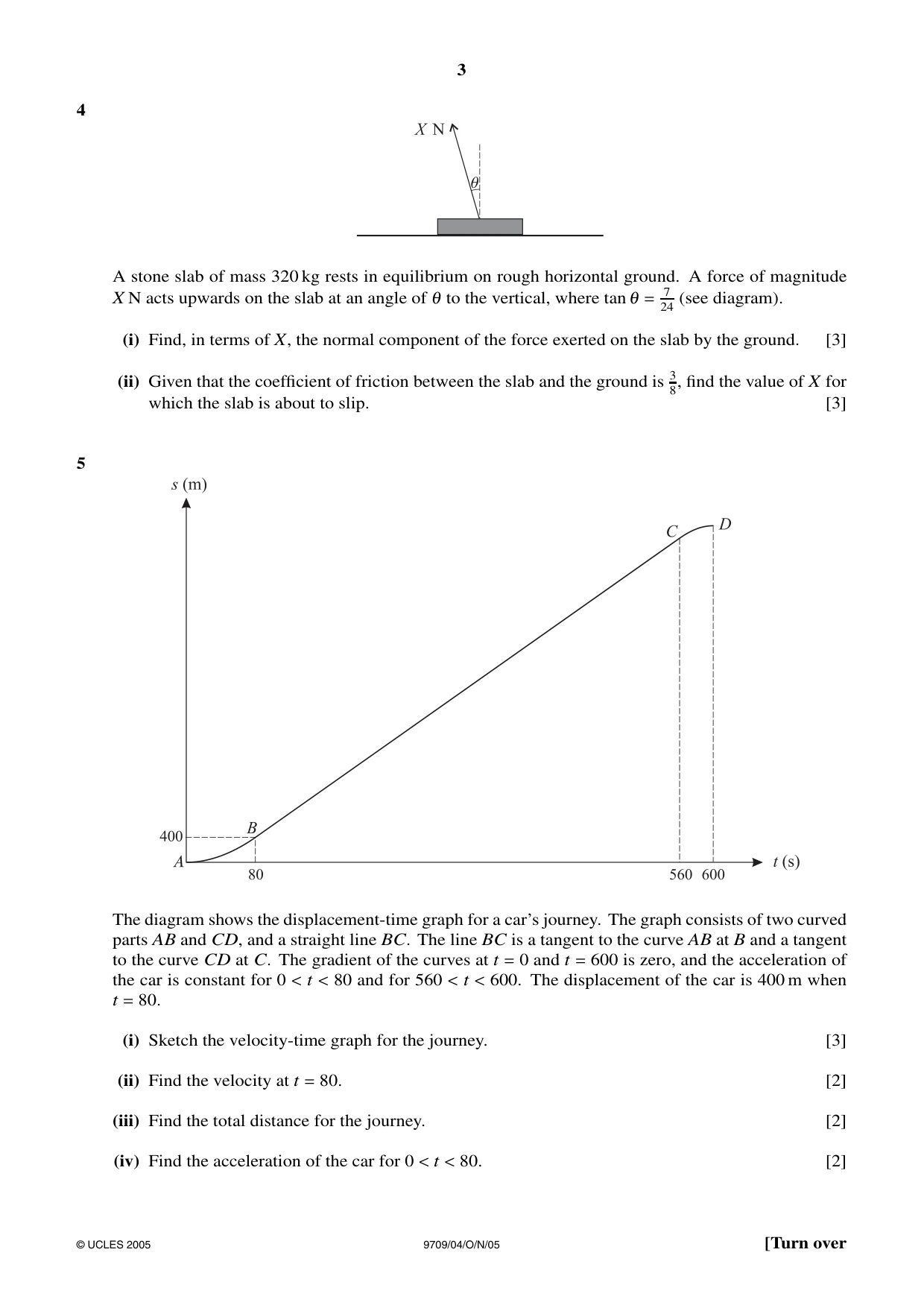
5 The diagram shows the displacement-time graph for a car’s journey. The graph consists of two curved parts AB and CD, and a straight line BC. The line BC is a tangent to the curve AB at B and a tangent to the curve CD at C. The gradient of the curves at t = 0 and t = 600 is zero, and the acceleration of the car is constant for 0 < t < 80 and for 560 < t < 600. The displacement of the car is 400 m when t = 80. (i) Sketch the velocity-time graph for the journey. [3] (ii) Find the velocity at t = 80. [2] (iii) Find the total distance for the journey. [2] (iv) Find the acceleration of the car for 0 < t < 80. [2]
Mark scheme: 5 (i) v For 3 straight line segments; v(t) positive for 0 < t < 600, continuous M1 and single valued. A1 End points (t = 0, t = 600) on t axis t A1 3 +ve, zero and –ve gradients in order 80 560 600 (ii) For using the idea that the area of the ½ 80v = 400 triangle represents distance, or for M1 using [(0) + v]÷ 2 = s ÷ t Velocity is 10 ms-1 A1 2 (iii) For using the idea that the area of the D = ½ (600 + 480)10 M1 trapezium represents total distance Total distance is 5400 m A1ft 2 (iv) For using the idea that gradient represents acceleration, or for using M1 v = (0) + at Acceleration is 0.125 ms-2 for 0 < t < 80 A1ft 2
Q6 · A particle P starts from rest at O and travels in a straight line
6 A particle P starts from rest at O and travels in a straight line. Its velocity v m s−1 at time t s is given 54 by v = 8t −2t2 for 0 ≤t ≤3, and v = for t > 3. Find t2 (i) the distance travelled by P in the first 3 seconds, [4] (ii) an expression in terms of t for the displacement of P from O, valid for t > 3, [3] (iii) the value of v when the displacement of P from O is 27 m. [3]
Mark scheme: 6 (i) M1 in (i) or (ii) For using s = ∫ vdt s = 4t2 – 2t3/3 (+C) A1 s = 4×9 – (2/3)27 M1 For using limits 0, 3 or equivalent (may be implied by absence of C and substituting t = 3) Distance is 18 m A1 4 (ii) s = -54/t (+C) B1 18 = -54/3 + C M1 For using s(3) = ans(i) Displacement is 36 – 54/t A1 3 (iii) 36 – 54/t = 27 t = 6 M1* For solving s(t) = 27 and v = 54/36 M1*dep For substituting value of t found into v(t) v = 1.5 A1 3 GCE A/AS LEVEL – November 2005 9709 04
Q7 · Two particles A and B, of masses 0.3 kg and 0.2 kg respectively, are attached to the ends…
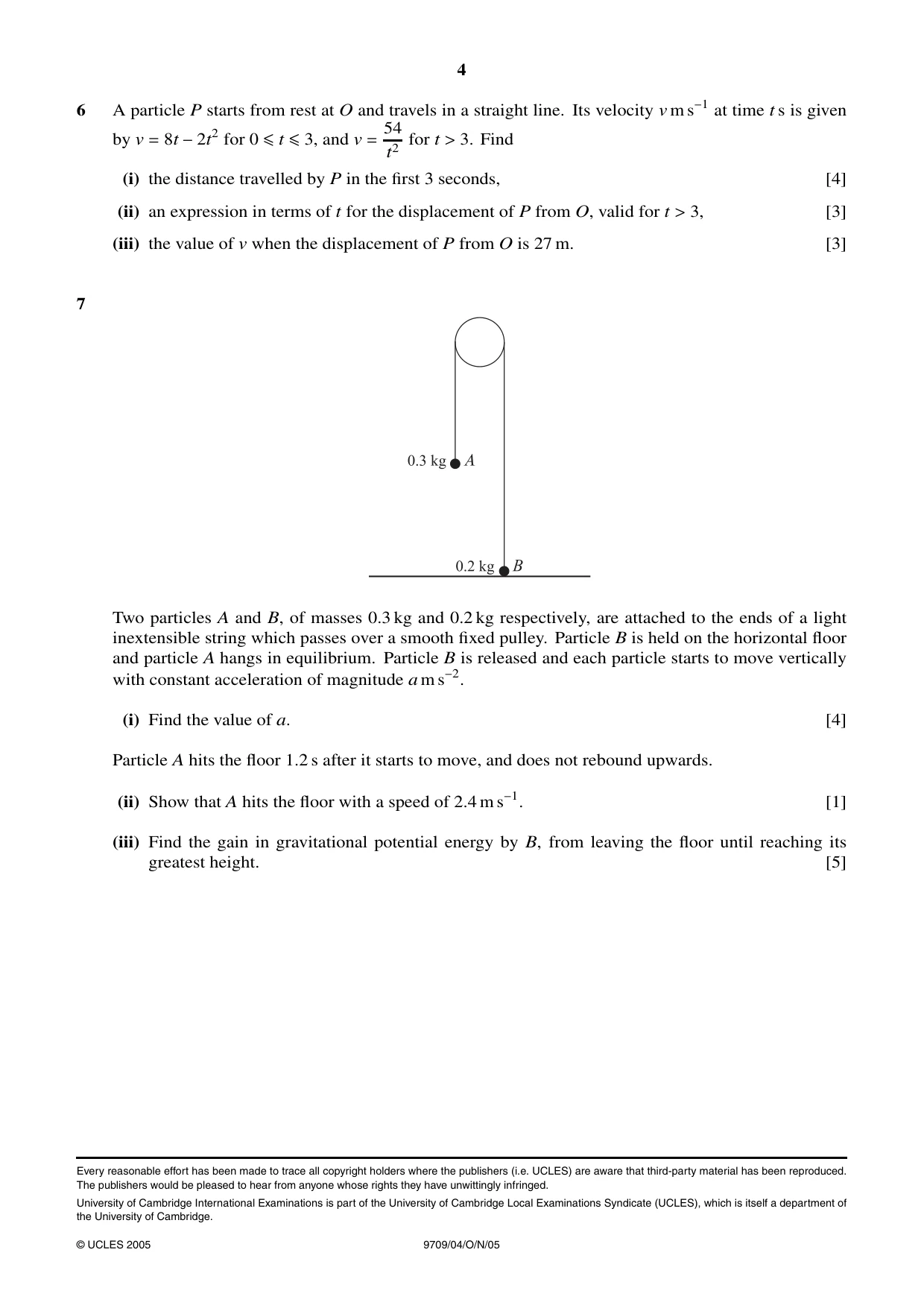
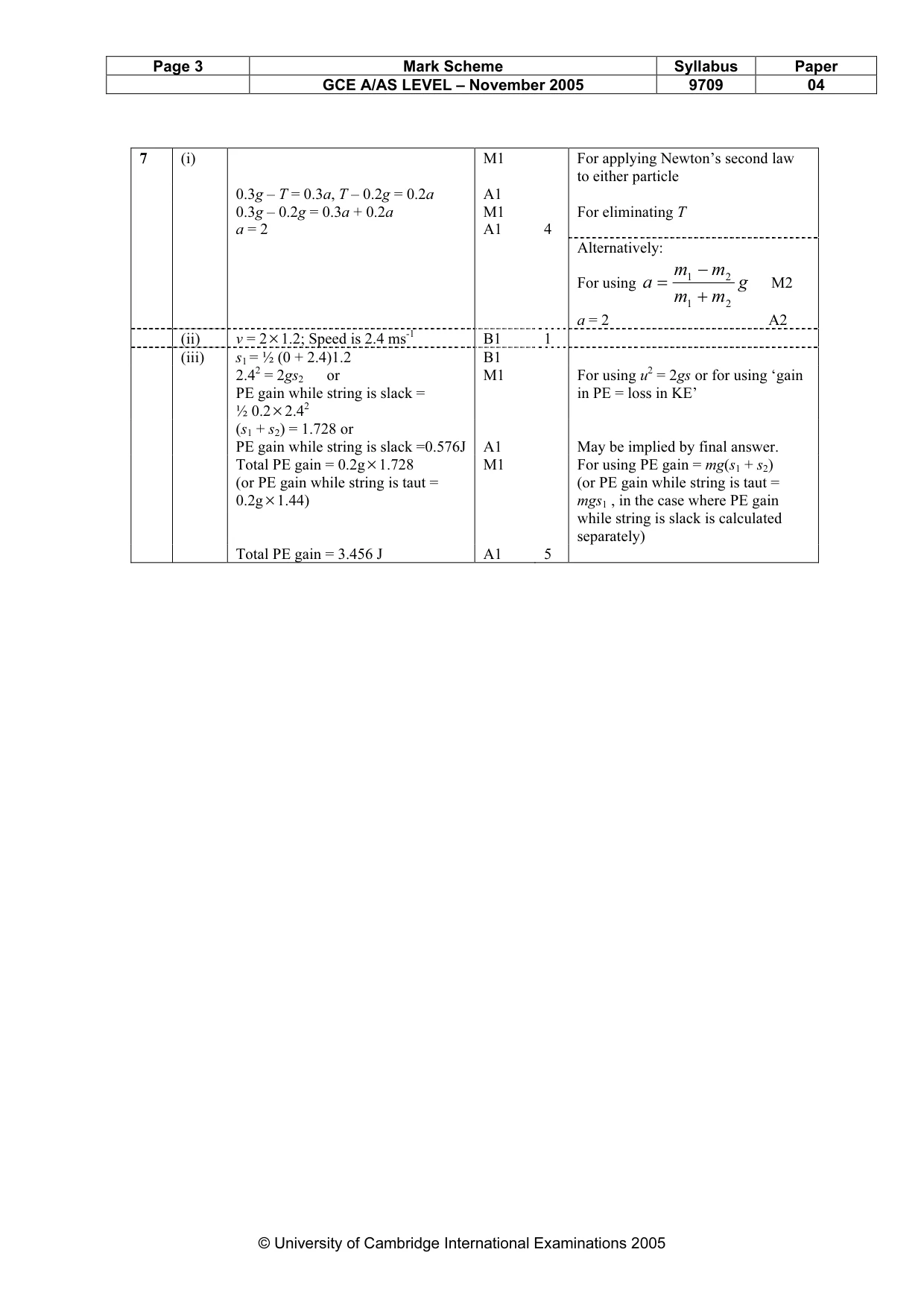
7 Two particles A and B, of masses 0.3 kg and 0.2 kg respectively, are attached to the ends of a light inextensible string which passes over a smooth fixed pulley. Particle B is held on the horizontal floor and particle A hangs in equilibrium. Particle B is released and each particle starts to move vertically with constant acceleration of magnitude a m s−2. (i) Find the value of a. [4] Particle A hits the floor 1.2 s after it starts to move, and does not rebound upwards. (ii) Show that A hits the floor with a speed of 2.4 m s−1. [1] (iii) Find the gain in gravitational potential energy by B, from leaving the floor until reaching its greatest height. [5] Every reasonable effort has been made to trace all copyright holders where the publishers (i.e. UCLES) are aware that third-party material has been reproduced. The publishers would be pleased to hear from anyone whose rights they have unwittingly infringed. University of Cambridge International Examinations is part of the University of Cambridge Local Examinations Syndicate (UCLES), which is itself a department of the University of Cambridge.
Mark scheme: 7 (i) M1 For applying Newton’s second law to either particle 0.3g – T = 0.3a, T – 0.2g = 0.2a A1 0.3g – 0.2g = 0.3a + 0.2a M1 For eliminating T a = 2 A1 4 Alternatively: m1 − m 2 For using a = g M2 m1 + m 2 a = 2 A2 (ii) v = 2×1.2; Speed is 2.4 ms-1 B1 1 (iii) s1 = ½ (0 + 2.4)1.2 B1 2.42 = 2gs2 or M1 For using u2 = 2gs or for using ‘gain PE gain while string is slack = in PE = loss in KE’ ½ 0.2×2.42 (s1 + s2) = 1.728 or PE gain while string is slack =0.576J A1 May be implied by final answer. Total PE gain = 0.2g×1.728 M1 For using PE gain = mg(s1 + s2) (or PE gain while string is taut = (or PE gain while string is taut = 0.2g×1.44) mgs1 , in the case where PE gain while string is slack is calculated separately) Total PE gain = 3.456 J A1 5
What was in this paper
The subtopics covered by these 7 questions, and how many questions each got. Open one in a new tab to see every Cambridge question on it.