Cambridge A Level Mathematics 9709 — 2021 Oct/Nov Paper 4 · Variant 2
9709/42/O/N/21 · 7 questions · 50 marks · ≈56 min
The question paper and its mark scheme, free to read here and free to download. This is Cambridge’s own paper, exactly as it was sat.
Question paper12 pages
Mark scheme14 pages
Answers below. Sit the paper first if you are practising.
Questions as text
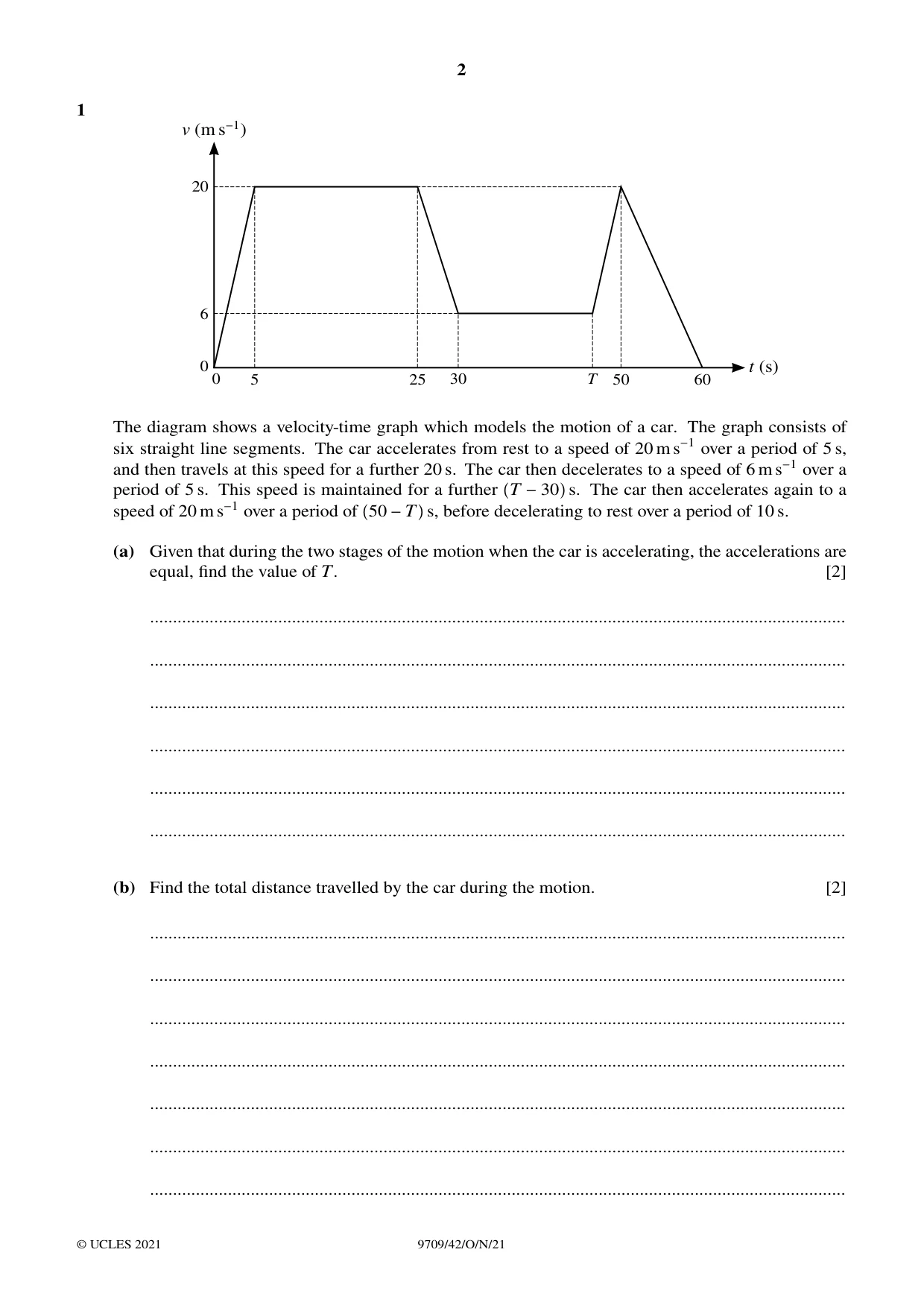
Q1 · V (m s−1) 20 6 0 t (s) 0 5 25 30 T 50 60 The diagram shows a velocity-time graph which…
1 v (m s−1) 20 6 0 t (s) 0 5 25 30 T 50 60 The diagram shows a velocity-time graph which models the motion of a car. The graph consists of six straight line segments. The car accelerates from rest to a speed of 20 m s−1 over a period of 5 s, and then travels at this speed for a further 20 s. The car then decelerates to a speed of 6 m s−1 over a period of 5 s. This speed is maintained for a further T −30 s. The car then accelerates again to a speed of 20 m s−1 over a period of 50 −T s, before decelerating to rest over a period of 10 s. (a) Given that during the two stages of the motion when the car is accelerating, the accelerations are equal, find the value of T. [2] ........................................................................................................................................................ ........................................................................................................................................................ ........................................................................................................................................................ ........................................................................................................................................................ ........................................................................................................................................................ ........................................................................................................................................................ (b) Find the total distance travelled by the car during the motion. [2] ........................................................................................................................................................ ........................................................................................................................................................ ........................................................................................................................................................ ........................................................................................................................................................ ........................................................................................................................................................ ........................................................................................................................................................ ........................................................................................................................................................
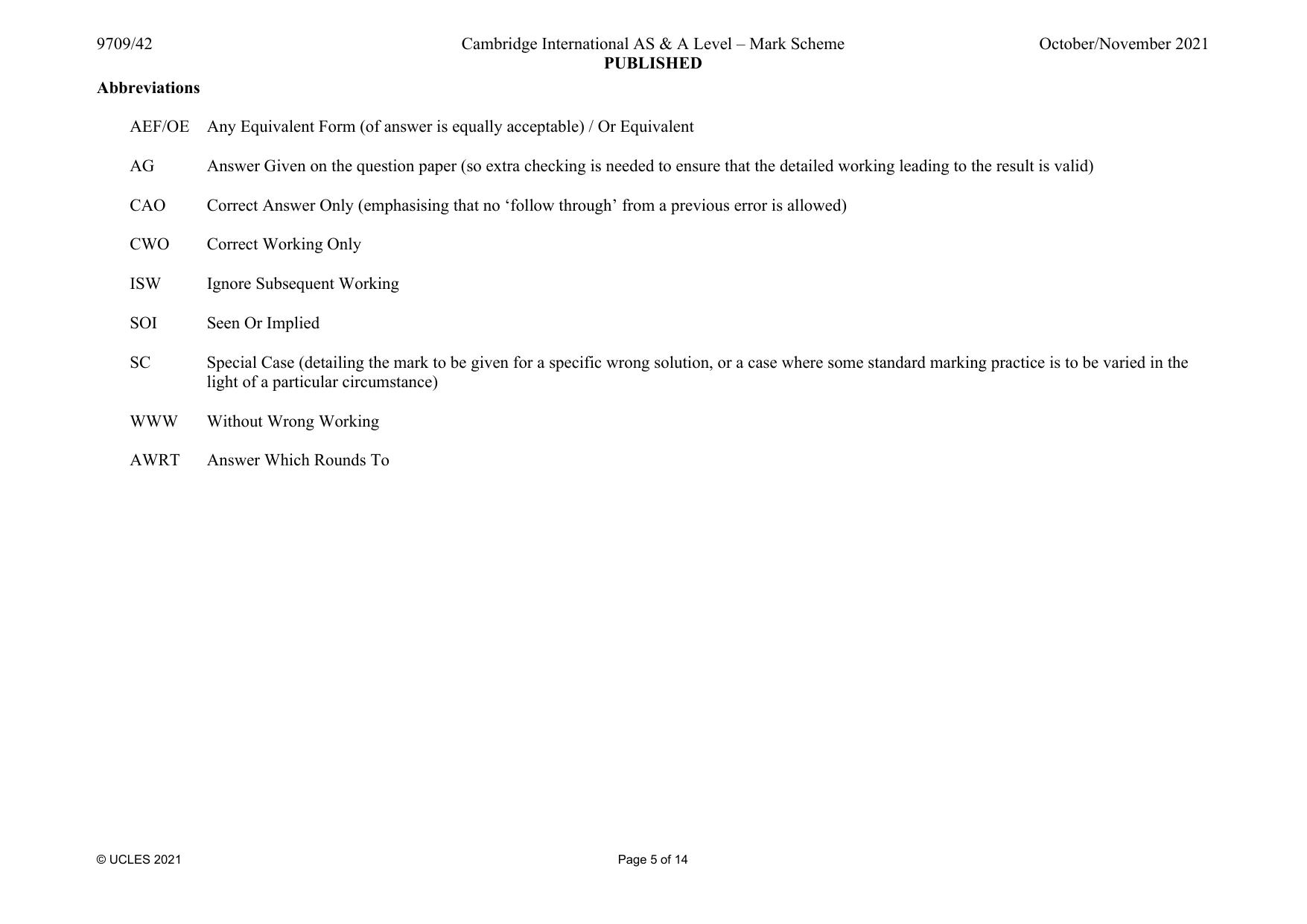
Mark scheme: 1(a) 20 6 20 50 5 T - = - or ( ) 20 20 6 5 50 T = + - Allow correct use of their incorrect 20 5 . T = 46.5 A1 2 1(b) Distance = 1 2 × 5 × 20 + 20 × 20 + 1 2 × 5 × (20 + 6) + + 6 × (T – 30) + 1 2 × (50 – T) × (20 + 6) + 1 2 × 10 × 20 [= 50 + 400 + 65 + 99 + 45.5 + 100] OR Distance = 1 2 × 20 × (60 + 45) – 1 2 × 14 × (25 + T – 30) [= 1050 – 290.5] M1 Attempt to find the total distance travelled using areas. Allow with T not yet substituted. Allow one error in use of area formulae or omission of only one of the areas: 0–5, 5–25, 25–30, 30–T, T–50, 50–-60. Total distance travelled = 759.5 m A1 FT FT their T value: Provided 30 50 < < T and distance 1085 7 = −T 2
Q2 · A van of mass 3600 kg is towing a trailer of mass 1200 kg along a straight horizontal…
2 A van of mass 3600 kg is towing a trailer of mass 1200 kg along a straight horizontal road using a light horizontal rope. There are resistance forces of 700 N on the van and 300 N on the trailer. (a) The driving force exerted by the van is 2500 N. Find the tension in the rope. [4] ........................................................................................................................................................ ........................................................................................................................................................ ........................................................................................................................................................ ........................................................................................................................................................ ........................................................................................................................................................ ........................................................................................................................................................ ........................................................................................................................................................ ........................................................................................................................................................ ........................................................................................................................................................ ........................................................................................................................................................ ........................................................................................................................................................ ........................................................................................................................................................ The driving force is now removed and the van driver applies a braking force which acts only on the van. The resistance forces remain unchanged. (b) Find the least possible value of the braking force which will cause the rope to become slack. [2] ........................................................................................................................................................ ........................................................................................................................................................ ........................................................................................................................................................ ........................................................................................................................................................ ........................................................................................................................................................ ........................................................................................................................................................ ........................................................................................................................................................ ........................................................................................................................................................
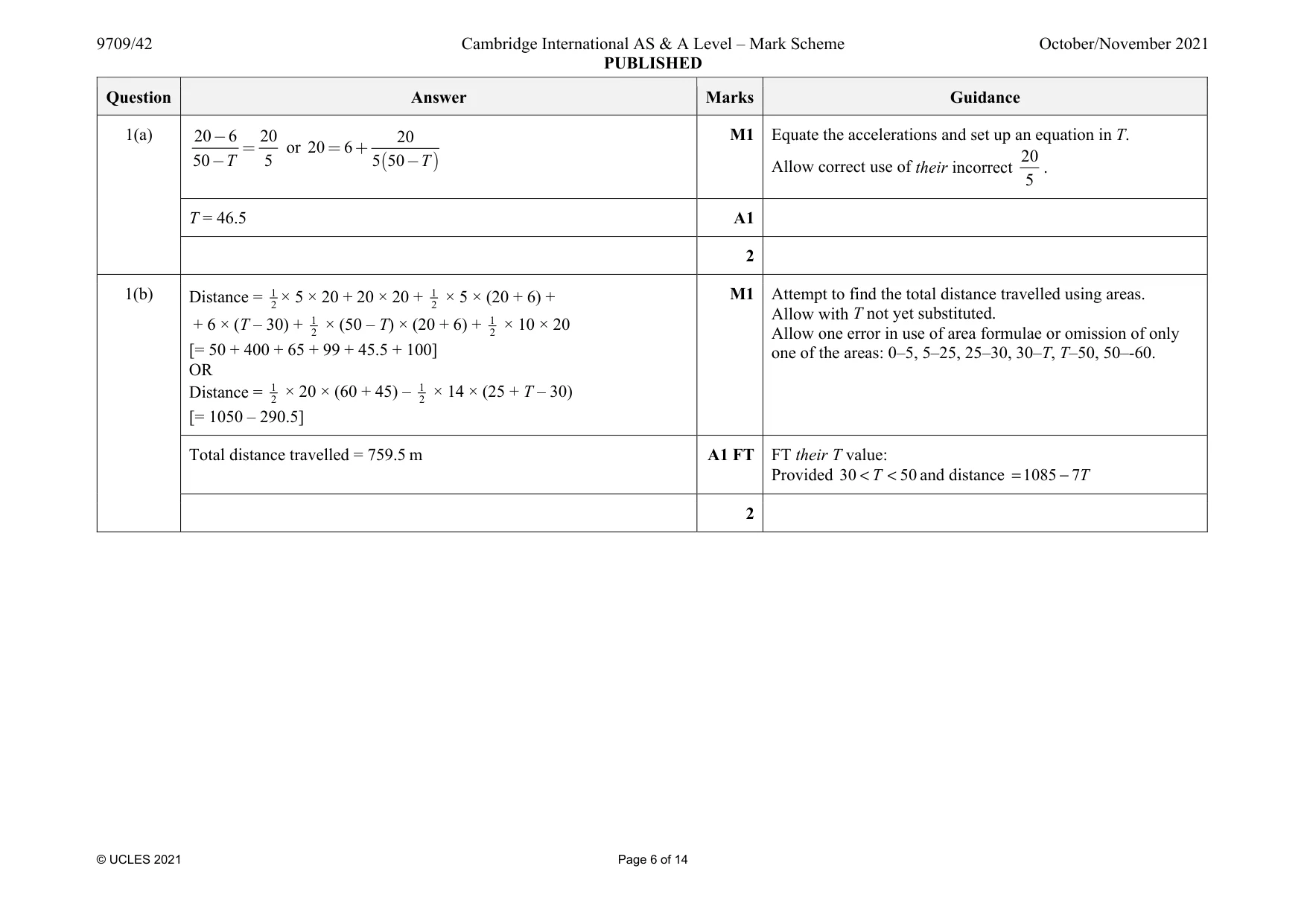
Mark scheme: 2(a) For van: 2500 – 700 – T = 3600a For trailer: T – 300 = 1200a For system: 2500 – 700 – 300 = (3600 + 1200)a M1 Apply Newton’s 2nd law to the van or to the trailer or to the system of van and trailer. Correct number of terms. A1 For any two correct. Obtain an equation in T only 5 0.3125 16 = = a M1 Tension in the rope = T = 675 N A1 4 2(b) For van: –F – 700 = 3600a For trailer: – 300 = 1200a System: ( ) 700 300 3600 1200 − − − = + F a M1 Apply Newton’s 2nd law to any two of the van, the trailer and the system with braking force F and with T = 0. Least possible value of braking force = F = 200 N A1 Allow F = –200 2
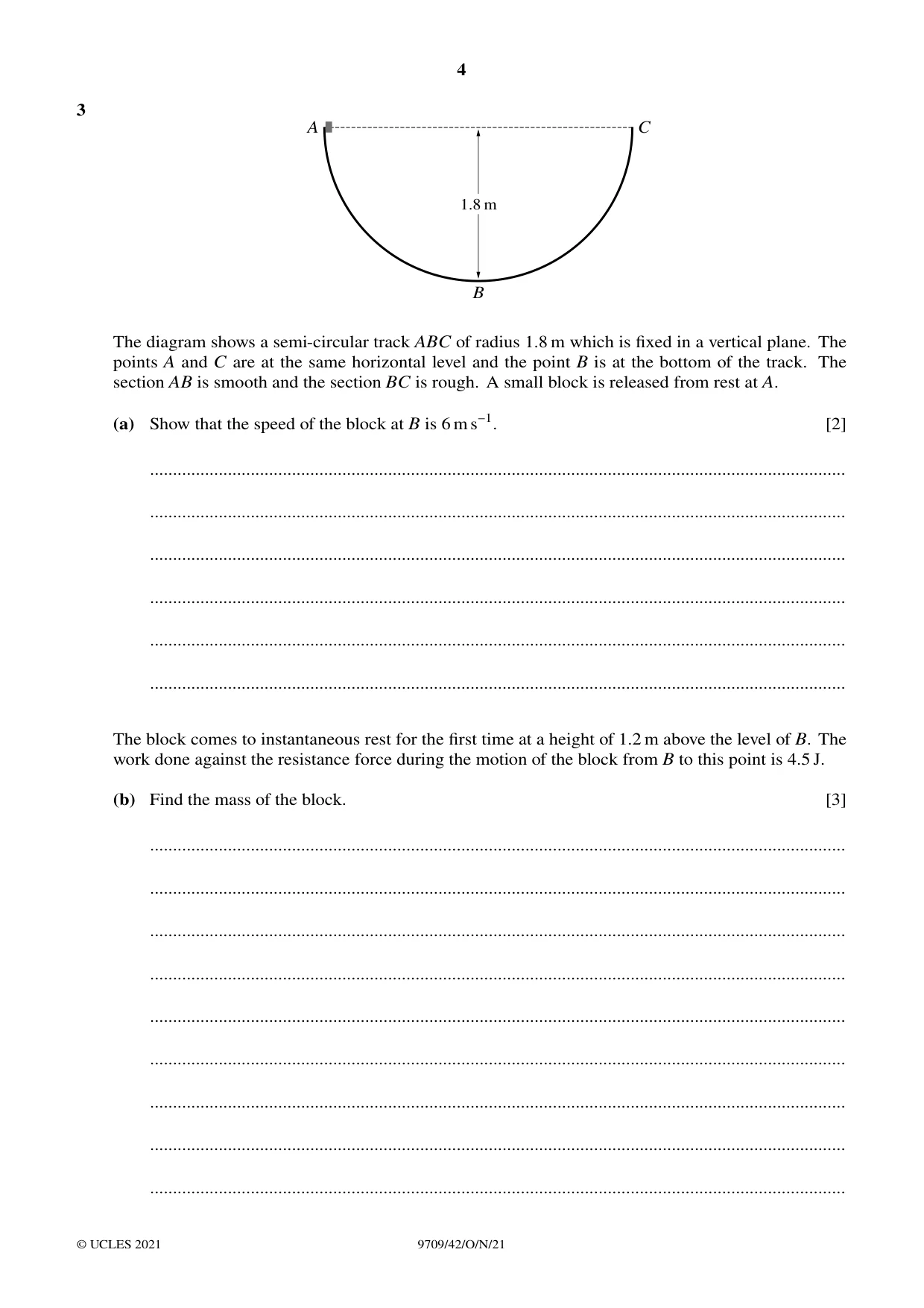
Q3 · A C 1.8 m B The diagram shows a semi-circular track ABC of radius 1.8 m which is fixed in…
3 A C 1.8 m B The diagram shows a semi-circular track ABC of radius 1.8 m which is fixed in a vertical plane. The points A and C are at the same horizontal level and the point B is at the bottom of the track. The section AB is smooth and the section BC is rough. A small block is released from rest at A. (a) Show that the speed of the block at B is 6 m s−1. [2] ........................................................................................................................................................ ........................................................................................................................................................ ........................................................................................................................................................ ........................................................................................................................................................ ........................................................................................................................................................ ........................................................................................................................................................ The block comes to instantaneous rest for the first time at a height of 1.2 m above the level of B. The work done against the resistance force during the motion of the block from B to this point is 4.5 J. (b) Find the mass of the block. [3] ........................................................................................................................................................ ........................................................................................................................................................ ........................................................................................................................................................ ........................................................................................................................................................ ........................................................................................................................................................ ........................................................................................................................................................ ........................................................................................................................................................ ........................................................................................................................................................ ........................................................................................................................................................
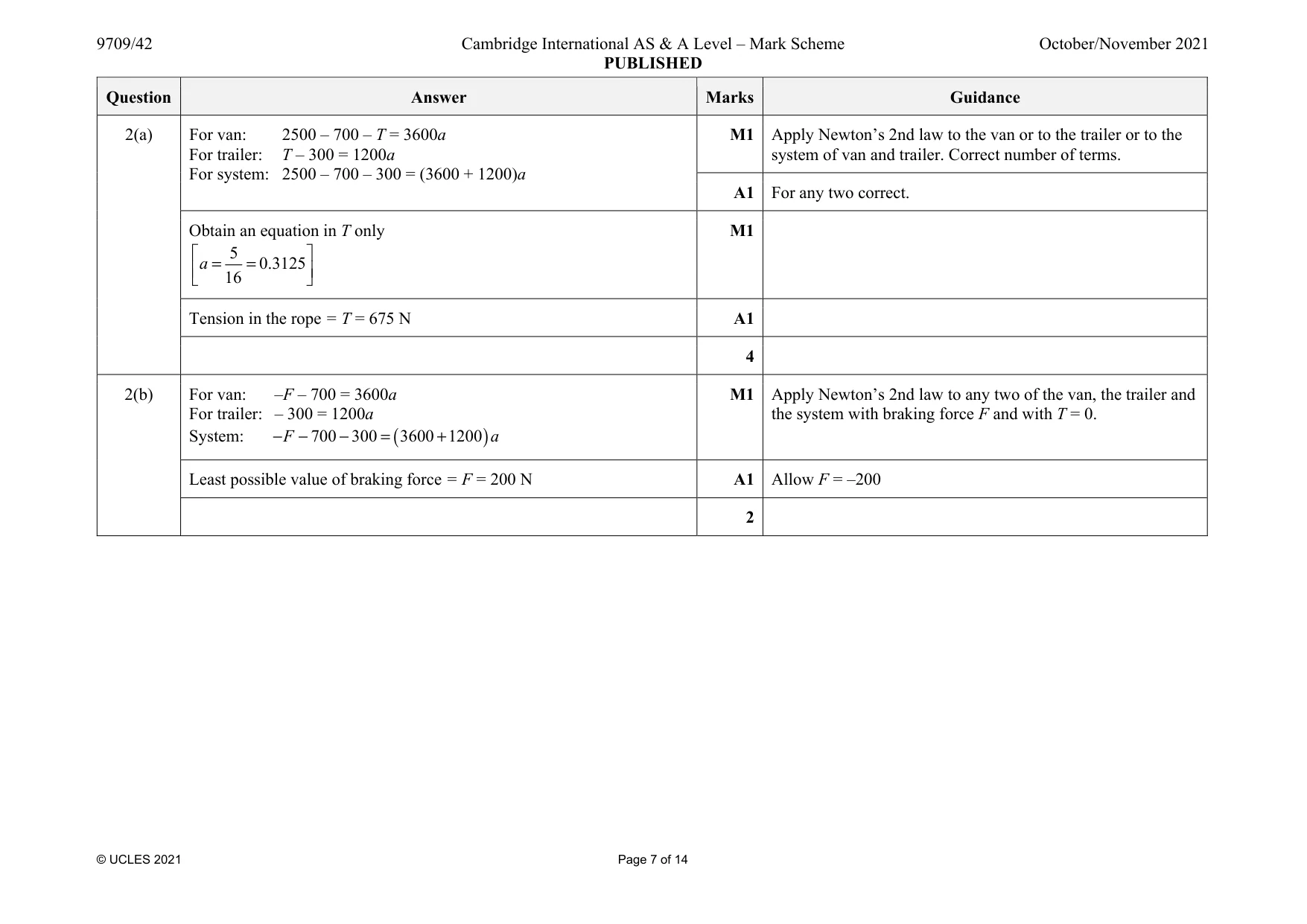
Mark scheme: 3(a) mg × 1.8 = 1 2 mv2 M1 Use of conservation of energy, 2 terms. Must NOT use constant acceleration equations. Use of equations such as 2 2 2 = + v u as scores M0 A0. Speed of block at B = v = 6 ms–1 A1 AG 2 3(b) Attempt the work-energy equation M1 In the form: ± KE lost = ± PE gain ± WD against Resistance 1 2 × m × 62 = 4.5 + mg × 1.2 A1 If using motion from A to final point mg × 1.8 = mg × 1.2 + 4.5 Mass of the block = m = 0.75 kg A1 3
Q4 · A cyclist starts from rest at a point A and travels along a straight road AB, coming to…
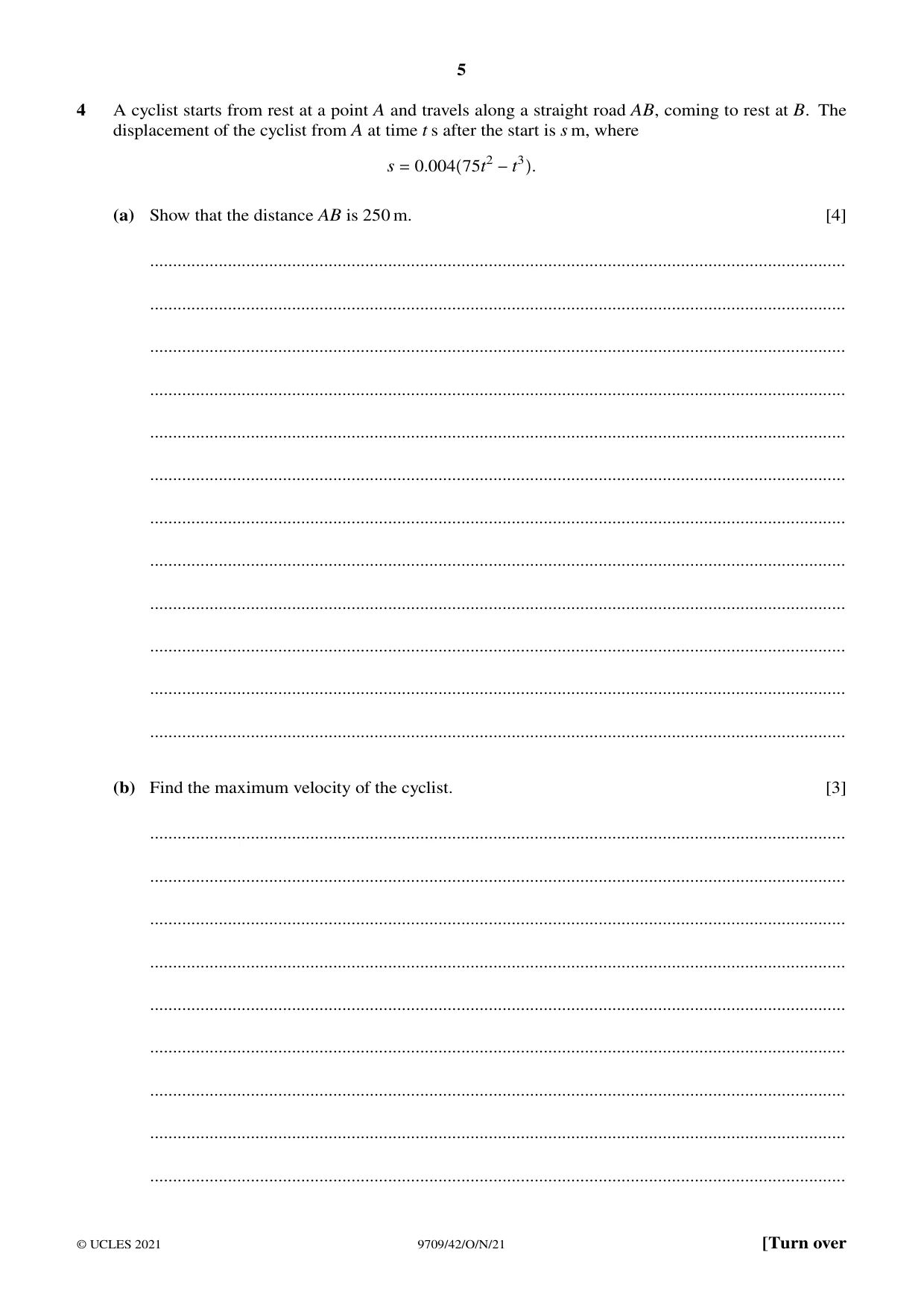
4 A cyclist starts from rest at a point A and travels along a straight road AB, coming to rest at B. The displacement of the cyclist from A at time t s after the start is s m, where s = 0.004 75t2 −t3 . (a) Show that the distance AB is 250 m. [4] ........................................................................................................................................................ ........................................................................................................................................................ ........................................................................................................................................................ ........................................................................................................................................................ ........................................................................................................................................................ ........................................................................................................................................................ ........................................................................................................................................................ ........................................................................................................................................................ ........................................................................................................................................................ ........................................................................................................................................................ ........................................................................................................................................................ ........................................................................................................................................................ (b) Find the maximum velocity of the cyclist. [3] ........................................................................................................................................................ ........................................................................................................................................................ ........................................................................................................................................................ ........................................................................................................................................................ ........................................................................................................................................................ ........................................................................................................................................................ ........................................................................................................................................................ ........................................................................................................................................................ ........................................................................................................................................................
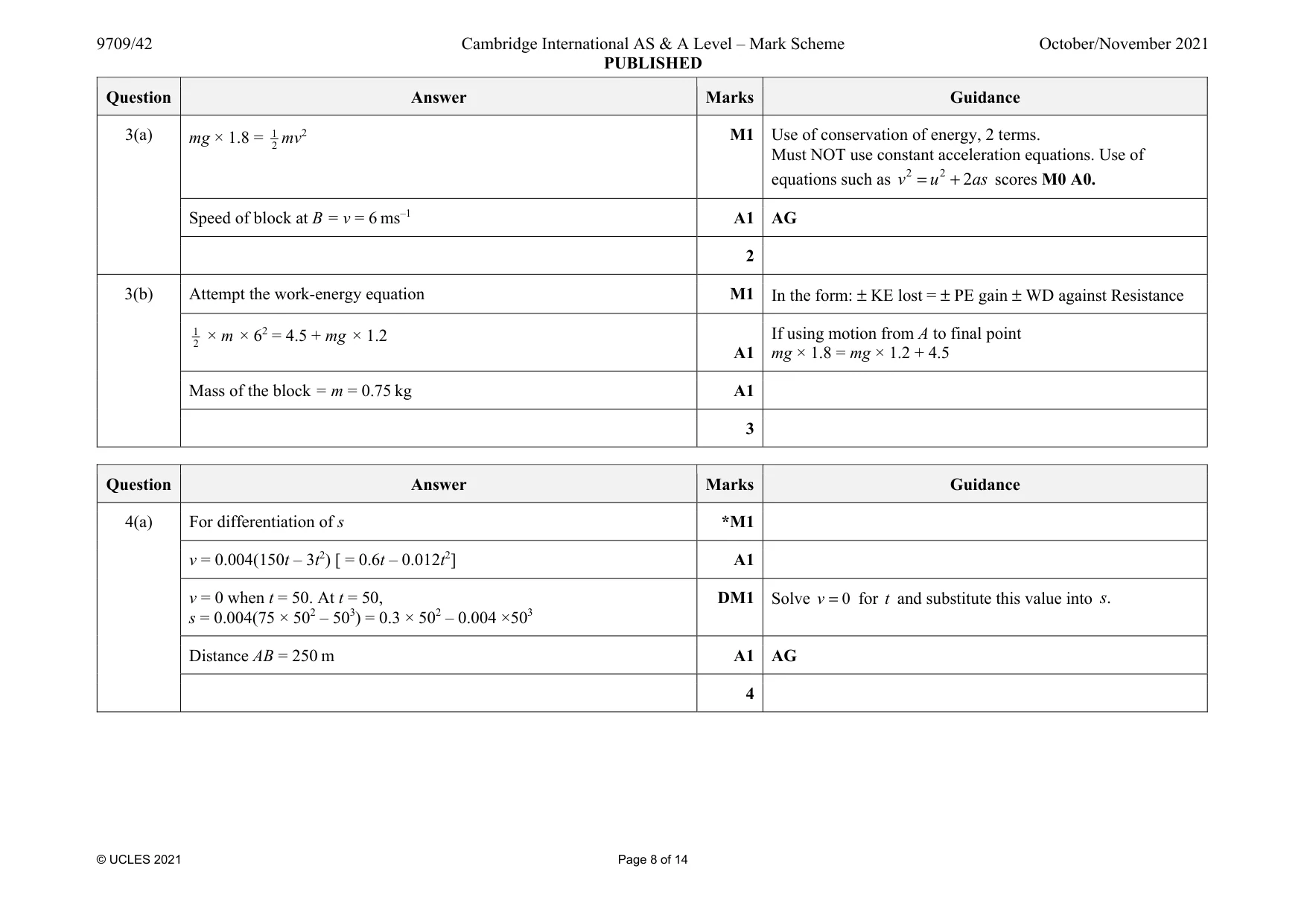
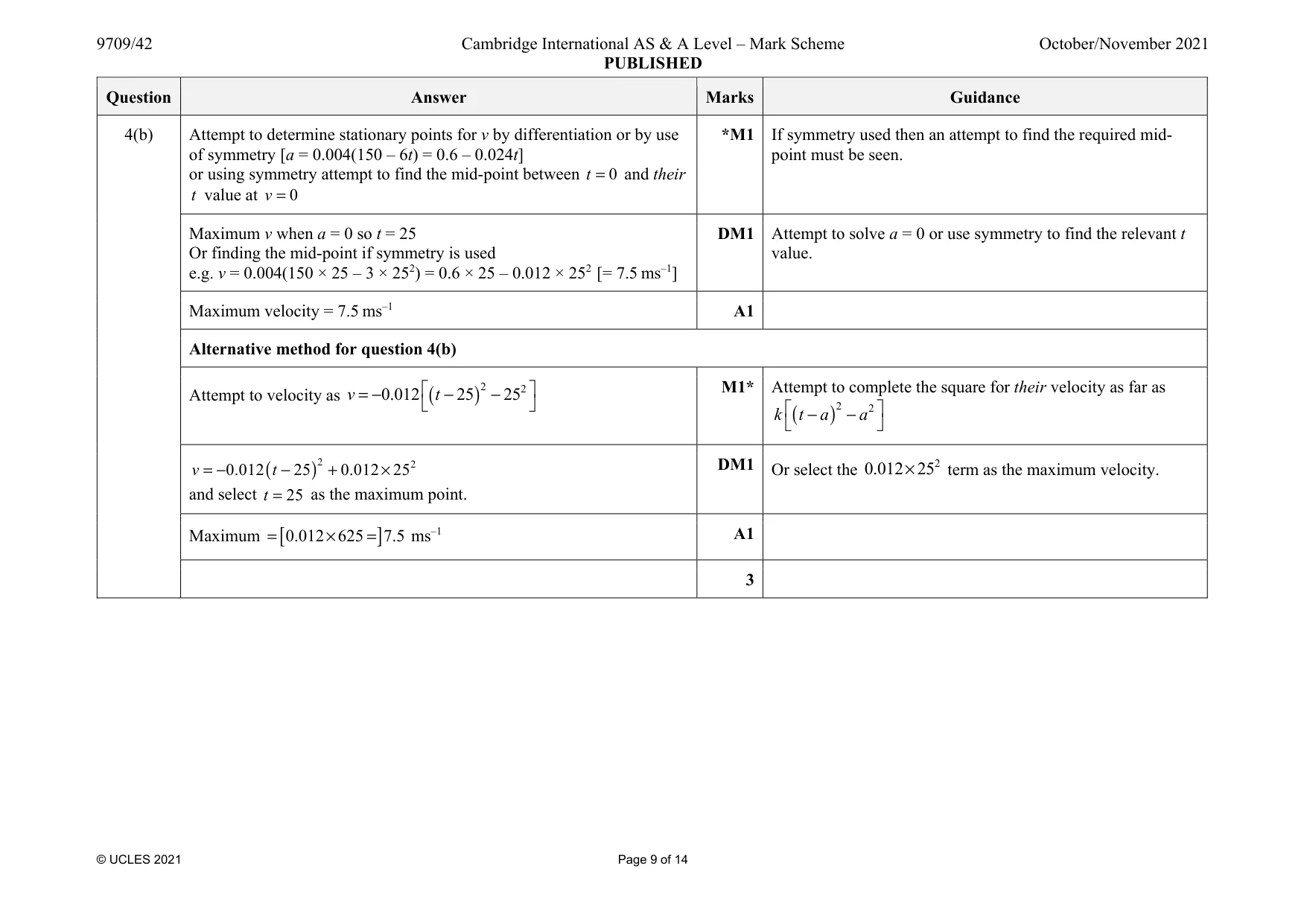
Mark scheme: 4(a) For differentiation of s *M1 v = 0.004(150t – 3t2) [ = 0.6t – 0.012t2] A1 v = 0 when t = 50. At t = 50, s = 0.004(75 × 502 – 503) = 0.3 × 502 – 0.004 ×503 DM1 Solve 0 = v for t and substitute this value into .s Distance AB = 250 m A1 AG 4 Question Answer Marks Guidance 4(b) Attempt to determine stationary points for v by differentiation or by use of symmetry [a = 0.004(150 – 6t) = 0.6 – 0.024t] or using symmetry attempt to find the mid-point between 0 = t and their t value at 0 = v *M1 If symmetry used then an attempt to find the required mid- point must be seen. Maximum v when a = 0 so t = 25 Or finding the mid-point if symmetry is used e.g. v = 0.004(150 × 25 – 3 × 252) = 0.6 × 25 – 0.012 × 252 [= 7.5 ms–1] DM1 Attempt to solve a = 0 or use symmetry to find the relevant t value. Maximum velocity = 7.5 ms–1 A1 Alternative method for question 4(b) Attempt to velocity as ( ) 2 2 0.012 25 25 = − − − v t M1* Attempt to complete the square for their velocity as far as ( ) 2 2 − − k t a a ( ) 2 2 0.012 25 0.012 25 = − − + × v t and select 25 = t as the maximum point. DM1 Or select the 2 0.012 25 × term as the maximum velocity. Maximum [ ] 0.012 625 7.5 = × = ms–1 A1 3
Q5 · A railway engine of mass 75 000 kg is moving up a straight hill inclined at an angle !
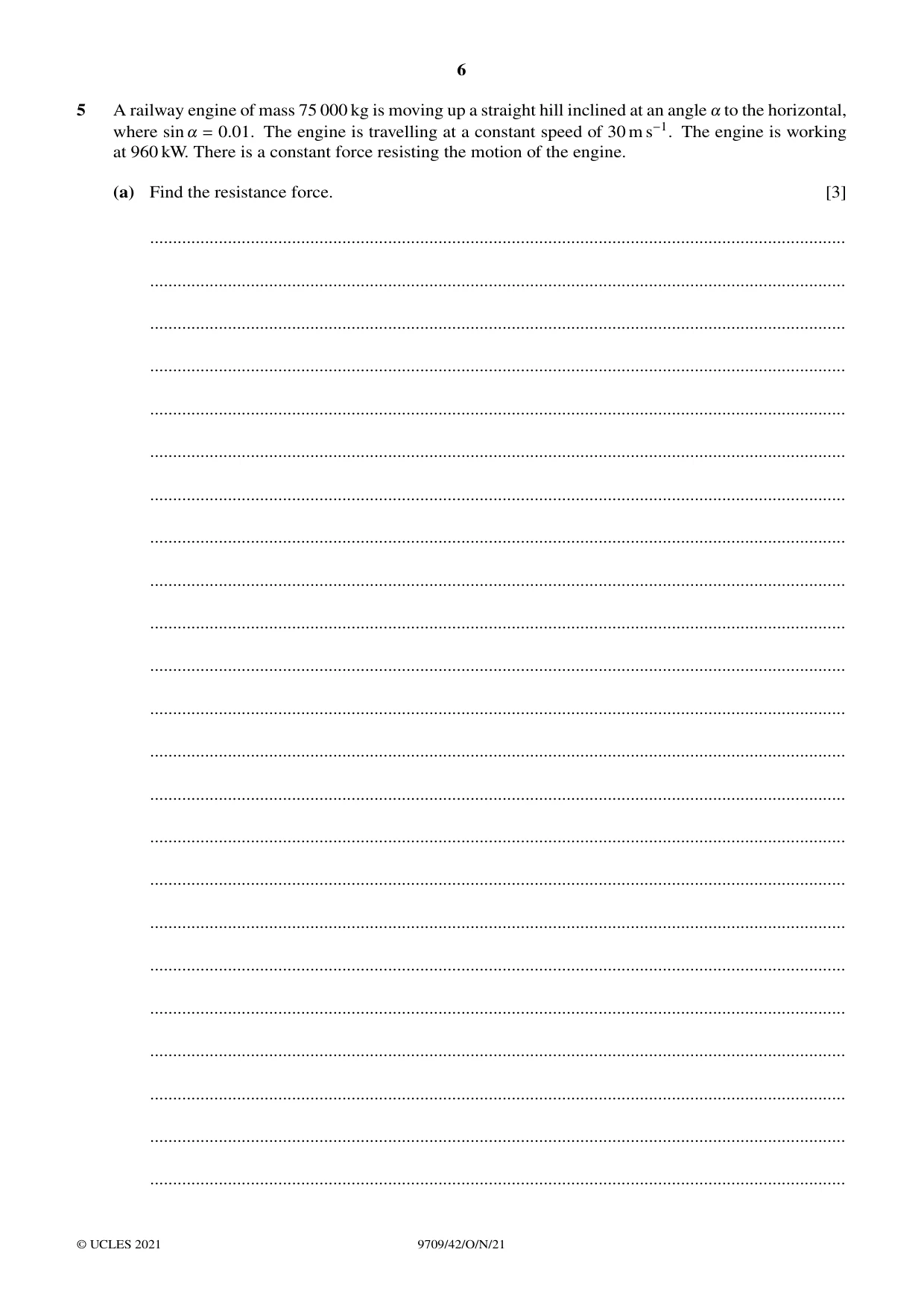
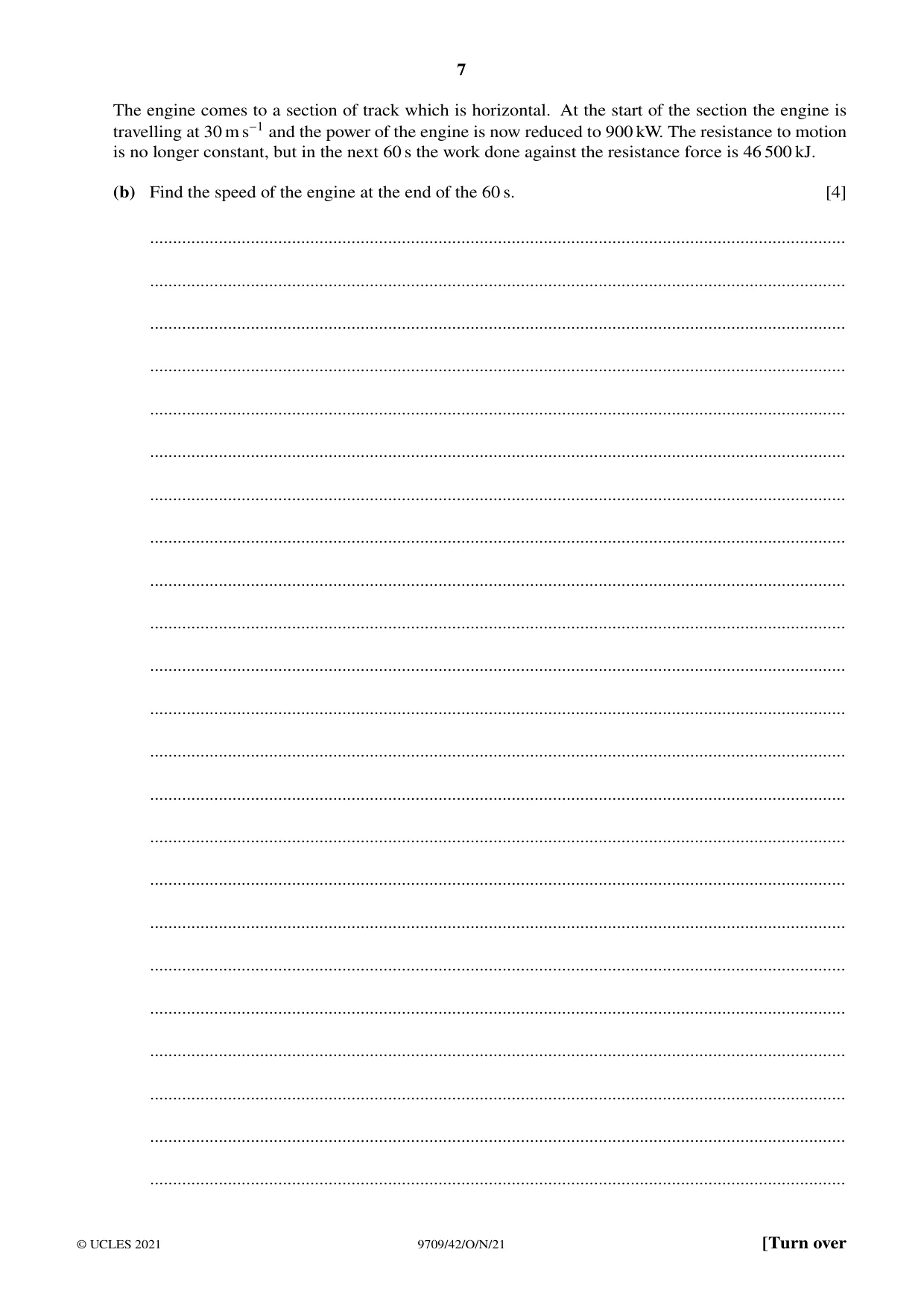
5 A railway engine of mass 75 000 kg is moving up a straight hill inclined at an angle ! to the horizontal, where sin ! = 0.01. The engine is travelling at a constant speed of 30 m s−1. The engine is working at 960 kW. There is a constant force resisting the motion of the engine. (a) Find the resistance force. [3] ........................................................................................................................................................ ........................................................................................................................................................ ........................................................................................................................................................ ........................................................................................................................................................ ........................................................................................................................................................ ........................................................................................................................................................ ........................................................................................................................................................ ........................................................................................................................................................ ........................................................................................................................................................ ........................................................................................................................................................ ........................................................................................................................................................ ........................................................................................................................................................ ........................................................................................................................................................ ........................................................................................................................................................ ........................................................................................................................................................ ........................................................................................................................................................ ........................................................................................................................................................ ........................................................................................................................................................ ........................................................................................................................................................ ........................................................................................................................................................ ........................................................................................................................................................ ........................................................................................................................................................ ........................................................................................................................................................ The engine comes to a section of track which is horizontal. At the start of the section the engine is travelling at 30 m s−1 and the power of the engine is now reduced to 900 kW. The resistance to motion is no longer constant, but in the next 60 s the work done against the resistance force is 46 500 kJ. (b) Find the speed of the engine at the end of the 60 s. [4] ........................................................................................................................................................ ........................................................................................................................................................ ........................................................................................................................................................ ........................................................................................................................................................ ........................................................................................................................................................ ........................................................................................................................................................ ........................................................................................................................................................ ........................................................................................................................................................ ........................................................................................................................................................ ........................................................................................................................................................ ........................................................................................................................................................ ........................................................................................................................................................ ........................................................................................................................................................ ........................................................................................................................................................ ........................................................................................................................................................ ........................................................................................................................................................ ........................................................................................................................................................ ........................................................................................................................................................ ........................................................................................................................................................ ........................................................................................................................................................ ........................................................................................................................................................ ........................................................................................................................................................ ........................................................................................................................................................
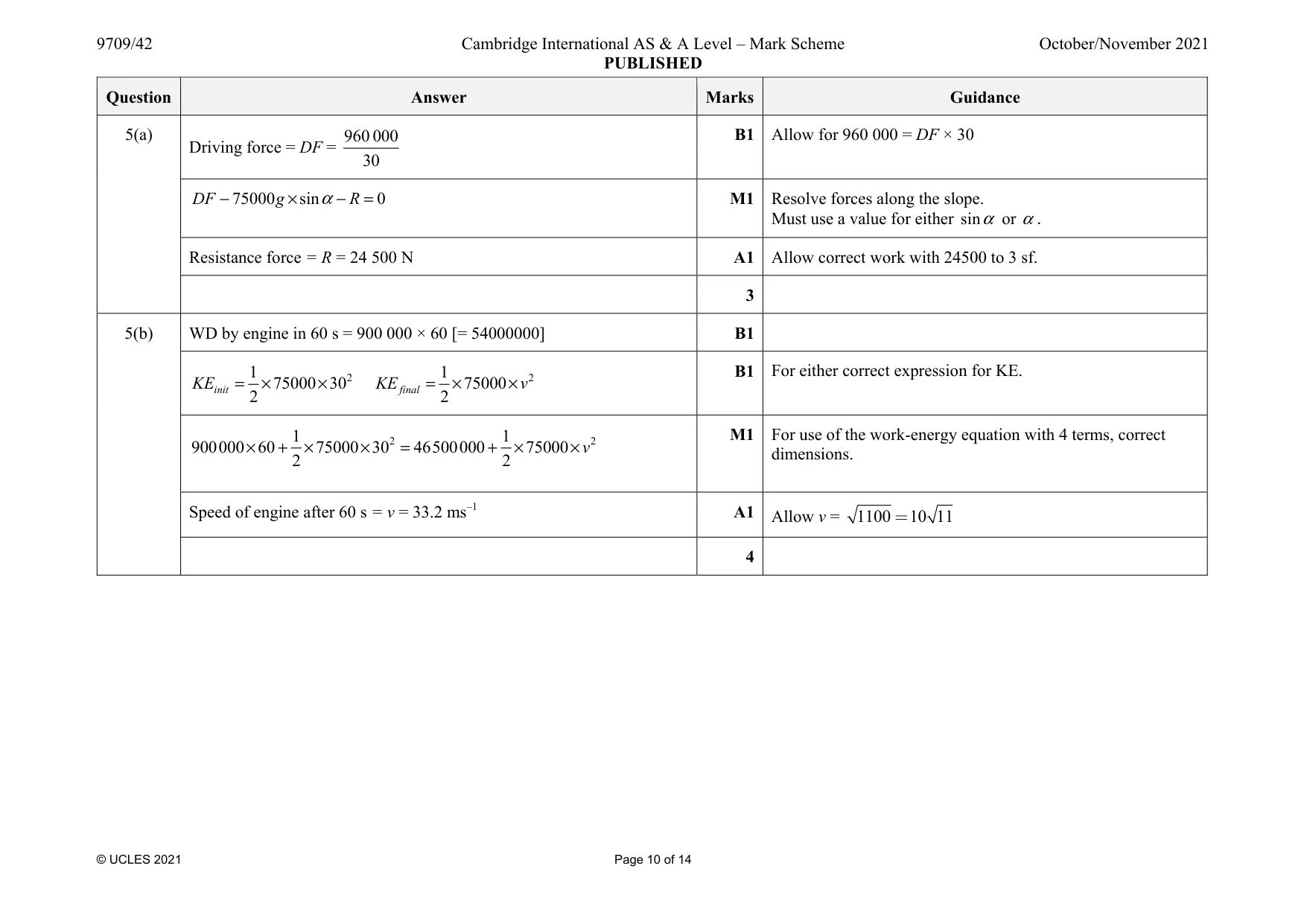
Mark scheme: 5(a) Driving force = DF = 960 000 30 B1 Allow for 960 000 = DF × 30 75000 sin 0 α − × − = DF g R M1 Resolve forces along the slope. Must use a value for either sinα or α . Resistance force = R = 24 500 N A1 Allow correct work with 24500 to 3 sf. 3 5(b) WD by engine in 60 s = 900 000 × 60 [= 54000000] B1 2 1 75000 30 2 = × × init KE 2 1 75000 2 = × × final KE v B1 For either correct expression for KE. 2 2 1 1 900 000 60 75000 30 46 500 000 75000 2 2 v × + × × = + × × M1 For use of the work-energy equation with 4 terms, correct dimensions. Speed of engine after 60 s = v = 33.2 ms–1 A1 Allow v = 1100 10 11 = 4
Q6 · 60Å X N 5 kg 60Å A block of mass 5 kg is held in equilibrium near a vertical wall by two…
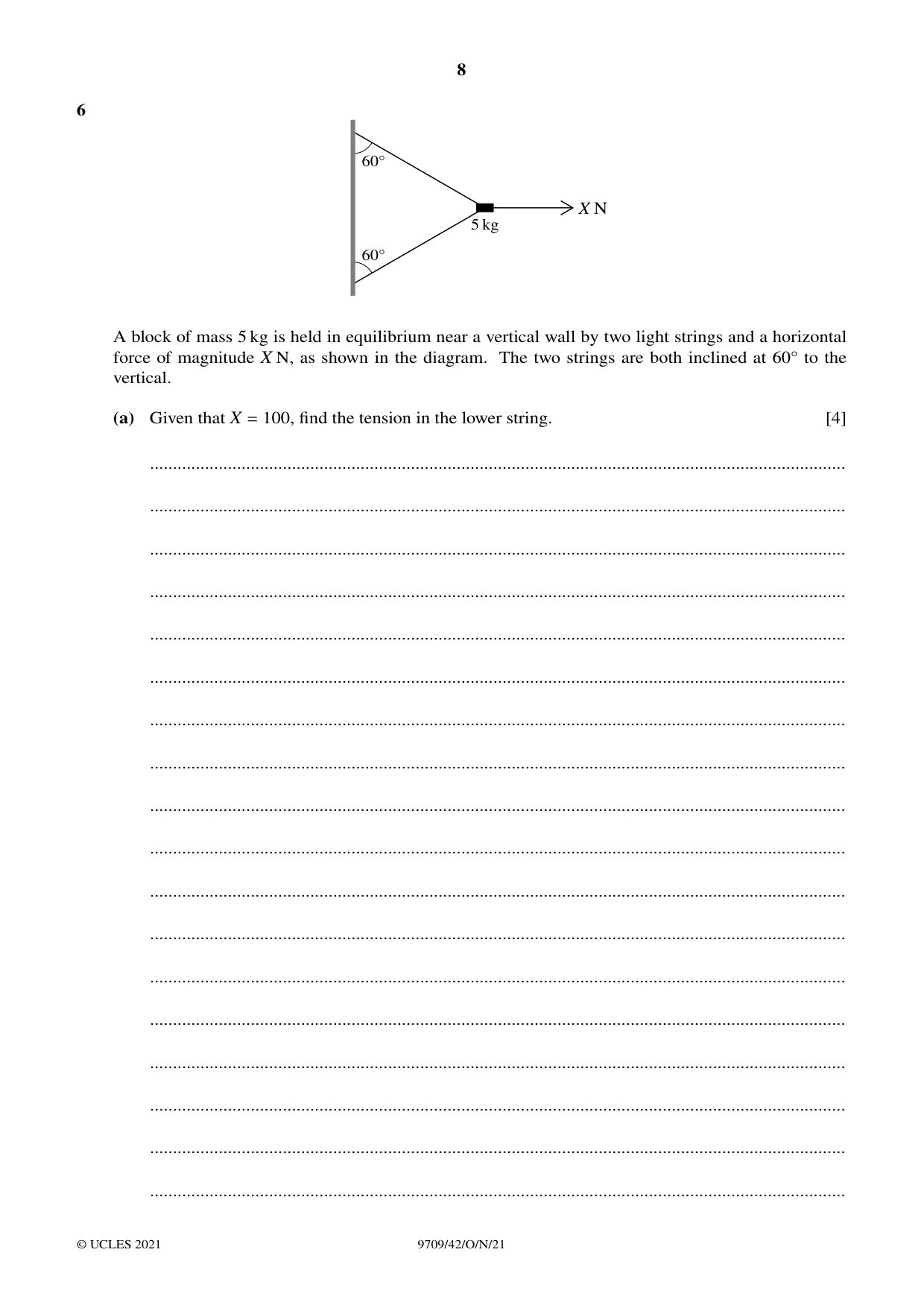
6 60Å X N 5 kg 60Å A block of mass 5 kg is held in equilibrium near a vertical wall by two light strings and a horizontal force of magnitude X N, as shown in the diagram. The two strings are both inclined at 60Å to the vertical. (a) Given that X = 100, find the tension in the lower string. [4] ........................................................................................................................................................ ........................................................................................................................................................ ........................................................................................................................................................ ........................................................................................................................................................ ........................................................................................................................................................ ........................................................................................................................................................ ........................................................................................................................................................ ........................................................................................................................................................ ........................................................................................................................................................ ........................................................................................................................................................ ........................................................................................................................................................ ........................................................................................................................................................ ........................................................................................................................................................ ........................................................................................................................................................ ........................................................................................................................................................ ........................................................................................................................................................ ........................................................................................................................................................ ........................................................................................................................................................ (b) Find the least value of X for which the block remains in equilibrium in the position shown. [4] ........................................................................................................................................................ ........................................................................................................................................................ ........................................................................................................................................................ ........................................................................................................................................................ ........................................................................................................................................................ ........................................................................................................................................................ ........................................................................................................................................................ ........................................................................................................................................................ ........................................................................................................................................................ ........................................................................................................................................................ ........................................................................................................................................................ ........................................................................................................................................................ ........................................................................................................................................................ ........................................................................................................................................................ ........................................................................................................................................................ ........................................................................................................................................................ ........................................................................................................................................................ ........................................................................................................................................................ ........................................................................................................................................................ ........................................................................................................................................................ ........................................................................................................................................................ ........................................................................................................................................................ ........................................................................................................................................................ ........................................................................................................................................................ ........................................................................................................................................................
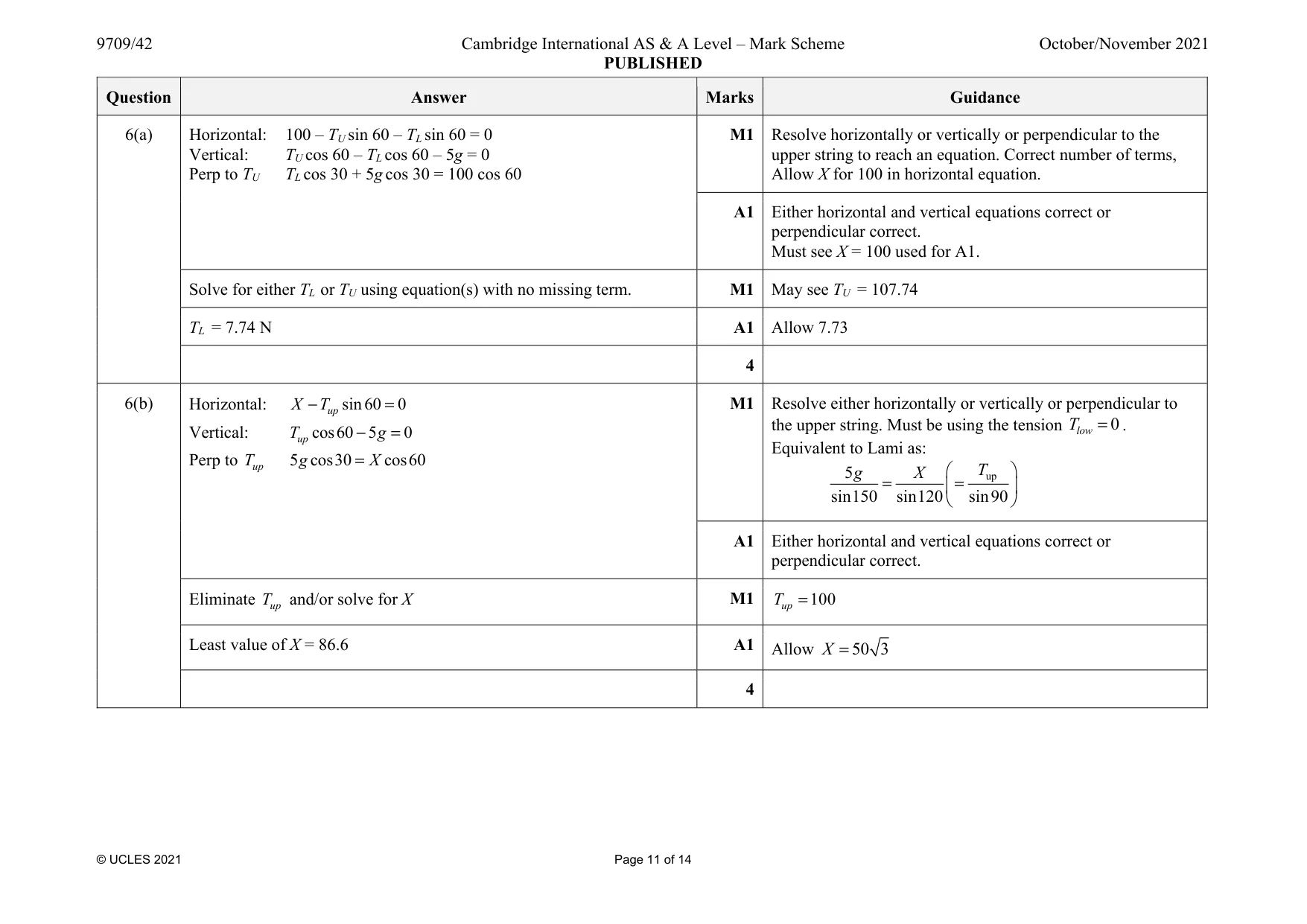
Mark scheme: 6(a) Horizontal: 100 – TU sin 60 – TL sin 60 = 0 Vertical: TU cos 60 – TL cos 60 – 5g = 0 Perp to TU TL cos 30 + 5g cos 30 = 100 cos 60 M1 Resolve horizontally or vertically or perpendicular to the upper string to reach an equation. Correct number of terms, Allow X for 100 in horizontal equation. A1 Either horizontal and vertical equations correct or perpendicular correct. Must see X = 100 used for A1. Solve for either TL or TU using equation(s) with no missing term. M1 May see TU = 107.74 TL = 7.74 N A1 Allow 7.73 4 6(b) Horizontal: sin60 0 − = up X T Vertical: cos60 5 0 − = up T g Perp to up T 5 cos30 cos60 = g X M1 Resolve either horizontally or vertically or perpendicular to the upper string. Must be using the tension 0 = low T . Equivalent to Lami as: up 5 sin150 sin120 sin90 = = T g X A1 Either horizontal and vertical equations correct or perpendicular correct. Eliminate up T and/or solve for X M1 100 up T = Least value of X = 86.6 A1 Allow 50 3 = X 4
Q7 · P m kg 6.4 m Q 2m kg !
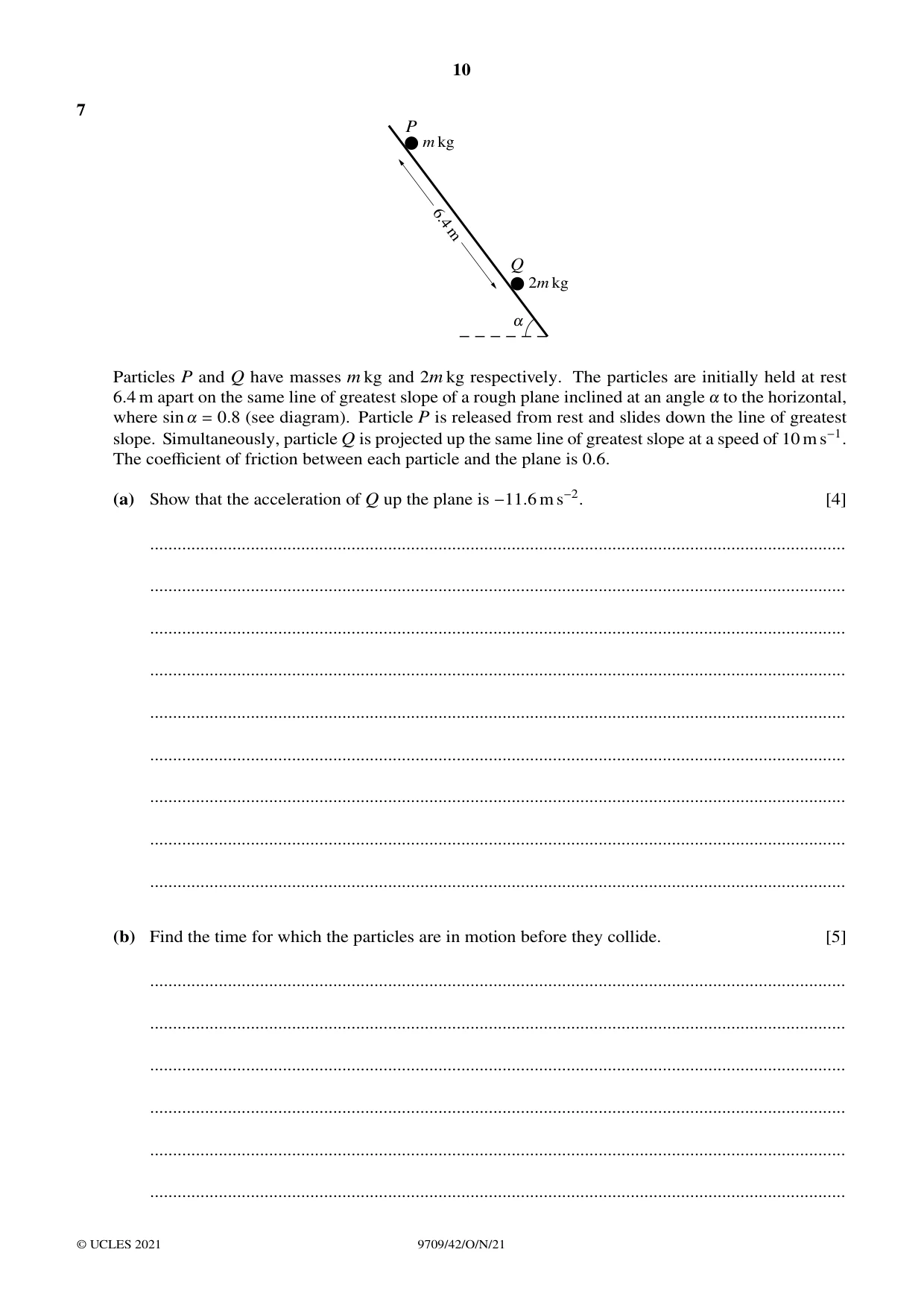
7 P m kg 6.4 m Q 2m kg ! Particles P and Q have masses m kg and 2m kg respectively. The particles are initially held at rest 6.4 m apart on the same line of greatest slope of a rough plane inclined at an angle ! to the horizontal, where sin ! = 0.8 (see diagram). Particle P is released from rest and slides down the line of greatest slope. Simultaneously, particle Q is projected up the same line of greatest slope at a speed of 10 m s−1. The coefficient of friction between each particle and the plane is 0.6. (a) Show that the acceleration of Q up the plane is −11.6 m s−2. [4] ........................................................................................................................................................ ........................................................................................................................................................ ........................................................................................................................................................ ........................................................................................................................................................ ........................................................................................................................................................ ........................................................................................................................................................ ........................................................................................................................................................ ........................................................................................................................................................ ........................................................................................................................................................ (b) Find the time for which the particles are in motion before they collide. [5] ........................................................................................................................................................ ........................................................................................................................................................ ........................................................................................................................................................ ........................................................................................................................................................ ........................................................................................................................................................ ........................................................................................................................................................ ........................................................................................................................................................ ........................................................................................................................................................ ........................................................................................................................................................ ........................................................................................................................................................ ........................................................................................................................................................ ........................................................................................................................................................ ........................................................................................................................................................ ........................................................................................................................................................ ........................................................................................................................................................ ........................................................................................................................................................ ........................................................................................................................................................ (c) The particles coalesce on impact. Find the speed of the combined particle immediately after the impact. [4] ........................................................................................................................................................ ........................................................................................................................................................ ........................................................................................................................................................ ........................................................................................................................................................ ........................................................................................................................................................ ........................................................................................................................................................ ........................................................................................................................................................ ........................................................................................................................................................ ........................................................................................................................................................ ........................................................................................................................................................ ........................................................................................................................................................ ........................................................................................................................................................
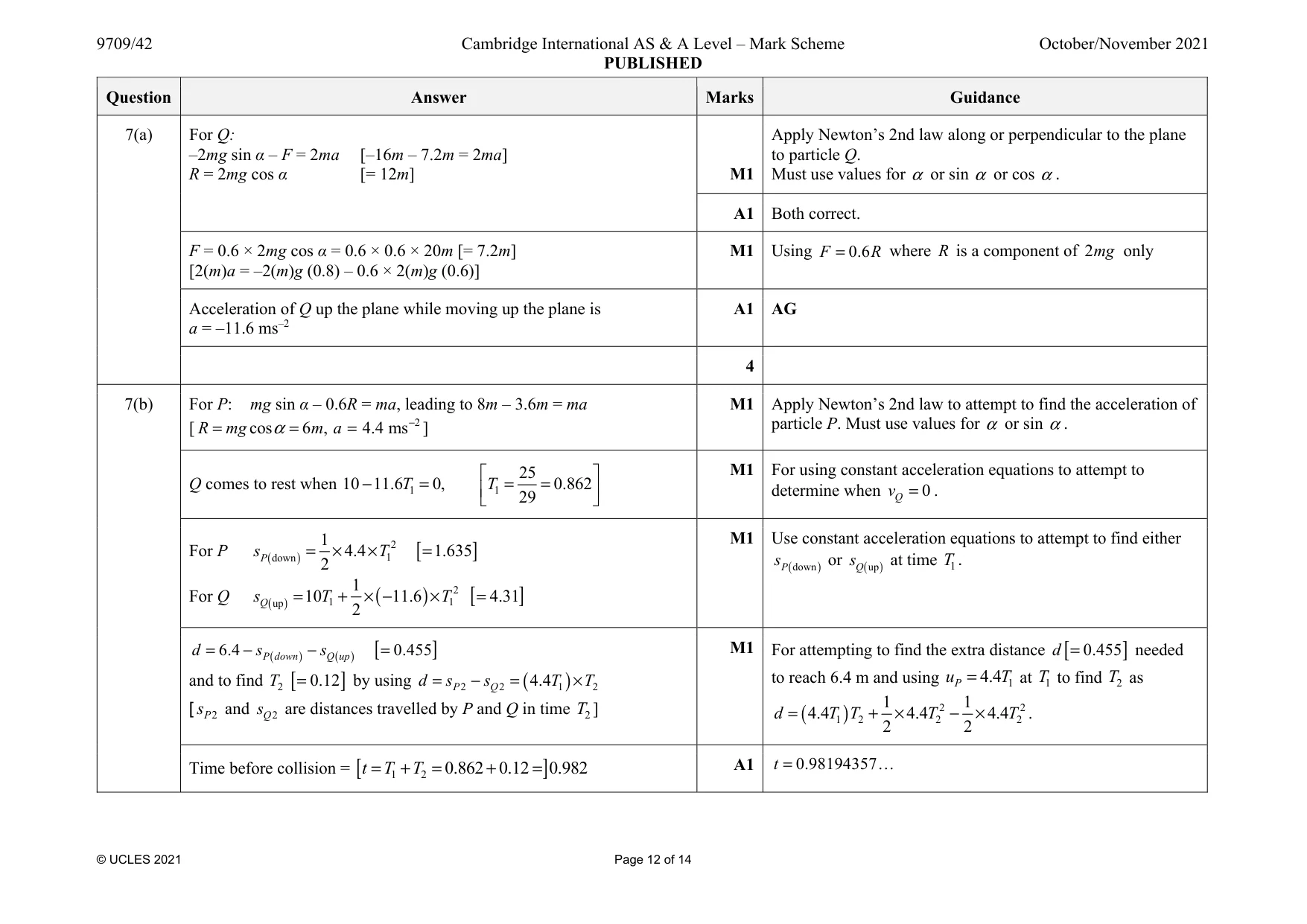
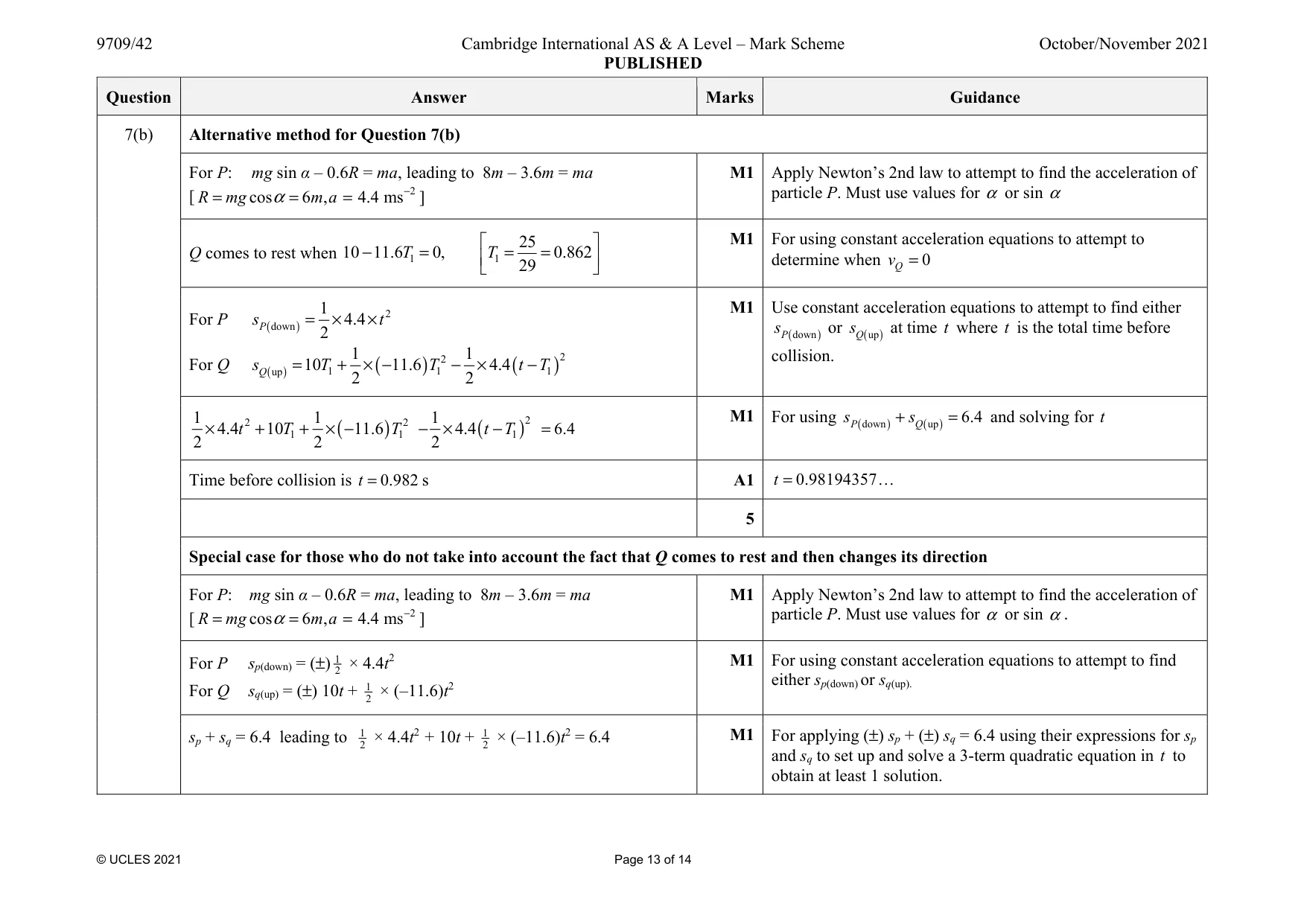
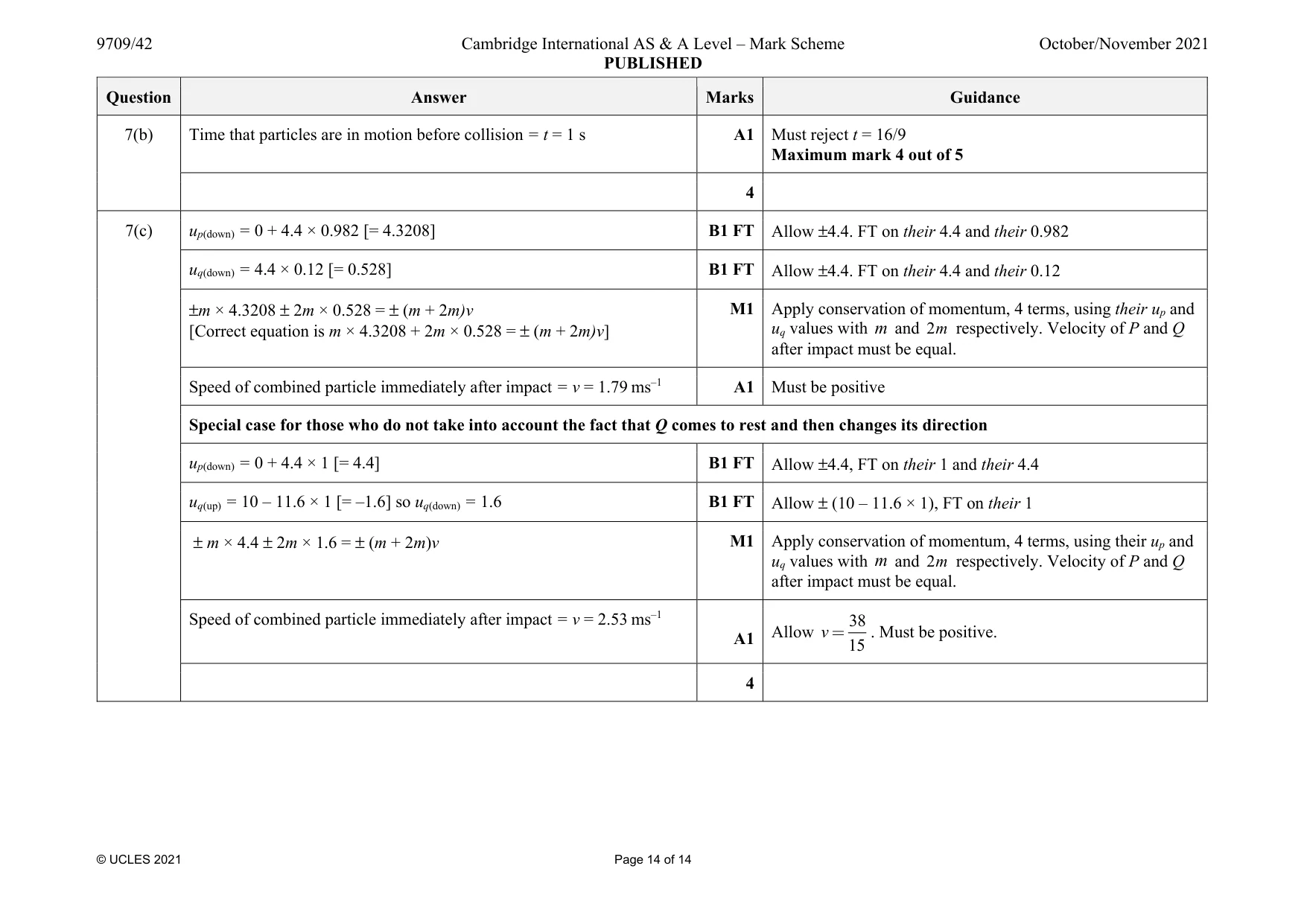
Mark scheme: 7(a) For Q: –2mg sin α – F = 2ma [–16m – 7.2m = 2ma] R = 2mg cos α [= 12m] M1 Apply Newton’s 2nd law along or perpendicular to the plane to particle Q. Must use values for α or sin α or cos α . A1 Both correct. F = 0.6 × 2mg cos α = 0.6 × 0.6 × 20m [= 7.2m] [2(m)a = –2(m)g (0.8) – 0.6 × 2(m)g (0.6)] M1 Using 0.6 = F R where R is a component of 2mg only Acceleration of Q up the plane while moving up the plane is a = –11.6 ms–2 A1 AG 4 7(b) For P: mg sin α – 0.6R = ma, leading to 8m – 3.6m = ma [ 2 cos 6 , 4.4 ms α − = = = R mg m a ] M1 Apply Newton’s 2nd law to attempt to find the acceleration of particle P. Must use values for α or sin α . Q comes to rest when 1 1 25 10 11.6 0, 0.862 29 − = = = T T M1 For using constant acceleration equations to attempt to determine when 0 = Q v . For P ( ) [ ] 2 1 down 1 4.4 1.635 2 = × × = Ps T For Q ( ) ( ) [ ] 2 1 1 up 1 10 11.6 4.31 2 = + × − × = Q s T T M1 Use constant acceleration equations to attempt to find either ( ) down Ps or ( ) up Q s at time 1T . ( ) ( ) [ ] 6.4 0.455 = − − = P down Q up d s s and to find [ ] 2 0.12 = T by using ( ) 2 2 1 2 4.4 = − = × P Q d s s T T [ 2 Ps and 2 Q s are distances travelled by P and Q in time 2 T ] M1 For attempting to find the extra distance [ ] 0.455 = d needed to reach 6.4 m and using 1 4.4 = P u T at 1T to find 2 T as ( ) 2 2 1 2 2 2 1 1 4.4 4.4 4.4 2 2 = + × − × d T T T T . Time before collision = [ ] 1 2 0.862 0.12 0.982 t T T = + = + = A1 0.98194357 = … t Question Answer Marks Guidance 7(b) Alternative method for Question 7(b) For P: mg sin α – 0.6R = ma, leading to 8m – 3.6m = ma [ 2 cos 6 , 4.4 ms α − = = = R mg m a ] M1 Apply Newton’s 2nd law to attempt to find the acceleration of particle P. Must use values for α or sin α Q comes to rest when 1 1 25 10 11.6 0, 0.862 29 − = = = T T M1 For using constant acceleration equations to attempt to determine when 0 = Q v For P ( ) 2 down 1 4.4 2 = × × Ps t For Q ( ) ( ) ( ) 2 2 1 1 1 up 1 1 10 11.6 4.4 2 2 = + × − − × − Q s T T t T M1 Use constant acceleration equations to attempt to find either ( ) down Ps or ( ) up Q s at time t where t is the total time before collision. ( ) 2 2 1 1 1 1 4.4 10 11.6 2 2 × + + × − t T T ( ) 2 1 1 4.4 2 − × − t T 6.4 = M1 For using ( ) ( ) down up 6.4 + = P Q s s and solving for t Time before collision is 0.982 t = s A1 0.98194357 = … t 5 Special case for those who do not take into account the fact that Q comes to rest and then changes its direction For P: mg sin α – 0.6R = ma, leading to 8m – 3.6m = ma [ 2 cos 6 , 4.4 ms α − = = = R mg m a ] M1 Apply Newton’s 2nd law to attempt to find the acceleration of particle P. Must use values for α or sin α . For P sp(down) = (±) 1 2 × 4.4t2 For Q sq(up) = (±) 10t + 1 2 × (–11.6)t2 M1 For using constant acceleration equations to attempt to find either sp(down) or sq(up). sp + sq = 6.4 leading to 1 2 × 4.4t2 + 10t + 1 2 × (–11.6)t2 = 6.4 M1 For applying (±) sp + (±) sq = 6.4 using their expressions for sp and sq to set up and solve a 3-term quadratic equation in t to obtain at least 1 solution. Question Answer Marks Guidance 7(b) Time that particles are in motion before collision = t = 1 s A1 Must reject t = 16/9 Maximum mark 4 out of 5 4 7(c) up(down) = 0 + 4.4 × 0.982 [= 4.3208] B1 FT Allow ±4.4. FT on their 4.4 and their 0.982 uq(down) = 4.4 × 0.12 [= 0.528] B1 FT Allow ±4.4. FT on their 4.4 and their 0.12 ±m × 4.3208 ± 2m × 0.528 = ± (m + 2m)v [Correct equation is m × 4.3208 + 2m × 0.528 = ± (m + 2m)v] M1 Apply conservation of momentum, 4 terms, using their up and uq values with m and 2m respectively. Velocity of P and Q after impact must be equal. Speed of combined particle immediately after impact = v = 1.79 ms–1 A1 Must be positive Special case for those who do not take into account the fact that Q comes to rest and then changes its direction up(down) = 0 + 4.4 × 1 [= 4.4] B1 FT Allow ±4.4, FT on their 1 and their 4.4 uq(up) = 10 – 11.6 × 1 [= –1.6] so uq(down) = 1.6 B1 FT Allow ± (10 – 11.6 × 1), FT on their 1 ± m × 4.4 ± 2m × 1.6 = ± (m + 2m)v M1 Apply conservation of momentum, 4 terms, using their up and uq values with m and 2m respectively. Velocity of P and Q after impact must be equal. Speed of combined particle immediately after impact = v = 2.53 ms–1 A1 Allow 38 15 v = . Must be positive. 4
What was in this paper
The subtopics covered by these 7 questions, and how many questions each got. Open one in a new tab to see every Cambridge question on it.
What you needed in this session
Cambridge’s own grade thresholds for 2021 Oct/Nov, Paper 4 · Variant 2. A higher threshold means an easier paper — the bar moves with how the cohort did.