Cambridge A Level Mathematics 9709 — 2014 Oct/Nov Paper 4 · Variant 2
9709/42/O/N/14 · 7 questions · 50 marks · ≈56 min
The question paper and its mark scheme, free to read here and free to download. This is Cambridge’s own paper, exactly as it was sat.
Question paper4 pages
Mark scheme7 pages
Answers below. Sit the paper first if you are practising.
Questions as text
Q1 · A particle P is projected vertically upwards with speed 11 m s−1 from a point on…
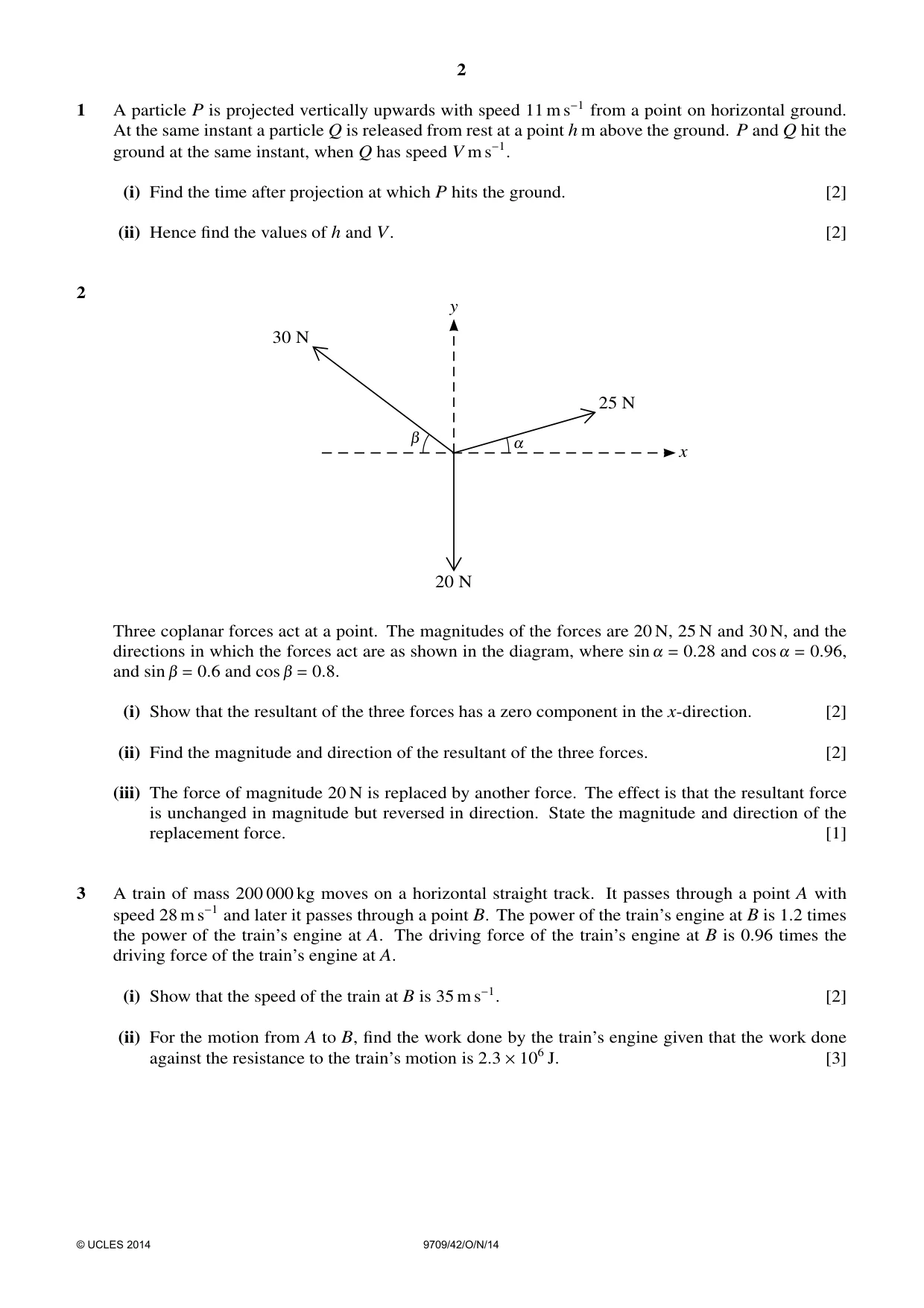
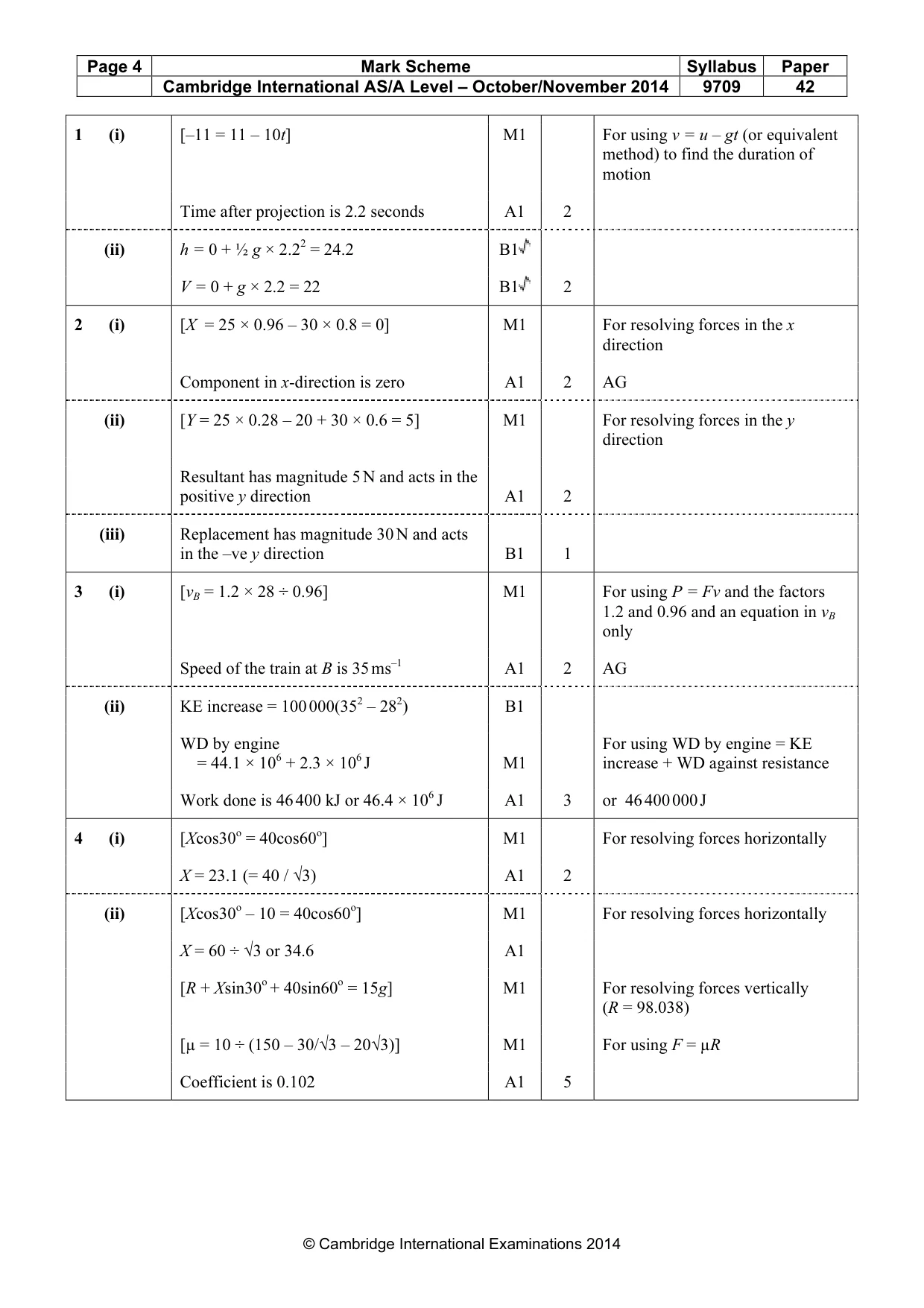
1 A particle P is projected vertically upwards with speed 11 m s−1 from a point on horizontal ground. At the same instant a particle Q is released from rest at a point h m above the ground. P and Q hit the ground at the same instant, when Q has speed V m s−1. (i) Find the time after projection at which P hits the ground. [2] (ii) Hence find the values of h and V. [2]
Mark scheme: 1 (i) [–11 = 11 – 10t] M1 For using v = u – gt (or equivalent method) to find the duration of motion Time after projection is 2.2 seconds A1 2 (ii) h = 0 + ½ g × 2.22 = 24.2 B1 V = 0 + g × 2.2 = 22 B1 2
Q2 · Y 30 N 25 N " !
2 y 30 N 25 N " ! x 20 N Three coplanar forces act at a point. The magnitudes of the forces are 20 N, 25 N and 30 N, and the directions in which the forces act are as shown in the diagram, where sin ! = 0.28 and cos ! = 0.96, and sin " = 0.6 and cos " = 0.8. (i) Show that the resultant of the three forces has a zero component in the x-direction. [2] (ii) Find the magnitude and direction of the resultant of the three forces. [2] (iii) The force of magnitude 20 N is replaced by another force. The effect is that the resultant force is unchanged in magnitude but reversed in direction. State the magnitude and direction of the replacement force. [1]
Mark scheme: 2 (i) [X = 25 × 0.96 – 30 × 0.8 = 0] M1 For resolving forces in the x direction Component in x-direction is zero A1 2 AG (ii) [Y = 25 × 0.28 – 20 + 30 × 0.6 = 5] M1 For resolving forces in the y direction Resultant has magnitude 5 N and acts in the positive y direction A1 2 (iii) Replacement has magnitude 30 N and acts in the –ve y direction B1 1
Q3 · A train of mass 200 000 kg moves on a horizontal straight track
3 A train of mass 200 000 kg moves on a horizontal straight track. It passes through a point A with speed 28 m s−1 and later it passes through a point B. The power of the train’s engine at B is 1.2 times the power of the train’s engine at A. The driving force of the train’s engine at B is 0.96 times the driving force of the train’s engine at A. (i) Show that the speed of the train at B is 35 m s−1. [2] (ii) For the motion from A to B, find the work done by the train’s engine given that the work done against the resistance to the train’s motion is 2.3 × 10⁶ J. [3]
Mark scheme: 3 (i) [vB = 1.2 × 28 ÷ 0.96] M1 For using P = Fv and the factors 1.2 and 0.96 and an equation in vB only Speed of the train at B is 35 ms–1 A1 2 AG (ii) KE increase = 100 000(352 – 282) B1 WD by engine For using WD by engine = KE = 44.1 × 10⁶ + 2.3 × 10⁶ J M1 increase + WD against resistance Work done is 46 400 kJ or 46.4 × 10⁶ J A1 3 or 46 400 000 J
Q4 · 40 N X N A B 30Å C Forces of magnitude X N and 40 N act on a block B of mass 15 kg, which…
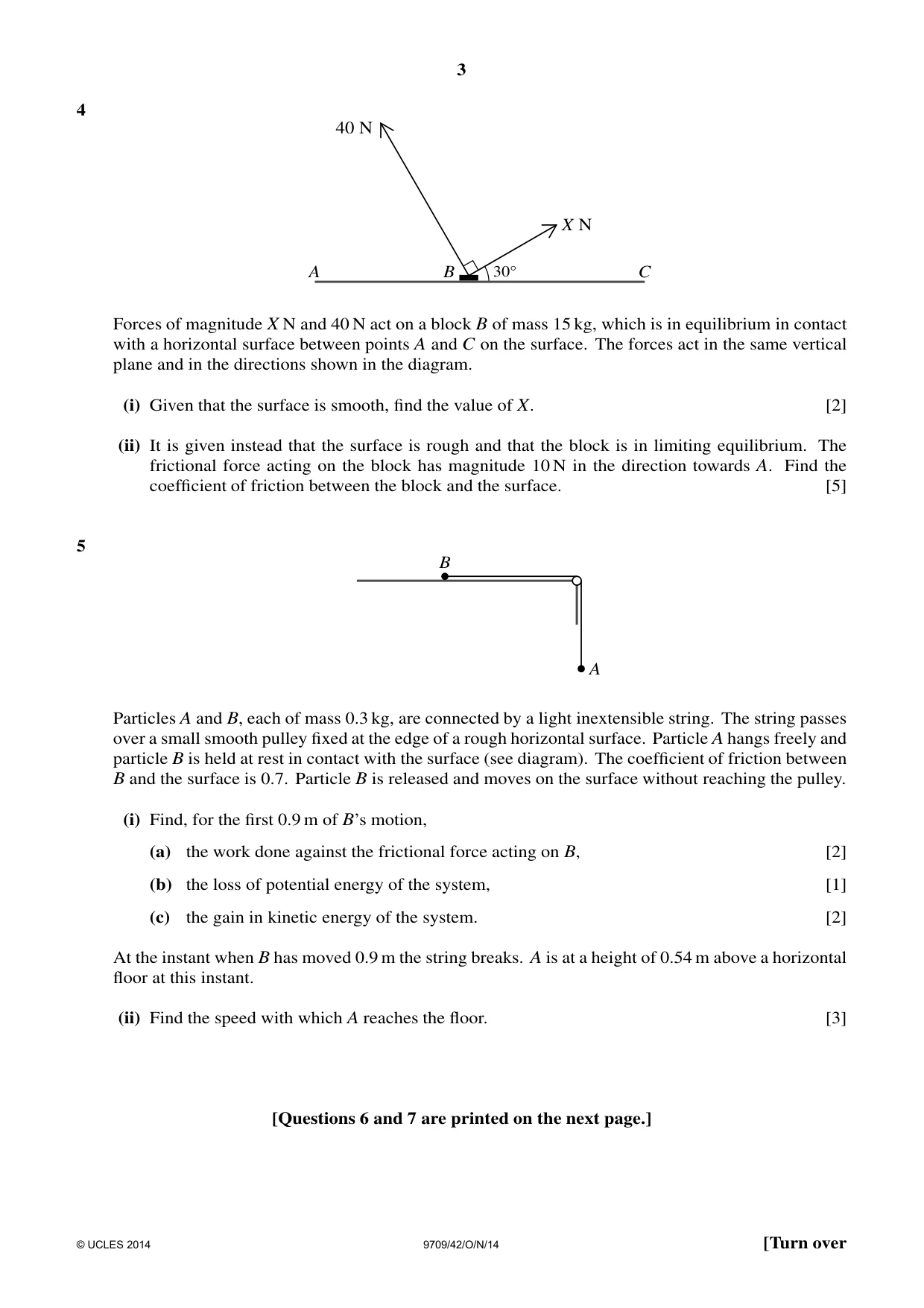
4 40 N X N A B 30Å C Forces of magnitude X N and 40 N act on a block B of mass 15 kg, which is in equilibrium in contact with a horizontal surface between points A and C on the surface. The forces act in the same vertical plane and in the directions shown in the diagram. (i) Given that the surface is smooth, find the value of X. [2] (ii) It is given instead that the surface is rough and that the block is in limiting equilibrium. The frictional force acting on the block has magnitude 10 N in the direction towards A. Find the coefficient of friction between the block and the surface. [5]
Mark scheme: 4 (i) [Xcos30o = 40cos60o] M1 For resolving forces horizontally X = 23.1 (= 40 / √3) A1 2 (ii) [Xcos30o – 10 = 40cos60o] M1 For resolving forces horizontally X = 60 ÷ √3 or 34.6 A1 [R + Xsin30o + 40sin60o = 15g] M1 For resolving forces vertically (R = 98.038) [µ = 10 ÷ (150 – 30/√3 – 20√3)] M1 For using F = µR Coefficient is 0.102 A1 5
Q5 · B A Particles A and B, each of mass 0.3 kg, are connected by a light inextensible string
5 B A Particles A and B, each of mass 0.3 kg, are connected by a light inextensible string. The string passes over a small smooth pulley fixed at the edge of a rough horizontal surface. Particle A hangs freely and particle B is held at rest in contact with the surface (see diagram). The coefficient of friction between B and the surface is 0.7. Particle B is released and moves on the surface without reaching the pulley. (i) Find, for the first 0.9 m of B’s motion, (a) the work done against the frictional force acting on B, [2] (b) the loss of potential energy of the system, [1] (c) the gain in kinetic energy of the system. [2] At the instant when B has moved 0.9 m the string breaks. A is at a height of 0.54 m above a horizontal floor at this instant. (ii) Find the speed with which A reaches the floor. [3] [Questions 6 and 7 are printed on the next page.]
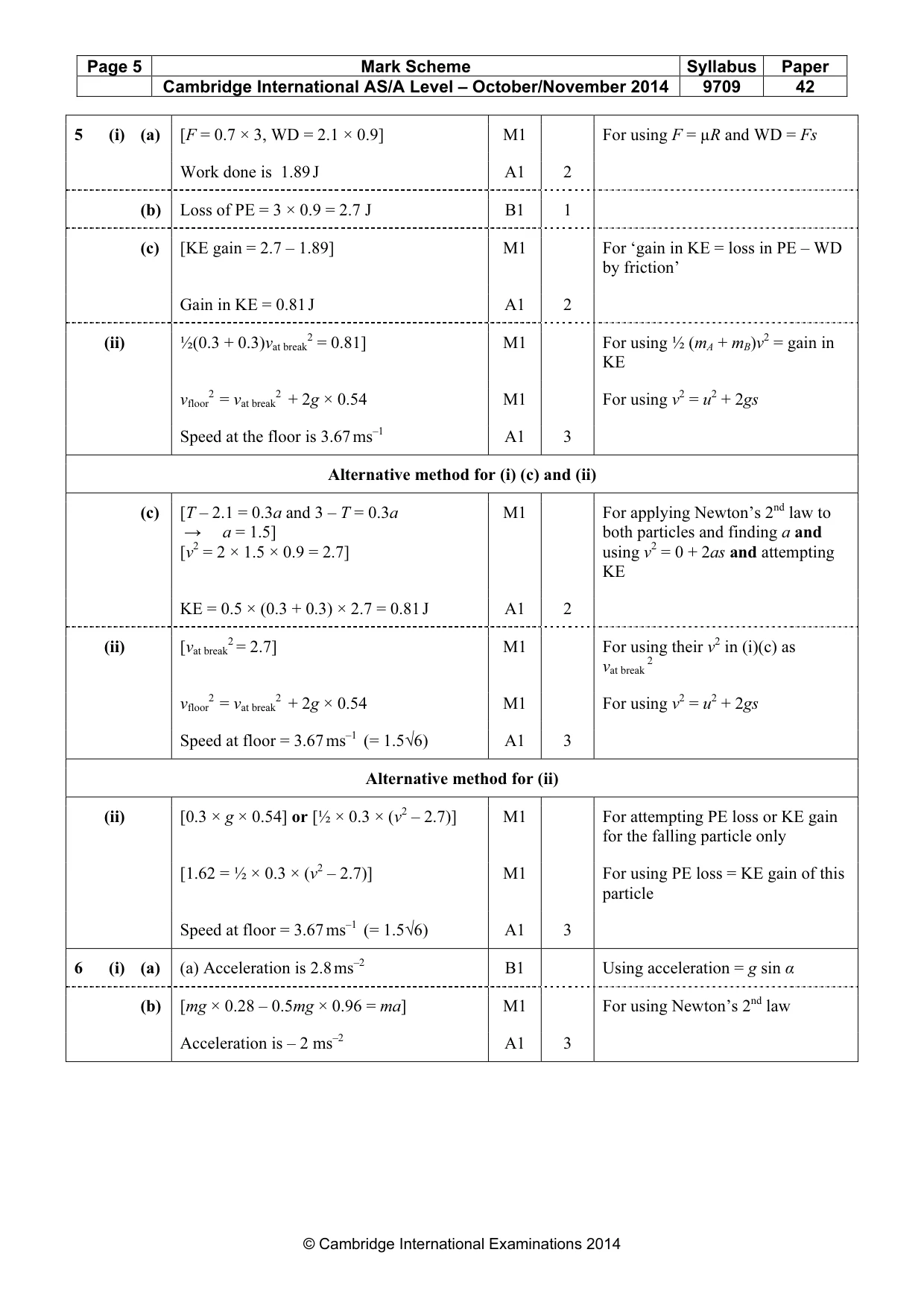
Mark scheme: 5 (i) (a) [F = 0.7 × 3, WD = 2.1 × 0.9] M1 For using F = µR and WD = Fs Work done is 1.89 J A1 2 (b) Loss of PE = 3 × 0.9 = 2.7 J B1 1 (c) [KE gain = 2.7 – 1.89] M1 For ‘gain in KE = loss in PE – WD by friction’ Gain in KE = 0.81 J A1 2 (ii) ½(0.3 + 0.3)vat break2 = 0.81] M1 For using ½ (mA + mB)v2 = gain in KE 2 2 vfloor = vat break + 2g × 0.54 M1 For using v2 = u2 + 2gs Speed at the floor is 3.67 ms–1 A1 3 Alternative method for (i) (c) and (ii) (c) [T – 2.1 = 0.3a and 3 – T = 0.3a M1 For applying Newton’s 2nd law to → a = 1.5] both particles and finding a and [v2 = 2 × 1.5 × 0.9 = 2.7] using v2 = 0 + 2as and attempting KE KE = 0.5 × (0.3 + 0.3) × 2.7 = 0.81 J A1 2 (ii) [vat break 2 = 2.7] M1 For using their v2 in (i)(c) as 2 vat break 2 2 vfloor = vat break + 2g × 0.54 M1 For using v2 = u2 + 2gs Speed at floor = 3.67 ms–1 (= 1.5√6) A1 3 Alternative method for (ii) (ii) [0.3 × g × 0.54] or [½ × 0.3 × (v2 – 2.7)] M1 For attempting PE loss or KE gain for the falling particle only [1.62 = ½ × 0.3 × (v2 – 2.7)] M1 For using PE loss = KE gain of this particle Speed at floor = 3.67 ms–1 (= 1.5√6) A1 3
Q6 · ABC is a line of greatest slope of a plane inclined at angle !
6 ABC is a line of greatest slope of a plane inclined at angle ! to the horizontal, where sin ! = 0.28 and cos ! = 0.96. The point A is at the top of the plane, the point C is at the bottom of the plane and the length of AC is 5 m. The part of the plane above the level of B is smooth and the part below the level of B is rough. A particle P is released from rest at A and reaches C with a speed of 2 m s−1. The coefficient of friction between P and the part of the plane below B is 0.5. Find (i) the acceleration of P while moving (a) from A to B, (b) from B to C, [3] (ii) the distance AB, [3] (iii) the time taken for P to move from A to C. [3]
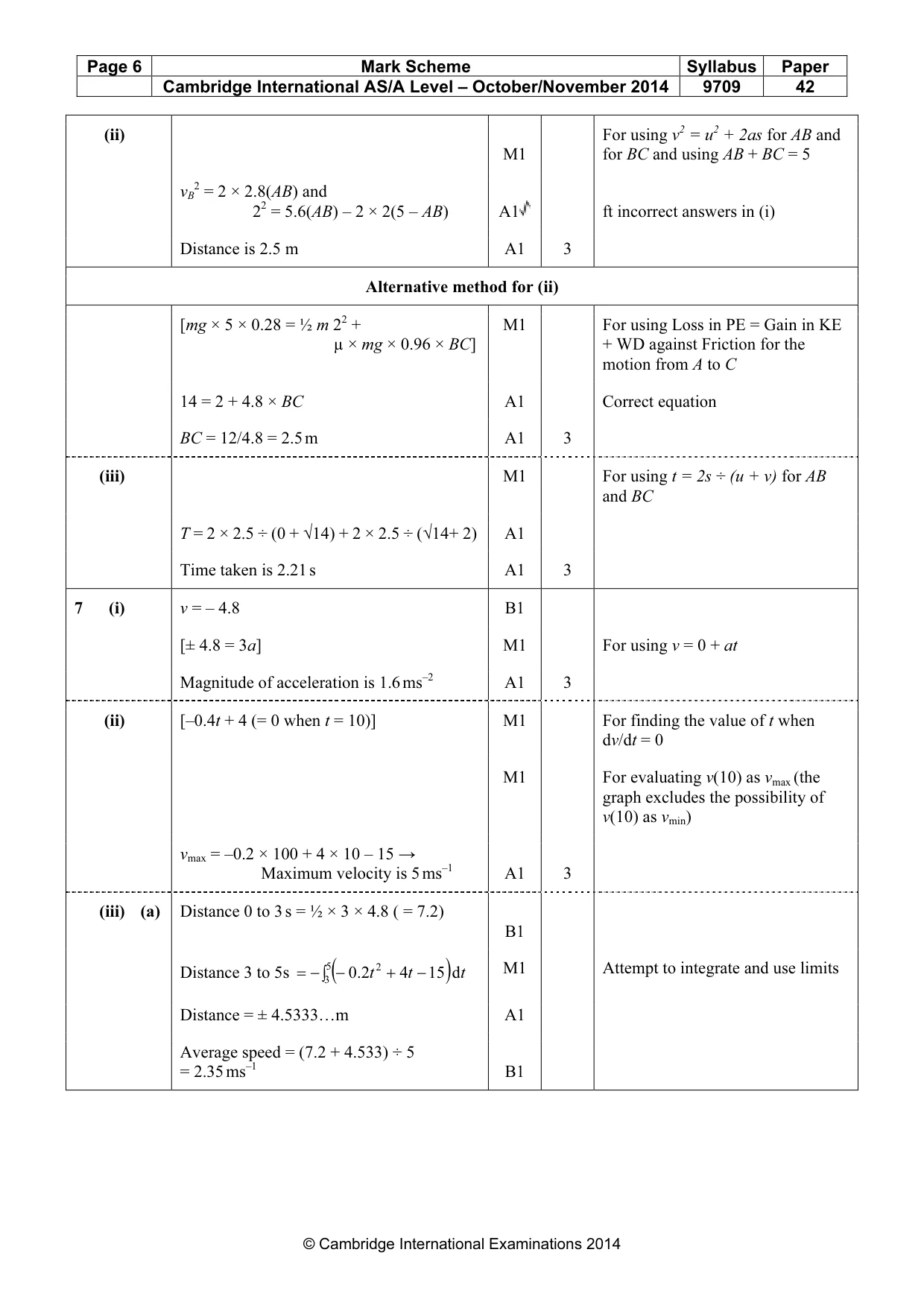
Mark scheme: 6 (i) (a) (a) Acceleration is 2.8 ms–2 B1 Using acceleration = g sin α (b) [mg × 0.28 – 0.5mg × 0.96 = ma] M1 For using Newton’s 2nd law Acceleration is – 2 ms–2 A1 3 (ii) For using v2 = u2 + 2as for AB and M1 for BC and using AB + BC = 5 2 vB = 2 × 2.8(AB) and 22 = 5.6(AB) – 2 × 2(5 – AB) A1 ft incorrect answers in (i) Distance is 2.5 m A1 3 Alternative method for (ii) [mg × 5 × 0.28 = ½ m 22 + M1 For using Loss in PE = Gain in KE µ × mg × 0.96 × BC] + WD against Friction for the motion from A to C 14 = 2 + 4.8 × BC A1 Correct equation BC = 12/4.8 = 2.5 m A1 3 (iii) M1 For using t = 2s ÷ (u + v) for AB and BC T = 2 × 2.5 ÷ (0 + √14) + 2 × 2.5 ÷ (√14+ 2) A1 Time taken is 2.21 s A1 3
Q7 · V m s−1 O t s 3 5 15 The diagram shows the velocity-time graph for the motion of a…
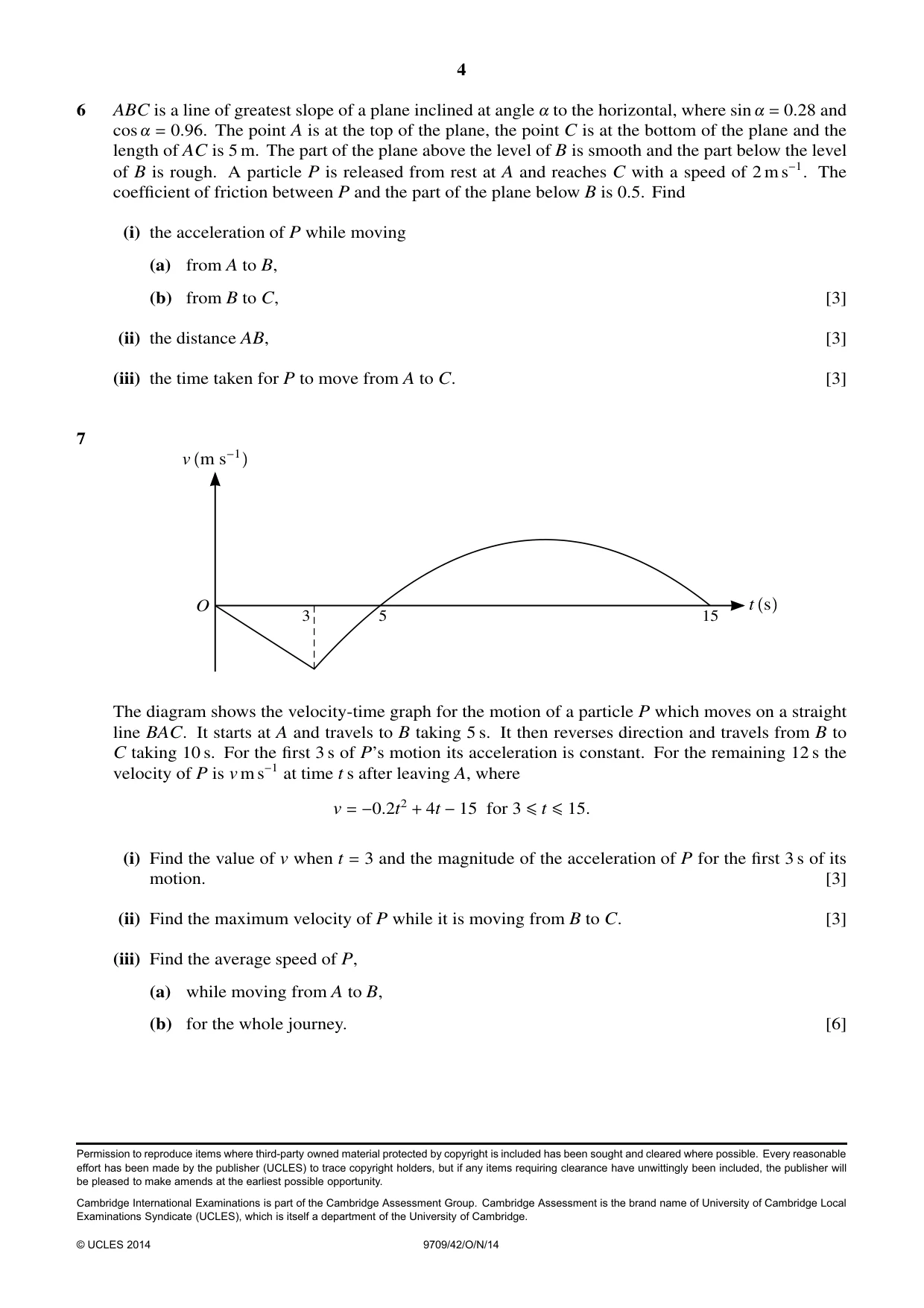
7 v m s−1 O t s 3 5 15 The diagram shows the velocity-time graph for the motion of a particle P which moves on a straight line BAC. It starts at A and travels to B taking 5 s. It then reverses direction and travels from B to C taking 10 s. For the first 3 s of P’s motion its acceleration is constant. For the remaining 12 s the velocity of P is v m s−1 at time t s after leaving A, where v = −0.2t2 + 4t −15 for 3 ≤t ≤15. (i) Find the value of v when t = 3 and the magnitude of the acceleration of P for the first 3 s of its motion. [3] (ii) Find the maximum velocity of P while it is moving from B to C. [3] (iii) Find the average speed of P, (a) while moving from A to B, (b) for the whole journey. [6]
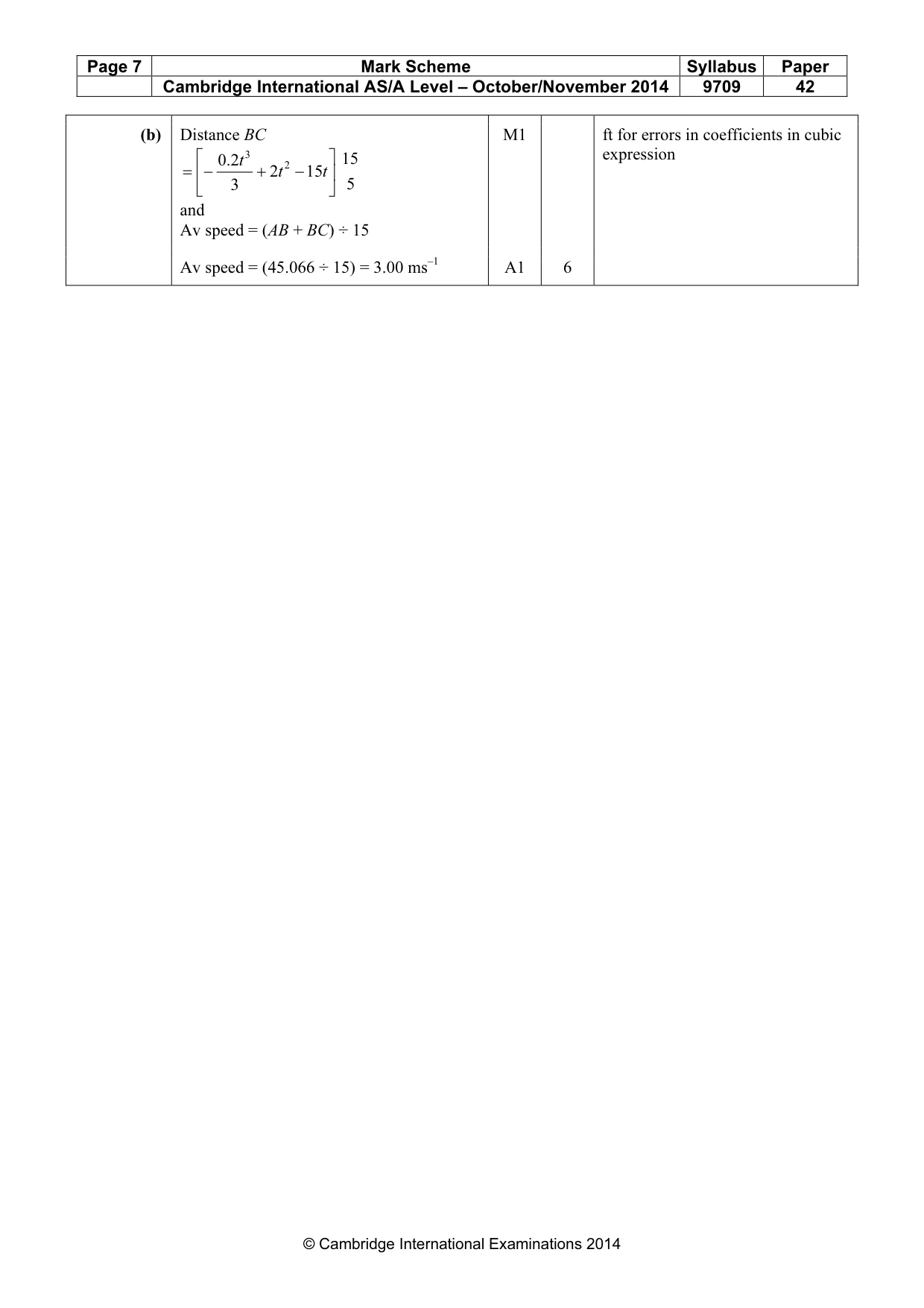
Mark scheme: 7 (i) v = – 4.8 B1 [± 4.8 = 3a] M1 For using v = 0 + at Magnitude of acceleration is 1.6 ms–2 A1 3 (ii) [–0.4t + 4 (= 0 when t = 10)] M1 For finding the value of t when dv/dt = 0 M1 For evaluating v(10) as vmax (the graph excludes the possibility of v(10) as vmin) vmax = –0.2 × 100 + 4 × 10 – 15 → Maximum velocity is 5 ms–1 A1 3 (iii) (a) Distance 0 to 3 s = ½ × 3 × 4.8 ( = 7.2) B1 d t M1 Attempt to integrate and use limits 2.0t 2 + 4t − 15 ) Distance 3 to 5s = − ∫35(− Distance = ± 4.5333…m A1 Average speed = (7.2 + 4.533) ÷ 5 = 2.35 ms–1 B1 (b) Distance BC M1 ft for errors in coefficients in cubic 2.0t 3 2 15 expression = − + 2t − 15t 3 5 and Av speed = (AB + BC) ÷ 15 Av speed = (45.066 ÷ 15) = 3.00 ms–1 A1 6
What was in this paper
The subtopics covered by these 7 questions, and how many questions each got. Open one in a new tab to see every Cambridge question on it.
What you needed in this session
Cambridge’s own grade thresholds for 2014 Oct/Nov, Paper 4 · Variant 2. A higher threshold means an easier paper — the bar moves with how the cohort did.