Cambridge A Level Mathematics 9709 — 2011 May/June Paper 4 · Variant 2
9709/42/M/J/11 · 7 questions · 50 marks · ≈56 min
The question paper and its mark scheme, free to read here and free to download. This is Cambridge’s own paper, exactly as it was sat.
Question paper4 pages
Mark scheme7 pages
Answers below. Sit the paper first if you are practising.
Questions as text
Q1 · A load is pulled along horizontal ground for a distance of 76 m, using a rope
1 A load is pulled along horizontal ground for a distance of 76 m, using a rope. The rope is inclined at 5◦above the horizontal and the tension in the rope is 65 N. (i) Find the work done by the tension. [2] At an instant during the motion the velocity of the load is 1.5 m s−1. (ii) Find the rate of working of the tension at this instant. [2]
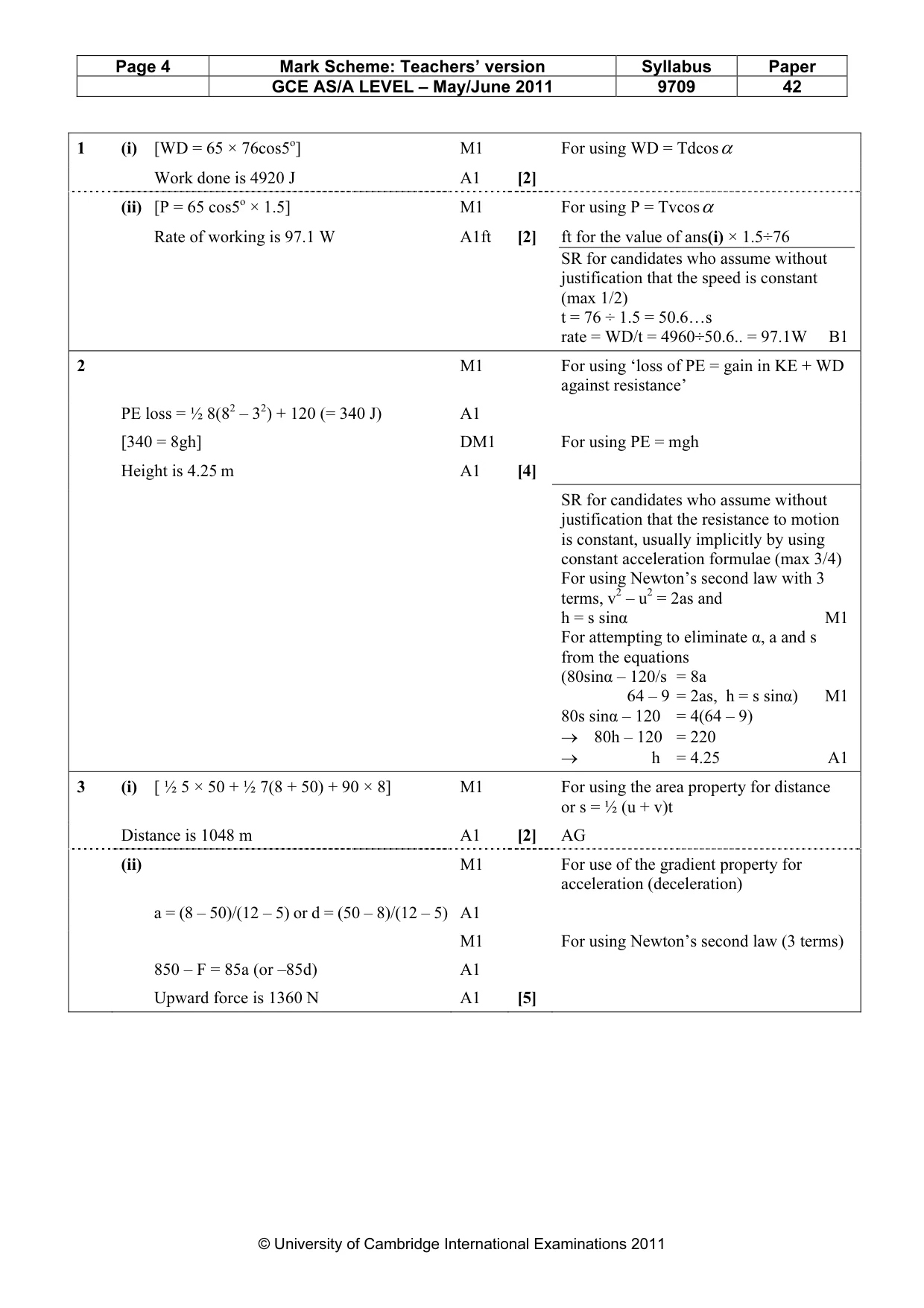
Mark scheme: 1 (i) [WD = 65 × 76cos5o] M1 For using WD = Tdcosα Work done is 4920 J A1 [2] (ii) [P = 65 cos5o × 1.5] M1 For using P = Tvcosα Rate of working is 97.1 W A1ft [2] ft for the value of ans(i) × 1.5÷76 SR for candidates who assume without justification that the speed is constant (max 1/2) t = 76 ÷ 1.5 = 50.6…s rate = WD/t = 4960÷50.6.. = 97.1W B1
Q2 · An object of mass 8 kg slides down a line of greatest slope of an inclined plane
2 An object of mass 8 kg slides down a line of greatest slope of an inclined plane. Its initial speed at the top of the plane is 3 m s−1 and its speed at the bottom of the plane is 8 m s−1. The work done against the resistance to motion of the object is 120 J. Find the height of the top of the plane above the level of the bottom. [4]
Mark scheme: 2 M1 For using ‘loss of PE = gain in KE + WD against resistance’ PE loss = ½ 8(82 – 32) + 120 (= 340 J) A1 [340 = 8gh] DM1 For using PE = mgh Height is 4.25 m A1 [4] SR for candidates who assume without justification that the resistance to motion is constant, usually implicitly by using constant acceleration formulae (max 3/4) For using Newton’s second law with 3 terms, v2 – u2 = 2as and h = s sinα M1 For attempting to eliminate α, a and s from the equations (80sinα – 120/s = 8a 64 – 9 = 2as, h = s sinα) M1 80s sinα – 120 = 4(64 – 9) → 80h – 120 = 220 → h = 4.25 A1
Q3 · V (m s–1 ) 50 8 0 t (s) 0 5 12 102 The velocity-time graph shown models the motion of a…
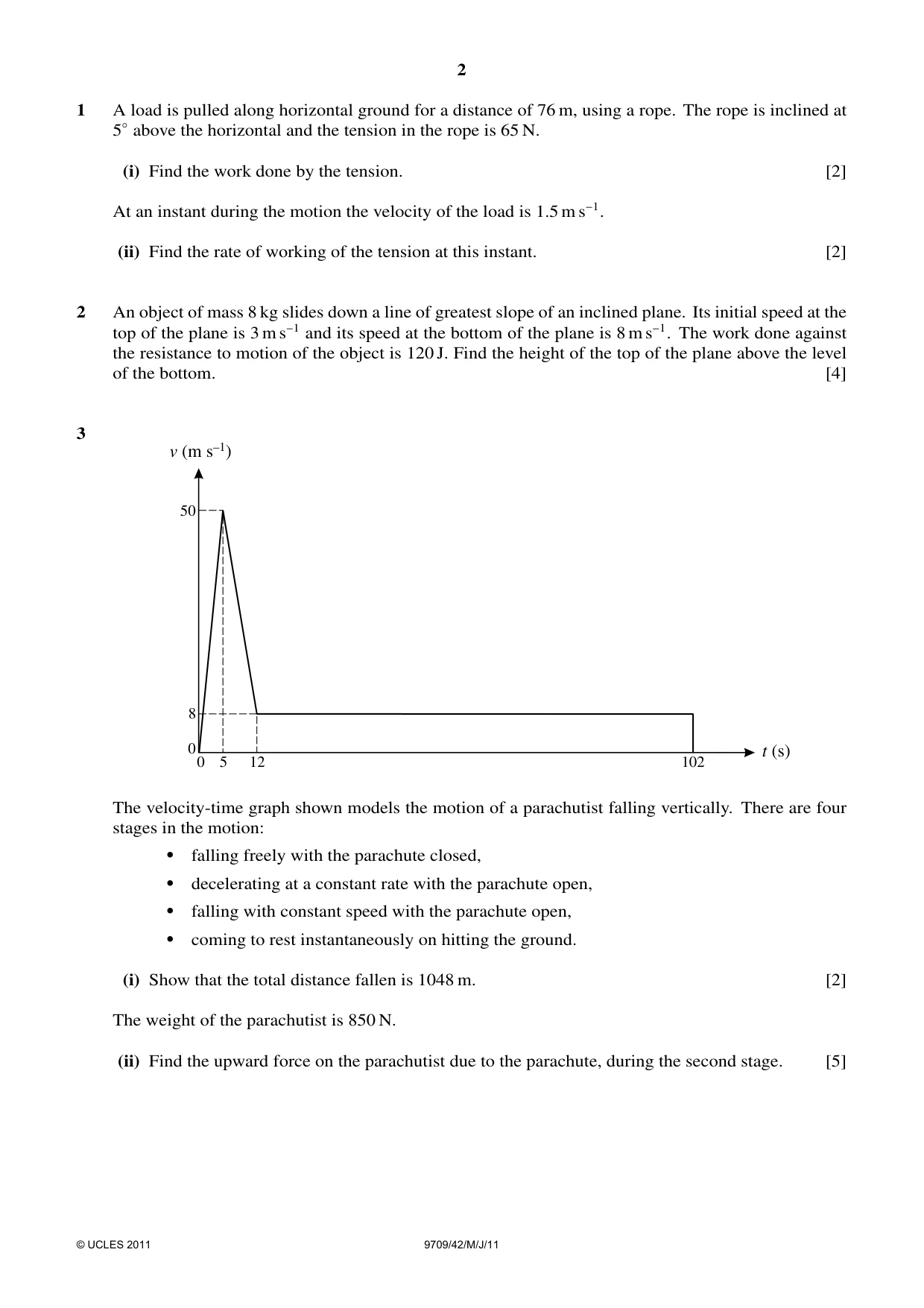
3 v (m s–1 ) 50 8 0 t (s) 0 5 12 102 The velocity-time graph shown models the motion of a parachutist falling vertically. There are four stages in the motion: • falling freely with the parachute closed, • decelerating at a constant rate with the parachute open, • falling with constant speed with the parachute open, • coming to rest instantaneously on hitting the ground. (i) Show that the total distance fallen is 1048 m. [2] The weight of the parachutist is 850 N. (ii) Find the upward force on the parachutist due to the parachute, during the second stage. [5]
Mark scheme: 3 (i) [ ½ 5 × 50 + ½ 7(8 + 50) + 90 × 8] M1 For using the area property for distance or s = ½ (u + v)t Distance is 1048 m A1 [2] AG (ii) M1 For use of the gradient property for acceleration (deceleration) a = (8 – 50)/(12 – 5) or d = (50 – 8)/(12 – 5) A1 M1 For using Newton’s second law (3 terms) 850 – F = 85a (or –85d) A1 Upward force is 1360 N A1 [5] GCE AS/A LEVEL – May/June 2011 9709 42
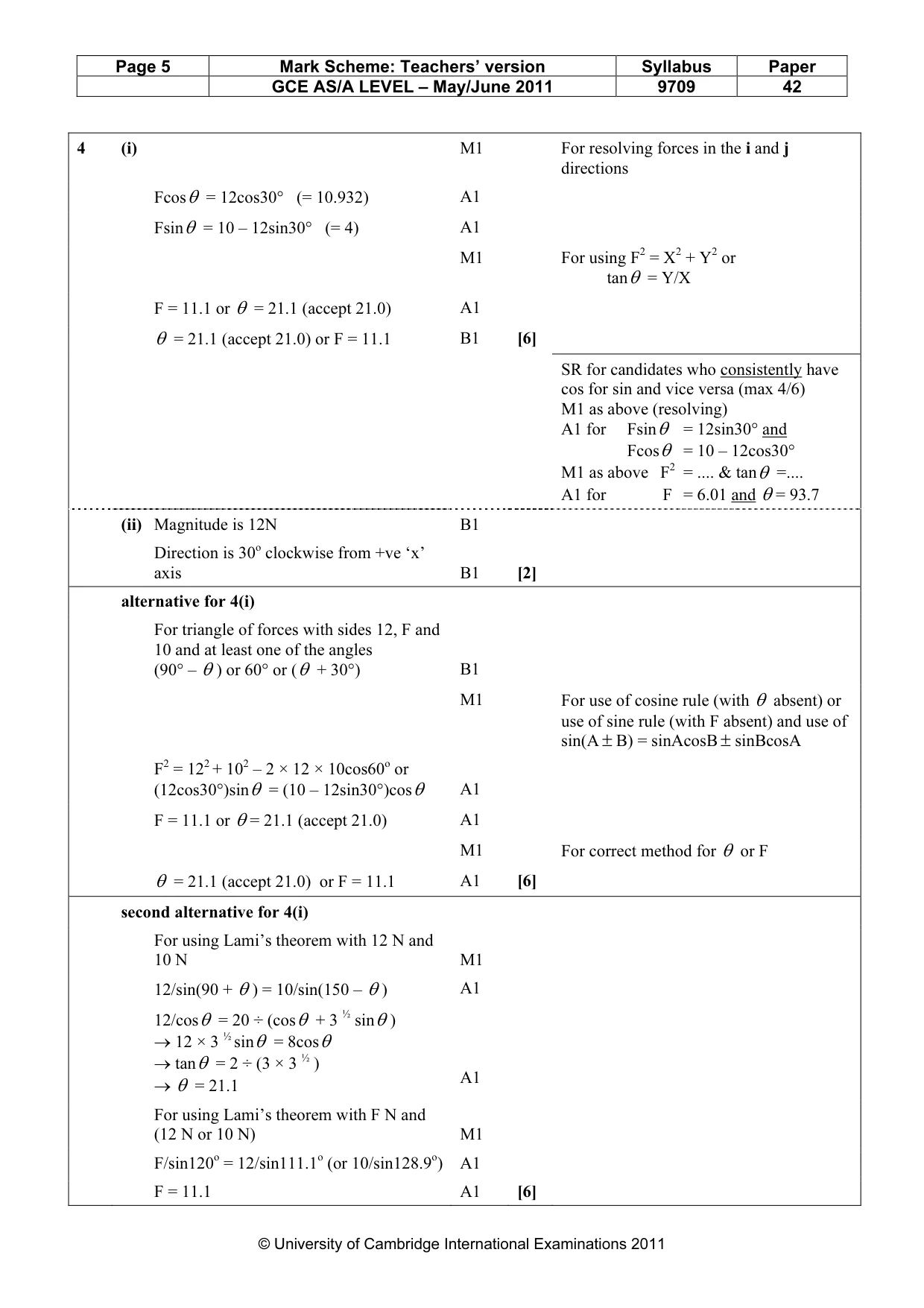
Q4 · 12 N F N P 30° q° 10 N The three coplanar forces shown in the diagram act at a point P…
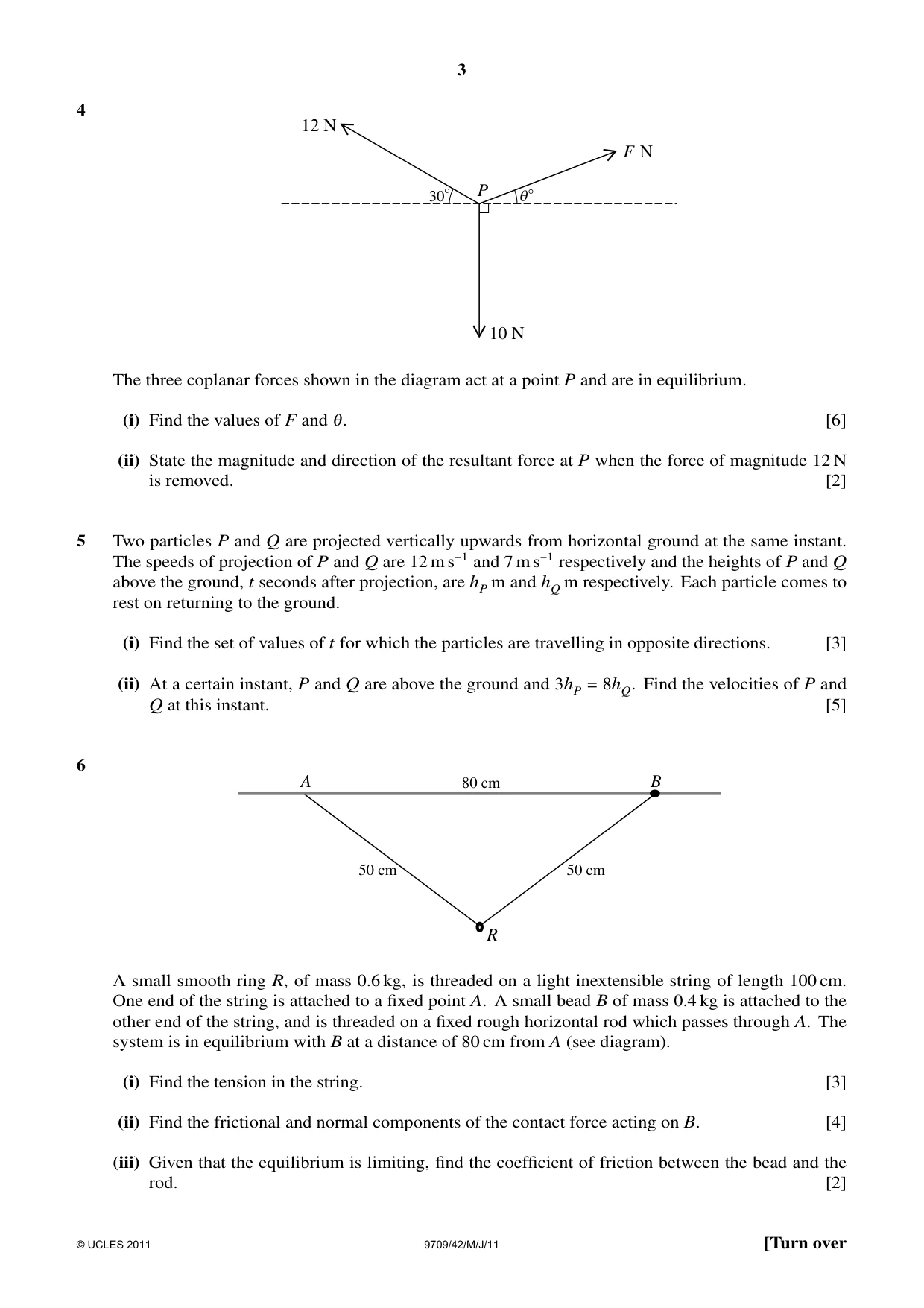
4 12 N F N P 30° q° 10 N The three coplanar forces shown in the diagram act at a point P and are in equilibrium. (i) Find the values of F and θ. [6] (ii) State the magnitude and direction of the resultant force at P when the force of magnitude 12 N is removed. [2]
Mark scheme: 4 (i) M1 For resolving forces in the i and j directions Fcosθ = 12cos30° (= 10.932) A1 Fsinθ = 10 – 12sin30° (= 4) A1 M1 For using F2 = X2 + Y2 or tanθ = Y/X F = 11.1 or θ = 21.1 (accept 21.0) A1 θ = 21.1 (accept 21.0) or F = 11.1 B1 [6] SR for candidates who consistently have cos for sin and vice versa (max 4/6) M1 as above (resolving) A1 for Fsinθ = 12sin30° and Fcosθ = 10 – 12cos30° M1 as above F2 = .... & tanθ =.... A1 for F = 6.01 and θ = 93.7 (ii) Magnitude is 12N B1 Direction is 30o clockwise from +ve ‘x’ axis B1 [2] alternative for 4(i) For triangle of forces with sides 12, F and 10 and at least one of the angles (90° – θ ) or 60° or (θ + 30°) B1 M1 For use of cosine rule (with θ absent) or use of sine rule (with F absent) and use of sin(A ± B) = sinAcosB ± sinBcosA F2 = 122 + 102 – 2 × 12 × 10cos60o or (12cos30°)sinθ = (10 – 12sin30°)cosθ A1 F = 11.1 or θ = 21.1 (accept 21.0) A1 M1 For correct method for θ or F θ = 21.1 (accept 21.0) or F = 11.1 A1 [6] second alternative for 4(i) For using Lami’s theorem with 12 N and 10 N M1 12/sin(90 + θ ) = 10/sin(150 – θ ) A1 12/cosθ = 20 ÷ (cosθ + 3 ½ sinθ ) → 12 × 3 ½ sinθ = 8cosθ → tanθ = 2 ÷ (3 × 3 ½ ) A1 → θ = 21.1 For using Lami’s theorem with F N and (12 N or 10 N) M1 F/sin120o = 12/sin111.1o (or 10/sin128.9o) A1 F = 11.1 A1 [6] GCE AS/A LEVEL – May/June 2011 9709 42 Alternative for 4(ii) For X = 11.1cos21.1o and Y = 11.1sin21.1o – 10, M1 R2 = X2 + Y2 and tanФ = Y/X Magnitude 12 N and direction 30o clockwise from +ve x-axis A1 [2]
Q5 · Two particles P and Q are projected vertically upwards from horizontal ground at the same…
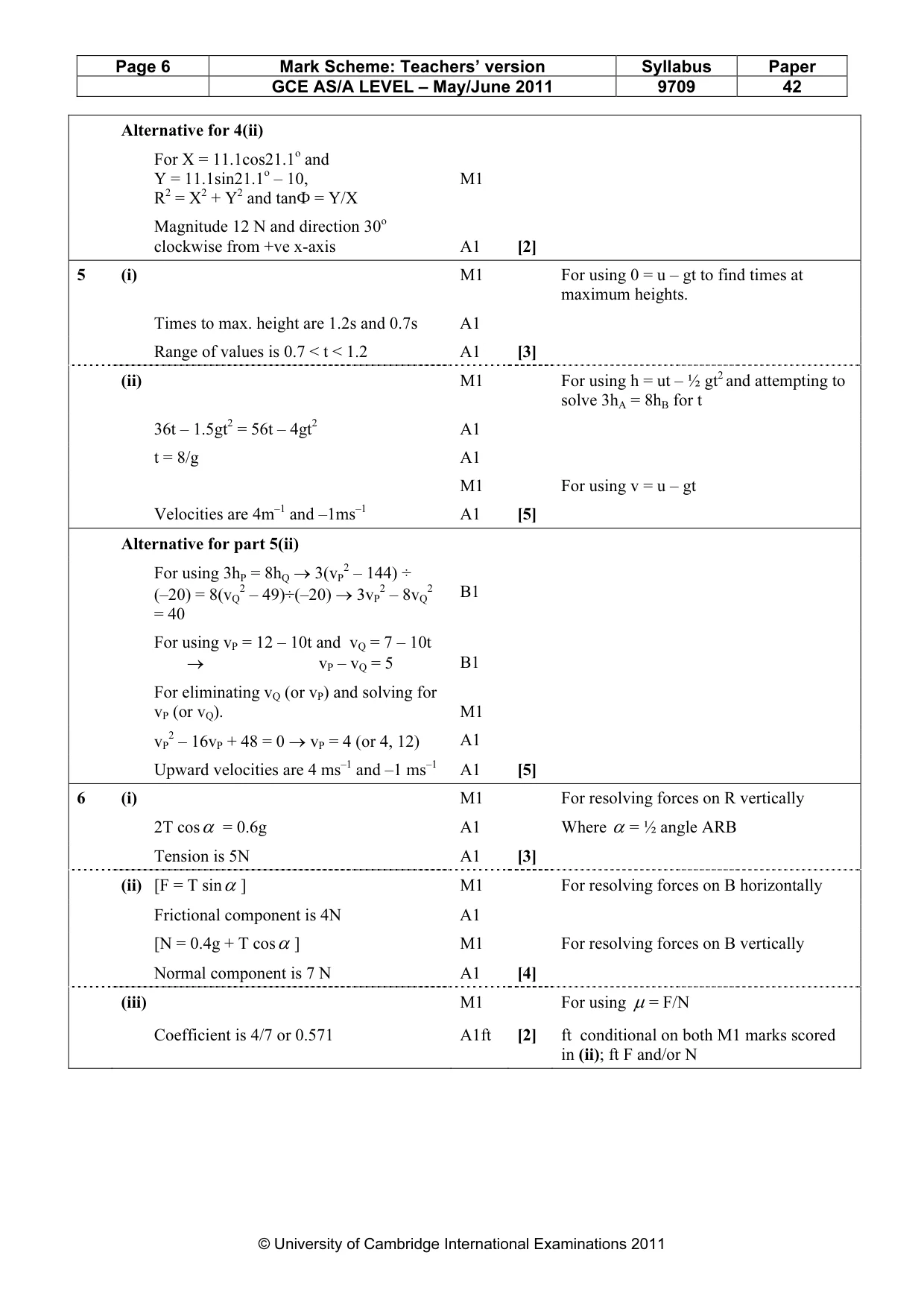
5 Two particles P and Q are projected vertically upwards from horizontal ground at the same instant. The speeds of projection of P and Q are 12 m s−1 and 7 m s−1 respectively and the heights of P and Q above the ground, t seconds after projection, are hP m and hQ m respectively. Each particle comes to rest on returning to the ground. (i) Find the set of values of t for which the particles are travelling in opposite directions. [3] (ii) At a certain instant, P and Q are above the ground and 3hP = 8hQ. Find the velocities of P and Q at this instant. [5]
Mark scheme: 5 (i) M1 For using 0 = u – gt to find times at maximum heights. Times to max. height are 1.2s and 0.7s A1 Range of values is 0.7 < t < 1.2 A1 [3] (ii) M1 For using h = ut – ½ gt2 and attempting to solve 3hA = 8hB for t 36t – 1.5gt2 = 56t – 4gt2 A1 t = 8/g A1 M1 For using v = u – gt Velocities are 4m–1 and –1ms–1 A1 [5] Alternative for part 5(ii) For using 3hP = 8hQ → 3(vP2 – 144) ÷ (–20) = 8(vQ2 – 49)÷(–20) → 3vP2 – 8vQ2 B1 = 40 For using vP = 12 – 10t and vQ = 7 – 10t → vP – vQ = 5 B1 For eliminating vQ (or vP) and solving for vP (or vQ). M1 vP2 – 16vP + 48 = 0 → vP = 4 (or 4, 12) A1 Upward velocities are 4 ms–1 and –1 ms–1 A1 [5]
Q6 · A 80 cm B 50 cm 50 cm R A small smooth ring R, of mass 0.6 kg, is threaded on a light…
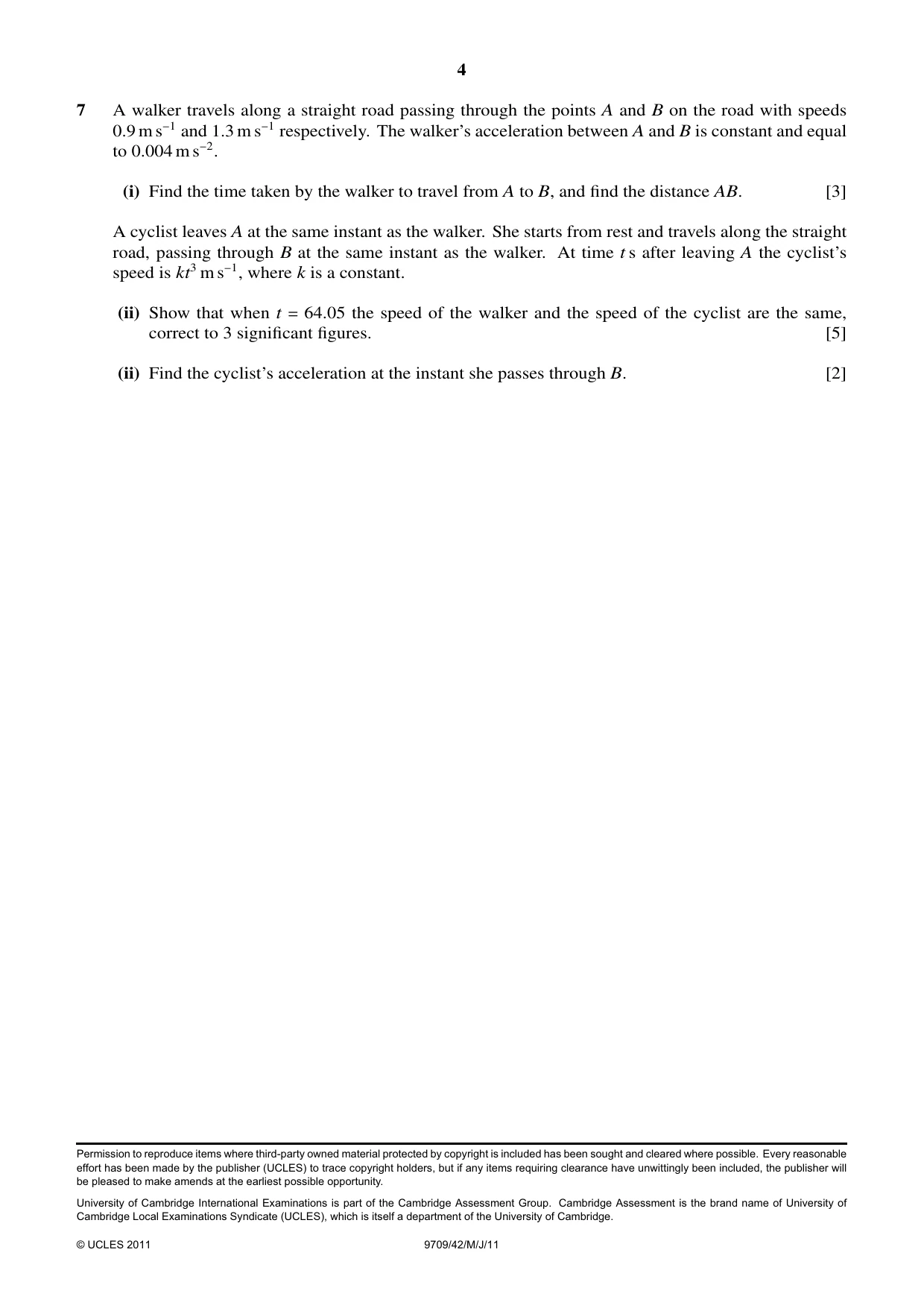
6 A 80 cm B 50 cm 50 cm R A small smooth ring R, of mass 0.6 kg, is threaded on a light inextensible string of length 100 cm. One end of the string is attached to a fixed point A. A small bead B of mass 0.4 kg is attached to the other end of the string, and is threaded on a fixed rough horizontal rod which passes through A. The system is in equilibrium with B at a distance of 80 cm from A (see diagram). (i) Find the tension in the string. [3] (ii) Find the frictional and normal components of the contact force acting on B. [4] (iii) Given that the equilibrium is limiting, find the coefficient of friction between the bead and the rod. [2]
Mark scheme: 6 (i) M1 For resolving forces on R vertically 2T cosα = 0.6g A1 Where α = ½ angle ARB Tension is 5N A1 [3] (ii) [F = T sinα ] M1 For resolving forces on B horizontally Frictional component is 4N A1 [N = 0.4g + T cosα ] M1 For resolving forces on B vertically Normal component is 7 N A1 [4] (iii) M1 For using µ = F/N Coefficient is 4/7 or 0.571 A1ft [2] ft conditional on both M1 marks scored in (ii); ft F and/or N GCE AS/A LEVEL – May/June 2011 9709 42 Alternative for Q6(i)/(ii) (i) For finding the relevant angles and using M1 Lami’s theorem 6/sin106.26° = T/sin126.87° A1 Tension is 5N A1 [3] (ii) F/sin126.87° = 5/sin90° B1 Frictional component is 4N B1 (R – 4)/sin143.13° = 5/sin90° B1 Normal component is 7 N B1 [4]
Q7 · A walker travels along a straight road passing through the points A and B on the road…
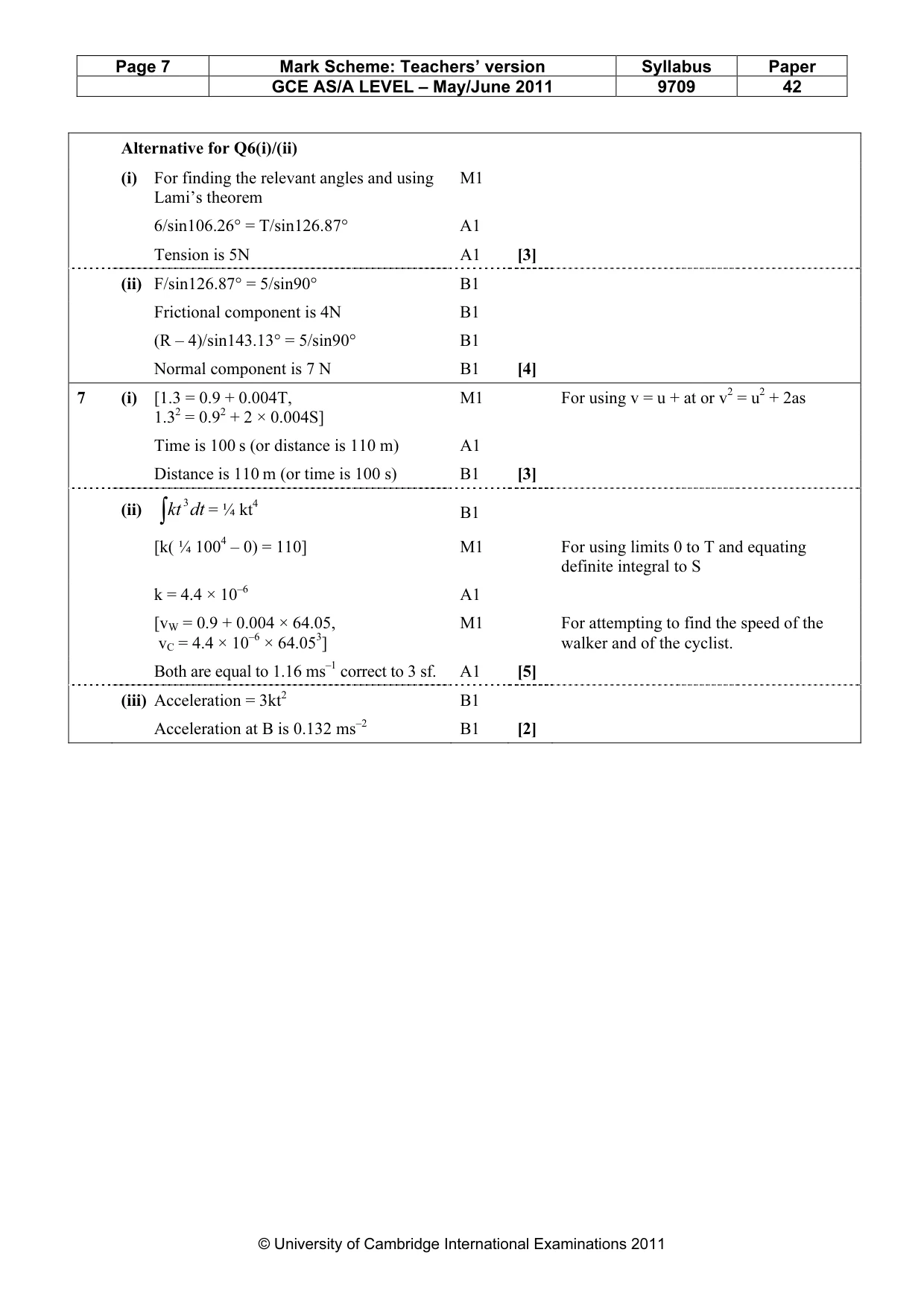
7 A walker travels along a straight road passing through the points A and B on the road with speeds 0.9 m s−1 and 1.3 m s−1 respectively. The walker’s acceleration between A and B is constant and equal to 0.004 m s−2. (i) Find the time taken by the walker to travel from A to B, and find the distance AB. [3] A cyclist leaves A at the same instant as the walker. She starts from rest and travels along the straight road, passing through B at the same instant as the walker. At time t s after leaving A the cyclist’s speed is kt3 m s−1, where k is a constant. (ii) Show that when t = 64.05 the speed of the walker and the speed of the cyclist are the same, correct to 3 significant figures. [5] (ii) Find the cyclist’s acceleration at the instant she passes through B. [2]
Mark scheme: 7 (i) [1.3 = 0.9 + 0.004T, M1 For using v = u + at or v2 = u2 + 2as 1.32 = 0.92 + 2 × 0.004S] Time is 100 s (or distance is 110 m) A1 Distance is 110 m (or time is 100 s) B1 [3] = ¼ kt4 B1 (ii) ∫ kt 3 dt [k( ¼ 1004 – 0) = 110] M1 For using limits 0 to T and equating definite integral to S k = 4.4 × 10⁻⁶ A1 [vW = 0.9 + 0.004 × 64.05, M1 For attempting to find the speed of the vC = 4.4 × 10–6 × 64.053] walker and of the cyclist. Both are equal to 1.16 ms–1 correct to 3 sf. A1 [5] (iii) Acceleration = 3kt2 B1 Acceleration at B is 0.132 ms–2 B1 [2]
What was in this paper
The subtopics covered by these 7 questions, and how many questions each got. Open one in a new tab to see every Cambridge question on it.
What you needed in this session
Cambridge’s own grade thresholds for 2011 May/June, Paper 4 · Variant 2. A higher threshold means an easier paper — the bar moves with how the cohort did.