Cambridge A Level Mathematics 9709 — 2010 May/June Paper 4 · Variant 2
9709/42/M/J/10 · 7 questions · 50 marks · ≈56 min
The question paper and its mark scheme, free to read here and free to download. This is Cambridge’s own paper, exactly as it was sat.
Question paper4 pages
Mark scheme6 pages
Answers below. Sit the paper first if you are practising.
Questions as text
Q1 · A car of mass 1150 kg travels up a straight hill inclined at 1.2◦to the horizontal
1 A car of mass 1150 kg travels up a straight hill inclined at 1.2◦to the horizontal. The resistance to motion of the car is 975 N. Find the acceleration of the car at an instant when it is moving with speed 16 m s−1 and the engine is working at a power of 35 kW. [4]
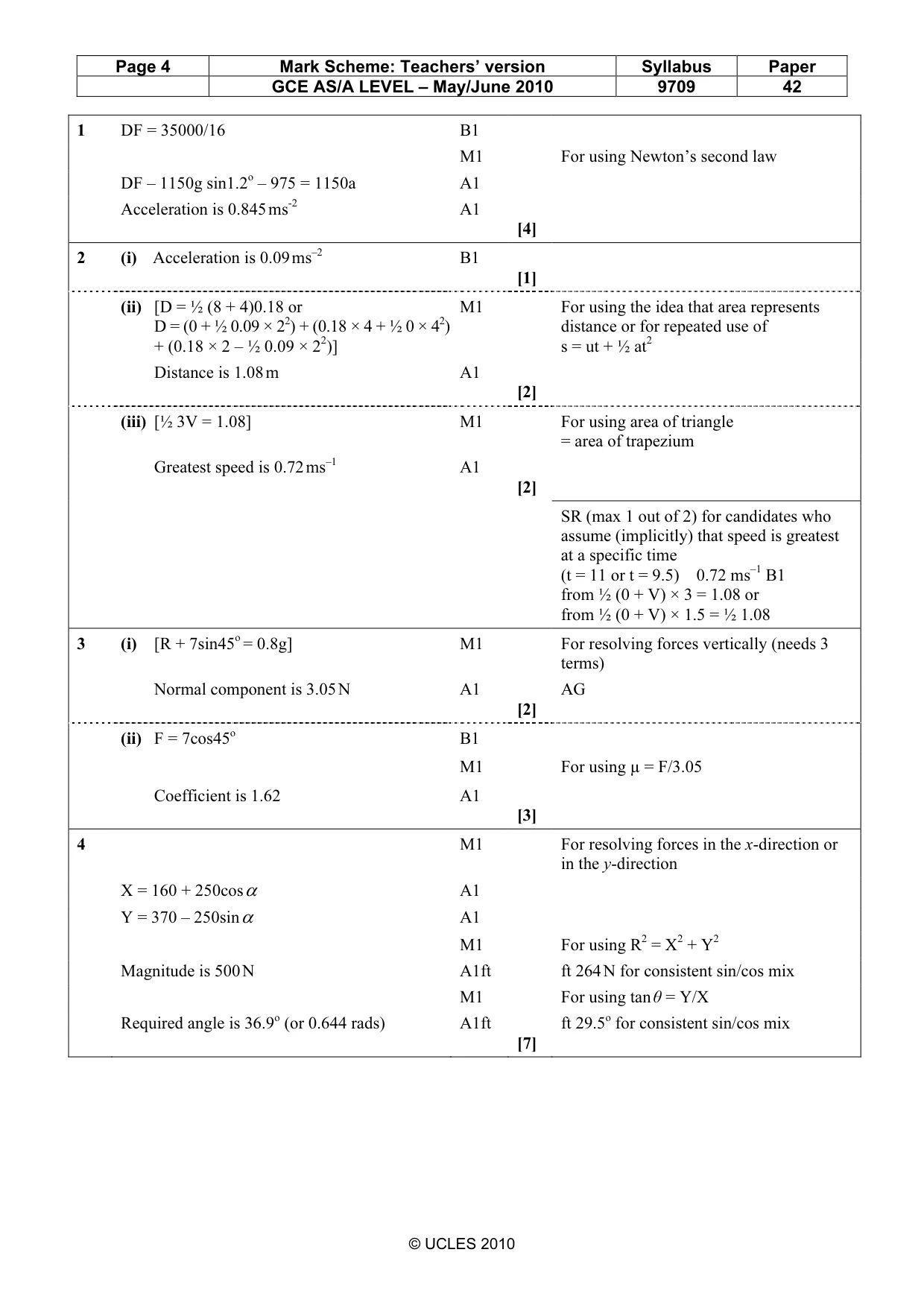
Mark scheme: 1 DF = 35000/16 B1 M1 For using Newton’s second law DF – 1150g sin1.2o – 975 = 1150a A1 Acceleration is 0.845 ms-2 A1 [4] 2
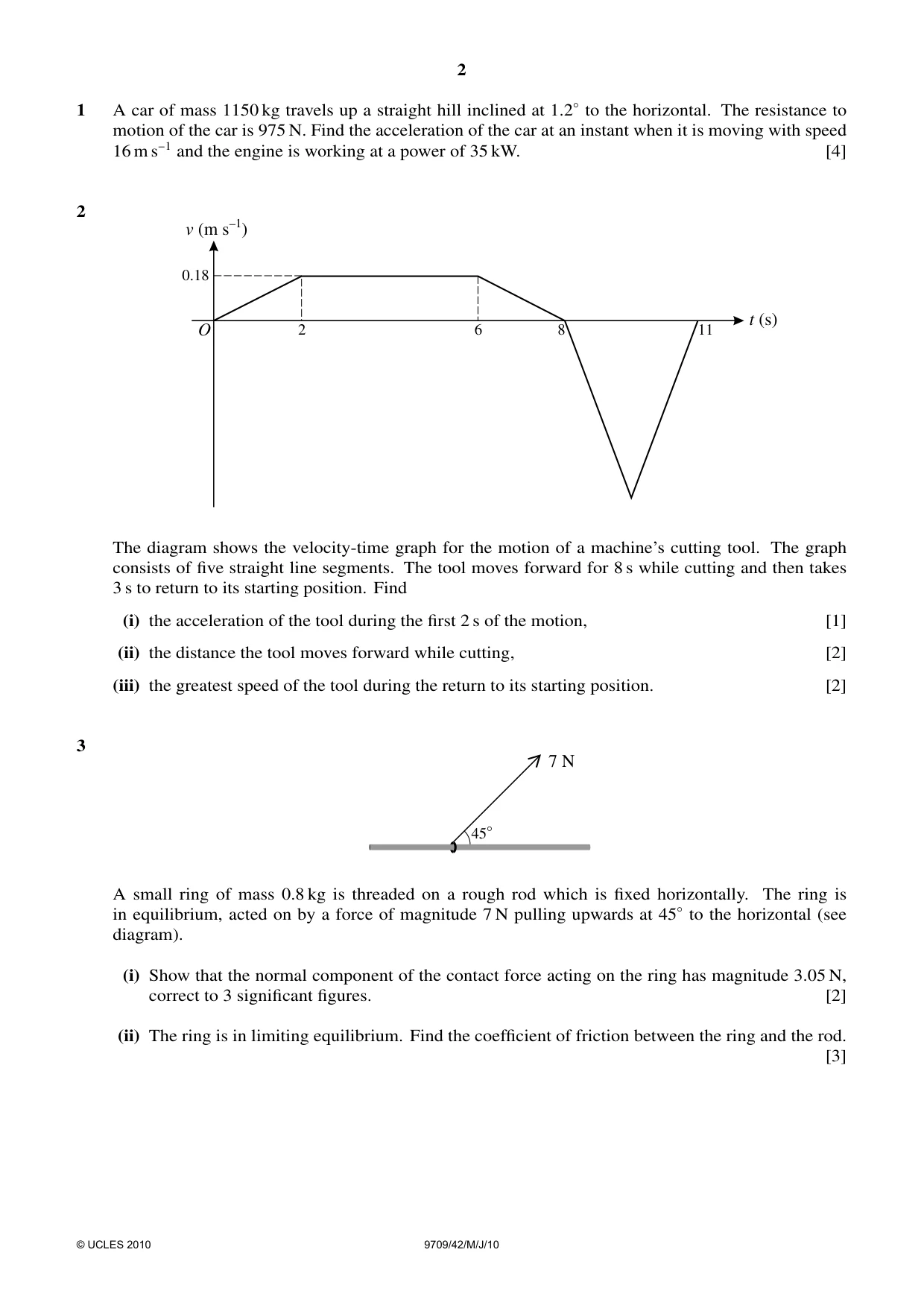
Q2 · V (m s–1 ) 0.18 t (s) O 2 6 8 11 The diagram shows the velocity-time graph for the motion…
2 v (m s–1 ) 0.18 t (s) O 2 6 8 11 The diagram shows the velocity-time graph for the motion of a machine’s cutting tool. The graph consists of five straight line segments. The tool moves forward for 8 s while cutting and then takes 3 s to return to its starting position. Find (i) the acceleration of the tool during the first 2 s of the motion, [1] (ii) the distance the tool moves forward while cutting, [2] (iii) the greatest speed of the tool during the return to its starting position. [2]
Mark scheme: 2 (i) Acceleration is 0.09 ms–2 B1 [1] (ii) [D = ½ (8 + 4)0.18 or M1 For using the idea that area represents D = (0 + ½ 0.09 × 22) + (0.18 × 4 + ½ 0 × 42) distance or for repeated use of + (0.18 × 2 – ½ 0.09 × 22)] s = ut + ½ at2 Distance is 1.08 m A1 [2] (iii) [½ 3V = 1.08] M1 For using area of triangle = area of trapezium Greatest speed is 0.72 ms–1 A1 [2] SR (max 1 out of 2) for candidates who assume (implicitly) that speed is greatest at a specific time (t = 11 or t = 9.5) 0.72 ms–1 B1 from ½ (0 + V) × 3 = 1.08 or from ½ (0 + V) × 1.5 = ½ 1.08
Q3 · 7 N 45° A small ring of mass 0.8 kg is threaded on a rough rod which is fixed horizontally
3 7 N 45° A small ring of mass 0.8 kg is threaded on a rough rod which is fixed horizontally. The ring is in equilibrium, acted on by a force of magnitude 7 N pulling upwards at 45◦to the horizontal (see diagram). (i) Show that the normal component of the contact force acting on the ring has magnitude 3.05 N, correct to 3 significant figures. [2] (ii) The ring is in limiting equilibrium. Find the coefficient of friction between the ring and the rod. [3]
Mark scheme: 3 (i) [R + 7sin45o = 0.8g] M1 For resolving forces vertically (needs 3 terms) Normal component is 3.05 N A1 AG [2] (ii) F = 7cos45o B1 M1 For using µ = F/3.05 Coefficient is 1.62 A1 [3]
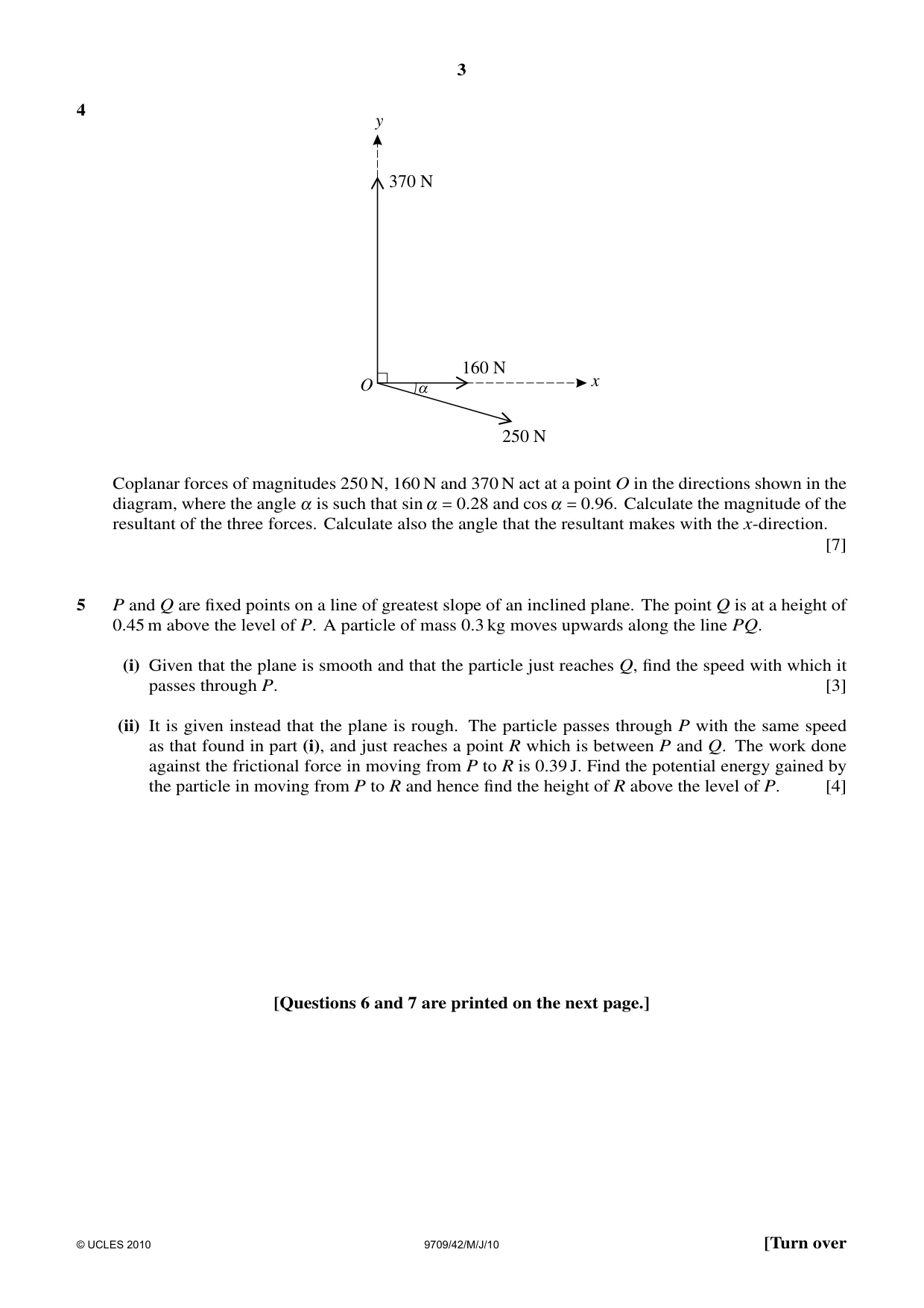
Q4 · Y 370 N 160 N O a x 250 N Coplanar forces of magnitudes 250 N, 160 N and 370 N act at a…
4 y 370 N 160 N O a x 250 N Coplanar forces of magnitudes 250 N, 160 N and 370 N act at a point O in the directions shown in the diagram, where the angle α is such that sin α = 0.28 and cos α = 0.96. Calculate the magnitude of the resultant of the three forces. Calculate also the angle that the resultant makes with the x-direction. [7]
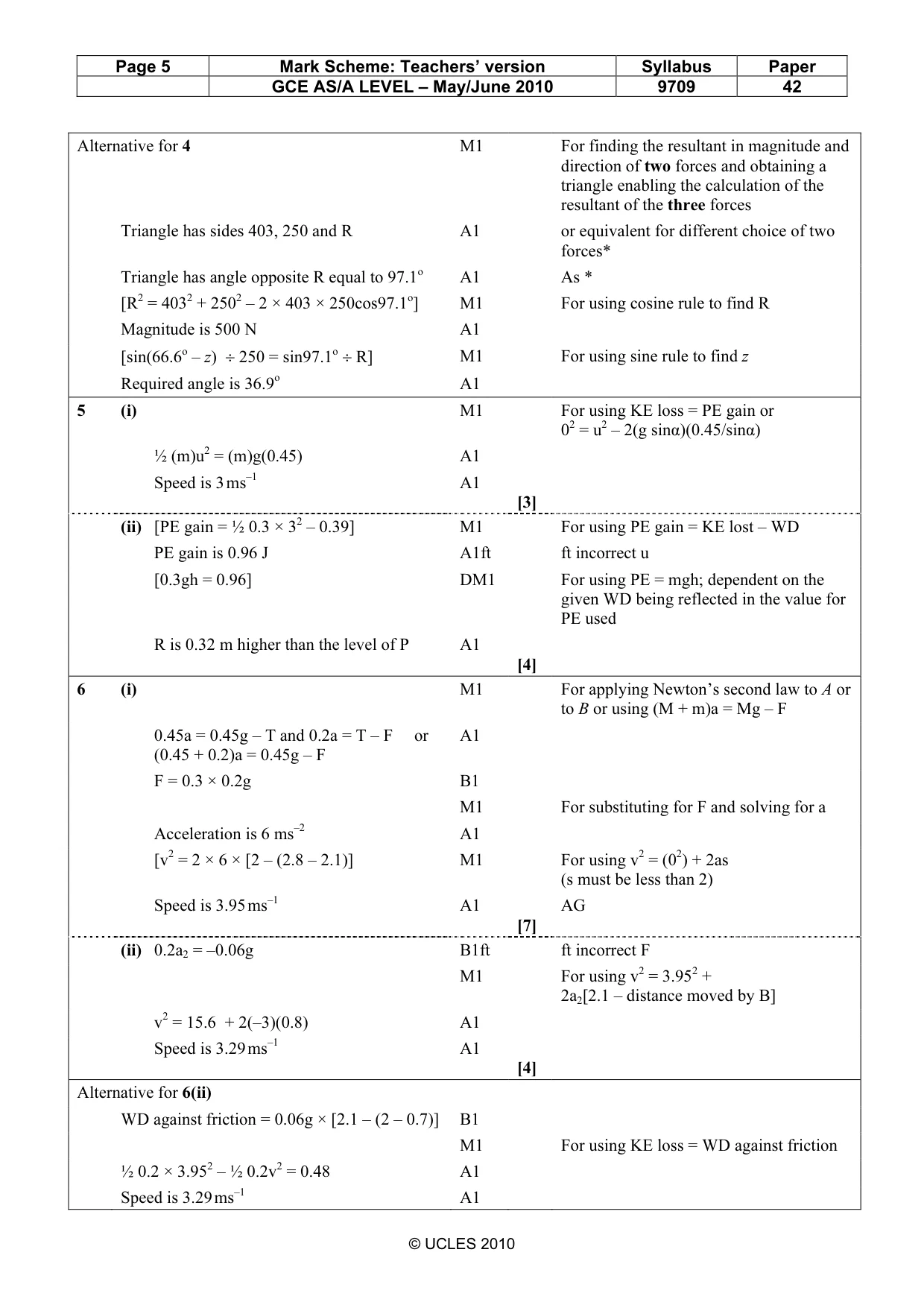
Mark scheme: 4 M1 For resolving forces in the x-direction or in the y-direction X = 160 + 250cosα A1 Y = 370 – 250sinα A1 M1 For using R2 = X2 + Y2 Magnitude is 500 N A1ft ft 264 N for consistent sin/cos mix M1 For using tan θ = Y/X Required angle is 36.9o (or 0.644 rads) A1ft ft 29.5o for consistent sin/cos mix [7] GCE AS/A LEVEL – May/June 2010 9709 42 Alternative for 4 M1 For finding the resultant in magnitude and direction of two forces and obtaining a triangle enabling the calculation of the resultant of the three forces Triangle has sides 403, 250 and R A1 or equivalent for different choice of two forces* Triangle has angle opposite R equal to 97.1o A1 As * [R2 = 4032 + 2502 – 2 × 403 × 250cos97.1o] M1 For using cosine rule to find R Magnitude is 500 N A1 [sin(66.6o – z) ÷ 250 = sin97.1o ÷ R] M1 For using sine rule to find z Required angle is 36.9o A1
Q5 · P and Q are fixed points on a line of greatest slope of an inclined plane
5 P and Q are fixed points on a line of greatest slope of an inclined plane. The point Q is at a height of 0.45 m above the level of P. A particle of mass 0.3 kg moves upwards along the line PQ. (i) Given that the plane is smooth and that the particle just reaches Q, find the speed with which it passes through P. [3] (ii) It is given instead that the plane is rough. The particle passes through P with the same speed as that found in part (i), and just reaches a point R which is between P and Q. The work done against the frictional force in moving from P to R is 0.39 J. Find the potential energy gained by the particle in moving from P to R and hence find the height of R above the level of P. [4] [Questions 6 and 7 are printed on the next page.]
Mark scheme: 5 (i) M1 For using KE loss = PE gain or 02 = u2 – 2(g sinα)(0.45/sinα) ½ (m)u2 = (m)g(0.45) A1 Speed is 3 ms–1 A1 [3] (ii) [PE gain = ½ 0.3 × 32 – 0.39] M1 For using PE gain = KE lost – WD PE gain is 0.96 J A1ft ft incorrect u [0.3gh = 0.96] DM1 For using PE = mgh; dependent on the given WD being reflected in the value for PE used R is 0.32 m higher than the level of P A1 [4]
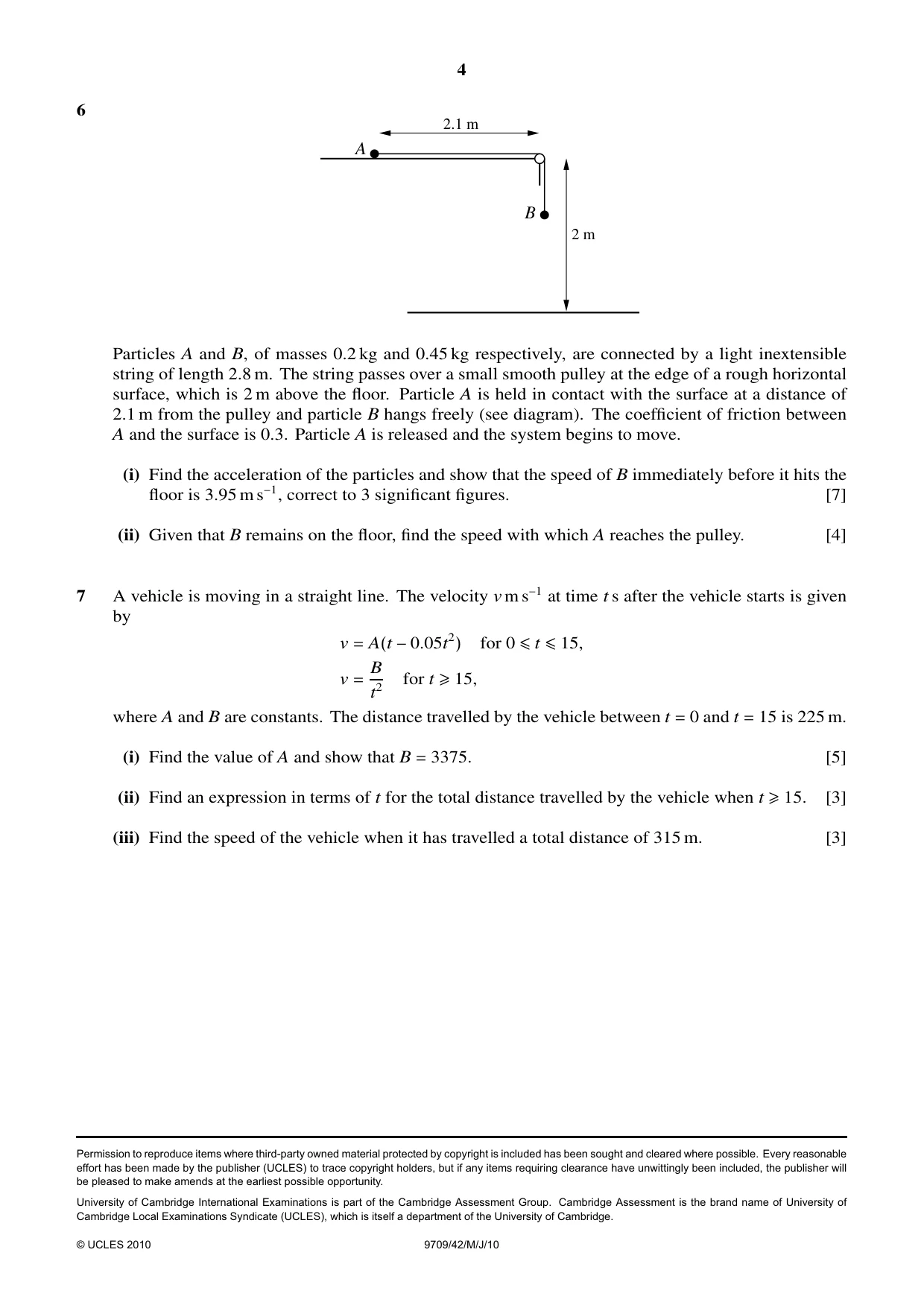
Q6 · 2.1 m A B 2 m Particles A and B, of masses 0.2 kg and 0.45 kg respectively, are connected…
6 2.1 m A B 2 m Particles A and B, of masses 0.2 kg and 0.45 kg respectively, are connected by a light inextensible string of length 2.8 m. The string passes over a small smooth pulley at the edge of a rough horizontal surface, which is 2 m above the floor. Particle A is held in contact with the surface at a distance of 2.1 m from the pulley and particle B hangs freely (see diagram). The coefficient of friction between A and the surface is 0.3. Particle A is released and the system begins to move. (i) Find the acceleration of the particles and show that the speed of B immediately before it hits the floor is 3.95 m s−1, correct to 3 significant figures. [7] (ii) Given that B remains on the floor, find the speed with which A reaches the pulley. [4]
Mark scheme: 6 (i) M1 For applying Newton’s second law to A or to B or using (M + m)a = Mg – F 0.45a = 0.45g – T and 0.2a = T – F or A1 (0.45 + 0.2)a = 0.45g – F F = 0.3 × 0.2g B1 M1 For substituting for F and solving for a Acceleration is 6 ms–2 A1 [v2 = 2 × 6 × [2 – (2.8 – 2.1)] M1 For using v2 = (02) + 2as (s must be less than 2) Speed is 3.95 ms–1 A1 AG [7] (ii) 0.2a2 = –0.06g B1ft ft incorrect F M1 For using v2 = 3.952 + 2a2[2.1 – distance moved by B] v2 = 15.6 + 2(–3)(0.8) A1 Speed is 3.29 ms–1 A1 [4] Alternative for 6(ii) WD against friction = 0.06g × [2.1 – (2 – 0.7)] B1 M1 For using KE loss = WD against friction ½ 0.2 × 3.952 – ½ 0.2v2 = 0.48 A1 Speed is 3.29 ms–1 A1 GCE AS/A LEVEL – May/June 2010 9709 42
Q7 · A vehicle is moving in a straight line
7 A vehicle is moving in a straight line. The velocity v m s−1 at time t s after the vehicle starts is given by v = A(t −0.05t2) for 0 ≤t ≤15, B v = for t ≥15, t2 where A and B are constants. The distance travelled by the vehicle between t = 0 and t = 15 is 225 m. (i) Find the value of A and show that B = 3375. [5] (ii) Find an expression in terms of t for the total distance travelled by the vehicle when t ≥15. [3] (iii) Find the speed of the vehicle when it has travelled a total distance of 315 m. [3]
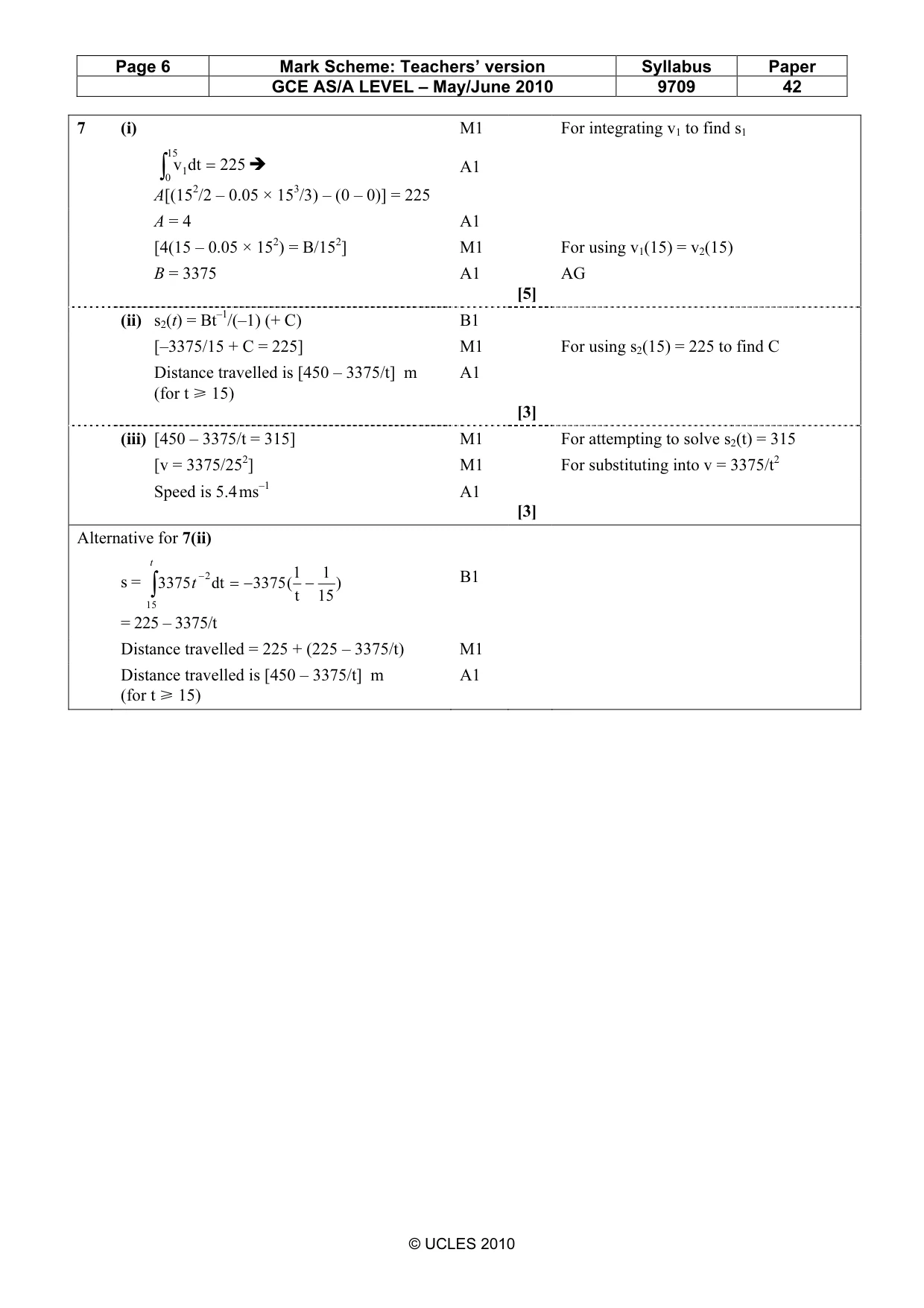
Mark scheme: 7 (i) M1 For integrating v1 to find s1 15 dt = 225 A1 1 ∫ 0 v A[(152/2 – 0.05 × 153/3) – (0 – 0)] = 225 A = 4 A1 [4(15 – 0.05 × 152) = B/152] M1 For using v1(15) = v2(15) B = 3375 A1 AG [5] (ii) s2(t) = Bt–1/(–1) (+ C) B1 [–3375/15 + C = 225] M1 For using s2(15) = 225 to find C Distance travelled is [450 – 3375/t] m A1 (for t [ 15) [3] (iii) [450 – 3375/t = 315] M1 For attempting to solve s2(t) = 315 [v = 3375/252] M1 For substituting into v = 3375/t2 Speed is 5.4 ms–1 A1 [3] Alternative for 7(ii) t − 2 1 1 s = ∫ 3375 t dt = − 3375 ( t − 15 ) B1 15 = 225 – 3375/t Distance travelled = 225 + (225 – 3375/t) M1 Distance travelled is [450 – 3375/t] m A1 (for t [ 15)
What was in this paper
The subtopics covered by these 7 questions, and how many questions each got. Open one in a new tab to see every Cambridge question on it.
What you needed in this session
Cambridge’s own grade thresholds for 2010 May/June, Paper 4 · Variant 2. A higher threshold means an easier paper — the bar moves with how the cohort did.