Cambridge A Level Mathematics 9709 — 2016 May/June Paper 4 · Variant 2
9709/42/M/J/16 · 7 questions · 50 marks · ≈56 min
The question paper and its mark scheme, free to read here and free to download. This is Cambridge’s own paper, exactly as it was sat.
Question paper4 pages
Mark scheme8 pages
Answers below. Sit the paper first if you are practising.
Questions as text
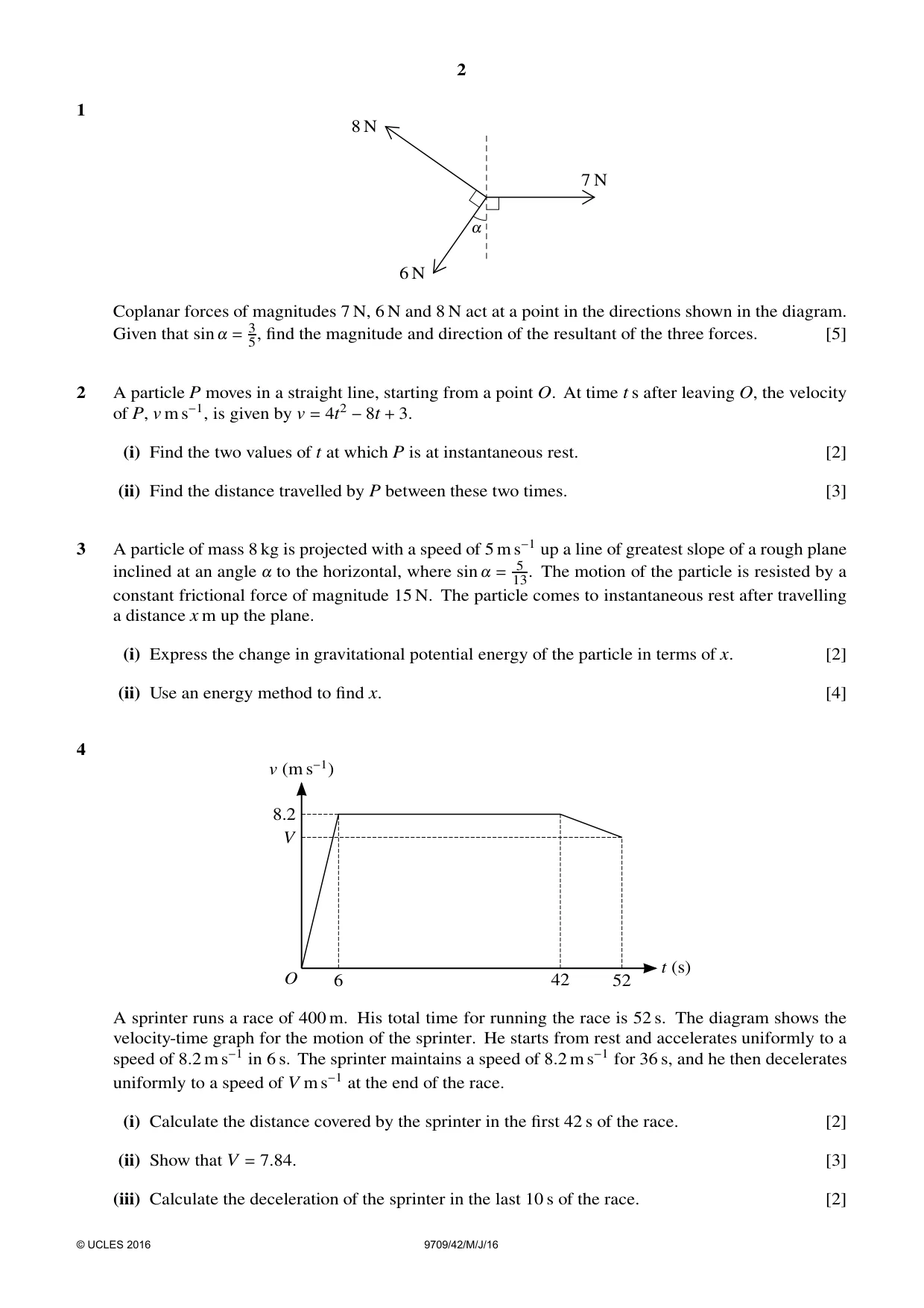
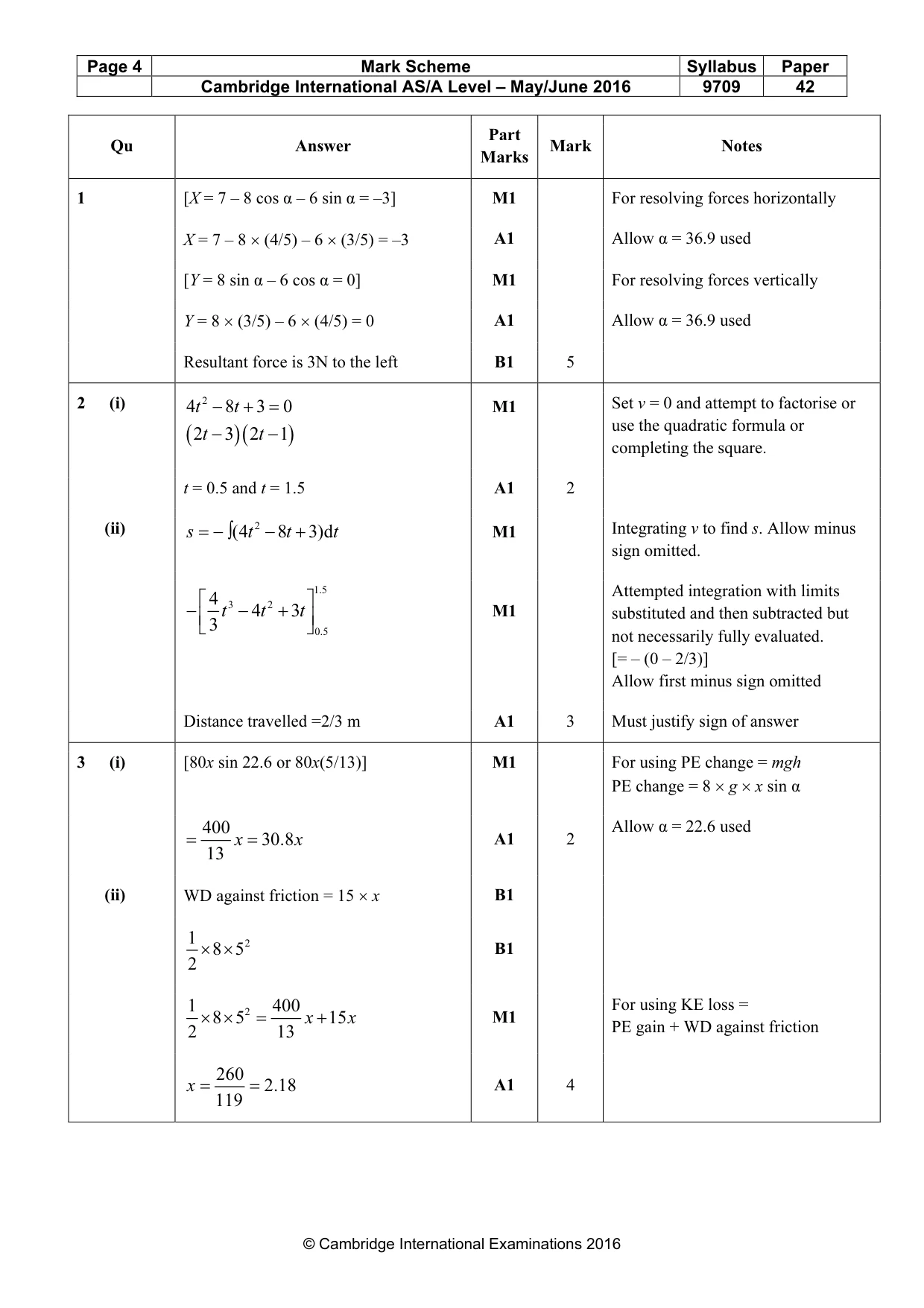
Q1 · 8 N 7 N !
1 8 N 7 N ! 6 N Coplanar forces of magnitudes 7 N, 6 N and 8 N act at a point in the directions shown in the diagram. Given that sin ! = 35, find the magnitude and direction of the resultant of the three forces. [5]
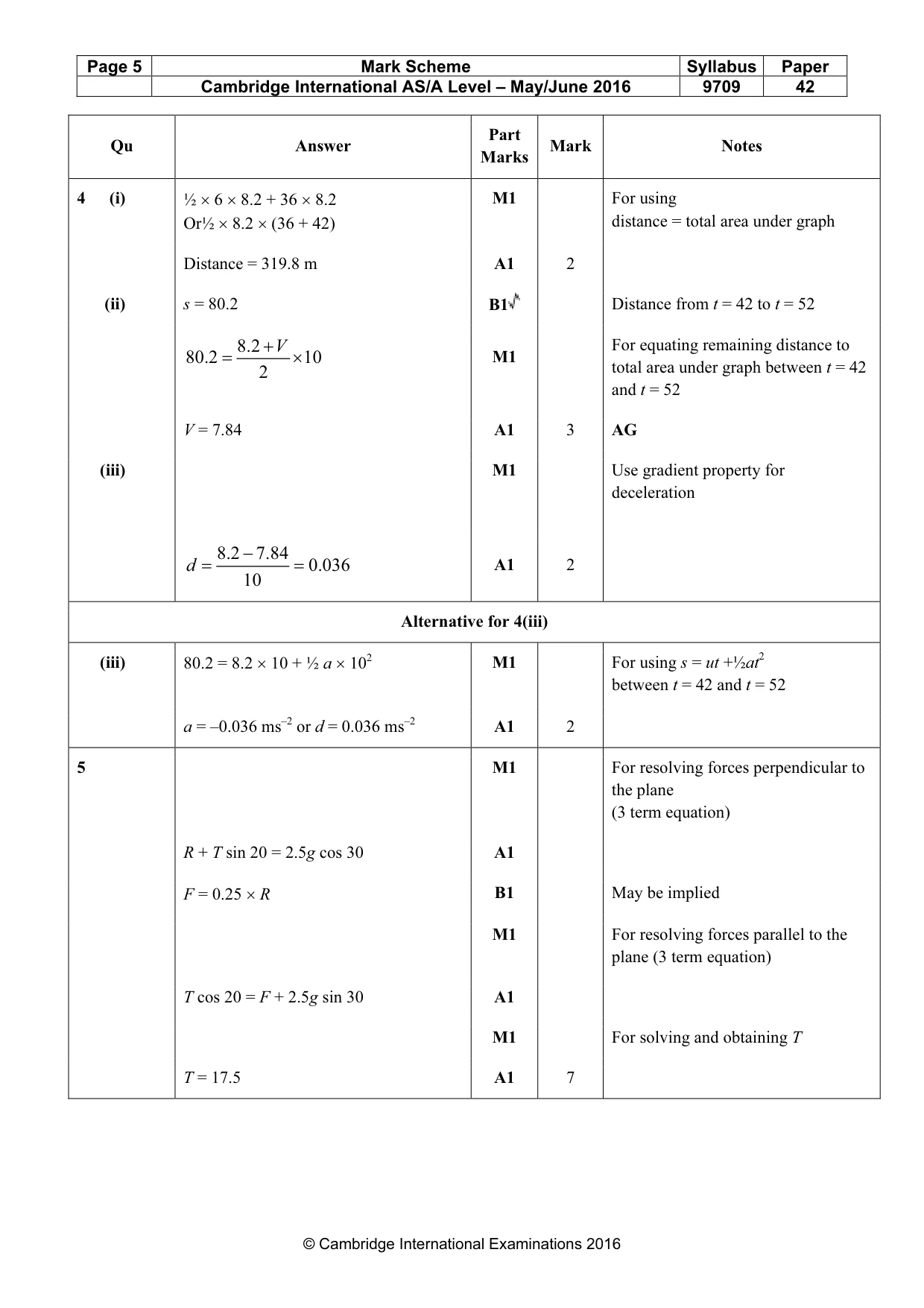
Mark scheme: Part Qu Answer Mark Notes Marks 1 [X = 7 – 8 cos α – 6 sin α = –3] M1 For resolving forces horizontally X = 7 – 8 × (4/5) – 6 × (3/5) = –3 A1 Allow α = 36.9 used [Y = 8 sin α – 6 cos α = 0] M1 For resolving forces vertically Y = 8 × (3/5) – 6 × (4/5) = 0 A1 Allow α = 36.9 used Resultant force is 3N to the left B1 5
Q2 · A particle P moves in a straight line, starting from a point O
2 A particle P moves in a straight line, starting from a point O. At time t s after leaving O, the velocity of P, v m s−1, is given by v = 4t2 −8t + 3. (i) Find the two values of t at which P is at instantaneous rest. [2] (ii) Find the distance travelled by P between these two times. [3]
Mark scheme: 2 (i) 4t 2 − 8t + 3 = 0 M1 Set v = 0 and attempt to factorise or ( 2t − 3 )( 2t − 1) use the quadratic formula or completing the square. t = 0.5 and t = 1.5 A1 2 (ii) s = −∫ (4t 2 − 8t + 3)d t M1 Integrating v to find s. Allow minus sign omitted. 1.5 Attempted integration with limits 4 3 2 − t − 4t + 3t M1 substituted and then subtracted but 3 0.5 not necessarily fully evaluated. [= – (0 – 2/3)] Allow first minus sign omitted Distance travelled =2/3 m A1 3 Must justify sign of answer
Q3 · A particle of mass 8 kg is projected with a speed of 5 m s−1 up a line of greatest slope…
3 A particle of mass 8 kg is projected with a speed of 5 m s−1 up a line of greatest slope of a rough plane inclined at an angle ! to the horizontal, where sin ! = 13.5 The motion of the particle is resisted by a constant frictional force of magnitude 15 N. The particle comes to instantaneous rest after travelling a distance x m up the plane. (i) Express the change in gravitational potential energy of the particle in terms of x. [2] (ii) Use an energy method to find x. [4]
Mark scheme: 3 (i) [80x sin 22.6 or 80x(5/13)] M1 For using PE change = mgh PE change = 8 × g × x sin α 400 Allow α = 22.6 used = x = 30.8 x A1 2 13 (ii) WD against friction = 15 × x B1 1 2 × 8 × 5 B1 2 1 2 400 For using KE loss = × 8 × 5 = x + 15 x M1 2 13 PE gain + WD against friction 260 x = = 2.18 A1 4 119
Q4 · V (m s−1) 8.2 V t (s) O 6 42 52 A sprinter runs a race of 400 m
4 v (m s−1) 8.2 V t (s) O 6 42 52 A sprinter runs a race of 400 m. His total time for running the race is 52 s. The diagram shows the velocity-time graph for the motion of the sprinter. He starts from rest and accelerates uniformly to a speed of 8.2 m s−1 in 6 s. The sprinter maintains a speed of 8.2 m s−1 for 36 s, and he then decelerates uniformly to a speed of V m s−1 at the end of the race. (i) Calculate the distance covered by the sprinter in the first 42 s of the race. [2] (ii) Show that V = 7.84. [3] (iii) Calculate the deceleration of the sprinter in the last 10 s of the race. [2]
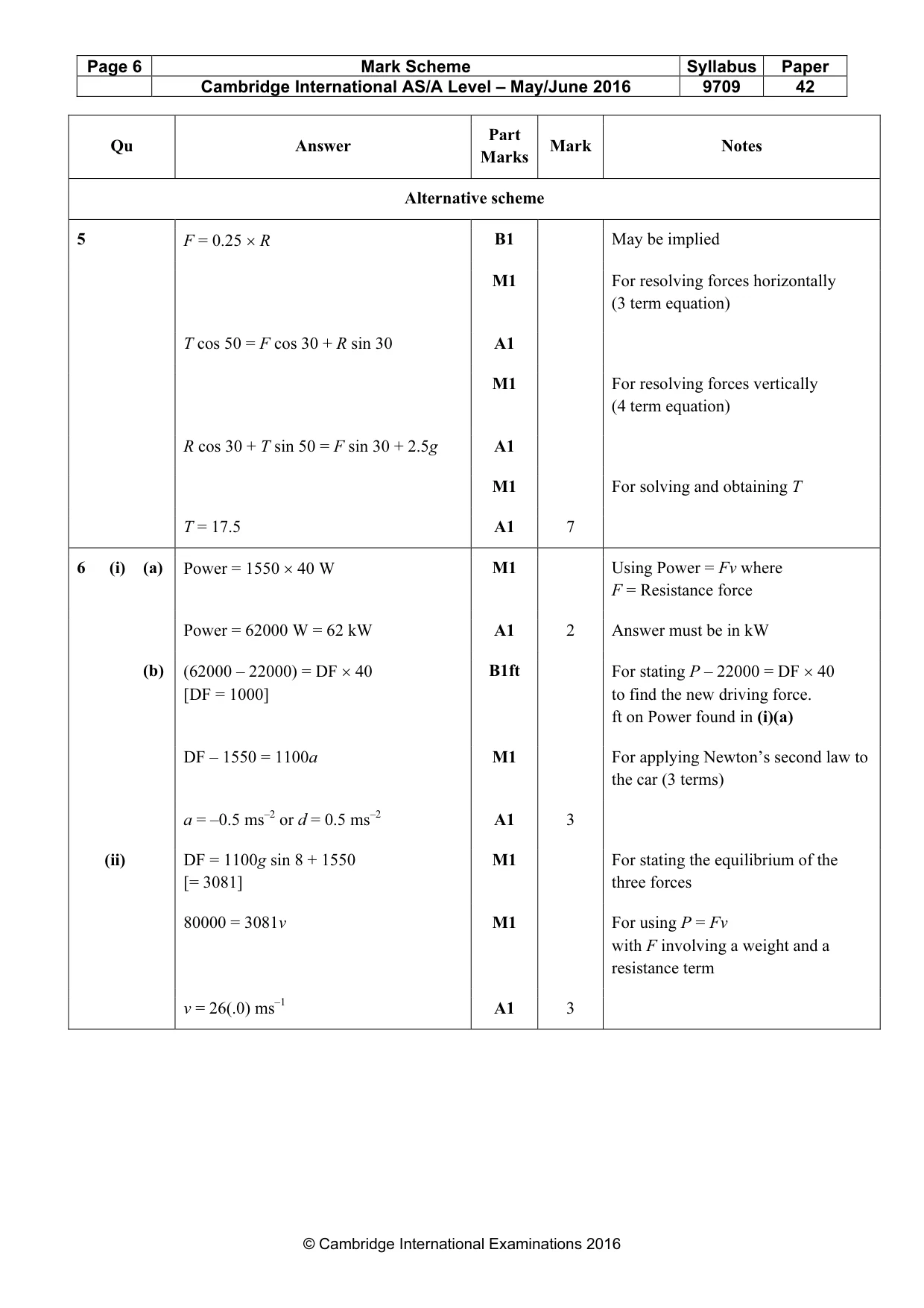
Mark scheme: 4 (i) ½ × 6 × 8.2 + 36 × 8.2 M1 For using Or½ × 8.2 × (36 + 42) distance = total area under graph Distance = 319.8 m A1 2 (ii) s = 80.2 B1 Distance from t = 42 to t = 52 8.2 + V For equating remaining distance to 80.2 = × 10 M1 2 total area under graph between t = 42 and t = 52 V = 7.84 A1 3 AG (iii) M1 Use gradient property for deceleration 8.2 − 7.84 d = = 0.036 A1 2 10 Alternative for 4(iii) (iii) 80.2 = 8.2 × 10 + ½ a × 102 M1 For using s = ut +½at2 between t = 42 and t = 52 a = –0.036 ms–2 or d = 0.036 ms–2 A1 2
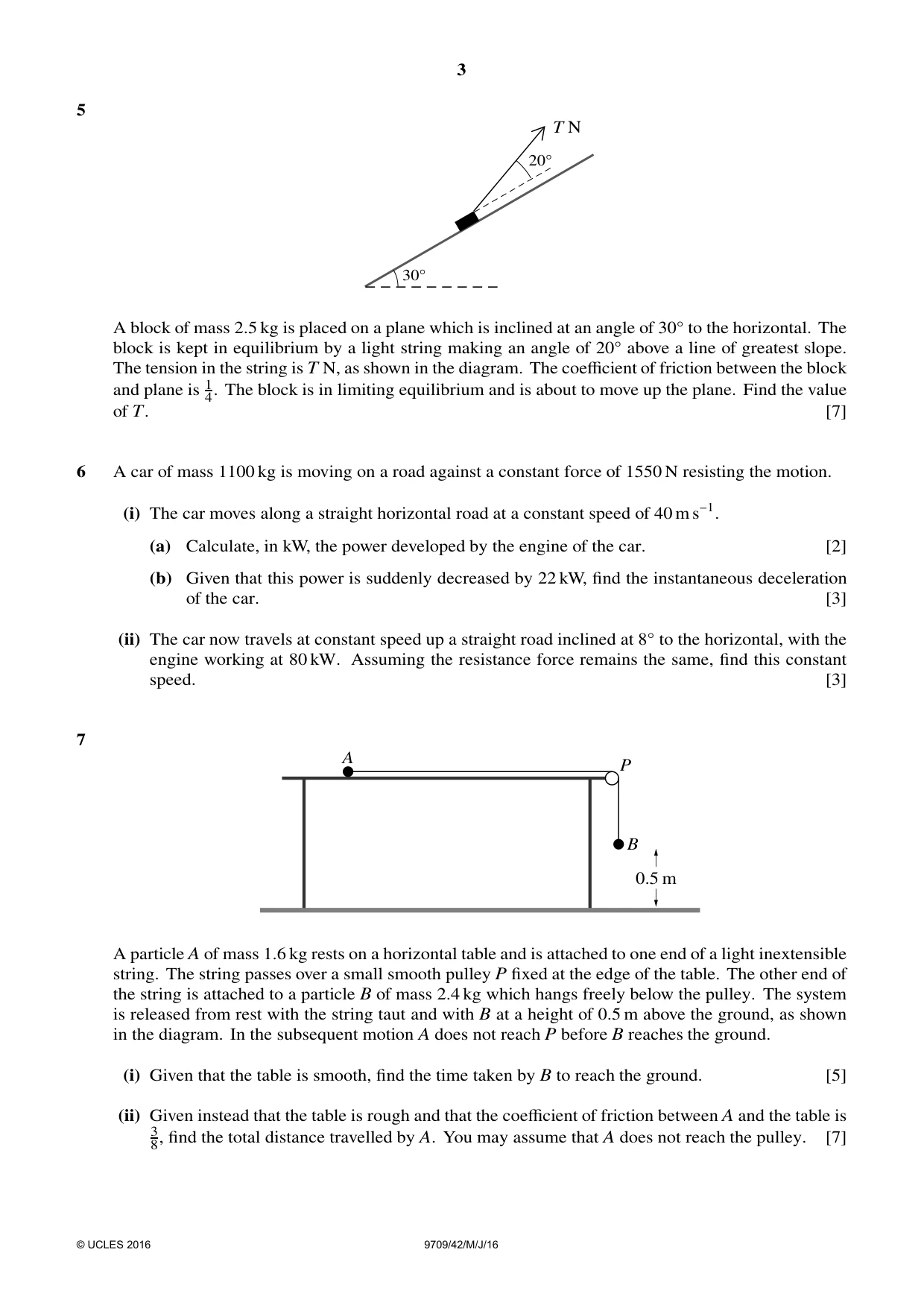
Q5 · T N 20Å 30Å A block of mass 2.5 kg is placed on a plane which is inclined at an angle of…
5 T N 20Å 30Å A block of mass 2.5 kg is placed on a plane which is inclined at an angle of 30Å to the horizontal. The block is kept in equilibrium by a light string making an angle of 20Å above a line of greatest slope. The tension in the string is T N, as shown in the diagram. The coefficient of friction between the block and plane is 14. The block is in limiting equilibrium and is about to move up the plane. Find the value of T. [7]
Mark scheme: 5 M1 For resolving forces perpendicular to the plane (3 term equation) R + T sin 20 = 2.5g cos 30 A1 F = 0.25 × R B1 May be implied M1 For resolving forces parallel to the plane (3 term equation) T cos 20 = F + 2.5g sin 30 A1 M1 For solving and obtaining T T = 17.5 A1 7 Part Qu Answer Mark Notes Marks Alternative scheme 5 F = 0.25 × R B1 May be implied M1 For resolving forces horizontally (3 term equation) T cos 50 = F cos 30 + R sin 30 A1 M1 For resolving forces vertically (4 term equation) R cos 30 + T sin 50 = F sin 30 + 2.5g A1 M1 For solving and obtaining T T = 17.5 A1 7
Q6 · A car of mass 1100 kg is moving on a road against a constant force of 1550 N resisting…
6 A car of mass 1100 kg is moving on a road against a constant force of 1550 N resisting the motion. (i) The car moves along a straight horizontal road at a constant speed of 40 m s−1. (a) Calculate, in kW, the power developed by the engine of the car. [2] (b) Given that this power is suddenly decreased by 22 kW, find the instantaneous deceleration of the car. [3] (ii) The car now travels at constant speed up a straight road inclined at 8Å to the horizontal, with the engine working at 80 kW. Assuming the resistance force remains the same, find this constant speed. [3]
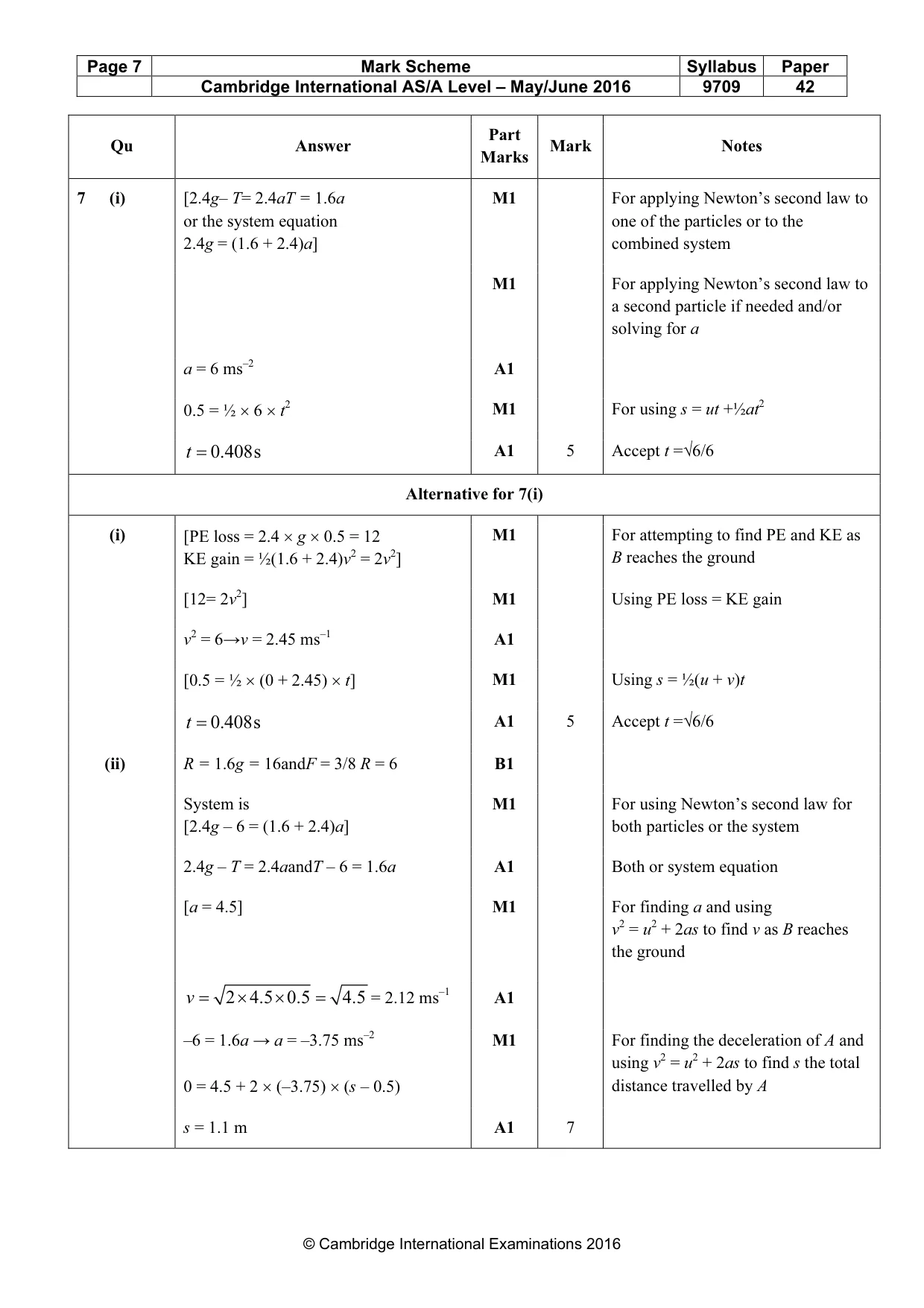
Mark scheme: 6 (i) (a) Power = 1550 × 40 W M1 Using Power = Fv where F = Resistance force Power = 62000 W = 62 kW A1 2 Answer must be in kW (b) (62000 – 22000) = DF × 40 B1ft For stating P – 22000 = DF × 40 [DF = 1000] to find the new driving force. ft on Power found in (i)(a) DF – 1550 = 1100a M1 For applying Newton’s second law to the car (3 terms) a = –0.5 ms–2 or d = 0.5 ms–2 A1 3 (ii) DF = 1100g sin 8 + 1550 M1 For stating the equilibrium of the [= 3081] three forces 80000 = 3081v M1 For using P = Fv with F involving a weight and a resistance term v = 26(.0) ms–1 A1 3
Q7 · A P B 0.5 m A particle A of mass 1.6 kg rests on a horizontal table and is attached to…
7 A P B 0.5 m A particle A of mass 1.6 kg rests on a horizontal table and is attached to one end of a light inextensible string. The string passes over a small smooth pulley P fixed at the edge of the table. The other end of the string is attached to a particle B of mass 2.4 kg which hangs freely below the pulley. The system is released from rest with the string taut and with B at a height of 0.5 m above the ground, as shown in the diagram. In the subsequent motion A does not reach P before B reaches the ground. (i) Given that the table is smooth, find the time taken by B to reach the ground. [5] (ii) Given instead that the table is rough and that the coefficient of friction between A and the table is 38, find the total distance travelled by A. You may assume that A does not reach the pulley. [7]
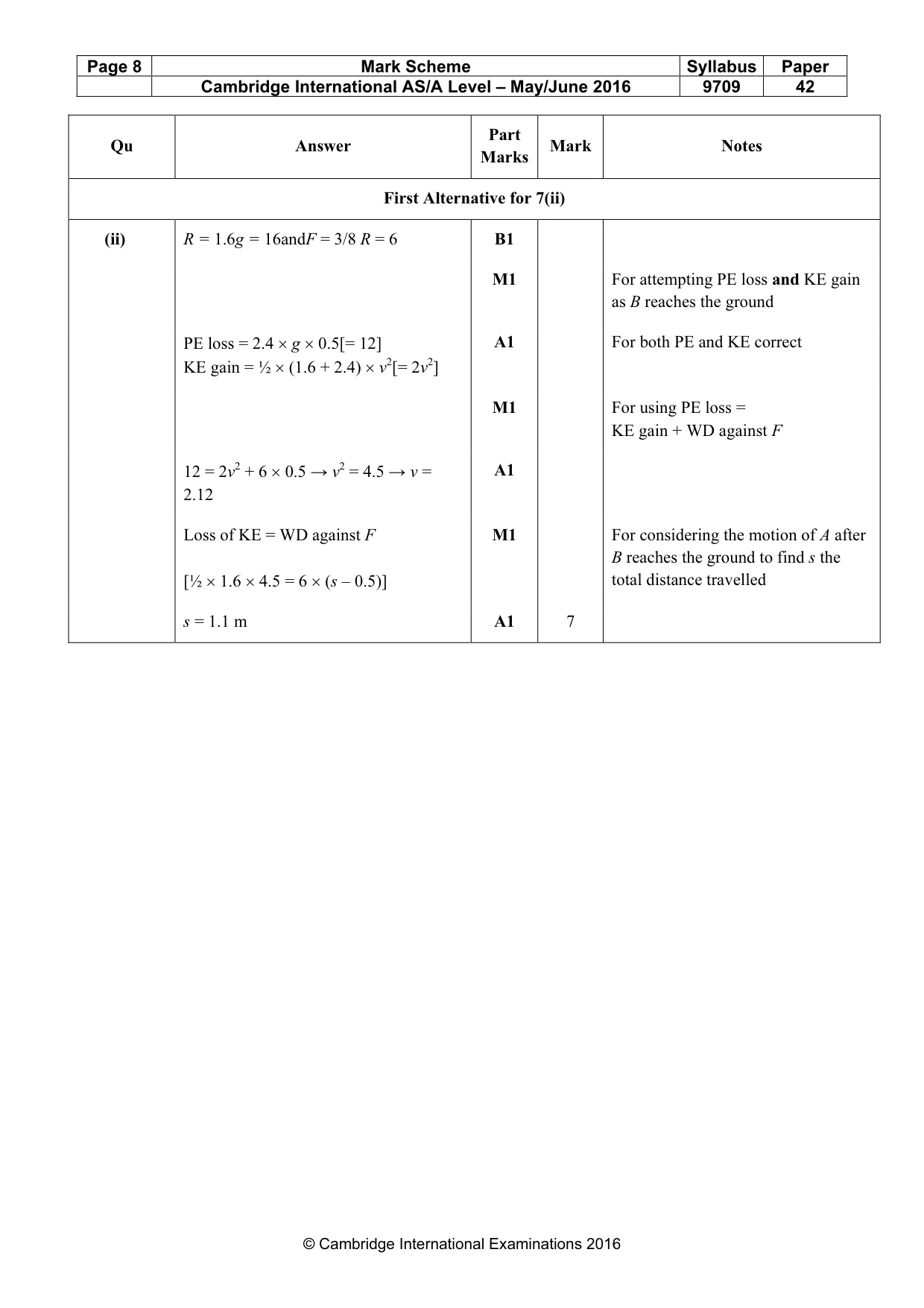
Mark scheme: 7 (i) [2.4g– T= 2.4aT = 1.6a M1 For applying Newton’s second law to or the system equation one of the particles or to the 2.4g = (1.6 + 2.4)a] combined system M1 For applying Newton’s second law to a second particle if needed and/or solving for a a = 6 ms–2 A1 0.5 = ½ × 6 × t2 M1 For using s = ut +½at2 t = 0.408 s A1 5 Accept t =√6/6 Alternative for 7(i) (i) [PE loss = 2.4 × g × 0.5 = 12 M1 For attempting to find PE and KE as KE gain = ½(1.6 + 2.4)v2 = 2v2] B reaches the ground [12= 2v2] M1 Using PE loss = KE gain v2 = 6→v = 2.45 ms–1 A1 [0.5 = ½ × (0 + 2.45) × t] M1 Using s = ½(u + v)t t = 0.408 s A1 5 Accept t =√6/6 (ii) R = 1.6g = 16andF = 3/8 R = 6 B1 System is M1 For using Newton’s second law for [2.4g – 6 = (1.6 + 2.4)a] both particles or the system 2.4g – T = 2.4aandT – 6 = 1.6a A1 Both or system equation [a = 4.5] M1 For finding a and using v2 = u2 + 2as to find v as B reaches the ground v = 2 × 4.5 × 0.5 = 4.5 = 2.12 ms–1 A1 –6 = 1.6a → a = –3.75 ms–2 M1 For finding the deceleration of A and using v2 = u2 + 2as to find s the total 0 = 4.5 + 2 × (–3.75) × (s – 0.5) distance travelled by A s = 1.1 m A1 7 Part Qu Answer Mark Notes Marks First Alternative for 7(ii) (ii) R = 1.6g = 16andF = 3/8 R = 6 B1 M1 For attempting PE loss and KE gain as B reaches the ground PE loss = 2.4 × g × 0.5[= 12] A1 For both PE and KE correct KE gain = ½ × (1.6 + 2.4) × v2[= 2v2] M1 For using PE loss = KE gain + WD against F 12 = 2v2 + 6 × 0.5 → v2 = 4.5 → v = A1 2.12 Loss of KE = WD against F M1 For considering the motion of A after B reaches the ground to find s the [½ × 1.6 × 4.5 = 6 × (s – 0.5)] total distance travelled s = 1.1 m A1 7
What was in this paper
The subtopics covered by these 7 questions, and how many questions each got. Open one in a new tab to see every Cambridge question on it.
What you needed in this session
Cambridge’s own grade thresholds for 2016 May/June, Paper 4 · Variant 2. A higher threshold means an easier paper — the bar moves with how the cohort did.