Cambridge A Level Mathematics 9709 — 2011 May/June Paper 4 · Variant 3
9709/43/M/J/11 · 7 questions · 50 marks · ≈56 min
The question paper and its mark scheme, free to read here and free to download. This is Cambridge’s own paper, exactly as it was sat.
Question paper4 pages
Mark scheme6 pages
Answers below. Sit the paper first if you are practising.
Questions as text
Q1 · A block is pulled for a distance of 50 m along a horizontal floor, by a rope that is…
1 A block is pulled for a distance of 50 m along a horizontal floor, by a rope that is inclined at an angle of α◦to the floor. The tension in the rope is 180 N and the work done by the tension is 8200 J. Find the value of α. [3]
Mark scheme: 1 M1 For using WD = Fdcosα 8200 = 180 × 50 cosα A1 α = 24.3 A1 [3]
Q2 · A car of mass 1250 kg is travelling along a straight horizontal road with its engine…
2 A car of mass 1250 kg is travelling along a straight horizontal road with its engine working at a constant rate of P W. The resistance to the car’s motion is constant and equal to R N. When the speed of the car is 19 m s−1 its acceleration is 0.6 m s−2, and when the speed of the car is 30 m s−1 its acceleration is 0.16 m s−2. Find the values of P and R. [6]
Mark scheme: 2 M1 For using DF = P/v M1 For using Newton’s second law when v = 19 or when v = 30 P/19 – R = 1250 × 0.6 and A1 P/30 – R = 1250 × 0.16 [19R + 19 × 1250 × 0.6 M1 For attempting to eliminate P or R = 30R + 30 × 1250 × 0.16] R = 750 or P = 28500 A1 P = 28500 or R = 750 B1ft ft wrong answer for R or P substituted [6] into a correct linear equation.
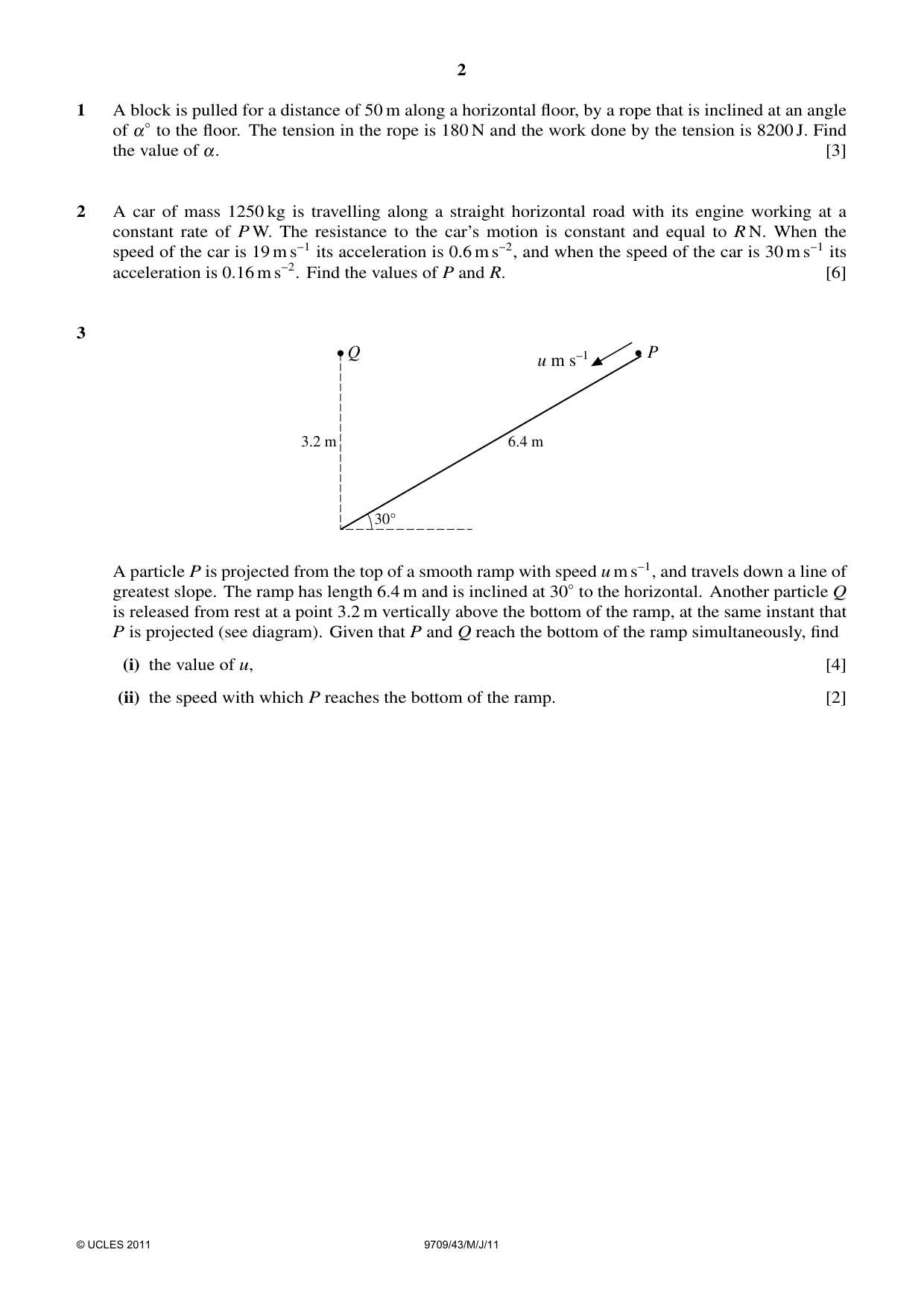
Q3 · Q P u m s–1 3.2 m 6.4 m 30° A particle P is projected from the top of a smooth ramp with…
3 Q P u m s–1 3.2 m 6.4 m 30° A particle P is projected from the top of a smooth ramp with speed u m s−1, and travels down a line of greatest slope. The ramp has length 6.4 m and is inclined at 30◦to the horizontal. Another particle Q is released from rest at a point 3.2 m vertically above the bottom of the ramp, at the same instant that P is projected (see diagram). Given that P and Q reach the bottom of the ramp simultaneously, find (i) the value of u, [4] (ii) the speed with which P reaches the bottom of the ramp. [2]
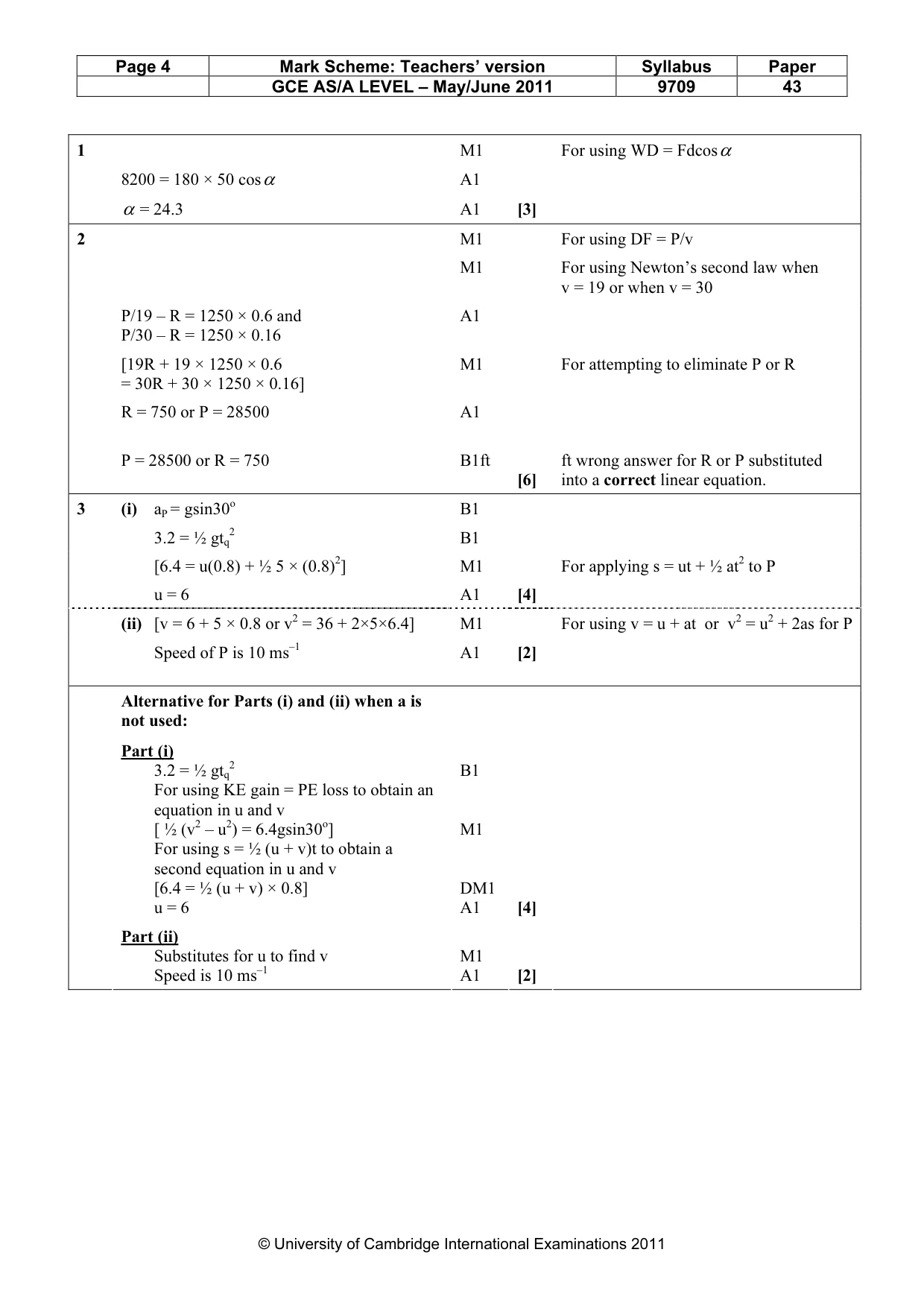
Mark scheme: 3 (i) aP = gsin30o B1 2 3.2 = ½ gtq B1 [6.4 = u(0.8) + ½ 5 × (0.8)2] M1 For applying s = ut + ½ at2 to P u = 6 A1 [4] (ii) [v = 6 + 5 × 0.8 or v2 = 36 + 2×5×6.4] M1 For using v = u + at or v2 = u2 + 2as for P Speed of P is 10 ms–1 A1 [2] Alternative for Parts (i) and (ii) when a is not used: Part (i) 2 3.2 = ½ gtq B1 For using KE gain = PE loss to obtain an equation in u and v [ ½ (v2 – u2) = 6.4gsin30o] M1 For using s = ½ (u + v)t to obtain a second equation in u and v [6.4 = ½ (u + v) × 0.8] DM1 u = 6 A1 [4] Part (ii) Substitutes for u to find v M1 Speed is 10 ms–1 A1 [2] GCE AS/A LEVEL – May/June 2011 9709 43
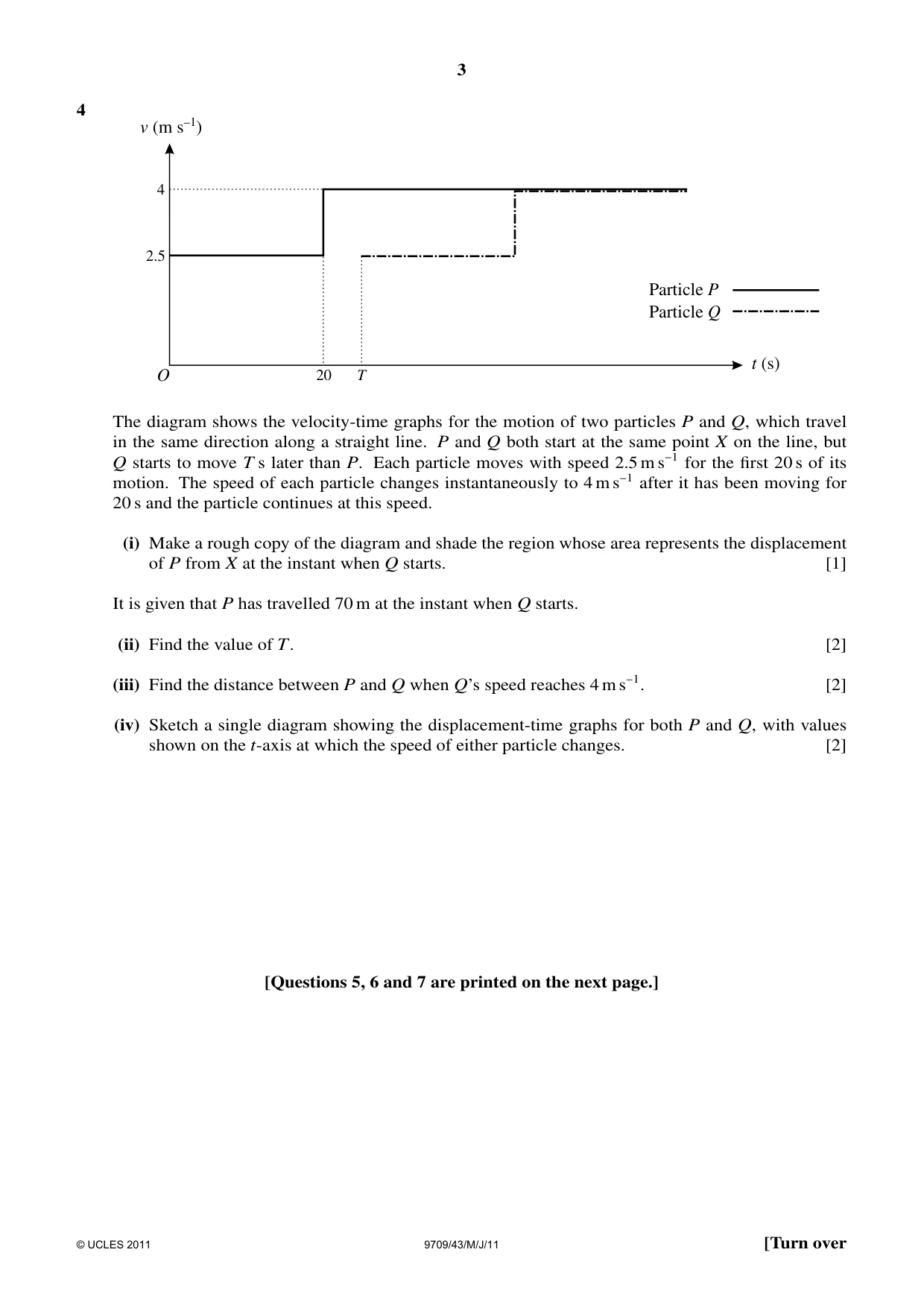
Q4 · V (m s–1 ) 4 2.5 Particle P Particle Q t (s) O 20 T The diagram shows the velocity-time…
4 v (m s–1 ) 4 2.5 Particle P Particle Q t (s) O 20 T The diagram shows the velocity-time graphs for the motion of two particles P and Q, which travel in the same direction along a straight line. P and Q both start at the same point X on the line, but Q starts to move T s later than P. Each particle moves with speed 2.5 m s−1 for the first 20 s of its motion. The speed of each particle changes instantaneously to 4 m s−1 after it has been moving for 20 s and the particle continues at this speed. (i) Make a rough copy of the diagram and shade the region whose area represents the displacement of P from X at the instant when Q starts. [1] It is given that P has travelled 70 m at the instant when Q starts. (ii) Find the value of T. [2] (iii) Find the distance between P and Q when Q’s speed reaches 4 m s−1. [2] (iv) Sketch a single diagram showing the displacement-time graphs for both P and Q, with values shown on the t-axis at which the speed of either particle changes. [2] [Questions 5, 6 and 7 are printed on the next page.]
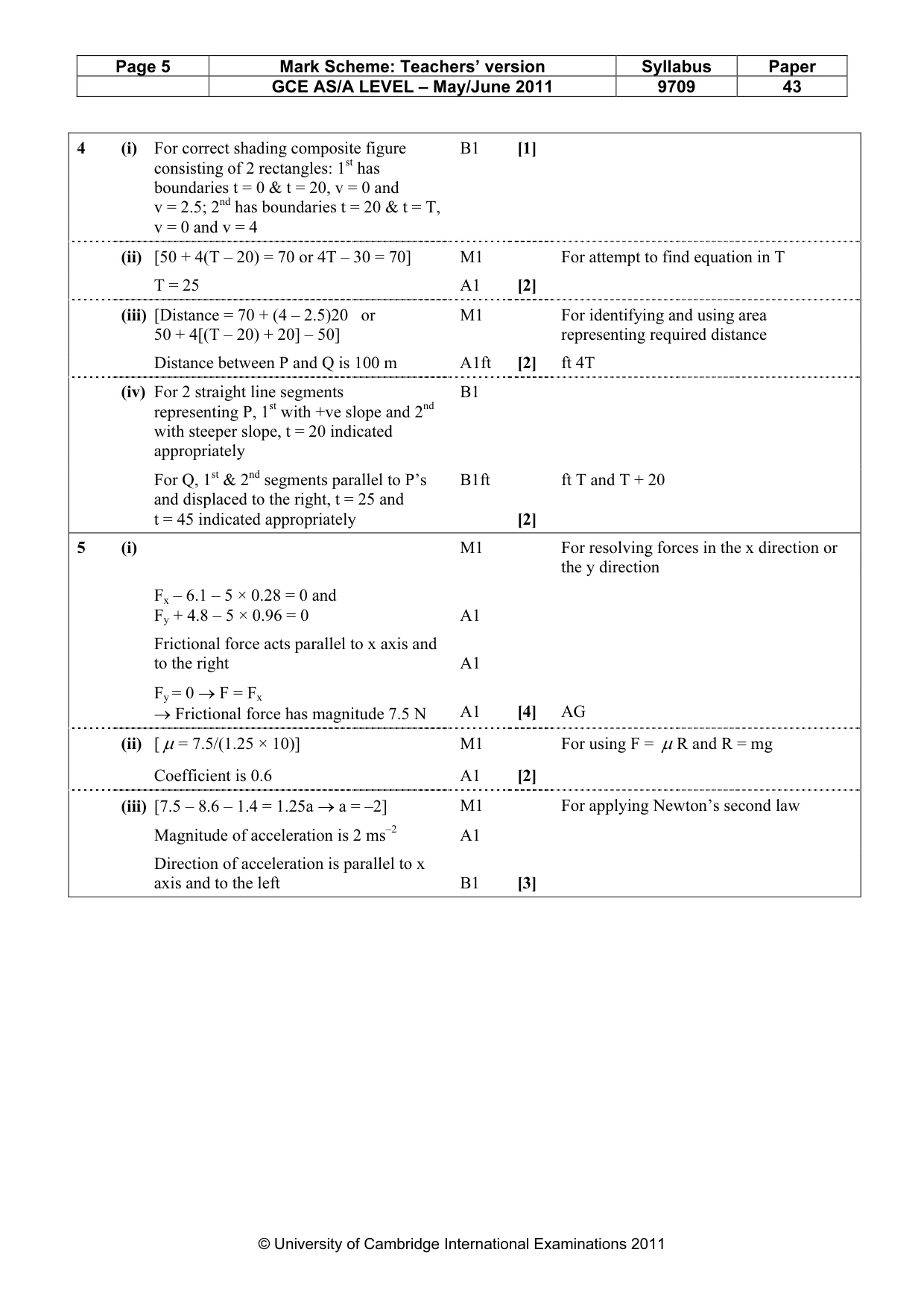
Mark scheme: 4 (i) For correct shading composite figure B1 [1] consisting of 2 rectangles: 1st has boundaries t = 0 & t = 20, v = 0 and v = 2.5; 2nd has boundaries t = 20 & t = T, v = 0 and v = 4 (ii) [50 + 4(T – 20) = 70 or 4T – 30 = 70] M1 For attempt to find equation in T T = 25 A1 [2] (iii) [Distance = 70 + (4 – 2.5)20 or M1 For identifying and using area 50 + 4[(T – 20) + 20] – 50] representing required distance Distance between P and Q is 100 m A1ft [2] ft 4T (iv) For 2 straight line segments B1 representing P, 1st with +ve slope and 2nd with steeper slope, t = 20 indicated appropriately For Q, 1st & 2nd segments parallel to P’s B1ft ft T and T + 20 and displaced to the right, t = 25 and t = 45 indicated appropriately [2]
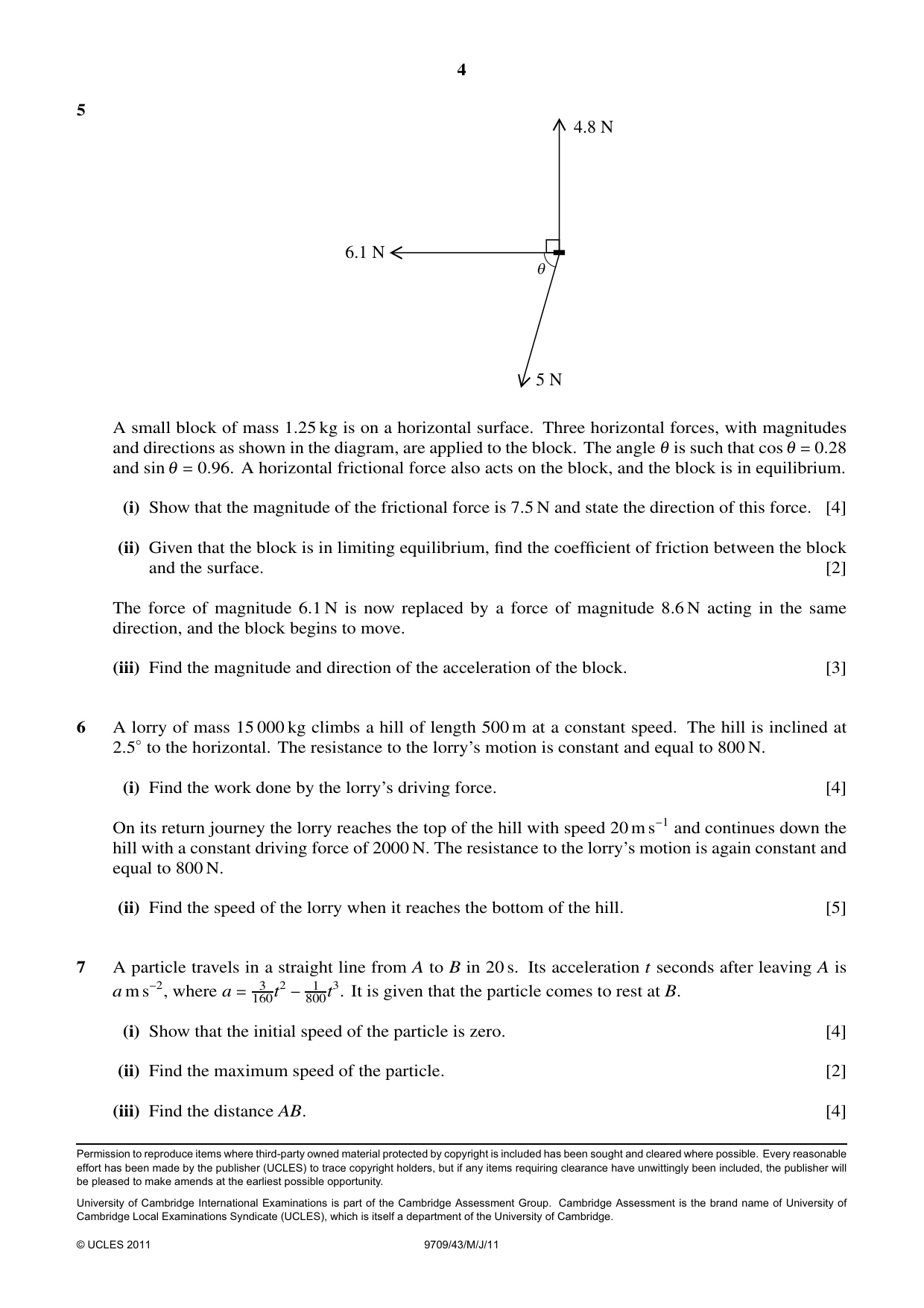
Q5 · 4.8 N 6.1 N q 5 N A small block of mass 1.25 kg is on a horizontal surface
5 4.8 N 6.1 N q 5 N A small block of mass 1.25 kg is on a horizontal surface. Three horizontal forces, with magnitudes and directions as shown in the diagram, are applied to the block. The angle θ is such that cos θ = 0.28 and sin θ = 0.96. A horizontal frictional force also acts on the block, and the block is in equilibrium. (i) Show that the magnitude of the frictional force is 7.5 N and state the direction of this force. [4] (ii) Given that the block is in limiting equilibrium, find the coefficient of friction between the block and the surface. [2] The force of magnitude 6.1 N is now replaced by a force of magnitude 8.6 N acting in the same direction, and the block begins to move. (iii) Find the magnitude and direction of the acceleration of the block. [3]
Mark scheme: 5 (i) M1 For resolving forces in the x direction or the y direction Fx – 6.1 – 5 × 0.28 = 0 and Fy + 4.8 – 5 × 0.96 = 0 A1 Frictional force acts parallel to x axis and to the right A1 Fy = 0 → F = Fx → Frictional force has magnitude 7.5 N A1 [4] AG (ii) [ µ = 7.5/(1.25 × 10)] M1 For using F = µ R and R = mg Coefficient is 0.6 A1 [2] (iii) [7.5 – 8.6 – 1.4 = 1.25a → a = –2] M1 For applying Newton’s second law Magnitude of acceleration is 2 ms–2 A1 Direction of acceleration is parallel to x axis and to the left B1 [3] GCE AS/A LEVEL – May/June 2011 9709 43
Q6 · A lorry of mass 15 000 kg climbs a hill of length 500 m at a constant speed
6 A lorry of mass 15 000 kg climbs a hill of length 500 m at a constant speed. The hill is inclined at 2.5◦to the horizontal. The resistance to the lorry’s motion is constant and equal to 800 N. (i) Find the work done by the lorry’s driving force. [4] On its return journey the lorry reaches the top of the hill with speed 20 m s−1 and continues down the hill with a constant driving force of 2000 N. The resistance to the lorry’s motion is again constant and equal to 800 N. (ii) Find the speed of the lorry when it reaches the bottom of the hill. [5]
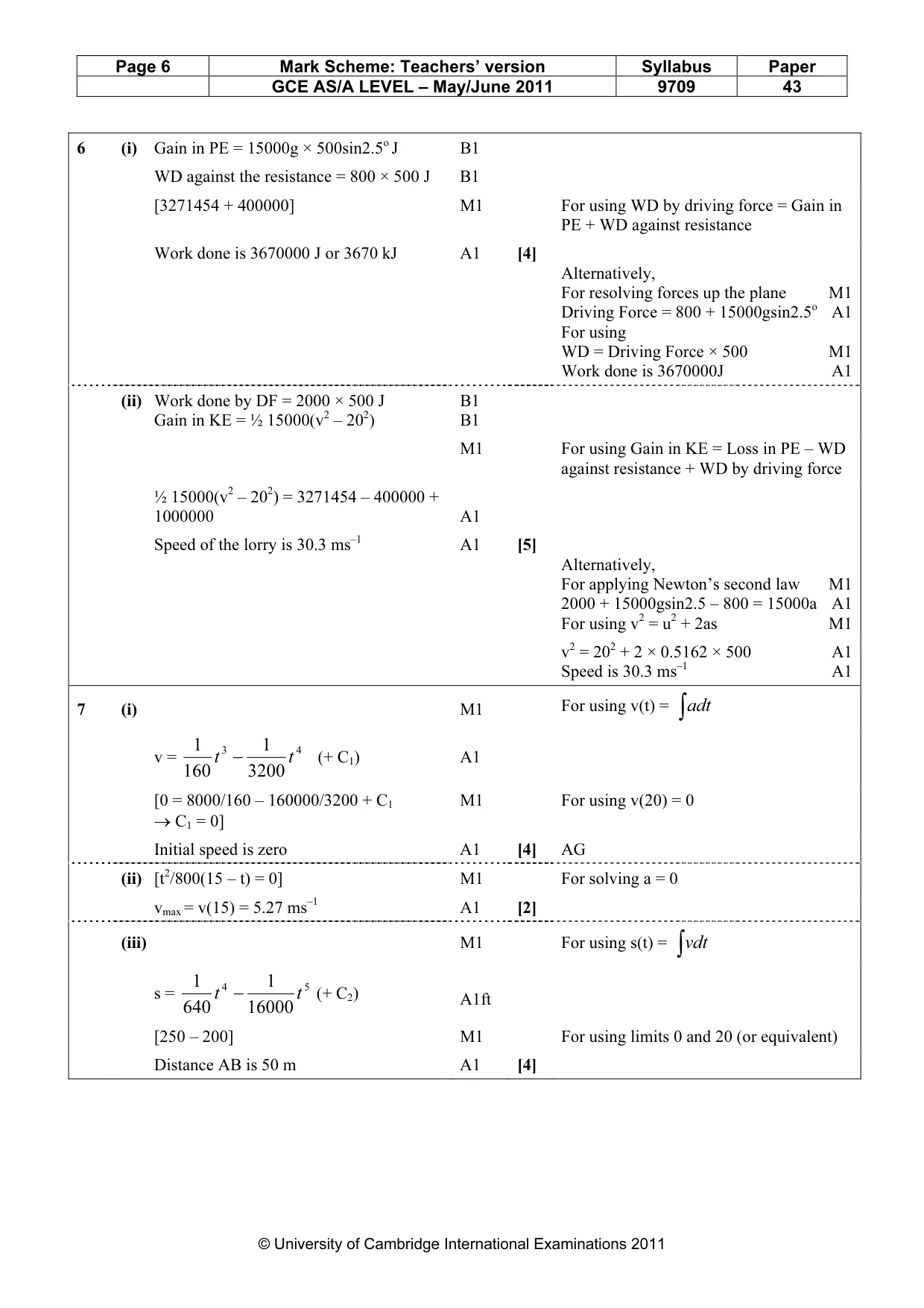
Mark scheme: 6 (i) Gain in PE = 15000g × 500sin2.5o J B1 WD against the resistance = 800 × 500 J B1 [3271454 + 400000] M1 For using WD by driving force = Gain in PE + WD against resistance Work done is 3670000 J or 3670 kJ A1 [4] Alternatively, For resolving forces up the plane M1 Driving Force = 800 + 15000gsin2.5o A1 For using WD = Driving Force × 500 M1 Work done is 3670000J A1 (ii) Work done by DF = 2000 × 500 J B1 Gain in KE = ½ 15000(v2 – 202) B1 M1 For using Gain in KE = Loss in PE – WD against resistance + WD by driving force ½ 15000(v2 – 202) = 3271454 – 400000 + 1000000 A1 Speed of the lorry is 30.3 ms–1 A1 [5] Alternatively, For applying Newton’s second law M1 2000 + 15000gsin2.5 – 800 = 15000a A1 For using v2 = u2 + 2as M1 v2 = 202 + 2 × 0.5162 × 500 A1 Speed is 30.3 ms–1 A1 ∫
Q7 · A particle travels in a straight line from A to B in 20 s
7 A particle travels in a straight line from A to B in 20 s. Its acceleration t seconds after leaving A is It is given that the particle comes to rest at B. a m s−2, where a = 160t23 − 800t3.1 (i) Show that the initial speed of the particle is zero. [4] (ii) Find the maximum speed of the particle. [2] (iii) Find the distance AB. [4]
Mark scheme: 7 (i) M1 For using v(t) = ∫adt 1 3 1 4 v = t − t (+ C1) A1 160 3200 [0 = 8000/160 – 160000/3200 + C1 M1 For using v(20) = 0 → C1 = 0] Initial speed is zero A1 [4] AG (ii) [t2/800(15 – t) = 0] M1 For solving a = 0 vmax = v(15) = 5.27 ms–1 A1 [2] (iii) M1 For using s(t) = ∫vdt 1 4 1 5 s = t − t (+ C2) A1ft 640 16000 [250 – 200] M1 For using limits 0 and 20 (or equivalent) Distance AB is 50 m A1 [4]
What was in this paper
The subtopics covered by these 7 questions, and how many questions each got. Open one in a new tab to see every Cambridge question on it.
What you needed in this session
Cambridge’s own grade thresholds for 2011 May/June, Paper 4 · Variant 3. A higher threshold means an easier paper — the bar moves with how the cohort did.