Questions as text
Q1 · The antibiotic streptomycin is now proving to be less effective in reducing the incidence… 9700/11 May/June 2006
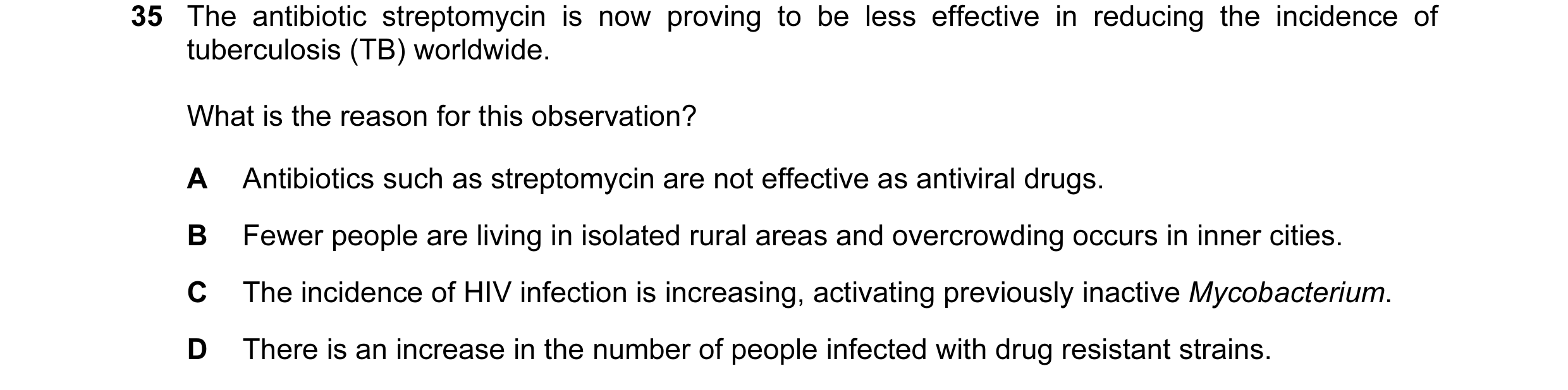
35 The antibiotic streptomycin is now proving to be less effective in reducing the incidence of tuberculosis (TB) worldwide. What is the reason for this observation? A Antibiotics such as streptomycin are not effective as antiviral drugs. B Fewer people are living in isolated rural areas and overcrowding occurs in inner cities. C The incidence of HIV infection is increasing, activating previously inactive Mycobacterium. D There is an increase in the number of people infected with drug resistant strains.
1 marks
Answer: D
This question in 9700/11 May/June 2006
Q2 · For which diseases is treatment with antibiotics likely to be effective? 9700/11 Oct/Nov 2006
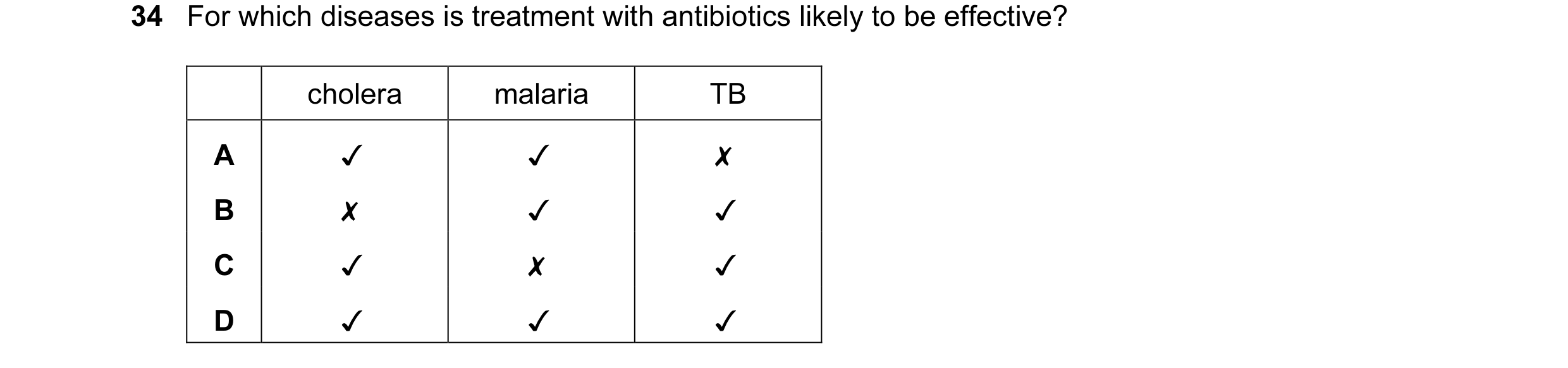
34 For which diseases is treatment with antibiotics likely to be effective?
cholera malaria TB
0 0O WwW >
<< x
Ko 4
<4 x
1 marks
Answer: C
This question in 9700/11 Oct/Nov 2006
Q3 · Some antibacterial drugs can affect the synthesis of proteins 9700/11 Oct/Nov 2007
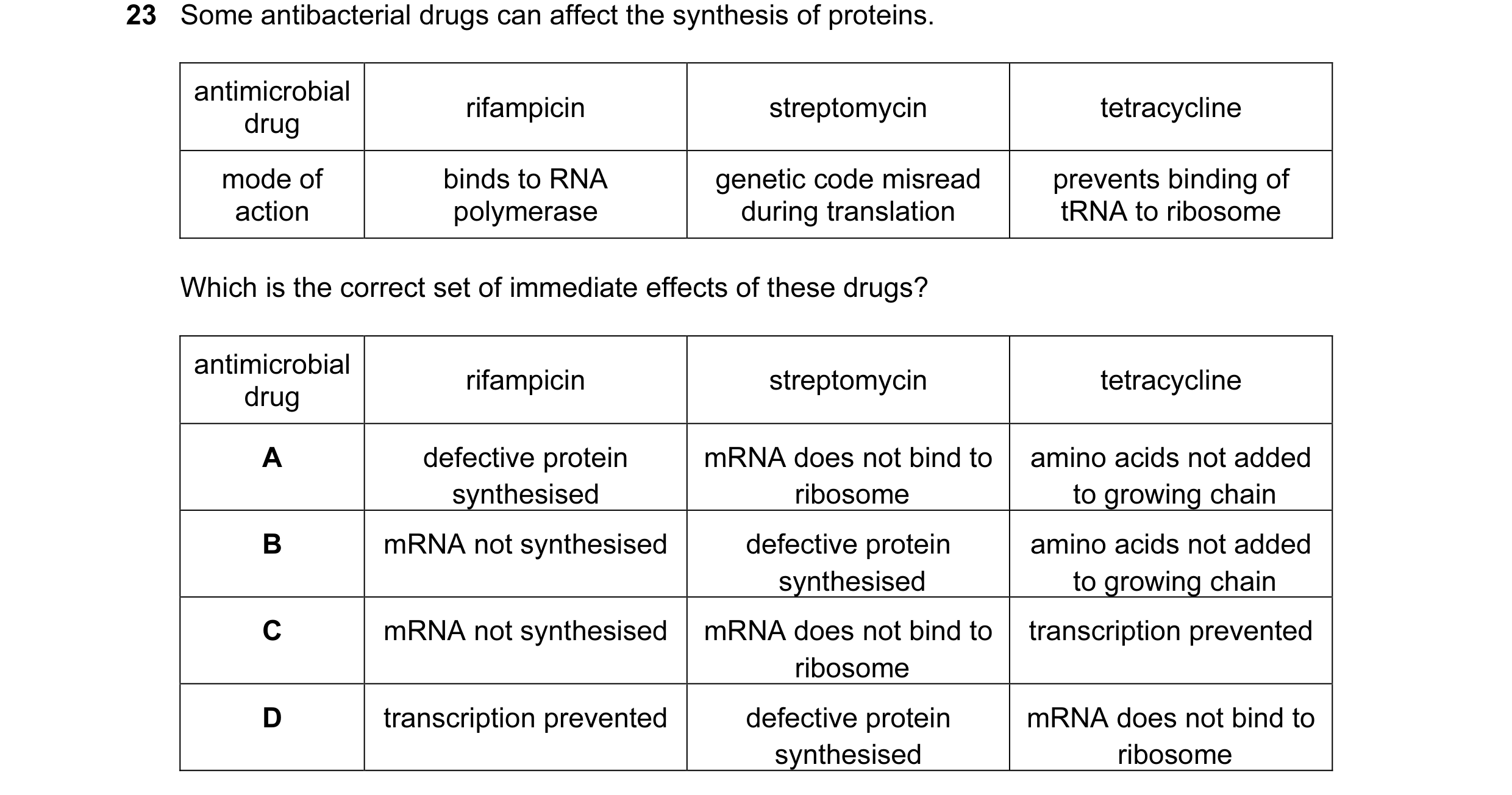
23 Some antibacterial drugs can affect the synthesis of proteins. antimicrobial rifampicin streptomycin tetracycline drug mode of binds to RNA genetic code misread prevents binding of action polymerase during translation tRNA to ribosome Which is the correct set of immediate effects of these drugs? antimicrobial rifampicin streptomycin tetracycline drug A defective protein mRNA does not bind to amino acids not added synthesised ribosome to growing chain B mRNA not synthesised defective protein amino acids not added synthesised to growing chain C mRNA not synthesised mRNA does not bind to transcription prevented ribosome D transcription prevented defective protein mRNA does not bind to synthesised ribosome
1 marks
Answer: B
This question in 9700/11 Oct/Nov 2007
Q4 · Which diseases can be cured by the use of antibiotics? 9700/11 Oct/Nov 2007
35 Which diseases can be cured by the use of antibiotics? A cholera and tuberculosis B HIV / AIDS and smallpox C HIV / AIDS and tuberculosis D smallpox and cholera
1 marks
Answer: A
This question in 9700/11 Oct/Nov 2007
Q5 · Which disease is treated with drugs that have a similar molecular structure to DNA… 9700/11 May/June 2008
35 Which disease is treated with drugs that have a similar molecular structure to DNA nucleotides? A cholera B HIV / AIDS C malaria D tuberculosis (TB)
1 marks
Answer: B
This question in 9700/11 May/June 2008
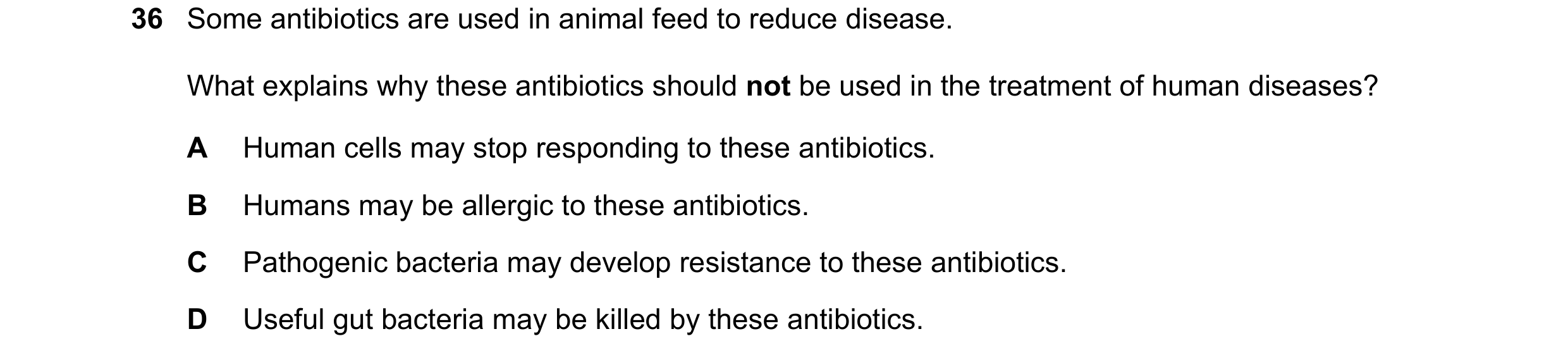
Q6 · Some antibiotics are used in animal feed to reduce disease 9700/11 Oct/Nov 2008
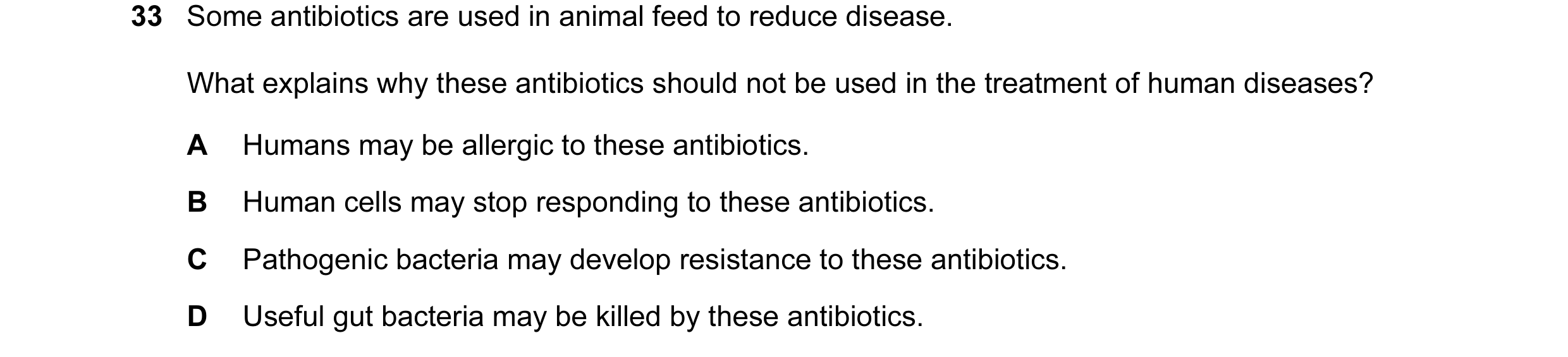
33 Some antibiotics are used in animal feed to reduce disease. What explains why these antibiotics should not be used in the treatment of human diseases? A Humans may be allergic to these antibiotics. B Human cells may stop responding to these antibiotics. C Pathogenic bacteria may develop resistance to these antibiotics. D Useful gut bacteria may be killed by these antibiotics.
1 marks
Answer: C
This question in 9700/11 Oct/Nov 2008
Q7 · Which diseases can be cured by the use of antibiotics? 9700/11 Oct/Nov 2010
33 Which diseases can be cured by the use of antibiotics? A cholera and tuberculosis B measles and smallpox C measles and tuberculosis D smallpox and cholera
1 marks
Answer: A
This question in 9700/11 Oct/Nov 2010
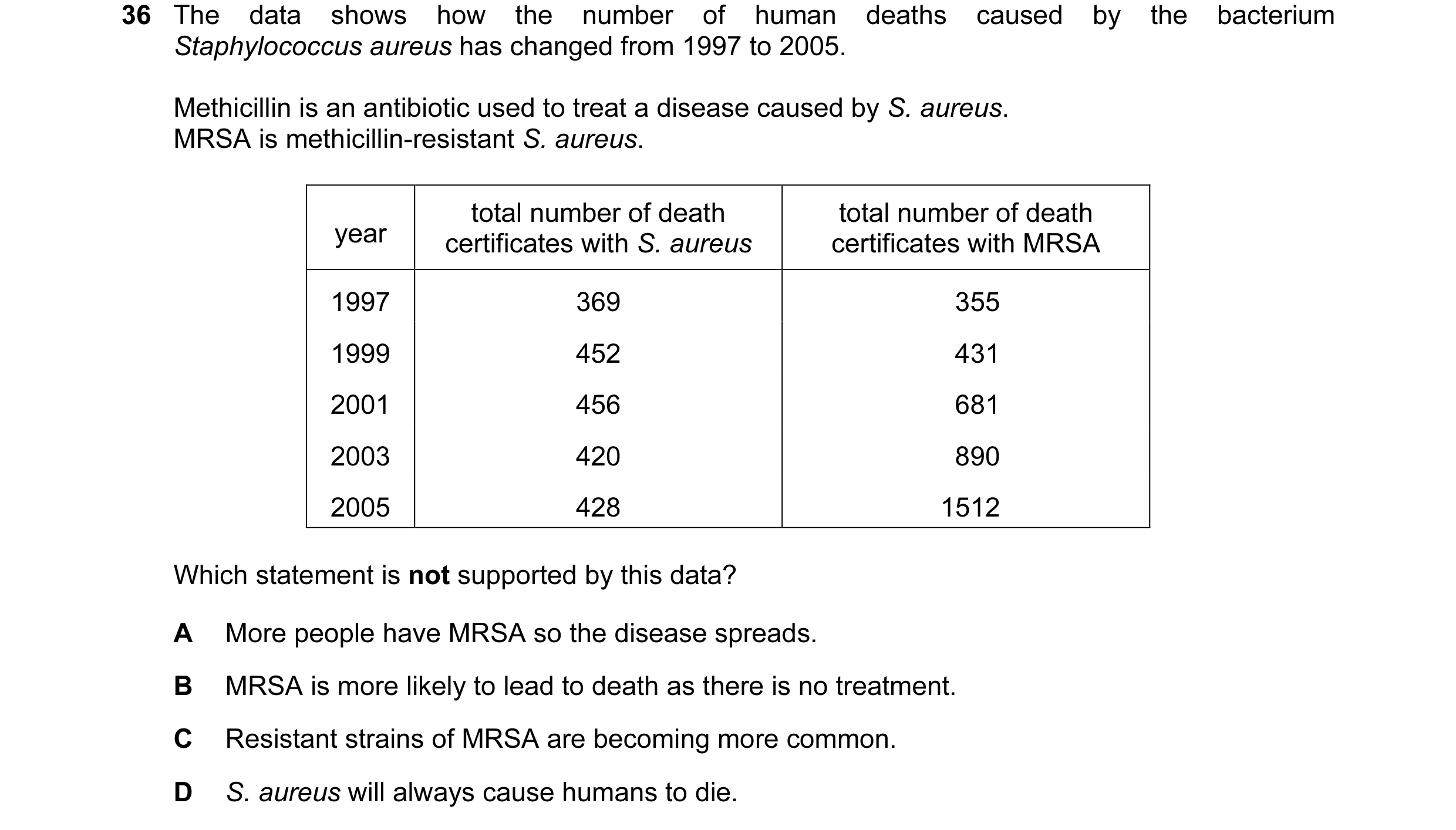
Q8 · The data shows how the number of human deaths caused by the bacterium Staphylococcus… 9700/12 Oct/Nov 2010
36 The data shows how the number of human deaths caused by the bacterium Staphylococcus aureus has changed from 1997 to 2005. Methicillin is an antibiotic used to treat a disease caused by S. aureus. MRSA is methicillin-resistant S. aureus. total number of death total number of death year certificates with S. aureus certificates with MRSA 1997 369 355 1999 452 431 2001 456 681 2003 420 890 2005 428 1512 Which statement is not supported by this data? A More people have MRSA so the disease spreads. B MRSA is more likely to lead to death as there is no treatment. C Resistant strains of MRSA are becoming more common. D S. aureus will always cause humans to die.
1 marks
Answer: D
This question in 9700/12 Oct/Nov 2010
Q9 · The diagram shows one way of testing the effect of an antibiotic on bacteria 9700/11 May/June 2011
37 The diagram shows one way of testing the effect of an antibiotic on bacteria. colonies of bacteria diameter of zone petri dish with measured every nutrient agar week for 5 weeks grown for containing 5 weeks bacteria disc of filter paper soaked in antibiotic The table shows the results of testing five different types of bacteria. Zones of less than 13 mm show the presence of resistant bacteria. type of diameter of zone / mm bacteria week 1 week 2 week 3 week 4 week 5 1 24.10 21.90 19.00 17.60 14.30 2 18.60 15.40 12.20 9.00 0.00 3 17.90 12.80 12.40 11.10 10.90 4 19.40 15.30 13.20 8.10 0.00 5 22.00 21.00 20.50 20.40 20.40 Which statement can be supported by this data? A Bacteria become more resistant to antibiotics over time. B Only types 2, 3 and 4 of the bacteria show resistance to the antibiotic. C The antibiotic can be used to treat all the types of bacteria. D Type 5 of the bacteria can never become resistant to the antibiotic.
1 marks
Answer: B
This question in 9700/11 May/June 2011
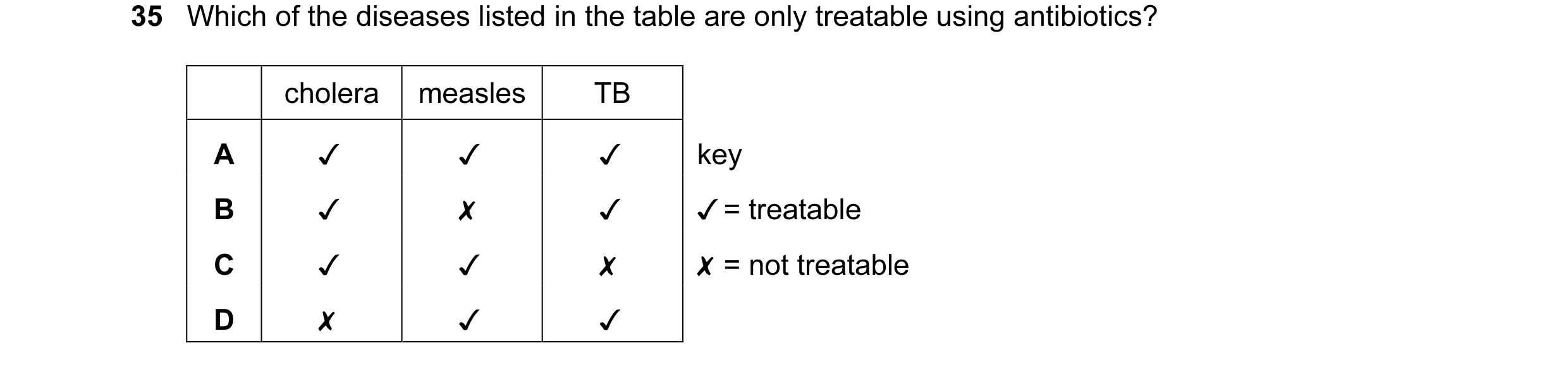
Q10 · Which of the diseases listed in the table are only treatable using antibiotics? 9700/12 May/June 2011
35 Which of the diseases listed in the table are only treatable using antibiotics?
cholera | measles TB
v v key
JY = treatable
X = not treatable
0 ONO DW >
Ke 4K
v x
v v
x v
1 marks
Answer: B
This question in 9700/12 May/June 2011
Q11 · The diagram shows one way of testing the effect of an antibiotic on bacteria 9700/13 May/June 2011
39 The diagram shows one way of testing the effect of an antibiotic on bacteria. colonies of bacteria diameter of zone petri dish with measured every nutrient agar week for 5 weeks grown for containing 5 weeks bacteria disc of filter paper soaked in antibiotic The table shows the results of testing five different types of bacteria. Zones of less than 13 mm show the presence of resistant bacteria. type of diameter of zone / mm bacteria week 1 week 2 week 3 week 4 week 5 1 24.10 21.90 19.00 17.60 14.30 2 18.60 15.40 12.20 9.00 0.00 3 17.90 12.80 12.40 11.10 10.90 4 19.40 15.30 13.20 8.10 0.00 5 22.00 21.00 20.50 20.40 20.40 Which statement can be supported by this data? A Bacteria become more resistant to antibiotics over time. B Only types 2, 3 and 4 of the bacteria show resistance to the antibiotic. C The antibiotic can be used to treat all the types of bacteria. D Type 5 of the bacteria can never become resistant to the antibiotic.
1 marks
Answer: B
This question in 9700/13 May/June 2011
Q12 · Which details are correct? 9700/11 Oct/Nov 2011
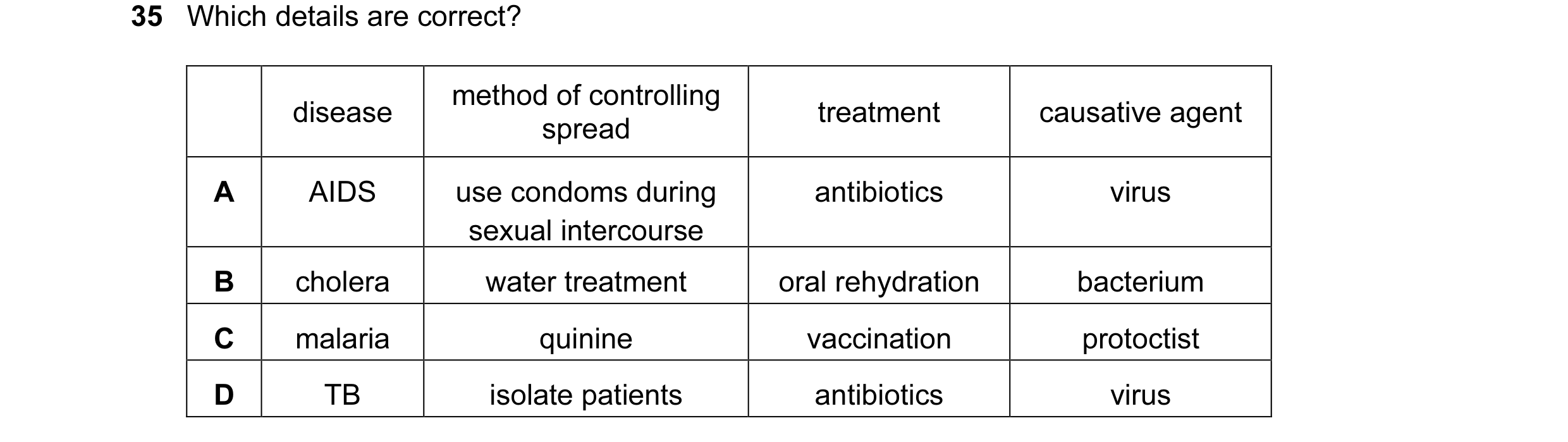
35 Which details are correct? method of controlling disease treatment causative agent spread A AIDS use condoms during antibiotics virus sexual intercourse B cholera water treatment oral rehydration bacterium C malaria quinine vaccination protoctist D TB isolate patients antibiotics virus
1 marks
Answer: B
This question in 9700/11 Oct/Nov 2011
Q13 · Which details are correct? 9700/13 Oct/Nov 2011
14 Which details are correct? method of controlling disease treatment causative agent spread A AIDS use condoms during antibiotics virus sexual intercourse B cholera water treatment oral rehydration bacterium C malaria quinine vaccination protoctist D TB isolate patients antibiotics virus
1 marks
Answer: B
This question in 9700/13 Oct/Nov 2011
Q14 · Some antibiotics are used in animal feed to reduce disease 9700/13 May/June 2013
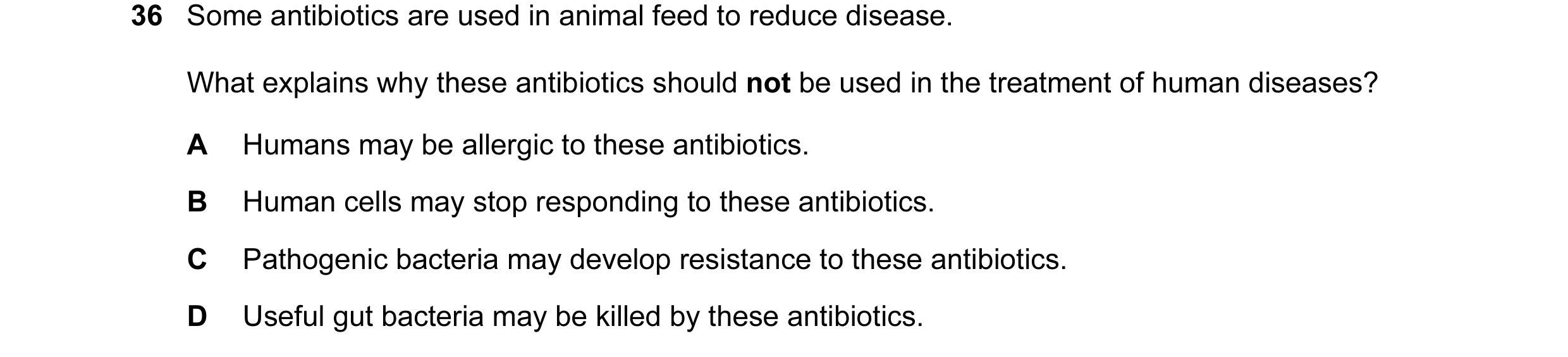
36 Some antibiotics are used in animal feed to reduce disease. What explains why these antibiotics should not be used in the treatment of human diseases? A Humans may be allergic to these antibiotics. B Human cells may stop responding to these antibiotics. C Pathogenic bacteria may develop resistance to these antibiotics. D Useful gut bacteria may be killed by these antibiotics.
1 marks
Answer: C
This question in 9700/13 May/June 2013
Q15 · The statements refer to the disease tuberculosis (TB) 9700/11 May/June 2014
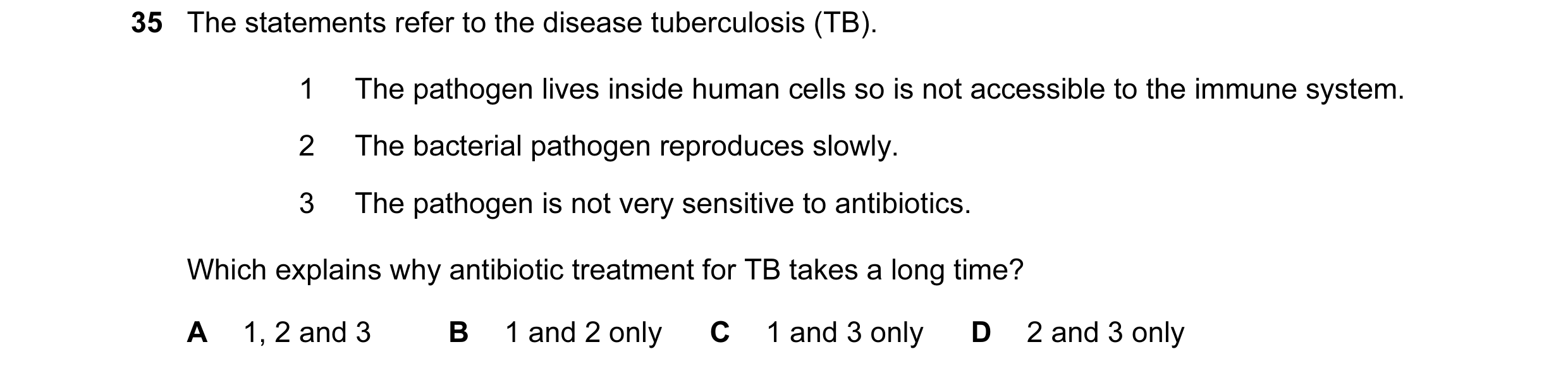
35 The statements refer to the disease tuberculosis (TB). 1 The pathogen lives inside human cells so is not accessible to the immune system. 2 The bacterial pathogen reproduces slowly. 3 The pathogen is not very sensitive to antibiotics. Which explains why antibiotic treatment for TB takes a long time? A 1, 2 and 3 B 1 and 2 only C 1 and 3 only D 2 and 3 only
1 marks
Answer: D
This question in 9700/11 May/June 2014
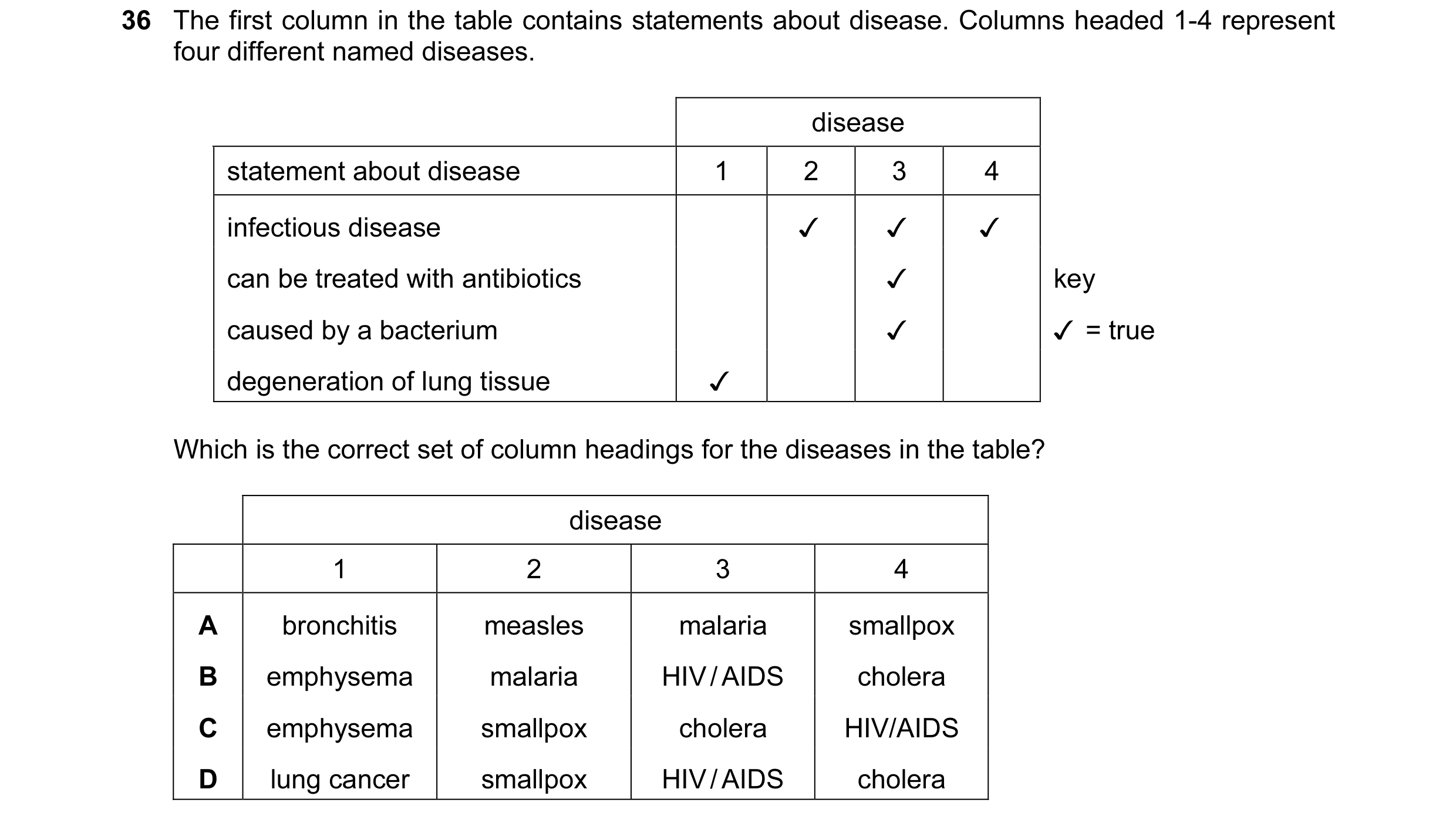
Q16 · The first column in the table contains statements about disease 9700/11 May/June 2014
36 The first column in the table contains statements about disease. Columns headed 1-4 represent
four different named diseases.
disease
statement about disease 1 2 3
infectious disease v v
can be treated with antibiotics v
caused by a bacterium v
degeneration of lung tissue v
Which is the correct set of column headings for the diseases in the table?
disease
0 0O DW >
bronchitis
emphysema
emphysema
lung cancer
measles
malaria
smallpox
smallpox
malaria
HIV/AIDS
cholera
HIV/AIDS
smallpox
cholera
HIV/AIDS
cholera
key
/ =true
1 marks
Answer: C
This question in 9700/11 May/June 2014
Q17 · Some antibiotics work by binding to ribosomes and preventing protein synthesis 9700/11 Oct/Nov 2014
19 Some antibiotics work by binding to ribosomes and preventing protein synthesis. Which statement explains why these antibiotics kill bacterial cells but not human cells? A In bacterial cells mRNA is formed in the cytoplasm from naked DNA. B Ribosomes in human cells have a different structure from those in bacterial cells. C The antibiotics cannot pass through human cell surface membranes. D The tRNA molecules in bacterial cells are different from those in human cells.
1 marks
Answer: B
This question in 9700/11 Oct/Nov 2014
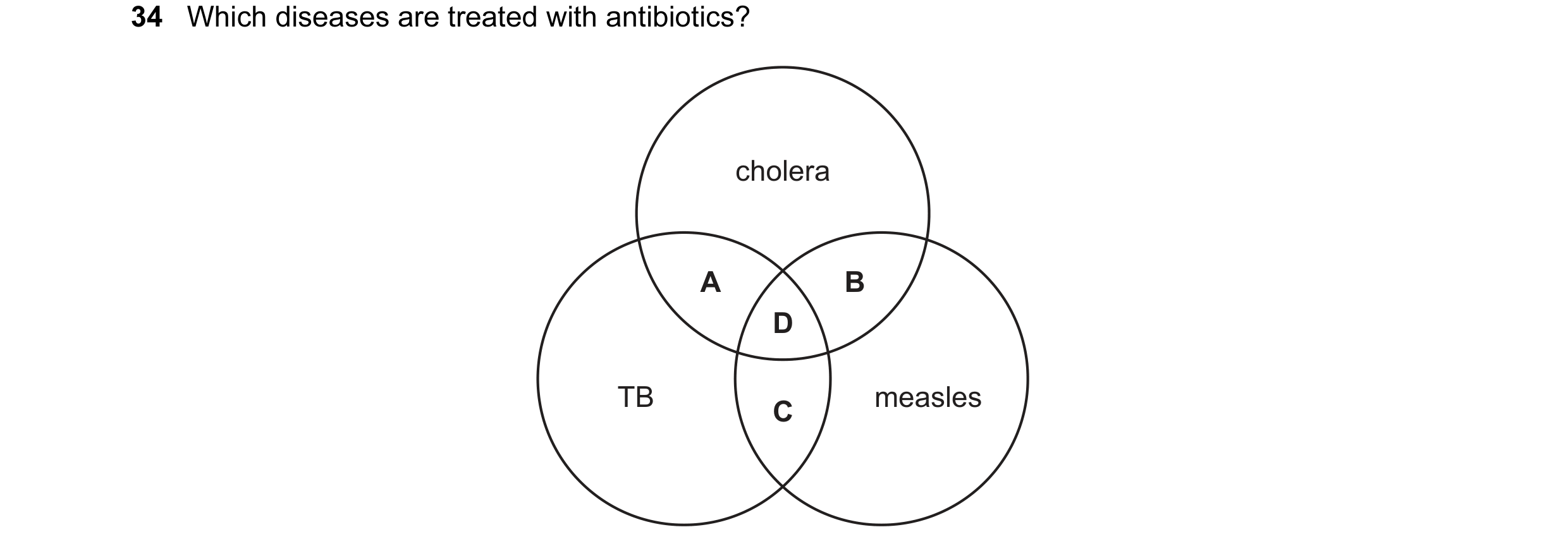
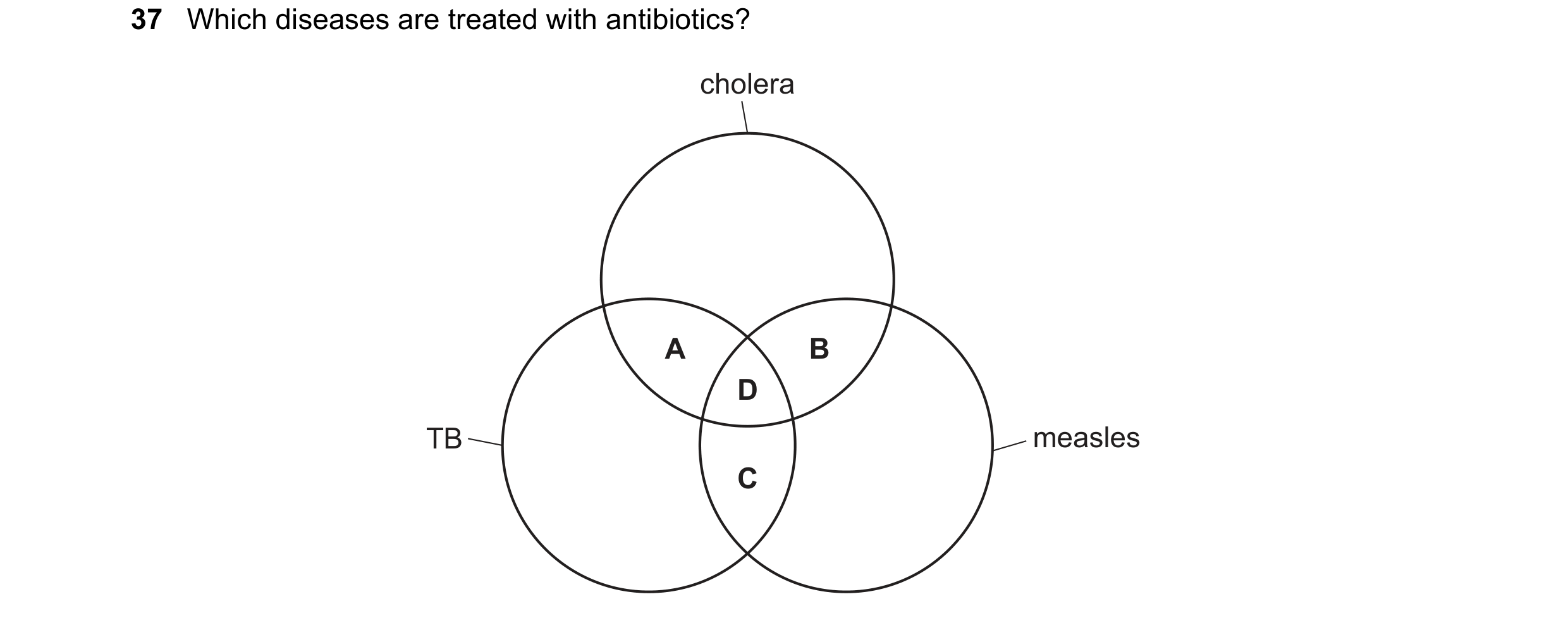
Q18 · Which diseases are treated with antibiotics? 9700/11 Oct/Nov 2014
34 Which diseases are treated with antibiotics? cholera A B D TB measles C
1 marks
Answer: A
This question in 9700/11 Oct/Nov 2014
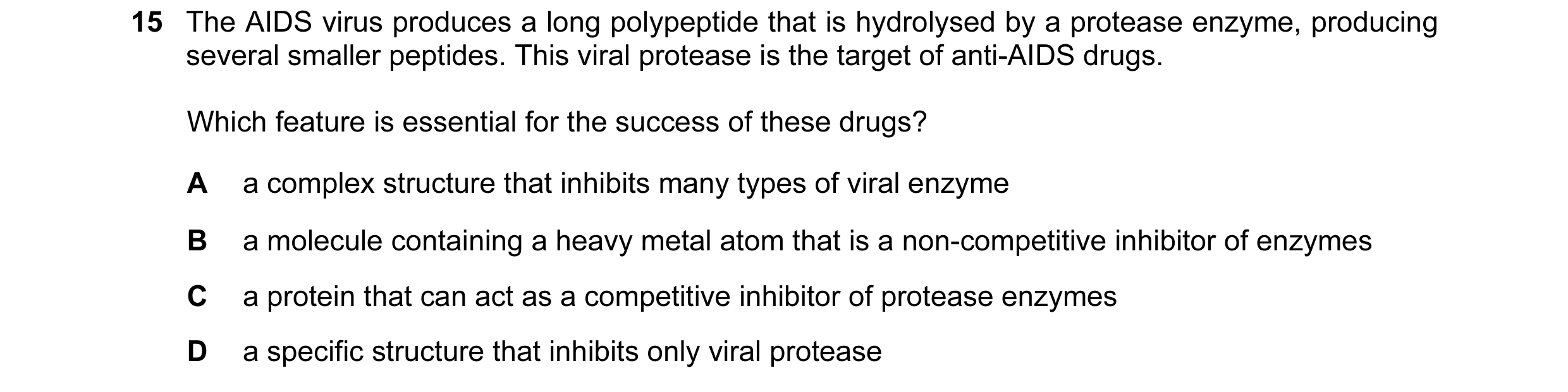
Q19 · The AIDS virus produces a long polypeptide that is hydrolysed by a protease enzyme… 9700/12 Oct/Nov 2014
15 The AIDS virus produces a long polypeptide that is hydrolysed by a protease enzyme, producing several smaller peptides. This viral protease is the target of anti-AIDS drugs. Which feature is essential for the success of these drugs? A a complex structure that inhibits many types of viral enzyme B a molecule containing a heavy metal atom that is a non-competitive inhibitor of enzymes C a protein that can act as a competitive inhibitor of protease enzymes D a specific structure that inhibits only viral protease
1 marks
Answer: D
This question in 9700/12 Oct/Nov 2014
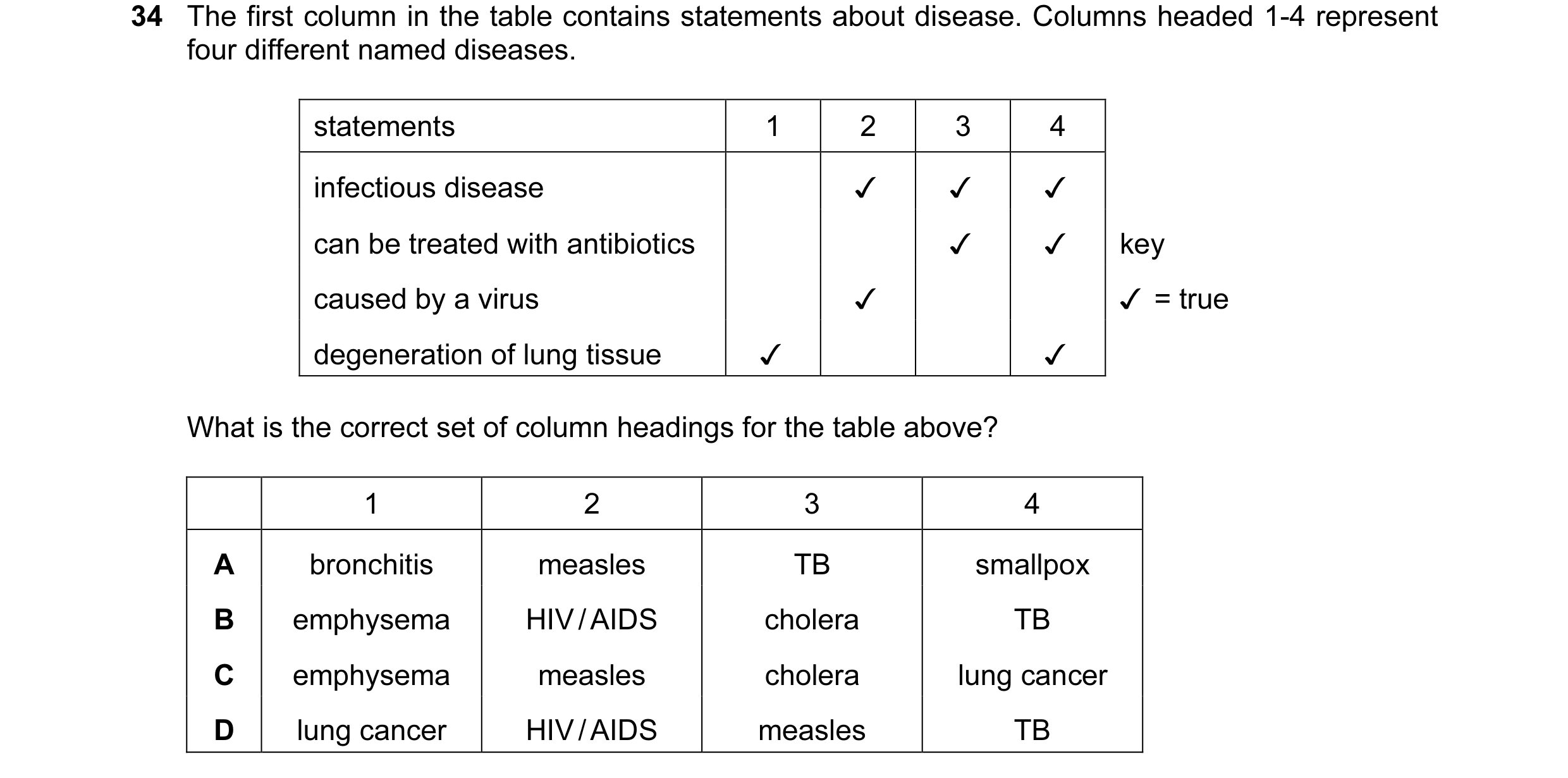
Q20 · The first column in the table contains statements about disease 9700/11 May/June 2015
34 The first column in the table contains statements about disease. Columns headed 1-4 represent
four different named diseases.
statements 1
infectious disease v v v
can be treated with antibiotics v v key
caused by a virus v ¥ =true
degeneration of lung tissue v v
What is the correct set of column headings for the table above?
1 2 3 4
A bronchitis measles TB smallpox
B emphysema HIV/AIDS cholera TB
Cc emphysema measles cholera lung cancer
D lung cancer HIV/AIDS measles TB
1 marks
Answer: B
This question in 9700/11 May/June 2015
Q21 · Strains of Mycobacterium have been found that are: • multiple drug-resistant (MDR)… 9700/13 May/June 2015
35 Strains of Mycobacterium have been found that are: • multiple drug-resistant (MDR) – resistant to the drugs most commonly used to control tuberculosis (TB) • extensively drug-resistant (XDR) – resistant to the drugs most commonly used to control TB and to some of the drugs less commonly used to control TB • totally drug-resistant (TDR) – resistant to all known drugs used to control TB. Comparisons of some of these strains of Mycobacterium found differences in the thickness of their cell walls, as shown in the table. thickness of cell Mycobacterium wall / nm non-resistant 15 MDR 17 TDR 20 What conclusions may be drawn from this information? A Bacteria secrete thicker cell walls when in contact with a mixture of drugs. B The cell walls of TDR bacteria are impermeable to drugs. C Thicker cell walls may form a physical barrier to drugs. D XDR bacteria have cell walls between 17 and 20 nm thick.
1 marks
Answer: C
This question in 9700/13 May/June 2015
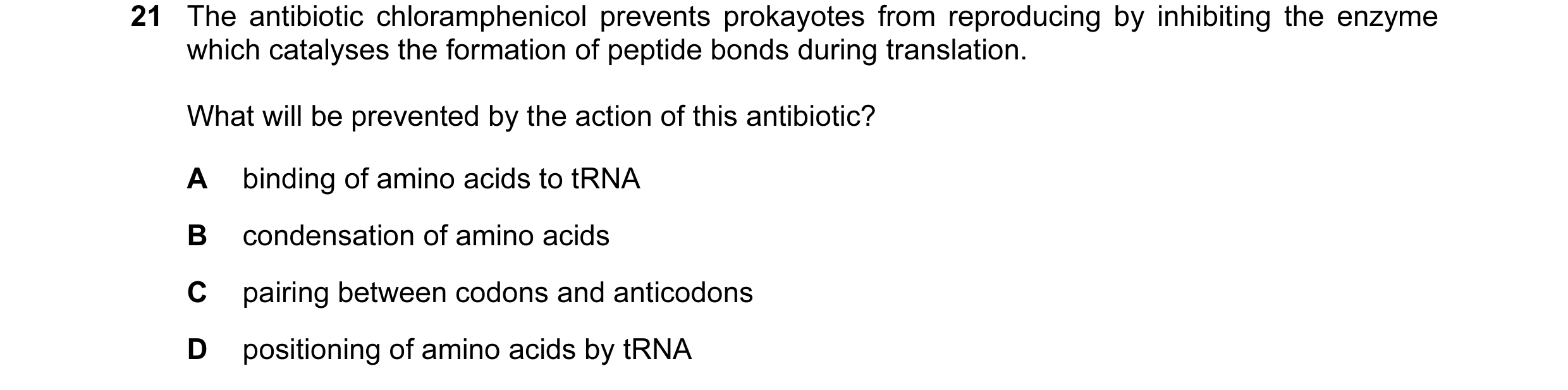
Q22 · The antibiotic chloramphenicol prevents prokayotes from reproducing by inhibiting the… 9700/11 Oct/Nov 2015
21 The antibiotic chloramphenicol prevents prokayotes from reproducing by inhibiting the enzyme which catalyses the formation of peptide bonds during translation. What will be prevented by the action of this antibiotic? A binding of amino acids to tRNA B condensation of amino acids C pairing between codons and anticodons D positioning of amino acids by tRNA
1 marks
Answer: B
This question in 9700/11 Oct/Nov 2015
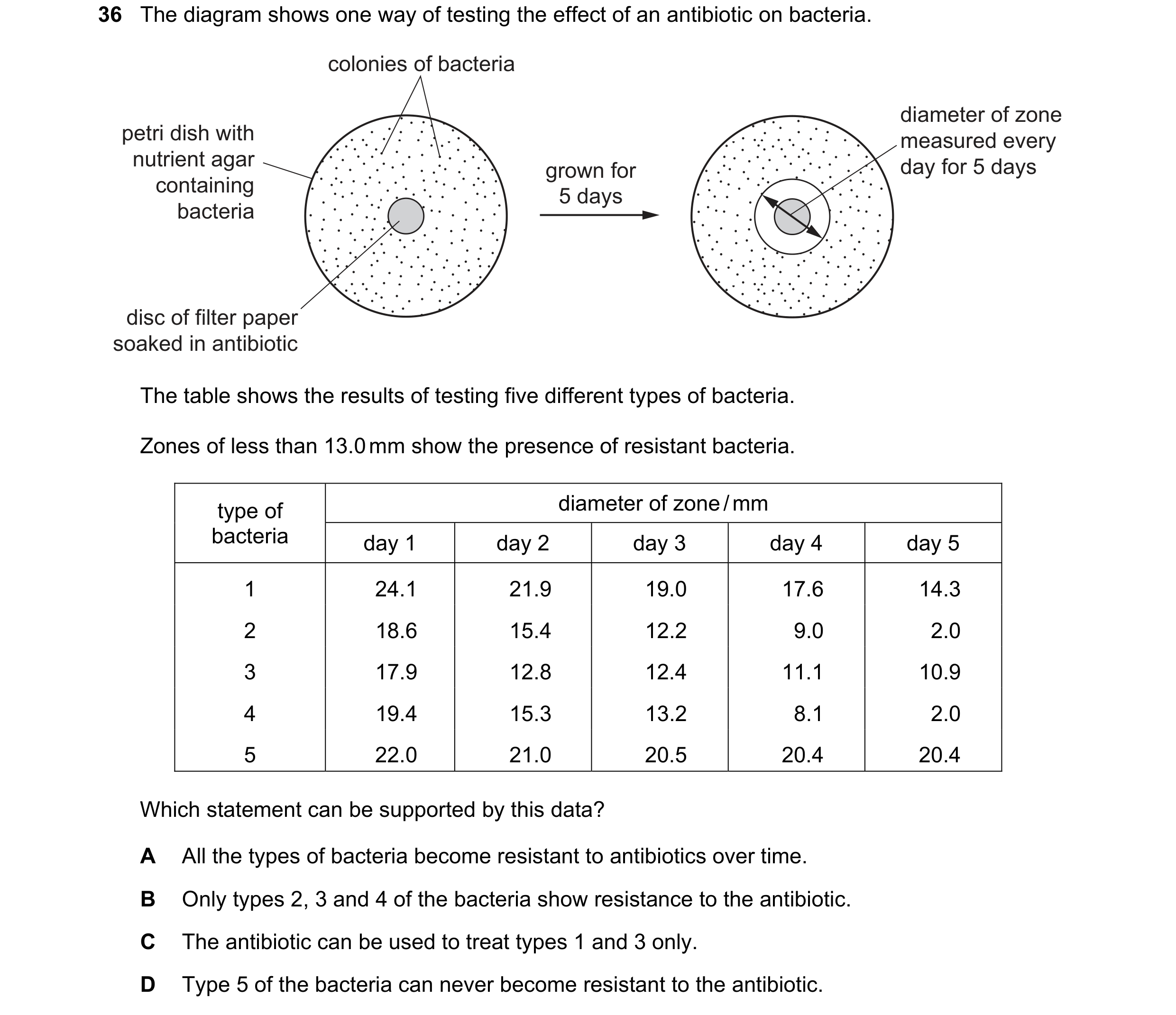
Q23 · The diagram shows one way of testing the effect of an antibiotic on bacteria 9700/11 Oct/Nov 2015
35 The diagram shows one way of testing the effect of an antibiotic on bacteria. colonies of bacteria diameter of zone petri dish with measured every nutrient agar day for 5 days grown for containing 5 days bacteria disc of filter paper soaked in antibiotic The table shows the results of testing five different types of bacteria. Zones of less than 13 mm show the presence of resistant bacteria. type of diameter of zone / mm bacteria day 1 day 2 day 3 day 4 day 5 1 24.10 21.90 19.00 17.60 14.30 2 18.60 15.40 12.20 9.00 0.00 3 17.90 12.80 12.40 11.10 10.90 4 19.40 15.30 13.20 8.10 0.00 5 22.00 21.00 20.50 20.40 20.40 Which statement can be supported by this data? A All the types of bacteria become resistant to antibiotics over time. B Only types 2, 3 and 4 of the bacteria show resistance to the antibiotic. C The antibiotic can be used to treat types 1 and 3 only. D Type 5 of the bacteria can never become resistant to the antibiotic.
1 marks
Answer: B
This question in 9700/11 Oct/Nov 2015
Q24 · Why is it necessary for a person with a bacterial infection to take antibiotics at evenly… 9700/12 Oct/Nov 2015
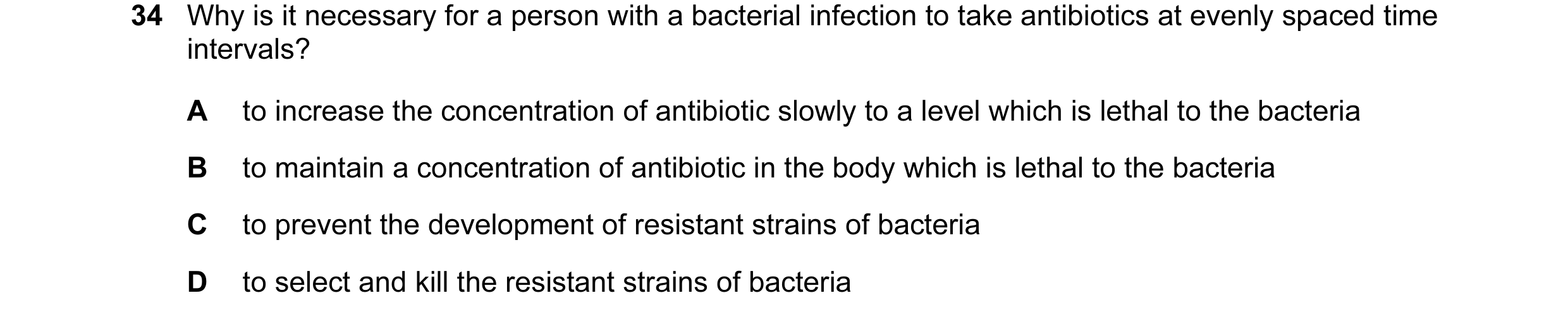
34 Why is it necessary for a person with a bacterial infection to take antibiotics at evenly spaced time intervals? A to increase the concentration of antibiotic slowly to a level which is lethal to the bacteria B to maintain a concentration of antibiotic in the body which is lethal to the bacteria C to prevent the development of resistant strains of bacteria D to select and kill the resistant strains of bacteria
1 marks
Answer: B
This question in 9700/12 Oct/Nov 2015
Q25 · Some antibiotics kill prokaryotes by binding to RNA polymerase 9700/13 Oct/Nov 2015
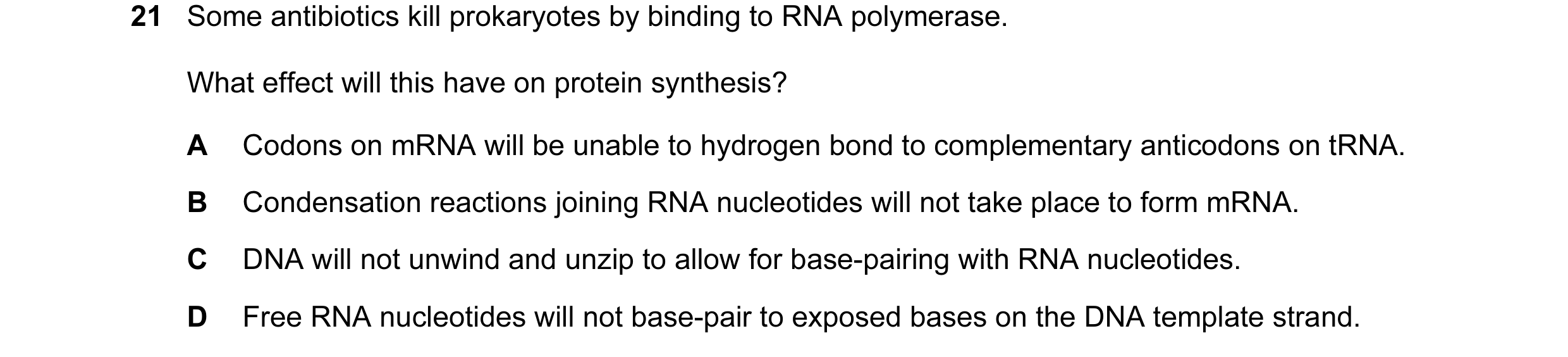
21 Some antibiotics kill prokaryotes by binding to RNA polymerase. What effect will this have on protein synthesis? A Codons on mRNA will be unable to hydrogen bond to complementary anticodons on tRNA. B Condensation reactions joining RNA nucleotides will not take place to form mRNA. C DNA will not unwind and unzip to allow for base-pairing with RNA nucleotides. D Free RNA nucleotides will not base-pair to exposed bases on the DNA template strand.
1 marks
Answer: B
This question in 9700/13 Oct/Nov 2015
Q26 · The data shows how the number of human deaths caused by the bacterium Staphylococcus… 9700/13 Oct/Nov 2015
35 The data shows how the number of human deaths caused by the bacterium Staphylococcus aureus has changed over a period of five years. Methicillin is an antibiotic used to treat a disease caused by S. aureus. MRSA is methicillin-resistant S. aureus. total number of deaths total number of deaths year caused by S. aureus caused by MRSA 1 369 355 2 452 431 3 456 681 4 420 890 5 428 1512 Which statement is not supported by this data? A More people have MRSA so the disease spreads. B MRSA is more likely to lead to death than S. aureus. C Resistant strains of MRSA are becoming more common. D S. aureus will always cause humans to die.
1 marks
Answer: D
This question in 9700/13 Oct/Nov 2015
Q27 · The table shows the mode of action of two antibacterial drugs that can affect the… 9700/12 Feb/March 2016
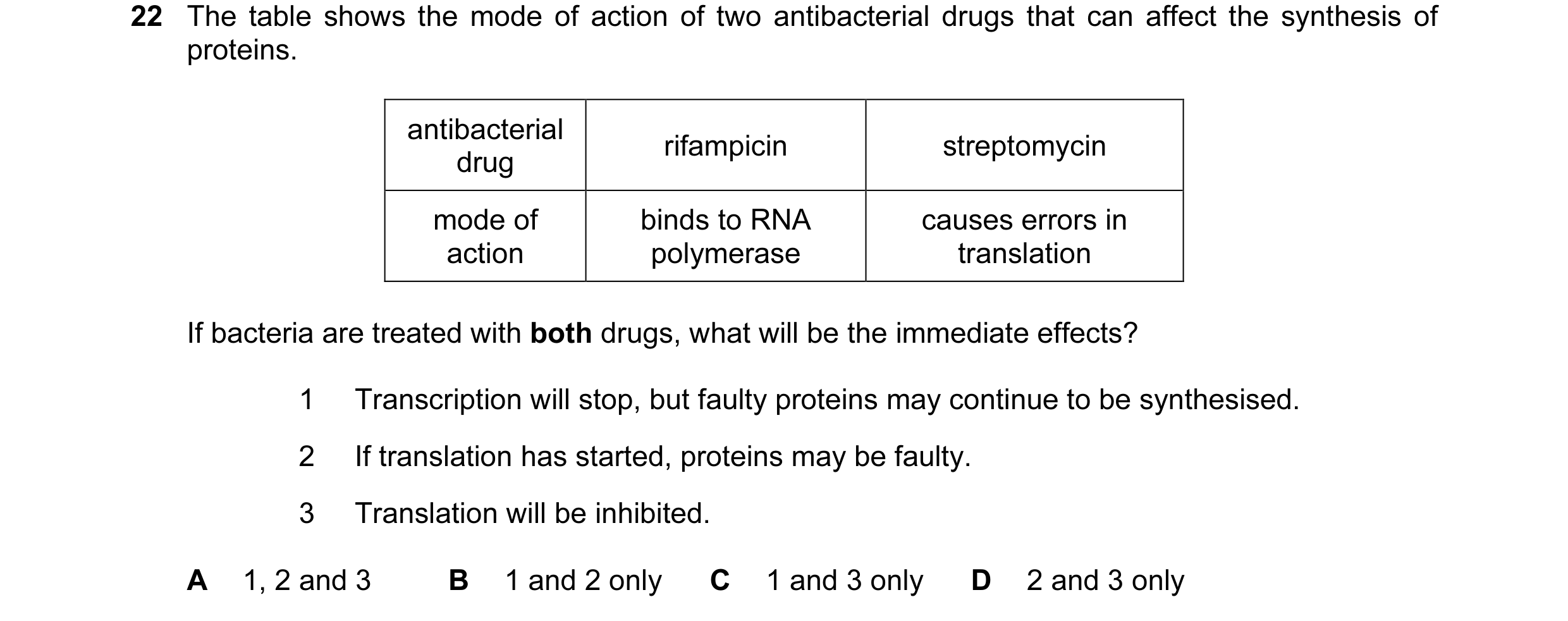
22 The table shows the mode of action of two antibacterial drugs that can affect the synthesis of proteins. antibacterial rifampicin streptomycin drug mode of binds to RNA causes errors in action polymerase translation If bacteria are treated with both drugs, what will be the immediate effects? 1 Transcription will stop, but faulty proteins may continue to be synthesised. 2 If translation has started, proteins may be faulty. 3 Translation will be inhibited. A 1, 2 and 3 B 1 and 2 only C 1 and 3 only D 2 and 3 only
1 marks
Answer: B
This question in 9700/12 Feb/March 2016
Q28 · What is not an example of antibiotic action? 9700/12 Feb/March 2016
37 What is not an example of antibiotic action? A damage to cell surface membranes B prevention of protein synthesis C prevention of synthesis of new cell walls D stimulation of antibody production
1 marks
Answer: D
This question in 9700/12 Feb/March 2016
Q29 · Which disease is treated with drugs that have a similar molecular structure to DNA… 9700/11 May/June 2016
38 Which disease is treated with drugs that have a similar molecular structure to DNA nucleotides? A cholera B HIV / AIDS C malaria D TB
1 marks
Answer: B
This question in 9700/11 May/June 2016
Q30 · An antibiotic inhibits the formation of cross-links between the molecules that form cell… 9700/13 May/June 2016
37 An antibiotic inhibits the formation of cross-links between the molecules that form cell walls in bacteria. Which statements explain why bacteria are killed by the antibiotic? 1 The bacterial cell is destroyed by osmotic lysis. 2 Cellulose molecules cannot form hydrogen bonds. 3 The cell wall is no longer selectively permeable. A 1 and 2 only B 2 and 3 only C 1 only D 2 only
1 marks
This question in 9700/13 May/June 2016
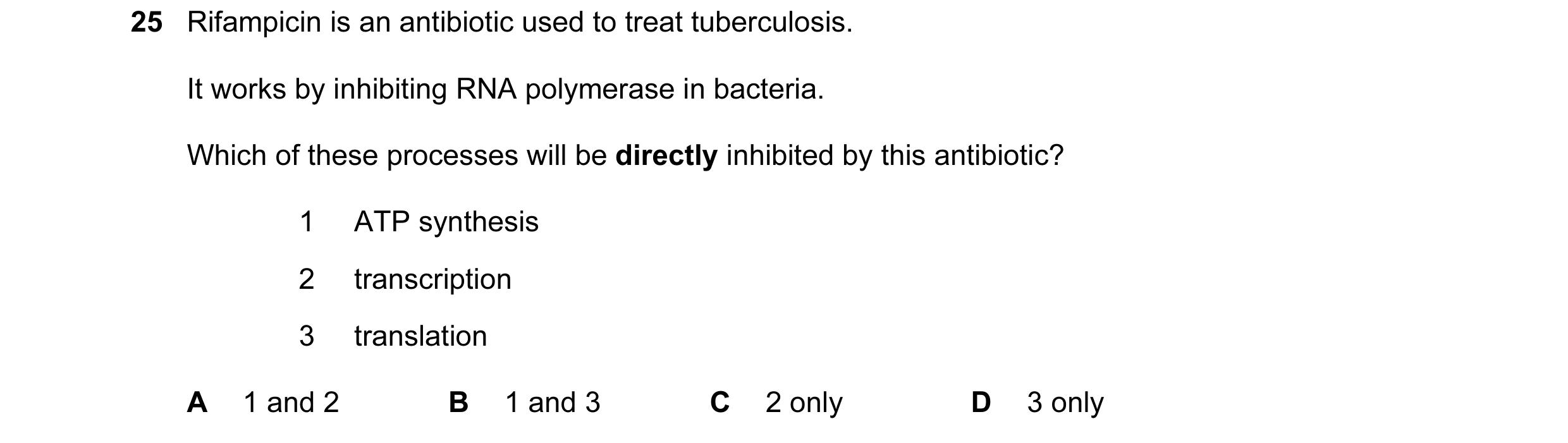
Q31 · Rifampicin is an antibiotic used to treat tuberculosis 9700/12 Feb/March 2017
25 Rifampicin is an antibiotic used to treat tuberculosis. It works by inhibiting RNA polymerase in bacteria. Which of these processes will be directly inhibited by this antibiotic? 1 ATP synthesis 2 transcription 3 translation A 1 and 2 B 1 and 3 C 2 only D 3 only
1 marks
Answer: C
This question in 9700/12 Feb/March 2017
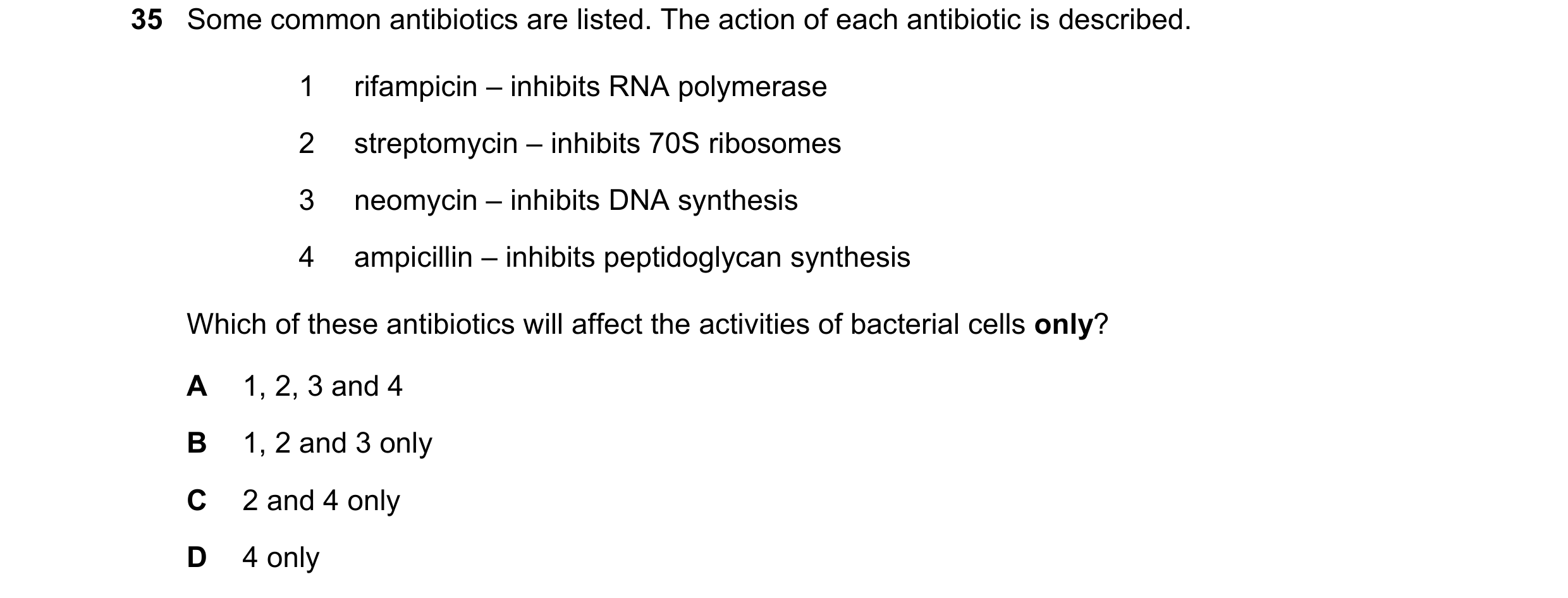
Q32 · Some common antibiotics are listed 9700/12 May/June 2017
35 Some common antibiotics are listed. The action of each antibiotic is described. 1 rifampicin – inhibits RNA polymerase 2 streptomycin – inhibits 70S ribosomes 3 neomycin – inhibits DNA synthesis 4 ampicillin – inhibits peptidoglycan synthesis Which of these antibiotics will affect the activities of bacterial cells only? A 1, 2, 3 and 4 B 1, 2 and 3 only C 2 and 4 only D 4 only
1 marks
Answer: D
This question in 9700/12 May/June 2017
Q33 · Some antibiotics are used in animal feed to reduce disease 9700/13 May/June 2017
36 Some antibiotics are used in animal feed to reduce disease. What explains why these antibiotics should not be used in the treatment of human diseases? A Human cells may stop responding to these antibiotics. B Humans may be allergic to these antibiotics. C Pathogenic bacteria may develop resistance to these antibiotics. D Useful gut bacteria may be killed by these antibiotics.
1 marks
Answer: C
This question in 9700/13 May/June 2017
Q34 · In what order do the following processes occur to produce a population of bacteria that… 9700/13 May/June 2017
37 In what order do the following processes occur to produce a population of bacteria that are resistant to a new antibiotic? 1 change in reproductive success of bacteria 2 increase in frequency of the resistance allele in the population 3 increase in genetic variation within the population 4 random mutation occurs in bacterial DNA A 1 → 3 → 2 → 4 B 2 → 1 → 3 → 4 C 3 → 4 → 1 → 2 D 4 → 3 → 1 → 2
1 marks
Answer: D
This question in 9700/13 May/June 2017
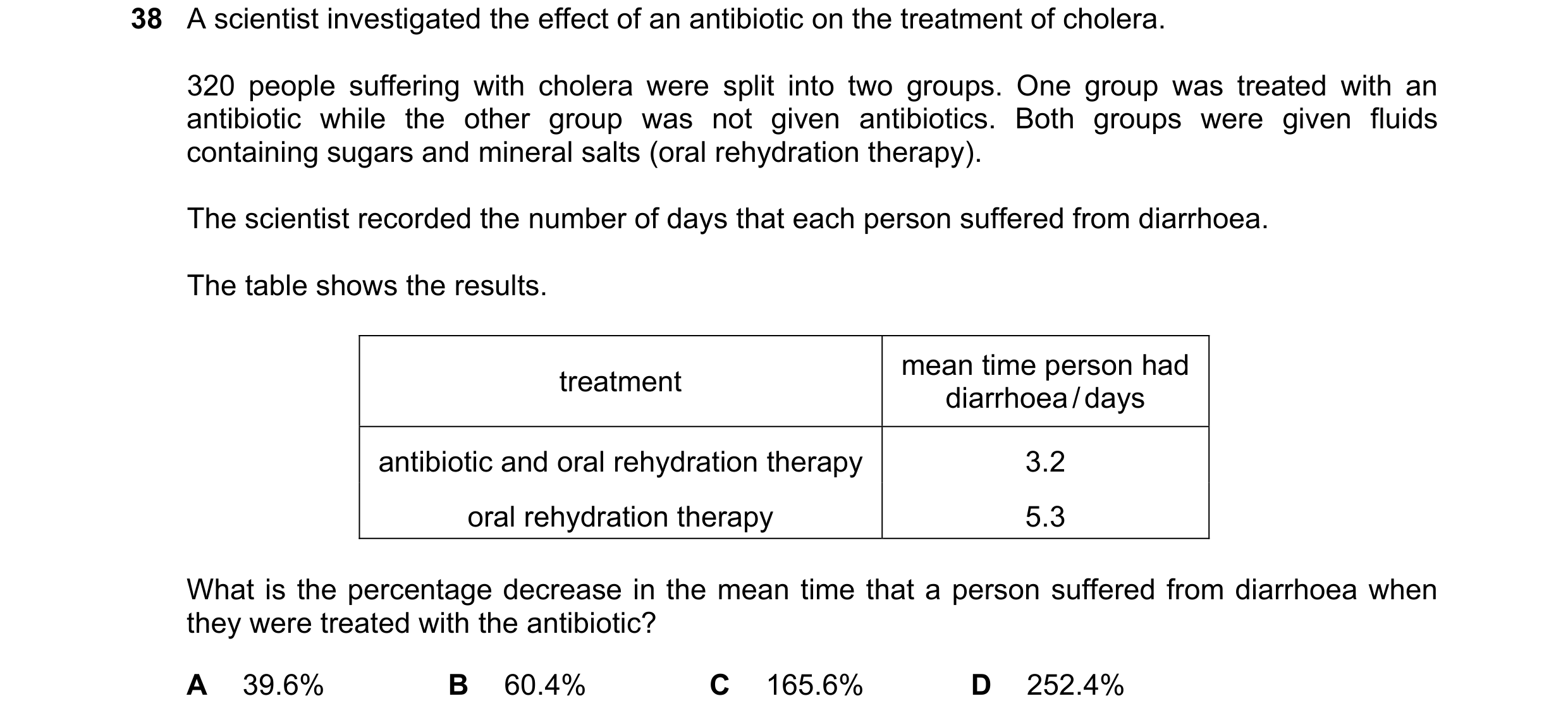
Q35 · A scientist investigated the effect of an antibiotic on the treatment of cholera 9700/12 Oct/Nov 2017
38 A scientist investigated the effect of an antibiotic on the treatment of cholera. 320 people suffering with cholera were split into two groups. One group was treated with an antibiotic while the other group was not given antibiotics. Both groups were given fluids containing sugars and mineral salts (oral rehydration therapy). The scientist recorded the number of days that each person suffered from diarrhoea. The table shows the results. mean time person had treatment diarrhoea / days antibiotic and oral rehydration therapy 3.2 oral rehydration therapy 5.3 What is the percentage decrease in the mean time that a person suffered from diarrhoea when they were treated with the antibiotic? A 39.6% B 60.4% C 165.6% D 252.4%
1 marks
Answer: A
This question in 9700/12 Oct/Nov 2017
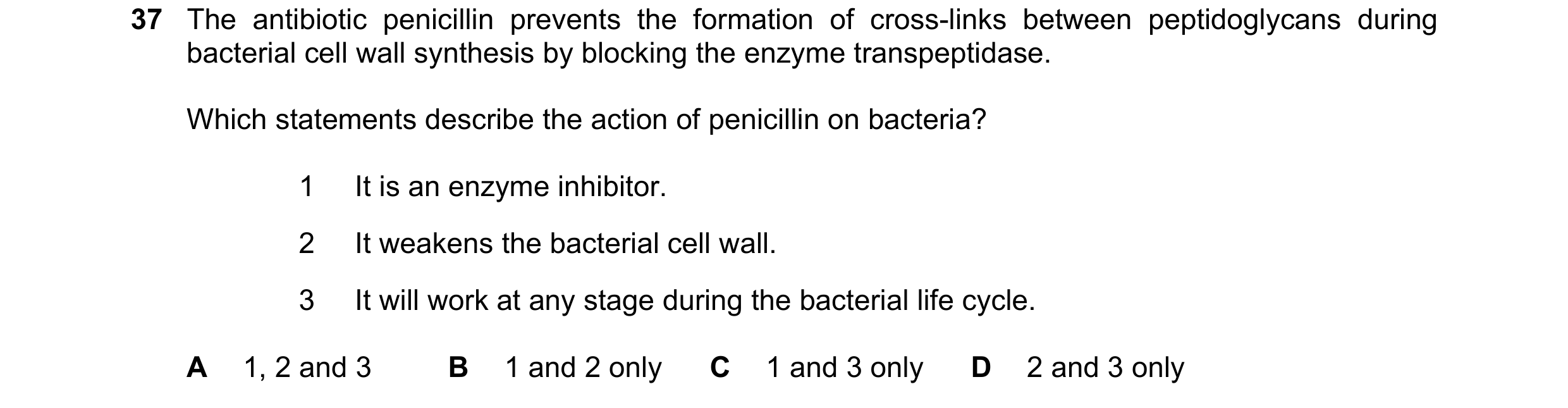
Q36 · The antibiotic penicillin prevents the formation of cross-links between peptidoglycans… 9700/13 Oct/Nov 2017
37 The antibiotic penicillin prevents the formation of cross-links between peptidoglycans during bacterial cell wall synthesis by blocking the enzyme transpeptidase. Which statements describe the action of penicillin on bacteria? 1 It is an enzyme inhibitor. 2 It weakens the bacterial cell wall. 3 It will work at any stage during the bacterial life cycle. A 1, 2 and 3 B 1 and 2 only C 1 and 3 only D 2 and 3 only
1 marks
Answer: B
This question in 9700/13 Oct/Nov 2017
Q37 · Bacteria that infect skin wounds can become resistant to the antibiotic commonly used to… 9700/12 Feb/March 2018
37 Bacteria that infect skin wounds can become resistant to the antibiotic commonly used to kill them. Which statement explains how these bacteria could become resistant to the antibiotic? A Exposure to the antibiotic causes a change in the bacterial cell wall, preventing the antibiotic from working. B Other bacteria that normally protect the skin against infection are killed by the antibiotic, allowing the infectious bacteria to survive. C Random mutations in DNA allow some of the bacteria to survive in the presence of the antibiotic. D The antibiotic causes the bacterial DNA to mutate, allowing the bacteria to survive in the presence of the antibiotic.
1 marks
Answer: C
This question in 9700/12 Feb/March 2018
Q38 · The diagram shows one way of testing the effect of an antibiotic on bacteria 9700/11 May/June 2018
36 The diagram shows one way of testing the effect of an antibiotic on bacteria. colonies of bacteria diameter of zone petri dish with measured every nutrient agar day for 5 days grown for containing 5 days bacteria disc of filter paper soaked in antibiotic The table shows the results of testing five different types of bacteria. Zones of less than 13.0 mm show the presence of resistant bacteria. type of diameter of zone / mm bacteria day 1 day 2 day 3 day 4 day 5 1 24.1 21.9 19.0 17.6 14.3 2 18.6 15.4 12.2 9.0 2.0 3 17.9 12.8 12.4 11.1 10.9 4 19.4 15.3 13.2 8.1 2.0 5 22.0 21.0 20.5 20.4 20.4 Which statement can be supported by this data? A All the types of bacteria become resistant to antibiotics over time. B Only types 2, 3 and 4 of the bacteria show resistance to the antibiotic. C The antibiotic can be used to treat types 1 and 3 only. D Type 5 of the bacteria can never become resistant to the antibiotic.
1 marks
Answer: B
This question in 9700/11 May/June 2018
Q39 · Some animals have genes that code for small peptides called cathelicidins 9700/11 May/June 2018
37 Some animals have genes that code for small peptides called cathelicidins. These peptides kill a wide range of bacteria by attaching to lipids in bacterial membranes, so weakening or disrupting them. Scientists have produced a synthetic version of the cathelicidin that kills bacteria that are resistant to a number of antibiotics such as tetracycline. Which pair of statements explain how this synthetic cathelicidin might help with the problem of antibiotic resistance? 1 It is synthetic so bacteria can never become resistant to it. 2 It could be used instead of tetracycline, allowing tetracycline resistance to be reduced. 3 The only way a bacterium could develop resistance to it is by altering all the lipids in its membranes. 4 It could be used to kill multidrug-resistant strains of bacteria for which there is no effective antibiotic. A 1 and 3 B 1 and 4 C 2 and 3 D 2 and 4
1 marks
Answer: D
This question in 9700/11 May/June 2018
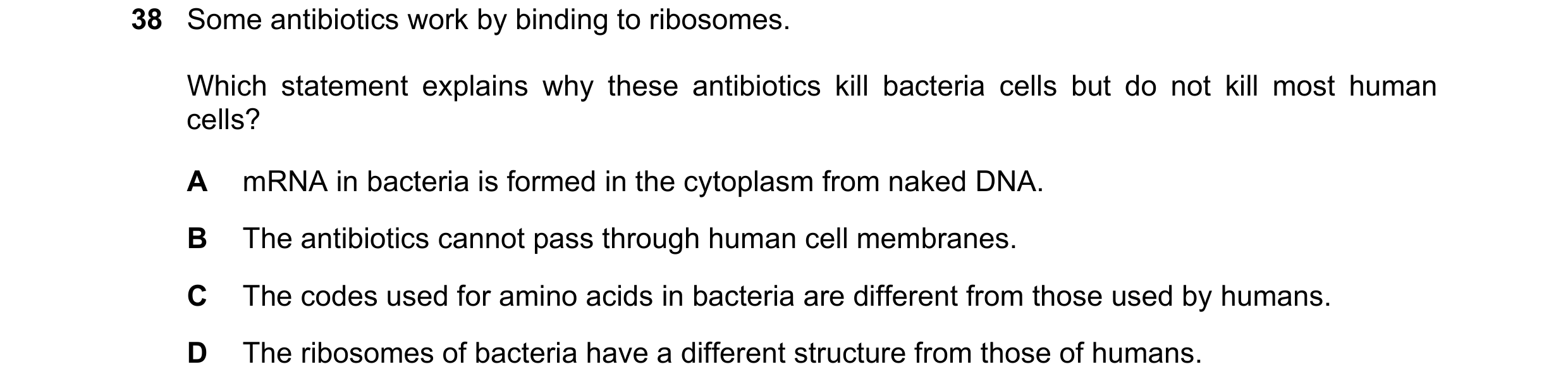
Q40 · Some antibiotics work by binding to ribosomes 9700/13 May/June 2018
38 Some antibiotics work by binding to ribosomes. Which statement explains why these antibiotics kill bacteria cells but do not kill most human cells? A mRNA in bacteria is formed in the cytoplasm from naked DNA. B The antibiotics cannot pass through human cell membranes. C The codes used for amino acids in bacteria are different from those used by humans. D The ribosomes of bacteria have a different structure from those of humans.
1 marks
Answer: D
This question in 9700/13 May/June 2018
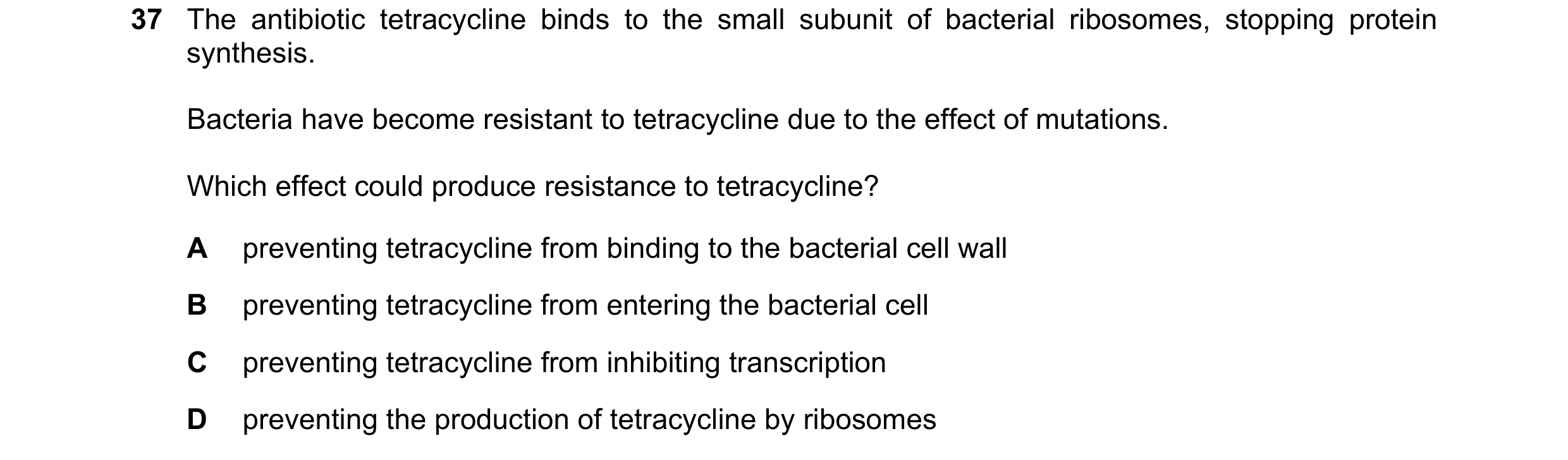
Q41 · The antibiotic tetracycline binds to the small subunit of bacterial ribosomes, stopping… 9700/12 Oct/Nov 2018
37 The antibiotic tetracycline binds to the small subunit of bacterial ribosomes, stopping protein synthesis. Bacteria have become resistant to tetracycline due to the effect of mutations. Which effect could produce resistance to tetracycline? A preventing tetracycline from binding to the bacterial cell wall B preventing tetracycline from entering the bacterial cell C preventing tetracycline from inhibiting transcription D preventing the production of tetracycline by ribosomes
1 marks
Answer: B
This question in 9700/12 Oct/Nov 2018
Q42 · Which diseases cannot be treated with antibiotics? 9700/13 Oct/Nov 2018
36 Which diseases cannot be treated with antibiotics? 1 cholera 2 HIV/AIDS 3 measles A 1, 2 and 3 B 1 and 2 only C 1 and 3 only D 2 and 3 only
1 marks
Answer: D
This question in 9700/13 Oct/Nov 2018
Q43 · Rifampicin is an antibiotic used to treat tuberculosis (TB) 9700/12 Feb/March 2019
22 Rifampicin is an antibiotic used to treat tuberculosis (TB). It works by inhibiting RNA polymerase in bacteria. Which processes are directly inhibited by this antibiotic? 1 DNA replication 2 transcription 3 ATP synthesis A 1, 2 and 3 B 1 and 2 only C 1 and 3 only D 2 only
1 marks
Answer: D
This question in 9700/12 Feb/March 2019
Q44 · What explains why most viruses that cause diseases in humans are unaffected by… 9700/12 Feb/March 2019
37 What explains why most viruses that cause diseases in humans are unaffected by antibiotics? A Viral antigens do not bind to antibiotics. B Viral nucleic acids are protected by a protein coat. C Viruses contain no ribosomes or mRNA. D Viruses reproduce inside living eukaryotic cells.
1 marks
Answer: D
This question in 9700/12 Feb/March 2019
Q45 · How does penicillin affect bacteria? 9700/13 May/June 2019
38 How does penicillin affect bacteria? A It inhibits DNA replication by binding to nucleotides. B It inhibits translation by preventing tRNA binding to ribosomes. C It is a competitive inhibitor of an enzyme in cell wall synthesis. D It is a competitive inhibitor of an enzyme in protein synthesis.
1 marks
Answer: C
This question in 9700/13 May/June 2019
Q46 · Which use of antibiotics helps to reduce the spread of resistance in bacteria? 9700/11 Oct/Nov 2019
37 Which use of antibiotics helps to reduce the spread of resistance in bacteria? A using high concentrations of the antibiotic to kill all the bacteria B giving routine preventative antibiotics to people who are having an operation C regularly changing the type of antibiotic used to treat particular bacterial infections D giving antibiotics to treat low level infection caused by a bacterium
1 marks
Answer: C
This question in 9700/11 Oct/Nov 2019
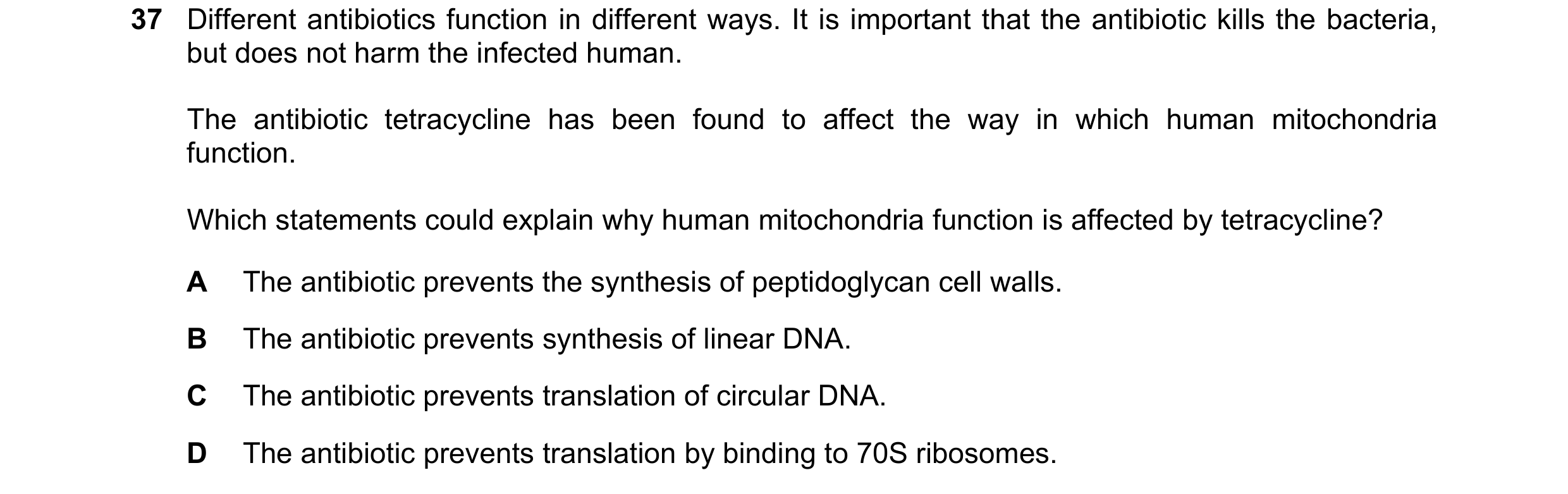
Q47 · Different antibiotics function in different ways 9700/12 Oct/Nov 2019
37 Different antibiotics function in different ways. It is important that the antibiotic kills the bacteria, but does not harm the infected human. The antibiotic tetracycline has been found to affect the way in which human mitochondria function. Which statements could explain why human mitochondria function is affected by tetracycline? A The antibiotic prevents the synthesis of peptidoglycan cell walls. B The antibiotic prevents synthesis of linear DNA. C The antibiotic prevents translation of circular DNA. D The antibiotic prevents translation by binding to 70S ribosomes.
1 marks
Answer: D
This question in 9700/12 Oct/Nov 2019
Q48 · The statements refer to the disease tuberculosis (TB) 9700/13 Oct/Nov 2019
36 The statements refer to the disease tuberculosis (TB). 1 The pathogen lives inside human cells so is not accessible to the immune system. 2 The bacterial pathogen reproduces slowly. 3 The pathogen is not very sensitive to antibiotics. Which explains why antibiotic treatment for TB takes a long time? A 1, 2 and 3 B 1 and 2 only C 1 only D 2 and 3 only
1 marks
Answer: D
This question in 9700/13 Oct/Nov 2019
Q49 · Scientists studied the multidrug resistant bacterial infections in children, caused by… 9700/13 Oct/Nov 2019
37 Scientists studied the multidrug resistant bacterial infections in children, caused by one type of bacteria, between 2007 and 2015. The percentage of multidrug resistant infections rose from 0.2% to 1.5%. What was the percentage increase in multidrug resistant infections between 2007 and 2015? A 1.3% B 87% C 130% D 650%
1 marks
Answer: D
This question in 9700/13 Oct/Nov 2019
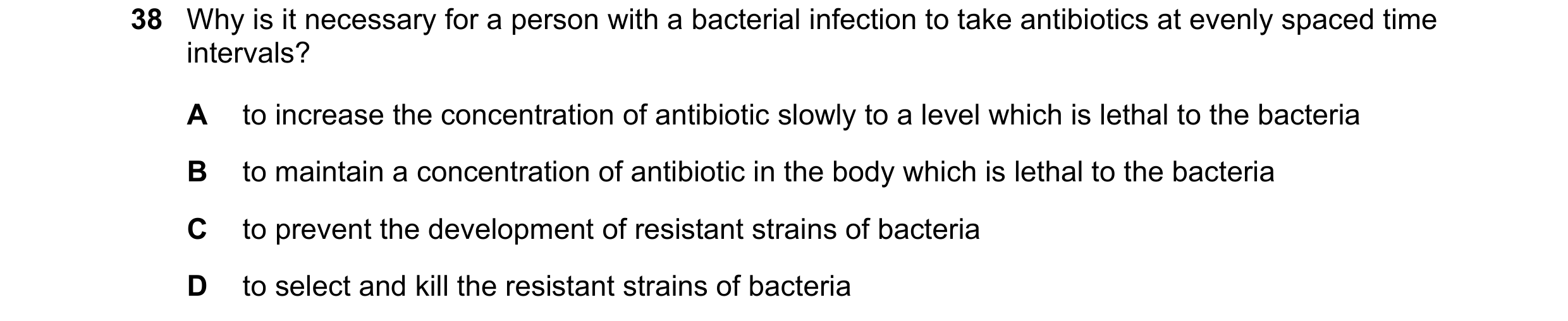
Q50 · Why is it necessary for a person with a bacterial infection to take antibiotics at evenly… 9700/13 Oct/Nov 2019
38 Why is it necessary for a person with a bacterial infection to take antibiotics at evenly spaced time intervals? A to increase the concentration of antibiotic slowly to a level which is lethal to the bacteria B to maintain a concentration of antibiotic in the body which is lethal to the bacteria C to prevent the development of resistant strains of bacteria D to select and kill the resistant strains of bacteria
1 marks
Answer: B
This question in 9700/13 Oct/Nov 2019
Q51 · Which diseases are treated with antibiotics? 9700/12 Feb/March 2020
37 Which diseases are treated with antibiotics? cholera A B D TB measles C
1 marks
Answer: A
This question in 9700/12 Feb/March 2020
Q52 · A population of bacteria is exposed to the antibiotic penicillin 9700/11 May/June 2020
23 A population of bacteria is exposed to the antibiotic penicillin. Most of the bacteria die. However, some bacteria in the population have an allele coding for an enzyme that breaks down penicillin. These bacteria are able to survive. Which could explain how these bacterial cells acquired this allele? 1 An error during DNA replication. 2 An error during transcription. 3 An error during translation. A 1, 2 and 3 B 1 and 3 only C 1 only D 2 and 3 only
1 marks
Answer: C
This question in 9700/11 May/June 2020
Q53 · The antibiotic teixobactin was discovered in January 2015 9700/11 May/June 2020
38 The antibiotic teixobactin was discovered in January 2015. Teixobactin kills some bacteria such as Staphylococcus and Mycobacterium. Most antibiotics work by binding to proteins. Teixobactin binds to lipids that are used in the synthesis of bacterial cell walls. This means that it is unlikely that bacteria will quickly develop resistance to teixobactin. Which statements explain why bacteria are unlikely to quickly develop resistance to teixobactin? 1 A mutation in the gene coding for a protein allows selection for resistance. 2 Teixobactin binds to a lipid rather than to a protein. 3 The structure of a lipid is not encoded by DNA. A 1, 2 and 3 B 1 and 2 only C 1 and 3 only D 2 and 3 only
1 marks
Answer: D
This question in 9700/11 May/June 2020
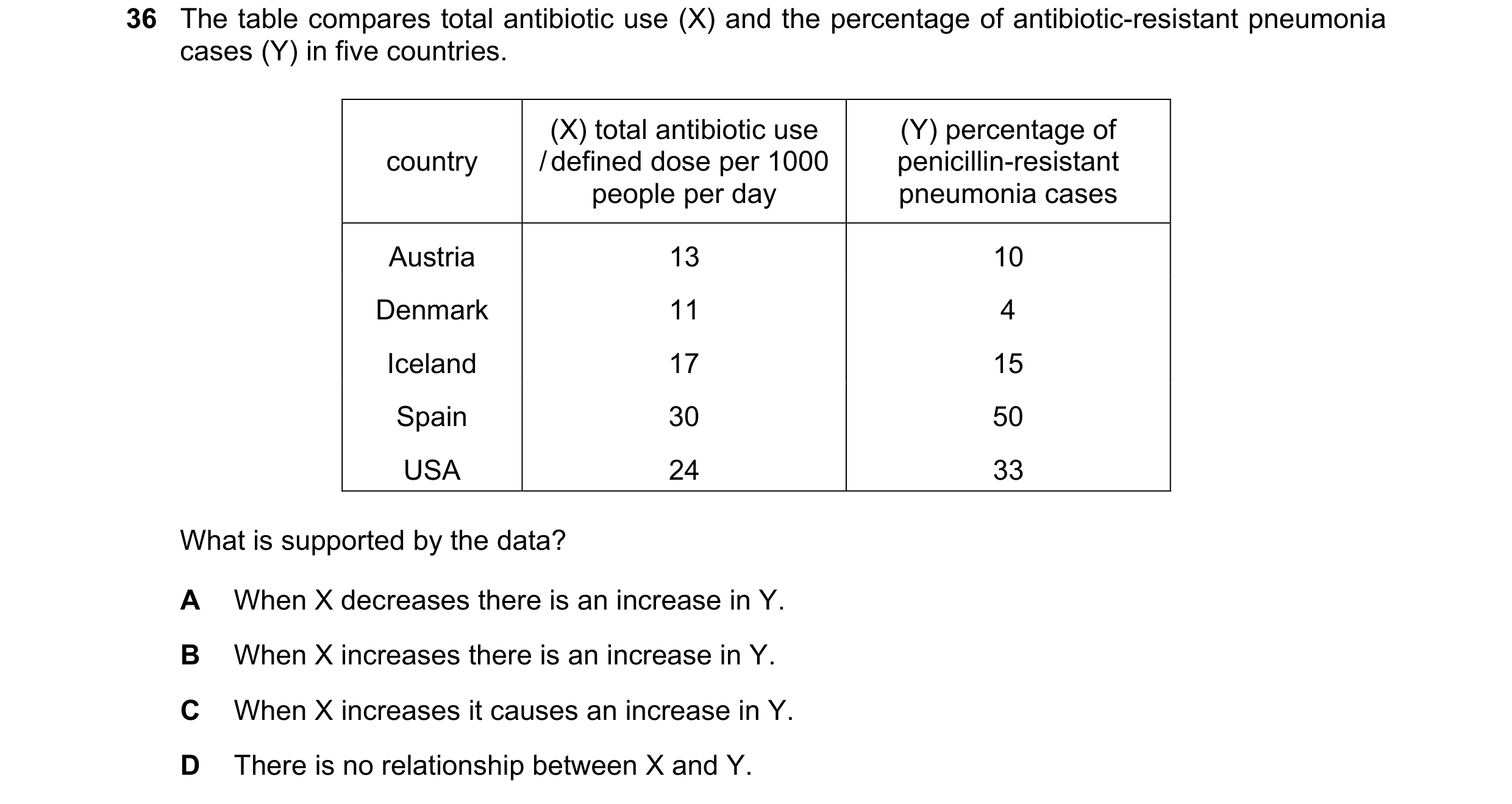
Q54 · The table compares total antibiotic use (X) and the percentage of antibiotic-resistant… 9700/12 May/June 2020
36 The table compares total antibiotic use (X) and the percentage of antibiotic-resistant pneumonia cases (Y) in five countries. (X) total antibiotic use (Y) percentage of country / defined dose per 1000 penicillin-resistant people per day pneumonia cases Austria 13 10 Denmark 11 4 Iceland 17 15 Spain 30 50 USA 24 33 What is supported by the data? A When X decreases there is an increase in Y. B When X increases there is an increase in Y. C When X increases it causes an increase in Y. D There is no relationship between X and Y.
1 marks
Answer: B
This question in 9700/12 May/June 2020
Q55 · Which statement about the development of resistance to antibiotics in bacteria is correct? 9700/12 May/June 2020
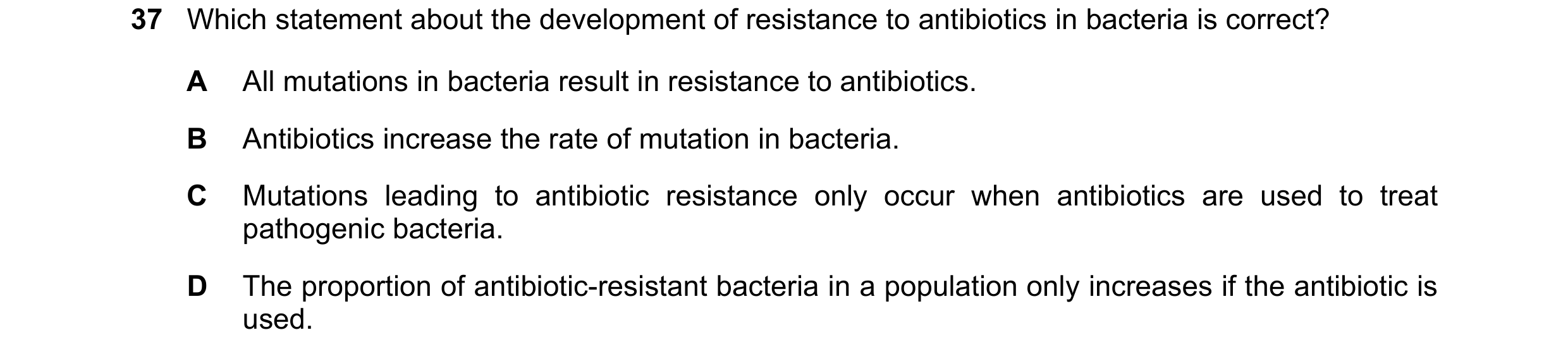
37 Which statement about the development of resistance to antibiotics in bacteria is correct? A All mutations in bacteria result in resistance to antibiotics. B Antibiotics increase the rate of mutation in bacteria. C Mutations leading to antibiotic resistance only occur when antibiotics are used to treat pathogenic bacteria. D The proportion of antibiotic-resistant bacteria in a population only increases if the antibiotic is used.
1 marks
Answer: D
This question in 9700/12 May/June 2020
Q56 · Some antibiotics kill prokaryotes by binding to RNA polymerase 9700/13 May/June 2020
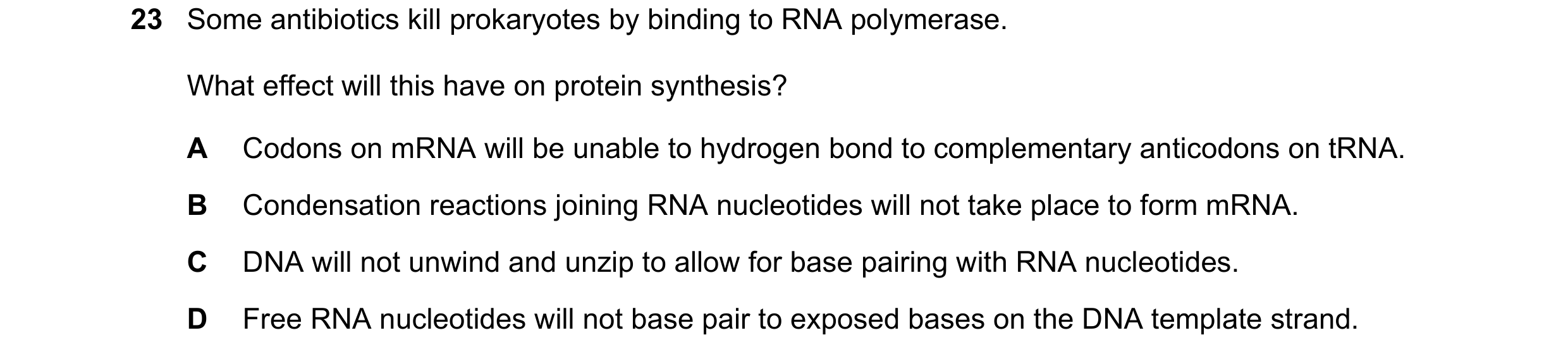
23 Some antibiotics kill prokaryotes by binding to RNA polymerase. What effect will this have on protein synthesis? A Codons on mRNA will be unable to hydrogen bond to complementary anticodons on tRNA. B Condensation reactions joining RNA nucleotides will not take place to form mRNA. C DNA will not unwind and unzip to allow for base pairing with RNA nucleotides. D Free RNA nucleotides will not base pair to exposed bases on the DNA template strand.
1 marks
Answer: B
This question in 9700/13 May/June 2020
Q57 · Some common antibiotics are listed 9700/13 May/June 2020
38 Some common antibiotics are listed. The action of each antibiotic is described. 1 rifampicin – inhibits RNA polymerase 2 streptomycin – inhibits 70S ribosomes 3 neomycin – inhibits DNA synthesis 4 ampicillin – inhibits peptidoglycan synthesis Which of these antibiotics will affect the activities of bacterial cells only? A 1, 2, 3 and 4 B 1, 2 and 3 only C 2 and 4 only D 4 only
1 marks
Answer: D
This question in 9700/13 May/June 2020
Q58 · Species X is a single-celled eukaryote 9700/11 Oct/Nov 2020
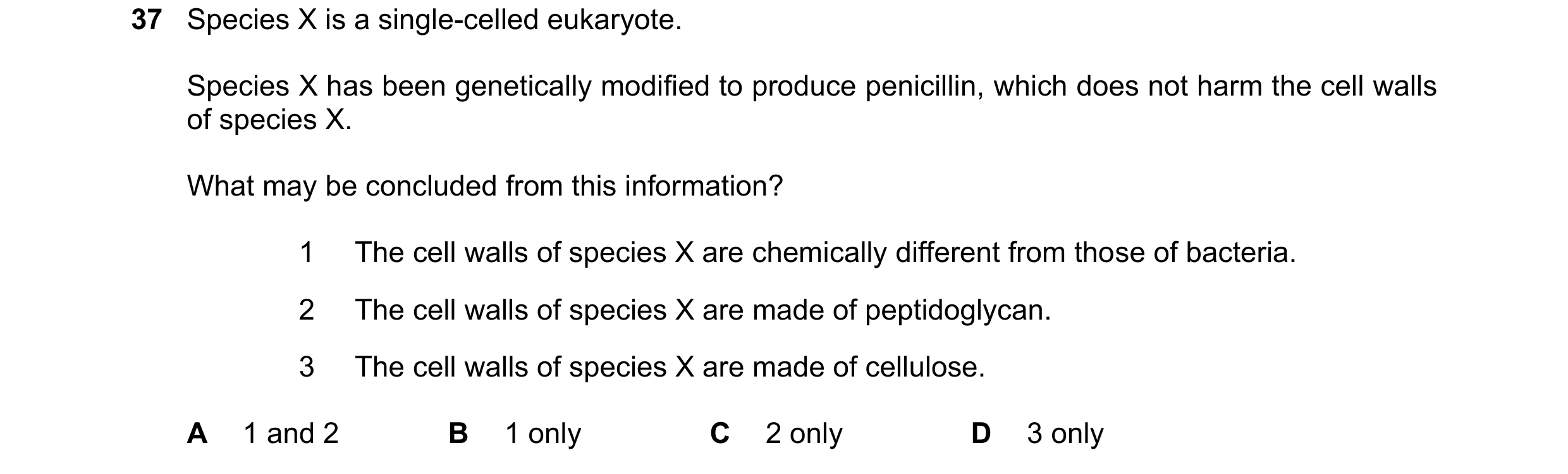
37 Species X is a single-celled eukaryote. Species X has been genetically modified to produce penicillin, which does not harm the cell walls of species X. What may be concluded from this information? 1 The cell walls of species X are chemically different from those of bacteria. 2 The cell walls of species X are made of peptidoglycan. 3 The cell walls of species X are made of cellulose. A 1 and 2 B 1 only C 2 only D 3 only
1 marks
Answer: B
This question in 9700/11 Oct/Nov 2020
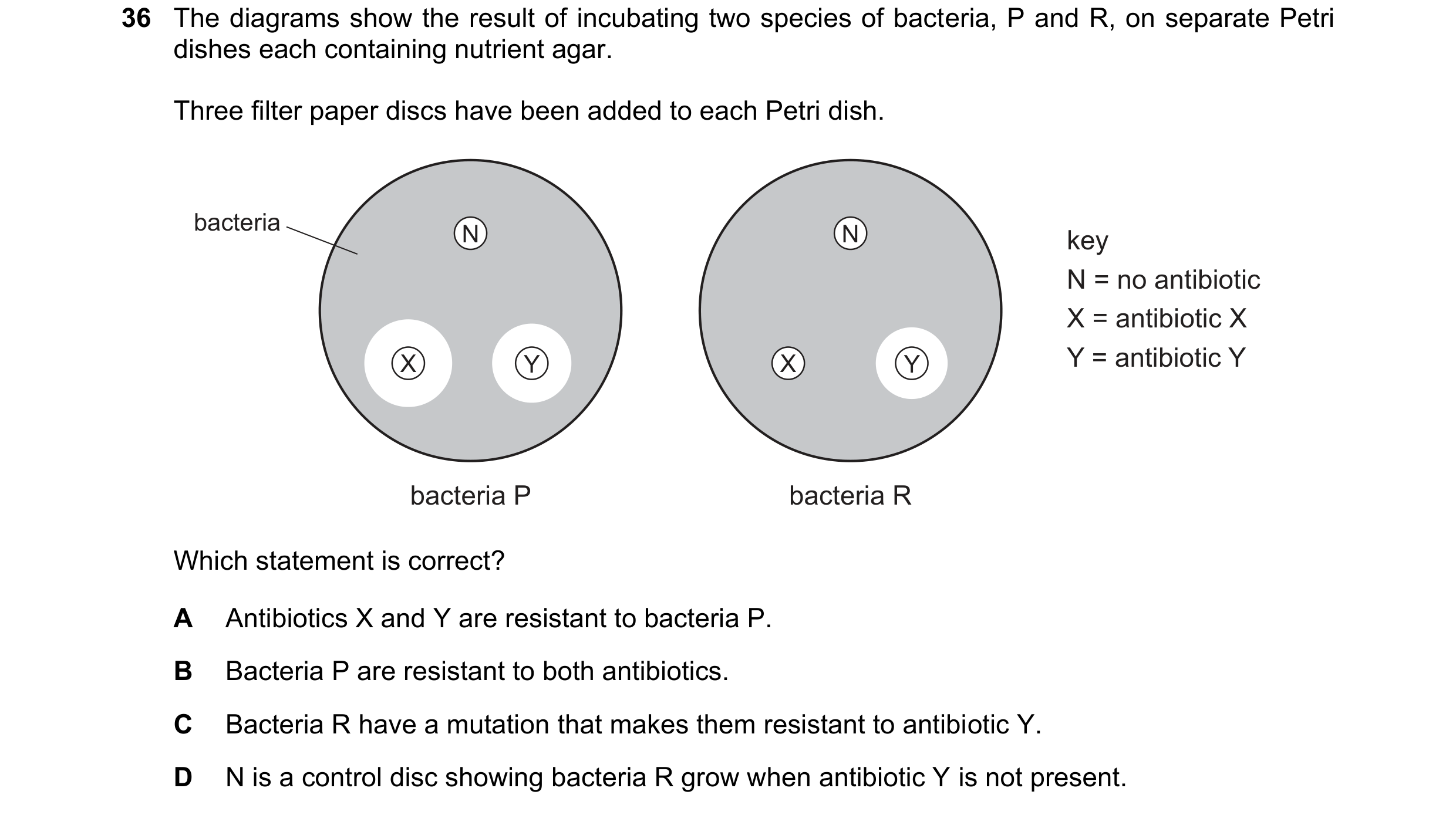
Q59 · The diagrams show the result of incubating two species of bacteria, P and R, on separate… 9700/13 Oct/Nov 2020
36 The diagrams show the result of incubating two species of bacteria, P and R, on separate Petri dishes each containing nutrient agar. Three filter paper discs have been added to each Petri dish. bacteria N N key N = no antibiotic X = antibiotic X X Y X Y Y = antibiotic Y bacteria P bacteria R Which statement is correct? A Antibiotics X and Y are resistant to bacteria P. B Bacteria P are resistant to both antibiotics. C Bacteria R have a mutation that makes them resistant to antibiotic Y. D N is a control disc showing bacteria R grow when antibiotic Y is not present.
1 marks
Answer: D
This question in 9700/13 Oct/Nov 2020
Q60 · There are two main classes of antibiotics, broad spectrum and narrow spectrum 9700/12 Feb/March 2021
38 There are two main classes of antibiotics, broad spectrum and narrow spectrum. Broad spectrum antibiotics affect a wide range of bacteria, while narrow spectrum antibiotics affect specific types of bacteria. Which uses of antibiotics may result in antibiotic-resistant bacteria? 1 a broad spectrum antibiotic given to reduce the effects of the influenza virus 2 a broad spectrum antibiotic to treat Mycobacterium tuberculosis in humans 3 a narrow spectrum antibiotic to treat diarrhoea and sickness in cattle A 1, 2 and 3 B 1 and 2 only C 1 and 3 only D 2 and 3 only
1 marks
Answer: A
This question in 9700/12 Feb/March 2021
Q61 · What is the initial mechanism by which bacteria become resistant to antibiotics? 9700/11 May/June 2021
37 What is the initial mechanism by which bacteria become resistant to antibiotics? A genetic mutation B overuse of antibiotics C natural selection D patients not finishing a course of antibiotics
1 marks
Answer: A
This question in 9700/11 May/June 2021
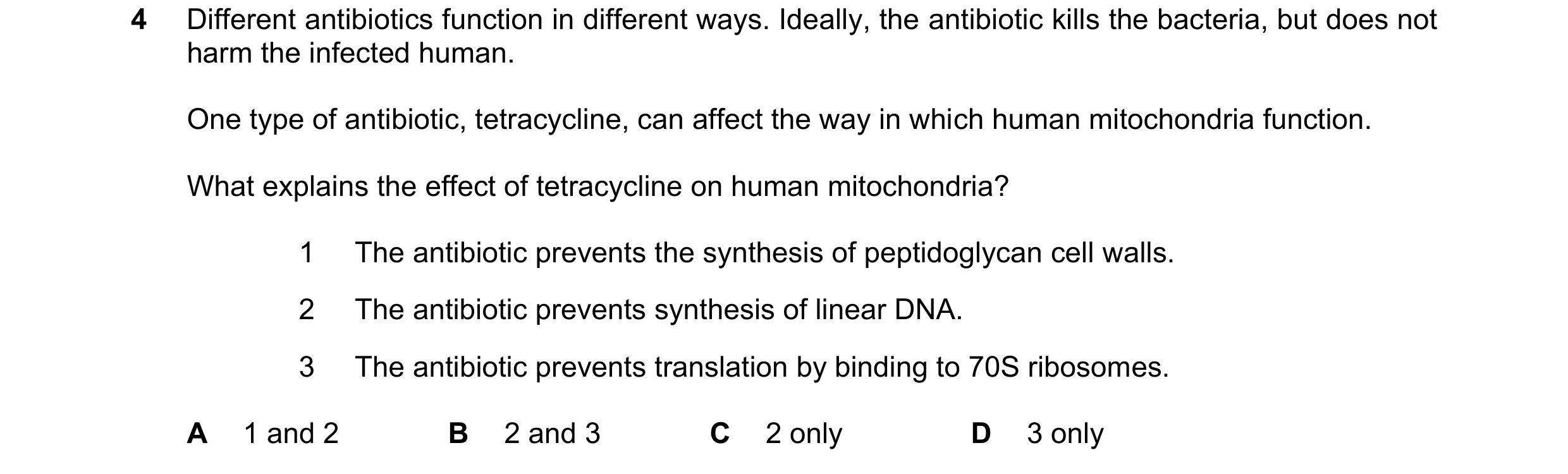
Q62 · Different antibiotics function in different ways 9700/12 May/June 2021
4 Different antibiotics function in different ways. Ideally, the antibiotic kills the bacteria, but does not harm the infected human. One type of antibiotic, tetracycline, can affect the way in which human mitochondria function. What explains the effect of tetracycline on human mitochondria? 1 The antibiotic prevents the synthesis of peptidoglycan cell walls. 2 The antibiotic prevents synthesis of linear DNA. 3 The antibiotic prevents translation by binding to 70S ribosomes. A 1 and 2 B 2 and 3 C 2 only D 3 only
1 marks
Answer: D
This question in 9700/12 May/June 2021
Q63 · What has contributed to the increase in antibiotic resistance in bacteria? 9700/12 May/June 2021
37 What has contributed to the increase in antibiotic resistance in bacteria? 1 increased use of vaccines for animal diseases 2 mutations in bacterial DNA 3 patients not completing their antibiotic treatment A 1, 2 and 3 B 1 and 2 only C 1 and 3 only D 2 and 3 only
1 marks
Answer: D
This question in 9700/12 May/June 2021
Q64 · Disease transmission can be reduced in different ways 9700/13 May/June 2021
37 Disease transmission can be reduced in different ways. antibiotic therapy for sufferers vaccination for non-sufferers more living space per person The transmission of which disease can be reduced by all of these methods? A cholera B TB C malaria D measles
1 marks
Answer: B
This question in 9700/13 May/June 2021
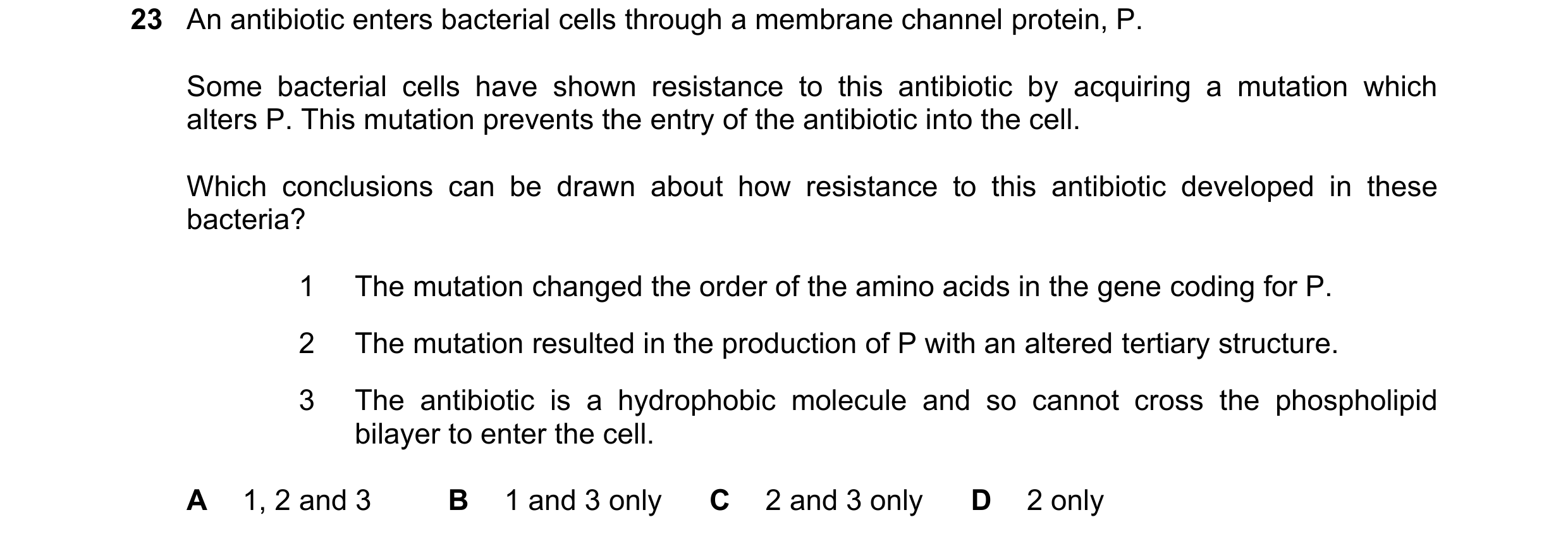
Q65 · An antibiotic enters bacterial cells through a membrane channel protein, P 9700/11 Oct/Nov 2021
23 An antibiotic enters bacterial cells through a membrane channel protein, P. Some bacterial cells have shown resistance to this antibiotic by acquiring a mutation which alters P. This mutation prevents the entry of the antibiotic into the cell. Which conclusions can be drawn about how resistance to this antibiotic developed in these bacteria? 1 The mutation changed the order of the amino acids in the gene coding for P. 2 The mutation resulted in the production of P with an altered tertiary structure. 3 The antibiotic is a hydrophobic molecule and so cannot cross the phospholipid bilayer to enter the cell. A 1, 2 and 3 B 1 and 3 only C 2 and 3 only D 2 only
1 marks
Answer: D
This question in 9700/11 Oct/Nov 2021
Q66 · Which description of multiple drug resistance in bacteria is correct? 9700/11 Oct/Nov 2021
37 Which description of multiple drug resistance in bacteria is correct? A Bacteria have DNA with resistant genes for several different types of antibiotic. B Different species of bacteria have DNA with resistant genes for one type of antibiotic. C Large numbers of one species of bacteria are immune to several different types of antibiotic. D Many different species of bacteria are immune to one type of antibiotic.
1 marks
Answer: A
This question in 9700/11 Oct/Nov 2021
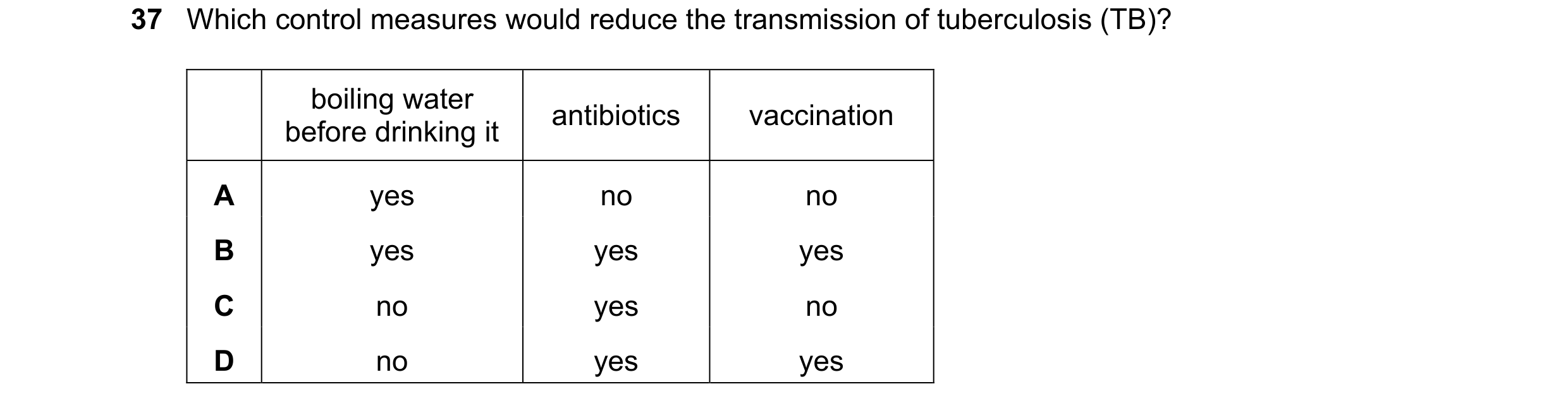
Q67 · Which control measures would reduce the transmission of tuberculosis (TB)? 9700/12 Oct/Nov 2021
37 Which control measures would reduce the transmission of tuberculosis (TB)? boiling water antibiotics vaccination before drinking it A yes no no B yes yes yes C no yes no D no yes yes
1 marks
Answer: D
This question in 9700/12 Oct/Nov 2021
Q68 · Which row shows how penicillin kills bacteria? 9700/12 Feb/March 2022
38 Which row shows how penicillin kills bacteria? process inhibited by penicillin effect on bacteria A formation of water enters and peptidoglycan cross-links bacteria burst B breakdown of water enters and peptidoglycan cross-links bacteria burst C formation of water leaves and peptidoglycan cross-links bacteria dehydrate D breakdown of water leaves and peptidoglycan cross-links bacteria dehydrate
1 marks
Answer: A
This question in 9700/12 Feb/March 2022
Q69 · What will reduce the rate at which bacteria become resistant to antibiotics? 9700/11 May/June 2022
37 What will reduce the rate at which bacteria become resistant to antibiotics? 1 prescribing two antibiotics with different modes of action 2 prescribing different antibiotics for the same bacterium 3 finishing a prescribed course of antibiotics A 1, 2 and 3 B 1 and 2 only C 1 and 3 only D 2 and 3 only
1 marks
Answer: A
This question in 9700/11 May/June 2022
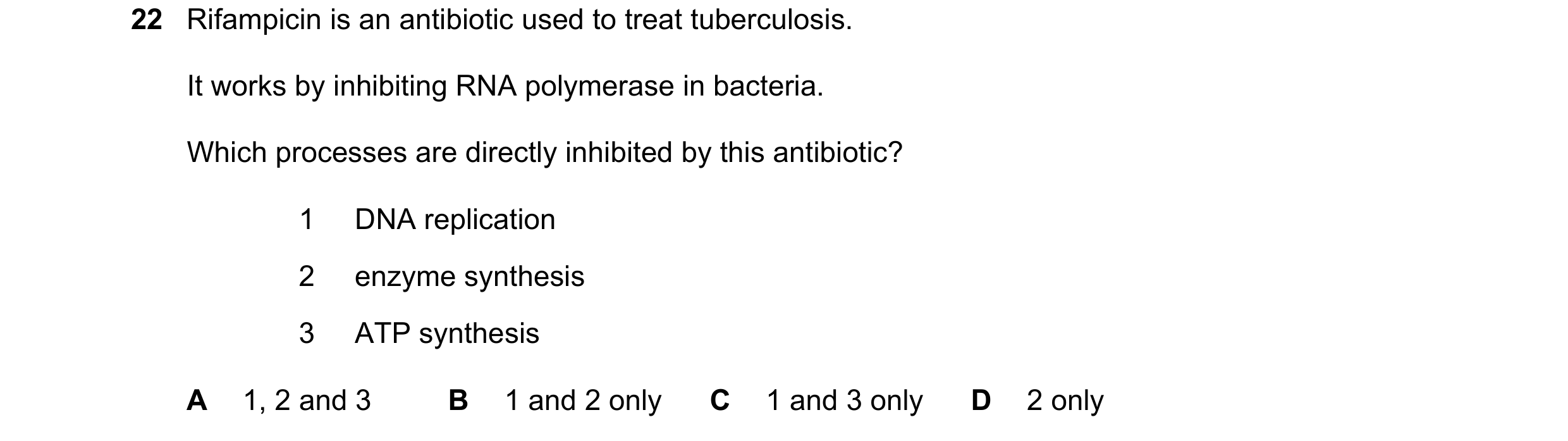
Q70 · Rifampicin is an antibiotic used to treat tuberculosis 9700/12 May/June 2022
22 Rifampicin is an antibiotic used to treat tuberculosis. It works by inhibiting RNA polymerase in bacteria. Which processes are directly inhibited by this antibiotic? 1 DNA replication 2 enzyme synthesis 3 ATP synthesis A 1, 2 and 3 B 1 and 2 only C 1 and 3 only D 2 only
1 marks
Answer: D
This question in 9700/12 May/June 2022
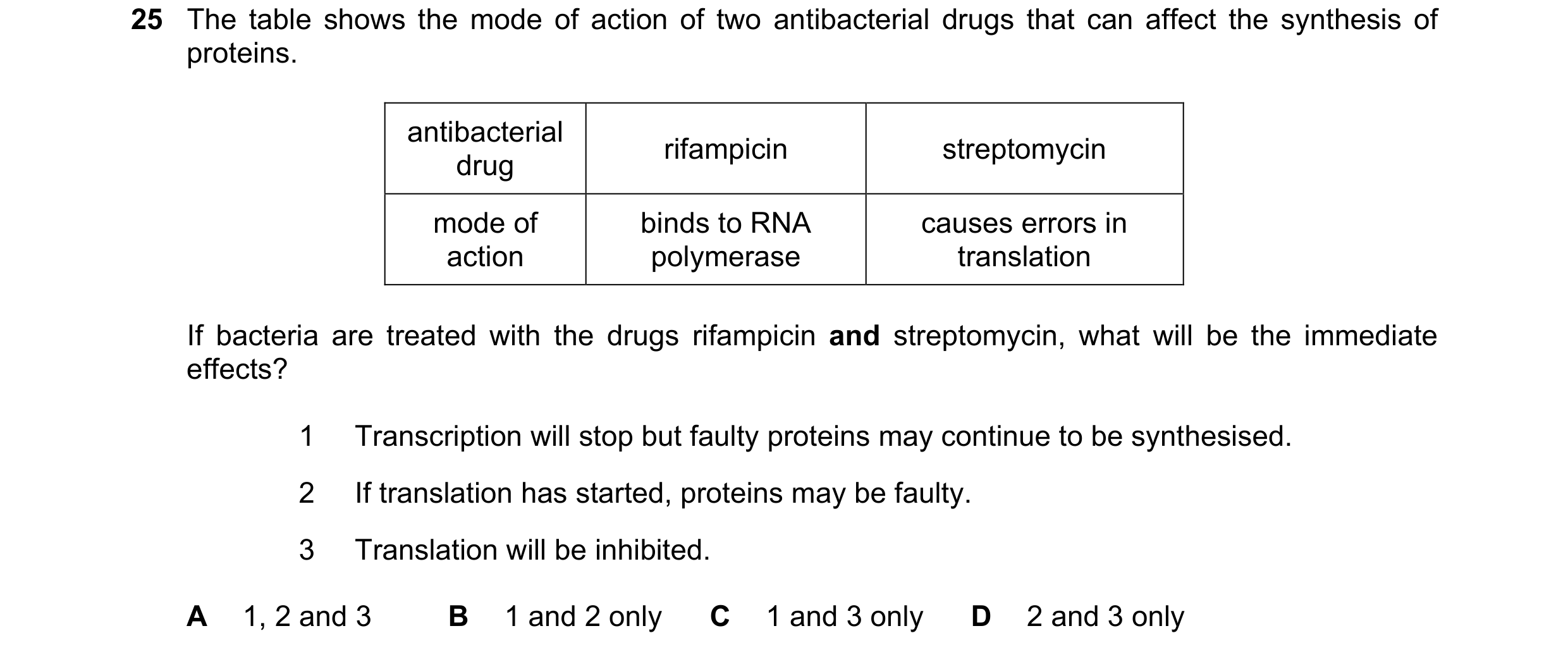
Q71 · The table shows the mode of action of two antibacterial drugs that can affect the… 9700/11 Oct/Nov 2022
25 The table shows the mode of action of two antibacterial drugs that can affect the synthesis of proteins. antibacterial rifampicin streptomycin drug mode of binds to RNA causes errors in action polymerase translation If bacteria are treated with the drugs rifampicin and streptomycin, what will be the immediate effects? 1 Transcription will stop but faulty proteins may continue to be synthesised. 2 If translation has started, proteins may be faulty. 3 Translation will be inhibited. A 1, 2 and 3 B 1 and 2 only C 1 and 3 only D 2 and 3 only
1 marks
Answer: B
This question in 9700/11 Oct/Nov 2022
Q72 · Penicillin is an antibiotic used to treat infections caused by bacteria 9700/11 Oct/Nov 2022
38 Penicillin is an antibiotic used to treat infections caused by bacteria. Which events explain how bacteria become resistant to penicillin? 1 The number of bacteria with the allele for resistance to penicillin increases. 2 Resistance to penicillin is the result of a mutation in a bacterium. 3 Bacteria with the allele for resistance to penicillin pass the allele to their daughter cells. 4 The mutation for resistance to penicillin is always caused by the presence of penicillin. A 1, 2, 3 and 4 B 1, 2 and 3 only C 1 and 4 only D 2 and 3 only
1 marks
Answer: B
This question in 9700/11 Oct/Nov 2022
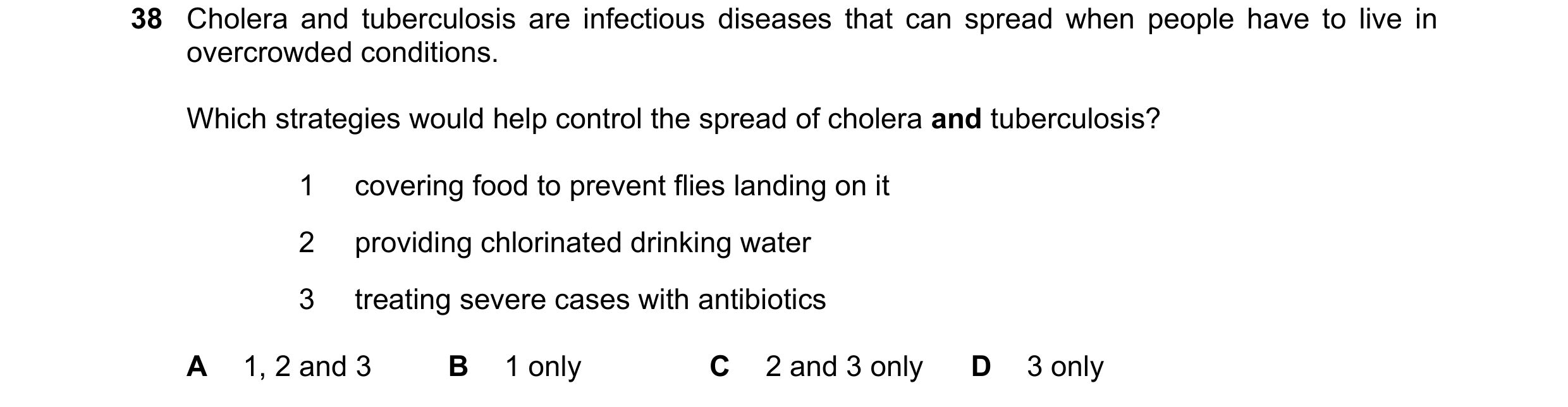
Q73 · Cholera and tuberculosis are infectious diseases that can spread when people have to live… 9700/12 Oct/Nov 2022
38 Cholera and tuberculosis are infectious diseases that can spread when people have to live in overcrowded conditions. Which strategies would help control the spread of cholera and tuberculosis? 1 covering food to prevent flies landing on it 2 providing chlorinated drinking water 3 treating severe cases with antibiotics A 1, 2 and 3 B 1 only C 2 and 3 only D 3 only
1 marks
Answer: D
This question in 9700/12 Oct/Nov 2022
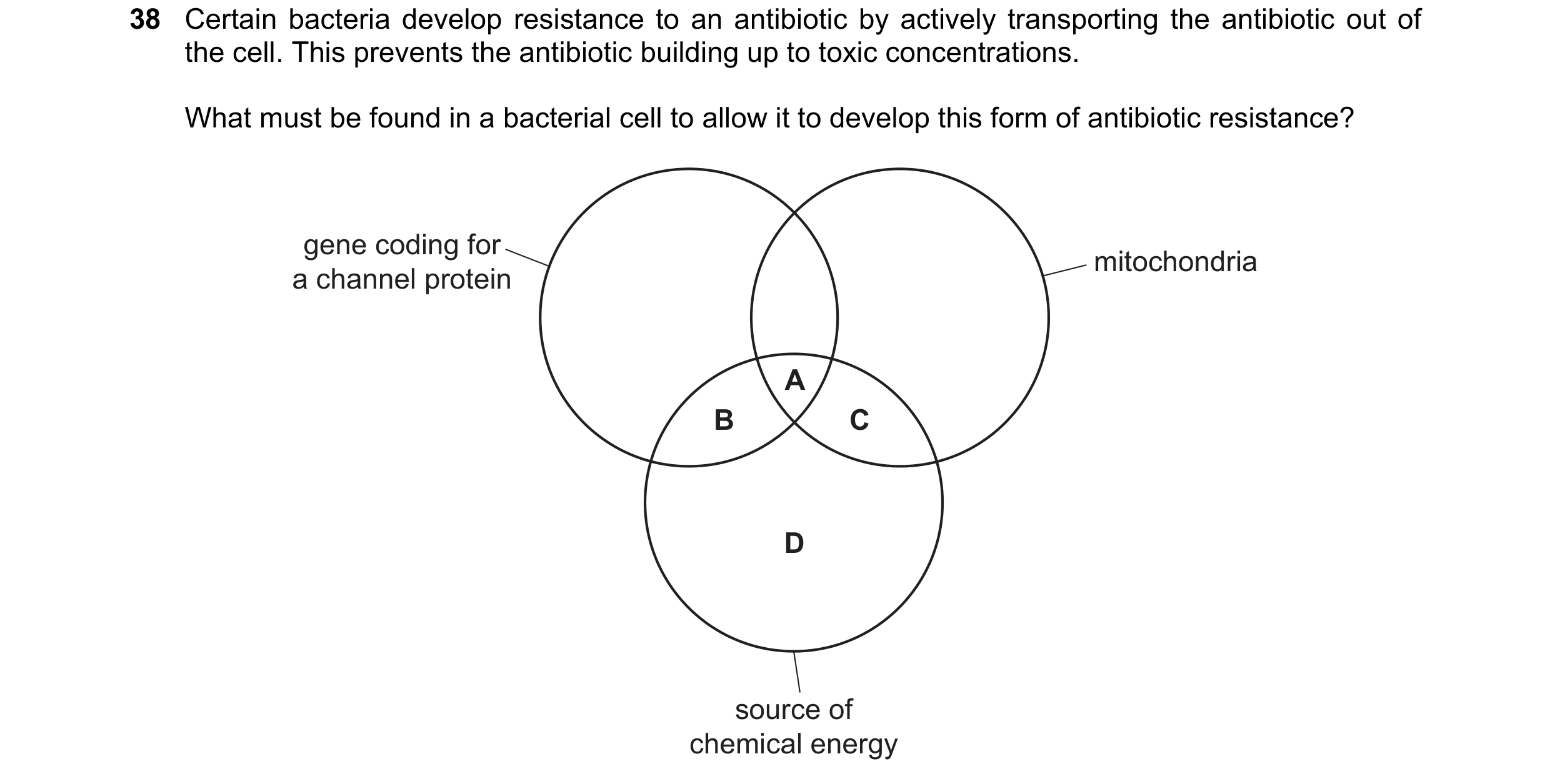
Q74 · Certain bacteria develop resistance to an antibiotic by actively transporting the… 9700/13 Oct/Nov 2022
38 Certain bacteria develop resistance to an antibiotic by actively transporting the antibiotic out of the cell. This prevents the antibiotic building up to toxic concentrations. What must be found in a bacterial cell to allow it to develop this form of antibiotic resistance? gene coding for mitochondria a channel protein A B C D source of chemical energy
1 marks
Answer: D
This question in 9700/13 Oct/Nov 2022
Q75 · Which statement correctly explains why viruses are unaffected by penicillin? 9700/12 Feb/March 2023
39 Which statement correctly explains why viruses are unaffected by penicillin? A Penicillin only affects host cell metabolism. B Penicillin only binds with 70S ribosomes. C Penicillin only blocks mRNA synthesis in prokaryotes. D Penicillin only blocks peptidoglycan synthesis.
1 marks
Answer: D
This question in 9700/12 Feb/March 2023
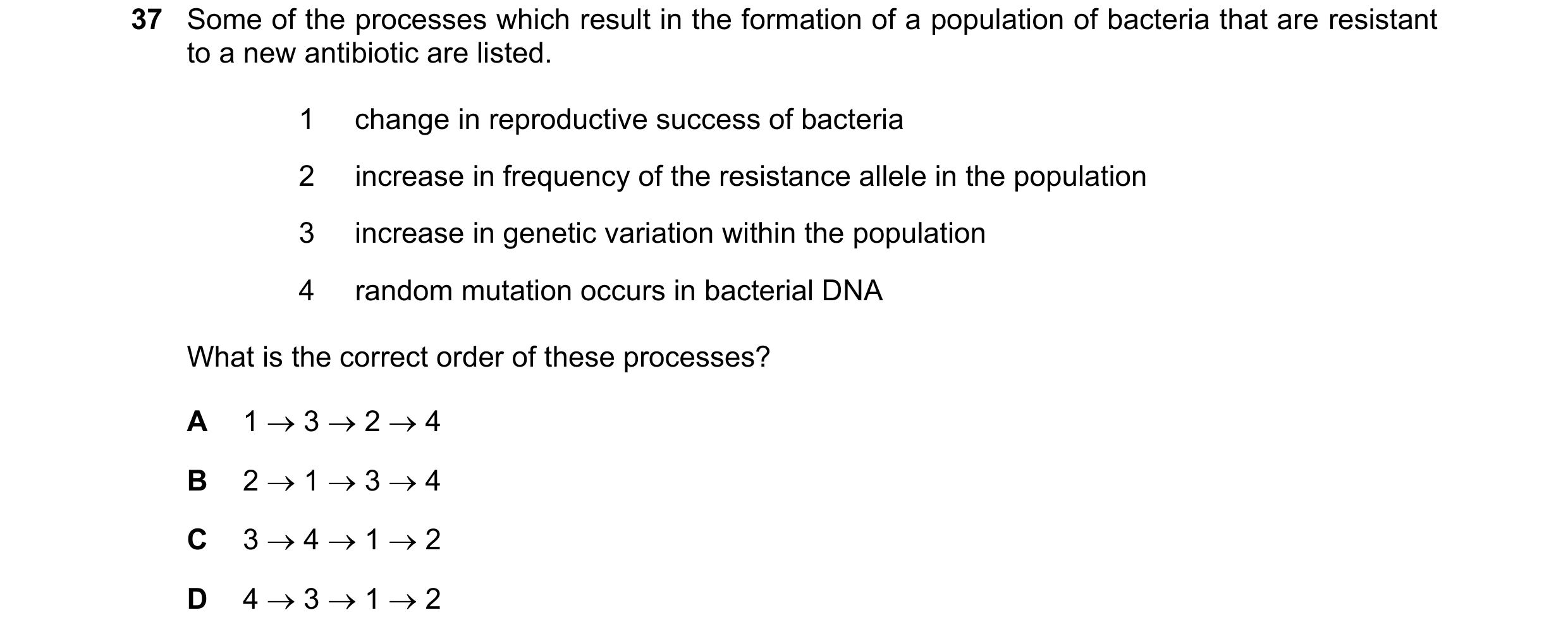
Q76 · Some of the processes which result in the formation of a population of bacteria that are… 9700/11 May/June 2023
37 Some of the processes which result in the formation of a population of bacteria that are resistant to a new antibiotic are listed. 1 change in reproductive success of bacteria 2 increase in frequency of the resistance allele in the population 3 increase in genetic variation within the population 4 random mutation occurs in bacterial DNA What is the correct order of these processes? A 1 → 3 → 2 → 4 B 2 → 1 → 3 → 4 C 3 → 4 → 1 → 2 D 4 → 3 → 1 → 2
1 marks
Answer: D
This question in 9700/11 May/June 2023
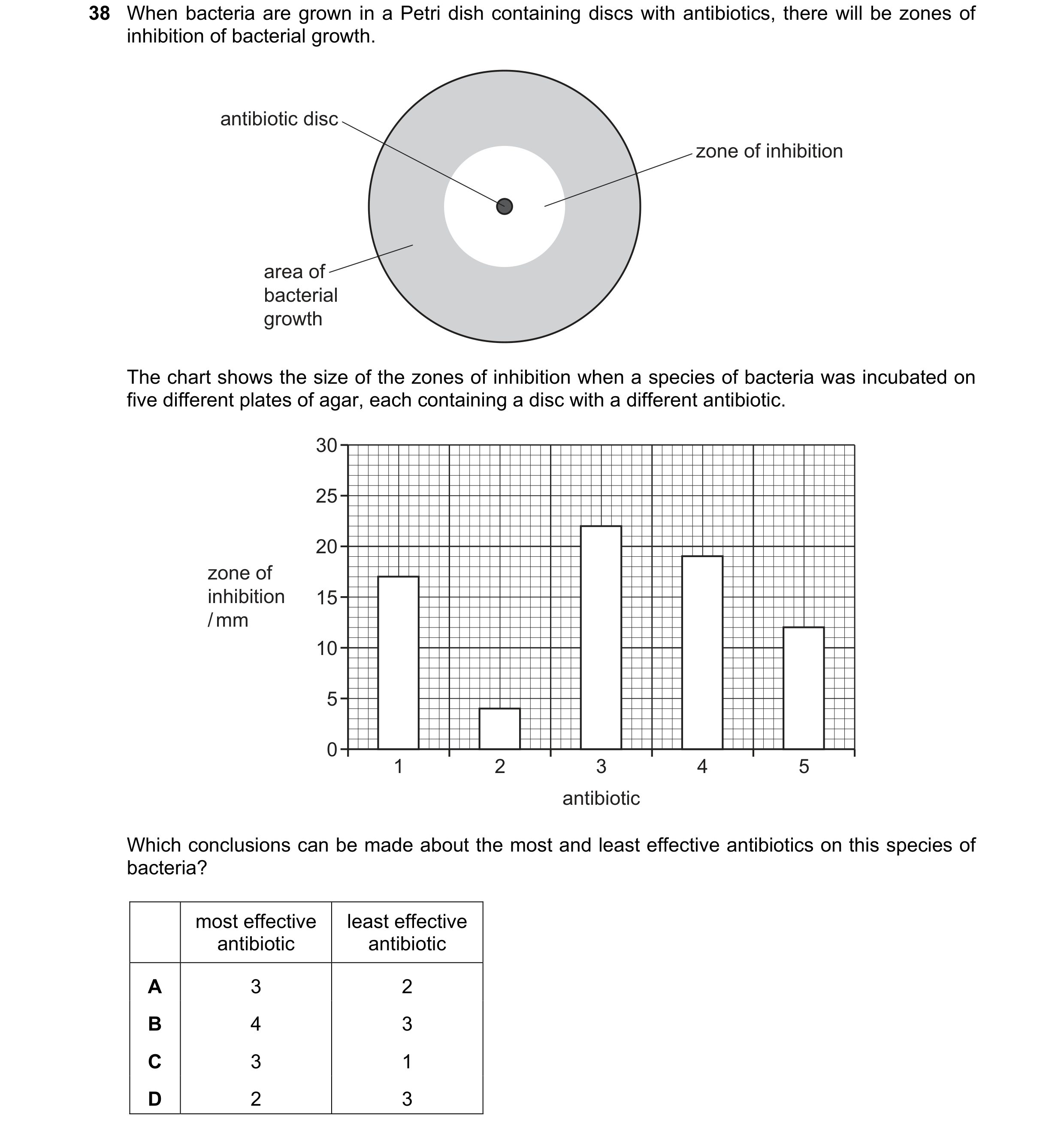
Q77 · When bacteria are grown in a Petri dish containing discs with antibiotics, there will be… 9700/11 May/June 2023
38 When bacteria are grown in a Petri dish containing discs with antibiotics, there will be zones of inhibition of bacterial growth. antibiotic disc zone of inhibition area of bacterial growth The chart shows the size of the zones of inhibition when a species of bacteria was incubated on five different plates of agar, each containing a disc with a different antibiotic. 30 25 20 zone of inhibition 15 / mm 10 5 0 1 2 3 4 5 antibiotic Which conclusions can be made about the most and least effective antibiotics on this species of bacteria? most effective least effective antibiotic antibiotic A 3 2 B 4 3 C 3 1 D 2 3
1 marks
Answer: A
This question in 9700/11 May/June 2023
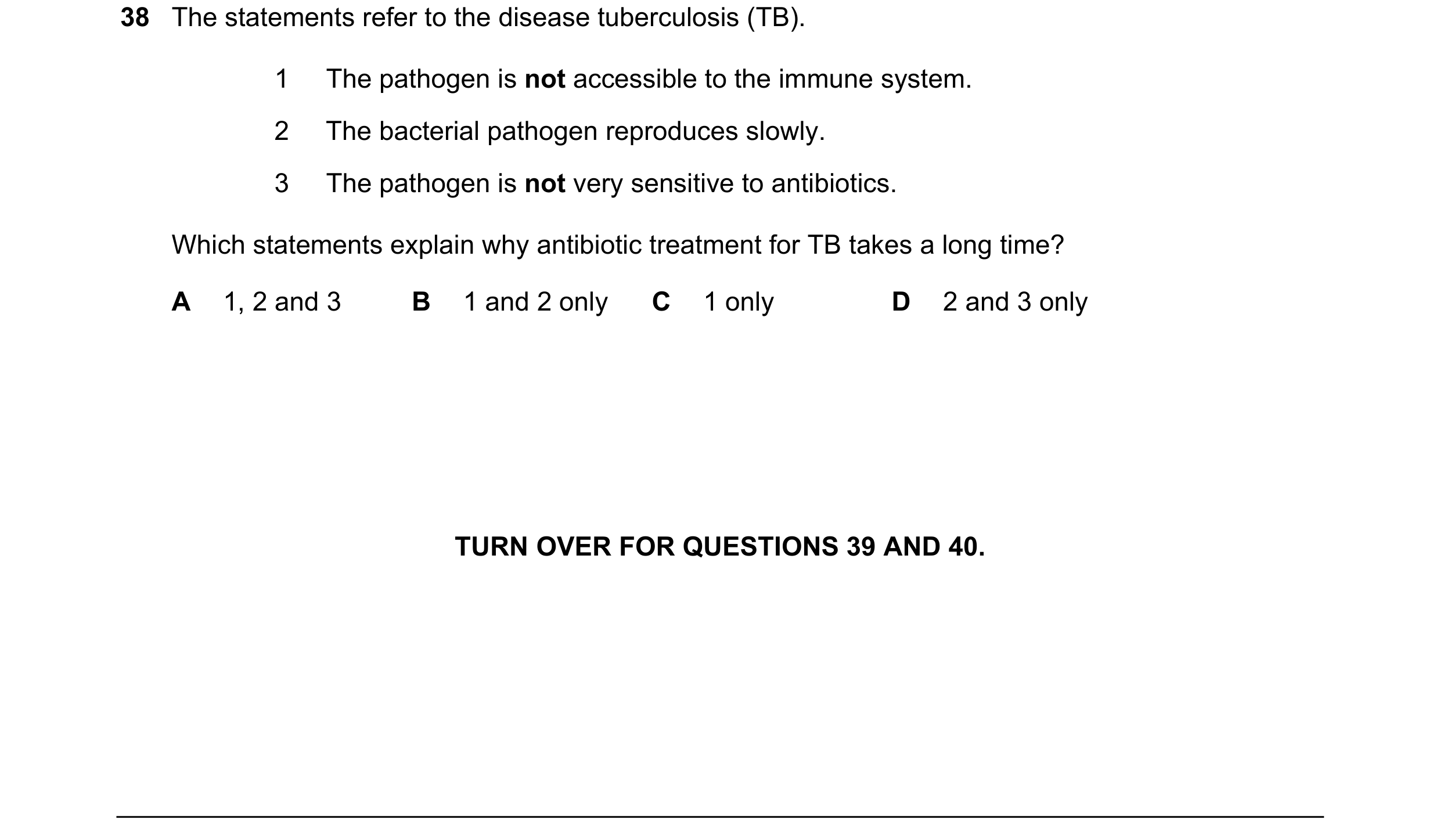
Q78 · The statements refer to the disease tuberculosis (TB) 9700/12 May/June 2023
38 The statements refer to the disease tuberculosis (TB). 1 The pathogen is not accessible to the immune system. 2 The bacterial pathogen reproduces slowly. 3 The pathogen is not very sensitive to antibiotics. Which statements explain why antibiotic treatment for TB takes a long time? A 1, 2 and 3 B 1 and 2 only C 1 only D 2 and 3 only TURN OVER FOR QUESTIONS 39 AND 40.
1 marks
Answer: D
This question in 9700/12 May/June 2023
Q79 · Organism X produces molecule Y, which blocks the activity of 70S ribosomes 9700/12 Oct/Nov 2023
37 Organism X produces molecule Y, which blocks the activity of 70S ribosomes.
An experiment was carried out to investigate the effect of Y on bacterial cells.
An agar plate with bacteria growing all over its surface had four wells cut into the agar. Different
substances were added to each well and the agar plate with bacteria was incubated for a week.
The diagram shows the results after a week.
intact cells of organism X sterile distilled water only
bacterial growth
concentrated solution
made from the cytoplasm
of lots of organism X cells
commonly used antibiotic
no bacterial growth
Which conclusions can be made from these results?
molecule Y would
molecule Y
molecule Y also affect the
: cannot be . .
functions as an synthesis of proteins
tas released from cells
antibiotic from nuclear DNA
of organism X ;
in a human cell
A Jv v v key
B v v x /¥ = can be concluded
Cc v x v X = cannot be concluded
D x J J
1 marks
Answer: B
This question in 9700/12 Oct/Nov 2023
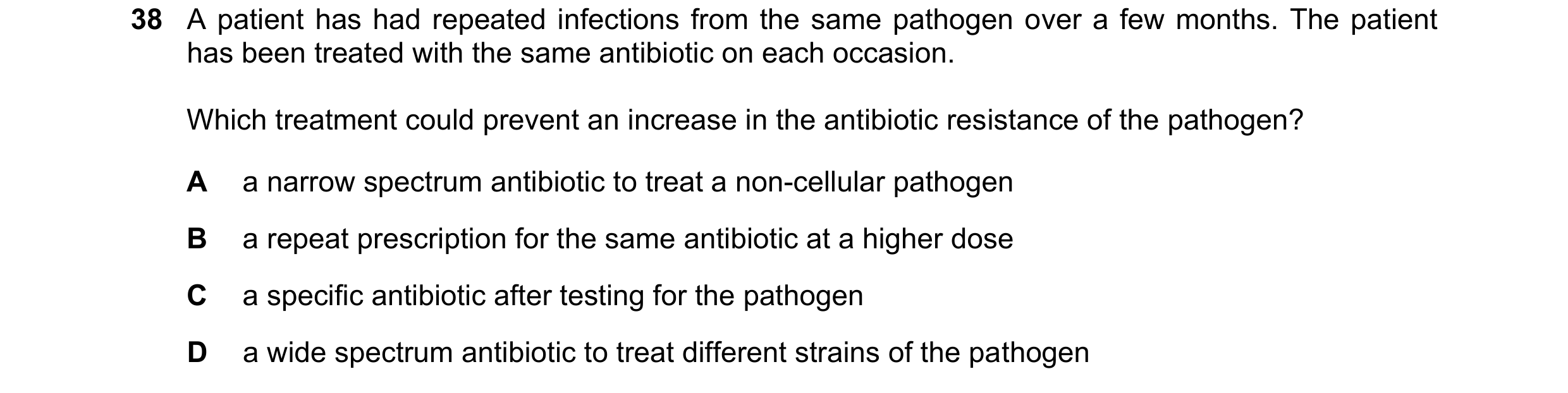
Q80 · A patient has had repeated infections from the same pathogen over a few months 9700/12 Oct/Nov 2023
38 A patient has had repeated infections from the same pathogen over a few months. The patient has been treated with the same antibiotic on each occasion. Which treatment could prevent an increase in the antibiotic resistance of the pathogen? A a narrow spectrum antibiotic to treat a non-cellular pathogen B a repeat prescription for the same antibiotic at a higher dose C a specific antibiotic after testing for the pathogen D a wide spectrum antibiotic to treat different strains of the pathogen
1 marks
Answer: C
This question in 9700/12 Oct/Nov 2023
Q81 · Bacteria can become resistant to antibiotics 9700/13 Oct/Nov 2023
37 Bacteria can become resistant to antibiotics. What can help reduce the development of antibiotic resistance in bacteria? 1 Use specific antibiotics instead of wide spectrum. 2 Use antibiotics to treat viral infections. 3 Develop new antibiotics. A 1, 2 and 3 B 1 and 2 only C 1 and 3 only D 2 and 3 only
1 marks
Answer: C
This question in 9700/13 Oct/Nov 2023
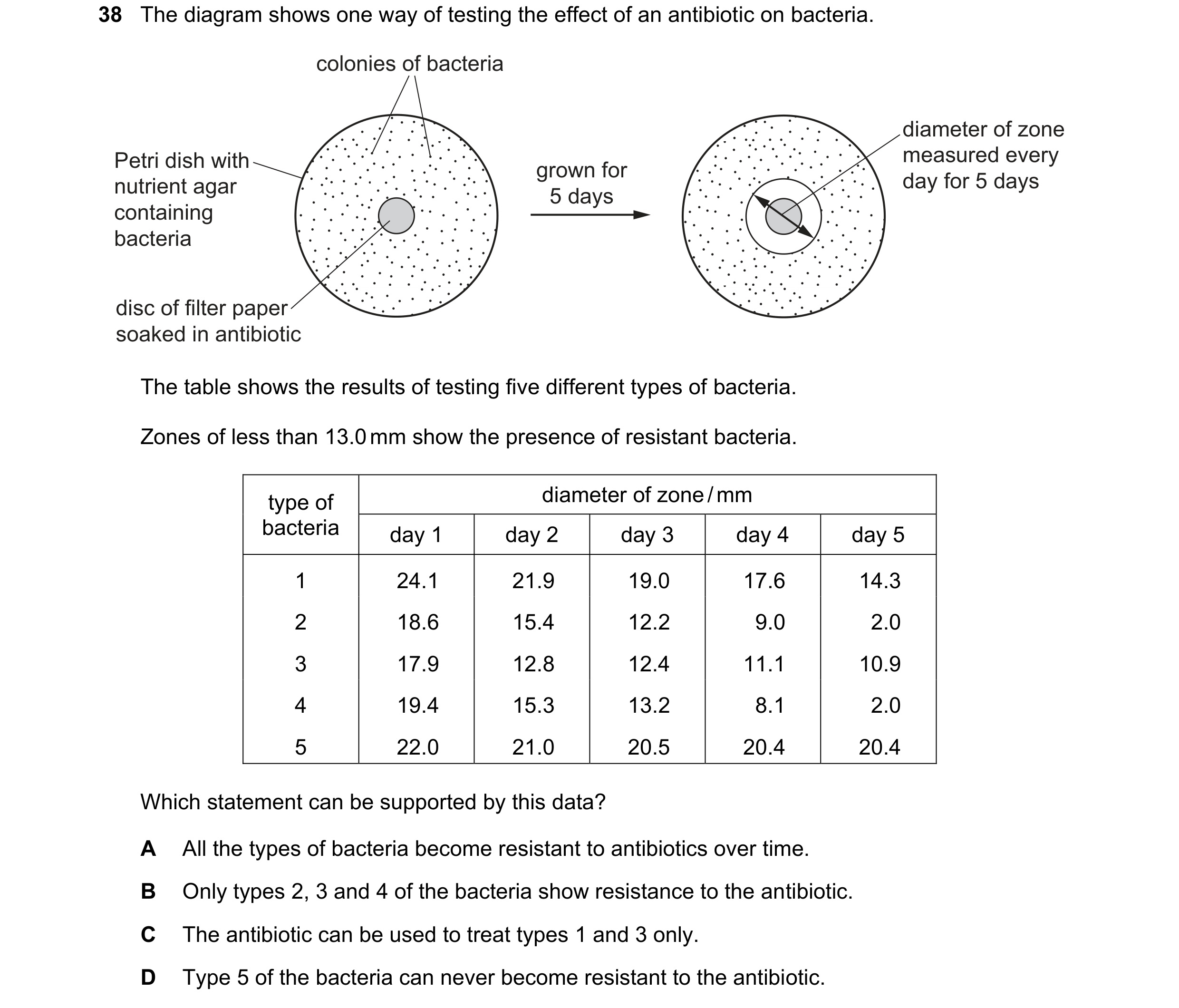
Q82 · The diagram shows one way of testing the effect of an antibiotic on bacteria 9700/13 Oct/Nov 2023
38 The diagram shows one way of testing the effect of an antibiotic on bacteria. colonies of bacteria diameter of zone Petri dish with measured every grown for nutrient agar day for 5 days 5 days containing bacteria disc of filter paper soaked in antibiotic The table shows the results of testing five different types of bacteria. Zones of less than 13.0 mm show the presence of resistant bacteria. type of diameter of zone / mm bacteria day 1 day 2 day 3 day 4 day 5 1 24.1 21.9 19.0 17.6 14.3 2 18.6 15.4 12.2 9.0 2.0 3 17.9 12.8 12.4 11.1 10.9 4 19.4 15.3 13.2 8.1 2.0 5 22.0 21.0 20.5 20.4 20.4 Which statement can be supported by this data? A All the types of bacteria become resistant to antibiotics over time. B Only types 2, 3 and 4 of the bacteria show resistance to the antibiotic. C The antibiotic can be used to treat types 1 and 3 only. D Type 5 of the bacteria can never become resistant to the antibiotic.
1 marks
Answer: B
This question in 9700/13 Oct/Nov 2023
Q83 · Antibiotic-resistant strains of Mycobacterium tuberculosis are a major problem when… 9700/12 Feb/March 2024
38 Antibiotic-resistant strains of Mycobacterium tuberculosis are a major problem when treating TB. A new antibiotic, teixobactin, could be very effective at killing M. tuberculosis with only a small risk that the bacteria will evolve teixobactin resistance. Penicillin and similar antibiotics bind to a single protein, but teixobactin binds to two lipids that are needed for the formation of the bacterial cell wall. Teixobactin binds to regions of the two lipids that do not vary across many different species of bacteria. Which statements help to explain why the use of teixobactin is thought to be less likely to lead to the evolution of antibiotic resistance than the use of many other antibiotics, such as penicillin? 1 A single mutation can result in bacteria that are resistant to penicillin and similar antibiotics but at least two mutations are required to produce teixobactin-resistant bacteria. 2 Mutations can affect the structure of proteins but cannot affect the structure of lipids because only proteins are made of amino acids. 3 The lack of variation across many species of bacteria in the two lipids that bind to teixobactin suggest that the particular structure of these lipids is essential for successful bacterial cell wall formation. A 1, 2 and 3 B 1 and 2 only C 1 and 3 only D 2 and 3 only
1 marks
Answer: C
This question in 9700/12 Feb/March 2024
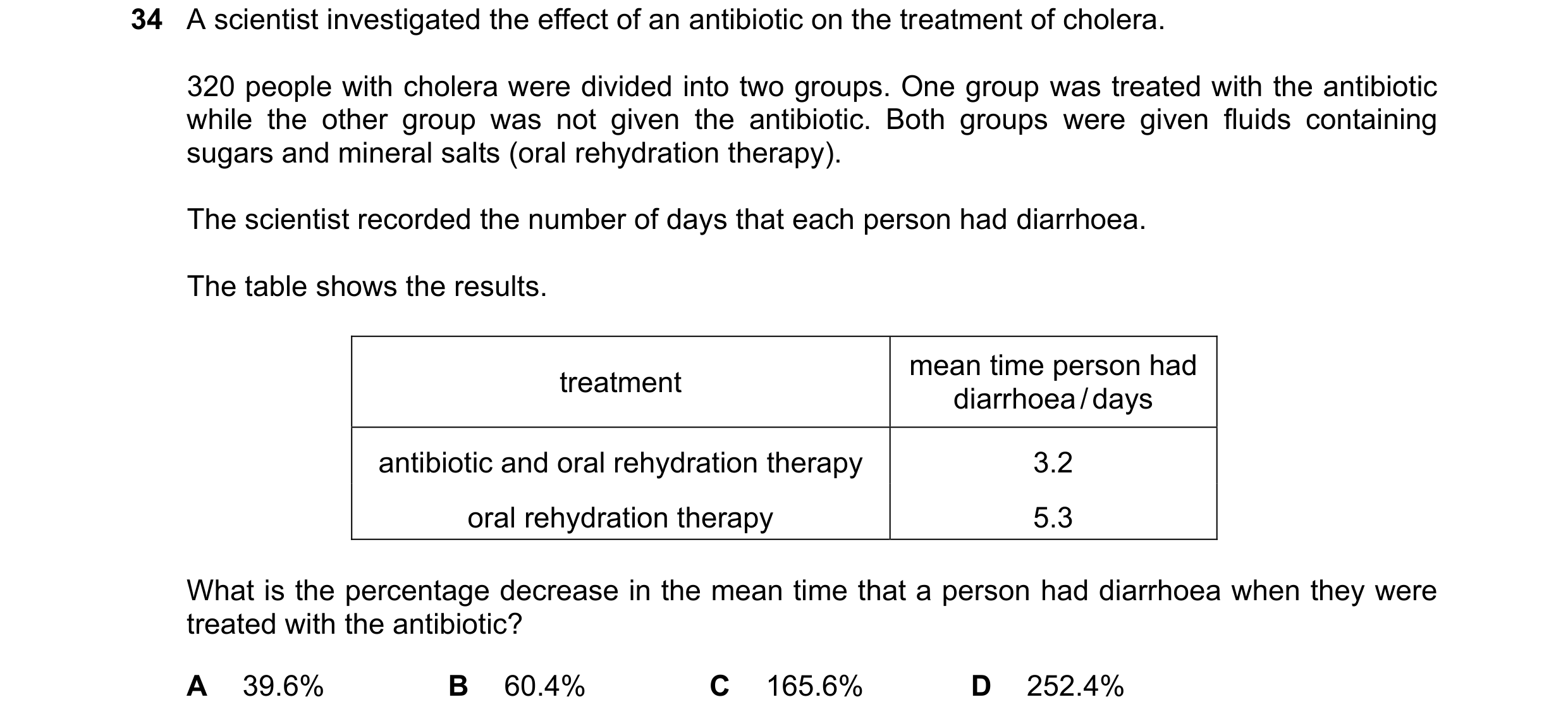
Q84 · A scientist investigated the effect of an antibiotic on the treatment of cholera 9700/11 May/June 2024
34 A scientist investigated the effect of an antibiotic on the treatment of cholera. 320 people with cholera were divided into two groups. One group was treated with the antibiotic while the other group was not given the antibiotic. Both groups were given fluids containing sugars and mineral salts (oral rehydration therapy). The scientist recorded the number of days that each person had diarrhoea. The table shows the results. mean time person had treatment diarrhoea / days antibiotic and oral rehydration therapy 3.2 oral rehydration therapy 5.3 What is the percentage decrease in the mean time that a person had diarrhoea when they were treated with the antibiotic? A 39.6% B 60.4% C 165.6% D 252.4%
1 marks
Answer: A
This question in 9700/11 May/June 2024
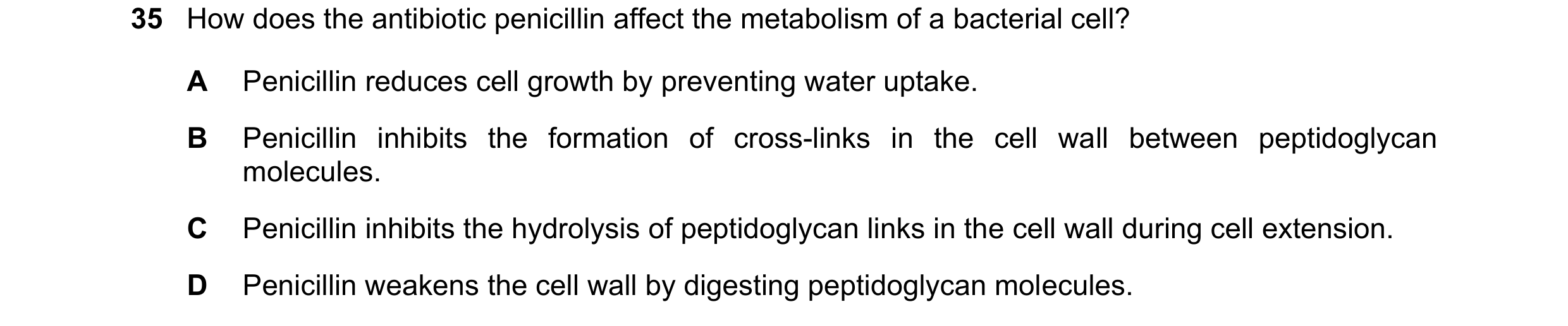
Q85 · How does the antibiotic penicillin affect the metabolism of a bacterial cell? 9700/11 May/June 2024
35 How does the antibiotic penicillin affect the metabolism of a bacterial cell? A Penicillin reduces cell growth by preventing water uptake. B Penicillin inhibits the formation of cross-links in the cell wall between peptidoglycan molecules. C Penicillin inhibits the hydrolysis of peptidoglycan links in the cell wall during cell extension. D Penicillin weakens the cell wall by digesting peptidoglycan molecules.
1 marks
Answer: B
This question in 9700/11 May/June 2024
Q86 · Scientists studied the multidrug-resistant bacterial infections in children caused by one… 9700/11 May/June 2024
36 Scientists studied the multidrug-resistant bacterial infections in children caused by one type of bacteria between 2007 and 2015. The percentage of multidrug-resistant infections rose from 0.2% to 1.5%. What was the percentage increase in multidrug-resistant infections between 2007 and 2015? A 1.3% B 87% C 130% D 650%
1 marks
Answer: D
This question in 9700/11 May/June 2024
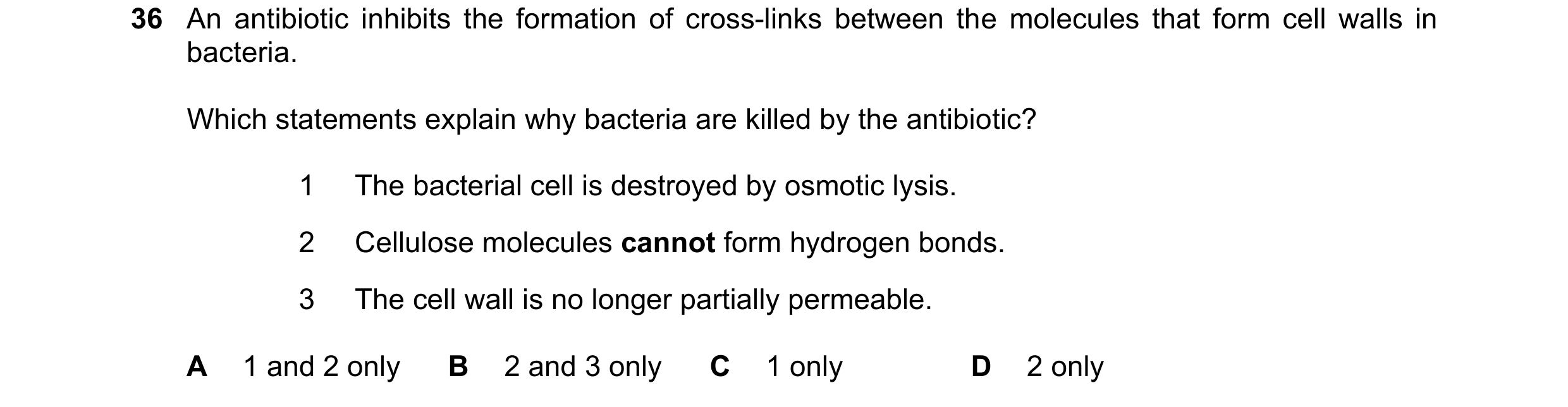
Q87 · An antibiotic inhibits the formation of cross-links between the molecules that form cell… 9700/12 May/June 2024
36 An antibiotic inhibits the formation of cross-links between the molecules that form cell walls in bacteria. Which statements explain why bacteria are killed by the antibiotic? 1 The bacterial cell is destroyed by osmotic lysis. 2 Cellulose molecules cannot form hydrogen bonds. 3 The cell wall is no longer partially permeable. A 1 and 2 only B 2 and 3 only C 1 only D 2 only
1 marks
Answer: C
This question in 9700/12 May/June 2024
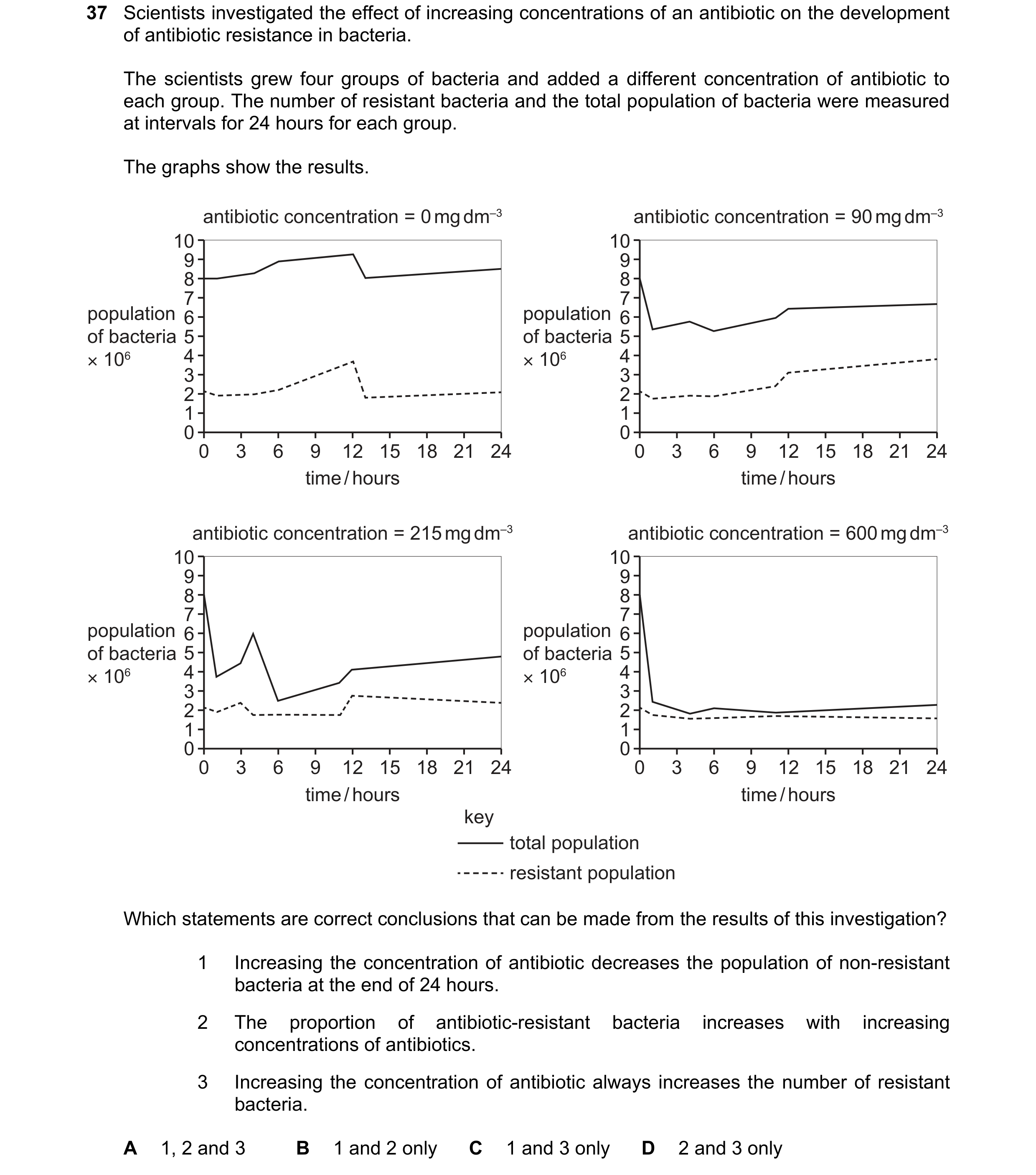
Q88 · Scientists investigated the effect of increasing concentrations of an antibiotic on the… 9700/12 May/June 2024
37 Scientists investigated the effect of increasing concentrations of an antibiotic on the development of antibiotic resistance in bacteria. The scientists grew four groups of bacteria and added a different concentration of antibiotic to each group. The number of resistant bacteria and the total population of bacteria were measured at intervals for 24 hours for each group. The graphs show the results. antibiotic concentration = 0 mg dm–3 antibiotic concentration = 90 mg dm–3 10 10 9 9 8 8 7 7 population 6 population 6 of bacteria 5 of bacteria 5 × 10⁶ 4 × 10⁶ 4 3 3 2 2 1 1 0 0 0 3 6 9 12 15 18 21 24 0 3 6 9 12 15 18 21 24 time / hours time / hours antibiotic concentration = 215 mg dm–3 antibiotic concentration = 600 mg dm–3 10 10 9 9 8 8 7 7 population 6 population 6 of bacteria 5 of bacteria 5 × 10⁶ 4 × 10⁶ 4 3 3 2 2 1 1 0 0 0 3 6 9 12 15 18 21 24 0 3 6 9 12 15 18 21 24 time / hours time / hours key total population resistant population Which statements are correct conclusions that can be made from the results of this investigation? 1 Increasing the concentration of antibiotic decreases the population of non-resistant bacteria at the end of 24 hours. 2 The proportion of antibiotic-resistant bacteria increases with increasing concentrations of antibiotics. 3 Increasing the concentration of antibiotic always increases the number of resistant bacteria. A 1, 2 and 3 B 1 and 2 only C 1 and 3 only D 2 and 3 only
1 marks
Answer: B
This question in 9700/12 May/June 2024
Q89 · Bacteria may be classified according to differences in cell wall structure 9700/13 May/June 2024
37 Bacteria may be classified according to differences in cell wall structure. The differences are shown by using the Gram stain. The diagram shows part of a Gram-positive bacterium and part of a Gram-negative bacterium, drawn to the same scale. external environment peptidoglycan layer Gram-positive bacterium periplasm (watery fluid containing proteins) cell surface membrane cytoplasm external environment outer membrane made of carbohydrate and lipid Gram-negative periplasm bacterium peptidoglycan layer periplasm cell surface membrane cytoplasm The antibiotic penicillin kills bacteria by inhibiting the synthesis of the cell walls during bacterial cell growth. Which type of bacteria will be killed by penicillin more easily and why? A Gram-positive bacteria because the peptidoglycan layer is exposed to penicillin directly B Gram-positive bacteria because it has a thinner layer surrounding the cell membrane overall C Gram-negative bacteria because the thin peptidoglycan layer can be broken down faster D Gram-negative bacteria because there is more periplasm available, which gives a weaker structure
1 marks
Answer: A
This question in 9700/13 May/June 2024
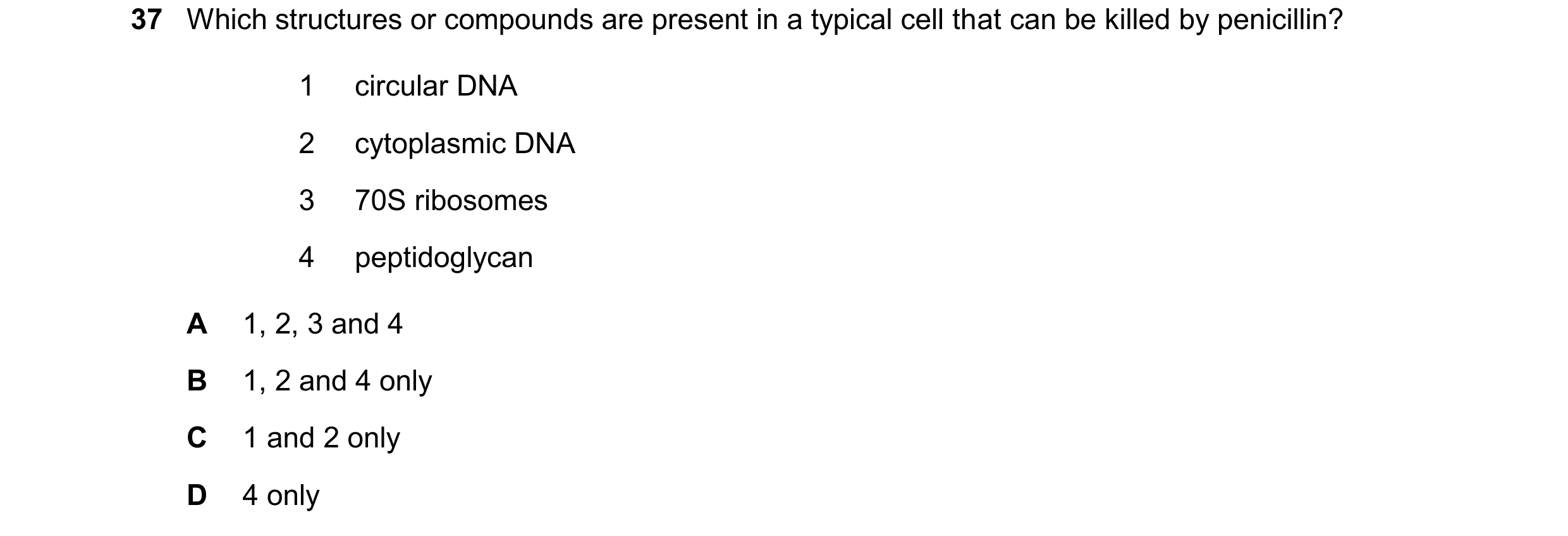
Q90 · Which structures or compounds are present in a typical cell that can be killed by… 9700/11 Oct/Nov 2024
37 Which structures or compounds are present in a typical cell that can be killed by penicillin? 1 circular DNA 2 cytoplasmic DNA 3 70S ribosomes 4 peptidoglycan A 1, 2, 3 and 4 B 1, 2 and 4 only C 1 and 2 only D 4 only
1 marks
Answer: A
This question in 9700/11 Oct/Nov 2024
Q91 · Which statements are correct for penicillin? 9700/12 Oct/Nov 2024
37 Which statements are correct for penicillin? 1 It is harmful to prokaryotic cells. 2 It disrupts cell wall synthesis. 3 It becomes less effective with regular use. A 1, 2 and 3 B 1 and 2 only C 1 and 3 only D 2 and 3 only
1 marks
Answer: A
This question in 9700/12 Oct/Nov 2024
Q92 · Which organisms have cell walls that can be affected by penicillin? 9700/13 Oct/Nov 2024
37 Which organisms have cell walls that can be affected by penicillin? 1 bacteria 2 protoctists 3 viruses A 1 and 2 B 1 and 3 C 1 only D 2 and 3
1 marks
Answer: C
This question in 9700/13 Oct/Nov 2024
Q93 · Which statements explain why antibiotics may not treat cholera successfully? 9700/12 May/June 2025
38 Which statements explain why antibiotics may not treat cholera successfully? 1 The infectious organism has developed resistance to the antibiotic. 2 Antibiotics cannot harm viruses. 3 Antibiotics do not affect pathogens that are eukaryotic. A 1, 2 and 3 B 1 only C 2 only D 3 only
1 marks
Answer: B
This question in 9700/12 May/June 2025
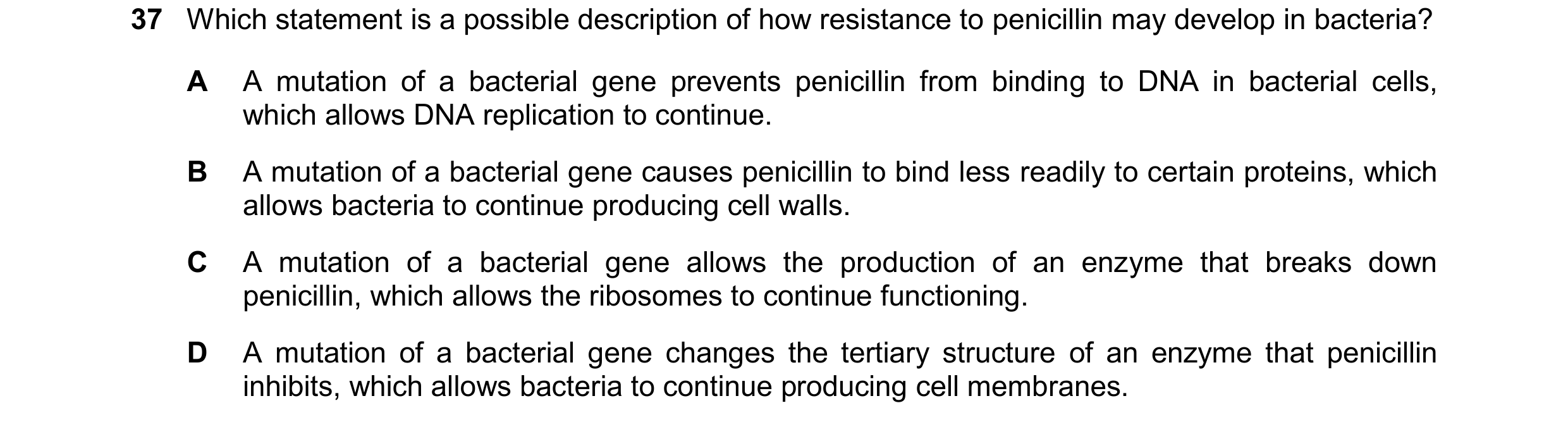
Q94 · Which statement is a possible description of how resistance to penicillin may develop in… 9700/13 May/June 2025
37 Which statement is a possible description of how resistance to penicillin may develop in bacteria? A A mutation of a bacterial gene prevents penicillin from binding to DNA in bacterial cells, which allows DNA replication to continue. B A mutation of a bacterial gene causes penicillin to bind less readily to certain proteins, which allows bacteria to continue producing cell walls. C A mutation of a bacterial gene allows the production of an enzyme that breaks down penicillin, which allows the ribosomes to continue functioning. D A mutation of a bacterial gene changes the tertiary structure of an enzyme that penicillin inhibits, which allows bacteria to continue producing cell membranes.
1 marks
Answer: B
This question in 9700/13 May/June 2025
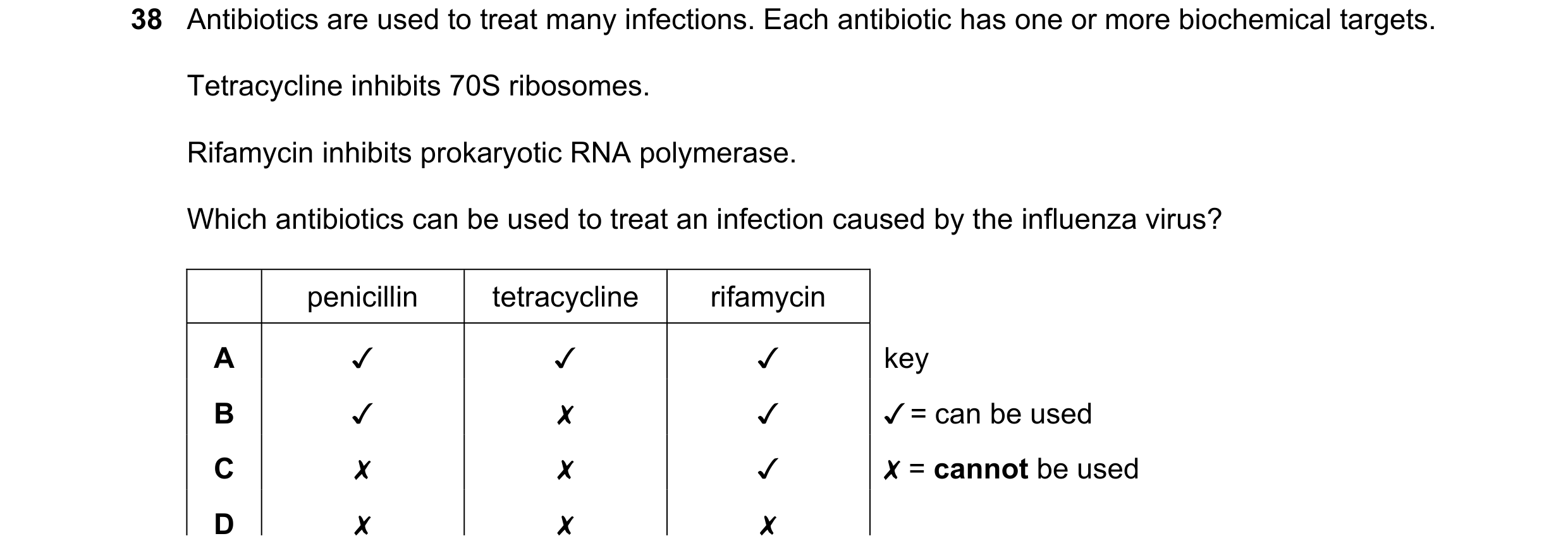
Q95 · Antibiotics are used to treat many infections 9700/14 May/June 2025
38 Antibiotics are used to treat many infections. Each antibiotic has one or more biochemical targets.
Tetracycline inhibits 70S ribosomes.
Rifamycin inhibits prokaryotic RNA polymerase.
Which antibiotics can be used to treat an infection caused by the influenza virus?
penicillin tetracycline rifamycin
A v v v
B v x v
Cc x x Jv
D x x x
key
/ =can be used
X = cannot be used
1 marks
Answer: D
This question in 9700/14 May/June 2025
Q96 · How does penicillin affect bacteria? 9700/11 Oct/Nov 2025
38 How does penicillin affect bacteria? A It inhibits DNA replication by binding to nucleotides. B It inhibits translation by preventing tRNA binding to ribosomes. C It is a competitive inhibitor of an enzyme in cell wall synthesis. D It is a competitive inhibitor of an enzyme in protein synthesis.
1 marks
Answer: C
This question in 9700/11 Oct/Nov 2025
 1 / 32

 2 / 32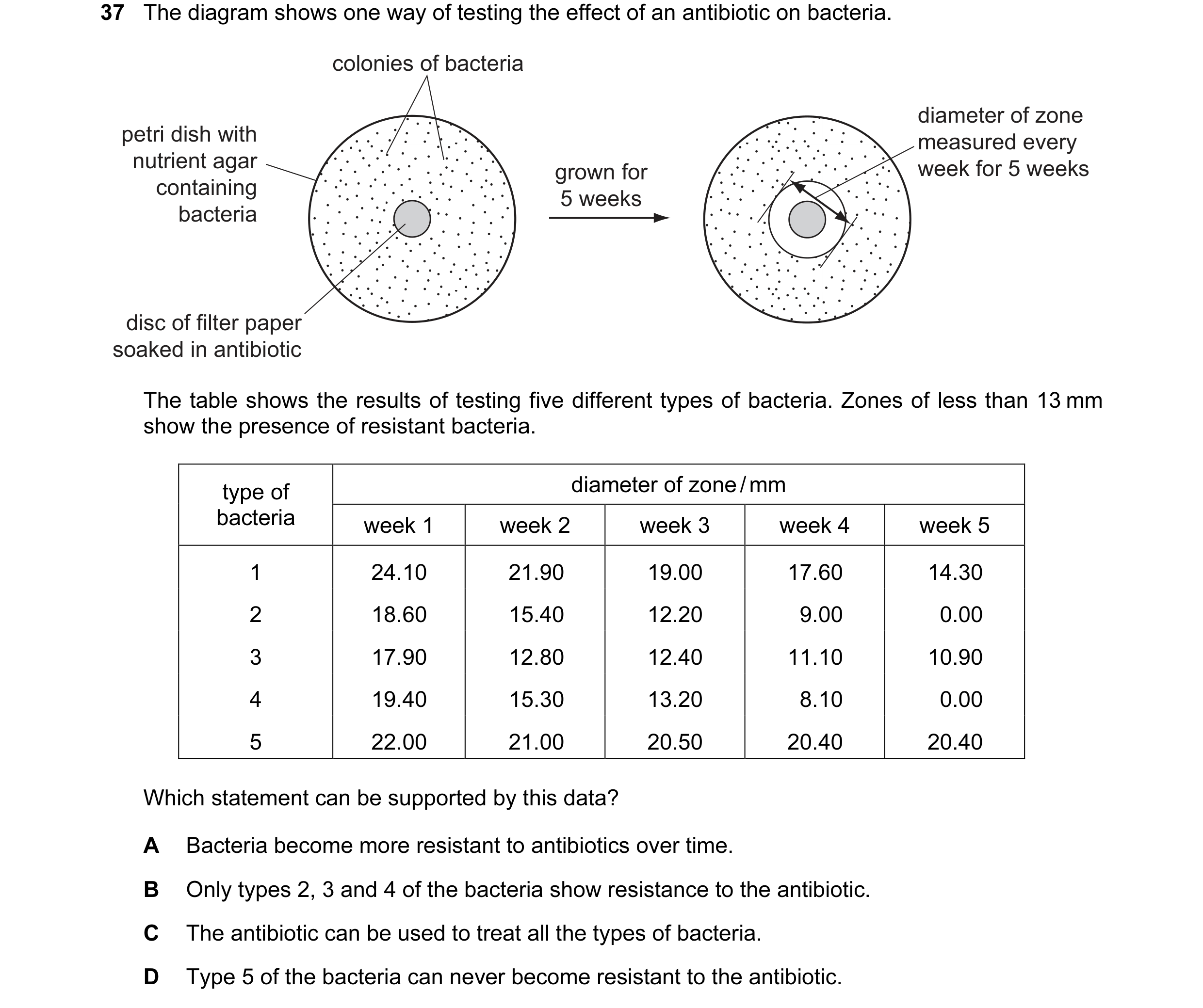
 3 / 32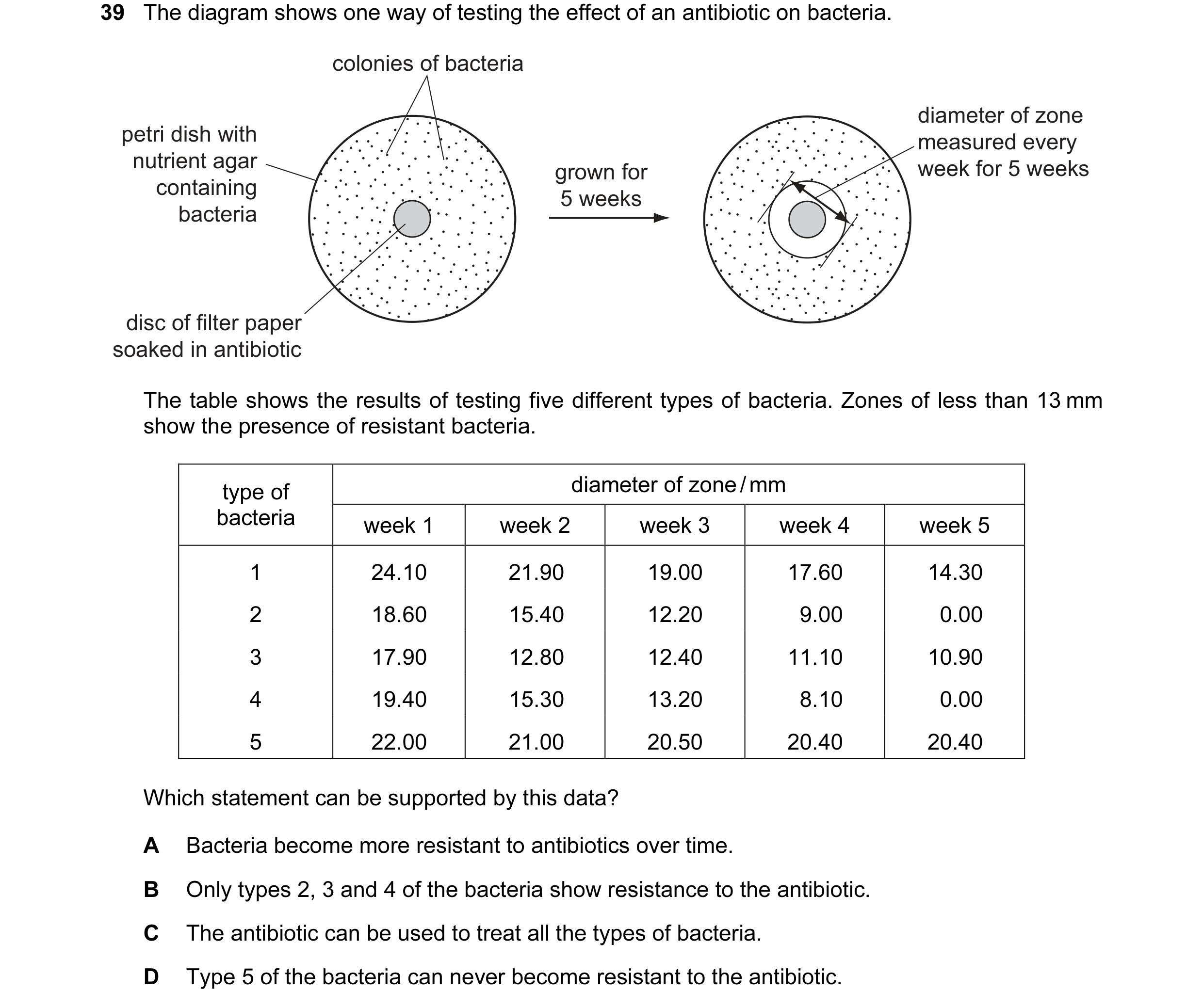
 4 / 32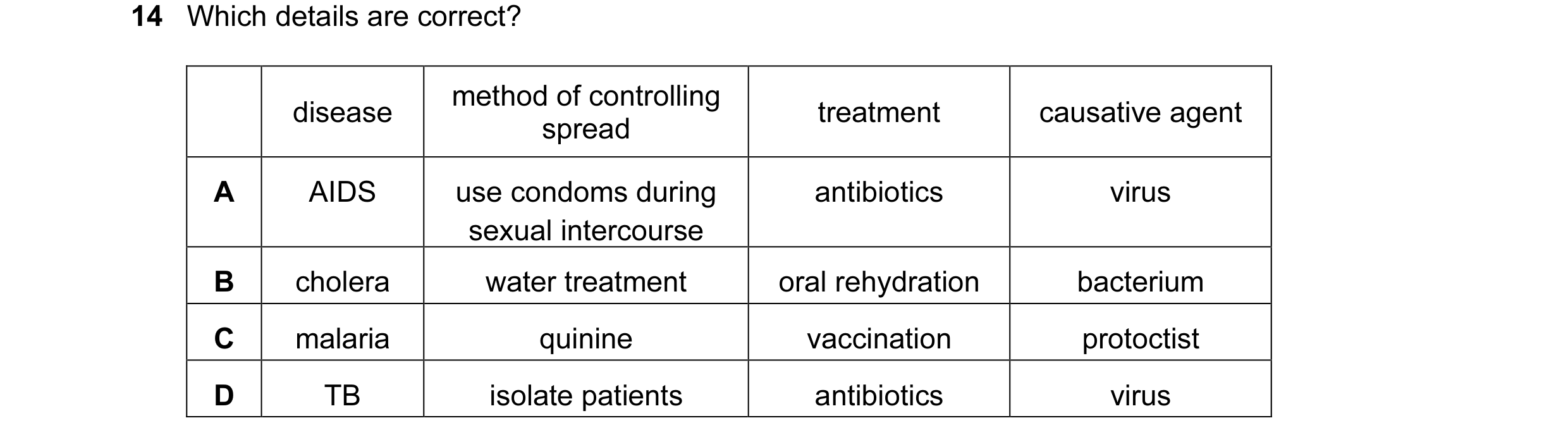
 5 / 32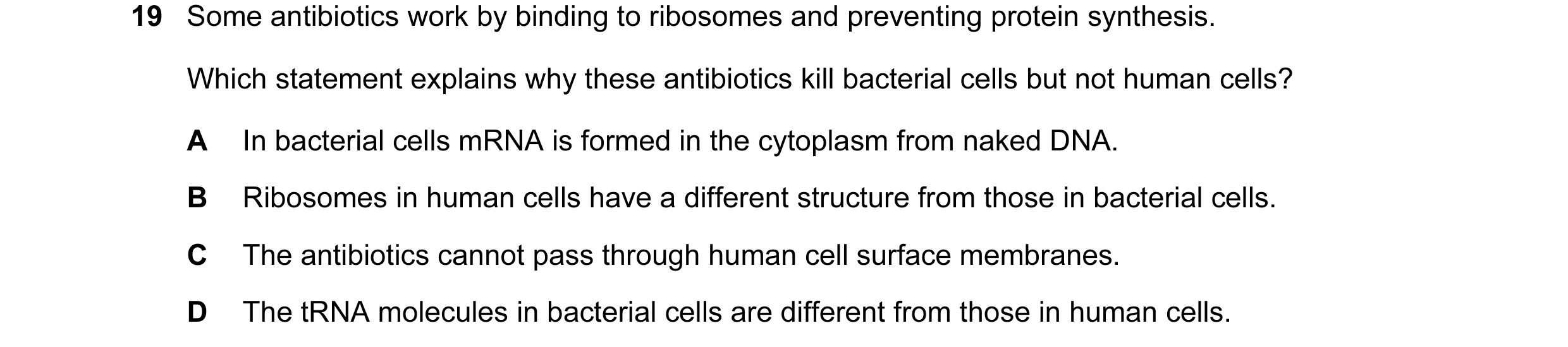
 6 / 32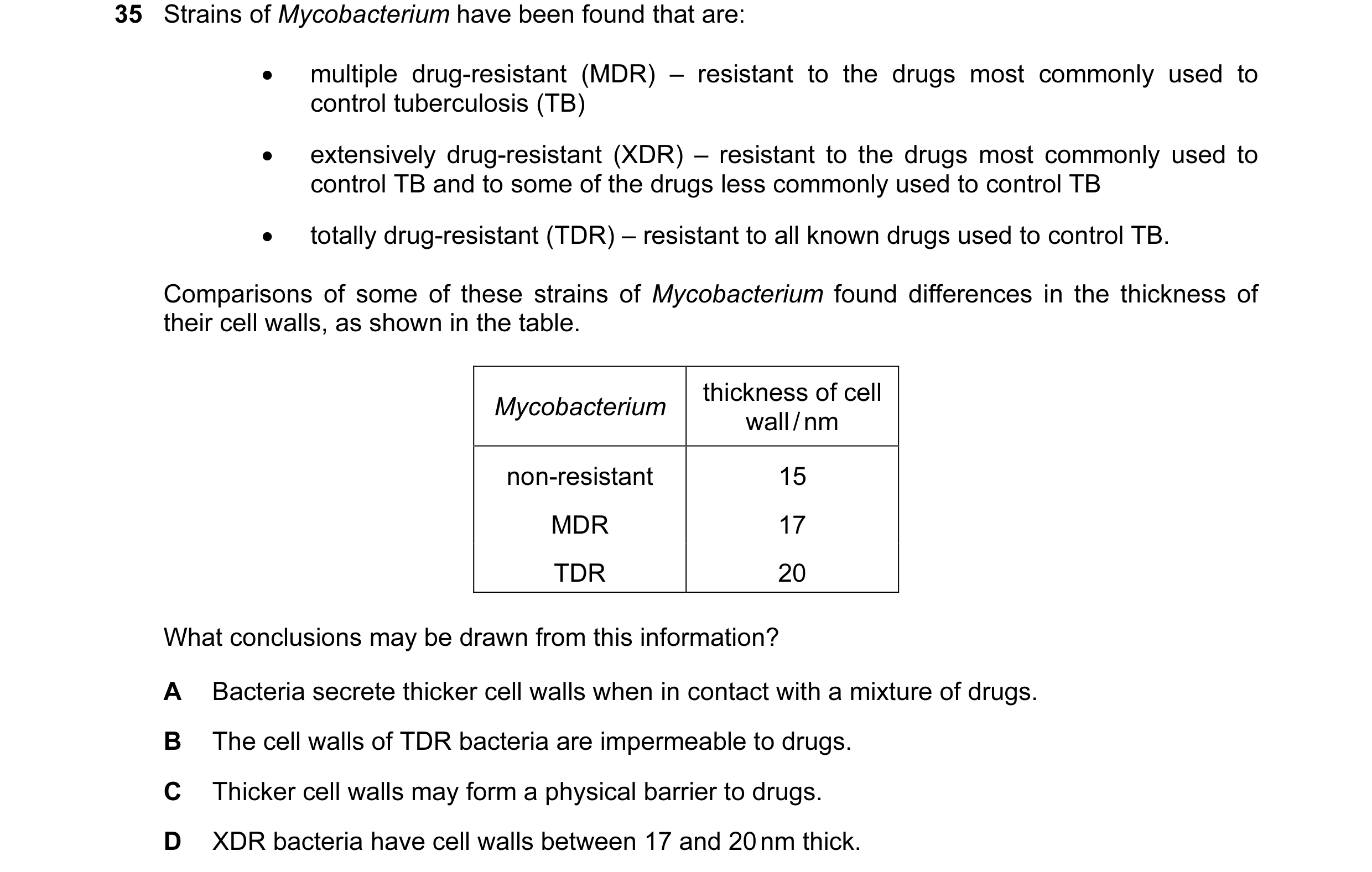
 7 / 32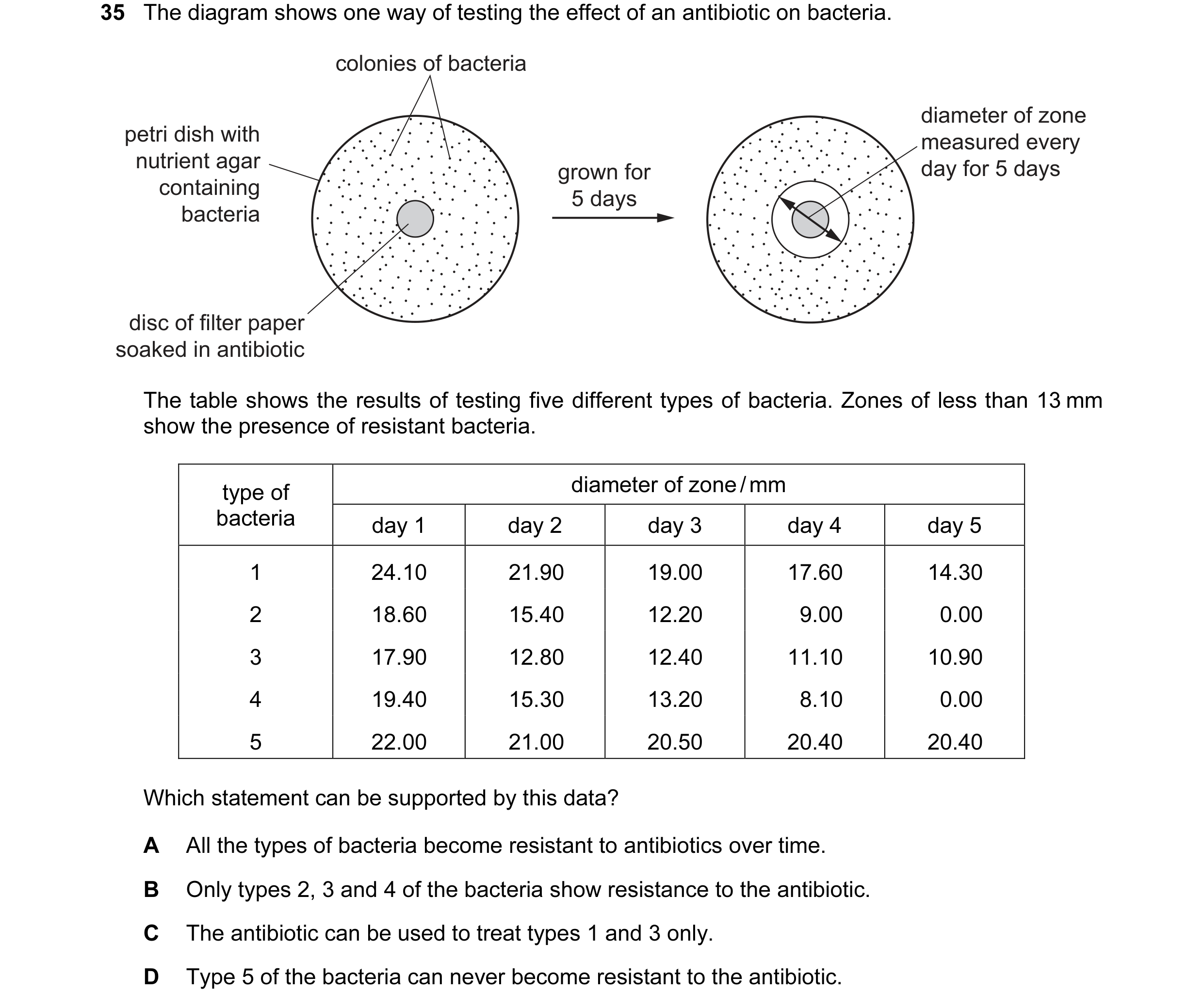
 8 / 32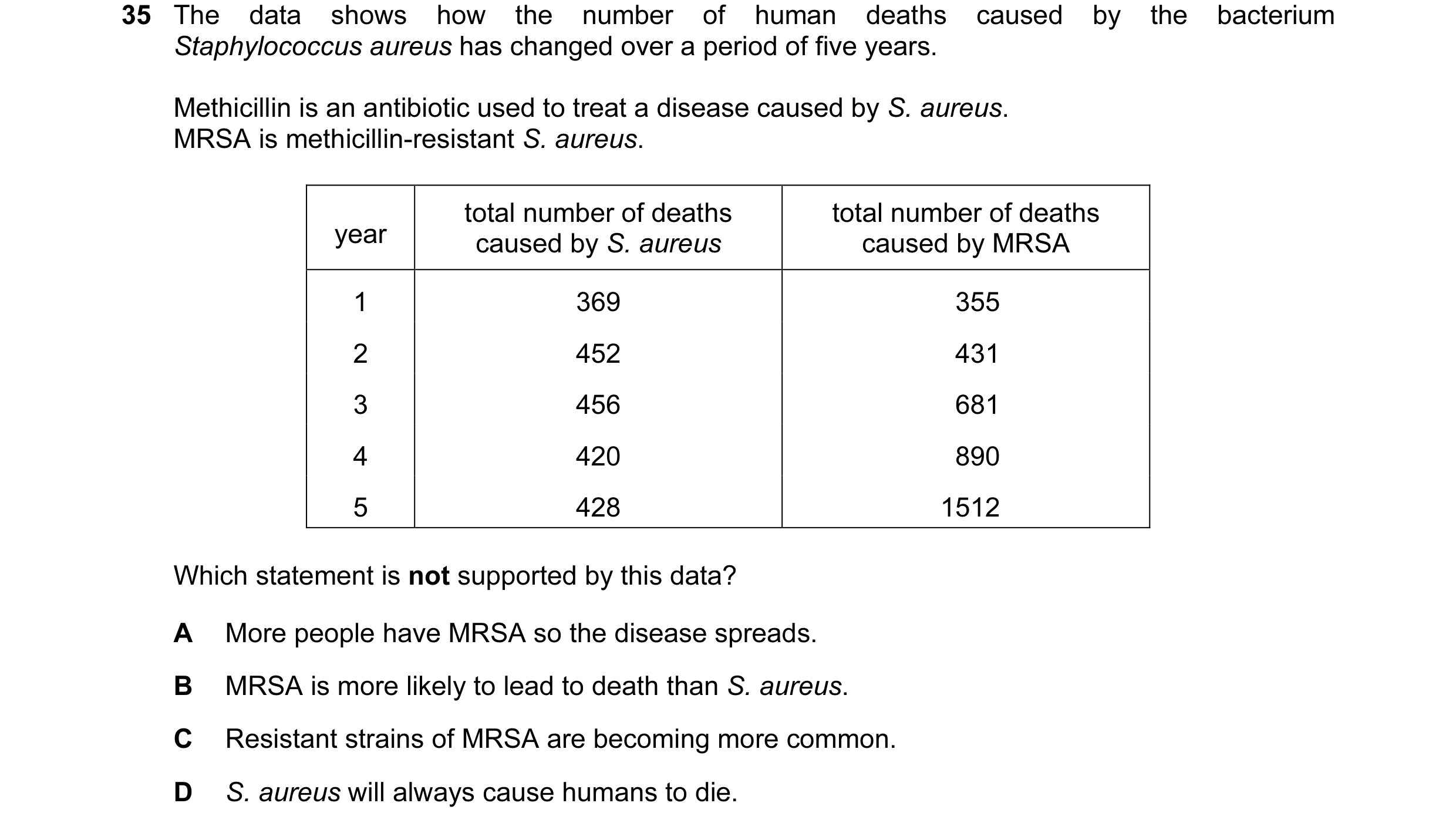

 9 / 32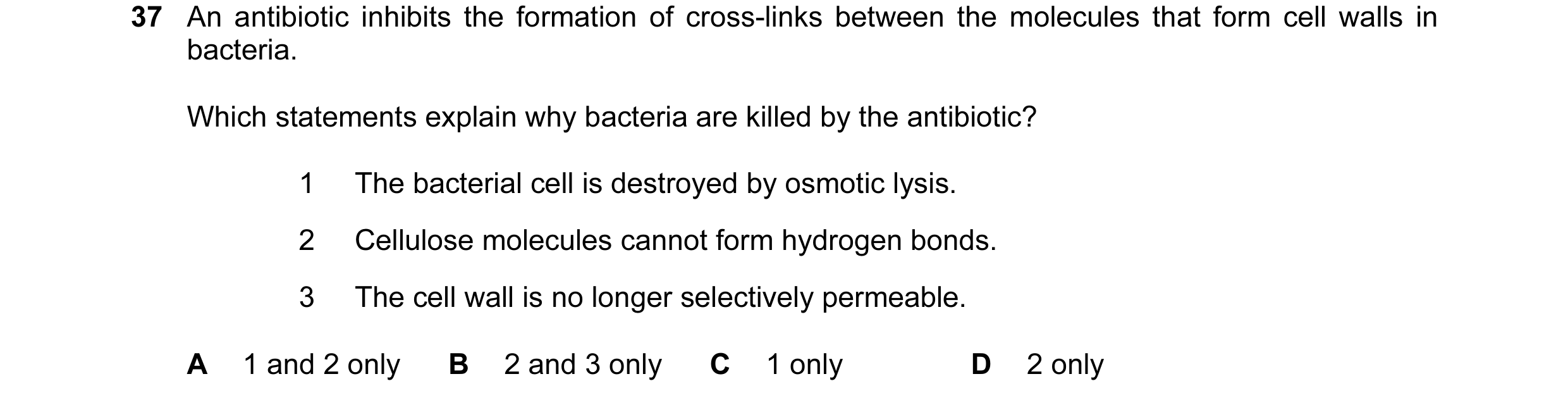
 10 / 32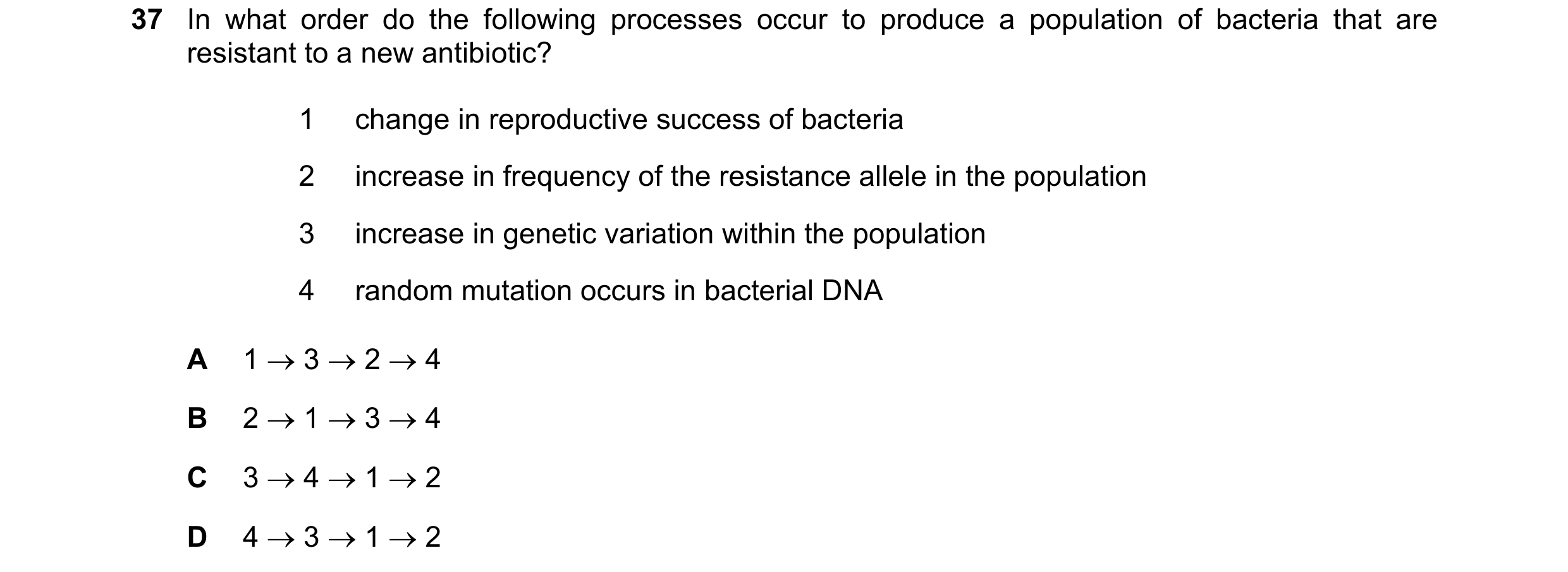
 11 / 32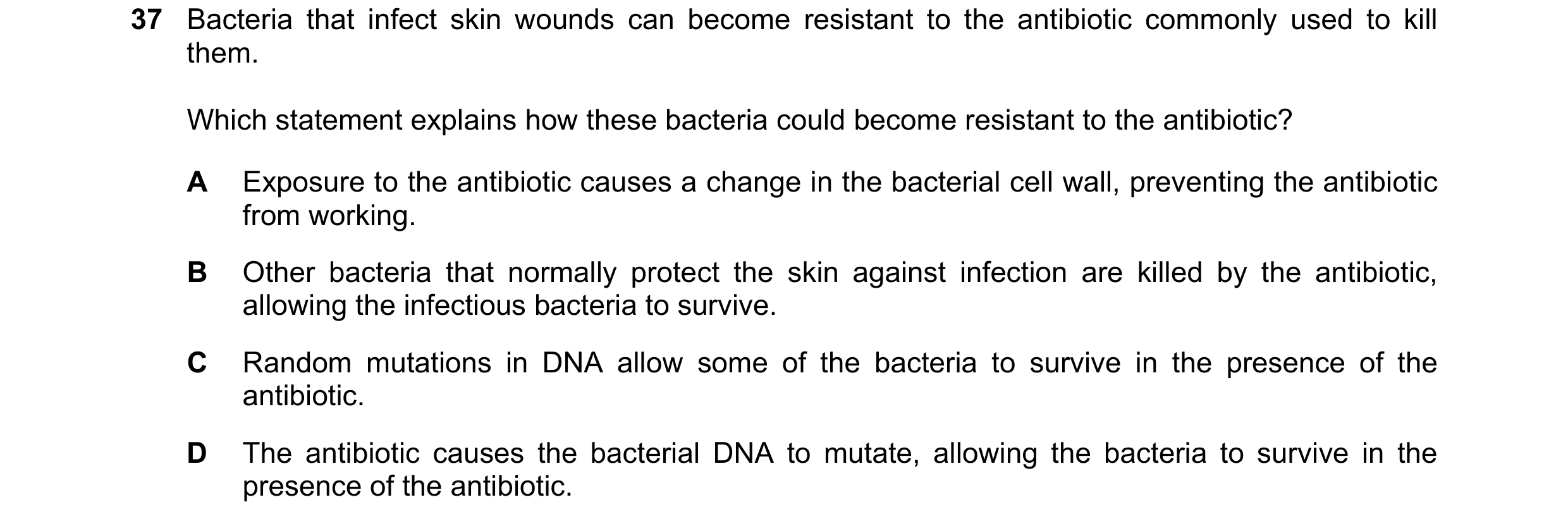
 12 / 32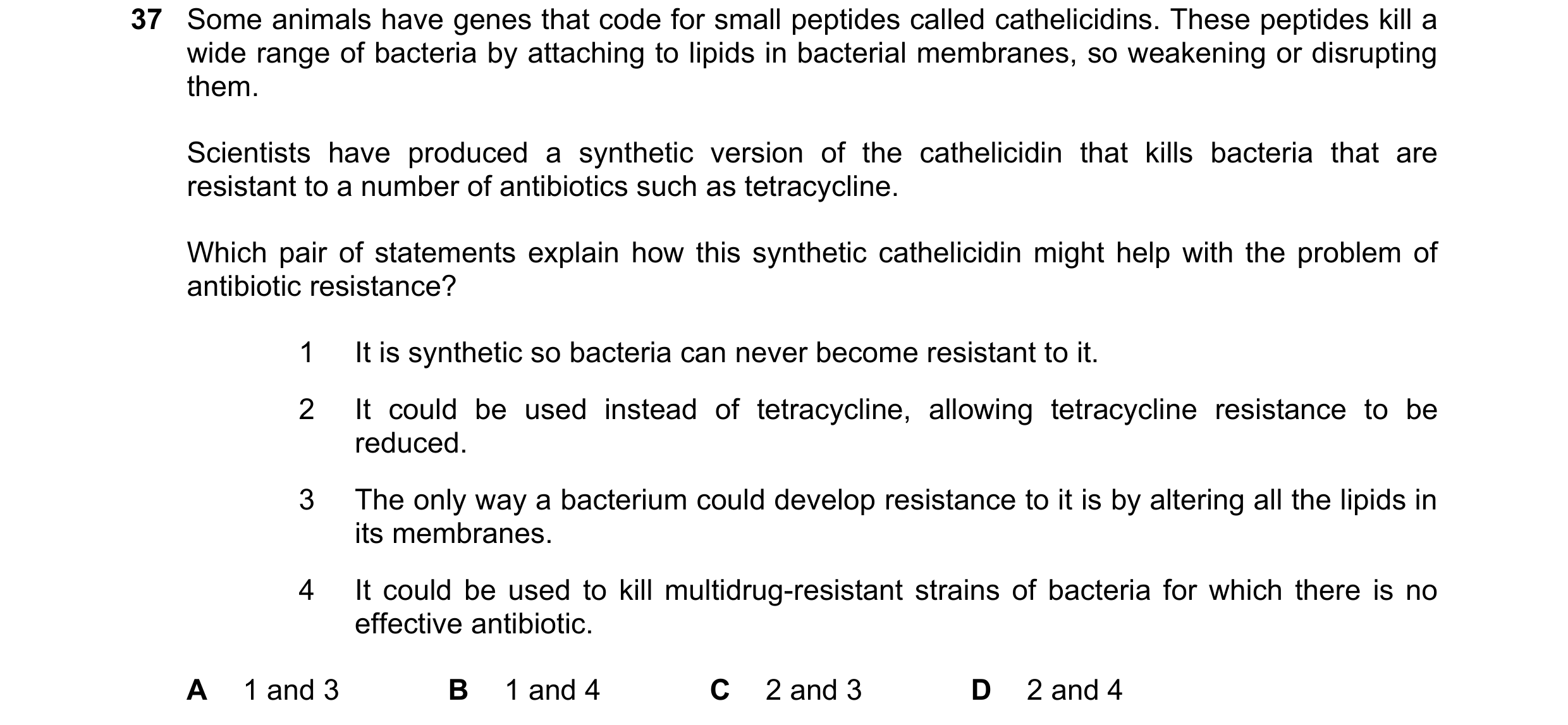
 13 / 32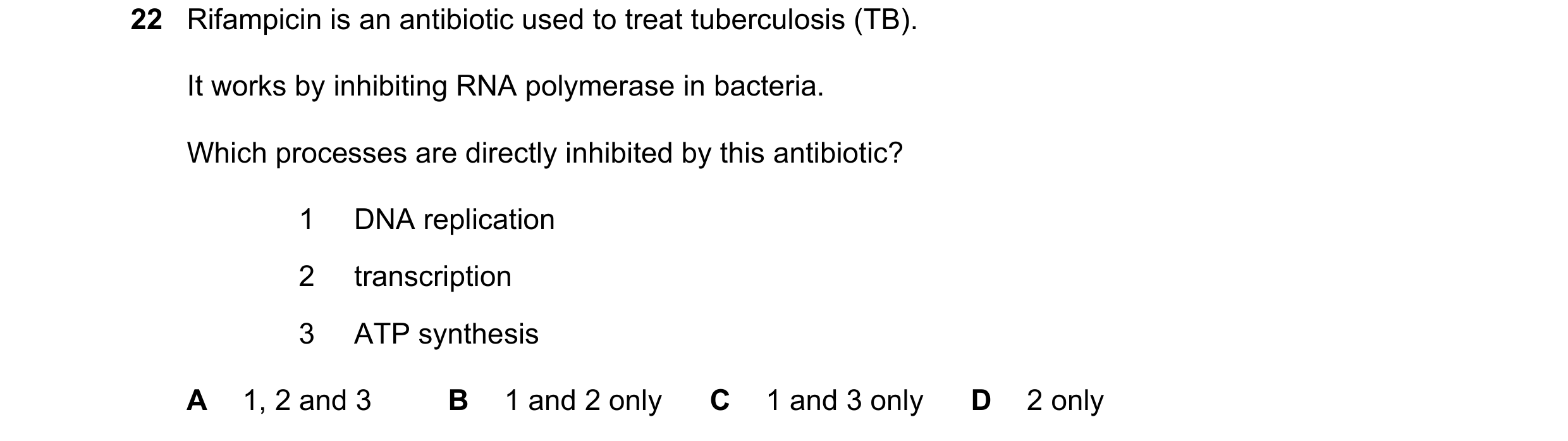



 14 / 32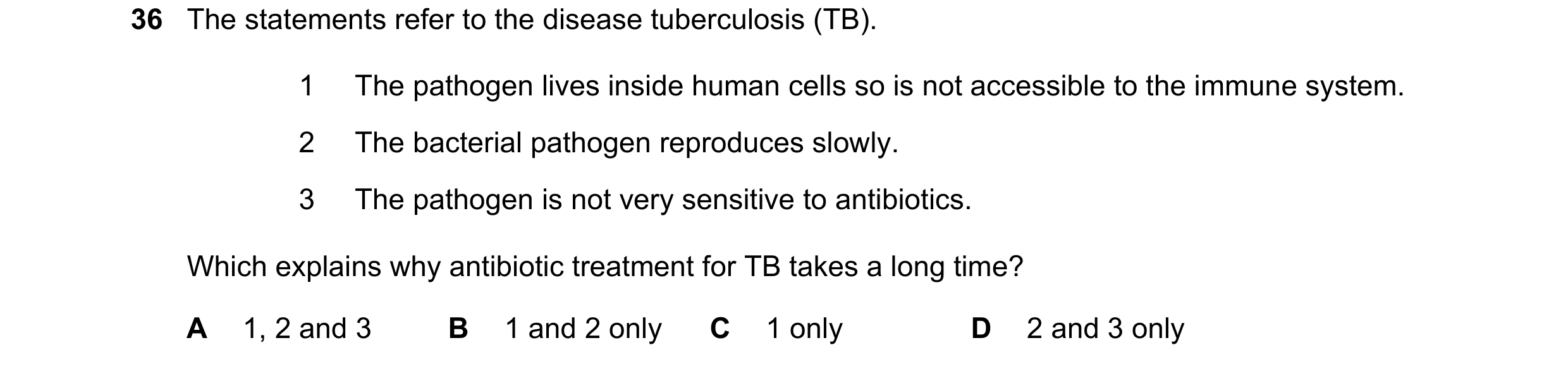

 15 / 32
 16 / 32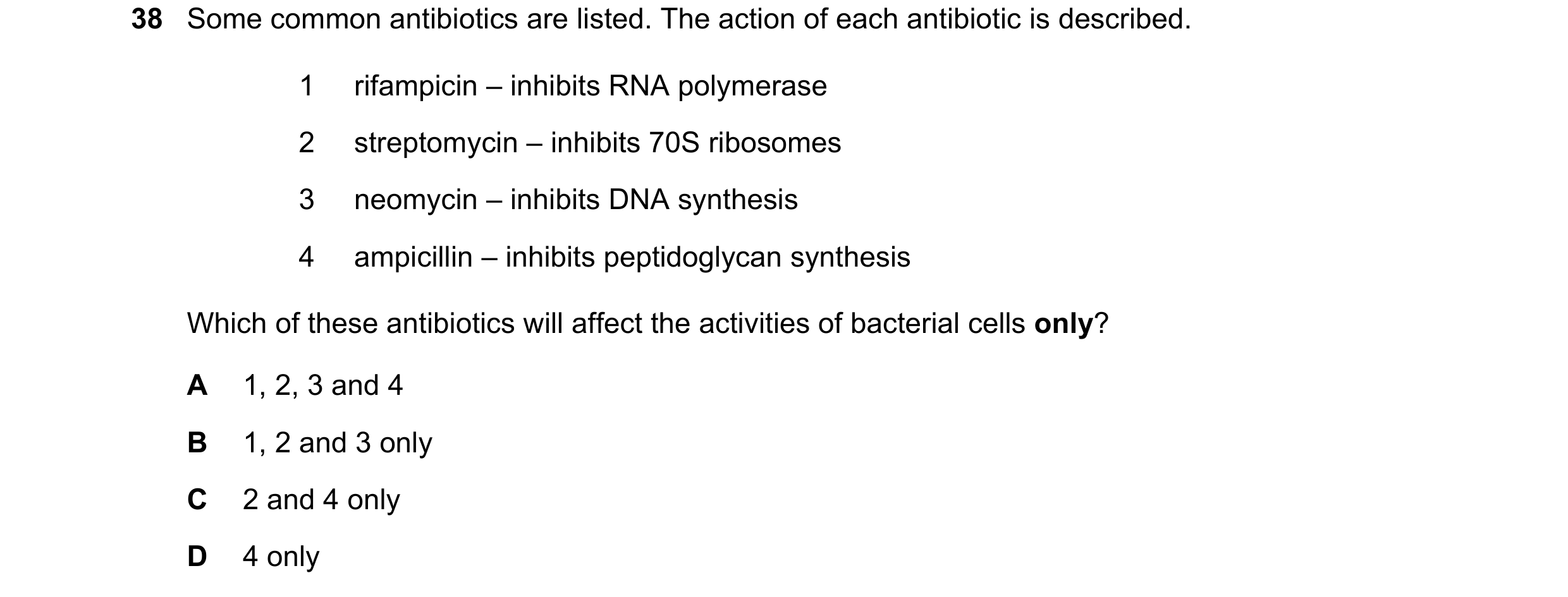
 17 / 32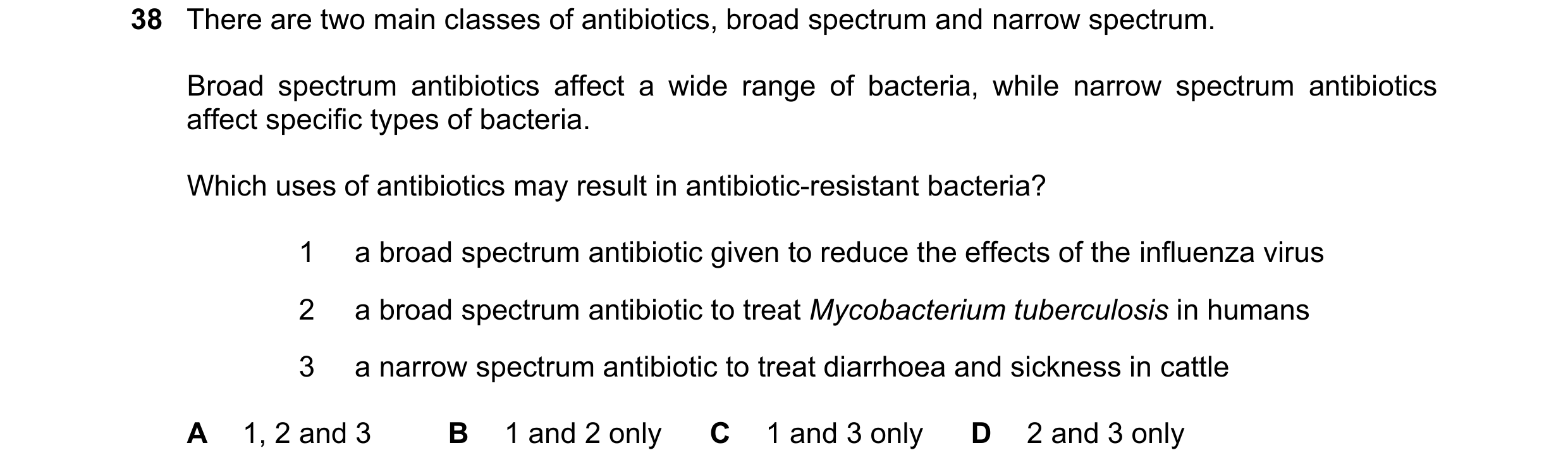

 18 / 32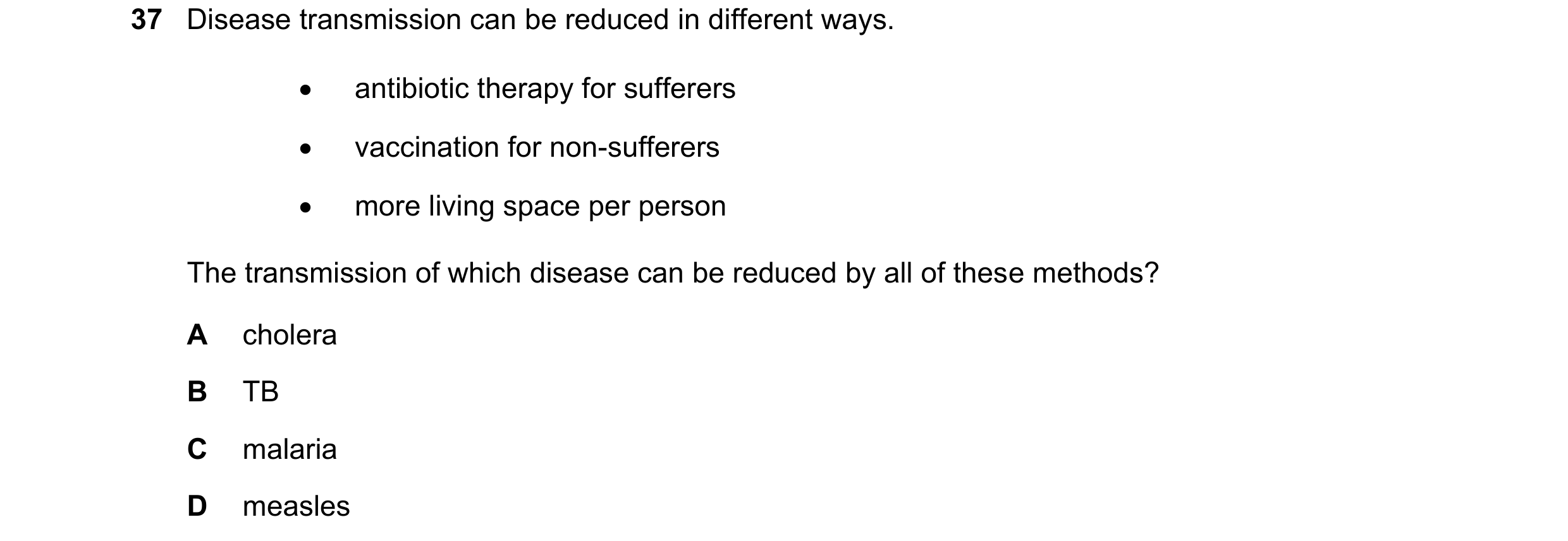

 19 / 32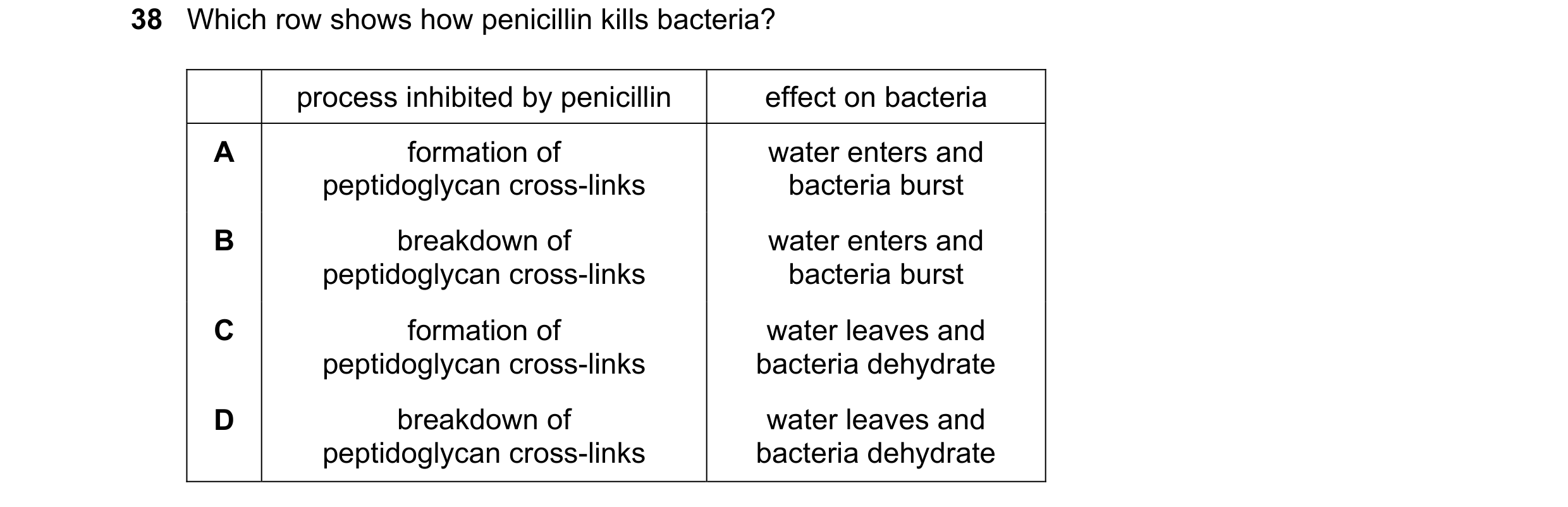

 20 / 32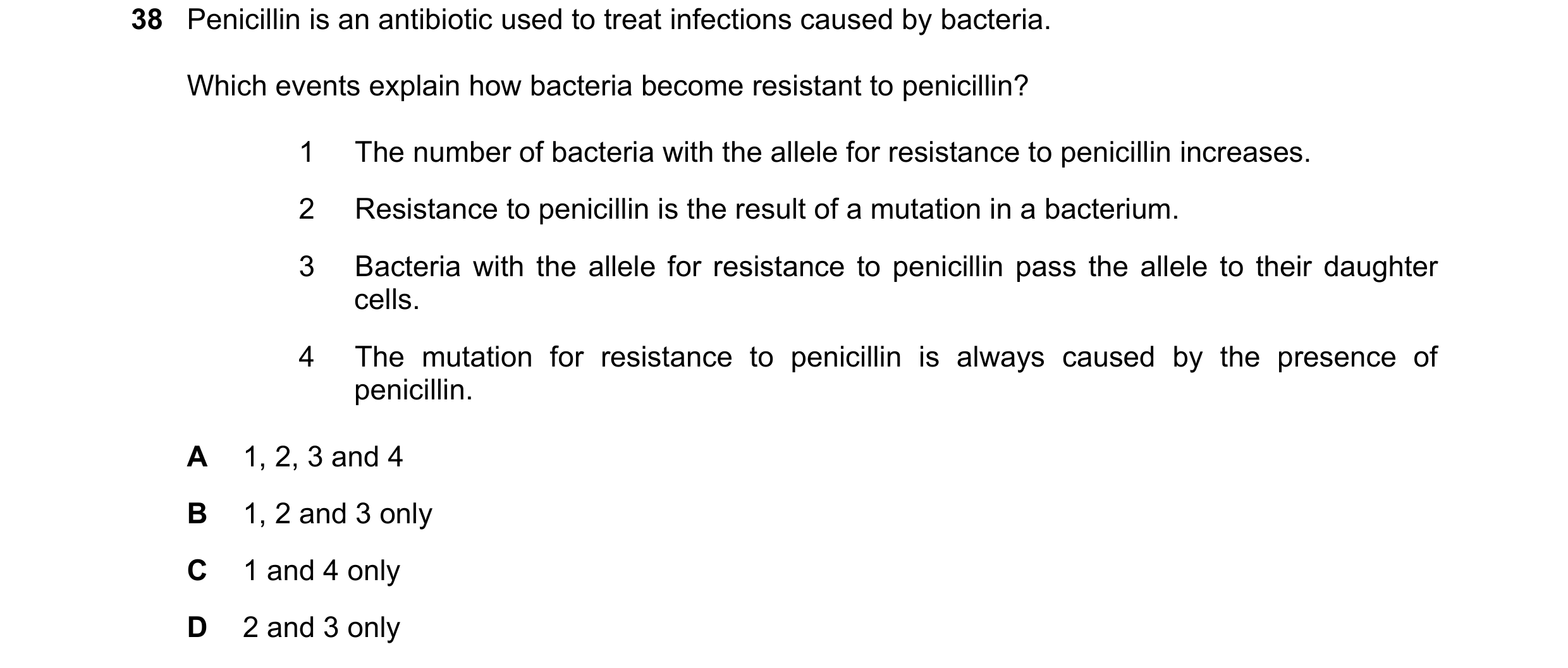
 21 / 32
 22 / 32
 23 / 32
 24 / 32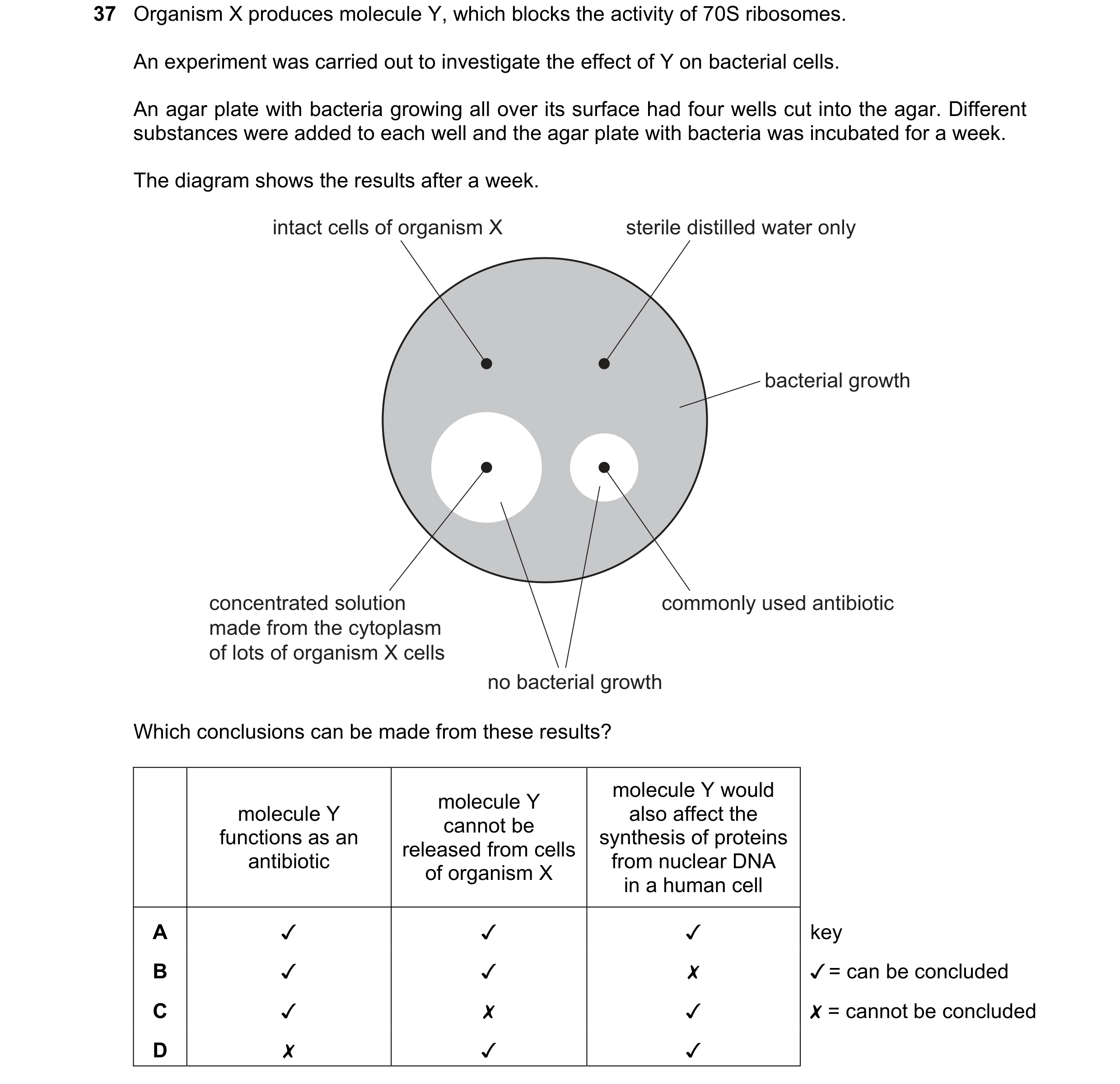
 25 / 32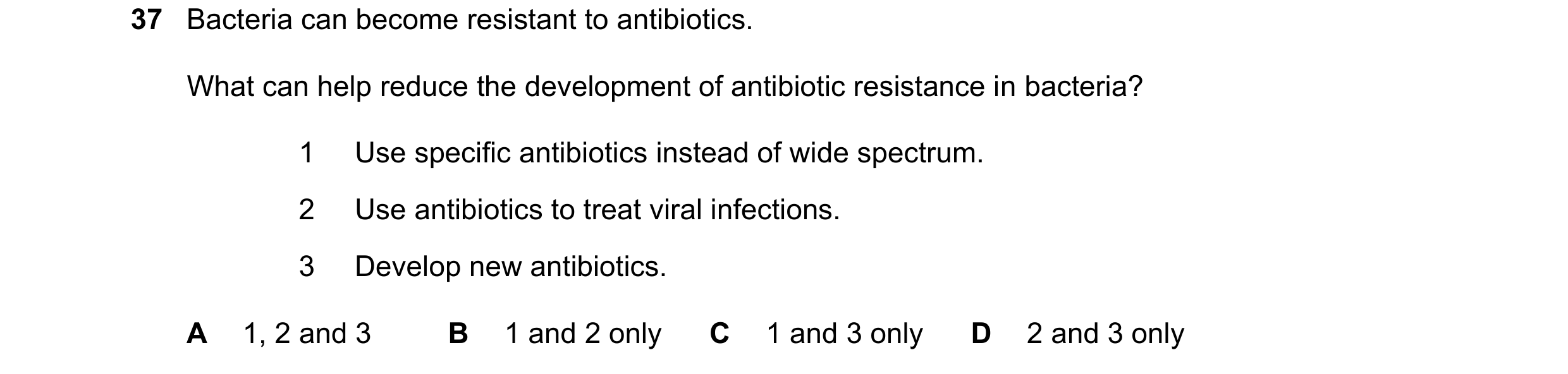
 26 / 32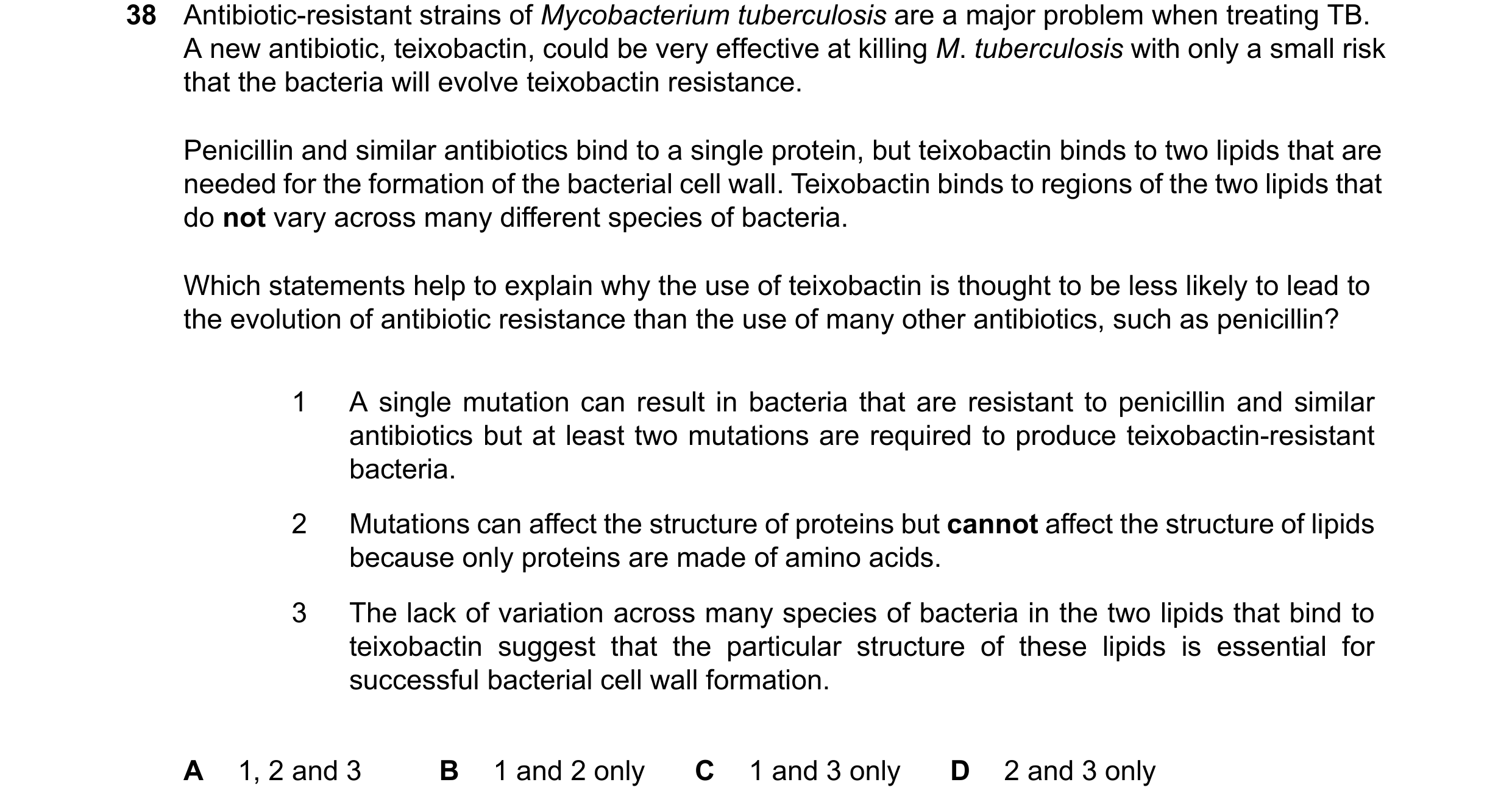
 27 / 32
 28 / 32
 29 / 32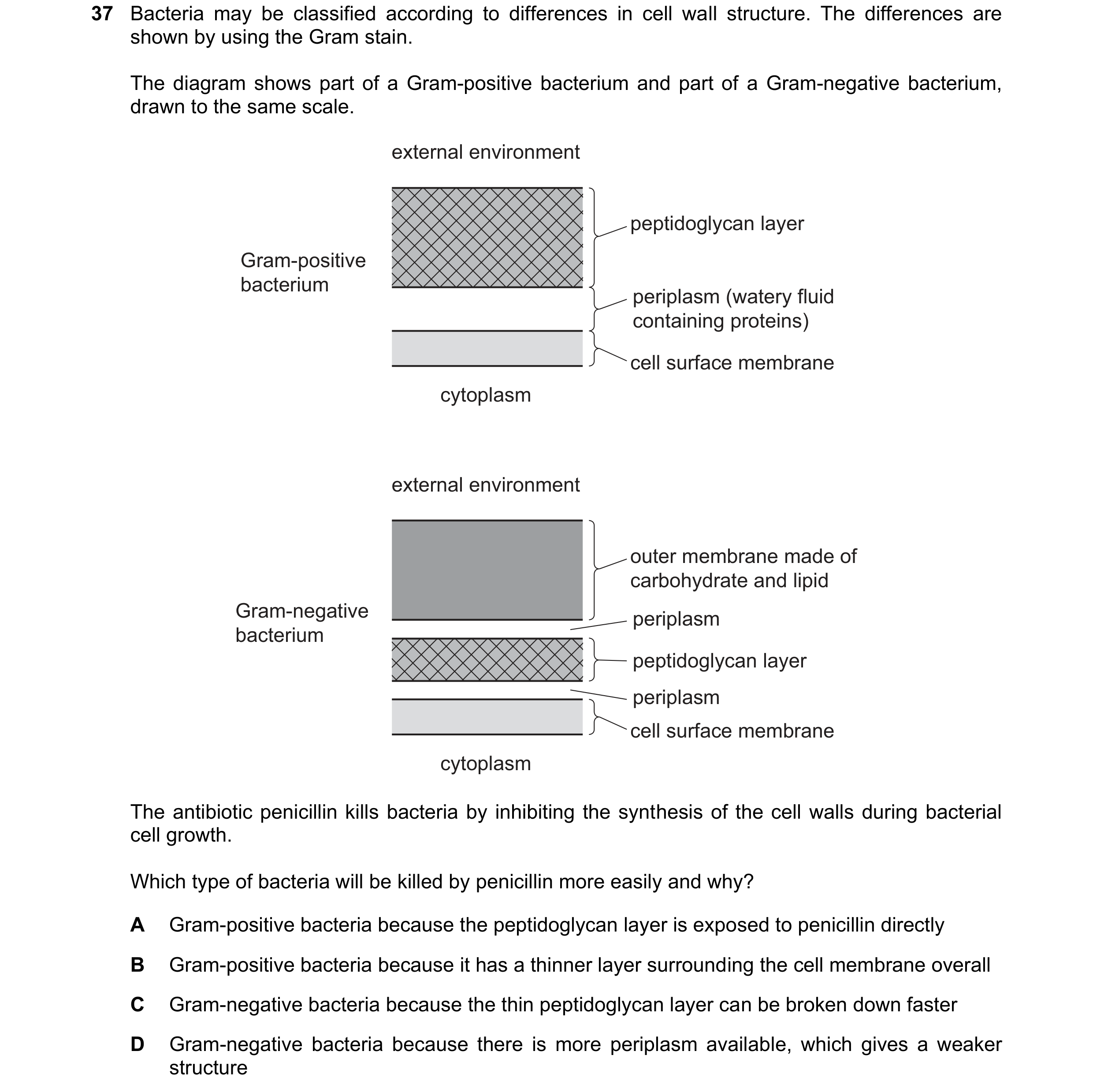
 30 / 32


 31 / 32
 32 / 32