Questions as text
Q1 · Which two substances are normally both crystalline? 9702/11 Oct/Nov 2004
21 Which two substances are normally both crystalline? A copper and diamond B copper and glass C diamond and glass D diamond and rubber
1 marks
Answer: A
This question in 9702/11 Oct/Nov 2004
Q2 · The force F required to extend a sample of rubber by a distance x is found to vary as… 9702/11 Oct/Nov 2004
23 The force F required to extend a sample of rubber by a distance x is found to vary as shown. F / N 40 30 20 10 0 0 1 2 3 4 5 x / m The energy stored in the rubber for an extension of 5 m is A less than 100 J. B 100 J. C between 100 J and 200 J. D more than 200 J.
1 marks
Answer: A
This question in 9702/11 Oct/Nov 2004
Q3 · When white sugar granules are heated, they melt 9702/11 Oct/Nov 2005
19 When white sugar granules are heated, they melt. When the melt is cooled quickly, a brittle solid form of toffee is produced. How does the structure of the sugar change? A amorphous to polymeric B crystalline to amorphous C crystalline to polymeric D polymeric to amorphous
1 marks
Answer: B
This question in 9702/11 Oct/Nov 2005
Q4 · A ductile material is stretched by a tensile force to a point beyond its elastic limit 9702/11 Oct/Nov 2005
20 A ductile material is stretched by a tensile force to a point beyond its elastic limit. The tensile force is then reduced to zero. The graph of force against extension is shown below. force Y X Z 0 0 extension Which area represents the net work done on the sample? A X B X + Y C Y + Z D Z
1 marks
Answer: B
This question in 9702/11 Oct/Nov 2005
Q5 · In describing the behaviour of a spring, the spring constant is used 9702/11 May/June 2006
21 In describing the behaviour of a spring, the spring constant is used. Different loads are used to extend the spring by different amounts. To find the spring constant, which quantities are required? A the elastic limit and the loads B the elastic limit, extensions and the length of the spring C the loads and the extensions of the spring D the loads and the length of the spring
1 marks
Answer: C
This question in 9702/11 May/June 2006
Q6 · The graph shows the behaviour of a sample of a metal when it is stretched until it starts… 9702/11 May/June 2006
22 The graph shows the behaviour of a sample of a metal when it is stretched until it starts to undergo plastic deformation. force / N 550 Y 500 X 0 0 10.0 12.0 extension / mm What is the total work done in stretching the sample from zero extension to 12.0 mm? Simplify the calculation by treating the region XY as a straight line. A 3.30 J B 3.55 J C 3.60 J D 6.60 J
1 marks
Answer: B
This question in 9702/11 May/June 2006
Q7 · A piece of copper is drawn into a continuous wire 9702/11 May/June 2007
17 A piece of copper is drawn into a continuous wire. What behaviour is the copper exhibiting? A brittle only B elastic only C plastic only D both brittle and elastic
1 marks
Answer: C
This question in 9702/11 May/June 2007
Q8 · The force-extension graph of a particular sample of rubber as a load is applied and then… 9702/11 May/June 2007
18 The force-extension graph of a particular sample of rubber as a load is applied and then removed is shown. force 0 0 extension What does the shaded area represent? A the energy transformed into heat during the complete cycle B the recoverable elastic potential energy stored at maximum extension C the work done on the sample while loading D the work done on the sample while unloading
1 marks
Answer: B
This question in 9702/11 May/June 2007
Q9 · A sample of metal is subjected to a force which increases to a maximum value and then… 9702/11 May/June 2008
22 A sample of metal is subjected to a force which increases to a maximum value and then decreases back to zero. A force-extension graph for the sample is shown. force Y X 00 extension When the sample contracts it follows the same force-extension curve as when it was being stretched. What is the behaviour of the metal between X and Y? A both elastic and plastic B elastic but not plastic C plastic but not elastic D not elastic and not plastic
1 marks
Answer: B
This question in 9702/11 May/June 2008
Q10 · A spring of original length 100 mm is compressed by a force 9702/11 May/June 2008
23 A spring of original length 100 mm is compressed by a force. The graph shows the variation of the length L of the spring with the compressing force F. 12 10 F / N 8 6 4 2 0 40 50 60 70 80 90 100 L / mm What is the energy stored in the spring when the length is 70 mm? A 0.090 J B 0.21 J C 0.27 J D 0.63 J
1 marks
Answer: A
This question in 9702/11 May/June 2008
Q11 · Which properties best describe modelling clay? 9702/11 Oct/Nov 2008
19 Which properties best describe modelling clay? A brittle and ductile B ductile and elastic C elastic and plastic D plastic and ductile
1 marks
Answer: D
This question in 9702/11 Oct/Nov 2008
Q12 · A number of similar springs, each having the same spring constant, are joined in four… 9702/11 Oct/Nov 2008
21 A number of similar springs, each having the same spring constant, are joined in four arrangements. The same load is applied to each. Which arrangement gives the greatest extension? A B C D load load load load
1 marks
Answer: C
This question in 9702/11 Oct/Nov 2008
Q13 · Four materials are formed into rods of the same dimensions 9702/11 May/June 2009
19 Four materials are formed into rods of the same dimensions. At room temperature, which can sustain the largest plastic deformation? A the ductile material aluminium B the brittle material carbon C the brittle material glass D the ductile material steel Space for working A
1 marks
Answer: A
This question in 9702/11 May/June 2009
Q14 · A rubber band is stretched by hanging weights on it and the force-extension graph is… 9702/11 May/June 2009
21 A rubber band is stretched by hanging weights on it and the force-extension graph is plotted from the results. 20 force / N 15 10 5 0 0 10 20 30 extension / cm What is the best estimate of the strain energy stored in the rubber band when it is extended 30 cm? A 2.0 J B 2.6 J C 5.1 J D 200 J Space for working
1 marks
Answer: A
This question in 9702/11 May/June 2009
Q15 · Which row best defines elastic and plastic behaviour of a material? 9702/11 Oct/Nov 2009
20 Which row best defines elastic and plastic behaviour of a material? elastic behaviour of a material plastic behaviour of a material A extends only within the limit of proportionality extends beyond the limit of proportionality B has a linear force-extension curve has a horizontal force-extension curve C obeys Hooke’s Law extends continuously under a steady load D returns to its original shape and size suffers permanent deformation Space for working
1 marks
Answer: D
This question in 9702/11 Oct/Nov 2009
Q16 · The graph shows the non-linear force-extension curve for a wire made from a new composite… 9702/11 Oct/Nov 2009
21 The graph shows the non-linear force-extension curve for a wire made from a new composite material. F / N 100 P 0 0 1.0 2.0 x / mm What could be the value of the strain energy stored in the wire when it is stretched to point P? A 0.09 J B 0.10 J C 0.11 J D 0.20 J
1 marks
Answer: C
This question in 9702/11 Oct/Nov 2009
Q17 · Which row best defines elastic and plastic behaviour of a material? 9702/12 Oct/Nov 2009
19 Which row best defines elastic and plastic behaviour of a material? elastic behaviour of a material plastic behaviour of a material A extends only within the limit of proportionality extends beyond the limit of proportionality B has a linear force-extension curve has a horizontal force-extension curve C obeys Hooke’s Law extends continuously under a steady load D returns to its original shape and size suffers permanent deformation Space for working
1 marks
Answer: D
This question in 9702/12 Oct/Nov 2009
Q18 · The graph shows the non-linear force-extension curve for a wire made from a new composite… 9702/12 Oct/Nov 2009
20 The graph shows the non-linear force-extension curve for a wire made from a new composite material. F / N 100 P 0 0 1.0 2.0 x / mm What could be the value of the strain energy stored in the wire when it is stretched to point P? A 0.09 J B 0.10 J C 0.11 J D 0.20 J
1 marks
Answer: C
This question in 9702/12 Oct/Nov 2009
Q19 · A spring is compressed by a force 9702/11 May/June 2010
20 A spring is compressed by a force. The graph shows the compressing force F plotted against the length L of the spring. 12 F / N 10 8 6 4 2 0 40 50 60 70 80 90 100 L / mm What is the spring constant of this spring? A 0.2 N m–1 B 5 N m–1 C 100 N m–1 D 200 N m–1 Space for working
1 marks
Answer: D
This question in 9702/11 May/June 2010
Q20 · Which graph represents the force-extension relationship of a rubber band that is… 9702/11 May/June 2010
21 Which graph represents the force-extension relationship of a rubber band that is stretched almost to its breaking point? A B force force 00 00 extension extension C D force force 00 00 extension extension
1 marks
Answer: A
This question in 9702/11 May/June 2010
Q21 · Which graph represents the force-extension relationship of a rubber band that is… 9702/13 May/June 2010
19 Which graph represents the force-extension relationship of a rubber band that is stretched almost to its breaking point? A B force force 00 00 extension extension C D force force 00 00 extension extension Space for working
1 marks
Answer: A
This question in 9702/13 May/June 2010
Q22 · Which group of materials contains two polymers? 9702/12 Oct/Nov 2010
19 Which group of materials contains two polymers? A copper sand polystyrene B glass wood aluminium C nylon sugar rubber D stone diamond steel
1 marks
Answer: C
This question in 9702/12 Oct/Nov 2010
Q23 · To determine the mass of food in a pan, a scale is used that has high sensitivity for… 9702/12 Oct/Nov 2010
22 To determine the mass of food in a pan, a scale is used that has high sensitivity for small masses but low sensitivity for large masses. To do this, two springs are used, each with a different spring constant k. One of the springs has a low spring constant and the other has a high spring constant. Which arrangement of springs would be suitable? A B rigid box low k low k high k high k C D high k rigid box low k high k low k Space for working
1 marks
Answer: A
This question in 9702/12 Oct/Nov 2010
Q24 · The graph shows how force depends on extension for a certain spring 9702/13 Oct/Nov 2010
19 The graph shows how force depends on extension for a certain spring. 10.0 F / N 8.0 6.0 4.0 2.0 0.0 0 10 20 30 40 50 extension / mm What is the energy stored in the spring when the extension is 30 mm? A 0.095 J B 0.19 J C 0.25 J D 0.95 J
1 marks
Answer: A
This question in 9702/13 Oct/Nov 2010
Q25 · A long, thin metal wire is suspended from a fixed support and hangs vertically 9702/11 May/June 2011
20 A long, thin metal wire is suspended from a fixed support and hangs vertically. Masses are suspended from its lower end. The load on the lower end is increased from zero and then decreased again back to zero. The diagram shows the force-extension graph produced. force T S R 0 0 V extension Where on the graph would the elastic limit be found? A anywhere between point R and point S B beyond point S but before point T C exactly at point S D exactly at point T Space for working
1 marks
Answer: B
This question in 9702/11 May/June 2011
Q26 · The diagram shows the structure of part of a mattress 9702/12 May/June 2011
24 The diagram shows the structure of part of a mattress. spring layer 1 layer 2 The manufacturer wants to design a softer mattress (one which will compress more for the same load). Which change will not have the desired effect? A using more layers of springs B using more springs per unit area C using springs with a smaller spring constant D using springs made from wire with a smaller Young modulus
1 marks
Answer: B
This question in 9702/12 May/June 2011
Q27 · A long, thin metal wire is suspended from a fixed support and hangs vertically 9702/13 May/June 2011
21 A long, thin metal wire is suspended from a fixed support and hangs vertically. Masses are suspended from its lower end. The load on the lower end is increased from zero and then decreased again back to zero. The diagram shows the force-extension graph produced. force T S R 0 0 V extension Where on the graph would the elastic limit be found? A anywhere between point R and point S B beyond point S but before point T C exactly at point S D exactly at point T Space for working
1 marks
Answer: B
This question in 9702/13 May/June 2011
Q28 · A rubber band is stretched and then relaxed to its original length 9702/11 Oct/Nov 2011
24 A rubber band is stretched and then relaxed to its original length. The diagram shows the force-extension graph for this process. Q force P area X R area Y O 00 e extension As the force is increased, the curve follows the path OPQ to extension e. As the force is reduced, the curve follows the path QRO to return to zero extension. The area labelled X is between the curves OPQ and QRO. The area labelled Y is bounded by the curve QRO and the horizontal axis. Which statement about the process is correct? A Area X is the energy which heats the band as it is stretched to e. B (Area X + area Y) is the minimum energy required to stretch the band to e. C Area X is the elastic potential energy stored in the band when it is stretched to e. D (Area Y – area X) is the net work done on the band during the process. Space for working
1 marks
Answer: B
This question in 9702/11 Oct/Nov 2011
Q29 · When describing the behaviour of a spring, the spring constant is used 9702/11 Oct/Nov 2011
25 When describing the behaviour of a spring, the spring constant is used. Different loads are used to extend the spring by different amounts. To find the spring constant, which quantities are required? A the elastic limit and the loads B the elastic limit, extensions and the length of the spring C the loads and the extensions of the spring D the loads and the length of the spring
1 marks
Answer: C
This question in 9702/11 Oct/Nov 2011
Q30 · The graph shows the effect of applying a force of up to 5 N to a spring 9702/12 Oct/Nov 2011
22 The graph shows the effect of applying a force of up to 5 N to a spring. 14 spring length / cm 11 10 0 5 force / N What is the total increase in length produced by a 7 N force, assuming the spring obeys Hooke’s law? A 4.2 cm B 5.6 cm C 15.2 cm D 19.6 cm Space for working
1 marks
Answer: A
This question in 9702/12 Oct/Nov 2011
Q31 · The following force-extension graphs are drawn to the same scale 9702/12 Oct/Nov 2011
23 The following force-extension graphs are drawn to the same scale. Which graph represents the deformed object with the greatest amount of elastic potential energy? A B force force 00 00 extension extension C D force force 00 00 extension extension Space for working
1 marks
Answer: B
This question in 9702/12 Oct/Nov 2011
Q32 · A rubber band is stretched and then relaxed to its original length 9702/13 Oct/Nov 2011
22 A rubber band is stretched and then relaxed to its original length. The diagram shows the force-extension graph for this process. Q force P area X R area Y O 00 e extension As the force is increased, the curve follows the path OPQ to extension e. As the force is reduced, the curve follows the path QRO to return to zero extension. The area labelled X is between the curves OPQ and QRO. The area labelled Y is bounded by the curve QRO and the horizontal axis. Which statement about the process is correct? A Area X is the energy which heats the band as it is stretched to e. B (Area X + area Y) is the minimum energy required to stretch the band to e. C Area X is the elastic potential energy stored in the band when it is stretched to e. D (Area Y – area X) is the net work done on the band during the process. Space for working
1 marks
Answer: B
This question in 9702/13 Oct/Nov 2011
Q33 · When describing the behaviour of a spring, the spring constant is used 9702/13 Oct/Nov 2011
26 When describing the behaviour of a spring, the spring constant is used. Different loads are used to extend the spring by different amounts. To find the spring constant, which quantities are required? A the elastic limit and the loads B the elastic limit, extensions and the length of the spring C the loads and the extensions of the spring D the loads and the length of the spring
1 marks
Answer: C
This question in 9702/13 Oct/Nov 2011
Q34 · The graph is a force-extension graph for a wire that is being stretched 9702/12 May/June 2012
24 The graph is a force-extension graph for a wire that is being stretched. 30 force / N 25 20 15 10 5 0 0 5 10 15 20 extension / mm How much work needs to be done by the tensile force, to two significant figures, to cause an extension of 7.0 mm? A 0.088 J B 0.12 J C 0.53 J D 120 J
1 marks
Answer: B
This question in 9702/12 May/June 2012
Q35 · Three springs are arranged vertically as shown 9702/11 Oct/Nov 2012
23 Three springs are arranged vertically as shown. P Q R W Springs P and Q are identical and have spring constant k. Spring R has spring constant 3k. What is the increase in the overall length of the arrangement when a force W is applied as shown? A 5 W B 4 W C 7 kW D 4 kW 6 k 3 k 2 Space for working
1 marks
Answer: A
This question in 9702/11 Oct/Nov 2012
Q36 · The diagram shows the stress-strain graph for two wires X and Y of different materials up… 9702/11 Oct/Nov 2012
24 The diagram shows the stress-strain graph for two wires X and Y of different materials up to their breaking points. Both wires have the same initial dimensions. stress X Y 00 strain Which statement is not correct? A Material X extends elastically. B Material X extends more than material Y when loaded with the same force. C Material X has a larger ultimate tensile stress. D Material X is brittle.
1 marks
Answer: B
This question in 9702/11 Oct/Nov 2012
Q37 · Which row gives the correct description for the arrangement of atoms in the four types of… 9702/12 Oct/Nov 2012
24 Which row gives the correct description for the arrangement of atoms in the four types of material? atoms have an ordered atoms are arranged atoms have no atoms form giant arrangement in regions, but in an ordered way long-range order chain-like molecules these ordered regions are at throughout angles to one another A crystalline amorphous polymeric polycrystalline B polycrystalline crystalline amorphous polymeric C polymeric polycrystalline crystalline amorphous D amorphous polymeric polycrystalline crystalline Space for working
1 marks
Answer: D
This question in 9702/12 Oct/Nov 2012
Q38 · The diagram shows the force-extension graphs for two materials, of the same dimensions… 9702/12 Oct/Nov 2012
26 The diagram shows the force-extension graphs for two materials, of the same dimensions, loaded to fracture. force 00 extension What describes the behaviour of the materials? A Both materials are brittle. B Both materials obey Hooke’s law. C Both materials are plastic. D Both materials have the same ultimate tensile stress. Space for working
1 marks
Answer: D
This question in 9702/12 Oct/Nov 2012
Q39 · A trolley is held at rest between two steel springs 9702/13 Oct/Nov 2012
24 A trolley is held at rest between two steel springs. P Q Each spring has an unstretched length of 0.10 m. Spring P has spring constant 60 N m–1. Spring Q has spring constant 120 N m–1. Spring P has an extension of 0.40 m. What is the extension of spring Q? A 0.10 m B 0.20 m C 0.30 m D 0.80 m
1 marks
Answer: B
This question in 9702/13 Oct/Nov 2012
Q40 · The stress-strain graphs for four different materials are shown below 9702/11 May/June 2013
22 The stress-strain graphs for four different materials are shown below. Which diagram shows the stress-strain graph for a ductile metal? A B stress stress 00 00 strain strain C D stress stress 00 00 strain strain Space for working
1 marks
Answer: A
This question in 9702/11 May/June 2013
Q41 · A rubber cord hangs from a rigid support 9702/12 May/June 2013
22 A rubber cord hangs from a rigid support. A weight attached to its lower end is gradually increased from zero, and then gradually reduced to zero. force stretching rubber cord contraction weight 00 extension The force-extension curve for contraction is below the force-extension curve for stretching. What does the shaded area between the curves represent? A the amount of elastic energy stored in the rubber B the amount of thermal energy dissipated in the rubber C the work done on the rubber cord during stretching D the work done by the rubber cord during contraction Space for working
1 marks
Answer: B
This question in 9702/12 May/June 2013
Q42 · A spring of unextended length 40 mm is suspended from a fixed point 9702/13 May/June 2013
15 A spring of unextended length 40 mm is suspended from a fixed point. A load of 16 N is applied to the free end of the spring. This causes the spring to extend so that its final length is five times its original length. The spring obeys Hooke’s Law. What is the energy stored in the spring due to this extension? A 1.3 J B 1.6 J C 2.6 J D 3.2 J Space for working
1 marks
Answer: A
This question in 9702/13 May/June 2013
Q43 · Which graph represents the force-extension relationship of a rubber band that is… 9702/13 May/June 2013
20 Which graph represents the force-extension relationship of a rubber band that is stretched almost to its breaking point? A B force force 0 0 0 0 extension extension C D force force 0 0 0 0 extension extension Space for working
1 marks
Answer: A
This question in 9702/13 May/June 2013
Q44 · A spring is stretched over a range within which elastic deformation occurs 9702/13 May/June 2013
21 A spring is stretched over a range within which elastic deformation occurs. Its spring constant is 3.0 N cm–1. Which row, for the stated applied force, gives the correct extension and strain energy? force extension strain energy / N / cm / mJ A 3.0 1.0 1.5 B 6.0 2.0 120 C 12.0 3.0 180 D 24.0 8.0 960
1 marks
Answer: D
This question in 9702/13 May/June 2013
Q45 · Which two substances are normally both crystalline? 9702/11 Oct/Nov 2013
21 Which two substances are normally both crystalline? A copper and diamond B copper and glass C diamond and glass D diamond and rubber Space for working
1 marks
Answer: A
This question in 9702/11 Oct/Nov 2013
Q46 · Which properties best describe modelling clay? 9702/11 Oct/Nov 2013
23 Which properties best describe modelling clay? A brittle and ductile B ductile and elastic C elastic and plastic D plastic and ductile
1 marks
Answer: D
This question in 9702/11 Oct/Nov 2013
Q47 · Which two substances are normally both crystalline? 9702/12 Oct/Nov 2013
21 Which two substances are normally both crystalline? A copper and diamond B copper and glass C diamond and glass D diamond and rubber Space for working
1 marks
Answer: A
This question in 9702/12 Oct/Nov 2013
Q48 · Which properties best describe modelling clay? 9702/12 Oct/Nov 2013
23 Which properties best describe modelling clay? A brittle and ductile B ductile and elastic C elastic and plastic D plastic and ductile
1 marks
Answer: D
This question in 9702/12 Oct/Nov 2013
Q49 · A steel spring has a spring constant of 150 N m–1 9702/12 Oct/Nov 2013
24 A steel spring has a spring constant of 150 N m–1. When a 25 N weight is hung from the spring, it has a stretched length of 55 cm. What was the original length of the spring? A 0.38 m B 0.49 m C 0.61 m D 0.72 m Space for working
1 marks
Answer: A
This question in 9702/12 Oct/Nov 2013
Q50 · A diving board of length 5.0 m is hinged at one end and supported 2.0 m from this end by… 9702/13 Oct/Nov 2013
15 A diving board of length 5.0 m is hinged at one end and supported 2.0 m from this end by a spring of spring constant 10 kN m–1. A child of mass 40 kg stands at the far end of the board. mass of child 40 kg diving board 2.0 m spring hinge 5.0 m What is the extra compression of the spring caused by the child standing on the end of the board? A 1.0 cm B 1.6 cm C 9.8 cm D 16 cm Space for working
1 marks
Answer: C
This question in 9702/13 Oct/Nov 2013
Q51 · The stress-strain graphs for three different materials are shown, not drawn to the same… 9702/11 May/June 2014
20 The stress-strain graphs for three different materials are shown, not drawn to the same scales. 1 2 3 stress stress stress 00 00 00 strain strain strain The three materials are copper, rubber and glass. Which materials are represented by the graphs? 1 2 3 A copper glass rubber B copper rubber glass C glass copper rubber D glass rubber copper Space for working
1 marks
Answer: B
This question in 9702/11 May/June 2014
Q52 · A sample of metal is subjected to a force which increases to a maximum value and then… 9702/12 May/June 2014
19 A sample of metal is subjected to a force which increases to a maximum value and then decreases back to zero. A force-extension graph for the sample is shown. force Y X 0 0 extension When the sample contracts it follows the same force-extension curve as when it was being stretched. What is the behaviour of the metal between X and Y? A both elastic and plastic B not elastic and not plastic C plastic but not elastic D elastic but not plastic Space for working
1 marks
Answer: D
This question in 9702/12 May/June 2014
Q53 · The graph shows the length of a spring as it is stretched by an increasing load 9702/12 May/June 2014
20 The graph shows the length of a spring as it is stretched by an increasing load. 15 length / cm 10 5 0 0 0.1 0.2 0.3 0.4 0.5 load / N What is the spring constant? A 8.0 N m–1 B 2.7 N m–1 C 0.13 N m–1 D 0.080 N m–1 Space for working
1 marks
Answer: A
This question in 9702/12 May/June 2014
Q54 · Cylindrical samples of steel, glass and rubber are each subjected to a gradually… 9702/13 May/June 2014
24 Cylindrical samples of steel, glass and rubber are each subjected to a gradually increasing tensile force F. The extensions e are measured and graphs are plotted as shown below. F F F 00 e 00 e 00 e graph X graph Y graph Z Which row correctly relates the graphs to the materials? steel glass rubber A X Y Z B X Z Y C Y X Z D Y Z X
1 marks
Answer: D
This question in 9702/13 May/June 2014
Q55 · What is the correct name for a material containing long-chain molecules that are tangled… 9702/11 Oct/Nov 2014
17 What is the correct name for a material containing long-chain molecules that are tangled and coiled? A amorphous metal B amorphous polymer C crystalline metal D crystalline polymer Space for working
1 marks
Answer: B
This question in 9702/11 Oct/Nov 2014
Q56 · The stress-strain graph for a glass rod, up to the point at which it breaks, is shown… 9702/11 Oct/Nov 2014
20 The stress-strain graph for a glass rod, up to the point at which it breaks, is shown below. stress 00 strain Which statement about the glass rod is correct? A Hooke’s law is obeyed for all values of stress up to the breaking point. B The glass is ductile. C The glass shows plastic deformation. D When the cross-sectional area of the rod is doubled, the ultimate tensile stress of the rod is halved.
1 marks
Answer: A
This question in 9702/11 Oct/Nov 2014
Q57 · A rubber band is stretched by hanging weights on it and the force-extension graph is… 9702/11 Oct/Nov 2014
21 A rubber band is stretched by hanging weights on it and the force-extension graph is plotted from the results. 20 force / N 15 10 5 0 0 10 20 30 extension / cm What is the best estimate of the strain energy stored in the rubber band when it is extended 30 cm? A 1.8 J B 2.6 J C 5.1 J D 200 J Space for working
1 marks
Answer: A
This question in 9702/11 Oct/Nov 2014
Q58 · What is the correct name for a material containing long-chain molecules that are tangled… 9702/12 Oct/Nov 2014
17 What is the correct name for a material containing long-chain molecules that are tangled and coiled? A amorphous metal B amorphous polymer C crystalline metal D crystalline polymer Space for working
1 marks
Answer: B
This question in 9702/12 Oct/Nov 2014
Q59 · The stress-strain graph for a glass rod, up to the point at which it breaks, is shown… 9702/12 Oct/Nov 2014
20 The stress-strain graph for a glass rod, up to the point at which it breaks, is shown below. stress 00 strain Which statement about the glass rod is correct? A Hooke’s law is obeyed for all values of stress up to the breaking point. B The glass is ductile. C The glass shows plastic deformation. D When the cross-sectional area of the rod is doubled, the ultimate tensile stress of the rod is halved.
1 marks
Answer: A
This question in 9702/12 Oct/Nov 2014
Q60 · A rubber band is stretched by hanging weights on it and the force-extension graph is… 9702/12 Oct/Nov 2014
21 A rubber band is stretched by hanging weights on it and the force-extension graph is plotted from the results. 20 force / N 15 10 5 0 0 10 20 30 extension / cm What is the best estimate of the strain energy stored in the rubber band when it is extended 30 cm? A 1.8 J B 2.6 J C 5.1 J D 200 J Space for working
1 marks
Answer: A
This question in 9702/12 Oct/Nov 2014
Q61 · The graph shows the behaviour of a sample of a metal when it is stretched until it starts… 9702/13 Oct/Nov 2014
24 The graph shows the behaviour of a sample of a metal when it is stretched until it starts to undergo plastic deformation. force / N 550 Y 500 X 0 0 10.0 12.0 extension / mm What is the total work done in stretching the sample from zero to 12.0 mm extension? Simplify the calculation by treating the curve XY as a straight line. A 3.30 J B 3.55 J C 3.60 J D 6.60 J Space for working
1 marks
Answer: B
This question in 9702/13 Oct/Nov 2014
Q62 · Two springs, one with spring constant k1 = 4 kN m–1 and the other with spring constant k2… 9702/13 Oct/Nov 2014
25 Two springs, one with spring constant k1 = 4 kN m–1 and the other with spring constant k2 = 2 kN m–1, are connected as shown. k1 k2 load 80 N What is the total extension of the springs when supporting a load of 80 N? A 1.3 cm B 4 cm C 6 cm D 60 cm
1 marks
Answer: C
This question in 9702/13 Oct/Nov 2014
Q63 · Descriptions of three different types of material are listed 9702/11 May/June 2015
20 Descriptions of three different types of material are listed. 1 a polycrystalline material made up of large numbers of small crystals 2 an amorphous material with little or no ordered arrangement of molecules 3 a polymeric material consisting of long chains of molecules Which row correctly matches the descriptions to nylon, copper and glass? 1 2 3 A copper glass nylon B copper nylon glass C glass nylon copper D nylon copper glass
1 marks
Answer: A
This question in 9702/11 May/June 2015
Q64 · The variation with applied force of the extension of a spring is shown in the graph 9702/11 May/June 2015
23 The variation with applied force of the extension of a spring is shown in the graph. 8.0 force / N 6.0 4.0 2.0 0 0 1.0 2.0 3.0 4.0 extension / cm When there is no force applied to the spring, it has a length of 1.0 cm. What is the increase in the strain energy stored in the spring when its length is increased from 2.0 cm to 3.0 cm? A 0.020 J B 0.030 J C 0.040 J D 0.050 J
1 marks
Answer: B
This question in 9702/11 May/June 2015
Q65 · A long, thin metal wire is suspended from a fixed support and hangs vertically 9702/12 May/June 2015
22 A long, thin metal wire is suspended from a fixed support and hangs vertically. Masses are suspended from its lower end. The load on the lower end is increased from zero and then decreased again back to zero. The diagram shows the force-extension graph produced. force T S R 0 0 extension Where on the graph would the elastic limit be found? A anywhere between point R and point S B just beyond point S C exactly at point S D exactly at point T
1 marks
Answer: B
This question in 9702/12 May/June 2015
Q66 · The graph shows the non-linear force-extension curve for a wire made from a new composite… 9702/13 May/June 2015
23 The graph shows the non-linear force-extension curve for a wire made from a new composite material. F / N 100 P 0 0 1.0 2.0 x / mm What could be the value of the strain energy stored in the wire when it is stretched elastically to point P? A 0.09 J B 0.10 J C 0.11 J D 0.20 J
1 marks
Answer: C
This question in 9702/13 May/June 2015
Q67 · The graph shows the variation with stress of the strain of a material as it is extended… 9702/11 Oct/Nov 2015
22 The graph shows the variation with stress of the strain of a material as it is extended elastically. strain 00 stress Why is the strain energy per unit volume of the material not the area under the graph? A The axes are the wrong way round. B The graph is not a straight line. C The graph is strain-stress instead of extension-force. D The material is polymeric.
1 marks
Answer: A
This question in 9702/11 Oct/Nov 2015
Q68 · Which statement about elastic and plastic deformation is correct? 9702/12 Oct/Nov 2015
22 Which statement about elastic and plastic deformation is correct? A Elastic deformation and plastic deformation are proportional to the applied force. B Elastic deformation and plastic deformation cause no change in volume. C Elastic deformation causes heating of the material but plastic deformation does not. D Elastic deformation is reversible but plastic deformation is not.
1 marks
Answer: D
This question in 9702/12 Oct/Nov 2015
Q69 · What is meant by the ultimate tensile stress of a ductile metal? 9702/12 Oct/Nov 2015
23 What is meant by the ultimate tensile stress of a ductile metal? A It is the maximum stress at which the material deforms elastically. B It is the maximum stress at which the material obeys Hooke’s law. C It is the maximum stress that the material can support without breaking. D It is the Young modulus multiplied by the maximum possible strain of a material.
1 marks
Answer: C
This question in 9702/12 Oct/Nov 2015
Q70 · A metal wire is stretched by a load 9702/12 Feb/March 2016
18 A metal wire is stretched by a load. The force-extension graph is shown. force 0 0 extension What is represented by the area under the whole graph? A the change in gravitational potential energy of the wire B the energy that would be released from the wire if the final load was removed C the energy transferred into heat energy in the wire D the work done in stretching the wire
1 marks
Answer: D
This question in 9702/12 Feb/March 2016
Q71 · A number of identical springs are joined in four arrangements 9702/11 May/June 2016
20 A number of identical springs are joined in four arrangements. Which arrangement has the same spring constant as a single spring? A B C D load load load load
1 marks
Answer: C
This question in 9702/11 May/June 2016
Q72 · A sample of material is stretched by a tensile force to a point beyond its elastic limit 9702/11 May/June 2016
21 A sample of material is stretched by a tensile force to a point beyond its elastic limit. The tensile force is then reduced to zero. The graph of force against extension is shown below. force Y X Z 00 extension Which area represents the net work done on the sample? A X B X + Y C Y + Z D Z
1 marks
Answer: B
This question in 9702/11 May/June 2016
Q73 · A spring balance consists of a spring of length 20.0 cm with a hook attached 9702/12 May/June 2016
20 A spring balance consists of a spring of length 20.0 cm with a hook attached. When a fish of mass 3.0 kg is suspended from the hook, the new length of the spring is 27.0 cm. What is the spring constant of the spring? A 4.2 N m–1 B 43 N m–1 C 110 N m–1 D 420 N m–1
1 marks
Answer: D
This question in 9702/12 May/June 2016
Q74 · A metal wire is attached at one end to a fixed point and a load is hung from the other… 9702/12 May/June 2016
21 A metal wire is attached at one end to a fixed point and a load is hung from the other end so that the wire hangs vertically. The load is increased from zero to 20 N. This causes the wire to extend elastically by 5.0 mm. The load is then reduced to 12 N and the extension decreases to 3.0 mm. load / N 20 12 0 0 3.0 5.0 extension / mm How much strain energy is released during the unloading process? A 0.8 × 10⁻² J B 1.8 × 10⁻² J C 2.4 × 10⁻² J D 3.2 × 10⁻² J
1 marks
Answer: D
This question in 9702/12 May/June 2016
Q75 · The diagram shows the force-extension graph for a sample of material 9702/13 May/June 2016
20 The diagram shows the force-extension graph for a sample of material. The sample is stretched and then returns to its original length. force area P area Q area R 00 extension Which area represents the work done to stretch the sample? A P + Q B P only C Q + R D R only
1 marks
Answer: C
This question in 9702/13 May/June 2016
Q76 · A metal wire is stretched to breaking point and the force-extension graph is plotted 9702/11 Oct/Nov 2016
21 A metal wire is stretched to breaking point and the force-extension graph is plotted. Which graph is correctly labelled with the elastic region, the plastic region and the area representing the work done to stretch the wire until it breaks? A B plastic elastic elastic region plastic region force / N region force / N region work done work done 0 0 0 extension / m 0 extension / m C D plastic plastic elastic region elastic region force / N region force / N region work done work done 0 0 0 extension / m 0 extension / m
1 marks
Answer: D
This question in 9702/11 Oct/Nov 2016
Q77 · A metal wire is stretched to breaking point and the force-extension graph is plotted 9702/13 Oct/Nov 2016
21 A metal wire is stretched to breaking point and the force-extension graph is plotted. Which graph is correctly labelled with the elastic region, the plastic region and the area representing the work done to stretch the wire until it breaks? A B plastic elastic elastic region plastic region force / N region force / N region work done work done 0 0 0 extension / m 0 extension / m C D plastic plastic elastic region elastic region force / N region force / N region work done work done 0 0 0 extension / m 0 extension / m
1 marks
Answer: D
This question in 9702/13 Oct/Nov 2016
Q78 · A weight of 120 kN is placed on top of a metal column 9702/12 Feb/March 2017
21 A weight of 120 kN is placed on top of a metal column. The length of the column is compressed by 0.25 mm. The column obeys Hooke’s law when compressed. How much energy is stored in the compressed column? A 15 J B 30 J C 15 kJ D 30 kJ
1 marks
Answer: A
This question in 9702/12 Feb/March 2017
Q79 · The variation of the compression of a spring with the force applied to it is shown in the… 9702/11 May/June 2017
21 The variation of the compression of a spring with the force applied to it is shown in the graph. 5.0 compression / cm 4.0 3.0 2.0 1.0 0 0 2.0 4.0 6.0 8.0 10.0 force / N A block slides along a horizontal frictionless surface towards the spring, as shown. spring block The block is brought to rest by the spring. When the spring reaches a compression of 4.0 cm, all of the kinetic energy of the block is transferred to the elastic potential energy of the spring. What is the kinetic energy of the block when it first makes contact with the spring? A 0.16 J B 0.32 J C 16 J D 32 J
1 marks
Answer: A
This question in 9702/11 May/June 2017
Q80 · A cable on a suspension bridge supports a weight of 19.3 × 10⁵ N 9702/12 May/June 2017
19 A cable on a suspension bridge supports a weight of 19.3 × 10⁵ N. This weight causes the cable to stretch by 47 mm. A lorry crossing the bridge then increases the force on the cable to 23.3 × 10⁵ N. The force-extension graph for the cable is shown. 23.3 × 10⁵ force / N 19.3 × 10⁵ 0 0 47 57 extension / mm What is the increase in strain energy in the cable when the lorry is crossing the bridge? A 21 kJ B 23 kJ C 45 kJ D 66 kJ
1 marks
Answer: A
This question in 9702/12 May/June 2017
Q81 · A rubber band is stretched and then relaxed to its original length 9702/12 May/June 2017
21 A rubber band is stretched and then relaxed to its original length. The diagram shows the force-extension graph for this process. Q force P area X R area Y O 0 e 0 extension As the force is increased, the curve follows the path OPQ to extension e. As the force is reduced, the curve follows the path QRO to return to zero extension. The area labelled X is between the curves OPQ and QRO. The area labelled Y is bounded by the curve QRO and the horizontal axis. Which statement about the process is correct? A Area X is the energy which heats the band as it is stretched to extension e. B (Area X + area Y) is the minimum energy required to stretch the band to extension e. C Area X is the elastic potential energy stored in the band when it is stretched to extension e. D (Area Y – area X) is the net work done on the band during the process.
1 marks
Answer: B
This question in 9702/12 May/June 2017
Q82 · Two springs X and Y stretch elastically 9702/13 May/June 2017
19 Two springs X and Y stretch elastically. The graphs show the variation with extension x of the force F applied to each spring. spring X spring Y 20 80 F / N F / N 0 0 0 10 0 5 x / cm x / cm Which statement is correct? A When each spring is given the same extension, the energy stored in Y is 4 times the energy stored in X. B When each spring is given the same extension, the energy stored in Y is 8 times the energy stored in X. C When the same force is applied to each spring, the energy stored in Y is 4 times the energy stored in X. D When the same force is applied to each spring, the energy stored in Y is 8 times the energy stored in X.
1 marks
Answer: B
This question in 9702/13 May/June 2017
Q83 · The diagram shows the force-extension graph for a steel wire, up to its breaking point 9702/13 May/June 2017
20 The diagram shows the force-extension graph for a steel wire, up to its breaking point. 250 force / N 200 150 100 50 0 0 5 10 extension / mm What is the best estimate of the work done to break the wire? A 2.1 J B 2.3 J C 2.4 J D 2.5 J
1 marks
Answer: A
This question in 9702/13 May/June 2017
Q84 · A spring is loaded with weights 9702/11 Oct/Nov 2017
20 A spring is loaded with weights. When the weights are removed, the spring returns to its original length. The spring is then loaded with heavier weights. When the weights are removed, the spring is longer than it was originally. Which types of deformation are shown by this experiment? A both elastic and plastic deformation B elastic deformation only C neither elastic nor plastic deformation D plastic deformation only
1 marks
Answer: A
This question in 9702/11 Oct/Nov 2017
Q85 · A sample of metal is subjected to a force which increases to a maximum value and then… 9702/13 Oct/Nov 2017
20 A sample of metal is subjected to a force which increases to a maximum value and then decreases back to zero. A force-extension graph for the sample is shown. force Y X 0 0 extension When the sample contracts, it follows the same force-extension curve as when it was being stretched. What is the behaviour of the metal between X and Y? A both elastic and plastic B not elastic and not plastic C plastic but not elastic D elastic but not plastic
1 marks
Answer: D
This question in 9702/13 Oct/Nov 2017
Q86 · The force-extension graph of a metal wire is shown 9702/12 Feb/March 2018
19 The force-extension graph of a metal wire is shown. At which point on the graph does the metal wire stop obeying Hooke’s law? force D C B A 0 0 extension
1 marks
Answer: A
This question in 9702/12 Feb/March 2018
Q87 · The graph shows the length of a spring as it is stretched by an increasing load 9702/12 May/June 2018
21 The graph shows the length of a spring as it is stretched by an increasing load. 15 length / cm 10 5 0 0 0.1 0.2 0.3 0.4 0.5 load / N What is the spring constant of the spring? A 0.080 N m–1 B 0.13 N m–1 C 2.7 N m–1 D 8.0 N m–1
1 marks
Answer: D
This question in 9702/12 May/June 2018
Q88 · The graph shows how the extension of a spring varies with the force used to stretch it 9702/13 May/June 2018
19 The graph shows how the extension of a spring varies with the force used to stretch it. 4.0 extension / cm 2.0 0 0 10 20 30 force / kN What is the strain energy in the spring when the extension is 4.0 cm? A 60 J B 120 J C 600 J D 1200 J
1 marks
Answer: C
This question in 9702/13 May/June 2018
Q89 · Forces are applied to the ends of a rod so that its length increases 9702/11 Oct/Nov 2018
20 Forces are applied to the ends of a rod so that its length increases. The variation with load L of the extension e of the rod is shown. e P 0 0 L The point P is the elastic limit. Which shaded area represents the work done during the plastic deformation of the rod? A B e e P P 0 0 0 L 0 L C D e e P P 0 0 0 L 0 L
1 marks
Answer: C
This question in 9702/11 Oct/Nov 2018
Q90 · A wire has both elastic and plastic properties 9702/12 Oct/Nov 2018
21 A wire has both elastic and plastic properties. When it is slowly loaded, its extension varies with load as shown by line OXY. The removal of the load is represented by line YZ. This creates areas P, Q and R on the graph. Y load X P Q R O 0 0 Z extension Which area represents the maximum elastic potential energy stored in the wire? A P B Q C Q + R D R
1 marks
Answer: D
This question in 9702/12 Oct/Nov 2018
Q91 · A scientist is investigating the properties of a new material 9702/13 Oct/Nov 2018
20 A scientist is investigating the properties of a new material. She plots a force-extension graph for the material up to its breaking point. force R Q P 0 0 extension Which statement must be correct? A The area under the graph from P to R is the strain energy stored in the material. B The area under the graph from P to R is the work done in stretching the material. C The material stretches elastically from Q to R. D The material stretches plastically from P to Q.
1 marks
Answer: B
This question in 9702/13 Oct/Nov 2018
Q92 · A spring has a spring constant of 6.0 N cm –1 9702/12 Feb/March 2019
20 A spring has a spring constant of 6.0 N cm –1. It is joined to another spring whose spring constant is 4.0 N cm–1. A load of 80 N is suspended from this composite spring. 6.0 N cm–1 4.0 N cm–1 load 80 N What is the extension of this composite spring? A 8.0 cm B 16 cm C 17 cm D 33 cm
1 marks
Answer: D
This question in 9702/12 Feb/March 2019
Q93 · The graph shows the extension of a sample of a type of rubber as different loads F are… 9702/12 Feb/March 2019
21 The graph shows the extension of a sample of a type of rubber as different loads F are applied and then gradually removed. 100 F / N 80 60 40 20 0 0 4 8 12 16 extension / mm What is the best estimate of the strain energy in the rubber when a load of 80 N is applied? A 0.40 J B 0.64 J C 0.88 J D 1.3 J
1 marks
Answer: C
This question in 9702/12 Feb/March 2019
Q94 · A spring of original length 100 mm is compressed by a force 9702/11 May/June 2019
20 A spring of original length 100 mm is compressed by a force. The graph shows the variation of the compressing force F with the length L of the spring. 12 F / N 10 8 6 4 2 0 40 50 60 70 80 90 100 L / mm What is the energy stored in the spring when the length is 70 mm? A 0.090 J B 0.21 J C 0.27 J D 0.63 J
1 marks
Answer: A
This question in 9702/11 May/June 2019
Q95 · The stress-strain graphs for loading and unloading four different materials are shown 9702/12 May/June 2019
22 The stress-strain graphs for loading and unloading four different materials are shown. Which material exhibits purely elastic behaviour? A B stress loading stress loading unloading unloading 0 0 0 strain 0 strain C D stress loading stress loading unloading unloading 0 0 0 strain 0 strain
1 marks
Answer: B
This question in 9702/12 May/June 2019
Q96 · A wire is attached at one end to a fixed point 9702/13 May/June 2019
20 A wire is attached at one end to a fixed point. A tensile force F is applied to the other end of the wire, causing it to extend. This is shown on the graph by the line OSP. The force F is then gradually reduced to zero and the wire contracts. This is shown on the graph by the line PQ. P F S O Q T R extension Which area on the graph represents the work done by the wire as it contracts? A OSTO B OSPRO C QPRQ D OSPQO
1 marks
Answer: C
This question in 9702/13 May/June 2019
Q97 · A wire is extended by a force 9702/11 Oct/Nov 2019
20 A wire is extended by a force. The graph shows how the extension of the wire varies with the force applied. 2d S R extension d T M O P Q 0 0 W 2W force Initially a force W gives an extension d. The force is then increased to 2W. This increases the extension to 2d. Which area of the graph represents the work done by the force when the force increases from W to 2W ? A ORQ B OQRS C ORS D TMRS
1 marks
Answer: D
This question in 9702/11 Oct/Nov 2019
Q98 · A rubber cord hangs from a rigid support 9702/12 Oct/Nov 2019
19 A rubber cord hangs from a rigid support. A weight attached to its lower end is gradually increased from zero, and then gradually reduced to zero. force stretching rubber cord contraction weight 00 extension The force–extension curve for contraction is below the force–extension curve for stretching. What does the shaded area between the curves represent? A the elastic potential energy stored in the rubber cord B the thermal energy dissipated in the rubber cord C the work done on the rubber cord during stretching D the work done by the rubber cord during contraction
1 marks
Answer: B
This question in 9702/12 Oct/Nov 2019
Q99 · The diagram shows a force–extension graph for a rubber band as the band is extended and… 9702/13 Oct/Nov 2019
20 The diagram shows a force–extension graph for a rubber band as the band is extended and then the stretching force is decreased to zero. force rubber band extends rubber band contracts 0 0 extension What can be deduced from the graph? A The rubber band does not return to its original length when the force is decreased to zero. B The rubber band obeys Hooke’s law for the extensions shown. C The rubber band remains elastic for the extensions shown. D The shaded area represents the work done in extending the rubber band.
1 marks
Answer: C
This question in 9702/13 Oct/Nov 2019
Q100 · The graph shows the non-linear force–extension curve for a wire made from a new composite… 9702/12 Feb/March 2020
20 The graph shows the non-linear force–extension curve for a wire made from a new composite material. F / N 100 P 0 0 1.0 2.0 x / mm What is the best estimate of the work done in stretching the wire to point P? A 0.09 J B 0.10 J C 0.11 J D 0.20 J
1 marks
Answer: C
This question in 9702/12 Feb/March 2020
Q101 · A tensile force is used to extend a sample of a material 9702/11 May/June 2020
20 A tensile force is used to extend a sample of a material. The force is then removed. The variation with strain of the applied stress is shown on the graph. Which point on the graph could represent the elastic limit for the material? C stress B A D 0 0 strain
1 marks
Answer: B
This question in 9702/11 May/June 2020
Q102 · A tensile force is applied to an unstretched rubber band, causing it to stretch 9702/11 May/June 2020
21 A tensile force is applied to an unstretched rubber band, causing it to stretch. The tensile force is then removed. Which statement about the rubber band must be correct? A If the rubber band stretches elastically and plastically, all the work done by the force is converted to thermal energy in the rubber. B If the rubber band stretches elastically, it obeys Hooke’s law. C If the rubber band stretches elastically, the gradient of the force–extension graph represents the work done by the force. D If the rubber band stretches plastically, the rubber band will be longer after the force is removed than it was before the force is applied.
1 marks
Answer: D
This question in 9702/11 May/June 2020
Q103 · Which statement describes what is meant by the plastic deformation of a material? 9702/12 May/June 2020
20 Which statement describes what is meant by the plastic deformation of a material? A It always obeys Hooke’s law. B It does not return to its original length when the extending force is removed. C It never obeys Hooke’s law. D It returns to its original length when the extending force is removed.
1 marks
Answer: B
This question in 9702/12 May/June 2020
Q104 · The Achilles tendon in a rabbit’s leg is stretched when the rabbit jumps 9702/13 May/June 2020
21 The Achilles tendon in a rabbit’s leg is stretched when the rabbit jumps. The graph shows the variation with tension of the length of the tendon. 40 length / mm 38 36 34 32 30 0 100 200 300 400 500 tension / N What is the strain energy in the tendon when the tension is 400 N? A 0.40 J B 0.80 J C 2.4 J D 7.4 J
1 marks
Answer: A
This question in 9702/13 May/June 2020
Q105 · An unstretched rubber cord is stretched by a force 9702/11 Oct/Nov 2020
20 An unstretched rubber cord is stretched by a force. The force F is plotted against the extension x. F is slowly increased from zero, causing the cord to extend along path P. F is then reduced back to zero along path Q. F P Q 0 x 0 What is represented by the shaded area? A the elastic energy stored in the rubber cord B the energy that causes plastic deformation C the energy dissipated as heat D the work done to extend the rubber cord
1 marks
Answer: C
This question in 9702/11 Oct/Nov 2020
Q106 · The graph shows the force–extension graph for a wire 9702/12 Oct/Nov 2020
21 The graph shows the force–extension graph for a wire. 100 force / N 80 60 40 20 0 0 1.0 2.0 3.0 4.0 5.0 extension / 10–3 m The wire is already extended by a force of 60 N. How much work is done to increase the extension of the wire by 2.0 mm? A 0.040 J B 0.090 J C 0.16 J D 0.25 J
1 marks
Answer: C
This question in 9702/12 Oct/Nov 2020
Q107 · A wire is stretched by applying increasing values of force F 9702/12 Feb/March 2021
20 A wire is stretched by applying increasing values of force F. For each value of force applied, the extension x is recorded. A force–extension graph is plotted from the data obtained. Which statement about the area under the graph must be correct? A It can be calculated as 1 2 Fx . B It is the elastic potential energy stored in the stretched sample. C It is the work done in stretching the sample. D It would be the same for any wire of the same material.
1 marks
Answer: C
This question in 9702/12 Feb/March 2021
Q108 · Forces are applied to the ends of a rod so that its length increases 9702/11 May/June 2021
20 Forces are applied to the ends of a rod so that its length increases. The variation with force F of the extension e of the rod is shown. e P 0 0 F The point P is the elastic limit. Which shaded area represents the work done during the plastic deformation of the rod? A B e e P P 0 0 0 F 0 F C D e e P P 0 0 0 F 0 F
1 marks
Answer: C
This question in 9702/11 May/June 2021
Q109 · A spring is initially neither compressed nor extended 9702/13 May/June 2021
16 A spring is initially neither compressed nor extended. A force can be applied to this spring so that it is either compressed to a shorter length or extended to a longer length. What is the change in the elastic potential energy in the spring when it is extended and when it is compressed? change in the elastic potential energy spring is extended spring is compressed A decreases decreases B decreases increases C increases decreases D increases increases
1 marks
Answer: D
This question in 9702/13 May/June 2021
Q110 · What is an example of plastic deformation? 9702/13 May/June 2021
21 What is an example of plastic deformation? A A rubber ball is momentarily compressed every time it hits the ground. B A spoon stirring some coffee in a ceramic mug hits its surface and makes a clinking sound. C A toolbox is left on a horizontal plank. When the toolbox is removed, the plank is no longer straight. D The spring in some bathroom weighing scales is compressed by a person standing on the scales.
1 marks
Answer: C
This question in 9702/13 May/June 2021
Q111 · Two identical springs are connected in parallel 9702/11 Oct/Nov 2021
20 Two identical springs are connected in parallel. A weight of 8.0 N is hung from the combination, as shown. 8 force / N 6 4 2 0 0 2 4 6 8 10 8.0 N length / cm The graph shows the variation with length of the force applied to one of the springs. What is the strain energy in one of the springs? A 0.060 J B 0.12 J C 0.14 J D 0.24 J
1 marks
Answer: A
This question in 9702/11 Oct/Nov 2021
Q112 · Which spring combination has an overall spring constant of 8.0 N m–1? 9702/13 Oct/Nov 2021
20 Which spring combination has an overall spring constant of 8.0 N m–1? A B extension = 0.20 m extension extension = 0.075 m = 0.075 m extension = 0.20 m 1.2 N 1.6 N C D extension extension extension extension = 0.075 m = 0.075 m = 0.075 m = 0.075 m extension extension extension = 0.075 m = 0.075 m = 0.15 m 1.8 N 2.4 N
1 marks
Answer: C
This question in 9702/13 Oct/Nov 2021
Q113 · A metal wire is stretched to breaking point and the force–extension graph is plotted 9702/13 Oct/Nov 2021
21 A metal wire is stretched to breaking point and the force–extension graph is plotted. Which graph is correctly labelled with the elastic region, the plastic region and the area representing the work done to stretch the wire until it breaks? A B plastic elastic elastic region plastic region region region force force work done work done 0 0 0 extension 0 extension C D plastic plastic elastic region elastic region region region force force work done work done 0 0 0 extension 0 extension
1 marks
Answer: D
This question in 9702/13 Oct/Nov 2021
Q114 · An object is stretched until it reaches the elastic limit 9702/12 Feb/March 2022
19 An object is stretched until it reaches the elastic limit. Which statement must describe the stress on the object when it is at the elastic limit? A It is the maximum stress for which the object obeys Hooke’s law. B It is the maximum stress that can be applied to the object before it has elastic deformation. C It is the maximum stress that can be applied to the object before it has plastic deformation. D It is the maximum stress the object can withstand before it breaks.
1 marks
Answer: C
This question in 9702/12 Feb/March 2022
Q115 · Which statement about elastic and plastic deformation must be correct? 9702/11 May/June 2022
20 Which statement about elastic and plastic deformation must be correct? A Elastic deformation and plastic deformation are proportional to the applied force. B Elastic deformation and plastic deformation cause no change in volume. C Elastic deformation causes heating of the material but plastic deformation does not. D Elastic deformation is reversible but plastic deformation is not.
1 marks
Answer: D
This question in 9702/11 May/June 2022
Q116 · A wire is being stretched by a tensile force 9702/12 May/June 2022
20 A wire is being stretched by a tensile force. Which statement about the elastic limit must be correct? A The deformation is plastic after the elastic limit has been reached. B The deformation is plastic until the elastic limit is reached. C The extension is proportional to the tensile force after the elastic limit has been reached. D The extension is proportional to the tensile force until the elastic limit is reached.
1 marks
Answer: A
This question in 9702/12 May/June 2022
Q117 · Identical springs are joined in four arrangements 9702/11 Oct/Nov 2022
19 Identical springs are joined in four arrangements. Which arrangement has the same spring constant as a single spring? A B C D load load load load
1 marks
Answer: C
This question in 9702/11 Oct/Nov 2022
Q118 · An unstretched spring has a length of 2.0 cm 9702/11 Oct/Nov 2022
20 An unstretched spring has a length of 2.0 cm. The spring is then stretched within its limit of proportionality by a tensile force of 1.5 N so that the elastic potential energy stored in the spring is 0.045 J. What is the stretched length of the spring? A 3.0 cm B 5.0 cm C 6.0 cm D 8.0 cm
1 marks
Answer: D
This question in 9702/11 Oct/Nov 2022
Q119 · A wire is extended by different forces 9702/12 Oct/Nov 2022
21 A wire is extended by different forces. The wire obeys Hooke’s law. A graph is plotted to show the variation of a quantity y with a quantity x. y 0 0 x What could x and y represent? x y A elastic potential energy extension B extension force C force extension D extension elastic potential energy
1 marks
Answer: A
This question in 9702/12 Oct/Nov 2022
Q120 · A wire is fixed at one end and extended by a force that is applied to the other end 9702/12 Feb/March 2023
19 A wire is fixed at one end and extended by a force that is applied to the other end. The force is slowly increased from zero and then slowly decreased back to zero. The force–extension graph for the wire is shown. force 0 0 extension The graph line for the wire being loaded is the same as the graph line for the wire being unloaded. Which statement describes the deformation of the wire? A It is both elastic and plastic. B It is elastic only. C It is neither elastic nor plastic. D It is plastic only.
1 marks
Answer: B
This question in 9702/12 Feb/March 2023
Q121 · A lamp is suspended in equilibrium from a fixed support by three long identical wires 9702/11 May/June 2023
18 A lamp is suspended in equilibrium from a fixed support by three long identical wires. wires fixed support lamp The weight of the lamp causes each wire to have an extension of 0.40 cm. The height h of the lamp above the floor is measured. The middle wire suddenly breaks and the lamp falls a small distance as the extensions of the remaining two wires increase. The wires obey Hooke’s law. When the lamp is in equilibrium, the height h of the lamp above the floor is measured again. What is the difference between the two values of h? A 0.20 cm B 0.27 cm C 0.40 cm D 0.60 cm
1 marks
Answer: A
This question in 9702/11 May/June 2023
Q122 · The force–extension graph for a spring is shown 9702/11 May/June 2023
19 The force–extension graph for a spring is shown. force 0 0 extension What represents the work done to extend the spring? A the area under the graph B the gradient of the graph C the reciprocal of the gradient of the graph D twice the area under the graph
1 marks
Answer: A
This question in 9702/11 May/June 2023
Q123 · A child holds a thin metal wire that is attached to a kite 9702/12 May/June 2023
19 A child holds a thin metal wire that is attached to a kite. The graph shows how the extension of the wire varies with its tension. 150 tension / N wire kite 100 50 0 0 0.15 0.30 0.45 extension / mm A gust of wind increases the tension from 100 N to 150 N. What is the change in the elastic potential energy of the wire caused by the gust of wind? A 3.8 mJ B 19 mJ C 34 mJ D 38 mJ
1 marks
Answer: B
This question in 9702/12 May/June 2023
Q124 · The graph shows how the length of a spring varies with the force applied to it 9702/13 May/June 2023
19 The graph shows how the length of a spring varies with the force applied to it. force F 0 0 L0 L1 length The spring has unstretched length L0. When a force F is applied, the spring has length L1. What is the work done in stretching the spring to length L1? A 1 2 FL1 B 1 2 F(L1 – L0) C FL1 D F(L1 – L0)
1 marks
Answer: B
This question in 9702/13 May/June 2023
Q125 · Three identical springs, each with the same spring constant, are connected together in… 9702/12 Oct/Nov 2023
18 Three identical springs, each with the same spring constant, are connected together in four different arrangements, as shown. Which arrangement has the largest combined spring constant? A B C D
1 marks
Answer: B
This question in 9702/12 Oct/Nov 2023
Q126 · The force–extension graph for a wire is shown 9702/12 Oct/Nov 2023
19 The force–extension graph for a wire is shown. X Y force Z 0 0 extension Which row could identify the labels X, Y and Z? limit of region of elastic region of plastic proportionality deformation deformation A X Y Z B Z Y X C Y Z X D Z X Y
1 marks
Answer: D
This question in 9702/12 Oct/Nov 2023
Q127 · Compressive forces are applied normally to the end faces of a cylinder of initial length L 9702/13 Oct/Nov 2023
19 Compressive forces are applied normally to the end faces of a cylinder of initial length L. The cylinder is compressed by the forces so that its length decreases to 0.6L. After the compressive forces are removed, the cylinder’s length increases to 0.8L. cylinder L 0.6L 0.8L before compressive compressive after compressive forces applied forces applied forces removed What describes the deformation of the cylinder when its length was 0.6L? A both elastic and plastic B elastic only C plastic only D neither elastic nor plastic
1 marks
Answer: A
This question in 9702/13 Oct/Nov 2023
Q128 · A spring is fixed at one end and extended by applying force F to the other end 9702/12 Feb/March 2024
21 A spring is fixed at one end and extended by applying force F to the other end. The spring has extension x and elastic potential energy EP. The spring constant is k. The spring obeys Hooke’s law. Which relationship is correct for this spring? A EP F B EP x C EP k D EP x 2
1 marks
Answer: D
This question in 9702/12 Feb/March 2024
Q129 · A force–extension graph is produced for a metal wire 9702/12 Feb/March 2024
22 A force–extension graph is produced for a metal wire. What must describe the limit of proportionality of the wire? A the point at which the wire breaks B the point beyond which Hooke’s law is not obeyed C the point beyond which the wire cannot return to its original length D the point beyond which the wire starts to deform plastically
1 marks
Answer: B
This question in 9702/12 Feb/March 2024
Q130 · A spring has a spring constant of 6.0 N cm–1 9702/12 Feb/March 2024
23 A spring has a spring constant of 6.0 N cm–1. It is joined to another spring whose spring constant is 4.0 N cm–1. A load of 80 N is suspended from this composite spring. 6.0 N cm–1 4.0 N cm–1 load 80 N What is the extension of this composite spring? A 8.0 cm B 16 cm C 17 cm D 33 cm
1 marks
Answer: D
This question in 9702/12 Feb/March 2024
Q131 · When a force of 0.80 N is applied to a spring, the length of the spring is 90 mm 9702/11 May/June 2024
21 When a force of 0.80 N is applied to a spring, the length of the spring is 90 mm. When a force of 1.30 N is applied to the same spring, its length is 115 mm. The spring obeys Hooke’s law. What is the spring constant of the spring? A 8.9 N m–1 B 10 N m–1 C 11 N m–1 D 20 N m–1
1 marks
Answer: D
This question in 9702/11 May/June 2024
Q132 · For a wire, Hooke’s law is obeyed for a tension F and extension x 9702/11 May/June 2024
23 For a wire, Hooke’s law is obeyed for a tension F and extension x. The Young modulus for the material of the wire is E. Which expression represents the elastic potential energy stored in the wire? A 1 Ex B Ex C 1 Fx D Fx 2 2
1 marks
Answer: C
This question in 9702/11 May/June 2024
Q133 · A sample of metal is subjected to a force which increases to a maximum value and then… 9702/12 May/June 2024
18 A sample of metal is subjected to a force which increases to a maximum value and then decreases back to zero. A force–extension graph for the sample is shown. force Y X 0 0 extension When the sample contracts, it follows the same force–extension curve as when it was being stretched. What is the behaviour of the metal between X and Y? A both elastic and plastic B not elastic and not plastic C elastic but not plastic D plastic but not elastic
1 marks
Answer: C
This question in 9702/12 May/June 2024
Q134 · A sample of material is stretched by a tensile force to a point beyond its elastic limit 9702/13 May/June 2024
20 A sample of material is stretched by a tensile force to a point beyond its elastic limit. The tensile force is then reduced to zero. The force–extension graph is shown. force Y X Z 0 0 extension Which area represents the net work done on the sample? A X B X + Y C Y + Z D Z
1 marks
Answer: B
This question in 9702/13 May/June 2024
Q135 · A wire is fixed at one end and is extended by a force F1 acting on the other end 9702/13 May/June 2024
21 A wire is fixed at one end and is extended by a force F1 acting on the other end. This causes the wire to have an elastic potential energy of 0.15 J. The force applied to the wire is now changed to a force F2. This causes the wire to have a new elastic potential energy of 0.60 J. The wire obeys Hooke’s law. What is the relationship between F1 and F2? A F1 = 2F2 B F1 = 4F2 C 2F1 = F2 D 4F1 = F2
1 marks
Answer: C
This question in 9702/13 May/June 2024
Q136 · A wire is stretched by a gradually increasing force 9702/11 Oct/Nov 2024
21 A wire is stretched by a gradually increasing force. The force–extension graph for the wire is shown. S R force Q P 0 0 extension Which statement must be correct? A Point Q is the elastic limit. B Point R is the limit of proportionality. C The area under the graph from P to S is the elastic potential energy stored in the wire. D The area under the graph from P to S is the work done in stretching the wire.
1 marks
Answer: D
This question in 9702/11 Oct/Nov 2024
Q137 · The graph shows the relationship between stress and strain for three wires of the same… 9702/12 Oct/Nov 2024
20 The graph shows the relationship between stress and strain for three wires of the same linear dimensions but made from different materials. P stress Q R 0 0 0.1 1.0 strain Which statements are correct? 1 The extension of P is approximately twice that of Q for the same stress. 2 The ratio of the Young modulus for P to that of Q is approximately two. 3 For strain less than 0.1, R obeys Hooke’s law. A 1, 2 and 3 B 1 and 3 only C 2 and 3 only D 2 only
1 marks
Answer: C
This question in 9702/12 Oct/Nov 2024
Q138 · The graph shows how the length of a spring varies with the force applied to it 9702/12 Oct/Nov 2024
22 The graph shows how the length of a spring varies with the force applied to it. Two areas P and Q are labelled. length P Q 0 0 force Which area represents the work done in stretching the spring? A area P B area Q C area P + area Q D area Q – area P
1 marks
Answer: A
This question in 9702/12 Oct/Nov 2024
Q139 · The force–extension graph of a metal wire is shown 9702/13 Oct/Nov 2024
21 The force–extension graph of a metal wire is shown. At which point on the graph does the metal wire stop obeying Hooke’s law? force D C B A 0 0 extension
1 marks
Answer: A
This question in 9702/13 Oct/Nov 2024
Q140 · A rubber cord hangs from a rigid support 9702/13 Oct/Nov 2024
23 A rubber cord hangs from a rigid support. A weight attached to its lower end is gradually increased from zero, and then gradually reduced to zero. force stretching rubber cord contraction weight 0 0 extension The force–extension curve for contraction is below the force–extension curve for stretching. What does the shaded area between the curves represent? A the elastic potential energy stored in the rubber cord B the thermal energy dissipated in the rubber cord C the work done by the rubber cord during contraction D the work done on the rubber cord during stretching
1 marks
Answer: B
This question in 9702/13 Oct/Nov 2024
Q141 · A wire is extended by a tensile force so that its deformation is elastic 9702/12 Feb/March 2025
19 A wire is extended by a tensile force so that its deformation is elastic. What is meant by elastic deformation? A The extension of the wire is proportional to the tensile force. B The extension of the wire is not proportional to the tensile force. C When the tensile force is removed, the wire does not return to its original length. D When the tensile force is removed, the wire returns to its original length.
1 marks
Answer: D
This question in 9702/12 Feb/March 2025
Q142 · The graph shows the relationship between force acting on a compression spring and change… 9702/12 Feb/March 2025
21 The graph shows the relationship between force acting on a compression spring and change in length of the spring. 180 160 140 force / N 120 100 80 60 40 20 0 0.0 1.0 2.0 3.0 4.0 5.0 6.0 7.0 8.0 9.0 10.0 change in length / mm One of these springs is placed in each corner of a horizontal square plate. The axis of each spring is in a vertical direction. These four springs support a total load of 160 N. What is the total elastic potential energy stored in the four springs? A 0.048 J B 0.19 J C 0.38 J D 0.77 J
1 marks
Answer: B
This question in 9702/12 Feb/March 2025
Q143 · A student investigates a spring 9702/11 May/June 2025
21 A student investigates a spring. The variation of the length of the spring with the force applied to the spring is shown. 0.60 length / m 0.40 0.20 0 0 2.4 force / N What is the spring constant of the spring? A 0.17 N m–1 B 0.25 N m–1 C 4.0 N m–1 D 6.0 N m–1
1 marks
Answer: D
This question in 9702/11 May/June 2025
Q144 · The graph shows the variation with force of the extension of a wire 9702/11 May/June 2025
22 The graph shows the variation with force of the extension of a wire. Q extension force decreasing P R increasing force 0 0 force The force is gradually increased to a maximum at Q and then gradually decreased to zero at R. Which statement is correct? A Along the line PQ, the wire obeys Hooke’s law. extension B Along the line RP, the spring constant is equal to . force C The wire has elastic deformation at point Q. D The work done in stretching the wire to P is equal to (force extension) at point P.
1 marks
Answer: C
This question in 9702/11 May/June 2025
Q145 · Two springs X and Y stretch elastically 9702/12 May/June 2025
22 Two springs X and Y stretch elastically. The graphs show the variation with extension x of the force F applied to each spring. spring X spring Y 20 80 F / N F / N 0 0 0 10 0 5 x / cm x / cm Which statement is correct? A When each spring is given the same extension, the energy stored in Y is 4 times the energy stored in X. B When each spring is given the same extension, the energy stored in Y is 8 times the energy stored in X. C When the same force is applied to each spring, the energy stored in Y is 4 times the energy stored in X. D When the same force is applied to each spring, the energy stored in Y is 8 times the energy stored in X.
1 marks
Answer: B
This question in 9702/12 May/June 2025
Q146 · Which phrase describes the strain at the elastic limit on a stress–strain graph? 9702/12 May/June 2025
23 Which phrase describes the strain at the elastic limit on a stress–strain graph? A the maximum strain below which Hooke’s law is obeyed B the maximum strain below which the deformation is plastic C the minimum strain above which Hooke’s law is obeyed D the minimum strain above which the deformation is plastic
1 marks
Answer: D
This question in 9702/12 May/June 2025
Q147 · The force–extension graph for a metal wire is shown 9702/13 May/June 2025
21 The force–extension graph for a metal wire is shown. force 0 0 extension Which quantity is represented by the area under the graph? A power transferred to the wire B temperature increase in the wire C time taken for the wire to extend D work done on the wire
1 marks
Answer: D
This question in 9702/13 May/June 2025
Q148 · A wire of length L is stretched to determine its limit of proportionality 9702/13 May/June 2025
23 A wire of length L is stretched to determine its limit of proportionality. The graph shows the variation of the extension x with the force F applied to the wire. F P 0 0 x The limit of proportionality is shown by point P on the graph. The experiment is repeated with another wire of length 2L but of the same material and same diameter as the first wire. Which point on the graph shows the limit of proportionality for the new wire? F B C P A D 0 0 x
1 marks
Answer: D
This question in 9702/13 May/June 2025
Q149 · A spring of unstretched length 0.10 m is suspended vertically from a support 9702/14 May/June 2025
18 A spring of unstretched length 0.10 m is suspended vertically from a support. A weight of 2.0 N is attached to the bottom of the spring and its length increases to 0.15 m. An additional weight of 4.0 N is then added to the bottom of the spring. The spring obeys Hooke’s law. How much extra elastic potential energy is stored in the spring due to the addition of the 4.0 N weight? A 0.067 J B 0.13 J C 0.20 J D 0.40 J
1 marks
Answer: D
This question in 9702/14 May/June 2025
Q150 · A spring is fixed at one end 9702/11 Oct/Nov 2025
20 A spring is fixed at one end. The length L of the spring is increased by applying a tensile force F to the other end. The graph shows the variation of L with F. 12 L / cm 8 4 0 0 2 4 6 F / N What is the elastic potential energy of the spring when F is 6.0 N? A 0.12 J B 0.24 J C 0.36 J D 0.60 J
1 marks
Answer: A
This question in 9702/11 Oct/Nov 2025
Q151 · The diagram shows a force–extension graph for a rubber band as the band is extended and… 9702/11 Oct/Nov 2025
23 The diagram shows a force–extension graph for a rubber band as the band is extended and then the stretching force is decreased to zero. rubber force band extends rubber band contracts 0 0 extension What can be deduced from the graph? A The rubber band does not return to its original length when the force is decreased to zero. B The rubber band obeys Hooke’s law for the extensions shown. C The rubber band remains elastic for the extensions shown. D The shaded area represents the work done in extending the rubber band.
1 marks
Answer: C
This question in 9702/11 Oct/Nov 2025
Q152 · The graph shows how the extension of a spring varies with the force used to stretch it 9702/12 Oct/Nov 2025
23 The graph shows how the extension of a spring varies with the force used to stretch it. 4.0 extension / cm 2.0 0 0 10 20 30 force / kN What is the elastic potential energy of the spring when the extension is 4.0 cm? A 60 J B 120 J C 600 J D 1200 J
1 marks
Answer: C
This question in 9702/12 Oct/Nov 2025
Q153 · A spring is fixed at one end 9702/13 Oct/Nov 2025
20 A spring is fixed at one end. The length L of the spring is increased by applying a tensile force F to the other end. The graph shows the variation of L with F. 12 L / cm 8 4 0 0 2 4 6 F / N What is the elastic potential energy of the spring when F is 6.0 N? A 0.12 J B 0.24 J C 0.36 J D 0.60 J
1 marks
Answer: A
This question in 9702/13 Oct/Nov 2025
Q154 · The diagram shows a force–extension graph for a rubber band as the band is extended and… 9702/13 Oct/Nov 2025
23 The diagram shows a force–extension graph for a rubber band as the band is extended and then the stretching force is decreased to zero. rubber force band extends rubber band contracts 0 0 extension What can be deduced from the graph? A The rubber band does not return to its original length when the force is decreased to zero. B The rubber band obeys Hooke’s law for the extensions shown. C The rubber band remains elastic for the extensions shown. D The shaded area represents the work done in extending the rubber band.
1 marks
Answer: C
This question in 9702/13 Oct/Nov 2025
Q155 · The graph shows the variation in extension with force for a sample of rubber 9702/14 Oct/Nov 2025
21 The graph shows the variation in extension with force for a sample of rubber. force is force applied force is removed 0 0 extension The top line shows the variation in extension as a force is applied. The bottom line shows the variation in extension as the force is removed. What is represented by the area between the two lines? A the work done as the force is applied B the work done as the force is applied minus the work done as the force is removed C the work done as the force is removed D the work done as the force is removed plus the work done as the force is applied
1 marks
Answer: B
This question in 9702/14 Oct/Nov 2025
Q156 · Two identical springs have the same spring constant k 9702/14 Oct/Nov 2025
22 Two identical springs have the same spring constant k. The springs are connected in parallel. The length of the unstretched springs is x. A force F is applied to the spring combination. The length of the springs is now y. x y F Both springs are deformed within their limits of proportionality. Which expression gives the elastic potential energy stored in one of the springs? A 1 F ( y – x ) B 1 F ( y – x ) C 1 k ( y – x ) 2 D k(y – x)2 4 2 4
1 marks
Answer: A
This question in 9702/14 Oct/Nov 2025
Q157 · Which expression gives the formula for the spring constant? 9702/14 Oct/Nov 2025
23 Which expression gives the formula for the spring constant? 2Fx 2 F F A Fx B C D x x 2
1 marks
Answer: C
This question in 9702/14 Oct/Nov 2025

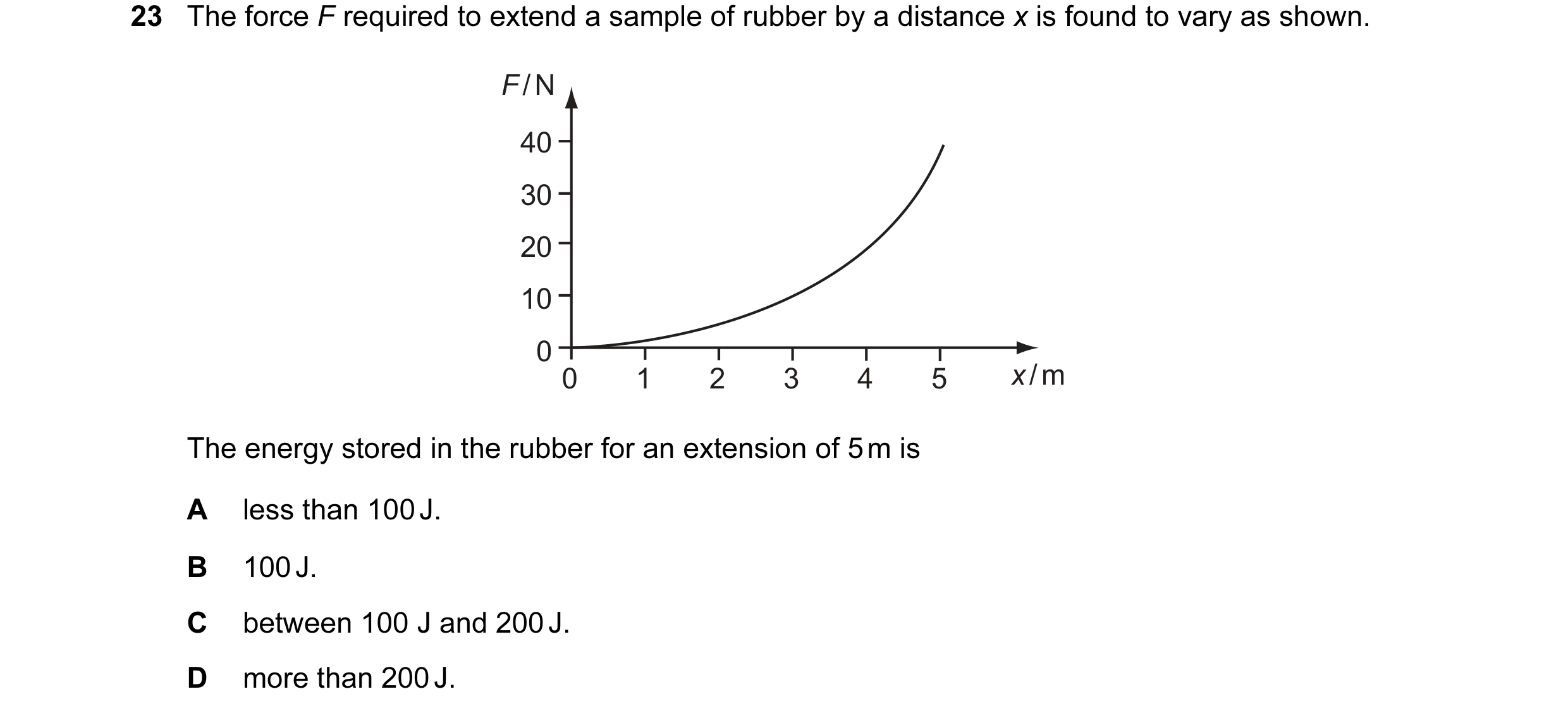
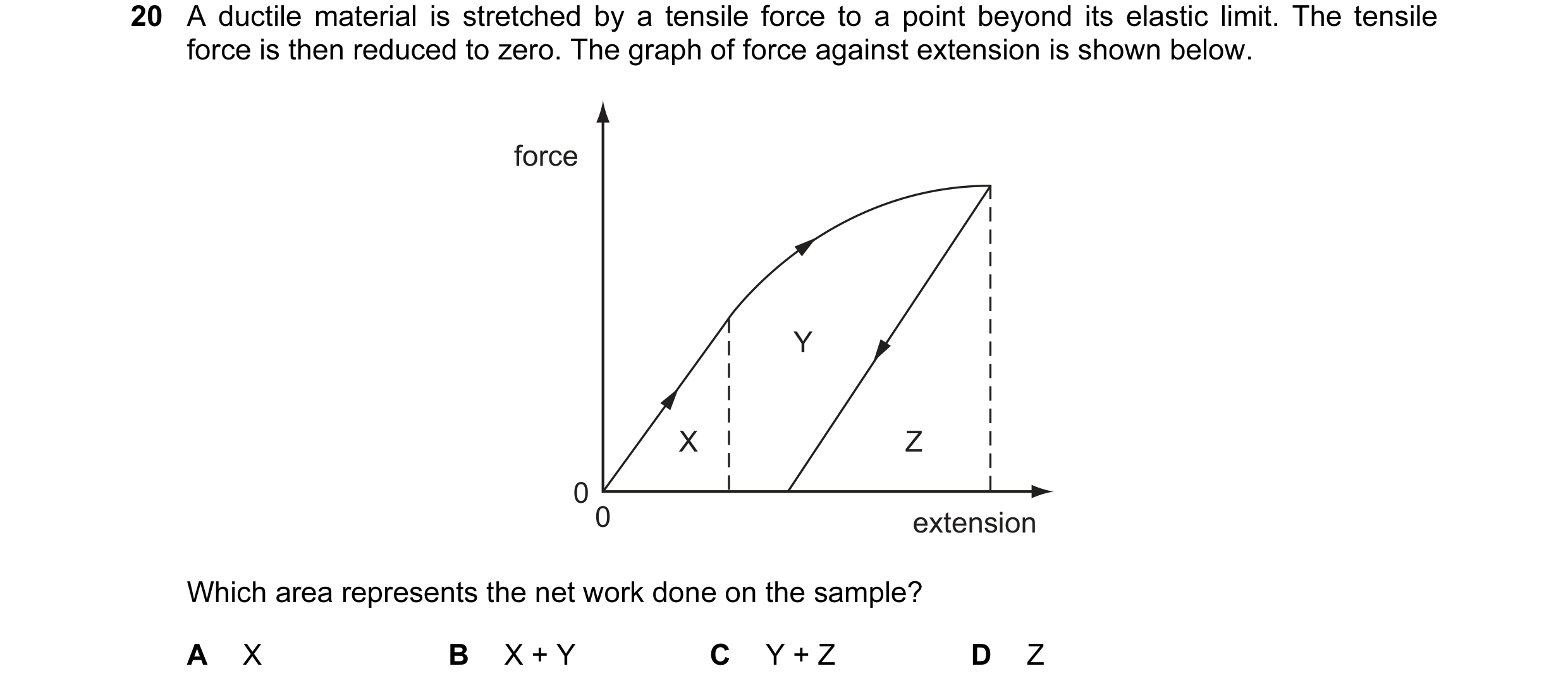 1 / 63
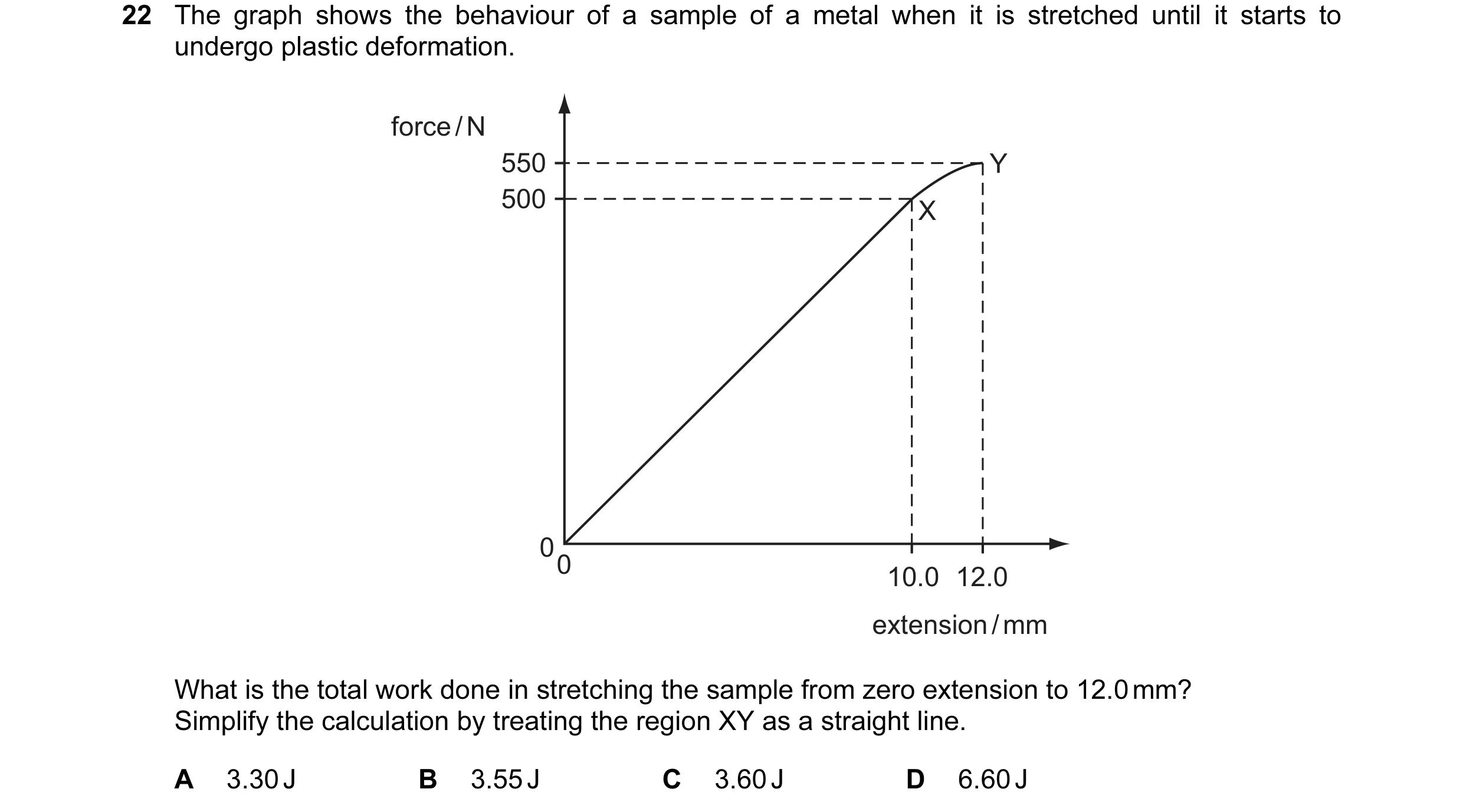
 2 / 63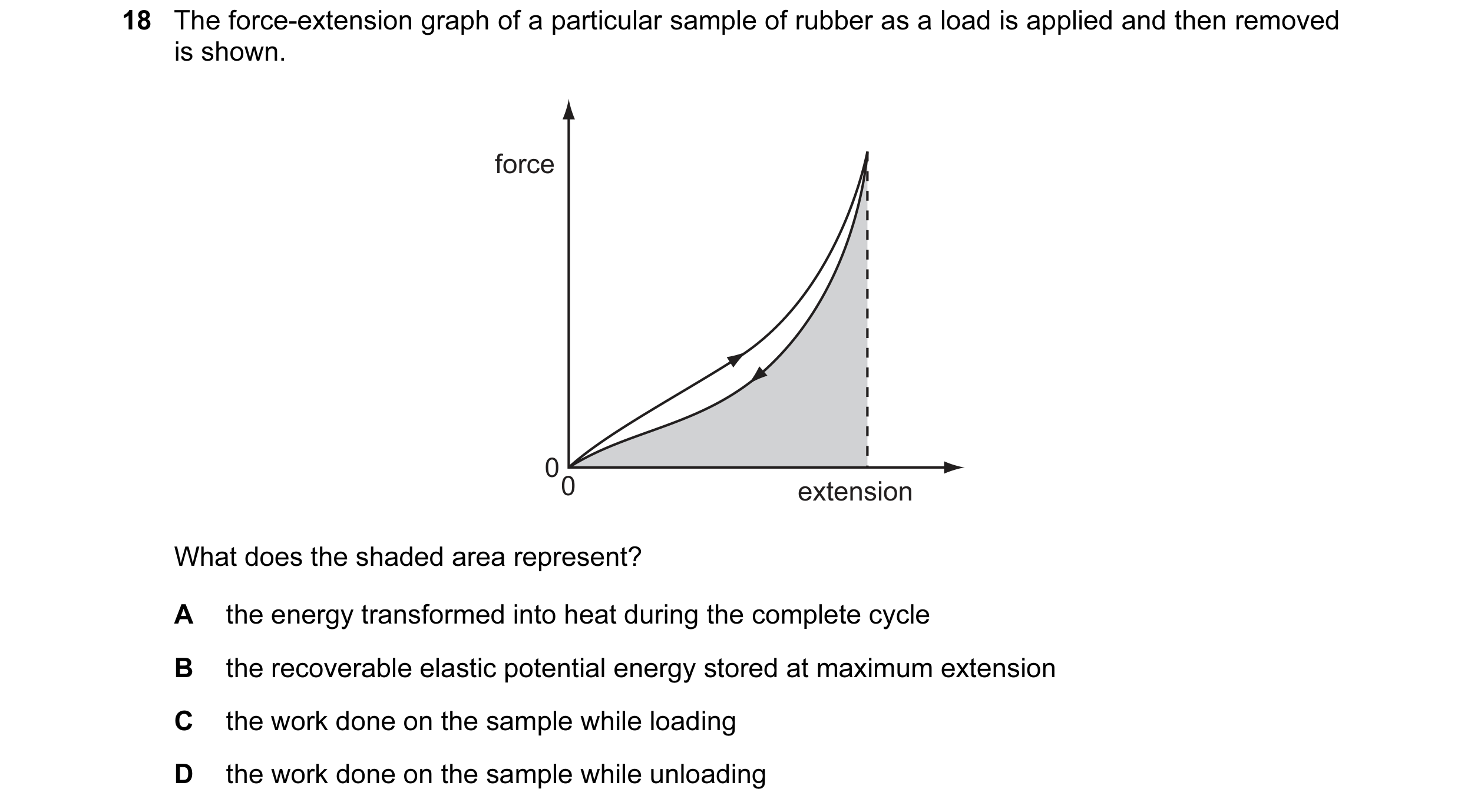
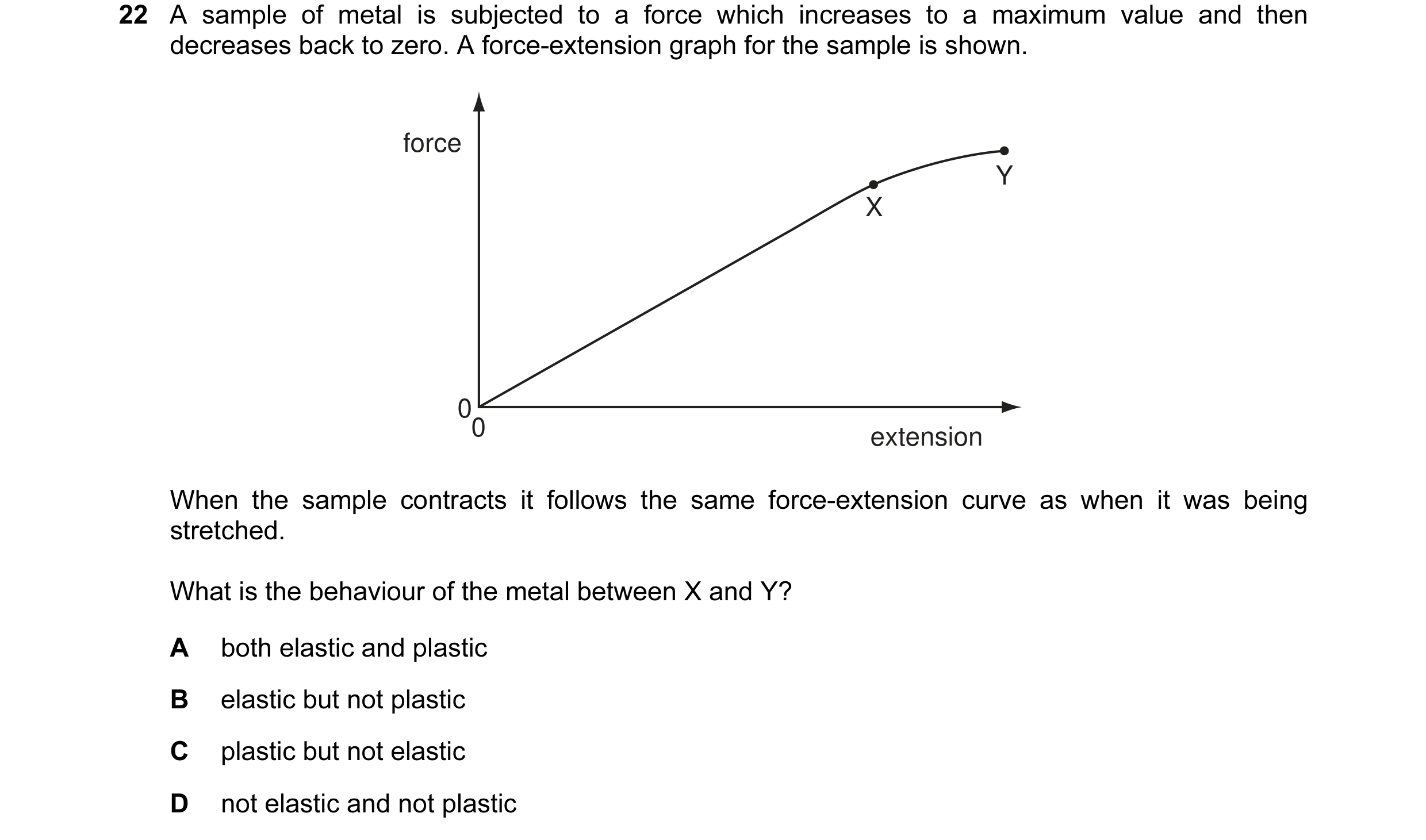 3 / 63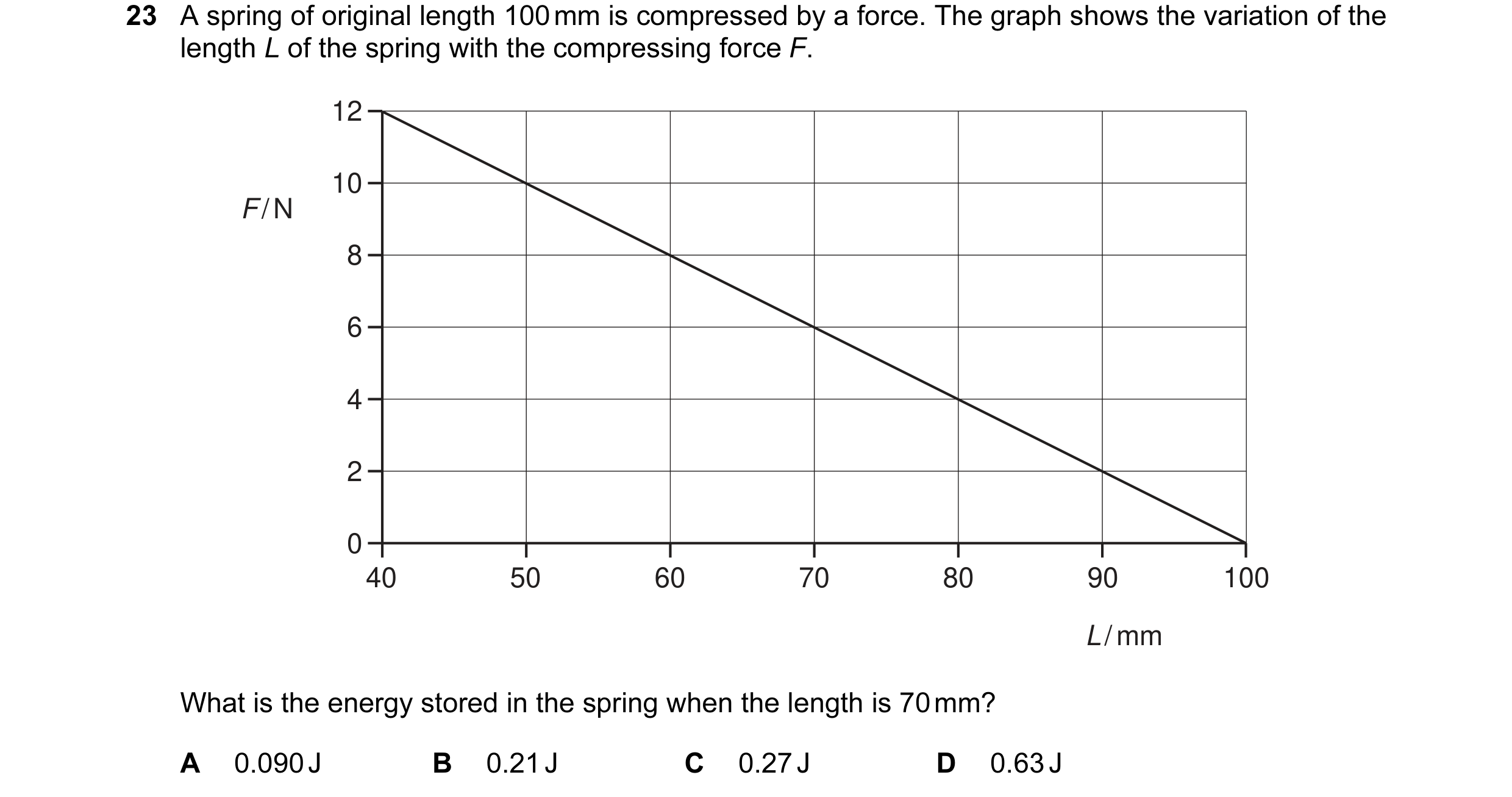

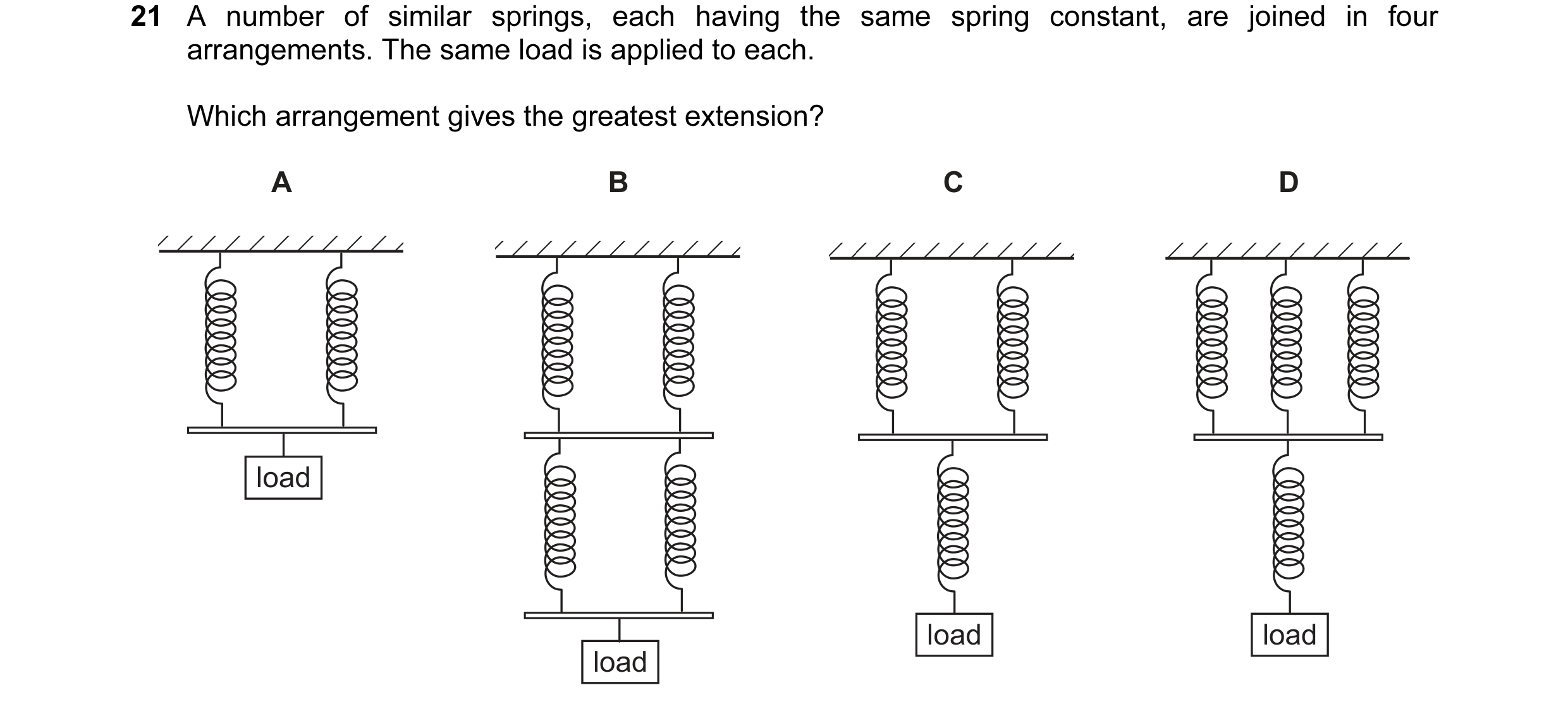 4 / 63
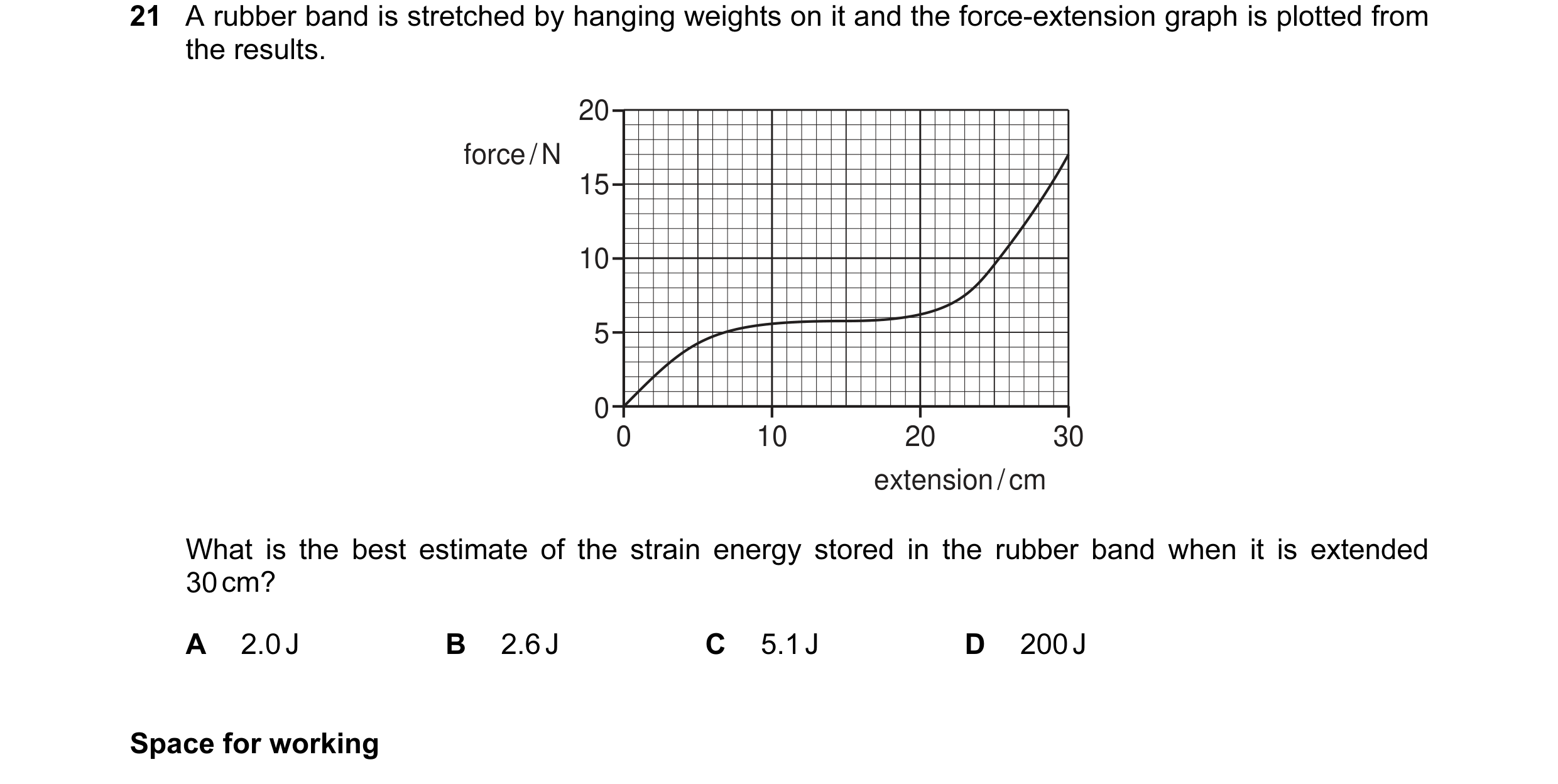 5 / 63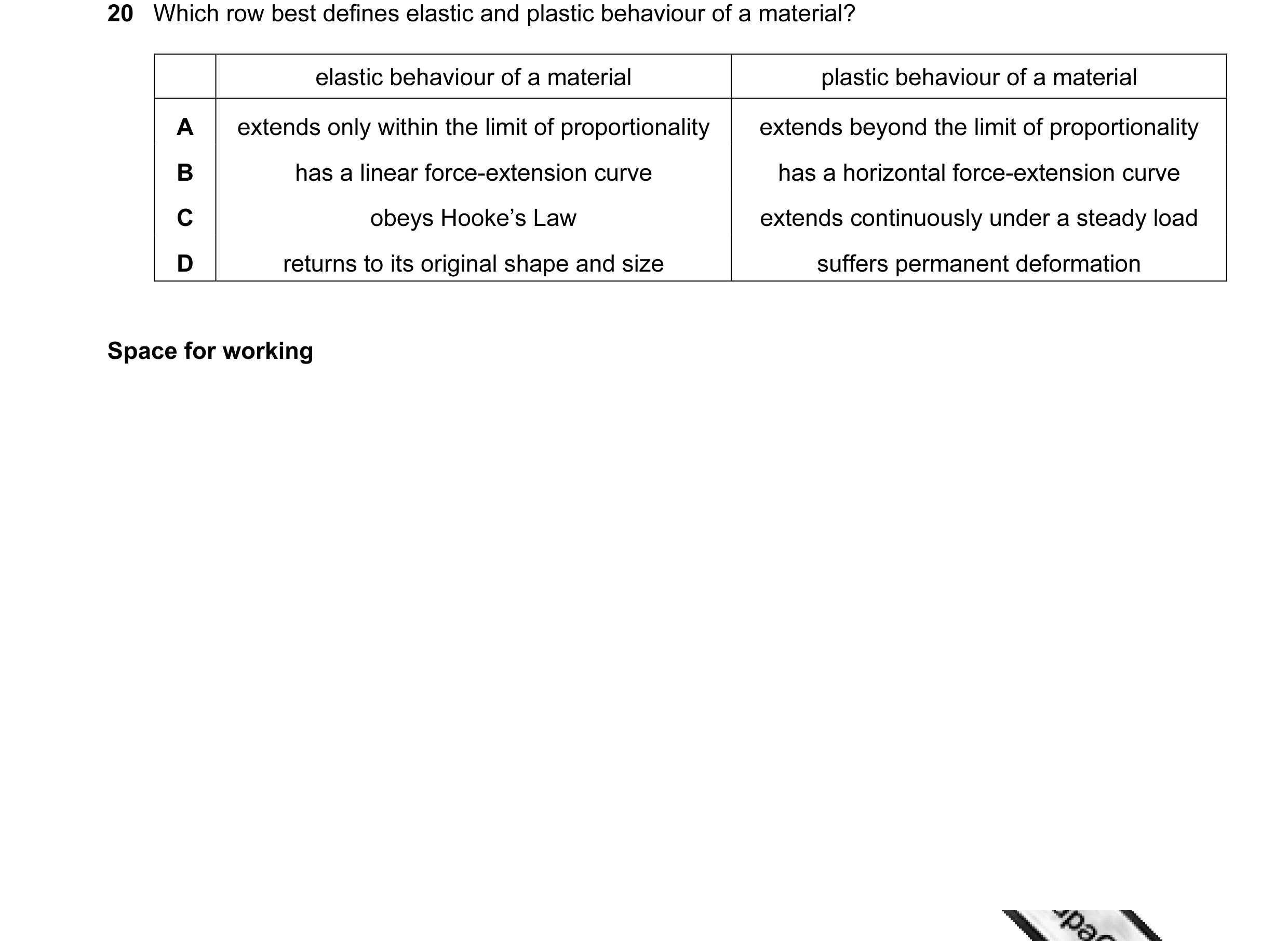
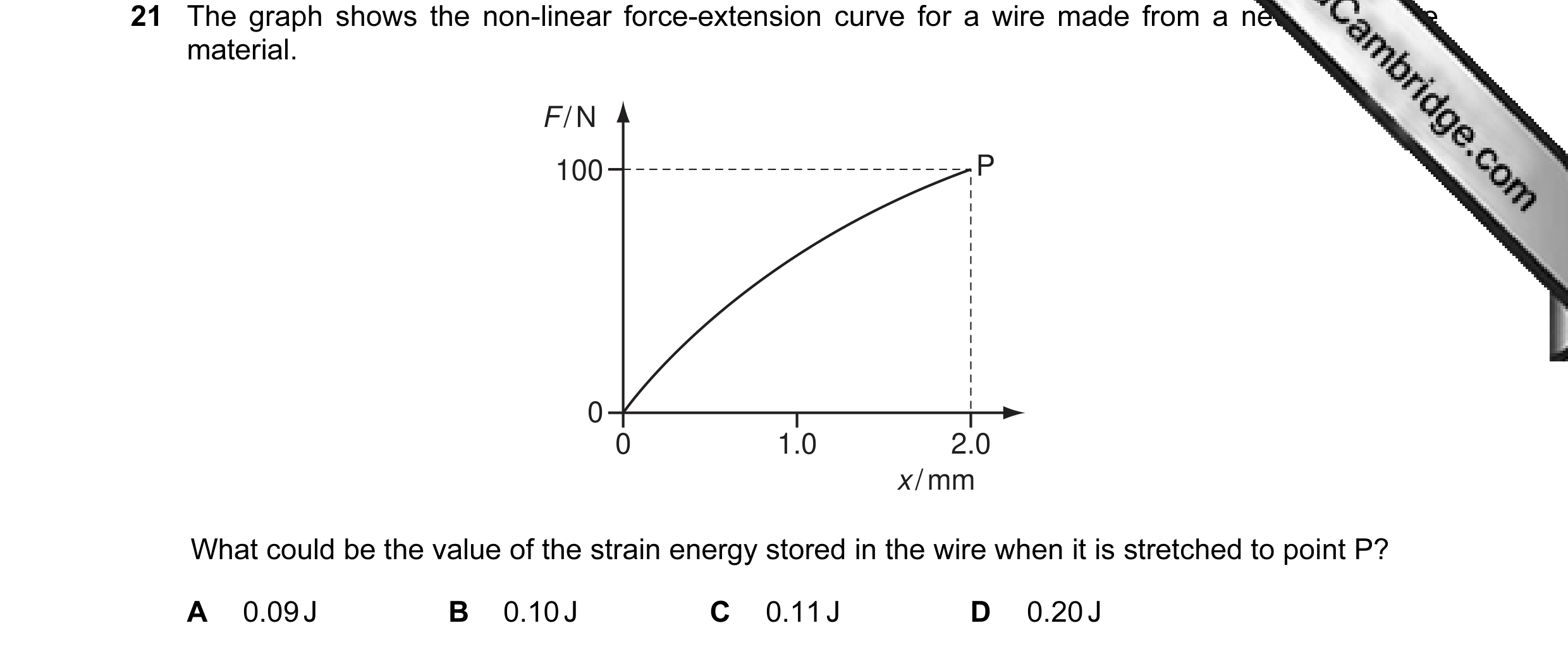 6 / 63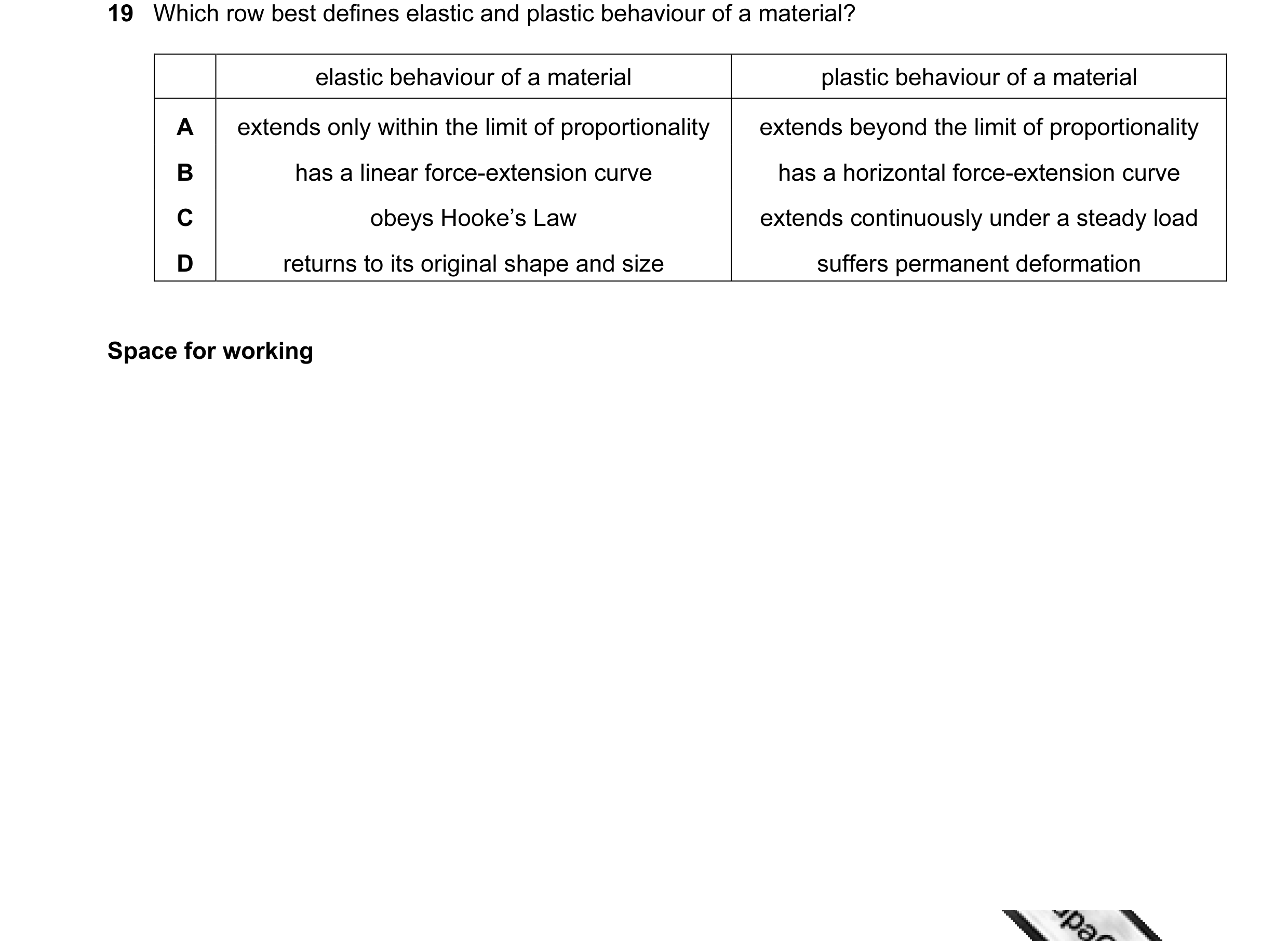
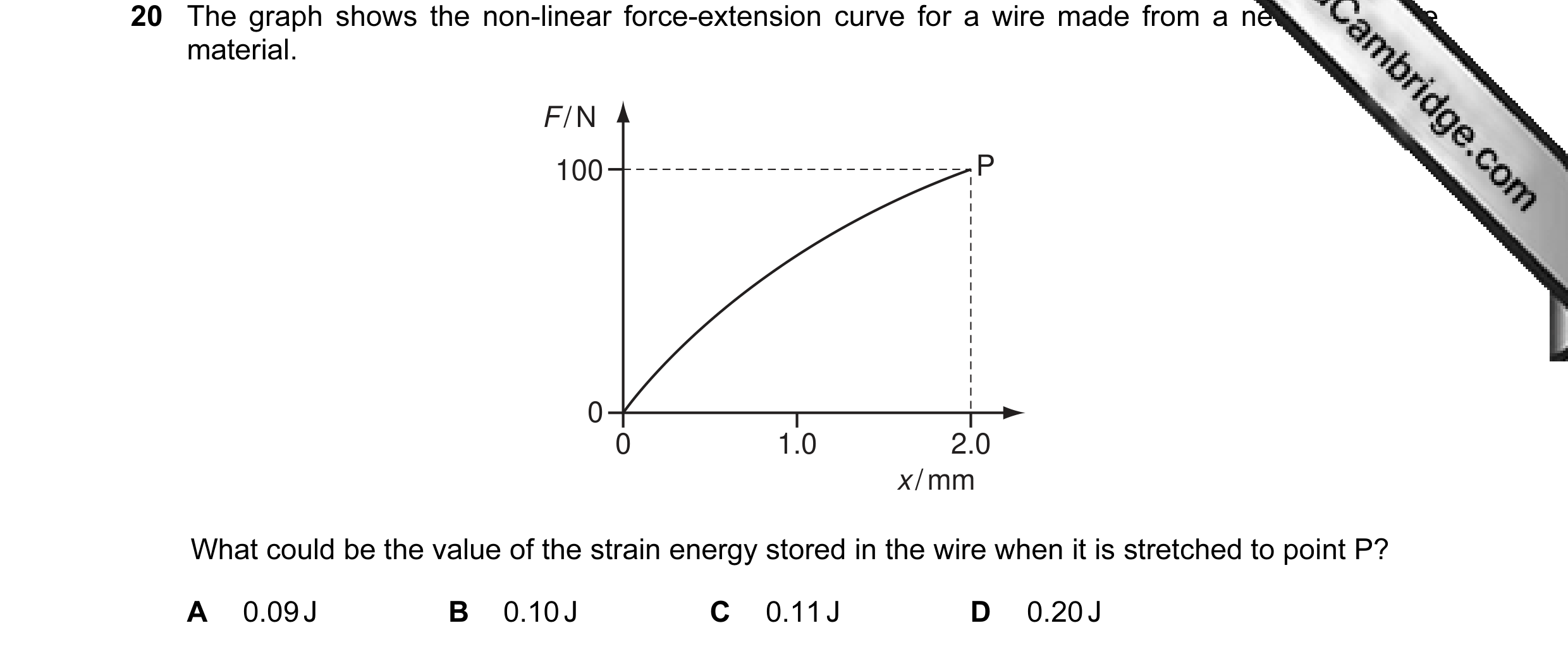 7 / 63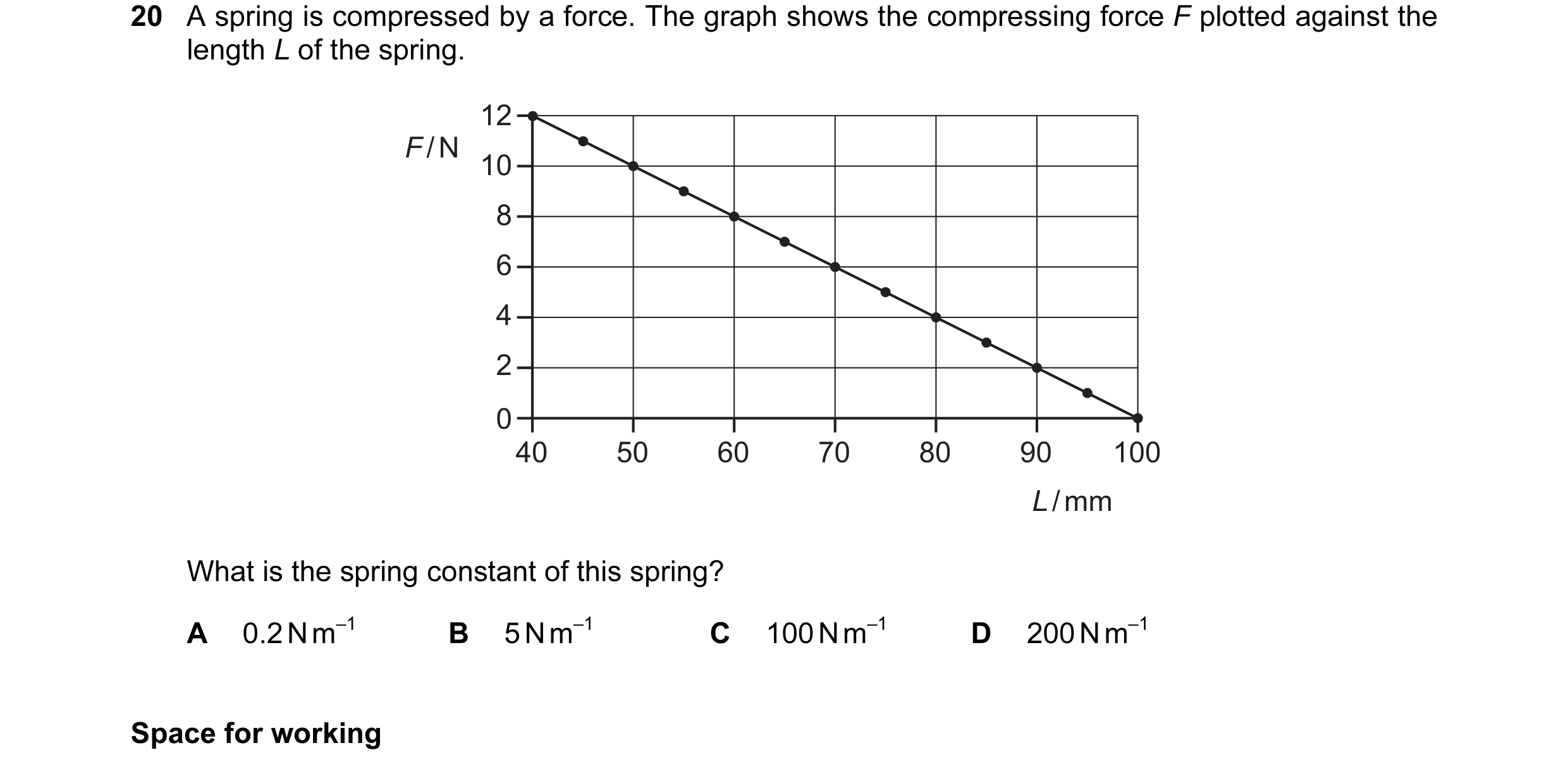
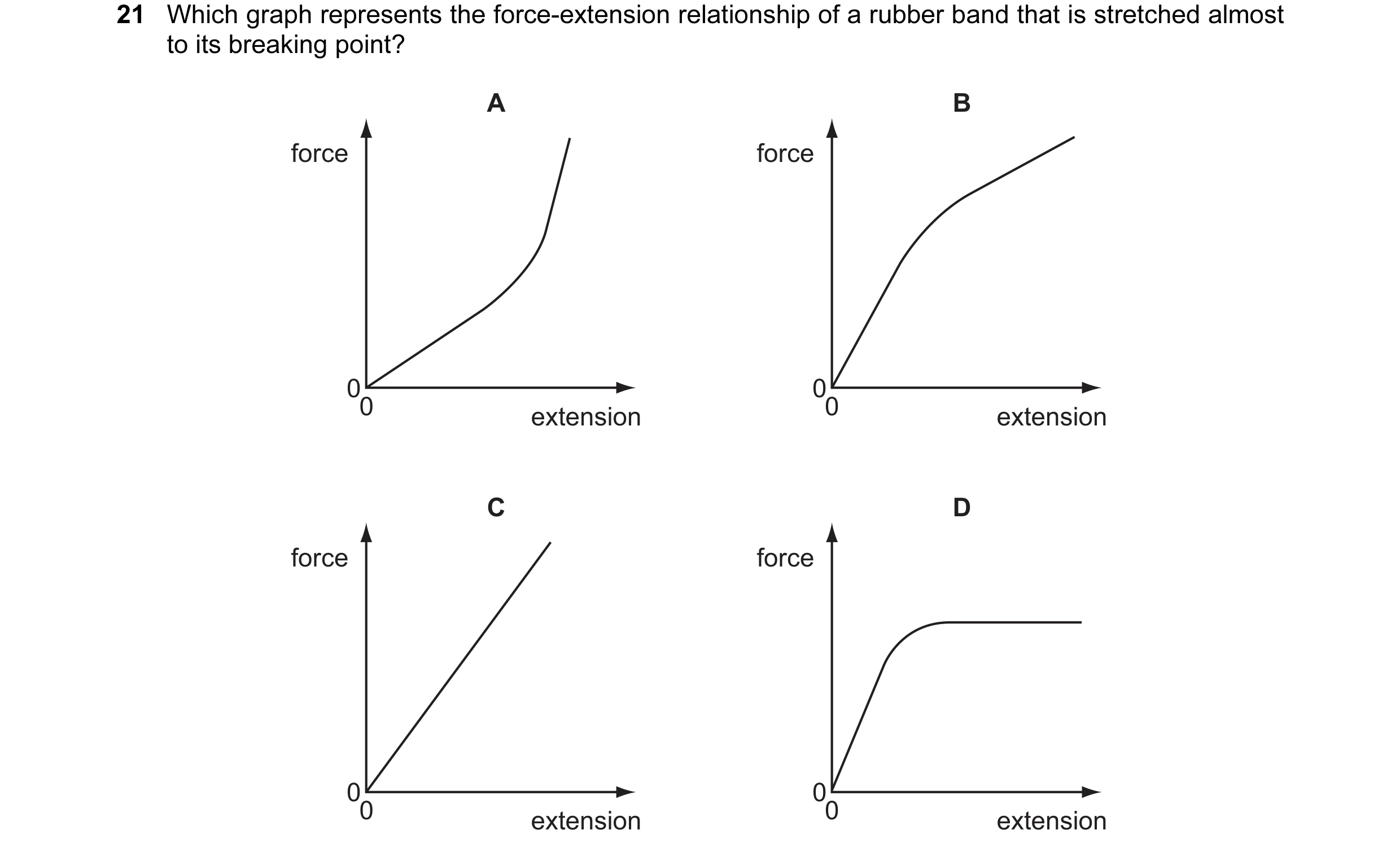 8 / 63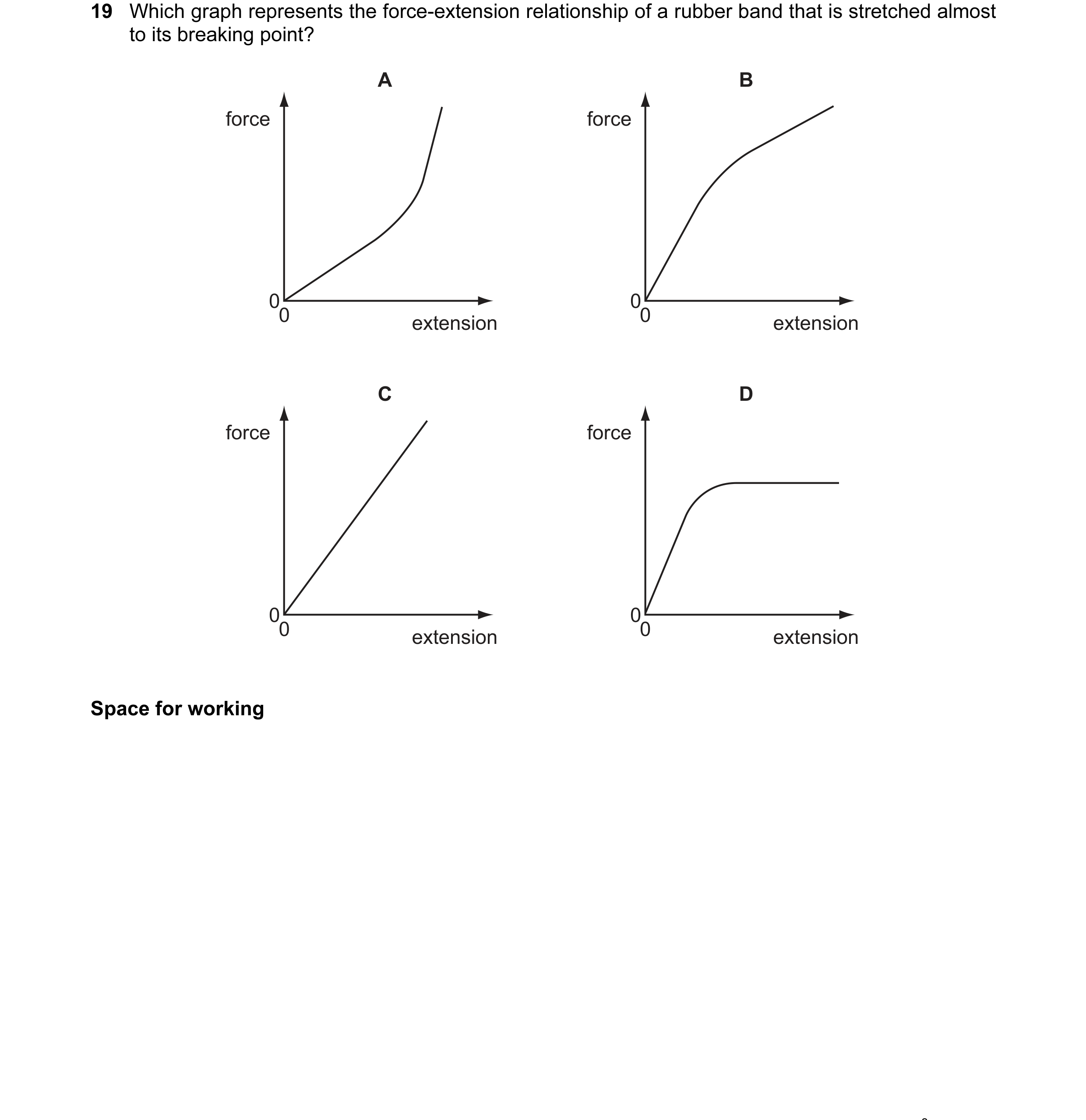
 9 / 63
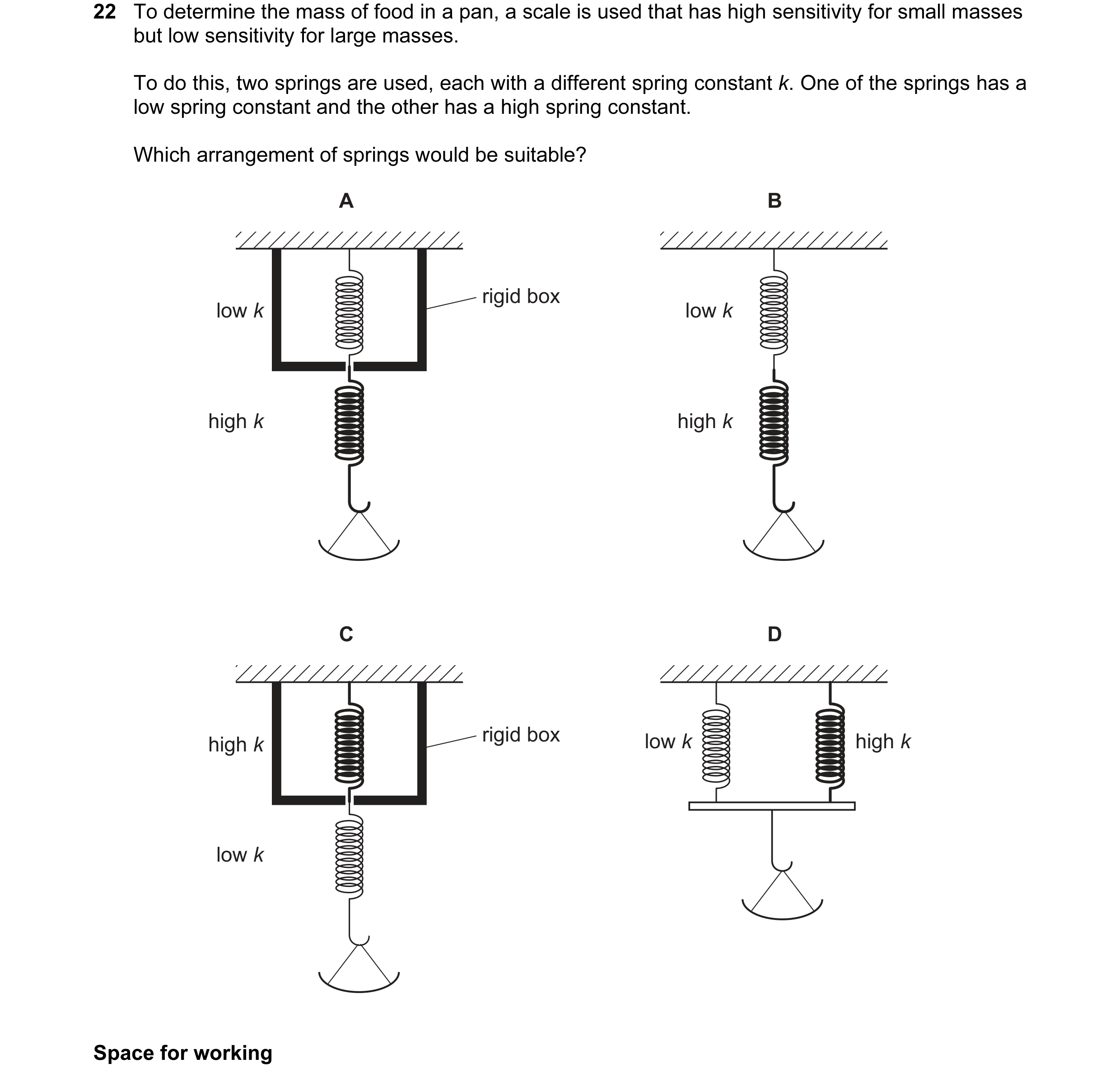 10 / 63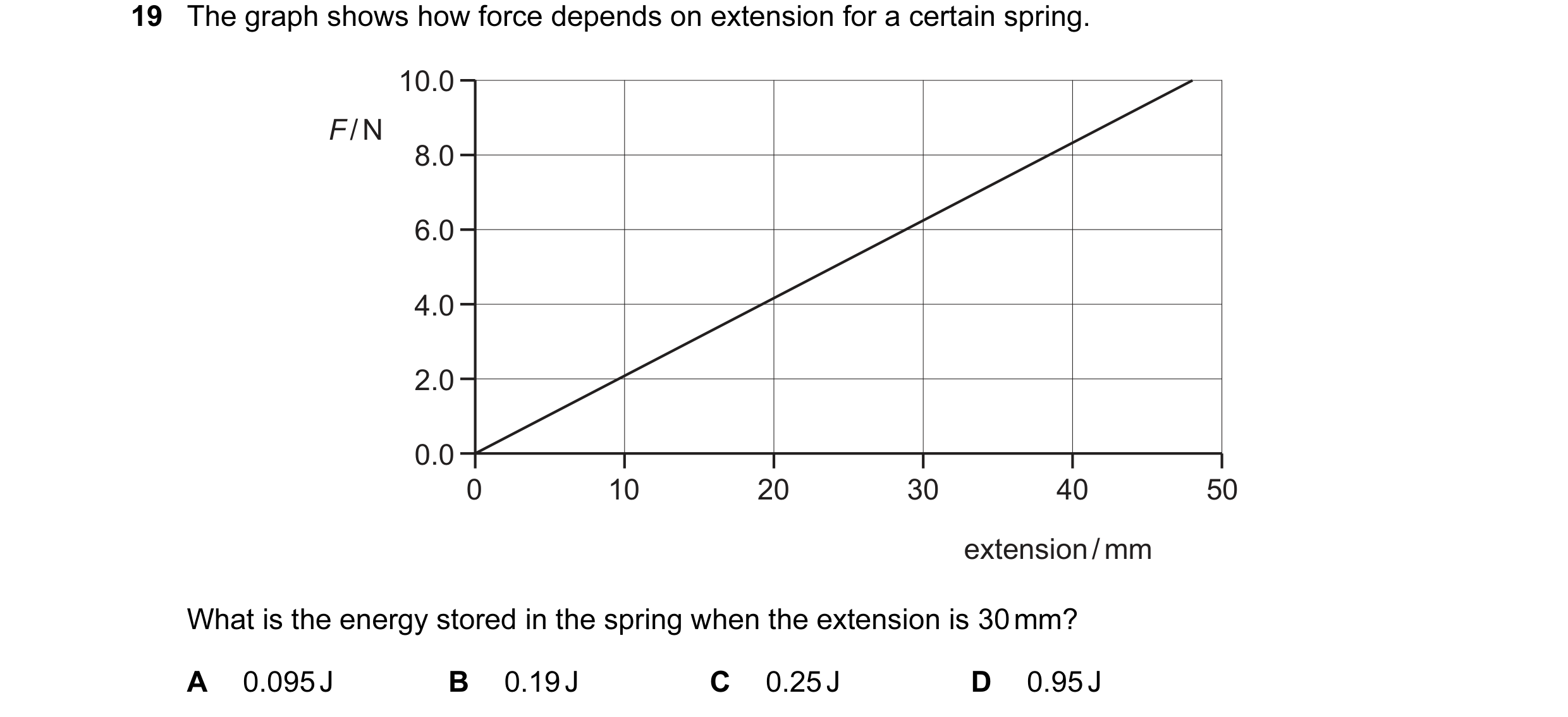
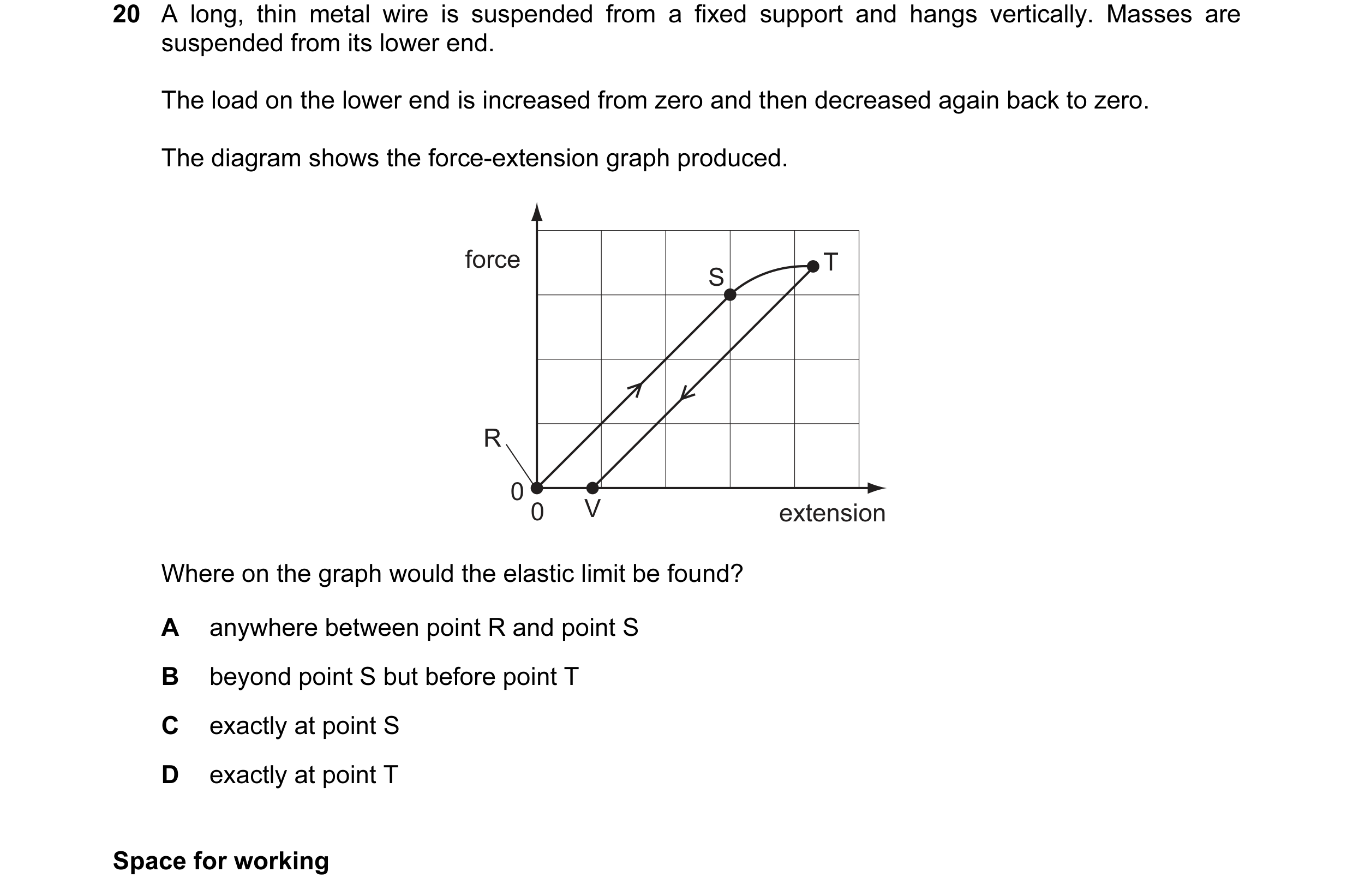 11 / 63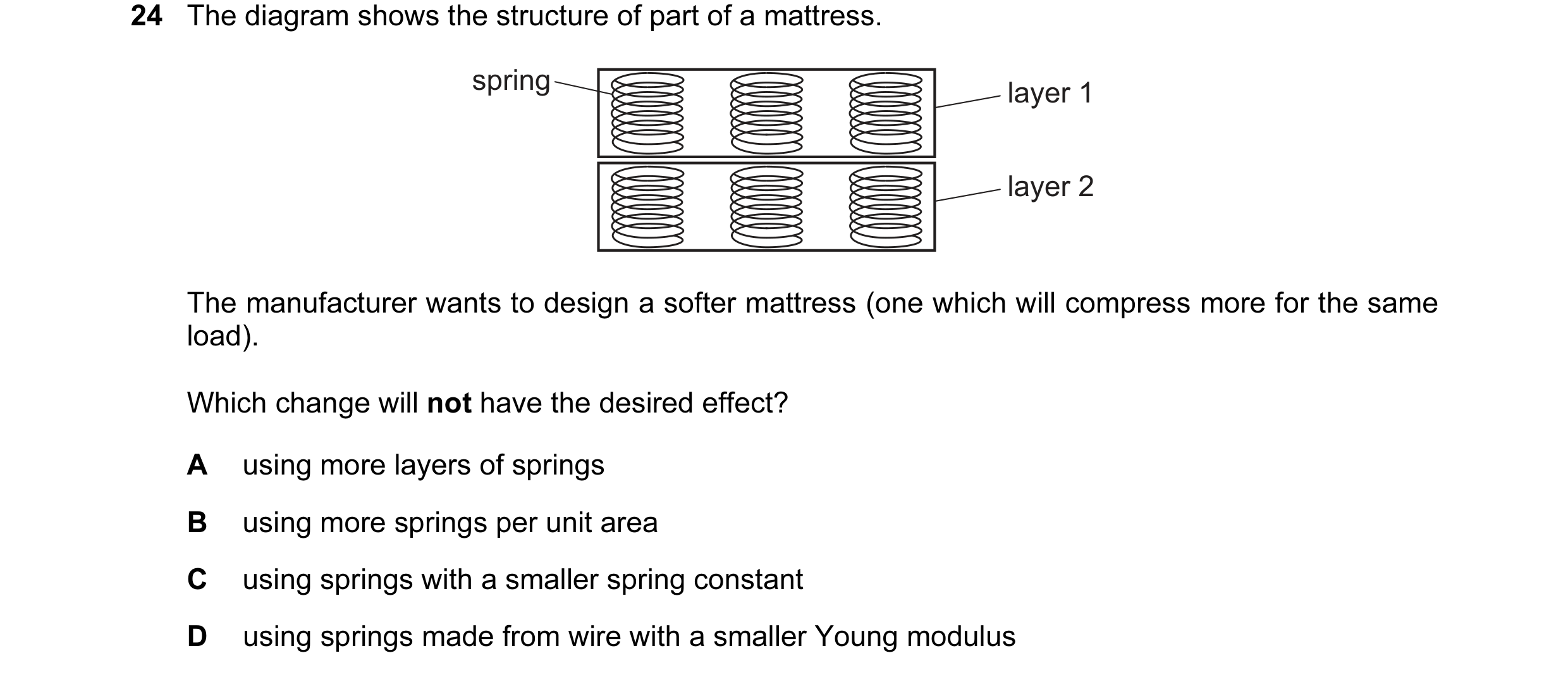
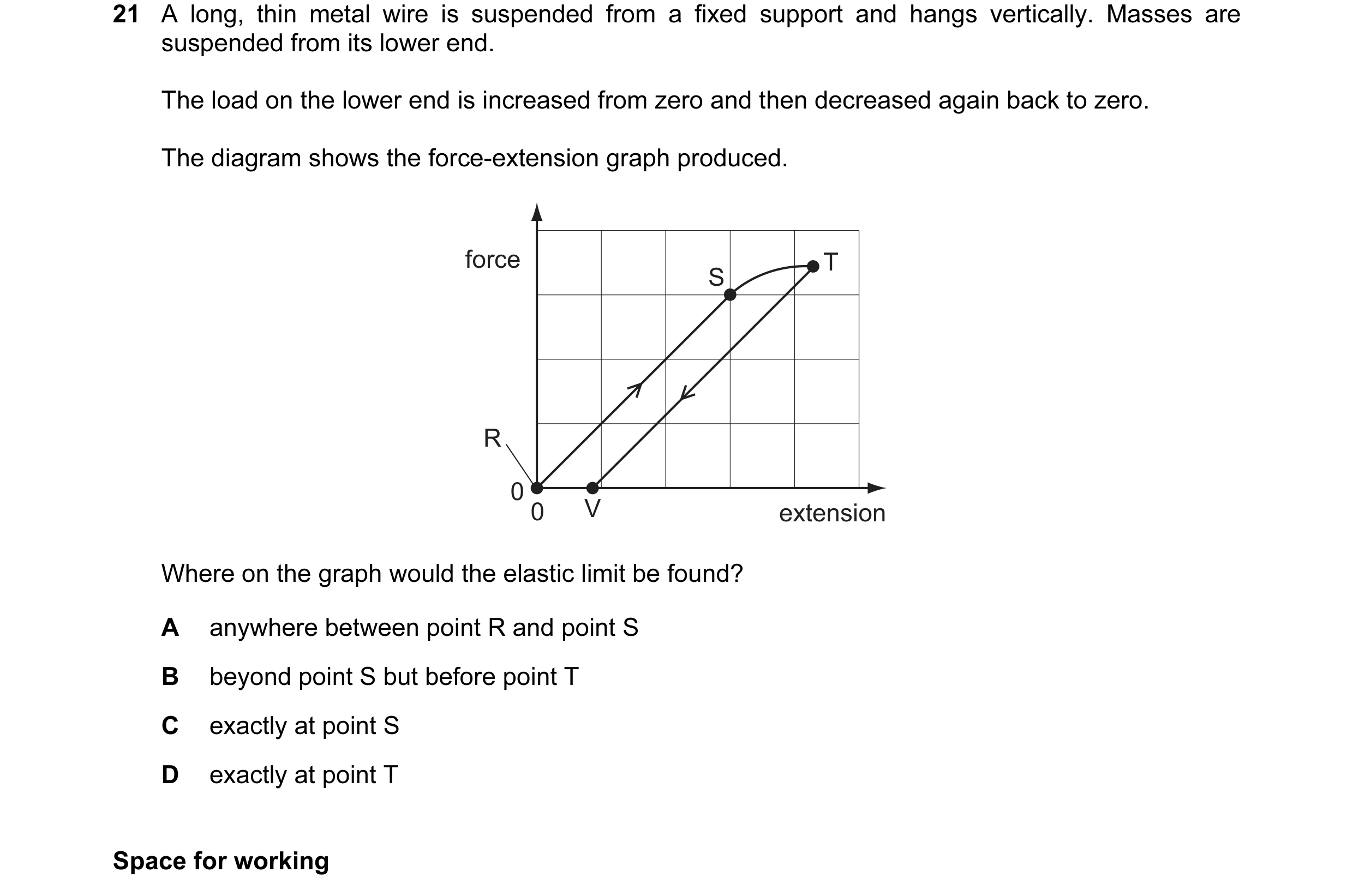 12 / 63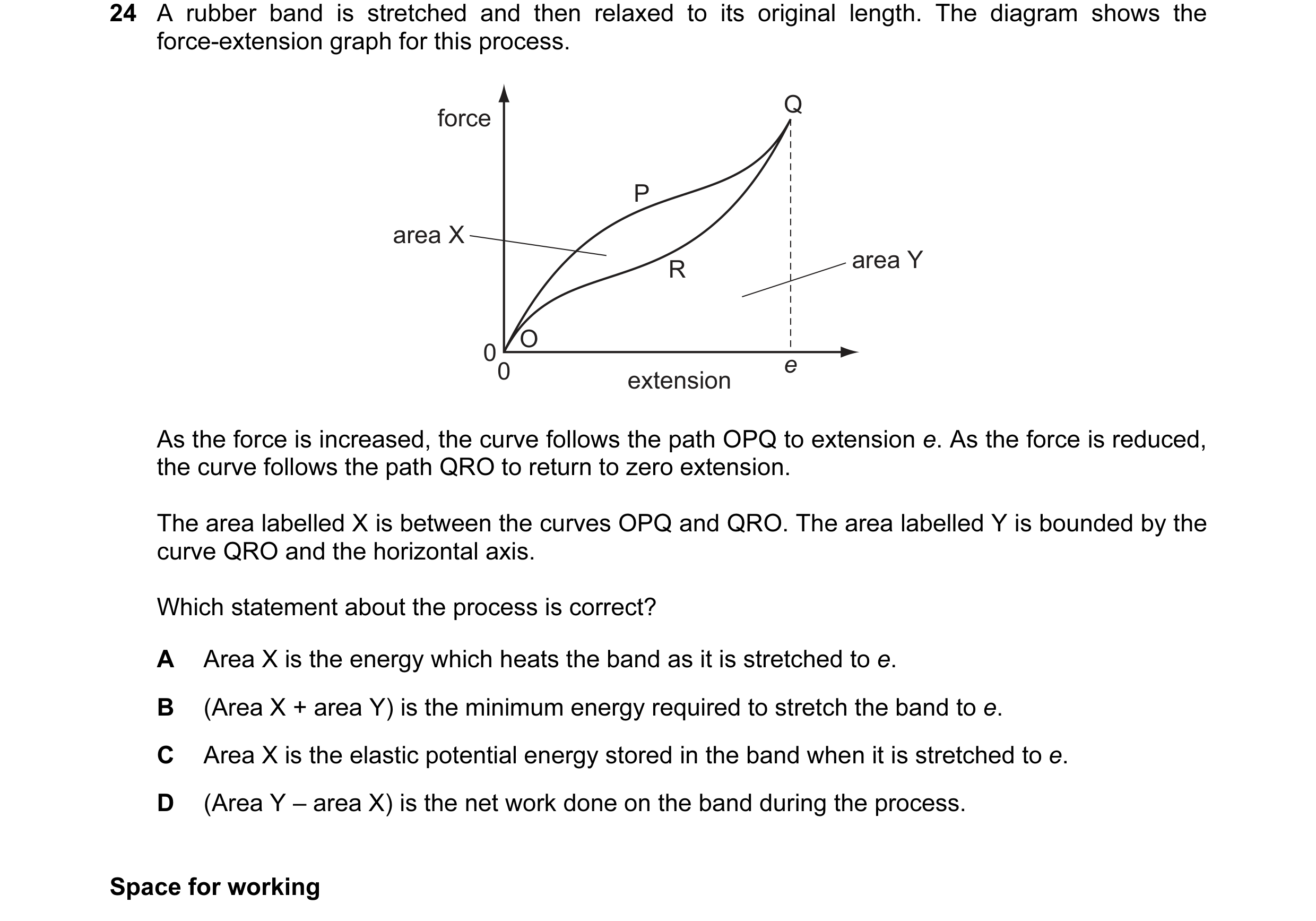
 13 / 63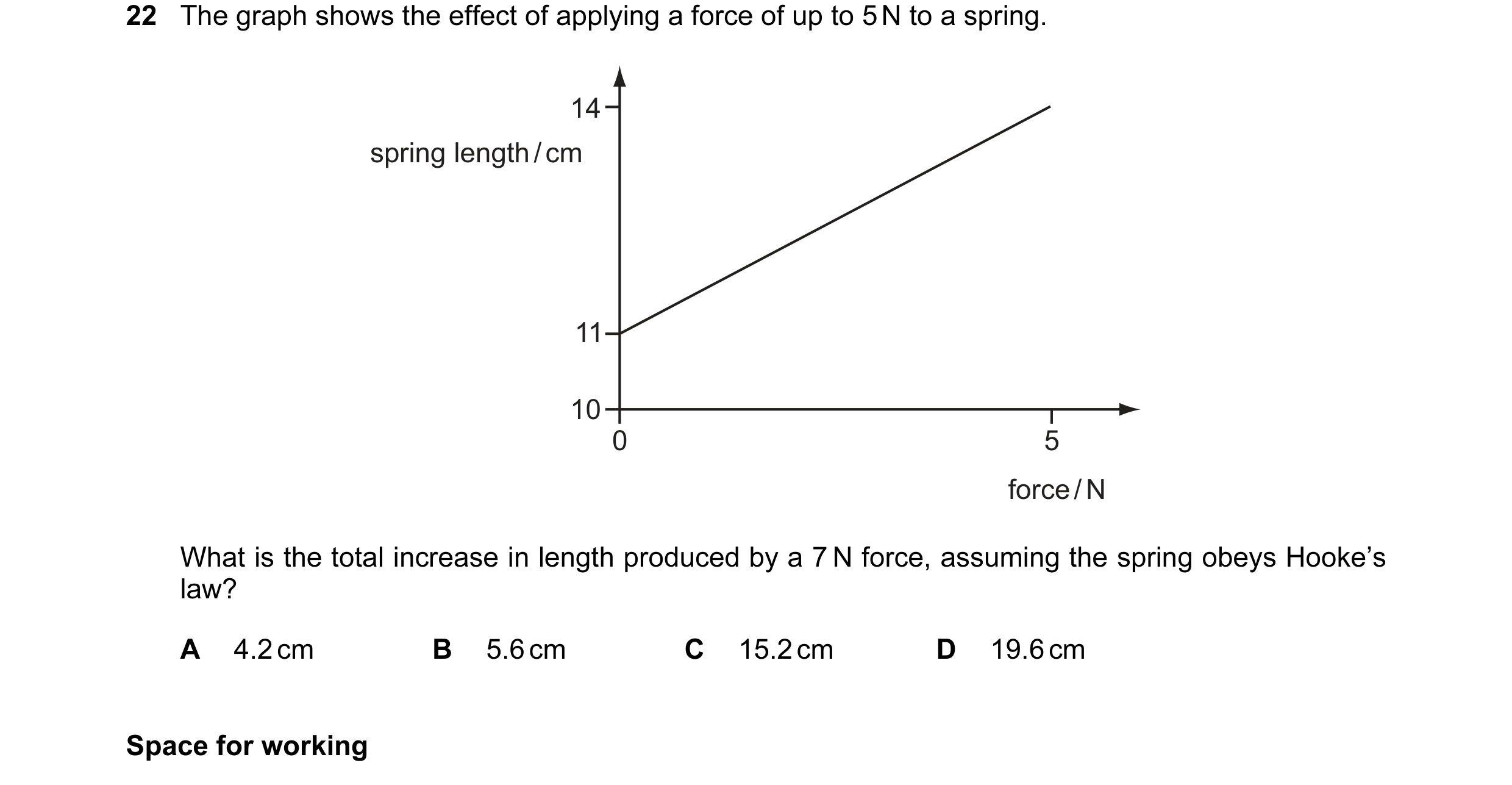
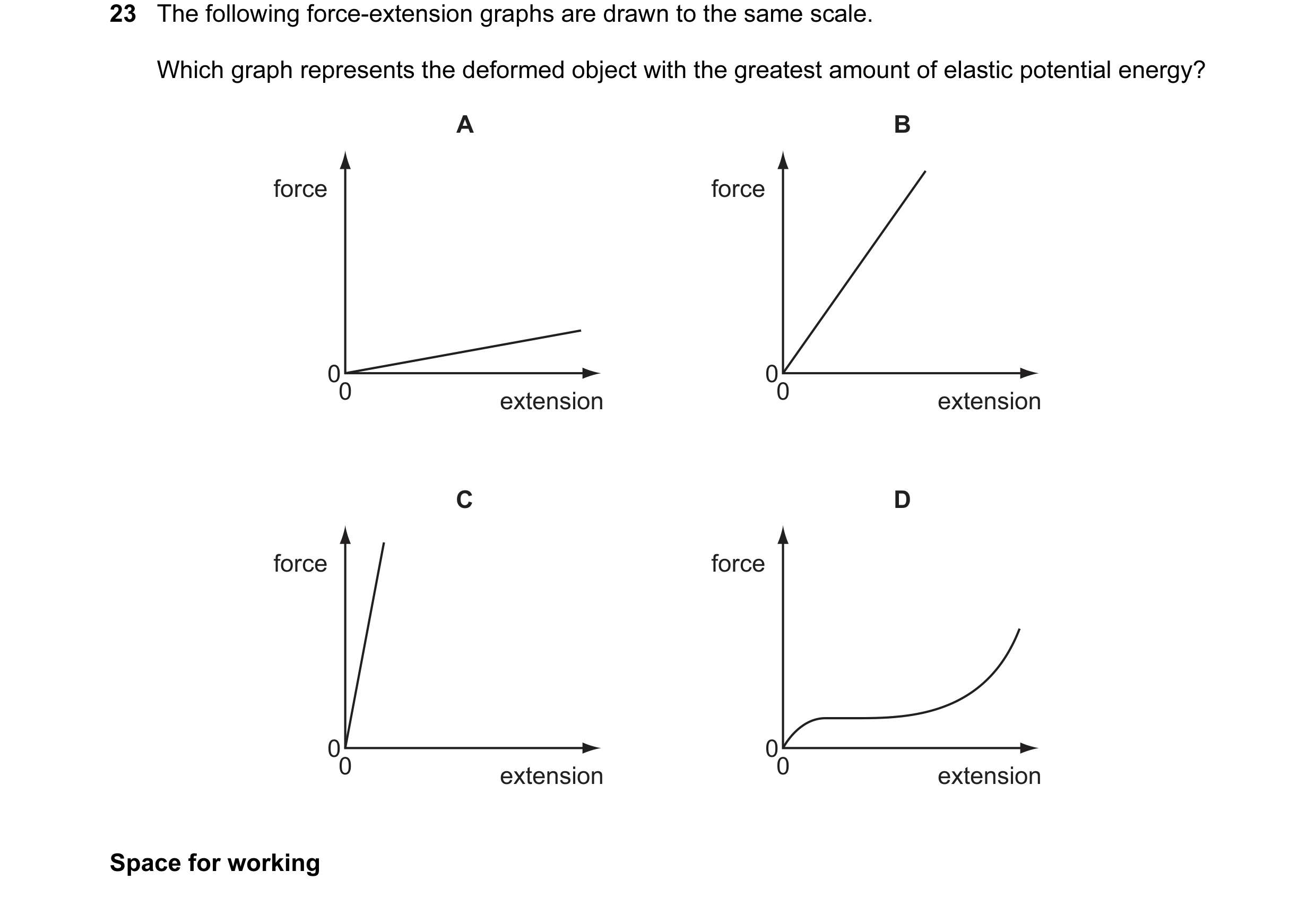 14 / 63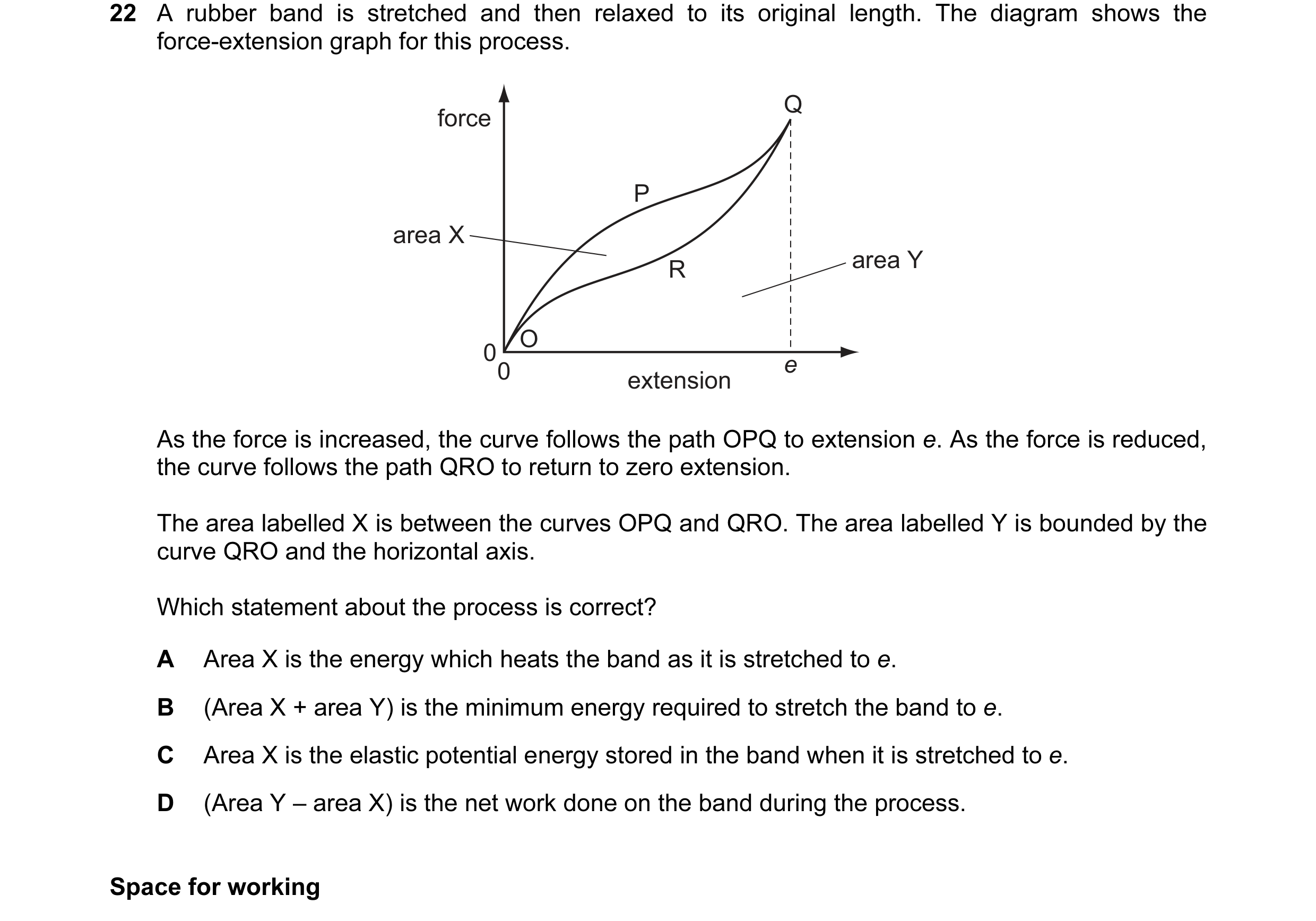
 15 / 63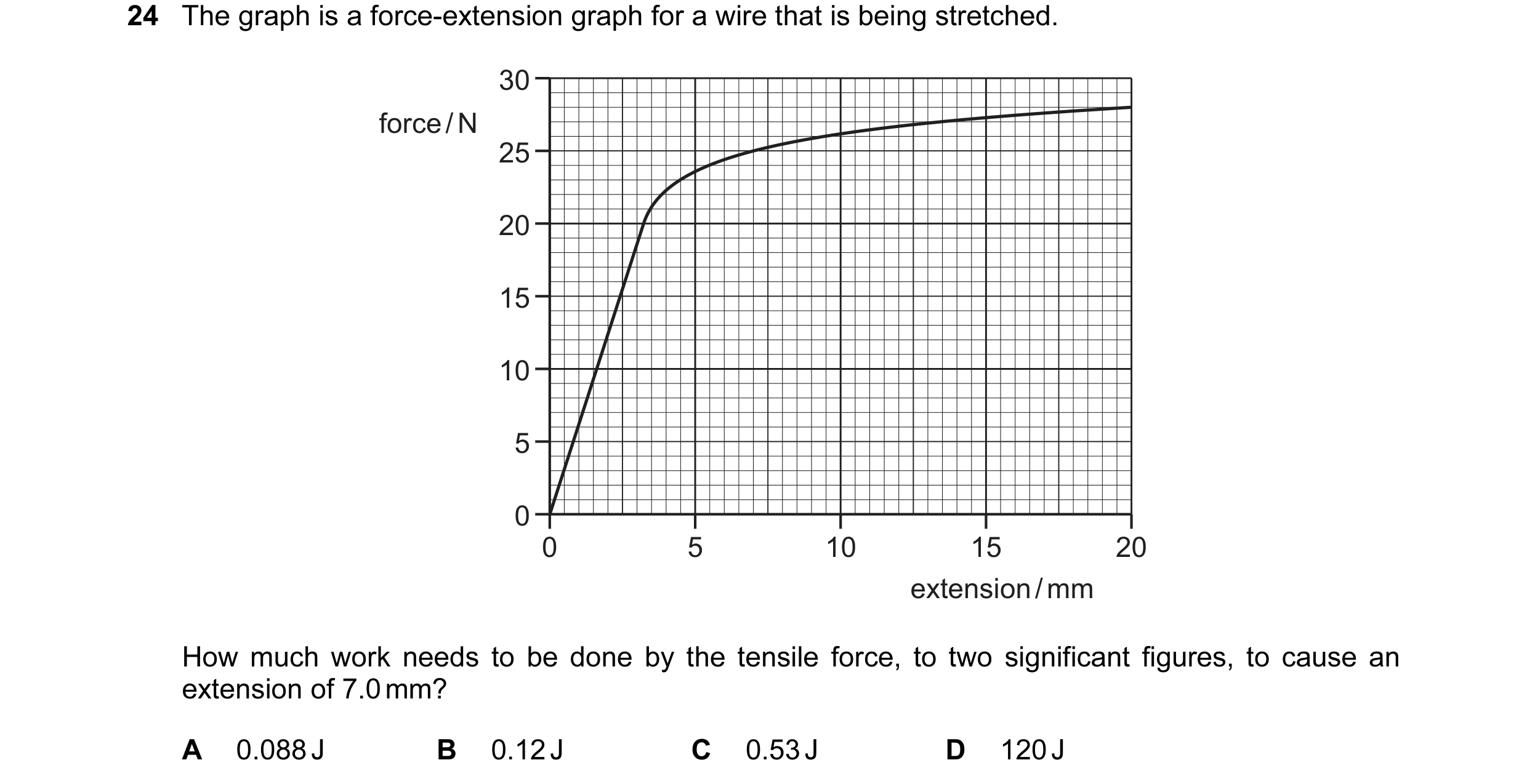
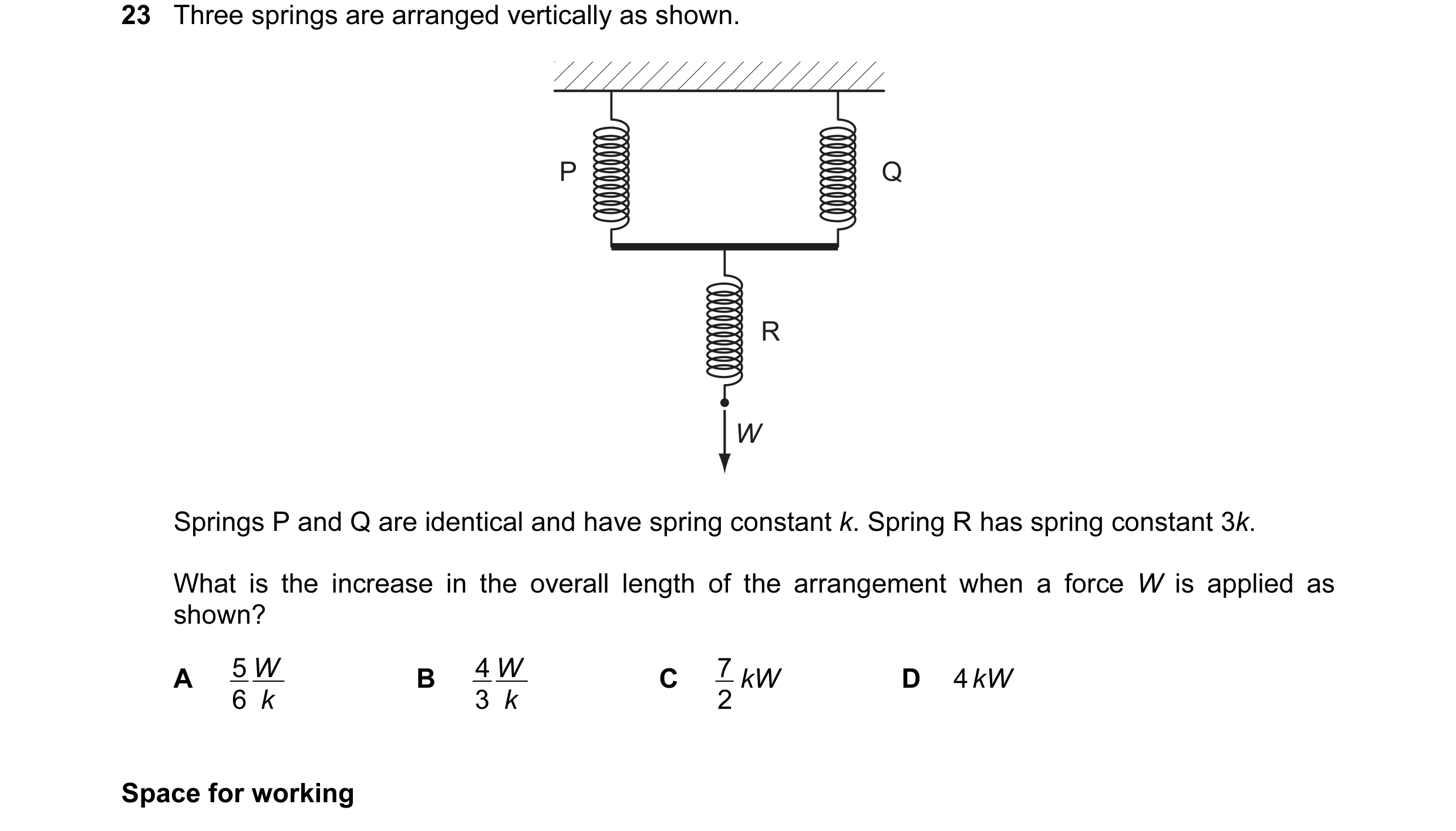 16 / 63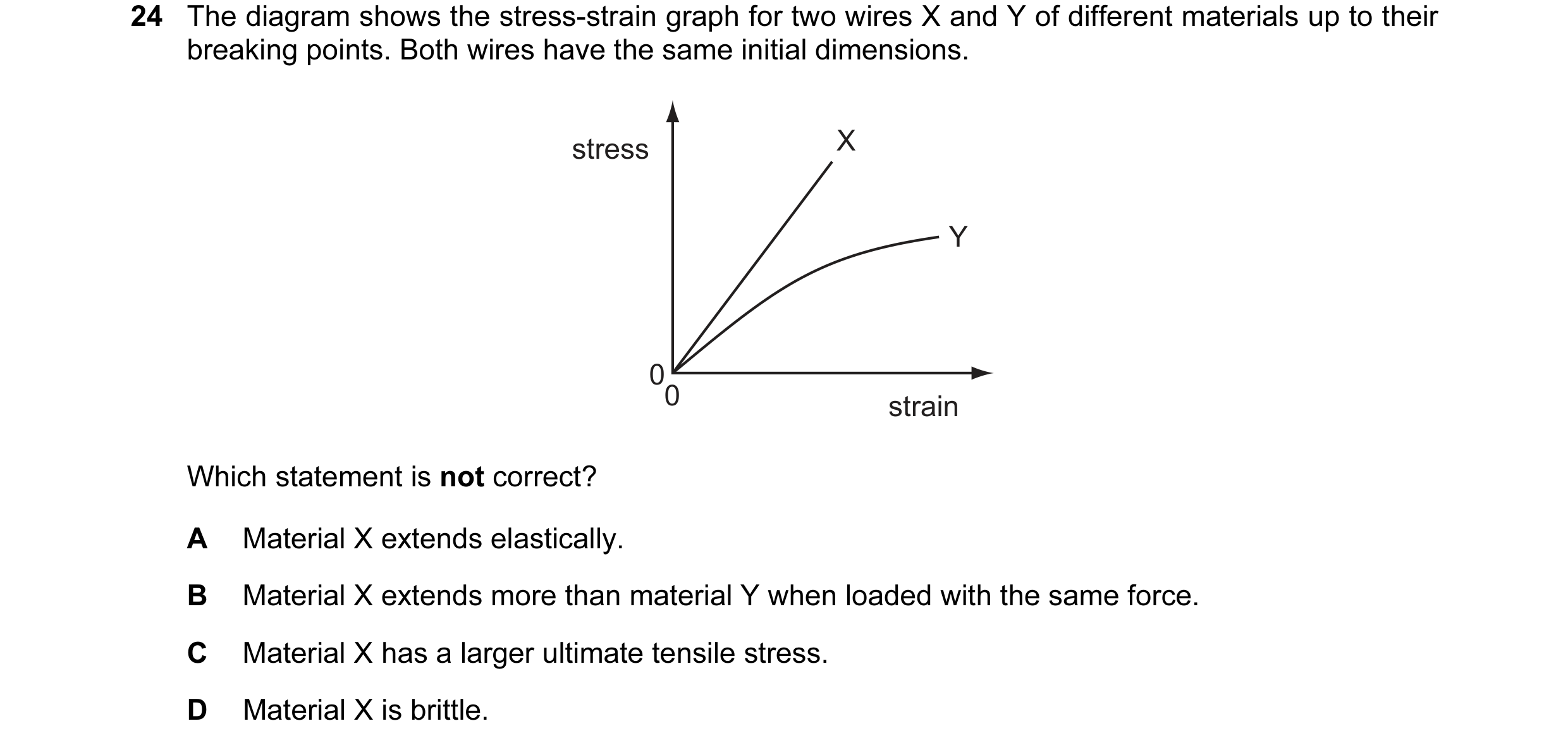
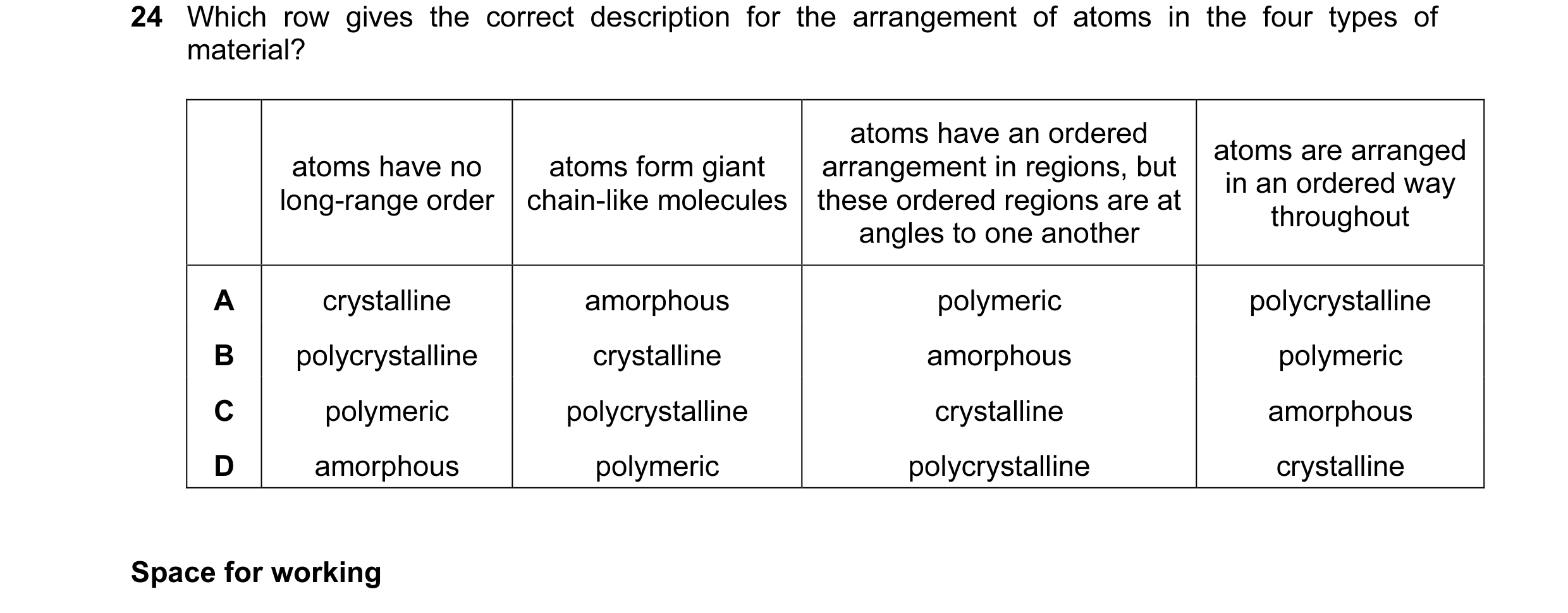 17 / 63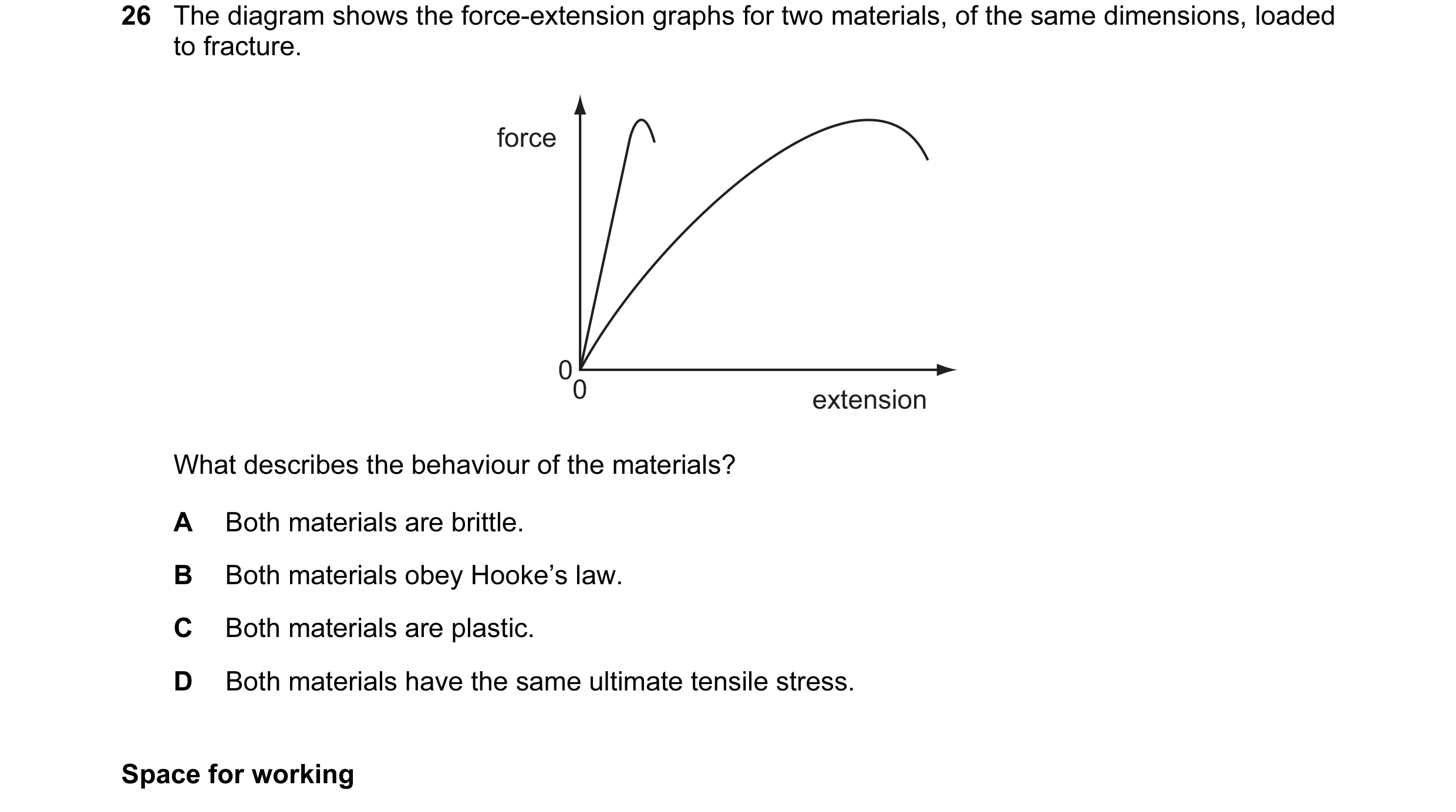
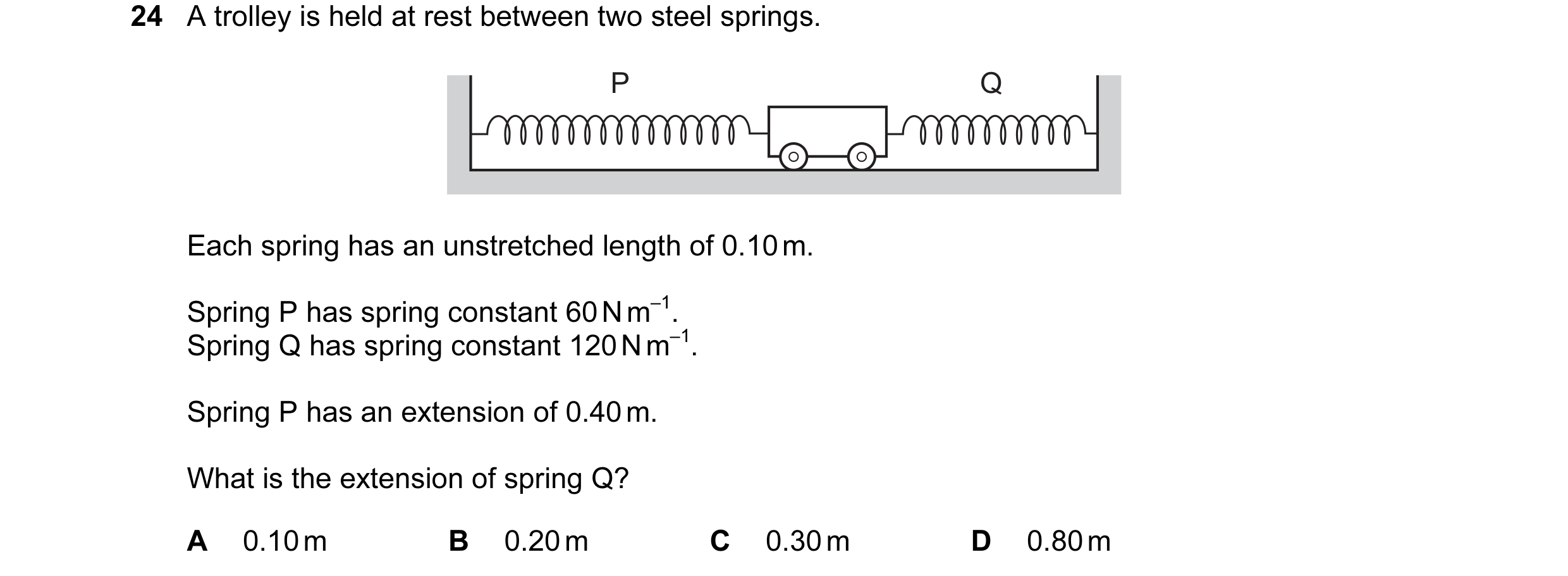 18 / 63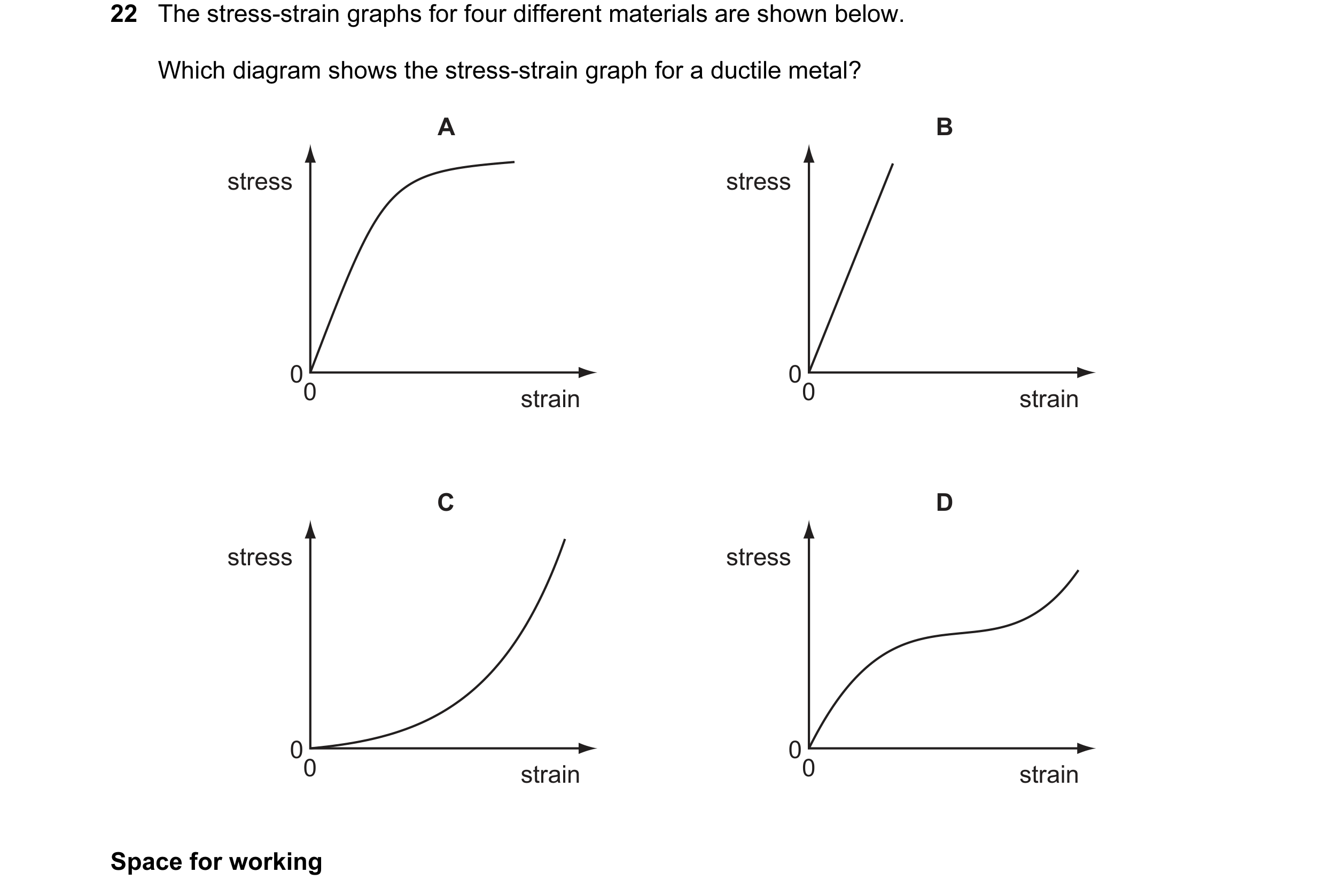
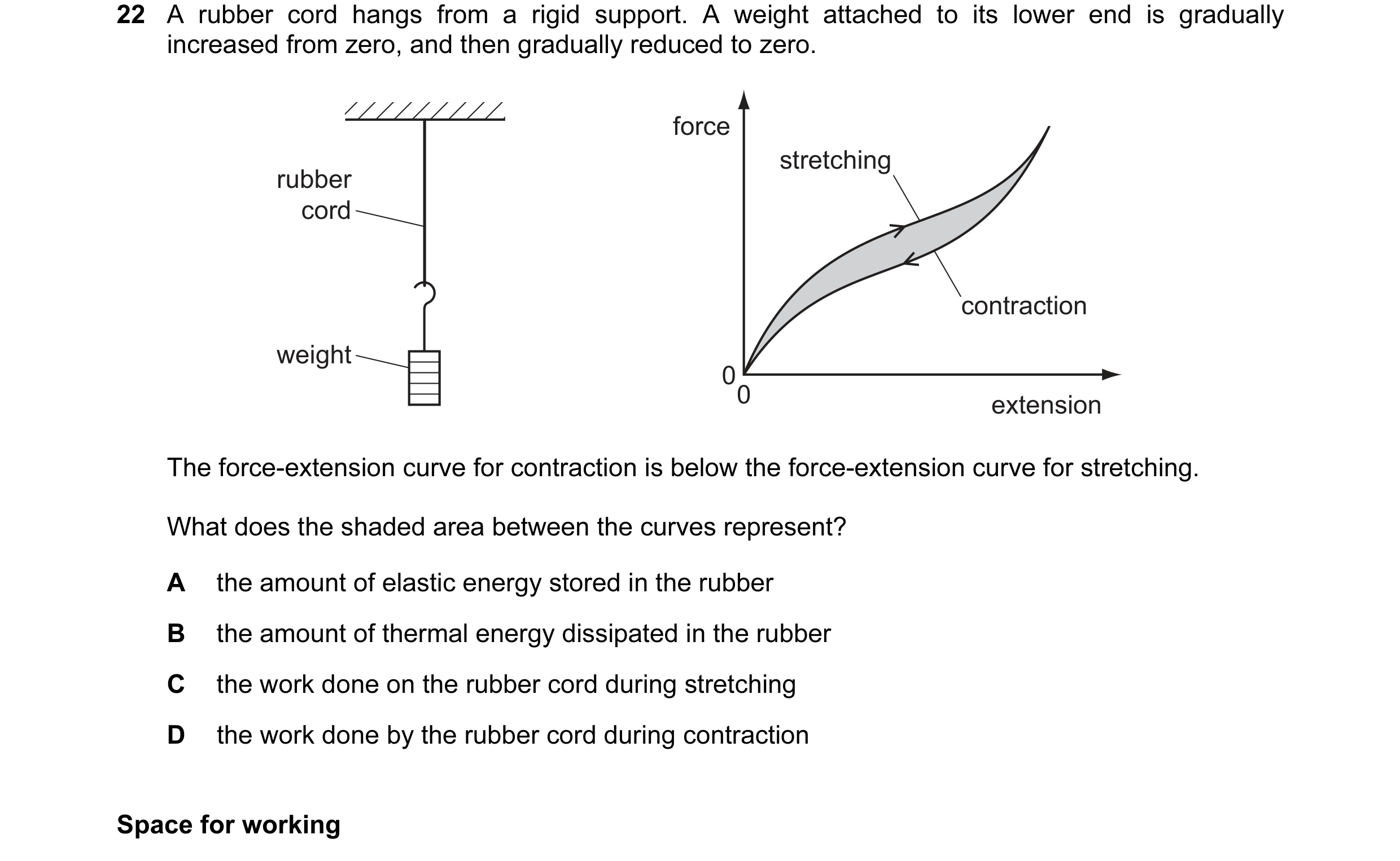 19 / 63
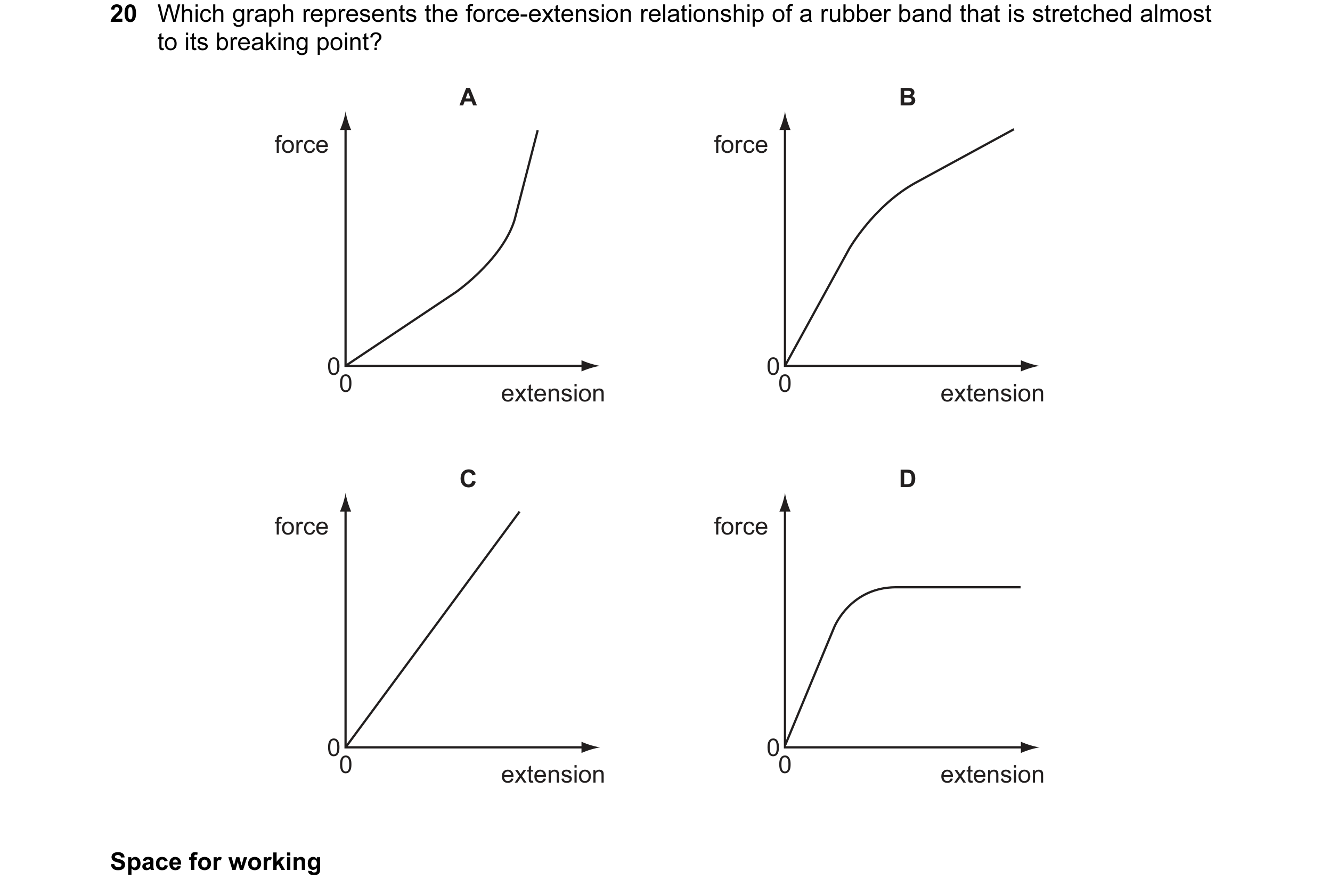
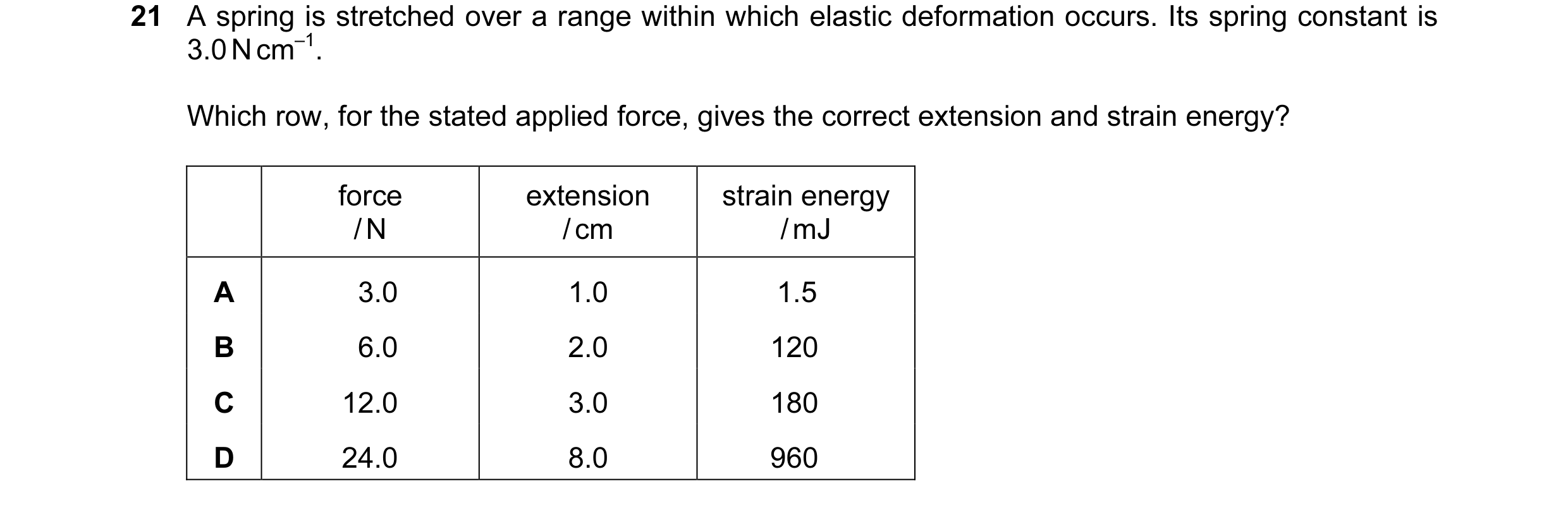 20 / 63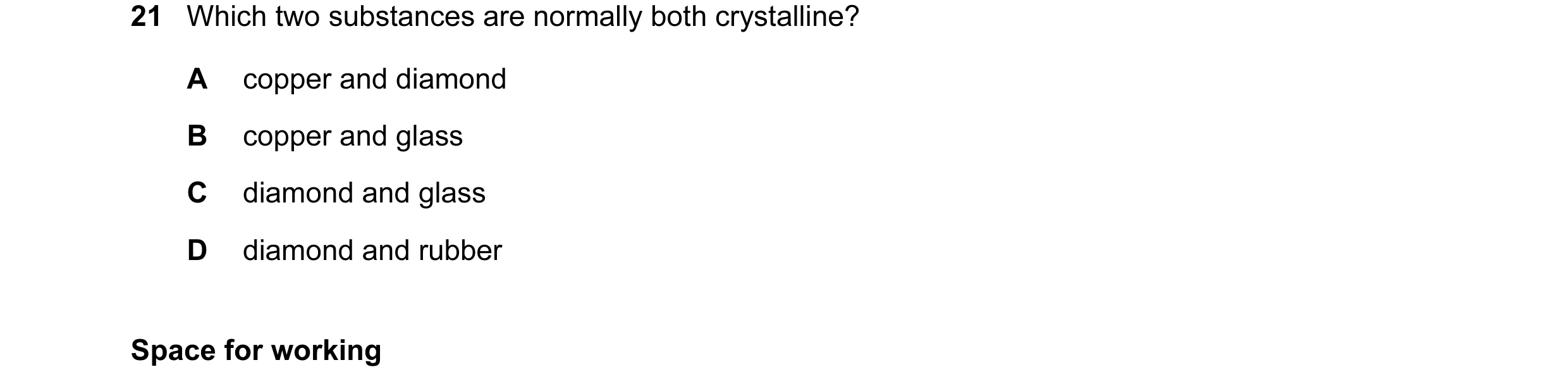
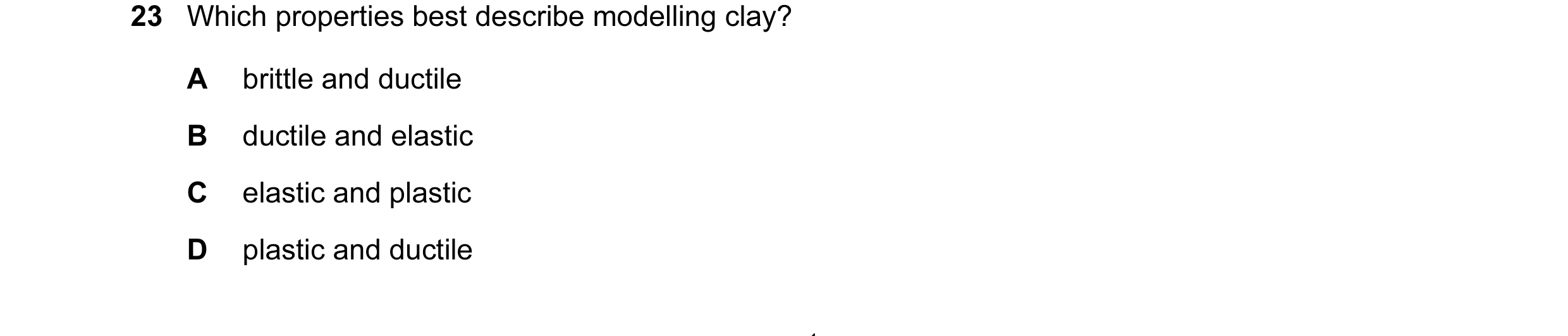
 21 / 63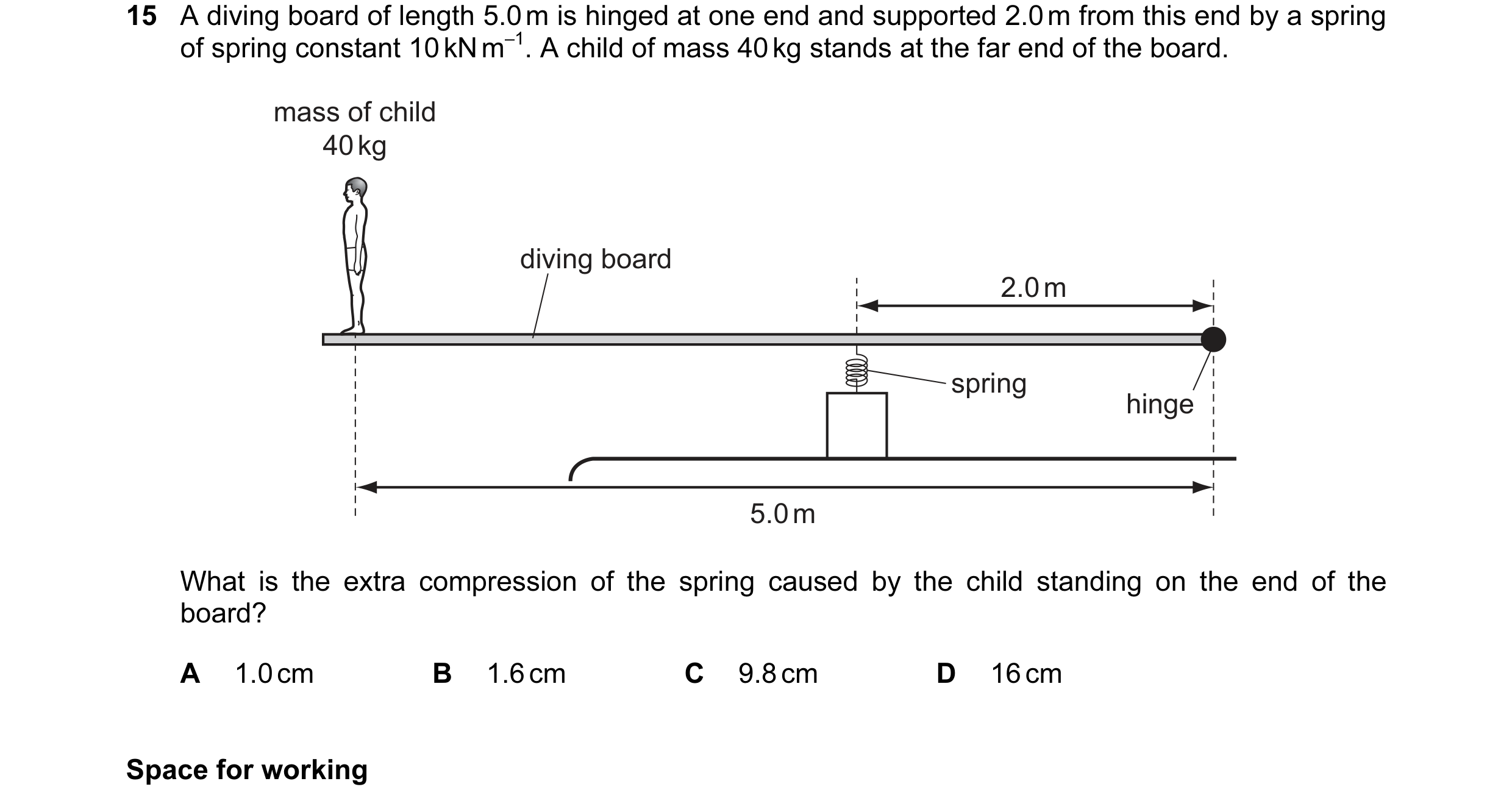
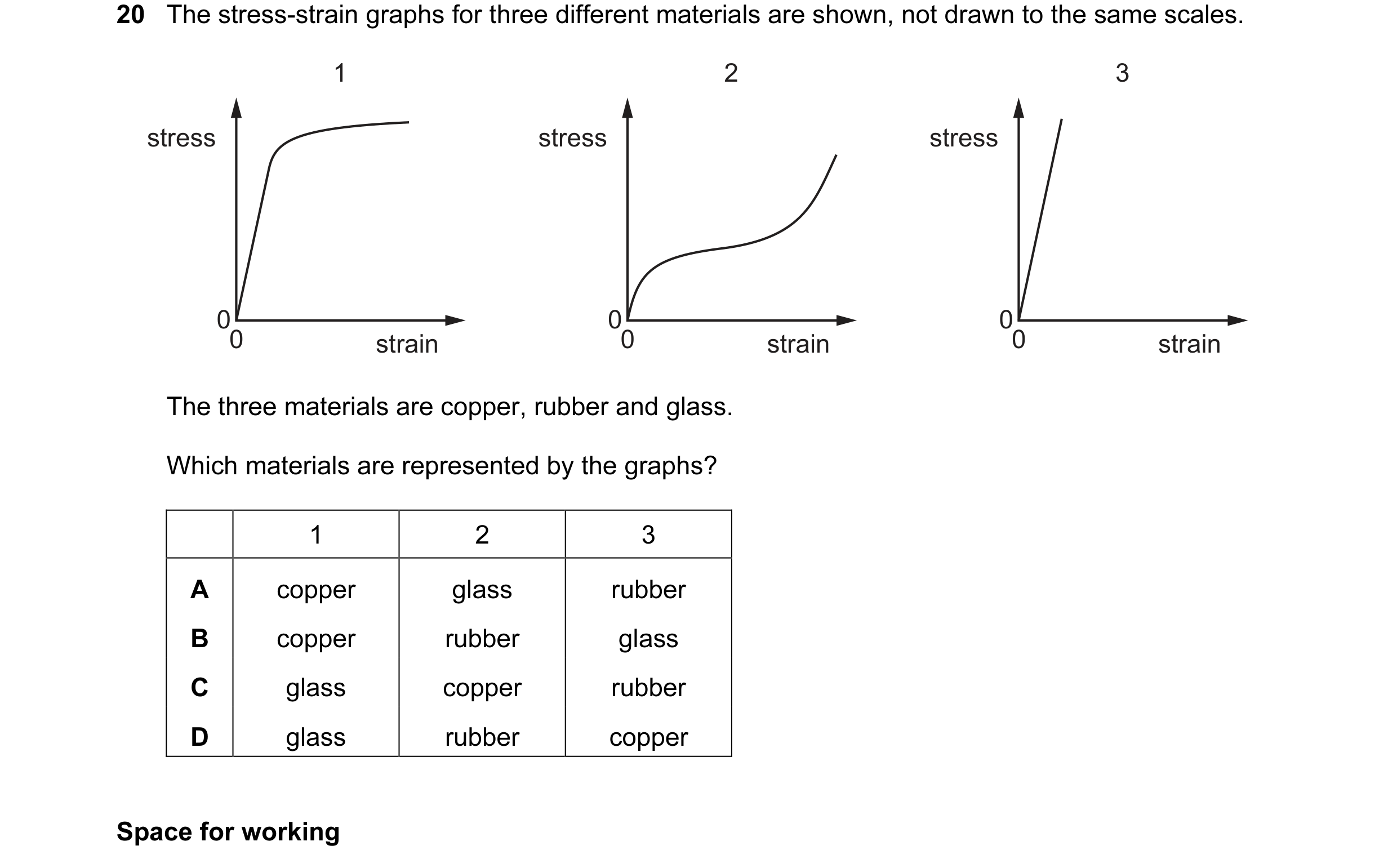 22 / 63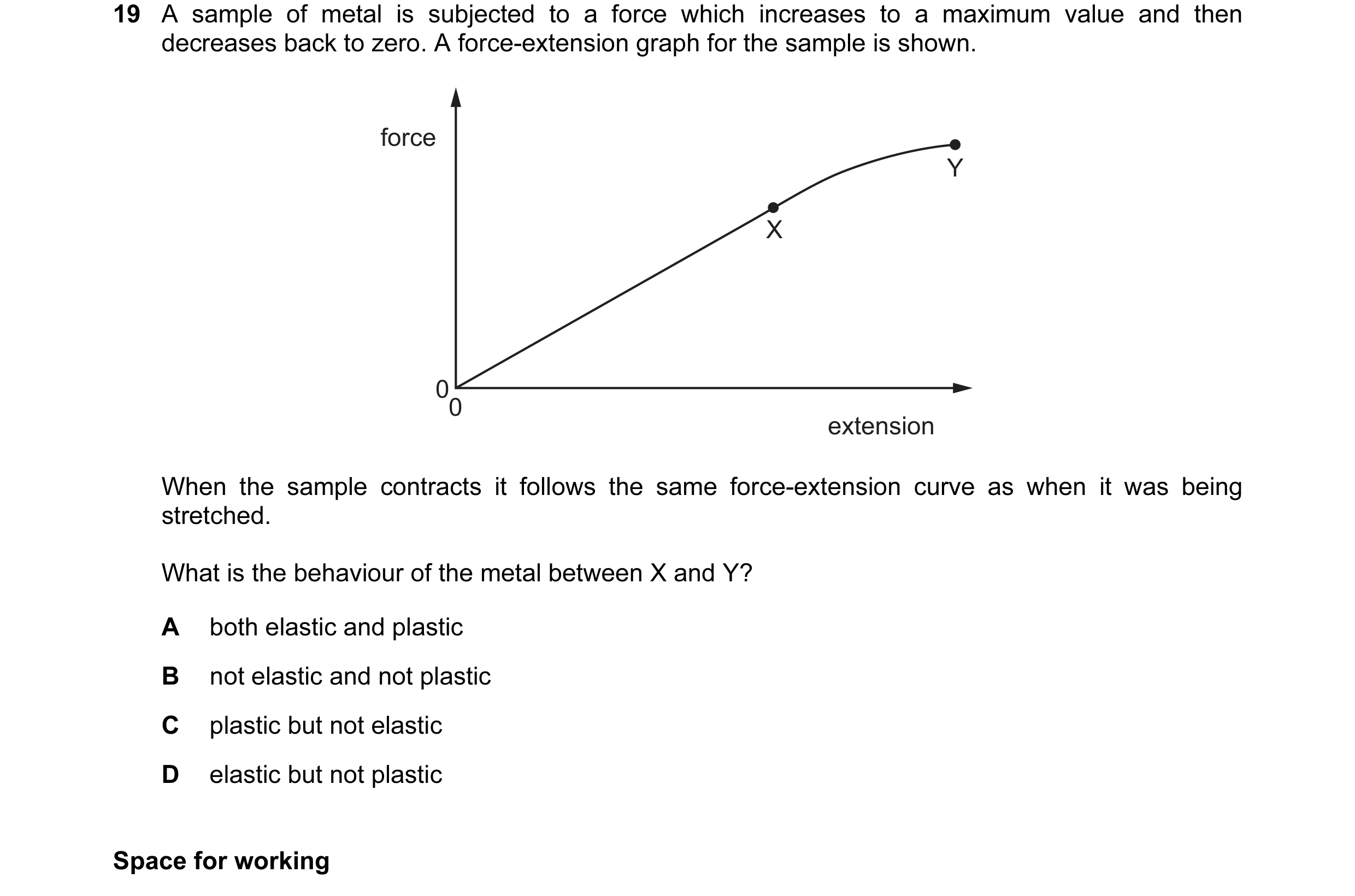
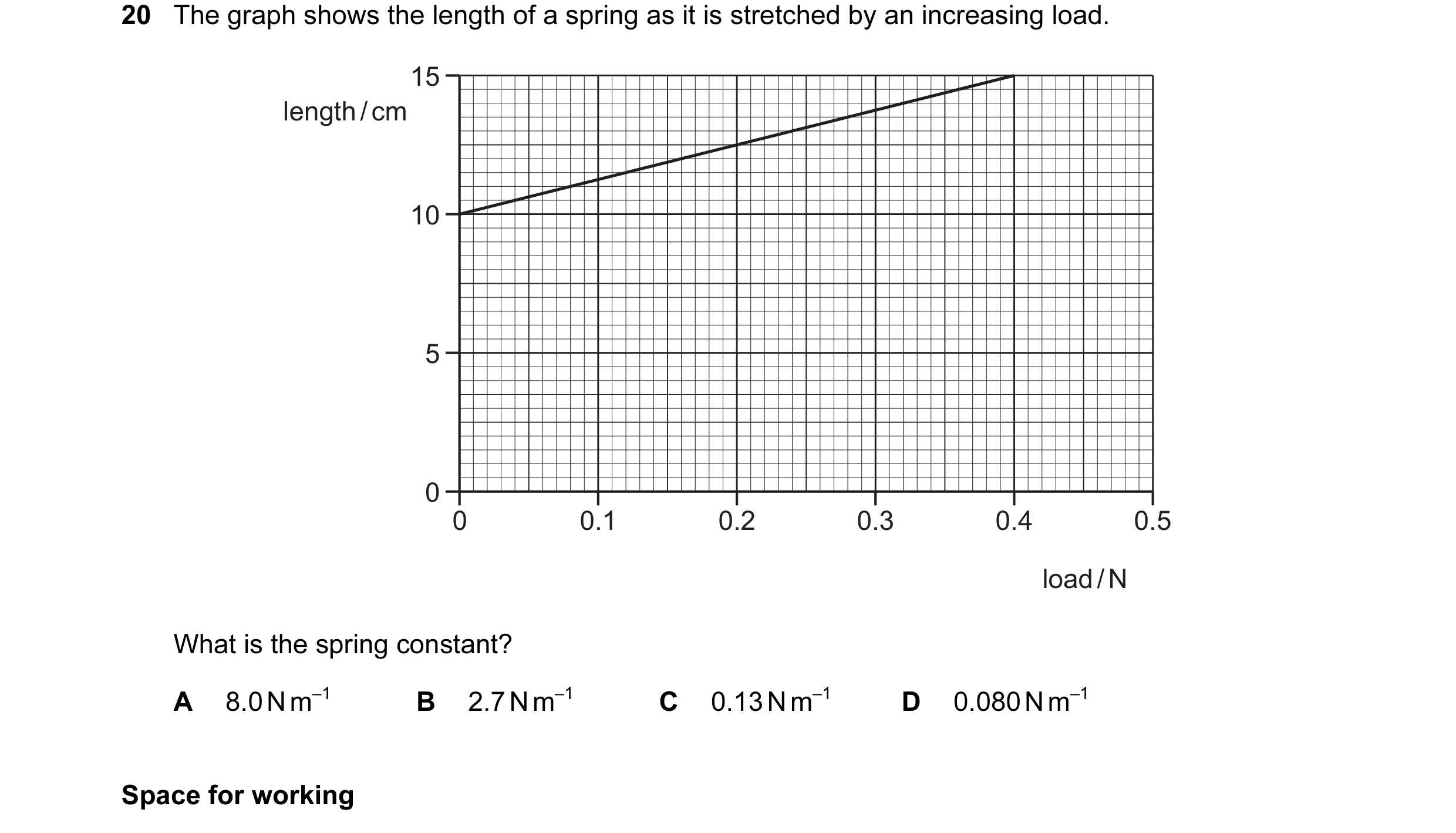 23 / 63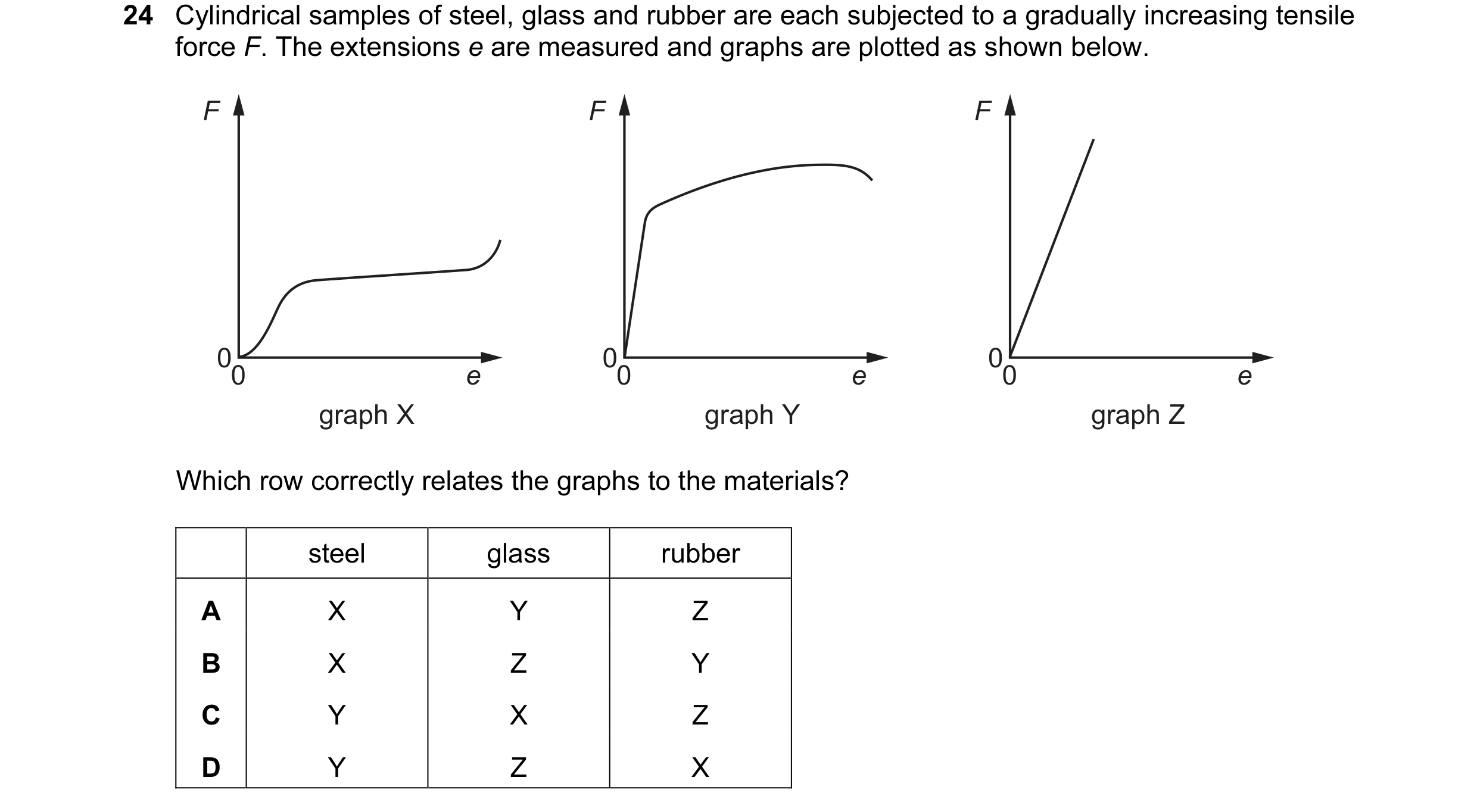
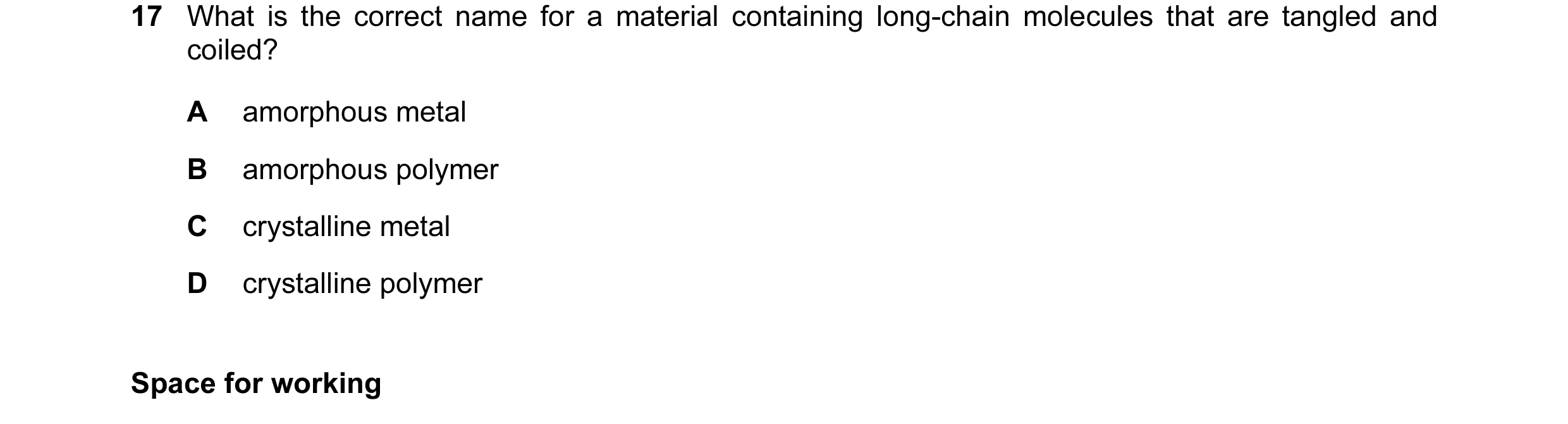
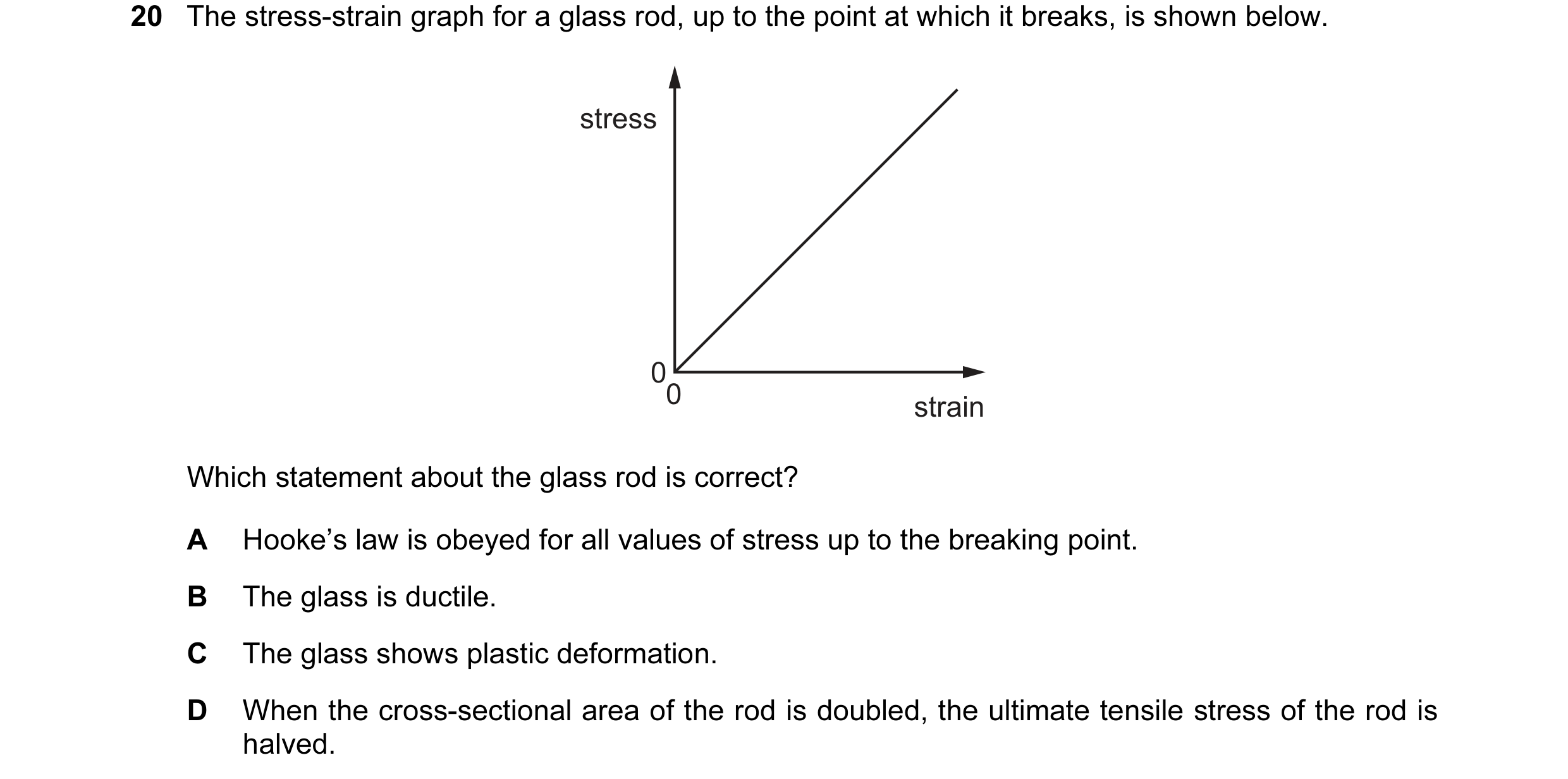 24 / 63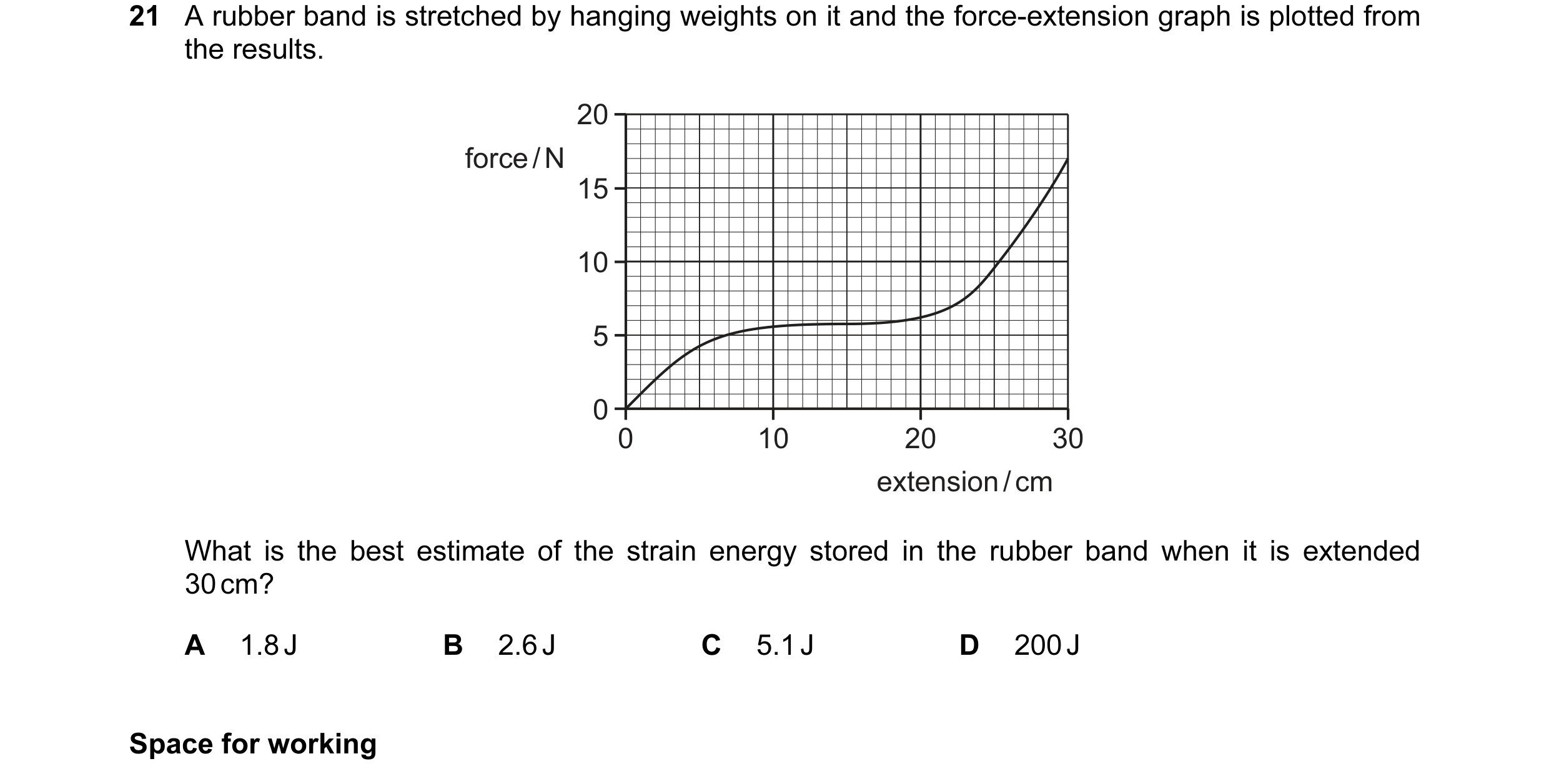
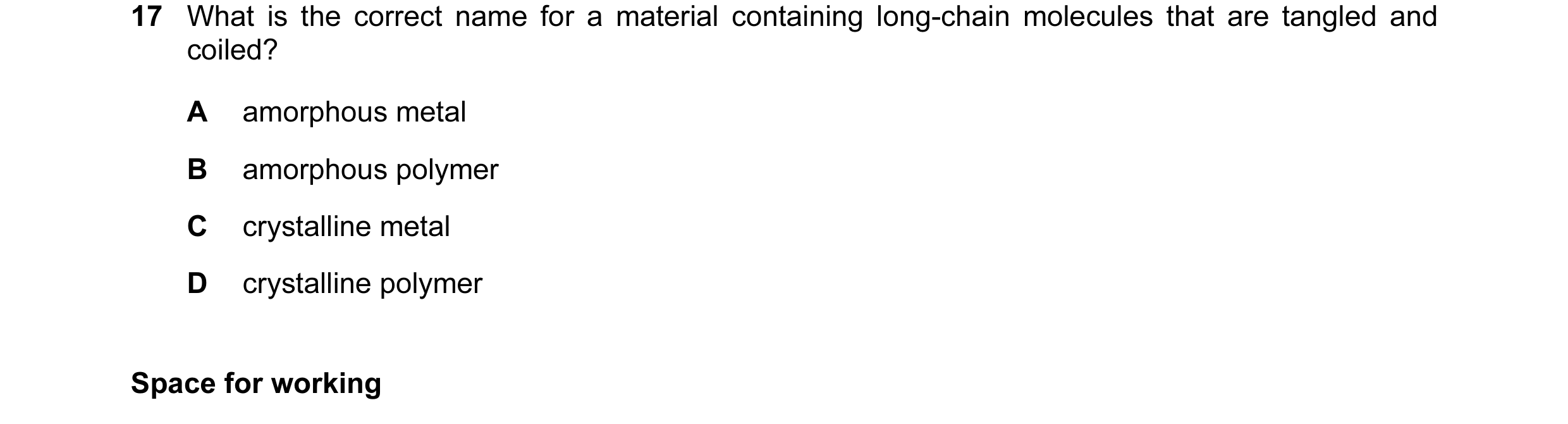
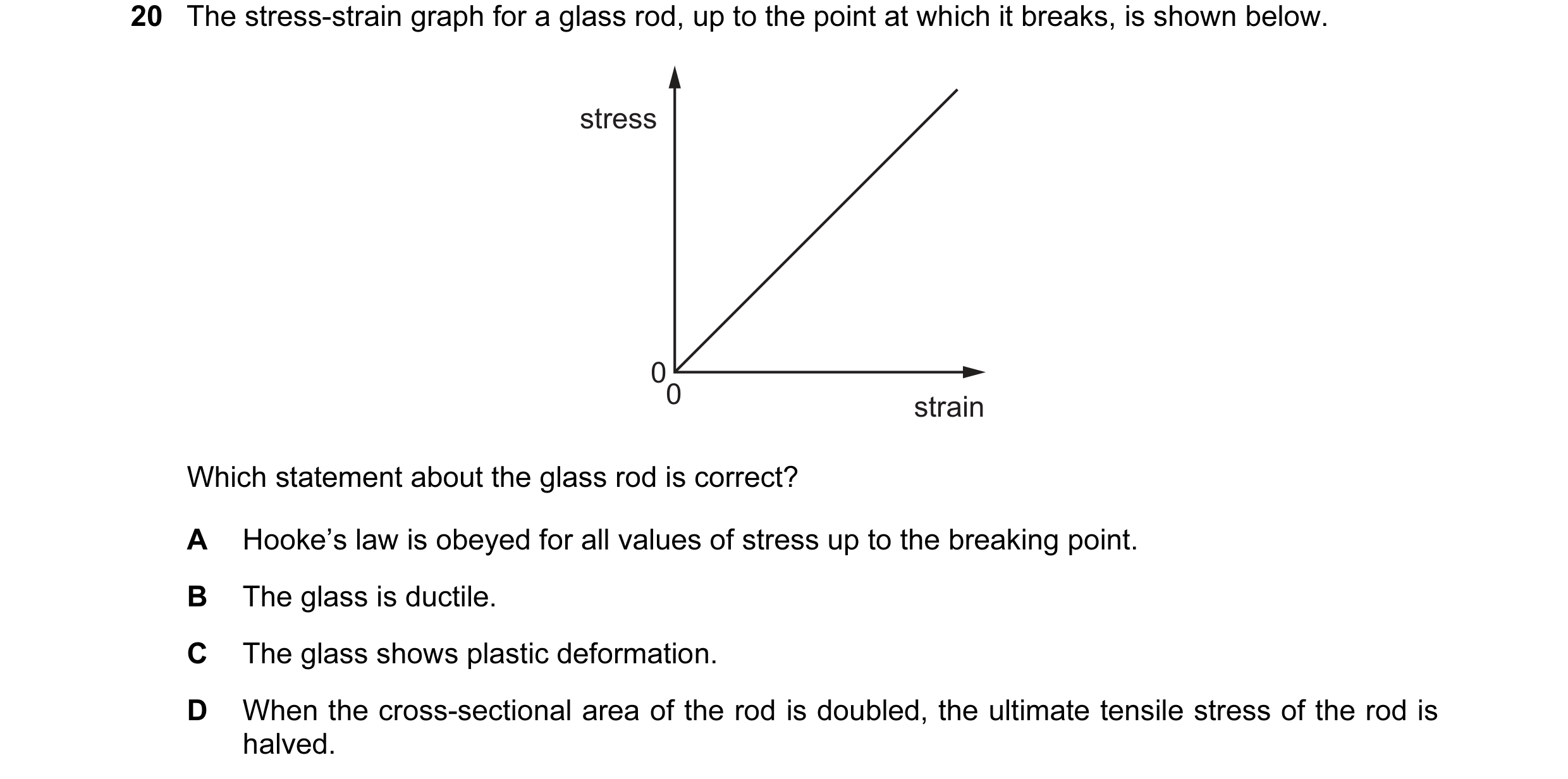 25 / 63
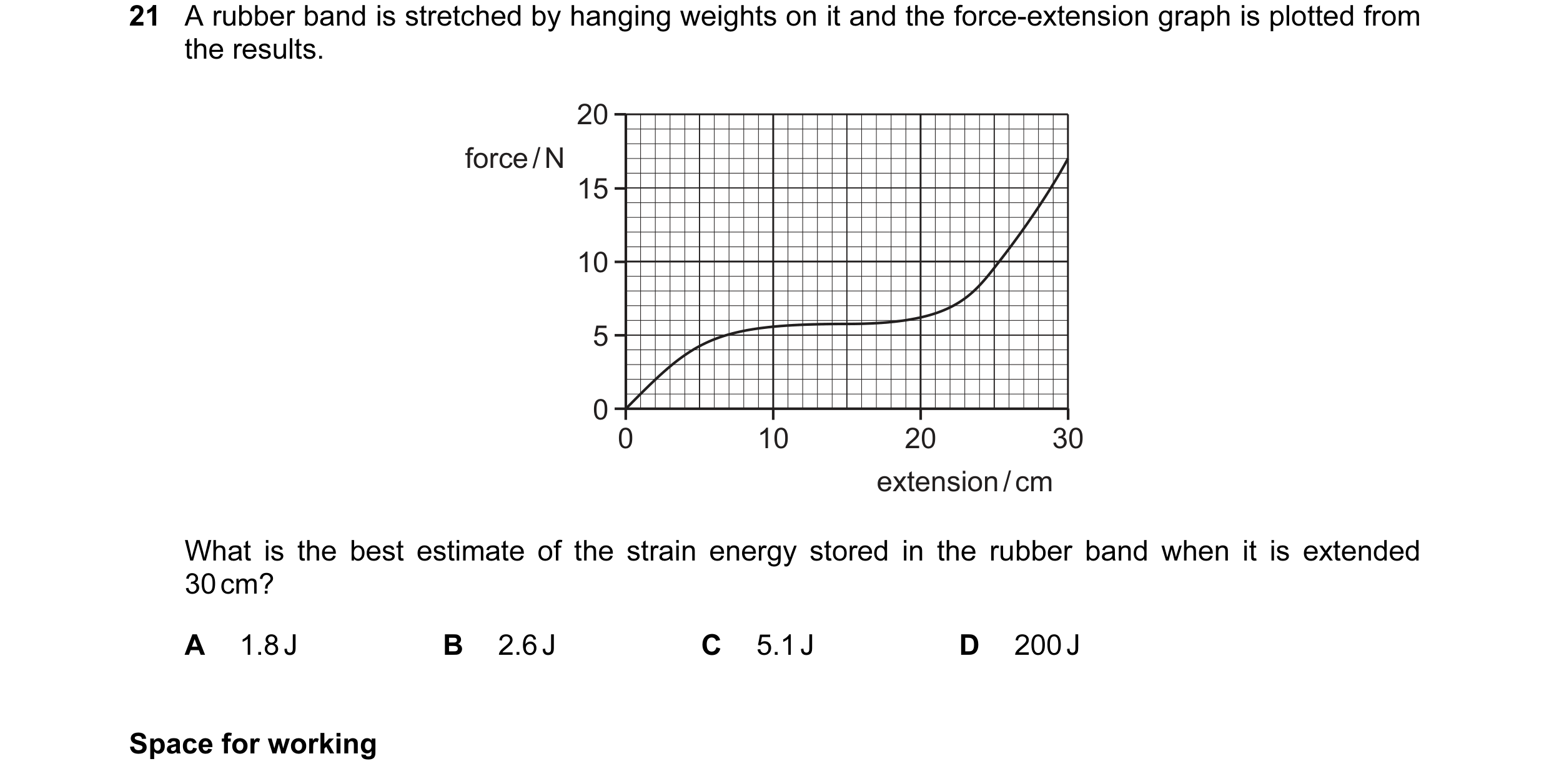 26 / 63
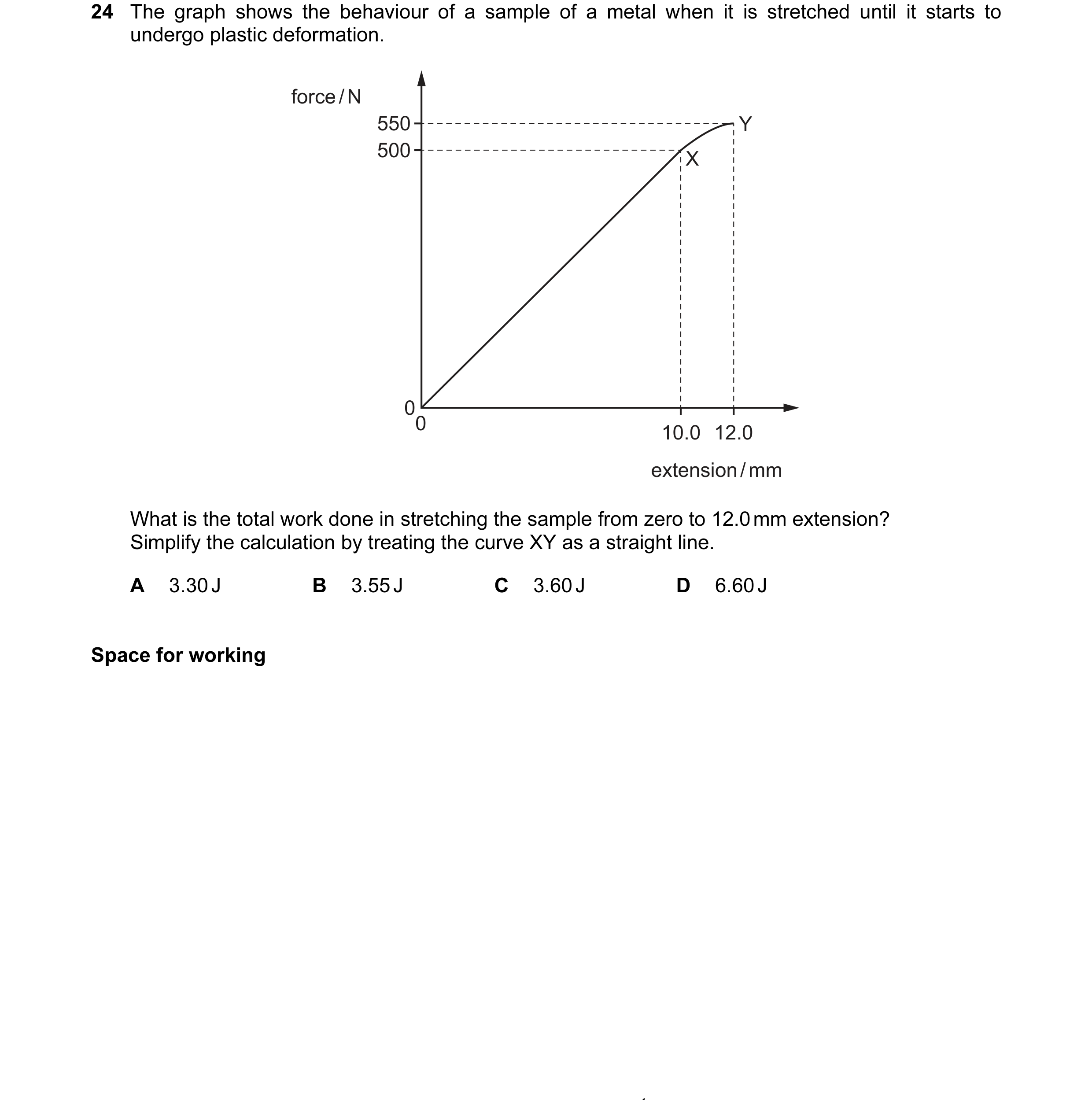 27 / 63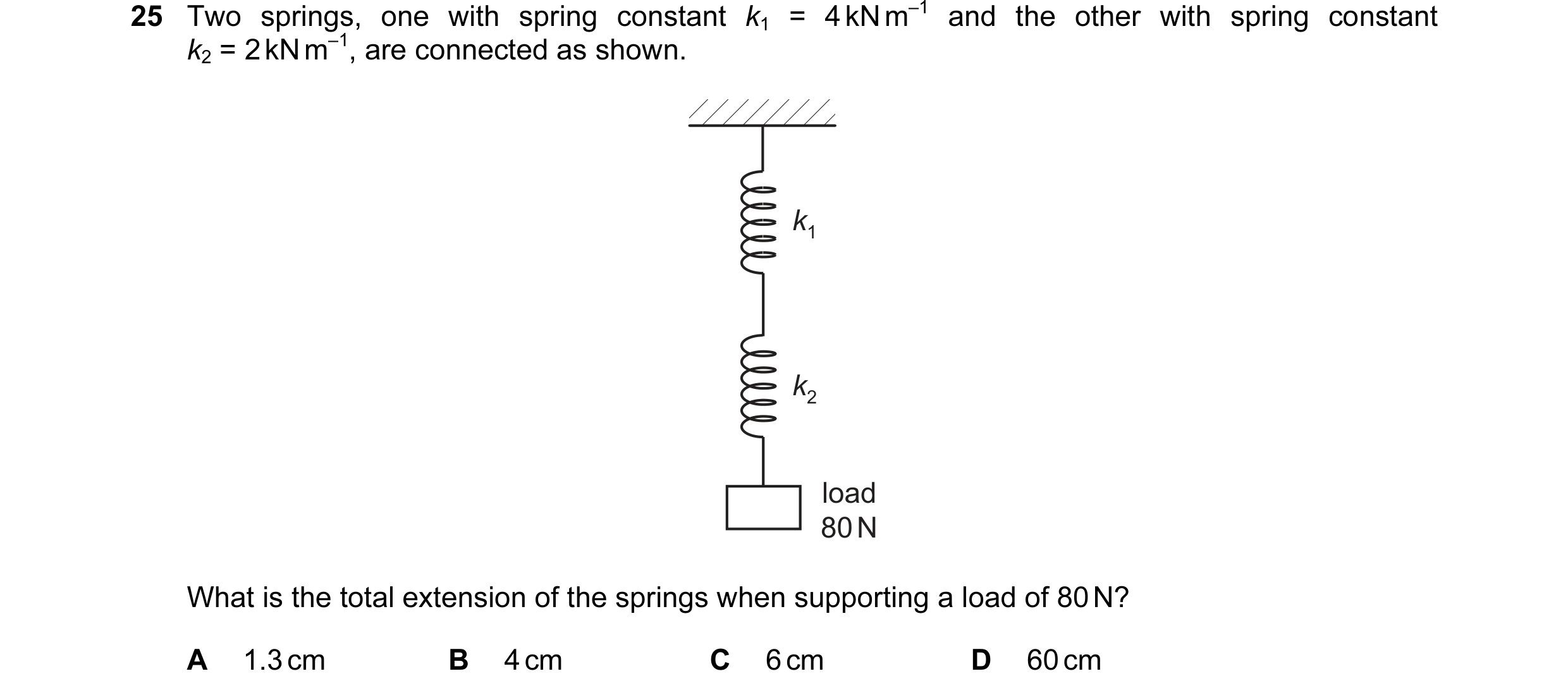
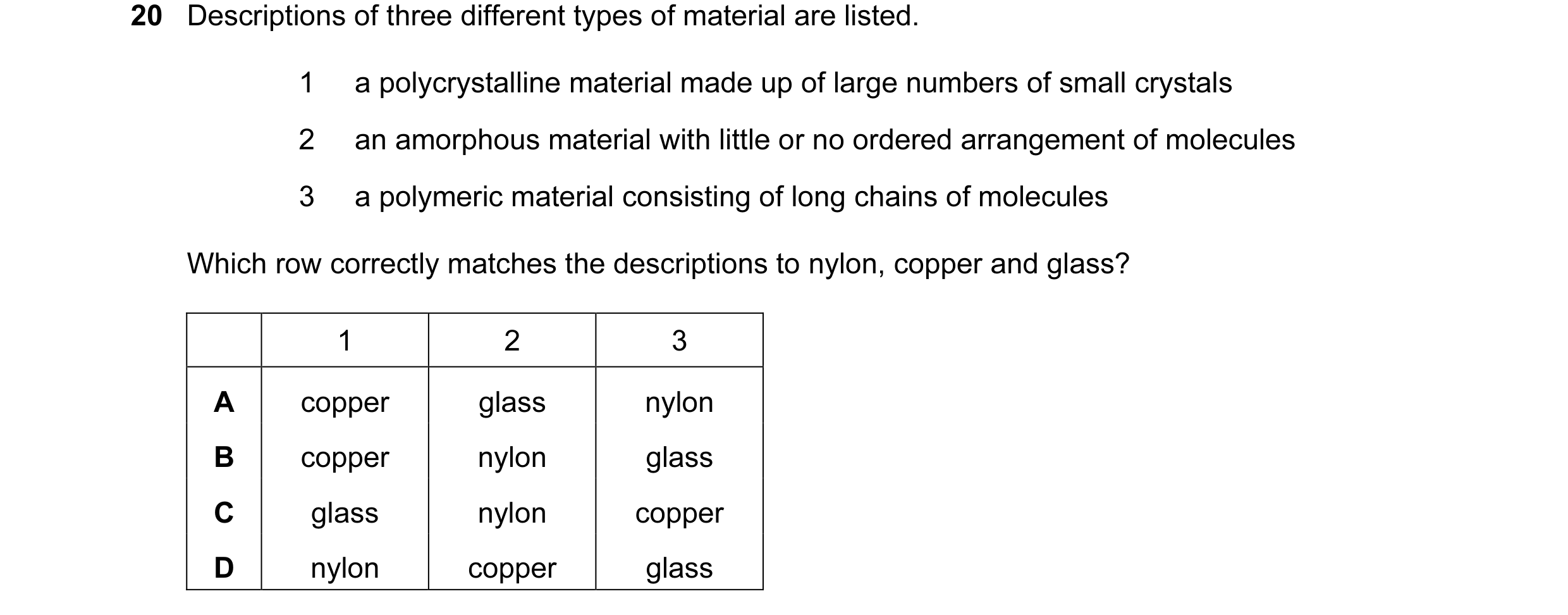 28 / 63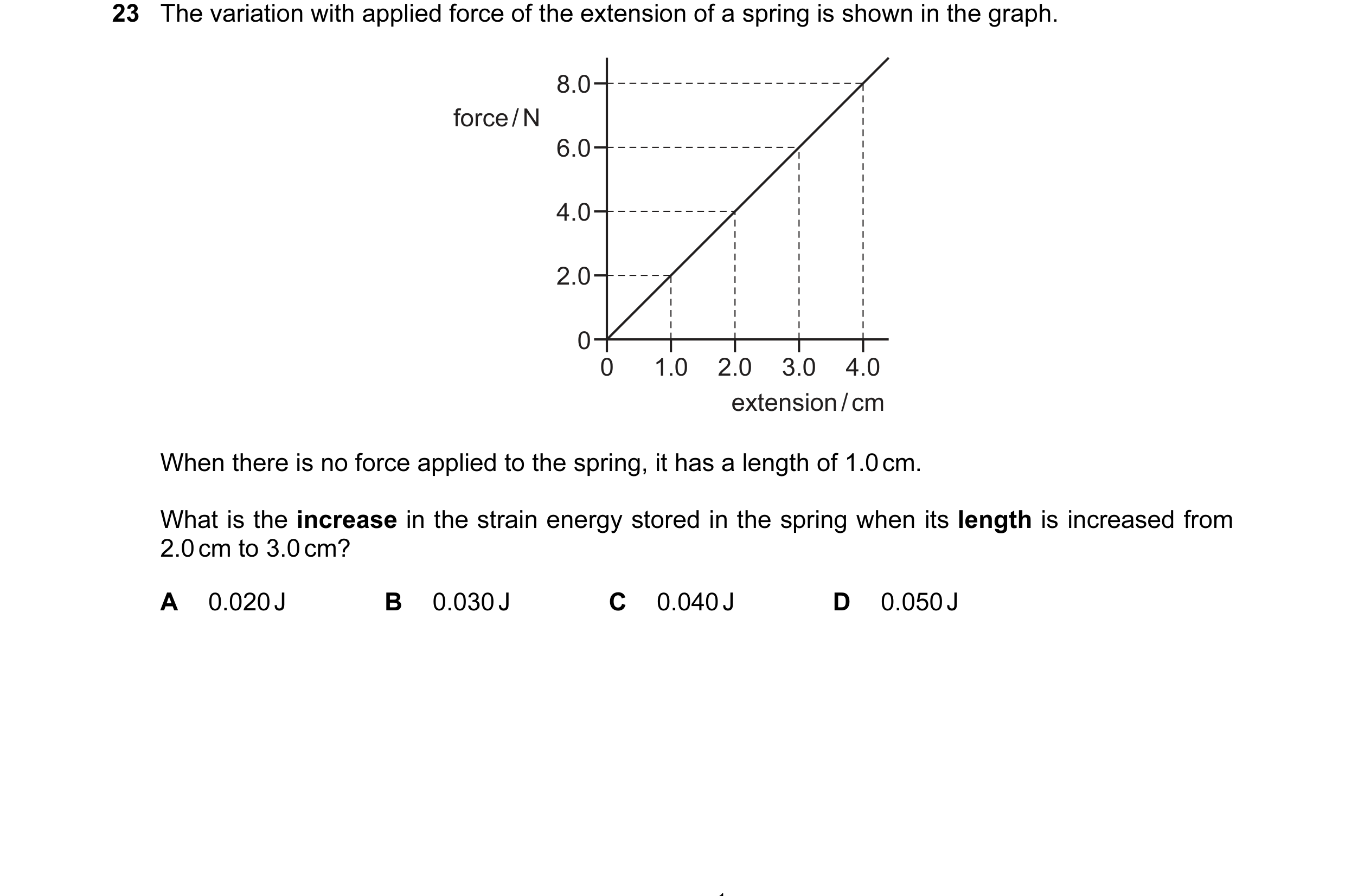
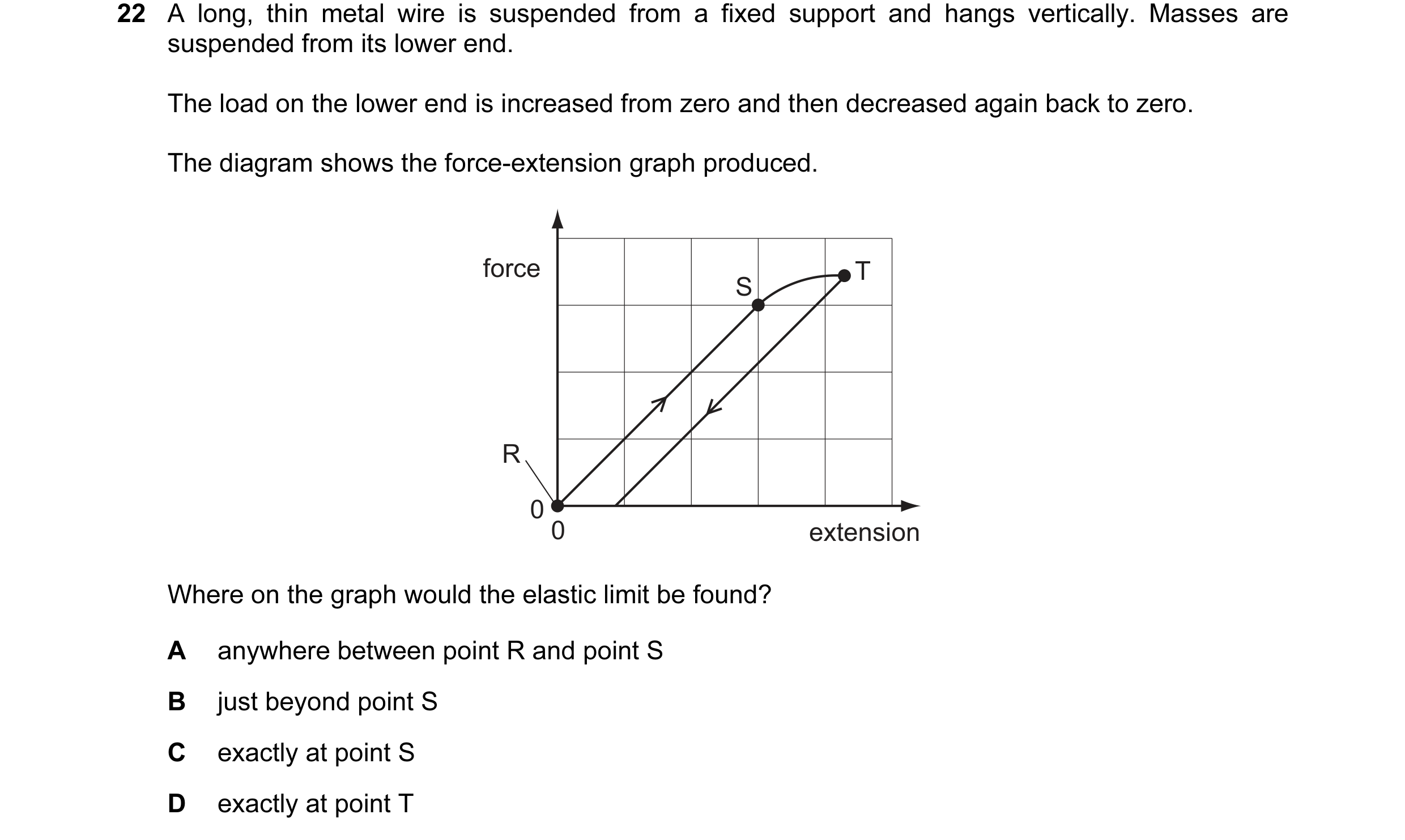 29 / 63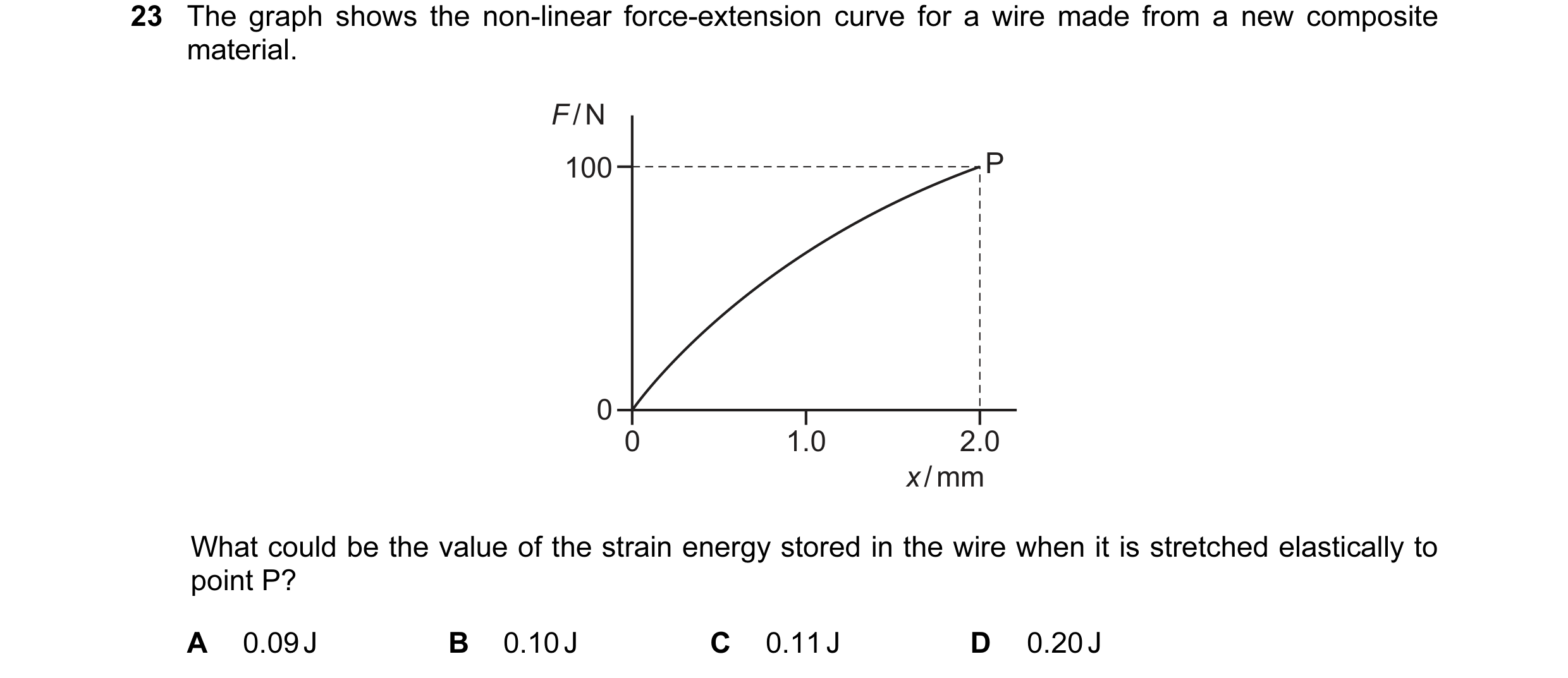
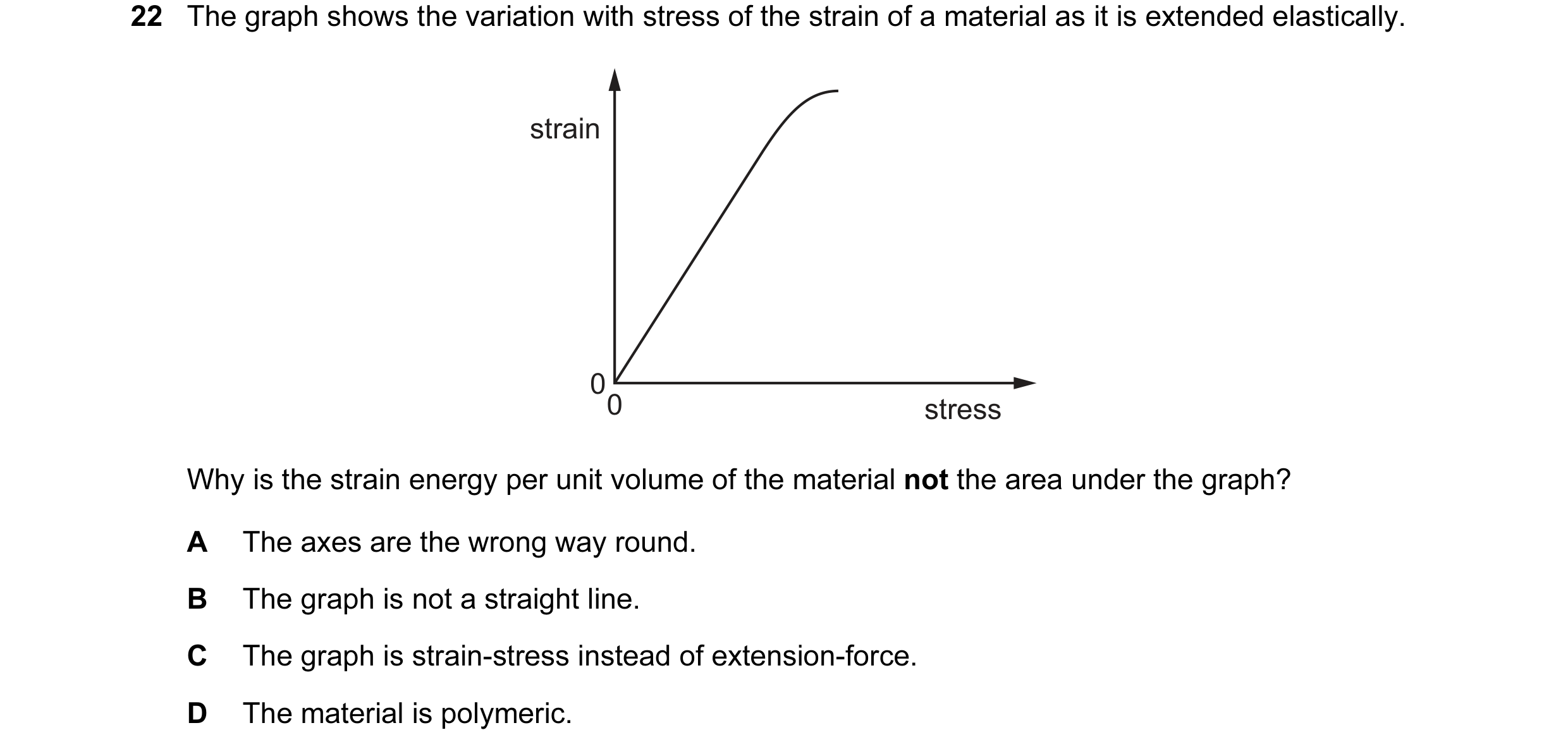

 30 / 63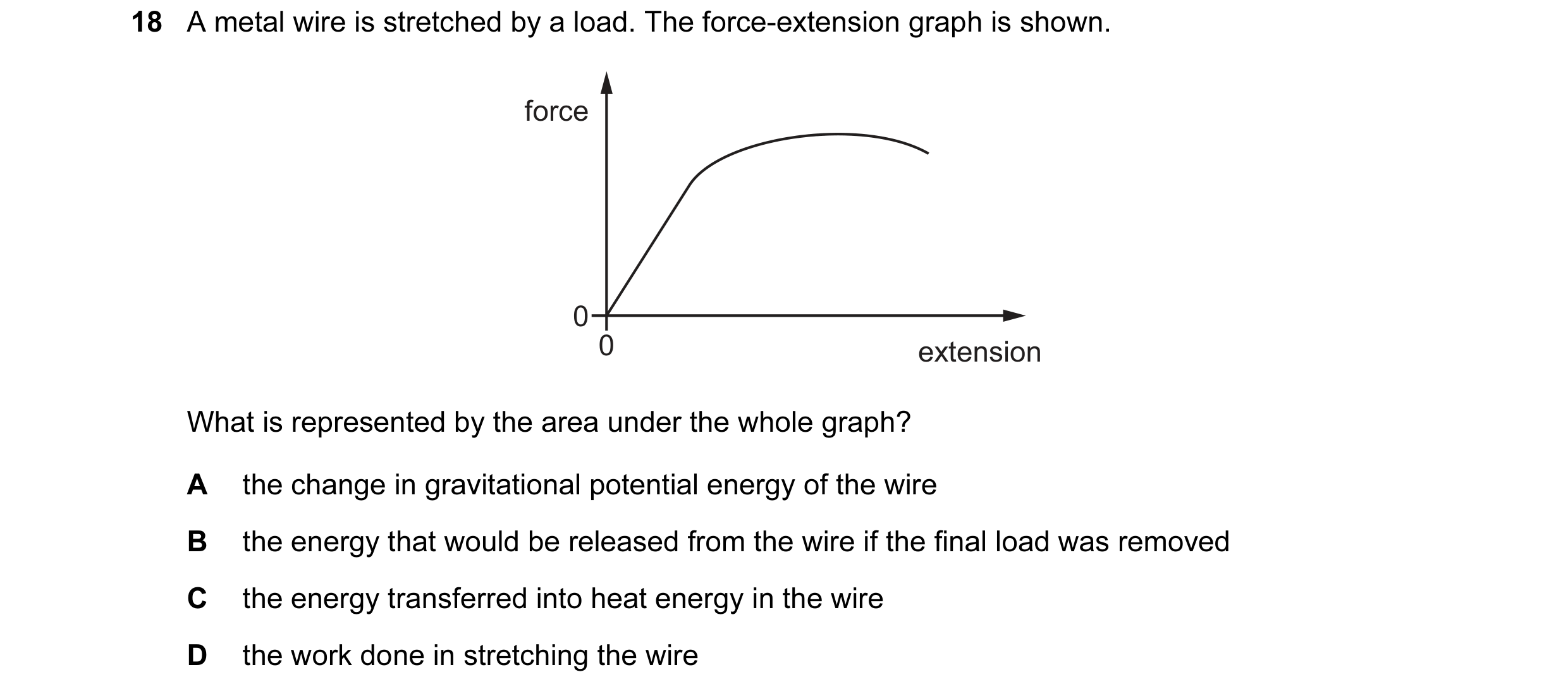
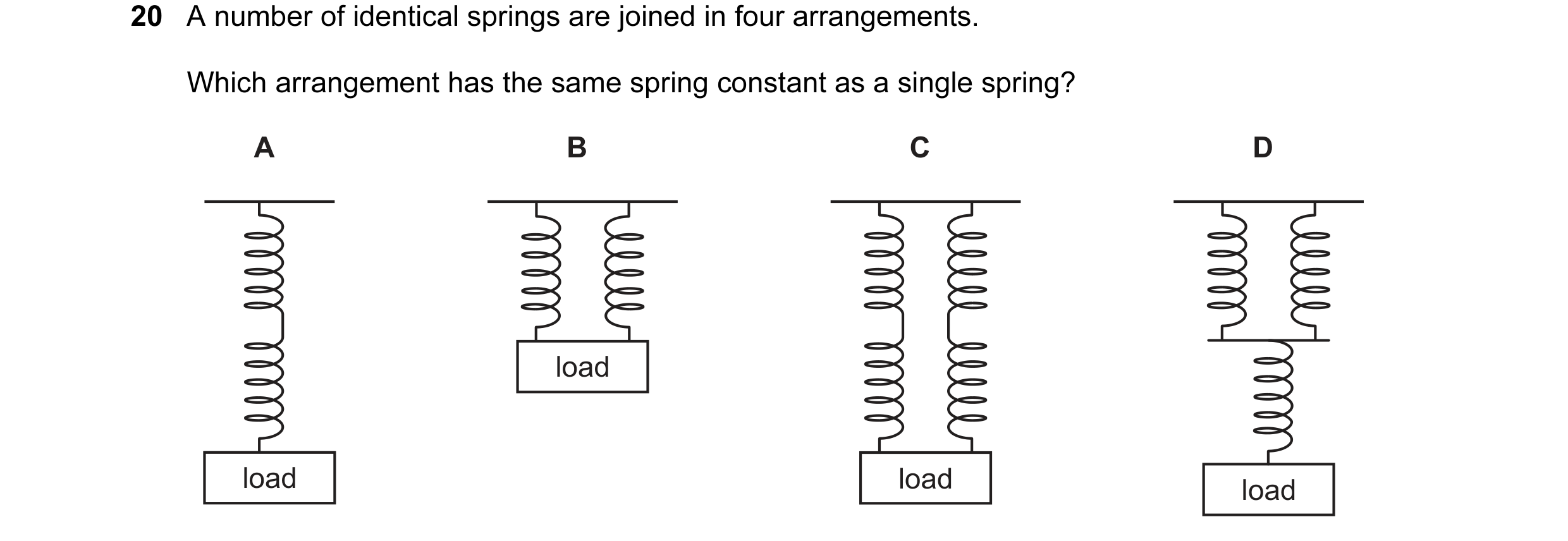
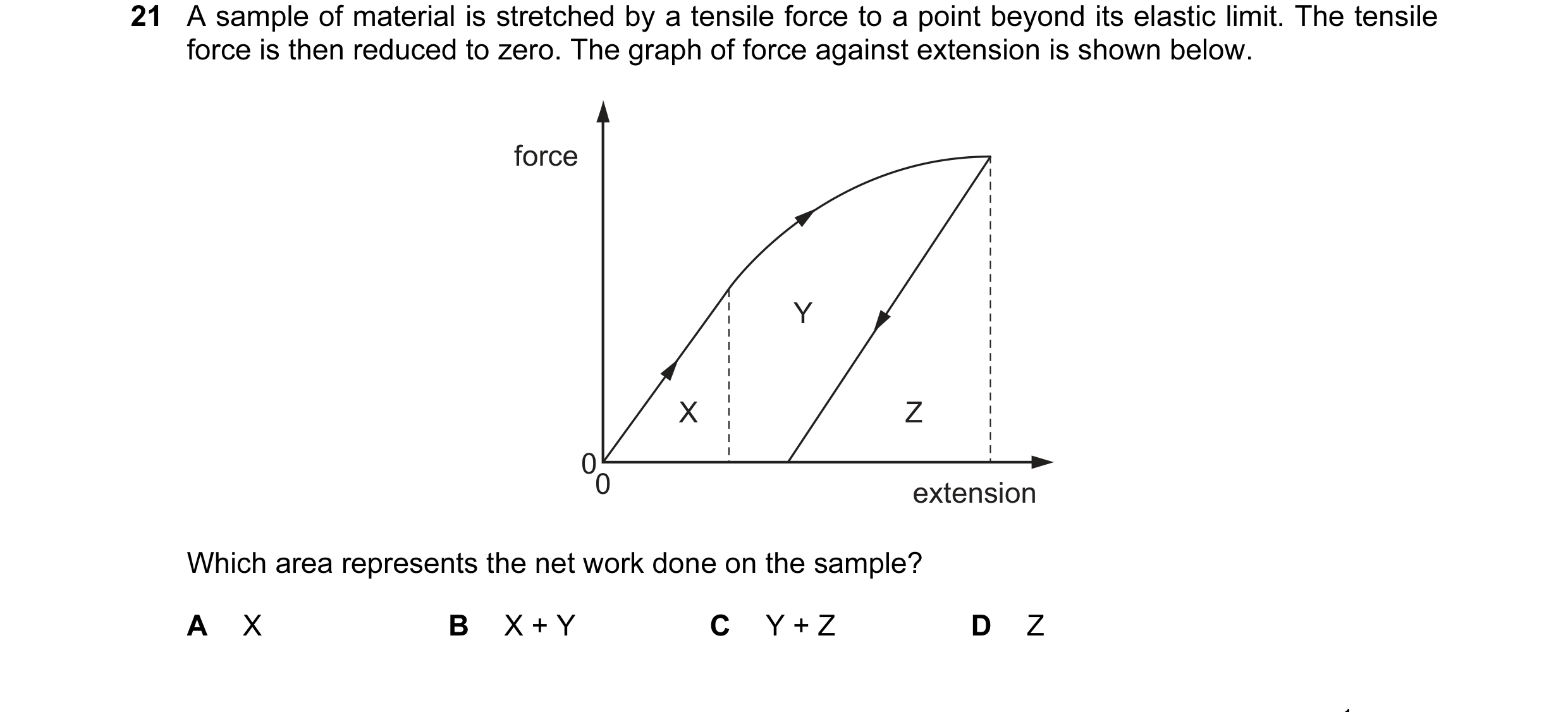 31 / 63
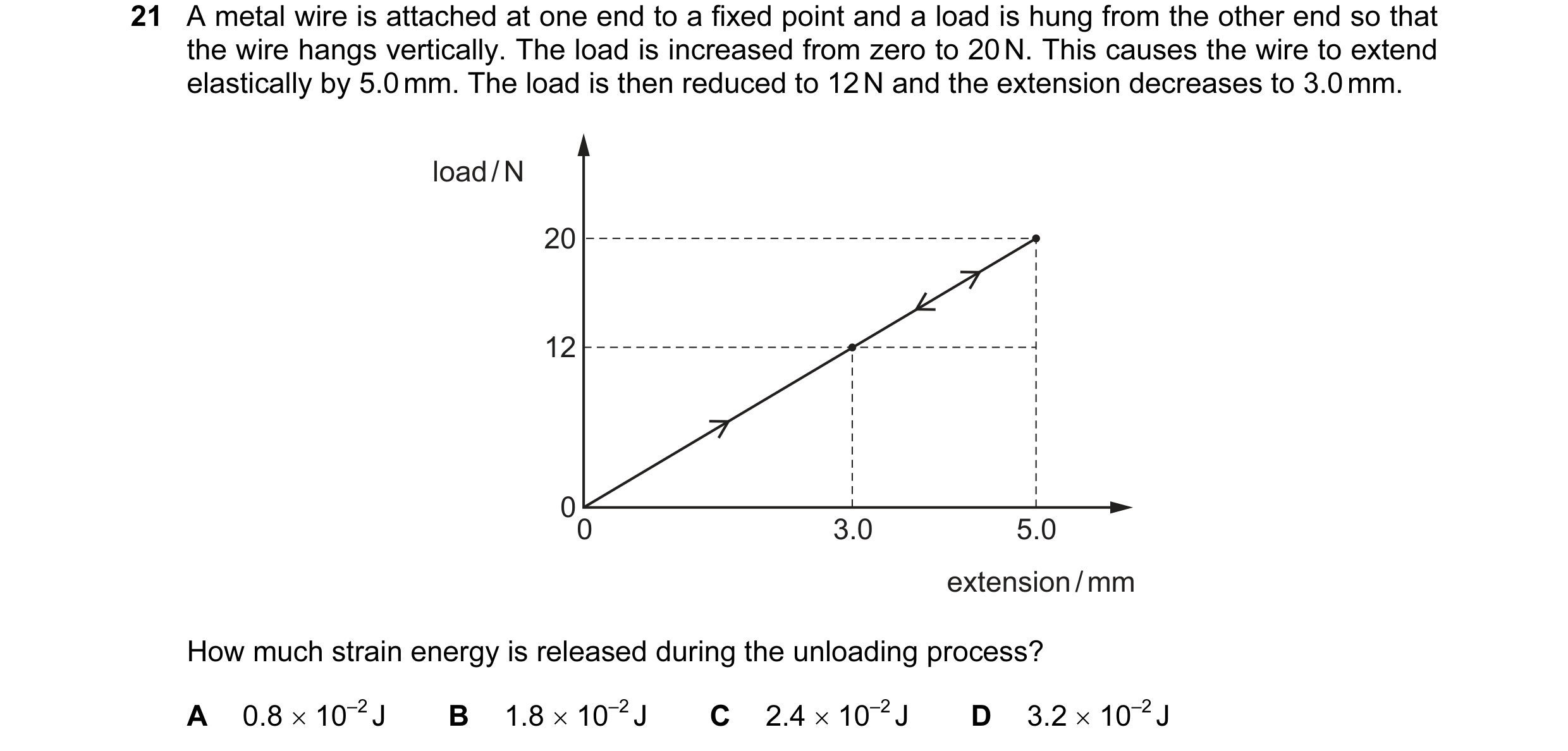
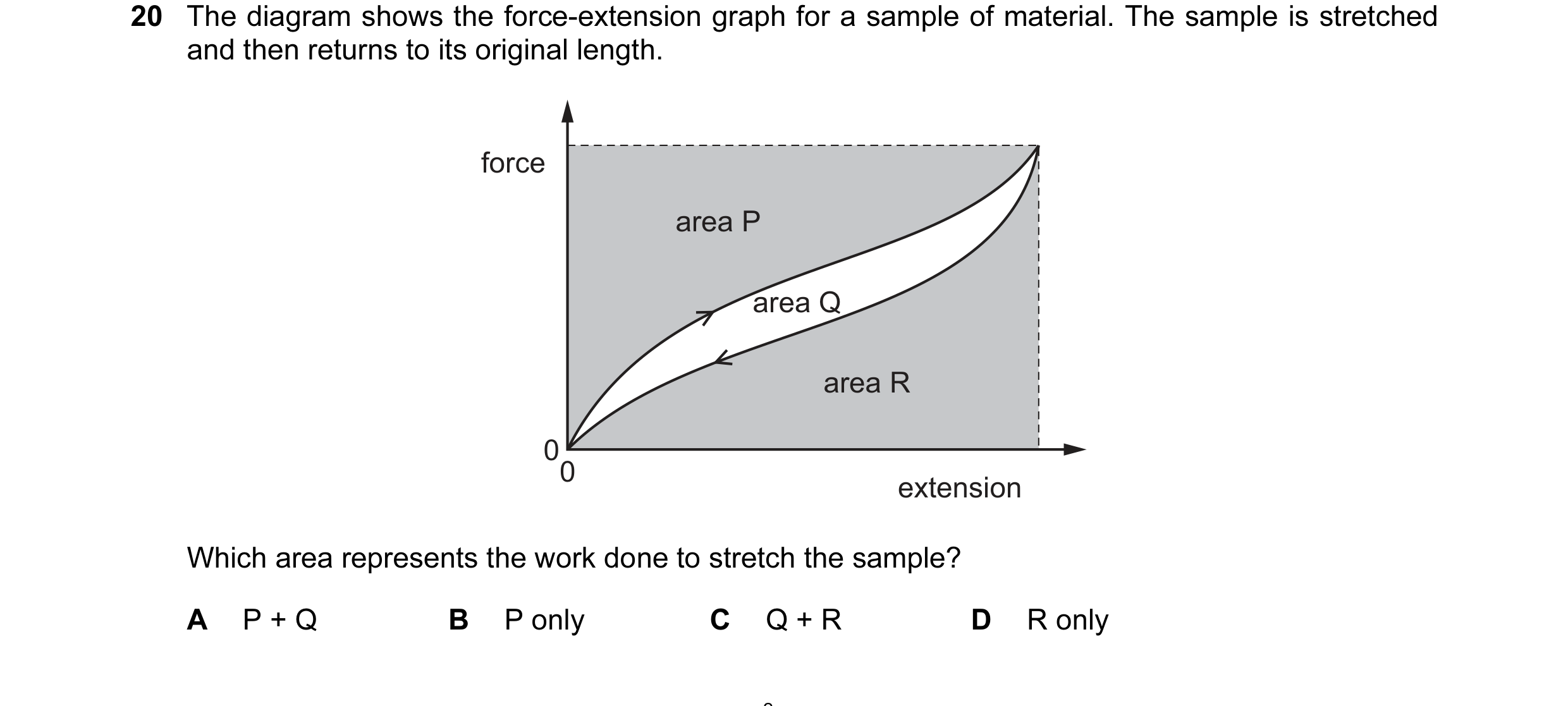 32 / 63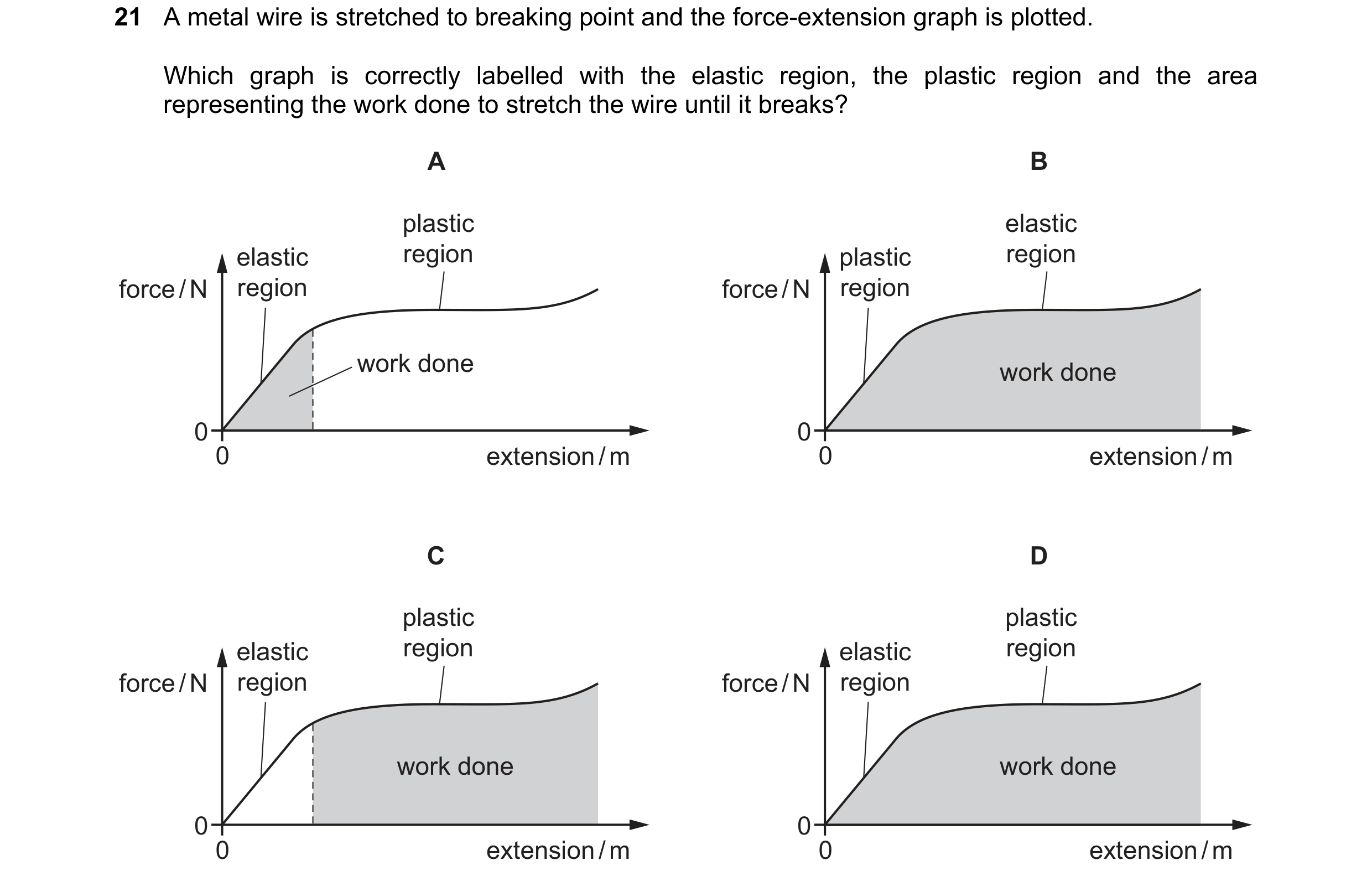
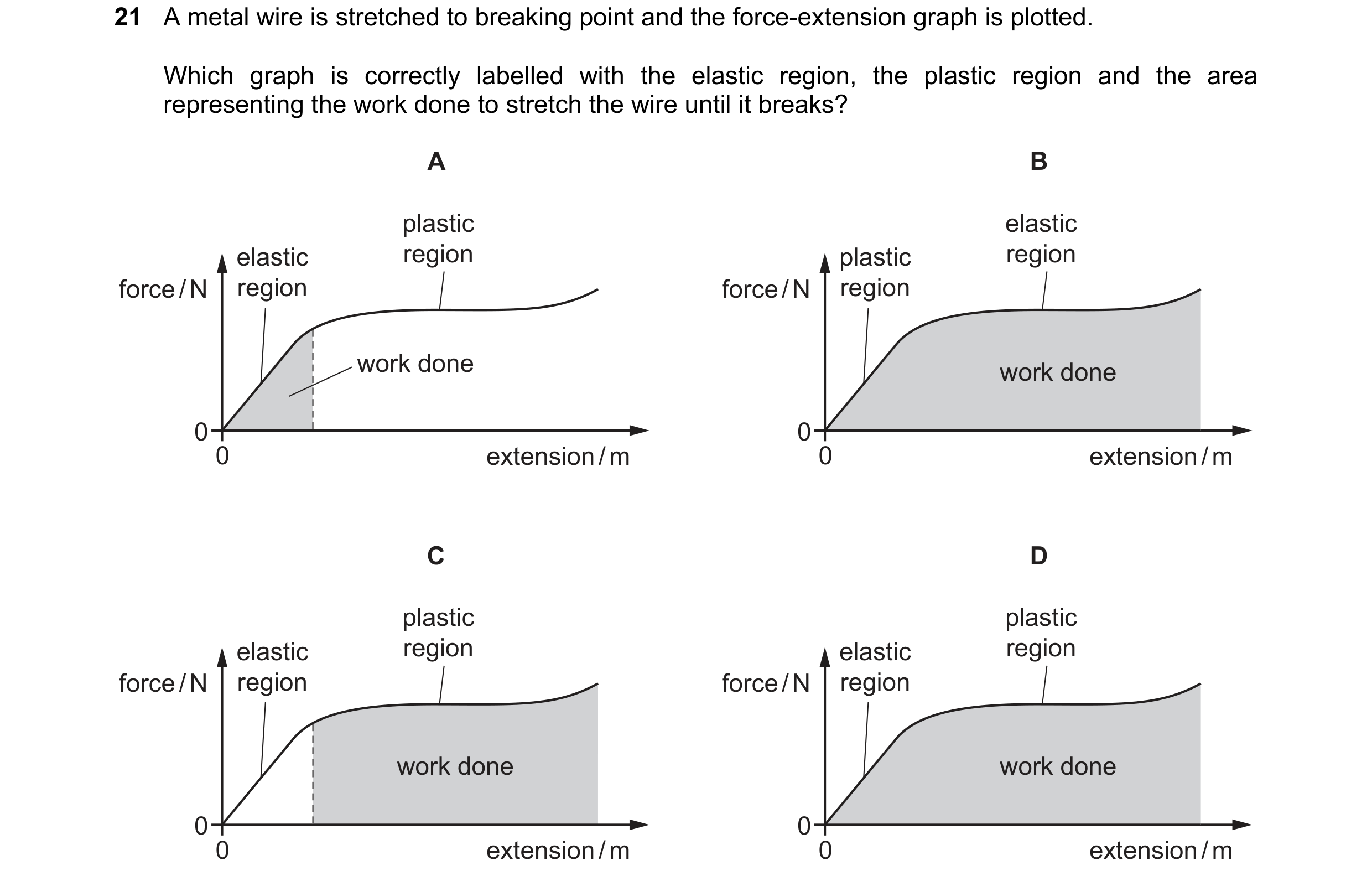 33 / 63
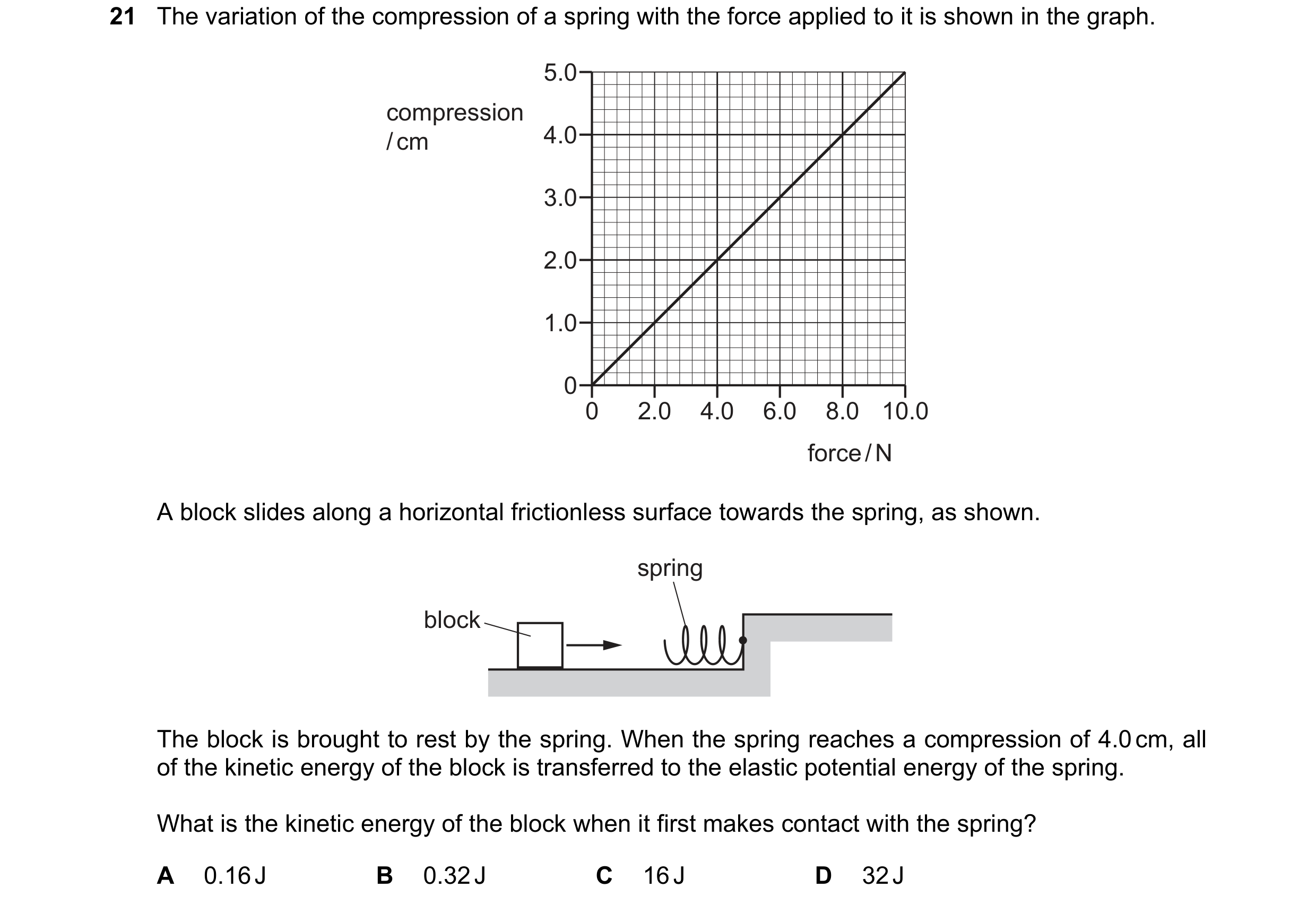
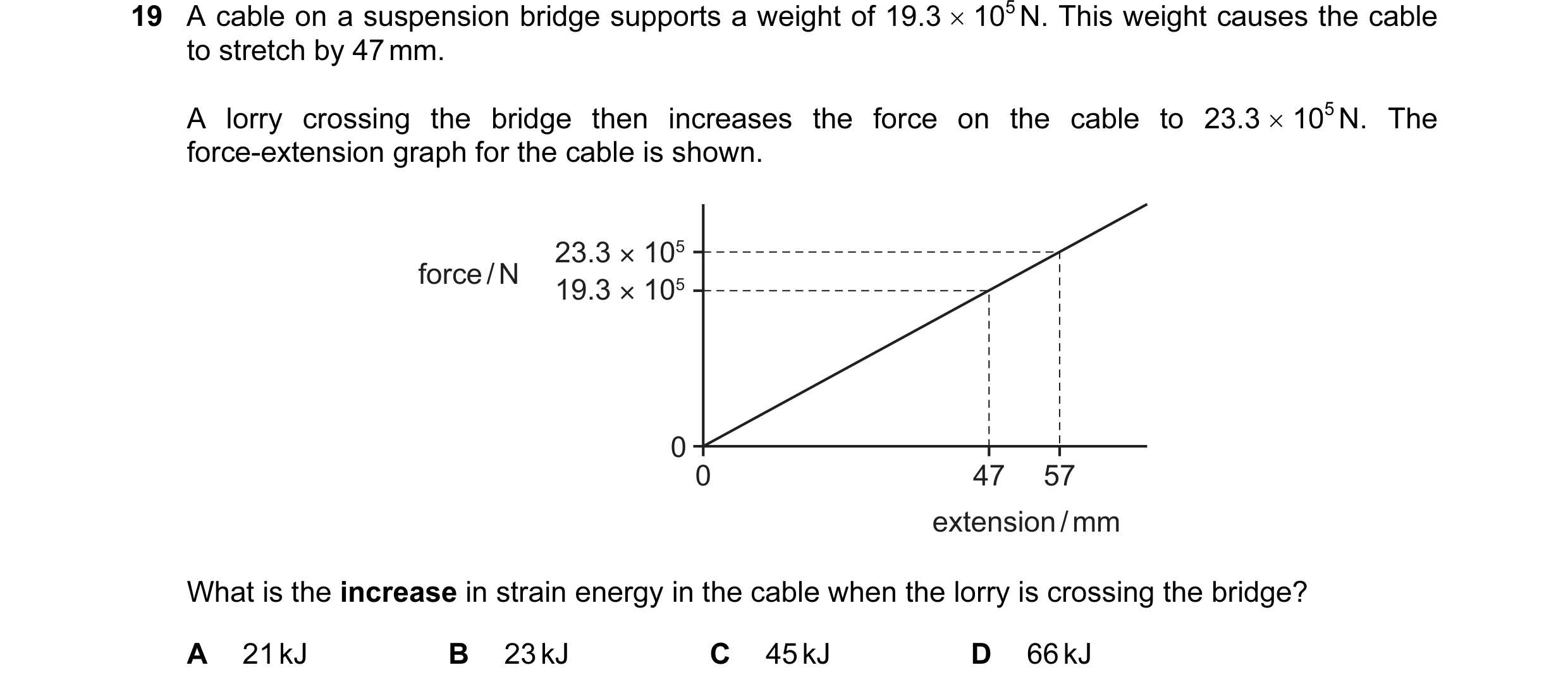 34 / 63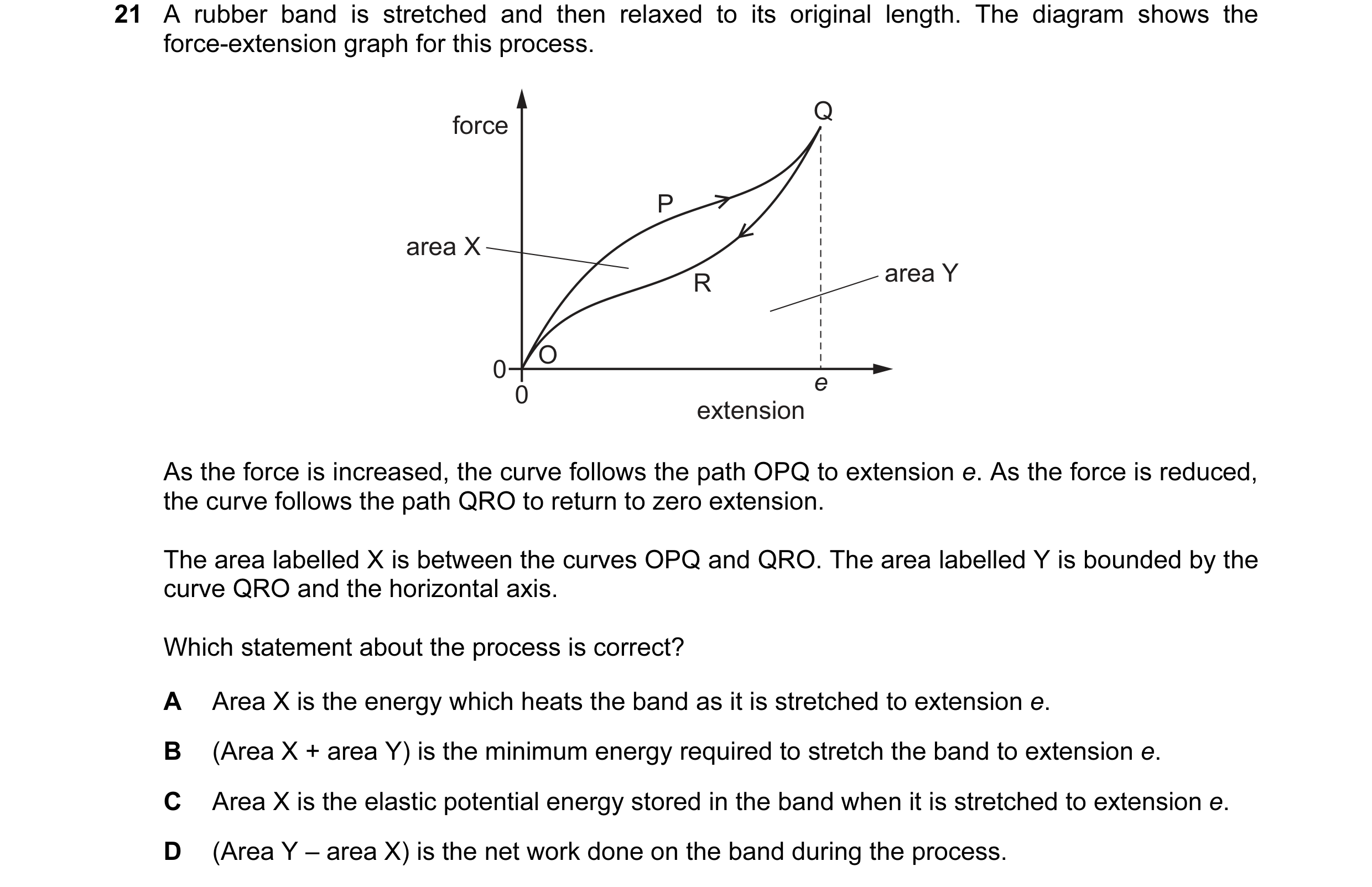
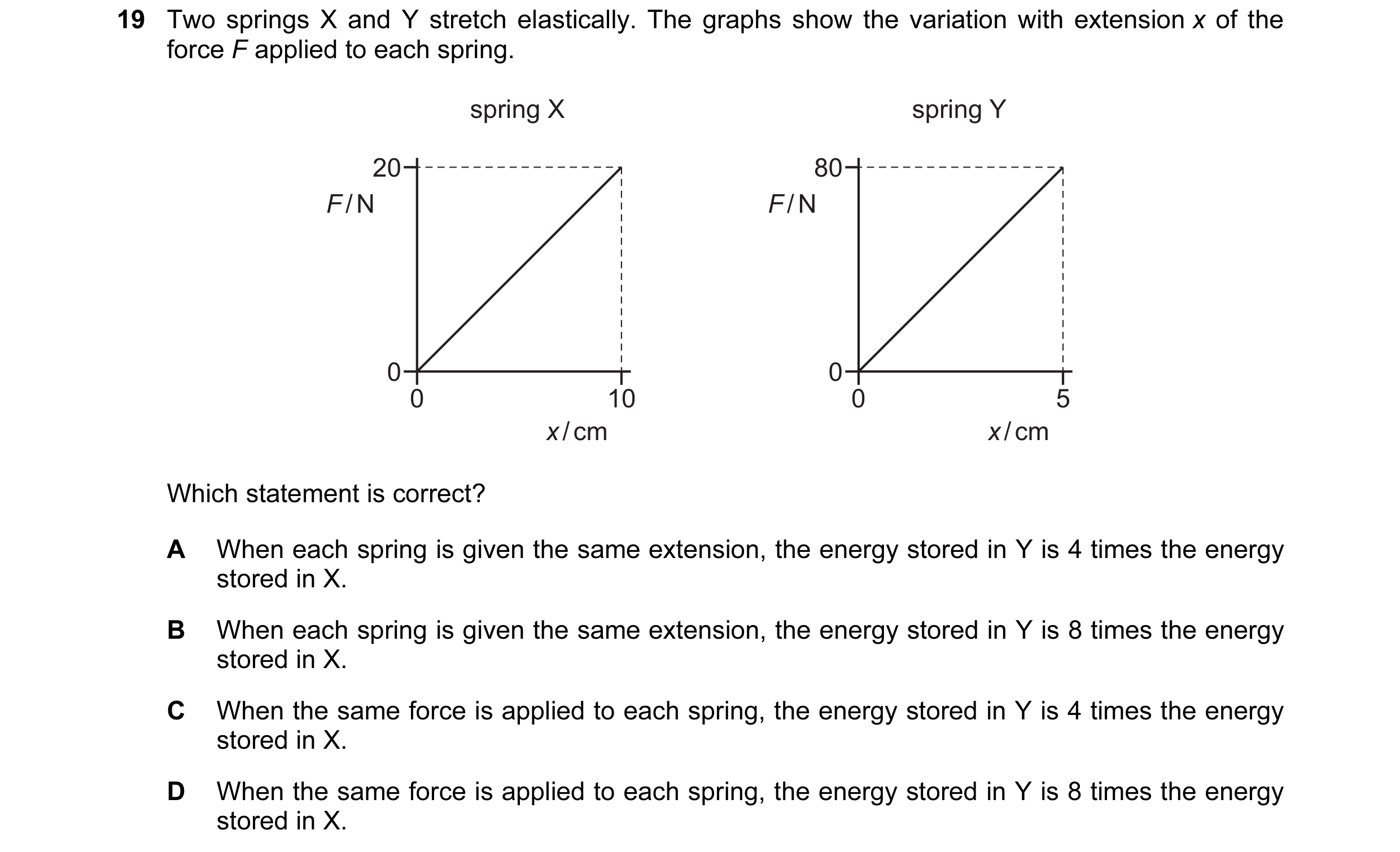 35 / 63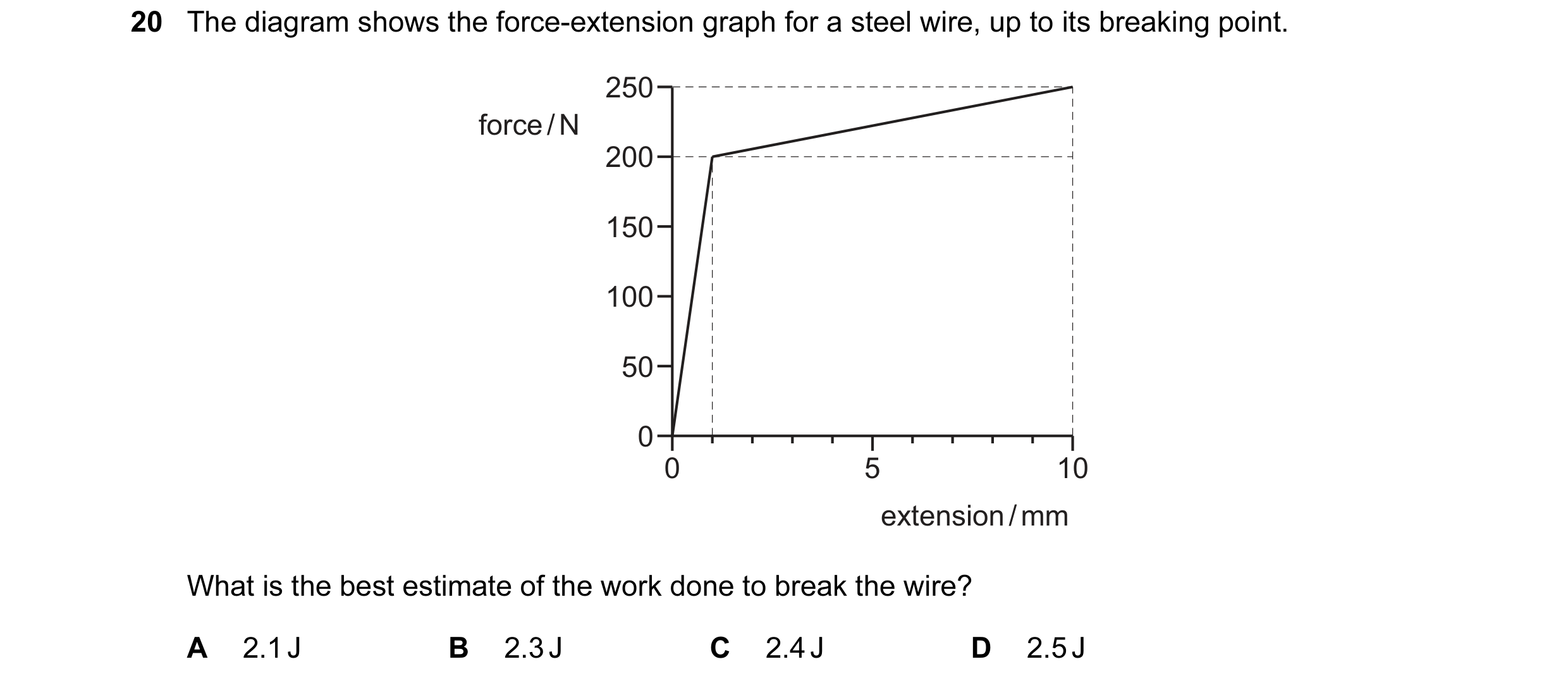
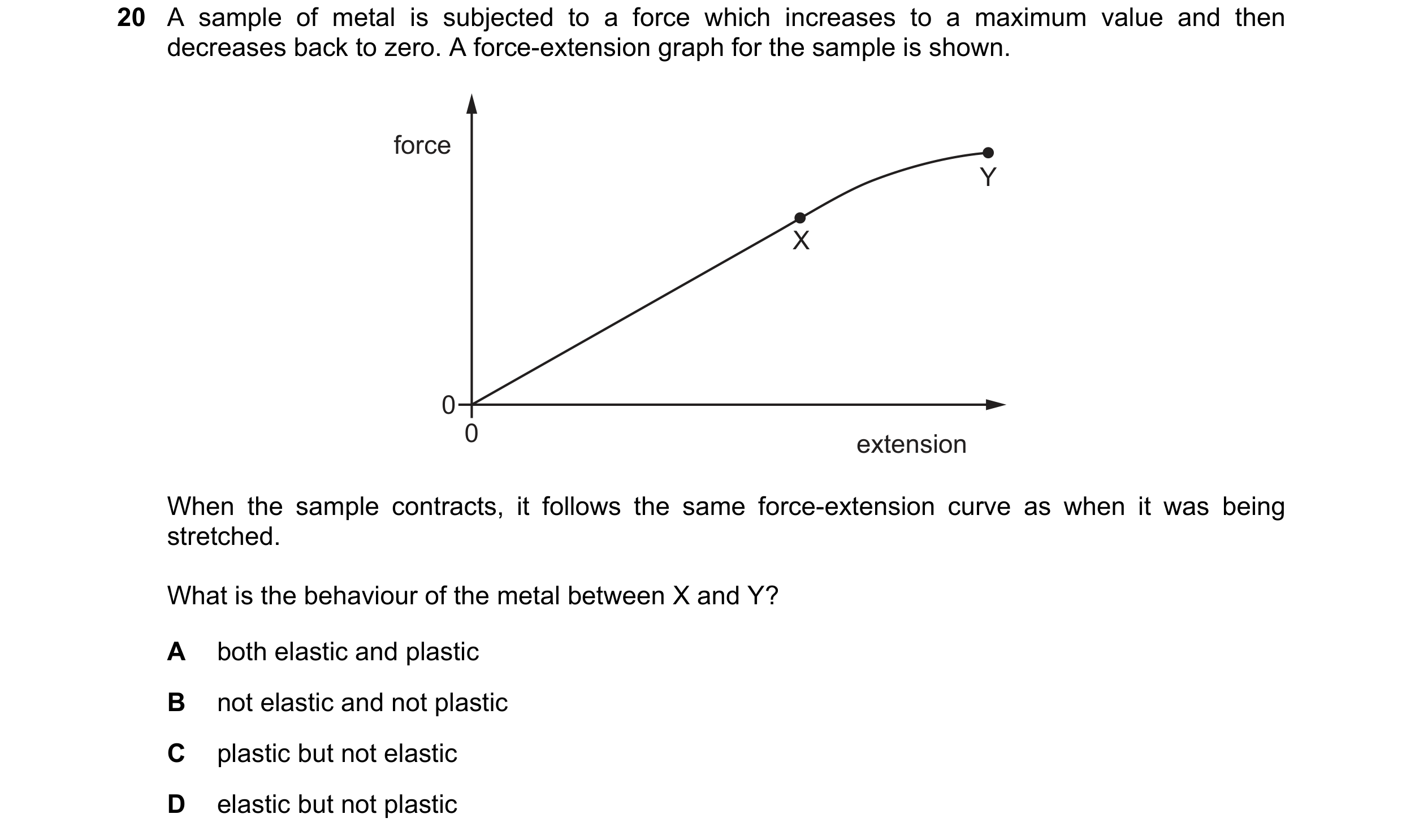 36 / 63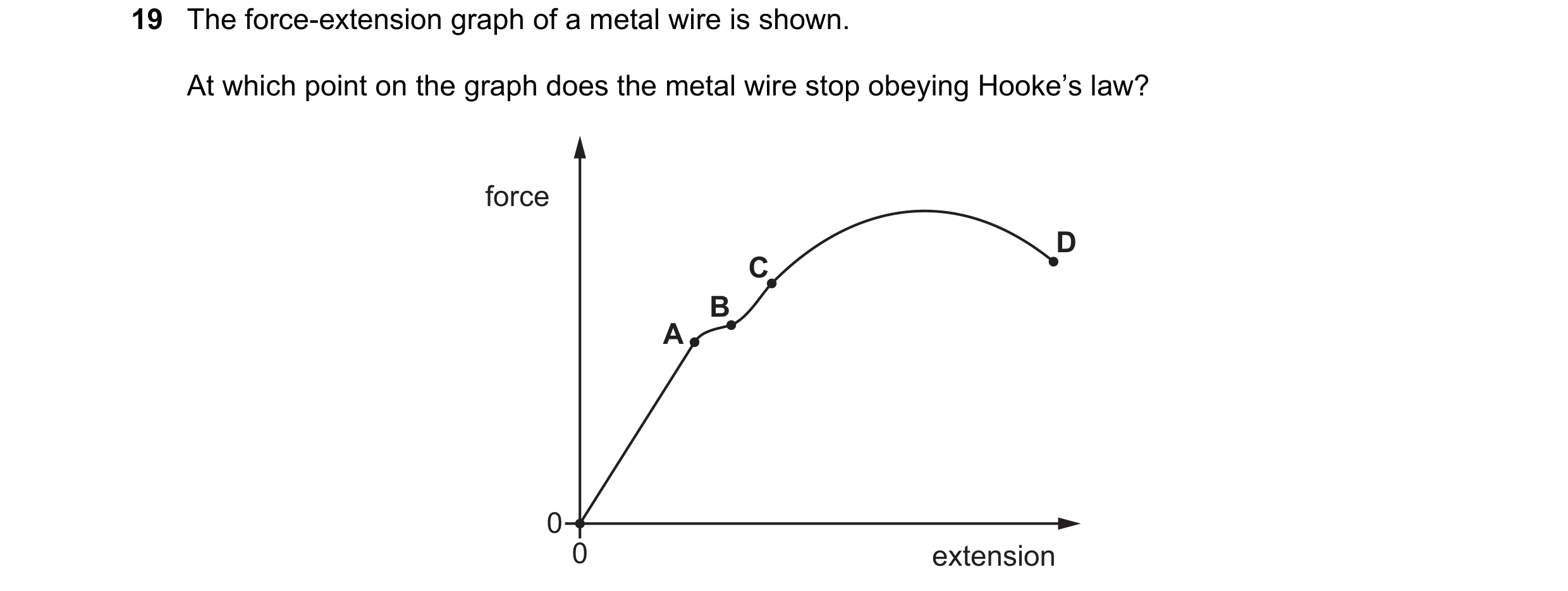
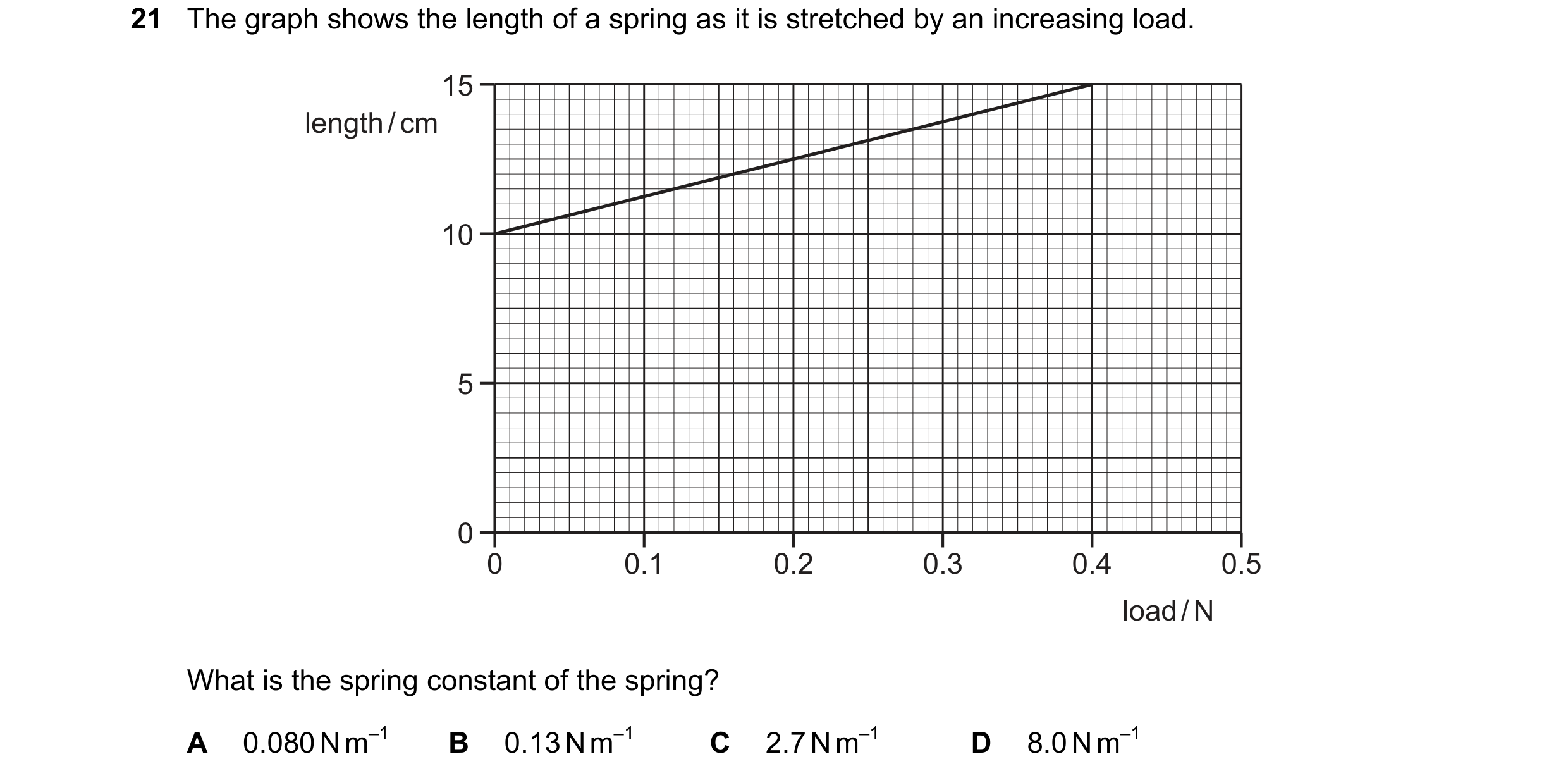
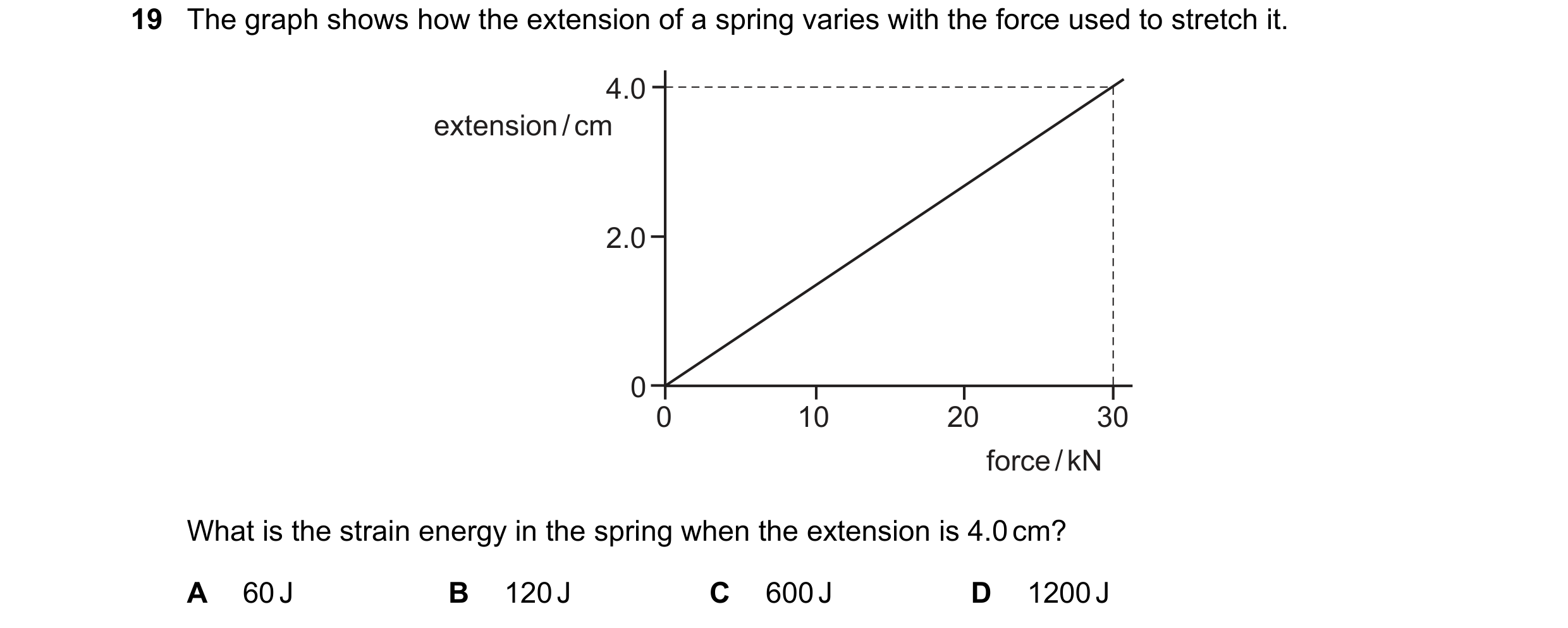 37 / 63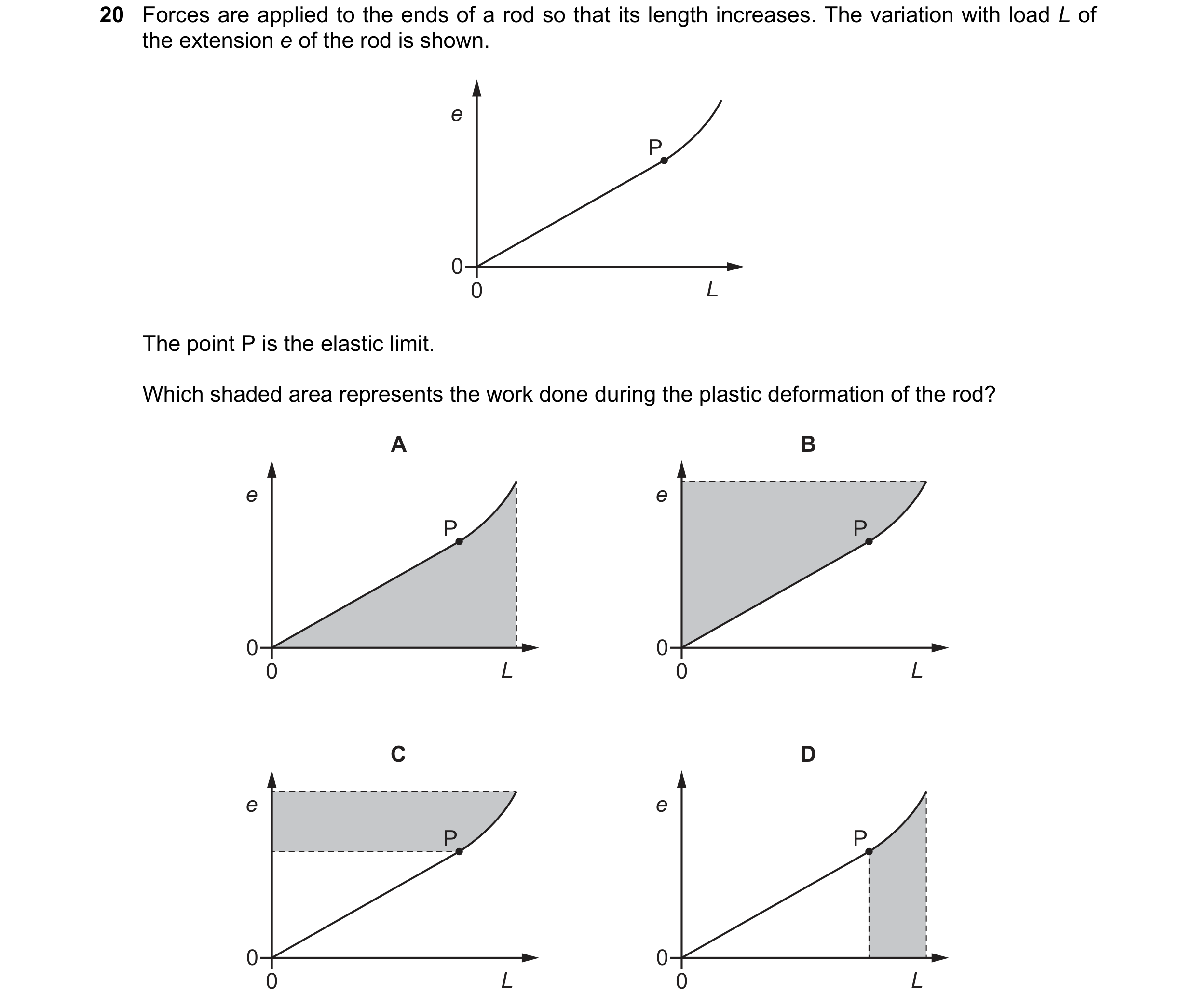
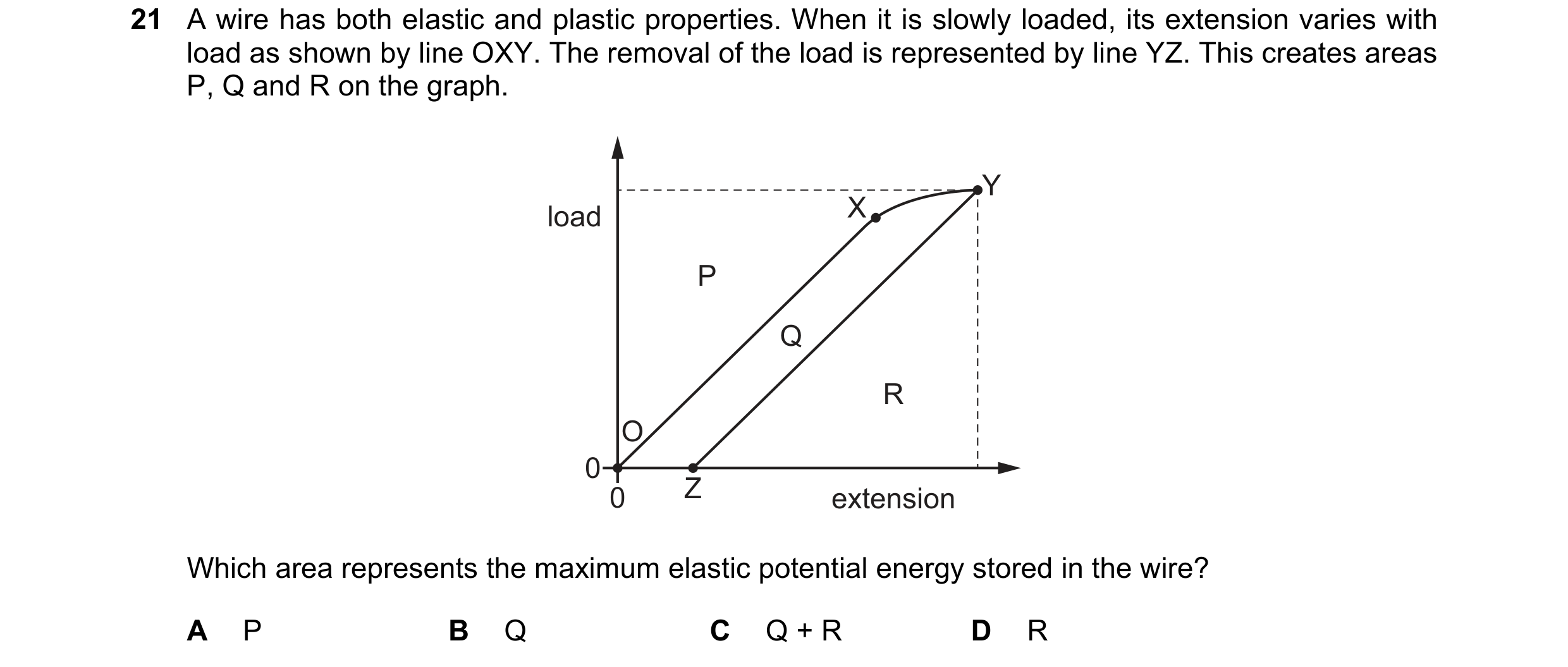 38 / 63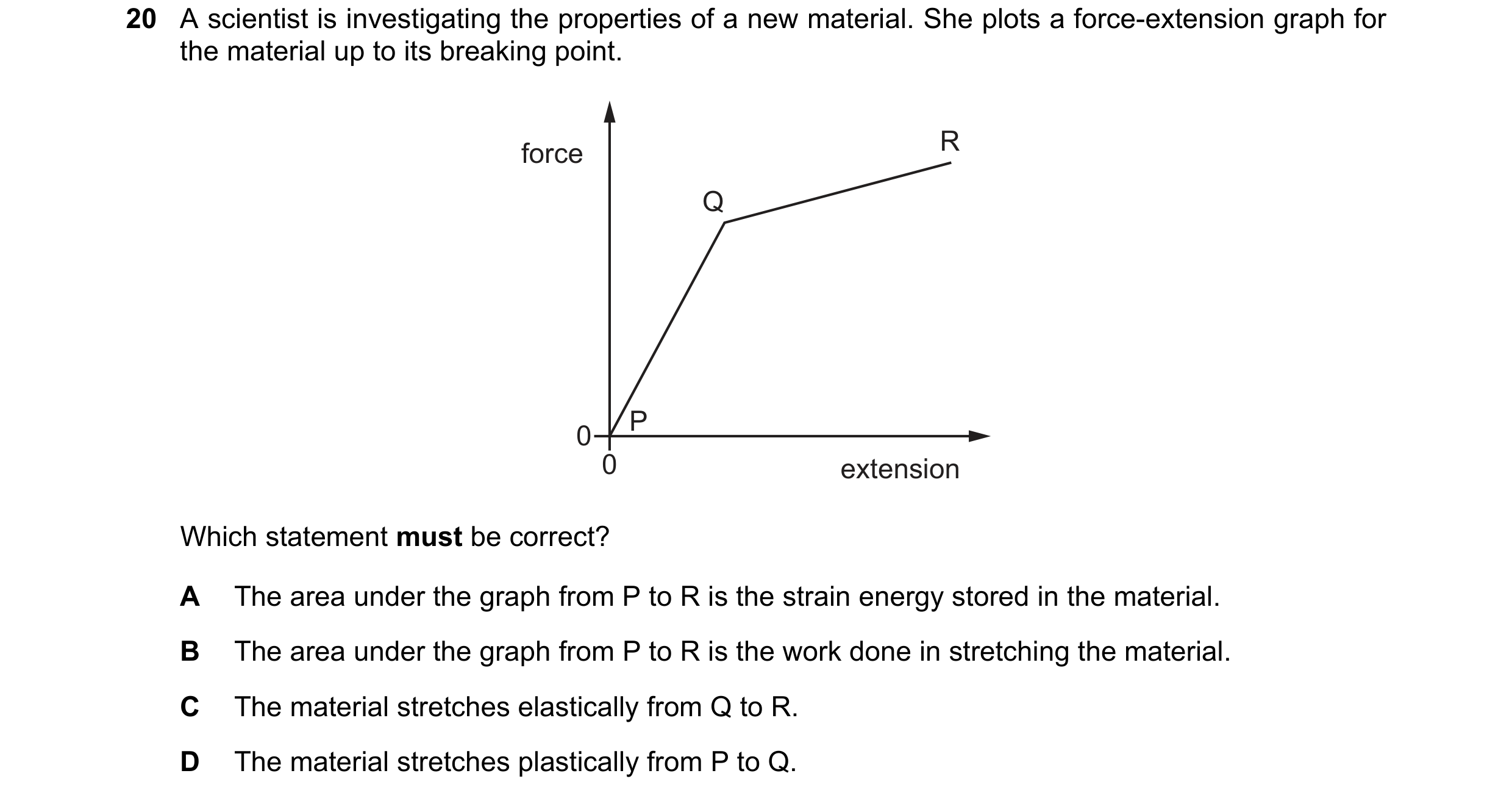
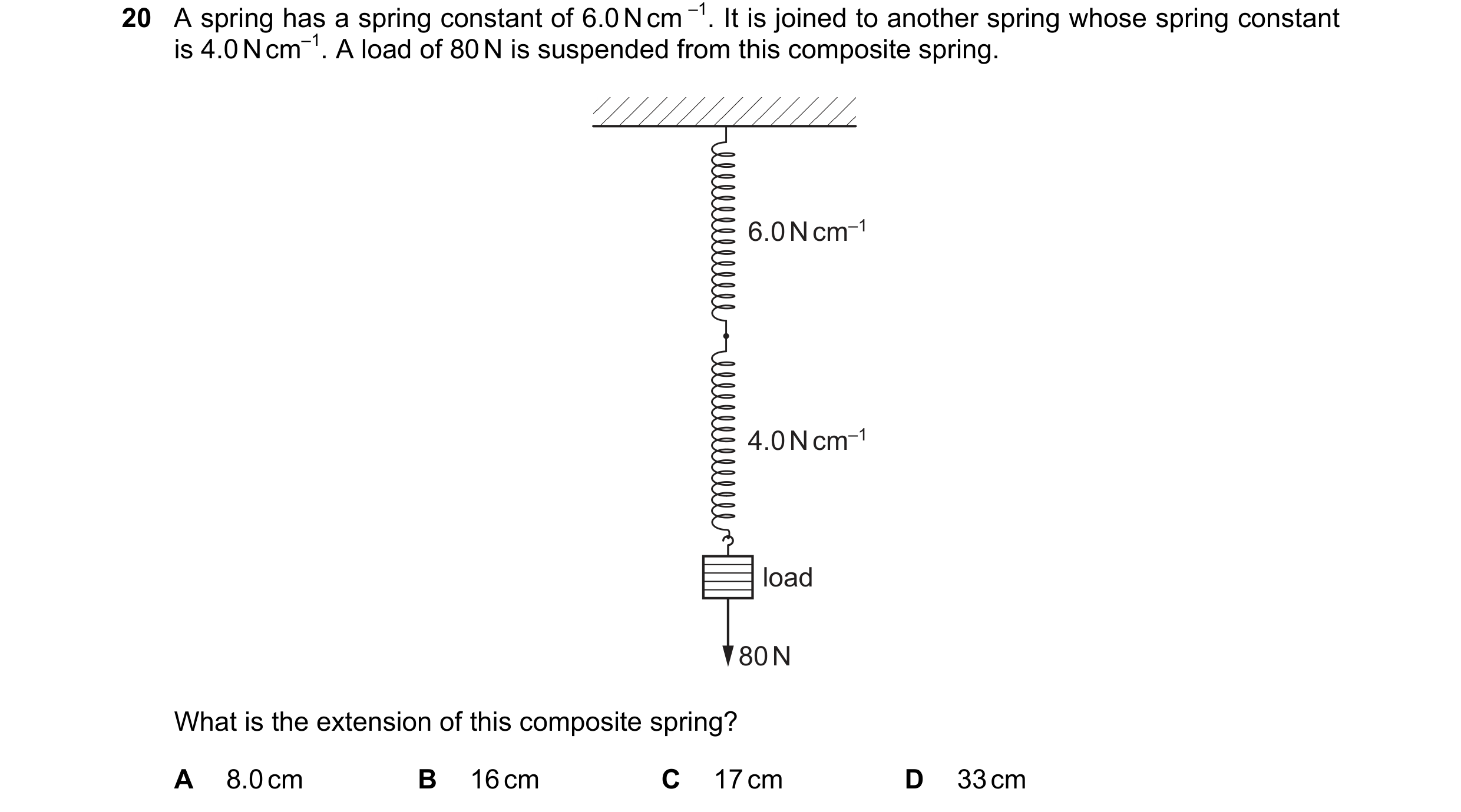 39 / 63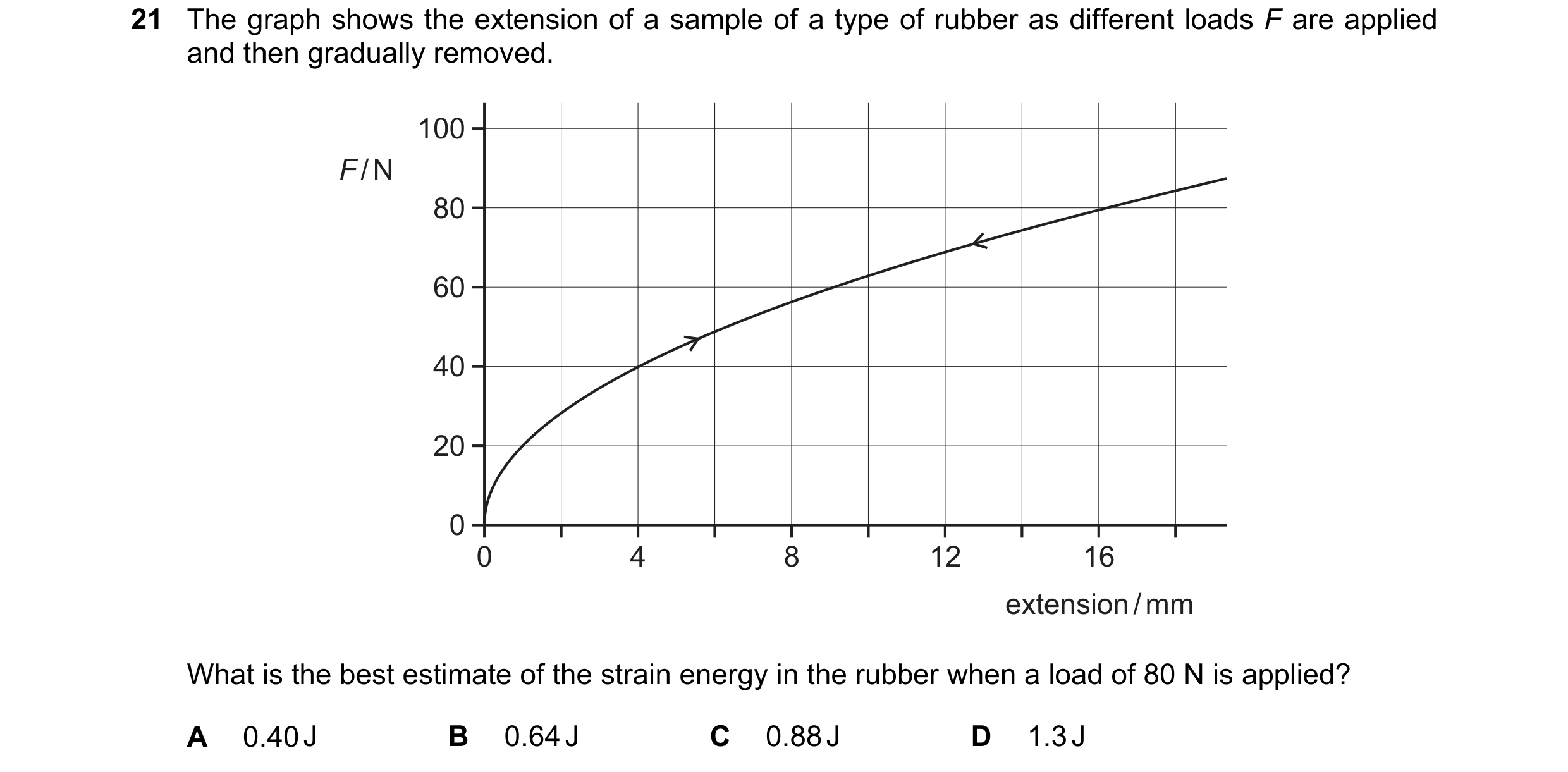
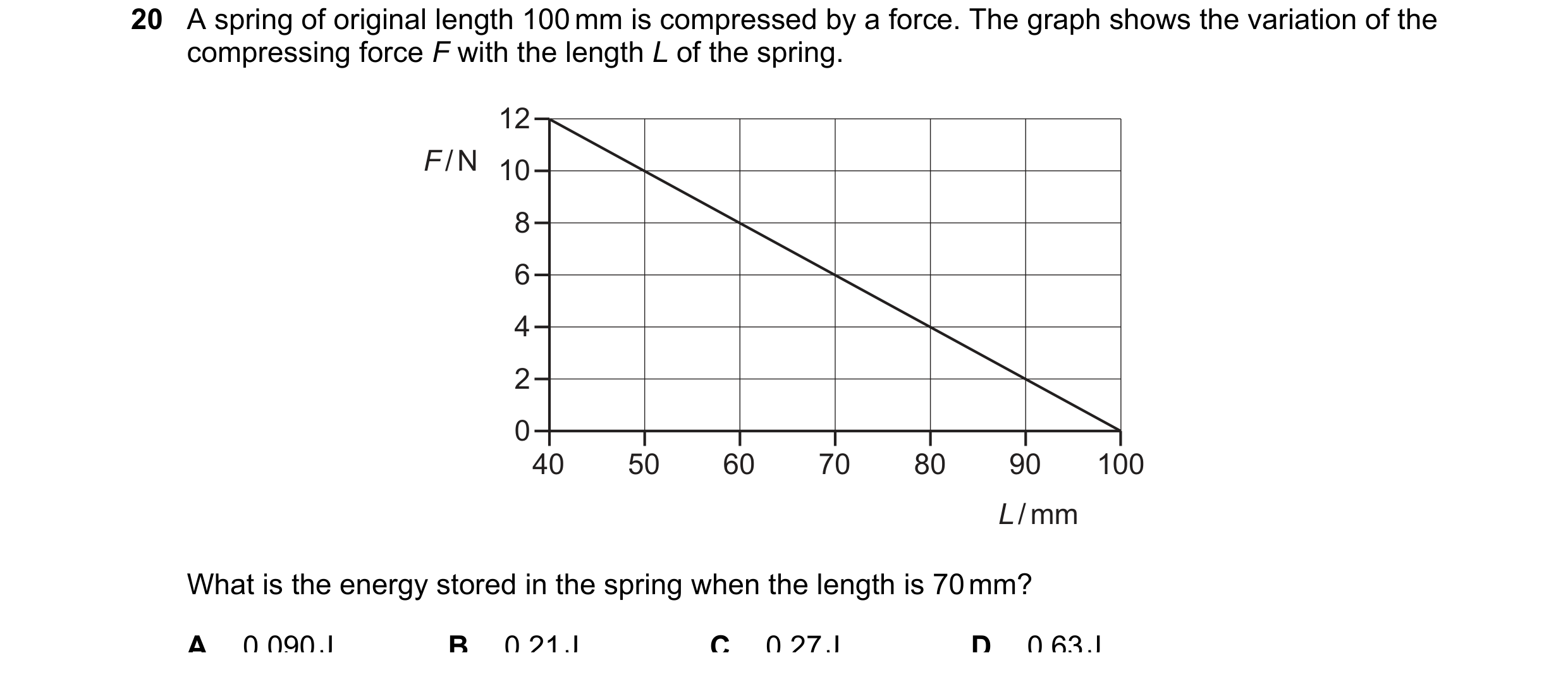 40 / 63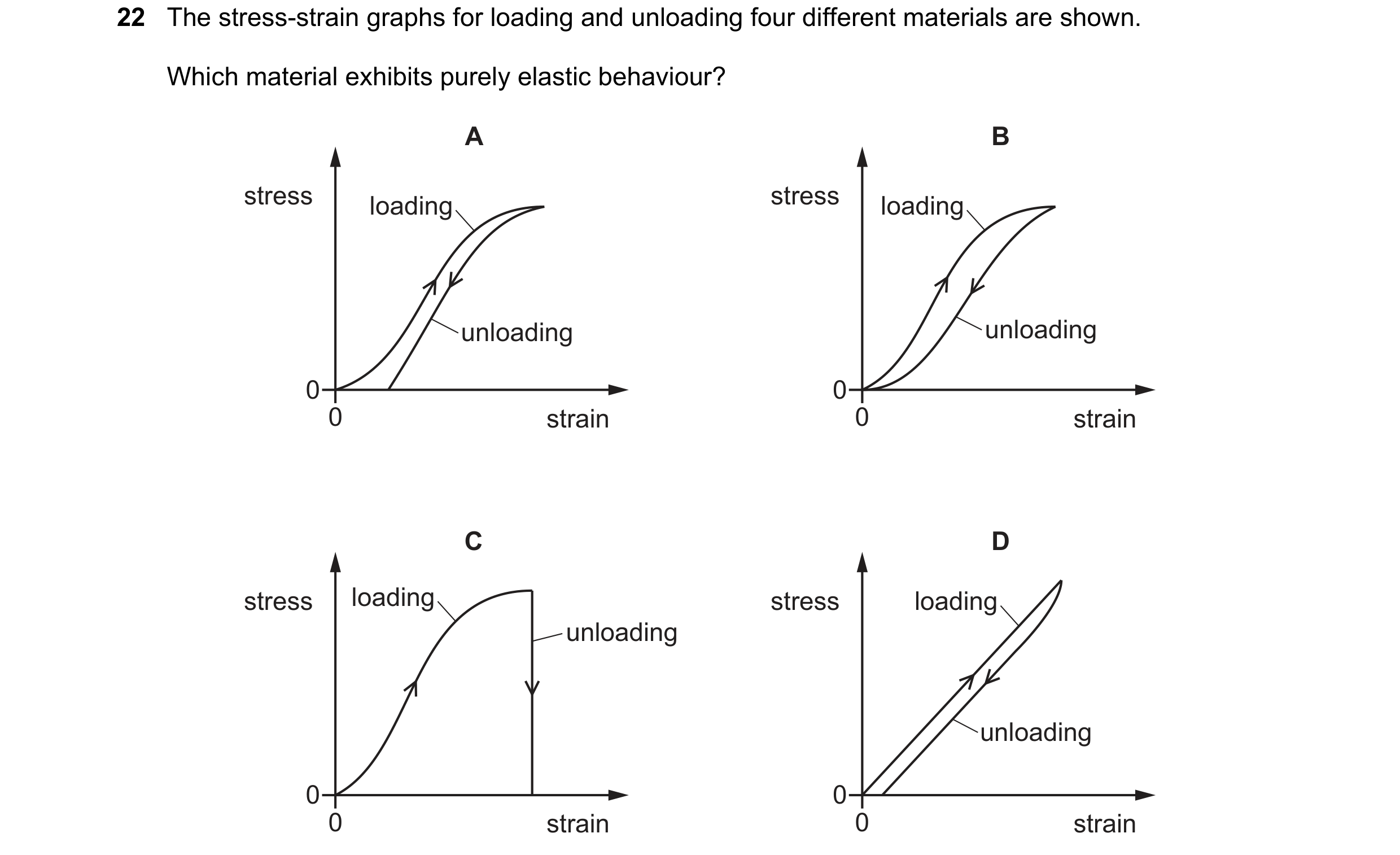
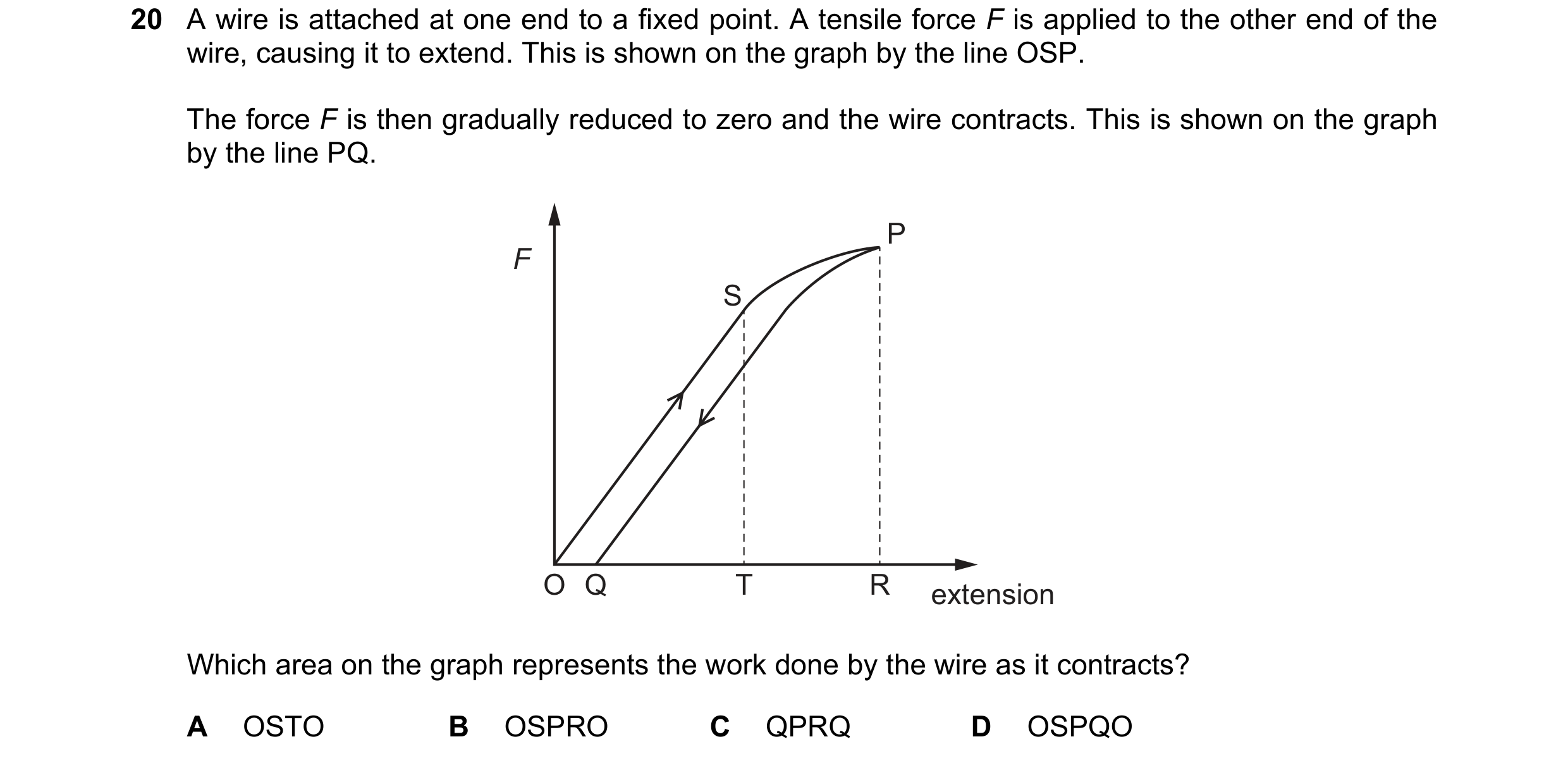 41 / 63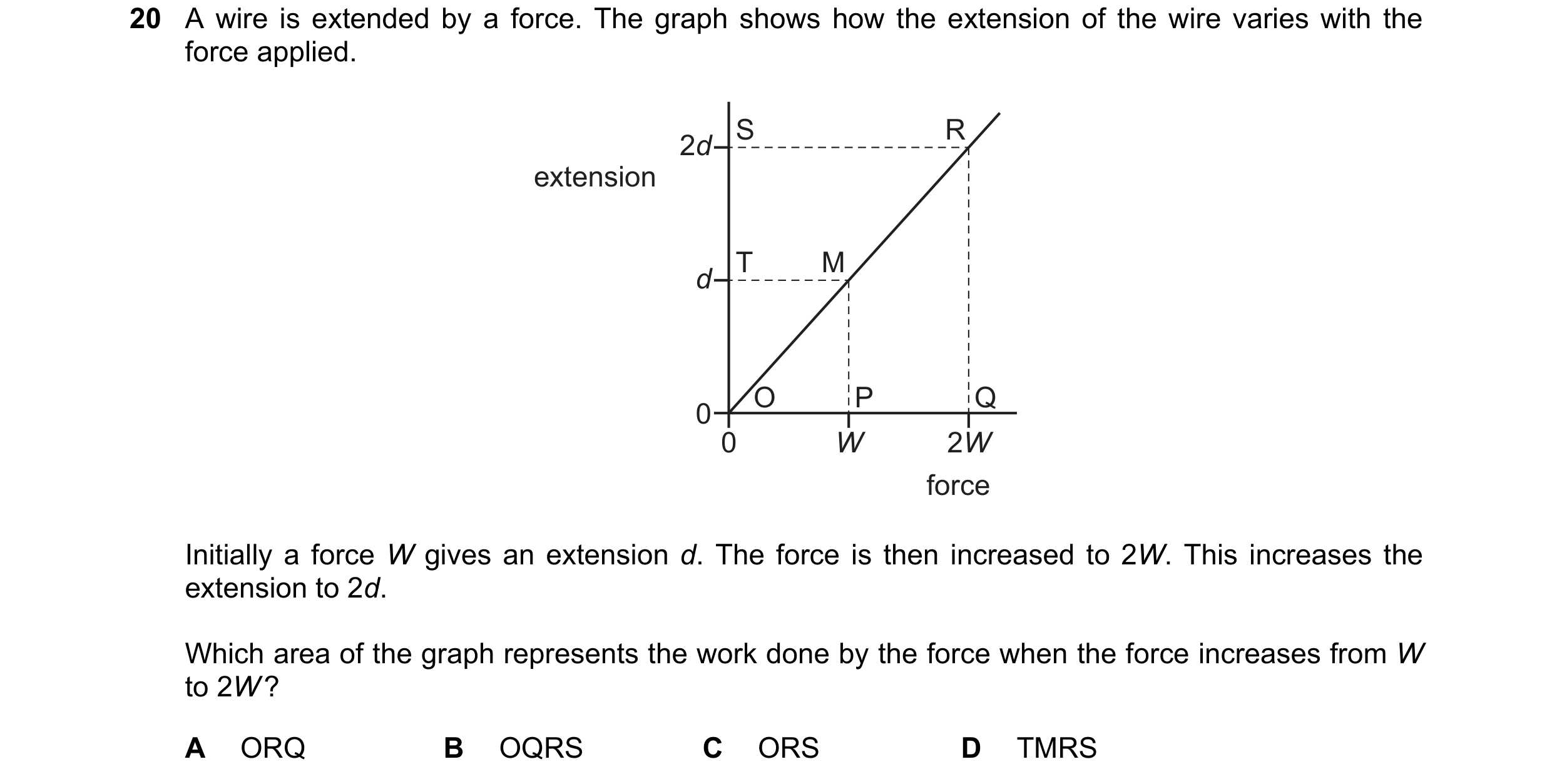
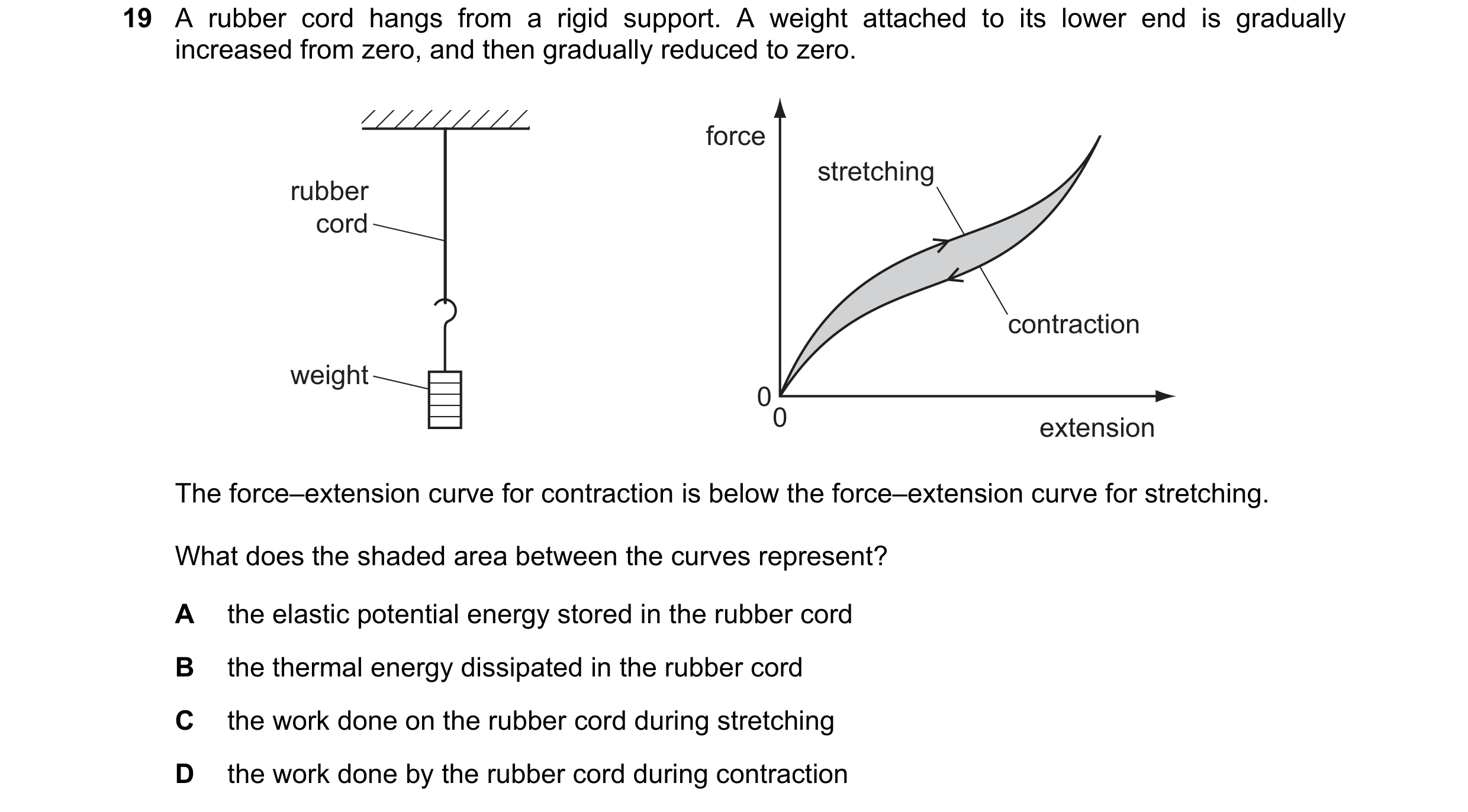 42 / 63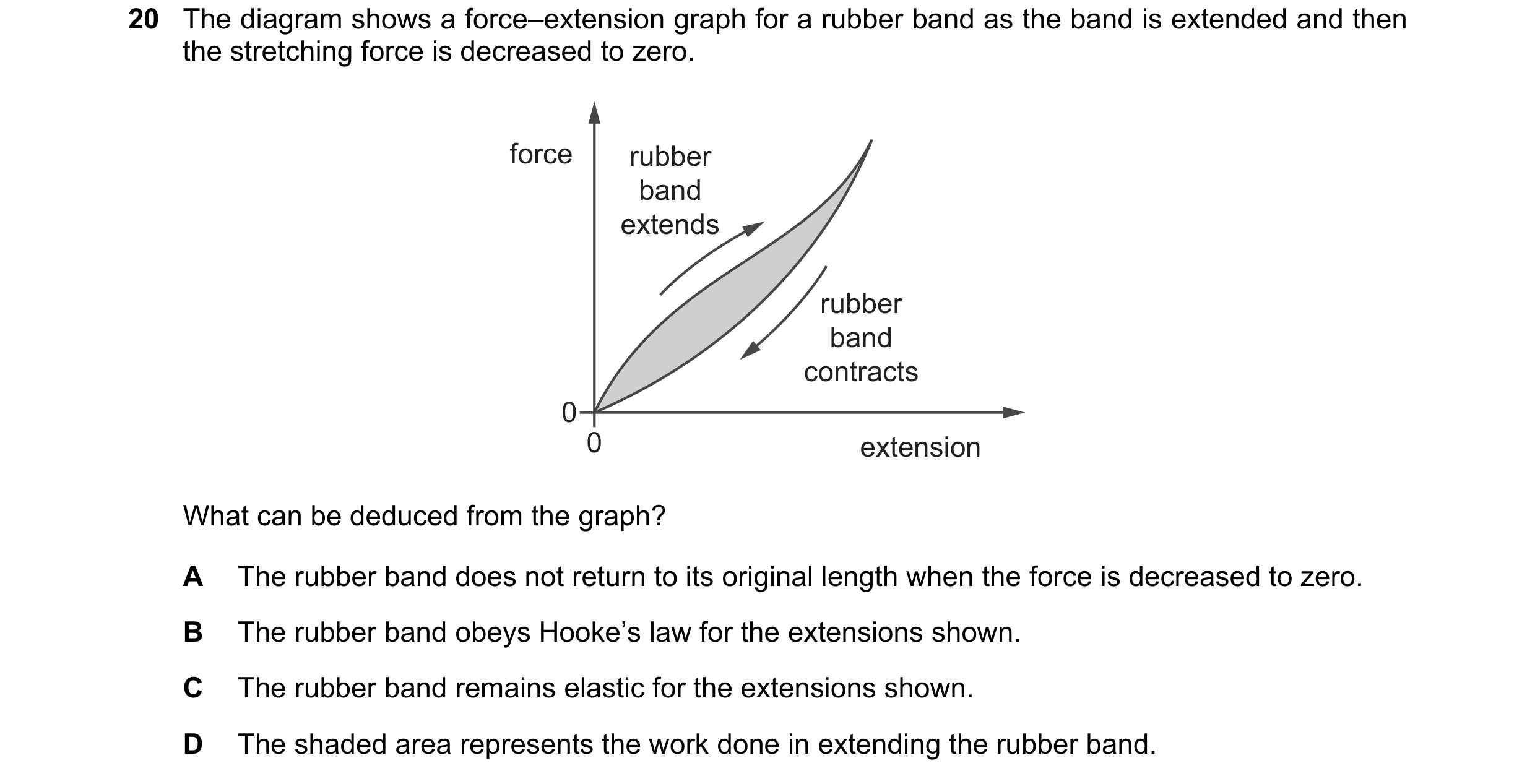
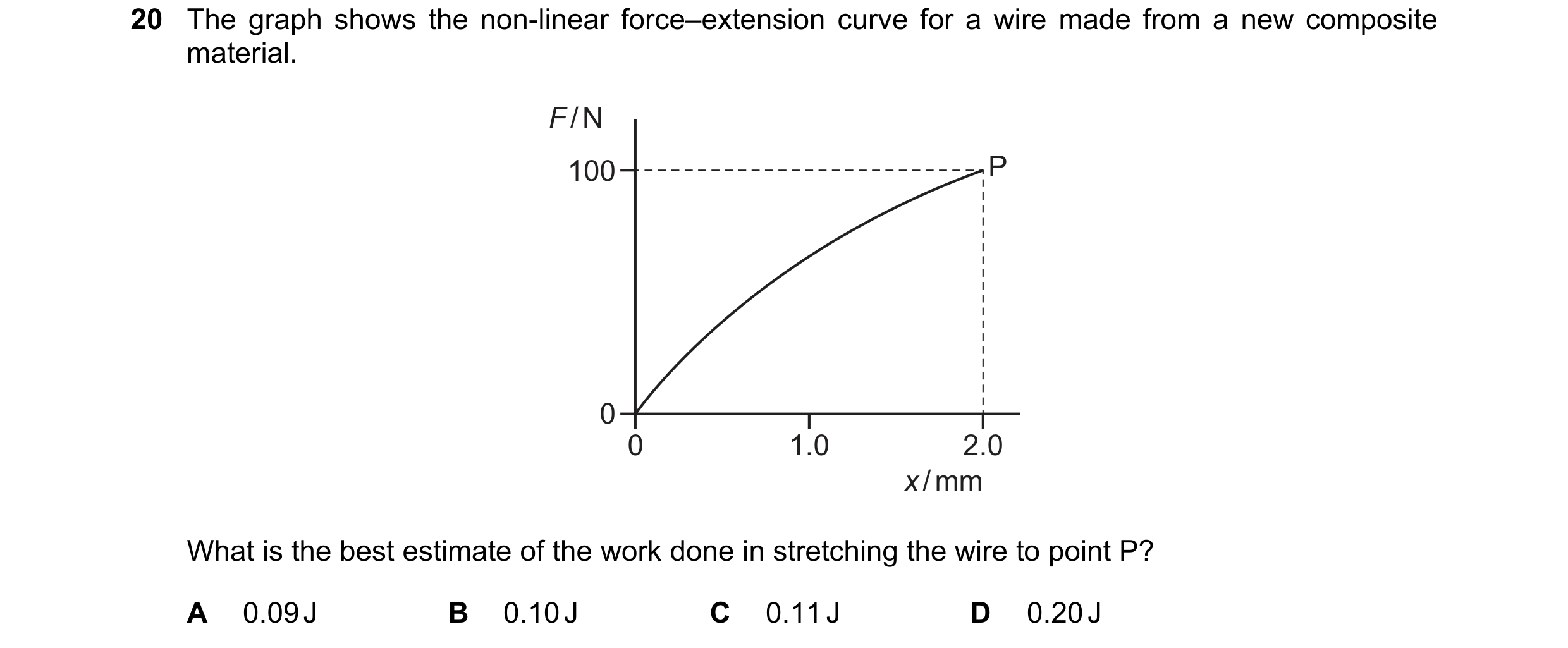
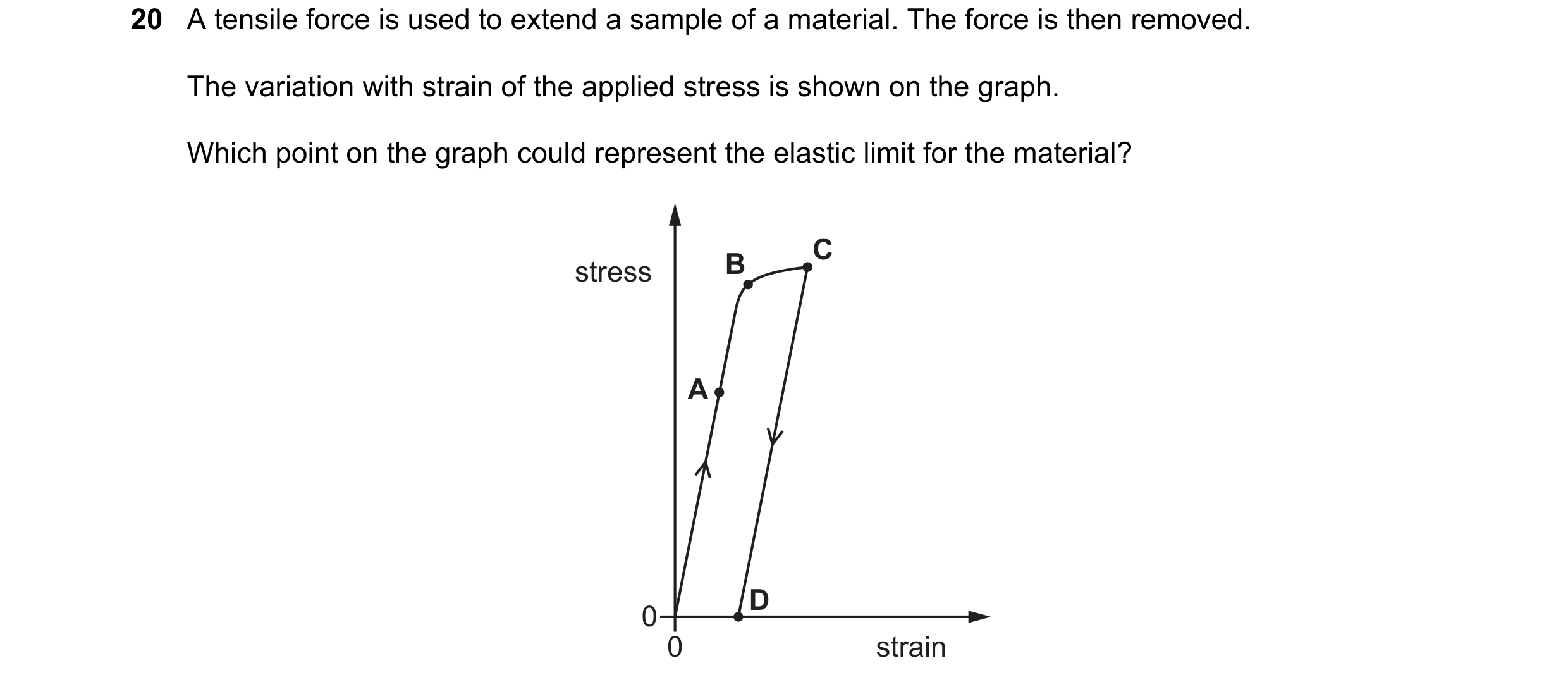 43 / 63

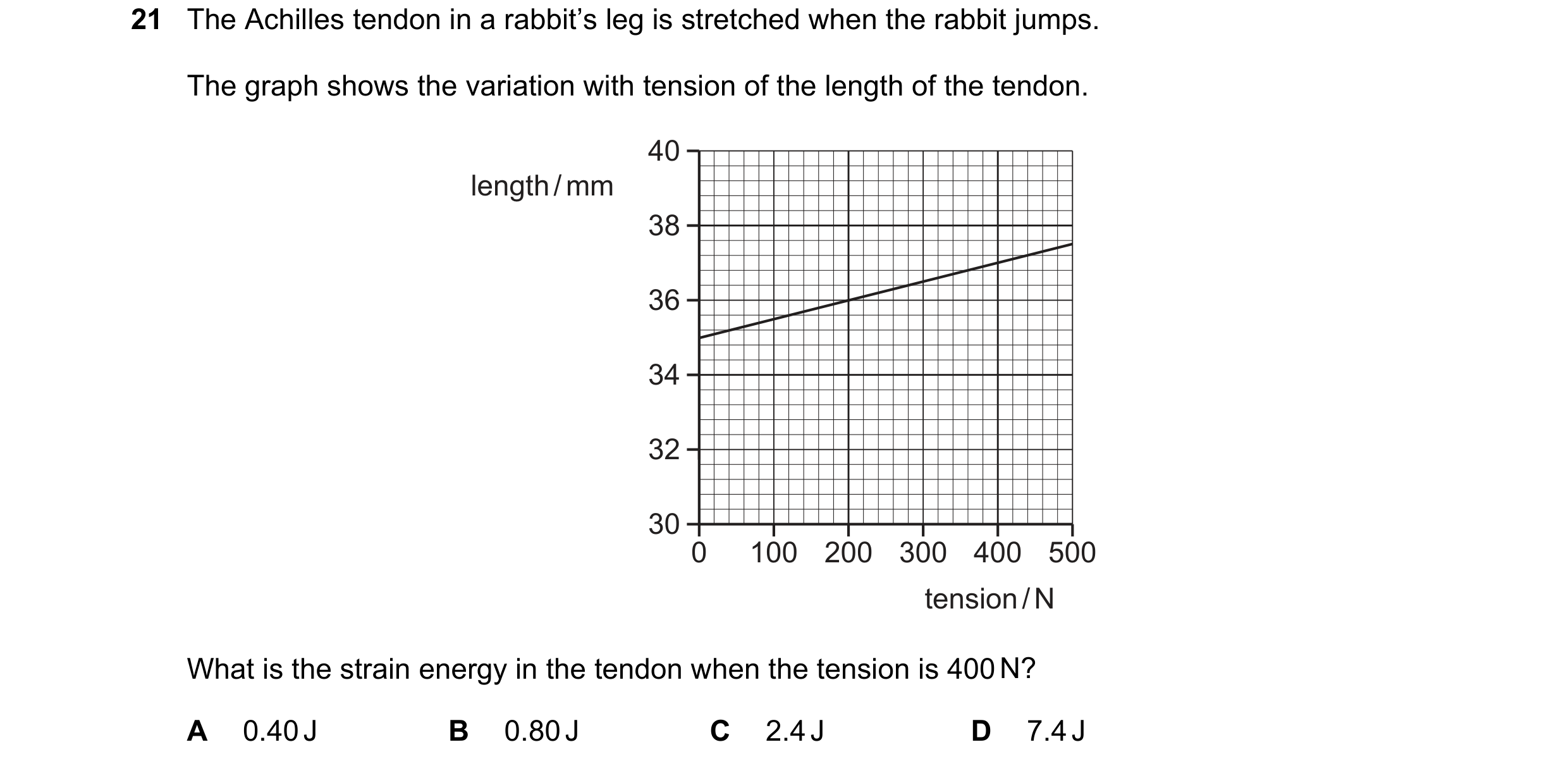 44 / 63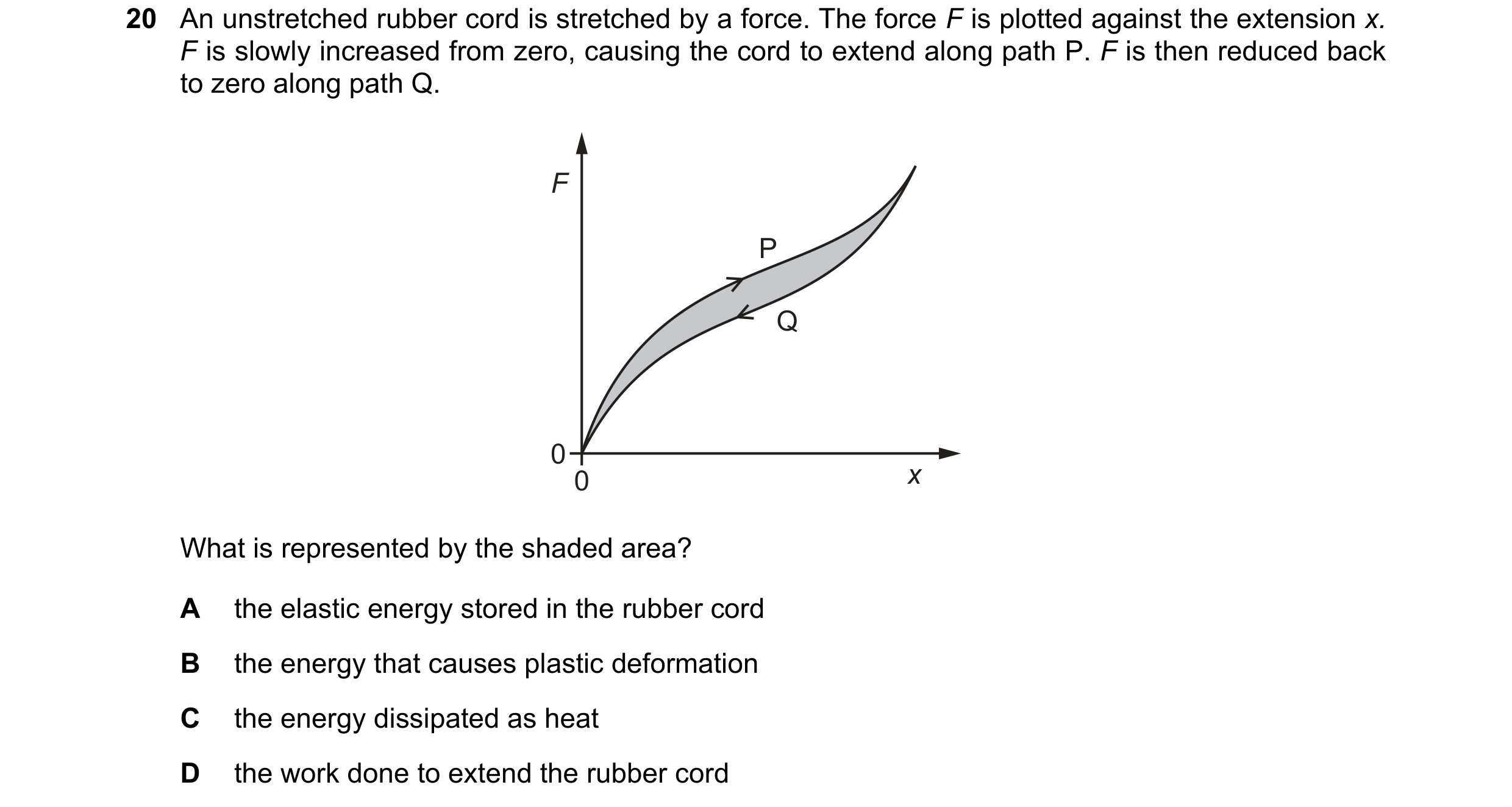
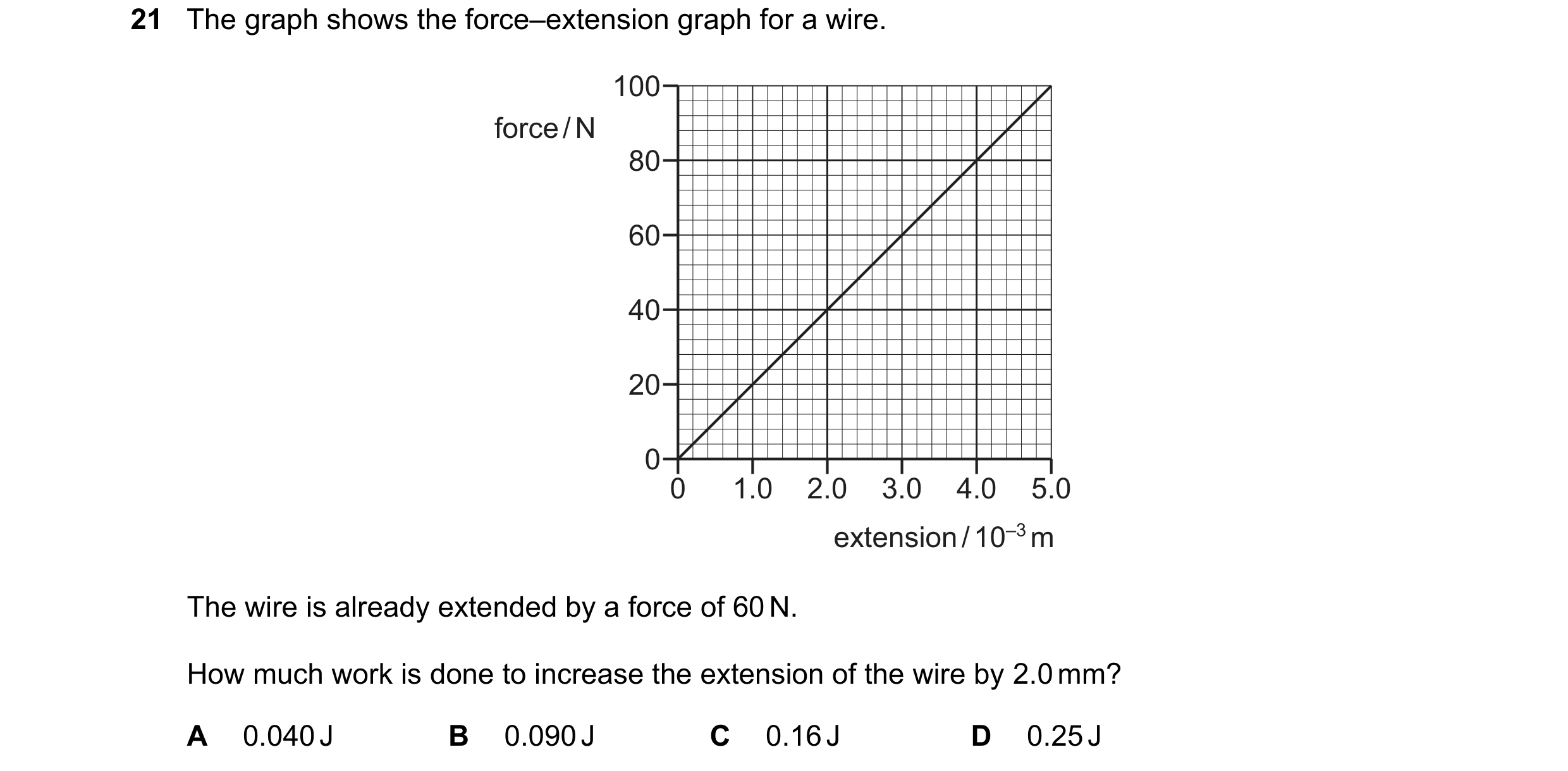
 45 / 63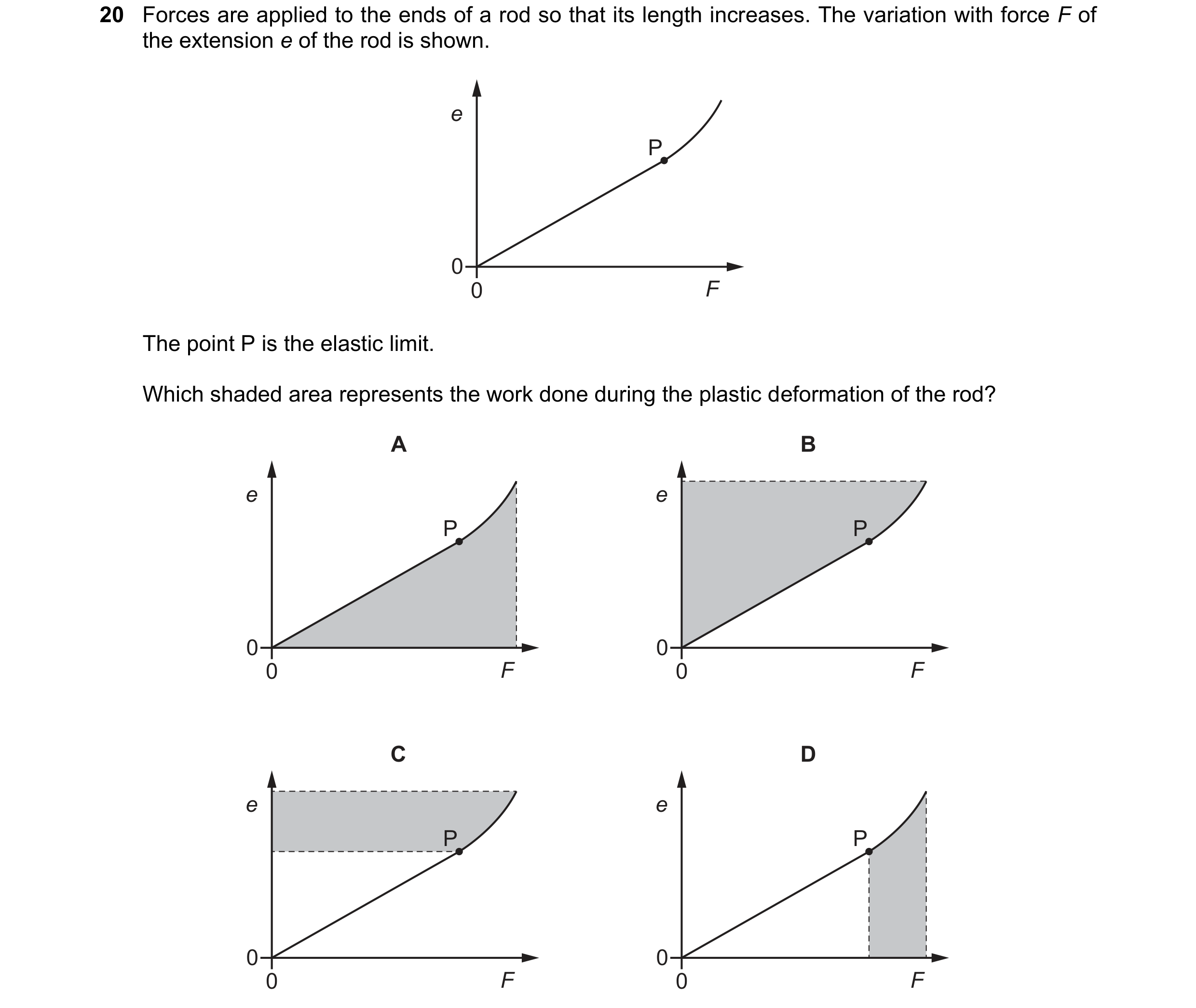
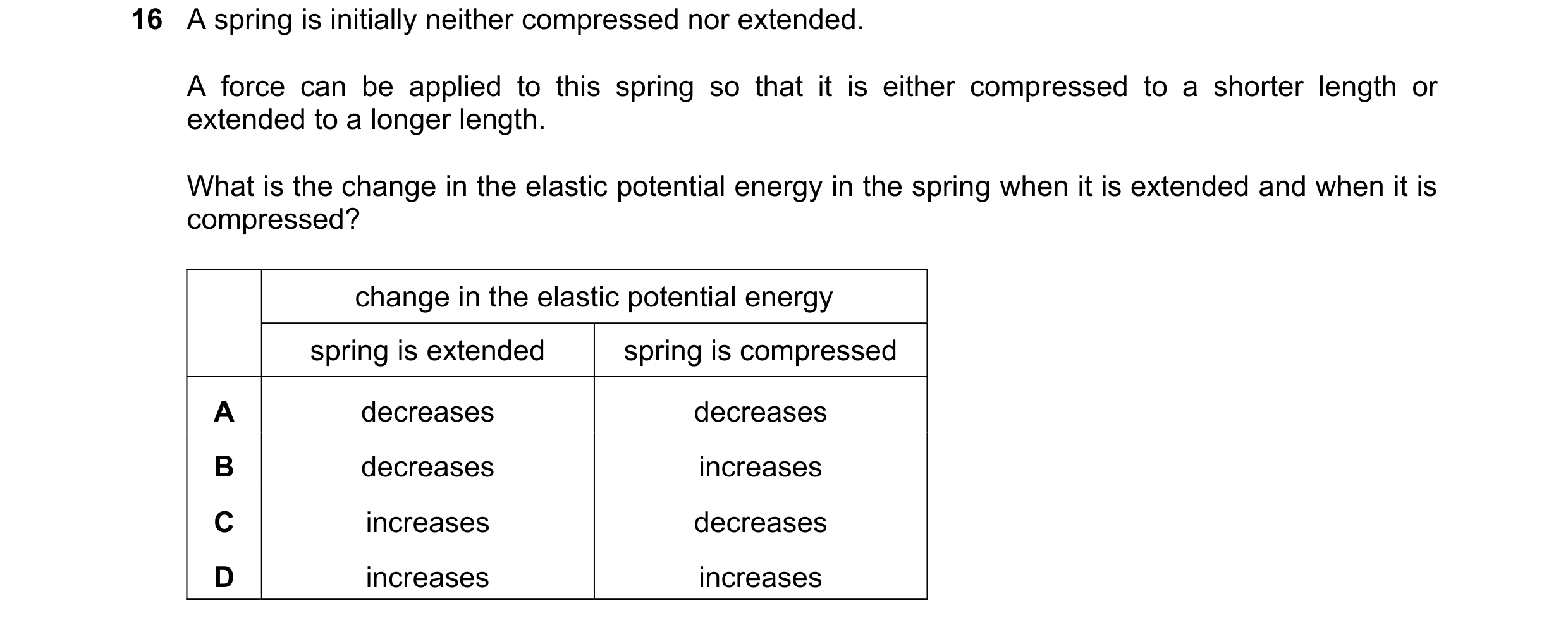 46 / 63
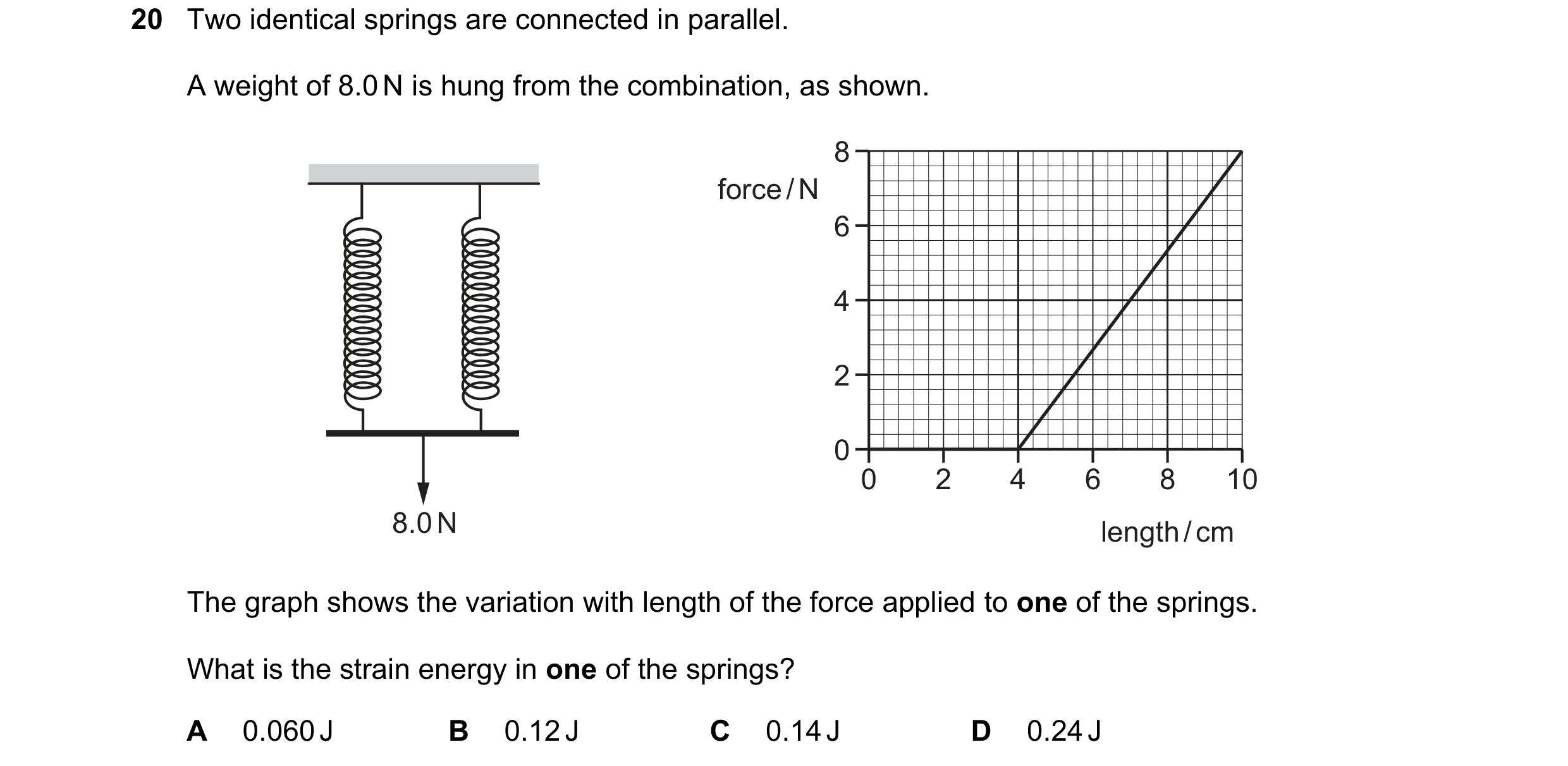
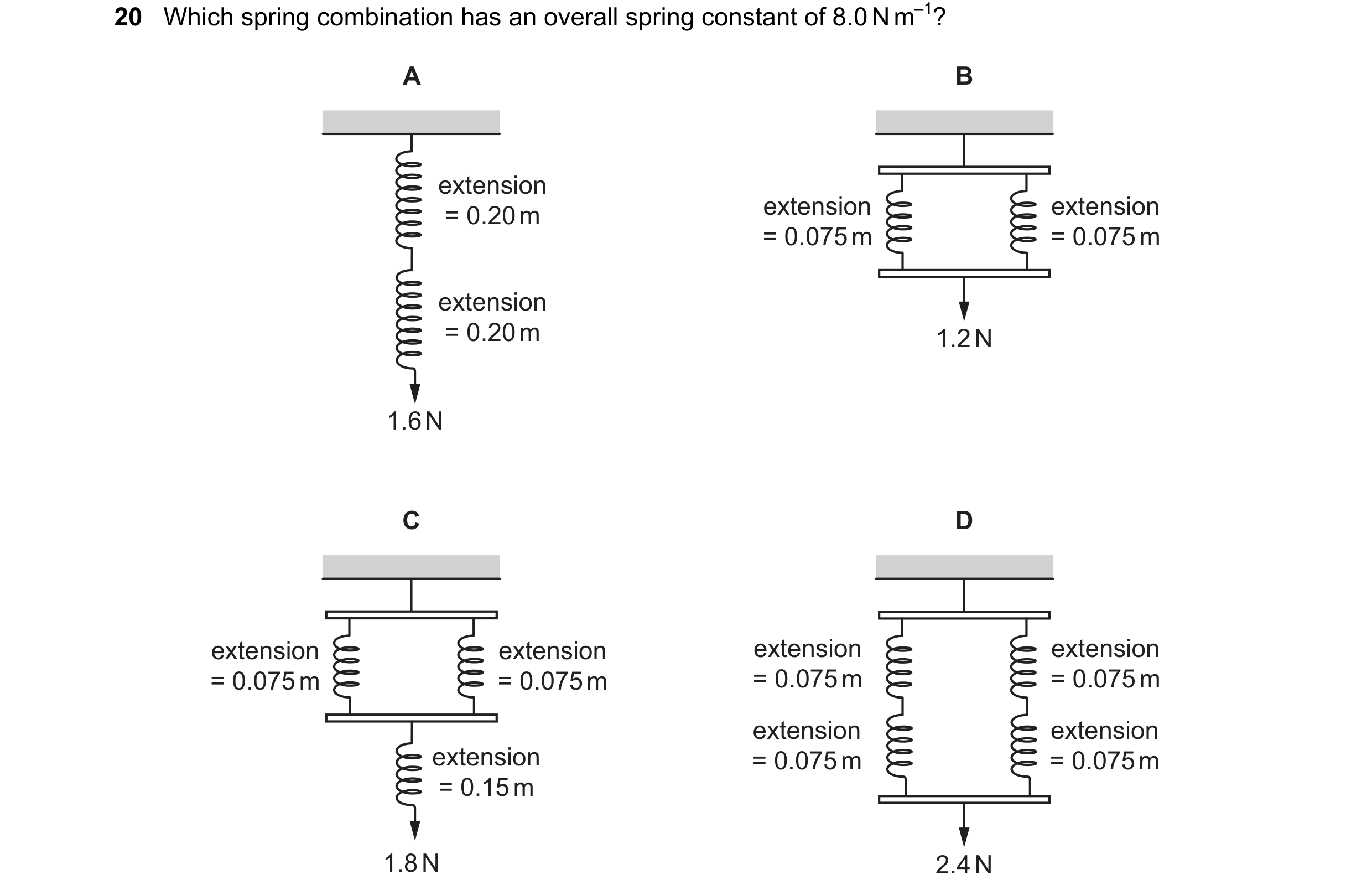 47 / 63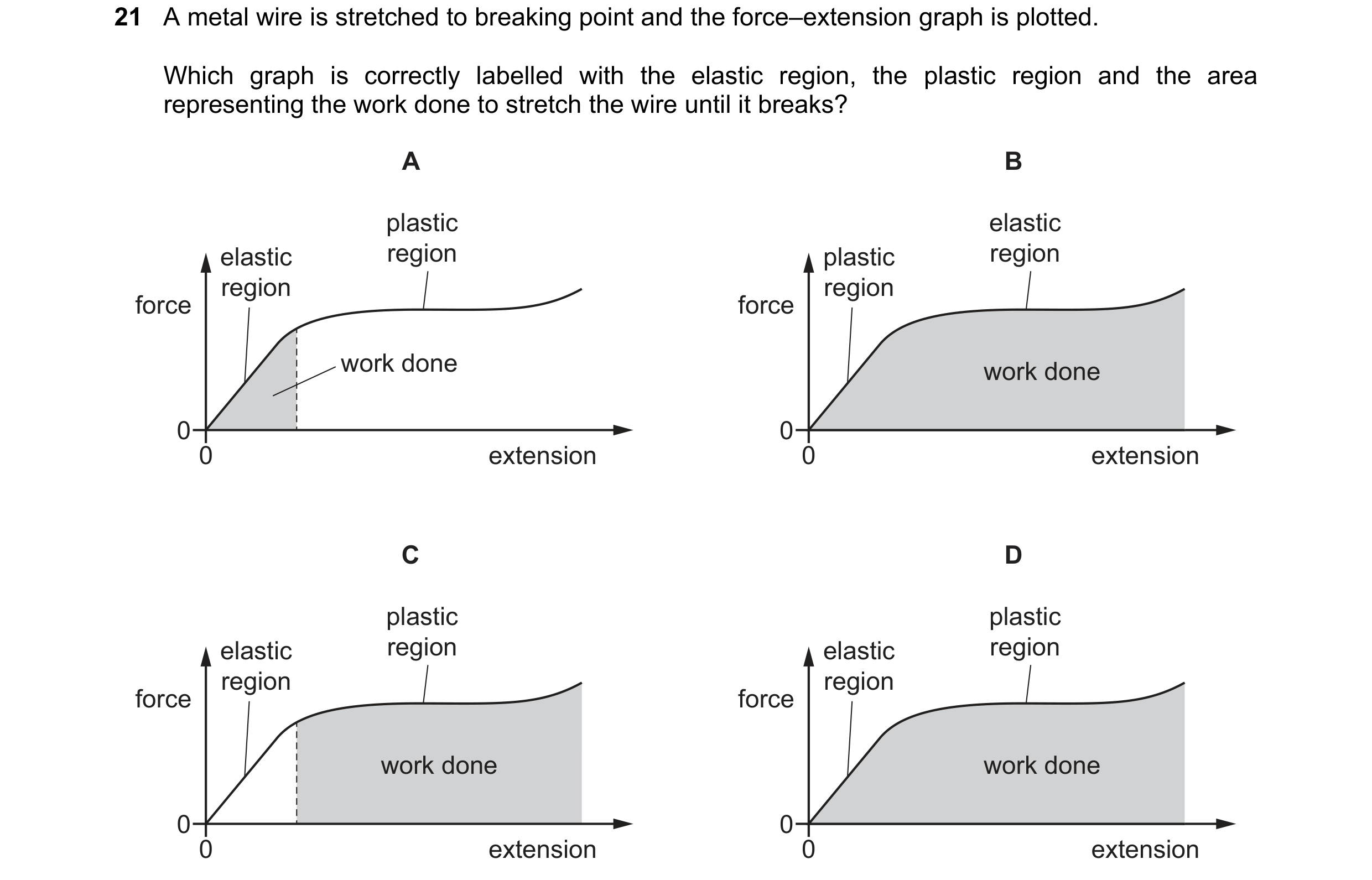

 48 / 63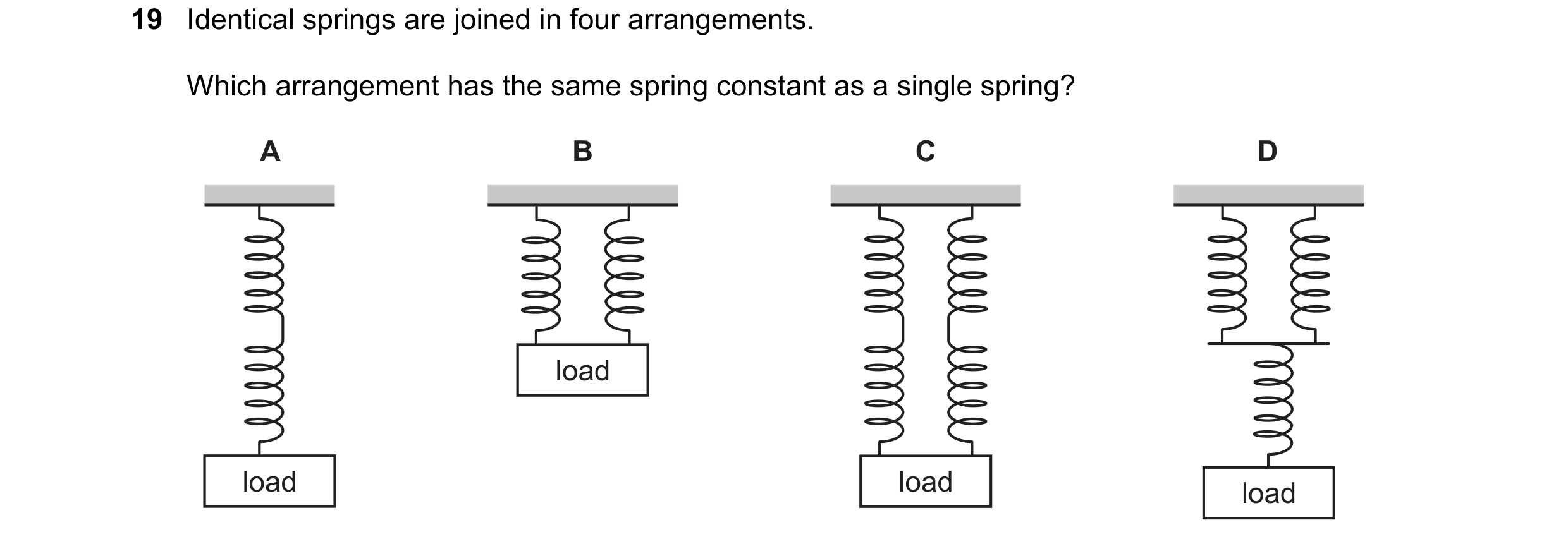

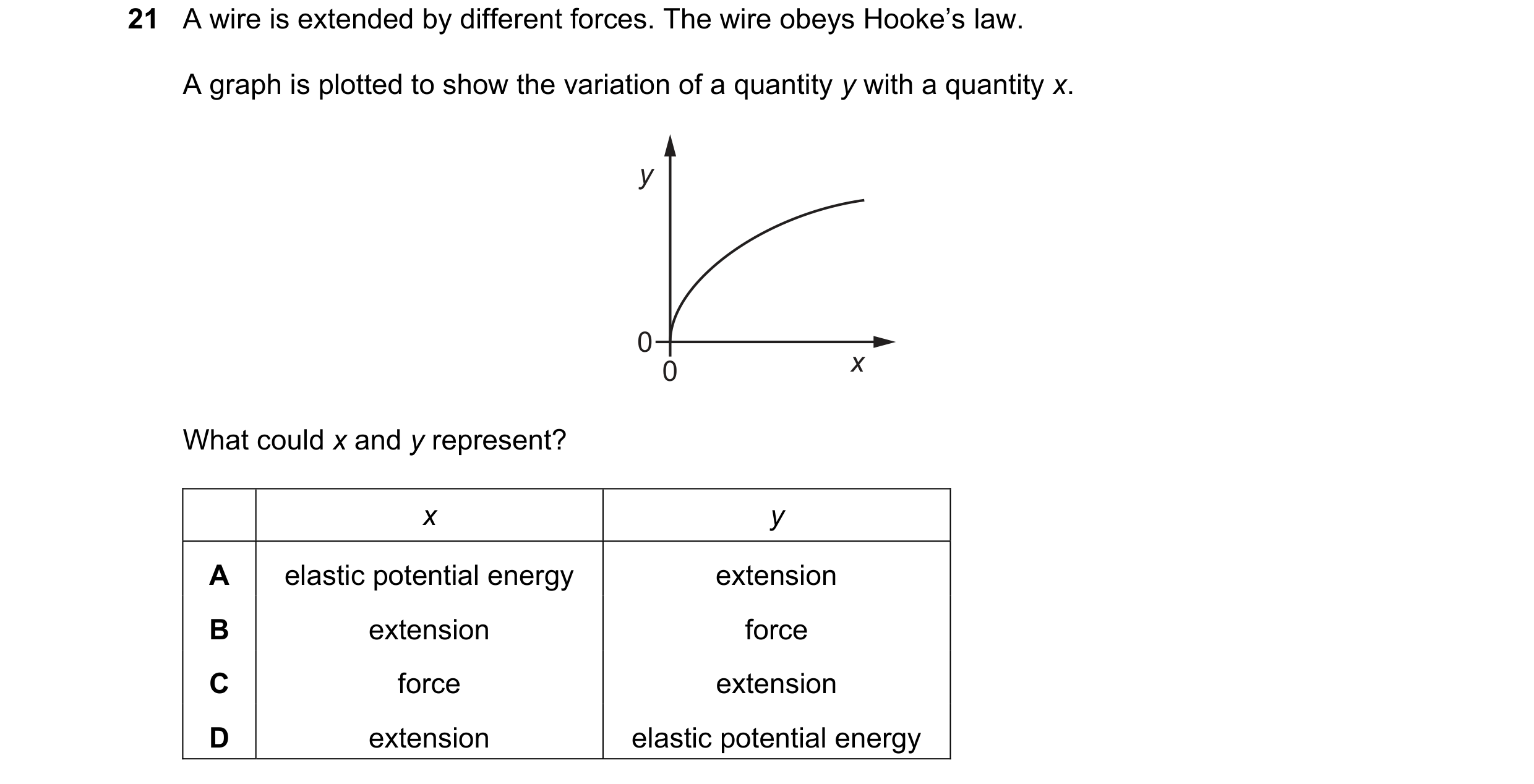 49 / 63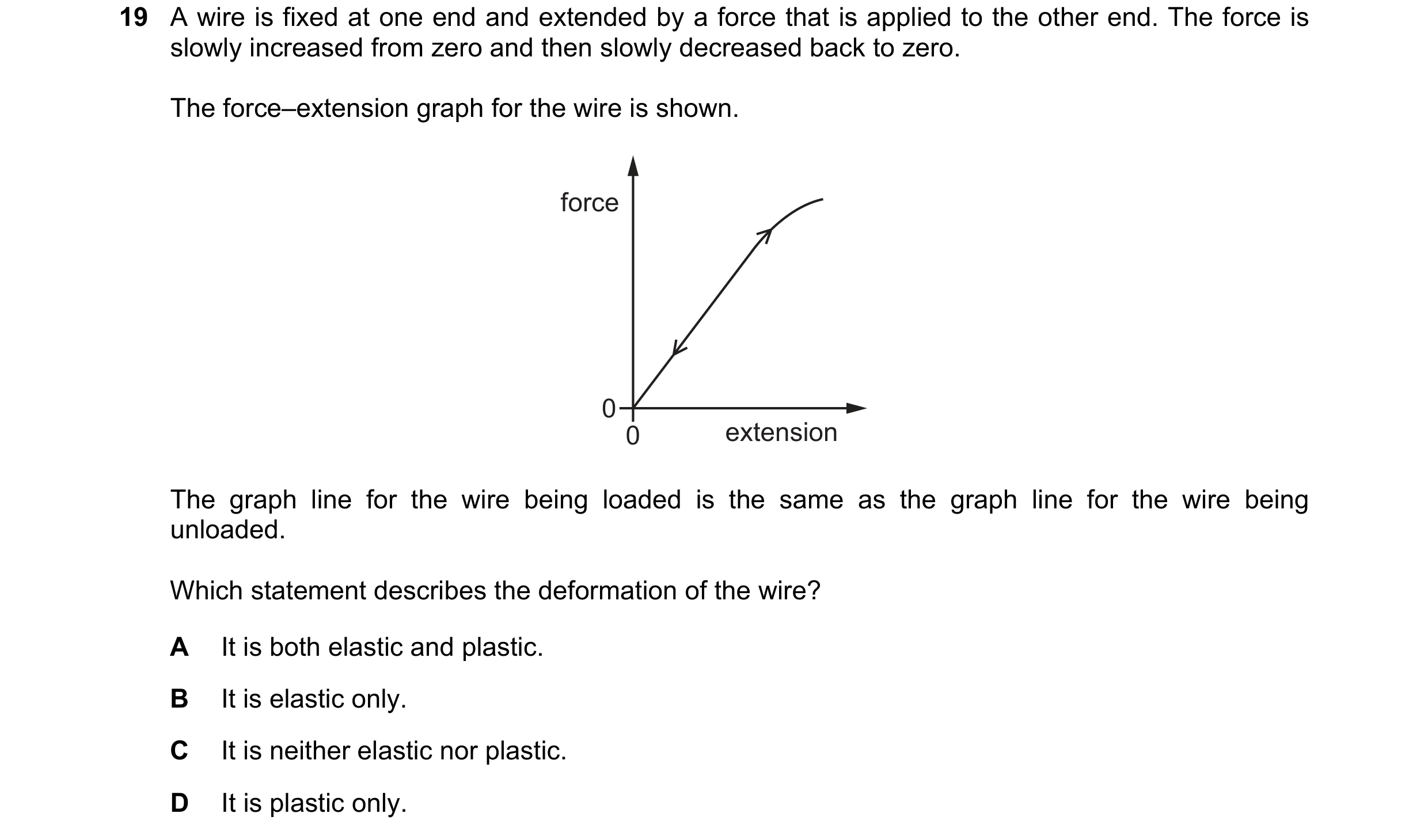
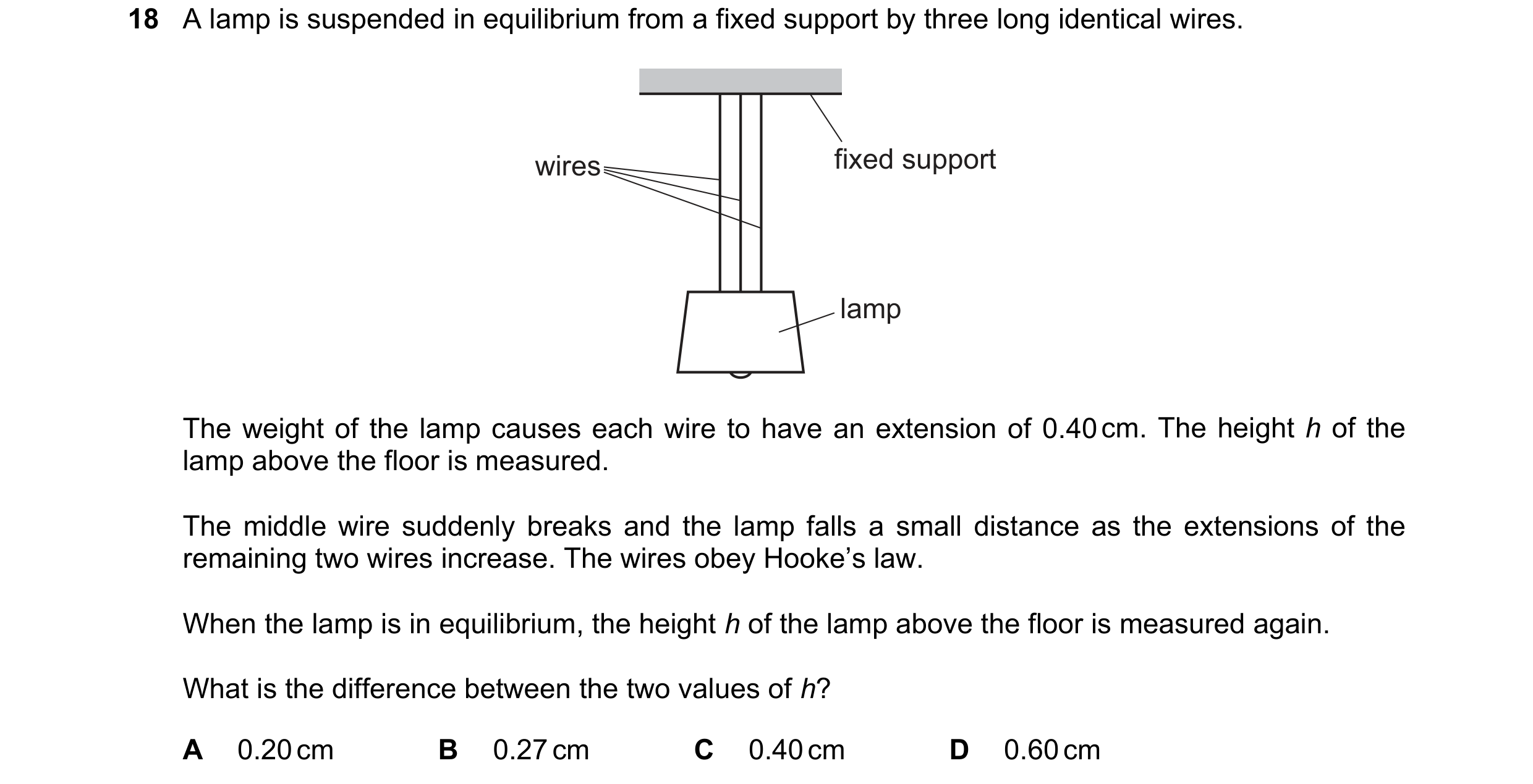 50 / 63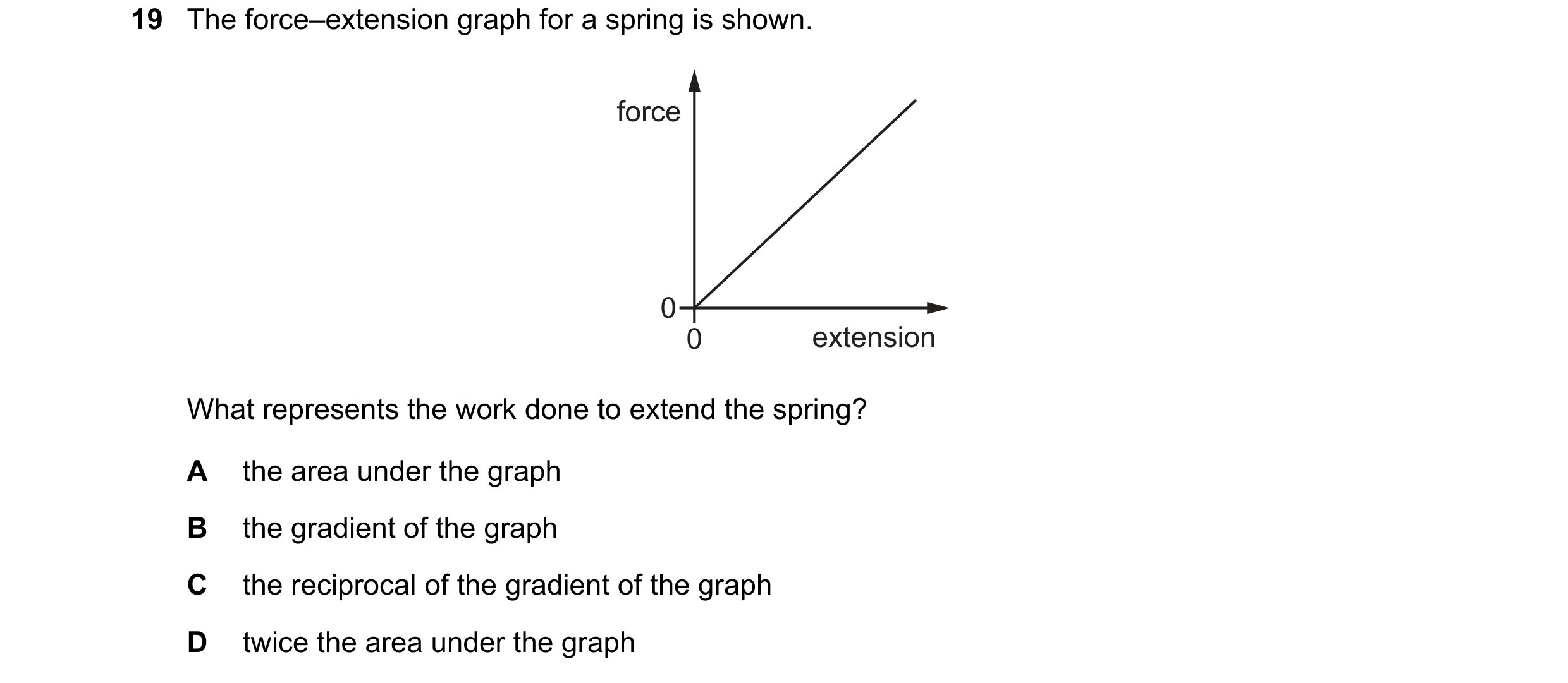
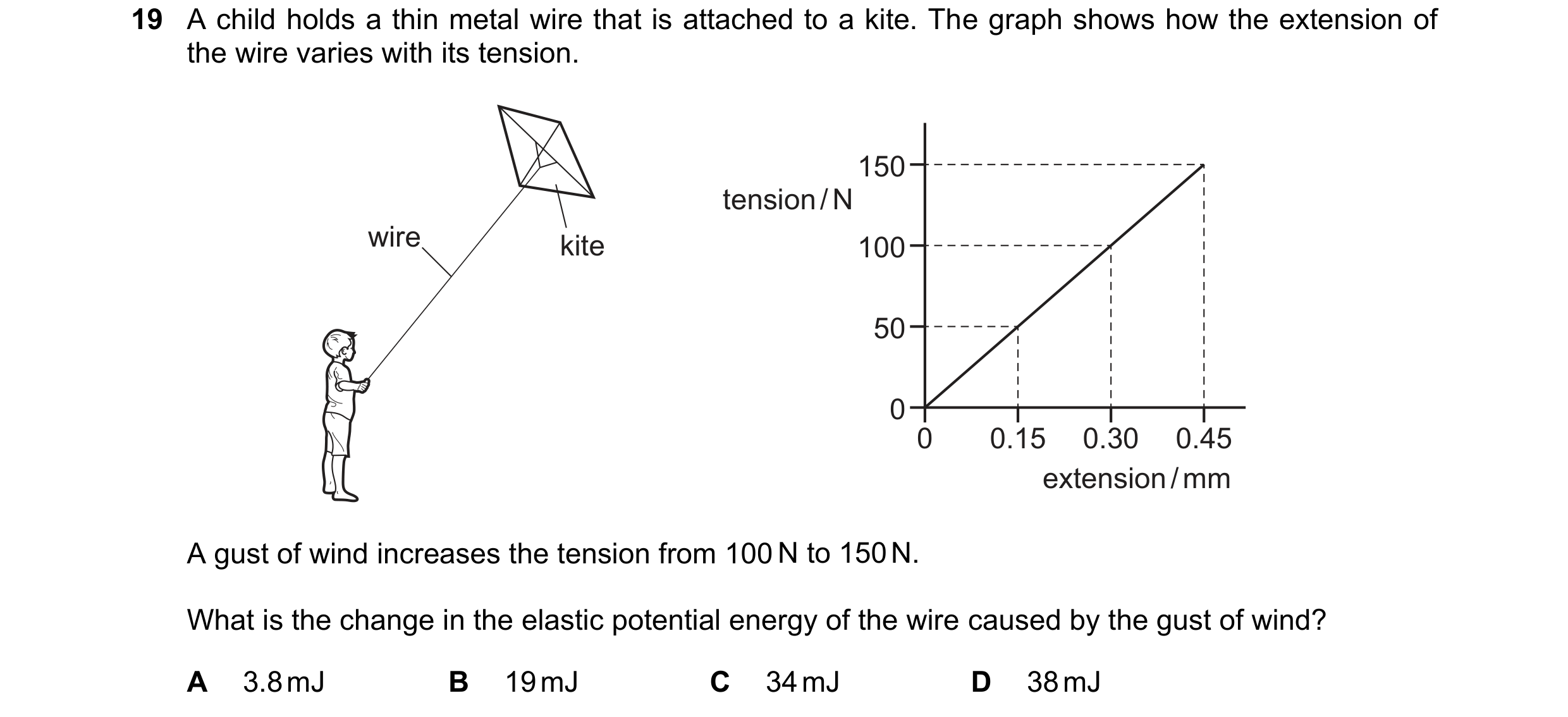
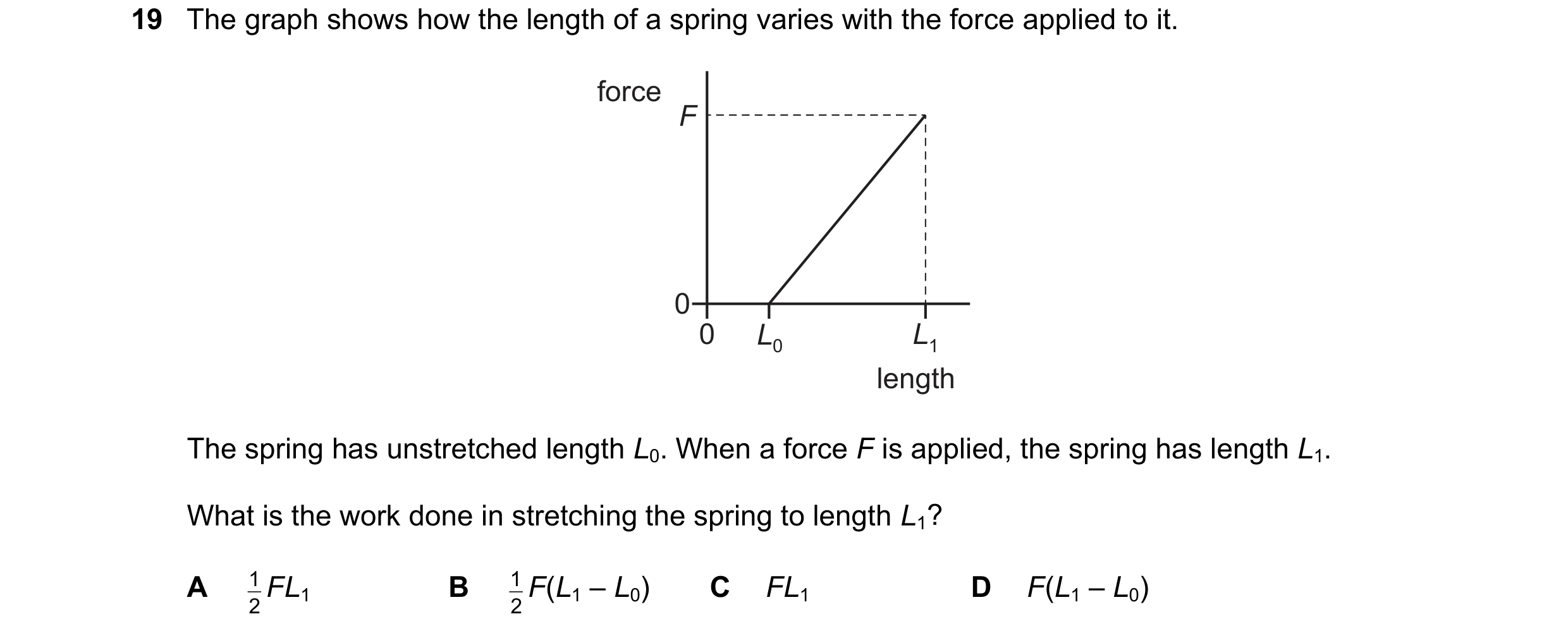 51 / 63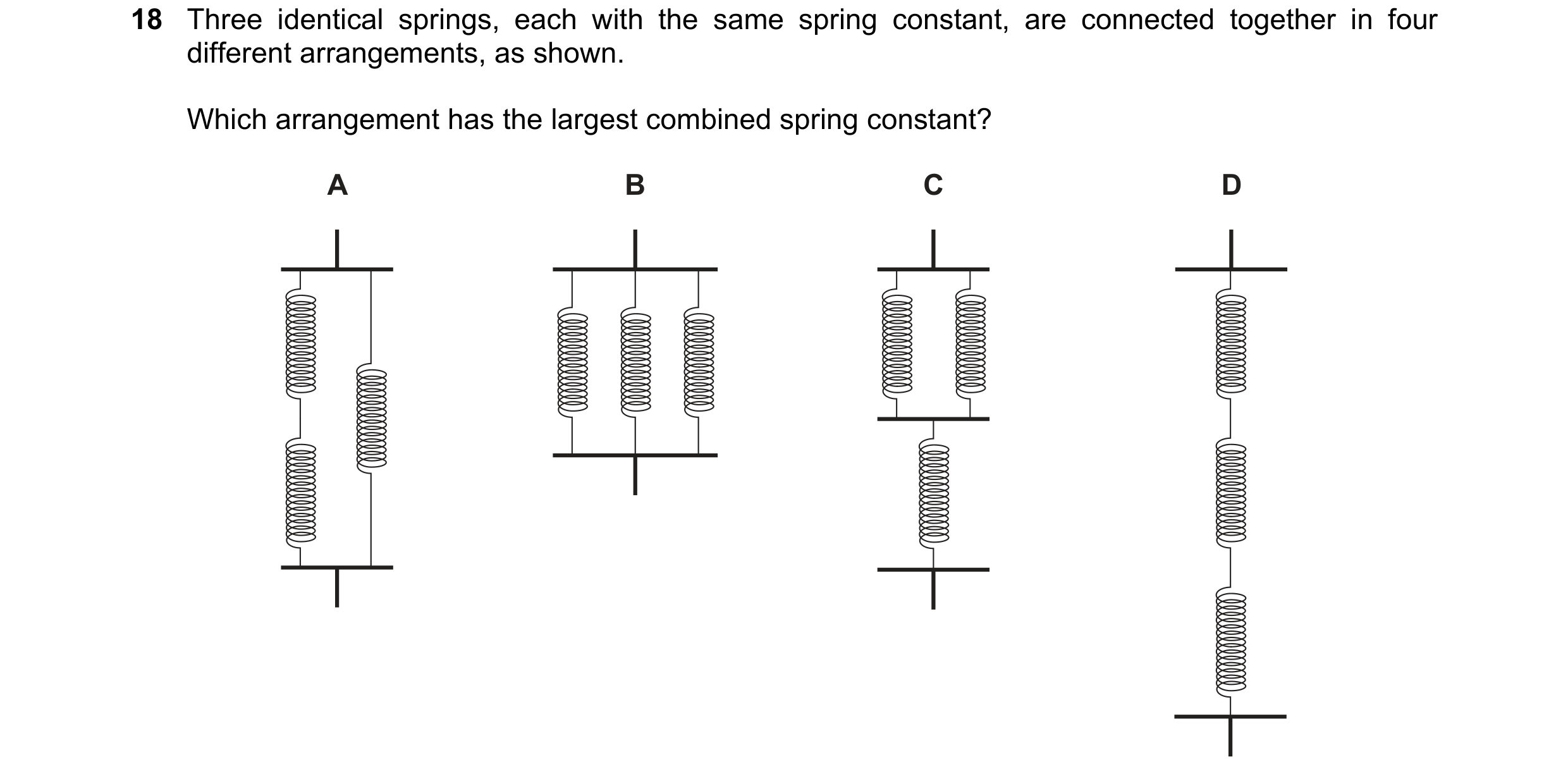
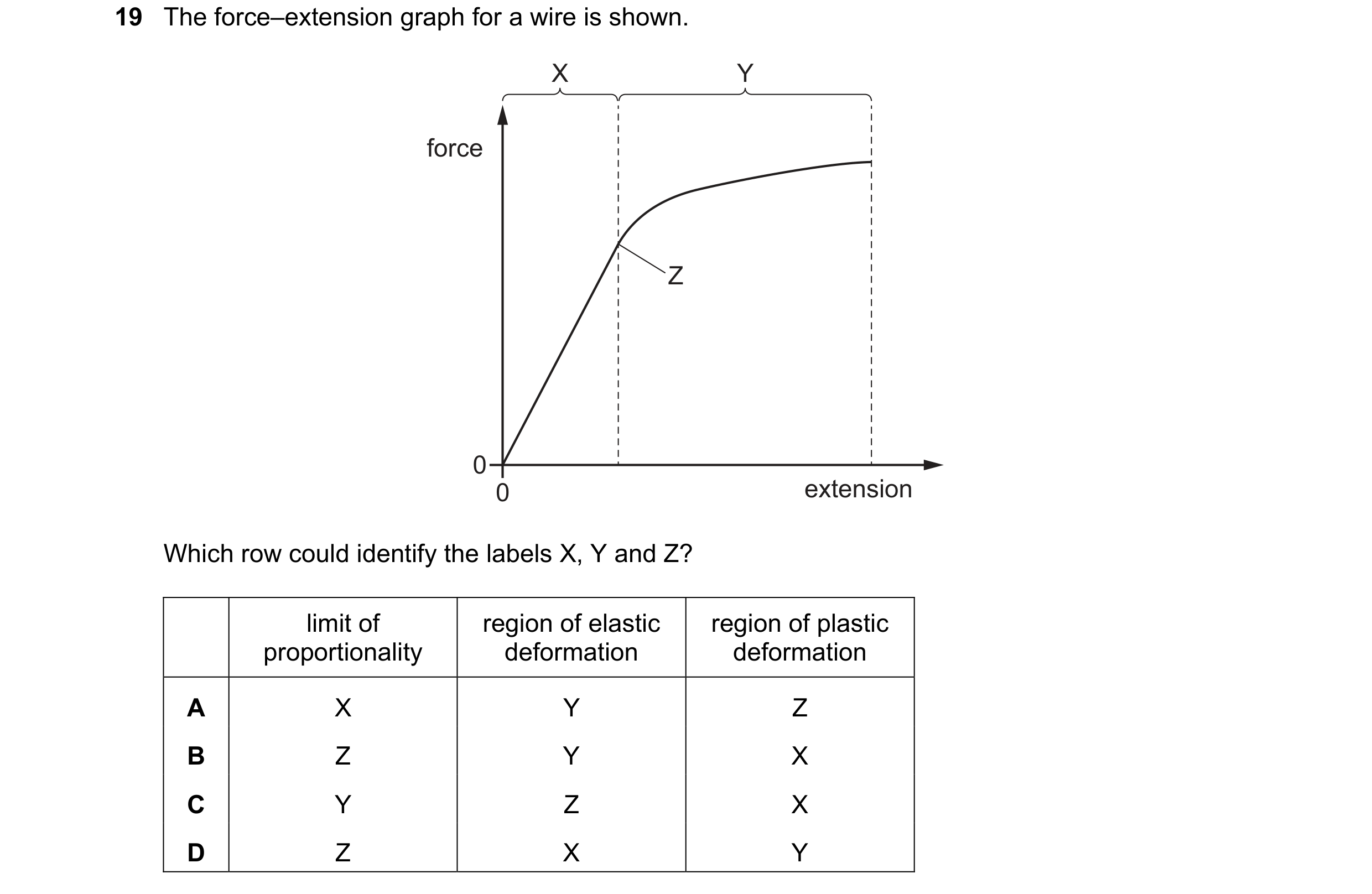 52 / 63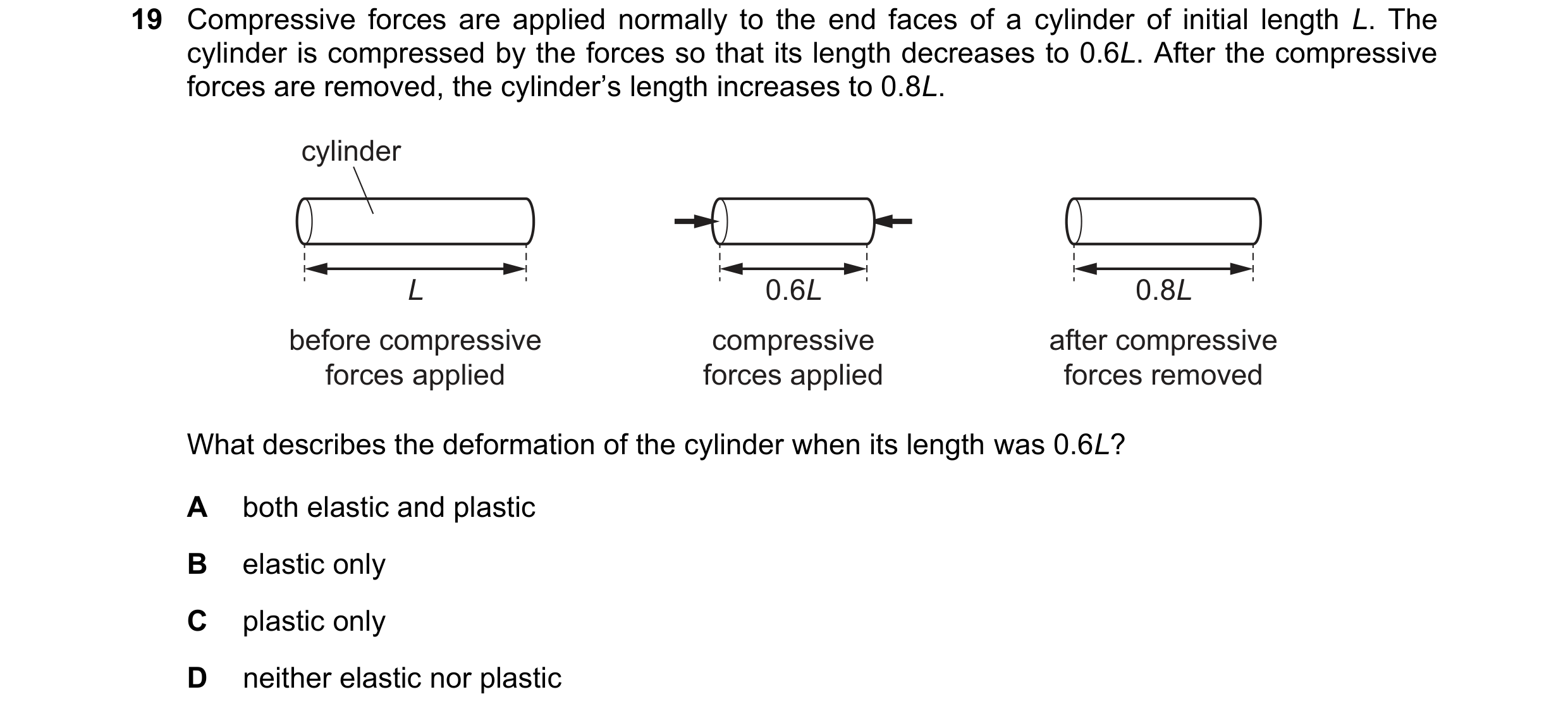

 53 / 63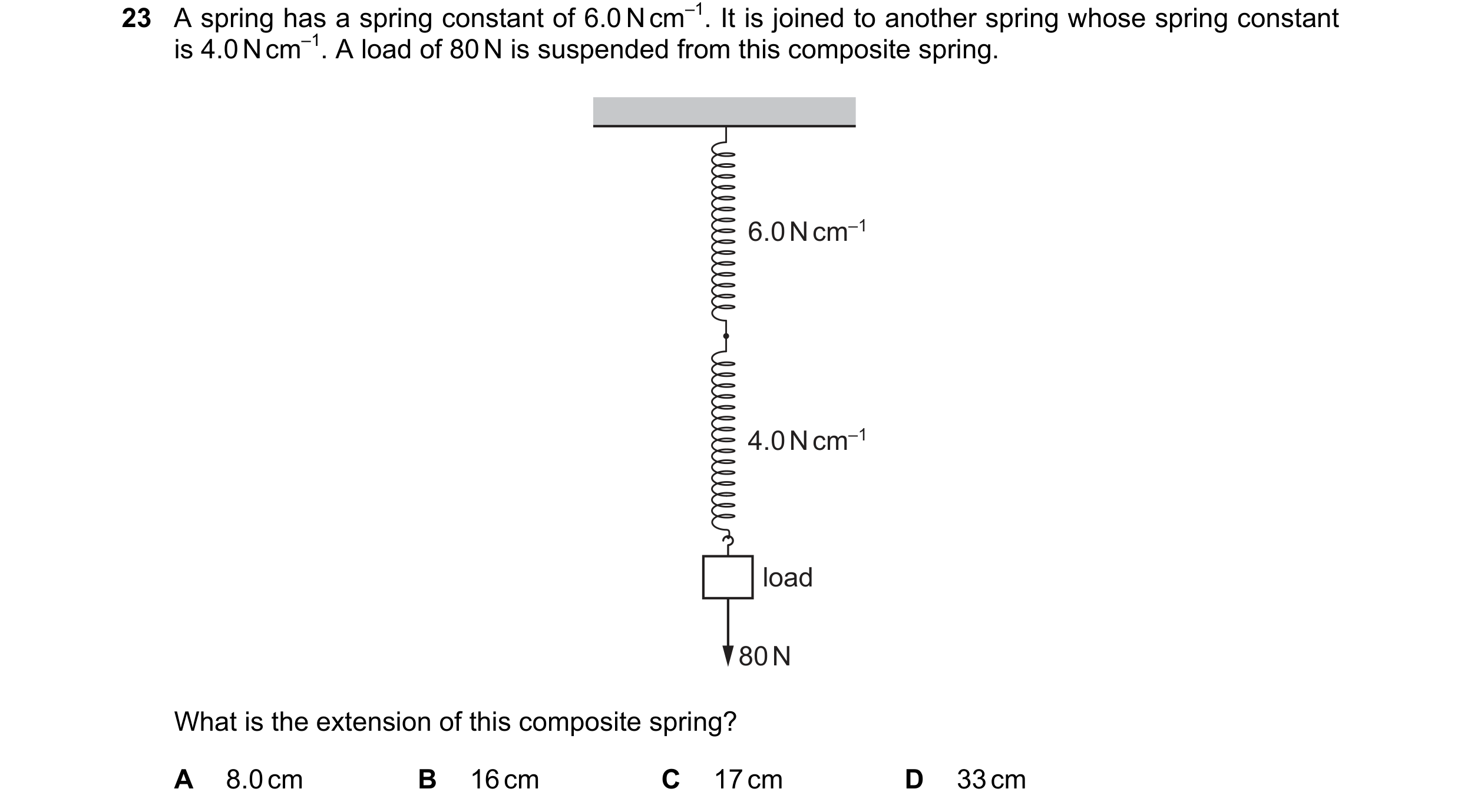
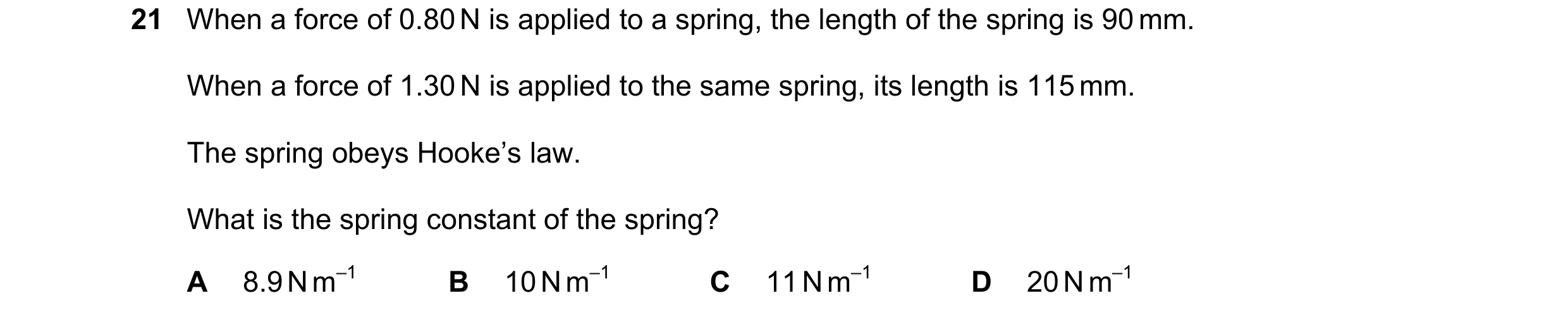
 54 / 63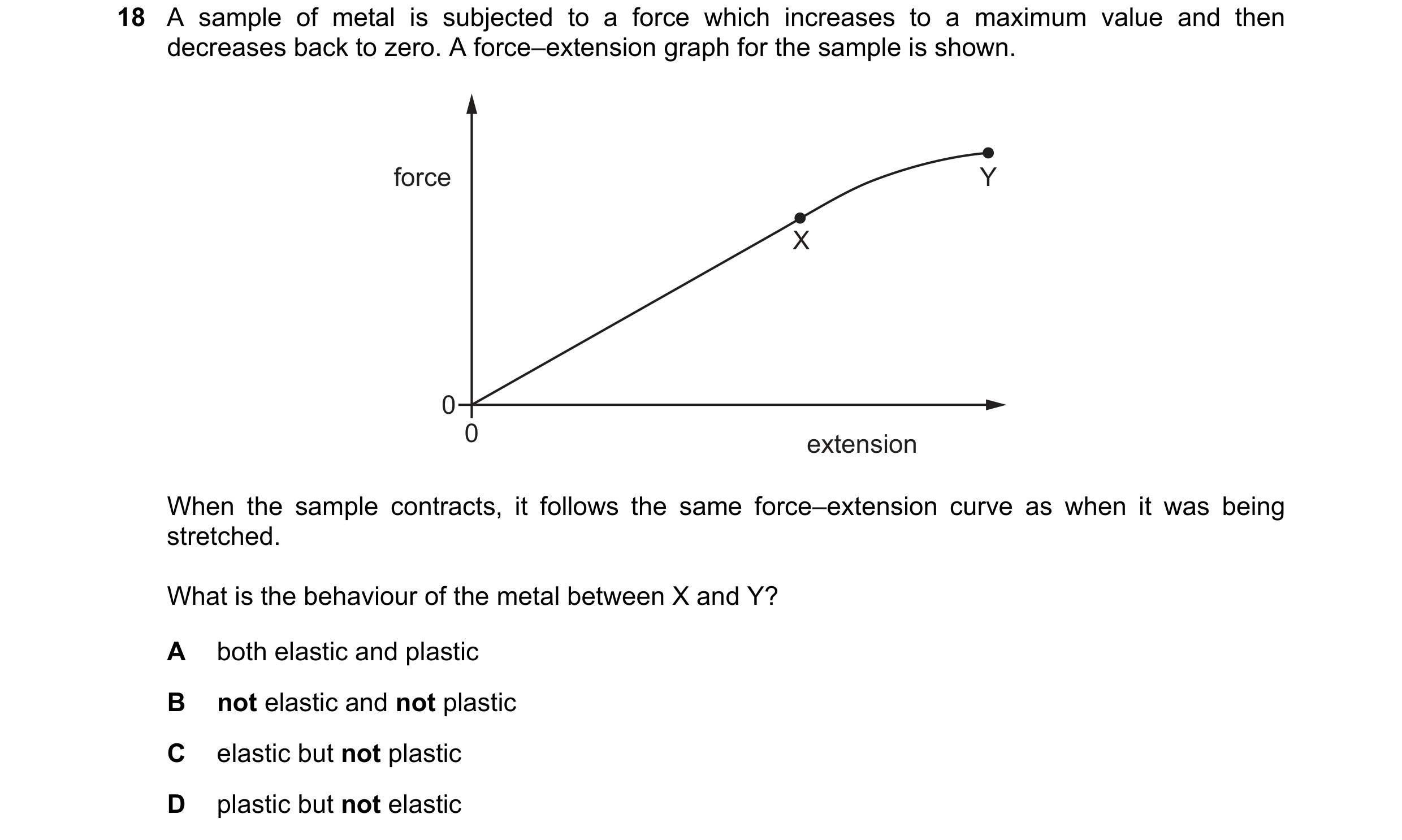
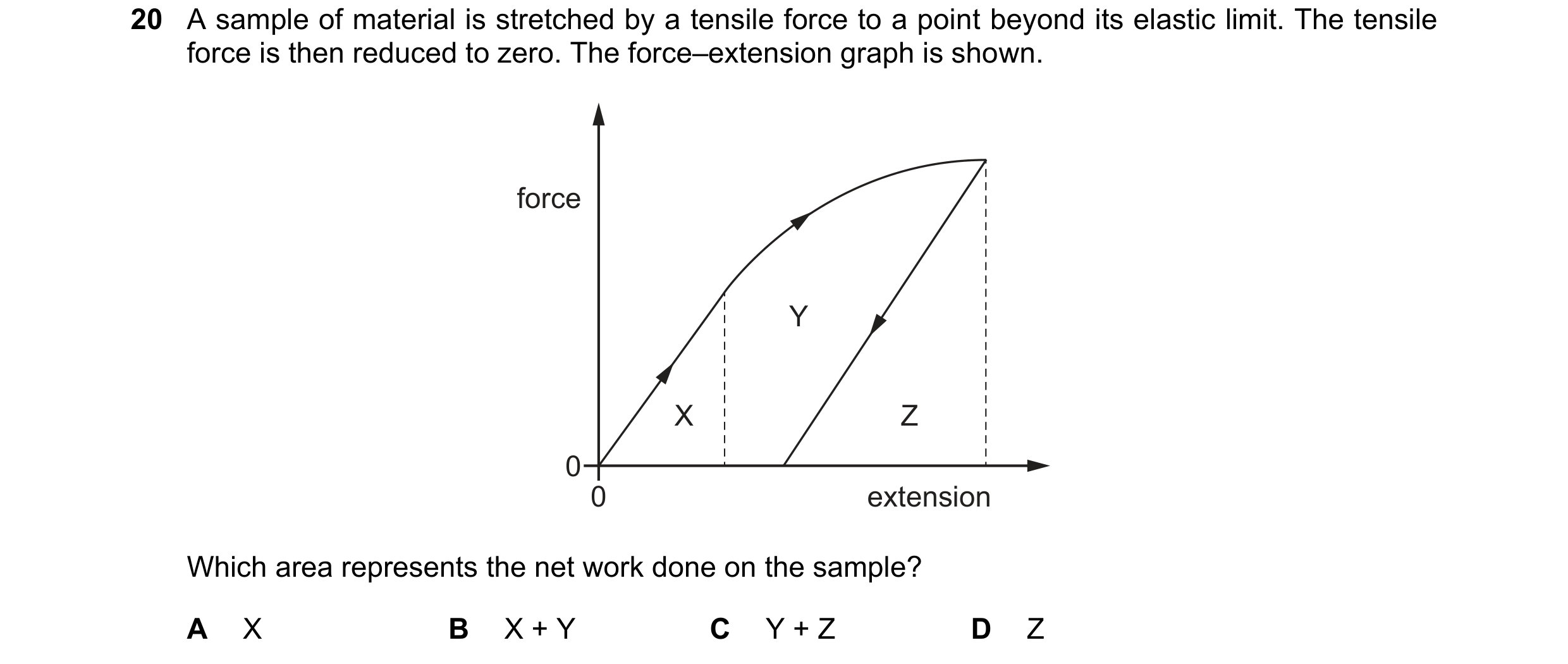
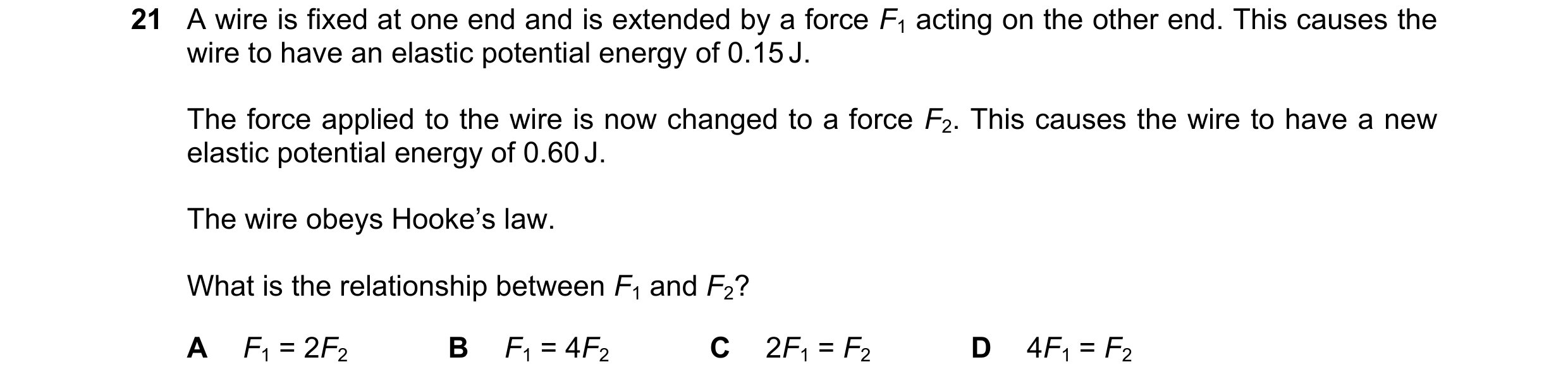 55 / 63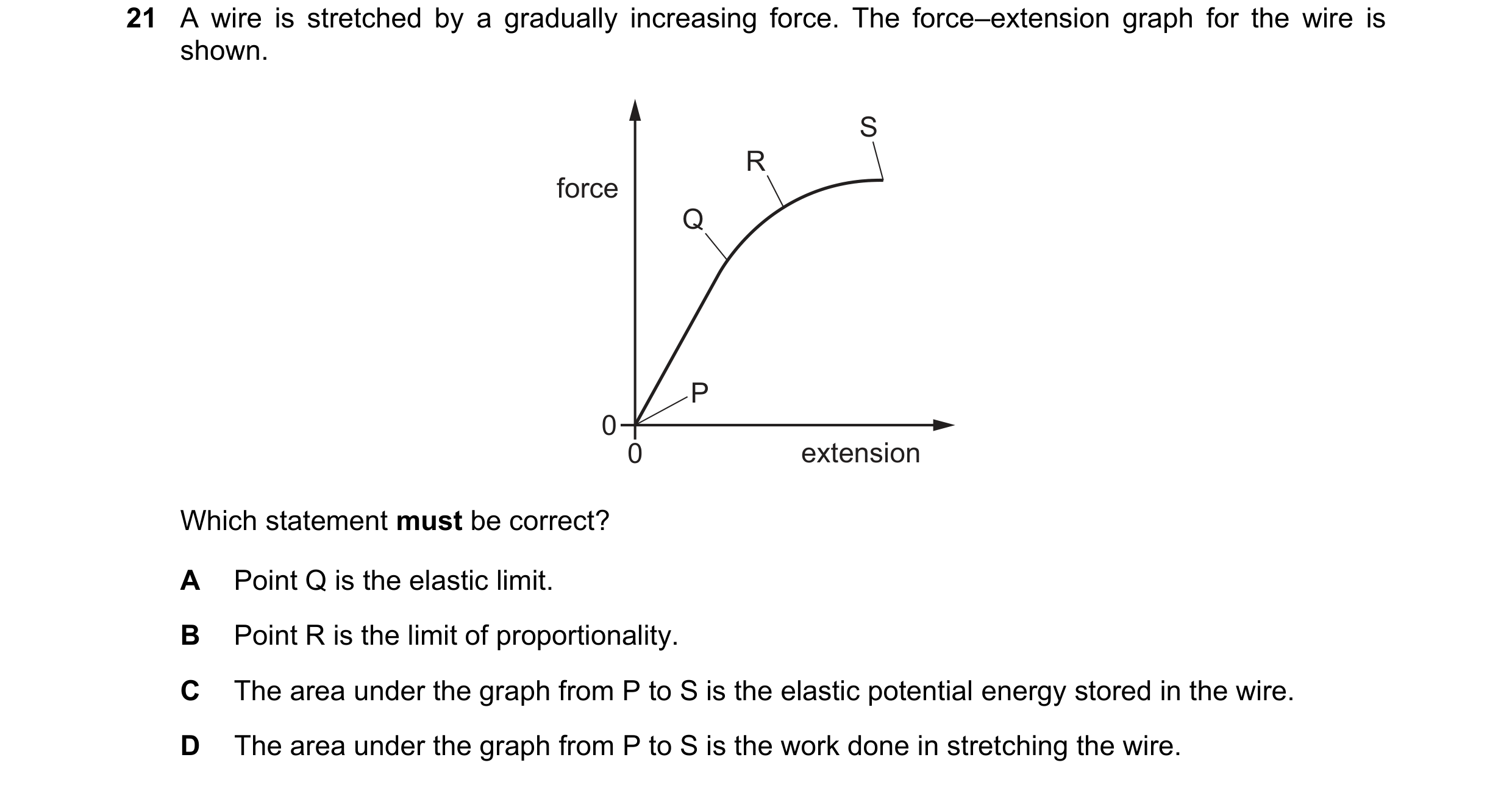
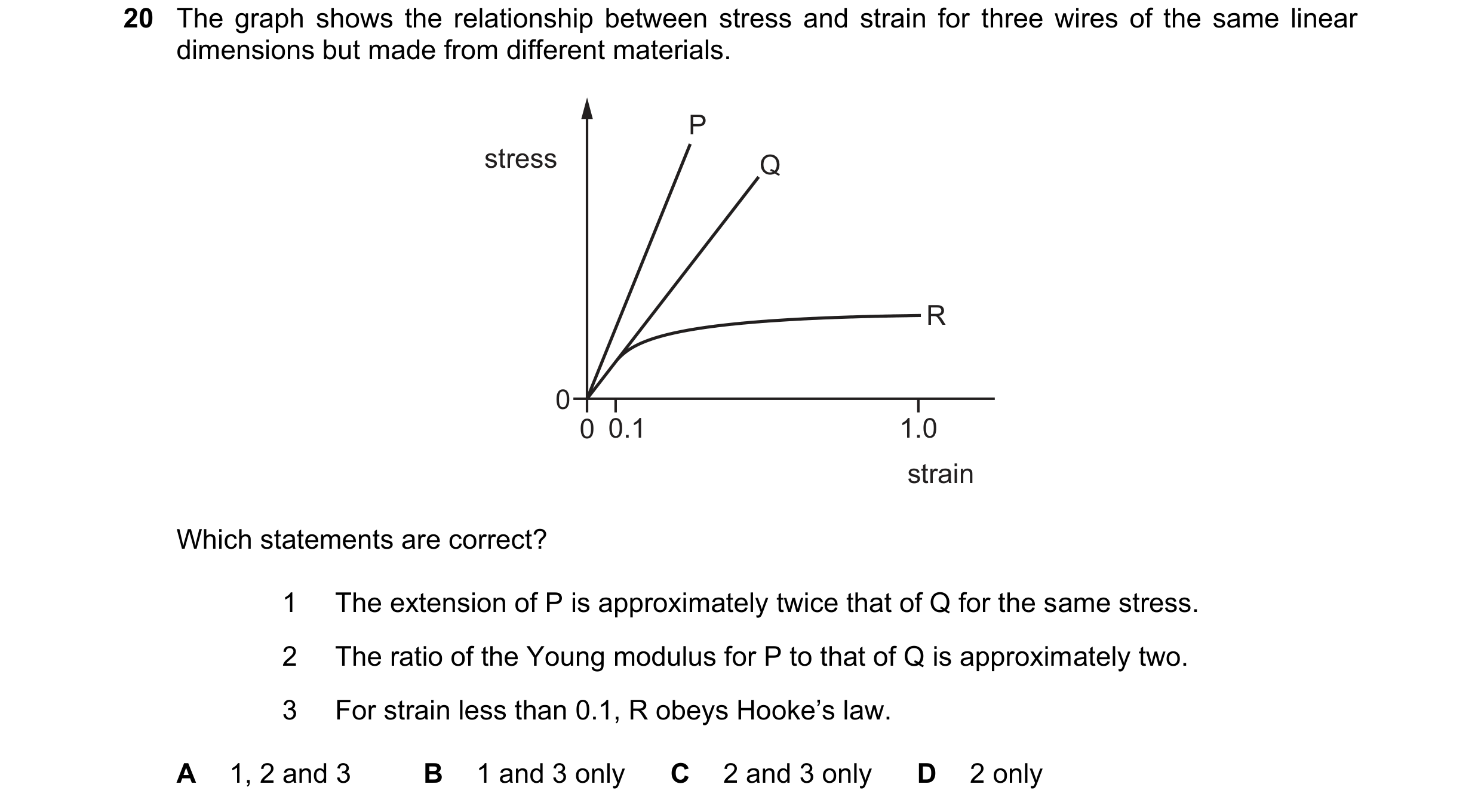 56 / 63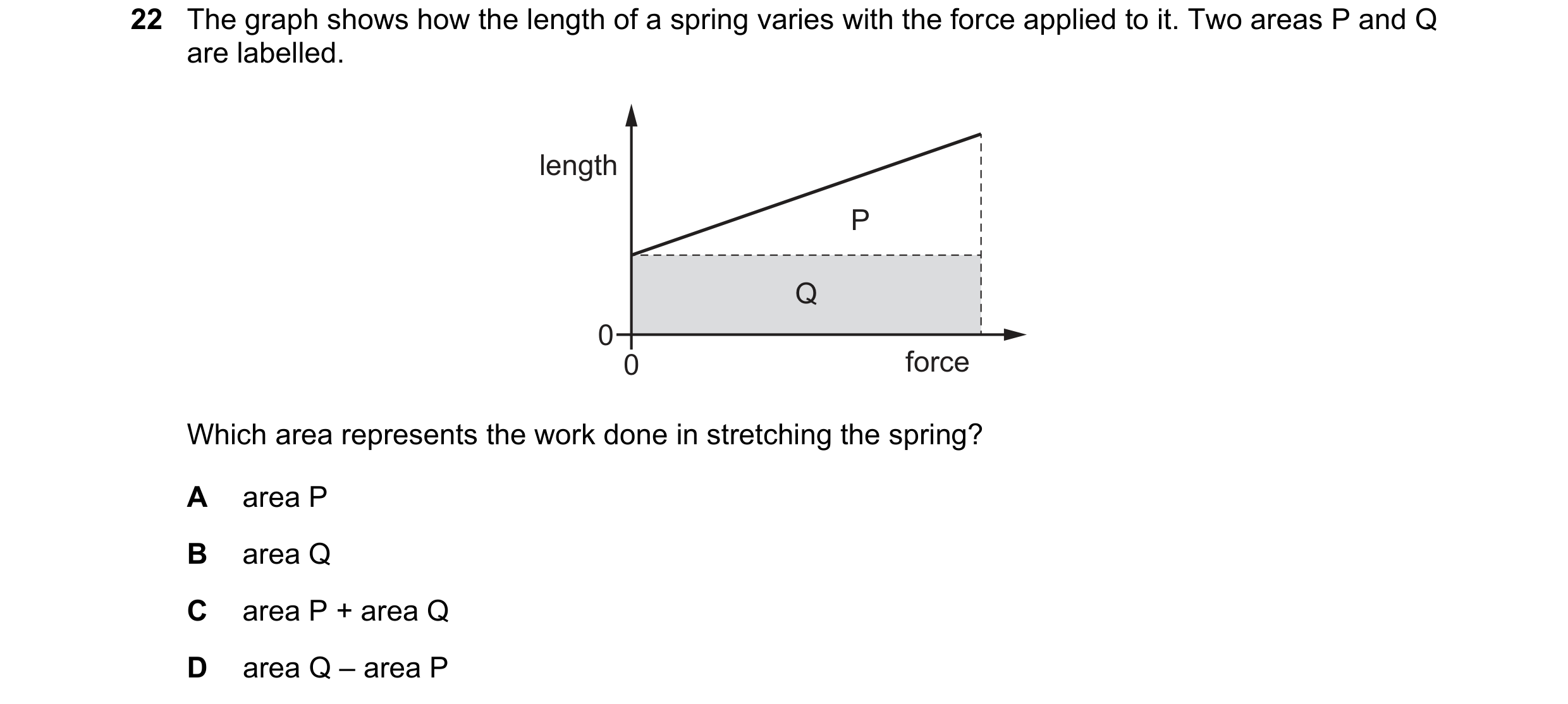
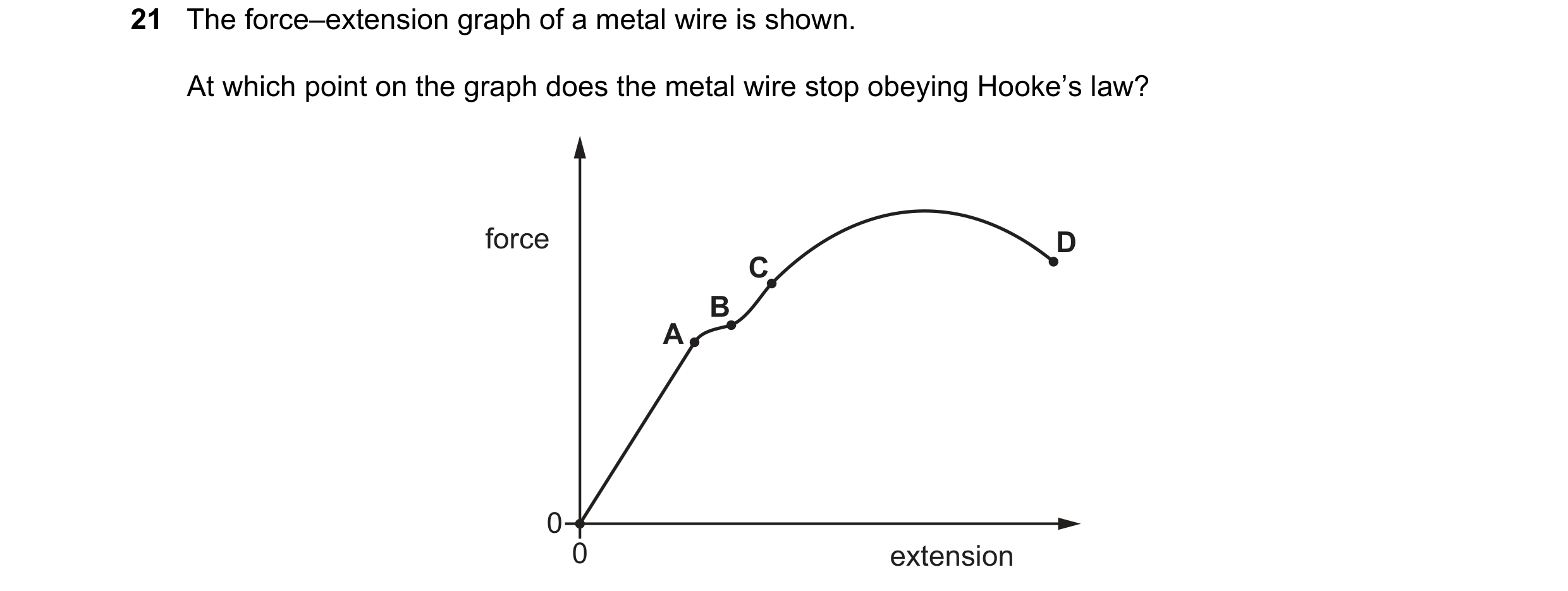
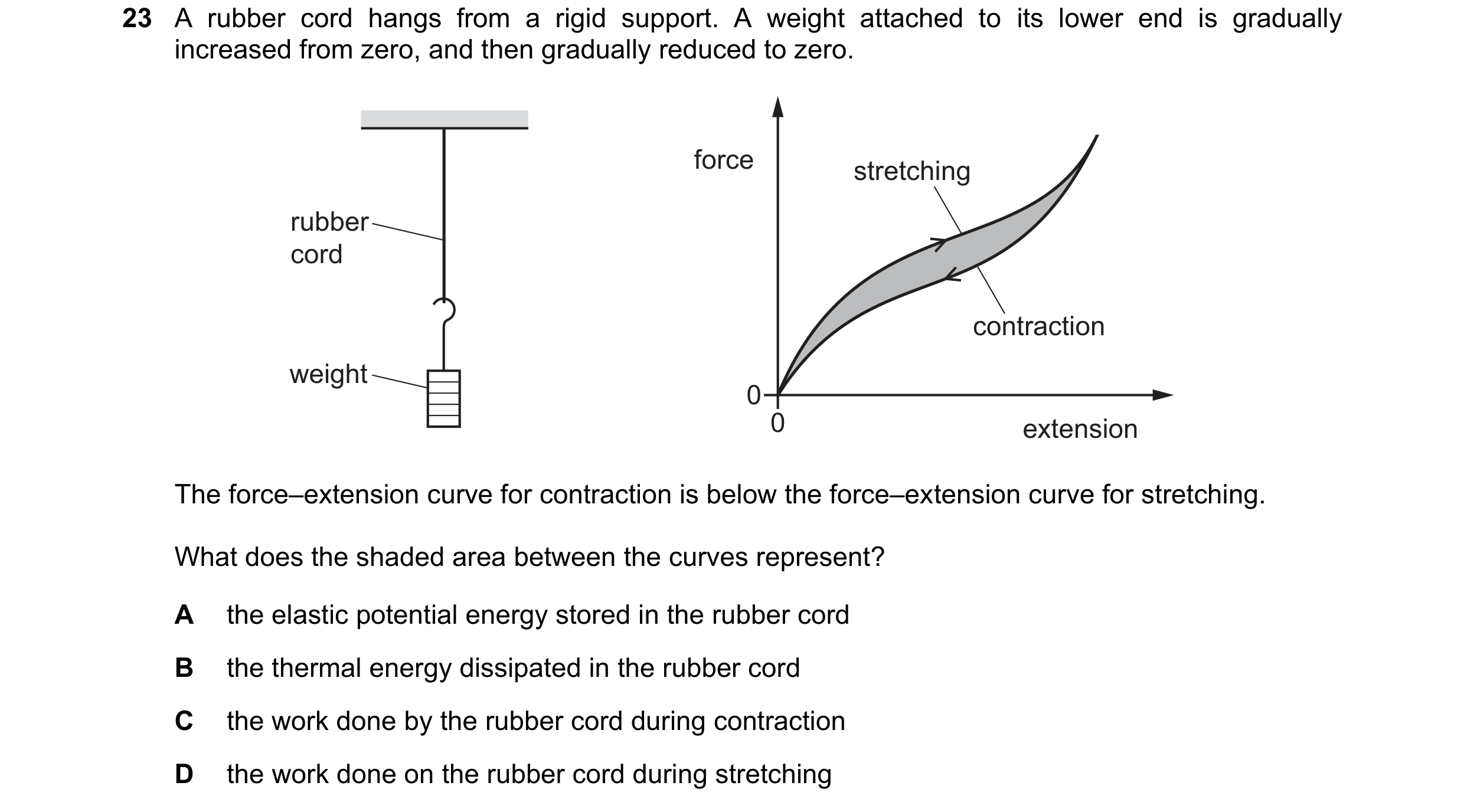 57 / 63
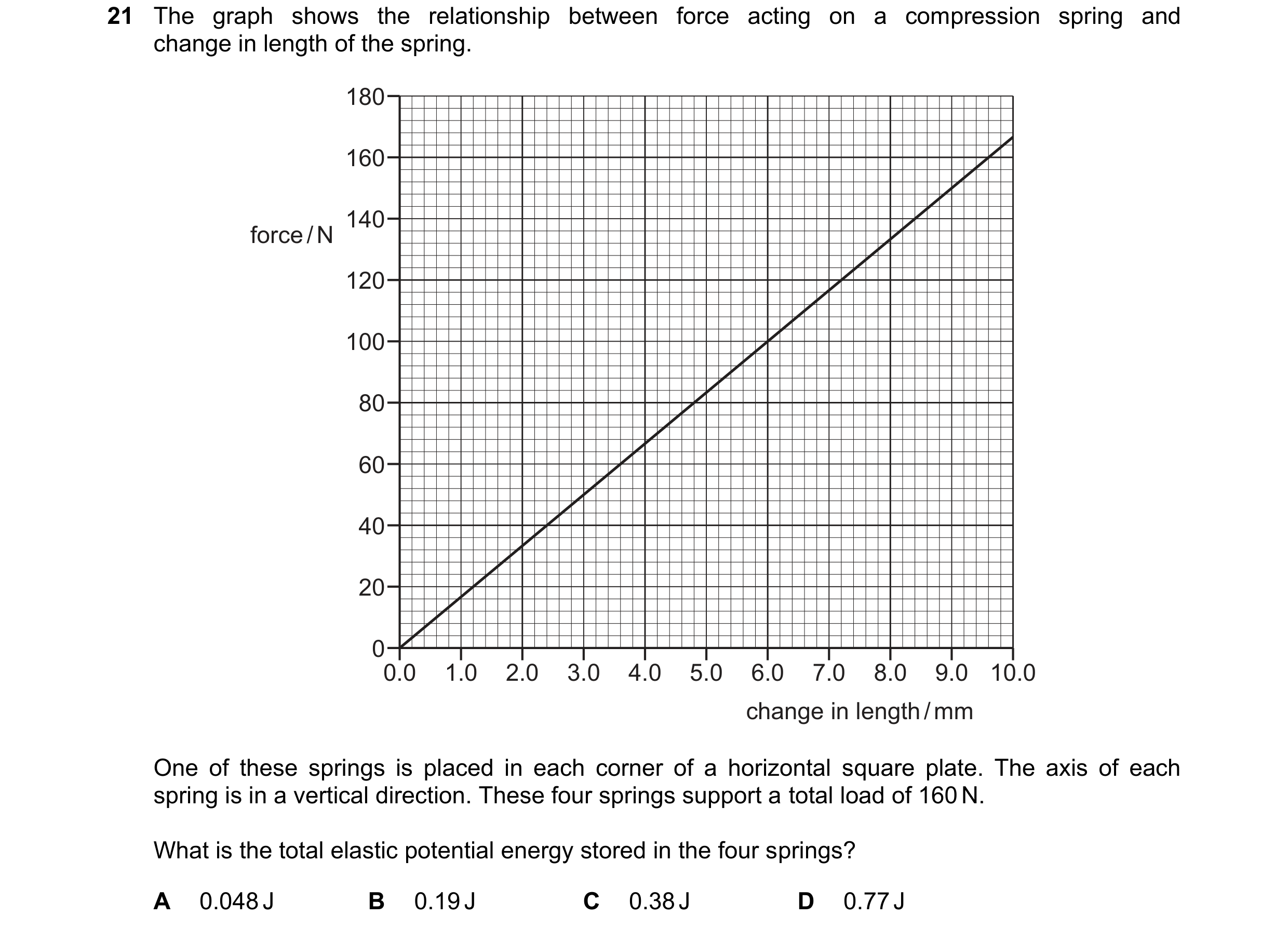
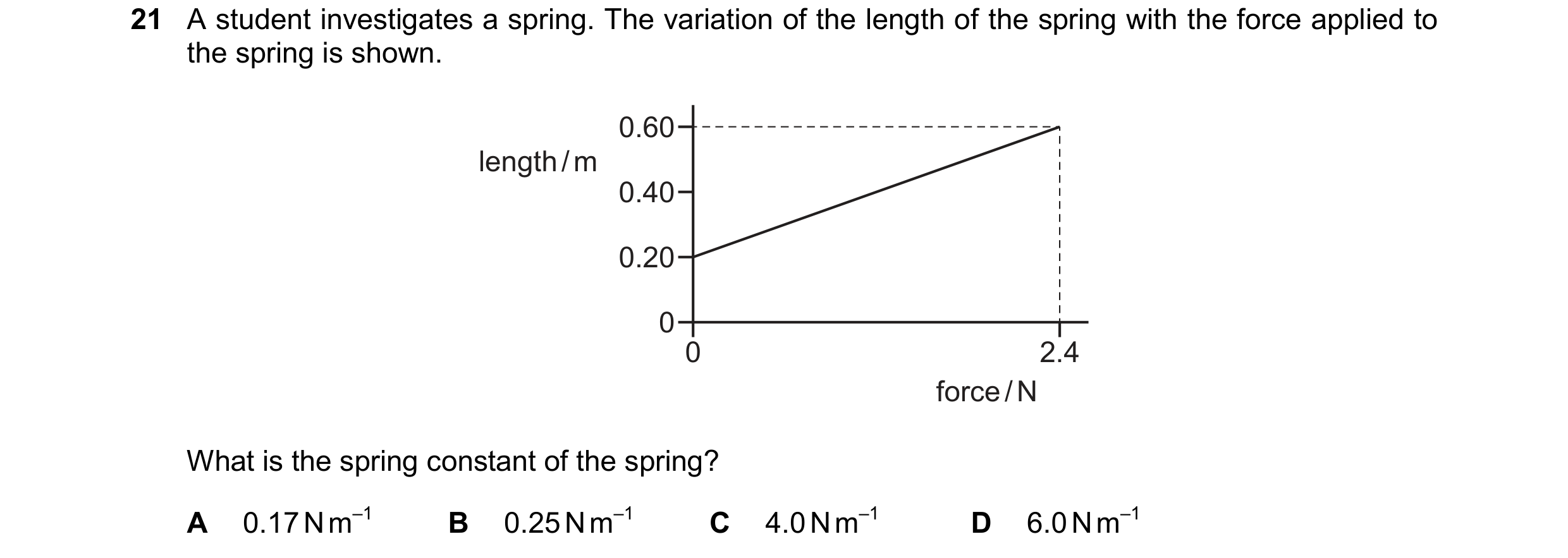 58 / 63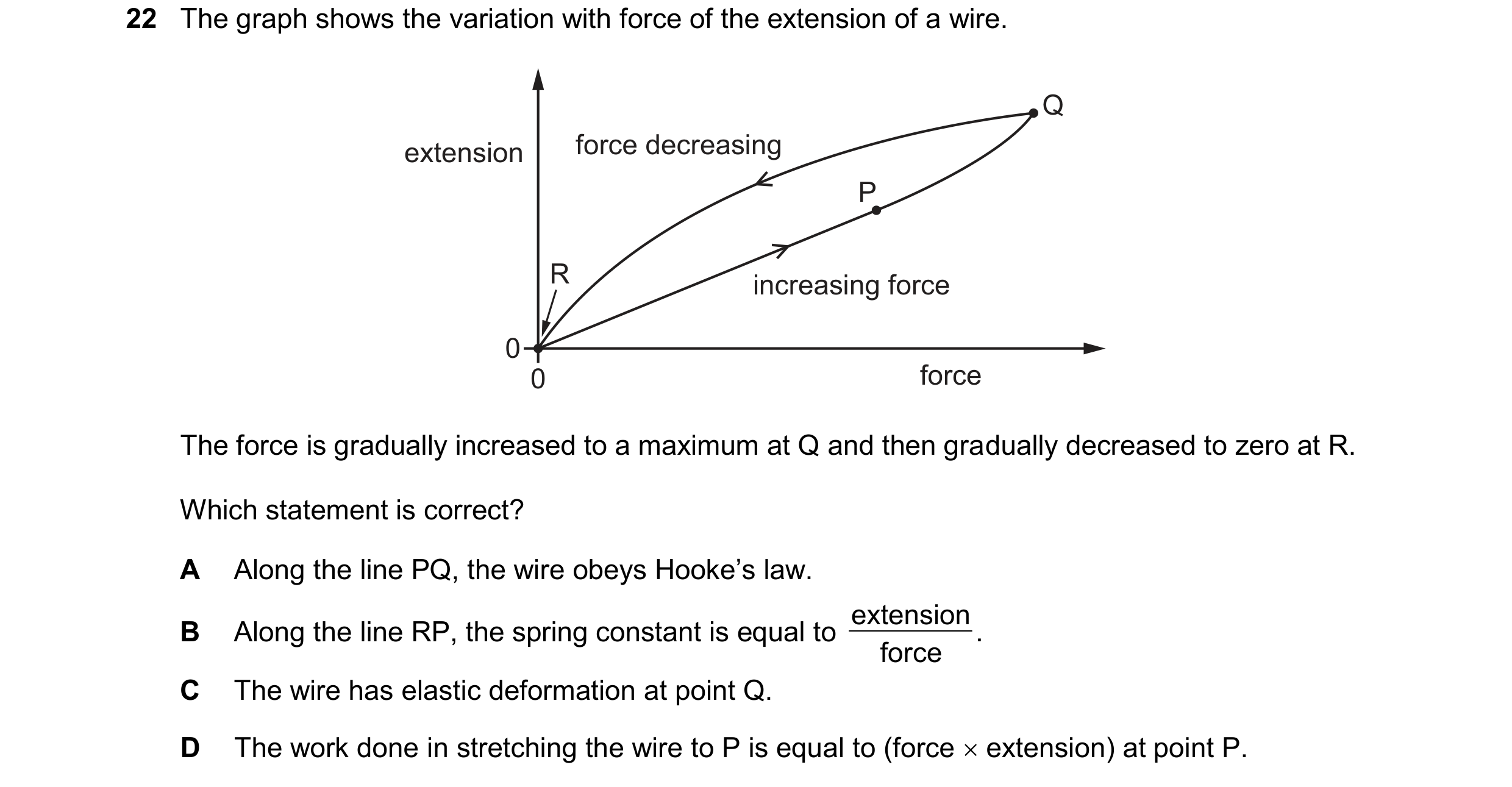
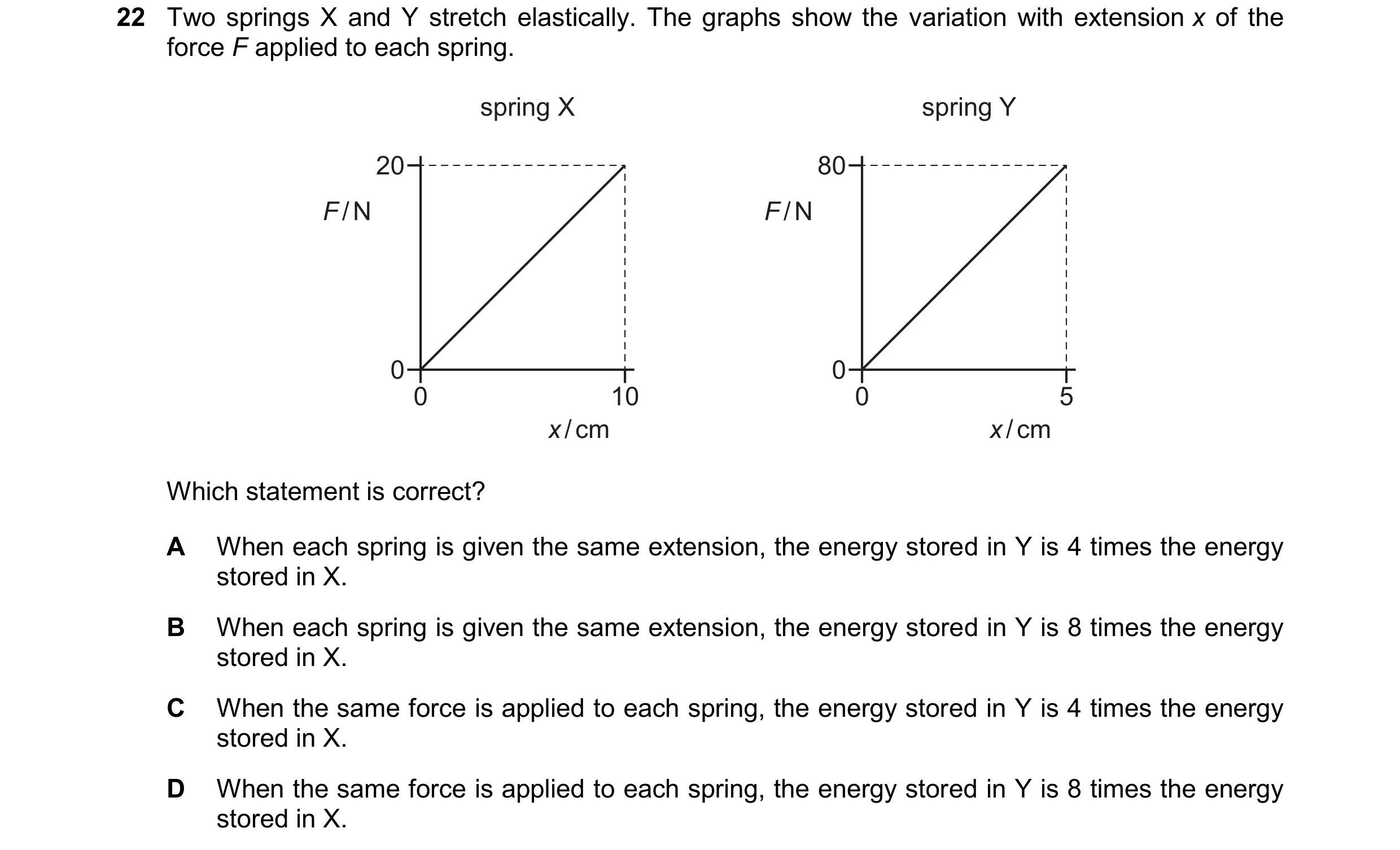
 59 / 63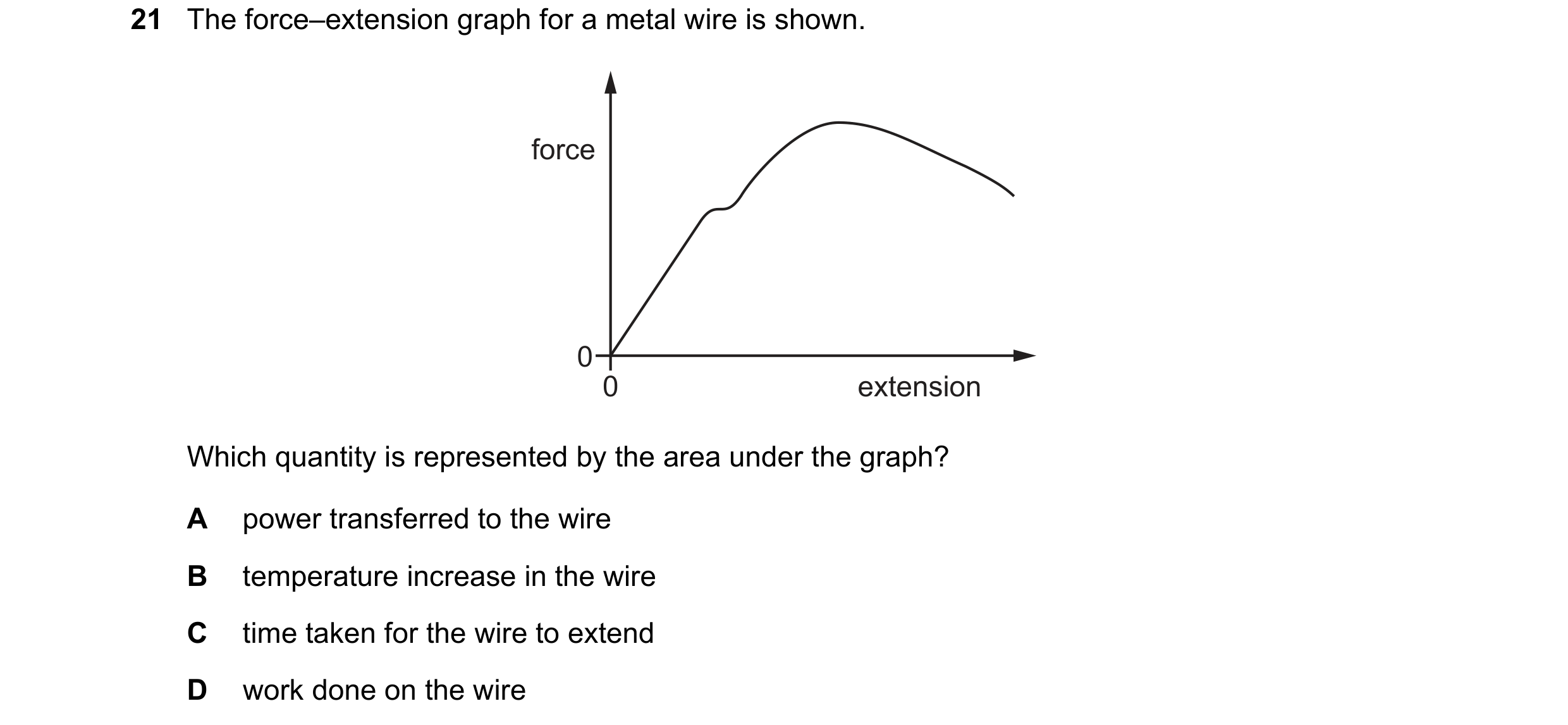
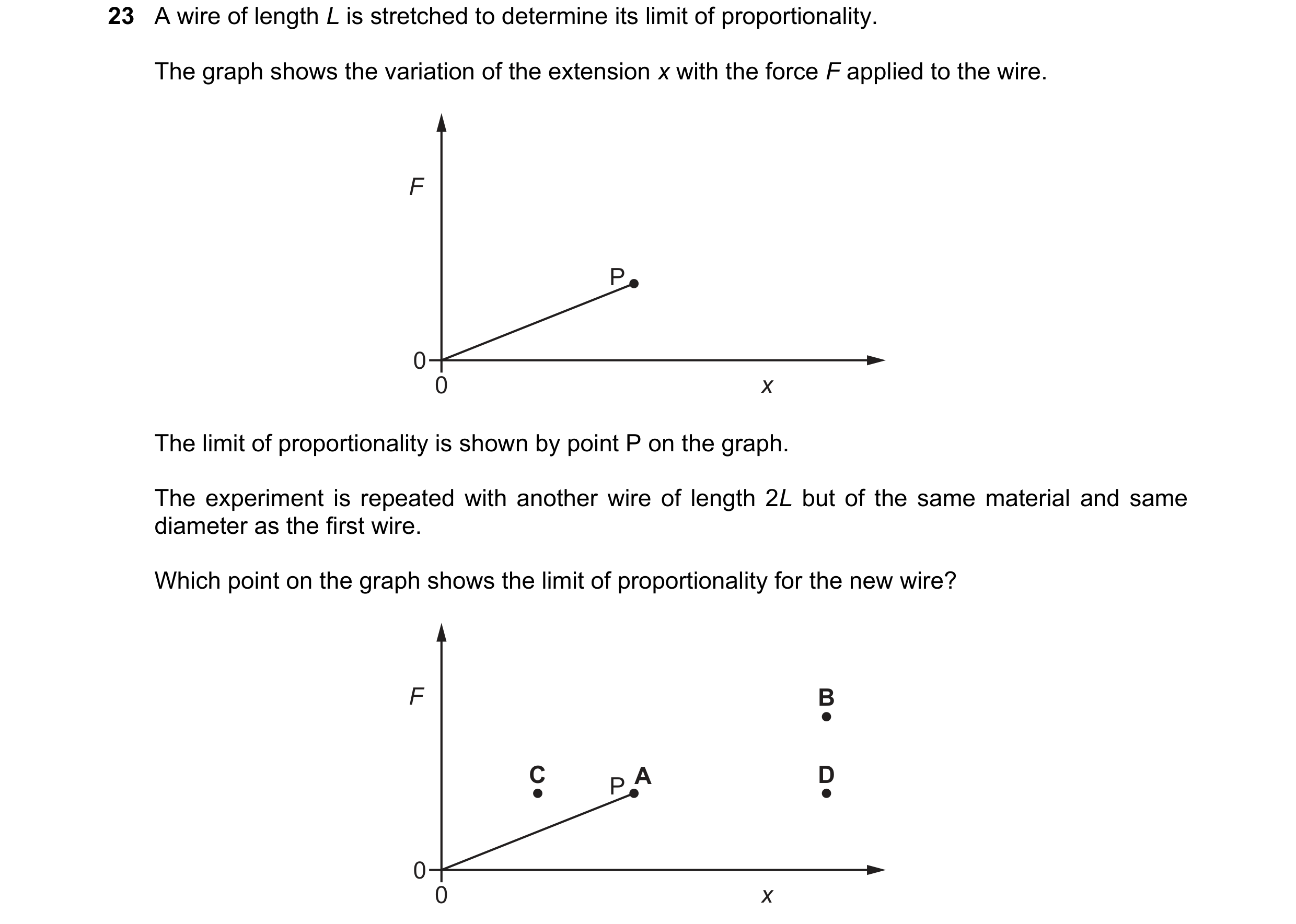 60 / 63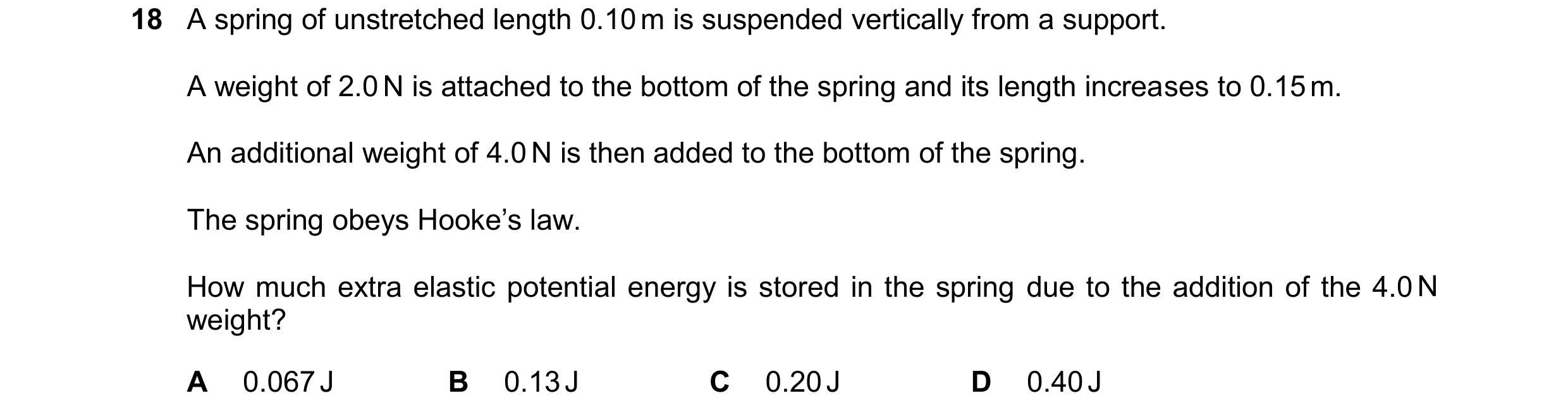
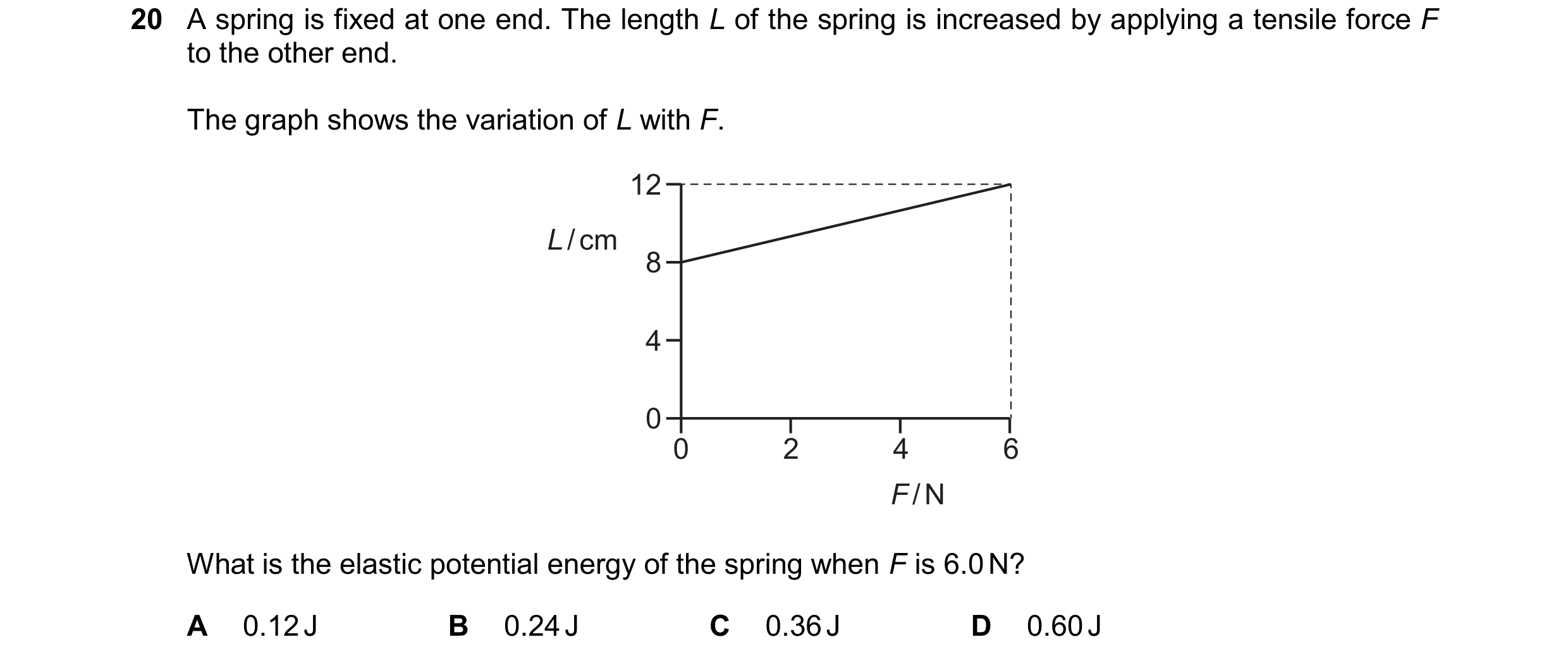
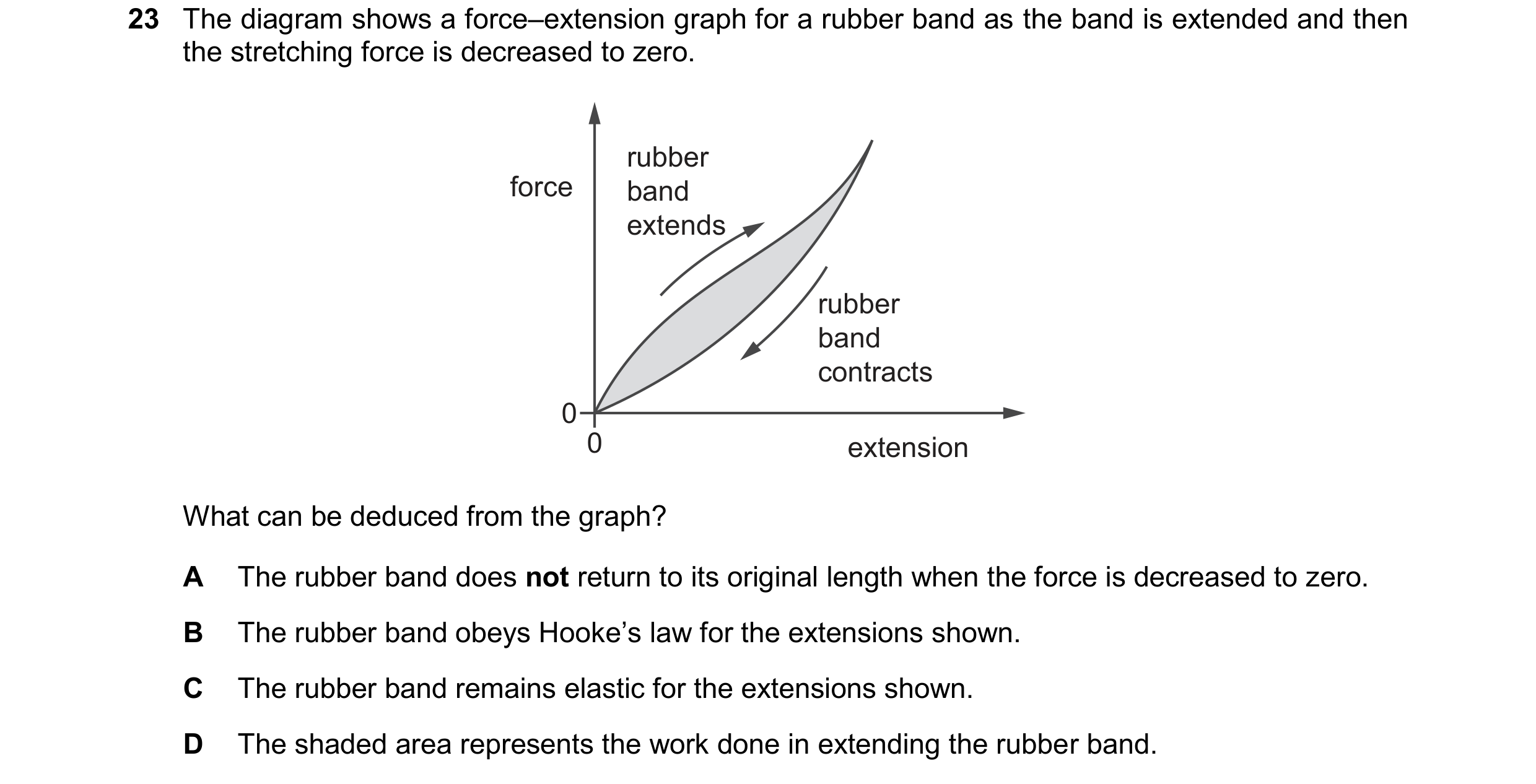 61 / 63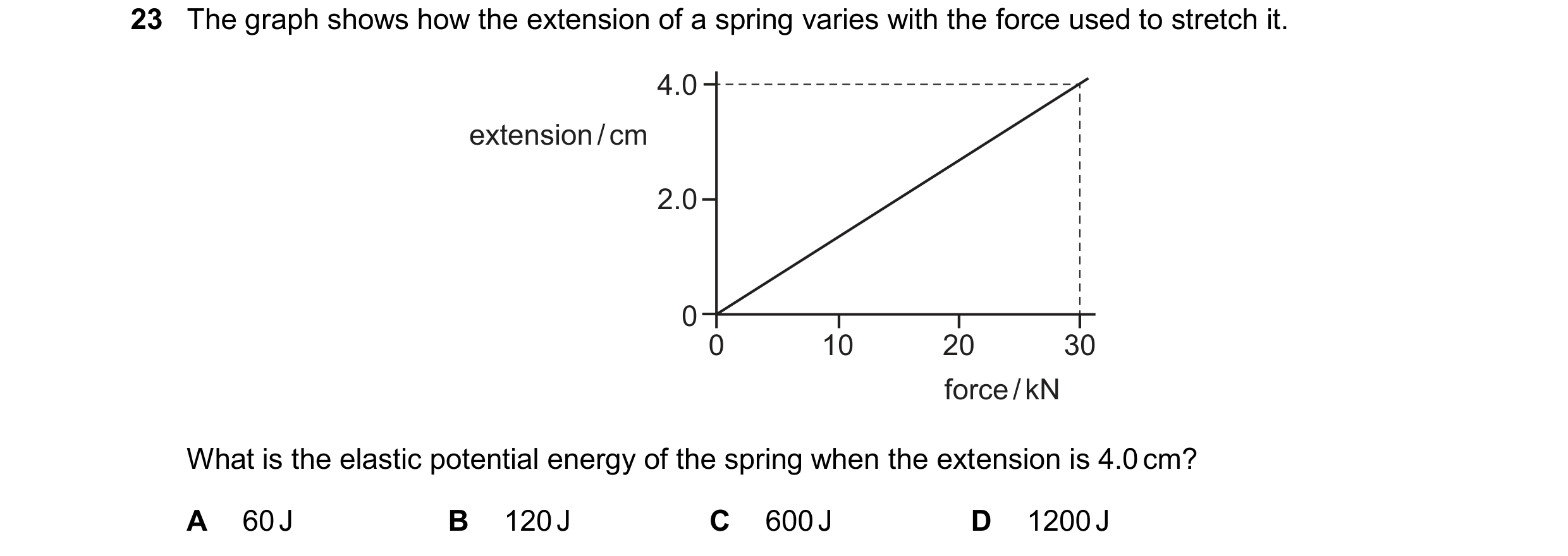
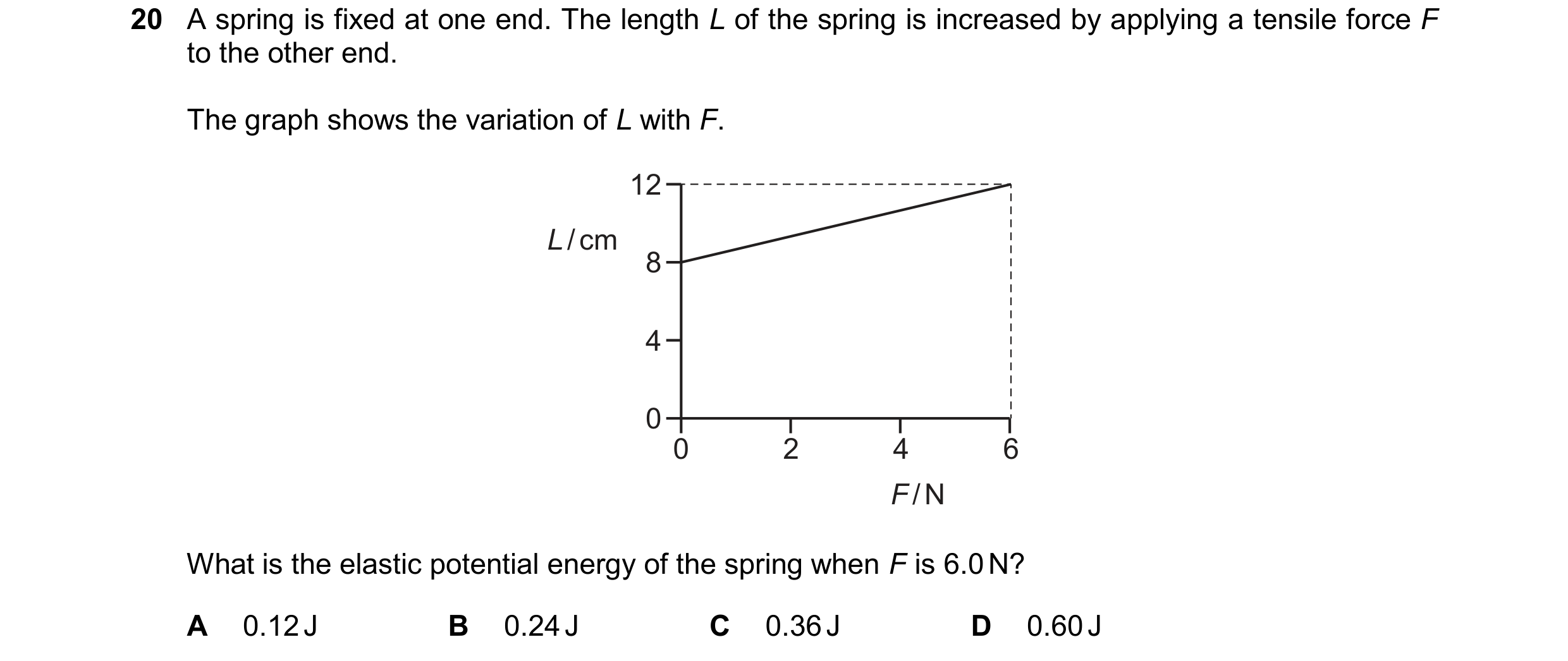
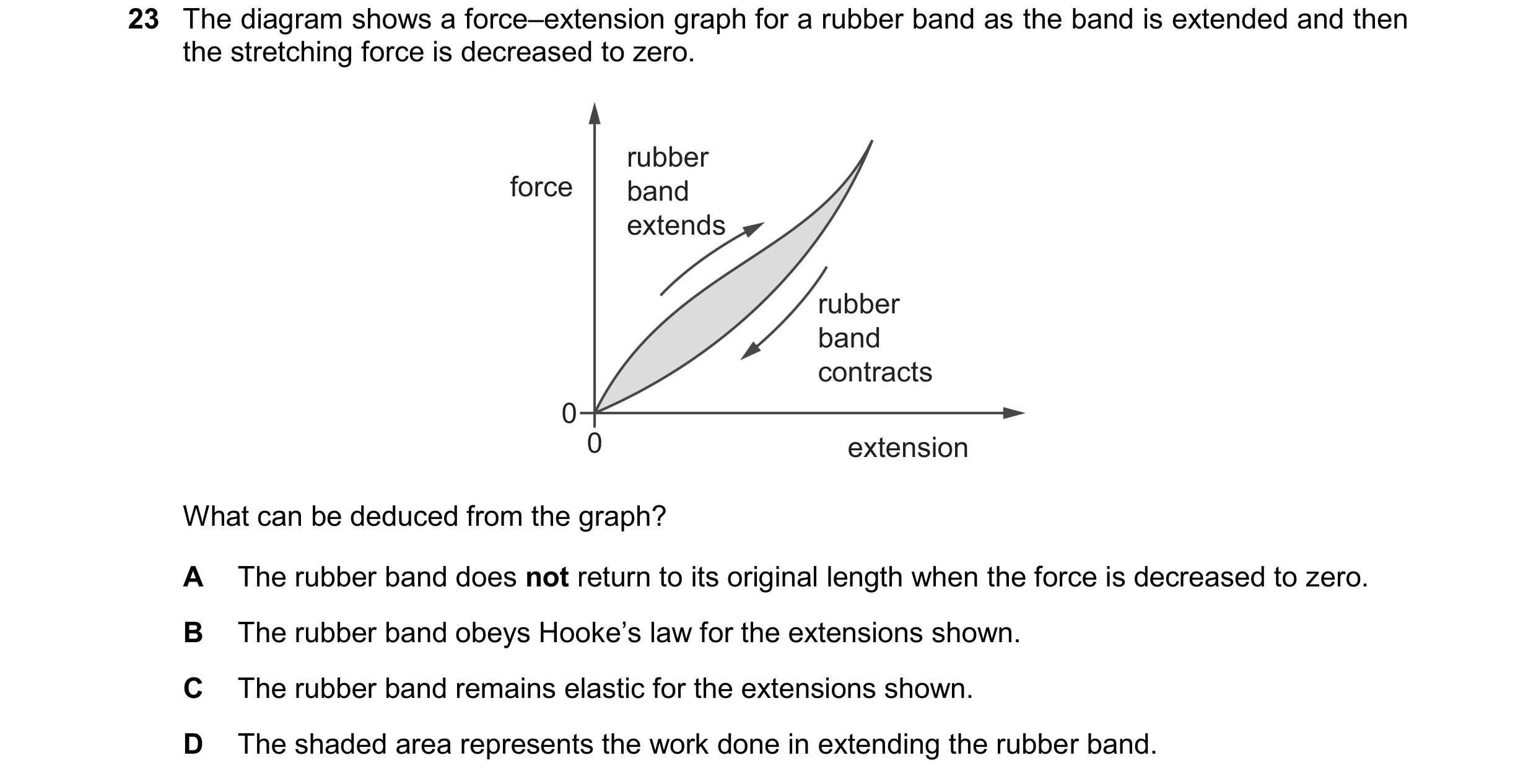 62 / 63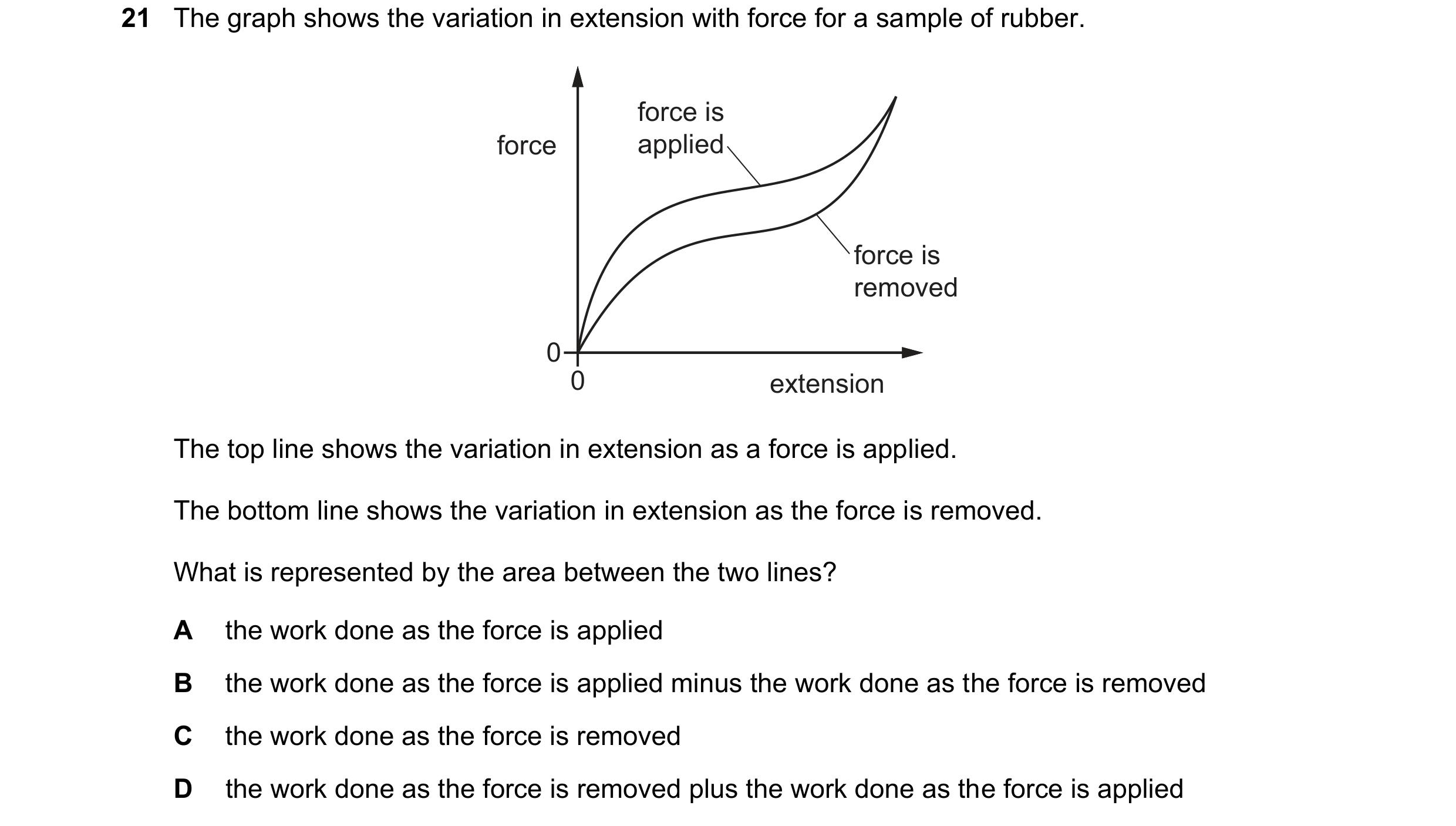
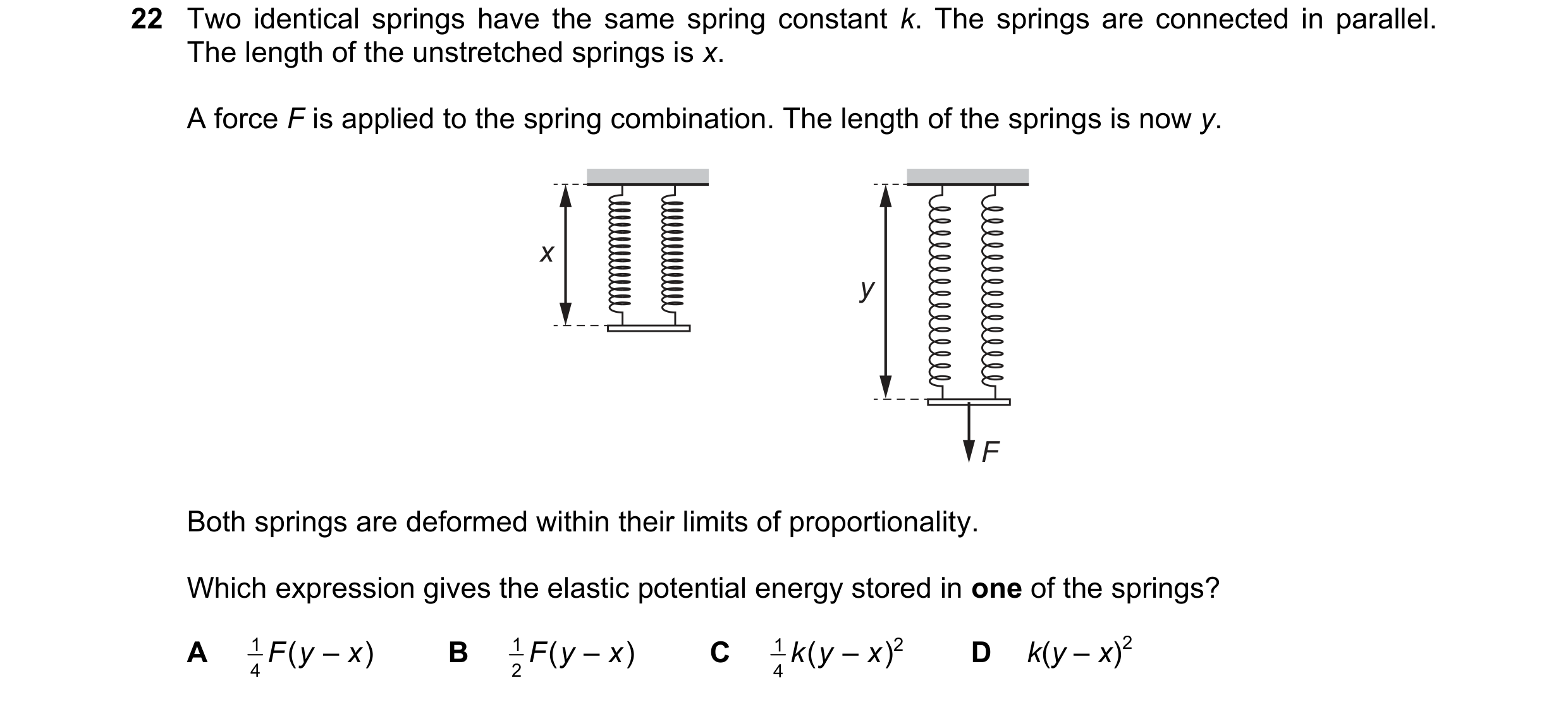
 63 / 63