Questions as text
Q1 · A spring is supported so that it hangs vertically, as shown in Fig 9702/23 May/June 2017
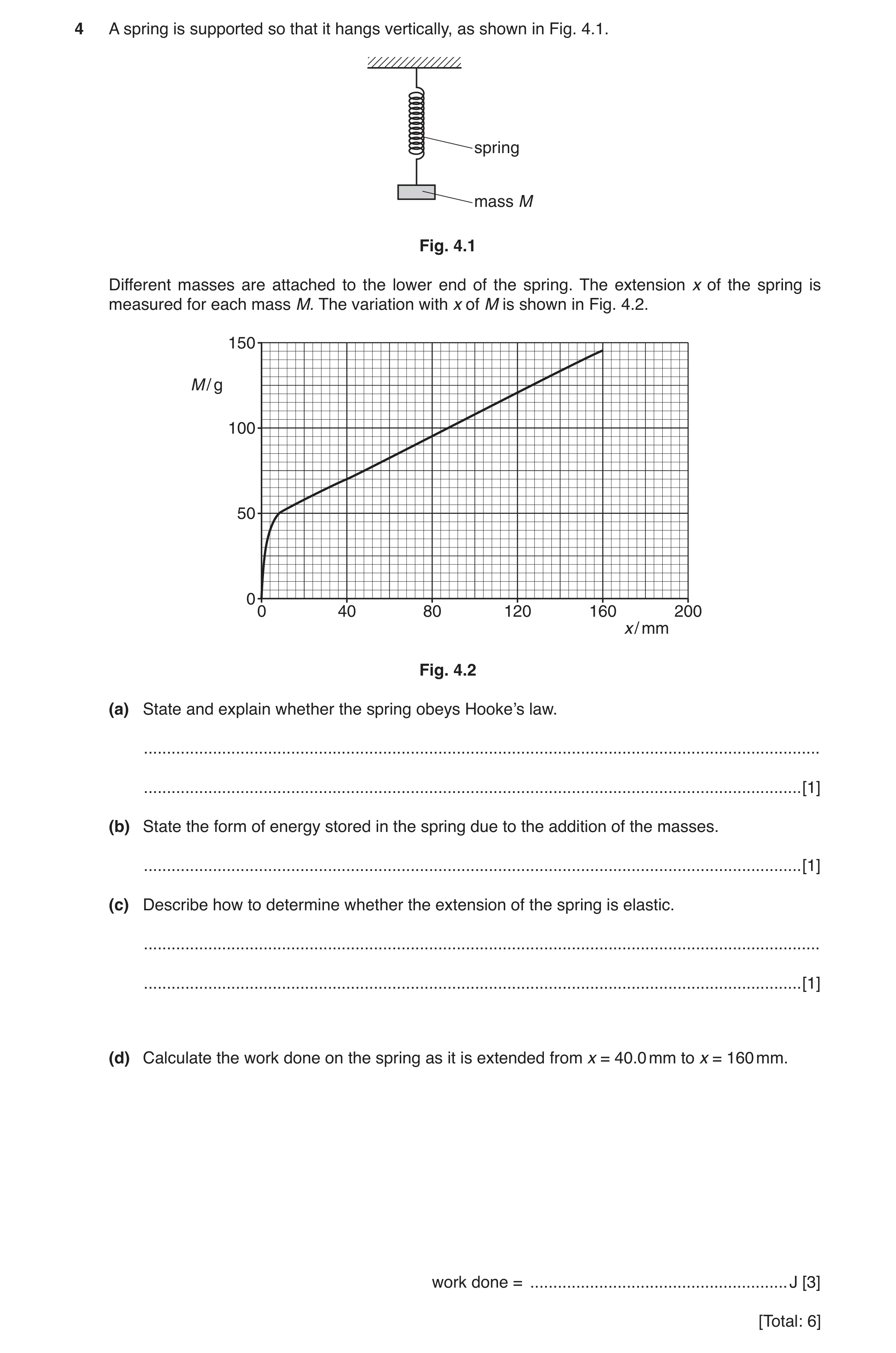
4 A spring is supported so that it hangs vertically, as shown in Fig. 4.1. spring mass M Fig. 4.1 Different masses are attached to the lower end of the spring. The extension x of the spring is measured for each mass M. The variation with x of M is shown in Fig. 4.2. 150 M / g 100 50 0 0 40 80 120 160 200 x / mm Fig. 4.2 (a) State and explain whether the spring obeys Hooke’s law. … … [1] (b) State the form of energy stored in the spring due to the addition of the masses. … [1] (c) Describe how to determine whether the extension of the spring is elastic. … … [1] (d) Calculate the work done on the spring as it is extended from x = 40.0 mm to x = 160 mm. work done = … J [3] [Total: 6]
6 marks
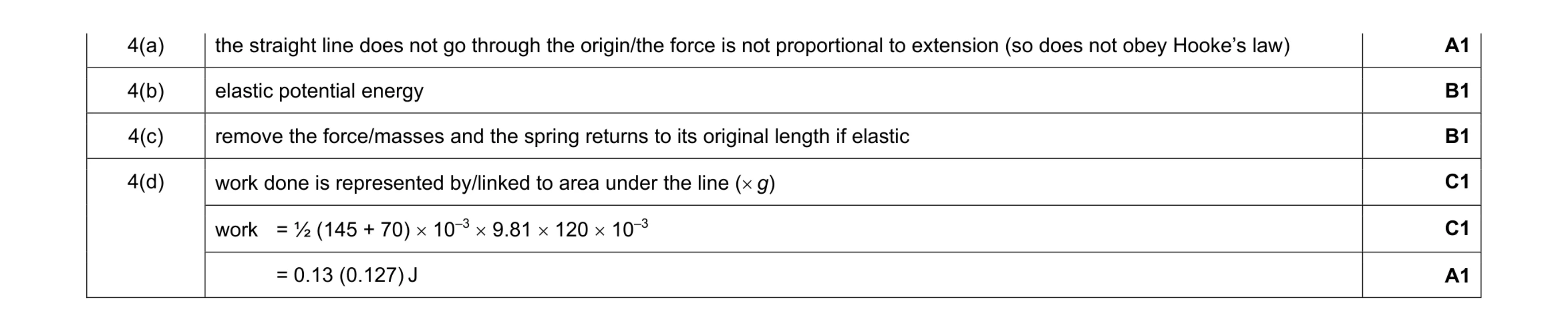
Mark scheme: 4(a) the straight line does not go through the origin/the force is not proportional to extension (so does not obey Hooke’s law) A1 4(b) elastic potential energy B1 4(c) remove the force/masses and the spring returns to its original length if elastic B1 4(d) work done is represented by/linked to area under the line (× g) C1 work = ½ (145 + 70) × 10–3 × 9.81 × 120 × 10–3 C1 = 0.13 (0.127) J A1
This question in 9702/23 May/June 2017
Q2 · A spring is attached at one end to a fixed point and hangs vertically with a cube… 9702/22 Oct/Nov 2017
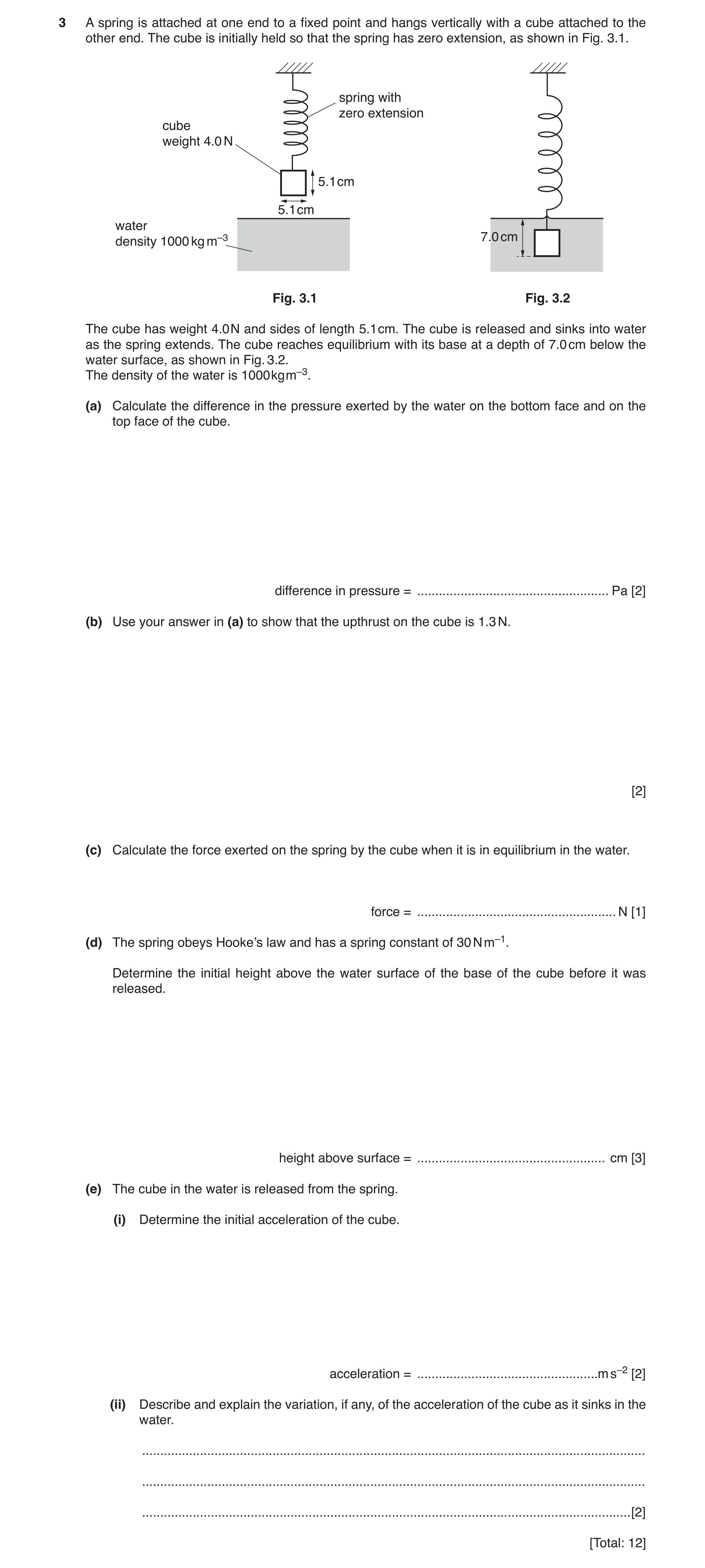
3 A spring is attached at one end to a fixed point and hangs vertically with a cube attached to the other end. The cube is initially held so that the spring has zero extension, as shown in Fig. 3.1. spring with zero extension cube weight 4.0 N 5.1 cm 5.1 cm water 7.0 cm density 1000 kg m–3 Fig. 3.1 Fig. 3.2 The cube has weight 4.0 N and sides of length 5.1 cm. The cube is released and sinks into water as the spring extends. The cube reaches equilibrium with its base at a depth of 7.0 cm below the water surface, as shown in Fig. 3.2. The density of the water is 1000 kg m–3. (a) Calculate the difference in the pressure exerted by the water on the bottom face and on the top face of the cube. difference in pressure = … Pa [2] (b) Use your answer in (a) to show that the upthrust on the cube is 1.3 N. [2] (c) Calculate the force exerted on the spring by the cube when it is in equilibrium in the water. force = … N [1] (d) The spring obeys Hooke’s law and has a spring constant of 30 N m–1. Determine the initial height above the water surface of the base of the cube before it was released. height above surface = … cm [3] (e) The cube in the water is released from the spring. (i) Determine the initial acceleration of the cube. acceleration = … m s–2 [2] (ii) Describe and explain the variation, if any, of the acceleration of the cube as it sinks in the water. … … … [2] [Total: 12]
12 marks
Mark scheme: 3(a) C1 ∆p = 1000 × 9.81 × (7.0 × 10–2 – 1.9 × 10⁻²) or 686 – 186 = 500 Pa A1 3(b) F = pA or (∆)F = ∆p × A C1 upthrust = 500 × (5.1 × 10–2)2 = 1.3 N or upthrust = (686 – 186) × (5.1 ×10–2)2 = 1.3 N or upthrust = 1000 × 9.81 × 5.1 ×10–2 × (5.1 × 10–2)2 = 1.3 N A1 3(c) force = 4.0 – 1.3 = 2.7 N A1 Question Answer Marks 3(d) extension/x/e = 2.7 / 30 C1 = 0.09 (m) or 9 (cm) C1 height above surface = 9 – 7 = 2 cm A1 3(e)(i) mass = 4.0 / 9.81 C1 acceleration = 2.7 / (4.0 / 9.81) = 6.6 m s–2 A1 3(e)(ii) viscous force increases (and then becomes constant) M1 (weight and upthrust constant so) acceleration decreases (to zero) A1
This question in 9702/22 Oct/Nov 2017
Q3 · The variation with extension x of the force F applied to a spring is shown in Fig 9702/21 Oct/Nov 2019
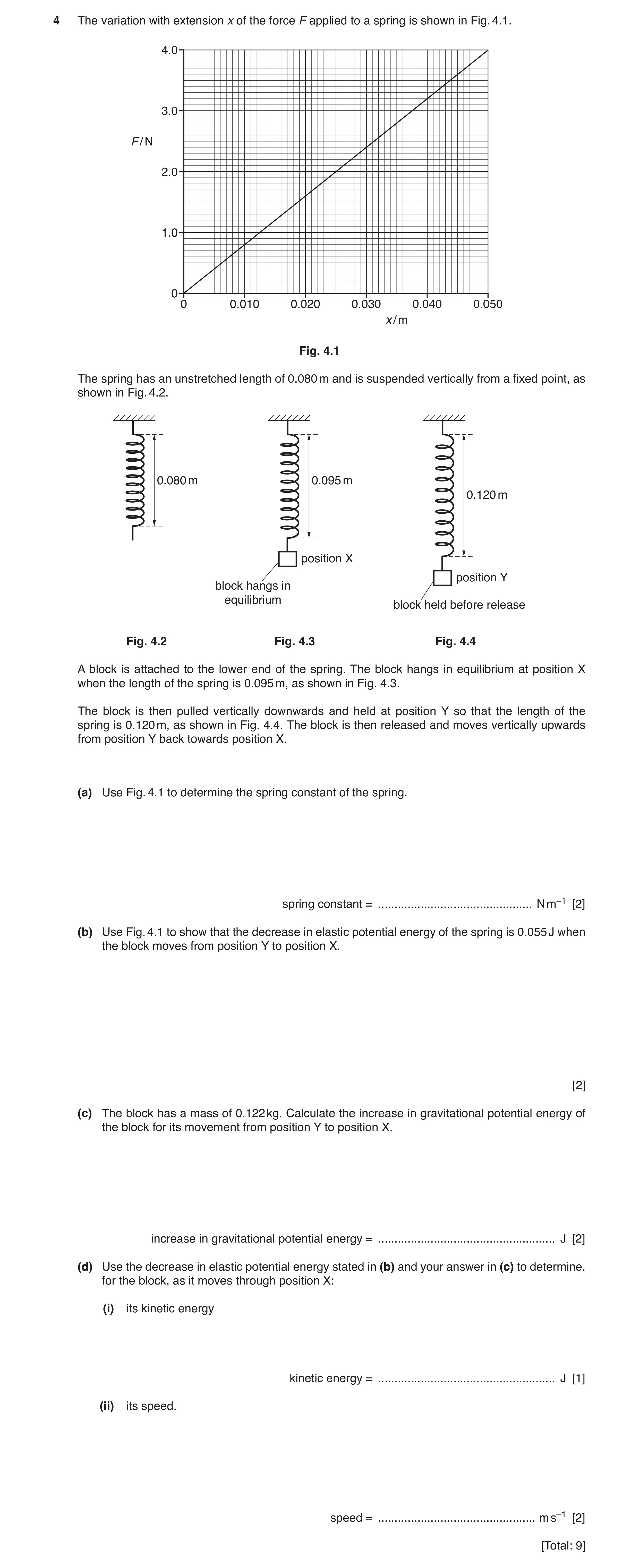
4 The variation with extension x of the force F applied to a spring is shown in Fig. 4.1. 4.0 3.0 F / N 2.0 1.0 0 0 0.010 0.020 0.030 0.040 0.050 x / m Fig. 4.1 The spring has an unstretched length of 0.080 m and is suspended vertically from a fixed point, as shown in Fig. 4.2. 0.080 m 0.095 m 0.120 m position X position Y block hangs in equilibrium block held before release Fig. 4.2 Fig. 4.3 Fig. 4.4 A block is attached to the lower end of the spring. The block hangs in equilibrium at position X when the length of the spring is 0.095 m, as shown in Fig. 4.3. The block is then pulled vertically downwards and held at position Y so that the length of the spring is 0.120 m, as shown in Fig. 4.4. The block is then released and moves vertically upwards from position Y back towards position X. (a) Use Fig. 4.1 to determine the spring constant of the spring. spring constant = … N m–1 [2] (b) Use Fig. 4.1 to show that the decrease in elastic potential energy of the spring is 0.055 J when the block moves from position Y to position X. [2] (c) The block has a mass of 0.122 kg. Calculate the increase in gravitational potential energy of the block for its movement from position Y to position X. increase in gravitational potential energy = … J [2] (d) Use the decrease in elastic potential energy stated in (b) and your answer in (c) to determine, for the block, as it moves through position X: (i) its kinetic energy kinetic energy = … J [1] (ii) its speed. speed = … m s–1 [2] [Total: 9]
9 marks
Mark scheme: 4(a) C1 e.g. k = 4.0 / 0.050 k = 80 N m–1 A1 4(b) E = ½Fx or E = ½kx2 or E = area under graph C1 (∆)E = (½ × 3.2 × 0.040) – (½ × 1.2 × 0.015) = 0.055 J or (∆)E = (½ × 80 × 0.0402) – (½ × 80 × 0.0152) = 0.055 J or (∆)E = ½ × (1.2 + 3.2) × 0.025 = 0.055 J A1 4(c) (∆)E = mg(∆)h C1 = 0.122 × 9.81 × (0.120 – 0.095) = 0.030 J A1 or (∆)E = W × (∆)h (C1) = 1.2 × 0.025 = 0.030 J (A1) Question Answer Marks 4(d)(i) E = 0.055 – 0.030 = 0.025 J A1 4(d)(ii) E = ½mv2 C1 v = [(2 × 0.025) / 0.122]0.5 = 0.64 m s–1 A1
This question in 9702/21 Oct/Nov 2019
Q4 · State what is meant by work done 9702/22 Feb/March 2020
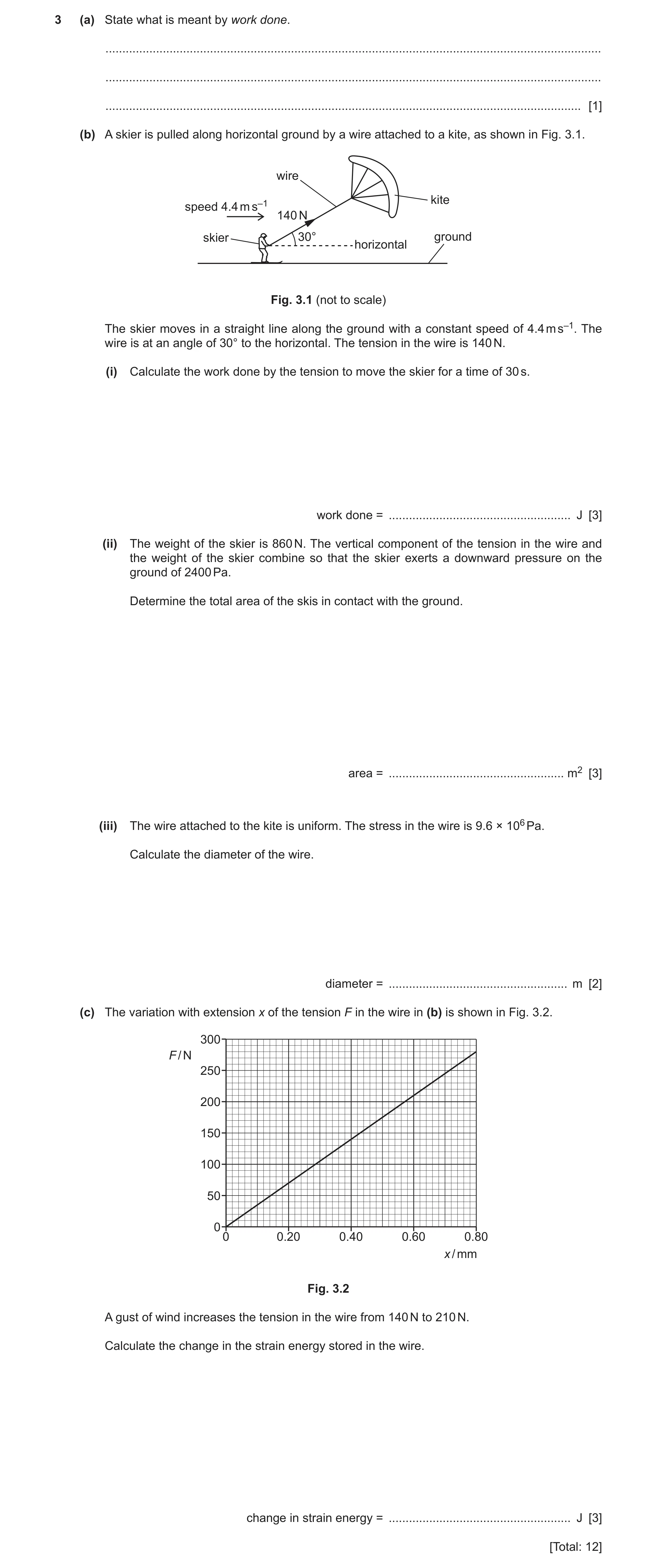
3 (a) State what is meant by work done. … … … [1] (b) A skier is pulled along horizontal ground by a wire attached to a kite, as shown in Fig. 3.1. wire kite speed 4.4 m s–1 140 N skier 30° ground horizontal Fig. 3.1 (not to scale) The skier moves in a straight line along the ground with a constant speed of 4.4 m s–1. The wire is at an angle of 30° to the horizontal. The tension in the wire is 140 N. (i) Calculate the work done by the tension to move the skier for a time of 30 s. work done = … J [3] (ii) The weight of the skier is 860 N. The vertical component of the tension in the wire and the weight of the skier combine so that the skier exerts a downward pressure on the ground of 2400 Pa. Determine the total area of the skis in contact with the ground. area = … m2 [3] (iii) The wire attached to the kite is uniform. The stress in the wire is 9.6 × 10⁶ Pa. Calculate the diameter of the wire. diameter = … m [2] (c) The variation with extension x of the tension F in the wire in (b) is shown in Fig. 3.2. 300 F / N 250 200 150 100 50 0 0 0.20 0.40 0.60 0.80 x / mm Fig. 3.2 A gust of wind increases the tension in the wire from 140 N to 210 N. Calculate the change in the strain energy stored in the wire. change in strain energy = … J [3] [Total: 12]
12 marks
Mark scheme: 3(a) force × displacement in the direction of the force B1 3(b)(i) displacement = 4.4 × 30 C1 work done = 140 cos 30° × 4.4 × 30 C1 = 1.6 × 10⁴ J A1 3(b)(ii) p = F / A C1 F = 860 – 140 sin 30° (= 790) C1 A = 790 / 2400 = 0.33 m2 A1 3(b)(iii) σ = F / A or F / πr 2 or 4F / πd 2 C1 9.6 × 106 = 4 × 140 / πd 2 d = 4.3 × 10⁻³ m A1 Question Answer Marks 3(c) E = ½Fx or ½kx2 or area under graph C1 (Δ)E = ½ × (140 + 210) × 0.20 × 10–3 or (Δ)E = (½ × 210 × 0.60 × 10–3) – (½ × 140 × 0.40 × 10–3) or (Δ)E = (140 × 0.20 × 10–3) + (½ × 0.20 × 10–3 × 70) or (Δ)E = [½×3.5 × 105 × (0.60 × 10–3)2 ] – [½ × 3.5 × 105 × (0.40 × 10–3)2 ] C1 ΔE = 0.035 J A1
This question in 9702/22 Feb/March 2020
Q5 · State the principle of moments 9702/23 May/June 2020
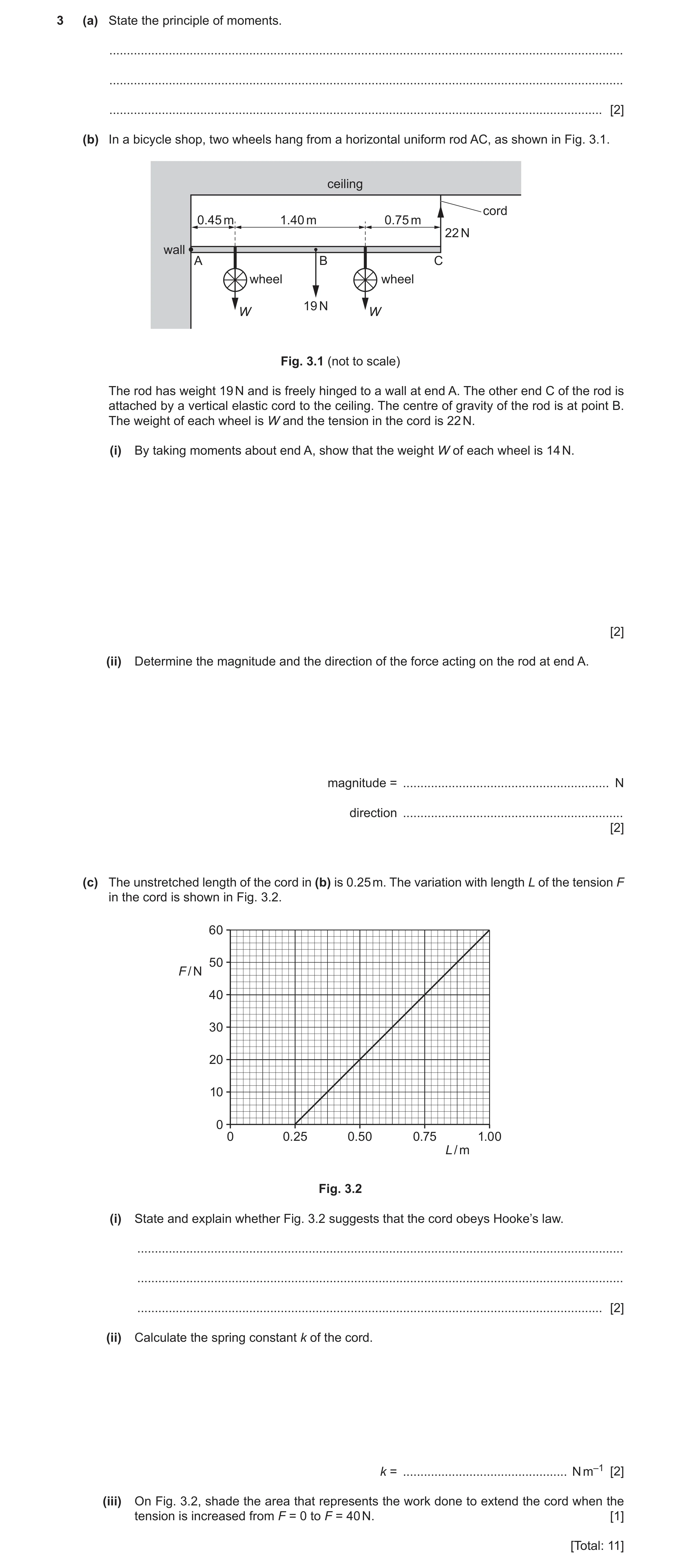
3 (a) State the principle of moments. … … … [2] (b) In a bicycle shop, two wheels hang from a horizontal uniform rod AC, as shown in Fig. 3.1. ceiling cord 0.45 m 1.40 m 0.75 m 22 N wall A B C wheel wheel 19 N W W Fig. 3.1 (not to scale) The rod has weight 19 N and is freely hinged to a wall at end A. The other end C of the rod is attached by a vertical elastic cord to the ceiling. The centre of gravity of the rod is at point B. The weight of each wheel is W and the tension in the cord is 22 N. (i) By taking moments about end A, show that the weight W of each wheel is 14 N. [2] (ii) Determine the magnitude and the direction of the force acting on the rod at end A. magnitude = … N direction … [2] (c) The unstretched length of the cord in (b) is 0.25 m. The variation with length L of the tension F in the cord is shown in Fig. 3.2. 60 50 F / N 40 30 20 10 0 0 0.25 0.50 0.75 1.00 L / m Fig. 3.2 (i) State and explain whether Fig. 3.2 suggests that the cord obeys Hooke’s law. … … … [2] (ii) Calculate the spring constant k of the cord. k = … N m–1 [2] (iii) On Fig. 3.2, shade the area that represents the work done to extend the cord when the tension is increased from F = 0 to F = 40 N. [1] [Total: 11]
11 marks
Mark scheme: 3(a) for a body in (rotational) equilibrium B1 sum/total of clockwise moments about a point = sum/total of anticlockwise moments about the (same) point B1 3(b)(i) (W × 0.45) or (19 × 1.3) or (W × 1.85) or (22 × 2.6) C1 (W × 0.45) + (19 × 1.3) + (W × 1.85) = (22 × 2.6) so W = 14 N A1 3(b)(ii) magnitude = 19 + 14 + 14 – 22 = 25 N A1 direction: vertically upwards A1 3(c)(i) the extension is zero when the force is zero B1 graph is a straight line and (so) Hooke’s law obeyed B1 3(c)(ii) k = F / x or k = gradient C1 e.g. k = 60 / (1.00 – 0.25) k = 80 N m–1 A1 3(c)(iii) area shaded below graph line between L = 0.25 m and L = 0.75 m B1
This question in 9702/23 May/June 2020
Question 6 9702/23 Oct/Nov 2020
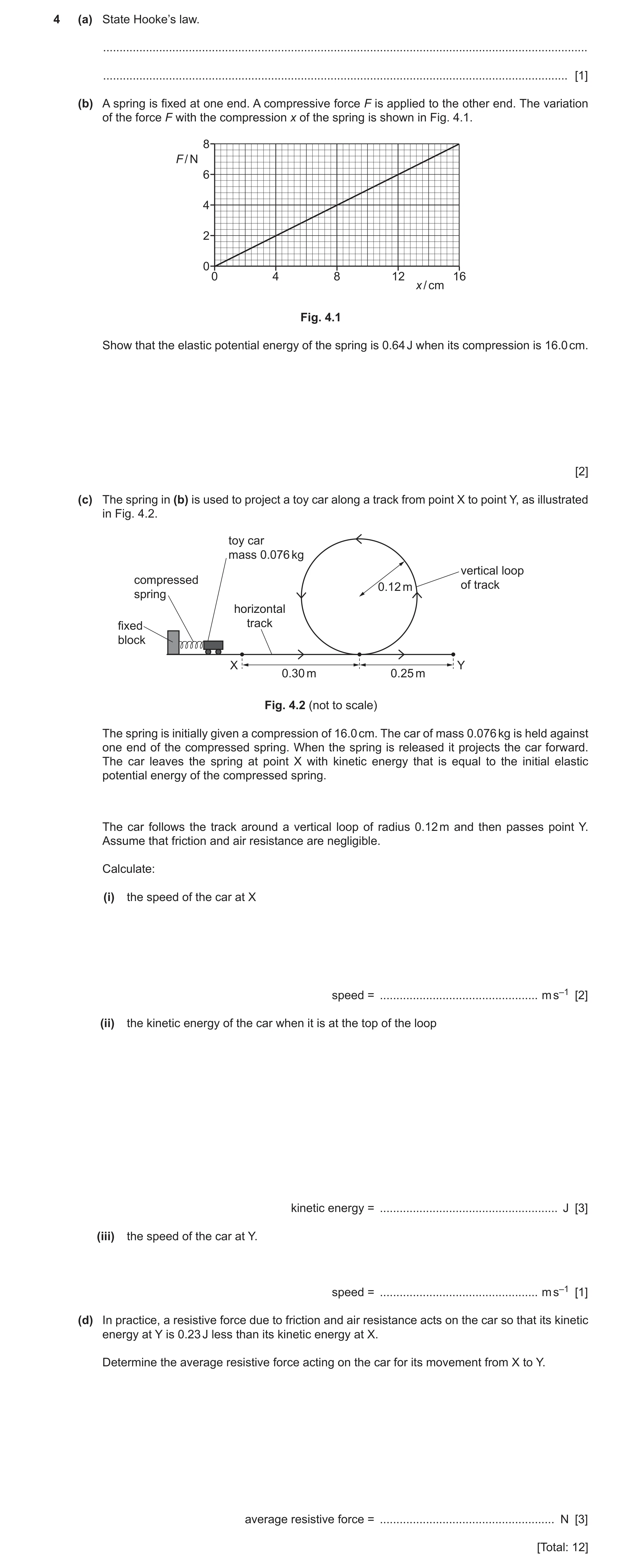
4 (a) State Hooke’s law. … … [1] (b) A spring is fixed at one end. A compressive force F is applied to the other end. The variation of the force F with the compression x of the spring is shown in Fig. 4.1. 8 F / N 6 4 2 0 0 4 8 12 16 x / cm Fig. 4.1 Show that the elastic potential energy of the spring is 0.64 J when its compression is 16.0 cm. [2] (c) The spring in (b) is used to project a toy car along a track from point X to point Y, as illustrated in Fig. 4.2. toy car mass 0.076 kg vertical loop compressed 0.12 m of track spring horizontal fixed track block X Y 0.30 m 0.25 m Fig. 4.2 (not to scale) The spring is initially given a compression of 16.0 cm. The car of mass 0.076 kg is held against one end of the compressed spring. When the spring is released it projects the car forward. The car leaves the spring at point X with kinetic energy that is equal to the initial elastic potential energy of the compressed spring. The car follows the track around a vertical loop of radius 0.12 m and then passes point Y. Assume that friction and air resistance are negligible. Calculate: (i) the speed of the car at X speed = … m s–1 [2] (ii) the kinetic energy of the car when it is at the top of the loop kinetic energy = … J [3] (iii) the speed of the car at Y. speed = … m s–1 [1] (d) In practice, a resistive force due to friction and air resistance acts on the car so that its kinetic energy at Y is 0.23 J less than its kinetic energy at X. Determine the average resistive force acting on the car for its movement from X to Y. average resistive force = … N [3] [Total: 12]
12 marks
Mark scheme: 4(a) compression/extension is proportional to force (provided limit of proportionality is not exceeded) B1 4(b) (E) = ½Fx or ½kx2 or area under graph C1 = ½ × 8 × 16 × 10–2 = 0.64 (J) or = ½ × 50 × (16 × 10–2)2 = 0.64 (J) A1 4(c)(i) (E) = ½mv 2 C1 0.64 = ½ × 0.076 × v 2 v = 4.1 m s–1 A1 4(c)(ii) (Δ)(E) = mg(Δ)h C1 = 0.076 × 9.81 × 0.24 (= 0.18 (J)) C1 kinetic energy = 0.64 – 0.18 = 0.46 J A1 4(c)(iii) v = 4.1 m s–1 A1 4(d) W = Fs C1 d = 0.30 + (2π × 0.12) + 0.25 (= 1.3 m) C1 F = 0.23 / 1.3 = 0.18 N A1
This question in 9702/23 Oct/Nov 2020
Q7 · A spring is extended by a force 9702/22 Feb/March 2021
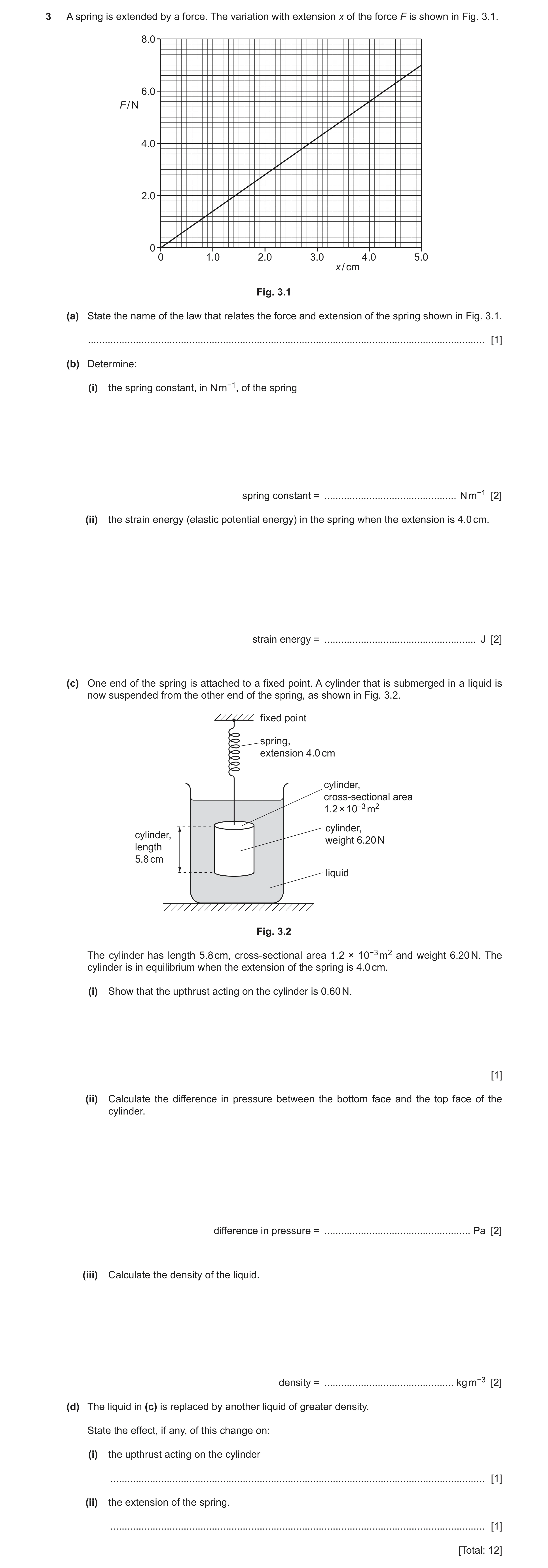
3 A spring is extended by a force. The variation with extension x of the force F is shown in Fig. 3.1. 8.0 6.0 F / N 4.0 2.0 0 0 1.0 2.0 3.0 4.0 5.0 x / cm Fig. 3.1 (a) State the name of the law that relates the force and extension of the spring shown in Fig. 3.1. … [1] (b) Determine: (i) the spring constant, in N m−1, of the spring spring constant = … N m−1 [2] (ii) the strain energy (elastic potential energy) in the spring when the extension is 4.0 cm. strain energy = … J [2] (c) One end of the spring is attached to a fixed point. A cylinder that is submerged in a liquid is now suspended from the other end of the spring, as shown in Fig. 3.2. fixed point spring, extension 4.0 cm cylinder, cross-sectional area 1.2 × 10⁻³ m2 cylinder, cylinder, weight 6.20 N length 5.8 cm liquid Fig. 3.2 The cylinder has length 5.8 cm, cross-sectional area 1.2 × 10⁻³ m2 and weight 6.20 N. The cylinder is in equilibrium when the extension of the spring is 4.0 cm. (i) Show that the upthrust acting on the cylinder is 0.60 N. [1] (ii) Calculate the difference in pressure between the bottom face and the top face of the cylinder. difference in pressure = … Pa [2] (iii) Calculate the density of the liquid. density = … kg m−3 [2] (d) The liquid in (c) is replaced by another liquid of greater density. State the effect, if any, of this change on: (i) the upthrust acting on the cylinder … [1] (ii) the extension of the spring. … [1] [Total: 12]
12 marks
Mark scheme: 3(a) Hooke’s (law) B1 3(b)(i) k = F / x or k = gradient e.g. k = 7.0 / 5.0 × 10⁻² C1 = 140 N m–1 A1 3(b)(ii) E = ½ F x or E = ½ k x 2 or E = area under graph = ½ × 5.6 × 4.0 × 10–2 or ½ × 140 × (4.0 × 10–2)2 C1 = 0.11 J A1 3(c)(i) (upthrust =) 6.20 – 5.60 = 0.60 (N) A1 3(c)(ii) Δp = ΔF / A = 0.60 / 1.2 × 10⁻³ C1 = 500 Pa A1 3(c)(iii) (Δ)p = ρg(Δ)h ρ = 500 / (9.81 × 5.8 × 10–2) C1 = 880 kg m–3 A1 3(d)(i) (upthrust) increases B1 3(d)(ii) (extension) decreases B1
This question in 9702/22 Feb/March 2021
Q8 · A spring is suspended from a fixed point at one end 9702/22 May/June 2023
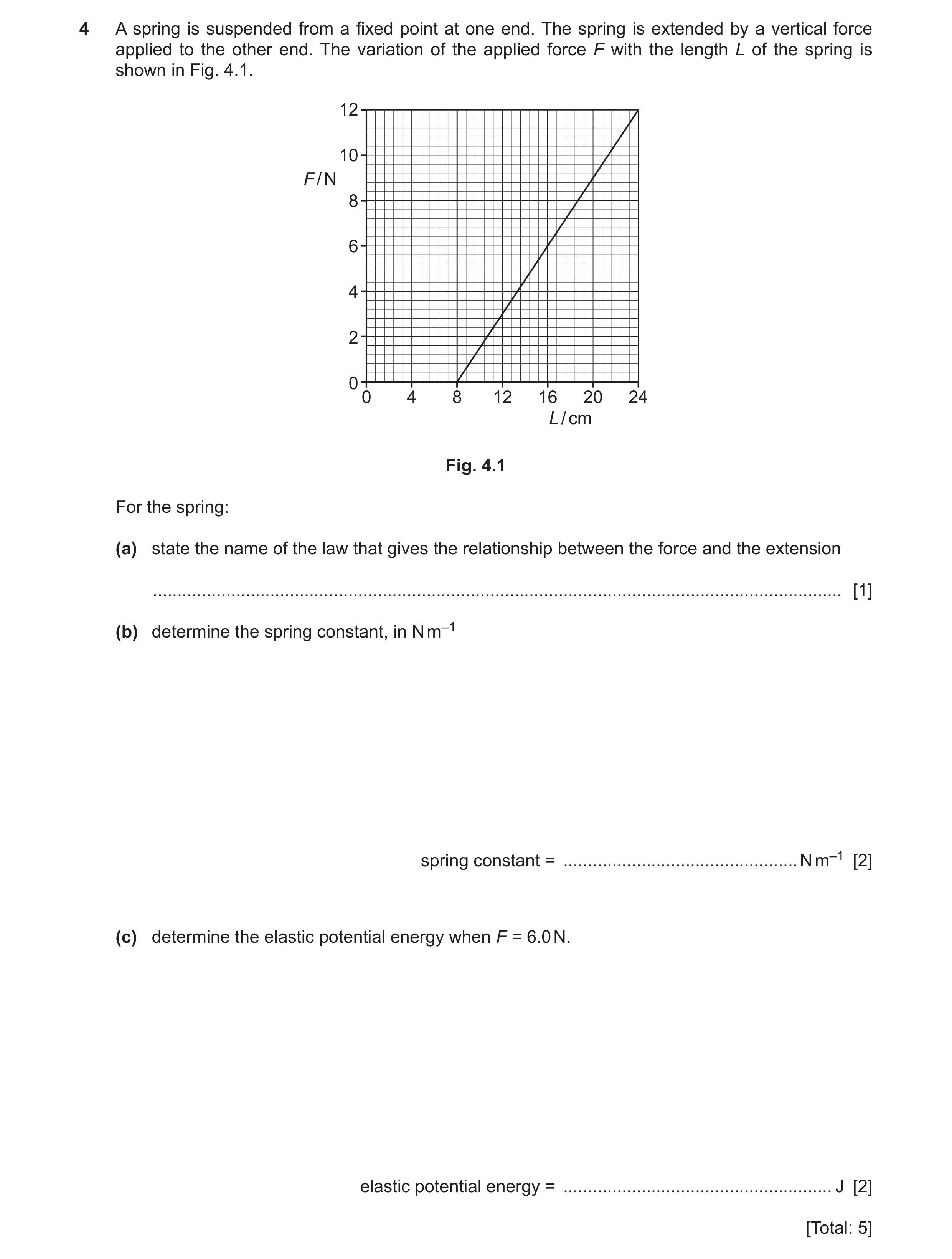
4 A spring is suspended from a fixed point at one end. The spring is extended by a vertical force applied to the other end. The variation of the applied force F with the length L of the spring is shown in Fig. 4.1. 12 10 F / N 8 6 4 2 0 0 4 8 12 16 20 24 L / cm Fig. 4.1 For the spring: (a) state the name of the law that gives the relationship between the force and the extension … [1] (b) determine the spring constant, in N m–1 spring constant = … N m–1 [2] (c) determine the elastic potential energy when F = 6.0 N. elastic potential energy = … J [2] [Total: 5]
5 marks
Mark scheme: 4(a) Hooke’s (law) B1 4(b) k = F / x or k = gradient C1 = e.g. 12.0 / (0.240 – 0.08) = 75 N m–1 A1 4(c) E = 1 2 Fx or E = 1 2 kx 2 or E = area under graph C1 E = 1 2 6.0 0.080 or 1 2 75 0.082 = 0.24 J A1
This question in 9702/22 May/June 2023
Q9 · A pinball machine uses a spring to launch a small metal ball of mass 4.5 × 10 –2 kg up a… 9702/22 May/June 2024
4 A pinball machine uses a spring to launch a small metal ball of mass 4.5 × 10 –2 kg up a ramp. The spring is compressed by 8.0 × 10 –2 m and held in equilibrium, as shown in Fig. 4.1. original length 8.0 × 10⁻² m ramp spring fixed end ball, mass 4.5 × 10⁻² kg 15° horizontal Fig. 4.1 (not to scale) The ramp is at an angle of 15° to the horizontal. (a) The spring obeys Hooke’s law and has a spring constant of 29 N m–1. Calculate the elastic potential energy in the compressed spring. elastic potential energy = … J [2] (b) The spring is released and expands quickly back to its original length. (i) Calculate the increase in gravitational potential energy of the ball when the spring returns to its original length. increase in gravitational potential energy = … J [3] (ii) The ball leaves the spring when the spring reaches its original length. Assume that all the elastic potential energy of the spring is transferred to the ball. Calculate the speed of the ball as it leaves the spring. speed = … m s–1 [3] (c) The ball comes to rest on a horizontal trapdoor of negligible mass at a distance d from its pivot. A force F acts vertically downwards at a distance of 2.0 cm from the pivot, as shown in Fig. 4.2. 2.0 cm d ball F pivot trapdoor Fig. 4.2 (not to scale) (i) The trapdoor is in equilibrium when F is 1.7 N. Calculate d. d = … m [2] (ii) Force F is decreased from 1.7 N. State the direction of the resultant moment about the pivot on the trapdoor. … [1] [Total: 11]
11 marks
Mark scheme: 4(a) E = ½kx2 or E= ½Fx and F = kx C1 E = ½ 29 (8.0 10–2)2 or E = ½ 2.32 8.0 10–2 E = 9.3 10–2 J A1 4(b)(i) ()E(P) = mg()h C1 = 4.5 10–2 9.81 8.0 10–2 sin 15° C1 = 9.1 10–3 J A1 4(b)(ii) E(K) = ½mv2 C1 (9.3 10–2 – 9.1 10–3) = ½ 4.5 10–2 v2 C1 v = (2 8.4 10–2 / 4.5 10–2)0.5 = 1.9 m s–1 A1 4(c)(i) 1.7 2.0 ( 10–2) or 4.5 10–2 9.81 d C1 1.7 2.0 10–2 = 4.5 10–2 9.81 d d = 7.7 10–2 m A1 4(c)(ii) clockwise B1
This question in 9702/22 May/June 2024
Question 10 9702/23 May/June 2024
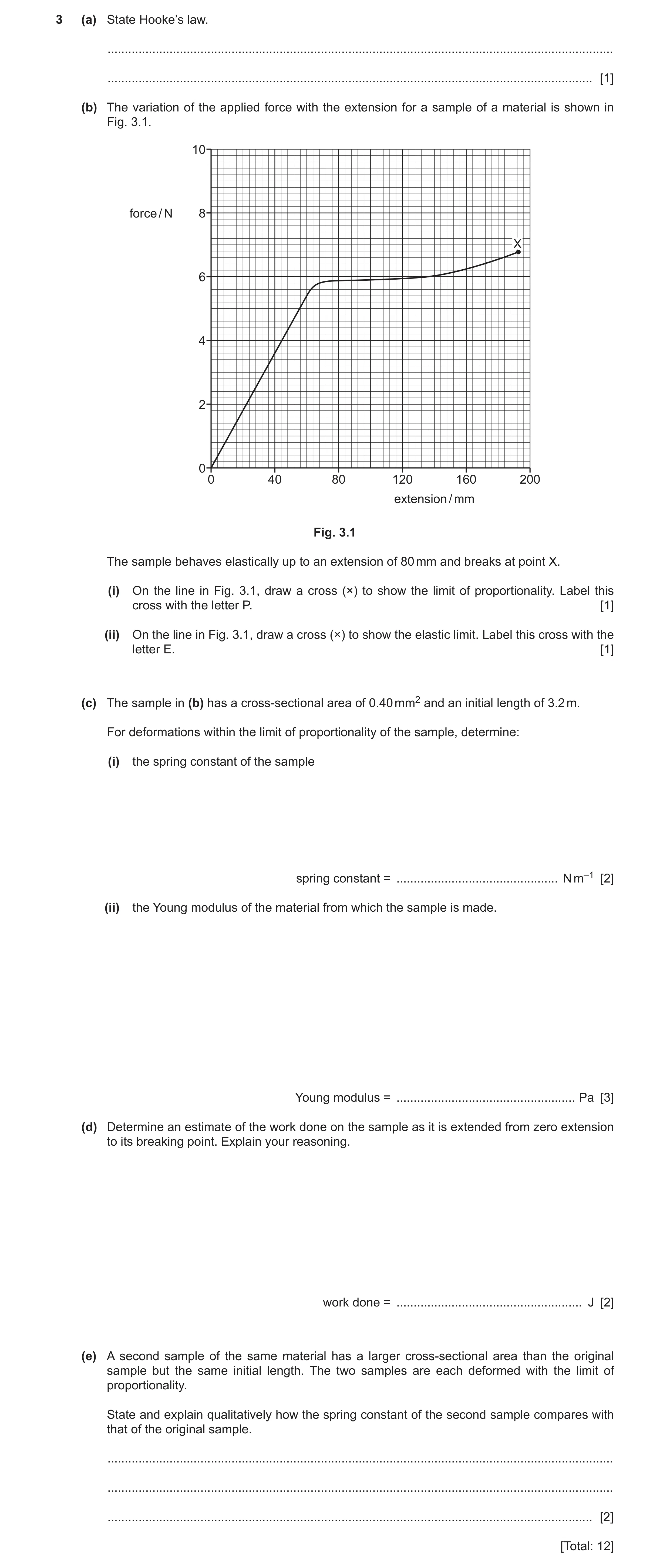
3 (a) State Hooke’s law. … … [1] (b) The variation of the applied force with the extension for a sample of a material is shown in Fig. 3.1. 10 force / N 8 X 6 4 2 0 0 40 80 120 160 200 extension / mm Fig. 3.1 The sample behaves elastically up to an extension of 80 mm and breaks at point X. (i) On the line in Fig. 3.1, draw a cross (×) to show the limit of proportionality. Label this cross with the letter P. [1] (ii) On the line in Fig. 3.1, draw a cross (×) to show the elastic limit. Label this cross with the letter E. [1] (c) The sample in (b) has a cross-sectional area of 0.40 mm2 and an initial length of 3.2 m. For deformations within the limit of proportionality of the sample, determine: (i) the spring constant of the sample spring constant = … N m–1 [2] (ii) the Young modulus of the material from which the sample is made. Young modulus = … Pa [3] (d) Determine an estimate of the work done on the sample as it is extended from zero extension to its breaking point. Explain your reasoning. work done = … J [2] (e) A second sample of the same material has a larger cross-sectional area than the original sample but the same initial length. The two samples are each deformed with the limit of proportionality. State and explain qualitatively how the spring constant of the second sample compares with that of the original sample. … … … [2] [Total: 12]
12 marks
Mark scheme: 3(a) extension is proportional to (applied) force B1 3(b)(i) P at (60, 5.4) A1 3(b)(ii) E at (80, 5.9) A1 3(c)(i) k = F / x or k = gradient of (straight line section of) graph C1 e.g. gradient = 5.4 / 0.060 k = 90 N m–1 A1 3(c)(ii) Young modulus or E = / or FL / Ax or kL / A C1 E = (5.4 3.2) / (4.0 10−7 0.06) or 90 3.2 / (4.0 10−7) C1 E = 7.2 108 Pa A1 3(d) work done = area under graph B1 = (1.0 0.2) J A1 3(e) the extension will be smaller (for the same force on the thicker sample) or a greater force is required (to extend the thicker sample by the same amount) or spring constant is proportional to area M1 the spring constant (of the second sample) will be greater A1
This question in 9702/23 May/June 2024
Q11 · A spring is fixed at one end and attached to the frame of a pulley at the other end 9702/22 Oct/Nov 2025
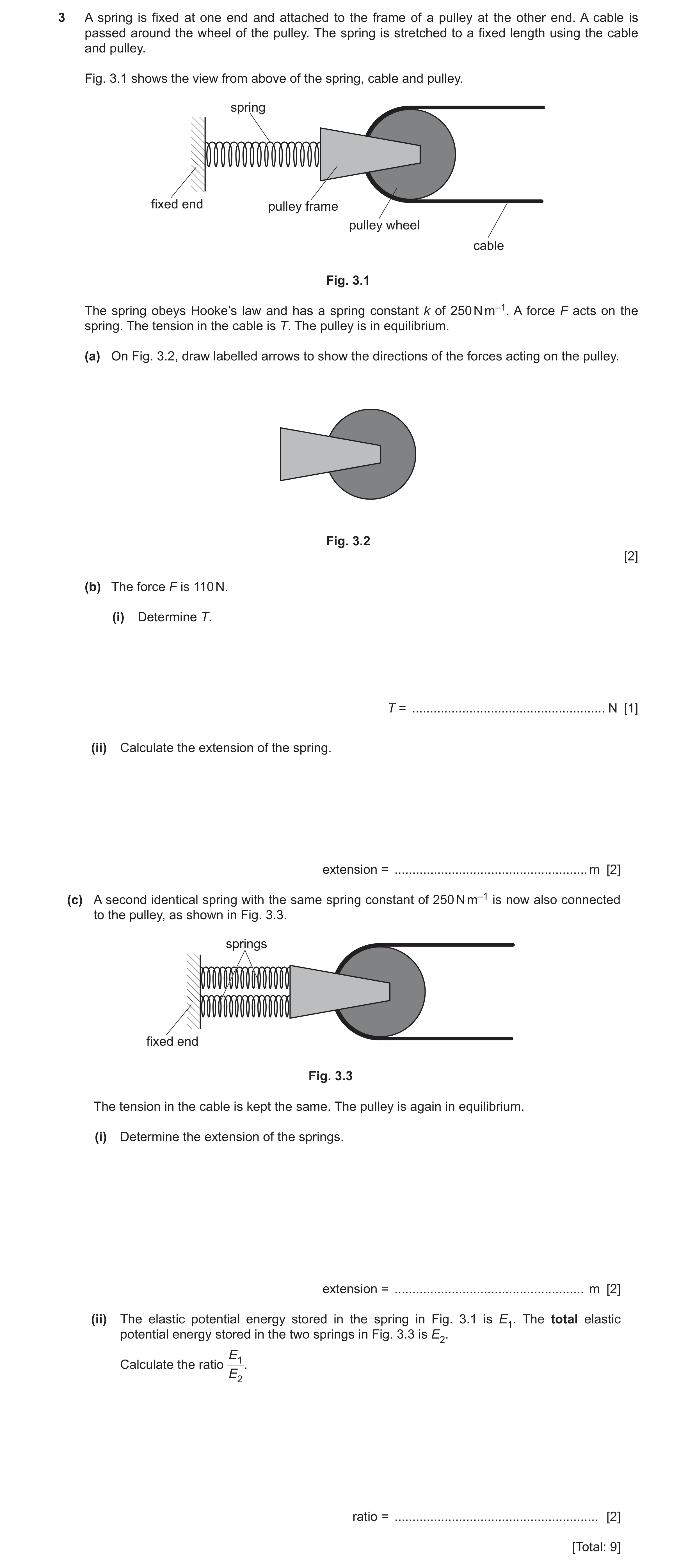
3 A spring is fixed at one end and attached to the frame of a pulley at the other end. A cable is passed around the wheel of the pulley. The spring is stretched to a fixed length using the cable and pulley. Fig. 3.1 shows the view from above of the spring, cable and pulley. spring fixed end pulley frame pulley wheel cable Fig. 3.1 The spring obeys Hooke’s law and has a spring constant k of 250 N m–1. A force F acts on the spring. The tension in the cable is T. The pulley is in equilibrium. (a) On Fig. 3.2, draw labelled arrows to show the directions of the forces acting on the pulley. Fig. 3.2 [2] (b) The force F is 110 N. (i) Determine T. T = … N [1] (ii) Calculate the extension of the spring. extension = … m [2] (c) A second identical spring with the same spring constant of 250 N m–1 is now also connected to the pulley, as shown in Fig. 3.3. springs fixed end Fig. 3.3 The tension in the cable is kept the same. The pulley is again in equilibrium. (i) Determine the extension of the springs. extension = … m [2] (ii) The elastic potential energy stored in the spring in Fig. 3.1 is E1. The total elastic potential energy stored in the two springs in Fig. 3.3 is E2. E1 Calculate the ratio . E2 ratio = … [2] [Total: 9]
9 marks
Mark scheme: 3(a) an arrow horizontally on the page to the left labelled F B1 two arrows horizontally on the page to the right each labelled T B1 3(b)(i) T = 110 / 2 A1 = 55 N 3(b)(ii) x = F / k C1 = 110 / 250 A1 = 0.44 m 3(c)(i) extension = 55 / 250 or 110 / (2 250) C1 extension = 0.22 m A1 3(c)(ii) 1 1 1 C1 E = Fx or E = kx2 or E = F2 / k 2 2 2 1 1 A1 E1 / E2 = ( 110 0.44) / (2 ( 55 10.22)) 2 2 or 1 1 E1 / E2 = ( k 0.442) / (2 ( k 0.222)) 2 2 or 1 1 E1 / E2 = ( 1102 / k) / (2 ( 552 / k)) 2 2 E1 / E2 = 2.0 (no ECF from 3(b)(ii) and 3(c)(i))
This question in 9702/22 Oct/Nov 2025
Q12 · A bungee jumper of mass 64 kg secures one end of an elastic rope to a bridge 9702/24 Oct/Nov 2025
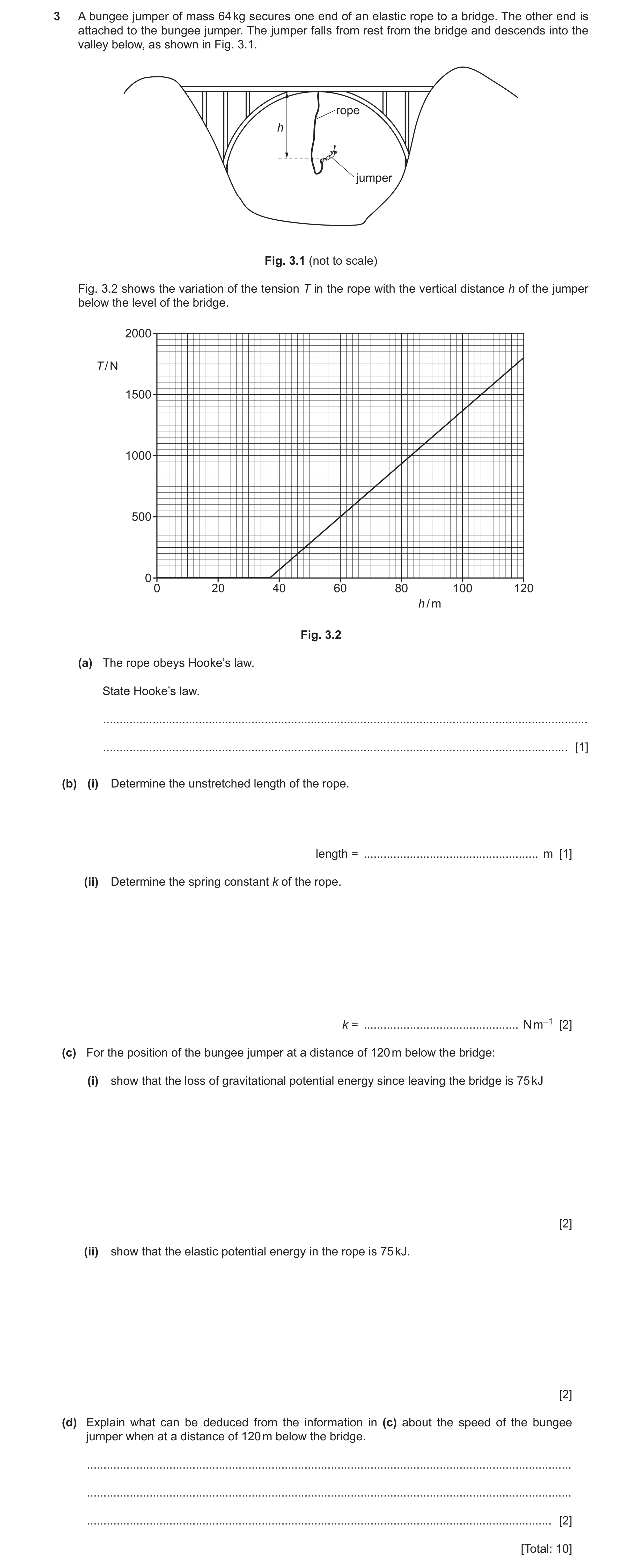
3 A bungee jumper of mass 64 kg secures one end of an elastic rope to a bridge. The other end is attached to the bungee jumper. The jumper falls from rest from the bridge and descends into the valley below, as shown in Fig. 3.1. rope h jumper Fig. 3.1 (not to scale) Fig. 3.2 shows the variation of the tension T in the rope with the vertical distance h of the jumper below the level of the bridge. 2000 T / N 1500 1000 500 0 0 20 40 60 80 100 120 h / m Fig. 3.2 (a) The rope obeys Hooke’s law. State Hooke’s law. … … [1] (b) (i) Determine the unstretched length of the rope. length = … m [1] (ii) Determine the spring constant k of the rope. k = … N m–1 [2] (c) For the position of the bungee jumper at a distance of 120 m below the bridge: (i) show that the loss of gravitational potential energy since leaving the bridge is 75 kJ [2] (ii) show that the elastic potential energy in the rope is 75 kJ. [2] (d) Explain what can be deduced from the information in (c) about the speed of the bungee jumper when at a distance of 120 m below the bridge. … … … [2] [Total: 10]
10 marks
Mark scheme: 3(a) force is proportional to extension B1 3(b)(i) length = 37 m A1 3(b)(ii) spring constant = F / x C1 = e.g. 1800 / (120 – 37) A1 = 22 N m–1 3(c)(i) (()E) = mg()h C1 = 64 × 9.81 × 120 = 75 000 J or 75 kJ A1 3(c)(ii) 1 1 1 C1 (E =) Fx or (E =) kx2 or (E =) F2 / k or (E =) area under graph 2 2 2 1 A1 (E =) × 1800 × (120 – 37) = 75 000 J or 75 kJ 2 or 1 (E =) × 21.7 × (120 – 37)2 = 75 000 J or 75 kJ 2 3(d) (all) gravitational potential energy has been converted / equal to elastic potential energy (so no kinetic energy) B1 kinetic energy is zero so speed is zero B1
This question in 9702/24 Oct/Nov 2025
 15 / 23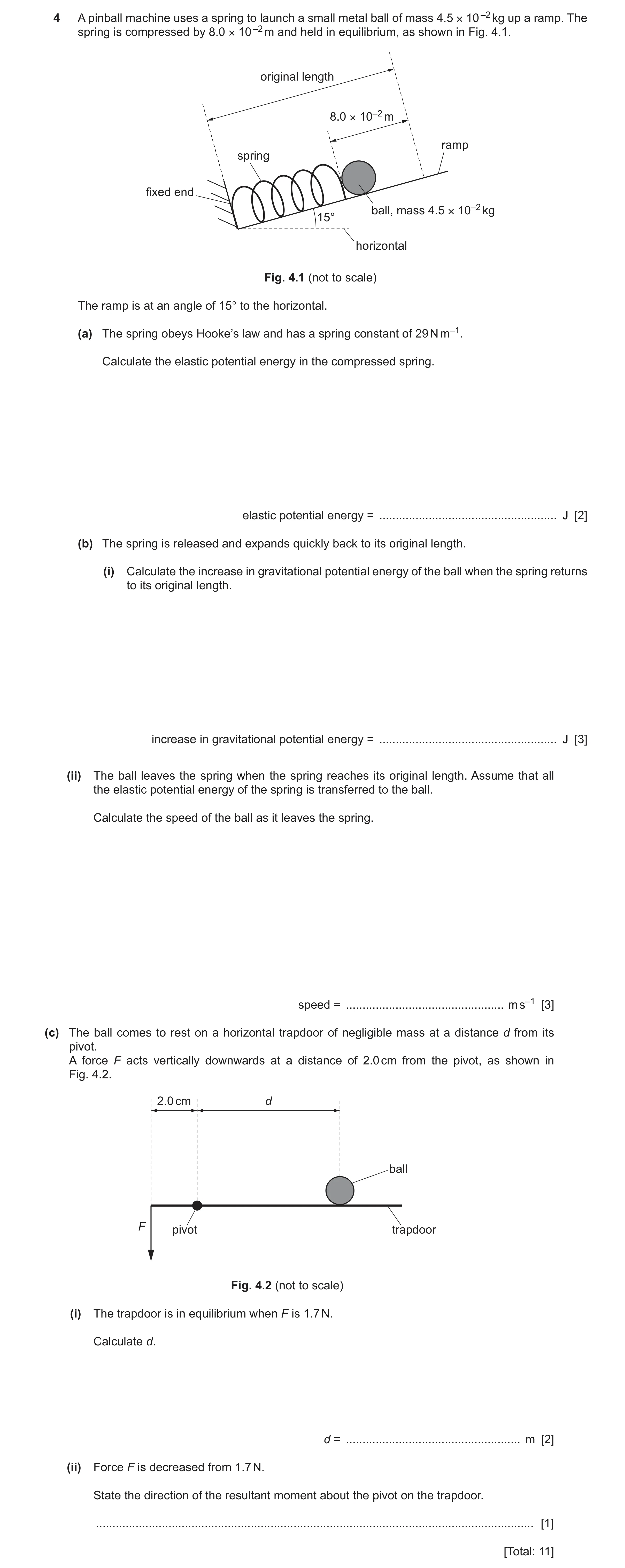
 6
6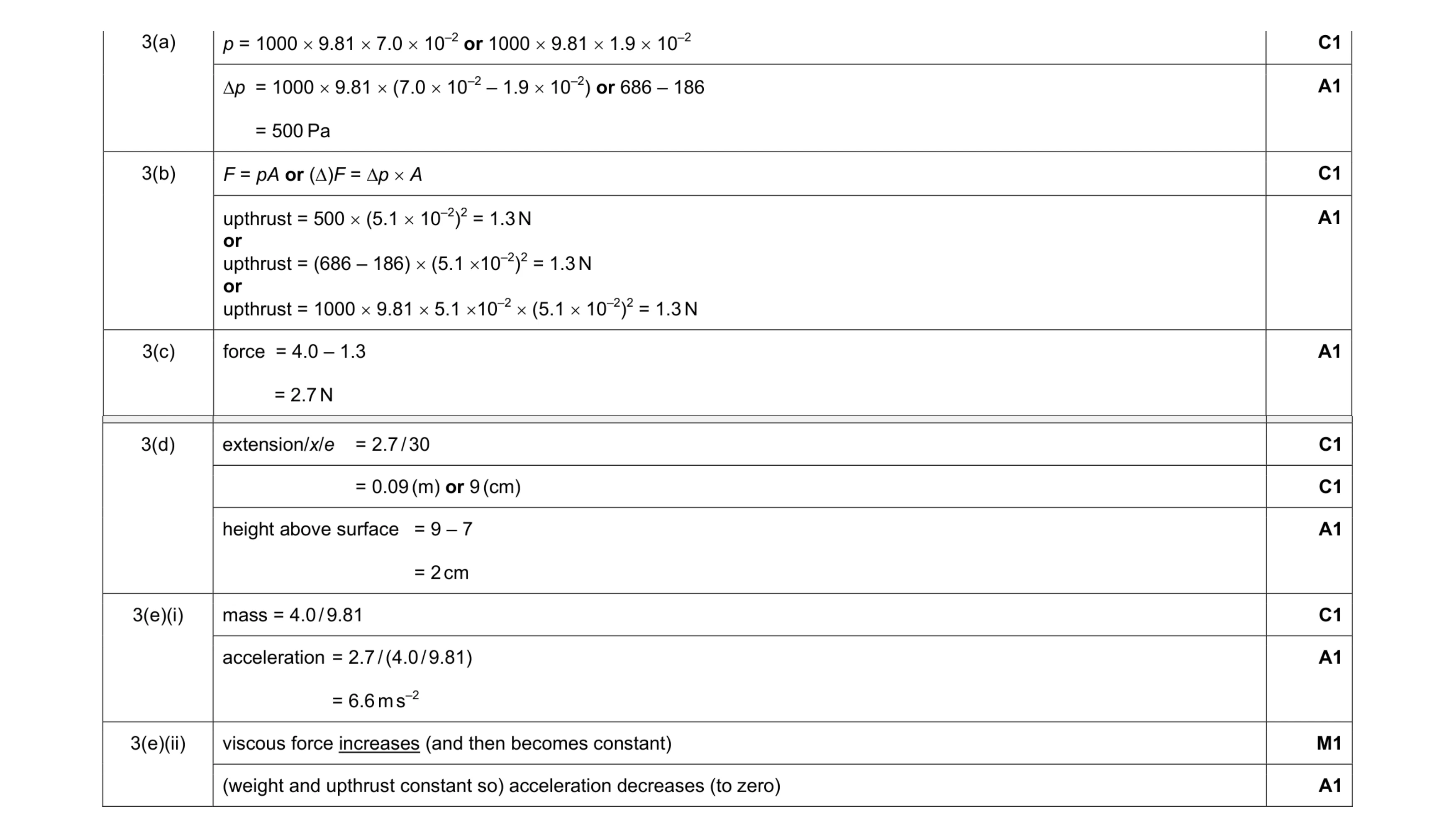 12
12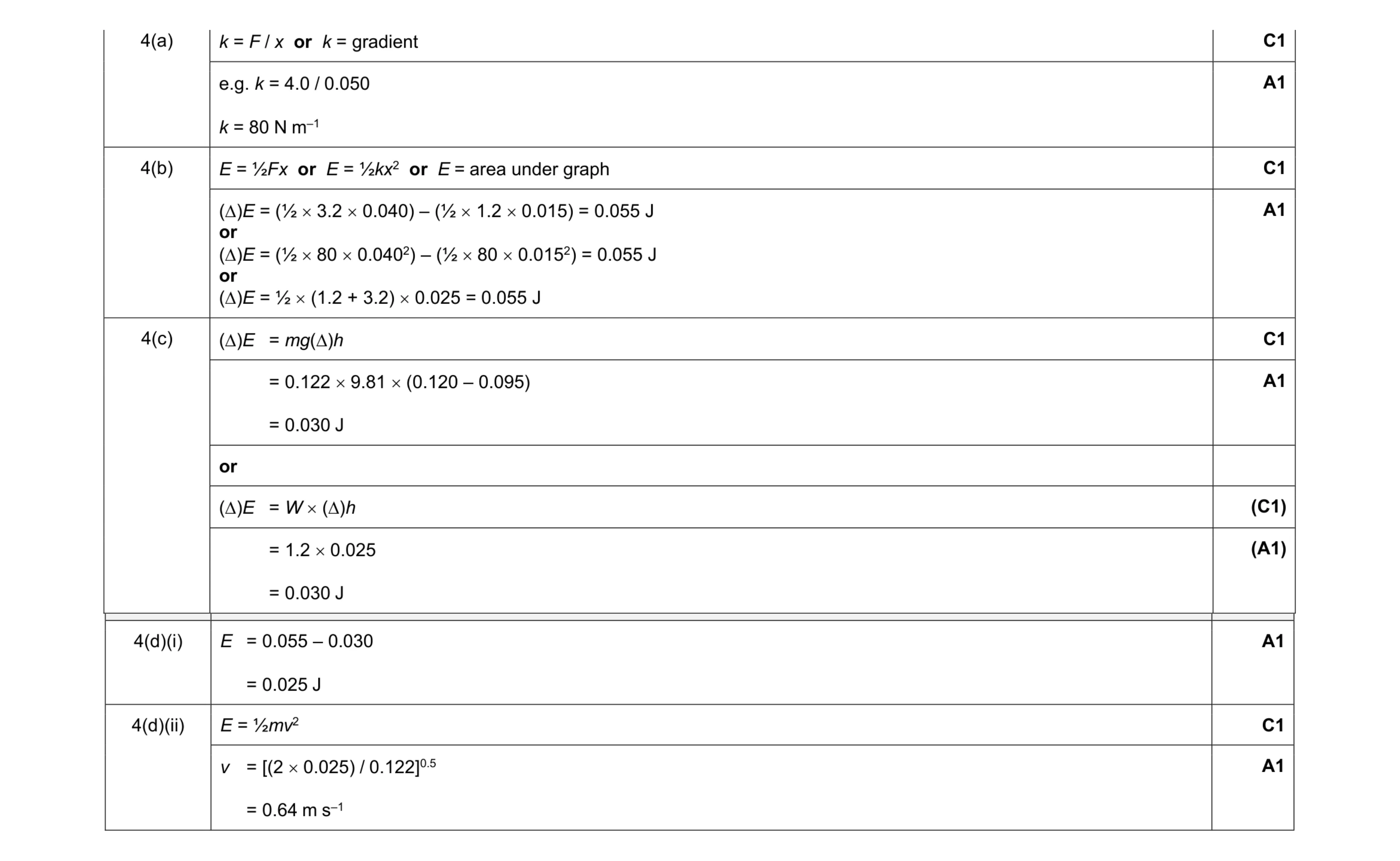 9
9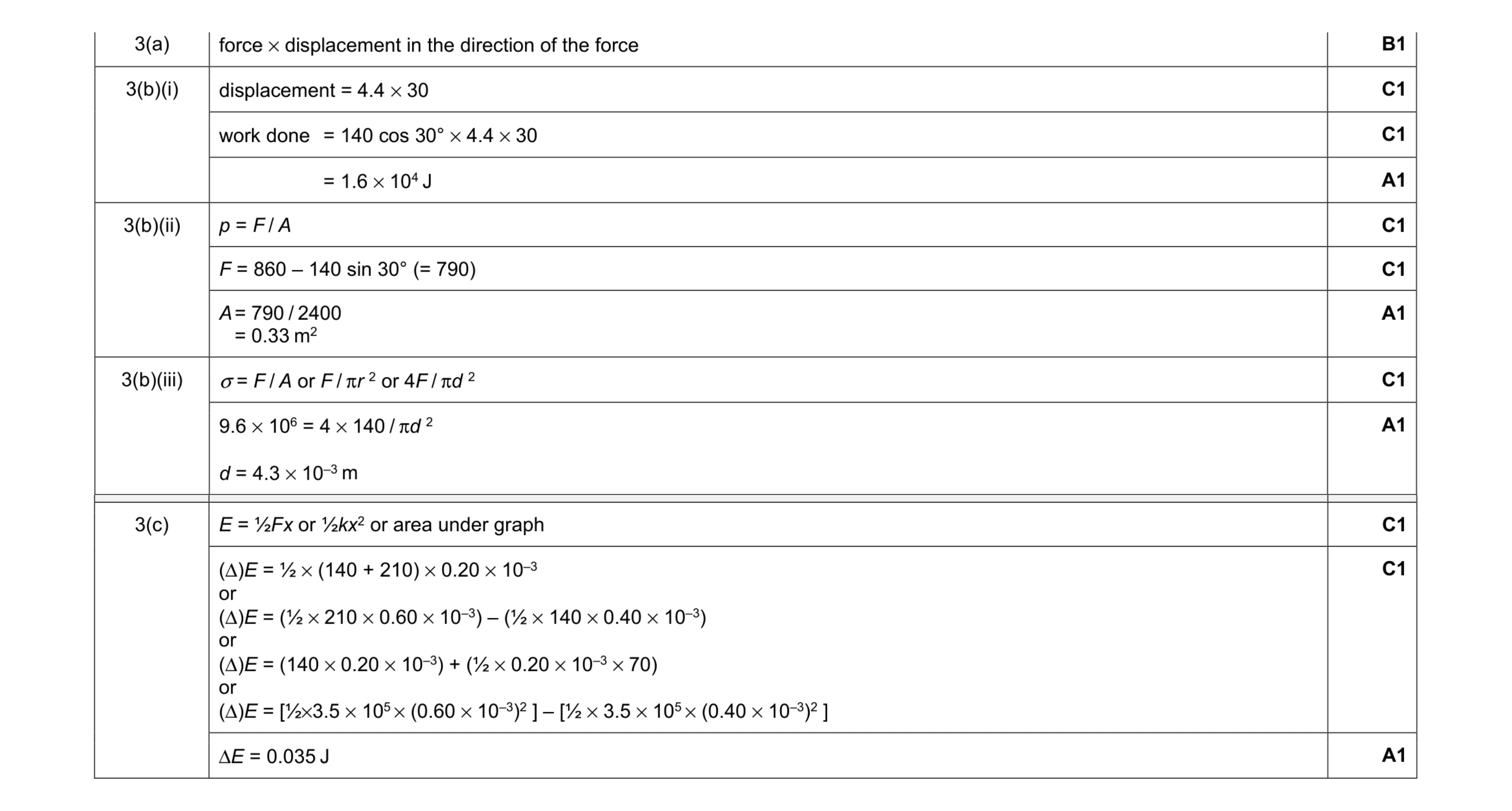 12
12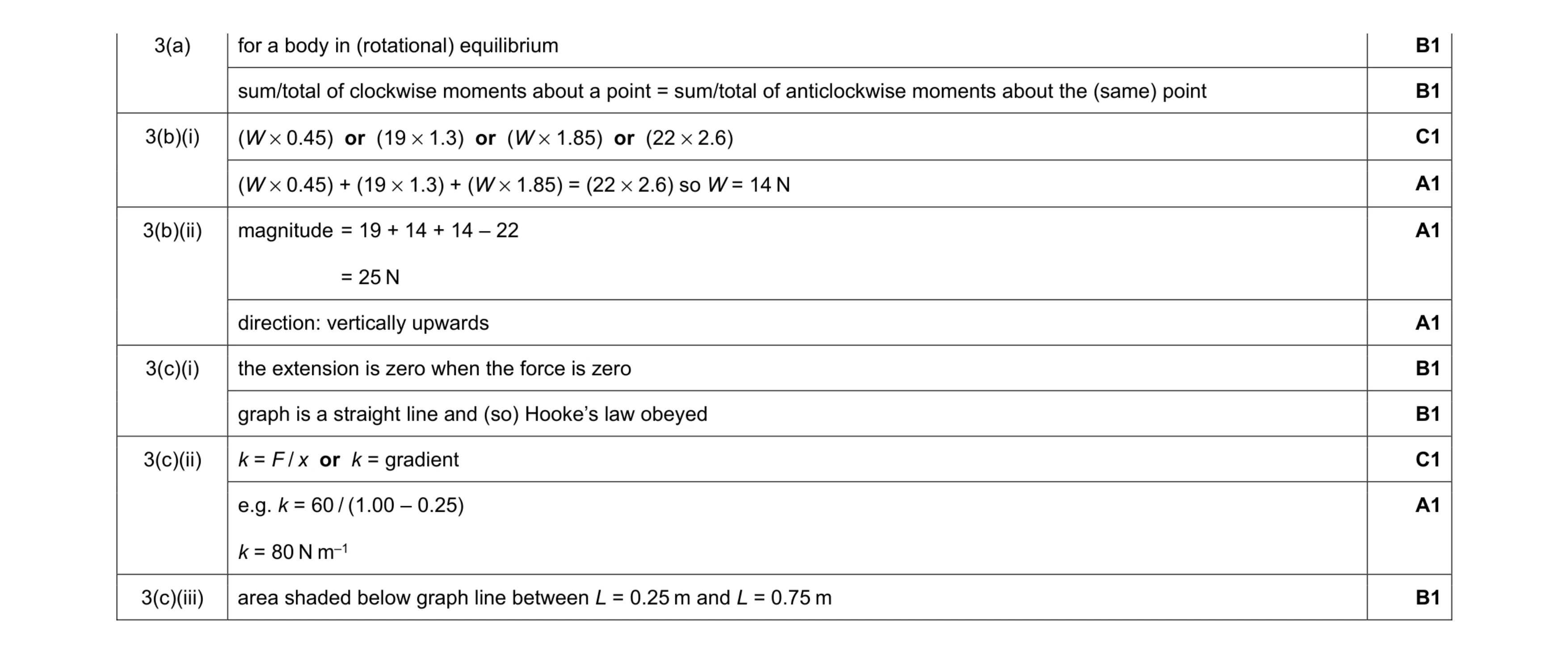 11
11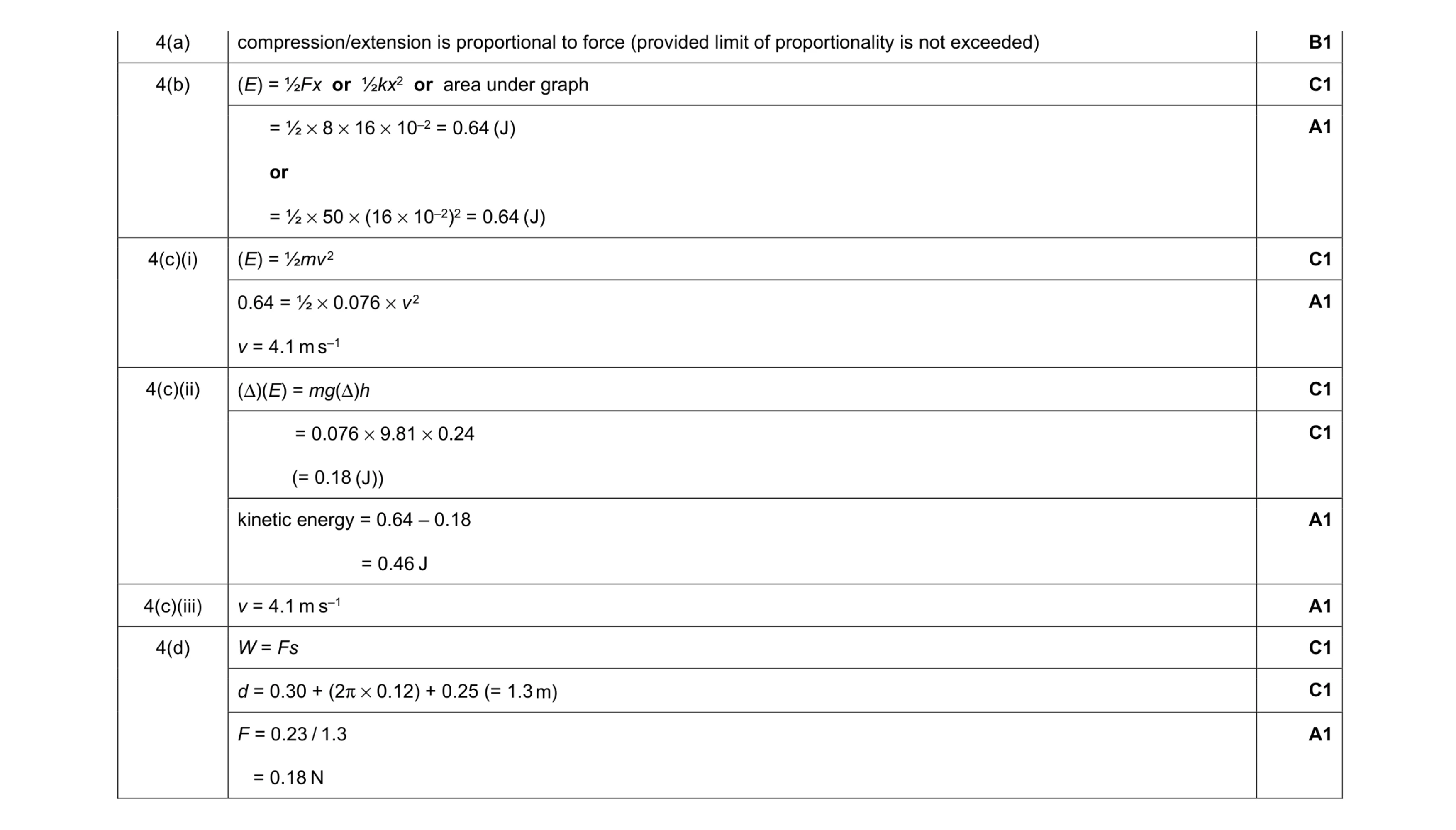 12
12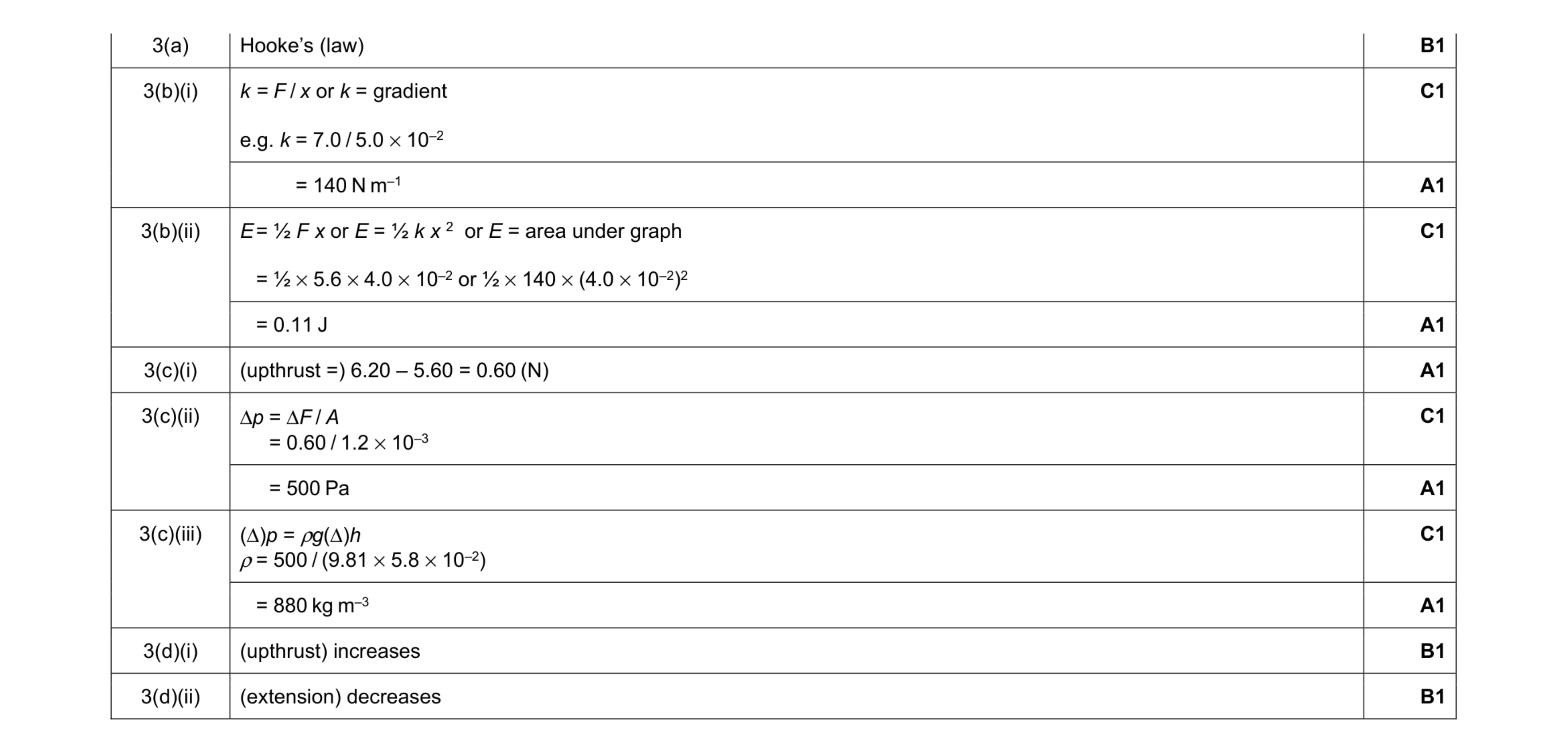 12
12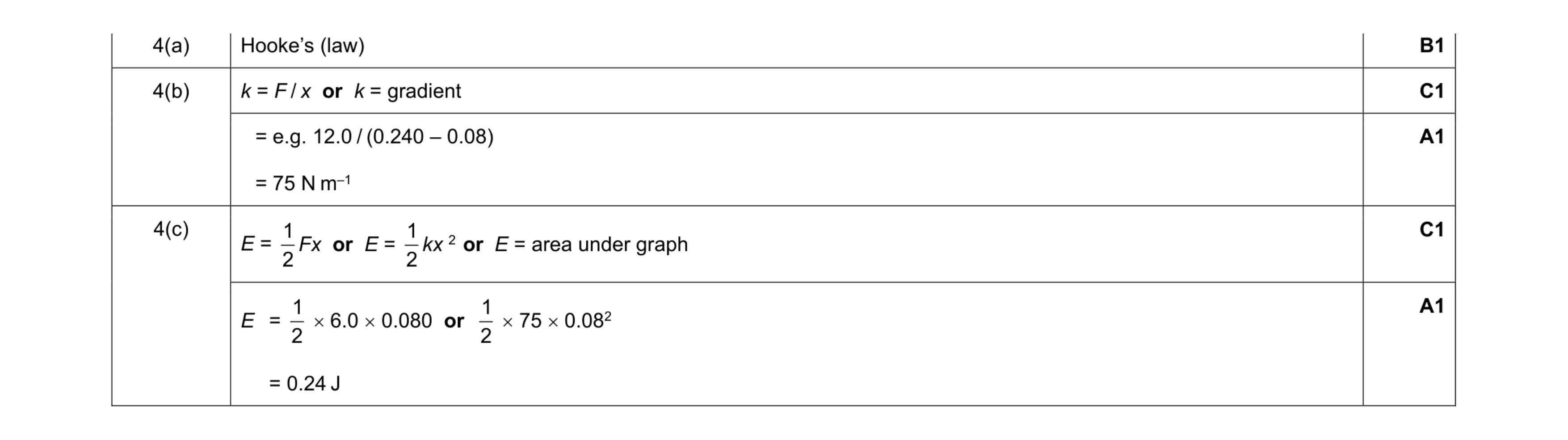 5
5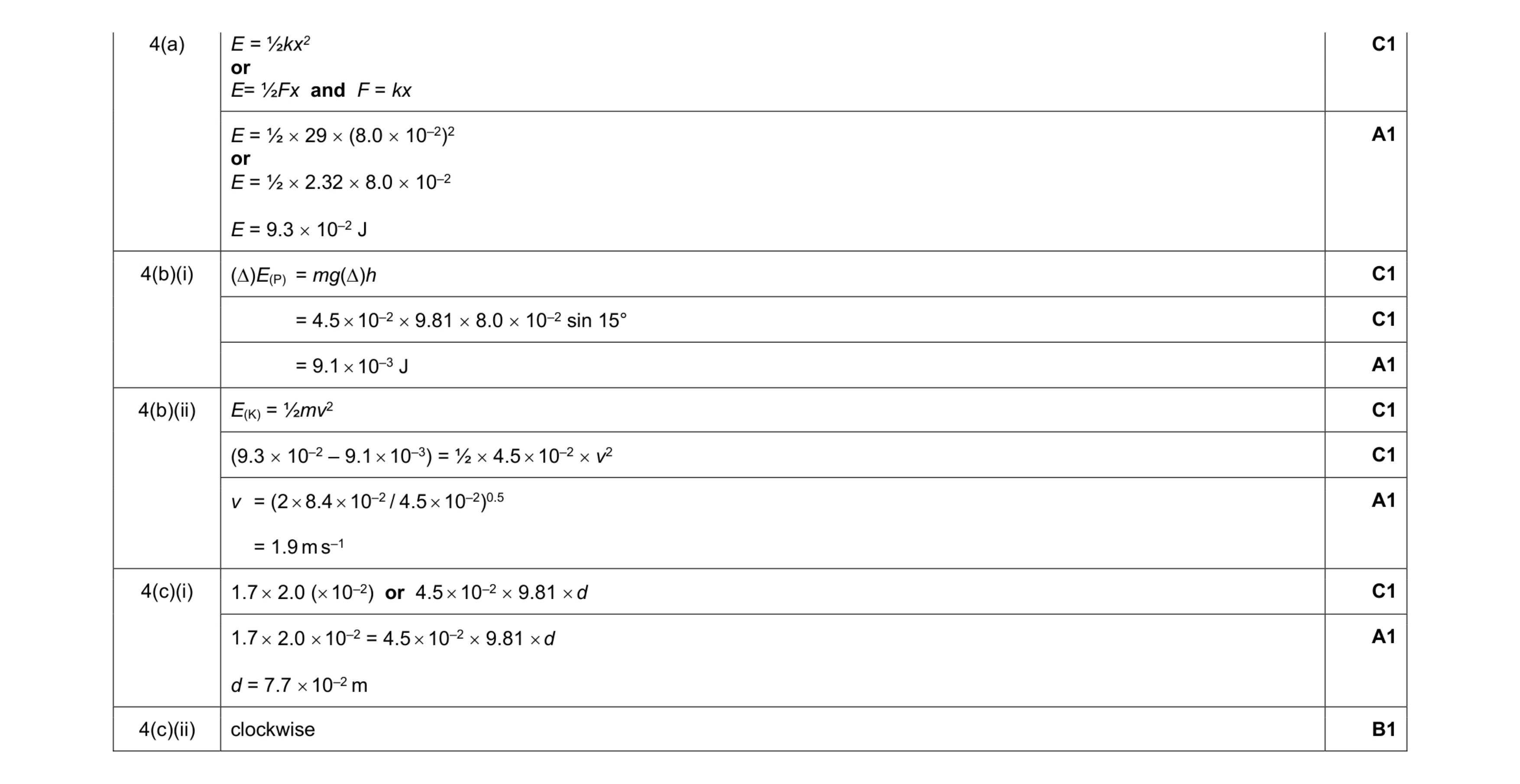 11
11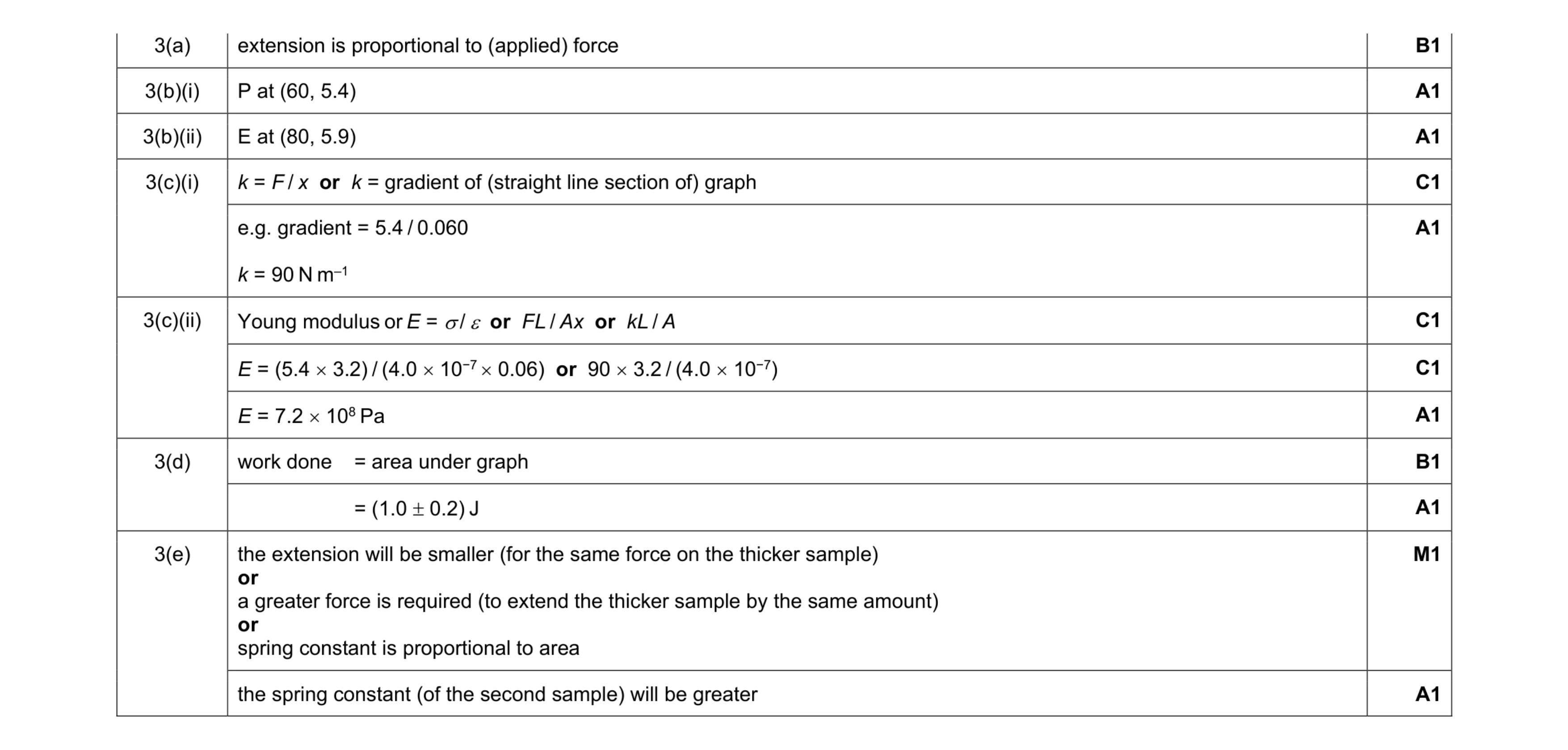 12
12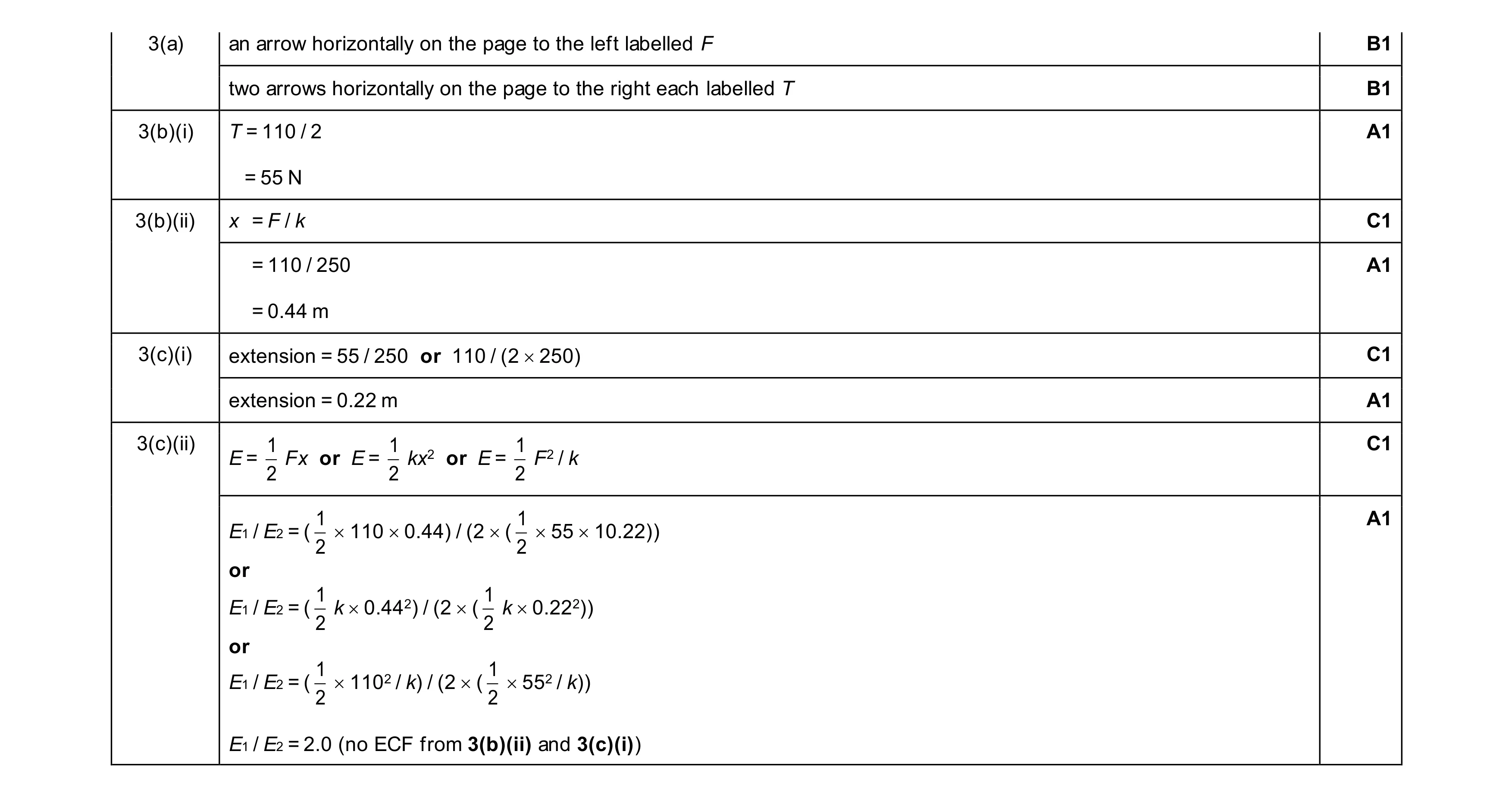 9
9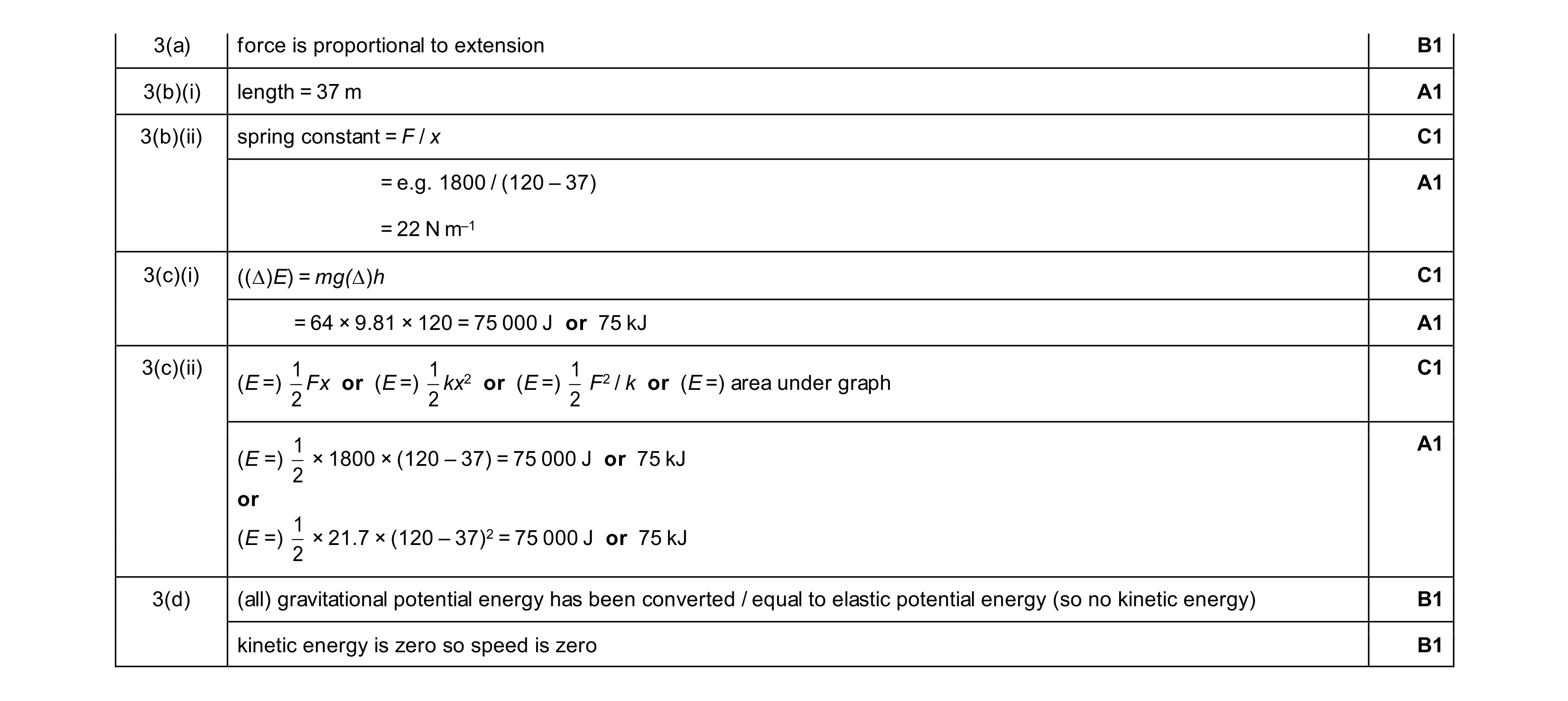 10
10