Questions as text
Q1 · The kinetic energy of a particle is increased by a factor of 4 9702/11 Oct/Nov 2004
15 The kinetic energy of a particle is increased by a factor of 4. By what factor does its speed increase? A 2 B 4 C 8 D 16
1 marks
Answer: A
This question in 9702/11 Oct/Nov 2004
Q2 · A horizontal force of 90 N is used to push a box across a horizontal floor 9702/11 Oct/Nov 2004
16 A horizontal force of 90 N is used to push a box across a horizontal floor. The frictional force on the box is 50 N. What is the gain in kinetic energy of the box when it is moved through a distance of 6.0 m? A 240 J B 300 J C 540 J D 840 J
1 marks
Answer: A
This question in 9702/11 Oct/Nov 2004
Q3 · A car with a total mass of 1400 kg is travelling at 30 m s–1 9702/11 Oct/Nov 2005
14 A car with a total mass of 1400 kg is travelling at 30 m s–1. What is the kinetic energy of the car? A 21 kJ B 42 kJ C 630 kJ D 1260 kJ
1 marks
Answer: C
This question in 9702/11 Oct/Nov 2005
Q4 · An object is thrown into the air 9702/11 Oct/Nov 2005
15 An object is thrown into the air. Which graph shows how the potential energy Ep of the object varies with height h above the ground? A B C D Ep Ep Ep Ep 0 0 0 0 0 h 0 h 0 h 0 h
1 marks
Answer: A
This question in 9702/11 Oct/Nov 2005
Q5 · A motorist travelling at 10 m s–1 can bring his car to rest in a braking distance of 10 m 9702/11 May/June 2006
17 A motorist travelling at 10 m s–1 can bring his car to rest in a braking distance of 10 m. In what distance could he bring the car to rest from a speed of 30 m s–1 using the same braking force? A 17 m B 30 m C 52 m D 90 m
1 marks
Answer: D
This question in 9702/11 May/June 2006
Q6 · A stone of weight 4.0 N in the Earth’s gravitational field is moved from P to Q and then… 9702/11 May/June 2006
18 A stone of weight 4.0 N in the Earth’s gravitational field is moved from P to Q and then to R along the path shown. Q 40 m R 30 m 50 m P Earth's surface How much potential energy does the stone gain? A 120 J B 200 J C 280 J D 1200 J
1 marks
Answer: A
This question in 9702/11 May/June 2006
Q7 · To get to his office from the entrance of the building, a man has to walk up six flights… 9702/11 Oct/Nov 2006
16 To get to his office from the entrance of the building, a man has to walk up six flights of stairs. The height of each flight is 2.5 m and the man has a mass of 80 kg. What is the approximate gain in the man’s gravitational potential energy during the climb? A 1200 J B 2000 J C 4800 J D 12 000 J
1 marks
Answer: D
This question in 9702/11 Oct/Nov 2006
Q8 · The diagram shows the masses and velocities of two trolleys about to collide 9702/11 May/June 2007
12 The diagram shows the masses and velocities of two trolleys about to collide. 4 m s–1 1 m s–1 2 kg 4 kg After the impact they move off together. What is the total kinetic energy of the trolleys after the collision? A 1.3 J B 12 J C 18 J D 19 J
1 marks
Answer: B
This question in 9702/11 May/June 2007
Q9 · Each of the nuclei below is accelerated from rest through the same potential difference 9702/11 May/June 2007
40 Each of the nuclei below is accelerated from rest through the same potential difference. Which one completes the acceleration with the lowest speed? A 1 1H B 4 2He C 7 3Li D 9 4Be
1 marks
Answer: C
This question in 9702/11 May/June 2007
Q10 · A steel ball is falling at constant speed in oil 9702/11 May/June 2008
18 A steel ball is falling at constant speed in oil. Which graph shows the variation with time of the gravitational potential energy Ep and the kinetic energy Ek of the ball? A B energy energy Ek Ek Ep Ep 0 0 0 time 0 time C D Ek Ek energy energy Ep Ep 0 0 0 time 0 time
1 marks
Answer: B
This question in 9702/11 May/June 2008
Q11 · A block of weight W is pulled up a rough slope by a force F 9702/11 Oct/Nov 2008
15 A block of weight W is pulled up a rough slope by a force F. When the block has moved a distance x along the slope, it has risen height h. x F h W Which expressions give the amount of work done on the block and the amount of gravitational potential energy gained by the block? gravitational potential work done energy A Fx Wh B Fh Wx C Wx Fh D Wh Fx
1 marks
Answer: A
This question in 9702/11 Oct/Nov 2008
Q12 · An object is thrown into the air 9702/11 Oct/Nov 2008
16 An object is thrown into the air. Which graph shows how the potential energy Ep of the object varies with height h above the ground? A B C D Ep Ep Ep Ep 0 0 0 0 0 h 0 h 0 h 0 h
1 marks
Answer: A
This question in 9702/11 Oct/Nov 2008
Q13 · A pendulum bob oscillates between P and R 9702/11 Oct/Nov 2008
17 A pendulum bob oscillates between P and R. P R y Q x Assuming the gravitational potential energy lost in moving from P to Q is converted into kinetic energy, what is the speed of the bob at Q? A 2 gx B 2gx C 2 gy D 2gy
1 marks
Answer: C
This question in 9702/11 Oct/Nov 2008
Q14 · A stationary body explodes into two components of masses m and 2m 9702/11 May/June 2009
10 A stationary body explodes into two components of masses m and 2m. The components gain kinetic energies X and Y respectively. m 2m direction m moves direction 2m moves with kinetic energy X with kinetic energy Y X What is the value of the ratio ? Y 1 1 2 4 A B C D 4 2 1 1 Space for working
1 marks
Answer: C
This question in 9702/11 May/June 2009
Q15 · The diagram shows two identical vessels X and Y connected by a short pipe with a tap 9702/11 May/June 2009
15 The diagram shows two identical vessels X and Y connected by a short pipe with a tap. X Y h m Initially, X is filled with water of mass m to a depth h, and Y is empty. When the tap is opened, water flows from X to Y until the depths of water in both vessels are equal. How much potential energy is lost by the water during this process? (g = acceleration of free fall) mgh mgh A 0 B C D mgh 4 2 Space for working
1 marks
Answer: B
This question in 9702/11 May/June 2009
Q16 · The diagram shows an electron, with charge e, mass m, and velocity v, entering a uniform… 9702/11 May/June 2009
29 The diagram shows an electron, with charge e, mass m, and velocity v, entering a uniform electric field of strength E. electron v E x The direction of the field and the electron’s motion are both horizontal and to the right. Which expression gives the distance x through which the electron travels before it stops momentarily? mv mv mv 2 mv 2 A x = E B x = Ee C x = D x = 2 E 2 Ee
1 marks
Answer: D
This question in 9702/11 May/June 2009
Q17 · A projectile is launched at 45° to the horizontal with initial kinetic energy E 9702/11 Oct/Nov 2009
14 A projectile is launched at 45° to the horizontal with initial kinetic energy E. Assuming air resistance to be negligible, what will be the kinetic energy of the projectile when it reaches its highest point? A 0.50 E B 0.71 E C 0.87 E D E Space for working
1 marks
Answer: A
This question in 9702/11 Oct/Nov 2009
Q18 · A projectile is launched at 45° to the horizontal with initial kinetic energy E 9702/12 Oct/Nov 2009
13 A projectile is launched at 45° to the horizontal with initial kinetic energy E. Assuming air resistance to be negligible, what will be the kinetic energy of the projectile when it reaches its highest point? A 0.50 E B 0.71 E C 0.87 E D E Space for working
1 marks
Answer: A
This question in 9702/12 Oct/Nov 2009
Q19 · A raindrop of mass m is falling vertically through the air with a steady speed v 9702/12 Oct/Nov 2010
15 A raindrop of mass m is falling vertically through the air with a steady speed v. The raindrop experiences a retarding force kv due to the air, where k is a constant. The acceleration of free fall is g. Which expression gives the kinetic energy of the raindrop? mg mg 2 m 3 g 2 m 3 g 2 A B C D k 2k 2 2 2 k 2k Space for working
1 marks
Answer: D
This question in 9702/12 Oct/Nov 2010
Q20 · The diagram shows a lift system in which the elevator (mass m1) is partly counterbalanced… 9702/13 Oct/Nov 2010
17 The diagram shows a lift system in which the elevator (mass m1) is partly counterbalanced by a heavy weight (mass m2). motor v v elevator m1 m2 At what rate does the motor provide energy to the system when the elevator is rising at a steady speed v ? (g = acceleration of free fall) A 1 m1 v 2 2 B 1 (m1 – m2)v 2 2 C m1gv D (m1 – m2)gv
1 marks
Answer: D
This question in 9702/13 Oct/Nov 2010
Q21 · A steel sphere is dropped vertically onto a horizontal metal plate 9702/11 May/June 2011
14 A steel sphere is dropped vertically onto a horizontal metal plate. The sphere hits the plate with a speed u, leaves it at a speed v, and rebounds vertically to half of its original height. v ? Which expression gives the value of u A 1 B 1 C 1 D 1 – 1 2 2 2 2 2 Space for working
1 marks
Answer: C
This question in 9702/11 May/June 2011
Q22 · A block of mass 2.0 kg is released from rest on a slope 9702/11 May/June 2011
15 A block of mass 2.0 kg is released from rest on a slope. It travels 7.0 m down the slope and falls a vertical distance of 3.0 m. The block experiences a frictional force parallel to the slope of 5.0 N. 2.0 kg 7.0 m 3.0 m What is the speed of the block after falling this distance? A 4.9 m s–1 B 6.6 m s–1 C 8.6 m s–1 D 10.1 m s–1
1 marks
Answer: A
This question in 9702/11 May/June 2011
Q23 · A body travelling with a speed of 10 m s–1 has kinetic energy 1500 J 9702/11 May/June 2011
17 A body travelling with a speed of 10 m s–1 has kinetic energy 1500 J. If the speed of the body is increased to 40 m s–1, what is its new kinetic energy? A 4500 J B 6000 J C 24 000 J D 1 350 000 J
1 marks
Answer: C
This question in 9702/11 May/June 2011
Q24 · A body of mass m, moving at velocity v, collides with a stationary body of the same mass… 9702/13 May/June 2011
10 A body of mass m, moving at velocity v, collides with a stationary body of the same mass and sticks to it. Which row describes the momentum and kinetic energy of the two bodies after the collision? momentum kinetic energy A mv 1 mv 2 4 B mv 1 mv 2 8 C 2mv 1 mv 2 2 D 2mv mv 2
1 marks
Answer: A
This question in 9702/13 May/June 2011
Q25 · A steel sphere is dropped vertically onto a horizontal metal plate 9702/13 May/June 2011
14 A steel sphere is dropped vertically onto a horizontal metal plate. The sphere hits the plate with a speed u, leaves it at a speed v, and rebounds vertically to half of its original height. Which expression gives the value of u v ? A 1 B 1 C 1 D 1 – 1 2 2 2 2 2
1 marks
Answer: C
This question in 9702/13 May/June 2011
Q26 · A block of mass 2.0 kg is released from rest on a slope 9702/13 May/June 2011
15 A block of mass 2.0 kg is released from rest on a slope. It travels 7.0 m down the slope and falls a vertical distance of 3.0 m. The block experiences a frictional force parallel to the slope of 5.0 N. 2.0 kg 7.0 m 3.0 m What is the speed of the block after falling this distance? A 4.9 m s–1 B 6.6 m s–1 C 8.6 m s–1 D 10.1 m s–1
1 marks
Answer: A
This question in 9702/13 May/June 2011
Q27 · A body travelling with a speed of 10 m s–1 has kinetic energy 1500 J 9702/13 May/June 2011
16 A body travelling with a speed of 10 m s–1 has kinetic energy 1500 J. If the speed of the body is increased to 40 m s–1, what is its new kinetic energy? A 4500 J B 6000 J C 24 000 J D 1 350 000 J Space for working
1 marks
Answer: C
This question in 9702/13 May/June 2011
Q28 · An Olympic athlete of mass 80 kg competes in a 100 m race 9702/11 Oct/Nov 2011
2 An Olympic athlete of mass 80 kg competes in a 100 m race. What is the best estimate of his mean kinetic energy during the race? A 4 × 10² J B 4 × 10³ J C 4 × 10⁴ J D 4 × 10⁵ J
1 marks
Answer: B
This question in 9702/11 Oct/Nov 2011
Q29 · A trolley runs from P to Q along a track 9702/11 Oct/Nov 2011
18 A trolley runs from P to Q along a track. At Q its potential energy is 50 kJ less than at P. trolley P Q At P, the kinetic energy of the trolley is 5 kJ. Between P and Q, the work the trolley does against friction is 10 kJ. What is the kinetic energy of the trolley at Q? A 35 kJ B 45 kJ C 55 kJ D 65 kJ
1 marks
Answer: B
This question in 9702/11 Oct/Nov 2011
Q30 · An Olympic athlete of mass 80 kg competes in a 100 m race 9702/13 Oct/Nov 2011
4 An Olympic athlete of mass 80 kg competes in a 100 m race. What is the best estimate of his mean kinetic energy during the race? A 4 × 10² J B 4 × 10³ J C 4 × 10⁴ J D 4 × 10⁵ J Space for working
1 marks
Answer: B
This question in 9702/13 Oct/Nov 2011
Q31 · Initially, four identical uniform blocks, each of mass m and thickness h, are spread on a… 9702/12 May/June 2012
17 Initially, four identical uniform blocks, each of mass m and thickness h, are spread on a table. h h How much work is done on the blocks in stacking them on top of one another? A 3 mgh B 6 mgh C 8 mgh D 10 mgh Space for working
1 marks
Answer: B
This question in 9702/12 May/June 2012
Q32 · A mass of 2.0 kg rests on a frictionless surface 9702/11 Oct/Nov 2012
13 A mass of 2.0 kg rests on a frictionless surface. It is attached to a 1.0 kg mass by a light, thin string which passes over a frictionless pulley. The 1.0 kg mass is released and it accelerates downwards. mass pulley 2.0 kg 1.0 kg 0.50 m What is the speed of the 2.0 kg mass as the 1.0 kg mass hits the floor, having fallen a distance of 0.50 m? A 1.8 m s–1 B 2.2 m s–1 C 3.1 m s–1 D 9.8 m s–1 Space for working
1 marks
Answer: A
This question in 9702/11 Oct/Nov 2012
Q33 · A lead pellet is shot vertically upwards into a clay block that is stationary at the… 9702/11 Oct/Nov 2012
14 A lead pellet is shot vertically upwards into a clay block that is stationary at the moment of impact but is able to rise freely after impact. stationary clay block mass 95 g impact velocity 200 m s–1 lead pellet mass 5.0 g The pellet hits the block with an initial velocity of 200 m s–1. It embeds itself in the block and does not emerge. How high above its initial position will the block rise? (Mass of pellet = 5.0 g; mass of clay block = 95 g.) A 5.1 m B 5.6 m C 10 m D 2000 m Space for working
1 marks
Answer: A
This question in 9702/11 Oct/Nov 2012
Q34 · The kinetic energy of a particle is increased by a factor of 4 9702/11 Oct/Nov 2012
18 The kinetic energy of a particle is increased by a factor of 4. By what factor does its speed increase? A 2 B 4 C 8 D 16
1 marks
Answer: A
This question in 9702/11 Oct/Nov 2012
Q35 · A railway engine accelerates a train of total mass 800 tonnes (1 tonne = 1000 kg) from… 9702/11 Oct/Nov 2012
20 A railway engine accelerates a train of total mass 800 tonnes (1 tonne = 1000 kg) from rest to a speed of 50 m s–1. How much work must be done on the train to reach this speed? A 1.0 × 10⁶ J B 2.0 × 10⁶ J C 1.0 × 10⁹ J D 2.0 × 10⁹ J
1 marks
Answer: C
This question in 9702/11 Oct/Nov 2012
Q36 · What is the approximate kinetic energy of an Olympic athlete when running at maximum… 9702/12 Oct/Nov 2012
3 What is the approximate kinetic energy of an Olympic athlete when running at maximum speed during a 100 m race? A 400 J B 4000 J C 40 000 J D 400 000 J
1 marks
Answer: B
This question in 9702/12 Oct/Nov 2012
Q37 · A railway engine accelerates a train of total mass 1200 tonnes (1 tonne = 1000 kg) from… 9702/12 Oct/Nov 2012
20 A railway engine accelerates a train of total mass 1200 tonnes (1 tonne = 1000 kg) from rest to a speed of 75 m s–1. How much useful work must be done on the train to reach this speed? A 1.7 × 10⁶ J B 3.4 × 10⁶ J C 1.7 × 10⁹ J D 3.4 × 10⁹ J Space for working
1 marks
Answer: D
This question in 9702/12 Oct/Nov 2012
Q38 · A car travelling with speed 28 m s–1 leaves a motorway on an exit road 9702/13 Oct/Nov 2012
18 A car travelling with speed 28 m s–1 leaves a motorway on an exit road. The end of the exit road is 22 m higher than the motorway. If only the force of gravity is considered, what will be the speed of the car at the end of the exit road? A 7.3 m s–1 B 19 m s–1 C 21 m s–1 D 24 m s–1 Space for working
1 marks
Answer: B
This question in 9702/13 Oct/Nov 2012
Q39 · The diagram shows a hydroelectric power station 9702/13 Oct/Nov 2012
21 The diagram shows a hydroelectric power station. The reservoir is linked to the turbines by a pipe of uniform cross-sectional area. Water flows from the reservoir, through the pipe and through the turbines at a constant rate. reservoir X turbine house Y Which statement about the change of energy of the water as it moves from X to Y is correct? A It gains both gravitational potential energy and kinetic energy. B It loses gravitational potential energy and gains elastic potential energy. C It loses gravitational potential energy and gains kinetic energy. D It loses both elastic potential energy and gravitational potential energy. Space for working
1 marks
Answer: B
This question in 9702/13 Oct/Nov 2012
Q40 · A bow of mass 400 g shoots an arrow of mass 120 g vertically upwards 9702/12 May/June 2013
16 A bow of mass 400 g shoots an arrow of mass 120 g vertically upwards. The potential energy stored in the bow just before release is 80 J. The system has an efficiency of 28%. What is the height reached by the arrow when air resistance is neglected? A 4 m B 19 m C 187 m D 243 m Space for working
1 marks
Answer: B
This question in 9702/12 May/June 2013
Q41 · A ball of mass m is thrown up to height h in air with an initial velocity v, as shown 9702/13 May/June 2013
14 A ball of mass m is thrown up to height h in air with an initial velocity v, as shown. v h P P Q Q Air resistance is considered negligible. The acceleration of free fall is g. What is the total work done by the gravitational force on the ball during its flight from P to Q? A zero B ½mv 2 C mgh D 2mgh
1 marks
Answer: A
This question in 9702/13 May/June 2013
Q42 · The diagram shows a barrel of weight 1.0 × 10³ N on a frictionless slope inclined at 30o… 9702/11 Oct/Nov 2013
17 The diagram shows a barrel of weight 1.0 × 10³ N on a frictionless slope inclined at 30o to the horizontal. force of slope on barrel force barrel slope 1.0 × 10³ N 30o A force is applied to the barrel to move it up the slope at constant speed. The force is parallel to the slope. What is the work done in moving the barrel a distance of 5.0 m up the slope? A 2.5 × 10³ J B 4.3 × 10³ J C 5.0 × 10³ J D 1.0 × 10⁴ J
1 marks
Answer: A
This question in 9702/11 Oct/Nov 2013
Q43 · The diagram shows a barrel of weight 1.0 × 10³ N on a frictionless slope inclined at 30o… 9702/12 Oct/Nov 2013
17 The diagram shows a barrel of weight 1.0 × 10³ N on a frictionless slope inclined at 30o to the horizontal. force of slope on barrel force barrel slope 1.0 × 10³ N 30o A force is applied to the barrel to move it up the slope at constant speed. The force is parallel to the slope. What is the work done in moving the barrel a distance of 5.0 m up the slope? A 2.5 × 10³ J B 4.3 × 10³ J C 5.0 × 10³ J D 1.0 × 10⁴ J
1 marks
Answer: A
This question in 9702/12 Oct/Nov 2013
Q44 · A body travelling with a speed of 20 m s–1 has kinetic energy Ek 9702/13 Oct/Nov 2013
18 A body travelling with a speed of 20 m s–1 has kinetic energy Ek. If the speed of the body is increased to 80 m s–1, what is its new kinetic energy? A 4Ek B 8Ek C 12Ek D 16Ek Space for working
1 marks
Answer: D
This question in 9702/13 Oct/Nov 2013
Q45 · An object of mass 4.0 kg moving with a speed of 3.0 m s–1 strikes a stationary object in… 9702/11 May/June 2014
9 An object of mass 4.0 kg moving with a speed of 3.0 m s–1 strikes a stationary object in an inelastic collision. Which statement is correct? A After collision, the total kinetic energy is 18 J. B After collision, the total kinetic energy is less than 18 J. C Before collision, the total kinetic energy is 12 J. D Before collision, the total kinetic energy is less than 12 J.
1 marks
Answer: B
This question in 9702/11 May/June 2014
Q46 · Two train carriages each of mass 5000 kg roll toward one another on a level track 9702/12 May/June 2014
7 Two train carriages each of mass 5000 kg roll toward one another on a level track. One is travelling at 2.00 m s–1 and the other at 1.00 m s–1, as shown. 2.00 m s–1 1.00 m s–1 5000 kg 5000 kg They collide and join together. What is the kinetic energy lost during the collision? A 1250 J B 7500 J C 11 250 J D 12 500 J Space for working
1 marks
Answer: C
This question in 9702/12 May/June 2014
Q47 · A mass at point X inside a uniform gravitational field experiences a gravitational force… 9702/12 May/June 2014
14 A mass at point X inside a uniform gravitational field experiences a gravitational force of 0.200 N. It has 1.00 J of gravitational potential energy. 30 cm X uniform 50 cm gravitational field Y The mass is then moved to point Y. What is its new gravitational potential energy? A 0.90 J B 0.94 J C 1.06 J D 1.10 J Space for working
1 marks
Answer: C
This question in 9702/12 May/June 2014
Q48 · A small mass is placed at point P on the inside surface of a smooth hemisphere 9702/12 May/June 2014
15 A small mass is placed at point P on the inside surface of a smooth hemisphere. It is then released from rest. When it reaches the lowest point T, its speed is 4.0 m s–1. The diagram (not to scale) shows the speed of the mass at other points Q, R and S as it slides down. Air resistance is negligible. P 1.0 m s–1 Q not to smooth 2.0 m s–1 scale hemisphere R 3.0 m s–1 S 4.0 m s–1 T The mass loses potential energy E in falling from P to T. E ? At which point has the mass lost potential energy 4 A Q B R C S D none of these Space for working
1 marks
Answer: B
This question in 9702/12 May/June 2014
Q49 · An escalator is 60 m long and lifts passengers through a vertical height of 30 m, as shown 9702/12 May/June 2014
16 An escalator is 60 m long and lifts passengers through a vertical height of 30 m, as shown. 30 m 60 m To drive the escalator against the forces of friction when there are no passengers requires a power of 2.0 kW. The escalator is used by passengers of average mass 60 kg and the power to overcome friction remains constant. How much power is required to drive the escalator when it is carrying 20 passengers and is travelling at 0.75 m s–1? A 4.4 kW B 6.4 kW C 8.8 kW D 10.8 kW
1 marks
Answer: B
This question in 9702/12 May/June 2014
Q50 · Two oppositely-charged horizontal metal plates are placed in a vacuum 9702/12 May/June 2014
29 Two oppositely-charged horizontal metal plates are placed in a vacuum. A positively-charged particle starts from rest and moves from one plate to the other plate, as shown. – + + Which graph shows how the kinetic energy EK of the particle varies with the distance x moved from the positive plate? A B C D EK EK EK EK 00 00 00 00 x x x x Space for working
1 marks
Answer: D
This question in 9702/12 May/June 2014
Q51 · A stationary body explodes into two components of masses m and 2m 9702/13 May/June 2014
12 A stationary body explodes into two components of masses m and 2m. The components gain kinetic energies X and Y respectively. m 2m moves with moves with kinetic energy X kinetic energy Y X What is the value of the ratio ? Y 1 1 2 4 A B C D 4 2 1 1 Space for working
1 marks
Answer: C
This question in 9702/13 May/June 2014
Q52 · A uniform solid cuboid of concrete of dimensions 0.50 m × 1.20 m × 0.40 m and weight 4000… 9702/13 May/June 2014
14 A uniform solid cuboid of concrete of dimensions 0.50 m × 1.20 m × 0.40 m and weight 4000 N rests on a flat surface with the 1.20 m edge vertical as shown in diagram 1. 0.40 m 0.40 m 1.20 m 0.50 m 0.50 m 1.20 m diagram 1 diagram 2 What is the minimum energy required to roll the cuboid through 90° to the position shown in diagram 2 with the 0.50 m edge vertical? A 200 J B 400 J C 1400 J D 2600 J Space for working
1 marks
Answer: A
This question in 9702/13 May/June 2014
Q53 · A mass attached to the lower end of a spring bounces up and down 9702/11 Oct/Nov 2014
13 A mass attached to the lower end of a spring bounces up and down. At which points in the path of the mass do the gravitational potential energy of the mass (GPE), the elastic potential energy in the spring (EPE) and the kinetic energy of the mass (KE) have their highest values? GPE EPE KE A bottom middle top B bottom top middle C top bottom middle D top bottom top
1 marks
Answer: C
This question in 9702/11 Oct/Nov 2014
Q54 · A mass attached to the lower end of a spring bounces up and down 9702/12 Oct/Nov 2014
13 A mass attached to the lower end of a spring bounces up and down. At which points in the path of the mass do the gravitational potential energy of the mass (GPE), the elastic potential energy in the spring (EPE) and the kinetic energy of the mass (KE) have their highest values? GPE EPE KE A bottom middle top B bottom top middle C top bottom middle D top bottom top
1 marks
Answer: C
This question in 9702/12 Oct/Nov 2014
Q55 · A projectile is launched at 45° to the horizontal with initial kinetic energy E 9702/12 Oct/Nov 2014
16 A projectile is launched at 45° to the horizontal with initial kinetic energy E. Assuming air resistance to be negligible, what will be the kinetic energy of the projectile when it reaches its highest point? A 0.50 E B 0.71 E C 0.87 E D E
1 marks
Answer: A
This question in 9702/12 Oct/Nov 2014
Q56 · A box of weight 30 N is released from rest on a ramp that is at an angle of 30° to the… 9702/13 Oct/Nov 2014
17 A box of weight 30 N is released from rest on a ramp that is at an angle of 30° to the horizontal. The box slides down the ramp so that it falls through a vertical distance of 8.0 m. A constant frictional force of 10 N acts on the box while it is moving. 8.0 m 30 N 30° What is the kinetic energy of the box after falling through this distance? A 80 J B 160 J C 240 J D 400 J Space for working
1 marks
Answer: A
This question in 9702/13 Oct/Nov 2014
Q57 · A uniform solid block has weight 500 N, width 0.4 m and height 0.6 m 9702/12 May/June 2015
15 A uniform solid block has weight 500 N, width 0.4 m and height 0.6 m. The block rests on the edge of a step of depth 0.8 m, as shown. 0.4 m 0.6 m 0.8 m 0.4 m The block is knocked over the edge of the step and rotates through 90° before coming to rest with the 0.6 m edge horizontal. What is the change in gravitational potential energy of the block? A 300 J B 400 J C 450 J D 550 J
1 marks
Answer: C
This question in 9702/12 May/June 2015
Q58 · A fisherman lifts a fish of mass 250 g from rest through a vertical height of 1.8 m 9702/12 May/June 2015
17 A fisherman lifts a fish of mass 250 g from rest through a vertical height of 1.8 m. The fish gains a speed of 1.1 m s–1. What is the energy gained by the fish? A 0.15 J B 4.3 J C 4.4 J D 4.6 J
1 marks
Answer: D
This question in 9702/12 May/June 2015
Q59 · A wooden block is freely supported on brackets at a height of 4.0 m above the ground, as… 9702/13 May/June 2015
13 A wooden block is freely supported on brackets at a height of 4.0 m above the ground, as shown. wooden block of mass 95 g impact bracket velocity 200 m s–1 4.0 m bullet of mass 5.0 g A bullet of mass 5.0 g is shot vertically upwards into the wooden block of mass 95 g. It embeds itself in the block. The impact causes the block to rise above its supporting brackets. The bullet hits the block with a velocity of 200 m s–1. How far above the ground will the block be at the maximum height of its path? A 5.1 m B 5.6 m C 9.1 m D 9.6 m
1 marks
Answer: C
This question in 9702/13 May/June 2015
Q60 · A loaded aeroplane has a total mass of 1.2 × 10⁵ kg while climbing after take-off 9702/13 May/June 2015
18 A loaded aeroplane has a total mass of 1.2 × 10⁵ kg while climbing after take-off. It climbs at an angle of 23° to the horizontal with a speed of 50 m s–1. What is the rate at which it is gaining potential energy at this time? A 2.3 × 10⁶ J s–1 B 2.5 × 10⁶ J s–1 C 2.3 × 10⁷ J s–1 D 2.5 × 10⁷ J s–1
1 marks
Answer: C
This question in 9702/13 May/June 2015
Q61 · When a horizontal force F is applied to a frictionless trolley over a distance s, the… 9702/13 May/June 2015
19 When a horizontal force F is applied to a frictionless trolley over a distance s, the kinetic energy of the trolley changes from 4.0 J to 8.0 J. If a force of 2F is applied to the trolley over a distance of 2s, what will the original kinetic energy of 4.0 J become? A 16 J B 20 J C 32 J D 64 J
1 marks
Answer: B
This question in 9702/13 May/June 2015
Q62 · A car of mass 500 kg is at rest at point X on a slope, as shown 9702/12 Oct/Nov 2015
16 A car of mass 500 kg is at rest at point X on a slope, as shown. The car’s brakes are released and the car rolls down the slope with its engine switched off. At point Y the car has moved through a vertical height of 30 m and has a speed of 11 m s–1. mass = 500 kg speed = 0 m s–1 X 30 m speed = 11 m s–1 Y What is the energy dissipated by frictional forces when the car moves from X to Y? A 3.0 × 10⁴ J B 1.2 × 10⁵ J C 1.5 × 10⁵ J D 1.8 × 10⁵ J
1 marks
Answer: B
This question in 9702/12 Oct/Nov 2015
Q63 · The force diagram shows an aircraft accelerating 9702/12 Feb/March 2016
15 The force diagram shows an aircraft accelerating. At the instant shown, the velocity of the aircraft is 40 m s–1. velocity 40 m s–1 600 kN lift 200 kN 500 kN air resistance engine thrust 600 kN weight At which rate is its kinetic energy increasing? A 2.4 MW B 8.0 MW C 12 MW D 20 MW
1 marks
Answer: C
This question in 9702/12 Feb/March 2016
Q64 · A man is running in a straight line 9702/12 Feb/March 2016
16 A man is running in a straight line. What is an approximate value of his kinetic energy? A 10 J B 100 J C 1000 J D 10 000 J
1 marks
Answer: C
This question in 9702/12 Feb/March 2016
Q65 · The pump of a water pumping system uses 2.0 kW of electrical power when raising water 9702/12 Feb/March 2016
17 The pump of a water pumping system uses 2.0 kW of electrical power when raising water. The pumping system lifts 16 kg of water per second through a vertical height of 7.0 m. What is the efficiency of the pumping system? A 1.8% B 5.6% C 22% D 55%
1 marks
Answer: D
This question in 9702/12 Feb/March 2016
Q66 · Which amount of energy is not 2400 J? 9702/11 May/June 2016
18 Which amount of energy is not 2400 J? A the decrease in gravitational potential energy of a body of mass 60 kg when it moves vertically downwards through 40 m near the Earth’s surface B the energy transferred in 15 s by a machine of power 160 W C the kinetic energy of a body of mass 12 kg moving at a speed of 20 m s–1 D the work done by a gas expanding against a constant external pressure of 120 kPa when its volume increases by 0.020 m3
1 marks
Answer: A
This question in 9702/11 May/June 2016
Q67 · A boy on a bicycle starts from rest and rolls down a hill inclined at 30° to the… 9702/12 May/June 2016
17 A boy on a bicycle starts from rest and rolls down a hill inclined at 30° to the horizontal. The boy and bicycle have a combined mass of 25 kg. There is a frictional force of 30 N, which is independent of the velocity of the bicycle. What is the kinetic energy of the boy and the bicycle after rolling 20 m down the slope? A 1850 J B 2450 J C 3050 J D 3640 J
1 marks
Answer: A
This question in 9702/12 May/June 2016
Q68 · A bungee jumper jumps from a platform and is decelerated by an elastic bungee cord, as… 9702/13 May/June 2016
16 A bungee jumper jumps from a platform and is decelerated by an elastic bungee cord, as shown. platform bungee jumper bungee cord bungee cord ground ground not to before jumping scale during the jump When the jumper makes the jump, his initial gravitational potential energy is converted into his kinetic energy and into elastic potential energy in the cord. At which part of the jump are all three types of energy non-zero? A on the platform before the jump B on the way down before the cord has started to extend C on the way down as he decelerates D at the bottom of the jump when he is stationary
1 marks
Answer: C
This question in 9702/13 May/June 2016
Q69 · An object of mass 0.30 kg is thrown vertically upwards from the ground with an initial… 9702/13 May/June 2016
17 An object of mass 0.30 kg is thrown vertically upwards from the ground with an initial velocity of 8.0 m s–1. The object reaches a maximum height of 1.9 m. How much work is done against air resistance as the object rises to its maximum height? A 4.0 J B 5.6 J C 9.6 J D 15 J
1 marks
Answer: A
This question in 9702/13 May/June 2016
Q70 · A truck of mass 500 kg moves from rest at the top of a section of track 400 m long and 30… 9702/11 Oct/Nov 2016
19 A truck of mass 500 kg moves from rest at the top of a section of track 400 m long and 30 m high, as shown. The frictional force acting on the truck is 250 N throughout its journey. 400 m 30 m What is the final speed of the truck? A 14 m s–1 B 24 m s–1 C 31 m s–1 D 190 m s–1
1 marks
Answer: A
This question in 9702/11 Oct/Nov 2016
Q71 · A truck of mass 500 kg moves from rest at the top of a section of track 400 m long and 30… 9702/13 Oct/Nov 2016
19 A truck of mass 500 kg moves from rest at the top of a section of track 400 m long and 30 m high, as shown. The frictional force acting on the truck is 250 N throughout its journey. 400 m 30 m What is the final speed of the truck? A 14 m s–1 B 24 m s–1 C 31 m s–1 D 190 m s–1
1 marks
Answer: A
This question in 9702/13 Oct/Nov 2016
Q72 · A man climbs slowly at a steady speed to the top of a ladder 9702/11 May/June 2017
15 A man climbs slowly at a steady speed to the top of a ladder. What is the main energy transfer taking place for the man as he climbs? A chemical potential to gravitational potential B chemical potential to kinetic C kinetic to gravitational potential D thermal (heat) to kinetic
1 marks
Answer: A
This question in 9702/11 May/June 2017
Q73 · A railway engine accelerates a train of total mass 800 tonnes (1 tonne = 1000 kg) from… 9702/11 May/June 2017
17 A railway engine accelerates a train of total mass 800 tonnes (1 tonne = 1000 kg) from rest to a speed of 50 m s–1. How much useful work must be done on the train to reach this speed? A 1.0 × 10⁶ J B 2.0 × 10⁶ J C 1.0 × 10⁹ J D 2.0 × 10⁹ J
1 marks
Answer: C
This question in 9702/11 May/June 2017
Q74 · The variation of the compression of a spring with the force applied to it is shown in the… 9702/11 May/June 2017
21 The variation of the compression of a spring with the force applied to it is shown in the graph. 5.0 compression / cm 4.0 3.0 2.0 1.0 0 0 2.0 4.0 6.0 8.0 10.0 force / N A block slides along a horizontal frictionless surface towards the spring, as shown. spring block The block is brought to rest by the spring. When the spring reaches a compression of 4.0 cm, all of the kinetic energy of the block is transferred to the elastic potential energy of the spring. What is the kinetic energy of the block when it first makes contact with the spring? A 0.16 J B 0.32 J C 16 J D 32 J
1 marks
Answer: A
This question in 9702/11 May/June 2017
Q75 · A cyclist is travelling at a constant speed up a hill 9702/12 May/June 2017
15 A cyclist is travelling at a constant speed up a hill. The frictional force resisting the cyclist’s motion is 8.0 N. The cyclist uses 450 J of energy to travel a distance of 20 m. What is the increase in the gravitational potential energy of the cyclist? A 160 J B 290 J C 440 J D 610 J
1 marks
Answer: B
This question in 9702/12 May/June 2017
Q76 · A stone of mass m falls from rest at the top of a cliff of height h into the sea below 9702/12 May/June 2017
16 A stone of mass m falls from rest at the top of a cliff of height h into the sea below. Just before hitting the sea the stone has speed v. What is the average force of air resistance acting on the stone during its fall? m ( v 2 − 2 gh ) v 2 v 2 A mg B C m g − D m gh −2 h 2 h
1 marks
Answer: C
This question in 9702/12 May/June 2017
Q77 · A railway engine accelerates a train of total mass 1200 tonnes (1 tonne = 1000 kg) from… 9702/12 May/June 2017
17 A railway engine accelerates a train of total mass 1200 tonnes (1 tonne = 1000 kg) from rest to a speed of 75 m s–1. How much useful work must be done on the train to reach this speed? A 3.4 × 10⁶ J B 6.8 × 10⁶ J C 3.4 × 10⁹ J D 6.8 × 10⁹ J
1 marks
Answer: C
This question in 9702/12 May/June 2017
Q78 · What is the best estimate of the kinetic energy of a family car travelling at 50 km h–1? 9702/13 May/June 2017
1 What is the best estimate of the kinetic energy of a family car travelling at 50 km h–1? A 1.5 × 10³ J B 1.5 × 10⁵ J C 1.5 × 10⁷ J D 1.5 × 10⁹ J
1 marks
Answer: B
This question in 9702/13 May/June 2017
Q79 · A constant force pushes a block along a horizontal frictionless surface 9702/13 May/June 2017
16 A constant force pushes a block along a horizontal frictionless surface. The block moves from rest through a fixed distance. What is the relationship between the final speed v of the block and its mass m? A 1 B C 1 D v ∝ m v ∝ m v ∝ v ∝ m m
1 marks
Answer: C
This question in 9702/13 May/June 2017
Q80 · A stone is projected vertically upwards from the ground at an initial speed of 15 m s–1 9702/11 Oct/Nov 2017
18 A stone is projected vertically upwards from the ground at an initial speed of 15 m s–1. Air resistance is negligible. What is the maximum height reached by the stone? A 0.76 m B 11 m C 23 m D 110 m
1 marks
Answer: B
This question in 9702/11 Oct/Nov 2017
Q81 · A ball of mass m is thrown up to height h in air with an initial velocity v, as shown 9702/12 Oct/Nov 2017
16 A ball of mass m is thrown up to height h in air with an initial velocity v, as shown. v h P Q Air resistance is negligible. The acceleration of free fall is g. What is the total work done by the gravitational force on the ball during its flight from P to Q? A zero B 1 mv 2 C mgh D 2mgh 2
1 marks
Answer: A
This question in 9702/12 Oct/Nov 2017
Q82 · A constant force F, acting on a car of mass m, moves the car up a slope through a… 9702/12 Oct/Nov 2017
17 A constant force F, acting on a car of mass m, moves the car up a slope through a distance s at constant velocity v. The angle of the slope to the horizontal is α. s F α gravitatio nal potential energy gained by car What is the ratio ? work done by force F mgs sin α mv mv 2 mg sin α A B C D Fv Fs 2 Fs F
1 marks
Answer: D
This question in 9702/12 Oct/Nov 2017
Q83 · Car X is travelling at half the speed of car Y 9702/12 Oct/Nov 2017
18 Car X is travelling at half the speed of car Y. Car X has twice the mass of car Y. Which statement is correct? A Car X has half the kinetic energy of car Y. B Car X has one quarter of the kinetic energy of car Y. C Car X has twice the kinetic energy of car Y. D The two cars have the same kinetic energy.
1 marks
Answer: A
This question in 9702/12 Oct/Nov 2017
Q84 · A ball is thrown vertically upwards 9702/13 Oct/Nov 2017
15 A ball is thrown vertically upwards. Air resistance is negligible. Which statement is correct? A By the principle of conservation of energy, the total energy of the ball is constant throughout its motion. B By the principle of conservation of momentum, the momentum of the ball is constant throughout its motion. C The kinetic energy of the ball is greatest at the greatest height attained. D The potential energy of the ball increases at a constant rate during its ascent.
1 marks
Answer: A
This question in 9702/13 Oct/Nov 2017
Q85 · A trolley rolls along a horizontal surface and then travels up a slope before reaching a… 9702/13 Oct/Nov 2017
18 A trolley rolls along a horizontal surface and then travels up a slope before reaching a second horizontal surface. The slope is of length L. The trolley has mass M. The slope is at an angle α to the horizontal surface. The second horizontal surface is at height h above the first surface. L M h α Assume negligible frictional forces. The acceleration of free fall is known. In order to determine the minimum initial velocity of the trolley for it to reach the top of the slope, which additional values are needed? A h and M B M, L and h C α, L, M D h only
1 marks
Answer: D
This question in 9702/13 Oct/Nov 2017
Q86 · A bead is released from rest at point P and slides along a wire, as shown 9702/12 Feb/March 2018
16 A bead is released from rest at point P and slides along a wire, as shown. P NOT TO SCALE 1.4 m s–1 Q h 40 cm The track loops around and forms a vertical circle of diameter 40 cm. At point Q, the bead has a speed of 1.4 m s–1. Air resistance and friction on the wire are negligible. What is the height h from which the bead is released? A 0.30 m B 0.40 m C 0.50 m D 0.60 m
1 marks
Answer: C
This question in 9702/12 Feb/March 2018
Q87 · Two boxes X and Y have the same mass 9702/12 Feb/March 2018
18 Two boxes X and Y have the same mass. Box X is lifted vertically through a height h by a force of magnitude F. Box Y is pulled along a slope by a force of the same magnitude to reach the same height, as shown. h F h F box X box Y Which statement is correct? A Both boxes gain the same amount of gravitational potential energy and the same amount of work is done by the two forces. B Both boxes gain the same amount of gravitational potential energy but more work is done by the force acting on box Y than by the force acting on box X. C Box Y gains less gravitational potential energy than box X because the weight of box Y is less than the weight of box X. D Box Y gains more gravitational potential energy than box X as more work is done by the force acting on box Y than by the force acting on box X.
1 marks
Answer: B
This question in 9702/12 Feb/March 2018
Q88 · The momentum of a car of mass m increases from p1 to p2 9702/11 May/June 2018
8 The momentum of a car of mass m increases from p1 to p2. What is the increase in the kinetic energy of the car? ( p 2 − 2 p 2 ) ( p 2 − p ) 2 p 2 − p p 1− p A 1 B 1 C 1 D 2 2 m 2 m 2 m 2 m
1 marks
Answer: A
This question in 9702/11 May/June 2018
Q89 · A cannon-ball of mass 3.50 kg is fired at a speed of 22.0 m s–1 from a gun on a ship at a… 9702/11 May/June 2018
15 A cannon-ball of mass 3.50 kg is fired at a speed of 22.0 m s–1 from a gun on a ship at a height of 6.00 m above sea level. The total energy of the cannon-ball is the sum of the gravitational potential energy relative to the surface of the sea and the kinetic energy. What is the total energy of the cannon-ball as it leaves the gun? A 206 J B 641 J C 847 J D 1050 J
1 marks
Answer: D
This question in 9702/11 May/June 2018
Q90 · A car of mass 500 kg is at rest at point X on a slope, as shown 9702/12 May/June 2018
19 A car of mass 500 kg is at rest at point X on a slope, as shown. The car’s brakes are released and the car rolls down the slope with its engine switched off. At point Y the car has moved through a vertical height of 30 m and has a speed of 11 m s–1. mass = 500 kg speed = 0 m s–1 X 30 m speed = 11 m s–1 Y What is the energy dissipated by frictional forces when the car moves from X to Y? A 3.0 × 10⁴ J B 1.2 × 10⁵ J C 1.5 × 10⁵ J D 1.8 × 10⁵ J
1 marks
Answer: B
This question in 9702/12 May/June 2018
Q91 · A ball is thrown vertically up into the air 9702/13 May/June 2018
16 A ball is thrown vertically up into the air. It rises to the top of its path before beginning to fall vertically downwards. top of path midpoint of path starting position Assume that the gravitational potential energy of the ball is zero at its starting position. Which statement about the ball is not correct? A As it rises, its kinetic energy is transferred to gravitational potential energy. B At the midpoint of its path, its gravitational potential energy is equal to its initial kinetic energy. C At the top of its path, its kinetic energy is zero. D At the top of its path, its total energy is less than its initial total energy.
1 marks
Answer: B
This question in 9702/13 May/June 2018
Q92 · A mass m is on top of a platform that is supported by gas in a cylinder of… 9702/11 Oct/Nov 2018
15 A mass m is on top of a platform that is supported by gas in a cylinder of cross-sectional area A, as shown. mass m platform h gas The platform has negligible mass and can move freely up and down. The gas is heated and expands so that the mass is raised through a height h. Atmospheric pressure is p. gain in gravitatio nal potential energy of the mass What is the ratio ? work done by the gas mg mg pA mg − pA A B C D pA mg + pA mg mg
1 marks
Answer: B
This question in 9702/11 Oct/Nov 2018
Q93 · A car is travelling at a speed of 20 m s–1 9702/12 Oct/Nov 2018
1 A car is travelling at a speed of 20 m s–1. The table contains values for the kinetic energy and the momentum of the car. Which values are reasonable estimates? kinetic energy momentum / J / kg m s–1 A 3 × 10⁵ 3 × 10⁴ B 3 × 10⁵ 5 × 10⁶ C 2 × 10⁷ 3 × 10⁴ D 2 × 10⁷ 5 × 10⁶
1 marks
Answer: A
This question in 9702/12 Oct/Nov 2018
Q94 · A bungee jumper on a platform over a river is attached to an elastic rope that is 20 m… 9702/12 Oct/Nov 2018
15 A bungee jumper on a platform over a river is attached to an elastic rope that is 20 m long when unstretched. He falls towards the river and his lowest point is 30 m below the platform. The initial gravitational potential energy of the jumper is transferred to other forms during the jump. Which other forms of energy do the jumper and rope have when the jumper has fallen half-way and when he is at the lowest point of his jump? half-way lowest point A kinetic energy and elastic potential energy kinetic energy and elastic potential energy B kinetic energy and elastic potential energy elastic potential energy only C kinetic energy only kinetic energy and elastic potential energy D kinetic energy only elastic potential energy only
1 marks
Answer: D
This question in 9702/12 Oct/Nov 2018
Q95 · An object is thrown into the air 9702/12 Oct/Nov 2018
17 An object is thrown into the air. Which graph shows how the gravitational potential energy Ep of the object varies with height h above the ground? A B C D Ep Ep Ep Ep 0 h 0 h 0 h 0 h
1 marks
Answer: A
This question in 9702/12 Oct/Nov 2018
Q96 · On a planet, a gravitational force F acts on a mass of 6.0 kg 9702/13 Oct/Nov 2018
17 On a planet, a gravitational force F acts on a mass of 6.0 kg. The mass is moved by force F a distance of 30 m in the direction of the gravitational field. The work done by the field is 450 J. What is the force F on the mass and what is the acceleration of free fall g on the planet? F / N g / m s–2 A 0.067 0.011 B 0.067 0.40 C 15 2.5 D 15 90
1 marks
Answer: C
This question in 9702/13 Oct/Nov 2018
Q97 · Two balls, of masses m and 2m, travelling in a vacuum with initial velocities 2v and v… 9702/12 Feb/March 2019
10 Two balls, of masses m and 2m, travelling in a vacuum with initial velocities 2v and v respectively, collide with each other head-on, as shown. m 2v v 2m After the collision, the ball of mass m rebounds to the left with velocity v. What is the loss of kinetic energy in the collision? A 3 mv2 B 3 mv2 C 9 mv2 D 9 mv2 4 2 4 2
1 marks
Answer: C
This question in 9702/12 Feb/March 2019
Q98 · The kinetic energy Ek of an object of mass m moving at speed v is given by the equation… 9702/11 May/June 2019
18 The kinetic energy Ek of an object of mass m moving at speed v is given by the equation shown. Ek = 2 1 mv2 Which equation is not used in the derivation of this equation? A F = ma B s = vt C v2 = u2 + 2as D W = Fs
1 marks
Answer: B
This question in 9702/11 May/June 2019
Q99 · A bungee jumper jumps off a high bridge, when attached to it by a long elastic rope which… 9702/12 May/June 2019
18 A bungee jumper jumps off a high bridge, when attached to it by a long elastic rope which obeys Hooke’s law. The gravitational potential energy of the jumper is measured relative to the lowest point reached by the jumper. Which graph shows the variation of the gravitational potential energy of the jumper, and the elastic potential energy in the rope, with the vertical distance fallen from the top of the bridge? A B energy energy key elastic potential 0 0 energy in rope 0 vertical 0 vertical distance fallen distance fallen gravitational potential energy of jumper C D energy energy 0 0 0 vertical 0 vertical distance fallen distance fallen
1 marks
Answer: A
This question in 9702/12 May/June 2019
Q100 · What is the approximate kinetic energy of an Olympic athlete when running at maximum… 9702/13 May/June 2019
4 What is the approximate kinetic energy of an Olympic athlete when running at maximum speed during a 100 m race? A 400 J B 4000 J C 40 000 J D 400 000 J
1 marks
Answer: B
This question in 9702/13 May/June 2019
Q101 · A student can run or walk up the stairs to her classroom 9702/13 May/June 2019
16 A student can run or walk up the stairs to her classroom. Which statement describes the power required and the gravitational potential energy gained while running up the stairs compared to walking up them? A Running provides more gravitational potential energy and uses more power. B Running provides more gravitational potential energy and uses the same power. C Running provides the same gravitational potential energy and uses more power. D Running provides the same gravitational potential energy and uses the same power.
1 marks
Answer: C
This question in 9702/13 May/June 2019
Q102 · A lead pellet is shot vertically upwards into a clay block that is stationary at the… 9702/13 May/June 2019
17 A lead pellet is shot vertically upwards into a clay block that is stationary at the moment of impact but is able to rise freely after impact. stationary clay block mass 95 g impact velocity 200 m s–1 lead pellet mass 5.0 g The mass of the pellet is 5.0 g and the mass of the clay block is 95 g. The pellet hits the block with an initial vertical velocity of 200 m s–1. It embeds itself in the block and does not emerge. How high above its initial position will the block rise? A 5.1 m B 5.6 m C 10 m D 100 m
1 marks
Answer: A
This question in 9702/13 May/June 2019
Q103 · On the surface of a planet, 30 J of work is done against gravity to raise a mass of 1.0… 9702/13 May/June 2019
18 On the surface of a planet, 30 J of work is done against gravity to raise a mass of 1.0 kg through a height of 10 m. How much work must be done to raise a mass of 4.0 kg through a height of 5.0 m on this planet? A 15 J B 60 J C 120 J D 200 J
1 marks
Answer: B
This question in 9702/13 May/June 2019
Q104 · An object travelling with a speed of 10 m s–1 has kinetic energy 1500 J 9702/11 Oct/Nov 2019
17 An object travelling with a speed of 10 m s–1 has kinetic energy 1500 J. The speed of the object is increased to 40 m s–1. What is the new kinetic energy of the object? A 4500 J B 6000 J C 24 000 J D 1 350 000 J
1 marks
Answer: C
This question in 9702/11 Oct/Nov 2019
Q105 · A cyclist has a speed of 5 m s–1 and a small car has a speed of 12 m s–1 9702/12 Oct/Nov 2019
1 A cyclist has a speed of 5 m s–1 and a small car has a speed of 12 m s–1. Which statement does not give a reasonable estimate? A The kinetic energy of the cyclist is 1 × 10³ J. B The kinetic energy of the car is 7 × 10⁴ J. C The momentum of the cyclist is 4 × 10² kg m s–1. D The momentum of the car is 2 × 10⁵ kg m s–1.
1 marks
Answer: D
This question in 9702/12 Oct/Nov 2019
Q106 · The motor of a crane lifts a load of mass 600 kg 9702/12 Oct/Nov 2019
17 The motor of a crane lifts a load of mass 600 kg. The load rises vertically at a constant speed of 12 m per minute. What is the useful power output of the motor? A 0.12 kW B 1.2 kW C 7.2 kW D 71 kW
1 marks
Answer: B
This question in 9702/12 Oct/Nov 2019
Q107 · A steel ball is falling at constant speed in oil 9702/13 Oct/Nov 2019
16 A steel ball is falling at constant speed in oil. Which graph shows the variation with time of the gravitational potential energy Ep and the kinetic energy Ek of the ball? A B energy energy Ek Ek Ep Ep 0 time 0 time C D Ek Ek energy energy Ep Ep 0 time 0 time
1 marks
Answer: B
This question in 9702/13 Oct/Nov 2019
Q108 · Initially, four identical uniform blocks, each of mass m and thickness h, are spread on a… 9702/13 Oct/Nov 2019
18 Initially, four identical uniform blocks, each of mass m and thickness h, are spread on a table. h h The acceleration of free fall is g. How much work is done on the blocks in stacking them on top of one another? A 3 mgh B 6 mgh C 8 mgh D 10 mgh
1 marks
Answer: B
This question in 9702/13 Oct/Nov 2019
Q109 · A ball is thrown vertically upwards from the surface of the Earth 9702/12 Feb/March 2020
15 A ball is thrown vertically upwards from the surface of the Earth. Which statement describes the energy of the ball as it rises through the air? A The kinetic energy of the ball decreases as the gravitational potential energy decreases. B The kinetic energy of the ball decreases as the gravitational potential energy increases. C The kinetic energy of the ball increases as the gravitational potential energy decreases. D The total energy of the ball increases.
1 marks
Answer: B
This question in 9702/12 Feb/March 2020
Q110 · An object is moved in a vertical plane from X to Y, and then from Y to Z, as shown in the… 9702/12 Feb/March 2020
17 An object is moved in a vertical plane from X to Y, and then from Y to Z, as shown in the diagram. Z 5 m 3 m 4 m X V 4 m 3 m 5 m Y The distances between various points are indicated on the diagram. Lines XY and VZ are vertical. The object weighs 20 N. How much gravitational potential energy does the object gain by moving from X to Z? A 60 J B 120 J C 140 J D 260 J
1 marks
Answer: A
This question in 9702/12 Feb/March 2020
Q111 · What is a reasonable estimate of the kinetic energy of a car travelling at a speed of 30… 9702/11 May/June 2020
1 What is a reasonable estimate of the kinetic energy of a car travelling at a speed of 30 m s–1? A 102 J B 104 J C 106 J D 108 J
1 marks
Answer: C
This question in 9702/11 May/June 2020
Q112 · A mass attached to the lower end of a spring bounces up and down 9702/11 May/June 2020
16 A mass attached to the lower end of a spring bounces up and down. At which points in the path of the mass do the gravitational potential energy of the mass (GPE), the elastic potential energy in the spring (EPE) and the kinetic energy of the mass (KE) have their highest values? GPE EPE KE A bottom middle top B bottom top middle C top bottom middle D top bottom top
1 marks
Answer: C
This question in 9702/11 May/June 2020
Q113 · A ball is dropped from rest and falls towards the ground 9702/11 May/June 2020
18 A ball is dropped from rest and falls towards the ground. Air resistance is negligible. Which graph shows the variation with speed of the height of the ball above the ground? A B height height above above ground ground 0 0 0 speed 0 speed C D height height above above ground ground 0 0 0 speed 0 speed
1 marks
Answer: C
This question in 9702/11 May/June 2020
Q114 · A man is running a race in a straight line 9702/13 May/June 2020
1 A man is running a race in a straight line. What is an approximate value of his kinetic energy? A 10 J B 100 J C 1000 J D 10 000 J
1 marks
Answer: C
This question in 9702/13 May/June 2020
Q115 · A ball slides down a curved track, as shown 9702/13 May/June 2020
18 A ball slides down a curved track, as shown. X 0.40 m Y Point X is at a height of 0.40 m above point Y. The speed of the ball at point X is 2.5 m s–1. Frictional forces are negligible. What is the speed of the ball at point Y? A 2.8 m s–1 B 3.2 m s–1 C 3.8 m s–1 D 14 m s–1
1 marks
Answer: C
This question in 9702/13 May/June 2020
Q116 · The diagram shows the masses and velocities of two trolleys that are about to collide 9702/11 Oct/Nov 2020
10 The diagram shows the masses and velocities of two trolleys that are about to collide. 4.0 m s–1 1.0 m s–1 2.0 kg 4.0 kg After the impact they move off together. What is the kinetic energy lost in the collision? A 4 J B 6 J C 12 J D 14 J
1 marks
Answer: B
This question in 9702/11 Oct/Nov 2020
Q117 · A hydroelectric power station uses the gravitational potential energy of water to… 9702/11 Oct/Nov 2020
16 A hydroelectric power station uses the gravitational potential energy of water to generate electrical energy. In one particular power station, the mass of water flowing per unit time is 1.5 105 kg s–1. The water falls through a vertical height of 120 m. The electrical power generated is 100 MW. What is the efficiency of the power station? A 5.6% B 43% C 57% D 77%
1 marks
Answer: C
This question in 9702/11 Oct/Nov 2020
Q118 · A ball is thrown vertically upwards 9702/12 Oct/Nov 2020
16 A ball is thrown vertically upwards. Air resistance is negligible. Which statement is correct? A By the principle of conservation of energy, the total energy of the ball is constant throughout its motion. B By the principle of conservation of momentum, the momentum of the ball is constant throughout its motion. C The kinetic energy of the ball is greatest at the greatest height attained. D The potential energy of the ball increases at a constant rate during its ascent.
1 marks
Answer: A
This question in 9702/12 Oct/Nov 2020
Q119 · The change in gravitational potential energy ∆E of an object of mass m when moving… 9702/12 Oct/Nov 2020
18 The change in gravitational potential energy ∆E of an object of mass m when moving through height ∆h near the surface of the Earth is given by the equation shown. ∆E = mg∆h Which equation is needed as part of the derivation of this expression? A kinetic energy = 1 2 mass (speed)2 B moment = force distance C weight = mass acceleration of free fall D work done = power time
1 marks
Answer: C
This question in 9702/12 Oct/Nov 2020
Q120 · An object of mass 0.30 kg is thrown vertically upwards from the ground with an initial… 9702/13 Oct/Nov 2020
18 An object of mass 0.30 kg is thrown vertically upwards from the ground with an initial velocity of 8.0 m s–1. The object reaches a maximum height of 1.9 m. How much work is done against air resistance as the object rises to its maximum height? A 4.0 J B 5.6 J C 9.6 J D 15 J
1 marks
Answer: A
This question in 9702/13 Oct/Nov 2020
Q121 · An egg of mass 25 g falls vertically downwards from the surface of a table which is 900… 9702/12 Feb/March 2021
17 An egg of mass 25 g falls vertically downwards from the surface of a table which is 900 mm above the ground. Air resistance is negligible. What is the kinetic energy of the egg when it hits the ground? A 0.023 J B 0.22 J C 23 J D 220 J
1 marks
Answer: B
This question in 9702/12 Feb/March 2021
Q122 · A trolley of mass 600 kg is initially at point P on a slope, at a height of 80 m above… 9702/11 May/June 2021
17 A trolley of mass 600 kg is initially at point P on a slope, at a height of 80 m above ground level, as shown. The trolley is released from rest and moves along the slope, first coming to rest at point Q, at height h above ground level. trolley mass 600 kg NOT TO P SCALE Q 80 m 1.5 km slope h ground level The total distance PQ moved by the trolley along the slope is 1.5 km. A constant resistive force of 300 N opposes the motion of the trolley on the slope. What is h ? A 3.5 m B 76 m C 79 m D 80 m
1 marks
Answer: A
This question in 9702/11 May/June 2021
Q123 · An object of weight 15.0N is pulled along a horizontal surface at a constant velocity of… 9702/11 May/June 2021
18 An object of weight 15.0N is pulled along a horizontal surface at a constant velocity of 2.00ms™‘.
The force pulling the object is 12.0N at 30.0° to the horizontal, as shown.
2.00ms
a 12.0N
15.0N
What is the power used to move the object?
A 12.0W B 20.8W C 24.0W D 30.0W
1 marks
Answer: B
This question in 9702/11 May/June 2021
Q124 · What is a reasonable estimate of the kinetic energy of an Olympic athlete sprinting in a… 9702/13 May/June 2021
1 What is a reasonable estimate of the kinetic energy of an Olympic athlete sprinting in a 100 m race? A 40 J B 400 J C 4000 J D 40 000 J
1 marks
Answer: C
This question in 9702/13 May/June 2021
Q125 · A car of mass 500 kg is at rest at point X on a slope, as shown 9702/13 May/June 2021
18 A car of mass 500 kg is at rest at point X on a slope, as shown. The car’s brakes are released and the car rolls down the slope with its engine switched off. At point Y the car has moved through a vertical height of 30 m and has a speed of 11 m s–1. mass = 500 kg speed = 0 m s–1 X 30 m speed = 11 m s–1 Y What is the energy dissipated by frictional forces when the car moves from X to Y? A 3.0 104 J B 1.2 105 J C 1.5 105 J D 1.8 105 J
1 marks
Answer: B
This question in 9702/13 May/June 2021
Q126 · A pulley of radius 0.40 m supports weights of 20 N and 15 N by means of a thin string, as… 9702/11 Oct/Nov 2021
16 A pulley of radius 0.40 m supports weights of 20 N and 15 N by means of a thin string, as shown. 15 N 20 N The weights are moved by slowly rotating the pulley clockwise through an angle of 60. What is the increase in the total gravitational potential energy of the weights? A 0.33 J B 2.0 J C 2.1 J D 15 J
1 marks
Answer: C
This question in 9702/11 Oct/Nov 2021
Q127 · A car of mass 1500 kg accelerates from an initial speed of 15 m s–1 9702/11 Oct/Nov 2021
17 A car of mass 1500 kg accelerates from an initial speed of 15 m s–1. This acceleration causes the car to gain 3.0 105 J of kinetic energy. What is the change in the speed of the car? A 5.4 m s–1 B 10 m s–1 C 20 m s–1 D 25 m s–1
1 marks
Answer: B
This question in 9702/11 Oct/Nov 2021
Q128 · Car P has kinetic energy 240 kJ 9702/13 Oct/Nov 2021
18 Car P has kinetic energy 240 kJ. Car Q has half the mass and twice the speed of car P. What is the kinetic energy of car Q? A 120 kJ B 240 kJ C 480 kJ D 960 kJ
1 marks
Answer: C
This question in 9702/13 Oct/Nov 2021
Q129 · A water pump is driven by an engine 9702/13 Oct/Nov 2021
19 A water pump is driven by an engine. The pump raises a volume of 0.50 m3 of water in 1.0 minute from a depth of 30 m. The pump has an efficiency of 70%. The density of water is 1000 kg m–3. What is the useful output power from the engine? A 2.5 kW B 3.5 kW C 150 kW D 210 kW
1 marks
Answer: B
This question in 9702/13 Oct/Nov 2021
Q130 · A rock of mass 40 kg is released from rest from a height of 20 m above the surface of a… 9702/12 Feb/March 2022
17 A rock of mass 40 kg is released from rest from a height of 20 m above the surface of a planet. The rock has a kinetic energy of 32 kJ when it hits the surface of the planet. The planet does not have an atmosphere. What is the weight of the rock on the surface of the planet? A 1.6 N B 390 N C 1.6 kN D 64 kN
1 marks
Answer: C
This question in 9702/12 Feb/March 2022
Q131 · Objects with different masses are placed on the horizontal surface of a table 9702/11 May/June 2022
18 Objects with different masses are placed on the horizontal surface of a table. The objects are then raised to different heights above the table. The gain in gravitational potential energy of each object is the same. Which graph best shows the variation of the height h of the objects above the table with their mass m? A B C D h h h h 0 0 0 0 0 m 0 m 0 m 0 m
1 marks
Answer: A
This question in 9702/11 May/June 2022
Q132 · A student attempts to derive the formula for kinetic energy EK 9702/12 May/June 2022
18 A student attempts to derive the formula for kinetic energy EK. She begins by considering an object of mass m which is initially at rest. A constant force F applied to the object causes it to accelerate to final velocity v in displacement s. The kinetic energy gained by the object is equal to the work done on the object by the force F. Which equation would the student not need in order to derive the formula for EK? A F = ma B W = Fs C E = 1 Fs D v 2 = u 2 + 2as 2
1 marks
Answer: C
This question in 9702/12 May/June 2022
Q133 · A spring is compressed by a mass, as shown 9702/11 Oct/Nov 2022
16 A spring is compressed by a mass, as shown. mass spring before after Which statement describes the changes to the energy of the spring when it is compressed by the mass? A The spring gains both gravitational potential energy and elastic potential energy. B The spring gains gravitational potential energy and loses elastic potential energy. C The spring loses both gravitational potential energy and elastic potential energy. D The spring loses gravitational potential energy and gains elastic potential energy.
1 marks
Answer: D
This question in 9702/11 Oct/Nov 2022
Q134 · A man of mass 75 kg runs up a staircase consisting of 30 steps 9702/11 Oct/Nov 2022
17 A man of mass 75 kg runs up a staircase consisting of 30 steps. Each step is 20 cm high. The man takes a time of 7.0 s to run from the bottom of the staircase to the top. What is the average rate of increase of gravitational potential energy of the man? A 64 W B 450 W C 630 W D 4400 W
1 marks
Answer: C
This question in 9702/11 Oct/Nov 2022
Q135 · An alpha-particle has 2.2 10–13 J of kinetic energy 9702/11 Oct/Nov 2022
18 An alpha-particle has 2.2 10–13 J of kinetic energy. What is the speed of the alpha-particle? A 4.1 106 m s–1 B 5.8 106 m s–1 C 8.1 106 m s–1 D 1.2 107 m s–1
1 marks
Answer: C
This question in 9702/11 Oct/Nov 2022
Q136 · An object of mass m is dropped onto the surface of two planets, X and Y, which have no… 9702/12 Oct/Nov 2022
19 An object of mass m is dropped onto the surface of two planets, X and Y, which have no atmosphere. The height from which the object is dropped and the change in gravitational potential energy of the object, for each planet, are given in the table. change in gravitational height / m potential energy planet X 3 ∆E planet Y 4 4∆E The acceleration of free fall near the surface of planet X is gX. What is the acceleration of free fall near the surface of planet Y? 3 g 4 g A B C 3gX D 4gX 4 X 3 X
1 marks
Answer: C
This question in 9702/12 Oct/Nov 2022
Q137 · A train of mass 600 000 kg moves with a speed of 100 km h–1 9702/13 Oct/Nov 2022
1 A train of mass 600 000 kg moves with a speed of 100 km h–1. What is the order of magnitude of the kinetic energy of the train? A 106 J B 108 J C 1010 J D 1012 J
1 marks
Answer: B
This question in 9702/13 Oct/Nov 2022
Q138 · A bungee jumper jumps from a platform and is decelerated by an elastic bungee cord, as… 9702/13 Oct/Nov 2022
17 A bungee jumper jumps from a platform and is decelerated by an elastic bungee cord, as shown. platform bungee jumper bungee cord bungee cord ground ground NOT TO before jumping SCALE during the jump When the jumper makes the jump, his initial gravitational potential energy is converted into his kinetic energy and into elastic potential energy in the cord. At which part of the jump are all three types of energy non-zero? A on the platform before the jump B on the way down before the cord has started to extend C on the way down as he decelerates D at the bottom of the jump when he is stationary
1 marks
Answer: C
This question in 9702/13 Oct/Nov 2022
Q139 · A projectile of mass 0.25 kg is at a height of 30 m above horizontal ground and… 9702/12 Feb/March 2023
17 A projectile of mass 0.25 kg is at a height of 30 m above horizontal ground and travelling at a speed of 15 m s–1. A short time later, it is at a height of 35 m above the horizontal ground and travelling at a speed of 5.0 m s–1. How much work is done against air resistance during this time? A 0 J B 13 J C 25 J D 37 J
1 marks
Answer: B
This question in 9702/12 Feb/March 2023
Q140 · A ball is thrown vertically upwards from the surface of the Earth 9702/11 May/June 2023
17 A ball is thrown vertically upwards from the surface of the Earth. Which statement describes the energy of the ball as it rises through the air? A The kinetic energy of the ball decreases as the gravitational potential energy decreases. B The kinetic energy of the ball decreases as the gravitational potential energy increases. C The kinetic energy of the ball increases as the gravitational potential energy decreases. D The total energy of the ball increases.
1 marks
Answer: B
This question in 9702/11 May/June 2023
Q141 · A block is released from rest and slides a distance x down a straight slope 9702/12 May/June 2023
17 A block is released from rest and slides a distance x down a straight slope.
The slope is at an angle @to the horizontal.
block
The slope is frictionless and air resistance is negligible.
The acceleration of free fall is g.
Which expression gives the final speed of the block?
A jae B 29x sin@ Cc 29x D 29xsin@
1 marks
Answer: B
This question in 9702/12 May/June 2023
Q142 · A perfectly elastic collision occurs between two objects X and Y 9702/13 May/June 2023
10 A perfectly elastic collision occurs between two objects X and Y. The mass of X is m and the 3v in the opposite mass of Y is 4m. Object X travels at speed v before the collision and speed 5 direction after the collision. Object Y is stationary before the collision. 3v v 5 X Y X Y m 4m m 4m before after What is the kinetic energy of Y after the collision? 8 mv 2 34 mv 2 16 mv 2 1 mv 2 A B C D 10 50 50 5
1 marks
Answer: C
This question in 9702/13 May/June 2023
Q143 · An object of mass 0.40 kg is projected into the air and follows a curved path above… 9702/13 May/June 2023
17 An object of mass 0.40 kg is projected into the air and follows a curved path above horizontal ground. path of object object, mass 0.40 kg ground 18 m The object takes a time of 1.5 s to move along its path. The object lands a horizontal distance of 18 m from its initial position. Air resistance is negligible. What is the kinetic energy of the object at its maximum height? A 0 J B 2.4 J C 11 J D 29 J
1 marks
Answer: D
This question in 9702/13 May/June 2023
Q144 · Two balls, of masses m and 2m, travelling in a vacuum with initial velocities 2v and v… 9702/12 Oct/Nov 2023
10 Two balls, of masses m and 2m, travelling in a vacuum with initial velocities 2v and v respectively, collide with each other head-on, as shown. m 2v v 2m After the collision, the ball of mass m rebounds to the left with velocity v. What is the loss of kinetic energy in the collision? A 3 mv2 B 3 mv2 C 9 mv2 D 9 mv2 4 2 4 2
1 marks
Answer: C
This question in 9702/12 Oct/Nov 2023
Q145 · When an object of mass m is raised through a vertical height ∆h, the gain of its… 9702/12 Oct/Nov 2023
17 When an object of mass m is raised through a vertical height ∆h, the gain of its gravitational potential energy is ∆EP. ∆EP and ∆h are related by the equation ∆EP = mg∆h, where g is the acceleration of free fall. The definition of which physical quantity is needed to derive this equation? A acceleration B momentum C power D work done
1 marks
Answer: D
This question in 9702/12 Oct/Nov 2023
Q146 · A parachutist is falling towards the ground at a constant speed v 9702/13 Oct/Nov 2023
17 A parachutist is falling towards the ground at a constant speed v. The rate at which she is losing gravitational potential energy is R. The acceleration of free fall is g. What is the mass of the parachutist? gv R 2 R v 2 A B C D R gv v 2 2 R
1 marks
Answer: B
This question in 9702/13 Oct/Nov 2023
Q147 · A basketball player hits a ball vertically downwards with a speed of 2.4 m s–1 from a… 9702/12 Feb/March 2024
9 A basketball player hits a ball vertically downwards with a speed of 2.4 m s–1 from a height of 0.90 m. Air resistance is negligible. What is the speed of the ball as it hits the ground? A 4.2 m s–1 B 4.8 m s–1 C 18 m s–1 D 23 m s–1
1 marks
Answer: B
This question in 9702/12 Feb/March 2024
Q148 · A ball is projected into the air from horizontal ground and follows the path shown in the… 9702/12 Feb/March 2024
18 A ball is projected into the air from horizontal ground and follows the path shown in the diagram. R Q S T path of ball 1.8 m 1.6 m 1.5 m 1.3 m not to scale horizontal ground At points Q, R, S and T, the ball has kinetic energies EQ, ER, ES and ET respectively. The heights above the ground of these four points are shown. Air resistance is negligible. Which difference in kinetic energies is the smallest? A EQ – ES B ES – ER C ET – EQ D ET – ER
1 marks
Answer: A
This question in 9702/12 Feb/March 2024
Q149 · An initially stationary firework explodes and splits into two fragments that move… 9702/12 Feb/March 2024
20 An initially stationary firework explodes and splits into two fragments that move horizontally in opposite directions. The total kinetic energy transferred to the fragments by the explosion is E. One fragment has mass m and the other one has mass 2m. What is the speed of the fragment of mass m immediately after the explosion? E 2 E 2 E 4 E A B C D m m 3 m 3 m
1 marks
Answer: D
This question in 9702/12 Feb/March 2024
Q150 · A steel ball is falling at constant speed in oil 9702/11 May/June 2024
20 A steel ball is falling at constant speed in oil. Which graph shows the variation with time of the gravitational potential energy Ep and the kinetic energy Ek of the ball? A B energy energy Ek Ek Ep Ep 0 time 0 time C D Ek Ek energy energy Ep Ep 0 time 0 time
1 marks
Answer: B
This question in 9702/11 May/June 2024
Q151 · A lead pellet is shot vertically upwards into a clay block that is stationary at the… 9702/12 May/June 2024
10 A lead pellet is shot vertically upwards into a clay block that is stationary at the moment of impact, but is able to rise freely after impact. stationary clay block mass 95 g impact velocity 200 m s–1 lead pellet mass 5.0 g The mass of the pellet is 5.0 g and the mass of the clay block is 95 g. The pellet hits the block with an initial vertical velocity of 200 m s–1. It embeds itself in the block and does not emerge. How high above its initial position will the block rise? A 5.1 m B 5.6 m C 10 m D 100 m
1 marks
Answer: A
This question in 9702/12 May/June 2024
Q152 · The kinetic energy of a particle is increased by a factor of 4 9702/12 May/June 2024
16 The kinetic energy of a particle is increased by a factor of 4. By what factor does its speed increase? A 2 B 4 C 8 D 16
1 marks
Answer: A
This question in 9702/12 May/June 2024
Q153 · A mass of 28 g is raised vertically upwards through a distance of 4.6 m 9702/12 May/June 2024
17 A mass of 28 g is raised vertically upwards through a distance of 4.6 m. What is the change in gravitational potential energy of the mass? A 0.13 J B 1.3 J C 130 J D 1300 J
1 marks
Answer: B
This question in 9702/12 May/June 2024
Q154 · An object is in a uniform gravitational field 9702/13 May/June 2024
17 An object is in a uniform gravitational field. The graph shows how the change in gravitational
potential energy AEp of the object varies with the vertical distance x moved by the object from a
fixed point.
AE
0
0 x
Which graph shows how the gravitational force F acting on the object varies with distance x?
A B Cc D
0 0 0 0
0 x 0 x 0 x 0 x
1 marks
Answer: C
This question in 9702/13 May/June 2024
Q155 · A block of mass 2.0 kg is released from rest on a slope 9702/13 May/June 2024
18 A block of mass 2.0 kg is released from rest on a slope. It travels 7.0 m down the slope and falls a vertical distance of 3.0 m. The block experiences a frictional force parallel to the slope of 5.0 N. 2.0 kg 7.0 m 3.0 m What is the speed of the block after falling this distance? A 4.9 m s–1 B 6.6 m s–1 C 8.6 m s–1 D 10 m s–1
1 marks
Answer: A
This question in 9702/13 May/June 2024
Q156 · A car of mass 1200 kg has momentum 18 000 kg m s–1 9702/11 Oct/Nov 2024
7 A car of mass 1200 kg has momentum 18 000 kg m s–1. What is the kinetic energy of the car? A 4.65 kJ B 6.57 kJ C 135 kJ D 270 kJ
1 marks
Answer: C
This question in 9702/11 Oct/Nov 2024
Q157 · A ball of mass m is thrown up to height h in air with an initial velocity v, as shown 9702/11 Oct/Nov 2024
18 A ball of mass m is thrown up to height h in air with an initial velocity v, as shown. v h P Q Air resistance is negligible. The acceleration of free fall is g. What is the total work done by the gravitational force on the ball during its flight from P to Q? A zero B 1 mv 2 C mgh D 2mgh 2
1 marks
Answer: A
This question in 9702/11 Oct/Nov 2024
Q158 · A spring of spring constant 30 N m–1 is suspended vertically from its top 9702/11 Oct/Nov 2024
19 A spring of spring constant 30 N m–1 is suspended vertically from its top. The spring obeys Hooke’s law. Initially the spring is not compressed and not stretched. A mass of 0.50 kg is attached to the bottom of the spring. The mass is released from rest and falls. Frictional effects are negligible. In the motion that follows, what is the maximum extension of the spring? A 0.017 m B 0.033 m C 0.16 m D 0.33 m
1 marks
Answer: D
This question in 9702/11 Oct/Nov 2024
Q159 · A small car travels in a town 9702/12 Oct/Nov 2024
2 A small car travels in a town. What is a reasonable estimate of the kinetic energy of the car? A 5 104 J B 5 107 J C 5 1010 J D 5 1013 J
1 marks
Answer: A
This question in 9702/12 Oct/Nov 2024
Q160 · A stone of mass 0.30 kg is thrown vertically downwards with a speed of 20 m s–1 from a… 9702/13 Oct/Nov 2024
17 A stone of mass 0.30 kg is thrown vertically downwards with a speed of 20 m s–1 from a height of 12 m above the ground. It falls vertically until it hits the ground. Air resistance is negligible. What is the kinetic energy of the stone just before it hits the ground? A 25 J B 35 J C 60 J D 95 J
1 marks
Answer: D
This question in 9702/13 Oct/Nov 2024
Q161 · The equation for kinetic energy EK can be derived using the equations of motion 9702/13 Oct/Nov 2024
20 The equation for kinetic energy EK can be derived using the equations of motion. Four equations relating to motion are listed. 1 W = Fs 2 F = ma 3 v 2 = u 2 + 2as W 4 P = t Which three equations can be used to derive the equation for EK? A 1, 2 and 3 B 1, 2 and 4 C 1, 3 and 4 D 2, 3 and 4
1 marks
Answer: A
This question in 9702/13 Oct/Nov 2024
Q162 · A block is released from rest at the top of a slope inclined at an angle to the horizontal 9702/12 Feb/March 2025
15 A block is released from rest at the top of a slope inclined at an angle to the horizontal. The slope
has length L as shown in the diagram.
c7
There are no resistive forces acting on the block.
What is the speed of the block at the bottom of the slope?
A 4.43V/Lcos9¢ B 4.43VLsin@ C 19.6Lcos@ D 19.6Lsin6é
1 marks
Answer: B
This question in 9702/12 Feb/March 2025
Q163 · A projectile is launched at 45° to the horizontal with initial kinetic energy E 9702/12 Feb/March 2025
18 A projectile is launched at 45° to the horizontal with initial kinetic energy E. Assuming air resistance to be negligible, what will be the kinetic energy of the projectile when it reaches its highest point? A 0.50E B 0.71E C 0.87E D E
1 marks
Answer: A
This question in 9702/12 Feb/March 2025
Q164 · An object is falling in a uniform gravitational field 9702/11 May/June 2025
17 An object is falling in a uniform gravitational field. Which two quantities are sufficient to calculate the change in gravitational potential energy? A mass and acceleration of free fall B mass and change in vertical displacement C weight and acceleration of free fall D weight and change in vertical displacement
1 marks
Answer: D
This question in 9702/11 May/June 2025
Q165 · The momentum of a car of mass m increases from p1 to p2 9702/11 May/June 2025
19 The momentum of a car of mass m increases from p1 to p2. What is the increase in the kinetic energy of the car? ( p 2 – p 2 ) ( p – p ) 2 p – p p – p A 2 1 B 2 1 C 2 1 D 1 2 2 m 2 m 2 m 2 m
1 marks
Answer: A
This question in 9702/11 May/June 2025
Q166 · Four identical uniform blocks are spread on a table 9702/13 May/June 2025
16 Four identical uniform blocks are spread on a table. Each block has mass m and thickness h. h h The acceleration of free fall is g. How much work is done on the blocks in stacking them on top of one another? A 3mgh B 6mgh C 8mgh D 10mgh
1 marks
Answer: B
This question in 9702/13 May/June 2025
Q167 · A ball is released from rest and falls vertically to the ground 9702/13 May/June 2025
18 A ball is released from rest and falls vertically to the ground. The kinetic energy EK of the ball varies as the height h of the ball above the ground changes. Air resistance is negligible. Which graph shows the variation of EK with h? A B EK EK 0 0 0 h 0 h C D EK EK 0 0 0 h 0 h
1 marks
Answer: D
This question in 9702/13 May/June 2025
Q168 · An object travelling with a speed of 10 m s–1 has kinetic energy of 1500 J 9702/13 May/June 2025
19 An object travelling with a speed of 10 m s–1 has kinetic energy of 1500 J. The speed of the object is increased to 40 m s–1. What is the new kinetic energy of the object? A 4500 J B 6000 J C 24 000 J D 1 350 000 J
1 marks
Answer: C
This question in 9702/13 May/June 2025
Q169 · An object with a mass of 100 g falls a vertical distance of 10 m 9702/11 Oct/Nov 2025
17 An object with a mass of 100 g falls a vertical distance of 10 m. What is the change in the gravitational potential energy of the object? A 1 J B 10 J C 100 J D 10 000 J
1 marks
Answer: B
This question in 9702/11 Oct/Nov 2025
Q170 · A bungee jumper jumps from a platform and is decelerated by an elastic bungee cord, as… 9702/11 Oct/Nov 2025
18 A bungee jumper jumps from a platform and is decelerated by an elastic bungee cord, as shown. before jumping during the jump platform bungee jumper bungee cord bungee cord ground ground NOT TO SCALE When the jumper makes the jump, his initial gravitational potential energy relative to the ground is converted into his kinetic energy and into elastic potential energy in the cord. At which part of the jump are all three types of energy non-zero? A on the platform before the jump B on the way down before the cord has started to extend C on the way down as he decelerates D at the bottom of the jump when he is stationary
1 marks
Answer: C
This question in 9702/11 Oct/Nov 2025
Q171 · A student attempts to derive the formula for kinetic energy EK 9702/12 Oct/Nov 2025
17 A student attempts to derive the formula for kinetic energy EK. She begins by considering an object of mass m that is initially at rest. A constant force F applied to the object causes it to accelerate to final velocity v in displacement s. The kinetic energy gained by the object is equal to the work done on the object by the force F. Which equation does the student not need in order to derive the formula for EK? A F = ma B W = Fs C E = Fs 1 D v 2 = u 2 + 2as 2
1 marks
Answer: C
This question in 9702/12 Oct/Nov 2025
Q172 · A ball falls towards the ground from point X 9702/12 Oct/Nov 2025
18 A ball falls towards the ground from point X. Point X is 2.4 m above the ground. The ball rebounds from the ground and rises to point Y. Point Y is 1.8 m above the ground. A single value of the change in height h is used to calculate the change in gravitational potential energy of the ball from X to Y. What is the magnitude of h? A 0.6 m B 1.8 m C 2.4 m D 4.2 m
1 marks
Answer: A
This question in 9702/12 Oct/Nov 2025
Q173 · The diagram shows a block on a slope 9702/12 Oct/Nov 2025
19 The diagram shows a block on a slope. 8.0 m 1.8 N h A constant force of 1.8 N in a direction parallel to the slope is exerted on the block. This causes the block to move along the slope at a constant speed. The block moves a distance of 8.0 m along the slope and gains height h. The work done against the frictional force acting on the block is 4.8 J. The weight of the block is 4.0 N. What is the value of h? A 1.2 m B 2.4 m C 3.6 m D 4.8 m
1 marks
Answer: B
This question in 9702/12 Oct/Nov 2025
Q174 · An object with a mass of 100 g falls a vertical distance of 10 m 9702/13 Oct/Nov 2025
17 An object with a mass of 100 g falls a vertical distance of 10 m. What is the change in the gravitational potential energy of the object? A 1 J B 10 J C 100 J D 10 000 J
1 marks
Answer: B
This question in 9702/13 Oct/Nov 2025
Q175 · A bungee jumper jumps from a platform and is decelerated by an elastic bungee cord, as… 9702/13 Oct/Nov 2025
18 A bungee jumper jumps from a platform and is decelerated by an elastic bungee cord, as shown. before jumping during the jump platform bungee jumper bungee cord bungee cord ground ground NOT TO SCALE When the jumper makes the jump, his initial gravitational potential energy relative to the ground is converted into his kinetic energy and into elastic potential energy in the cord. At which part of the jump are all three types of energy non-zero? A on the platform before the jump B on the way down before the cord has started to extend C on the way down as he decelerates D at the bottom of the jump when he is stationary
1 marks
Answer: C
This question in 9702/13 Oct/Nov 2025
Q176 · An object of mass 2.0 kg is travelling at a speed of 3.0 m s–1 on a horizontal… 9702/14 Oct/Nov 2025
10 An object of mass 2.0 kg is travelling at a speed of 3.0 m s–1 on a horizontal frictionless surface. This object collides head-on with a stationary object of mass 1.0 kg. The two objects stick together on impact. 2.0 kg 1.0 kg 3.0 m s–1 at rest How much kinetic energy is lost on impact? A zero B 2.0 J C 2.4 J D 3.0 J
1 marks
Answer: D
This question in 9702/14 Oct/Nov 2025
Q177 · A toy car travels around a vertical loop track 9702/14 Oct/Nov 2025
17 A toy car travels around a vertical loop track. toy car 58 cm 32 cm The toy car is released from rest at a height of 58 cm above the bottom of the vertical loop. The car is at a height of 32 cm when it is at the top of the vertical loop. Assume that no resistive forces act on the car. What is the speed of the car at the top of the vertical loop? A 0.87 m s–1 B 2.3 m s–1 C 2.5 m s–1 D 3.4 m s–1
1 marks
Answer: B
This question in 9702/14 Oct/Nov 2025



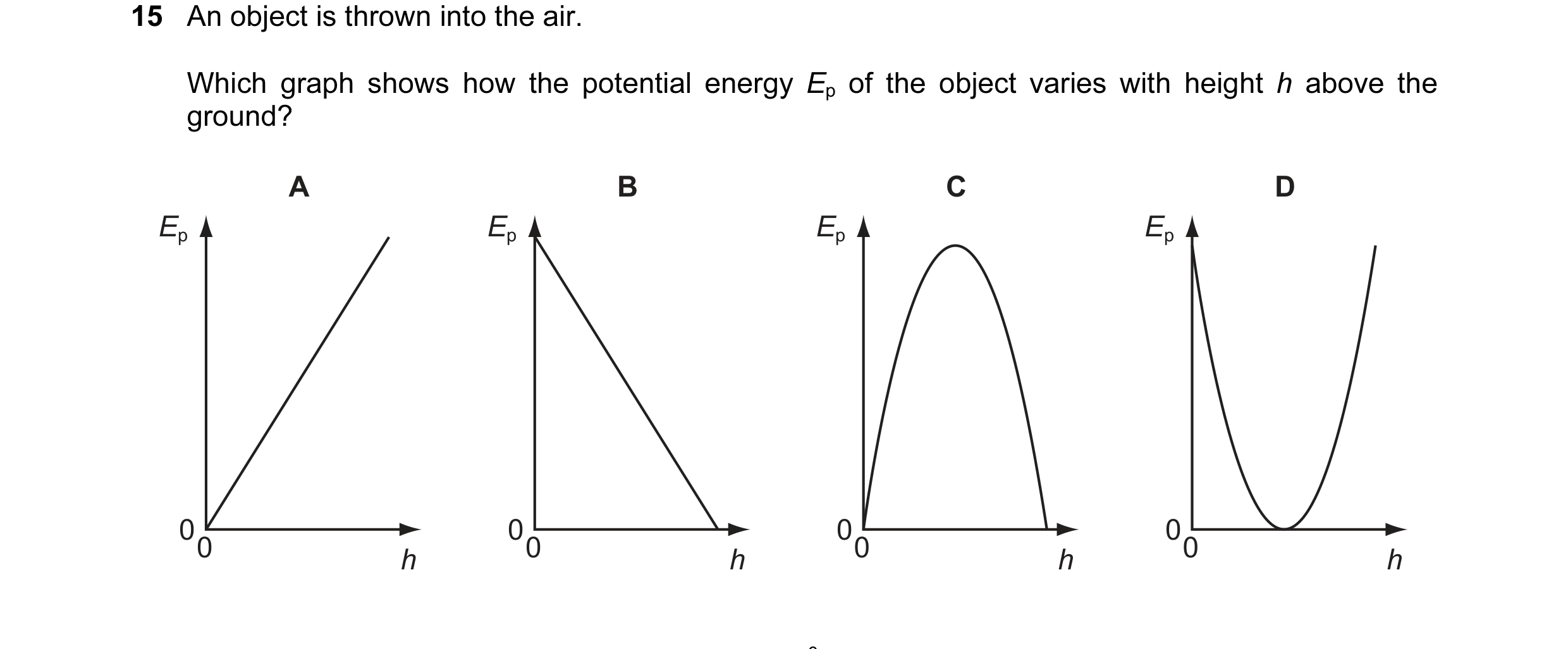
 1 / 50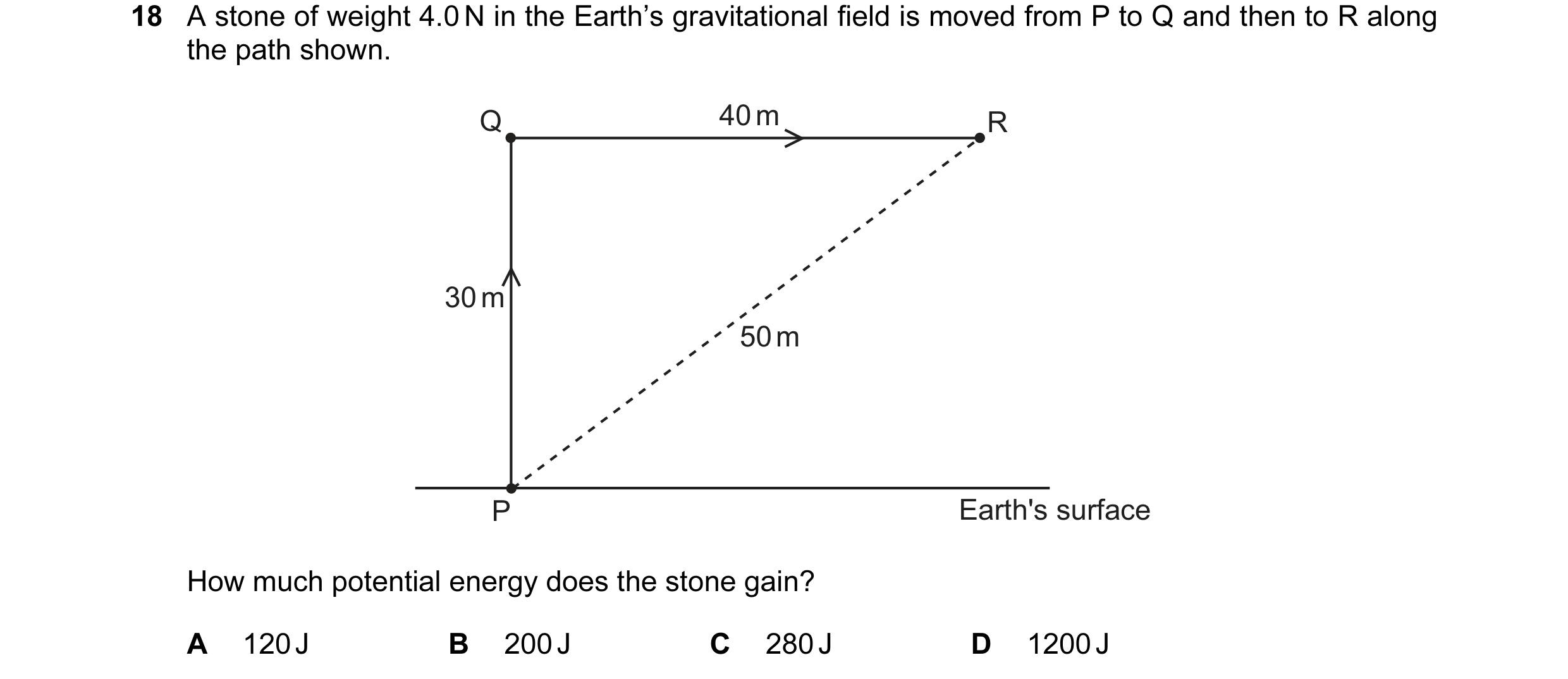

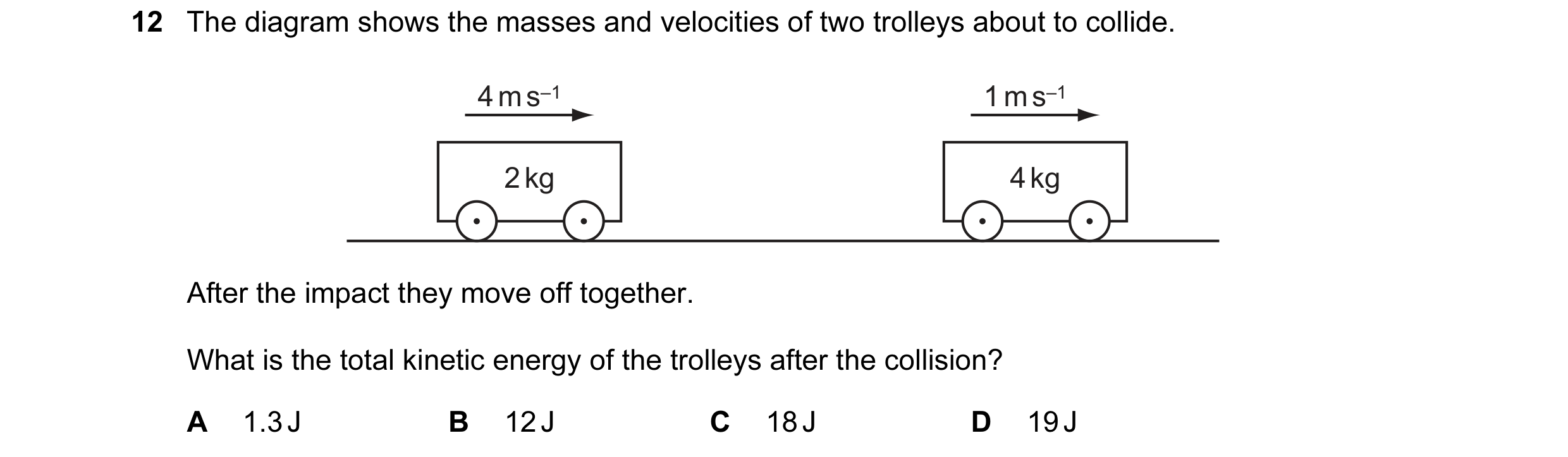
 2 / 50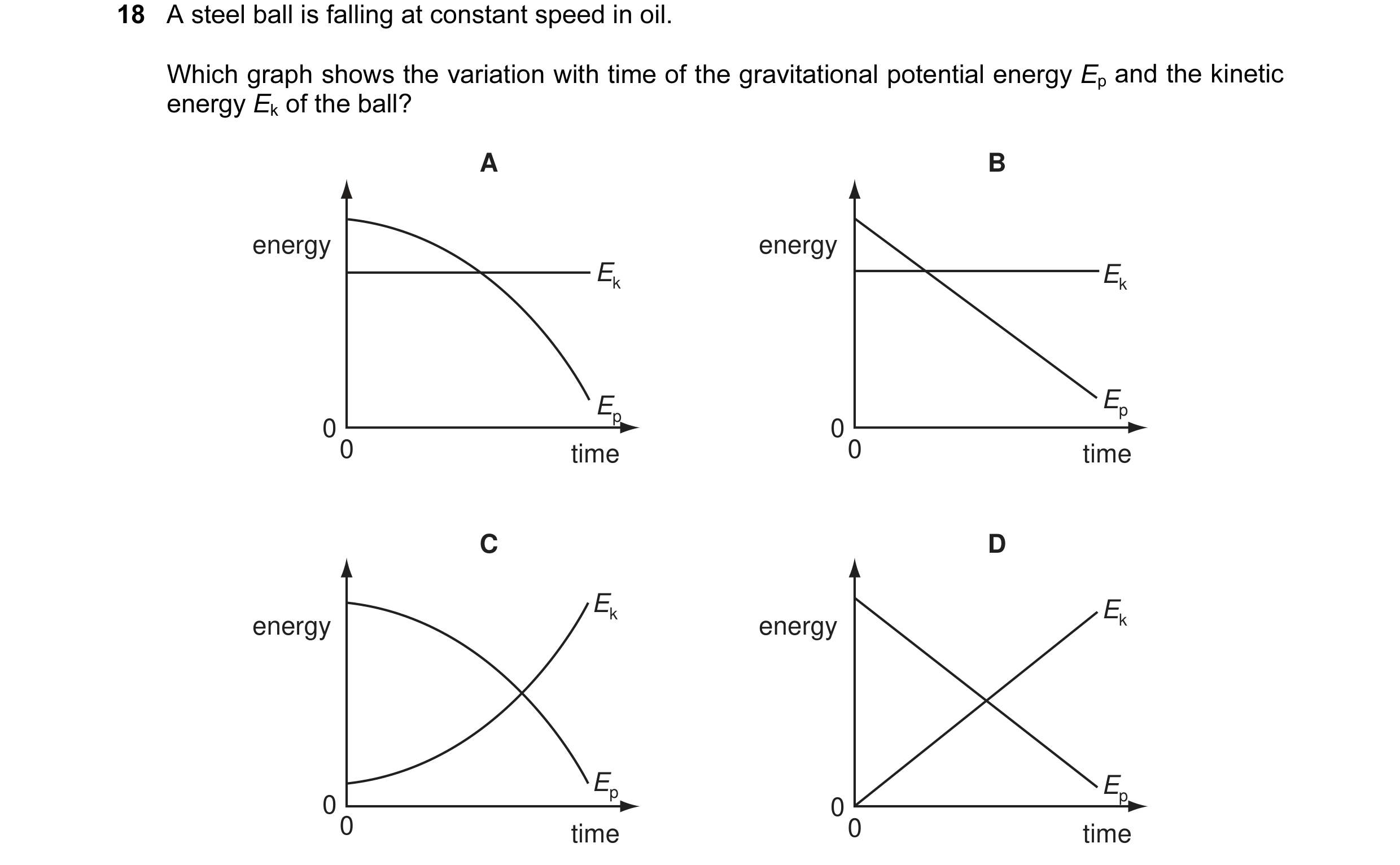
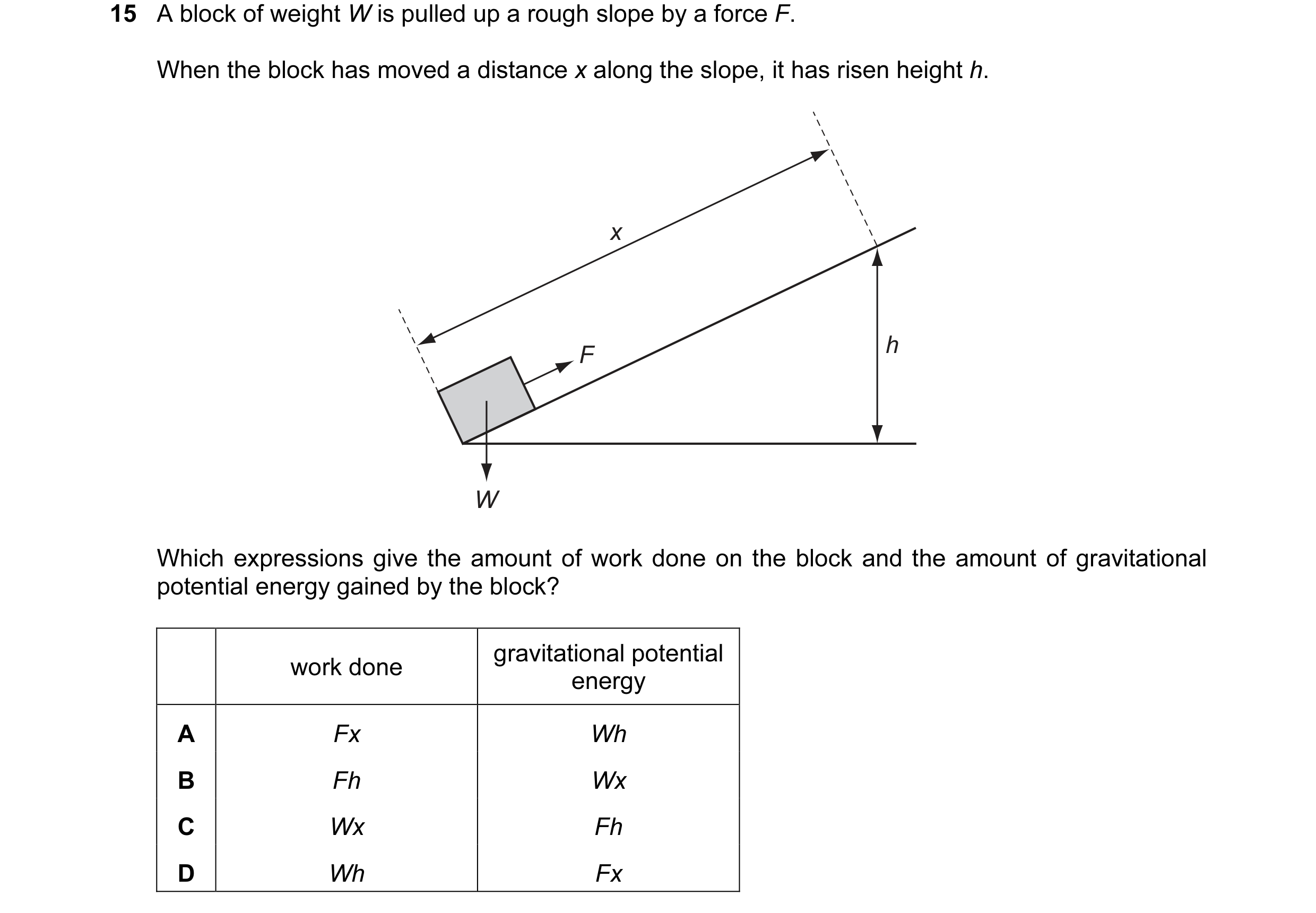 3 / 50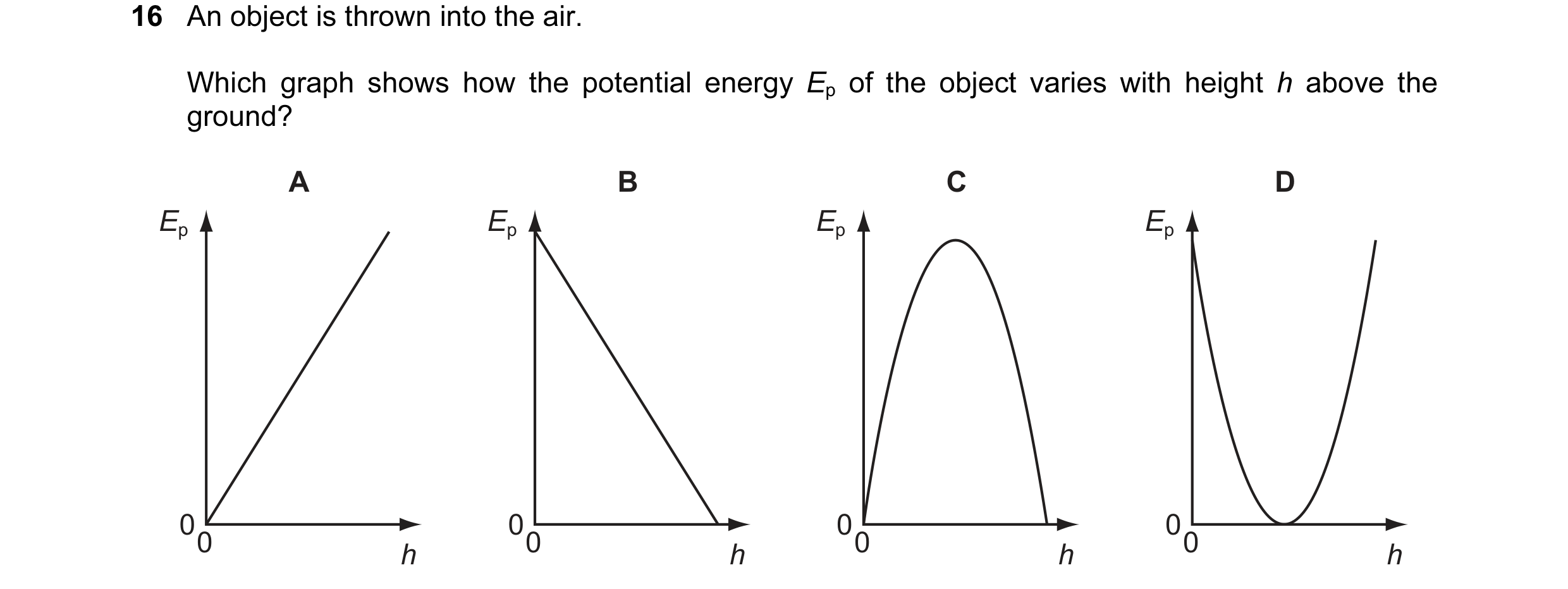
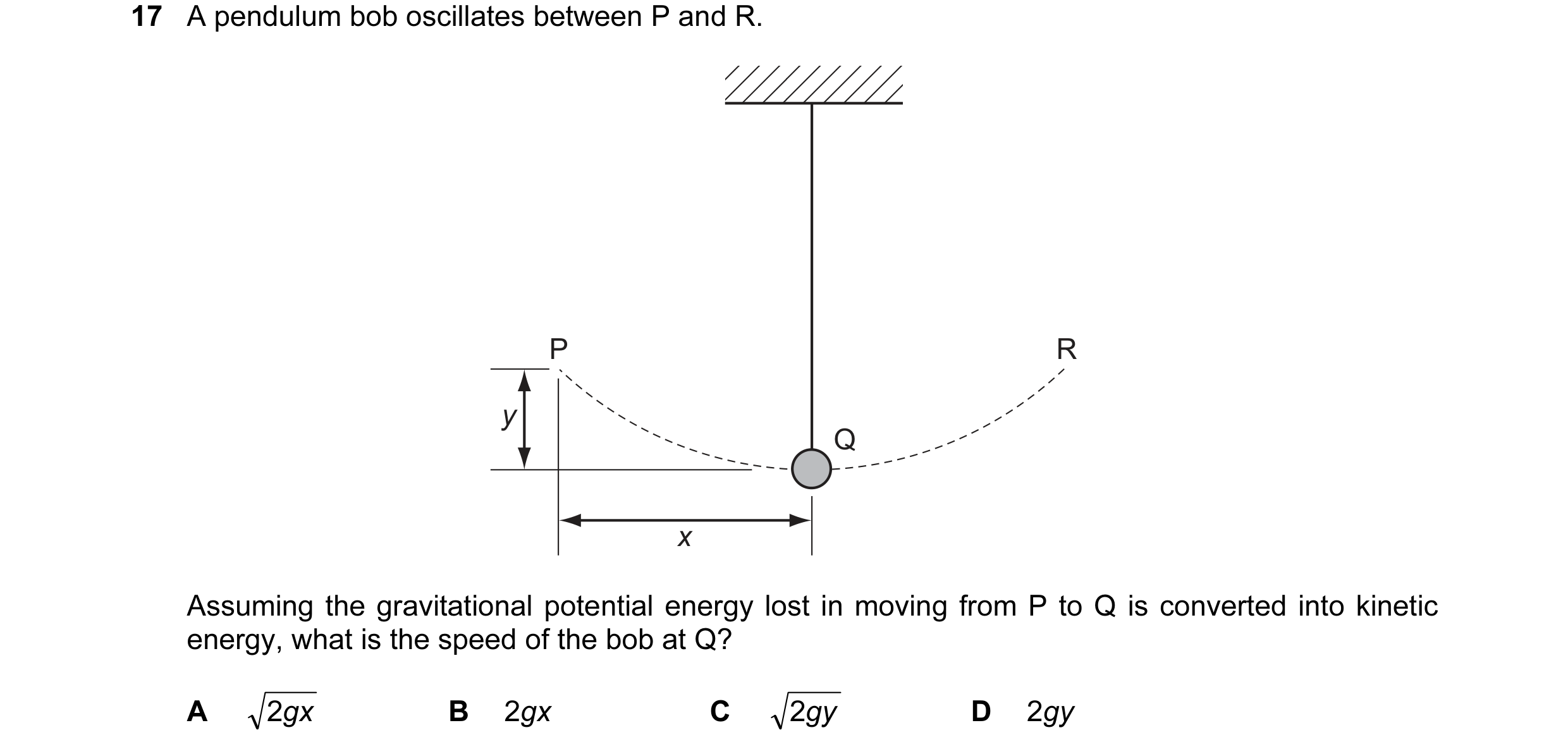
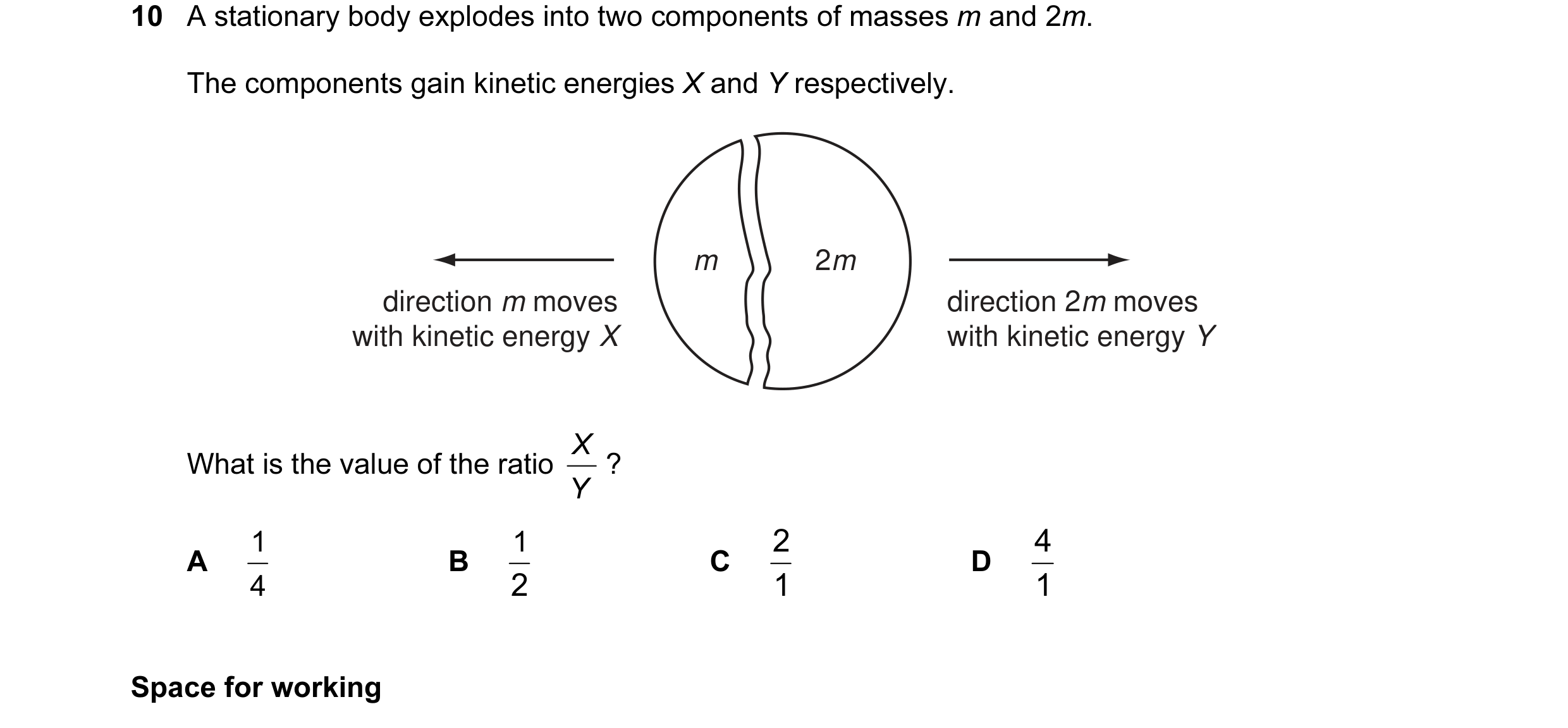 4 / 50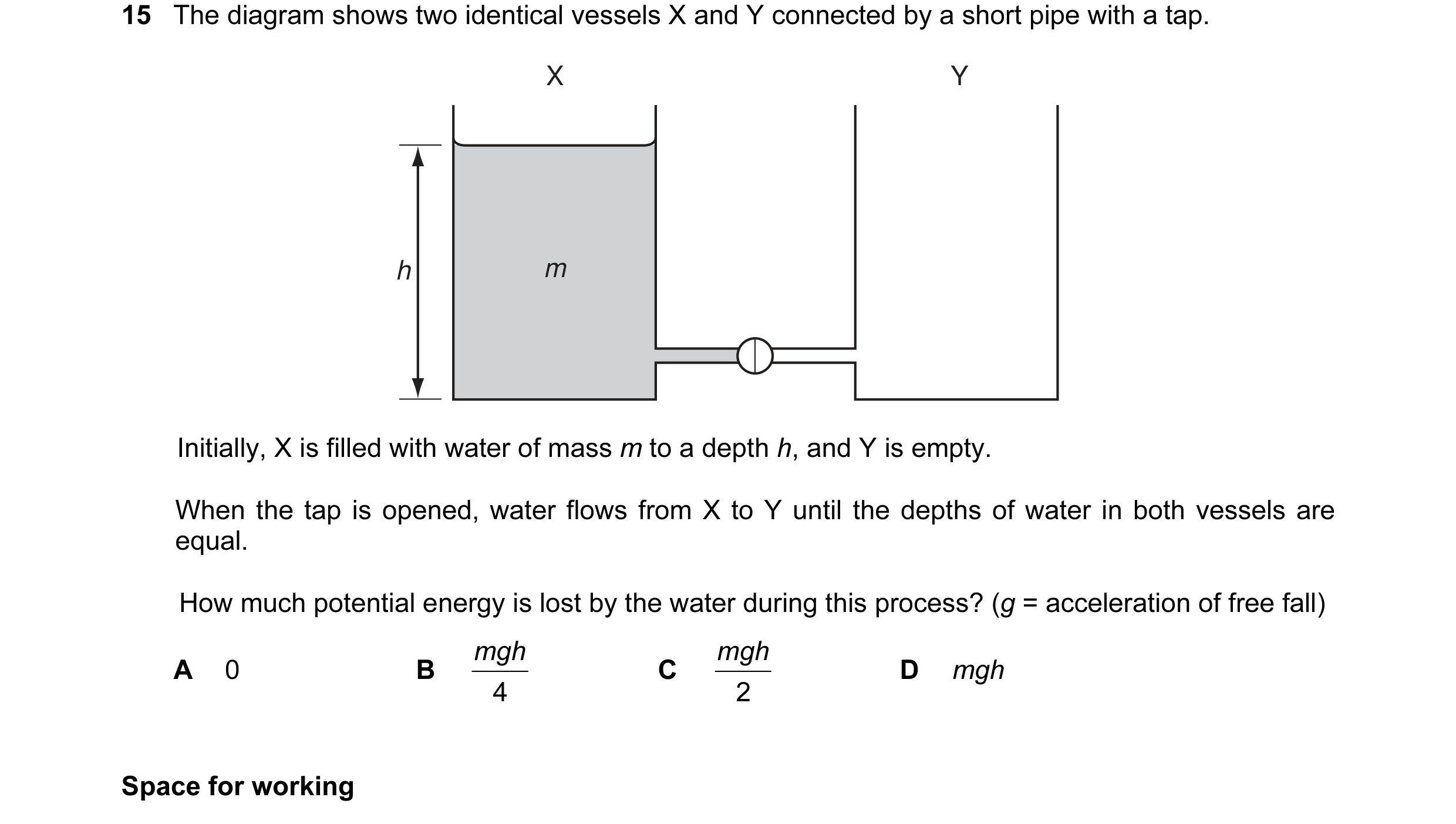
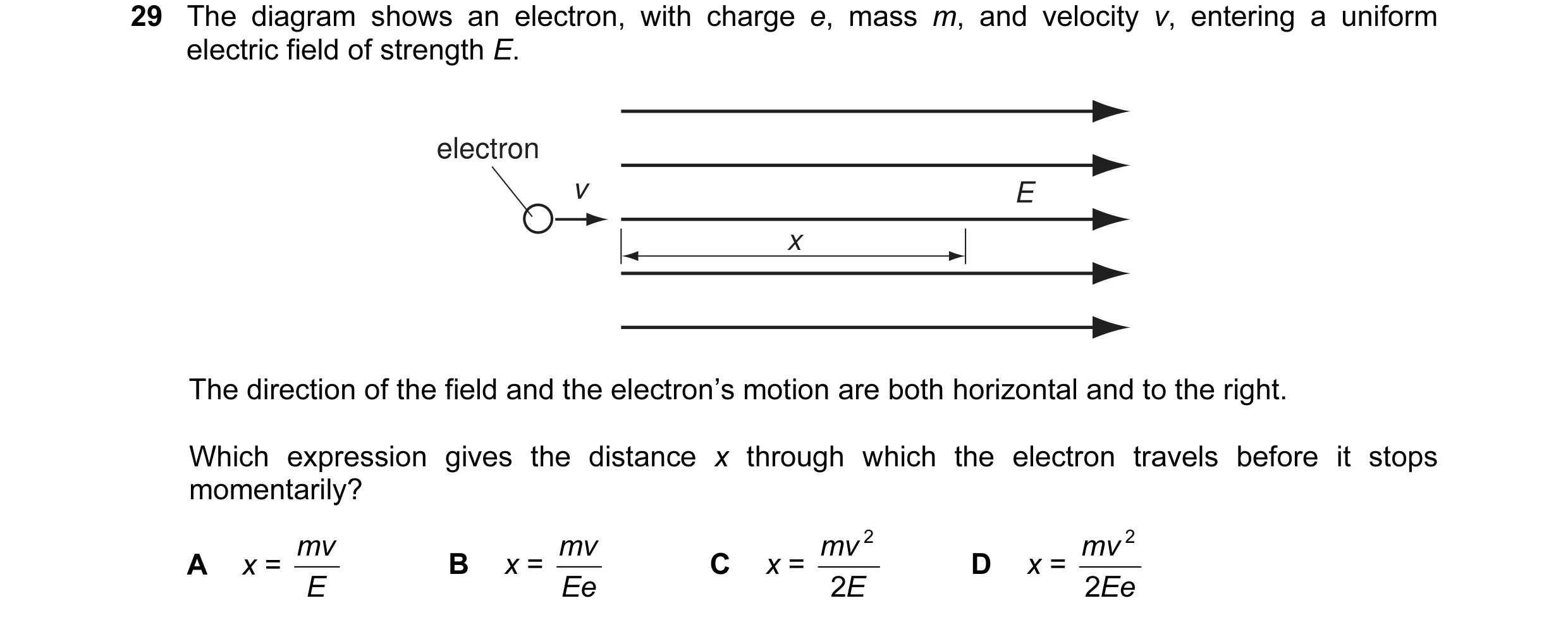 5 / 50
 6 / 50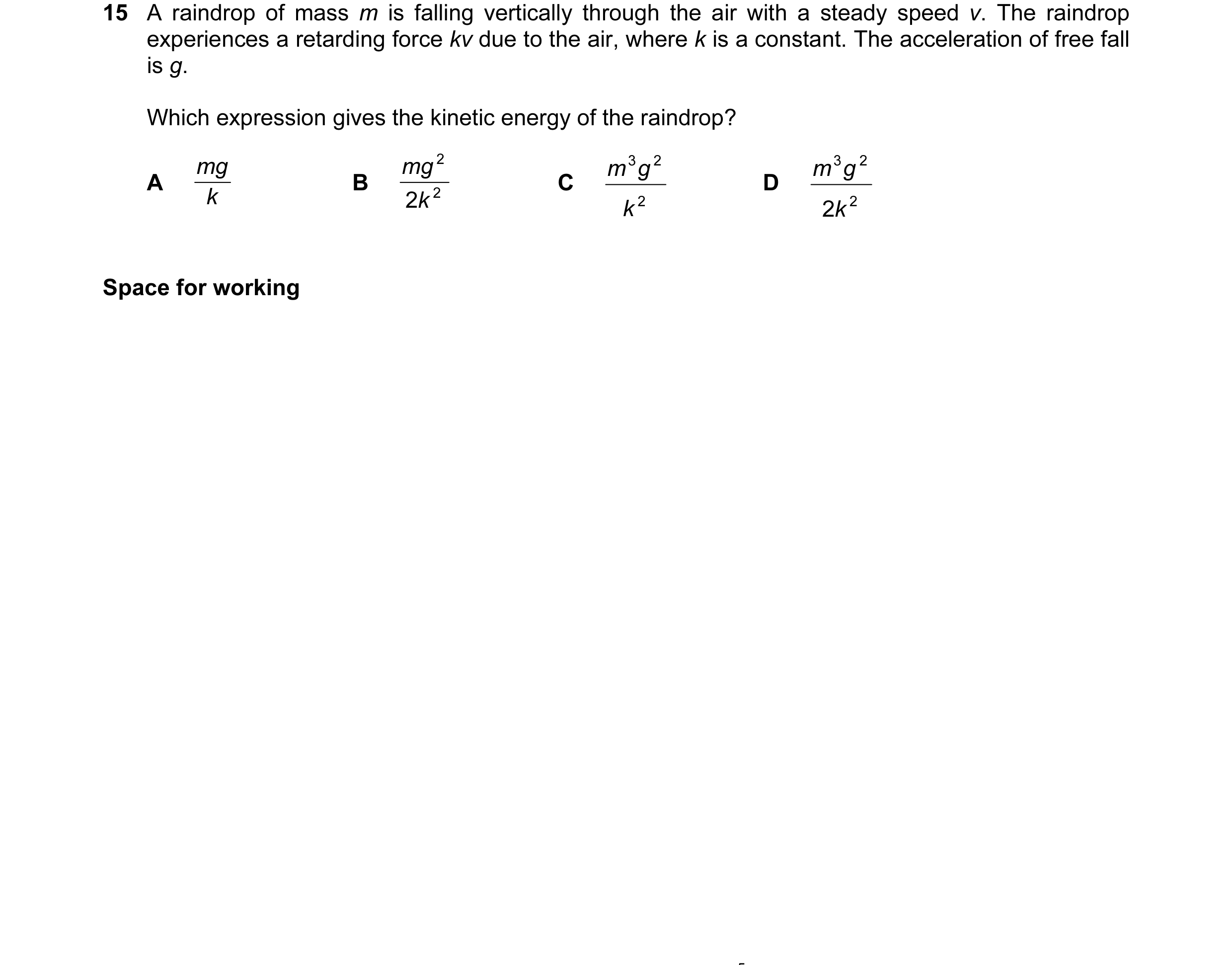
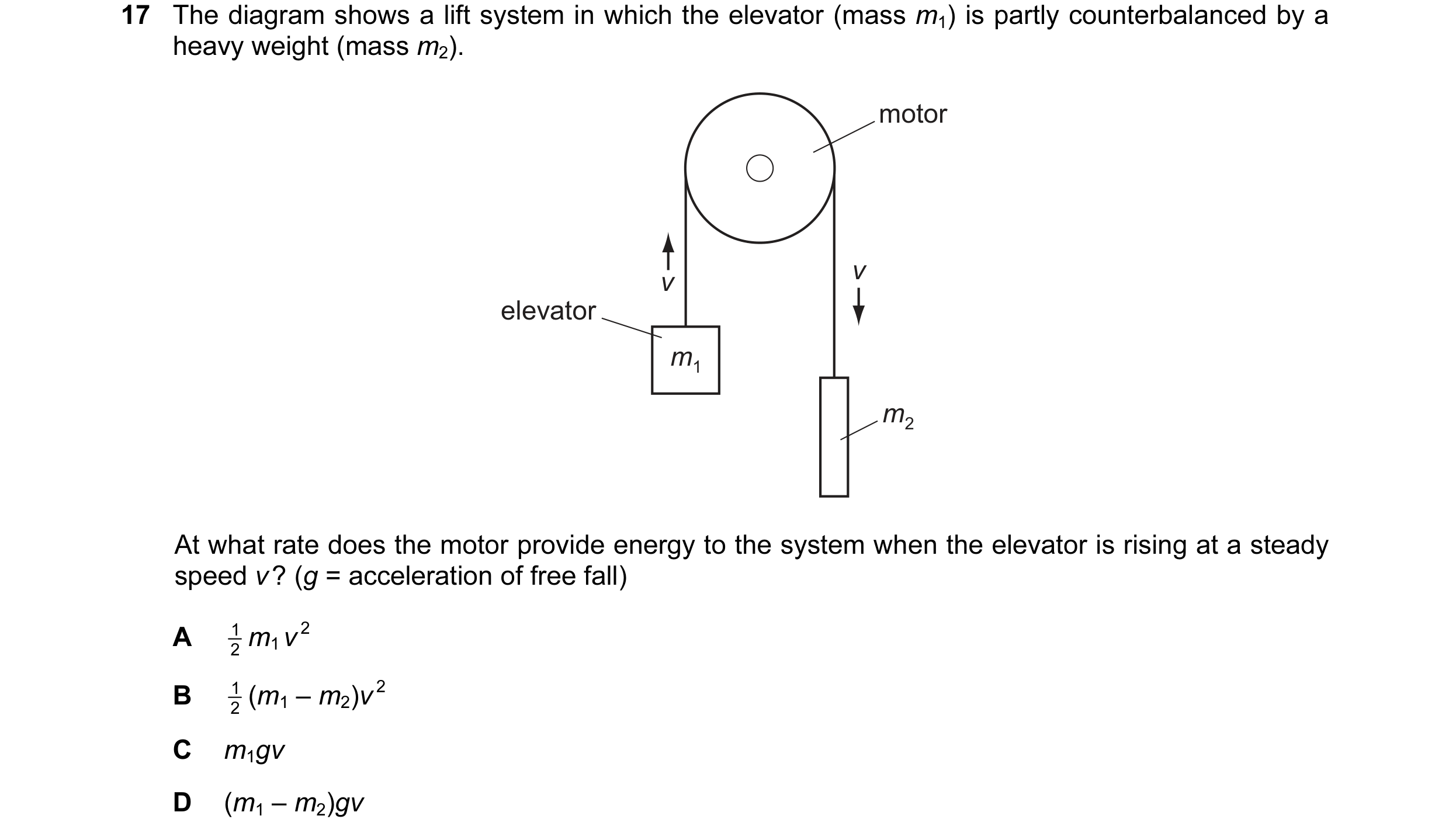 7 / 50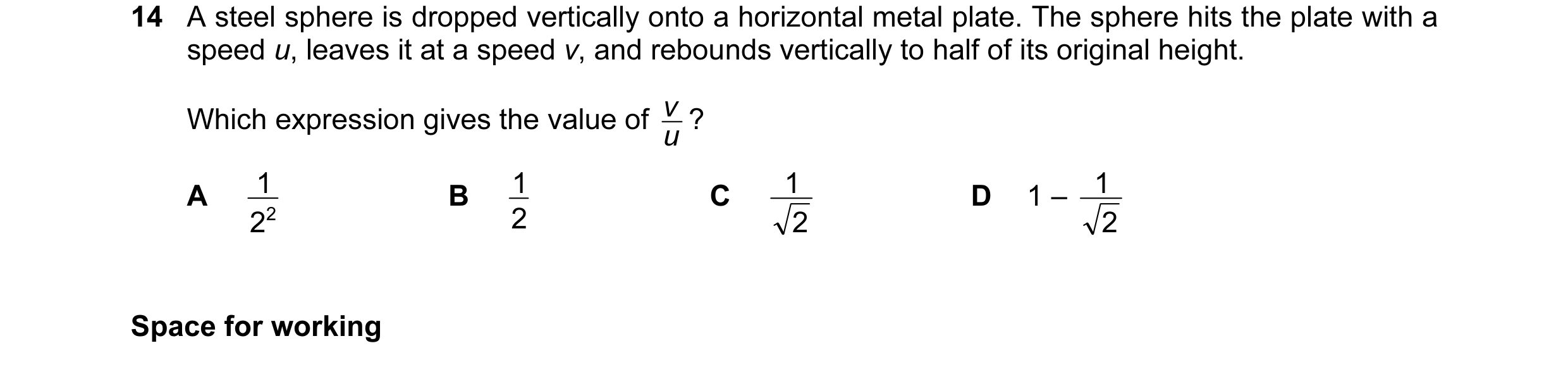
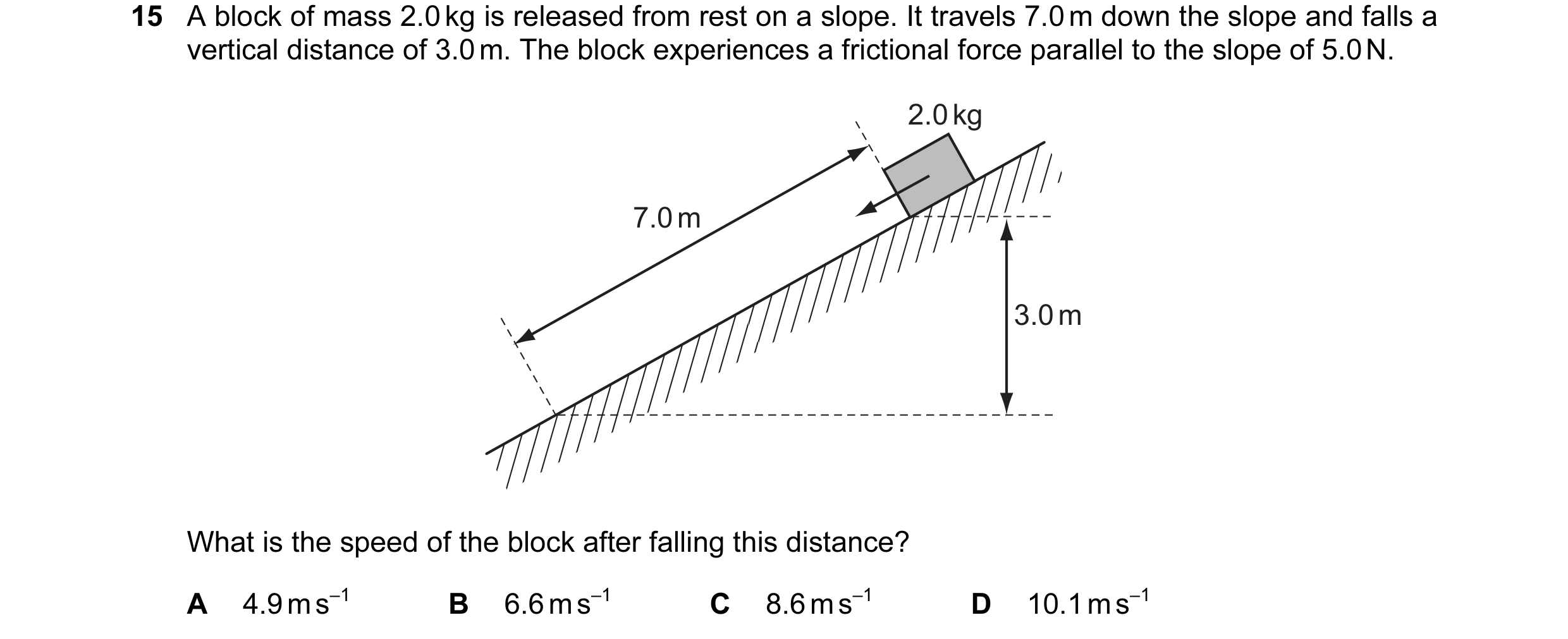

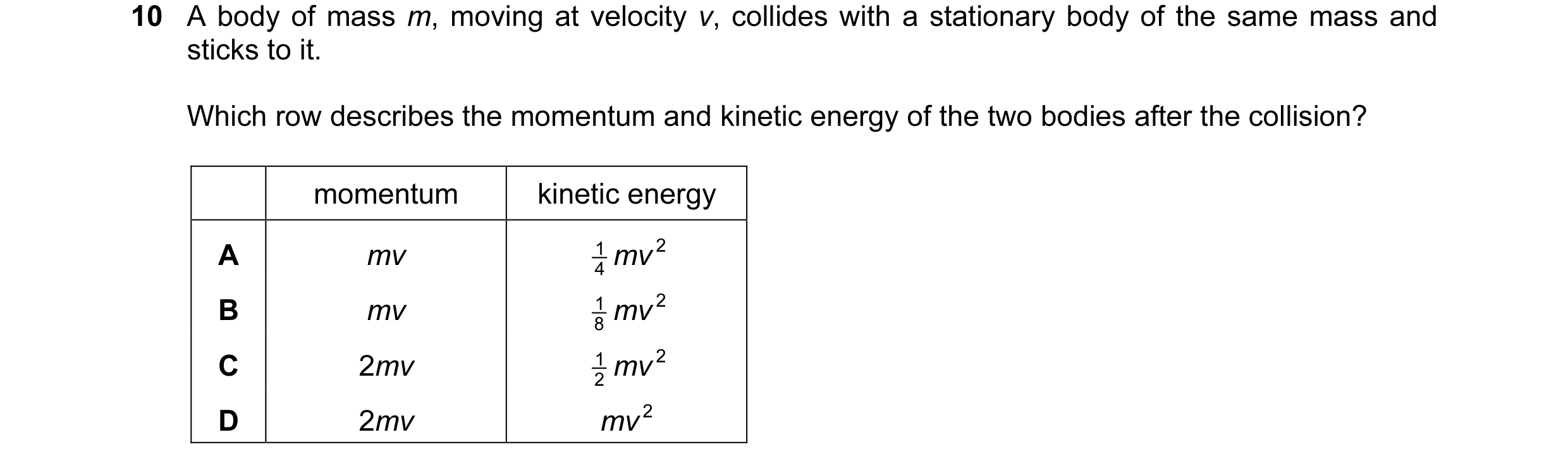
 8 / 50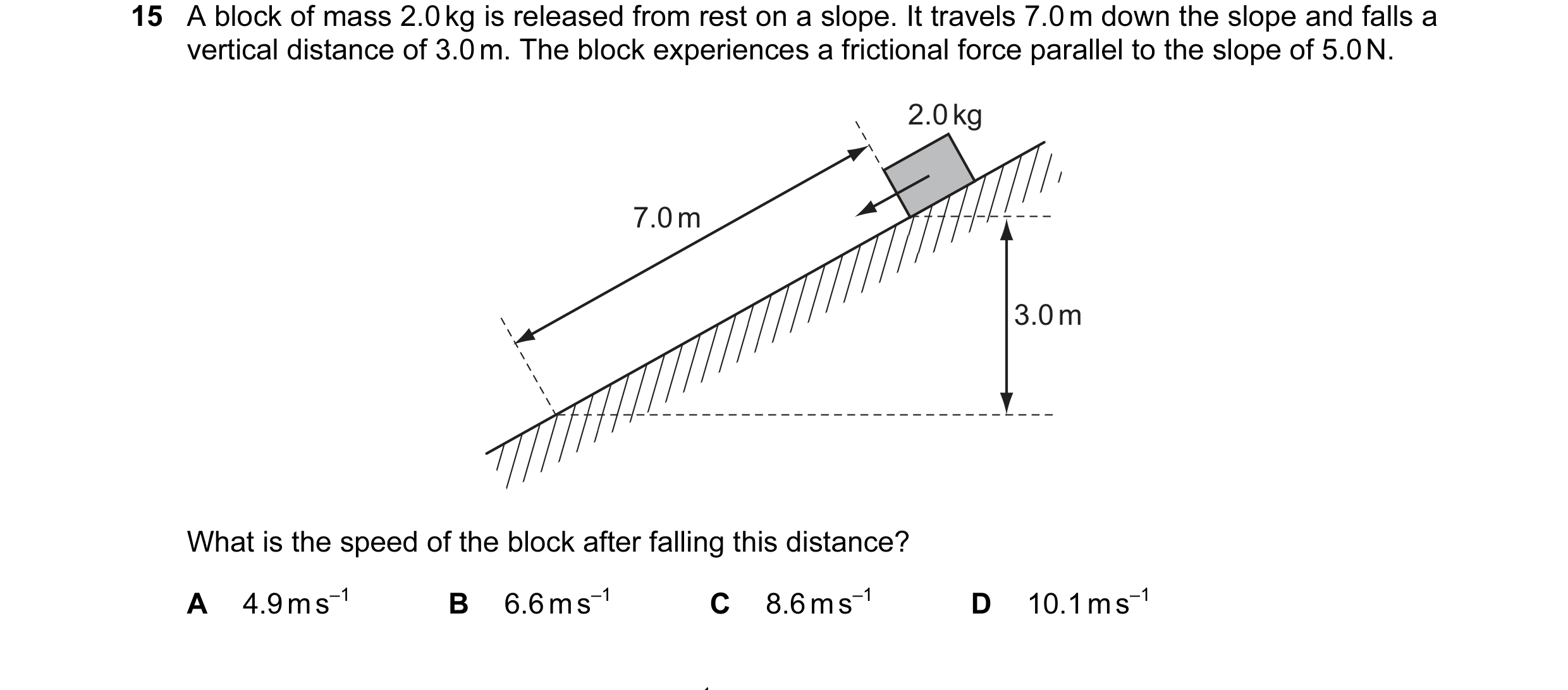


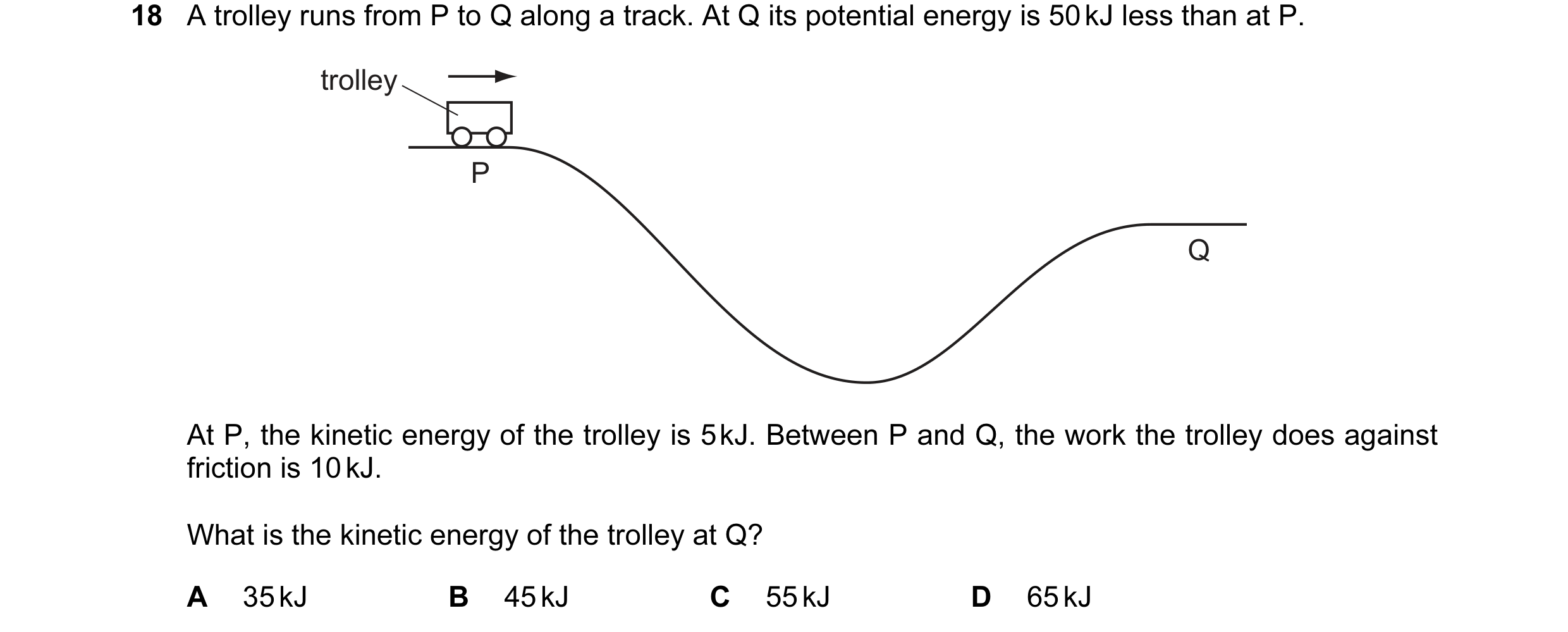 9 / 50
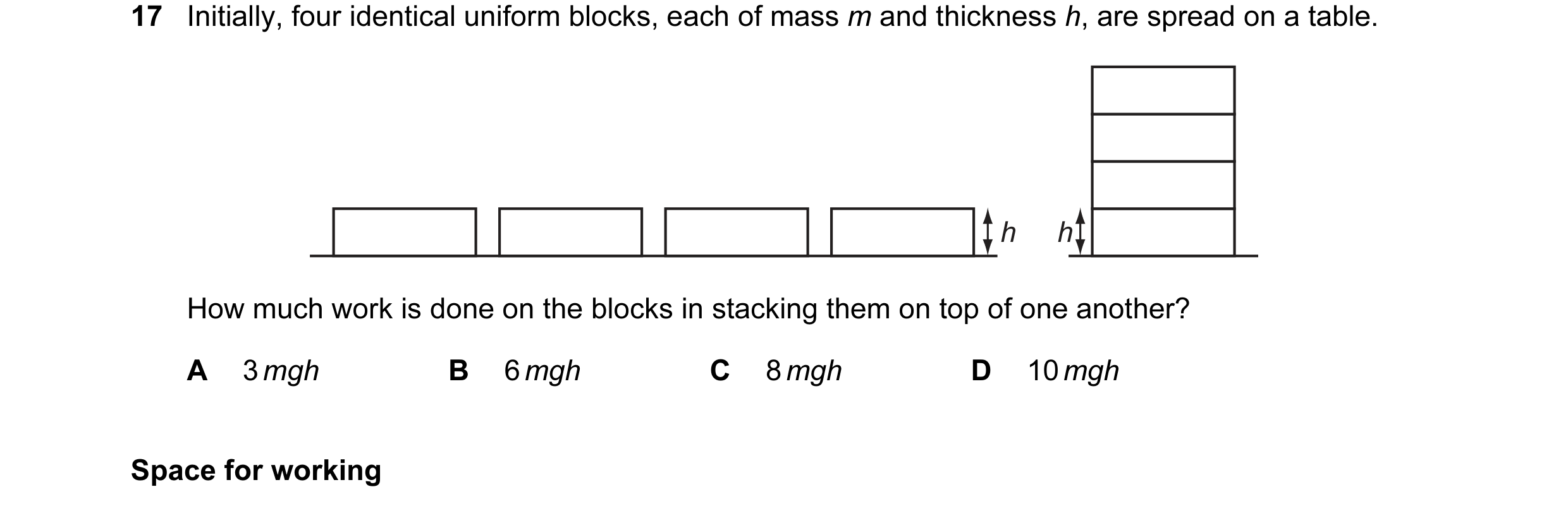
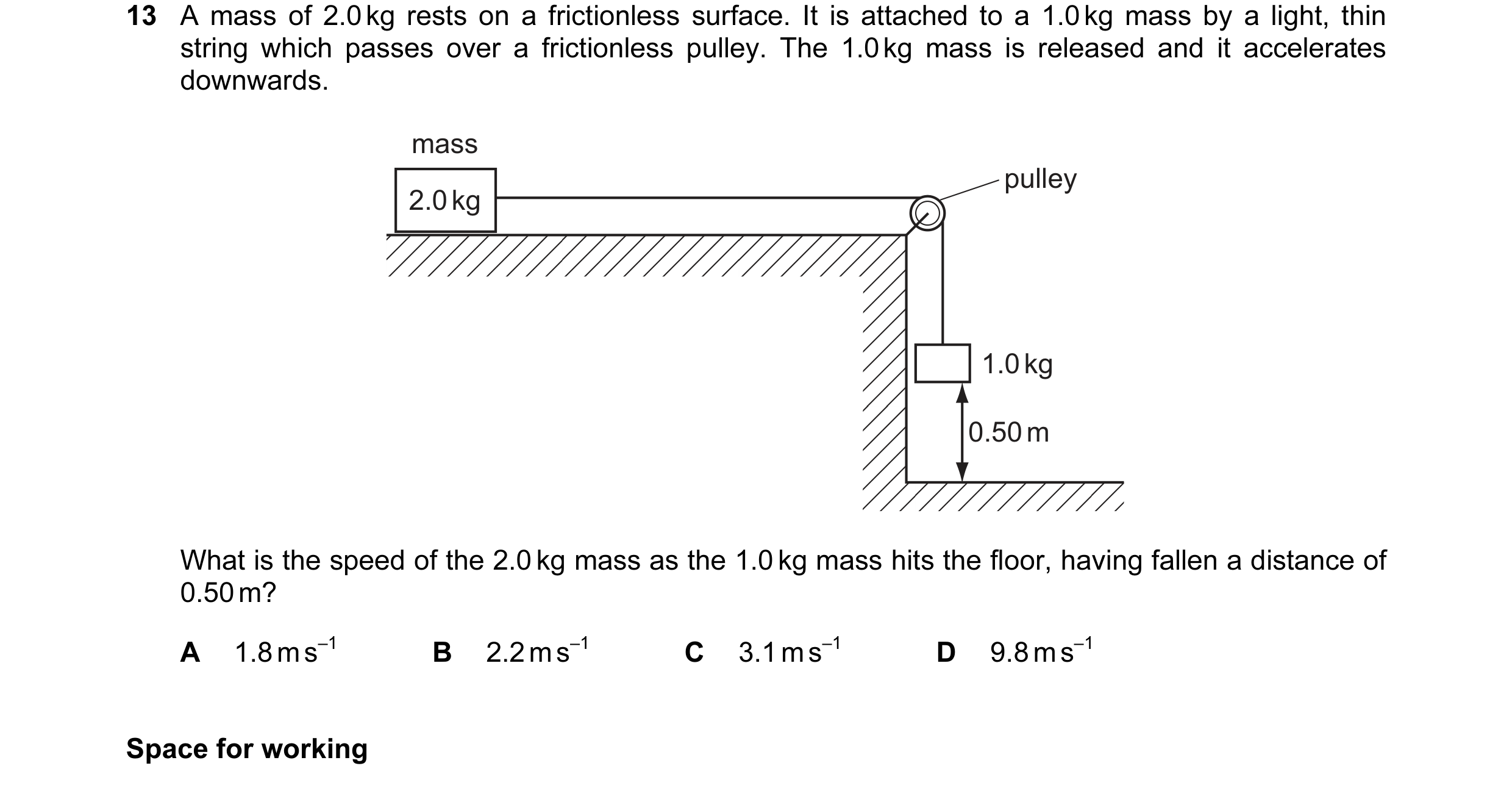 10 / 50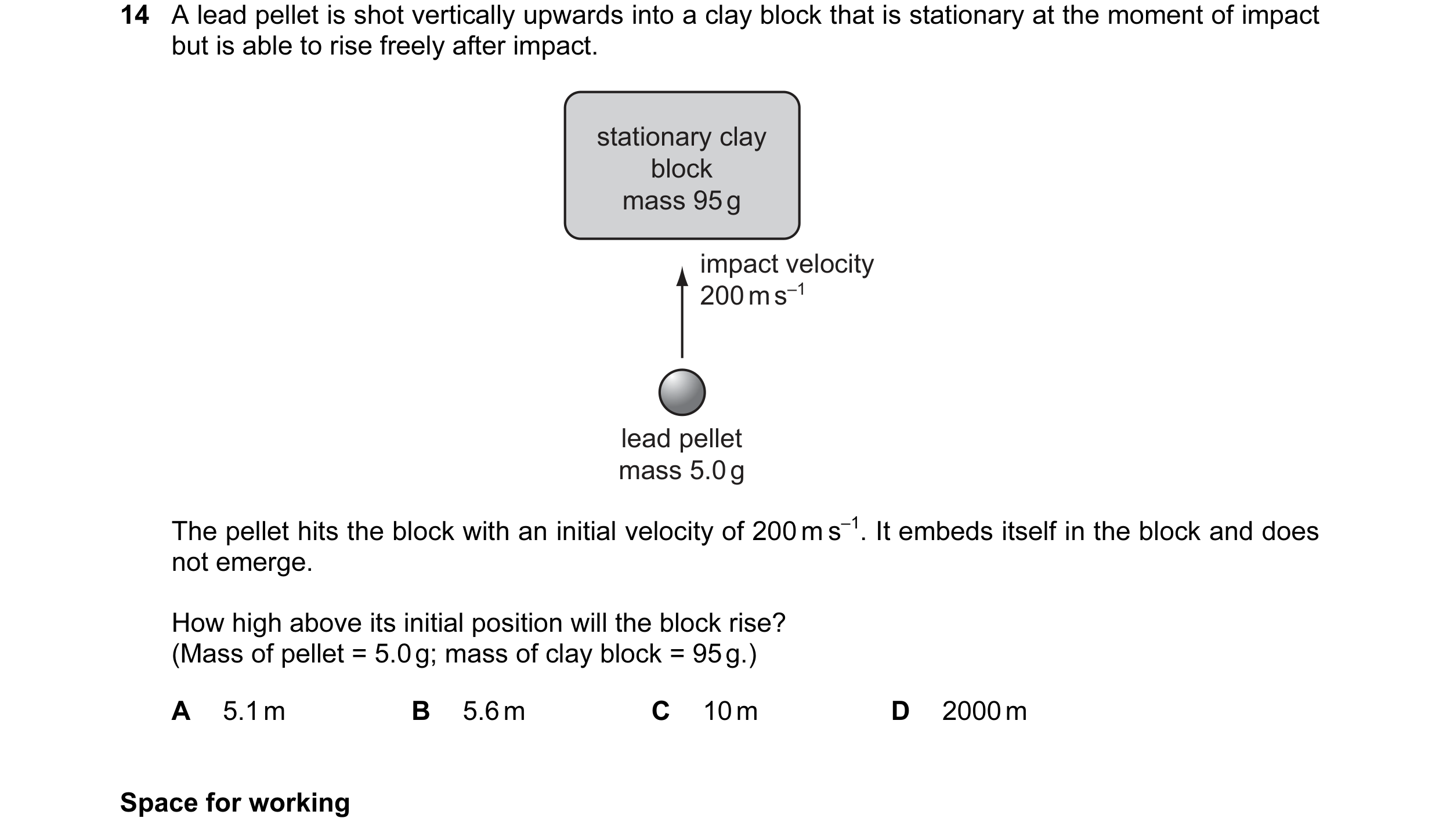



 11 / 50
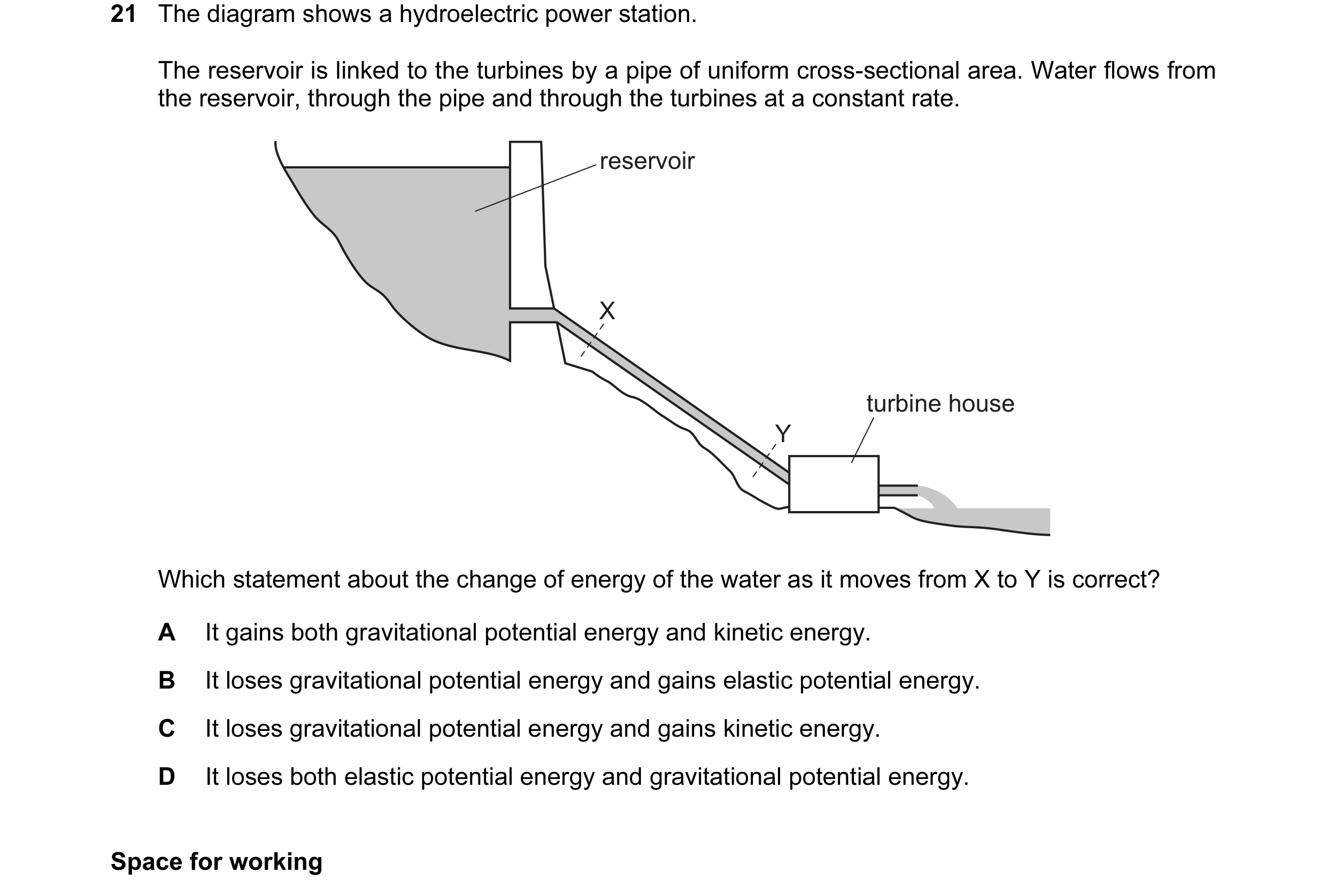 12 / 50
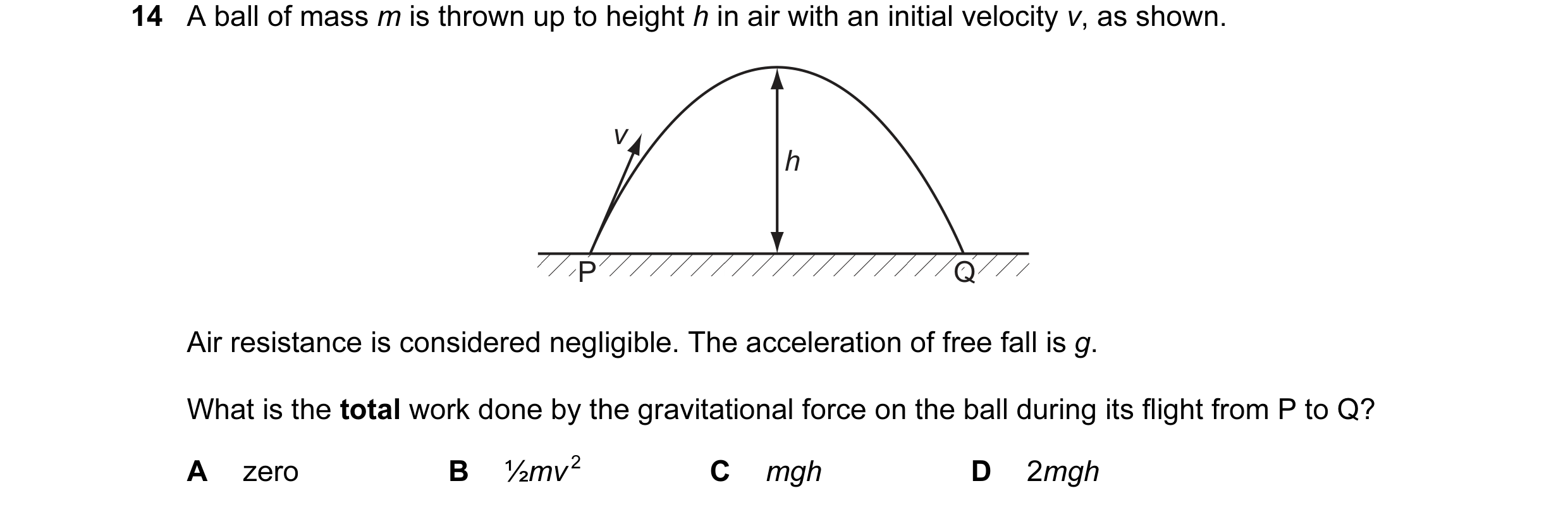
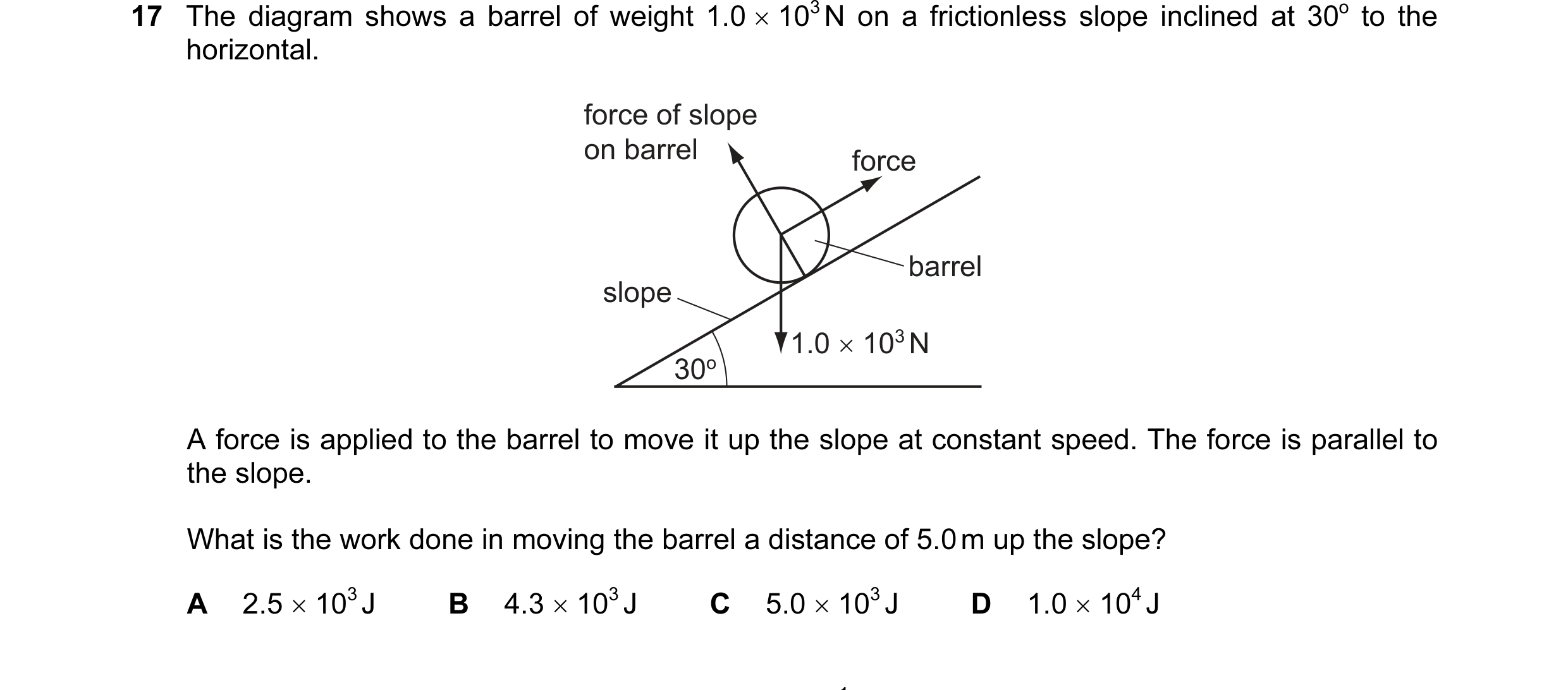 13 / 50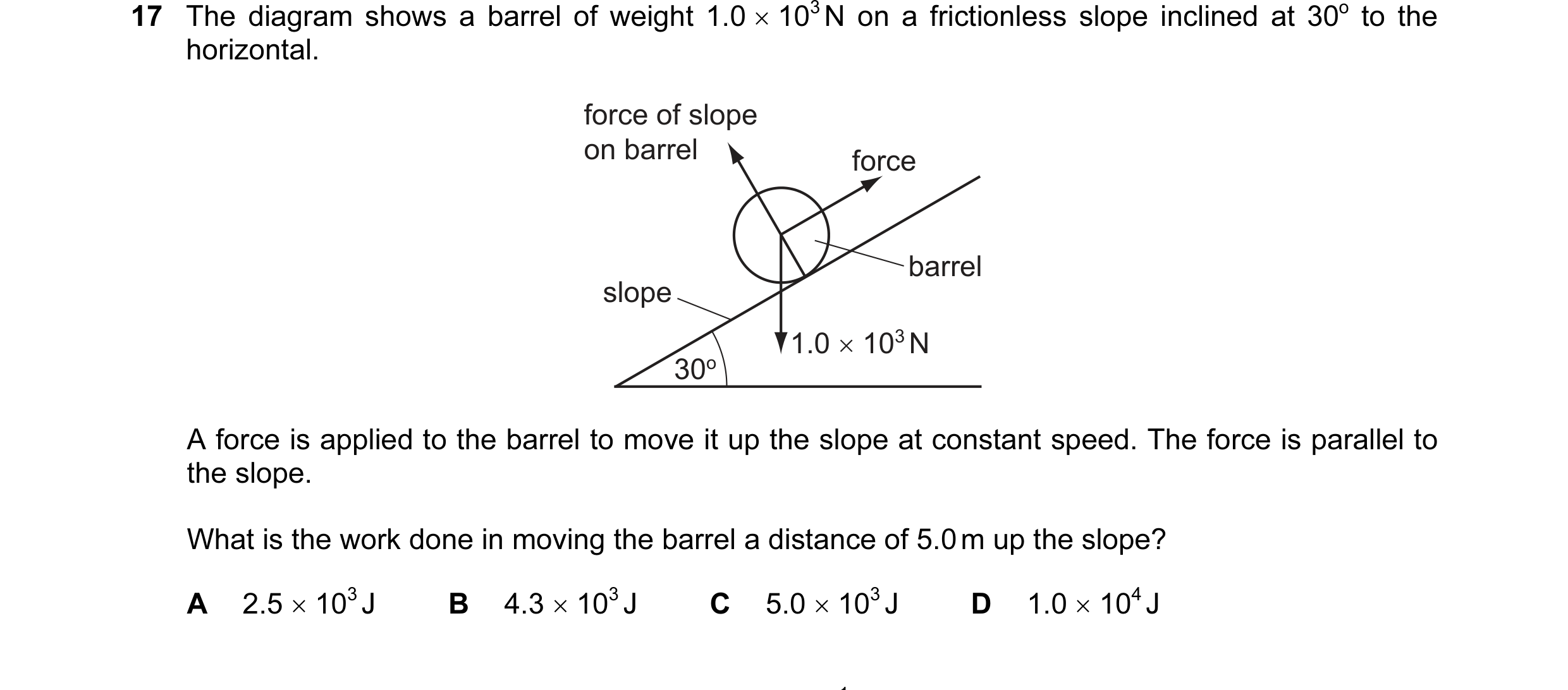

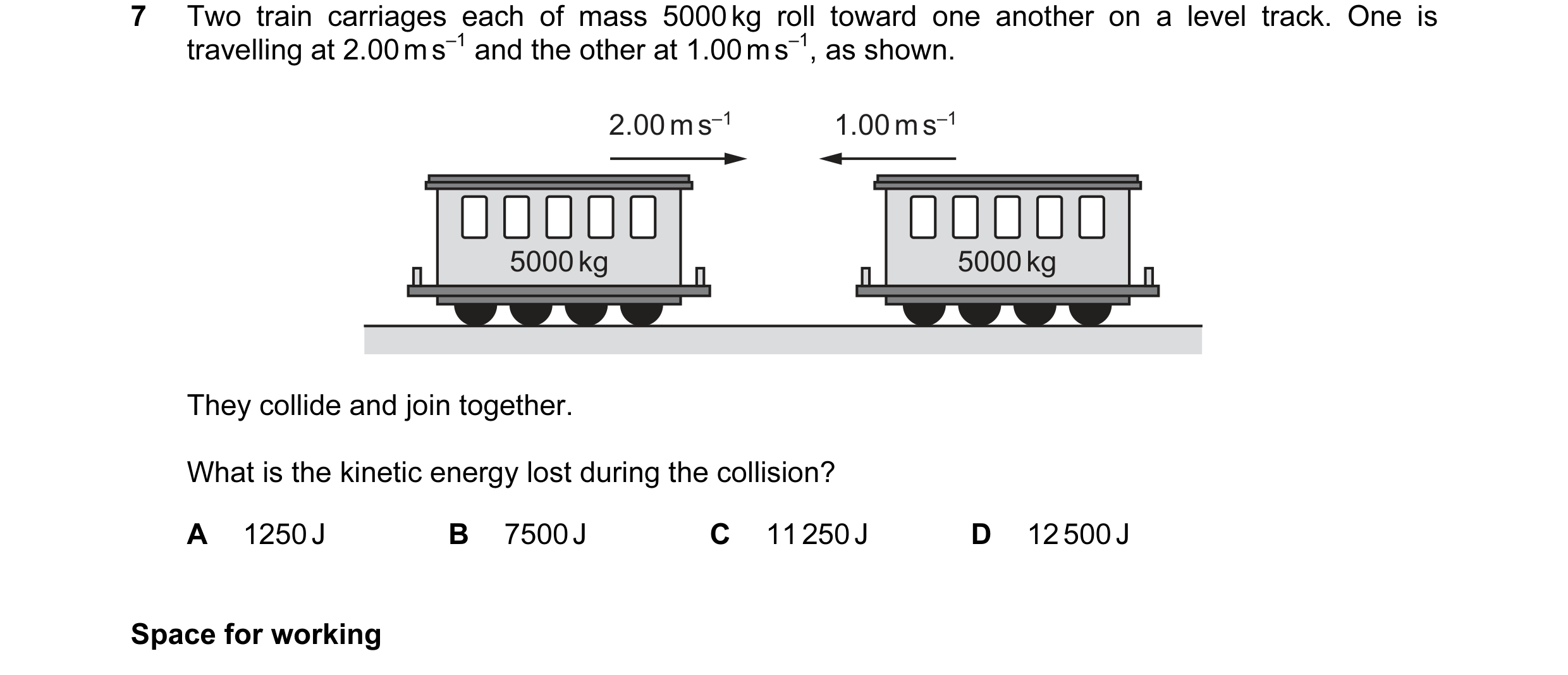 14 / 50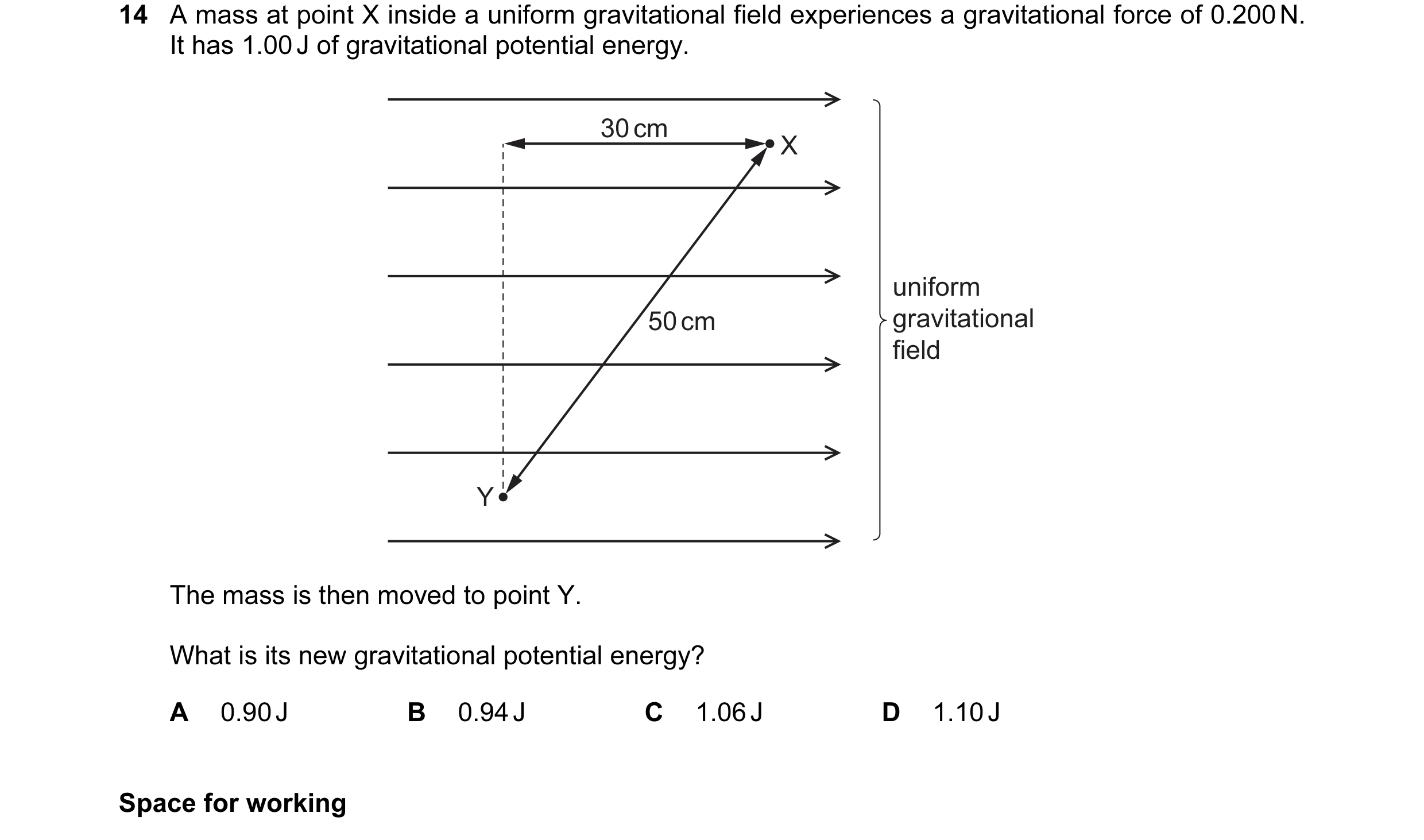
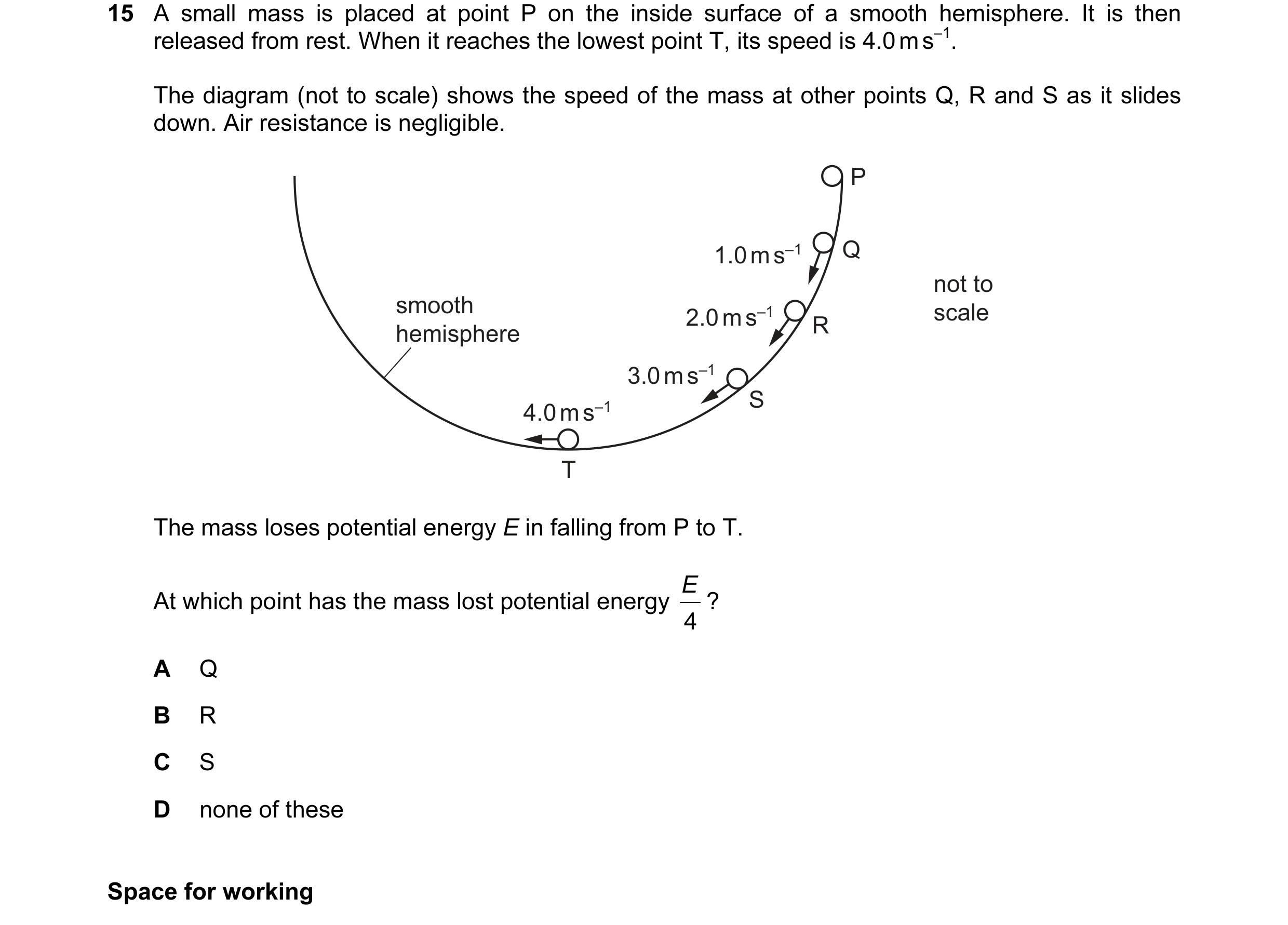 15 / 50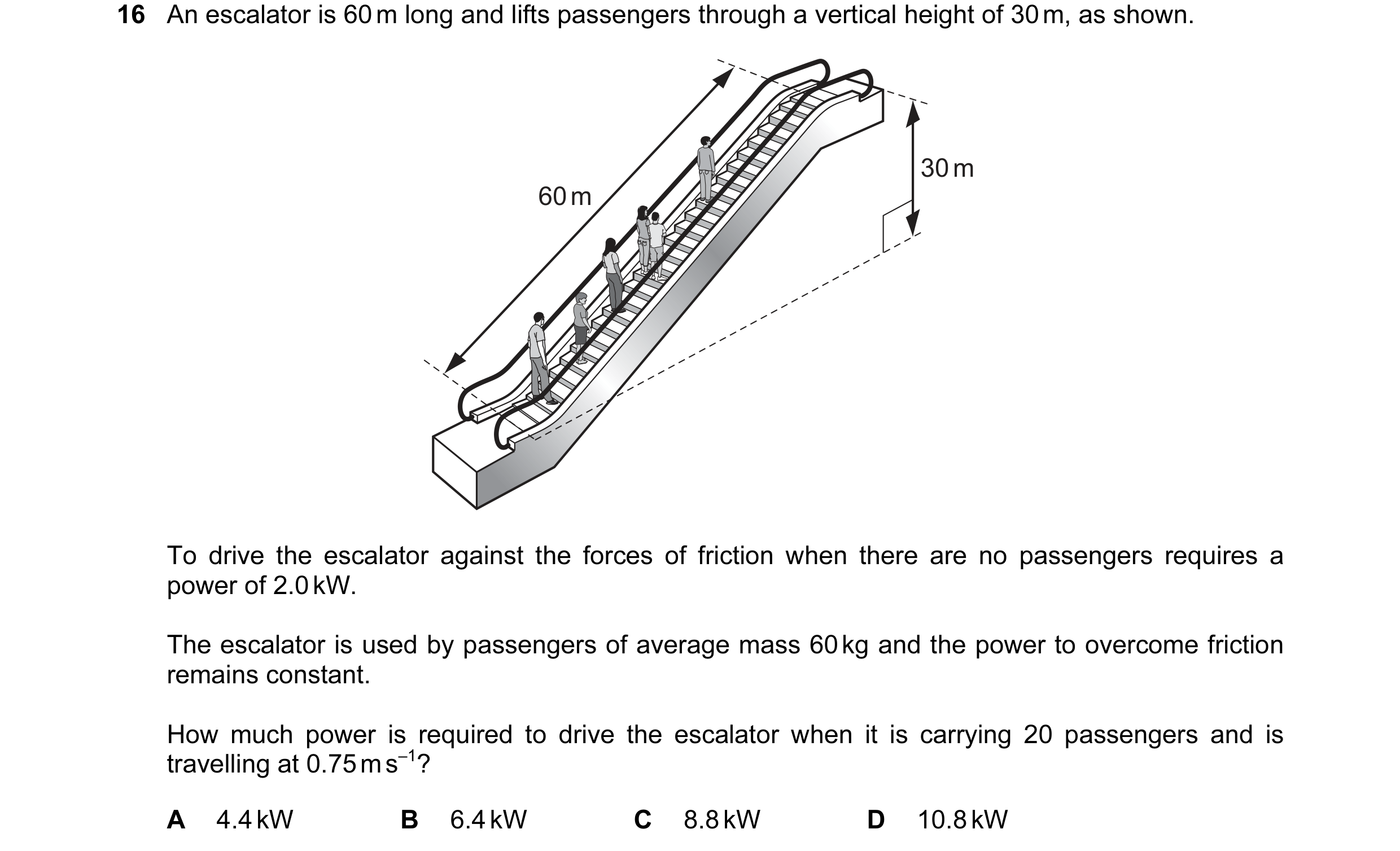
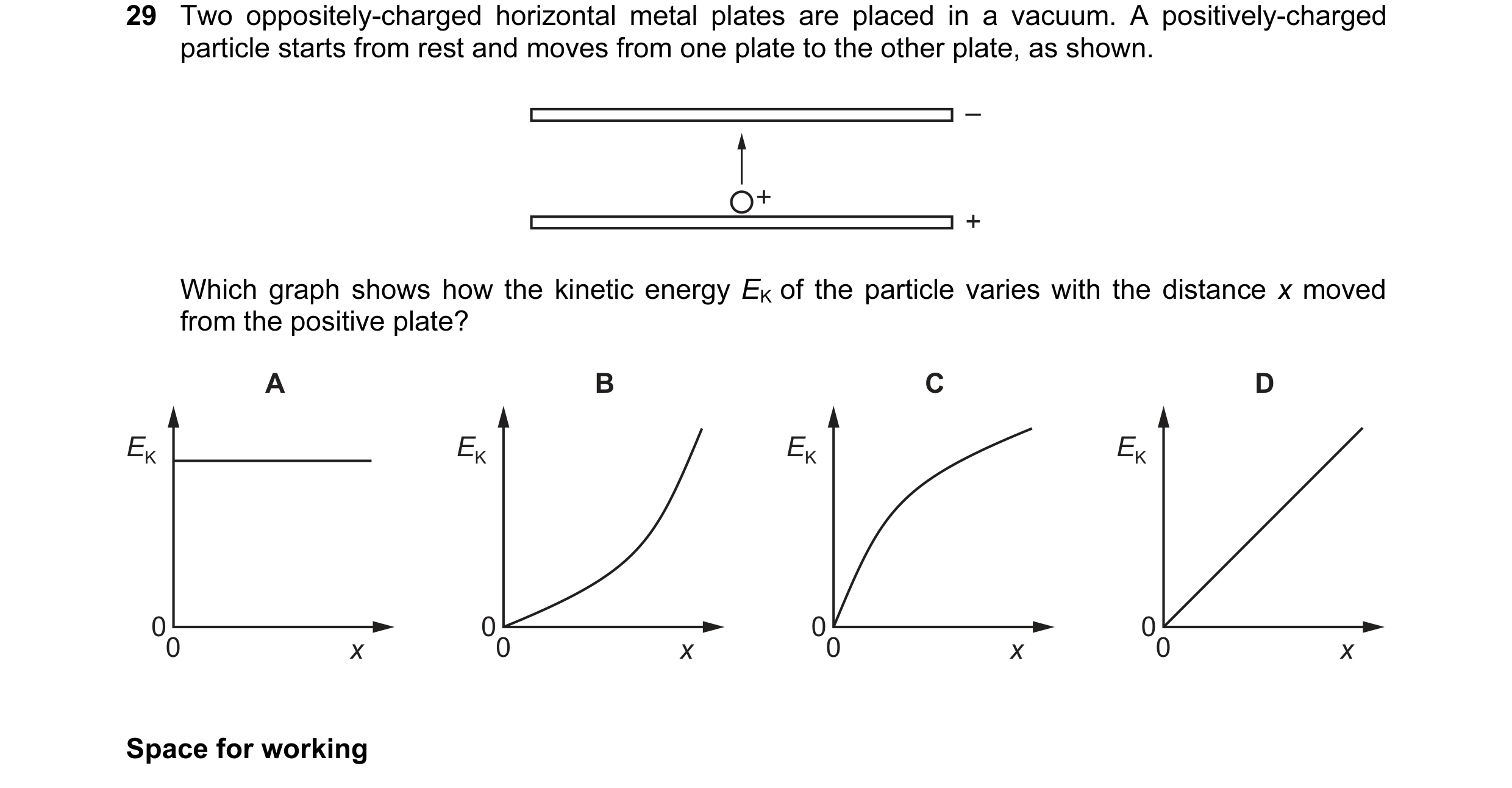 16 / 50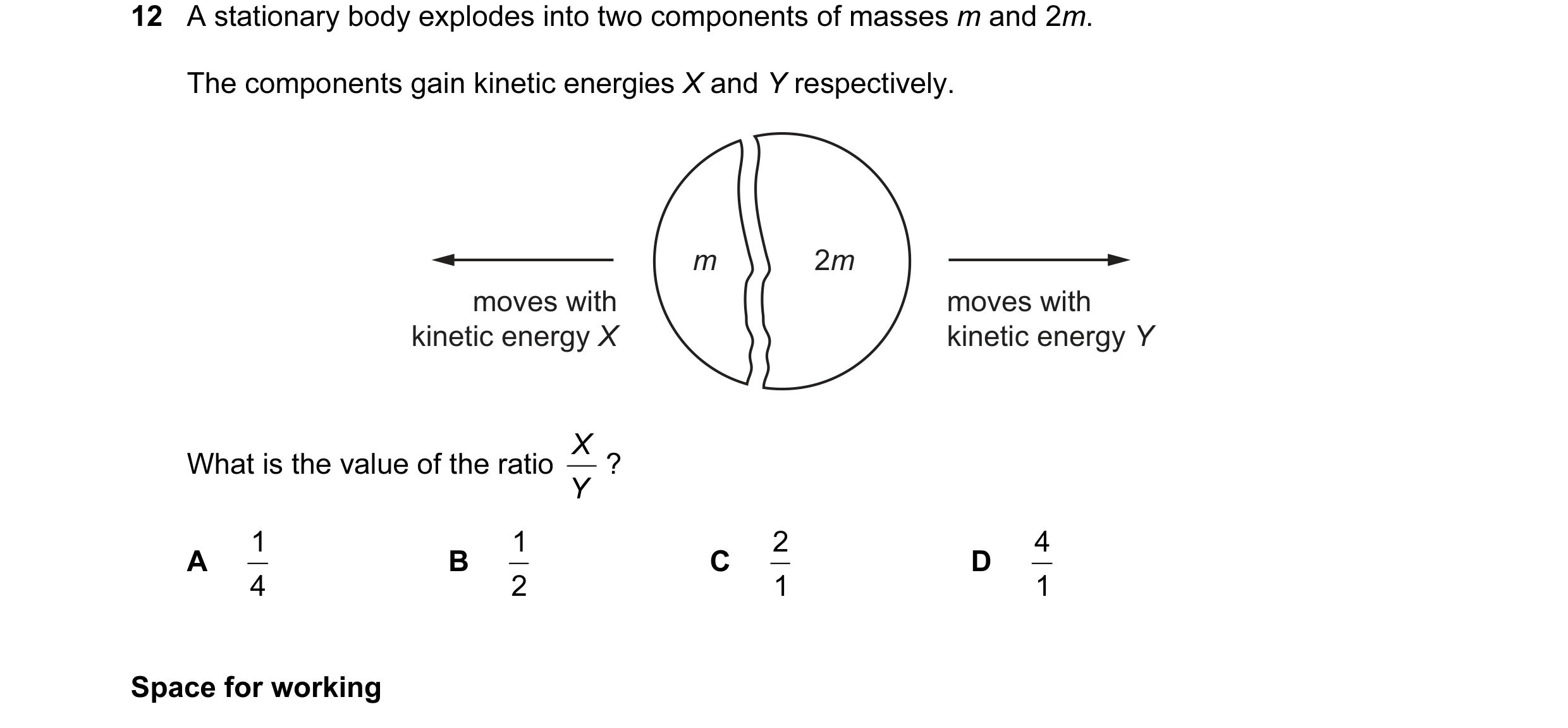
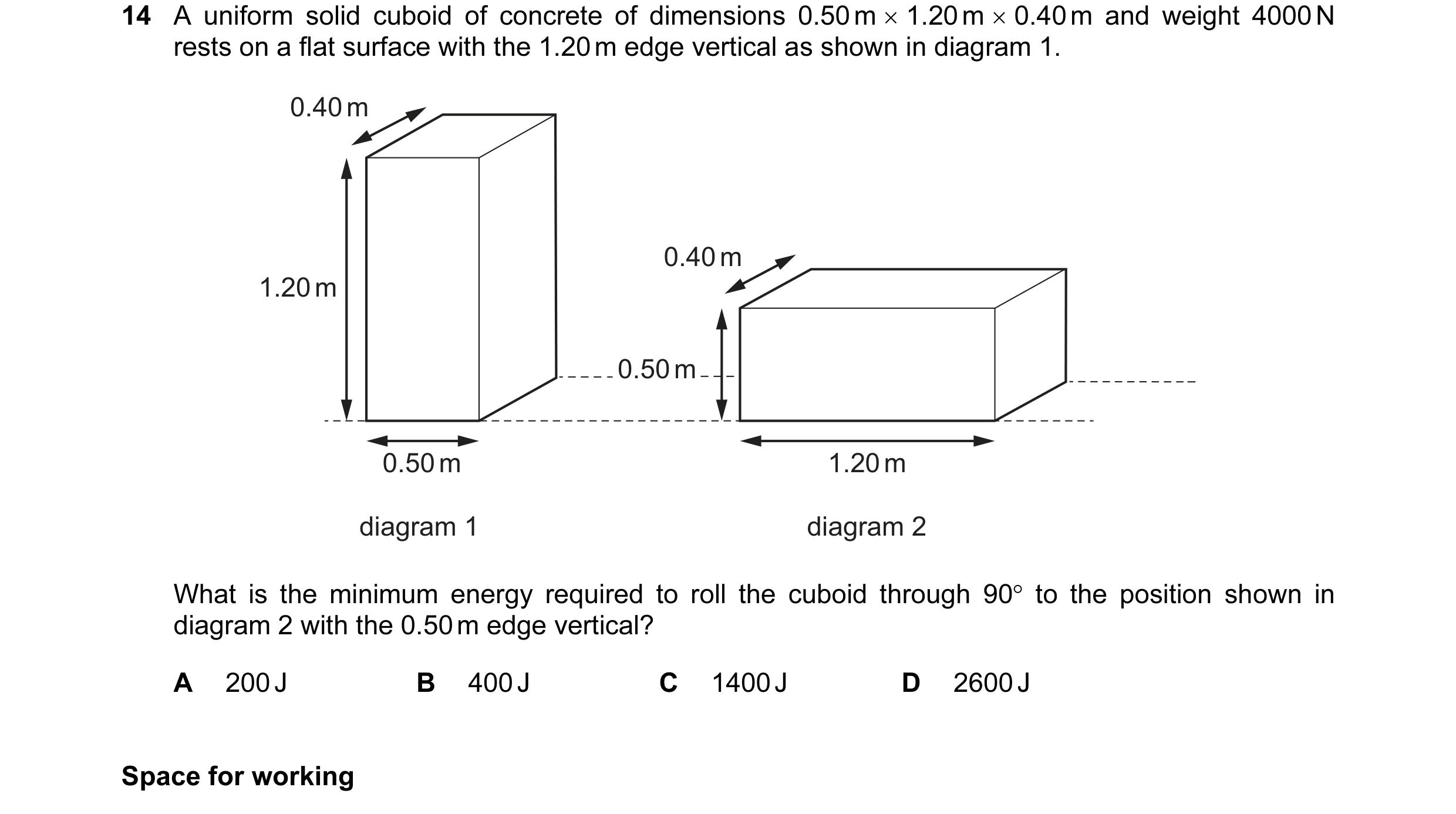
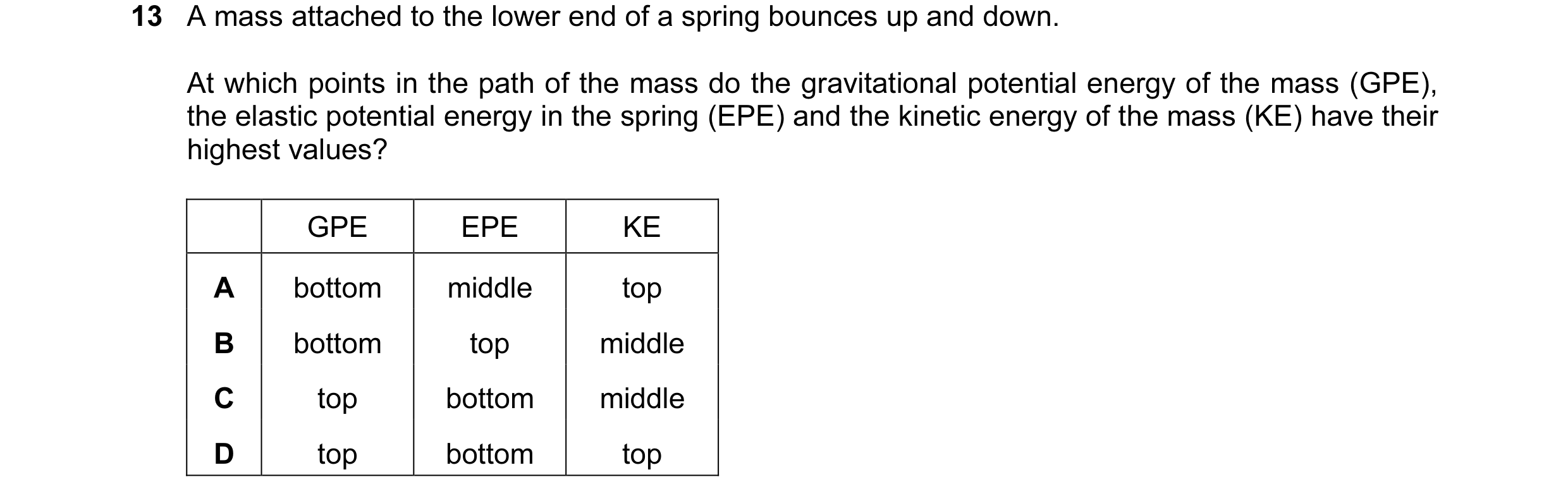 17 / 50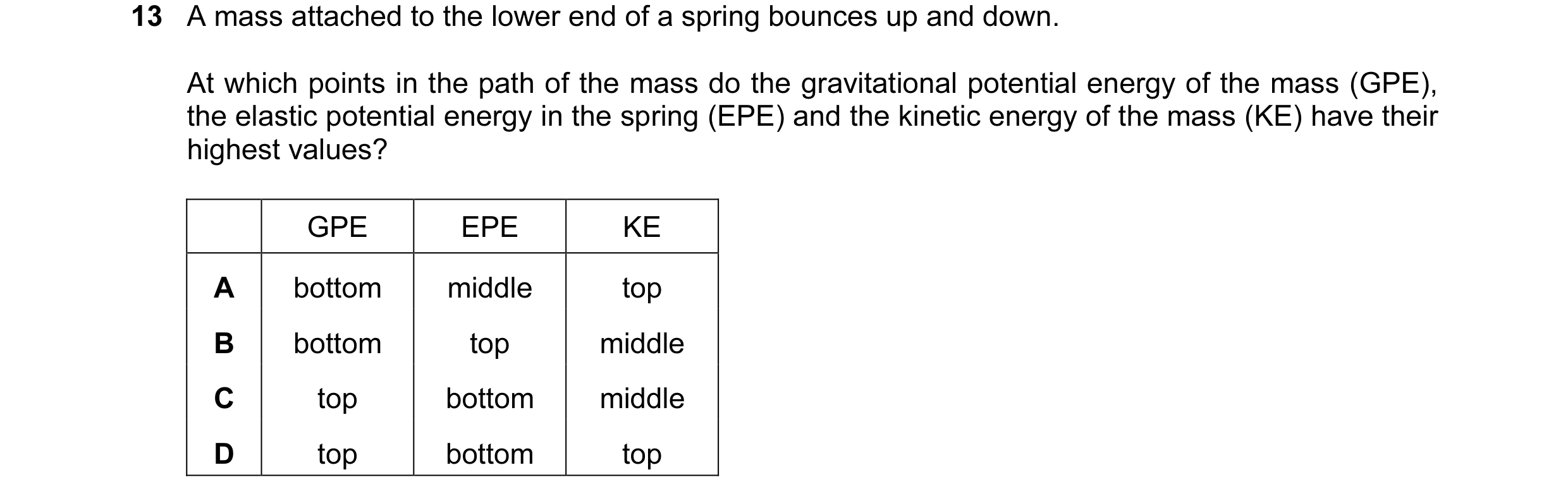

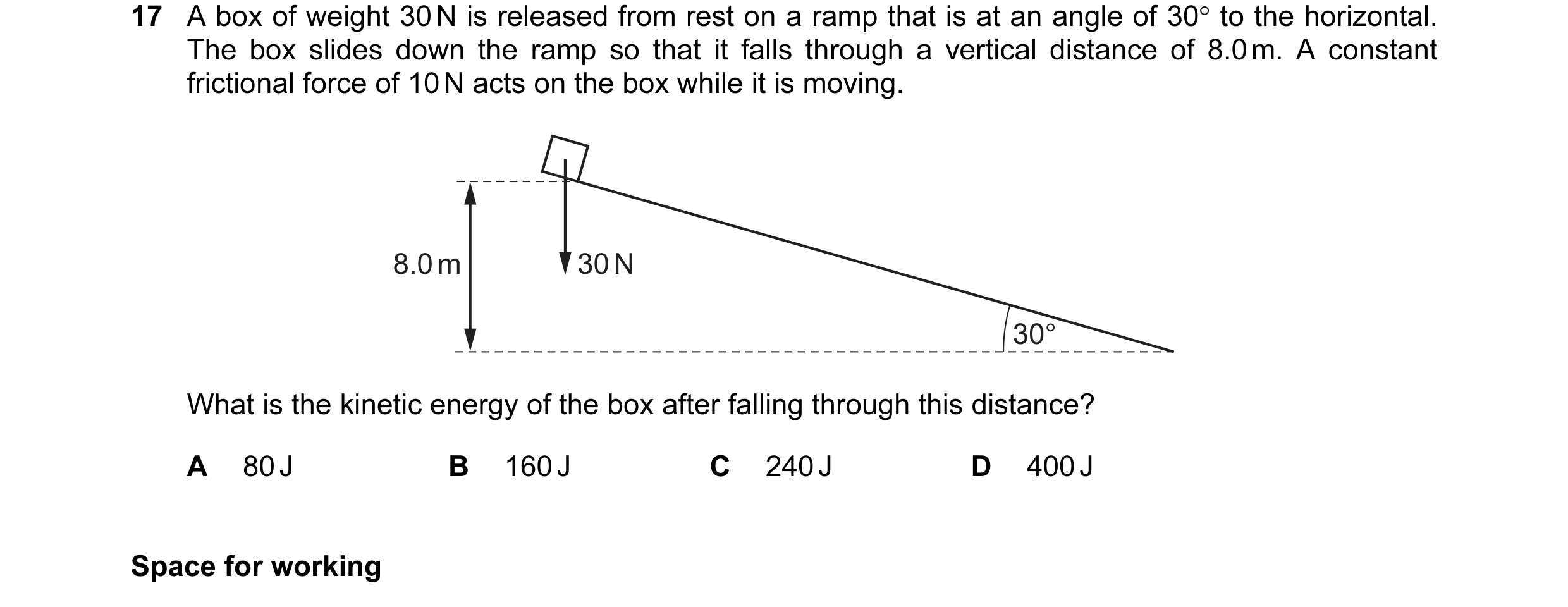 18 / 50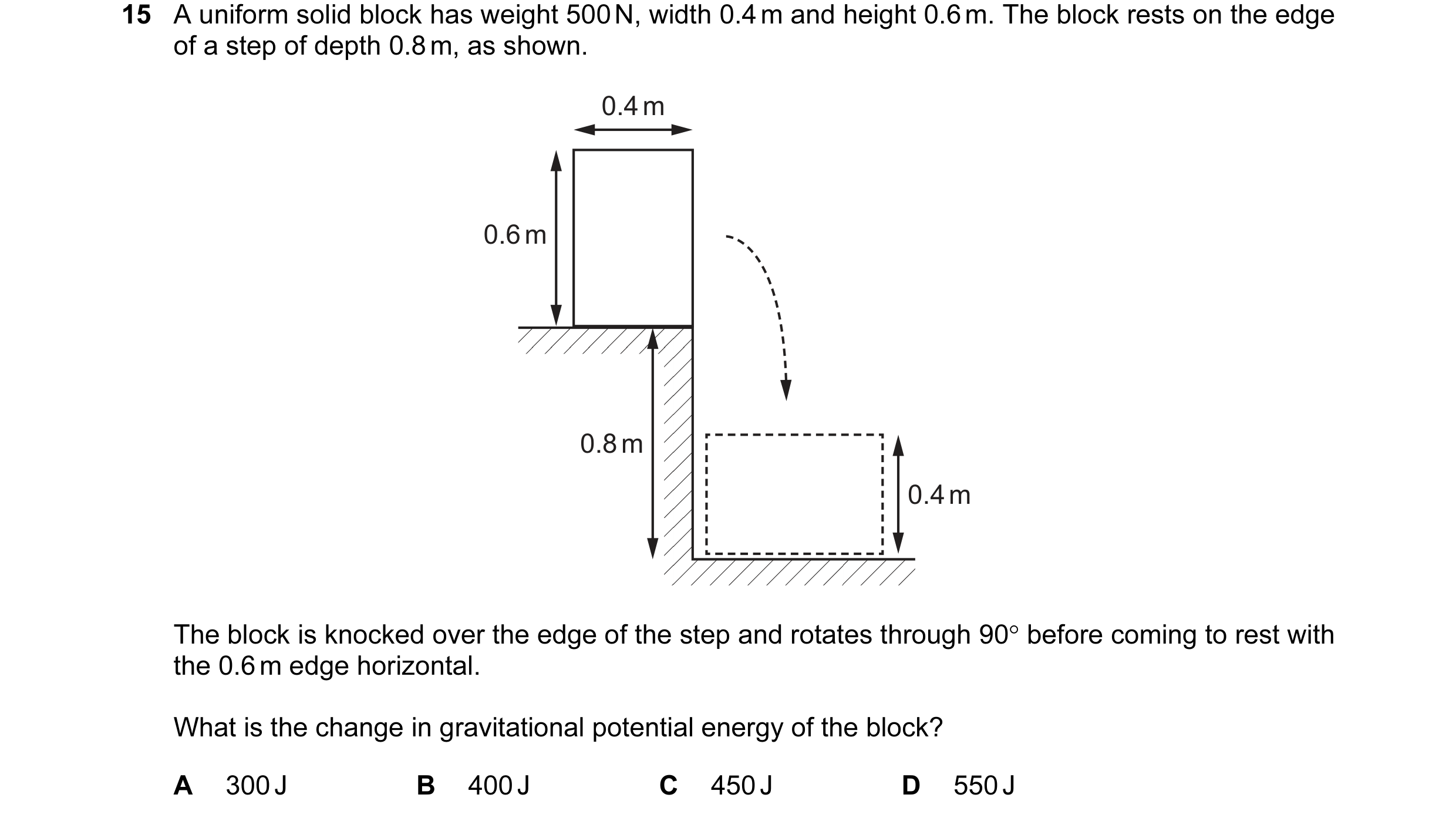

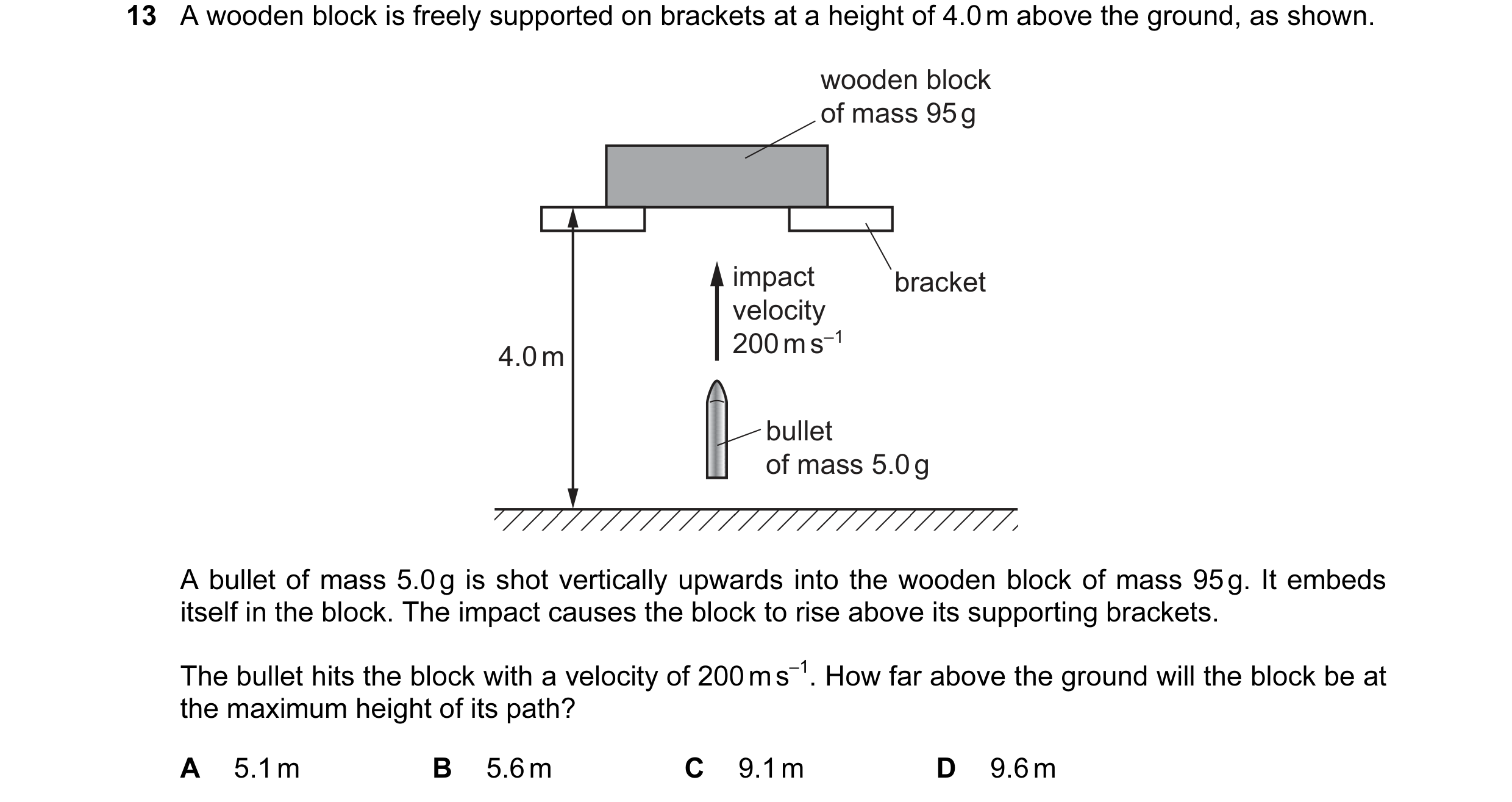 19 / 50

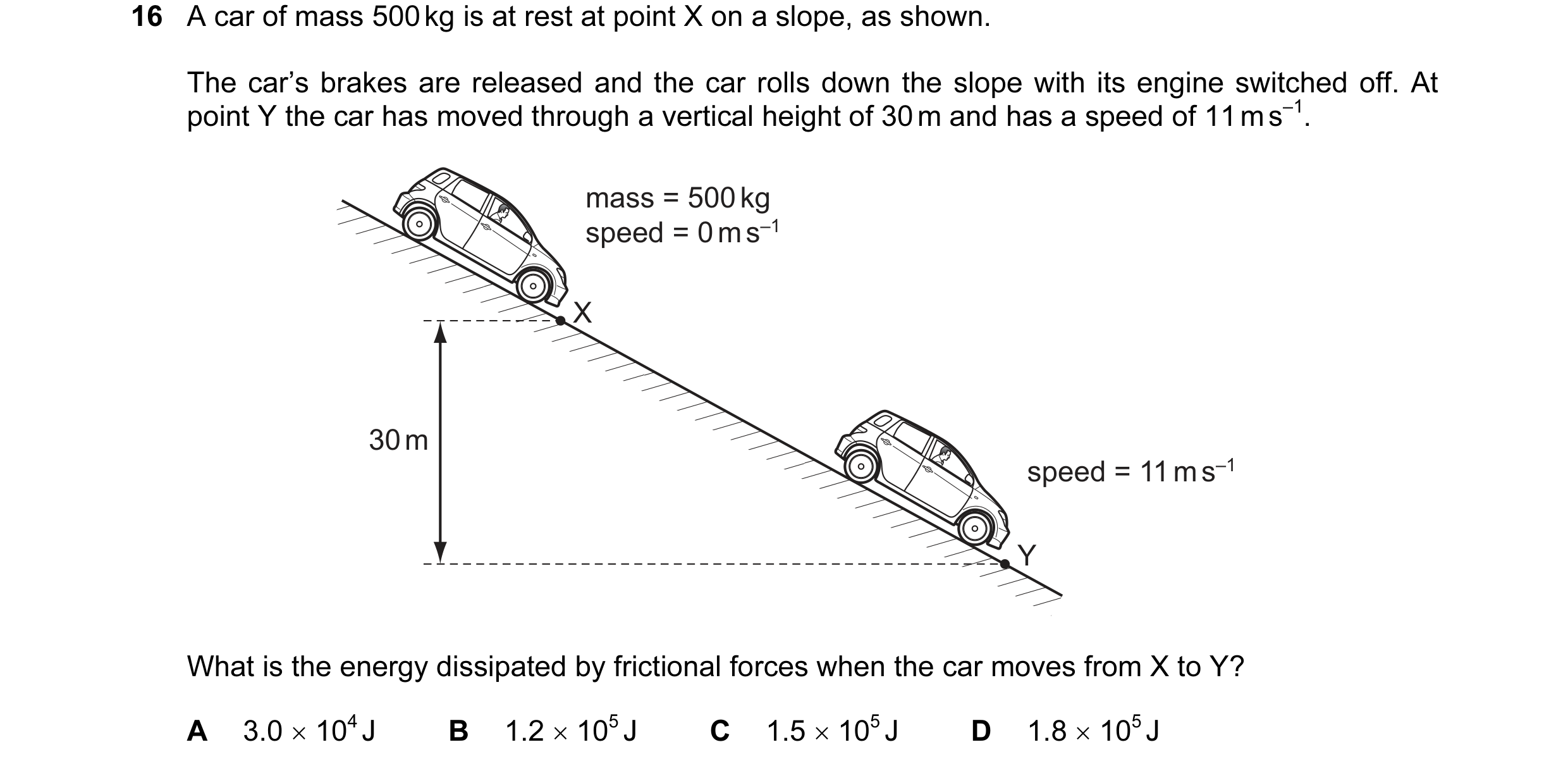
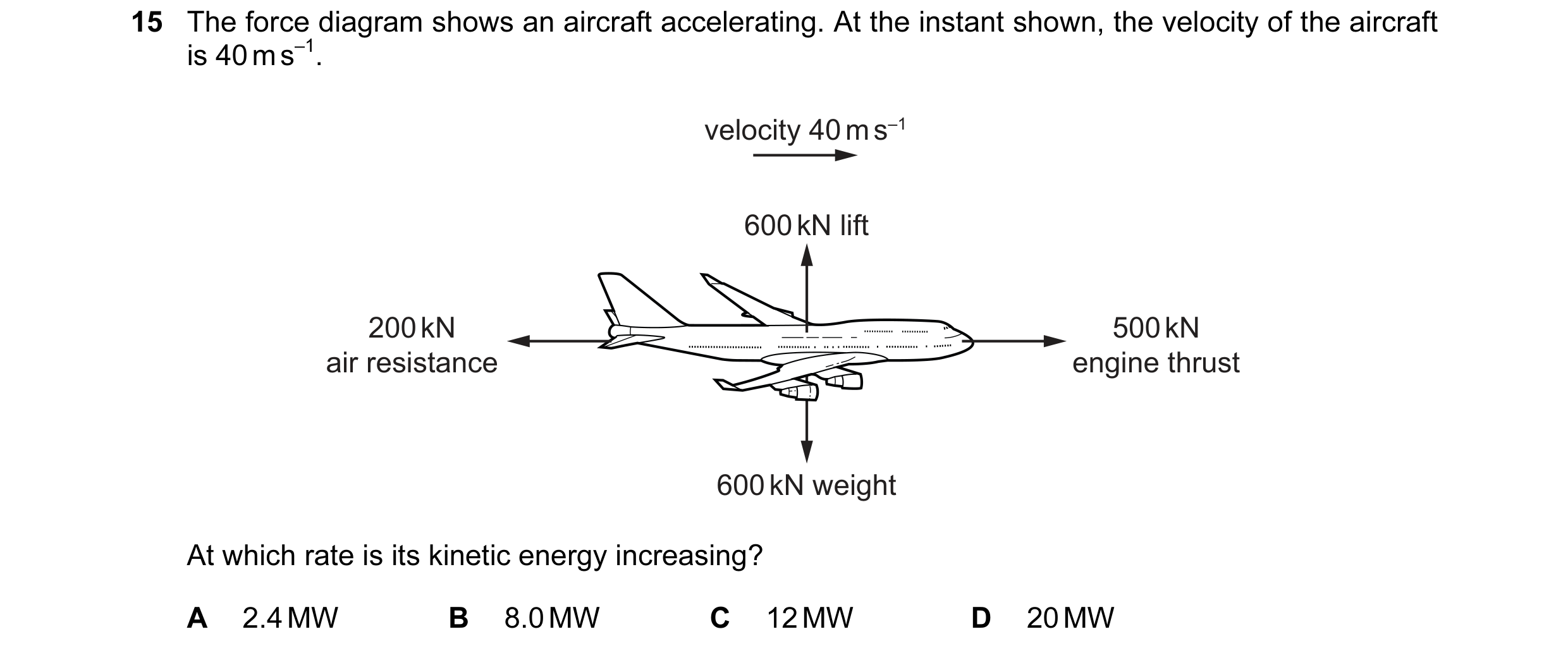 20 / 50


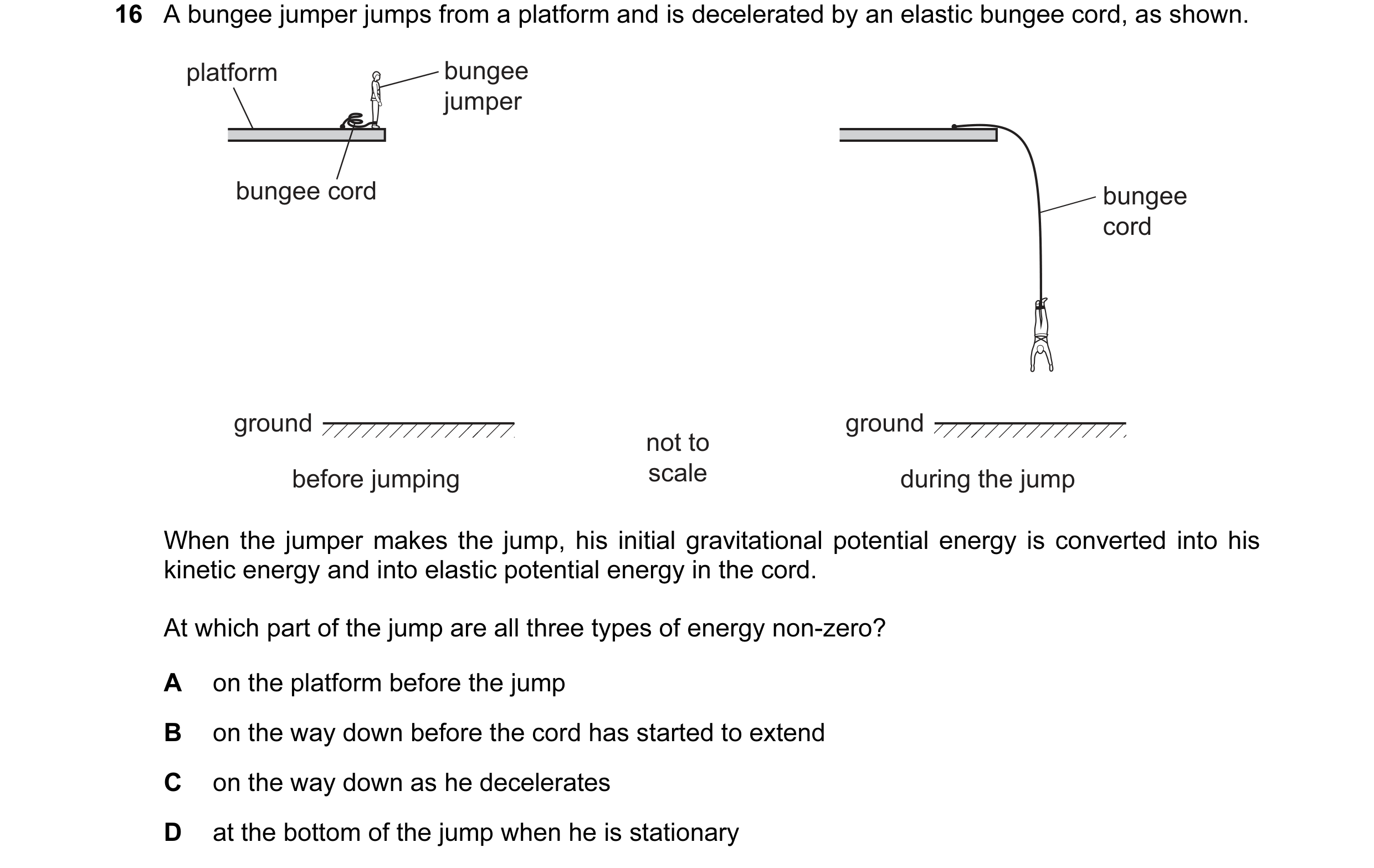 21 / 50
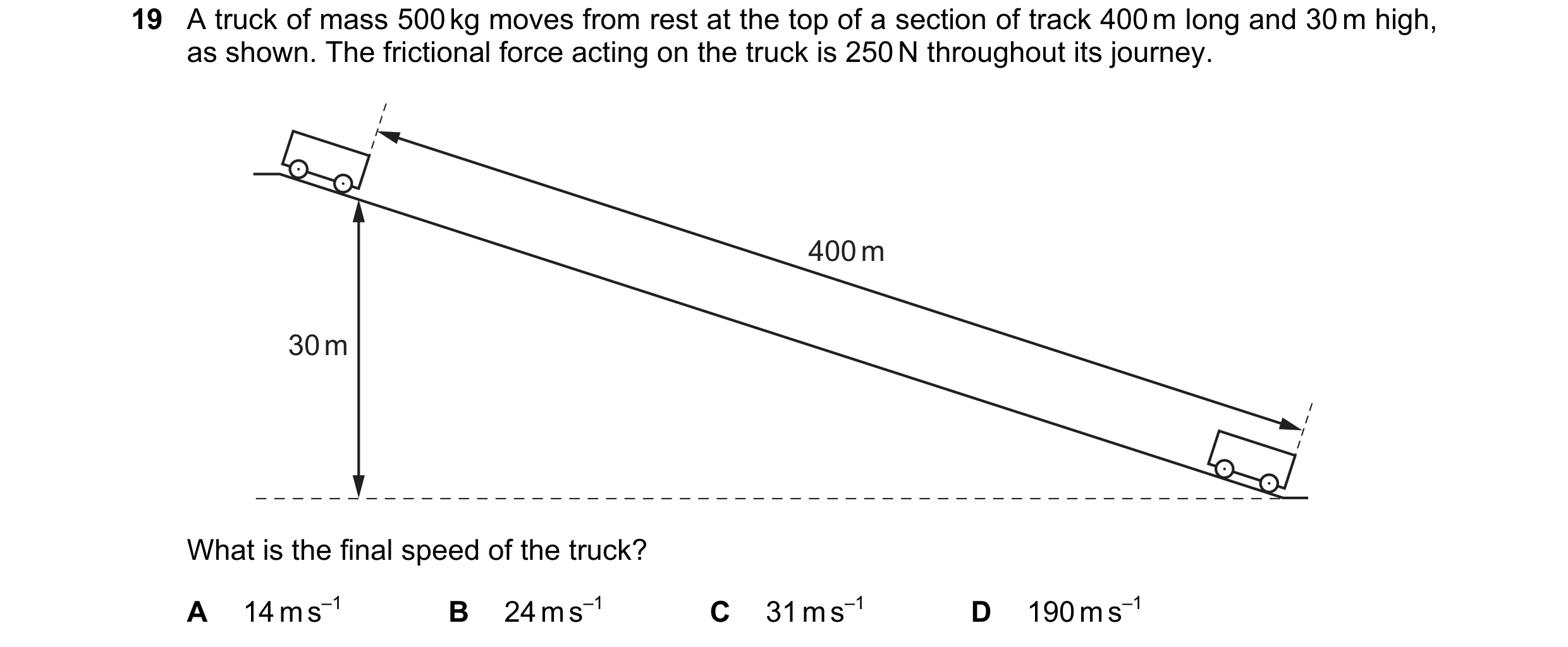
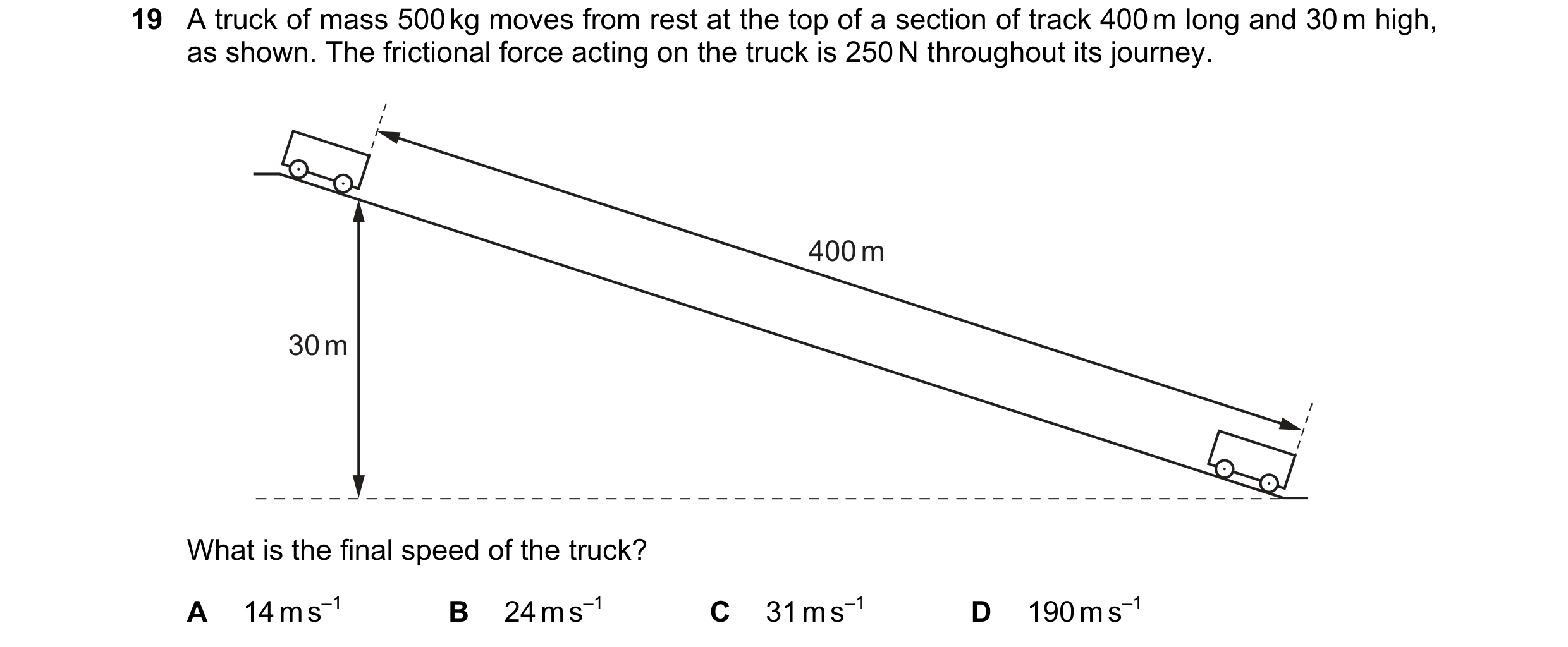
 22 / 50
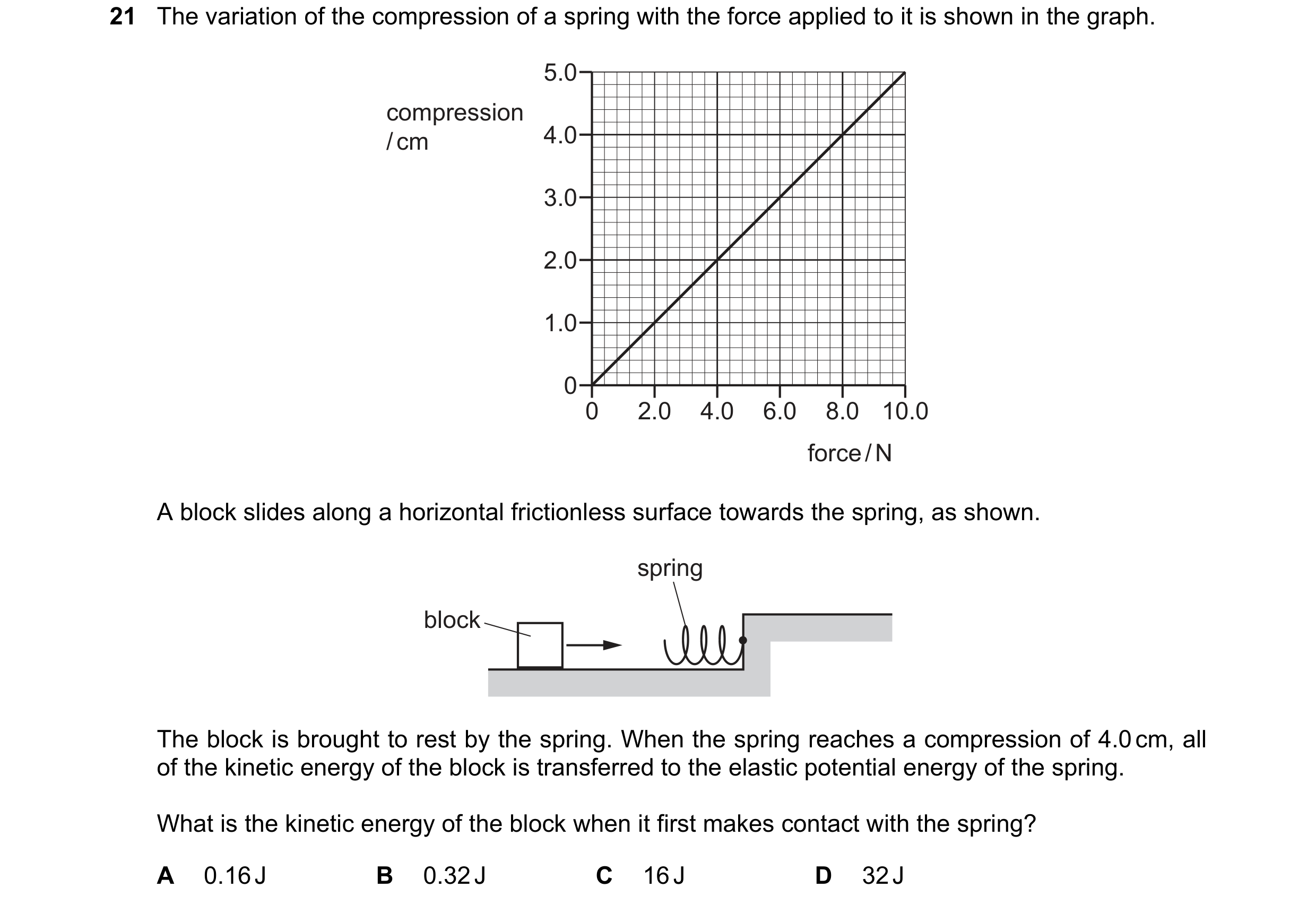


 23 / 50


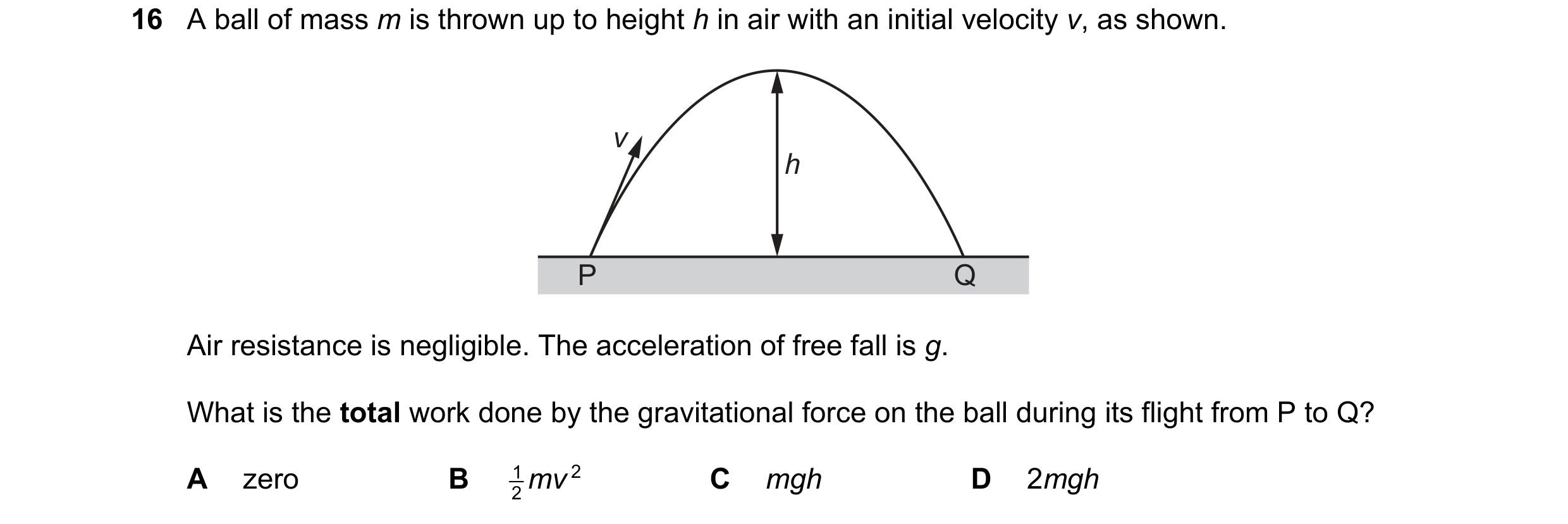
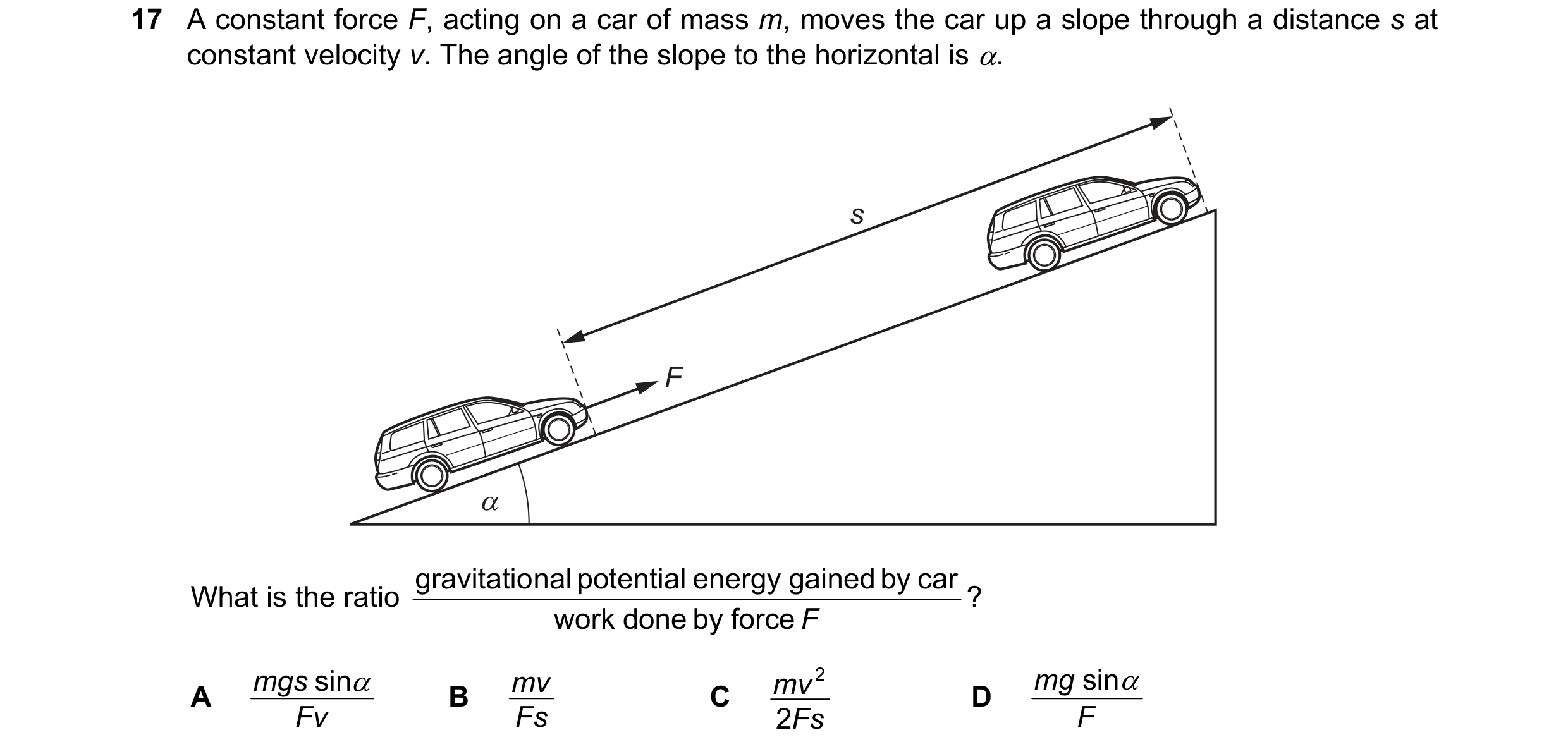 24 / 50
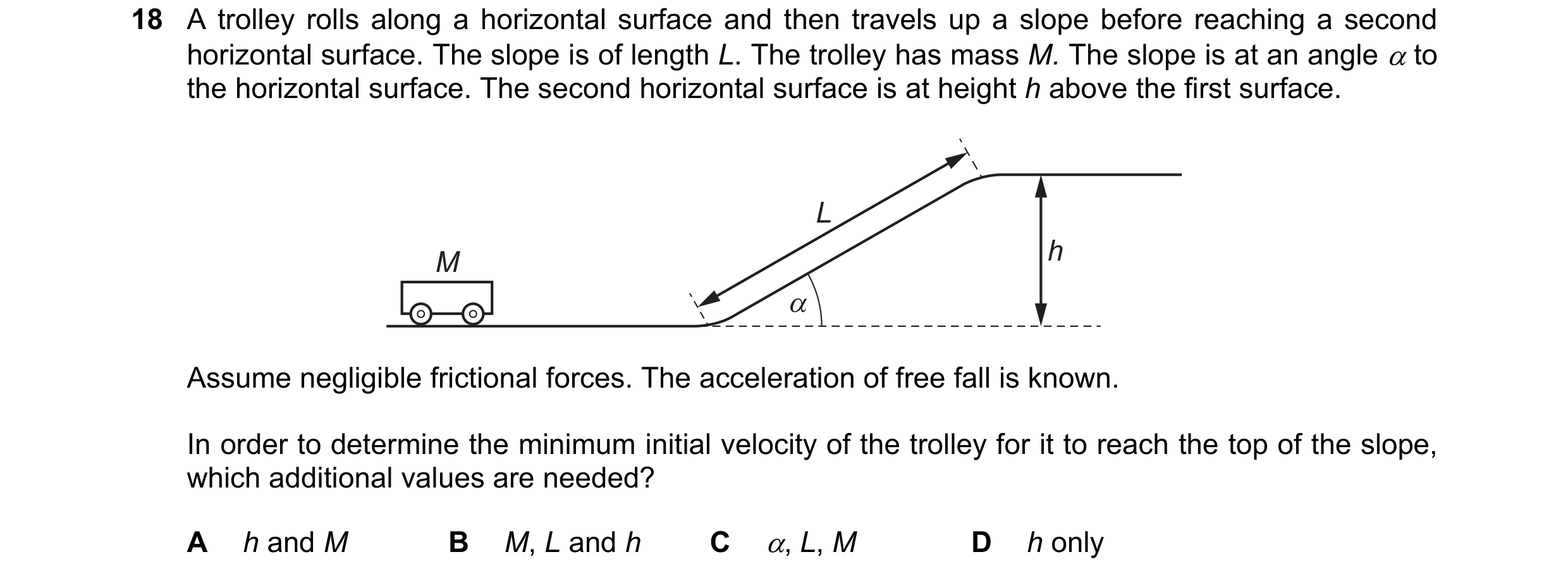
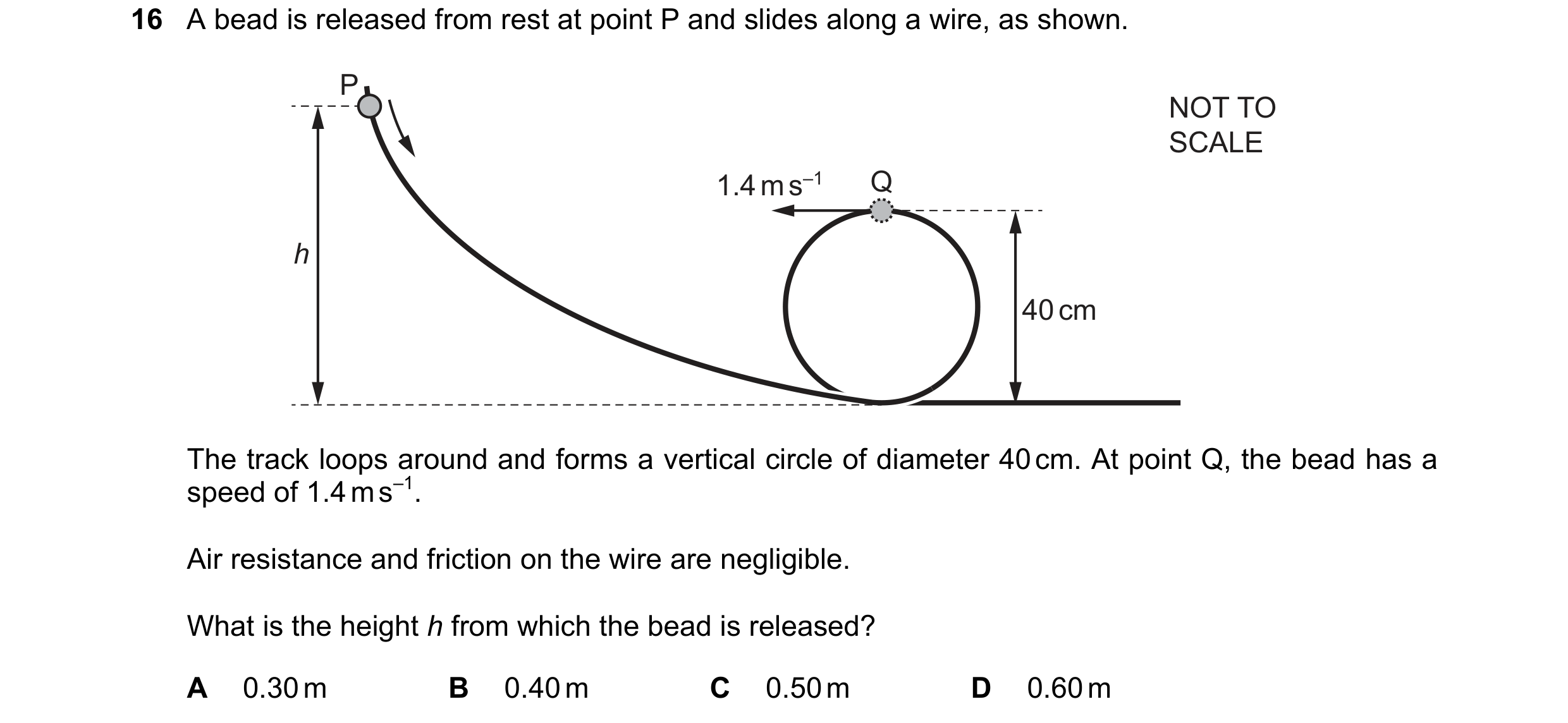 25 / 50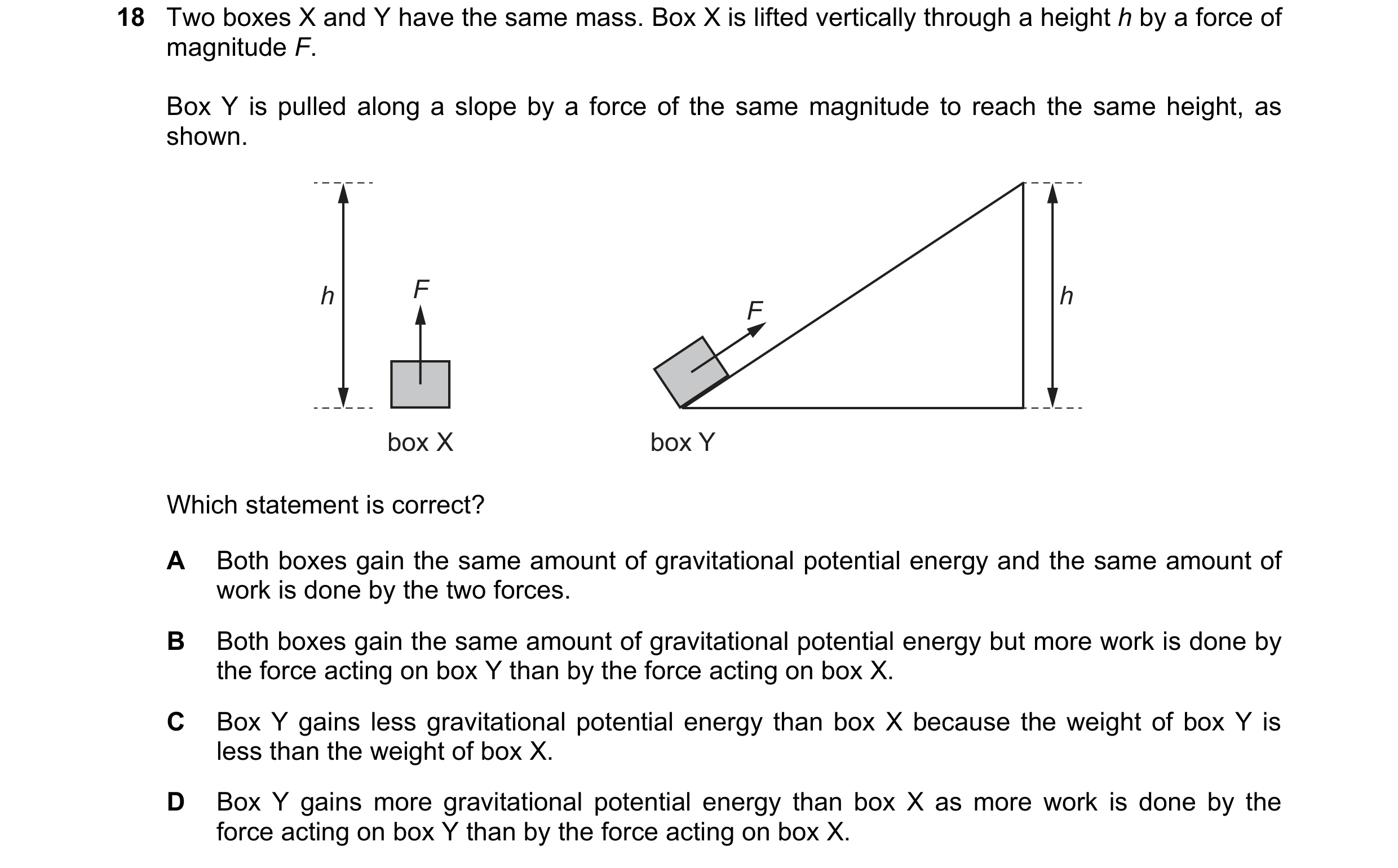

 26 / 50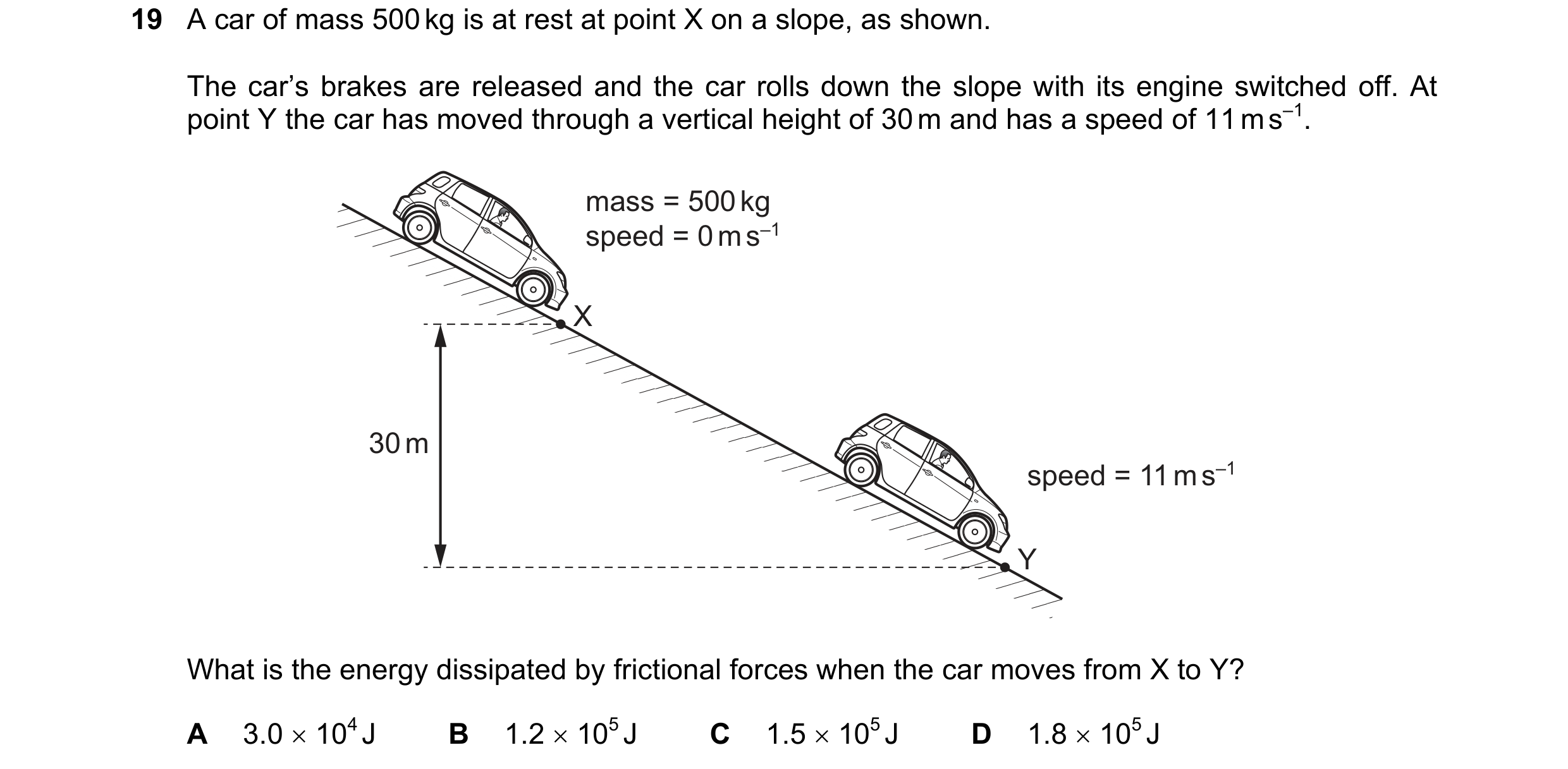
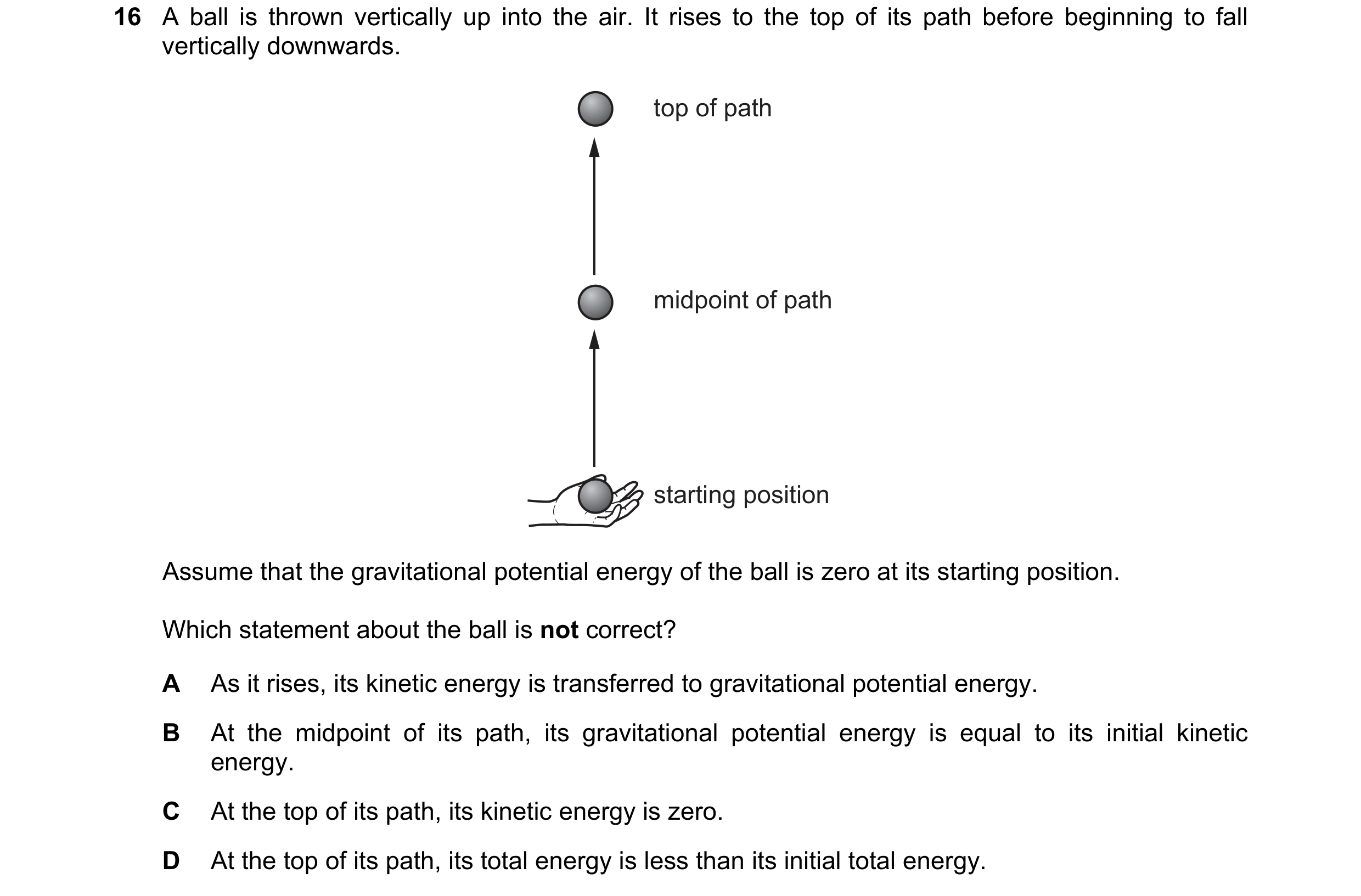 27 / 50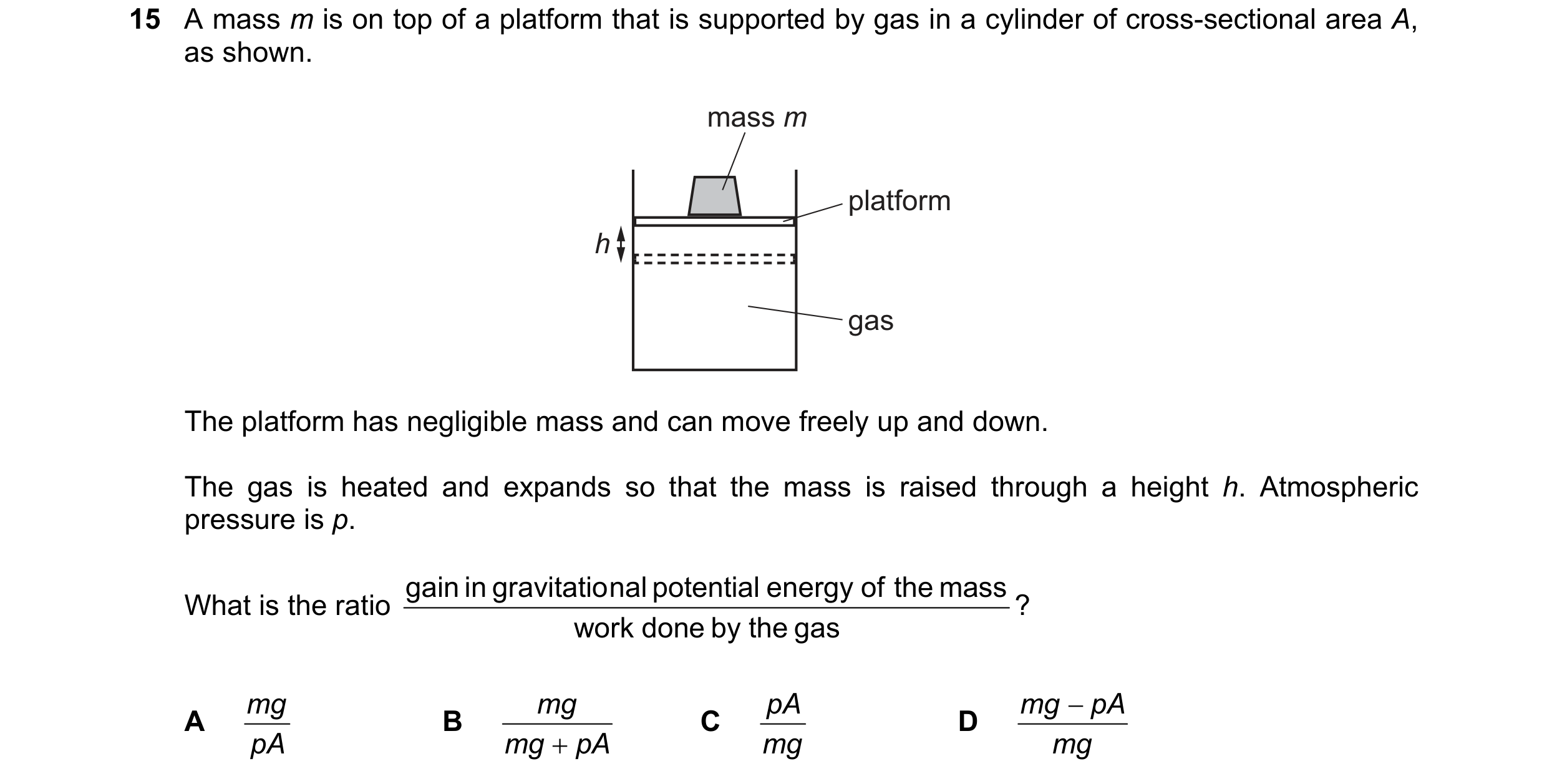
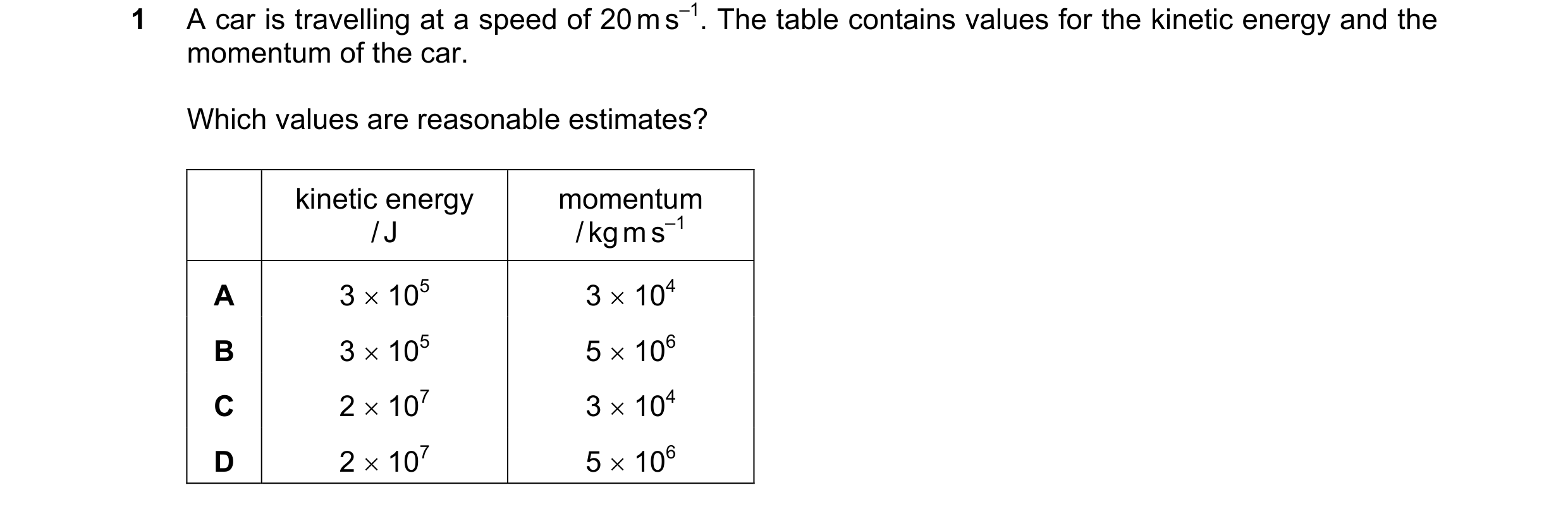
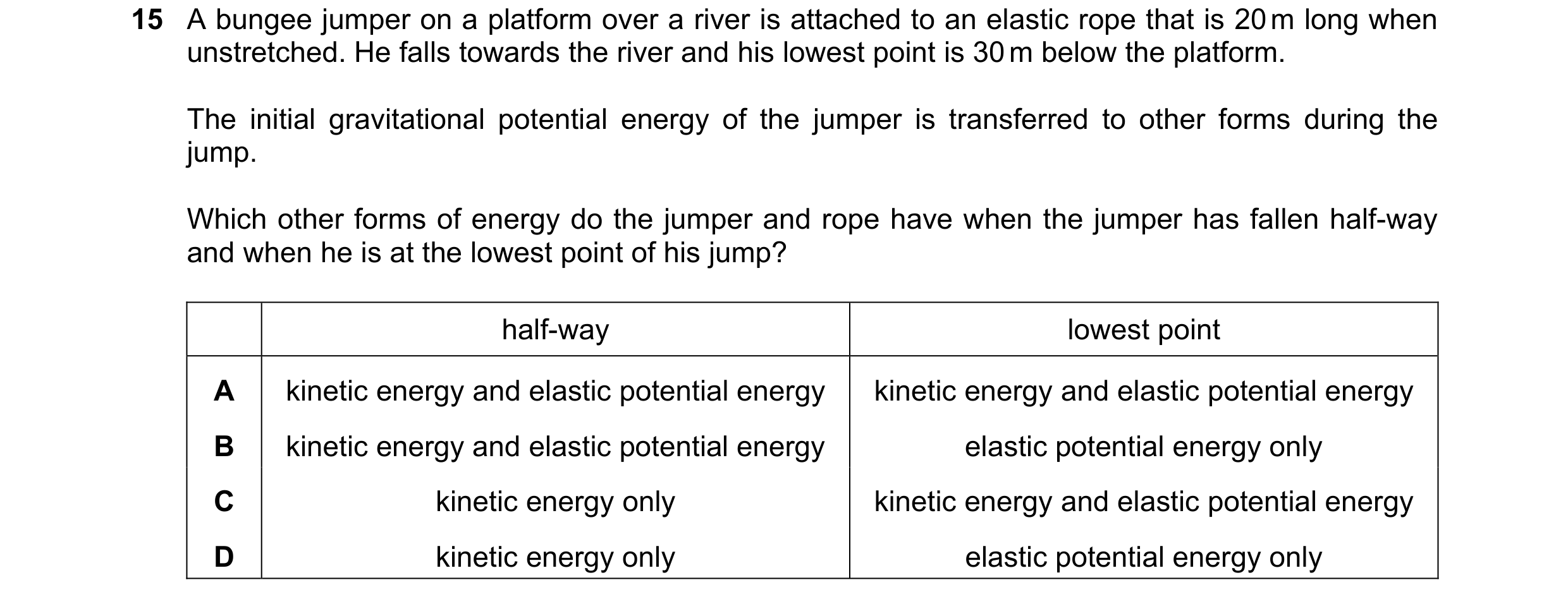 28 / 50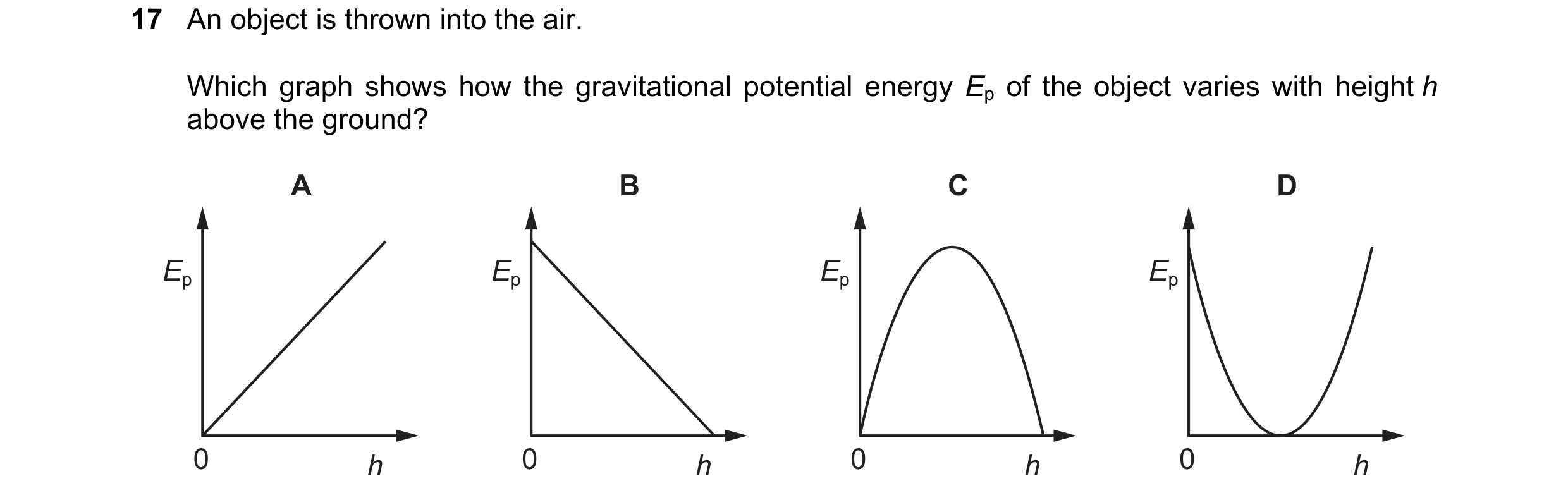
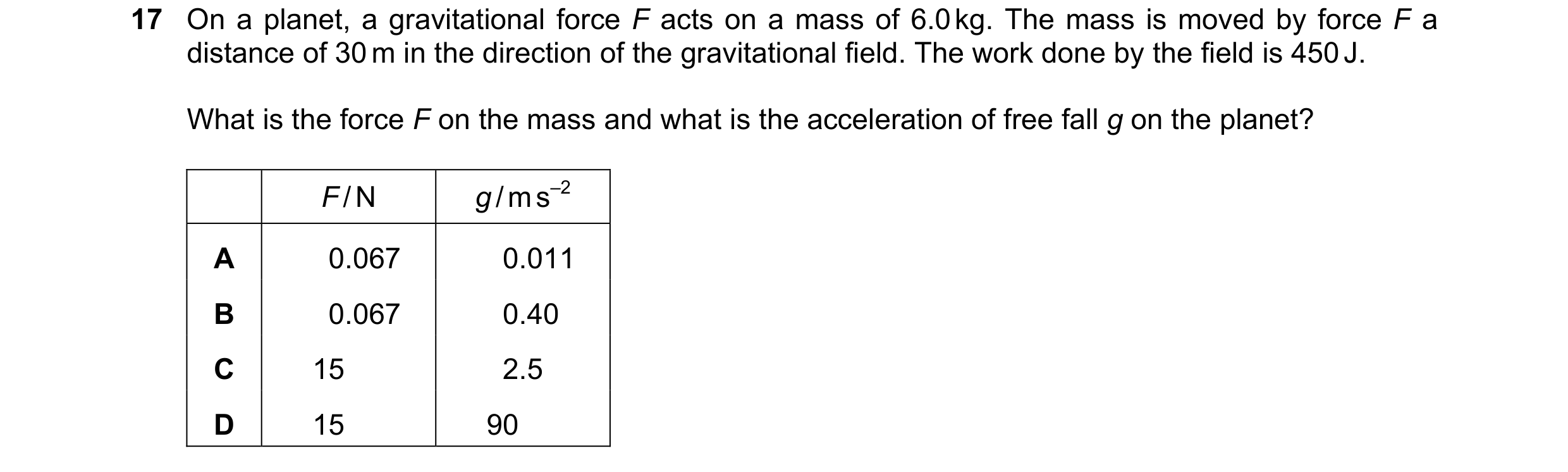
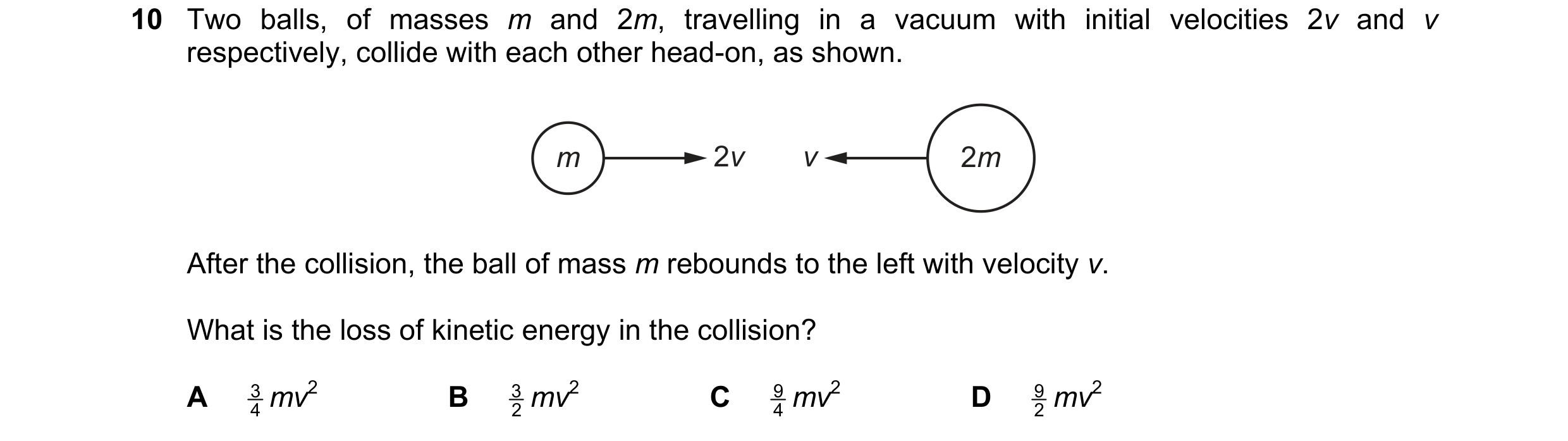
 29 / 50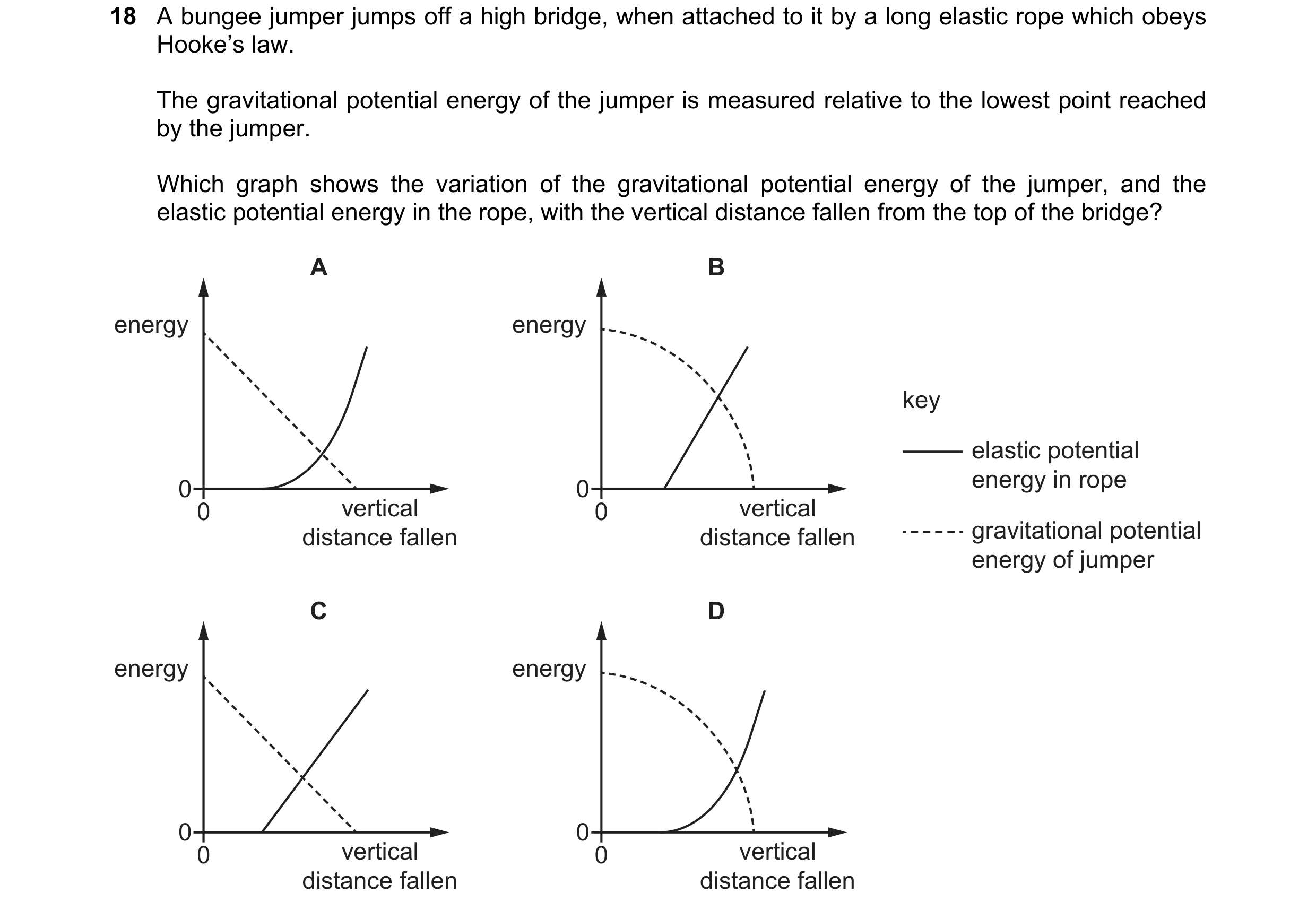

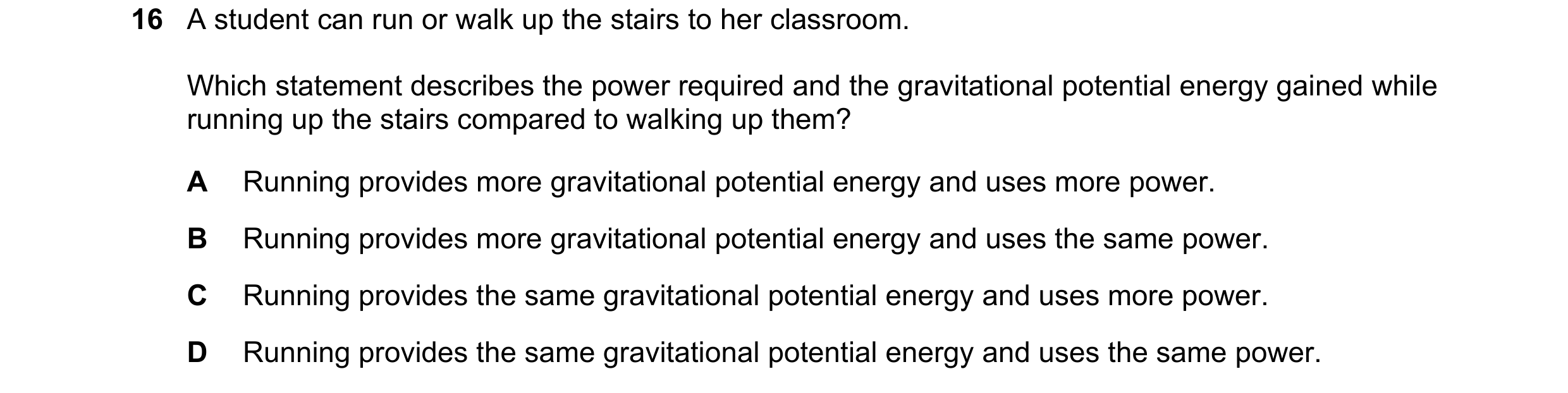 30 / 50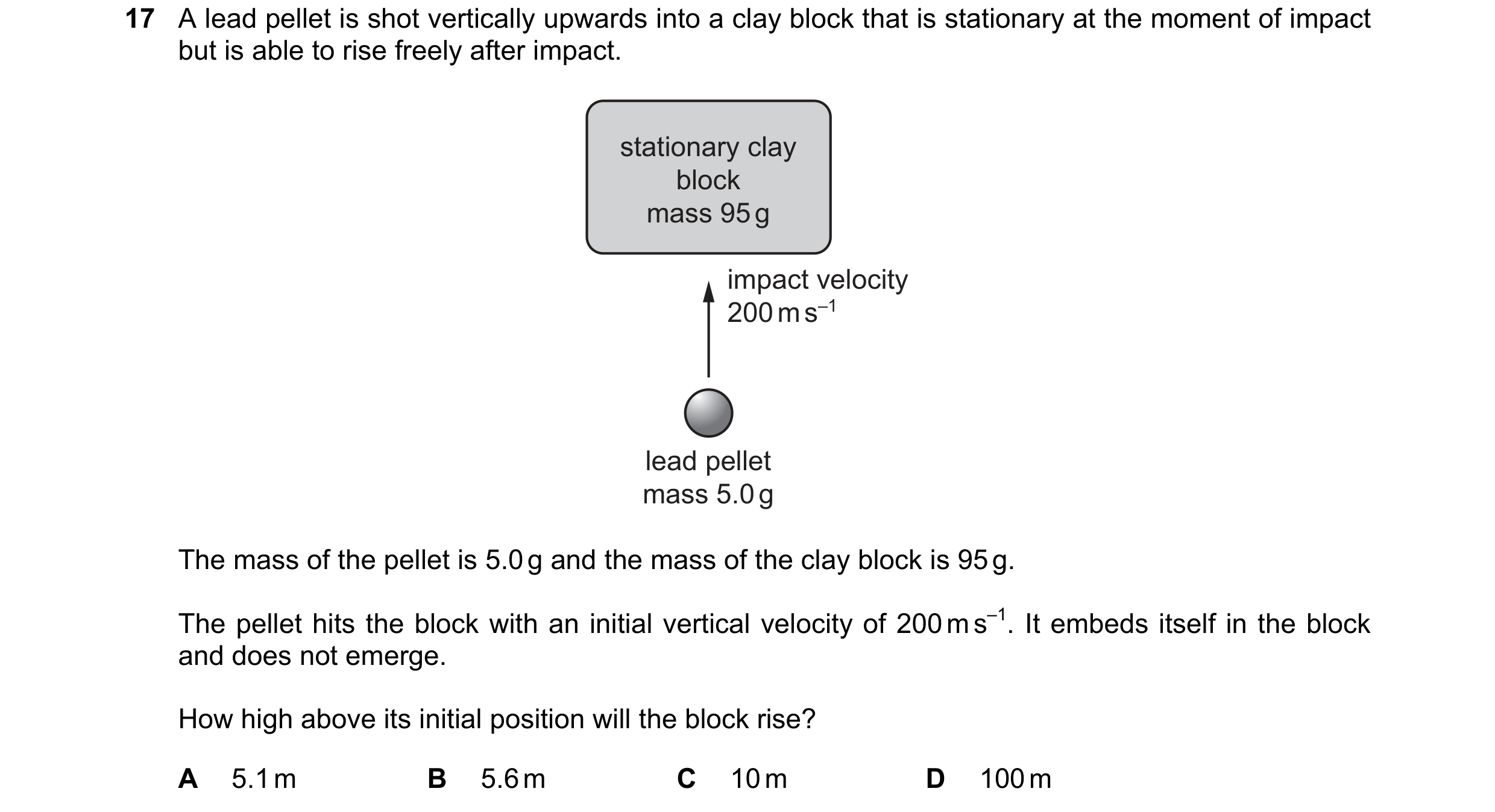


 31 / 50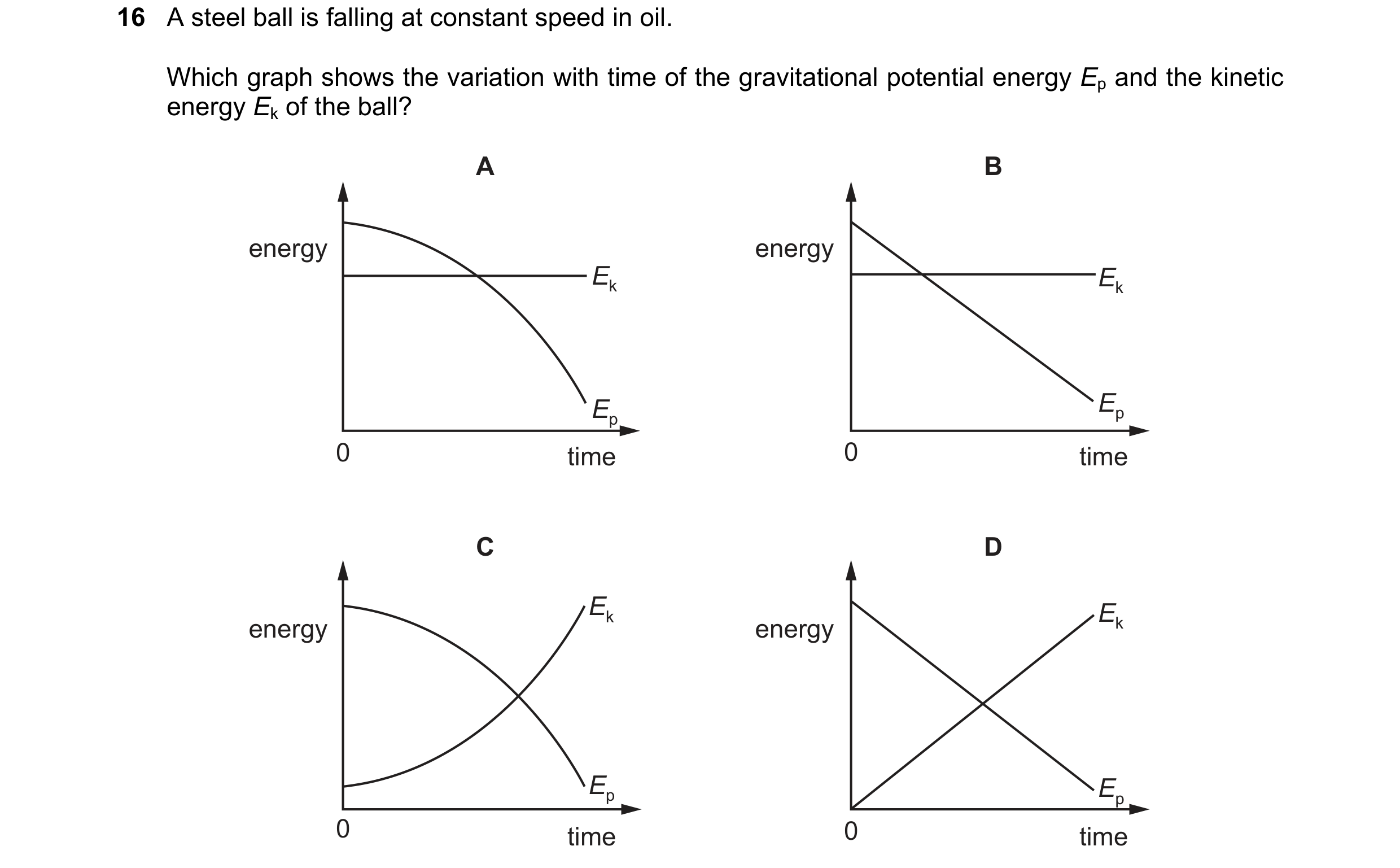
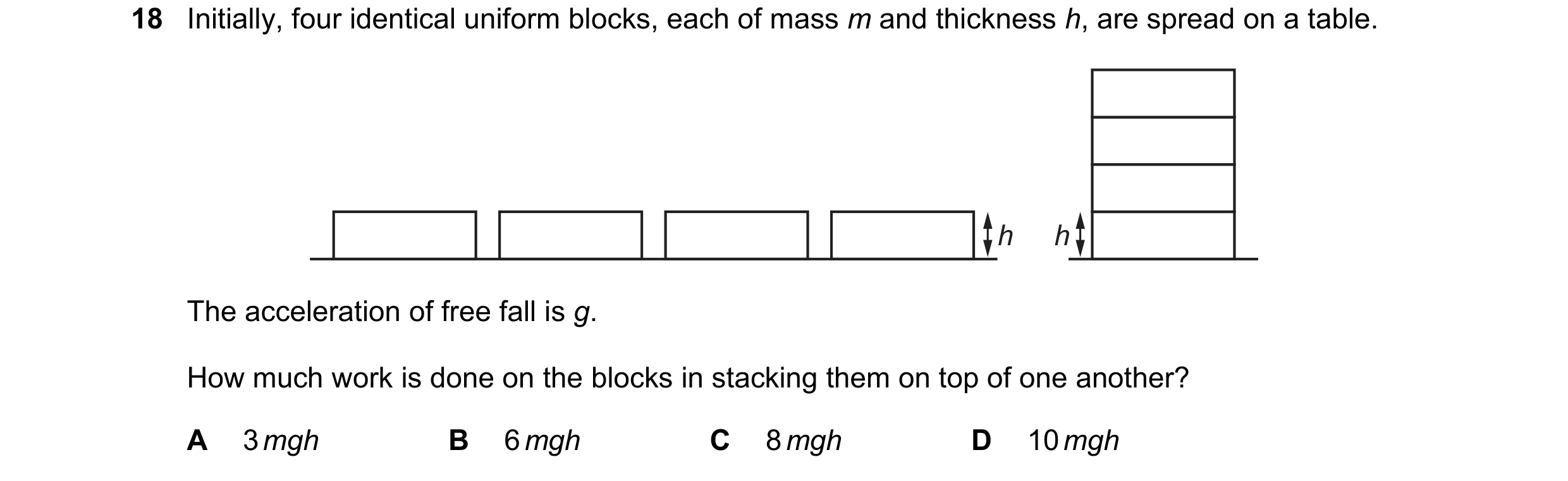
 32 / 50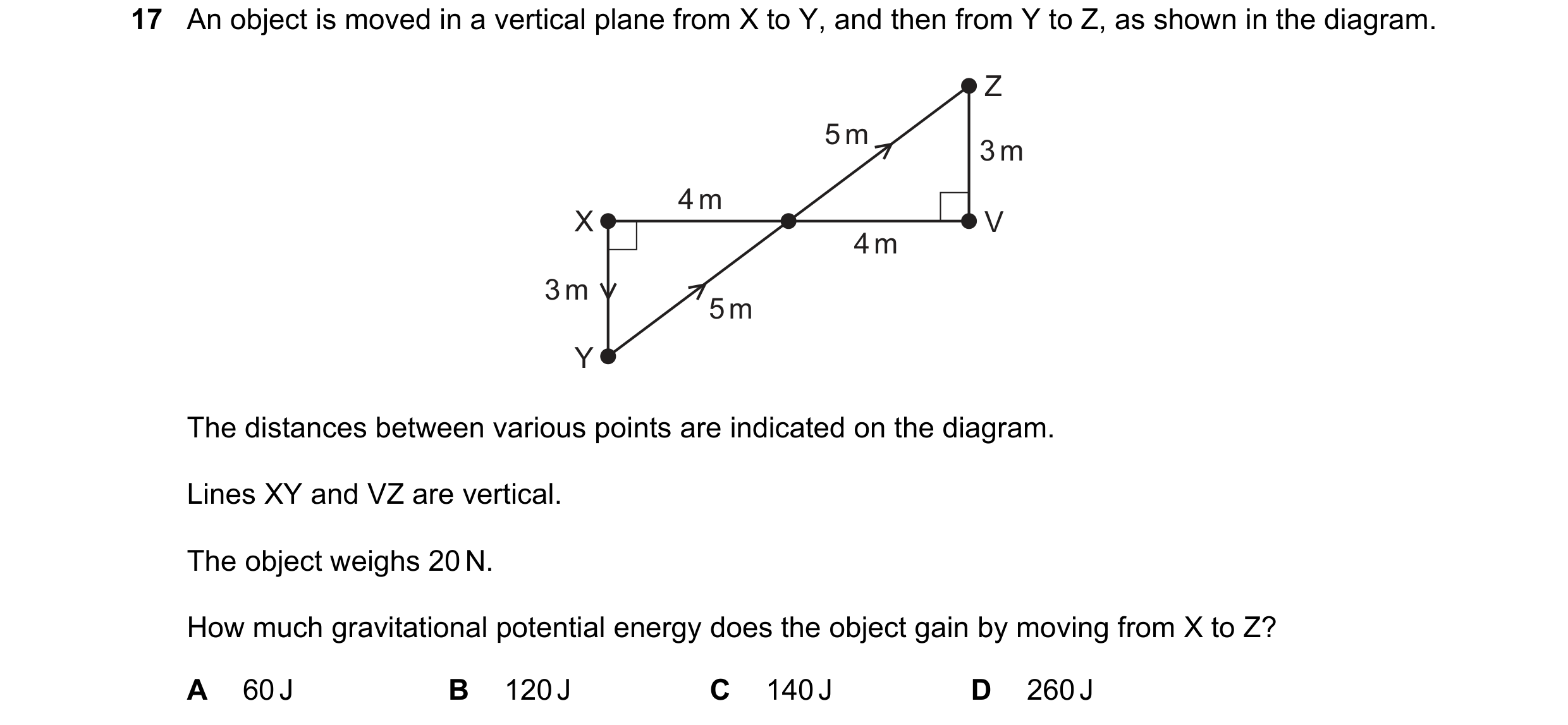

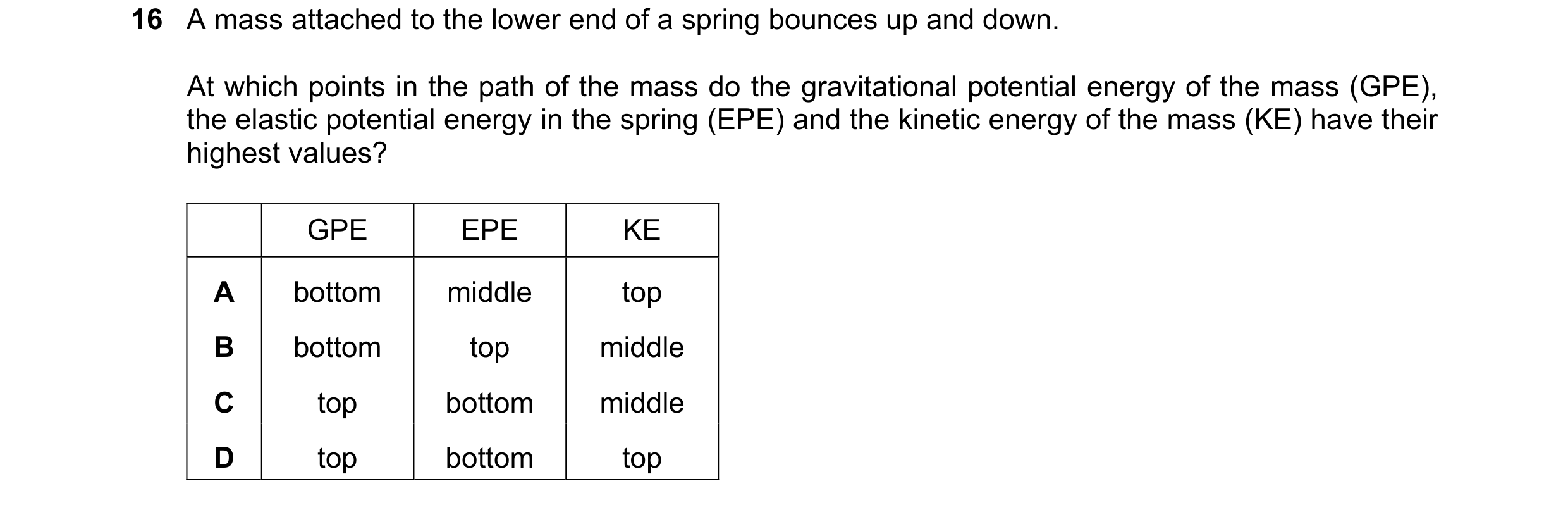 33 / 50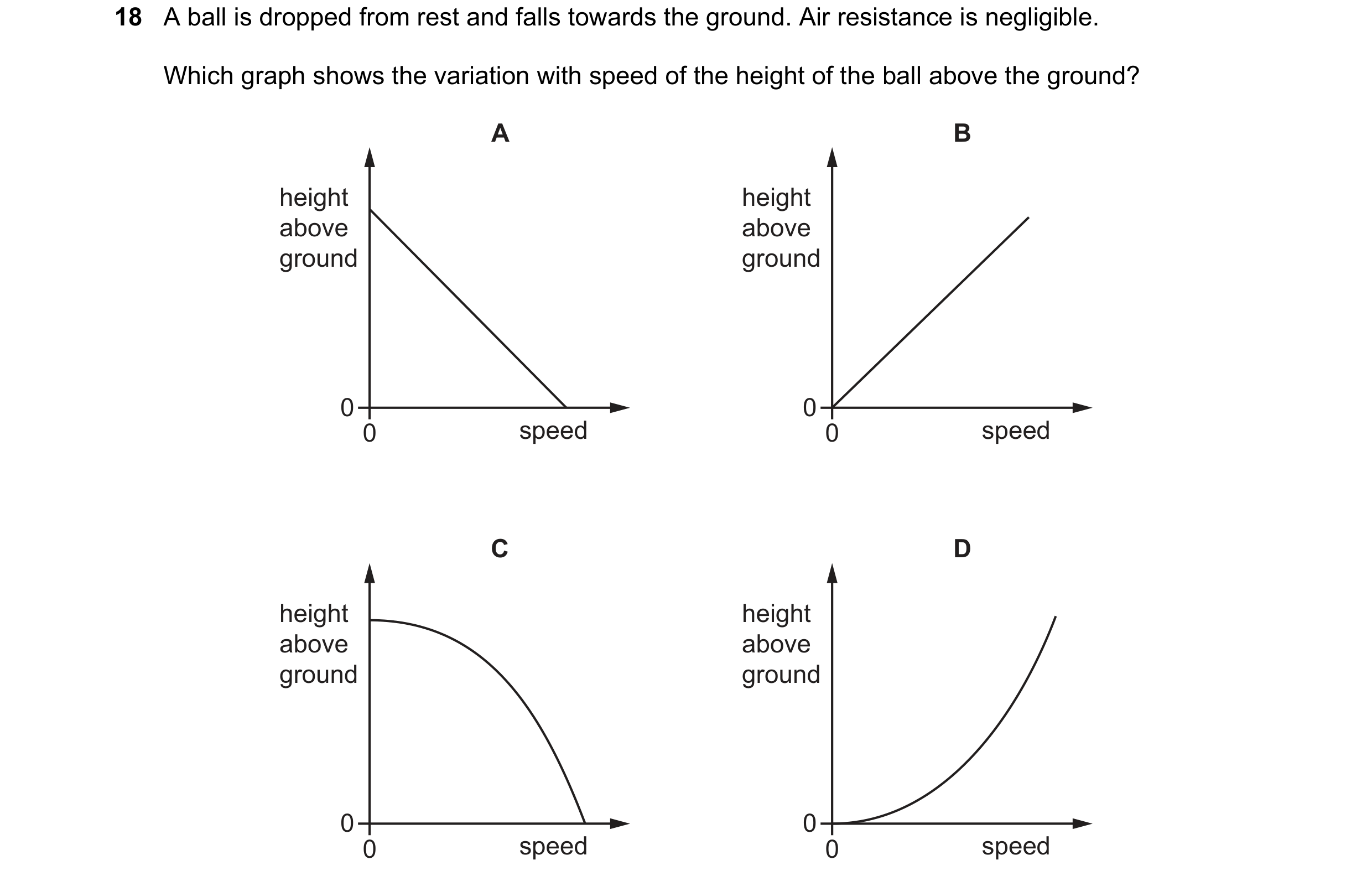

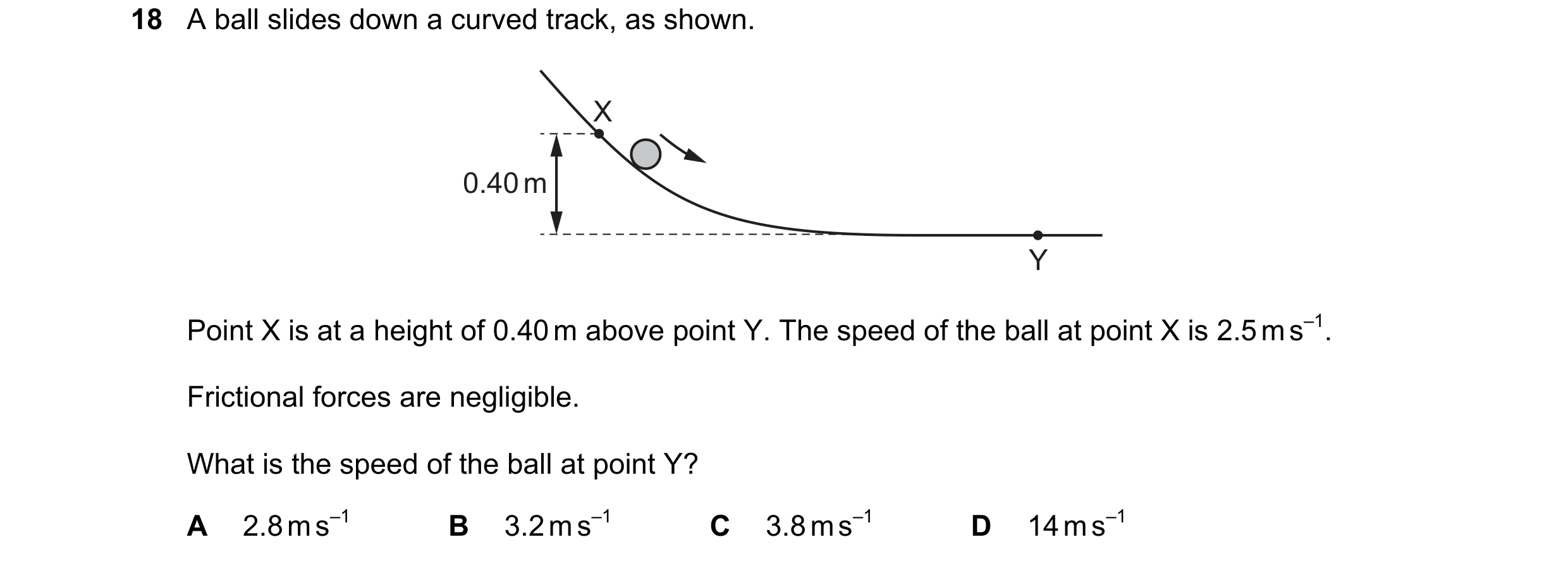 34 / 50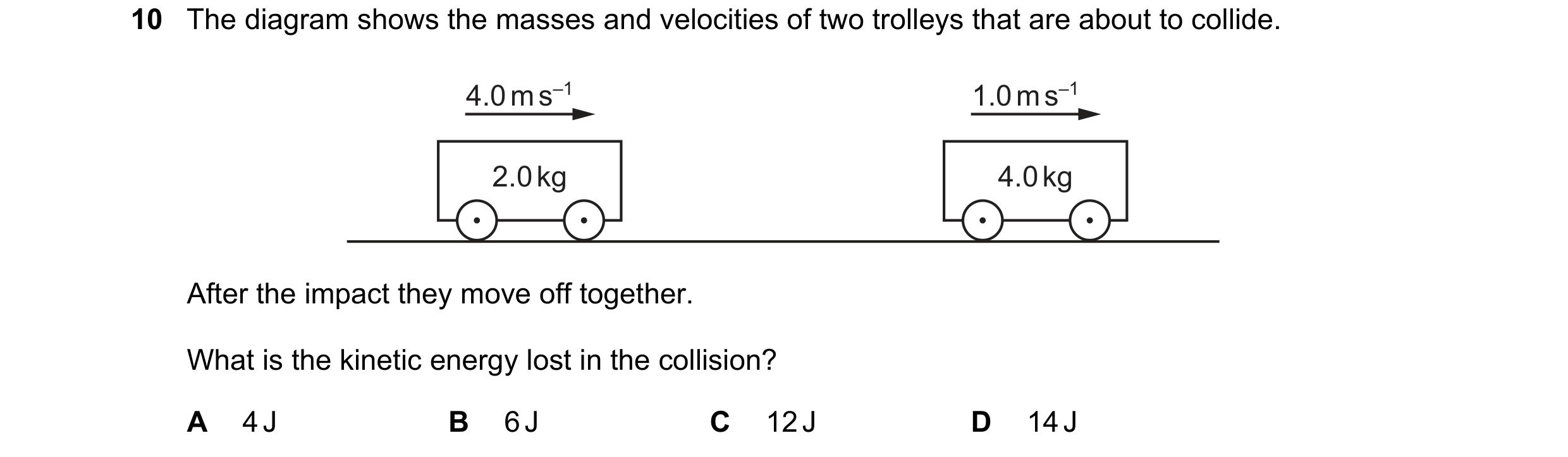
 35 / 50
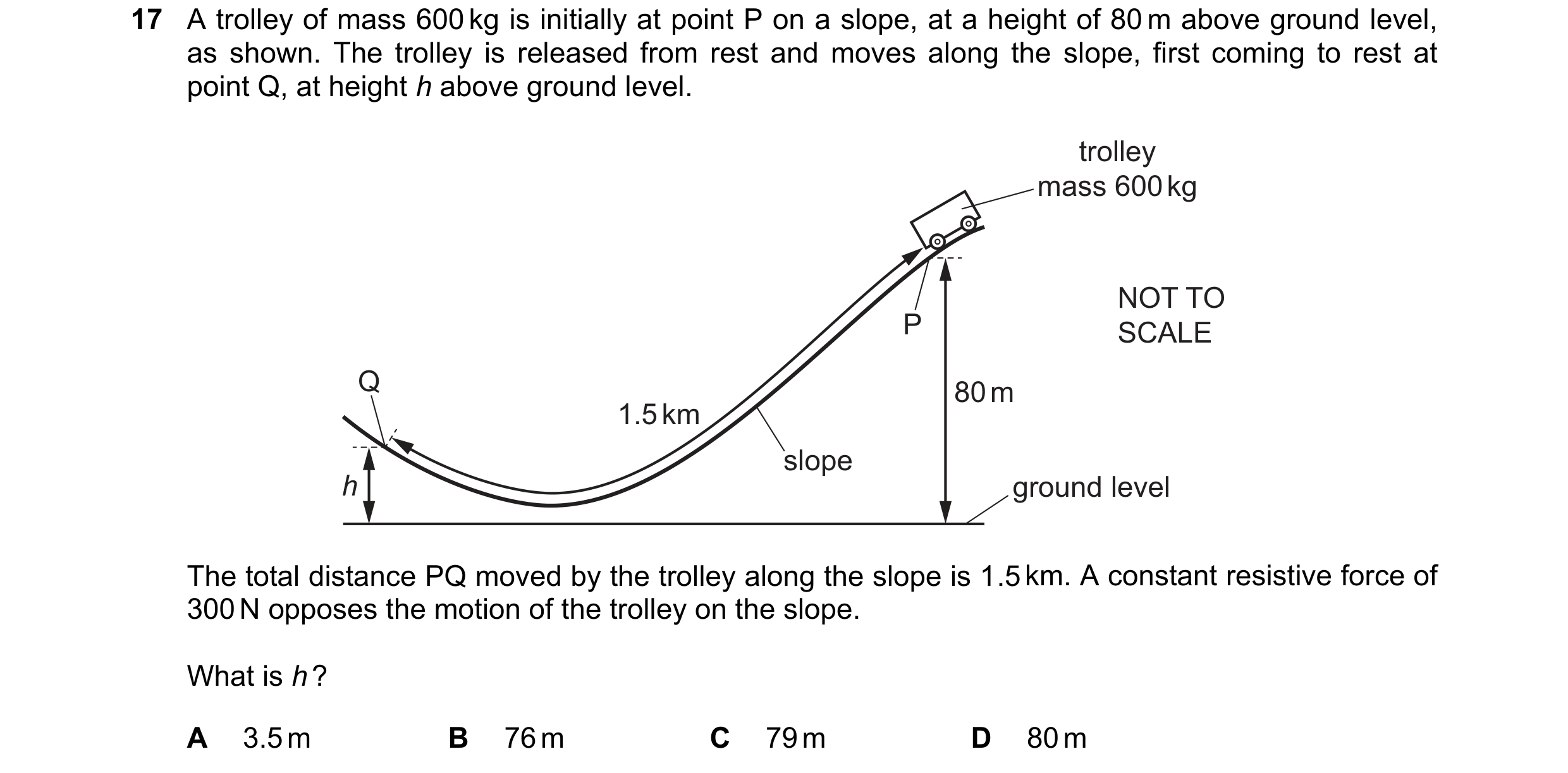
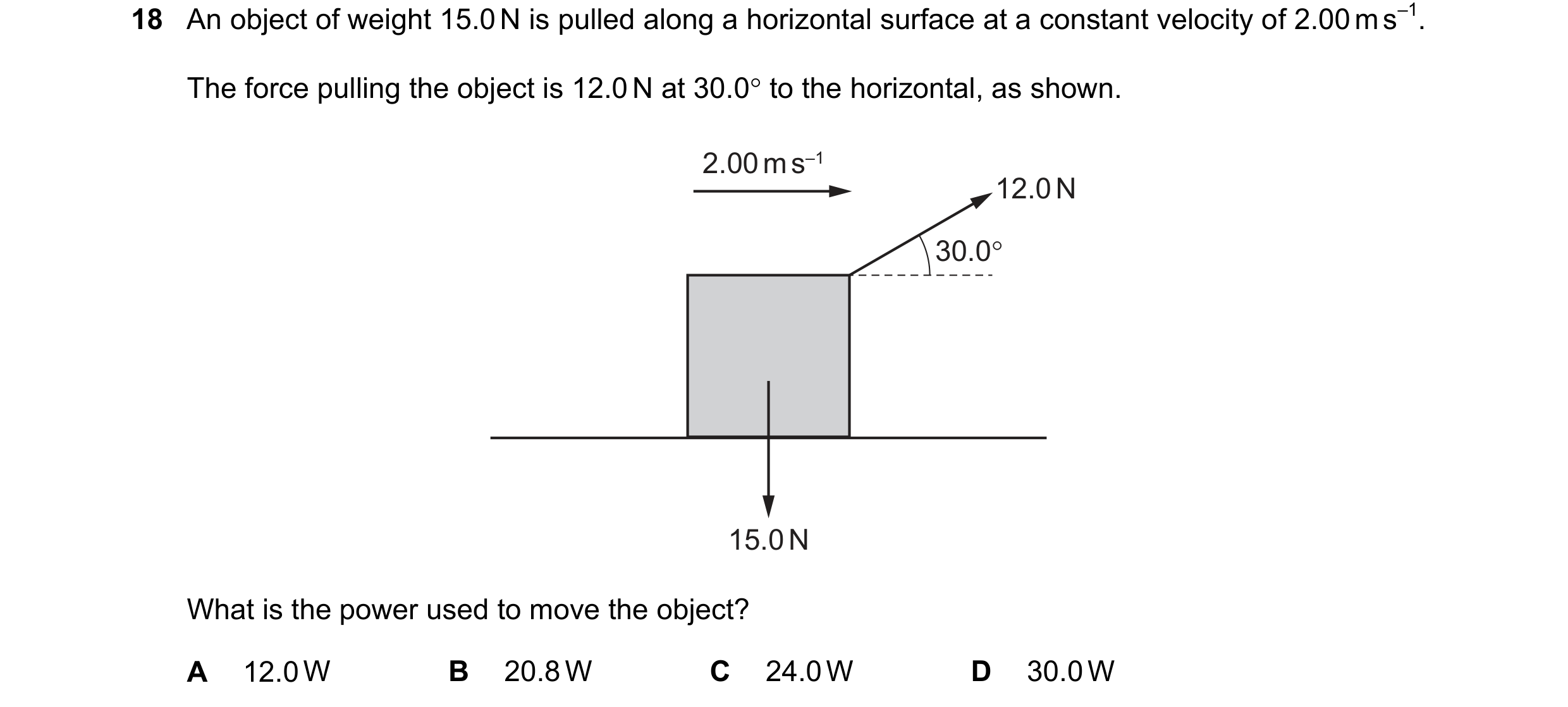
 36 / 50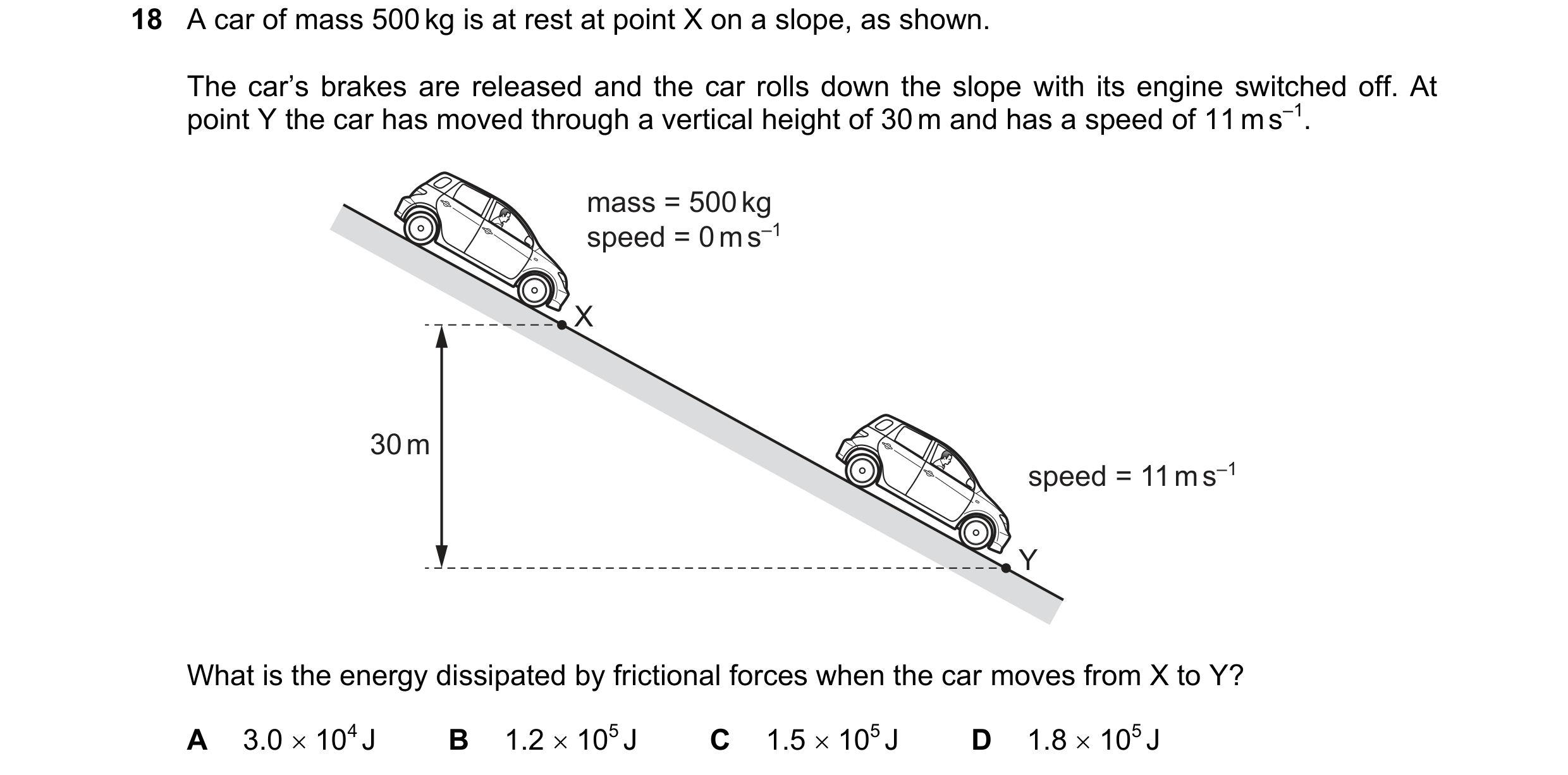
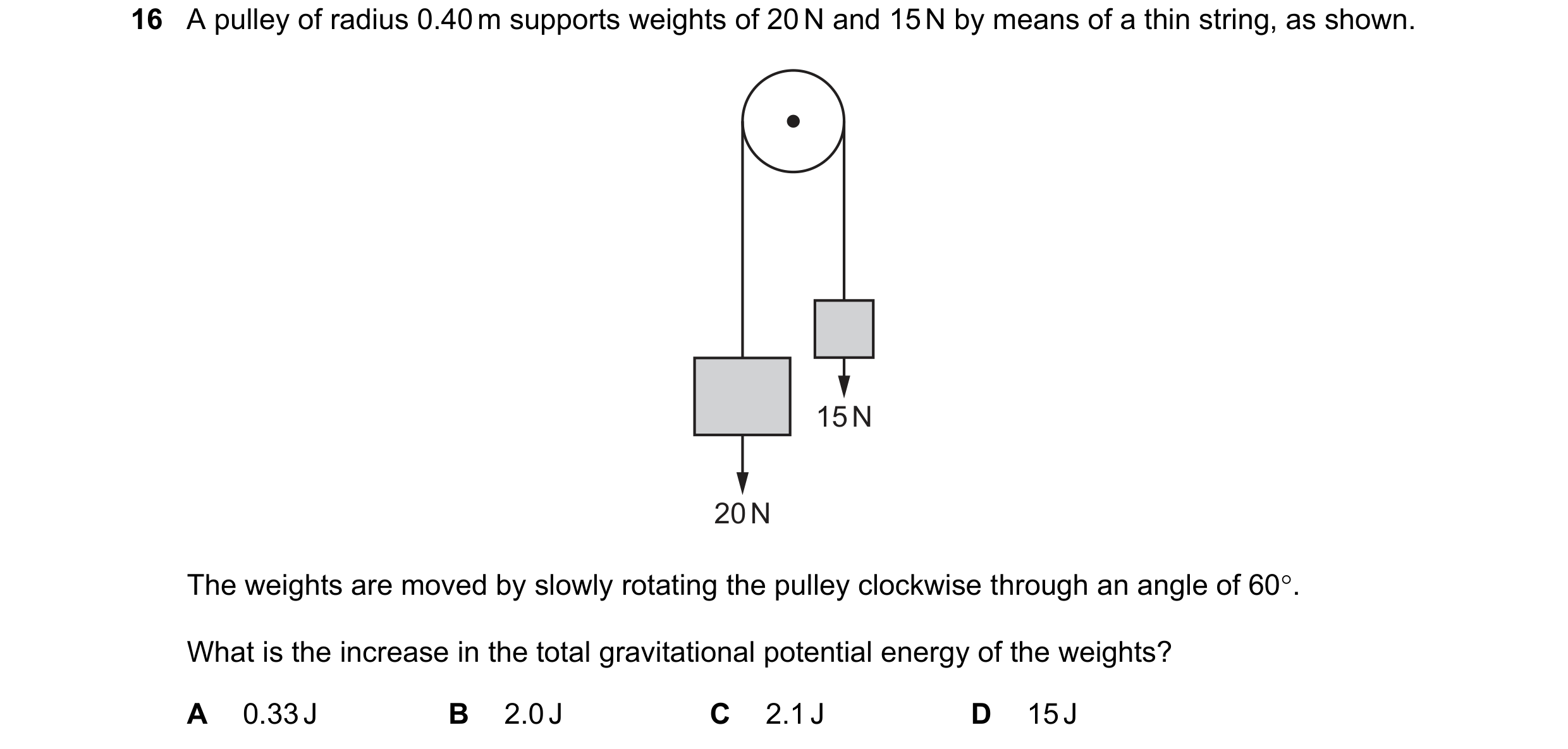

 37 / 50

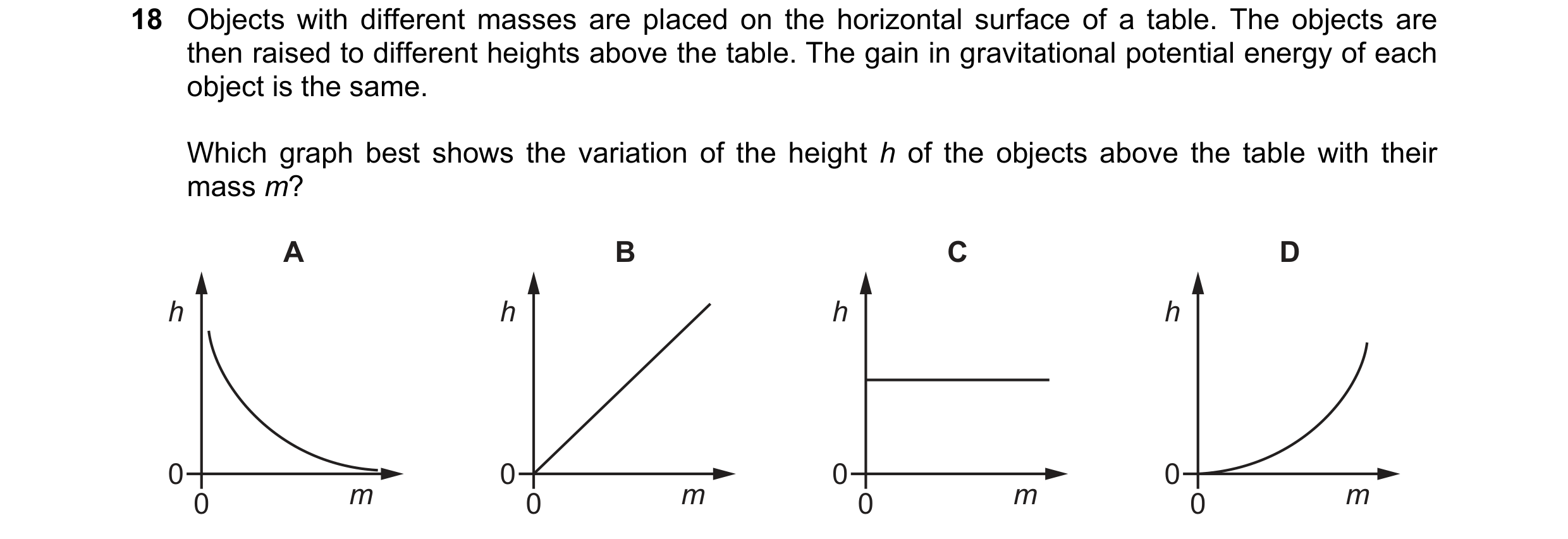
 38 / 50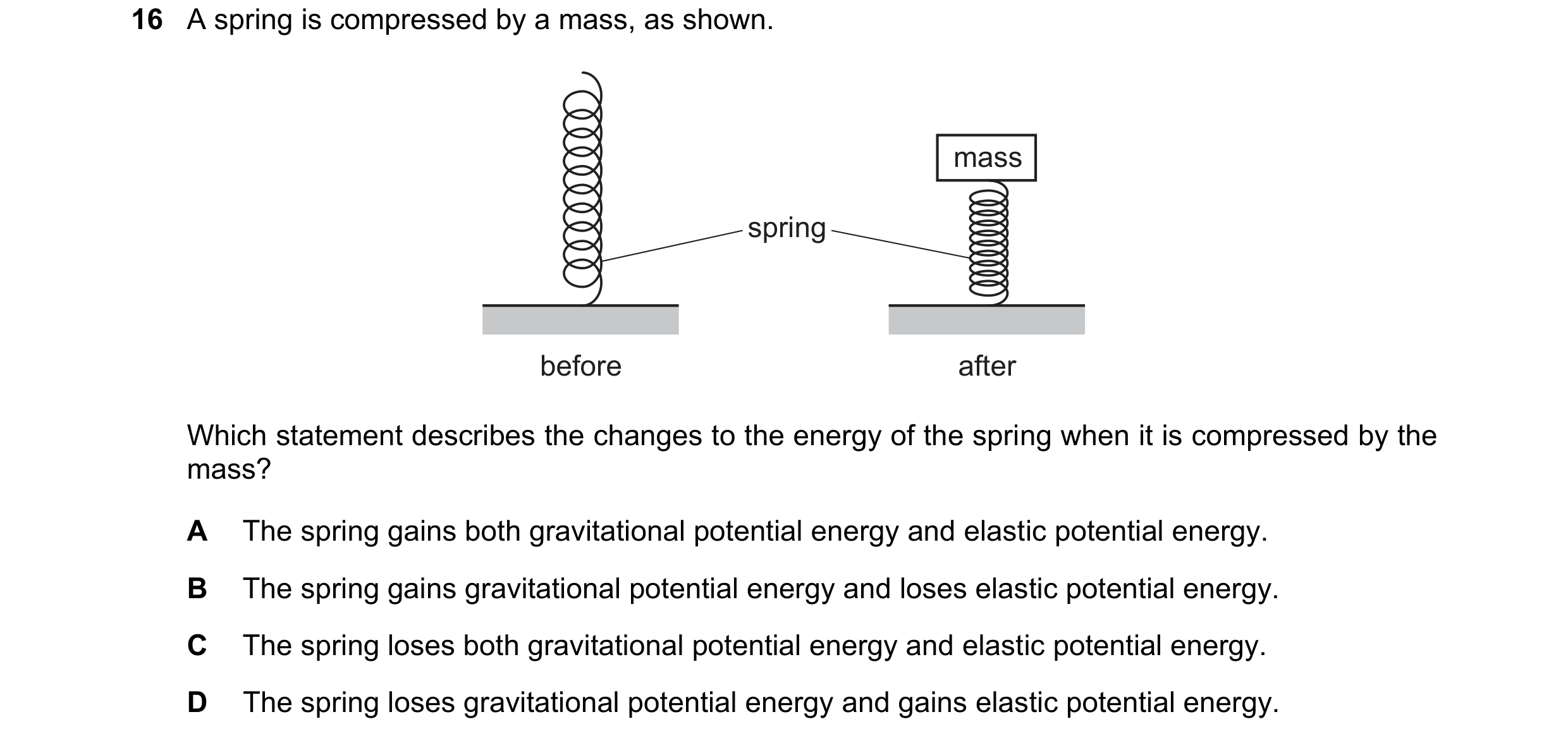

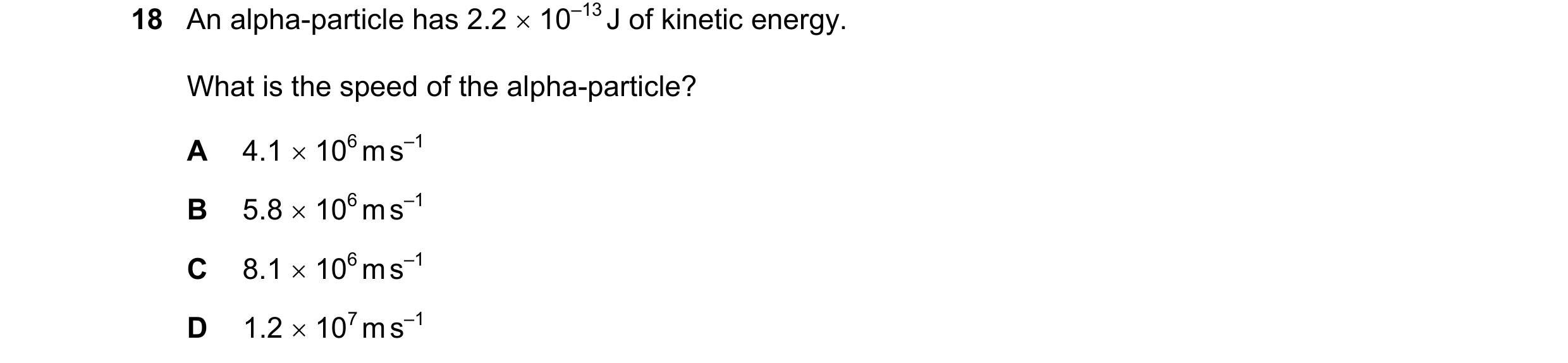
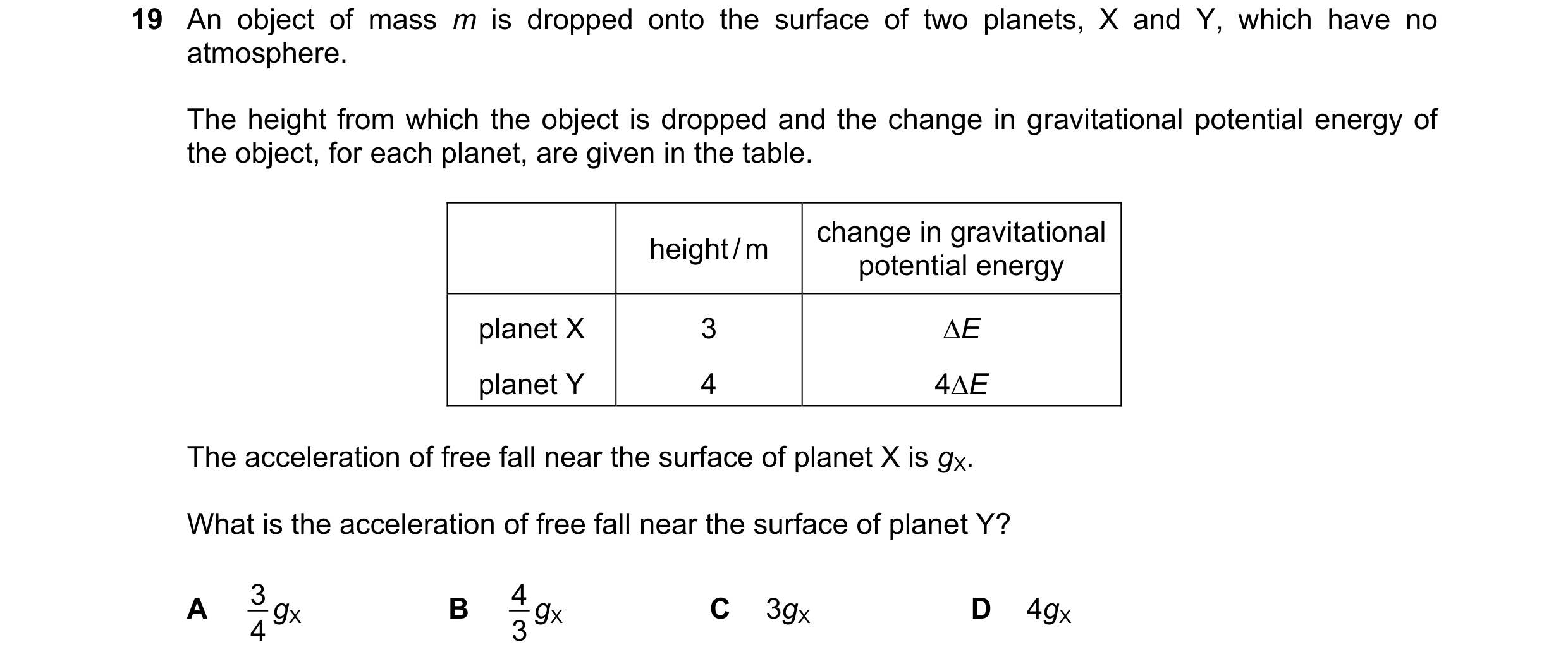 39 / 50
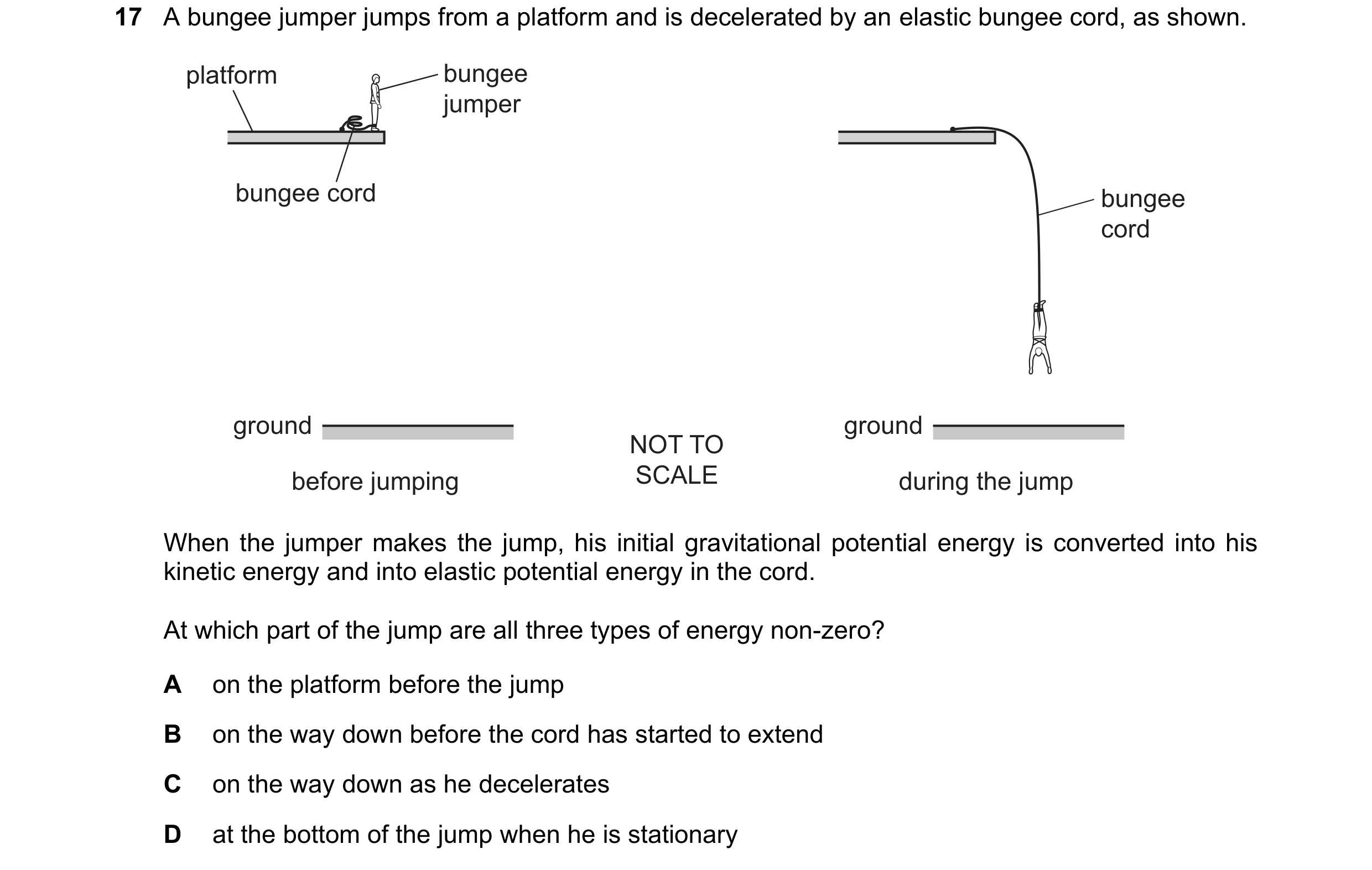

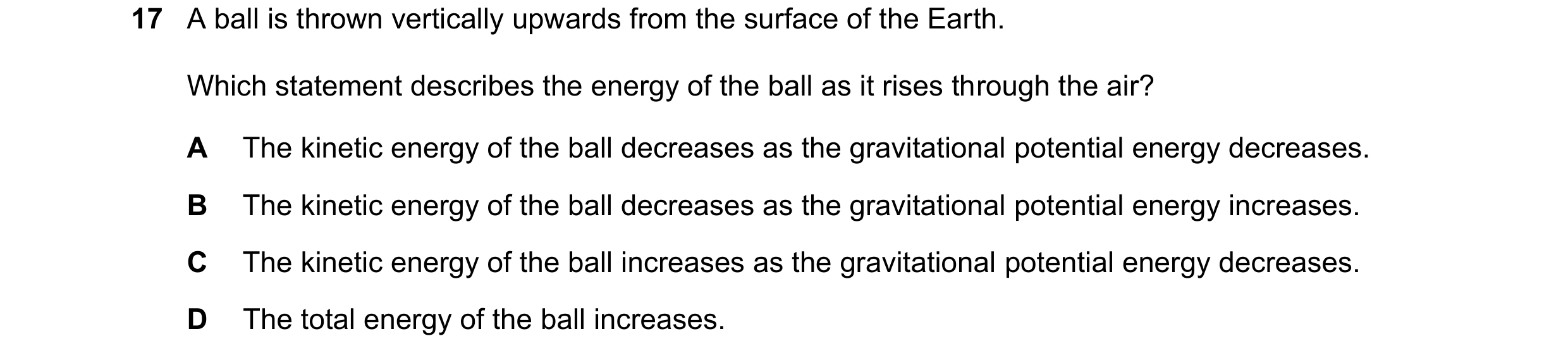 40 / 50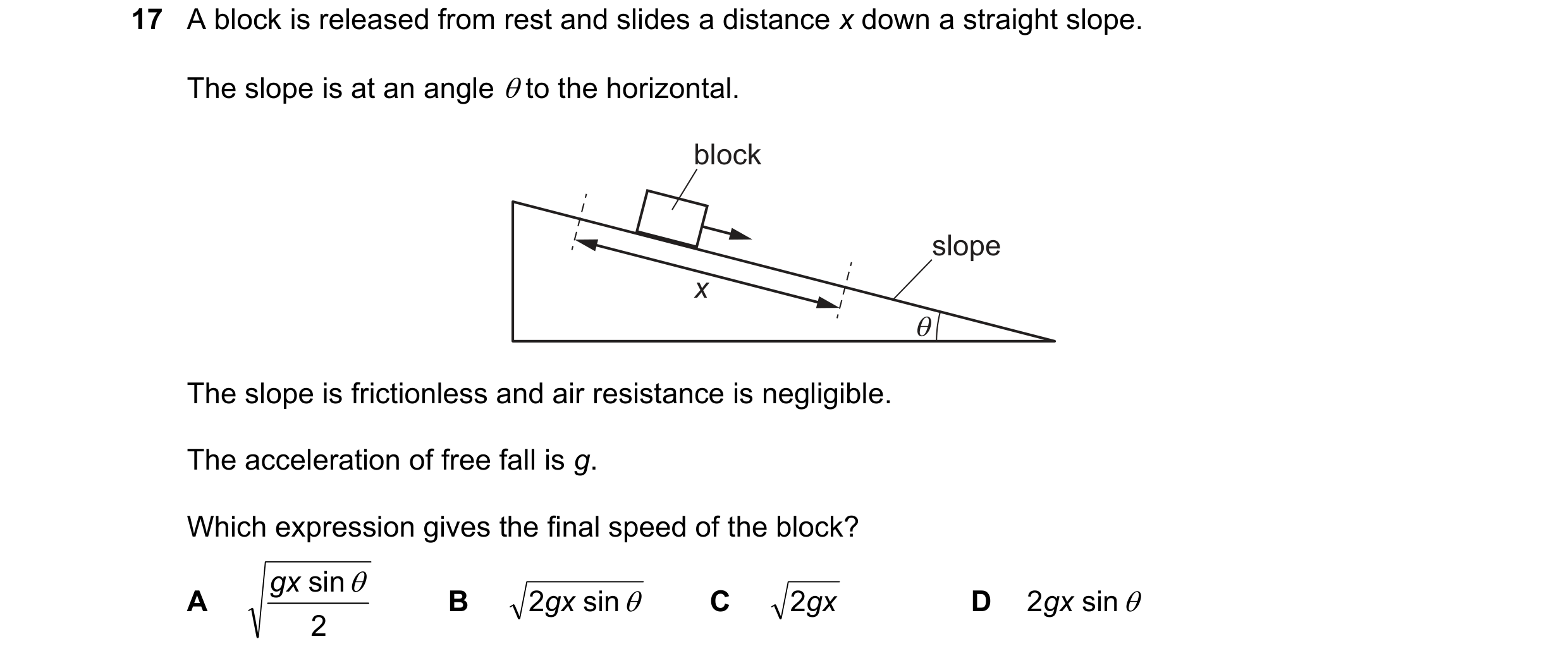
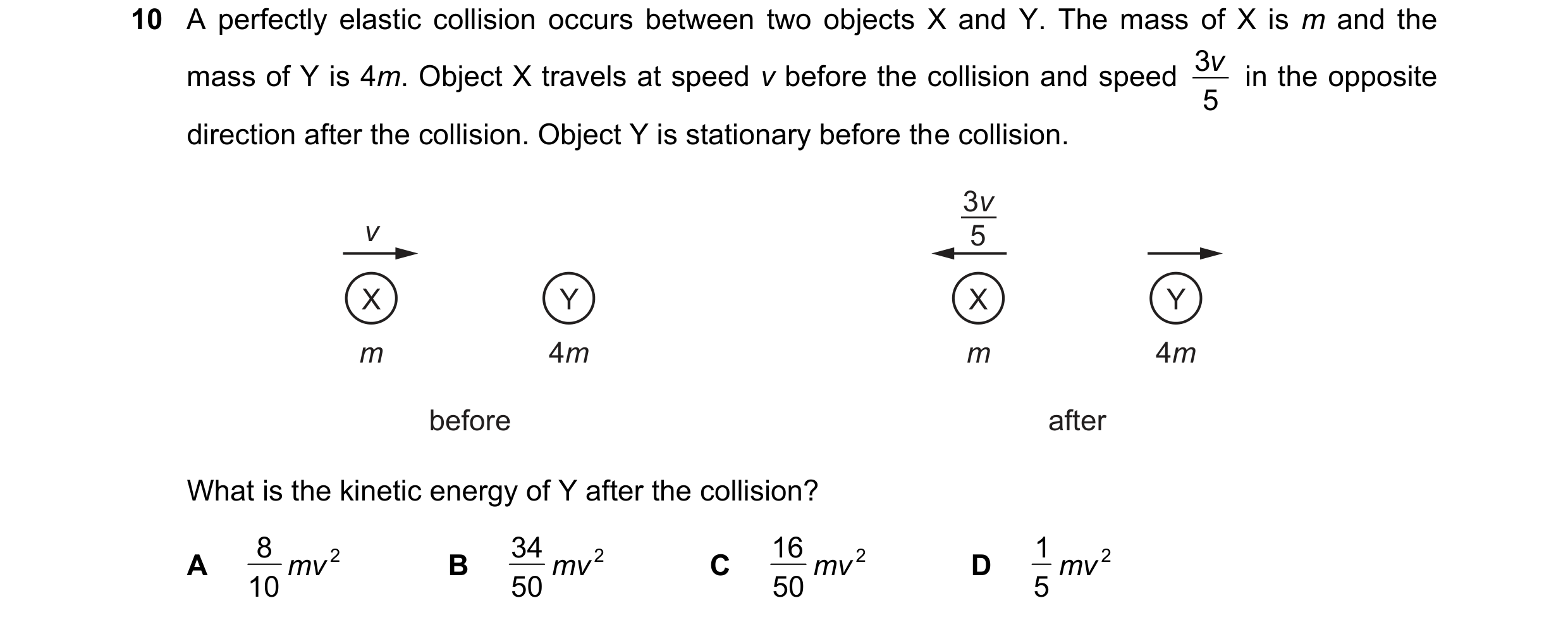
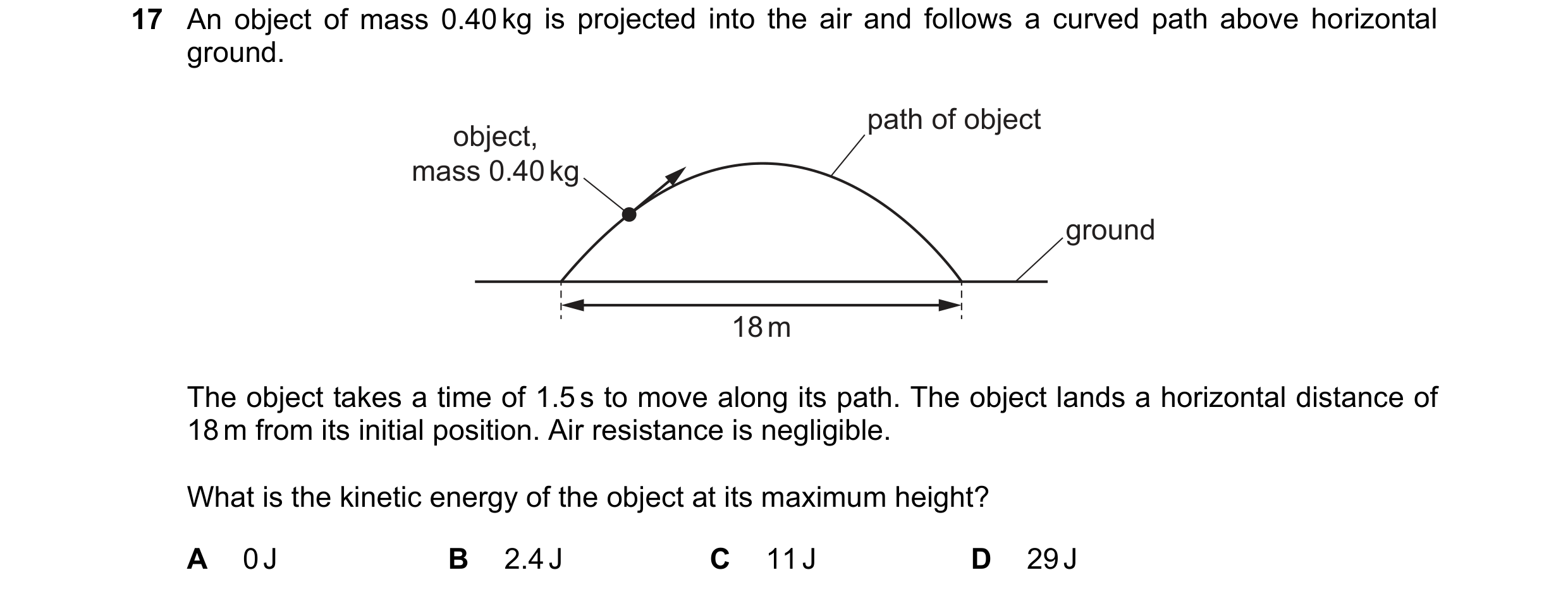 41 / 50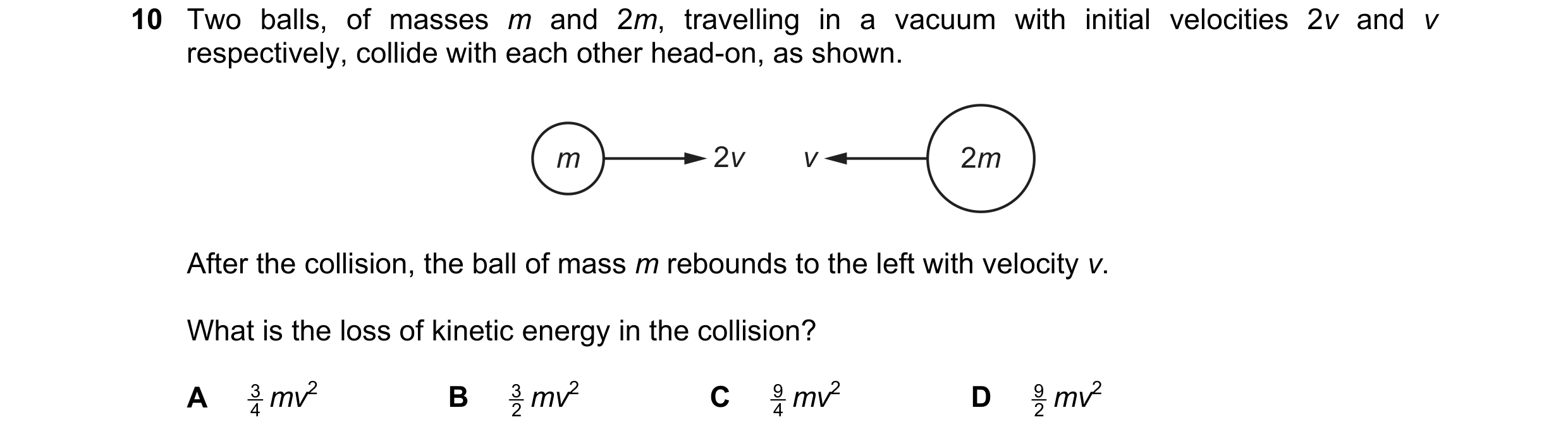
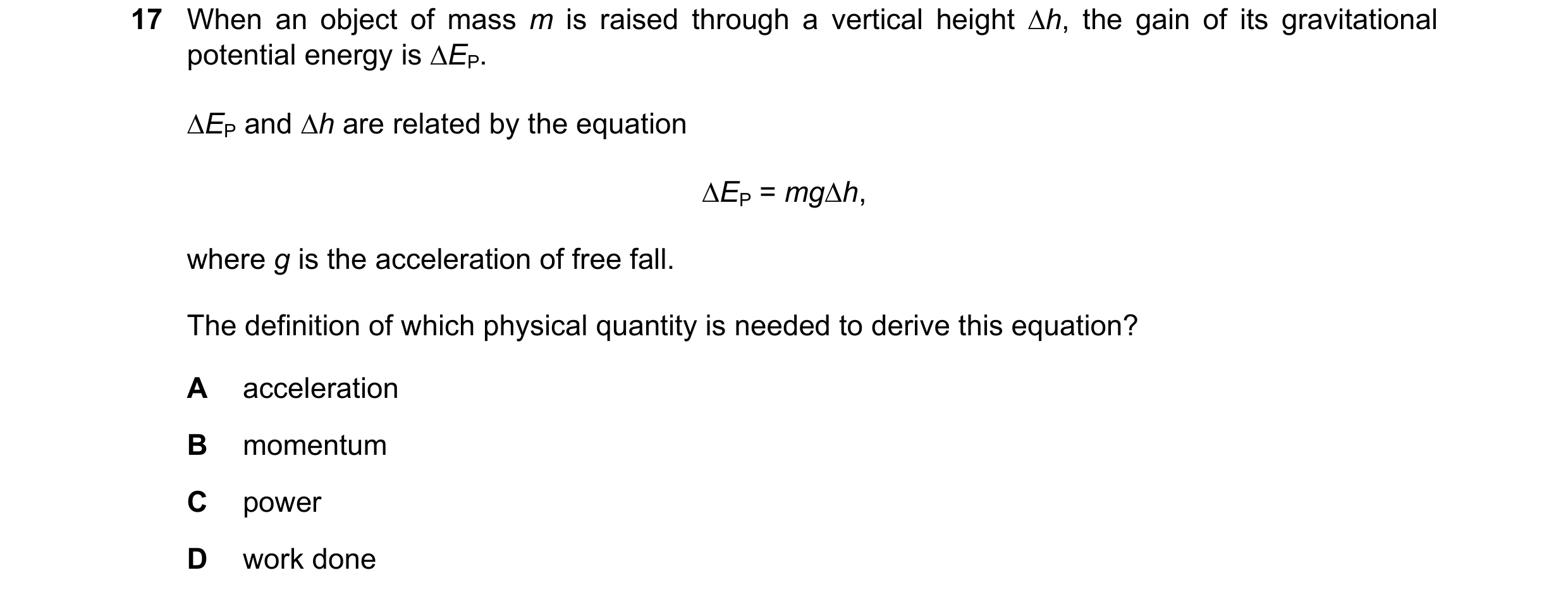
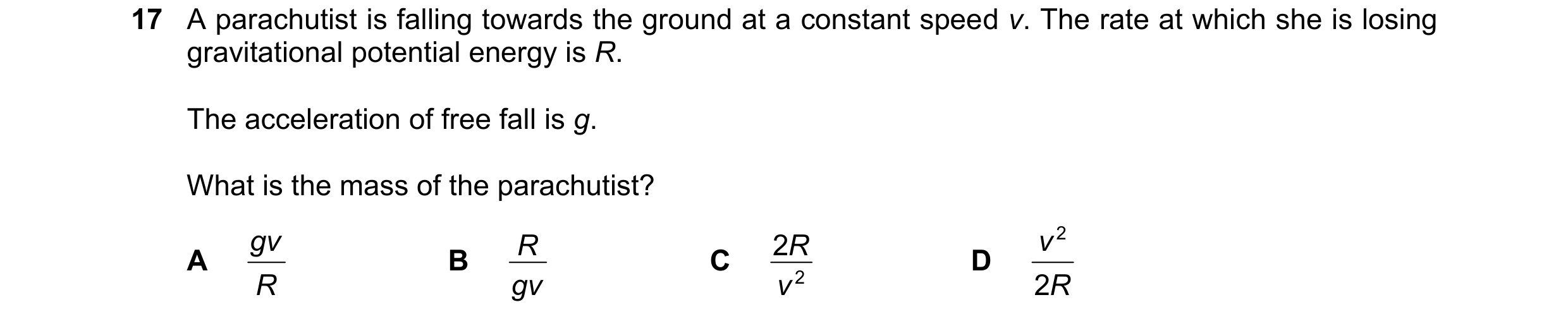
 42 / 50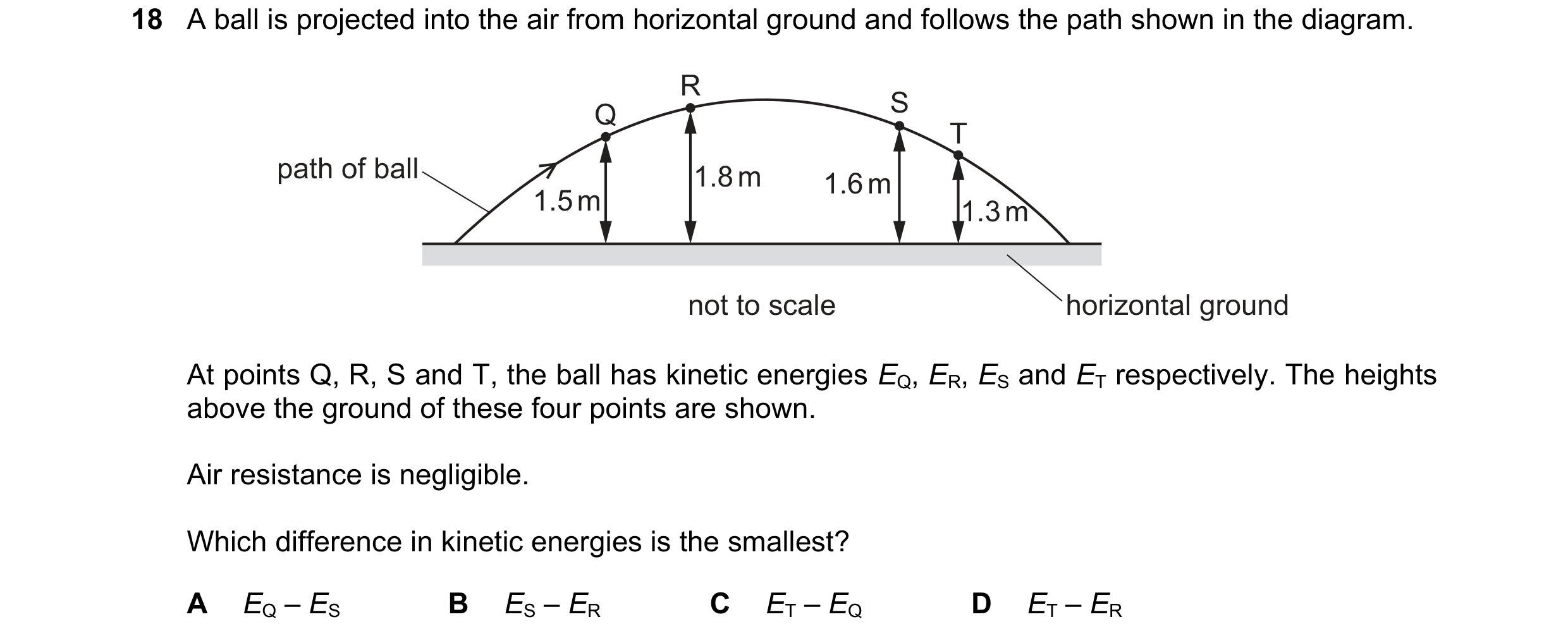
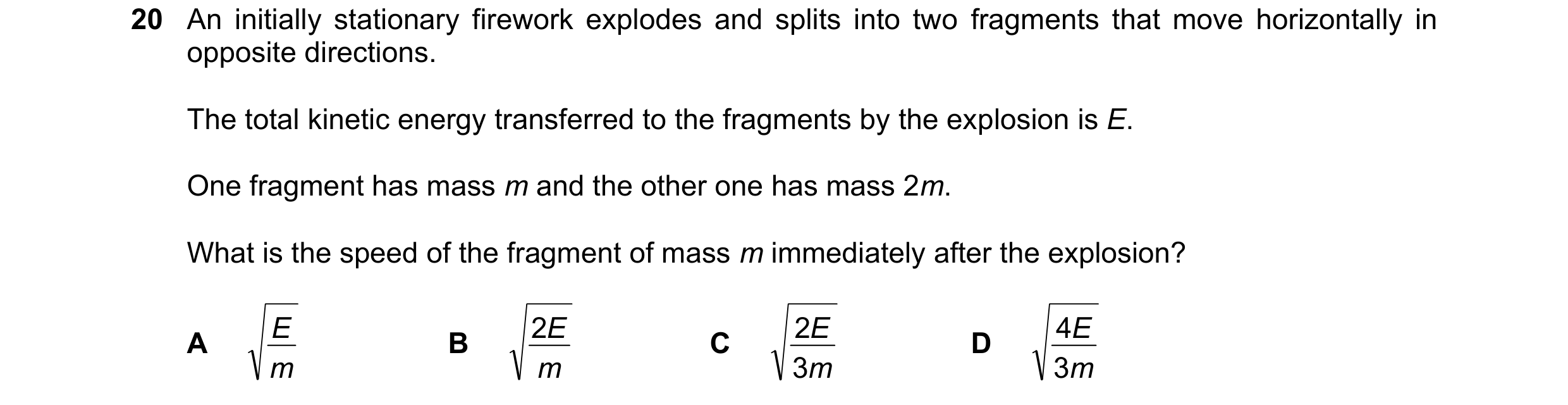
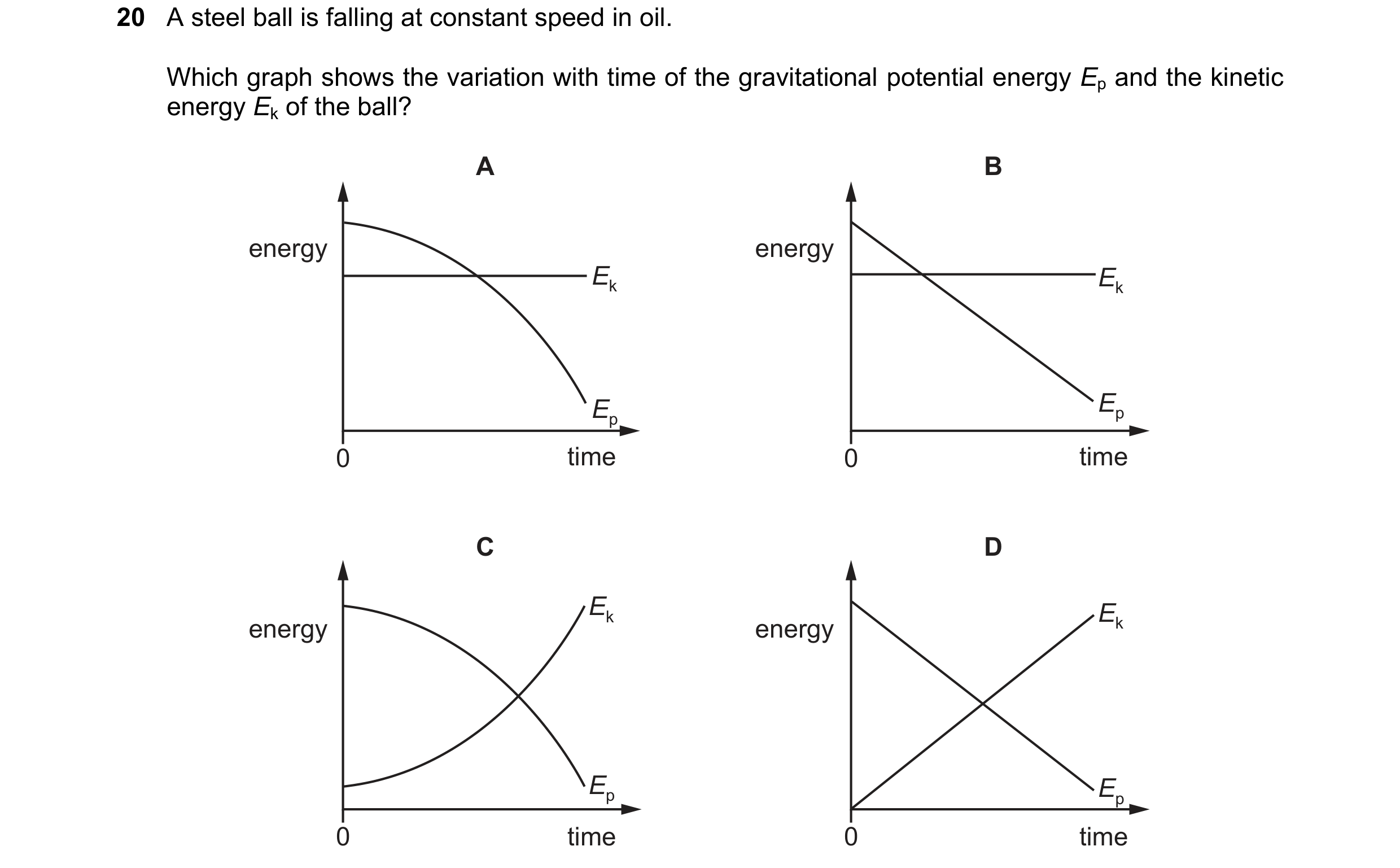 43 / 50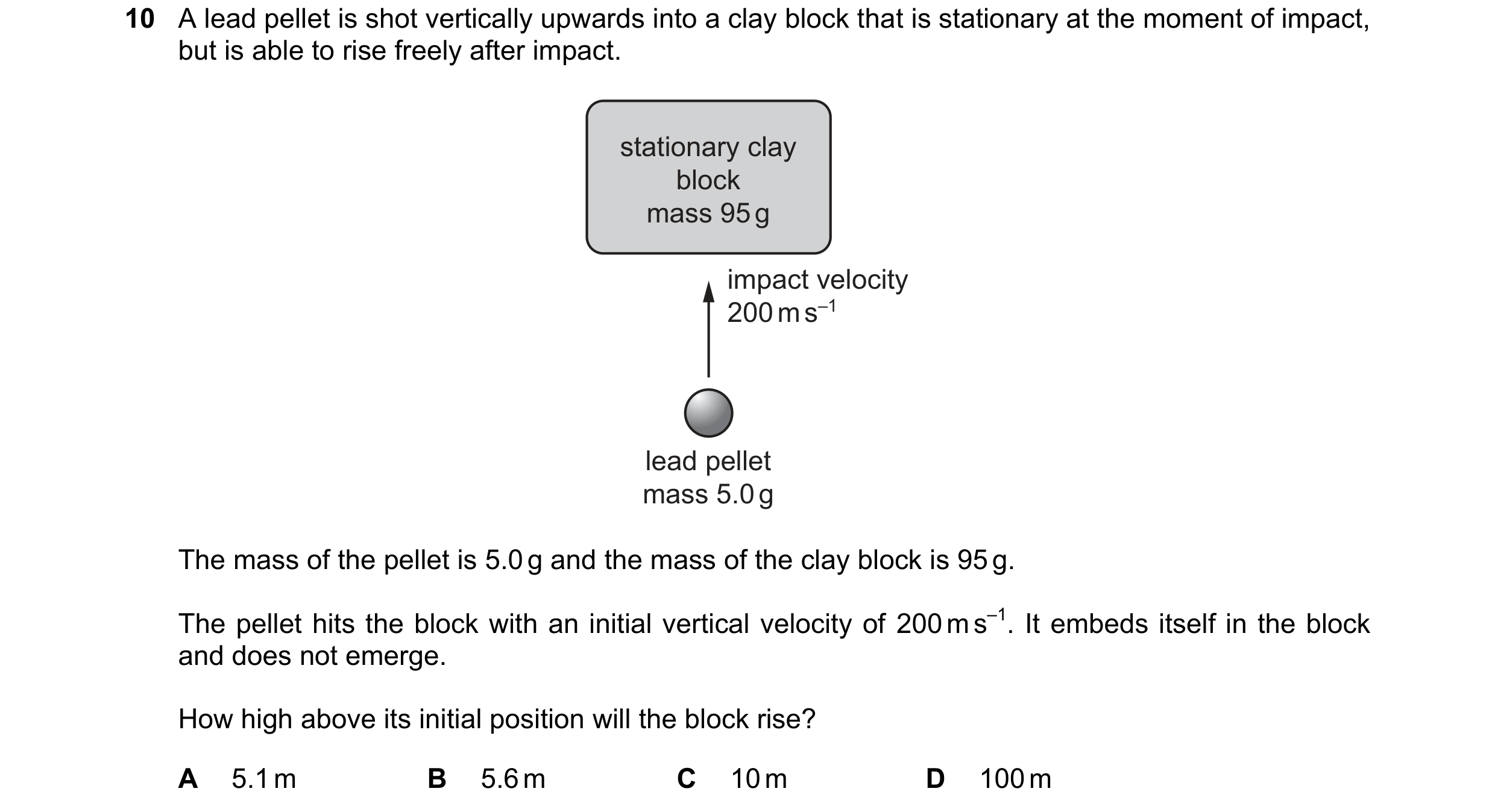


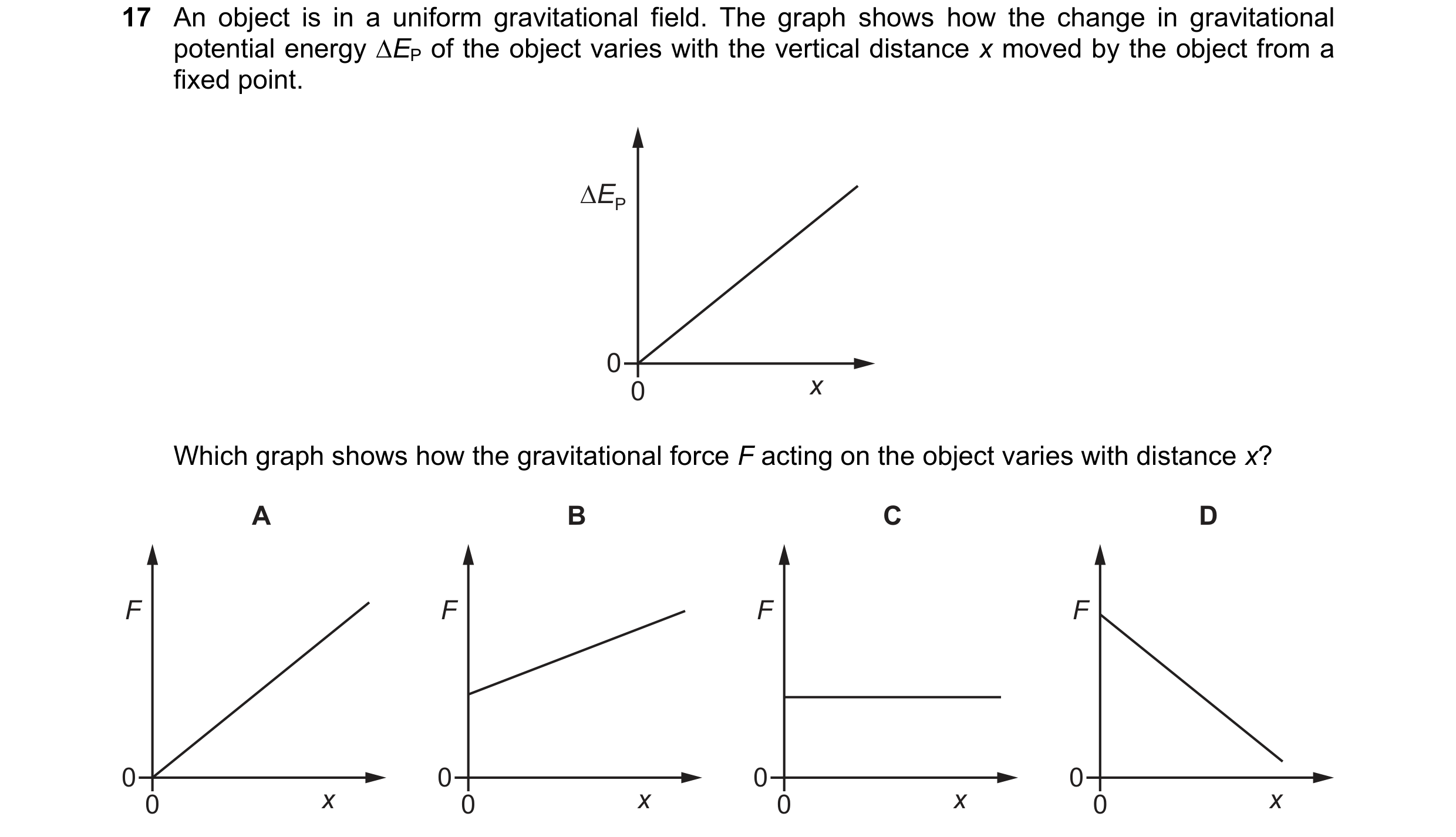 44 / 50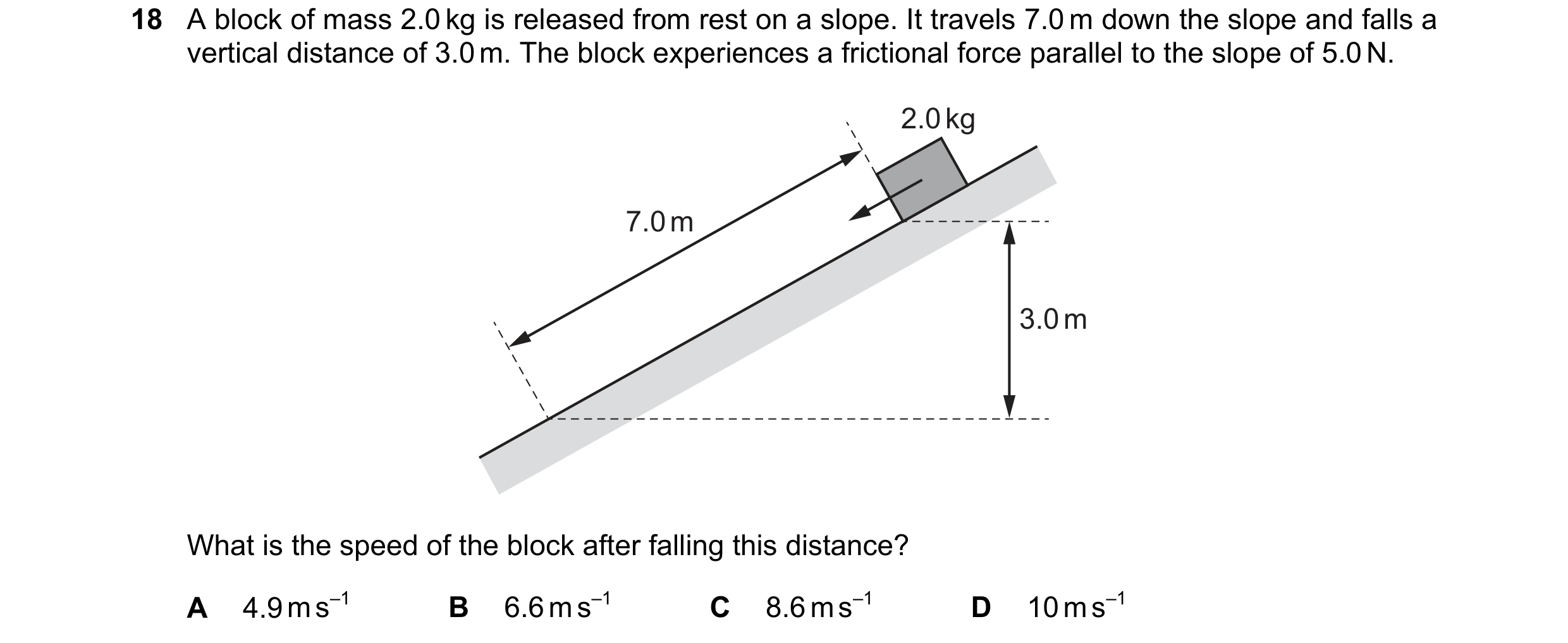

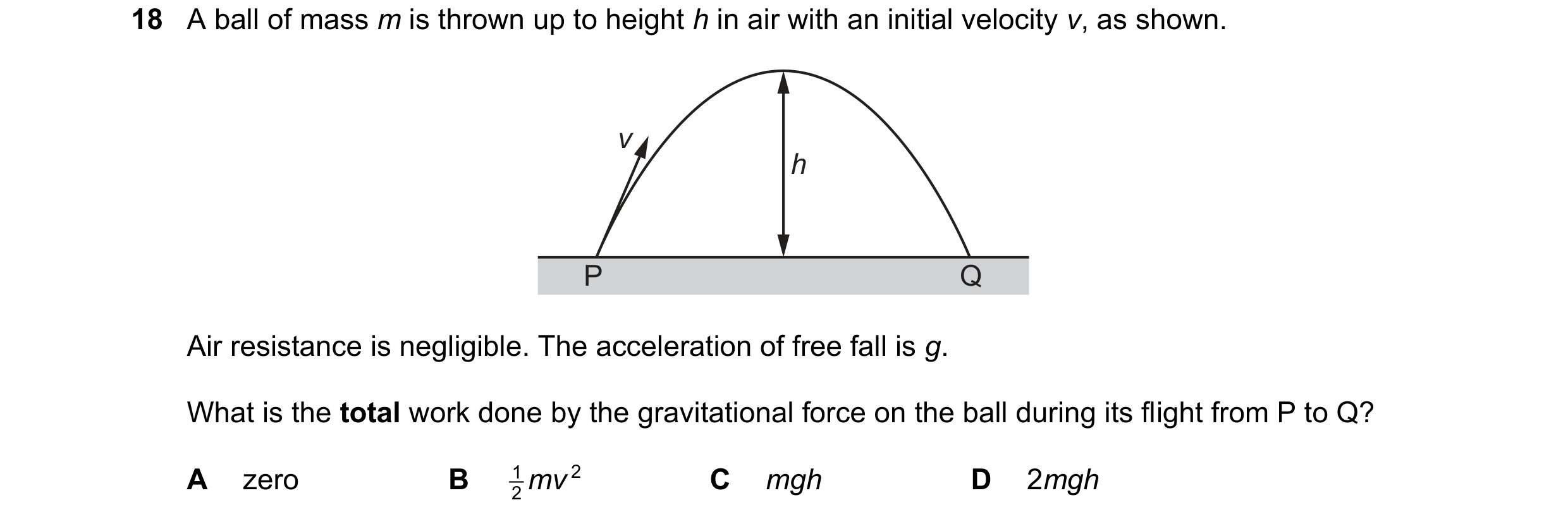
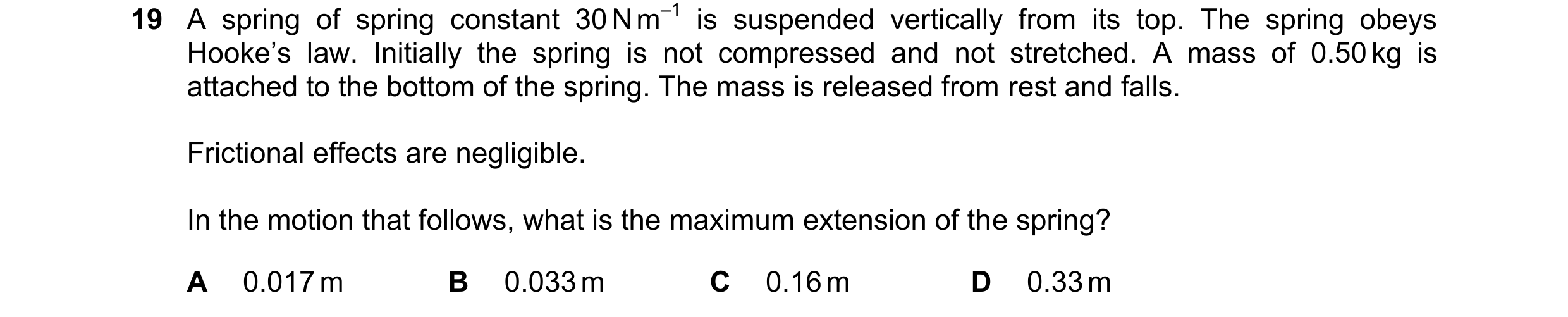
 45 / 50
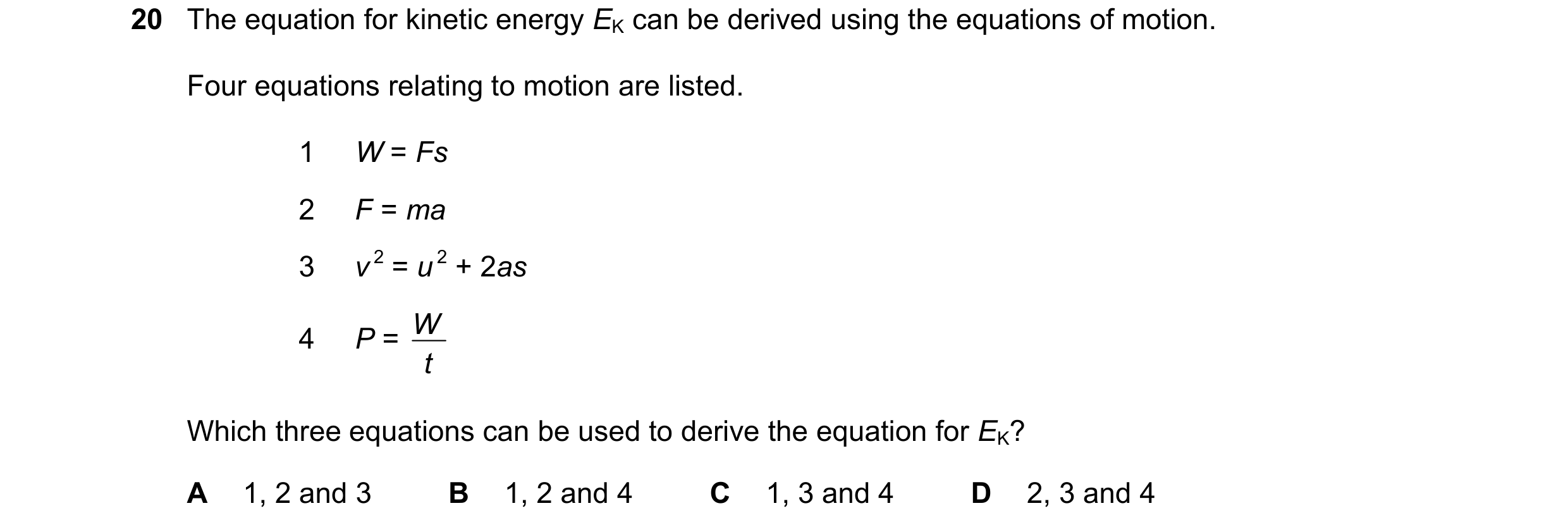
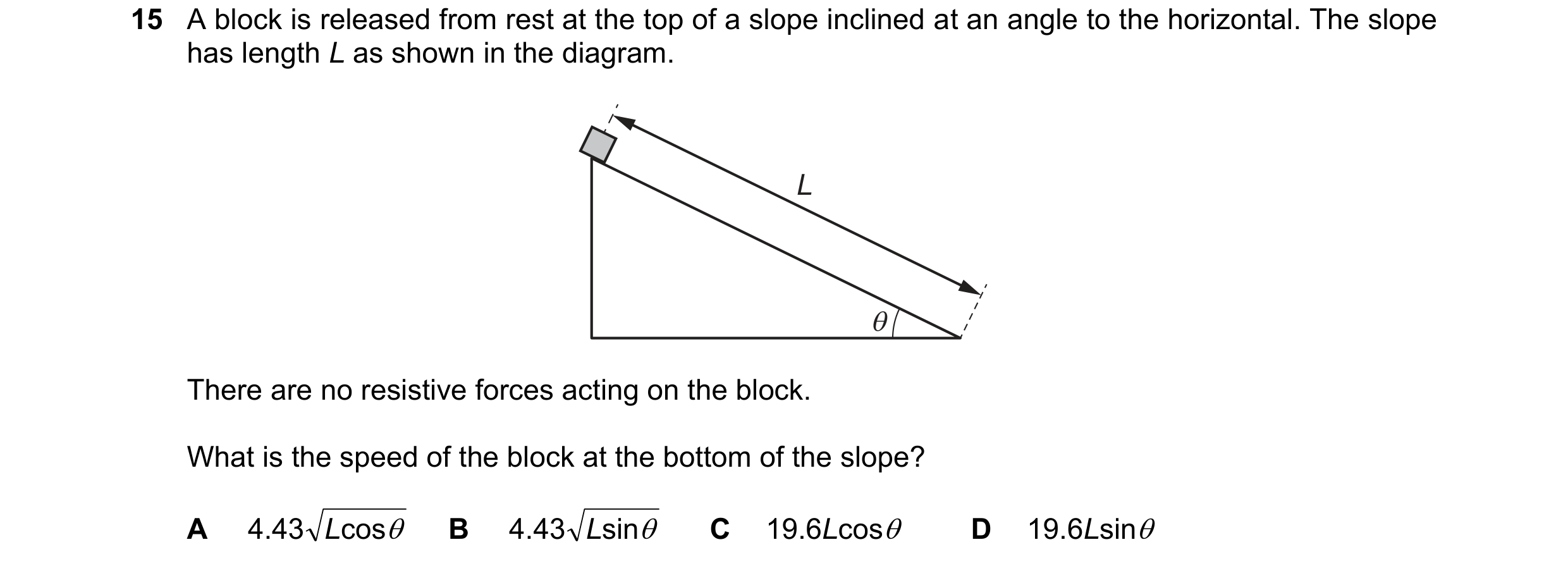

 46 / 50
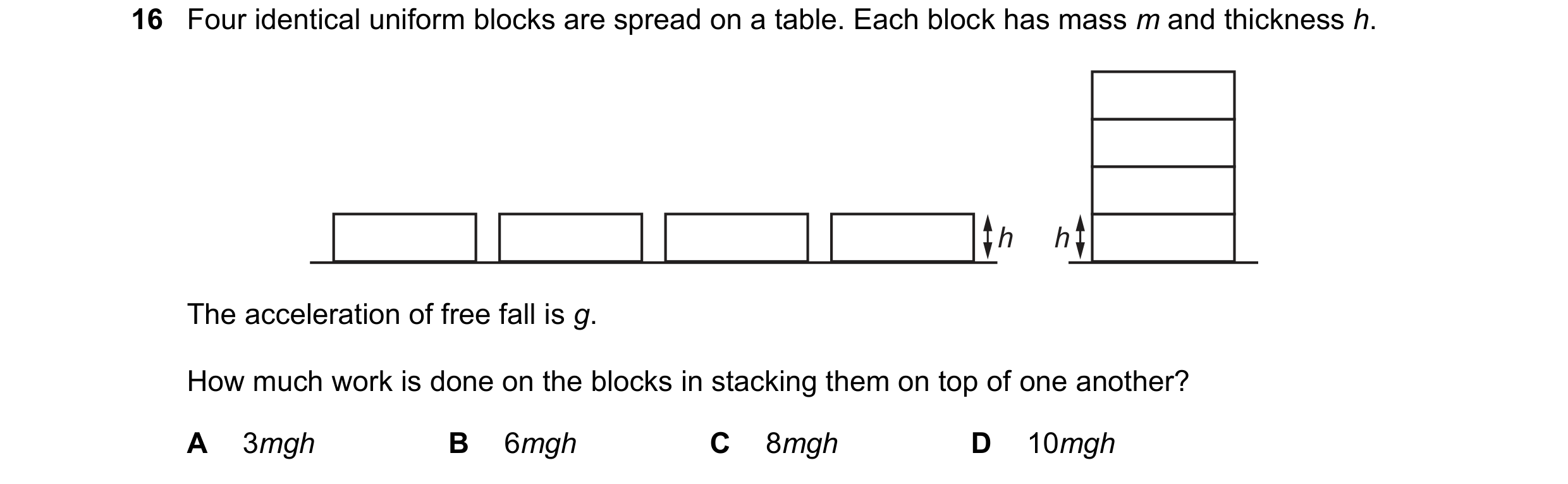
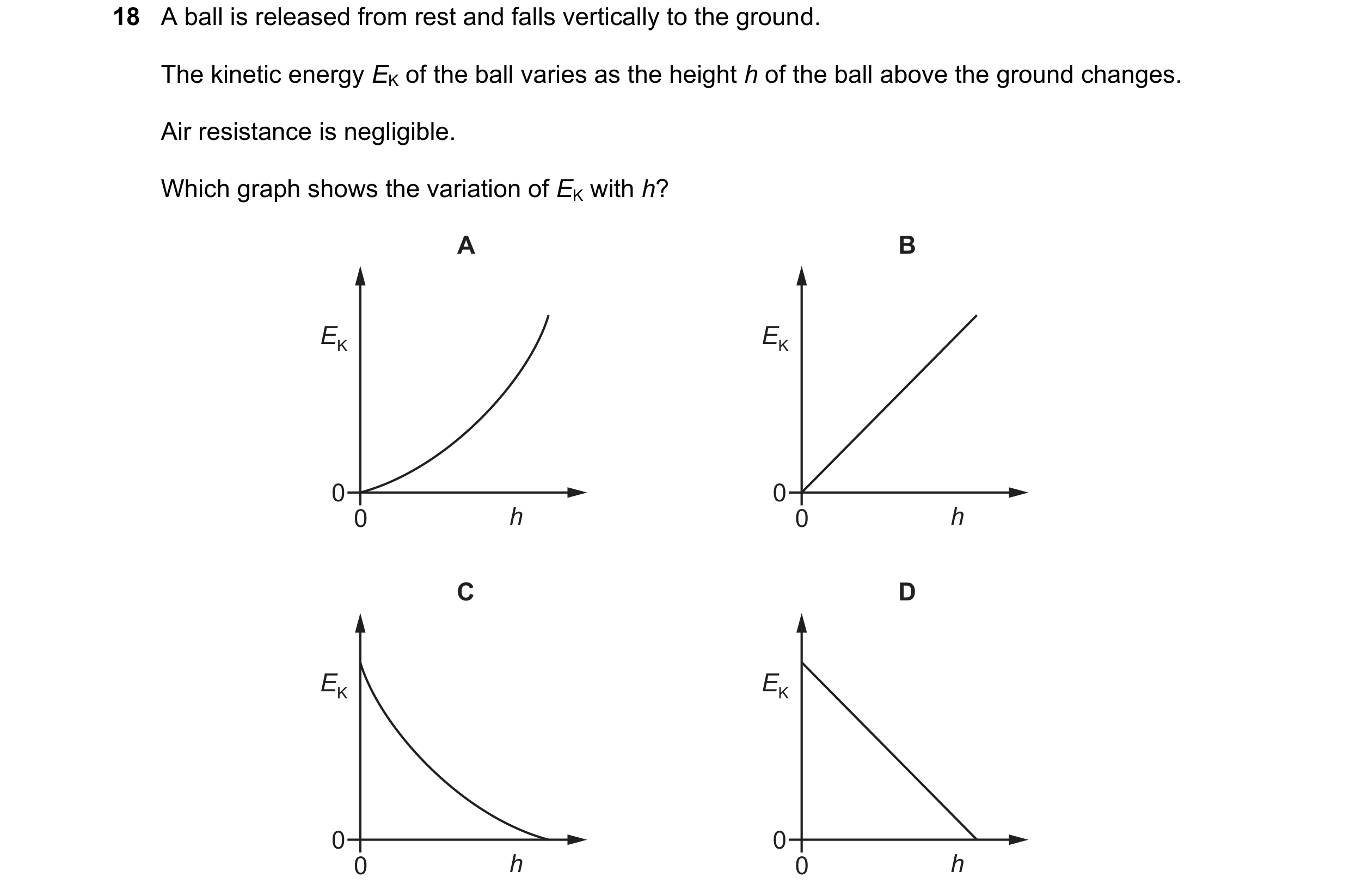
 47 / 50
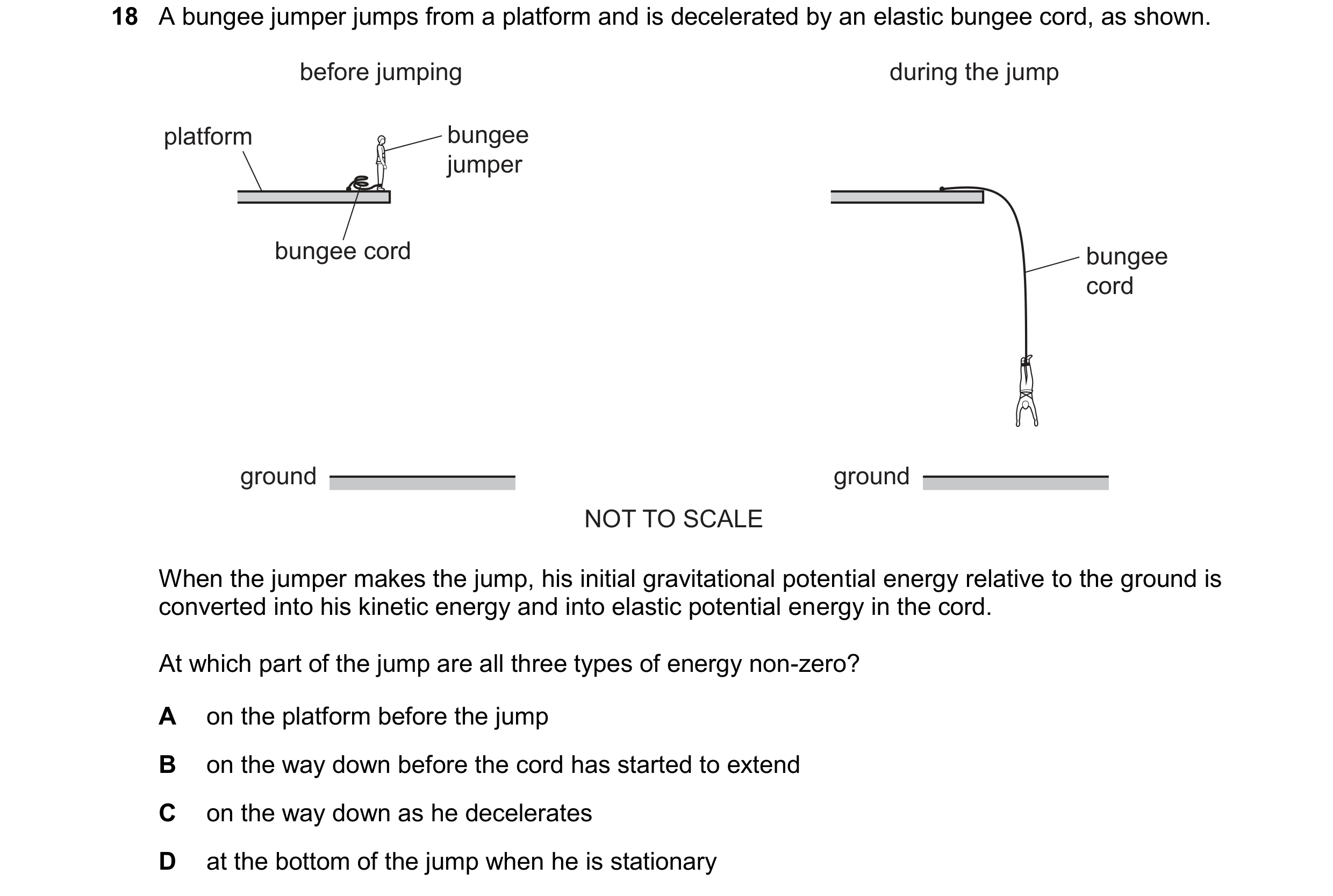

 48 / 50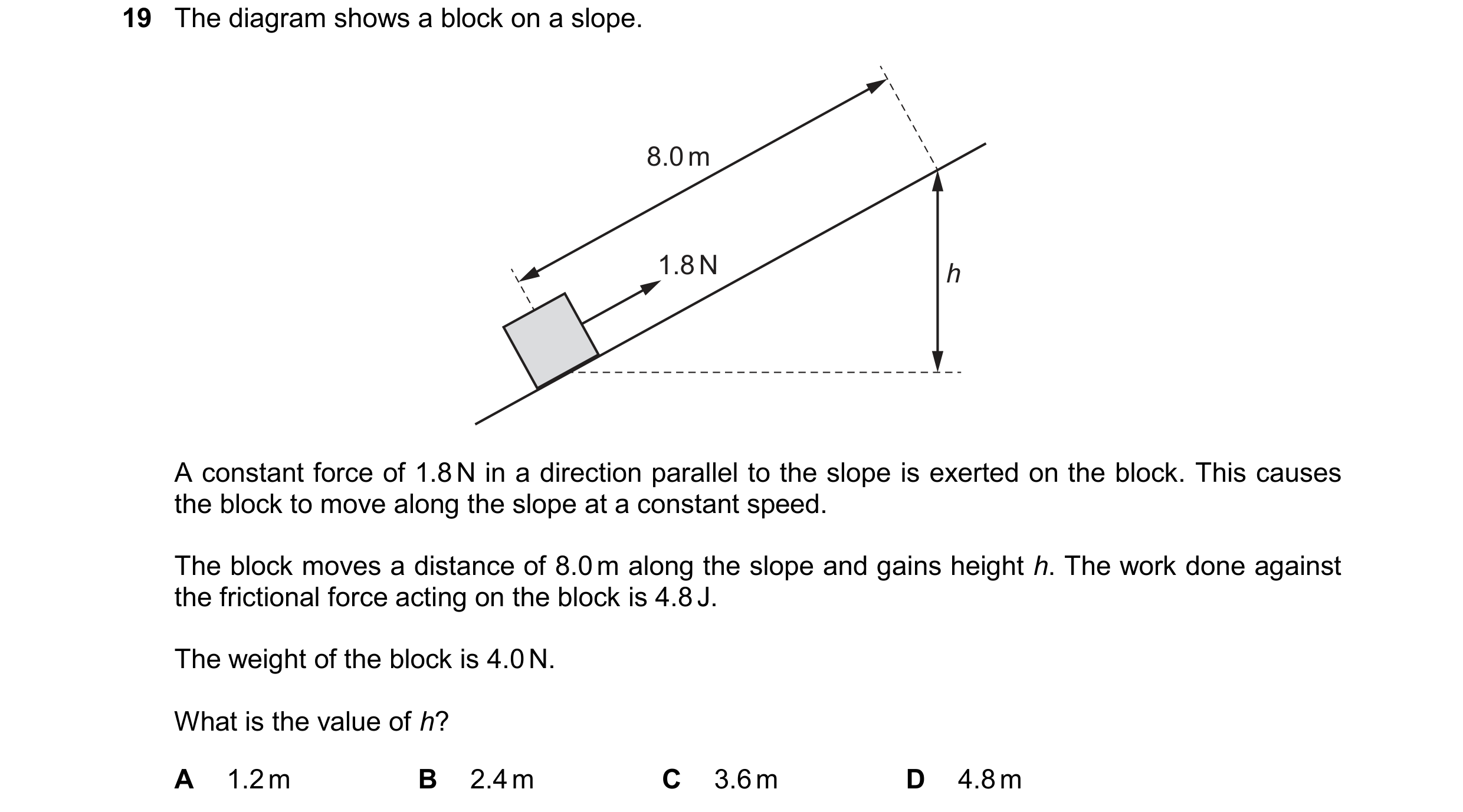

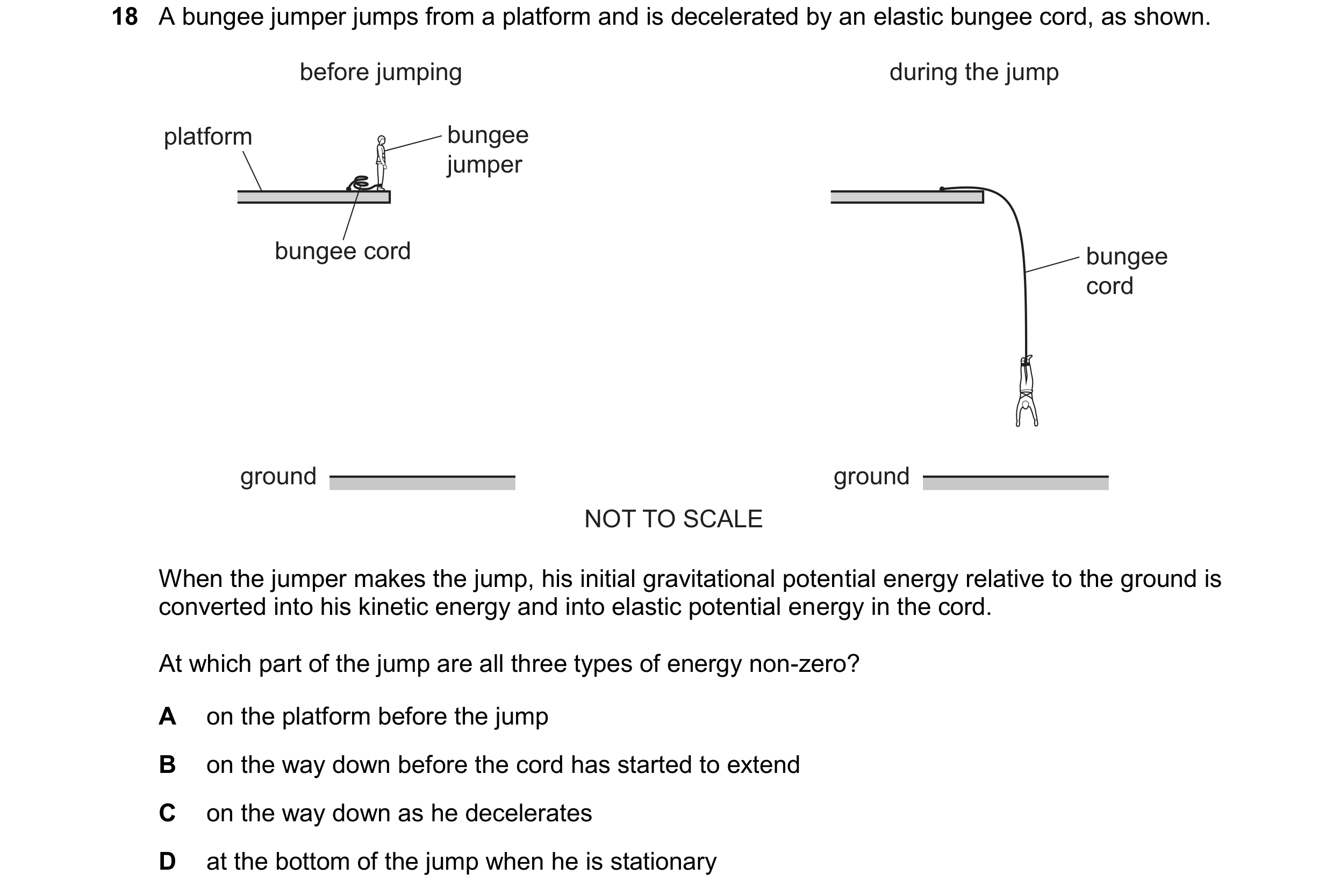 49 / 50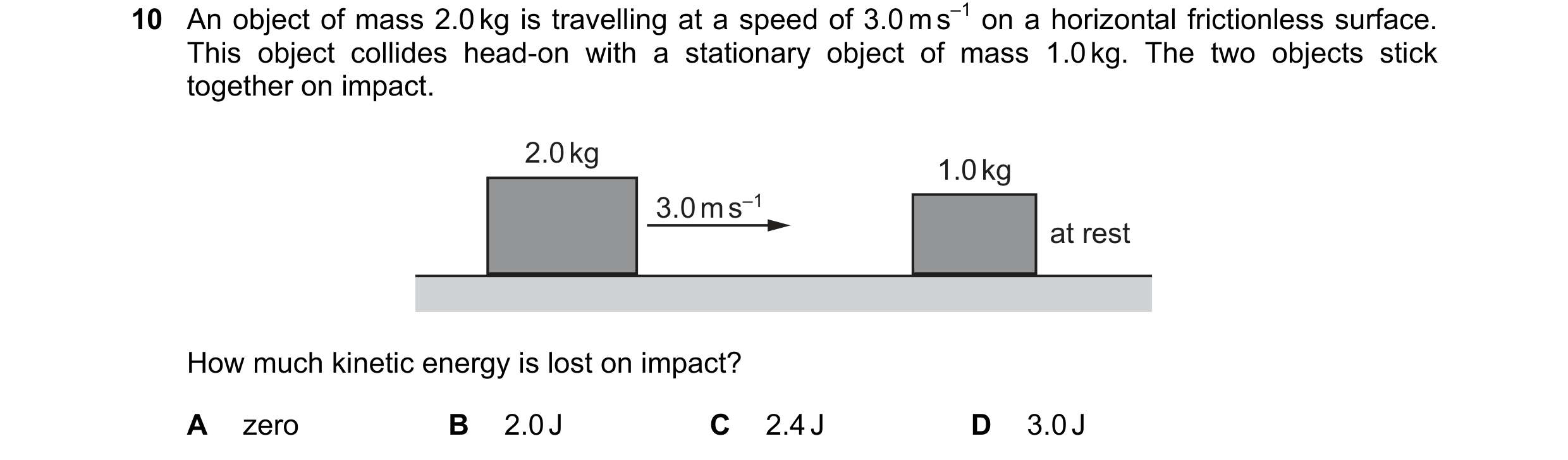
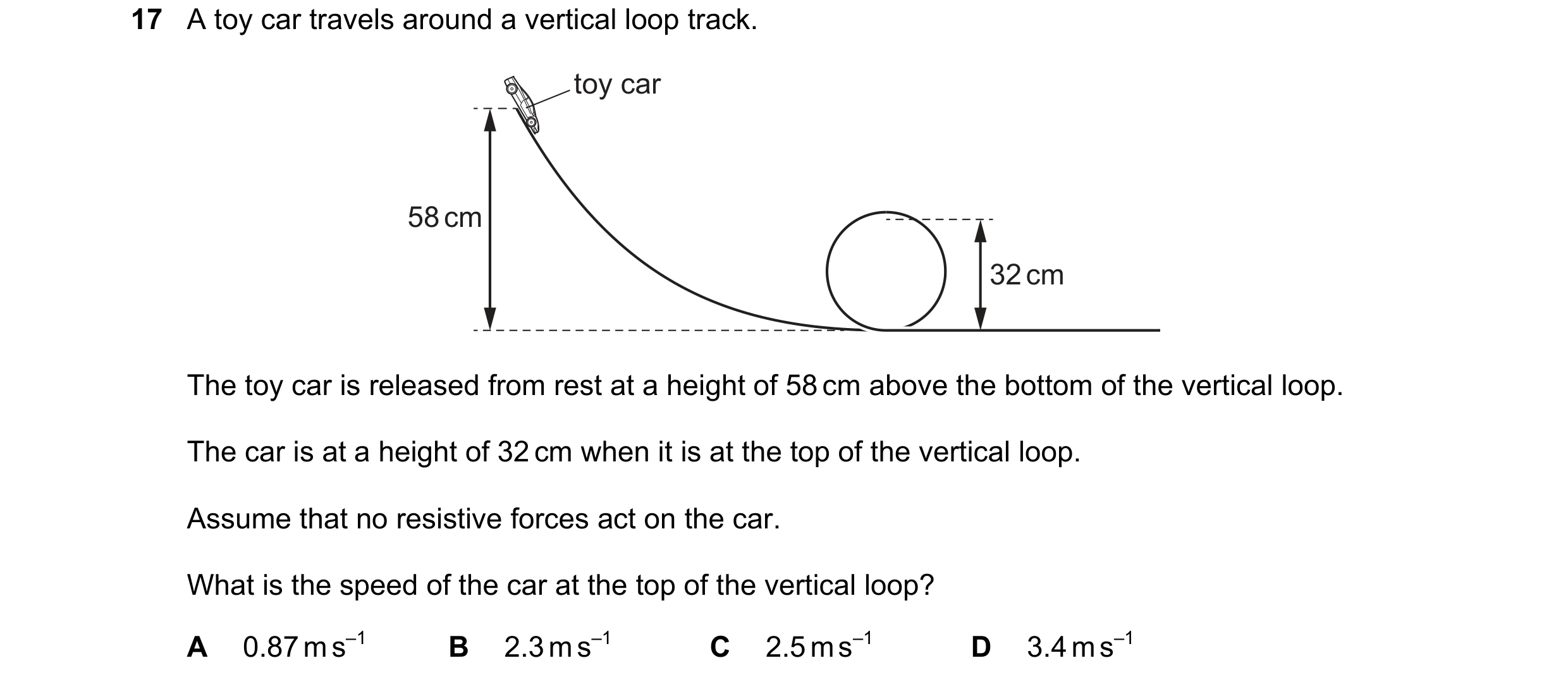 50 / 50