Questions as text
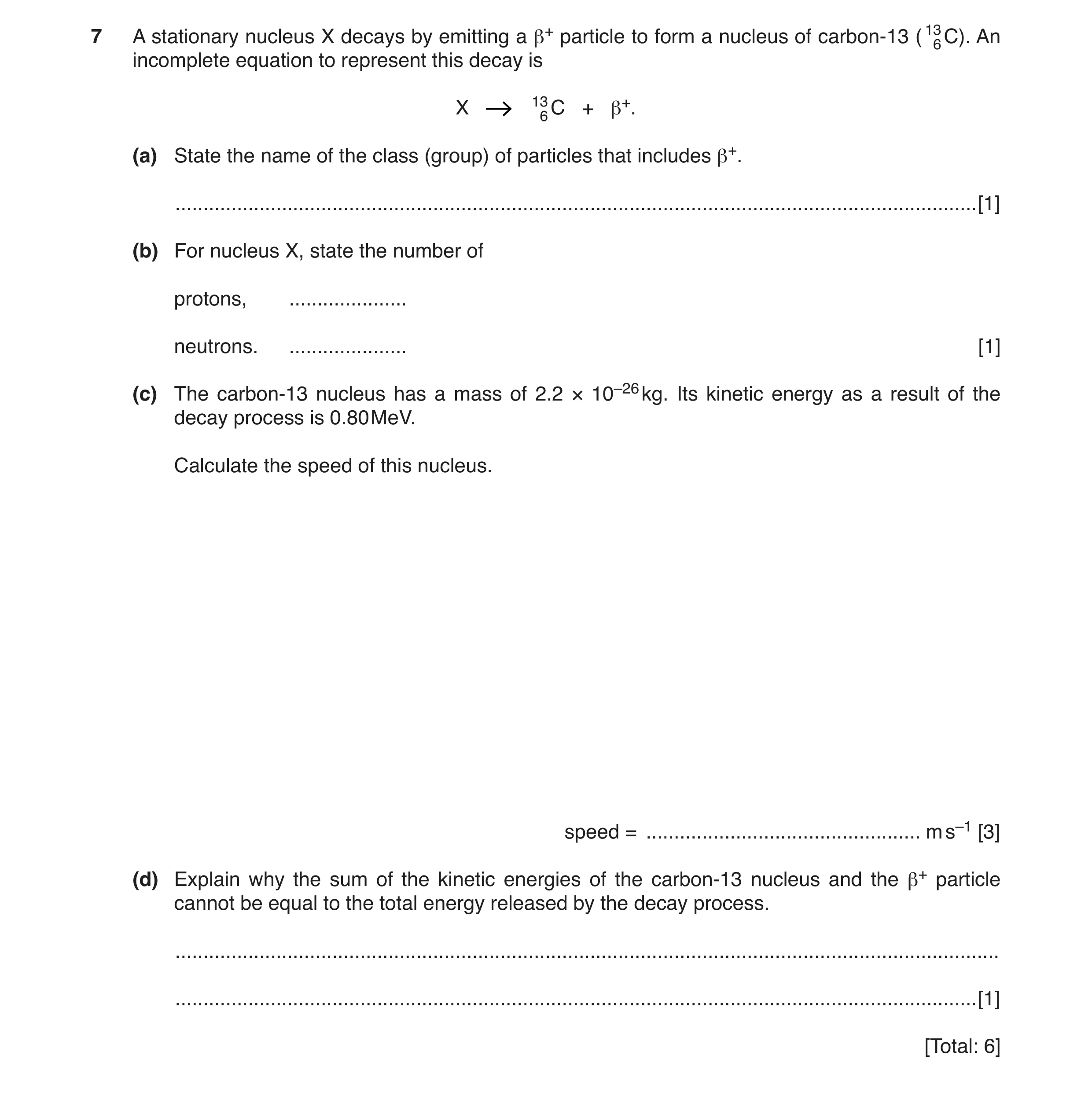
Q1 · A stationary nucleus X decays by emitting a β+ particle to form a nucleus of carbon-13 (… 9702/22 Oct/Nov 2017
7 A stationary nucleus X decays by emitting a β+ particle to form a nucleus of carbon-13 ( 136 C). An incomplete equation to represent this decay is X 136 C + β+. (a) State the name of the class (group) of particles that includes β+. … [1] (b) For nucleus X, state the number of protons, … neutrons. … [1] (c) The carbon-13 nucleus has a mass of 2.2 × 10⁻²⁶ kg. Its kinetic energy as a result of the decay process is 0.80 MeV. Calculate the speed of this nucleus. speed = … m s–1 [3] (d) Explain why the sum of the kinetic energies of the carbon-13 nucleus and the β+ particle cannot be equal to the total energy released by the decay process. … … [1] [Total: 6]
6 marks
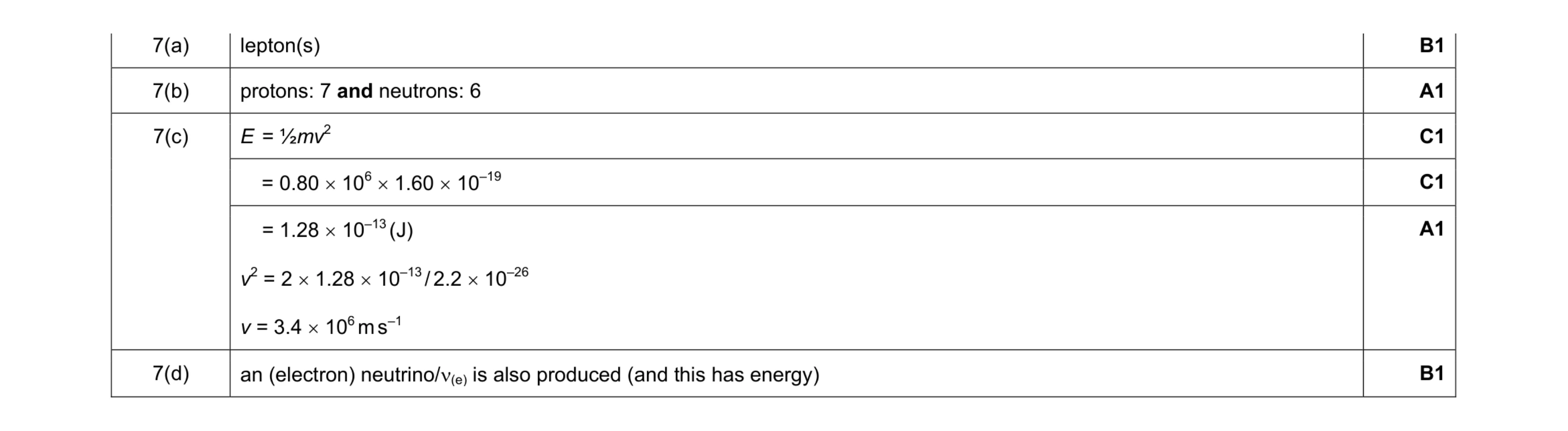
Mark scheme: 7(a) lepton(s) B1 7(b) protons: 7 and neutrons: 6 A1 7(c) E = ½mv2 C1 = 0.80 × 106 × 1.60 × 10–19 C1 = 1.28 × 10⁻¹³ (J) v2 = 2 × 1.28 × 10–13 / 2.2 × 10⁻²⁶ v = 3.4 × 10⁶ m s–1 A1 7(d) an (electron) neutrino/ν(e) is also produced (and this has energy) B1
This question in 9702/22 Oct/Nov 2017
Q2 · Explain what is meant by (i) work done, … … [1] (ii) kinetic energy 9702/22 Feb/March 2018
2 (a) Explain what is meant by (i) work done, … … [1] (ii) kinetic energy. … … [1] (b) A leisure-park ride consists of a carriage that moves along a railed track. Part of the track lies in a vertical plane and follows an arc XY of a circle of radius 13 m, as shown in Fig. 2.1. 13 m Y 13 m carriage 22 m s–1 mass 580 kg track X Fig. 2.1 The mass of the carriage is 580 kg. At point X, the carriage has velocity 22 m s–1 in a horizontal direction. The velocity of the carriage then decreases to 12 m s–1 in a vertical direction at point Y. (i) For the carriage moving from X to Y 1. show that the decrease in kinetic energy is 9.9 × 10⁴ J, [2] 2. calculate the gain in gravitational potential energy. gain in gravitational potential energy = … J [2] (ii) Show that the length of the track from X to Y is 20 m. [1] (iii) Use your answers in (b)(i) and (b)(ii) to calculate the average resistive force acting on the carriage as it moves from X to Y. resistive force = … N [2] (iv) Describe the change in the direction of the linear momentum of the carriage as it moves from X to Y. … … [1] (v) Determine the magnitude of the change in linear momentum when the carriage moves from X to Y. change in momentum = … N s [3] [Total: 13]
13 marks
Mark scheme: 2(a)(i) B1 2(a)(ii) energy (of a mass/body) due to motion / speed / velocity B1 2(b)(i) 1 E = ½mv 2 C1 (∆)E = ½ × 580 × (222 – 122) = 9.9 × 10⁴ J A1 2 (∆)E = mg(∆)h ∆E = 580 × 9.81 × 13 C1 = 7.4 × 10⁴ J A1 Question Answer Marks 2(b)(ii) length = (2π×13) / 4 or (π×26) / 4 or (π×13) / 2 = 20 m A1 2(b)(iii) work done against resistive force = 9.9 × 10⁴ – 7.4 × 10⁴ average resistive force = (9.9 × 10⁴ – 7.4 × 10⁴) / 20 C1 = 1300 N A1 2(b)(iv) from horizontal/right to vertical / up or 90° A1 2(b)(v) p = mv or (580 × 22) or (580 × 12) C1 ∆p = [ (580×12)2 + (580×22)2 ]0.5 C1 = 1.5 × 10⁴ N s A1
This question in 9702/22 Feb/March 2018
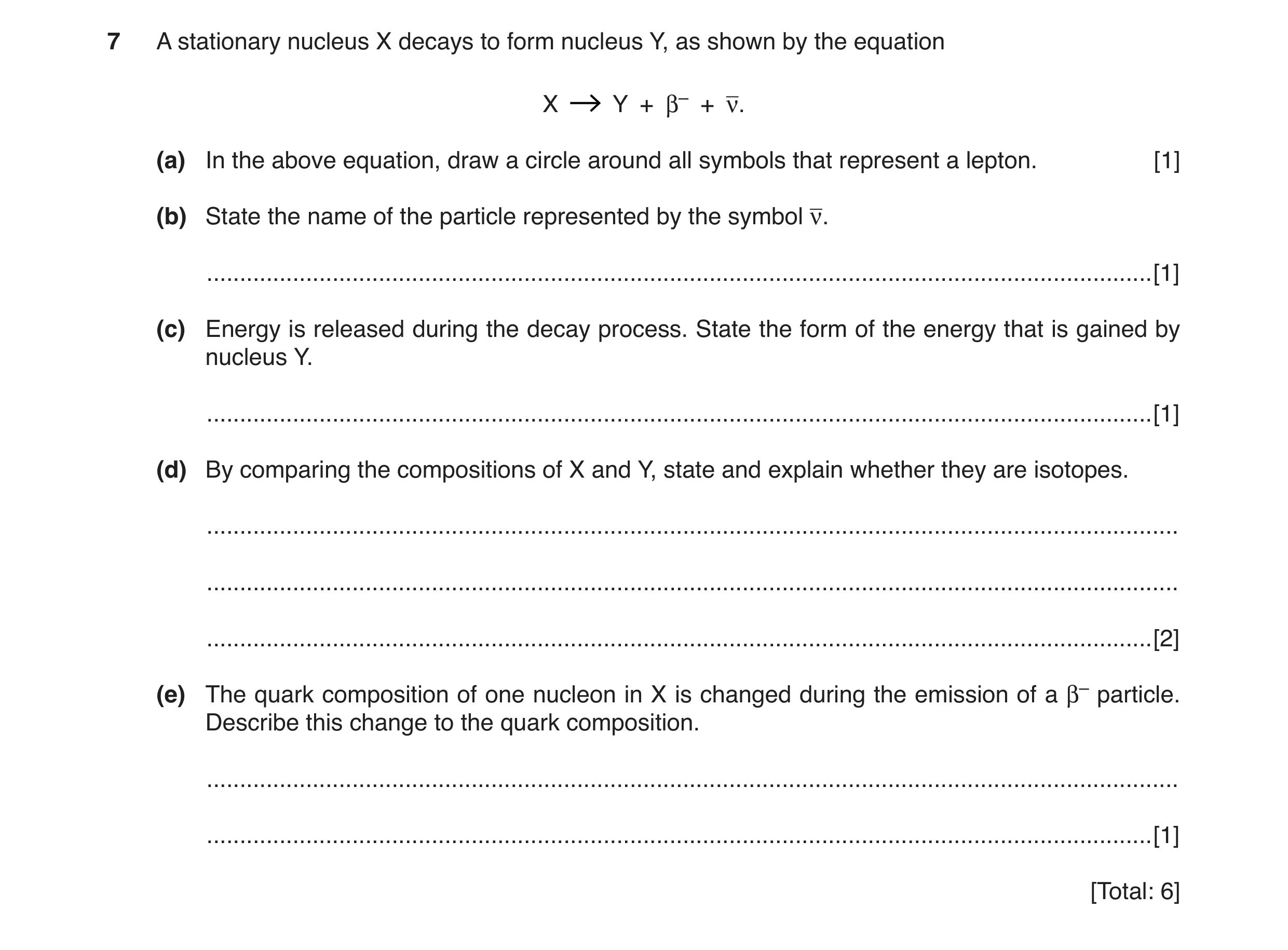
Q3 · A stationary nucleus X decays to form nucleus Y, as shown by the equation X Y + β– + ν 9702/22 May/June 2018
7 A stationary nucleus X decays to form nucleus Y, as shown by the equation X Y + β– + ν. (a) In the above equation, draw a circle around all symbols that represent a lepton. [1] (b) State the name of the particle represented by the symbol ν. … [1] (c) Energy is released during the decay process. State the form of the energy that is gained by nucleus Y. … [1] (d) By comparing the compositions of X and Y, state and explain whether they are isotopes. … … … [2] (e) The quark composition of one nucleon in X is changed during the emission of a β– particle. Describe this change to the quark composition. … … [1] [Total: 6]
6 marks
Mark scheme: 7(a) B1 7(b) (electron) antineutrino B1 7(c) kinetic (energy) B1 7(d) Y has one more proton (and one less neutron)/X has one less proton (and one more neutron) or Y has more protons (and fewer neutrons)/X has fewer protons (and more neutrons) or a neutron changes to a proton or the number of protons increases M1 (so) not isotopes A1 7(e) up down down changes to up up down or udd → uud or down changes to up or d → u B1
This question in 9702/22 May/June 2018
Q4 · A ball is thrown vertically upwards towards a ceiling and then rebounds, as illustrated… 9702/23 May/June 2018
3 A ball is thrown vertically upwards towards a ceiling and then rebounds, as illustrated in Fig. 3.1. ceiling ball leaving speed 3.8 m s–1 ceiling ball thrown speed 9.6 m s–1 upwards Fig. 3.1 The ball is thrown with speed 9.6 m s–1 and takes a time of 0.37 s to reach the ceiling. The ball is then in contact with the ceiling for a further time of 0.085 s until leaving it with a speed of 3.8 m s–1. The mass of the ball is 0.056 kg. Assume that air resistance is negligible. (a) Show that the ball reaches the ceiling with a speed of 6.0 m s–1. [1] (b) Calculate the height of the ceiling above the point from which the ball was thrown. height = … m [2] (c) Calculate (i) the increase in gravitational potential energy of the ball for its movement from its initial position to the ceiling, increase in gravitational potential energy = … J [2] (ii) the decrease in kinetic energy of the ball while it is in contact with the ceiling. decrease in kinetic energy = … J [2] (d) State how Newton’s third law applies to the collision between the ball and the ceiling. … … … … [2] (e) Calculate the change in momentum of the ball during the collision. change in momentum = … N s [2] (f) Determine the magnitude of the average force exerted by the ceiling on the ball during the collision. average force = … N [2] [Total: 13]
13 marks
Mark scheme: 3(a) v = u + at v = 9.6 – (9.81 × 0.37) = 6.0 m s–1 A1 3(b) s = ½ × (9.6 + 6.0) × 0.37 or 6.02 = 9.62 – (2 × 9.81 × s) or s = (9.6 × 0.37) – (½ × 9.81 × 0.372) or s = (6.0 × 0.37) + (½ × 9.81 × 0.372) C1 s = 2.9 m A1 3(c)(i) (∆)E = mg(∆)h C1 ∆E = 0.056 × 9.81 × 2.9 = 1.6 J A1 3(c)(ii) E = ½mv 2 C1 ∆E = ½ × 0.056 × (6.02 – 3.82) = 0.60 J A1 3(d) force on ball (by ceiling) equal to force on ceiling (by ball) M1 and opposite (in direction) A1 3(e) (p =) mv or 0.056 × 6.0 or 0.056 × 3.8 C1 change in momentum = 0.056 × (6.0 + 3.8) = 0.55 N s A1 Question Answer Mark 3(f) resultant force = 0.55 / 0.085 (= 6.47 N) C1 force by ceiling = 6.47 – (0.056 × 9.81) = 5.9 N A1
This question in 9702/23 May/June 2018
Question 5 9702/21 Oct/Nov 2018
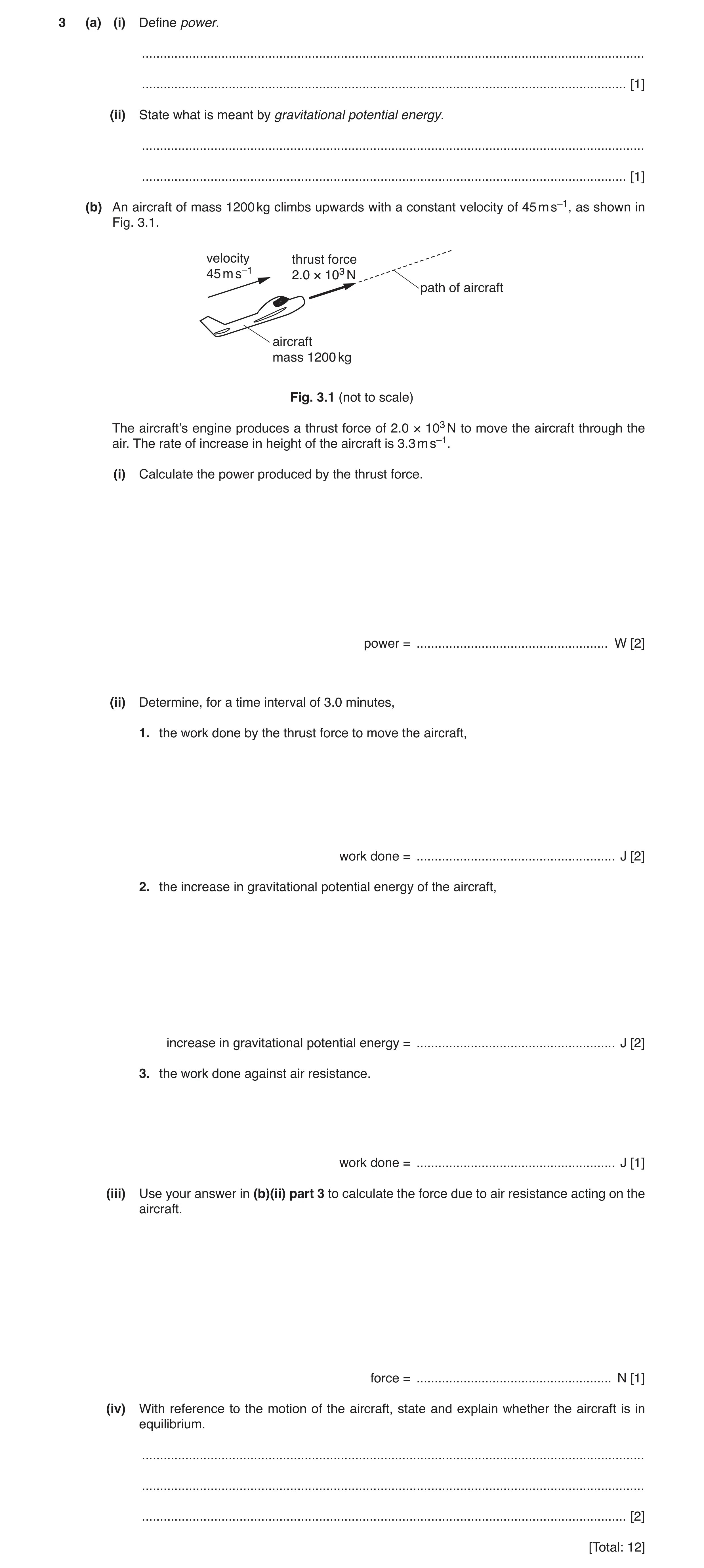
3 (a) (i) Define power. … … [1] (ii) State what is meant by gravitational potential energy. … … [1] (b) An aircraft of mass 1200 kg climbs upwards with a constant velocity of 45 m s–1, as shown in Fig. 3.1. velocity thrust force 45 m s–1 2.0 × 10³ N path of aircraft aircraft mass 1200 kg Fig. 3.1 (not to scale) The aircraft’s engine produces a thrust force of 2.0 × 10³ N to move the aircraft through the air. The rate of increase in height of the aircraft is 3.3 m s–1. (i) Calculate the power produced by the thrust force. power = … W [2] (ii) Determine, for a time interval of 3.0 minutes, 1. the work done by the thrust force to move the aircraft, work done = … J [2] 2. the increase in gravitational potential energy of the aircraft, increase in gravitational potential energy = … J [2] 3. the work done against air resistance. work done = … J [1] (iii) Use your answer in (b)(ii) part 3 to calculate the force due to air resistance acting on the aircraft. force = … N [1] (iv) With reference to the motion of the aircraft, state and explain whether the aircraft is in equilibrium. … … … [2] [Total: 12]
12 marks
Mark scheme: 3(a)(i) work (done) / time (taken) B1 3(a)(ii) energy of a mass due to its position in a gravitational field B1 3(b)(i) P = Fv C1 = 2.0 × 103 × 45 = 9.0 × 10⁴ W A1 3(b)(ii) 1. W = (2.0 × 103) × (45 × 3.0 × 60) or W = 9.0 × 104 × 3.0 × 60 C1 W = 1.6 × 10⁷ J A1 2. (∆)EP = mg(∆)h C1 = 1200 × 9.81 × 3.3 × 3.0 × 60 = 7.0 × 10⁶ J A1 3. W = 1.6 × 10⁷ – 7.0 × 106 = 9.0 × 10⁶ J A1 3(b)(iii) force = (9.0 × 10⁶) / (45 × 3.0 × 60) = 1.1 × 10³ N A1 3(b)(iv) constant velocity so no resultant force B1 no resultant force so in equilibrium B1
This question in 9702/21 Oct/Nov 2018
Q6 · A golfer strikes a ball so that it leaves horizontal ground with a velocity of 6.0 m s–1… 9702/22 Oct/Nov 2018
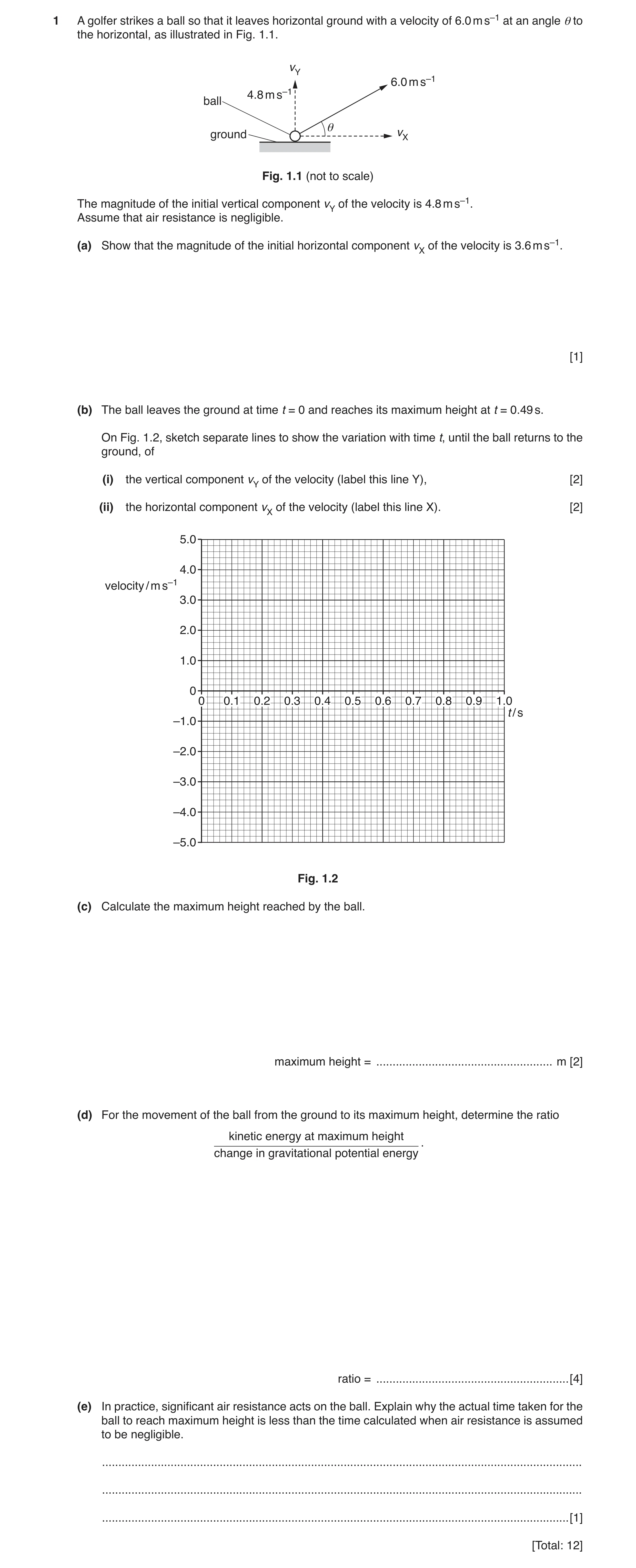
1 A golfer strikes a ball so that it leaves horizontal ground with a velocity of 6.0 m s–1 at an angle θ to the horizontal, as illustrated in Fig. 1.1. vY 6.0 m s–1 4.8 m s–1 ball θ ground vX Fig. 1.1 (not to scale) The magnitude of the initial vertical component vY of the velocity is 4.8 m s–1. Assume that air resistance is negligible. (a) Show that the magnitude of the initial horizontal component vX of the velocity is 3.6 m s–1. [1] (b) The ball leaves the ground at time t = 0 and reaches its maximum height at t = 0.49 s. On Fig. 1.2, sketch separate lines to show the variation with time t, until the ball returns to the ground, of (i) the vertical component vY of the velocity (label this line Y), [2] (ii) the horizontal component vX of the velocity (label this line X). [2] 5.0 4.0 velocity / m s–1 3.0 2.0 1.0 0 0 0.1 0.2 0.3 0.4 0.5 0.6 0.7 0.8 0.9 1.0 t / s –1.0 –2.0 –3.0 –4.0 –5.0 Fig. 1.2 (c) Calculate the maximum height reached by the ball. maximum height = … m [2] (d) For the movement of the ball from the ground to its maximum height, determine the ratio kinetic energy at maximum height . change in gravitational potential energy ratio = … [4] (e) In practice, significant air resistance acts on the ball. Explain why the actual time taken for the ball to reach maximum height is less than the time calculated when air resistance is assumed to be negligible. … … … [1] [Total: 12]
12 marks
Mark scheme: 1(a) or 6.0 sinθ = 4.8 (so θ = 53.1°) and vx = 6.0 cos 53.1° = 3.6 (m s–1) A1 1(b)(i) straight line from (0, 4.8) to (0.49, 0) M1 straight line continues with same slope to (0.98, –4.8) (labelled Y) A1 1(b)(ii) a horizontal line M1 from (0, 3.6) to (0.98, 3.6) (labelled X) A1 1(c) s = ut + ½at2 = (4.8 × 0.49) + (½ × –9.81 × 0.492) or s = ½(u + v)t or area under graph = ½ × (4.8 + 0) × 0.49 or s = vt – ½at2 = ½ × 9.81 × 0.492 or v2 = u2 + 2as s = 4.82 / (2 × 9.81) C1 s = 1.2 m A1 Question Answer Marks 1(d) (∆)E = mg(∆)h C1 E = ½mv2 C1 ratio = (½ × m × 3.62) / (m × 9.81 × 1.2) or ratio = [(½ × m × 6.02) – (m × 9.81 × 1.2)] / (m × 9.81 × 1.2) or ratio = (½ × m × 3.62) / (½ × m × 4.82) C1 ratio = 0.56 A1 1(e) (force due to) air resistance acts in opposite direction to the velocity or (with air resistance, average) resultant force is larger (than weight) B1
This question in 9702/22 Oct/Nov 2018
Q7 · Two balls, X and Y, move along a horizontal frictionless surface, as illustrated in Fig 9702/22 Feb/March 2019
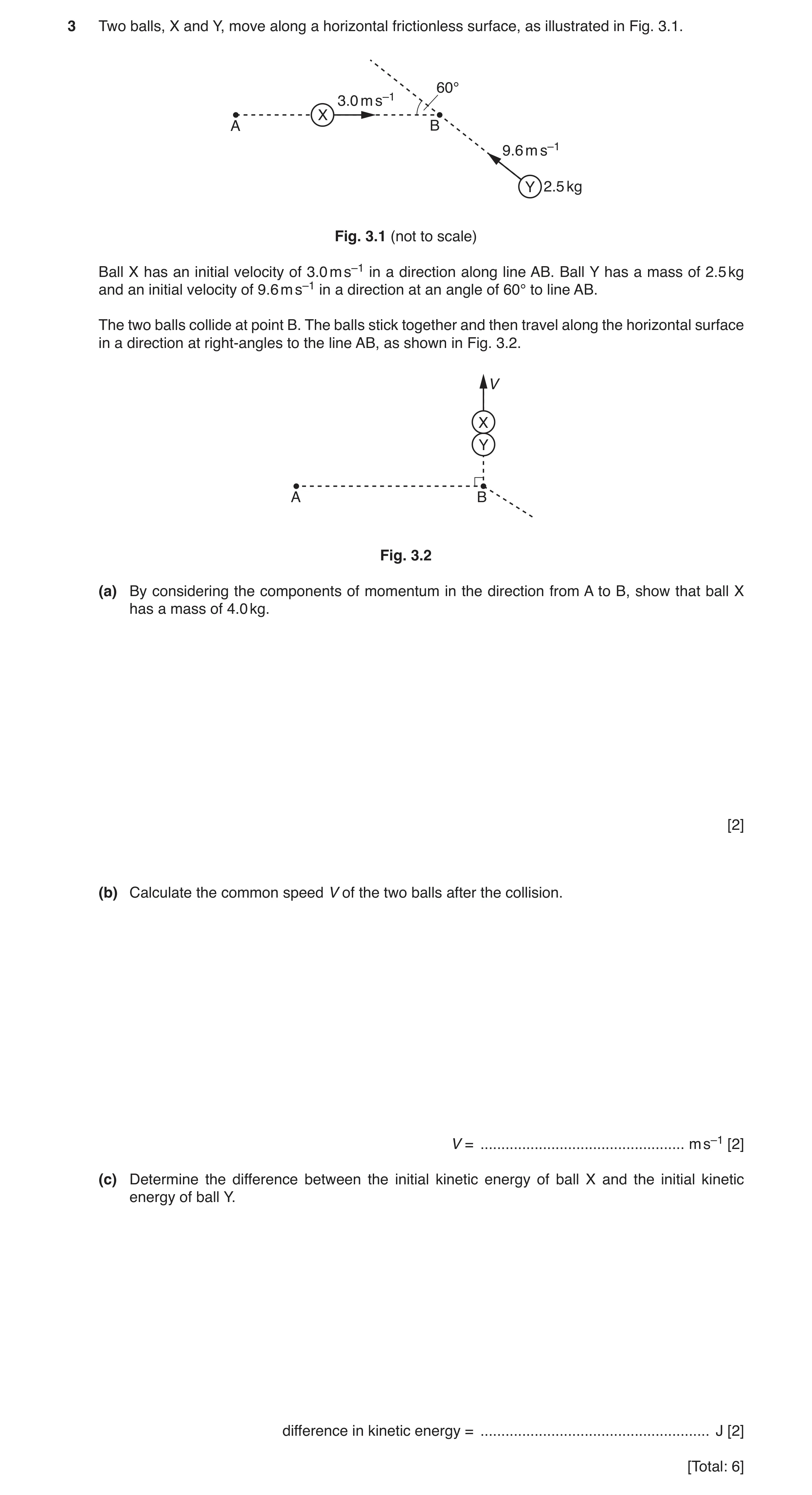
3 Two balls, X and Y, move along a horizontal frictionless surface, as illustrated in Fig. 3.1. 60° 3.0 m s–1 X A B 9.6 m s–1 Y 2.5 kg Fig. 3.1 (not to scale) Ball X has an initial velocity of 3.0 m s–1 in a direction along line AB. Ball Y has a mass of 2.5 kg and an initial velocity of 9.6 m s–1 in a direction at an angle of 60° to line AB. The two balls collide at point B. The balls stick together and then travel along the horizontal surface in a direction at right-angles to the line AB, as shown in Fig. 3.2. V X Y A B Fig. 3.2 (a) By considering the components of momentum in the direction from A to B, show that ball X has a mass of 4.0 kg. [2] (b) Calculate the common speed V of the two balls after the collision. V = … m s–1 [2] (c) Determine the difference between the initial kinetic energy of ball X and the initial kinetic energy of ball Y. difference in kinetic energy = … J [2] [Total: 6]
6 marks
Mark scheme: 3(a) C1 (m × 3.0) – (2.5 × 9.6 × cos 60°) = 0 so m = 4.0 (kg) A1 Question Answer Marks 3(b) 2.5 × 9.6 × sin60° = (4.0 + 2.5) × V C1 V = 3.2 m s–1 A1 or use of momentum vector triangle: (4.0 × 3.0)2 + [(4.0 + 2.5) × V]2 = (2.5 × 9.6)2 (C1) V = 3.2 m s–1 (A1) 3(c) E = ½mv 2 difference in EK = ½ × 2.5 × (9.6)2 – ½ × 4.0 × (3.0)2 C1 = 97 J A1
This question in 9702/22 Feb/March 2019
Q8 · A resultant force F moves an object of mass m through distance s in a straight line 9702/23 May/June 2019
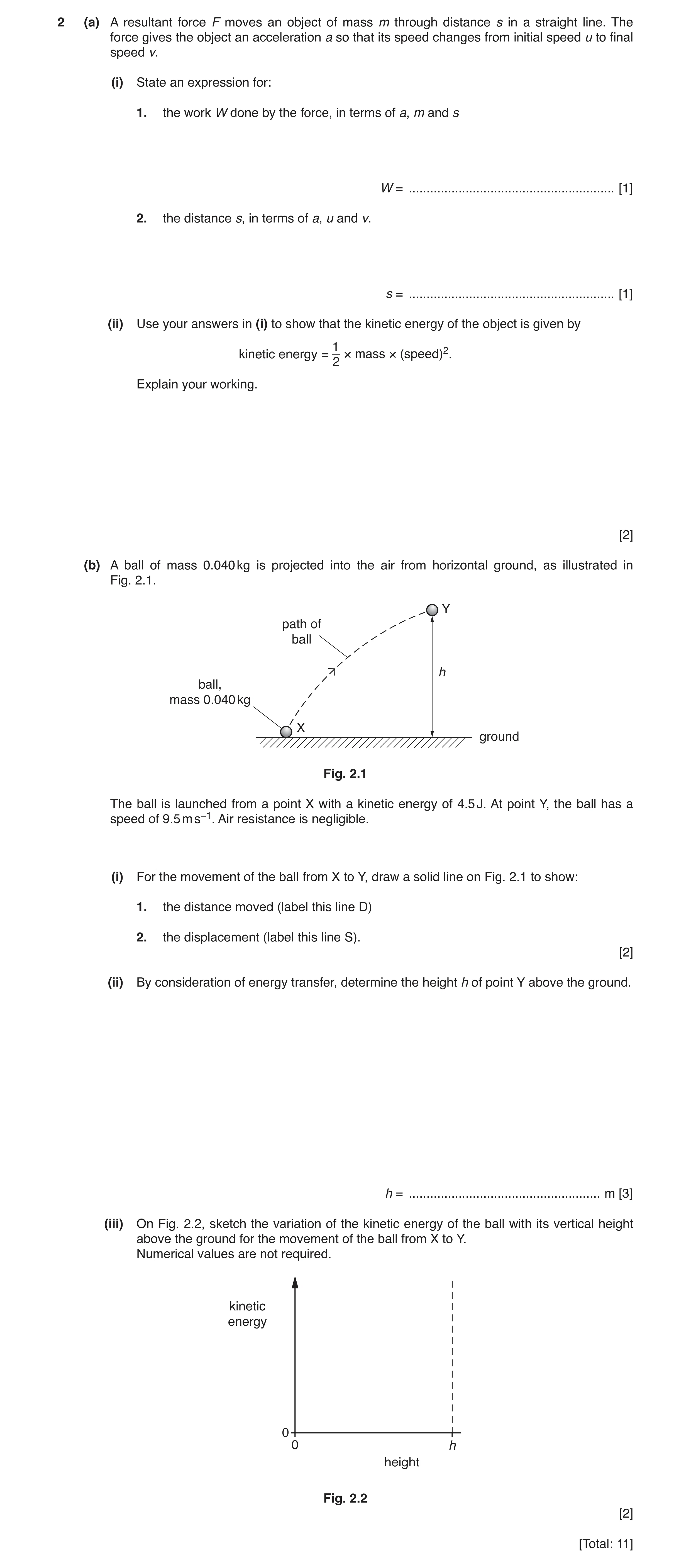
2 (a) A resultant force F moves an object of mass m through distance s in a straight line. The force gives the object an acceleration a so that its speed changes from initial speed u to final speed v. (i) State an expression for: 1. the work W done by the force, in terms of a, m and s W = … [1] 2. the distance s, in terms of a, u and v. s = … [1] (ii) Use your answers in (i) to show that the kinetic energy of the object is given by 1 kinetic energy = × mass × (speed)2. 2 Explain your working. [2] (b) A ball of mass 0.040 kg is projected into the air from horizontal ground, as illustrated in Fig. 2.1. Y path of ball h ball, mass 0.040 kg X ground Fig. 2.1 The ball is launched from a point X with a kinetic energy of 4.5 J. At point Y, the ball has a speed of 9.5 m s−1. Air resistance is negligible. (i) For the movement of the ball from X to Y, draw a solid line on Fig. 2.1 to show: 1. the distance moved (label this line D) 2. the displacement (label this line S). [2] (ii) By consideration of energy transfer, determine the height h of point Y above the ground. h = … m [3] (iii) On Fig. 2.2, sketch the variation of the kinetic energy of the ball with its vertical height above the ground for the movement of the ball from X to Y. Numerical values are not required. kinetic energy 0 0 h height Fig. 2.2 [2] [Total: 11]
11 marks
Mark scheme: 2(a)(i) 1. W = mas B1 2. s = (v 2 – u 2) / 2a B1 2(a)(ii) W/work equals energy transferred/gain or change in kinetic energy B1 W (= mas) = ma(v 2 – u 2) / 2a leading to W = m(v 2 – u 2) / 2 (so KE = ½mv 2) B1 2(b)(i) 1. solid curved line drawn from X to Y along path of ball and labelled D B1 2. solid straight line drawn from X to Y and labelled S B1 2(b)(ii) (∆)E = mg(∆)h C1 4.5 = (0.040 × 9.81 × h) + (½ × 0.040 × 9.52) C1 h = 6.9 m A1 2(b)(iii) line with a negative gradient starting from a non-zero value of kinetic energy when the vertical height is zero M1 straight line ends at a non-zero value of kinetic energy when the vertical height is h A1
This question in 9702/23 May/June 2019
Q9 · The variation with extension x of the force F applied to a spring is shown in Fig 9702/21 Oct/Nov 2019
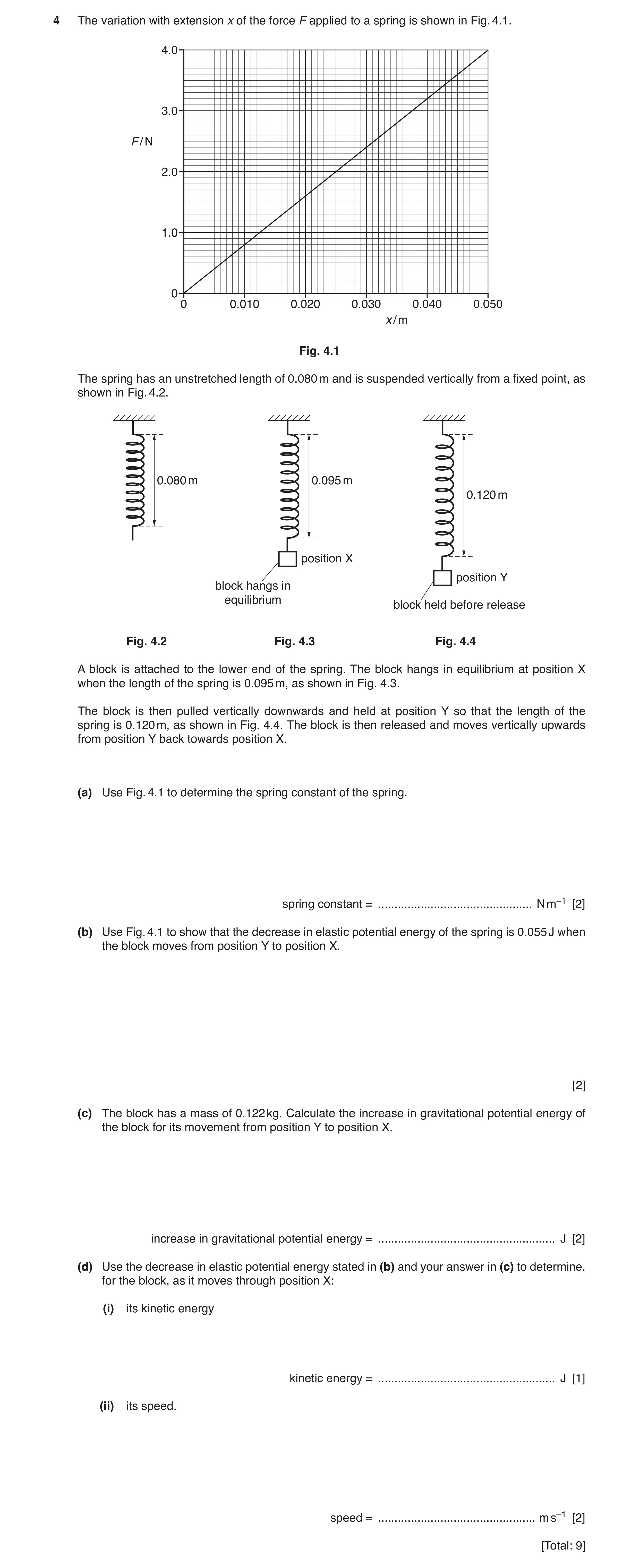
4 The variation with extension x of the force F applied to a spring is shown in Fig. 4.1. 4.0 3.0 F / N 2.0 1.0 0 0 0.010 0.020 0.030 0.040 0.050 x / m Fig. 4.1 The spring has an unstretched length of 0.080 m and is suspended vertically from a fixed point, as shown in Fig. 4.2. 0.080 m 0.095 m 0.120 m position X position Y block hangs in equilibrium block held before release Fig. 4.2 Fig. 4.3 Fig. 4.4 A block is attached to the lower end of the spring. The block hangs in equilibrium at position X when the length of the spring is 0.095 m, as shown in Fig. 4.3. The block is then pulled vertically downwards and held at position Y so that the length of the spring is 0.120 m, as shown in Fig. 4.4. The block is then released and moves vertically upwards from position Y back towards position X. (a) Use Fig. 4.1 to determine the spring constant of the spring. spring constant = … N m–1 [2] (b) Use Fig. 4.1 to show that the decrease in elastic potential energy of the spring is 0.055 J when the block moves from position Y to position X. [2] (c) The block has a mass of 0.122 kg. Calculate the increase in gravitational potential energy of the block for its movement from position Y to position X. increase in gravitational potential energy = … J [2] (d) Use the decrease in elastic potential energy stated in (b) and your answer in (c) to determine, for the block, as it moves through position X: (i) its kinetic energy kinetic energy = … J [1] (ii) its speed. speed = … m s–1 [2] [Total: 9]
9 marks
Mark scheme: 4(a) C1 e.g. k = 4.0 / 0.050 k = 80 N m–1 A1 4(b) E = ½Fx or E = ½kx2 or E = area under graph C1 (∆)E = (½ × 3.2 × 0.040) – (½ × 1.2 × 0.015) = 0.055 J or (∆)E = (½ × 80 × 0.0402) – (½ × 80 × 0.0152) = 0.055 J or (∆)E = ½ × (1.2 + 3.2) × 0.025 = 0.055 J A1 4(c) (∆)E = mg(∆)h C1 = 0.122 × 9.81 × (0.120 – 0.095) = 0.030 J A1 or (∆)E = W × (∆)h (C1) = 1.2 × 0.025 = 0.030 J (A1) Question Answer Marks 4(d)(i) E = 0.055 – 0.030 = 0.025 J A1 4(d)(ii) E = ½mv2 C1 v = [(2 × 0.025) / 0.122]0.5 = 0.64 m s–1 A1
This question in 9702/21 Oct/Nov 2019
Q10 · State two conditions for an object to be in equilibrium 9702/21 May/June 2020
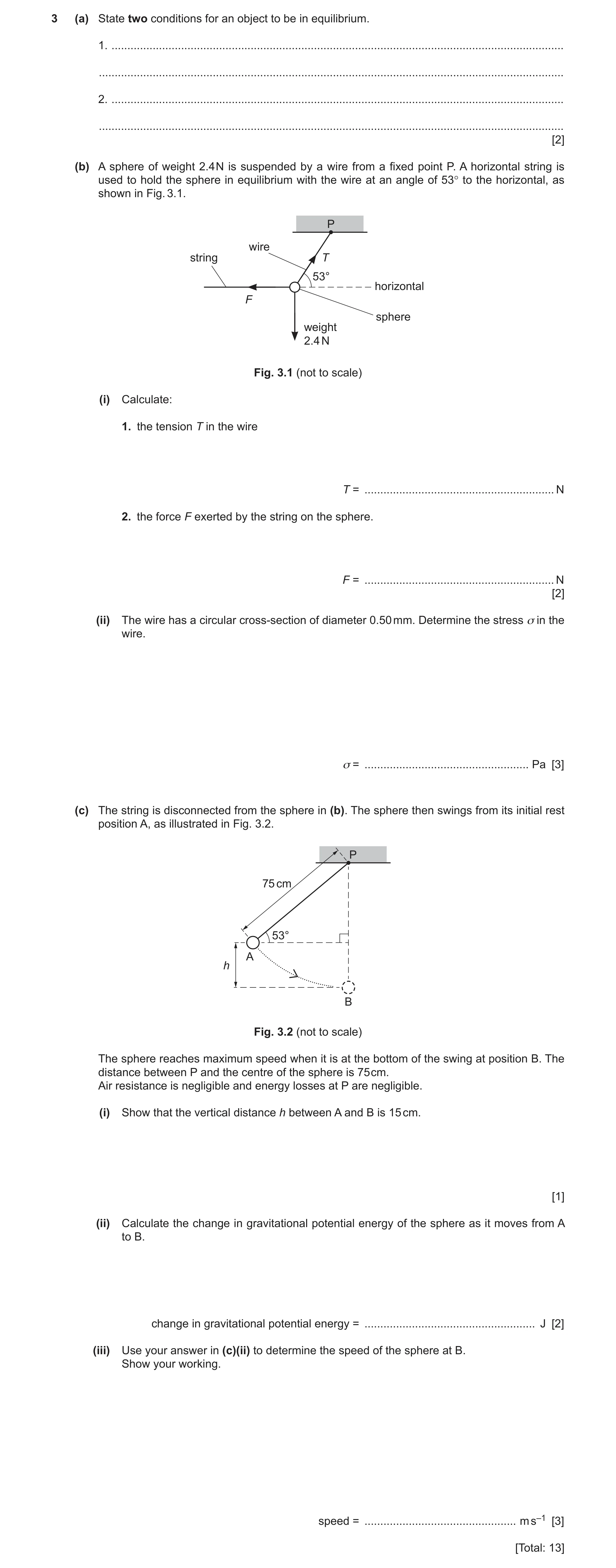
3 (a) State two conditions for an object to be in equilibrium. 1. … … 2. … … [2] (b) A sphere of weight 2.4 N is suspended by a wire from a fixed point P. A horizontal string is used to hold the sphere in equilibrium with the wire at an angle of 53° to the horizontal, as shown in Fig. 3.1. P wire string T 53° horizontal F sphere weight 2.4 N Fig. 3.1 (not to scale) (i) Calculate: 1. the tension T in the wire T = … N 2. the force F exerted by the string on the sphere. F = … N [2] (ii) The wire has a circular cross-section of diameter 0.50 mm. Determine the stress σ in the wire. σ = … Pa [3] (c) The string is disconnected from the sphere in (b). The sphere then swings from its initial rest position A, as illustrated in Fig. 3.2. P 75 cm 53° A h B Fig. 3.2 (not to scale) The sphere reaches maximum speed when it is at the bottom of the swing at position B. The distance between P and the centre of the sphere is 75 cm. Air resistance is negligible and energy losses at P are negligible. (i) Show that the vertical distance h between A and B is 15 cm. [1] (ii) Calculate the change in gravitational potential energy of the sphere as it moves from A to B. change in gravitational potential energy = … J [2] (iii) Use your answer in (c)(ii) to determine the speed of the sphere at B. Show your working. speed = … m s–1 [3] [Total: 13]
13 marks
Mark scheme: 3(a) resultant force (in any direction) is zero B1 resultant torque/moment (about any point) is zero B1 3(b)(i) 1. T sin 53° = 2.4 T = 3.0 N A1 2. F = T cos 53° or F 2 = T 2 – 2.42 F = 1.8 N A1 3(b)(ii) σ = T / A or σ = F / A C1 A = πd2 / 4 or A = πr2 C1 σ = 3.0 × 4 / [π × (0.50 × 10⁻³)2] = 1.5 × 10⁷ Pa A1 3(c)(i) h = 75 – 75 sin 53° = 15 cm A1 3(c)(ii) (Δ)E = mg(Δ)h or (Δ)E = W(Δ)h C1 (Δ)E = 2.4 × 15 × 10–2 = 0.36 J A1 3(c)(iii) E = ½mv2 B1 0.36 = ½ × (2.4 / 9.81) × v2 C1 v = 1.7 m s–1 A1
This question in 9702/21 May/June 2020
Q11 · A small block is lifted vertically upwards by a toy aircraft, as illustrated in Fig 9702/21 Oct/Nov 2020
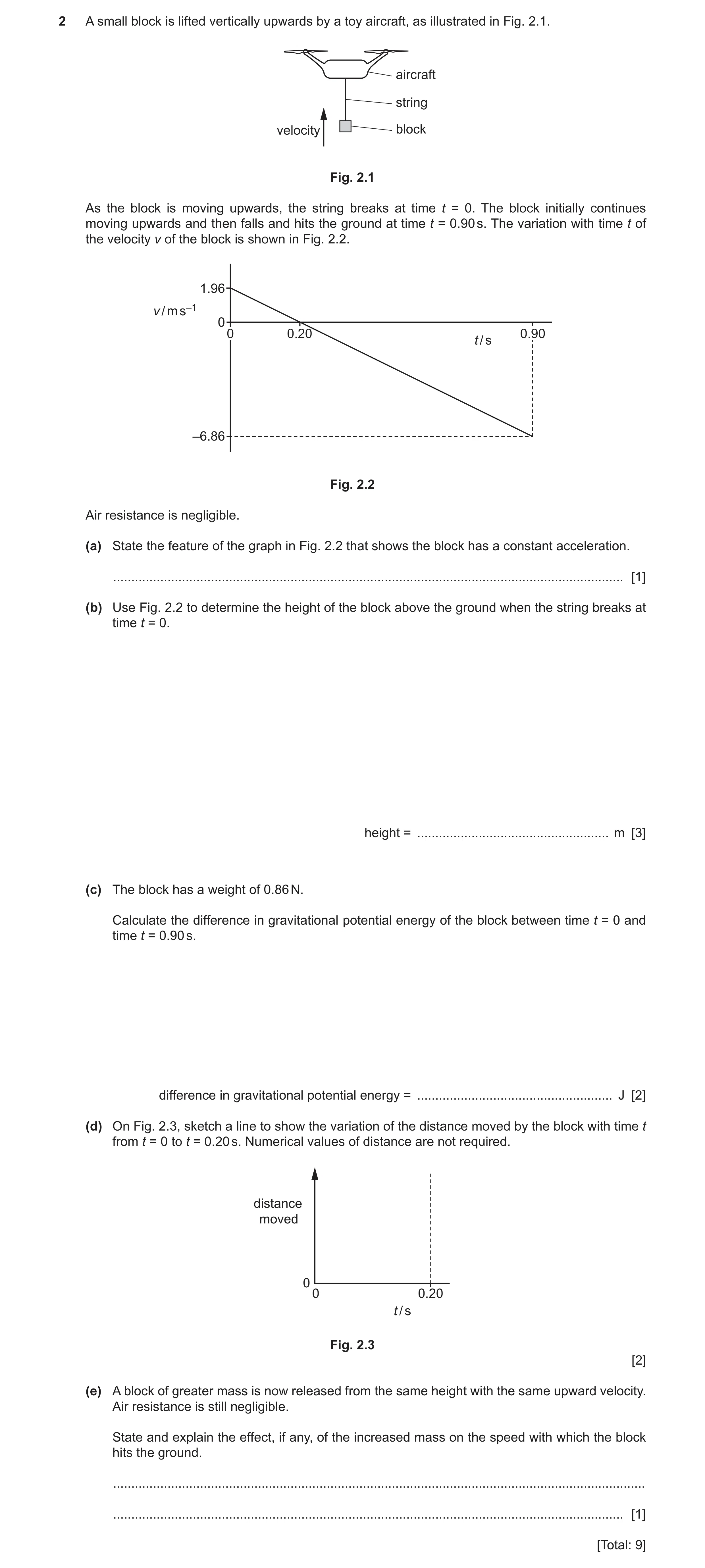
2 A small block is lifted vertically upwards by a toy aircraft, as illustrated in Fig. 2.1. aircraft string velocity block Fig. 2.1 As the block is moving upwards, the string breaks at time t = 0. The block initially continues moving upwards and then falls and hits the ground at time t = 0.90 s. The variation with time t of the velocity v of the block is shown in Fig. 2.2. 1.96 v / m s–1 0 0 0.20 0.900.90 t / s –6.86 Fig. 2.2 Air resistance is negligible. (a) State the feature of the graph in Fig. 2.2 that shows the block has a constant acceleration. … [1] (b) Use Fig. 2.2 to determine the height of the block above the ground when the string breaks at time t = 0. height = … m [3] (c) The block has a weight of 0.86 N. Calculate the difference in gravitational potential energy of the block between time t = 0 and time t = 0.90 s. difference in gravitational potential energy = … J [2] (d) On Fig. 2.3, sketch a line to show the variation of the distance moved by the block with time t from t = 0 to t = 0.20 s. Numerical values of distance are not required. distance moved 0 0 0.20 t / s Fig. 2.3 [2] (e) A block of greater mass is now released from the same height with the same upward velocity. Air resistance is still negligible. State and explain the effect, if any, of the increased mass on the speed with which the block hits the ground. … … [1] [Total: 9]
9 marks
Mark scheme: 2(a) constant gradient B1 2(b) (displacement until 0.20 s =) ½ × 1.96 × 0.20 (= 0.196 m) or (displacement after 0.20 s =) ½ × 6.86 × 0.70 (= 2.401 m) C1 height = 2.401 – 0.196 C1 = 2.2 m (alternative methods are possible using equations of uniformly accelerated motion) A1 2(c) (Δ)E = mg(Δ)h or W(Δ)h C1 (Δ)E = 0.86 × 2.2 = 1.9 J A1 2(d) curved line from the origin M1 gradient of curved line decreases and is zero at t = 0.20 s only A1 2(e) acceleration (of free fall) is unchanged/is not dependent on mass and (so) no effect B1
This question in 9702/21 Oct/Nov 2020
Question 12 9702/23 Oct/Nov 2020
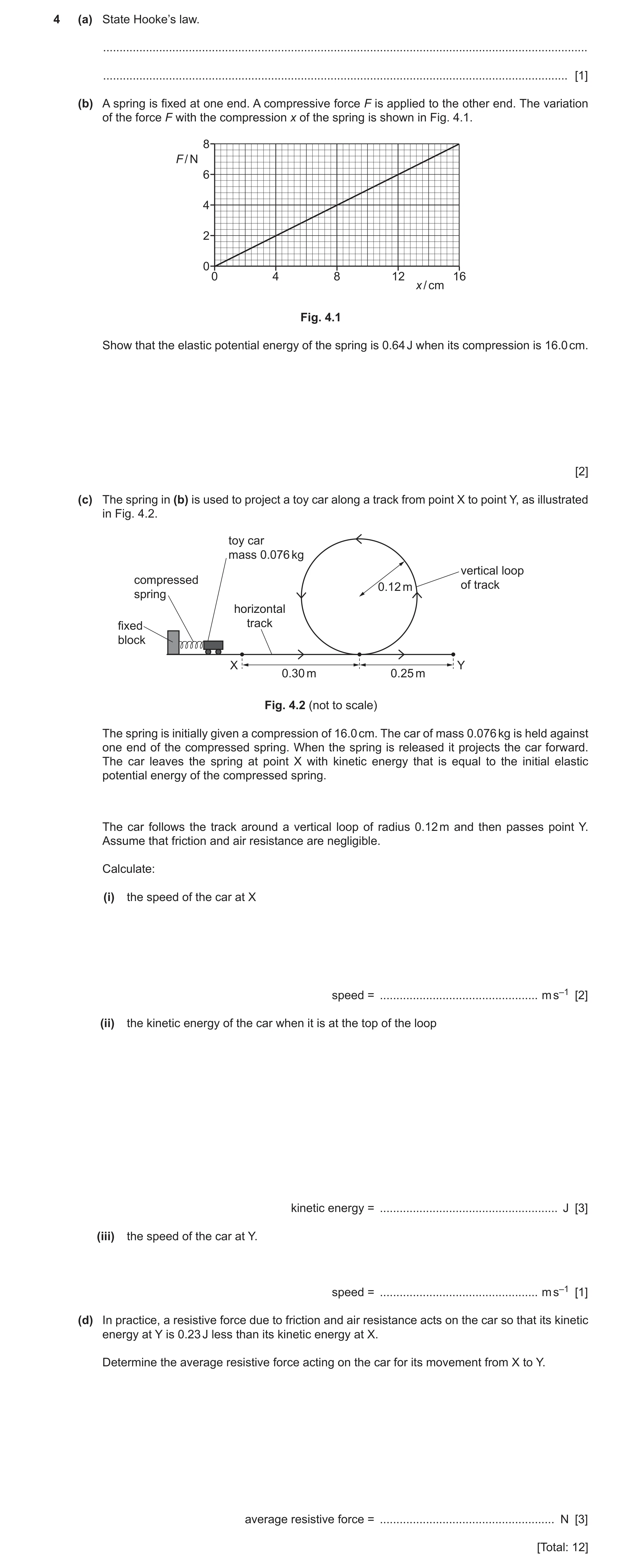
4 (a) State Hooke’s law. … … [1] (b) A spring is fixed at one end. A compressive force F is applied to the other end. The variation of the force F with the compression x of the spring is shown in Fig. 4.1. 8 F / N 6 4 2 0 0 4 8 12 16 x / cm Fig. 4.1 Show that the elastic potential energy of the spring is 0.64 J when its compression is 16.0 cm. [2] (c) The spring in (b) is used to project a toy car along a track from point X to point Y, as illustrated in Fig. 4.2. toy car mass 0.076 kg vertical loop compressed 0.12 m of track spring horizontal fixed track block X Y 0.30 m 0.25 m Fig. 4.2 (not to scale) The spring is initially given a compression of 16.0 cm. The car of mass 0.076 kg is held against one end of the compressed spring. When the spring is released it projects the car forward. The car leaves the spring at point X with kinetic energy that is equal to the initial elastic potential energy of the compressed spring. The car follows the track around a vertical loop of radius 0.12 m and then passes point Y. Assume that friction and air resistance are negligible. Calculate: (i) the speed of the car at X speed = … m s–1 [2] (ii) the kinetic energy of the car when it is at the top of the loop kinetic energy = … J [3] (iii) the speed of the car at Y. speed = … m s–1 [1] (d) In practice, a resistive force due to friction and air resistance acts on the car so that its kinetic energy at Y is 0.23 J less than its kinetic energy at X. Determine the average resistive force acting on the car for its movement from X to Y. average resistive force = … N [3] [Total: 12]
12 marks
Mark scheme: 4(a) compression/extension is proportional to force (provided limit of proportionality is not exceeded) B1 4(b) (E) = ½Fx or ½kx2 or area under graph C1 = ½ × 8 × 16 × 10–2 = 0.64 (J) or = ½ × 50 × (16 × 10–2)2 = 0.64 (J) A1 4(c)(i) (E) = ½mv 2 C1 0.64 = ½ × 0.076 × v 2 v = 4.1 m s–1 A1 4(c)(ii) (Δ)(E) = mg(Δ)h C1 = 0.076 × 9.81 × 0.24 (= 0.18 (J)) C1 kinetic energy = 0.64 – 0.18 = 0.46 J A1 4(c)(iii) v = 4.1 m s–1 A1 4(d) W = Fs C1 d = 0.30 + (2π × 0.12) + 0.25 (= 1.3 m) C1 F = 0.23 / 1.3 = 0.18 N A1
This question in 9702/23 Oct/Nov 2020
Q13 · State what is meant by work done 9702/22 Feb/March 2021
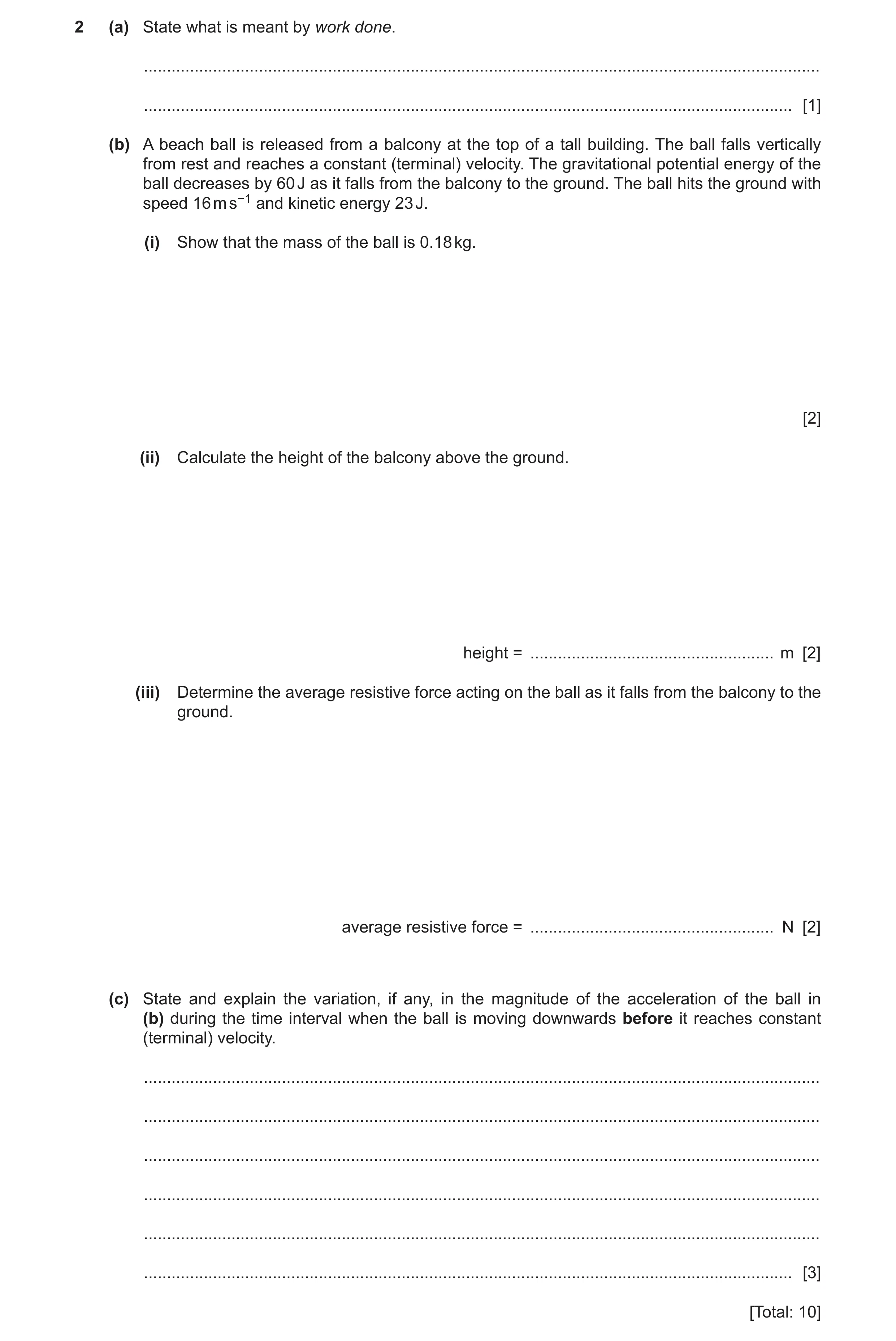
2 (a) State what is meant by work done. … … [1] (b) A beach ball is released from a balcony at the top of a tall building. The ball falls vertically from rest and reaches a constant (terminal) velocity. The gravitational potential energy of the ball decreases by 60 J as it falls from the balcony to the ground. The ball hits the ground with speed 16 m s−1 and kinetic energy 23 J. (i) Show that the mass of the ball is 0.18 kg. [2] (ii) Calculate the height of the balcony above the ground. height = … m [2] (iii) Determine the average resistive force acting on the ball as it falls from the balcony to the ground. average resistive force = … N [2] (c) State and explain the variation, if any, in the magnitude of the acceleration of the ball in (b) during the time interval when the ball is moving downwards before it reaches constant (terminal) velocity. … … … … … … [3] [Total: 10]
10 marks
Mark scheme: 2(a) force × displacement in the direction of the force B1 2(b)(i) E = ½mv 2 C1 (m =) 23 × 2 / 162 = 0.18 (kg) A1 2(b)(ii) (Δ)E = mg(Δ)h 60 = 0.18 × 9.81 × h C1 h = 34 m A1 2(b)(iii) (work done =) 60 – 23 = 37 (J) C1 average resistive force = 37 / 34 = 1.1 N A1 2(c) air resistance (acting on ball) increases B1 resultant force (on ball) decreases or weight constant and air resistance increases B1 acceleration decreases B1
This question in 9702/22 Feb/March 2021
Q14 · A child of weight 330 N is at point X at the top of a slide 9702/22 May/June 2021
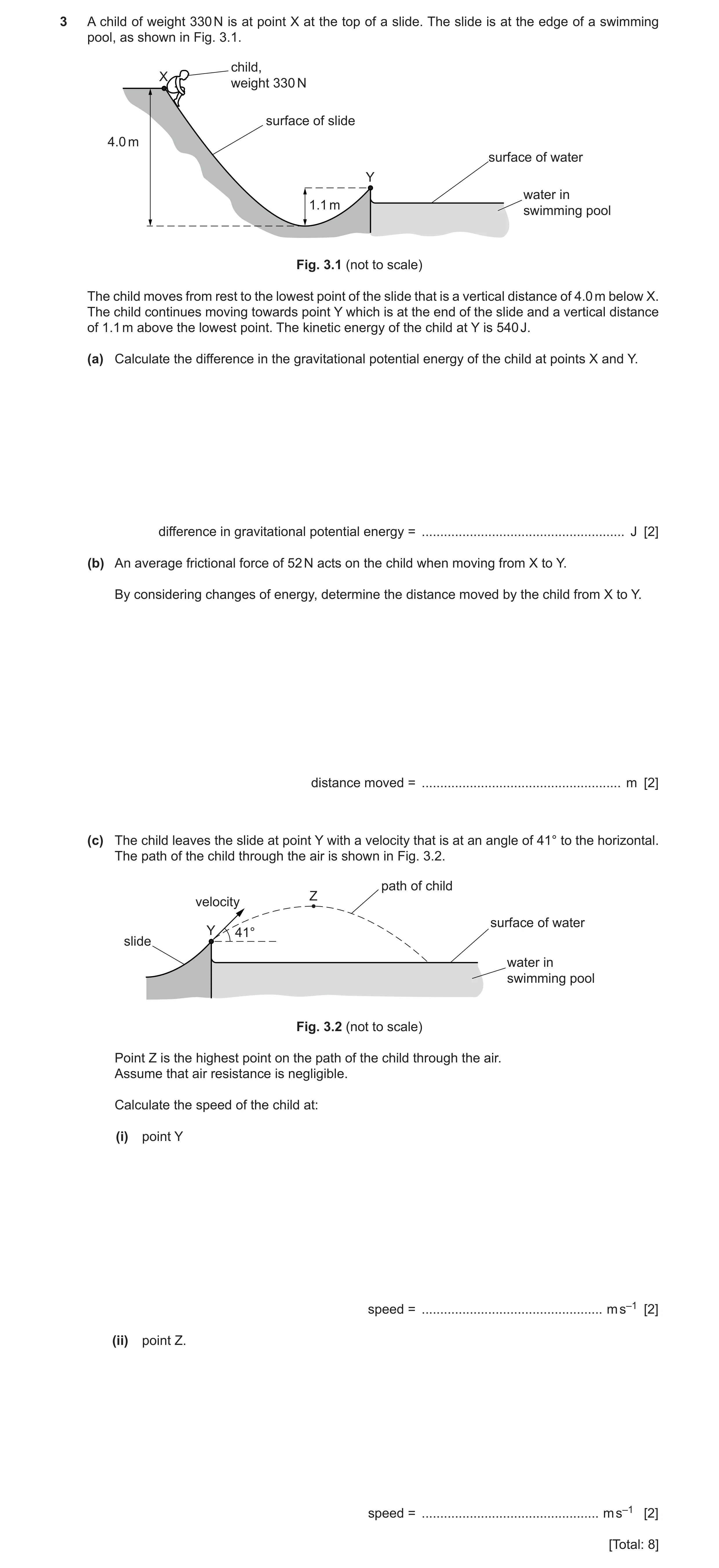
3 A child of weight 330 N is at point X at the top of a slide. The slide is at the edge of a swimming pool, as shown in Fig. 3.1. child, X weight 330 N surface of slide 4.0 m surface of water Y water in 1.1 m swimming pool Fig. 3.1 (not to scale) The child moves from rest to the lowest point of the slide that is a vertical distance of 4.0 m below X. The child continues moving towards point Y which is at the end of the slide and a vertical distance of 1.1 m above the lowest point. The kinetic energy of the child at Y is 540 J. (a) Calculate the difference in the gravitational potential energy of the child at points X and Y. difference in gravitational potential energy = … J [2] (b) An average frictional force of 52 N acts on the child when moving from X to Y. By considering changes of energy, determine the distance moved by the child from X to Y. distance moved = … m [2] (c) The child leaves the slide at point Y with a velocity that is at an angle of 41° to the horizontal. The path of the child through the air is shown in Fig. 3.2. path of child Z velocity surface of water Y 41° slide water in swimming pool Fig. 3.2 (not to scale) Point Z is the highest point on the path of the child through the air. Assume that air resistance is negligible. Calculate the speed of the child at: (i) point Y speed = … m s–1 [2] (ii) point Z. speed = … m s–1 [2] [Total: 8]
8 marks
Mark scheme: 3(a) (Δ)E = mg(Δ)h or W(∆)h C1 = 330 × (4.0 – 1.1) = 960 J A1 3(b) (work =) 960 – 540 ( = 420 J) C1 distance moved = (960 – 540) / 52 = 8.1 m A1 3(c)(i) E = ½mv2 C1 540 = ½ × (330 / 9.81) × v2 v = 5.7 m s–1 A1 3(c)(ii) speed = horizontal component of velocity = 5.7 × cos 41° C1 = 4.3 m s–1 A1
This question in 9702/22 May/June 2021
Question 15 9702/21 Oct/Nov 2021
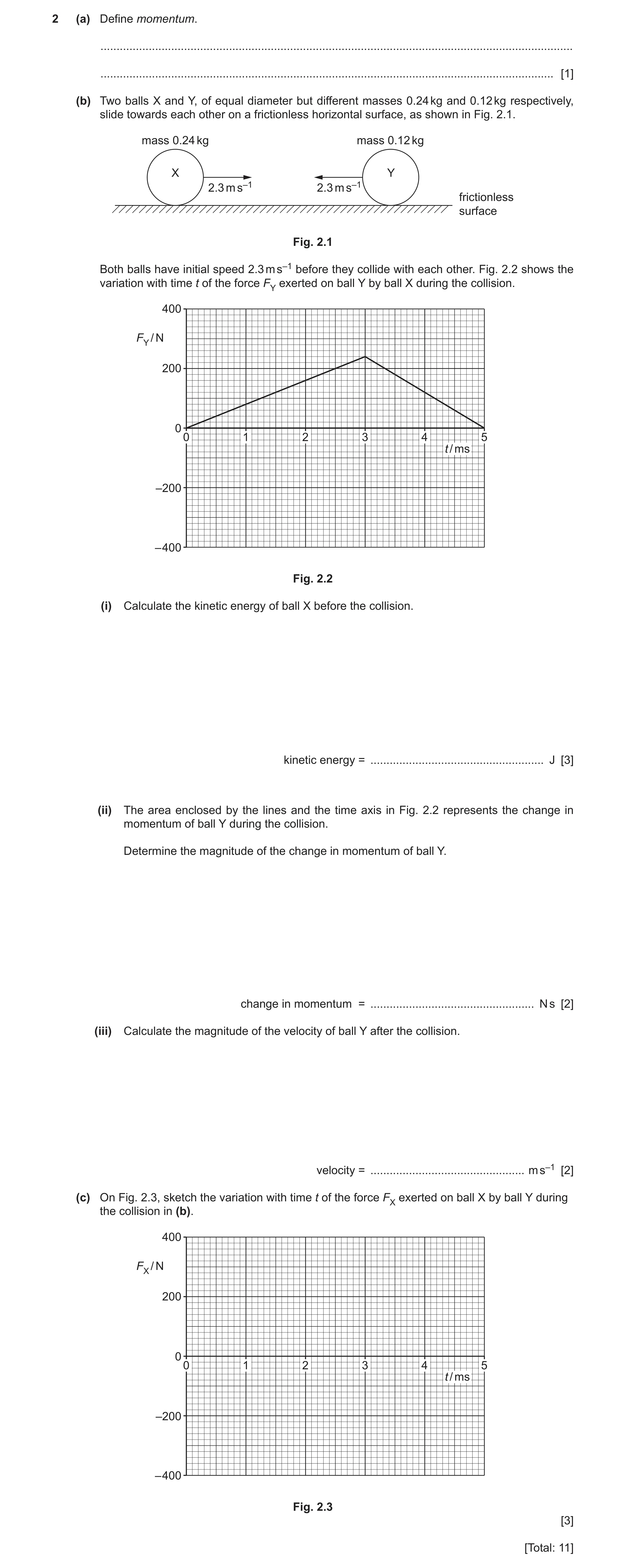
2 (a) Define momentum. … … [1] (b) Two balls X and Y, of equal diameter but different masses 0.24 kg and 0.12 kg respectively, slide towards each other on a frictionless horizontal surface, as shown in Fig. 2.1. mass 0.24 kg mass 0.12 kg X Y 2.3 m s–1 2.3 m s–1 frictionless surface Fig. 2.1 Both balls have initial speed 2.3 m s–1 before they collide with each other. Fig. 2.2 shows the variation with time t of the force FY exerted on ball Y by ball X during the collision. 400 FY / N 200 0 0 1 2 3 4 5 t / ms –200 – 400 Fig. 2.2 (i) Calculate the kinetic energy of ball X before the collision. kinetic energy = … J [3] (ii) The area enclosed by the lines and the time axis in Fig. 2.2 represents the change in momentum of ball Y during the collision. Determine the magnitude of the change in momentum of ball Y. change in momentum = … N s [2] (iii) Calculate the magnitude of the velocity of ball Y after the collision. velocity = … m s–1 [2] (c) On Fig. 2.3, sketch the variation with time t of the force FX exerted on ball X by ball Y during the collision in (b). 400 FX / N 200 0 0 1 2 3 4 5 t / ms –200 – 400 Fig. 2.3 [3] [Total: 11]
11 marks
Mark scheme: 2(a) mass × velocity B1 2(b)(i) kinetic energy = ½mv2 C1 = ½ × 0.24 × 2.32 C1 = 0.63 J A1 2(b)(ii) change in momentum = ½ × 240 × 5.0 × 10–3 C1 = 0.60 N s A1 2(b)(iii) (change in velocity of Y) = 0.60 / 0.12 ( = 5.0 m s–1) C1 final velocity of Y = 5.0 – 2.3 = 2.7 m s–1 A1 or (final momentum of Y) = 0.60 – 0.12 × 2.3 ( = 0.324 N s) (C1) final velocity of Y = 0.324 / 0.12 = 2.7 m s–1 (A1) 2(c) sloping straight line from (0, 0) to t = 3.0 ms and another straight line continuous with the first from t = 3.0 ms to (5.0, 0) B1 lines showing maximum force of magnitude 240 N B1 lines wholly in the negative F region of the graph B1
This question in 9702/21 Oct/Nov 2021
Question 16 9702/22 Oct/Nov 2021
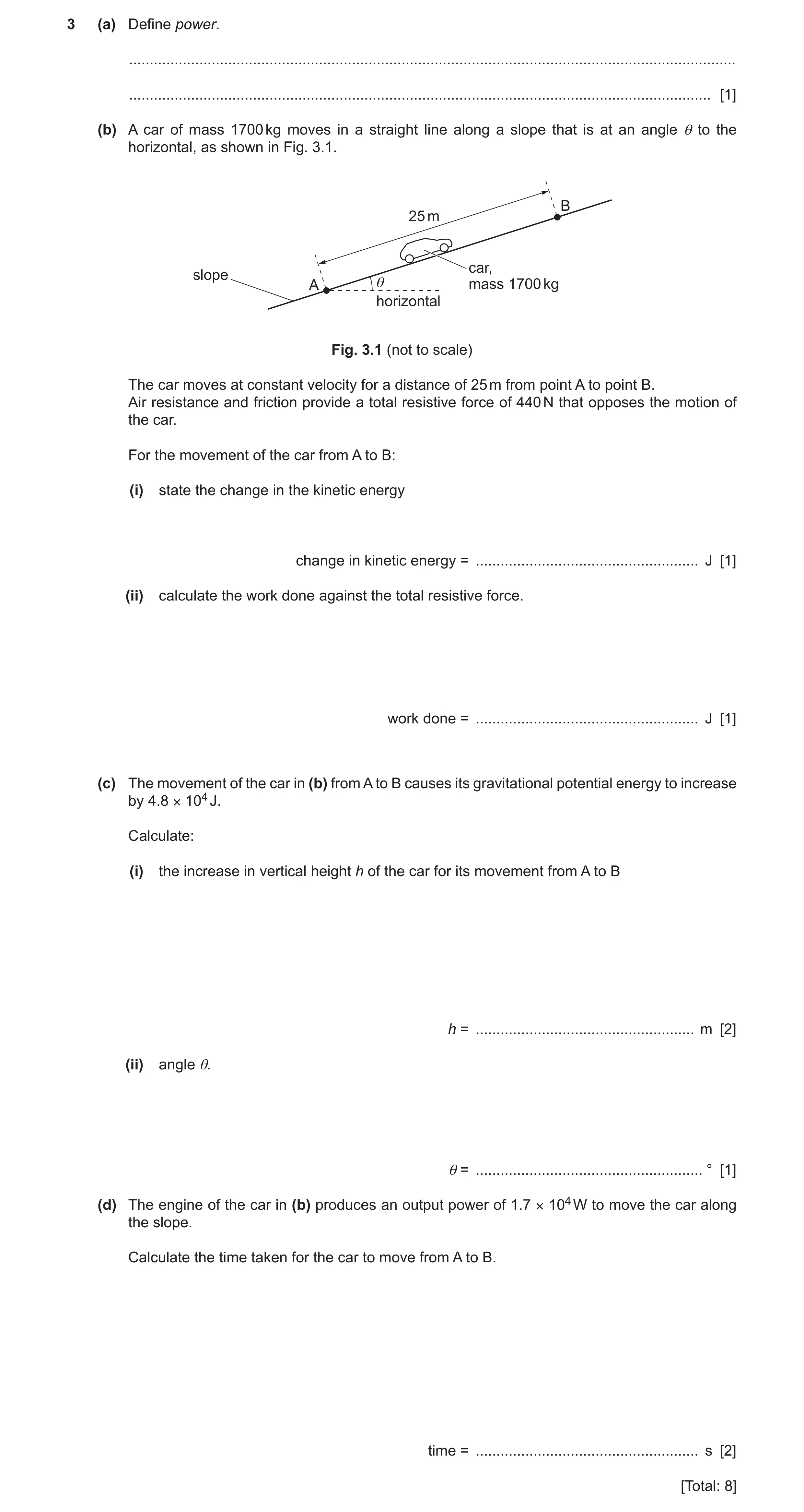
3 (a) Define power. … … [1] (b) A car of mass 1700 kg moves in a straight line along a slope that is at an angle θ to the horizontal, as shown in Fig. 3.1. B 25 m car, slope A θ mass 1700 kg horizontal Fig. 3.1 (not to scale) The car moves at constant velocity for a distance of 25 m from point A to point B. Air resistance and friction provide a total resistive force of 440 N that opposes the motion of the car. For the movement of the car from A to B: (i) state the change in the kinetic energy change in kinetic energy = … J [1] (ii) calculate the work done against the total resistive force. work done = … J [1] (c) The movement of the car in (b) from A to B causes its gravitational potential energy to increase by 4.8 × 10⁴ J. Calculate: (i) the increase in vertical height h of the car for its movement from A to B h = … m [2] (ii) angle θ. θ = … ° [1] (d) The engine of the car in (b) produces an output power of 1.7 × 10⁴ W to move the car along the slope. Calculate the time taken for the car to move from A to B. time = … s [2] [Total: 8]
8 marks
Mark scheme: 3(a) work (done) / time (taken) B1 3(b)(i) zero / 0 J A1 3(b)(ii) work done = 440 × 25 = 1.1 × 10⁴ J A1 3(c)(i) (Δ)E(P) = mg(Δ)h C1 h = 4.8 × 10⁴ / (1700 × 9.81) = 2.9 m A1 3(c)(ii) θ = sin–1 (2.9 / 25) = 6.7° A1 3(d) work done = 4.8 × 10⁴ + 1.1 × 10⁴ (= 5.9 × 10⁴ J) C1 time = 5.9 × 10⁴ / 1.7 × 104 = 3.5 s A1
This question in 9702/22 Oct/Nov 2021
Q17 · A stationary nucleus P of mass 243 u decays by emitting an α-particle of mass 4 u to form… 9702/22 Oct/Nov 2021
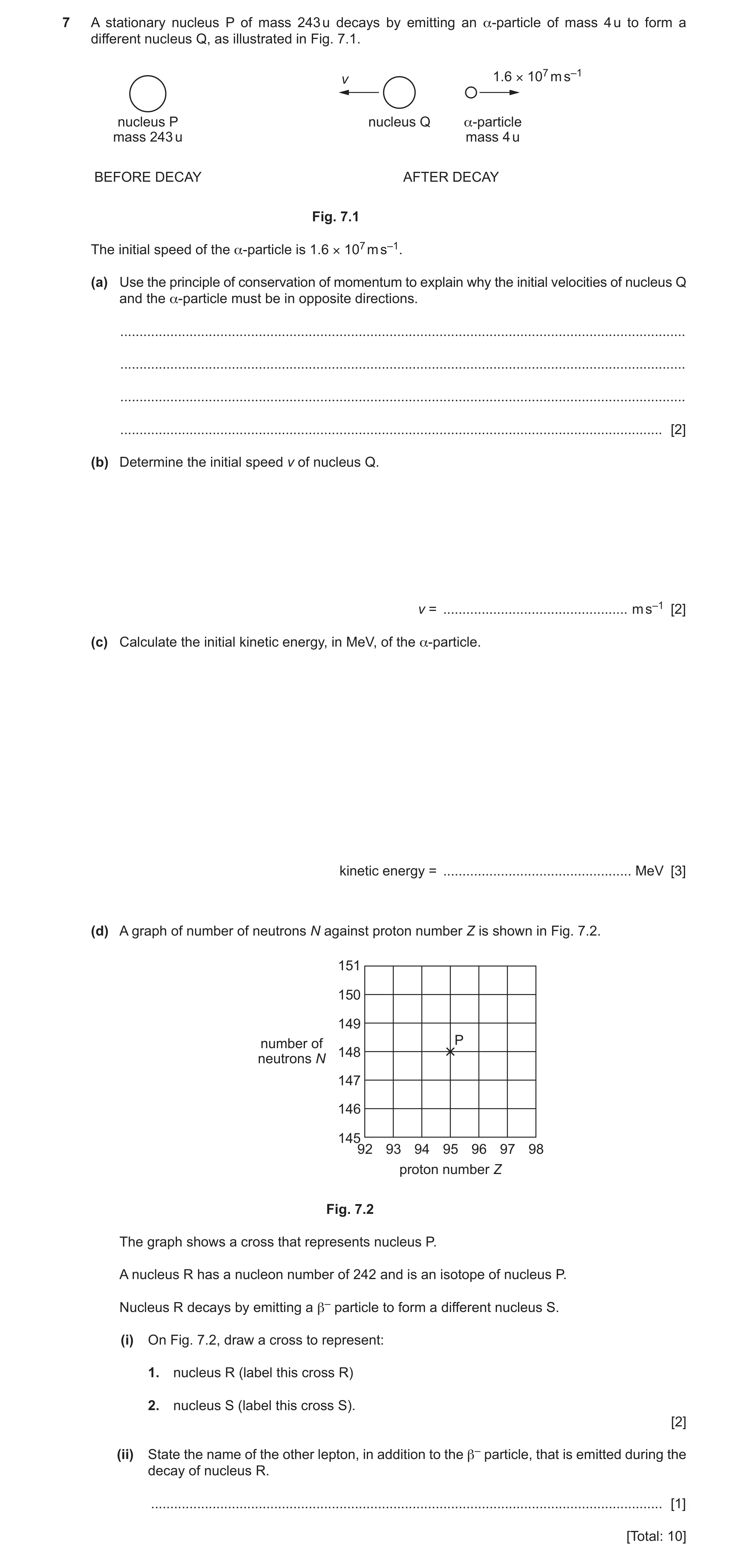
7 A stationary nucleus P of mass 243 u decays by emitting an α-particle of mass 4 u to form a different nucleus Q, as illustrated in Fig. 7.1. v 1.6 × 10⁷ m s–1 nucleus P nucleus Q α-particle mass 243 u mass 4 u BEFORE DECAY AFTER DECAY Fig. 7.1 The initial speed of the α-particle is 1.6 × 10⁷ m s–1. (a) Use the principle of conservation of momentum to explain why the initial velocities of nucleus Q and the α-particle must be in opposite directions. … … … … [2] (b) Determine the initial speed v of nucleus Q. v = … m s–1 [2] (c) Calculate the initial kinetic energy, in MeV, of the α-particle. kinetic energy = … MeV [3] (d) A graph of number of neutrons N against proton number Z is shown in Fig. 7.2. 151 150 149 number of P 148 neutrons N 147 146 14592 93 94 95 96 97 98 proton number Z Fig. 7.2 The graph shows a cross that represents nucleus P. A nucleus R has a nucleon number of 242 and is an isotope of nucleus P. Nucleus R decays by emitting a β– particle to form a different nucleus S. (i) On Fig. 7.2, draw a cross to represent: 1. nucleus R (label this cross R) 2. nucleus S (label this cross S). [2] (ii) State the name of the other lepton, in addition to the β– particle, that is emitted during the decay of nucleus R. … [1] [Total: 10]
10 marks
Mark scheme: 7(a) (total) momentum before (decay) is zero or P has zero momentum B1 (total momentum after decay must be zero so) α-particle and Q have momenta in opposite directions (and therefore velocities are in opposite directions) B1 7(b) p = 239 (u) × v or 4 (u) × 1.6 × 10⁷ C1 239 (u) × v = 4 (u) × 1.6 × 10⁷ v = 2.7 × 10⁵ m s–1 A1 7(c) E(K) = ½mv2 C1 = ½ × 4 × 1.66 × 10–27 × (1.6 × 107)2 C1 = 8.5 × 10⁻¹³ (J) = 8.5 × 10⁻¹³ / 1.60 × 10⁻¹³ (MeV) = 5.3 MeV A1 7(d)(i) 1. R plotted at (95,147) B1 2. S plotted at (96,146) B1 7(d)(ii) (electron) antineutrino B1
This question in 9702/22 Oct/Nov 2021
Q18 · A motor uses a wire to raise a block, as illustrated in Fig 9702/22 Feb/March 2023
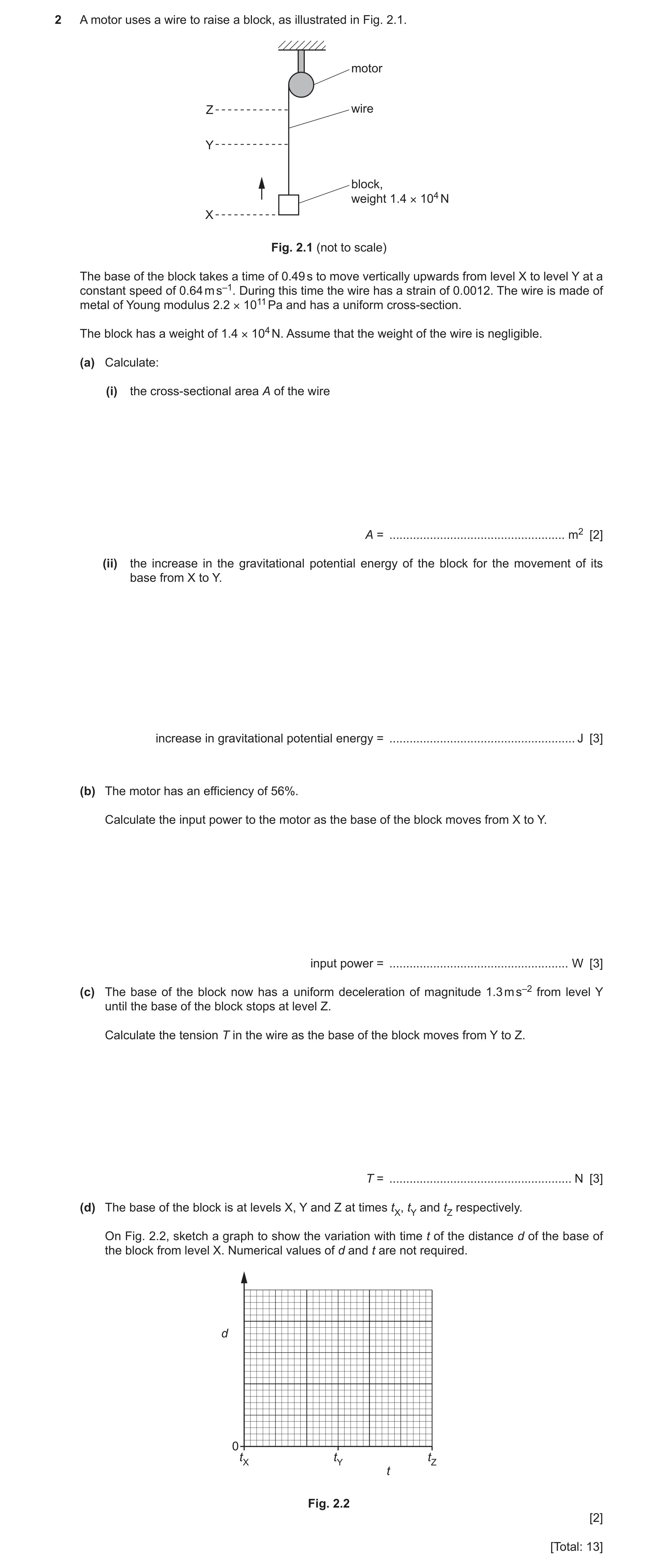
2 A motor uses a wire to raise a block, as illustrated in Fig. 2.1. motor Z wire Y block, weight 1.4 × 10⁴ N X Fig. 2.1 (not to scale) The base of the block takes a time of 0.49 s to move vertically upwards from level X to level Y at a constant speed of 0.64 m s–1. During this time the wire has a strain of 0.0012. The wire is made of metal of Young modulus 2.2 × 10¹¹ Pa and has a uniform cross-section. The block has a weight of 1.4 × 10⁴ N. Assume that the weight of the wire is negligible. (a) Calculate: (i) the cross-sectional area A of the wire A = … m2 [2] (ii) the increase in the gravitational potential energy of the block for the movement of its base from X to Y. increase in gravitational potential energy = … J [3] (b) The motor has an efficiency of 56%. Calculate the input power to the motor as the base of the block moves from X to Y. input power = … W [3] (c) The base of the block now has a uniform deceleration of magnitude 1.3 m s–2 from level Y until the base of the block stops at level Z. Calculate the tension T in the wire as the base of the block moves from Y to Z. T = … N [3] (d) The base of the block is at levels X, Y and Z at times tX, tY and tZ respectively. On Fig. 2.2, sketch a graph to show the variation with time t of the distance d of the base of the block from level X. Numerical values of d and t are not required. d 0 tX tY tZ t Fig. 2.2 [2] [Total: 13]
13 marks
Mark scheme: 2(a)(i) E = / or E = F / A C1 A = 1.4 104 / (2.2 1011 0.0012) A1 = 5.3 10–5 m2 2(a)(ii) (∆)h = 0.64 0.49 (= 0.3136) C1 (∆)E = mg(∆)h or W(∆)h C1 = 1.4 104 0.64 0.49 A1 = 4.4 103 J 2(b) P = Fv or W / t C1 = (1.4 104 0.64) / 0.56 or (4.4 103 / 0.49) / 0.56 C1 = 1.6 104 W A1 2(c) m = 1.4 104 / 9.81 C1 ( = 1427 kg) (resultant) F = (1.4 104 / 9.81) 1.3 C1 ( = 1855 N) T = 1.4 104 – 1855 or (1.4104 / 9.81) (9.81 – 1.3) A1 = 1.2 104 N 2(d) upward sloping straight line from (tX, 0) to tY B1 from tY to tZ: an upward sloping curve with decreasing magnitude of gradient (that is horizontal at tZ) B1
This question in 9702/22 Feb/March 2023
Q19 · State what is meant by the centre of gravity of an object 9702/22 May/June 2023
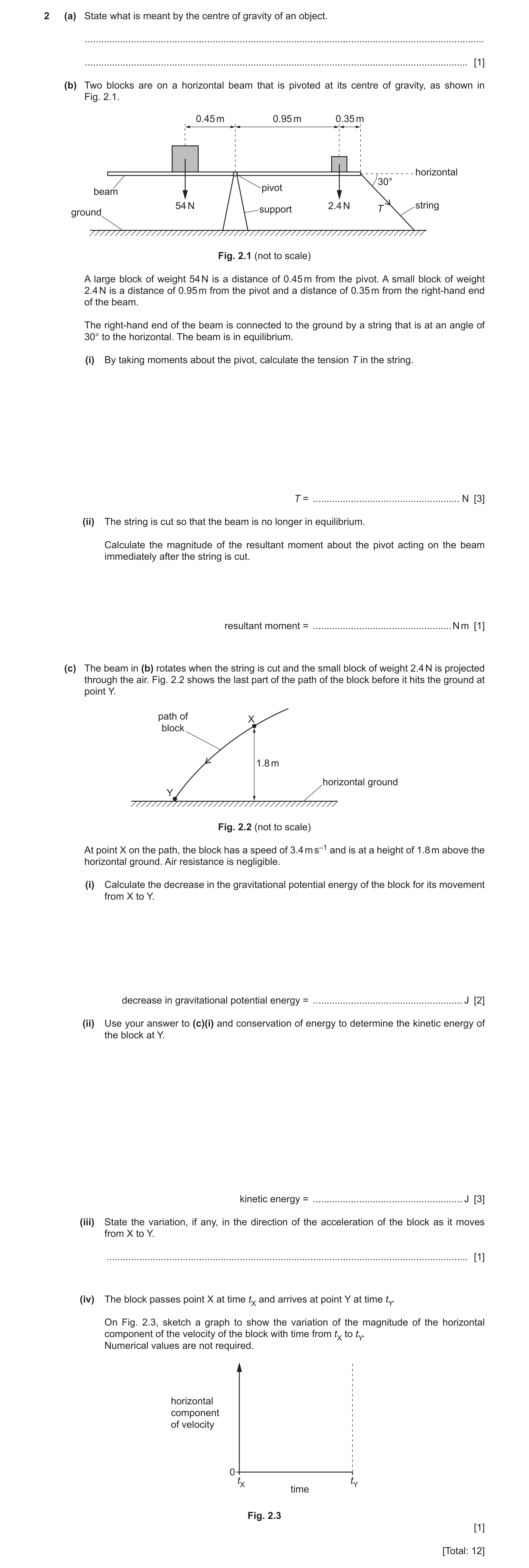
2 (a) State what is meant by the centre of gravity of an object. … … [1] (b) Two blocks are on a horizontal beam that is pivoted at its centre of gravity, as shown in Fig. 2.1. 0.45 m 0.95 m 0.35 m horizontal 30° pivot beam 54 N 2.4 N string support T ground Fig. 2.1 (not to scale) A large block of weight 54 N is a distance of 0.45 m from the pivot. A small block of weight 2.4 N is a distance of 0.95 m from the pivot and a distance of 0.35 m from the right‑hand end of the beam. The right‑hand end of the beam is connected to the ground by a string that is at an angle of 30° to the horizontal. The beam is in equilibrium. (i) By taking moments about the pivot, calculate the tension T in the string. T = … N [3] (ii) The string is cut so that the beam is no longer in equilibrium. Calculate the magnitude of the resultant moment about the pivot acting on the beam immediately after the string is cut. resultant moment = … N m [1] (c) The beam in (b) rotates when the string is cut and the small block of weight 2.4 N is projected through the air. Fig. 2.2 shows the last part of the path of the block before it hits the ground at point Y. path of X block 1.8 m horizontal ground Y Fig. 2.2 (not to scale) At point X on the path, the block has a speed of 3.4 m s–1 and is at a height of 1.8 m above the horizontal ground. Air resistance is negligible. (i) Calculate the decrease in the gravitational potential energy of the block for its movement from X to Y. decrease in gravitational potential energy = … J [2] (ii) Use your answer to (c)(i) and conservation of energy to determine the kinetic energy of the block at Y. kinetic energy = … J [3] (iii) State the variation, if any, in the direction of the acceleration of the block as it moves from X to Y. … [1] (iv) The block passes point X at time tX and arrives at point Y at time tY. On Fig. 2.3, sketch a graph to show the variation of the magnitude of the horizontal component of the velocity of the block with time from tX to tY. Numerical values are not required. horizontal component of velocity 0 tX tY time Fig. 2.3 [1] [Total: 12]
12 marks
Mark scheme: 2(a) the point where (all) the weight (of the object) is taken to act B1 2(b)(i) (54 0.45) or (2.4 0.95) or (T sin 30° 1.3) C1 (54 0.45) = (2.4 0.95) + (T sin 30° 1.3) C1 T = 34 N A1 2(b)(ii) resultant moment = (54 0.45) – (2.4 0.95) or (34 sin 30° 1.3) = 22 N m A1 2(c)(i) (∆)E = mg(∆)h or W(∆)h C1 = 2.4 1.8 = 4.3 J A1 Question Answer Marks 2(c)(ii) 2 1 2 E mv C1 = 1 2 (2.4 / 9.81) 3.42 = 1.4 J (at X) C1 kinetic energy at Y = 4.3 1.4 = 5.7 J A1 or 2 1 2 mv = 2 1 2 mu mg()h (C1) v2 = 3.42 2 9.81 1.8 v2 = 46.9 so v = 6.85 (m s–1) KE = 1 2 (2.4 / 9.81) 6.852 (C1) = 5.7 J (A1) 2(c)(iii) no variation or acceleration is (always) vertically downwards B1 2(c)(iv) horizontal straight line at a non-zero value of velocity B1
This question in 9702/22 May/June 2023
Q20 · A pinball machine uses a spring to launch a small metal ball of mass 4.5 × 10 –2 kg up a… 9702/22 May/June 2024
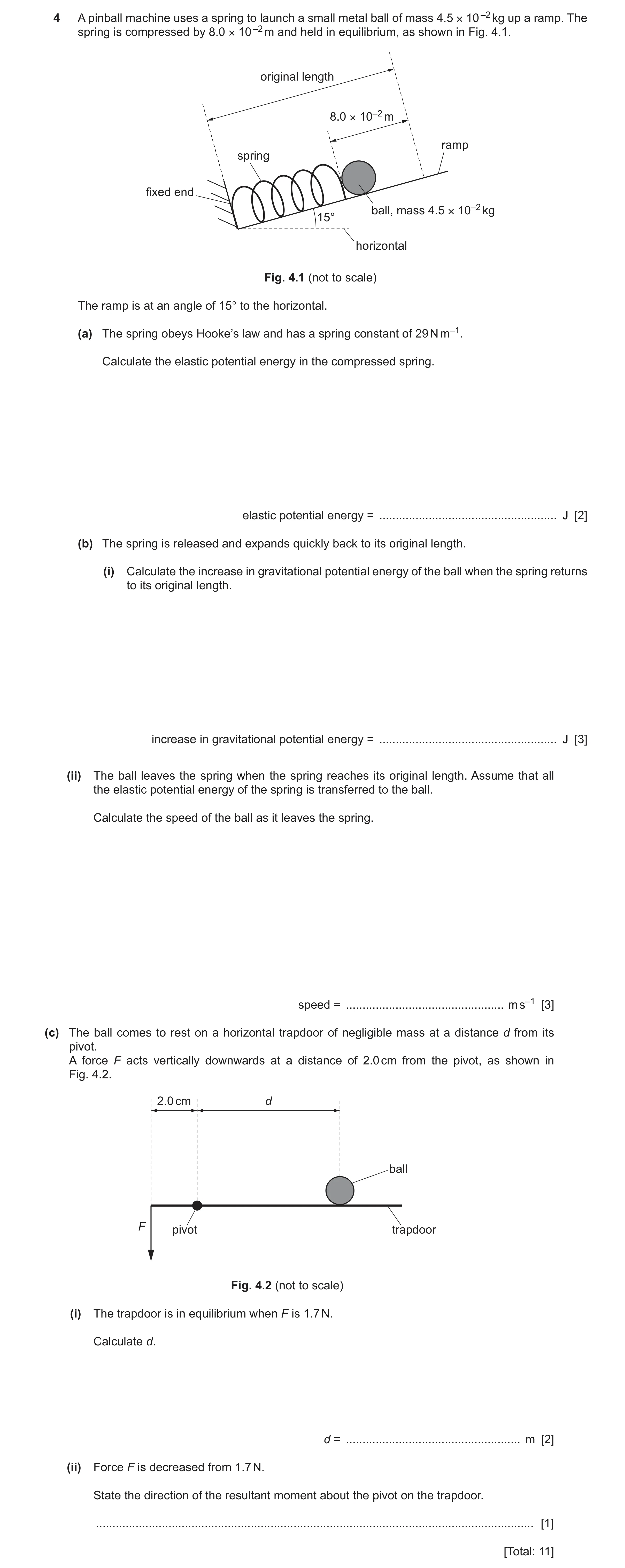
4 A pinball machine uses a spring to launch a small metal ball of mass 4.5 × 10 –2 kg up a ramp. The spring is compressed by 8.0 × 10 –2 m and held in equilibrium, as shown in Fig. 4.1. original length 8.0 × 10⁻² m ramp spring fixed end ball, mass 4.5 × 10⁻² kg 15° horizontal Fig. 4.1 (not to scale) The ramp is at an angle of 15° to the horizontal. (a) The spring obeys Hooke’s law and has a spring constant of 29 N m–1. Calculate the elastic potential energy in the compressed spring. elastic potential energy = … J [2] (b) The spring is released and expands quickly back to its original length. (i) Calculate the increase in gravitational potential energy of the ball when the spring returns to its original length. increase in gravitational potential energy = … J [3] (ii) The ball leaves the spring when the spring reaches its original length. Assume that all the elastic potential energy of the spring is transferred to the ball. Calculate the speed of the ball as it leaves the spring. speed = … m s–1 [3] (c) The ball comes to rest on a horizontal trapdoor of negligible mass at a distance d from its pivot. A force F acts vertically downwards at a distance of 2.0 cm from the pivot, as shown in Fig. 4.2. 2.0 cm d ball F pivot trapdoor Fig. 4.2 (not to scale) (i) The trapdoor is in equilibrium when F is 1.7 N. Calculate d. d = … m [2] (ii) Force F is decreased from 1.7 N. State the direction of the resultant moment about the pivot on the trapdoor. … [1] [Total: 11]
11 marks
Mark scheme: 4(a) E = ½kx2 or E= ½Fx and F = kx C1 E = ½ 29 (8.0 10–2)2 or E = ½ 2.32 8.0 10–2 E = 9.3 10–2 J A1 4(b)(i) ()E(P) = mg()h C1 = 4.5 10–2 9.81 8.0 10–2 sin 15° C1 = 9.1 10–3 J A1 4(b)(ii) E(K) = ½mv2 C1 (9.3 10–2 – 9.1 10–3) = ½ 4.5 10–2 v2 C1 v = (2 8.4 10–2 / 4.5 10–2)0.5 = 1.9 m s–1 A1 4(c)(i) 1.7 2.0 ( 10–2) or 4.5 10–2 9.81 d C1 1.7 2.0 10–2 = 4.5 10–2 9.81 d d = 7.7 10–2 m A1 4(c)(ii) clockwise B1
This question in 9702/22 May/June 2024
Q21 · A truck R of mass 9400 kg moves with constant acceleration in a straight line down a… 9702/22 Feb/March 2025
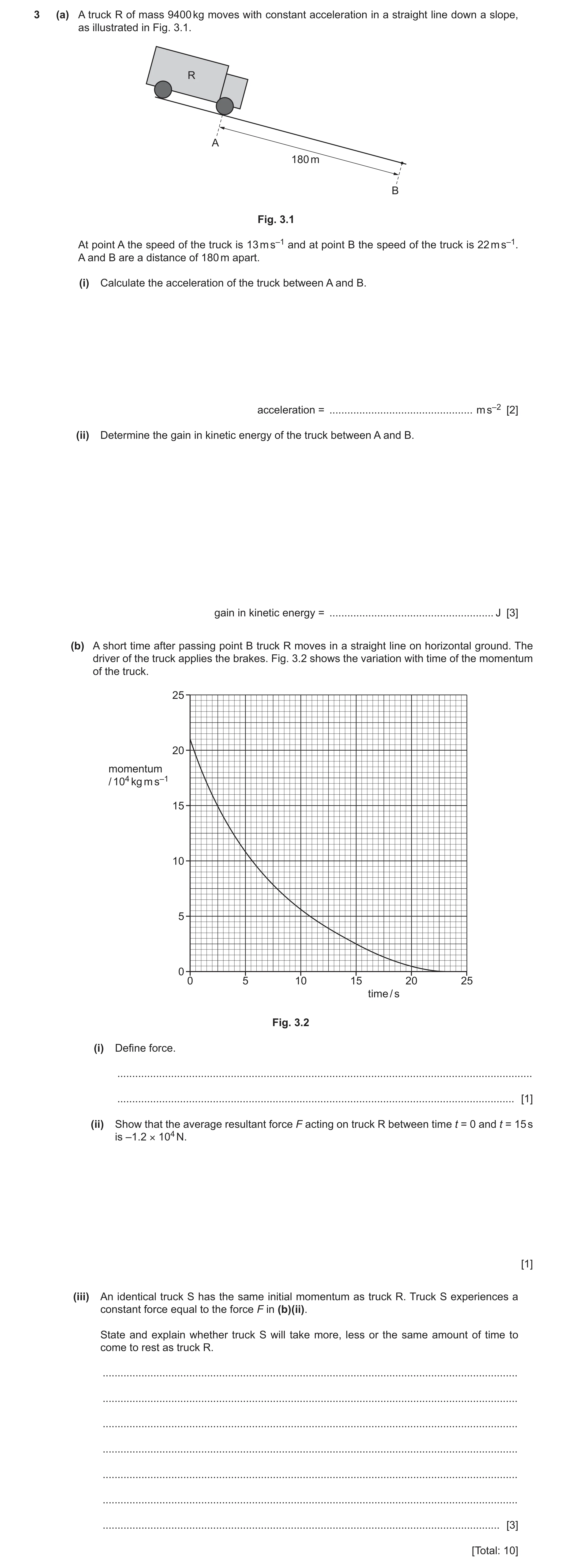
3 (a) A truck R of mass 9400 kg moves with constant acceleration in a straight line down a slope, as illustrated in Fig. 3.1. R A 180 m B Fig. 3.1 At point A the speed of the truck is 13 m s–1 and at point B the speed of the truck is 22 m s–1. A and B are a distance of 180 m apart. (i) Calculate the acceleration of the truck between A and B. acceleration = … m s–2 [2] (ii) Determine the gain in kinetic energy of the truck between A and B. gain in kinetic energy = … J [3] (b) A short time after passing point B truck R moves in a straight line on horizontal ground. The driver of the truck applies the brakes. Fig. 3.2 shows the variation with time of the momentum of the truck. 25 20 momentum / 104 kg m s–1 15 10 5 0 0 5 10 15 20 25 time / s Fig. 3.2 (i) Define force. … … [1] (ii) Show that the average resultant force F acting on truck R between time t = 0 and t = 15 s is –1.2 × 10⁴ N. [1] (iii) An identical truck S has the same initial momentum as truck R. Truck S experiences a constant force equal to the force F in (b)(ii). State and explain whether truck S will take more, less or the same amount of time to come to rest as truck R. … … … … … … … [3] [Total: 10]
10 marks
Mark scheme: 3(a)(i) a = (v2 – u2) / 2s C1 = (222 – 132) / (2 180) = 0.88 m s–2 A1 OR (C1) [t = (180 2) / (22 + 13) = 10.3] 180 = 13 10.3 + ½ a 10.32 or 180 = 22 10.3 – ½ a 10.3 2 or 22 = 13 + a 10.3 a = 0.88 m s–2 (A1) 3(a)(ii) ()E = ½m()v2 C1 gain in KE = ½m(v2 – u2) C1 = ½ 9400 (222 – 132) = 1.5 106 J A1 OR (C1) W = Fs = ma d gain in KE = 9400 0.88 180 (C1) = 1.5 106 J (A1) 3(b)(i) rate of change of momentum B1 3(b)(ii) (Force =) (2.5 104 – 21 104) / 15 = – 1.2 104 (N) A1 3(b)(iii) The change of momentum (for S and R to come to rest) is the same B1 (Average) force on R (to come to rest) is B1 (–21 104 / 23 =) 0.91 104 N or (Average) force on R (to come to rest) is less than the force on S / less than F (S will come to rest in) less time (than R). B1 OR (B1) The change of momentum (for S and R to come to rest) is the same Time for S to come to rest is (–21 104 / 1.2 104 =) 17.5 s (and time for R to come to rest is 23 s) (B1) (S comes to rest in) less time (than R). (B1)
This question in 9702/22 Feb/March 2025
Q22 · A small ball is dropped from rest from height h1 above the ground and falls vertically… 9702/22 May/June 2025
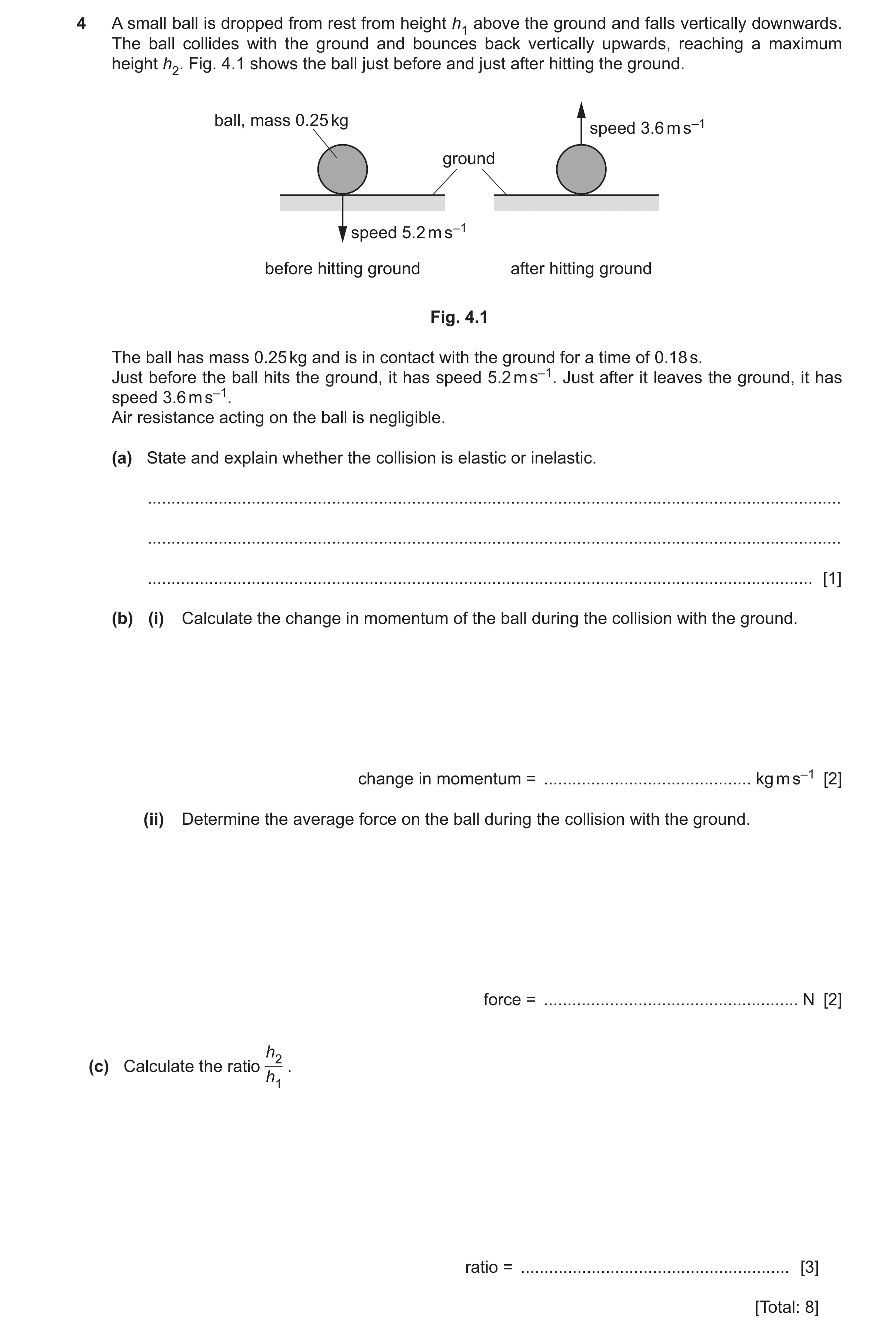
4 A small ball is dropped from rest from height h1 above the ground and falls vertically downwards. The ball collides with the ground and bounces back vertically upwards, reaching a maximum height h2. Fig. 4.1 shows the ball just before and just after hitting the ground. ball, mass 0.25 kg speed 3.6 m s–1 ground speed 5.2 m s–1 before hitting ground after hitting ground Fig. 4.1 The ball has mass 0.25 kg and is in contact with the ground for a time of 0.18 s. Just before the ball hits the ground, it has speed 5.2 m s–1. Just after it leaves the ground, it has speed 3.6 m s–1. Air resistance acting on the ball is negligible. (a) State and explain whether the collision is elastic or inelastic. … … … [1] (b) (i) Calculate the change in momentum of the ball during the collision with the ground. change in momentum = … kg m s–1 [2] (ii) Determine the average force on the ball during the collision with the ground. force = … N [2] h2 (c) Calculate the ratio . h1 ratio = … [3] [Total: 8]
8 marks
Mark scheme: 4(a) The (total) kinetic energy changes / decreases so (the collision is) inelastic B1 OR (B1) (relative) speed of approach not equal to / greater than (relative) speed of separation so (collision is) inelastic 4(b)(i) p = mv or 0.25 3.6 or 0.25 5.2 C1 p = 0.25 (3.6 + 5.2) = 2.2 kg m s–1 A1 4(b)(ii) F = p / ()t C1 = 2.2 / 0.18 = 12 N A1 OR (C1) F = ma and a = (v–u) / t = mv / t = 0.25 (3.6 + 5.2) / 0.18 = 12 N (A1) 4(c) ½ mv2 = mg()h C1 ½ 0.25 5.22 = 0.25 g h1 h1 = 5.22 / 2g h1 = 1.38 ½ 0.25 3.62 = 0.25 g h2 C1 h2 = 3.62/2g h2 = 0.66 h2 / h1 = 0.66 / 1.38 ratio = 0.48 A1
This question in 9702/22 May/June 2025
Q23 · A car of mass 1500 kg is travelling along a straight horizontal road at constant velocity… 9702/23 May/June 2025
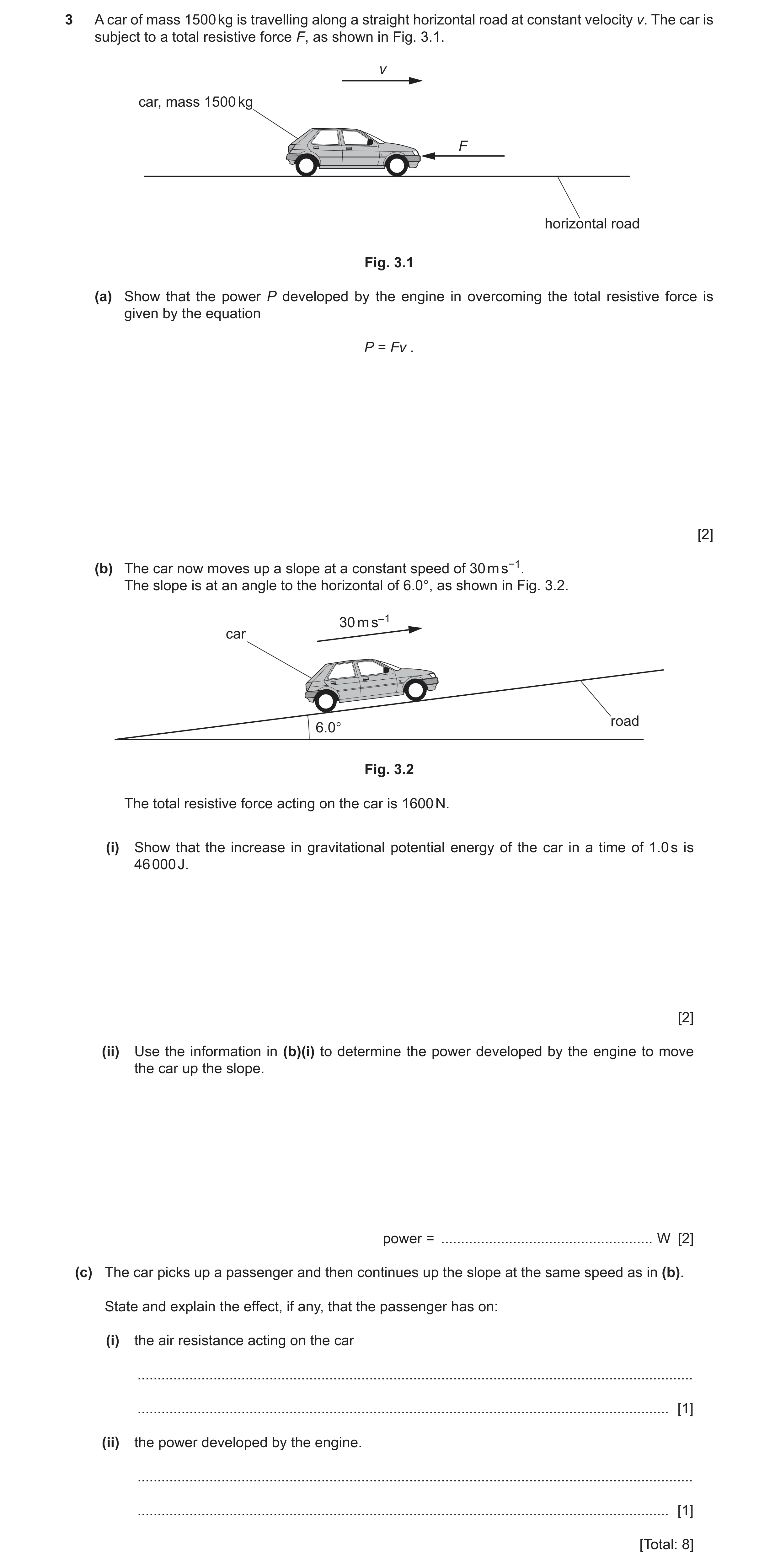
3 A car of mass 1500 kg is travelling along a straight horizontal road at constant velocity v. The car is subject to a total resistive force F, as shown in Fig. 3.1. v car, mass 1500 kg F horizontal road Fig. 3.1 (a) Show that the power P developed by the engine in overcoming the total resistive force is given by the equation P = Fv . [2] (b) The car now moves up a slope at a constant speed of 30 m s−1. The slope is at an angle to the horizontal of 6.0°, as shown in Fig. 3.2. 30 m s–1 car road 6.0° Fig. 3.2 The total resistive force acting on the car is 1600 N. (i) Show that the increase in gravitational potential energy of the car in a time of 1.0 s is 46 000 J. [2] (ii) Use the information in (b)(i) to determine the power developed by the engine to move the car up the slope. power = … W [2] (c) The car picks up a passenger and then continues up the slope at the same speed as in (b). State and explain the effect, if any, that the passenger has on: (i) the air resistance acting on the car … … [1] (ii) the power developed by the engine. … … [1] [Total: 8]
8 marks
Mark scheme: 3(a) W = Fd B1 P = Fd / t = Fv or P = Fvt / t = Fv B1 3(b)(i) ()E(P) = mg()h C1 increase of gravitational potential energy of car in 1.0 s A1 = 1500 9.81 30 sin 6.0 = 46 000 J 3(b)(ii) (Power to overcome total resistive forces) = 1600 30 C1 = 48 000 W power = 48 000 + 46 000 A1 = 9.4 104 W 3(c)(i) Air resistance is the same, as the speed is the same B1 3(c)(ii) Mass / weight has increased so (power will) increase B1
This question in 9702/23 May/June 2025
 1 / 38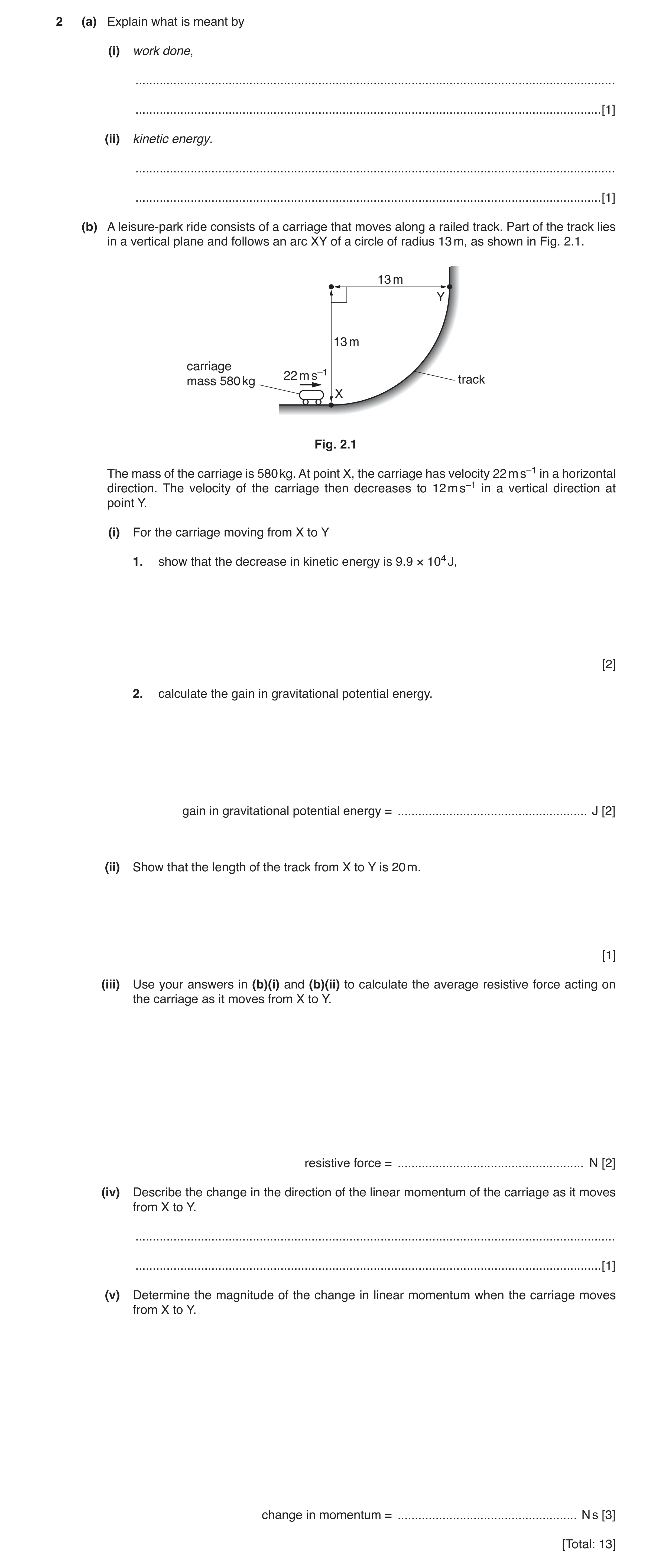
 3 / 38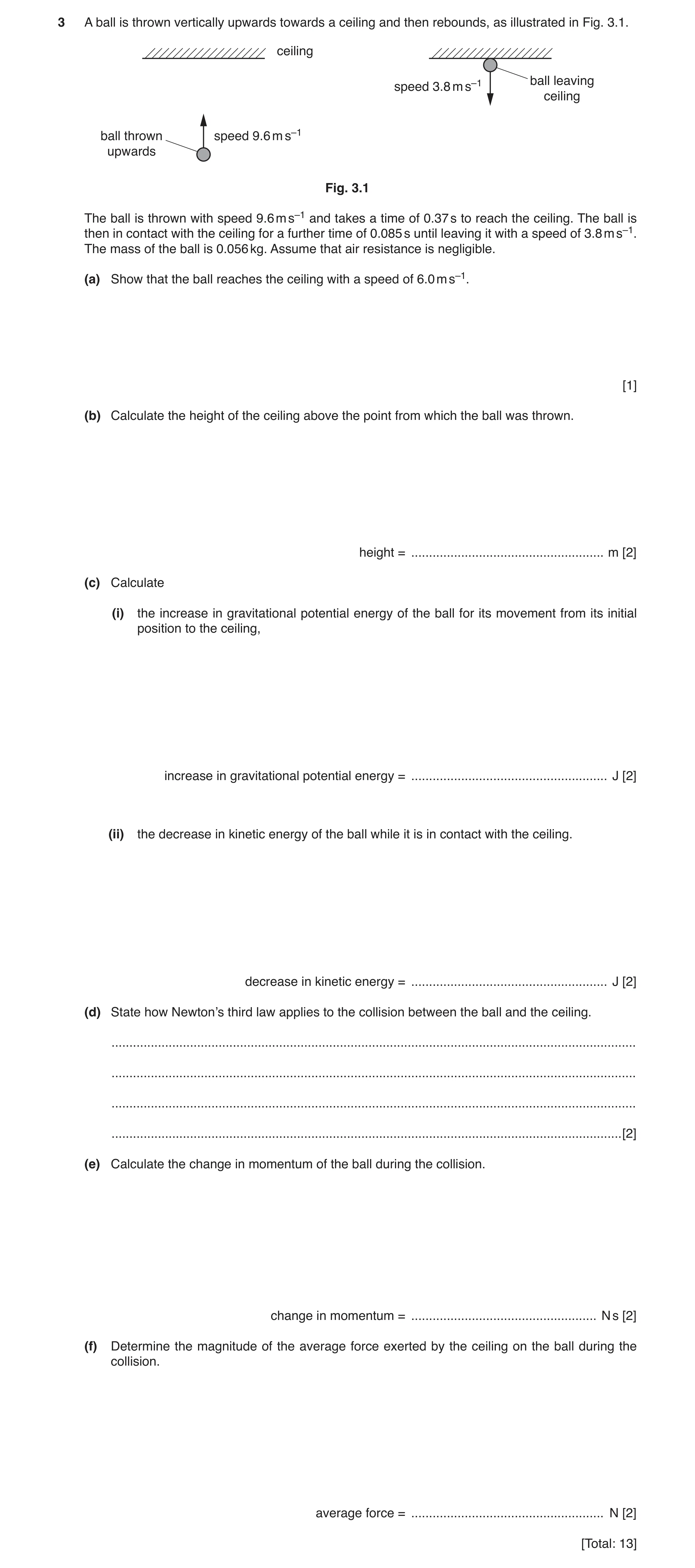
 6
6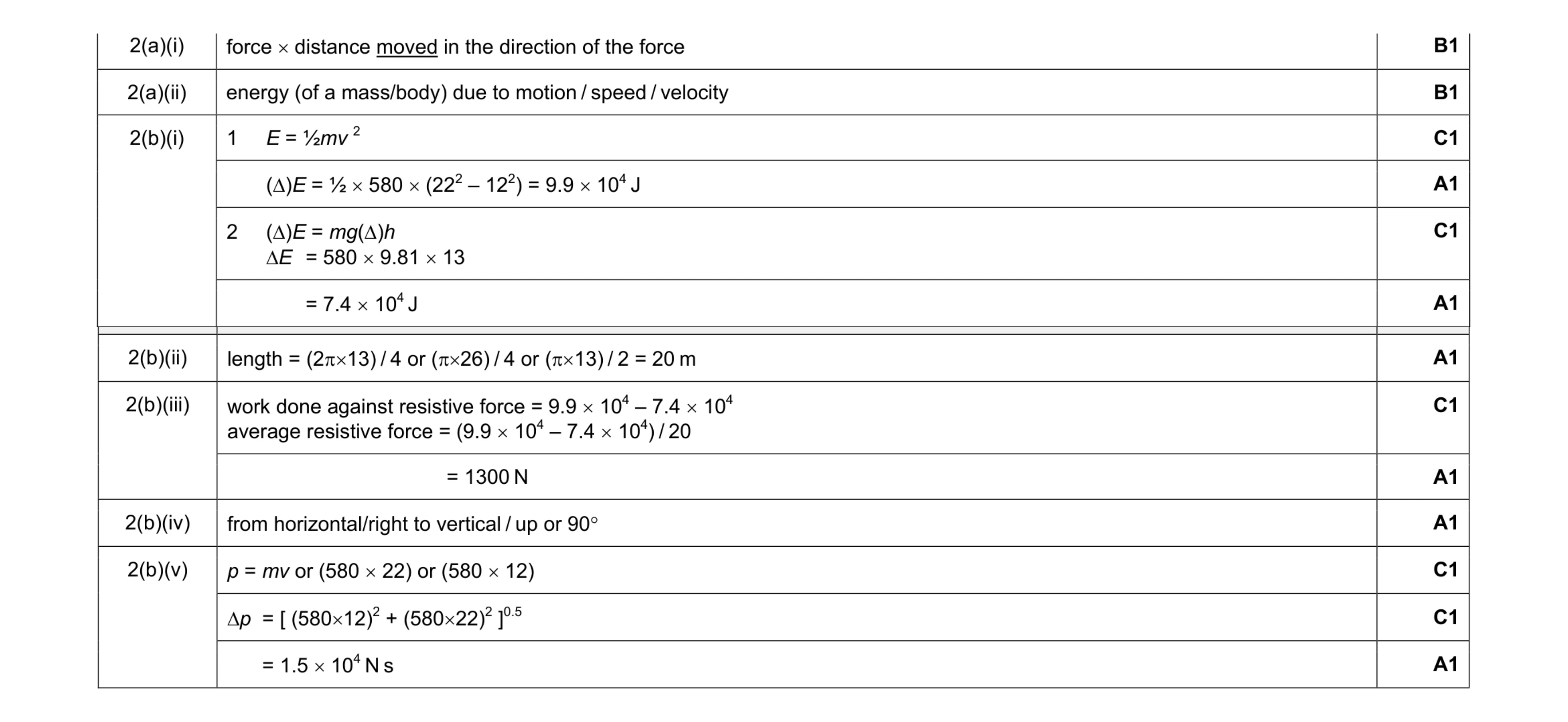 13
13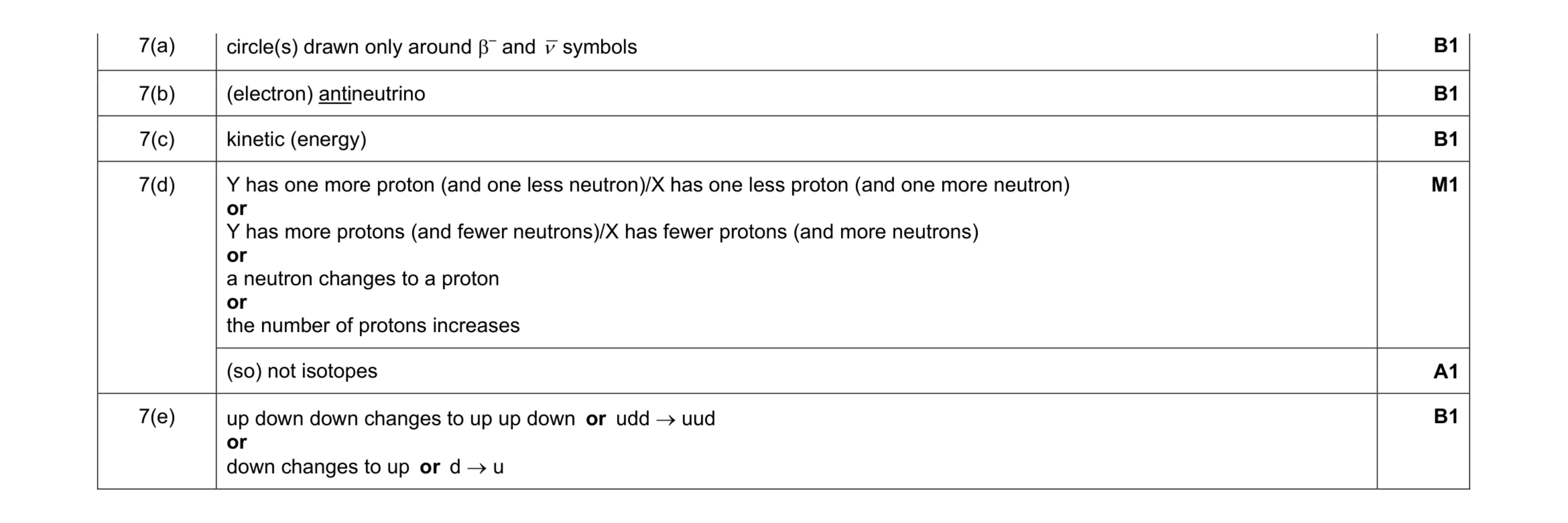 6
6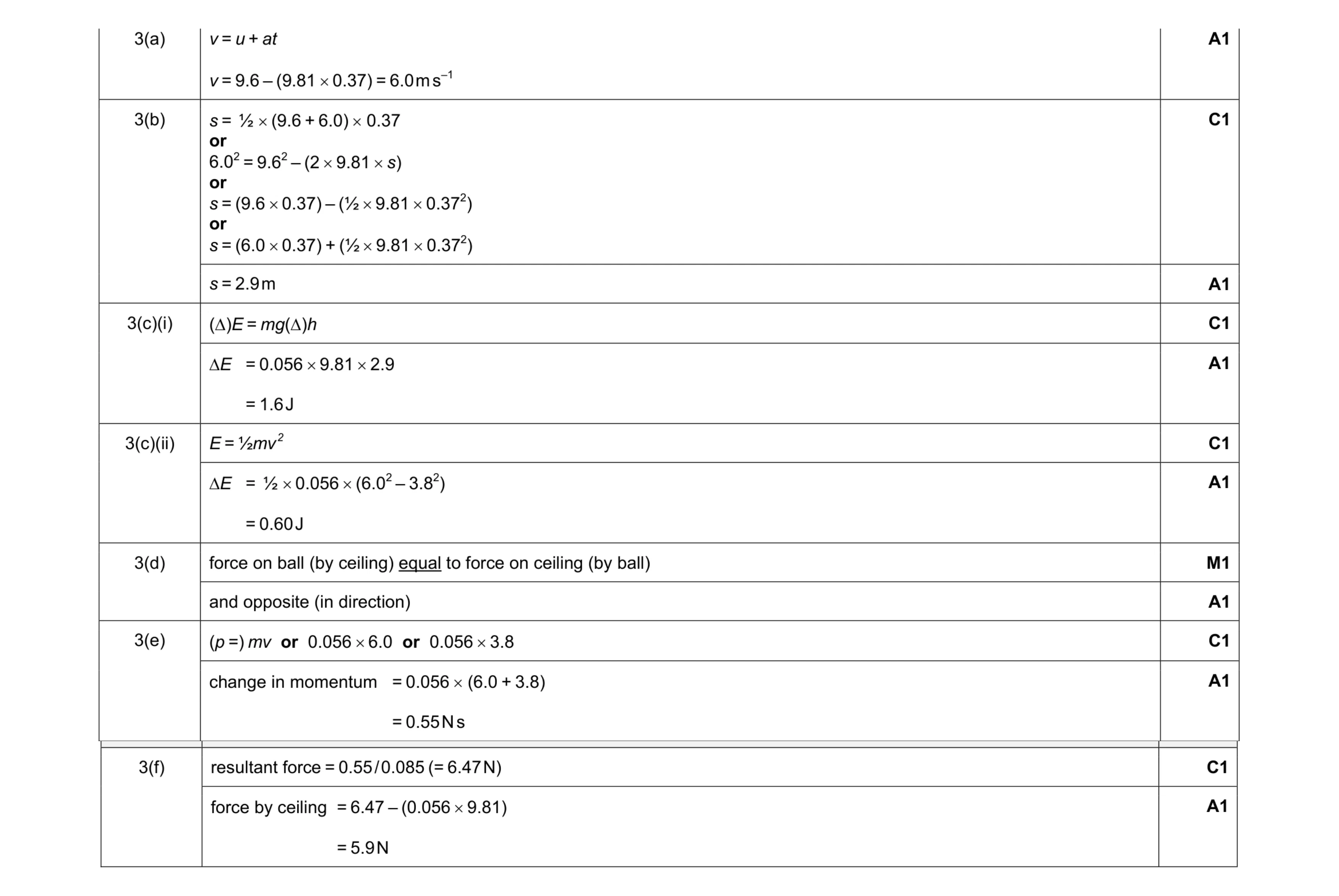 13
13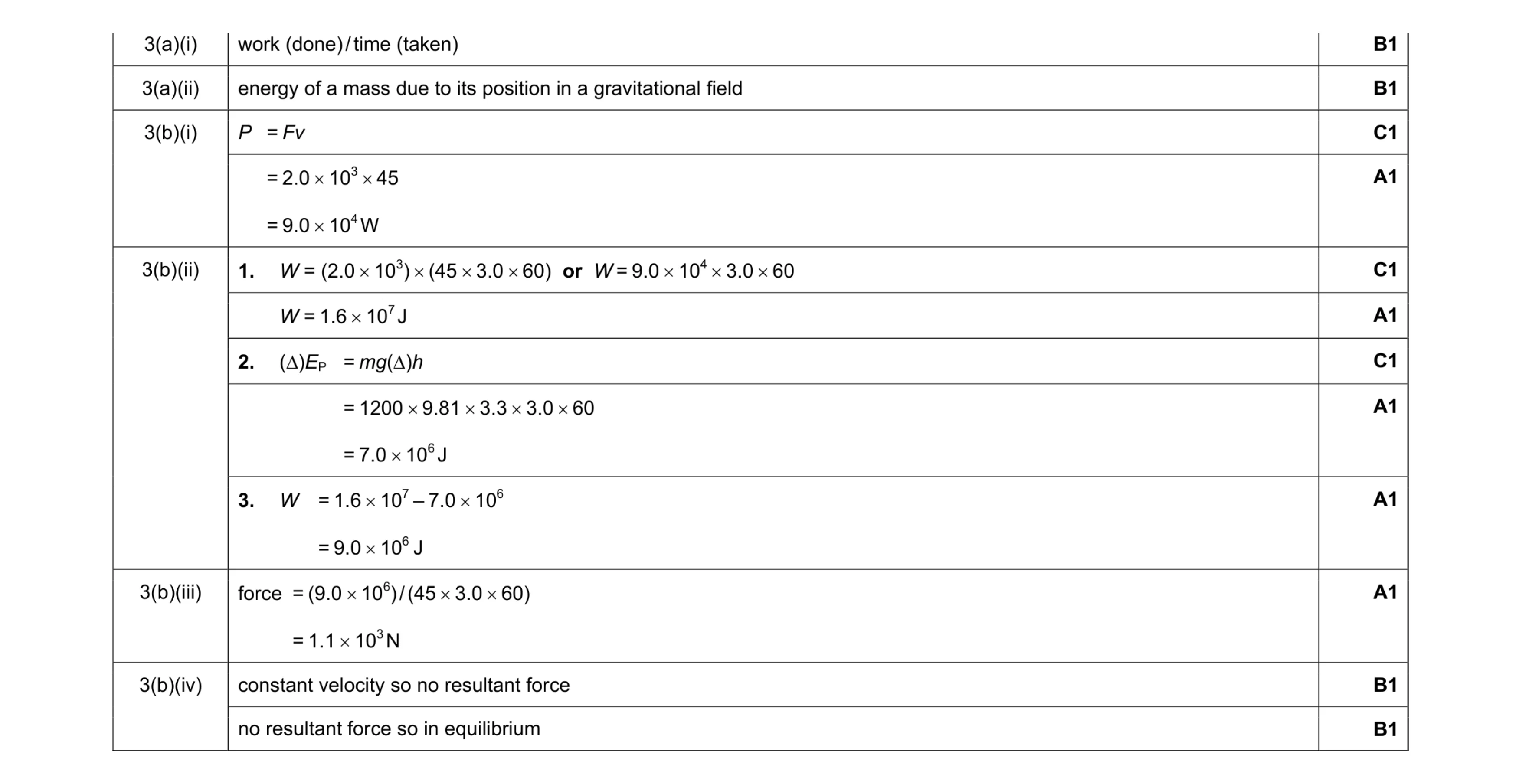 12
12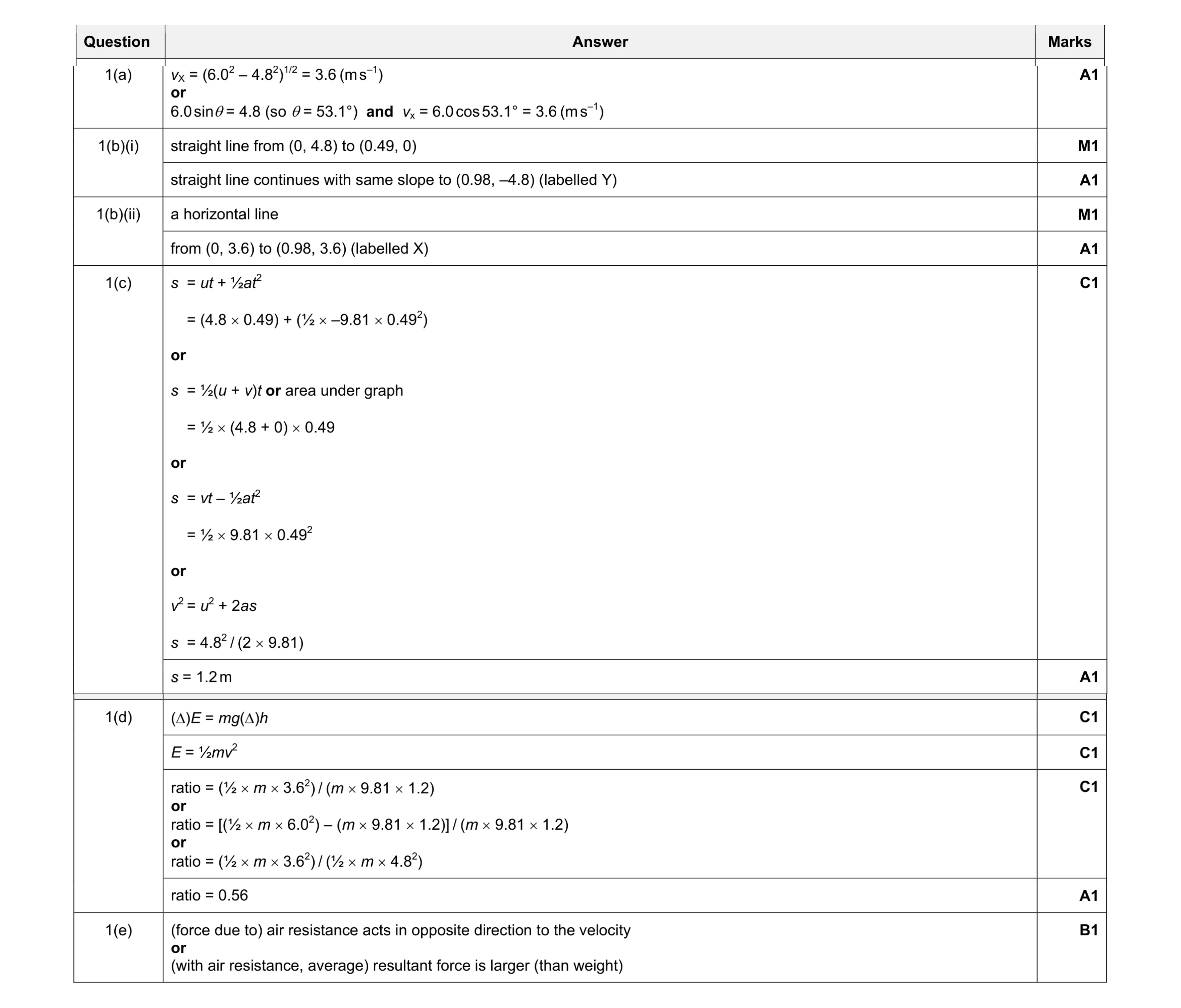 12
12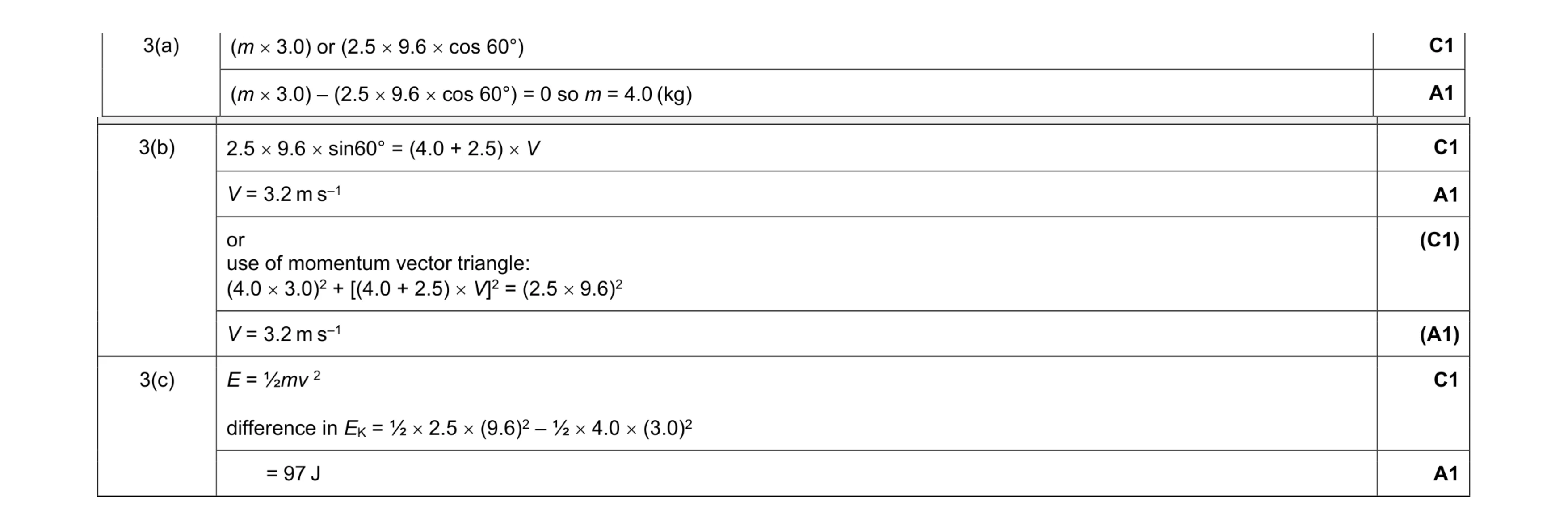 6
6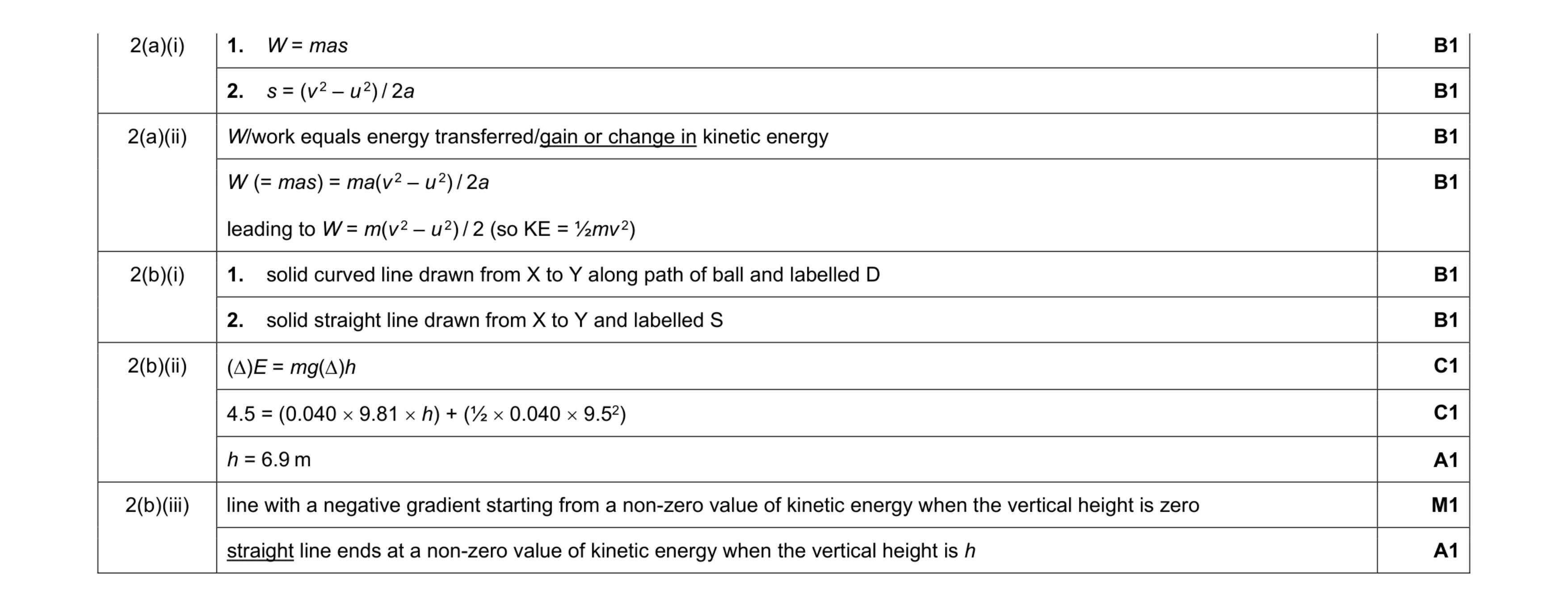 11
11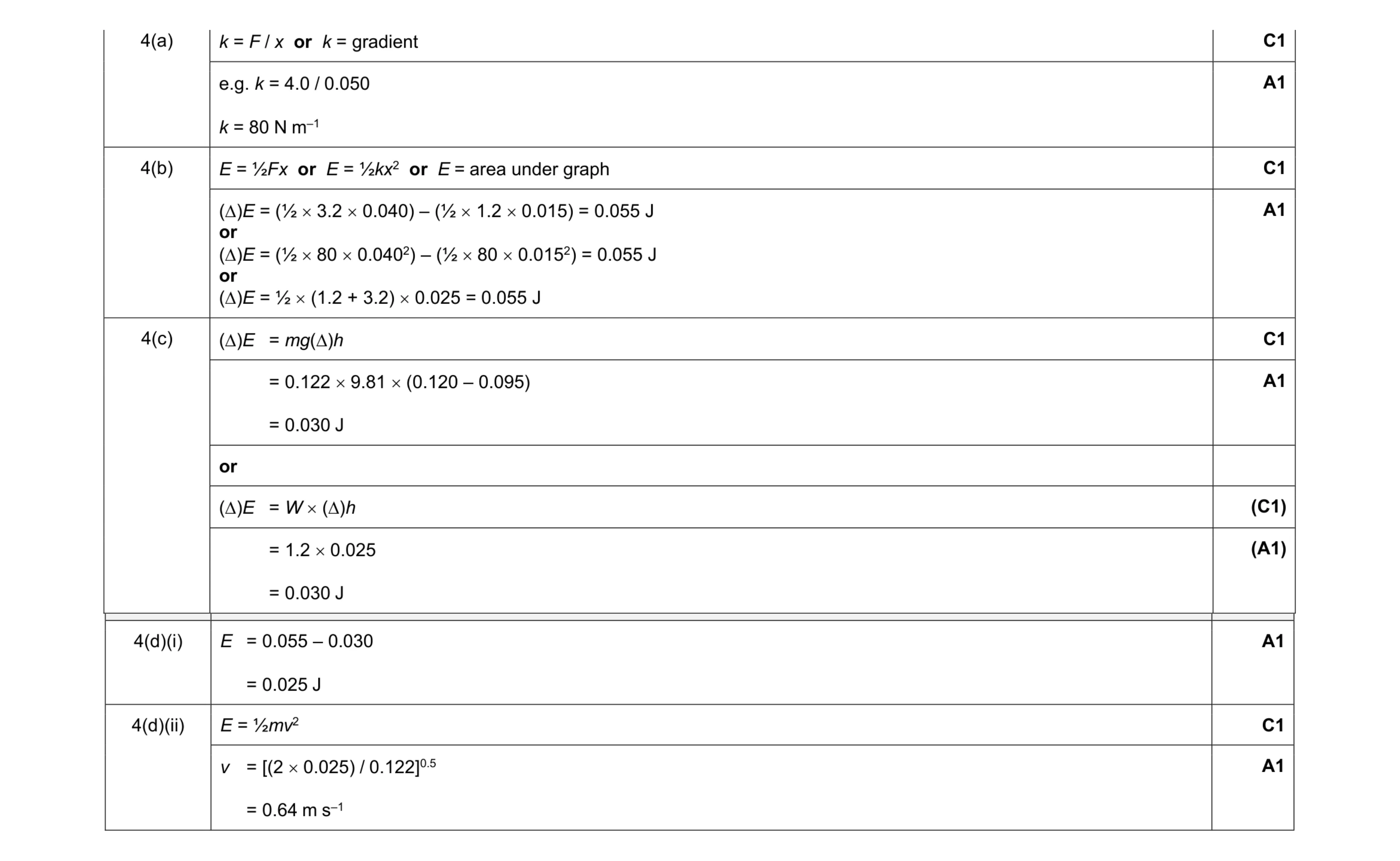 9
9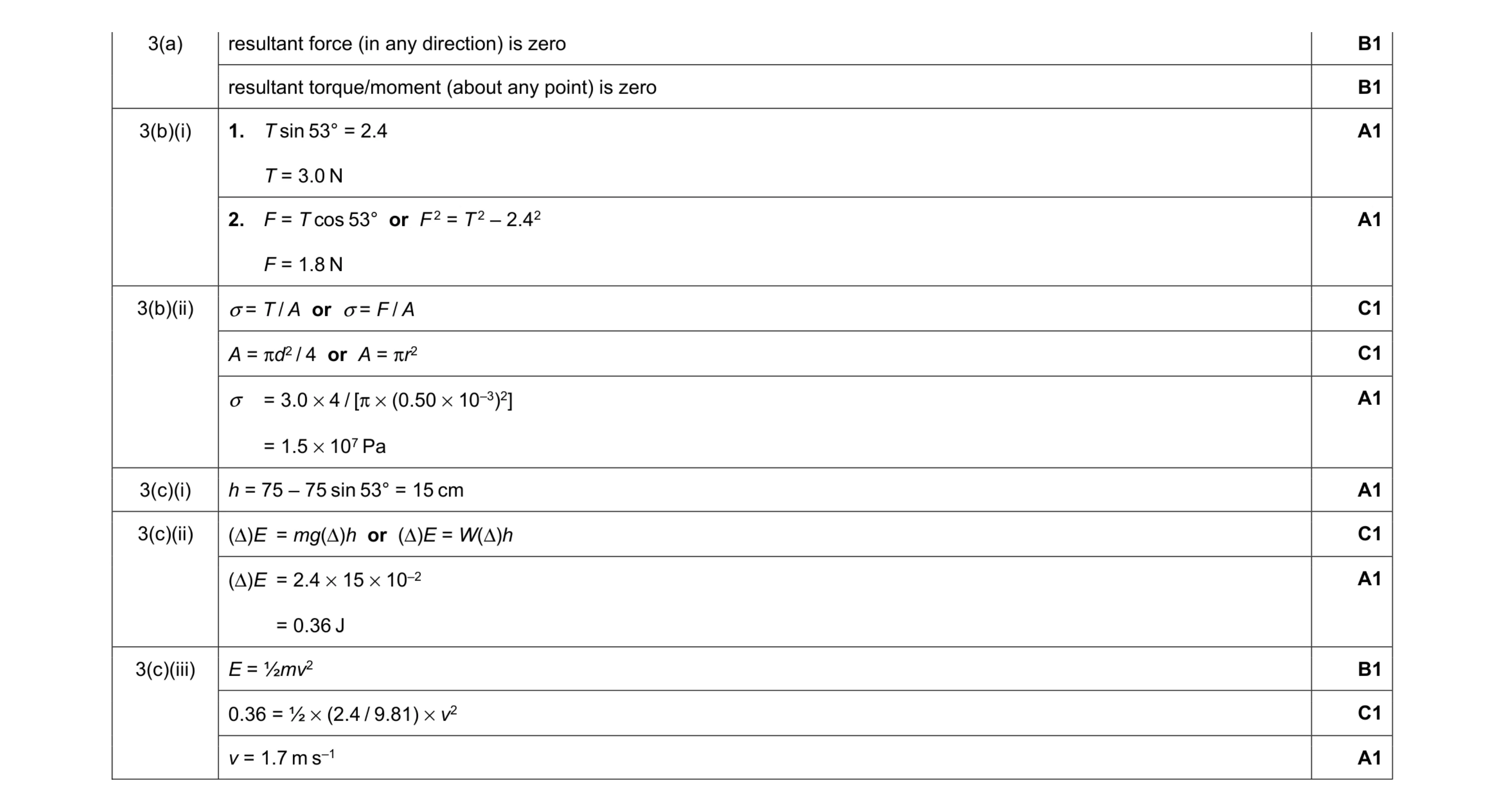 13
13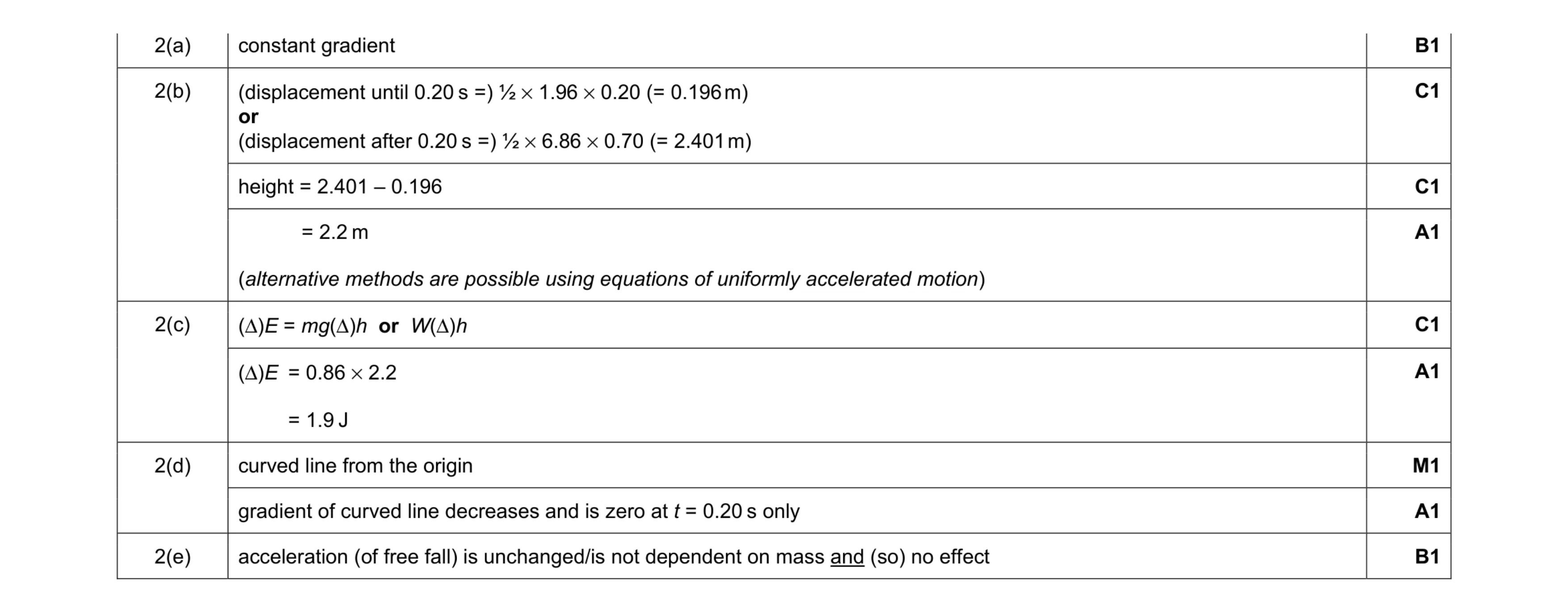 9
9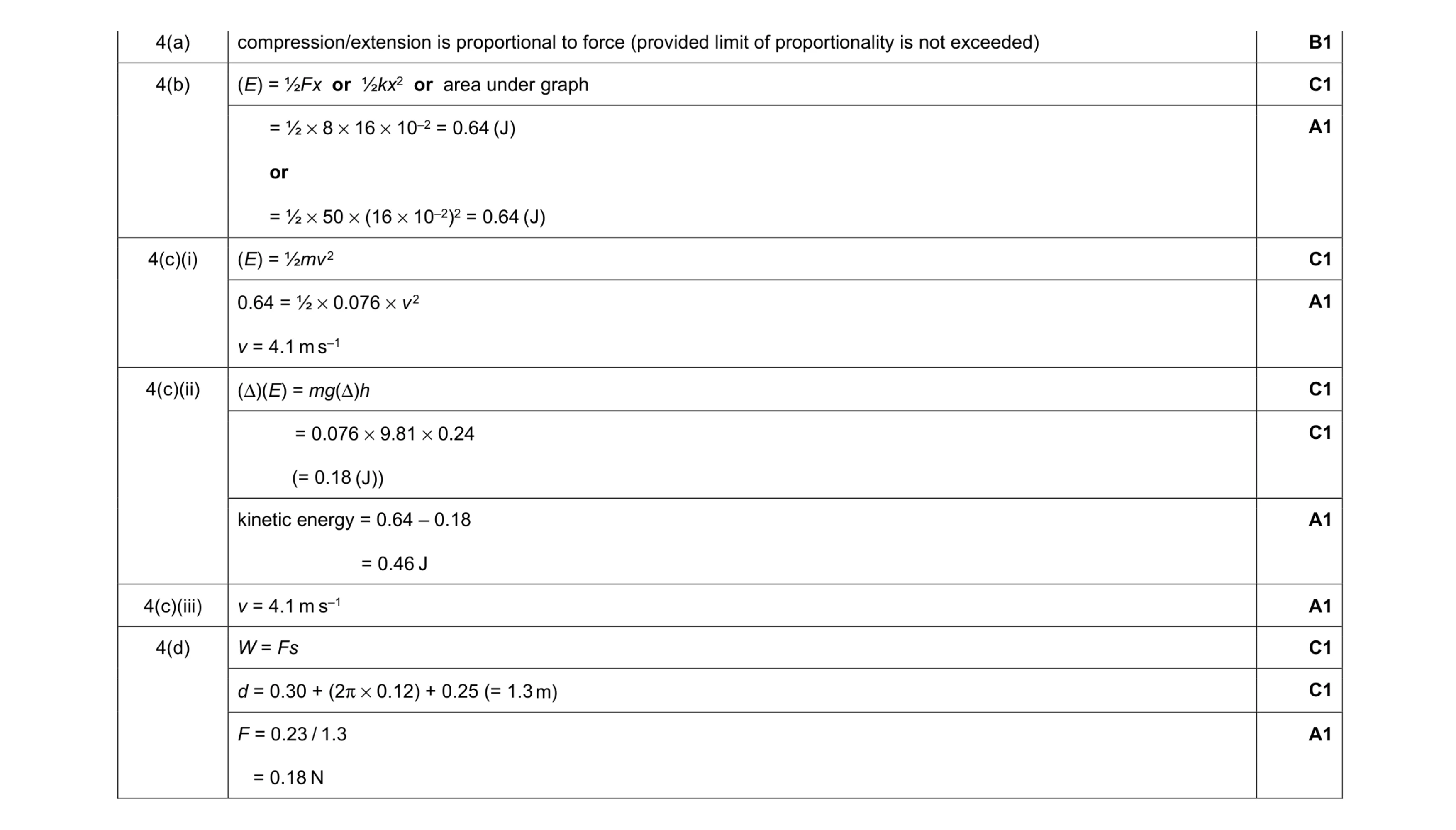 12
12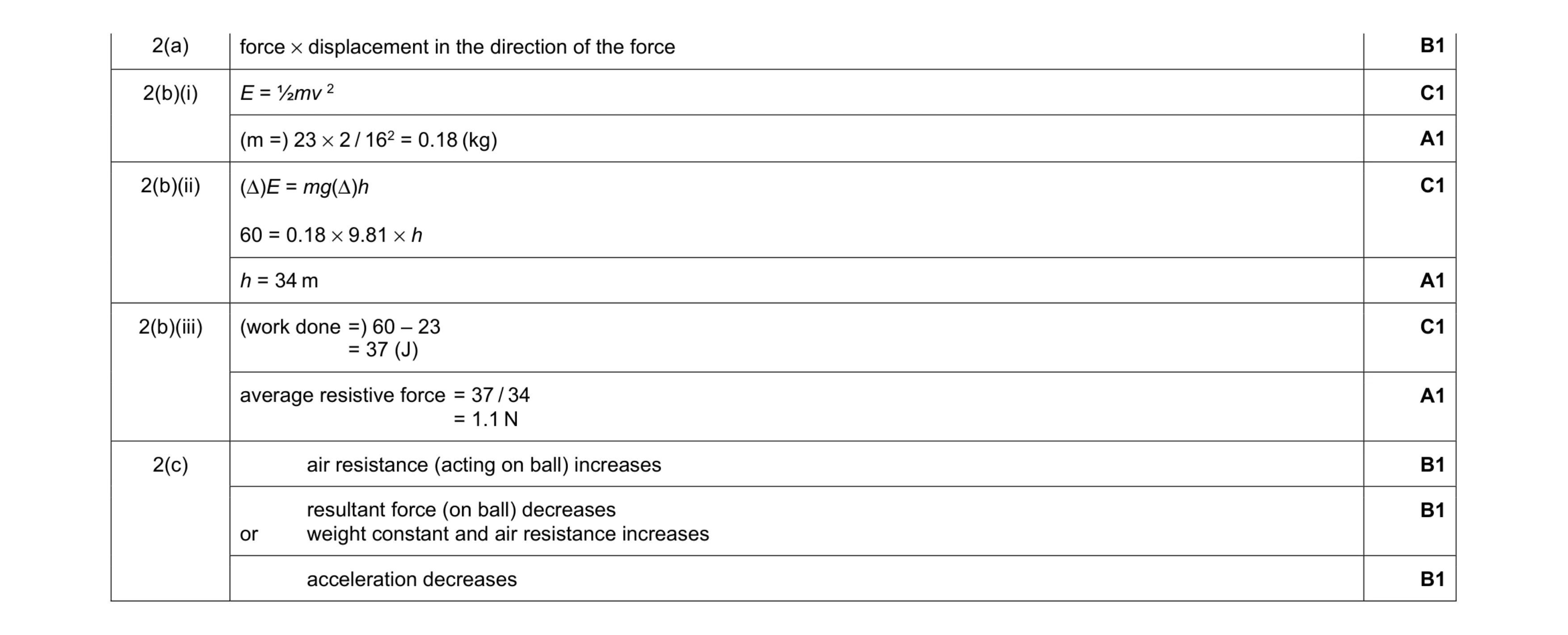 10
10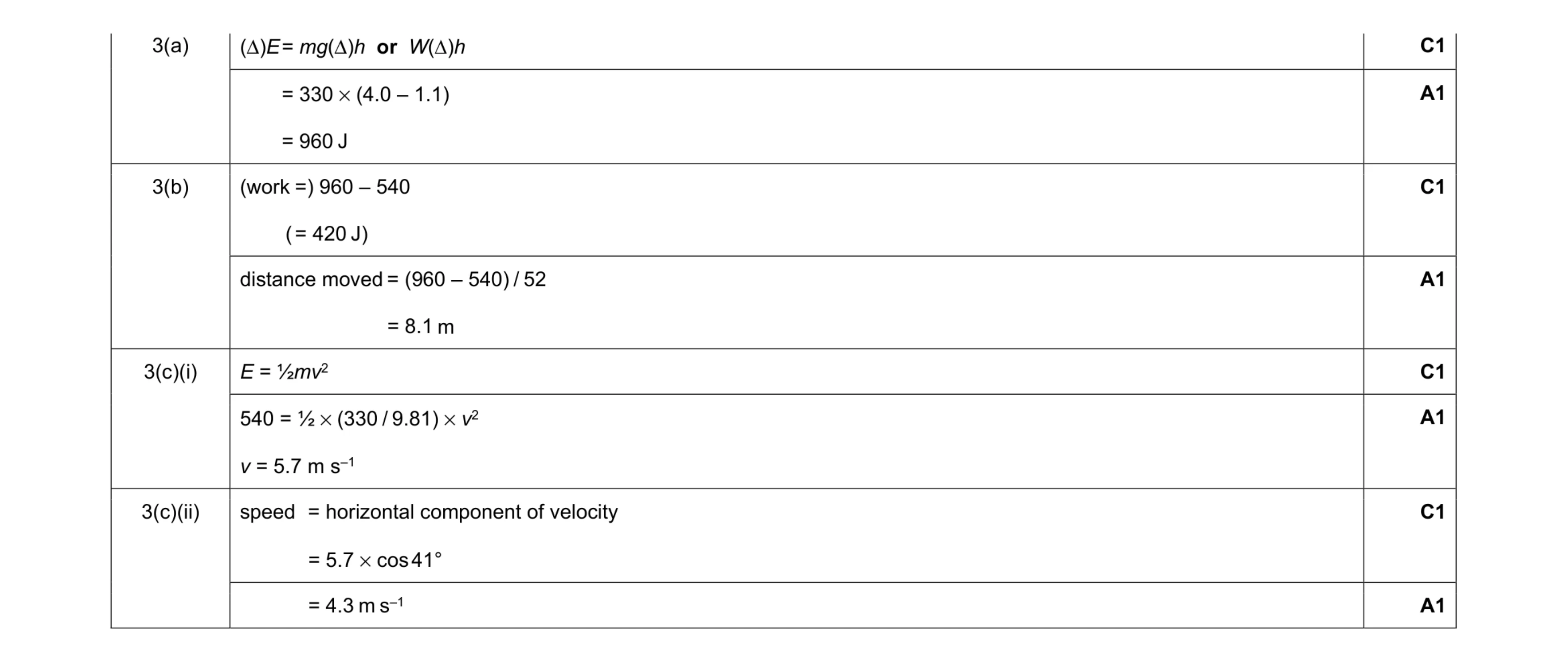 8
8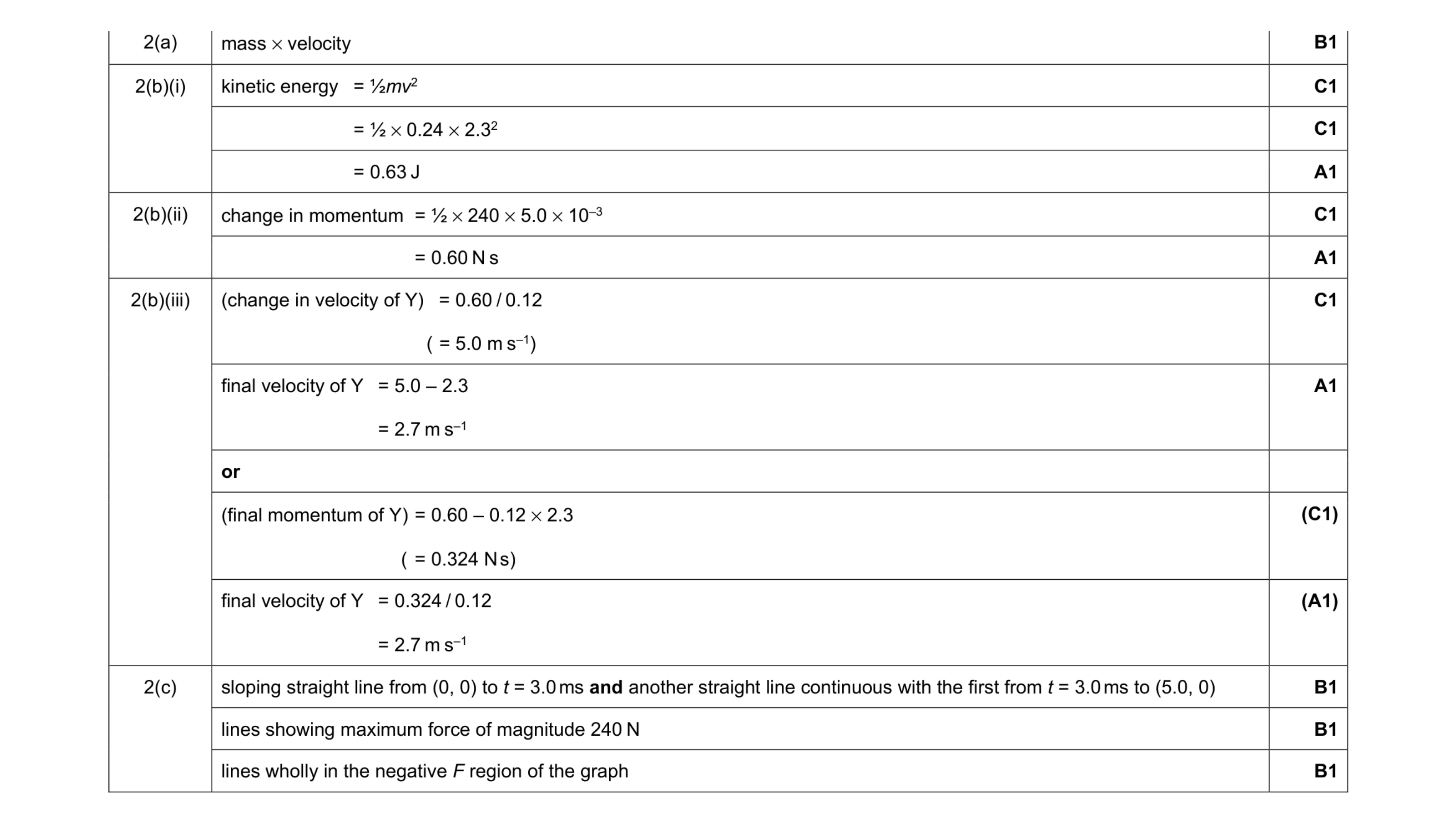 11
11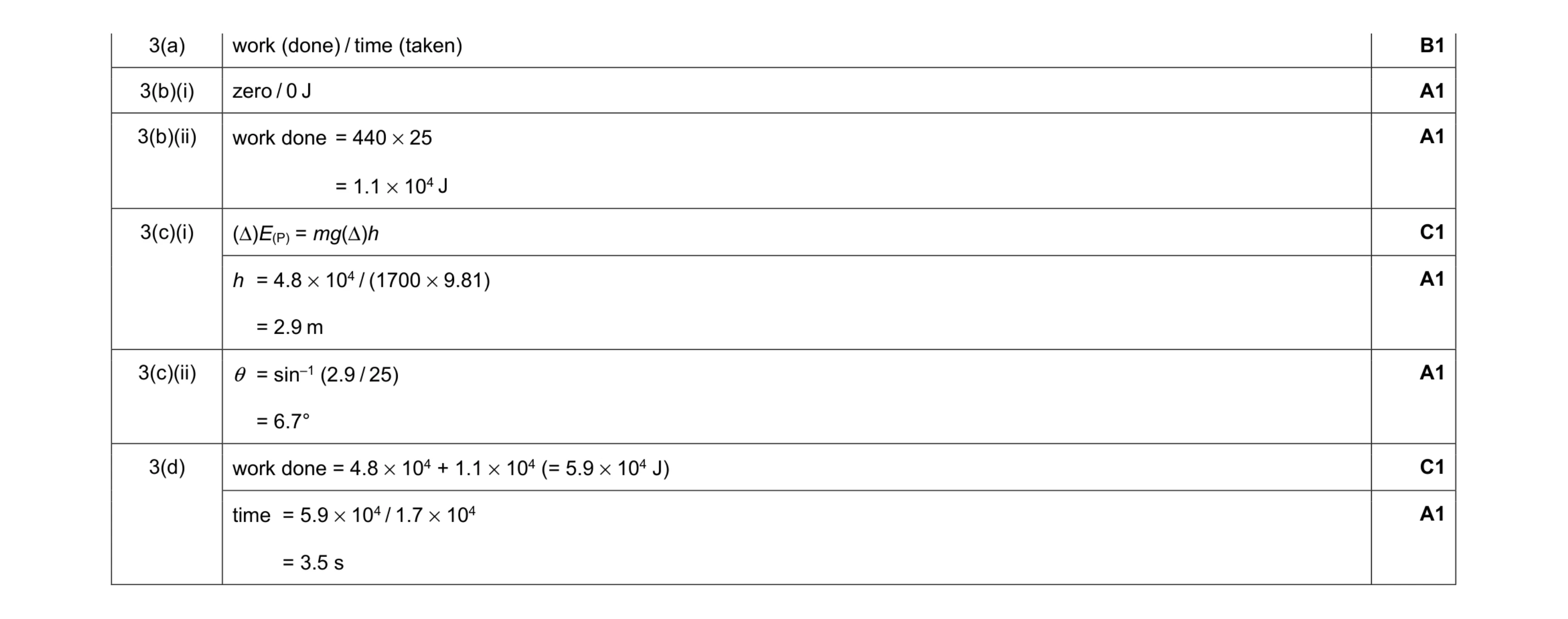 8
8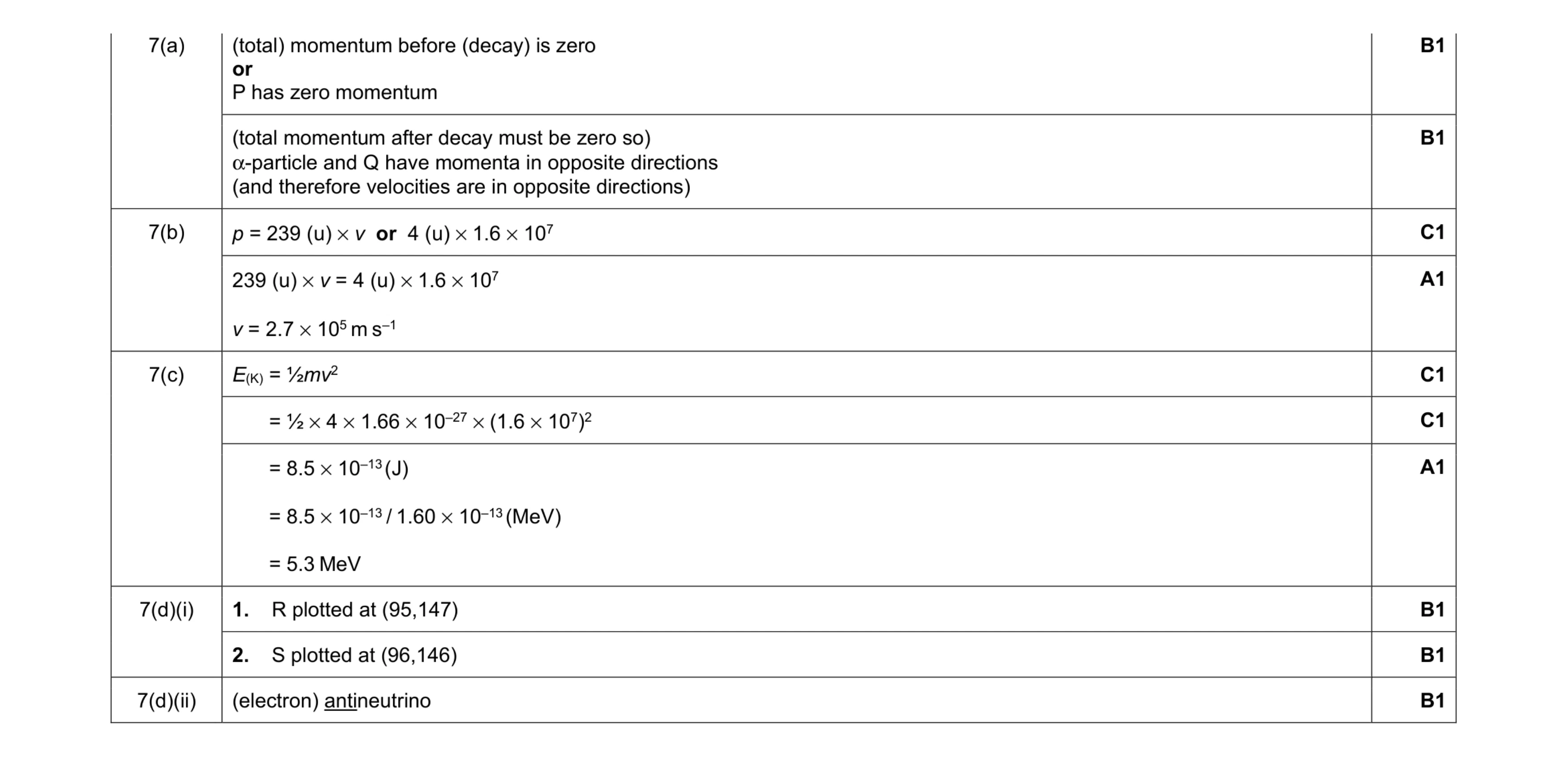 10
10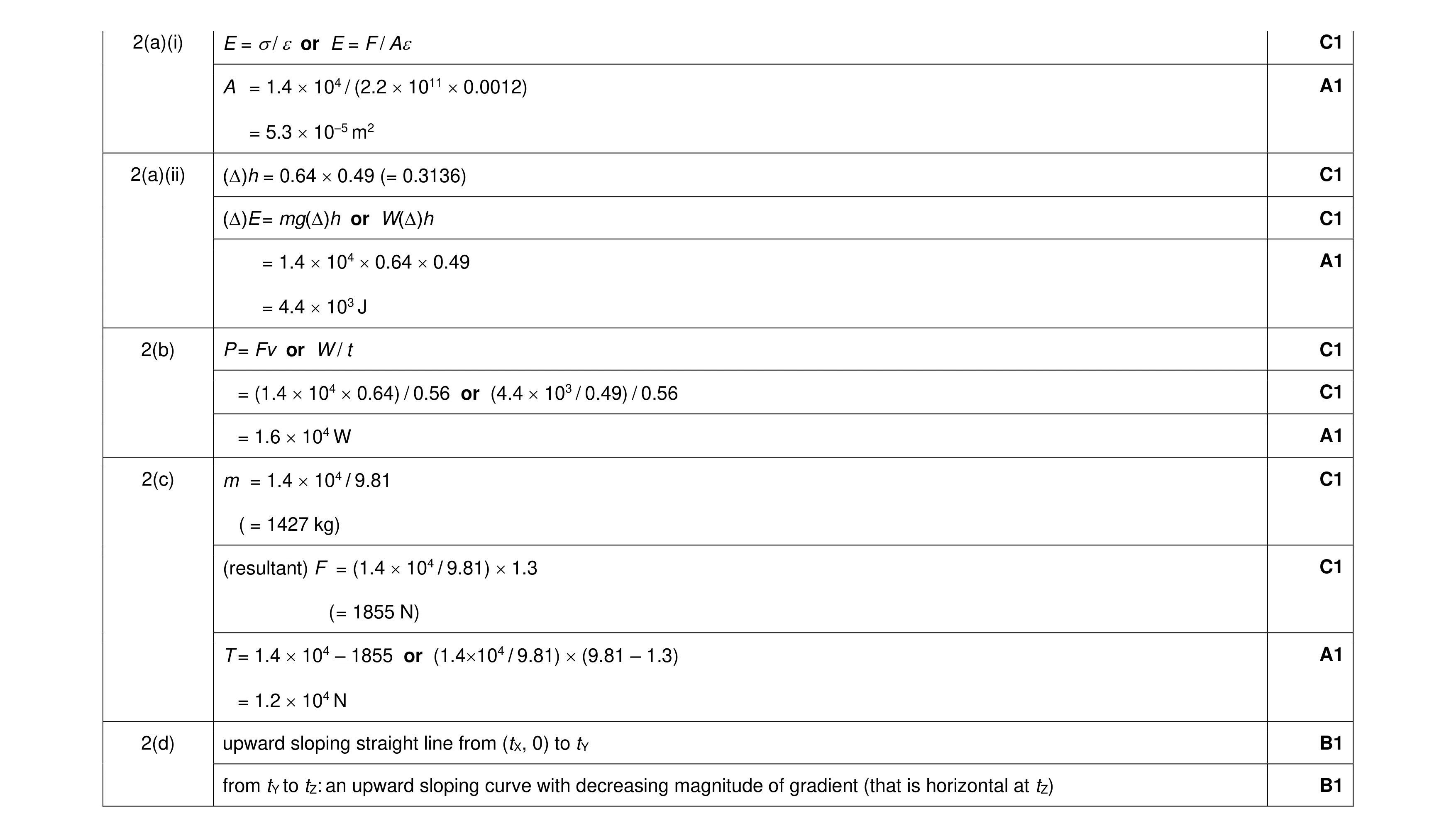 13
13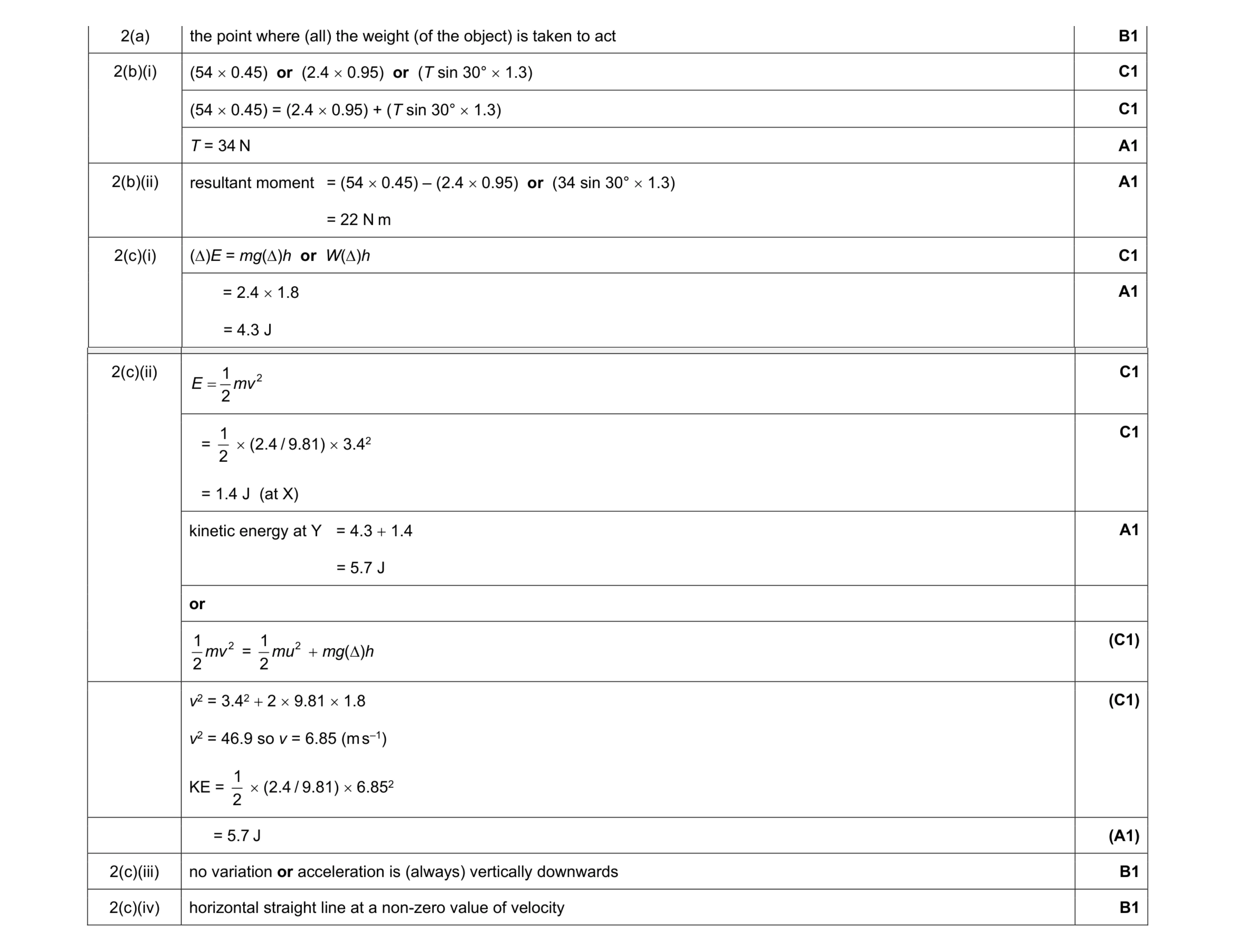 12
12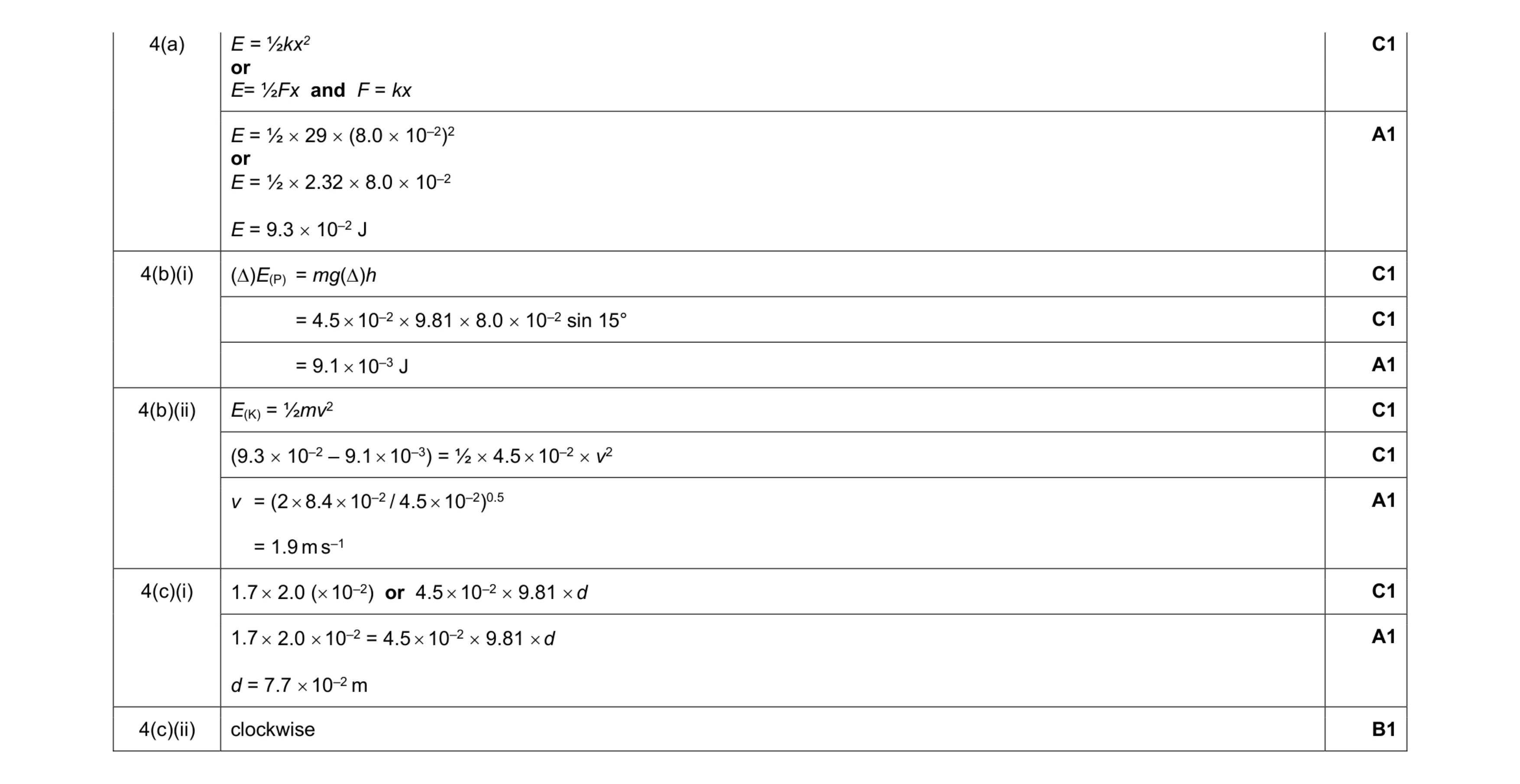 11
11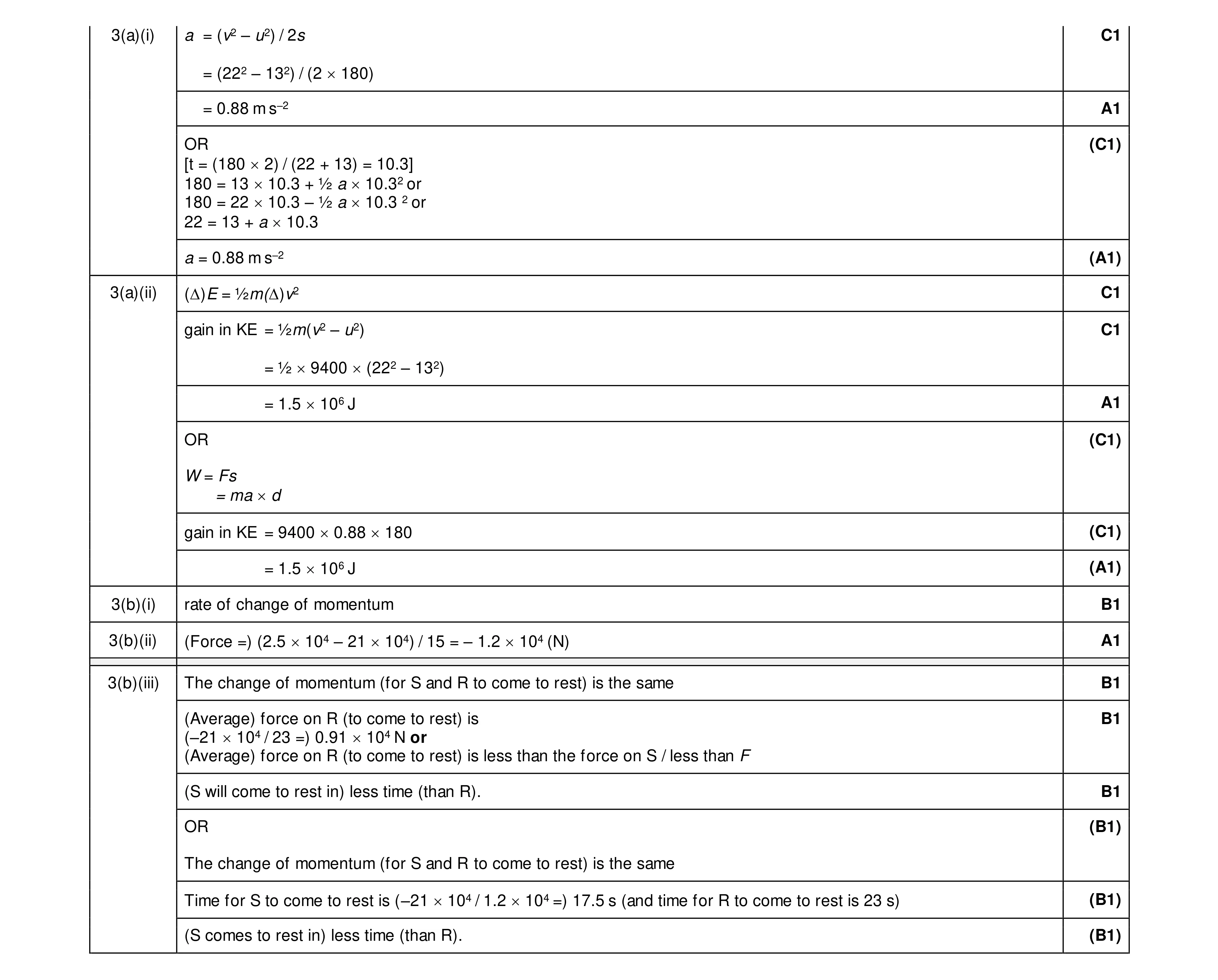 10
10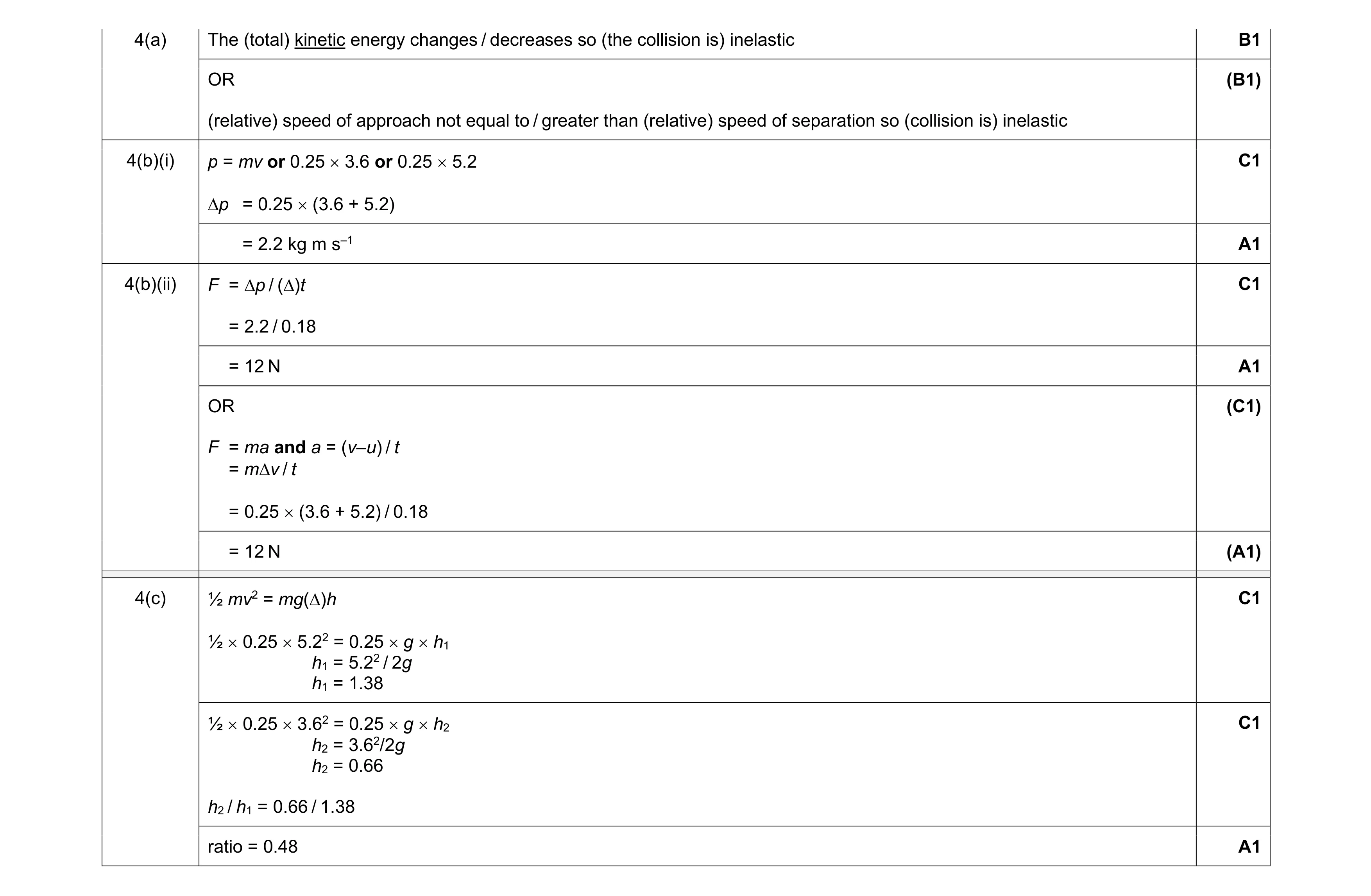 8
8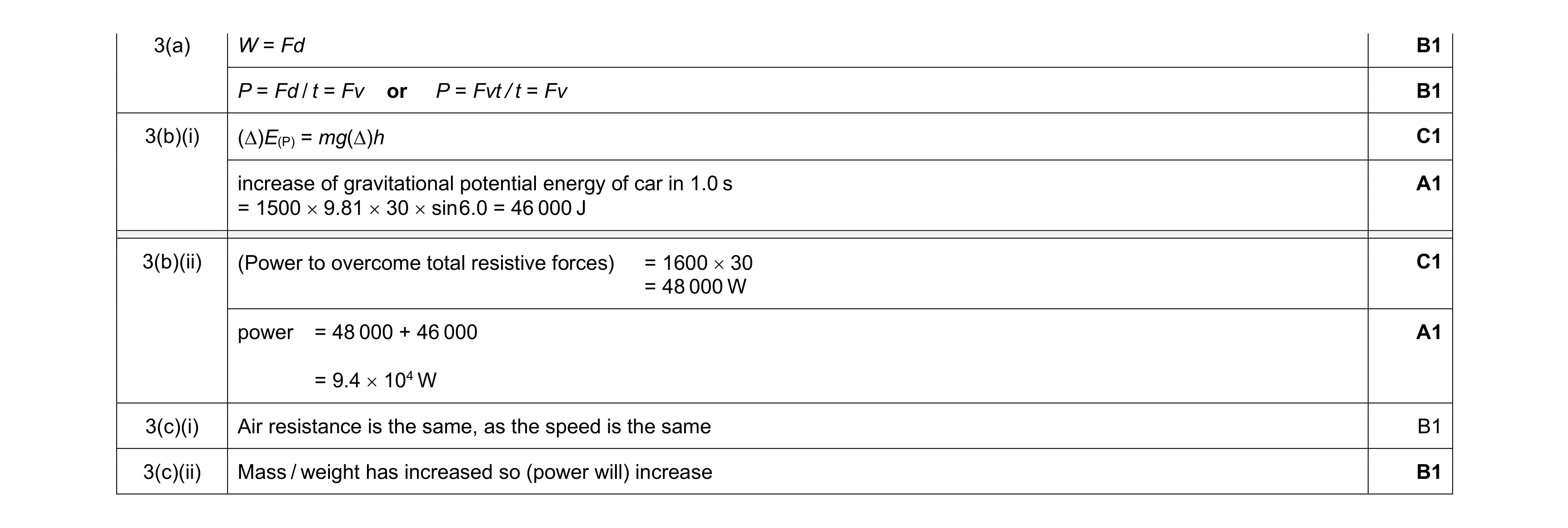 8
8