Questions as text
Q1 · An electron is accelerated from rest in a vacuum through a potential difference of 1.2… 9702/41 Oct/Nov 2005
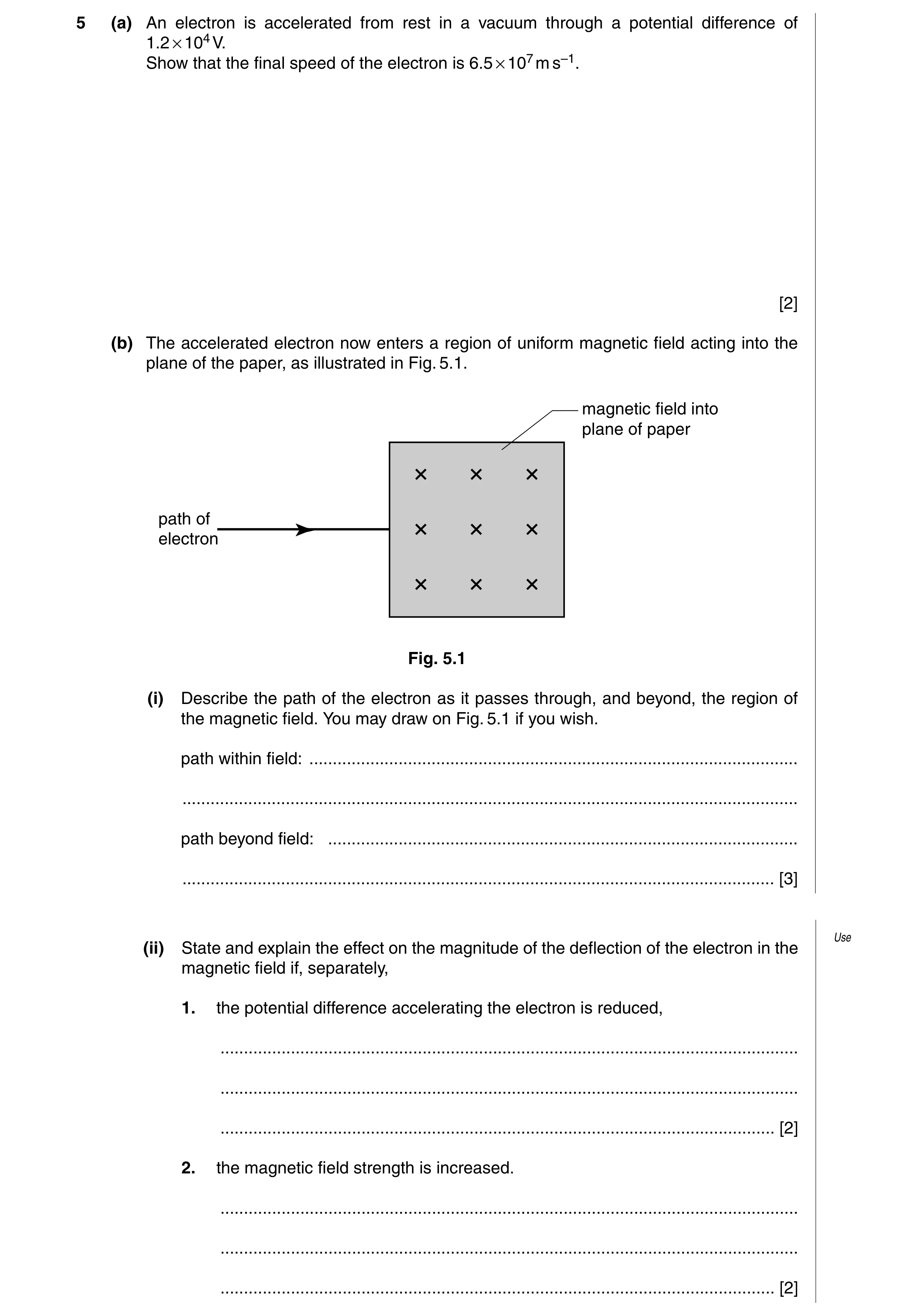
5 (a) An electron is accelerated from rest in a vacuum through a potential difference of 1.2 ×10⁴V. Show that the final speed of the electron is 6.5 ×10⁷m s–1. [2] (b) The accelerated electron now enters a region of uniform magnetic field acting into the plane of the paper, as illustrated in Fig. 5.1. magnetic field into plane of paper + + + path of + + + electron + + + Fig. 5.1 (i) Describe the path of the electron as it passes through, and beyond, the region of the magnetic field. You may draw on Fig. 5.1 if you wish. path within field: … … path beyond field: … … [3] Use (ii) State and explain the effect on the magnitude of the deflection of the electron in the magnetic field if, separately, 1. the potential difference accelerating the electron is reduced, … … … [2] 2. the magnetic field strength is increased. … … … [2]
9 marks
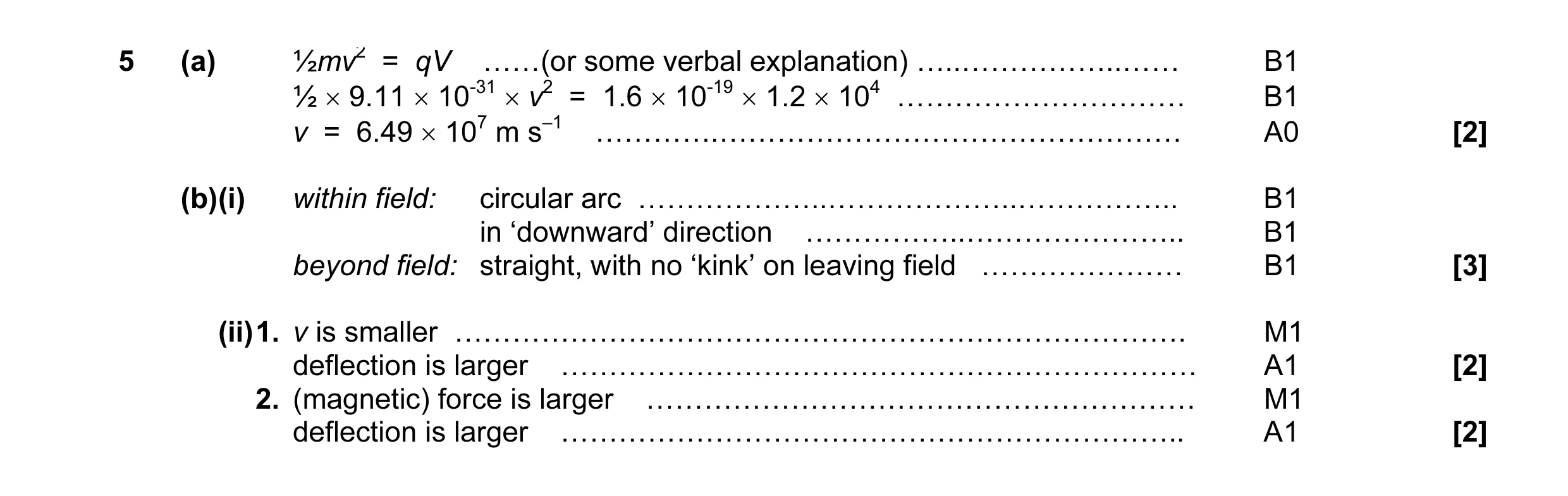
Mark scheme: 5 (a) ½mv2 = qV ……(or some verbal explanation) …..……………..…… B1 ½ × 9.11 × 10-31 × v2 = 1.6 × 10-19 × 1.2 × 104 ………………………… B1 v = 6.49 × 10⁷ m s–1 ………….………………………………………… A0 [2] (b) (i) within field: circular arc ………………..………………..…………….. B1 in ‘downward’ direction ……………..………………….. B1 beyond field: straight, with no ‘kink’ on leaving field ………………… B1 [3] (ii) 1. v is smaller …………………………………………………………………. M1 deflection is larger ………………………………………………………… A1 [2] 2. (magnetic) force is larger ………………………………………………… M1 deflection is larger ……………………………………………………….. A1 [2]
This question in 9702/41 Oct/Nov 2005
Q2 · The Earth may be considered to be a uniform sphere with its mass M concentrated at its… 9702/41 May/June 2006
1 The Earth may be considered to be a uniform sphere with its mass M concentrated at its centre. A satellite of mass m orbits the Earth such that the radius of the circular orbit is r. (a) Show that the linear speed v of the satellite is given by the expression ⎛GM⎞ v = . √ ⎝ r ⎠ [2] (b) For this satellite, write down expressions, in terms of G, M, m and r, for (i) its kinetic energy, kinetic energy = …………………………. [1] (ii) its gravitational potential energy, potential energy = …………………………. [1] (iii) its total energy. total energy = …………………………. [2] Use (c) The total energy of the satellite gradually decreases. State and explain the effect of this decrease on (i) the radius r of the orbit, … … … [2] (ii) the linear speed v of the satellite. … … … [2]
10 marks
Mark scheme: 1 (a) centripetal force is provided by gravitational force B1 mv2 / r = GMm / r2 B1 hence v = √(GM / r) A0 [2] (b) (i) EK (= ½mv2) = GMm / 2r B1 [1] (ii) EP = - GMm / r B1 [1] (iii) ET = - GMm / r + GMm / 2r C1 = - GMm / 2r. A1 [2] (c) (i) if ET decreases then - GMm / 2r becomes more negative or GMm / 2r becomes larger M1 so r decreases A1 [2] (ii) EK = GMm / 2r and r decreases M1 so (EK and) v increases A1 [2]
This question in 9702/41 May/June 2006
Q3 · A rocket is launched from the surface of the Earth 9702/41 Oct/Nov 2006
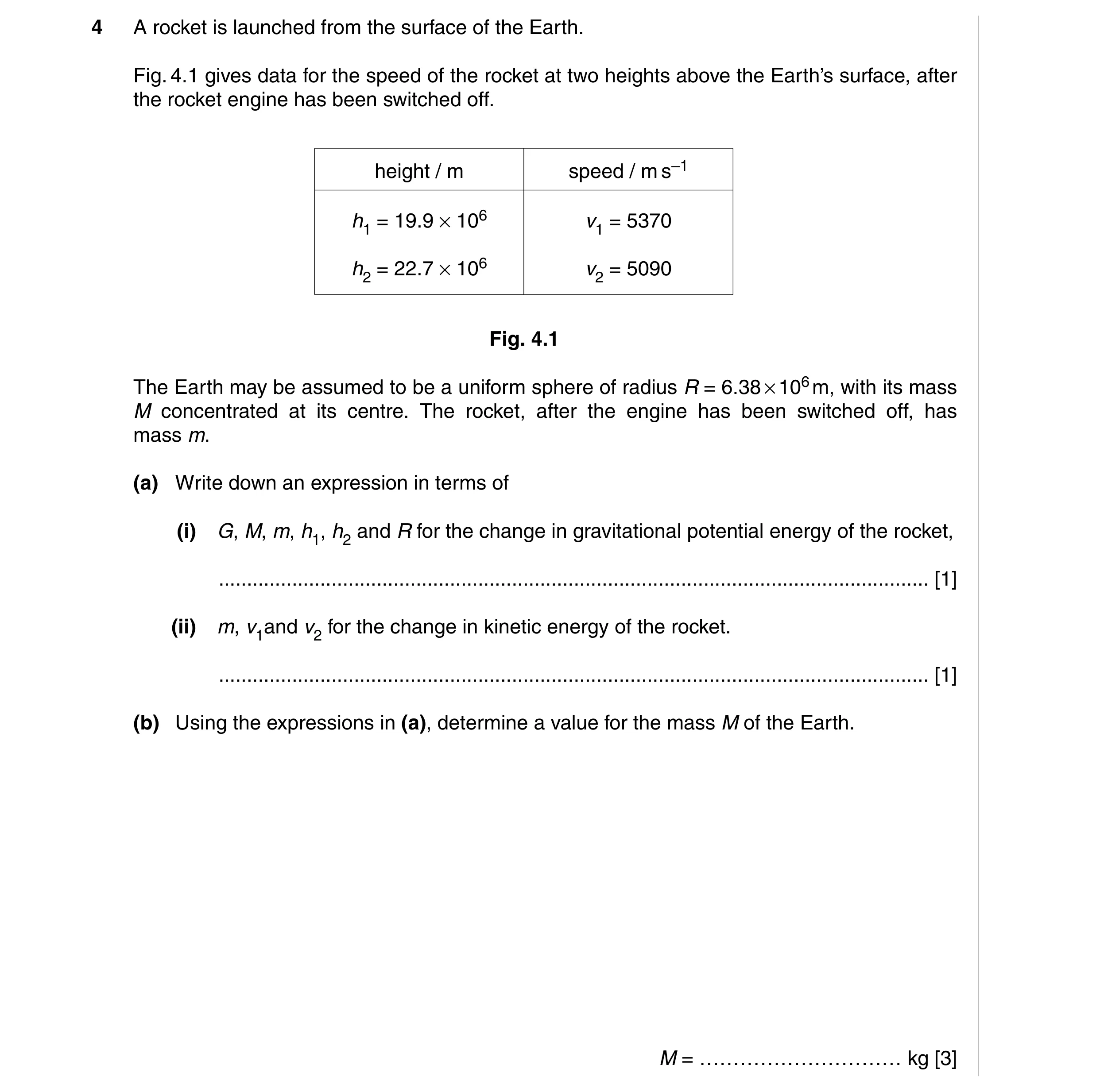
4 A rocket is launched from the surface of the Earth. Fig. 4.1 gives data for the speed of the rocket at two heights above the Earth’s surface, after the rocket engine has been switched off. height / m speed / m s–1 h1 = 19.9 × 10⁶ v1 = 5370 h2 = 22.7 × 10⁶ v2 = 5090 Fig. 4.1 The Earth may be assumed to be a uniform sphere of radius R = 6.38 ×10⁶m, with its mass M concentrated at its centre. The rocket, after the engine has been switched off, has mass m. (a) Write down an expression in terms of (i) G, M, m, h1, h2 and R for the change in gravitational potential energy of the rocket, … [1] (ii) m, v1and v2 for the change in kinetic energy of the rocket. … [1] (b) Using the expressions in (a), determine a value for the mass M of the Earth. M = ………………………… kg [3]
5 marks
Mark scheme: 4 (a) (i) GMm {(R + h1)–1 – (R + h2)–1} B1 ½m {v12 – v2 2} B1 [2] (b) 2M x 6.67 x 10–11 {(26.28 x 10⁶)–1 – (29.08 x 10⁶)–1} = 53702 – 50902 B1 M x 4.888 x 10–19 = 2.929 x 10⁶ C1 M = 6.00 x 1024 kg A1 [3] (If equation in (a) is dimensionally unsound, then 0/3 marks in (b), if dimensionally sound but incorrect, treat as e.c.f.)
This question in 9702/41 Oct/Nov 2006
Q4 · Explain what is meant by a gravitational field 9702/41 May/June 2007
1 (a) Explain what is meant by a gravitational field. … … [1] (b) A spherical planet has mass M and radius R. The planet may be considered to have all its mass concentrated at its centre. A rocket is launched from the surface of the planet such that the rocket moves radially away from the planet. The rocket engines are stopped when the rocket is at a height R above the surface of the planet, as shown in Fig. 1.1. R 2R planet R Fig. 1.1 The mass of the rocket, after its engines have been stopped, is m. (i) Show that, for the rocket to travel from a height R to a height 2R above the planet’s surface, the change ΔEP in the magnitude of the gravitational potential energy of the rocket is given by the expression GMm ΔEP = . 6R [2] Examiner’s Use (ii) During the ascent from a height R to a height 2R, the speed of the rocket changes from 7600 m s–1 to 7320 m s–1. Show that, in SI units, the change ΔEK in the kinetic energy of the rocket is given by the expression ΔEK = (2.09 × 10⁶)m. [1] (c) The planet has a radius of 3.40 × 10⁶ m. (i) Use the expressions in (b) to determine a value for the mass M of the planet. M = …………………………… kg [2] (ii) State one assumption made in the determination in (i). … … [1]
7 marks
Mark scheme: 1 (a) (region of space) where a mass experiences a force B1 [1] (b) (i) potential energy = (–)GMm / x C1 ∆EP = GMm/2R – GMm/3R M1 = GMm/6R A0 [2] (ii) EK = ½m (76002 – 73202) M1 = (2.09 × 10⁶)m A0 [1] (c) (i) 2.09 × 106 = (6.67 × 10⁻¹¹ M)/(6 × 3.4 × 106) C1 M = 6.39 × 10²³ kg A1 [2] (ii) e.g. no energy dissipated due to friction with atmosphere/air rocket is outside atmosphere not influenced by another planet etc. B1 [1]
This question in 9702/41 May/June 2007
Q5 · Define electric potential at a point 9702/41 Oct/Nov 2009
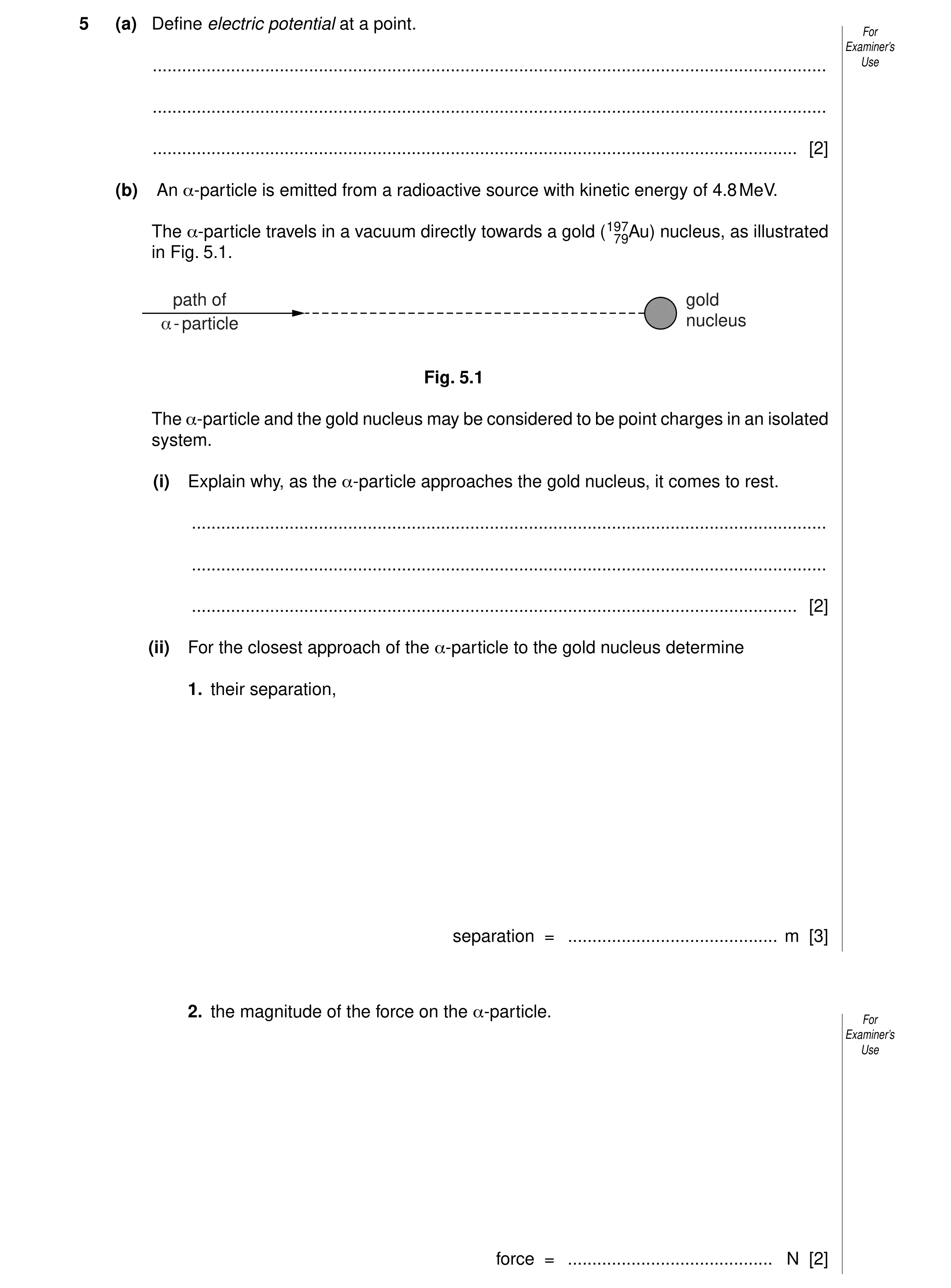
5 (a) Define electric potential at a point. For Examiner’s … Use … … [2] (b) An α-particle is emitted from a radioactive source with kinetic energy of 4.8 MeV. The α-particle travels in a vacuum directly towards a gold (19779Au) nucleus, as illustrated in Fig. 5.1. path of gold α - particle nucleus Fig. 5.1 The α-particle and the gold nucleus may be considered to be point charges in an isolated system. (i) Explain why, as the α-particle approaches the gold nucleus, it comes to rest. … … … [2] (ii) For the closest approach of the α-particle to the gold nucleus determine 1. their separation, separation = … m [3] 2. the magnitude of the force on the α-particle. For Examiner’s Use force = … N [2]
9 marks
Mark scheme: 5 (a) work done per / on unit positive charge … M1 moving charge from infinity to the point … A1 [2] (b) (i) α-particle and gold nucleus repel each other … B1 all kinetic energy of α-particle converted into electric potential energy … B1 [2] (ii) 1 potential energy = (79 × 2 × {1.6 × 10⁻¹⁹}2) / (4π × 8.85 × 10-12 × d) … C1 kinetic energy = 4.8 × 1.6 × 10-13 = 7.68 × 10⁻¹³ J … C1 equating to give d = 4.7 × 10⁻¹⁴ m … A1 [3] (ii) 2 F = Qq / 4πε0d × 1 / d = 7.68 × 10-13 × 1 / (4.7 × 10⁻¹⁴) … C1 = 16 N … A1 [2] [Total: 9]
This question in 9702/41 Oct/Nov 2009
Q6 · Define gravitational potential at a point 9702/41 May/June 2012
1 (a) Define gravitational potential at a point. … … [1] (b) The gravitational potential φ at distance r from point mass M is given by the expression GM φ = – r where G is the gravitational constant. Explain the significance of the negative sign in this expression. … … … [2] (c) A spherical planet may be assumed to be an isolated point mass with its mass concentrated at its centre. A small mass m is moving near to, and normal to, the surface of the planet. The mass moves away from the planet through a short distance h. State and explain why the change in gravitational potential energy ΔEP of the mass is given by the expression ΔEP = mgh where g is the acceleration of free fall. … … … … … … [4] (d) The planet in (c) has mass M and diameter 6.8 × 10³ km. The product GM for this planet For is 4.3 × 10¹³ N m2 kg–1. Examiner’s Use A rock, initially at rest a long distance from the planet, accelerates towards the planet. Assuming that the planet has negligible atmosphere, calculate the speed of the rock as it hits the surface of the planet. speed = … m s–1 [3]
10 marks
Mark scheme: 1 (a) work done in bringing unit mass from infinity (to the point) B1 [1] (b) gravitational force is (always) attractive B1 either as r decreases, object/mass/body does work or work is done by masses as they come together B1 [2] (c) either force on mass = mg (where g is the acceleration of free fall /gravitational field strength) B1 g = GM/r2 B1 if r @ h, g is constant B1 ∆EP = force × distance moved M1 = mgh A0 or ∆EP = m∆φ (C1) = GMm(1/r1 – 1/r2) = GMm(r2 – r1)/r1r2 (B1) if r2 ≈ r1, then (r2 – r1) = h and r1r2 = r2 (B1) g = GM/r2 (B1) ∆EP = mgh (A0) [4] (d) ½mv2 = m∆φ v2 = 2 × GM/r C1 = (2 × 4.3 × 1013) / (3.4 × 10⁶) C1 v = 5.0 × 10³ m s–1 A1 [3] (Use of diameter instead of radius to give v = 3.6 × 10³ m s–1 scores 2 marks)
This question in 9702/41 May/June 2012
Q7 · A ball of mass 37 g is held between two fixed points A and B by two stretched helical… 9702/42 May/June 2012
2 A ball of mass 37 g is held between two fixed points A and B by two stretched helical springs, For as shown in Fig. 2.1. Examiner’s Use ball mass 37 g A B Fig. 2.1 The ball oscillates along the line AB with simple harmonic motion of frequency 3.5 Hz and amplitude 2.8 cm. (a) Show that the total energy of the oscillations is 7.0 mJ. [2] (b) At two points in the oscillation of the ball, its kinetic energy is equal to the potential energy stored in the springs. Calculate the magnitude of the displacement at which this occurs. displacement = … cm [3] (c) On the axes of Fig. 2.2 and using your answers in (a) and (b), sketch a graph to show For the variation with displacement x of Examiner’s Use (i) the total energy of the system (label this line T), [1] (ii) the kinetic energy of the ball (label this line K), [2] (iii) the potential energy stored in the springs (label this line P). [2] 8 6 energy / mJ 4 2 0 –3 –2 –1 0 1 2 3 x / cm Fig. 2.2 (d) The arrangement in Fig. 2.1 is now rotated through 90° so that the line AB is vertical and the ball oscillates in a vertical plane. Suggest one form of energy, other than those in (c), that must be taken into consideration when plotting new graphs to show energy changes with displacement. … [1]
11 marks
Mark scheme: 2 (a) energy = ½mω2a2 and ω = 2πf C1 = ½ × 37 × 10–3 × (2π × 3.5)2 × (2.8 × 10–2)2 M1 = 7.0 × 10⁻³ J A0 [2] (allow 2π × 3.5 shown as 7π) Energy = ½ mv2 and v = rω (C1) Correct substitution (M1) Energy = 7.0 × 10⁻³ J (A0) (b) EK = EP ½mω2 (a2 – x2) = ½mω2x2 or EK or EP = 3.5 mJ C1 x = a/√2 = 2.8 /√2 or EK = ½mω2 (a2 – x2) or EP = ½mω2x2 C1 = 2.0 cm A1 [3] (EK or EP = 7.0 mJ scores 0/3) Allow: k = 17.9 (C1) E = ½ kx2 (C1) x = 2.0 cm (A1) GCE AS/A LEVEL – May/June 2012 9702 42 (c) (i) graph: horizontal line, y-intercept = 7.0 mJ with end-points of line at +2.8 cm and –2.8 cm B1 [1] (ii) graph: reasonable curve B1 with maximum at (0,7.0) end-points of line at (–2.8, 0) and (+2.8, 0) B1 [2] (iii) graph: inverted version of (ii) M1 with intersections at (–2.0, 3.5) and (+2.0, 3.5) A1 [2] (Allow marks in (iii), but not in (ii), if graphs K & P are not labelled) (d) gravitational potential energy B1 [1]
This question in 9702/42 May/June 2012
Q8 · Define gravitational potential at a point 9702/43 May/June 2012
1 (a) Define gravitational potential at a point. … … [1] (b) The gravitational potential φ at distance r from point mass M is given by the expression GM φ = – r where G is the gravitational constant. Explain the significance of the negative sign in this expression. … … … [2] (c) A spherical planet may be assumed to be an isolated point mass with its mass concentrated at its centre. A small mass m is moving near to, and normal to, the surface of the planet. The mass moves away from the planet through a short distance h. State and explain why the change in gravitational potential energy ΔEP of the mass is given by the expression ΔEP = mgh where g is the acceleration of free fall. … … … … … … [4] (d) The planet in (c) has mass M and diameter 6.8 × 10³ km. The product GM for this planet For is 4.3 × 10¹³ N m2 kg–1. Examiner’s Use A rock, initially at rest a long distance from the planet, accelerates towards the planet. Assuming that the planet has negligible atmosphere, calculate the speed of the rock as it hits the surface of the planet. speed = … m s–1 [3]
10 marks
Mark scheme: 1 (a) work done in bringing unit mass from infinity (to the point) B1 [1] (b) gravitational force is (always) attractive B1 either as r decreases, object/mass/body does work or work is done by masses as they come together B1 [2] (c) either force on mass = mg (where g is the acceleration of free fall /gravitational field strength) B1 g = GM/r2 B1 if r @ h, g is constant B1 ∆EP = force × distance moved M1 = mgh A0 or ∆EP = m∆φ (C1) = GMm(1/r1 – 1/r2) = GMm(r2 – r1)/r1r2 (B1) if r2 ≈ r1, then (r2 – r1) = h and r1r2 = r2 (B1) g = GM/r2 (B1) ∆EP = mgh (A0) [4] (d) ½mv2 = m∆φ v2 = 2 × GM/r C1 = (2 × 4.3 × 1013) / (3.4 × 10⁶) C1 v = 5.0 × 10³ m s–1 A1 [3] (Use of diameter instead of radius to give v = 3.6 × 10³ m s–1 scores 2 marks)
This question in 9702/43 May/June 2012
Q9 · State Newton’s law of gravitation 9702/41 Oct/Nov 2012
1 (a) State Newton’s law of gravitation. … … … [2] (b) A satellite of mass m is in a circular orbit of radius r about a planet of mass M. For this planet, the product GM is 4.00 × 10¹⁴ N m2 kg–1, where G is the gravitational constant. The planet may be assumed to be isolated in space. (i) By considering the gravitational force on the satellite and the centripetal force, show that the kinetic energy EK of the satellite is given by the expression GMm EK = . 2r [2] (ii) The satellite has mass 620 kg and is initially in a circular orbit of radius 7.34 × 10⁶ m, as illustrated in Fig. 1.1. initial orbit 7.34 × 10⁶ m 7.30 × 10⁶ m new orbit Fig. 1.1 (not to scale) Resistive forces cause the satellite to move into a new orbit of radius 7.30 × 10⁶ m. For Examiner’s Determine, for the satellite, the change in Use 1. kinetic energy, change in kinetic energy = … J [2] 2. gravitational potential energy. change in potential energy = … J [2] (iii) Use your answers in (ii) to explain whether the linear speed of the satellite increases, decreases or remains unchanged when the radius of the orbit decreases. … … … [2]
10 marks
Mark scheme: 1 (a) force is proportional to the product of the masses and inversely proportional to the square of the separation M1 either point masses or separation >> size of masses A1 [2] (b) (i) gravitational force provides the centripetal force B1 mv2/r = GMm/r2 and EK = ½mv2 M1 hence EK = GMm/2r A0 [2] (ii) 1. ∆EK = ½ × 4.00 × 1014 × 620 × ({7.30 × 10⁶}–1 – {7.34 × 10⁶}–1) C1 = 9.26 × 10⁷ J (ignore any sign in answer) A1 [2] (allow 1.0 × 10⁸ J if evidence that EK evaluated separately for each r) 2. ∆EP = 4.00 × 1014 × 620 × ({7.30 × 10⁶}–1 – {7.34 × 10⁶}–1) C1 = 1.85 × 10⁸ J (ignore any sign in answer) A1 [2] (allow 1.8 or 1.9 × 10⁸ J) (iii) either (7.30 × 10⁶)–1 – (7.34 × 10⁶)–1 or ∆EK is positive / EK increased M1 speed has increased A1 [2]
This question in 9702/41 Oct/Nov 2012
Q10 · State Newton’s law of gravitation 9702/42 Oct/Nov 2012
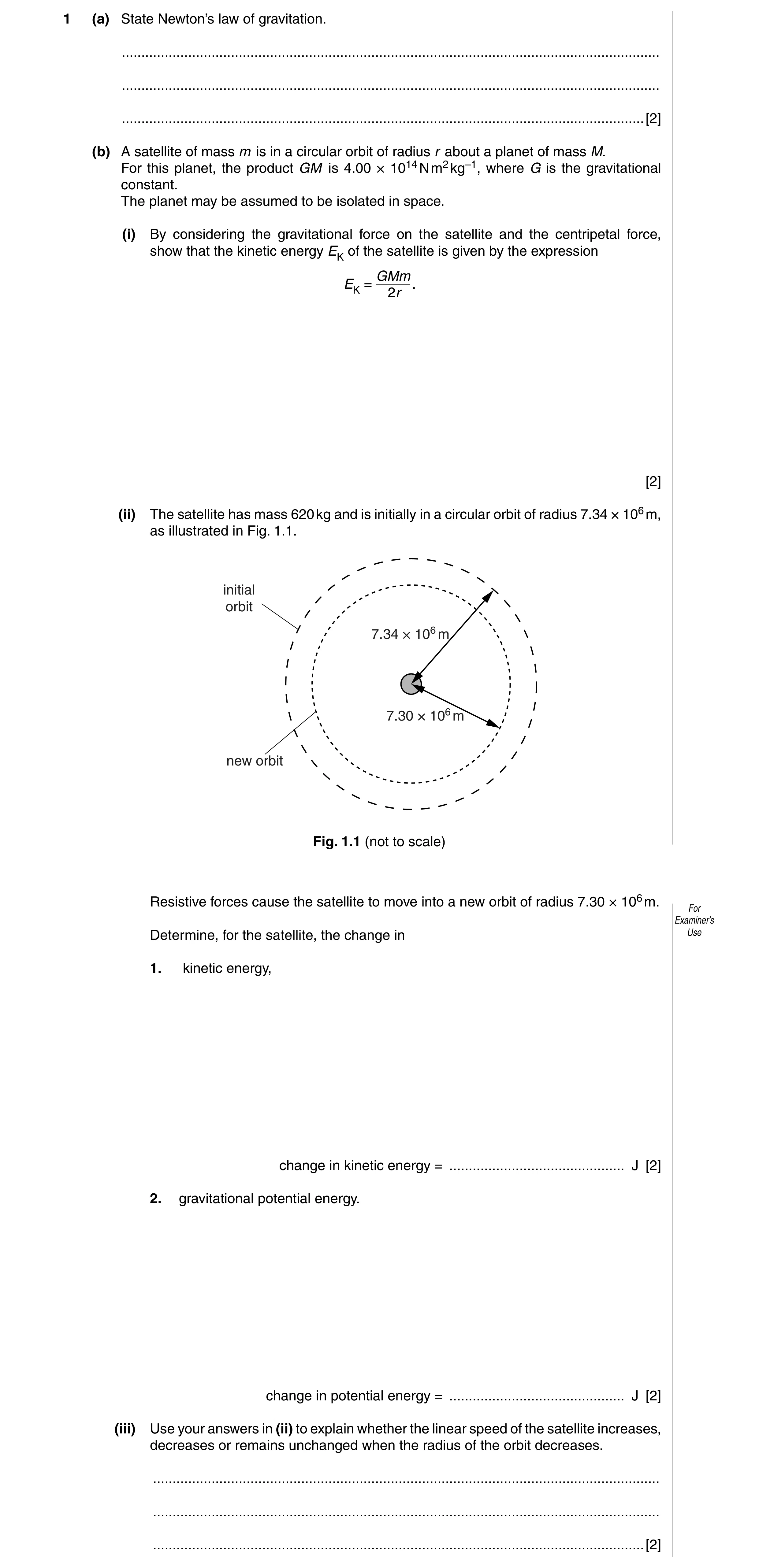
1 (a) State Newton’s law of gravitation. … … … [2] (b) A satellite of mass m is in a circular orbit of radius r about a planet of mass M. For this planet, the product GM is 4.00 × 10¹⁴ N m2 kg–1, where G is the gravitational constant. The planet may be assumed to be isolated in space. (i) By considering the gravitational force on the satellite and the centripetal force, show that the kinetic energy EK of the satellite is given by the expression GMm EK = . 2r [2] (ii) The satellite has mass 620 kg and is initially in a circular orbit of radius 7.34 × 10⁶ m, as illustrated in Fig. 1.1. initial orbit 7.34 × 10⁶ m 7.30 × 10⁶ m new orbit Fig. 1.1 (not to scale) Resistive forces cause the satellite to move into a new orbit of radius 7.30 × 10⁶ m. For Examiner’s Determine, for the satellite, the change in Use 1. kinetic energy, change in kinetic energy = … J [2] 2. gravitational potential energy. change in potential energy = … J [2] (iii) Use your answers in (ii) to explain whether the linear speed of the satellite increases, decreases or remains unchanged when the radius of the orbit decreases. … … … [2]
10 marks
Mark scheme: 1 (a) force is proportional to the product of the masses and inversely proportional to the square of the separation M1 either point masses or separation >> size of masses A1 [2] (b) (i) gravitational force provides the centripetal force B1 mv2/r = GMm/r2 and EK = ½mv2 M1 hence EK = GMm/2r A0 [2] (ii) 1. ∆EK = ½ × 4.00 × 1014 × 620 × ({7.30 × 10⁶}–1 – {7.34 × 10⁶}–1) C1 = 9.26 × 10⁷ J (ignore any sign in answer) A1 [2] (allow 1.0 × 10⁸ J if evidence that EK evaluated separately for each r) 2. ∆EP = 4.00 × 1014 × 620 × ({7.30 × 10⁶}–1 – {7.34 × 10⁶}–1) C1 = 1.85 × 10⁸ J (ignore any sign in answer) A1 [2] (allow 1.8 or 1.9 × 10⁸ J) (iii) either (7.30 × 10⁶)–1 – (7.34 × 10⁶)–1 or ∆EK is positive / EK increased M1 speed has increased A1 [2]
This question in 9702/42 Oct/Nov 2012
Q11 · Define electric potential at a point 9702/41 May/June 2013
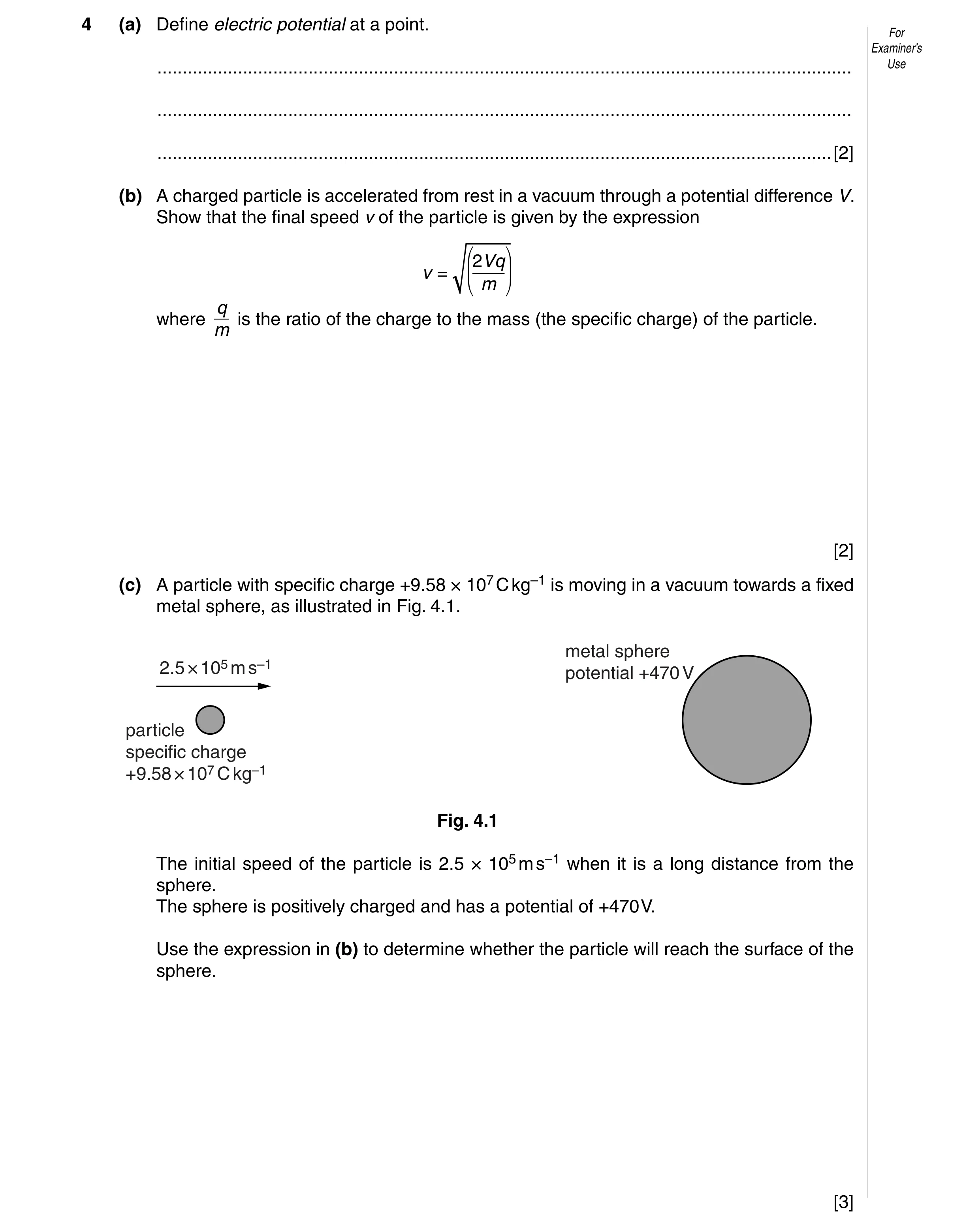
4 (a) Define electric potential at a point. For Examiner’s … Use … … [2] (b) A charged particle is accelerated from rest in a vacuum through a potential difference V. Show that the final speed v of the particle is given by the expression ⎛ ⎞ 2Vq v = ⎜ ⎟ ⎝ m ⎠ q where is the ratio of the charge to the mass (the specific charge) of the particle. m [2] (c) A particle with specific charge +9.58 × 10⁷ C kg–1 is moving in a vacuum towards a fixed metal sphere, as illustrated in Fig. 4.1. metal sphere 2.5 × 10⁵ m s–1 potential +470 V particle specific charge +9.58 × 10⁷ C kg–1 Fig. 4.1 The initial speed of the particle is 2.5 × 10⁵ m s–1 when it is a long distance from the sphere. The sphere is positively charged and has a potential of +470 V. Use the expression in (b) to determine whether the particle will reach the surface of the sphere. [3]
7 marks
Mark scheme: 4 (a) work done moving unit positive charge M1 from infinity (to the point) A1 [2] (b) (gain in) kinetic energy = change in potential energy B1 ½mv2 = qV leading to v = (2Vq/m)½ B1 [2] (c) either (2.5 × 10⁵)2 = 2 × V × 9.58 × 10⁷ C1 V = 330 V M1 this is less than 470 V and so ‘no’ A1 [3] or v = (2 × 470 × 9.58 × 107) (C1) v = 3.0 × 10⁵ m s–1 (M1) this is greater than 2.5 × 10⁵ m s–1 and so ‘no’ (A1) or (2.5 × 10⁵)2 = 2 × 470 × (q/m) (C1) (q/m) = 6.6 × 10⁷ C kg–1 (M1) this is less than 9.58 × 10⁷ C kg–1 and so ‘no’ (A1) GCE AS/A LEVEL – May/June 2013 9702 41
This question in 9702/41 May/June 2013
Q12 · Define electric potential at a point 9702/43 May/June 2013
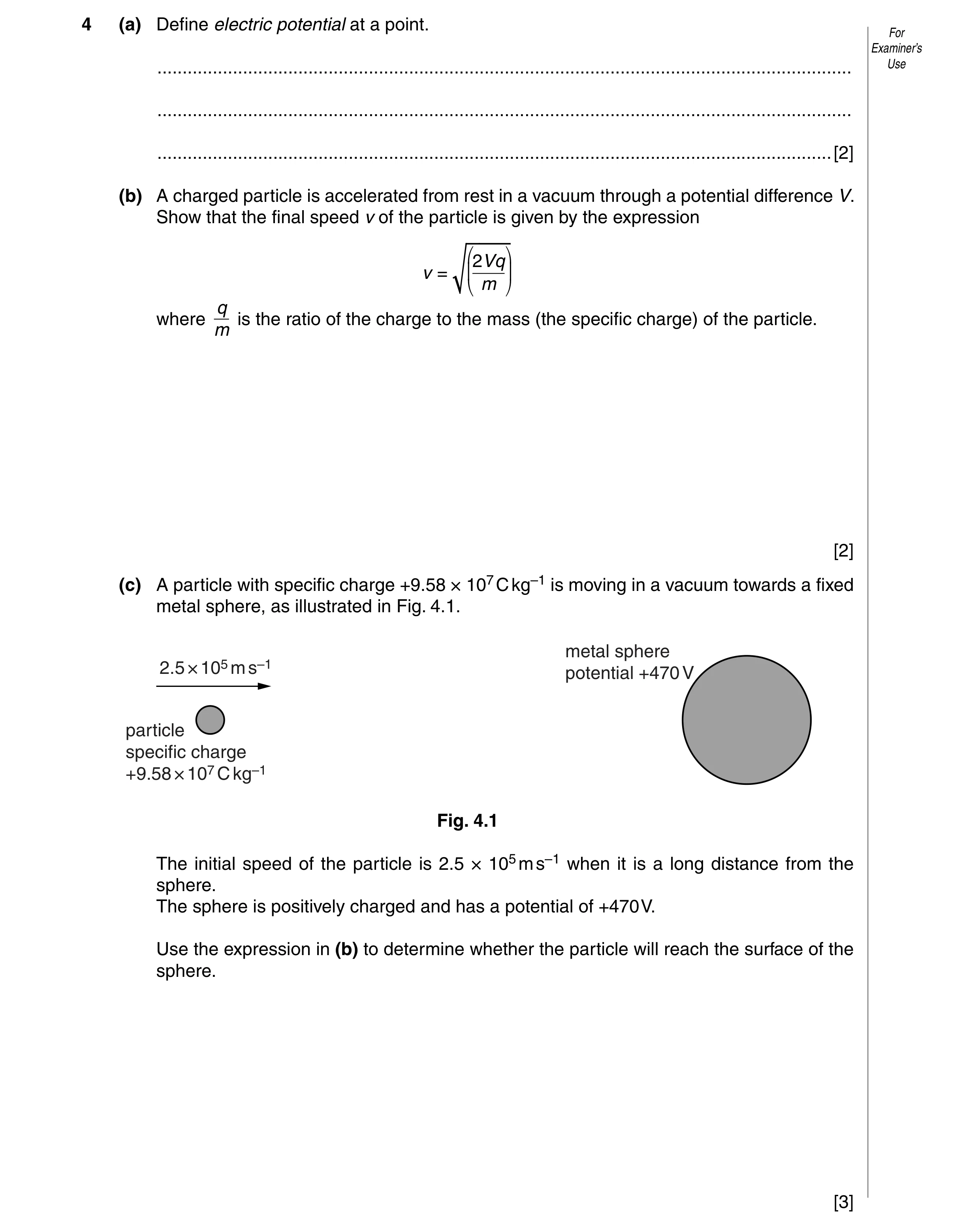
4 (a) Define electric potential at a point. For Examiner’s … Use … … [2] (b) A charged particle is accelerated from rest in a vacuum through a potential difference V. Show that the final speed v of the particle is given by the expression ⎛ ⎞ 2Vq v = ⎜ ⎟ ⎝ m ⎠ q where is the ratio of the charge to the mass (the specific charge) of the particle. m [2] (c) A particle with specific charge +9.58 × 10⁷ C kg–1 is moving in a vacuum towards a fixed metal sphere, as illustrated in Fig. 4.1. metal sphere 2.5 × 10⁵ m s–1 potential +470 V particle specific charge +9.58 × 10⁷ C kg–1 Fig. 4.1 The initial speed of the particle is 2.5 × 10⁵ m s–1 when it is a long distance from the sphere. The sphere is positively charged and has a potential of +470 V. Use the expression in (b) to determine whether the particle will reach the surface of the sphere. [3]
7 marks
Mark scheme: 4 (a) work done moving unit positive charge M1 from infinity (to the point) A1 [2] (b) (gain in) kinetic energy = change in potential energy B1 ½mv2 = qV leading to v = (2Vq/m)½ B1 [2] (c) either (2.5 × 10⁵)2 = 2 × V × 9.58 × 10⁷ C1 V = 330 V M1 this is less than 470 V and so ‘no’ A1 [3] or v = (2 × 470 × 9.58 × 107) (C1) v = 3.0 × 10⁵ m s–1 (M1) this is greater than 2.5 × 10⁵ m s–1 and so ‘no’ (A1) or (2.5 × 10⁵)2 = 2 × 470 × (q/m) (C1) (q/m) = 6.6 × 10⁷ C kg–1 (M1) this is less than 9.58 × 10⁷ C kg–1 and so ‘no’ (A1) GCE AS/A LEVEL – May/June 2013 9702 43
This question in 9702/43 May/June 2013
Q13 · The mass M of a spherical planet may be assumed to be a point mass at the centre of the… 9702/42 May/June 2014
1 The mass M of a spherical planet may be assumed to be a point mass at the centre of the planet. (a) A stone, travelling at speed v, is in a circular orbit of radius r about the planet, as illustrated in Fig. 1.1. stone v planet r Fig. 1.1 Show that the speed v is given by the expression GM v = r where G is the gravitational constant. Explain your working. [2] (b) A second stone, initially at rest at infinity, travels towards the planet, as illustrated in Fig. 1.2. stone V0 planet x Fig. 1.2 (not to scale) The stone does not hit the surface of the planet. (i) Determine, in terms of the gravitational constant G and the mass M of the planet, the speed V0 of the stone at a distance x from the centre of the planet. Explain your working. You may assume that the gravitational attraction on the stone is due only to the planet. [3] (ii) Use your answer in (i) and the expression in (a) to explain whether this stone could enter a circular orbit about the planet. … … … … [2]
7 marks
Mark scheme: 1 (a) gravitational force provides/is the centripetal force B1 GMm / r2 R mv2 / r M1 v R √(GM / r) A0 [2] allow gravitational field strength provides/is the centripetal acceleration (B1) GM / r2 R v2 / r (M1) (b) (i) kinetic energy increase/change R loss / change in (gravitational) potential energy B1 ½mV02 R GMm / x C1 V02 R 2GM / x V0 R √(2GM / x) A1 [3] (max. 2 for use of r not x) (ii) V0 is (always) greater than v (for x = r) M1 so stone could not enter into orbit A1 [2] (expressions in (a) and (b)(i) must be dimensionally correct)
This question in 9702/42 May/June 2014
Q14 · An isolated spherical planet has a diameter of 6.8 × 10⁶ m 9702/41 Oct/Nov 2014
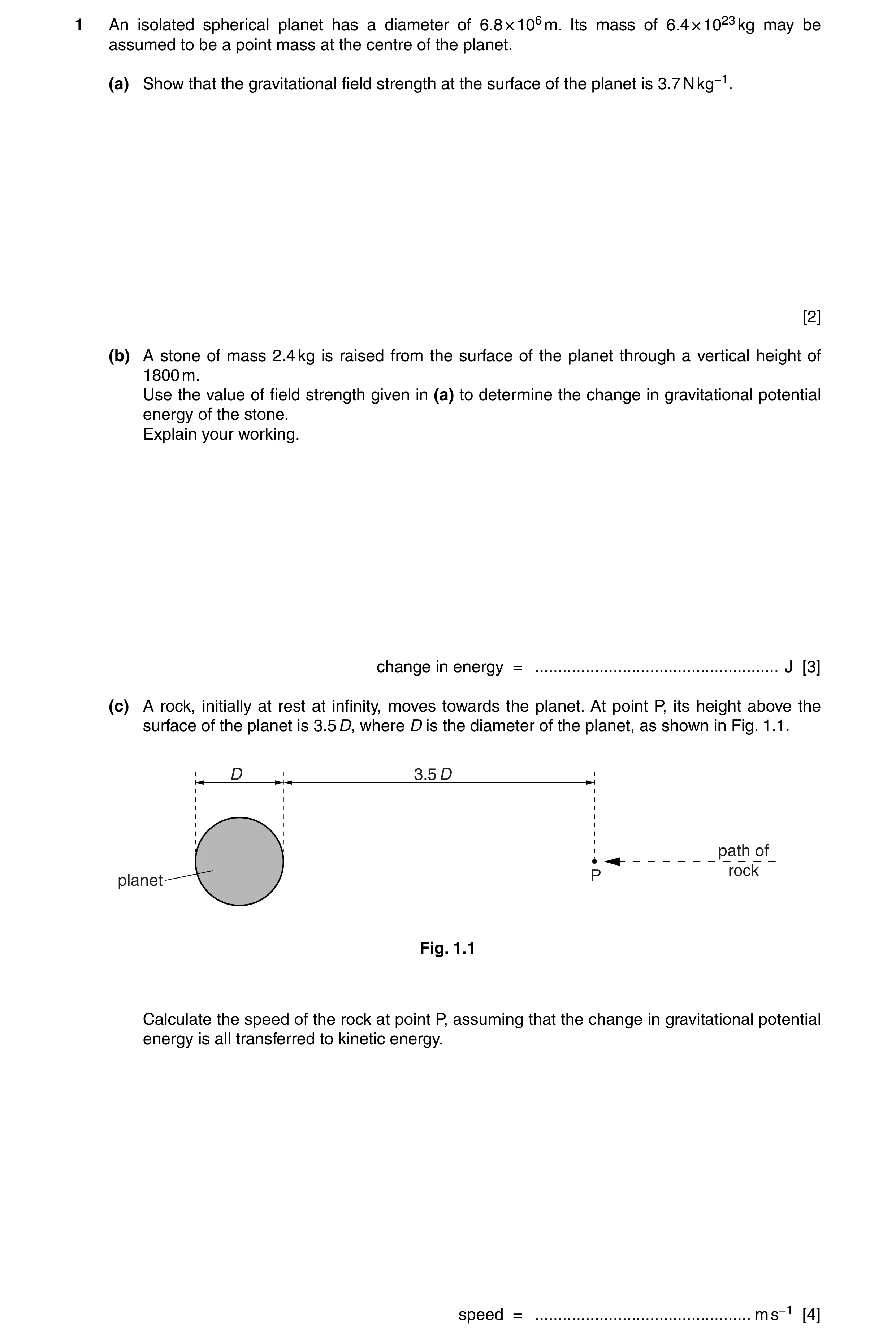
1 An isolated spherical planet has a diameter of 6.8 × 10⁶ m. Its mass of 6.4 × 10²³ kg may be assumed to be a point mass at the centre of the planet. (a) Show that the gravitational field strength at the surface of the planet is 3.7 N kg−1. [2] (b) A stone of mass 2.4 kg is raised from the surface of the planet through a vertical height of 1800 m. Use the value of field strength given in (a) to determine the change in gravitational potential energy of the stone. Explain your working. change in energy = … J [3] (c) A rock, initially at rest at infinity, moves towards the planet. At point P, its height above the surface of the planet is 3.5 D, where D is the diameter of the planet, as shown in Fig. 1.1. D 3.5 D path of rock P planet Fig. 1.1 Calculate the speed of the rock at point P, assuming that the change in gravitational potential energy is all transferred to kinetic energy. speed = … m s−1 [4]
9 marks
Mark scheme: 1 (a) g = GM / R2 C1 = (6.67 × 10–11 × 6.4 × 1023) / (3.4 × 10⁶)2 = 3.7 N kg–1 A1 [2] (b) ∆EP = mg∆h because ∆h ≪ R (or 1800 m ≪ 3.4 × 10⁶ m) g is constant B1 ∆EP = 2.4 × 3.7 × 1800 C1 = 1.6 × 10⁴ J A1 [3] (use of g = 9.8 m s–2 max. 1 for explanation) (c) gravitational potential energy = (–)GMm / x C1 v2 = 2GM / x C1 x = 4D = 4 × 6.8 × 106 C1 v2 = (2 × 6.67 × 10–11 × 6.4 × 1023) / (4 × 6.8 × 106) = 3.14 × 10⁶ v = 1.8 × 10³ m s–1 A1 [4] (use of 3.5 D giving 1.9 × 10³ m s–1, allow max. 3)
This question in 9702/41 Oct/Nov 2014
Q15 · An isolated spherical planet has a diameter of 6.8 × 10⁶ m 9702/42 Oct/Nov 2014
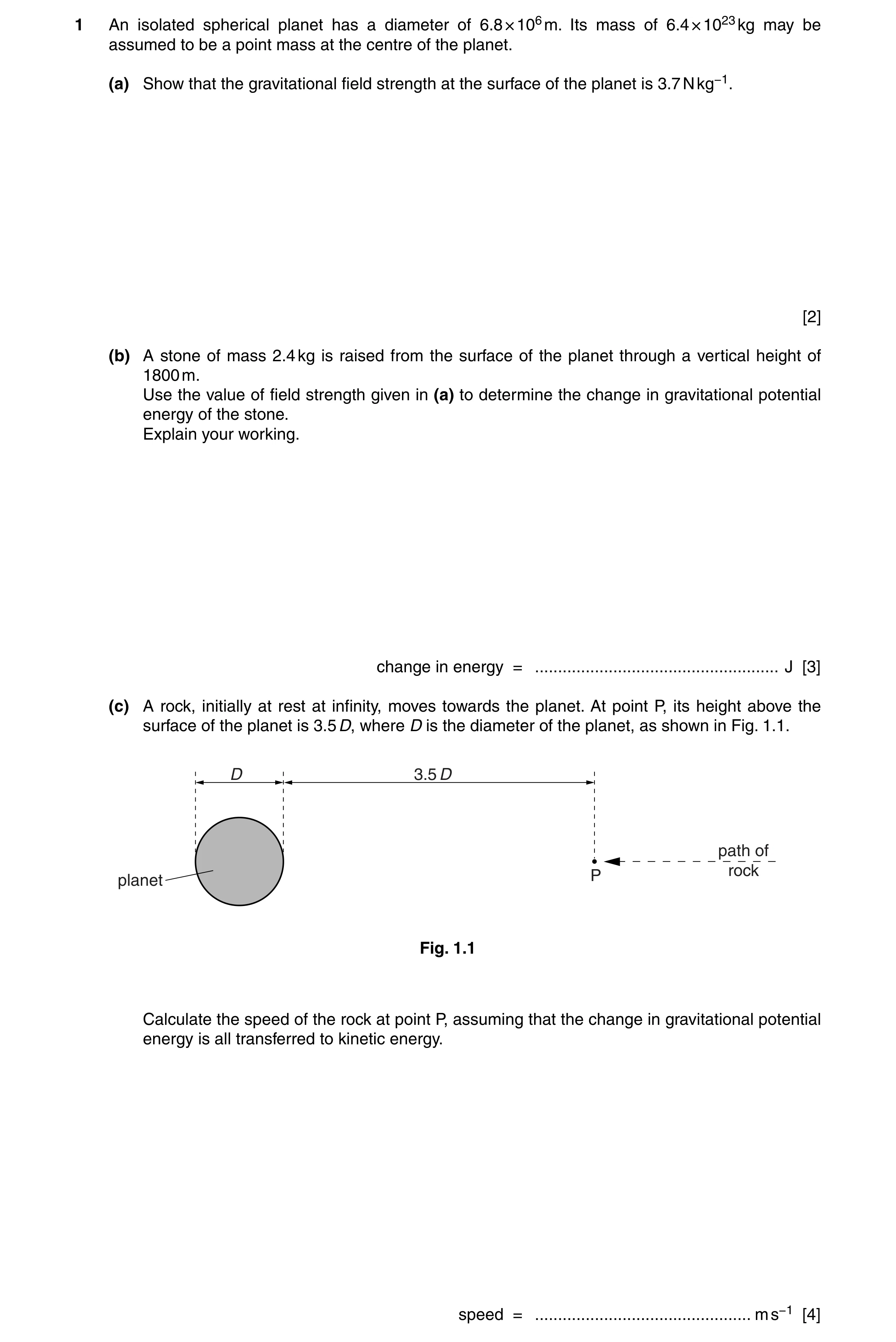
1 An isolated spherical planet has a diameter of 6.8 × 10⁶ m. Its mass of 6.4 × 10²³ kg may be assumed to be a point mass at the centre of the planet. (a) Show that the gravitational field strength at the surface of the planet is 3.7 N kg−1. [2] (b) A stone of mass 2.4 kg is raised from the surface of the planet through a vertical height of 1800 m. Use the value of field strength given in (a) to determine the change in gravitational potential energy of the stone. Explain your working. change in energy = … J [3] (c) A rock, initially at rest at infinity, moves towards the planet. At point P, its height above the surface of the planet is 3.5 D, where D is the diameter of the planet, as shown in Fig. 1.1. D 3.5 D path of rock P planet Fig. 1.1 Calculate the speed of the rock at point P, assuming that the change in gravitational potential energy is all transferred to kinetic energy. speed = … m s−1 [4]
9 marks
Mark scheme: 1 (a) g = GM / R2 C1 = (6.67 × 10–11 × 6.4 × 1023) / (3.4 × 10⁶)2 = 3.7 N kg–1 A1 [2] (b) ∆EP = mg∆h because ∆h ≪ R (or 1800 m ≪ 3.4 × 10⁶ m) g is constant B1 ∆EP = 2.4 × 3.7 × 1800 C1 = 1.6 × 10⁴ J A1 [3] (use of g = 9.8 m s–2 max. 1 for explanation) (c) gravitational potential energy = (–)GMm / x C1 v2 = 2GM / x C1 x = 4D = 4 × 6.8 × 106 C1 v2 = (2 × 6.67 × 10–11 × 6.4 × 1023) / (4 × 6.8 × 106) = 3.14 × 10⁶ v = 1.8 × 10³ m s–1 A1 [4] (use of 3.5 D giving 1.9 × 10³ m s–1, allow max. 3)
This question in 9702/42 Oct/Nov 2014
Q16 · Two small solid metal spheres A and B have equal radii and are in a vacuum 9702/43 Oct/Nov 2016
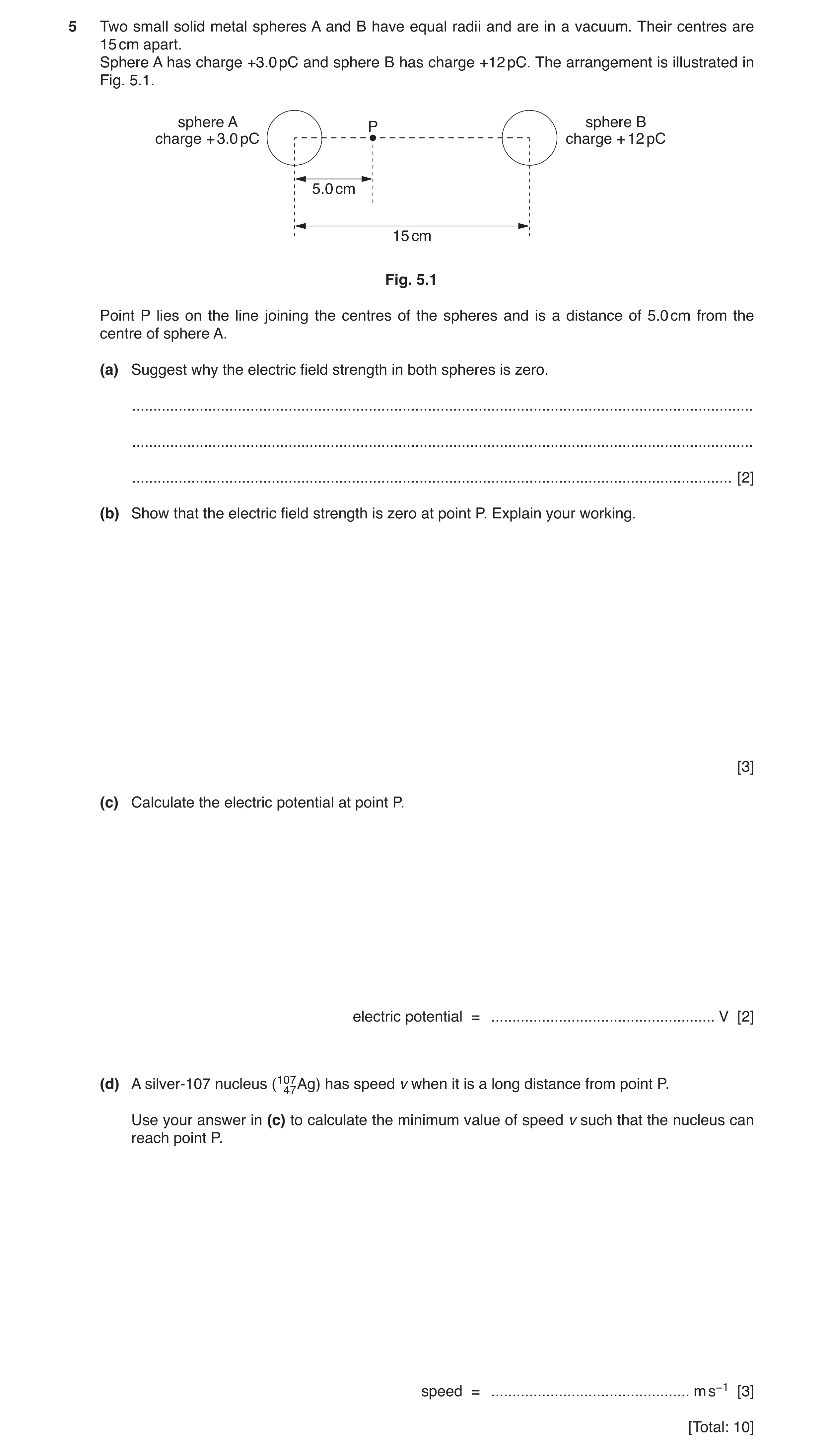
5 Two small solid metal spheres A and B have equal radii and are in a vacuum. Their centres are 15 cm apart. Sphere A has charge +3.0 pC and sphere B has charge +12 pC. The arrangement is illustrated in Fig. 5.1. sphere A sphere B P charge + 3.0 pC charge + 12 pC 5.0 cm 15 cm Fig. 5.1 Point P lies on the line joining the centres of the spheres and is a distance of 5.0 cm from the centre of sphere A. (a) Suggest why the electric field strength in both spheres is zero. … … … [2] (b) Show that the electric field strength is zero at point P. Explain your working. [3] (c) Calculate the electric potential at point P. electric potential = … V [2] (d) A silver-107 nucleus (10747 Ag) has speed v when it is a long distance from point P. Use your answer in (c) to calculate the minimum value of speed v such that the nucleus can reach point P. speed = … m s−1 [3] [Total: 10]
10 marks
Mark scheme: 5 (a) in an electric field, charges (in a conductor) would move B1 no movement of charge so zero field strength or charge moves until F = 0 / E = 0 B1 [2] or charges in metal do not move (B1) no (resultant) force on charges so no (electric) field (B1) (b) at P, EA = (3.0 × 10⁻¹²) / [4πε0(5.0 × 10⁻²)2] (= 10.79 N C–1) M1 at P, EB = (12 × 10–12) / [4πε0(10 × 10–2)2] (= 10.79 N C–1) M1 or (3.0 × 10⁻¹²) / [4πε0(5.0 × 10⁻²)2] – (12 × 10–12) / [4πε0(10 × 10–2)2] = 0 or (3.0 × 10⁻¹²) / [4πε0(5.0 × 10⁻²)2] = (12 × 10–12) / [4πε0(10 × 10–2)2] (M2) fields due to charged spheres are (equal and) opposite in direction, so E = 0 A1 [3] (c) potential = 8.99 × 10⁹ {(3.0 × 10⁻¹²) / (5.0 × 10⁻²) + (12 × 10–12) / (10 × 10–2)} C1 = 1.62 V A1 [2] (d) ½mv2 = qV EK = ½ × 107 × 1.66 × 10–27 × v 2 C1 qV = 47 × 1.60 × 10–19 × 1.62 C1 v 2 = 1.37 × 10⁸ v = 1.2 × 10⁴ m s–1 A1 [3]
This question in 9702/43 Oct/Nov 2016
 1 / 22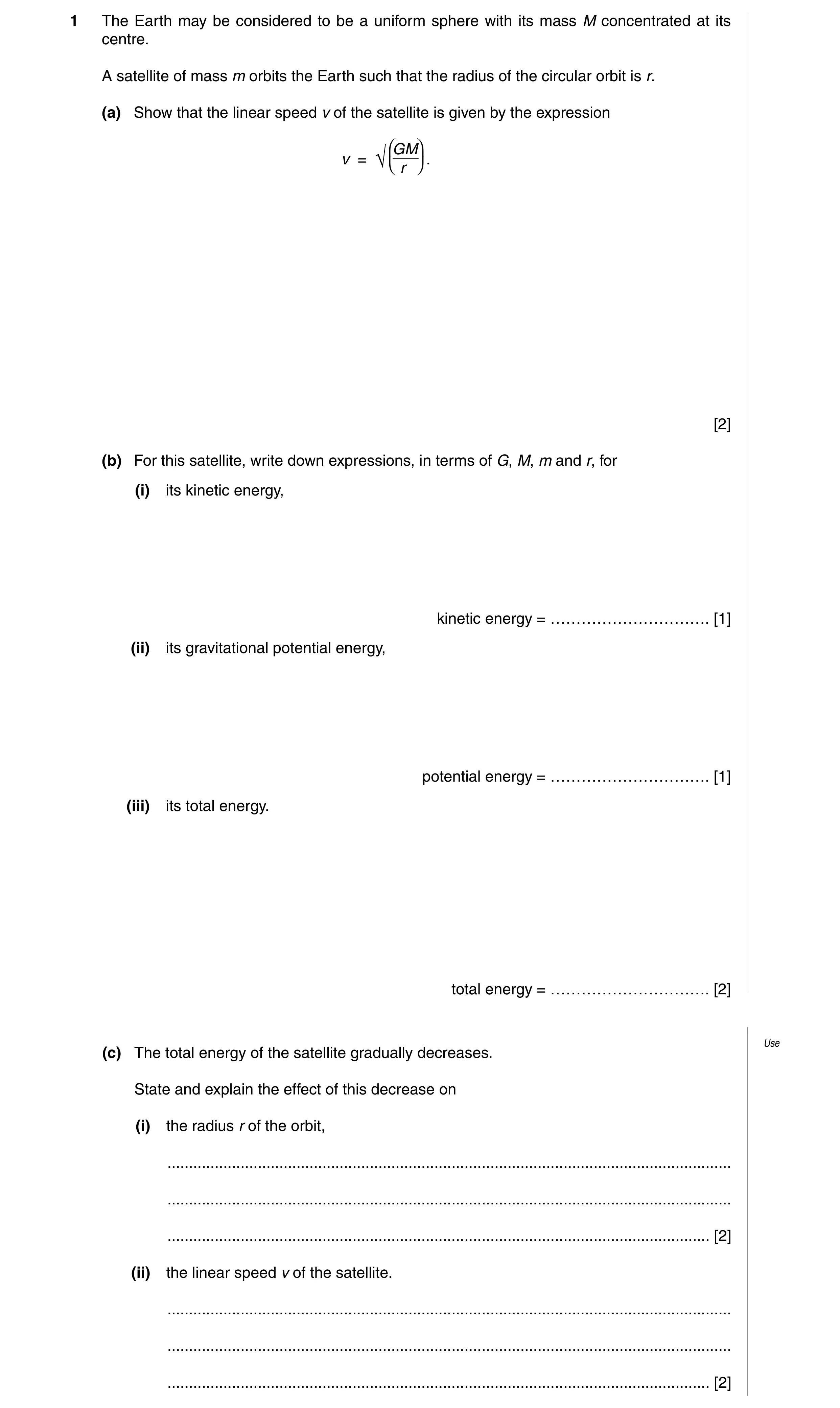
 4 / 22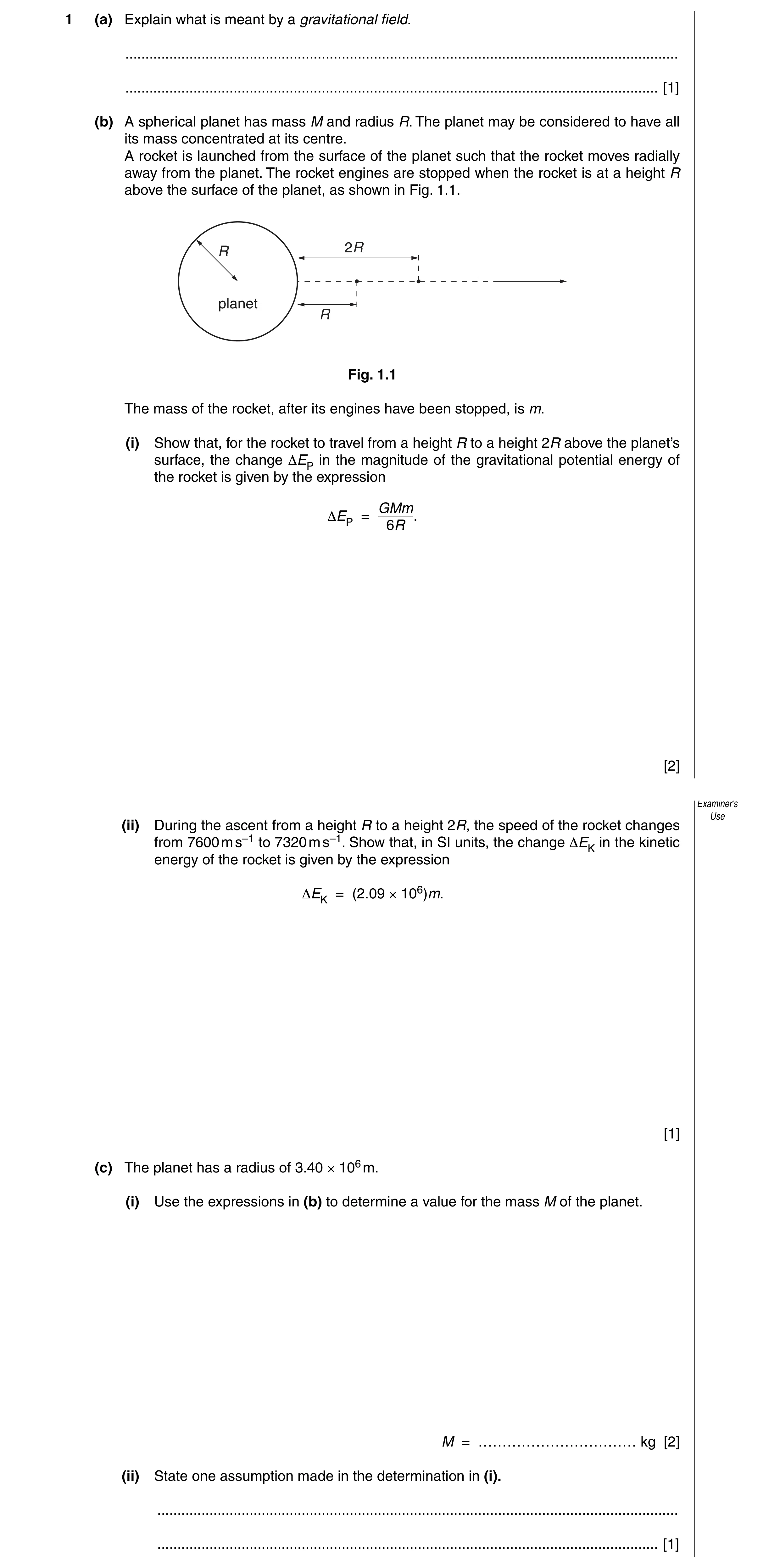
 7 / 22
 8 / 22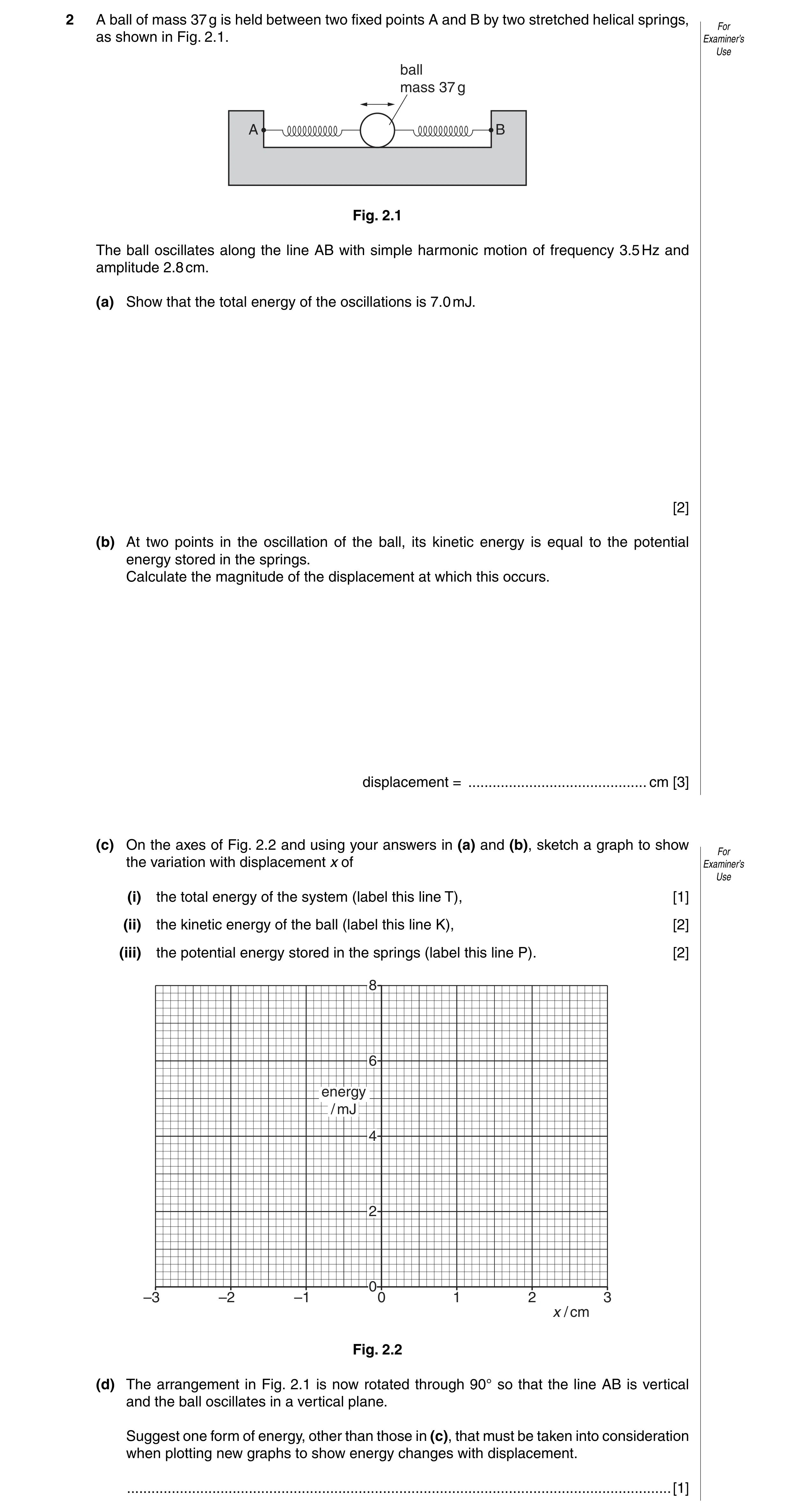
 11 / 22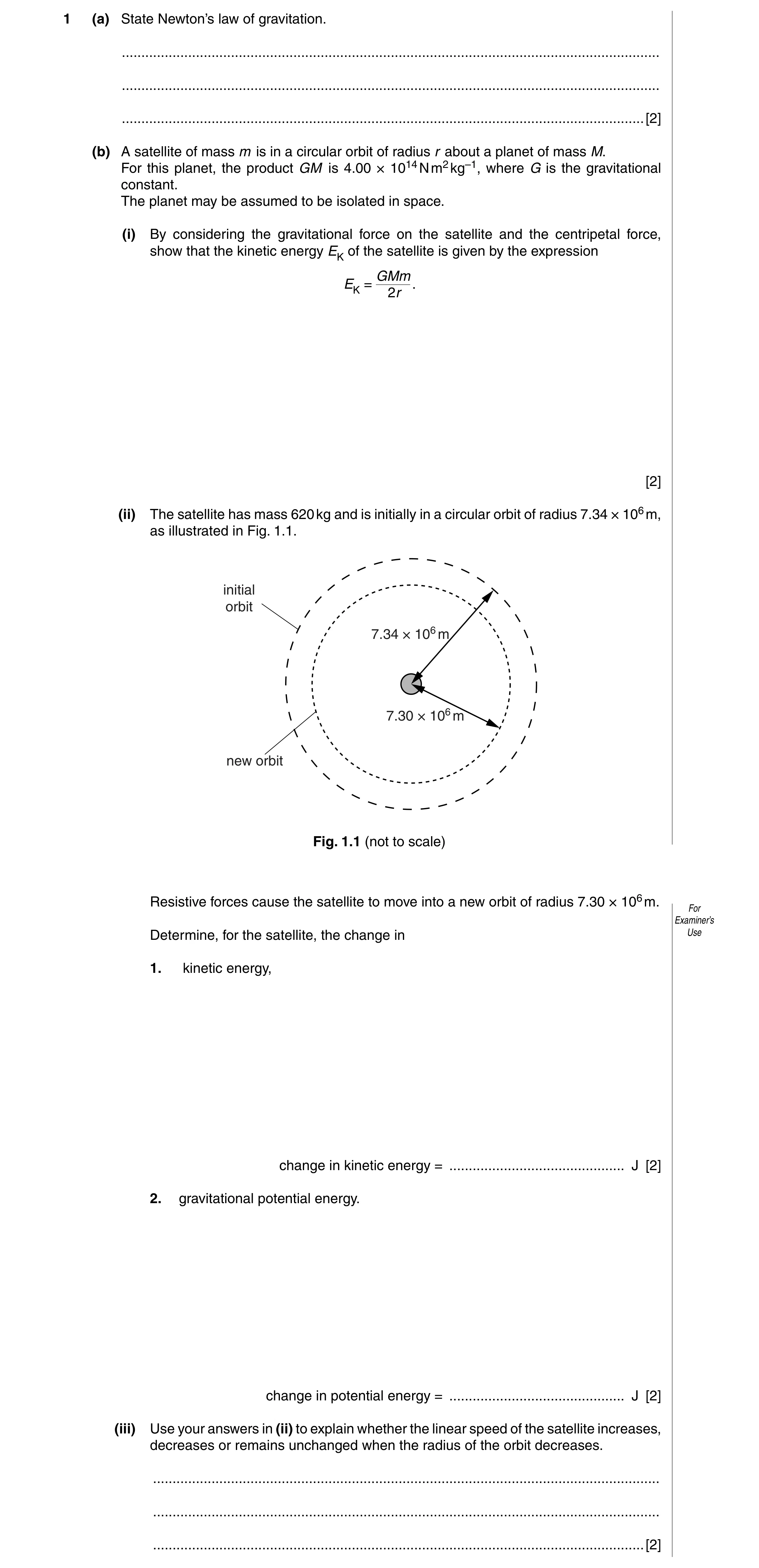
 16 / 22
 17 / 22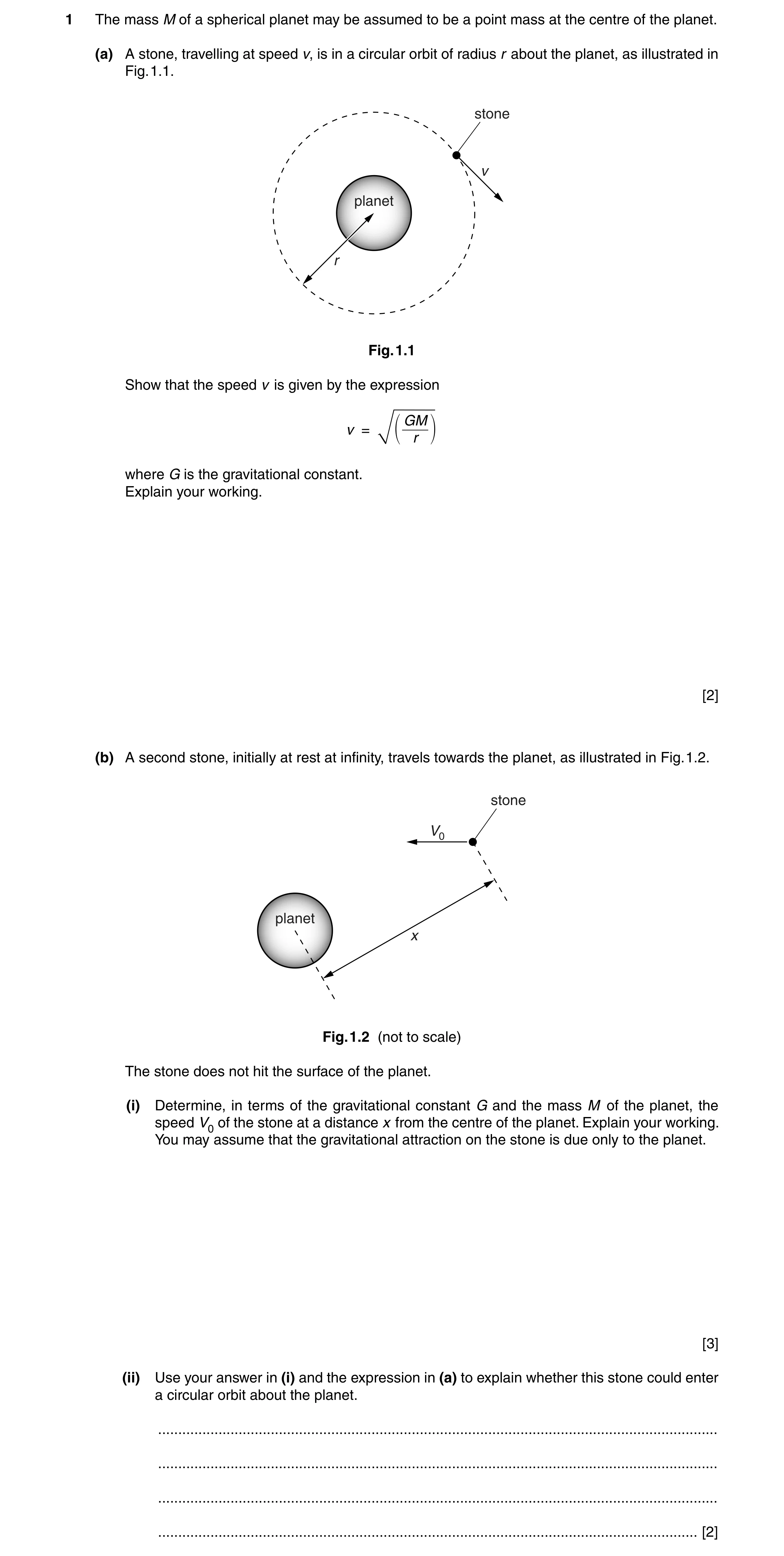
 9
9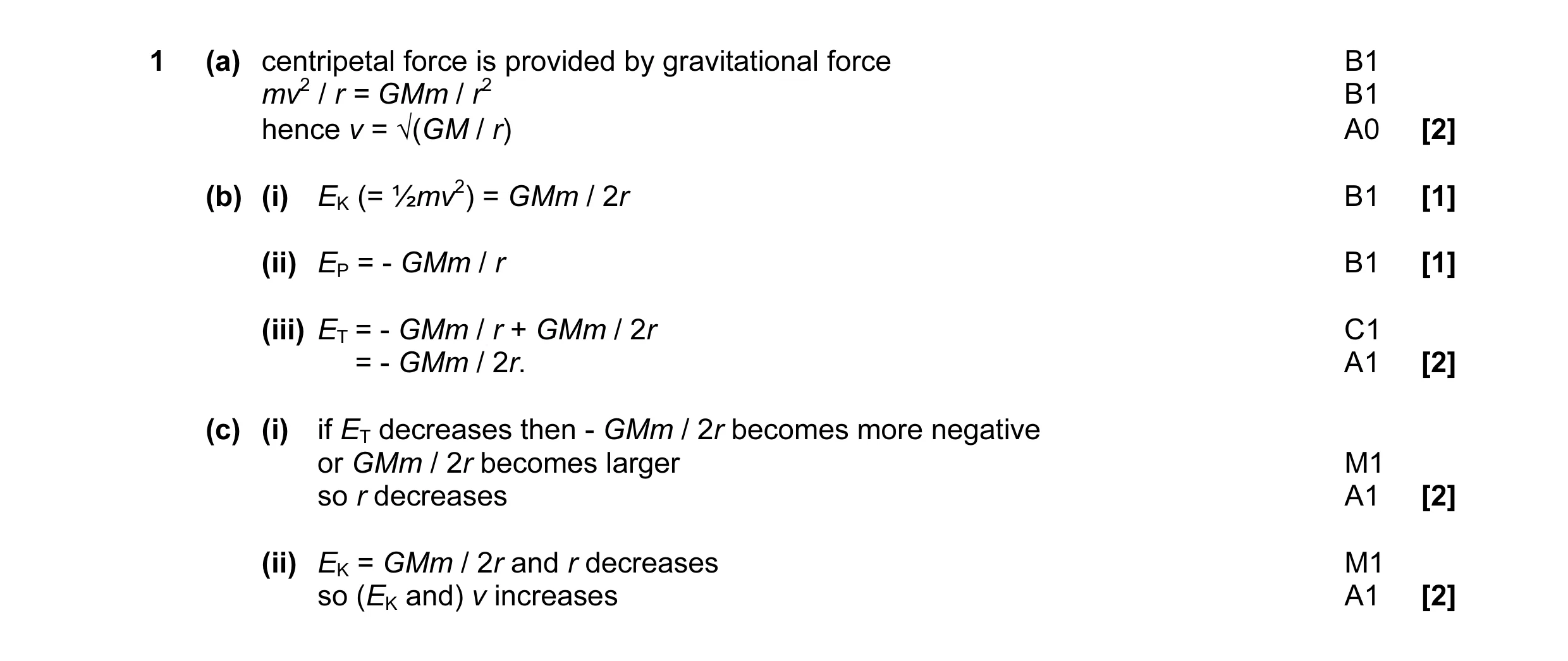 10
10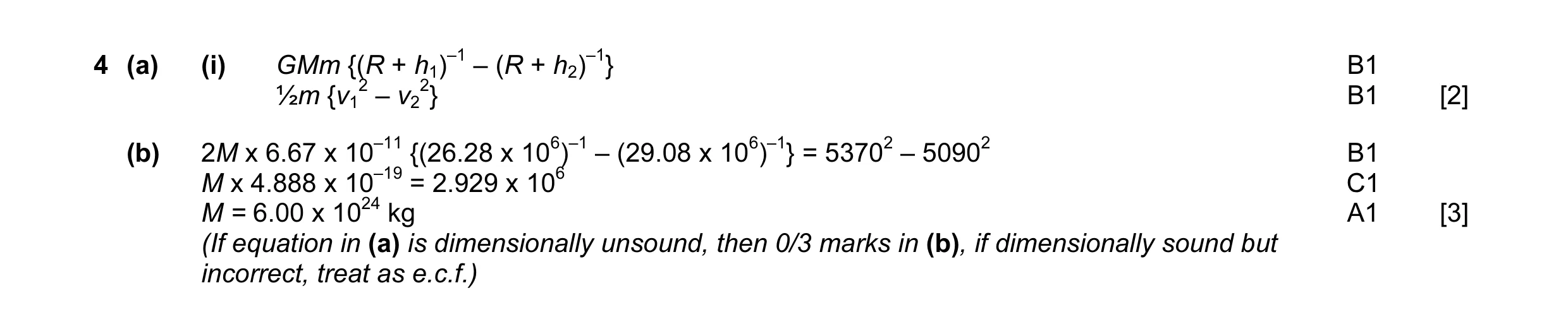 5
5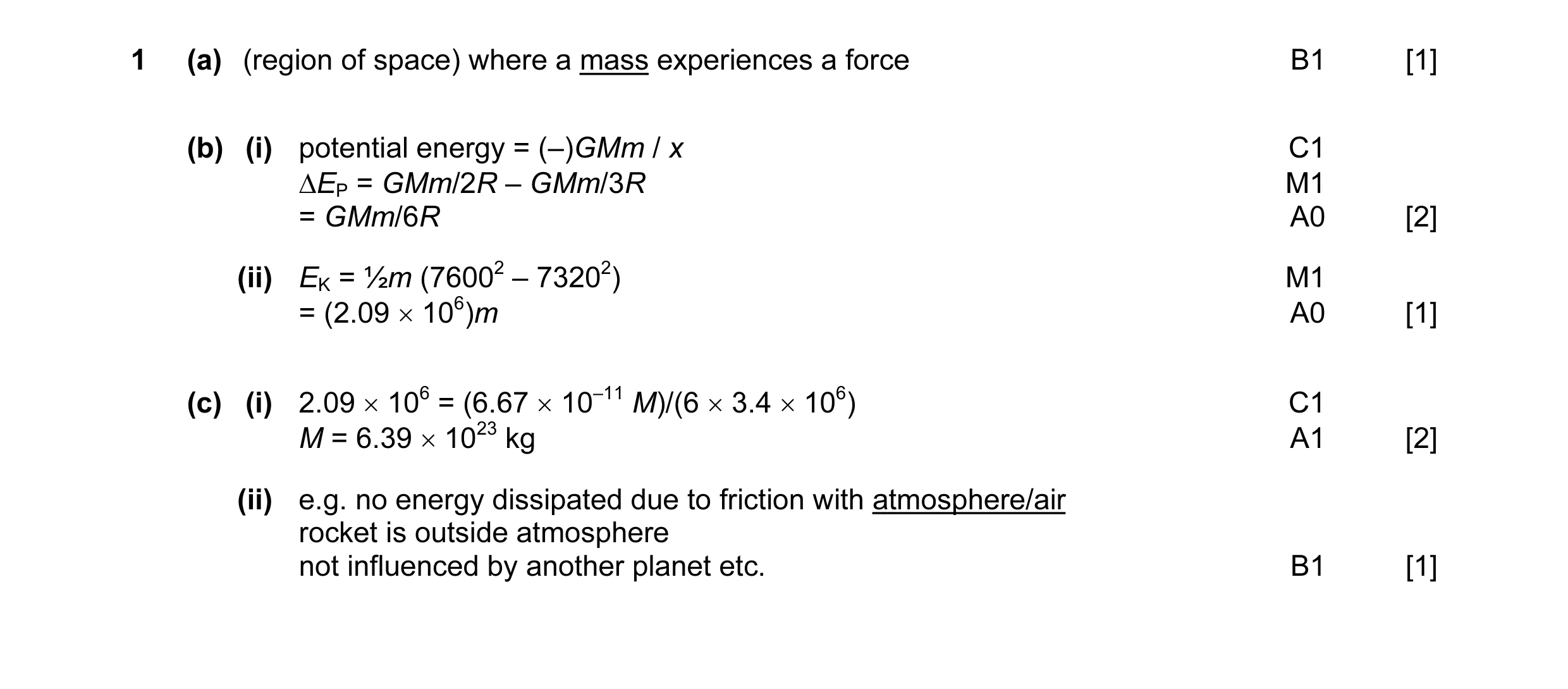 7
7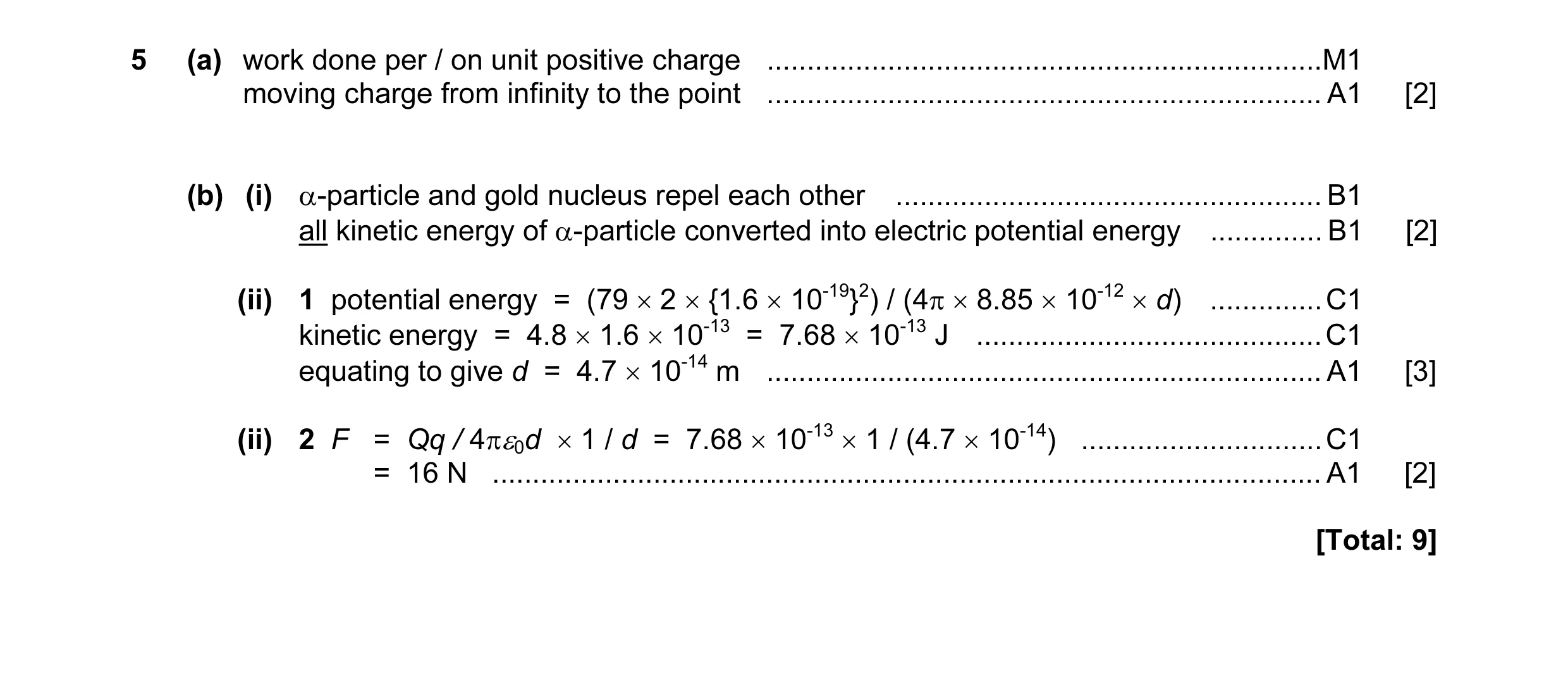 9
9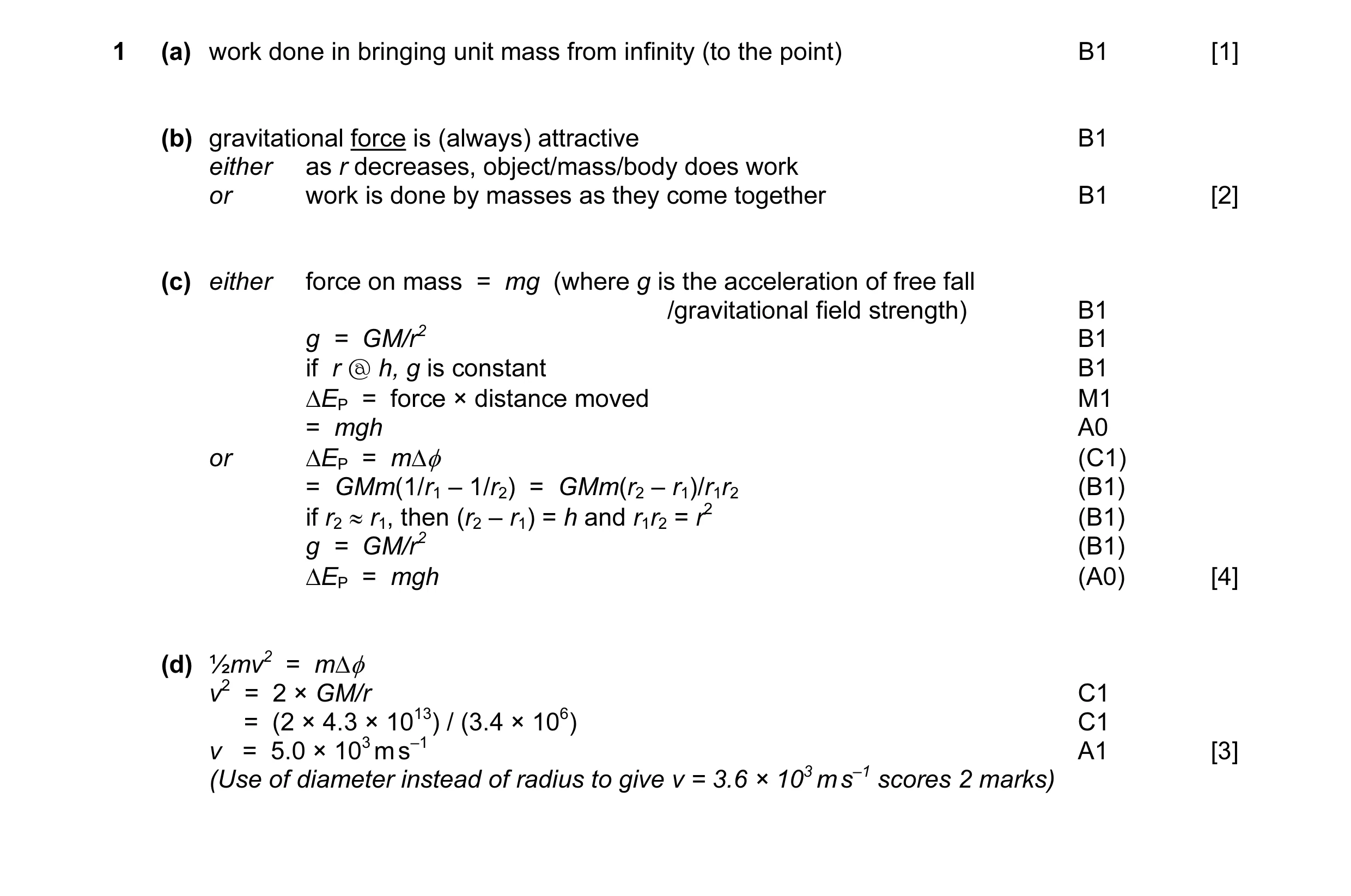 10
10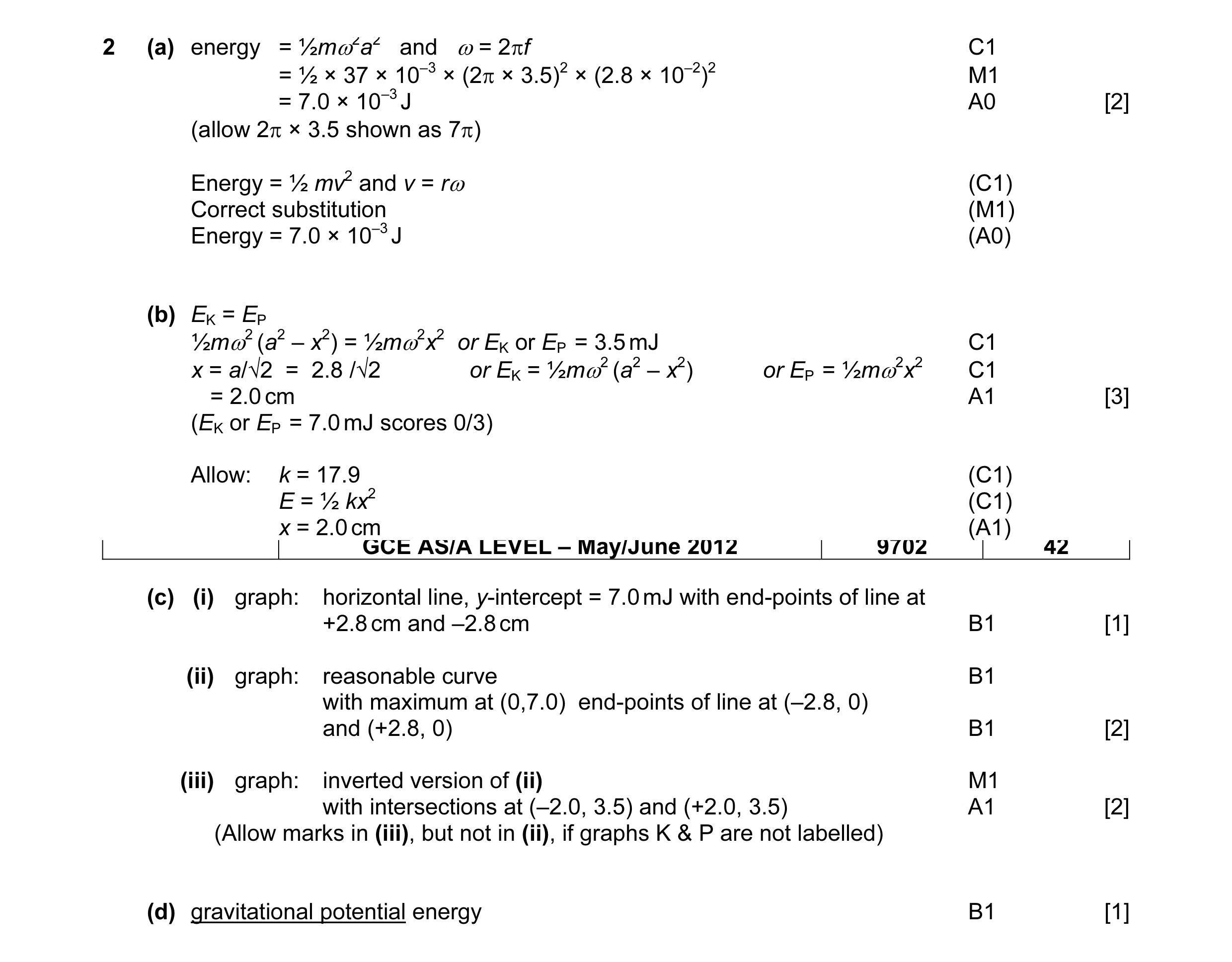 11
11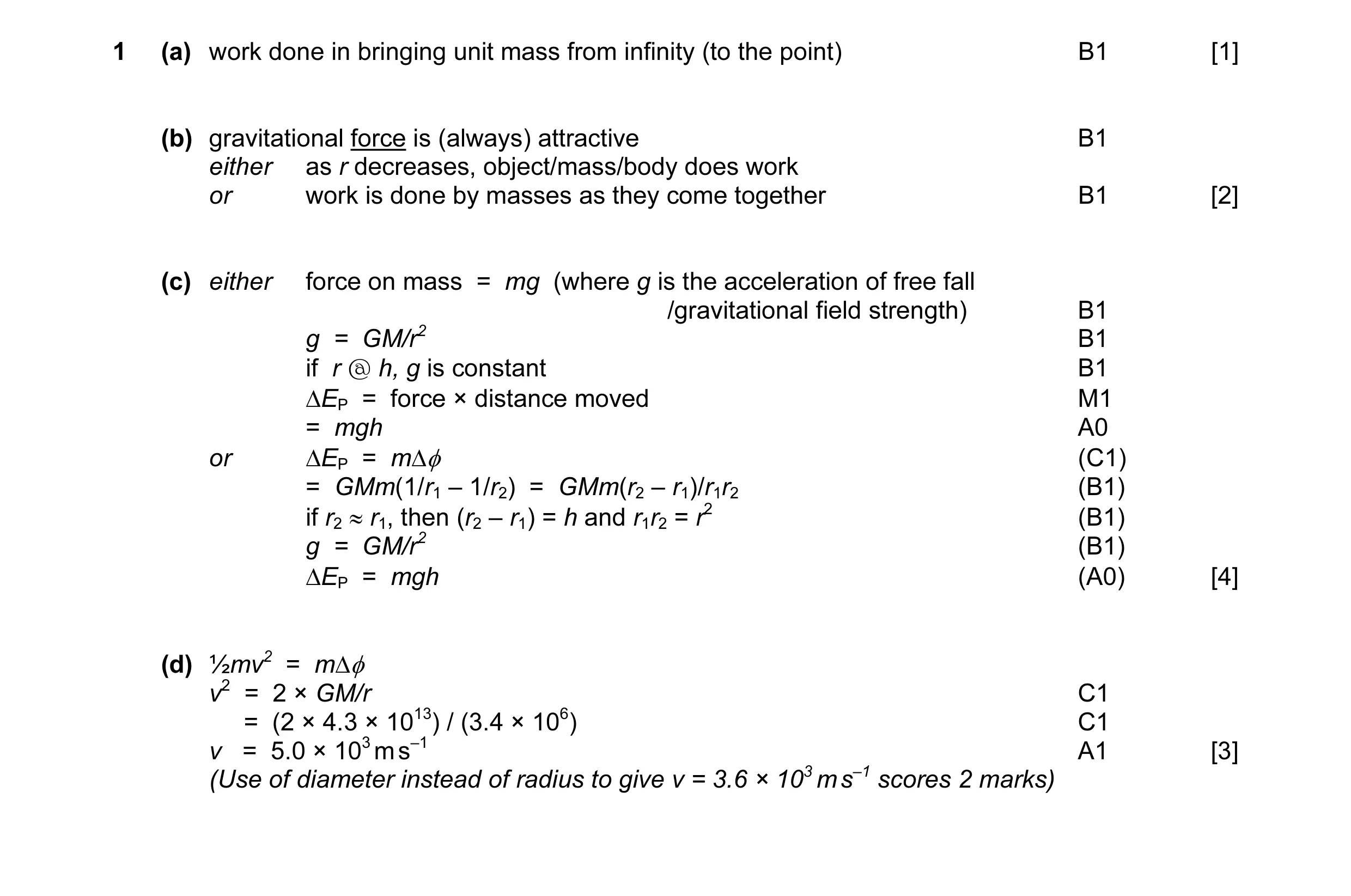 10
10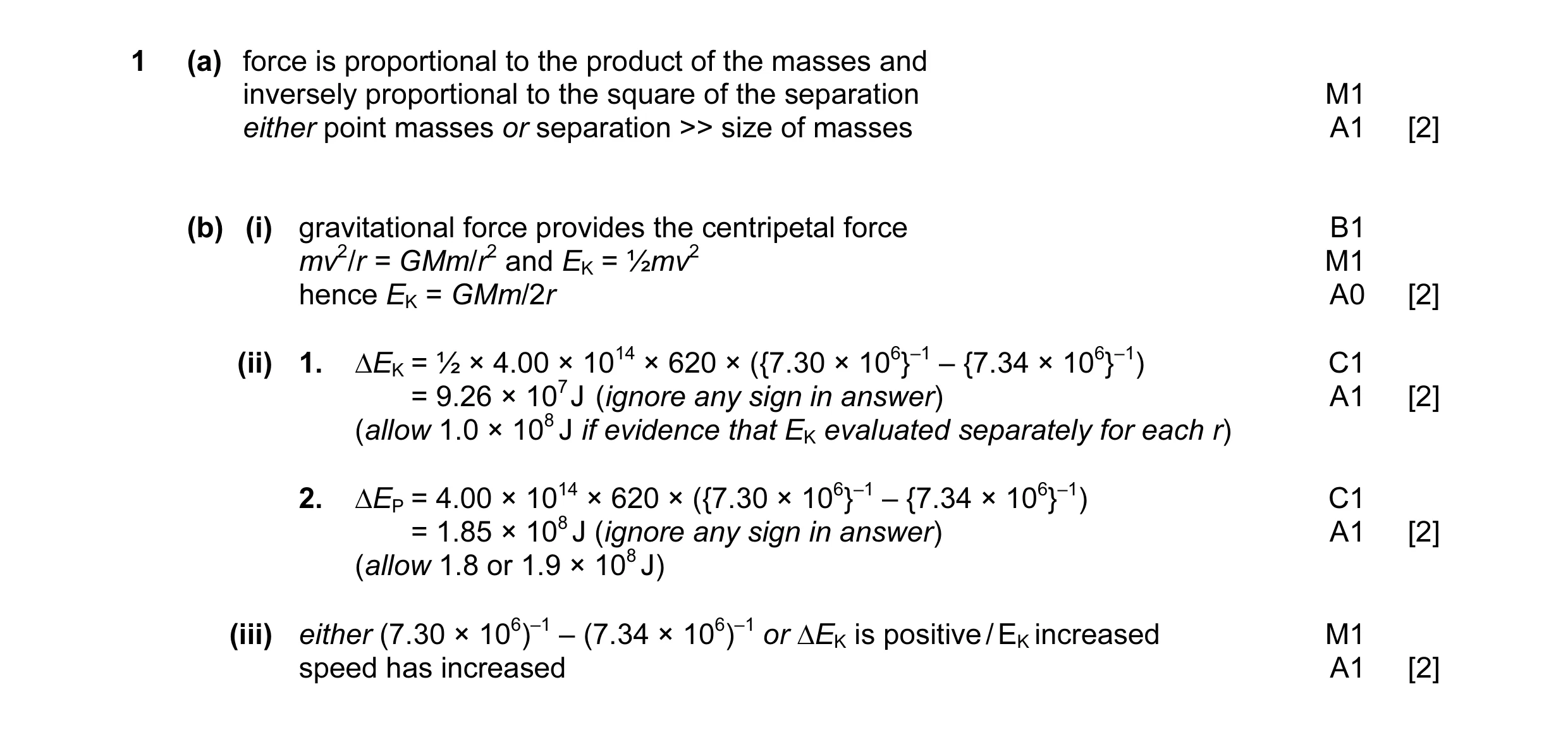 10
10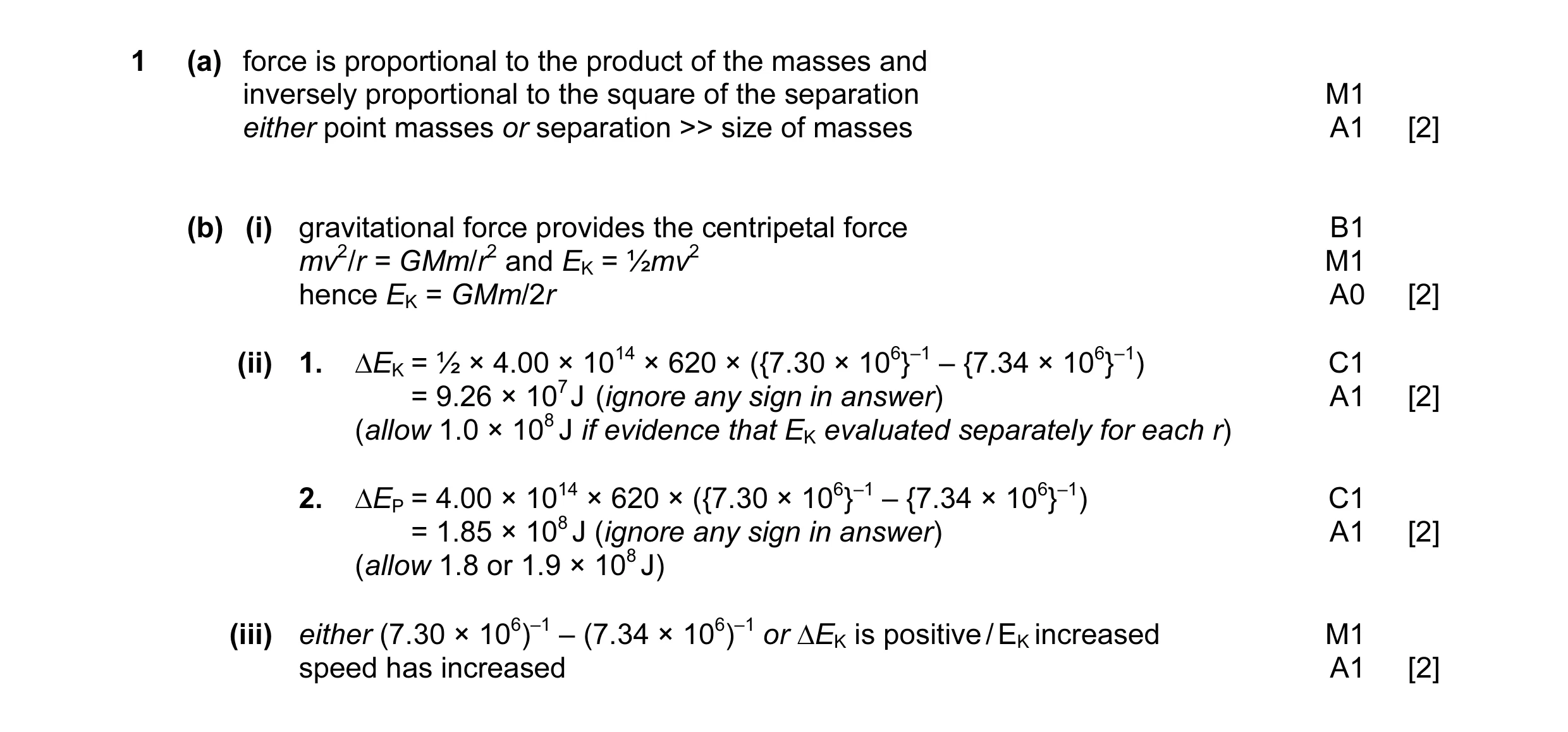 10
10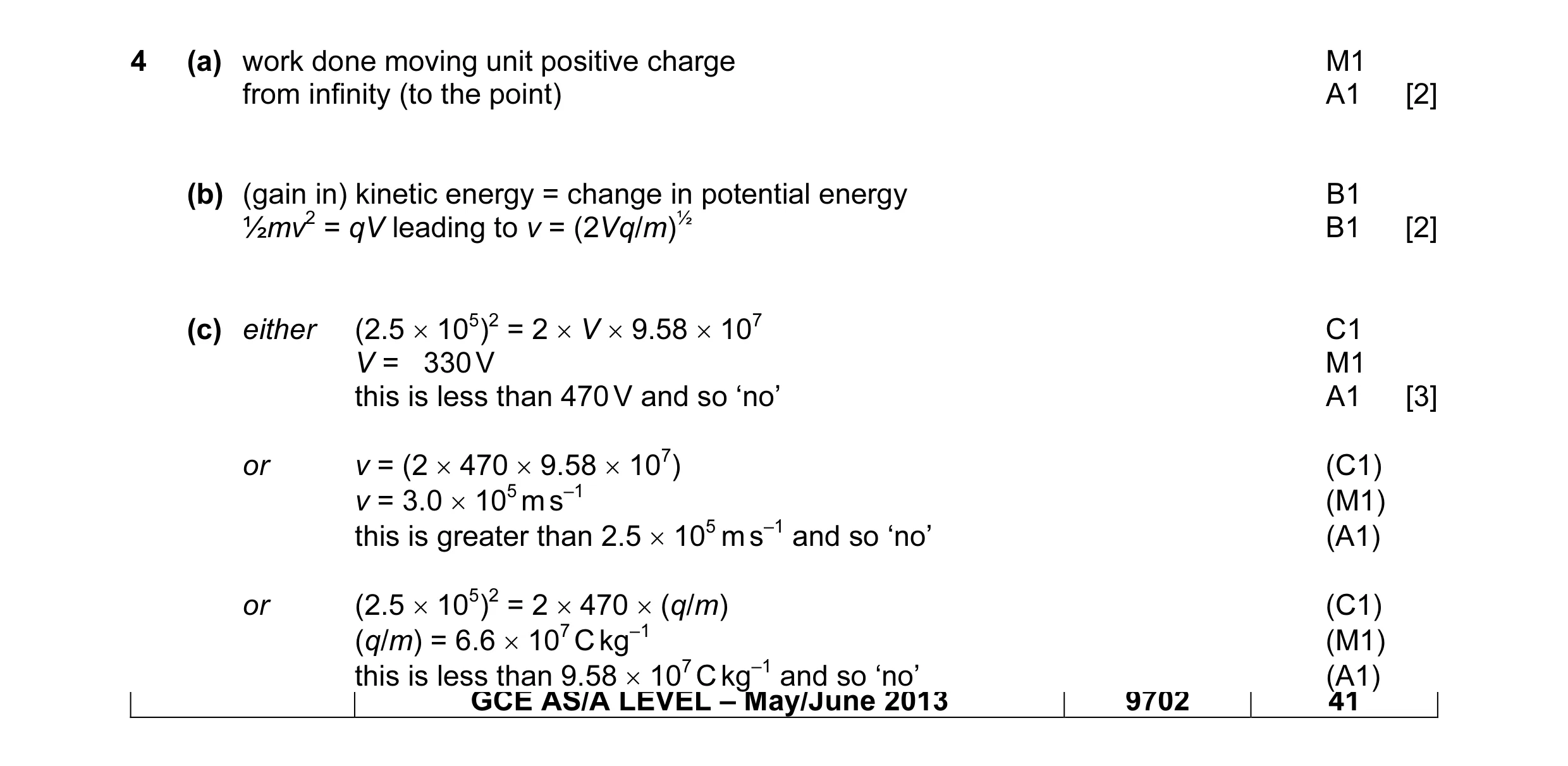 7
7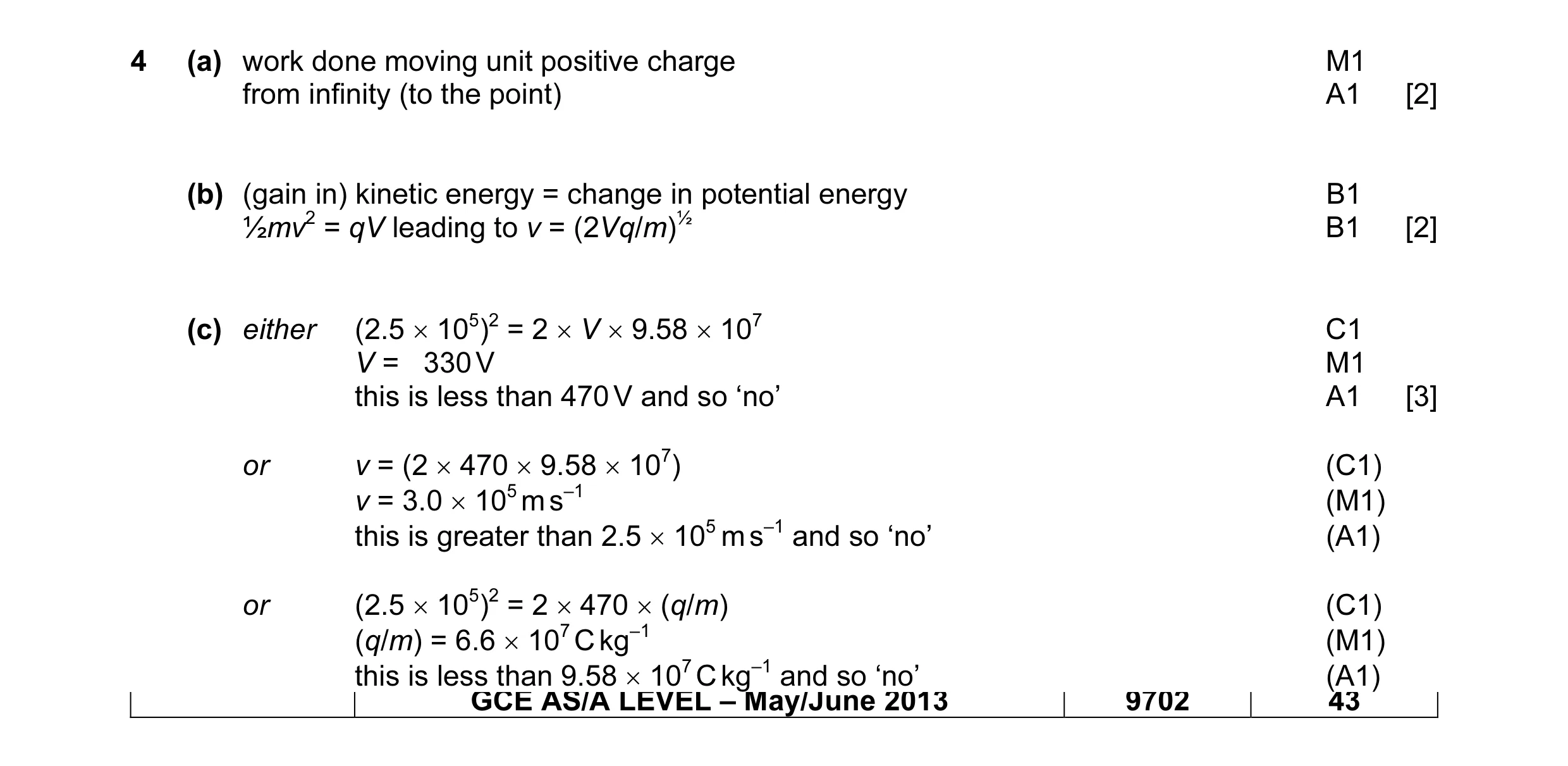 7
7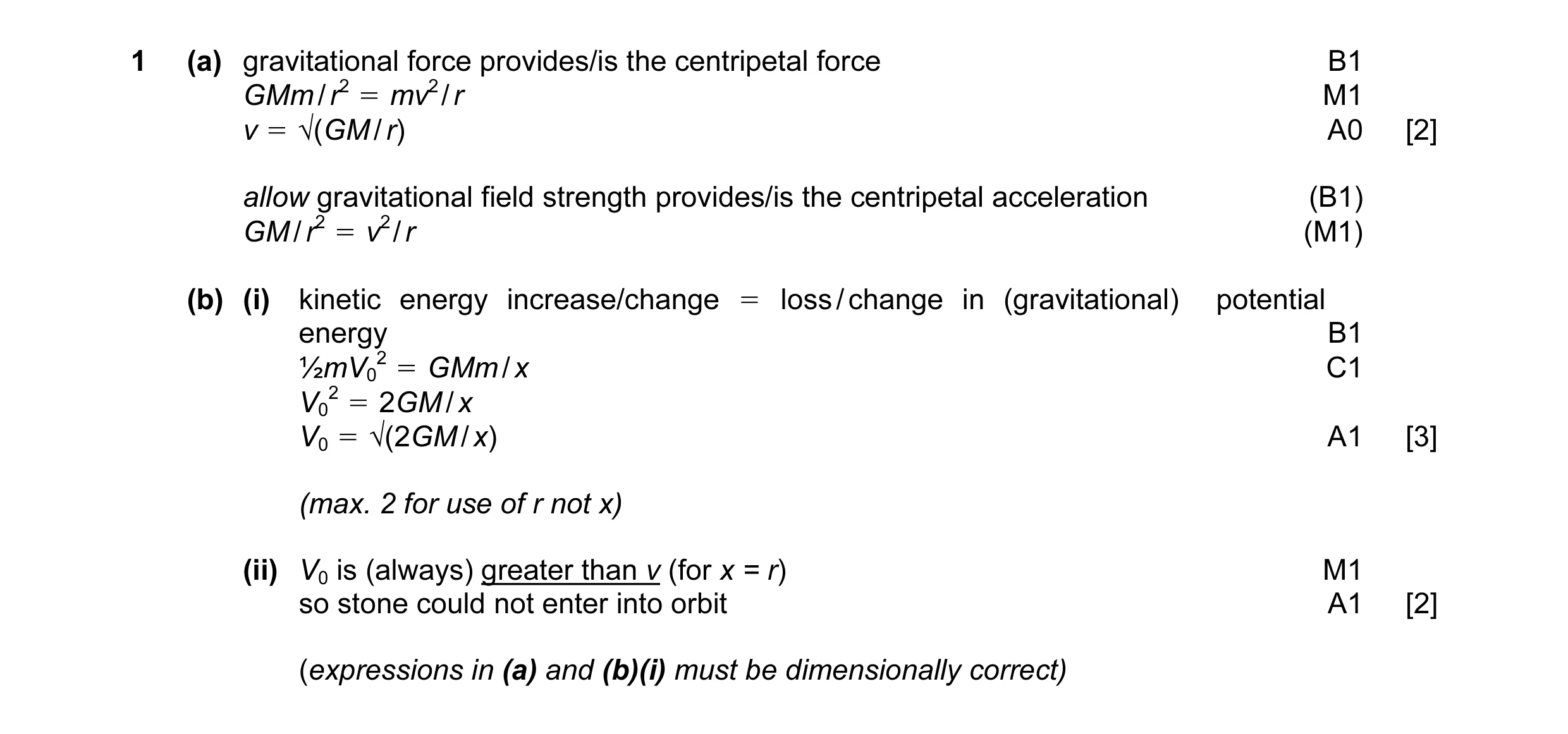 7
7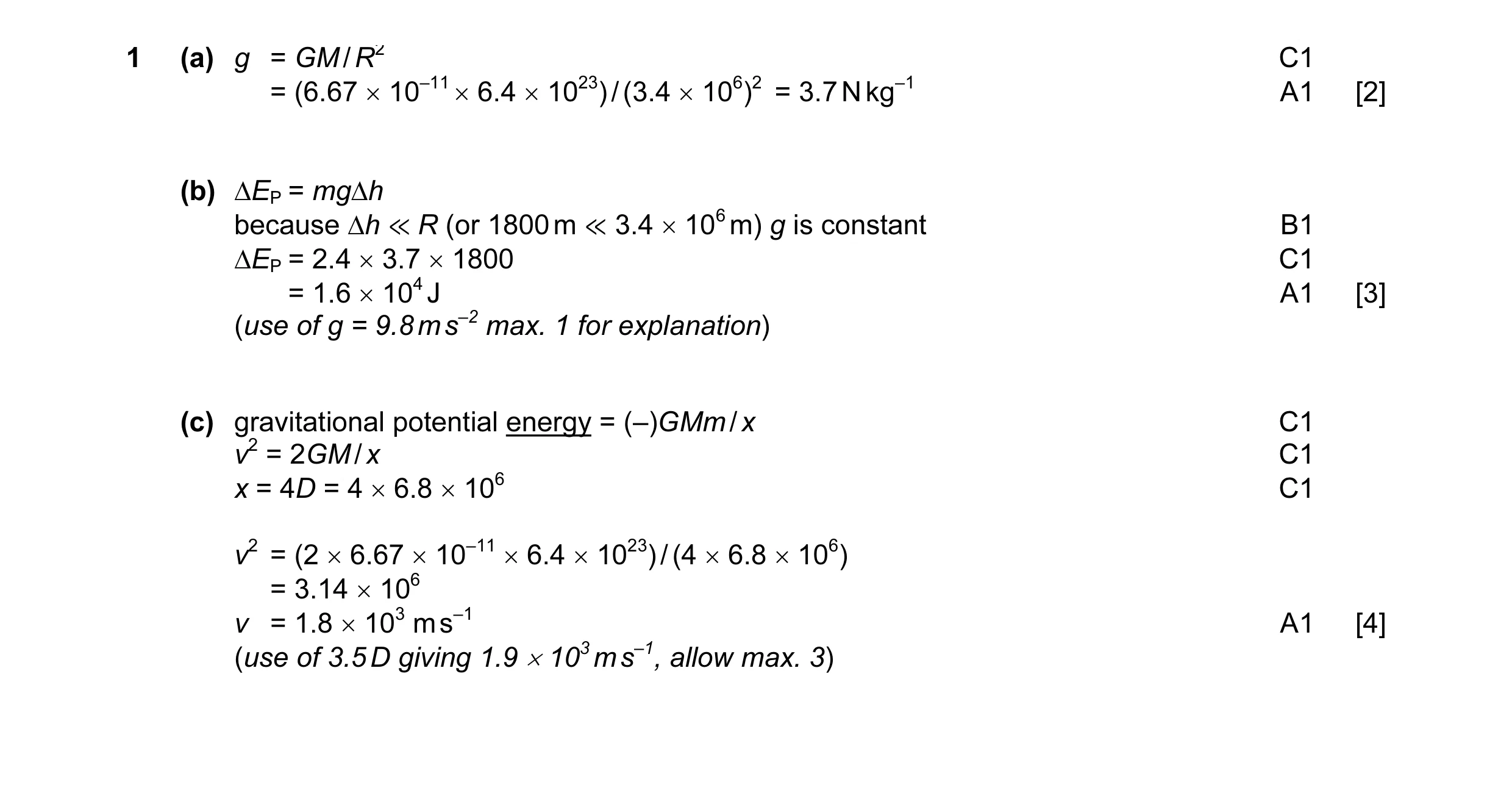 9
9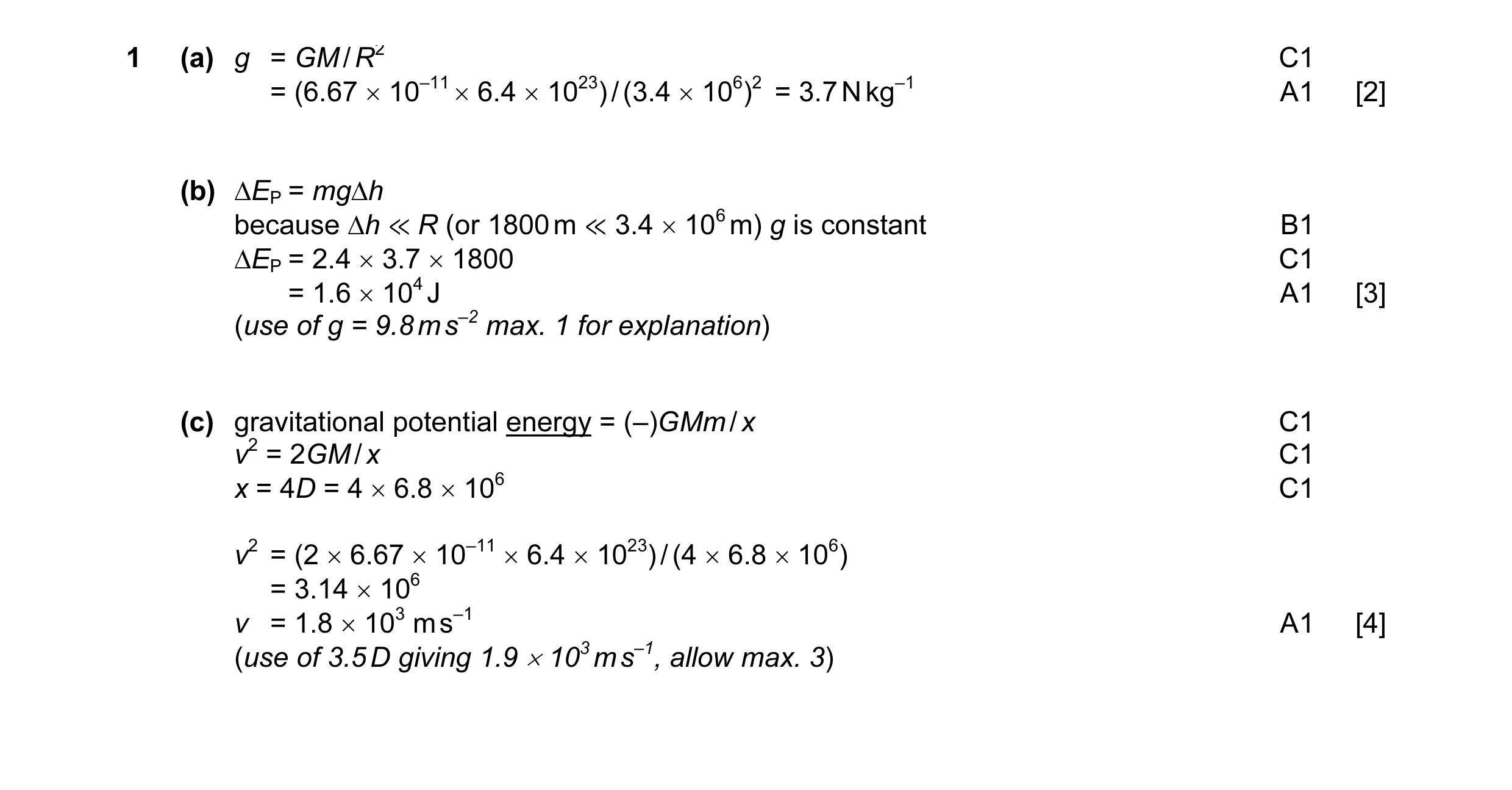 9
9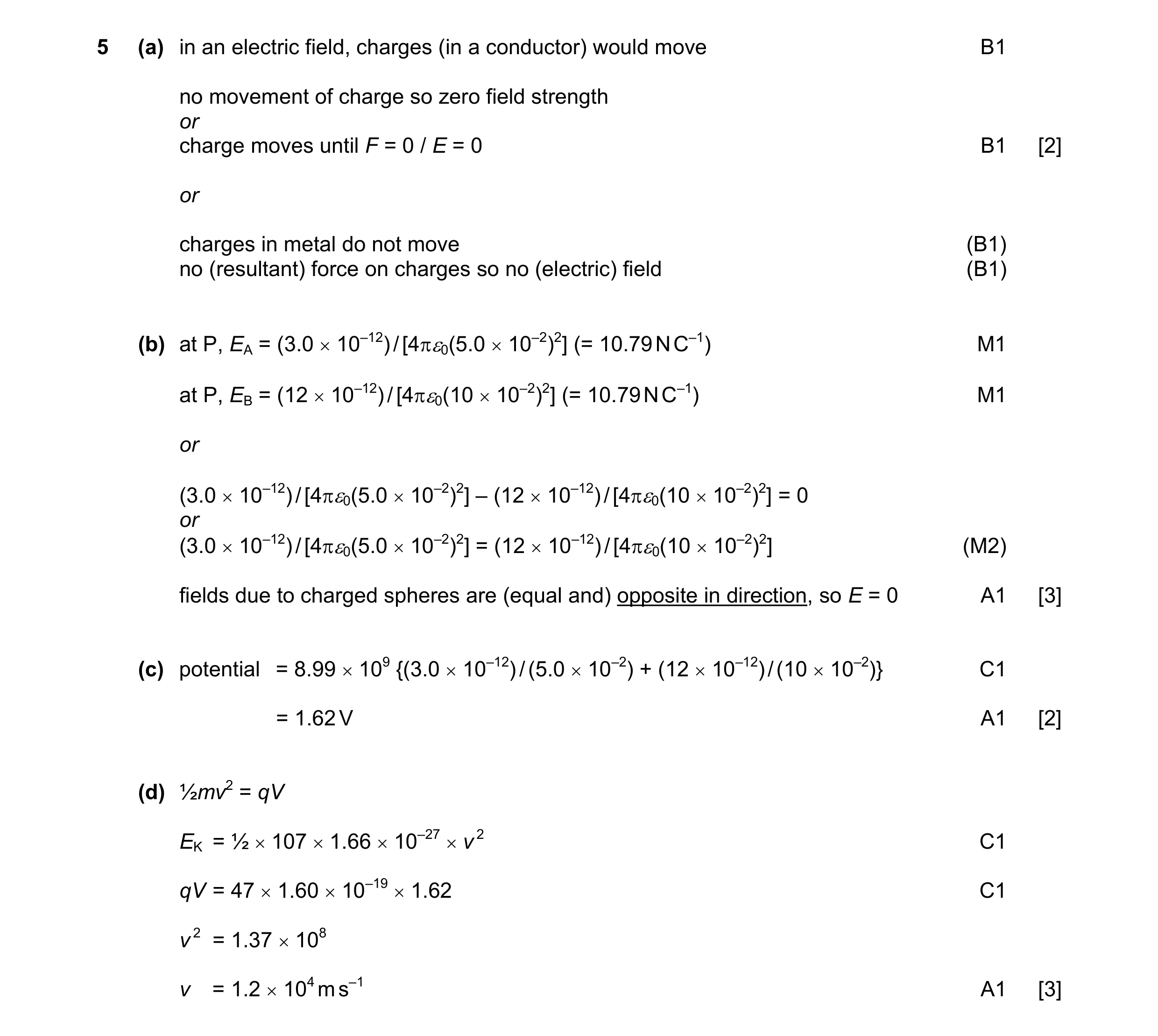 10
10