Questions as text
Q1 · A student investigates which end of a magnetic compass needle is attracted to a bar magnet 0654/11 May/June 2006
36 A student investigates which end of a magnetic compass needle is attracted to a bar magnet. What does the investigation show? A Both ends of the compass needle are attracted by the north pole of the magnet. B Both ends of the compass needle are attracted by the south pole of the magnet. C One end of the compass needle is attracted by the north pole and the other end by the south pole. D The compass needle is not attracted by either end of the magnet.
1 marks
Answer: C
This question in 0654/11 May/June 2006
Q2 · The diagram shows the use of a reed relay 0654/11 Oct/Nov 2007
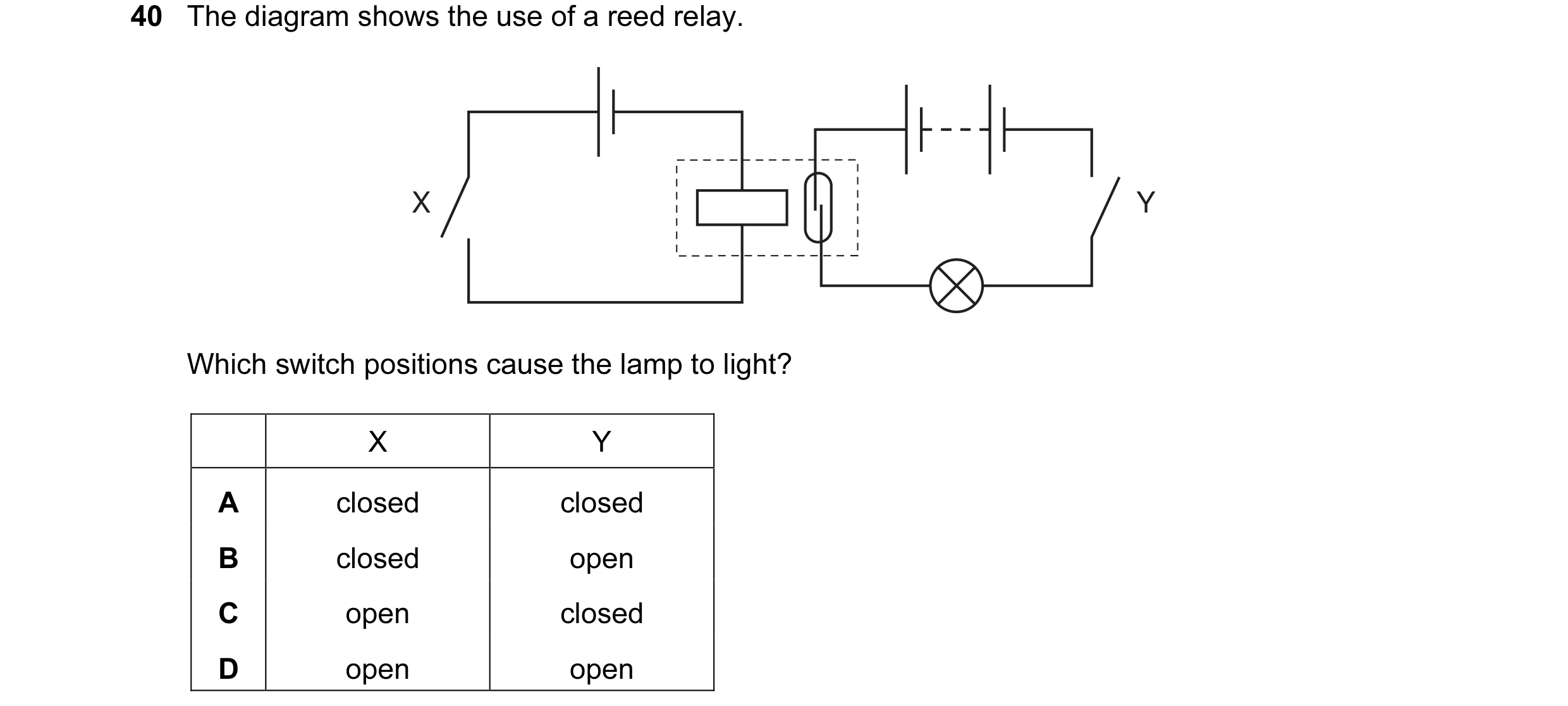
40 The diagram shows the use of a reed relay. X Y Which switch positions cause the lamp to light? X Y A closed closed B closed open C open closed D open open
1 marks
Answer: A
This question in 0654/11 Oct/Nov 2007
Q3 · A magnet and a charged plastic rod are held near each other 0654/11 May/June 2010
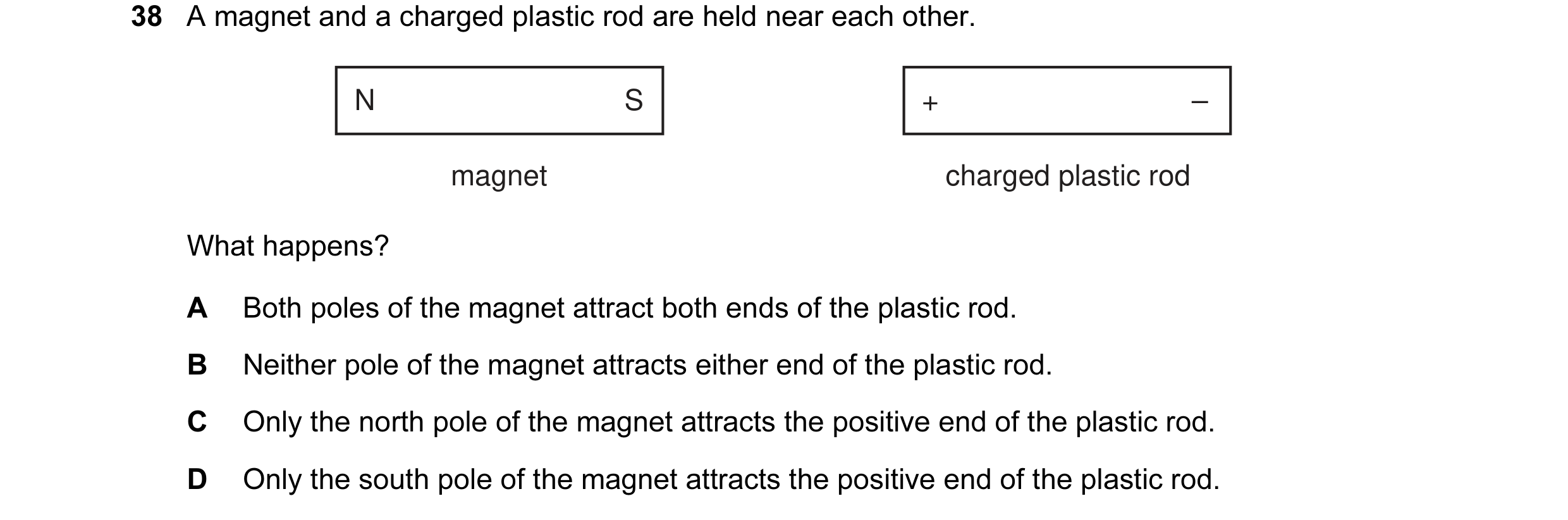
38 A magnet and a charged plastic rod are held near each other. N S + – magnet charged plastic rod What happens? A Both poles of the magnet attract both ends of the plastic rod. B Neither pole of the magnet attracts either end of the plastic rod. C Only the north pole of the magnet attracts the positive end of the plastic rod. D Only the south pole of the magnet attracts the positive end of the plastic rod.
1 marks
Answer: B
This question in 0654/11 May/June 2010
Q4 · A magnet and a charged plastic rod are held near each other 0654/12 May/June 2010
32 A magnet and a charged plastic rod are held near each other. N S + – magnet charged plastic rod What happens? A Both poles of the magnet attract both ends of the plastic rod. B Neither pole of the magnet attracts either end of the plastic rod. C Only the north pole of the magnet attracts the positive end of the plastic rod. D Only the south pole of the magnet attracts the positive end of the plastic rod.
1 marks
Answer: B
This question in 0654/12 May/June 2010
Q5 · The pattern of field lines around a bar magnet on a sheet of paper can be shown by… 0654/11 Oct/Nov 2010
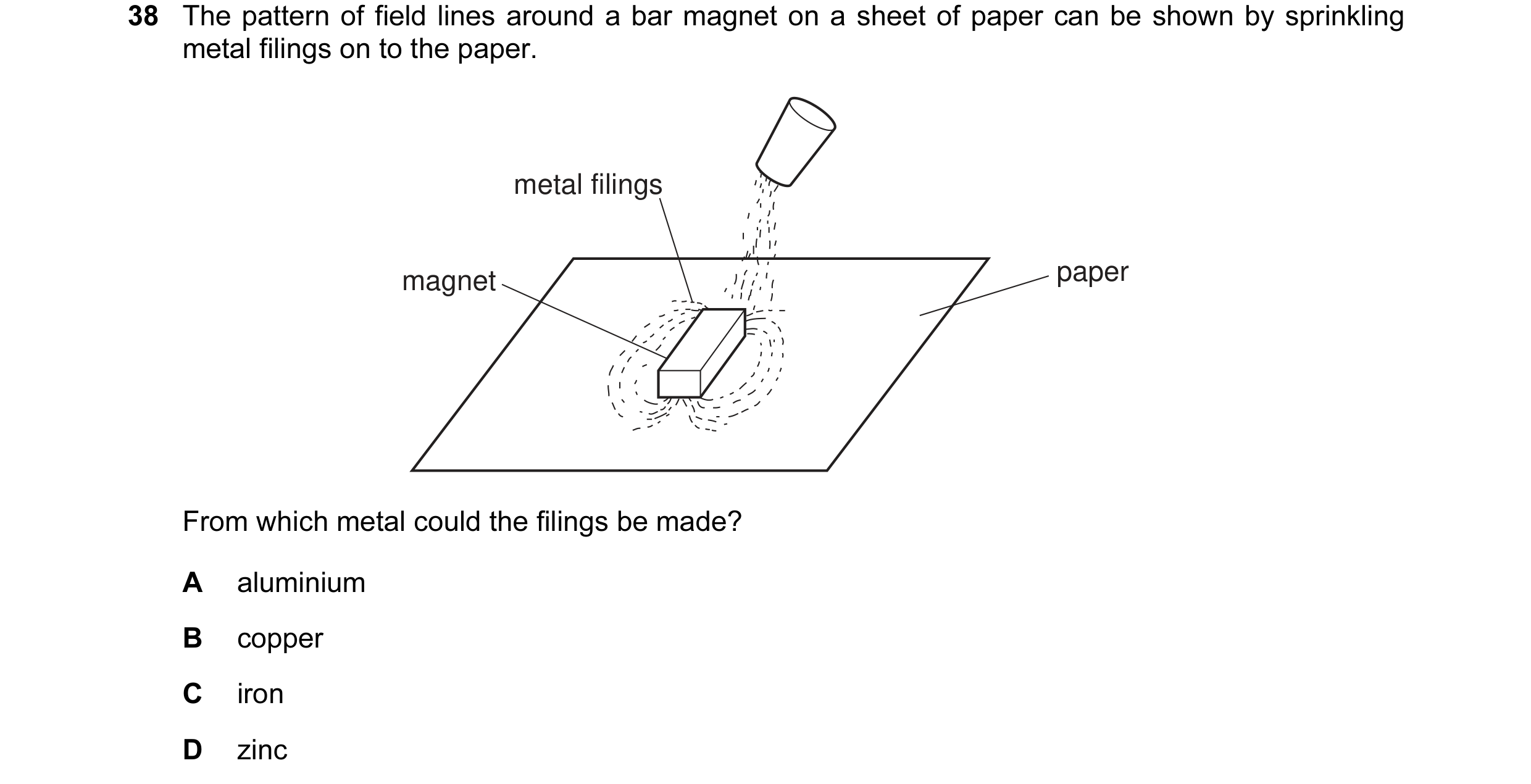
38 The pattern of field lines around a bar magnet on a sheet of paper can be shown by sprinkling metal filings on to the paper. metal filings magnet paper From which metal could the filings be made? A aluminium B copper C iron D zinc
1 marks
Answer: C
This question in 0654/11 Oct/Nov 2010
Q6 · The pattern of field lines around a bar magnet on a sheet of paper can be shown by… 0654/12 Oct/Nov 2010
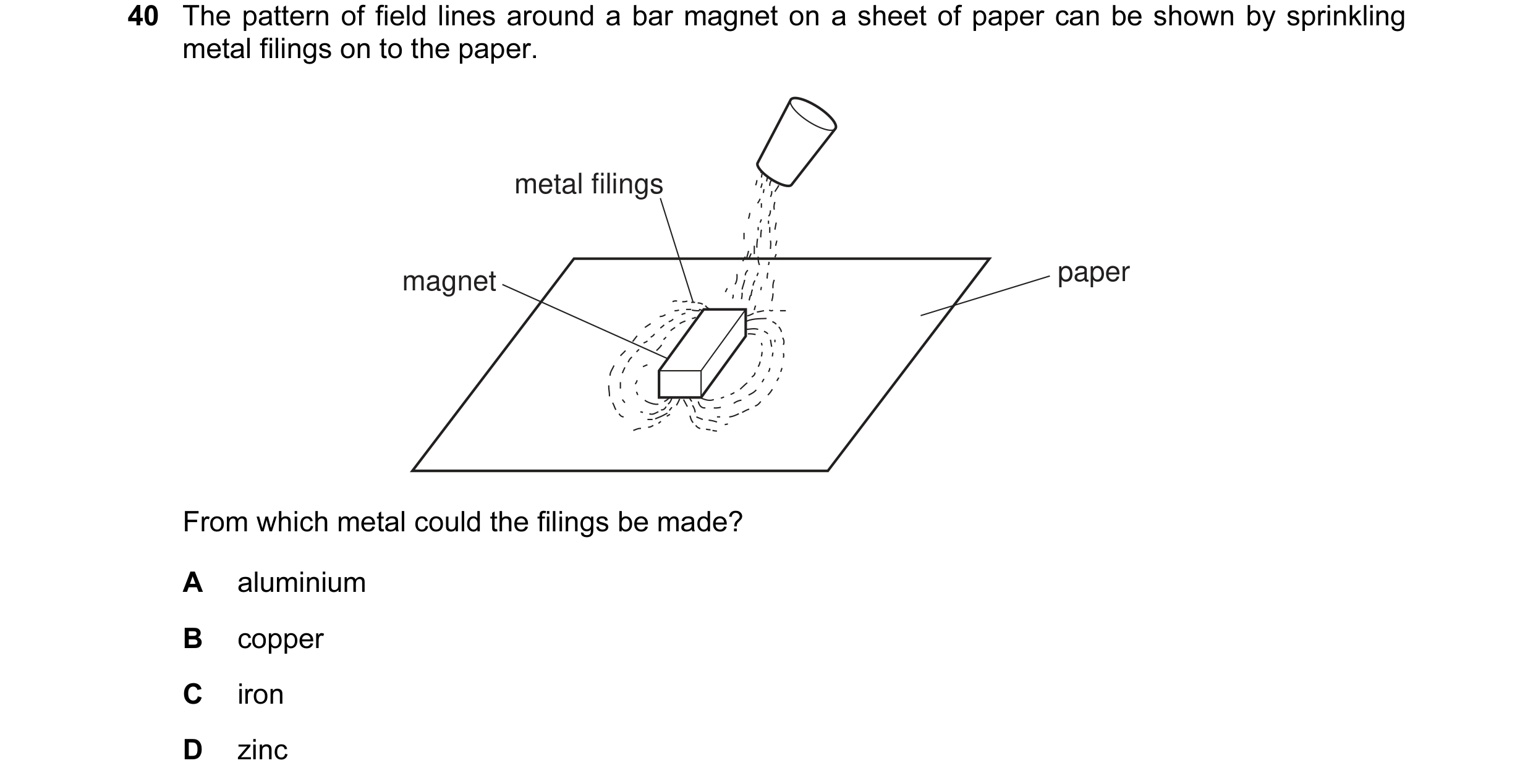
40 The pattern of field lines around a bar magnet on a sheet of paper can be shown by sprinkling metal filings on to the paper. metal filings magnet paper From which metal could the filings be made? A aluminium B copper C iron D zinc
1 marks
Answer: C
This question in 0654/12 Oct/Nov 2010
Q7 · The pattern of field lines around a bar magnet on a sheet of paper can be shown by… 0654/13 Oct/Nov 2010
35 The pattern of field lines around a bar magnet on a sheet of paper can be shown by sprinkling metal filings on to the paper. metal filings magnet paper From which metal could the filings be made? A aluminium B copper C iron D zinc
1 marks
Answer: C
This question in 0654/13 Oct/Nov 2010
Q8 · A satellite orbits the Earth 0654/11 May/June 2011
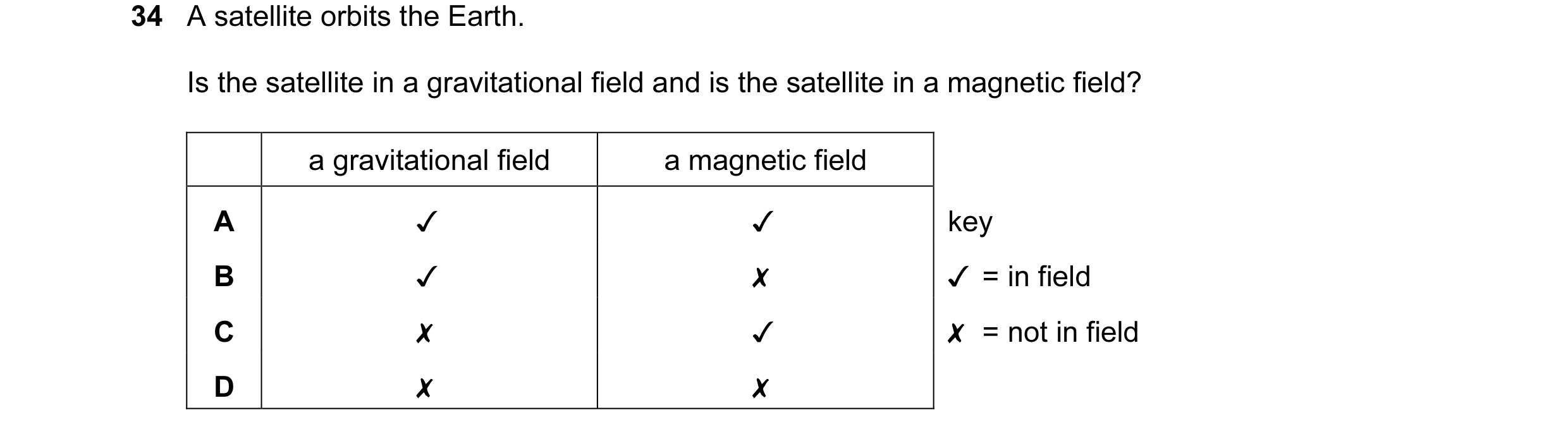
34 A satellite orbits the Earth.
Is the satellite in a gravitational field and is the satellite in a magnetic field?
0 0O DW >
a gravitational field
~ «K &
a magnetic field
x \ x
key
JY =in field
X =not in field
1 marks
Answer: A
This question in 0654/11 May/June 2011
Q9 · A satellite orbits the Earth 0654/12 May/June 2011
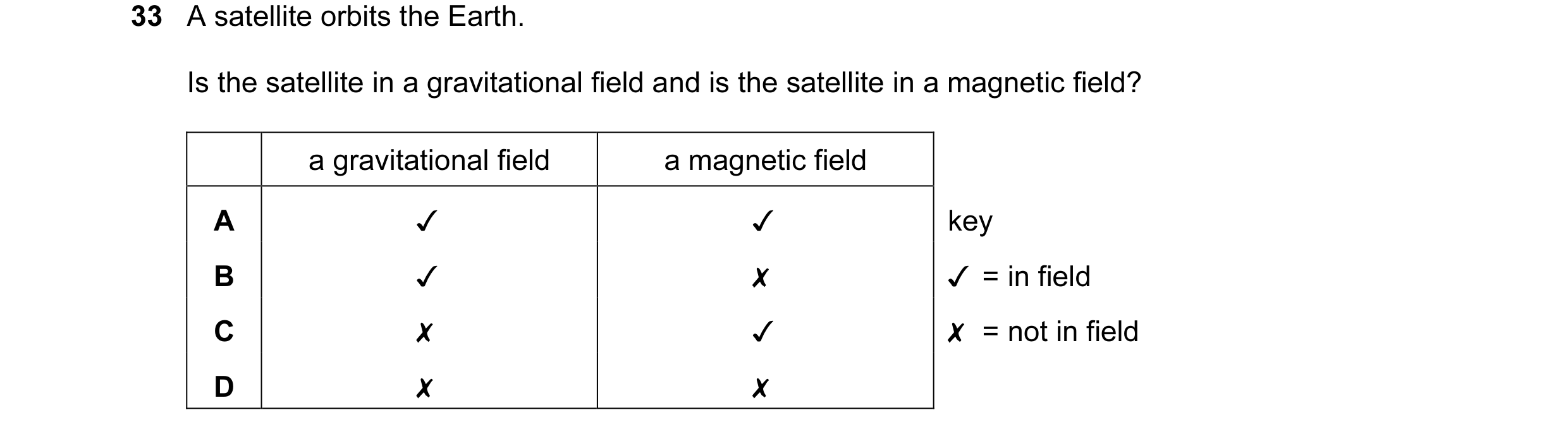
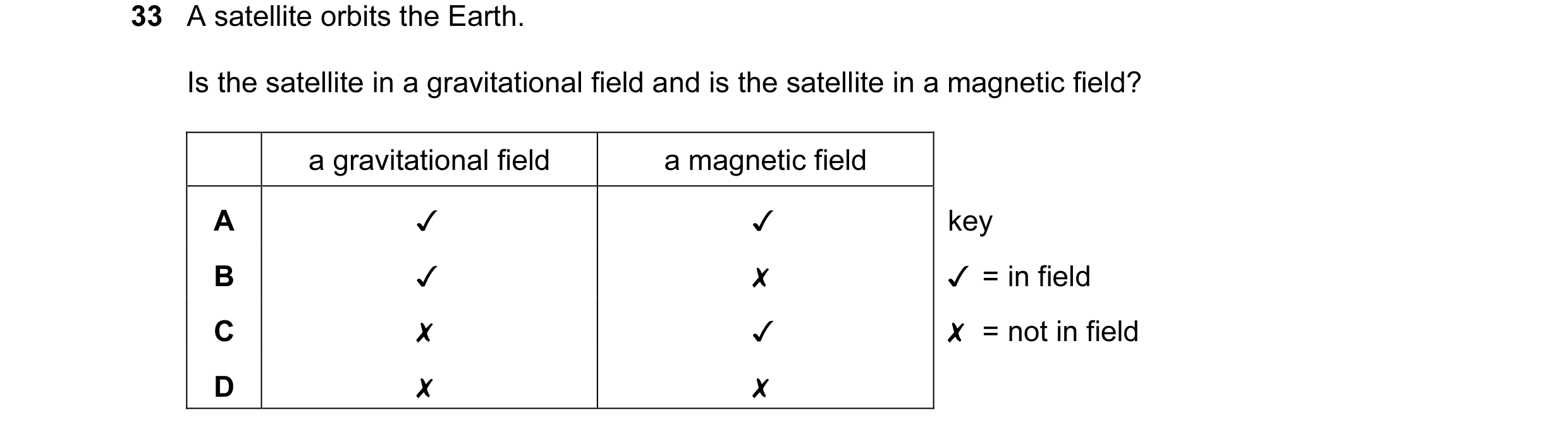
33 A satellite orbits the Earth.
Is the satellite in a gravitational field and is the satellite in a magnetic field?
a gravitational field
a magnetic field
0 0O WwW D>
v
v
x
x
v
x
v
x
key
JY =in field
X =not in field
1 marks
Answer: A
This question in 0654/12 May/June 2011
Q10 · A satellite orbits the Earth 0654/13 May/June 2011
33 A satellite orbits the Earth.
Is the satellite in a gravitational field and is the satellite in a magnetic field?
a gravitational field
a magnetic field
0 0O WwW D>
v
v
x
x
v
x
v
x
key
JY =in field
X =not in field
1 marks
Answer: A
This question in 0654/13 May/June 2011
Q11 · A bar magnet is brought near a metal rod 0654/11 May/June 2013
38 A bar magnet is brought near a metal rod. magnet metal rod N S The magnet is then turned around so that its poles have changed positions. The magnet is again brought near to the metal rod. In both cases the metal rod is attracted to the magnet. What could the metal rod be? A another bar magnet B a piece of aluminium C a piece of copper D a piece of iron
1 marks
Answer: D
This question in 0654/11 May/June 2013
Q12 · A rod is rubbed with a dry piece of cloth 0654/12 May/June 2013
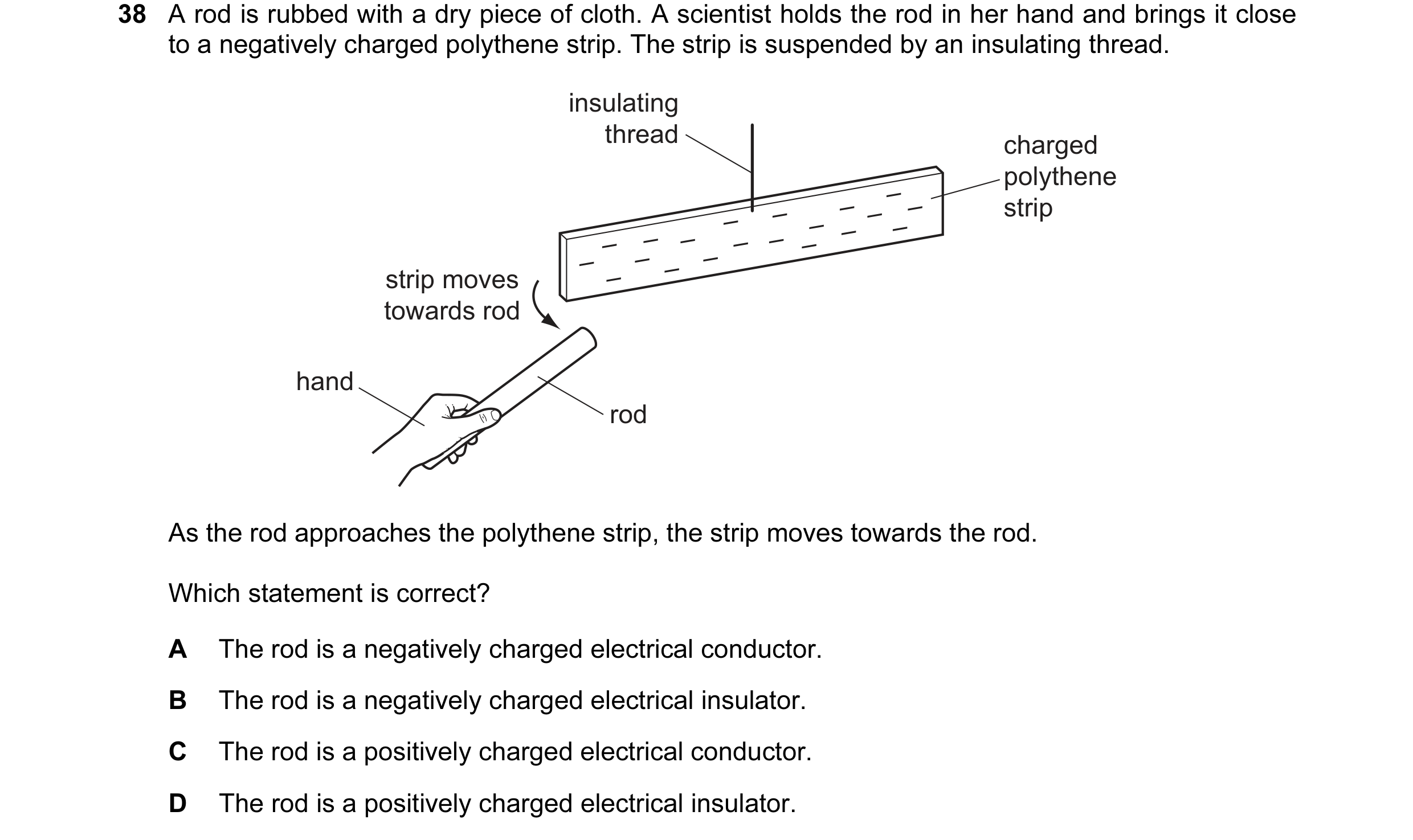
38 A rod is rubbed with a dry piece of cloth. A scientist holds the rod in her hand and brings it close to a negatively charged polythene strip. The strip is suspended by an insulating thread. insulating thread charged polythene – – – – – –– strip – – – – – – – – – – – – strip moves – towards rod hand rod As the rod approaches the polythene strip, the strip moves towards the rod. Which statement is correct? A The rod is a negatively charged electrical conductor. B The rod is a negatively charged electrical insulator. C The rod is a positively charged electrical conductor. D The rod is a positively charged electrical insulator.
1 marks
Answer: D
This question in 0654/12 May/June 2013
Q13 · A bar magnet is brought near a metal rod 0654/13 May/June 2013
39 A bar magnet is brought near a metal rod. magnet metal rod N S The magnet is then turned around so that its poles have changed positions. The magnet is again brought near to the metal rod. In both cases the metal rod is attracted to the magnet. What could the metal rod be? A another bar magnet B a piece of aluminium C a piece of copper D a piece of iron
1 marks
Answer: D
This question in 0654/13 May/June 2013
Q14 · Which diagram shows the magnetic field pattern around a straight wire carrying a current? 0654/11 Oct/Nov 2013
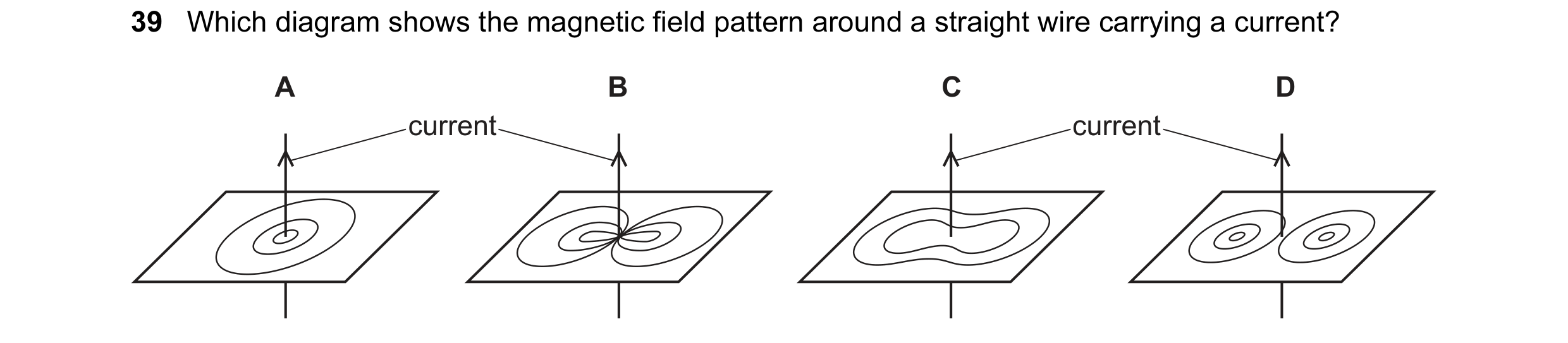
39 Which diagram shows the magnetic field pattern around a straight wire carrying a current? A B C D current current
1 marks
Answer: A
This question in 0654/11 Oct/Nov 2013
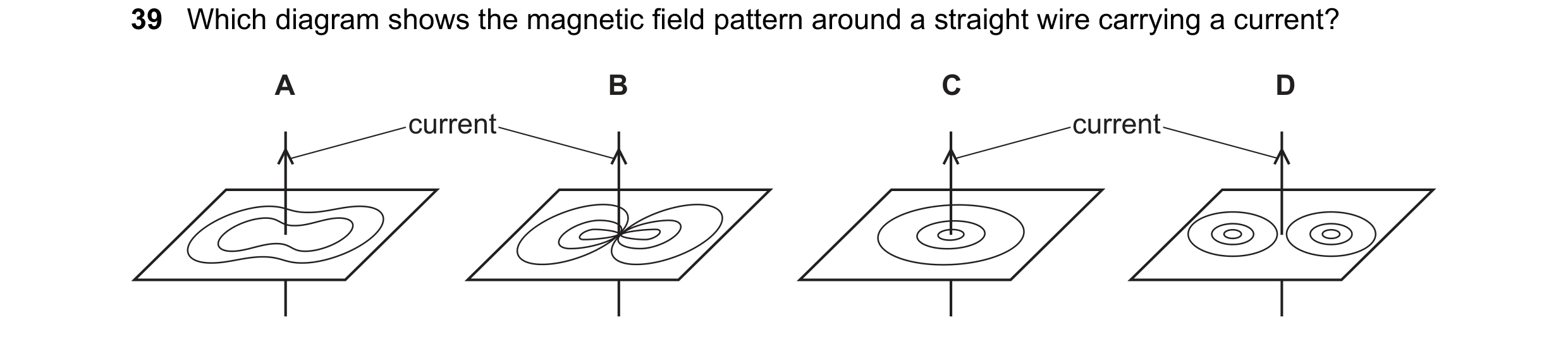
Q15 · Which diagram shows the magnetic field pattern around a straight wire carrying a current? 0654/12 Oct/Nov 2013
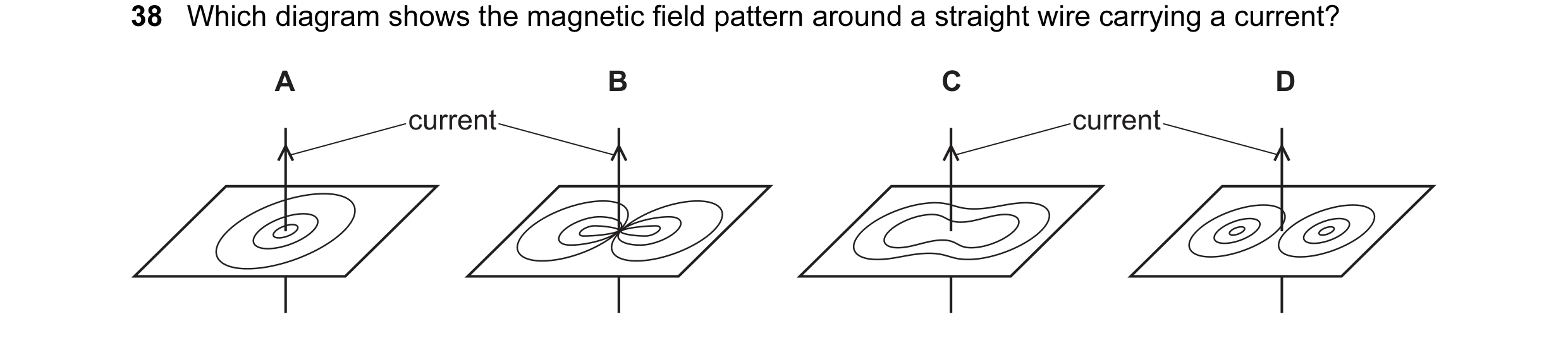
38 Which diagram shows the magnetic field pattern around a straight wire carrying a current? A B C D current current
1 marks
Answer: A
This question in 0654/12 Oct/Nov 2013
Q16 · A student believes that a certain steel bar is a magnet 0654/11 May/June 2014
37 A student believes that a certain steel bar is a magnet. What shows that the bar is a magnet? A The bar attracts a copper rod. B The bar is attracted by one end of another magnet. C The bar is attracted by both ends of another magnet. D The bar is repelled by one end of another magnet.
1 marks
Answer: D
This question in 0654/11 May/June 2014
Q17 · Which diagram shows the pattern of the magnetic field due to a current in a straight wire? 0654/12 May/June 2014
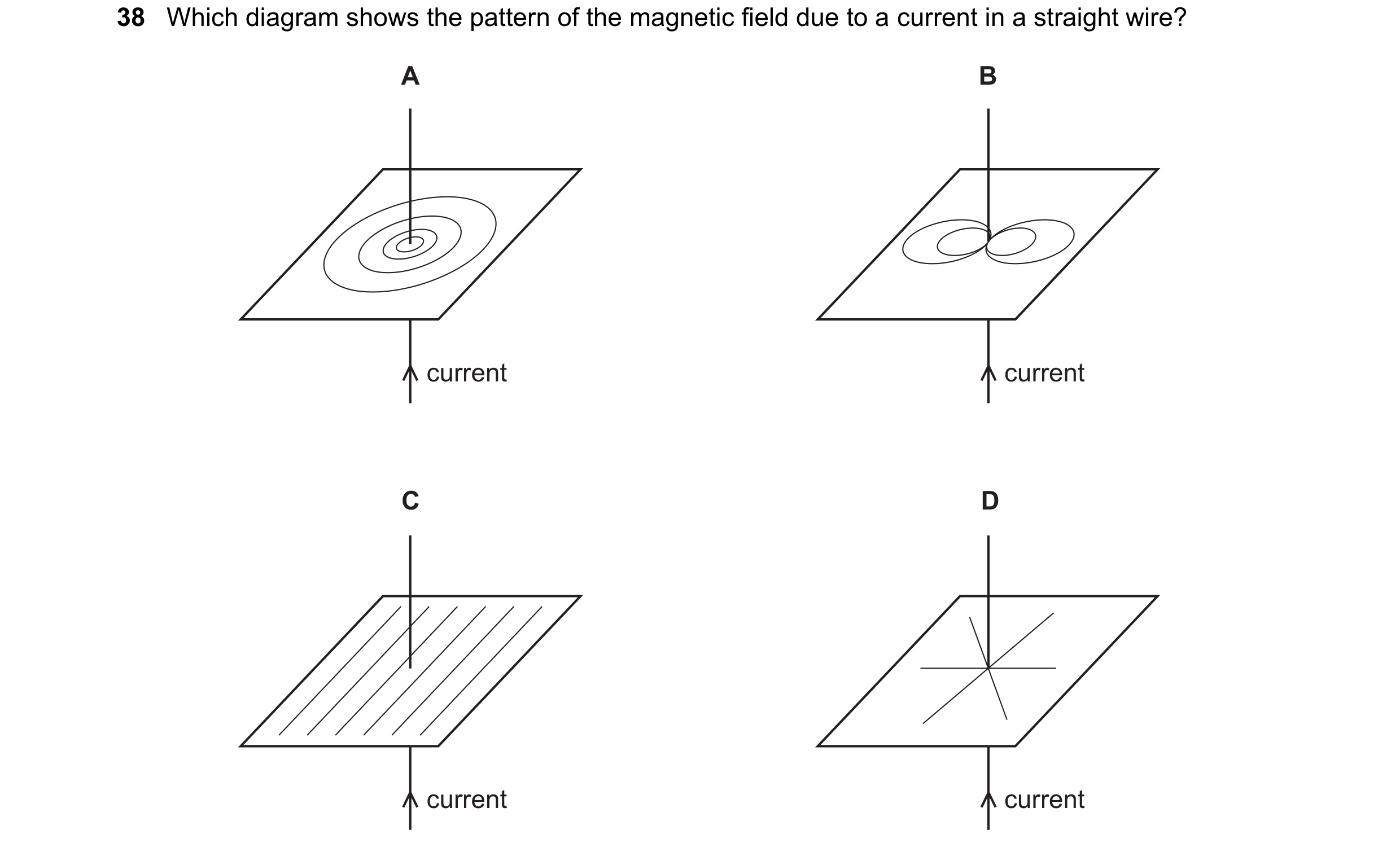
39 Which diagram shows the pattern of the magnetic field due to a current in a straight wire? A B current current C D current current
1 marks
Answer: A
This question in 0654/12 May/June 2014
Q18 · A student believes that a certain steel bar is a magnet 0654/13 May/June 2014
39 A student believes that a certain steel bar is a magnet. What shows that the bar is a magnet? A The bar attracts a copper rod. B The bar is attracted by one end of another magnet. C The bar is attracted by both ends of another magnet. D The bar is repelled by one end of another magnet.
1 marks
Answer: D
This question in 0654/13 May/June 2014
Q19 · Two rods, X and Y, look the same 0654/11 Oct/Nov 2014
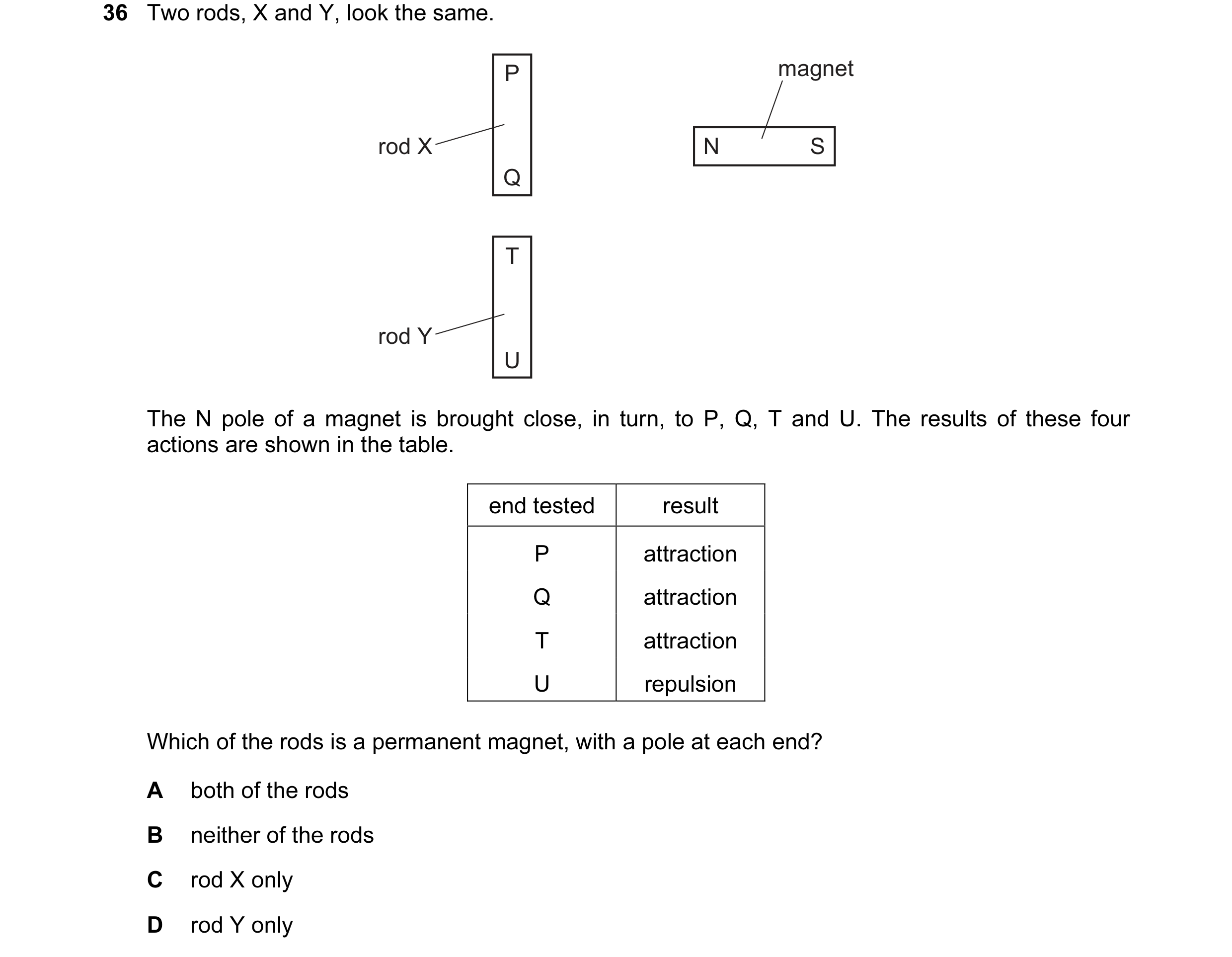
36 Two rods, X and Y, look the same. P magnet rod X N S Q T rod Y U The N pole of a magnet is brought close, in turn, to P, Q, T and U. The results of these four actions are shown in the table. end tested result P attraction Q attraction T attraction U repulsion Which of the rods is a permanent magnet, with a pole at each end? A both of the rods B neither of the rods C rod X only D rod Y only
1 marks
Answer: D
This question in 0654/11 Oct/Nov 2014
Q20 · Two rods, X and Y, look the same 0654/12 Oct/Nov 2014
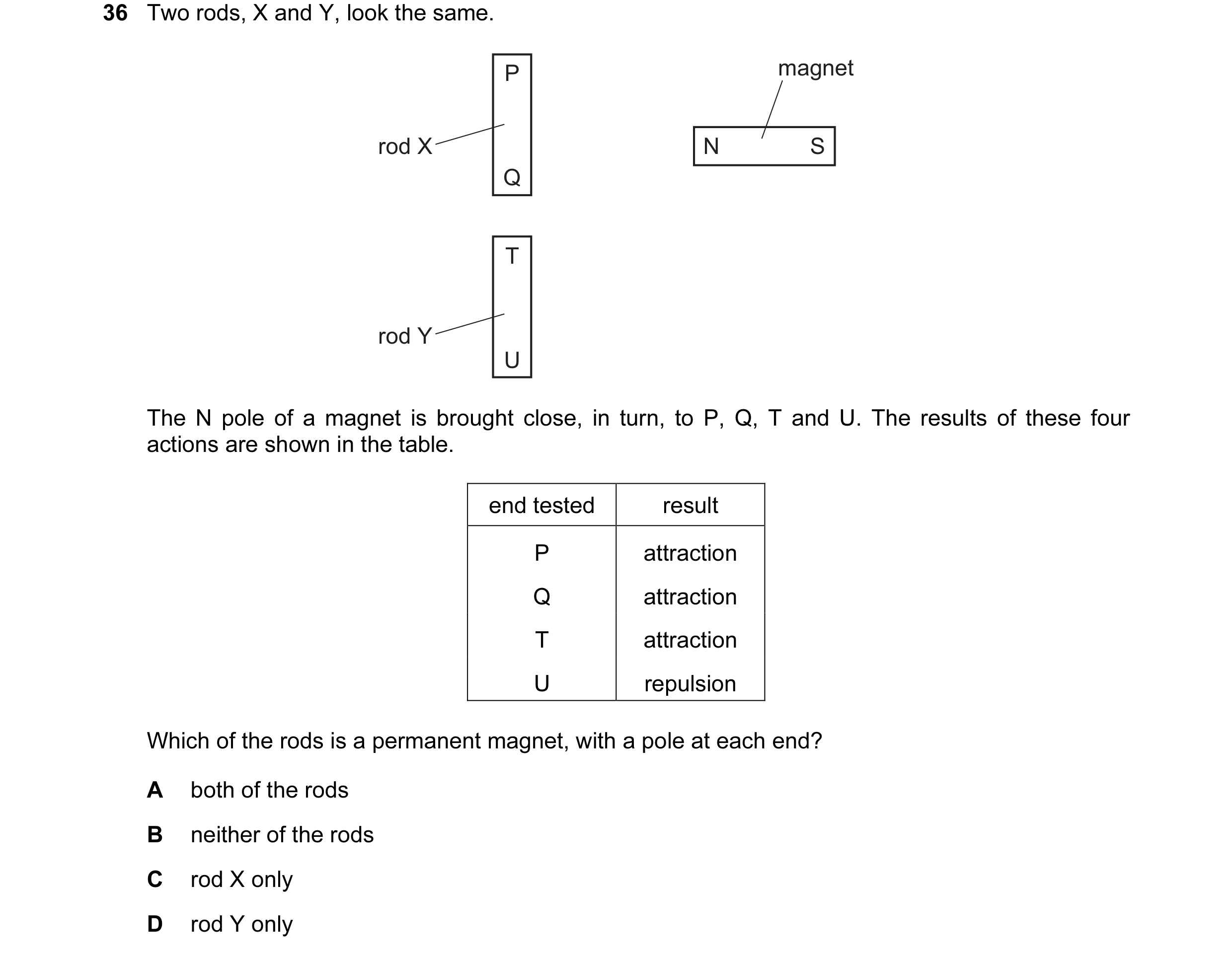
36 Two rods, X and Y, look the same. P magnet rod X N S Q T rod Y U The N pole of a magnet is brought close, in turn, to P, Q, T and U. The results of these four actions are shown in the table. end tested result P attraction Q attraction T attraction U repulsion Which of the rods is a permanent magnet, with a pole at each end? A both of the rods B neither of the rods C rod X only D rod Y only
1 marks
Answer: D
This question in 0654/12 Oct/Nov 2014
Q21 · Two rods, X and Y, look the same 0654/13 Oct/Nov 2014
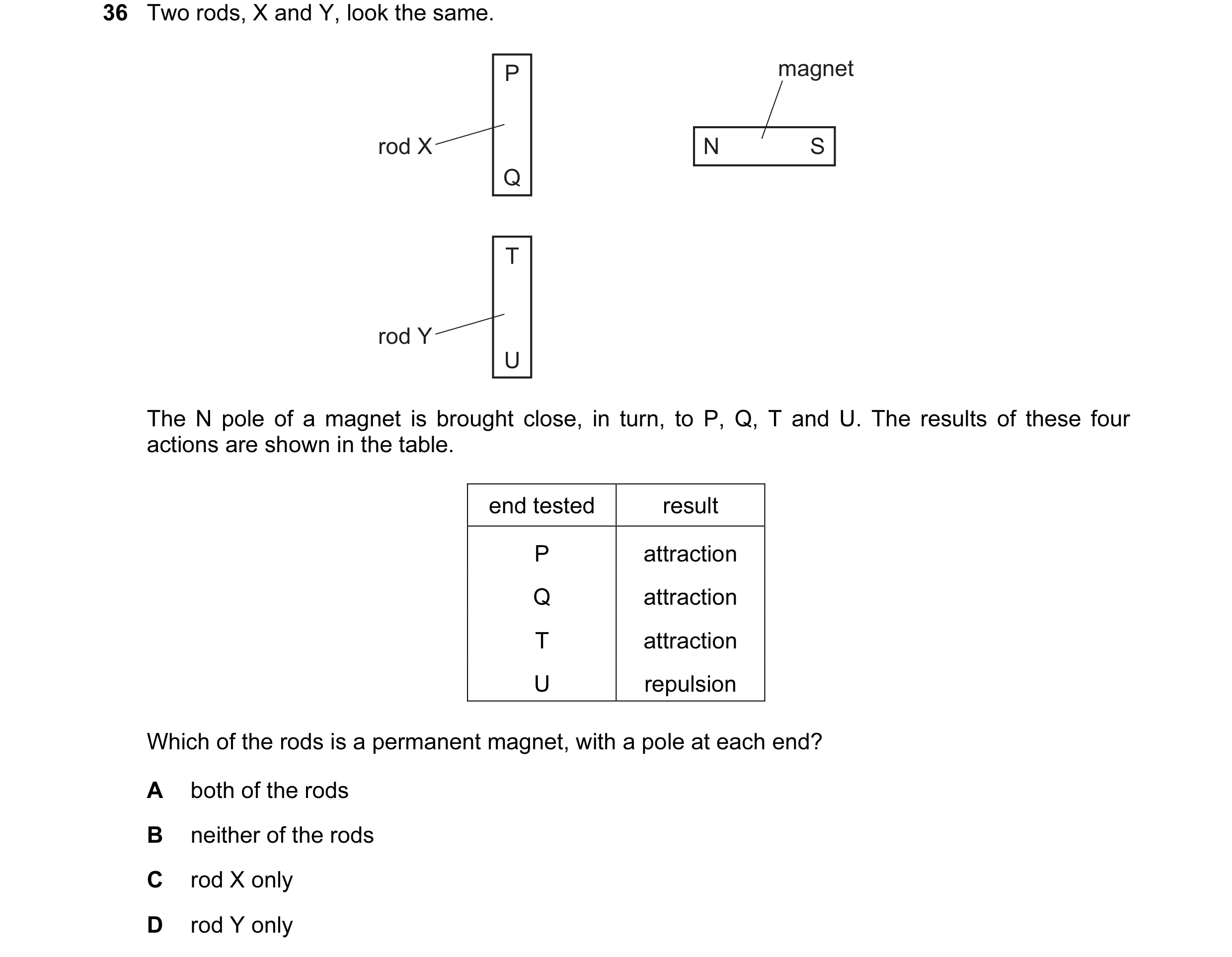
36 Two rods, X and Y, look the same. P magnet rod X N S Q T rod Y U The N pole of a magnet is brought close, in turn, to P, Q, T and U. The results of these four actions are shown in the table. end tested result P attraction Q attraction T attraction U repulsion Which of the rods is a permanent magnet, with a pole at each end? A both of the rods B neither of the rods C rod X only D rod Y only
1 marks
Answer: D
This question in 0654/13 Oct/Nov 2014
Q22 · Four nails A, B, C and D are tested to find which makes the strongest permanent magnet 0654/11 May/June 2015
37 Four nails A, B, C and D are tested to find which makes the strongest permanent magnet. One of the nails is placed against a bar magnet and the number of paper clips which the nail can support is recorded. nail N S bar magnet paper clips The bar magnet is then removed and the number of paper clips remaining attached to the nail is recorded. Each nail is tested in turn. Which nail becomes the strongest permanent magnet? number of paper clips attached to the nail nail bar magnet present bar magnet removed A 2 0 B 2 1 C 4 3 D 5 2
1 marks
Answer: C
This question in 0654/11 May/June 2015
Q23 · A student makes a permanent magnet using a piece of metal and a magnetising coil 0654/12 May/June 2015
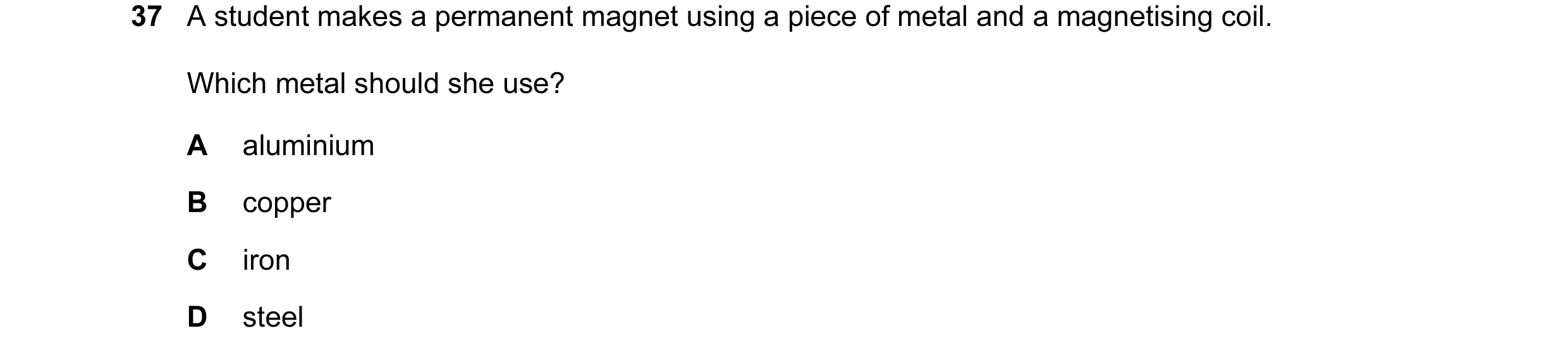
37 A student makes a permanent magnet using a piece of metal and a magnetising coil. Which metal should she use? A aluminium B copper C iron D steel
1 marks
Answer: D
This question in 0654/12 May/June 2015
Q24 · A piece of iron and a piece of steel are attracted to an electromagnet as shown 0654/13 May/June 2015
37 A piece of iron and a piece of steel are attracted to an electromagnet as shown. electromagnet N S iron steel The electromagnet is now switched off. What happens? A Both the iron and the steel remain magnetised. B Neither the iron nor the steel remains magnetised. C Only the iron remains magnetised. D Only the steel remains magnetised.
1 marks
Answer: D
This question in 0654/13 May/June 2015
Q25 · Some electrical devices require a magnet to be switched on and off many times in a second 0654/12 May/June 2016
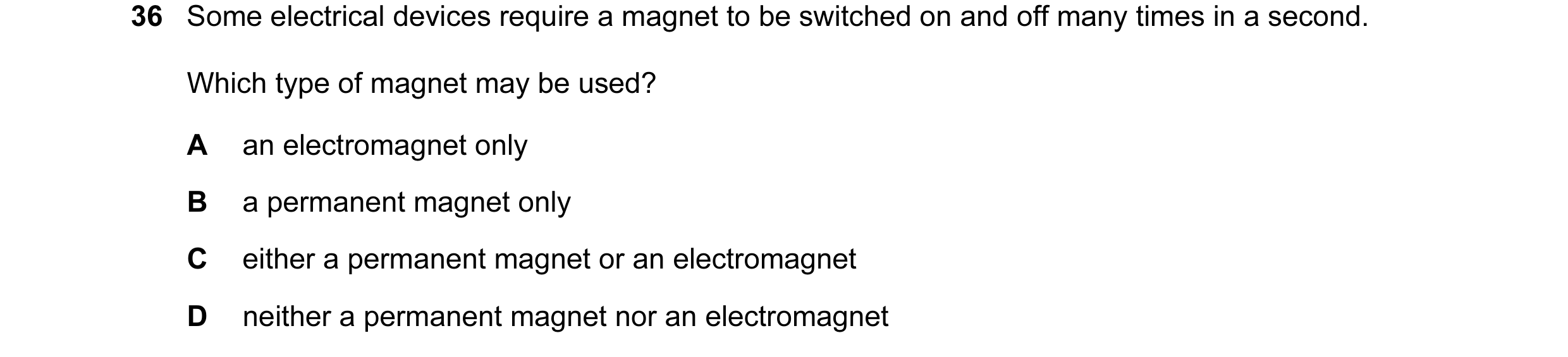
36 Some electrical devices require a magnet to be switched on and off many times in a second. Which type of magnet may be used? A an electromagnet only B a permanent magnet only C either a permanent magnet or an electromagnet D neither a permanent magnet nor an electromagnet
1 marks
Answer: A
This question in 0654/12 May/June 2016
Q26 · The diagram shows an electromagnet attracting an iron bar and a steel bar 0654/13 May/June 2016
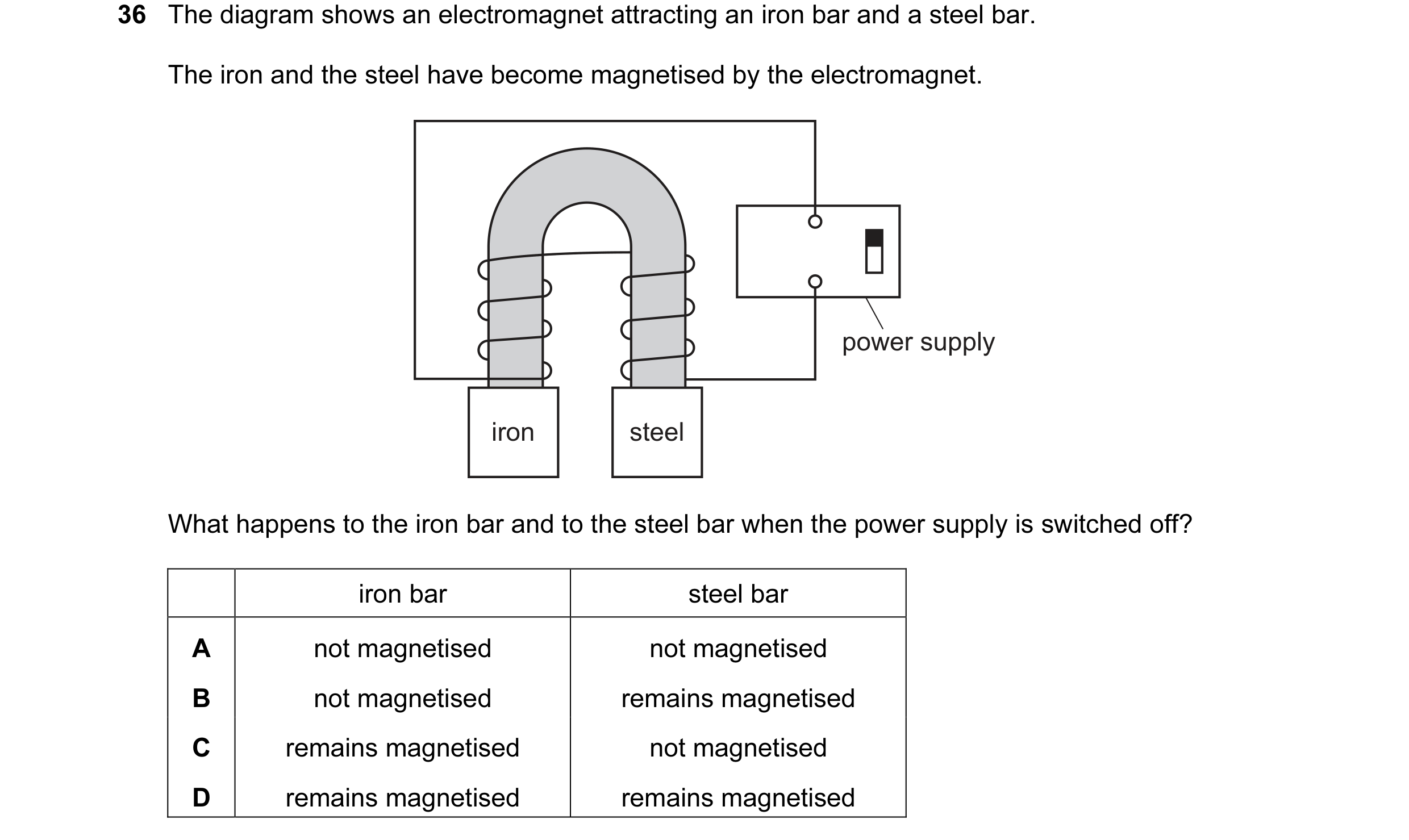
36 The diagram shows an electromagnet attracting an iron bar and a steel bar. The iron and the steel have become magnetised by the electromagnet. power supply iron steel What happens to the iron bar and to the steel bar when the power supply is switched off? iron bar steel bar A not magnetised not magnetised B not magnetised remains magnetised C remains magnetised not magnetised D remains magnetised remains magnetised
1 marks
Answer: B
This question in 0654/13 May/June 2016
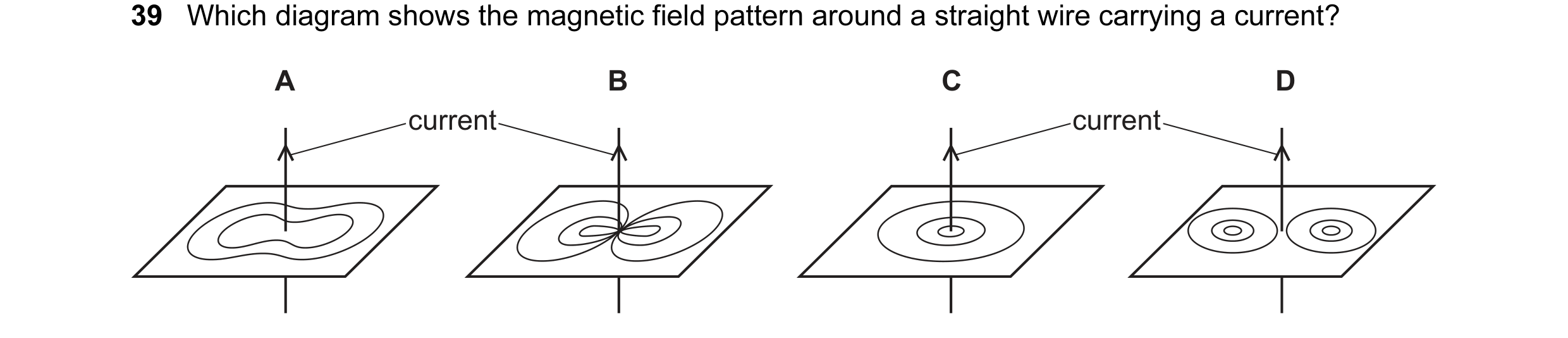
Q27 · Which diagram shows the magnetic field pattern around a straight wire carrying a current? 0654/11 Oct/Nov 2016
39 Which diagram shows the magnetic field pattern around a straight wire carrying a current? A B C D current current
1 marks
Answer: C
This question in 0654/11 Oct/Nov 2016
Q28 · Which diagram shows the magnetic field pattern around a straight wire carrying a current? 0654/12 Oct/Nov 2016
39 Which diagram shows the magnetic field pattern around a straight wire carrying a current? A B C D current current
1 marks
Answer: C
This question in 0654/12 Oct/Nov 2016
Q29 · Which diagram shows the magnetic field pattern around a straight wire carrying a current? 0654/13 Oct/Nov 2016
39 Which diagram shows the magnetic field pattern around a straight wire carrying a current? A B C D current current
1 marks
Answer: C
This question in 0654/13 Oct/Nov 2016
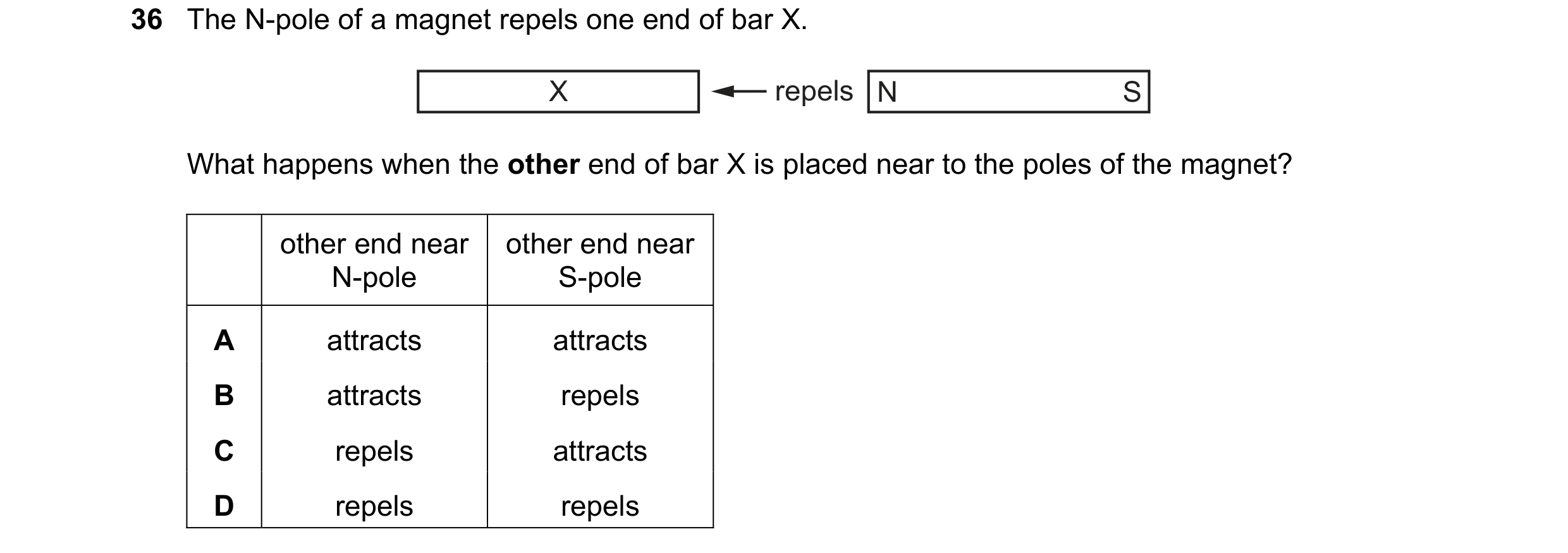
Q30 · The N-pole of a magnet repels one end of bar X 0654/11 May/June 2017
36 The N-pole of a magnet repels one end of bar X. X repels N S What happens when the other end of bar X is placed near to the poles of the magnet? other end near other end near N-pole S-pole A attracts attracts B attracts repels C repels attracts D repels repels
1 marks
Answer: B
This question in 0654/11 May/June 2017
Q31 · Which material is used for the core of an electromagnet? 0654/12 May/June 2017
37 Which material is used for the core of an electromagnet? A aluminium B copper C iron D steel
1 marks
Answer: C
This question in 0654/12 May/June 2017
Q32 · A student makes an electromagnet with a steel core 0654/13 May/June 2017
36 A student makes an electromagnet with a steel core. The electromagnet does not work well. Which problem with the electromagnet is caused by using a steel core? A It does not become magnetised at all. B It has the same type of magnetic pole at each end. C It remains magnetised when it is switched off. D It repels unmagnetised magnetic materials.
1 marks
Answer: C
This question in 0654/13 May/June 2017
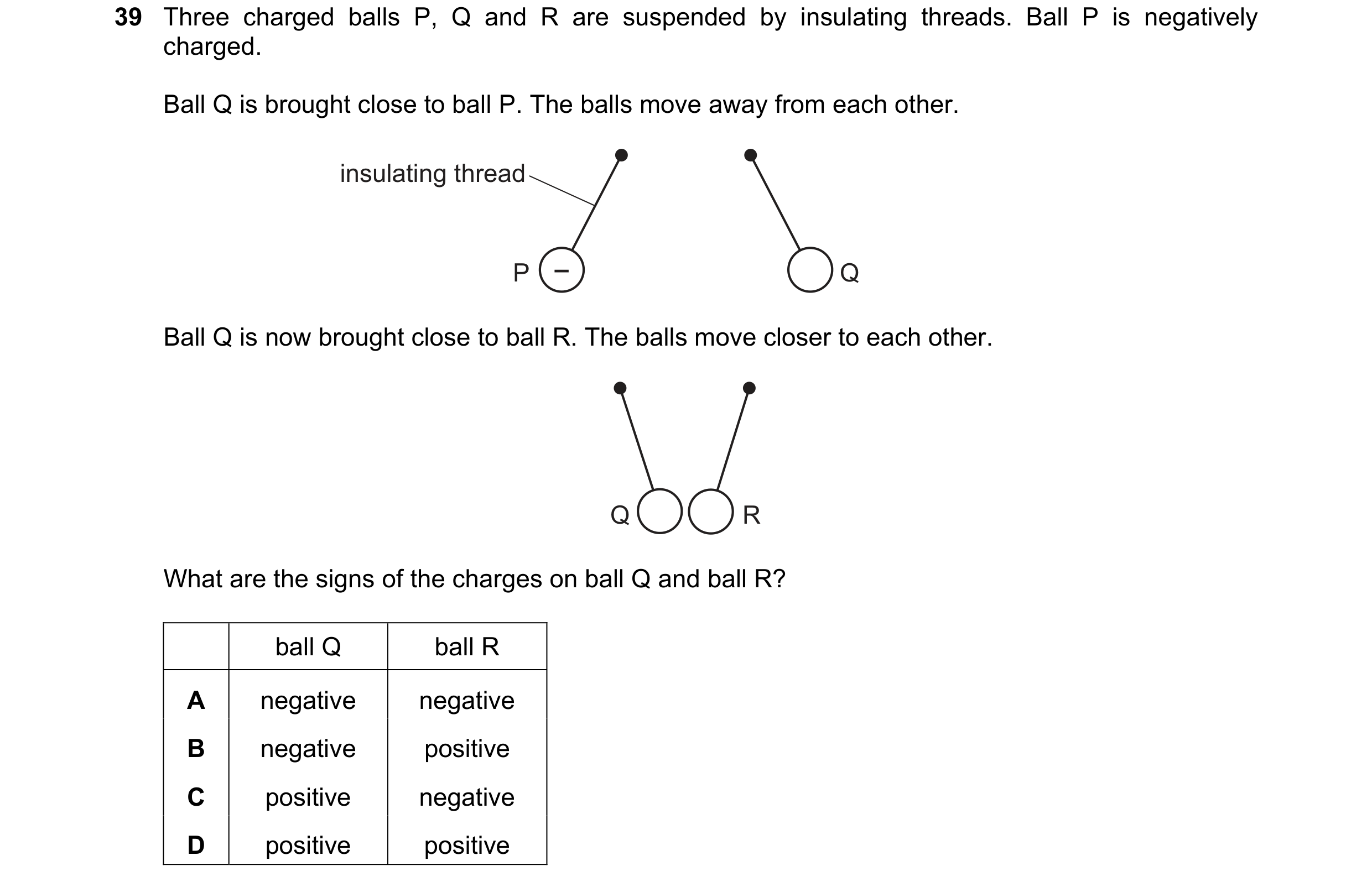
Q33 · Three charged balls P, Q and R are suspended by insulating threads 0654/11 Oct/Nov 2017
39 Three charged balls P, Q and R are suspended by insulating threads. Ball P is negatively charged. Ball Q is brought close to ball P. The balls move away from each other. insulating thread P – Q Ball Q is now brought close to ball R. The balls move closer to each other. Q R What are the signs of the charges on ball Q and ball R? ball Q ball R A negative negative B negative positive C positive negative D positive positive
1 marks
Answer: B
This question in 0654/11 Oct/Nov 2017
Q34 · Three charged balls P, Q and R are suspended by insulating threads 0654/12 Oct/Nov 2017
39 Three charged balls P, Q and R are suspended by insulating threads. Ball P is negatively charged. Ball Q is brought close to ball P. The balls move away from each other. insulating thread P – Q Ball Q is now brought close to ball R. The balls move closer to each other. Q R What are the signs of the charges on ball Q and ball R? ball Q ball R A negative negative B negative positive C positive negative D positive positive
1 marks
Answer: B
This question in 0654/12 Oct/Nov 2017
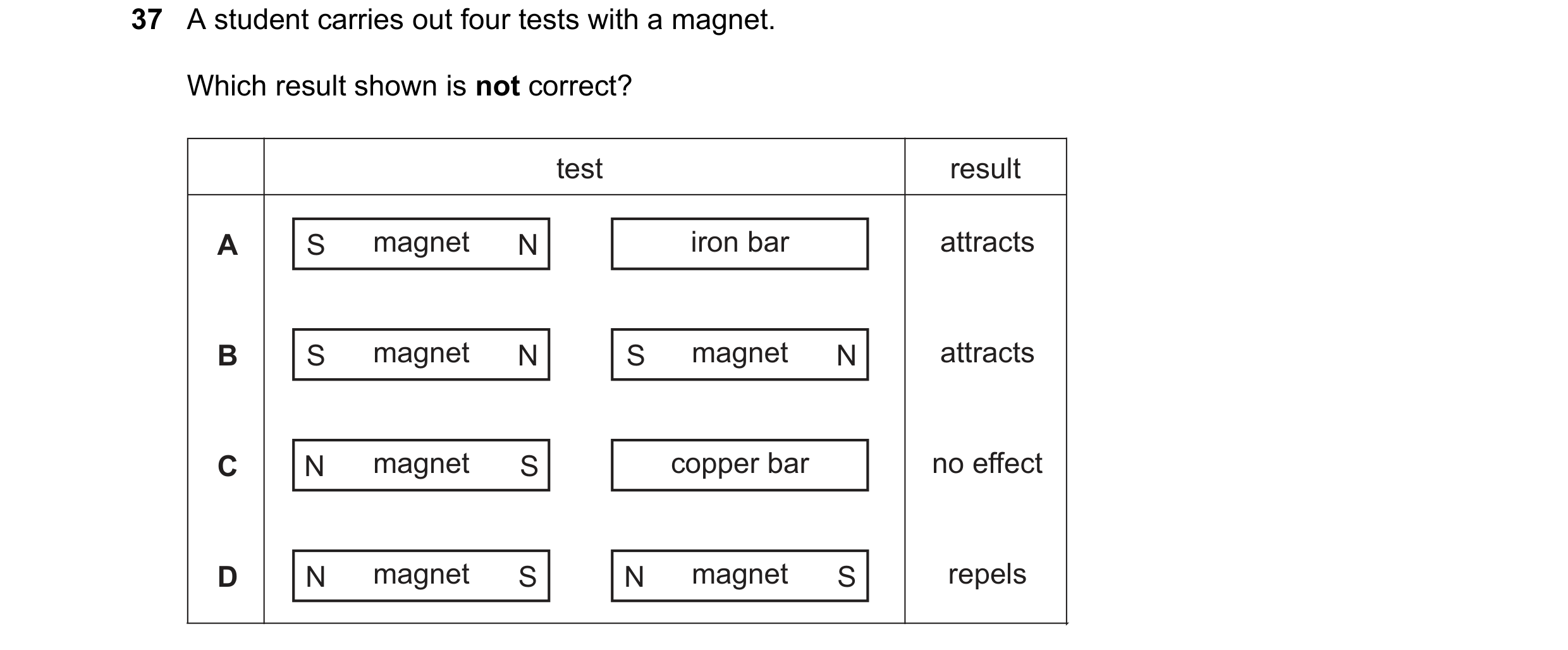
Q35 · A student carries out four tests with a magnet 0654/13 Oct/Nov 2017
37 A student carries out four tests with a magnet. Which result shown is not correct? test result A S magnet N iron bar attracts B S magnet N S magnet N attracts C N magnet S copper bar no effect D N magnet S N magnet S repels
1 marks
Answer: D
This question in 0654/13 Oct/Nov 2017
Q36 · Three charged balls P, Q and R are suspended by insulating threads 0654/13 Oct/Nov 2017
38 Three charged balls P, Q and R are suspended by insulating threads. Ball P is negatively charged. Ball Q is brought close to ball P. The balls move away from each other. insulating thread P – Q Ball Q is now brought close to ball R. The balls move closer to each other. Q R What are the signs of the charges on ball Q and ball R? ball Q ball R A negative negative B negative positive C positive negative D positive positive
1 marks
Answer: B
This question in 0654/13 Oct/Nov 2017
Q37 · Parts of an old car are being recycled 0654/11 Oct/Nov 2018
37 Parts of an old car are being recycled. An electromagnet is used to lift some parts of the car. Which parts of the car are lifted using an electromagnet? A the aluminium engine block B the plastic interior fittings C the rubber tyres D the steel body parts
1 marks
Answer: D
This question in 0654/11 Oct/Nov 2018
Q38 · An electromagnet has a metal core 0654/12 Oct/Nov 2018
37 An electromagnet has a metal core. Which metal is used and why? A iron because it becomes a permanent magnet B iron because it does not become a permanent magnet C steel because it becomes a permanent magnet D steel because it does not become a permanent magnet
1 marks
Answer: B
This question in 0654/12 Oct/Nov 2018
Q39 · Which diagram shows the pattern of the magnetic field around a straight wire carrying a… 0654/12 Oct/Nov 2018
40 Which diagram shows the pattern of the magnetic field around a straight wire carrying a current? A B current current C D current current
1 marks
Answer: A
This question in 0654/12 Oct/Nov 2018
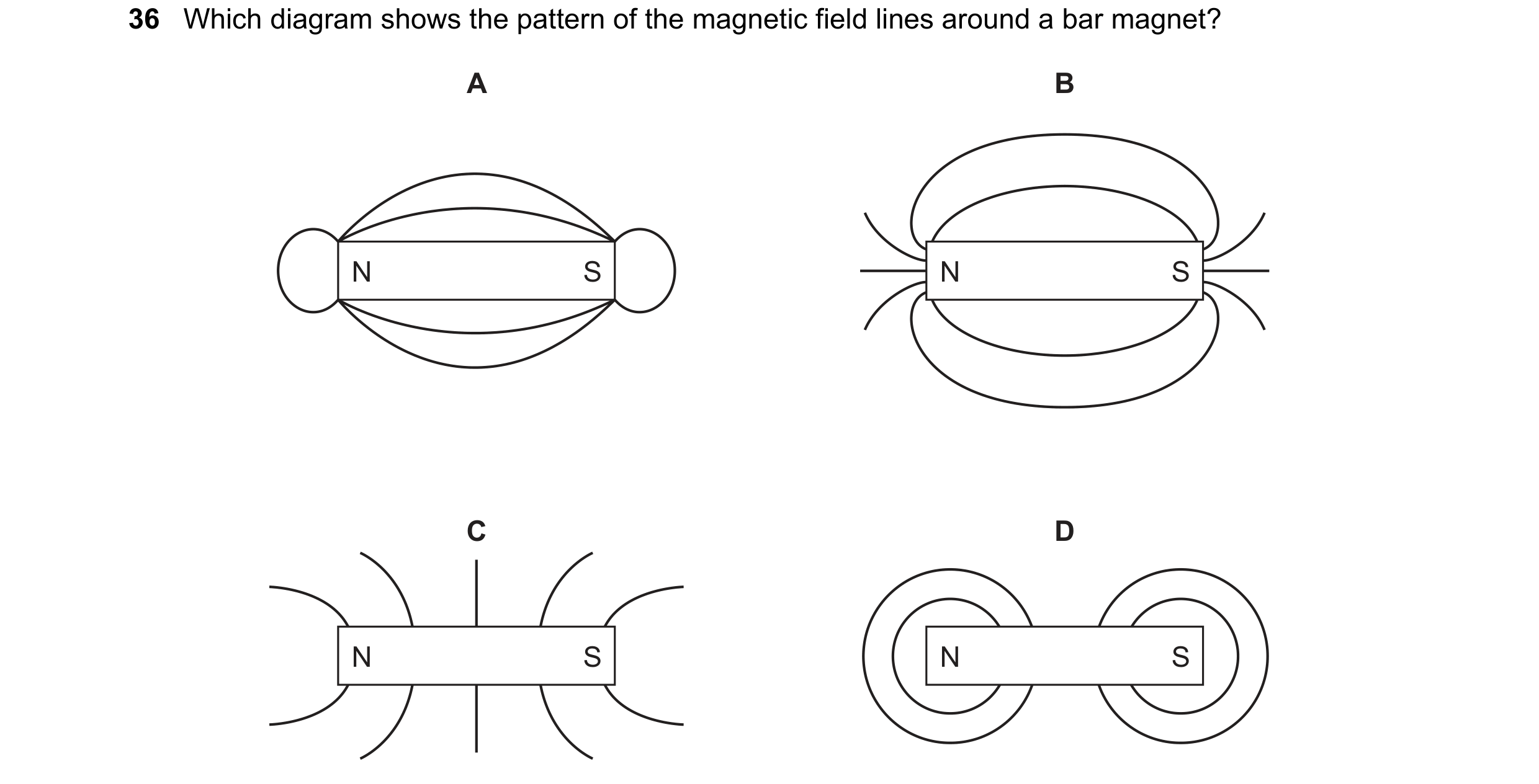
Q40 · Which diagram shows the pattern of the magnetic field lines around a bar magnet? 0654/13 Oct/Nov 2018
36 Which diagram shows the pattern of the magnetic field lines around a bar magnet? A B N S N S C D N S N S
1 marks
Answer: B
This question in 0654/13 Oct/Nov 2018
Q41 · The diagram shows an electromagnet 0654/11 May/June 2019
35 The diagram shows an electromagnet. core Which metal is used for the core of the electromagnet and why? metal reason A iron it becomes a permanent magnet B iron it is easily magnetised C steel it becomes a permanent magnet D steel it is easily magnetised
1 marks
Answer: B
This question in 0654/11 May/June 2019
Q42 · Which statement about the core of an electromagnet is correct? 0654/12 May/June 2019
35 Which statement about the core of an electromagnet is correct? A It is made of soft iron because soft iron is easy to magnetise. B It is made of soft iron because soft iron does not lose its magnetism easily. C It is made of steel because steel is easy to magnetise. D It is made of steel because steel loses its magnetism easily.
1 marks
Answer: A
This question in 0654/12 May/June 2019
Q43 · Which statement about the core of an electromagnet is correct? 0654/13 May/June 2019
35 Which statement about the core of an electromagnet is correct? A It is made of soft iron because soft iron is easy to magnetise. B It is made of soft iron because soft iron does not lose its magnetism easily. C It is made of steel because steel is easy to magnetise. D It is made of steel because steel loses its magnetism easily.
1 marks
Answer: A
This question in 0654/13 May/June 2019
Q44 · There is a current-carrying wire perpendicular to the page 0654/13 Oct/Nov 2019
38 There is a current-carrying wire perpendicular to the page. The direction of the current is into the page. Which diagram shows the pattern and direction of the magnetic field around the wire? A B current current into page into page C D current current into page into page
1 marks
Answer: A
This question in 0654/13 Oct/Nov 2019
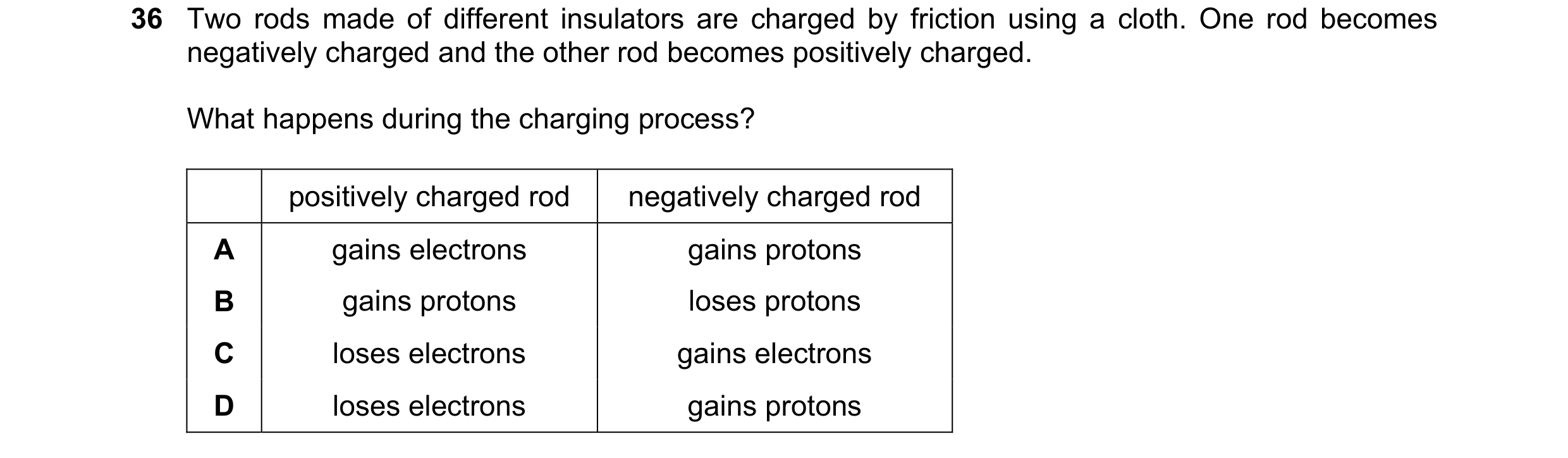
Q45 · Two rods made of different insulators are charged by friction using a cloth 0654/12 May/June 2020
36 Two rods made of different insulators are charged by friction using a cloth. One rod becomes negatively charged and the other rod becomes positively charged. What happens during the charging process? positively charged rod negatively charged rod A gains electrons gains protons B gains protons loses protons C loses electrons gains electrons D loses electrons gains protons
1 marks
Answer: C
This question in 0654/12 May/June 2020
Q46 · A current-carrying wire passes through a flat card 0654/13 May/June 2020
38 A current-carrying wire passes through a flat card. The arrow on each wire shows the direction of the current. Which diagram shows the pattern of the magnetic field on the card and the direction of the magnetic field lines? A B wire wire current current card card C D wire wire current current card card
1 marks
Answer: D
This question in 0654/13 May/June 2020
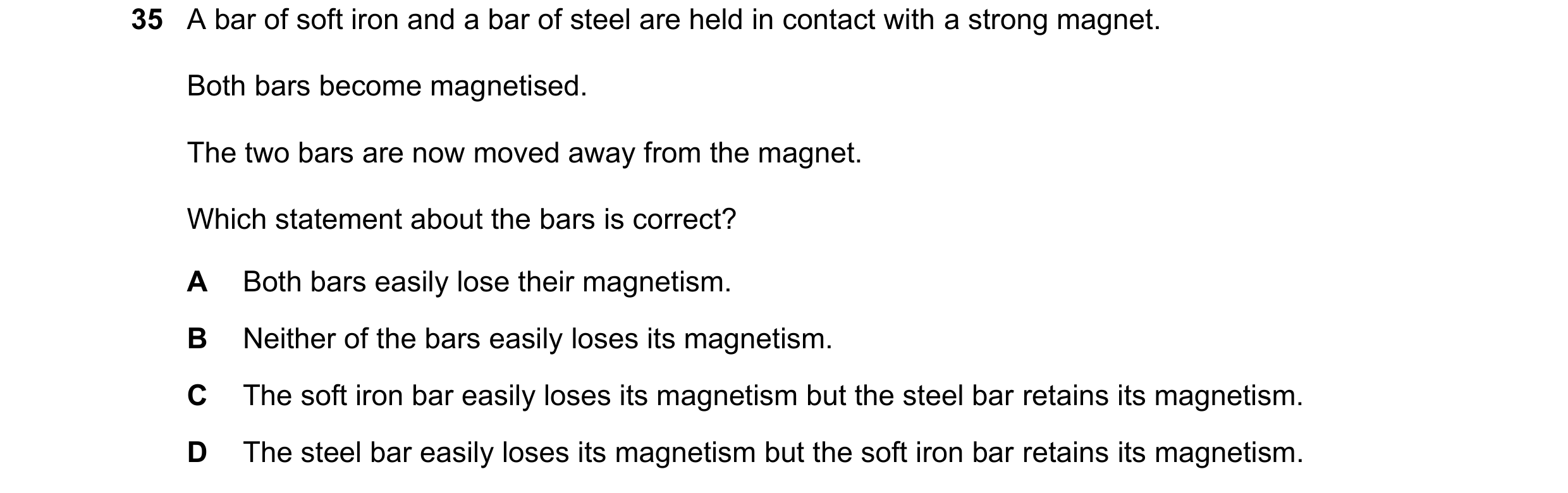
Q47 · A bar of soft iron and a bar of steel are held in contact with a strong magnet 0654/11 Oct/Nov 2020
35 A bar of soft iron and a bar of steel are held in contact with a strong magnet. Both bars become magnetised. The two bars are now moved away from the magnet. Which statement about the bars is correct? A Both bars easily lose their magnetism. B Neither of the bars easily loses its magnetism. C The soft iron bar easily loses its magnetism but the steel bar retains its magnetism. D The steel bar easily loses its magnetism but the soft iron bar retains its magnetism.
1 marks
Answer: C
This question in 0654/11 Oct/Nov 2020
Q48 · A solenoid carrying a current produces a magnetic field 0654/12 Oct/Nov 2020
38 A solenoid carrying a current produces a magnetic field. Which diagram shows the magnetic field pattern? A B current current C D current current
1 marks
Answer: D
This question in 0654/12 Oct/Nov 2020
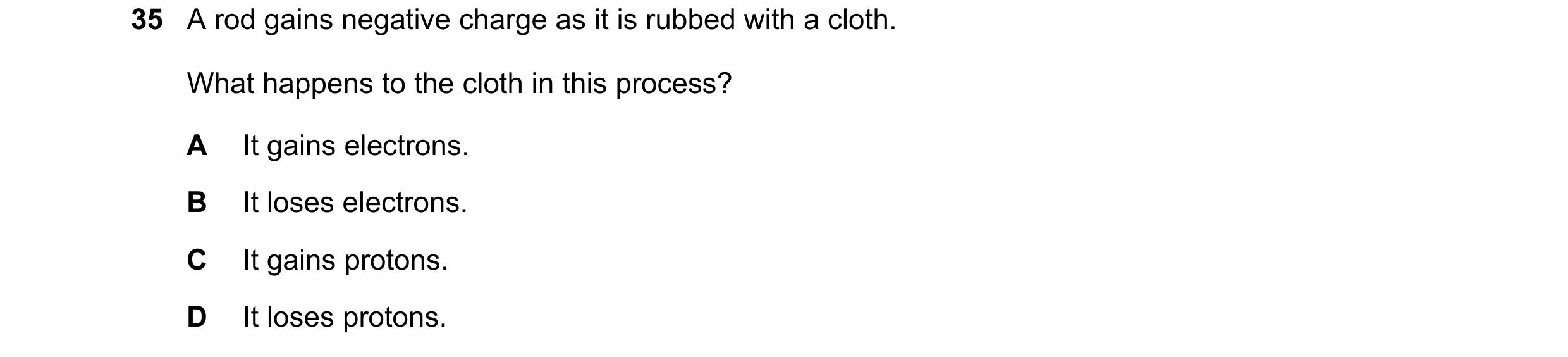
Q49 · A rod gains negative charge as it is rubbed with a cloth 0654/13 Oct/Nov 2020
35 A rod gains negative charge as it is rubbed with a cloth. What happens to the cloth in this process? A It gains electrons. B It loses electrons. C It gains protons. D It loses protons.
1 marks
Answer: B
This question in 0654/13 Oct/Nov 2020
Q50 · Which diagram shows the pattern of the magnetic field due to a current in a straight wire? 0654/12 Feb/March 2021
38 Which diagram shows the pattern of the magnetic field due to a current in a straight wire? A B current current C D current current
1 marks
Answer: A
This question in 0654/12 Feb/March 2021
Q51 · The diagrams each show a wire carrying a current in the direction of the arrow 0654/11 May/June 2021
39 The diagrams each show a wire carrying a current in the direction of the arrow. Which diagram shows the pattern and the direction of the magnetic field around the wire? A B current current C D current current
1 marks
Answer: C
This question in 0654/11 May/June 2021
Q52 · A rod is rubbed with a dry piece of cloth 0654/11 Oct/Nov 2021
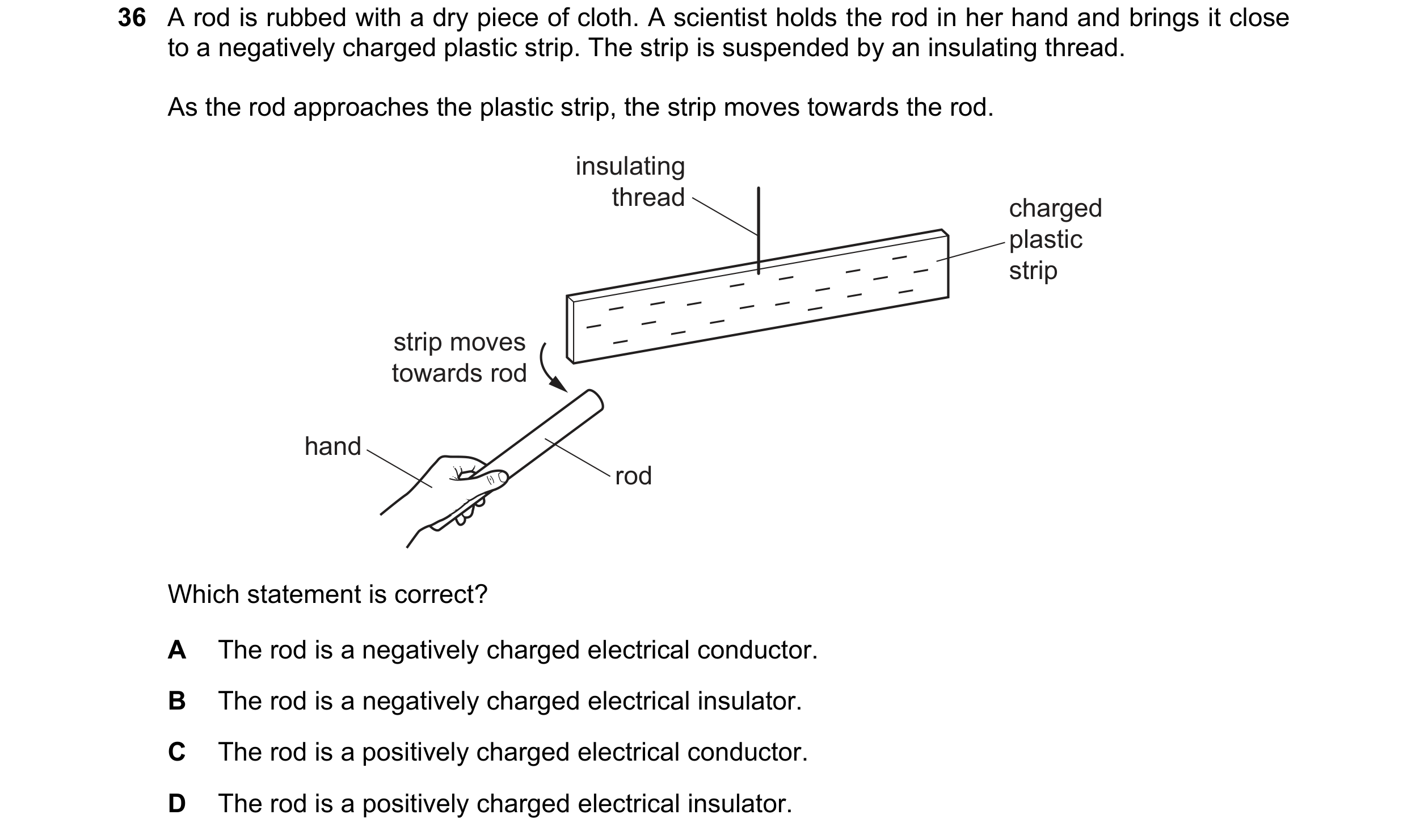
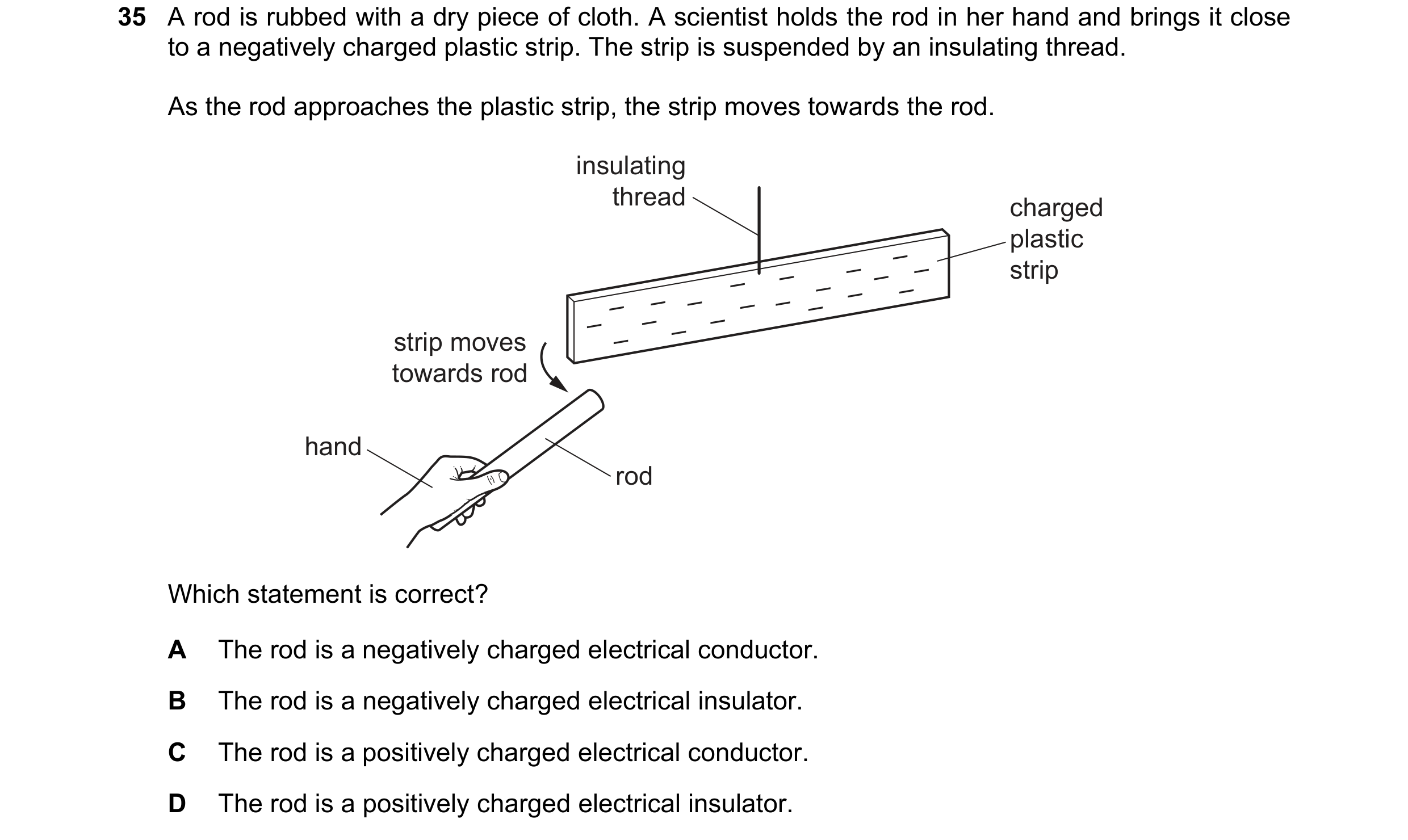
36 A rod is rubbed with a dry piece of cloth. A scientist holds the rod in her hand and brings it close to a negatively charged plastic strip. The strip is suspended by an insulating thread. As the rod approaches the plastic strip, the strip moves towards the rod. insulating thread charged plastic – – – – – –– strip – – – – – – – – – – – – strip moves – towards rod hand rod Which statement is correct? A The rod is a negatively charged electrical conductor. B The rod is a negatively charged electrical insulator. C The rod is a positively charged electrical conductor. D The rod is a positively charged electrical insulator.
1 marks
Answer: D
This question in 0654/11 Oct/Nov 2021
Q53 · The diagrams P, Q, R and S show four pairs of bar magnets 0654/12 Oct/Nov 2021
34 The diagrams P, Q, R and S show four pairs of bar magnets. P Q N S N S N S S N R S N S S N N S N S For which two pairs of magnets is there a force of attraction between the magnets? A P and Q B Q and R C R and S D P and S
1 marks
Answer: A
This question in 0654/12 Oct/Nov 2021
Q54 · A rod is rubbed with a dry piece of cloth 0654/12 Oct/Nov 2021
35 A rod is rubbed with a dry piece of cloth. A scientist holds the rod in her hand and brings it close to a negatively charged plastic strip. The strip is suspended by an insulating thread. As the rod approaches the plastic strip, the strip moves towards the rod. insulating thread charged plastic – – – – – –– strip – – – – – – – – – – – – strip moves – towards rod hand rod Which statement is correct? A The rod is a negatively charged electrical conductor. B The rod is a negatively charged electrical insulator. C The rod is a positively charged electrical conductor. D The rod is a positively charged electrical insulator.
1 marks
Answer: D
This question in 0654/12 Oct/Nov 2021
Q55 · A rod is rubbed with a dry piece of cloth 0654/13 Oct/Nov 2021
35 A rod is rubbed with a dry piece of cloth. A scientist holds the rod in her hand and brings it close to a negatively charged plastic strip. The strip is suspended by an insulating thread. As the rod approaches the plastic strip, the strip moves towards the rod. insulating thread charged plastic – – – – – –– strip – – – – – – – – – – – – strip moves – towards rod hand rod Which statement is correct? A The rod is a negatively charged electrical conductor. B The rod is a negatively charged electrical insulator. C The rod is a positively charged electrical conductor. D The rod is a positively charged electrical insulator.
1 marks
Answer: D
This question in 0654/13 Oct/Nov 2021
Q56 · A plastic rod is rubbed with a cloth and the rod becomes positively charged 0654/11 May/June 2022
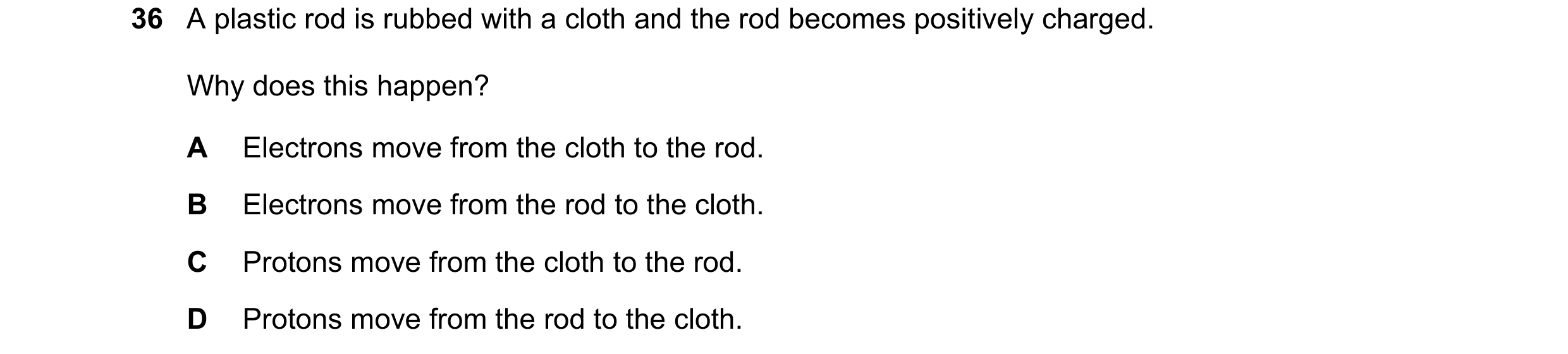
36 A plastic rod is rubbed with a cloth and the rod becomes positively charged. Why does this happen? A Electrons move from the cloth to the rod. B Electrons move from the rod to the cloth. C Protons move from the cloth to the rod. D Protons move from the rod to the cloth.
1 marks
Answer: B
This question in 0654/11 May/June 2022
Q57 · A student rubs a balloon against her hair 0654/12 May/June 2022
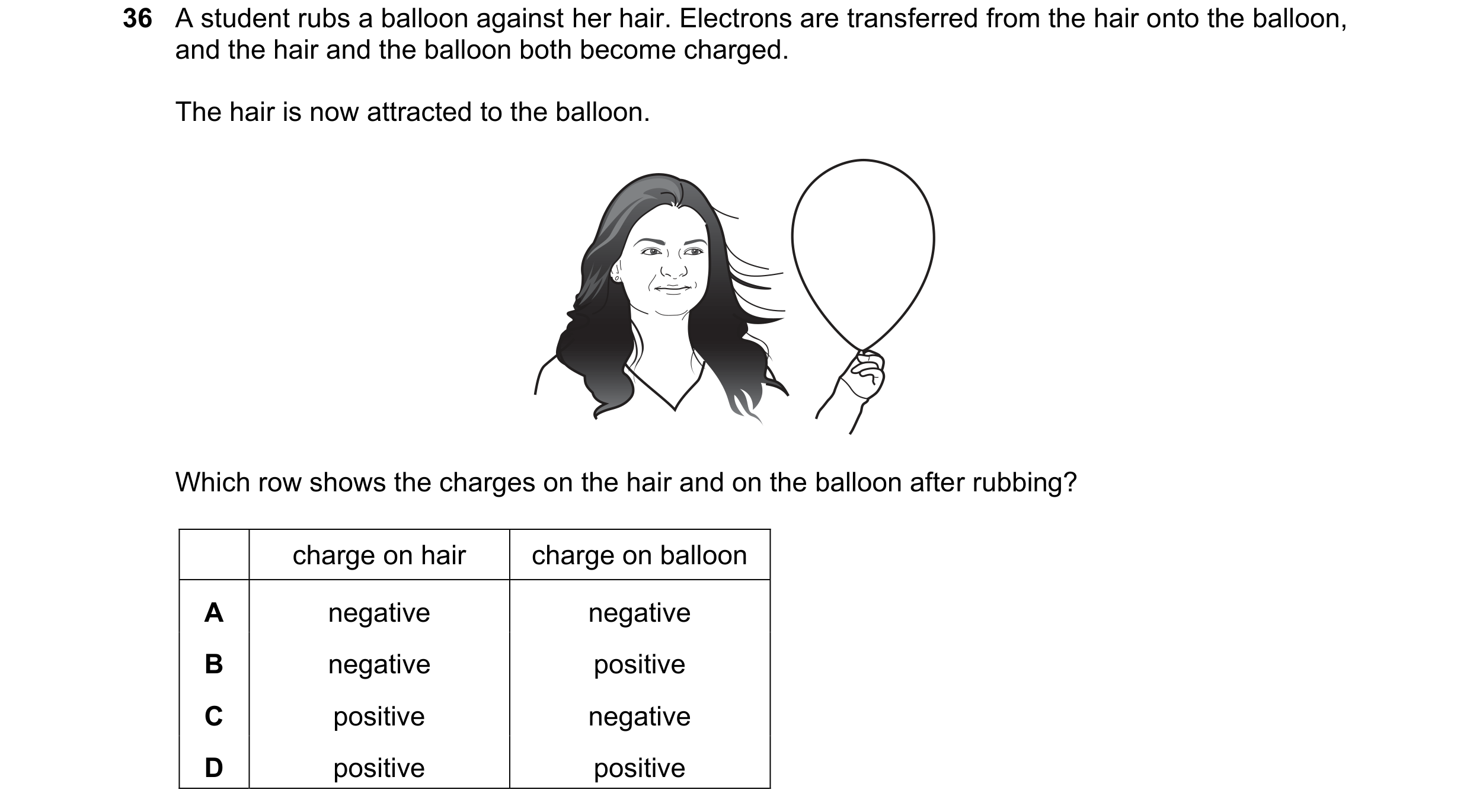
36 A student rubs a balloon against her hair. Electrons are transferred from the hair onto the balloon, and the hair and the balloon both become charged. The hair is now attracted to the balloon. Which row shows the charges on the hair and on the balloon after rubbing? charge on hair charge on balloon A negative negative B negative positive C positive negative D positive positive
1 marks
Answer: C
This question in 0654/12 May/June 2022
Q58 · A student rubs a balloon against her hair 0654/13 May/June 2022
36 A student rubs a balloon against her hair. Electrons are transferred from the hair onto the balloon, and the hair and the balloon both become charged. The hair is now attracted to the balloon. Which row shows the charges on the hair and on the balloon after rubbing? charge on hair charge on balloon A negative negative B negative positive C positive negative D positive positive
1 marks
Answer: C
This question in 0654/13 May/June 2022
Q59 · Which type of magnet can be switched on and off many times per second? 0654/11 Oct/Nov 2022
36 Which type of magnet can be switched on and off many times per second? A an electromagnet only B a permanent magnet only C both electromagnets and permanent magnets D neither electromagnets or permanent magnets
1 marks
Answer: A
This question in 0654/11 Oct/Nov 2022
Q60 · Which type of magnet can be switched on and off many times per second? 0654/12 Oct/Nov 2022
36 Which type of magnet can be switched on and off many times per second? A an electromagnet only B a permanent magnet only C both electromagnets and permanent magnets D neither electromagnets or permanent magnets
1 marks
Answer: A
This question in 0654/12 Oct/Nov 2022
Q61 · A plastic rod is rubbed with a cloth causing a negative charge on the rod 0654/12 Oct/Nov 2022
37 A plastic rod is rubbed with a cloth causing a negative charge on the rod. Which statements are correct? 1 The rod gains electrons. 2 The cloth loses electrons. 3 The cloth becomes positively charged. A 1 and 2 only B 1 and 3 only C 2 and 3 only D 1, 2 and 3
1 marks
Answer: D
This question in 0654/12 Oct/Nov 2022
Q62 · Which type of magnet can be switched on and off many times per second? 0654/13 Oct/Nov 2022
35 Which type of magnet can be switched on and off many times per second? A an electromagnet only B a permanent magnet only C both electromagnets and permanent magnets D neither electromagnets or permanent magnets
1 marks
Answer: A
This question in 0654/13 Oct/Nov 2022
Q63 · Which diagram shows the pattern and direction of the magnetic field near the S pole of a… 0654/12 Feb/March 2023
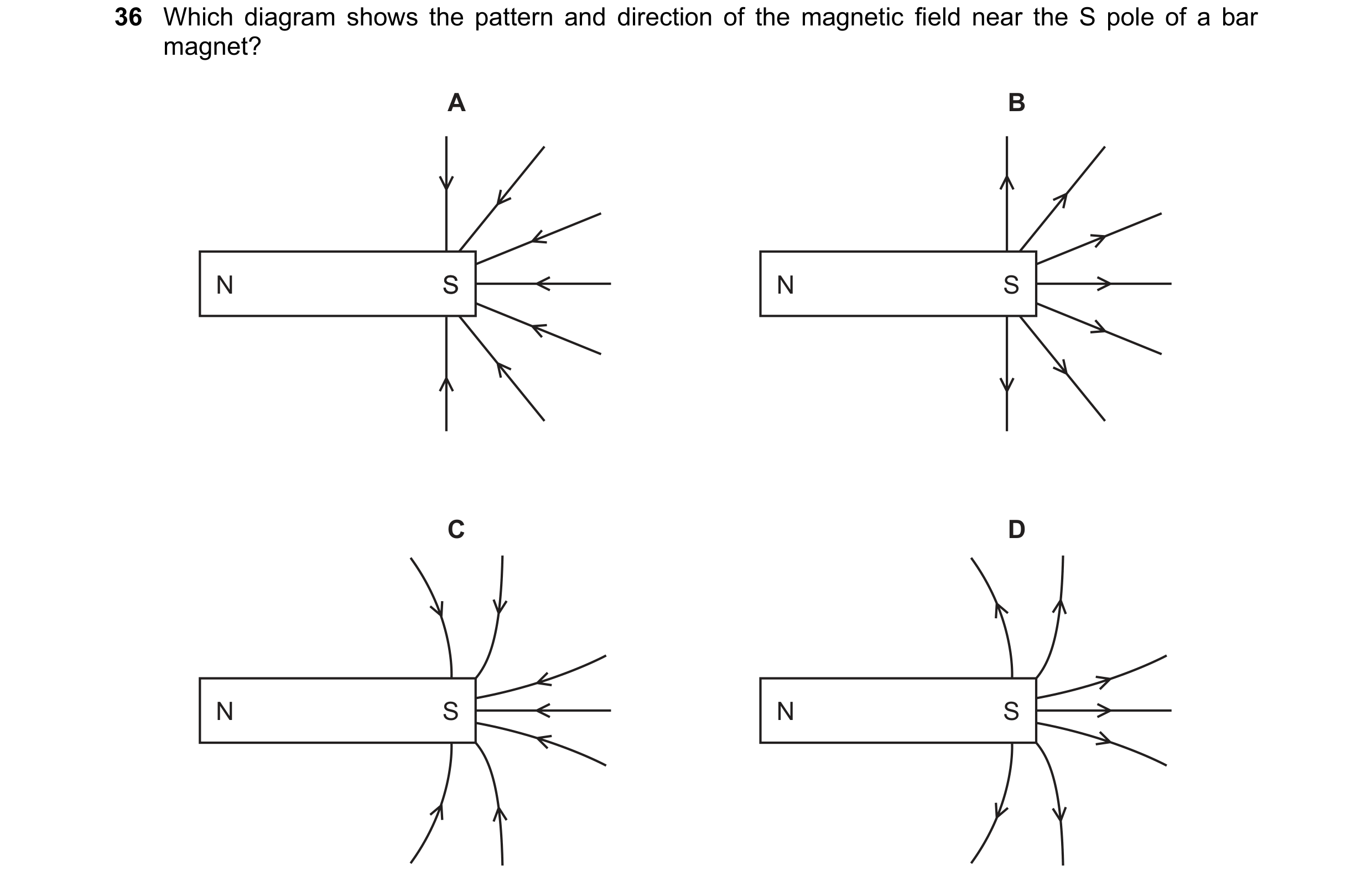
36 Which diagram shows the pattern and direction of the magnetic field near the S pole of a bar magnet? A B N S S N S C D N S N S
1 marks
Answer: C
This question in 0654/12 Feb/March 2023
Q64 · Two insulators are charged by rubbing them with a cloth 0654/11 May/June 2023
36 Two insulators are charged by rubbing them with a cloth. After this, the charged insulators repel each other. Which statement is a possible description of how the insulators become charged? A One gained electrons and the other gained protons. B One gained electrons and the other lost electrons. C They both lost electrons. D They both lost protons.
1 marks
Answer: C
This question in 0654/11 May/June 2023
Q65 · A plastic rod is rubbed with a cloth and the rod becomes positively charged 0654/12 May/June 2023
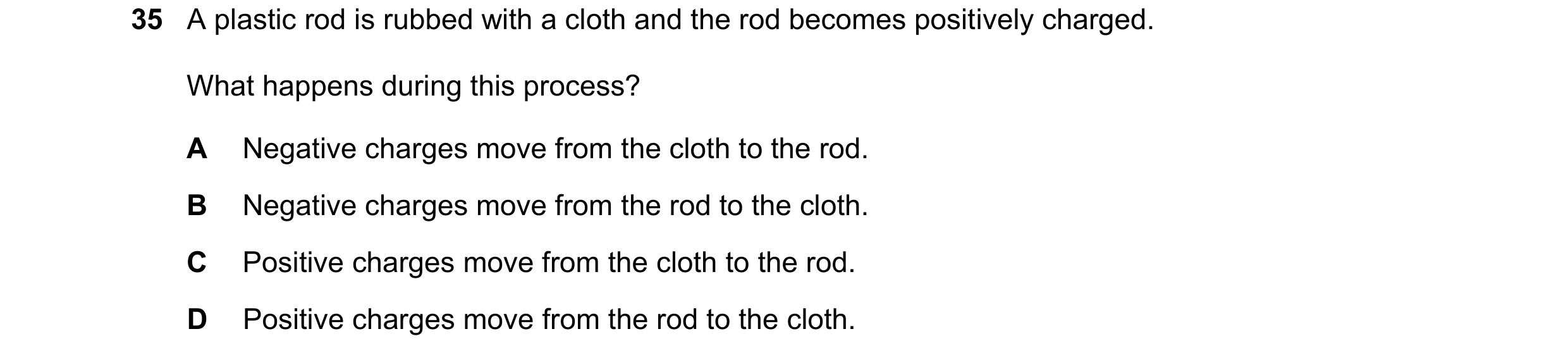
35 A plastic rod is rubbed with a cloth and the rod becomes positively charged. What happens during this process? A Negative charges move from the cloth to the rod. B Negative charges move from the rod to the cloth. C Positive charges move from the cloth to the rod. D Positive charges move from the rod to the cloth.
1 marks
Answer: B
This question in 0654/12 May/June 2023
Q66 · A plastic rod is rubbed with a cloth and the rod becomes positively charged 0654/13 May/June 2023
35 A plastic rod is rubbed with a cloth and the rod becomes positively charged. What happens during this process? A Negative charges move from the cloth to the rod. B Negative charges move from the rod to the cloth. C Positive charges move from the cloth to the rod. D Positive charges move from the rod to the cloth.
1 marks
Answer: B
This question in 0654/13 May/June 2023
Q67 · Three charged balls P, Q and R are suspended by insulating threads 0654/11 Oct/Nov 2023
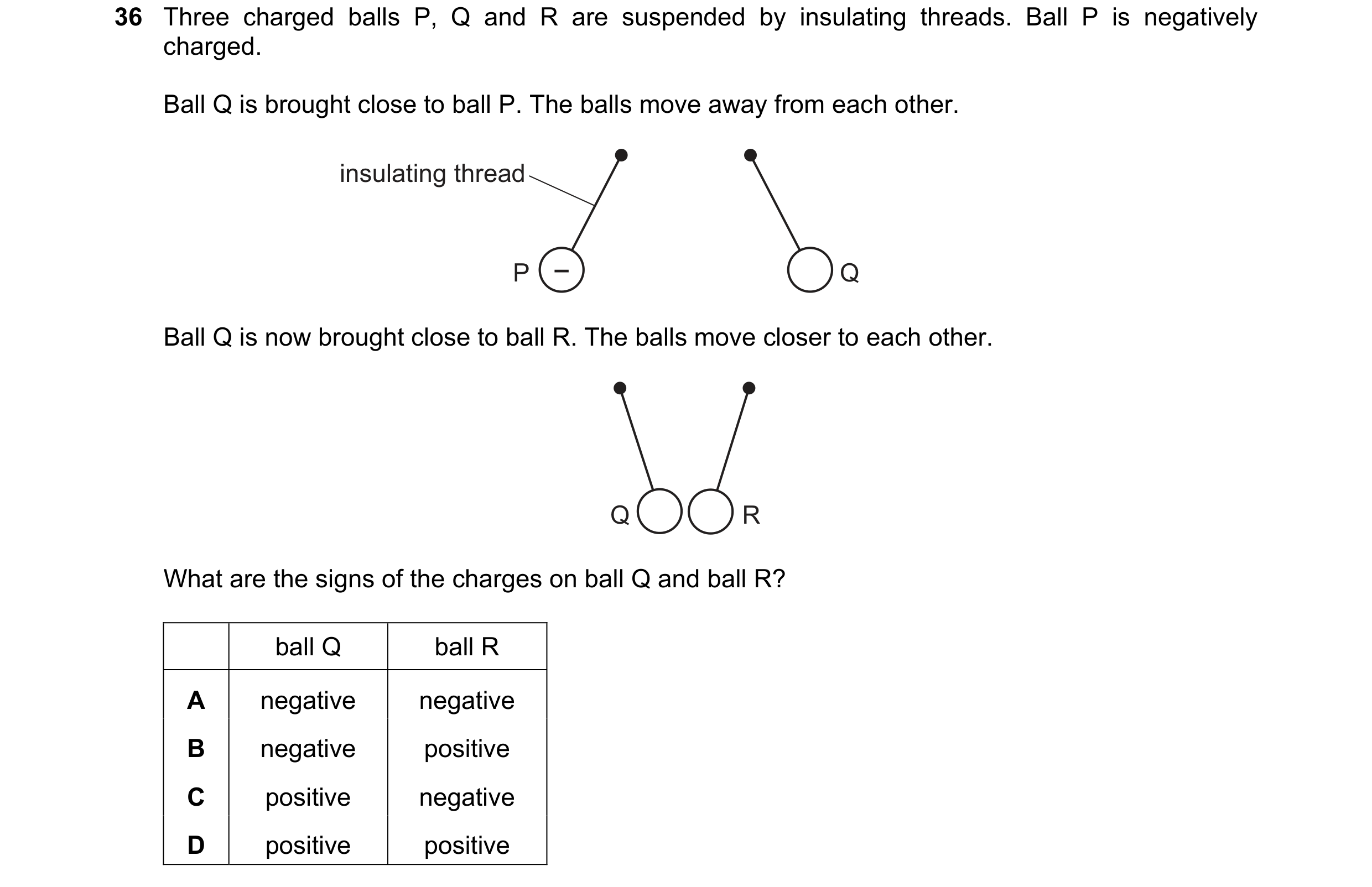
36 Three charged balls P, Q and R are suspended by insulating threads. Ball P is negatively charged. Ball Q is brought close to ball P. The balls move away from each other. insulating thread P – Q Ball Q is now brought close to ball R. The balls move closer to each other. Q R What are the signs of the charges on ball Q and ball R? ball Q ball R A negative negative B negative positive C positive negative D positive positive
1 marks
Answer: B
This question in 0654/11 Oct/Nov 2023
Q68 · A plastic rod is rubbed with a cloth 0654/12 Oct/Nov 2023
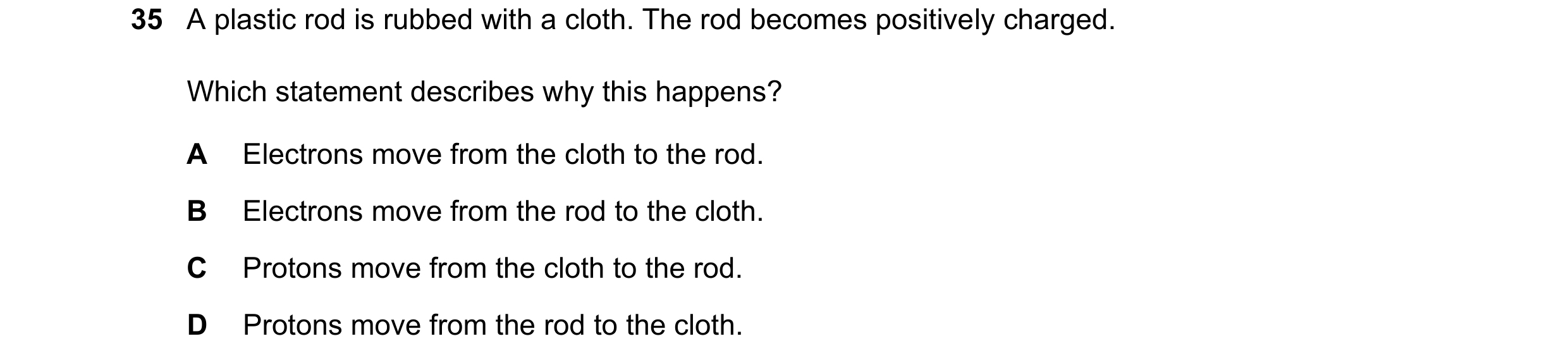
35 A plastic rod is rubbed with a cloth. The rod becomes positively charged. Which statement describes why this happens? A Electrons move from the cloth to the rod. B Electrons move from the rod to the cloth. C Protons move from the cloth to the rod. D Protons move from the rod to the cloth.
1 marks
Answer: B
This question in 0654/12 Oct/Nov 2023
Q69 · The diagrams show a wire carrying a current out of the page 0654/12 Oct/Nov 2023
38 The diagrams show a wire carrying a current out of the page. Which diagram shows the pattern of magnetic field lines near the wire? A B C D current out current out current out current out of the page of the page of the page of the page
1 marks
Answer: D
This question in 0654/12 Oct/Nov 2023
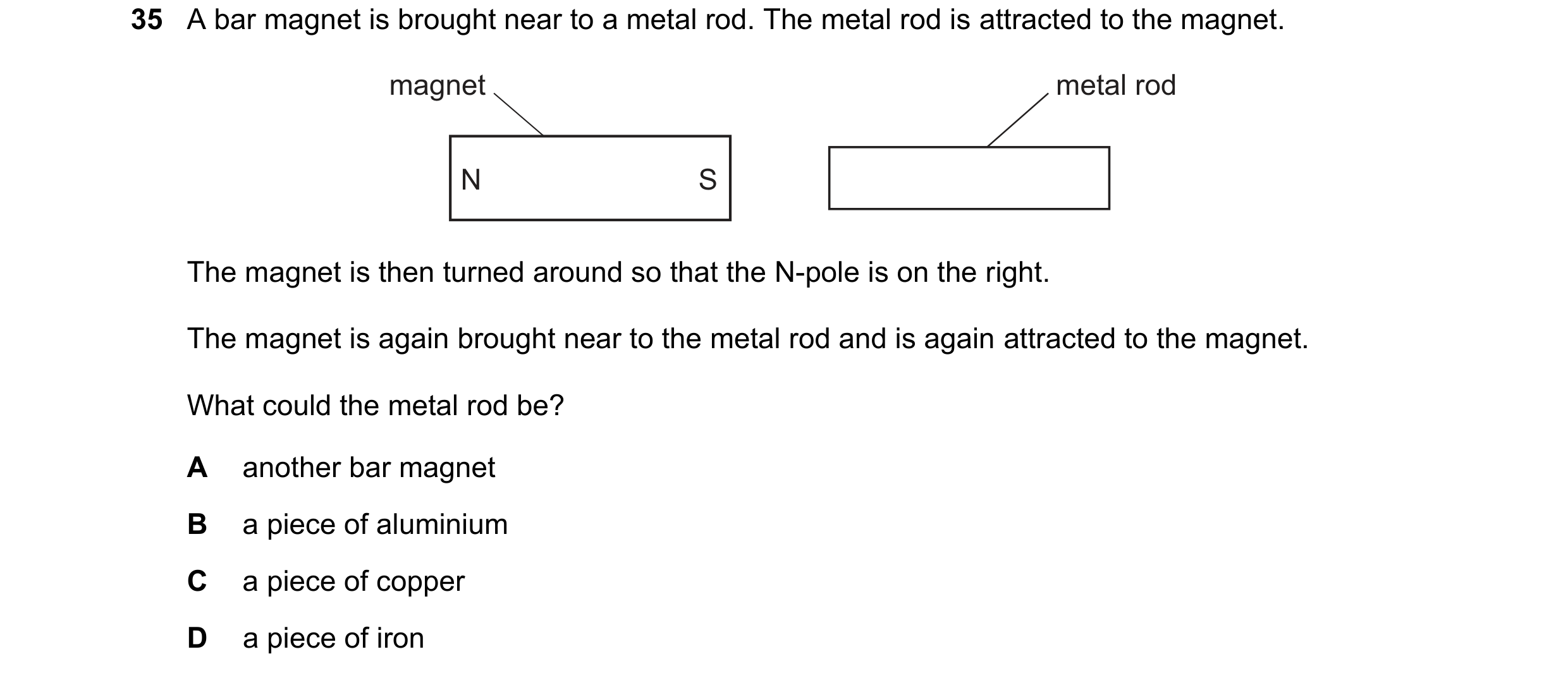
Q70 · A bar magnet is brought near to a metal rod 0654/13 Oct/Nov 2023
35 A bar magnet is brought near to a metal rod. The metal rod is attracted to the magnet. magnet metal rod N S The magnet is then turned around so that the N-pole is on the right. The magnet is again brought near to the metal rod and is again attracted to the magnet. What could the metal rod be? A another bar magnet B a piece of aluminium C a piece of copper D a piece of iron
1 marks
Answer: D
This question in 0654/13 Oct/Nov 2023
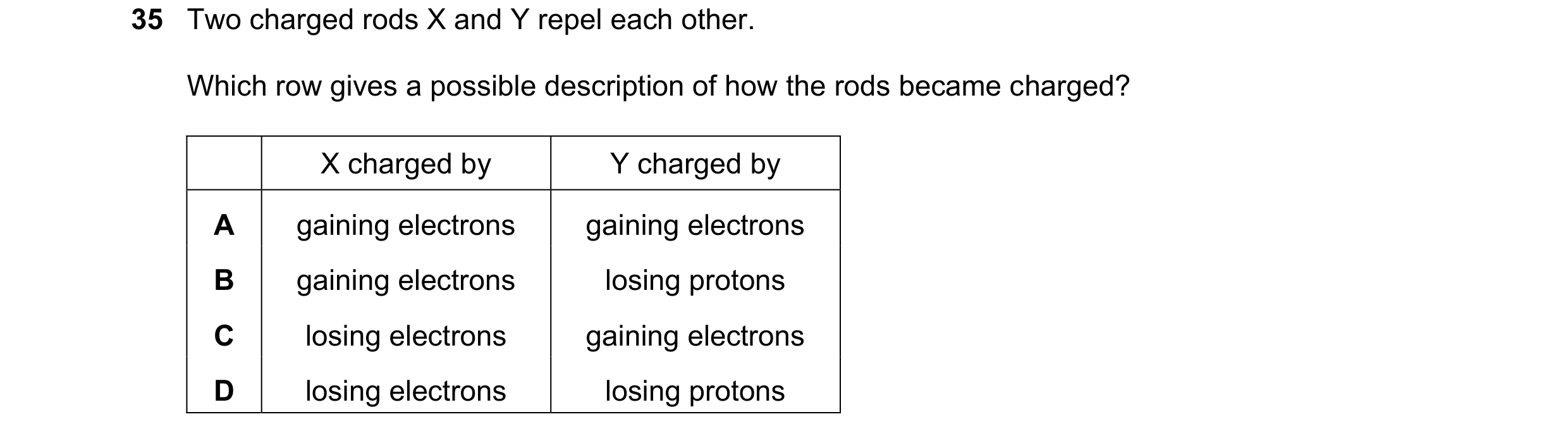
Q71 · Two charged rods X and Y repel each other 0654/12 Feb/March 2024
35 Two charged rods X and Y repel each other. Which row gives a possible description of how the rods became charged? X charged by Y charged by A gaining electrons gaining electrons B gaining electrons losing protons C losing electrons gaining electrons D losing electrons losing protons
1 marks
Answer: A
This question in 0654/12 Feb/March 2024
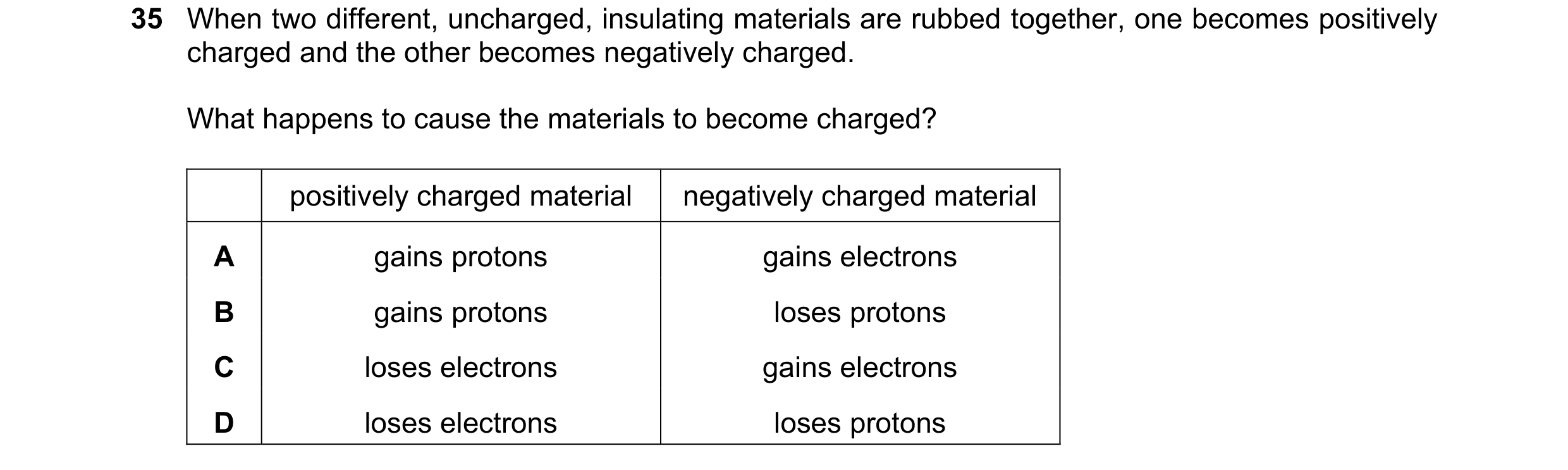
Q72 · When two different, uncharged, insulating materials are rubbed together, one becomes… 0654/12 May/June 2024
35 When two different, uncharged, insulating materials are rubbed together, one becomes positively charged and the other becomes negatively charged. What happens to cause the materials to become charged? positively charged material negatively charged material A gains protons gains electrons B gains protons loses protons C loses electrons gains electrons D loses electrons loses protons
1 marks
Answer: C
This question in 0654/12 May/June 2024
Q73 · When two different, uncharged, insulating materials are rubbed together, one becomes… 0654/13 May/June 2024
35 When two different, uncharged, insulating materials are rubbed together, one becomes positively charged and the other becomes negatively charged. What happens to cause the materials to become charged? positively charged material negatively charged material A gains protons gains electrons B gains protons loses protons C loses electrons gains electrons D loses electrons loses protons
1 marks
Answer: C
This question in 0654/13 May/June 2024
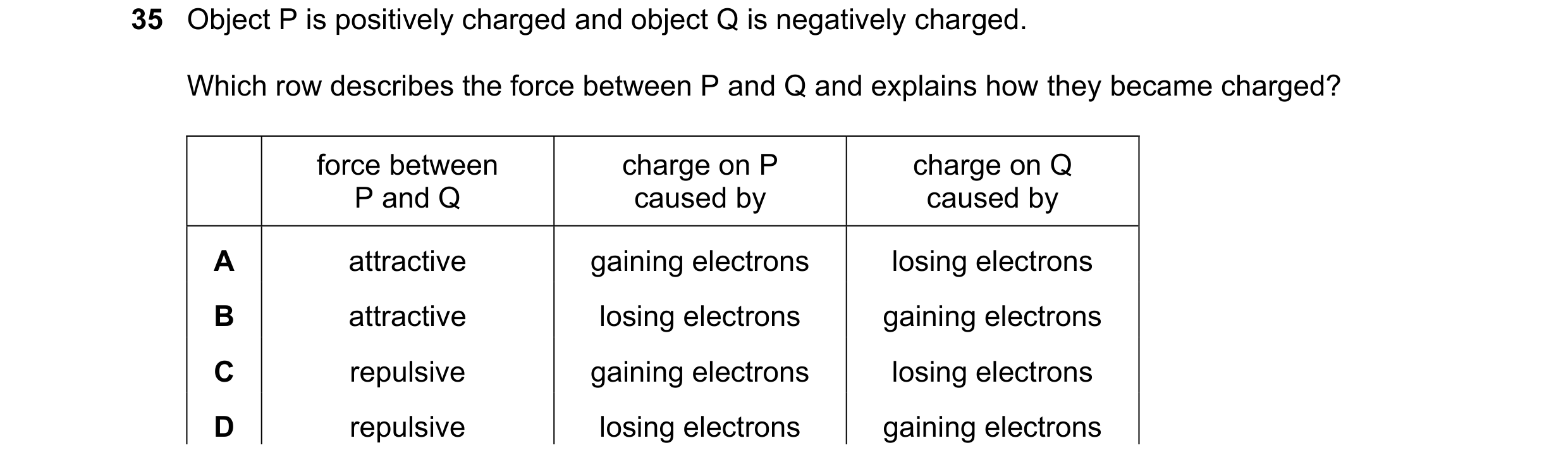
Q74 · Object P is positively charged and object Q is negatively charged 0654/11 Oct/Nov 2024
35 Object P is positively charged and object Q is negatively charged. Which row describes the force between P and Q and explains how they became charged? force between charge on P charge on Q P and Q caused by caused by A attractive gaining electrons losing electrons B attractive losing electrons gaining electrons C repulsive gaining electrons losing electrons D repulsive losing electrons gaining electrons
1 marks
Answer: B
This question in 0654/11 Oct/Nov 2024
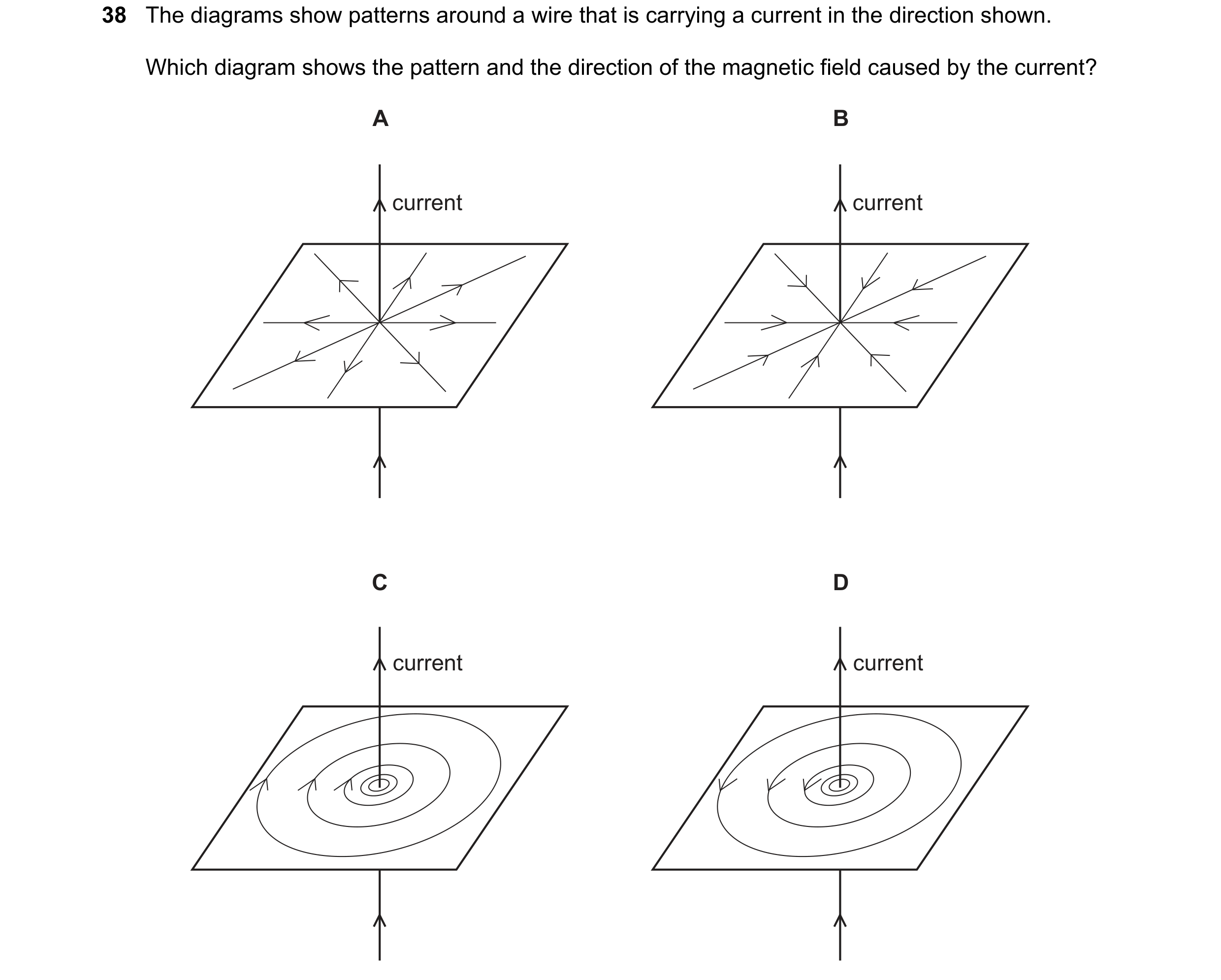
Q75 · The diagrams show patterns around a wire that is carrying a current in the direction shown 0654/12 Oct/Nov 2024
38 The diagrams show patterns around a wire that is carrying a current in the direction shown. Which diagram shows the pattern and the direction of the magnetic field caused by the current? A B current current C D current current
1 marks
Answer: D
This question in 0654/12 Oct/Nov 2024
Q76 · The diagrams show patterns around a wire that is carrying a current in the direction shown 0654/13 Oct/Nov 2024
38 The diagrams show patterns around a wire that is carrying a current in the direction shown. Which diagram shows the pattern and the direction of the magnetic field caused by the current? A B current current C D current current
1 marks
Answer: D
This question in 0654/13 Oct/Nov 2024
Q77 · Which substance is used to make a permanent magnet? 0654/12 Feb/March 2025
36 Which substance is used to make a permanent magnet? A brass B pure copper C soft iron D steel
1 marks
Answer: D
This question in 0654/12 Feb/March 2025
Q78 · A student holds an iron rod in one hand and a dry cotton cloth in the other hand 0654/12 Feb/March 2025
38 A student holds an iron rod in one hand and a dry cotton cloth in the other hand. The student rubs the iron rod with the cotton cloth several times. Next the student holds the cloth close to the iron rod. rod rod cloth cloth rod rubbed with cloth cloth held close to rod The student then repeats this procedure with an identical dry cotton cloth and a plastic rod. Which row shows the force between the iron rod and cloth and between the plastic rod and cloth when they are held close to each other after rubbing? force between force between iron rod plastic rod and cloth and cloth A attraction no force B no force attraction C no force repulsion D repulsion repulsion
1 marks
Answer: B
This question in 0654/12 Feb/March 2025
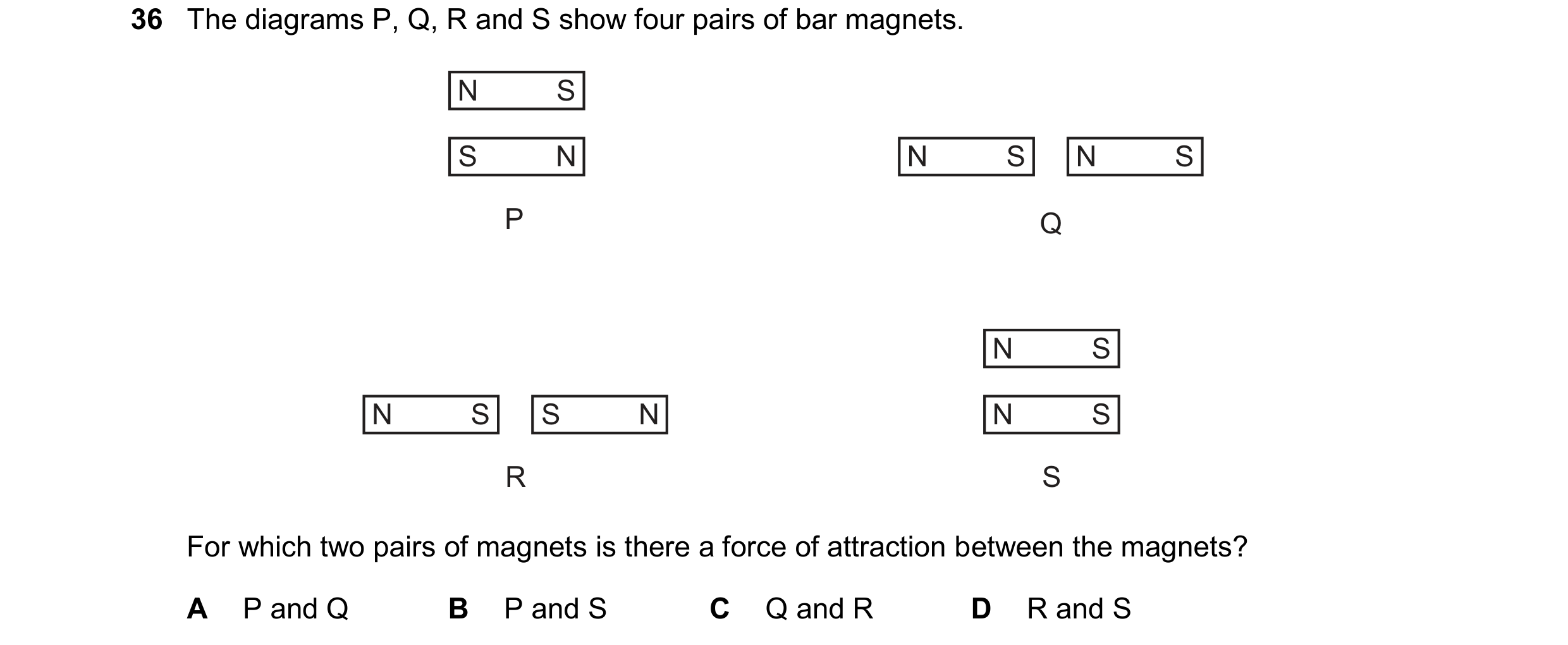
Q79 · The diagrams P, Q, R and S show four pairs of bar magnets 0654/11 Oct/Nov 2025
36 The diagrams P, Q, R and S show four pairs of bar magnets. N S S N N S N S P Q N S N S S N N S R S For which two pairs of magnets is there a force of attraction between the magnets? A P and Q B P and S C Q and R D R and S
1 marks
Answer: A
This question in 0654/11 Oct/Nov 2025
 1 / 31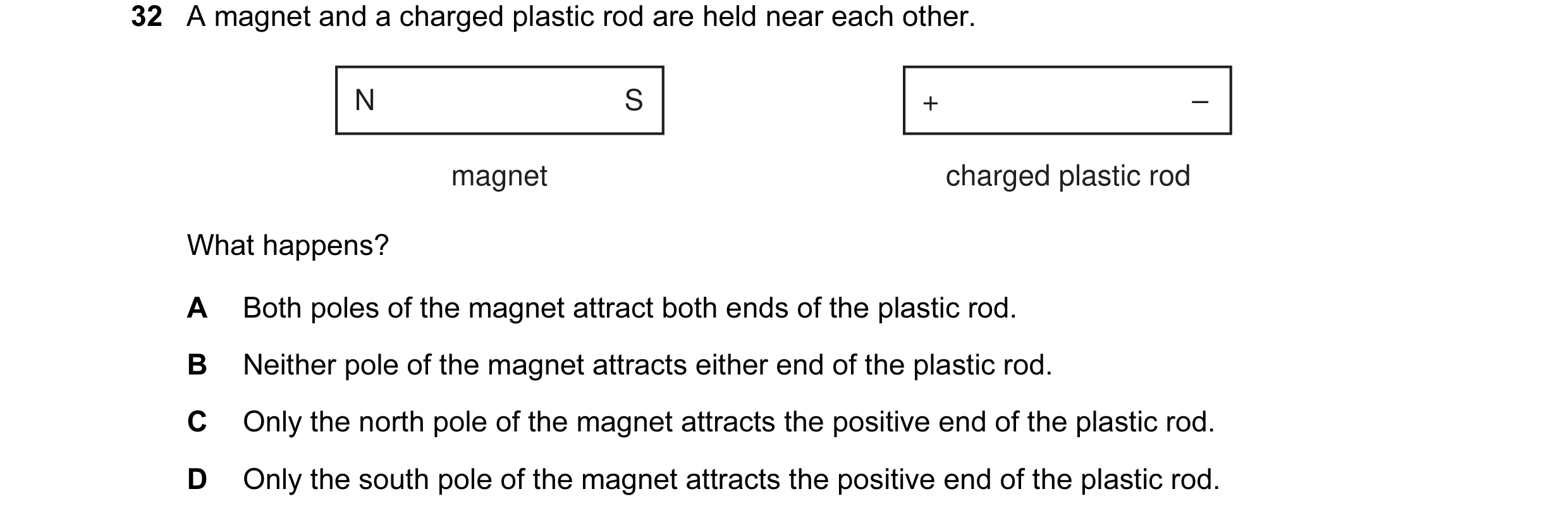
 2 / 31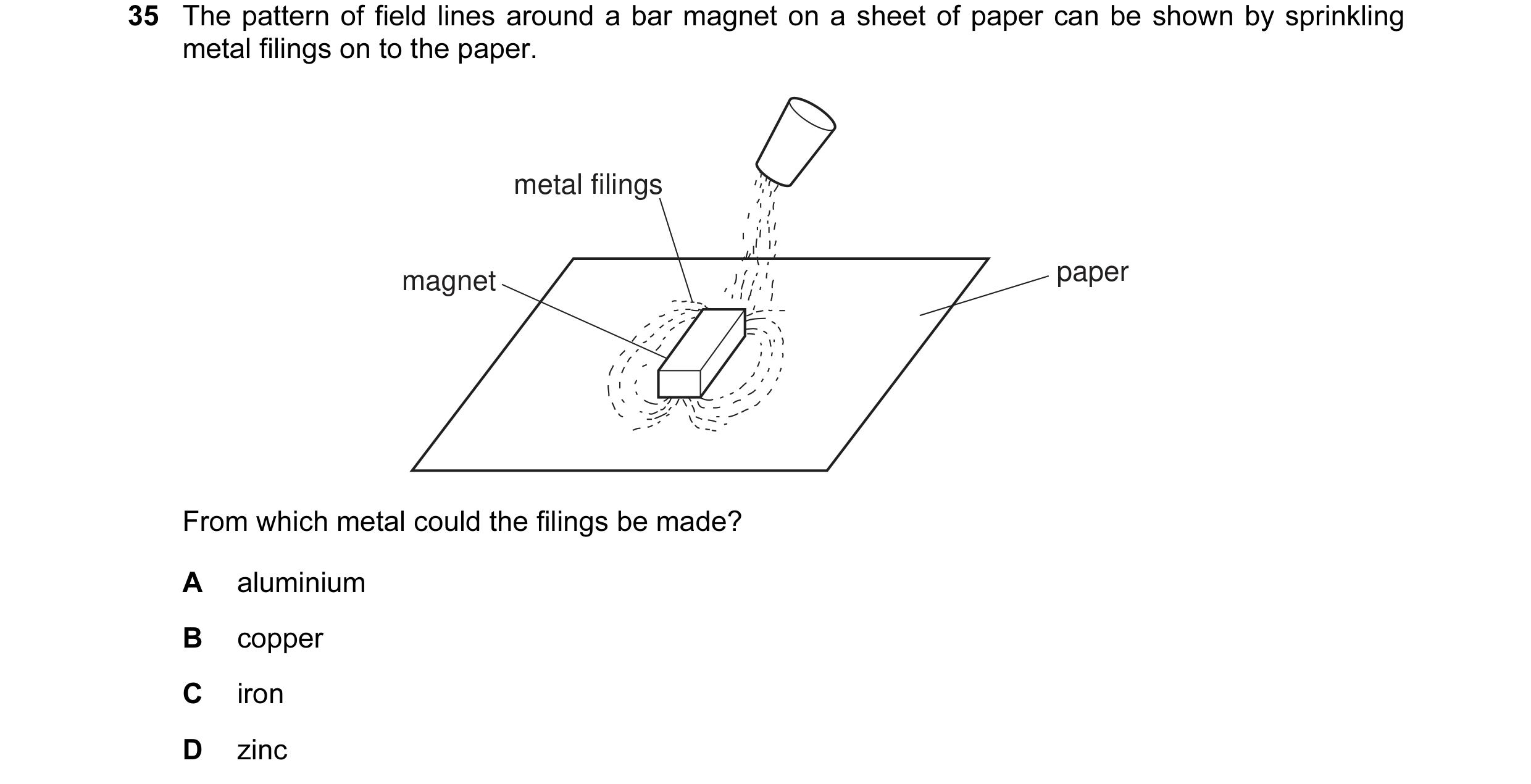
 3 / 31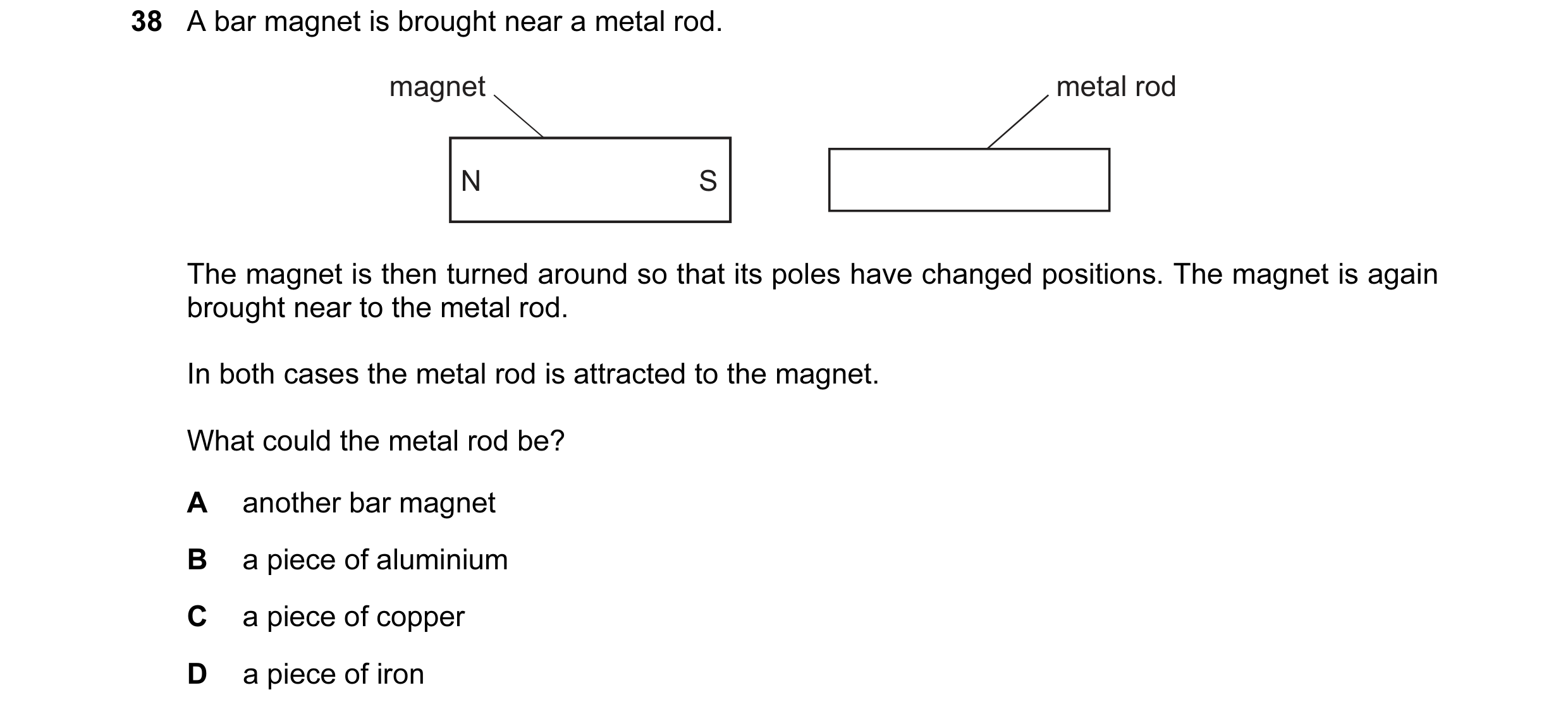
 4 / 31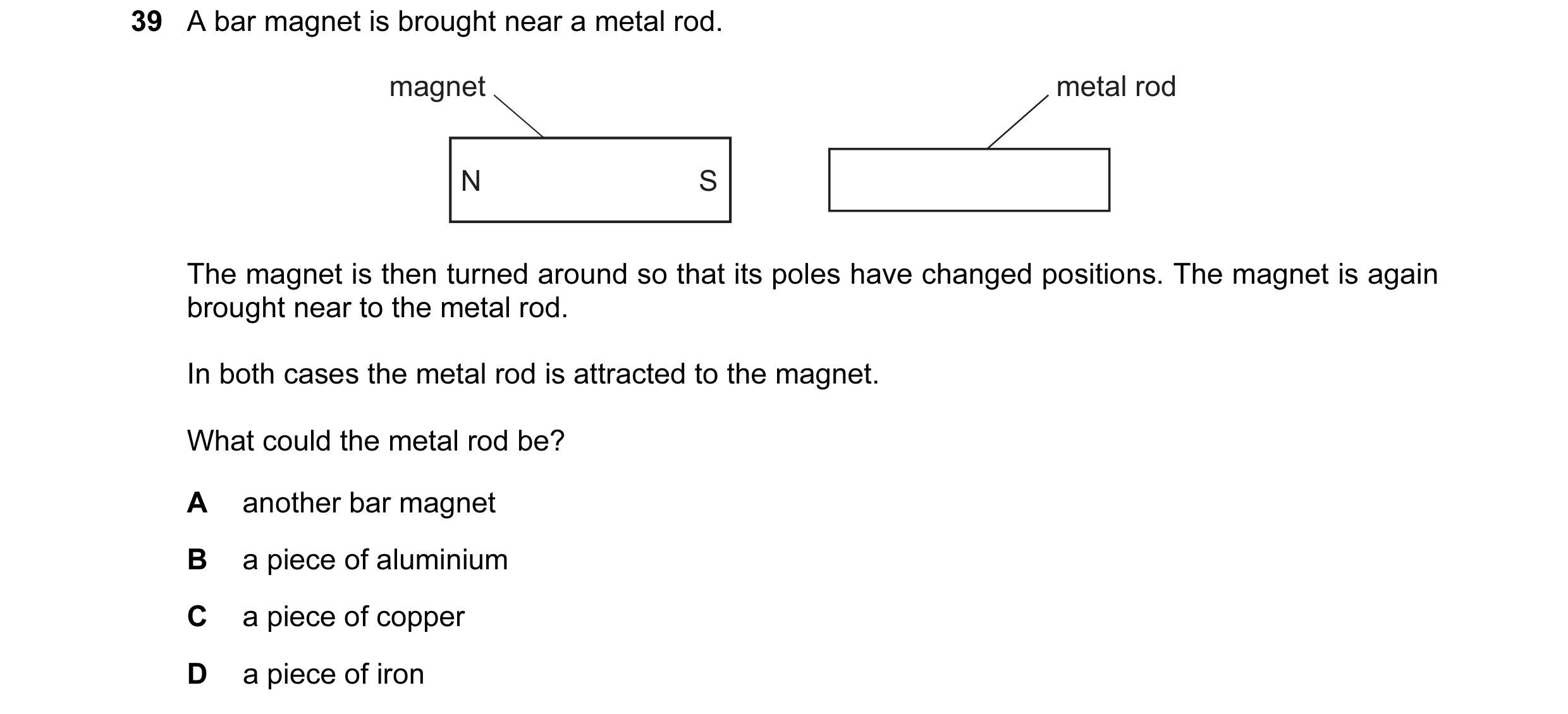
 5 / 31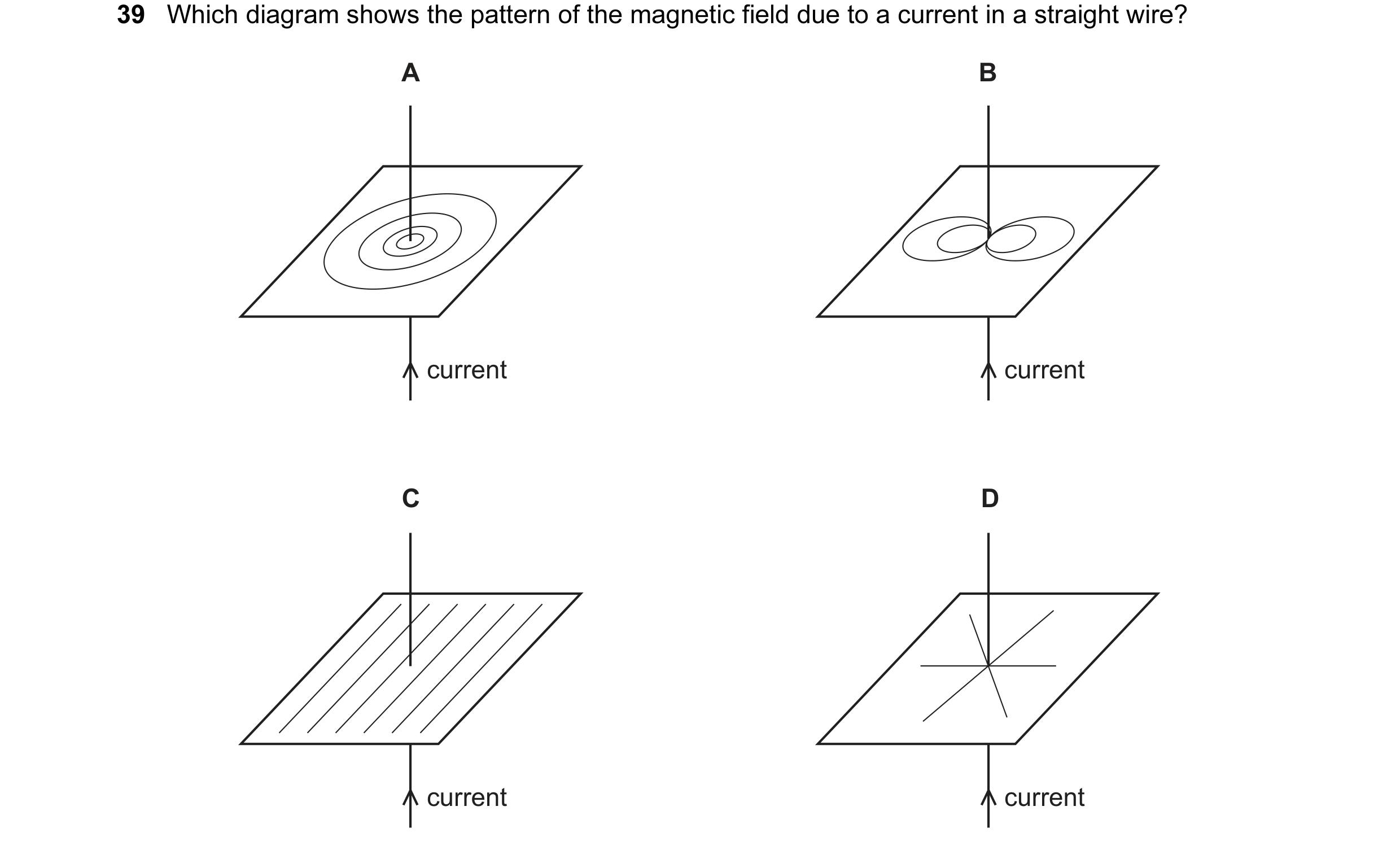
 6 / 31
 7 / 31
 8 / 31
 9 / 31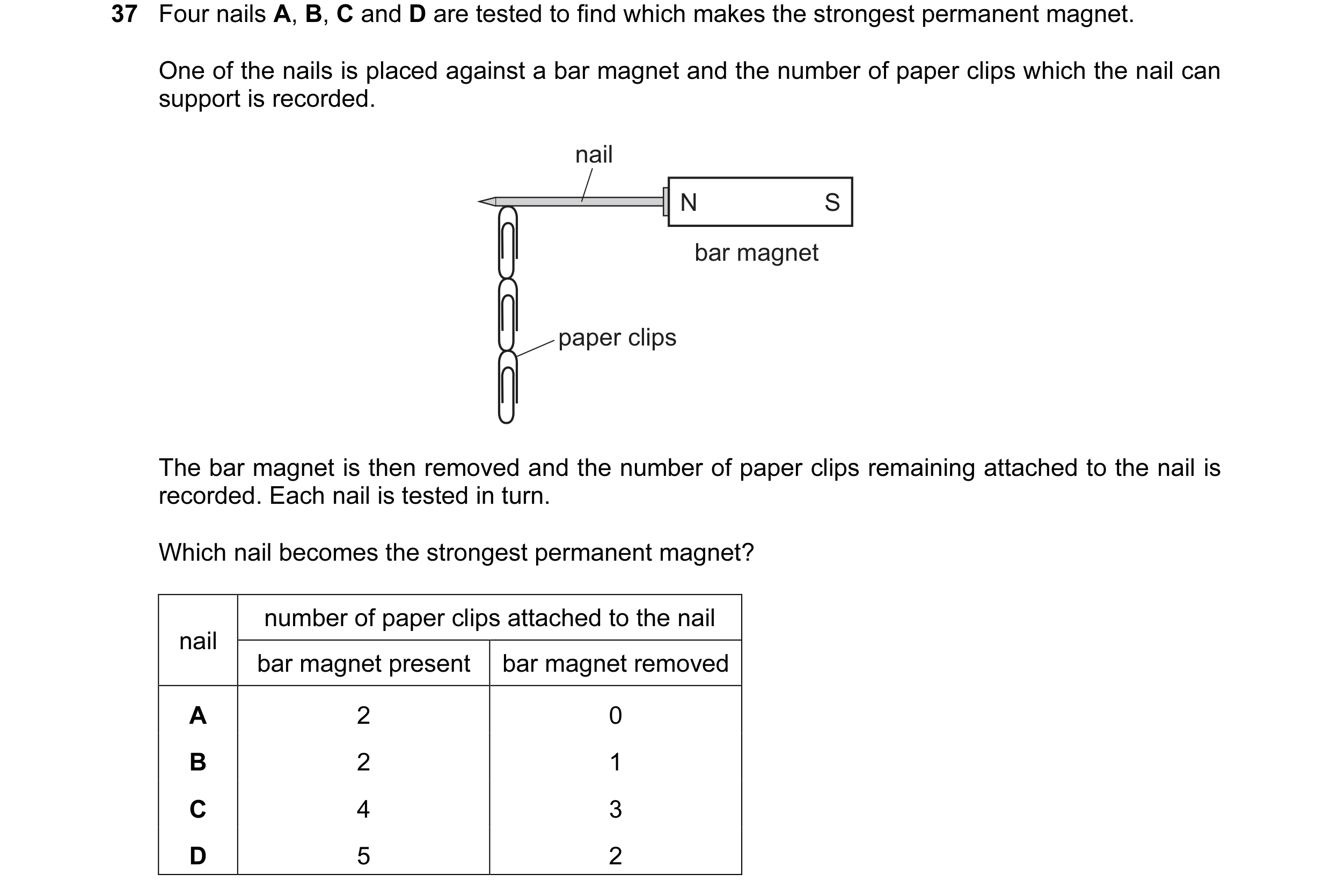
 10 / 31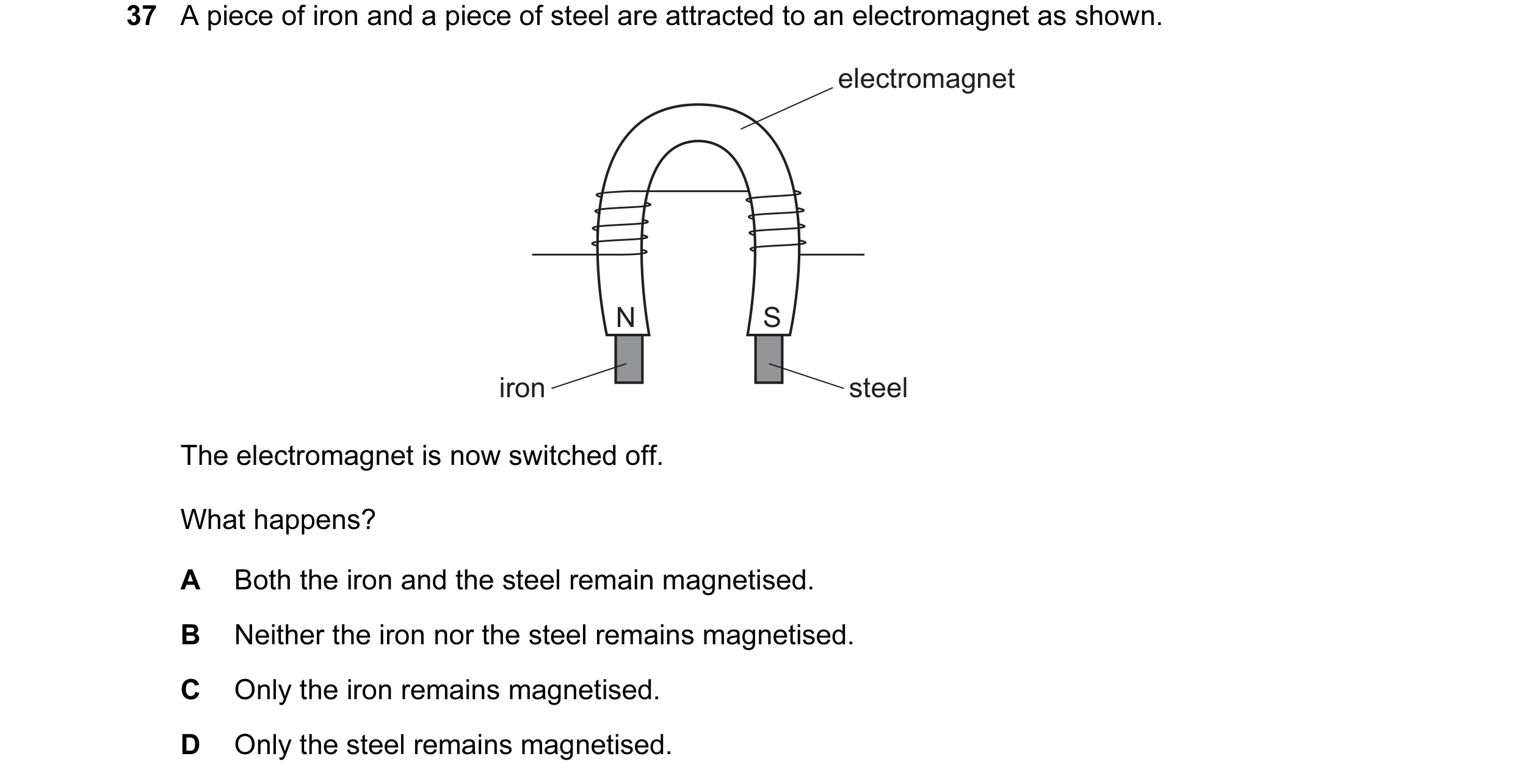
 11 / 31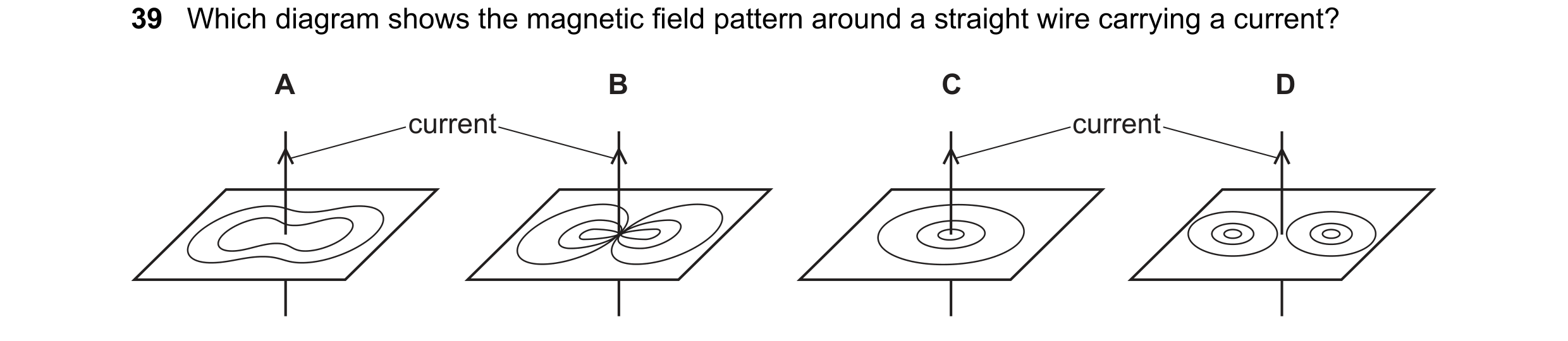
 12 / 31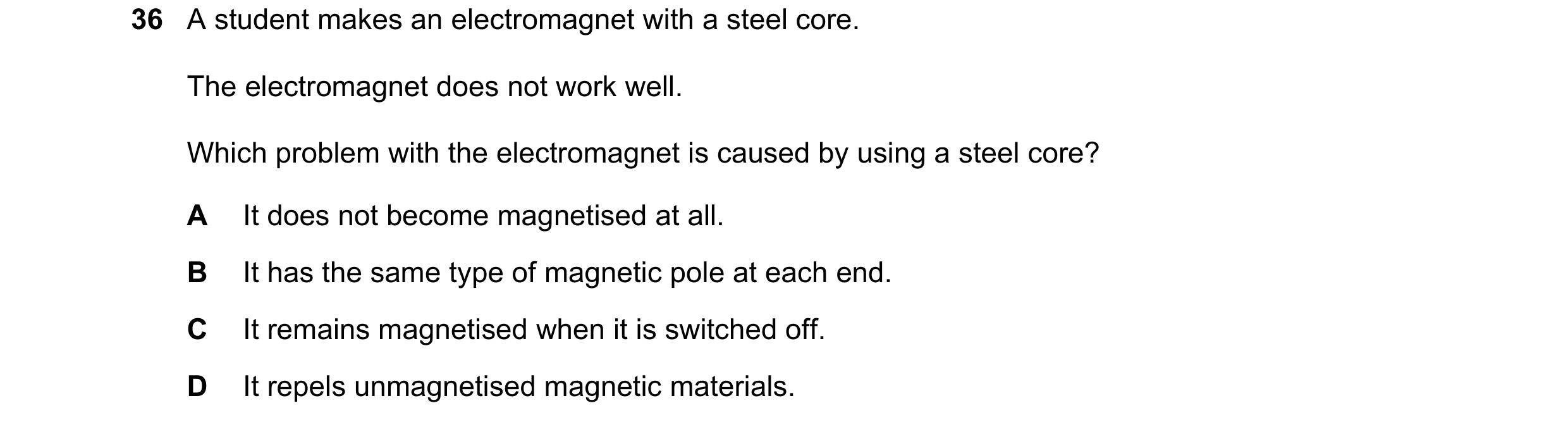
 13 / 31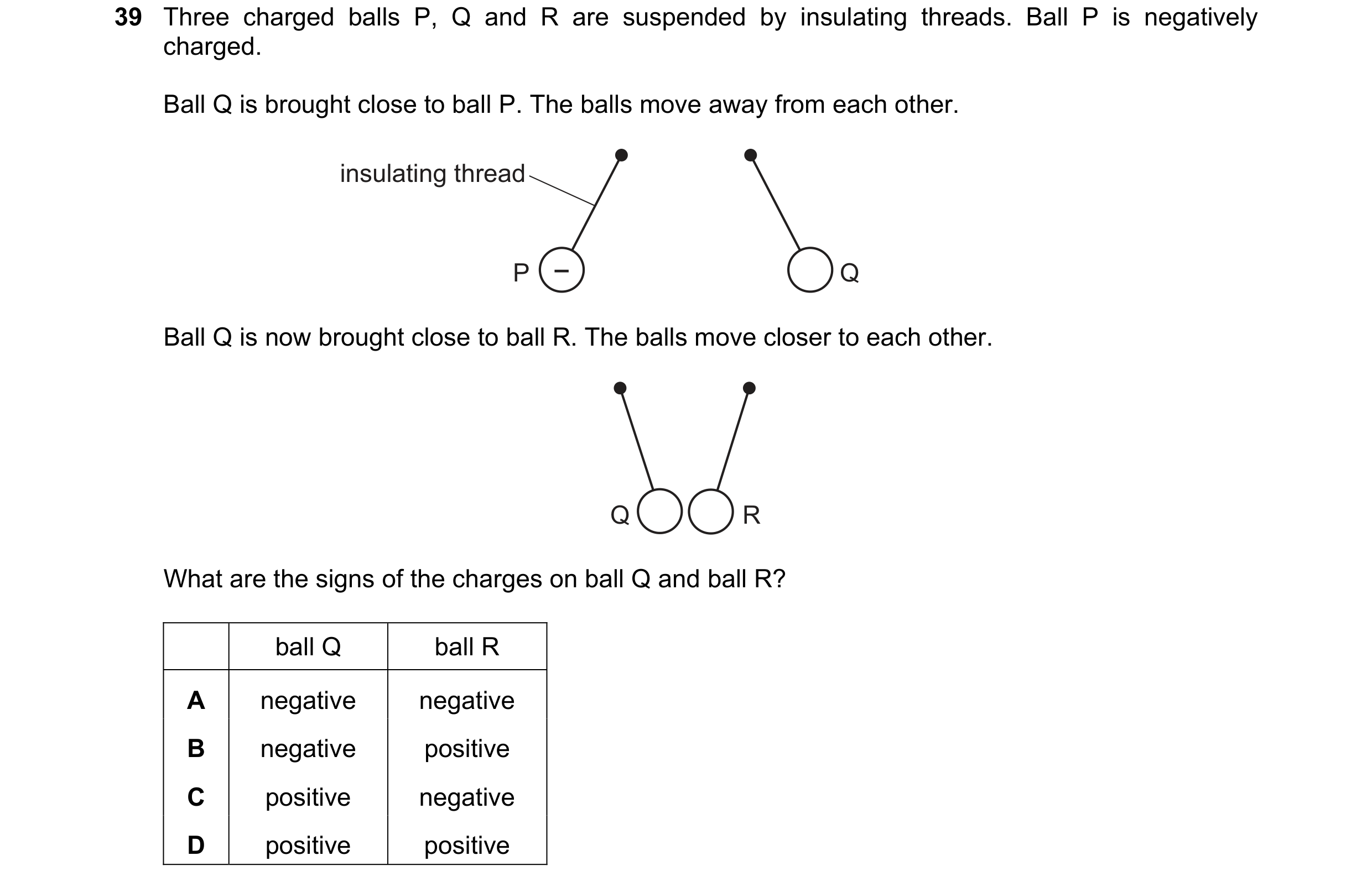
 14 / 31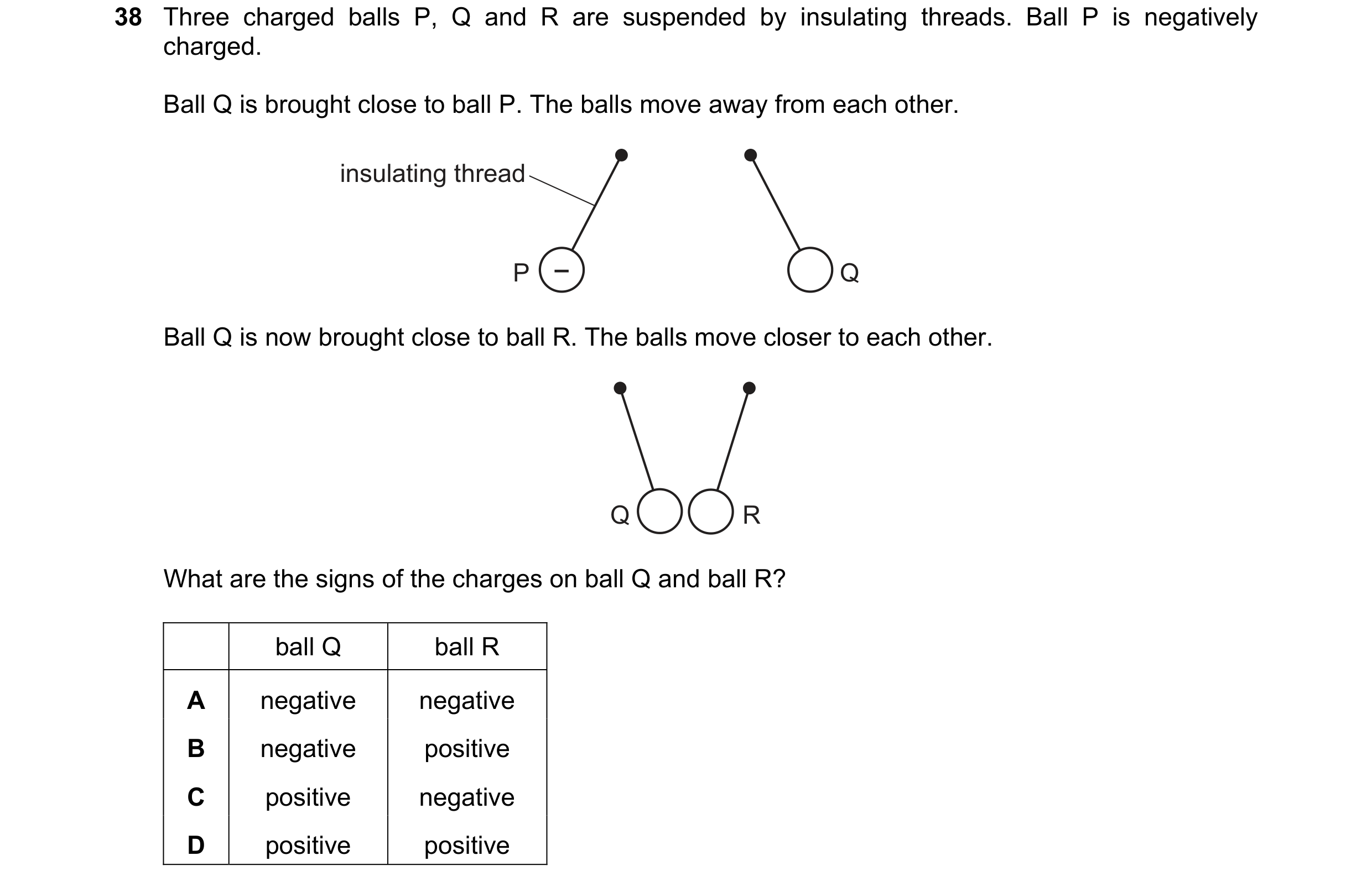
 15 / 31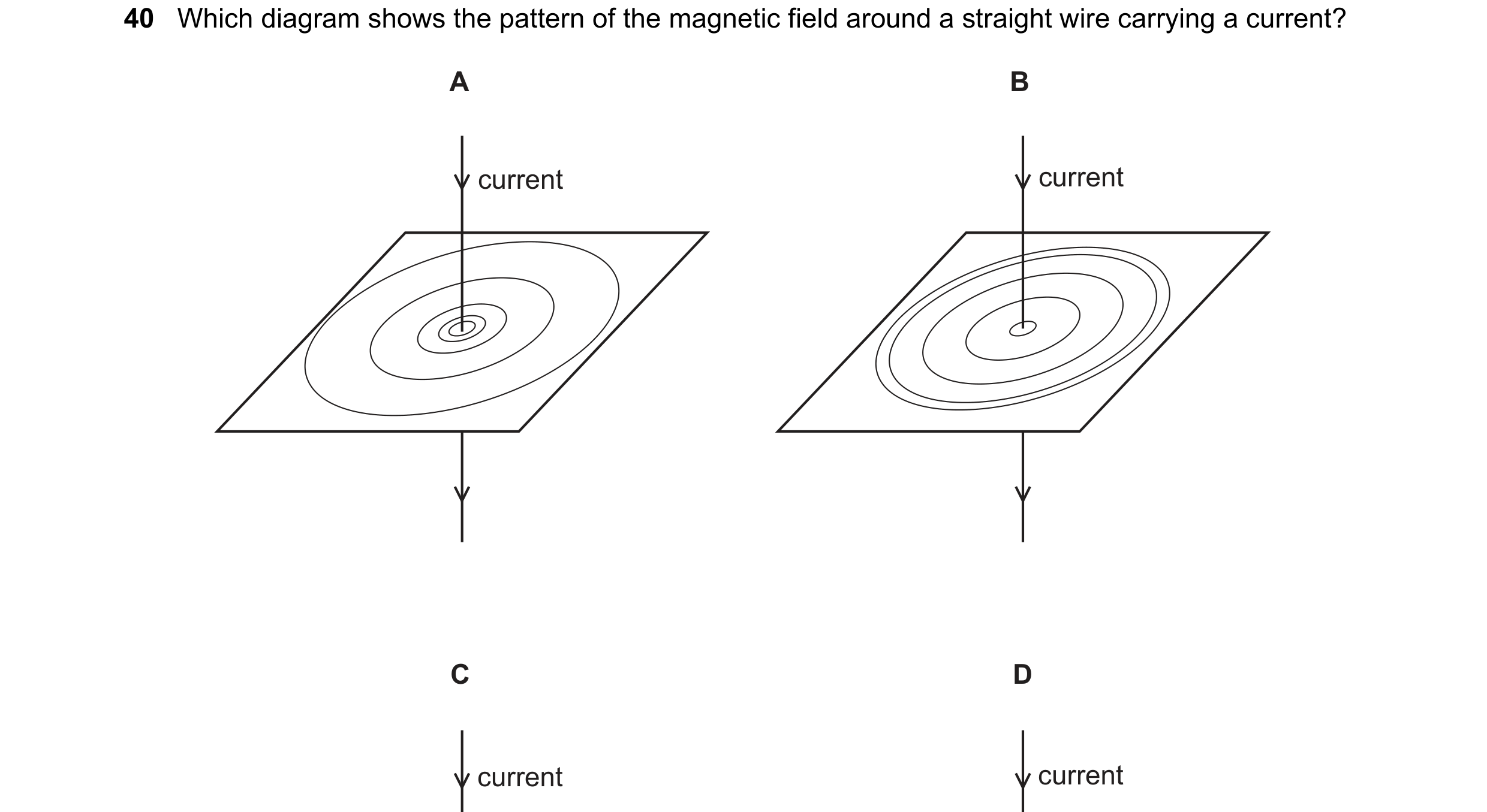
 16 / 31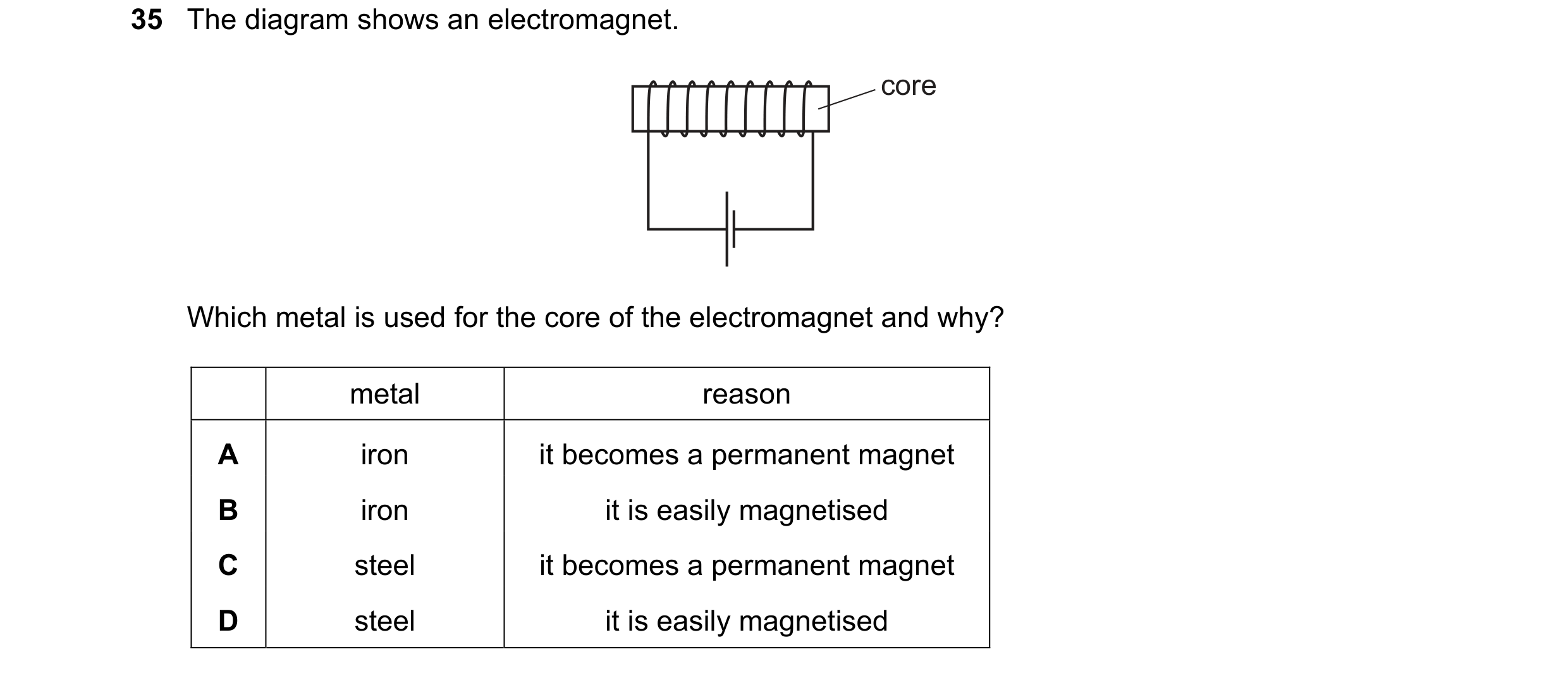

 17 / 31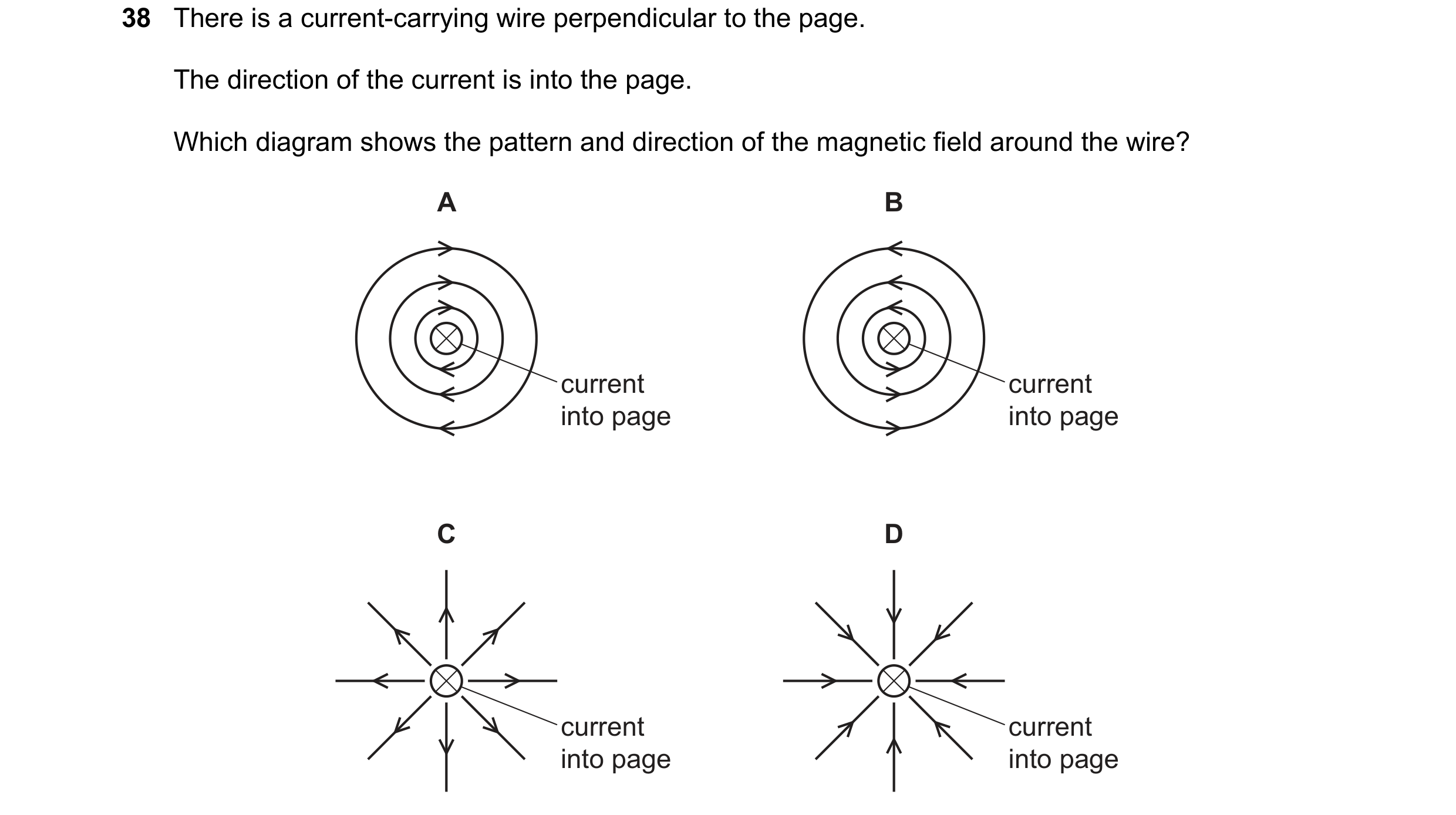
 18 / 31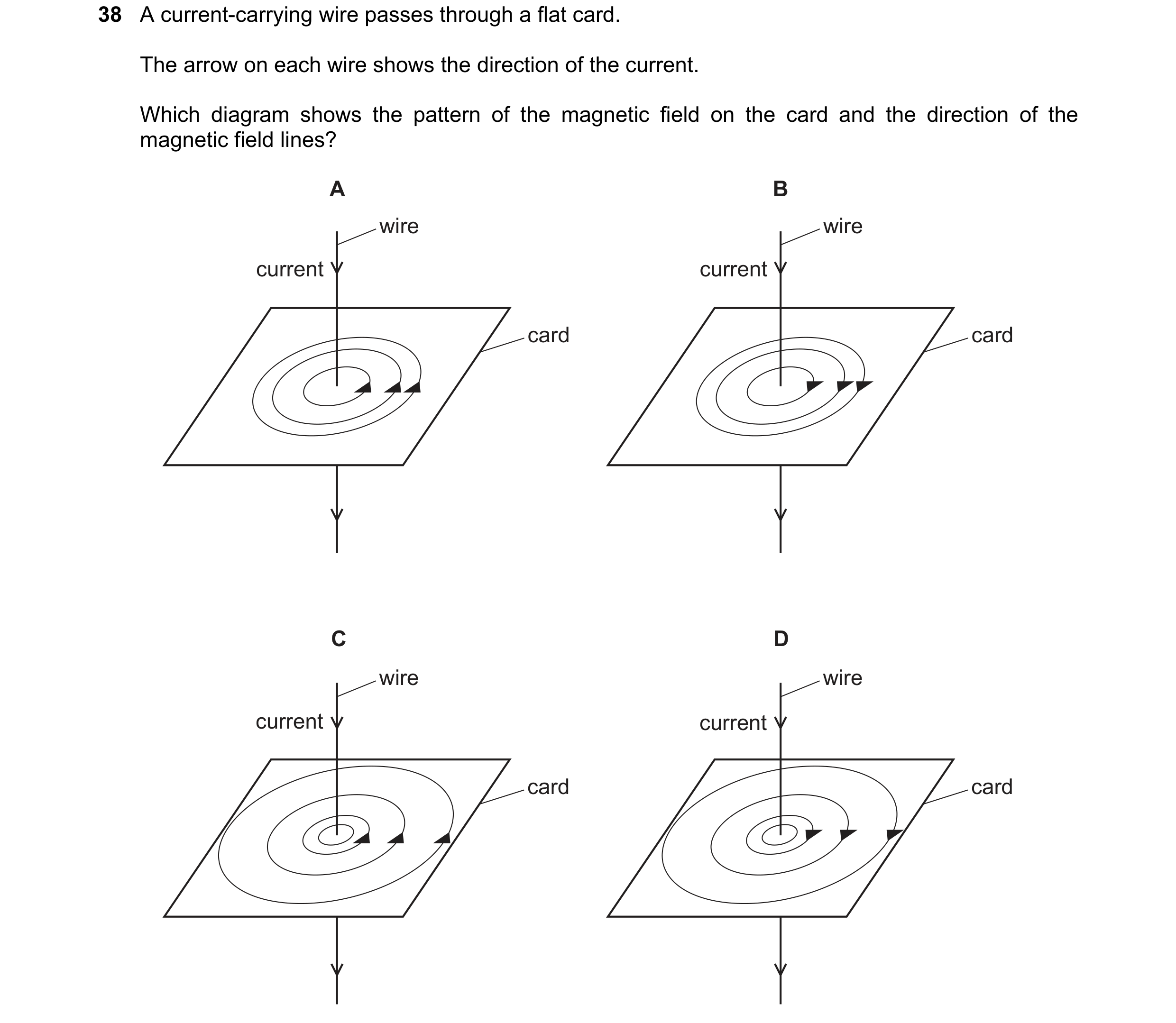
 19 / 31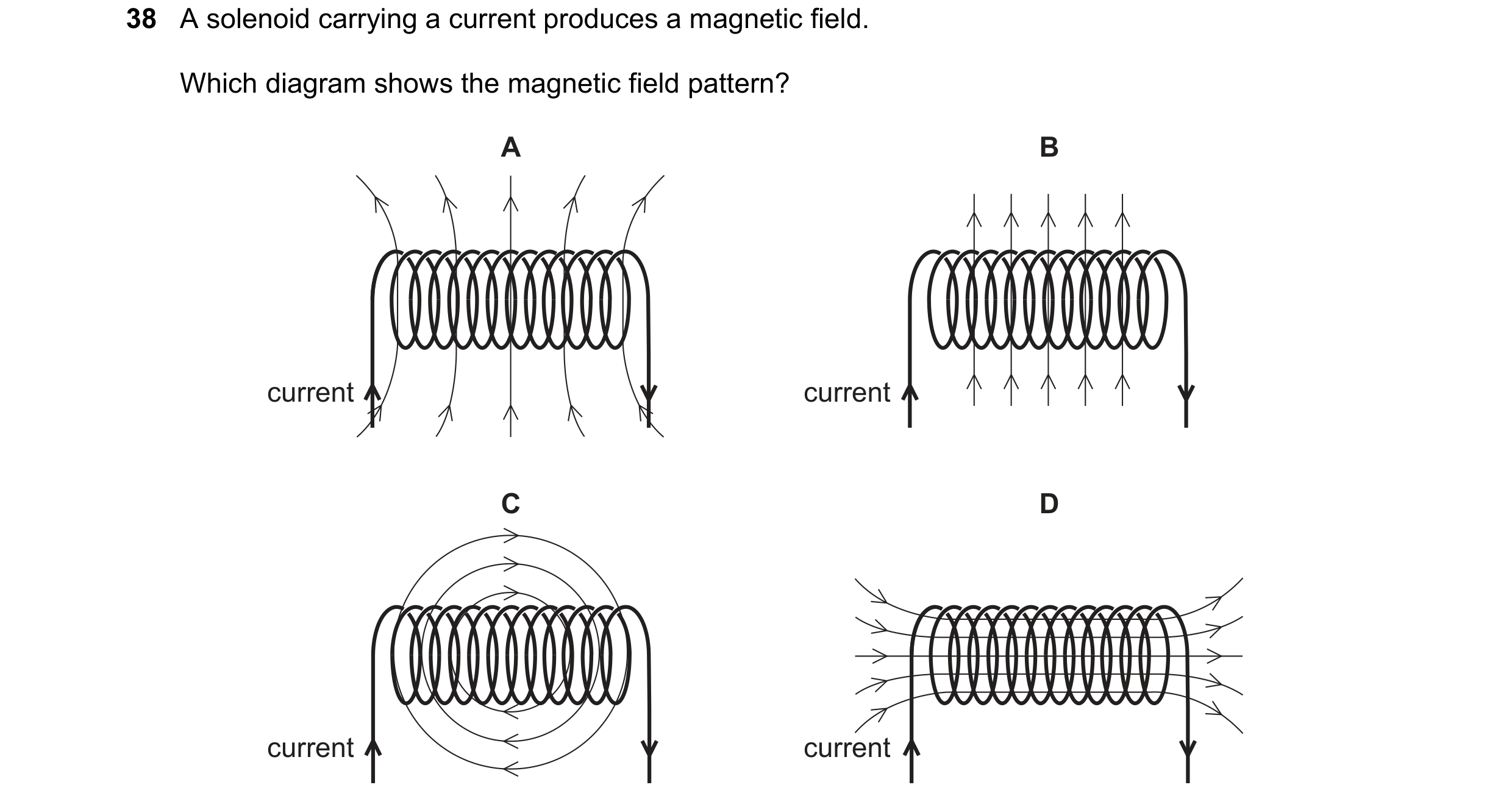
 20 / 31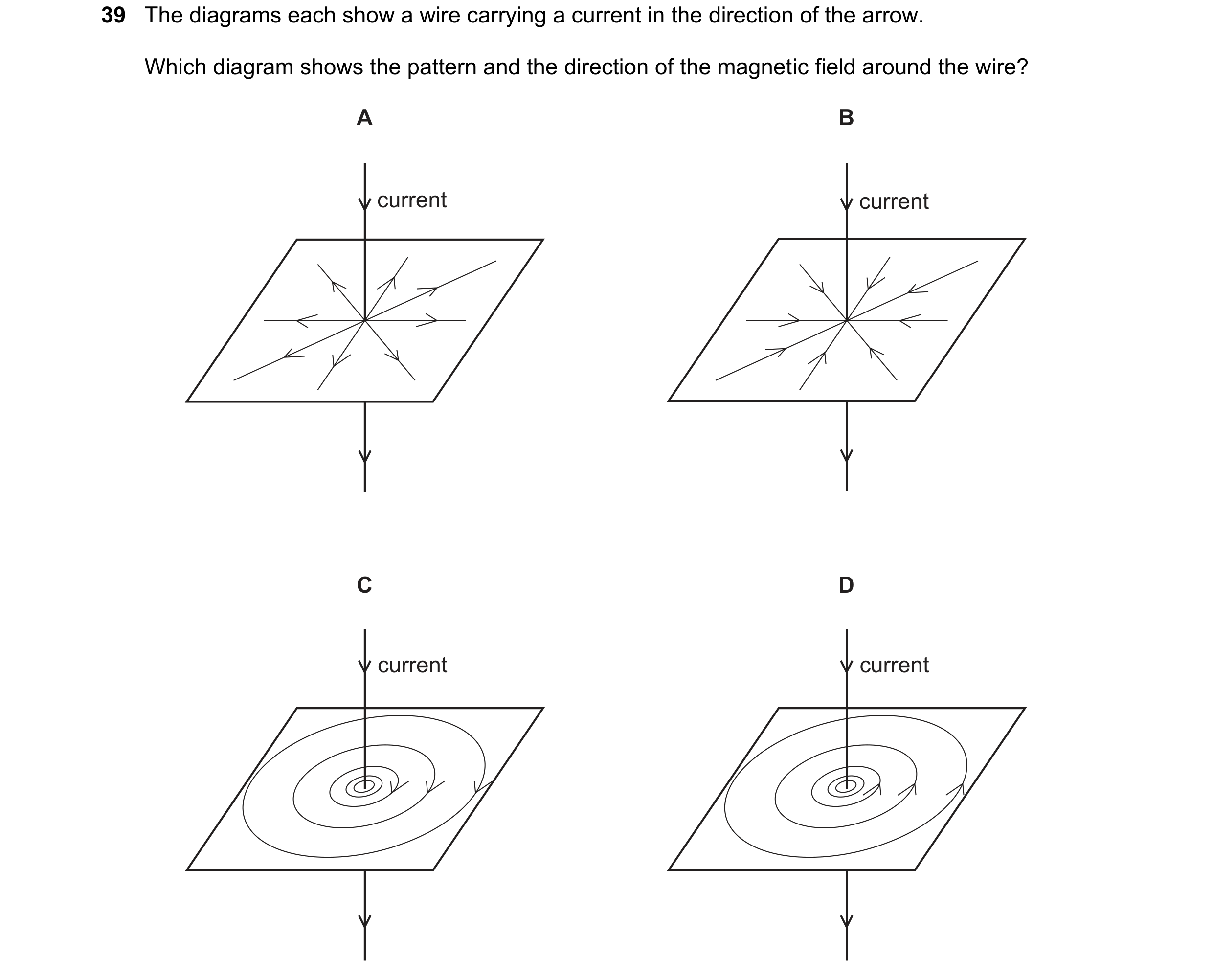
 21 / 31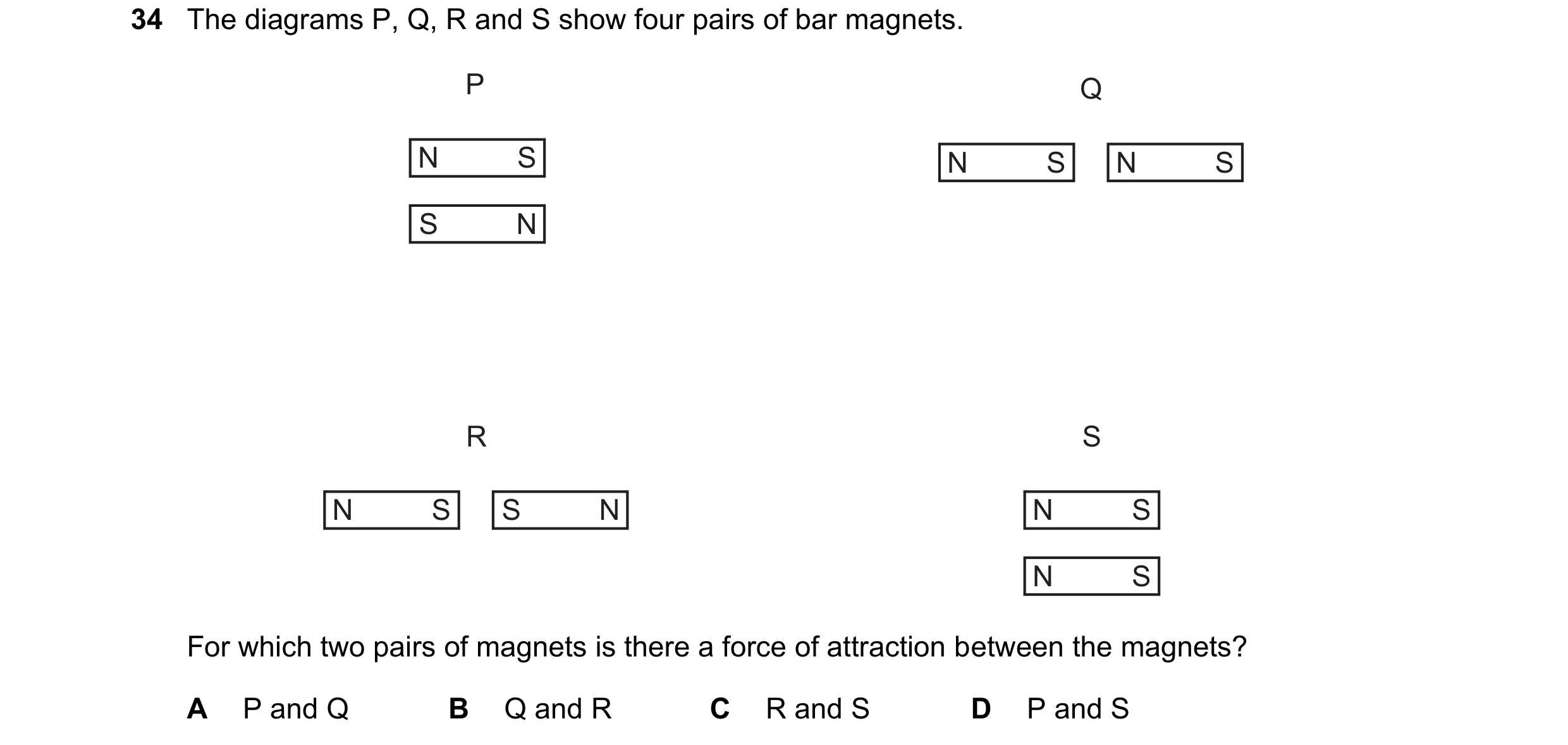
 22 / 31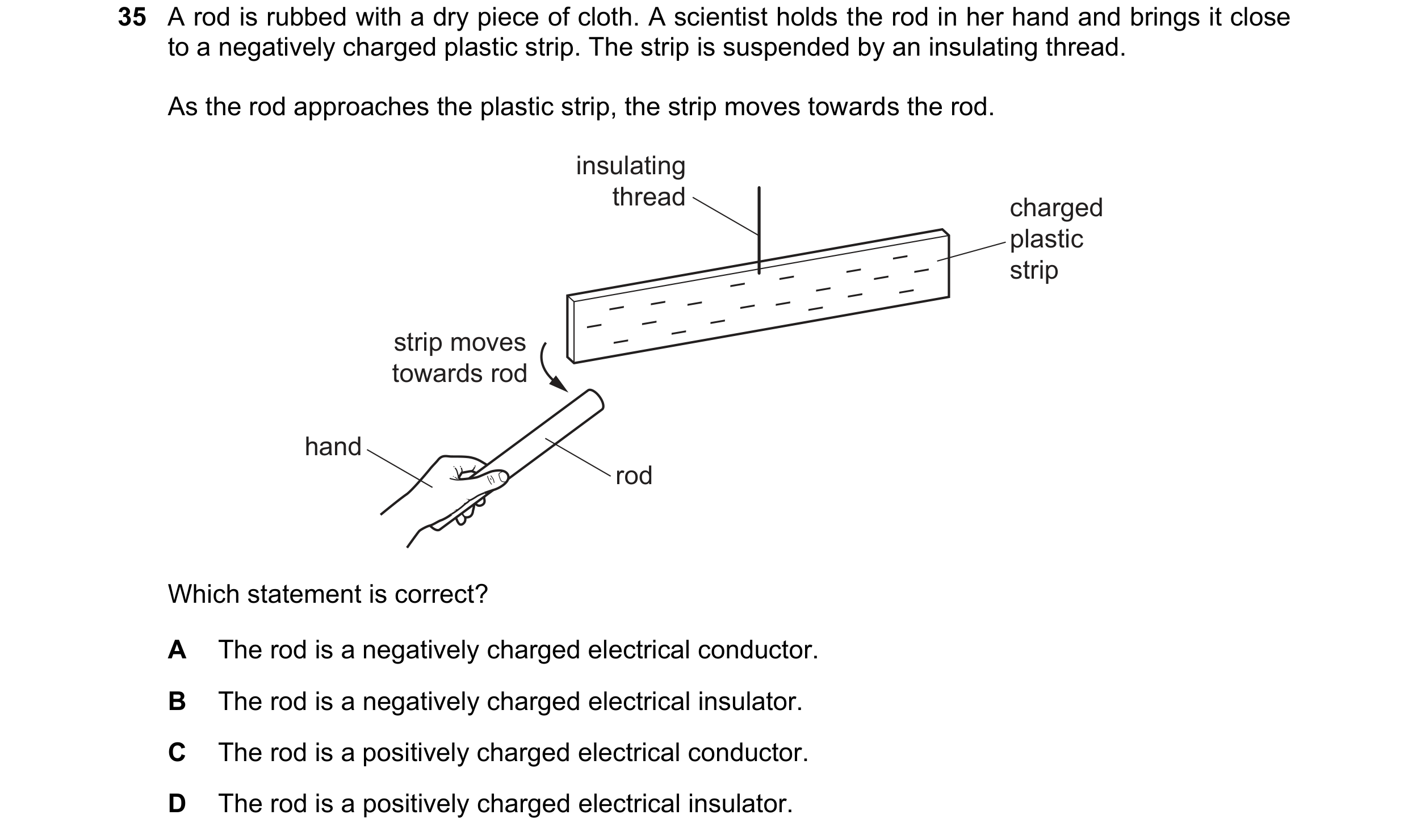
 23 / 31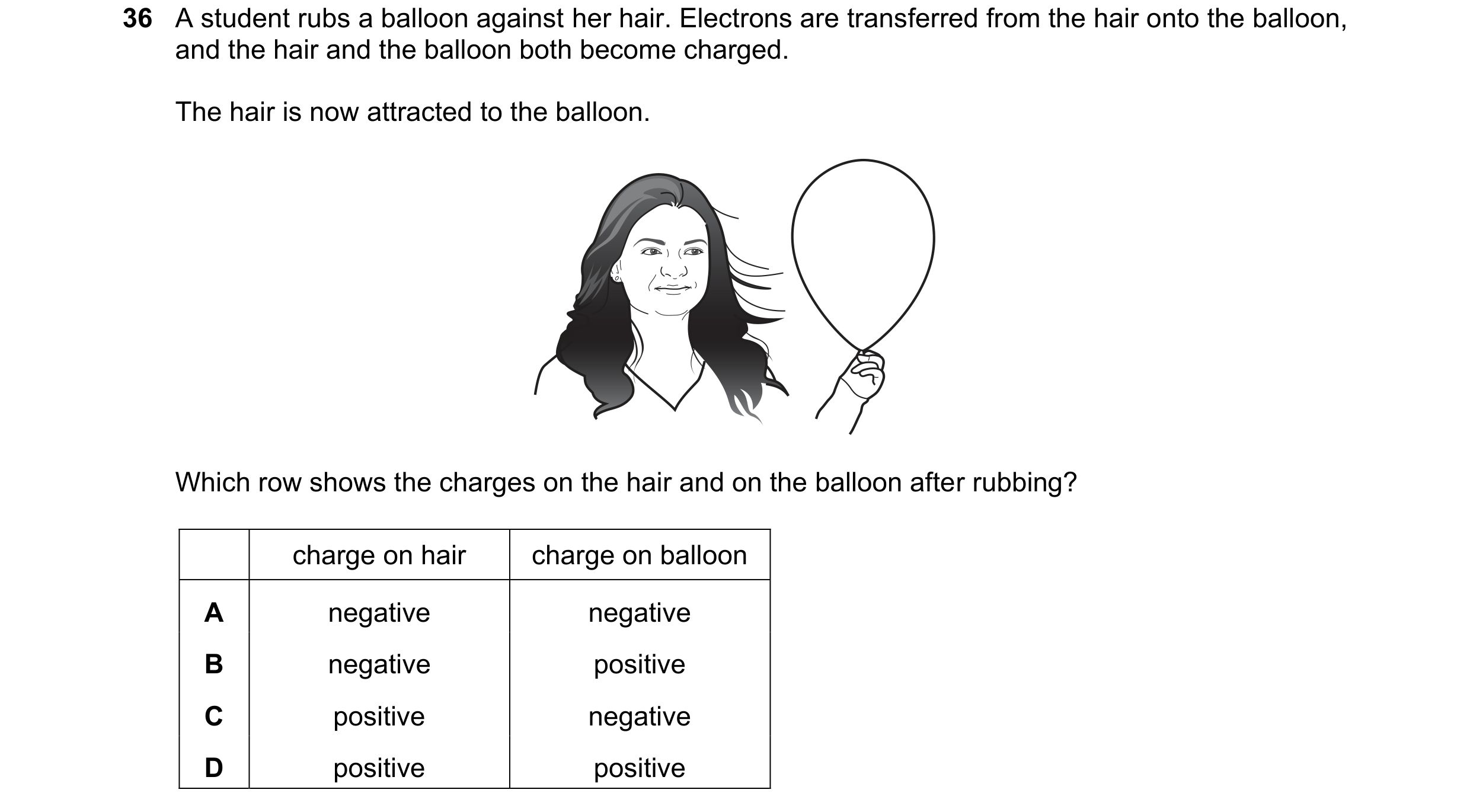


 24 / 31
 25 / 31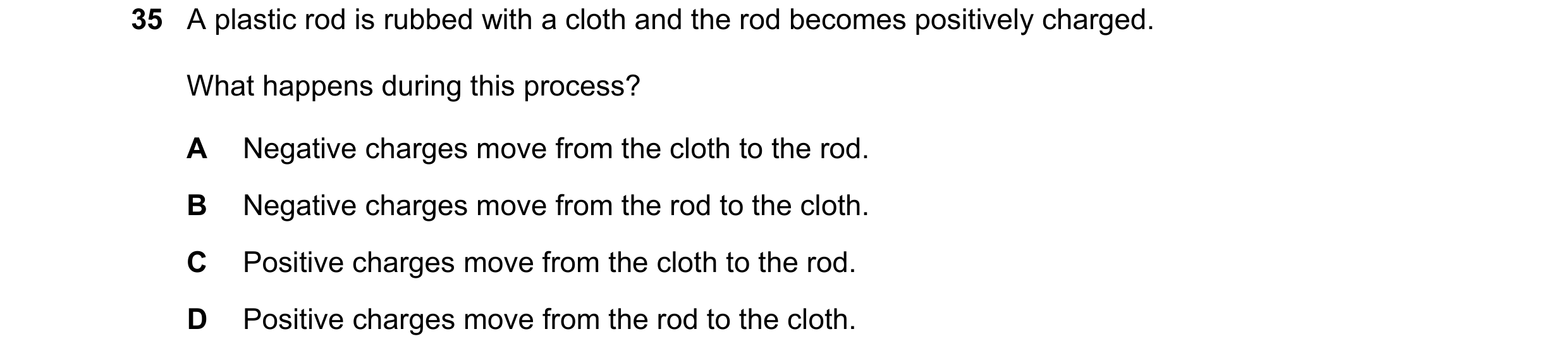
 26 / 31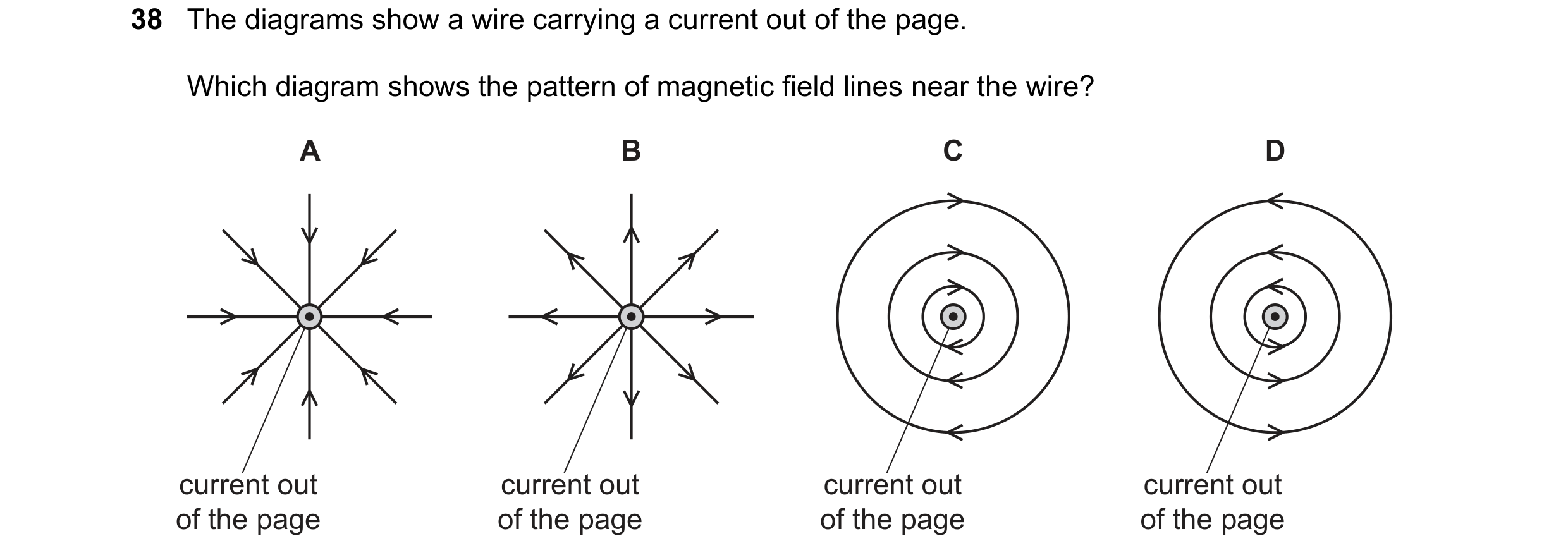
 27 / 31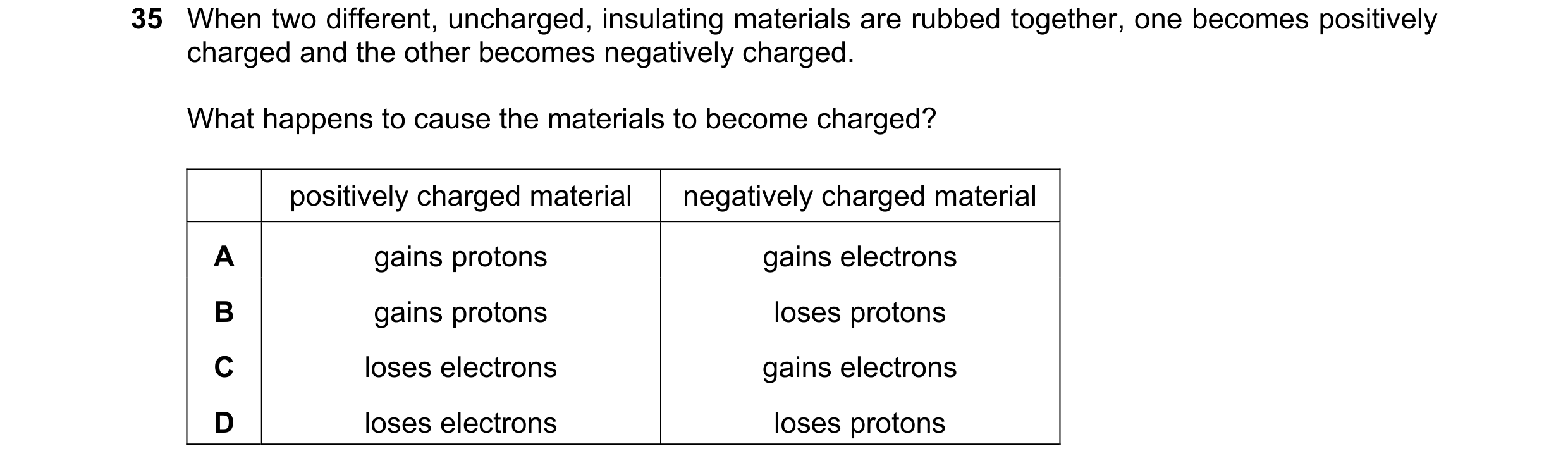
 28 / 31
 29 / 31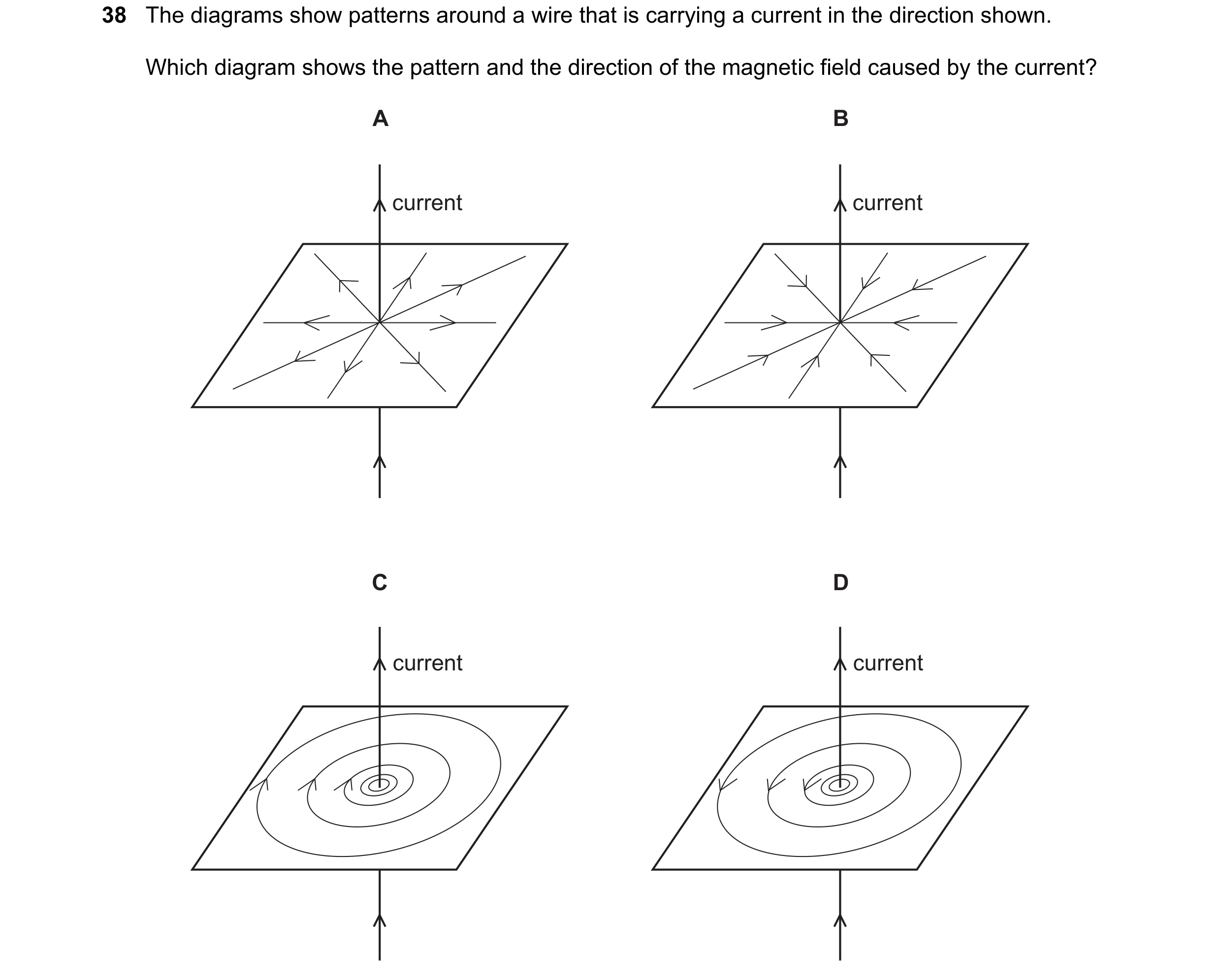
 30 / 31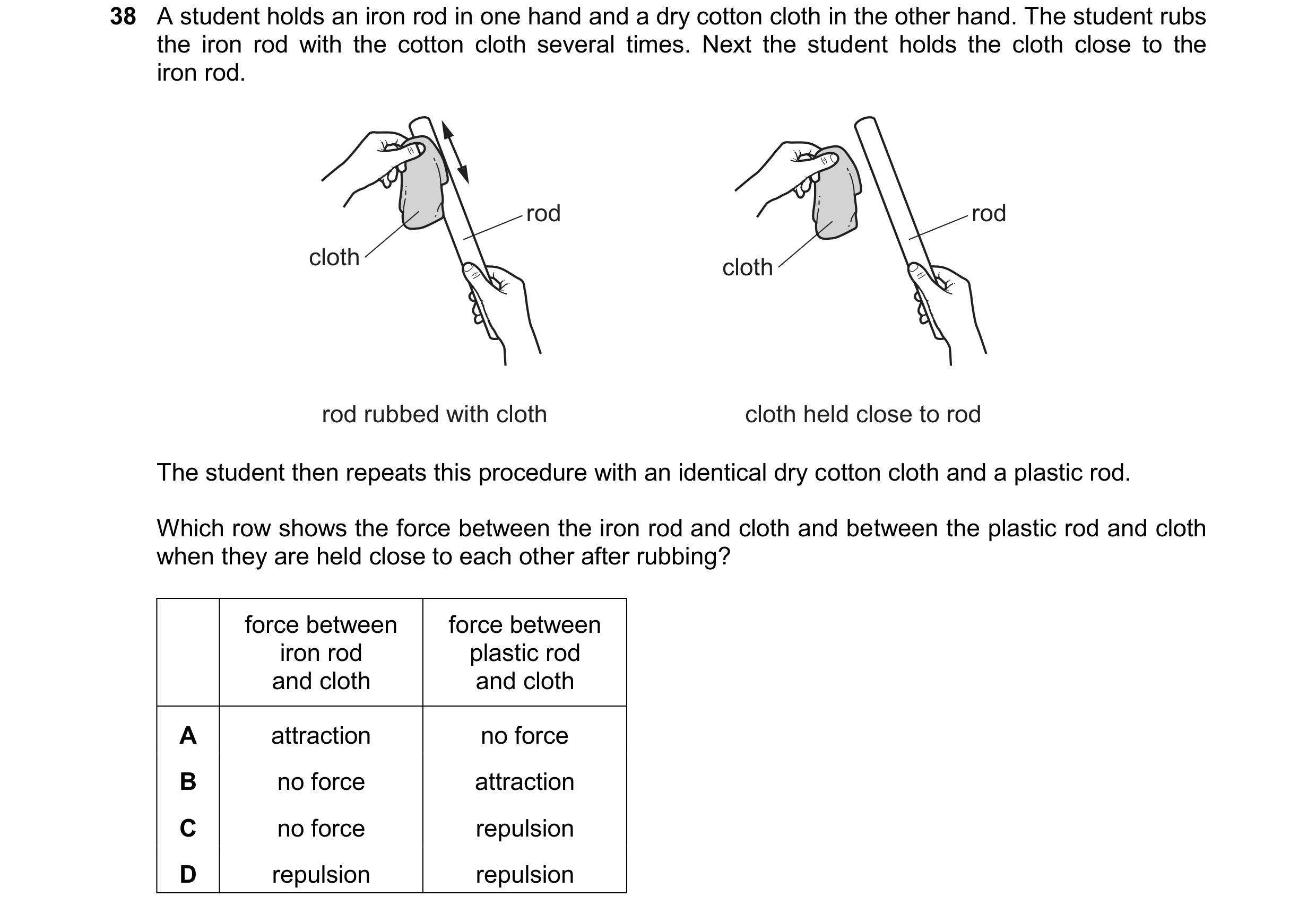
 31 / 31