Questions as text
Q1 · Three charged balls P, Q and R are suspended by insulating threads 0654/21 Oct/Nov 2017
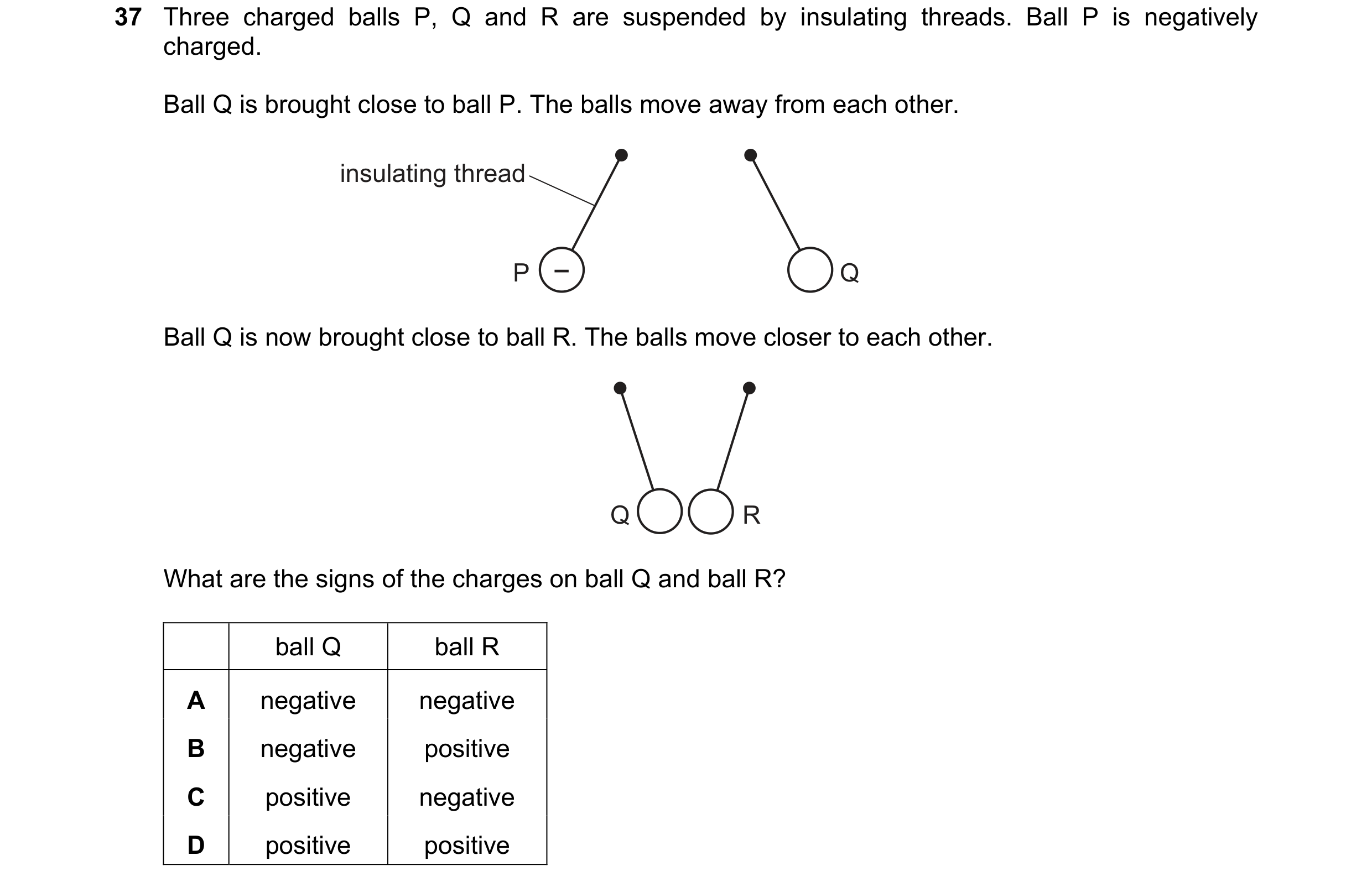
37 Three charged balls P, Q and R are suspended by insulating threads. Ball P is negatively charged. Ball Q is brought close to ball P. The balls move away from each other. insulating thread P – Q Ball Q is now brought close to ball R. The balls move closer to each other. Q R What are the signs of the charges on ball Q and ball R? ball Q ball R A negative negative B negative positive C positive negative D positive positive
1 marks
Answer: B
This question in 0654/21 Oct/Nov 2017
Q2 · A bar magnet is brought close to an unmagnetised iron rod 0654/22 Oct/Nov 2017
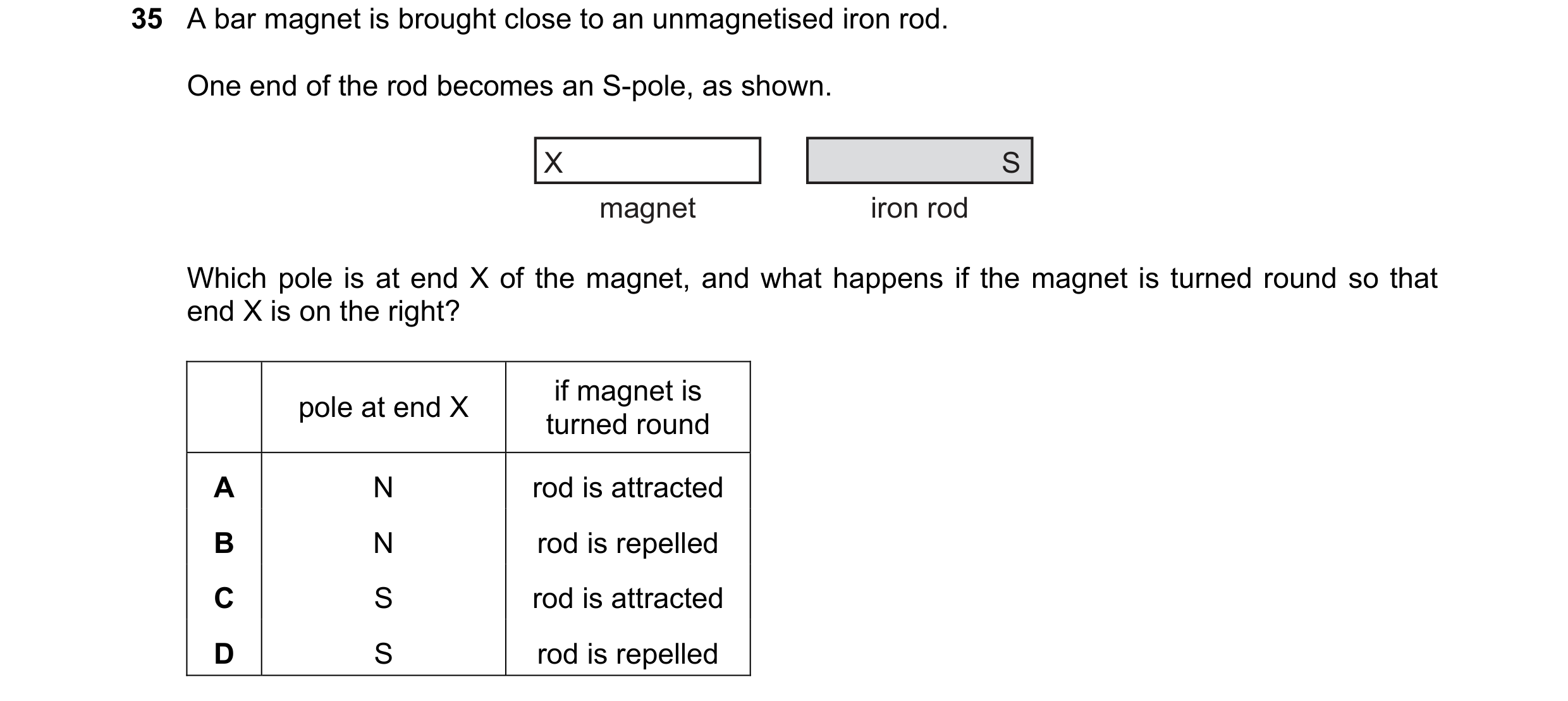
35 A bar magnet is brought close to an unmagnetised iron rod. One end of the rod becomes an S-pole, as shown. X S magnet iron rod Which pole is at end X of the magnet, and what happens if the magnet is turned round so that end X is on the right? if magnet is pole at end X turned round A N rod is attracted B N rod is repelled C S rod is attracted D S rod is repelled
1 marks
Answer: A
This question in 0654/22 Oct/Nov 2017
Q3 · Three charged balls P, Q and R are suspended by insulating threads 0654/22 Oct/Nov 2017
38 Three charged balls P, Q and R are suspended by insulating threads. Ball P is negatively charged. Ball Q is brought close to ball P. The balls move away from each other. insulating thread P – Q Ball Q is now brought close to ball R. The balls move closer to each other. Q R What are the signs of the charges on ball Q and ball R? ball Q ball R A negative negative B negative positive C positive negative D positive positive
1 marks
Answer: B
This question in 0654/22 Oct/Nov 2017
Q4 · Three charged balls P, Q and R are suspended by insulating threads 0654/23 Oct/Nov 2017
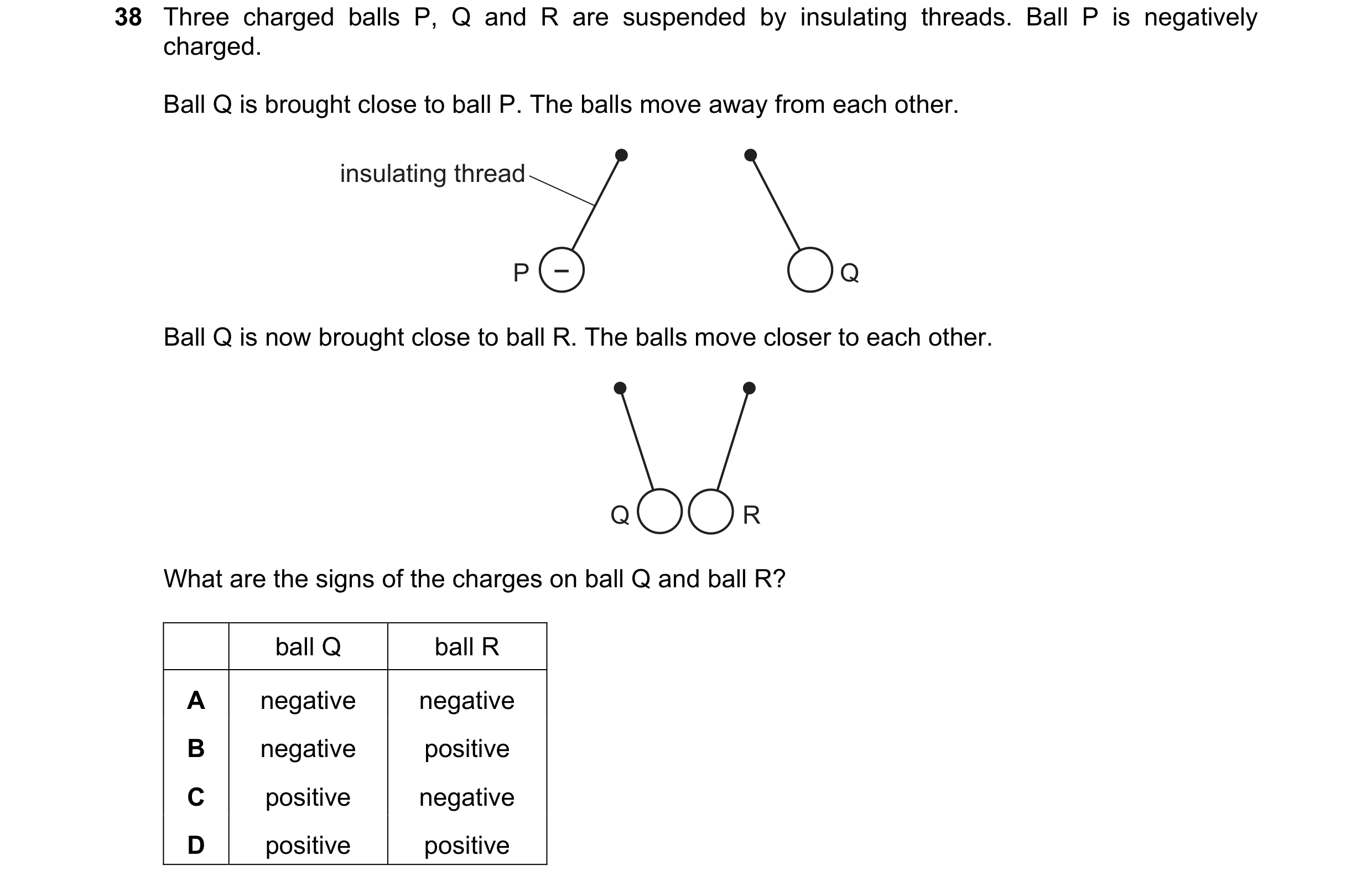
38 Three charged balls P, Q and R are suspended by insulating threads. Ball P is negatively charged. Ball Q is brought close to ball P. The balls move away from each other. insulating thread P – Q Ball Q is now brought close to ball R. The balls move closer to each other. Q R What are the signs of the charges on ball Q and ball R? ball Q ball R A negative negative B negative positive C positive negative D positive positive
1 marks
Answer: B
This question in 0654/23 Oct/Nov 2017
Q5 · An electromagnet has a metal core 0654/22 Oct/Nov 2018
36 An electromagnet has a metal core. Which metal is used and why? A iron because it becomes a permanent magnet B iron because it does not become a permanent magnet C steel because it becomes a permanent magnet D steel because it does not become a permanent magnet
1 marks
Answer: B
This question in 0654/22 Oct/Nov 2018
Q6 · Which diagram shows the pattern of the magnetic field lines around a bar magnet? 0654/23 Oct/Nov 2018
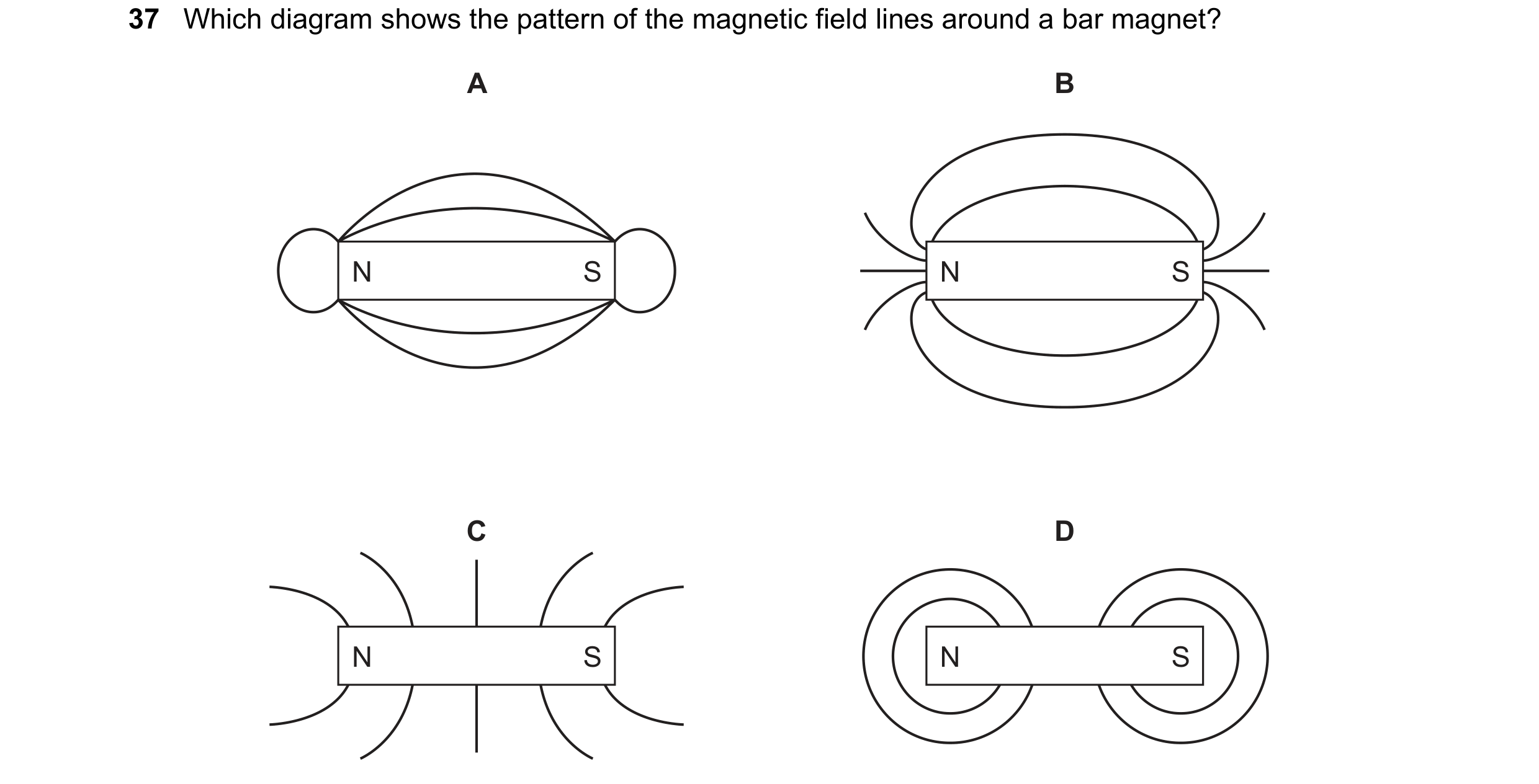
37 Which diagram shows the pattern of the magnetic field lines around a bar magnet? A B N S N S C D N S N S
1 marks
Answer: B
This question in 0654/23 Oct/Nov 2018
Q7 · Two unmagnetised iron nails are in contact with the S-pole of a permanent magnet 0654/22 May/June 2020
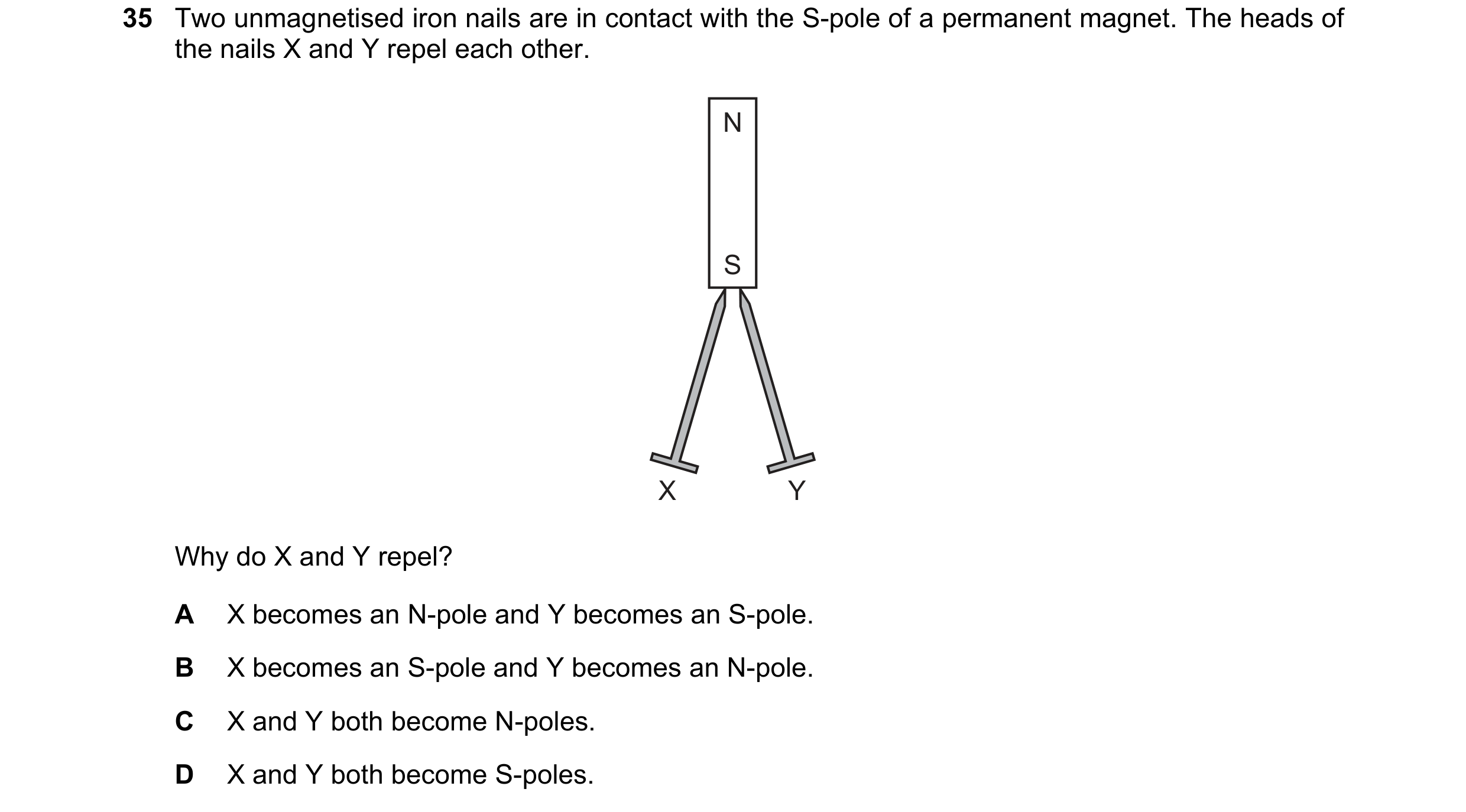
35 Two unmagnetised iron nails are in contact with the S-pole of a permanent magnet. The heads of the nails X and Y repel each other. N S X Y Why do X and Y repel? A X becomes an N-pole and Y becomes an S-pole. B X becomes an S-pole and Y becomes an N-pole. C X and Y both become N-poles. D X and Y both become S-poles.
1 marks
Answer: D
This question in 0654/22 May/June 2020
Q8 · A current-carrying wire passes through a flat card 0654/23 May/June 2020
38 A current-carrying wire passes through a flat card. The arrow on each wire shows the direction of the current. Which diagram shows the pattern of the magnetic field on the card and the direction of the magnetic field lines? A B wire wire current current card card C D wire wire current current card card
1 marks
Answer: D
This question in 0654/23 May/June 2020
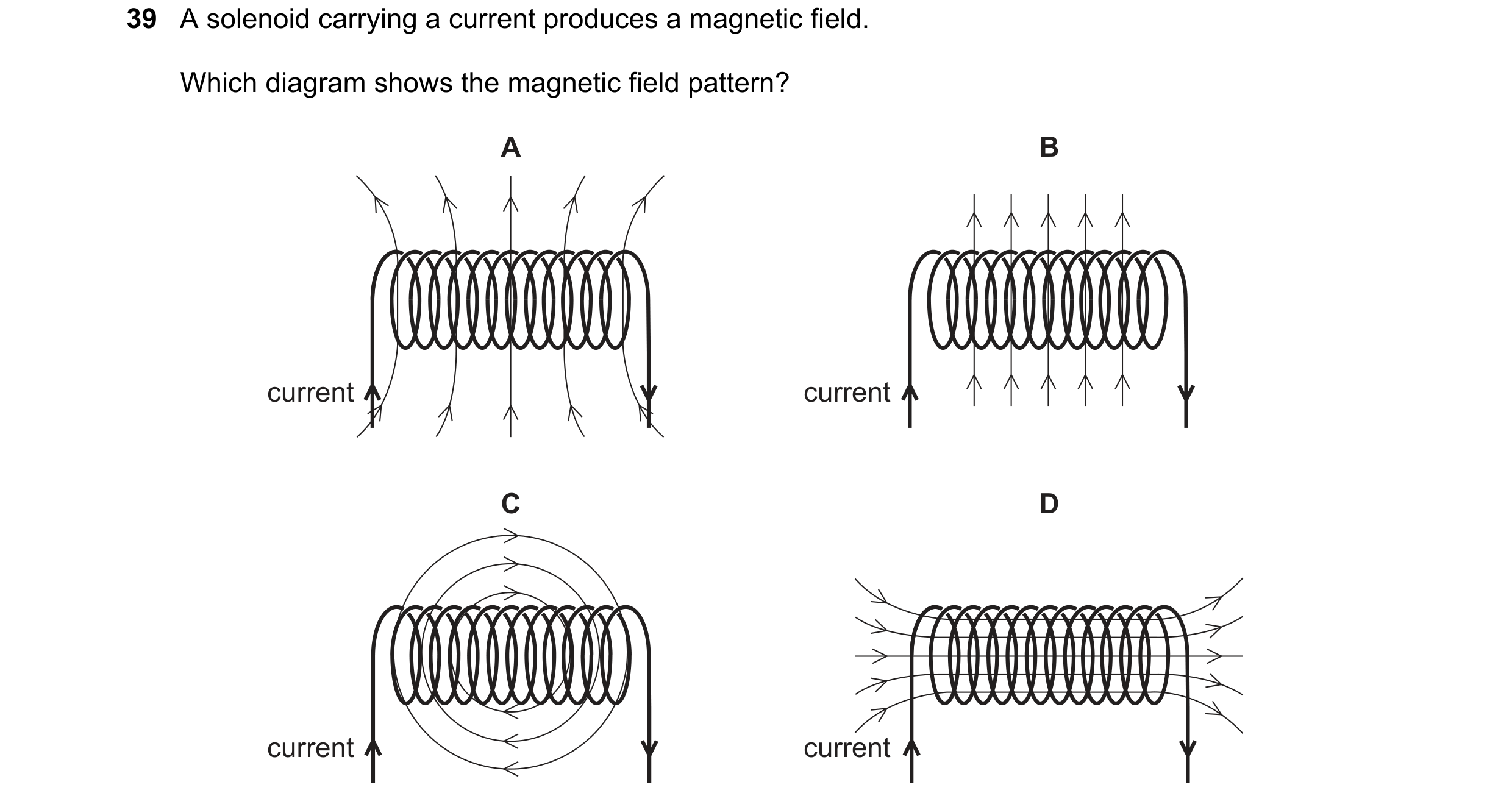
Q9 · A solenoid carrying a current produces a magnetic field 0654/21 Oct/Nov 2020
39 A solenoid carrying a current produces a magnetic field. Which diagram shows the magnetic field pattern? A B current current C D current current
1 marks
Answer: D
This question in 0654/21 Oct/Nov 2020
Q10 · A solenoid carrying a current produces a magnetic field 0654/22 Oct/Nov 2020
39 A solenoid carrying a current produces a magnetic field. Which diagram shows the magnetic field pattern? A B current current C D current current
1 marks
Answer: D
This question in 0654/22 Oct/Nov 2020
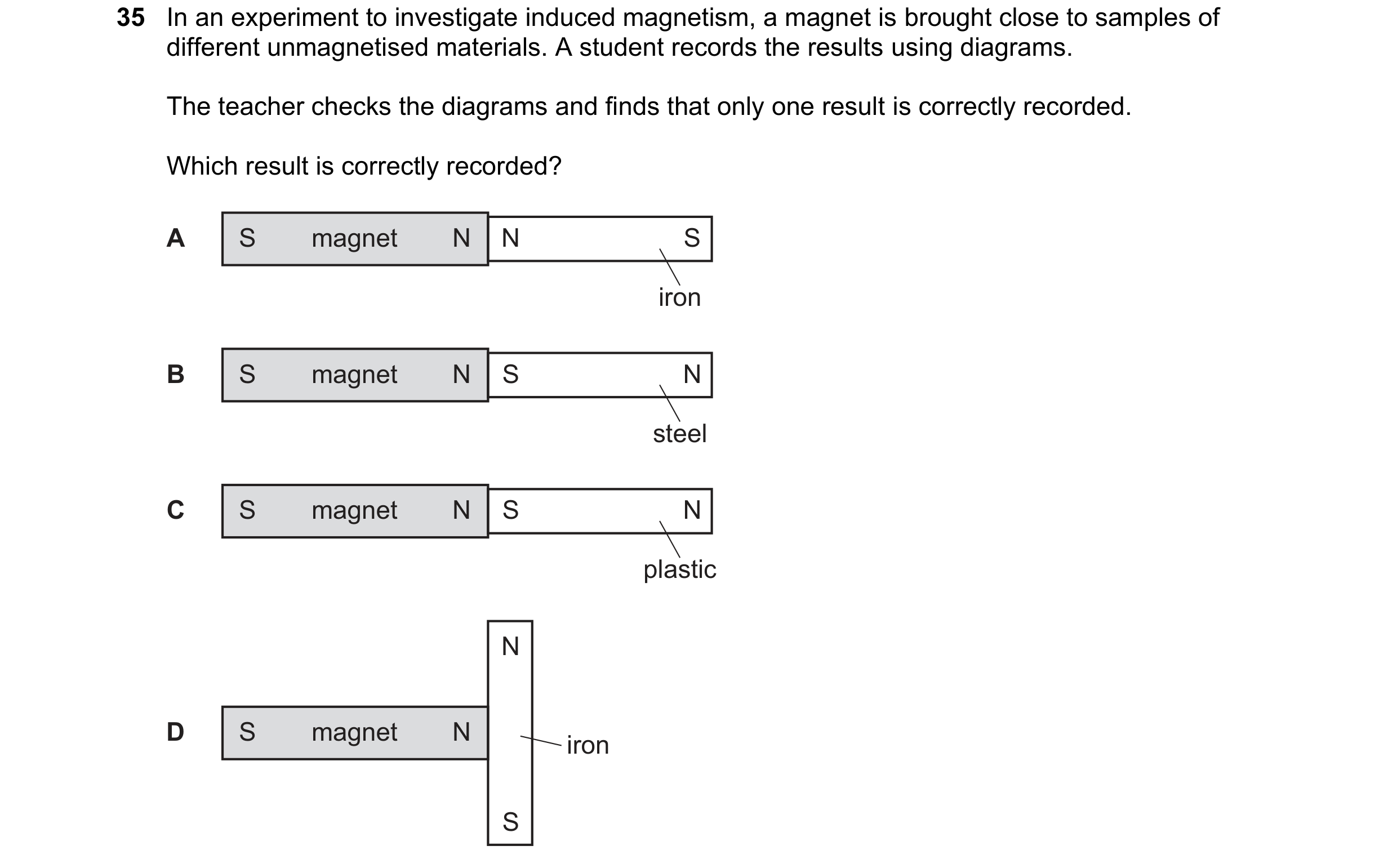
Q11 · In an experiment to investigate induced magnetism, a magnet is brought close to samples… 0654/23 Oct/Nov 2020
35 In an experiment to investigate induced magnetism, a magnet is brought close to samples of different unmagnetised materials. A student records the results using diagrams. The teacher checks the diagrams and finds that only one result is correctly recorded. Which result is correctly recorded? A S magnet N N S iron B S magnet N S N steel C S magnet N S N plastic N D S magnet N iron S
1 marks
Answer: B
This question in 0654/23 Oct/Nov 2020
Q12 · What is meant by an electric field? 0654/22 Feb/March 2021
35 What is meant by an electric field? A a region in which a charge experiences a force B a region in which a current experiences a force C a region in which a magnetic pole experiences a force D a region in which a mass experiences a force
1 marks
Answer: A
This question in 0654/22 Feb/March 2021
Q13 · Which diagram shows the pattern of the magnetic field due to a current in a straight wire? 0654/22 Feb/March 2021
37 Which diagram shows the pattern of the magnetic field due to a current in a straight wire? A B current current C D current current
1 marks
Answer: A
This question in 0654/22 Feb/March 2021
Q14 · An unmagnetised soft iron bar is held close to a permanent magnet and becomes attached to… 0654/21 May/June 2021
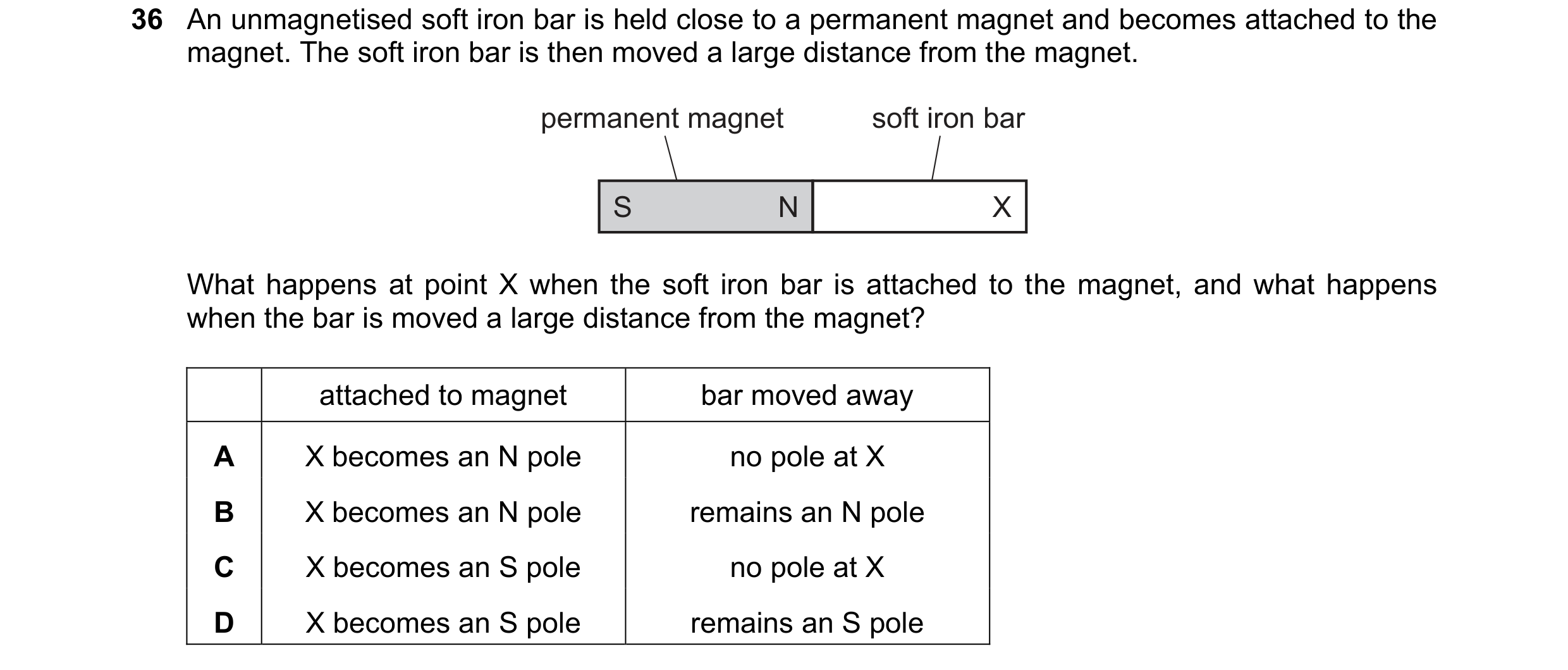
36 An unmagnetised soft iron bar is held close to a permanent magnet and becomes attached to the magnet. The soft iron bar is then moved a large distance from the magnet. permanent magnet soft iron bar S N X What happens at point X when the soft iron bar is attached to the magnet, and what happens when the bar is moved a large distance from the magnet? attached to magnet bar moved away A X becomes an N pole no pole at X B X becomes an N pole remains an N pole C X becomes an S pole no pole at X D X becomes an S pole remains an S pole
1 marks
Answer: A
This question in 0654/21 May/June 2021
Q15 · A rod is rubbed with a dry piece of cloth 0654/21 Oct/Nov 2021
38 A rod is rubbed with a dry piece of cloth. A scientist holds the rod in her hand and brings it close to a negatively charged plastic strip. The strip is suspended by an insulating thread. As the rod approaches the plastic strip, the strip moves towards the rod. insulating thread charged plastic – – – – – –– strip – – – – – – – – – – – – strip moves – towards rod hand rod Which statement is correct? A The rod is a negatively charged electrical conductor. B The rod is a negatively charged electrical insulator. C The rod is a positively charged electrical conductor. D The rod is a positively charged electrical insulator.
1 marks
Answer: D
This question in 0654/21 Oct/Nov 2021
Q16 · A rod is rubbed with a dry piece of cloth 0654/22 Oct/Nov 2021
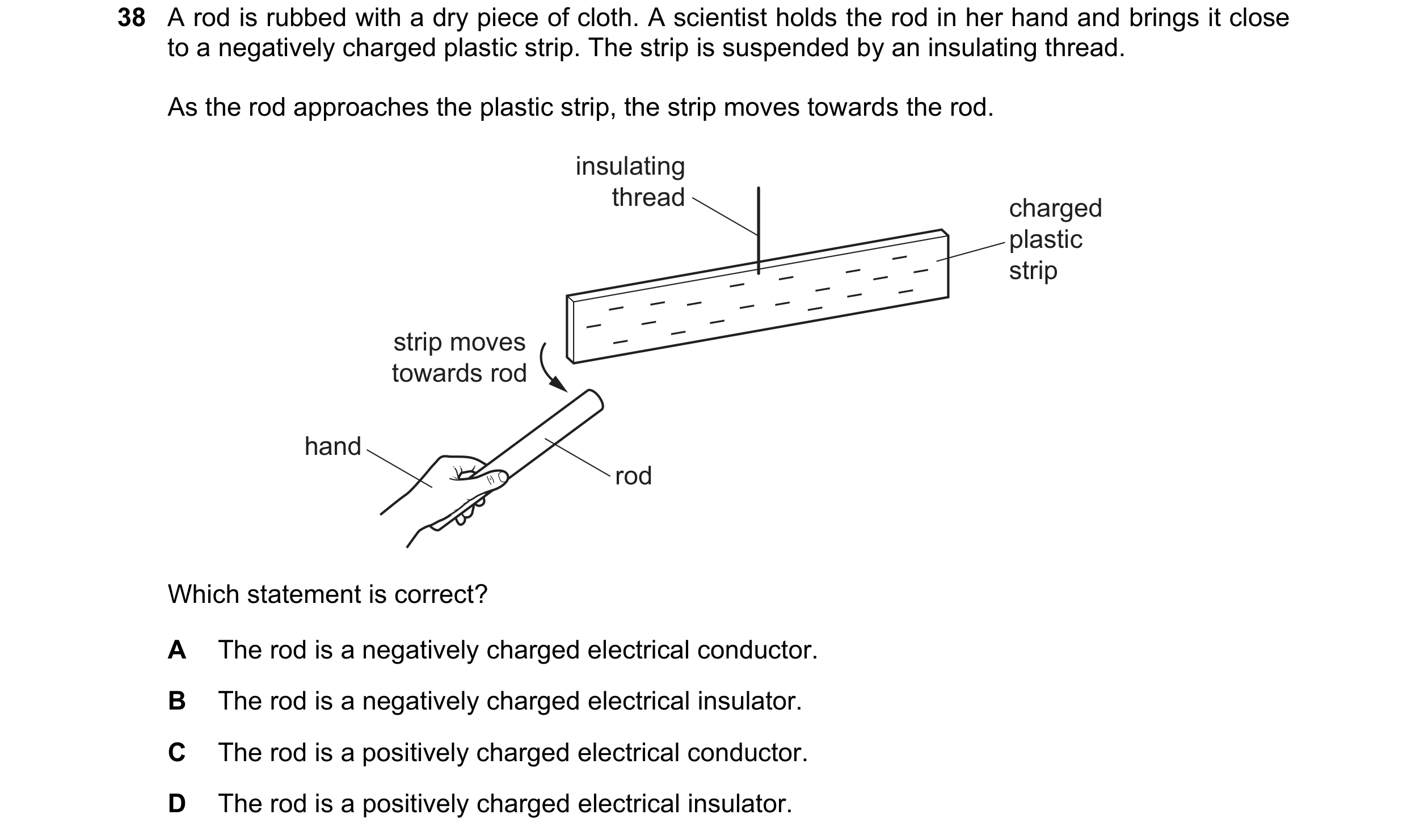
38 A rod is rubbed with a dry piece of cloth. A scientist holds the rod in her hand and brings it close to a negatively charged plastic strip. The strip is suspended by an insulating thread. As the rod approaches the plastic strip, the strip moves towards the rod. insulating thread charged plastic – – – – – –– strip – – – – – – – – – – – – strip moves – towards rod hand rod Which statement is correct? A The rod is a negatively charged electrical conductor. B The rod is a negatively charged electrical insulator. C The rod is a positively charged electrical conductor. D The rod is a positively charged electrical insulator.
1 marks
Answer: D
This question in 0654/22 Oct/Nov 2021
Q17 · A rod is rubbed with a dry piece of cloth 0654/23 Oct/Nov 2021
36 A rod is rubbed with a dry piece of cloth. A scientist holds the rod in her hand and brings it close to a negatively charged plastic strip. The strip is suspended by an insulating thread. As the rod approaches the plastic strip, the strip moves towards the rod. insulating thread charged plastic – – – – – –– strip – – – – – – – – – – – – strip moves – towards rod hand rod Which statement is correct? A The rod is a negatively charged electrical conductor. B The rod is a negatively charged electrical insulator. C The rod is a positively charged electrical conductor. D The rod is a positively charged electrical insulator.
1 marks
Answer: D
This question in 0654/23 Oct/Nov 2021
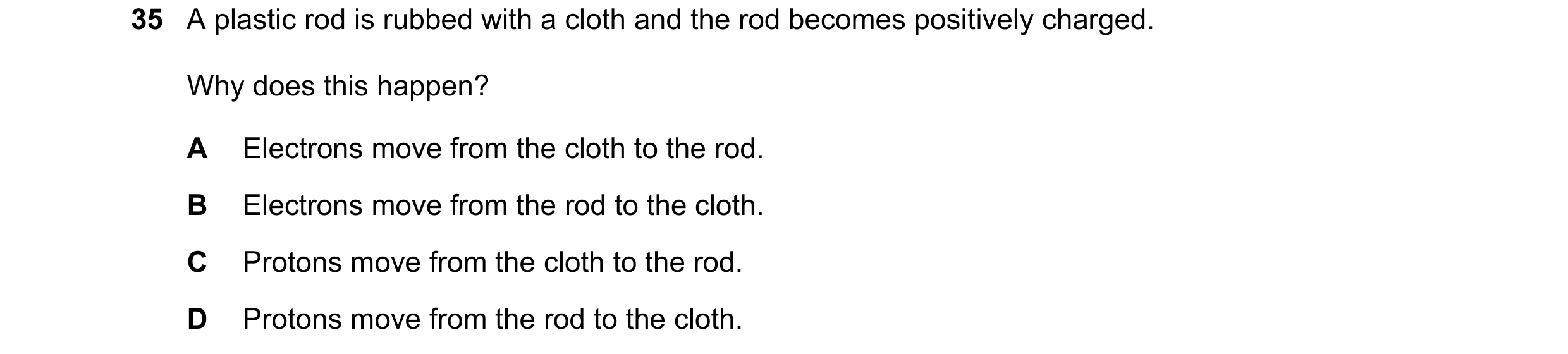
Q18 · A plastic rod is rubbed with a cloth and the rod becomes positively charged 0654/21 May/June 2022
35 A plastic rod is rubbed with a cloth and the rod becomes positively charged. Why does this happen? A Electrons move from the cloth to the rod. B Electrons move from the rod to the cloth. C Protons move from the cloth to the rod. D Protons move from the rod to the cloth.
1 marks
Answer: B
This question in 0654/21 May/June 2022
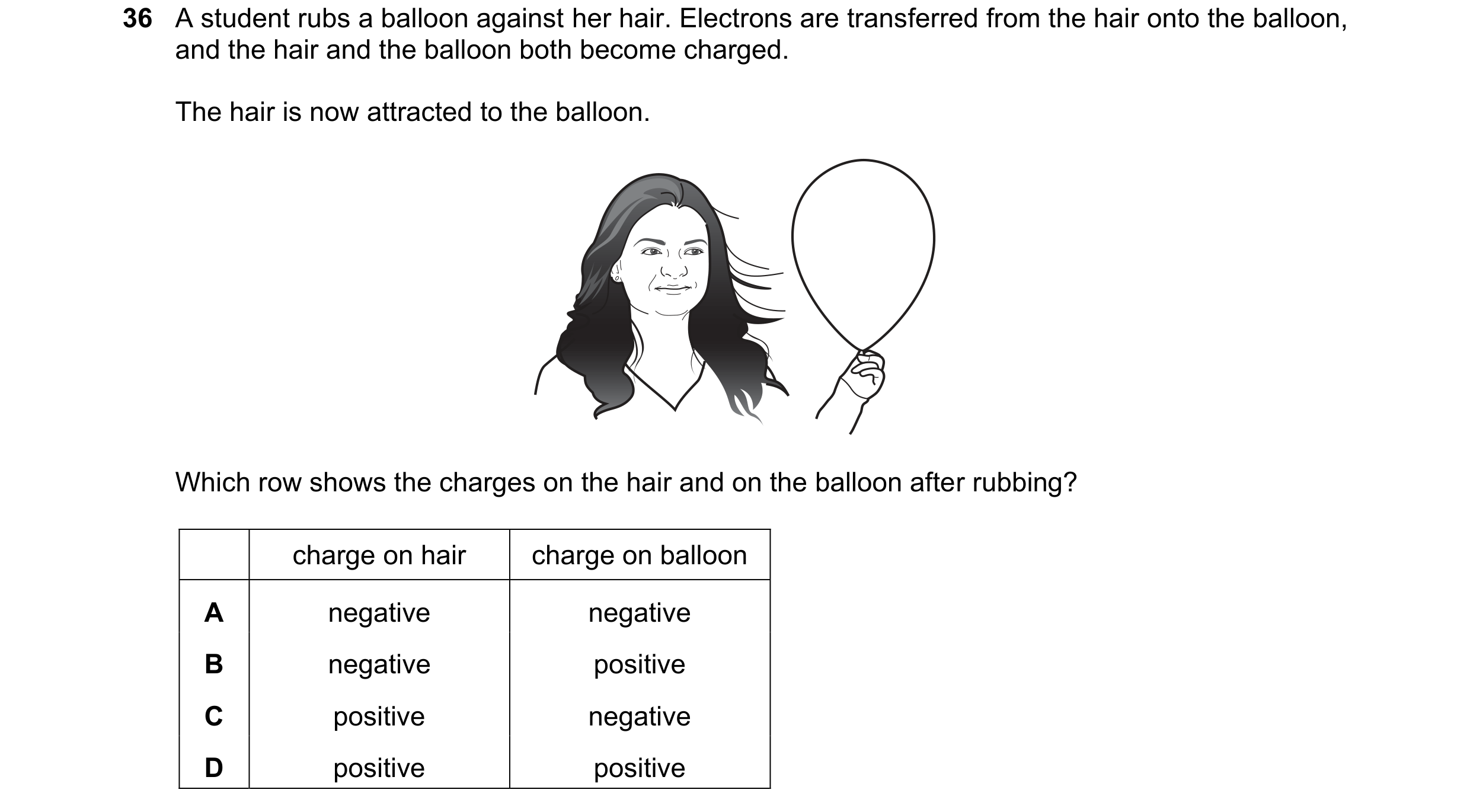
Q19 · A student rubs a balloon against her hair 0654/22 May/June 2022
36 A student rubs a balloon against her hair. Electrons are transferred from the hair onto the balloon, and the hair and the balloon both become charged. The hair is now attracted to the balloon. Which row shows the charges on the hair and on the balloon after rubbing? charge on hair charge on balloon A negative negative B negative positive C positive negative D positive positive
1 marks
Answer: C
This question in 0654/22 May/June 2022
Q20 · An iron bar XY is brought near to a magnet 0654/23 May/June 2022
35 An iron bar XY is brought near to a magnet. Magnetic poles are induced in the iron bar. X Y S N iron bar magnet What are the magnetic poles induced at X and Y? pole at X pole at Y A N N B N S C S N D S S
1 marks
Answer: C
This question in 0654/23 May/June 2022
Q21 · Which type of magnet can be switched on and off many times per second? 0654/21 Oct/Nov 2022
35 Which type of magnet can be switched on and off many times per second? A an electromagnet only B a permanent magnet only C both electromagnets and permanent magnets D neither electromagnets or permanent magnets
1 marks
Answer: A
This question in 0654/21 Oct/Nov 2022
Q22 · Which type of magnet can be switched on and off many times per second? 0654/22 Oct/Nov 2022
36 Which type of magnet can be switched on and off many times per second? A an electromagnet only B a permanent magnet only C both electromagnets and permanent magnets D neither electromagnets or permanent magnets
1 marks
Answer: A
This question in 0654/22 Oct/Nov 2022
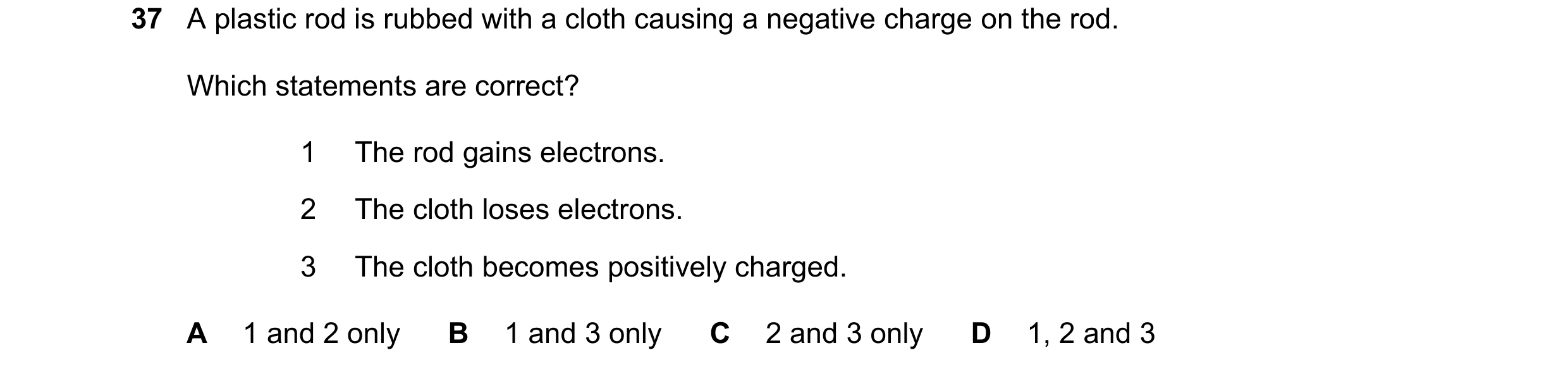
Q23 · A plastic rod is rubbed with a cloth causing a negative charge on the rod 0654/22 Oct/Nov 2022
37 A plastic rod is rubbed with a cloth causing a negative charge on the rod. Which statements are correct? 1 The rod gains electrons. 2 The cloth loses electrons. 3 The cloth becomes positively charged. A 1 and 2 only B 1 and 3 only C 2 and 3 only D 1, 2 and 3
1 marks
Answer: D
This question in 0654/22 Oct/Nov 2022
Q24 · Which type of magnet can be switched on and off many times per second? 0654/23 Oct/Nov 2022
35 Which type of magnet can be switched on and off many times per second? A an electromagnet only B a permanent magnet only C both electromagnets and permanent magnets D neither electromagnets or permanent magnets
1 marks
Answer: A
This question in 0654/23 Oct/Nov 2022
Q25 · Two insulators are charged by rubbing them with a cloth 0654/21 May/June 2023
35 Two insulators are charged by rubbing them with a cloth. After this, the charged insulators repel each other. Which statement is a possible description of how the insulators become charged? A One gained electrons and the other gained protons. B One gained electrons and the other lost electrons. C They both lost electrons. D They both lost protons.
1 marks
Answer: C
This question in 0654/21 May/June 2023
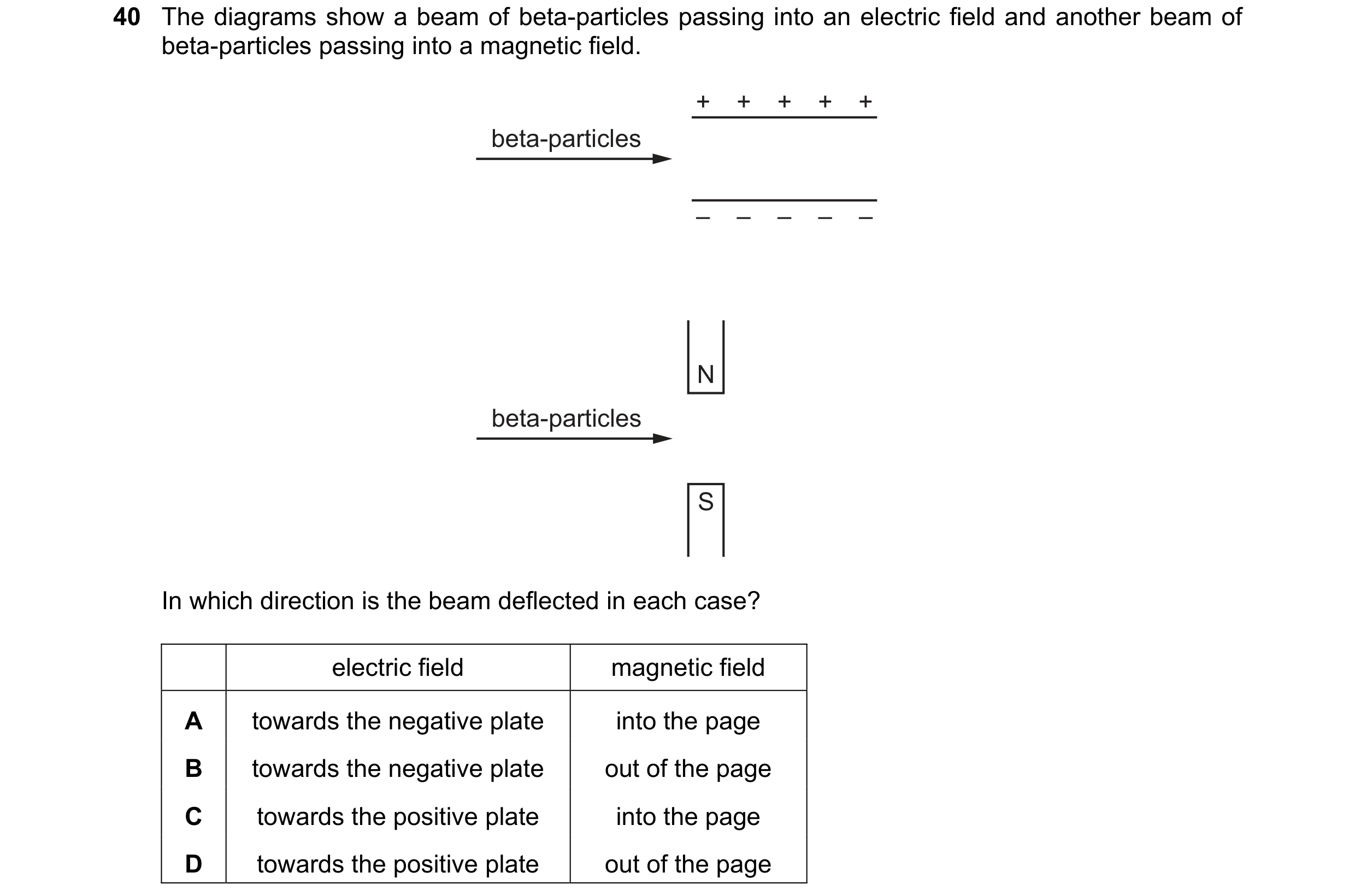
Q26 · The diagrams show a beam of beta-particles passing into an electric field and another… 0654/21 May/June 2023
40 The diagrams show a beam of beta-particles passing into an electric field and another beam of beta-particles passing into a magnetic field. + + + + + beta-particles – – – – – N beta-particles S In which direction is the beam deflected in each case? electric field magnetic field A towards the negative plate into the page B towards the negative plate out of the page C towards the positive plate into the page D towards the positive plate out of the page
1 marks
Answer: D
This question in 0654/21 May/June 2023
Q27 · Which material is used for the core of an electromagnet? 0654/22 May/June 2023
36 Which material is used for the core of an electromagnet? A aluminium B copper C iron D steel
1 marks
Answer: C
This question in 0654/22 May/June 2023
Q28 · There is a current-carrying wire perpendicular to the page 0654/22 May/June 2023
37 There is a current-carrying wire perpendicular to the page. The direction of the current is into the page. Which diagram shows the pattern and direction of the magnetic field around the wire? A B current current into page into page C D current current into page into page
1 marks
Answer: A
This question in 0654/22 May/June 2023
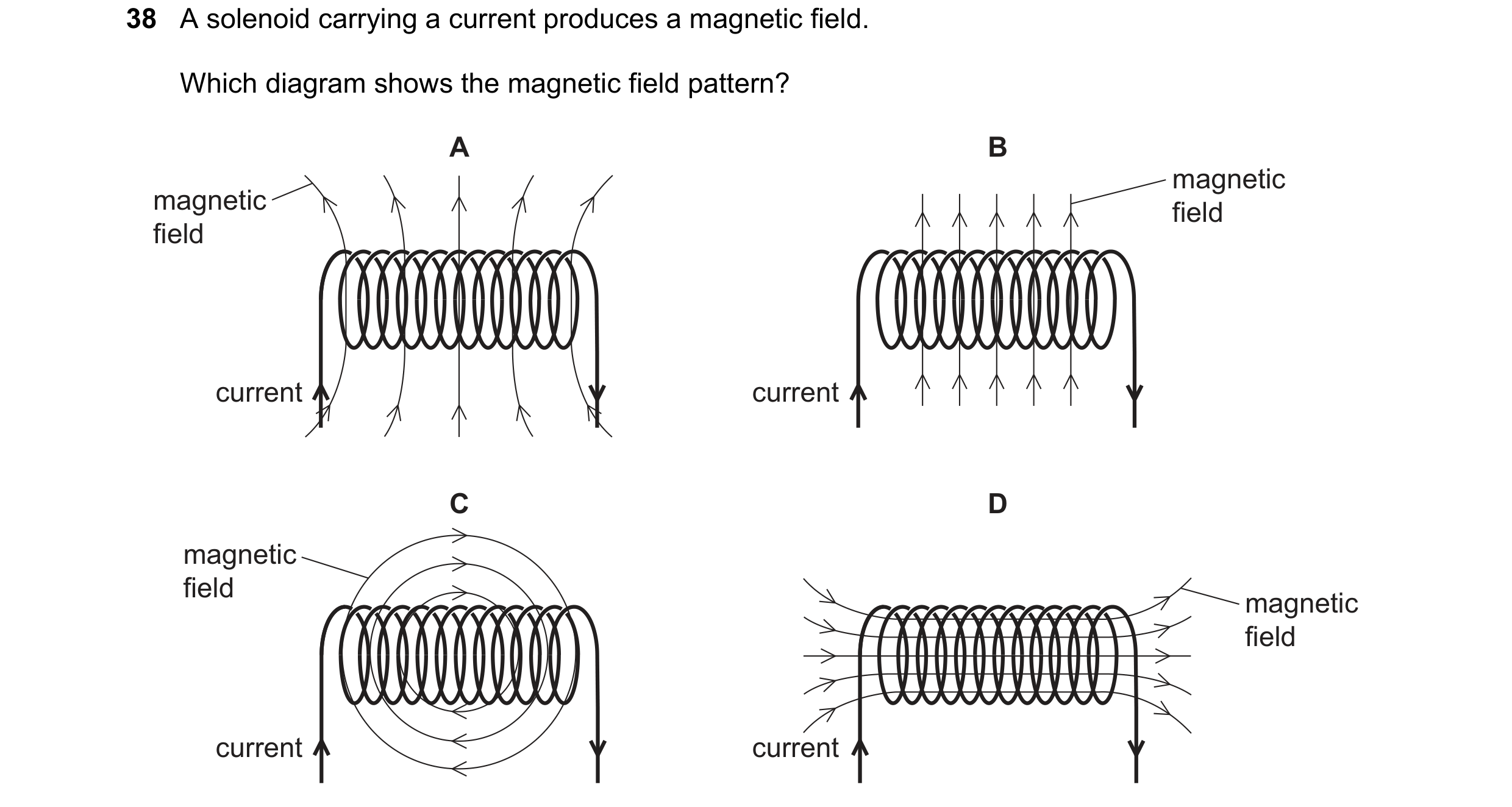
Q29 · A solenoid carrying a current produces a magnetic field 0654/23 May/June 2023
38 A solenoid carrying a current produces a magnetic field. Which diagram shows the magnetic field pattern? A B magnetic magnetic field field current current C D magnetic field magnetic field current current
1 marks
Answer: D
This question in 0654/23 May/June 2023
Q30 · Three charged balls P, Q and R are suspended by insulating threads 0654/21 Oct/Nov 2023
36 Three charged balls P, Q and R are suspended by insulating threads. Ball P is negatively charged. Ball Q is brought close to ball P. The balls move away from each other. insulating thread P – Q Ball Q is now brought close to ball R. The balls move closer to each other. Q R What are the signs of the charges on ball Q and ball R? ball Q ball R A negative negative B negative positive C positive negative D positive positive
1 marks
Answer: B
This question in 0654/21 Oct/Nov 2023
Q31 · A plastic rod is rubbed with a cloth 0654/22 Oct/Nov 2023
35 A plastic rod is rubbed with a cloth. The rod becomes positively charged. Which statement describes why this happens? A Electrons move from the cloth to the rod. B Electrons move from the rod to the cloth. C Protons move from the cloth to the rod. D Protons move from the rod to the cloth.
1 marks
Answer: B
This question in 0654/22 Oct/Nov 2023
Q32 · The diagrams show a wire carrying a current out of the page 0654/22 Oct/Nov 2023
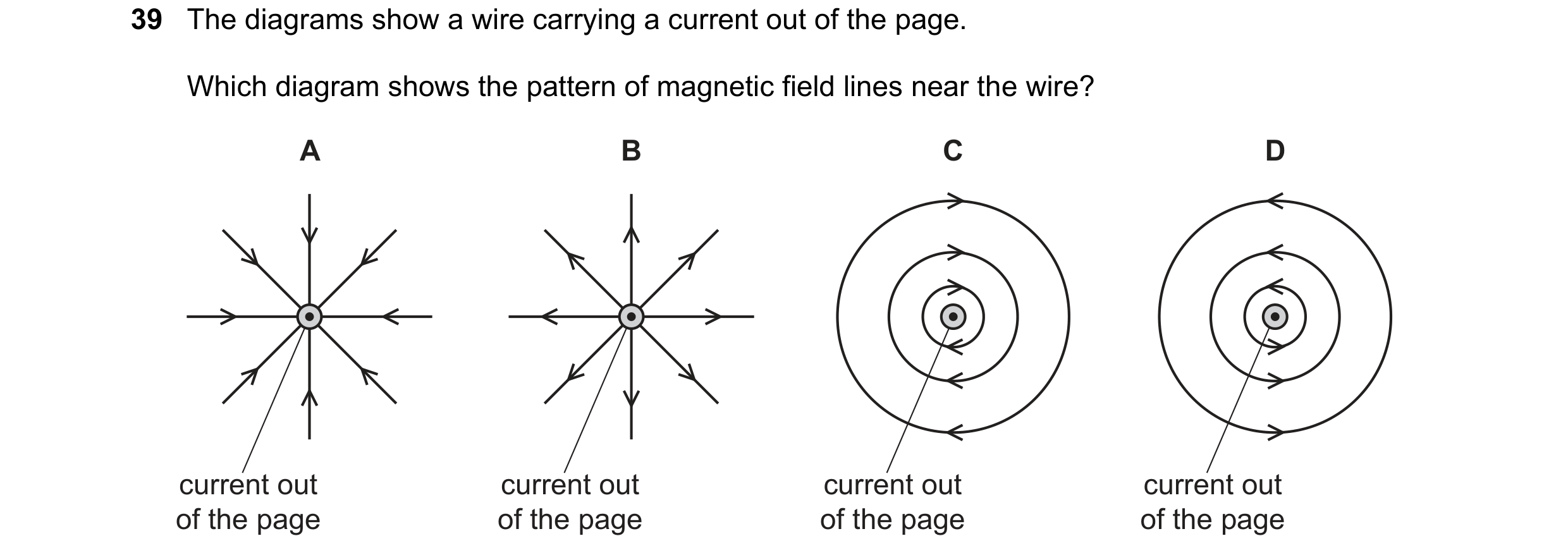
39 The diagrams show a wire carrying a current out of the page. Which diagram shows the pattern of magnetic field lines near the wire? A B C D current out current out current out current out of the page of the page of the page of the page
1 marks
Answer: D
This question in 0654/22 Oct/Nov 2023
Q33 · A bar magnet is brought near to a metal rod 0654/23 Oct/Nov 2023
35 A bar magnet is brought near to a metal rod. The metal rod is attracted to the magnet. magnet metal rod N S The magnet is then turned around so that the N-pole is on the right. The magnet is again brought near to the metal rod and is again attracted to the magnet. What could the metal rod be? A another bar magnet B a piece of aluminium C a piece of copper D a piece of iron
1 marks
Answer: D
This question in 0654/23 Oct/Nov 2023
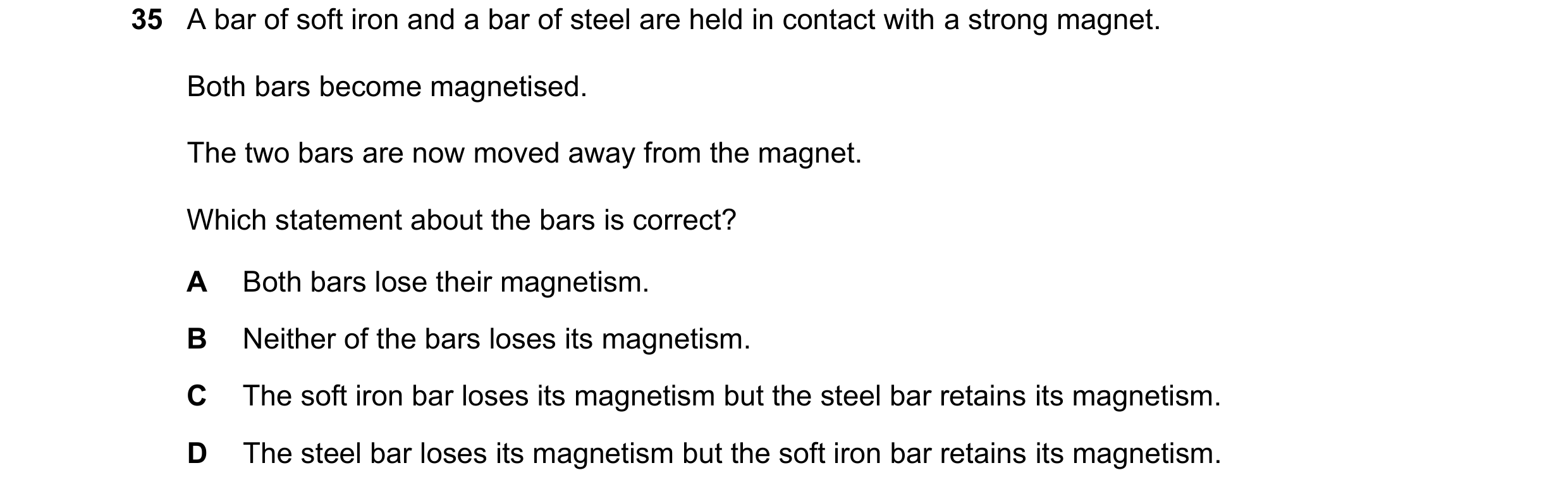
Q34 · A bar of soft iron and a bar of steel are held in contact with a strong magnet 0654/21 May/June 2024
35 A bar of soft iron and a bar of steel are held in contact with a strong magnet. Both bars become magnetised. The two bars are now moved away from the magnet. Which statement about the bars is correct? A Both bars lose their magnetism. B Neither of the bars loses its magnetism. C The soft iron bar loses its magnetism but the steel bar retains its magnetism. D The steel bar loses its magnetism but the soft iron bar retains its magnetism.
1 marks
Answer: C
This question in 0654/21 May/June 2024
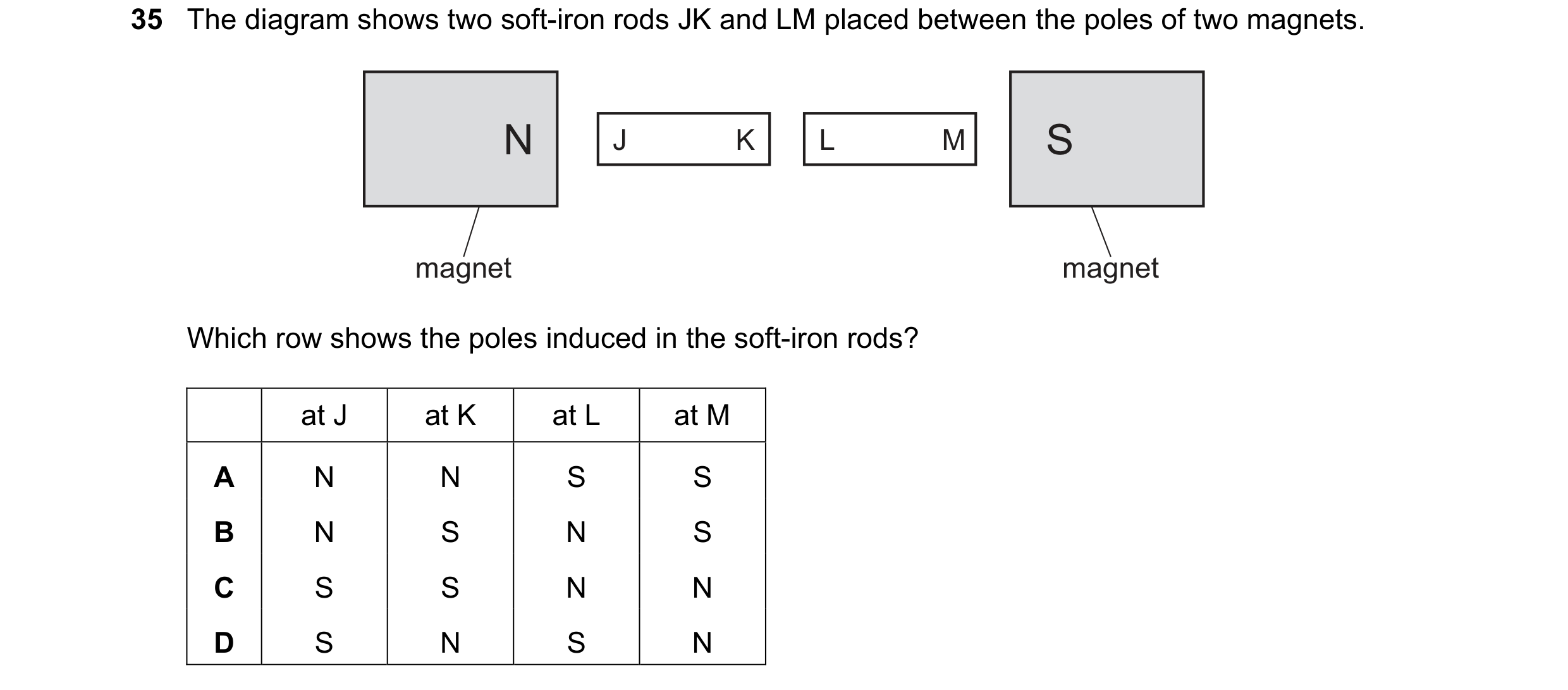
Q35 · The diagram shows two soft-iron rods JK and LM placed between the poles of two magnets 0654/22 May/June 2024
35 The diagram shows two soft-iron rods JK and LM placed between the poles of two magnets. N J K L M S magnet magnet Which row shows the poles induced in the soft-iron rods? at J at K at L at M A N N S S B N S N S C S S N N D S N S N
1 marks
Answer: D
This question in 0654/22 May/June 2024
Q36 · Which statement about the core of an electromagnet is correct? 0654/21 Oct/Nov 2024
35 Which statement about the core of an electromagnet is correct? A It is made of soft iron because soft iron is easy to magnetise. B It is made of soft iron because soft iron does not lose its magnetism easily. C It is made of steel because steel is easy to magnetise. D It is made of steel because steel loses its magnetism easily.
1 marks
Answer: A
This question in 0654/21 Oct/Nov 2024
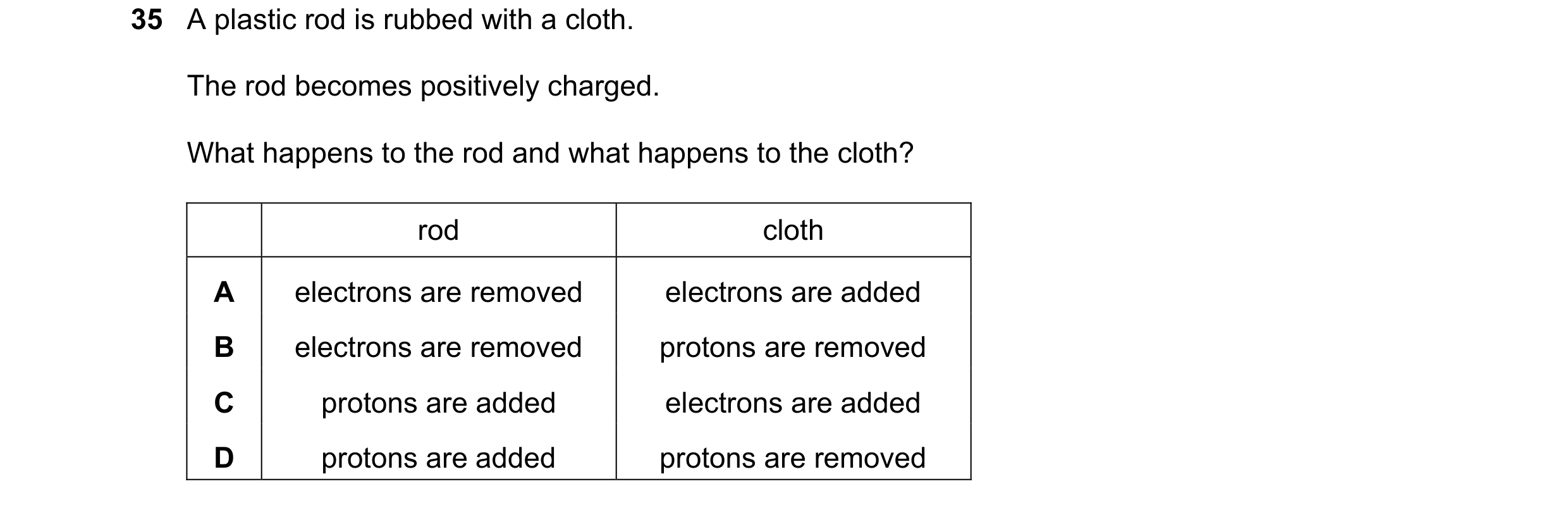
Q37 · A plastic rod is rubbed with a cloth 0654/22 Oct/Nov 2024
35 A plastic rod is rubbed with a cloth. The rod becomes positively charged. What happens to the rod and what happens to the cloth? rod cloth A electrons are removed electrons are added B electrons are removed protons are removed C protons are added electrons are added D protons are added protons are removed
1 marks
Answer: A
This question in 0654/22 Oct/Nov 2024
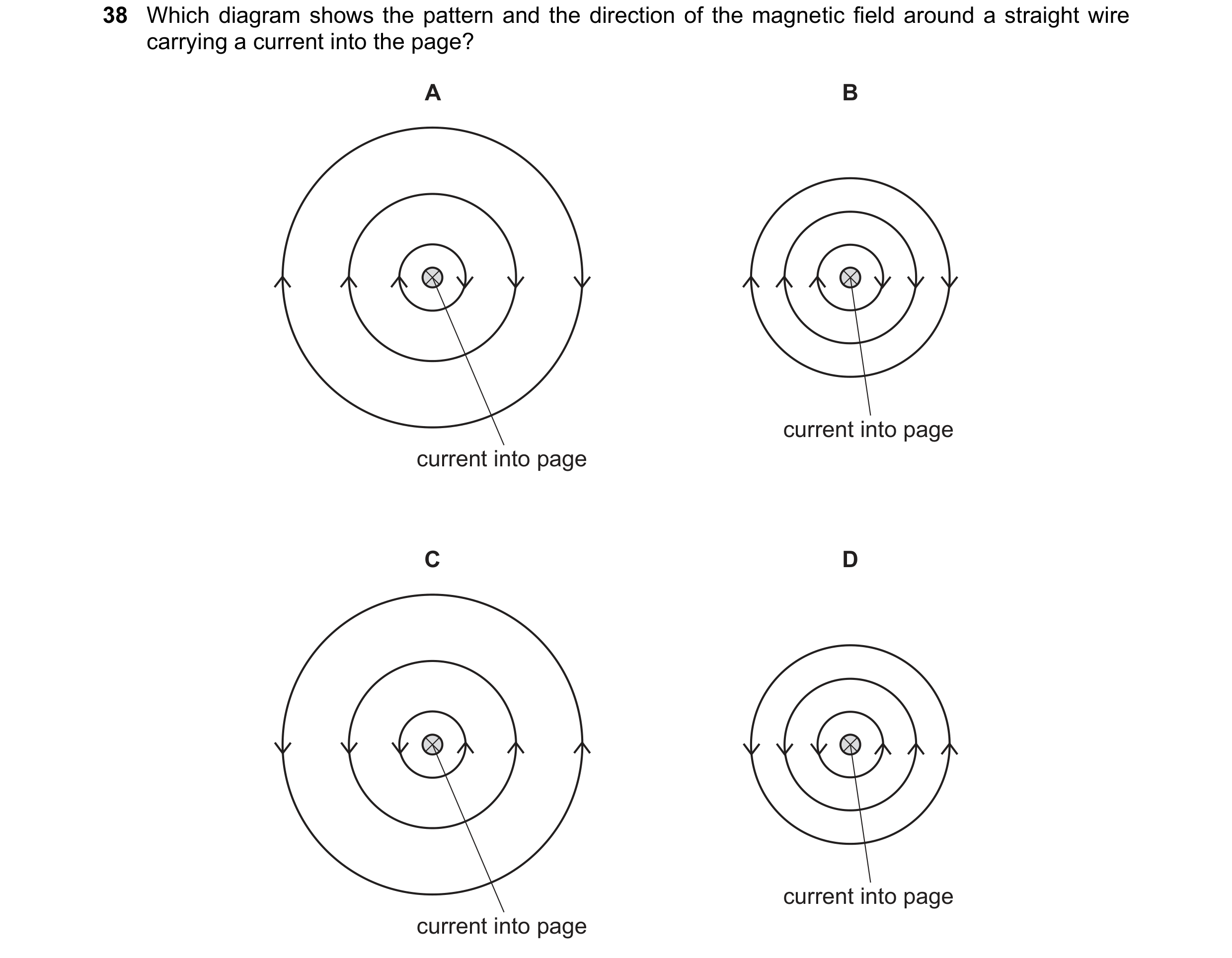
Q38 · Which diagram shows the pattern and the direction of the magnetic field around a straight… 0654/23 Oct/Nov 2024
38 Which diagram shows the pattern and the direction of the magnetic field around a straight wire carrying a current into the page? A B current into page current into page C D current into page current into page
1 marks
Answer: A
This question in 0654/23 Oct/Nov 2024
Q39 · A student makes an electromagnet with a steel core 0654/22 May/June 2025
36 A student makes an electromagnet with a steel core. There is a problem with the electromagnet. Which problem with the electromagnet is caused by using a steel core? A The electromagnet does not become magnetised. B The electromagnet has the same type of magnetic pole at each end. C The electromagnet remains magnetised when it is switched off. D The electromagnet repels unmagnetised magnetic materials.
1 marks
Answer: C
This question in 0654/22 May/June 2025
Q40 · An iron bar is placed within the magnetic field of a permanent magnet 0654/23 May/June 2025
35 An iron bar is placed within the magnetic field of a permanent magnet. What happens to the iron bar? A It becomes an induced permanent magnet. B It becomes an induced temporary magnet. C It becomes negatively charged. D It becomes positively charged.
1 marks
Answer: B
This question in 0654/23 May/June 2025
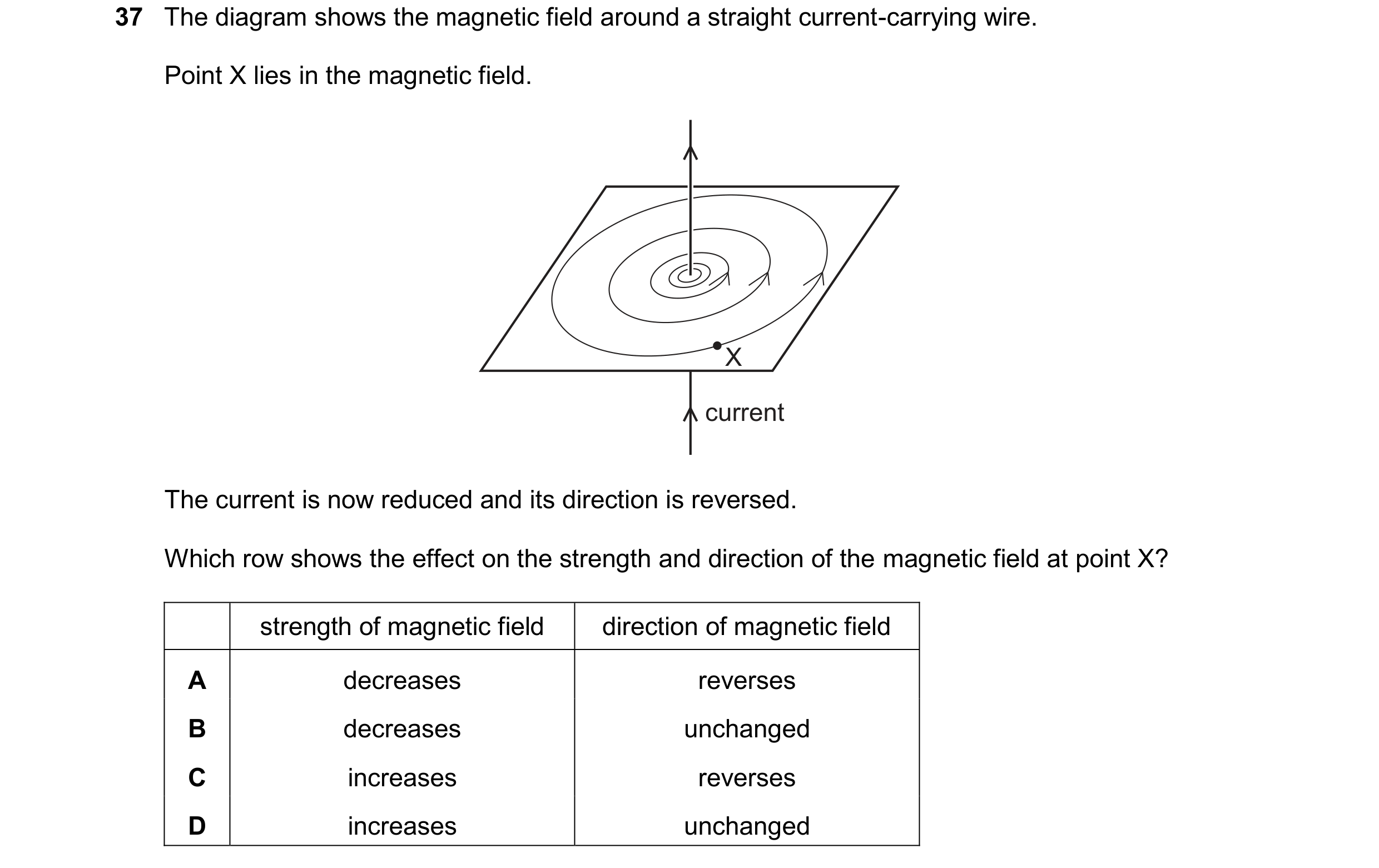
Q41 · The diagram shows the magnetic field around a straight current-carrying wire 0654/21 Oct/Nov 2025
37 The diagram shows the magnetic field around a straight current-carrying wire. Point X lies in the magnetic field. X current The current is now reduced and its direction is reversed. Which row shows the effect on the strength and direction of the magnetic field at point X? strength of magnetic field direction of magnetic field A decreases reverses B decreases unchanged C increases reverses D increases unchanged
1 marks
Answer: A
This question in 0654/21 Oct/Nov 2025
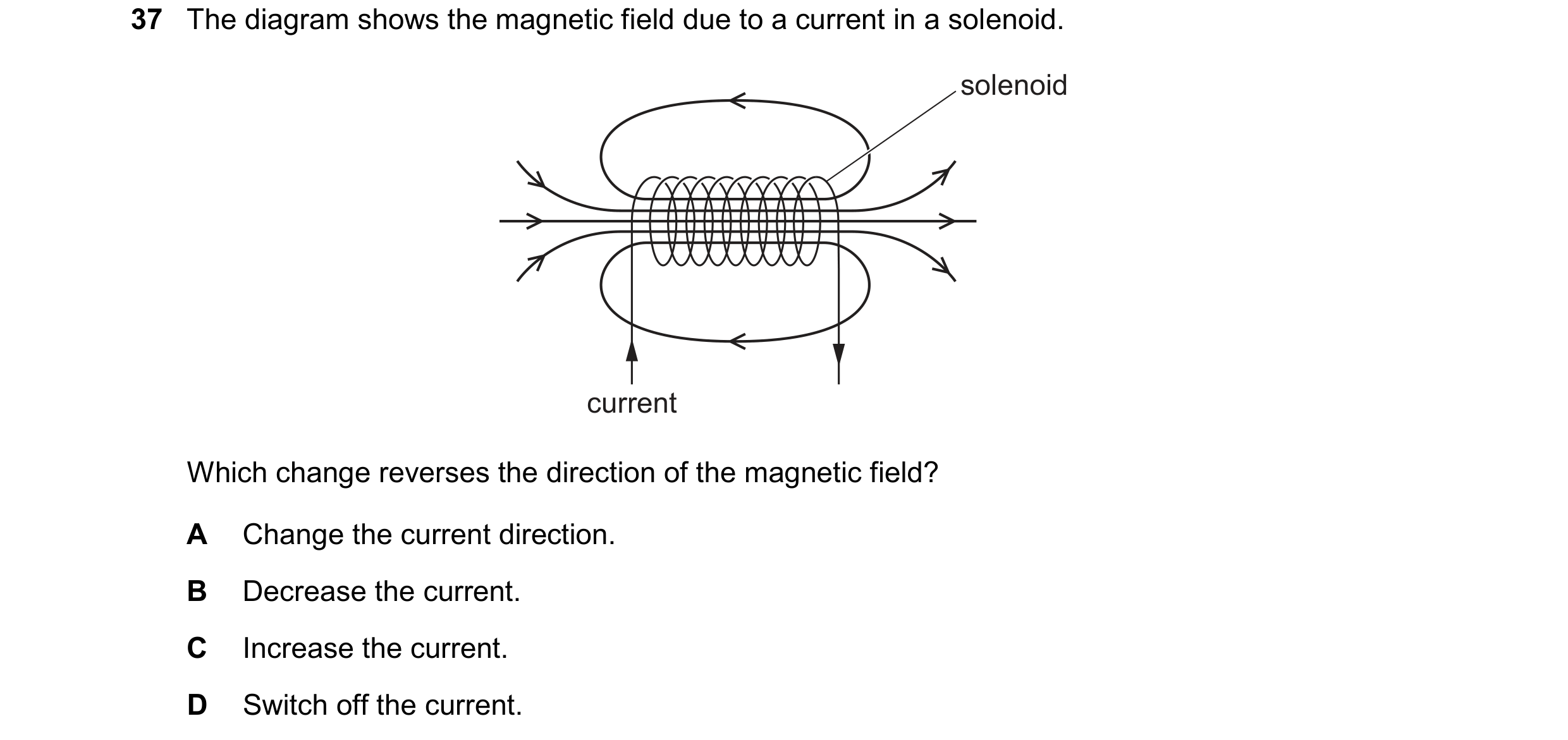
Q42 · The diagram shows the magnetic field due to a current in a solenoid 0654/22 Oct/Nov 2025
37 The diagram shows the magnetic field due to a current in a solenoid. solenoid current Which change reverses the direction of the magnetic field? A Change the current direction. B Decrease the current. C Increase the current. D Switch off the current.
1 marks
Answer: A
This question in 0654/22 Oct/Nov 2025
 1 / 16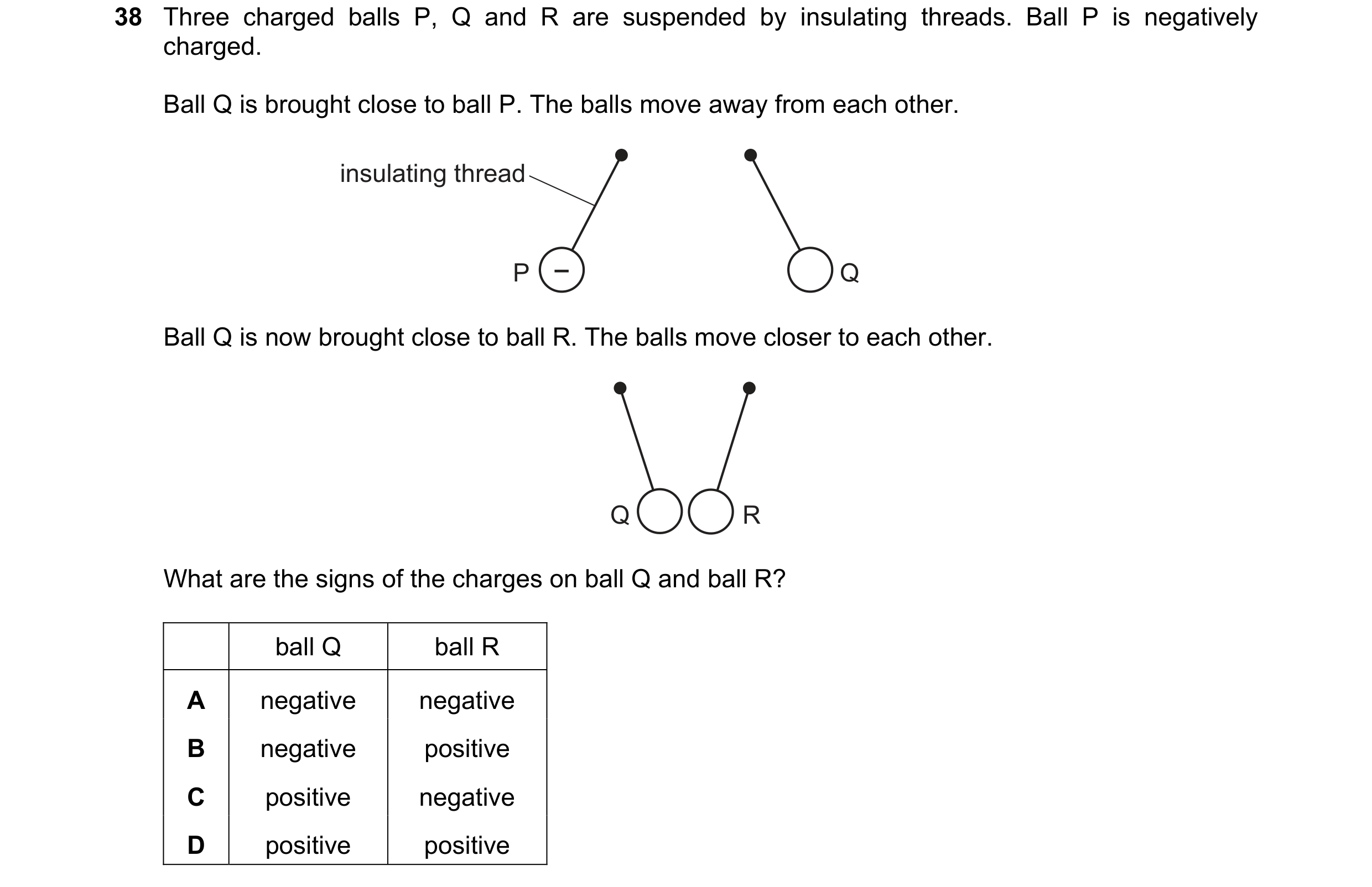
 2 / 16
 3 / 16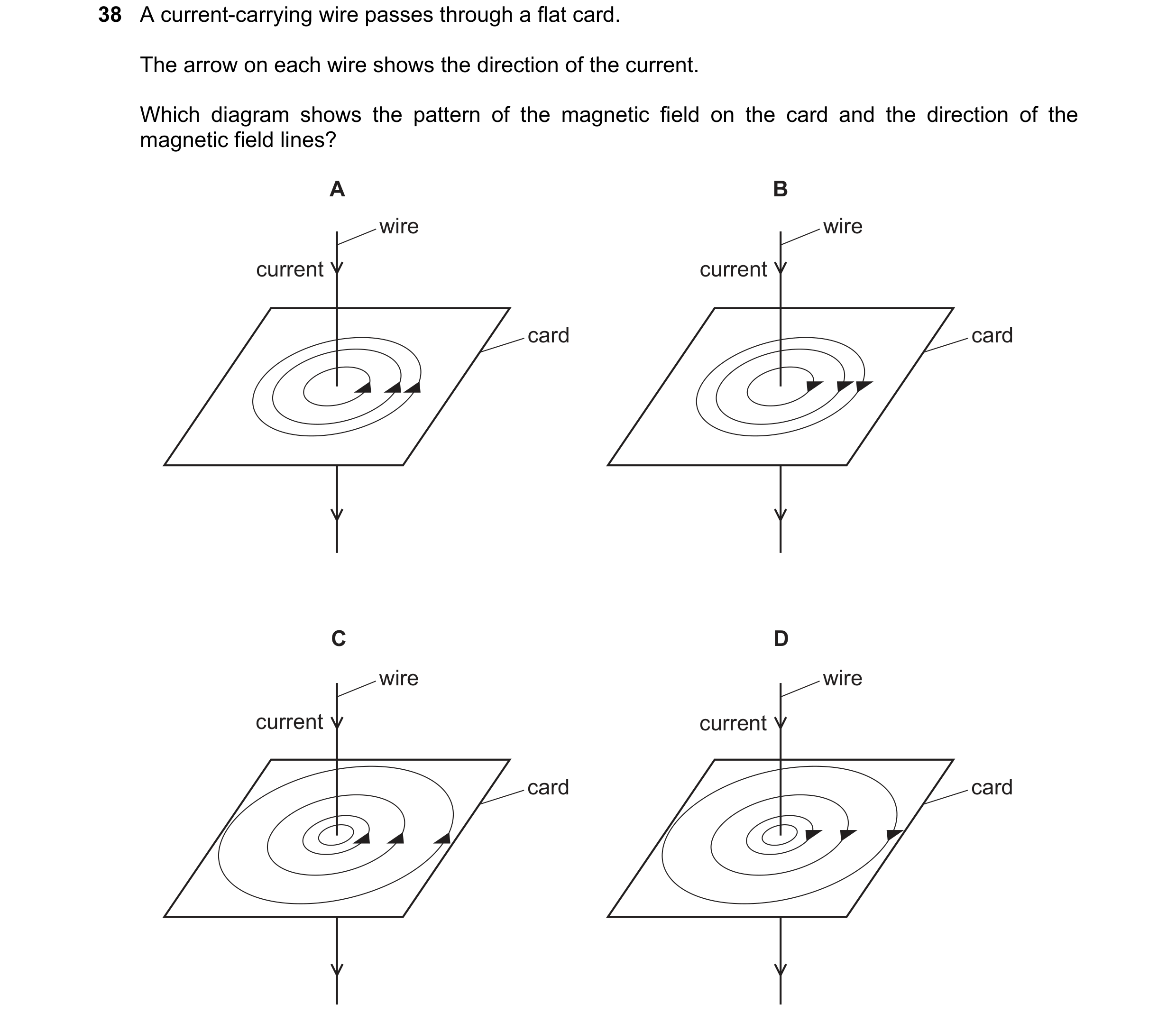
 4 / 16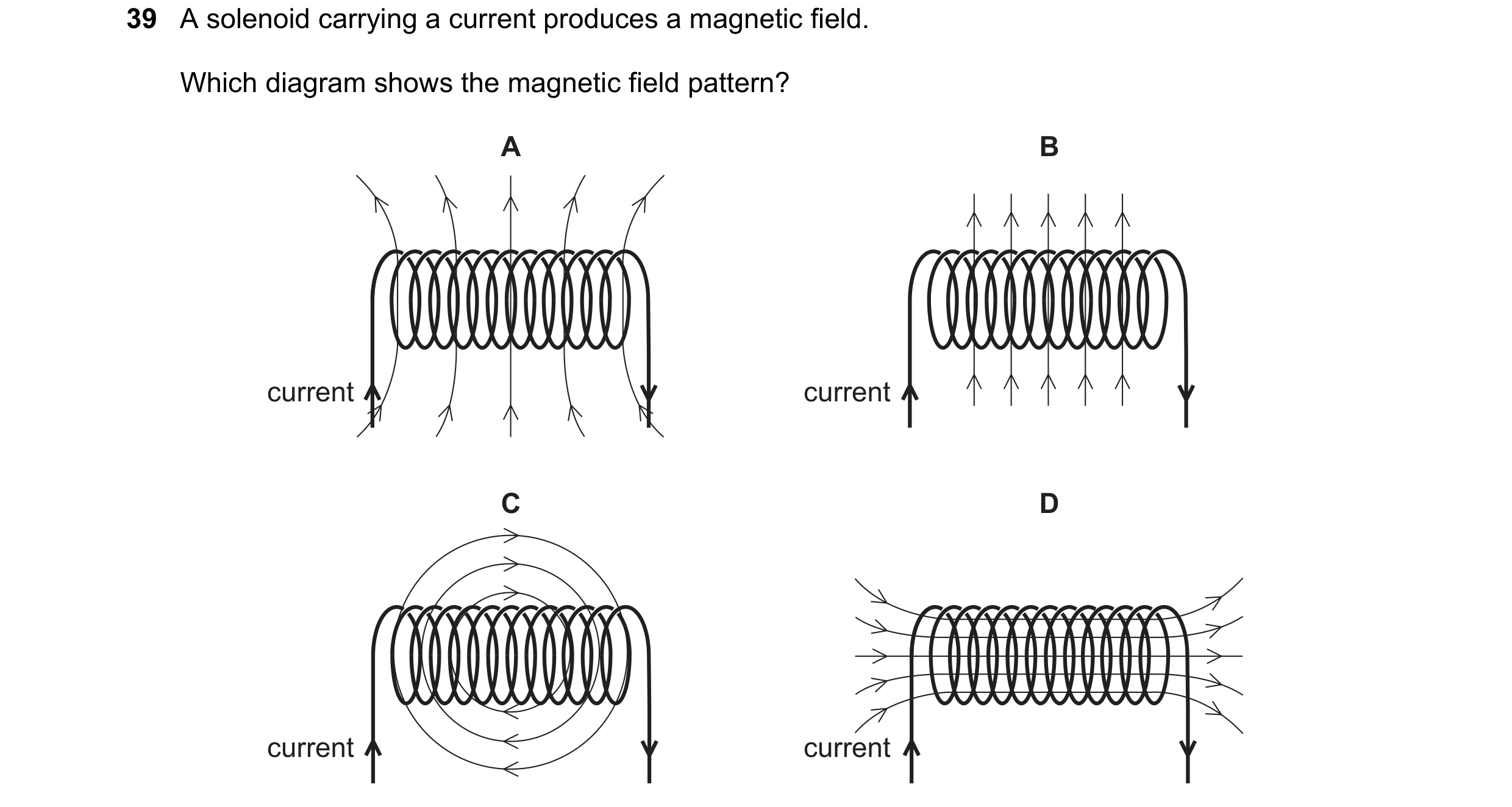
 5 / 16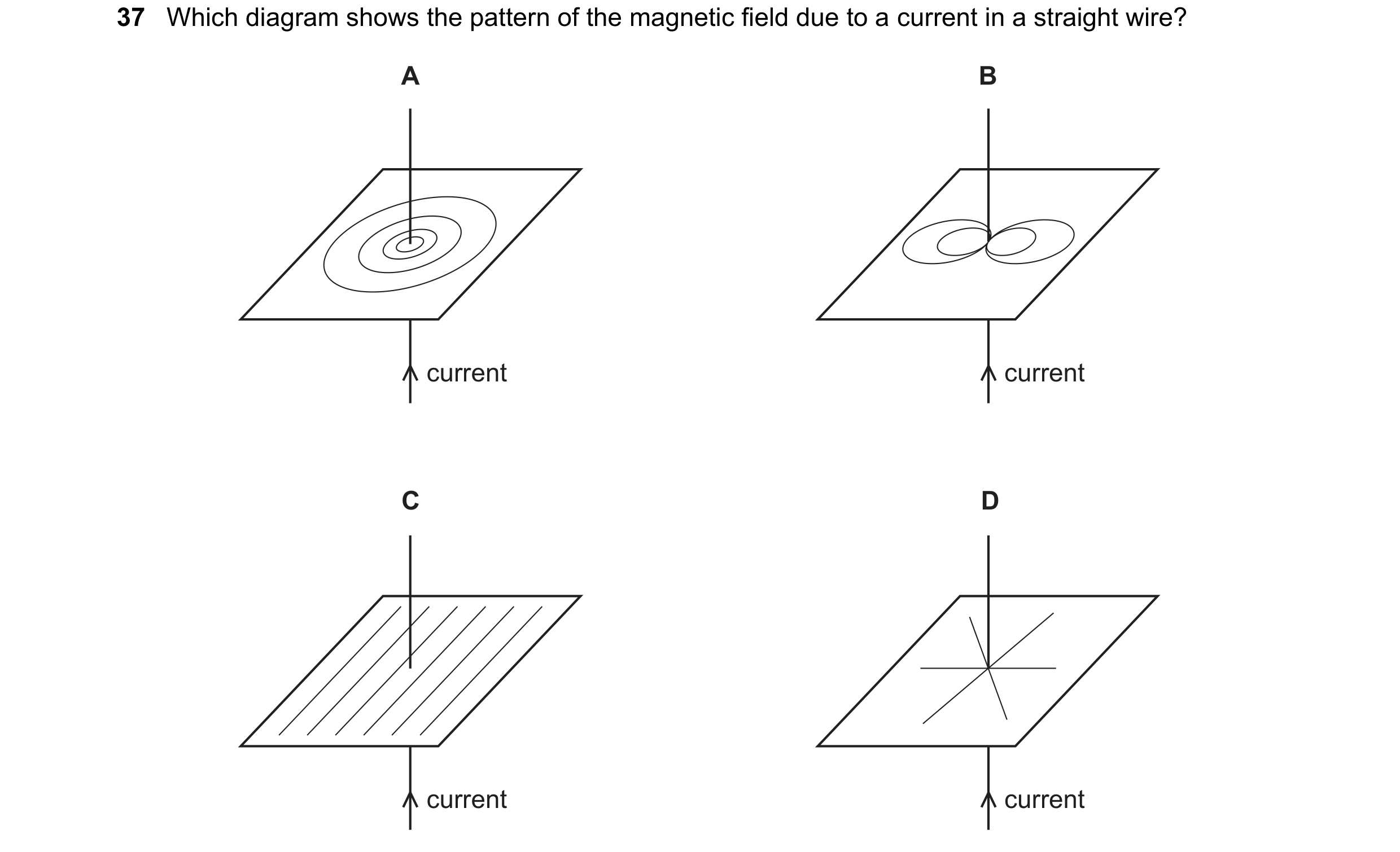
 6 / 16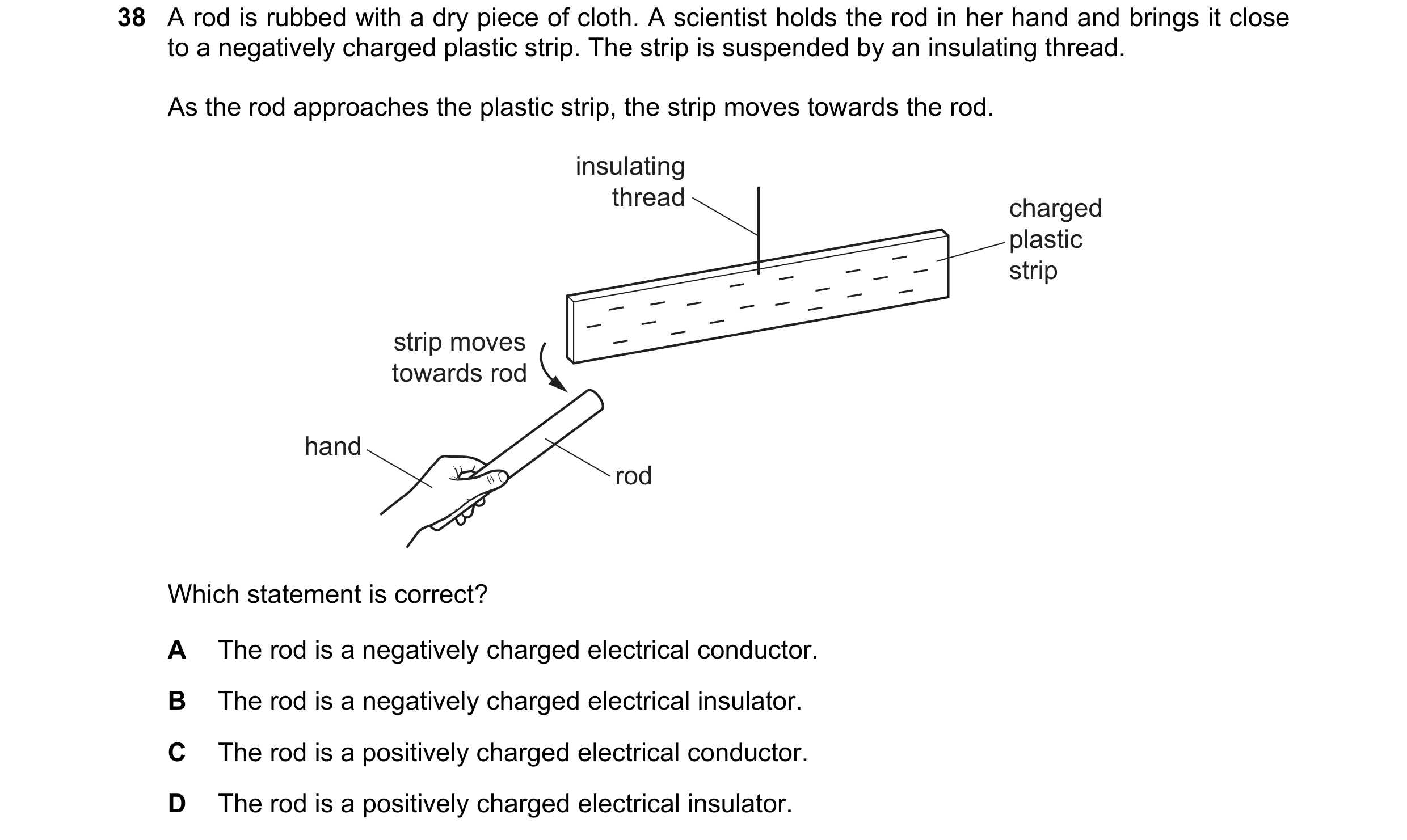
 7 / 16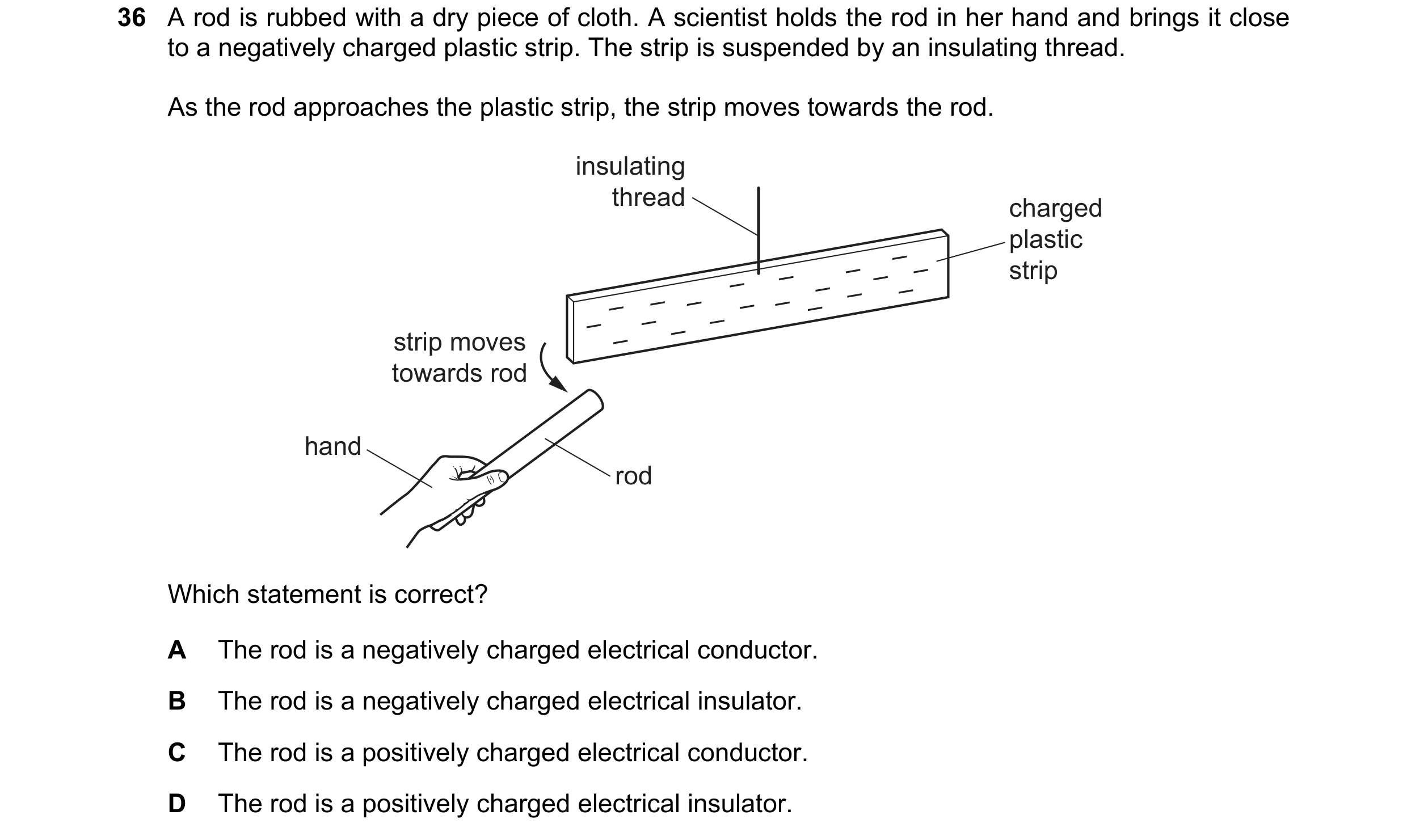
 8 / 16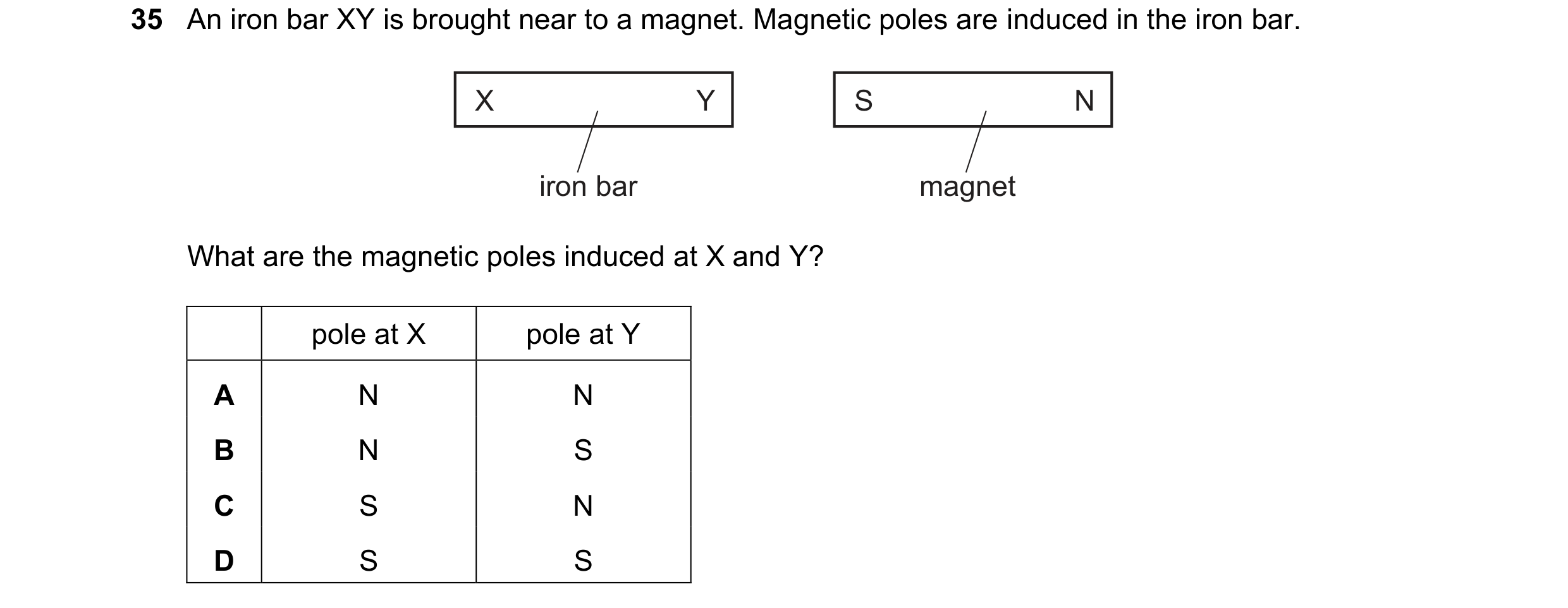


 9 / 16
 10 / 16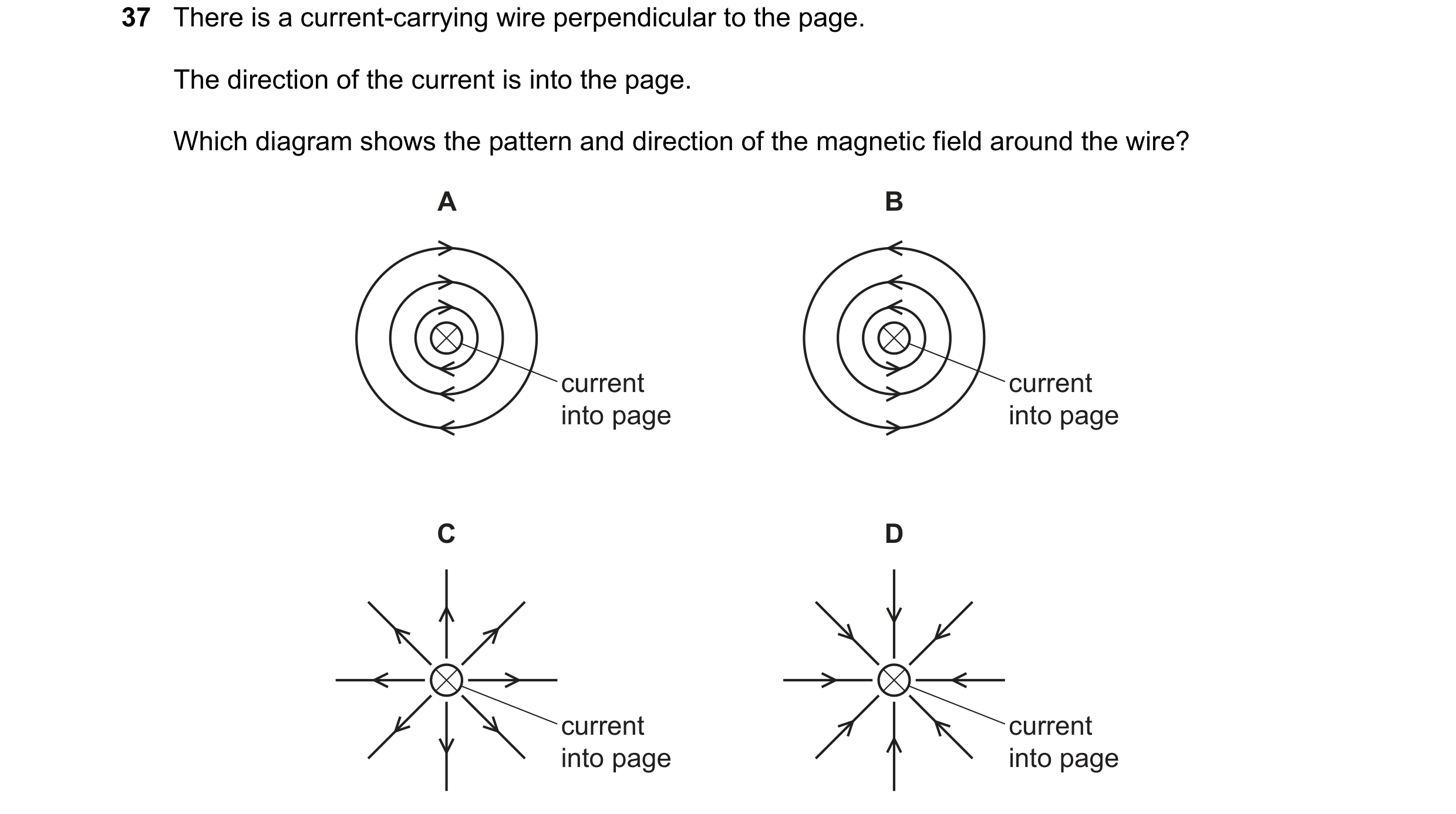
 11 / 16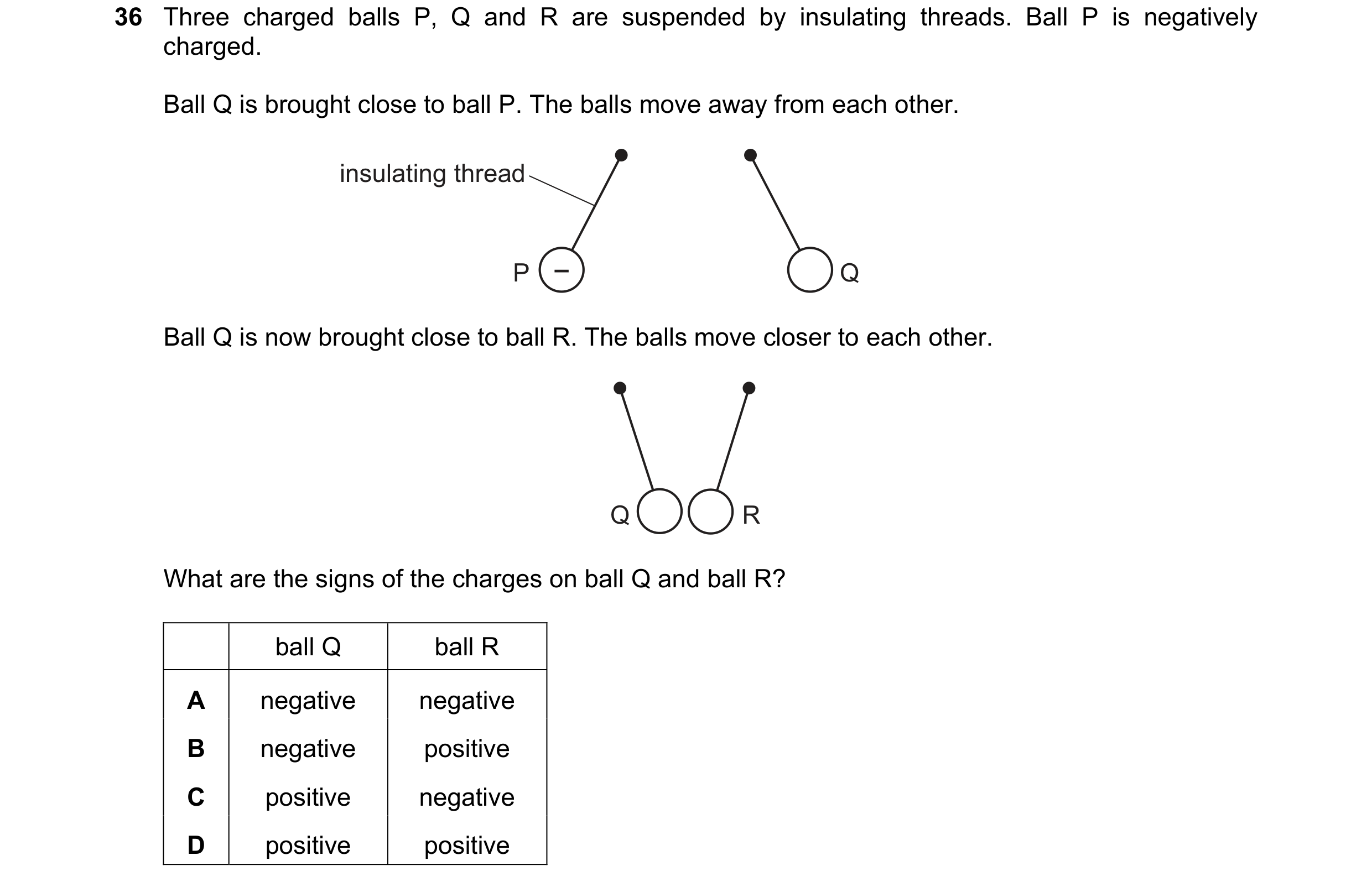
 12 / 16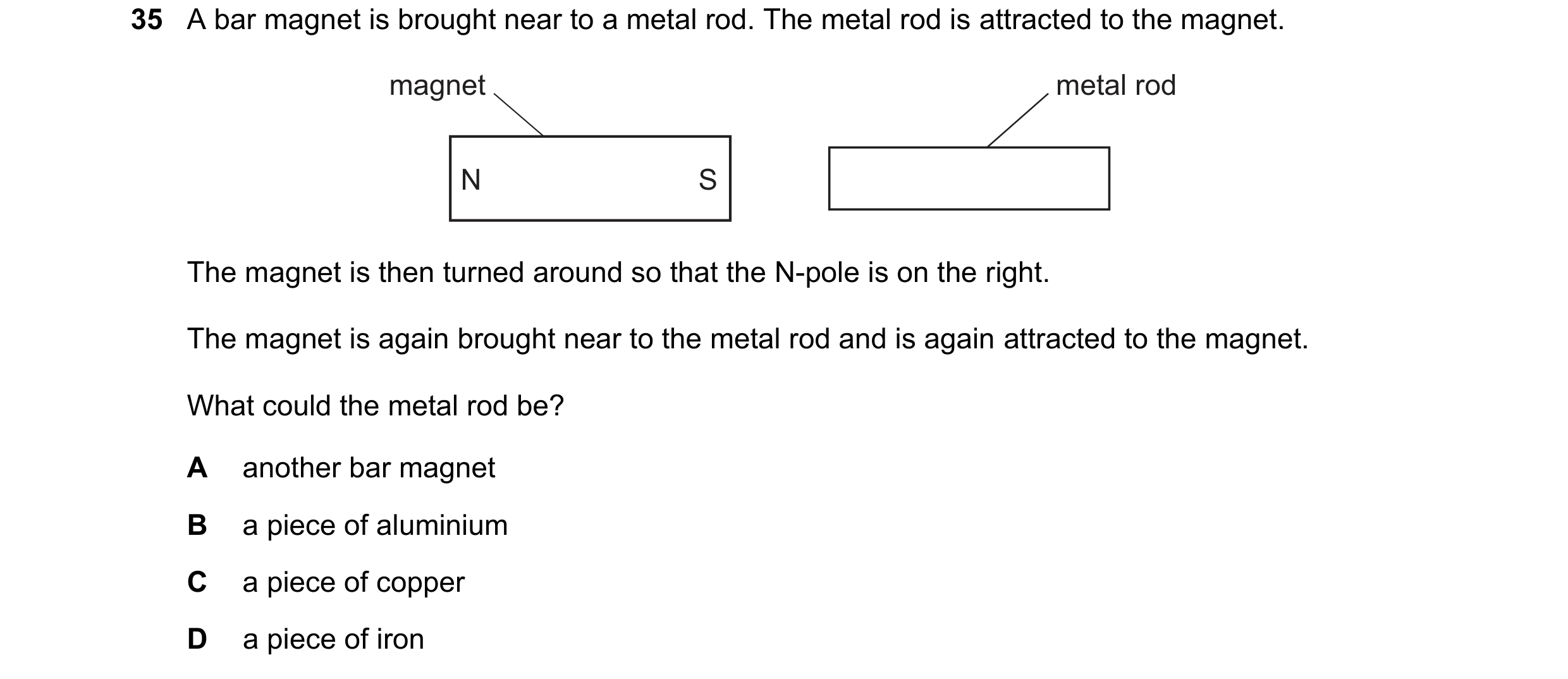
 13 / 16
 14 / 16
 15 / 16
 16 / 16