Questions as text
Q1 · A man drives a car 0654/32 Oct/Nov 2017
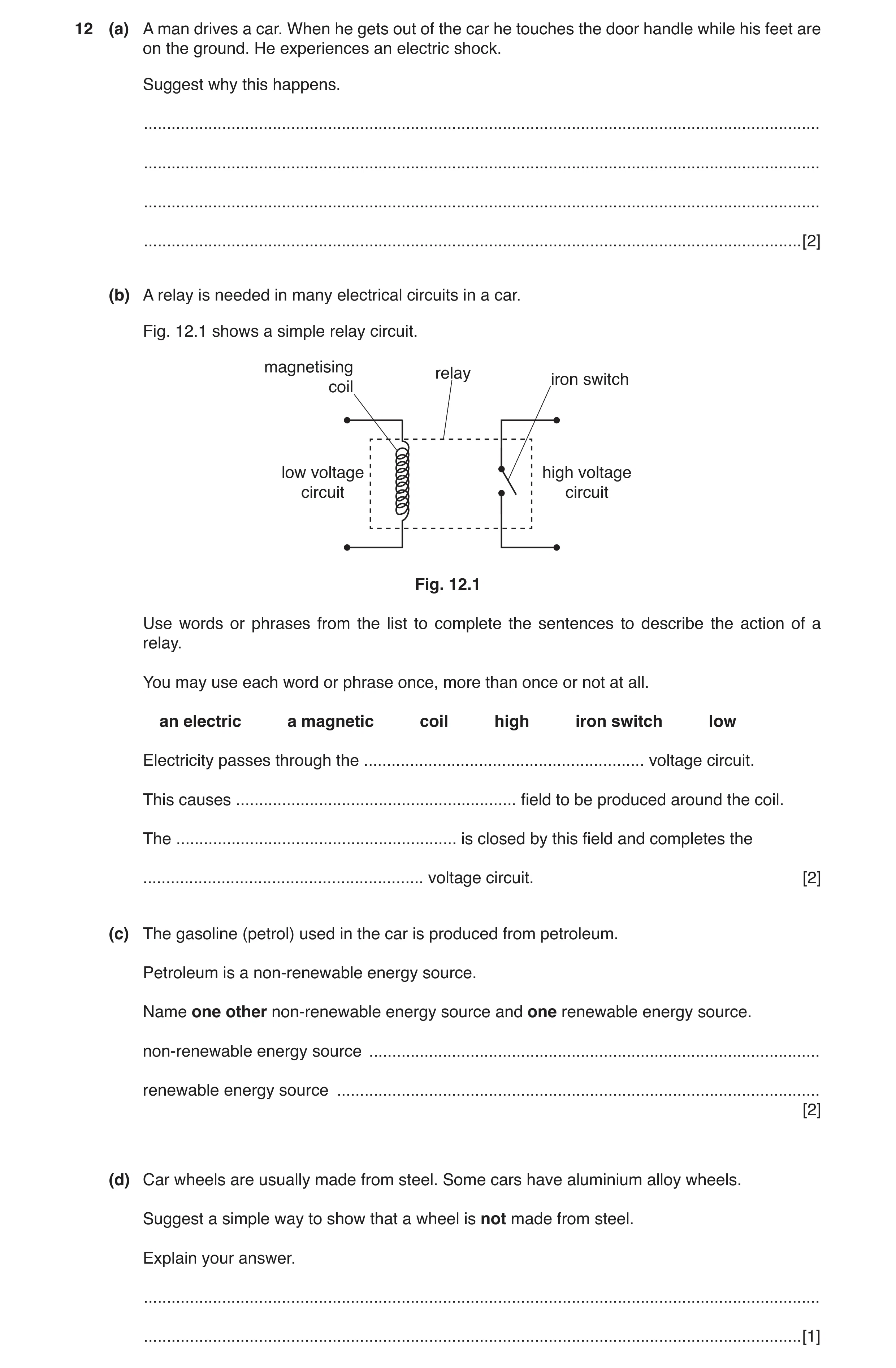
12 (a) A man drives a car. When he gets out of the car he touches the door handle while his feet are on the ground. He experiences an electric shock. Suggest why this happens. … … … … [2] (b) A relay is needed in many electrical circuits in a car. Fig. 12.1 shows a simple relay circuit. magnetising relay iron switch coil low voltage high voltage circuit circuit Fig. 12.1 Use words or phrases from the list to complete the sentences to describe the action of a relay. You may use each word or phrase once, more than once or not at all. an electric a magnetic coil high iron switch low Electricity passes through the … voltage circuit. This causes … field to be produced around the coil. The … is closed by this field and completes the … voltage circuit. [2] (c) The gasoline (petrol) used in the car is produced from petroleum. Petroleum is a non-renewable energy source. Name one other non-renewable energy source and one renewable energy source. non-renewable energy source … renewable energy source … [2] (d) Car wheels are usually made from steel. Some cars have aluminium alloy wheels. Suggest a simple way to show that a wheel is not made from steel. Explain your answer. … … [1]
7 marks
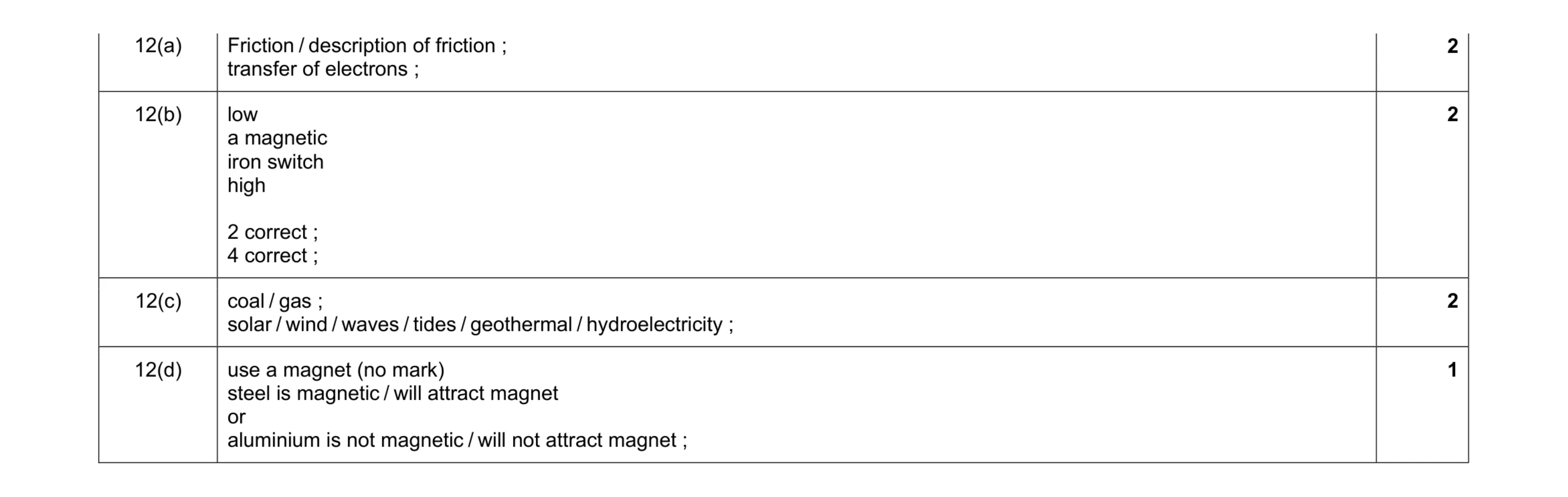
Mark scheme: 12(a) Friction / description of friction ; transfer of electrons ; 2 12(b) low a magnetic iron switch high 2 correct ; 4 correct ; 2 12(c) coal / gas ; solar / wind / waves / tides / geothermal / hydroelectricity ; 2 12(d) use a magnet (no mark) steel is magnetic / will attract magnet or aluminium is not magnetic / will not attract magnet ; 1
This question in 0654/32 Oct/Nov 2017
Q2 · The distance-time graph for a bus travelling through part of a town 0654/33 Oct/Nov 2017
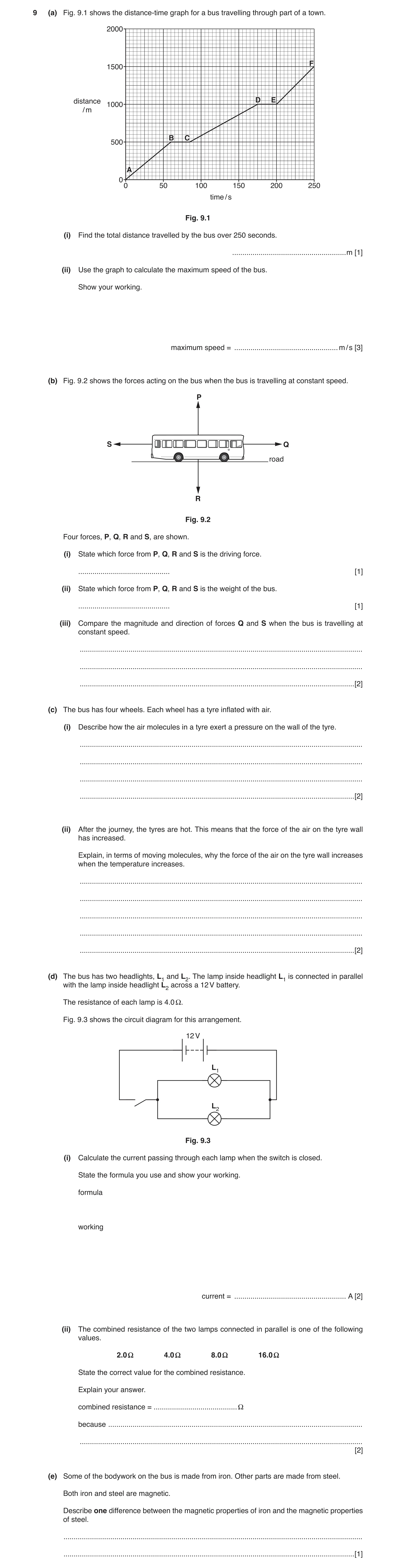
9 (a) Fig. 9.1 shows the distance-time graph for a bus travelling through part of a town. 2000 FF 1500 distance DD EE 1000 / m BB CC 500 AA 0 0 50 100 150 200 250 time / s Fig. 9.1 (i) Find the total distance travelled by the bus over 250 seconds. … m [1] (ii) Use the graph to calculate the maximum speed of the bus. Show your working. maximum speed = … m / s [3] (b) Fig. 9.2 shows the forces acting on the bus when the bus is travelling at constant speed. P S Q road R Fig. 9.2 Four forces, P, Q, R and S, are shown. (i) State which force from P, Q, R and S is the driving force. … [1] (ii) State which force from P, Q, R and S is the weight of the bus. … [1] (iii) Compare the magnitude and direction of forces Q and S when the bus is travelling at constant speed. … … … [2] (c) The bus has four wheels. Each wheel has a tyre inflated with air. (i) Describe how the air molecules in a tyre exert a pressure on the wall of the tyre. … … … … [2] (ii) After the journey, the tyres are hot. This means that the force of the air on the tyre wall has increased. Explain, in terms of moving molecules, why the force of the air on the tyre wall increases when the temperature increases. … … … … … [2] (d) The bus has two headlights, L1 and L2. The lamp inside headlight L1 is connected in parallel with the lamp inside headlight L2 across a 12 V battery. The resistance of each lamp is 4.0 Ω. Fig. 9.3 shows the circuit diagram for this arrangement. 12 V L1 L2 Fig. 9.3 (i) Calculate the current passing through each lamp when the switch is closed. State the formula you use and show your working. formula working current = … A [2] (ii) The combined resistance of the two lamps connected in parallel is one of the following values. 2.0 Ω 4.0 Ω 8.0 Ω 16.0 Ω State the correct value for the combined resistance. Explain your answer. combined resistance = … Ω because … … [2] (e) Some of the bodywork on the bus is made from iron. Other parts are made from steel. Both iron and steel are magnetic. Describe one difference between the magnetic properties of iron and the magnetic properties of steel. … … [1]
17 marks
Mark scheme: 9(a)(i) 1500 (m) ; 1 9(a)(ii) evidence that correct section has been identified / steepest gradient selected ; speed = distance / time or = 500 / 50 ; = 500 / 50 = 10 m / s ; 3 9(b)(i) Q ; 1 9(b)(ii) R ; 1 9(b)(iii) equal magnitude ; opposite directions ; 2 9(c)(i) particles collide with tyre walls ; particles exert a force (on the tyre wall) ; 2 9(c)(ii) particles are moving faster ; more collisions on tyre walls / collisions are more energetic ; 2 9(d)(i) I = V / R or 12 / 4.0 ; = 3.0 (A) ; 2 9(d)(ii) 2.0 Ω ; combined resistance of two resistances in parallel is less than that of either resistor by itself ; 2 9(e) iron magnetises quickly / steel magnetises slowly / iron loses magnetism quickly / steel loses magnetism slowly ; 1
This question in 0654/33 Oct/Nov 2017
Q3 · A list of materials is shown 0654/31 Oct/Nov 2018
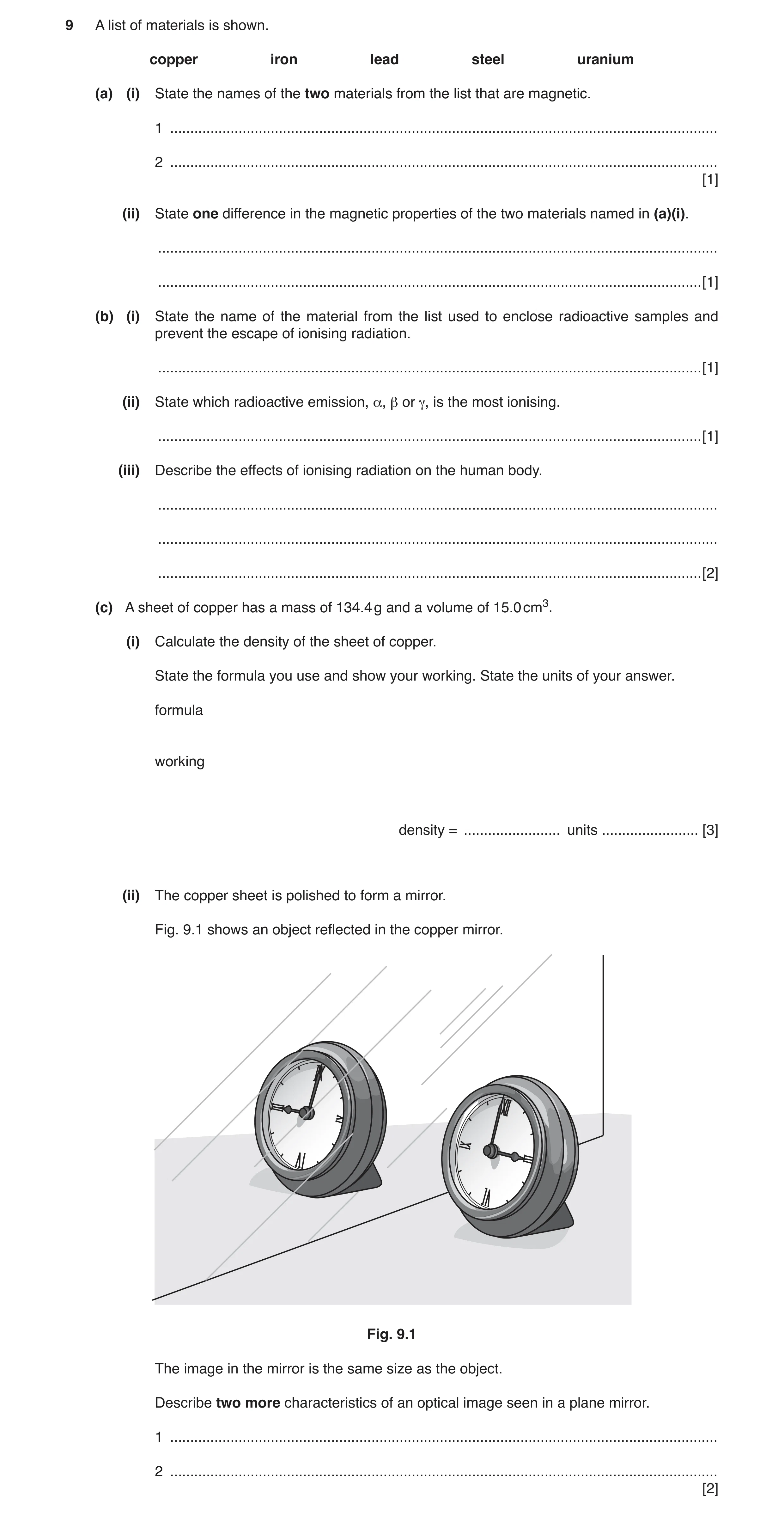
9 A list of materials is shown. copper iron lead steel uranium (a) (i) State the names of the two materials from the list that are magnetic. 1 … 2 … [1] (ii) State one difference in the magnetic properties of the two materials named in (a)(i). … … [1] (b) (i) State the name of the material from the list used to enclose radioactive samples and prevent the escape of ionising radiation. … [1] (ii) State which radioactive emission, α, β or γ, is the most ionising. … [1] (iii) Describe the effects of ionising radiation on the human body. … … … [2] (c) A sheet of copper has a mass of 134.4 g and a volume of 15.0 cm3. (i) Calculate the density of the sheet of copper. State the formula you use and show your working. State the units of your answer. formula working density = … units … [3] (ii) The copper sheet is polished to form a mirror. Fig. 9.1 shows an object reflected in the copper mirror. Fig. 9.1 The image in the mirror is the same size as the object. Describe two more characteristics of an optical image seen in a plane mirror. 1 … 2 … [2]
11 marks
Mark scheme: 9(a)(i) iron and steel ; 1 9(a)(ii) iron magnetises quicker / iron loses magnetism quicker ; 1 9(b)(i) lead ; 1 9(b)(ii) alpha ; 1 9(b)(ii) damages / mutates cells ; cancer ; radiation burns ; max 2 9(c)(i) density = mass / volume or 134.4 / 15.0 ; = 8.96 ; g / cm3 ; 3 9(c)(ii) upright ; laterally inverted ; 2
This question in 0654/31 Oct/Nov 2018
Q4 · Two headlamps on a truck are connected in parallel with a battery 0654/32 Oct/Nov 2018
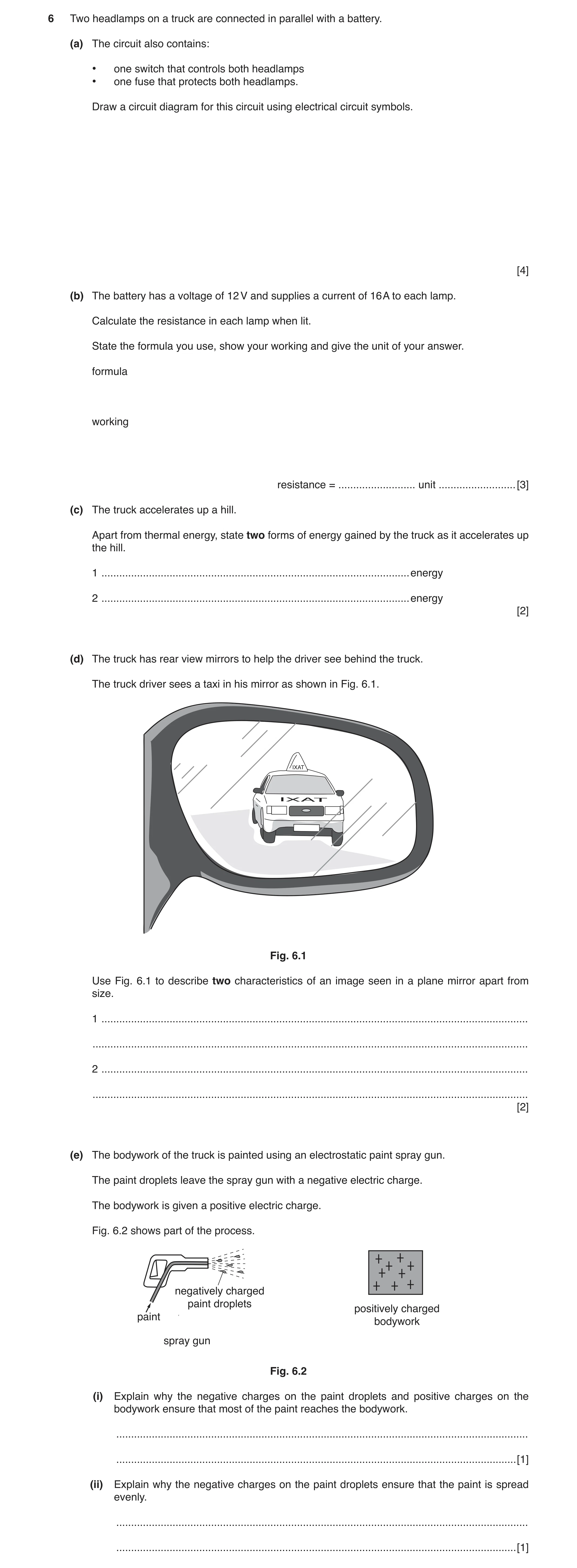
6 Two headlamps on a truck are connected in parallel with a battery. (a) The circuit also contains: • one switch that controls both headlamps • one fuse that protects both headlamps. Draw a circuit diagram for this circuit using electrical circuit symbols. [4] (b) The battery has a voltage of 12 V and supplies a current of 16 A to each lamp. Calculate the resistance in each lamp when lit. State the formula you use, show your working and give the unit of your answer. formula working resistance = … unit … [3] (c) The truck accelerates up a hill. Apart from thermal energy, state two forms of energy gained by the truck as it accelerates up the hill. 1 … energy 2 … energy [2] (d) The truck has rear view mirrors to help the driver see behind the truck. The truck driver sees a taxi in his mirror as shown in Fig. 6.1. TAXI TAXI Fig. 6.1 Use Fig. 6.1 to describe two characteristics of an image seen in a plane mirror apart from size. 1 … … 2 … … [2] (e) The bodywork of the truck is painted using an electrostatic paint spray gun. The paint droplets leave the spray gun with a negative electric charge. The bodywork is given a positive electric charge. Fig. 6.2 shows part of the process. negatively charged paint droplets positively charged paint bodywork spray gun Fig. 6.2 (i) Explain why the negative charges on the paint droplets and positive charges on the bodywork ensure that most of the paint reaches the bodywork. … … [1] (ii) Explain why the negative charges on the paint droplets ensure that the paint is spread evenly. … … [1]
13 marks
Mark scheme: 6(a) all symbols correct; lamps in parallel; switch in correct place; fuse in correct place; 4 6(b) R = V / I or 12 / 16; = 0.75; Ω; 3 6(c) kinetic; gravitational (potential); 2 6(d) upright; laterally inverted; 2 6(e)(i) opposite charges attract; 1 6(e)(ii) like charges repel; 1
This question in 0654/32 Oct/Nov 2018
Q5 · A metal saucepan containing water is placed onto the hot‑plate of an electric cooker 0654/32 Oct/Nov 2018
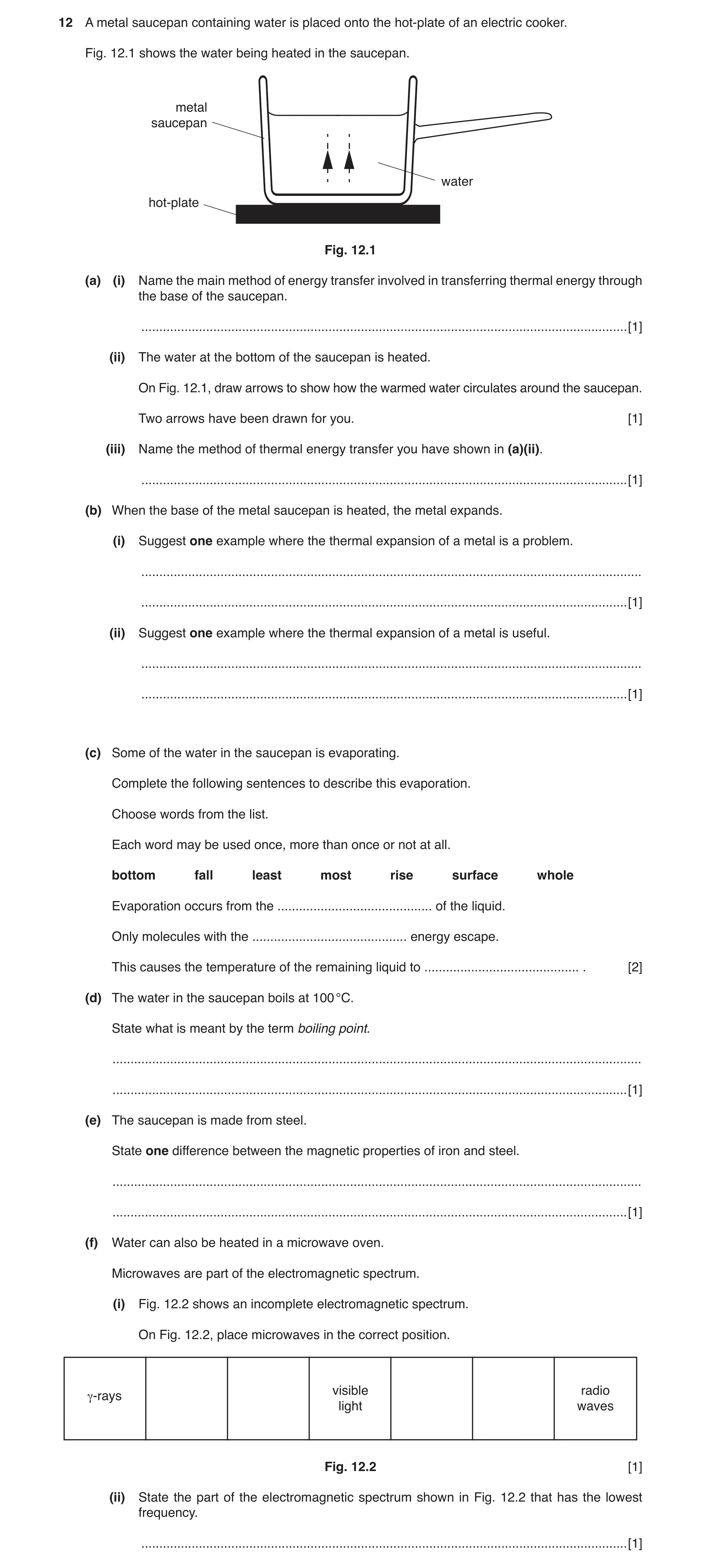
12 A metal saucepan containing water is placed onto the hot‑plate of an electric cooker. Fig. 12.1 shows the water being heated in the saucepan. metal saucepan water hot-plate Fig. 12.1 (a) (i) Name the main method of energy transfer involved in transferring thermal energy through the base of the saucepan. … [1] (ii) The water at the bottom of the saucepan is heated. On Fig. 12.1, draw arrows to show how the warmed water circulates around the saucepan. Two arrows have been drawn for you. [1] (iii) Name the method of thermal energy transfer you have shown in (a)(ii). … [1] (b) When the base of the metal saucepan is heated, the metal expands. (i) Suggest one example where the thermal expansion of a metal is a problem. … … [1] (ii) Suggest one example where the thermal expansion of a metal is useful. … … [1] (c) Some of the water in the saucepan is evaporating. Complete the following sentences to describe this evaporation. Choose words from the list. Each word may be used once, more than once or not at all. bottom fall least most rise surface whole Evaporation occurs from the … of the liquid. Only molecules with the … energy escape. This causes the temperature of the remaining liquid to … . [2] (d) The water in the saucepan boils at 100 °C. State what is meant by the term boiling point. … … [1] (e) The saucepan is made from steel. State one difference between the magnetic properties of iron and steel. … … [1] (f) Water can also be heated in a microwave oven. Microwaves are part of the electromagnetic spectrum. (i) Fig. 12.2 shows an incomplete electromagnetic spectrum. On Fig. 12.2, place microwaves in the correct position. visible radioγ-rays light waves Fig. 12.2 [1] (ii) State the part of the electromagnetic spectrum shown in Fig. 12.2 that has the lowest frequency. … [1]
11 marks
Mark scheme: 12(a)(i) conduction; 1 12(a)(ii) convection current drawn; 1 12(a)(iii) convection; 1 12(b)(i) railway tracks / overhead power cables; 1 12(b)(ii) thermostat / thermometer; 1 12(c) surface most fall 1 or 2 correct; 3 correct; 2 12(d) temperature at which a liquid changes into a gas; 1 12(e) iron loses magnetism quicker than steel steel is magnetised more slowly than iron; 1 12(f)(i) box to the left of radio waves; 1 12(f)(ii) radio waves; 1
This question in 0654/32 Oct/Nov 2018
Q6 · A boy travels in an elevator from the ground floor of an apartment building 0654/31 May/June 2019
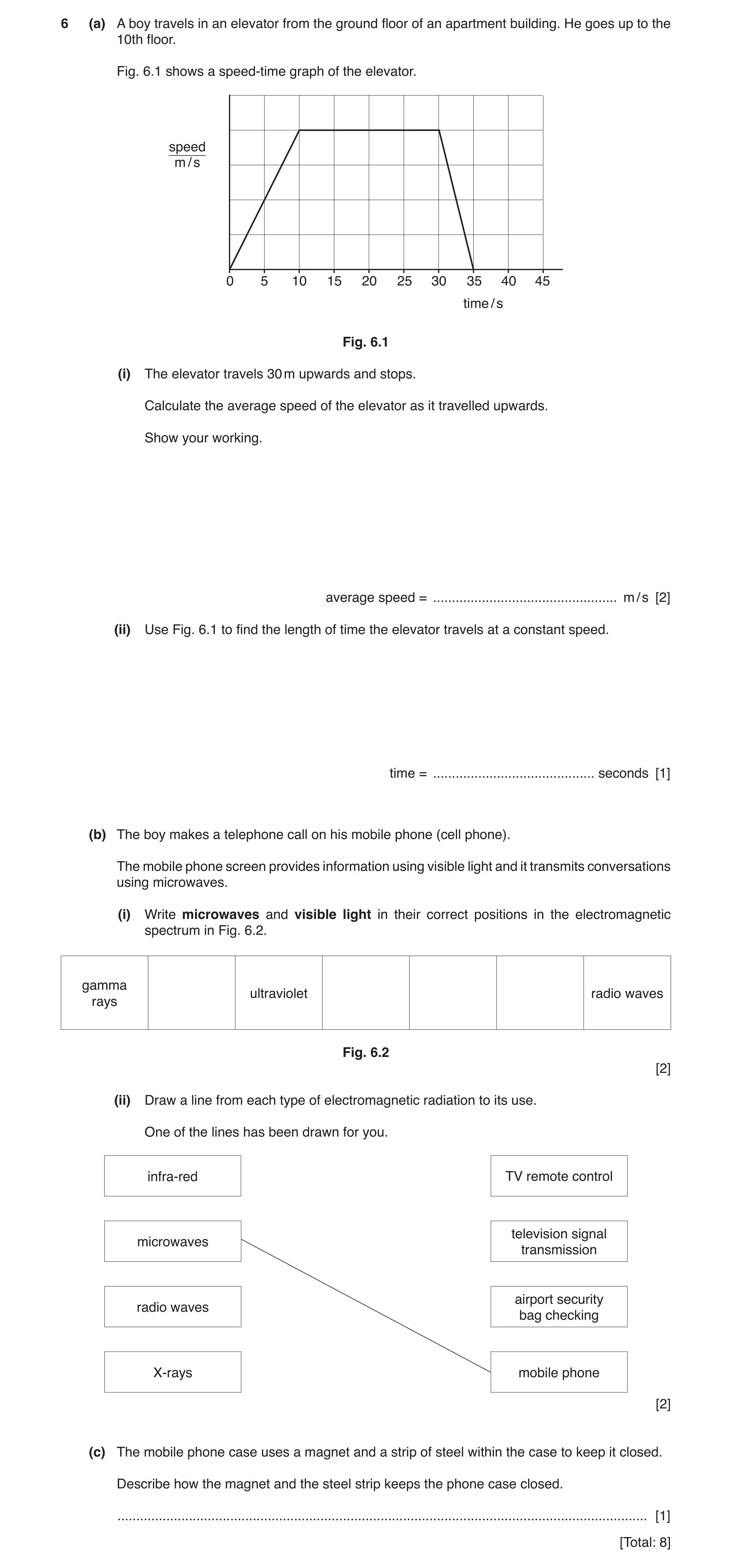
6 (a) A boy travels in an elevator from the ground floor of an apartment building. He goes up to the 10th floor. Fig. 6.1 shows a speed-time graph of the elevator. speed m / s 0 5 10 15 20 25 30 35 40 45 time / s Fig. 6.1 (i) The elevator travels 30 m upwards and stops. Calculate the average speed of the elevator as it travelled upwards. Show your working. average speed = … m / s [2] (ii) Use Fig. 6.1 to find the length of time the elevator travels at a constant speed. time = … seconds [1] (b) The boy makes a telephone call on his mobile phone (cell phone). The mobile phone screen provides information using visible light and it transmits conversations using microwaves. (i) Write microwaves and visible light in their correct positions in the electromagnetic spectrum in Fig. 6.2. gamma ultraviolet radio waves rays Fig. 6.2 [2] (ii) Draw a line from each type of electromagnetic radiation to its use. One of the lines has been drawn for you. infra-red TV remote control television signal microwaves transmission airport security radio waves bag checking X-rays mobile phone [2] (c) The mobile phone case uses a magnet and a strip of steel within the case to keep it closed. Describe how the magnet and the steel strip keeps the phone case closed. … [1] [Total: 8]
8 marks
Mark scheme: 6(a)(i) speed = distance / time or 30 / 35 ; 0.86 m / s ; 2 6(a)(ii) 20 seconds ; 1 6(b)(i) microwaves next to radio waves ; visible light in the middle ; 2 6(b)(ii) infra-red to TV remote control radio waves to television signal transmission X-rays to airport security bag checking 1 correct ; 3 correct ; 2 6(c) magnetic material is attracted to the magnet (or) force of attraction ; 1
This question in 0654/31 May/June 2019
Q7 · A teacher using a photocopier 0654/31 May/June 2019
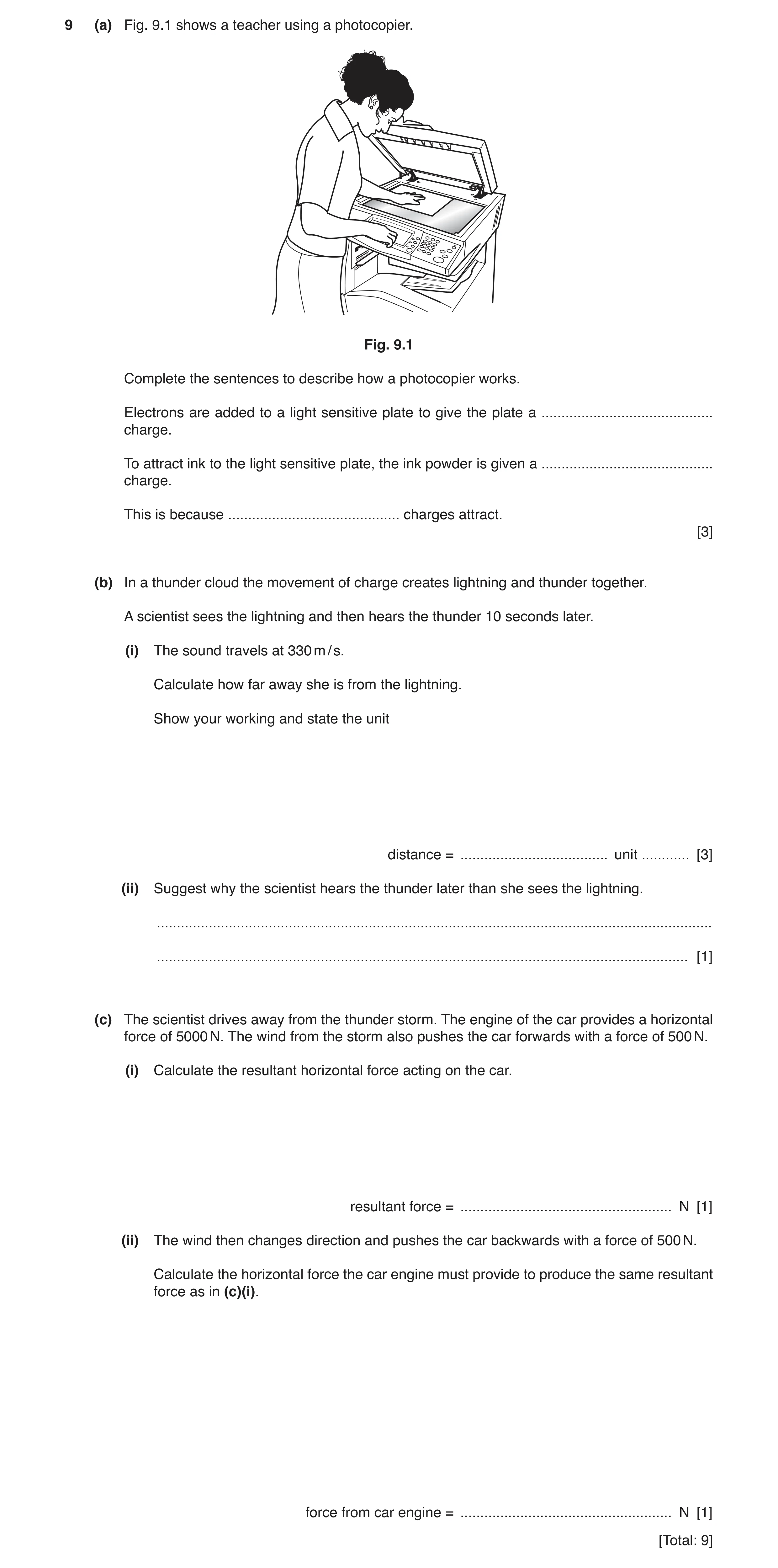
9 (a) Fig. 9.1 shows a teacher using a photocopier. Fig. 9.1 Complete the sentences to describe how a photocopier works. Electrons are added to a light sensitive plate to give the plate a … charge. To attract ink to the light sensitive plate, the ink powder is given a … charge. This is because … charges attract. [3] (b) In a thunder cloud the movement of charge creates lightning and thunder together. A scientist sees the lightning and then hears the thunder 10 seconds later. (i) The sound travels at 330 m / s. Calculate how far away she is from the lightning. Show your working and state the unit distance = … unit … [3] (ii) Suggest why the scientist hears the thunder later than she sees the lightning. … … [1] (c) The scientist drives away from the thunder storm. The engine of the car provides a horizontal force of 5000 N. The wind from the storm also pushes the car forwards with a force of 500 N. (i) Calculate the resultant horizontal force acting on the car. resultant force = … N [1] (ii) The wind then changes direction and pushes the car backwards with a force of 500 N. Calculate the horizontal force the car engine must provide to produce the same resultant force as in (c)(i). force from car engine = … N [1] [Total: 9]
9 marks
Mark scheme: 9(a) negative ; positive ; unlike / opposite ; Max 3 9(b)(i) (distance =) speed × time or 330 × 10 ; 3300 ; m ; 3 9(b)(ii) sound travels slower than light ; 1 9(c)(i) 5500 N ; 1 9(c)(ii) 6000 N ; 1
This question in 0654/31 May/June 2019
Question 8 0654/33 Oct/Nov 2019
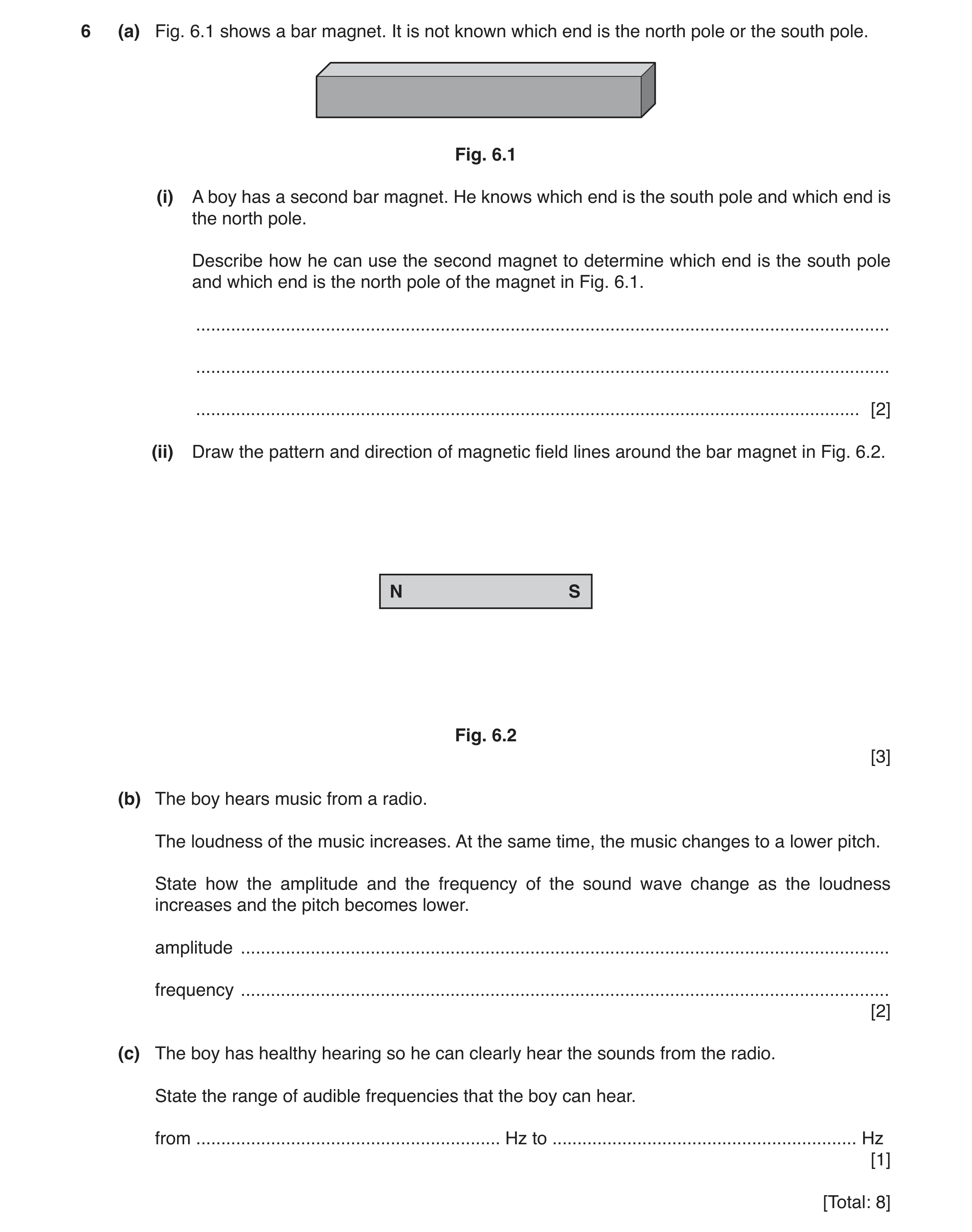
6 (a) Fig. 6.1 shows a bar magnet. It is not known which end is the north pole or the south pole. Fig. 6.1 (i) A boy has a second bar magnet. He knows which end is the south pole and which end is the north pole. Describe how he can use the second magnet to determine which end is the south pole and which end is the north pole of the magnet in Fig. 6.1. … … … [2] (ii) Draw the pattern and direction of magnetic field lines around the bar magnet in Fig. 6.2. N S Fig. 6.2 [3] (b) The boy hears music from a radio. The loudness of the music increases. At the same time, the music changes to a lower pitch. State how the amplitude and the frequency of the sound wave change as the loudness increases and the pitch becomes lower. amplitude … frequency … [2] (c) The boy has healthy hearing so he can clearly hear the sounds from the radio. State the range of audible frequencies that the boy can hear. from … Hz to … Hz [1] [Total: 8]
8 marks
Mark scheme: 6(a)(i) bring the known pole of the magnet towards the unknown pole of the other magnet; if it attracts it is the opposite pole OR if it repels it is the like pole; 2 6(a)(ii) complete field lines drawn (at least two to top, two to bottom); incomplete field lines drawn; arrows showing direction N to S; 3 6(b) amplitude – increases; frequency – decreases; 2 6(c) 20 Hz to 20 000 Hz; 1
This question in 0654/33 Oct/Nov 2019
Q9 · A car is driven along a road 0654/31 Oct/Nov 2020
6 (a) A car is driven along a road. (i) State the type of energy the car has due to its motion. (ii) During the journey, the car becomes electrostatically charged. State what has been added to or removed from the car for it to become charged. (iii) After the journey, the car needs to be refuelled at a gasoline (petrol) station. State the type of energy stored in the fuel. (iv) Not all of the energy stored in the fuel is transferred to the forward motion of the car. Explain why this is. (b) An electric car may be recharged by solar cells. Complete the sentences to describe how a solar cell can provide energy. Light energy from the … is absorbed by the solar cell. The solar cell changes the light energy to … energy. [2] (c) The electric car has a powerful d.c. motor. The turning effect of the motor can be increased by increasing the number of turns on the coil in the motor. State one other way to increase the turning effect of the d.c. motor. (d) (i) The two headlamps of the car are powered by the car battery. The lamps are connected in parallel. Complete the circuit diagram in Fig. 6.1 to show the two lamps connected in parallel, both controlled by one switch. The battery has been drawn for you. Fig. 6.1 [3] (ii) State one advantage of connecting the lamps in parallel. [Total: 11]
11 marks
Mark scheme: 6(a)(i) kinetic ; 1 6(a)(ii) electrons ; 1 6(a)(iii) chemical potential ; 1 6(a)(iv) energy transferred to other forms / energy lost to the surroundings / energy lost as thermal energy ; AVP ; 1 6(b) Sun ; electrical ; 2 6(c) increase the strength of the magnetic field / increase the current ; 1 6(d)(i) correct symbols for switch and lamp ; lamps connected in parallel ; one switch controlling both ; 3 6(d)(ii) if one fails, the other will still light up ; 1
This question in 0654/31 Oct/Nov 2020
Q10 · A car is driven along a road 0654/33 Oct/Nov 2020
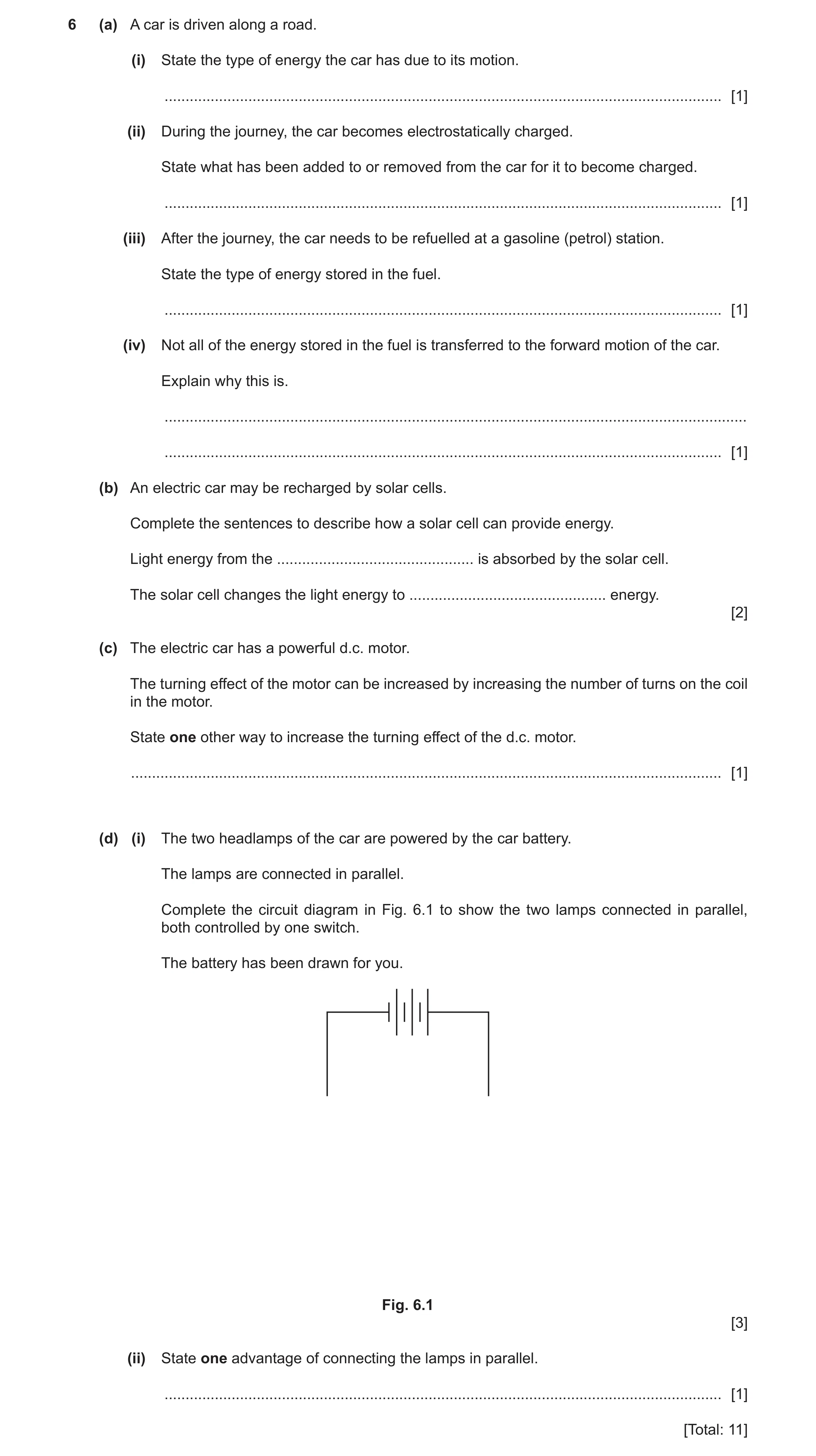
6 (a) A car is driven along a road. (i) State the type of energy the car has due to its motion. … [1] (ii) During the journey, the car becomes electrostatically charged. State what has been added to or removed from the car for it to become charged. … [1] (iii) After the journey, the car needs to be refuelled at a gasoline (petrol) station. State the type of energy stored in the fuel. … [1] (iv) Not all of the energy stored in the fuel is transferred to the forward motion of the car. Explain why this is. … … [1] (b) An electric car may be recharged by solar cells. Complete the sentences to describe how a solar cell can provide energy. Light energy from the … is absorbed by the solar cell. The solar cell changes the light energy to … energy. [2] (c) The electric car has a powerful d.c. motor. The turning effect of the motor can be increased by increasing the number of turns on the coil in the motor. State one other way to increase the turning effect of the d.c. motor. … [1] (d) (i) The two headlamps of the car are powered by the car battery. The lamps are connected in parallel. Complete the circuit diagram in Fig. 6.1 to show the two lamps connected in parallel, both controlled by one switch. The battery has been drawn for you. Fig. 6.1 [3] (ii) State one advantage of connecting the lamps in parallel. … [1] [Total: 11]
11 marks
Mark scheme: 6(a)(i) kinetic ; 1 6(a)(ii) electrons ; 1 6(a)(iii) chemical potential ; 1 6(a)(iv) energy transferred to other forms / energy lost to the surroundings / energy lost as thermal energy ; AVP ; 1 6(b) Sun ; electrical ; 2 6(c) increase the strength of the magnetic field / increase the current ; 1 6(d)(i) correct symbols for switch and lamp ; lamps connected in parallel ; one switch controlling both ; 3 6(d)(ii) if one fails, the other will still light up ; 1
This question in 0654/33 Oct/Nov 2020
Q11 · Choose words from the list below to complete the sentences that describe the energy… 0654/32 Oct/Nov 2021
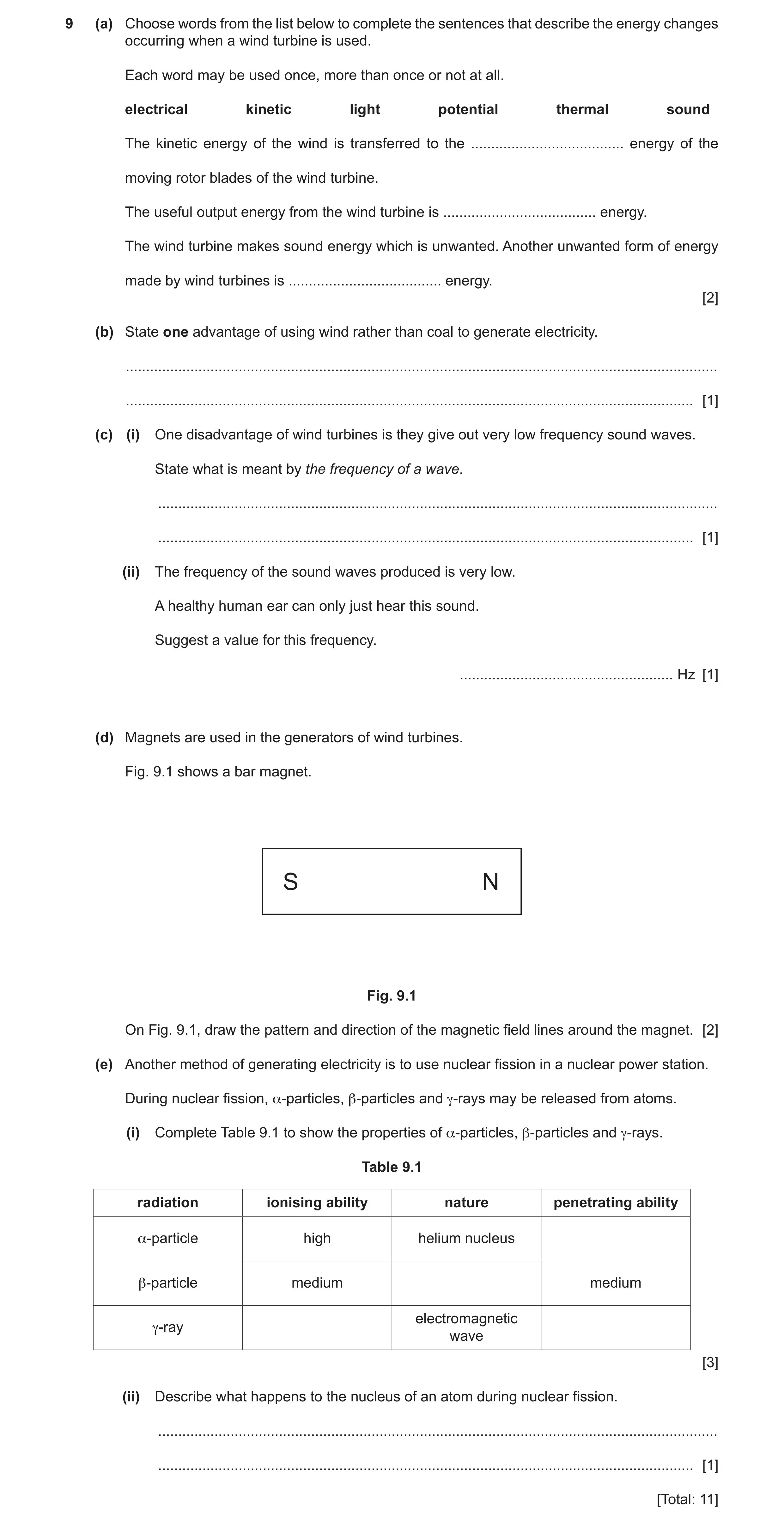
9 (a) Choose words from the list below to complete the sentences that describe the energy changes occurring when a wind turbine is used. Each word may be used once, more than once or not at all. electrical kinetic light potential thermal sound The kinetic energy of the wind is transferred to the … energy of the moving rotor blades of the wind turbine. The useful output energy from the wind turbine is … energy. The wind turbine makes sound energy which is unwanted. Another unwanted form of energy made by wind turbines is … energy. [2] (b) State one advantage of using wind rather than coal to generate electricity. … … [1] (c) (i) One disadvantage of wind turbines is they give out very low frequency sound waves. State what is meant by the frequency of a wave. … … [1] (ii) The frequency of the sound waves produced is very low. A healthy human ear can only just hear this sound. Suggest a value for this frequency. … Hz [1] (d) Magnets are used in the generators of wind turbines. Fig. 9.1 shows a bar magnet. S N Fig. 9.1 On Fig. 9.1, draw the pattern and direction of the magnetic field lines around the magnet. [2] (e) Another method of generating electricity is to use nuclear fission in a nuclear power station. During nuclear fission, α‑particles, β‑particles and γ‑rays may be released from atoms. (i) Complete Table 9.1 to show the properties of α‑particles, β‑particles and γ‑rays. Table 9.1 radiation ionising ability nature penetrating ability α‑particle high helium nucleus β‑particle medium medium electromagnetic γ‑ray wave [3] (ii) Describe what happens to the nucleus of an atom during nuclear fission. … … [1] [Total: 11]
11 marks
Mark scheme: 9(a) kinetic electrical thermal ;; 2 9(b) does not use up a fossil fuel ; does not produce CO2 / cause global warming etc. ; renewable ; AVP ; max 1 1 9(c)(i) number of waves produced per second / passing a fixed point per second ; 1 9(c)(ii) in range from 20 Hz to 50 Hz ; 1 Question Answer Marks 9(d) correct field lines ; arrows from N to S ; 2 9(e)(i) α – low penetrating ability ; β – electron ; γ – low ionising ability and high penetrating ability ; 3 9(e)(ii) splits ; 1
This question in 0654/32 Oct/Nov 2021
Q12 · Water in a saucepan on an electric cooker 0654/33 Oct/Nov 2021
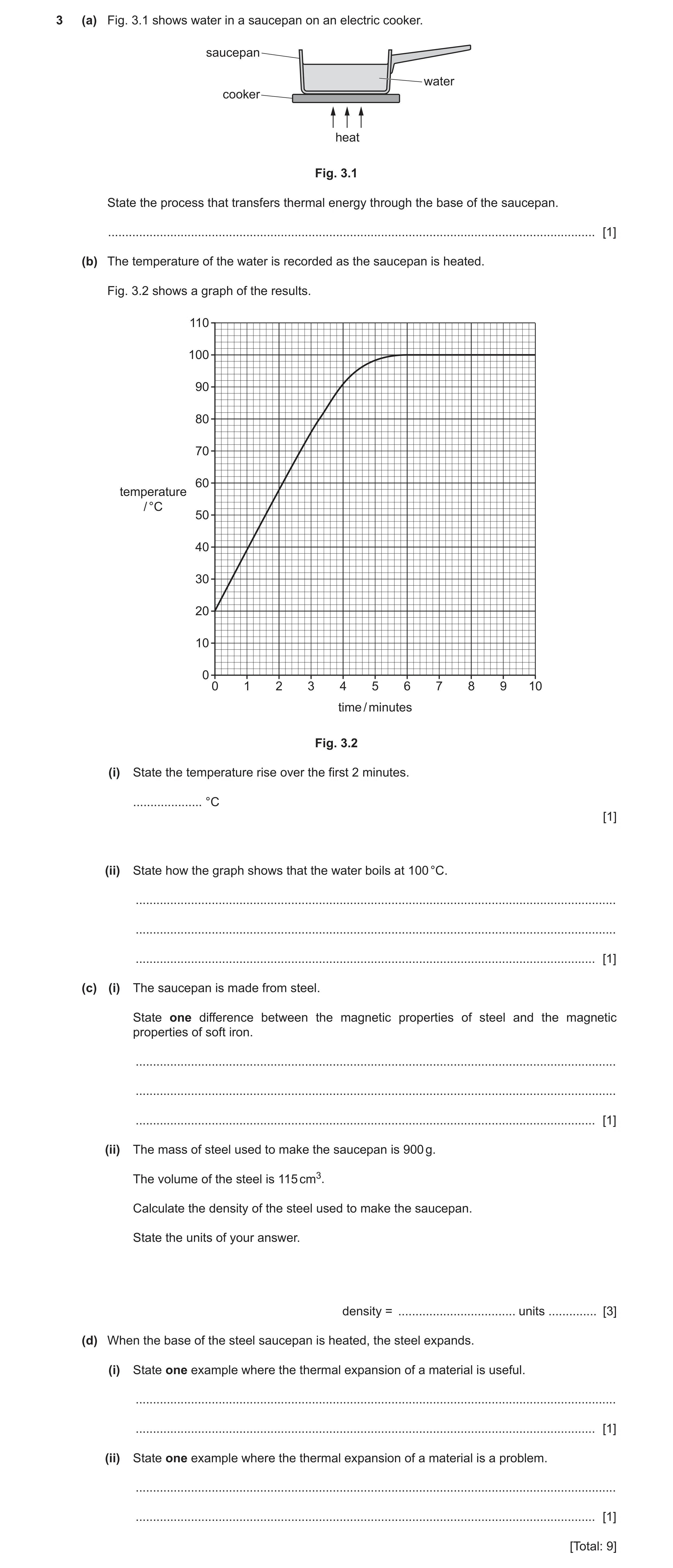
3 (a) Fig. 3.1 shows water in a saucepan on an electric cooker. saucepan water cooker heat Fig. 3.1 State the process that transfers thermal energy through the base of the saucepan. … [1] (b) The temperature of the water is recorded as the saucepan is heated. Fig. 3.2 shows a graph of the results. 110 100 90 80 70 60 temperature / °C 50 40 30 20 10 0 0 1 2 3 4 5 6 7 8 9 10 time / minutes Fig. 3.2 (i) State the temperature rise over the first 2 minutes. … °C [1] (ii) State how the graph shows that the water boils at 100 °C. … … … [1] (c) (i) The saucepan is made from steel. State one difference between the magnetic properties of steel and the magnetic properties of soft iron. … … … [1] (ii) The mass of steel used to make the saucepan is 900 g. The volume of the steel is 115 cm3. Calculate the density of the steel used to make the saucepan. State the units of your answer. density = … units … [3] (d) When the base of the steel saucepan is heated, the steel expands. (i) State one example where the thermal expansion of a material is useful. … … [1] (ii) State one example where the thermal expansion of a material is a problem. … … [1] [Total: 9]
9 marks
Mark scheme: 3(a)(i) conduction ; 1 3(b)(i) 38 °C ; 1 3(b)(ii) temperature stops increasing ; 1 3(c)(i) (soft) iron is magnetised quickly / steel is magnetised slowly ; or (soft) iron loses its magnetism quickly / steel loses magnetism slowly ; 1 3(c)(ii) density = mass ÷ volume or mass value ÷ volume value or 900 ÷ 115 ; 7.83 ; g / cm3 ; 3 3(d)(i) (liquid in glass) thermometers / bimetallic strips ; 1 3(d)(ii) bridges / roads / overhead electricity cables etc. ; 1
This question in 0654/33 Oct/Nov 2021
Q13 · Four forces, P, Q, R and S, acting on a bus travelling along a level road at constant… 0654/32 Feb/March 2022
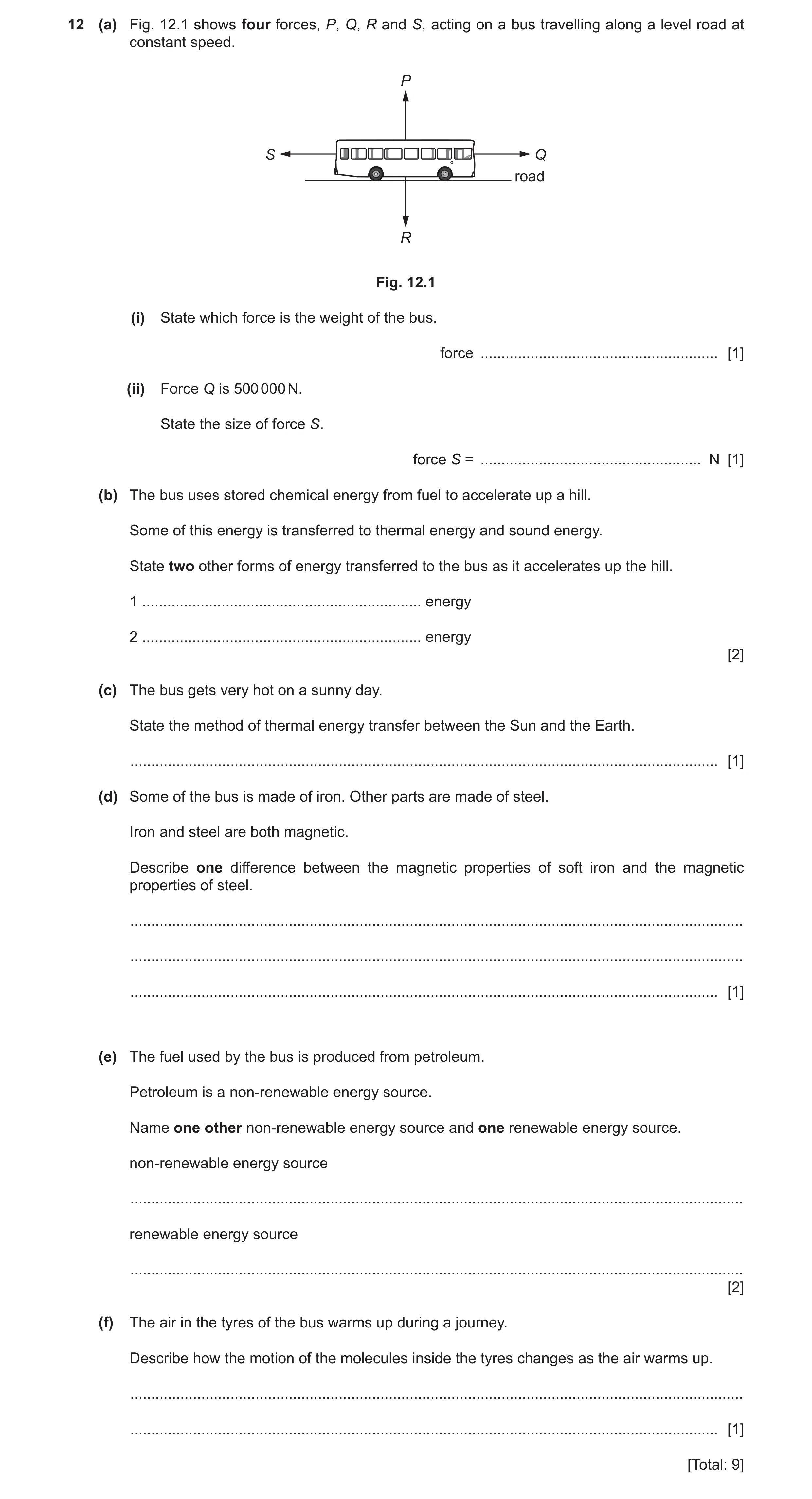
12 (a) Fig. 12.1 shows four forces, P, Q, R and S, acting on a bus travelling along a level road at constant speed. P S Q road R Fig. 12.1 (i) State which force is the weight of the bus. force … [1] (ii) Force Q is 500 000 N. State the size of force S. force S = … N [1] (b) The bus uses stored chemical energy from fuel to accelerate up a hill. Some of this energy is transferred to thermal energy and sound energy. State two other forms of energy transferred to the bus as it accelerates up the hill. 1 … energy 2 … energy [2] (c) The bus gets very hot on a sunny day. State the method of thermal energy transfer between the Sun and the Earth. … [1] (d) Some of the bus is made of iron. Other parts are made of steel. Iron and steel are both magnetic. Describe one difference between the magnetic properties of soft iron and the magnetic properties of steel. … … … [1] (e) The fuel used by the bus is produced from petroleum. Petroleum is a non-renewable energy source. Name one other non-renewable energy source and one renewable energy source. non-renewable energy source … renewable energy source … [2] (f) The air in the tyres of the bus warms up during a journey. Describe how the motion of the molecules inside the tyres changes as the air warms up. … … [1] [Total: 9]
9 marks
Mark scheme: 12(a)(i) R; 1 12(a)(ii) 500 000 N; 1 12(b) kinetic energy; gravitational potential energy; 2 12(c) radiation; 1 12(d) iron magnetises quicker / iron loses magnetism quicker; 1 Question Answer Marks 12(e) coal / natural gas; hydroelectric / solar / tidal / waves / geothermal / biogas / wind; 2 12(f) gain KE / move faster; 1
This question in 0654/32 Feb/March 2022
Question 14 0654/32 Oct/Nov 2023
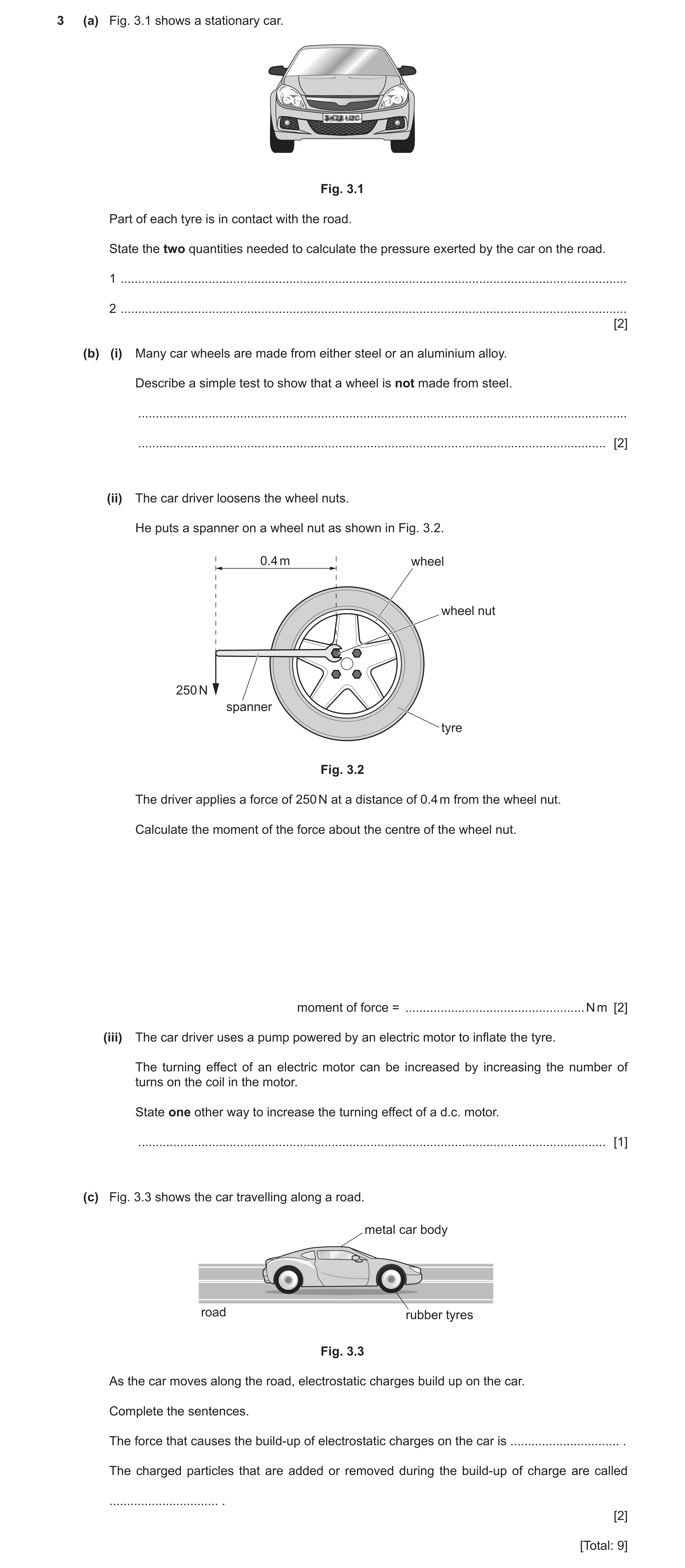
3 (a) Fig. 3.1 shows a stationary car. Fig. 3.1 Part of each tyre is in contact with the road. State the two quantities needed to calculate the pressure exerted by the car on the road. 1 … 2 … [2] (b) (i) Many car wheels are made from either steel or an aluminium alloy. Describe a simple test to show that a wheel is not made from steel. … … [2] (ii) The car driver loosens the wheel nuts. He puts a spanner on a wheel nut as shown in Fig. 3.2. 0.4 m wheel wheel nut 250 N spanner tyre Fig. 3.2 The driver applies a force of 250 N at a distance of 0.4 m from the wheel nut. Calculate the moment of the force about the centre of the wheel nut. moment of force = … N m [2] (iii) The car driver uses a pump powered by an electric motor to inflate the tyre. The turning effect of an electric motor can be increased by increasing the number of turns on the coil in the motor. State one other way to increase the turning effect of a d.c. motor. … [1] (c) Fig. 3.3 shows the car travelling along a road. metal car body road rubber tyres Fig. 3.3 As the car moves along the road, electrostatic charges build up on the car. Complete the sentences. The force that causes the build-up of electrostatic charges on the car is … . The charged particles that are added or removed during the build-up of charge are called … . [2] [Total: 9]
9 marks
Mark scheme: 3(a) weight of car ; 2 surface area of tyres in contact with the road ; 3(b)(i) use a magnet ; 2 wheel is not attracted ; ORA 3(b)(ii) moment = force perpendicular distance (in any form) / 250 0.4 ; 2 = 100 (N m) ; 3(b)(iii) one from: 1 increase current / voltage ; increase the strength of the magnetic field ; 3(c) friction ; 2 electrons ;
This question in 0654/32 Oct/Nov 2023
Q15 · A student investigates the properties of five materials: copper ice iron plastic wood… 0654/32 Feb/March 2024
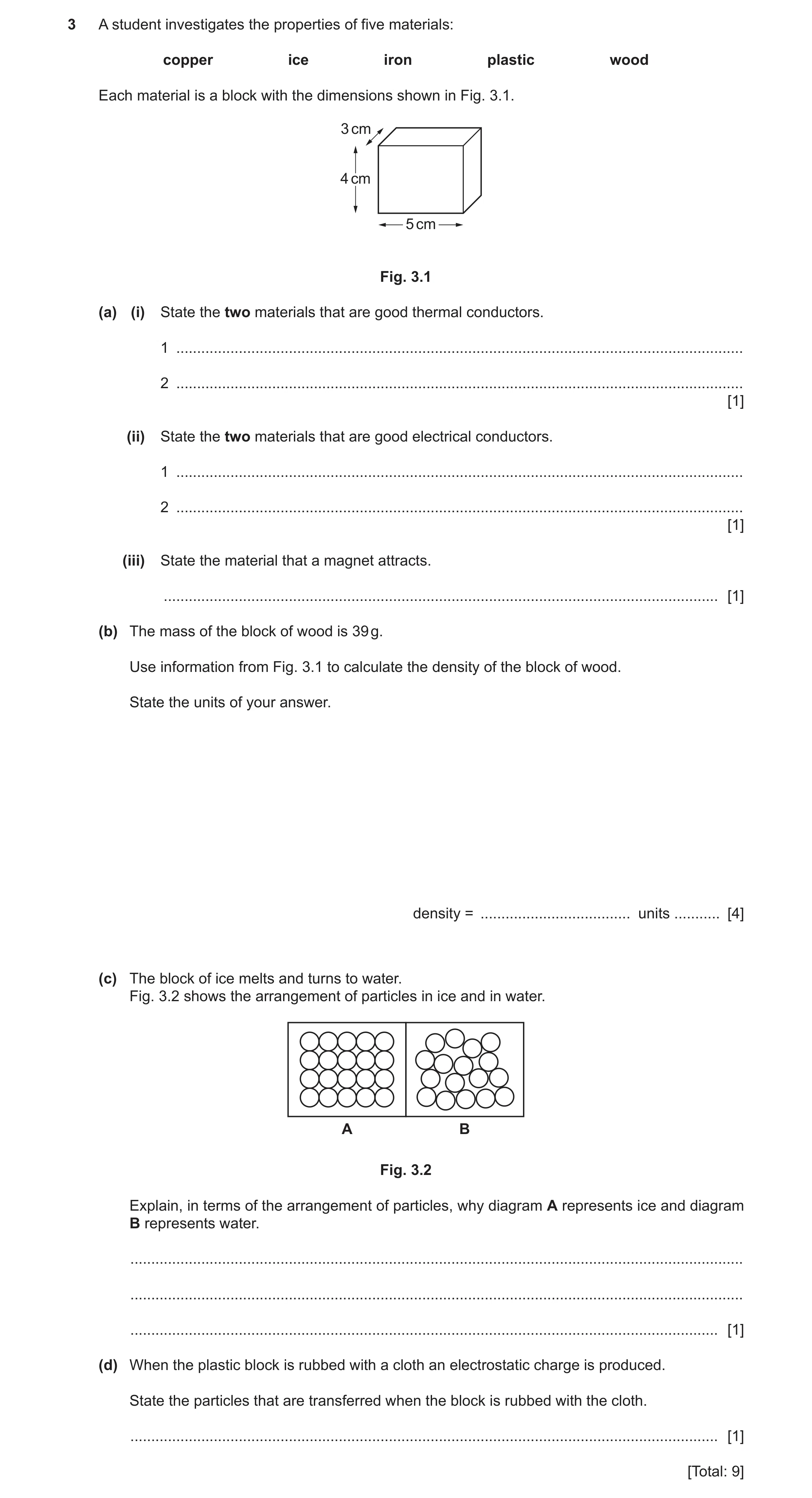
3 A student investigates the properties of five materials: copper ice iron plastic wood Each material is a block with the dimensions shown in Fig. 3.1. 3 cm 4 cm 5 cm Fig. 3.1 (a) (i) State the two materials that are good thermal conductors. 1 … 2 … [1] (ii) State the two materials that are good electrical conductors. 1 … 2 … [1] (iii) State the material that a magnet attracts. … [1] (b) The mass of the block of wood is 39 g. Use information from Fig. 3.1 to calculate the density of the block of wood. State the units of your answer. density = … units … [4] (c) The block of ice melts and turns to water. Fig. 3.2 shows the arrangement of particles in ice and in water. A B Fig. 3.2 Explain, in terms of the arrangement of particles, why diagram A represents ice and diagram B represents water. … … … [1] (d) When the plastic block is rubbed with a cloth an electrostatic charge is produced. State the particles that are transferred when the block is rubbed with the cloth. … [1] [Total: 9]
9 marks
Mark scheme: 3(a)(i) copper and iron ; 1 3(a)(ii) copper and iron ; 1 3(a)(iii) iron ; 1 3(b) volume = 3 4 5 = 60 cm3 ; 4 density = mass / volume (in any form) or 39 / 60 ; = 0.65 ; g / cm3 ; 3(c) ice – particles arranged regularly 1 and water – particles arranged irregularly ; 3(d) electrons ; 1
This question in 0654/32 Feb/March 2024
Q16 · Water in a steel saucepan being heated on an electric cooker 0654/32 May/June 2024
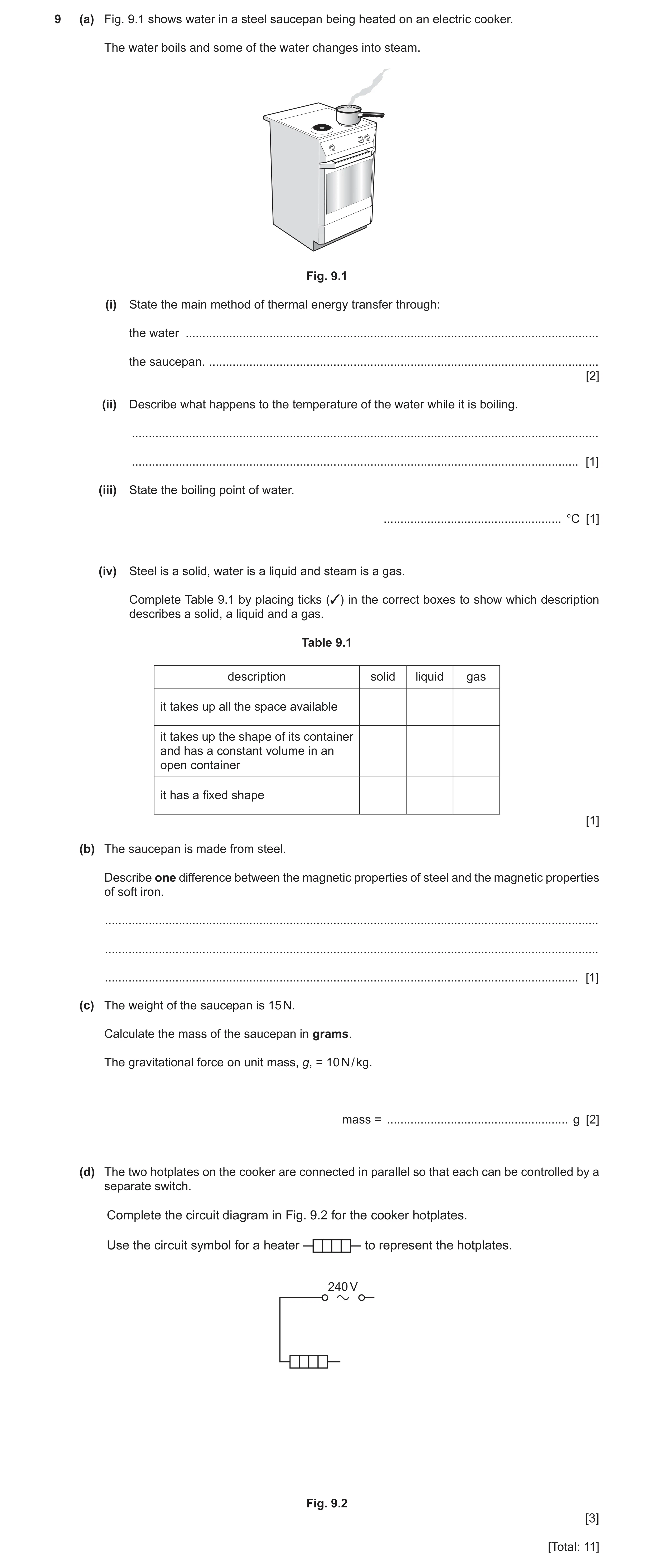
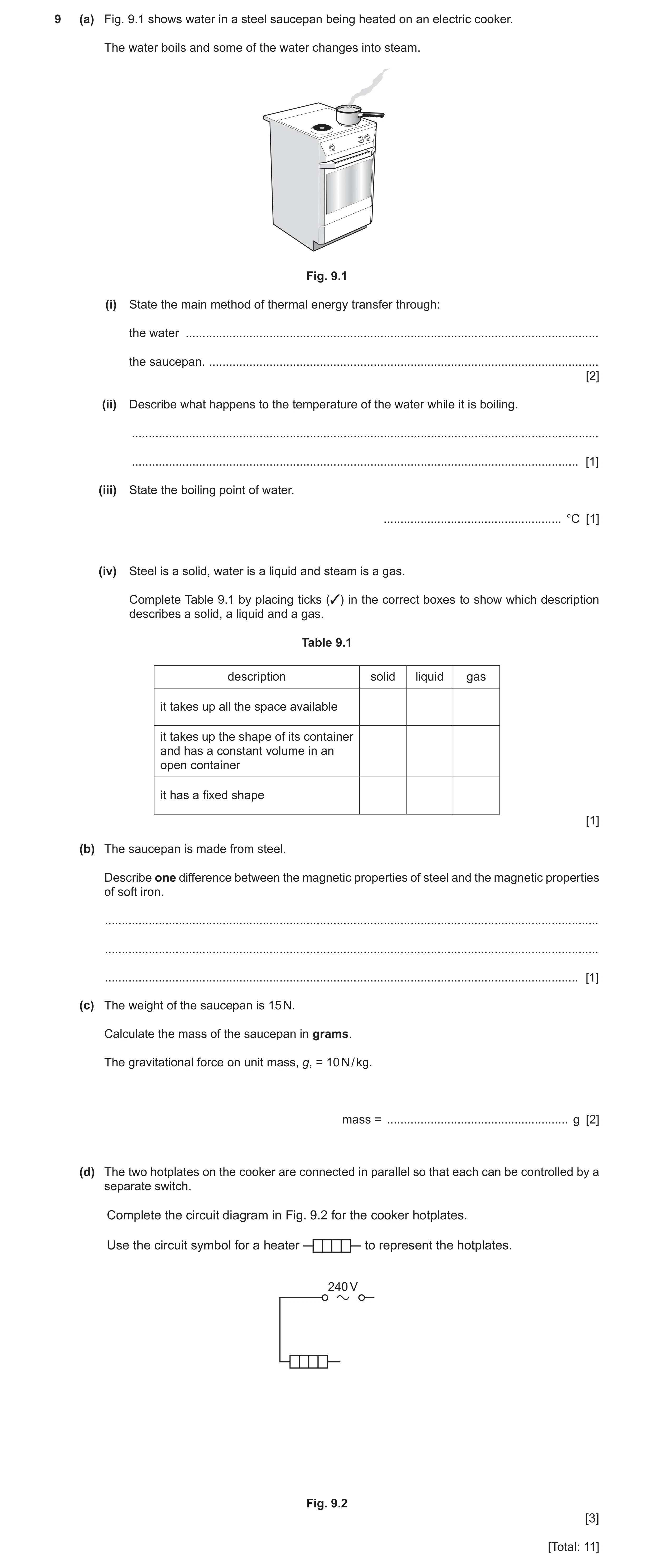
9 (a) Fig. 9.1 shows water in a steel saucepan being heated on an electric cooker. The water boils and some of the water changes into steam. Fig. 9.1 (i) State the main method of thermal energy transfer through: the water … the saucepan. … [2] (ii) Describe what happens to the temperature of the water while it is boiling. … … [1] (iii) State the boiling point of water. … °C [1] (iv) Steel is a solid, water is a liquid and steam is a gas. Complete Table 9.1 by placing ticks (✓) in the correct boxes to show which description describes a solid, a liquid and a gas. Table 9.1 description solid liquid gas it takes up all the space available it takes up the shape of its container and has a constant volume in an open container it has a fixed shape [1] (b) The saucepan is made from steel. Describe one difference between the magnetic properties of steel and the magnetic properties of soft iron. … … … [1] (c) The weight of the saucepan is 15 N. Calculate the mass of the saucepan in grams. The gravitational force on unit mass, g, = 10 N / kg. mass = … g [2] (d) The two hotplates on the cooker are connected in parallel so that each can be controlled by a separate switch. Complete the circuit diagram in Fig. 9.2 for the cooker hotplates. Use the circuit symbol for a heater to represent the hotplates. 240 V Fig. 9.2 [3] [Total: 11]
11 marks
Mark scheme: 9(a)(i) convection ; conduction ; 2 9(a)(ii) remains constant / remains at 100 ºC ; 1 9(a)(iii) 100 ºC ; 1 Question Answer Marks 9(a)(iv) description solid liquid gas it takes up all the space available it takes up the shape of its container and has a constant volume It has a fixed shape ; 1 9(b) steel retains its magnetism better / iron loses its magnetism more readily ; 1 9(c) m = W / g (in any form) or 15 / 10 or 1.5 ; = 1500 (g) ; 2 9(d) correct symbol for switch ; second heater connected in parallel ; each heater controlled by a separate switch ; 3
This question in 0654/32 May/June 2024
Q17 · Water in a steel saucepan being heated on an electric cooker 0654/33 May/June 2024
9 (a) Fig. 9.1 shows water in a steel saucepan being heated on an electric cooker. The water boils and some of the water changes into steam. Fig. 9.1 (i) State the main method of thermal energy transfer through: the water … the saucepan. … [2] (ii) Describe what happens to the temperature of the water while it is boiling. … … [1] (iii) State the boiling point of water. … °C [1] (iv) Steel is a solid, water is a liquid and steam is a gas. Complete Table 9.1 by placing ticks (✓) in the correct boxes to show which description describes a solid, a liquid and a gas. Table 9.1 description solid liquid gas it takes up all the space available it takes up the shape of its container and has a constant volume in an open container it has a fixed shape [1] (b) The saucepan is made from steel. Describe one difference between the magnetic properties of steel and the magnetic properties of soft iron. … … … [1] (c) The weight of the saucepan is 15 N. Calculate the mass of the saucepan in grams. The gravitational force on unit mass, g, = 10 N / kg. mass = … g [2] (d) The two hotplates on the cooker are connected in parallel so that each can be controlled by a separate switch. Complete the circuit diagram in Fig. 9.2 for the cooker hotplates. Use the circuit symbol for a heater to represent the hotplates. 240 V Fig. 9.2 [3] [Total: 11]
11 marks
Mark scheme: 9(a)(i) convection ; conduction ; 2 9(a)(ii) remains constant / remains at 100 ºC ; 1 9(a)(iii) 100 ºC ; 1 Question Answer Marks 9(a)(iv) description solid liquid gas it takes up all the space available it takes up the shape of its container and has a constant volume It has a fixed shape ; 1 9(b) steel retains its magnetism better / iron loses its magnetism more readily ; 1 9(c) m = W / g (in any form) or 15 / 10 or 1.5 ; = 1500 (g) ; 2 9(d) correct symbol for switch ; second heater connected in parallel ; each heater controlled by a separate switch ; 3
This question in 0654/33 May/June 2024
 14 / 28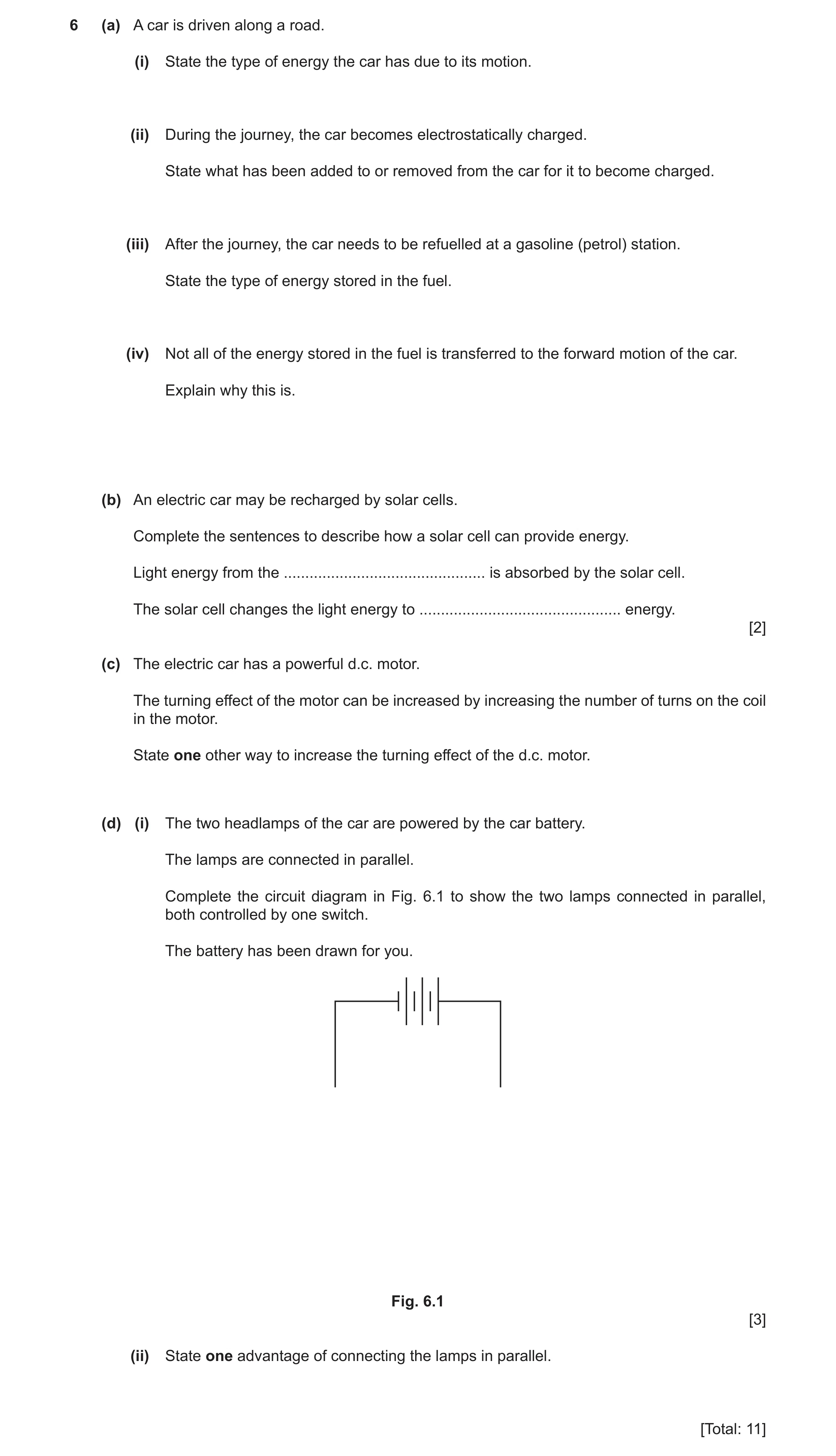
 7
7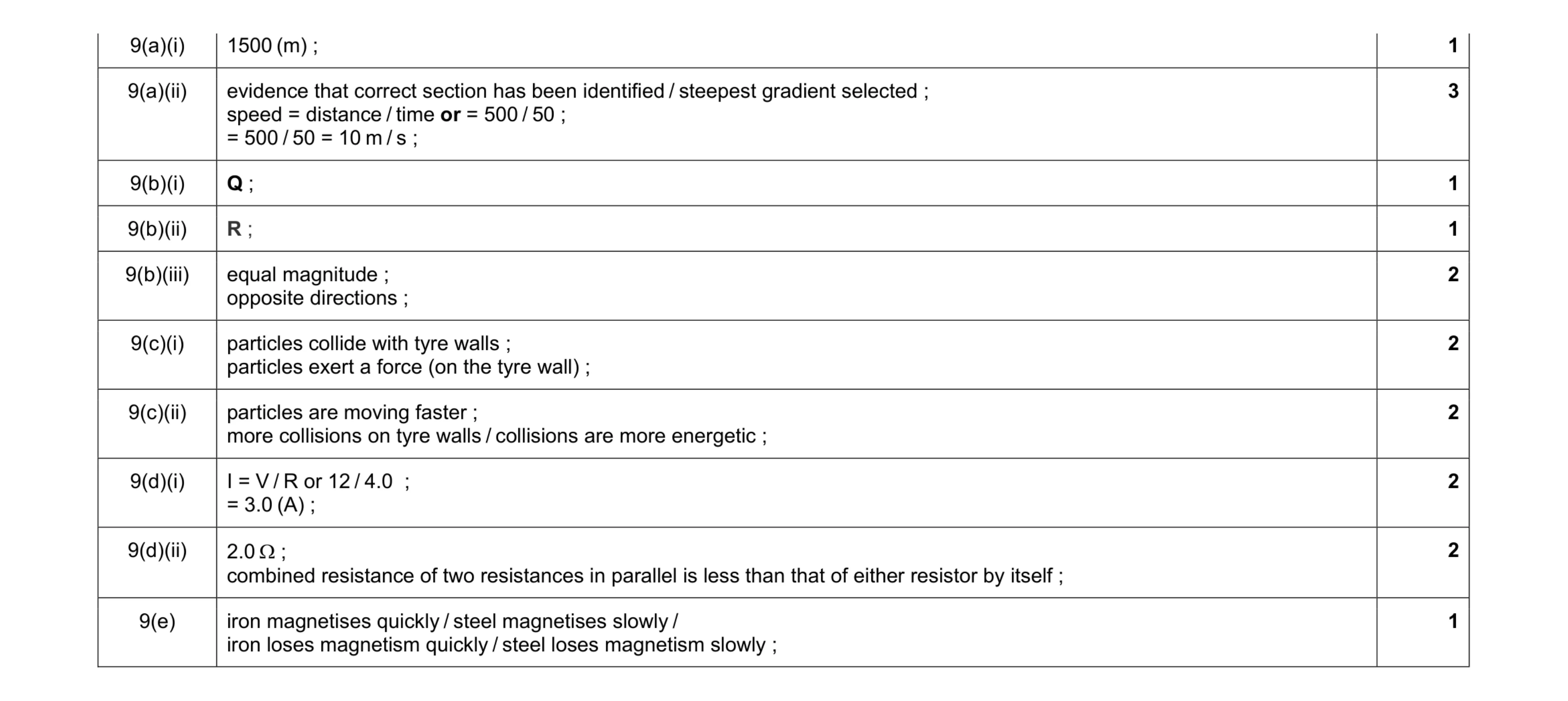 17
17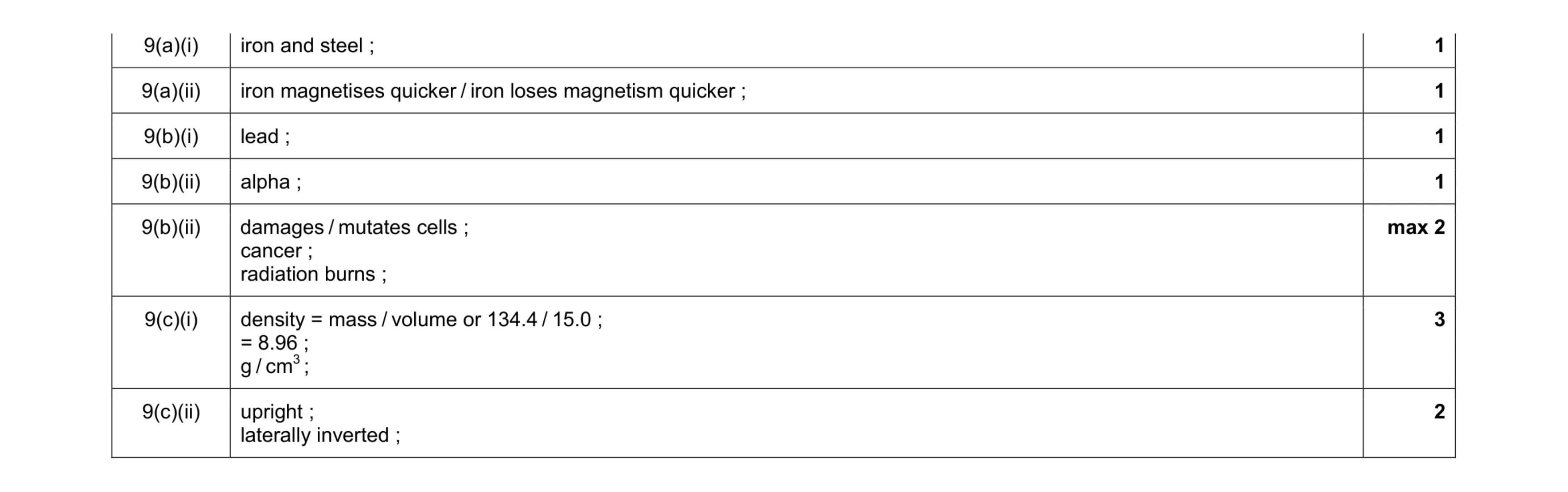 11
11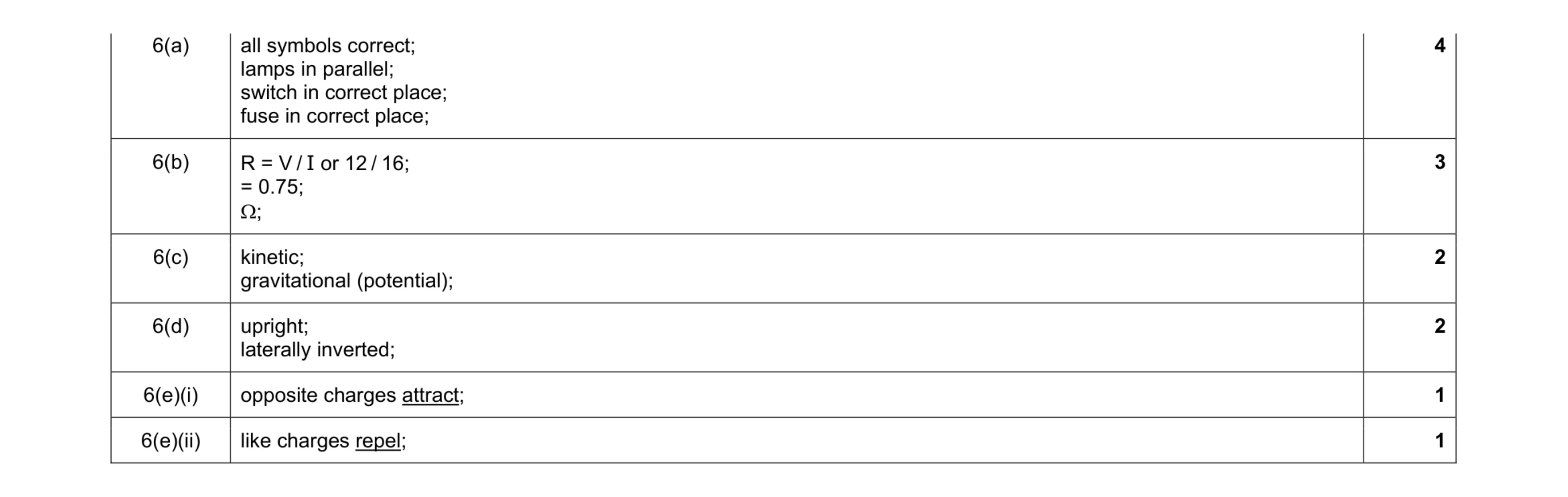 13
13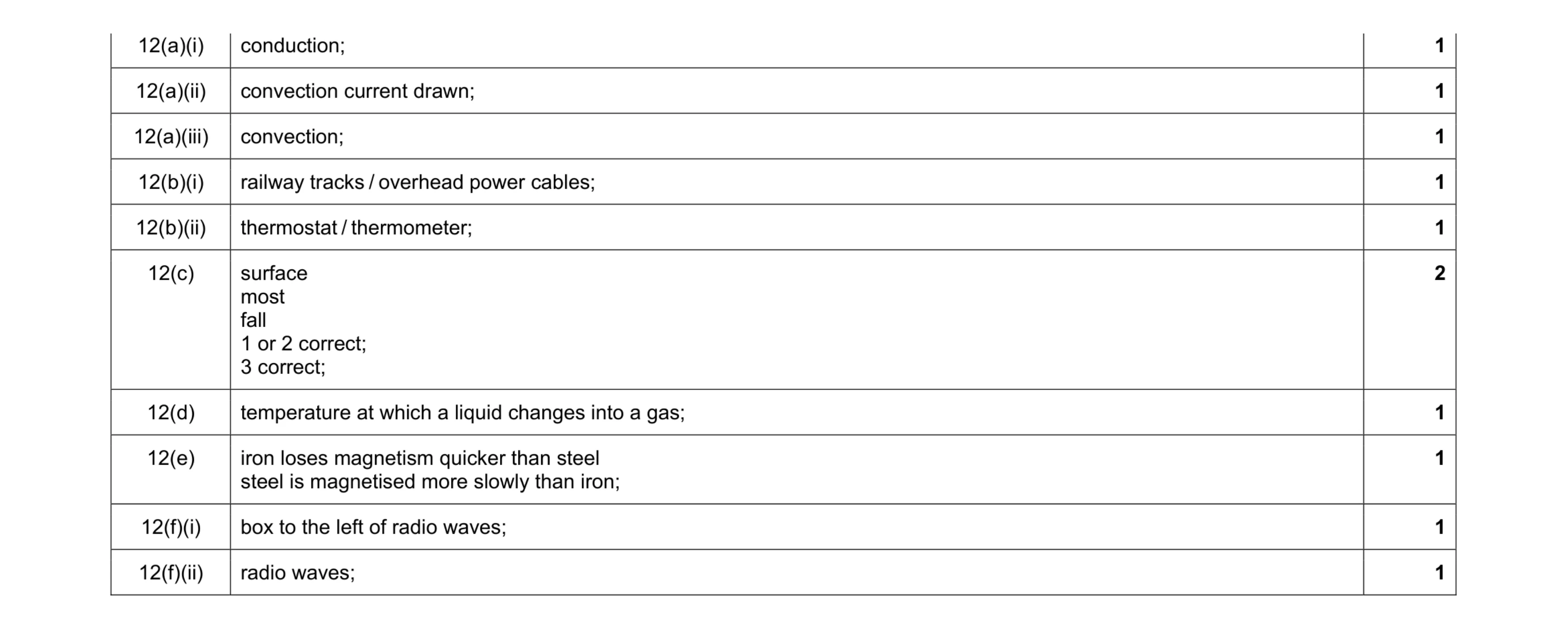 11
11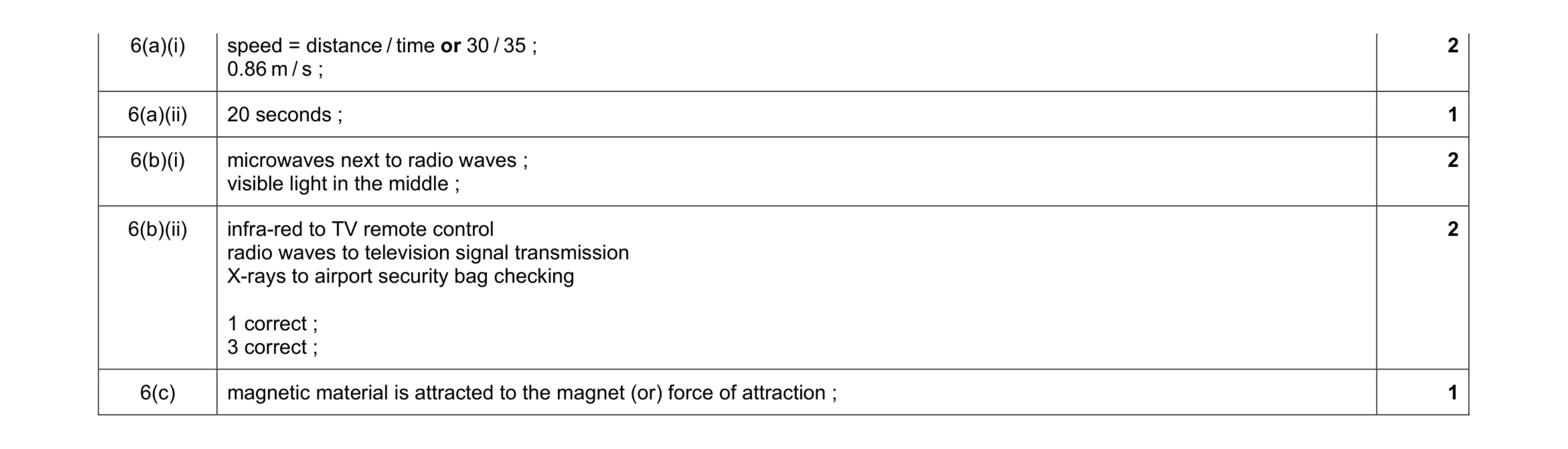 8
8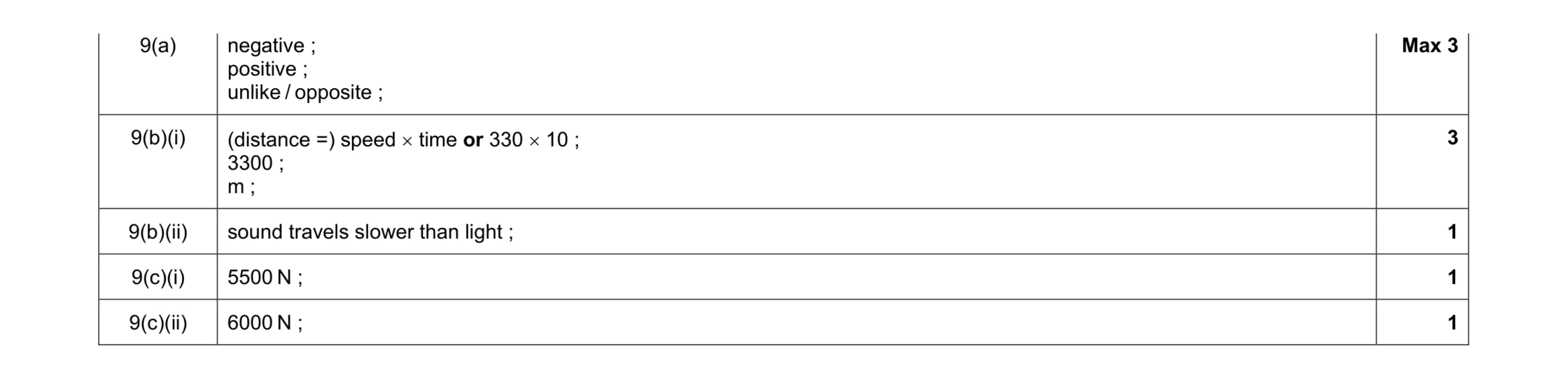 9
9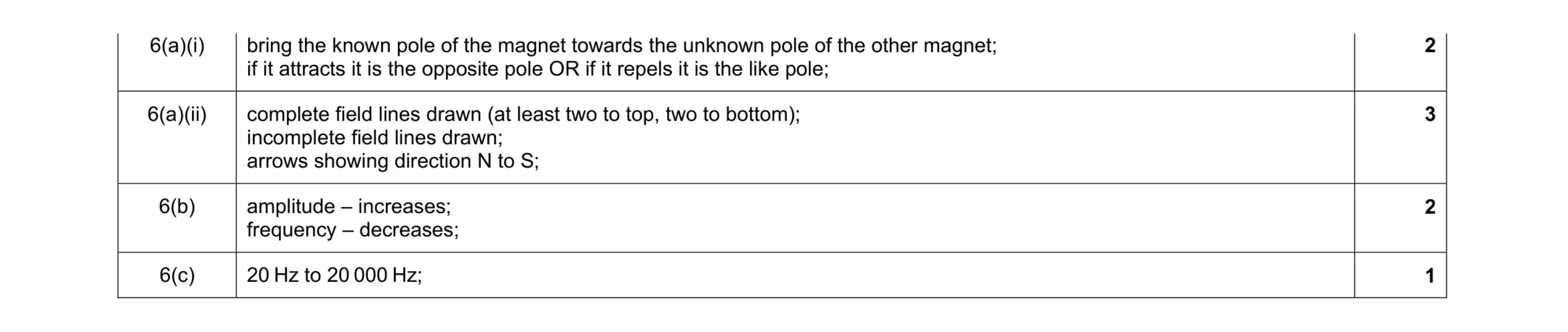 8
8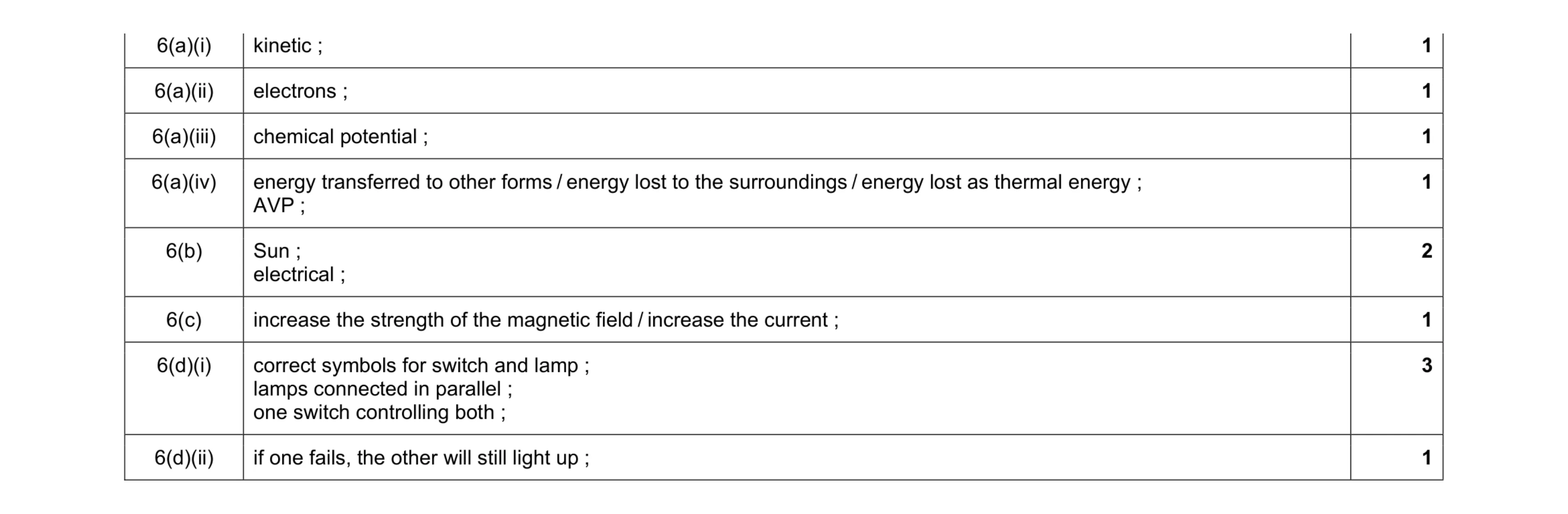 11
11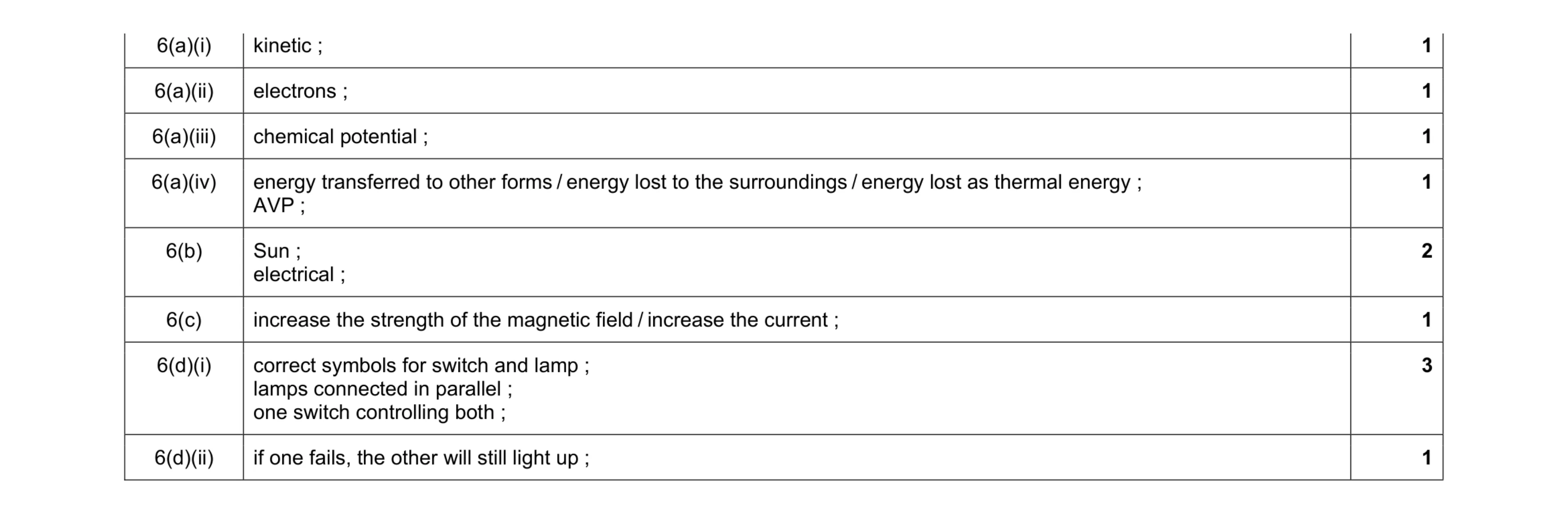 11
11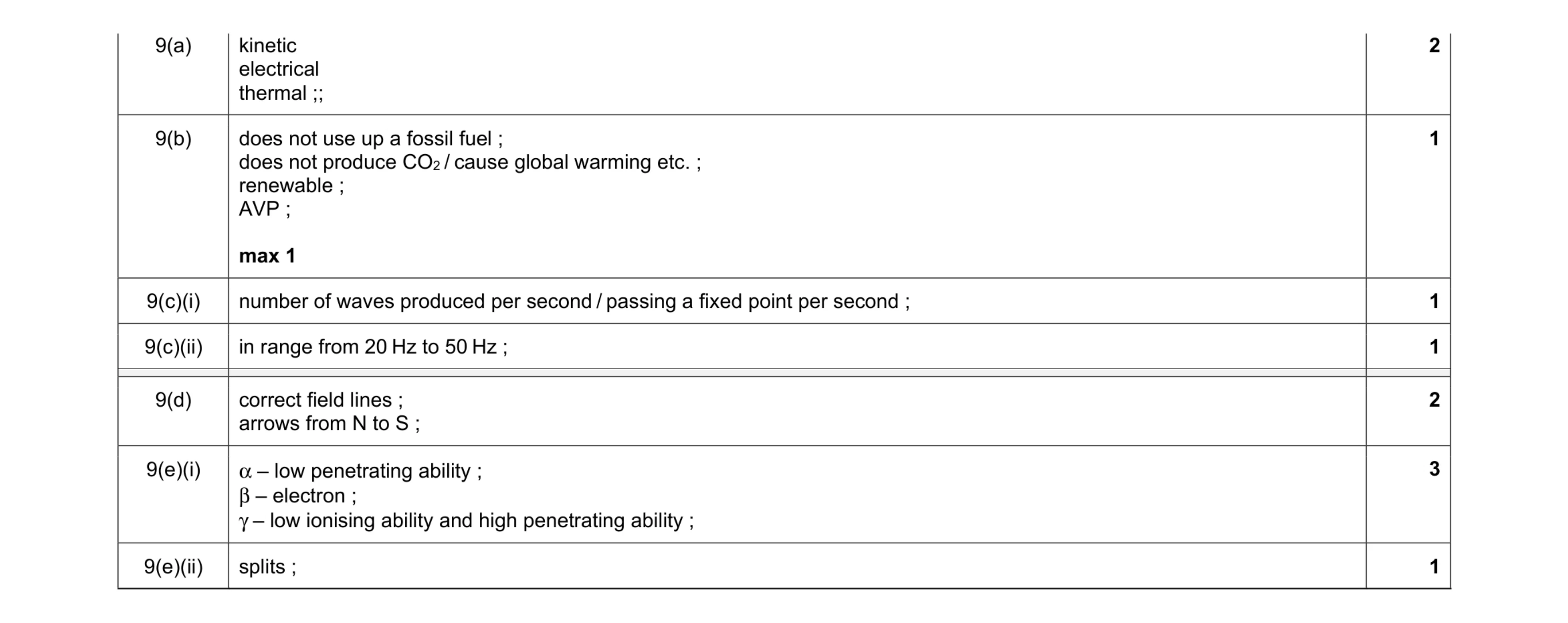 11
11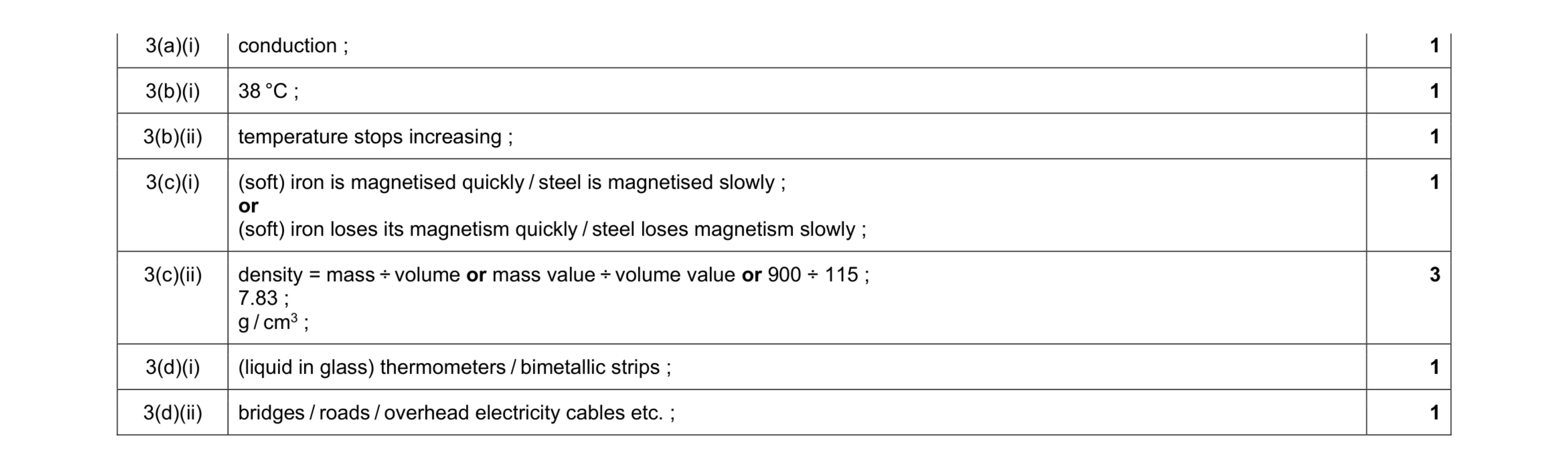 9
9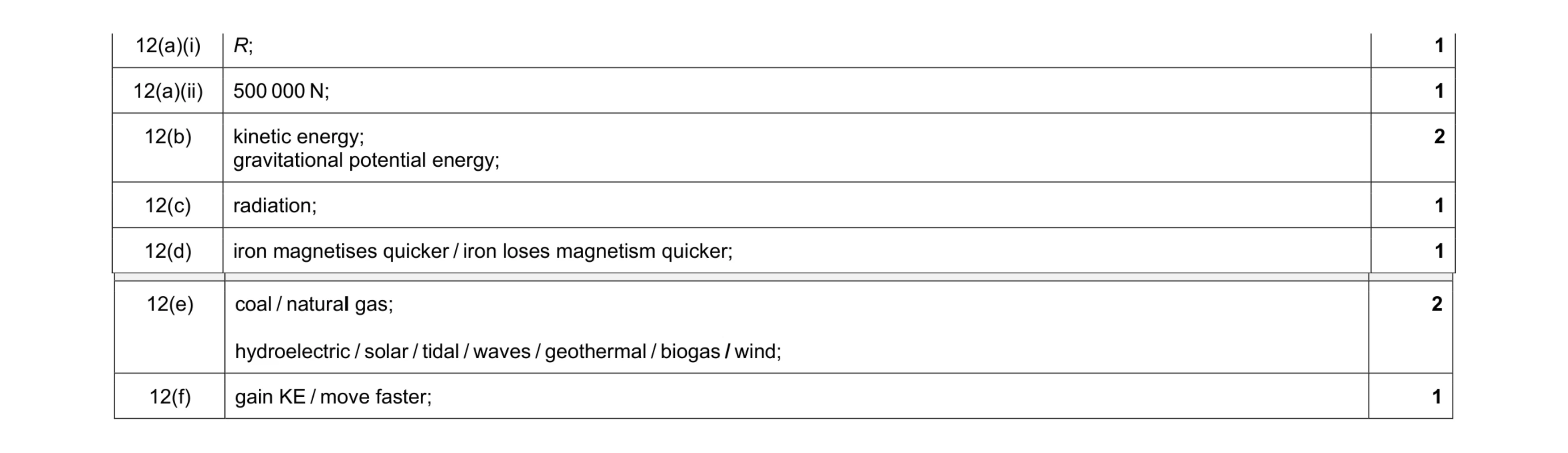 9
9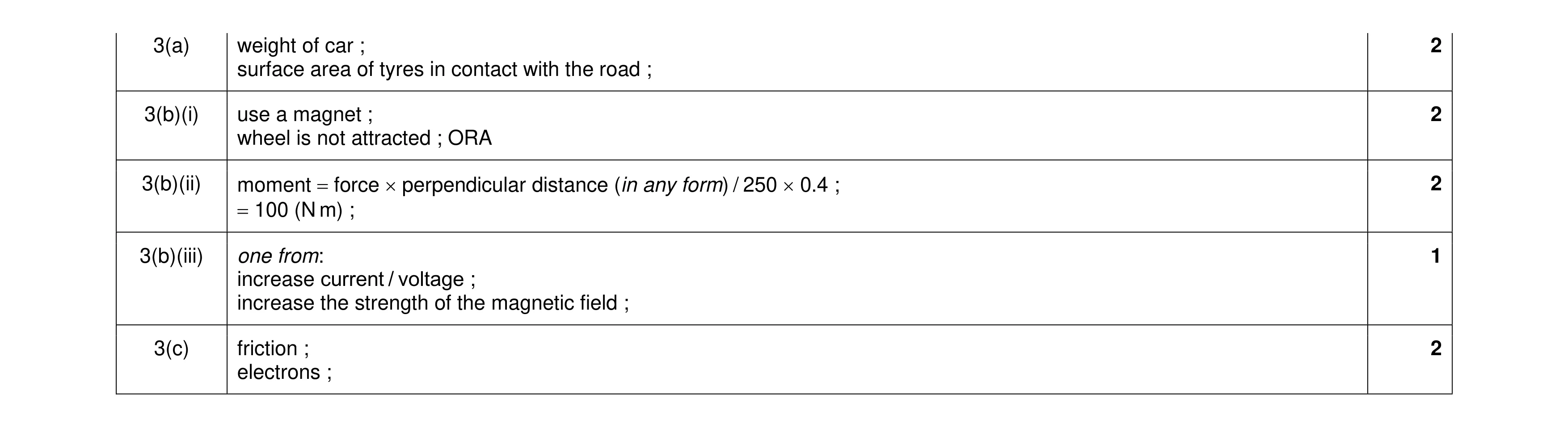 9
9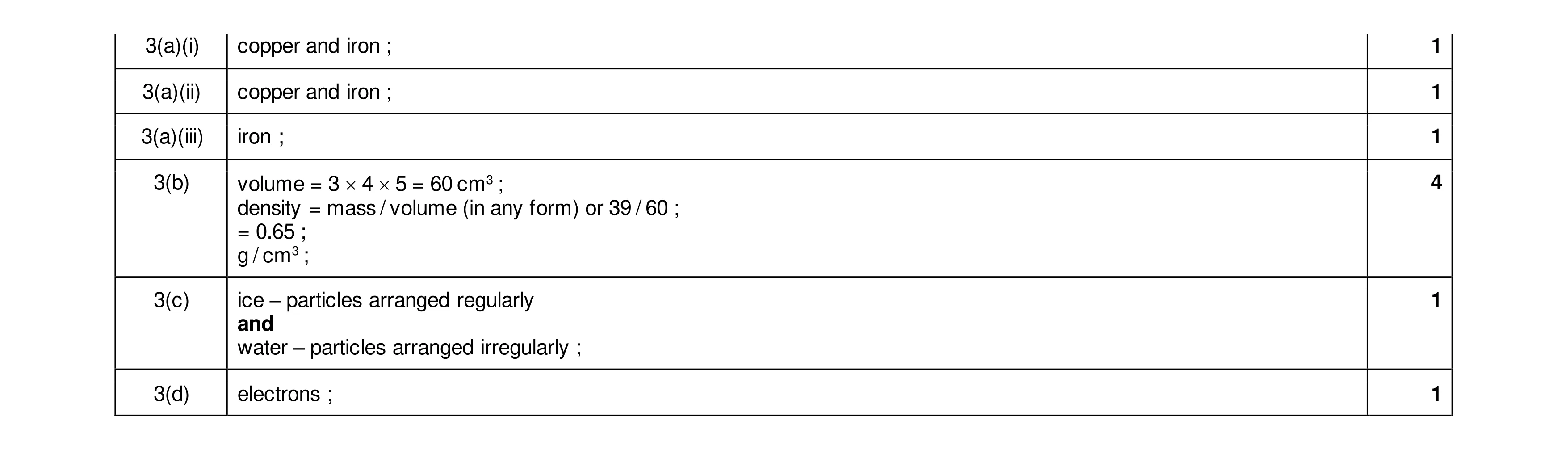 9
9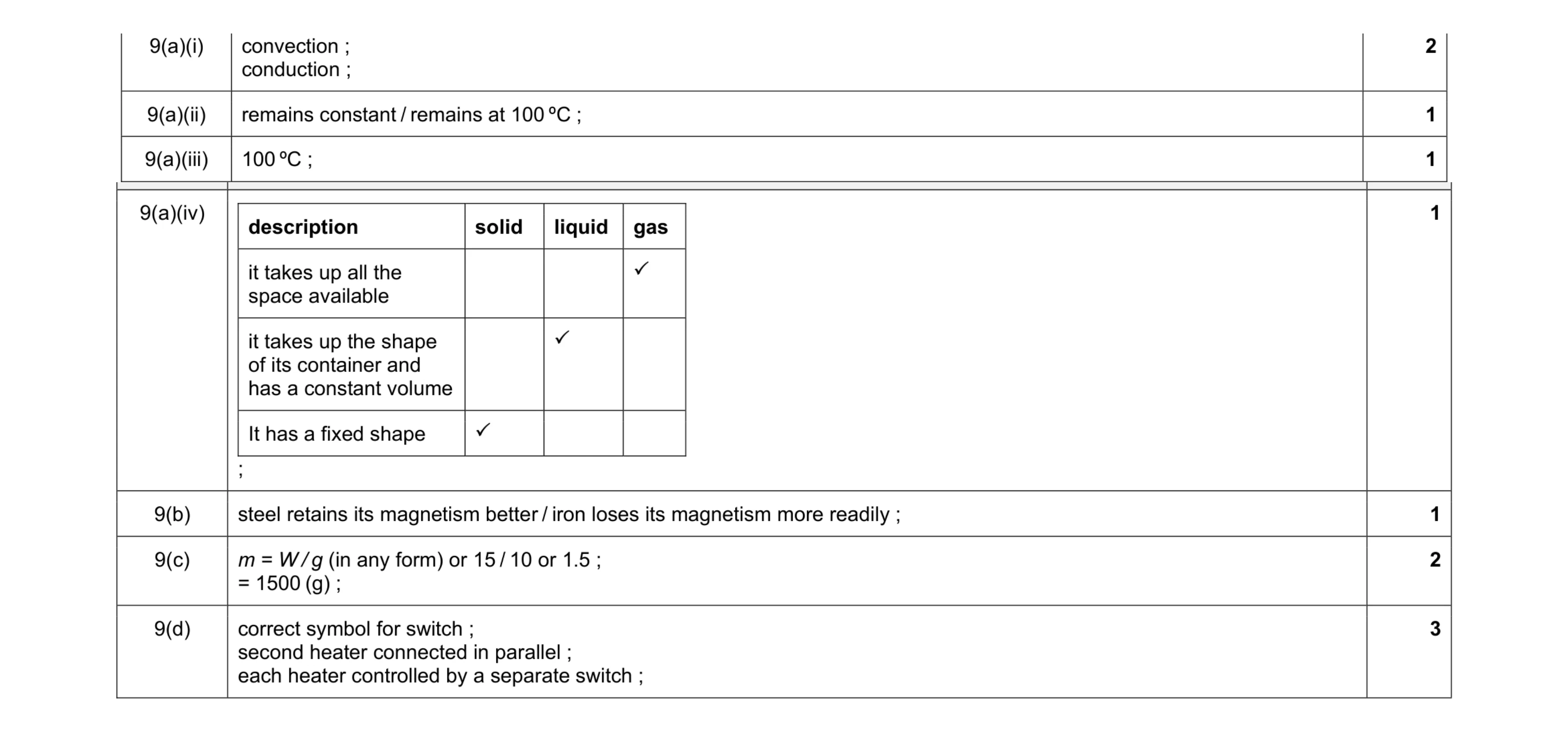 11
11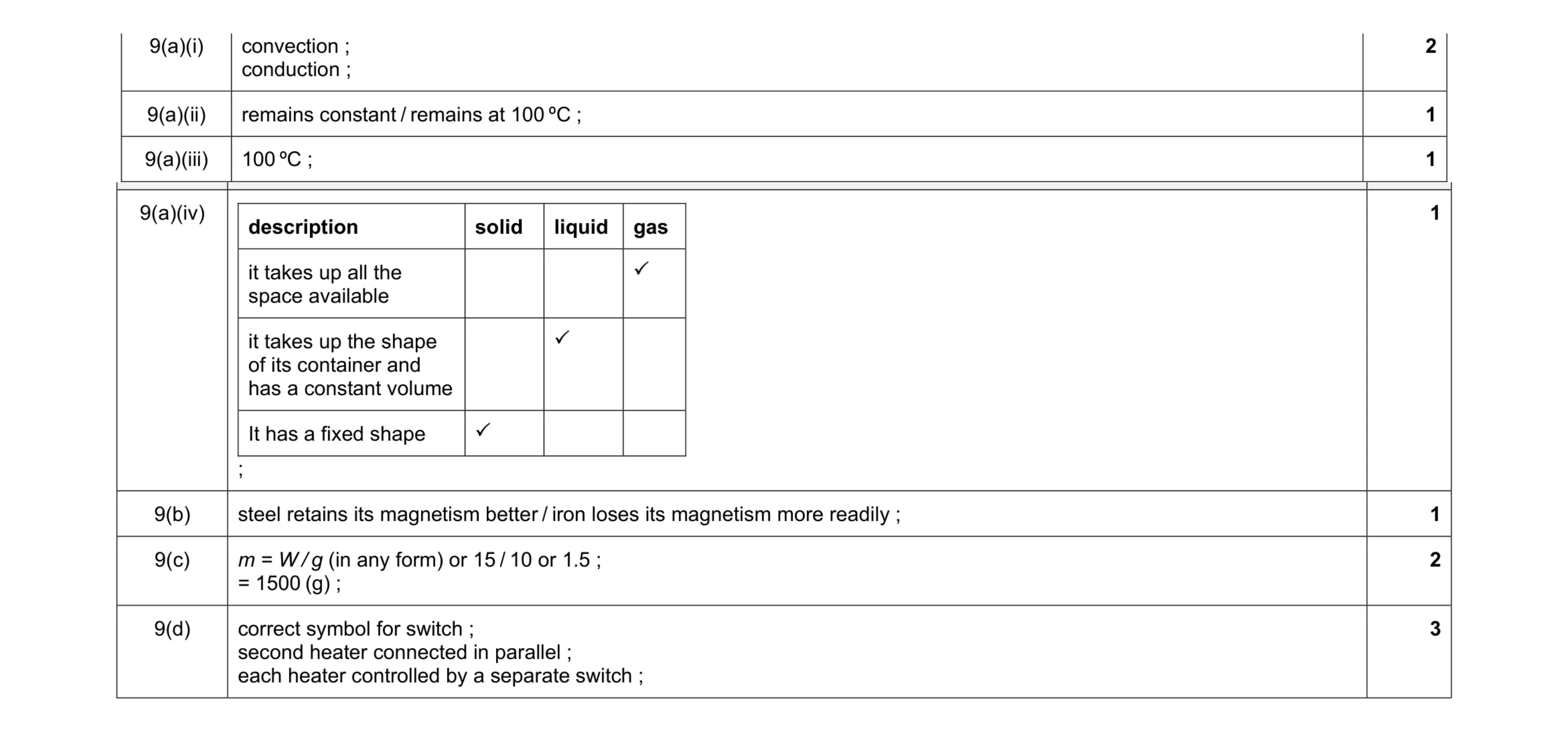 11
11