Questions as text
Q1 · Sounds are made by vibrating objects 0654/11 May/June 2006
35 Sounds are made by vibrating objects. A certain object vibrates but a person nearby cannot hear any sound. Which statement might explain why nothing is heard? A The amplitude of the sound waves is too large. B The frequency of the vibration is too high. C The sound waves are transverse. D The speed of the sound waves is too high.
1 marks
Answer: B
This question in 0654/11 May/June 2006
Q2 · The diagram represents a sound wave 0654/11 Oct/Nov 2007
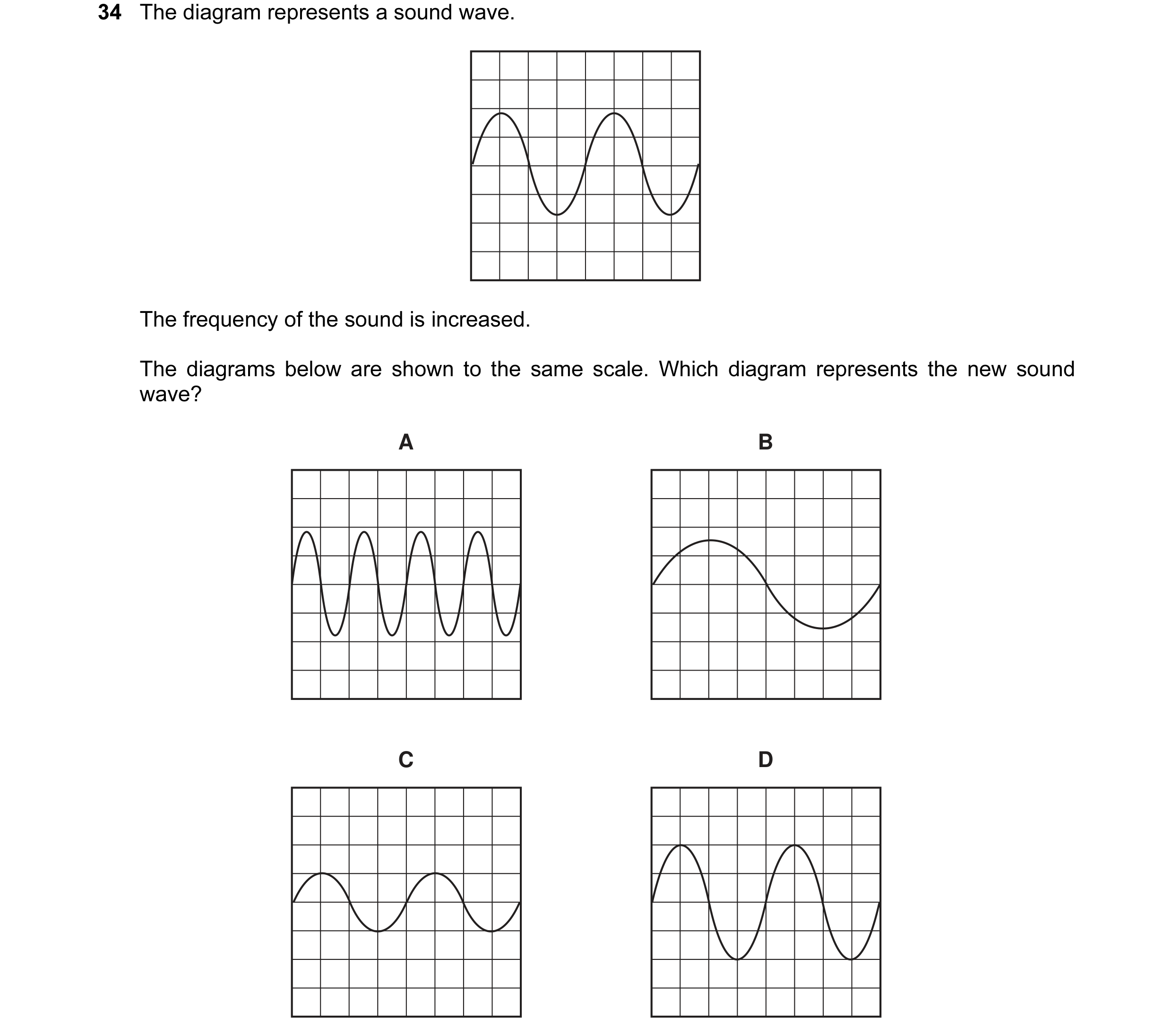
34 The diagram represents a sound wave. The frequency of the sound is increased. The diagrams below are shown to the same scale. Which diagram represents the new sound wave? A B C D
1 marks
Answer: A
This question in 0654/11 Oct/Nov 2007
Q3 · The diagrams show examples of wave motion 0654/11 May/June 2009
35 The diagrams show examples of wave motion. 1 2 ripple tank drum waves on water waves in air 3 4 waves on a rope waves in a spring (as shown) Which are longitudinal waves? A 1 only B 1, 2 and 4 C 2 and 3 only D 2 and 4 only
1 marks
Answer: D
This question in 0654/11 May/June 2009
Q4 · Astronaut 1 uses a hammer to mend a satellite in space 0654/11 May/June 2012
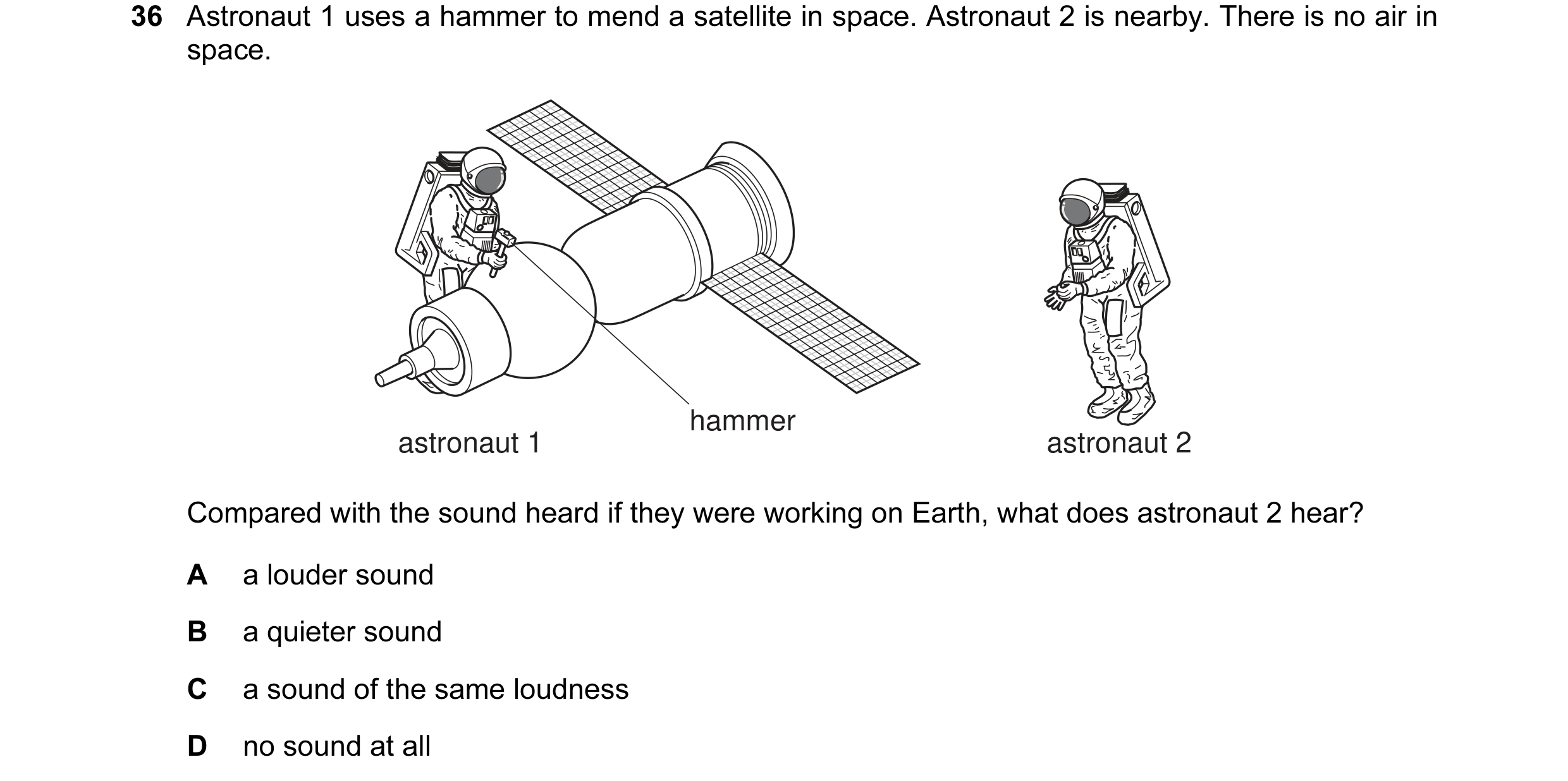
36 Astronaut 1 uses a hammer to mend a satellite in space. Astronaut 2 is nearby. There is no air in space. hammer astronaut 1 astronaut 2 Compared with the sound heard if they were working on Earth, what does astronaut 2 hear? A a louder sound B a quieter sound C a sound of the same loudness D no sound at all
1 marks
Answer: D
This question in 0654/11 May/June 2012
Q5 · Astronaut 1 uses a hammer to mend a satellite in space 0654/12 May/June 2012
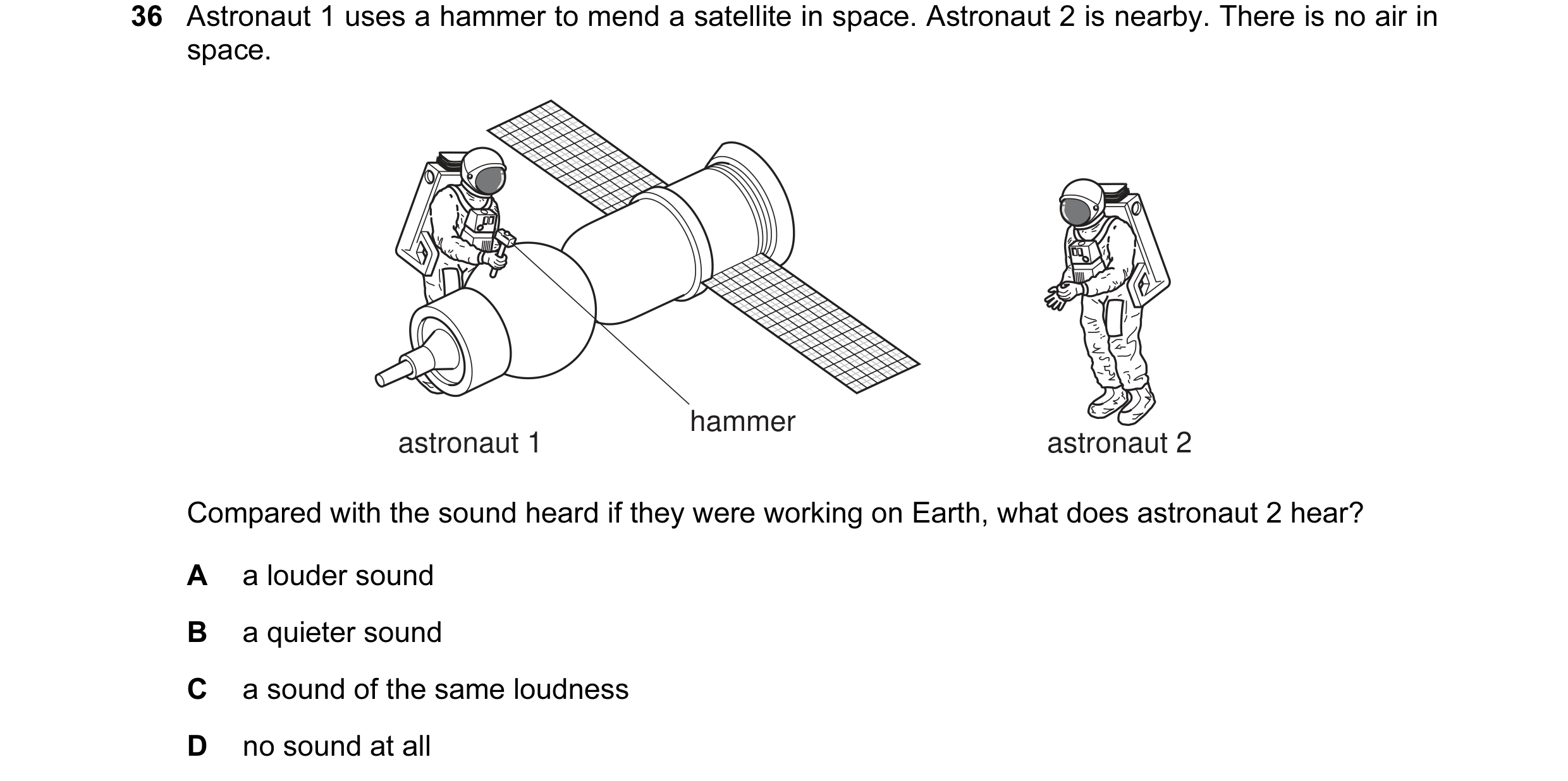
36 Astronaut 1 uses a hammer to mend a satellite in space. Astronaut 2 is nearby. There is no air in space. hammer astronaut 1 astronaut 2 Compared with the sound heard if they were working on Earth, what does astronaut 2 hear? A a louder sound B a quieter sound C a sound of the same loudness D no sound at all
1 marks
Answer: D
This question in 0654/12 May/June 2012
Q6 · Astronaut 1 uses a hammer to mend a satellite in space 0654/13 May/June 2012
36 Astronaut 1 uses a hammer to mend a satellite in space. Astronaut 2 is nearby. There is no air in space. hammer astronaut 1 astronaut 2 Compared with the sound heard if they were working on Earth, what does astronaut 2 hear? A a louder sound B a quieter sound C a sound of the same loudness D no sound at all
1 marks
Answer: D
This question in 0654/13 May/June 2012
Q7 · Which change to a sound wave would make it louder? 0654/11 May/June 2013
37 Which change to a sound wave would make it louder? A decreasing the amplitude B increasing the amplitude C decreasing the wavelength D increasing the wavelength
1 marks
Answer: B
This question in 0654/11 May/June 2013
Q8 · Which change to a sound wave would make it louder? 0654/12 May/June 2013
37 Which change to a sound wave would make it louder? A decreasing the amplitude B increasing the amplitude C decreasing the wavelength D increasing the wavelength
1 marks
Answer: B
This question in 0654/12 May/June 2013
Q9 · Which change to a sound wave would make it louder? 0654/13 May/June 2013
34 Which change to a sound wave would make it louder? A decreasing the amplitude B increasing the amplitude C decreasing the wavelength D increasing the wavelength
1 marks
Answer: B
This question in 0654/13 May/June 2013
Q10 · What is the approximate value of the frequency of the highest-pitched sound that can be… 0654/11 Oct/Nov 2013
37 What is the approximate value of the frequency of the highest-pitched sound that can be heard by a young person? A 20 Hz B 200 Hz C 2000 Hz D 20 000 Hz
1 marks
Answer: D
This question in 0654/11 Oct/Nov 2013
Q11 · What is the approximate value of the frequency of the highest-pitched sound that can be… 0654/12 Oct/Nov 2013
36 What is the approximate value of the frequency of the highest-pitched sound that can be heard by a young person? A 20 Hz B 200 Hz C 2000 Hz D 20 000 Hz
1 marks
Answer: D
This question in 0654/12 Oct/Nov 2013
Q12 · Which type of wave is longitudinal? 0654/13 Oct/Nov 2013
34 Which type of wave is longitudinal? A light wave B radio wave C sound wave D water wave
1 marks
Answer: C
This question in 0654/13 Oct/Nov 2013
Q13 · What is the approximate value of the frequency of the highest-pitched sound that can be… 0654/13 Oct/Nov 2013
37 What is the approximate value of the frequency of the highest-pitched sound that can be heard by a young person? A 20 Hz B 200 Hz C 2000 Hz D 20 000 Hz
1 marks
Answer: D
This question in 0654/13 Oct/Nov 2013
Q14 · A short, loud sound is made in front of a tall building 0654/11 May/June 2014
36 A short, loud sound is made in front of a tall building. An echo returns to the source of the sound 0.6 s later. The speed of sound is 330 m / s. How far away is the building from the source of the sound? A 99 m B 198 m C 550 m D 1100 m
1 marks
Answer: A
This question in 0654/11 May/June 2014
Q15 · A sound wave has a certain amplitude and a certain frequency 0654/12 May/June 2014
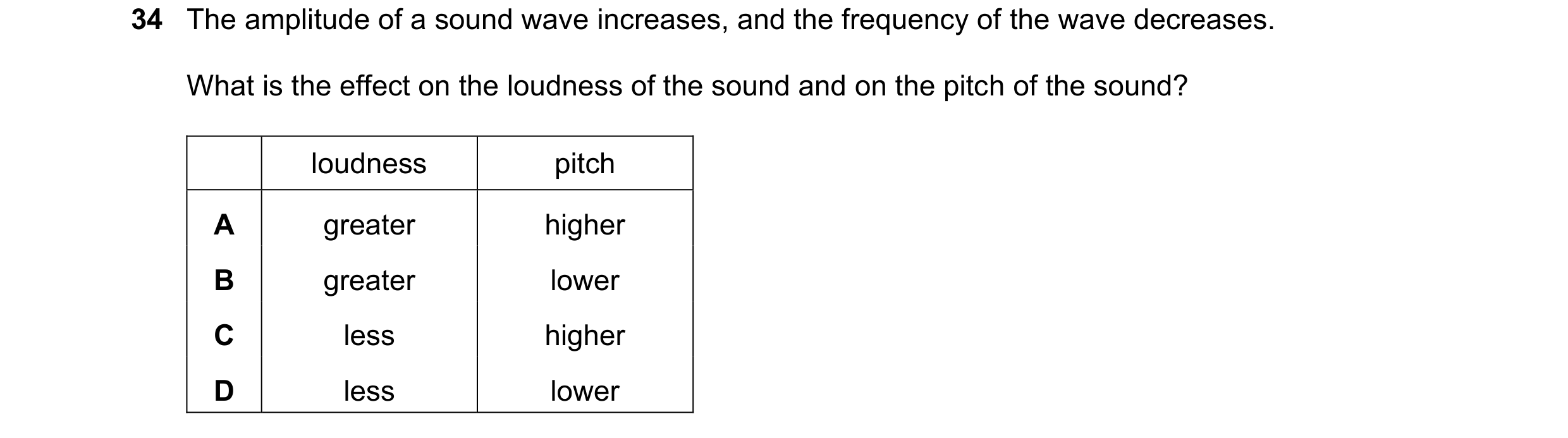
36 A sound wave has a certain amplitude and a certain frequency. The amplitude of the wave increases, and the frequency of the wave decreases. What is the effect on the loudness of the sound and on the pitch of the sound? loudness pitch A greater higher B greater lower C less higher D less lower
1 marks
Answer: B
This question in 0654/12 May/June 2014
Q16 · A short, loud sound is made in front of a tall building 0654/13 May/June 2014
34 A short, loud sound is made in front of a tall building. An echo returns to the source of the sound 0.6 s later. The speed of sound is 330 m / s. How far away is the building from the source of the sound? A 99 m B 198 m C 550 m D 1100 m
1 marks
Answer: A
This question in 0654/13 May/June 2014
Q17 · Which waves are longitudinal? 0654/11 Oct/Nov 2014
32 Which waves are longitudinal? A light waves from a lamp B sound waves from a piano C ultraviolet waves from the Sun D X-rays from a security scanner
1 marks
Answer: B
This question in 0654/11 Oct/Nov 2014
Q18 · Music is produced by the loudspeaker of a radio 0654/11 Oct/Nov 2014
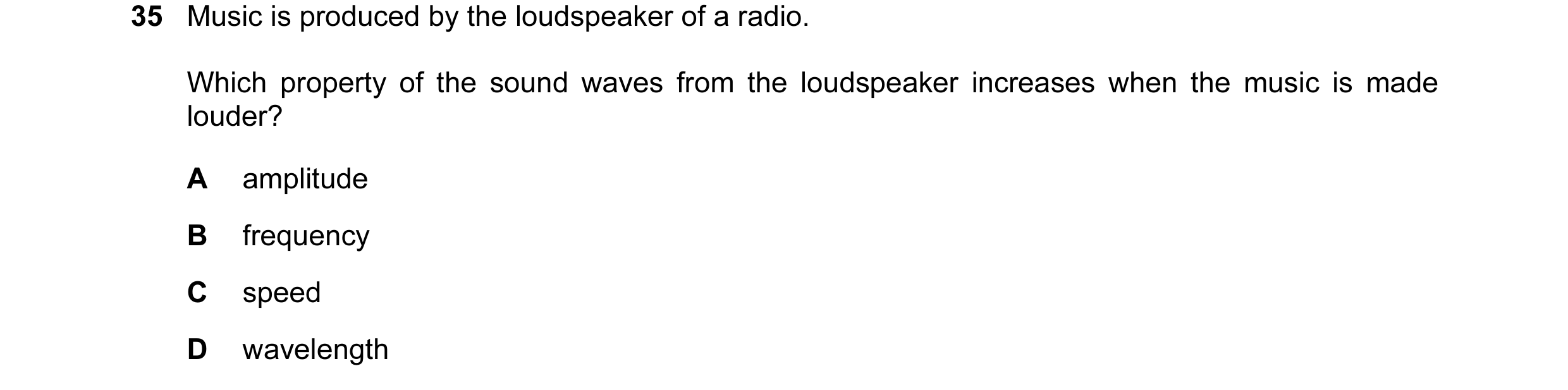
35 Music is produced by the loudspeaker of a radio. Which property of the sound waves from the loudspeaker increases when the music is made louder? A amplitude B frequency C speed D wavelength
1 marks
Answer: A
This question in 0654/11 Oct/Nov 2014
Q19 · Which waves are longitudinal? 0654/12 Oct/Nov 2014
33 Which waves are longitudinal? A light waves from a lamp B sound waves from a piano C ultraviolet waves from the Sun D X-rays from a security scanner
1 marks
Answer: B
This question in 0654/12 Oct/Nov 2014
Q20 · Music is produced by the loudspeaker of a radio 0654/12 Oct/Nov 2014
34 Music is produced by the loudspeaker of a radio. Which property of the sound waves from the loudspeaker increases when the music is made louder? A amplitude B frequency C speed D wavelength
1 marks
Answer: A
This question in 0654/12 Oct/Nov 2014
Q21 · Music is produced by the loudspeaker of a radio 0654/13 Oct/Nov 2014
35 Music is produced by the loudspeaker of a radio. Which property of the sound waves from the loudspeaker increases when the music is made louder? A amplitude B frequency C speed D wavelength
1 marks
Answer: A
This question in 0654/13 Oct/Nov 2014
Q22 · Which row gives an example of a longitudinal wave and describes the direction of the… 0654/11 May/June 2015
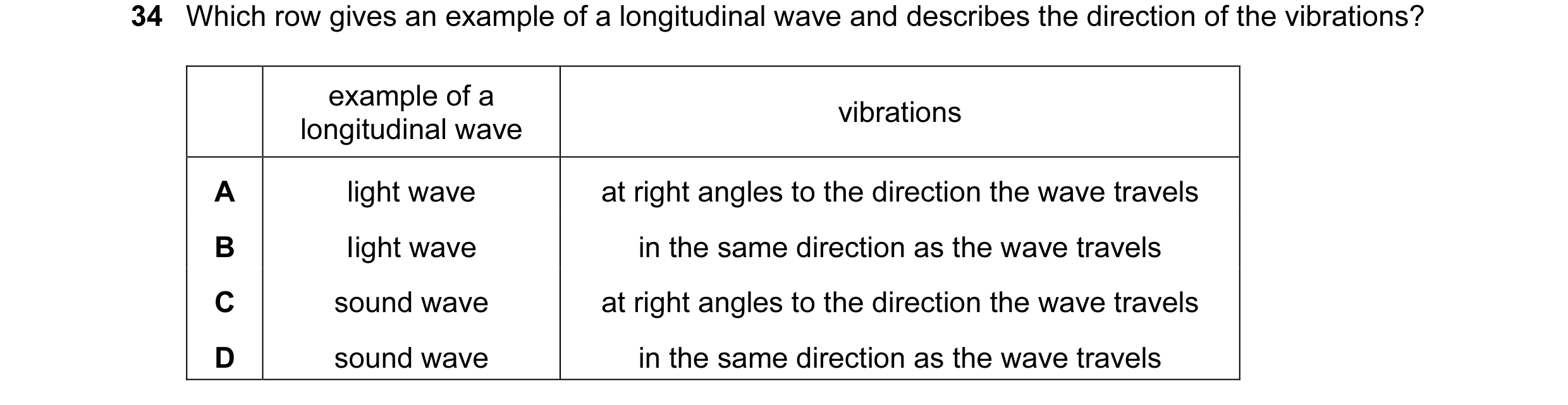
34 Which row gives an example of a longitudinal wave and describes the direction of the vibrations? example of a vibrations longitudinal wave A light wave at right angles to the direction the wave travels B Iight wave in the same direction as the wave travels C sound wave at right angles to the direction the wave travels D sound wave in the same direction as the wave travels
1 marks
Answer: D
This question in 0654/11 May/June 2015
Q23 · Which type of wave cannot travel through a vacuum? 0654/11 May/June 2015
36 Which type of wave cannot travel through a vacuum? A infra-red radiation B microwaves C sound waves D X-rays
1 marks
Answer: C
This question in 0654/11 May/June 2015
Q24 · An explosion experiment is carried out on Earth 0654/12 May/June 2015
36 An explosion experiment is carried out on Earth. The experiment is repeated by an astronaut in space where there is no gas or air. How does the explosion sound to the astronaut in space? A slightly louder than on Earth B the same loudness as on Earth C slightly quieter than on Earth D completely silent
1 marks
Answer: D
This question in 0654/12 May/June 2015
Q25 · Sound waves may cause an echo 0654/13 May/June 2015
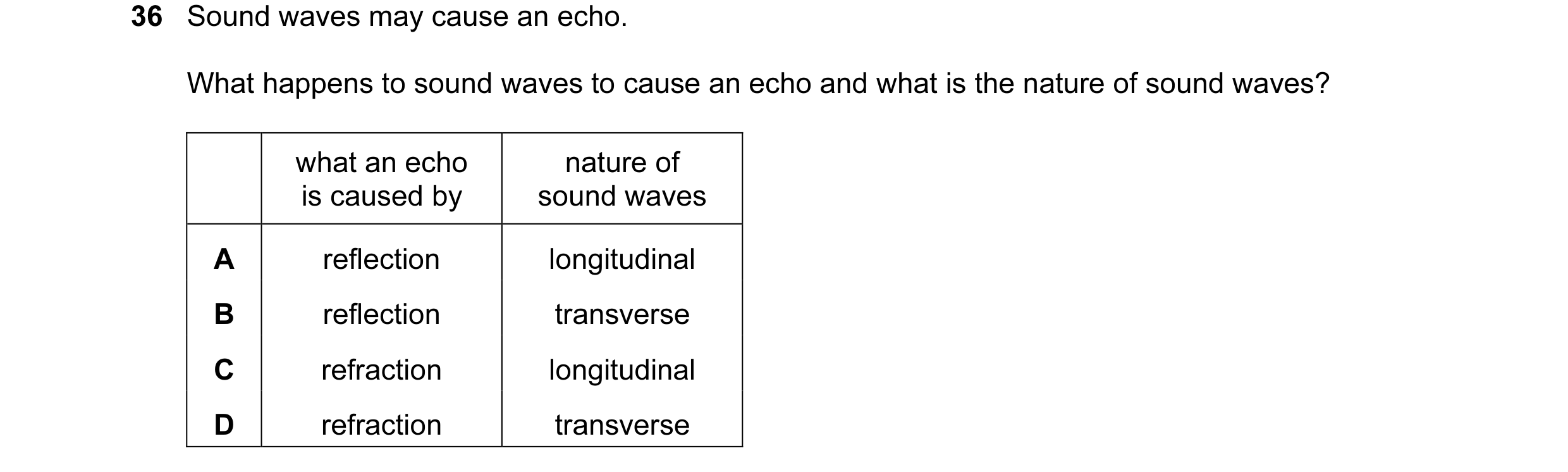
36 Sound waves may cause an echo. What happens to sound waves to cause an echo and what is the nature of sound waves? what an echo nature of is caused by sound waves A reflection longitudinal B reflection transverse C refraction longitudinal D refraction transverse
1 marks
Answer: A
This question in 0654/13 May/June 2015
Q26 · Student 1 and student 2 stand 170 m apart as shown in the diagram 0654/11 Oct/Nov 2015
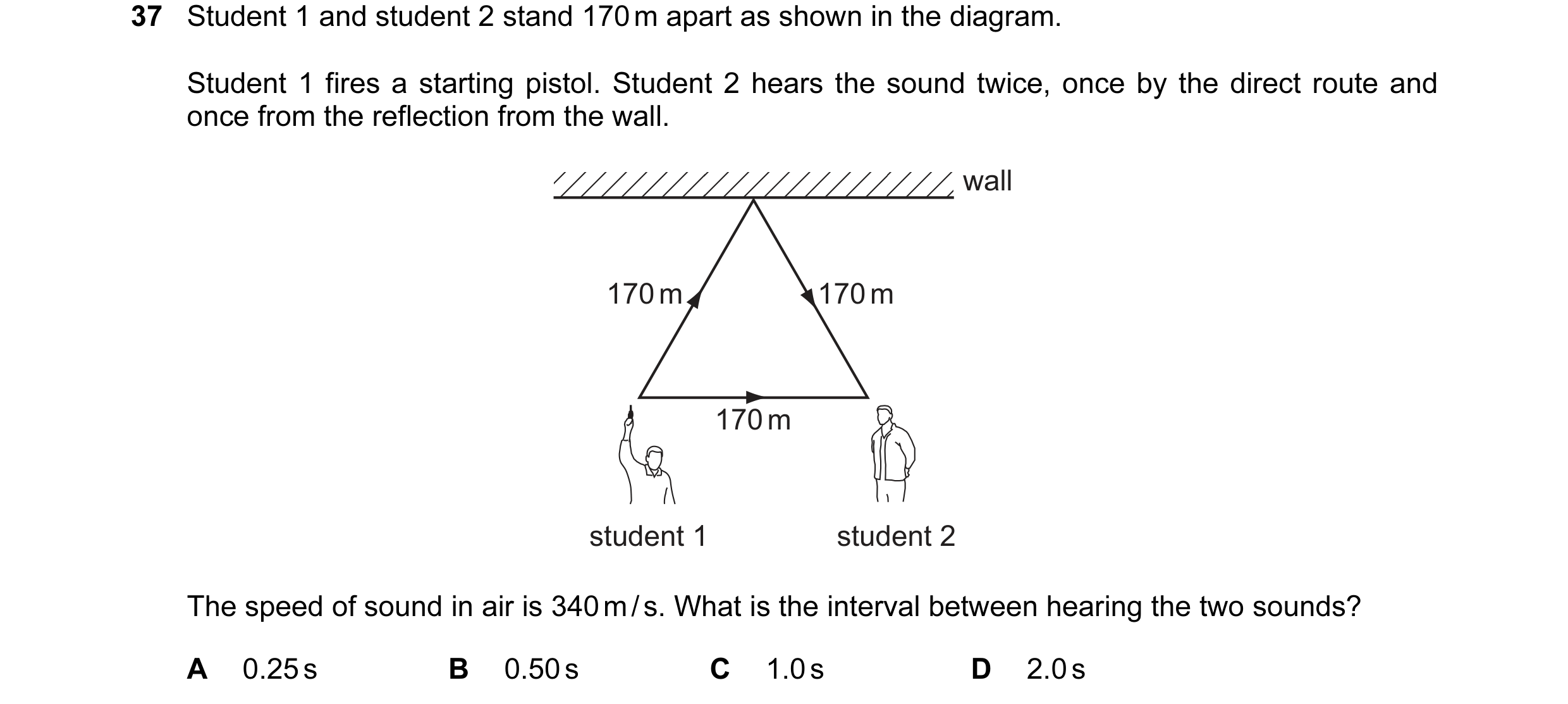
37 Student 1 and student 2 stand 170 m apart as shown in the diagram. Student 1 fires a starting pistol. Student 2 hears the sound twice, once by the direct route and once from the reflection from the wall. wall 170 m 170 m 170 m student 1 student 2 The speed of sound in air is 340 m / s. What is the interval between hearing the two sounds? A 0.25 s B 0.50 s C 1.0 s D 2.0 s
1 marks
Answer: B
This question in 0654/11 Oct/Nov 2015
Q27 · The horn on a ship is sounded 0654/12 Oct/Nov 2015
37 The horn on a ship is sounded. The captain hears an echo from a cliff 4.0 s later. The speed of sound is 340 m / s. How far away is the cliff? A 170 m B 340 m C 680 m D 1360 m
1 marks
Answer: C
This question in 0654/12 Oct/Nov 2015
Q28 · In a test, a car horn is found to be too loud and the pitch of the note is too high 0654/13 Oct/Nov 2015
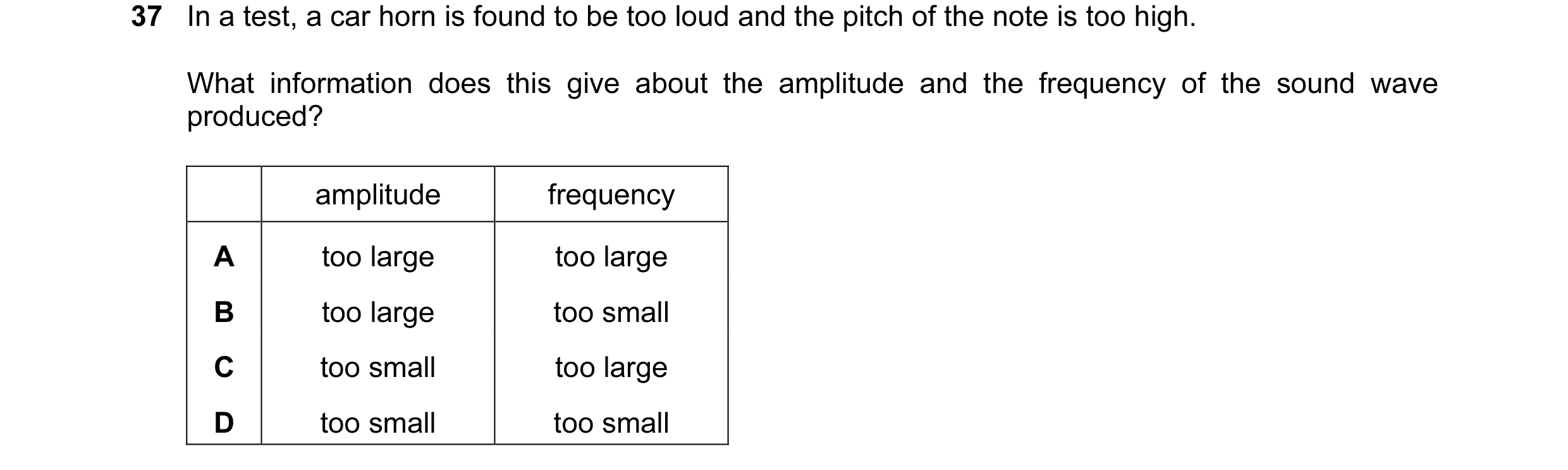
37 In a test, a car horn is found to be too loud and the pitch of the note is too high. What information does this give about the amplitude and the frequency of the sound wave produced? amplitude frequency A too large too large B too large too small C too small too large D too small too small
1 marks
Answer: A
This question in 0654/13 Oct/Nov 2015
Q29 · The diagrams represent two different sound waves, P and Q, drawn to the same scale 0654/11 May/June 2016
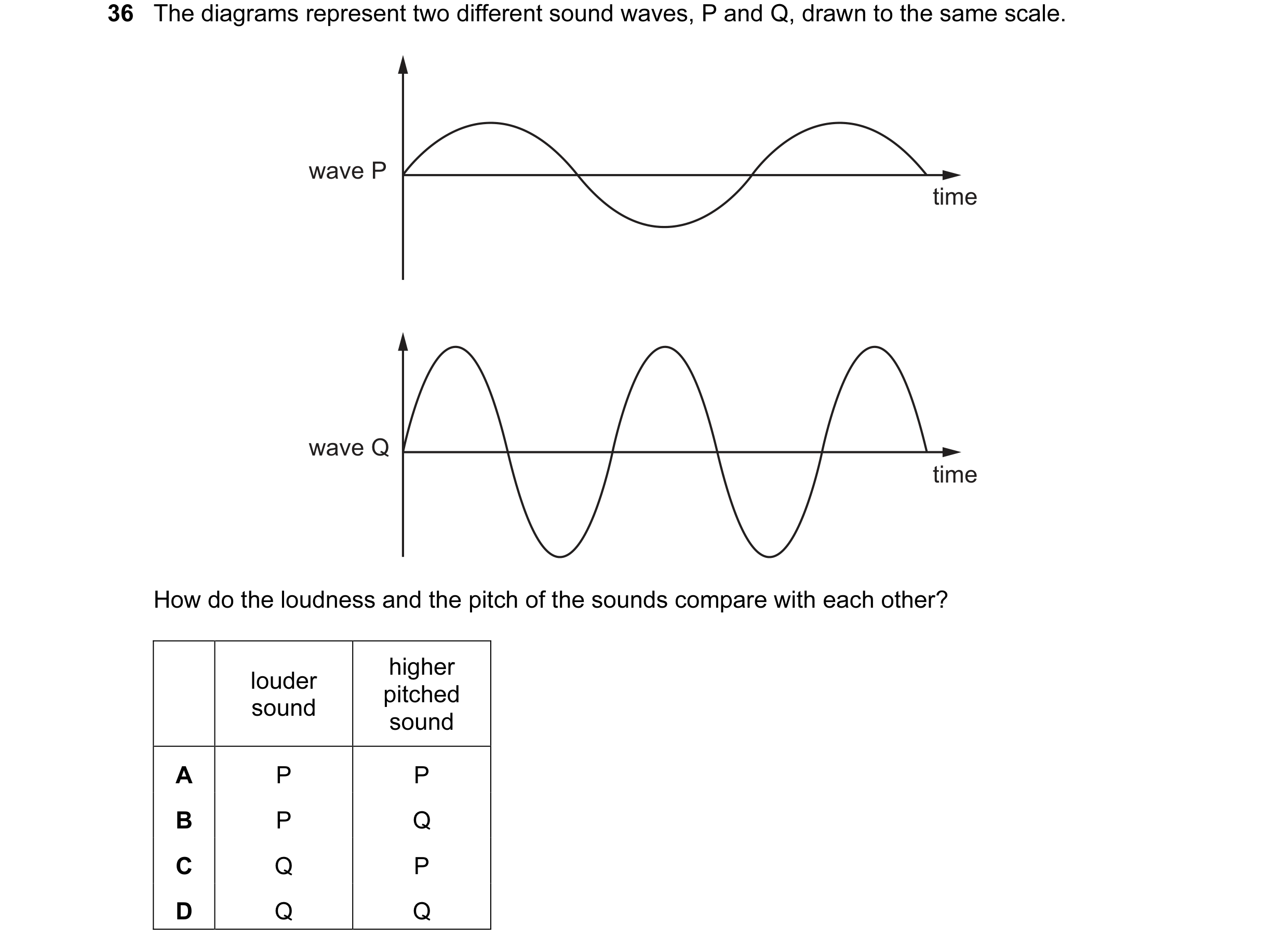
36 The diagrams represent two different sound waves, P and Q, drawn to the same scale. wave P time wave Q time How do the loudness and the pitch of the sounds compare with each other? higher louder pitched sound sound A P P B P Q C Q P D Q Q
1 marks
Answer: D
This question in 0654/11 May/June 2016
Q30 · Sound from a loudspeaker at P travels directly to Q 0654/11 Oct/Nov 2016
36 Sound from a loudspeaker at P travels directly to Q. Sound also reaches Q after being reflected from a wall at R. loudspeaker wall P 8 m 10 m R 8 m Q The speed of sound is 330 m / s. What is the difference in time for sound to travel from P to Q by the two routes? 6 16 A s B s C (6 × 330) s D (16 × 330) s 330 330
1 marks
Answer: A
This question in 0654/11 Oct/Nov 2016
Q31 · A sports field is next to a large school building 0654/12 Oct/Nov 2016
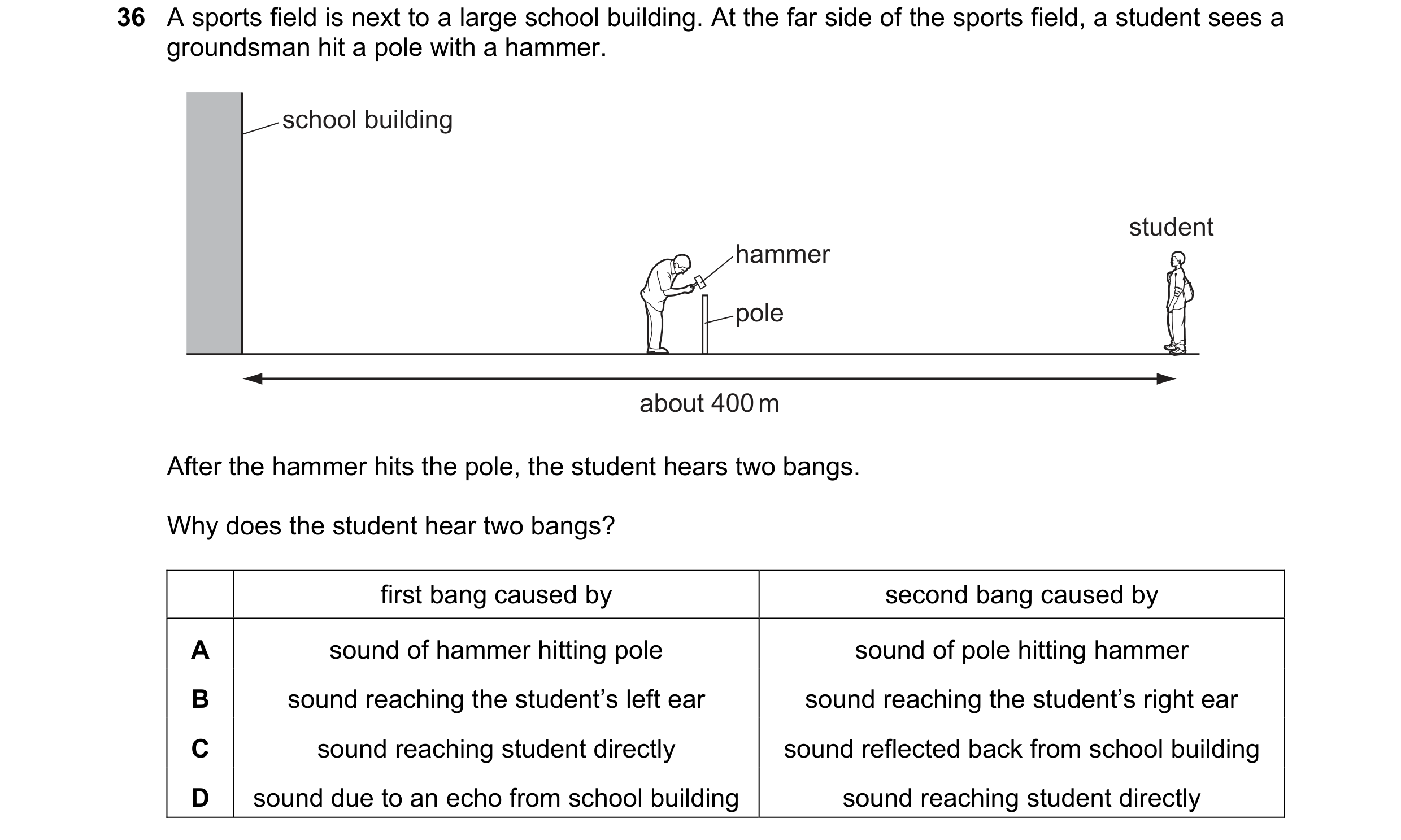
36 A sports field is next to a large school building. At the far side of the sports field, a student sees a groundsman hit a pole with a hammer. school building student hammer pole about 400 m After the hammer hits the pole, the student hears two bangs. Why does the student hear two bangs? first bang caused by second bang caused by A sound of hammer hitting pole sound of pole hitting hammer B sound reaching the student’s left ear sound reaching the student’s right ear C sound reaching student directly sound reflected back from school building D sound due to an echo from school building sound reaching student directly
1 marks
Answer: C
This question in 0654/12 Oct/Nov 2016
Q32 · What is the range of frequencies a typical person can hear? 0654/13 Oct/Nov 2016
36 What is the range of frequencies a typical person can hear? A 20 Hz – 2000 Hz B 20 Hz – 20 000 Hz C 200 Hz – 2000 Hz D 200 Hz – 20 000 Hz
1 marks
Answer: B
This question in 0654/13 Oct/Nov 2016
Q33 · Which waves are longitudinal? 0654/11 May/June 2017
33 Which waves are longitudinal? A B C D 88:88 microwaves sound waves water waves light waves in an oven from a trumpet on a pond from a lamp
1 marks
Answer: B
This question in 0654/11 May/June 2017
Q34 · Astronaut 1 uses a hammer to mend a satellite in space 0654/11 May/June 2017
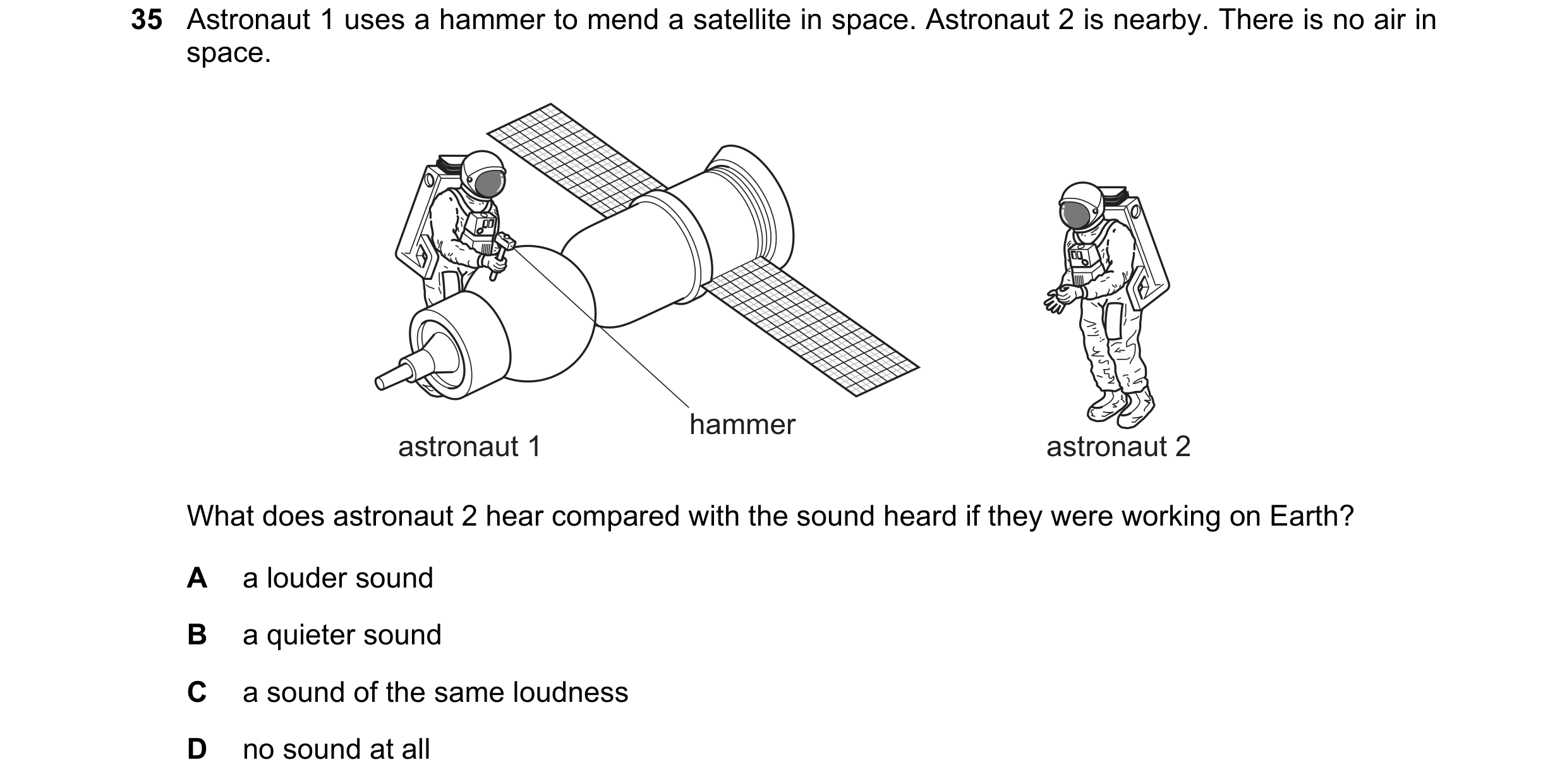
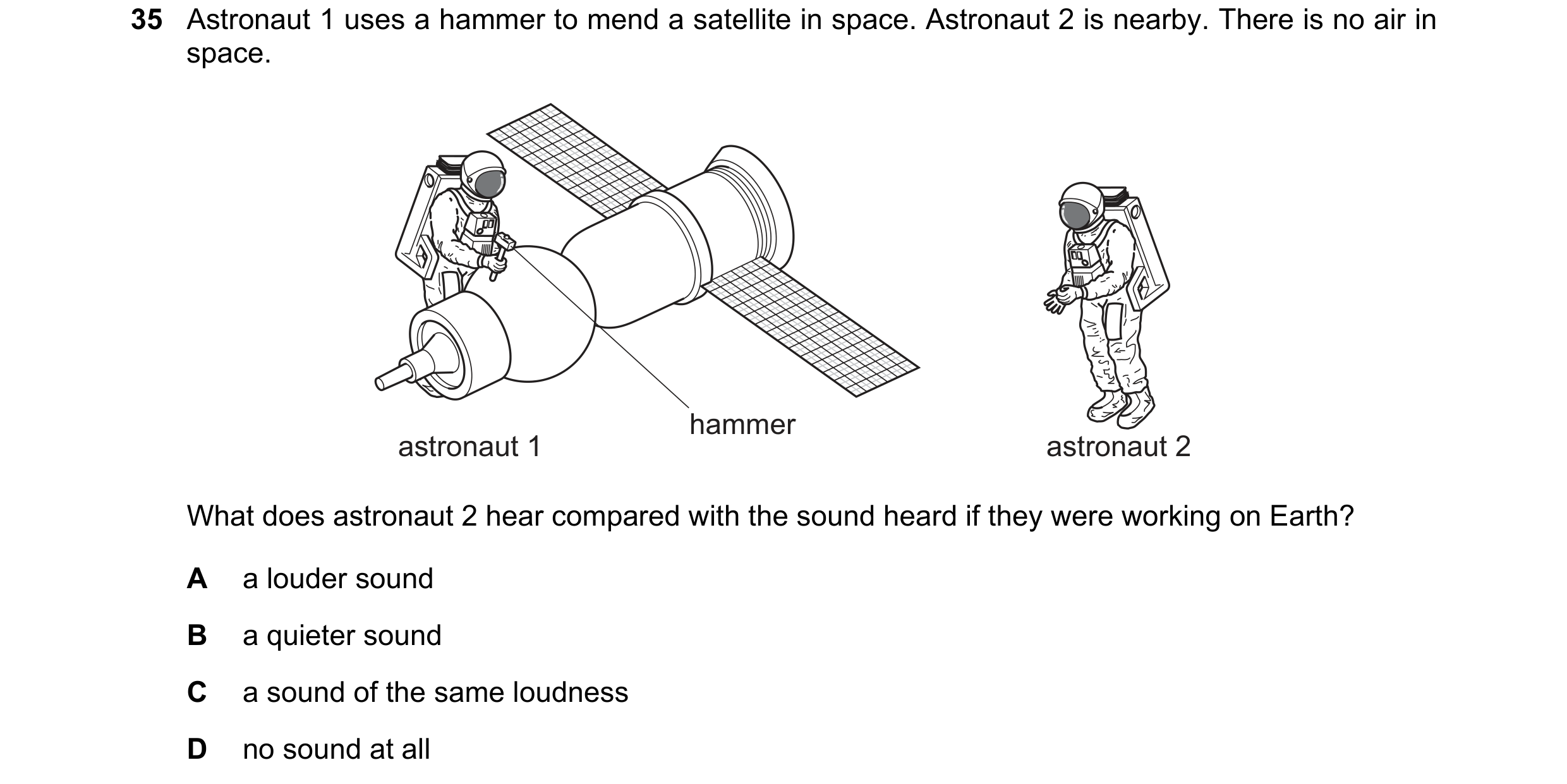
35 Astronaut 1 uses a hammer to mend a satellite in space. Astronaut 2 is nearby. There is no air in space. hammer astronaut 1 astronaut 2 What does astronaut 2 hear compared with the sound heard if they were working on Earth? A a louder sound B a quieter sound C a sound of the same loudness D no sound at all
1 marks
Answer: D
This question in 0654/11 May/June 2017
Q35 · Astronaut 1 uses a hammer to mend a satellite in space 0654/12 May/June 2017
35 Astronaut 1 uses a hammer to mend a satellite in space. Astronaut 2 is nearby. There is no air in space. hammer astronaut 1 astronaut 2 What does astronaut 2 hear compared with the sound heard if they were working on Earth? A a louder sound B a quieter sound C a sound of the same loudness D no sound at all
1 marks
Answer: D
This question in 0654/12 May/June 2017
Q36 · Astronaut 1 uses a hammer to mend a satellite in space 0654/13 May/June 2017
35 Astronaut 1 uses a hammer to mend a satellite in space. Astronaut 2 is nearby. There is no air in space. hammer astronaut 1 astronaut 2 What does astronaut 2 hear compared with the sound heard if they were working on Earth? A a louder sound B a quieter sound C a sound of the same loudness D no sound at all
1 marks
Answer: D
This question in 0654/13 May/June 2017
Q37 · Four loudspeakers each vibrate at the frequencies shown 0654/11 Oct/Nov 2017
37 Four loudspeakers each vibrate at the frequencies shown. Which loudspeaker produces the highest-pitched sound that can be heard by a human? A 5.0 × 10³ Hz B 15 × 103 Hz C 25 × 103 Hz D 35 × 103 Hz
1 marks
Answer: B
This question in 0654/11 Oct/Nov 2017
Q38 · A student claps his hands once when standing 100 m away from a large wall 0654/12 Oct/Nov 2017
36 A student claps his hands once when standing 100 m away from a large wall. The speed of sound in air is 330 m / s. How long after clapping does the student hear an echo? A 0.30 s B 0.61 s C 1.7 s D 3.3 s
1 marks
Answer: B
This question in 0654/12 Oct/Nov 2017
Q39 · A loudspeaker on a boat produces a pulse of sound in the sea 0654/13 Oct/Nov 2017
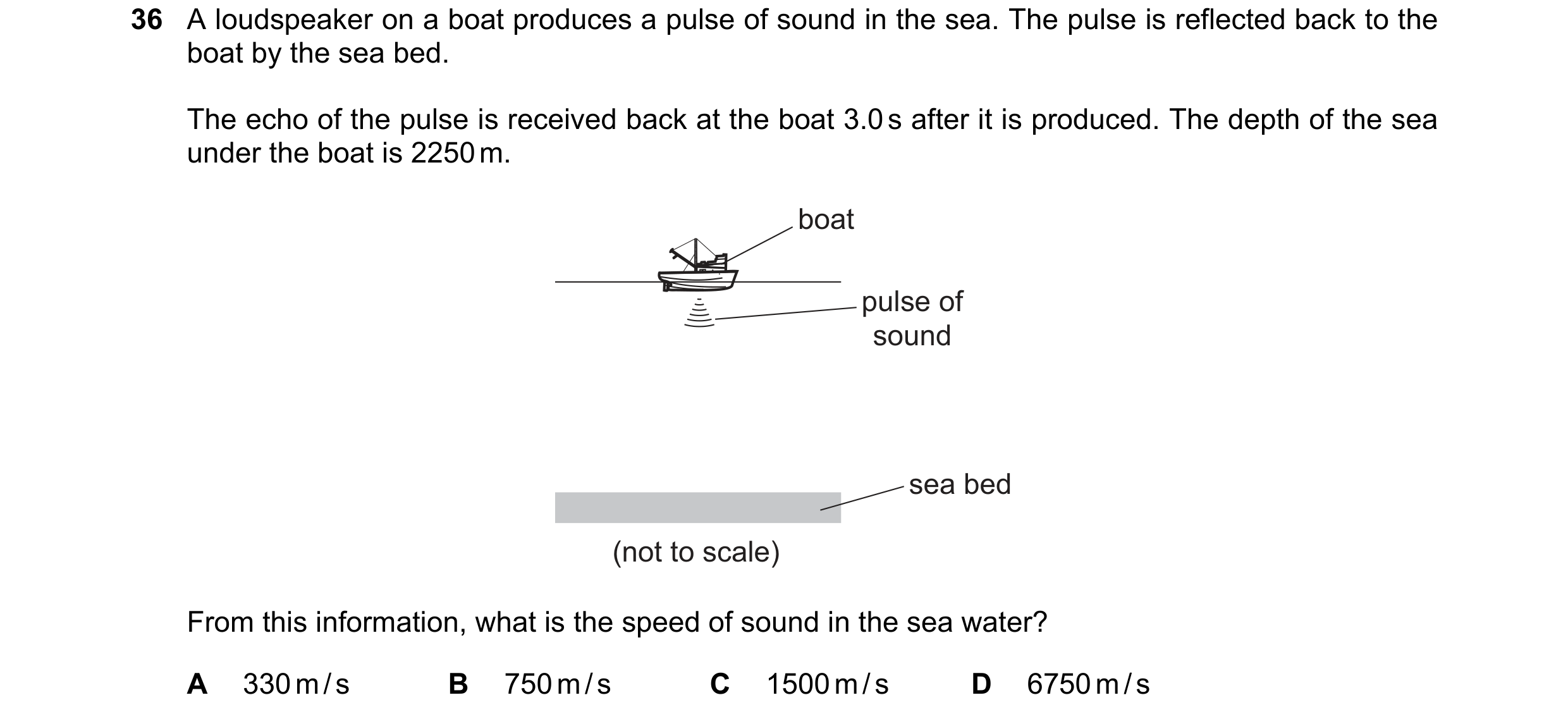
36 A loudspeaker on a boat produces a pulse of sound in the sea. The pulse is reflected back to the boat by the sea bed. The echo of the pulse is received back at the boat 3.0 s after it is produced. The depth of the sea under the boat is 2250 m. boat pulse of sound sea bed (not to scale) From this information, what is the speed of sound in the sea water? A 330 m / s B 750 m / s C 1500 m / s D 6750 m / s
1 marks
Answer: C
This question in 0654/13 Oct/Nov 2017
Q40 · A person stands 160 m away from a tall building and claps his hands 0654/11 Oct/Nov 2018
36 A person stands 160 m away from a tall building and claps his hands. He hears the echo 1.0 s later. What is the speed of sound in air? A 80 m / s B 160 m / s C 320 m / s D 640 m / s
1 marks
Answer: C
This question in 0654/11 Oct/Nov 2018
Q41 · The diagram is a displacement-time graph for the molecules in air as a sound wave passes 0654/12 Oct/Nov 2018
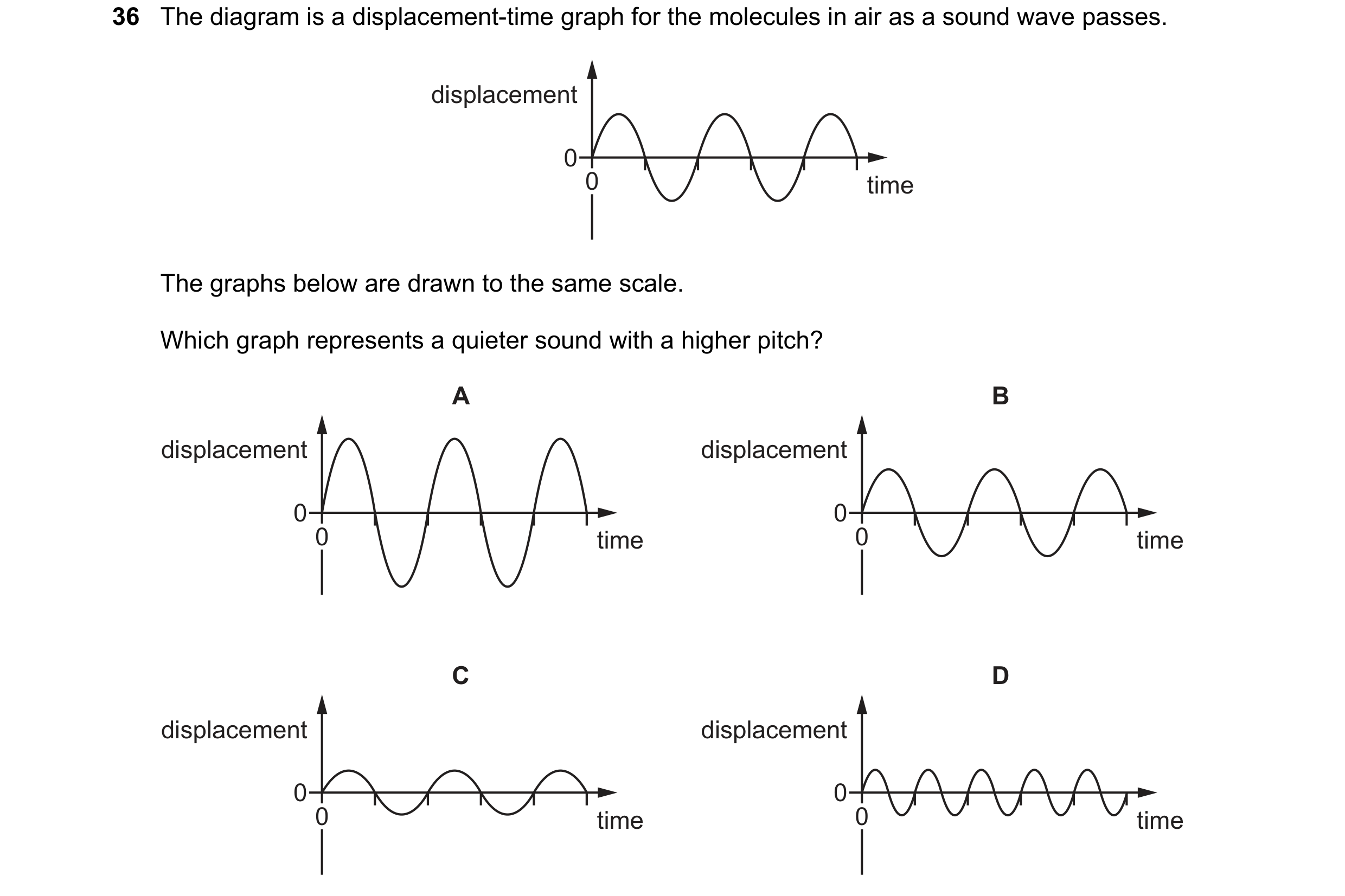
36 The diagram is a displacement-time graph for the molecules in air as a sound wave passes. displacement 0 0 time The graphs below are drawn to the same scale. Which graph represents a quieter sound with a higher pitch? A B displacement displacement 0 0 0 time 0 time C D displacement displacement 0 0 0 time 0 time
1 marks
Answer: D
This question in 0654/12 Oct/Nov 2018
Q42 · What is the approximate range of frequencies of sound that can be heard by humans? 0654/13 Oct/Nov 2018
35 What is the approximate range of frequencies of sound that can be heard by humans? A 2.0 Hz to 200 Hz B 2.0 Hz to 20 000 Hz C 20 Hz to 20 000 Hz D 2000 Hz to 20 000 Hz
1 marks
Answer: C
This question in 0654/13 Oct/Nov 2018
Q43 · A sports field is next to a large school building 0654/11 May/June 2019
34 A sports field is next to a large school building. A student at the far side of the sports field sees a groundsman hit a pole with a hammer. school building student hammer pole about 400 m After the hammer hits the pole, the student hears two bangs. Why does the student hear two bangs? first bang caused by second bang caused by A sound of hammer hitting pole sound of pole hitting hammer B sound reaching the student’s left ear sound reaching the student’s right ear C sound reaching student directly sound reflected back from school building D sound reflected back from school building sound reaching student directly
1 marks
Answer: C
This question in 0654/11 May/June 2019
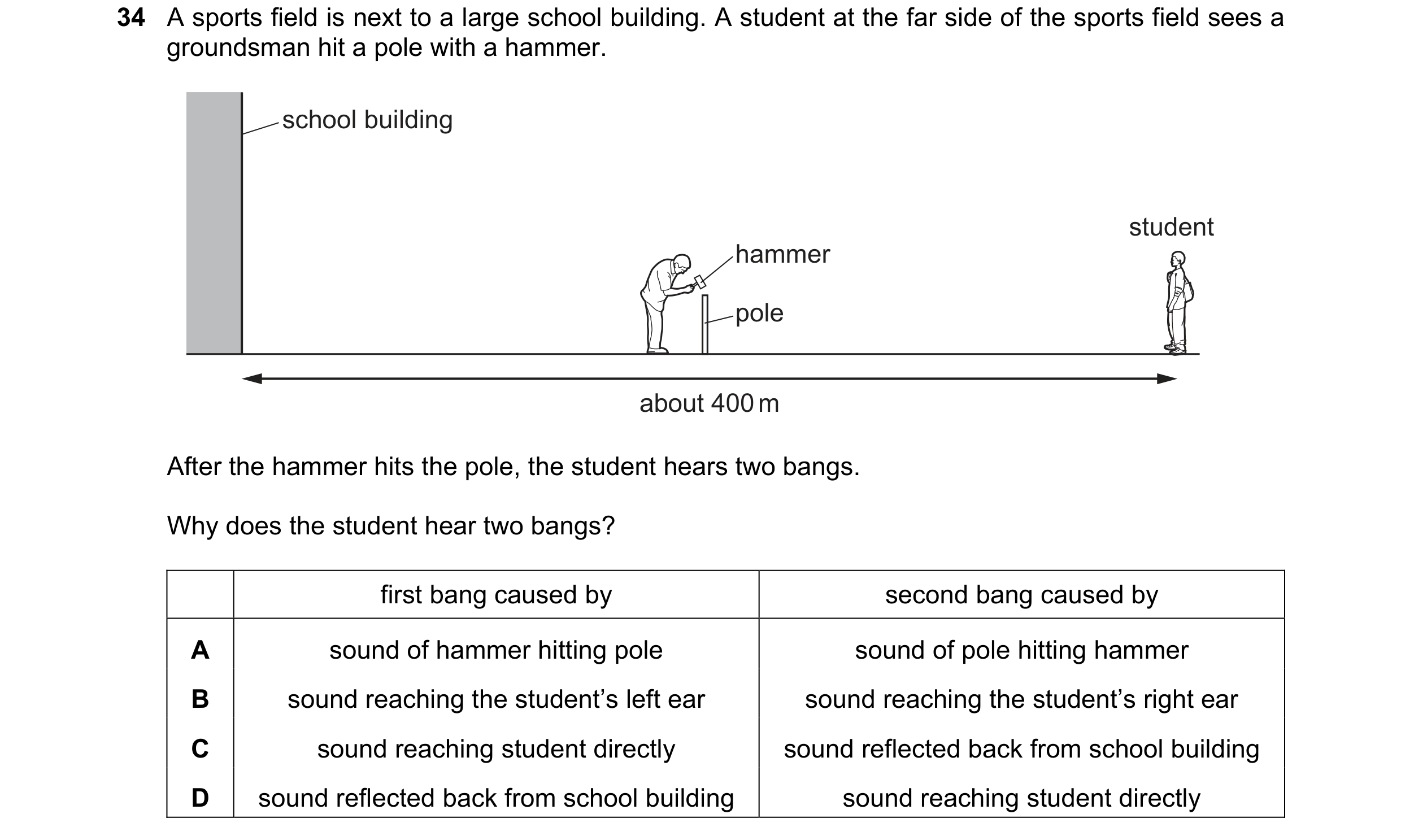
Q44 · A sports field is next to a large school building 0654/12 May/June 2019
34 A sports field is next to a large school building. A student at the far side of the sports field sees a groundsman hit a pole with a hammer. school building student hammer pole about 400 m After the hammer hits the pole, the student hears two bangs. Why does the student hear two bangs? first bang caused by second bang caused by A sound of hammer hitting pole sound of pole hitting hammer B sound reaching the student’s left ear sound reaching the student’s right ear C sound reaching student directly sound reflected back from school building D sound reflected back from school building sound reaching student directly
1 marks
Answer: C
This question in 0654/12 May/June 2019
Q45 · A sports field is next to a large school building 0654/13 May/June 2019
34 A sports field is next to a large school building. A student at the far side of the sports field sees a groundsman hit a pole with a hammer. school building student hammer pole about 400 m After the hammer hits the pole, the student hears two bangs. Why does the student hear two bangs? first bang caused by second bang caused by A sound of hammer hitting pole sound of pole hitting hammer B sound reaching the student’s left ear sound reaching the student’s right ear C sound reaching student directly sound reflected back from school building D sound reflected back from school building sound reaching student directly
1 marks
Answer: C
This question in 0654/13 May/June 2019
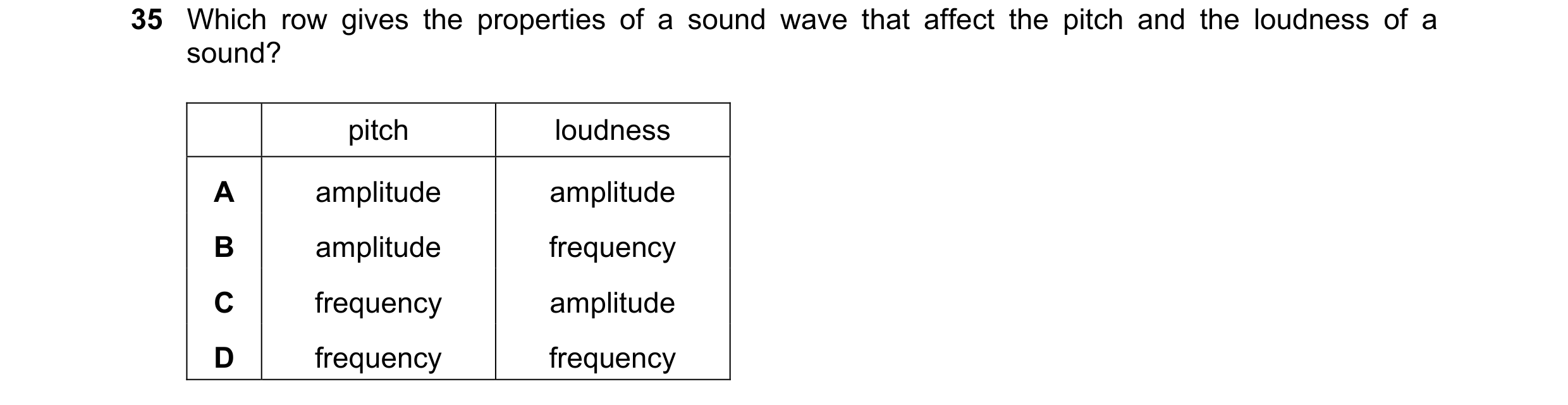
Q46 · Which row gives the properties of a sound wave that affect the pitch and the loudness of… 0654/12 Oct/Nov 2019
35 Which row gives the properties of a sound wave that affect the pitch and the loudness of a sound? pitch loudness A amplitude amplitude B amplitude frequency C frequency amplitude D frequency frequency
1 marks
Answer: C
This question in 0654/12 Oct/Nov 2019
Q47 · A person stands 80 m from a high wall and claps his hands 0654/11 May/June 2020
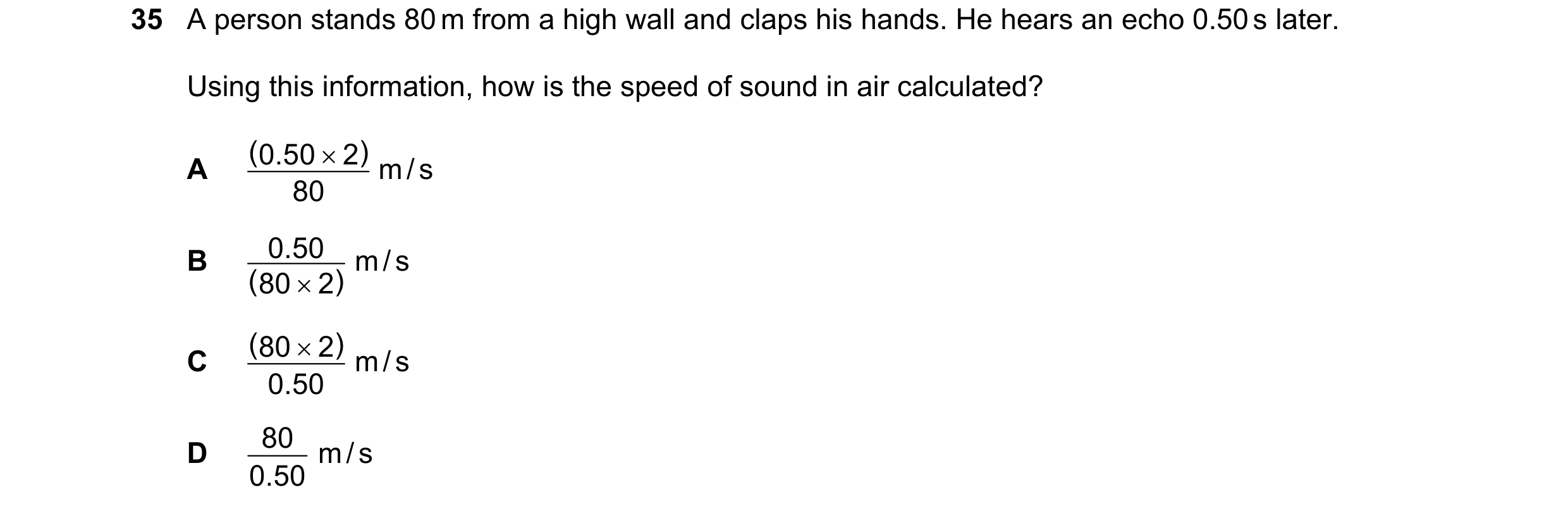
35 A person stands 80 m from a high wall and claps his hands. He hears an echo 0.50 s later. Using this information, how is the speed of sound in air calculated? ( 0.50 × 2 ) A m / s 80 B 0.50 m / s ( 80 × 2 ) ( 80 × 2 ) C m / s 0.50 80 D m / s 0.50
1 marks
Answer: C
This question in 0654/11 May/June 2020
Q48 · The sound heard from the siren of a police car becomes louder and higher pitched as the… 0654/12 May/June 2020
34 The sound heard from the siren of a police car becomes louder and higher pitched as the car approaches an observer. What happens to the amplitude and what happens to the frequency of the sound wave heard by the observer? amplitude frequency A decreases decreases B decreases increases C increases decreases D increases increases
1 marks
Answer: D
This question in 0654/12 May/June 2020
Q49 · The amplitude of a sound wave increases and the frequency decreases 0654/13 May/June 2020
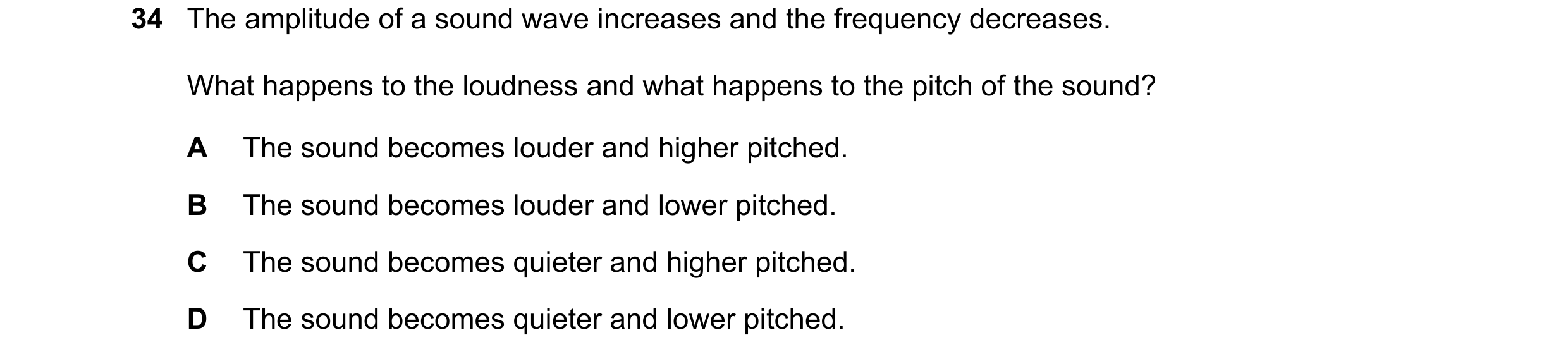
34 The amplitude of a sound wave increases and the frequency decreases. What happens to the loudness and what happens to the pitch of the sound? A The sound becomes louder and higher pitched. B The sound becomes louder and lower pitched. C The sound becomes quieter and higher pitched. D The sound becomes quieter and lower pitched.
1 marks
Answer: B
This question in 0654/13 May/June 2020
Q50 · A worker in a quarry stands 0.90 km away from an explosion 0654/11 Oct/Nov 2020
34 A worker in a quarry stands 0.90 km away from an explosion. She sees the explosion 3.0 s before she hears the sound of the explosion. Using this information, what value can be determined for the speed of sound? A 300 m / s B 600 m / s C 2700 m / s D 5400 m / s
1 marks
Answer: A
This question in 0654/11 Oct/Nov 2020
Q51 · A person stands 320 m away from a cliff and shouts 0654/12 Oct/Nov 2020
34 A person stands 320 m away from a cliff and shouts. He hears an echo from the cliff 2.0 s later. What is the speed of sound in the air? A 160 m / s B 300 m / s C 320 m / s D 640 m / s
1 marks
Answer: C
This question in 0654/12 Oct/Nov 2020
Q52 · Astronaut 1 uses a hammer to mend a satellite in space 0654/12 Feb/March 2021
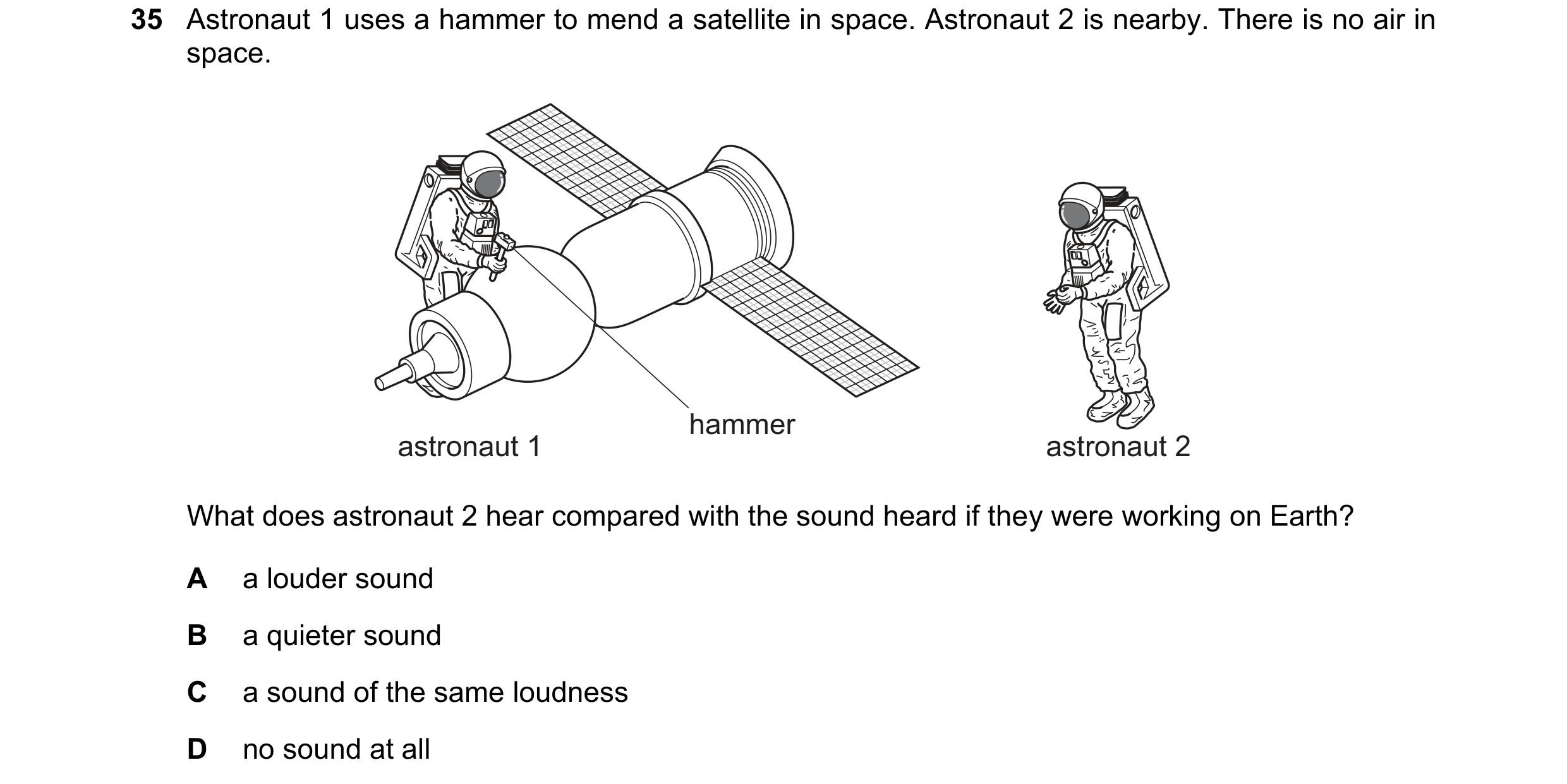
35 Astronaut 1 uses a hammer to mend a satellite in space. Astronaut 2 is nearby. There is no air in space. hammer astronaut 1 astronaut 2 What does astronaut 2 hear compared with the sound heard if they were working on Earth? A a louder sound B a quieter sound C a sound of the same loudness D no sound at all
1 marks
Answer: D
This question in 0654/12 Feb/March 2021
Q53 · Sound from a loudspeaker at P travels directly to Q 0654/11 May/June 2021
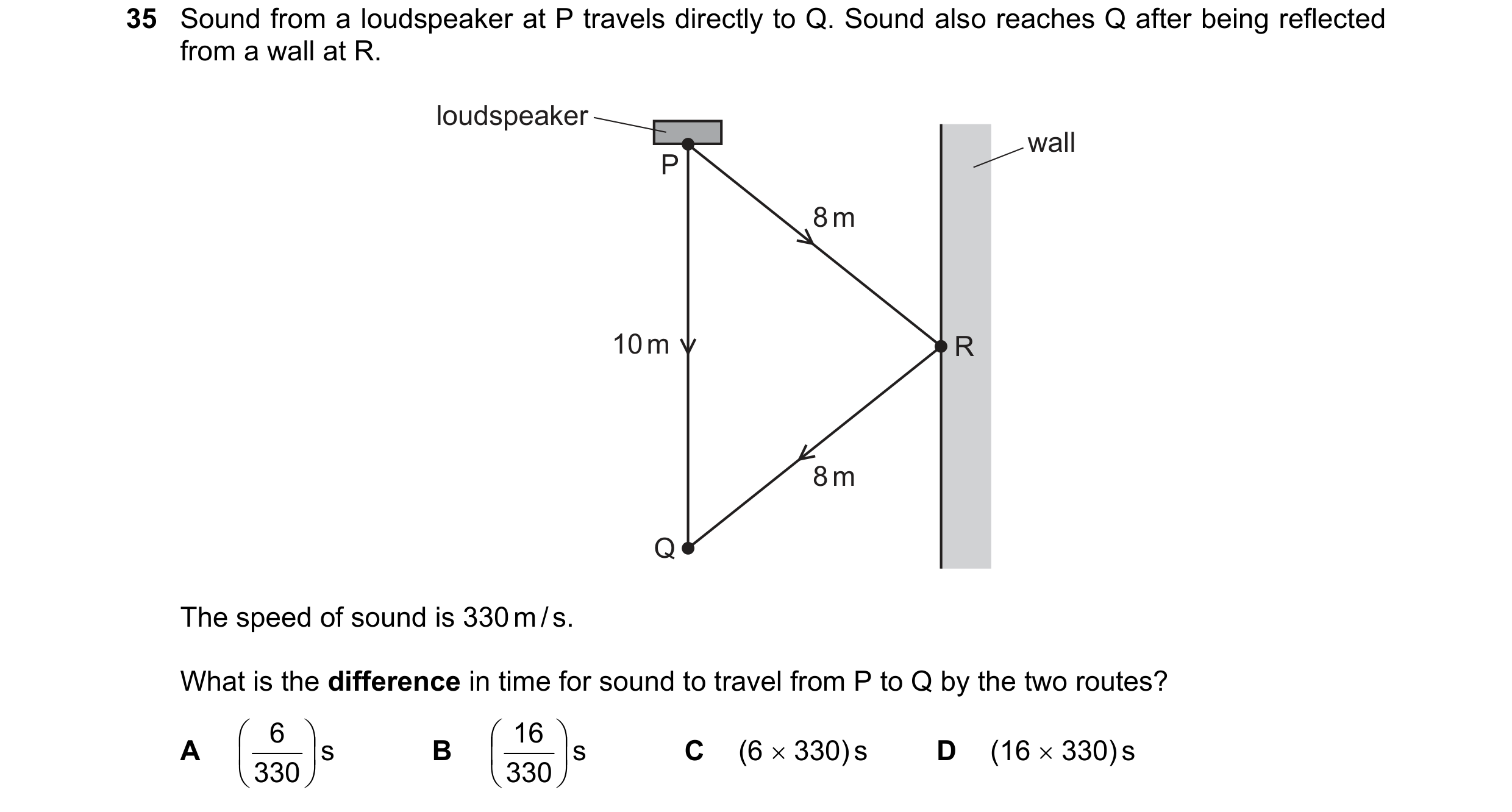
35 Sound from a loudspeaker at P travels directly to Q. Sound also reaches Q after being reflected from a wall at R. loudspeaker wall P 8 m 10 m R 8 m Q The speed of sound is 330 m / s. What is the difference in time for sound to travel from P to Q by the two routes? 6 16 A s B s C (6 330) s D (16 330) s 330 330
1 marks
Answer: A
This question in 0654/11 May/June 2021
Q54 · Sound from a loudspeaker at P travels directly to Q 0654/12 May/June 2021
35 Sound from a loudspeaker at P travels directly to Q. Sound also reaches Q after being reflected from a wall at R. loudspeaker wall P 8 m 10 m R 8 m Q The speed of sound is 330 m / s. What is the difference in time for sound to travel from P to Q by the two routes? 6 16 A s B s C (6 330) s D (16 330) s 330 330
1 marks
Answer: A
This question in 0654/12 May/June 2021
Q55 · Sound from a loudspeaker at P travels directly to Q 0654/13 May/June 2021
35 Sound from a loudspeaker at P travels directly to Q. Sound also reaches Q after being reflected from a wall at R. loudspeaker wall P 8 m 10 m R 8 m Q The speed of sound is 330 m / s. What is the difference in time for sound to travel from P to Q by the two routes? 6 16 A s B s C (6 330) s D (16 330) s 330 330
1 marks
Answer: A
This question in 0654/13 May/June 2021
Q56 · Which statement about sound is correct? 0654/11 May/June 2022
35 Which statement about sound is correct? A An echo is produced by refraction of sound waves. B The amplitude of a sound wave affects the pitch of a sound. C The approximate range of audible frequencies for a human is 20 Hz–20 kHz. D Sound waves travel more quickly in a vacuum than in air.
1 marks
Answer: C
This question in 0654/11 May/June 2022
Q57 · Two students conduct an experiment to determine the speed of sound in air 0654/11 Oct/Nov 2022
35 Two students conduct an experiment to determine the speed of sound in air. They stand 639 m apart. One student hits two blocks of wood together while the other uses a stop-watch to time how long it takes for the sound to reach him. It takes 1.80 s for the sound to reach the second student. What is the speed of sound in air, calculated using these results? A 330 m / s B 355 m / s C 710 m / s D 1150 m / s
1 marks
Answer: B
This question in 0654/11 Oct/Nov 2022
Q58 · The diagram is a displacement–time graph for the molecules in air as a sound wave passes 0654/12 Feb/March 2023
35 The diagram is a displacement–time graph for the molecules in air as a sound wave passes. displacement 0 0 time The graphs below are drawn to the same scale. Which graph represents a quieter sound with a higher pitch? A B displacement displacement 0 0 0 time 0 time C D displacement displacement 0 0 0 time 0 time
1 marks
Answer: D
This question in 0654/12 Feb/March 2023
Q59 · A man stands 420 m away from a high wall 0654/11 May/June 2023
34 A man stands 420 m away from a high wall. He bangs a drum once and starts a stop-watch at the same time. When he hears an echo from the wall, the stop-watch reads 2.4 s. What is the speed of sound, calculated from this information? A 87.5 m / s B 175 m / s C 330 m / s D 350 m / s
1 marks
Answer: D
This question in 0654/11 May/June 2023
Q60 · Which change to a sound wave makes the sound louder? 0654/11 Oct/Nov 2023
35 Which change to a sound wave makes the sound louder? A decreasing the amplitude B decreasing the wavelength C increasing the amplitude D increasing the wavelength
1 marks
Answer: C
This question in 0654/11 Oct/Nov 2023
Q61 · The amplitude of a sound wave increases, and the frequency of the wave decreases 0654/12 Oct/Nov 2023
34 The amplitude of a sound wave increases, and the frequency of the wave decreases. What is the effect on the loudness of the sound and on the pitch of the sound? loudness pitch A greater higher B greater lower C less higher D less lower
1 marks
Answer: B
This question in 0654/12 Oct/Nov 2023
Q62 · The sound heard from the siren of a police car becomes quieter and lower pitched as the… 0654/13 Oct/Nov 2023
34 The sound heard from the siren of a police car becomes quieter and lower pitched as the car moves away from an observer. Which row describes what happens to the amplitude and frequency of the sound wave heard by the observer? amplitude frequency A decreases decreases B decreases increases C increases decreases D increases increases
1 marks
Answer: A
This question in 0654/13 Oct/Nov 2023
Q63 · A student claps his hands once when standing 100 m away from a large wall 0654/12 Feb/March 2024
34 A student claps his hands once when standing 100 m away from a large wall. The speed of sound in air is 330 m / s. How long after clapping does the student hear an echo? A 0.30 s B 0.61 s C 1.7 s D 3.3 s
1 marks
Answer: B
This question in 0654/12 Feb/March 2024
Q64 · An electric bell is suspended by a rubber band in a glass jar 0654/11 May/June 2024
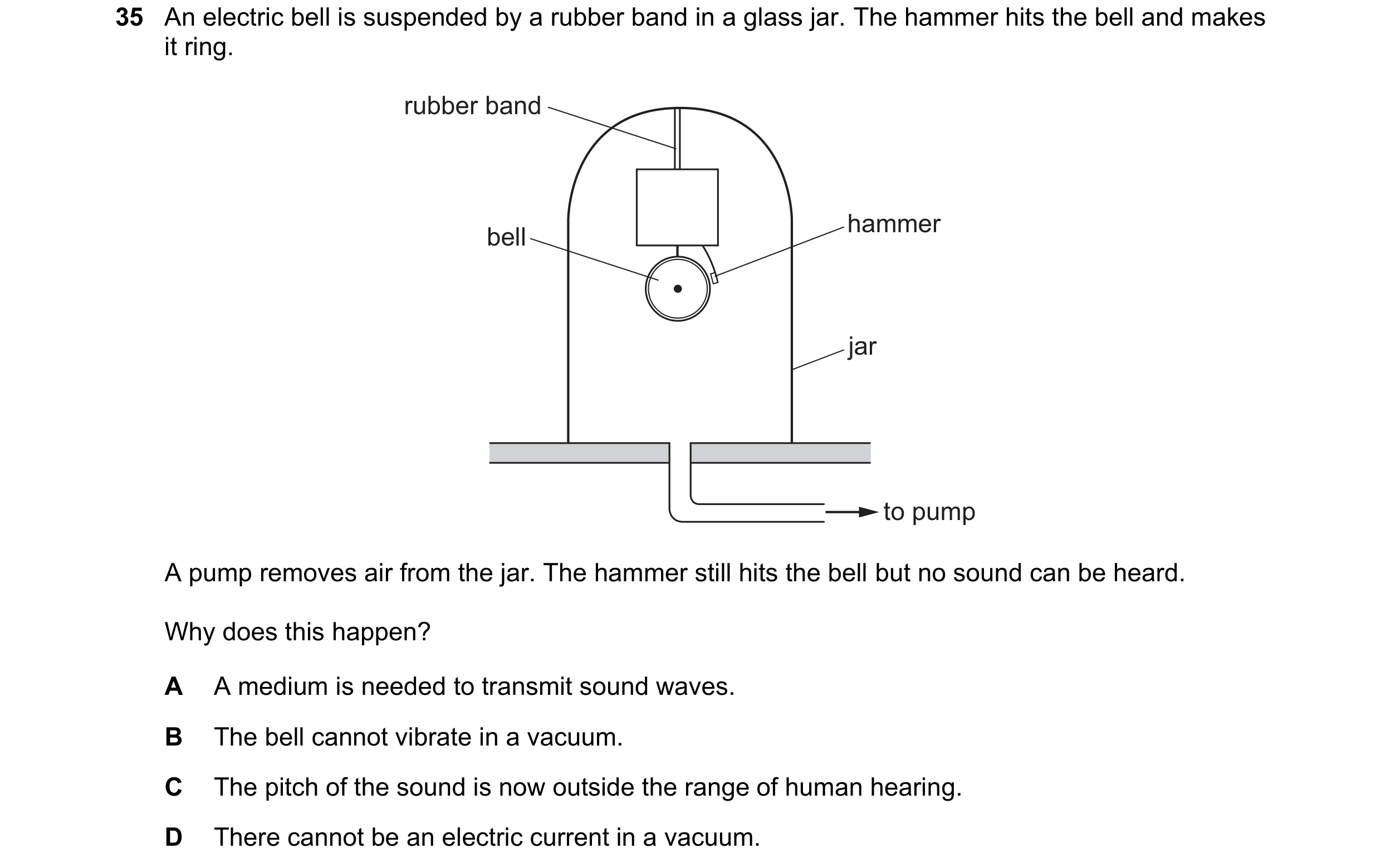
35 An electric bell is suspended by a rubber band in a glass jar. The hammer hits the bell and makes it ring. rubber band hammer bell jar to pump A pump removes air from the jar. The hammer still hits the bell but no sound can be heard. Why does this happen? A A medium is needed to transmit sound waves. B The bell cannot vibrate in a vacuum. C The pitch of the sound is now outside the range of human hearing. D There cannot be an electric current in a vacuum.
1 marks
Answer: A
This question in 0654/11 May/June 2024
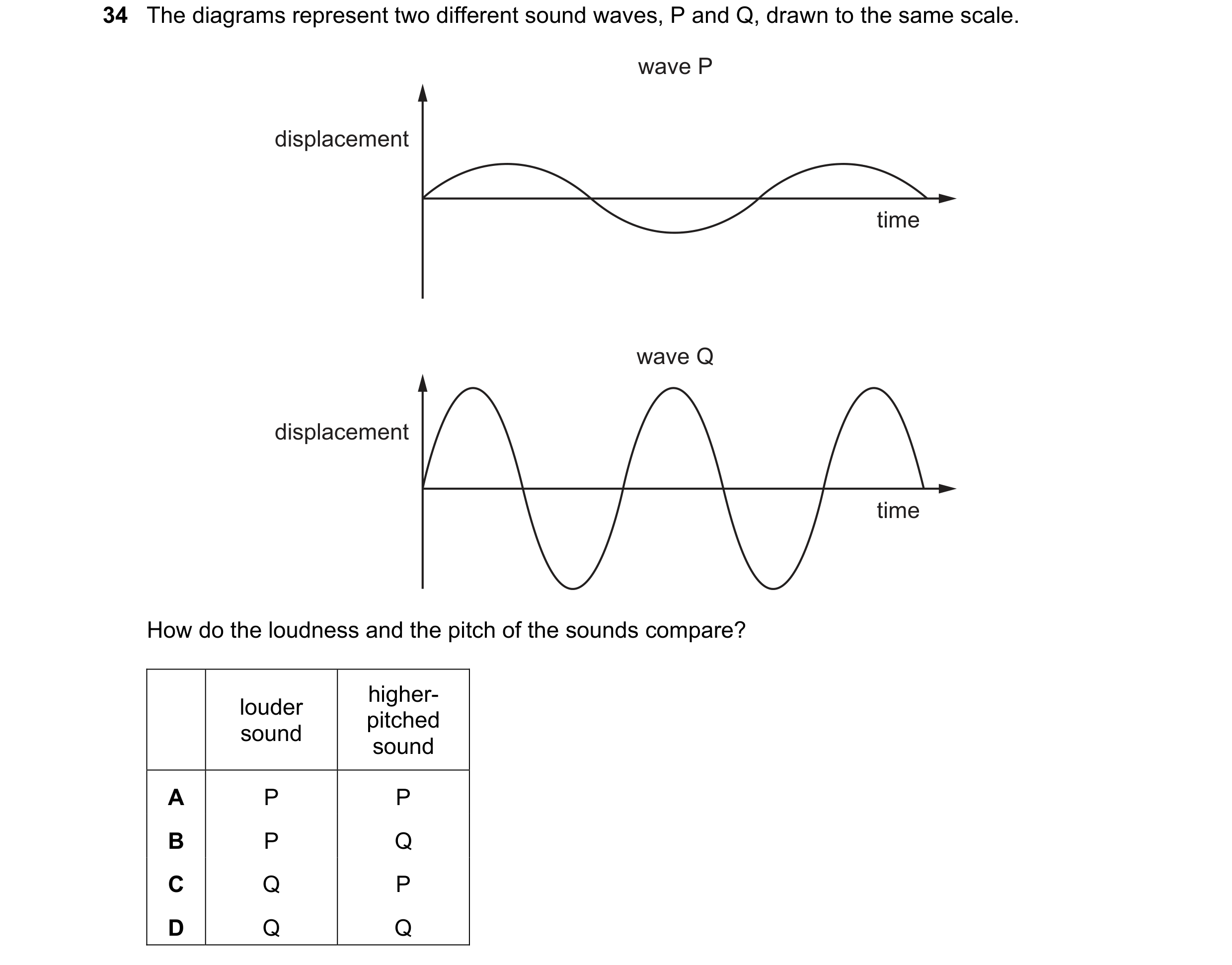
Q65 · The diagrams represent two different sound waves, P and Q, drawn to the same scale 0654/12 May/June 2024
34 The diagrams represent two different sound waves, P and Q, drawn to the same scale. wave P displacement time wave Q displacement time How do the loudness and the pitch of the sounds compare? higher- louder pitched sound sound A P P B P Q C Q P D Q Q
1 marks
Answer: D
This question in 0654/12 May/June 2024
Q66 · The diagrams represent two different sound waves, P and Q, drawn to the same scale 0654/13 May/June 2024
34 The diagrams represent two different sound waves, P and Q, drawn to the same scale. wave P displacement time wave Q displacement time How do the loudness and the pitch of the sounds compare? higher- louder pitched sound sound A P P B P Q C Q P D Q Q
1 marks
Answer: D
This question in 0654/13 May/June 2024
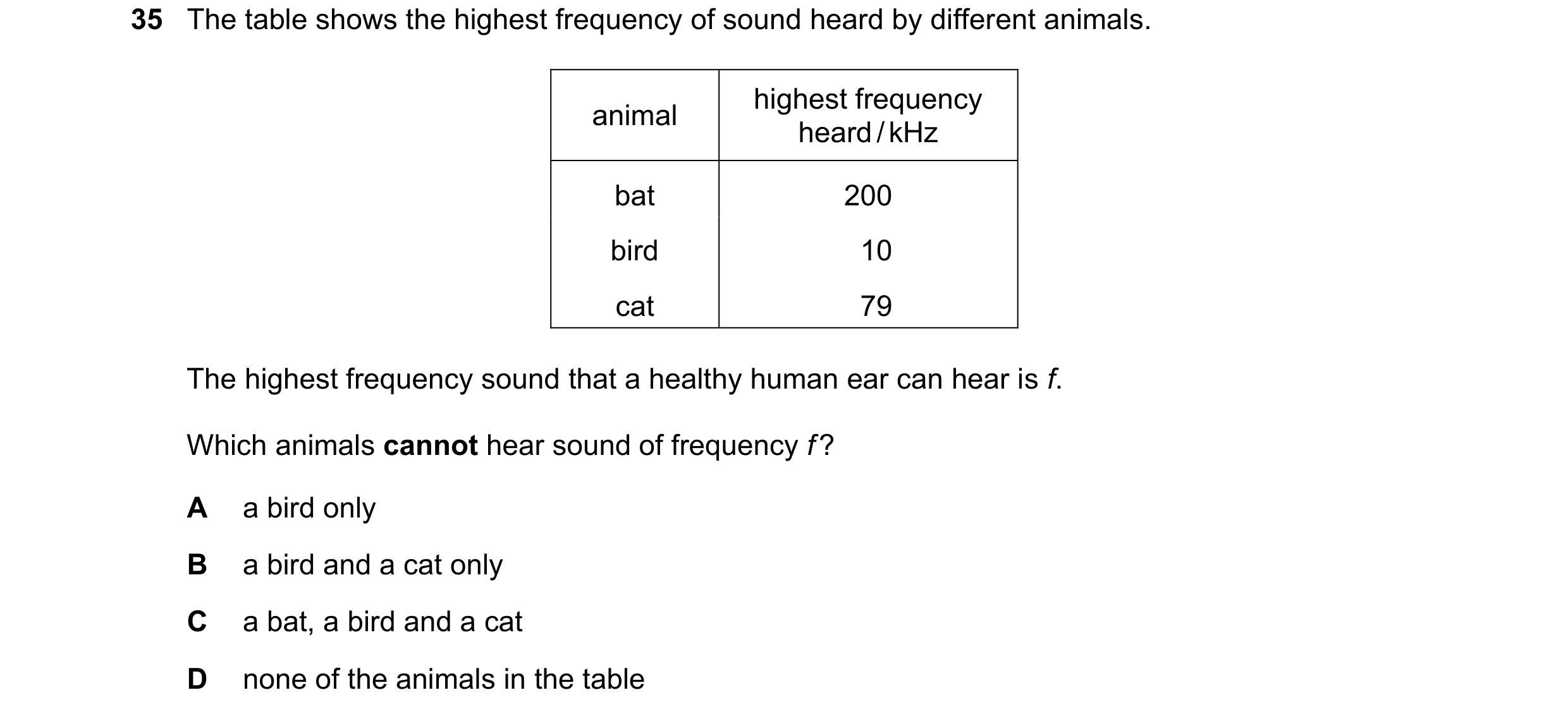
Q67 · The table shows the highest frequency of sound heard by different animals 0654/12 May/June 2025
35 The table shows the highest frequency of sound heard by different animals. highest frequency animal heard / kHz bat 200 bird 10 cat 79 The highest frequency sound that a healthy human ear can hear is f. Which animals cannot hear sound of frequency f ? A a bird only B a bird and a cat only C a bat, a bird and a cat D none of the animals in the table
1 marks
Answer: A
This question in 0654/12 May/June 2025
Q68 · The table shows the highest frequency of sound heard by different animals 0654/13 May/June 2025
35 The table shows the highest frequency of sound heard by different animals. highest frequency animal heard / kHz bat 200 bird 10 cat 79 The highest frequency sound that a healthy human ear can hear is f. Which animals cannot hear sound of frequency f ? A a bird only B a bird and a cat only C a bat, a bird and a cat D none of the animals in the table
1 marks
Answer: A
This question in 0654/13 May/June 2025
Q69 · The diagram shows a loudspeaker 0654/11 Oct/Nov 2025
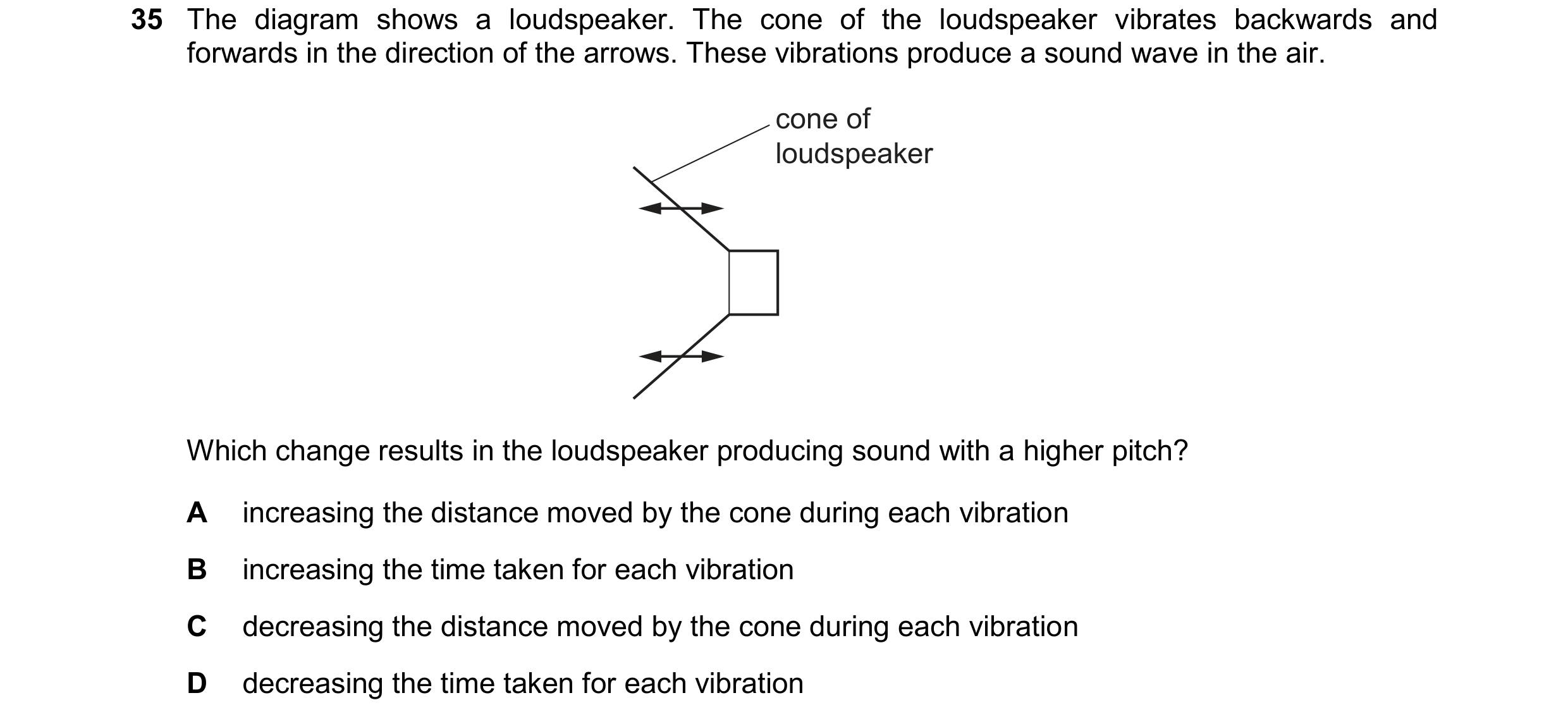
35 The diagram shows a loudspeaker. The cone of the loudspeaker vibrates backwards and forwards in the direction of the arrows. These vibrations produce a sound wave in the air. cone of loudspeaker Which change results in the loudspeaker producing sound with a higher pitch? A increasing the distance moved by the cone during each vibration B increasing the time taken for each vibration C decreasing the distance moved by the cone during each vibration D decreasing the time taken for each vibration
1 marks
Answer: D
This question in 0654/11 Oct/Nov 2025
 1 / 22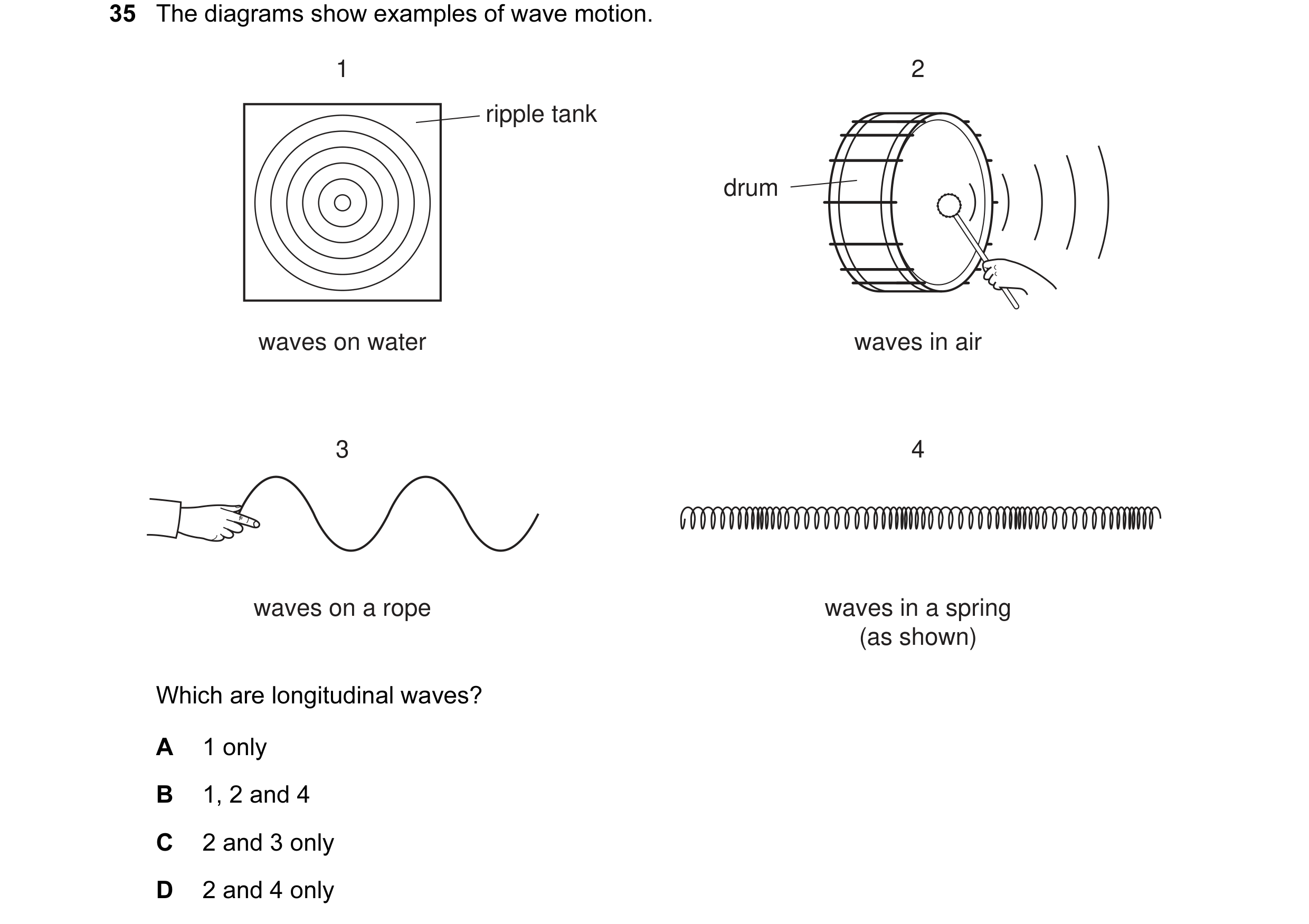
 2 / 22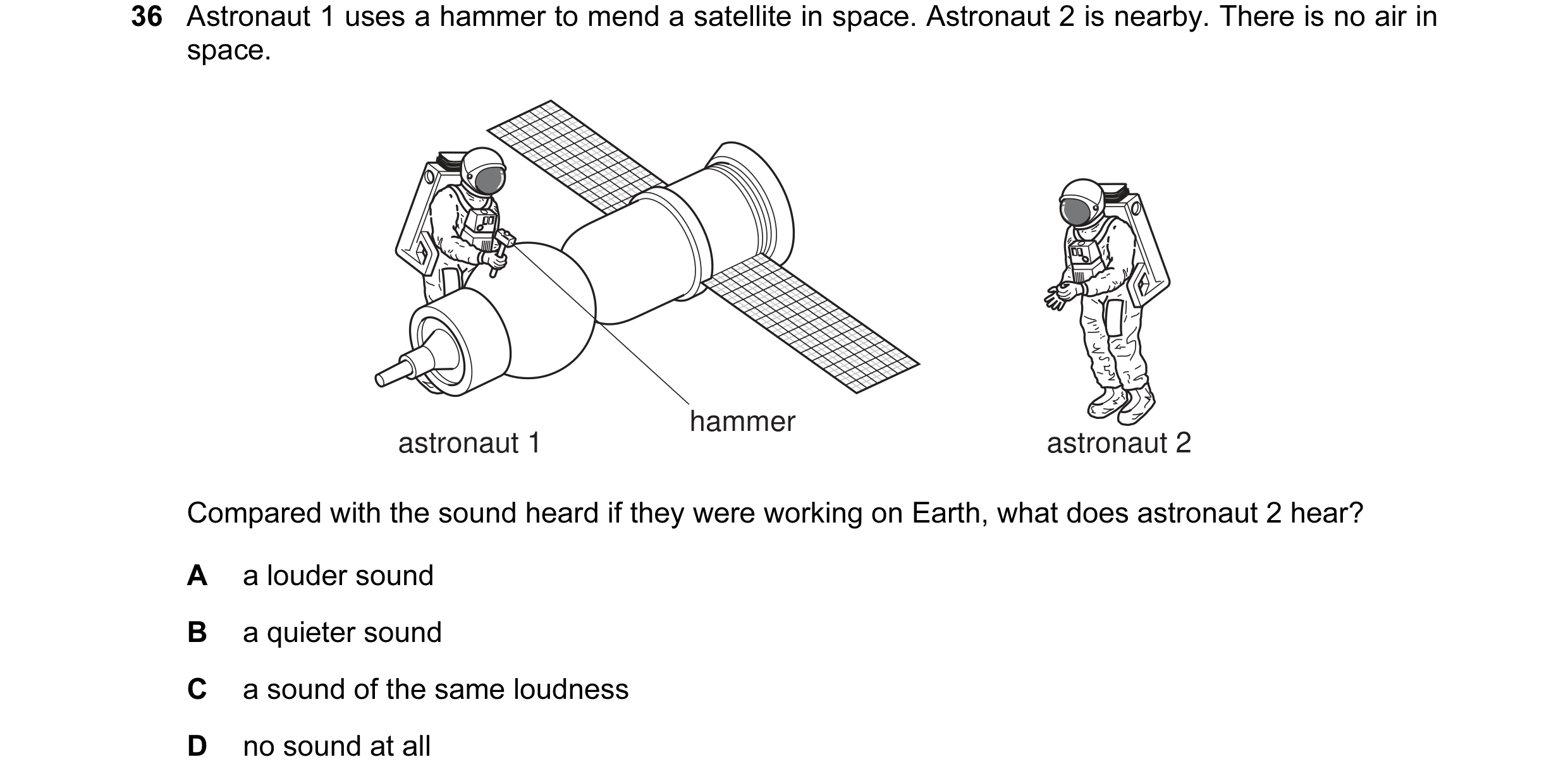
 3 / 22





 4 / 22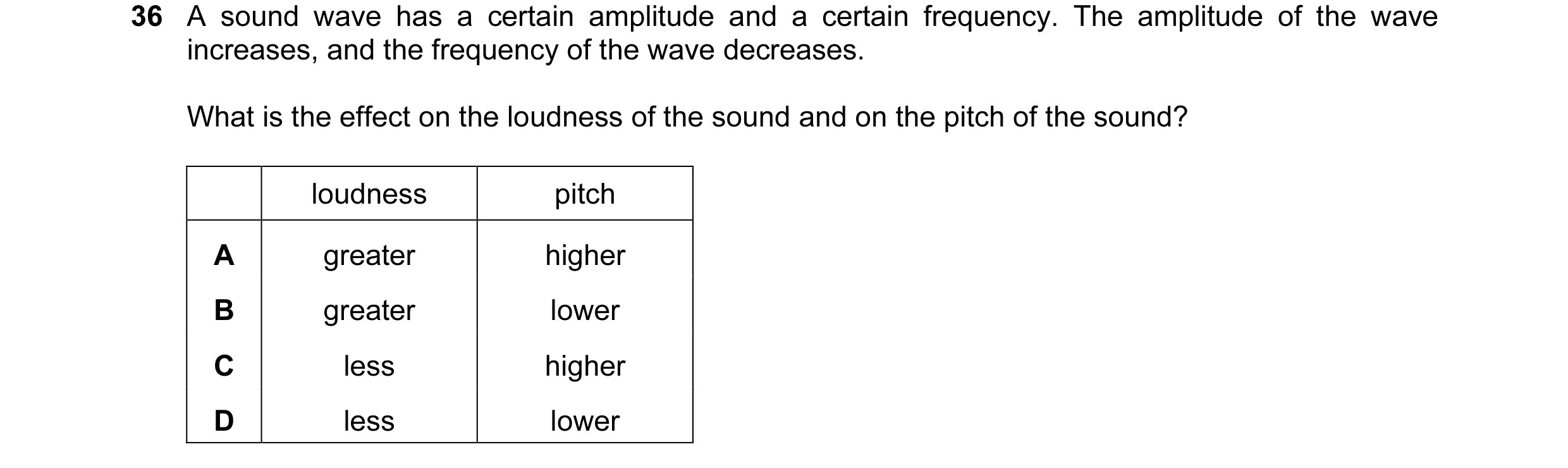


 5 / 22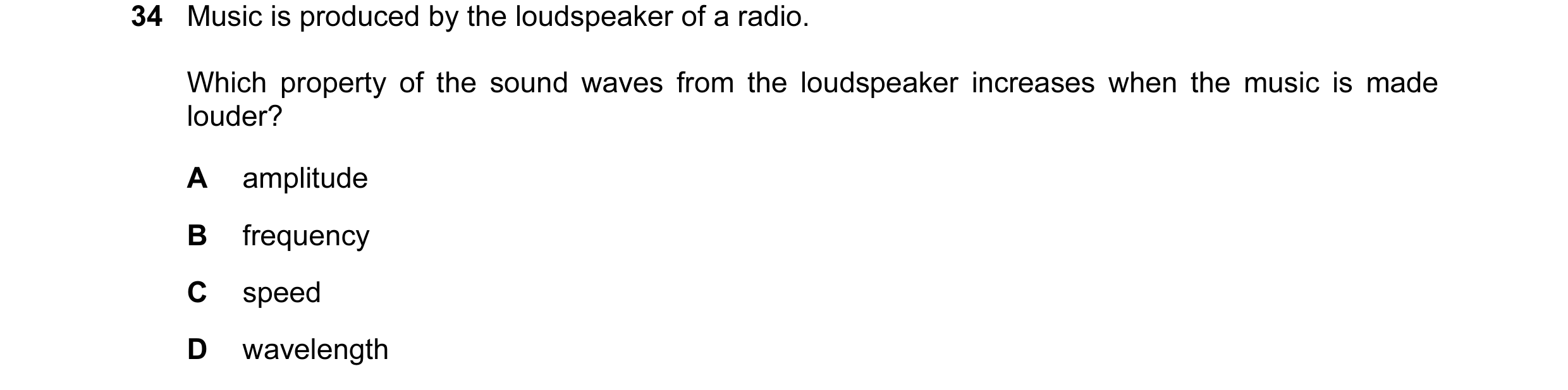
 6 / 22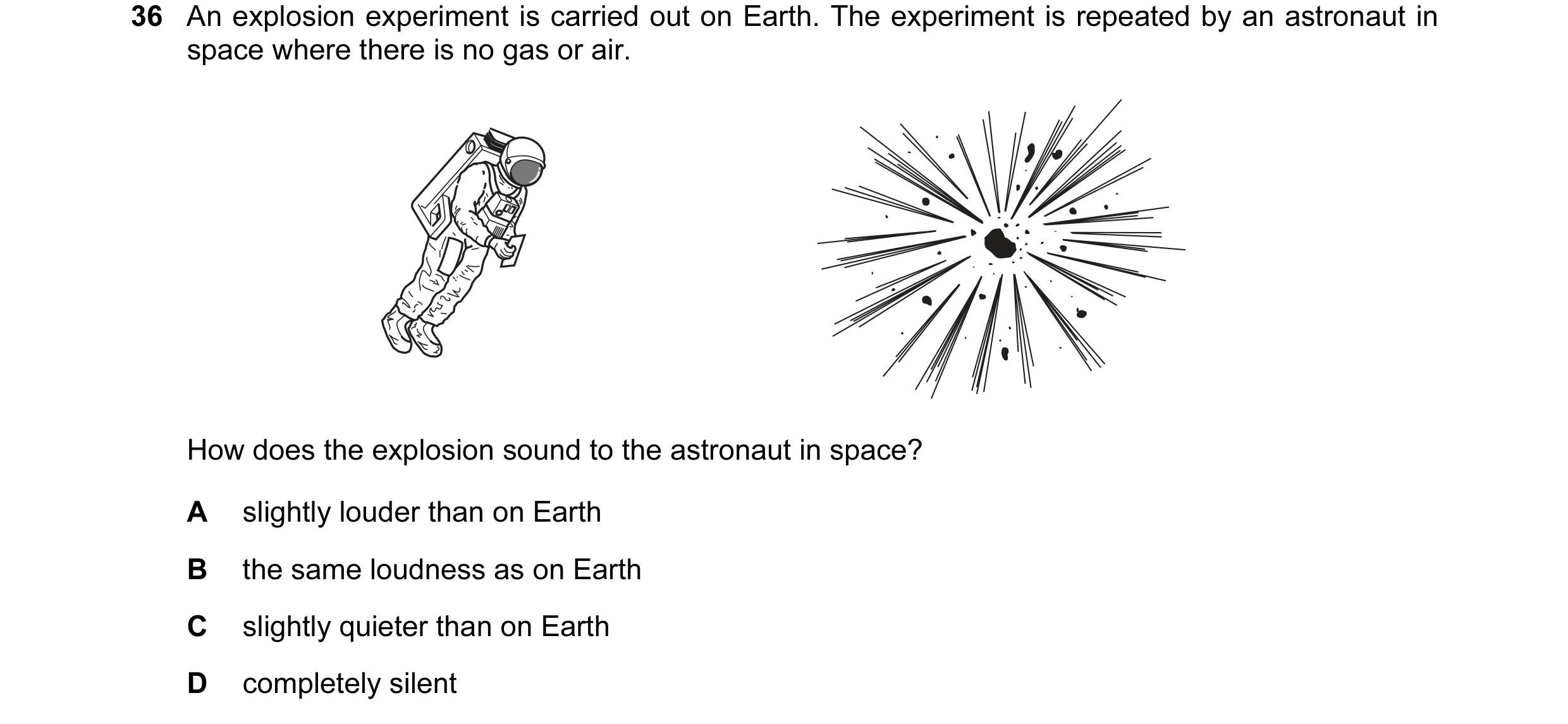
 7 / 22
 8 / 22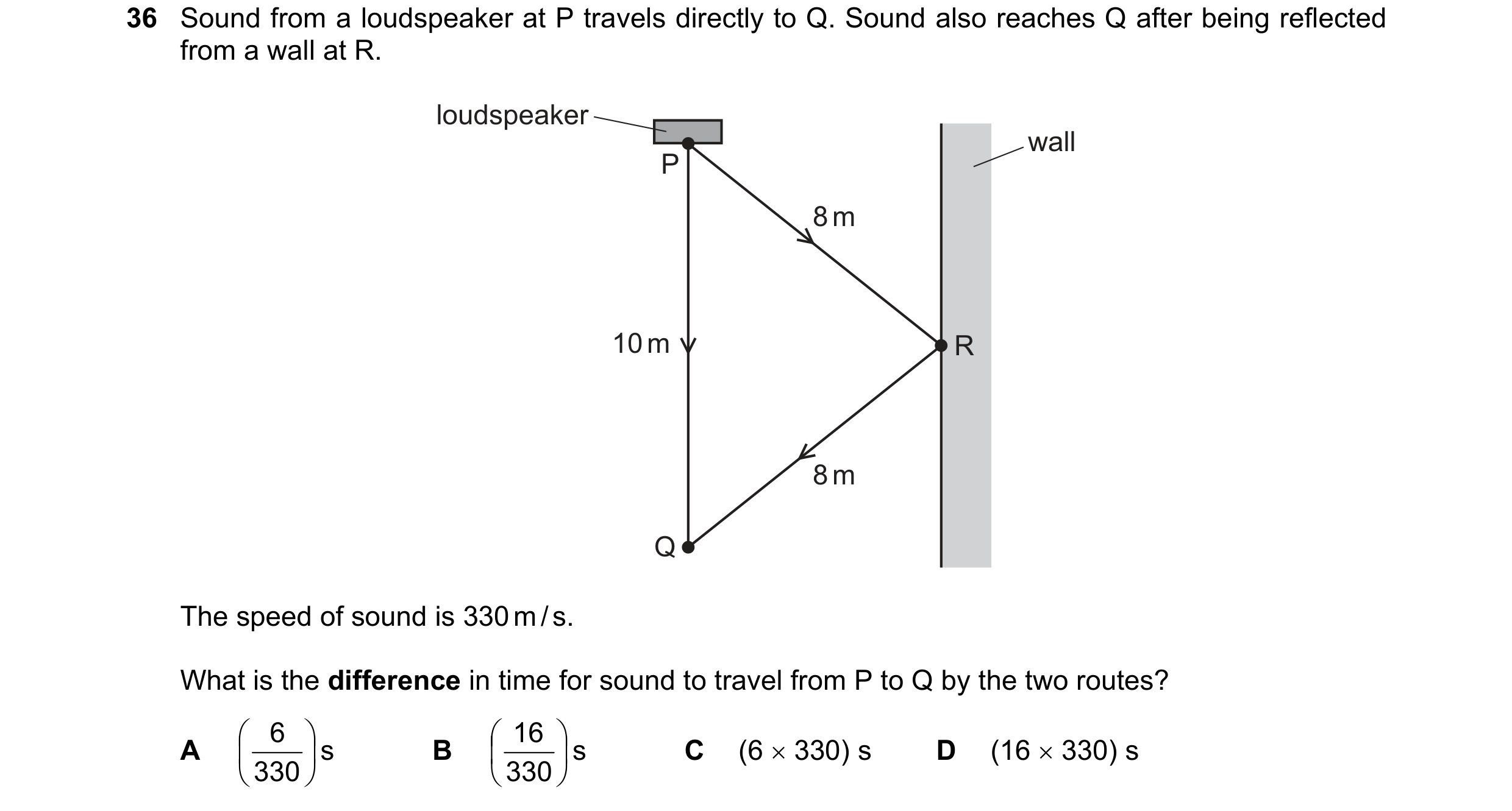
 9 / 22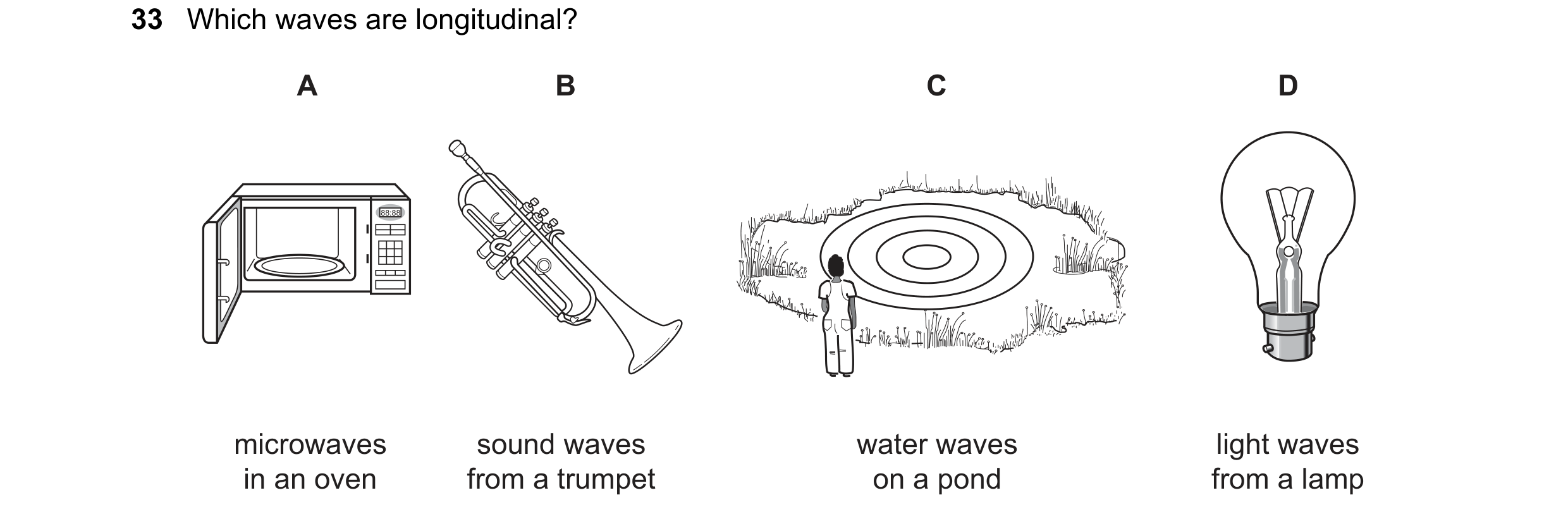
 10 / 22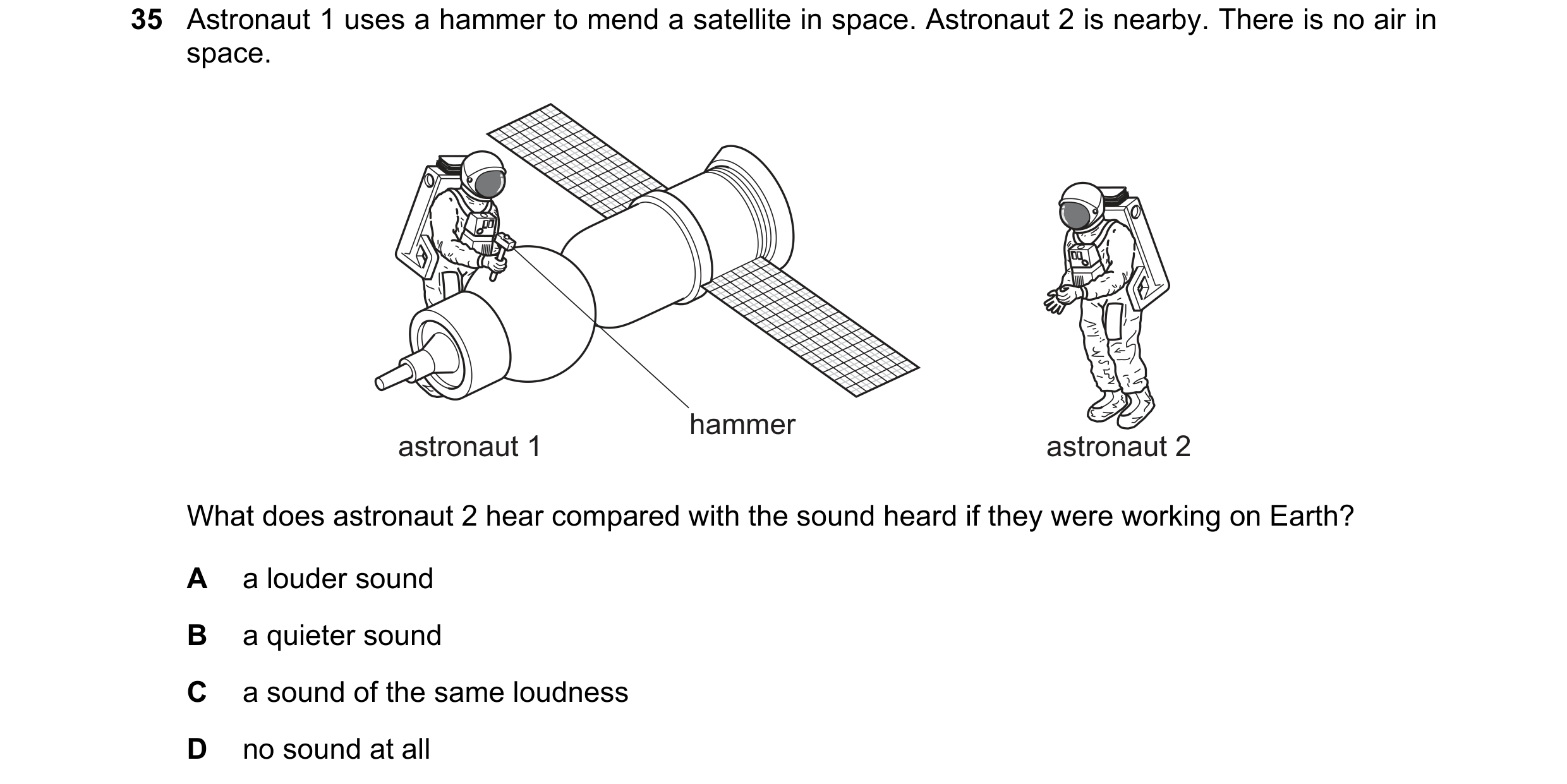


 11 / 22
 12 / 22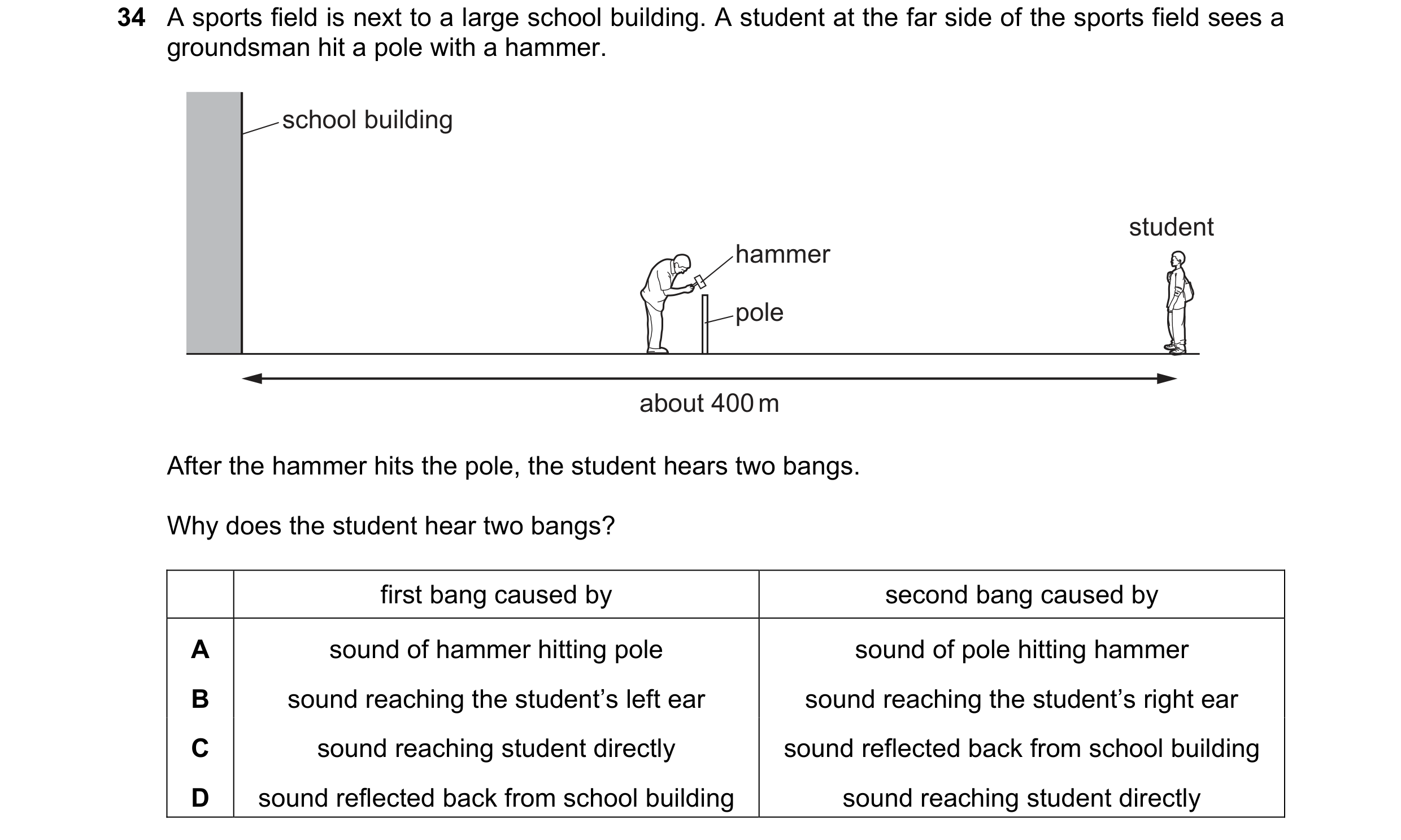
 13 / 22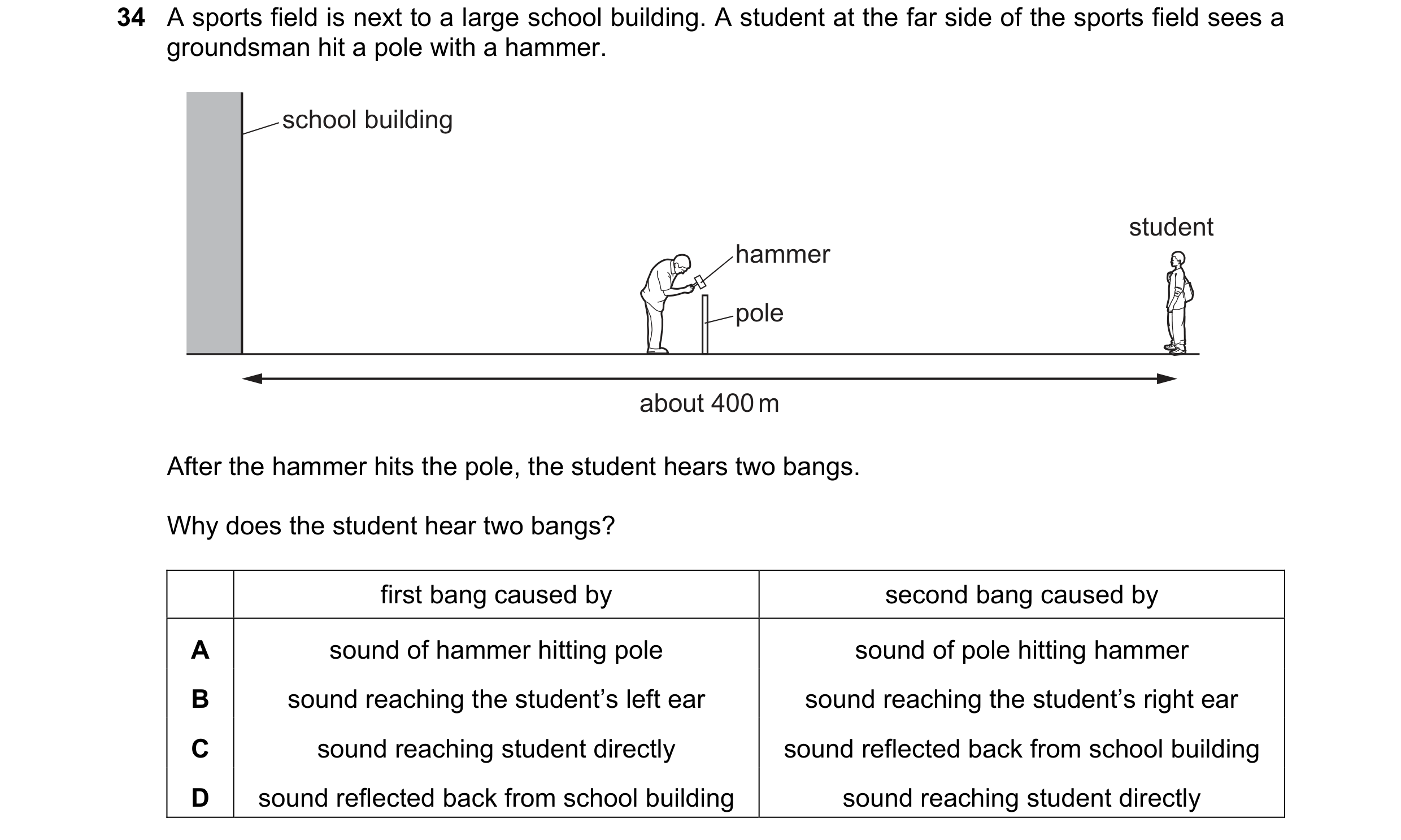
 14 / 22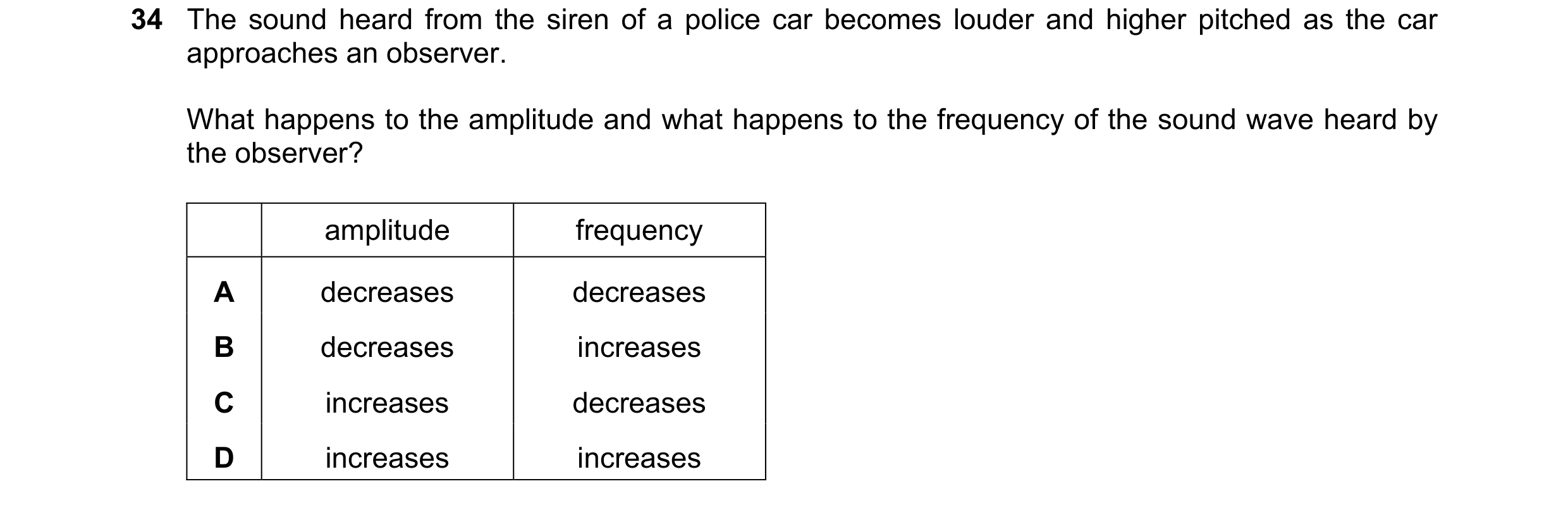


 15 / 22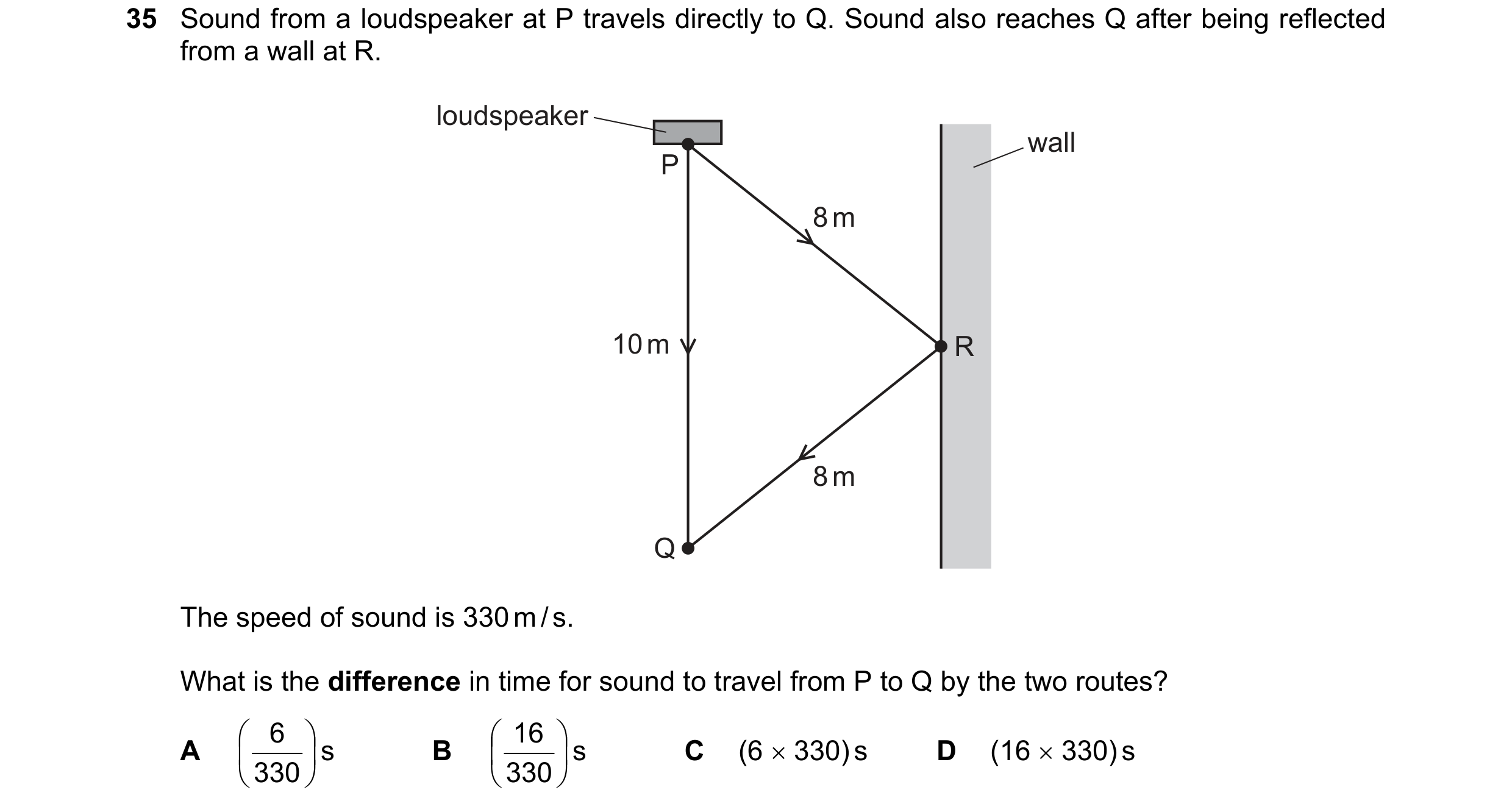
 16 / 22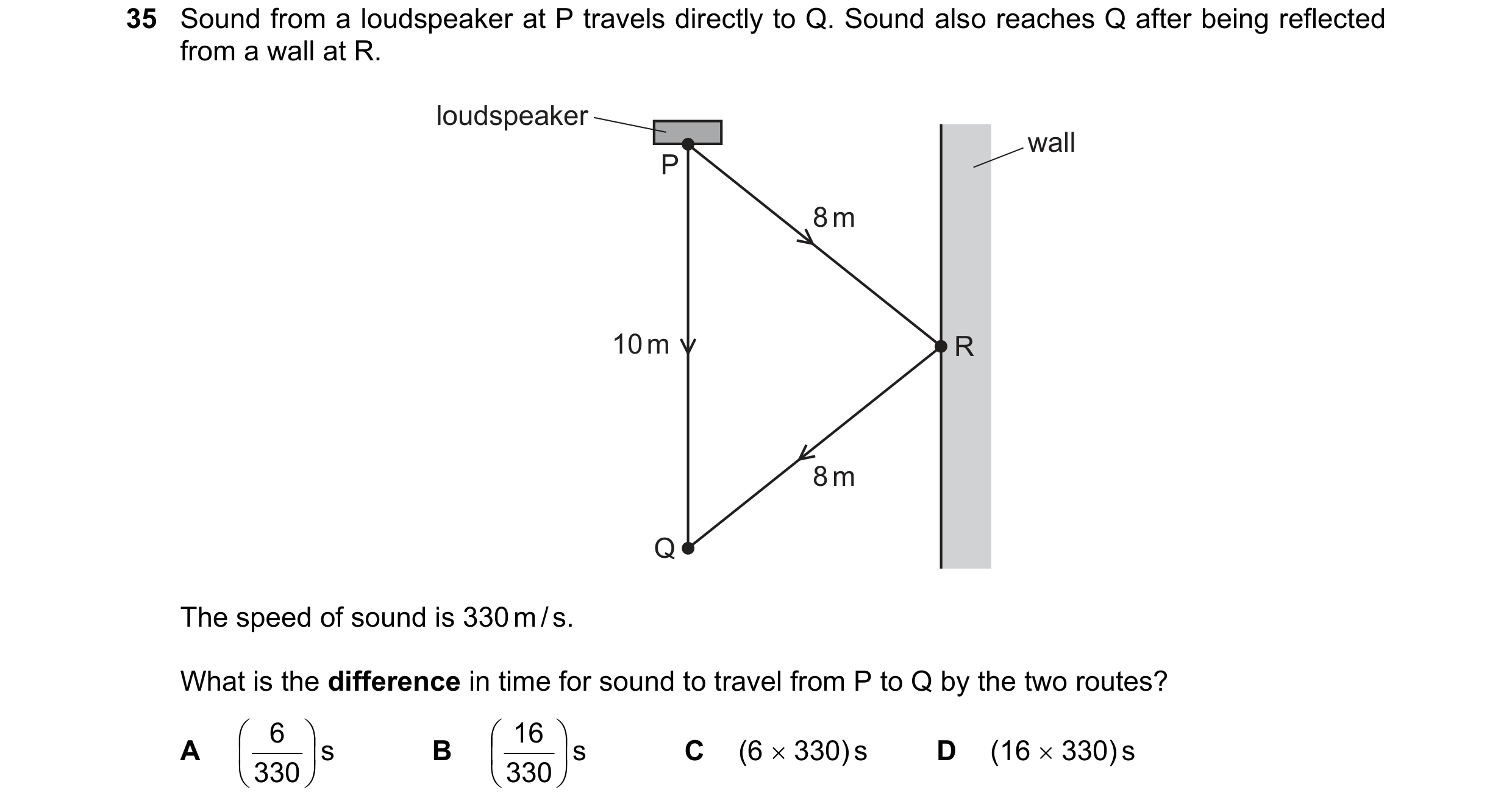

 17 / 22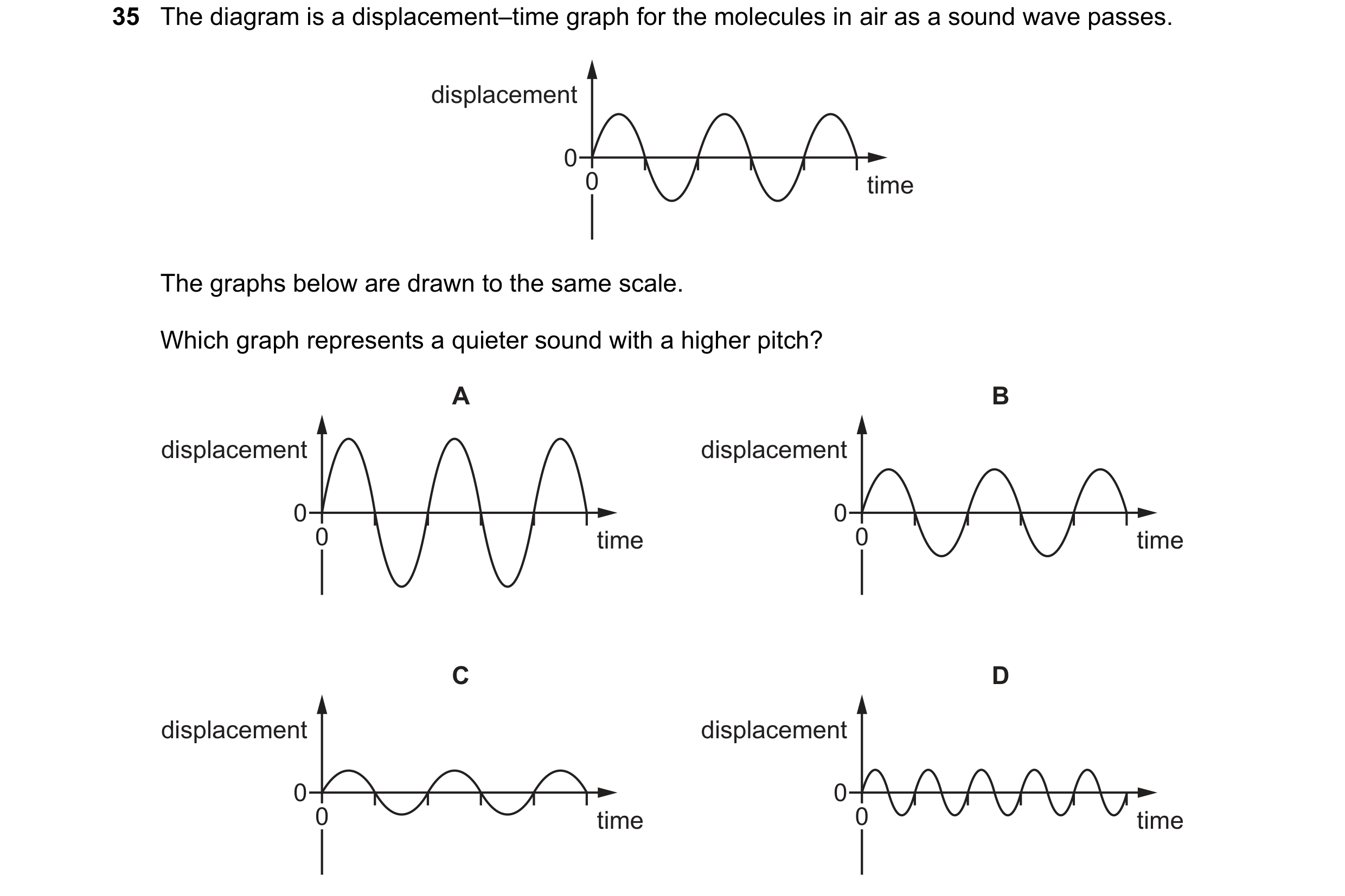


 18 / 22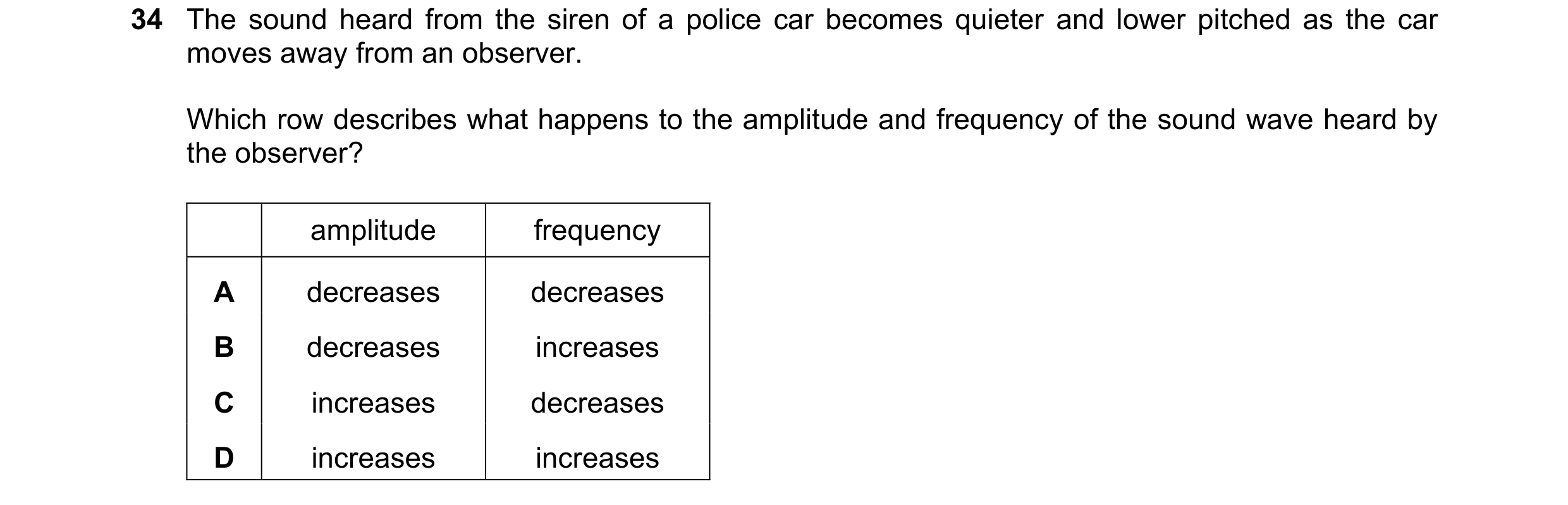

 19 / 22
 20 / 22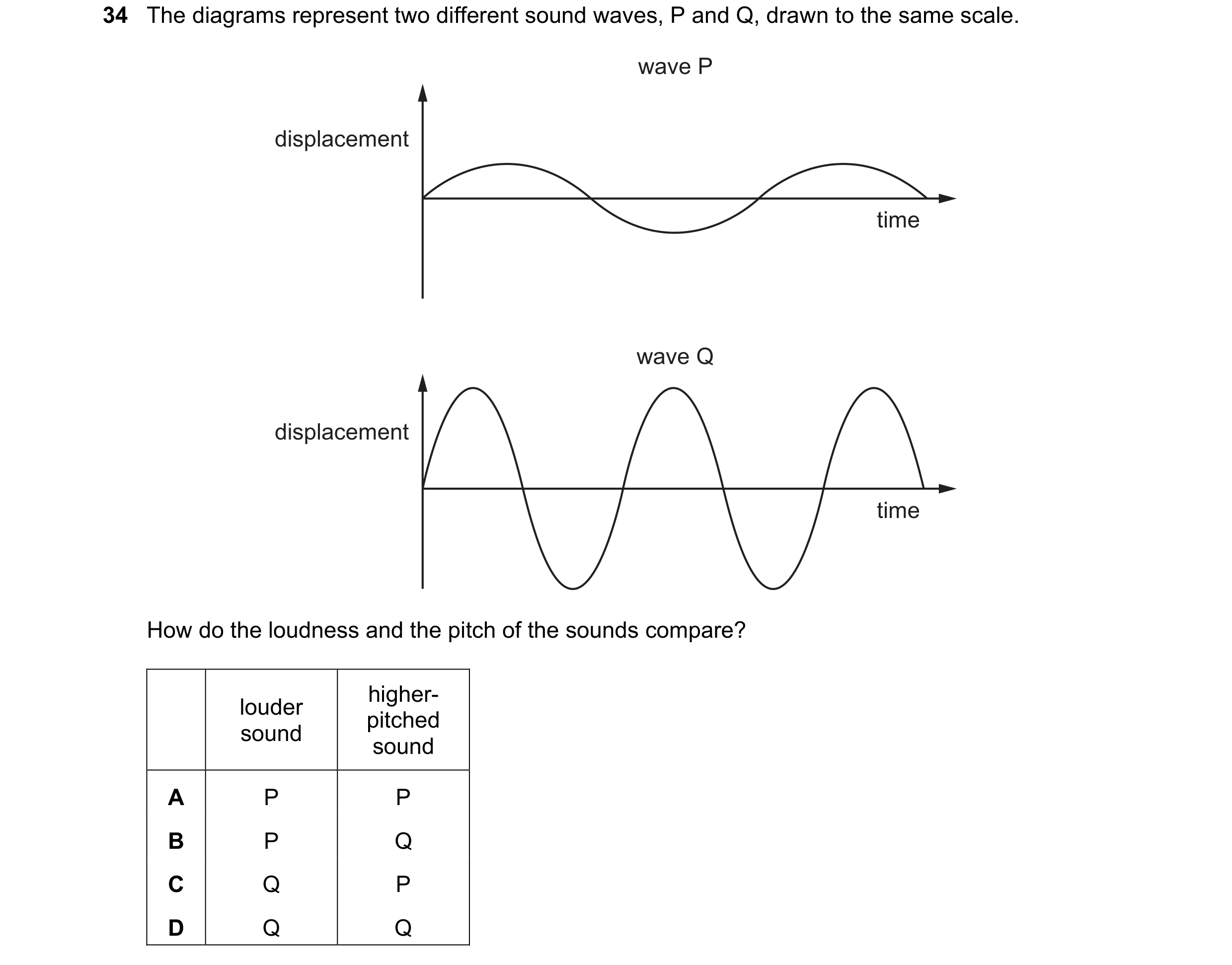
 21 / 22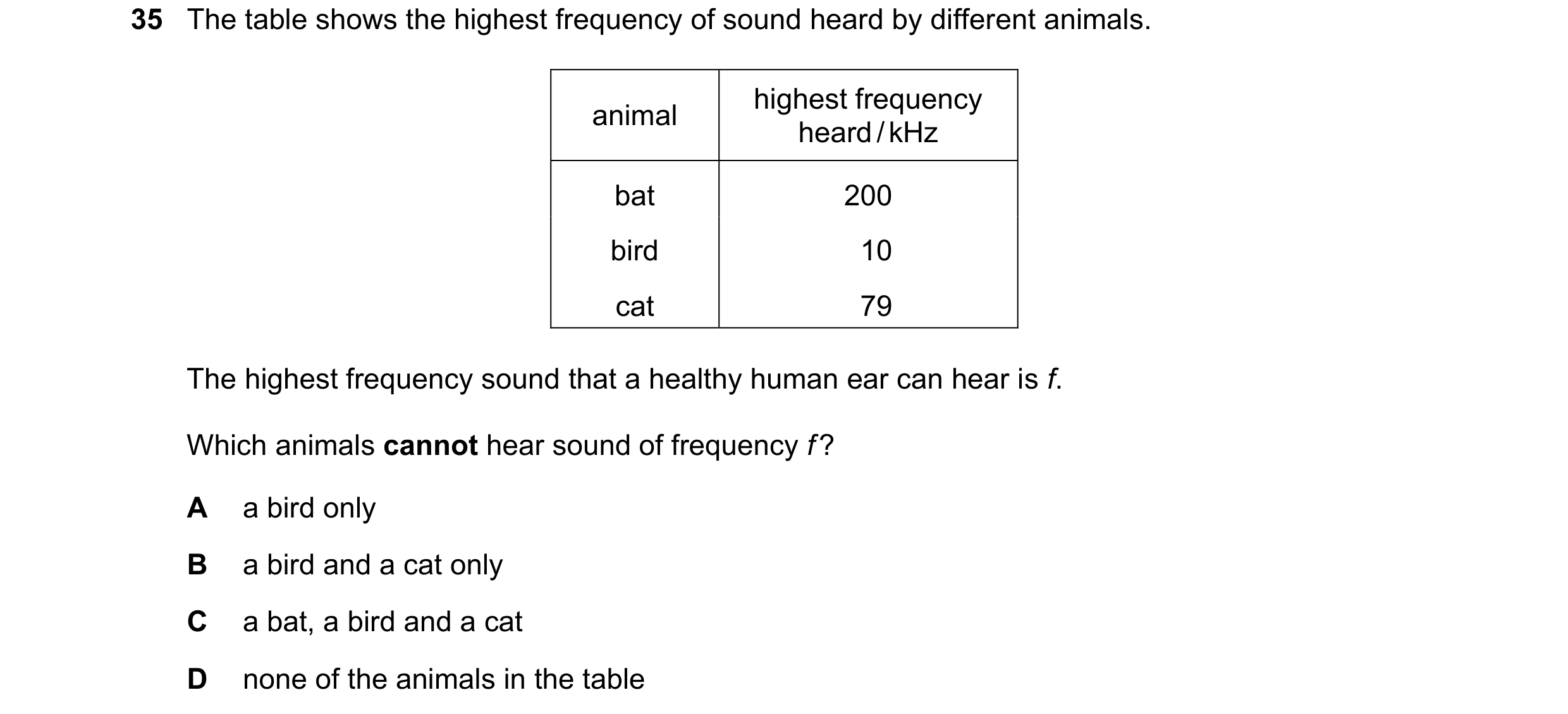
 22 / 22