Questions as text
Q1 · A small quantity of radioactive material is taken from a nuclear reactor 0654/41 May/June 2017
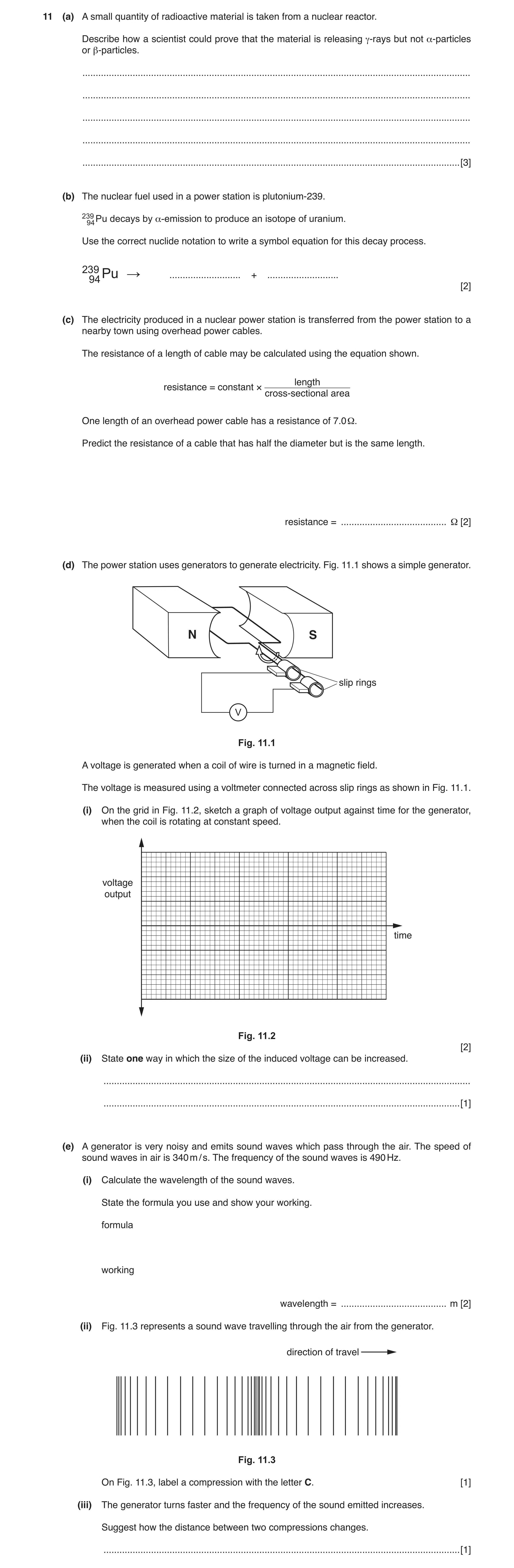
11 (a) A small quantity of radioactive material is taken from a nuclear reactor. Describe how a scientist could prove that the material is releasing γ-rays but not α-particles or β-particles. … … … … … [3] (b) The nuclear fuel used in a power station is plutonium-239. 239 94 Pu decays by α-emission to produce an isotope of uranium. Use the correct nuclide notation to write a symbol equation for this decay process. 239 Pu → … + … 94 [2] (c) The electricity produced in a nuclear power station is transferred from the power station to a nearby town using overhead power cables. The resistance of a length of cable may be calculated using the equation shown. length resistance = constant × cross-sectional area One length of an overhead power cable has a resistance of 7.0 Ω. Predict the resistance of a cable that has half the diameter but is the same length. resistance = … Ω [2] (d) The power station uses generators to generate electricity. Fig. 11.1 shows a simple generator. N S slip rings V Fig. 11.1 A voltage is generated when a coil of wire is turned in a magnetic field. The voltage is measured using a voltmeter connected across slip rings as shown in Fig. 11.1. (i) On the grid in Fig. 11.2, sketch a graph of voltage output against time for the generator, when the coil is rotating at constant speed. voltage output time Fig. 11.2 [2] (ii) State one way in which the size of the induced voltage can be increased. … … [1] (e) A generator is very noisy and emits sound waves which pass through the air. The speed of sound waves in air is 340 m / s. The frequency of the sound waves is 490 Hz. (i) Calculate the wavelength of the sound waves. State the formula you use and show your working. formula working wavelength = … m [2] (ii) Fig. 11.3 represents a sound wave travelling through the air from the generator. direction of travel Fig. 11.3 On Fig. 11.3, label a compression with the letter C. [1] (iii) The generator turns faster and the frequency of the sound emitted increases. Suggest how the distance between two compressions changes. … [1]
14 marks
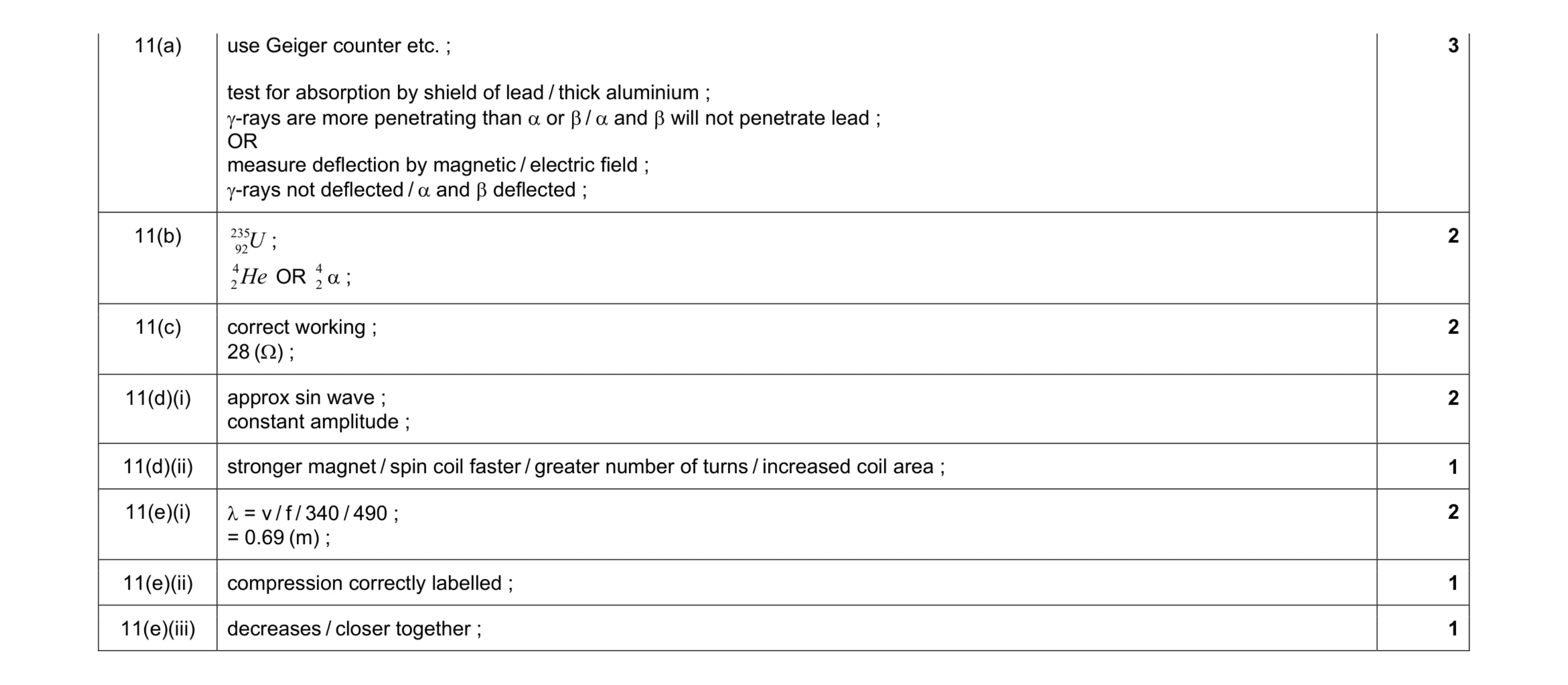
Mark scheme: 11(a) use Geiger counter etc. ; test for absorption by shield of lead / thick aluminium ; γ-rays are more penetrating than α or β / α and β will not penetrate lead ; OR measure deflection by magnetic / electric field ; γ-rays not deflected / α and β deflected ; 3 11(b) U 235 92 ; He 4 2 OR 4 2 α ; 2 11(c) correct working ; 28 (Ω) ; 2 11(d)(i) approx sin wave ; constant amplitude ; 2 11(d)(ii) stronger magnet / spin coil faster / greater number of turns / increased coil area ; 1 11(e)(i) λ = v / f / 340 / 490 ; = 0.69 (m) ; 2 11(e)(ii) compression correctly labelled ; 1 11(e)(iii) decreases / closer together ; 1
This question in 0654/41 May/June 2017
Q2 · A student is climbing a mountain 0654/41 May/June 2017
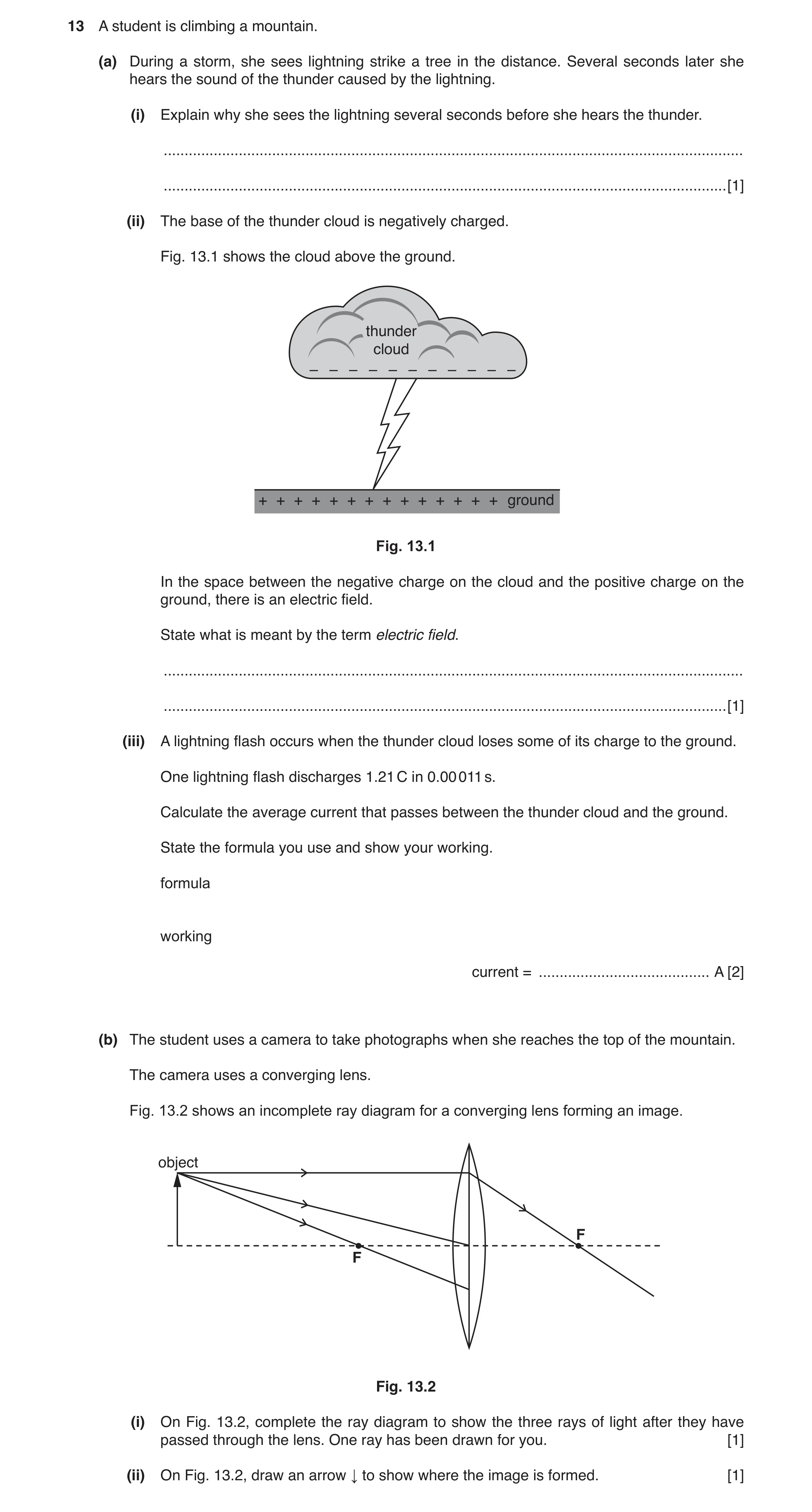
13 A student is climbing a mountain. (a) During a storm, she sees lightning strike a tree in the distance. Several seconds later she hears the sound of the thunder caused by the lightning. (i) Explain why she sees the lightning several seconds before she hears the thunder. … … [1] (ii) The base of the thunder cloud is negatively charged. Fig. 13.1 shows the cloud above the ground. thunder cloud – – – – – – – – – – – + + + + + + + + + + + + + + ground Fig. 13.1 In the space between the negative charge on the cloud and the positive charge on the ground, there is an electric field. State what is meant by the term electric field. … … [1] (iii) A lightning flash occurs when the thunder cloud loses some of its charge to the ground. One lightning flash discharges 1.21 C in 0.00 011 s. Calculate the average current that passes between the thunder cloud and the ground. State the formula you use and show your working. formula working current = … A [2] (b) The student uses a camera to take photographs when she reaches the top of the mountain. The camera uses a converging lens. Fig. 13.2 shows an incomplete ray diagram for a converging lens forming an image. object F F Fig. 13.2 (i) On Fig. 13.2, complete the ray diagram to show the three rays of light after they have passed through the lens. One ray has been drawn for you. [1] (ii) On Fig. 13.2, draw an arrow ↓ to show where the image is formed. [1]
6 marks
Mark scheme: 13(a)(i) light travels faster than sound ; 1 13(a)(ii) region where a charge experiences a force ; 1 13(a)(iii) current = charge / time / 1.21 / 0.00011 ; = 11000 (A) ; 2 13(b)(i) middle ray passes through without deviation AND bottom ray passes out parallel to principal axis AND all 3 rays pass through a point ; 1 13(b)(ii) inverted arrow drawn from principal axis to intersection of three rays ; 1
This question in 0654/41 May/June 2017
Q3 · A house has an electric doorbell 0654/41 Oct/Nov 2017
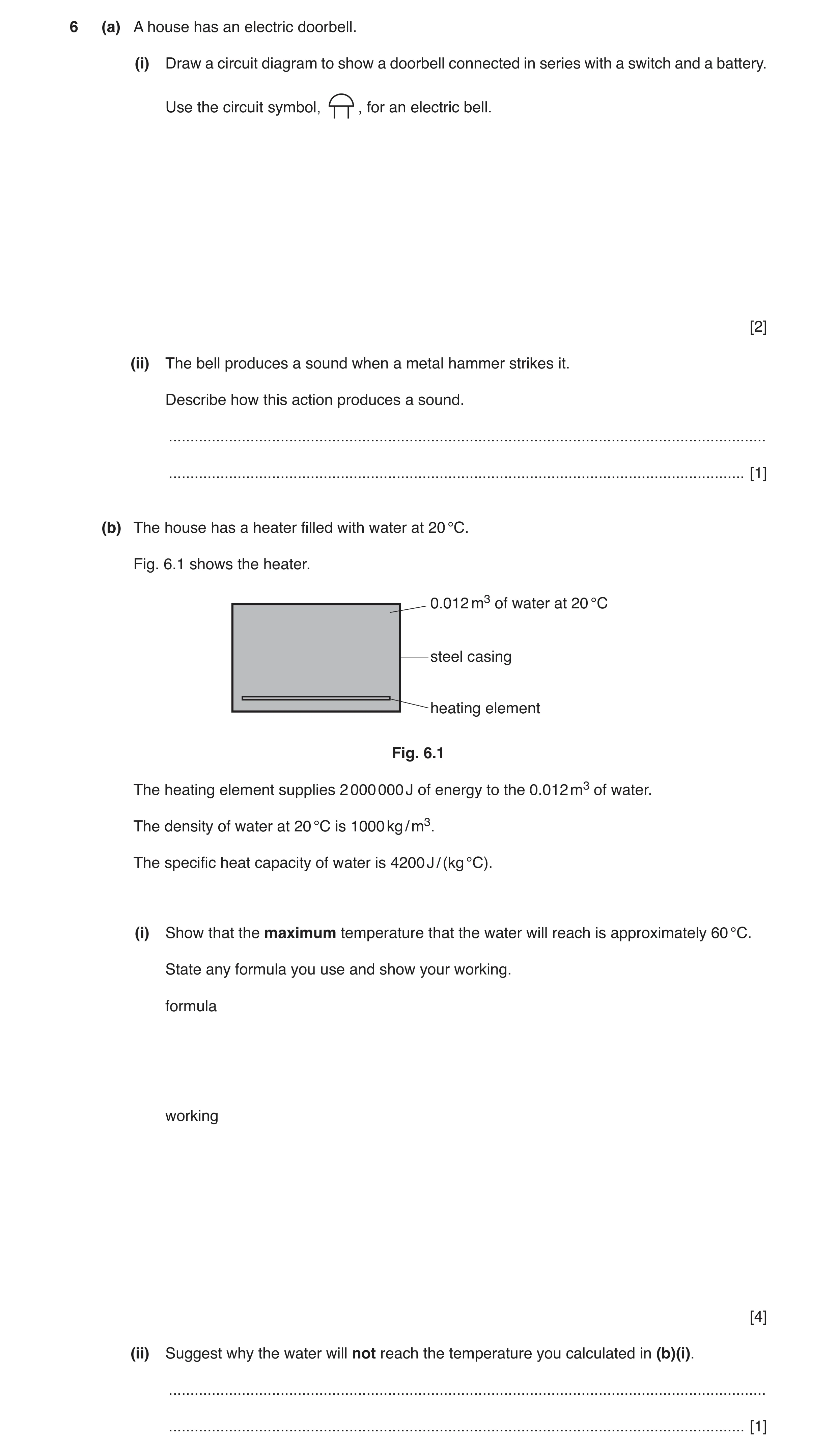
6 (a) A house has an electric doorbell. (i) Draw a circuit diagram to show a doorbell connected in series with a switch and a battery. Use the circuit symbol, , for an electric bell. [2] (ii) The bell produces a sound when a metal hammer strikes it. Describe how this action produces a sound. … … [1] (b) The house has a heater filled with water at 20 °C. Fig. 6.1 shows the heater. 0.012 m3 of water at 20 °C steel casing heating element Fig. 6.1 The heating element supplies 2 000 000 J of energy to the 0.012 m3 of water. The density of water at 20 °C is 1000 kg / m3. The specific heat capacity of water is 4200 J / (kg °C). (i) Show that the maximum temperature that the water will reach is approximately 60 °C. State any formula you use and show your working. formula working [4] (ii) Suggest why the water will not reach the temperature you calculated in (b)(i). … … [1]
8 marks
Mark scheme: 6(a)(i) all symbols correct ; all connected correctly in series circuit and all else correct ; 2 6(a)(ii) vibration / oscillation ; 1 6(b)(i) m=dV OR 1000 × 0.012 OR 12 (kg) ; ( ) 2000000 OR 12 4200 E T mc ∆ = × 40 oC ; maximum temperature = 40 + 20 oC (= 60 oC) ; 4 6(b)(ii) thermal energy is lost (to surroundings / casing ) ; 1
This question in 0654/41 Oct/Nov 2017
Q4 · During car journeys, a car will often become electrostatically charged 0654/42 Oct/Nov 2017
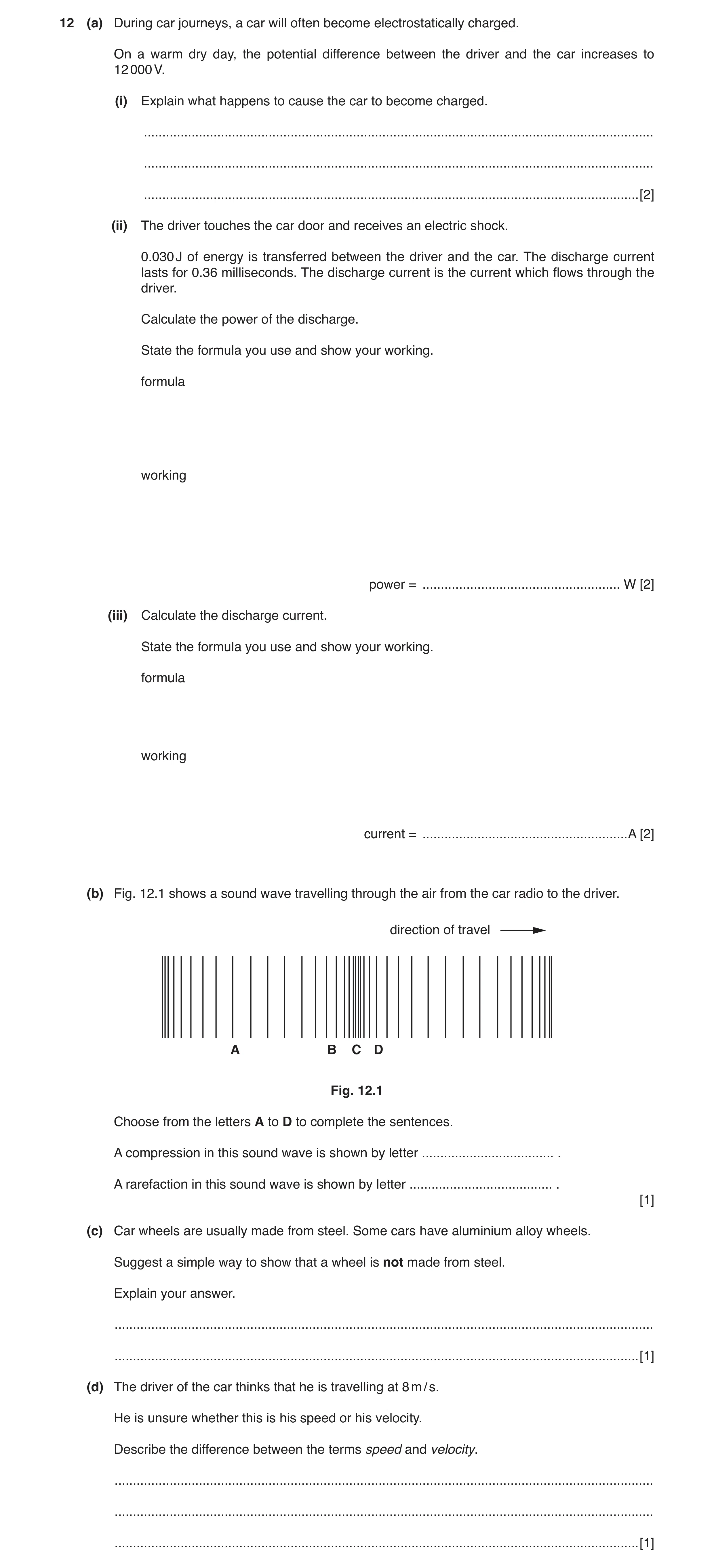
12 (a) During car journeys, a car will often become electrostatically charged. On a warm dry day, the potential difference between the driver and the car increases to 12 000 V. (i) Explain what happens to cause the car to become charged. … … … [2] (ii) The driver touches the car door and receives an electric shock. 0.030 J of energy is transferred between the driver and the car. The discharge current lasts for 0.36 milliseconds. The discharge current is the current which flows through the driver. Calculate the power of the discharge. State the formula you use and show your working. formula working power = … W [2] (iii) Calculate the discharge current. State the formula you use and show your working. formula working current = … A [2] (b) Fig. 12.1 shows a sound wave travelling through the air from the car radio to the driver. direction of travel A B C D Fig. 12.1 Choose from the letters A to D to complete the sentences. A compression in this sound wave is shown by letter … . A rarefaction in this sound wave is shown by letter … . [1] (c) Car wheels are usually made from steel. Some cars have aluminium alloy wheels. Suggest a simple way to show that a wheel is not made from steel. Explain your answer. … … [1] (d) The driver of the car thinks that he is travelling at 8 m / s. He is unsure whether this is his speed or his velocity. Describe the difference between the terms speed and velocity. … … … [1]
9 marks
Mark scheme: 12(a)(i) friction / description of friction ; transfer of electrons ; 2 12(a)(ii) power = energy / time or 0.03 / 0.00036 ; = 83.3 (W) ; 2 12(a)(iii) current = power / voltage or 83.3 / 12000 ; = 0.0069 (A) ; 2 12(b) C then A ; 1 12(c) use a magnet – aluminium is not magnetic steel is magnetic ; 1 12(d) speed – has magnitude only / scalar or velocity – has magnitude and direction / vector ; 1
This question in 0654/42 Oct/Nov 2017
Q5 · State the name of the electromagnetic wave that is used in mobile (cell) phone… 0654/43 Oct/Nov 2017
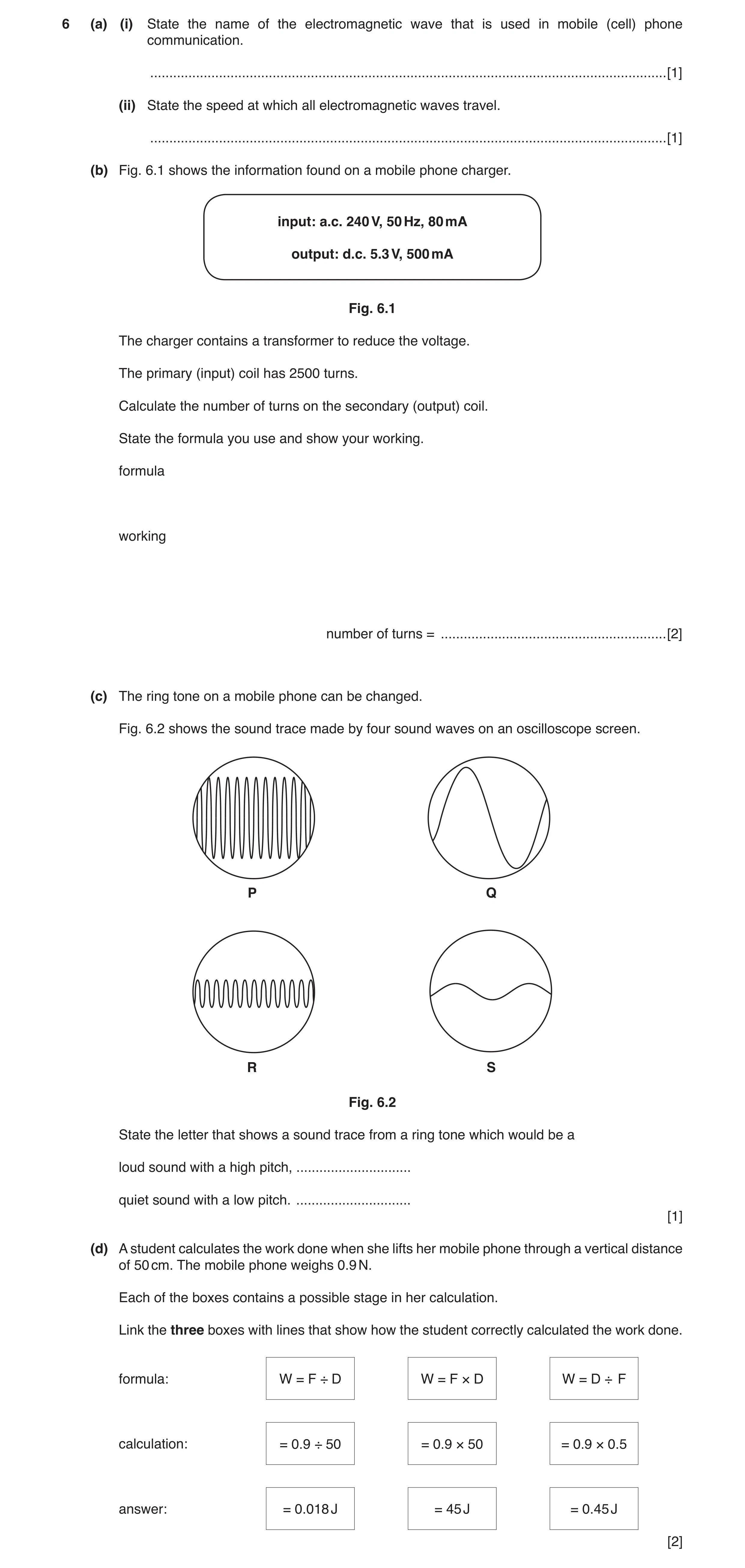
6 (a) (i) State the name of the electromagnetic wave that is used in mobile (cell) phone communication. … [1] (ii) State the speed at which all electromagnetic waves travel. … [1] (b) Fig. 6.1 shows the information found on a mobile phone charger. input: a.c. 240 V, 50 Hz, 80 mA output: d.c. 5.3 V, 500 mA Fig. 6.1 The charger contains a transformer to reduce the voltage. The primary (input) coil has 2500 turns. Calculate the number of turns on the secondary (output) coil. State the formula you use and show your working. formula working number of turns = … [2] (c) The ring tone on a mobile phone can be changed. Fig. 6.2 shows the sound trace made by four sound waves on an oscilloscope screen. P Q R S Fig. 6.2 State the letter that shows a sound trace from a ring tone which would be a loud sound with a high pitch, … quiet sound with a low pitch. … [1] (d) A student calculates the work done when she lifts her mobile phone through a vertical distance of 50 cm. The mobile phone weighs 0.9 N. Each of the boxes contains a possible stage in her calculation. Link the three boxes with lines that show how the student correctly calculated the work done. formula: W = F ÷ D W = F × D W = D ÷ F calculation: = 0.9 ÷ 50 = 0.9 × 50 = 0.9 × 0.5 answer: = 0.018 J = 45 J = 0.45 J [2]
7 marks
Mark scheme: 6(a)(i) microwaves ; 1 6(a)(ii) 300 000 000 / 3 × 10⁸ m / s ; 1 6(b) S S P P V N V N = OR ( ) 2500 5.3 240 s N × = ; = 55 (turns) ; 2 6(c) P then S ; 1 6(d) use of W = F × D ; answer 0.45 J ; 2
This question in 0654/43 Oct/Nov 2017
Q6 · A motorcycle with a rear lamp 0654/41 May/June 2019
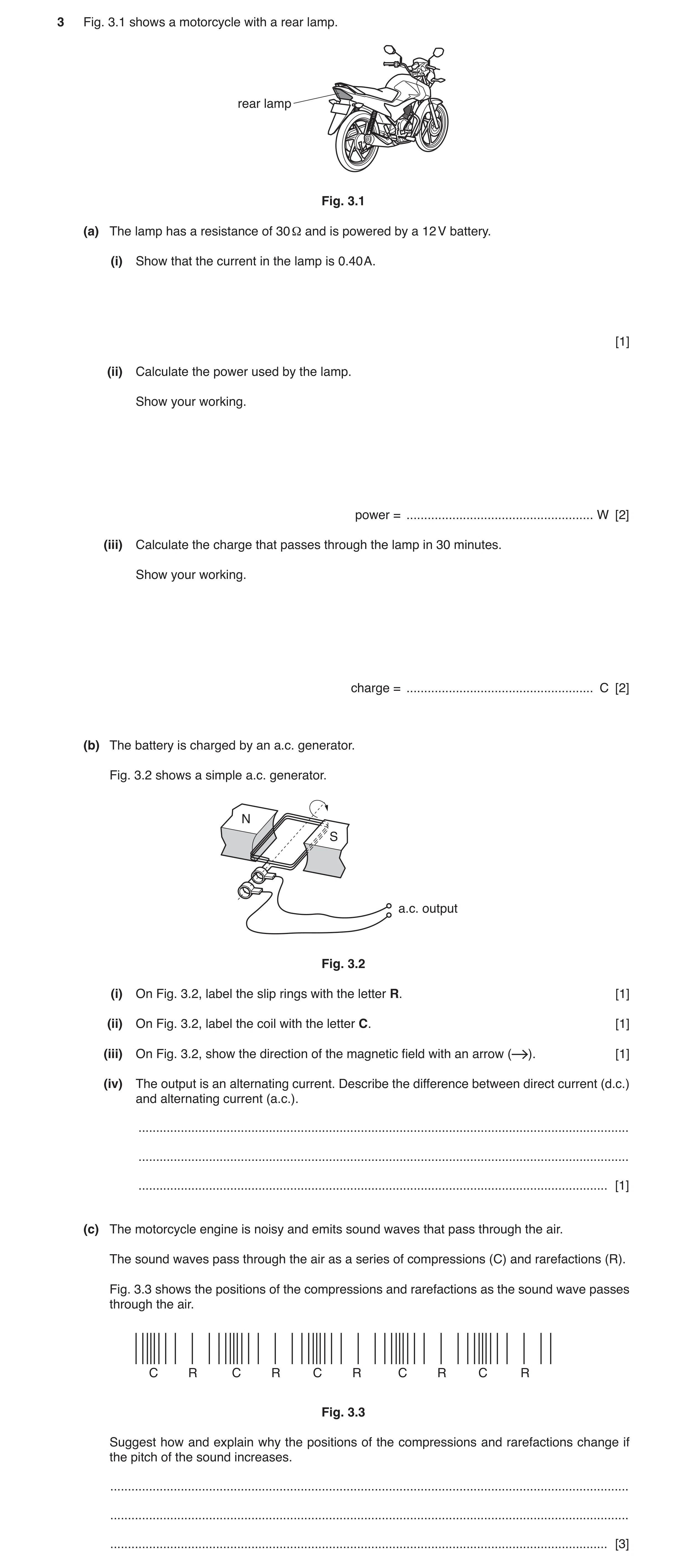
3 Fig. 3.1 shows a motorcycle with a rear lamp. rear lamp Fig. 3.1 (a) The lamp has a resistance of 30 Ω and is powered by a 12 V battery. (i) Show that the current in the lamp is 0.40 A. [1] (ii) Calculate the power used by the lamp. Show your working. power = … W [2] (iii) Calculate the charge that passes through the lamp in 30 minutes. Show your working. charge = … C [2] (b) The battery is charged by an a.c. generator. Fig. 3.2 shows a simple a.c. generator. N S a.c. output Fig. 3.2 (i) On Fig. 3.2, label the slip rings with the letter R. [1] (ii) On Fig. 3.2, label the coil with the letter C. [1] (iii) On Fig. 3.2, show the direction of the magnetic field with an arrow ( ). [1] (iv) The output is an alternating current. Describe the difference between direct current (d.c.) and alternating current (a.c.). … … … [1] (c) The motorcycle engine is noisy and emits sound waves that pass through the air. The sound waves pass through the air as a series of compressions (C) and rarefactions (R). Fig. 3.3 shows the positions of the compressions and rarefactions as the sound wave passes through the air. C R C R C R C R C R Fig. 3.3 Suggest how and explain why the positions of the compressions and rarefactions change if the pitch of the sound increases. … … … [3]
12 marks
Mark scheme: 3(a)(i) 12/30 = 0.4 (A) ; 1 3(a)(ii) voltage × current or 12 × 0.40 ; = 4.8 (W) ; 2 3(a)(iii) current × time or 0.4 × 30 (× 60) or 0.4 × 1800 ; =720 (C) ; 2 3(b)(i) correct label ; 1 3(b)(ii) correct label ; 1 3(b)(iii) arrow drawn from N to S ; 1 3(b)(iv) direct current goes in one direction / alternating current changes direction ; 1 3(c) higher frequency / more waves produced per second ; shorter wavelength ; compressions and rarefactions get closer together ; 3
This question in 0654/41 May/June 2019
Q7 · The visible light produced by the headlamps of a train is part of the electromagnetic… 0654/41 May/June 2019
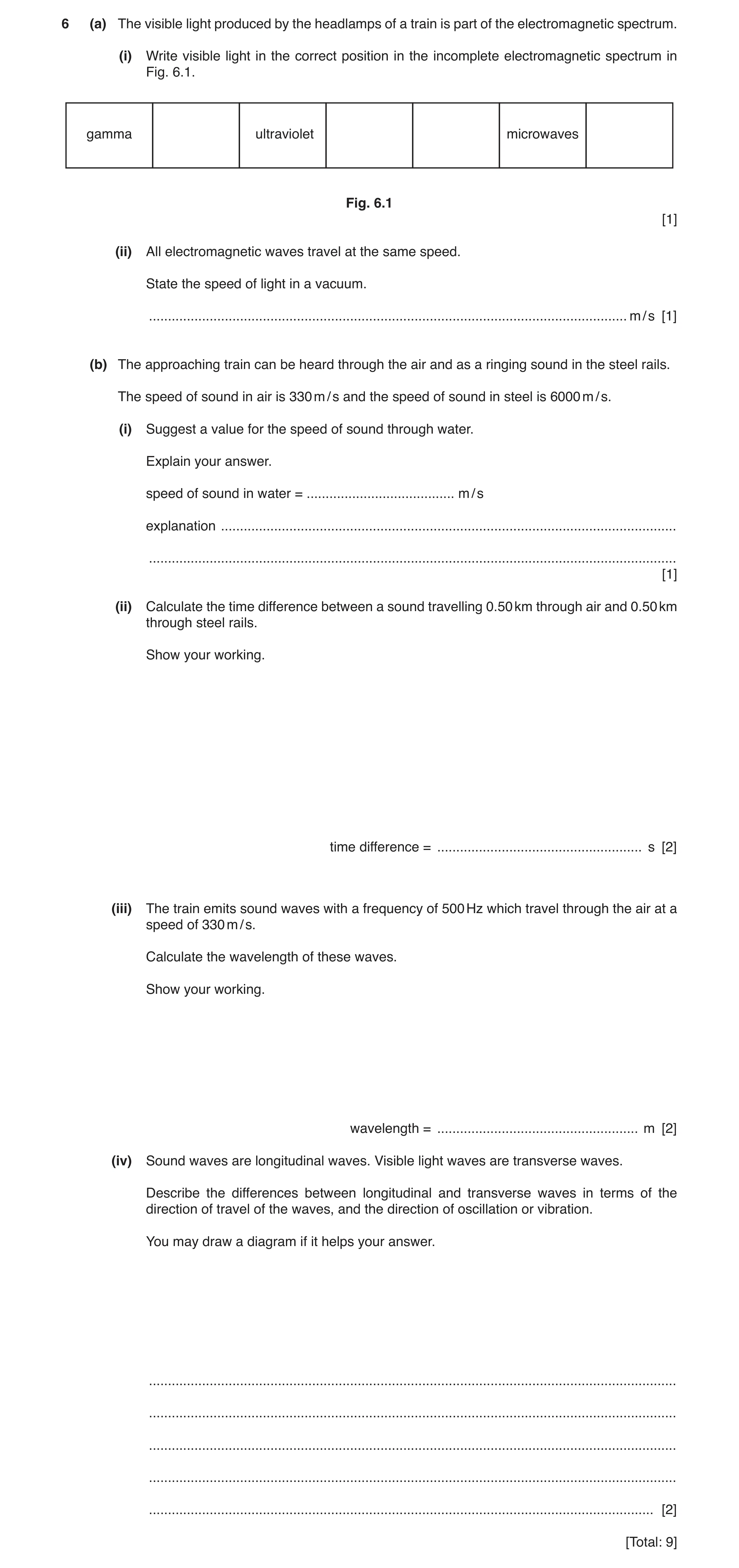
6 (a) The visible light produced by the headlamps of a train is part of the electromagnetic spectrum. (i) Write visible light in the correct position in the incomplete electromagnetic spectrum in Fig. 6.1. gamma ultraviolet microwaves Fig. 6.1 [1] (ii) All electromagnetic waves travel at the same speed. State the speed of light in a vacuum. … m / s [1] (b) The approaching train can be heard through the air and as a ringing sound in the steel rails. The speed of sound in air is 330 m / s and the speed of sound in steel is 6000 m / s. (i) Suggest a value for the speed of sound through water. Explain your answer. speed of sound in water = … m / s explanation … … [1] (ii) Calculate the time difference between a sound travelling 0.50 km through air and 0.50 km through steel rails. Show your working. time difference = … s [2] (iii) The train emits sound waves with a frequency of 500 Hz which travel through the air at a speed of 330 m / s. Calculate the wavelength of these waves. Show your working. wavelength = … m [2] (iv) Sound waves are longitudinal waves. Visible light waves are transverse waves. Describe the differences between longitudinal and transverse waves in terms of the direction of travel of the waves, and the direction of oscillation or vibration. You may draw a diagram if it helps your answer. … … … … … [2] [Total: 9]
9 marks
Mark scheme: 6(a)(i) visible placed correctly ; 1 6(a)(ii) 3 × 10⁸ (m/s) ; 1 6(b)(i) value above 330 m/s and below 6000 m/s and sound travels faster in a liquid than in a gas and sound travels slower in a liquid than in a solid ; 1 6(b)(ii) (time in air=) 500/330 or 1.515(s) and (time in steel =) 500/6000 or 0.0833(s) ; time difference = 1.4 (s) ; 2 6(b)(iii) (wavelength =) velocity / frequency or 330/500 ; = 0.66 (m) ; 2 6(b)(iv) transverse waves – direction of oscillation/vibration perpendicular to direction of wave travel ; longitudinal – direction of oscillation/vibration parallel to direction of wave travel ; 2
This question in 0654/41 May/June 2019
Q8 · The forces acting on an aircraft 0654/43 May/June 2019
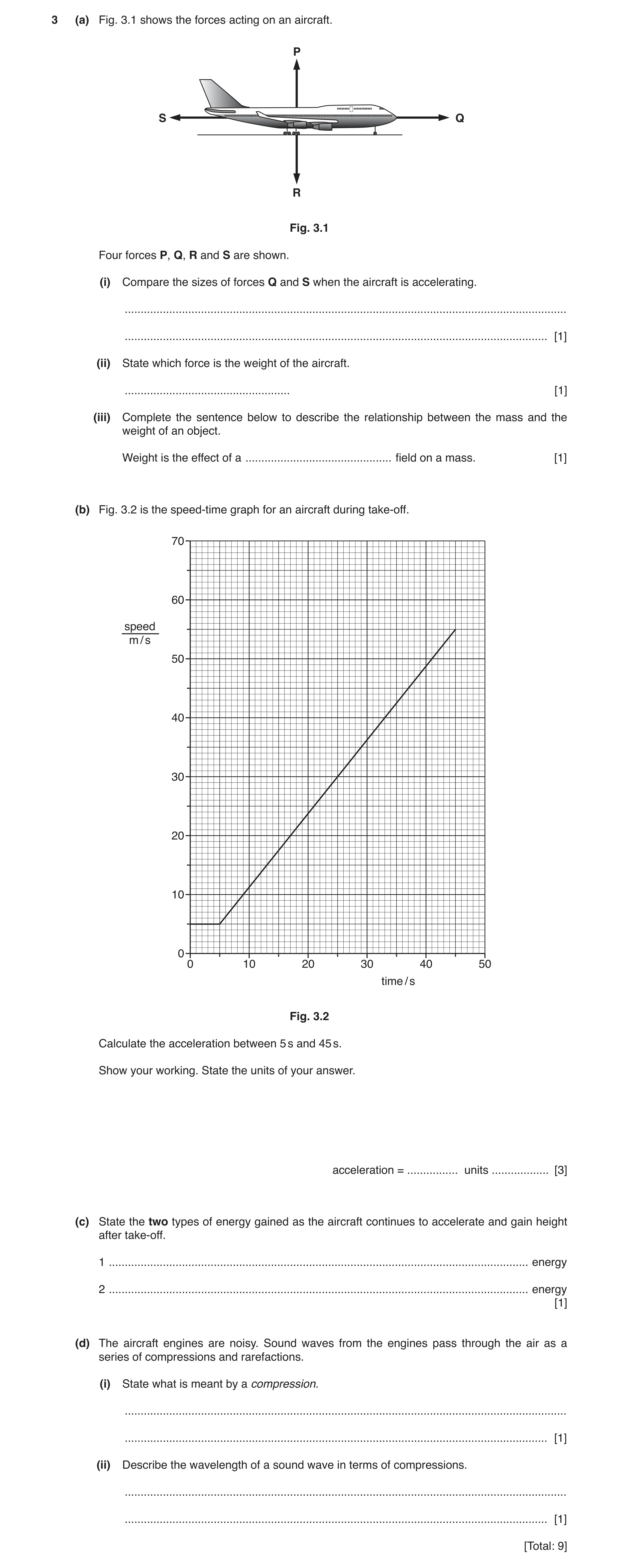
3 (a) Fig. 3.1 shows the forces acting on an aircraft. P S Q R Fig. 3.1 Four forces P, Q, R and S are shown. (i) Compare the sizes of forces Q and S when the aircraft is accelerating. … … [1] (ii) State which force is the weight of the aircraft. … [1] (iii) Complete the sentence below to describe the relationship between the mass and the weight of an object. Weight is the effect of a … field on a mass. [1] (b) Fig. 3.2 is the speed-time graph for an aircraft during take-off. 70 60 speed m / s 50 40 30 20 10 0 0 10 20 30 40 50 time / s Fig. 3.2 Calculate the acceleration between 5 s and 45 s. Show your working. State the units of your answer. acceleration = … units … [3] (c) State the two types of energy gained as the aircraft continues to accelerate and gain height after take-off. 1 … energy 2 … energy [1] (d) The aircraft engines are noisy. Sound waves from the engines pass through the air as a series of compressions and rarefactions. (i) State what is meant by a compression. … … [1] (ii) Describe the wavelength of a sound wave in terms of compressions. … … [1] [Total: 9]
9 marks
Mark scheme: 3(a)(i) Q is greater than S ; 1 3(a)(ii) R ; 1 3(a)(iii) gravitational ; 1 3(b) (acceleration =) change in speed/time or 50 / 40 ; = 1.3 / 1.25 ; m/s2 ; 3 3(c) kinetic and gravitational potential energy ; 1 3(d)(i) region of high pressure / where particles are closer together ; 1 3(d)(ii) distance between two successive compressions ; 1
This question in 0654/43 May/June 2019
Q9 · Ultrasound is very high frequency sound 0654/41 Oct/Nov 2019
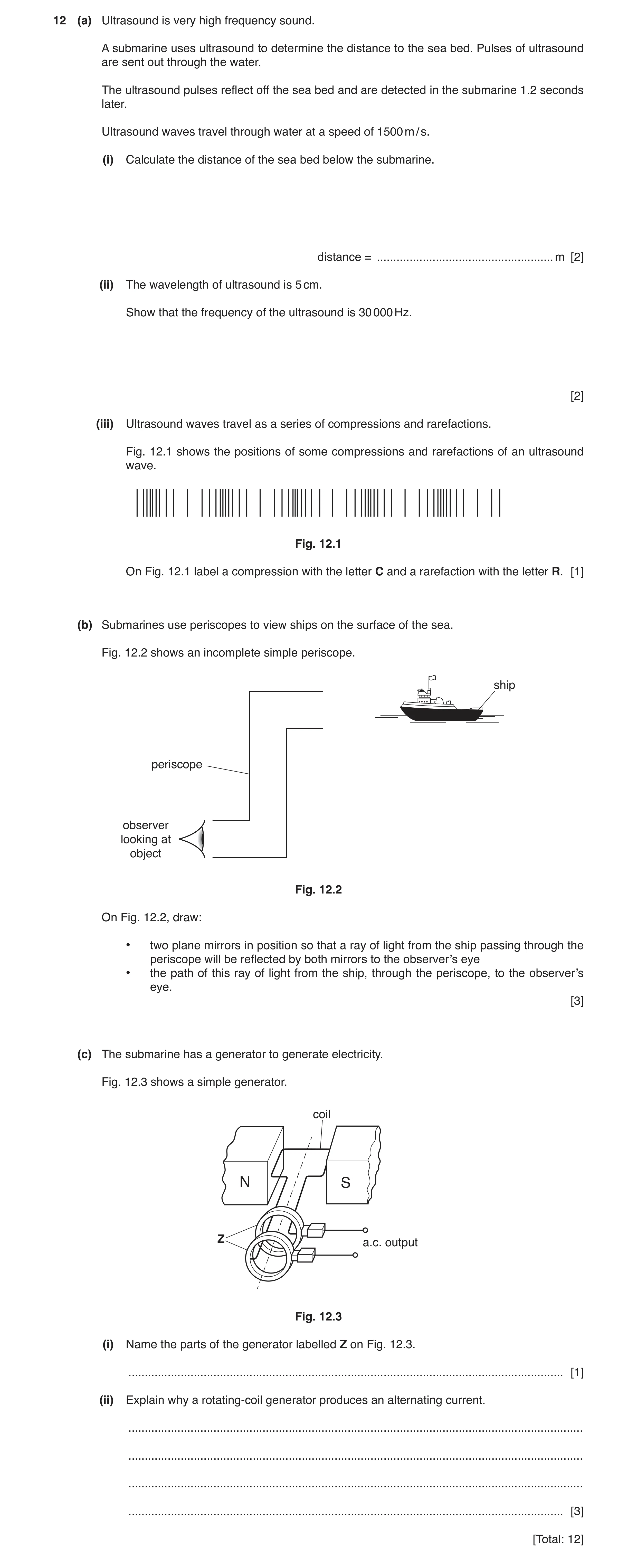
12 (a) Ultrasound is very high frequency sound. A submarine uses ultrasound to determine the distance to the sea bed. Pulses of ultrasound are sent out through the water. The ultrasound pulses reflect off the sea bed and are detected in the submarine 1.2 seconds later. Ultrasound waves travel through water at a speed of 1500 m / s. (i) Calculate the distance of the sea bed below the submarine. distance = … m [2] (ii) The wavelength of ultrasound is 5 cm. Show that the frequency of the ultrasound is 30 000 Hz. [2] (iii) Ultrasound waves travel as a series of compressions and rarefactions. Fig. 12.1 shows the positions of some compressions and rarefactions of an ultrasound wave. Fig. 12.1 On Fig. 12.1 label a compression with the letter C and a rarefaction with the letter R. [1] (b) Submarines use periscopes to view ships on the surface of the sea. Fig. 12.2 shows an incomplete simple periscope. ship periscope observer looking at object Fig. 12.2 On Fig. 12.2, draw: • two plane mirrors in position so that a ray of light from the ship passing through the periscope will be reflected by both mirrors to the observer’s eye • the path of this ray of light from the ship, through the periscope, to the observer’s eye. [3] (c) The submarine has a generator to generate electricity. Fig. 12.3 shows a simple generator. coil N S Z a.c. output Fig. 12.3 (i) Name the parts of the generator labelled Z on Fig. 12.3. … [1] (ii) Explain why a rotating-coil generator produces an alternating current. … … … … [3] [Total: 12]
12 marks
Mark scheme: 12(a)(i) depth = 1800 / 2 = 900 (m) ; 2 12(a)(ii) 0.05 (m) OR 150 000 (cm / s) ; (f = ) 1500 / 0.05 OR 150 000 / 5 ; ( = 30 000 Hz) 2 12(a)(iii) compression and rarefaction correctly identified ; 1 12(b) two mirrors in correct places ; two plane mirrors in correct places and correct orientations ; correct reflections shown ; 3 12(c)(i) slip rings ; 1 12(c)(ii) coil cuts lines of magnetic field / coil moves in magnetic field / coil experiences changing magnetic field ; e.m.f. / current induced ; each side of coil moves upwards and then downwards (through field as it turns) owtte ; current changes direction every half turn / flows in one direction and then the other ; max 3 3
This question in 0654/41 Oct/Nov 2019
Q10 · Dolphins are a species of aquatic mammal 0654/42 Oct/Nov 2019
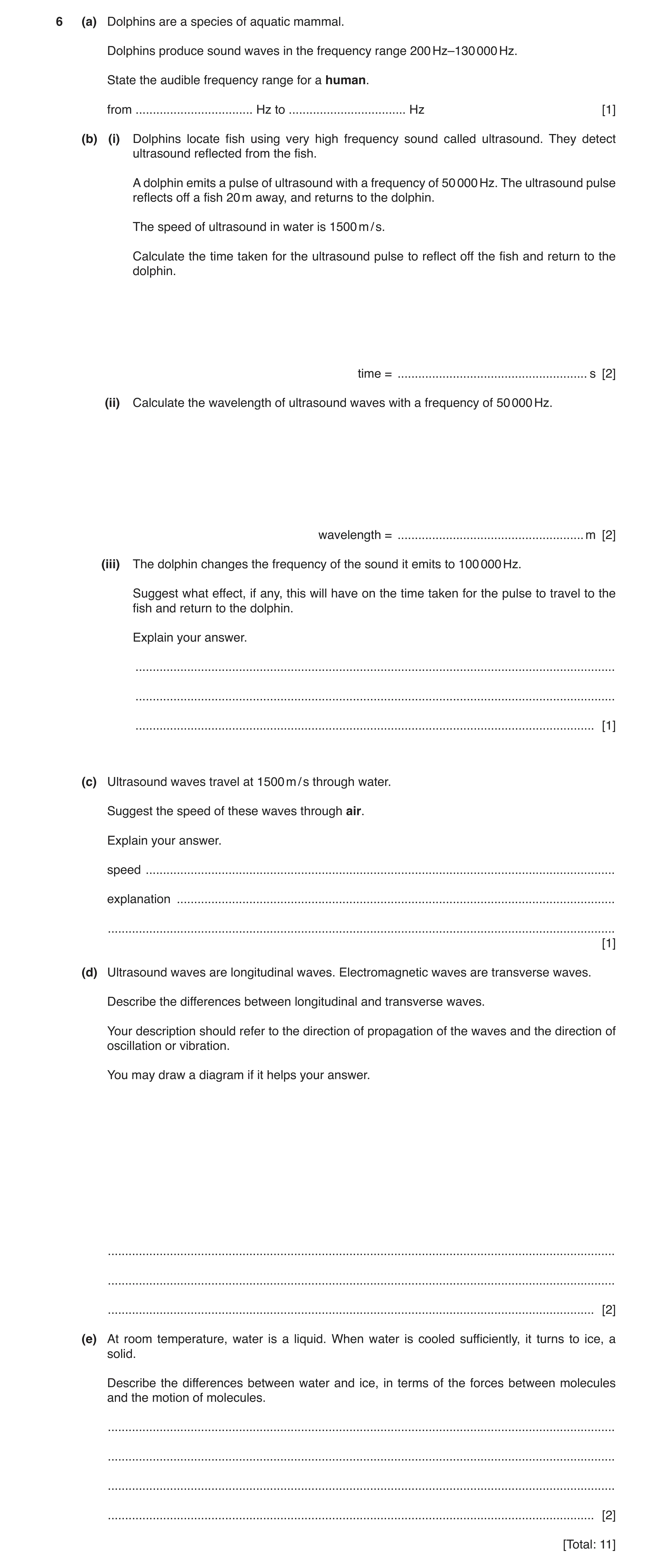
6 (a) Dolphins are a species of aquatic mammal. Dolphins produce sound waves in the frequency range 200 Hz–130 000 Hz. State the audible frequency range for a human. from … Hz to … Hz [1] (b) (i) Dolphins locate fish using very high frequency sound called ultrasound. They detect ultrasound reflected from the fish. A dolphin emits a pulse of ultrasound with a frequency of 50 000 Hz. The ultrasound pulse reflects off a fish 20 m away, and returns to the dolphin. The speed of ultrasound in water is 1500 m / s. Calculate the time taken for the ultrasound pulse to reflect off the fish and return to the dolphin. time = … s [2] (ii) Calculate the wavelength of ultrasound waves with a frequency of 50 000 Hz. wavelength = … m [2] (iii) The dolphin changes the frequency of the sound it emits to 100 000 Hz. Suggest what effect, if any, this will have on the time taken for the pulse to travel to the fish and return to the dolphin. Explain your answer. … … … [1] (c) Ultrasound waves travel at 1500 m / s through water. Suggest the speed of these waves through air. Explain your answer. speed … explanation … … [1] (d) Ultrasound waves are longitudinal waves. Electromagnetic waves are transverse waves. Describe the differences between longitudinal and transverse waves. Your description should refer to the direction of propagation of the waves and the direction of oscillation or vibration. You may draw a diagram if it helps your answer. … … … [2] (e) At room temperature, water is a liquid. When water is cooled sufficiently, it turns to ice, a solid. Describe the differences between water and ice, in terms of the forces between molecules and the motion of molecules. … … … … [2] [Total: 11]
11 marks
Mark scheme: 6(a) 20 (Hz) to 20 000 (Hz) ; 1 6(b)(i) (time =) distance / speed or 40 / 1500 ; = 0.027 (s) ; 2 6(b)(ii) (wavelength =) velocity / frequency or 1500 / 50 000 ; = 0.03 (m) ; 2 6(b)(iii) time remains the same because wave velocity doesn’t change ; 1 6(c) any speed lower than 1500 m / s (no mark) ultrasound waves travel slower in a gas compared to a liquid ; 1 6(d) transverse waves – direction of propagation perpendicular to direction of oscillation / vibration ; longitudinal – direction of propagation parallel to direction of oscillation / vibration ; 2 6(e) stronger forces of attraction between water molecules in ice ; water molecules are able to move / ice molecules can only vibrate ; 2
This question in 0654/42 Oct/Nov 2019
Q11 · An elephant of mass 3800 kg is moving at 0.4 m / s 0654/41 May/June 2020
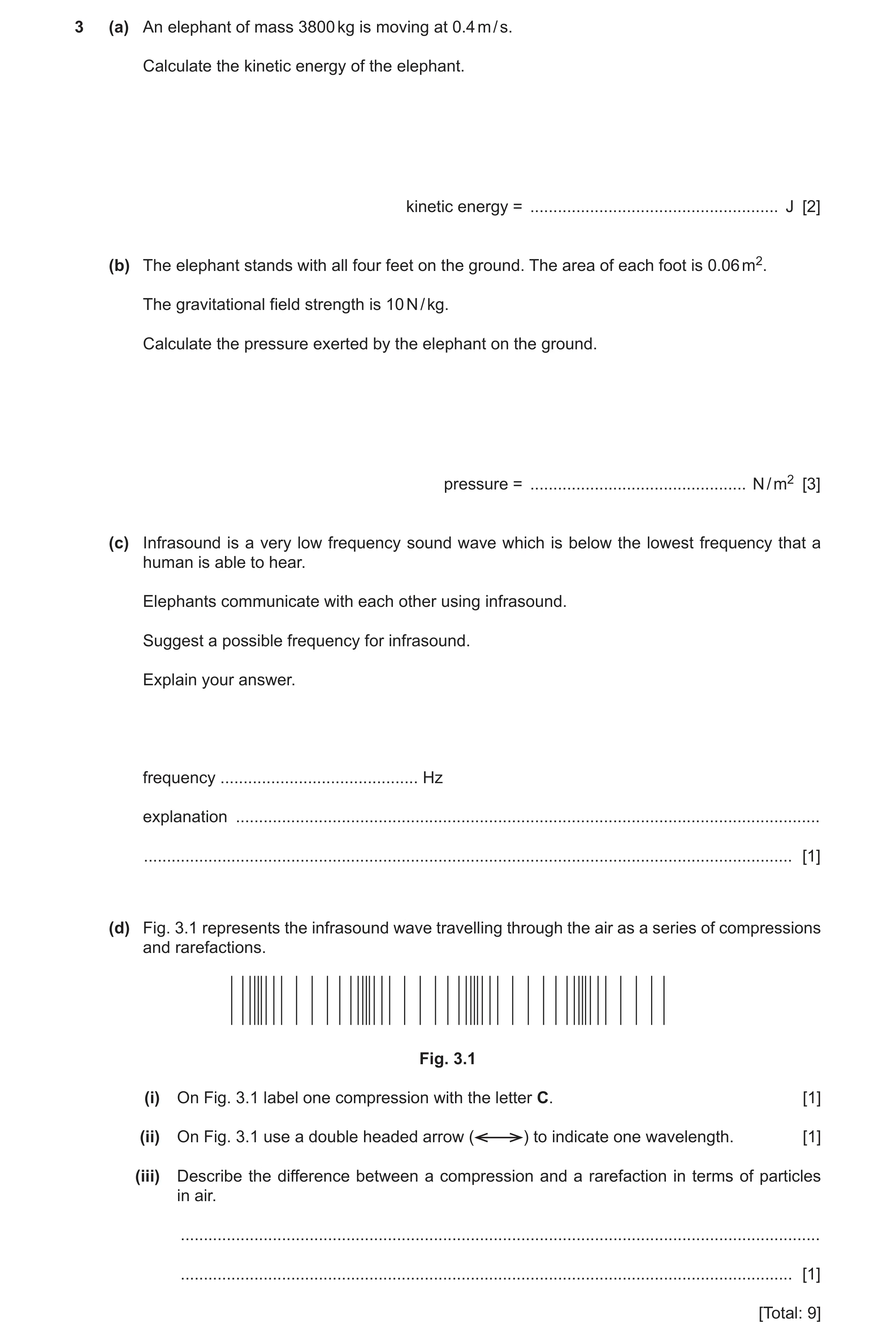
3 (a) An elephant of mass 3800 kg is moving at 0.4 m / s. Calculate the kinetic energy of the elephant. kinetic energy = … J [2] (b) The elephant stands with all four feet on the ground. The area of each foot is 0.06 m2. The gravitational field strength is 10 N / kg. Calculate the pressure exerted by the elephant on the ground. pressure = … N / m2 [3] (c) Infrasound is a very low frequency sound wave which is below the lowest frequency that a human is able to hear. Elephants communicate with each other using infrasound. Suggest a possible frequency for infrasound. Explain your answer. frequency … Hz explanation … … [1] (d) Fig. 3.1 represents the infrasound wave travelling through the air as a series of compressions and rarefactions. Fig. 3.1 (i) On Fig. 3.1 label one compression with the letter C. [1] (ii) On Fig. 3.1 use a double headed arrow ( ) to indicate one wavelength. [1] (iii) Describe the difference between a compression and a rarefaction in terms of particles in air. … … [1] [Total: 9]
9 marks
Mark scheme: 3(a) KE = 1 2 mv2 or KE = 1 2 × 3800 × 0.4 × 0.4; = 300 (J); 3(b) area = 4 × 0.06 (m2) or weight = 38 000 N; pressure = force /area = 38 000 / 0.24; = 160 000 (N/m2); 3 3(c) value between 0Hz and 20Hz no mark because 20Hz is the minimum audible frequency for a human; 1 3(d)(i) compression correctly labelled with a C; 1 3d(ii) one wavelength correctly shown with a double headed arrow (↔); 1 Question Answer Marks 3(d)(iii) (region of) high pressure / low pressure or particles closer together / further apart; 1
This question in 0654/41 May/June 2020
Q12 · A horse of mass 450 kg accelerates constantly from rest and reaches a maximum speed of 9… 0654/42 Oct/Nov 2020
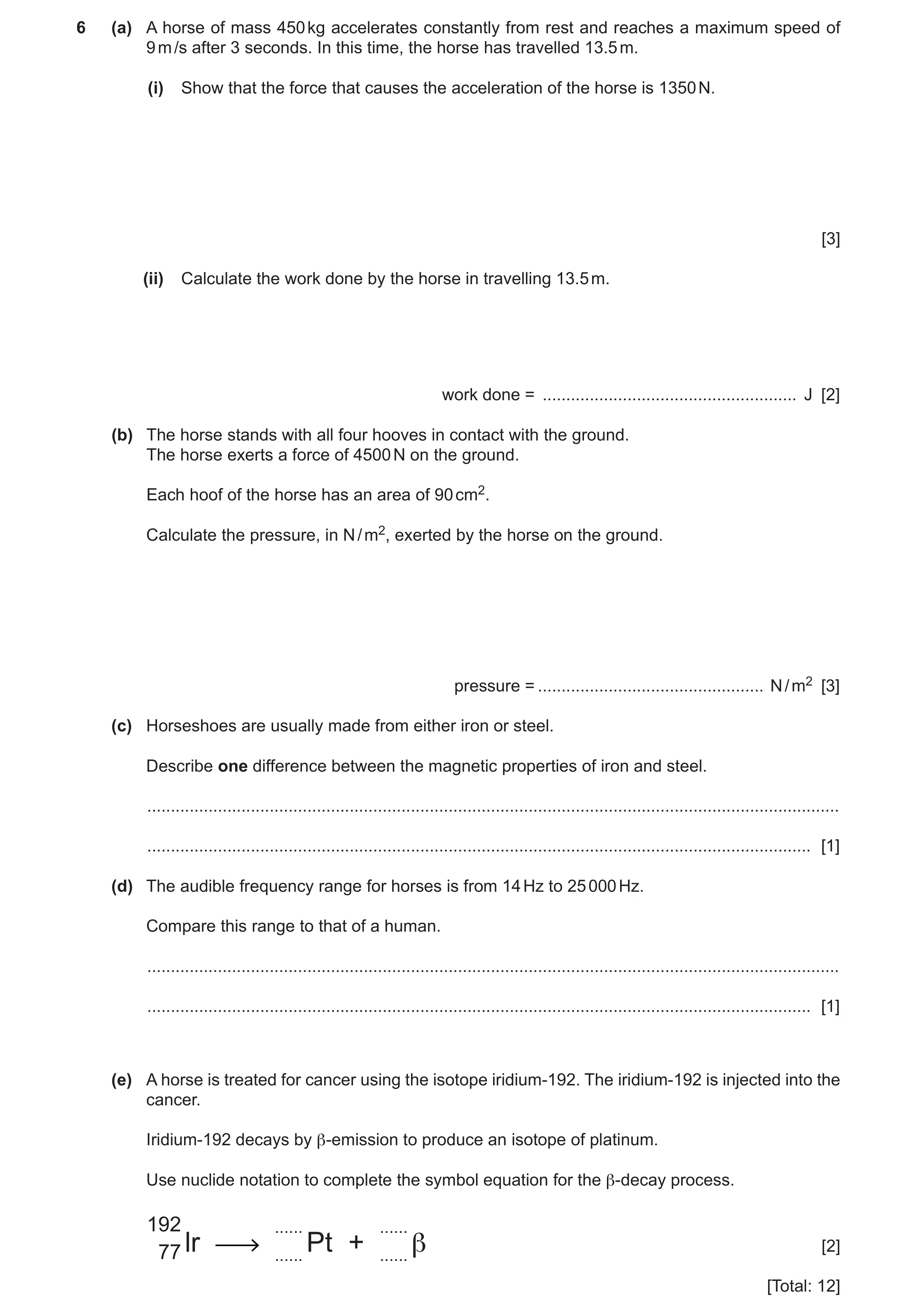
6 (a) A horse of mass 450 kg accelerates constantly from rest and reaches a maximum speed of 9 m /s after 3 seconds. In this time, the horse has travelled 13.5 m. (i) Show that the force that causes the acceleration of the horse is 1350 N. [3] (ii) Calculate the work done by the horse in travelling 13.5 m. work done = … J [2] (b) The horse stands with all four hooves in contact with the ground. The horse exerts a force of 4500 N on the ground. Each hoof of the horse has an area of 90 cm2. Calculate the pressure, in N / m2, exerted by the horse on the ground. pressure = … N / m2 [3] (c) Horseshoes are usually made from either iron or steel. Describe one difference between the magnetic properties of iron and steel. … … [1] (d) The audible frequency range for horses is from 14 Hz to 25 000 Hz. Compare this range to that of a human. … … [1] (e) A horse is treated for cancer using the isotope iridium-192. The iridium-192 is injected into the cancer. Iridium-192 decays by β-emission to produce an isotope of platinum. Use nuclide notation to complete the symbol equation for the β-decay process. 192 … … lr Pt + β [2] 77 … … [Total: 12]
12 marks
Mark scheme: 6(a)(i) acceleration = 9/3 = 3 m/s2 ; force = mass × acceleration ; working or 3 × 450 (= 1350 N) ; 6(a)(ii) work done = force × distance / 1350 × 13.5 ; = 18 200 (J) ; 2 6(b) 90 × 4 = 360 (cm2) = 0.036 m2 ; pressure = force / area or 4500 / 0.036 ; pressure = 125 000 (N/m2) ; 3 6(c) iron, magnetises / loses magnetism, quicker ; steel, magnetises / loses magnetism, slower ; max 1 1 6(d) humans have smaller audible range ; 1 6(e) − → + β 192 192 0 77 78 1 r Pt I ;; 2
This question in 0654/42 Oct/Nov 2020
Q13 · A student plans to measure the speed of sound through wood 0654/41 May/June 2021
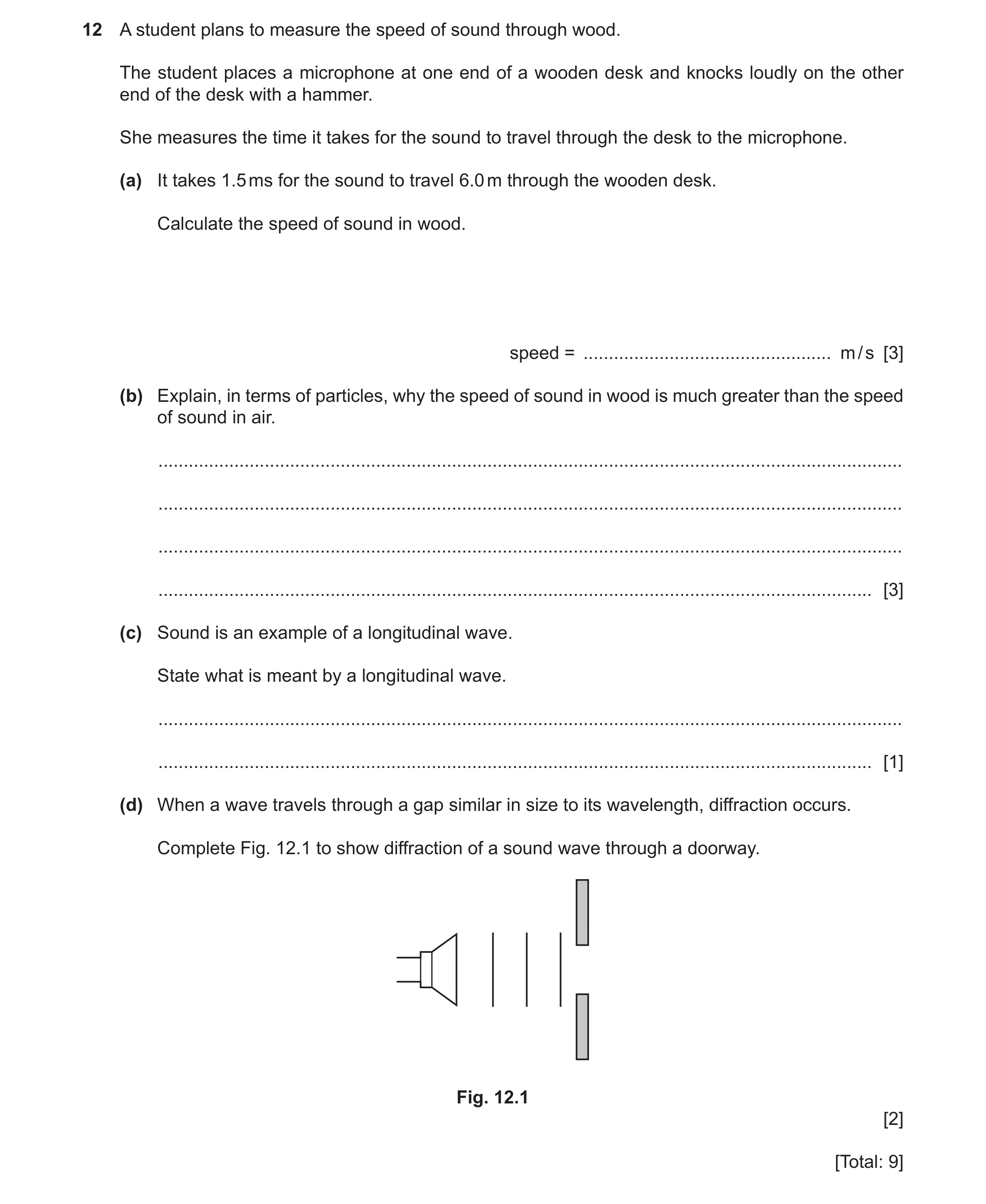
12 A student plans to measure the speed of sound through wood. The student places a microphone at one end of a wooden desk and knocks loudly on the other end of the desk with a hammer. She measures the time it takes for the sound to travel through the desk to the microphone. (a) It takes 1.5 ms for the sound to travel 6.0 m through the wooden desk. Calculate the speed of sound in wood. speed = … m / s [3] (b) Explain, in terms of particles, why the speed of sound in wood is much greater than the speed of sound in air. … … … … [3] (c) Sound is an example of a longitudinal wave. State what is meant by a longitudinal wave. … … [1] (d) When a wave travels through a gap similar in size to its wavelength, diffraction occurs. Complete Fig. 12.1 to show diffraction of a sound wave through a doorway. Fig. 12.1 [2] [Total: 9]
9 marks
Mark scheme: 12(a) 0.0015 or 1.5 × 10⁻³ ; (v =) d / t or 6 / 1.5 × 10⁻³ ; 4000 (m / s) ; 12(b) wood is a solid / air is a gas; particles in a solid are close together / touching / ORA ; vibrations are transferred more quickly in a solid / ORA ; 3 12(c) vibrations / oscillations are, parallel to / in the same direction as, the direction of, energy transfer / wave travel ; 1 12(d) spreading out of waves ; circular waves shown on right hand side of boundary ; 2
This question in 0654/41 May/June 2021
Q14 · Meteoroids are lumps of rock which travel through space 0654/43 Oct/Nov 2023
3 Meteoroids are lumps of rock which travel through space. (a) During its journey through space, a meteoroid travels at a constant speed of 25 000 m / s. (i) Calculate the time taken for the meteoroid to travel 1000 m. time = … s [2] (ii) Fig. 3.1 shows a speed–time graph for the meteoroid as it enters the atmosphere of a planet. 30 000 25 000 20 000 speed 15 000 m / s 10 000 5 000 0 0.0 1.0 2.0 3.0 4.0 5.0 6.0 7.0 8.0 time / seconds Fig. 3.1 Describe the motion of the meteoroid shown in Fig. 3.1. … … … … … [3] (b) When the meteoroid lands on Earth, it is called a meteorite. A small meteorite has a mass of 1720 g and a volume of 200 cm3. Calculate the density of the meteorite. density = … g / cm3 [2] (c) When meteorites land on Earth, they produce very loud sound waves that travel through all materials including air, solid rock and liquid water. (i) Describe how sound waves are transmitted in air. … … [1] (ii) Draw one line from each material to show the average speed of sound in that material. air 340 m / s rock 1500 m / s water 4200 m / s [1] [Total: 9]
9 marks
Mark scheme: 3(a)(i) (t =) d / v or 1000 / 25 000 ; (in any form) 2 (t =) 0.04 (s) ; 3(a)(ii) 0–3 s / initially constant speed ; 3 then slows down / decelerates / negative acceleration / non-constant deceleration ; (at 7 s) it stops / hits the ground / speed becomes 0 ; 3(b) (density =) mass / volume or 1720 / 200 (in any form) ; 2 8.6(0) (g / cm3) ; 3(c)(i) compressions and rarefactions ; 1 3(c)(ii) 1 air 340 m / s rock 1500 m / s water 4200 m / s all correct ;
This question in 0654/43 Oct/Nov 2023
Q15 · A wind turbine used to generate electricity 0654/42 Oct/Nov 2024
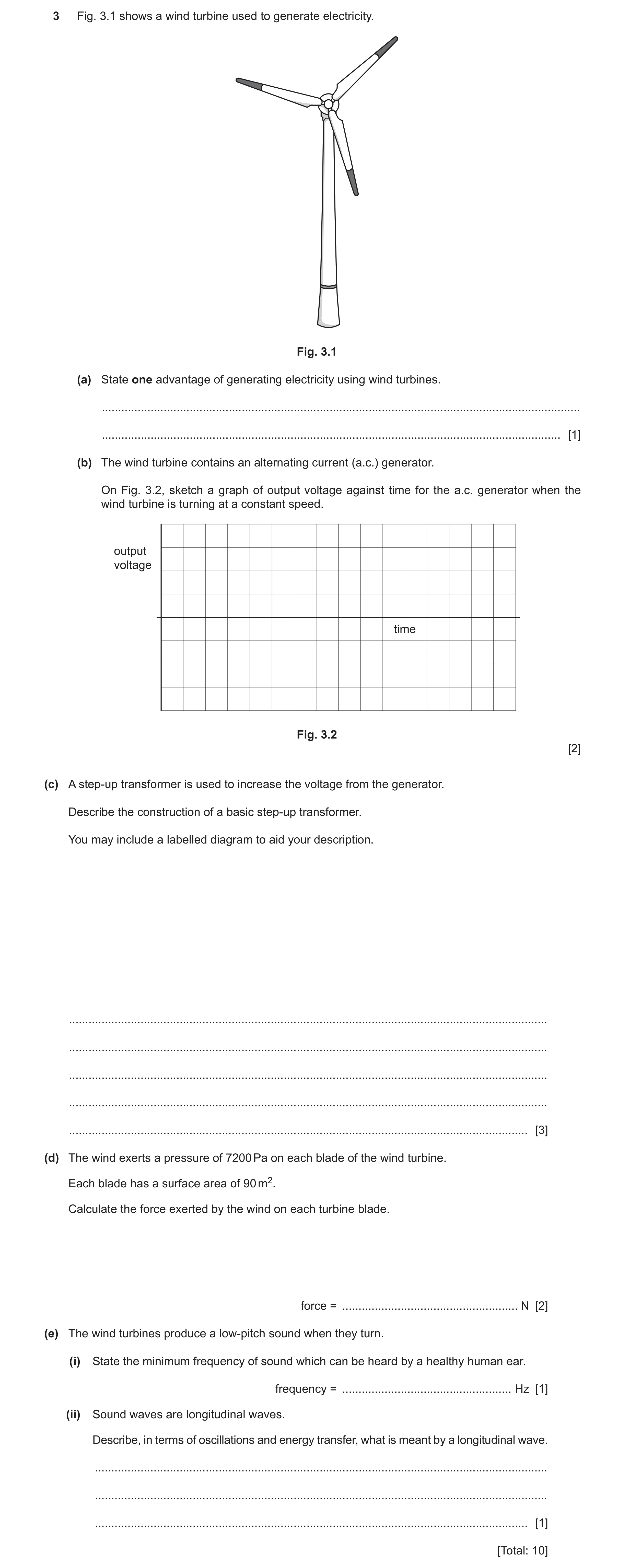
3 Fig. 3.1 shows a wind turbine used to generate electricity. Fig. 3.1 (a) State one advantage of generating electricity using wind turbines. … … [1] (b) The wind turbine contains an alternating current (a.c.) generator. On Fig. 3.2, sketch a graph of output voltage against time for the a.c. generator when the wind turbine is turning at a constant speed. output voltage time Fig. 3.2 [2] (c) A step-up transformer is used to increase the voltage from the generator. Describe the construction of a basic step-up transformer. You may include a labelled diagram to aid your description. … … … … … [3] (d) The wind exerts a pressure of 7200 Pa on each blade of the wind turbine. Each blade has a surface area of 90 m2. Calculate the force exerted by the wind on each turbine blade. force = … N [2] (e) The wind turbines produce a low-pitch sound when they turn. (i) State the minimum frequency of sound which can be heard by a healthy human ear. frequency = … Hz [1] (ii) Sound waves are longitudinal waves. Describe, in terms of oscillations and energy transfer, what is meant by a longitudinal wave. … … … [1] [Total: 10]
10 marks
Mark scheme: 3(a) does not release CO2 / does not release greenhouse gases / does not contribute to global warming / climate change / no 1 fuel costs / renewable / AVP ; 3(b) sinusoidal waveform ; 2 constant time period and amplitude ; 3(c) (soft) iron core ; 3 two coils wrapped around the same core ; number of turns on primary less than secondary / number of turns on secondary more than primary ; 3(d) evidence of F = P A or 7200 90 ; 2 650 000 (N) ; 3(e)(i) 20 (Hz) ; 1 3(e)(ii) (direction of) oscillations are parallel to direction of energy transfer ; 1
This question in 0654/42 Oct/Nov 2024
Q16 · A car suspension system 0654/43 Oct/Nov 2024
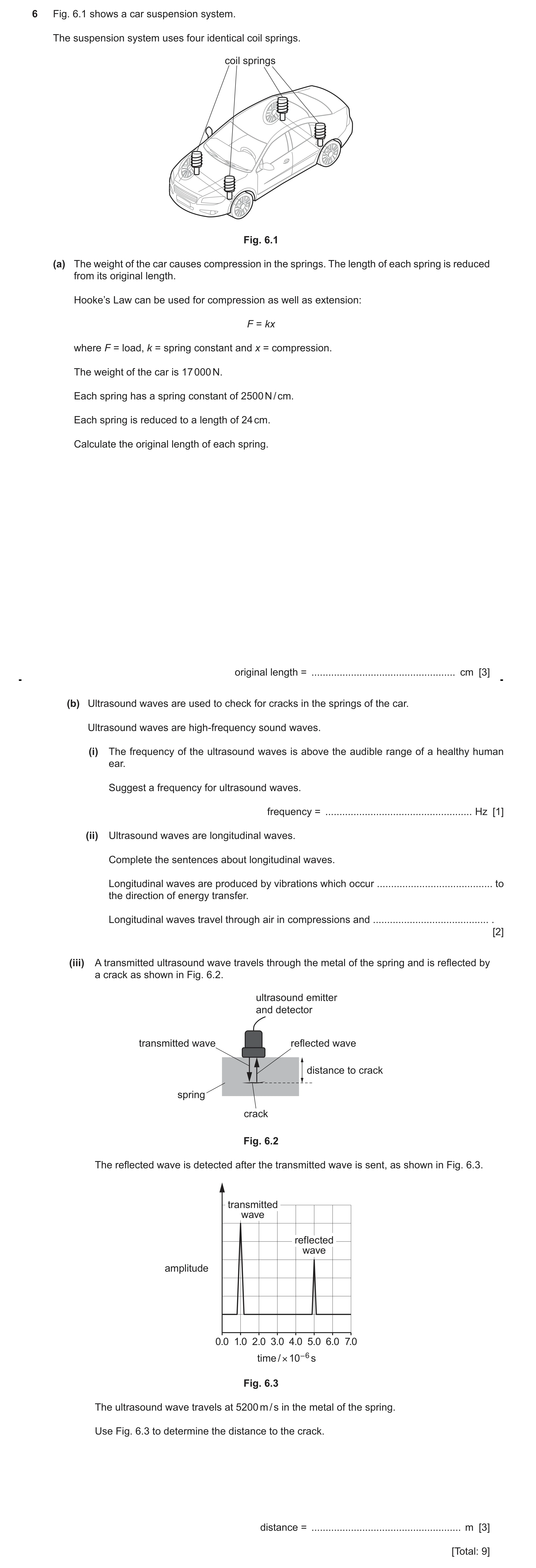
6 Fig. 6.1 shows a car suspension system. The suspension system uses four identical coil springs. coil springs Fig. 6.1 (a) The weight of the car causes compression in the springs. The length of each spring is reduced from its original length. Hooke’s Law can be used for compression as well as extension: F = kx where F = load, k = spring constant and x = compression. The weight of the car is 17 000 N. Each spring has a spring constant of 2500 N / cm. Each spring is reduced to a length of 24 cm. Calculate the original length of each spring. original length = … cm [3] (b) Ultrasound waves are used to check for cracks in the springs of the car. Ultrasound waves are high-frequency sound waves. (i) The frequency of the ultrasound waves is above the audible range of a healthy human ear. Suggest a frequency for ultrasound waves. frequency = … Hz [1] (ii) Ultrasound waves are longitudinal waves. Complete the sentences about longitudinal waves. Longitudinal waves are produced by vibrations which occur … to the direction of energy transfer. Longitudinal waves travel through air in compressions and … . [2] (iii) A transmitted ultrasound wave travels through the metal of the spring and is reflected by a crack as shown in Fig. 6.2. ultrasound emitter and detector transmitted wave reflected wave distance to crack spring crack Fig. 6.2 The reflected wave is detected after the transmitted wave is sent, as shown in Fig. 6.3. transmitted wave reflected wave amplitude 0.0 1.0 2.0 3.0 4.0 5.0 6.0 7.0 time / × 10–6 s Fig. 6.3 The ultrasound wave travels at 5200 m / s in the metal of the spring. Use Fig. 6.3 to determine the distance to the crack. distance = … m [3] [Total: 9]
9 marks
Mark scheme: 6(a) (force per spring) 17000 ÷ 4 or 4250 ; 3 (calculation of x) 1.7 (cm) ; (original length) 25.7 (cm) ; 6(b)(i) 20 000 (Hz): 1 6(b)(ii) parallel ; 2 rarefactions ; 6(b)(iii) (t =) 2.0 10–6 (s) ; 3 (d =) v t or 5200 2.0 10–6 ; (d =) 0.010(4) (m) ;
This question in 0654/43 Oct/Nov 2024
Q17 · Sound travels at different speeds in solids, liquids and gases 0654/42 Feb/March 2025
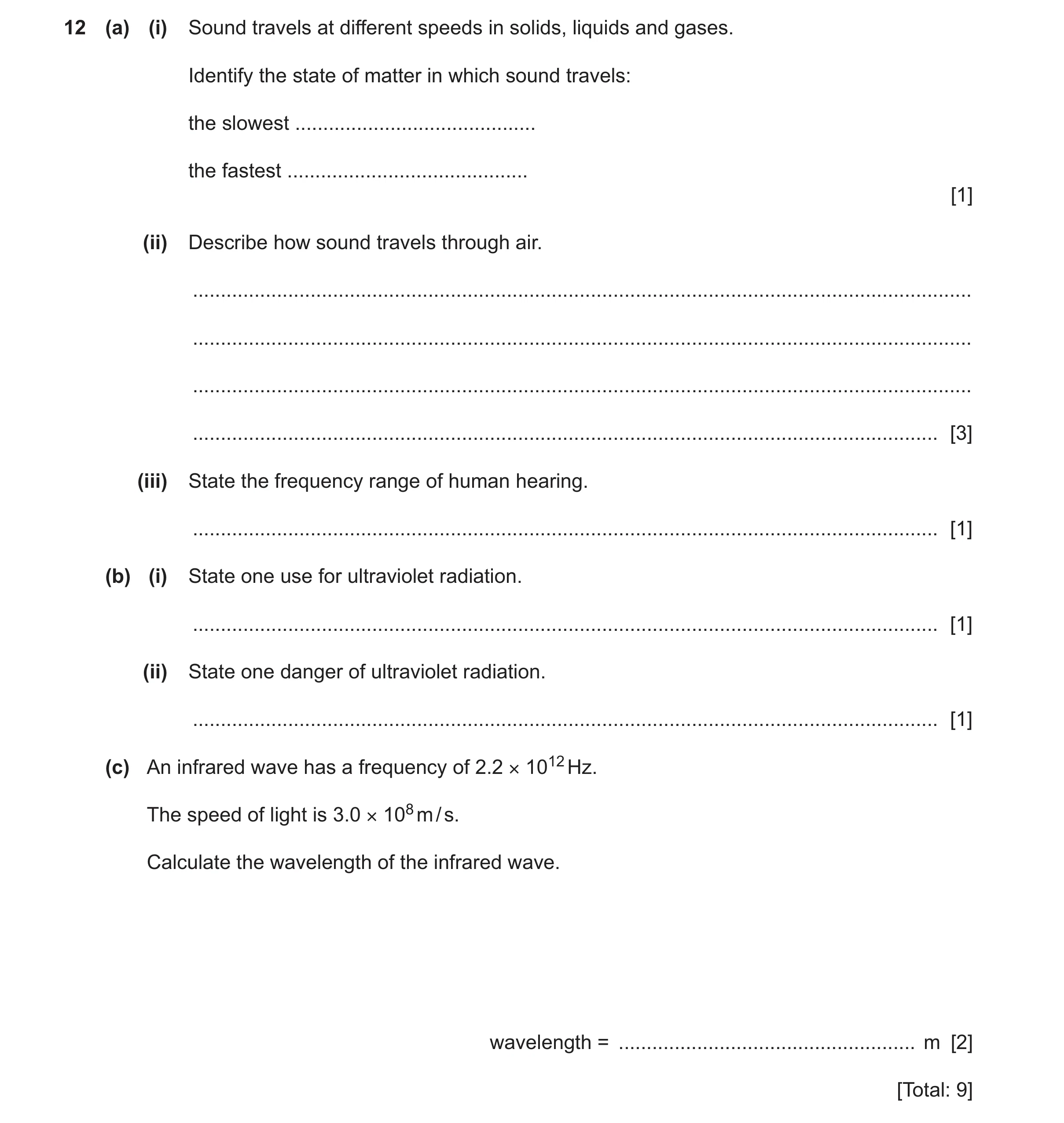
12 (a) (i) Sound travels at different speeds in solids, liquids and gases. Identify the state of matter in which sound travels: the slowest … the fastest … [1] (ii) Describe how sound travels through air. … … … … [3] (iii) State the frequency range of human hearing. … [1] (b) (i) State one use for ultraviolet radiation. … [1] (ii) State one danger of ultraviolet radiation. … [1] (c) An infrared wave has a frequency of 2.2 × 10¹² Hz. The speed of light is 3.0 × 10⁸ m / s. Calculate the wavelength of the infrared wave. wavelength = … m [2] [Total: 9]
9 marks
Mark scheme: 12(a)(i) gases and solid ; 1 12(a)(ii) any three from: 3 vibrations (vibrations) parallel to direction of energy transfer in a series of compressions and rarefactions AVP ; ; ; 12(a)(iii) 20–20 000 Hz ; 1 12(b)(i) detecting fake bank notes ; 1 (AVP) 12(b)(ii) damage to skin cells / damage to eyes / (skin) cancer / cell mutation ; 1 12(c) evidence of v = f or 3 108 = 2.2 1012 ; 2 1.4 10–4 (m) ;
This question in 0654/42 Feb/March 2025
Q18 · A sealed syringe contains a sample of gas as shown in Fig 0654/43 Oct/Nov 2025
10 (a) A sealed syringe contains a sample of gas as shown in Fig. 10.1. syringe 5 sealed tip 10 15 gas 20 cm3 Fig. 10.1 (i) State, in terms of particles, what causes pressure of a gas. … … … [2] (ii) The gas in the syringe is heated. State the change, if any, to the average speed of the particles. … [1] (iii) The volume of the gas is kept constant as it is heated. Explain, in term of particles, why the pressure of the gas increases. … … … [2] (b) (i) State the name of the state of matter in which sound travels fastest. … [1] (ii) Ultrasound waves can be used to produce images of unborn babies inside the human body, as shown in Fig. 10.2. skin ultrasound source and detector unborn baby Fig. 10.2 State the lowest frequency of ultrasound waves. … [1] (iii) A pulse of ultrasound is sent into a person from an ultrasound source at the surface of the skin. Ultrasound travels at 1500 m / s inside human bodies. A reflection arrives back at the surface of the skin after 8.0 × 10⁻⁵ s. Calculate the depth below the surface at which the reflection was caused. depth = … m [3] [Total: 10]
10 marks
Mark scheme: 10(a)(i) collisions ; 2 between particles and walls (of syringe) ; 10(a)(ii) increases ; 1 10(a)(iii) more frequent collisions ; 2 greater force ; 10(b)(i) solid ; 1 10(b)(ii) 20 000 Hz / 20 kHz ; 1 10(b)(iii) speed = distance / time or v =s / t (in any form) or 1500 = distance / 8.0 10–5 ; 3 distance = 0.12 (m) ; depth = 0.060 (m) ;
This question in 0654/43 Oct/Nov 2025
 20 / 30
 21 / 30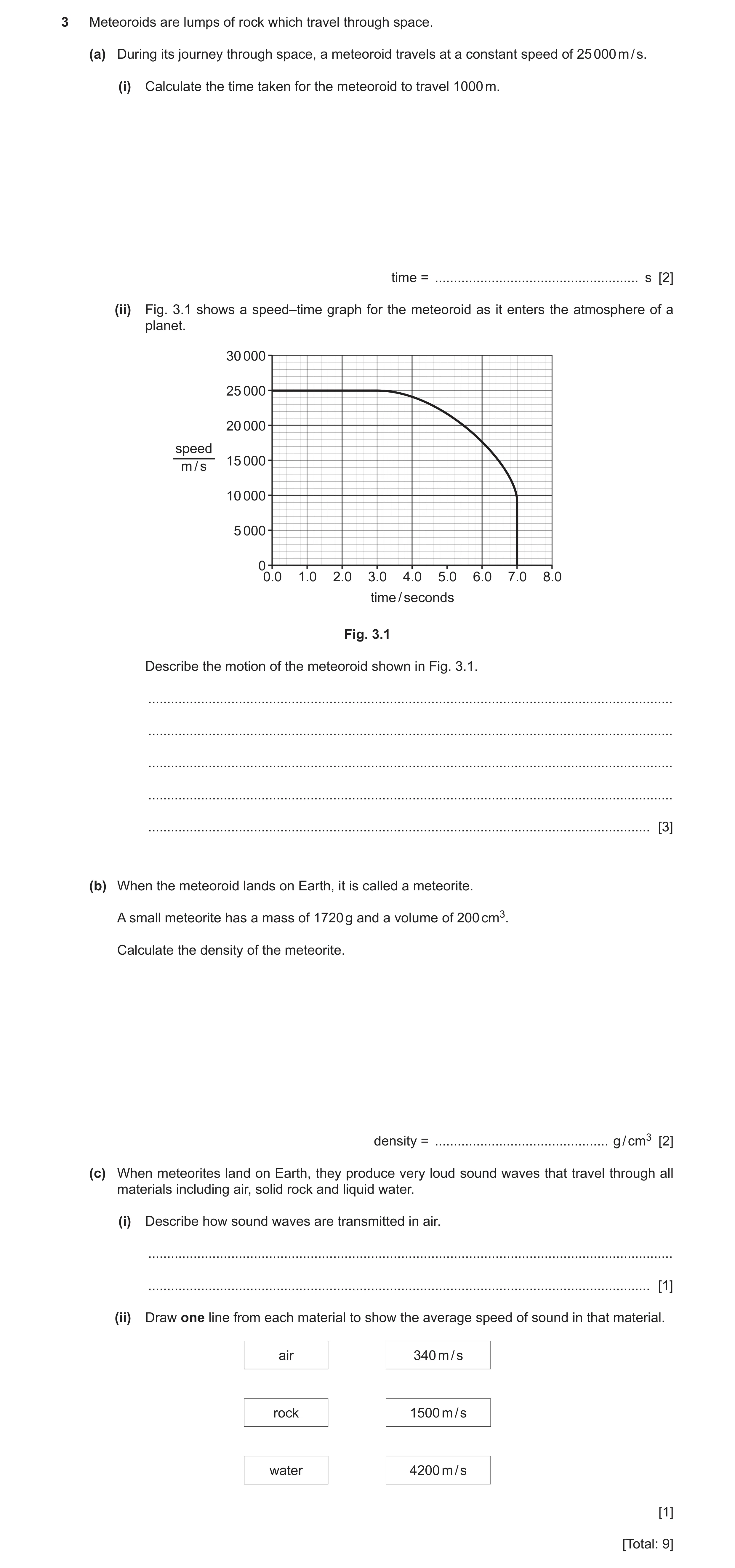
 28 / 30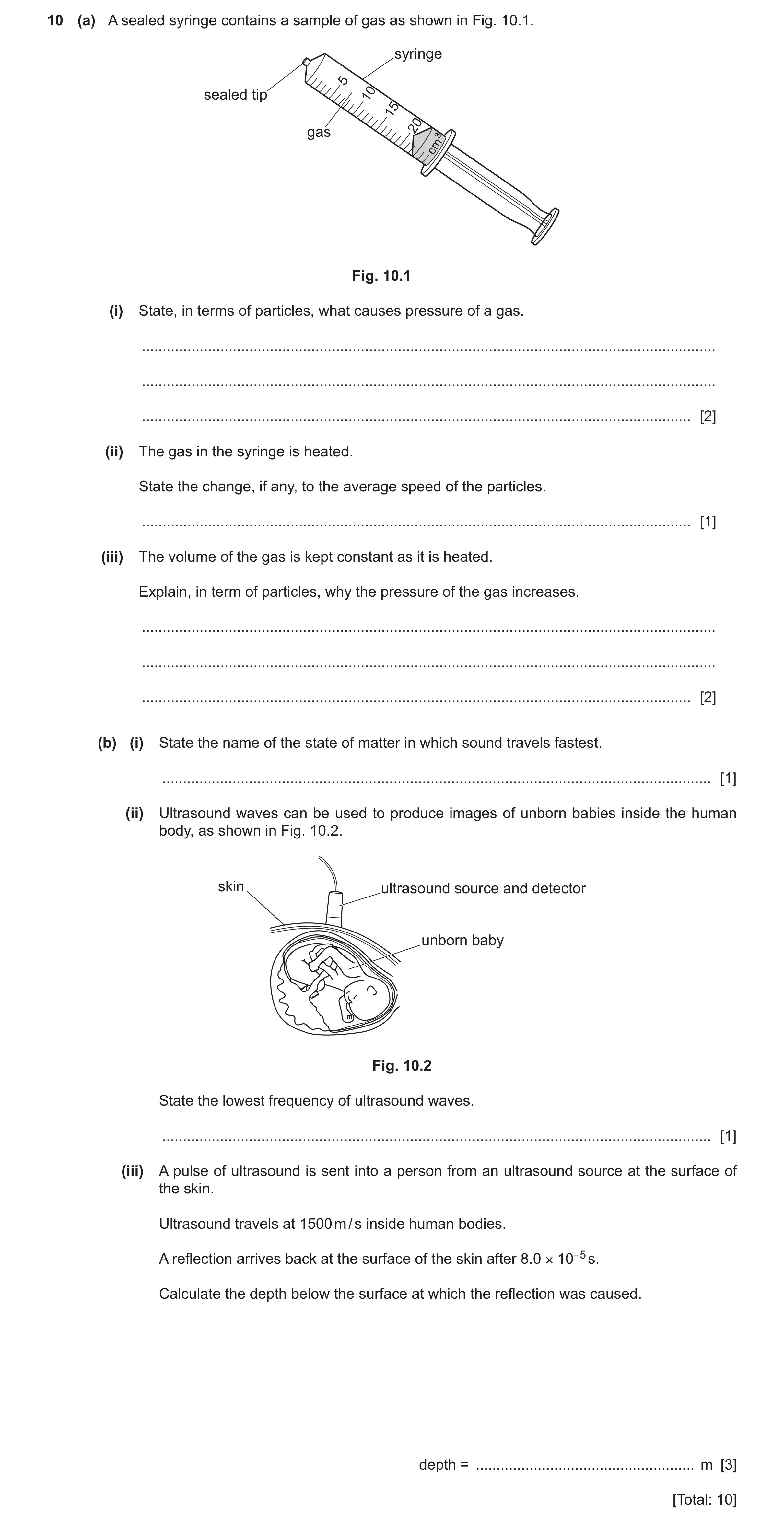
 14
14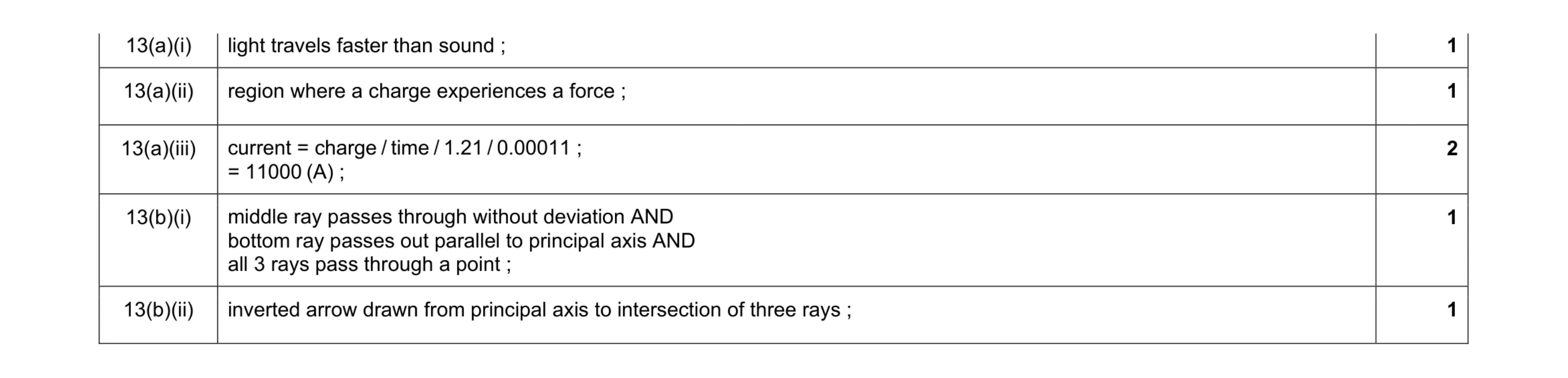 6
6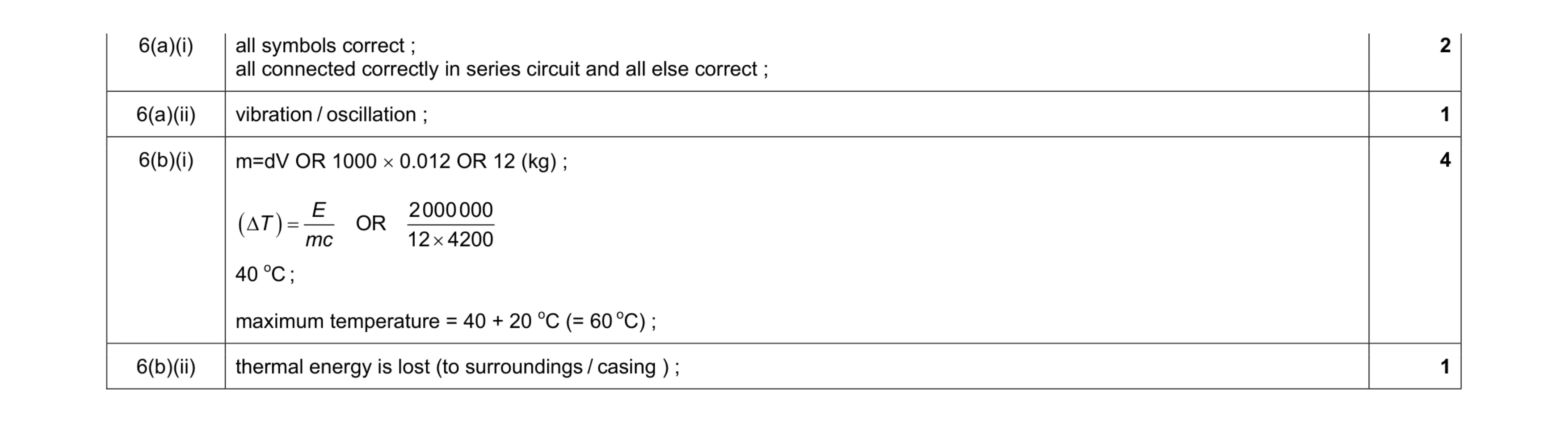 8
8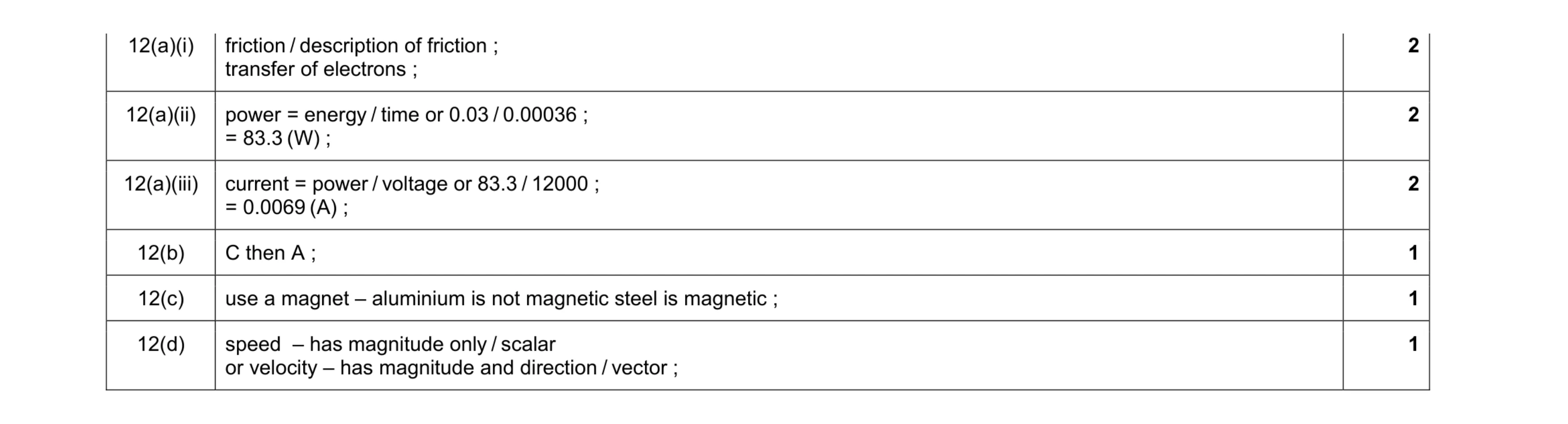 9
9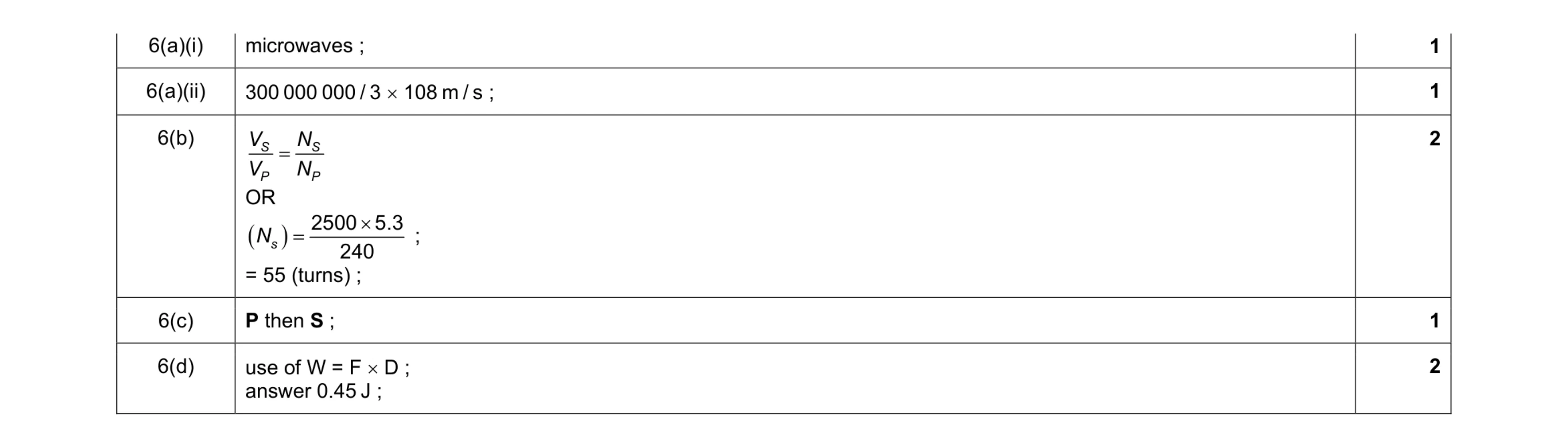 7
7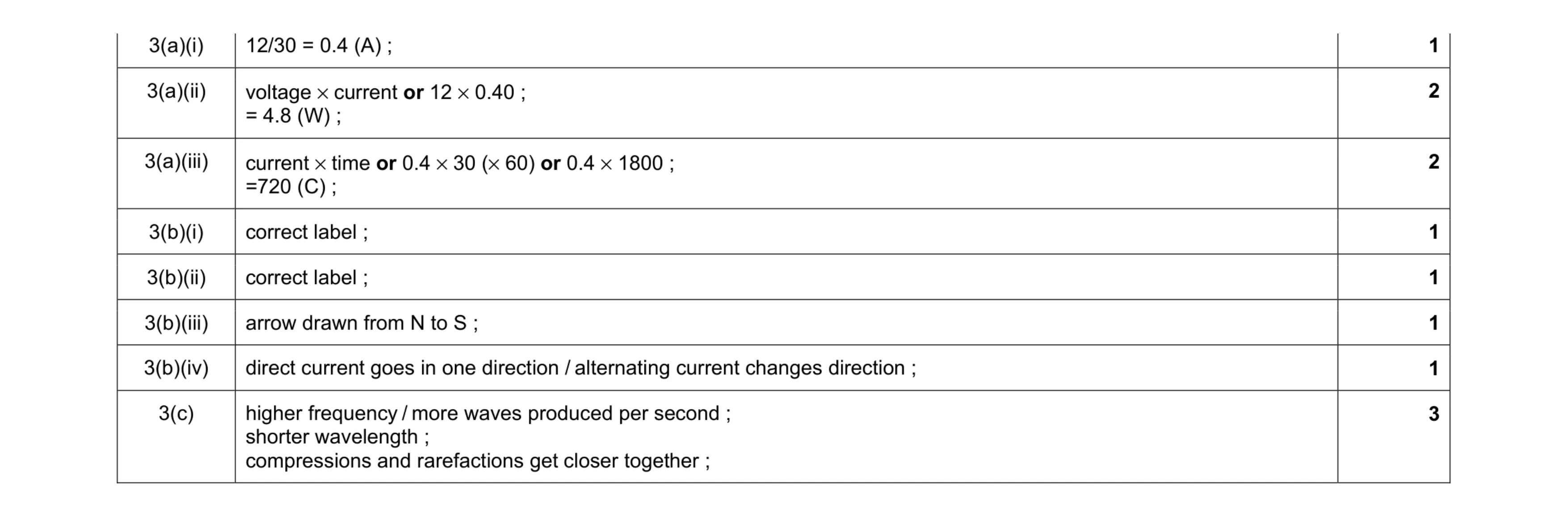 12
12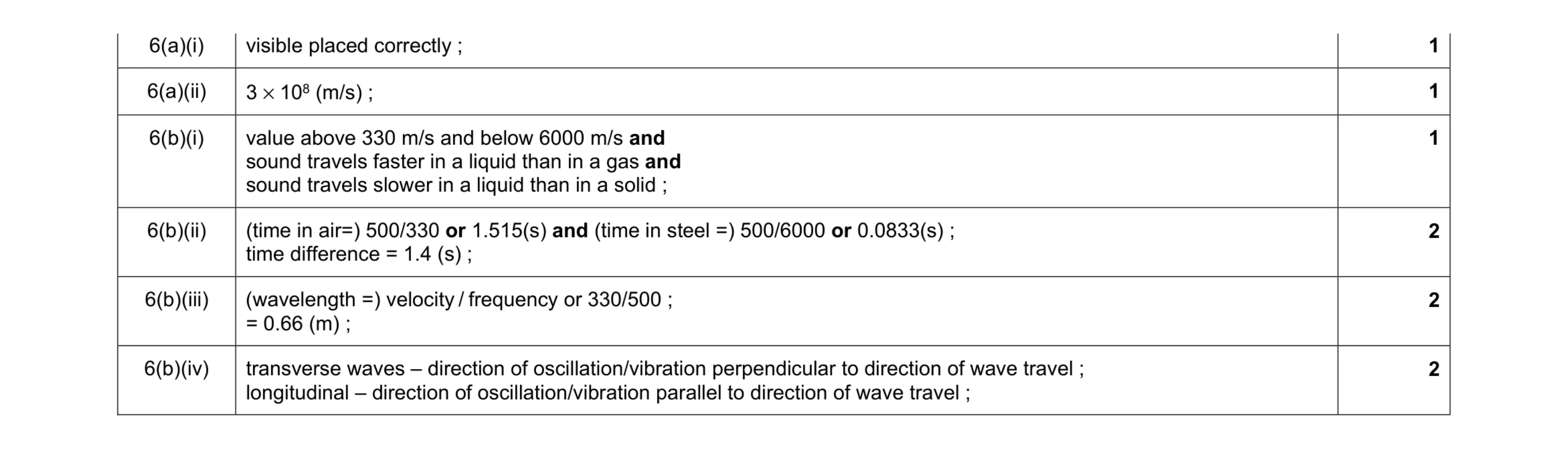 9
9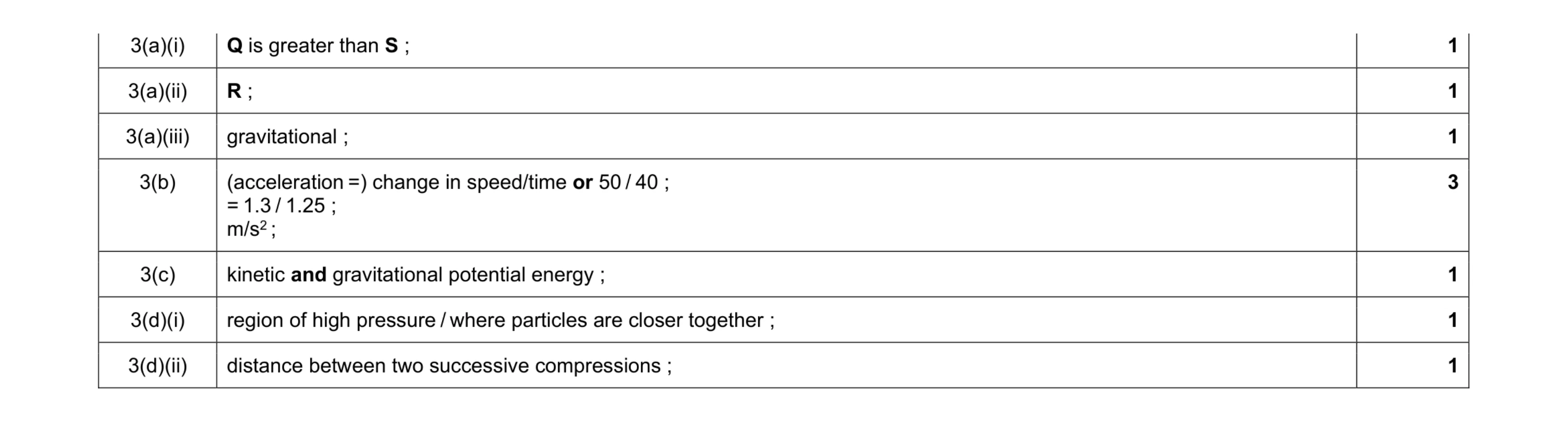 9
9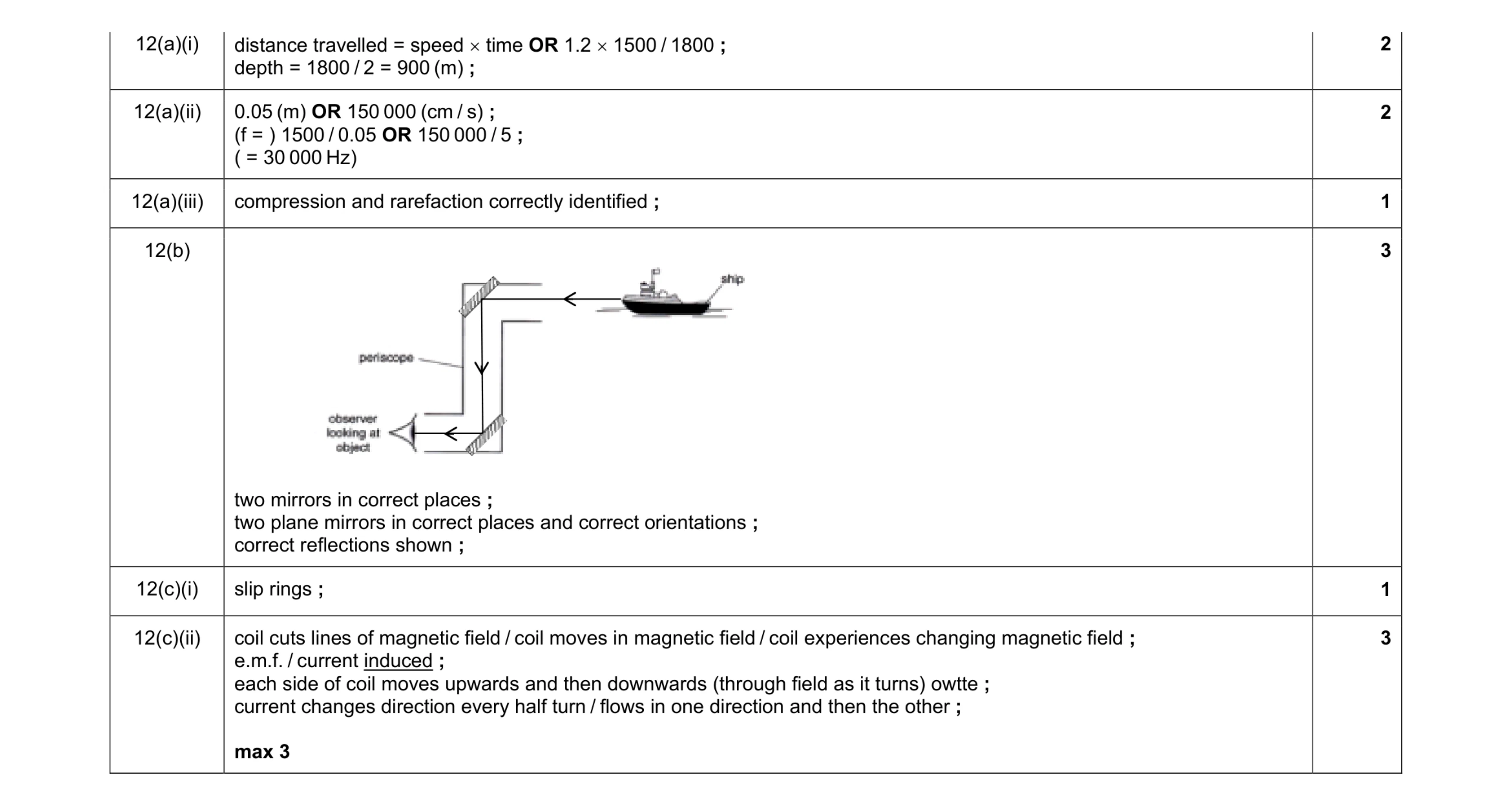 12
12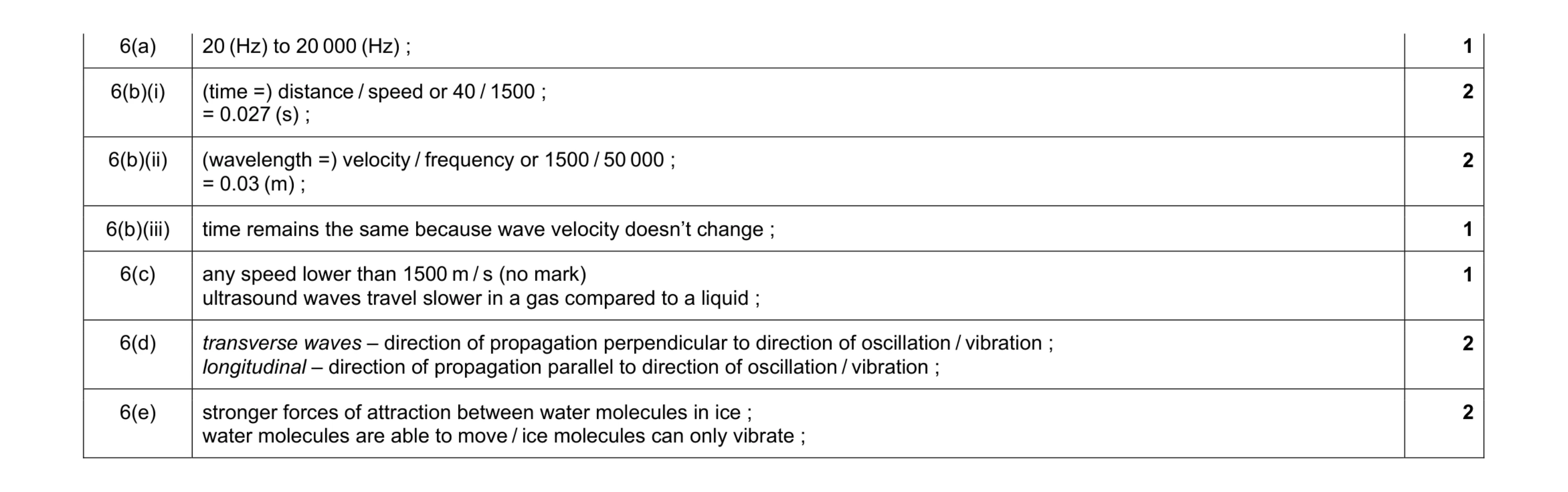 11
11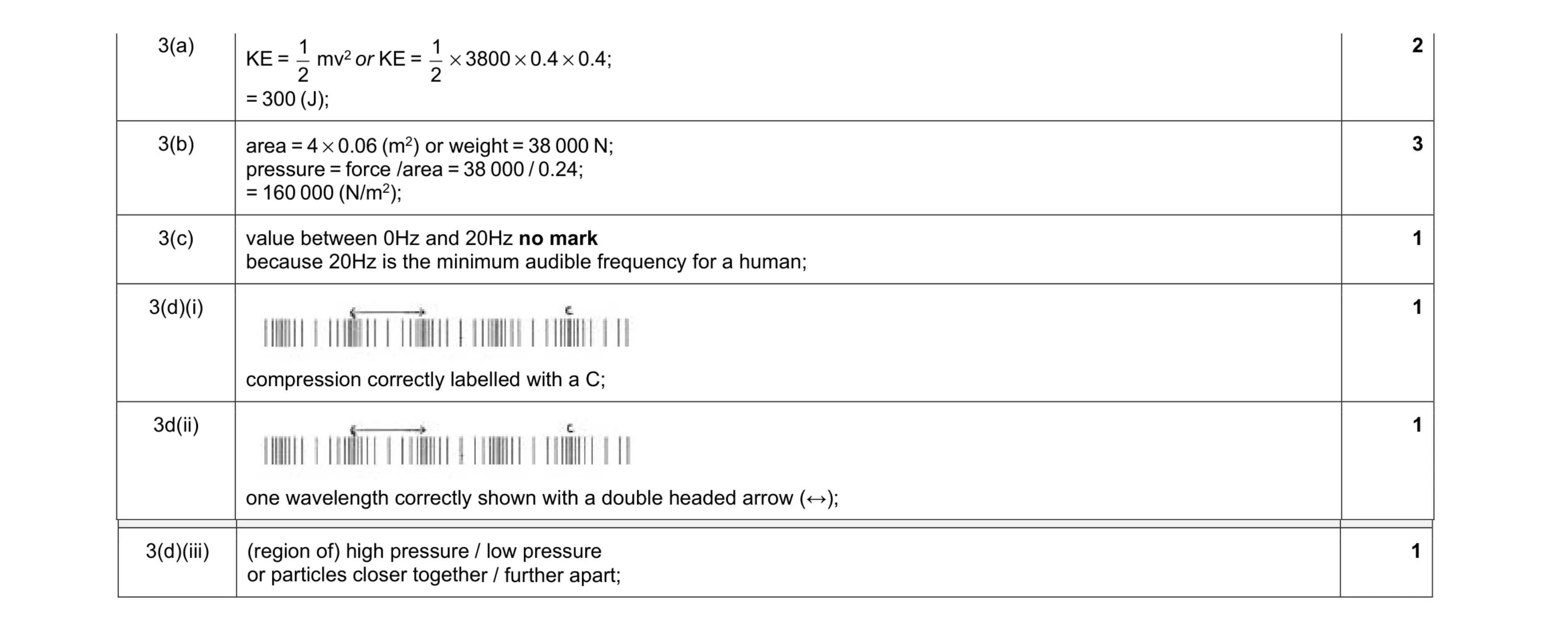 9
9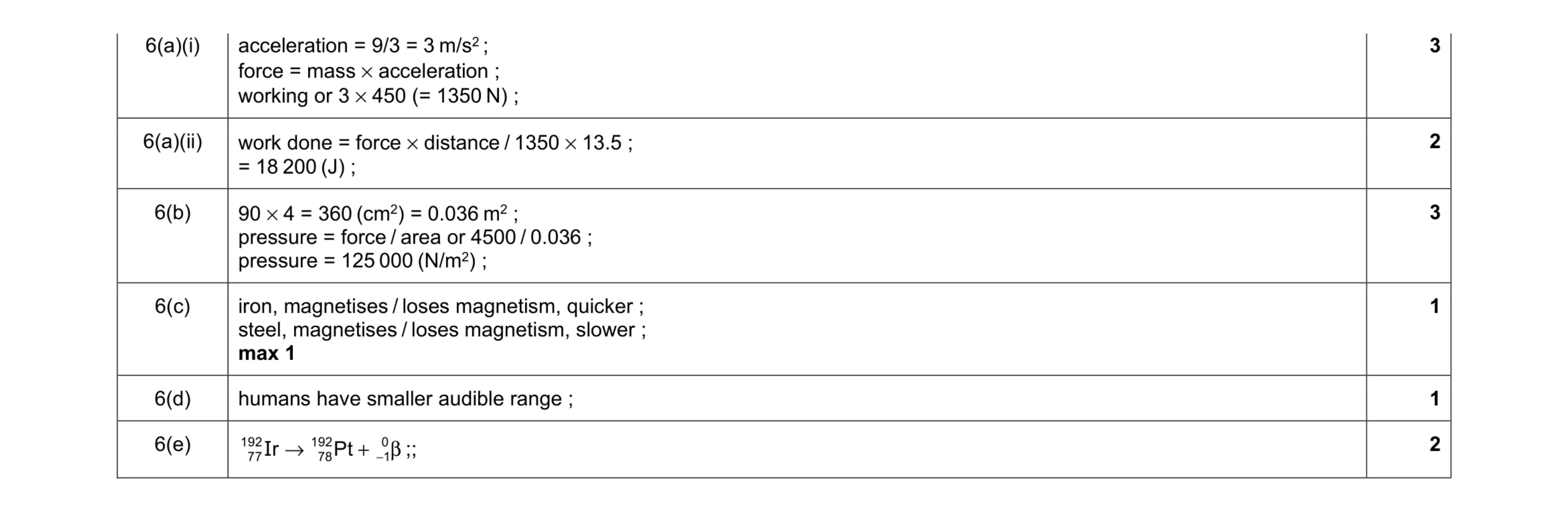 12
12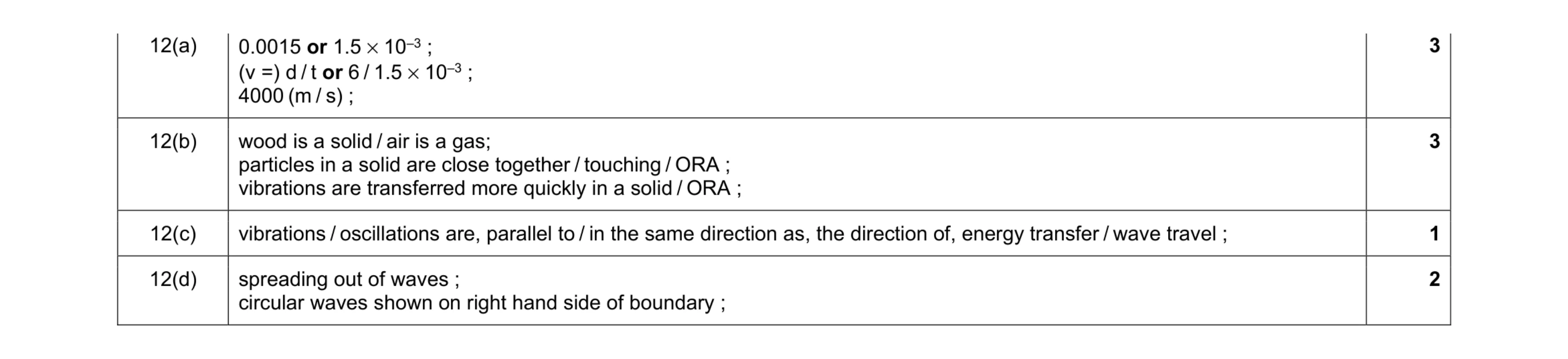 9
9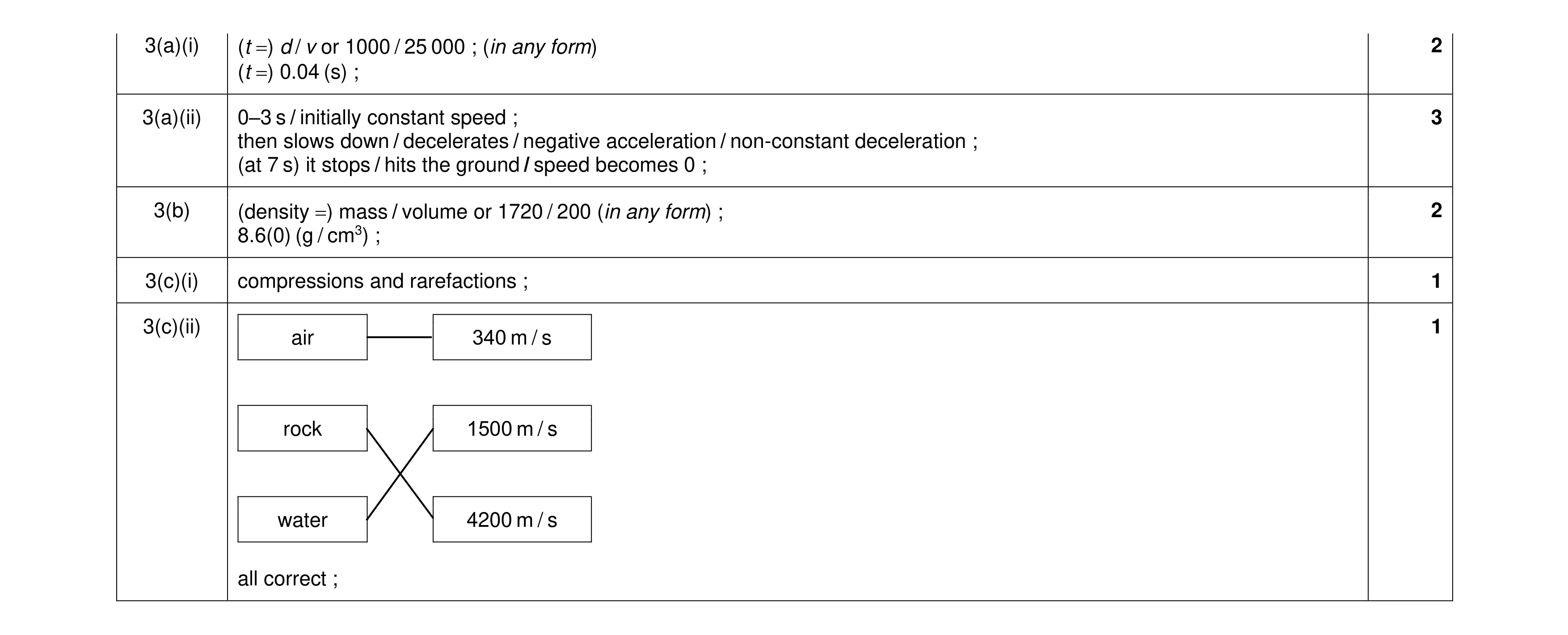 9
9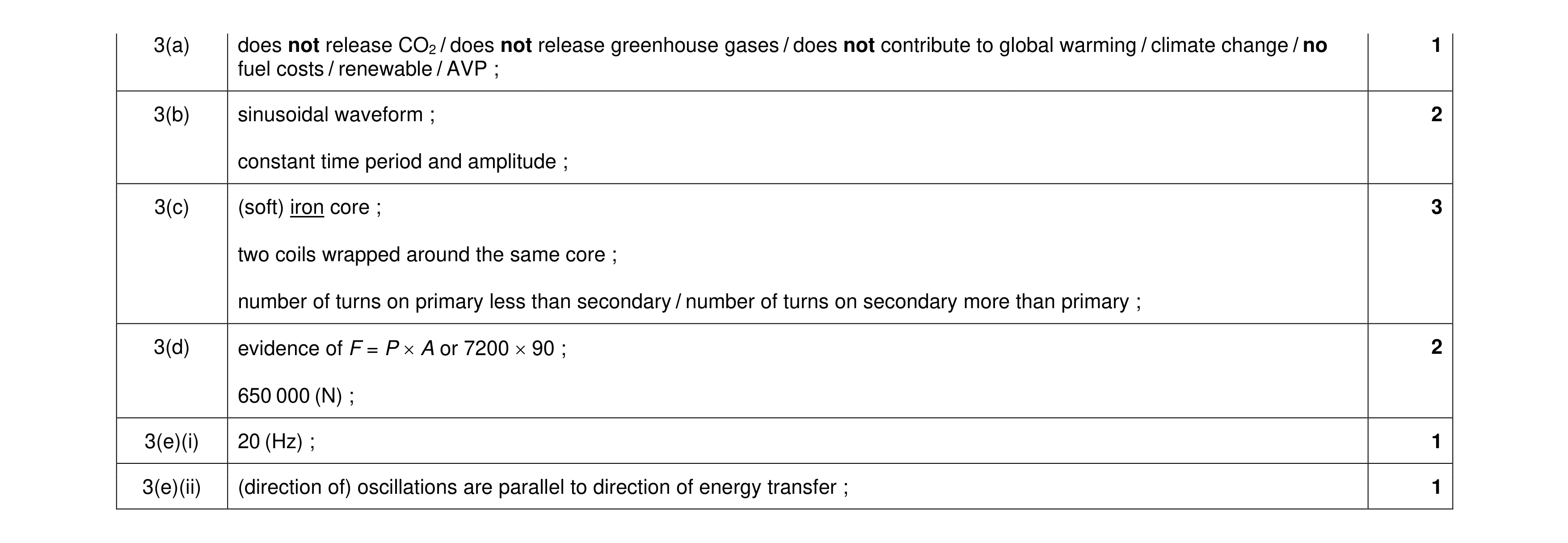 10
10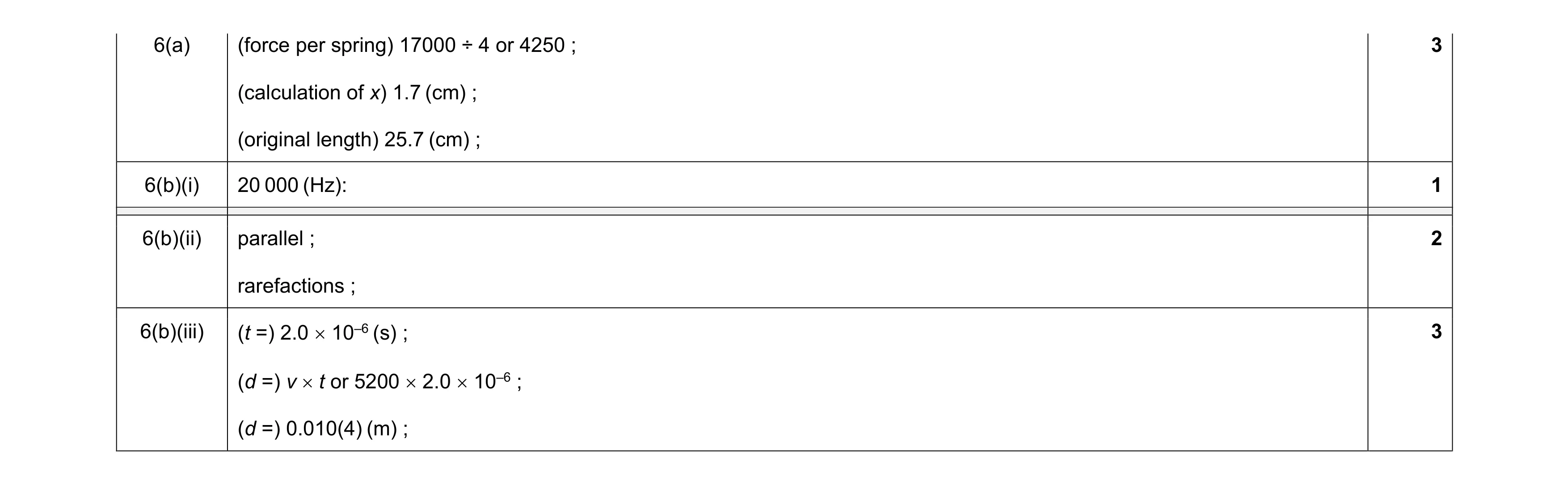 9
9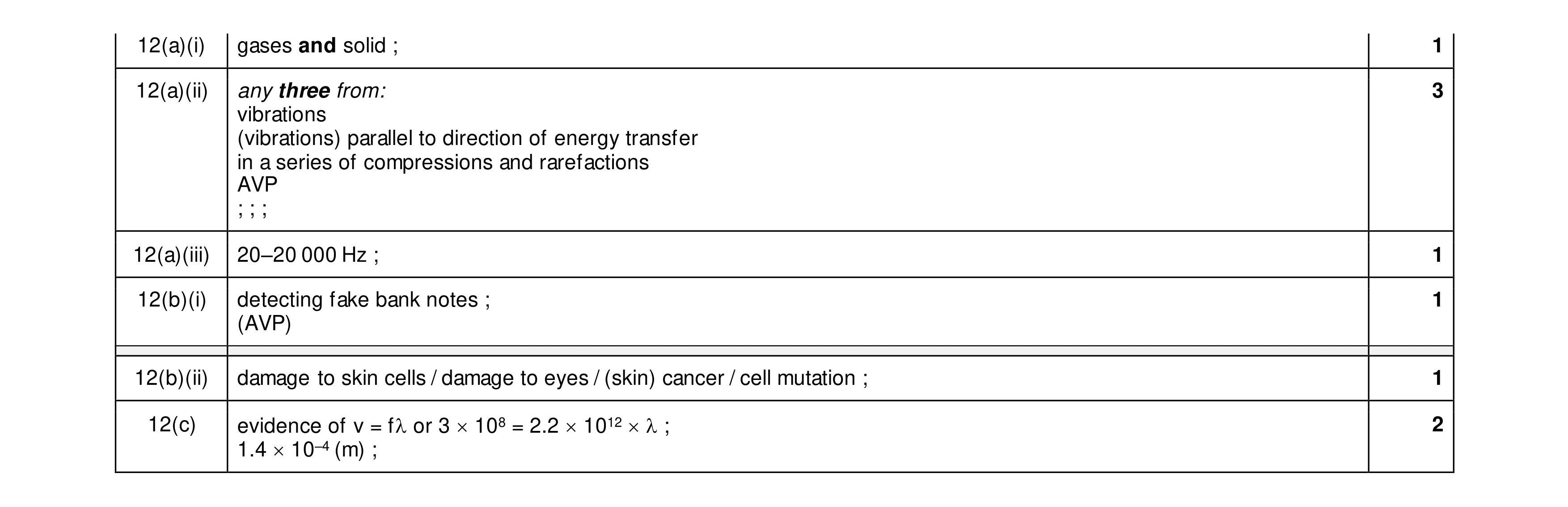 9
9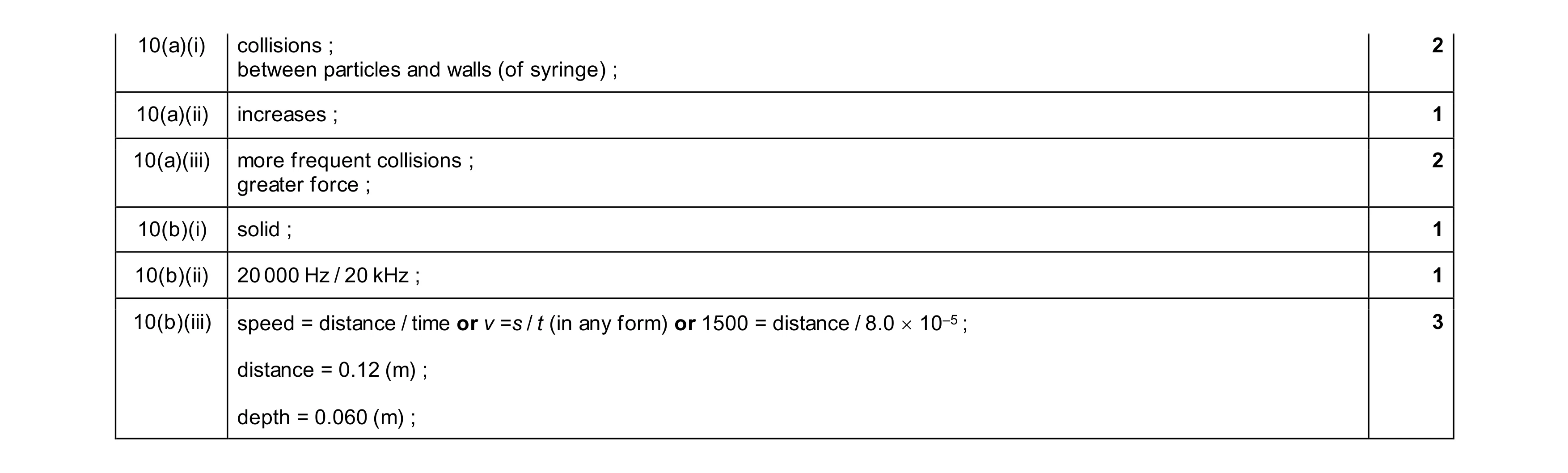 10
10