Questions as text
Q1 · Astronaut 1 uses a hammer to mend a satellite in space 0654/21 May/June 2017
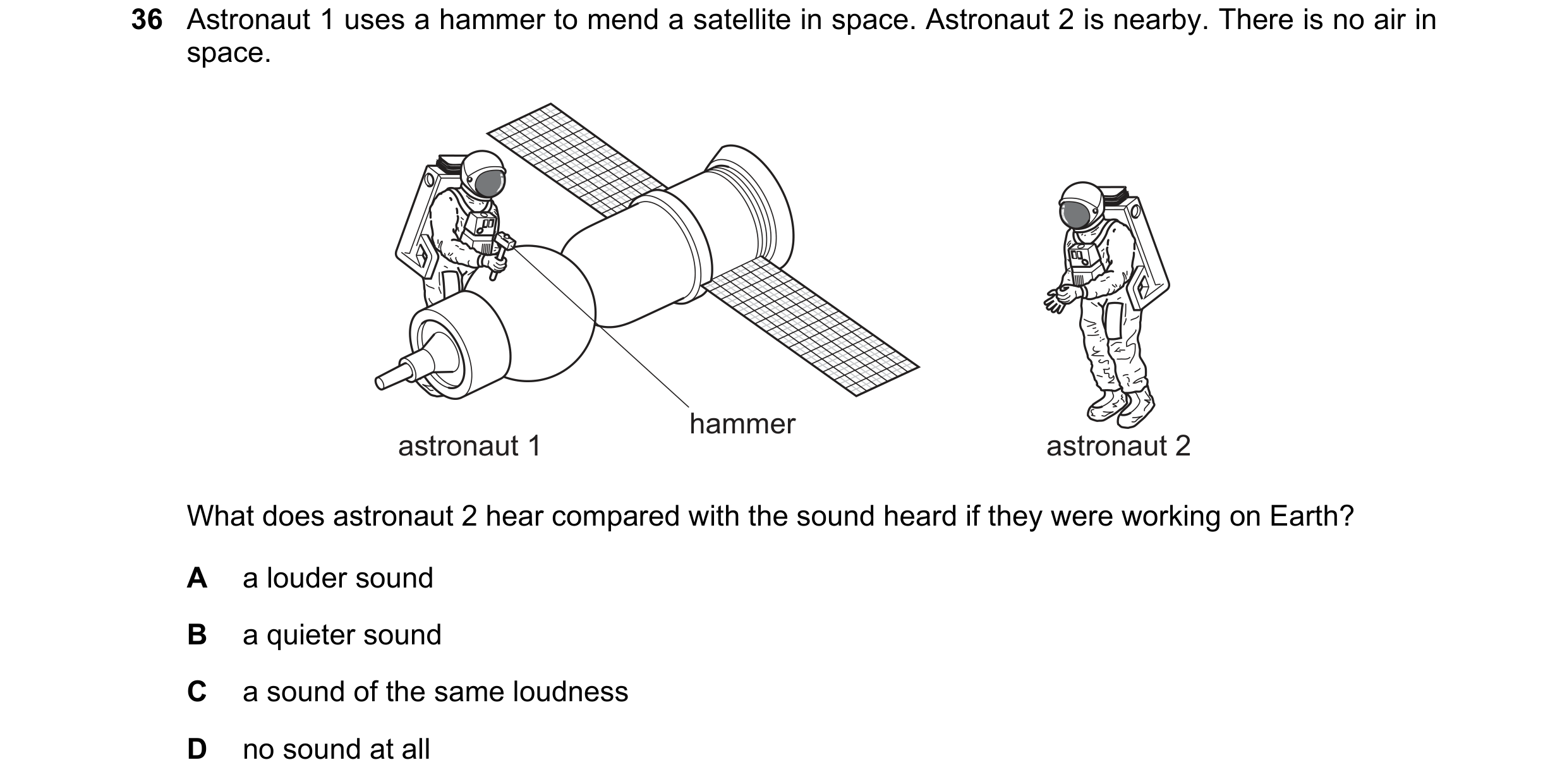
36 Astronaut 1 uses a hammer to mend a satellite in space. Astronaut 2 is nearby. There is no air in space. hammer astronaut 1 astronaut 2 What does astronaut 2 hear compared with the sound heard if they were working on Earth? A a louder sound B a quieter sound C a sound of the same loudness D no sound at all
1 marks
Answer: D
This question in 0654/21 May/June 2017
Q2 · Astronaut 1 uses a hammer to mend a satellite in space 0654/22 May/June 2017
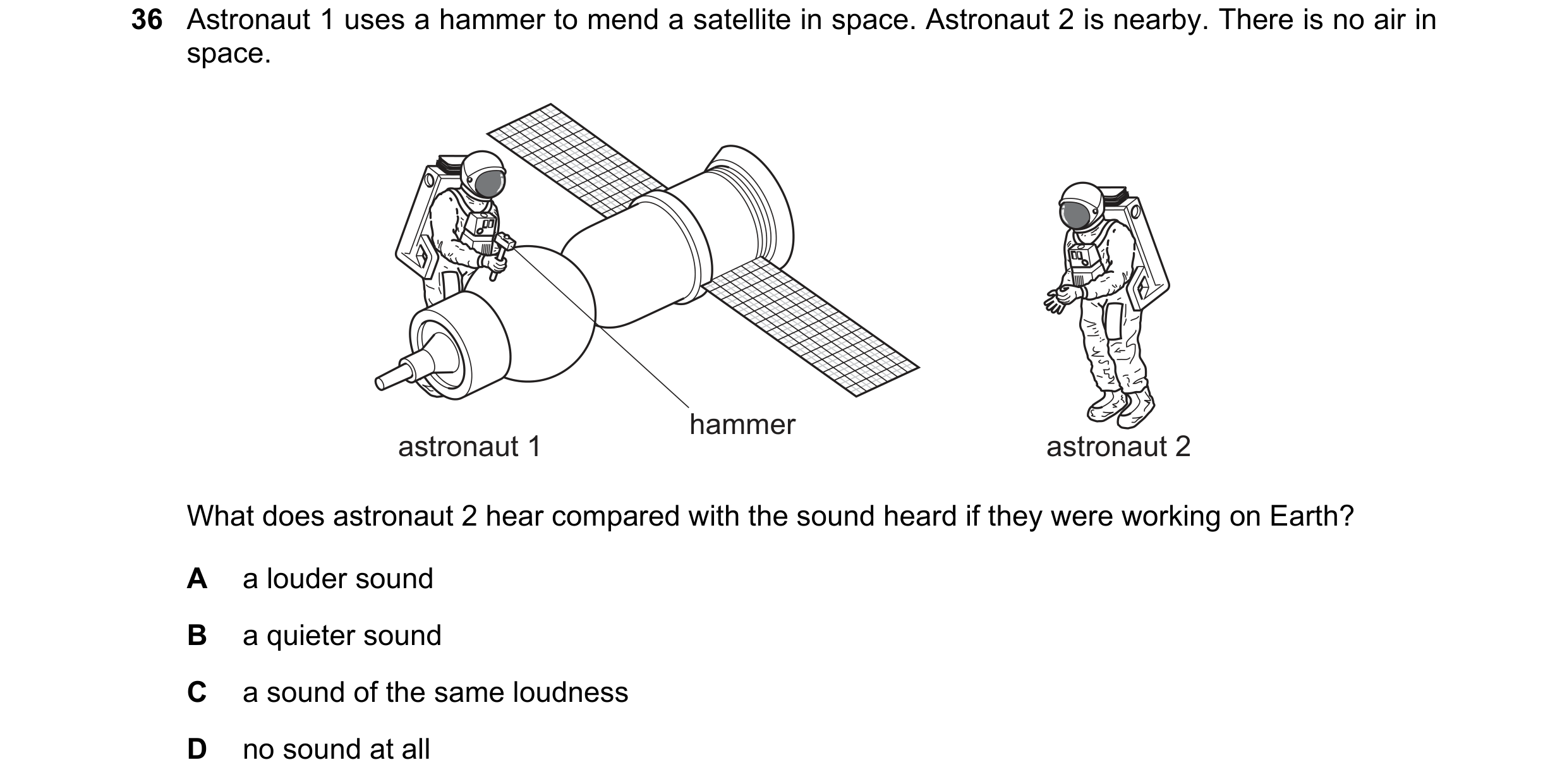
36 Astronaut 1 uses a hammer to mend a satellite in space. Astronaut 2 is nearby. There is no air in space. hammer astronaut 1 astronaut 2 What does astronaut 2 hear compared with the sound heard if they were working on Earth? A a louder sound B a quieter sound C a sound of the same loudness D no sound at all
1 marks
Answer: D
This question in 0654/22 May/June 2017
Q3 · Astronaut 1 uses a hammer to mend a satellite in space 0654/23 May/June 2017
36 Astronaut 1 uses a hammer to mend a satellite in space. Astronaut 2 is nearby. There is no air in space. hammer astronaut 1 astronaut 2 What does astronaut 2 hear compared with the sound heard if they were working on Earth? A a louder sound B a quieter sound C a sound of the same loudness D no sound at all
1 marks
Answer: D
This question in 0654/23 May/June 2017
Q4 · The diagram represents a sound wave of wavelength λ in air 0654/21 Oct/Nov 2017
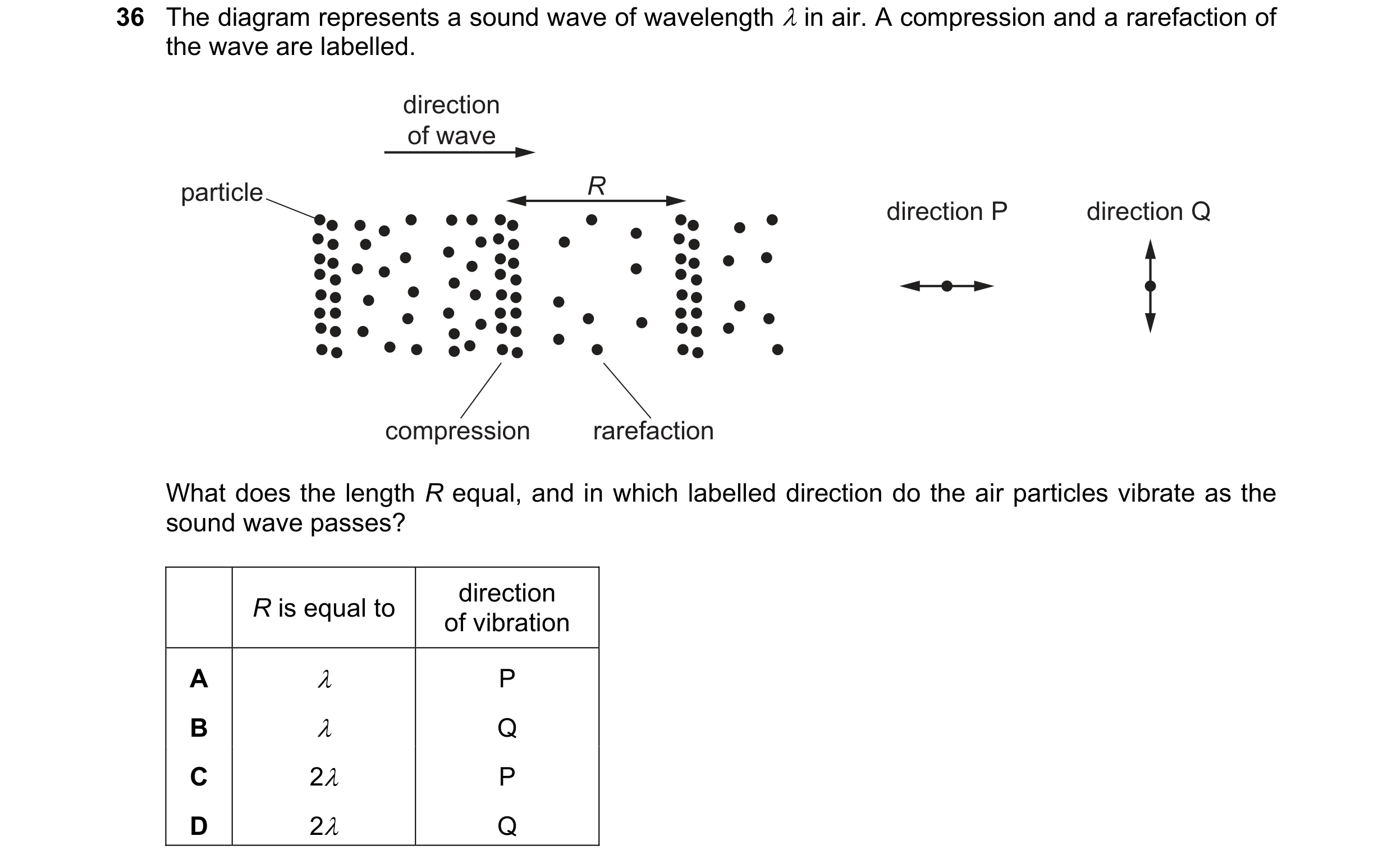
36 The diagram represents a sound wave of wavelength λ in air. A compression and a rarefaction of the wave are labelled. direction of wave particle R direction P direction Q compression rarefaction What does the length R equal, and in which labelled direction do the air particles vibrate as the sound wave passes? direction R is equal to of vibration A λ P B λ Q C 2λ P D 2λ Q
1 marks
Answer: A
This question in 0654/21 Oct/Nov 2017
Q5 · The diagram represents a wave in air 0654/23 Oct/Nov 2017
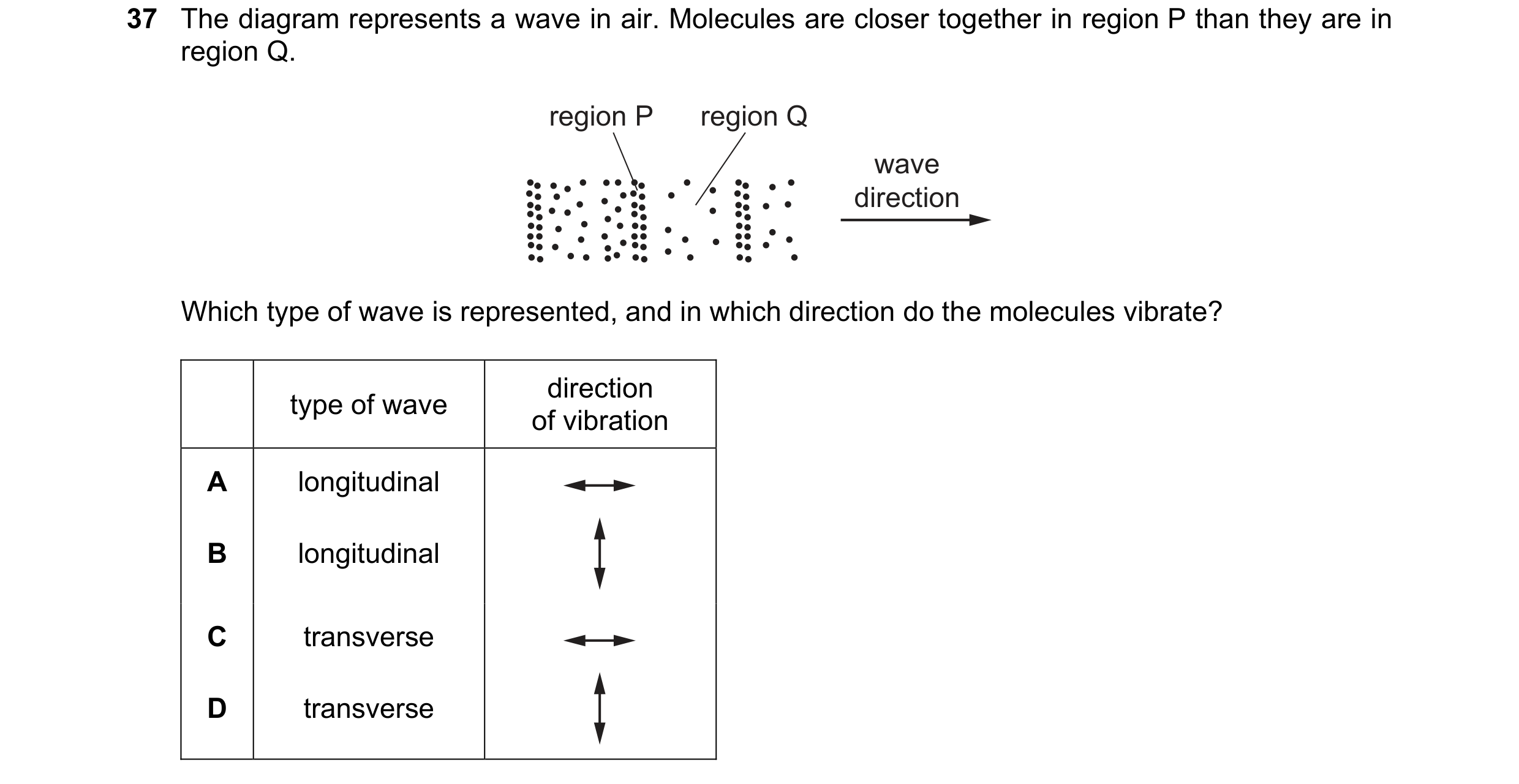
36 The diagram represents a wave in air. Molecules are closer together in region P than they are in region Q. region P region Q wave direction Which type of wave is represented, and in which direction do the molecules vibrate? direction type of wave of vibration A longitudinal B longitudinal C transverse D transverse
1 marks
Answer: A
This question in 0654/23 Oct/Nov 2017
Q6 · A wave in air consists of a series of regions called compressions and rarefactions 0654/21 Oct/Nov 2018
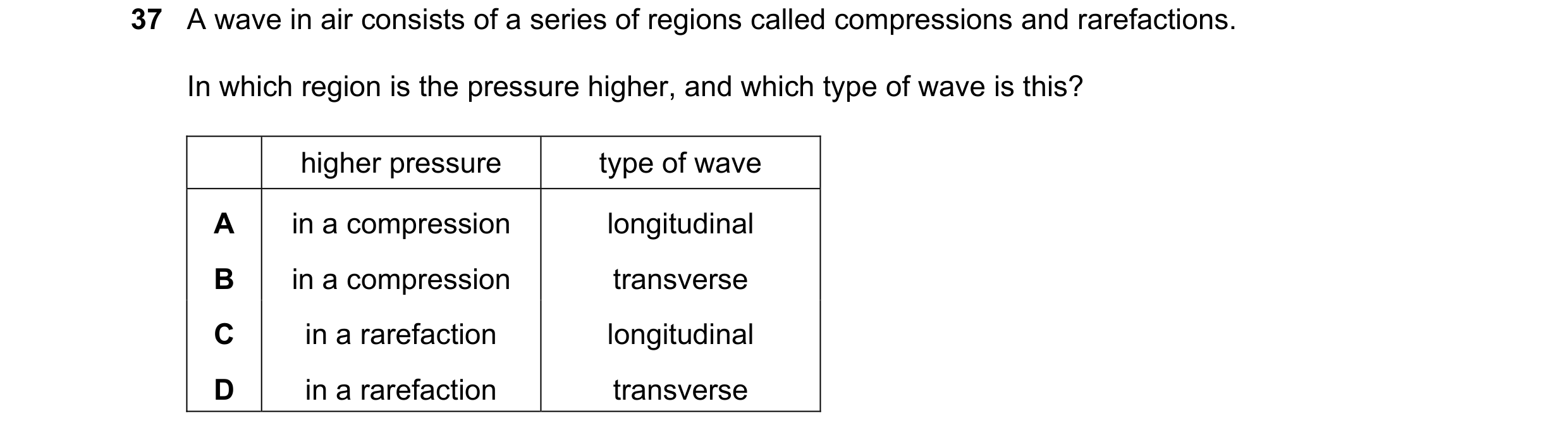
37 A wave in air consists of a series of regions called compressions and rarefactions. In which region is the pressure higher, and which type of wave is this? higher pressure type of wave A in a compression longitudinal B in a compression transverse C in a rarefaction longitudinal D in a rarefaction transverse
1 marks
Answer: A
This question in 0654/21 Oct/Nov 2018
Q7 · The speed of sound in air is 330 m / s 0654/22 Oct/Nov 2018
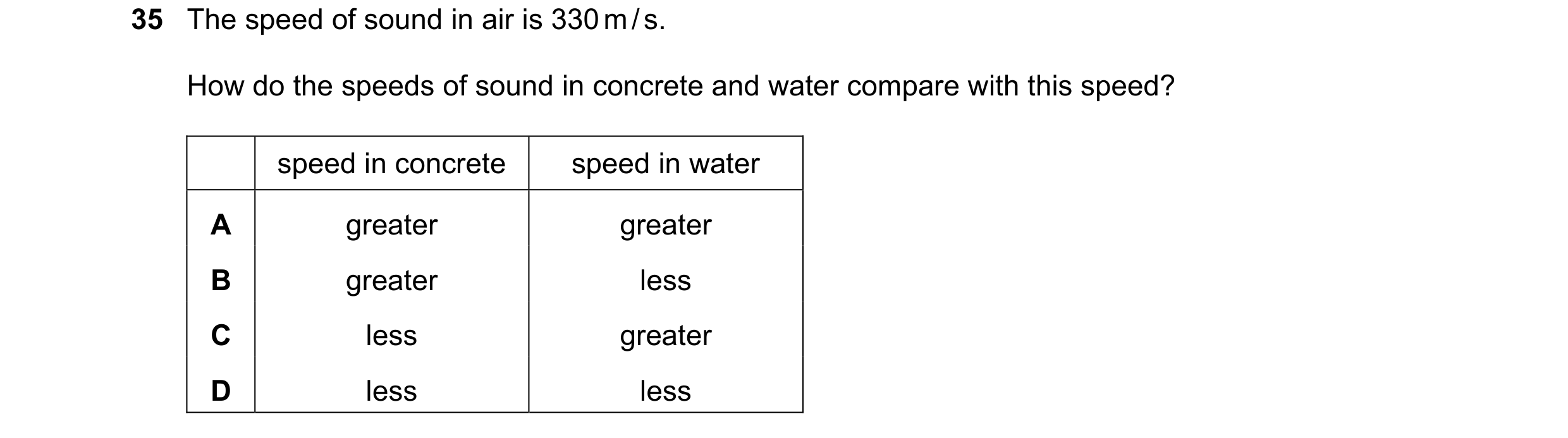
35 The speed of sound in air is 330 m / s. How do the speeds of sound in concrete and water compare with this speed? speed in concrete speed in water A greater greater B greater less C less greater D less less
1 marks
Answer: A
This question in 0654/22 Oct/Nov 2018
Q8 · Which statement about sound is correct? 0654/23 Oct/Nov 2018
35 Which statement about sound is correct? A Sound travels fastest through solids. B Sound travels fastest through liquids. C Sound travels fastest through gases. D Sound travels fastest through a vacuum.
1 marks
Answer: A
This question in 0654/23 Oct/Nov 2018
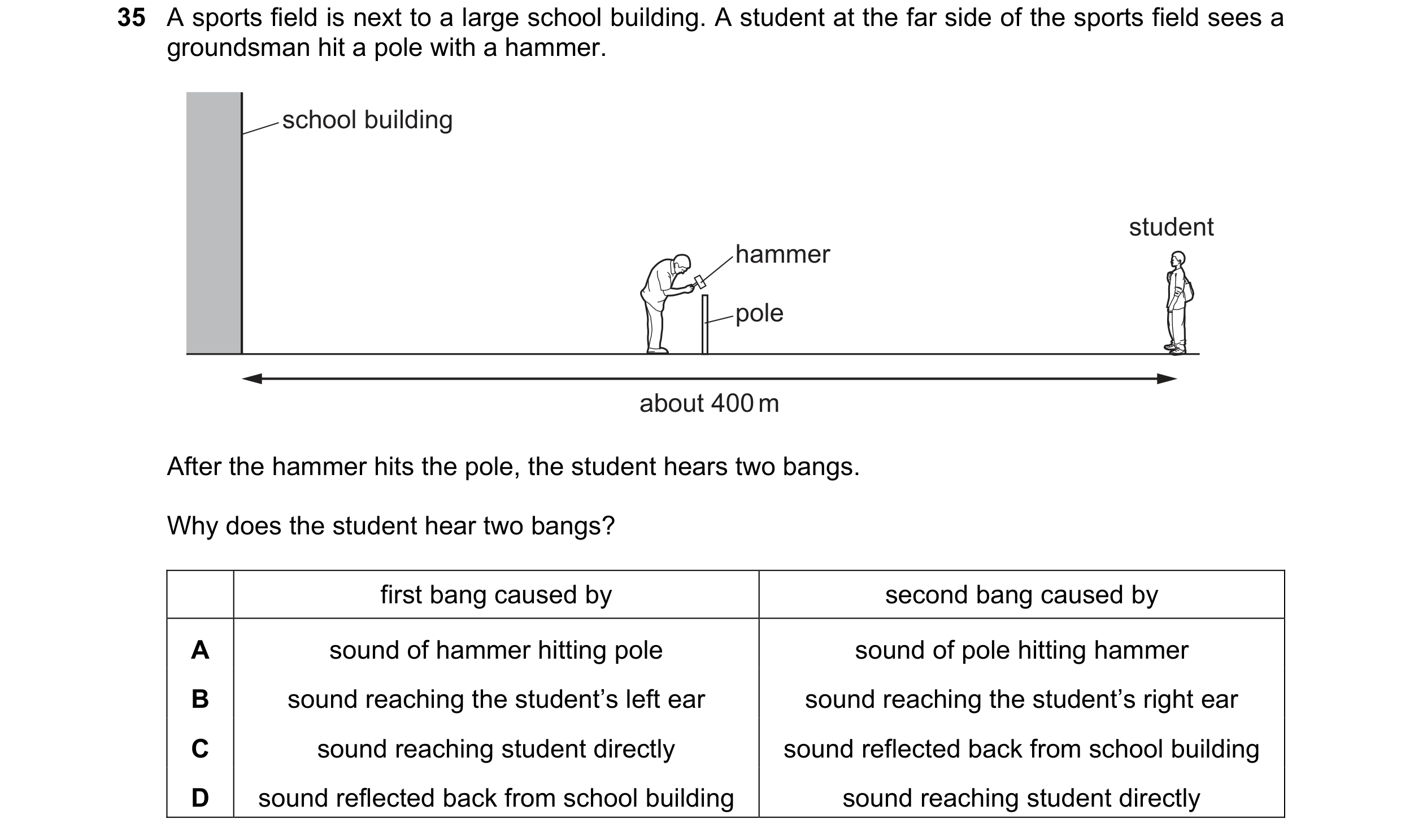
Q9 · A sports field is next to a large school building 0654/21 May/June 2019
35 A sports field is next to a large school building. A student at the far side of the sports field sees a groundsman hit a pole with a hammer. school building student hammer pole about 400 m After the hammer hits the pole, the student hears two bangs. Why does the student hear two bangs? first bang caused by second bang caused by A sound of hammer hitting pole sound of pole hitting hammer B sound reaching the student’s left ear sound reaching the student’s right ear C sound reaching student directly sound reflected back from school building D sound reflected back from school building sound reaching student directly
1 marks
Answer: C
This question in 0654/21 May/June 2019
Q10 · A sports field is next to a large school building 0654/22 May/June 2019
35 A sports field is next to a large school building. A student at the far side of the sports field sees a groundsman hit a pole with a hammer. school building student hammer pole about 400 m After the hammer hits the pole, the student hears two bangs. Why does the student hear two bangs? first bang caused by second bang caused by A sound of hammer hitting pole sound of pole hitting hammer B sound reaching the student’s left ear sound reaching the student’s right ear C sound reaching student directly sound reflected back from school building D sound reflected back from school building sound reaching student directly
1 marks
Answer: C
This question in 0654/22 May/June 2019
Q11 · A sports field is next to a large school building 0654/23 May/June 2019
34 A sports field is next to a large school building. A student at the far side of the sports field sees a groundsman hit a pole with a hammer. school building student hammer pole about 400 m After the hammer hits the pole, the student hears two bangs. Why does the student hear two bangs? first bang caused by second bang caused by A sound of hammer hitting pole sound of pole hitting hammer B sound reaching the student’s left ear sound reaching the student’s right ear C sound reaching student directly sound reflected back from school building D sound reflected back from school building sound reaching student directly
1 marks
Answer: C
This question in 0654/23 May/June 2019
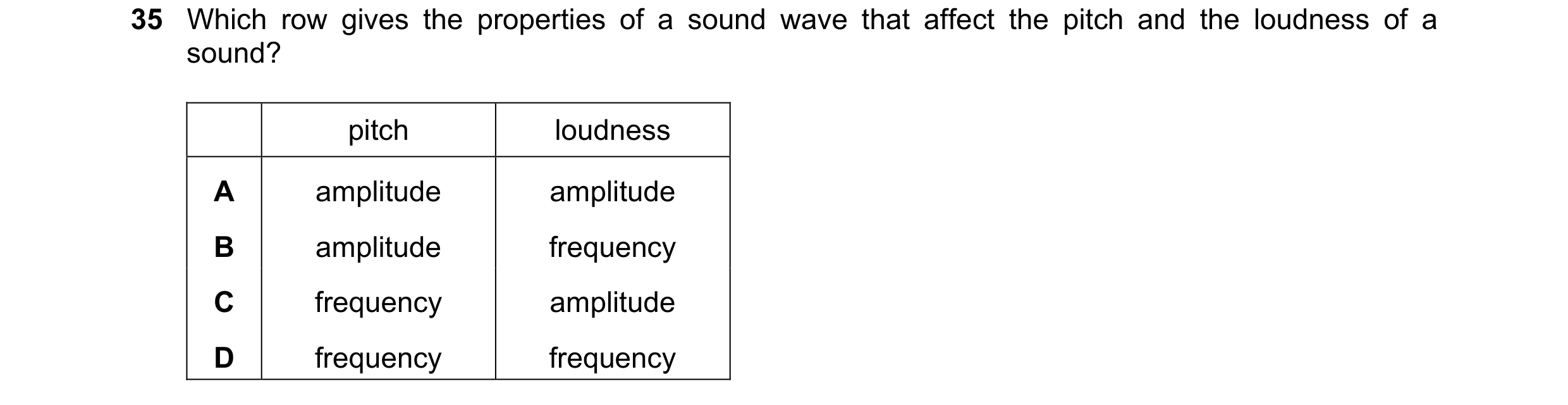
Q12 · Which row gives the properties of a sound wave that affect the pitch and the loudness of… 0654/22 Oct/Nov 2019
35 Which row gives the properties of a sound wave that affect the pitch and the loudness of a sound? pitch loudness A amplitude amplitude B amplitude frequency C frequency amplitude D frequency frequency
1 marks
Answer: C
This question in 0654/22 Oct/Nov 2019
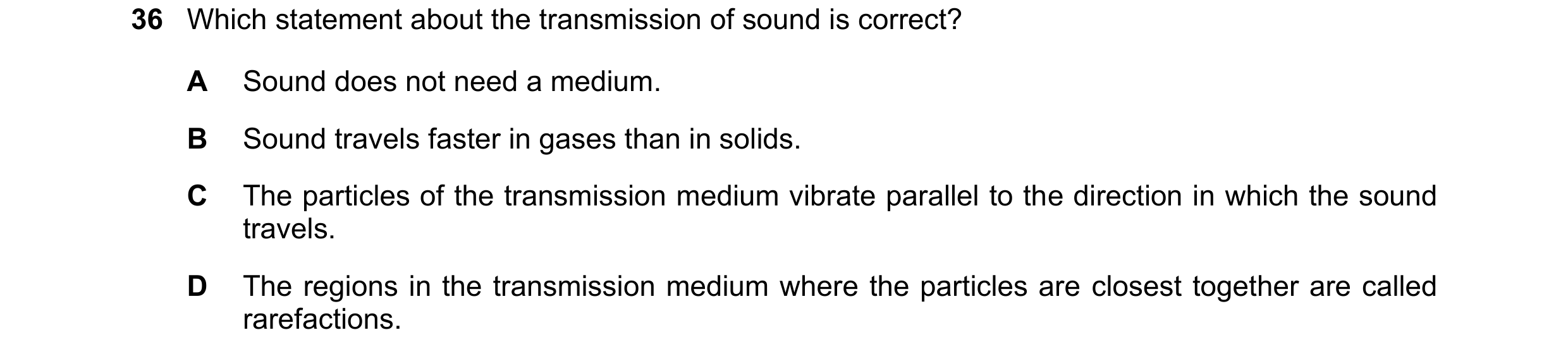
Q13 · Which statement about the transmission of sound is correct? 0654/21 May/June 2020
36 Which statement about the transmission of sound is correct? A Sound does not need a medium. B Sound travels faster in gases than in solids. C The particles of the transmission medium vibrate parallel to the direction in which the sound travels. D The regions in the transmission medium where the particles are closest together are called rarefactions.
1 marks
Answer: C
This question in 0654/21 May/June 2020
Q14 · Sound travels at different speeds in water, in steel and in air 0654/22 Feb/March 2021
34 Sound travels at different speeds in water, in steel and in air. Each row in the table gives the three speeds at room temperature. Which row gives the speeds in the correct columns? speed of sound in water speed of sound in steel speed of sound in air m / s m / s m / s A 300 1500 4500 B 300 4500 1500 C 1500 4500 300 D 4500 1500 300
1 marks
Answer: C
This question in 0654/22 Feb/March 2021
Q15 · Four loudspeakers vibrate at different frequencies 0654/21 Oct/Nov 2021
34 Four loudspeakers vibrate at different frequencies. Which frequency produces a sound with the largest wavelength and can be heard by a human? A 15 Hz B 150 Hz C 2.5 kHz D 25 kHz
1 marks
Answer: B
This question in 0654/21 Oct/Nov 2021
Q16 · The diagram represents a wave in air 0654/22 Oct/Nov 2021
37 The diagram represents a wave in air. Molecules are closer together in region P than they are in region Q. region P region Q wave direction Which type of wave is represented, and in which direction do the molecules vibrate? direction type of wave of vibration A longitudinal B longitudinal C transverse D transverse
1 marks
Answer: A
This question in 0654/22 Oct/Nov 2021
Q17 · Which statement about sound waves is not correct? 0654/22 Feb/March 2022
33 Which statement about sound waves is not correct? A They are caused by vibrations. B They are longitudinal. C They transfer energy. D They travel in a vacuum.
1 marks
Answer: D
This question in 0654/22 Feb/March 2022
Q18 · Which statement about sound is correct? 0654/21 May/June 2022
34 Which statement about sound is correct? A An echo is produced by refraction of sound waves. B The amplitude of a sound wave affects the pitch of a sound. C The approximate range of audible frequencies for a human is 20 Hz–20 kHz. D Sound waves travel more quickly in a vacuum than in air.
1 marks
Answer: C
This question in 0654/21 May/June 2022
Q19 · The speeds of sound in three different states of the same substance are 480 m / s, 1500 m… 0654/22 Oct/Nov 2022
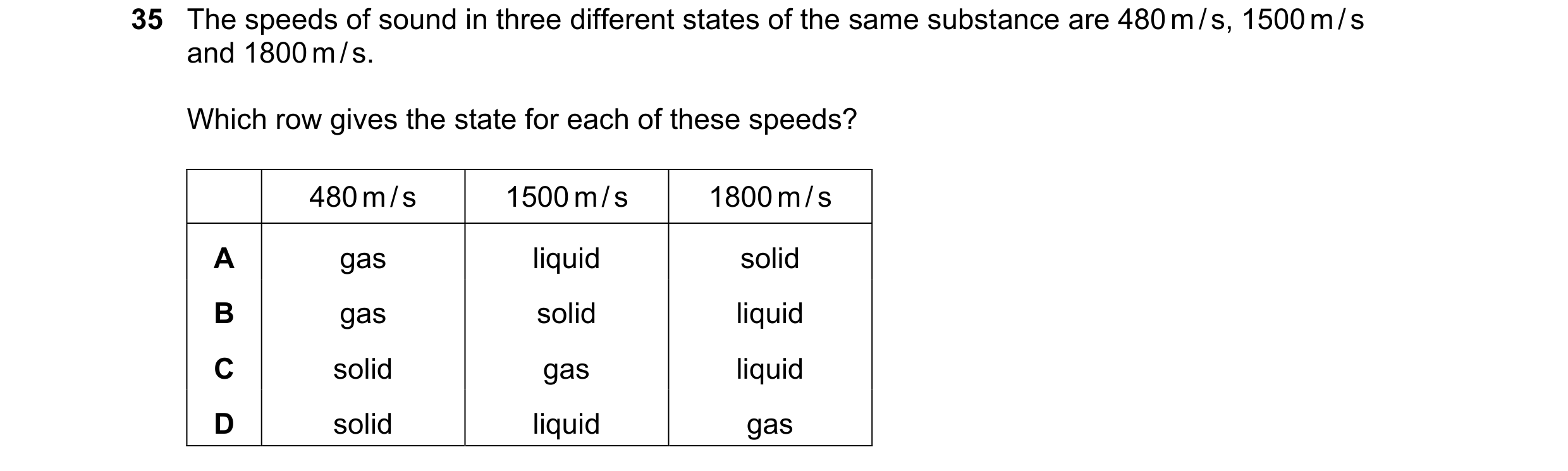
35 The speeds of sound in three different states of the same substance are 480 m / s, 1500 m / s and 1800 m / s. Which row gives the state for each of these speeds? 480 m / s 1500 m / s 1800 m / s A gas liquid solid B gas solid liquid C solid gas liquid D solid liquid gas
1 marks
Answer: A
This question in 0654/22 Oct/Nov 2022
Q20 · The diagram is a displacement–time graph for the molecules in air as a sound wave passes 0654/22 Feb/March 2023
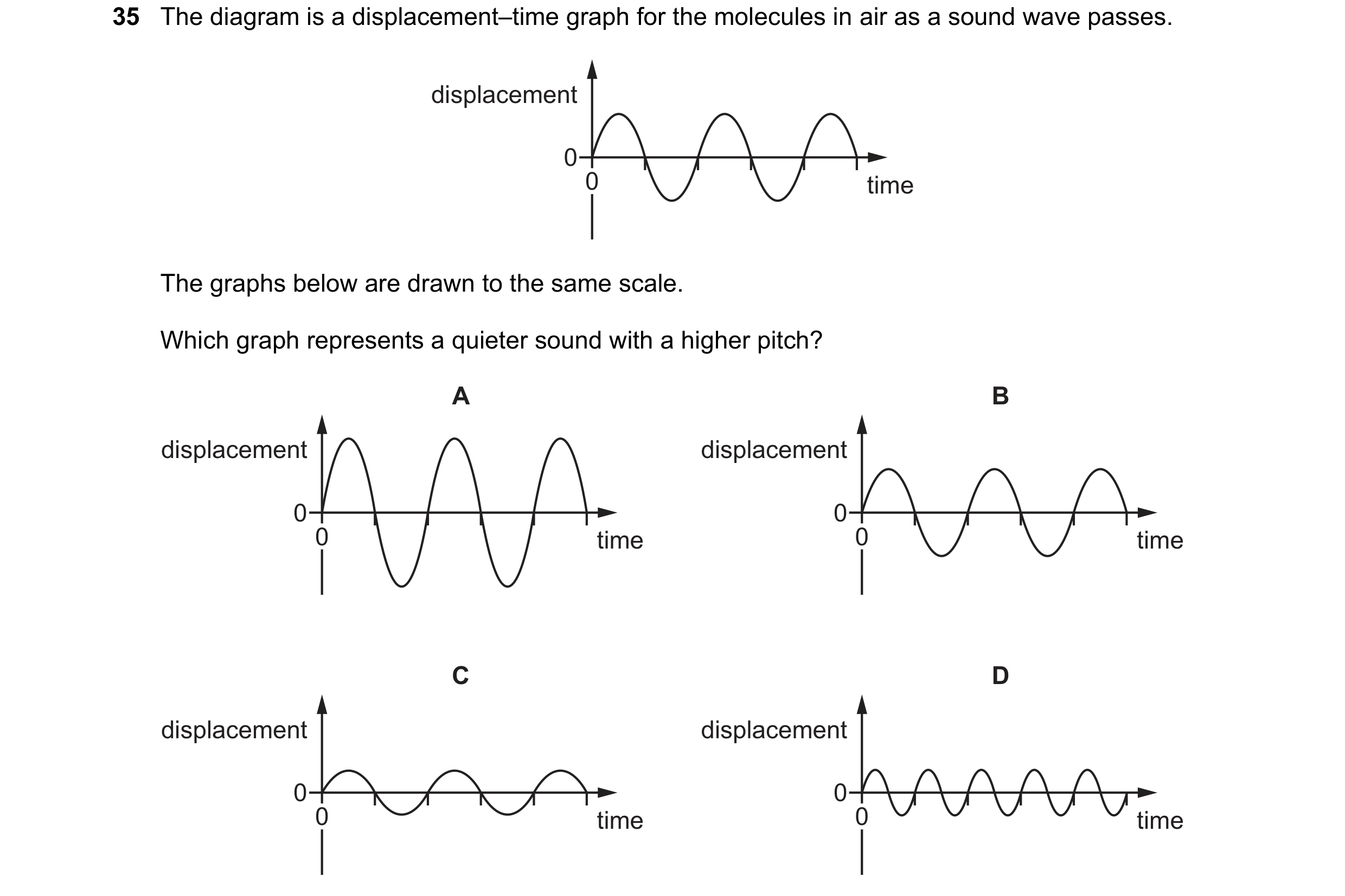
35 The diagram is a displacement–time graph for the molecules in air as a sound wave passes. displacement 0 0 time The graphs below are drawn to the same scale. Which graph represents a quieter sound with a higher pitch? A B displacement displacement 0 0 0 time 0 time C D displacement displacement 0 0 0 time 0 time
1 marks
Answer: D
This question in 0654/22 Feb/March 2023
Q21 · Which change to a sound wave makes the sound louder? 0654/21 Oct/Nov 2023
35 Which change to a sound wave makes the sound louder? A decreasing the amplitude B decreasing the wavelength C increasing the amplitude D increasing the wavelength
1 marks
Answer: C
This question in 0654/21 Oct/Nov 2023
Q22 · The amplitude of a sound wave increases, and the frequency of the wave decreases 0654/22 Oct/Nov 2023
34 The amplitude of a sound wave increases, and the frequency of the wave decreases. What is the effect on the loudness of the sound and on the pitch of the sound? loudness pitch A greater higher B greater lower C less higher D less lower
1 marks
Answer: B
This question in 0654/22 Oct/Nov 2023
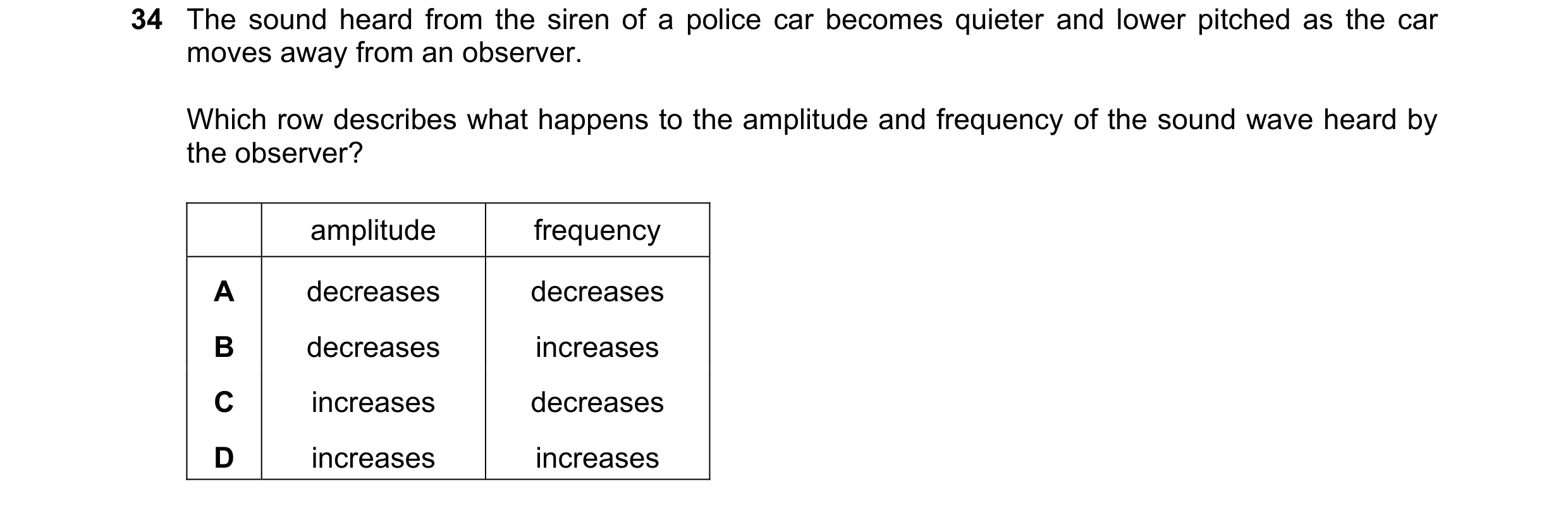
Q23 · The sound heard from the siren of a police car becomes quieter and lower pitched as the… 0654/23 Oct/Nov 2023
34 The sound heard from the siren of a police car becomes quieter and lower pitched as the car moves away from an observer. Which row describes what happens to the amplitude and frequency of the sound wave heard by the observer? amplitude frequency A decreases decreases B decreases increases C increases decreases D increases increases
1 marks
Answer: A
This question in 0654/23 Oct/Nov 2023
Q24 · Which two types of wave cannot travel at the same speed as each other in a vacuum? 0654/23 May/June 2024
34 Which two types of wave cannot travel at the same speed as each other in a vacuum? A infrared and gamma B ultraviolet and X-rays C light and microwaves D radio waves and sound
1 marks
Answer: D
This question in 0654/23 May/June 2024
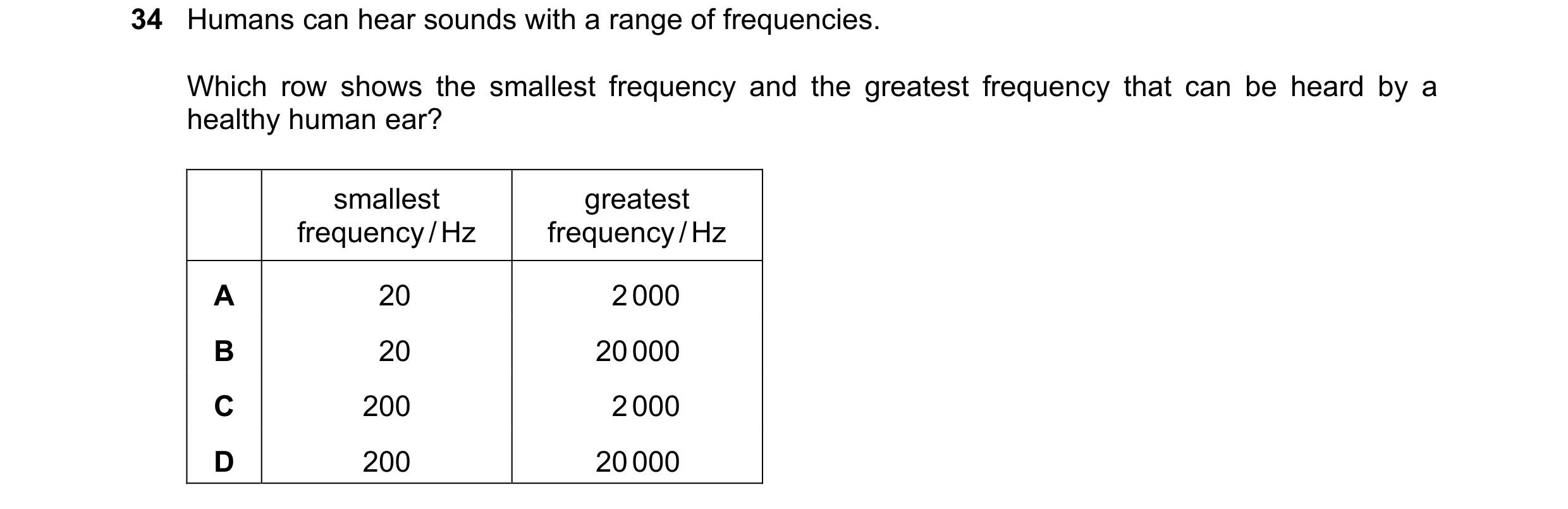
Q25 · Humans can hear sounds with a range of frequencies 0654/22 Oct/Nov 2024
34 Humans can hear sounds with a range of frequencies. Which row shows the smallest frequency and the greatest frequency that can be heard by a healthy human ear? smallest greatest frequency / Hz frequency / Hz A 20 2 000 B 20 20 000 C 200 2 000 D 200 20 000
1 marks
Answer: B
This question in 0654/22 Oct/Nov 2024
Q26 · A guitar produces a loud sound with a low pitch 0654/22 Feb/March 2025
36 A guitar produces a loud sound with a low pitch. Which description of the sound wave produced by the guitar is correct? A It has a large amplitude and a large frequency. B It has a large amplitude and a small frequency. C It has a small amplitude and a large frequency. D It has a small amplitude and a small frequency.
1 marks
Answer: B
This question in 0654/22 Feb/March 2025
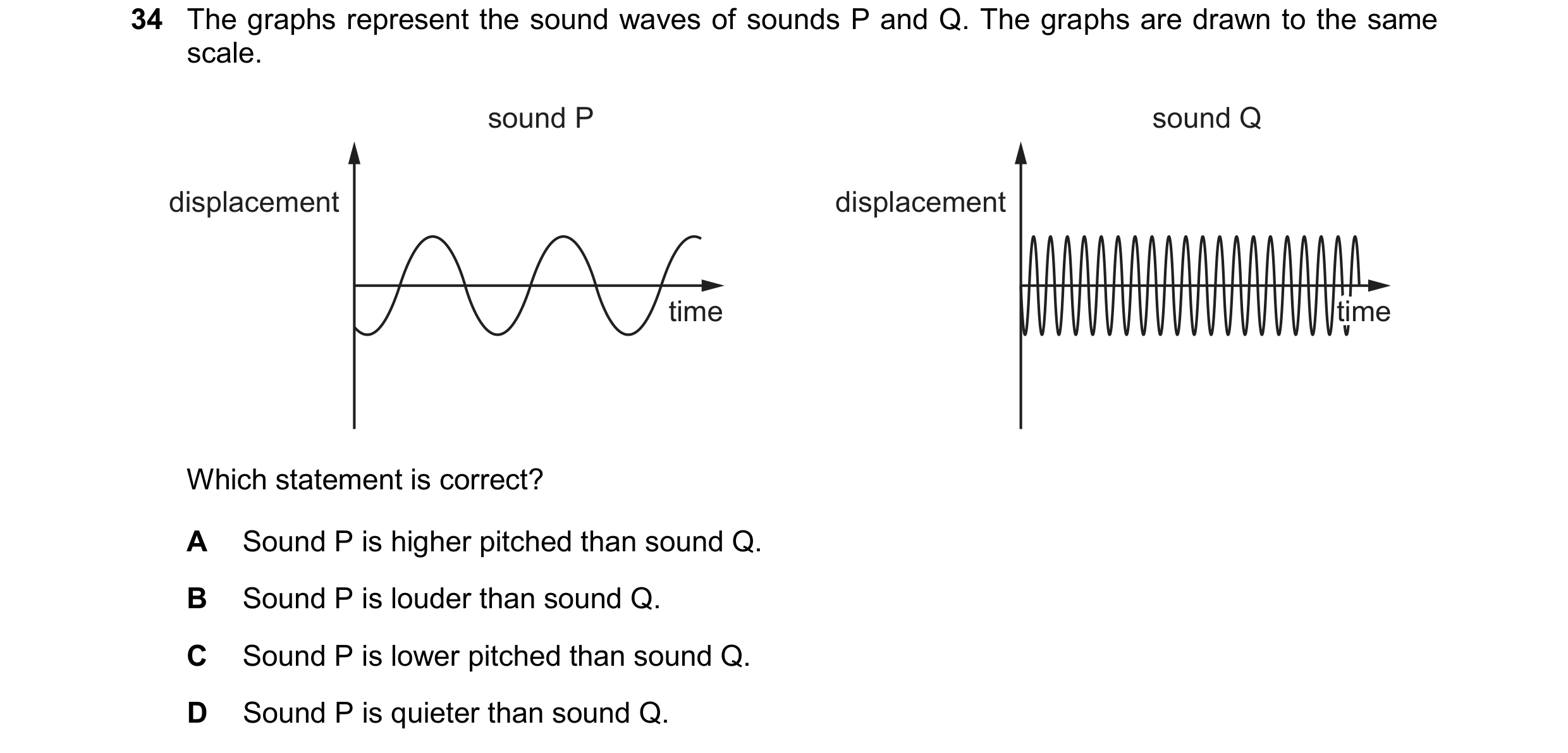
Q27 · The graphs represent the sound waves of sounds P and Q 0654/21 Oct/Nov 2025
34 The graphs represent the sound waves of sounds P and Q. The graphs are drawn to the same scale. sound P sound Q displacement displacement time time time time Which statement is correct? A Sound P is higher pitched than sound Q. B Sound P is louder than sound Q. C Sound P is lower pitched than sound Q. D Sound P is quieter than sound Q.
1 marks
Answer: C
This question in 0654/21 Oct/Nov 2025
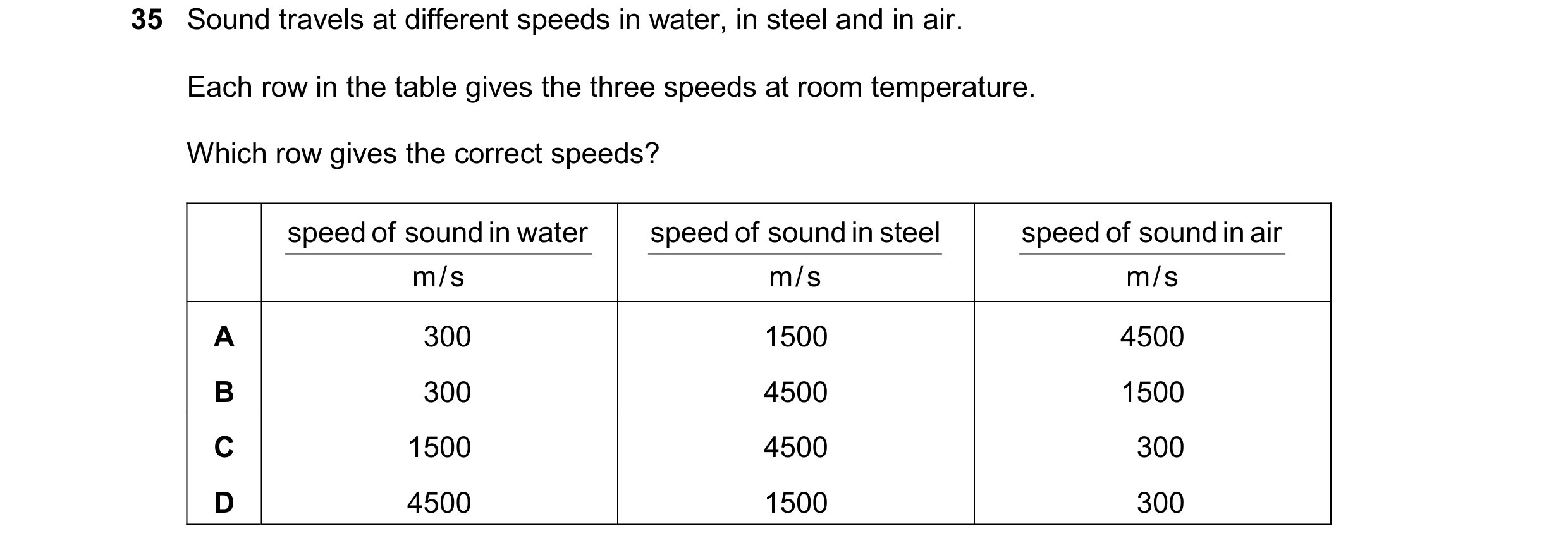
Q28 · Sound travels at different speeds in water, in steel and in air 0654/22 Oct/Nov 2025
35 Sound travels at different speeds in water, in steel and in air. Each row in the table gives the three speeds at room temperature. Which row gives the correct speeds? speed of sound in water speed of sound in steel speed of sound in air m / s m / s m / s A 300 1500 4500 B 300 4500 1500 C 1500 4500 300 D 4500 1500 300
1 marks
Answer: C
This question in 0654/22 Oct/Nov 2025
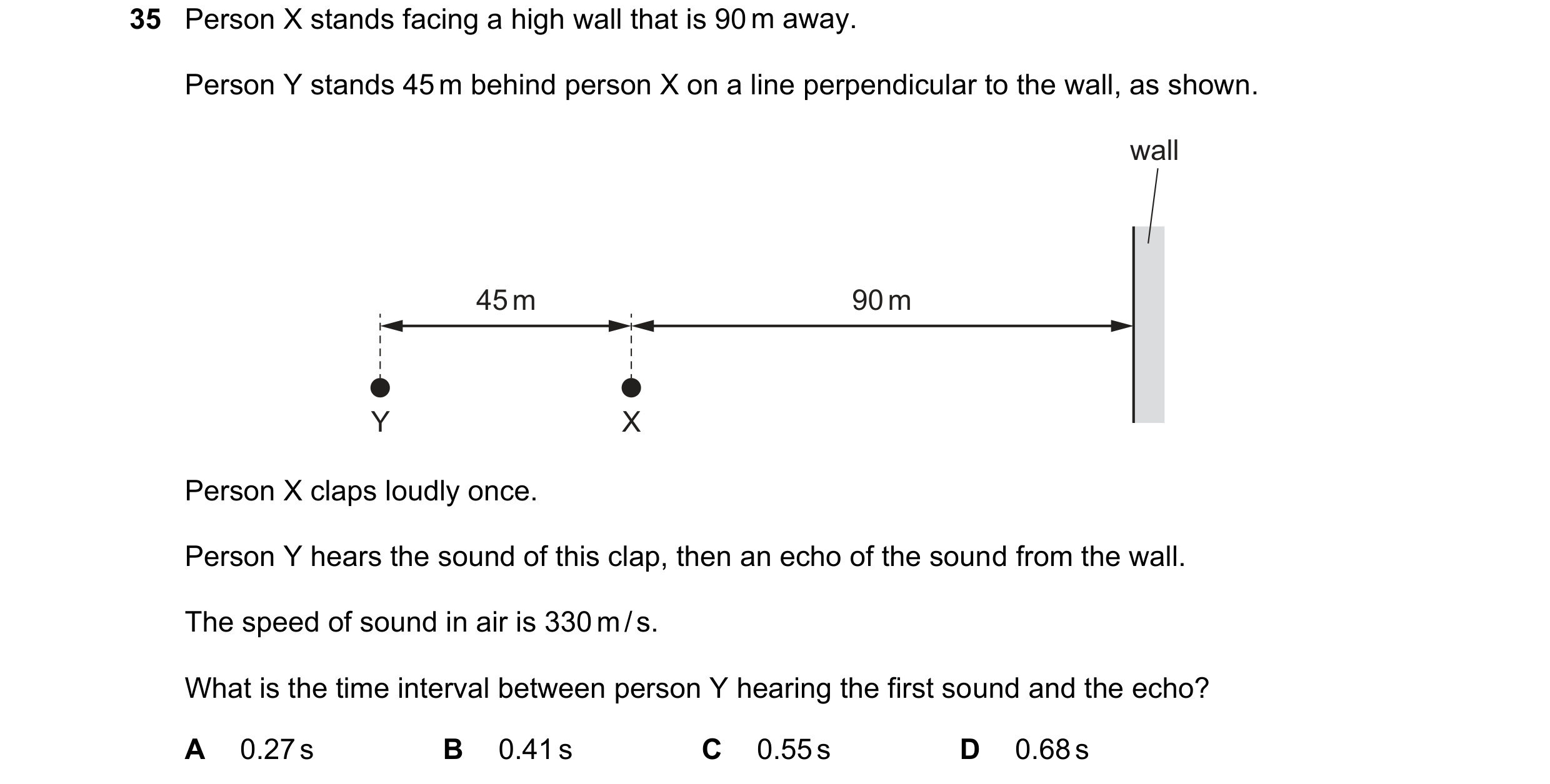
Q29 · Person X stands facing a high wall that is 90 m away 0654/23 Oct/Nov 2025
35 Person X stands facing a high wall that is 90 m away. Person Y stands 45 m behind person X on a line perpendicular to the wall, as shown. wall 45 m 90 m Y X Person X claps loudly once. Person Y hears the sound of this clap, then an echo of the sound from the wall. The speed of sound in air is 330 m / s. What is the time interval between person Y hearing the first sound and the echo? A 0.27 s B 0.41 s C 0.55 s D 0.68 s
1 marks
Answer: C
This question in 0654/23 Oct/Nov 2025
 1 / 10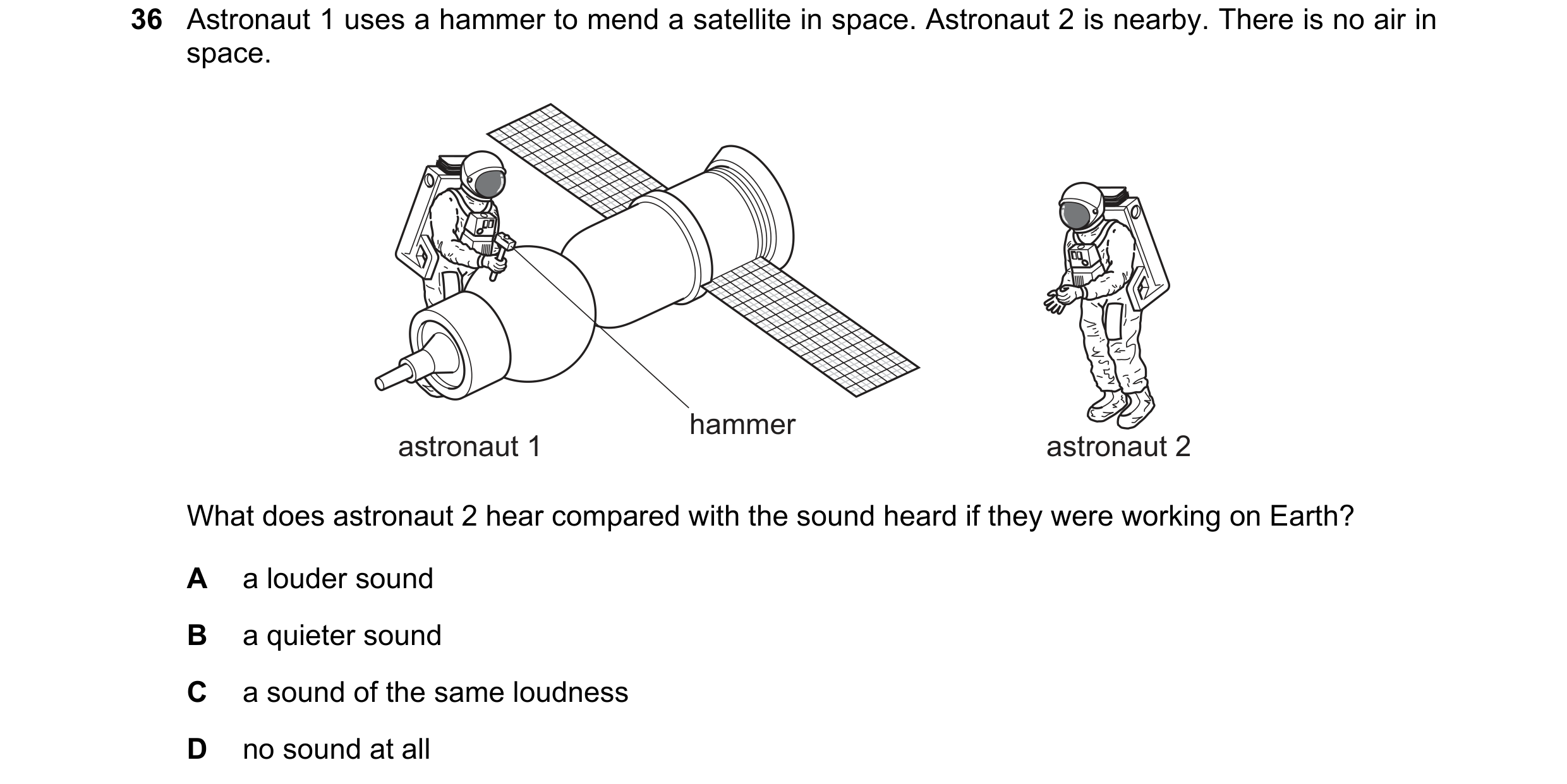
 2 / 10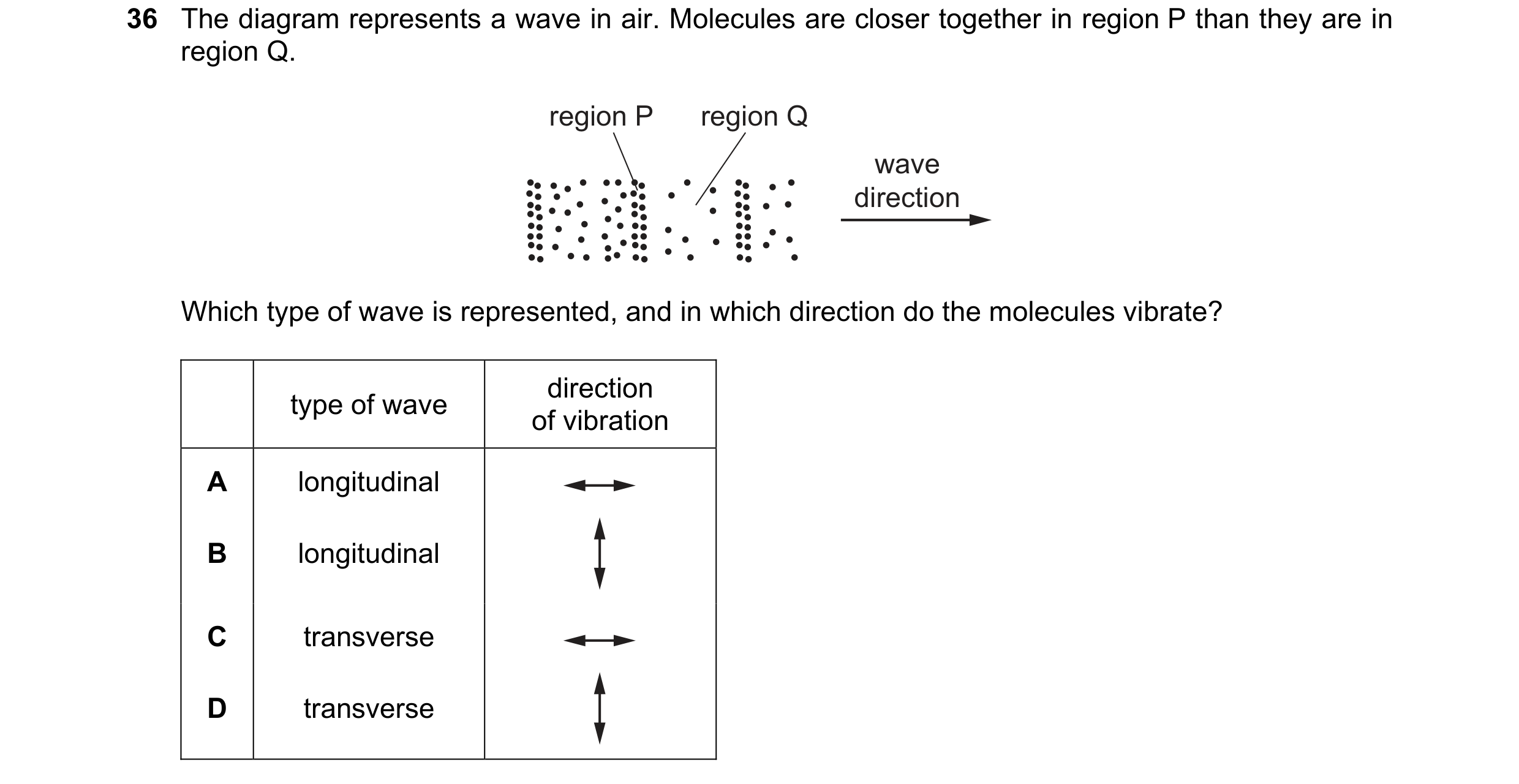
 3 / 10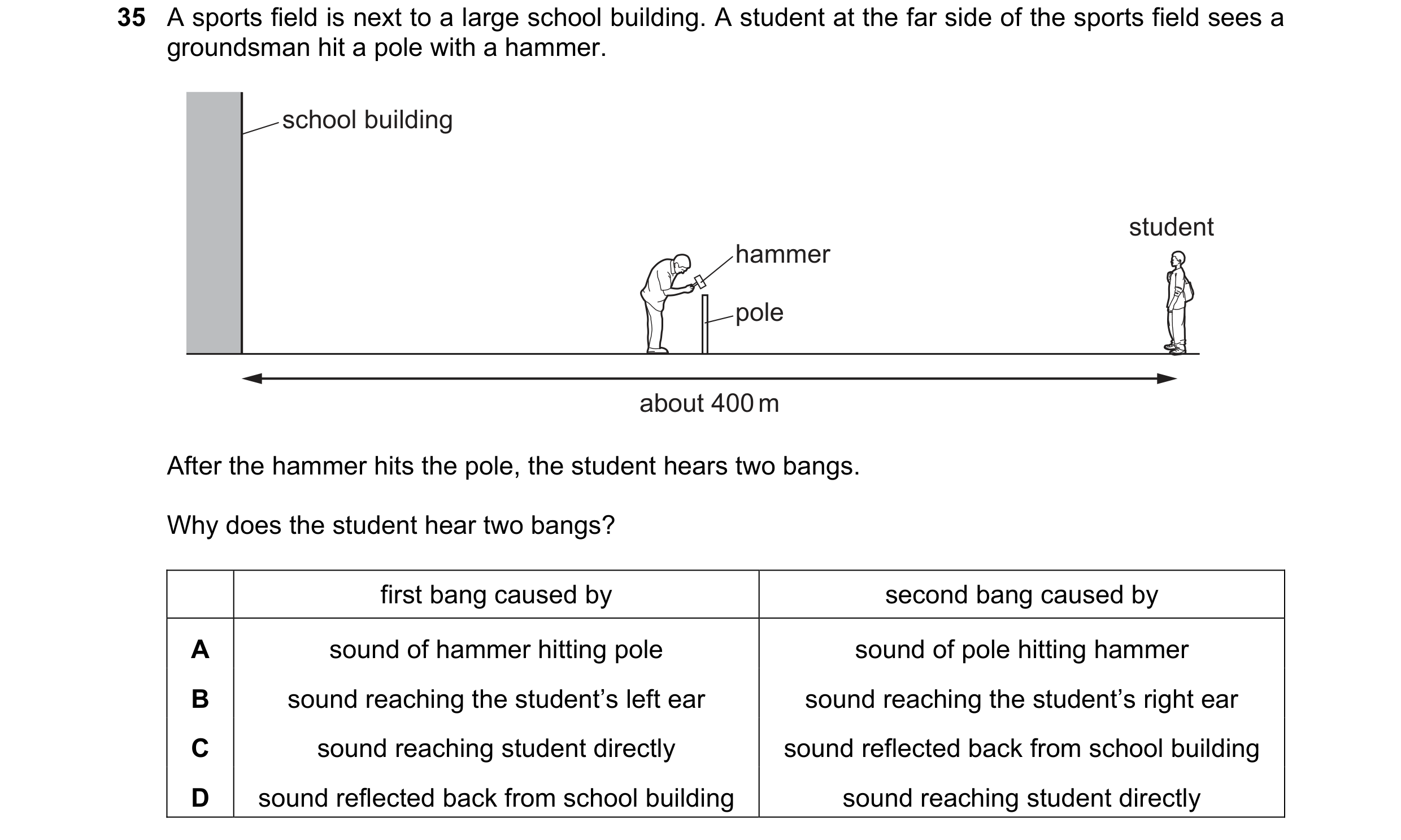
 4 / 10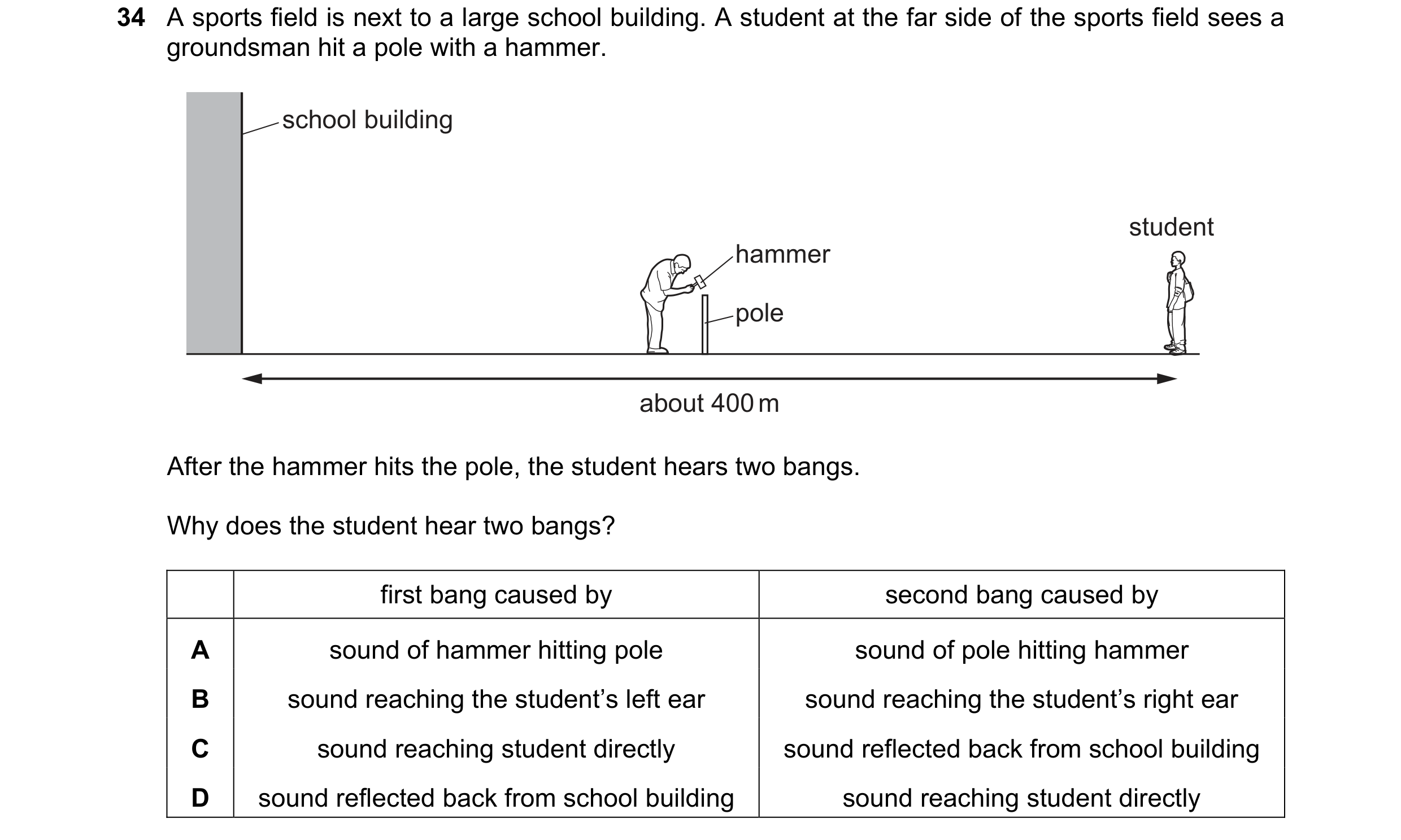
 5 / 10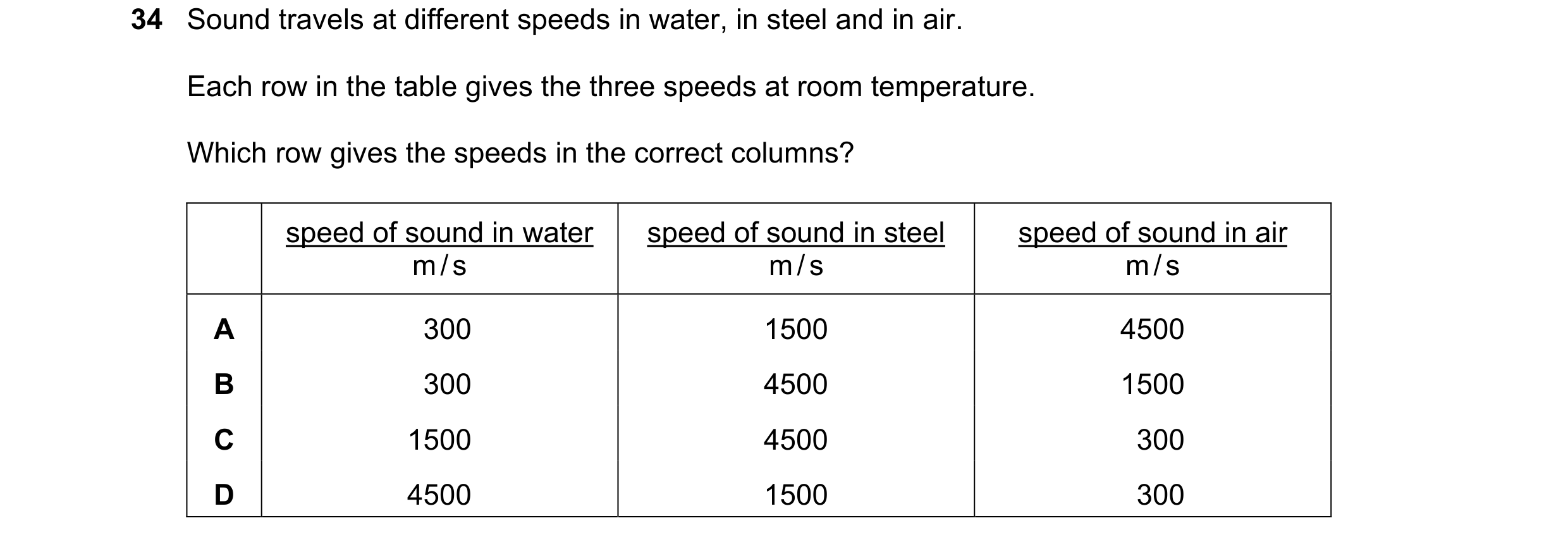

 6 / 10
 7 / 10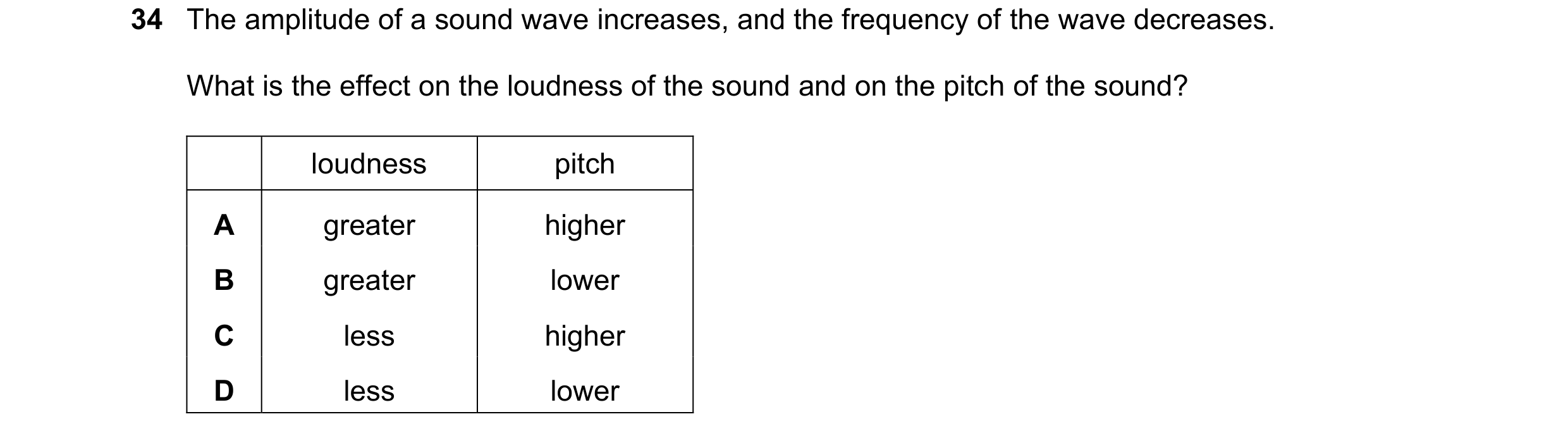

 8 / 10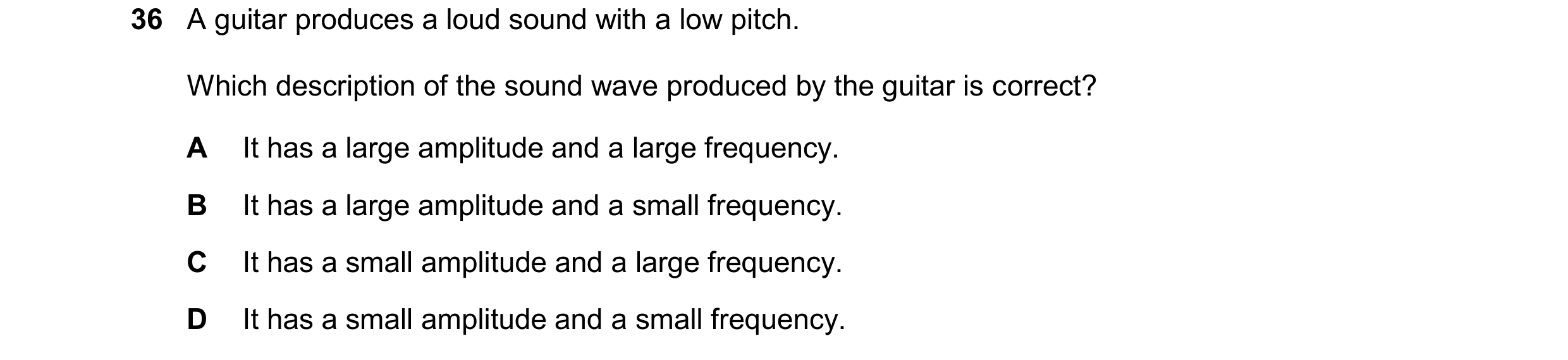
 9 / 10
 10 / 10