Questions as text
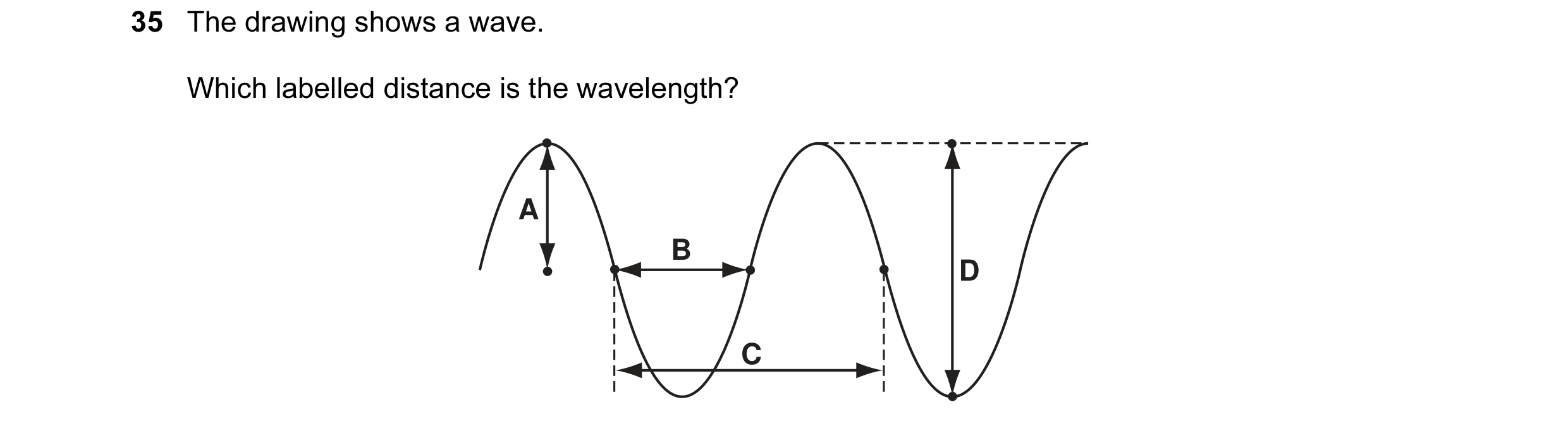
Q1 · The drawing shows a wave 0654/11 May/June 2005
35 The drawing shows a wave. Which labelled distance is the wavelength? A B D C
1 marks
Answer: C
This question in 0654/11 May/June 2005
Q2 · Which is the best description of the speed of a water wave? 0654/11 May/June 2006
33 Which is the best description of the speed of a water wave? A the distance between one wave crest and the next B the distance between the crest of a wave and a trough C the distance that a particle of water moves up and down in one second D the distance that a wavefront moves along the surface in one second
1 marks
Answer: D
This question in 0654/11 May/June 2006
Q3 · Water waves are reflected at a plane surface 0654/11 May/June 2007
32 Water waves are reflected at a plane surface. Which property of the waves is changed by the reflection? A direction B frequency C speed D wavelength
1 marks
Answer: A
This question in 0654/11 May/June 2007
Q4 · The diagram shows a section through a series of waves on water 0654/11 Oct/Nov 2007
33 The diagram shows a section through a series of waves on water. Which dotted line shows the position of the still water surface after the waves have passed? A B C D
1 marks
Answer: B
This question in 0654/11 Oct/Nov 2007
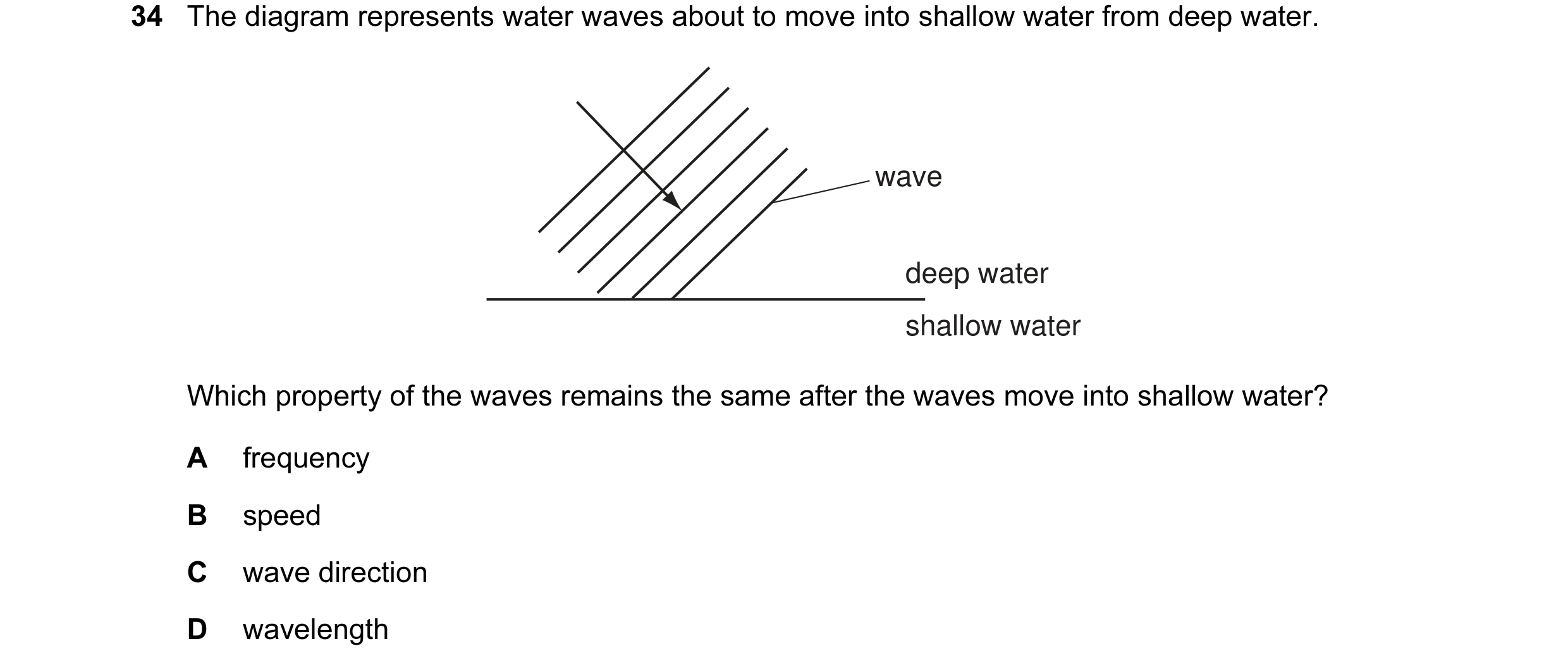
Q5 · The diagram represents water waves about to move into shallow water from deep water 0654/11 May/June 2008
34 The diagram represents water waves about to move into shallow water from deep water. wave deep water shallow water Which property of the waves remains the same after the waves move into shallow water? A frequency B speed C wave direction D wavelength
1 marks
Answer: A
This question in 0654/11 May/June 2008
Q6 · The diagrams show examples of wave motion 0654/11 May/June 2009
35 The diagrams show examples of wave motion. 1 2 ripple tank drum waves on water waves in air 3 4 waves on a rope waves in a spring (as shown) Which are longitudinal waves? A 1 only B 1, 2 and 4 C 2 and 3 only D 2 and 4 only
1 marks
Answer: D
This question in 0654/11 May/June 2009
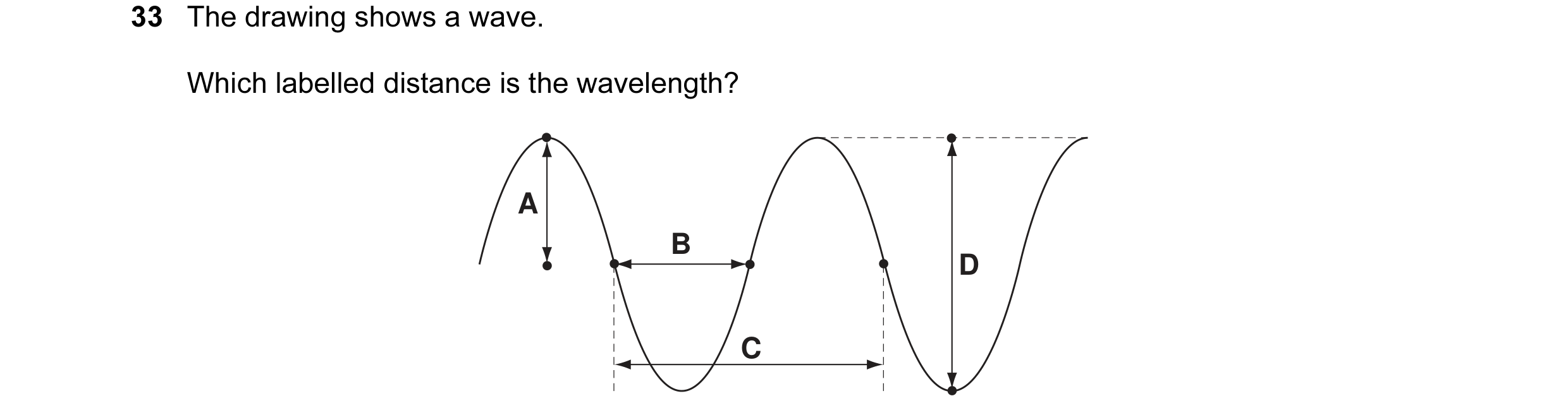
Q7 · The drawing shows a wave 0654/11 Oct/Nov 2009
33 The drawing shows a wave. Which labelled distance is the wavelength? A B D C
1 marks
Answer: C
This question in 0654/11 Oct/Nov 2009
Q8 · A stone is thrown into a pool and waves spread out from where it hits the water 0654/11 May/June 2010
36 A stone is thrown into a pool and waves spread out from where it hits the water. waves X What is the name given to the number of waves passing point X per second? A the amplitude B the frequency C the wavelength D the wave speed
1 marks
Answer: B
This question in 0654/11 May/June 2010
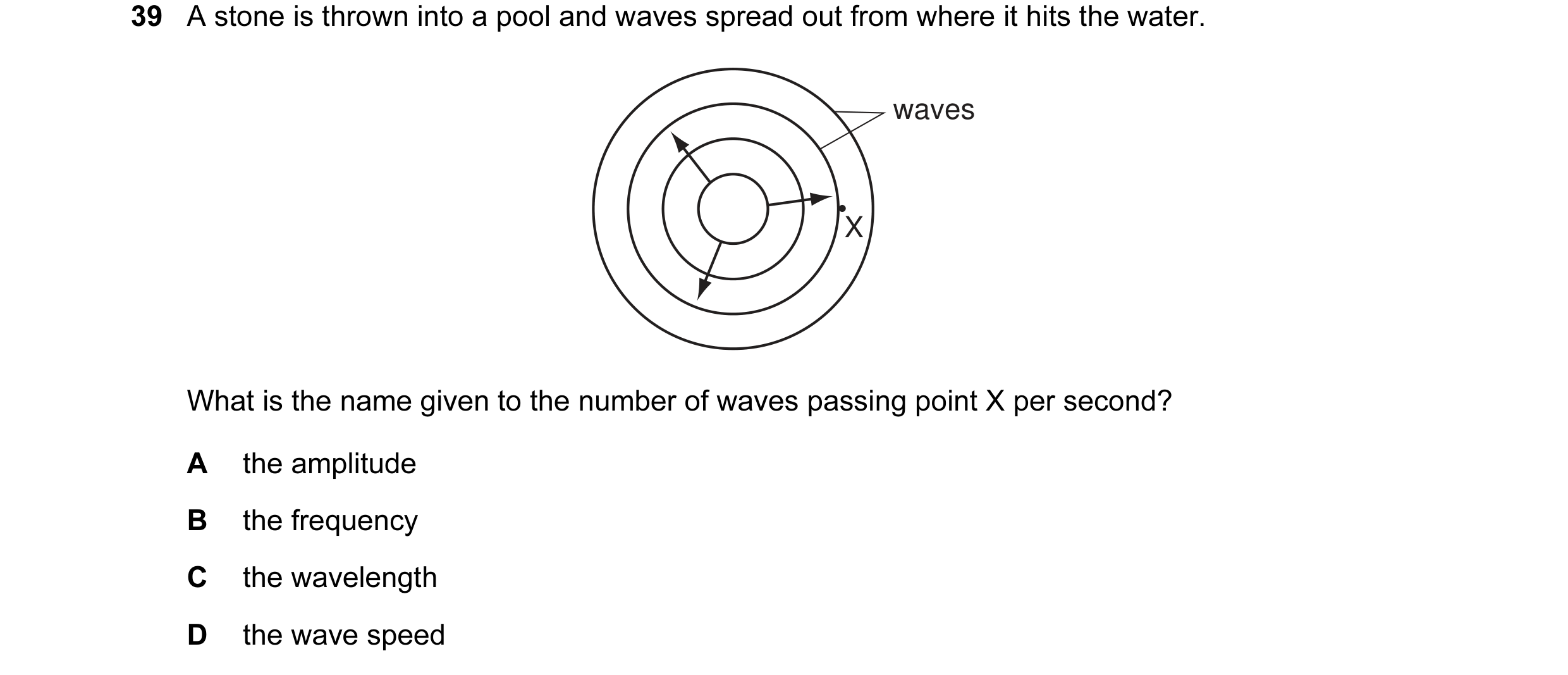
Q9 · A stone is thrown into a pool and waves spread out from where it hits the water 0654/12 May/June 2010
39 A stone is thrown into a pool and waves spread out from where it hits the water. waves X What is the name given to the number of waves passing point X per second? A the amplitude B the frequency C the wavelength D the wave speed
1 marks
Answer: B
This question in 0654/12 May/June 2010
Q10 · The diagram shows a wave 0654/11 Oct/Nov 2010
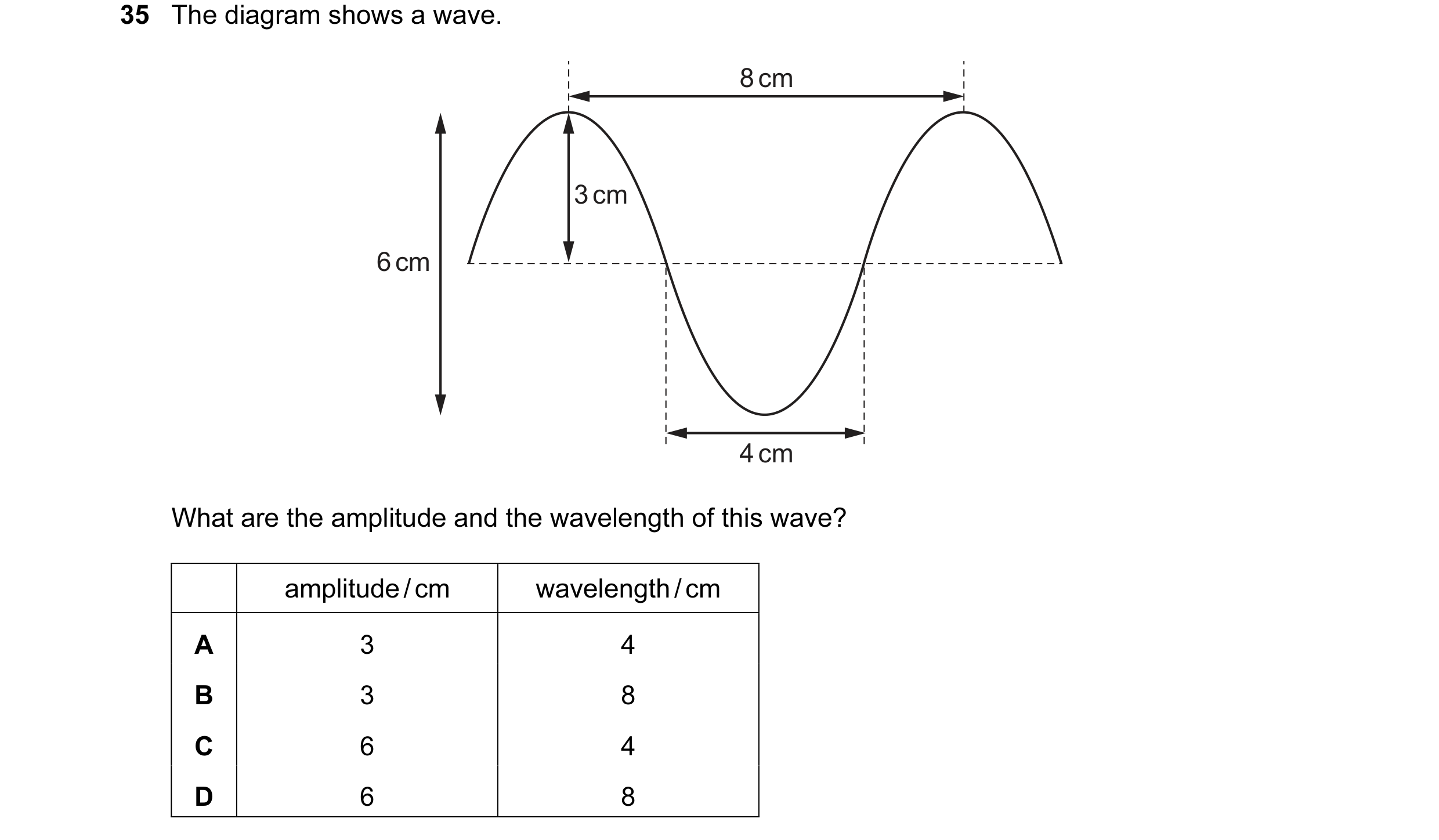
36 The diagram shows a wave. 8 cm 3 cm 6 cm 4 cm What are the amplitude and the wavelength of this wave? amplitude / cm wavelength / cm A 3 4 B 3 8 C 6 4 D 6 8
1 marks
Answer: B
This question in 0654/11 Oct/Nov 2010
Q11 · The diagram shows a wave 0654/12 Oct/Nov 2010
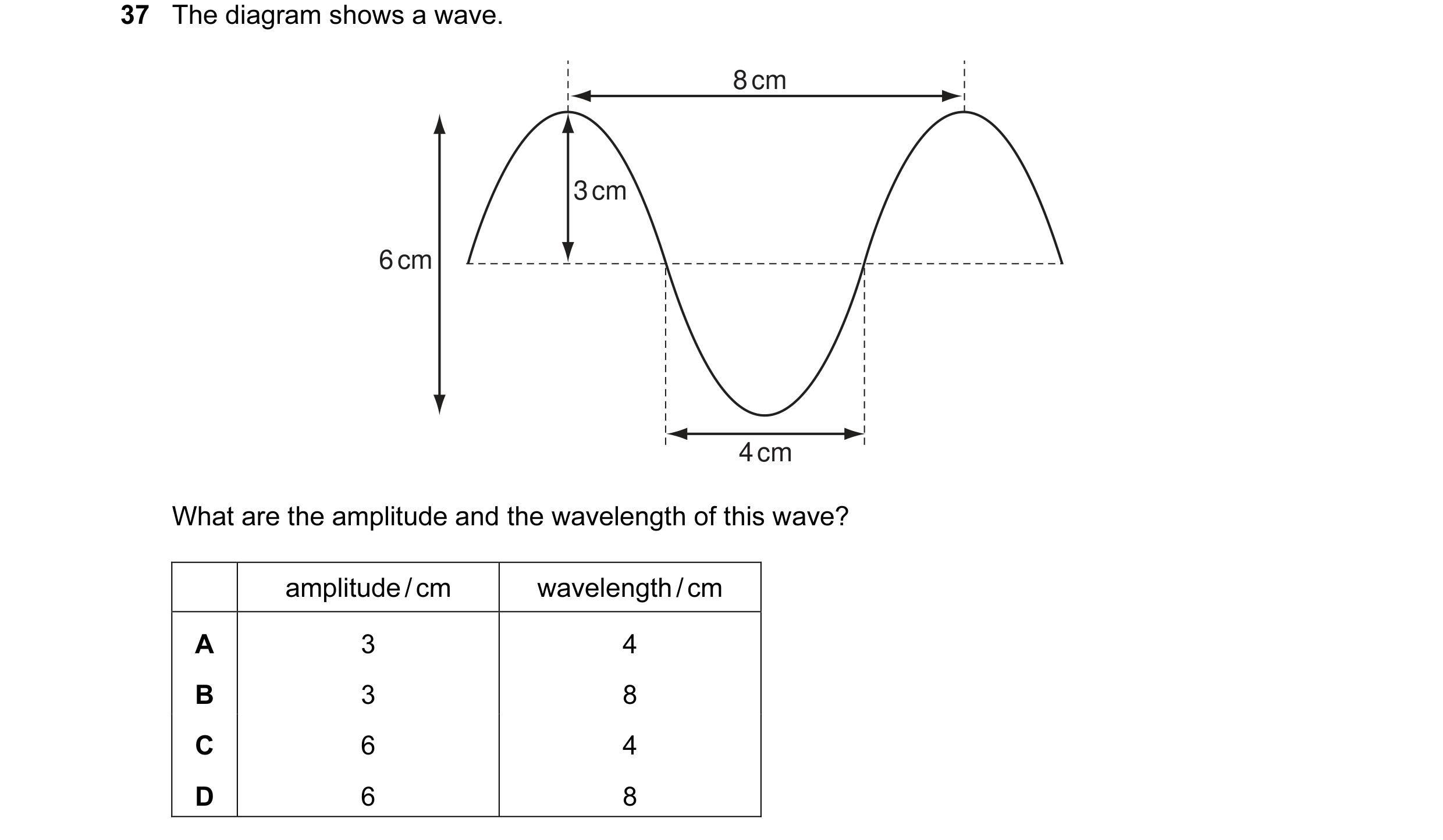
37 The diagram shows a wave. 8 cm 3 cm 6 cm 4 cm What are the amplitude and the wavelength of this wave? amplitude / cm wavelength / cm A 3 4 B 3 8 C 6 4 D 6 8
1 marks
Answer: B
This question in 0654/12 Oct/Nov 2010
Q12 · The diagram shows a wave 0654/13 Oct/Nov 2010
33 The diagram shows a wave. 8 cm 3 cm 6 cm 4 cm What are the amplitude and the wavelength of this wave? amplitude / cm wavelength / cm A 3 4 B 3 8 C 6 4 D 6 8
1 marks
Answer: B
This question in 0654/13 Oct/Nov 2010
Q13 · The diagram shows water waves travelling towards a barrier 0654/11 May/June 2012
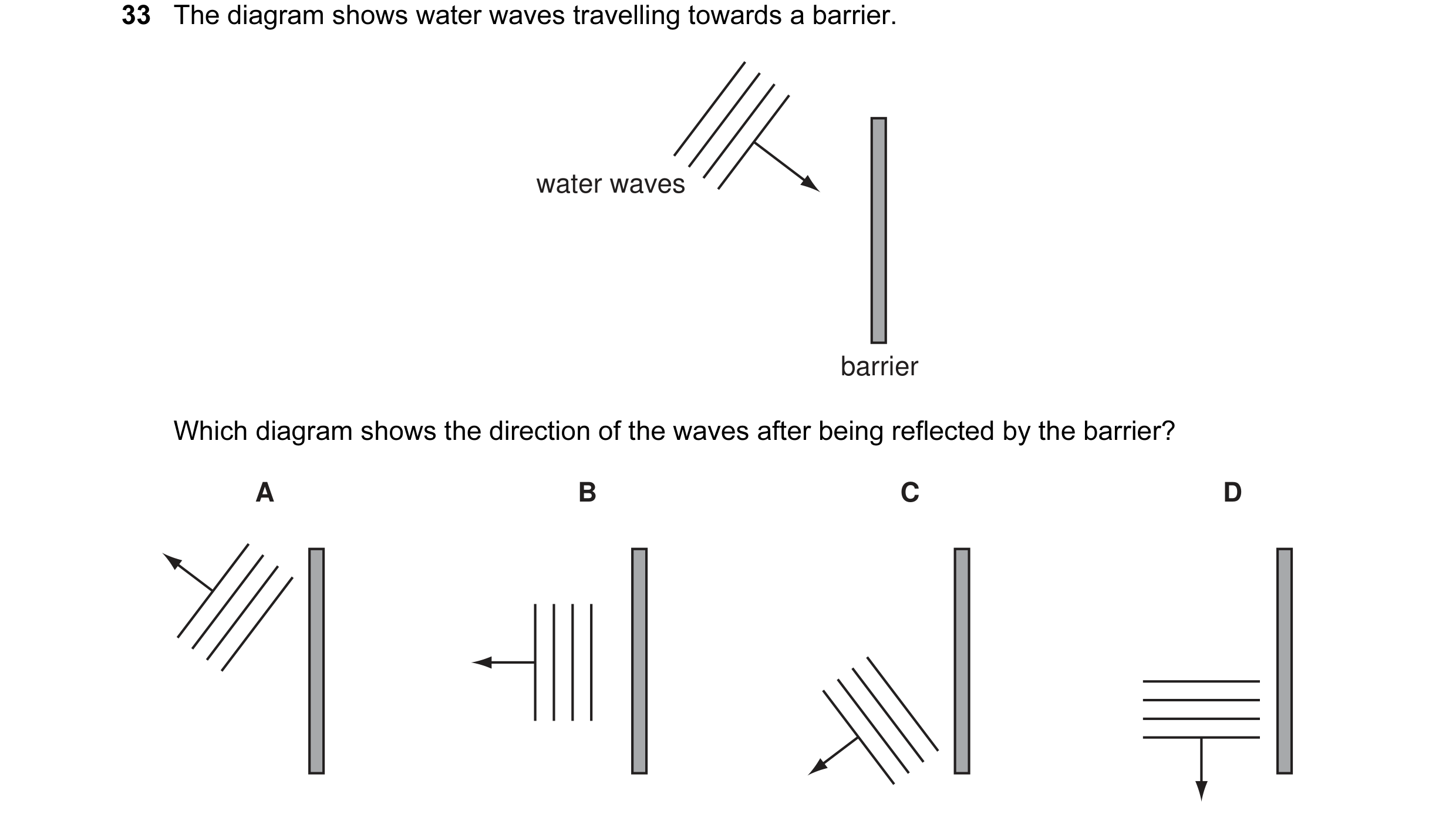
33 The diagram shows water waves travelling towards a barrier. water waves barrier Which diagram shows the direction of the waves after being reflected by the barrier? A B C D
1 marks
Answer: C
This question in 0654/11 May/June 2012
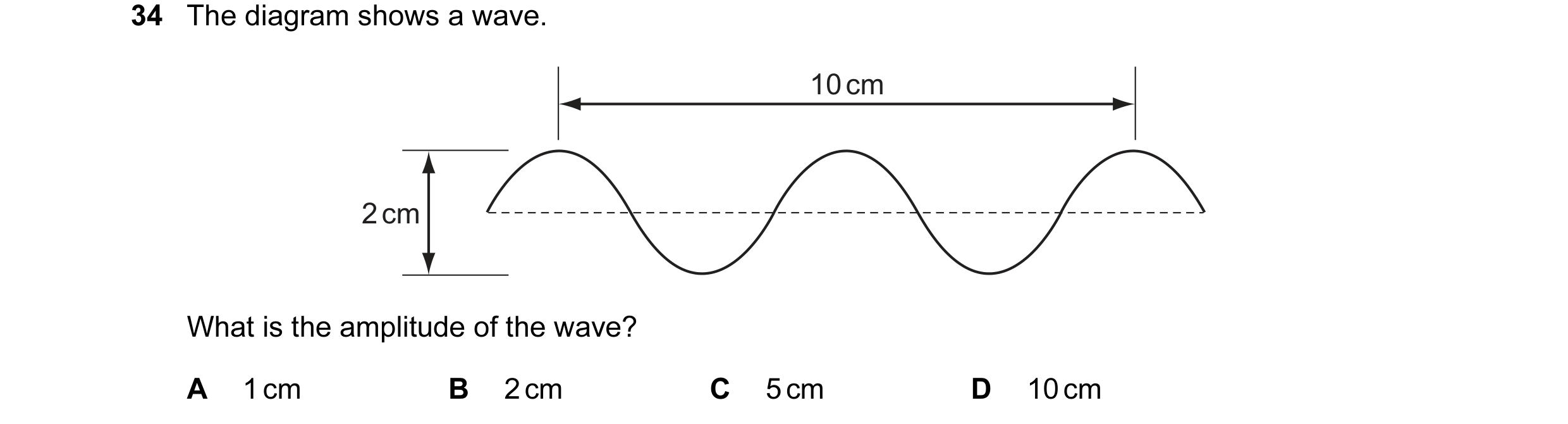
Q14 · The diagram shows a wave 0654/11 May/June 2013
34 The diagram shows a wave. 10 cm 2 cm What is the amplitude of the wave? A 1 cm B 2 cm C 5 cm D 10 cm
1 marks
Answer: A
This question in 0654/11 May/June 2013
Q15 · The diagram shows a wave 0654/12 May/June 2013
34 The diagram shows a wave. 10 cm 2 cm What is the amplitude of the wave? A 1 cm B 2 cm C 5 cm D 10 cm
1 marks
Answer: A
This question in 0654/12 May/June 2013
Q16 · Which change to a sound wave would make it louder? 0654/13 May/June 2013
34 Which change to a sound wave would make it louder? A decreasing the amplitude B increasing the amplitude C decreasing the wavelength D increasing the wavelength
1 marks
Answer: B
This question in 0654/13 May/June 2013
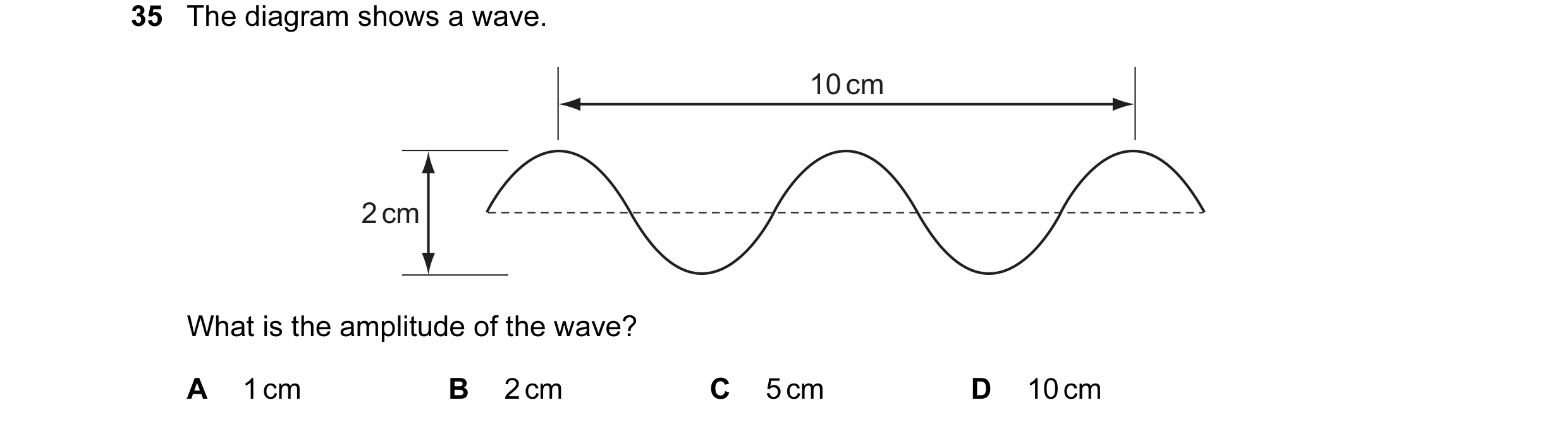
Q17 · The diagram shows a wave 0654/13 May/June 2013
35 The diagram shows a wave. 10 cm 2 cm What is the amplitude of the wave? A 1 cm B 2 cm C 5 cm D 10 cm
1 marks
Answer: A
This question in 0654/13 May/June 2013
Q18 · A student counts how many waves pass point P in 30 seconds 0654/11 Oct/Nov 2013
34 A student counts how many waves pass point P in 30 seconds. P wave direction Using only this information, what can the student calculate? A the amplitude of the wave B the frequency of the wave C the speed of the wave D the wavelength of the wave
1 marks
Answer: B
This question in 0654/11 Oct/Nov 2013
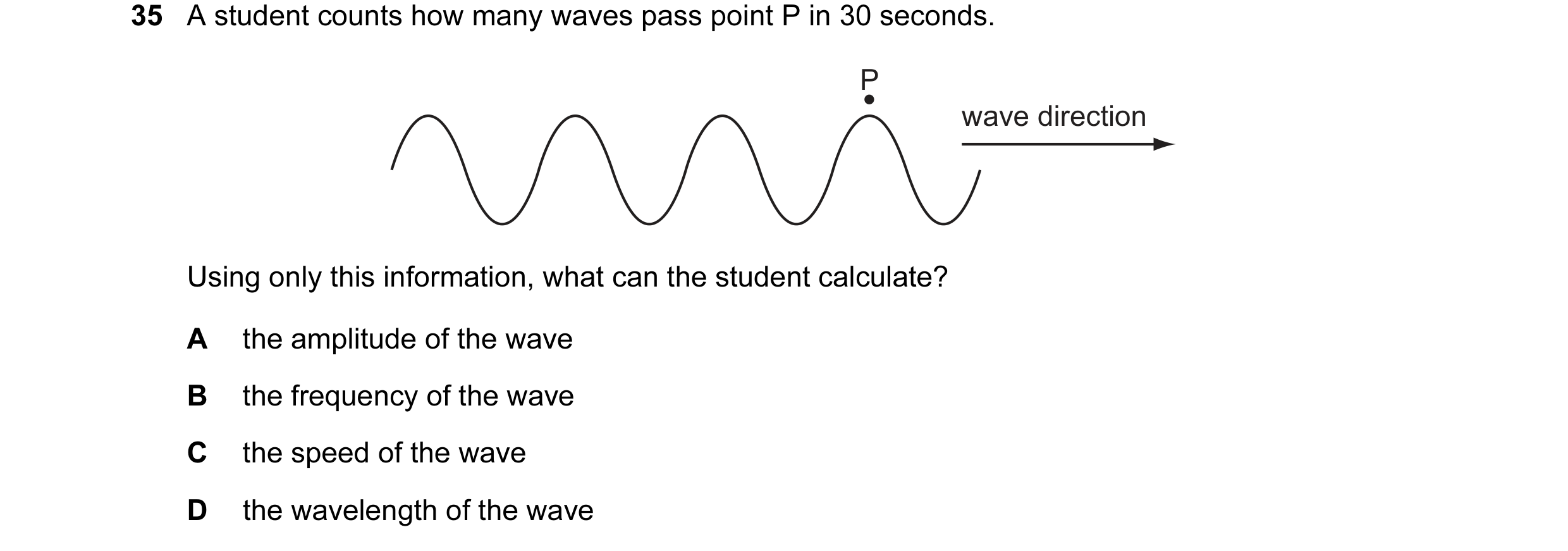
Q19 · A student counts how many waves pass point P in 30 seconds 0654/12 Oct/Nov 2013
35 A student counts how many waves pass point P in 30 seconds. P wave direction Using only this information, what can the student calculate? A the amplitude of the wave B the frequency of the wave C the speed of the wave D the wavelength of the wave
1 marks
Answer: B
This question in 0654/12 Oct/Nov 2013
Q20 · Which type of wave is longitudinal? 0654/13 Oct/Nov 2013
34 Which type of wave is longitudinal? A light wave B radio wave C sound wave D water wave
1 marks
Answer: C
This question in 0654/13 Oct/Nov 2013
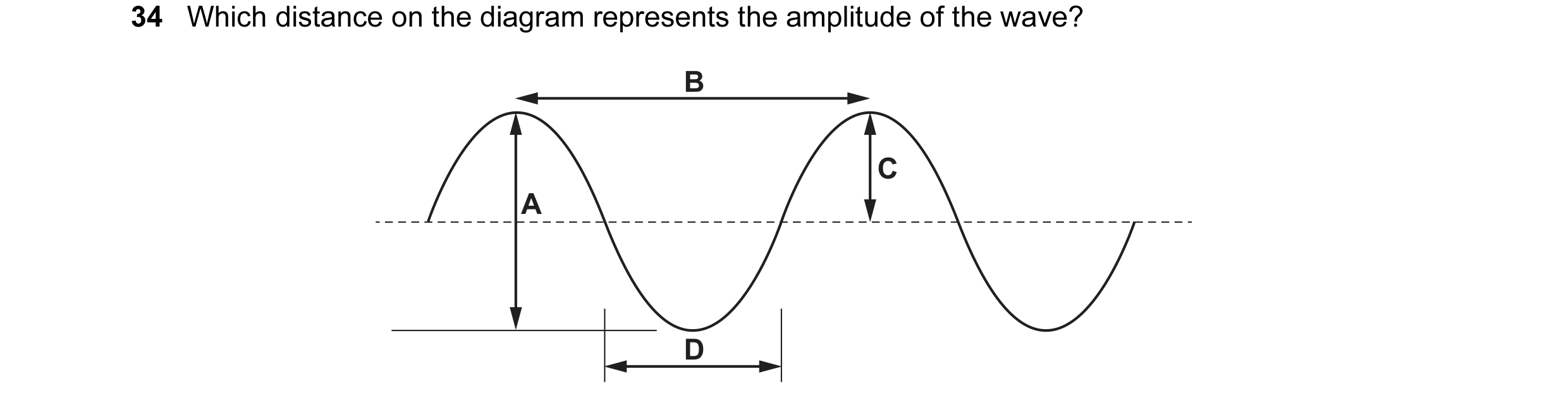
Q21 · Which distance on the diagram represents the amplitude of the wave? 0654/11 May/June 2014
34 Which distance on the diagram represents the amplitude of the wave? B C A D
1 marks
Answer: C
This question in 0654/11 May/June 2014
Q22 · Which distance on the diagram represents the amplitude of the wave? 0654/12 May/June 2014
34 Which distance on the diagram represents the amplitude of the wave? B C A D
1 marks
Answer: C
This question in 0654/12 May/June 2014
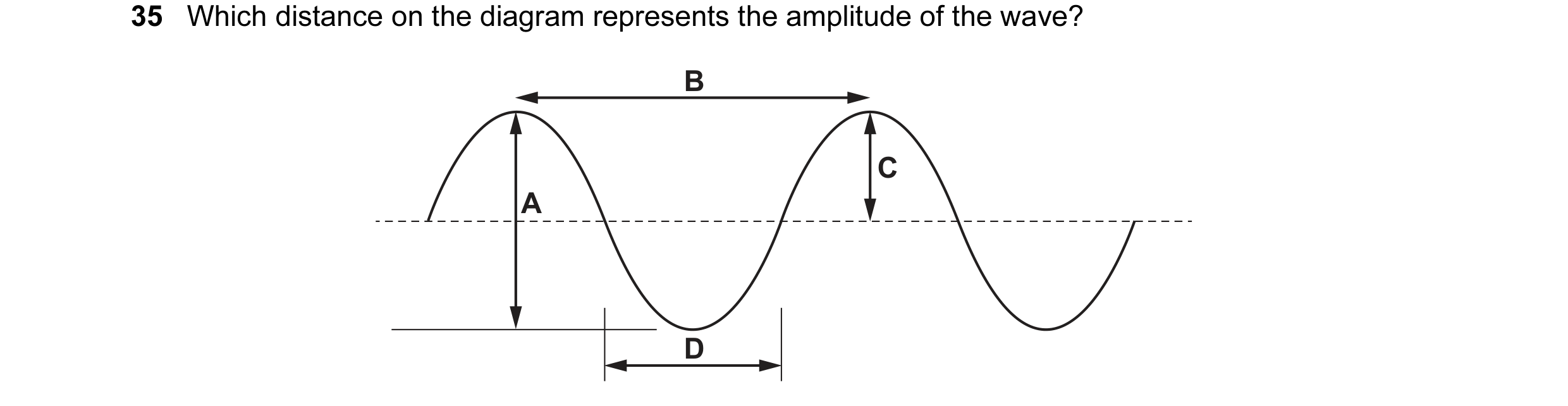
Q23 · Which distance on the diagram represents the amplitude of the wave? 0654/13 May/June 2014
35 Which distance on the diagram represents the amplitude of the wave? B C A D
1 marks
Answer: C
This question in 0654/13 May/June 2014
Q24 · Which waves are longitudinal? 0654/11 Oct/Nov 2014
32 Which waves are longitudinal? A light waves from a lamp B sound waves from a piano C ultraviolet waves from the Sun D X-rays from a security scanner
1 marks
Answer: B
This question in 0654/11 Oct/Nov 2014
Q25 · Which waves are longitudinal? 0654/12 Oct/Nov 2014
33 Which waves are longitudinal? A light waves from a lamp B sound waves from a piano C ultraviolet waves from the Sun D X-rays from a security scanner
1 marks
Answer: B
This question in 0654/12 Oct/Nov 2014
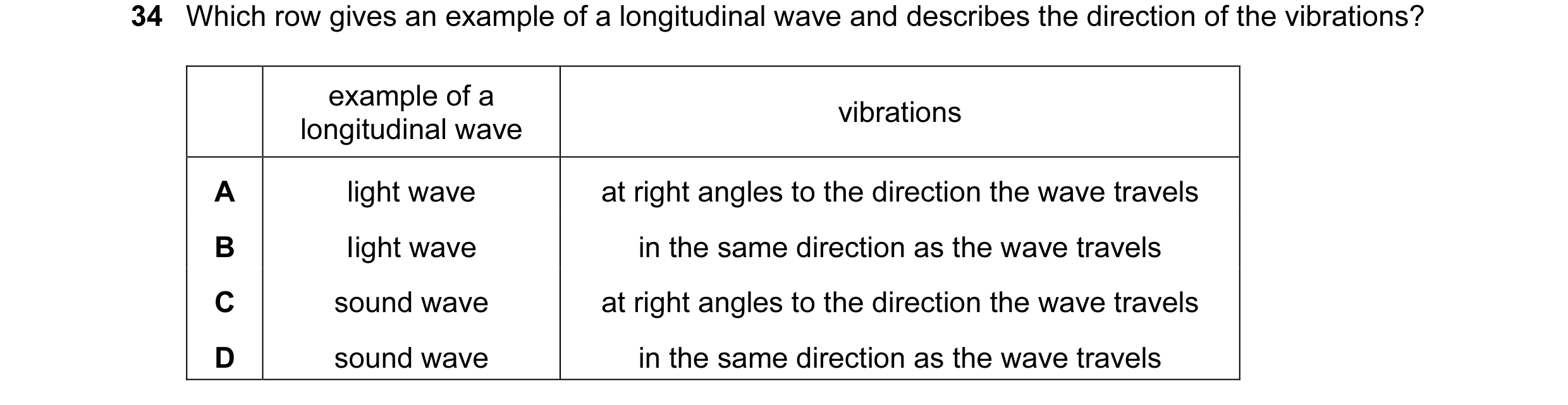
Q26 · Which row gives an example of a longitudinal wave and describes the direction of the… 0654/11 May/June 2015
34 Which row gives an example of a longitudinal wave and describes the direction of the vibrations? example of a vibrations longitudinal wave A light wave at right angles to the direction the wave travels B Iight wave in the same direction as the wave travels C sound wave at right angles to the direction the wave travels D sound wave in the same direction as the wave travels
1 marks
Answer: D
This question in 0654/11 May/June 2015
Q27 · The diagrams show examples of wave motion 0654/12 May/June 2015
34 The diagrams show examples of wave motion. 1 2 ripple tank drum waves on water waves in air 3 4 waves on a rope waves in a spring (as shown) Which waves are longitudinal? A 1 only B 2 and 3 only C 2, 3 and 4 only D 2 and 4 only
1 marks
Answer: D
This question in 0654/12 May/June 2015
Q28 · The diagram represents a water wave changing direction as it moves into a shallower region 0654/13 May/June 2015
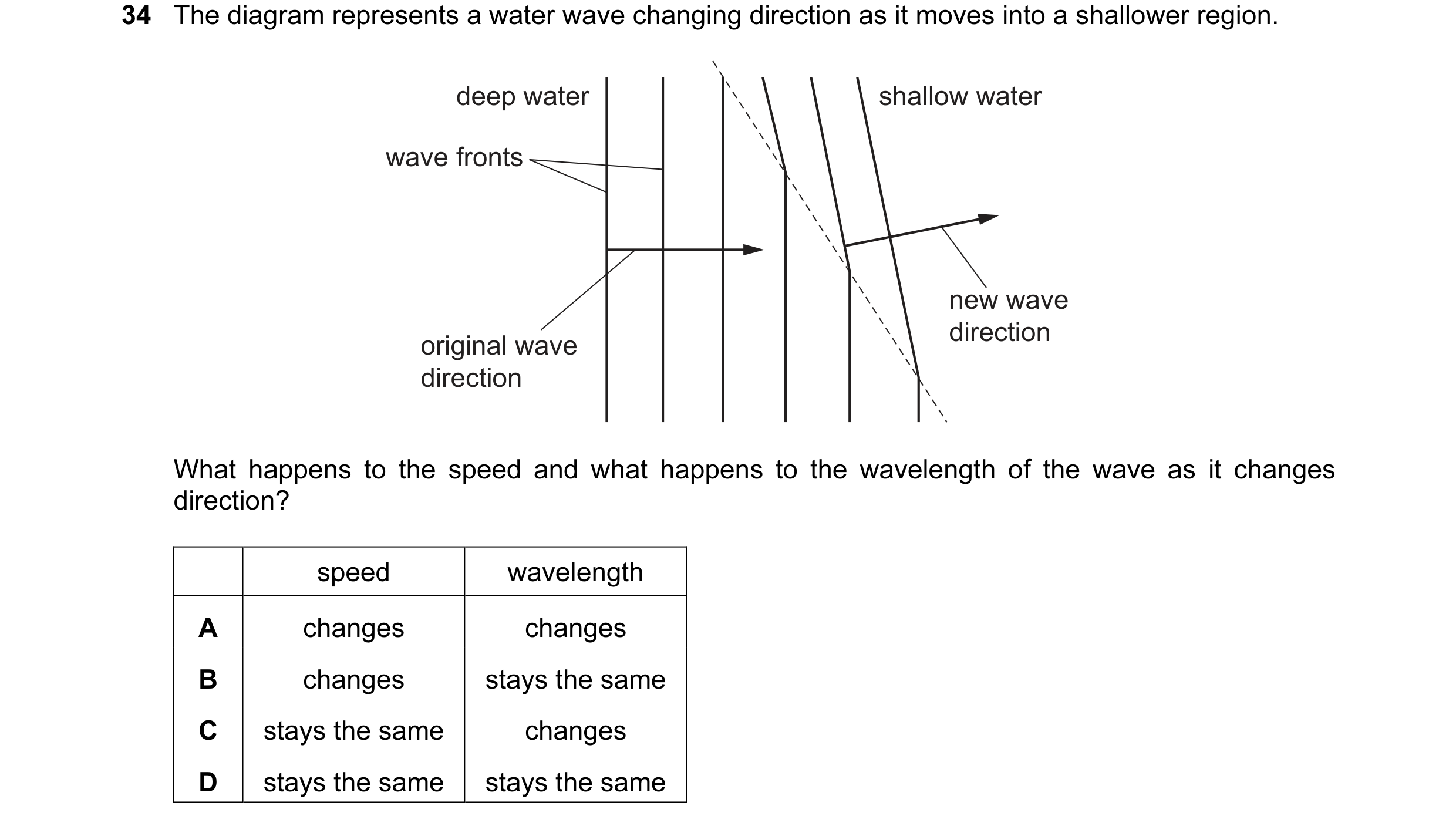
34 The diagram represents a water wave changing direction as it moves into a shallower region. deep water shallow water wave fronts new wave direction original wave direction What happens to the speed and what happens to the wavelength of the wave as it changes direction? speed wavelength A changes changes B changes stays the same C stays the same changes D stays the same stays the same
1 marks
Answer: A
This question in 0654/13 May/June 2015
Q29 · The diagram shows a wave 0654/11 Oct/Nov 2015
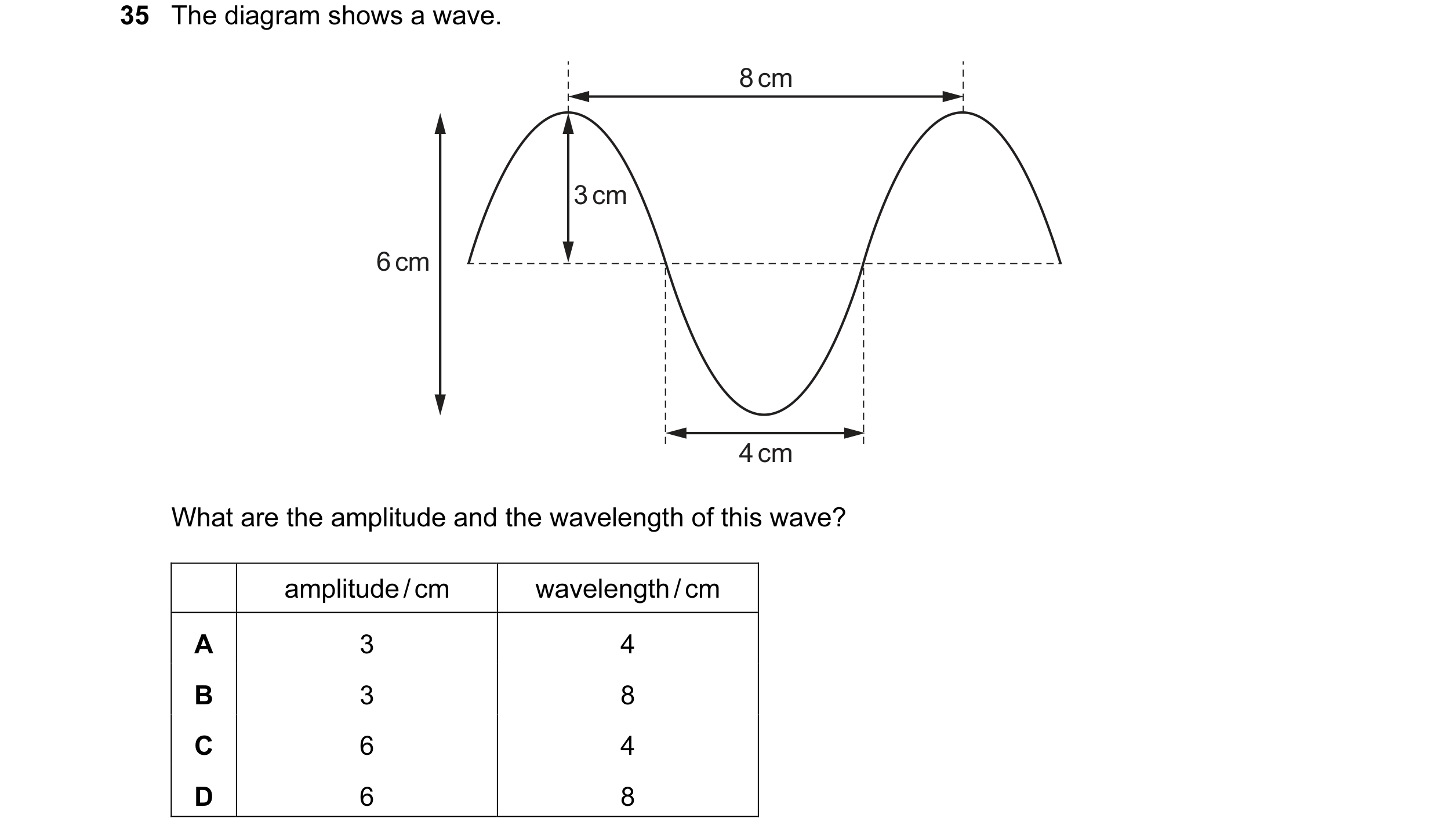
35 The diagram shows a wave. 8 cm 3 cm 6 cm 4 cm What are the amplitude and the wavelength of this wave? amplitude / cm wavelength / cm A 3 4 B 3 8 C 6 4 D 6 8
1 marks
Answer: B
This question in 0654/11 Oct/Nov 2015
Q30 · The diagram shows a wave 0654/12 Oct/Nov 2015
35 The diagram shows a wave. 8 cm 3 cm 6 cm 4 cm What are the amplitude and the wavelength of this wave? amplitude / cm wavelength / cm A 3 4 B 3 8 C 6 4 D 6 8
1 marks
Answer: B
This question in 0654/12 Oct/Nov 2015
Q31 · The diagram shows a wave 0654/13 Oct/Nov 2015
35 The diagram shows a wave. 8 cm 3 cm 6 cm 4 cm What are the amplitude and the wavelength of this wave? amplitude / cm wavelength / cm A 3 4 B 3 8 C 6 4 D 6 8
1 marks
Answer: B
This question in 0654/13 Oct/Nov 2015
Question 32 0654/11 May/June 2016
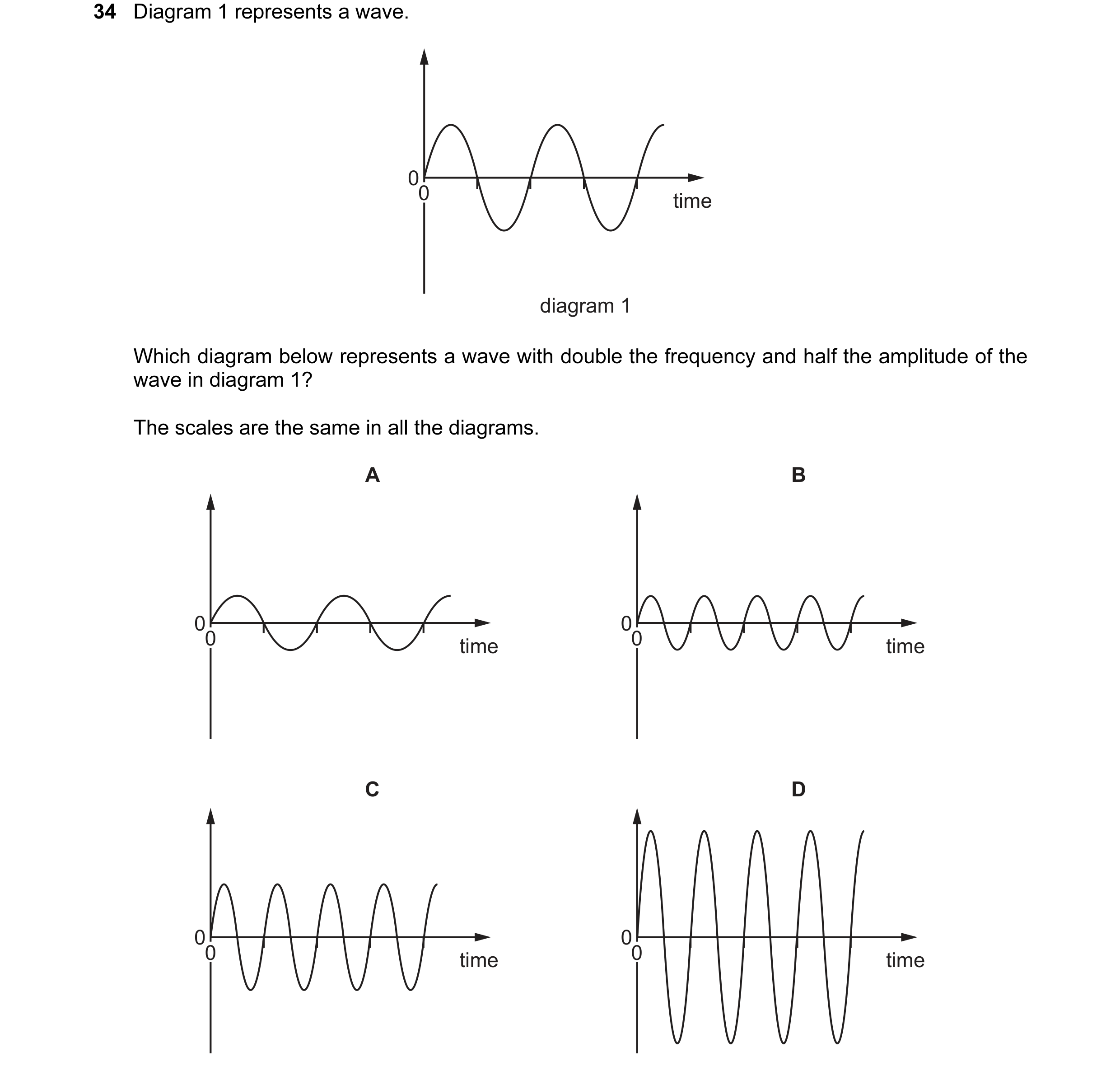
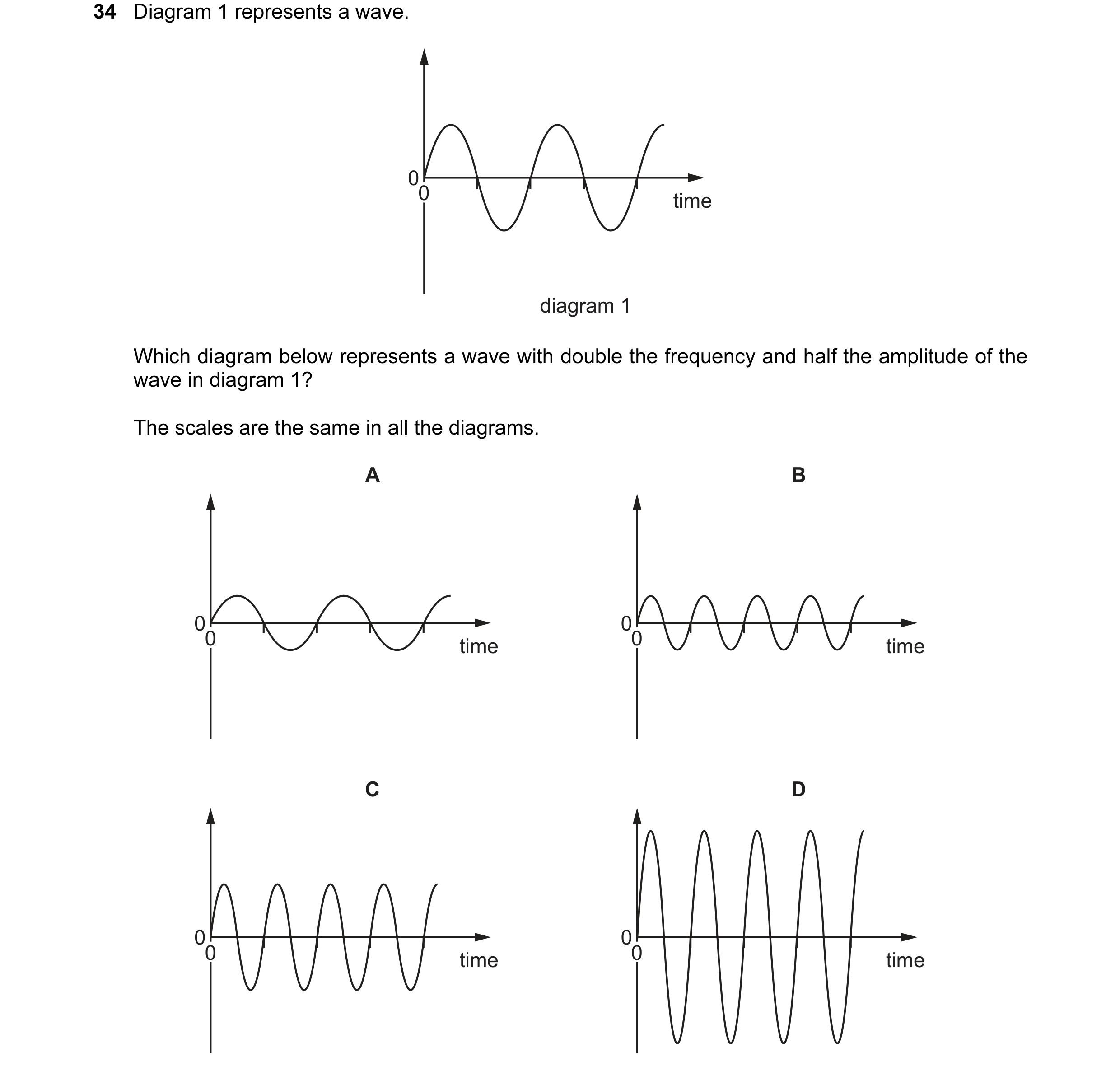
34 Diagram 1 represents a wave. 00 time diagram 1 Which diagram below represents a wave with double the frequency and half the amplitude of the wave in diagram 1? The scales are the same in all the diagrams. A B 00 00 time time C D 00 00 time time
1 marks
Answer: B
This question in 0654/11 May/June 2016
Question 33 0654/12 May/June 2016
34 Diagram 1 represents a wave. 00 time diagram 1 Which diagram below represents a wave with double the frequency and half the amplitude of the wave in diagram 1? The scales are the same in all the diagrams. A B 00 00 time time C D 00 00 time time
1 marks
Answer: B
This question in 0654/12 May/June 2016
Question 34 0654/13 May/June 2016
34 Diagram 1 represents a wave. 00 time diagram 1 Which diagram below represents a wave with double the frequency and half the amplitude of the wave in diagram 1? The scales are the same in all the diagrams. A B 00 00 time time C D 00 00 time time
1 marks
Answer: B
This question in 0654/13 May/June 2016
Q35 · A water wave passes point Y 0654/11 Oct/Nov 2016
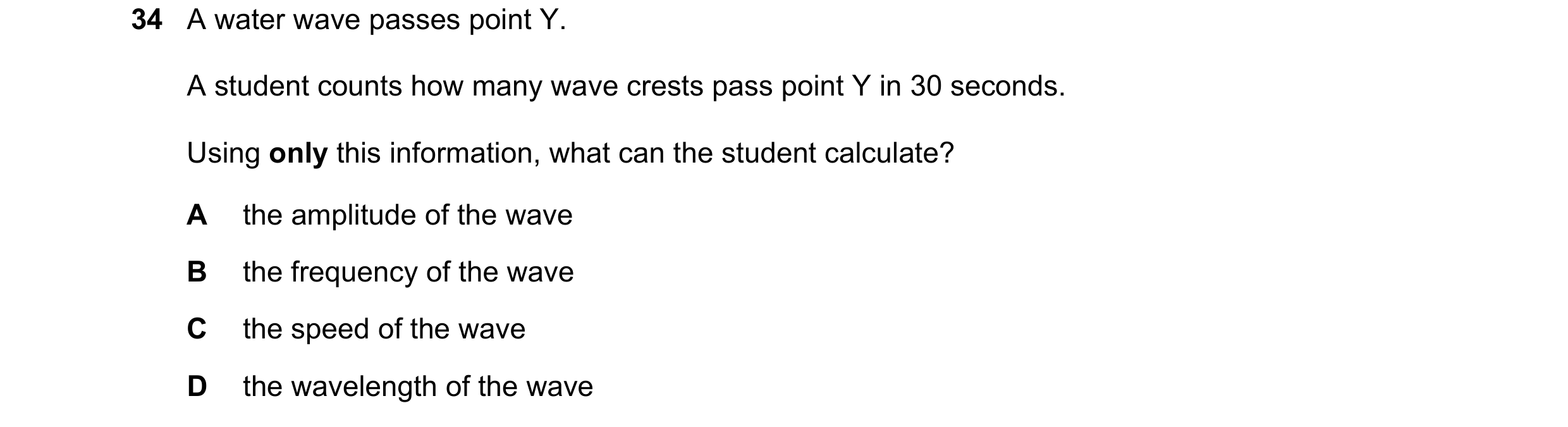
34 A water wave passes point Y. A student counts how many wave crests pass point Y in 30 seconds. Using only this information, what can the student calculate? A the amplitude of the wave B the frequency of the wave C the speed of the wave D the wavelength of the wave
1 marks
Answer: B
This question in 0654/11 Oct/Nov 2016
Q36 · A water wave passes point Y 0654/12 Oct/Nov 2016
34 A water wave passes point Y. A student counts how many wave crests pass point Y in 30 seconds. Using only this information, what can the student calculate? A the amplitude of the wave B the frequency of the wave C the speed of the wave D the wavelength of the wave
1 marks
Answer: B
This question in 0654/12 Oct/Nov 2016
Q37 · A water wave passes point Y 0654/13 Oct/Nov 2016
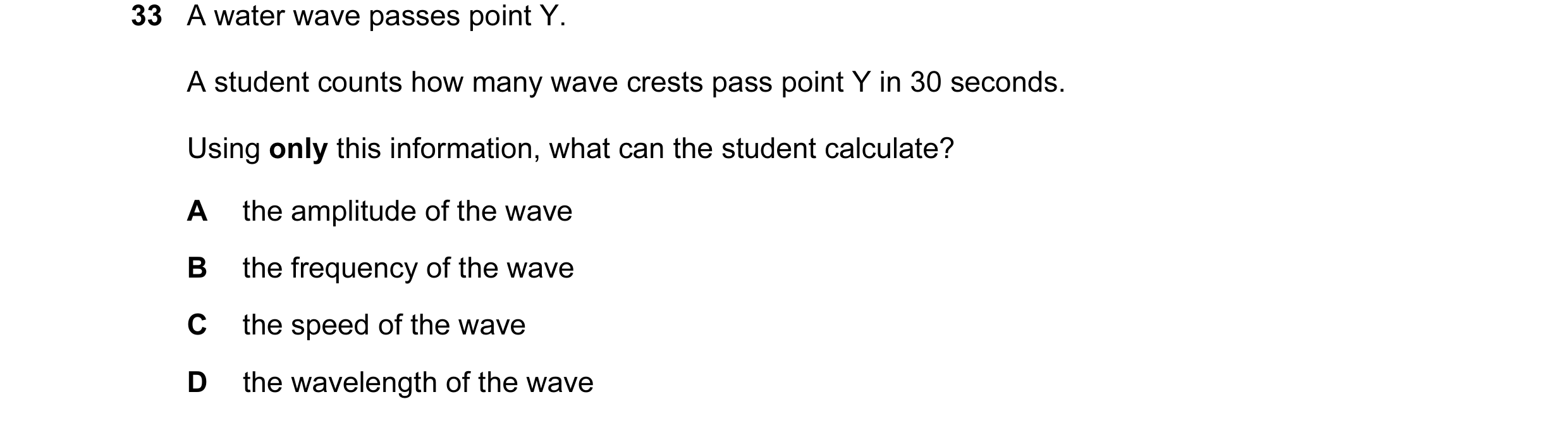
33 A water wave passes point Y. A student counts how many wave crests pass point Y in 30 seconds. Using only this information, what can the student calculate? A the amplitude of the wave B the frequency of the wave C the speed of the wave D the wavelength of the wave
1 marks
Answer: B
This question in 0654/13 Oct/Nov 2016
Q38 · Which waves are longitudinal? 0654/11 May/June 2017
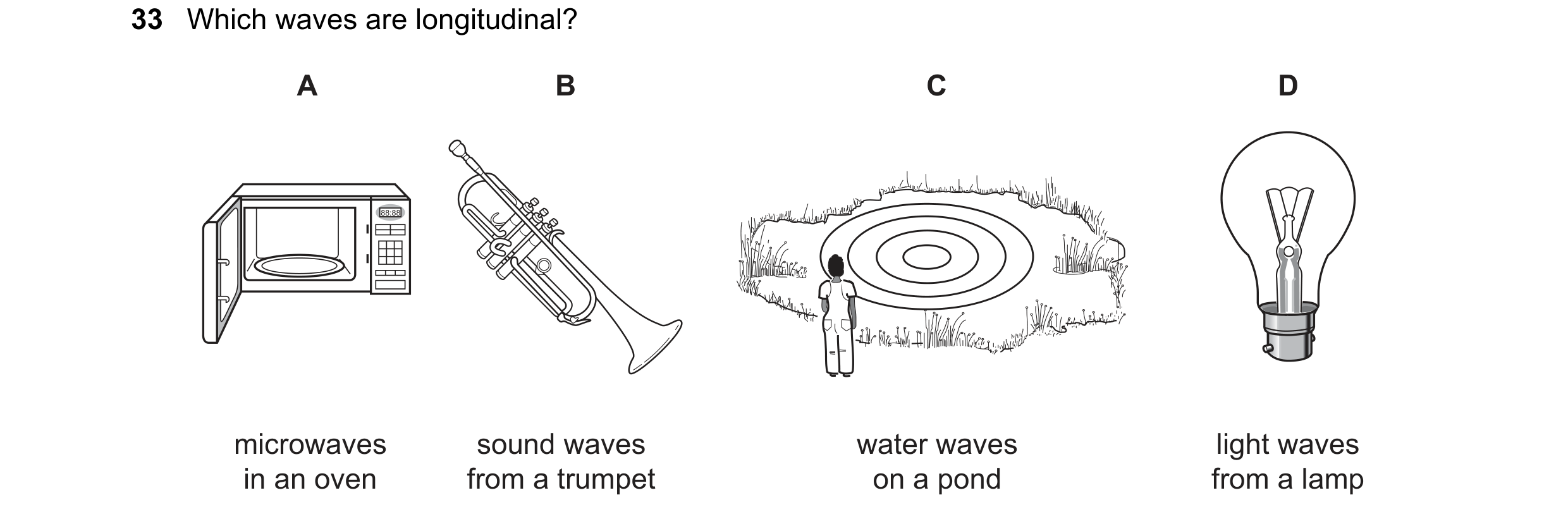
33 Which waves are longitudinal? A B C D 88:88 microwaves sound waves water waves light waves in an oven from a trumpet on a pond from a lamp
1 marks
Answer: B
This question in 0654/11 May/June 2017
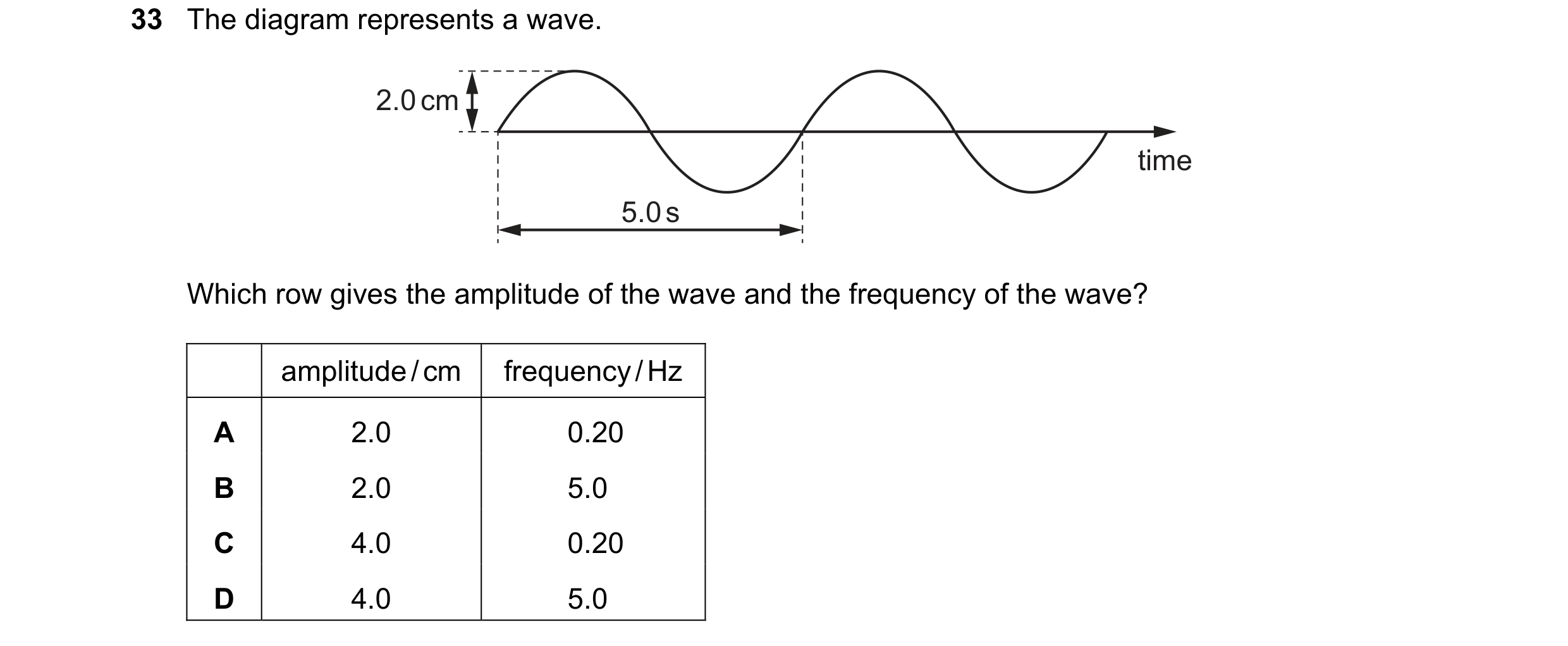
Q39 · The diagram represents a wave 0654/12 May/June 2017
33 The diagram represents a wave. 2.0 cm time 5.0 s Which row gives the amplitude of the wave and the frequency of the wave? amplitude / cm frequency / Hz A 2.0 0.20 B 2.0 5.0 C 4.0 0.20 D 4.0 5.0
1 marks
Answer: A
This question in 0654/12 May/June 2017
Q40 · The diagrams represent four waves 0654/13 May/June 2017
33 The diagrams represent four waves. The diagrams are drawn to the same scale. P Q displacement displacement 00 00 distance distance R S displacement displacement 00 00 distance distance Which statement is correct? A The amplitude of wave P is the same as the amplitude of wave R. B The amplitude of wave S is twice the amplitude of wave Q. C The wavelength of wave Q is twice the wavelength of wave P. D The wavelength of wave S is the same as the wavelength of wave Q.
1 marks
Answer: A
This question in 0654/13 May/June 2017
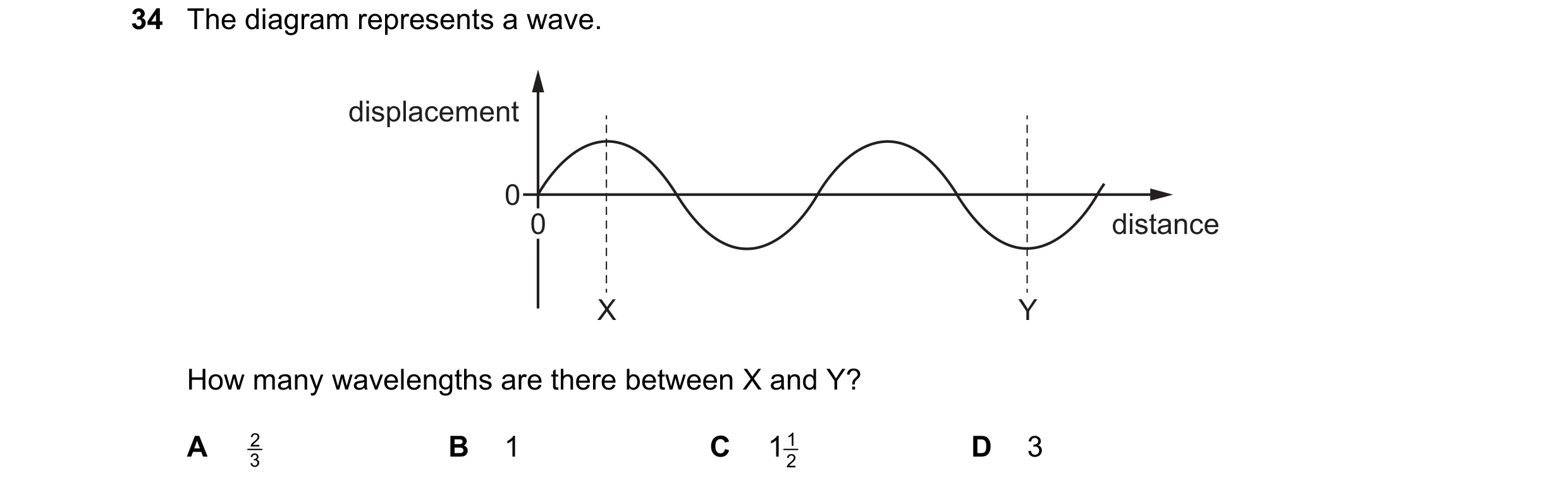
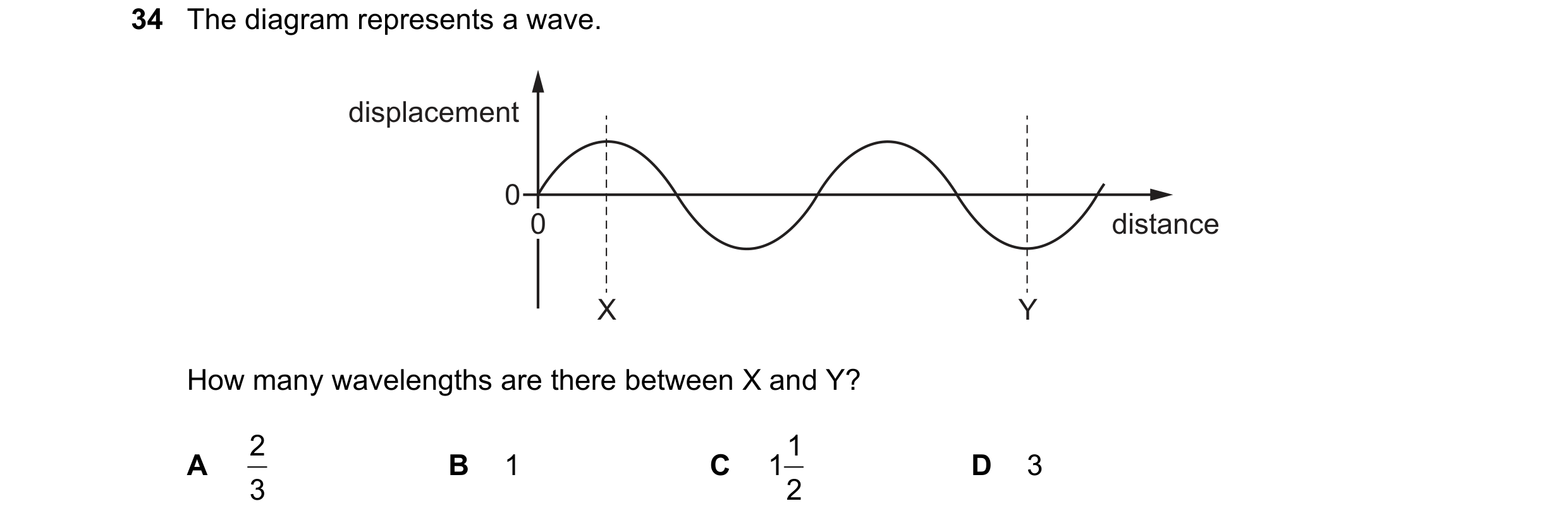
Q41 · The diagram represents a wave 0654/11 Oct/Nov 2017
34 The diagram represents a wave. displacement 0 0 distance X Y How many wavelengths are there between X and Y? A 2 B 1 C 1 1 D 3 3 2
1 marks
Answer: C
This question in 0654/11 Oct/Nov 2017
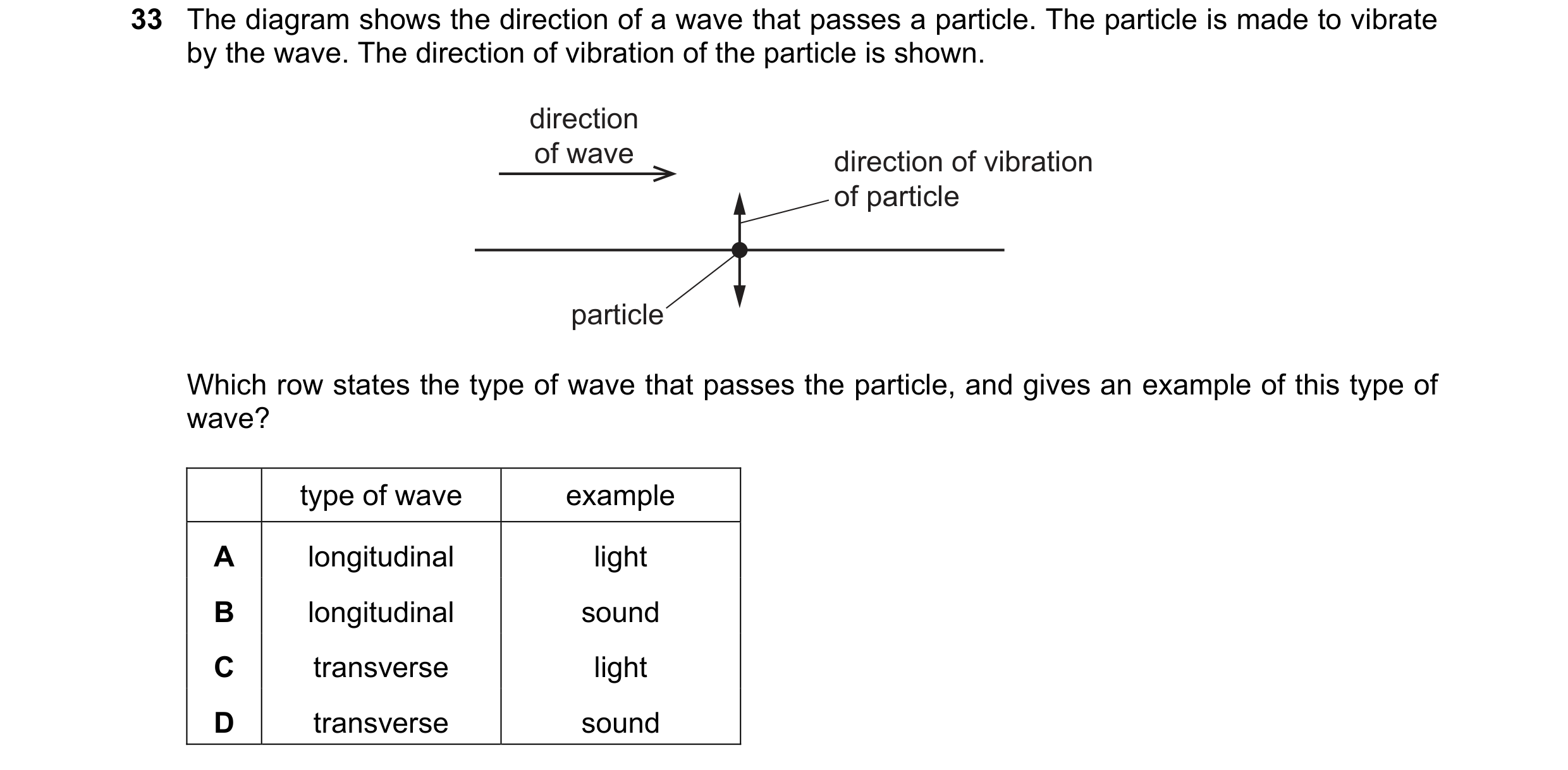
Q42 · The diagram shows the direction of a wave that passes a particle 0654/12 Oct/Nov 2017
33 The diagram shows the direction of a wave that passes a particle. The particle is made to vibrate by the wave. The direction of vibration of the particle is shown. direction of wave direction of vibration of particle particle Which row states the type of wave that passes the particle, and gives an example of this type of wave? type of wave example A longitudinal light B longitudinal sound C transverse light D transverse sound
1 marks
Answer: C
This question in 0654/12 Oct/Nov 2017
Question 43 0654/11 May/June 2019
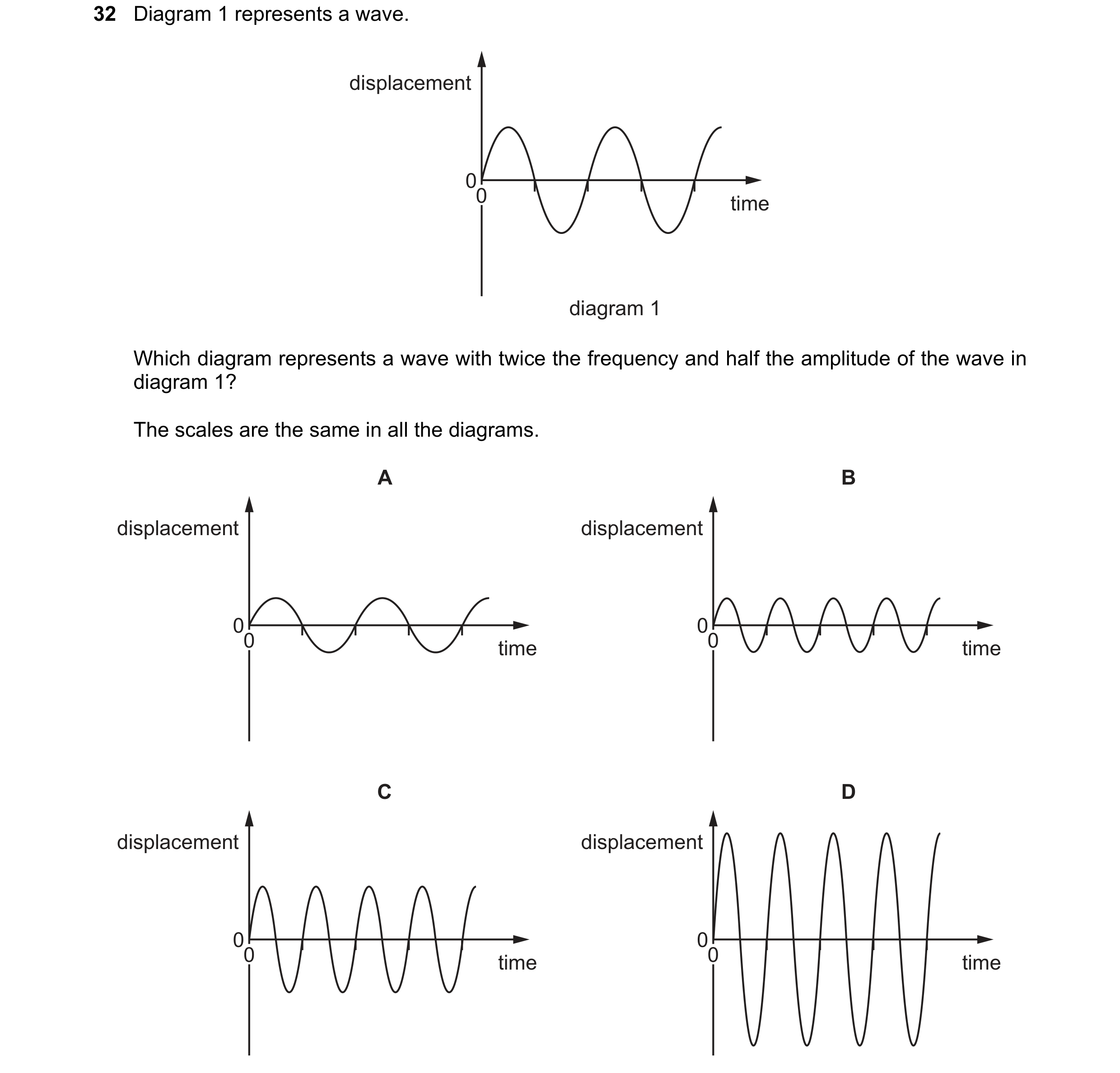
32 Diagram 1 represents a wave. displacement 00 time diagram 1 Which diagram represents a wave with twice the frequency and half the amplitude of the wave in diagram 1? The scales are the same in all the diagrams. A B displacement displacement 00 00 time time C D displacement displacement 00 00 time time
1 marks
Answer: B
This question in 0654/11 May/June 2019
Question 44 0654/12 May/June 2019
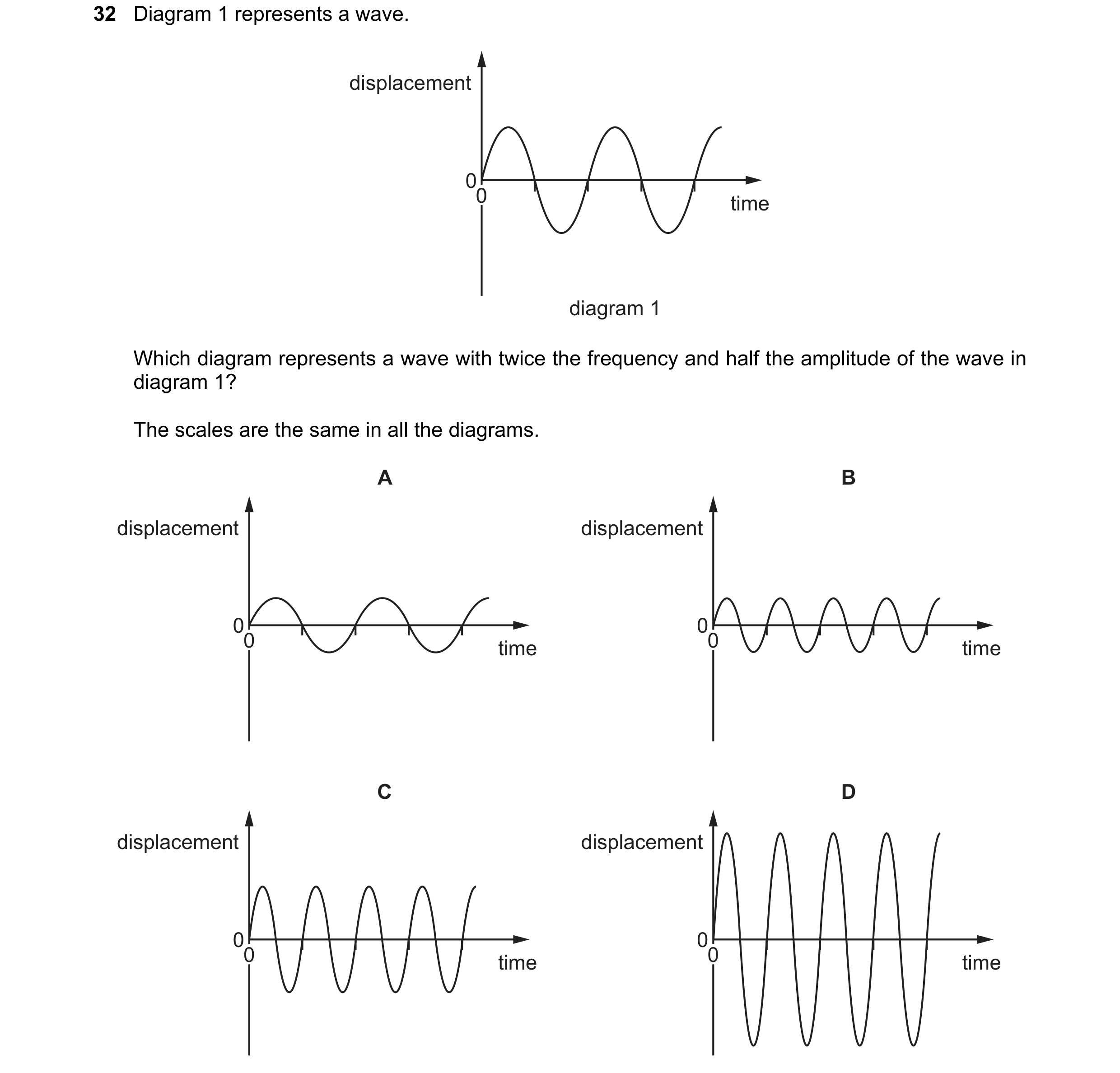
32 Diagram 1 represents a wave. displacement 00 time diagram 1 Which diagram represents a wave with twice the frequency and half the amplitude of the wave in diagram 1? The scales are the same in all the diagrams. A B displacement displacement 00 00 time time C D displacement displacement 00 00 time time
1 marks
Answer: B
This question in 0654/12 May/June 2019
Question 45 0654/13 May/June 2019
32 Diagram 1 represents a wave. displacement 00 time diagram 1 Which diagram represents a wave with twice the frequency and half the amplitude of the wave in diagram 1? The scales are the same in all the diagrams. A B displacement displacement 00 00 time time C D displacement displacement 00 00 time time
1 marks
Answer: B
This question in 0654/13 May/June 2019
Q46 · ‘The maximum distance a particle on the surface of deep water moves from its rest… 0654/12 May/June 2020
33 ‘The maximum distance a particle on the surface of deep water moves from its rest position when a wave passes it.’ Which property of a wave does this describe? A amplitude B frequency C speed D wavelength
1 marks
Answer: A
This question in 0654/12 May/June 2020
Q47 · ‘The number of crests on the surface of water that pass a particular point each second.’… 0654/13 May/June 2020
32 ‘The number of crests on the surface of water that pass a particular point each second.’ Which property of a wave does this describe? A amplitude B frequency C speed D wavelength
1 marks
Answer: B
This question in 0654/13 May/June 2020
Q48 · A tank contains water 0654/12 Oct/Nov 2020
32 A tank contains water. A wave is produced and travels across the surface of the water. What is the maximum height of the water as the wave passes compared with the original level of the water? A the amplitude B the frequency C the speed D the wavelength
1 marks
Answer: A
This question in 0654/12 Oct/Nov 2020
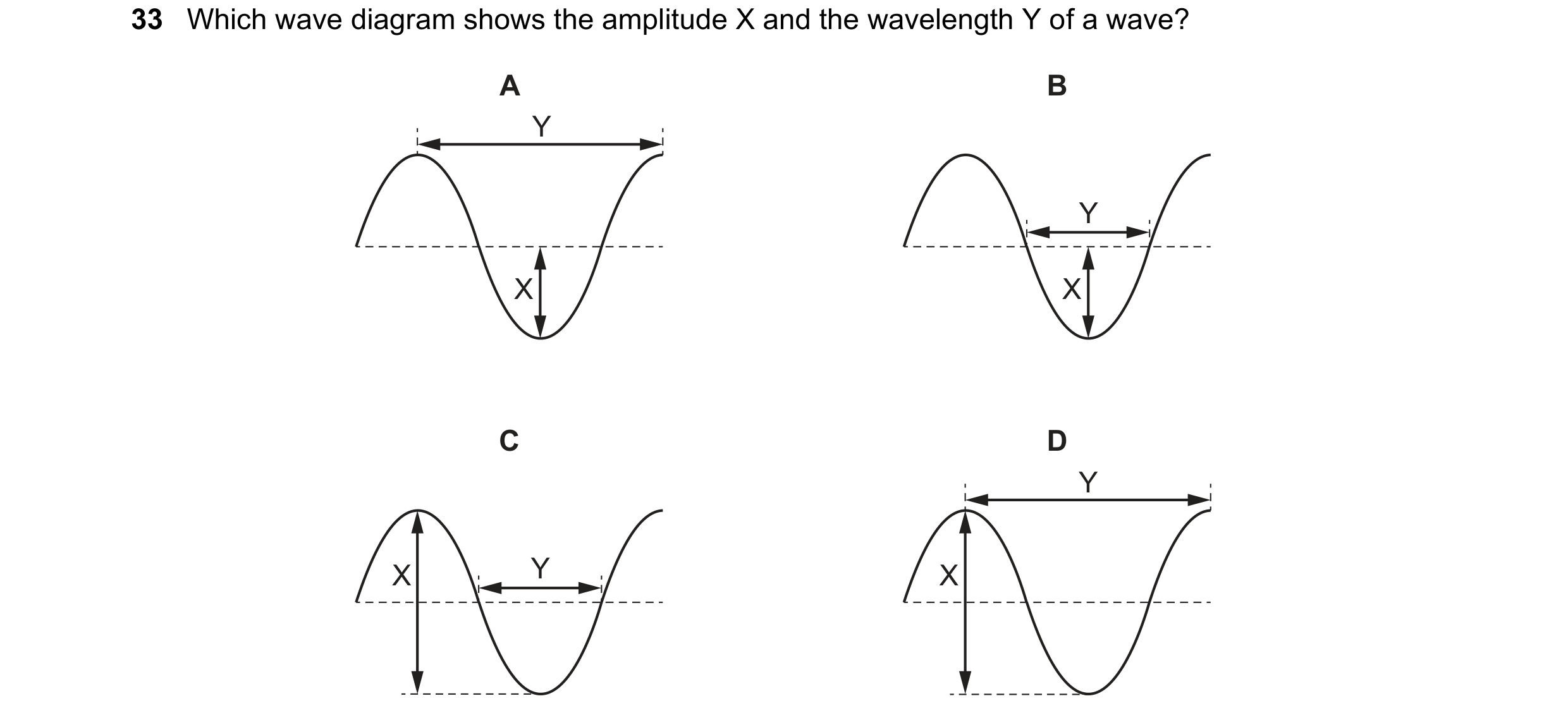
Q49 · Which wave diagram shows the amplitude X and the wavelength Y of a wave? 0654/13 Oct/Nov 2020
33 Which wave diagram shows the amplitude X and the wavelength Y of a wave? A B Y Y X X C D Y X Y X
1 marks
Answer: A
This question in 0654/13 Oct/Nov 2020
Q50 · The diagram shows a water wave seen from above 0654/12 Feb/March 2022
34 The diagram shows a water wave seen from above. One wavefront (crest) is made every 0.50 s. wavefronts (crests) 6.0 cm What is the frequency of the wave and what is its wavelength? frequency / Hz wavelength / cm A 0.50 3.0 B 0.50 6.0 C 2.0 3.0 D 2.0 6.0
1 marks
Answer: C
This question in 0654/12 Feb/March 2022
Q51 · A water wave passes point Y 0654/12 Feb/March 2023
34 A water wave passes point Y. A student counts how many wave crests pass point Y in 30 seconds. Using only this information, what can the student calculate? A the amplitude of the wave B the frequency of the wave C the speed of the wave D the wavelength of the wave
1 marks
Answer: B
This question in 0654/12 Feb/March 2023
Q52 · What is the name of the distance between two consecutive crests of a water wave? 0654/12 May/June 2023
33 What is the name of the distance between two consecutive crests of a water wave? A amplitude B frequency C speed D wavelength
1 marks
Answer: D
This question in 0654/12 May/June 2023
Q53 · What is the name of the distance between two consecutive crests of a water wave? 0654/13 May/June 2023
33 What is the name of the distance between two consecutive crests of a water wave? A amplitude B frequency C speed D wavelength
1 marks
Answer: D
This question in 0654/13 May/June 2023
Q54 · The diagram represents a transverse wave 0654/13 Oct/Nov 2023
33 The diagram represents a transverse wave. Which labelled arrow represents the wavelength of the wave? C A B D
1 marks
Answer: C
This question in 0654/13 Oct/Nov 2023
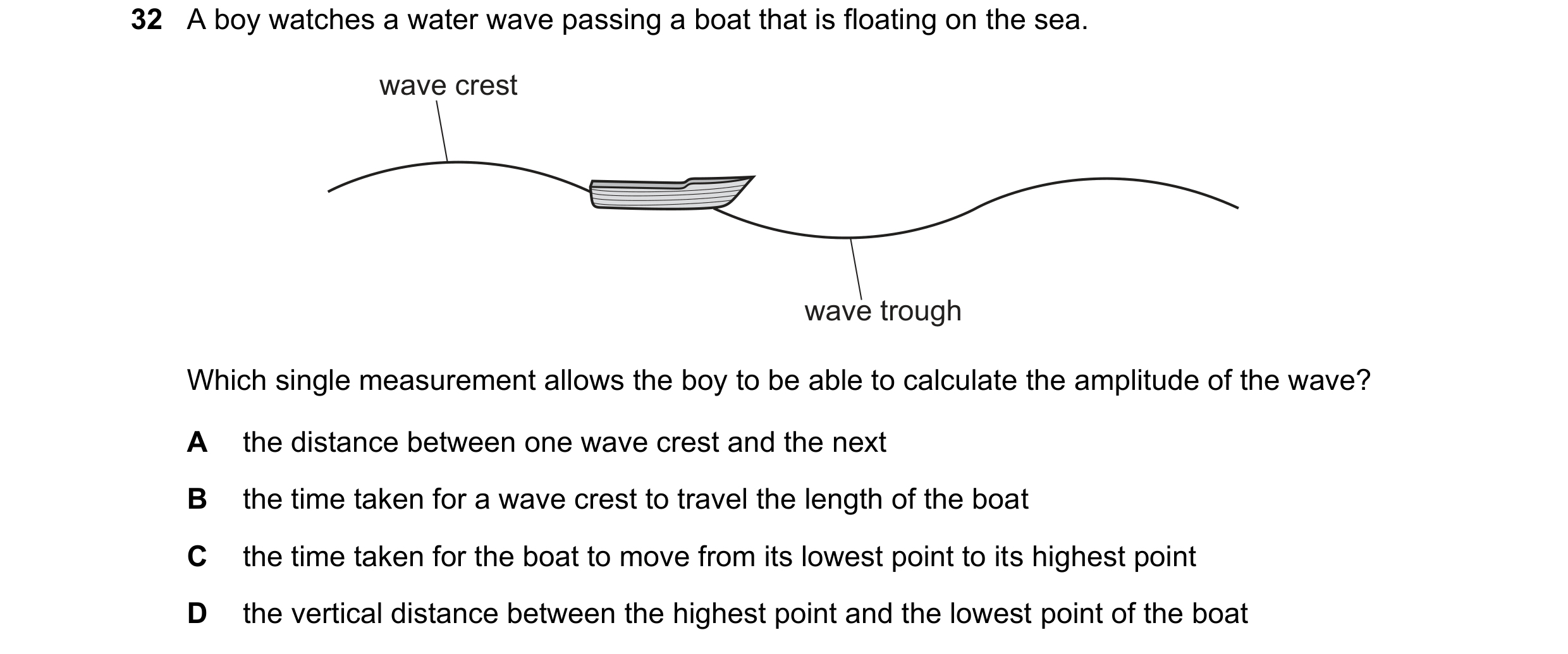
Q55 · A boy watches a water wave passing a boat that is floating on the sea 0654/12 Feb/March 2024
32 A boy watches a water wave passing a boat that is floating on the sea. wave crest wave trough Which single measurement allows the boy to be able to calculate the amplitude of the wave? A the distance between one wave crest and the next B the time taken for a wave crest to travel the length of the boat C the time taken for the boat to move from its lowest point to its highest point D the vertical distance between the highest point and the lowest point of the boat
1 marks
Answer: D
This question in 0654/12 Feb/March 2024
Q56 · The diagram represents a wave 0654/12 Oct/Nov 2024
34 The diagram represents a wave. displacement 0 0 distance X Y How many wavelengths are there between X and Y? 2 1 A B 1 C 1 D 3 3 2
1 marks
Answer: C
This question in 0654/12 Oct/Nov 2024
Q57 · The diagram represents a wave 0654/13 Oct/Nov 2024
34 The diagram represents a wave. displacement 0 0 distance X Y How many wavelengths are there between X and Y? 2 1 A B 1 C 1 D 3 3 2
1 marks
Answer: C
This question in 0654/13 Oct/Nov 2024
Q58 · One property of a water wave is the number of crests on the surface of water that pass a… 0654/12 Feb/March 2025
33 One property of a water wave is the number of crests on the surface of water that pass a particular point each second. What is this property? A amplitude B frequency C speed D wavelength
1 marks
Answer: B
This question in 0654/12 Feb/March 2025
Q59 · What is the name of the distance between one wave crest and the next wave crest? 0654/11 May/June 2025
33 What is the name of the distance between one wave crest and the next wave crest? A amplitude B frequency C speed D wavelength
1 marks
Answer: D
This question in 0654/11 May/June 2025
Q60 · A student investigates the motion of a small ball that is floating on water in a tank 0654/12 May/June 2025
33 A student investigates the motion of a small ball that is floating on water in a tank. A wave passes along the water surface from left to right. What happens to the ball? A It does not move. B It moves only to the left. C It moves only to the right. D It moves up and down.
1 marks
Answer: D
This question in 0654/12 May/June 2025
Q61 · A student investigates the motion of a small ball that is floating on water in a tank 0654/13 May/June 2025
33 A student investigates the motion of a small ball that is floating on water in a tank. A wave passes along the water surface from left to right. What happens to the ball? A It does not move. B It moves only to the left. C It moves only to the right. D It moves up and down.
1 marks
Answer: D
This question in 0654/13 May/June 2025
Q62 · Which statement about waves is correct? 0654/12 Oct/Nov 2025
33 Which statement about waves is correct? A They do not transfer energy or matter. B They transfer energy and matter. C They transfer energy but not matter. D They transfer matter but not energy.
1 marks
Answer: C
This question in 0654/12 Oct/Nov 2025
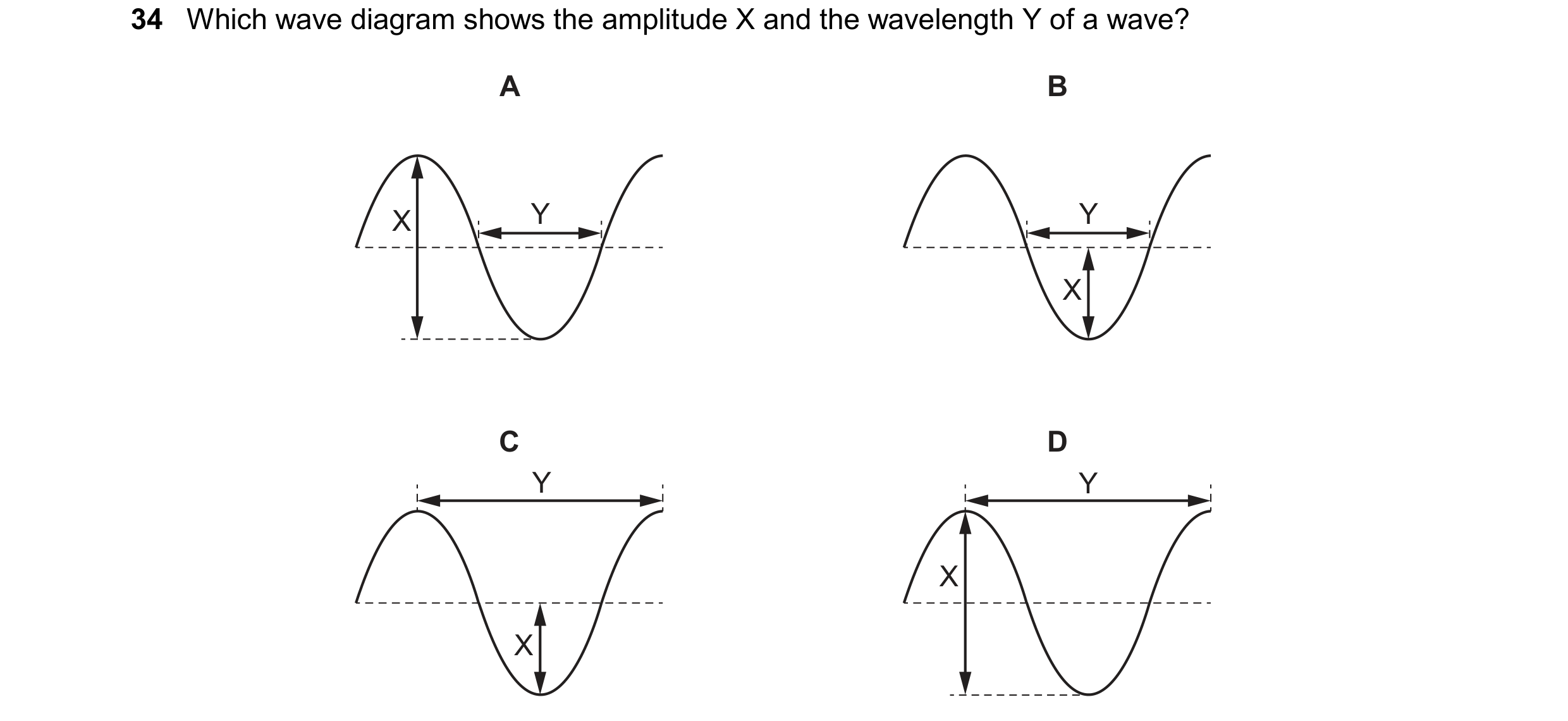
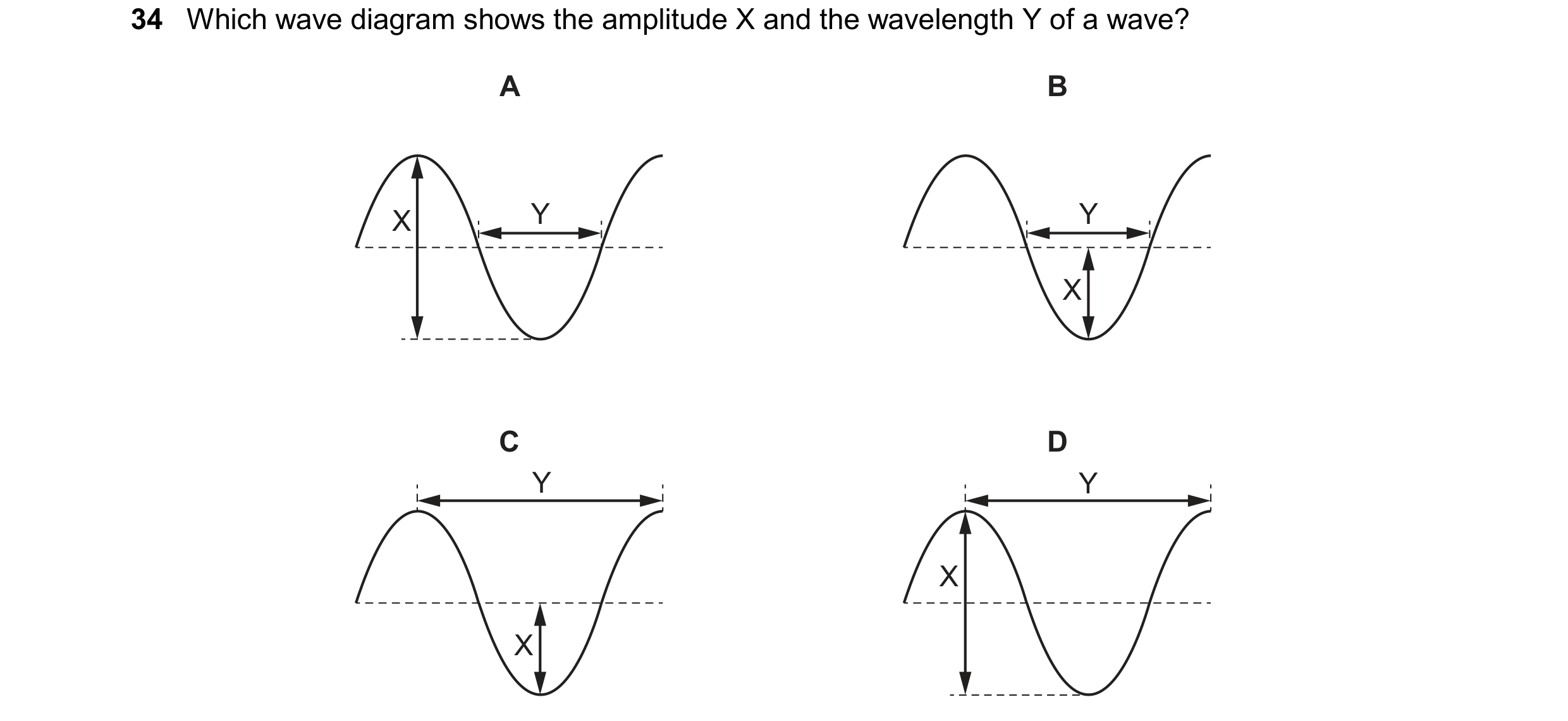
Q63 · Which wave diagram shows the amplitude X and the wavelength Y of a wave? 0654/12 Oct/Nov 2025
34 Which wave diagram shows the amplitude X and the wavelength Y of a wave? A B X Y Y X C D Y Y X X
1 marks
Answer: C
This question in 0654/12 Oct/Nov 2025
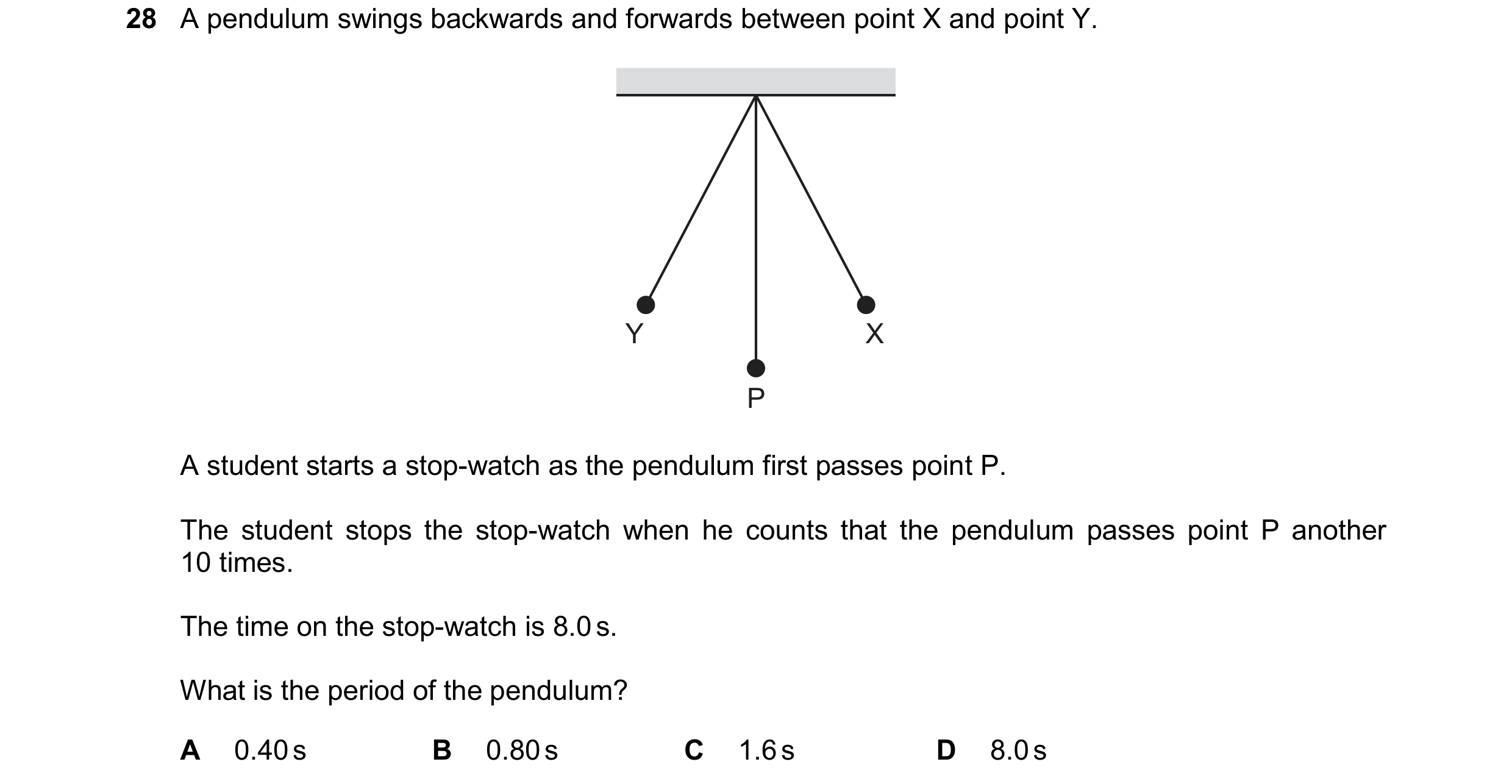
Q64 · A pendulum swings backwards and forwards between point X and point Y 0654/13 Oct/Nov 2025
28 A pendulum swings backwards and forwards between point X and point Y. Y X P A student starts a stop-watch as the pendulum first passes point P. The student stops the stop-watch when he counts that the pendulum passes point P another 10 times. The time on the stop-watch is 8.0 s. What is the period of the pendulum? A 0.40 s B 0.80 s C 1.6 s D 8.0 s
1 marks
Answer: C
This question in 0654/13 Oct/Nov 2025
Q65 · Which statement about waves is correct? 0654/13 Oct/Nov 2025
33 Which statement about waves is correct? A They do not transfer energy or matter. B They transfer energy and matter. C They transfer energy but not matter. D They transfer matter but not energy.
1 marks
Answer: C
This question in 0654/13 Oct/Nov 2025
Q66 · Which wave diagram shows the amplitude X and the wavelength Y of a wave? 0654/13 Oct/Nov 2025
34 Which wave diagram shows the amplitude X and the wavelength Y of a wave? A B X Y Y X C D Y Y X X
1 marks
Answer: C
This question in 0654/13 Oct/Nov 2025


 1 / 26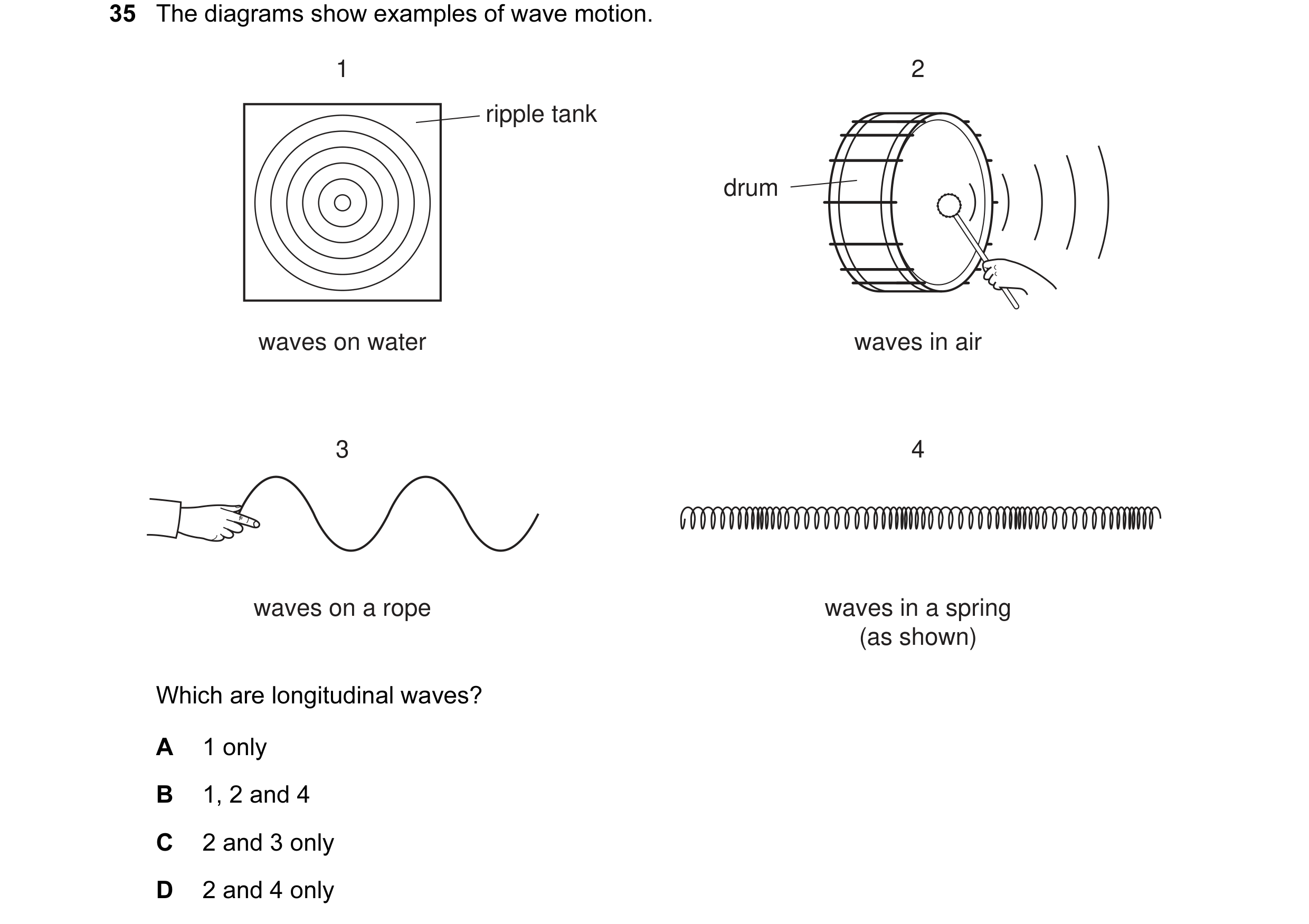
 2 / 26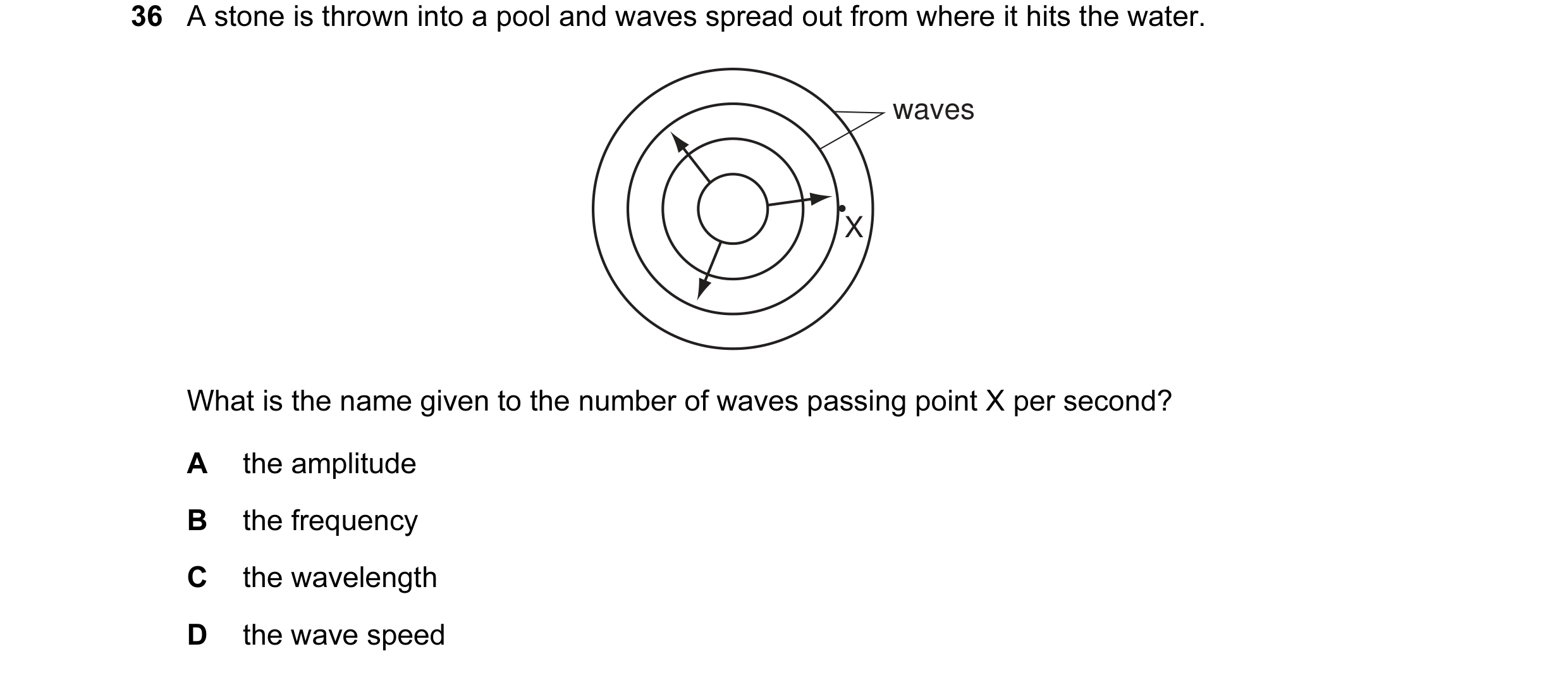
 3 / 26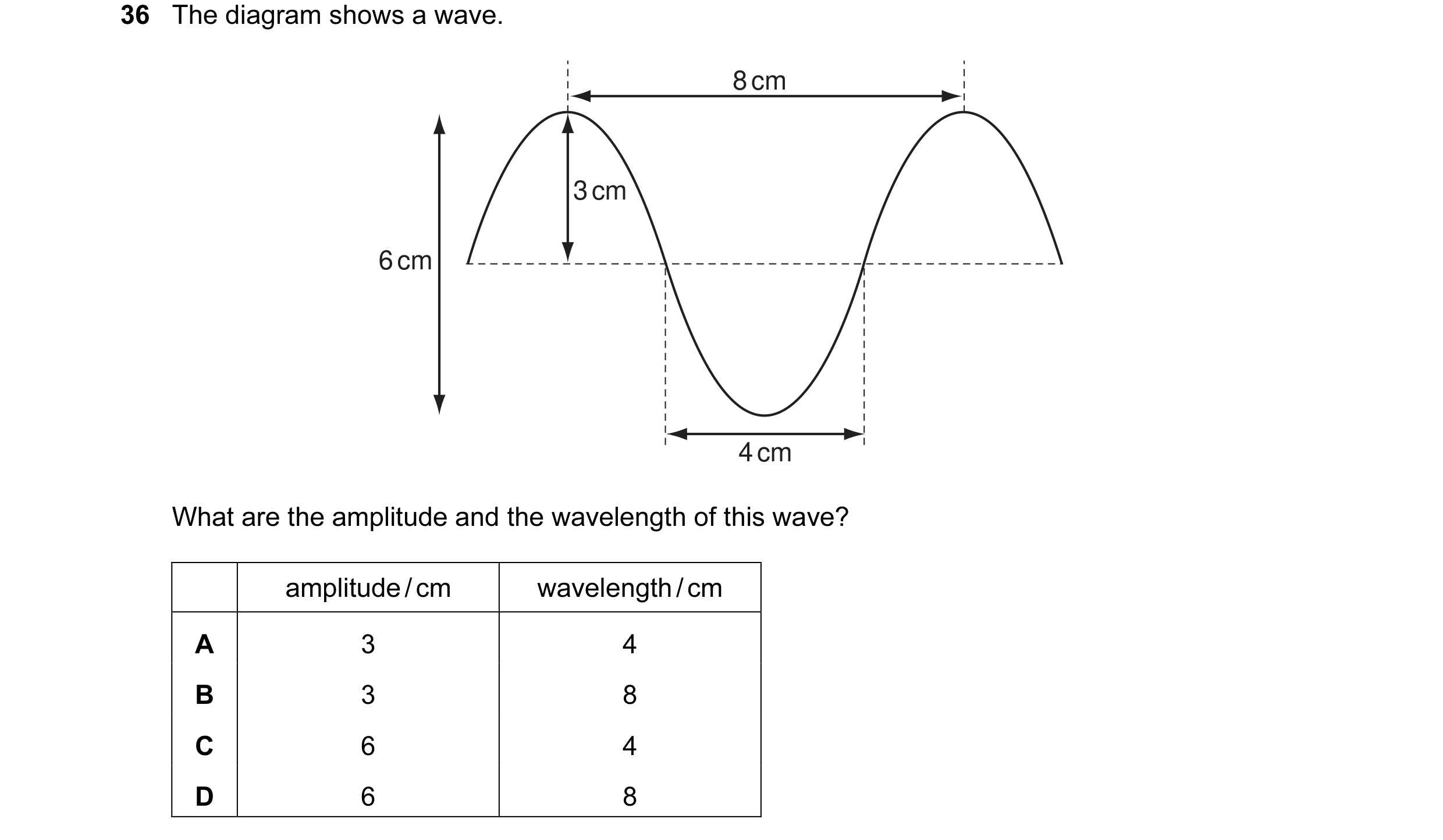
 4 / 26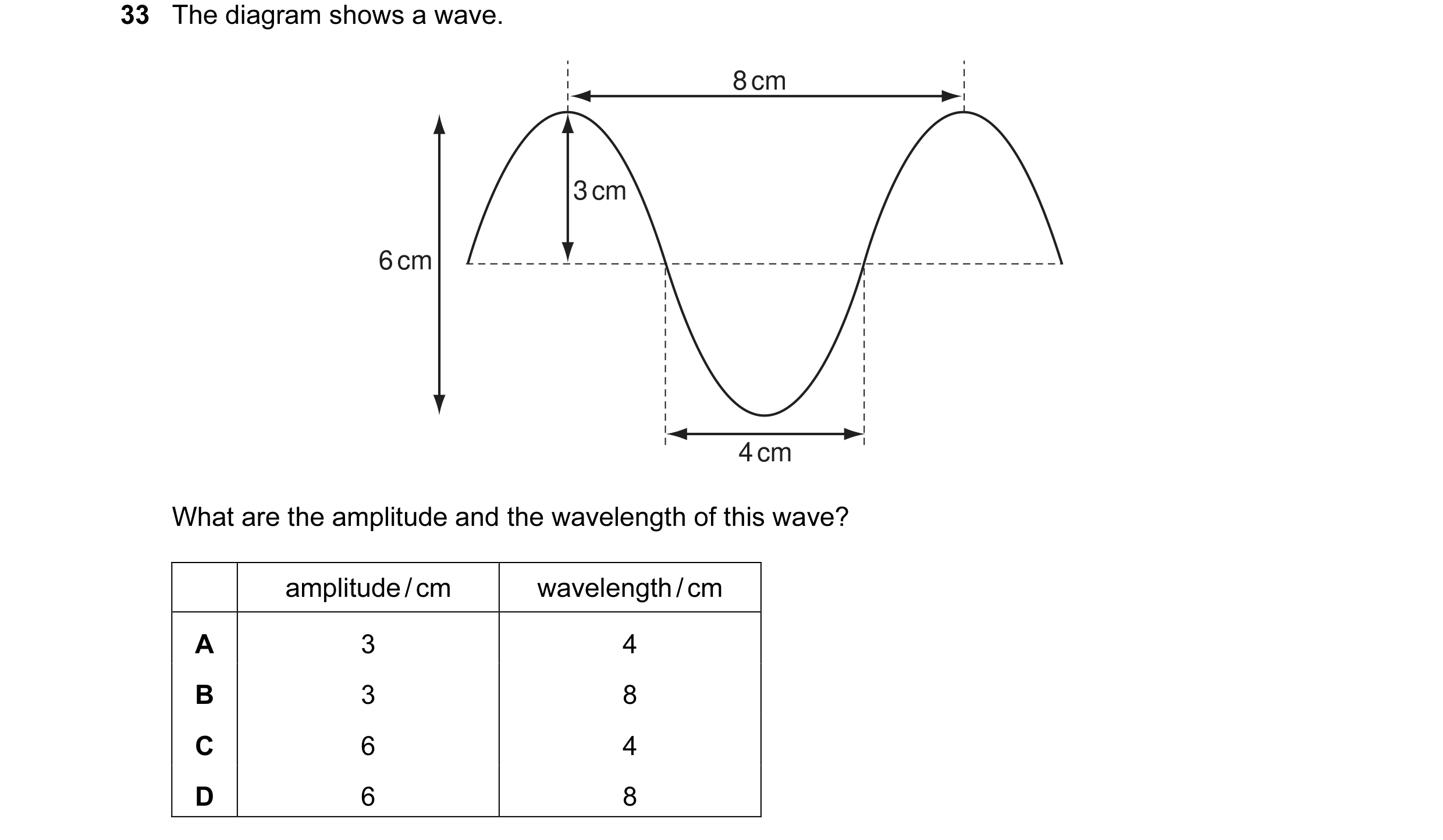
 5 / 26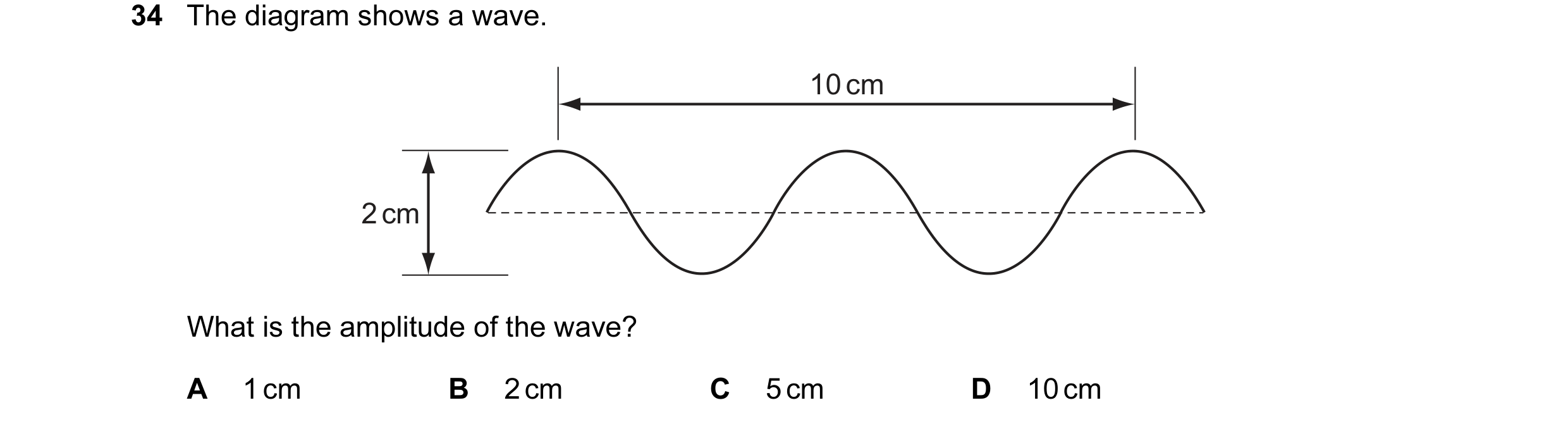

 6 / 26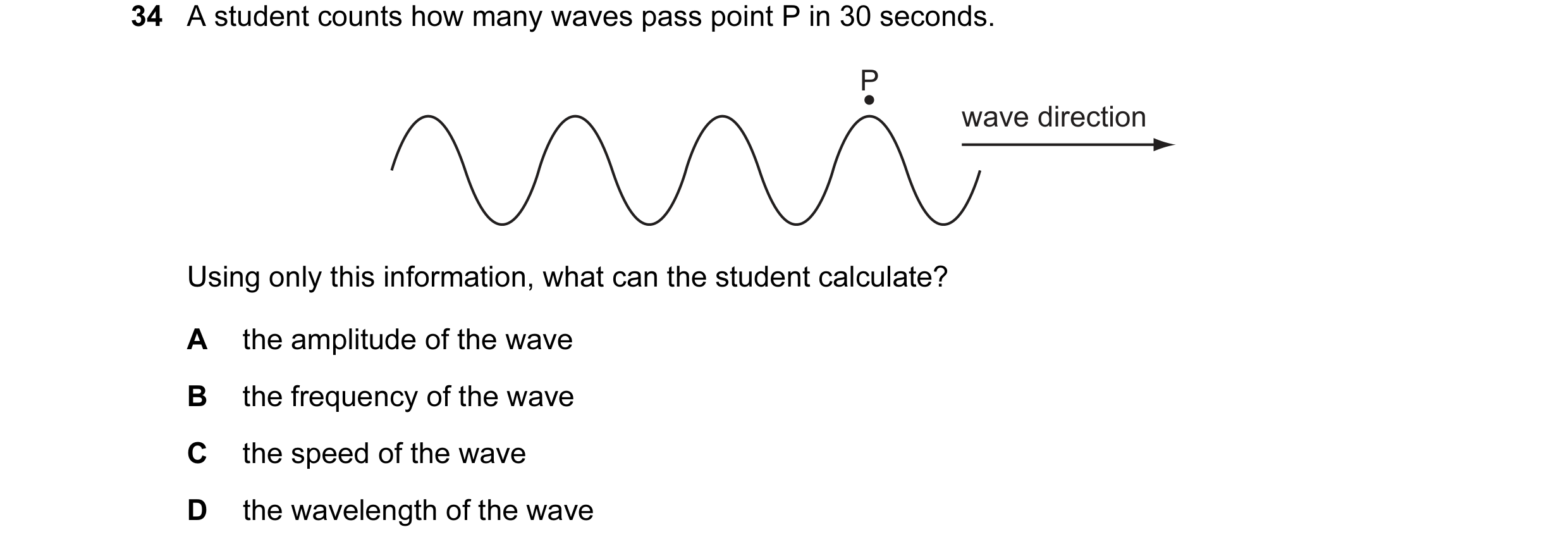

 7 / 26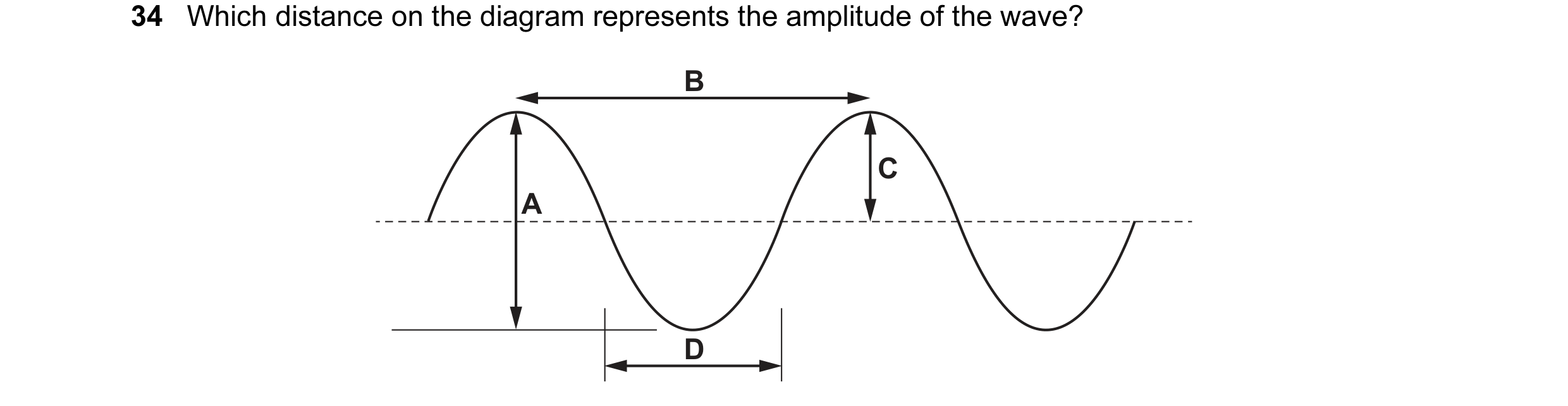


 8 / 26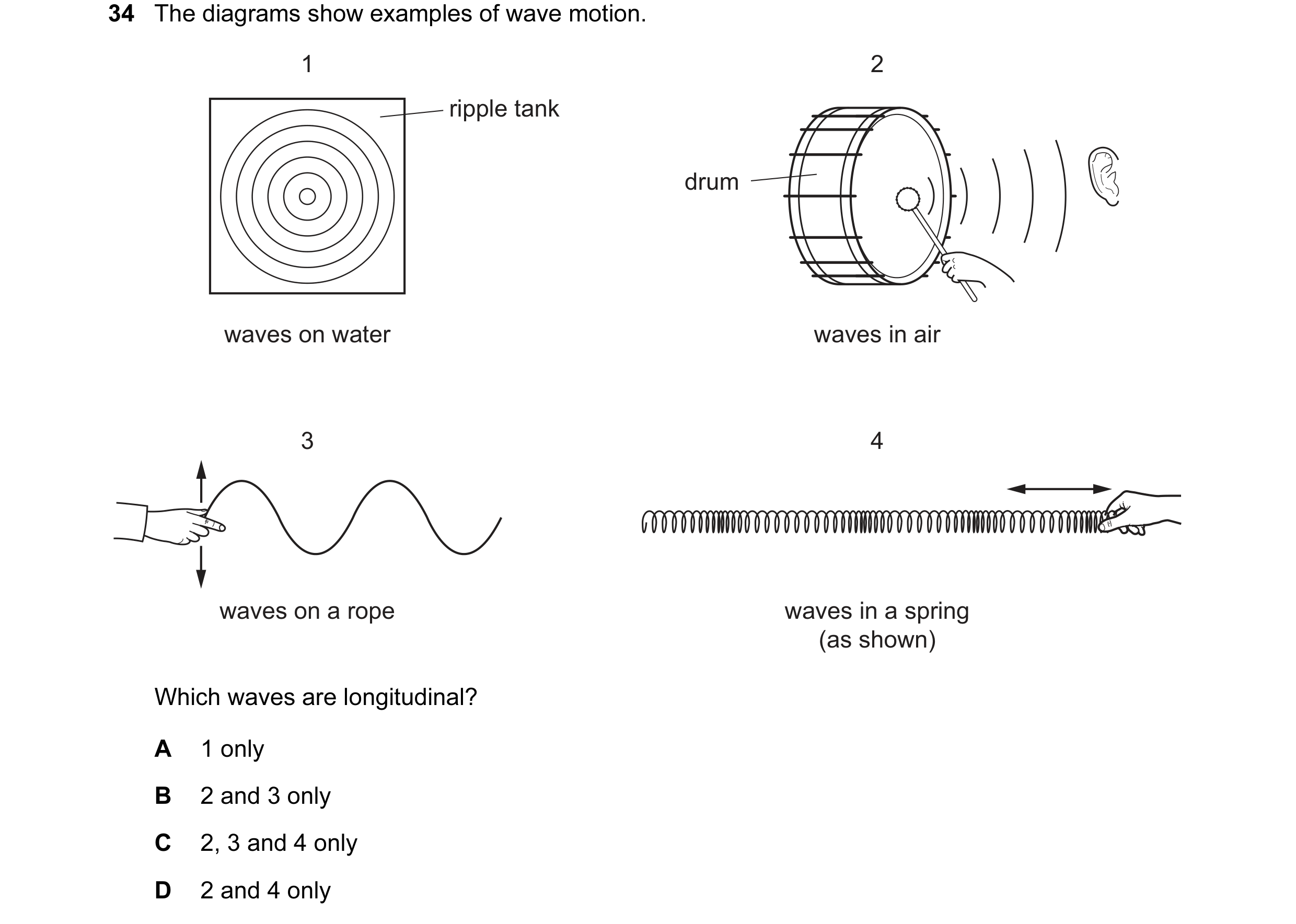
 9 / 26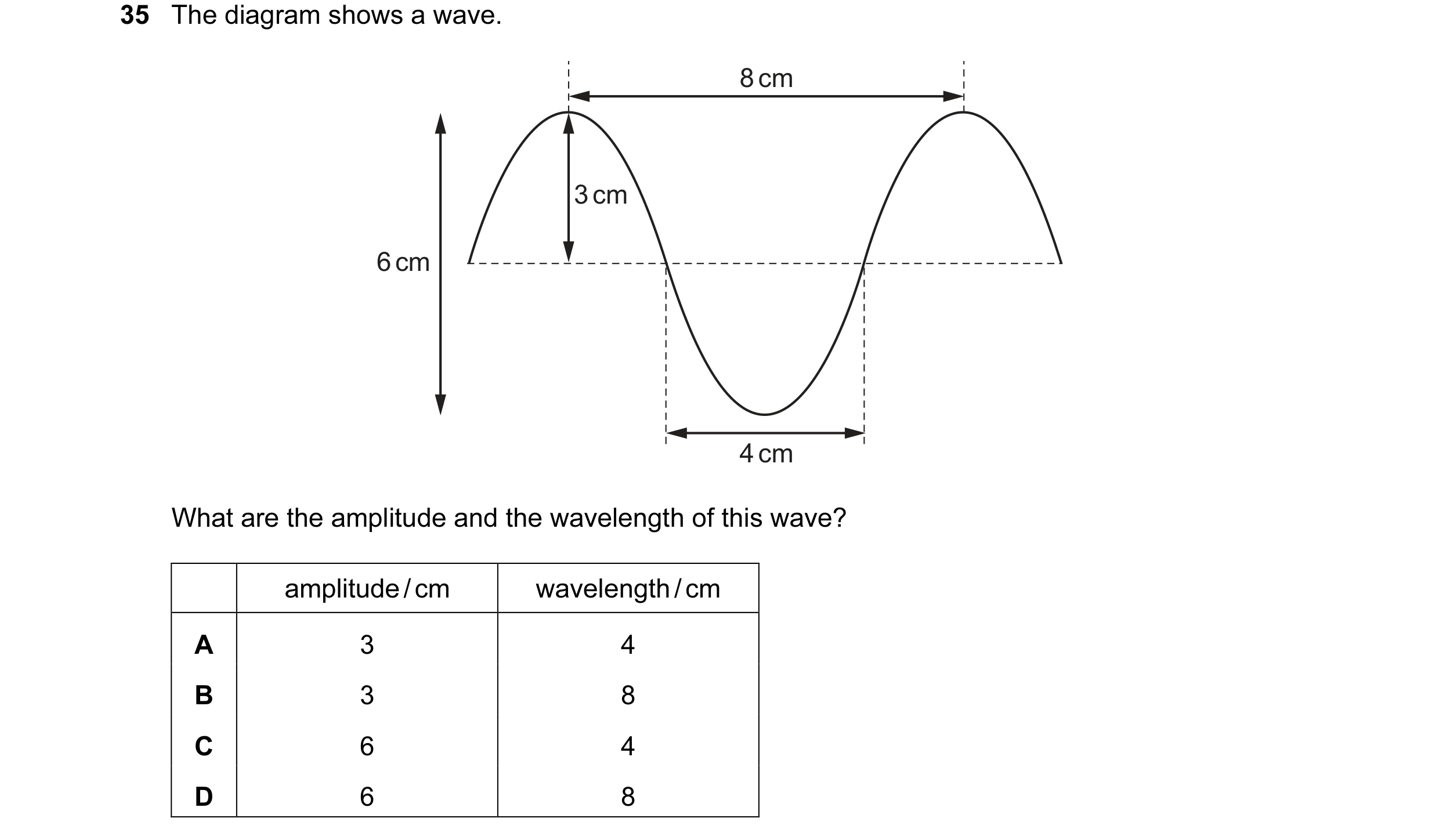
 10 / 26
 11 / 26
 12 / 26
 13 / 26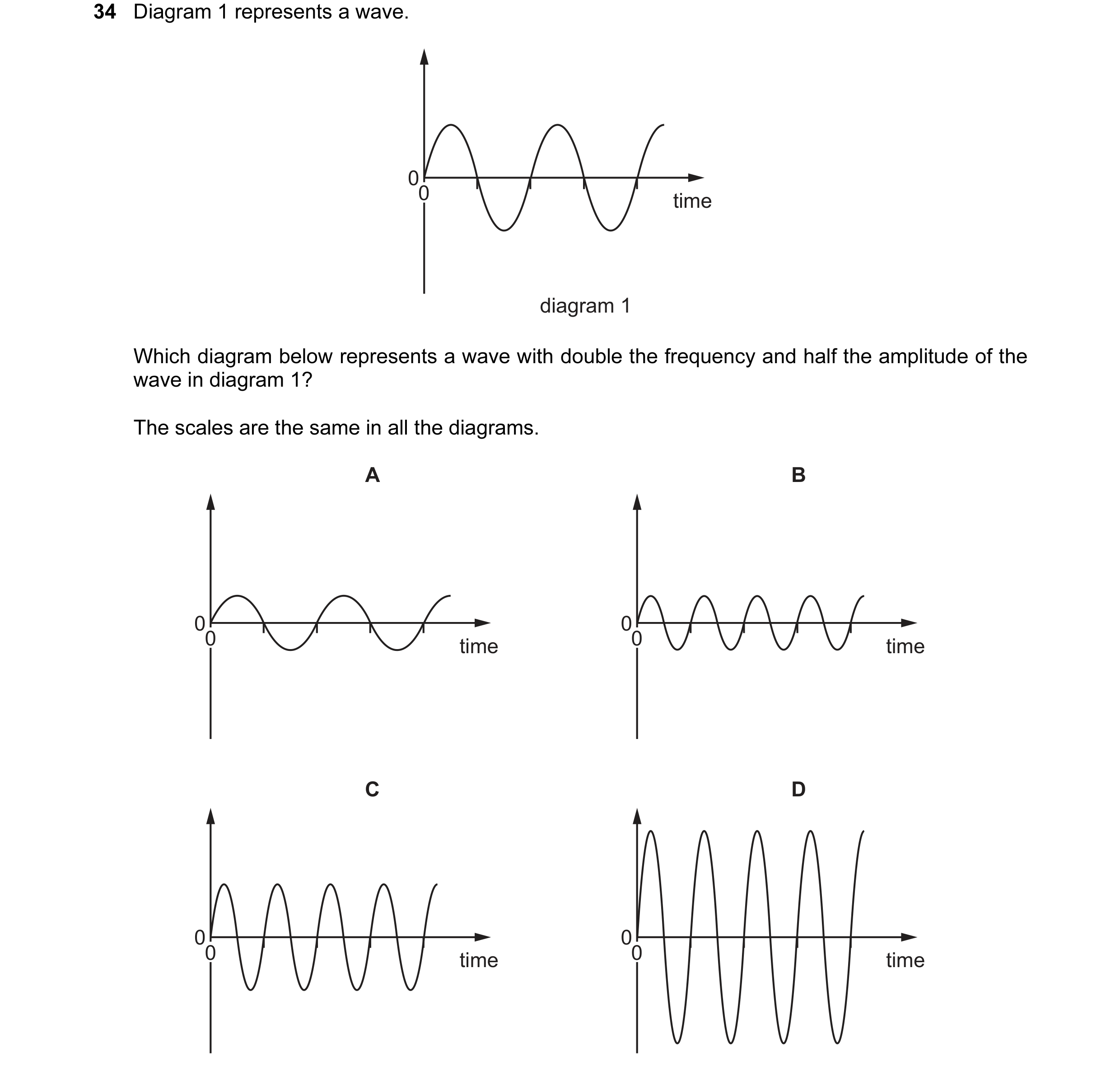
 14 / 26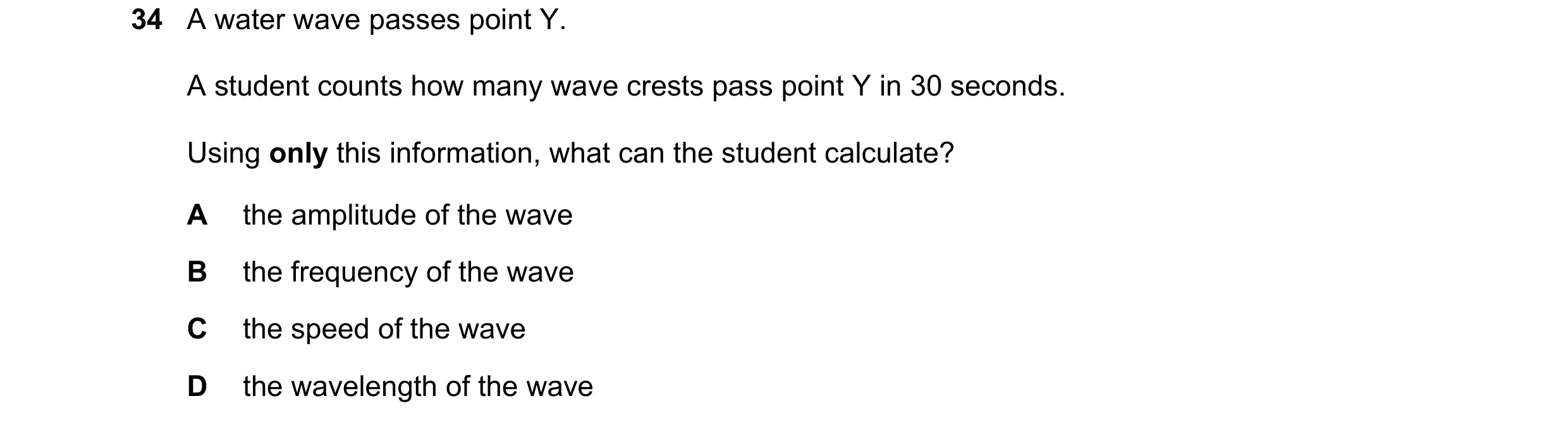
 15 / 26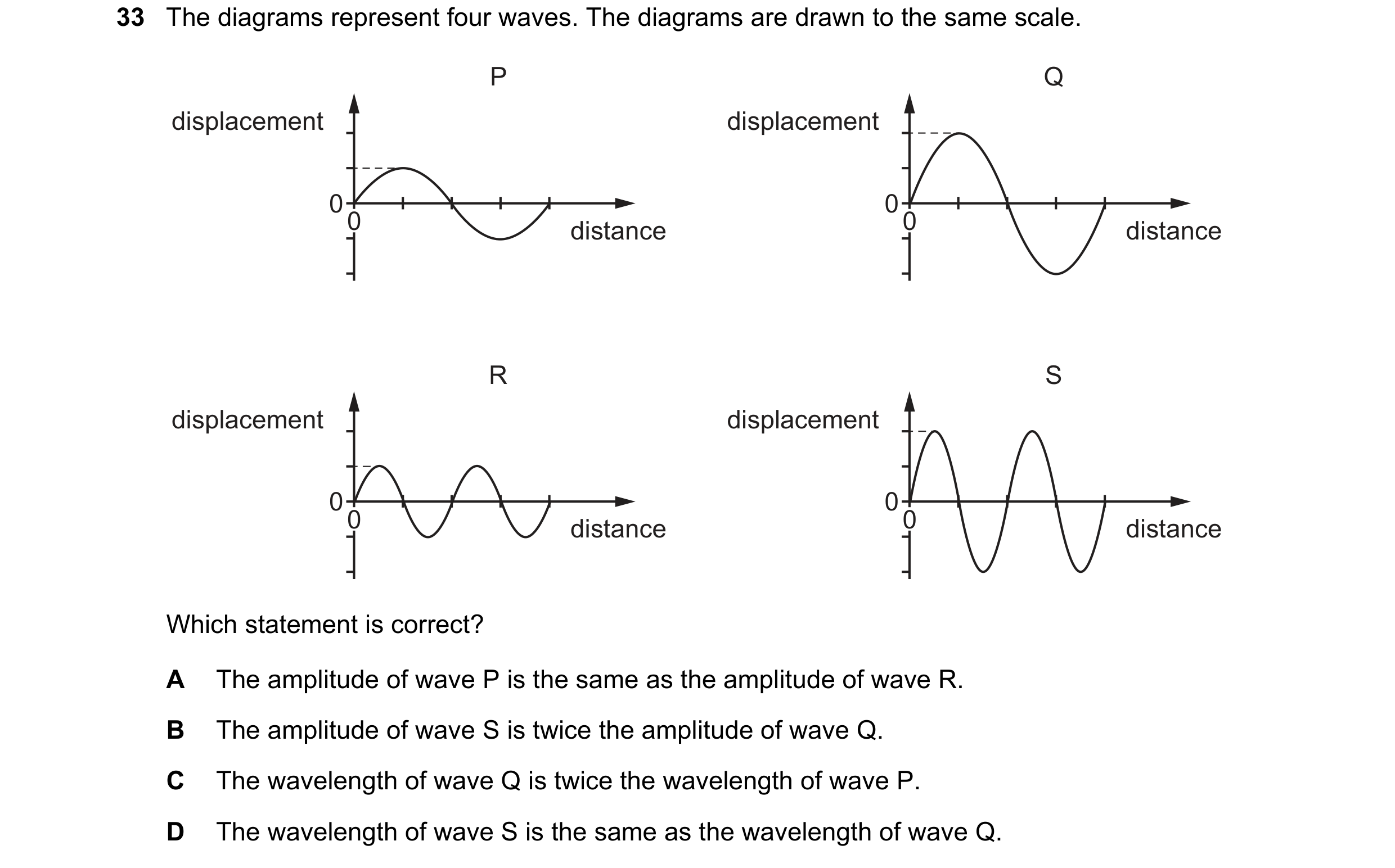
 16 / 26
 17 / 26
 18 / 26
 19 / 26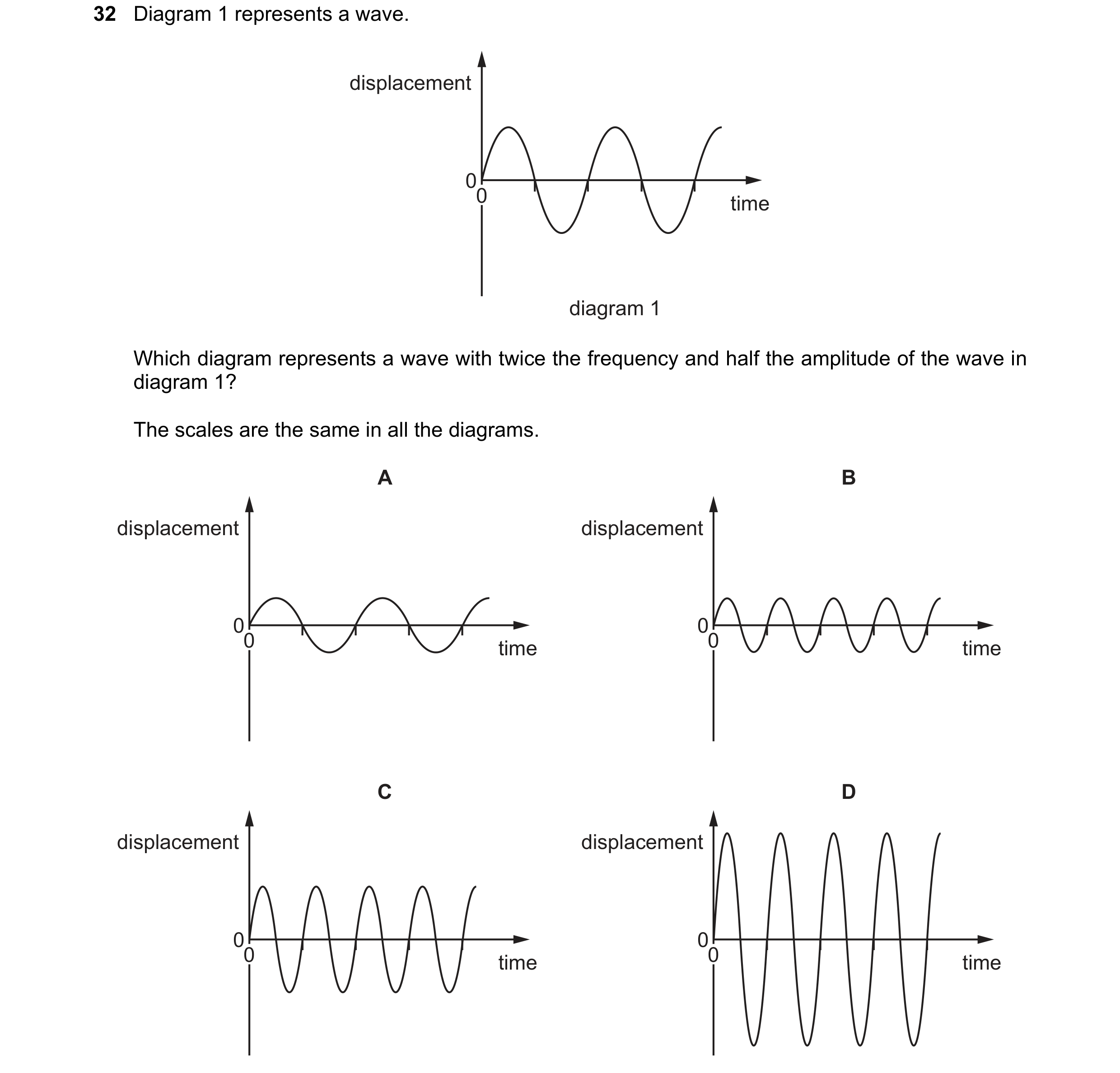
 20 / 26
 21 / 26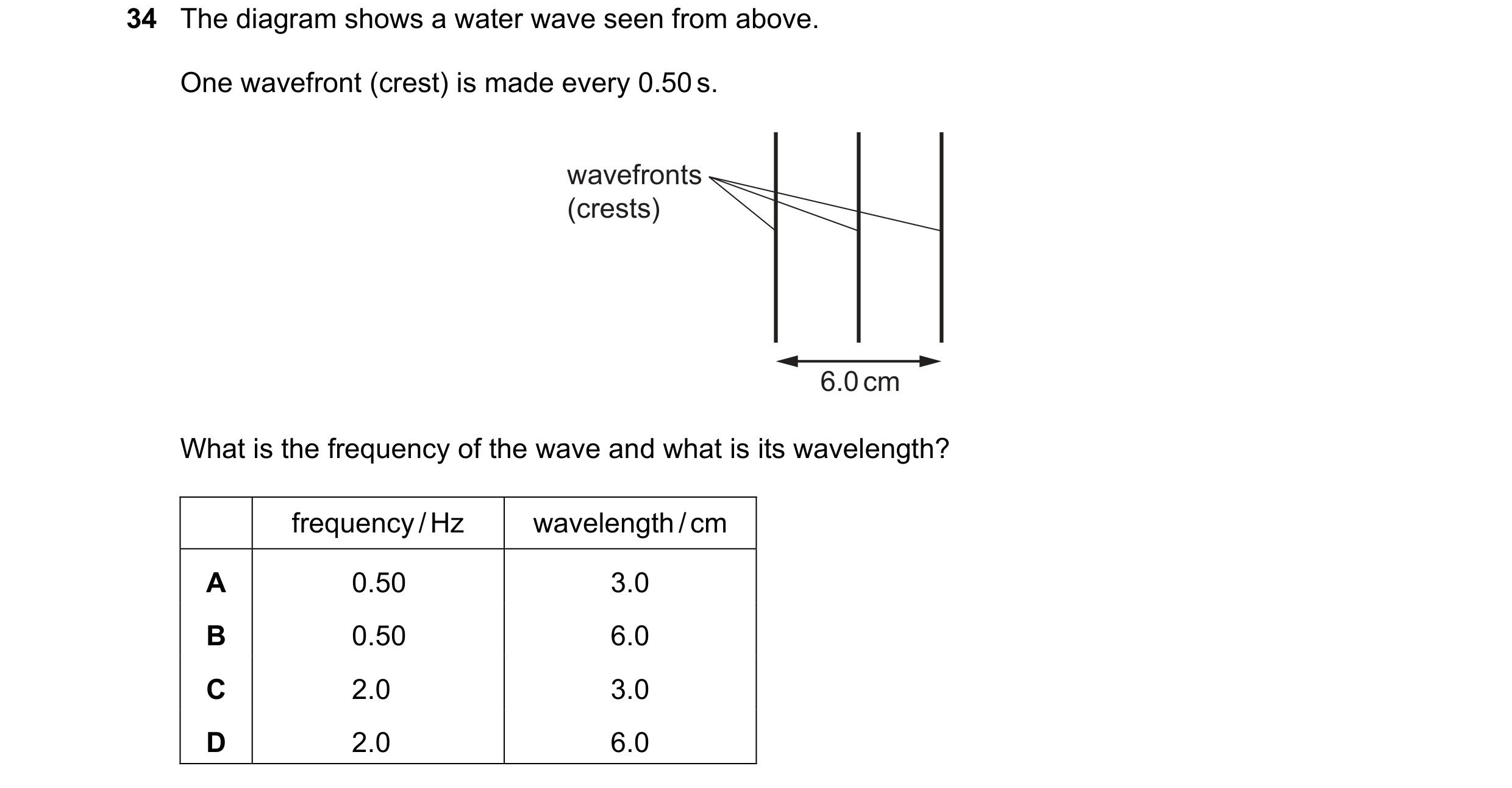

 22 / 26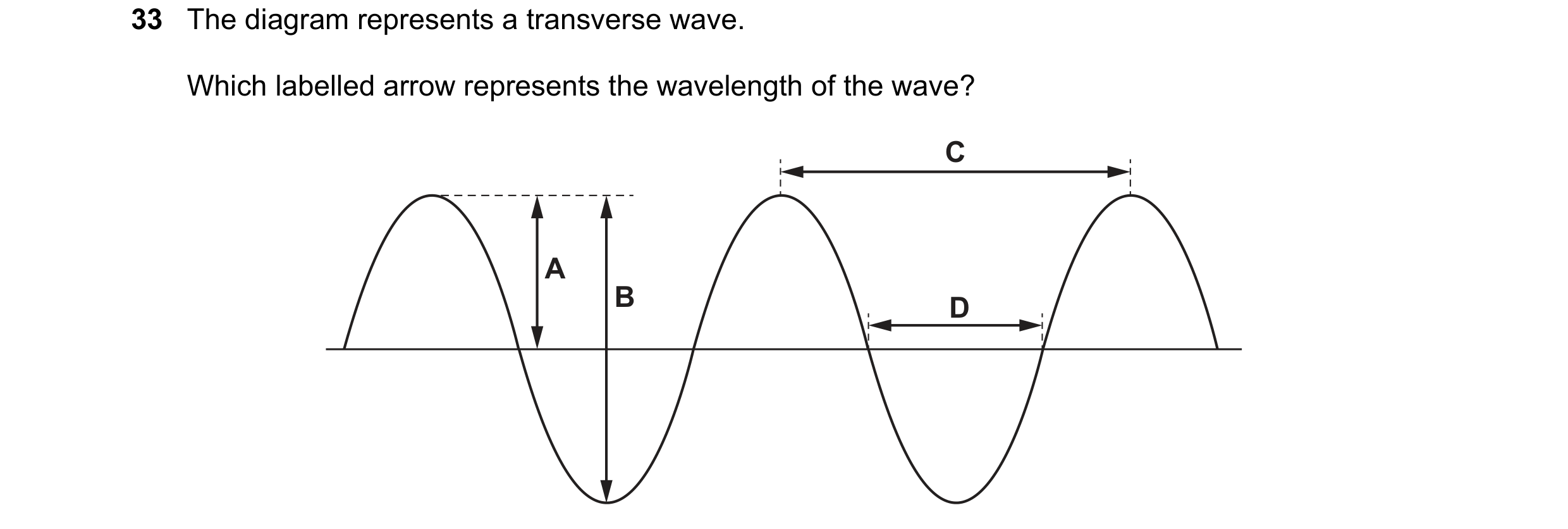
 23 / 26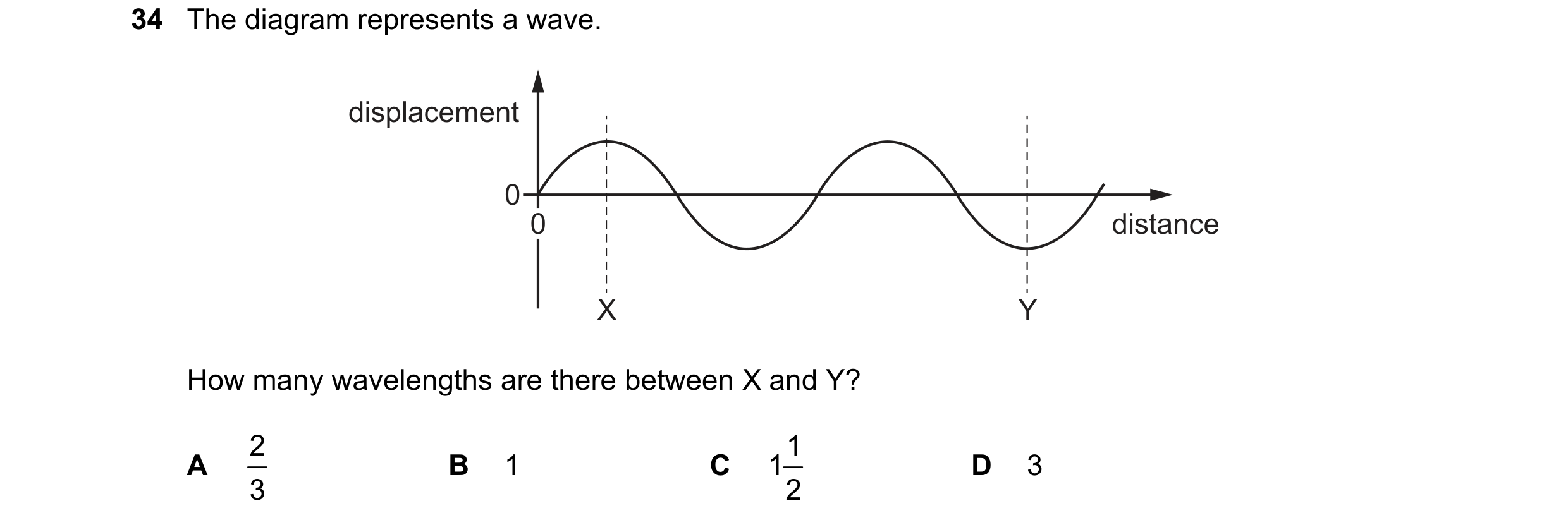

 24 / 26
 25 / 26
 26 / 26