Questions as text
Q1 · A school orchestra is practising 0654/32 May/June 2017
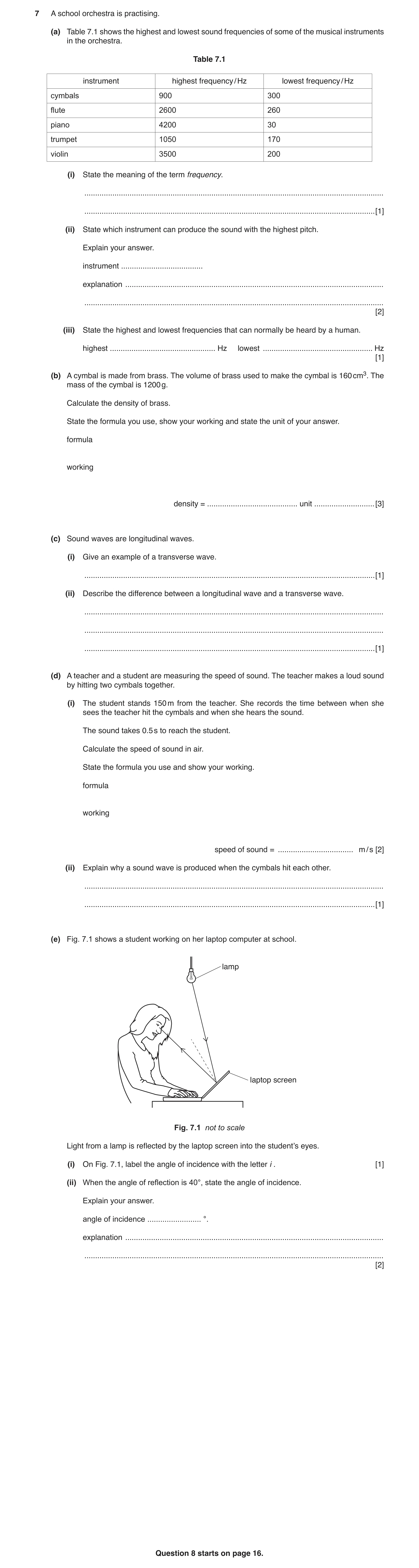
7 A school orchestra is practising. (a) Table 7.1 shows the highest and lowest sound frequencies of some of the musical instruments in the orchestra. Table 7.1 instrument highest frequency / Hz lowest frequency / Hz cymbals 900 300 flute 2600 260 piano 4200 30 trumpet 1050 170 violin 3500 200 (i) State the meaning of the term frequency. … … [1] (ii) State which instrument can produce the sound with the highest pitch. Explain your answer. instrument … explanation … … [2] (iii) State the highest and lowest frequencies that can normally be heard by a human. highest … Hz lowest … Hz [1] (b) A cymbal is made from brass. The volume of brass used to make the cymbal is 160 cm3. The mass of the cymbal is 1200 g. Calculate the density of brass. State the formula you use, show your working and state the unit of your answer. formula working density = … unit … [3] (c) Sound waves are longitudinal waves. (i) Give an example of a transverse wave. … [1] (ii) Describe the difference between a longitudinal wave and a transverse wave. … … … [1] (d) A teacher and a student are measuring the speed of sound. The teacher makes a loud sound by hitting two cymbals together. (i) The student stands 150 m from the teacher. She records the time between when she sees the teacher hit the cymbals and when she hears the sound. The sound takes 0.5 s to reach the student. Calculate the speed of sound in air. State the formula you use and show your working. formula working speed of sound = … m / s [2] (ii) Explain why a sound wave is produced when the cymbals hit each other. … … [1] (e) Fig. 7.1 shows a student working on her laptop computer at school. lamp laptop screen Fig. 7.1 not to scale Light from a lamp is reflected by the laptop screen into the student’s eyes. (i) On Fig. 7.1, label the angle of incidence with the letter i . [1] (ii) When the angle of reflection is 40°, state the angle of incidence. Explain your answer. angle of incidence … °. explanation … … [2] Question 8 starts on page 16.
15 marks
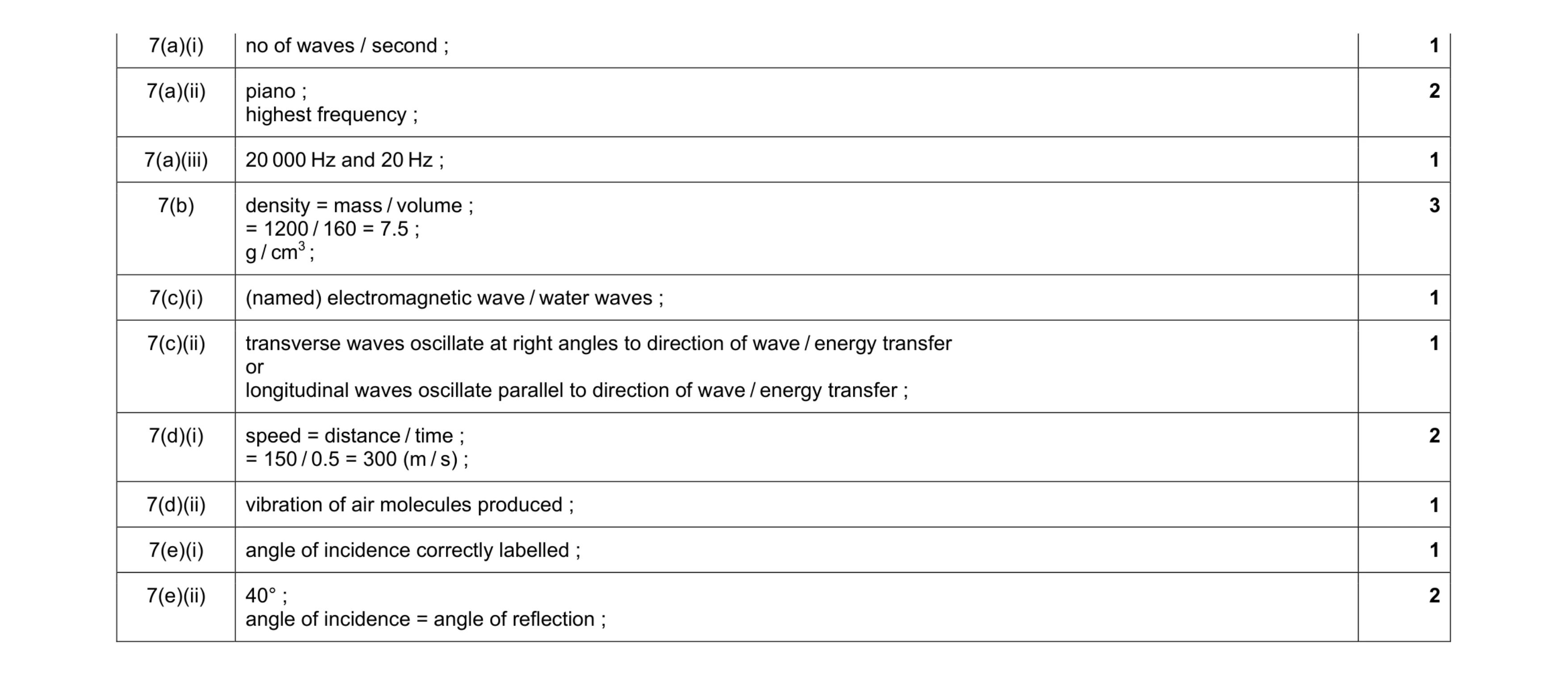
Mark scheme: 7(a)(i) no of waves / second ; 1 7(a)(ii) piano ; highest frequency ; 2 7(a)(iii) 20 000 Hz and 20 Hz ; 1 7(b) density = mass / volume ; = 1200 / 160 = 7.5 ; g / cm3 ; 3 7(c)(i) (named) electromagnetic wave / water waves ; 1 7(c)(ii) transverse waves oscillate at right angles to direction of wave / energy transfer or longitudinal waves oscillate parallel to direction of wave / energy transfer ; 1 7(d)(i) speed = distance / time ; = 150 / 0.5 = 300 (m / s) ; 2 7(d)(ii) vibration of air molecules produced ; 1 7(e)(i) angle of incidence correctly labelled ; 1 7(e)(ii) 40° ; angle of incidence = angle of reflection ; 2
This question in 0654/32 May/June 2017
Q2 · Part of a wave-powered electrical generator 0654/33 May/June 2017
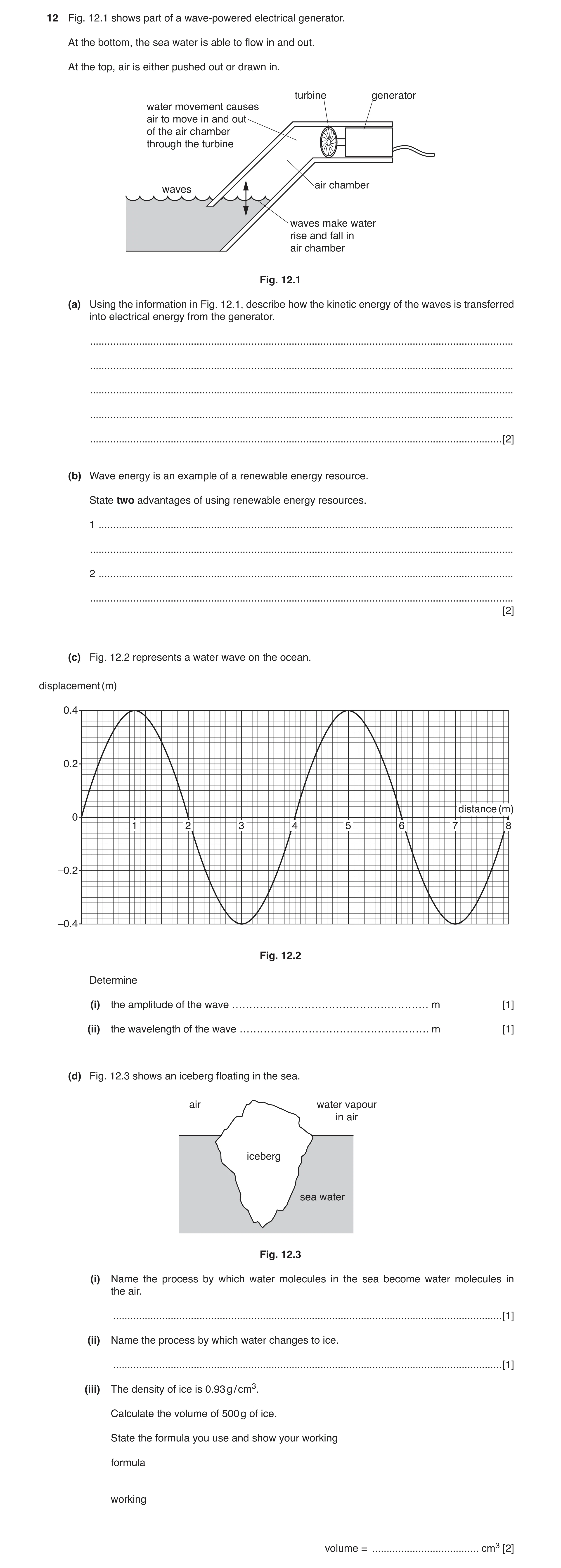
12 Fig. 12.1 shows part of a wave-powered electrical generator. At the bottom, the sea water is able to flow in and out. At the top, air is either pushed out or drawn in. turbine generator water movement causes air to move in and out of the air chamber through the turbine air chamber waves waves make water rise and fall in air chamber Fig. 12.1 (a) Using the information in Fig. 12.1, describe how the kinetic energy of the waves is transferred into electrical energy from the generator. … … … … … [2] (b) Wave energy is an example of a renewable energy resource. State two advantages of using renewable energy resources. 1 … … 2 … … [2] (c) Fig. 12.2 represents a water wave on the ocean. displacement (m) 0.4 0.2 distance (m) 0 1 2 3 4 5 6 7 8 –0.2 –0.4 Fig. 12.2 Determine (i) the amplitude of the wave ………………………………………………… m [1] (ii) the wavelength of the wave ………………………………………………. m [1] (d) Fig. 12.3 shows an iceberg floating in the sea. air water vapour in air iceberg sea water Fig. 12.3 (i) Name the process by which water molecules in the sea become water molecules in the air. … [1] (ii) Name the process by which water changes to ice. … [1] (iii) The density of ice is 0.93 g / cm3. Calculate the volume of 500 g of ice. State the formula you use and show your working formula working volume = … cm3 [2]
10 marks
Mark scheme: 12(a) KE of waves to KE of moving air ; KE of moving air to KE of turbine ; KE of turbine to KE of generator ; KE of generator to electrical energy ; max 2 12(b) will not run out ; fossil fuels can be used for other purposes ; less pollution than using fossil fuels ; max 2 12(c)(i) 0.4 (m) ; 1 12(c)(ii) 4 (m) ; 1 12(d)(i) evaporation ; 1 12(d)(ii) freezing ; 1 12(d)(iii) volume = mass / density ; = 500 / 0.93 = 537.6 (cm3) ; 2
This question in 0654/33 May/June 2017
Q3 · Four swimmers are competing at a swimming pool 0654/31 Oct/Nov 2017
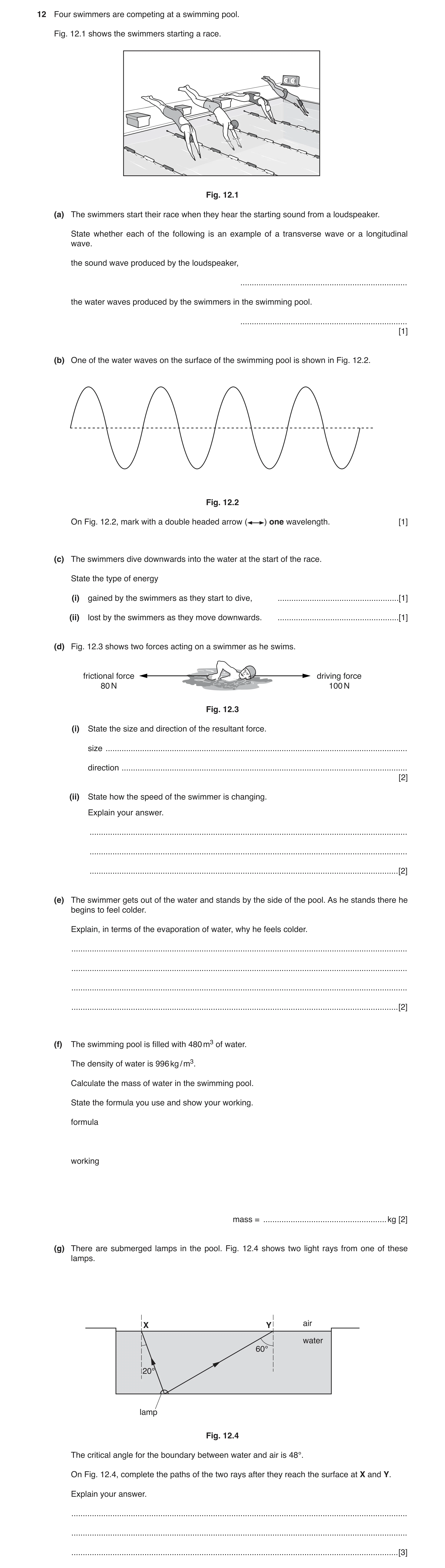
12 Four swimmers are competing at a swimming pool. Fig. 12.1 shows the swimmers starting a race. Fig. 12.1 (a) The swimmers start their race when they hear the starting sound from a loudspeaker. State whether each of the following is an example of a transverse wave or a longitudinal wave. the sound wave produced by the loudspeaker, … the water waves produced by the swimmers in the swimming pool. … [1] (b) One of the water waves on the surface of the swimming pool is shown in Fig. 12.2. Fig. 12.2 On Fig. 12.2, mark with a double headed arrow ( ) one wavelength. [1] (c) The swimmers dive downwards into the water at the start of the race. State the type of energy (i) gained by the swimmers as they start to dive, … [1] (ii) lost by the swimmers as they move downwards. … [1] (d) Fig. 12.3 shows two forces acting on a swimmer as he swims. frictional force driving force 80 N 100 N Fig. 12.3 (i) State the size and direction of the resultant force. size … direction … [2] (ii) State how the speed of the swimmer is changing. Explain your answer. … … … [2] (e) The swimmer gets out of the water and stands by the side of the pool. As he stands there he begins to feel colder. Explain, in terms of the evaporation of water, why he feels colder. … … … … [2] (f) The swimming pool is filled with 480 m3 of water. The density of water is 996 kg / m3. Calculate the mass of water in the swimming pool. State the formula you use and show your working. formula working mass = … kg [2] (g) There are submerged lamps in the pool. Fig. 12.4 shows two light rays from one of these lamps. X Y air water 60° 20° lamp Fig. 12.4 The critical angle for the boundary between water and air is 48°. On Fig. 12.4, complete the paths of the two rays after they reach the surface at X and Y. Explain your answer. … … … [3]
15 marks
Mark scheme: 12(a) sound wave – longitudinal water wave – transverse ; 1 12(b) double headed arrow showing distance between two identical points on two consecutive waves ; 1 12(c)(i) kinetic (energy) ; 1 12(c)(ii) (gravitational) potential (energy) ; 1 12(d)(i) 20 (N) ; forwards / to the right ; 2 Question Answer Marks 12(d)(ii) the swimmers speed increases / acceleration ; resultant force / unbalanced force in direction of motion / to right ; 2 12(e) energy transferred to particles from surroundings (body) ; fastest molecules escape ; average energy of the rest of particles reduced / thermal energy removed from liquid ; max 2 12(f) mass = density × volume or 996 × 480 ; 478 080 (kg) ; 2 12(g) at Y reflection only is shown ; at X refraction (and reflection is shown) ; total internal reflection occurs when angle of incidence exceeds critical angle / angle of incidence = angle of reflection for reflection / refraction away from normal going from denser to less dense medium ; 3
This question in 0654/31 Oct/Nov 2017
Q4 · Name the electromagnetic wave used in mobile (cell) phone communication 0654/33 Oct/Nov 2017
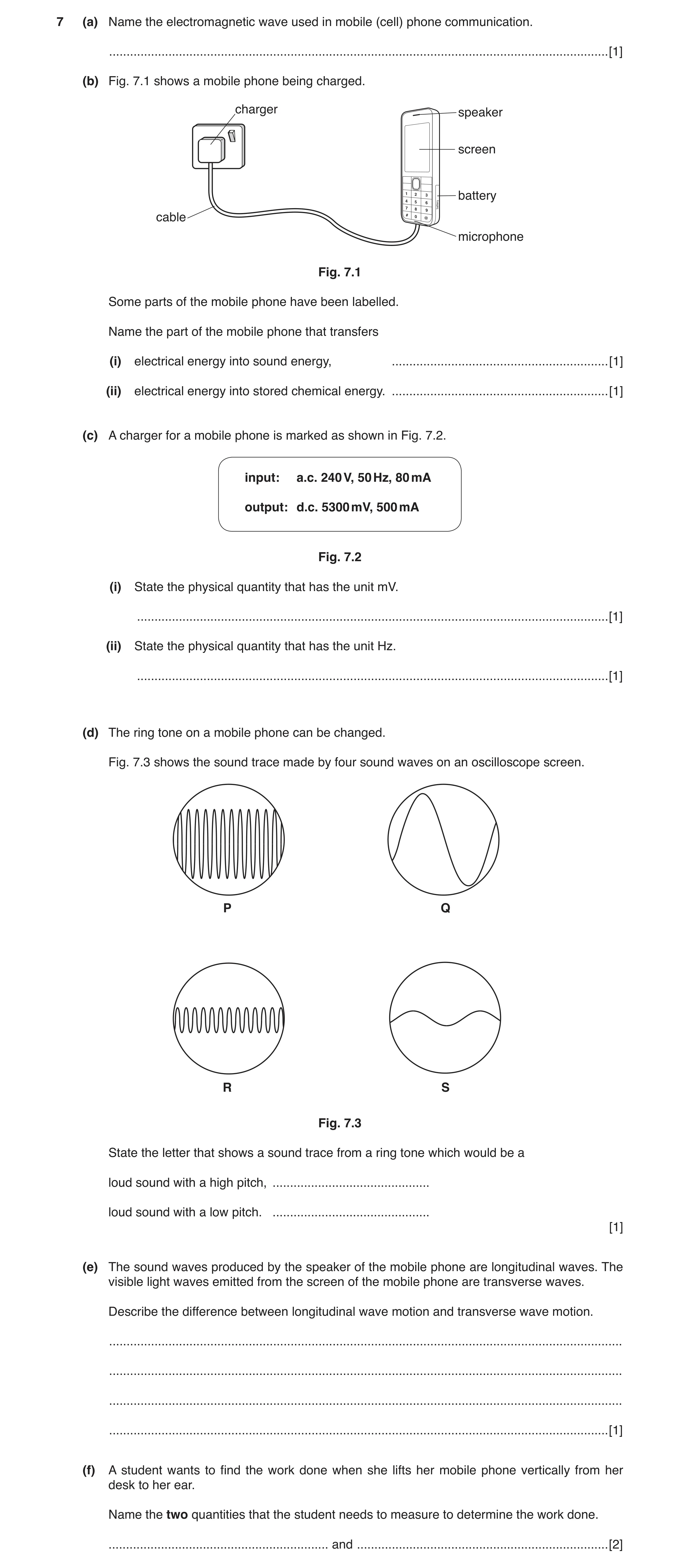
7 (a) Name the electromagnetic wave used in mobile (cell) phone communication. … [1] (b) Fig. 7.1 shows a mobile phone being charged. charger speaker screen 1 2 3 4 5 6 battery battery 7 8 9 # 0 @ cable microphone Fig. 7.1 Some parts of the mobile phone have been labelled. Name the part of the mobile phone that transfers (i) electrical energy into sound energy, … [1] (ii) electrical energy into stored chemical energy. … [1] (c) A charger for a mobile phone is marked as shown in Fig. 7.2. input: a.c. 240 V, 50 Hz, 80 mA output: d.c. 5300 mV, 500 mA Fig. 7.2 (i) State the physical quantity that has the unit mV. … [1] (ii) State the physical quantity that has the unit Hz. … [1] (d) The ring tone on a mobile phone can be changed. Fig. 7.3 shows the sound trace made by four sound waves on an oscilloscope screen. P Q R S Fig. 7.3 State the letter that shows a sound trace from a ring tone which would be a loud sound with a high pitch, … loud sound with a low pitch. … [1] (e) The sound waves produced by the speaker of the mobile phone are longitudinal waves. The visible light waves emitted from the screen of the mobile phone are transverse waves. Describe the difference between longitudinal wave motion and transverse wave motion. … … … … [1] (f) A student wants to find the work done when she lifts her mobile phone vertically from her desk to her ear. Name the two quantities that the student needs to measure to determine the work done. … and … [2]
9 marks
Mark scheme: 7(a) microwaves ; 1 7(b)(i) speaker ; 1 7(b)(ii) battery ; 1 7(c)(i) potential difference / voltage ; 1 7(c)(ii) frequency (of electricity) ; 1 7(d) P then Q ; 1 Question Answer Marks 7(e) transverse waves - the vibrations are at right angles to the direction of travel / longitudinal waves - the vibrations are along the same direction as the direction of travel ; 1 7(f) weight / force ; (vertical) distance ; 2
This question in 0654/33 Oct/Nov 2017
Q5 · The highest and lowest frequencies that four animals can hear 0654/31 Oct/Nov 2018
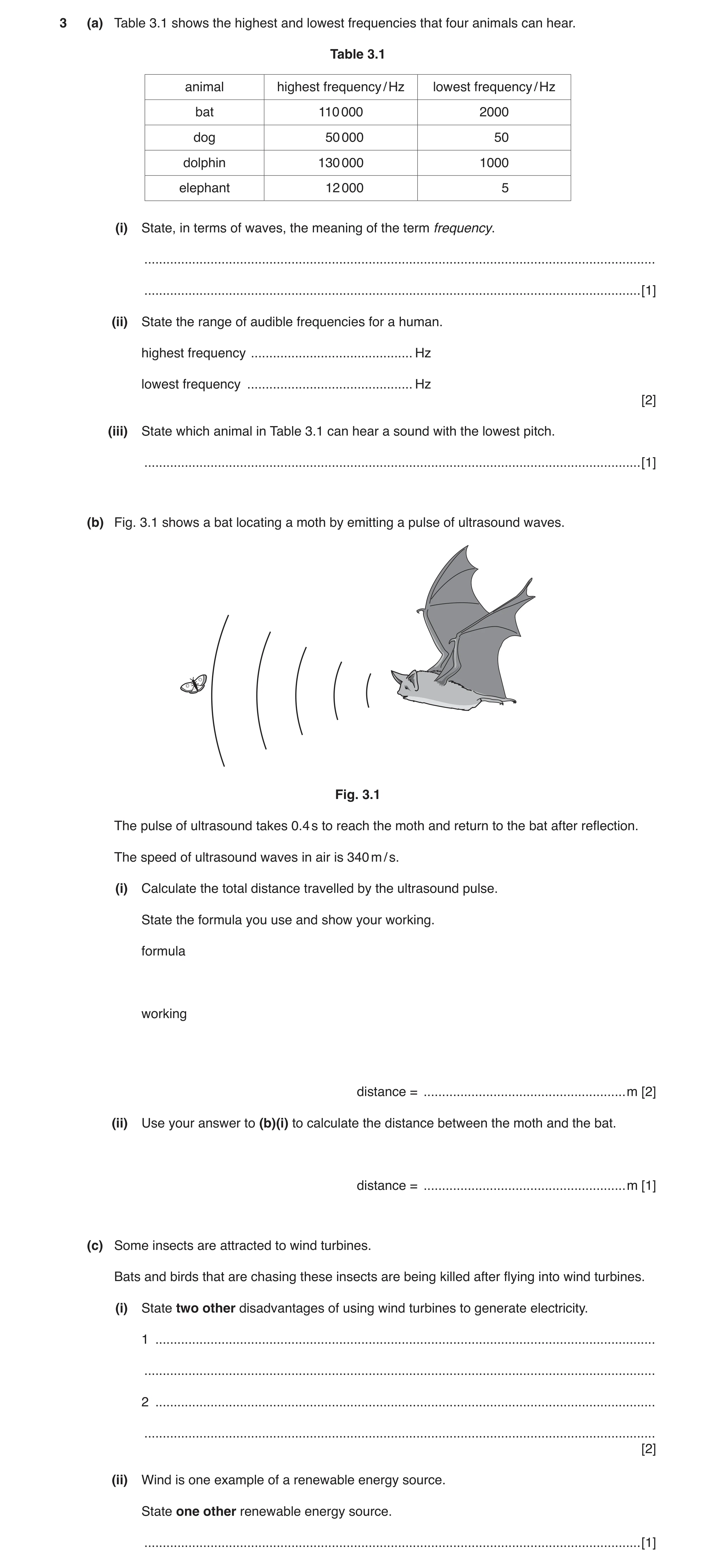
3 (a) Table 3.1 shows the highest and lowest frequencies that four animals can hear. Table 3.1 animal highest frequency / Hz lowest frequency / Hz bat 110 000 2000 dog 50 000 50 dolphin 130 000 1000 elephant 12 000 5 (i) State, in terms of waves, the meaning of the term frequency. … … [1] (ii) State the range of audible frequencies for a human. highest frequency … Hz lowest frequency … Hz [2] (iii) State which animal in Table 3.1 can hear a sound with the lowest pitch. … [1] (b) Fig. 3.1 shows a bat locating a moth by emitting a pulse of ultrasound waves. Fig. 3.1 The pulse of ultrasound takes 0.4 s to reach the moth and return to the bat after reflection. The speed of ultrasound waves in air is 340 m / s. (i) Calculate the total distance travelled by the ultrasound pulse. State the formula you use and show your working. formula working distance = … m [2] (ii) Use your answer to (b)(i) to calculate the distance between the moth and the bat. distance = … m [1] (c) Some insects are attracted to wind turbines. Bats and birds that are chasing these insects are being killed after flying into wind turbines. (i) State two other disadvantages of using wind turbines to generate electricity. 1 … … 2 … … [2] (ii) Wind is one example of a renewable energy source. State one other renewable energy source. … [1]
10 marks
Mark scheme: 3(a)(i) no of oscillations / vibrations / sec ; 1 3(a)(ii) 20 000 (Hz) ; 20 (Hz) ; 2 3(a)(iii) elephant ; 1 3(b)(i) distance = speed × time or 340 × 0.4 ; 136 (m) ; 2 3(b)(ii) 68 (m) ; 1 3(c)(i) do not work if too much / too little wind ; noisy ; visual pollution ; max 2 3(c)(ii) HEP / solar / tides / waves / geothermal ; 1
This question in 0654/31 Oct/Nov 2018
Q6 · Doctors use X‑rays, γ‑rays and ultrasound waves in a hospital 0654/32 Oct/Nov 2018
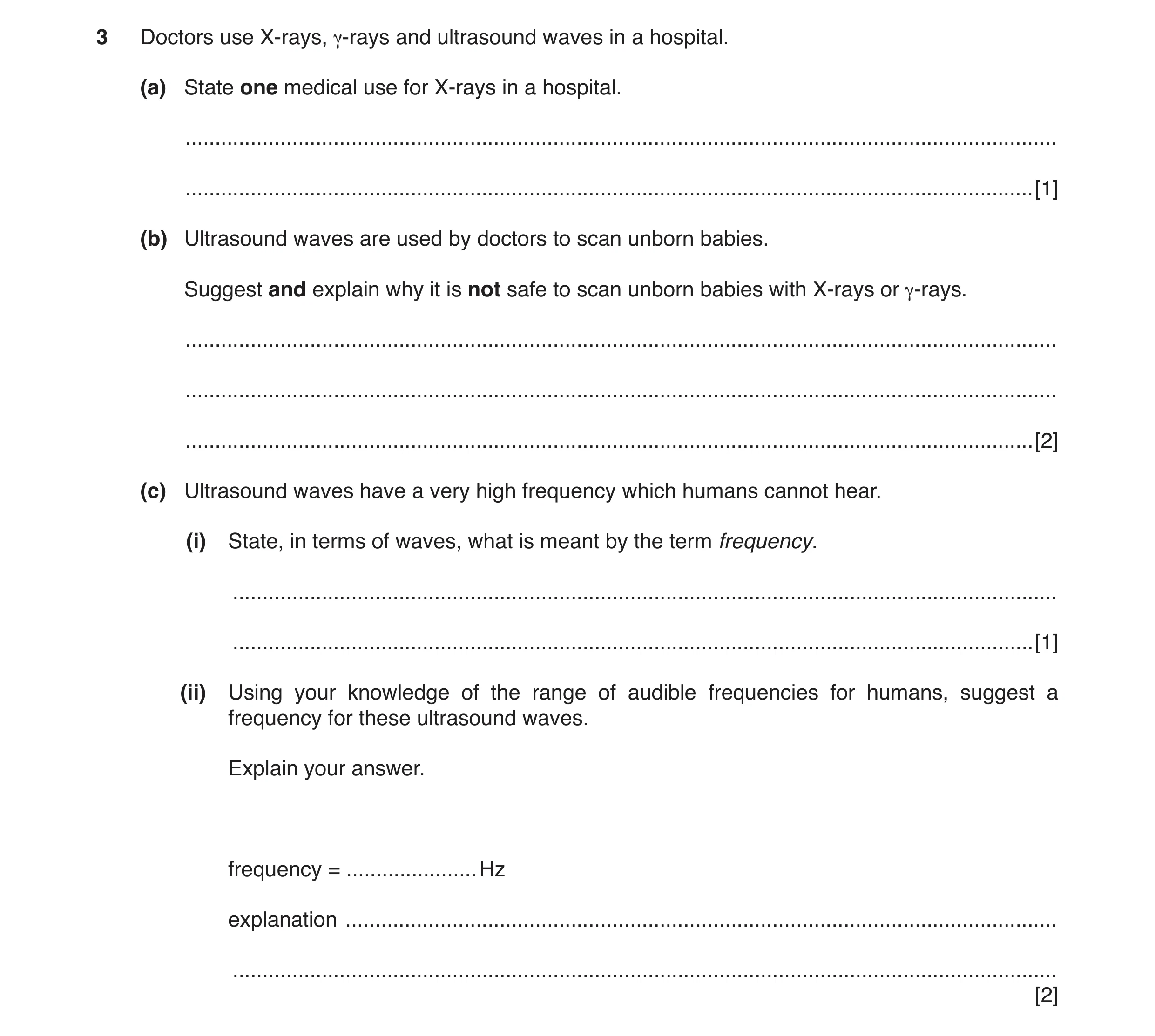
3 Doctors use X‑rays, γ‑rays and ultrasound waves in a hospital. (a) State one medical use for X‑rays in a hospital. … … [1] (b) Ultrasound waves are used by doctors to scan unborn babies. Suggest and explain why it is not safe to scan unborn babies with X‑rays or γ‑rays. … … … [2] (c) Ultrasound waves have a very high frequency which humans cannot hear. (i) State, in terms of waves, what is meant by the term frequency. … … [1] (ii) Using your knowledge of the range of audible frequencies for humans, suggest a frequency for these ultrasound waves. Explain your answer. frequency = … Hz explanation … … [2]
6 marks
Mark scheme: 3(a) X-rays – viewing bones / images of internal structures; 1 3(b) (more likely to be affected by) ionising radiation; named effect of ionising radiation on body cells; 2 3(c)(i) number of oscillations / vibration per second / per unit time; 1 3(c)(ii) any value above 20 000 Hz; maximum value for human hearing is 20 000 Hz; 2
This question in 0654/32 Oct/Nov 2018
Q7 · A crane used to construct a wind turbine 0654/31 May/June 2019
12 (a) Fig. 12.1 shows a crane used to construct a wind turbine. The crane lifts a generator and three individual turbine blades. The generator has a weight of 500 000 N. Each blade has a weight of 100 000 N. The crane lifts each item from the ground to a height of 75 m. pivot generator 40 m counterweight m blade 75 Fig. 12.1 (i) State which part of the turbine requires the crane to do the most work in order to lift the part to a height of 75 m. Explain your answer. part … explanation … … [1] (ii) The crane is lifting a blade. Calculate the moment of the weight of the blade about the pivot of the crane. Show your working. turning moment = … Nm [2] (iii) Explain why the counterweight is able to keep this system in equilibrium. … … [1] (b) (i) Complete the sequence of energy transfers in a wind turbine. … energy of the wind … kinetic energy of the moving blade and generator … energy from the generator [2] (ii) State one advantage and one disadvantage of wind turbines as an energy resource. advantage … disadvantage … [2] (c) As the blades of the wind turbine rotate, they produce a low pitch sound. As the wind speed increases, the blades rotate faster and the pitch of the sound increases. (i) State how the frequency of the sound changes as the blades rotate faster. … [1] (ii) The sound the wind turbine blades make is audible to a healthy human ear. State the range of audible frequencies for a human ear. … Hz [1] [Total: 10]
10 marks
Mark scheme: 12(a)(i) (the generator), it is has greatest weight ; 1 12(a)(ii) moment = force × perpendicular distance from pivot or 40 × 100 000 ; 4 000 000 (Nm) ; 2 12(a)(iii) no resultant turning effect ; 1 12(b)(i) kinetic ; electrical ; 2 12(b)(ii) advantage: wind is a renewable energy source ; disadvantage: if no wind means no energy produced ; 2 12(c)(i) increases ; 1 12(c)(ii) 20 Hz to 20 000 Hz ; 1
This question in 0654/31 May/June 2019
Q8 · A boy swims in a heated swimming pool 0654/32 Oct/Nov 2019
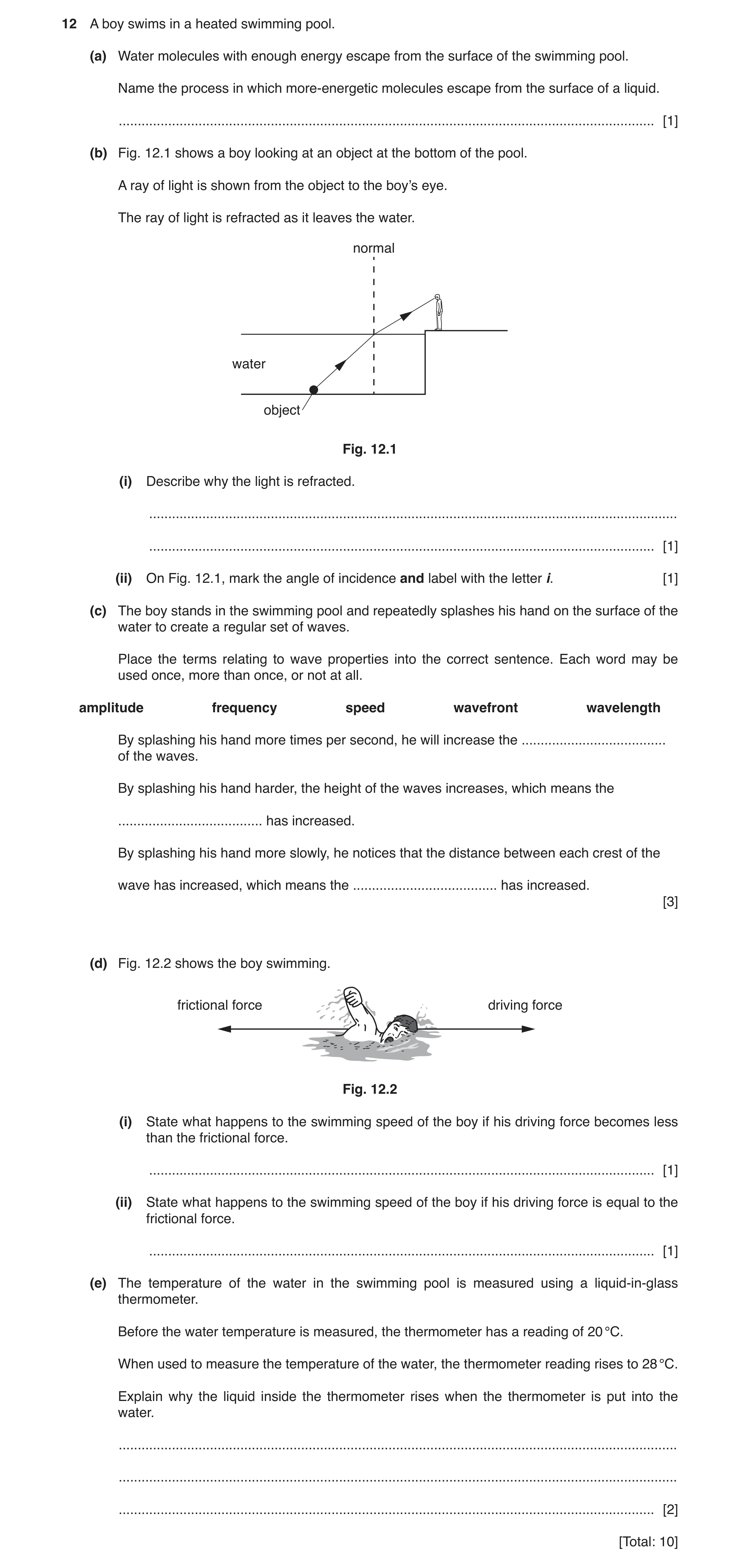
12 A boy swims in a heated swimming pool. (a) Water molecules with enough energy escape from the surface of the swimming pool. Name the process in which more-energetic molecules escape from the surface of a liquid. … [1] (b) Fig. 12.1 shows a boy looking at an object at the bottom of the pool. A ray of light is shown from the object to the boy’s eye. The ray of light is refracted as it leaves the water. normal water object Fig. 12.1 (i) Describe why the light is refracted. … … [1] (ii) On Fig. 12.1, mark the angle of incidence and label with the letter i. [1] (c) The boy stands in the swimming pool and repeatedly splashes his hand on the surface of the water to create a regular set of waves. Place the terms relating to wave properties into the correct sentence. Each word may be used once, more than once, or not at all. amplitude frequency speed wavefront wavelength By splashing his hand more times per second, he will increase the … of the waves. By splashing his hand harder, the height of the waves increases, which means the … has increased. By splashing his hand more slowly, he notices that the distance between each crest of the wave has increased, which means the … has increased. [3] (d) Fig. 12.2 shows the boy swimming. frictional force driving force Fig. 12.2 (i) State what happens to the swimming speed of the boy if his driving force becomes less than the frictional force. … [1] (ii) State what happens to the swimming speed of the boy if his driving force is equal to the frictional force. … [1] (e) The temperature of the water in the swimming pool is measured using a liquid-in-glass thermometer. Before the water temperature is measured, the thermometer has a reading of 20 °C. When used to measure the temperature of the water, the thermometer reading rises to 28 °C. Explain why the liquid inside the thermometer rises when the thermometer is put into the water. … … … [2] [Total: 10]
10 marks
Mark scheme: 12(a) evaporation ; 1 12(b)(i) due to a change of speed ; 1 12(b)(ii) angle drawn between the normal and the ray from the object and labelled with the letter ‘i’ ; 1 12(c) frequency ; amplitude ; wavelength ; 3 12(d)(i) slows down ; 1 12(d)(ii) constant ; 1 12(e) molecules gain KE / move apart ; liquid expands ; 2
This question in 0654/32 Oct/Nov 2019
Q9 · X-rays and γ-radiation are both forms of ionising radiation used in hospitals 0654/32 Feb/March 2021
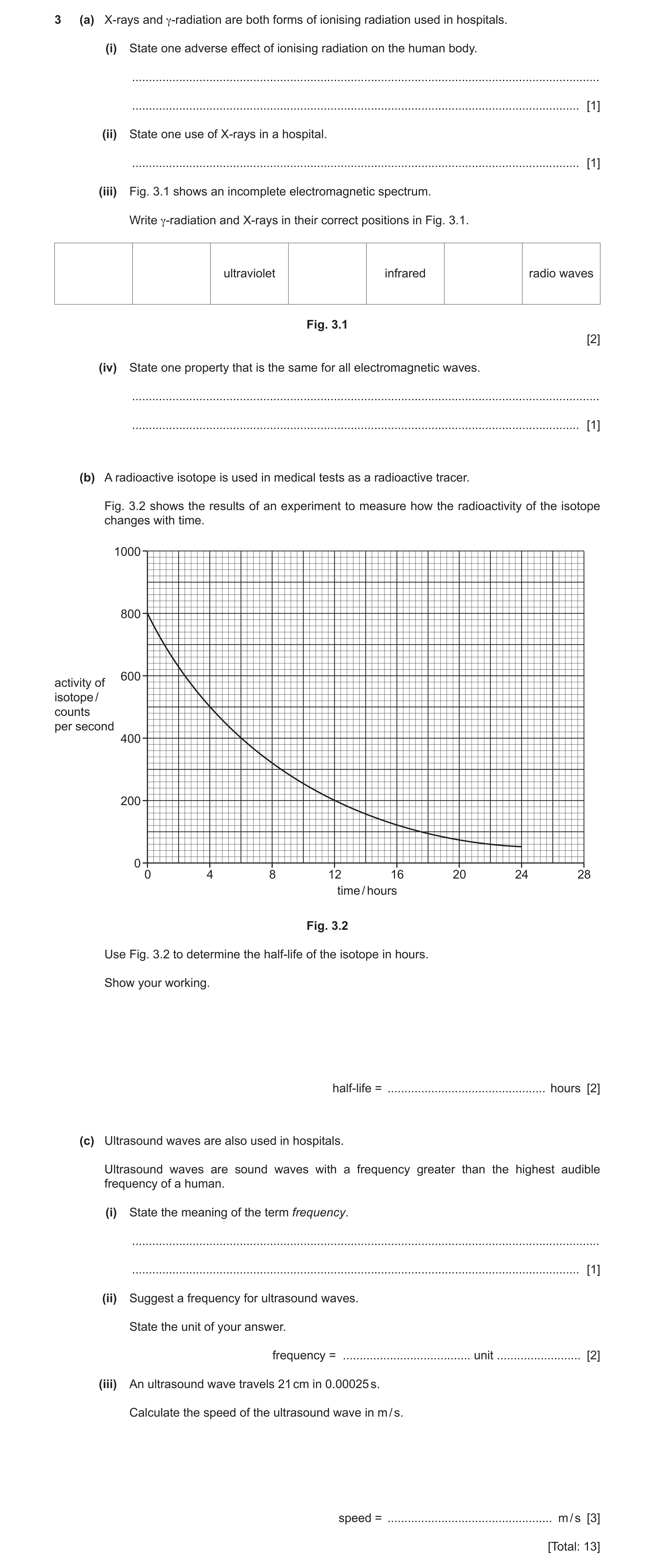
3 (a) X-rays and γ-radiation are both forms of ionising radiation used in hospitals. (i) State one adverse effect of ionising radiation on the human body. … … [1] (ii) State one use of X-rays in a hospital. … [1] (iii) Fig. 3.1 shows an incomplete electromagnetic spectrum. Write γ-radiation and X-rays in their correct positions in Fig. 3.1. ultraviolet infrared radio waves Fig. 3.1 [2] (iv) State one property that is the same for all electromagnetic waves. … … [1] (b) A radioactive isotope is used in medical tests as a radioactive tracer. Fig. 3.2 shows the results of an experiment to measure how the radioactivity of the isotope changes with time. 1000 800 600activity of isotope / counts per second 400 200 0 0 4 8 12 16 20 24 28 time / hours Fig. 3.2 Use Fig. 3.2 to determine the half-life of the isotope in hours. Show your working. half-life = … hours [2] (c) Ultrasound waves are also used in hospitals. Ultrasound waves are sound waves with a frequency greater than the highest audible frequency of a human. (i) State the meaning of the term frequency. … … [1] (ii) Suggest a frequency for ultrasound waves. State the unit of your answer. frequency = … unit … [2] (iii) An ultrasound wave travels 21 cm in 0.00025 s. Calculate the speed of the ultrasound wave in m / s. speed = … m / s [3] [Total: 13]
13 marks
Mark scheme: 3(a)(i) cancer / mutation; 1 3(a)(ii) detecting broken bones / CT scanning; 1 3(a)(iii) gamma X-rays UV infrared radio γ – radiation in 1st box from left; X – rays in 2nd box from left; 2 3(a)(iv) travel at same speed (in vacuo); 1 3(b) evidence of using data; 6 (hours) ; 2 3(c)(i) number of waves passing a fixed point per second; 1 3(c)(ii) above 20 000 ; Hz; 2 Question Answer Marks 3(c)(iii) 0.21m seen; speed = distance / time or 0.21 / 0.00025; = 840 m / s ; 3
This question in 0654/32 Feb/March 2021
Q10 · A school orchestra is practising 0654/31 May/June 2021
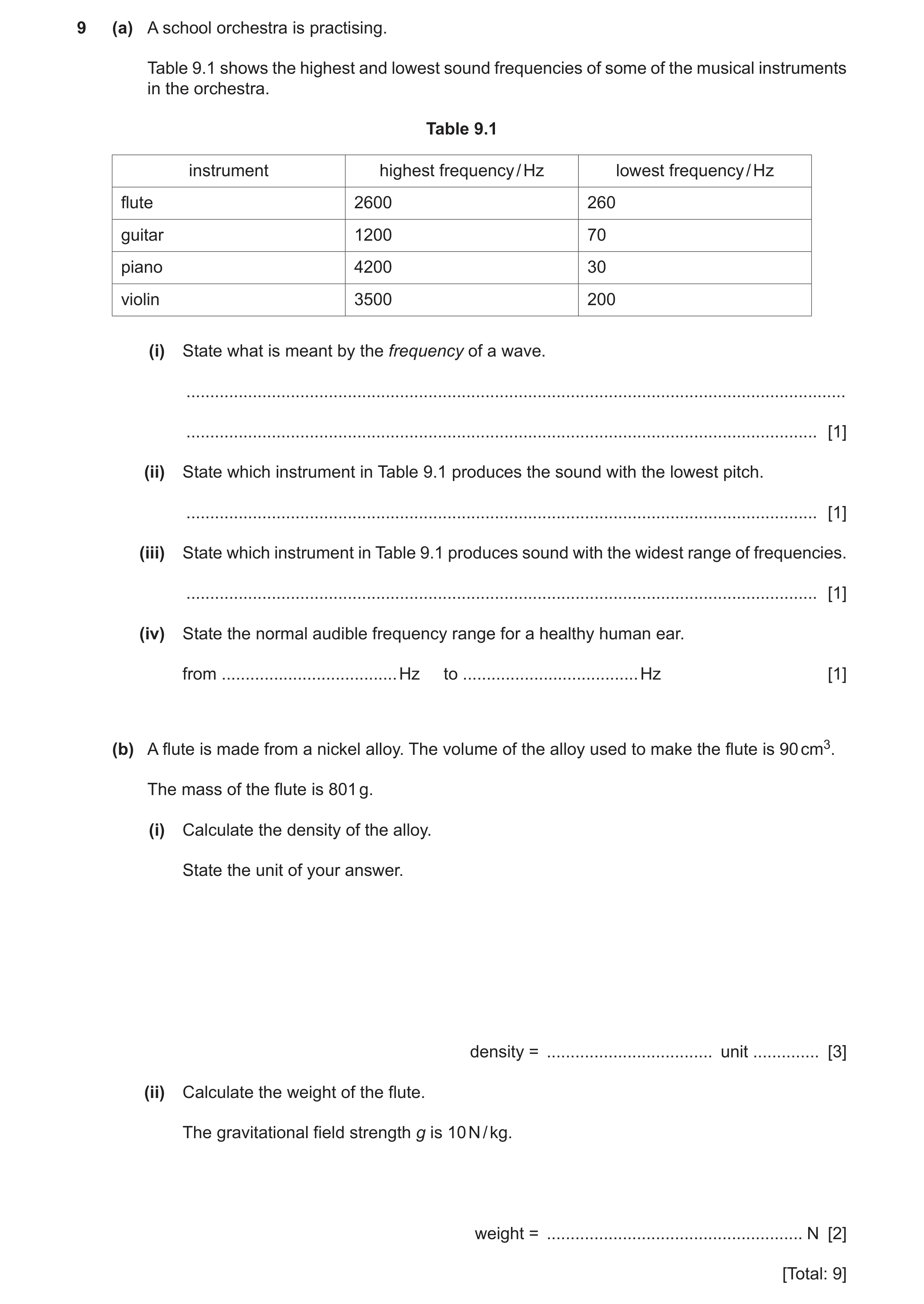
9 (a) A school orchestra is practising. Table 9.1 shows the highest and lowest sound frequencies of some of the musical instruments in the orchestra. Table 9.1 instrument highest frequency / Hz lowest frequency / Hz flute 2600 260 guitar 1200 70 piano 4200 30 violin 3500 200 (i) State what is meant by the frequency of a wave. … … [1] (ii) State which instrument in Table 9.1 produces the sound with the lowest pitch. … [1] (iii) State which instrument in Table 9.1 produces sound with the widest range of frequencies. … [1] (iv) State the normal audible frequency range for a healthy human ear. from … Hz to … Hz [1] (b) A flute is made from a nickel alloy. The volume of the alloy used to make the flute is 90 cm3. The mass of the flute is 801 g. (i) Calculate the density of the alloy. State the unit of your answer. density = … unit … [3] (ii) Calculate the weight of the flute. The gravitational field strength g is 10 N / kg. weight = … N [2] [Total: 9]
9 marks
Mark scheme: 9(a)(i) number of waves produced per second / passing a fixed point per second ; 1 9(a)(ii) piano ; 1 9(a)(iii) piano; 1 9(a)(iv) from 20 Hz to 20 000 Hz ; 1 9(b)(i) density = mass / volume or 801 / 90 ; = 8.90 ; g / cm3 ; 3 9(b)(ii) 801 g = 0.801 kg or weight = mass × g or 0.801 × 10 ; = 8.01 (N) ; 2
This question in 0654/31 May/June 2021
Q11 · Choose words from the list below to complete the sentences that describe the energy… 0654/32 Oct/Nov 2021
9 (a) Choose words from the list below to complete the sentences that describe the energy changes occurring when a wind turbine is used. Each word may be used once, more than once or not at all. electrical kinetic light potential thermal sound The kinetic energy of the wind is transferred to the … energy of the moving rotor blades of the wind turbine. The useful output energy from the wind turbine is … energy. The wind turbine makes sound energy which is unwanted. Another unwanted form of energy made by wind turbines is … energy. [2] (b) State one advantage of using wind rather than coal to generate electricity. … … [1] (c) (i) One disadvantage of wind turbines is they give out very low frequency sound waves. State what is meant by the frequency of a wave. … … [1] (ii) The frequency of the sound waves produced is very low. A healthy human ear can only just hear this sound. Suggest a value for this frequency. … Hz [1] (d) Magnets are used in the generators of wind turbines. Fig. 9.1 shows a bar magnet. S N Fig. 9.1 On Fig. 9.1, draw the pattern and direction of the magnetic field lines around the magnet. [2] (e) Another method of generating electricity is to use nuclear fission in a nuclear power station. During nuclear fission, α‑particles, β‑particles and γ‑rays may be released from atoms. (i) Complete Table 9.1 to show the properties of α‑particles, β‑particles and γ‑rays. Table 9.1 radiation ionising ability nature penetrating ability α‑particle high helium nucleus β‑particle medium medium electromagnetic γ‑ray wave [3] (ii) Describe what happens to the nucleus of an atom during nuclear fission. … … [1] [Total: 11]
11 marks
Mark scheme: 9(a) kinetic electrical thermal ;; 2 9(b) does not use up a fossil fuel ; does not produce CO2 / cause global warming etc. ; renewable ; AVP ; max 1 1 9(c)(i) number of waves produced per second / passing a fixed point per second ; 1 9(c)(ii) in range from 20 Hz to 50 Hz ; 1 Question Answer Marks 9(d) correct field lines ; arrows from N to S ; 2 9(e)(i) α – low penetrating ability ; β – electron ; γ – low ionising ability and high penetrating ability ; 3 9(e)(ii) splits ; 1
This question in 0654/32 Oct/Nov 2021
Q12 · A wind surfer on a surfboard, driven by the wind, sailing at a constant speed across the… 0654/31 May/June 2022
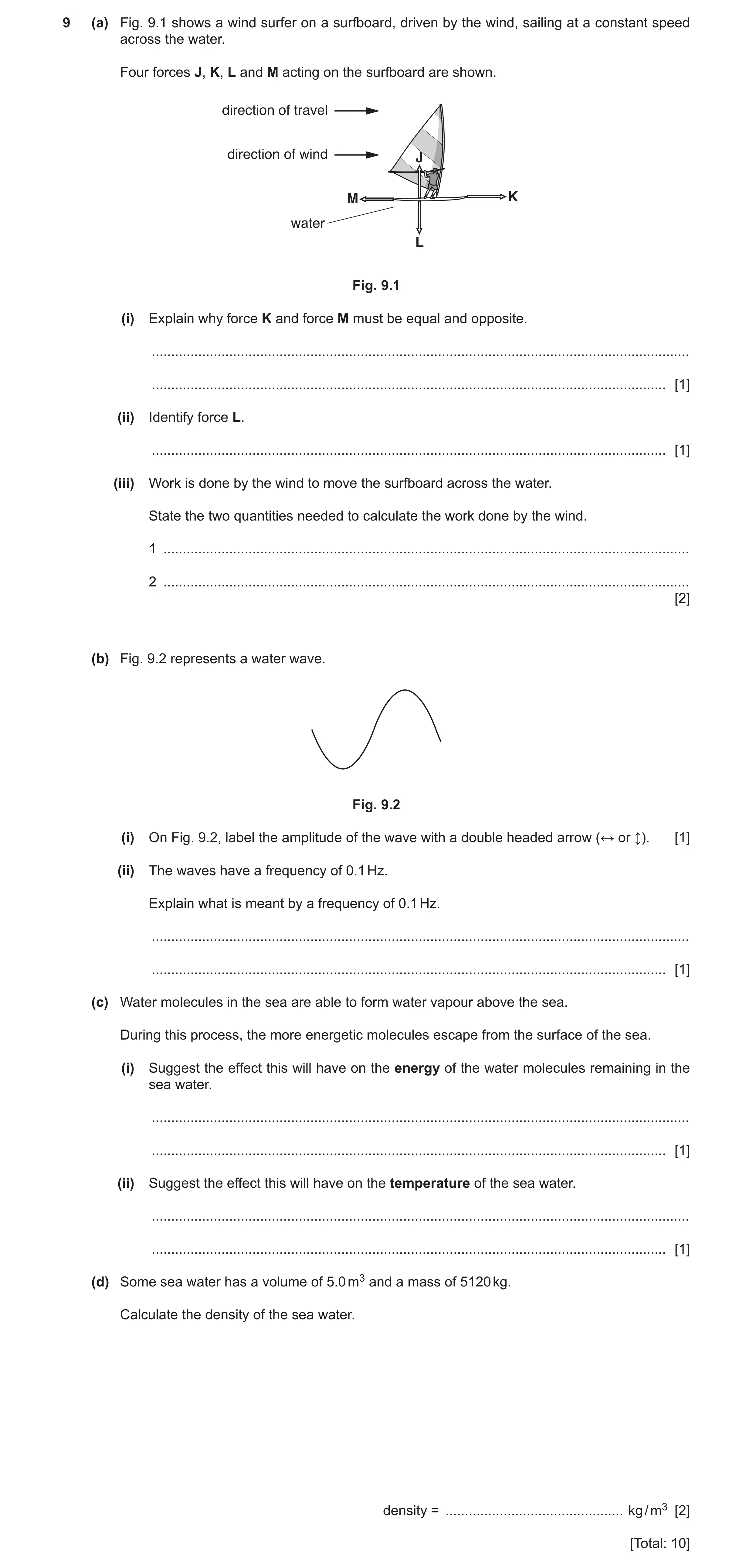
9 (a) Fig. 9.1 shows a wind surfer on a surfboard, driven by the wind, sailing at a constant speed across the water. Four forces J, K, L and M acting on the surfboard are shown. direction of travel direction of wind J M K water L Fig. 9.1 (i) Explain why force K and force M must be equal and opposite. … … [1] (ii) Identify force L. … [1] (iii) Work is done by the wind to move the surfboard across the water. State the two quantities needed to calculate the work done by the wind. 1 … 2 … [2] (b) Fig. 9.2 represents a water wave. Fig. 9.2 (i) On Fig. 9.2, label the amplitude of the wave with a double headed arrow (↔ or ↕). [1] (ii) The waves have a frequency of 0.1 Hz. Explain what is meant by a frequency of 0.1 Hz. … … [1] (c) Water molecules in the sea are able to form water vapour above the sea. During this process, the more energetic molecules escape from the surface of the sea. (i) Suggest the effect this will have on the energy of the water molecules remaining in the sea water. … … [1] (ii) Suggest the effect this will have on the temperature of the sea water. … … [1] (d) Some sea water has a volume of 5.0 m3 and a mass of 5120 kg. Calculate the density of the sea water. density = … kg / m3 [2] [Total: 10]
10 marks
Mark scheme: 9(a)(i) surfboard is moving at constant speed; 1 9(a)(ii) gravitational (force) / weight; 1 9(a)(iii) force; distance; 2 9(b)(i) amplitude correctly labelled; 1 9(b)(ii) one wave passes every 10 seconds; 1 9(c)(i) less energetic molecules ; owtte 1 9(c)(ii) decrease / cool ; 1 9(d) density = mass / volume or 5120 / 5; density = 1024 (kg / m3) ; 2
This question in 0654/31 May/June 2022
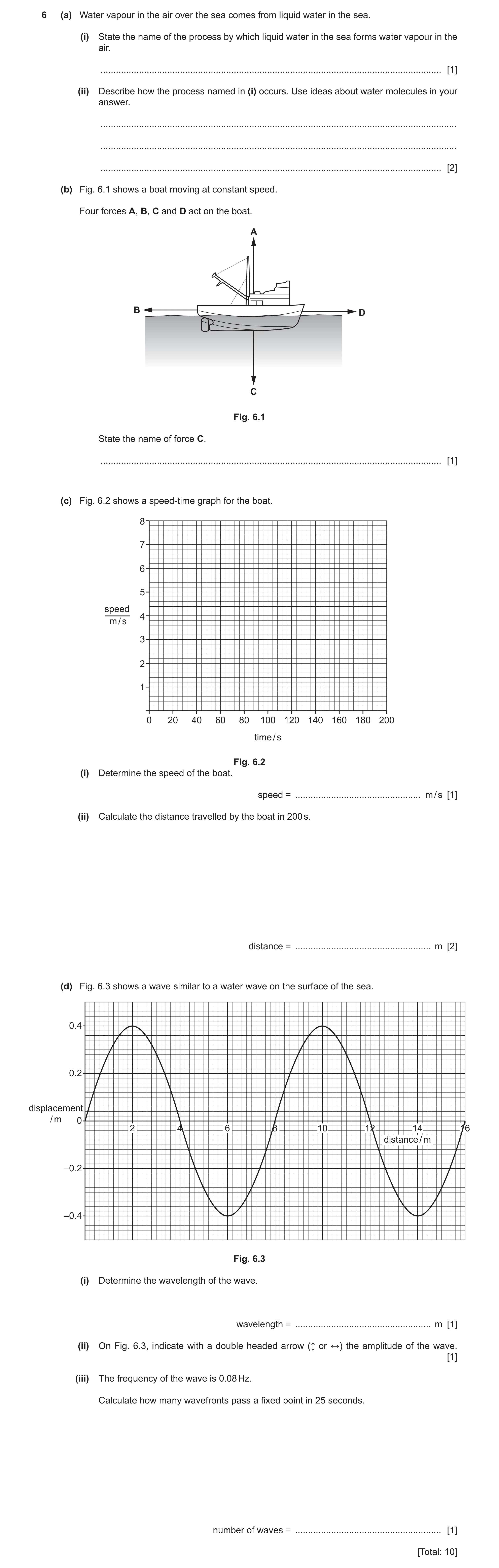
Q13 · Water vapour in the air over the sea comes from liquid water in the sea 0654/31 Oct/Nov 2022
6 (a) Water vapour in the air over the sea comes from liquid water in the sea. (i) State the name of the process by which liquid water in the sea forms water vapour in the air. … [1] (ii) Describe how the process named in (i) occurs. Use ideas about water molecules in your answer. … … … [2] (b) Fig. 6.1 shows a boat moving at constant speed. Four forces A, B, C and D act on the boat. A B D C Fig. 6.1 State the name of force C. … [1] (c) Fig. 6.2 shows a speed-time graph for the boat. 8 7 6 5 speed 4 m / s 3 2 1 0 20 40 60 80 100 120 140 160 180 200 time / s Fig. 6.2 (i) Determine the speed of the boat. speed = … m / s [1] (ii) Calculate the distance travelled by the boat in 200 s. distance = … m [2] (d) Fig. 6.3 shows a wave similar to a water wave on the surface of the sea. 0.4 0.2 displacement / m 0 2 4 6 8 10 12 14 16 distance / m –0.2 –0.4 Fig. 6.3 (i) Determine the wavelength of the wave. wavelength = … m [1] (ii) On Fig. 6.3, indicate with a double headed arrow (↕ or ↔) the amplitude of the wave. [1] (iii) The frequency of the wave is 0.08 Hz. Calculate how many wavefronts pass a fixed point in 25 seconds. number of waves = … [1] [Total: 10]
10 marks
Mark scheme: 6(a)(i) evaporation 1 6(a)(ii) fastest moving / most energetic molecules / particles ; 2 escape from surface ; 6(b) Weight ; 1 6(c)(i) 4.4 (m / s) ; 1 6(c)(ii) distance = speed time (in any form symbols or words) or 4.4 200 or area under graph ; 2 880 (m) ; 6(d)(i) 8 (m) ; 1 6(d)(ii) amplitude correctly indicated ; 1 6(d)(iii) 2.0 ; 1
This question in 0654/31 Oct/Nov 2022
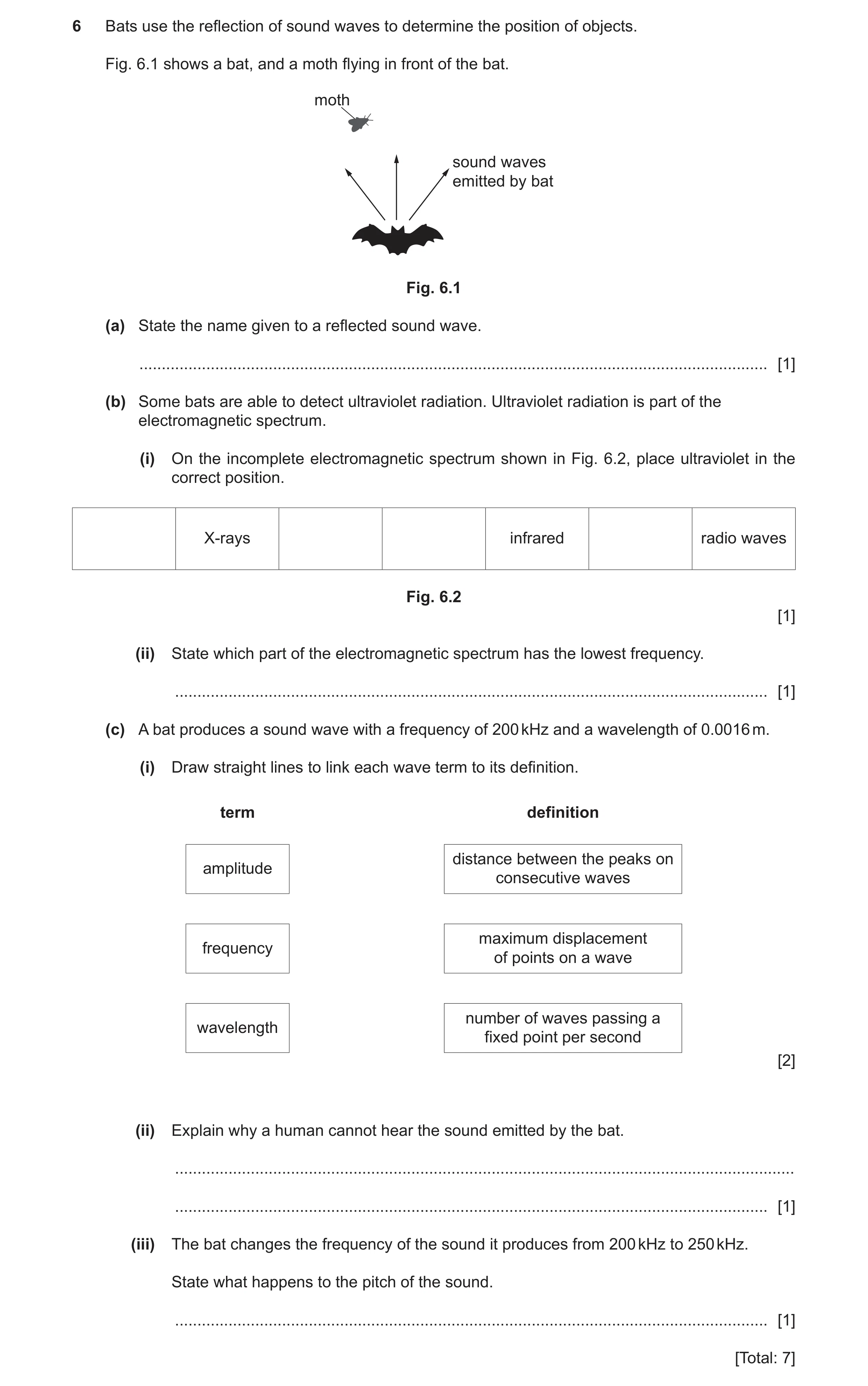
Q14 · Bats use the reflection of sound waves to determine the position of objects 0654/33 Oct/Nov 2022
6 Bats use the reflection of sound waves to determine the position of objects. Fig. 6.1 shows a bat, and a moth flying in front of the bat. moth sound waves emitted by bat Fig. 6.1 (a) State the name given to a reflected sound wave. … [1] (b) Some bats are able to detect ultraviolet radiation. Ultraviolet radiation is part of the electromagnetic spectrum. (i) On the incomplete electromagnetic spectrum shown in Fig. 6.2, place ultraviolet in the correct position. X-rays infrared radio waves Fig. 6.2 [1] (ii) State which part of the electromagnetic spectrum has the lowest frequency. … [1] (c) A bat produces a sound wave with a frequency of 200 kHz and a wavelength of 0.0016 m. (i) Draw straight lines to link each wave term to its definition. term definition distance between the peaks on amplitude consecutive waves maximum displacement frequency of points on a wave number of waves passing a wavelength fixed point per second [2] (ii) Explain why a human cannot hear the sound emitted by the bat. … … [1] (iii) The bat changes the frequency of the sound it produces from 200 kHz to 250 kHz. State what happens to the pitch of the sound. … [1] [Total: 7]
7 marks
Mark scheme: 6(a) echo ; 1 6(b)(i) 1 X-rays UV infrared radio waves 6(b)(ii) radio waves ; 1 6(c)(i) 2 term definition distance between the peaks on amplitude consecutive waves maximum displacement frequency of points on a wave number of waves passing a wavelength fixed point per second 1 correct 1 mark ; 3 correct 2 marks ; 6(c)(ii) highest frequency heard by a human is 20 000 Hz ; 1 6(c)(iii) pitch increases ; 1
This question in 0654/33 Oct/Nov 2022
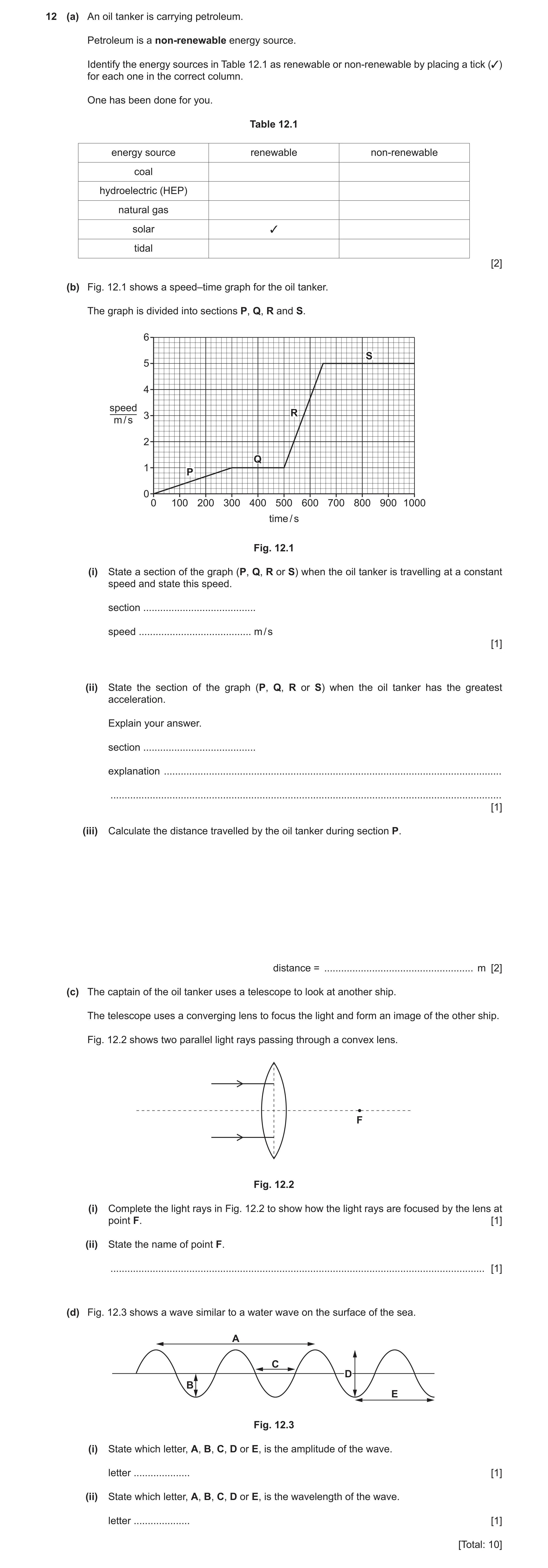
Q15 · An oil tanker is carrying petroleum 0654/32 May/June 2023
12 (a) An oil tanker is carrying petroleum. Petroleum is a non-renewable energy source. Identify the energy sources in Table 12.1 as renewable or non-renewable by placing a tick (3) for each one in the correct column. One has been done for you. Table 12.1 energy source renewable non-renewable coal hydroelectric (HEP) natural gas solar 3 tidal [2] (b) Fig. 12.1 shows a speed–time graph for the oil tanker. The graph is divided into sections P, Q, R and S. 6 S 5 4 speed 3 R m / s 2 Q 1 P 0 0 100 200 300 400 500 600 700 800 900 1000 time / s Fig. 12.1 (i) State a section of the graph (P, Q, R or S) when the oil tanker is travelling at a constant speed and state this speed. section … speed … m / s [1] (ii) State the section of the graph (P, Q, R or S) when the oil tanker has the greatest acceleration. Explain your answer. section … explanation … … [1] (iii) Calculate the distance travelled by the oil tanker during section P. distance = … m [2] (c) The captain of the oil tanker uses a telescope to look at another ship. The telescope uses a converging lens to focus the light and form an image of the other ship. Fig. 12.2 shows two parallel light rays passing through a convex lens. F Fig. 12.2 (i) Complete the light rays in Fig. 12.2 to show how the light rays are focused by the lens at point F. [1] (ii) State the name of point F. … [1] (d) Fig. 12.3 shows a wave similar to a water wave on the surface of the sea. A C D B E Fig. 12.3 (i) State which letter, A, B, C, D or E, is the amplitude of the wave. letter … [1] (ii) State which letter, A, B, C, D or E, is the wavelength of the wave. letter … [1] [Total: 10]
10 marks
Mark scheme: 12(a) energy source renewable non-renewable coal hydroelectric (HEP) natural gas solar tidal 2 or 3 correct ; 4 correct ; 12(b)(i) section Q and 1 (m / s) OR section S and 5 (m / s) ; 1 12(b)(ii) section R AND greatest gradient ; 1 12(b)(iii) area under graph or 1/2 1 300 ; 150 (m) ; 2 12(c)(i) both rays meet at F ; 1 12(c)(ii) principal focus ; 1 Question Answer Marks 12(d)(i) B ; 1 12(d)(ii) E ; 1
This question in 0654/32 May/June 2023
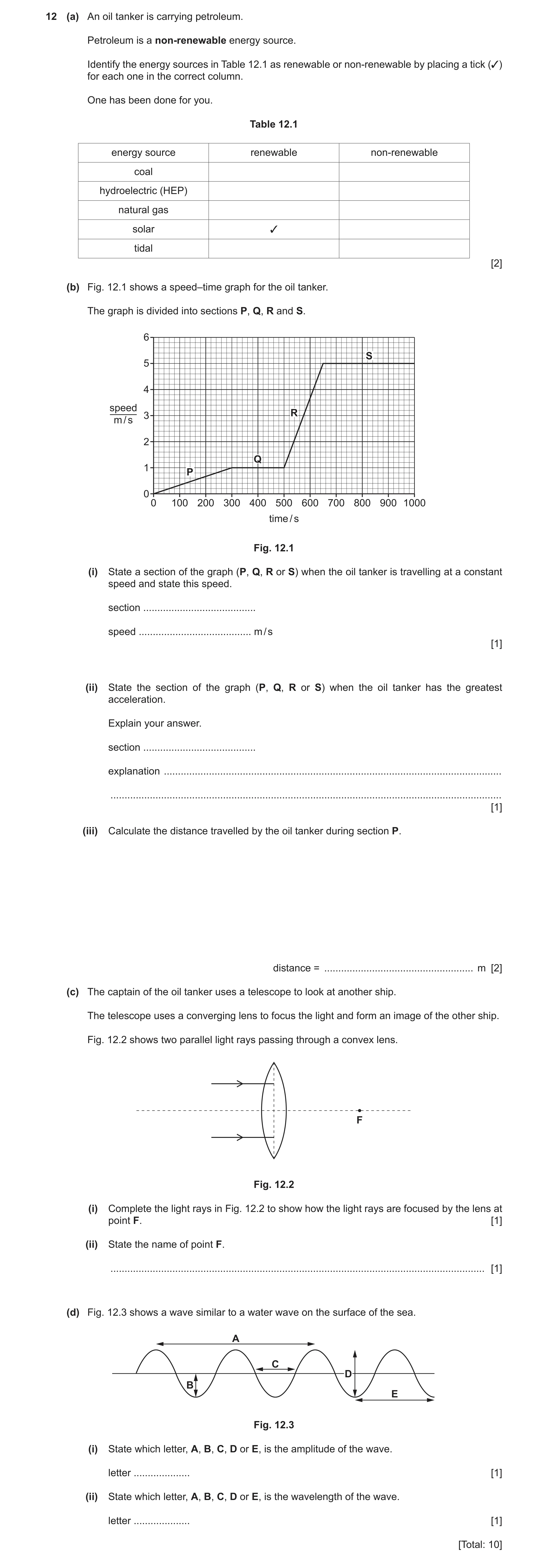
Q16 · An oil tanker is carrying petroleum 0654/33 May/June 2023
12 (a) An oil tanker is carrying petroleum. Petroleum is a non-renewable energy source. Identify the energy sources in Table 12.1 as renewable or non-renewable by placing a tick (3) for each one in the correct column. One has been done for you. Table 12.1 energy source renewable non-renewable coal hydroelectric (HEP) natural gas solar 3 tidal [2] (b) Fig. 12.1 shows a speed–time graph for the oil tanker. The graph is divided into sections P, Q, R and S. 6 S 5 4 speed 3 R m / s 2 Q 1 P 0 0 100 200 300 400 500 600 700 800 900 1000 time / s Fig. 12.1 (i) State a section of the graph (P, Q, R or S) when the oil tanker is travelling at a constant speed and state this speed. section … speed … m / s [1] (ii) State the section of the graph (P, Q, R or S) when the oil tanker has the greatest acceleration. Explain your answer. section … explanation … … [1] (iii) Calculate the distance travelled by the oil tanker during section P. distance = … m [2] (c) The captain of the oil tanker uses a telescope to look at another ship. The telescope uses a converging lens to focus the light and form an image of the other ship. Fig. 12.2 shows two parallel light rays passing through a convex lens. F Fig. 12.2 (i) Complete the light rays in Fig. 12.2 to show how the light rays are focused by the lens at point F. [1] (ii) State the name of point F. … [1] (d) Fig. 12.3 shows a wave similar to a water wave on the surface of the sea. A C D B E Fig. 12.3 (i) State which letter, A, B, C, D or E, is the amplitude of the wave. letter … [1] (ii) State which letter, A, B, C, D or E, is the wavelength of the wave. letter … [1] [Total: 10]
10 marks
Mark scheme: 12(a) energy source renewable non-renewable coal hydroelectric (HEP) natural gas solar tidal 2 or 3 correct ; 4 correct ; 12(b)(i) section Q and 1 (m / s) OR section S and 5 (m / s) ; 1 12(b)(ii) section R AND greatest gradient ; 1 12(b)(iii) area under graph or 1/2 1 300 ; 150 (m) ; 2 12(c)(i) both rays meet at F ; 1 12(c)(ii) principal focus ; 1 Question Answer Marks 12(d)(i) B ; 1 12(d)(ii) E ; 1
This question in 0654/33 May/June 2023
Q17 · A man is sitting on a beach on a sunny day 0654/33 Oct/Nov 2023
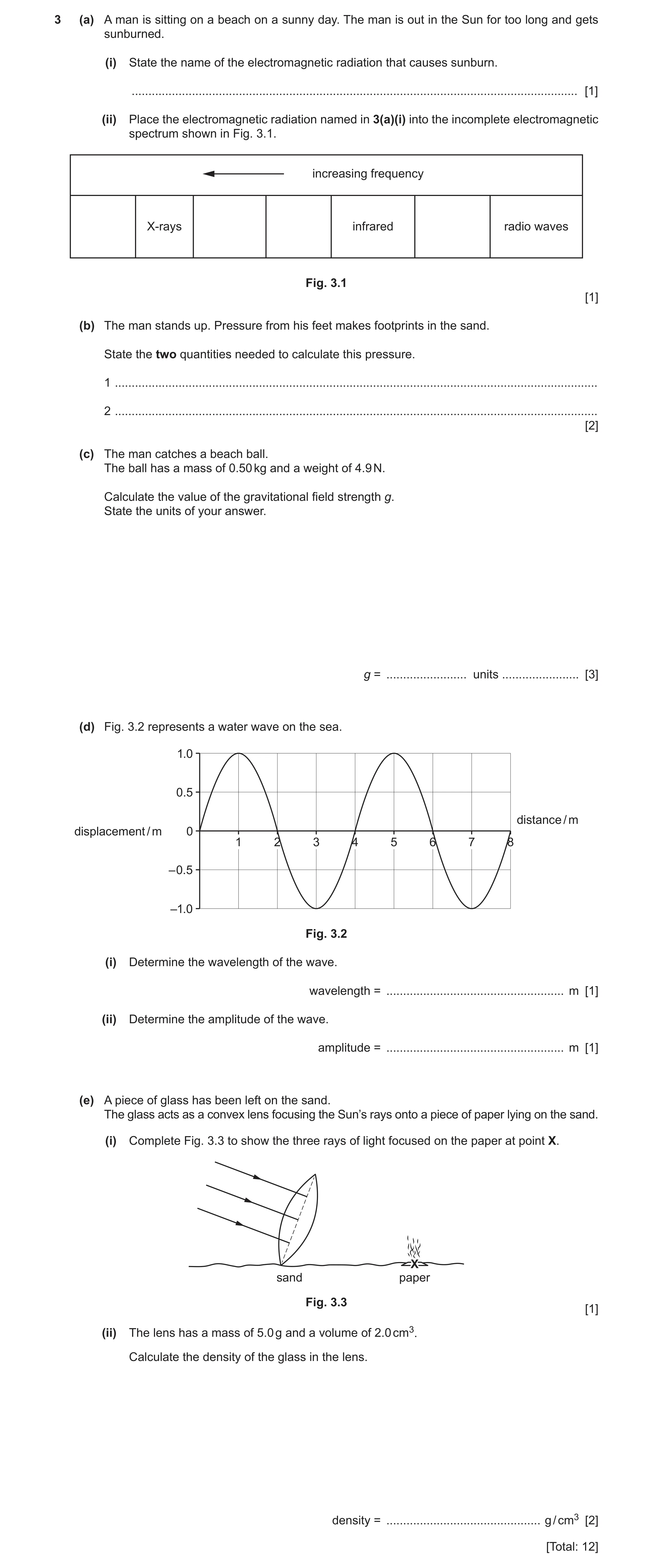
3 (a) A man is sitting on a beach on a sunny day. The man is out in the Sun for too long and gets sunburned. (i) State the name of the electromagnetic radiation that causes sunburn. … [1] (ii) Place the electromagnetic radiation named in 3(a)(i) into the incomplete electromagnetic spectrum shown in Fig. 3.1. increasing frequency X-rays infrared radio waves Fig. 3.1 [1] (b) The man stands up. Pressure from his feet makes footprints in the sand. State the two quantities needed to calculate this pressure. 1 … 2 … [2] (c) The man catches a beach ball. The ball has a mass of 0.50 kg and a weight of 4.9 N. Calculate the value of the gravitational field strength g. State the units of your answer. g = … units … [3] (d) Fig. 3.2 represents a water wave on the sea. 1.0 0.5 distance / m displacement / m 0 1 2 3 4 5 6 7 8 –0.5 –1.0 Fig. 3.2 (i) Determine the wavelength of the wave. wavelength = … m [1] (ii) Determine the amplitude of the wave. amplitude = … m [1] (e) A piece of glass has been left on the sand. The glass acts as a convex lens focusing the Sun’s rays onto a piece of paper lying on the sand. (i) Complete Fig. 3.3 to show the three rays of light focused on the paper at point X. X sand paper Fig. 3.3 [1] (ii) The lens has a mass of 5.0 g and a volume of 2.0 cm3. Calculate the density of the glass in the lens. density = … g / cm3 [2] [Total: 12]
12 marks
Mark scheme: 3(a)(i) ultraviolet ; 1 3(a)(ii) ultraviolet (UV) written in box to the right of X-rays ; 1 3(b) surface area of feet (in contact with sand) ; 2 weight of man ; 3(c) g = weight mass (in any form) / 4.9 0.50 ; 3 9.8 ; N / kg ; 3(d)(i) 4(.0) (m) ; 1 3(d)(ii) 1(.0) (m) ; 1 3(e)(i) three rays coming to a focus at X ; 1 3(e)(ii) density = mass ÷ volume (in any form) / 5.0 ÷ 2.0 ; 2 = 2.5 (g / cm3) ;
This question in 0654/33 Oct/Nov 2023
Q18 · Complete the following sentences using the words shown 0654/32 Feb/March 2024
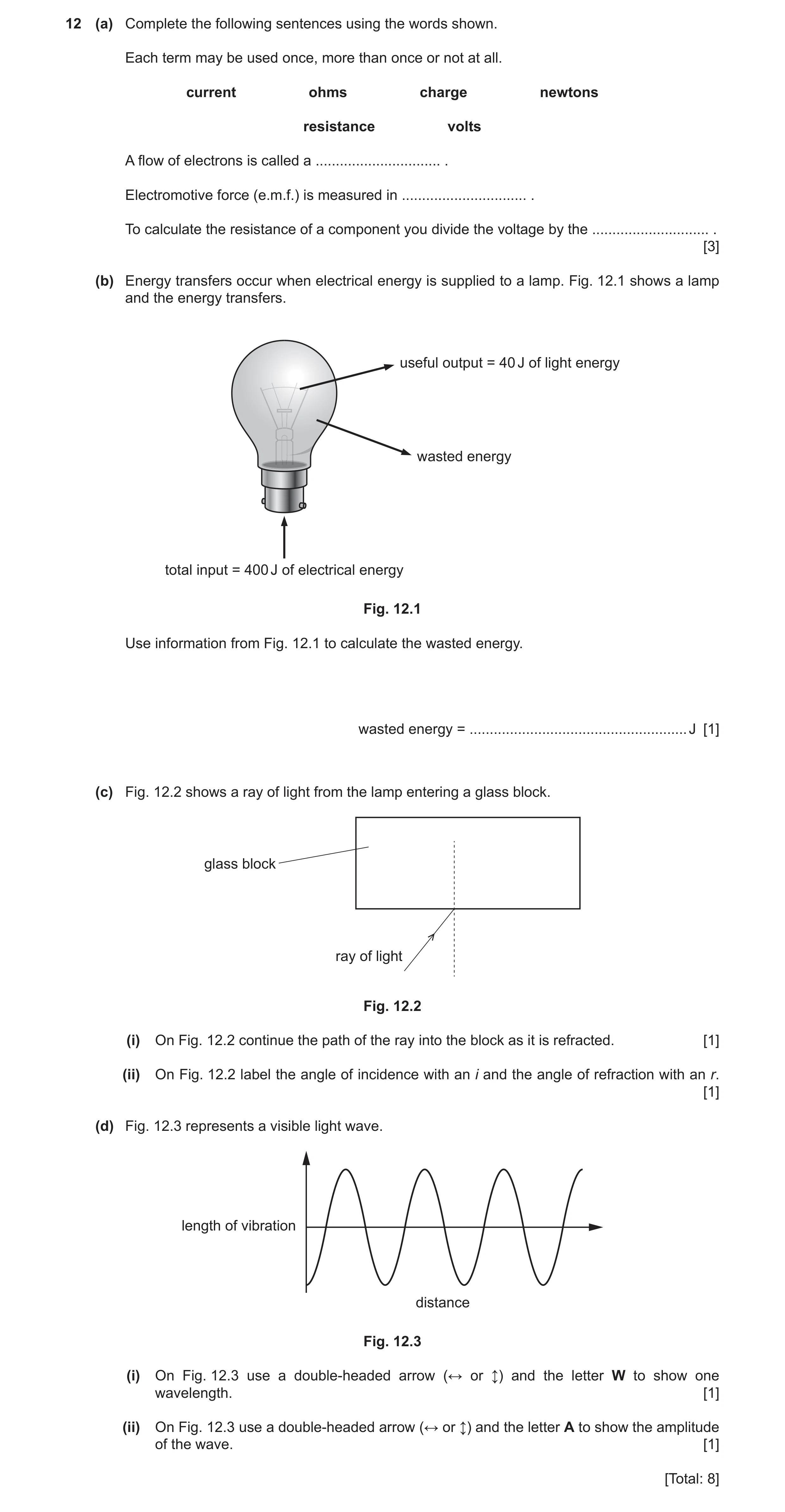
12 (a) Complete the following sentences using the words shown. Each term may be used once, more than once or not at all. current ohms charge newtons resistance volts A flow of electrons is called a … . Electromotive force (e.m.f.) is measured in … . To calculate the resistance of a component you divide the voltage by the … . [3] (b) Energy transfers occur when electrical energy is supplied to a lamp. Fig. 12.1 shows a lamp and the energy transfers. useful output = 40J of light energy wasted energy total input = 400J of electrical energy Fig. 12.1 Use information from Fig. 12.1 to calculate the wasted energy. wasted energy = … J [1] (c) Fig. 12.2 shows a ray of light from the lamp entering a glass block. glass block ray of light Fig. 12.2 (i) On Fig. 12.2 continue the path of the ray into the block as it is refracted. [1] (ii) On Fig. 12.2 label the angle of incidence with an i and the angle of refraction with an r. [1] (d) Fig. 12.3 represents a visible light wave. length of vibration distance Fig. 12.3 (i) On Fig. 12.3 use a double-headed arrow (↔ or ↕) and the letter W to show one wavelength. [1] (ii) On Fig. 12.3 use a double-headed arrow (↔ or ↕) and the letter A to show the amplitude of the wave. [1] [Total: 8]
8 marks
Mark scheme: 12(a) current ; 3 volts ; current ; 12(b) 360 (J ); 1 12(c)(i) ray drawn correctly ; 1 12(c)(ii) i and r labelled correctly ; 1 C 12(d)(i) one wavelength correctly shown ; 1 12(d)(ii) amplitude correctly shown ; 1
This question in 0654/32 Feb/March 2024
Q19 · X-rays and γ-radiation are both used in hospitals 0654/31 Oct/Nov 2025
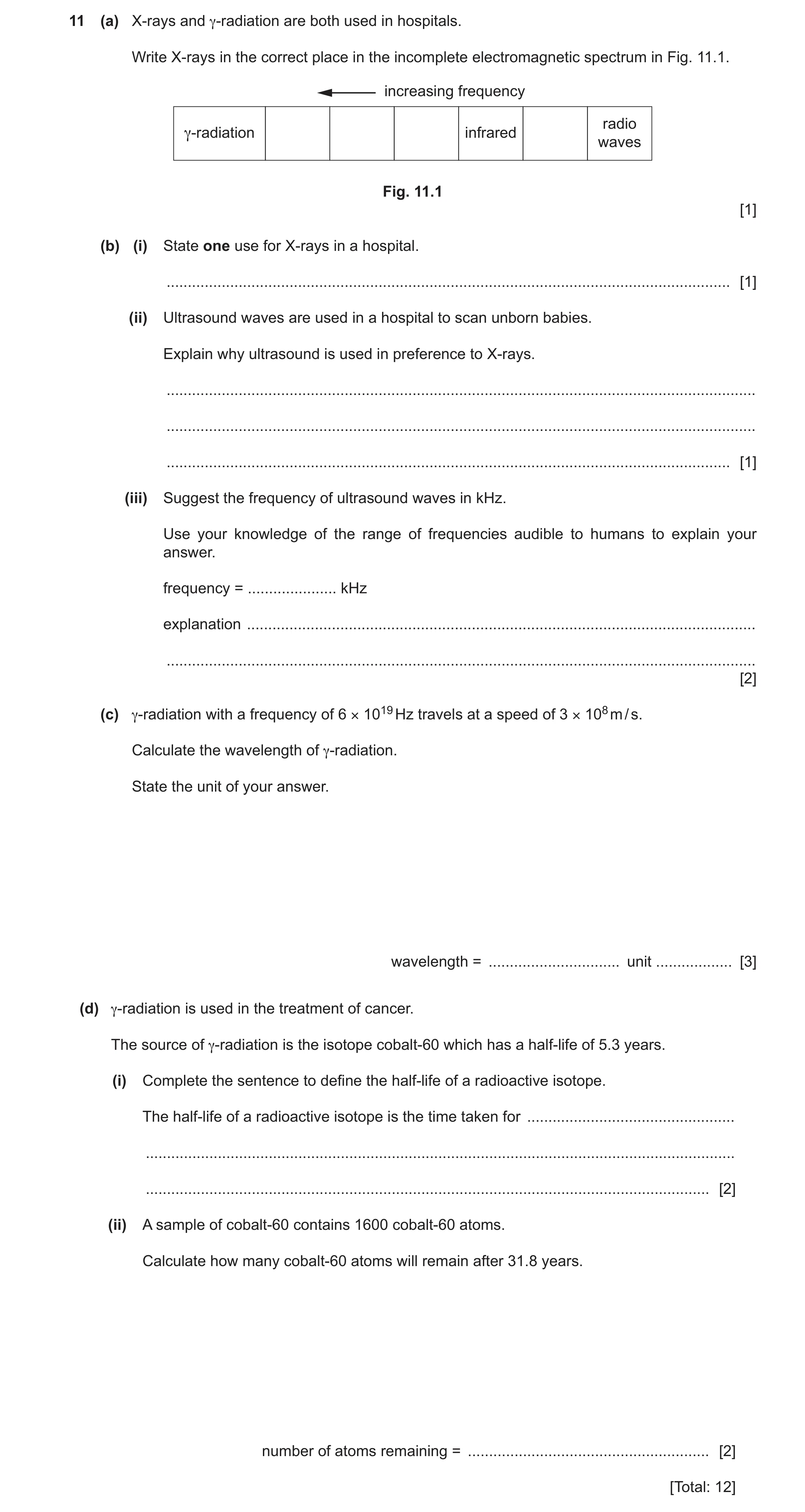
11 (a) X-rays and γ-radiation are both used in hospitals. Write X-rays in the correct place in the incomplete electromagnetic spectrum in Fig. 11.1. increasing frequency radio γ-radiation infrared waves Fig. 11.1 [1] (b) (i) State one use for X-rays in a hospital. … [1] (ii) Ultrasound waves are used in a hospital to scan unborn babies. Explain why ultrasound is used in preference to X-rays. … … … [1] (iii) Suggest the frequency of ultrasound waves in kHz. Use your knowledge of the range of frequencies audible to humans to explain your answer. frequency = … kHz explanation … … [2] (c) γ-radiation with a frequency of 6 × 10¹⁹ Hz travels at a speed of 3 × 10⁸ m / s. Calculate the wavelength of γ-radiation. State the unit of your answer. wavelength = … unit … [3] (d) γ-radiation is used in the treatment of cancer. The source of γ-radiation is the isotope cobalt-60 which has a half-life of 5.3 years. (i) Complete the sentence to define the half-life of a radioactive isotope. The half-life of a radioactive isotope is the time taken for … … … [2] (ii) A sample of cobalt-60 contains 1600 cobalt-60 atoms. Calculate how many cobalt-60 atoms will remain after 31.8 years. number of atoms remaining = … [2] [Total: 12]
12 marks
Mark scheme: 11(b)(i) scanning (bones) ; 1 11(b)(ii) (ultrasound) is less harmful / (ultrasound) causes less mutation / (ultrasound) causes less damage to cells / ORA ; 1 11(b)(iii) any figure above 20 (kHz) ; 2 explanation – highest audible frequency for a human is 20 (kHz) ; 11(c) v = f (in any form) 3 OR (wavelength =) 3 108 / 6 1019 ; 5 10–12 ; m ; 11(d)(i) (The half-life of a radioactive isotope is the time taken for) half the nuclei of (that isotope in any sample) to decay ; 2 two of the underlined words used correctly – 1 mark all three underlined words used correctly – 2 marks 11(d)(ii) 6 half-lives seen ; 2 so 25 atoms remain ;
This question in 0654/31 Oct/Nov 2025
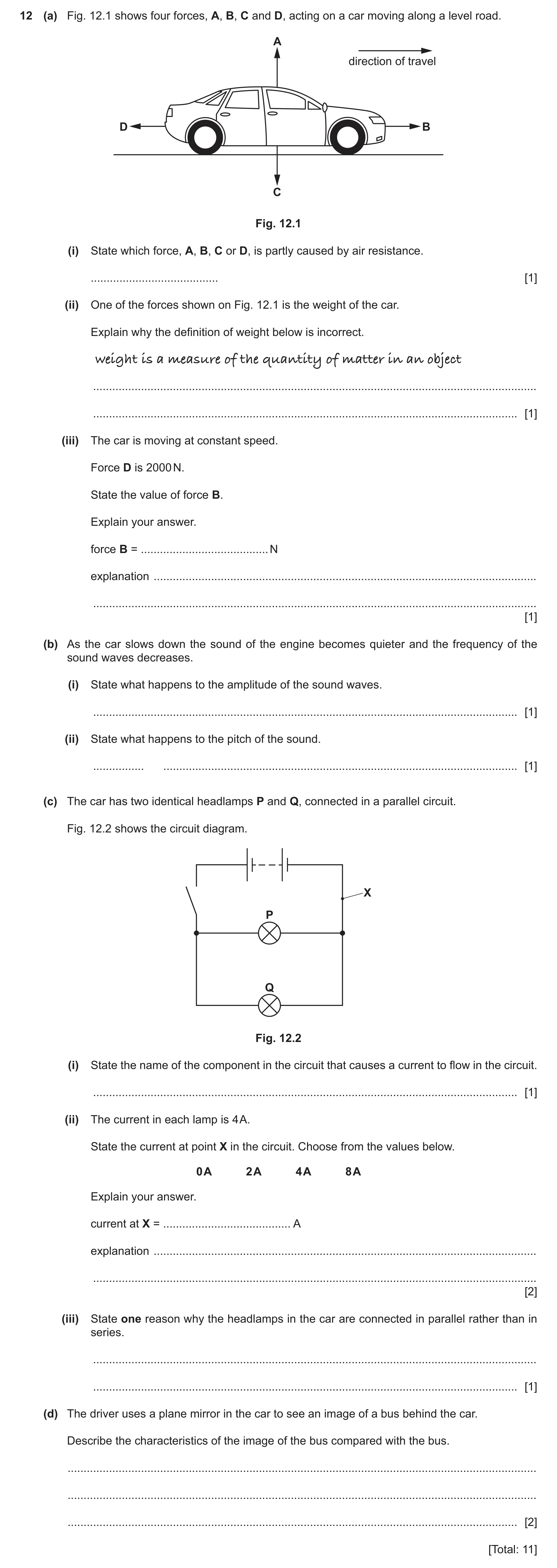
Q20 · Four forces, A, B, C and D, acting on a car moving along a level road 0654/32 Oct/Nov 2025
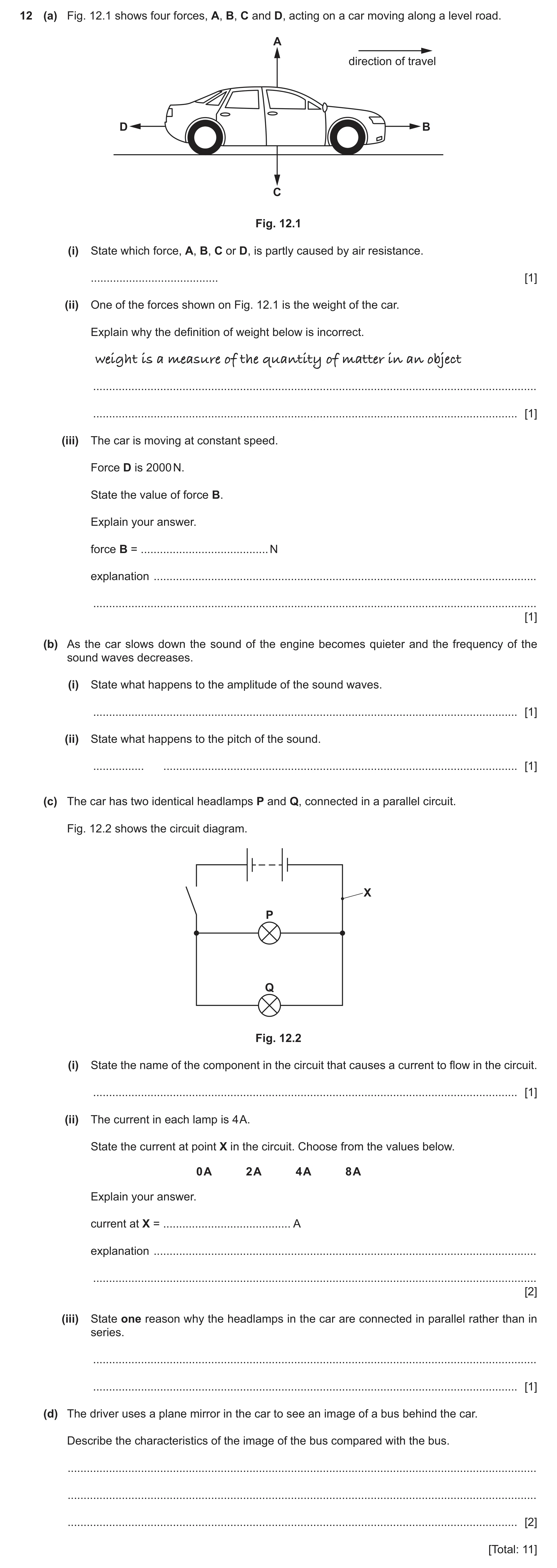
12 (a) Fig. 12.1 shows four forces, A, B, C and D, acting on a car moving along a level road. A direction of travel D B C Fig. 12.1 (i) State which force, A, B, C or D, is partly caused by air resistance. … [1] (ii) One of the forces shown on Fig. 12.1 is the weight of the car. Explain why the definition of weight below is incorrect. weight is a measure of the quantity of matter in an object … … [1] (iii) The car is moving at constant speed. Force D is 2000 N. State the value of force B. Explain your answer. force B = … N explanation … … [1] (b) As the car slows down the sound of the engine becomes quieter and the frequency of the sound waves decreases. (i) State what happens to the amplitude of the sound waves. … [1] (ii) State what happens to the pitch of the sound. … … [1] (c) The car has two identical headlamps P and Q, connected in a parallel circuit. Fig. 12.2 shows the circuit diagram. X P Q Fig. 12.2 (i) State the name of the component in the circuit that causes a current to flow in the circuit. … [1] (ii) The current in each lamp is 4 A. State the current at point X in the circuit. Choose from the values below. 0 A 2 A 4 A 8 A Explain your answer. current at X = … A explanation … … [2] (iii) State one reason why the headlamps in the car are connected in parallel rather than in series. … … [1] (d) The driver uses a plane mirror in the car to see an image of a bus behind the car. Describe the characteristics of the image of the bus compared with the bus. … … … [2] [Total: 11]
11 marks
Mark scheme: 12(a)(i) D ; 1 12(a)(ii) weight is the gravitational force on an object that has mass / definition of mass (not weight) ; 1 12(a)(iii) 2000 (N) and (constant speed so) no resultant force ; 1 12(b)(i) decreases ; 1 12(b)(ii) decreases ; 1 12(c)(i) battery ; 1 12(c)(ii) 8 (A) ; 2 current in main part of circuit is greater than current in either branch ; 12(c)(iii) full voltage across both lamps 1 OR if one lamp fails, the other will still work / AW ; 12(d) any two from: 2 • same size ; • same distance from mirror ; • laterally inverted ;
This question in 0654/32 Oct/Nov 2025
Q21 · Four forces, A, B, C and D, acting on a car moving along a level road 0654/33 Oct/Nov 2025
12 (a) Fig. 12.1 shows four forces, A, B, C and D, acting on a car moving along a level road. A direction of travel D B C Fig. 12.1 (i) State which force, A, B, C or D, is partly caused by air resistance. … [1] (ii) One of the forces shown on Fig. 12.1 is the weight of the car. Explain why the definition of weight below is incorrect. weight is a measure of the quantity of matter in an object … … [1] (iii) The car is moving at constant speed. Force D is 2000 N. State the value of force B. Explain your answer. force B = … N explanation … … [1] (b) As the car slows down the sound of the engine becomes quieter and the frequency of the sound waves decreases. (i) State what happens to the amplitude of the sound waves. … [1] (ii) State what happens to the pitch of the sound. … … [1] (c) The car has two identical headlamps P and Q, connected in a parallel circuit. Fig. 12.2 shows the circuit diagram. X P Q Fig. 12.2 (i) State the name of the component in the circuit that causes a current to flow in the circuit. … [1] (ii) The current in each lamp is 4 A. State the current at point X in the circuit. Choose from the values below. 0 A 2 A 4 A 8 A Explain your answer. current at X = … A explanation … … [2] (iii) State one reason why the headlamps in the car are connected in parallel rather than in series. … … [1] (d) The driver uses a plane mirror in the car to see an image of a bus behind the car. Describe the characteristics of the image of the bus compared with the bus. … … … [2] [Total: 11]
11 marks
Mark scheme: 12(a)(i) D ; 1 12(a)(ii) weight is the gravitational force on an object that has mass / definition of mass (not weight) ; 1 12(a)(iii) 2000 (N) and (constant speed so) no resultant force ; 1 12(b)(i) decreases ; 1 12(b)(ii) decreases ; 1 12(c)(i) battery ; 1 12(c)(ii) 8 (A) ; 2 current in main part of circuit is greater than current in either branch ; 12(c)(iii) full voltage across both lamps 1 OR if one lamp fails, the other will still work / AW ; 12(d) any two from: 2 • same size ; • same distance from mirror ; • laterally inverted ;
This question in 0654/33 Oct/Nov 2025
 12 / 39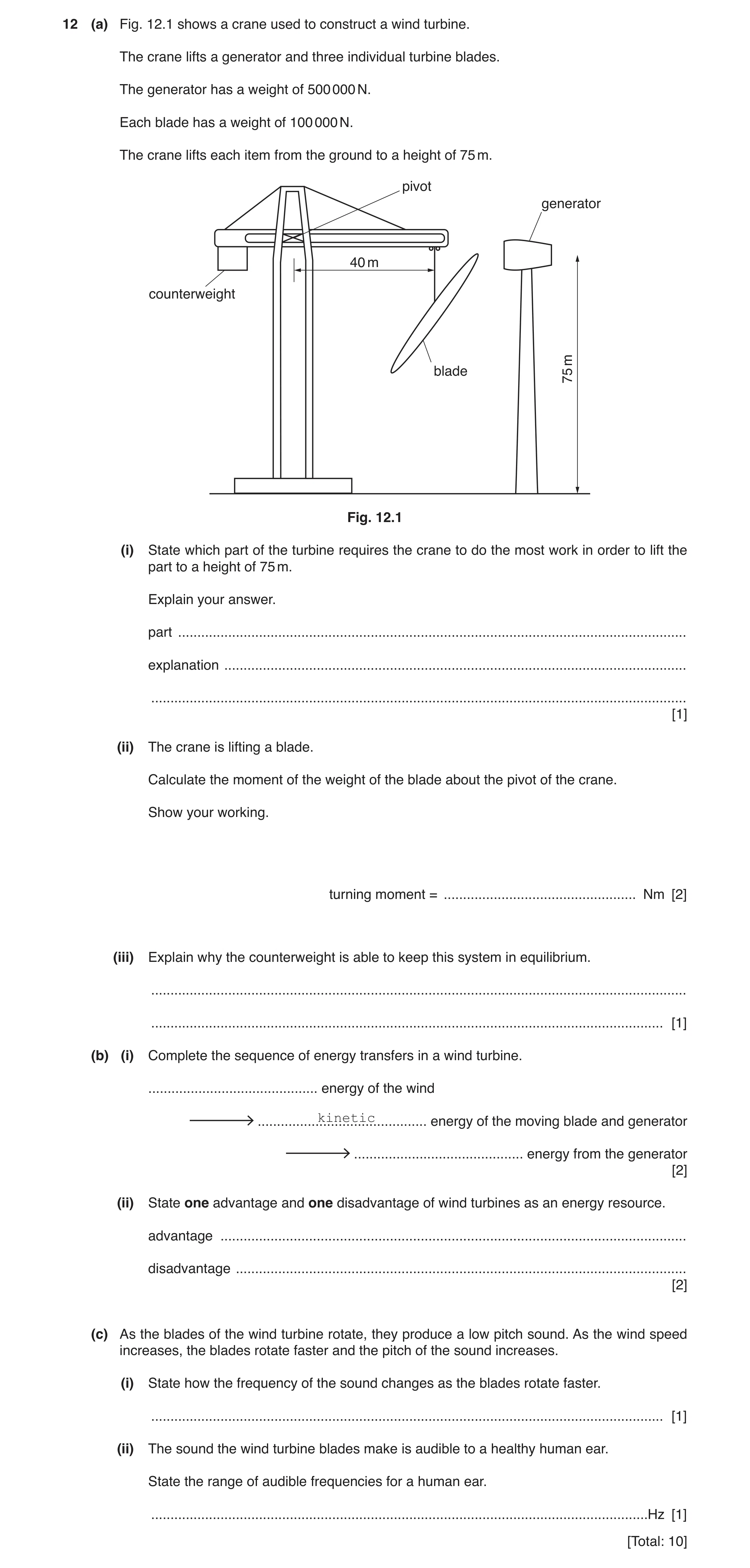
 18 / 39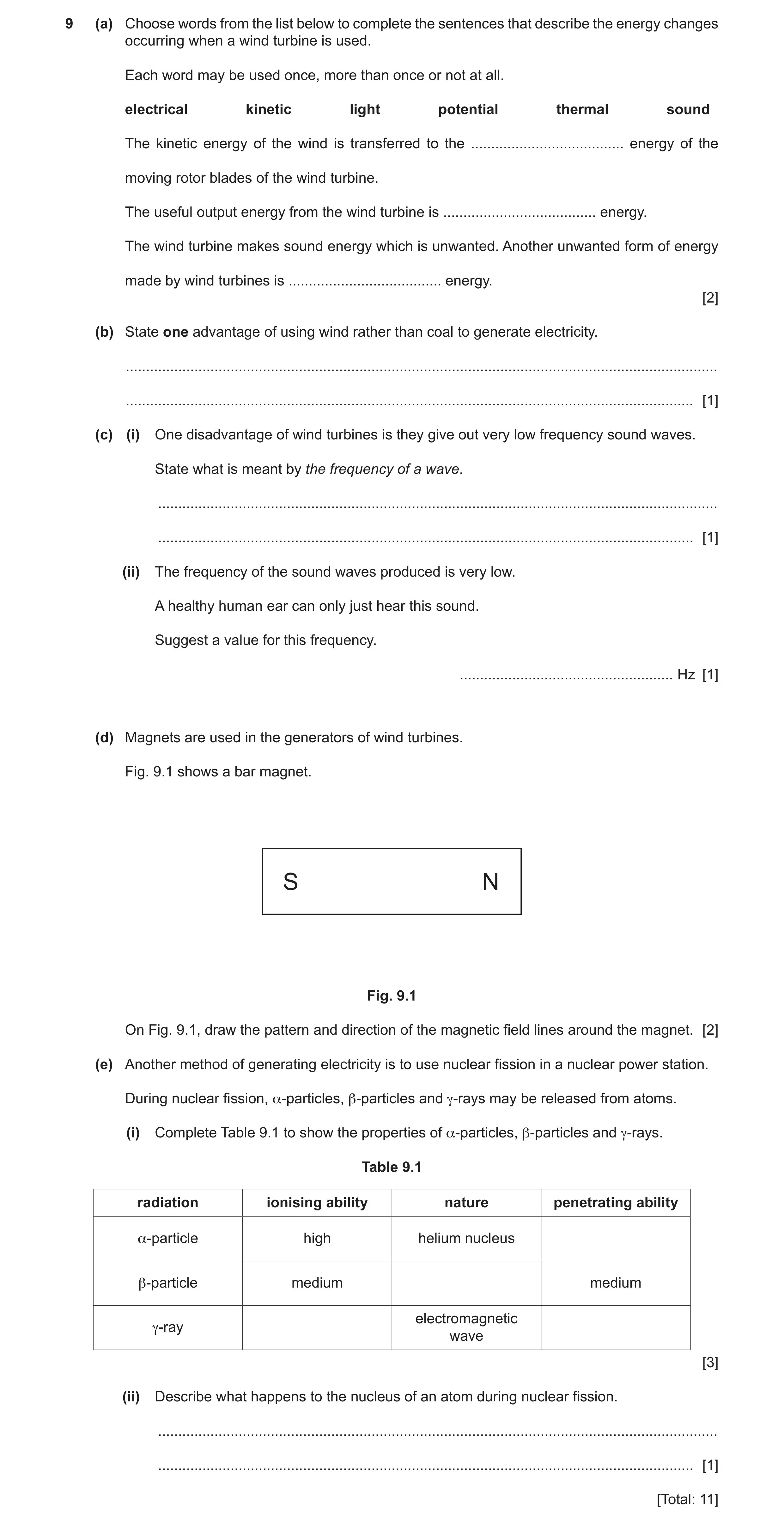
 15
15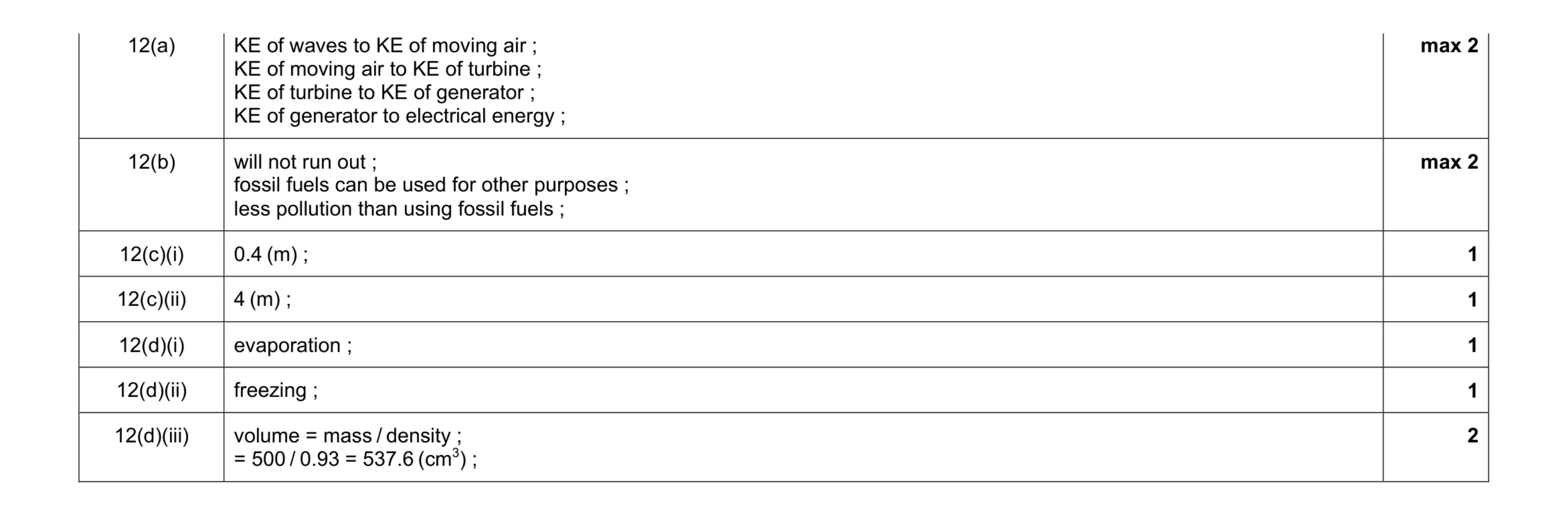 10
10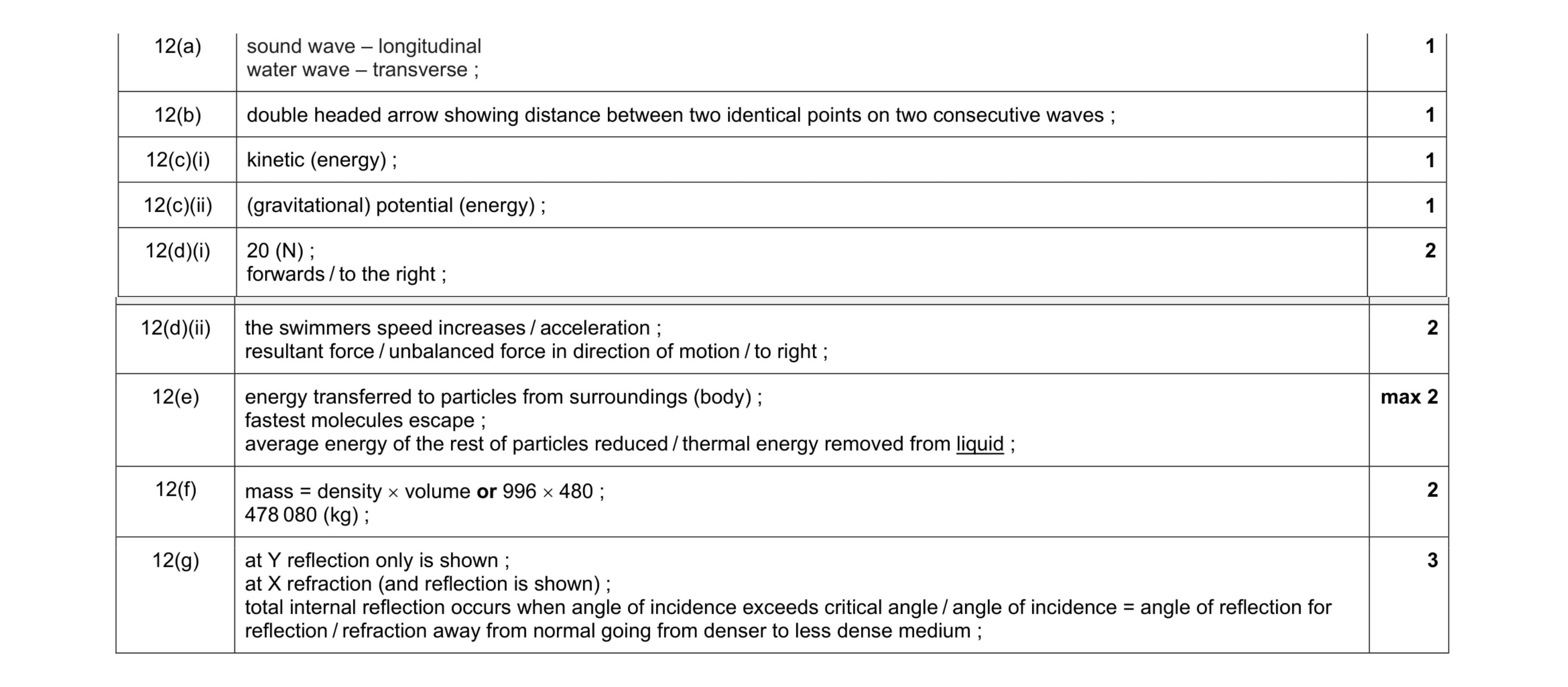 15
15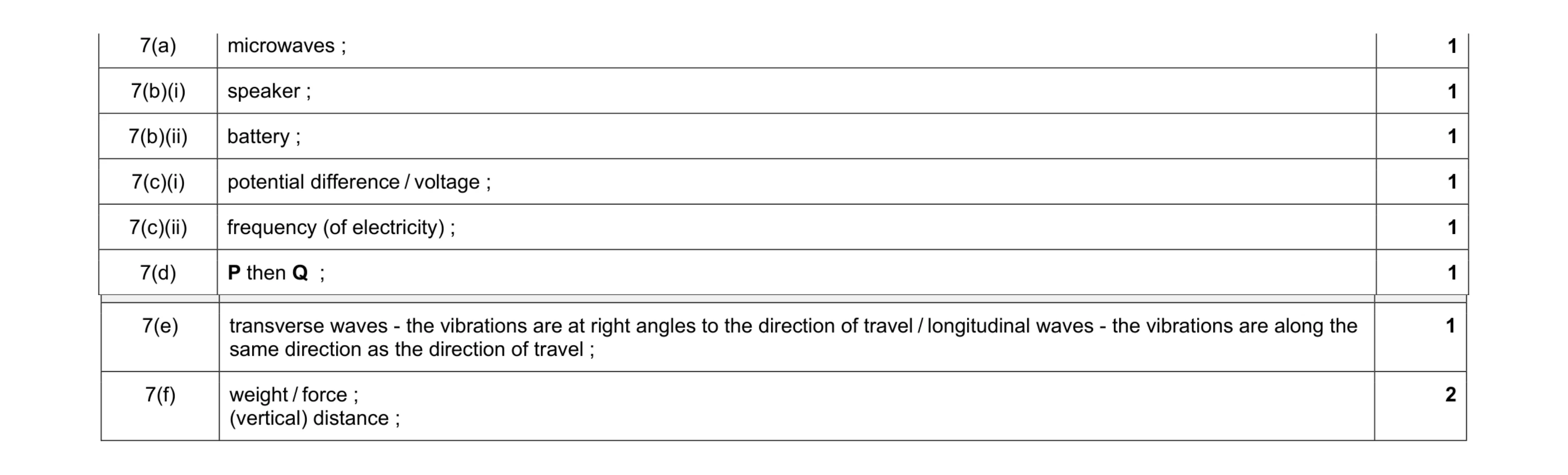 9
9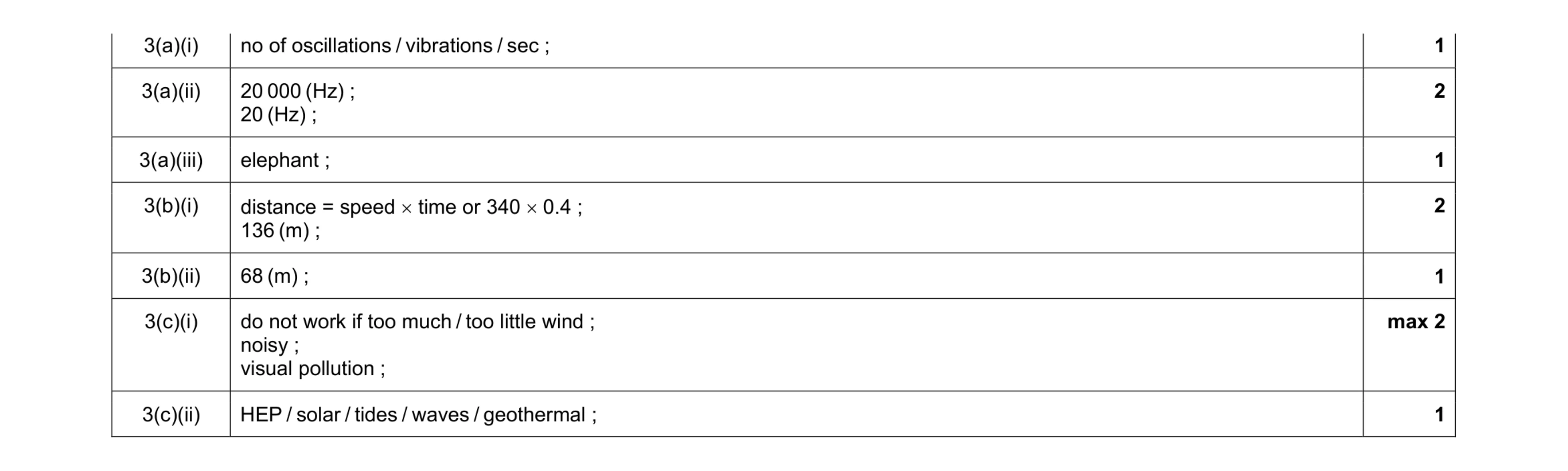 10
10 6
6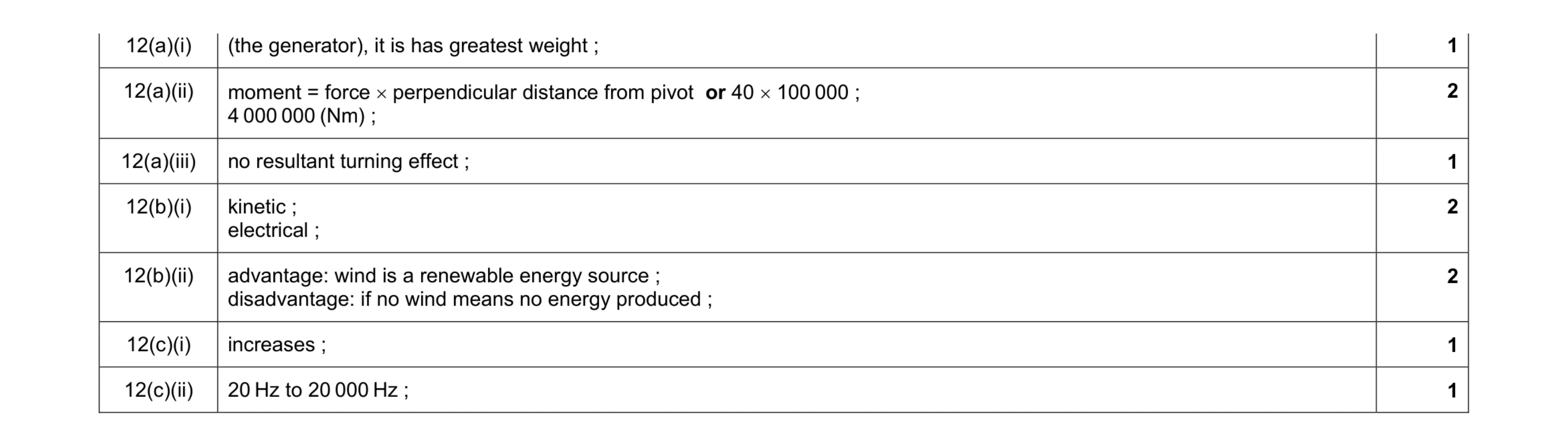 10
10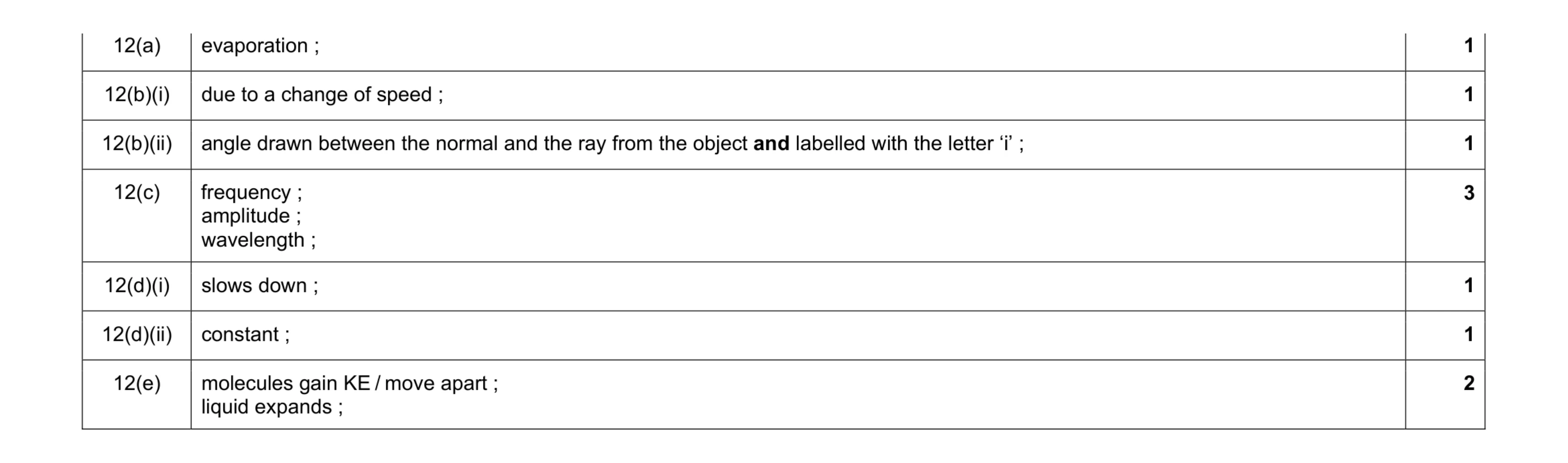 10
10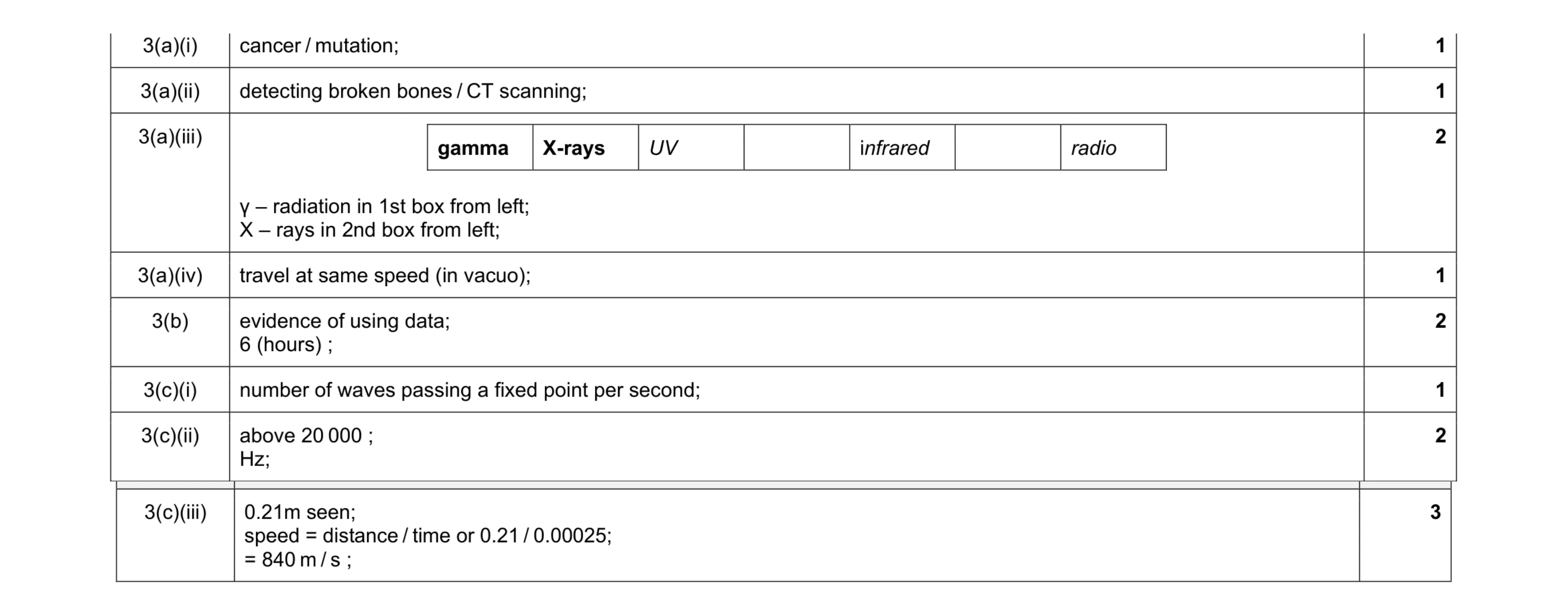 13
13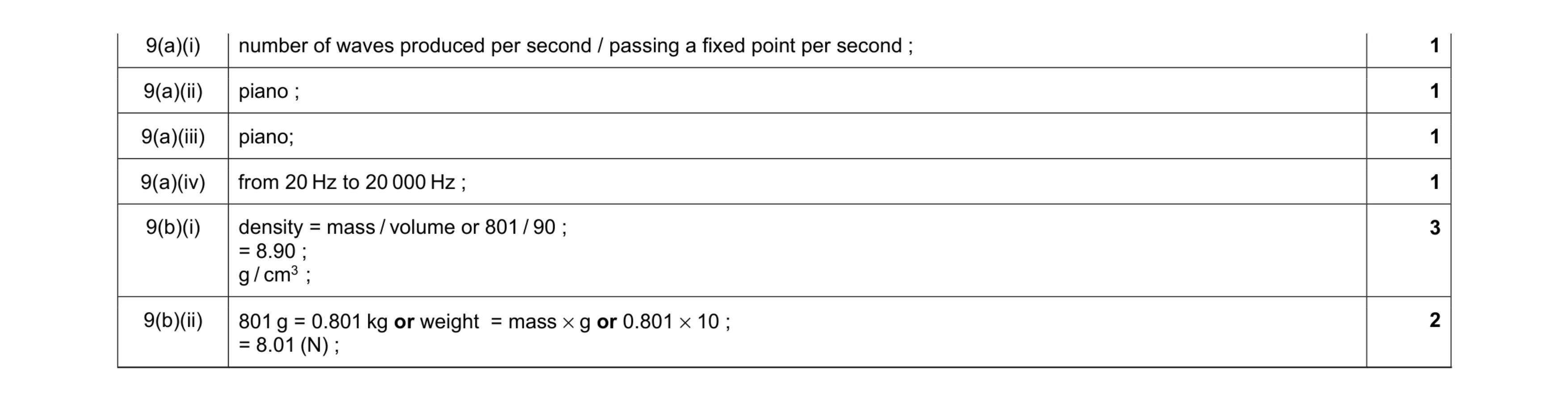 9
9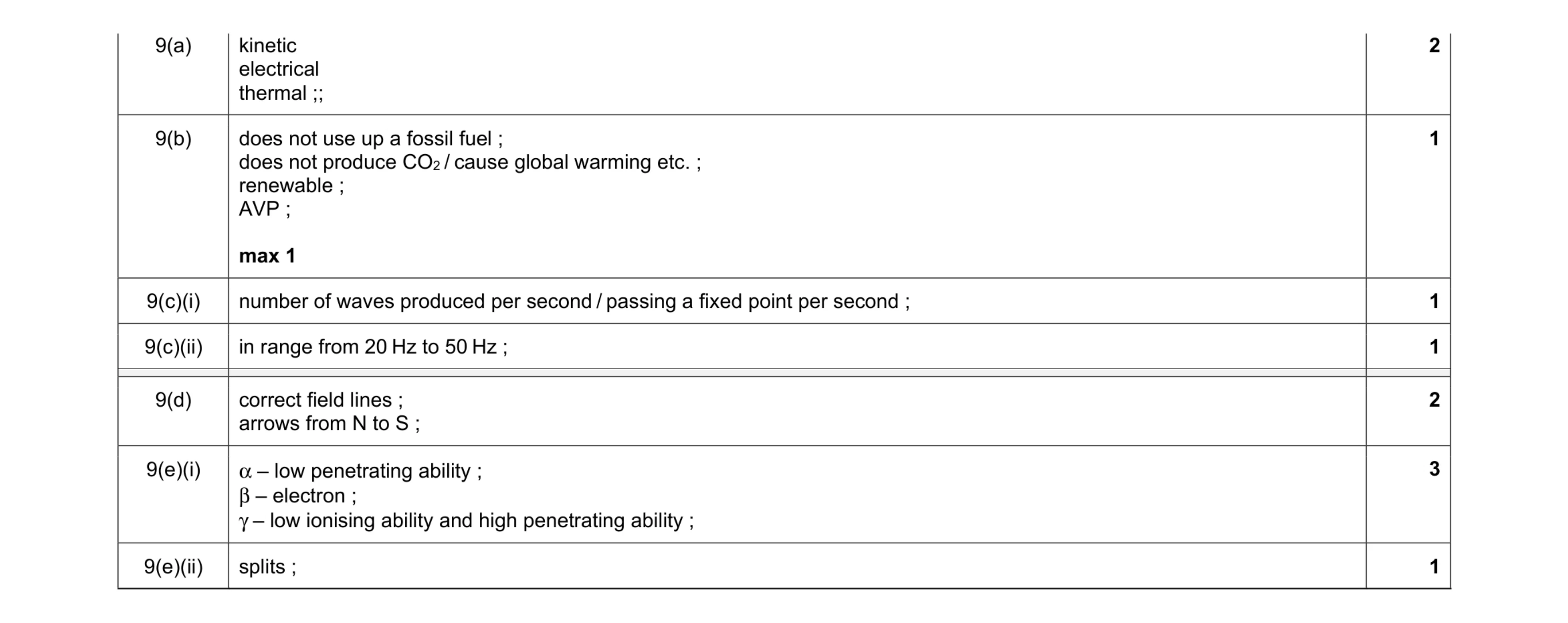 11
11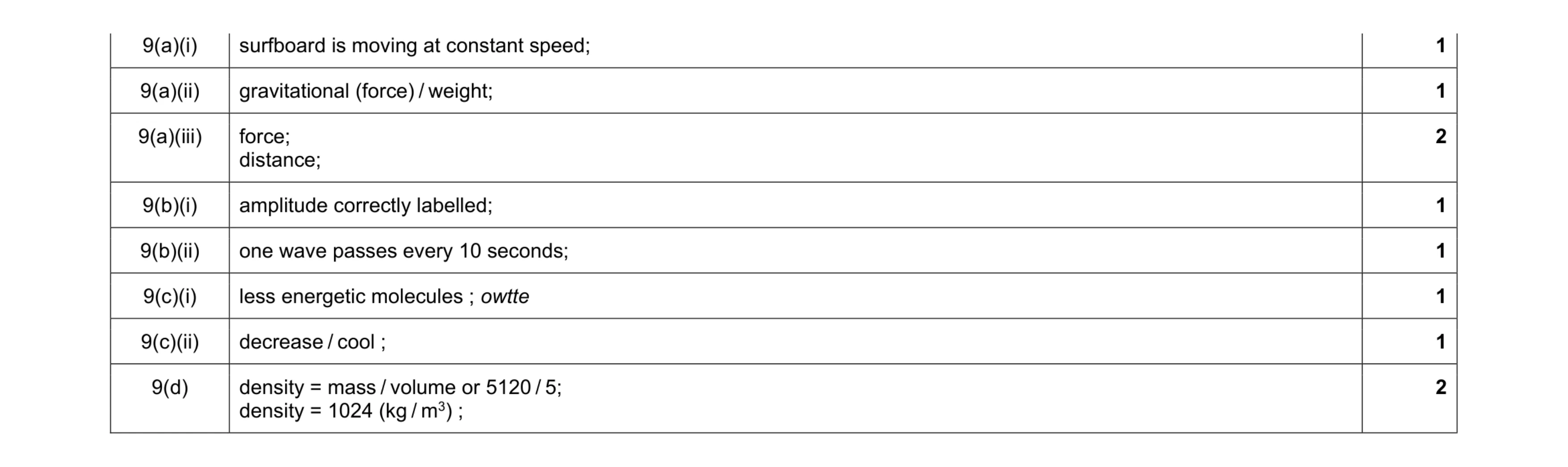 10
10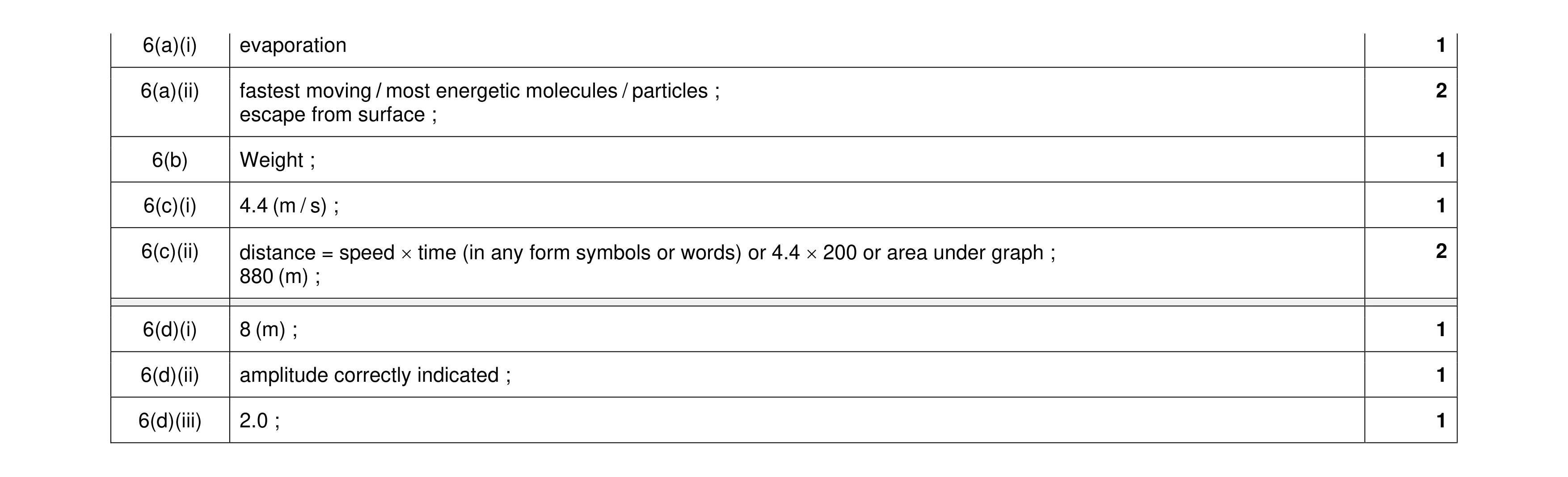 10
10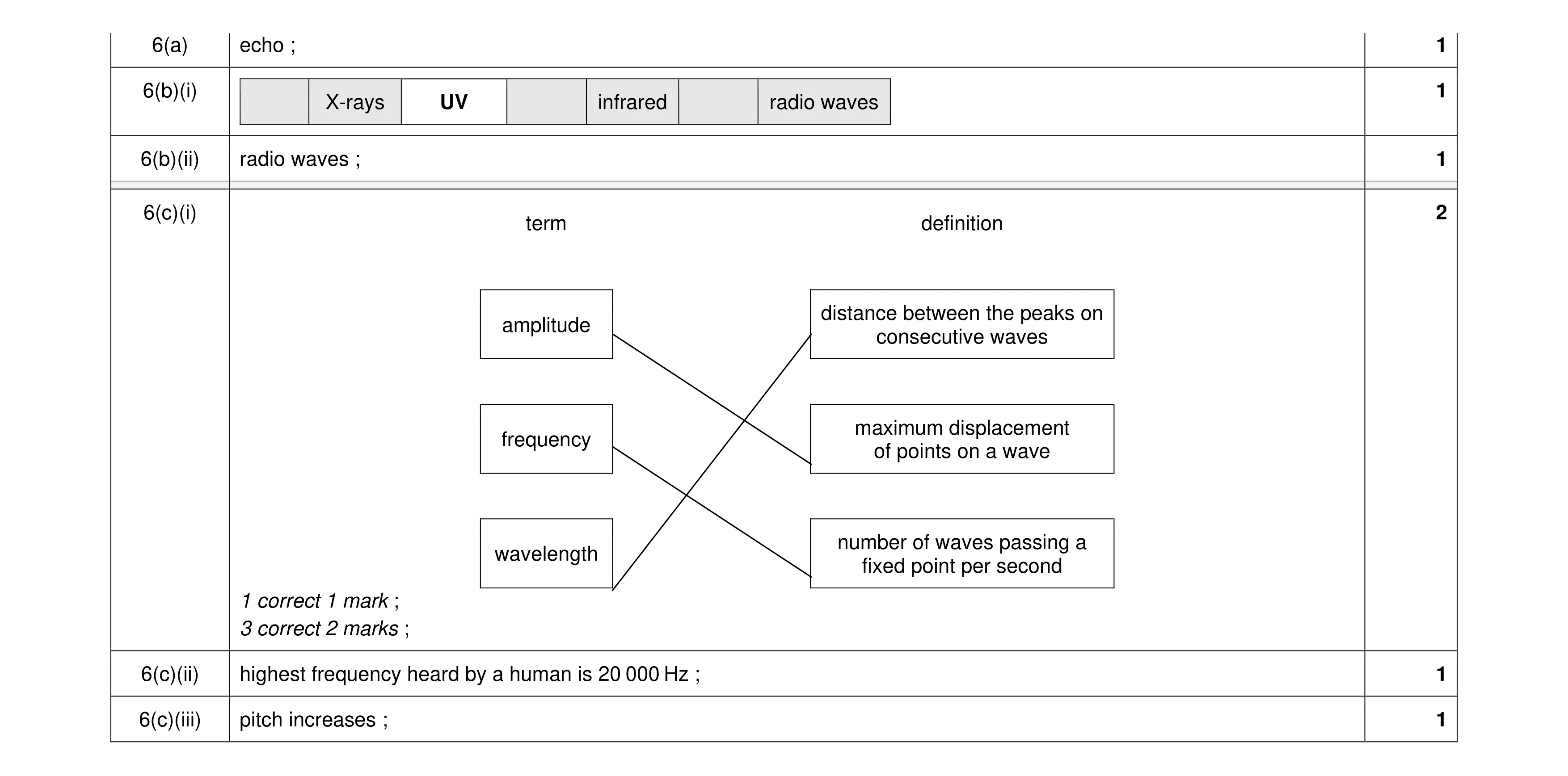 7
7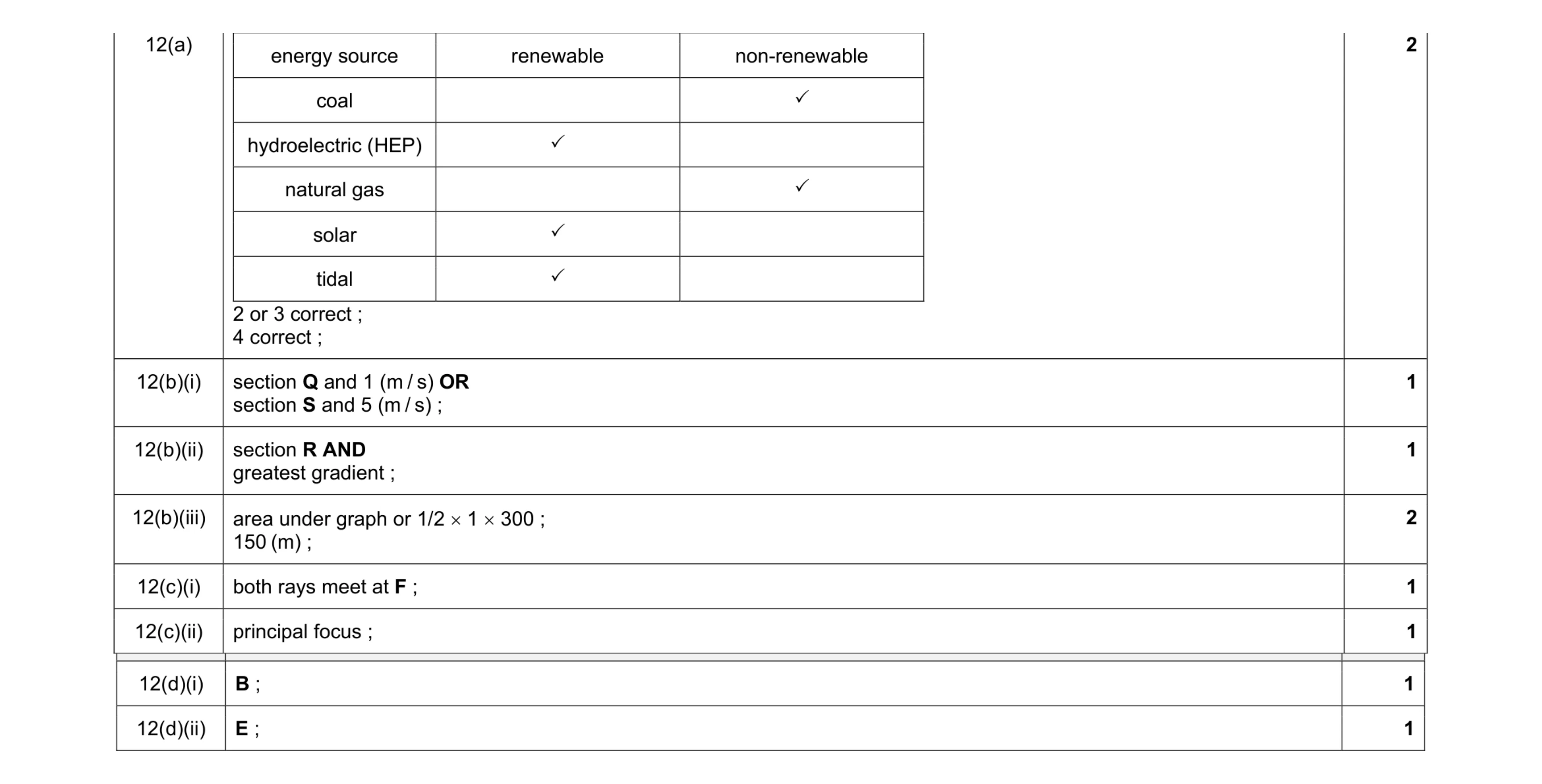 10
10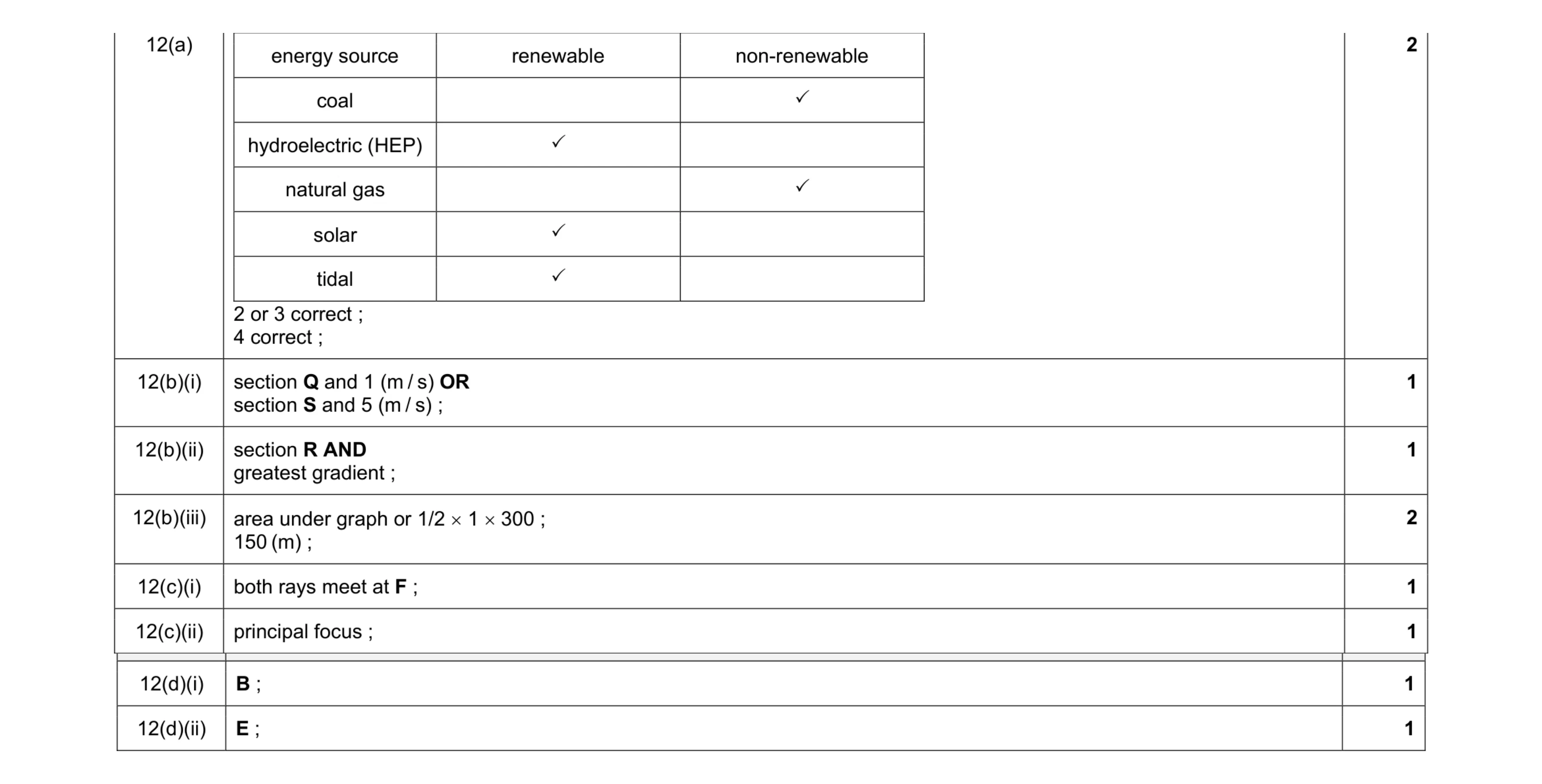 10
10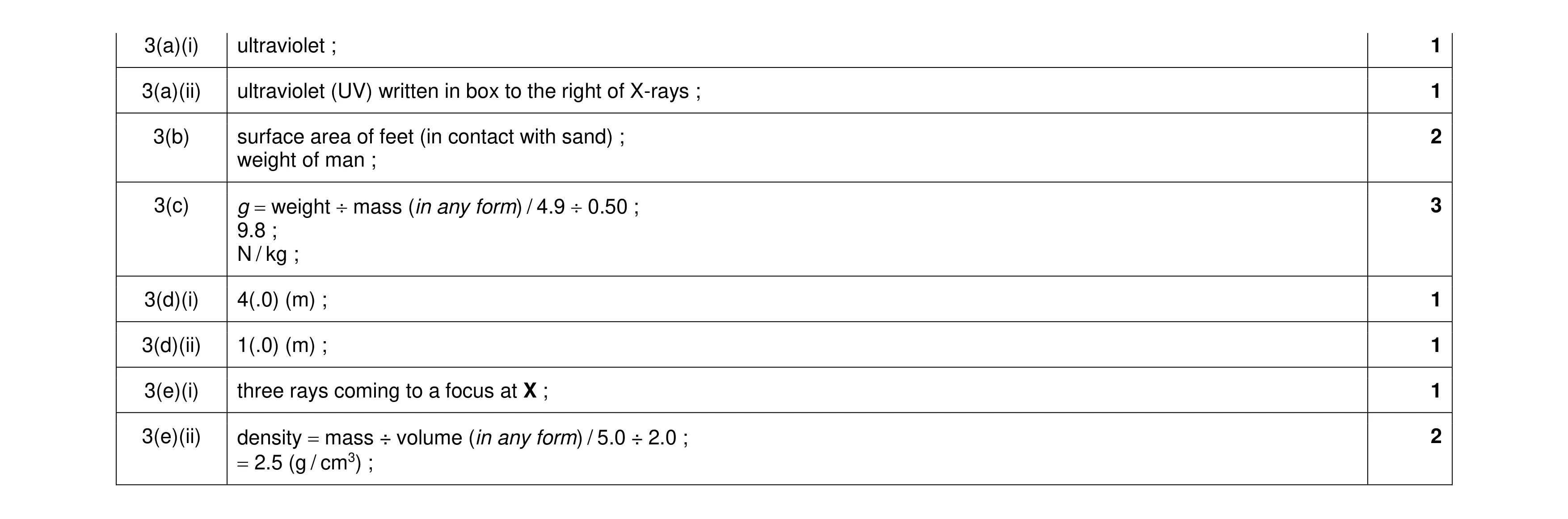 12
12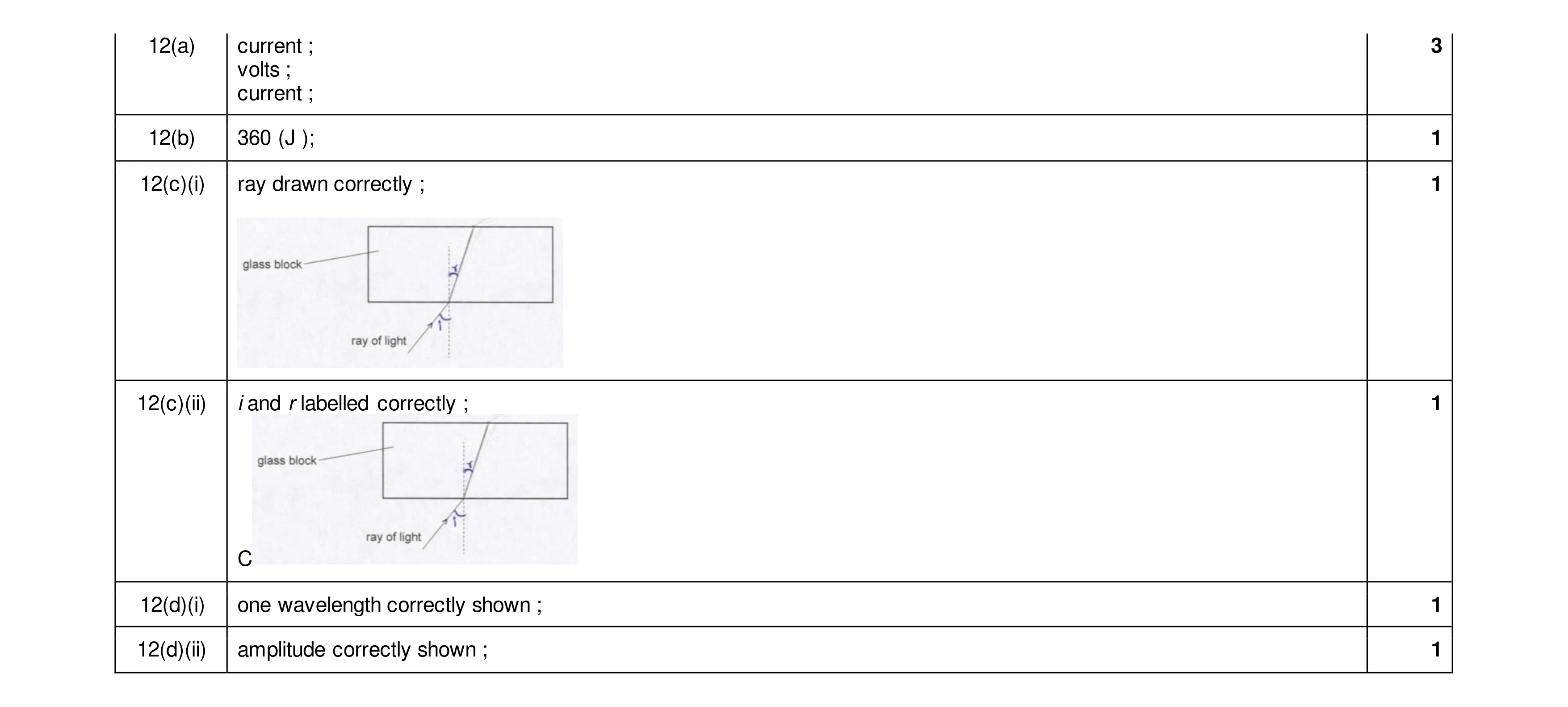 8
8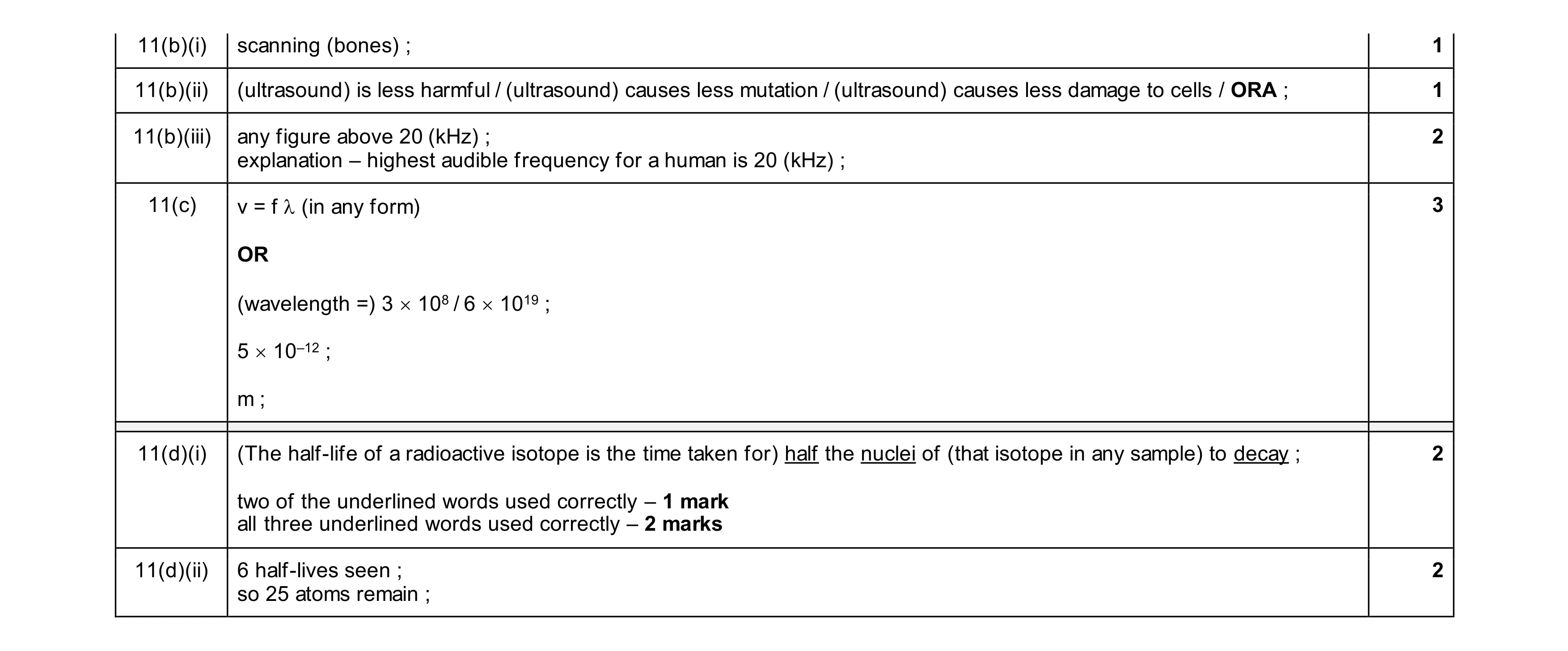 12
12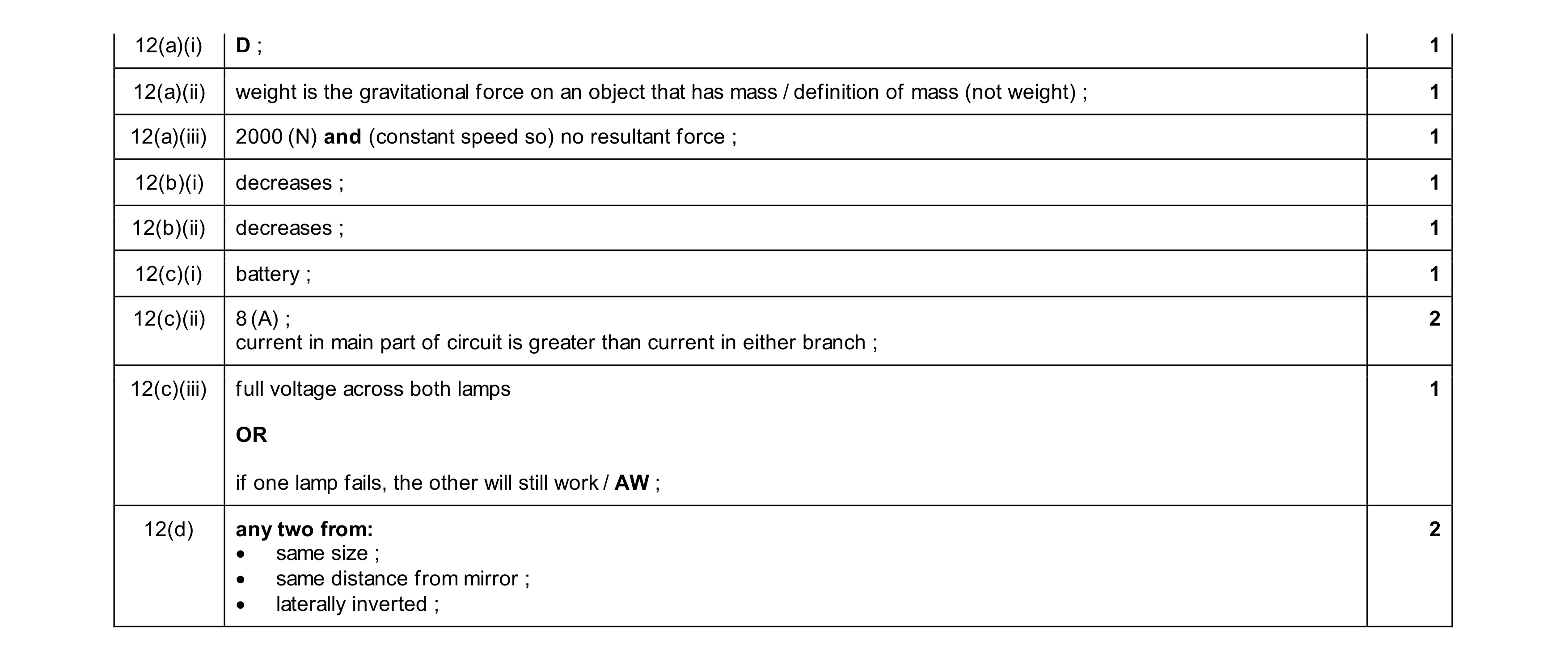 11
11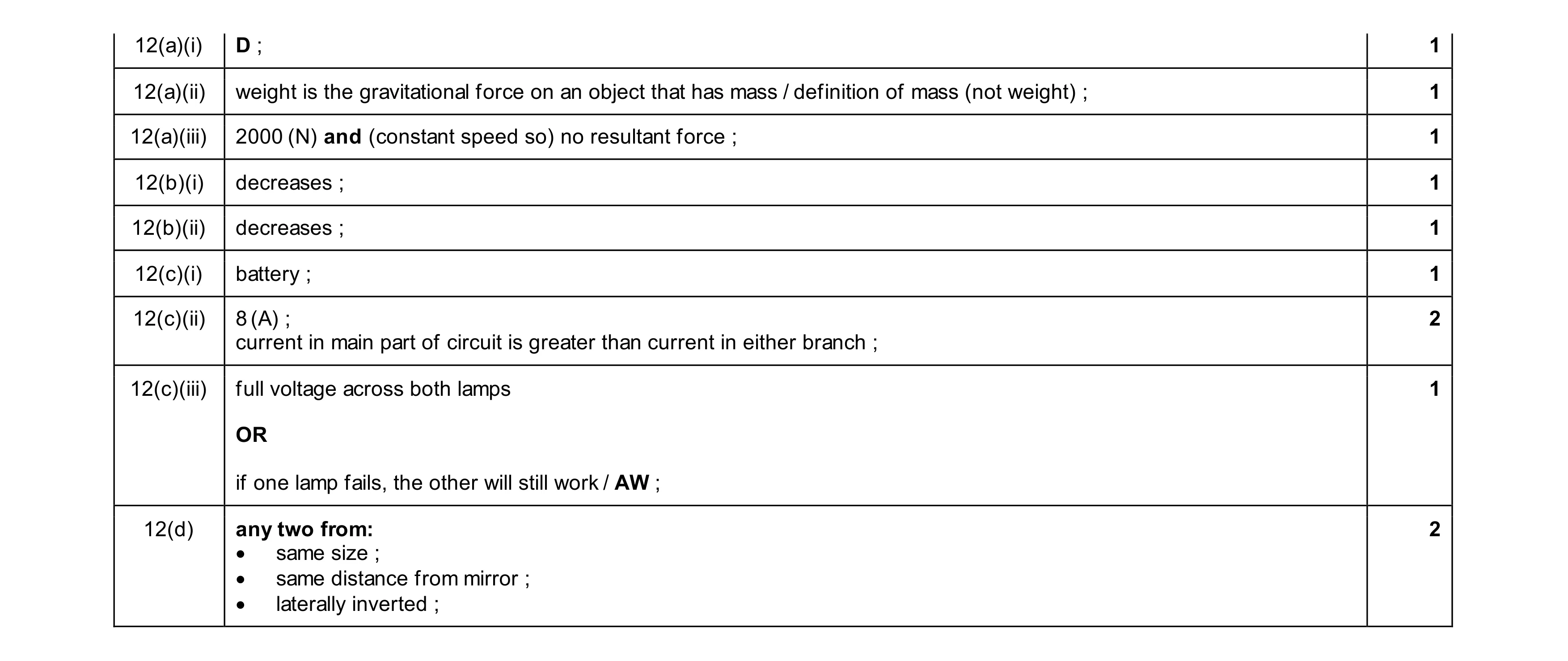 11
11