Questions as text
Q1 · Every 10 s a drop of water falls into a pool 0654/21 May/June 2017
34 Every 10 s a drop of water falls into a pool. The drops cause a circular wave to spread over the surface of the pool at a speed of 20 cm / s. What is the wavelength of the wave? A 0.50 cm B 2.0 cm C 10 cm D 200 cm
1 marks
Answer: D
This question in 0654/21 May/June 2017
Q2 · The diagrams show a water wave travelling towards a boundary 0654/23 May/June 2017
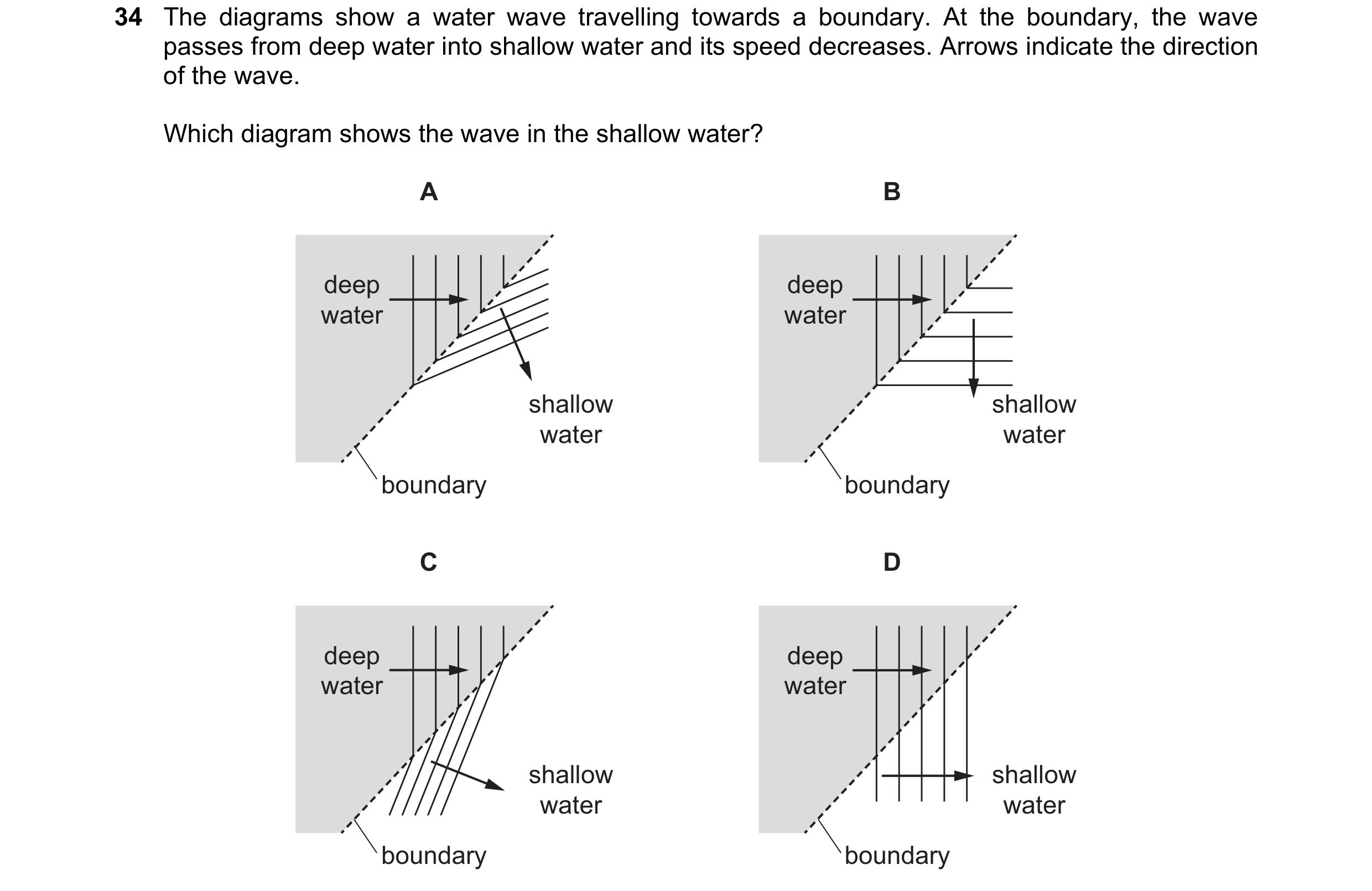
34 The diagrams show a water wave travelling towards a boundary. At the boundary, the wave passes from deep water into shallow water and its speed decreases. Arrows indicate the direction of the wave. Which diagram shows the wave in the shallow water? A B deep deep water water shallow shallow water water boundary boundary C D deep deep water water shallow shallow water water boundary boundary
1 marks
Answer: C
This question in 0654/23 May/June 2017
Q3 · The diagram represents a wave 0654/21 Oct/Nov 2017
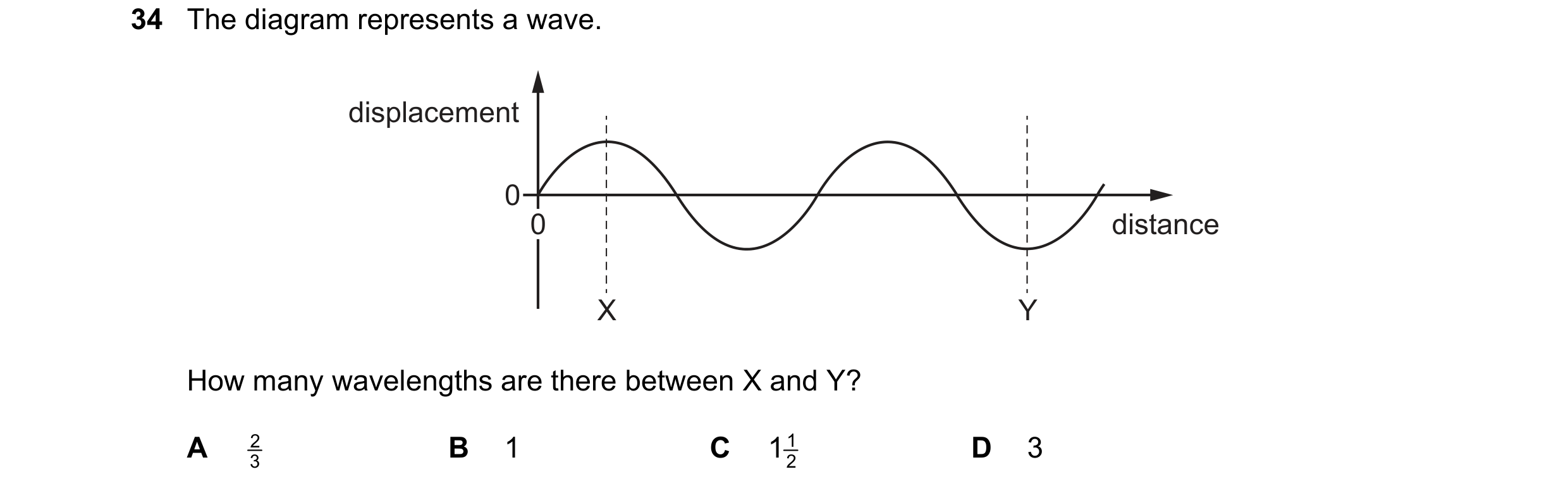
34 The diagram represents a wave. displacement 0 0 distance X Y How many wavelengths are there between X and Y? A 2 B 1 C 1 1 D 3 3 2
1 marks
Answer: C
This question in 0654/21 Oct/Nov 2017
Q4 · A water wave travels at a steady speed of 4.0 m / s and passes a stationary boat 0654/23 Oct/Nov 2017
33 A water wave travels at a steady speed of 4.0 m / s and passes a stationary boat. boat wave direction wave crest Four wave crests pass the boat every 2.0 seconds. What is the wavelength of the waves? A 0.5 m B 1.0 m C 2.0 m D 8.0 m
1 marks
Answer: C
This question in 0654/23 Oct/Nov 2017
Q5 · The diagram represents a wave in air 0654/23 Oct/Nov 2017
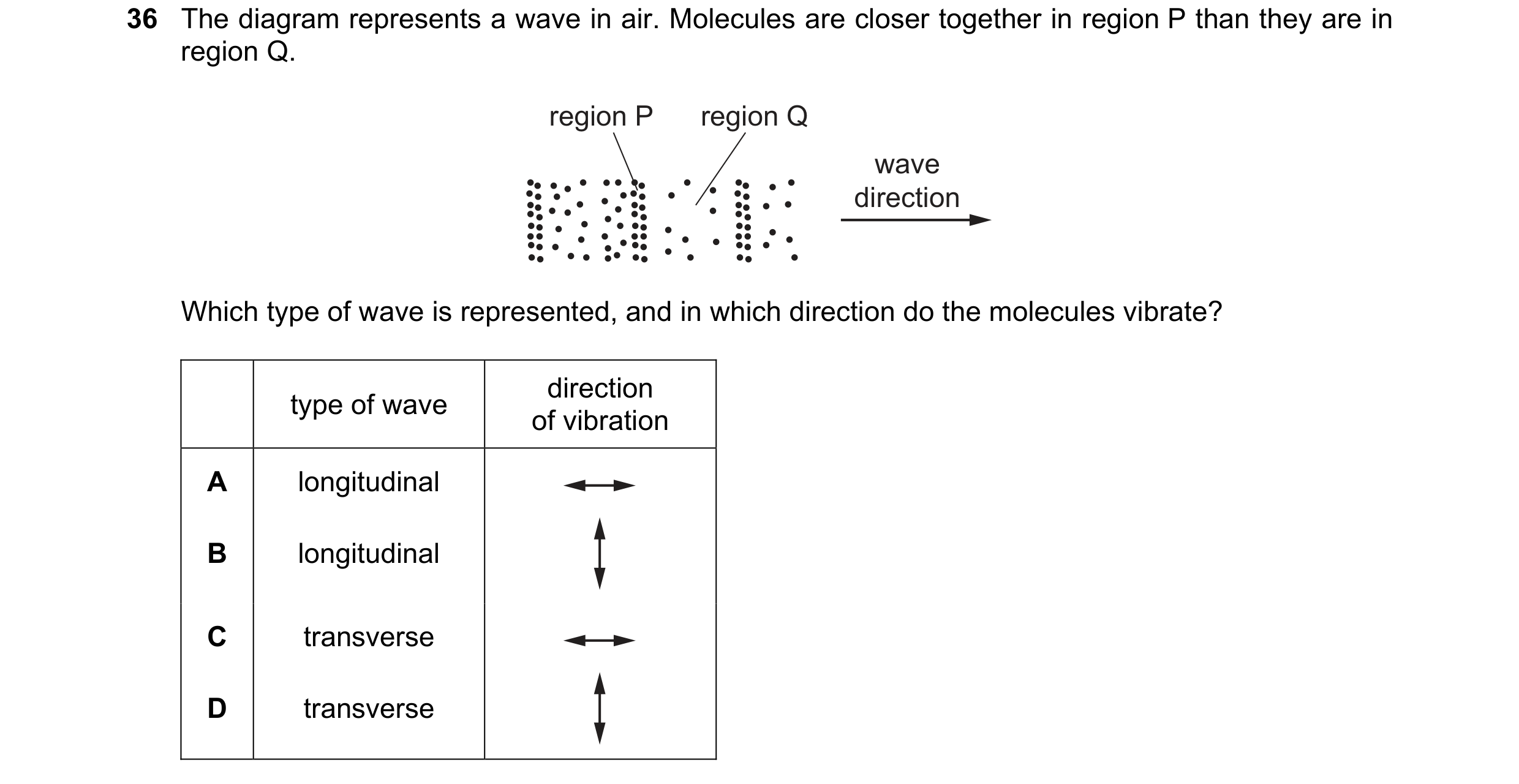
36 The diagram represents a wave in air. Molecules are closer together in region P than they are in region Q. region P region Q wave direction Which type of wave is represented, and in which direction do the molecules vibrate? direction type of wave of vibration A longitudinal B longitudinal C transverse D transverse
1 marks
Answer: A
This question in 0654/23 Oct/Nov 2017
Q6 · A radio transmitter emits radio waves with a frequency of 1.25 × 10⁸ Hz 0654/21 Oct/Nov 2018
35 A radio transmitter emits radio waves with a frequency of 1.25 × 10⁸ Hz. The most suitable aerial for this frequency is 4 1 of a wavelength long. The speed of radio waves is 3.0 × 10⁸ m / s. What is the length of the most suitable aerial? A 0.10 m B 0.60 m C 2.4 m D 9.6 m
1 marks
Answer: B
This question in 0654/21 Oct/Nov 2018
Q7 · A wave in air consists of a series of regions called compressions and rarefactions 0654/21 Oct/Nov 2018
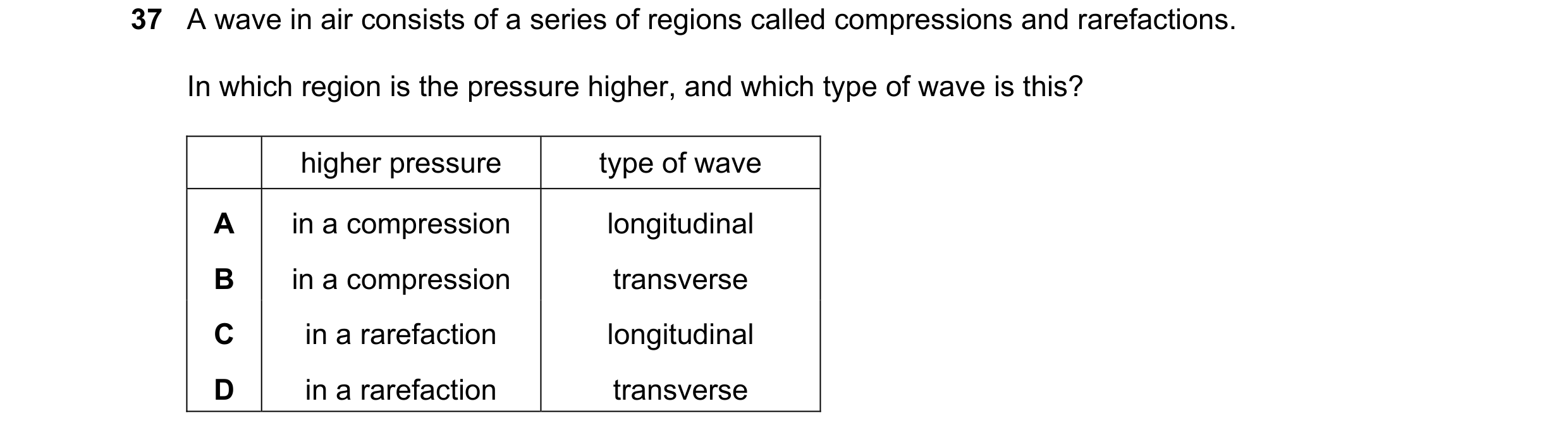
37 A wave in air consists of a series of regions called compressions and rarefactions. In which region is the pressure higher, and which type of wave is this? higher pressure type of wave A in a compression longitudinal B in a compression transverse C in a rarefaction longitudinal D in a rarefaction transverse
1 marks
Answer: A
This question in 0654/21 Oct/Nov 2018
Q8 · A radio transmitter emits radio waves with a frequency of 1.25 × 10⁸ Hz 0654/22 Oct/Nov 2018
33 A radio transmitter emits radio waves with a frequency of 1.25 × 10⁸ Hz. The most suitable aerial for this frequency is 4 1 of a wavelength long. The speed of radio waves is 3.0 × 10⁸ m / s. What is the length of the most suitable aerial? A 0.10 m B 0.60 m C 2.4 m D 9.6 m
1 marks
Answer: B
This question in 0654/22 Oct/Nov 2018
Q9 · A radio transmitter emits radio waves with a frequency of 1.25 × 10⁸ Hz 0654/23 Oct/Nov 2018
33 A radio transmitter emits radio waves with a frequency of 1.25 × 10⁸ Hz. The most suitable aerial for this frequency is 4 1 of a wavelength long. The speed of radio waves is 3.0 × 10⁸ m / s. What is the length of the most suitable aerial? A 0.10 m B 0.60 m C 2.4 m D 9.6 m
1 marks
Answer: B
This question in 0654/23 Oct/Nov 2018
Question 10 0654/21 May/June 2019
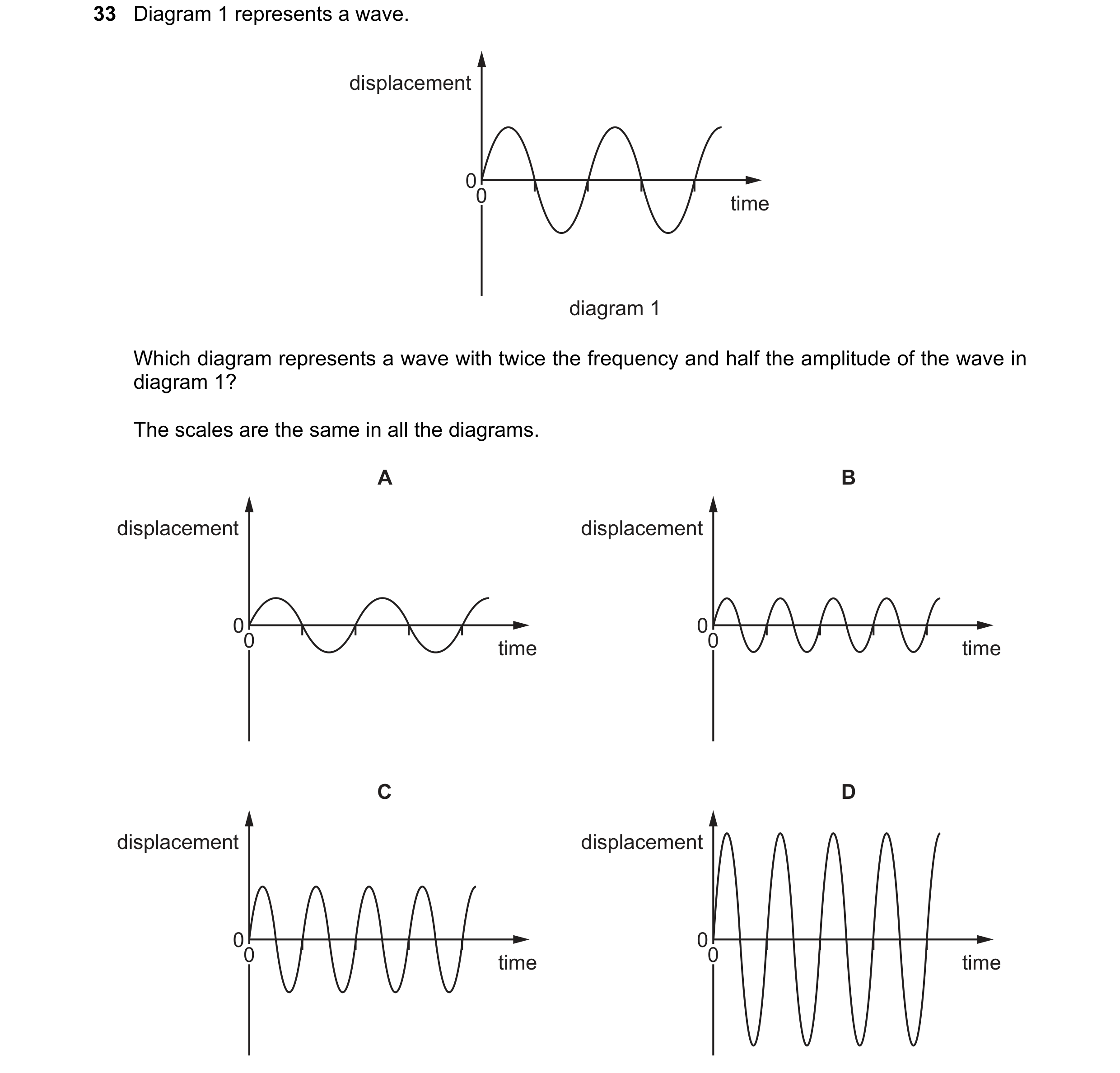
33 Diagram 1 represents a wave. displacement 00 time diagram 1 Which diagram represents a wave with twice the frequency and half the amplitude of the wave in diagram 1? The scales are the same in all the diagrams. A B displacement displacement 00 00 time time C D displacement displacement 00 00 time time
1 marks
Answer: B
This question in 0654/21 May/June 2019
Question 11 0654/22 May/June 2019
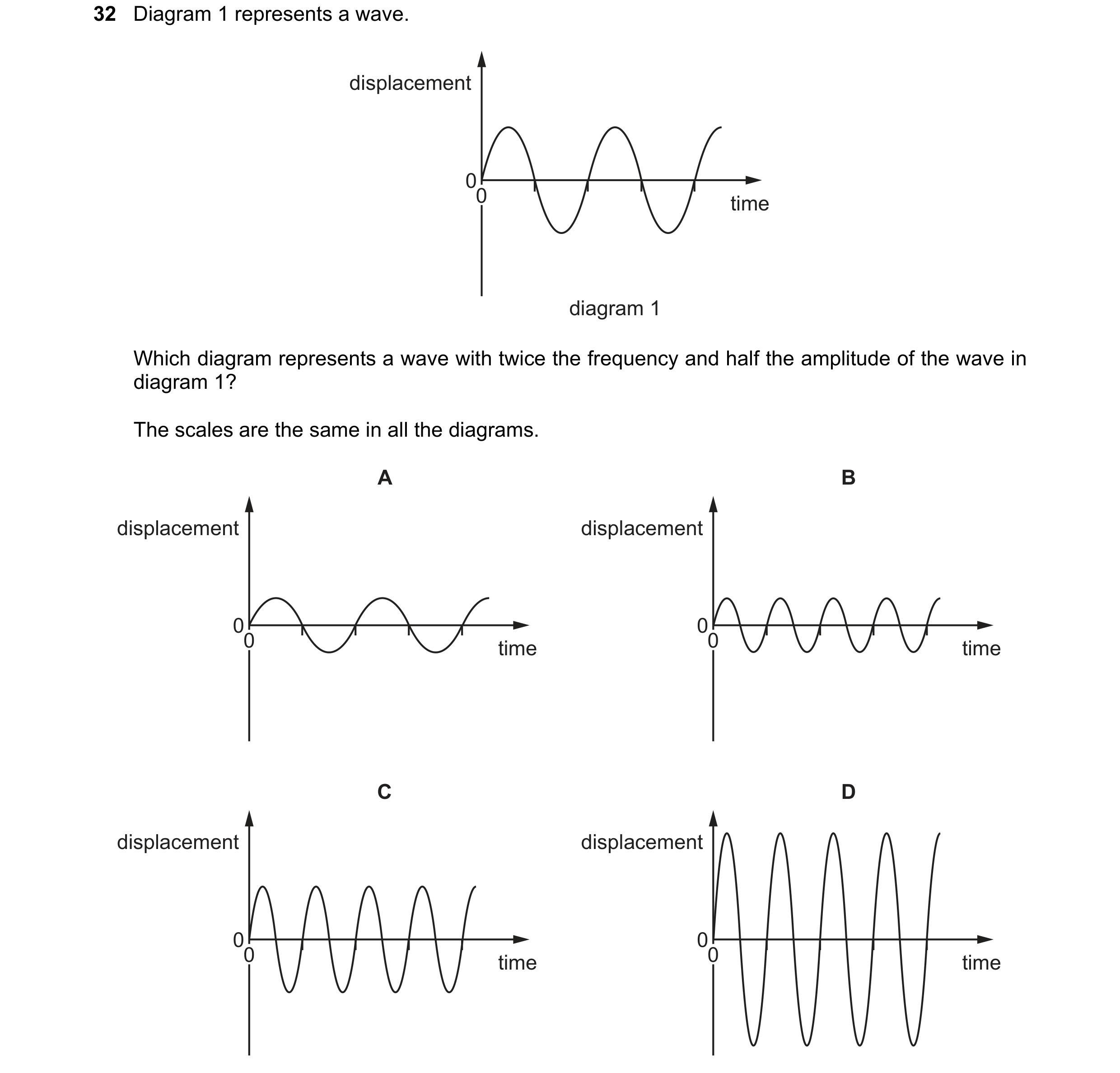
32 Diagram 1 represents a wave. displacement 00 time diagram 1 Which diagram represents a wave with twice the frequency and half the amplitude of the wave in diagram 1? The scales are the same in all the diagrams. A B displacement displacement 00 00 time time C D displacement displacement 00 00 time time
1 marks
Answer: B
This question in 0654/22 May/June 2019
Question 12 0654/23 May/June 2019
33 Diagram 1 represents a wave. displacement 00 time diagram 1 Which diagram represents a wave with twice the frequency and half the amplitude of the wave in diagram 1? The scales are the same in all the diagrams. A B displacement displacement 00 00 time time C D displacement displacement 00 00 time time
1 marks
Answer: B
This question in 0654/23 May/June 2019
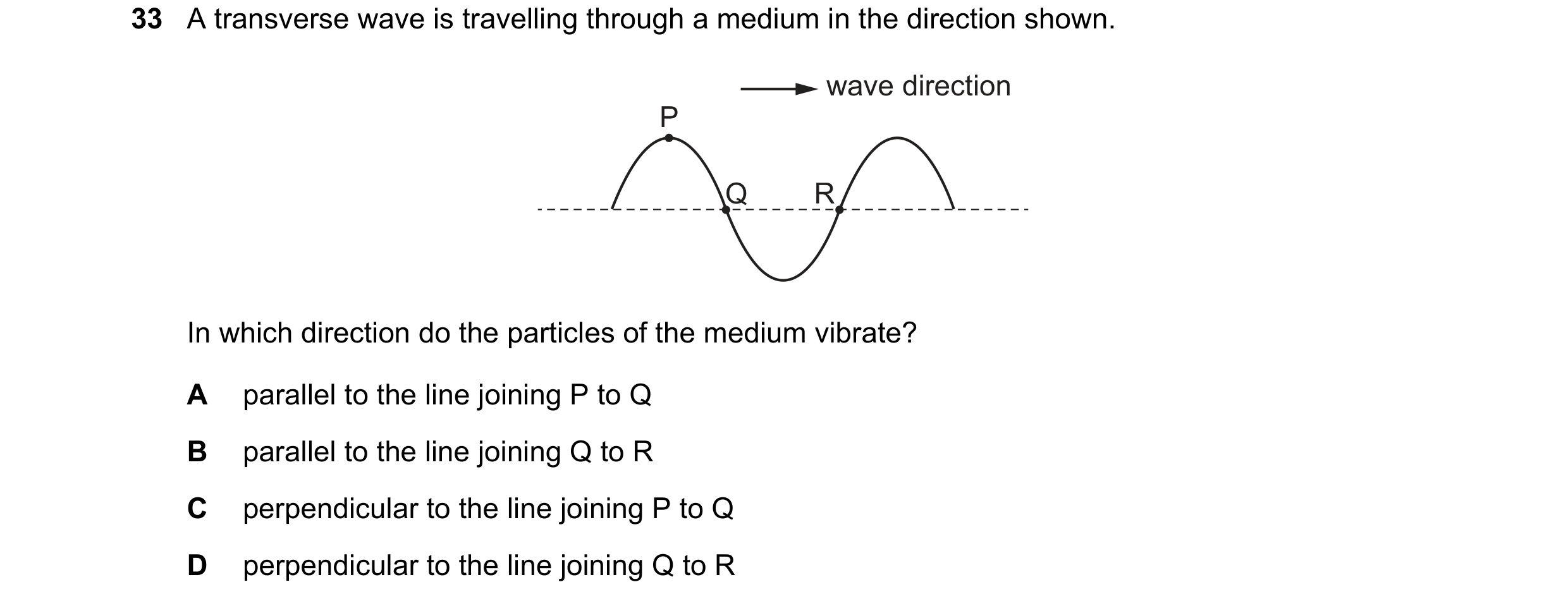
Q13 · A transverse wave is travelling through a medium in the direction shown 0654/21 Oct/Nov 2019
33 A transverse wave is travelling through a medium in the direction shown. wave direction P Q R In which direction do the particles of the medium vibrate? A parallel to the line joining P to Q B parallel to the line joining Q to R C perpendicular to the line joining P to Q D perpendicular to the line joining Q to R
1 marks
Answer: D
This question in 0654/21 Oct/Nov 2019
Q14 · An experiment is set up to investigate the motion of particles floating on water in a tank 0654/22 Oct/Nov 2019
33 An experiment is set up to investigate the motion of particles floating on water in a tank. A wave passes along the water surface from left to right. What happens to the floating particles? A They do not move. B They move up and down. C They move only to the left. D They move only to the right.
1 marks
Answer: B
This question in 0654/22 Oct/Nov 2019
Q15 · ‘The maximum distance a particle on the surface of deep water moves from its rest… 0654/22 May/June 2020
32 ‘The maximum distance a particle on the surface of deep water moves from its rest position when a wave passes it.’ Which property of a wave does this describe? A amplitude B frequency C speed D wavelength
1 marks
Answer: A
This question in 0654/22 May/June 2020
Q16 · ‘The number of crests on the surface of water that pass a particular point each second.’… 0654/23 May/June 2020
33 ‘The number of crests on the surface of water that pass a particular point each second.’ Which property of a wave does this describe? A amplitude B frequency C speed D wavelength
1 marks
Answer: B
This question in 0654/23 May/June 2020
Q17 · The diagram shows the direction of a wave that passes a particle 0654/21 Oct/Nov 2020
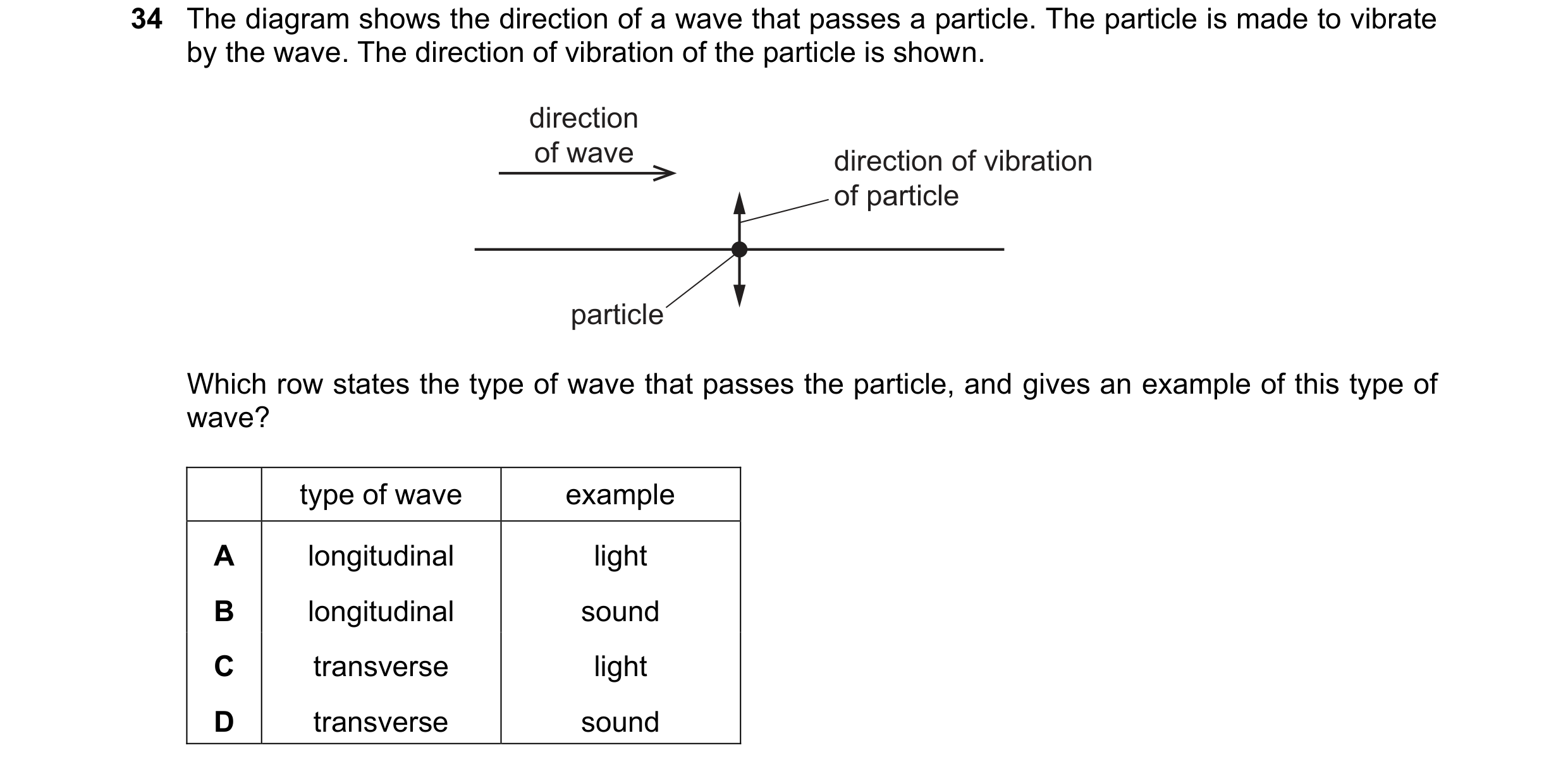
34 The diagram shows the direction of a wave that passes a particle. The particle is made to vibrate by the wave. The direction of vibration of the particle is shown. direction of wave direction of vibration of particle particle Which row states the type of wave that passes the particle, and gives an example of this type of wave? type of wave example A longitudinal light B longitudinal sound C transverse light D transverse sound
1 marks
Answer: C
This question in 0654/21 Oct/Nov 2020
Q18 · The diagram shows the direction of a wave that passes a particle 0654/22 Oct/Nov 2020
33 The diagram shows the direction of a wave that passes a particle. The particle is made to vibrate by the wave. The direction of vibration of the particle is shown. direction of wave direction of vibration of particle particle Which row states the type of wave that passes the particle, and gives an example of this type of wave? type of wave example A longitudinal light B longitudinal sound C transverse light D transverse sound
1 marks
Answer: C
This question in 0654/22 Oct/Nov 2020
Q19 · The diagram shows the direction of a wave that passes a particle 0654/23 Oct/Nov 2020
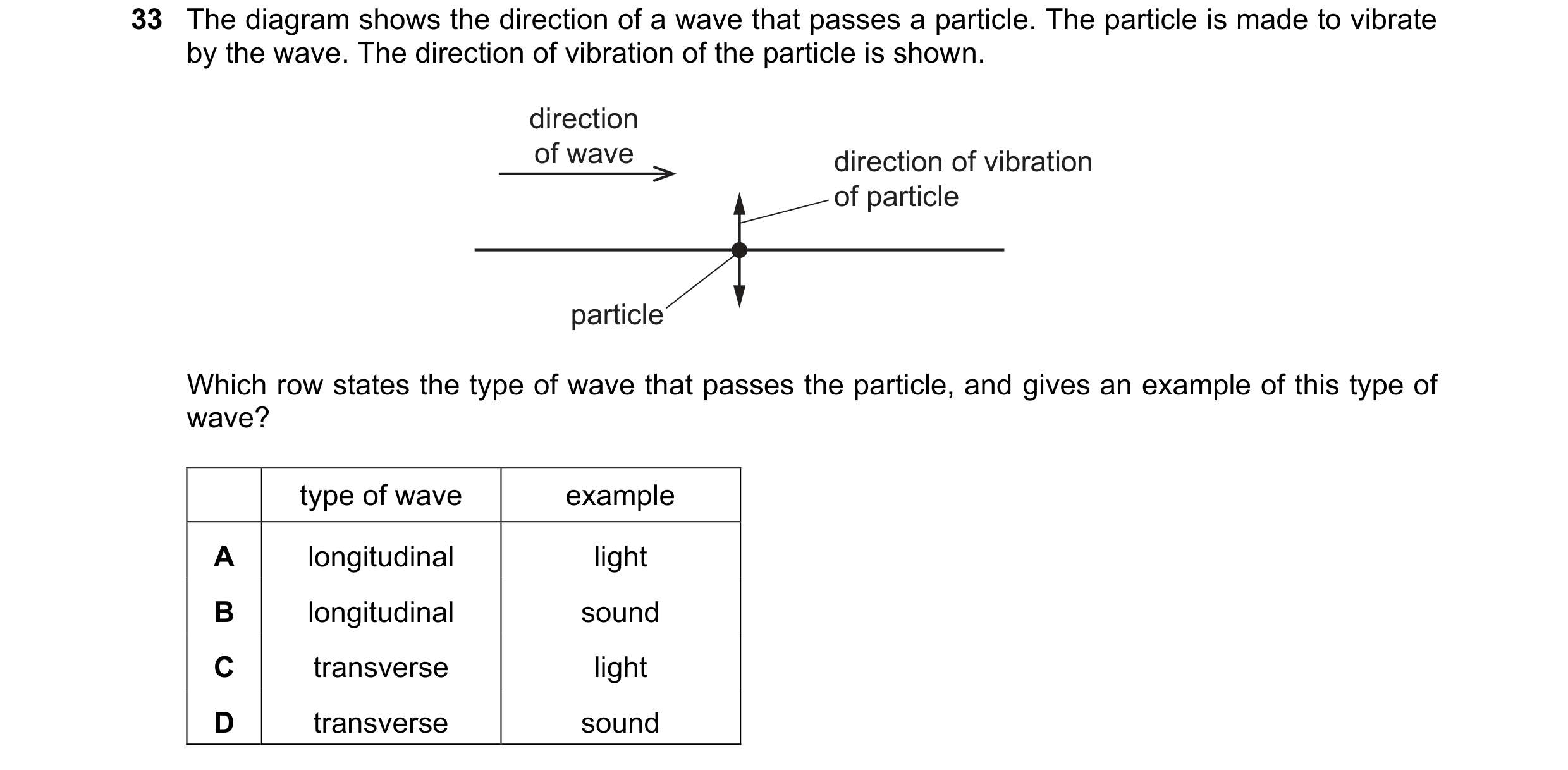
33 The diagram shows the direction of a wave that passes a particle. The particle is made to vibrate by the wave. The direction of vibration of the particle is shown. direction of wave direction of vibration of particle particle Which row states the type of wave that passes the particle, and gives an example of this type of wave? type of wave example A longitudinal light B longitudinal sound C transverse light D transverse sound
1 marks
Answer: C
This question in 0654/23 Oct/Nov 2020
Q20 · Which statement about waves is correct? 0654/23 May/June 2021
33 Which statement about waves is correct? A They do not transfer energy or matter. B They transfer energy and matter. C They transfer energy but not matter. D They transfer matter but not energy.
1 marks
Answer: C
This question in 0654/23 May/June 2021
Q21 · Four loudspeakers vibrate at different frequencies 0654/21 Oct/Nov 2021
34 Four loudspeakers vibrate at different frequencies. Which frequency produces a sound with the largest wavelength and can be heard by a human? A 15 Hz B 150 Hz C 2.5 kHz D 25 kHz
1 marks
Answer: B
This question in 0654/21 Oct/Nov 2021
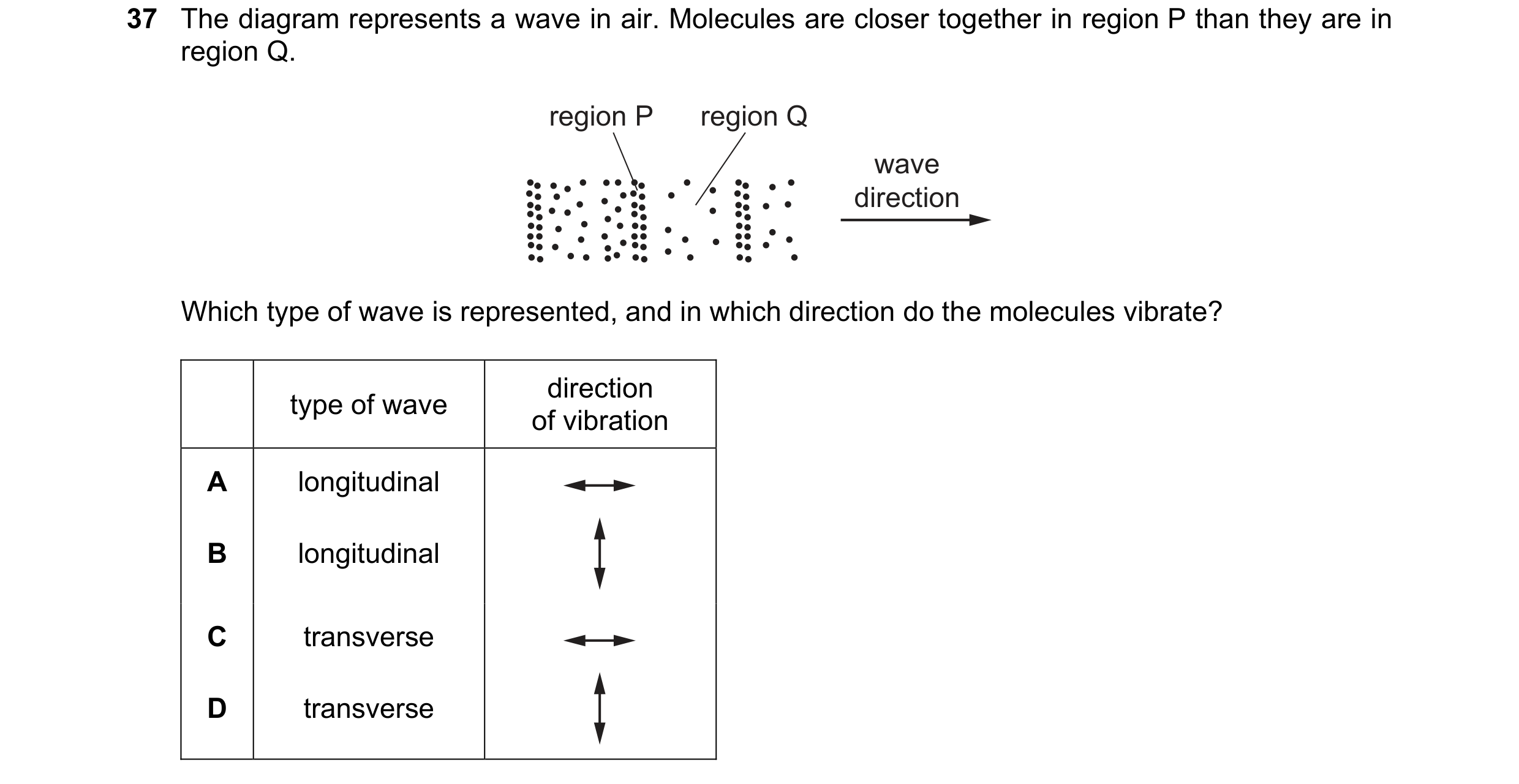
Q22 · The diagram represents a wave in air 0654/21 Oct/Nov 2021
37 The diagram represents a wave in air. Molecules are closer together in region P than they are in region Q. region P region Q wave direction Which type of wave is represented, and in which direction do the molecules vibrate? direction type of wave of vibration A longitudinal B longitudinal C transverse D transverse
1 marks
Answer: A
This question in 0654/21 Oct/Nov 2021
Q23 · The diagram represents a wave in air 0654/22 Oct/Nov 2021
37 The diagram represents a wave in air. Molecules are closer together in region P than they are in region Q. region P region Q wave direction Which type of wave is represented, and in which direction do the molecules vibrate? direction type of wave of vibration A longitudinal B longitudinal C transverse D transverse
1 marks
Answer: A
This question in 0654/22 Oct/Nov 2021
Q24 · The diagram represents a wave in air 0654/23 Oct/Nov 2021
35 The diagram represents a wave in air. Molecules are closer together in region P than they are in region Q. region P region Q wave direction Which type of wave is represented, and in which direction do the molecules vibrate? direction type of wave of vibration A longitudinal B longitudinal C transverse D transverse
1 marks
Answer: A
This question in 0654/23 Oct/Nov 2021
Q25 · A loudspeaker produces a sound wave that has a frequency of 3300 Hz 0654/23 May/June 2022
33 A loudspeaker produces a sound wave that has a frequency of 3300 Hz. The speed of sound in air is 330 m / s. What is the wavelength of the sound wave? A 0.10 m B 1.0 m C 11 m D 1.1 106 m
1 marks
Answer: A
This question in 0654/23 May/June 2022
Q26 · A water wave passes point Y 0654/22 Feb/March 2023
33 A water wave passes point Y. A student counts how many wave crests pass point Y in 30 seconds. Using only this information, what can the student calculate? A the amplitude of the wave B the frequency of the wave C the speed of the wave D the wavelength of the wave
1 marks
Answer: B
This question in 0654/22 Feb/March 2023
Q27 · A wave has a frequency of 3.0 MHz and a speed of 1500 m / s 0654/21 May/June 2023
33 A wave has a frequency of 3.0 MHz and a speed of 1500 m / s. What is the wavelength of the wave? A 5.0 10–4 m B 0.50 m C 500 m D 4500 m
1 marks
Answer: A
This question in 0654/21 May/June 2023
Q28 · A sound wave has a frequency of 16 kHz 0654/23 May/June 2023
33 A sound wave has a frequency of 16 kHz. The speed of sound is 320 m / s. What is the wavelength of the wave? A 0.020 m B 0.050 m C 20 m D 50 m
1 marks
Answer: A
This question in 0654/23 May/June 2023
Q29 · The amplitude of a sound wave increases, and the frequency of the wave decreases 0654/22 Oct/Nov 2023
34 The amplitude of a sound wave increases, and the frequency of the wave decreases. What is the effect on the loudness of the sound and on the pitch of the sound? loudness pitch A greater higher B greater lower C less higher D less lower
1 marks
Answer: B
This question in 0654/22 Oct/Nov 2023
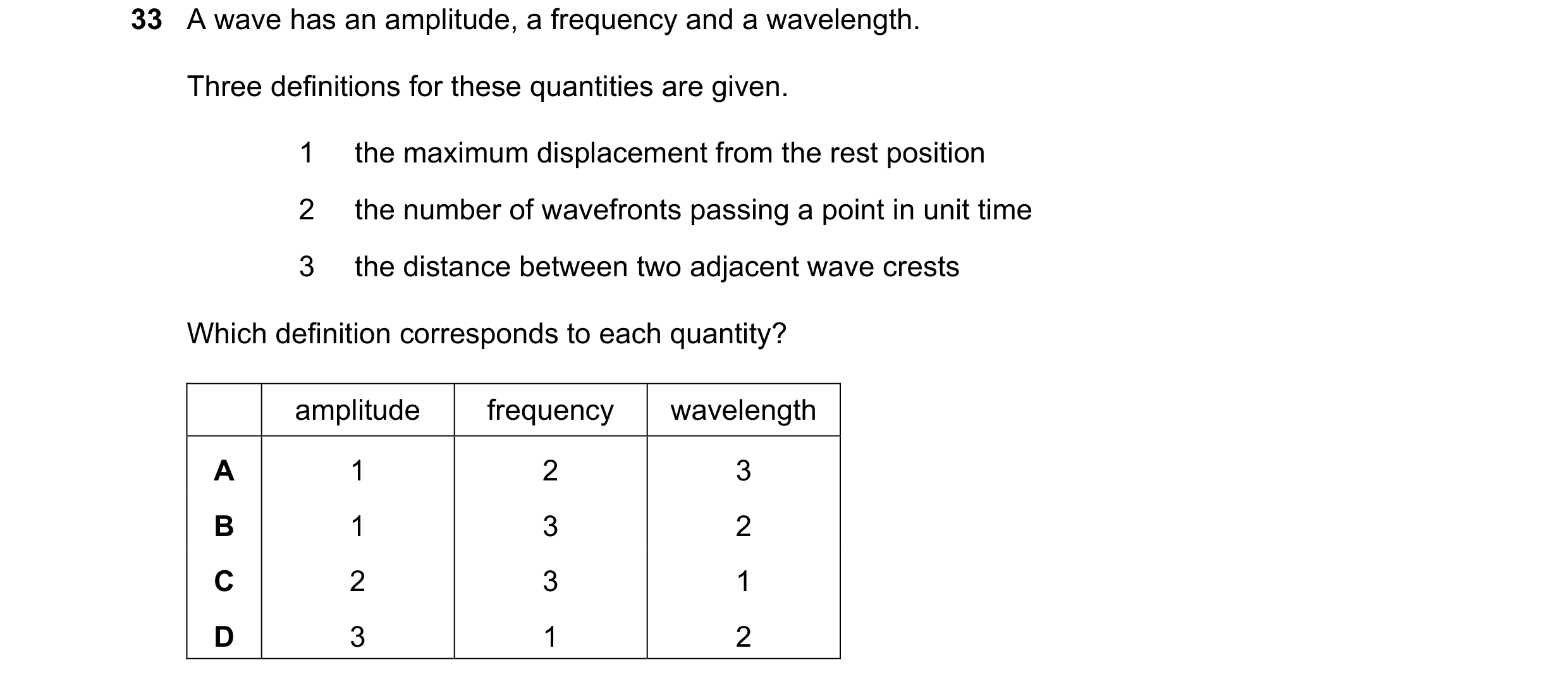
Q30 · A wave has an amplitude, a frequency and a wavelength 0654/21 May/June 2024
33 A wave has an amplitude, a frequency and a wavelength. Three definitions for these quantities are given. 1 the maximum displacement from the rest position 2 the number of wavefronts passing a point in unit time 3 the distance between two adjacent wave crests Which definition corresponds to each quantity? amplitude frequency wavelength A 1 2 3 B 1 3 2 C 2 3 1 D 3 1 2
1 marks
Answer: A
This question in 0654/21 May/June 2024
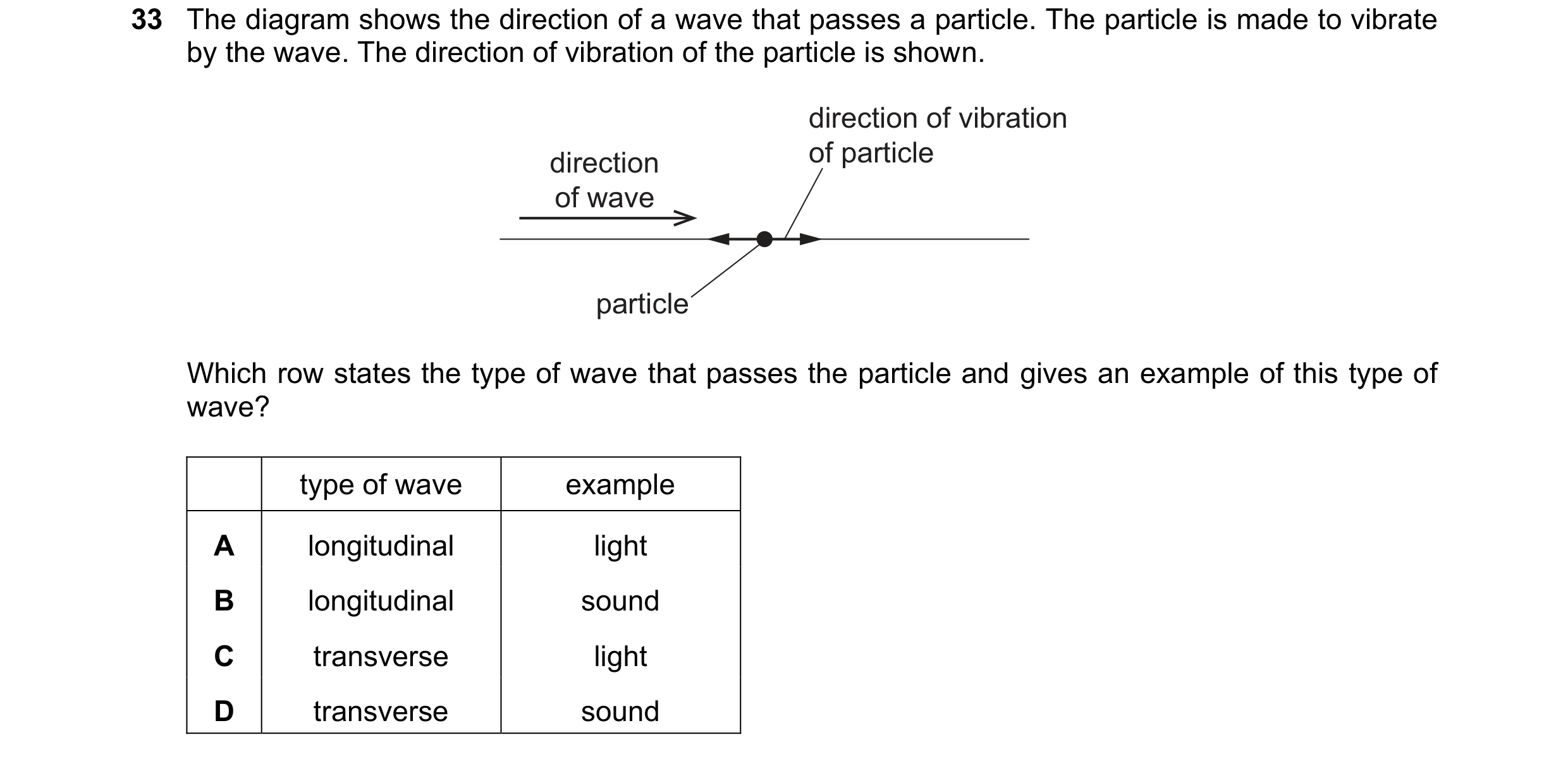
Q31 · The diagram shows the direction of a wave that passes a particle 0654/22 May/June 2024
33 The diagram shows the direction of a wave that passes a particle. The particle is made to vibrate by the wave. The direction of vibration of the particle is shown. direction of vibration direction of particle of wave particle Which row states the type of wave that passes the particle and gives an example of this type of wave? type of wave example A longitudinal light B longitudinal sound C transverse light D transverse sound
1 marks
Answer: B
This question in 0654/22 May/June 2024
Q32 · A wave approaches a gap in a barrier 0654/22 May/June 2025
33 A wave approaches a gap in a barrier. The gap is the same size as the wavelength of the wave. The arrow shows the direction of the wave. Which diagram shows what happens to the wave after it passes through the gap? A B C D
1 marks
Answer: B
This question in 0654/22 May/June 2025
Q33 · A wave passes a rock in the sea 0654/21 Oct/Nov 2025
32 A wave passes a rock in the sea. Five complete wavelengths pass the rock in 20 s. What is the frequency of this wave? A 0.25 Hz B 4.0 Hz C 15 Hz D 100 Hz
1 marks
Answer: A
This question in 0654/21 Oct/Nov 2025
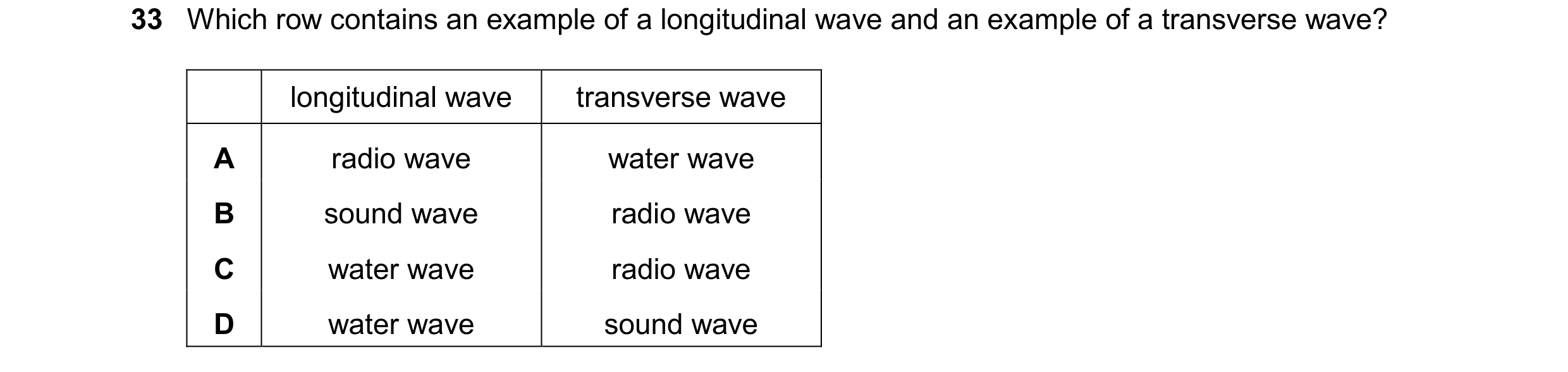
Q34 · Which row contains an example of a longitudinal wave and an example of a transverse wave? 0654/22 Oct/Nov 2025
33 Which row contains an example of a longitudinal wave and an example of a transverse wave? longitudinal wave transverse wave A radio wave water wave B sound wave radio wave C water wave radio wave D water wave sound wave
1 marks
Answer: B
This question in 0654/22 Oct/Nov 2025

 1 / 11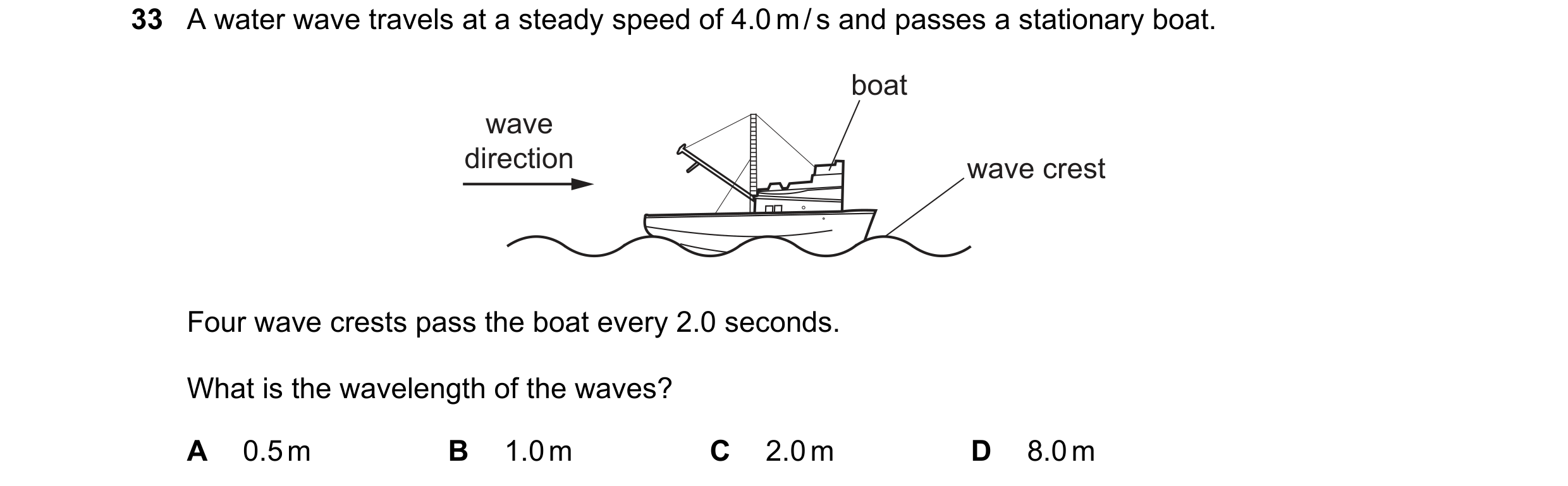

 2 / 11

 3 / 11
 4 / 11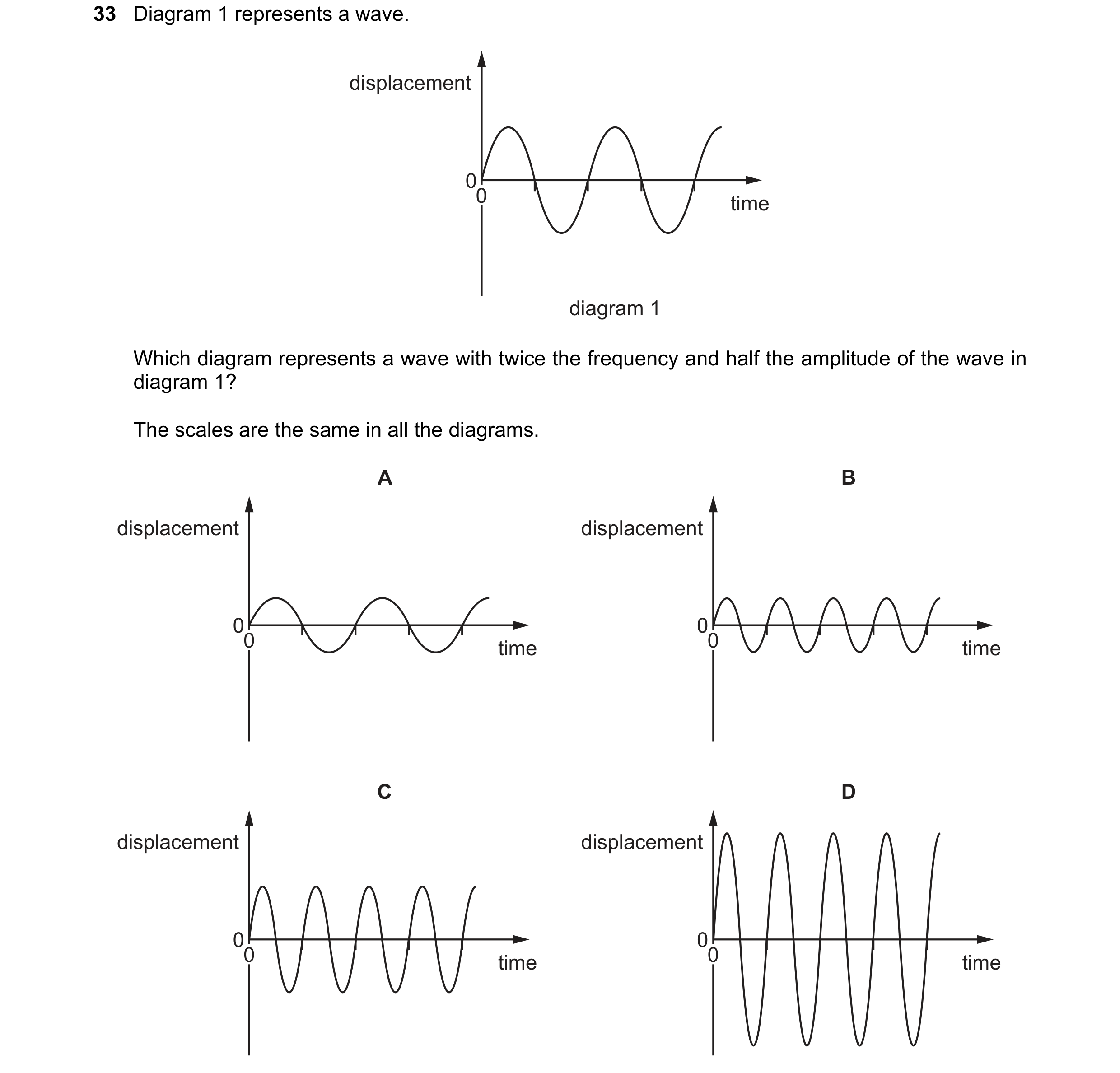
 5 / 11
 6 / 11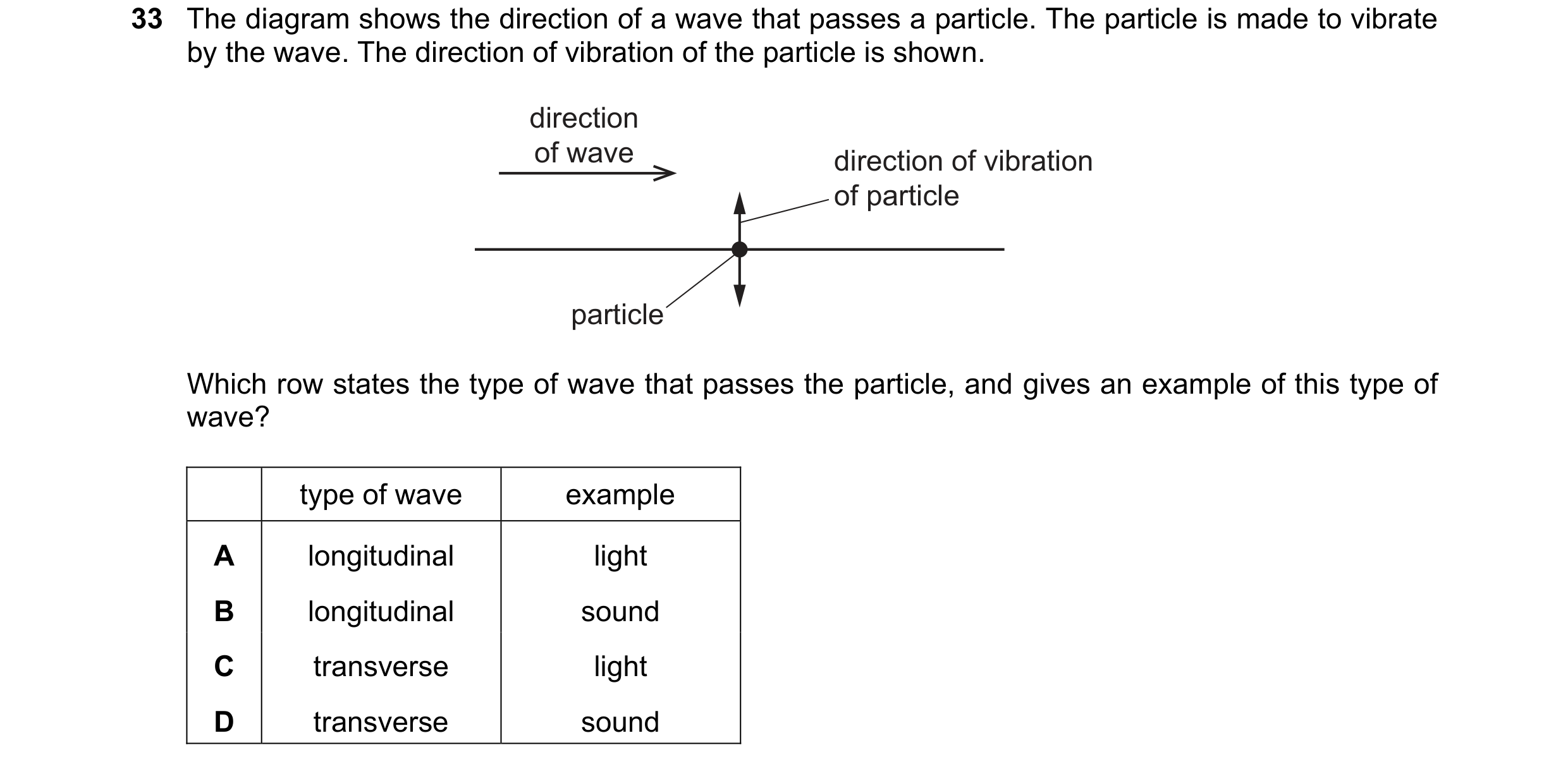

 7 / 11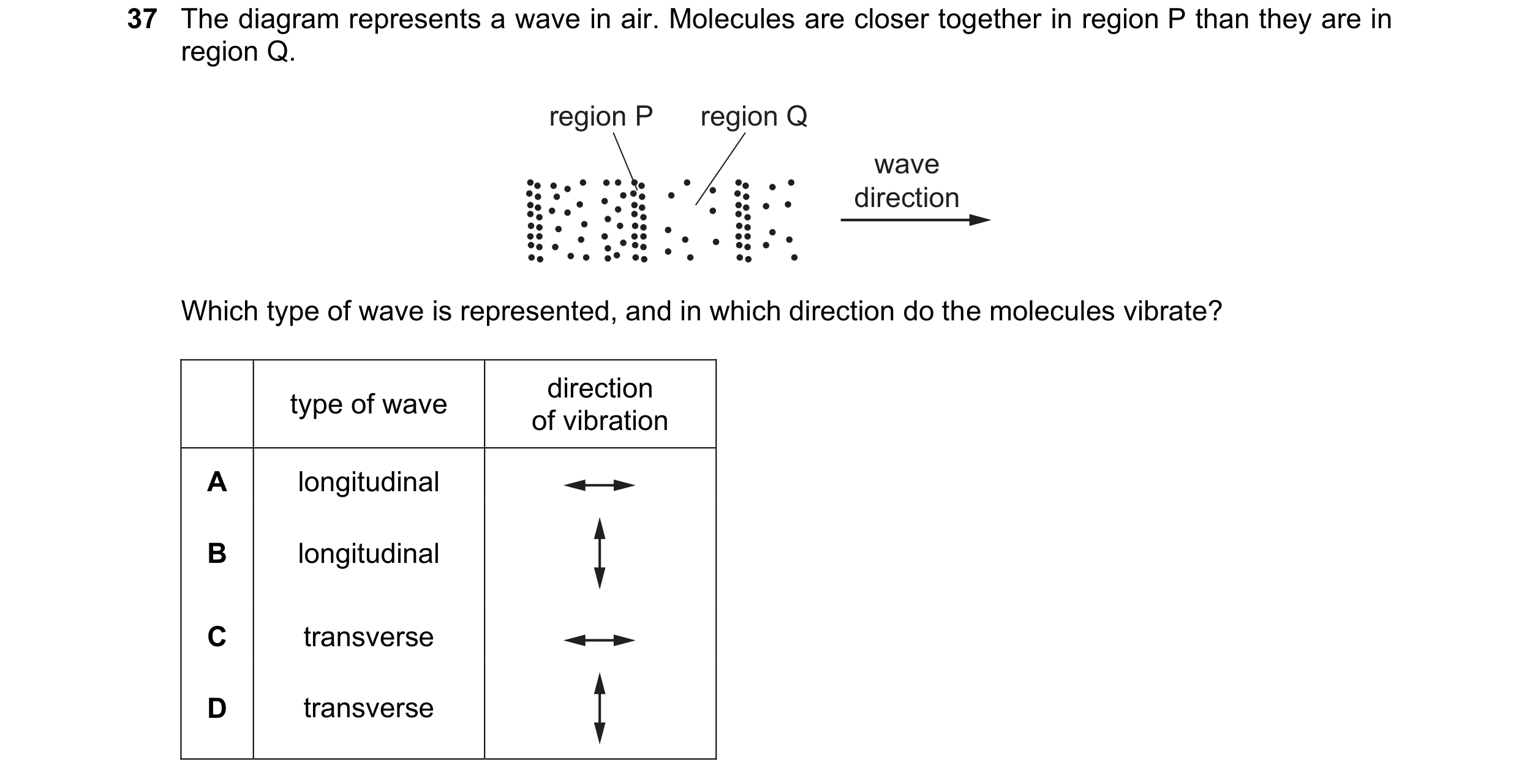
 8 / 11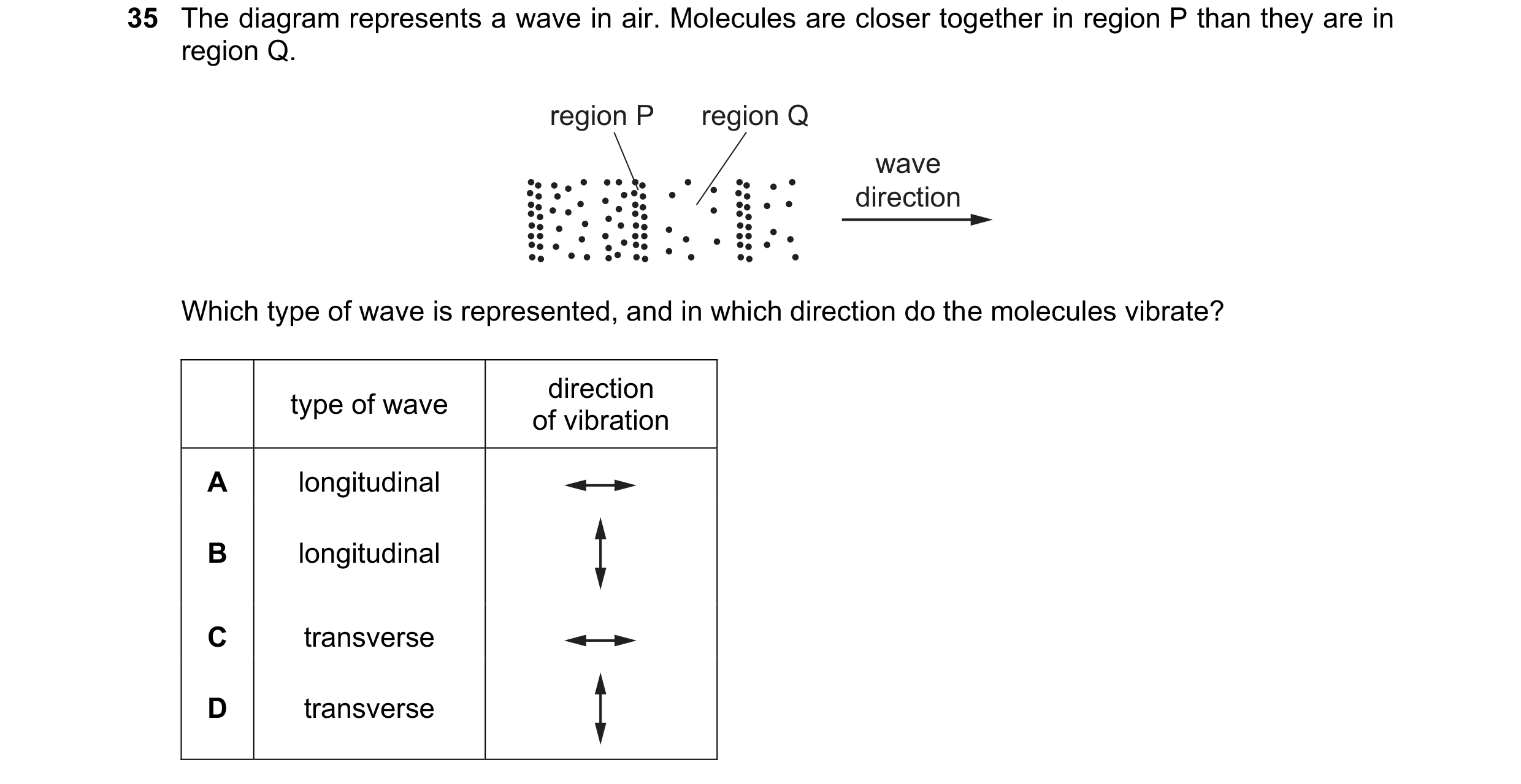


 9 / 11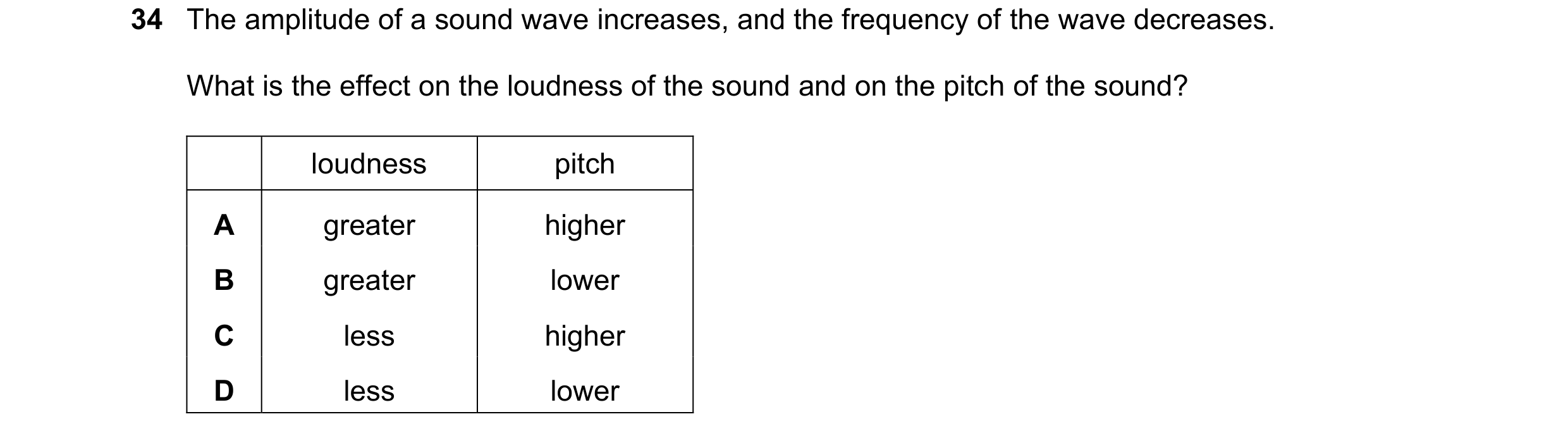
 10 / 11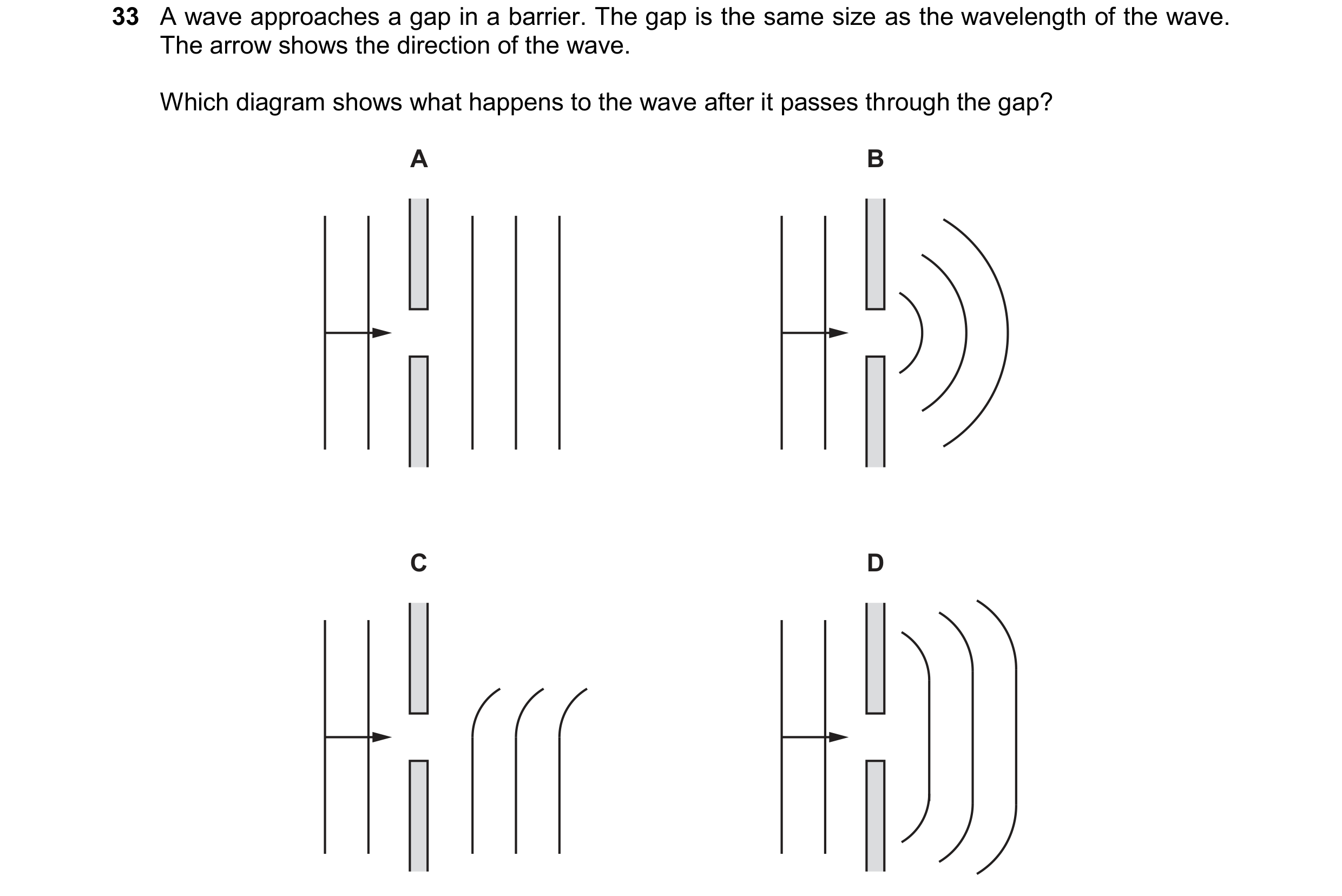

 11 / 11