Questions as text
Q1 · A school orchestra is practising 0654/42 May/June 2017
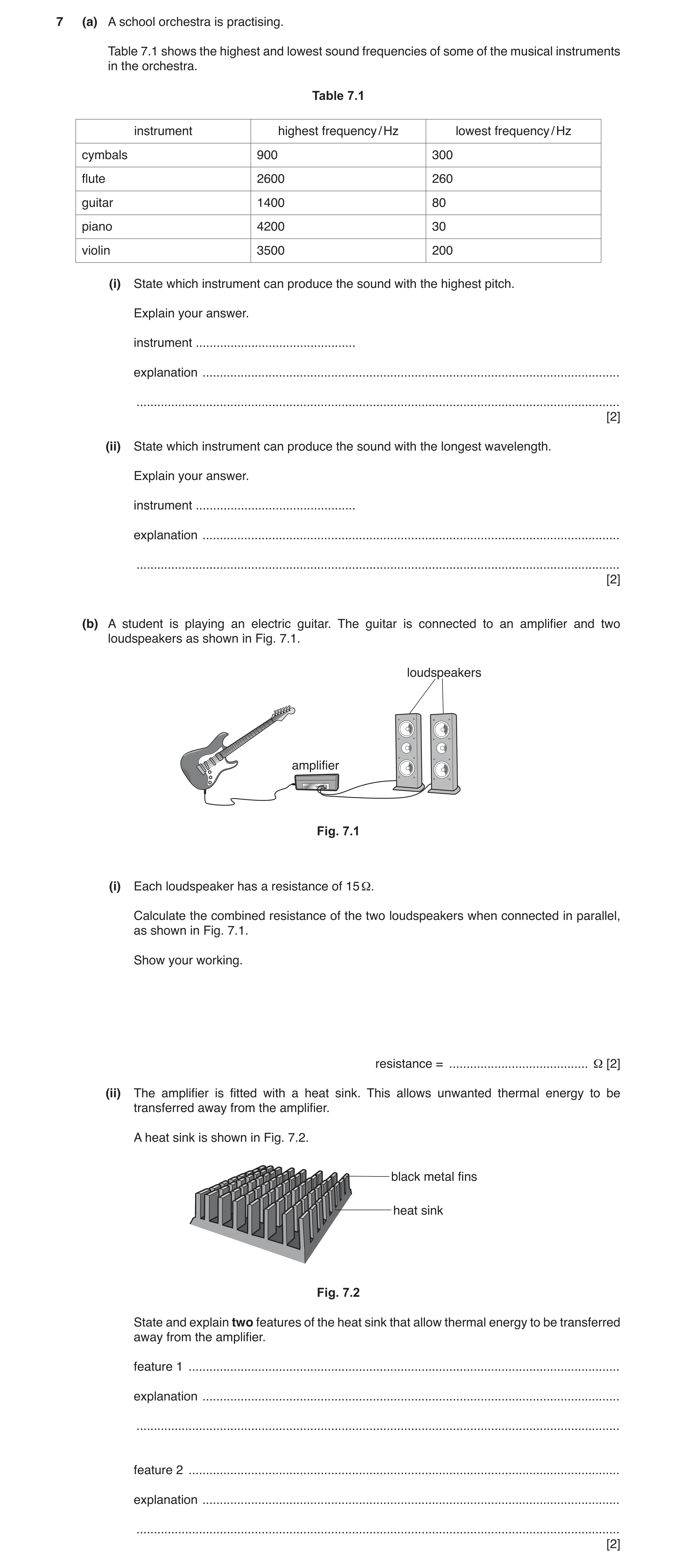
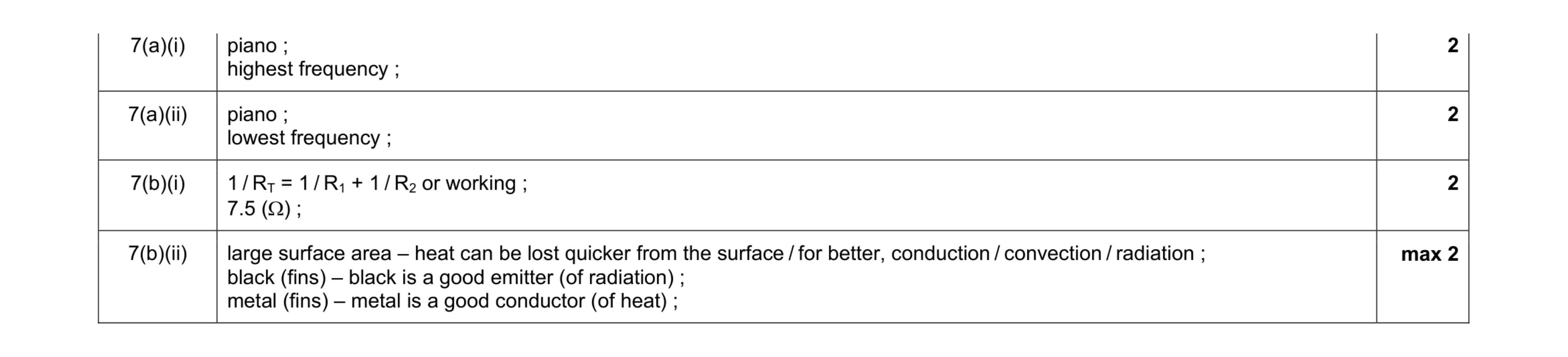
7 (a) A school orchestra is practising. Table 7.1 shows the highest and lowest sound frequencies of some of the musical instruments in the orchestra. Table 7.1 instrument highest frequency / Hz lowest frequency / Hz cymbals 900 300 flute 2600 260 guitar 1400 80 piano 4200 30 violin 3500 200 (i) State which instrument can produce the sound with the highest pitch. Explain your answer. instrument … explanation … … [2] (ii) State which instrument can produce the sound with the longest wavelength. Explain your answer. instrument … explanation … … [2] (b) A student is playing an electric guitar. The guitar is connected to an amplifier and two loudspeakers as shown in Fig. 7.1. loudspeakers amplifier Fig. 7.1 (i) Each loudspeaker has a resistance of 15 Ω. Calculate the combined resistance of the two loudspeakers when connected in parallel, as shown in Fig. 7.1. Show your working. resistance = … Ω [2] (ii) The amplifier is fitted with a heat sink. This allows unwanted thermal energy to be transferred away from the amplifier. A heat sink is shown in Fig. 7.2. black metal fins heat sink Fig. 7.2 State and explain two features of the heat sink that allow thermal energy to be transferred away from the amplifier. feature 1 … explanation … … feature 2 … explanation … … [2]
8 marks
Mark scheme: 7(a)(i) piano ; highest frequency ; 2 7(a)(ii) piano ; lowest frequency ; 2 7(b)(i) 1 / RT = 1 / R1 + 1 / R2 or working ; 7.5 (Ω) ; 2 7(b)(ii) large surface area – heat can be lost quicker from the surface / for better, conduction / convection / radiation ; black (fins) – black is a good emitter (of radiation) ; metal (fins) – metal is a good conductor (of heat) ; max 2
This question in 0654/42 May/June 2017
Q2 · An aircraft landing with constant deceleration along an airport runway 0654/42 May/June 2017
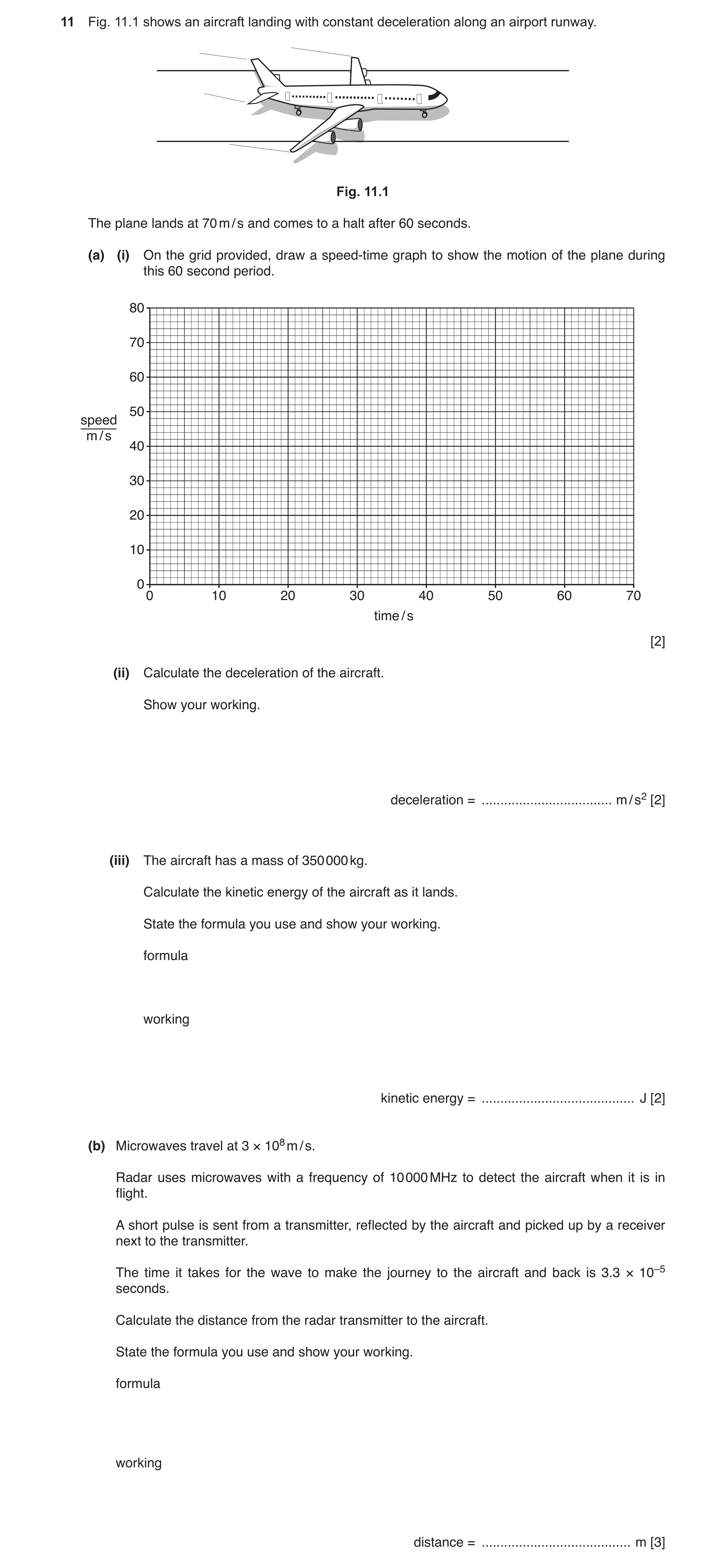
11 Fig. 11.1 shows an aircraft landing with constant deceleration along an airport runway. Fig. 11.1 The plane lands at 70 m / s and comes to a halt after 60 seconds. (a) (i) On the grid provided, draw a speed-time graph to show the motion of the plane during this 60 second period. 80 70 60 50 speed m / s 40 30 20 10 0 0 10 20 30 40 50 60 70 time / s [2] (ii) Calculate the deceleration of the aircraft. Show your working. deceleration = … m / s2 [2] (iii) The aircraft has a mass of 350 000 kg. Calculate the kinetic energy of the aircraft as it lands. State the formula you use and show your working. formula working kinetic energy = … J [2] (b) Microwaves travel at 3 × 10⁸ m / s. Radar uses microwaves with a frequency of 10 000 MHz to detect the aircraft when it is in flight. A short pulse is sent from a transmitter, reflected by the aircraft and picked up by a receiver next to the transmitter. The time it takes for the wave to make the journey to the aircraft and back is 3.3 × 10⁻⁵ seconds. Calculate the distance from the radar transmitter to the aircraft. State the formula you use and show your working. formula working distance = … m [3]
9 marks
Mark scheme: 11(a)(i) diagonal line from 0, 70 ; to 60, 0 ; 2 11(a)(ii) acceleration = change in speed / time / 70 / 60 ; = 1.17(m / s2) ; 2 11(a)(iii) KE = ½ mv2 / ½ × 350000 × 70 × 70 ; = 857500000 (J) ; 2 11(b) distance = speed x time or working ; = (3 x 108 × 3.3 × 10-5) / 2 = OR (3.3 × 10⁻⁵ / 2) × 3 × 108 ; distance = 4950 (m) ; 3
This question in 0654/42 May/June 2017
Q3 · Information which is on the label attached to a washing machine 0654/42 May/June 2017
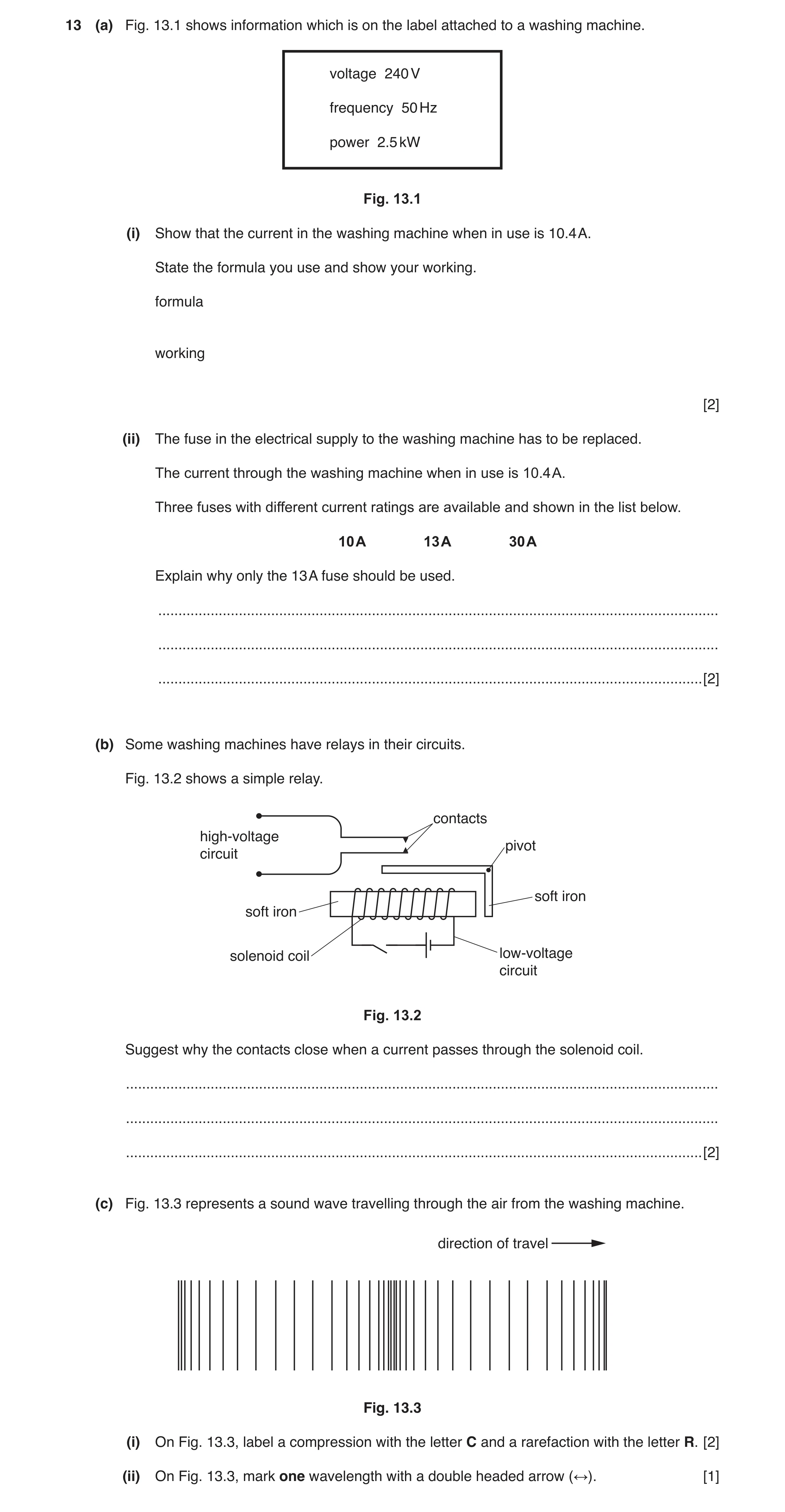
13 (a) Fig. 13.1 shows information which is on the label attached to a washing machine. voltage 240 V frequency 50 Hz power 2.5 kW Fig. 13.1 (i) Show that the current in the washing machine when in use is 10.4 A. State the formula you use and show your working. formula working [2] (ii) The fuse in the electrical supply to the washing machine has to be replaced. The current through the washing machine when in use is 10.4 A. Three fuses with different current ratings are available and shown in the list below. 10 A 13 A 30 A Explain why only the 13 A fuse should be used. … … … [2] (b) Some washing machines have relays in their circuits. Fig. 13.2 shows a simple relay. contacts high-voltage pivot circuit soft iron soft iron solenoid coil low-voltage circuit Fig. 13.2 Suggest why the contacts close when a current passes through the solenoid coil. … … … [2] (c) Fig. 13.3 represents a sound wave travelling through the air from the washing machine. direction of travel Fig. 13.3 (i) On Fig. 13.3, label a compression with the letter C and a rarefaction with the letter R. [2] (ii) On Fig. 13.3, mark one wavelength with a double headed arrow (↔). [1]
9 marks
Mark scheme: 13(a)(i) (2.5 × 1000) / 240 = 10.4 ; 2 13(a)(ii) must be higher than 10.4 / not 10 A fuse, or else it will blow (with normal current) ; not 30 A fuse if there is a fault too much current will pass through / causes damage to washing machine / causes fire ; 2 13(b) electromagnet / magnetic field created around solenoid coil ; soft iron (armature), attracted to magnet / turns, and closes contacts ; 2 13(c)(i) compression correctly labelled ; rarefaction correctly labelled ; 2 13(c)(ii) one wavelength correctly identified ; 1
This question in 0654/42 May/June 2017
Q4 · Two forces acting on a swimmer as he swims in a swimming pool 0654/41 Oct/Nov 2017
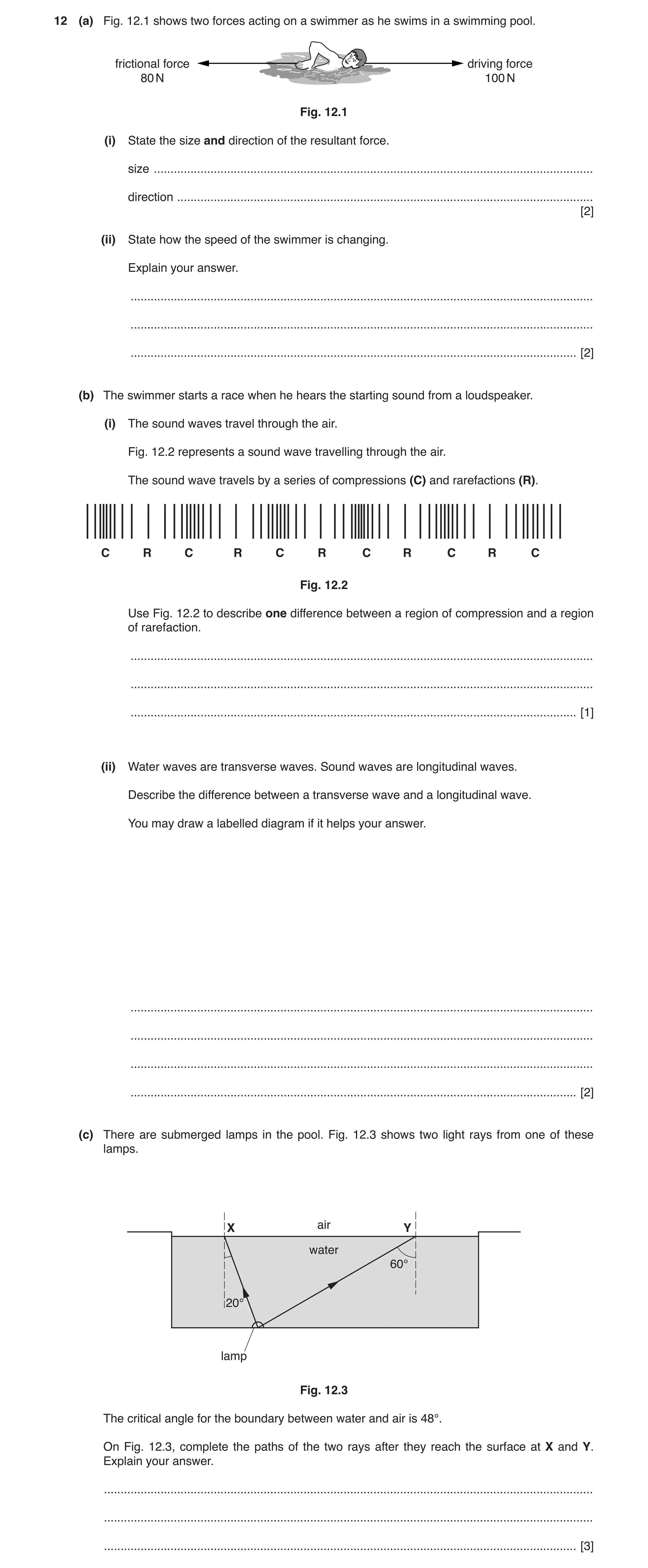
12 (a) Fig. 12.1 shows two forces acting on a swimmer as he swims in a swimming pool. frictional force driving force 80 N 100 N Fig. 12.1 (i) State the size and direction of the resultant force. size … direction … [2] (ii) State how the speed of the swimmer is changing. Explain your answer. … … … [2] (b) The swimmer starts a race when he hears the starting sound from a loudspeaker. (i) The sound waves travel through the air. Fig. 12.2 represents a sound wave travelling through the air. The sound wave travels by a series of compressions (C) and rarefactions (R). C R C R C R C R C R C Fig. 12.2 Use Fig. 12.2 to describe one difference between a region of compression and a region of rarefaction. … … … [1] (ii) Water waves are transverse waves. Sound waves are longitudinal waves. Describe the difference between a transverse wave and a longitudinal wave. You may draw a labelled diagram if it helps your answer. … … … … [2] (c) There are submerged lamps in the pool. Fig. 12.3 shows two light rays from one of these lamps. X air Y water 60° 20° lamp Fig. 12.3 The critical angle for the boundary between water and air is 48°. On Fig. 12.3, complete the paths of the two rays after they reach the surface at X and Y. Explain your answer. … … … [3]
10 marks
Mark scheme: 12(a)(i) 20 N ; forwards / to the right ; 2 12(a)(ii) the swimmers speed increases/ acceleration ; resultant force/ unbalanced force, to right / in direction of movement, /driving force > frictional force ; 2 12(b)(i) compressions are regions where the particles in air are close together / rarefactions are regions where the particles in air are spread out ; compressions are regions with air at high pressure / rarefactions are regions with air at low pressure ; max 1 12(b)(ii) transverse waves oscillate at right angles to direction of wave/energy transfer ; longitudinal waves oscillate parallel to direction of wave/energy transfer ; 2 12(c) at Y reflection only is shown ; at X refraction (and reflection) is shown ; total internal reflection occurs when angle of incidence exceeds critical angle / angle of incidence = angle of reflection / refraction away from normal when ray travels from denser to less dense medium ; 3
This question in 0654/41 Oct/Nov 2017
Q5 · A bat emitting ultrasound waves to detect obstacles and prey 0654/41 Oct/Nov 2018
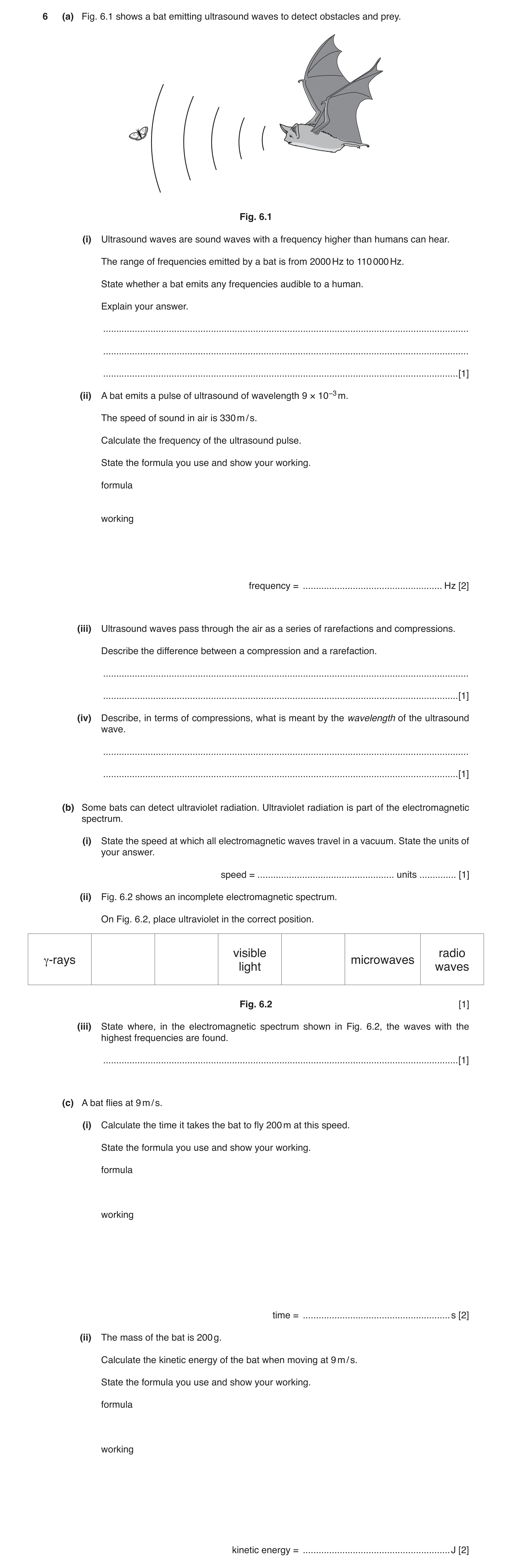
6 (a) Fig. 6.1 shows a bat emitting ultrasound waves to detect obstacles and prey. Fig. 6.1 (i) Ultrasound waves are sound waves with a frequency higher than humans can hear. The range of frequencies emitted by a bat is from 2000 Hz to 110 000 Hz. State whether a bat emits any frequencies audible to a human. Explain your answer. … … … [1] (ii) A bat emits a pulse of ultrasound of wavelength 9 × 10⁻³ m. The speed of sound in air is 330 m / s. Calculate the frequency of the ultrasound pulse. State the formula you use and show your working. formula working frequency = … Hz [2] (iii) Ultrasound waves pass through the air as a series of rarefactions and compressions. Describe the difference between a compression and a rarefaction. … … [1] (iv) Describe, in terms of compressions, what is meant by the wavelength of the ultrasound wave. … … [1] (b) Some bats can detect ultraviolet radiation. Ultraviolet radiation is part of the electromagnetic spectrum. (i) State the speed at which all electromagnetic waves travel in a vacuum. State the units of your answer. speed = … units … [1] (ii) Fig. 6.2 shows an incomplete electromagnetic spectrum. On Fig. 6.2, place ultraviolet in the correct position. visible radioγ-rays microwaves light waves Fig. 6.2 [1] (iii) State where, in the electromagnetic spectrum shown in Fig. 6.2, the waves with the highest frequencies are found. … [1] (c) A bat flies at 9 m / s. (i) Calculate the time it takes the bat to fly 200 m at this speed. State the formula you use and show your working. formula working time = … s [2] (ii) The mass of the bat is 200 g. Calculate the kinetic energy of the bat when moving at 9 m / s. State the formula you use and show your working. formula working kinetic energy = … J [2]
12 marks
Mark scheme: 6(a)(i) Yes, because human normally hears up to 20 000 Hz ; 1 6(a)(ii) frequency = speed / wavelength or 3 330 9 10− × or 330 0.009 ; 37 000 (Hz) ; 2 6(a)(iii) compression region of high pressure / where the particles are close together or rarefaction region of low pressure / where particles are further apart ; 1 6(a)(iv) distance between two (consecutive) compressions ; 1 6(b)(i) 300 000 000 m / s ; 1 6(b)(ii) box to the left of visible light ; 1 6(b)(iii) left hand side / gamma ; 1 6(c)(i) distance time= speed or 200 9 ; = 22 (s) ; 2 6(c)(ii) 2 1 KE mv 2 = or 1 0.2 9 9 2 × × × ; 8.1 (J) ; 2
This question in 0654/41 Oct/Nov 2018
Q6 · A boat pulling a water skier across a lake 0654/42 Oct/Nov 2018
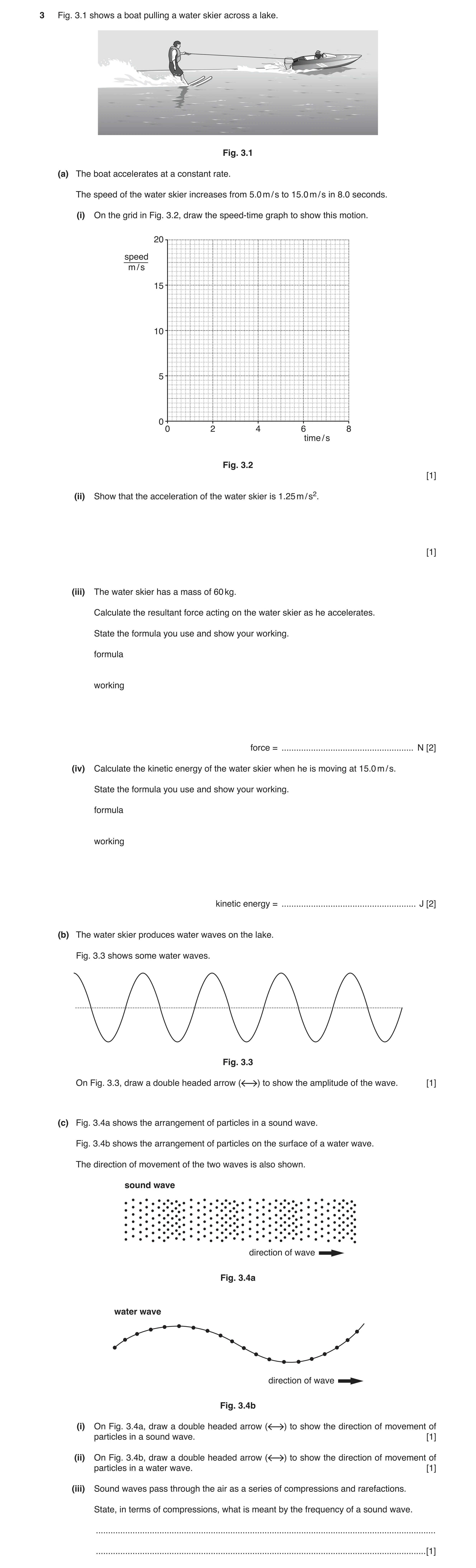
3 Fig. 3.1 shows a boat pulling a water skier across a lake. Fig. 3.1 (a) The boat accelerates at a constant rate. The speed of the water skier increases from 5.0 m / s to 15.0 m / s in 8.0 seconds. (i) On the grid in Fig. 3.2, draw the speed-time graph to show this motion. 20 speed m / s 15 10 5 0 0 2 4 6 8 time / s Fig. 3.2 [1] (ii) Show that the acceleration of the water skier is 1.25 m / s2. [1] (iii) The water skier has a mass of 60 kg. Calculate the resultant force acting on the water skier as he accelerates. State the formula you use and show your working. formula working force = … N [2] (iv) Calculate the kinetic energy of the water skier when he is moving at 15.0 m / s. State the formula you use and show your working. formula working kinetic energy = … J [2] (b) The water skier produces water waves on the lake. Fig. 3.3 shows some water waves. Fig. 3.3 On Fig. 3.3, draw a double headed arrow ( ) to show the amplitude of the wave. [1] (c) Fig. 3.4a shows the arrangement of particles in a sound wave. Fig. 3.4b shows the arrangement of particles on the surface of a water wave. The direction of movement of the two waves is also shown. sound wave direction of wave Fig. 3.4a water wave direction of wave Fig. 3.4b (i) On Fig. 3.4a, draw a double headed arrow ( ) to show the direction of movement of particles in a sound wave. [1] (ii) On Fig. 3.4b, draw a double headed arrow ( ) to show the direction of movement of particles in a water wave. [1] (iii) Sound waves pass through the air as a series of compressions and rarefactions. State, in terms of compressions, what is meant by the frequency of a sound wave. … … [1]
10 marks
Mark scheme: 3(a)(i) diagonal line starting at 0,5 and stopping at 8,15 ; 1 3(a)(ii) acceleration = change in speed / time or 10 / 8 = 1.25 ; 1 3(a)(iii) force = mass × acceleration or 60 × 1.25 ; = 75 (N) ; 2 3(a)(iv) kinetic energy = ½ mv2 or ½ × 60 × 15 × 15 ; = 6750 (J) / 6800 (J) ; 2 3(b) arrow drawn from middle to top or bottom of the wave ; 1 Question Answer Marks 3(c)(i) double headed arrow from left to right ; 1 3(c)(ii) water wave arrow up and down ; 1 3(c)(iii) number of compressions produced by the source per unit time / number of waves that pass a certain point per unit time ; 1
This question in 0654/42 Oct/Nov 2018
Q7 · Ultrasound waves are used in hospitals to scan unborn babies 0654/42 May/June 2019
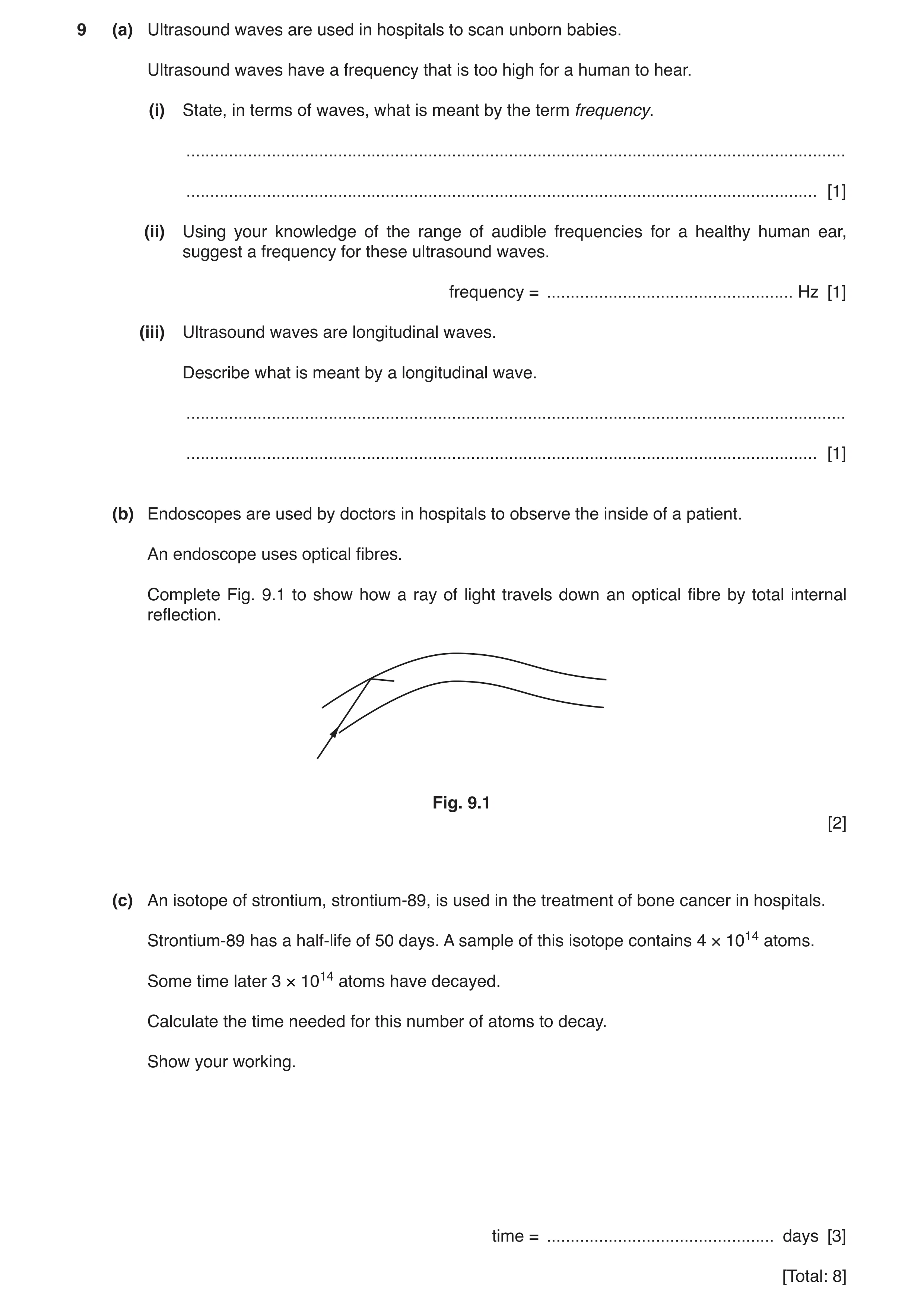
9 (a) Ultrasound waves are used in hospitals to scan unborn babies. Ultrasound waves have a frequency that is too high for a human to hear. (i) State, in terms of waves, what is meant by the term frequency. … … [1] (ii) Using your knowledge of the range of audible frequencies for a healthy human ear, suggest a frequency for these ultrasound waves. frequency = … Hz [1] (iii) Ultrasound waves are longitudinal waves. Describe what is meant by a longitudinal wave. … … [1] (b) Endoscopes are used by doctors in hospitals to observe the inside of a patient. An endoscope uses optical fibres. Complete Fig. 9.1 to show how a ray of light travels down an optical fibre by total internal reflection. Fig. 9.1 [2] (c) An isotope of strontium, strontium-89, is used in the treatment of bone cancer in hospitals. Strontium-89 has a half-life of 50 days. A sample of this isotope contains 4 × 10¹⁴ atoms. Some time later 3 × 10¹⁴ atoms have decayed. Calculate the time needed for this number of atoms to decay. Show your working. time = … days [3] [Total: 8]
8 marks
Mark scheme: 9(a)(i) number of waves passing a given point per unit time ; 1 9(a)(ii) frequency greater than 20 000 Hz ; 1 9(a)(iii) vibration / oscillation is in the same direction as energy transfer ; 1 9(b) total internal reflection shown ; angle correct ; 2 9(c) 1 × 10¹⁴ (atoms remain) ; indication of 2 half-lives ; (50 × 2 = ) 100 days ; 3
This question in 0654/42 May/June 2019
Q8 · A large snow tractor used by scientists working in the Arctic region 0654/42 May/June 2019
12 (a) Fig. 12.1 shows a large snow tractor used by scientists working in the Arctic region. continuous tracks Fig. 12.1 The snow tractor has large continuous tracks (caterpillar tracks), driven by the wheels. These tracks allow the snow tractor to travel across the soft snow without sinking. A tractor with four ordinary wheels would sink into the soft snow. Use ideas about pressure to explain this difference. … … … [2] (b) The snow tractor has two headlamps. The headlamps emit visible light of several different wavelengths. One of the wavelengths is 5.01 × 10⁻⁷ m. The frequency of this light is 5.98 × 10¹⁴ Hz. Calculate the speed of this light. Show your working. speed of light = … m / s [2] (c) Visible light is part of the electromagnetic spectrum. All electromagnetic waves travel at the same speed in a vacuum. State one other property that is the same for all electromagnetic waves. … … [1] (d) Fig. 12.2 shows equipment for measuring wind speed used by Arctic scientists. plastic cups plastic spindle plastic frame coil iron rod V Fig. 12.2 The wind makes the plastic cups move and this causes the spindle and magnet to turn. Suggest why an alternating voltage is measured on the voltmeter. … … … … [3] [Total: 8]
8 marks
Mark scheme: 12(a) tracks spread weight over larger (surface) area ; so pressure is less ; 2 12(b) (v) = f × λ or 5.98 × 1014 × 5.01 × 10-7 ; = 3.00 × 10⁸ (m) ; 2 12(c) all transverse waves ; 1 12(d) (coil experiences) changing magnetic field ; (changing magnetic field) induces emf ; direction of emf changes every half turn ; max 3
This question in 0654/42 May/June 2019
Q9 · A penguin walking on the ice in Antarctica 0654/43 May/June 2019
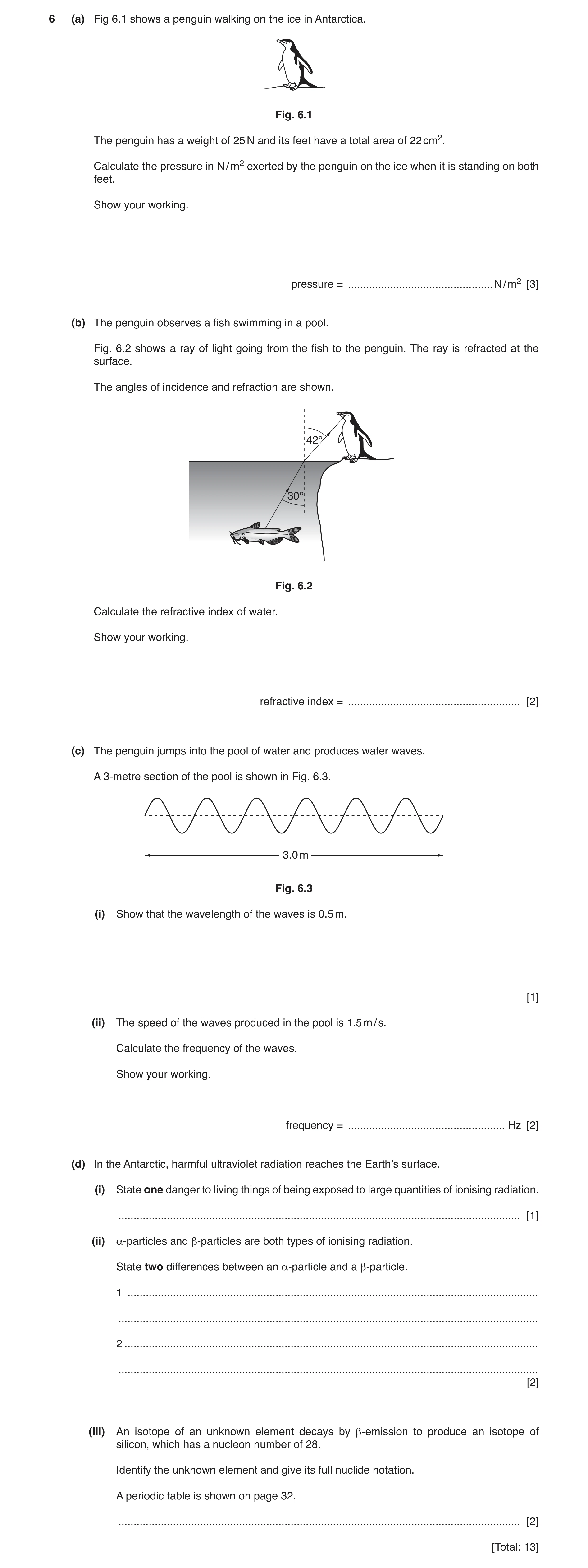
6 (a) Fig 6.1 shows a penguin walking on the ice in Antarctica. Fig. 6.1 The penguin has a weight of 25 N and its feet have a total area of 22 cm2. Calculate the pressure in N / m2 exerted by the penguin on the ice when it is standing on both feet. Show your working. pressure = … N / m2 [3] (b) The penguin observes a fish swimming in a pool. Fig. 6.2 shows a ray of light going from the fish to the penguin. The ray is refracted at the surface. The angles of incidence and refraction are shown. 42° 30° Fig. 6.2 Calculate the refractive index of water. Show your working. refractive index = … [2] (c) The penguin jumps into the pool of water and produces water waves. A 3-metre section of the pool is shown in Fig. 6.3. 3.0 m Fig. 6.3 (i) Show that the wavelength of the waves is 0.5 m. [1] (ii) The speed of the waves produced in the pool is 1.5 m / s. Calculate the frequency of the waves. Show your working. frequency = … Hz [2] (d) In the Antarctic, harmful ultraviolet radiation reaches the Earth’s surface. (i) State one danger to living things of being exposed to large quantities of ionising radiation. … [1] (ii) α-particles and β-particles are both types of ionising radiation. State two differences between an α-particle and a β-particle. 1 … … 2 … … [2] (iii) An isotope of an unknown element decays by β-emission to produce an isotope of silicon, which has a nucleon number of 28. Identify the unknown element and give its full nuclide notation. A periodic table is shown on page 32. … [2] [Total: 13]
13 marks
Mark scheme: 6(a) conversion of cm2 to m2 seen ; = 11 000 (N/m2) ; 3 6(b) 0.67 / 0.50 ; 1.3 ; 2 6(c)(i) 3.0 / 6.0 ; 1 6(c)(ii) f 1.5 / 0.5 ; = 3 (Hz) ; 2 6(d)(i) cancer / mutation ; 1 6(d)(ii) α particles are larger/heavier ; α particles have positive charge and β particles have negative charge ; α particles are more ionising ; α particles are less penetrating ; max 2 6(d)(iii) l 28A 13 1 mark for Al ; 1 mark for 13 and 28 in correct positions ; 2
This question in 0654/43 May/June 2019
Q10 · Dolphins are a species of aquatic mammal 0654/42 Oct/Nov 2019
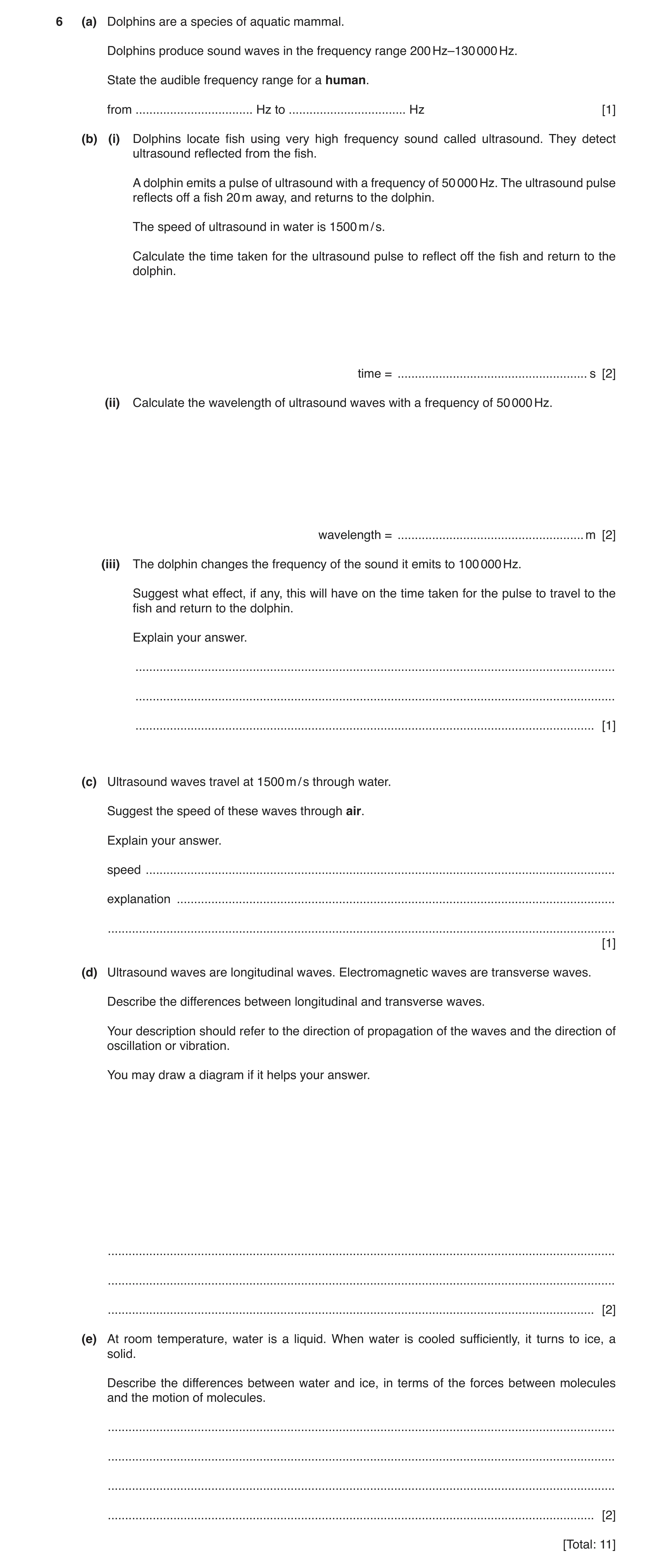
6 (a) Dolphins are a species of aquatic mammal. Dolphins produce sound waves in the frequency range 200 Hz–130 000 Hz. State the audible frequency range for a human. from … Hz to … Hz [1] (b) (i) Dolphins locate fish using very high frequency sound called ultrasound. They detect ultrasound reflected from the fish. A dolphin emits a pulse of ultrasound with a frequency of 50 000 Hz. The ultrasound pulse reflects off a fish 20 m away, and returns to the dolphin. The speed of ultrasound in water is 1500 m / s. Calculate the time taken for the ultrasound pulse to reflect off the fish and return to the dolphin. time = … s [2] (ii) Calculate the wavelength of ultrasound waves with a frequency of 50 000 Hz. wavelength = … m [2] (iii) The dolphin changes the frequency of the sound it emits to 100 000 Hz. Suggest what effect, if any, this will have on the time taken for the pulse to travel to the fish and return to the dolphin. Explain your answer. … … … [1] (c) Ultrasound waves travel at 1500 m / s through water. Suggest the speed of these waves through air. Explain your answer. speed … explanation … … [1] (d) Ultrasound waves are longitudinal waves. Electromagnetic waves are transverse waves. Describe the differences between longitudinal and transverse waves. Your description should refer to the direction of propagation of the waves and the direction of oscillation or vibration. You may draw a diagram if it helps your answer. … … … [2] (e) At room temperature, water is a liquid. When water is cooled sufficiently, it turns to ice, a solid. Describe the differences between water and ice, in terms of the forces between molecules and the motion of molecules. … … … … [2] [Total: 11]
11 marks
Mark scheme: 6(a) 20 (Hz) to 20 000 (Hz) ; 1 6(b)(i) (time =) distance / speed or 40 / 1500 ; = 0.027 (s) ; 2 6(b)(ii) (wavelength =) velocity / frequency or 1500 / 50 000 ; = 0.03 (m) ; 2 6(b)(iii) time remains the same because wave velocity doesn’t change ; 1 6(c) any speed lower than 1500 m / s (no mark) ultrasound waves travel slower in a gas compared to a liquid ; 1 6(d) transverse waves – direction of propagation perpendicular to direction of oscillation / vibration ; longitudinal – direction of propagation parallel to direction of oscillation / vibration ; 2 6(e) stronger forces of attraction between water molecules in ice ; water molecules are able to move / ice molecules can only vibrate ; 2
This question in 0654/42 Oct/Nov 2019
Q11 · A gardener cuts grass with an electric mower 0654/43 Oct/Nov 2019
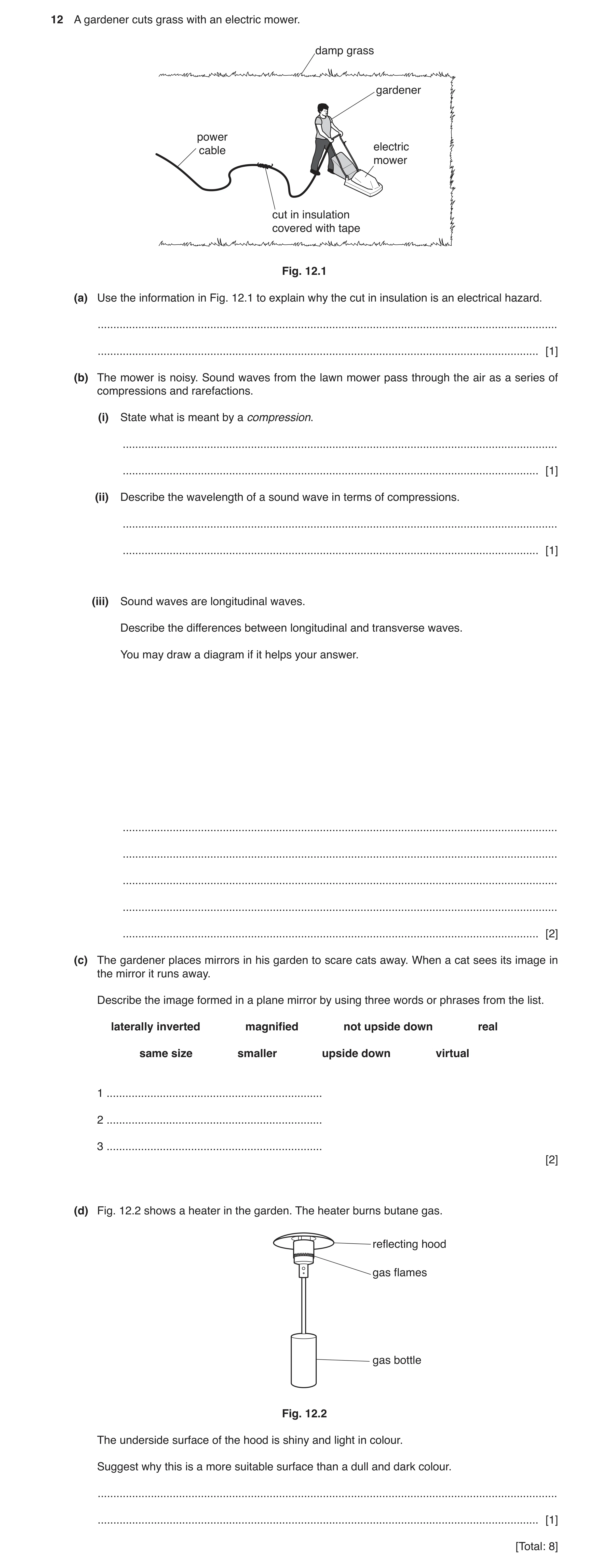
12 A gardener cuts grass with an electric mower. damp grass gardener power electric cable mower cut in insulation covered with tape Fig. 12.1 (a) Use the information in Fig. 12.1 to explain why the cut in insulation is an electrical hazard. … … [1] (b) The mower is noisy. Sound waves from the lawn mower pass through the air as a series of compressions and rarefactions. (i) State what is meant by a compression. … … [1] (ii) Describe the wavelength of a sound wave in terms of compressions. … … [1] (iii) Sound waves are longitudinal waves. Describe the differences between longitudinal and transverse waves. You may draw a diagram if it helps your answer. … … … … … [2] (c) The gardener places mirrors in his garden to scare cats away. When a cat sees its image in the mirror it runs away. Describe the image formed in a plane mirror by using three words or phrases from the list. laterally inverted magnified not upside down real same size smaller upside down virtual 1 … 2 … 3 … [2] (d) Fig. 12.2 shows a heater in the garden. The heater burns butane gas. reflecting hood gas flames gas bottle Fig. 12.2 The underside surface of the hood is shiny and light in colour. Suggest why this is a more suitable surface than a dull and dark colour. … … [1] [Total: 8]
8 marks
Mark scheme: 12(a) tape repair may let in water / short circuit / fire / electrocution ; 1 12(b)(i) region of high pressure / region of a high concentration of molecules ; 1 12(b)(ii) distance between two successive compressions ; 1 12(b)(iii) transverse waves – direction of propagation perpendicular to direction of oscillation ; longitudinal – direction of propagation parallel to direction of oscillation ; 2 12(c) Any 3 from laterally inverted ; same size ; virtual ; not upside down ; max 2 2 12(d) shiny / light surface will reflect more thermal energy / dull / dark surface will absorb more thermal energy ; 1
This question in 0654/43 Oct/Nov 2019
Q12 · A boat has a mass of 2000 kg 0654/43 Oct/Nov 2020
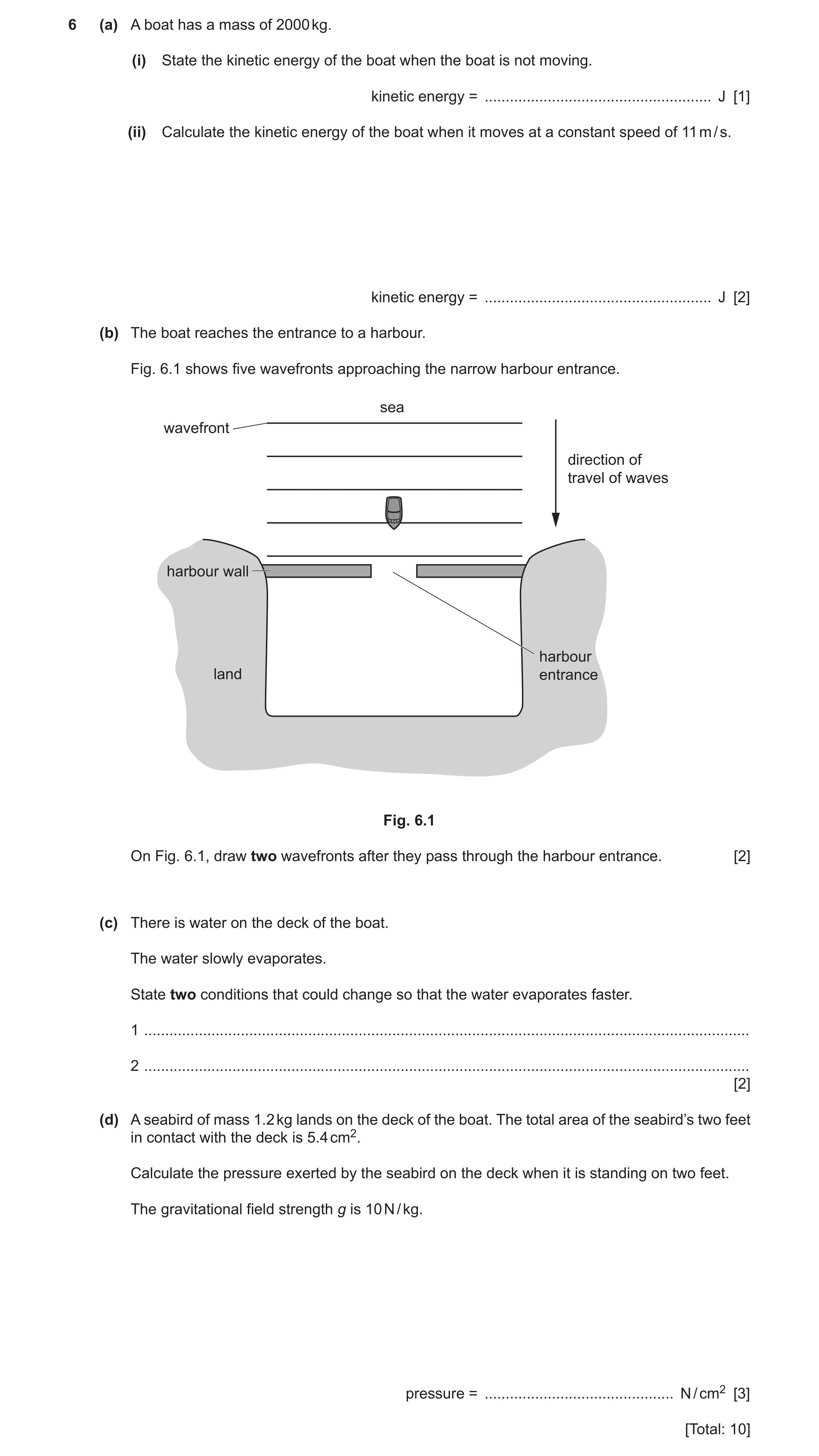
6 (a) A boat has a mass of 2000 kg. (i) State the kinetic energy of the boat when the boat is not moving. kinetic energy = … J [1] (ii) Calculate the kinetic energy of the boat when it moves at a constant speed of 11 m / s. kinetic energy = … J [2] (b) The boat reaches the entrance to a harbour. Fig. 6.1 shows five wavefronts approaching the narrow harbour entrance. sea wavefront direction of travel of waves harbour wall harbour land entrance Fig. 6.1 On Fig. 6.1, draw two wavefronts after they pass through the harbour entrance. [2] (c) There is water on the deck of the boat. The water slowly evaporates. State two conditions that could change so that the water evaporates faster. 1 … 2 … [2] (d) A seabird of mass 1.2 kg lands on the deck of the boat. The total area of the seabird’s two feet in contact with the deck is 5.4 cm2. Calculate the pressure exerted by the seabird on the deck when it is standing on two feet. The gravitational field strength g is 10 N / kg. pressure = … N / cm2 [3] [Total: 10]
10 marks
Mark scheme: 6(a)(i) 0 (J); 1 6(a)(ii) (ke =) ½mv2 or ½ × 2000 × 112 or ½ × 2000 × 121; (ke =) 121 000 (J); 2 6(b) wavefronts curve as shown ; wavelength unchanged ; 2 Question Answer Marks 6(c) (increase) temperature ; (more) air flow ; (increase) surface area of puddle ; humidity ; AVP ; max 2 2 6(d) (W =) mg / 1.2 × 10 / 12 ; (p =) F / A / 12 / 5.4 ; pressure = 2.2 (N / cm2); 3
This question in 0654/43 Oct/Nov 2020
Q13 · Visible light is a transverse wave and is part of the electromagnetic spectrum 0654/42 Feb/March 2021
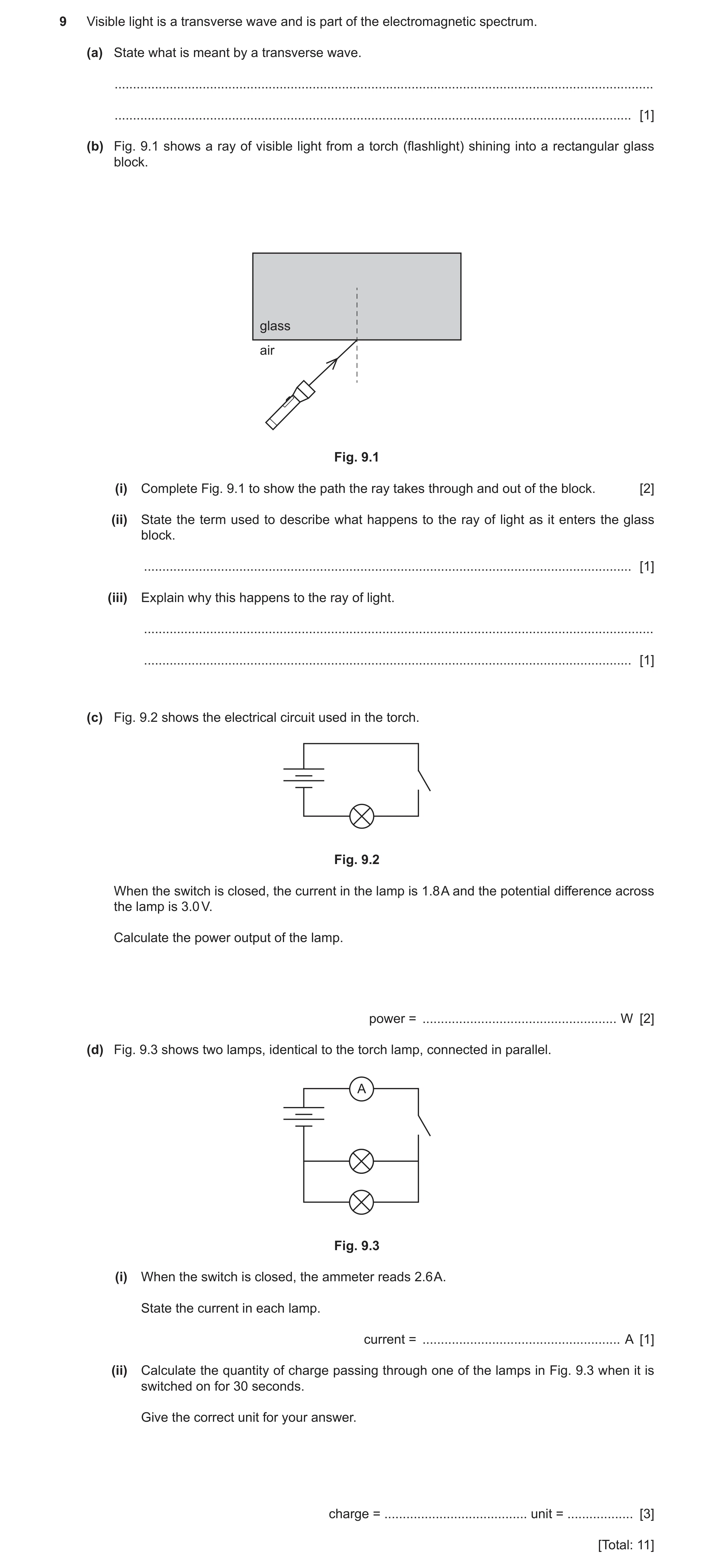
9 Visible light is a transverse wave and is part of the electromagnetic spectrum. (a) State what is meant by a transverse wave. … … [1] (b) Fig. 9.1 shows a ray of visible light from a torch (flashlight) shining into a rectangular glass block. glass air Fig. 9.1 (i) Complete Fig. 9.1 to show the path the ray takes through and out of the block. [2] (ii) State the term used to describe what happens to the ray of light as it enters the glass block. … [1] (iii) Explain why this happens to the ray of light. … … [1] (c) Fig. 9.2 shows the electrical circuit used in the torch. Fig. 9.2 When the switch is closed, the current in the lamp is 1.8 A and the potential difference across the lamp is 3.0 V. Calculate the power output of the lamp. power = … W [2] (d) Fig. 9.3 shows two lamps, identical to the torch lamp, connected in parallel. A Fig. 9.3 (i) When the switch is closed, the ammeter reads 2.6 A. State the current in each lamp. current = … A [1] (ii) Calculate the quantity of charge passing through one of the lamps in Fig. 9.3 when it is switched on for 30 seconds. Give the correct unit for your answer. charge = … unit = … [3] [Total: 11]
11 marks
Mark scheme: 9(a) vibrations / oscillations, are perpendicular to direction of energy transfer ; 1 9(b)(i) ray moves towards the normal inside glass block ; ray emerges parallel to incidence ray ; 2 9(b)(ii) refraction ; 1 9(b)(iii) change of speed / caused by change in density of medium ; 1 9(c) (P=) IV / 1.8 × 3.0 ; 5.4 (W) ; 2 9(d)(i) 1.3 (A) ; 1 Question Answer Marks 9(d)(ii) (Q =) It / 1.3 × 30 ; 39 ; C / Coulombs ; 3
This question in 0654/42 Feb/March 2021
Q14 · A student plans to measure the speed of sound through wood 0654/41 May/June 2021
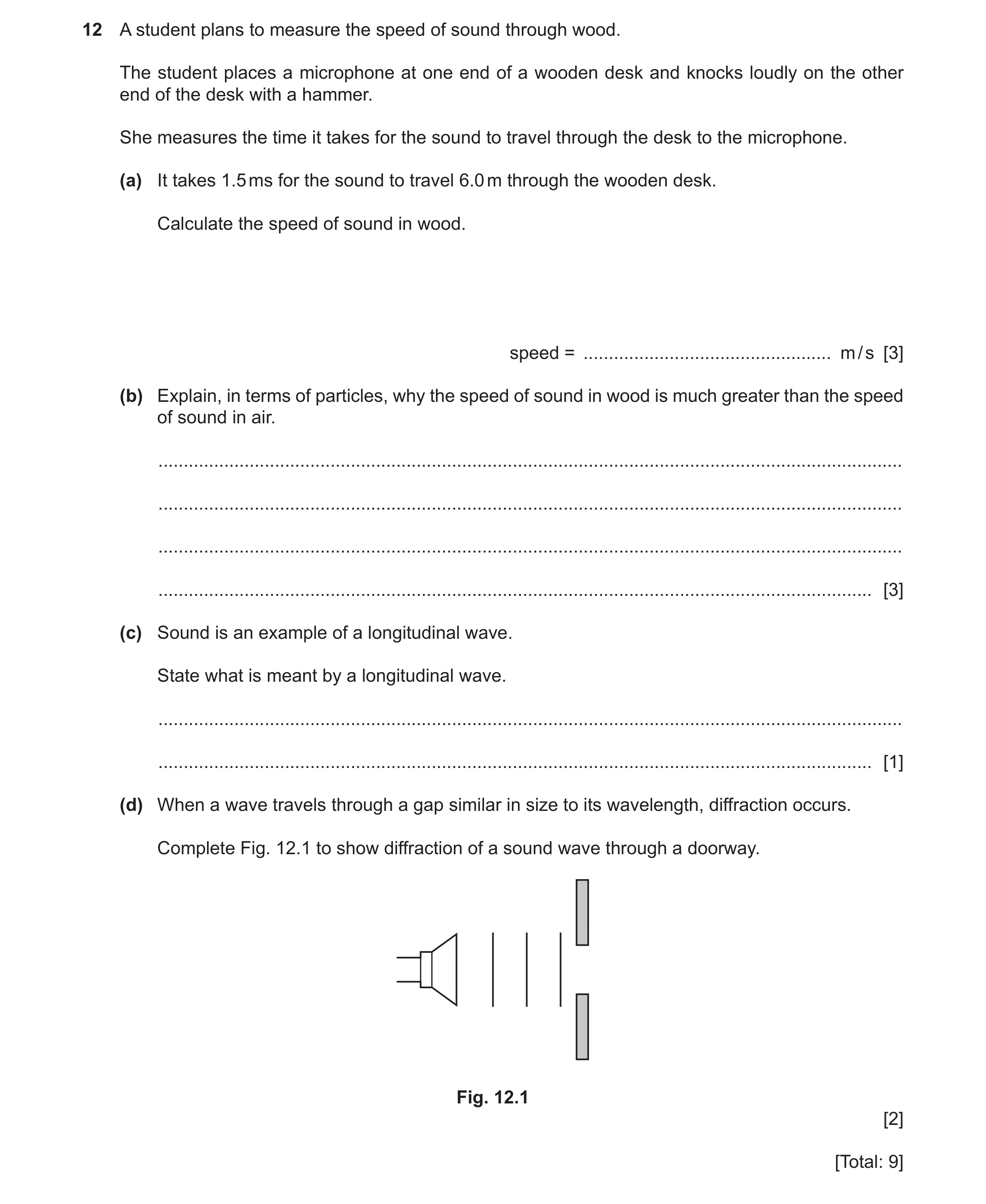
12 A student plans to measure the speed of sound through wood. The student places a microphone at one end of a wooden desk and knocks loudly on the other end of the desk with a hammer. She measures the time it takes for the sound to travel through the desk to the microphone. (a) It takes 1.5 ms for the sound to travel 6.0 m through the wooden desk. Calculate the speed of sound in wood. speed = … m / s [3] (b) Explain, in terms of particles, why the speed of sound in wood is much greater than the speed of sound in air. … … … … [3] (c) Sound is an example of a longitudinal wave. State what is meant by a longitudinal wave. … … [1] (d) When a wave travels through a gap similar in size to its wavelength, diffraction occurs. Complete Fig. 12.1 to show diffraction of a sound wave through a doorway. Fig. 12.1 [2] [Total: 9]
9 marks
Mark scheme: 12(a) 0.0015 or 1.5 × 10⁻³ ; (v =) d / t or 6 / 1.5 × 10⁻³ ; 4000 (m / s) ; 12(b) wood is a solid / air is a gas; particles in a solid are close together / touching / ORA ; vibrations are transferred more quickly in a solid / ORA ; 3 12(c) vibrations / oscillations are, parallel to / in the same direction as, the direction of, energy transfer / wave travel ; 1 12(d) spreading out of waves ; circular waves shown on right hand side of boundary ; 2
This question in 0654/41 May/June 2021
Q15 · State the speed of electromagnetic waves in a vacuum 0654/41 Oct/Nov 2021
3 (a) State the speed of electromagnetic waves in a vacuum. … [1] (b) Fig. 3.1 shows an incomplete electromagnetic spectrum. (i) Write visible light in its correct position in the spectrum. [1] ultraviolet infrared microwaves Fig. 3.1 (ii) State the form of electromagnetic radiation that has the highest frequency. … [1] (c) Visible light is an example of a transverse wave. (i) Use a double headed arrow (↔ or ↕) to label the wavelength of the transverse wave shown in Fig. 3.2. [1] Fig. 3.2 (ii) State the equation that links the frequency, speed and wavelength of a wave. … [1] (d) Fig. 3.3 shows an object placed close to a thin converging lens. object F F F = principal focus Fig. 3.3 (i) Complete Fig. 3.3 to show how the rays of light from the object form an image. [3] (ii) The image formed by this lens is real. State what is meant by a real image. … … [1] (iii) Suggest a use for a thin converging lens such as the one shown in Fig. 3.3. … … [1] [Total: 10]
10 marks
Mark scheme: 3(a) 3 × 10⁸ m / s ; 1 3(b)(i) ‘visible light’ placed in central box ; 1 3(b)(ii) gamma ; 1 3(c)(i) line drawn peak to peak / trough to trough / any identical points on adjacent waves ; 1 3(c)(ii) v = f λ ; 1 3(d)(i) any two from: ray parallel to the principal axis passing through F on image side ; ray passing through F on object side made parallel to the principal axis ; ray passing through optical centre of lens not refracted ; and image of correct size and position ; 3 3(d)(ii) can be formed on a screen / is formed from real rays of light / formed from converging rays ; 1 3(d)(iii) magnifying glass ; AVP ; max1
This question in 0654/41 Oct/Nov 2021
Q16 · Carbon-14 is an unstable isotope which decays to produce nitrogen -14 0654/43 Oct/Nov 2021
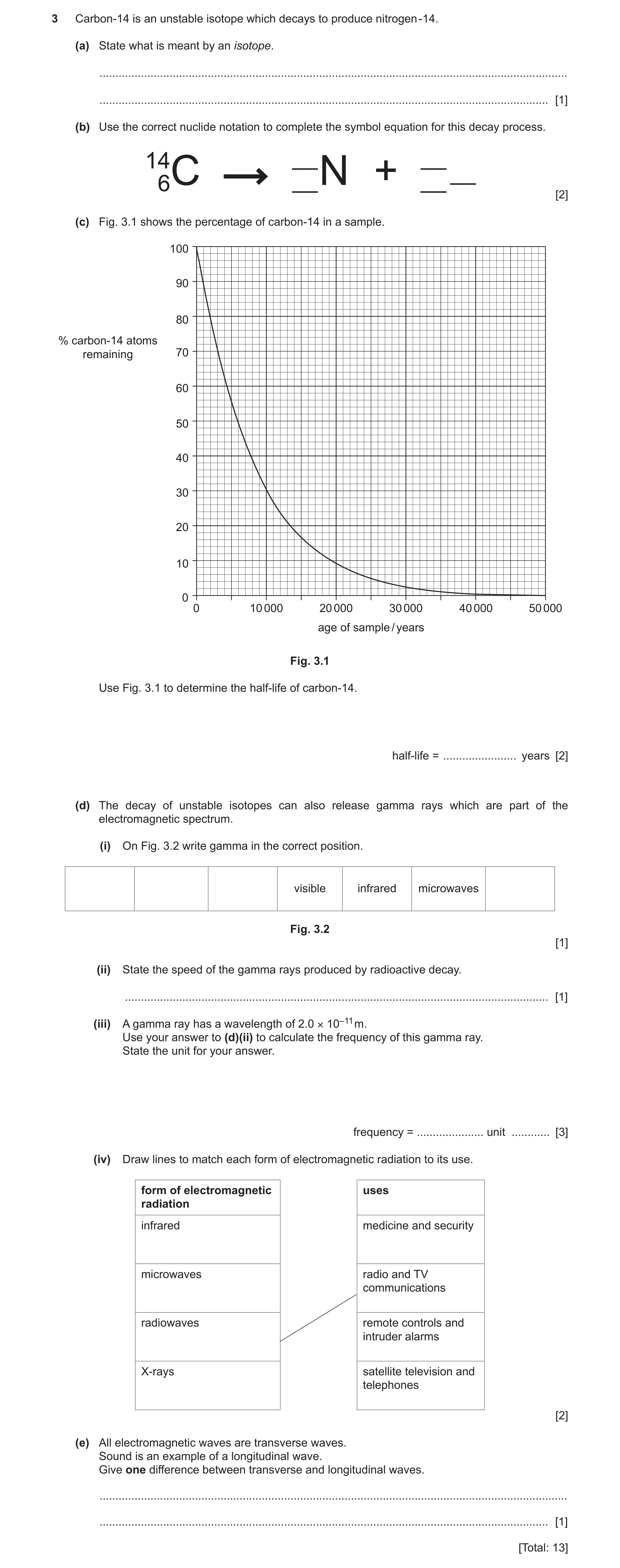
3 Carbon-14 is an unstable isotope which decays to produce nitrogen -14. (a) State what is meant by an isotope. … … [1] (b) Use the correct nuclide notation to complete the symbol equation for this decay process. 14 __ __ __ 6C __ N + __ [2] (c) Fig. 3.1 shows the percentage of carbon-14 in a sample. 100 90 80 % carbon-14 atoms remaining 70 60 50 40 30 20 10 0 0 10 000 20 000 30 000 40 000 50 000 age of sample / years Fig. 3.1 Use Fig. 3.1 to determine the half-life of carbon-14. half-life = … years [2] (d) The decay of unstable isotopes can also release gamma rays which are part of the electromagnetic spectrum. (i) On Fig. 3.2 write gamma in the correct position. visible infrared microwaves Fig. 3.2 [1] (ii) State the speed of the gamma rays produced by radioactive decay. … [1] (iii) A gamma ray has a wavelength of 2.0 × 10⁻¹¹ m. Use your answer to (d)(ii) to calculate the frequency of this gamma ray. State the unit for your answer. frequency = … unit … [3] (iv) Draw lines to match each form of electromagnetic radiation to its use. form of electromagnetic uses radiation infrared medicine and security microwaves radio and TV communications radiowaves remote controls and intruder alarms X-rays satellite television and telephones [2] (e) All electromagnetic waves are transverse waves. Sound is an example of a longitudinal wave. Give one difference between transverse and longitudinal waves. … … [1] [Total: 13]
13 marks
Mark scheme: 3(a) same proton number and different neutron number ; 1 3(b) 14 7N ; 0 1β − ; 2 3(c) use of graph ; 6000 years ; 2 3(d)(i) gamma in left box ; 1 3(d)(ii) 3 × 10⁸ m / s ; 1 3(d)(iii) (f=) v / λ or 3x10⁸ / 2.0x10⁻¹¹ ; 1.5 x 10¹⁹ ; Hz ; 3 3(d)(iv) ;; 2 3(e) transverse vibrations are perpendicular to energy transfer / longitudinal vibrations are parallel to energy transfer ; 1
This question in 0654/43 Oct/Nov 2021
Q17 · A student investigates the effect of changing light levels on the resistance of a… 0654/43 May/June 2022
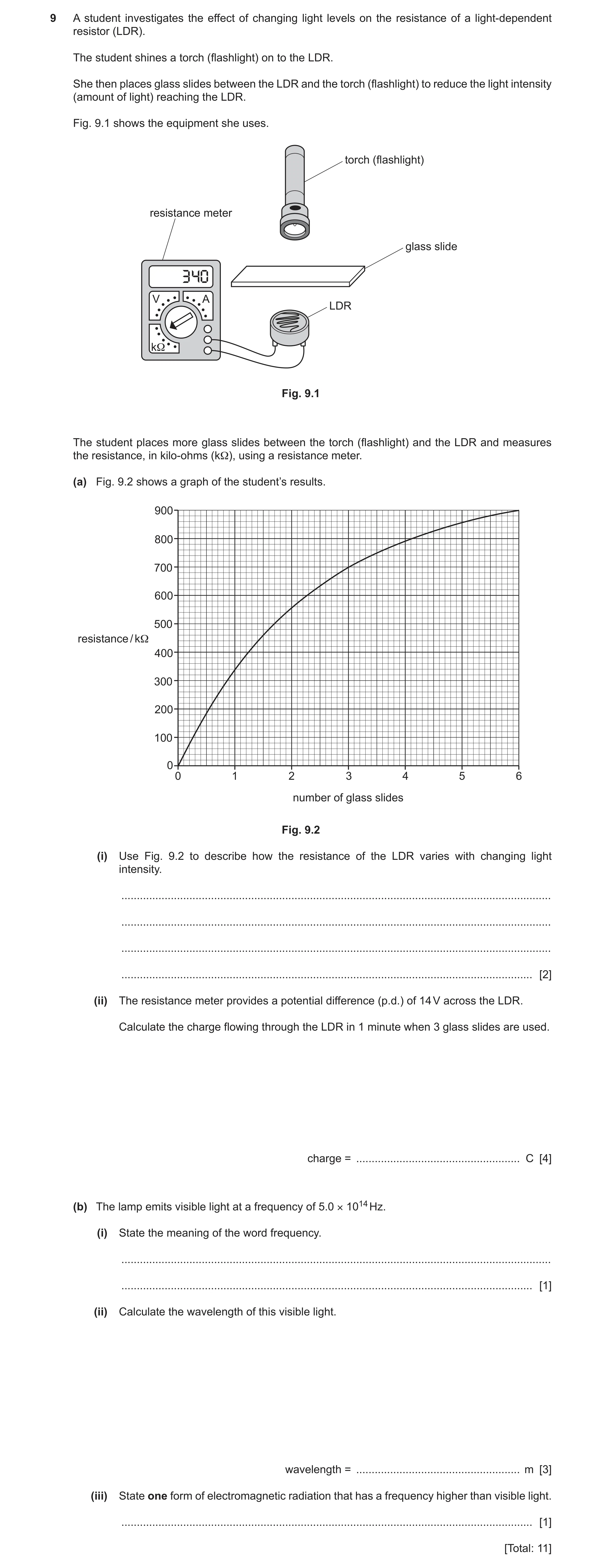
9 A student investigates the effect of changing light levels on the resistance of a light-dependent resistor (LDR). The student shines a torch (flashlight) on to the LDR. She then places glass slides between the LDR and the torch (flashlight) to reduce the light intensity (amount of light) reaching the LDR. Fig. 9.1 shows the equipment she uses. torch (flashlight) resistance meter glass slide 340 V A LDR kΩ Fig. 9.1 The student places more glass slides between the torch (flashlight) and the LDR and measures the resistance, in kilo-ohms (kΩ), using a resistance meter. (a) Fig. 9.2 shows a graph of the student’s results. 900 800 700 600 500 resistance / kΩ 400 300 200 100 0 0 1 2 3 4 5 6 number of glass slides Fig. 9.2 (i) Use Fig. 9.2 to describe how the resistance of the LDR varies with changing light intensity. … … … … [2] (ii) The resistance meter provides a potential difference (p.d.) of 14 V across the LDR. Calculate the charge flowing through the LDR in 1 minute when 3 glass slides are used. charge = … C [4] (b) The lamp emits visible light at a frequency of 5.0 × 10¹⁴ Hz. (i) State the meaning of the word frequency. … … [1] (ii) Calculate the wavelength of this visible light. wavelength = … m [3] (iii) State one form of electromagnetic radiation that has a frequency higher than visible light. … [1] [Total: 11]
11 marks
Mark scheme: 9(a)(i) resistance increases as light intensity decreases ; increase is smallest for lower light intensity ; 2 9(a)(ii) (R =) 700 (k) ; (I =) V / R OR 14 / 700000 / 0.00002 (A) ; (Q =) It OR 0.00002 60 ; 0.0012 (C) ; 4 9(b)(i) The number of oscillations per second / number of waves passing a point per second ; 1 9(b)(ii) (v =) 3 108 (m / s) ; ( =) v / f OR 8 14 3 10 5.0 10 ; 6.0 10–7 (m) ; 3 9(b)(iii) any one of: gamma / X-rays / UV ; 1
This question in 0654/43 May/June 2022
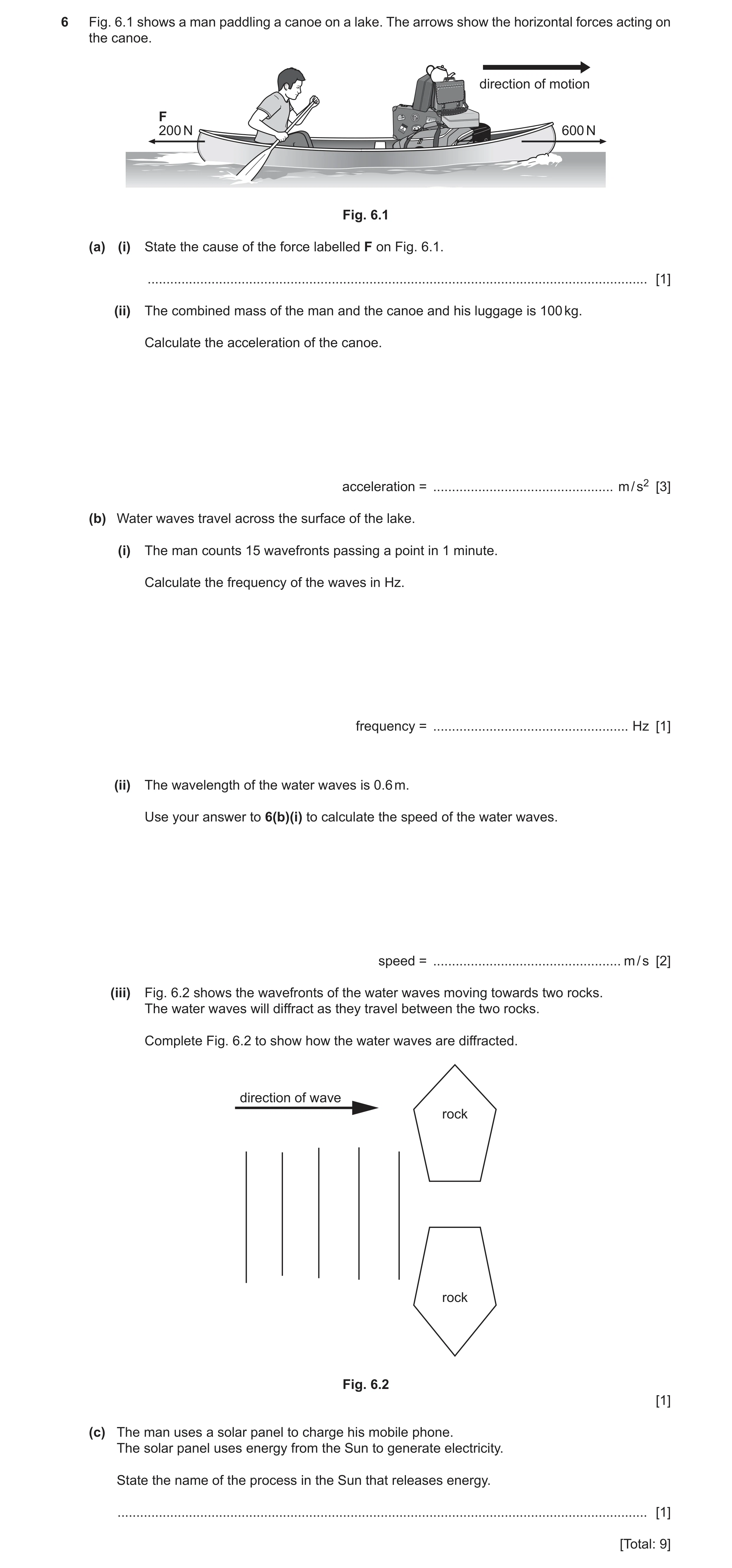
Q18 · A man paddling a canoe on a lake 0654/41 Oct/Nov 2022
6 Fig. 6.1 shows a man paddling a canoe on a lake. The arrows show the horizontal forces acting on the canoe. direction of motion F 200 N 600 N Fig. 6.1 (a) (i) State the cause of the force labelled F on Fig. 6.1. … [1] (ii) The combined mass of the man and the canoe and his luggage is 100 kg. Calculate the acceleration of the canoe. acceleration = … m / s2 [3] (b) Water waves travel across the surface of the lake. (i) The man counts 15 wavefronts passing a point in 1 minute. Calculate the frequency of the waves in Hz. frequency = … Hz [1] (ii) The wavelength of the water waves is 0.6 m. Use your answer to 6(b)(i) to calculate the speed of the water waves. speed = … m / s [2] (iii) Fig. 6.2 shows the wavefronts of the water waves moving towards two rocks. The water waves will diffract as they travel between the two rocks. Complete Fig. 6.2 to show how the water waves are diffracted. direction of wave rock rock Fig. 6.2 [1] (c) The man uses a solar panel to charge his mobile phone. The solar panel uses energy from the Sun to generate electricity. State the name of the process in the Sun that releases energy. … [1] [Total: 9]
9 marks
Mark scheme: 6(a)(i) friction / drag / air resistance / water resistance ; 1 6(a)(ii) resultant force = 400 N ; 3 (a =) F / m or 400 / 100 ; (a =) 4 (m / s2) ; 6(b)(i) 0.25 (Hz) ; 1 6(b)(ii) (v =) f / 0.25 0.6 ; 2 (v =) 0.15 (m / s) ; 6(b)(iii) circular wavefronts drawn in correct position, spreading out ; 1 6(c) (nuclear) fusion ; 1
This question in 0654/41 Oct/Nov 2022
Q19 · A man in a canoe on a lake 0654/43 Oct/Nov 2022
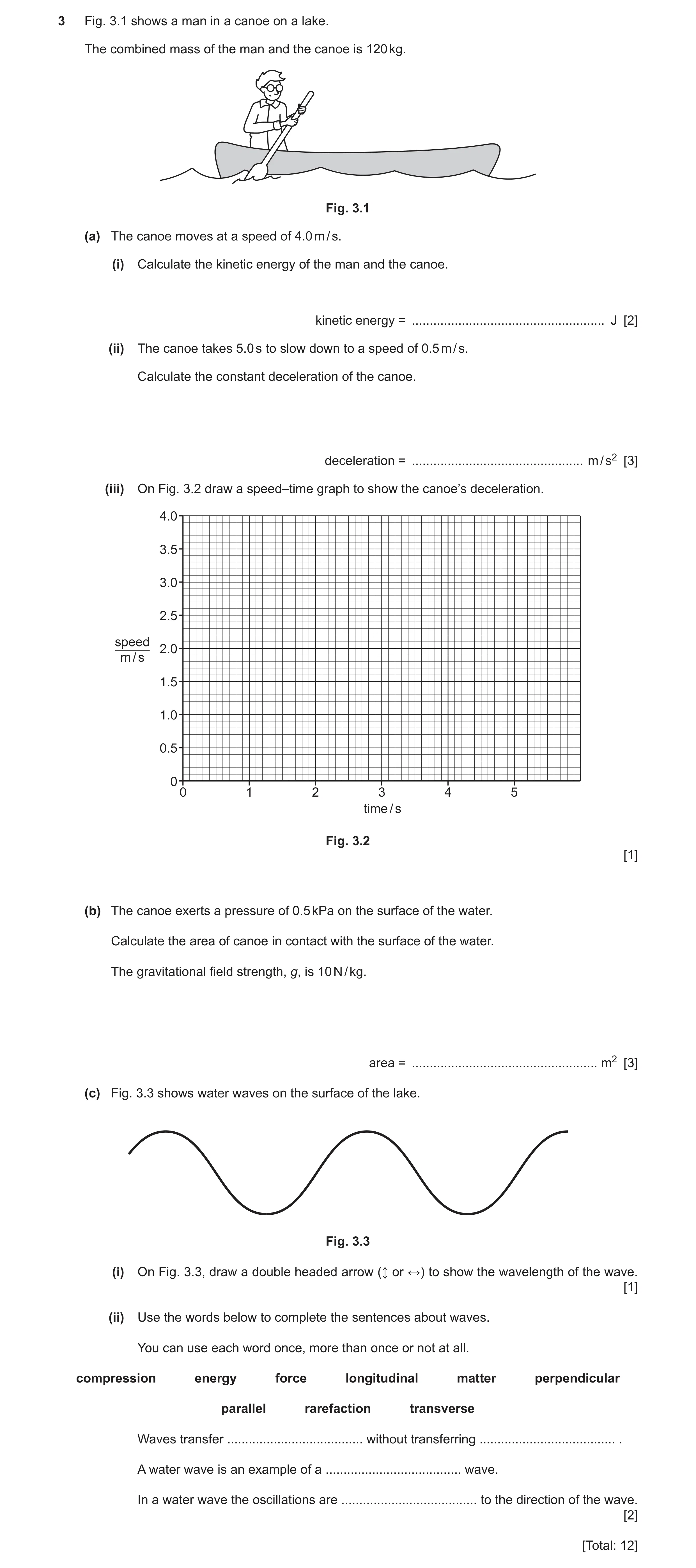
3 Fig. 3.1 shows a man in a canoe on a lake. The combined mass of the man and the canoe is 120 kg. Fig. 3.1 (a) The canoe moves at a speed of 4.0 m / s. (i) Calculate the kinetic energy of the man and the canoe. kinetic energy = … J [2] (ii) The canoe takes 5.0 s to slow down to a speed of 0.5 m / s. Calculate the constant deceleration of the canoe. deceleration = … m / s2 [3] (iii) On Fig. 3.2 draw a speed–time graph to show the canoe’s deceleration. 4.0 3.5 3.0 2.5 speed 2.0 m / s 1.5 1.0 0.5 0 0 1 2 3 4 5 time / s Fig. 3.2 [1] (b) The canoe exerts a pressure of 0.5 kPa on the surface of the water. Calculate the area of canoe in contact with the surface of the water. The gravitational field strength, g, is 10 N / kg. area = … m2 [3] (c) Fig. 3.3 shows water waves on the surface of the lake. Fig. 3.3 (i) On Fig. 3.3, draw a double headed arrow (↕ or ↔) to show the wavelength of the wave. [1] (ii) Use the words below to complete the sentences about waves. You can use each word once, more than once or not at all. compression energy force longitudinal matter perpendicular parallel rarefaction transverse Waves transfer … without transferring … . A water wave is an example of a … wave. In a water wave the oscillations are … to the direction of the wave. [2] [Total: 12]
12 marks
Mark scheme: 3(a)(i) (KE =) ½ mv2 or ½ 120 42 ; 2 960 (J) ; 3(a)(ii) (v =) 3.5 (m / s) ; 3 (a =) v / t or 3.5 / 5.0 ; 0.7 (m / s2) ; 3(a)(iii) 1 ; 3(b) (W =) mg or 120 10 or 1200 (N) ; 3 (A =) W / P or 1200 / 500 ; 2.4 (m2) ; 3(c)(i) correct arrow showing one complete wavelength ; 1 3(c)(ii) energy AND matter ; 2 transverse AND perpendicular ;
This question in 0654/43 Oct/Nov 2022
Q20 · A boiler that uses combustion of natural gas to heat water 0654/41 May/June 2023
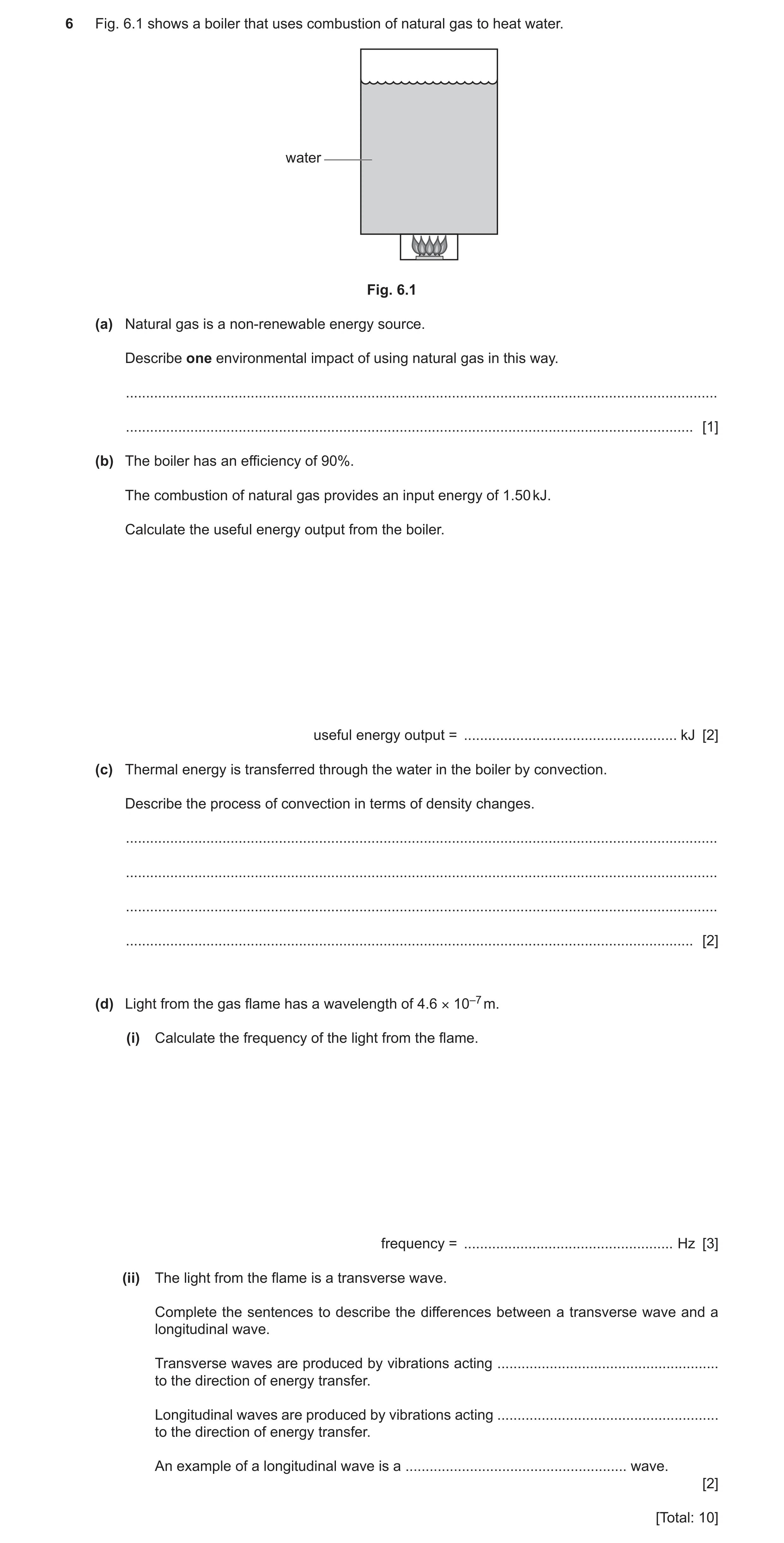
6 Fig. 6.1 shows a boiler that uses combustion of natural gas to heat water. water Fig. 6.1 (a) Natural gas is a non‑renewable energy source. Describe one environmental impact of using natural gas in this way. … … [1] (b) The boiler has an efficiency of 90%. The combustion of natural gas provides an input energy of 1.50 kJ. Calculate the useful energy output from the boiler. useful energy output = … kJ [2] (c) Thermal energy is transferred through the water in the boiler by convection. Describe the process of convection in terms of density changes. … … … … [2] (d) Light from the gas flame has a wavelength of 4.6 × 10⁻⁷ m. (i) Calculate the frequency of the light from the flame. frequency = … Hz [3] (ii) The light from the flame is a transverse wave. Complete the sentences to describe the differences between a transverse wave and a longitudinal wave. Transverse waves are produced by vibrations acting … to the direction of energy transfer. Longitudinal waves are produced by vibrations acting … to the direction of energy transfer. An example of a longitudinal wave is a … wave. [2] [Total: 10]
10 marks
Mark scheme: 6(a) (releases CO2) contributes to global warming / causes climate change / (enhanced) greenhouse effect ; 1 6(b) (output = ) efficiency input / 0.9 1.50 ; (output = ) 1.35 (kJ) ; 2 6(c) density of water decreases as it is heated ; less dense / heated water rises ; 2 6(d)(i) 3 108 (m / s) ; (frequency = ) speed / wavelength / 3 108/4.6 10–7 ; (frequency = ) 6.5 1014 (Hz) ; 3 6(d)(ii) perpendicular and parallel ; sound ; 2
This question in 0654/41 May/June 2023
Q21 · An insect called a pond skater 0654/42 May/June 2023
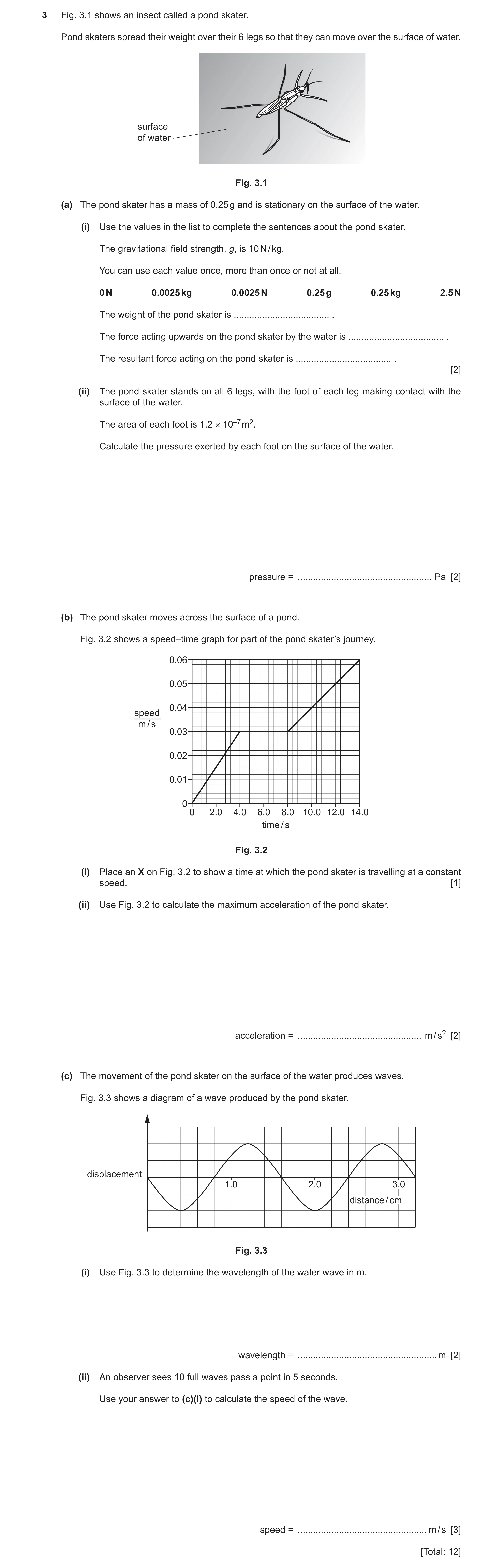
3 Fig. 3.1 shows an insect called a pond skater. Pond skaters spread their weight over their 6 legs so that they can move over the surface of water. surface of water Fig. 3.1 (a) The pond skater has a mass of 0.25 g and is stationary on the surface of the water. (i) Use the values in the list to complete the sentences about the pond skater. The gravitational field strength, g, is 10 N / kg. You can use each value once, more than once or not at all. 0 N 0.0025 kg 0.0025 N 0.25 g 0.25 kg 2.5 N The weight of the pond skater is … . The force acting upwards on the pond skater by the water is … . The resultant force acting on the pond skater is … . [2] (ii) The pond skater stands on all 6 legs, with the foot of each leg making contact with the surface of the water. The area of each foot is 1.2 × 10⁻⁷ m2. Calculate the pressure exerted by each foot on the surface of the water. pressure = … Pa [2] (b) The pond skater moves across the surface of a pond. Fig. 3.2 shows a speed–time graph for part of the pond skater’s journey. 0.06 0.05 0.04 speed m / s 0.03 0.02 0.01 0 0 2.0 4.0 6.0 8.0 10.0 12.0 14.0 time / s Fig. 3.2 (i) Place an X on Fig. 3.2 to show a time at which the pond skater is travelling at a constant speed. [1] (ii) Use Fig. 3.2 to calculate the maximum acceleration of the pond skater. acceleration = … m / s2 [2] (c) The movement of the pond skater on the surface of the water produces waves. Fig. 3.3 shows a diagram of a wave produced by the pond skater. displacement 1.0 2.0 3.0 distance / cm Fig. 3.3 (i) Use Fig. 3.3 to determine the wavelength of the water wave in m. wavelength = … m [2] (ii) An observer sees 10 full waves pass a point in 5 seconds. Use your answer to (c)(i) to calculate the speed of the wave. speed = … m / s [3] [Total: 12]
12 marks
Mark scheme: 3(a)(i) 0.0025 N ; 0.0025 N and 0 (N) ; 2 3(a)(ii) (P =) F / A or 0.0025 / (6 1.2 10–7) ; (P =) 3500 (Pa) ; 2 3(b)(i) X placed between 4.0 and 8.0 s ; 1 3(b)(ii) (a =) v / t or 0.03 / 4.0 ; (a =) 0.0075 (m / s2) ; 2 3(c)(i) 1.6 / 100 ; 0.016 (m) ; 2 Question Answer Marks 3(c)(ii) (f =) 2 (Hz) ; (v =) f or 2 0.016 ; (v =) 0.032 (m / s) ; 3
This question in 0654/42 May/June 2023
Q22 · X‑rays are part of the electromagnetic spectrum 0654/43 May/June 2023
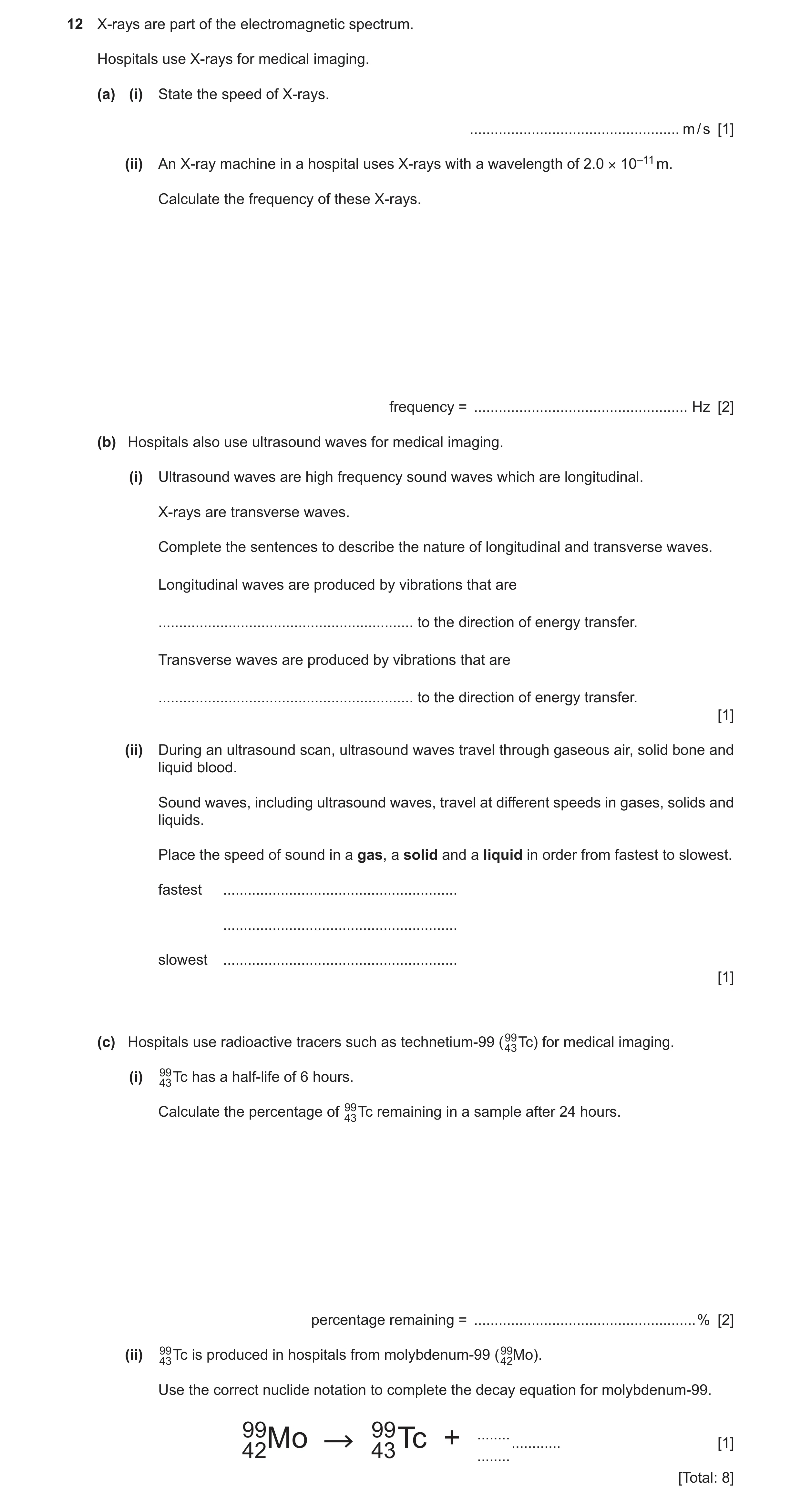
12 X‑rays are part of the electromagnetic spectrum. Hospitals use X‑rays for medical imaging. (a) (i) State the speed of X‑rays. … m / s [1] (ii) An X‑ray machine in a hospital uses X‑rays with a wavelength of 2.0 × 10⁻¹¹ m. Calculate the frequency of these X‑rays. frequency = … Hz [2] (b) Hospitals also use ultrasound waves for medical imaging. (i) Ultrasound waves are high frequency sound waves which are longitudinal. X‑rays are transverse waves. Complete the sentences to describe the nature of longitudinal and transverse waves. Longitudinal waves are produced by vibrations that are … to the direction of energy transfer. Transverse waves are produced by vibrations that are … to the direction of energy transfer. [1] (ii) During an ultrasound scan, ultrasound waves travel through gaseous air, solid bone and liquid blood. Sound waves, including ultrasound waves, travel at different speeds in gases, solids and liquids. Place the speed of sound in a gas, a solid and a liquid in order from fastest to slowest. fastest … … slowest … [1] (c) Hospitals use radioactive tracers such as technetium‑99 (9943 Tc) for medical imaging. (i) 9943 Tc has a half‑life of 6 hours. Calculate the percentage of 9943 Tc remaining in a sample after 24 hours. percentage remaining = … % [2] (ii) 9943 Tc is produced in hospitals from molybdenum‑99 (9942Mo). Use the correct nuclide notation to complete the decay equation for molybdenum‑99. 99 99 … … [1] 42Mo 43 Tc + … [Total: 8]
8 marks
Mark scheme: 12(a)(i) 12(a)(ii) (f =) v / / 3 108 / 2.0 10–11 ; (f =) 1.5 1019 (Hz) ; 2 12(b)(i) parallel AND perpendicular ; 1 12(b)(ii) solid liquid gas ; 1 12(c)(i) 4 half-lives ; 6.25 (%) ; 2 12(c)(ii) 0 1 ; 1
This question in 0654/43 May/June 2023
Q23 · A student investigates a spring 0654/42 Feb/March 2024
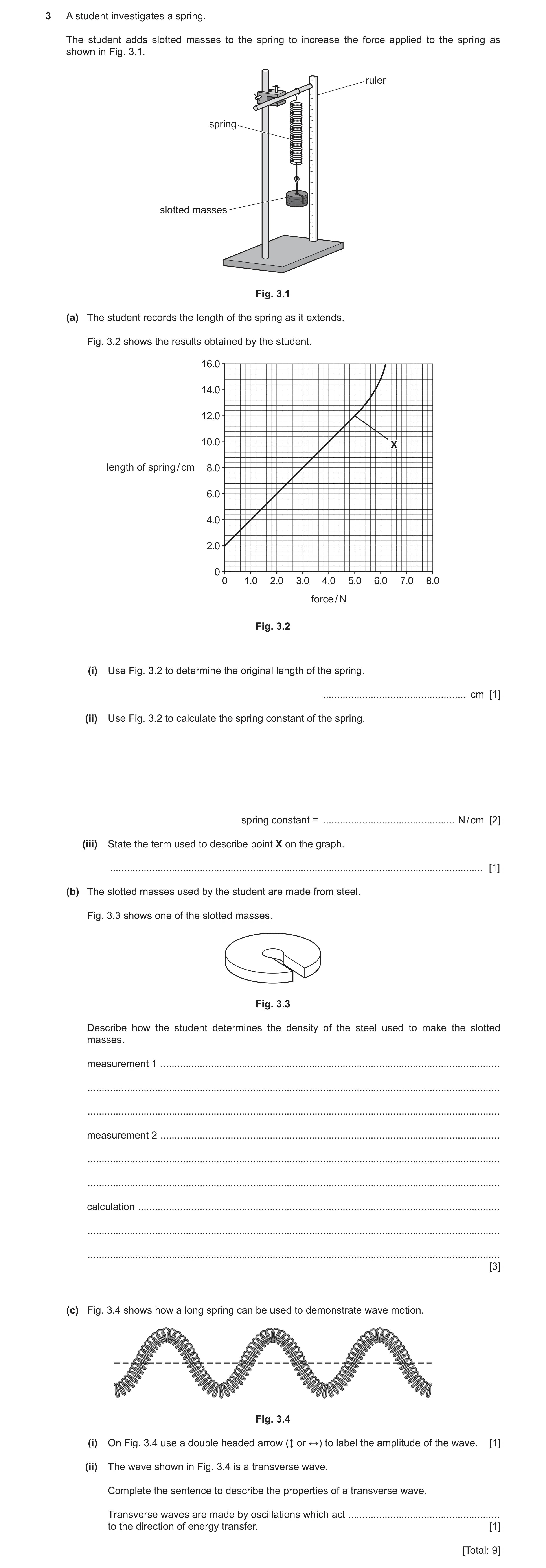
3 A student investigates a spring. The student adds slotted masses to the spring to increase the force applied to the spring as shown in Fig. 3.1. ruler spring slotted masses Fig. 3.1 (a) The student records the length of the spring as it extends. Fig. 3.2 shows the results obtained by the student. 16.0 14.0 12.0 10.0 X length of spring / cm 8.0 6.0 4.0 2.0 0 0 1.0 2.0 3.0 4.0 5.0 6.0 7.0 8.0 force / N Fig. 3.2 (i) Use Fig. 3.2 to determine the original length of the spring. … cm [1] (ii) Use Fig. 3.2 to calculate the spring constant of the spring. spring constant = … N / cm [2] (iii) State the term used to describe point X on the graph. … [1] (b) The slotted masses used by the student are made from steel. Fig. 3.3 shows one of the slotted masses. Fig. 3.3 Describe how the student determines the density of the steel used to make the slotted masses. measurement 1 … … … measurement 2 … … … calculation … … … [3] (c) Fig. 3.4 shows how a long spring can be used to demonstrate wave motion. Fig. 3.4 (i) On Fig. 3.4 use a double headed arrow (↕ or ↔) to label the amplitude of the wave. [1] (ii) The wave shown in Fig. 3.4 is a transverse wave. Complete the sentence to describe the properties of a transverse wave. Transverse waves are made by oscillations which act … to the direction of energy transfer. [1] [Total: 9]
9 marks
Mark scheme: 3(a)(i) 2.0 (cm) ; 1 3(a)(ii) use of data from graph OR use of F = k x OR 5.0 / 10 ; 2 (k=) 0.5 (N / cm) ; 3(a)(iii) limit of proportionality ; 1 3(b) volume using displacement method / eureka can ; 3 mass using, balance / scales ; density = mass / volume ; 3(c)(i) amplitude labelled from peak or trough to equilibrium position ; 1 3(c)(ii) perpendicular / at right angles / 90° ; 1
This question in 0654/42 Feb/March 2024
Q24 · Angler fish live in the sea at depths of up to 2000 m 0654/42 Oct/Nov 2024
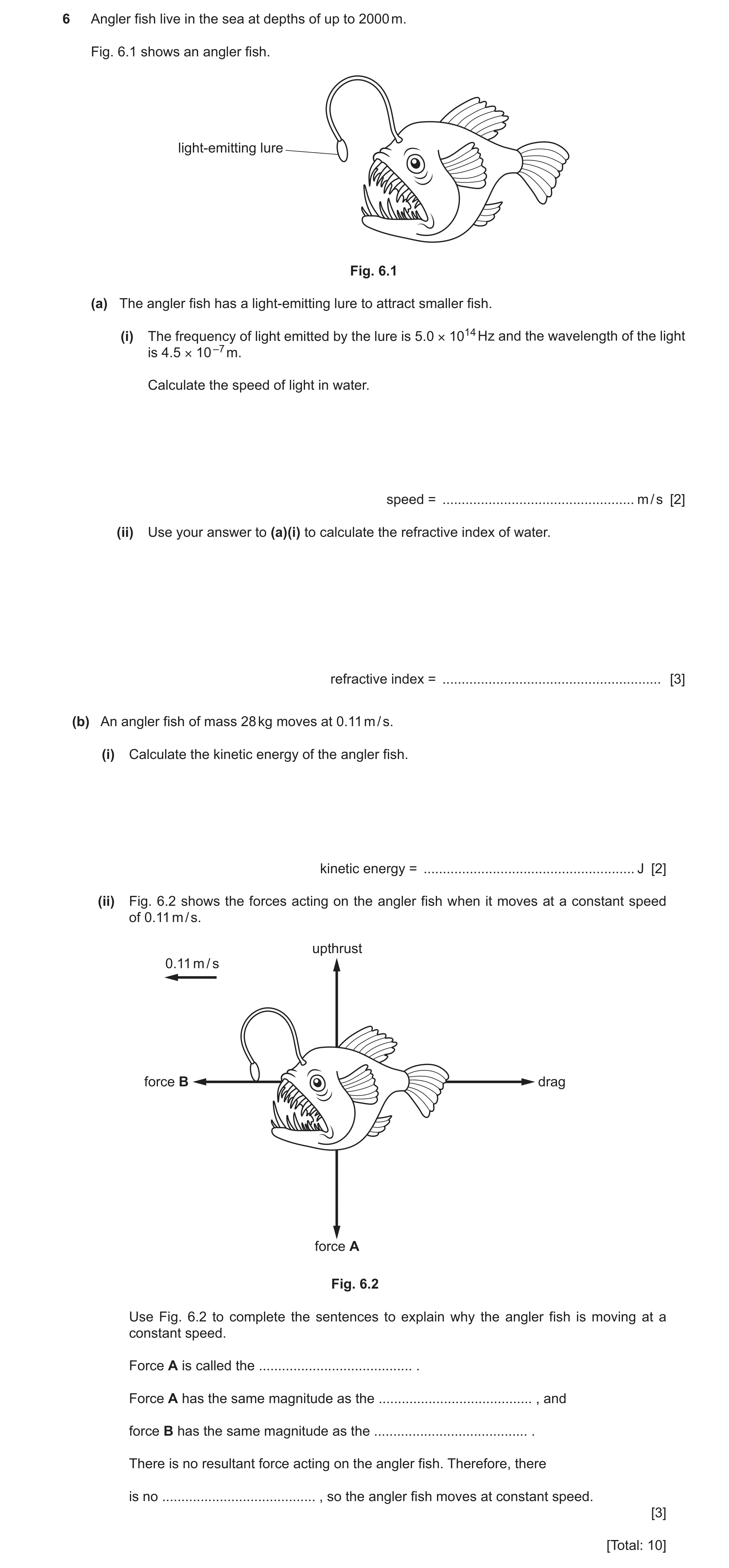
6 Angler fish live in the sea at depths of up to 2000 m. Fig. 6.1 shows an angler fish. light-emitting lure Fig. 6.1 (a) The angler fish has a light-emitting lure to attract smaller fish. (i) The frequency of light emitted by the lure is 5.0 × 10¹⁴ Hz and the wavelength of the light is 4.5 × 10 –7 m. Calculate the speed of light in water. speed = … m / s [2] (ii) Use your answer to (a)(i) to calculate the refractive index of water. refractive index = … [3] (b) An angler fish of mass 28 kg moves at 0.11 m / s. (i) Calculate the kinetic energy of the angler fish. kinetic energy = … J [2] (ii) Fig. 6.2 shows the forces acting on the angler fish when it moves at a constant speed of 0.11 m / s. upthrust 0.11 m / s force B drag force A Fig. 6.2 Use Fig. 6.2 to complete the sentences to explain why the angler fish is moving at a constant speed. Force A is called the … . Force A has the same magnitude as the … , and force B has the same magnitude as the … . There is no resultant force acting on the angler fish. Therefore, there is no … , so the angler fish moves at constant speed. [3] [Total: 10]
10 marks
Mark scheme: 6(a)(i) evidence of v = f λ or (5.0 1014) (4.5 10–7) ; 2 2.3 108 (m / s) ; 6(a)(ii) use of 3.0 108 (m / s) ; 3 evidence of n = c ÷ v or 3 108 ÷ 2.3 108 ; 1.3 ; 6(b)(i) (evidence of KE =) ½ mv2 or 0.5 28 0.112 ; 2 (KE =) 0.17 (J) ; 6(b)(ii) weight ; 3 upthrust and drag ; acceleration ;
This question in 0654/42 Oct/Nov 2024
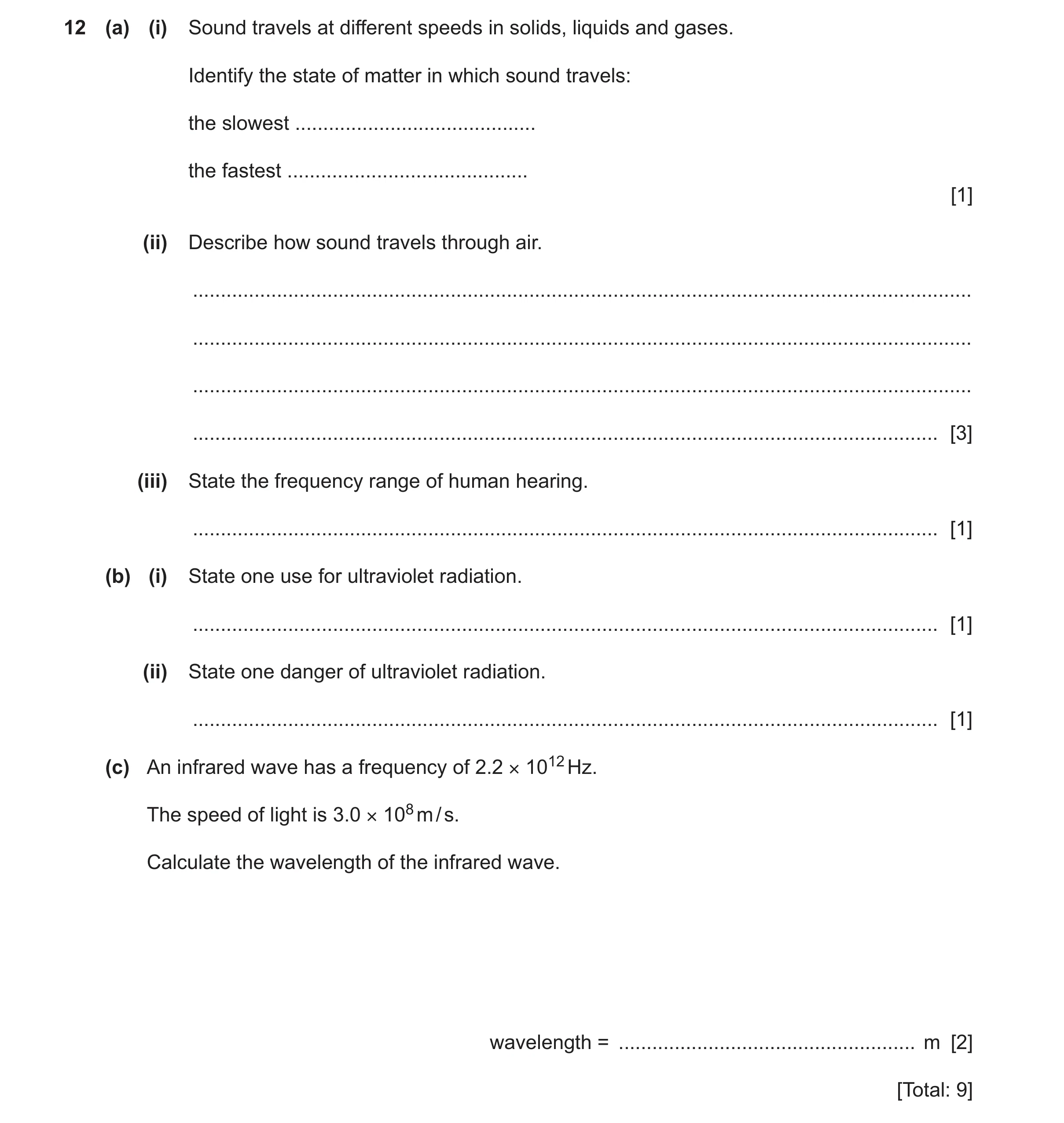
Q25 · Sound travels at different speeds in solids, liquids and gases 0654/42 Feb/March 2025
12 (a) (i) Sound travels at different speeds in solids, liquids and gases. Identify the state of matter in which sound travels: the slowest … the fastest … [1] (ii) Describe how sound travels through air. … … … … [3] (iii) State the frequency range of human hearing. … [1] (b) (i) State one use for ultraviolet radiation. … [1] (ii) State one danger of ultraviolet radiation. … [1] (c) An infrared wave has a frequency of 2.2 × 10¹² Hz. The speed of light is 3.0 × 10⁸ m / s. Calculate the wavelength of the infrared wave. wavelength = … m [2] [Total: 9]
9 marks
Mark scheme: 12(a)(i) gases and solid ; 1 12(a)(ii) any three from: 3 vibrations (vibrations) parallel to direction of energy transfer in a series of compressions and rarefactions AVP ; ; ; 12(a)(iii) 20–20 000 Hz ; 1 12(b)(i) detecting fake bank notes ; 1 (AVP) 12(b)(ii) damage to skin cells / damage to eyes / (skin) cancer / cell mutation ; 1 12(c) evidence of v = f or 3 108 = 2.2 1012 ; 2 1.4 10–4 (m) ;
This question in 0654/42 Feb/March 2025
Q26 · A diagram of a water wave 0654/43 May/June 2025
11 (a) Fig. 11.1 shows a diagram of a water wave. On Fig. 11.1, mark the amplitude and the wavelength of the wave using double-headed arrows (↔ or ↕). Label the amplitude A and the wavelength W. surface of water Fig. 11.1 [2] (b) A water wave has a wavelength of 0.078 m. The frequency of the wave is 0.50 Hz. Calculate the wave speed. wave speed = … m / s [2] (c) (i) Lenses refract light. Complete the ray diagram for the lens in Fig. 11.2 to show the location of the image formed. Draw the image formed with an arrow. converging lens object F F F = principal focus Fig. 11.2 [3] (ii) In another experiment, an object is placed at a distance of less than the focal length from a thin converging lens. Describe the characteristics of the image formed. … … [2] (d) The Sun transfers energy via infrared waves to the Earth. The Earth emits infrared radiation into space. State and explain what happens to the temperature of the Earth during the daytime and during the nighttime. daytime … … nighttime … … [3] [Total: 12]
12 marks
Mark scheme: 11(a) wavelength correct; 2 amplitude correct; 11(b) evidence of v = f or v = 0.5 0.078; 2 0.039 (m/s); 11(c)(i) any 2 from 3 ray parallel to principal axis and refracted through focal point; straight ray from top of object through centre of lens; ray through principal focus and refracted parallel of the principal axis; AND inverted image with arrow in correct location; 11(c)(ii) any two from: 2 upright; magnified; virtual; 11(d) rises in daytime and falls in nighttime; 3 day: energy in (to Earth) energy out (from Earth); night: energy in (to Earth) > energy out (from Earth);
This question in 0654/43 May/June 2025
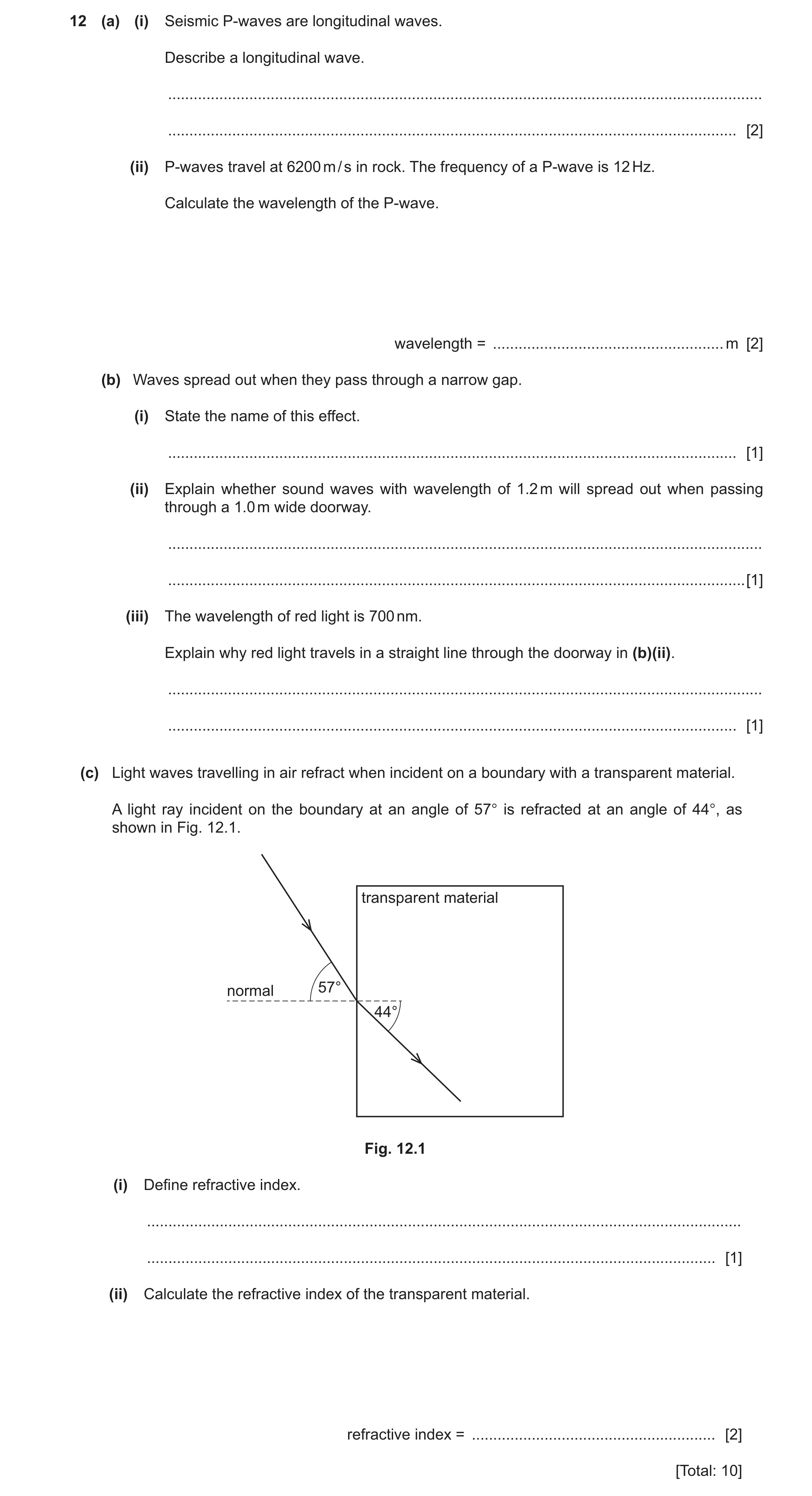
Q27 · Seismic P-waves are longitudinal waves 0654/41 Oct/Nov 2025
12 (a) (i) Seismic P-waves are longitudinal waves. Describe a longitudinal wave. … … [2] (ii) P-waves travel at 6200 m / s in rock. The frequency of a P-wave is 12 Hz. Calculate the wavelength of the P-wave. wavelength = … m [2] (b) Waves spread out when they pass through a narrow gap. (i) State the name of this effect. … [1] (ii) Explain whether sound waves with wavelength of 1.2 m will spread out when passing through a 1.0 m wide doorway. … … [1] (iii) The wavelength of red light is 700 nm. Explain why red light travels in a straight line through the doorway in (b)(ii). … … [1] (c) Light waves travelling in air refract when incident on a boundary with a transparent material. A light ray incident on the boundary at an angle of 57° is refracted at an angle of 44°, as shown in Fig. 12.1. transparent material normal 57° 44° Fig. 12.1 (i) Define refractive index. … … [1] (ii) Calculate the refractive index of the transparent material. refractive index = … [2] [Total: 10]
10 marks
Mark scheme: 12(a)(i) vibrations / oscillations are parallel ; 2 (vibrations / oscillations are parallel) to the direction of propagation / to the direction of travel / to the direction of energy transfer ; 12(a)(ii) evidence of v = f or 6200 = 12 ; 2 520 (m) ; 12(b)(i) diffraction ; 1 12(b)(ii) yes (sound waves spread out) 1 AND wavelength is similar to width of gap ; 12(b)(iii) wavelength is much less than width of gap / ORA ; 1 12(c)(i) ratio of the speeds of a wave in two different regions ; 1 12(c)(ii) n = sin 57 ÷ sin 44 ; 2 1.2 ;
This question in 0654/41 Oct/Nov 2025
 13 / 47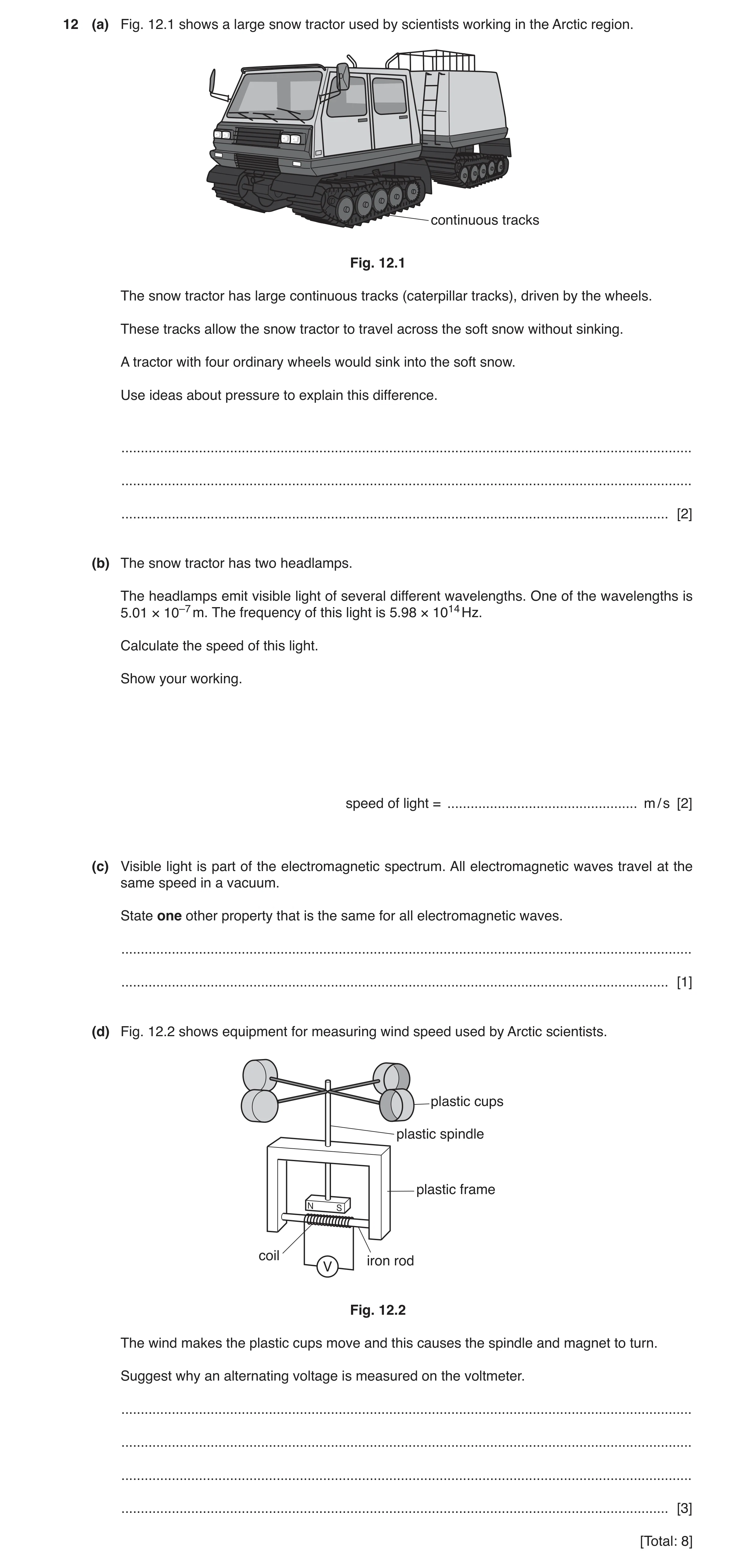
 25 / 47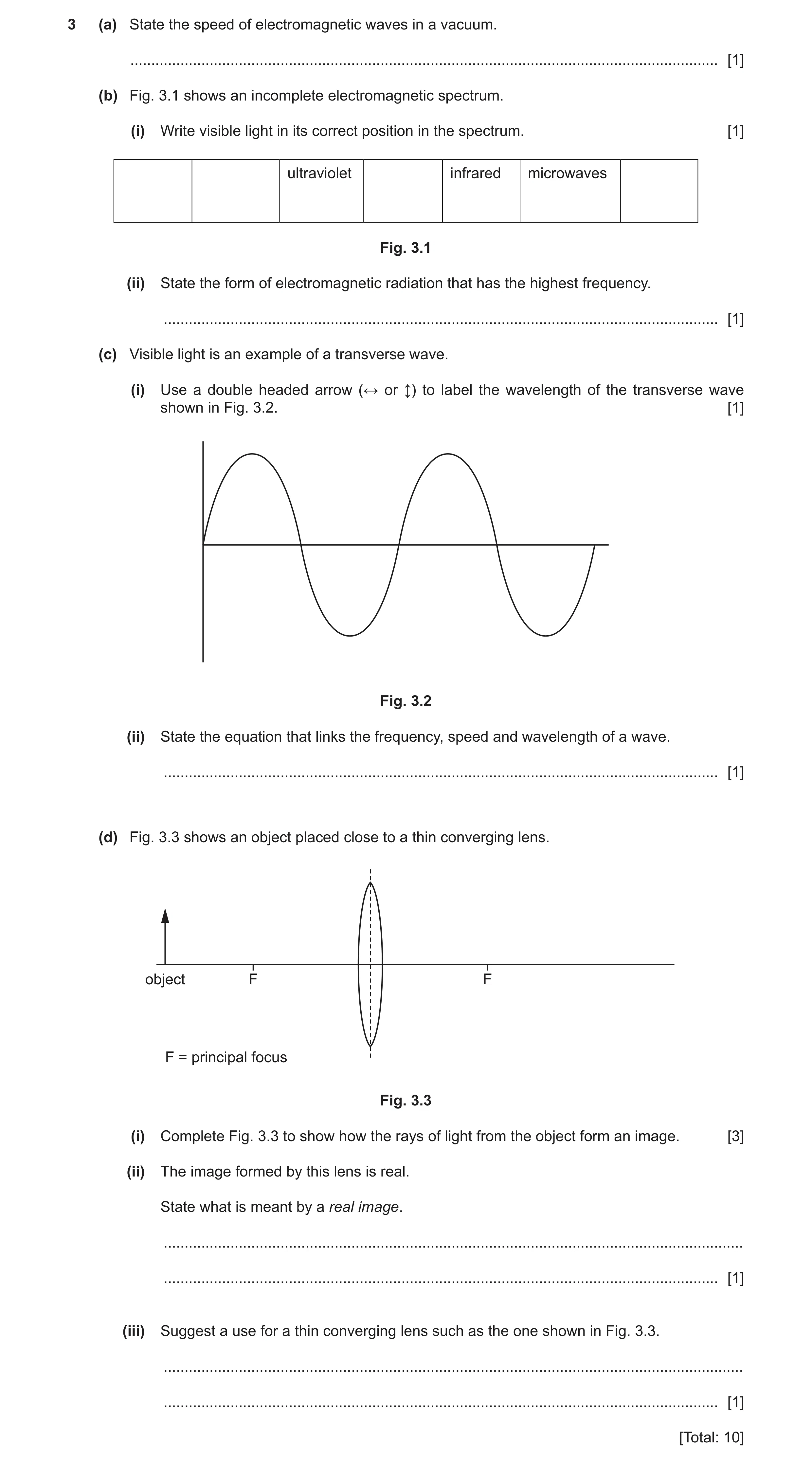
 44 / 47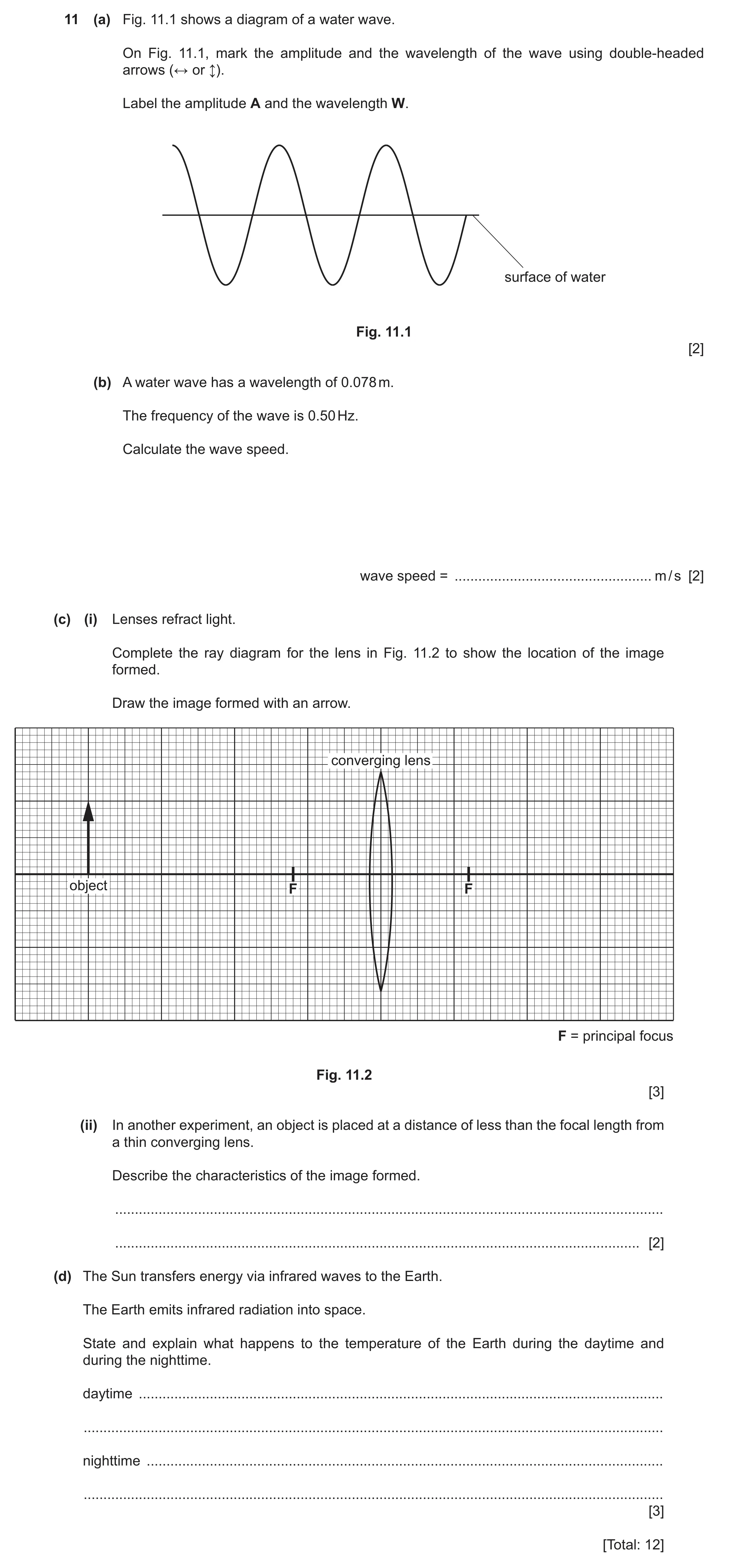
 8
8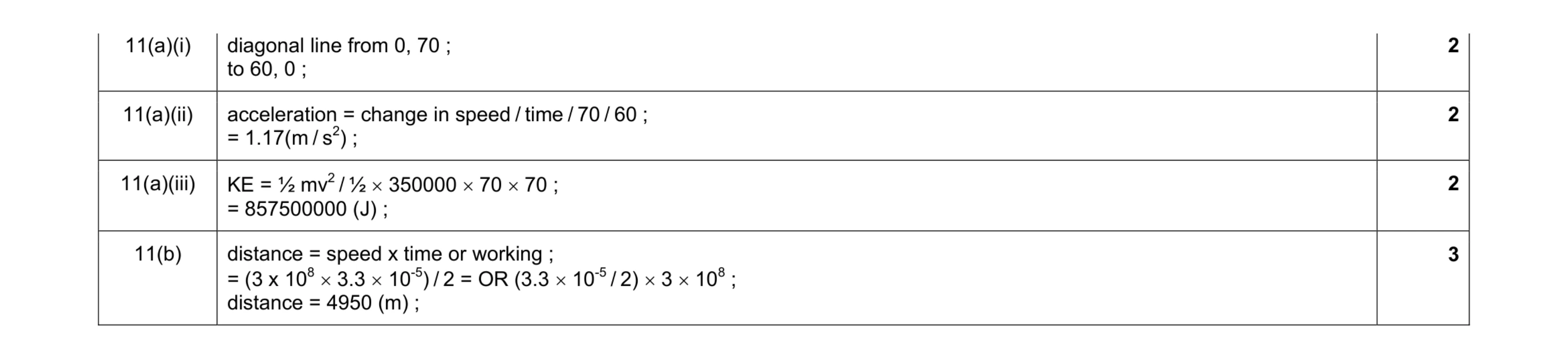 9
9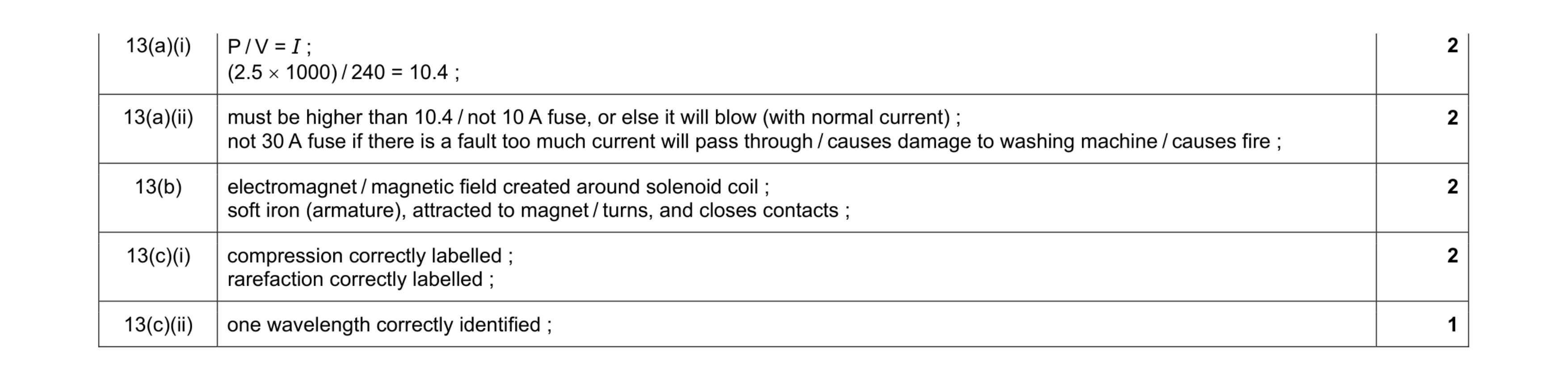 9
9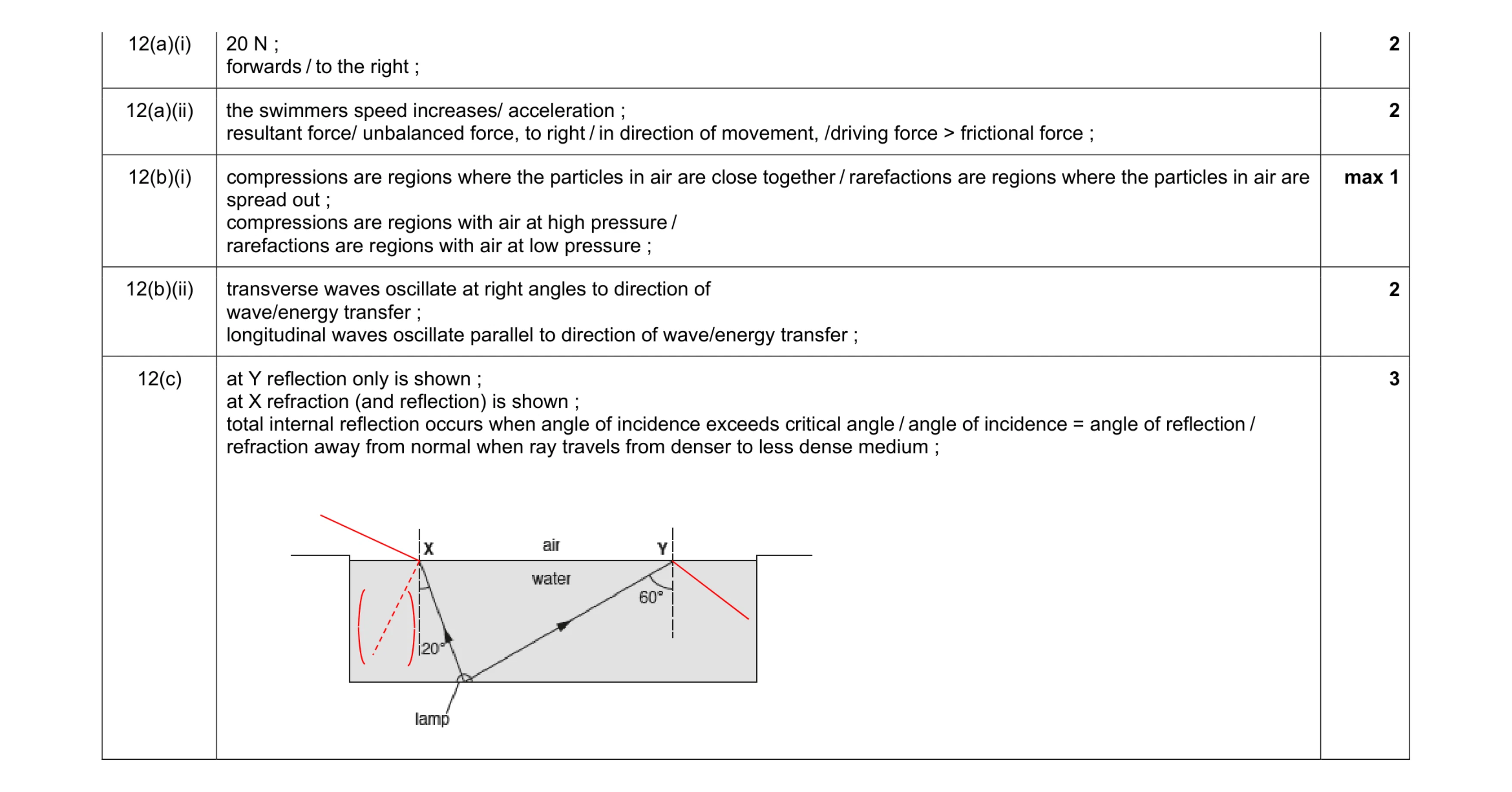 10
10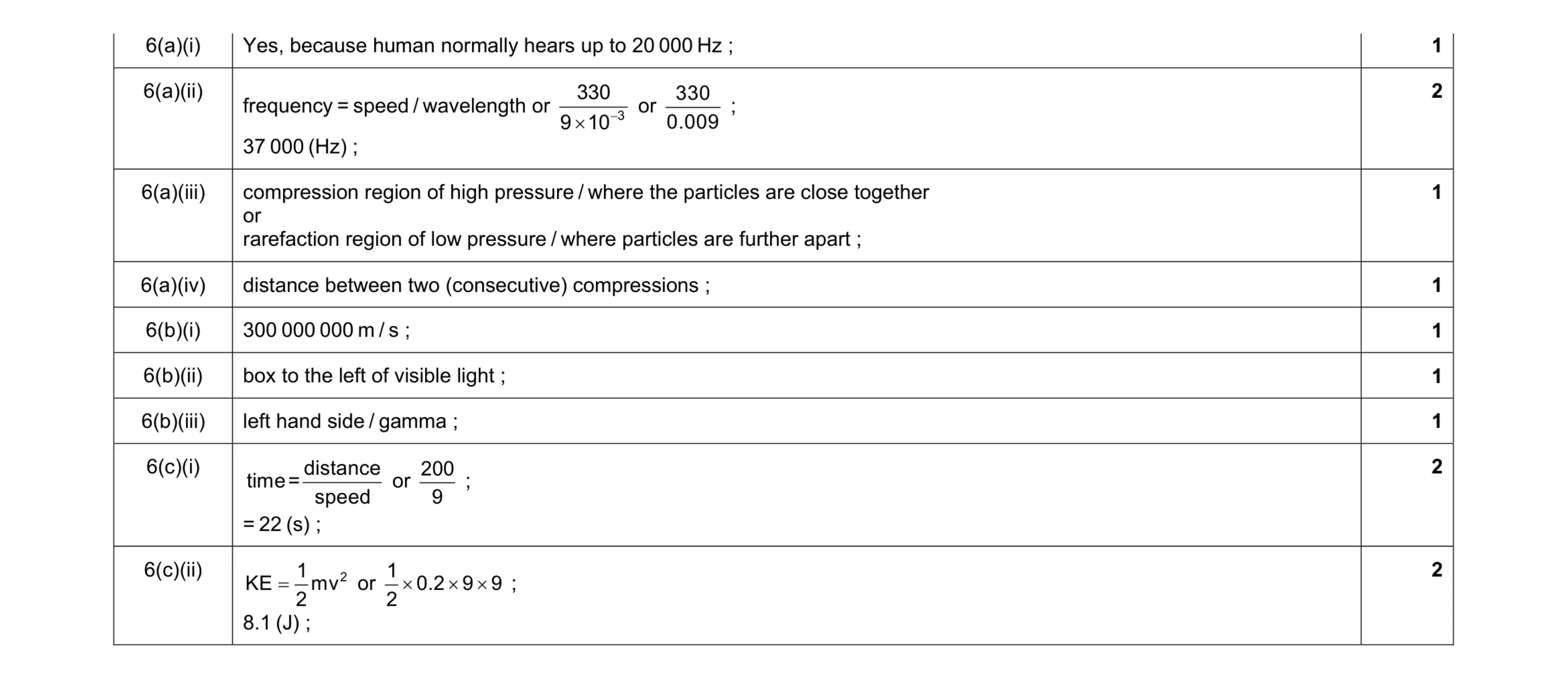 12
12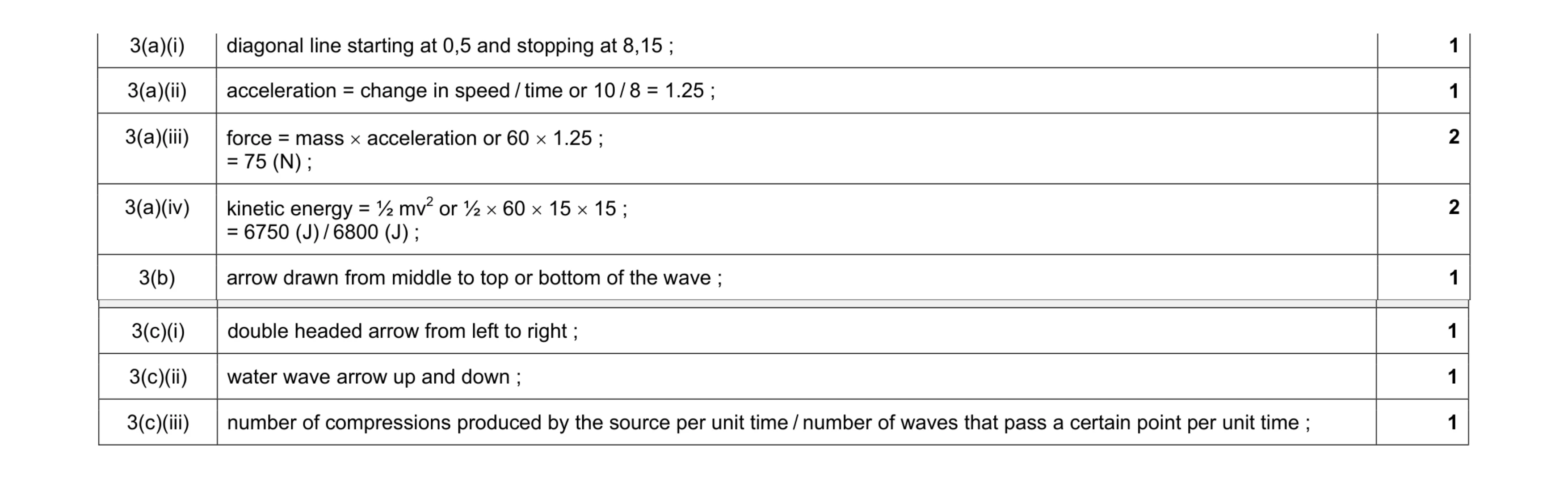 10
10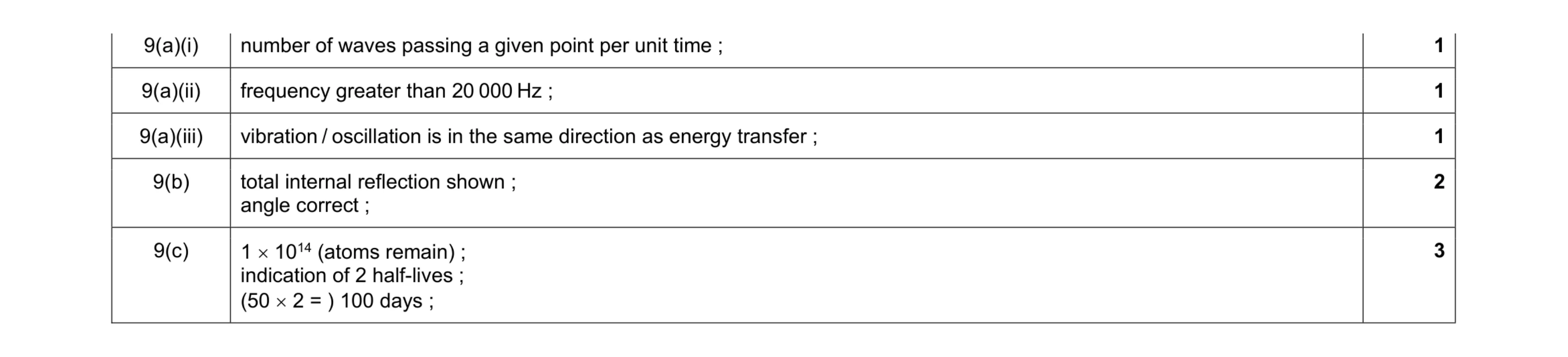 8
8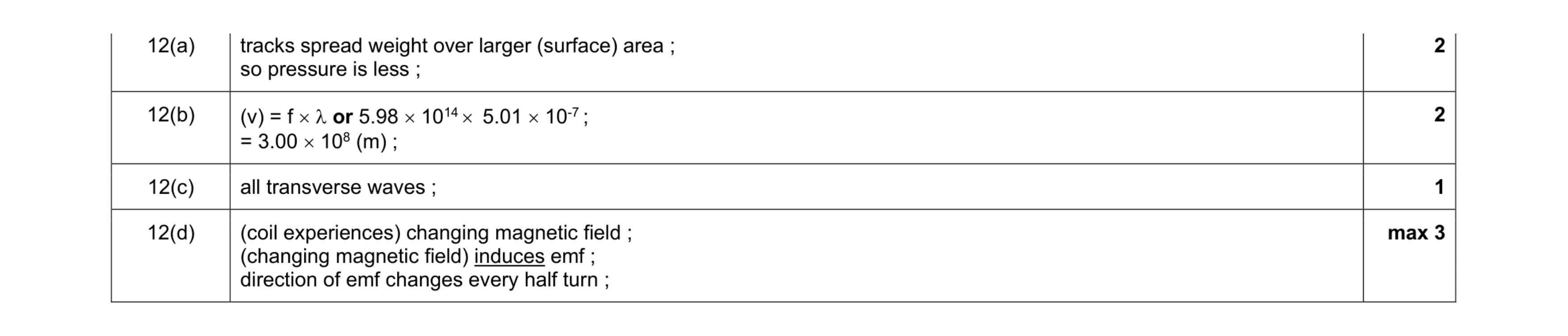 8
8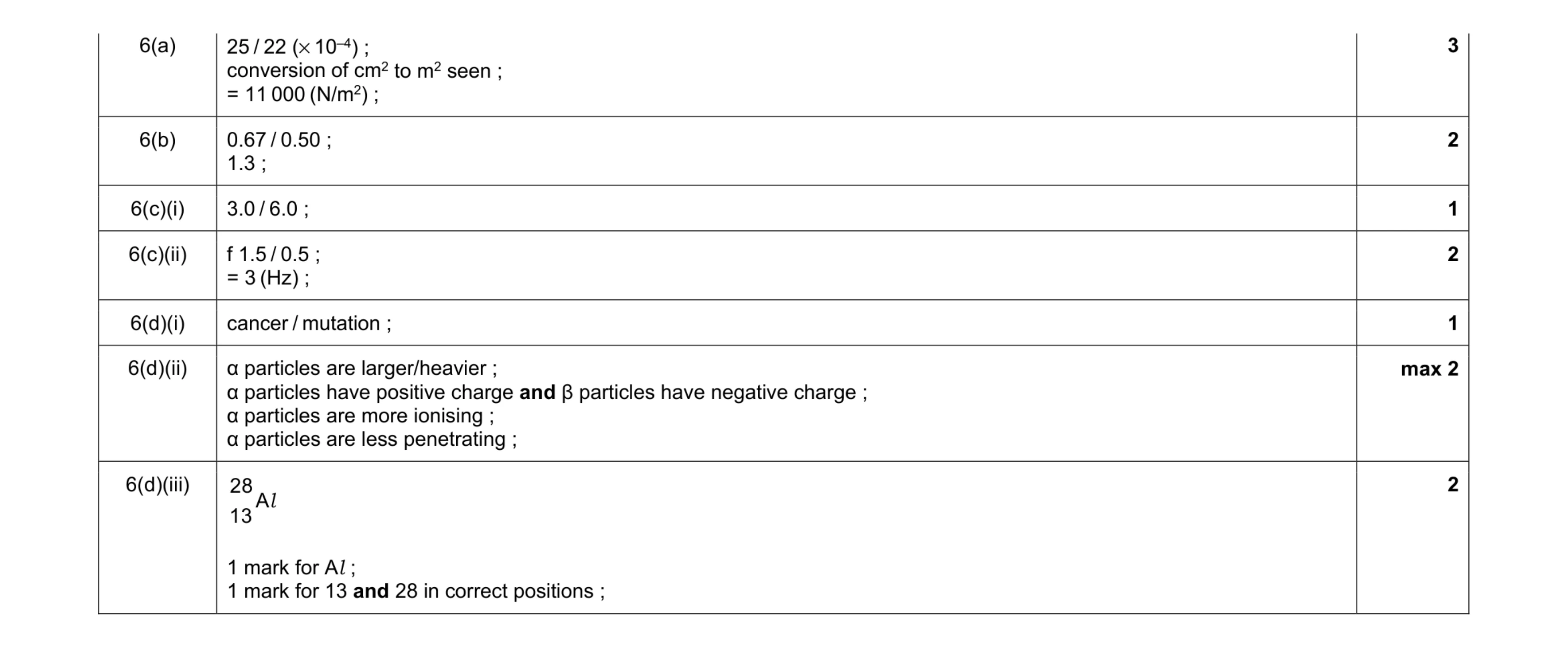 13
13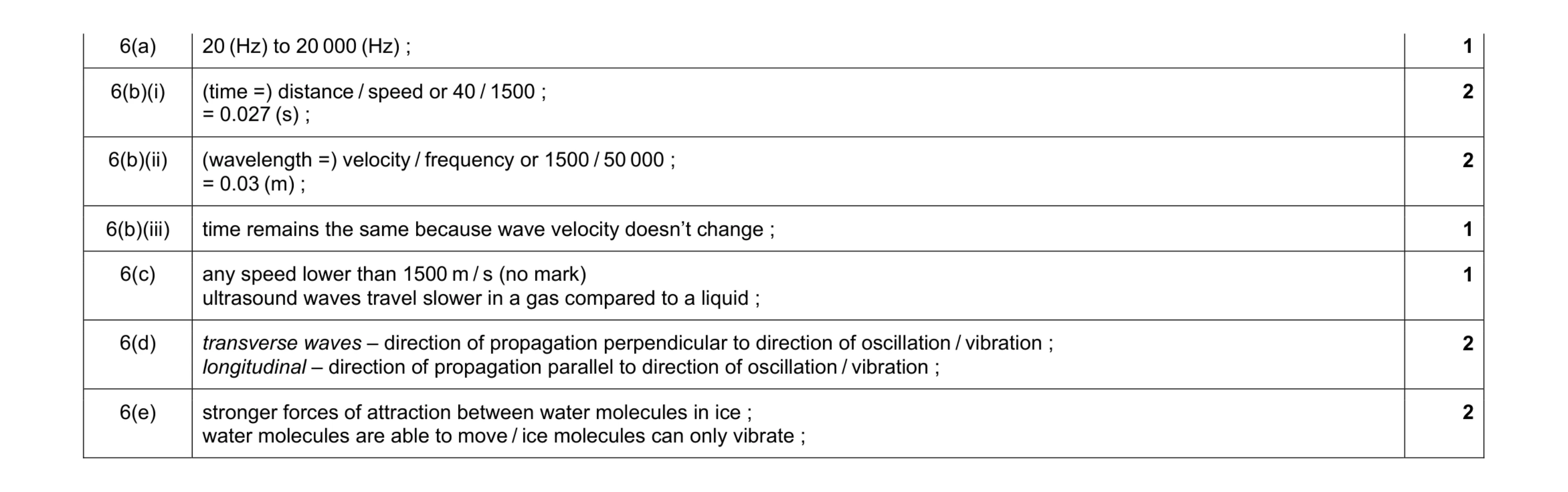 11
11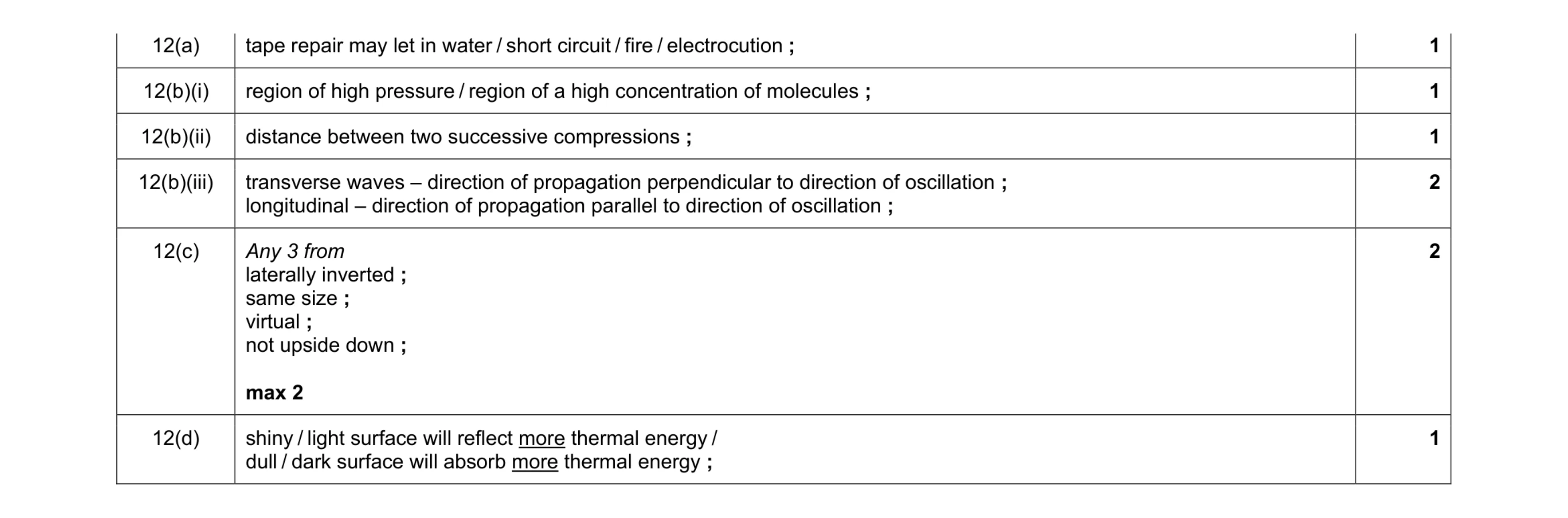 8
8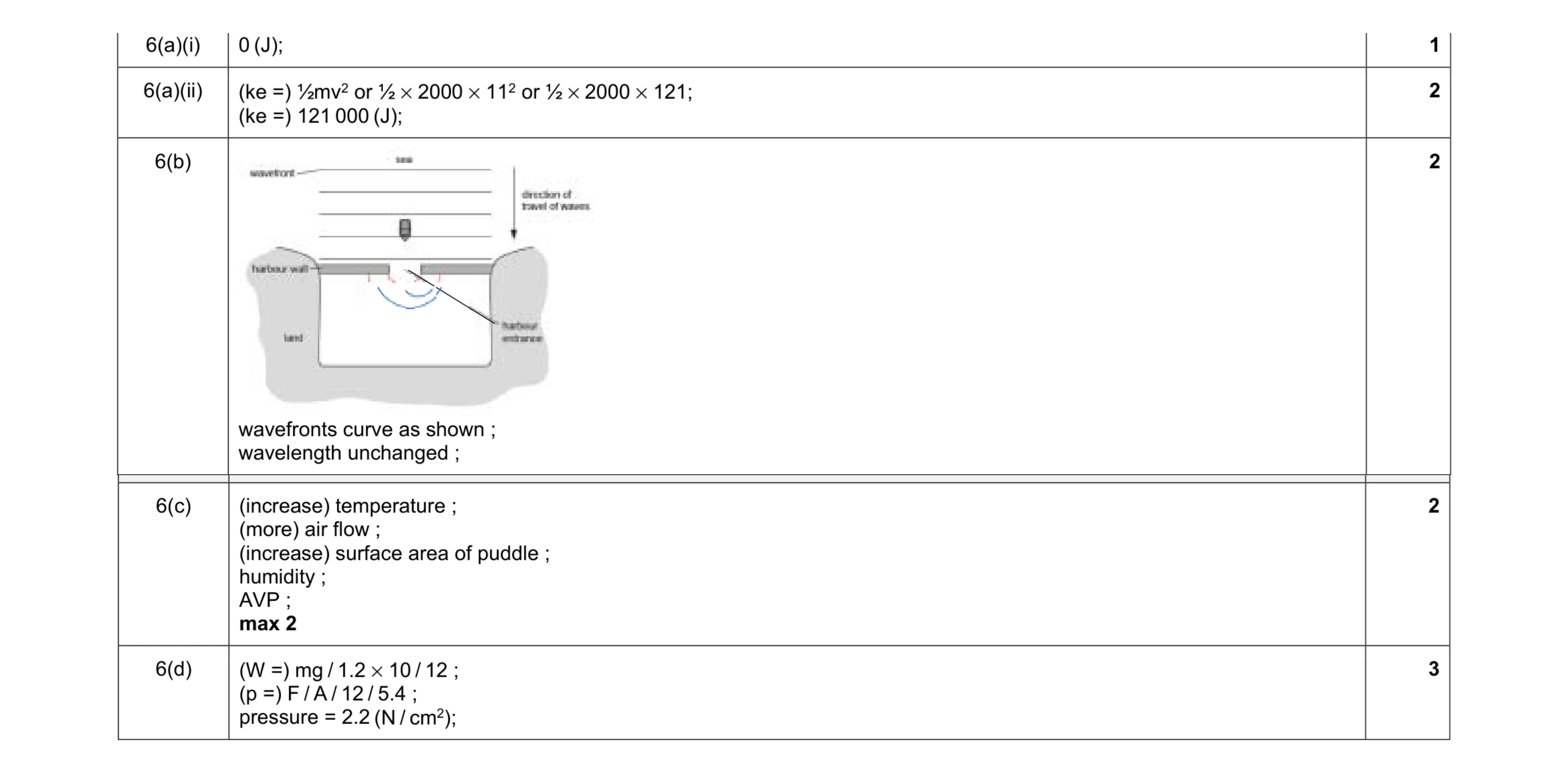 10
10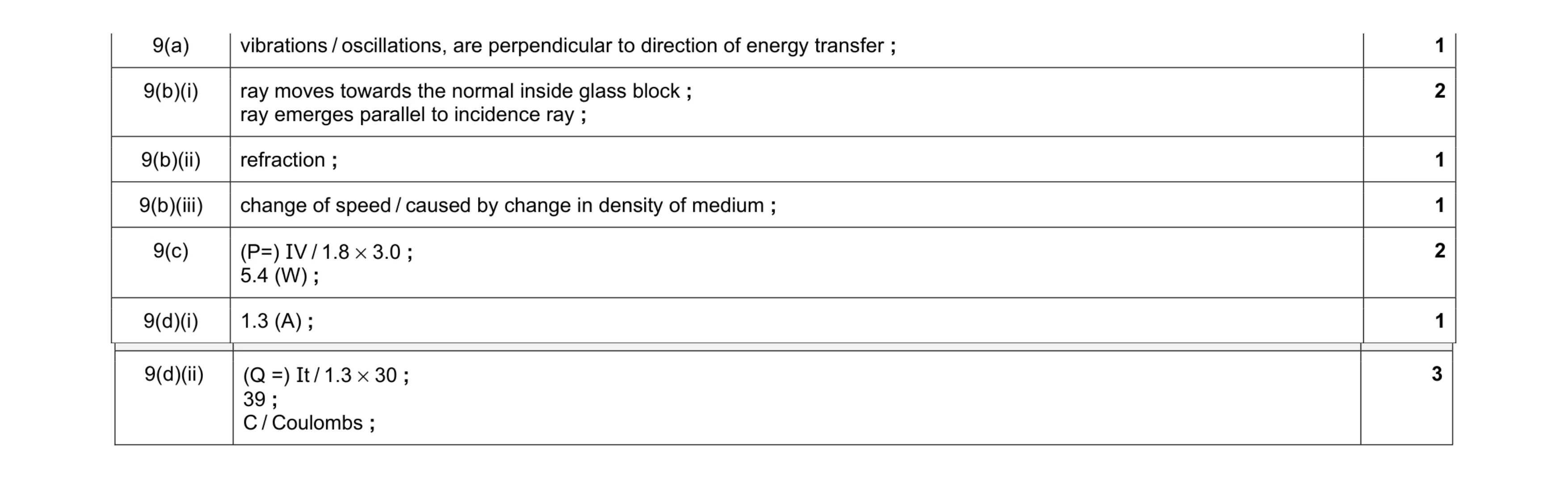 11
11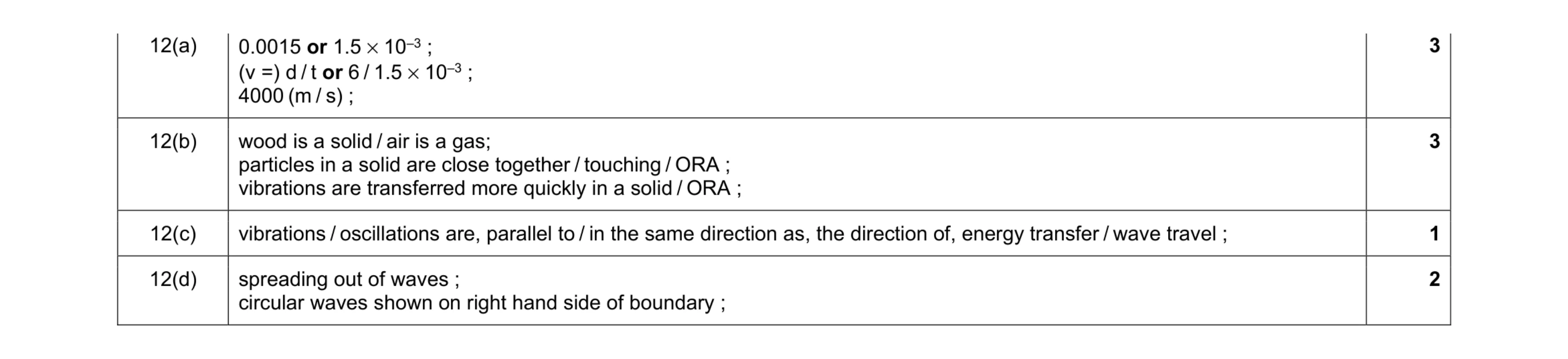 9
9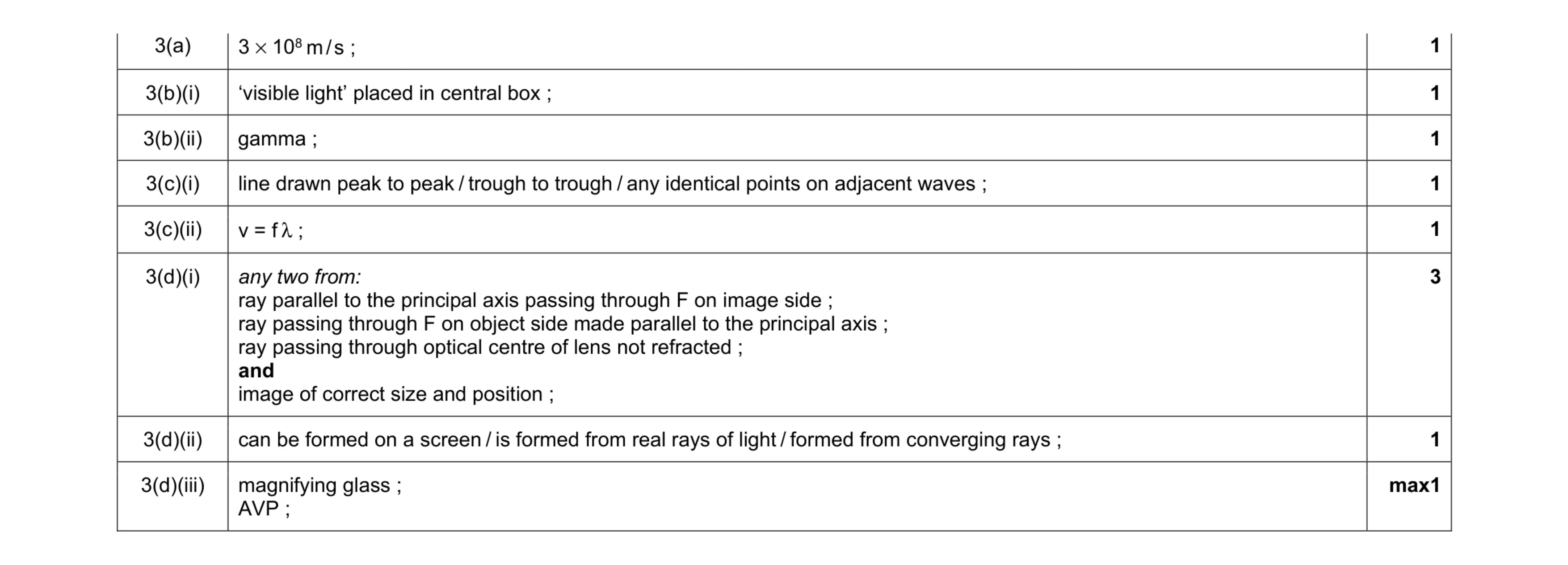 10
10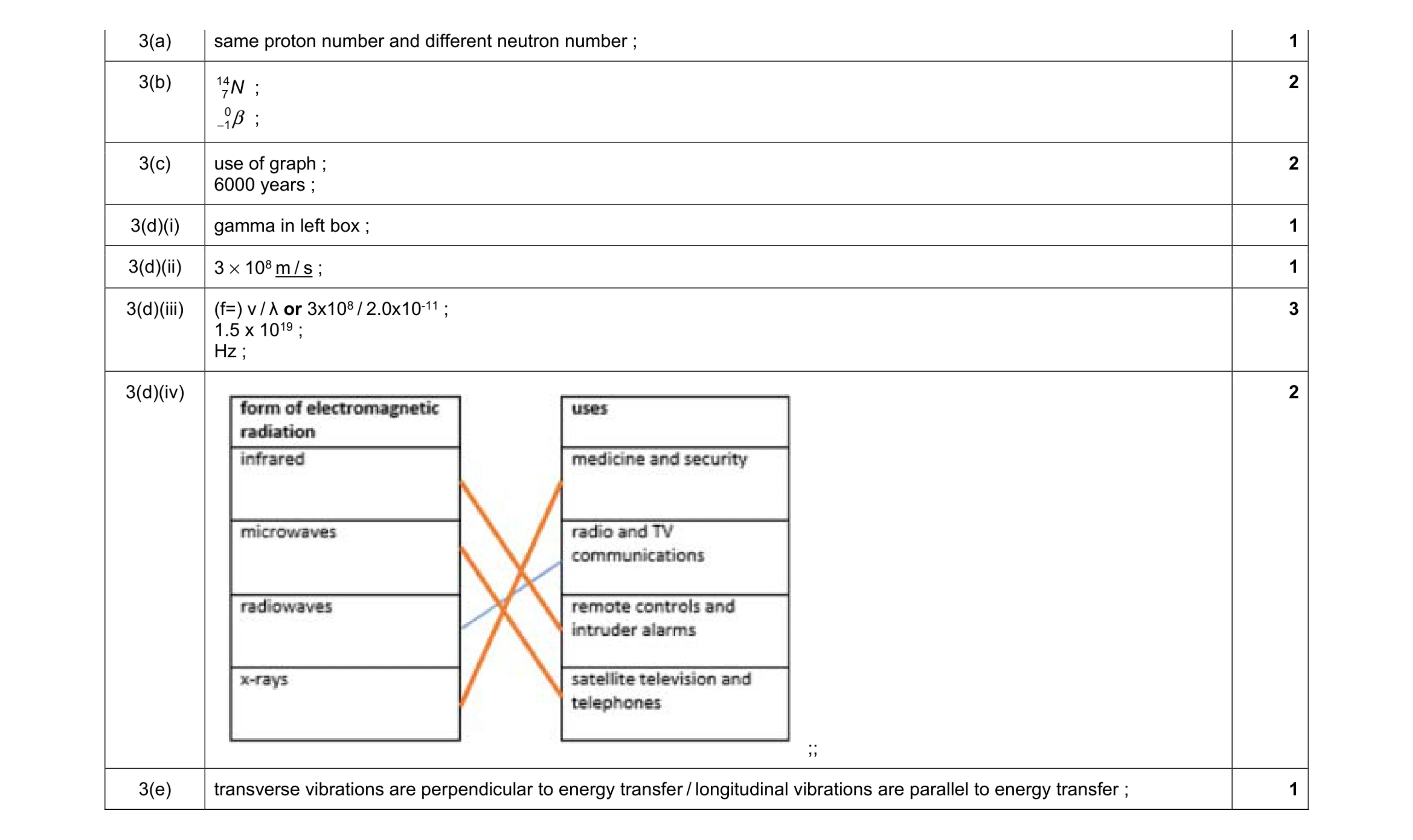 13
13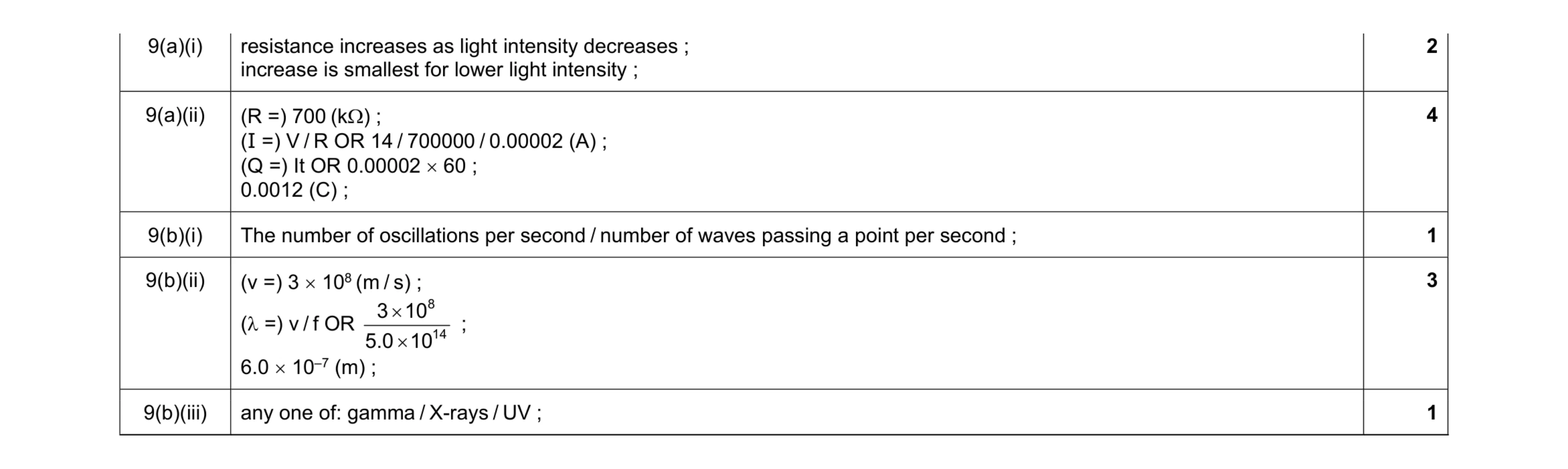 11
11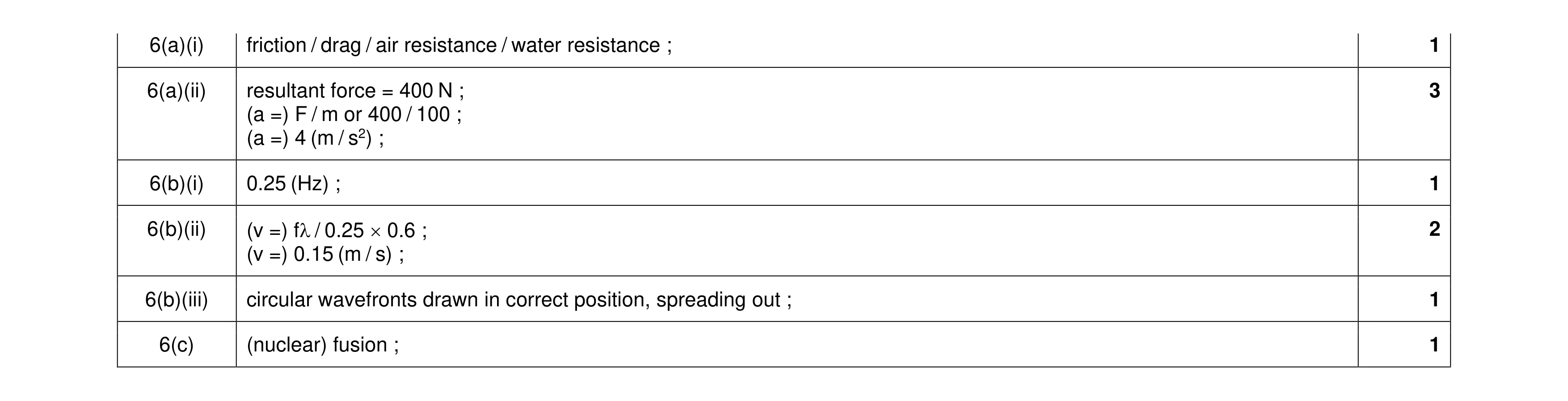 9
9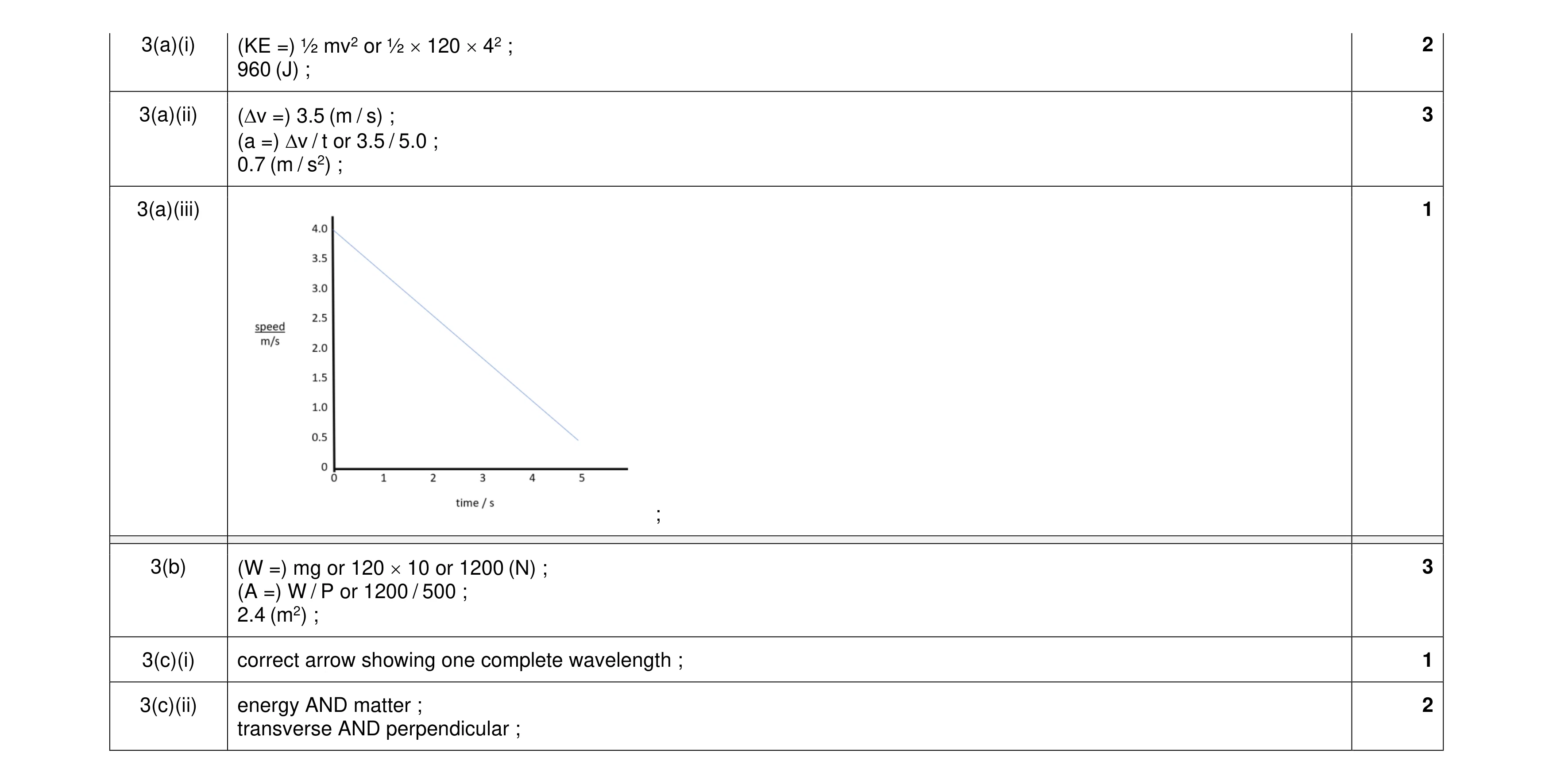 12
12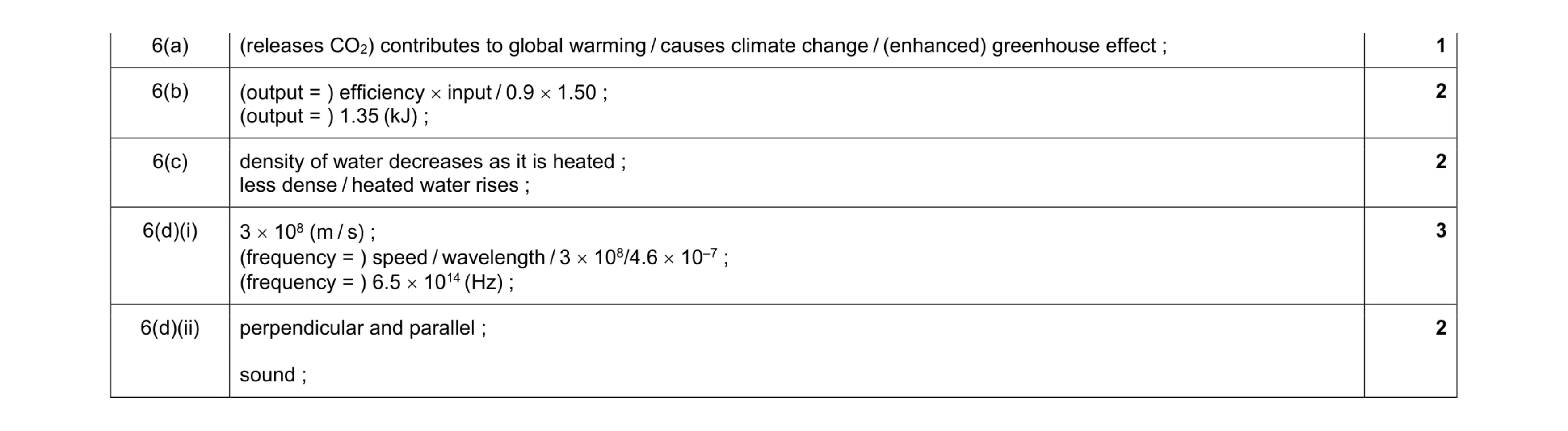 10
10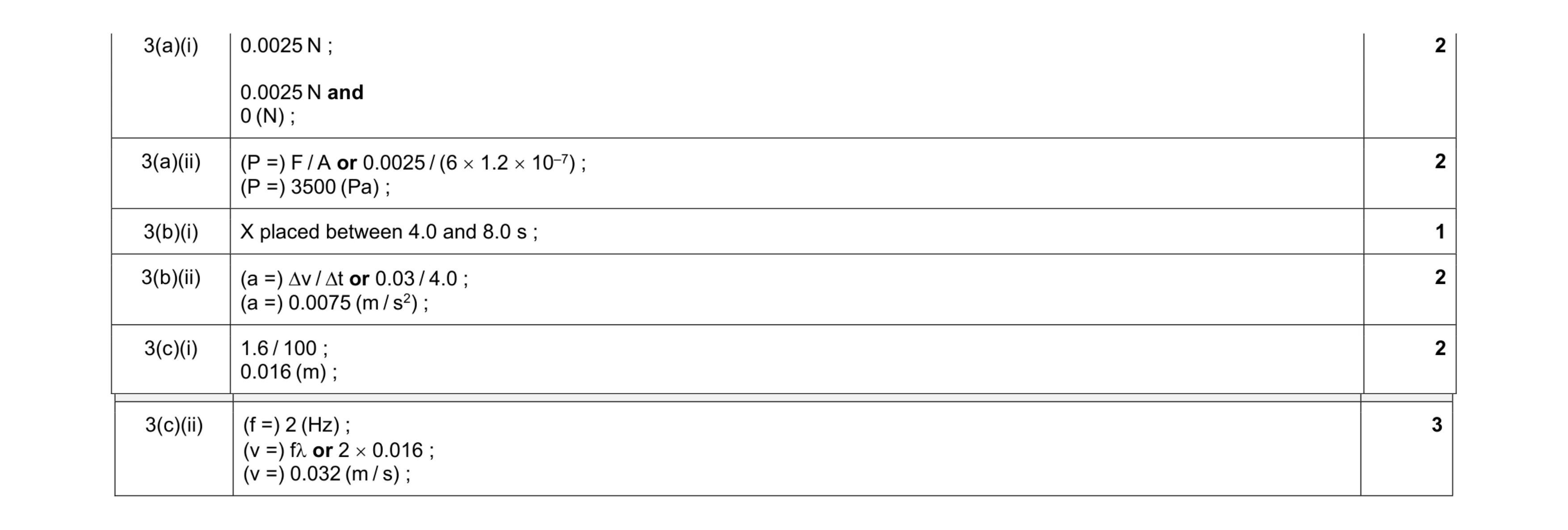 12
12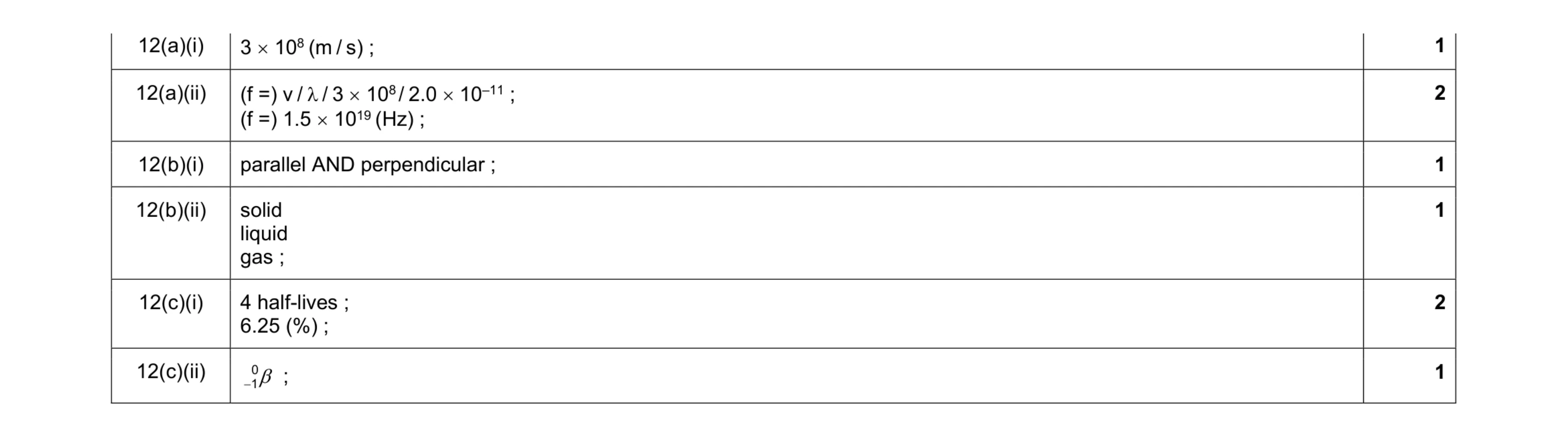 8
8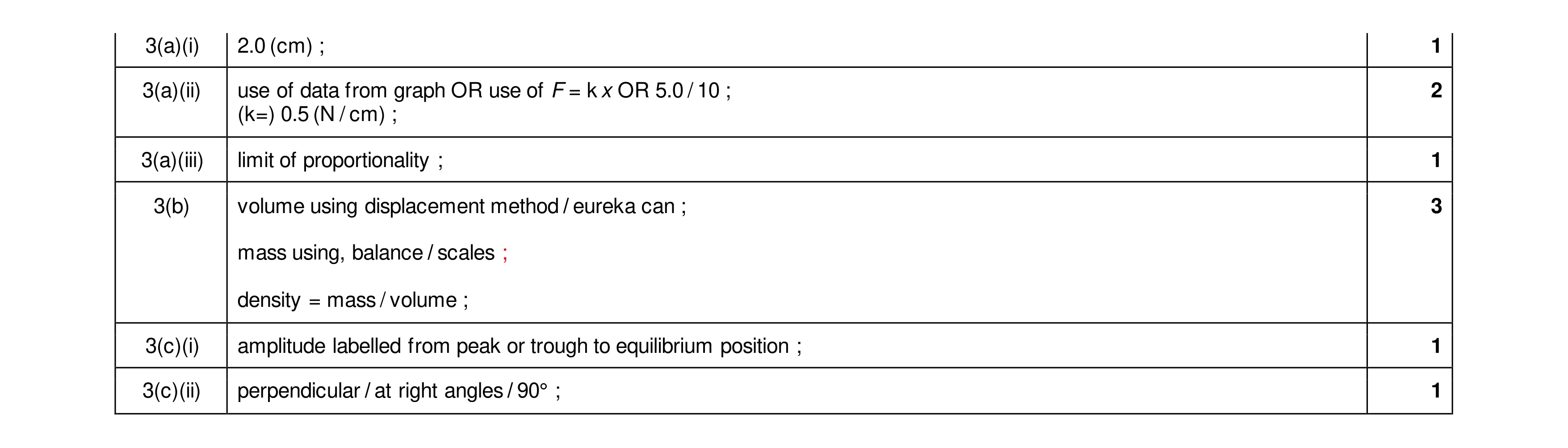 9
9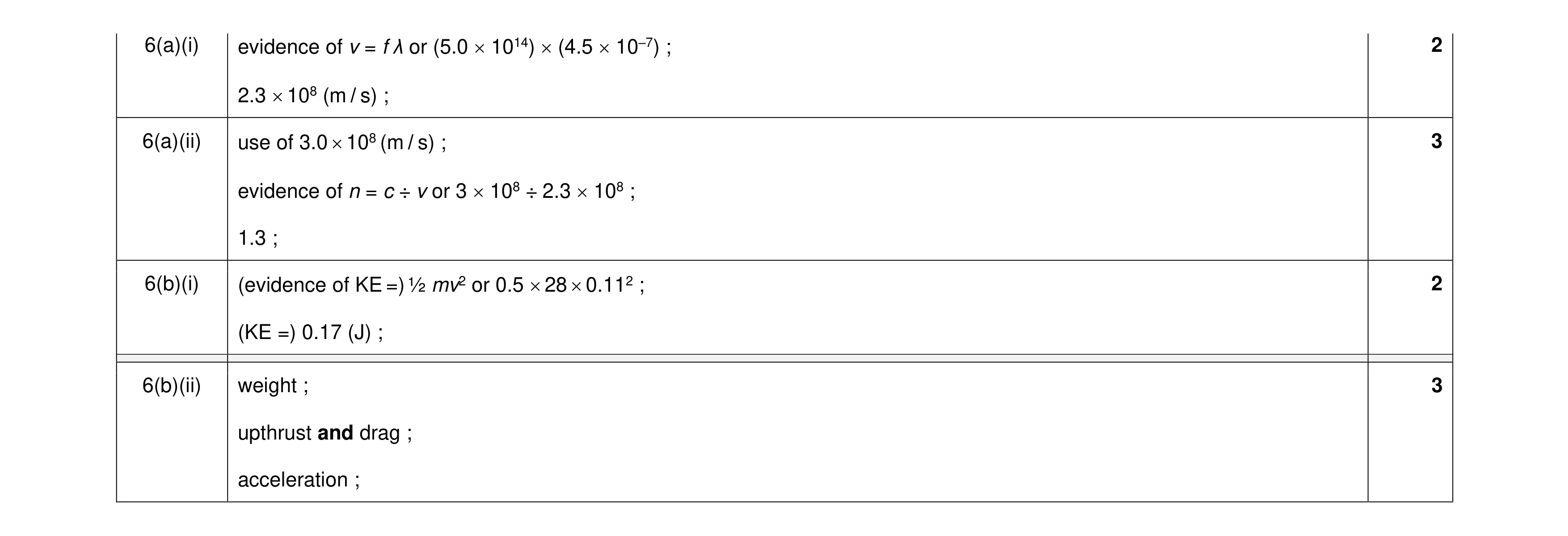 10
10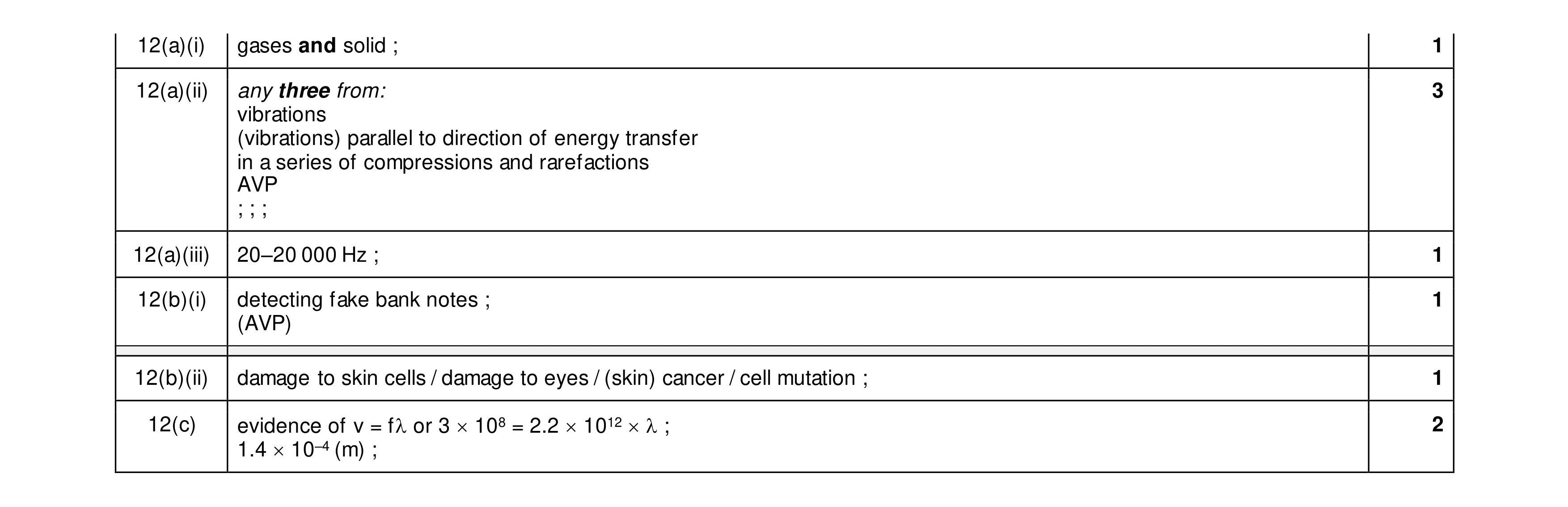 9
9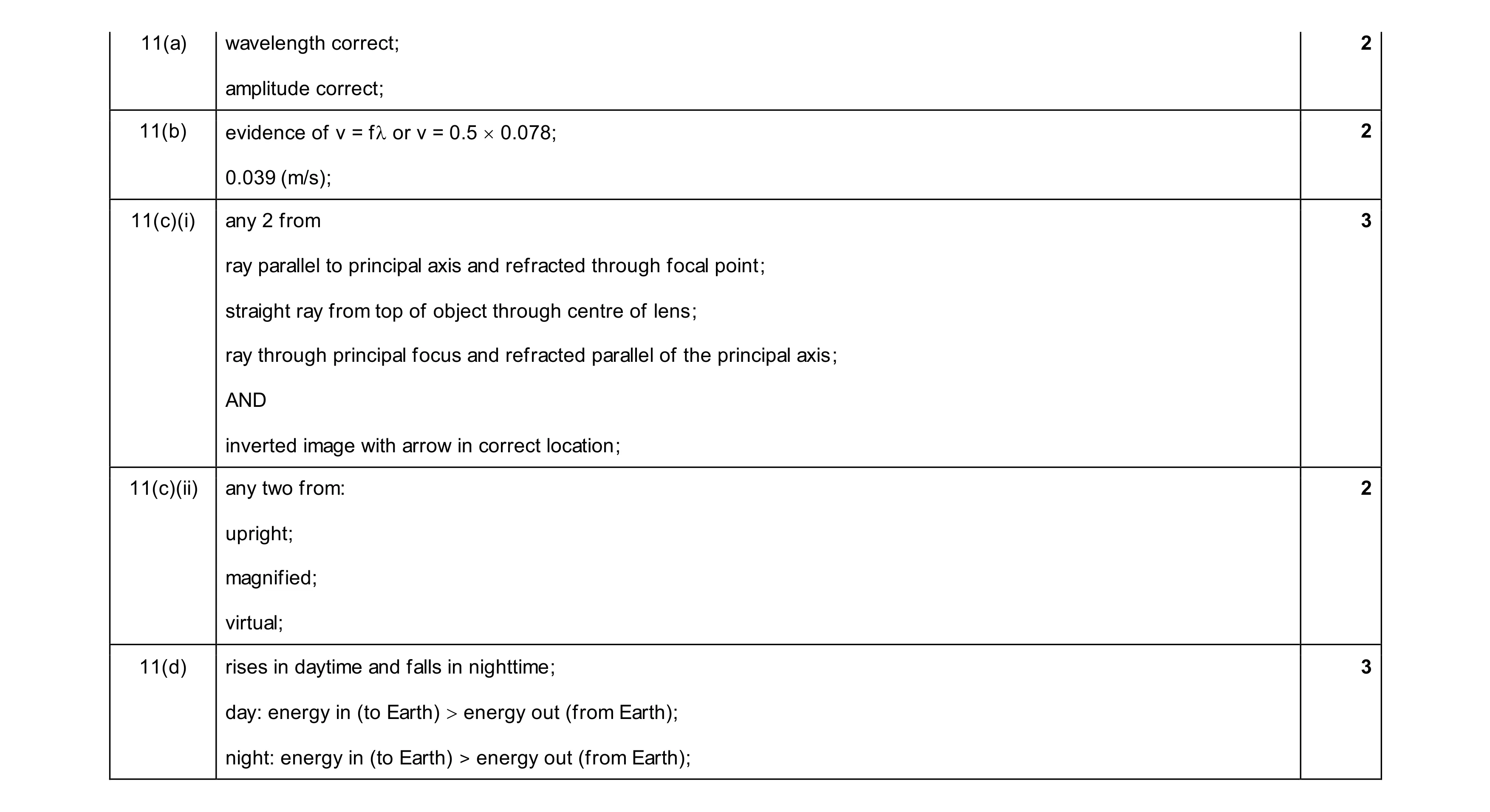 12
12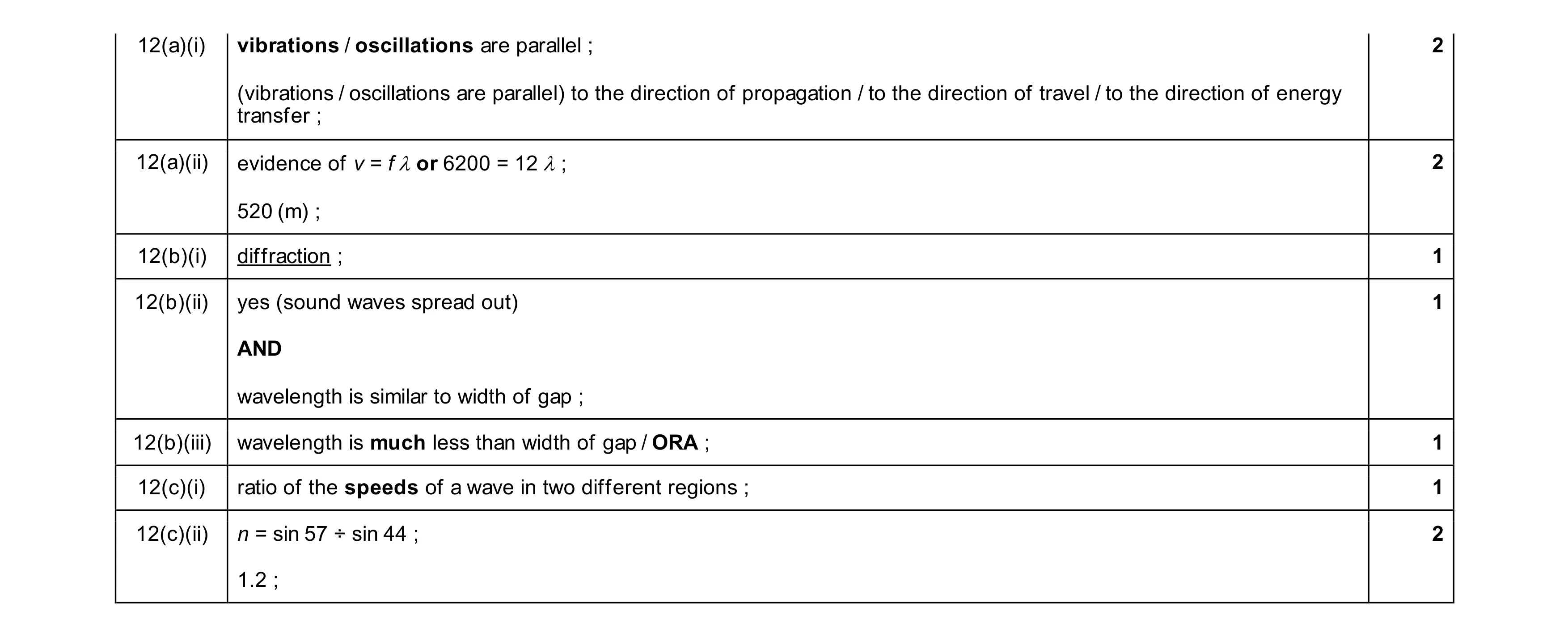 10
10