Questions as text
Q1 · A student wants to find the density of a small stone 0625/32 Feb/March 2017
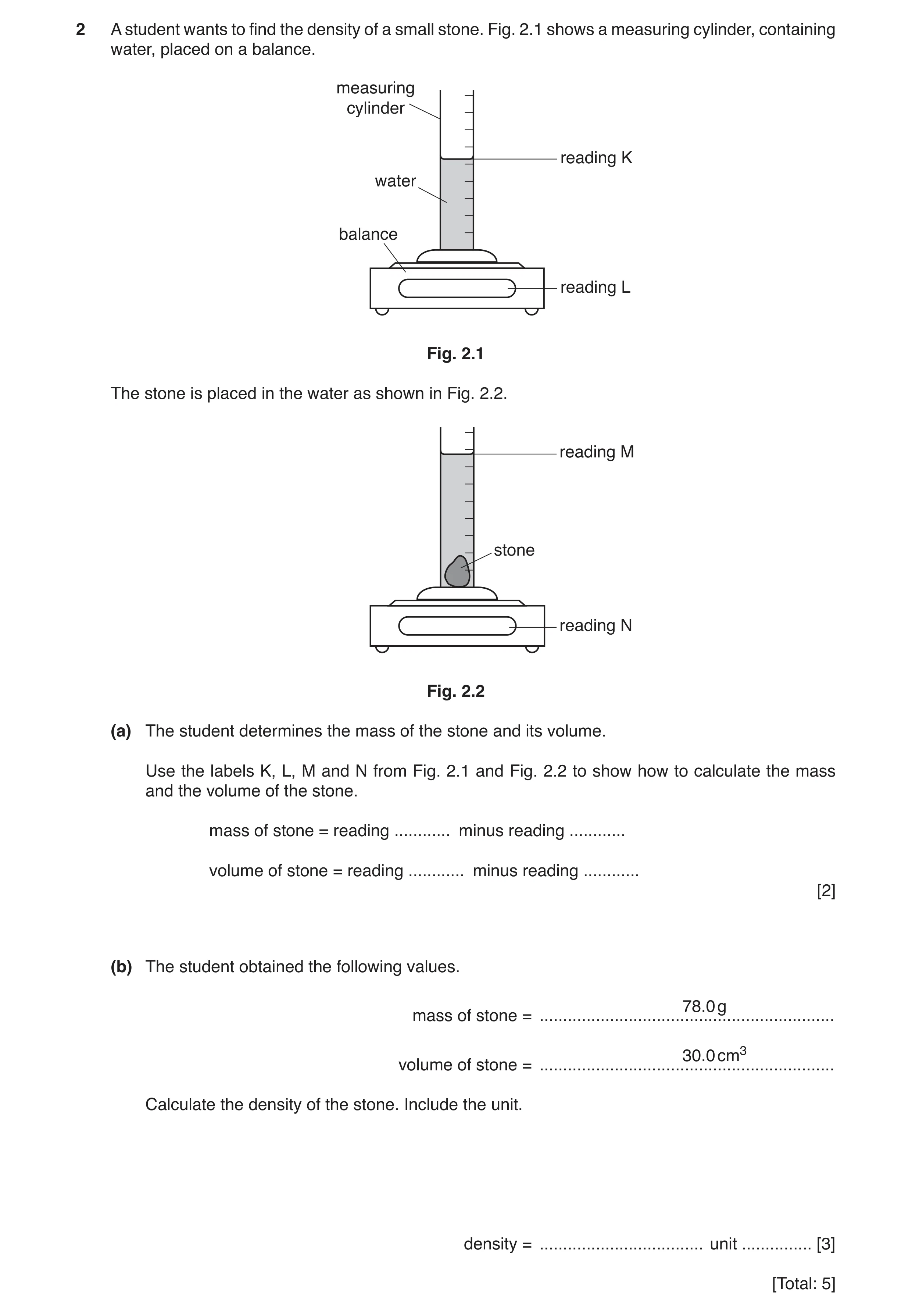
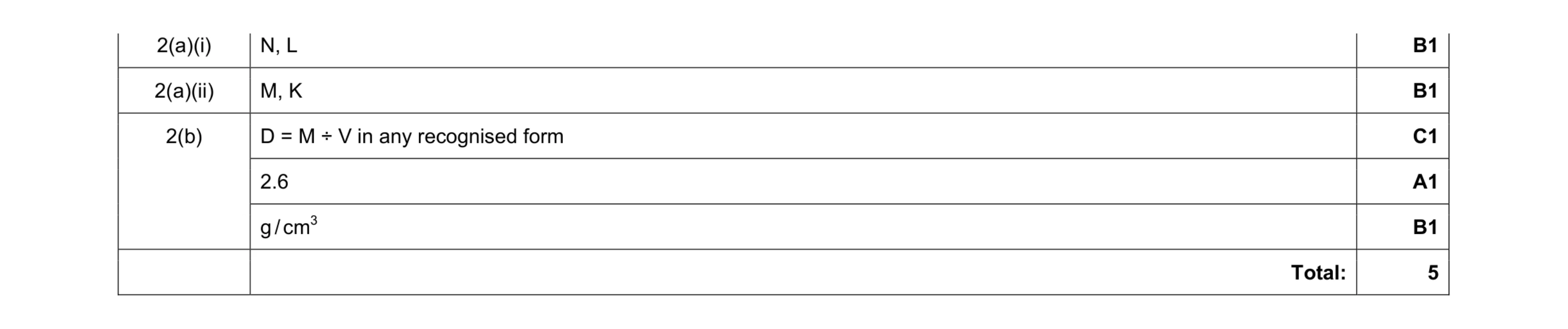
2 A student wants to find the density of a small stone. Fig. 2.1 shows a measuring cylinder, containing water, placed on a balance. measuring cylinder reading K water balance reading L Fig. 2.1 The stone is placed in the water as shown in Fig. 2.2. reading M stone reading N Fig. 2.2 (a) The student determines the mass of the stone and its volume. Use the labels K, L, M and N from Fig. 2.1 and Fig. 2.2 to show how to calculate the mass and the volume of the stone. mass of stone = reading … minus reading … volume of stone = reading … minus reading … [2] (b) The student obtained the following values. 78.0 g mass of stone = … 30.0 cm3 volume of stone = … Calculate the density of the stone. Include the unit. density = … unit … [3] [Total: 5]
5 marks
Mark scheme: 2(a)(i) N, L B1 2(a)(ii) M, K B1 2(b) D = M ÷ V in any recognised form C1 2.6 A1 g / cm3 B1 Total: 5
This question in 0625/32 Feb/March 2017
Q2 · The walls of a room are to be painted 0625/32 May/June 2017
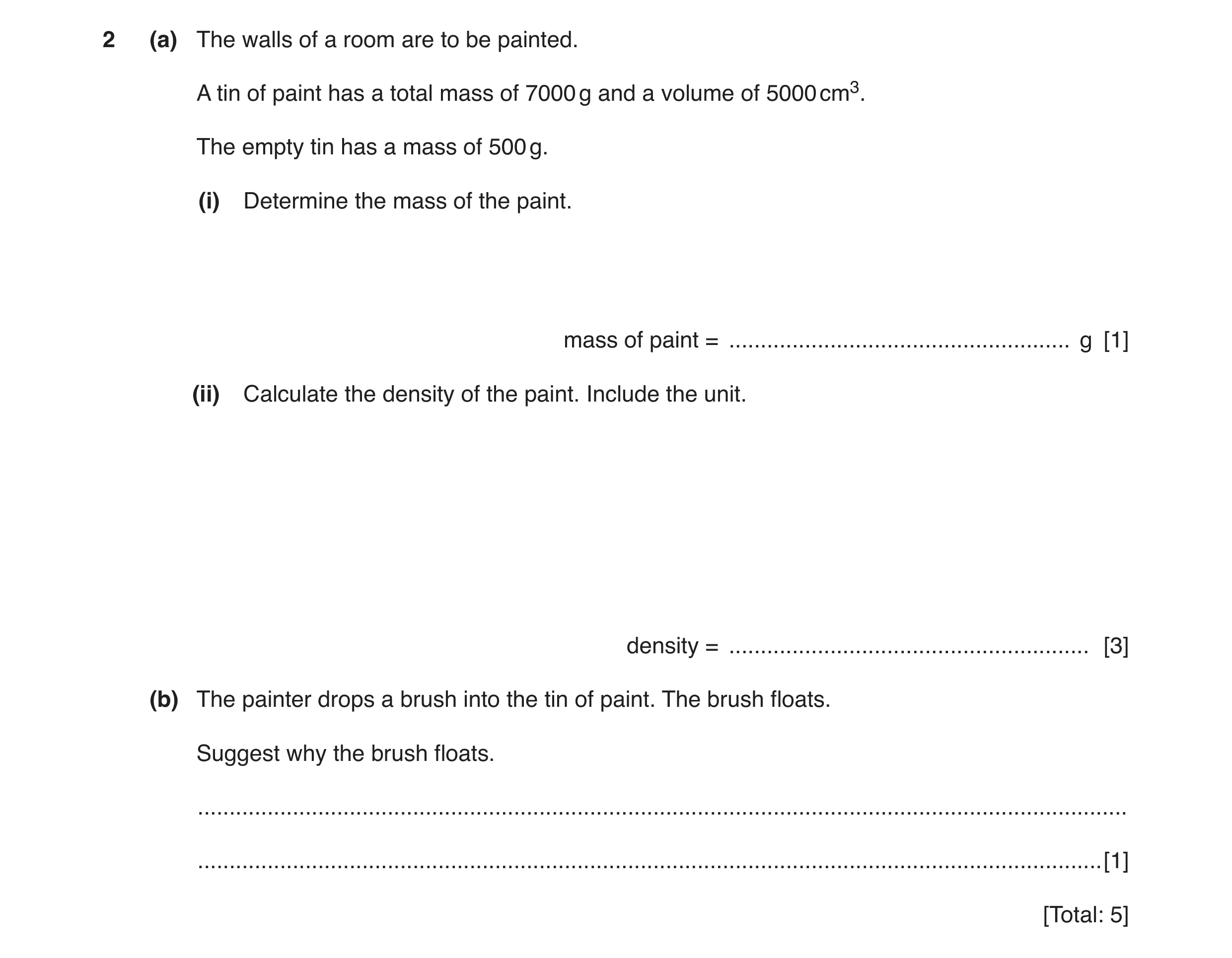
2 (a) The walls of a room are to be painted. A tin of paint has a total mass of 7000 g and a volume of 5000 cm3. The empty tin has a mass of 500 g. (i) Determine the mass of the paint. mass of paint = … g [1] (ii) Calculate the density of the paint. Include the unit. density = … [3] (b) The painter drops a brush into the tin of paint. The brush floats. Suggest why the brush floats. … … [1] [Total: 5]
5 marks
Mark scheme: 2(a)(i) 6500 (g) B1 2(a)(ii) density = mass ÷ volume in any form B1 1.3 A1 g / cm3 B1 2(b) density (of brush) is less (than) density of paint B1 Total: 5
This question in 0625/32 May/June 2017
Q3 · A warning marker floating on the surface of a lake 0625/31 Oct/Nov 2017
3 Fig 3.1 shows a warning marker floating on the surface of a lake. warning marker surface of lake metal chain heavy object bottom of lake Fig. 3.1 The marker is attached by a metal chain to a heavy object on the bottom of the lake. (a) Fig. 3.2 shows the forces acting on the marker at one moment in time. 280 N 250 N Fig. 3.2 Calculate the resultant force on the marker. resultant force = … N direction = … [2] (b) Fig. 3.3 shows part of the metal chain. It is made from small metal loops. Fig. 3.3 A damaged loop is removed from the chain. Describe a method to determine the density of the metal from which the loops are made. … … … … … … … [5] [Total: 7]
7 marks
Mark scheme: 3(a) subtraction of forces to obtain resultant or 30 (N) B1 up(wards) B1 3(b) any five from: measure mass (on top pan balance) part fill measuring cylinder with water (and note volume) submerge link in measuring cylinder determine increase in volume increase in volume = volume of link use density = mass ÷ volume Only award full marks for a viable method B5
This question in 0625/31 Oct/Nov 2017
Q4 · A glass vase used for displaying flowers 0625/32 Oct/Nov 2017
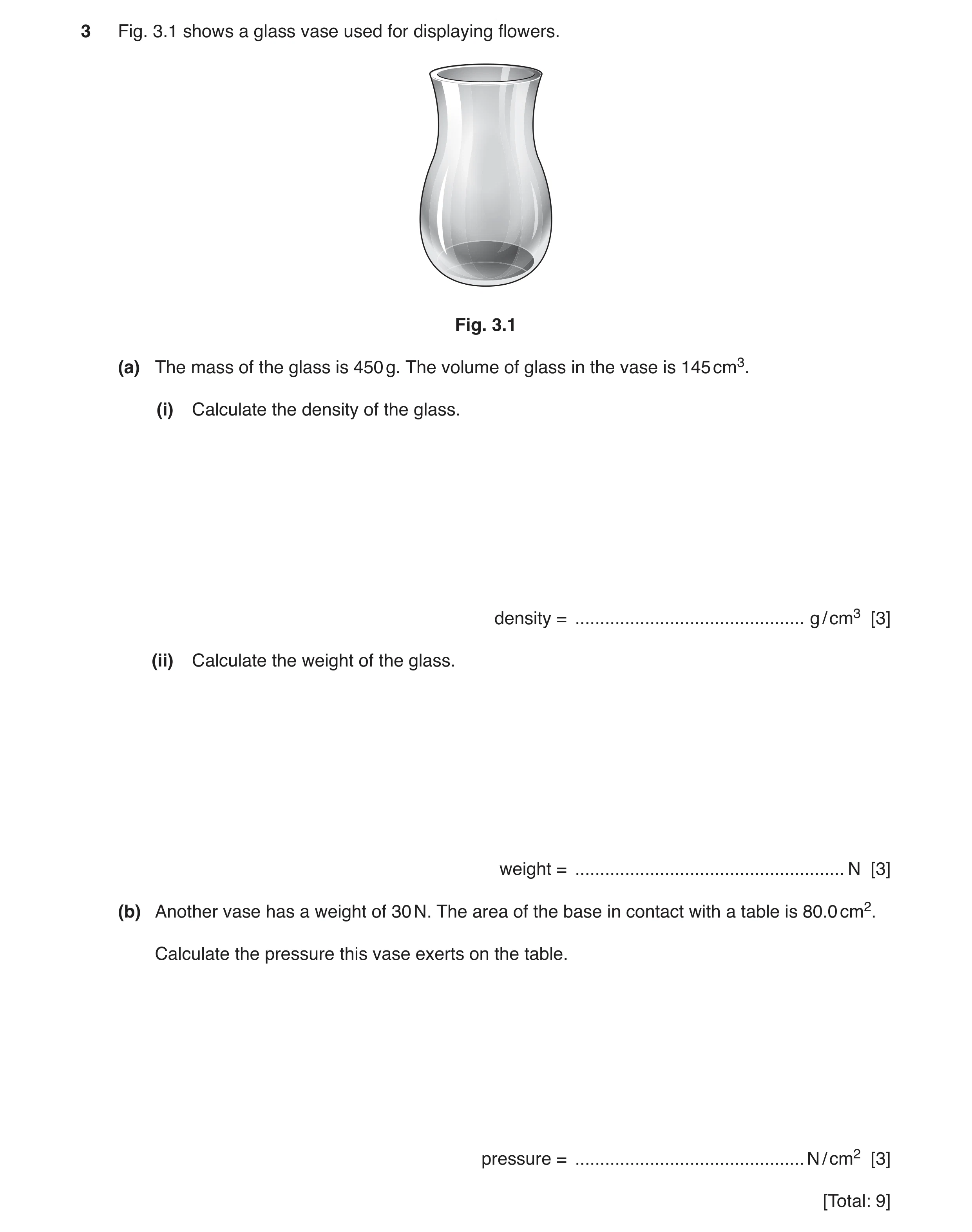
3 Fig. 3.1 shows a glass vase used for displaying flowers. Fig. 3.1 (a) The mass of the glass is 450 g. The volume of glass in the vase is 145 cm3. (i) Calculate the density of the glass. density = … g / cm3 [3] (ii) Calculate the weight of the glass. weight = … N [3] (b) Another vase has a weight of 30 N. The area of the base in contact with a table is 80.0 cm2. Calculate the pressure this vase exerts on the table. pressure = … N / cm2 [3] [Total: 9]
9 marks
Mark scheme: 3(a)(i) D = M / V C1 450 / 145 C1 3.1 (g / cm3) A1 3(a)(ii) W = m × g in any form C1 0.45 × 10 C1 4.5 (N) A1 3(b) P = F / A in any form C1 30 / 80 C1 0.375 (N / cm2) OR 0.38 (N / cm2) A1
This question in 0625/32 Oct/Nov 2017
Q5 · A metal object discovered by a scientist using a metal detector 0625/33 Oct/Nov 2017
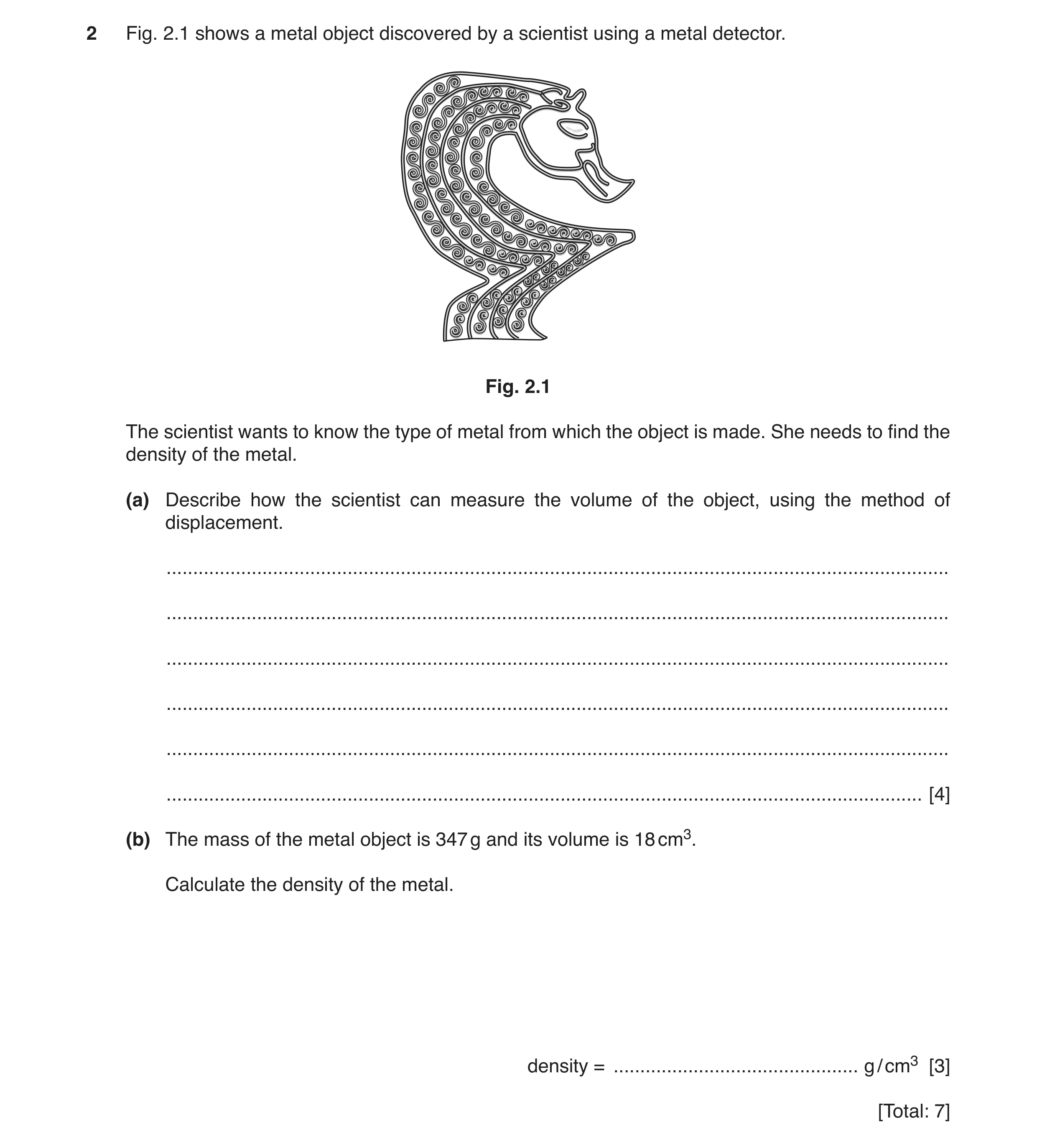
2 Fig. 2.1 shows a metal object discovered by a scientist using a metal detector. Fig. 2.1 The scientist wants to know the type of metal from which the object is made. She needs to find the density of the metal. (a) Describe how the scientist can measure the volume of the object, using the method of displacement. … … … … … … [4] (b) The mass of the metal object is 347 g and its volume is 18 cm3. Calculate the density of the metal. density = … g / cm3 [3] [Total: 7]
7 marks
Mark scheme: 2(a) measuring cylinder (partially filled) with water / displacement can filled with water B4 object (submerged) into water owtte new volume noted / displaced water collected in measuring cylinder (volume of object = ) difference in volumes / volume of water collected 2(b) density = mass ÷ volume written in any recognised form C1 347 ÷ 18 C1 19.28 OR 19.3 (g / cm3) A1
This question in 0625/33 Oct/Nov 2017
Q6 · A 250 cm3 beaker containing some liquid is shown in Fig 0625/31 May/June 2018
2 A 250 cm3 beaker containing some liquid is shown in Fig. 2.1. beaker unknown volume of liquid Fig. 2.1 (a) (i) A student has a measuring cylinder and a balance. Describe an experiment to determine the density of the liquid. … … … … … … … … [5] (ii) Suggest the unit of density used by the student. … [1] (b) Fig. 2.2 shows a block of polythene. polythene Fig. 2.2 (i) Polythene floats in water. Explain why polythene floats. … [1] (ii) The weight of the polythene block is 0.84 N. Calculate the mass of the block. mass = … kg [3] [Total: 10]
10 marks
Mark scheme: 2(a)(i) measure mass of empty measuring cylinder/beaker add measured/fixed volume of liquid measure mass of measuring cylinder/beaker and liquid determine mass of liquid (by subtracting mass empty from mass when full) use of D = M/V 5 2(a)(ii) g / cm3 OR kg / m3 1 2(b)(i) (polythene is) less dense (than water) 1 2(b)(ii) W = m × g in any form OR (m =) W ÷ g OR 100 g weighs 1 N 1 0.84 ÷ 10 OR 100 (g) × 0.84 1 0.084 (kg) OR 84 g 1
This question in 0625/31 May/June 2018
Question 7 0625/32 May/June 2018
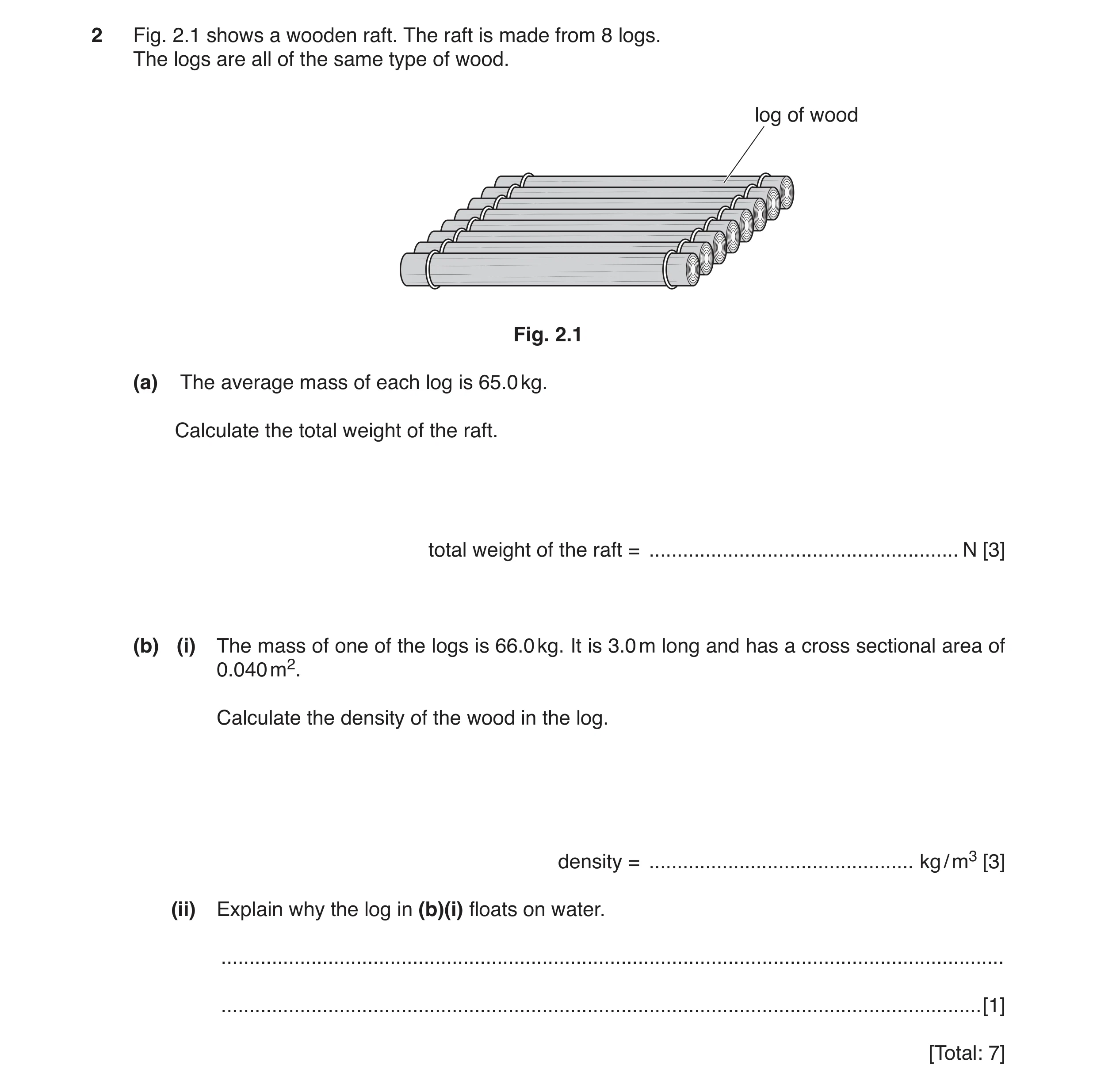
2 Fig. 2.1 shows a wooden raft. The raft is made from 8 logs. The logs are all of the same type of wood. log of wood Fig. 2.1 (a) The average mass of each log is 65.0 kg. Calculate the total weight of the raft. total weight of the raft = … N [3] (b) (i) The mass of one of the logs is 66.0 kg. It is 3.0 m long and has a cross sectional area of 0.040 m2. Calculate the density of the wood in the log. density = … kg / m3 [3] (ii) Explain why the log in (b)(i) floats on water. … … [1] [Total: 7]
7 marks
Mark scheme: 2(a) 1 650 × 8 1 5200 (N) 1 2(b)(i) (volume of log =) 3 × 0.04 = 0.12 (m3) 1 D = M / V OR (D =) M / V 1 550 (kg / m3) 1 2(b)(ii) The density of logs is less than density of water owtte. 1
This question in 0625/32 May/June 2018
Q8 · A set of masses made from the same material 0625/32 Feb/March 2019
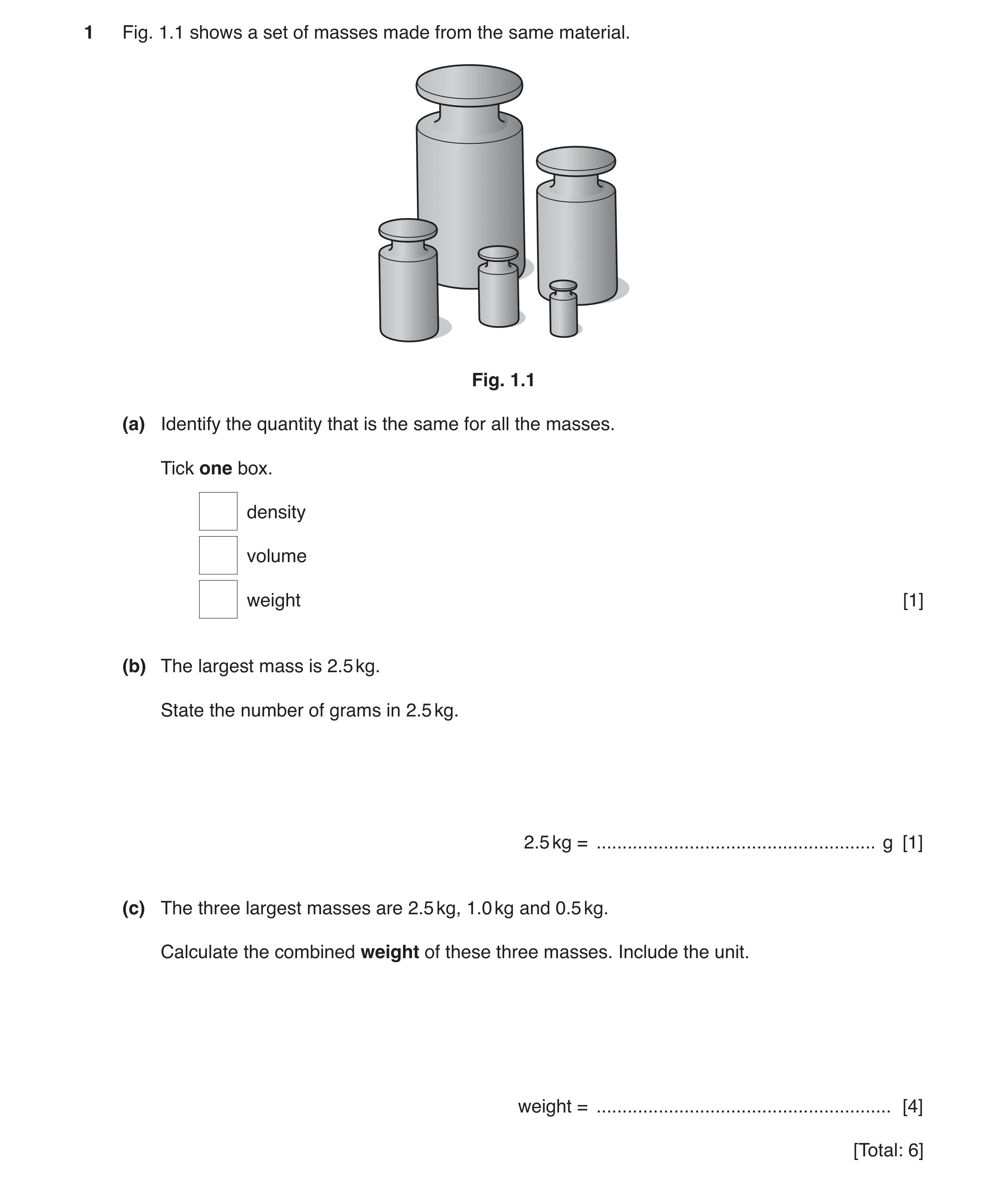
1 Fig. 1.1 shows a set of masses made from the same material. Fig. 1.1 (a) Identify the quantity that is the same for all the masses. Tick one box. density volume weight [1] (b) The largest mass is 2.5 kg. State the number of grams in 2.5 kg. 2.5 kg = … g [1] (c) The three largest masses are 2.5 kg, 1.0 kg and 0.5 kg. Calculate the combined weight of these three masses. Include the unit. weight = … [4] [Total: 6]
6 marks
Mark scheme: 1(a) top box ticked: density B1 1(b) 2500 (g) B1 1(c) W = mg in any form C1 (2.5 + 1.0 + 0.5) = 4 C1 40 A1 N or newtons B1
This question in 0625/32 Feb/March 2019
Q9 · A bottle contains some oil 0625/32 May/June 2019
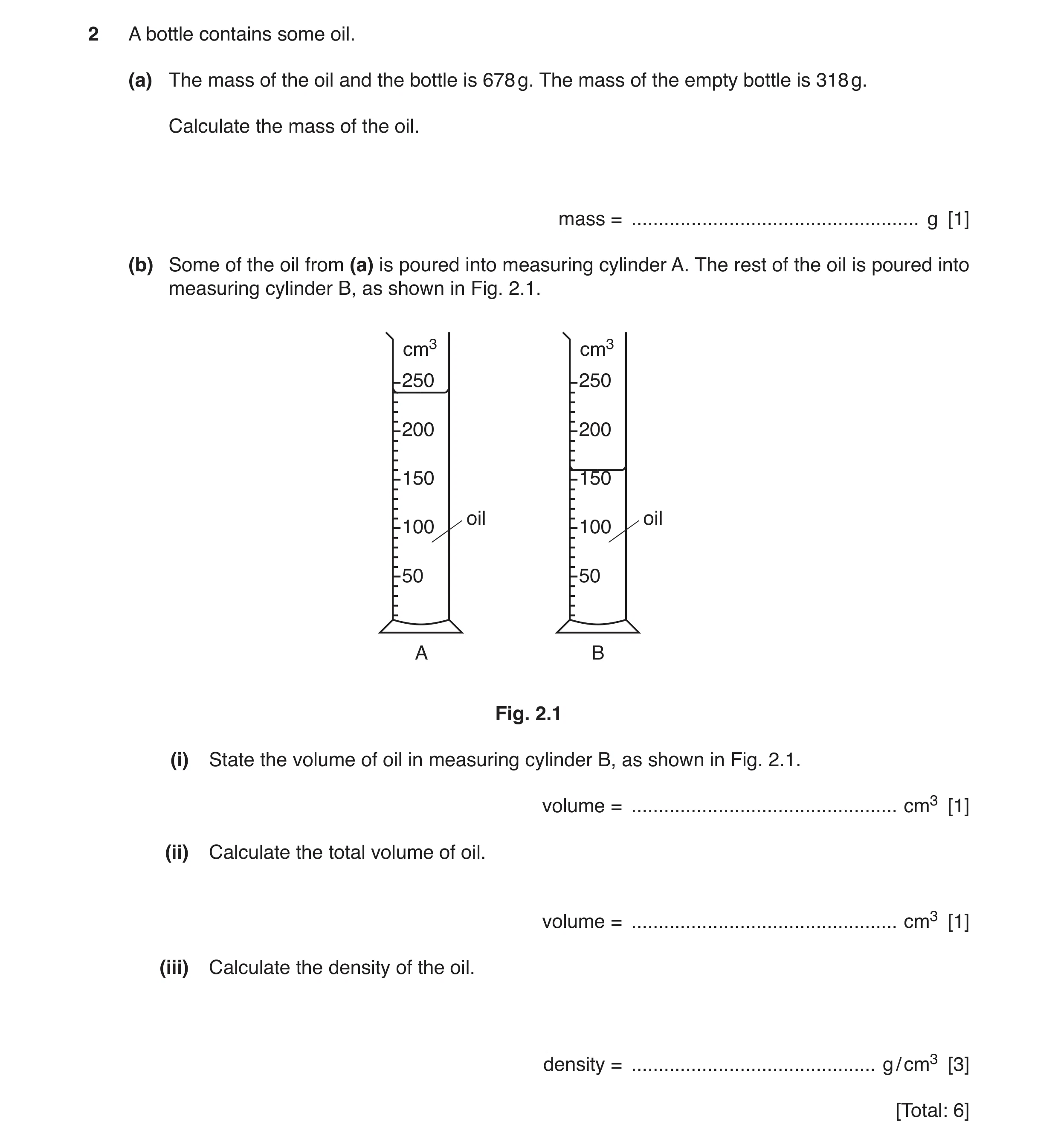
2 A bottle contains some oil. (a) The mass of the oil and the bottle is 678 g. The mass of the empty bottle is 318 g. Calculate the mass of the oil. mass = … g [1] (b) Some of the oil from (a) is poured into measuring cylinder A. The rest of the oil is poured into measuring cylinder B, as shown in Fig. 2.1. cm3 cm3 250 250 200 200 150 150 oil oil 100 100 50 50 A B Fig. 2.1 (i) State the volume of oil in measuring cylinder B, as shown in Fig. 2.1. volume = … cm3 [1] (ii) Calculate the total volume of oil. volume = … cm3 [1] (iii) Calculate the density of the oil. density = … g / cm3 [3] [Total: 6]
6 marks
Mark scheme: 2(a) (678 – 318 = ) 360 (g) B1 2(b)(i) 160 (cm3) B1 2(b)(ii) 400 (cm3) B1 2(b)(iii) D = m/v in any form C1 360 ÷ 400 C1 0.9 (g/cm3) A1
This question in 0625/32 May/June 2019
Question 10 0625/33 May/June 2019
1 Fig. 1.1 shows three metal blocks. Each block has the same mass. A B C Fig. 1.1 The volumes of the blocks are different. Each block is made of a different metal. The table gives the density of each metal. name of metal density (g / cm3) aluminium 2.83 iron 6.95 lead 11.3 (a) Use the data from the table to identify the metal used to make each block. A … B … C … [1] (b) Another metal block is made of brass. Its mass is 200 g. The density of brass is 8.4 g / cm3. Calculate the volume of the brass block. volume = … cm3 [3] (c) Describe a method for determining the volume of a small, dense, irregularly-shaped object. You may draw a labelled diagram. … … … … … … [4] [Total: 8]
8 marks
Mark scheme: 1(a) (A =) lead, (B=) iron, (C=) aluminium B1 1(b) density = mass ÷ volume in any form (V =) M/d C1 200 ÷ 8.4 C1 24 (cm3) A1 1(c) add water to measuring cylinder/note the volume of water added B1 lower/immerse metal object into water B1 note new volume of water owtte B1 subtract new volume from initial volume/determine difference in volumes B1
This question in 0625/33 May/June 2019
Q11 · A plastic water barrel 0625/31 Oct/Nov 2019
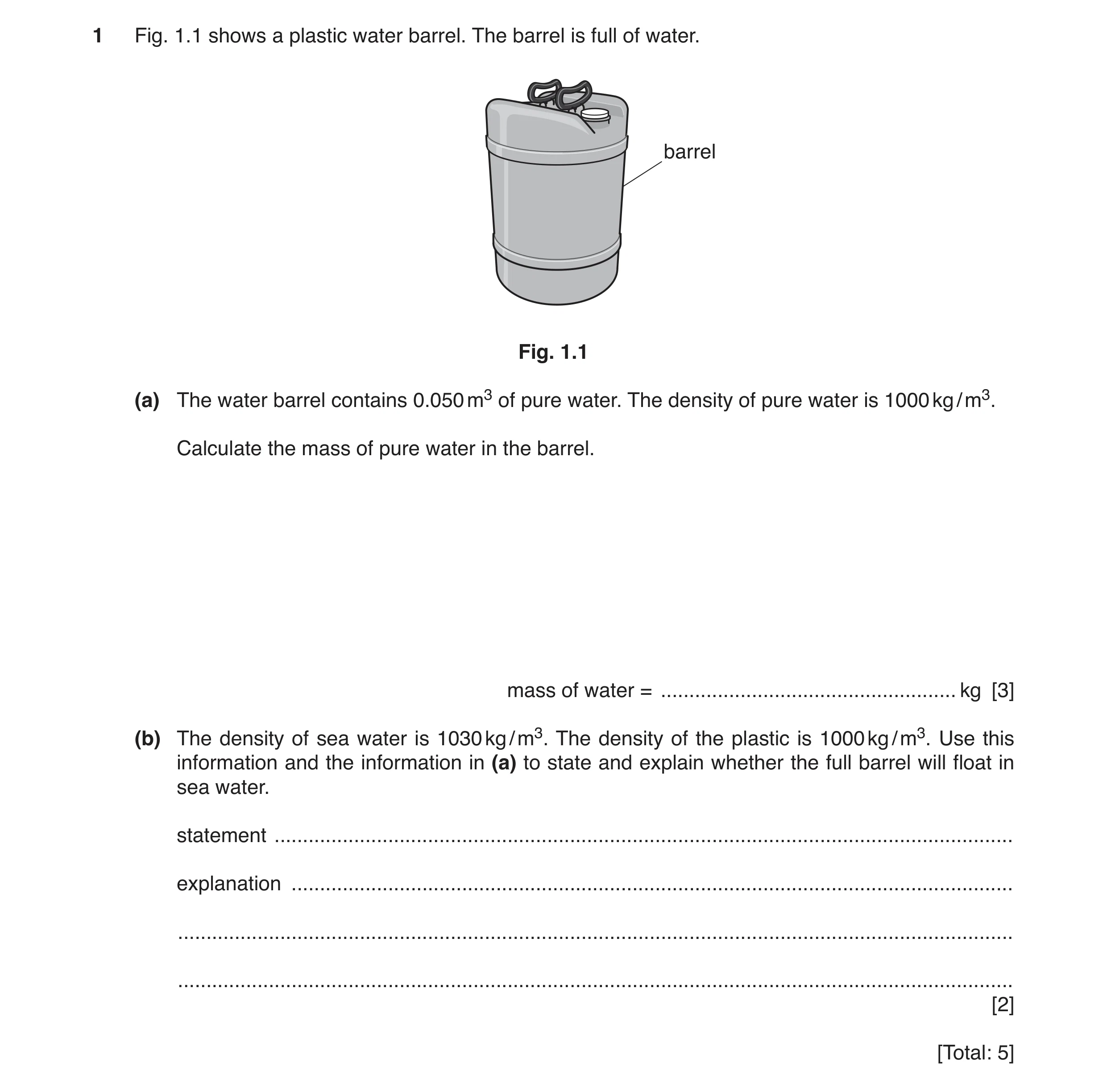
1 Fig. 1.1 shows a plastic water barrel. The barrel is full of water. barrel Fig. 1.1 (a) The water barrel contains 0.050 m3 of pure water. The density of pure water is 1000 kg / m3. Calculate the mass of pure water in the barrel. mass of water = … kg [3] (b) The density of sea water is 1030 kg / m3. The density of the plastic is 1000 kg / m3. Use this information and the information in (a) to state and explain whether the full barrel will float in sea water. statement … explanation … … … [2] [Total: 5]
5 marks
Mark scheme: 1(a) C1 mass = 1000 × 0.05 C1 50 (kg) A1 1(b) Floats OR does not sink M0 density of full barrel OR its density OR density of plastic OR density of barrel OR density of (pure) water is less than sea water C1 density of plastic OR barrel AND (pure) water is less than sea water A1
This question in 0625/31 Oct/Nov 2019
Q12 · A student has an irregularly shaped piece of metal, a beaker of water and a measuring… 0625/32 Oct/Nov 2019
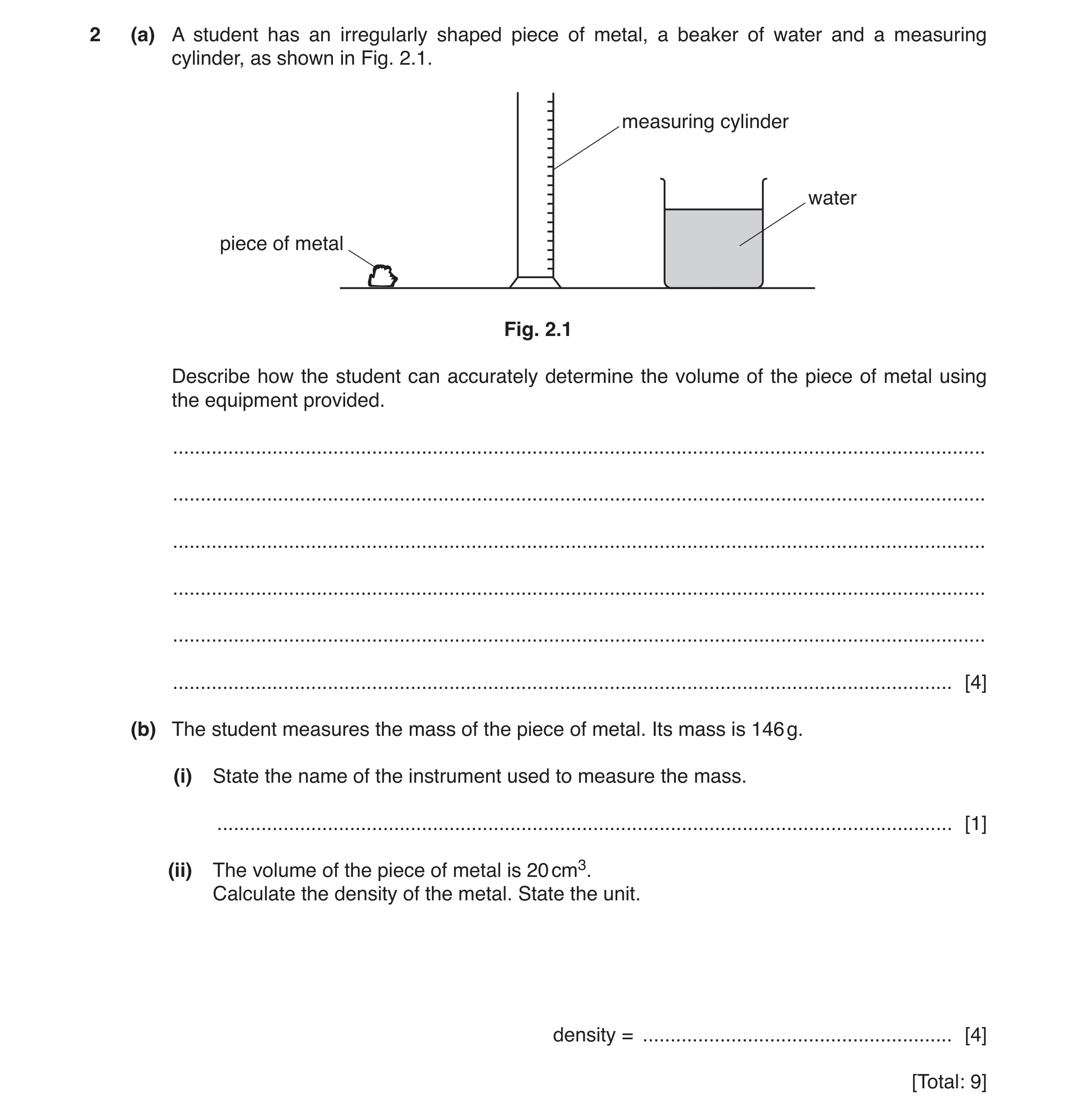
2 (a) A student has an irregularly shaped piece of metal, a beaker of water and a measuring cylinder, as shown in Fig. 2.1. measuring cylinder water piece of metal Fig. 2.1 Describe how the student can accurately determine the volume of the piece of metal using the equipment provided. … … … … … … [4] (b) The student measures the mass of the piece of metal. Its mass is 146 g. (i) State the name of the instrument used to measure the mass. … [1] (ii) The volume of the piece of metal is 20 cm3. Calculate the density of the metal. State the unit. density = … [4] [Total: 9]
9 marks
Mark scheme: 2(a) Any four from: pour some water into measuring cylinder record volume / reading of water (in measuring cylinder) place metal in water (in cylinder and completely submerge) record volume of water and metal (in cylinder) subtract starting volume from final volume (to give volume of metal) B4 2(b)(i) balance B1 2(b)(ii) density = mass ÷ volume C1 146 ÷ 20 C1 7.3 A1 g/cm3 B1
This question in 0625/32 Oct/Nov 2019
Q13 · A coil of wire 0625/31 May/June 2020
1 Fig. 1.1 shows a coil of wire. length of coil Fig. 1.1 (not to scale) (a) A student measures the length of the coil using a ruler. His measurement is 3.8 cm. There are 20 turns of wire in the coil. The student uses his measurement to calculate the average thickness of the wire. (i) Show that the average thickness of the wire is about 0.2 cm. average thickness of wire = … cm [2] (ii) The student’s measurement of 3.8 cm is inaccurate. Suggest one reason why the measurement is inaccurate. … … [1] (b) The volume of the wire in the coil is 16.6 cm3 and its mass is 148 g. Calculate the density of the metal used for the wire in the coil. density = … g / cm3 [3] (c) The student has a measuring cylinder and a beaker of water, as shown in Fig. 1.2. coil measuring beaker of water cylinder Fig. 1.2 Describe how the student can determine the volume of the coil by using the equipment shown in Fig. 1.2. … … … … … … [4] [Total: 10]
10 marks
Mark scheme: 1(a)(i) C1 (average thickness =) 0.19 (cm) (which is about 0.2 cm) A1 1(a)(ii) any one from: wire(s) not touching OR wire stretched (in places) OR ruler not at zero (owtte) OR wire(s) overlapping OR eye not directly above ruler (owtte) B1 1(b) density = mass ÷ volume OR m V ρ = in any form. C1 (ρ =) 148 ÷ 16.6 C1 (ρ =) 8.9 (g / cm3) A1 1(c) measuring cylinder partially filled with water coil submerged in water (owtte) new volume noted volume of wire = difference or increase in volume(s) B4
This question in 0625/31 May/June 2020
Q14 · A beaker containing liquid on a top pan balance 0625/31 Oct/Nov 2020
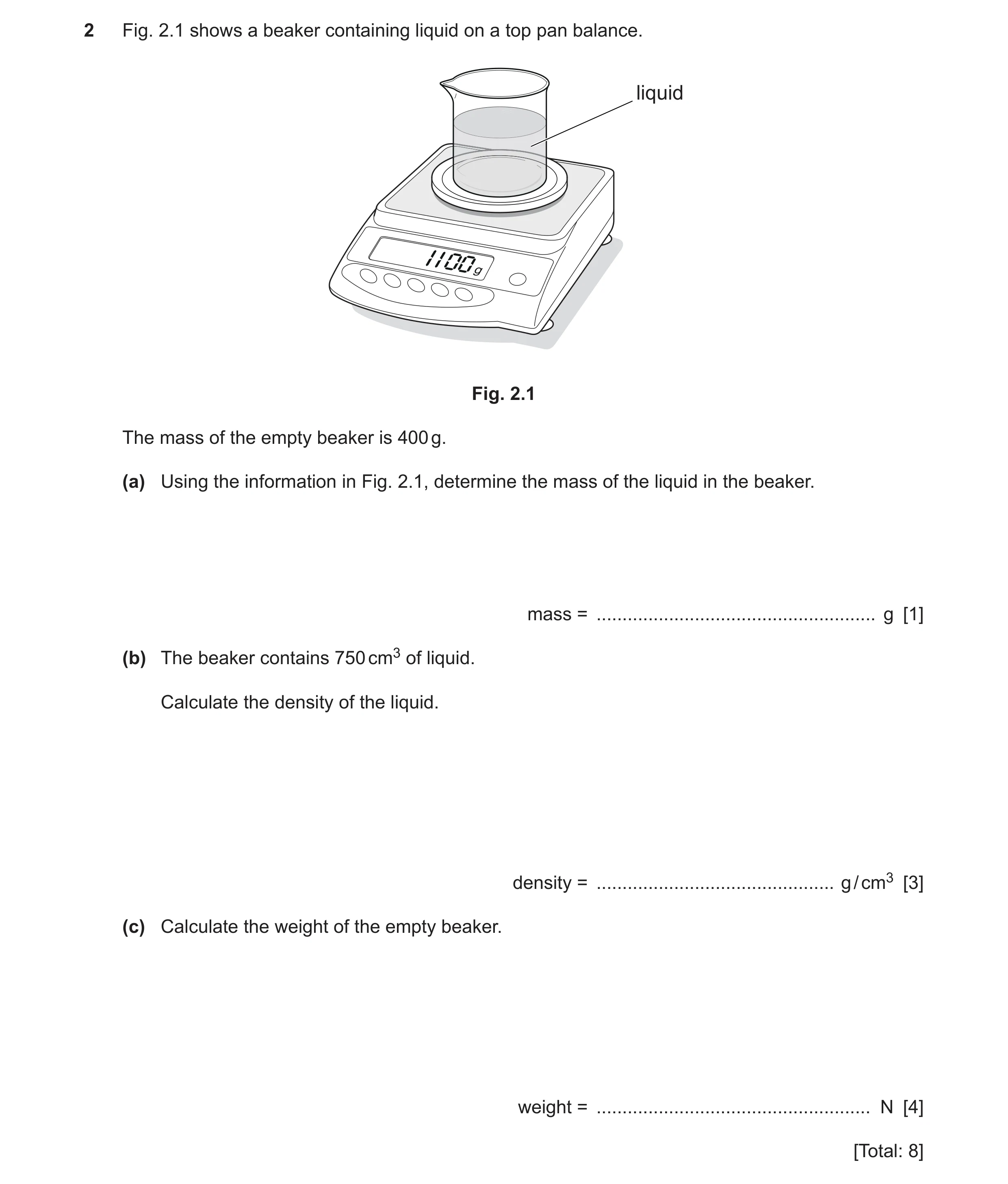
2 Fig. 2.1 shows a beaker containing liquid on a top pan balance. liquid Fig. 2.1 The mass of the empty beaker is 400 g. (a) Using the information in Fig. 2.1, determine the mass of the liquid in the beaker. mass = … g [1] (b) The beaker contains 750 cm3 of liquid. Calculate the density of the liquid. density = … g / cm3 [3] (c) Calculate the weight of the empty beaker. weight = … N [4] [Total: 8]
8 marks
Mark scheme: 2(a) (1100 – 400 =) 700 (g) B1 2(b) density = mass ÷ volume OR ρ = m ÷ V in any form C1 (ρ =) 700 ÷ 750 C1 (ρ =) 0.93 (g / cm3) A1 2(c) 400 (g) = 0.4 (kg) B1 w = m × g in any form C1 0.4 × 10 C1 (weight =) 4(.0) (N) A1
This question in 0625/31 Oct/Nov 2020
Q15 · A measuring cylinder containing water 0625/32 Feb/March 2021
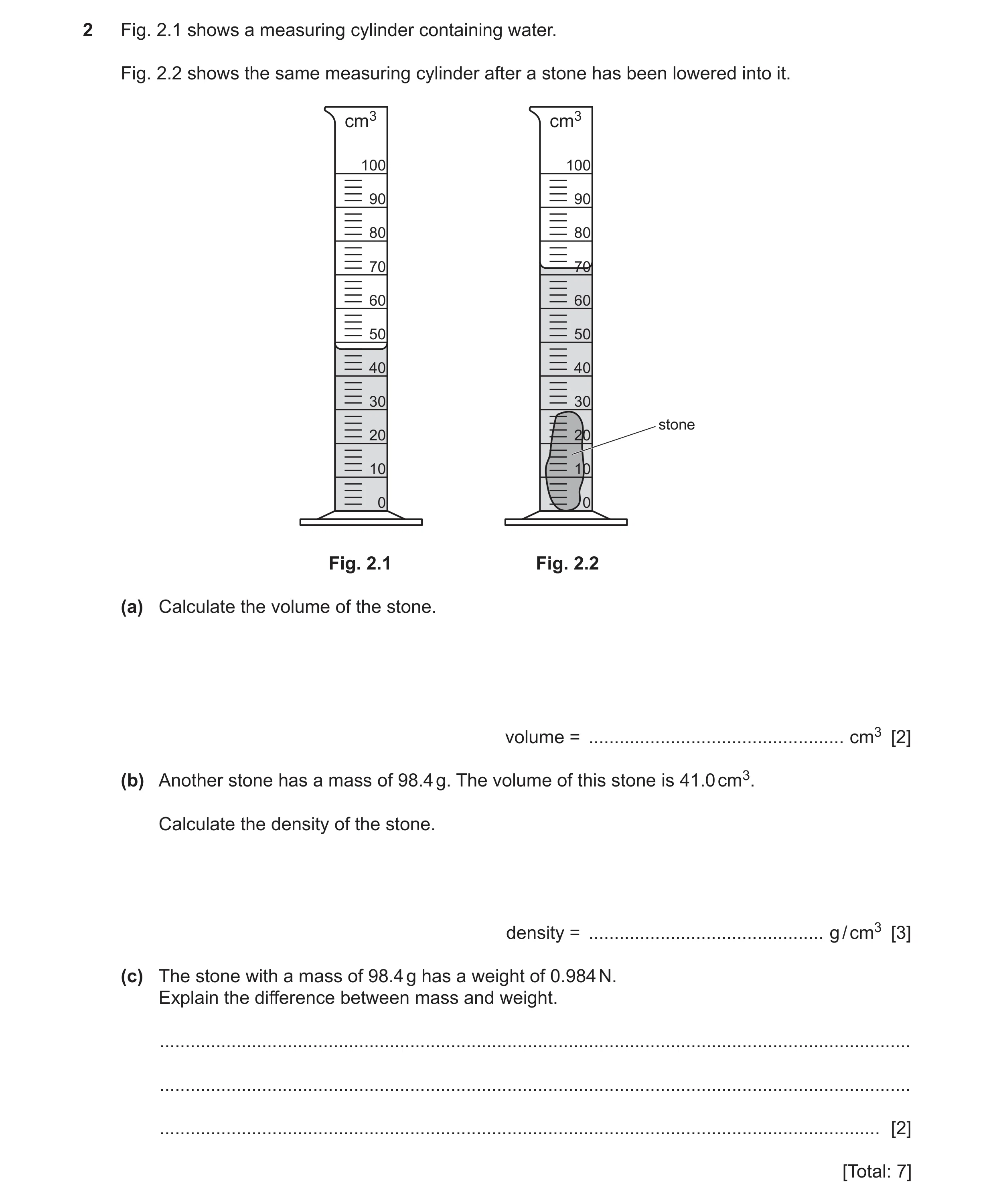
2 Fig. 2.1 shows a measuring cylinder containing water. Fig. 2.2 shows the same measuring cylinder after a stone has been lowered into it. cm3 cm3 100 100 90 90 80 80 70 70 60 60 50 50 40 40 30 30 stone 20 20 10 10 0 0 Fig. 2.1 Fig. 2.2 (a) Calculate the volume of the stone. volume = … cm3 [2] (b) Another stone has a mass of 98.4 g. The volume of this stone is 41.0 cm3. Calculate the density of the stone. density = … g / cm3 [3] (c) The stone with a mass of 98.4 g has a weight of 0.984 N. Explain the difference between mass and weight. … … … [2] [Total: 7]
7 marks
Mark scheme: 2(a) (volume =) difference in candidate’s readings C1 24 (cm3) A1 2(b) (density =) mass ÷ volume C1 (density =) 98.4 ÷ 41.0 C1 2.4(0) (g / cm3) A1 Question Answer Marks 2(c) idea that mass is (a measure of) amount of matter in a body B1 idea that weight is a gravitational force B1
This question in 0625/32 Feb/March 2021
Q16 · A liquid-in-glass thermometer contains mercury 0625/31 May/June 2021
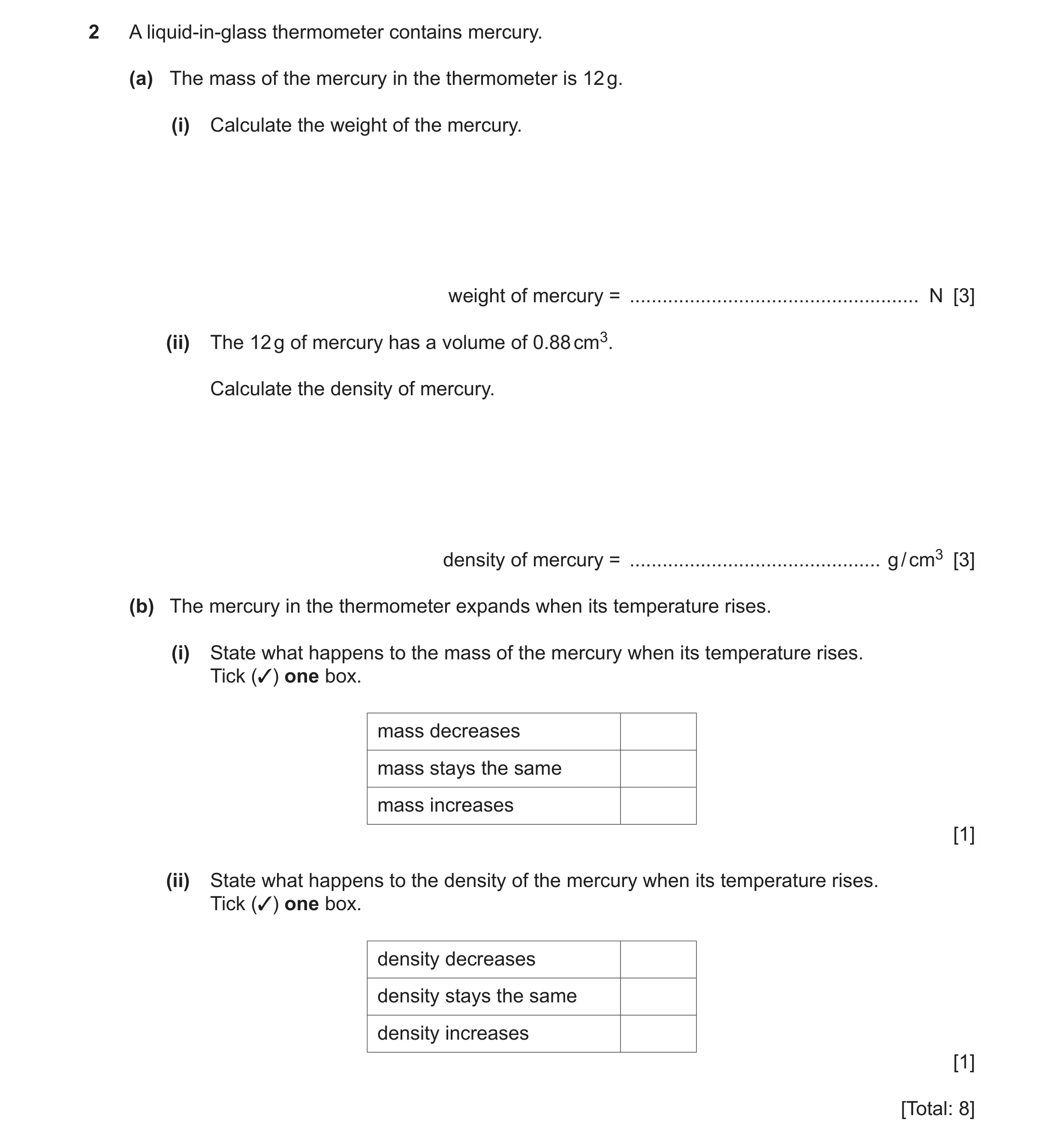
2 A liquid-in-glass thermometer contains mercury. (a) The mass of the mercury in the thermometer is 12 g. (i) Calculate the weight of the mercury. weight of mercury = … N [3] (ii) The 12 g of mercury has a volume of 0.88 cm3. Calculate the density of mercury. density of mercury = … g / cm3 [3] (b) The mercury in the thermometer expands when its temperature rises. (i) State what happens to the mass of the mercury when its temperature rises. Tick (3) one box. mass decreases mass stays the same mass increases [1] (ii) State what happens to the density of the mercury when its temperature rises. Tick (3) one box. density decreases density stays the same density increases [1] [Total: 8]
8 marks
Mark scheme: 2(a)(i) 12 ÷ 1000 = 0.012 (kg) C1 0.012 × 10 C1 = 0.12 (N) A1 2(a)(ii) (density = ) mass ÷ volume OR ( d =) m ÷ v C1 12 ÷ 0.88 C1 14 (g / cm3) A1 Question Answer Marks 2(b)(i) middle box ticked (mass stays the same) B1 2(b)(ii) top box ticked (density decreases) B1
This question in 0625/31 May/June 2021
Q17 · The core of a transformer 0625/32 May/June 2021
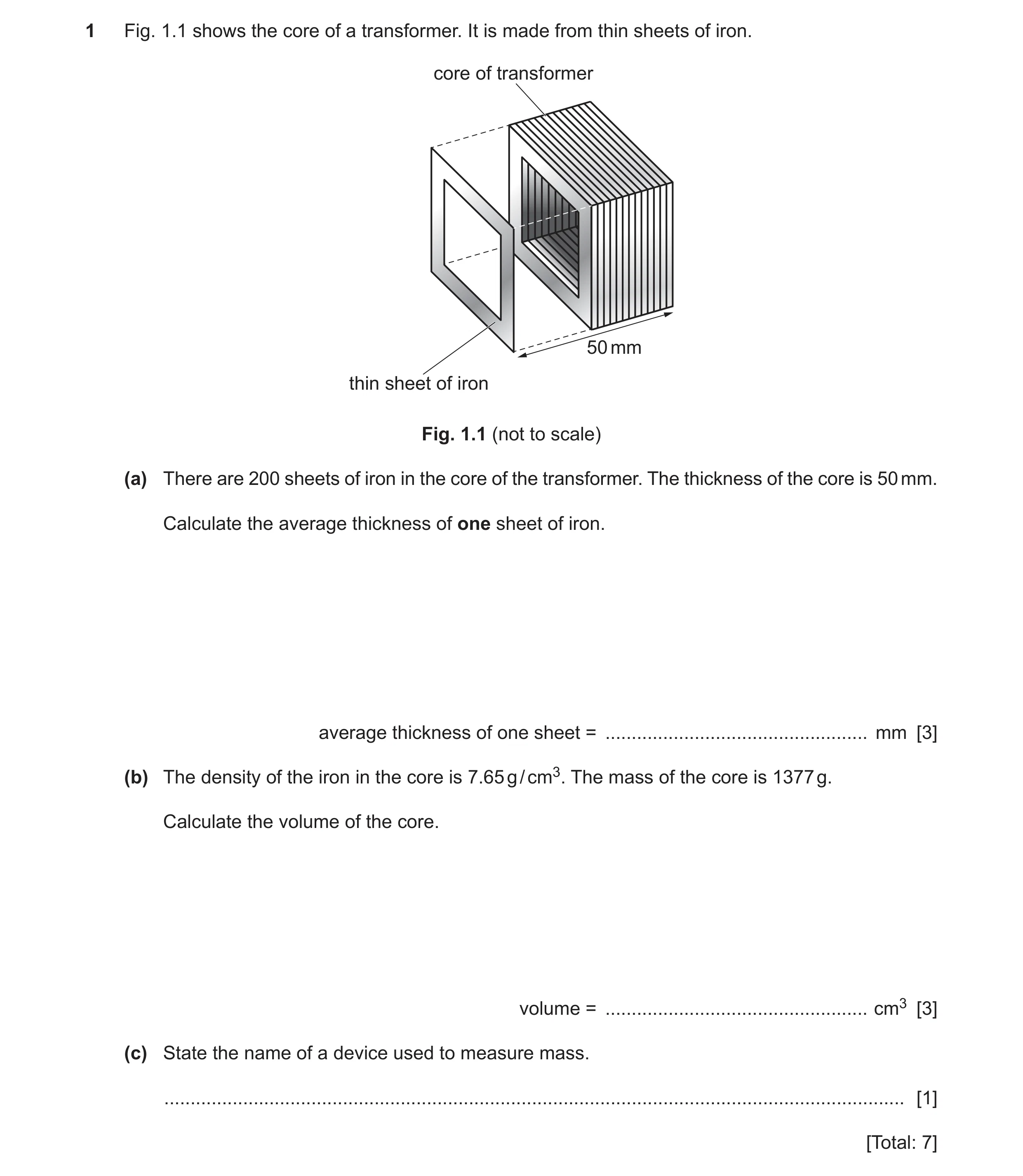
1 Fig. 1.1 shows the core of a transformer. It is made from thin sheets of iron. core of transformer 50 mm thin sheet of iron Fig. 1.1 (not to scale) (a) There are 200 sheets of iron in the core of the transformer. The thickness of the core is 50 mm. Calculate the average thickness of one sheet of iron. average thickness of one sheet = … mm [3] (b) The density of the iron in the core is 7.65 g / cm3. The mass of the core is 1377 g. Calculate the volume of the core. volume = … cm3 [3] (c) State the name of a device used to measure mass. … [1] [Total: 7]
7 marks
Mark scheme: 1(a) (average thickness =) 50 ÷ 200 C1 0.25 (mm) A1 1(b) density = mass ÷ volume OR (volume =) mass ÷ density C1 (volume =) 1377 ÷ 7.65 C1 180 (cm3) A1 1(c) (top pan or chemical) balance B1
This question in 0625/32 May/June 2021
Q18 · A scientist has a measuring cylinder, a beaker of sea water and an electronic balance 0625/33 May/June 2021
2 (a) A scientist has a measuring cylinder, a beaker of sea water and an electronic balance. Describe an experiment to determine the density of the sea water. Include any equations in your answer. … … … … … … [5] (b) A plank of wood floats on the sea. Explain why the wood floats. … … [1] [Total: 6]
6 marks
Mark scheme: 2(a) find mass of measuring cylinder / beaker / container empty B1 add sea water AND read volume B1 find mass of measuring cylinder / beaker / container with seawater B1 subtract the 2 mass readings (to give mass of seawater) B1 (D) = M ÷ V in any form B1 2(b) wood less dense (than seawater) / ora B1
This question in 0625/33 May/June 2021
Q19 · A student uses a ruler to measure the length of a piece of wire, as shown in Fig 0625/31 Oct/Nov 2021
1 A student uses a ruler to measure the length of a piece of wire, as shown in Fig. 1.1. wire 0 1 2 3 4 5 6 7 8 9 10 11 12 13 14 15 16 cm Fig. 1.1 (not to scale) (a) Use the ruler in Fig. 1.1 to determine the length of the piece of wire. length of wire = … cm [2] (b) The student folds the piece of wire and measures its mass. (i) State the name of an instrument the student can use to measure mass. … [1] (ii) The student determines the volume of the wire. He uses a measuring cylinder part‑filled with water and places the wire in it, as shown in Fig. 1.2. folded wire cm3 cm3 50 50 40 40 30 30 20 20 water water 10 10 folded wire Fig. 1.2 Determine the volume of the wire by using information in Fig. 1.2. volume of wire = … cm3 [2] (c) The student measures the mass and the volume of a piece of metal. The mass of the piece of metal is 93.6 g and its volume is 12 cm3. Calculate the density of the metal. density of metal = … g / cm3 [3] [Total: 8]
8 marks
Mark scheme: 1(a) 1.6 (cm) OR 14.8 (cm) seen OR used C1 13.2 (cm) A1 1(b)(i) (top pan / chemical / beam) balance B1 1(b)(ii) 22 (cm3) OR 18 (cm3) seen OR used C1 4(.0) (cm3) A1 1(c) (density = ) mass ÷ volume OR ( d =) m ÷ v in any form C1 93.6 ÷ 12 C1 7.8 (g / cm3) A1
This question in 0625/31 Oct/Nov 2021
Q20 · A coin collector has 19 identical coins, as shown in Fig 0625/32 Oct/Nov 2021
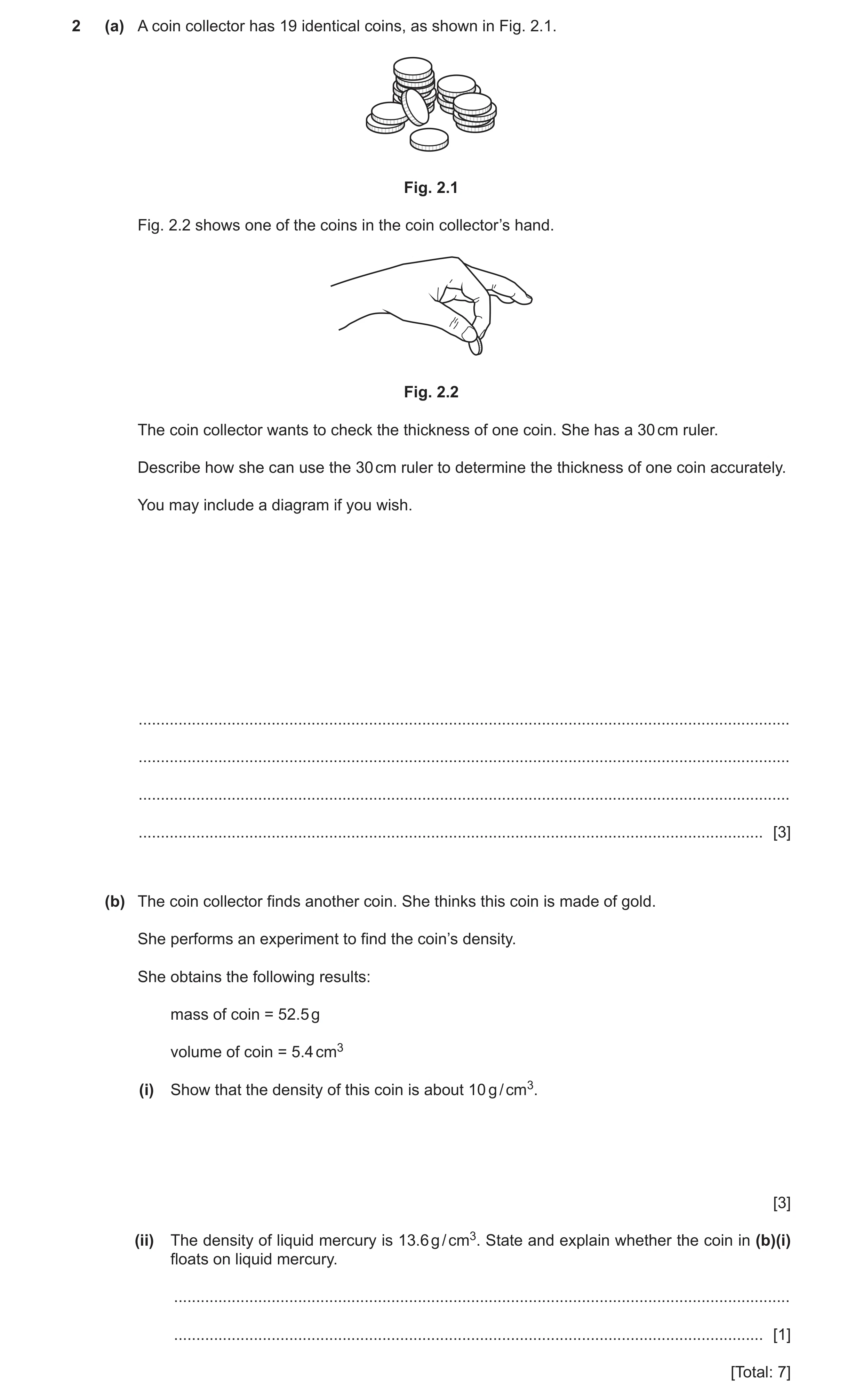
2 (a) A coin collector has 19 identical coins, as shown in Fig. 2.1. Fig. 2.1 Fig. 2.2 shows one of the coins in the coin collector’s hand. Fig. 2.2 The coin collector wants to check the thickness of one coin. She has a 30 cm ruler. Describe how she can use the 30 cm ruler to determine the thickness of one coin accurately. You may include a diagram if you wish. … … … … [3] (b) The coin collector finds another coin. She thinks this coin is made of gold. She performs an experiment to find the coin’s density. She obtains the following results: mass of coin = 52.5 g volume of coin = 5.4 cm3 (i) Show that the density of this coin is about 10 g / cm3. [3] (ii) The density of liquid mercury is 13.6 g / cm3. State and explain whether the coin in (b)(i) floats on liquid mercury. … … [1] [Total: 7]
7 marks
Mark scheme: 2(a) any three from: (put some coins) on top of each other OR in a stack idea measure the (total) thickness (of stack) 10 or more coins thickness (of one coin) = total thickness / ’length’ ÷ number of coins 2(b)(i) (D) = M ÷ V in any form C1 52.5 ÷ 5.4 C1 9.7(2) (g / cm3) A1 2(b)(ii) floats AND coin is less dense (than mercury) ora B1
This question in 0625/32 Oct/Nov 2021
Question 21 0625/33 Oct/Nov 2021
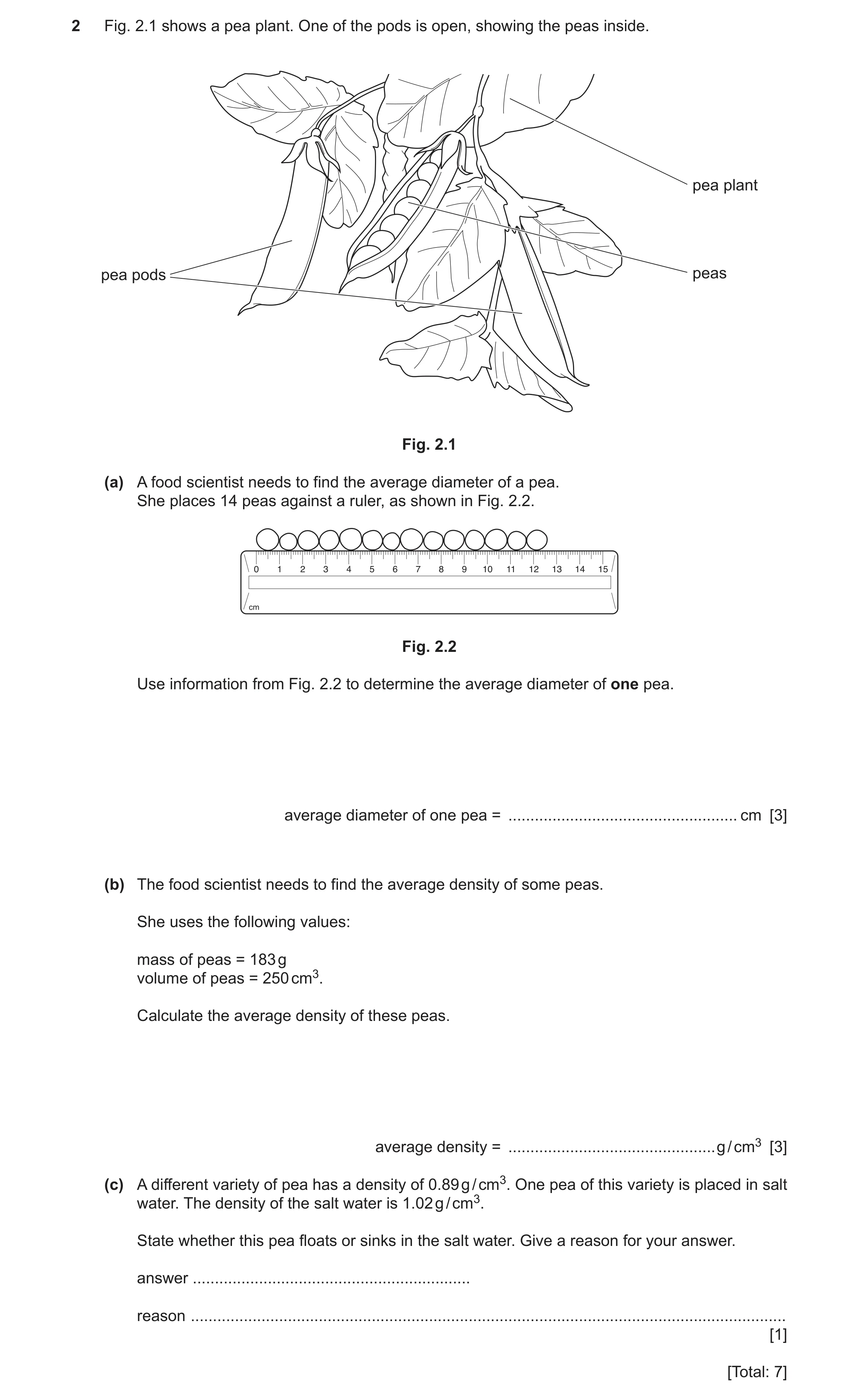
2 Fig. 2.1 shows a pea plant. One of the pods is open, showing the peas inside. pea plant pea pods peas Fig. 2.1 (a) A food scientist needs to find the average diameter of a pea. She places 14 peas against a ruler, as shown in Fig. 2.2. Fig. 2.2 Use information from Fig. 2.2 to determine the average diameter of one pea. average diameter of one pea = … cm [3] (b) The food scientist needs to find the average density of some peas. She uses the following values: mass of peas = 183 g volume of peas = 250 cm3. Calculate the average density of these peas. average density = … g / cm3 [3] (c) A different variety of pea has a density of 0.89 g / cm3. One pea of this variety is placed in salt water. The density of the salt water is 1.02 g / cm3. State whether this pea floats or sinks in the salt water. Give a reason for your answer. answer … reason … [1] [Total: 7]
7 marks
Mark scheme: 2(a) 12.6 C1 12.6 ÷ 14 C1 0.9(0) (cm) A1 2(b) (D =) M ÷ V in any form C1 183 ÷ 250 C1 0.73 (g / cm3) A1 2(c) float AND (peas / it) less dense (than salt water) B1
This question in 0625/33 Oct/Nov 2021
Q22 · A metal block and its dimensions 0625/32 Feb/March 2022
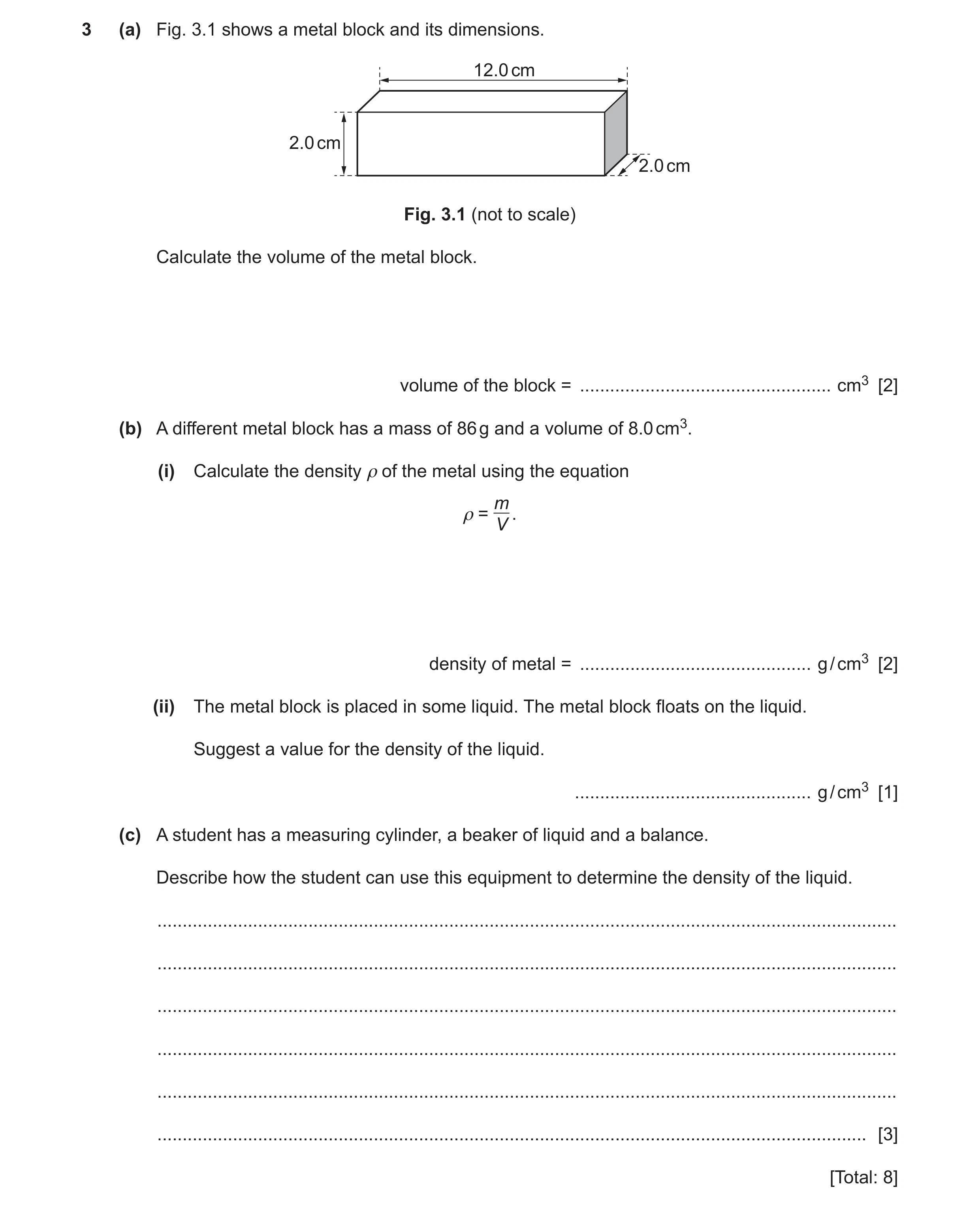
3 (a) Fig. 3.1 shows a metal block and its dimensions. 12.0 cm 2.0 cm 2.0 cm Fig. 3.1 (not to scale) Calculate the volume of the metal block. volume of the block = … cm3 [2] (b) A different metal block has a mass of 86 g and a volume of 8.0 cm3. (i) Calculate the density ρ of the metal using the equation m ρ = . V density of metal = … g / cm3 [2] (ii) The metal block is placed in some liquid. The metal block floats on the liquid. Suggest a value for the density of the liquid. … g / cm3 [1] (c) A student has a measuring cylinder, a beaker of liquid and a balance. Describe how the student can use this equipment to determine the density of the liquid. … … … … … … [3] [Total: 8]
8 marks
Mark scheme: 3(a) (volume =) 48 (cm3) A2 (volume =) l × b × h (C1) 3(b)(i) 11 (g / cm3) A2 (density =) 86 ÷ 8.0 (C1) 3(b)(ii) any value greater than (b)(i) (g / cm3) B1 3(c) any three from: measure mass of (empty) measuring cylinder on balance add liquid to measuring cylinder AND read volume measure mass of measuring cylinder AND liquid on balance find difference in the 2 mass readings B3
This question in 0625/32 Feb/March 2022
Q23 · Two identical metal blocks, A and B, being lifted 3.0 m from ground level 0625/33 May/June 2022
2 Fig. 2.1 shows two identical metal blocks, A and B, being lifted 3.0 m from ground level. Block A is lifted by a motor. Block B is lifted by a person. block A block B mass = 70 kg mass = 70 kg 3.0 m ground electric level motor Fig. 2.1 (a) Complete the following sentences. (i) As the motor starts turning, it usefully transfers … energy to … energy. [2] (ii) Both blocks gain … energy. [1] (b) Both blocks are lifted at the same steady speed. The blocks are then held at a height of 3.0 m. (i) Compare the energy gained by block A with the energy gained by block B. … [1] (ii) Explain why the energy input to the motor is more than the energy gained by block A. … … … [2] (iii) An engineer determines the power output of the motor. State the three measurements that the engineer needs to determine the power output of the motor. 1. … 2. … 3. … [2] (c) The volume of block A is 0.0089 m3. The mass of block A is 70 kg. Calculate the density of block A. density = … kg / m3 [3] [Total: 11]
11 marks
Mark scheme: 2(a)(i) electrical B1 (to) kinetic OR (gravitational) potential B1 2(a)(ii) (gravitational) potential B1 2(b)(i) same B1 2(b)(ii) any two from the following: energy transferred to surroundings thermal (energy) / heat lost work done against friction motor less than 100% efficient B2 Question Answer Marks 2(b)(iii) weight/force/mass AND height/distance moved B1 time B1 2(c) 7900 OR 7870 A3 70 ÷ 0.0089 (C2) (density = ) mass ÷ volume in any form (C1)
This question in 0625/33 May/June 2022
Q24 · A device for measuring gas pressure is connected to a gas supply as shown in Fig 0625/32 Oct/Nov 2022
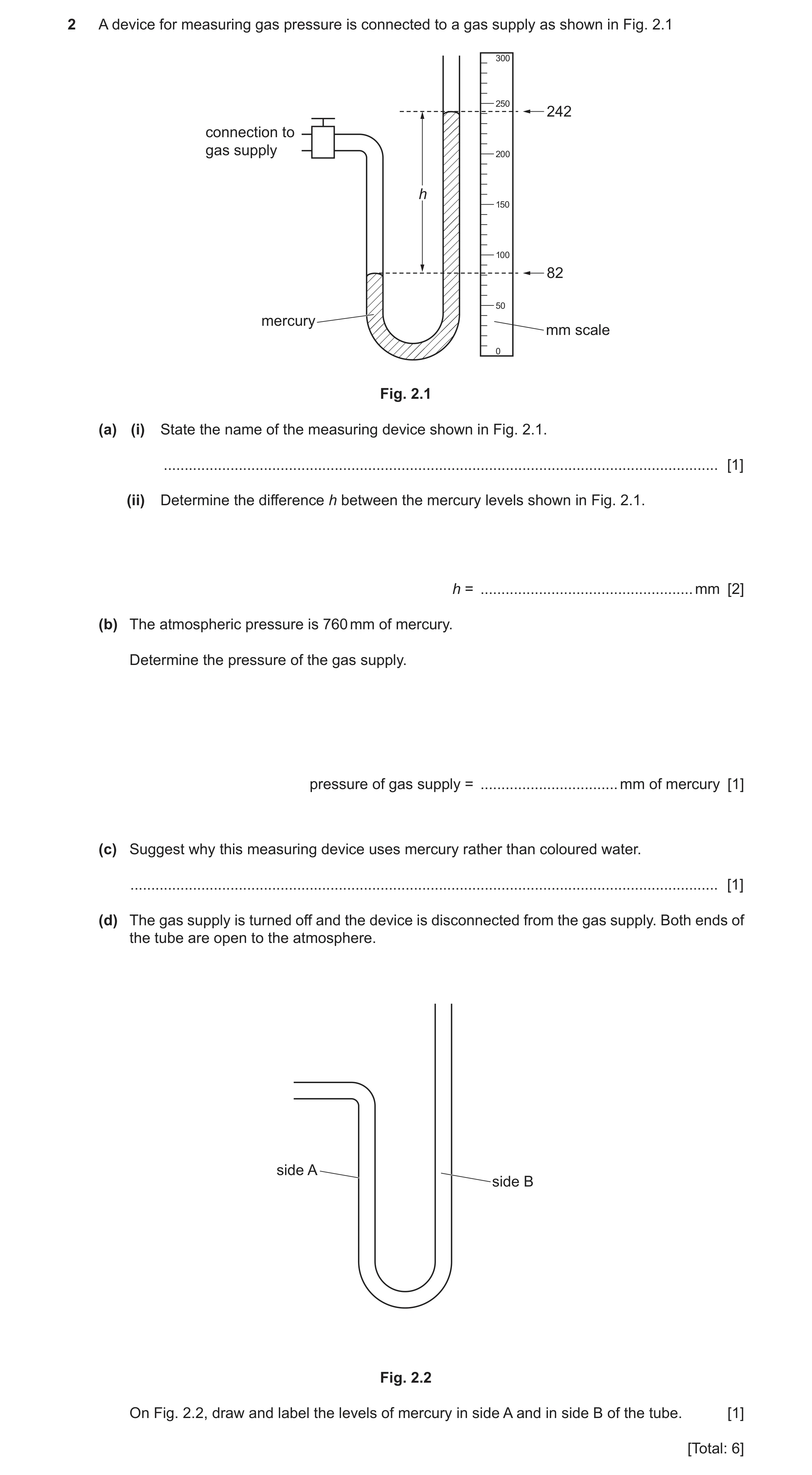
2 A device for measuring gas pressure is connected to a gas supply as shown in Fig. 2.1 300 250 242 connection to gas supply 200 h 150 100 82 50 mercury mm scale 0 Fig. 2.1 (a) (i) State the name of the measuring device shown in Fig. 2.1. … [1] (ii) Determine the difference h between the mercury levels shown in Fig. 2.1. h = … mm [2] (b) The atmospheric pressure is 760 mm of mercury. Determine the pressure of the gas supply. pressure of gas supply = … mm of mercury [1] (c) Suggest why this measuring device uses mercury rather than coloured water. … [1] (d) The gas supply is turned off and the device is disconnected from the gas supply. Both ends of the tube are open to the atmosphere. side A side B Fig. 2.2 On Fig. 2.2, draw and label the levels of mercury in side A and in side B of the tube. [1] [Total: 6]
6 marks
Mark scheme: 2(a)(i) (mercury / U-tube) manometer B1 2(a)(ii) 160 (mm) A2 242 – 82 (C1) 2(b) 920 (mm of mercury) B1 2(c) density (of water) too small / manometer would be too high / big owtte B1 2(d) levels at same height B1
This question in 0625/32 Oct/Nov 2022
Q25 · A builder buys some tiles to repair a floor 0625/33 Oct/Nov 2022
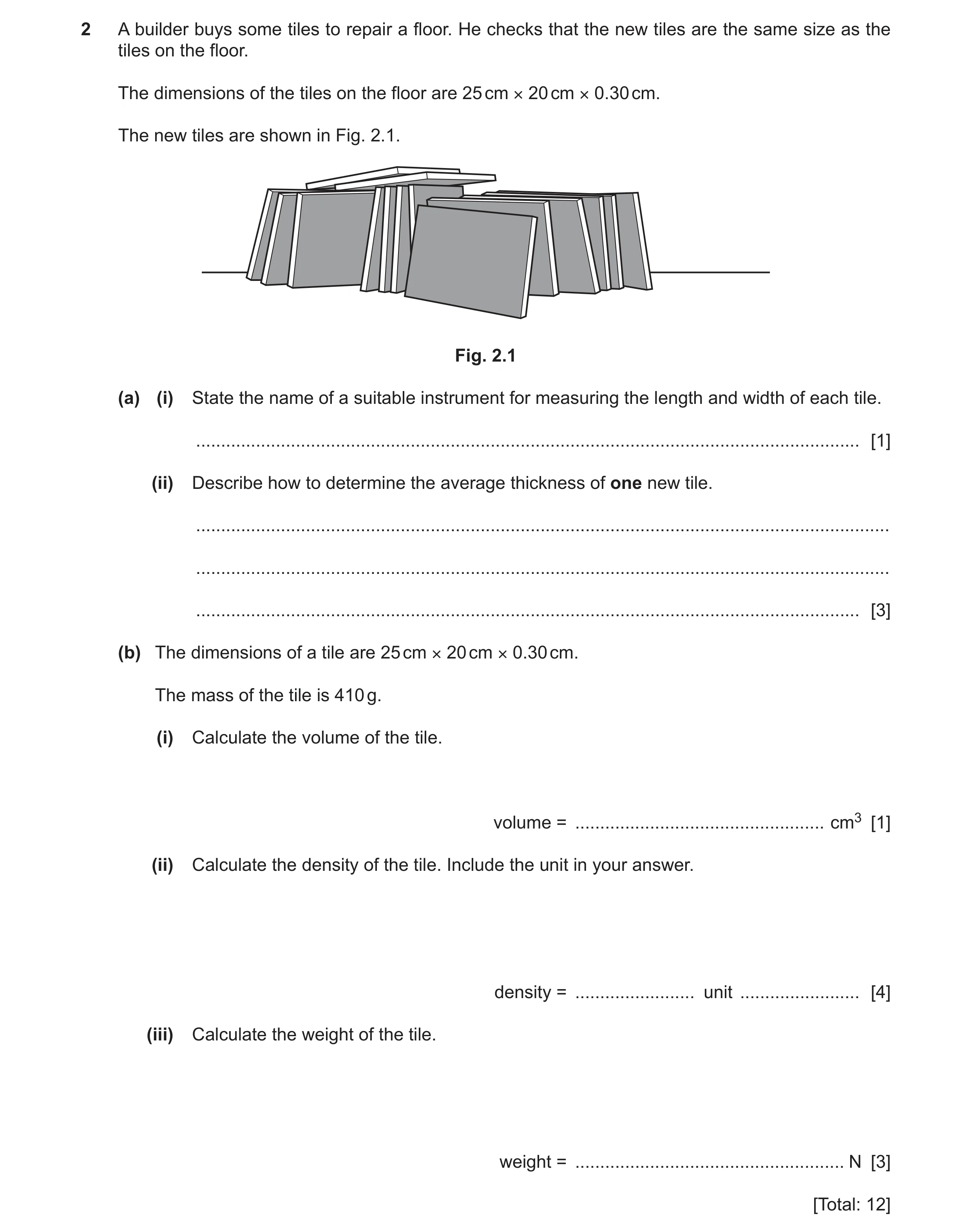
2 A builder buys some tiles to repair a floor. He checks that the new tiles are the same size as the tiles on the floor. The dimensions of the tiles on the floor are 25 cm × 20 cm × 0.30 cm. The new tiles are shown in Fig. 2.1. Fig. 2.1 (a) (i) State the name of a suitable instrument for measuring the length and width of each tile. … [1] (ii) Describe how to determine the average thickness of one new tile. … … … [3] (b) The dimensions of a tile are 25 cm × 20 cm × 0.30 cm. The mass of the tile is 410 g. (i) Calculate the volume of the tile. volume = … cm3 [1] (ii) Calculate the density of the tile. Include the unit in your answer. density = … unit … [4] (iii) Calculate the weight of the tile. weight = … N [3] [Total: 12]
12 marks
Mark scheme: 2(a)(i) rule(r) / metre stick / tape measure B1 2(a)(ii) place n tiles on top of each other owtte AND n = 10 or more B1 measure the (total) thickness of more than one tile B1 divide by n AND n = 2 or more B1 2(b)(i) (volume =) (25 20 0.30 =) 150 (cm3) B1 2(b)(ii) 2.7 A3 410 ÷ 150 OR 410 ÷ (their ans (b)(i)) (C2) density = mass ÷ volume in any form (C1) g / cm3 B1 2(b)(iii) 4.1(0) (N) A3 0.41(0) (C1) (W =) m g OR m 10 in any form (C1)
This question in 0625/33 Oct/Nov 2022
Q26 · Two strips of staples 0625/32 Feb/March 2023
1 Fig. 1.1 shows two strips of staples. strip of 40 staples width of strip Fig. 1.1 NOT to scale (a) The width of one strip is 56 mm. There are 40 staples in the strip. Calculate the average width of one staple. average width of one staple = … mm [2] (b) A student wants to find the volume of one strip of 40 staples. The student has a measuring cylinder and a beaker of water as shown in Fig. 1.2. strip measuring water of staples cylinder Fig. 1.2 Describe how the student can determine the volume of one strip of staples by using the equipment shown in Fig. 1.2. … … … … … … [4] (c) The staples are made from a block of metal. The mass of the block is 296 g. The volume of the block is 33.2 cm3. Calculate the density of the metal. Include the unit. density of the metal = … unit … [4] [Total: 10]
10 marks
Mark scheme: Question Answer Marks 1(a) (average thickness =) 1.4 (mm) A2 (average thickness =) 56 ÷ 40 (C1) 1(b) any three from: B3 measuring cylinder (partially) filled with water (initial) volume measured / noted strip submerged in water owtte (new / 2nd) volume (of strip and water) measured volume of strip = difference in volumes B1 1(c) (=) 8.92 A3 (=) 296 ÷ 33.2 (C2) (density =) mass ÷ volume OR (=) m / V in any form (C1) g / cm3 B1
This question in 0625/32 Feb/March 2023
Q27 · A student measures the diameter of some identical steel balls 0625/32 May/June 2023
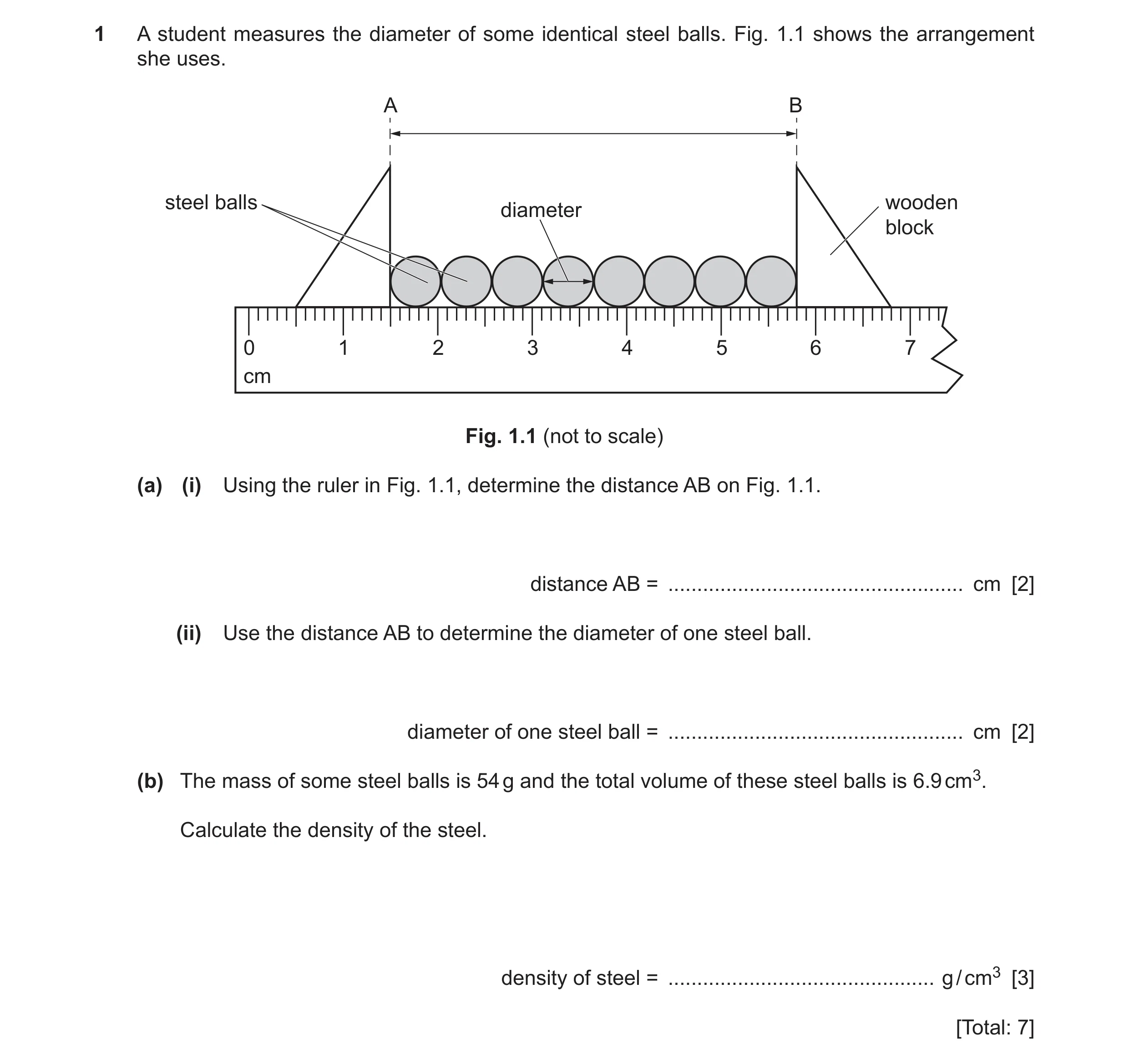
1 A student measures the diameter of some identical steel balls. Fig. 1.1 shows the arrangement she uses. A B steel balls wooden diameter block 0 1 2 3 4 5 6 7 cm Fig. 1.1 (not to scale) (a) (i) Using the ruler in Fig. 1.1, determine the distance AB on Fig. 1.1. distance AB = … cm [2] (ii) Use the distance AB to determine the diameter of one steel ball. diameter of one steel ball = … cm [2] (b) The mass of some steel balls is 54 g and the total volume of these steel balls is 6.9 cm3. Calculate the density of the steel. density of steel = … g / cm3 [3] [Total: 7]
7 marks
Mark scheme: 1(a)(i) 4.3 (cm) A2 5.8 (– 1.5) C1 1(a)(ii) (a)(i) ÷ 8 correctly evaluated (0.54 (cm) if 4.3 cm used) A2 (a)(i) ÷ 8 (C1) 1(b) 7.8 (g / cm3) A3 54 ÷ 6.9 (C2) D = m ÷ v in any form (C1)
This question in 0625/32 May/June 2023
Q28 · The mass of a solid metal cylinder is 400 g and its volume is 52 cm3 0625/31 Oct/Nov 2023
2 The mass of a solid metal cylinder is 400 g and its volume is 52 cm3. (a) Calculate the density of the metal. Include the unit. density = … [4] (b) The cylinder is falling at constant speed through the air. Fig. 2.1 shows the vertical forces acting on the cylinder. … … N cylinder 3.9 N weight Fig. 2.1 (not to scale) On Fig. 2.1, write the name and the size of the upward force on the cylinder. [2] (c) The student balances a beam on a pivot. On the beam, he positions the cylinder and a block so that the beam remains balanced. The arrangement is shown in Fig. 2.2. cylinder block pivot 42 cm 25 cm weight of block 3.9 N Fig. 2.2 (not to scale) Calculate the weight of the block. weight of block = … N [4] [Total: 10]
10 marks
Mark scheme: 2(a) 7.7 A3 400 ÷ 52 (C2) (density =) mass ÷ volume OR m / V (C1) g / cm3 B1 2(b) friction OR drag OR (air) resistance B1 3.9 (N) B1 2(c) (weight = 97.5 ÷ 42) = 2.3 (N) A4 W 42 = 3.9 25 {OR 97.5} OR (W =) 3.9 25 / 42 (C3) (moment of cylinder =) 3.9 25 OR 97.5 (C1) clockwise moment = anticlockwise moment OR moment of cylinder = moment of block (C1)
This question in 0625/31 Oct/Nov 2023
Q29 · The mass of a glass bottle is 0.18 kg 0625/33 Oct/Nov 2023
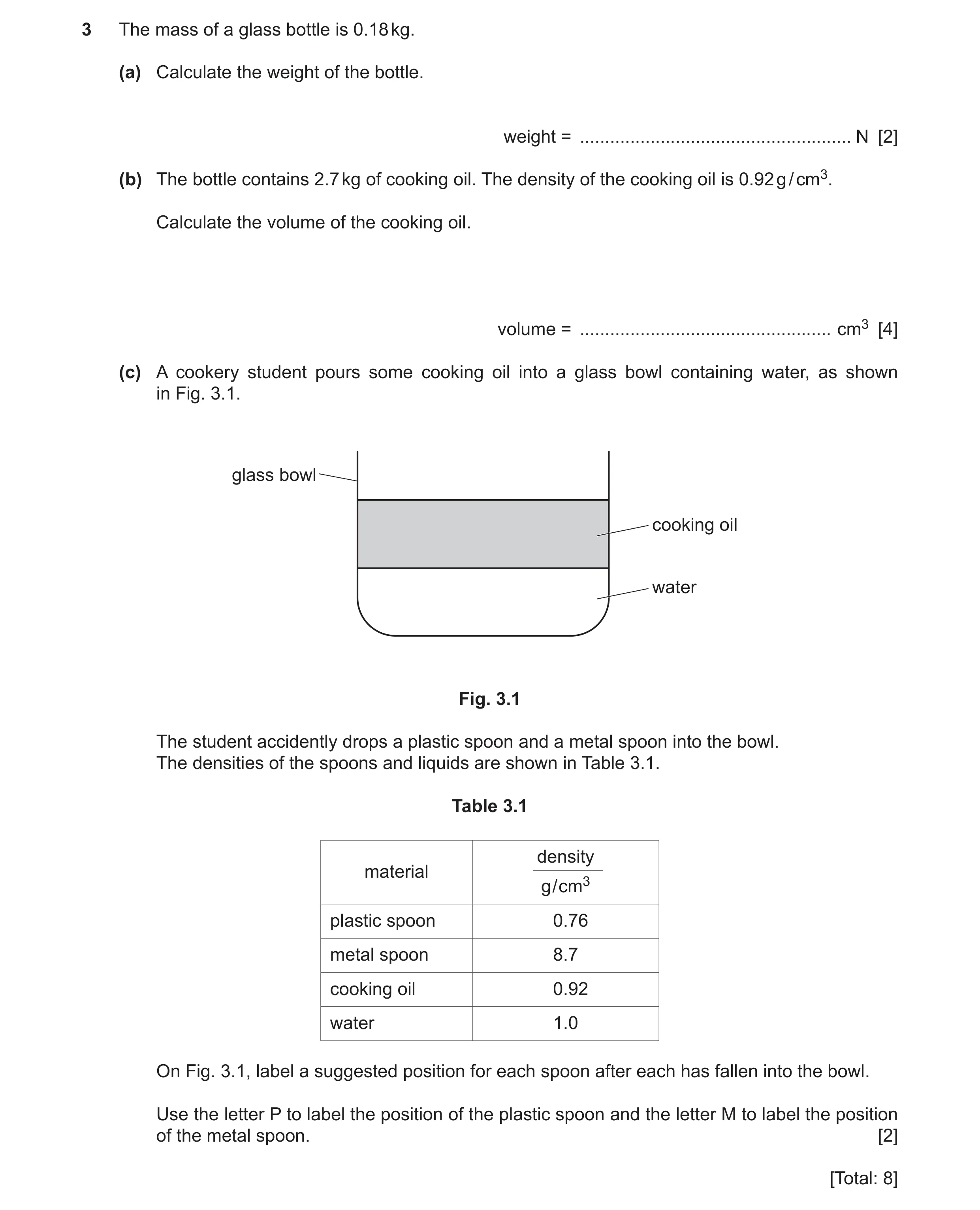
3 The mass of a glass bottle is 0.18 kg. (a) Calculate the weight of the bottle. weight = … N [2] (b) The bottle contains 2.7 kg of cooking oil. The density of the cooking oil is 0.92 g / cm3. Calculate the volume of the cooking oil. volume = … cm3 [4] (c) A cookery student pours some cooking oil into a glass bowl containing water, as shown in Fig. 3.1. glass bowl cooking oil water Fig. 3.1 The student accidently drops a plastic spoon and a metal spoon into the bowl. The densities of the spoons and liquids are shown in Table 3.1. Table 3.1 density material g / cm3 plastic spoon 0.76 metal spoon 8.7 cooking oil 0.92 water 1.0 On Fig. 3.1, label a suggested position for each spoon after each has fallen into the bowl. Use the letter P to label the position of the plastic spoon and the letter M to label the position of the metal spoon. [2] [Total: 8]
8 marks
Mark scheme: 3(a) 1.8 (N) A2 (weight =) mass gravitational field strength in any form OR m g OR m 9.8 OR 0.18 9.8 (C1) 3(b) 2900 (cm3) A4 2700 / 0.92 (C3) (volume =) mass / density OR V = m / ρ (C1) conversion of 2.7 kg to 2700 g (C1) 3(c) P on top liquid surface B1 M on bottom of bowl B1
This question in 0625/33 Oct/Nov 2023
Q30 · A student determines the volume of a piece of metal 0625/32 Feb/March 2024
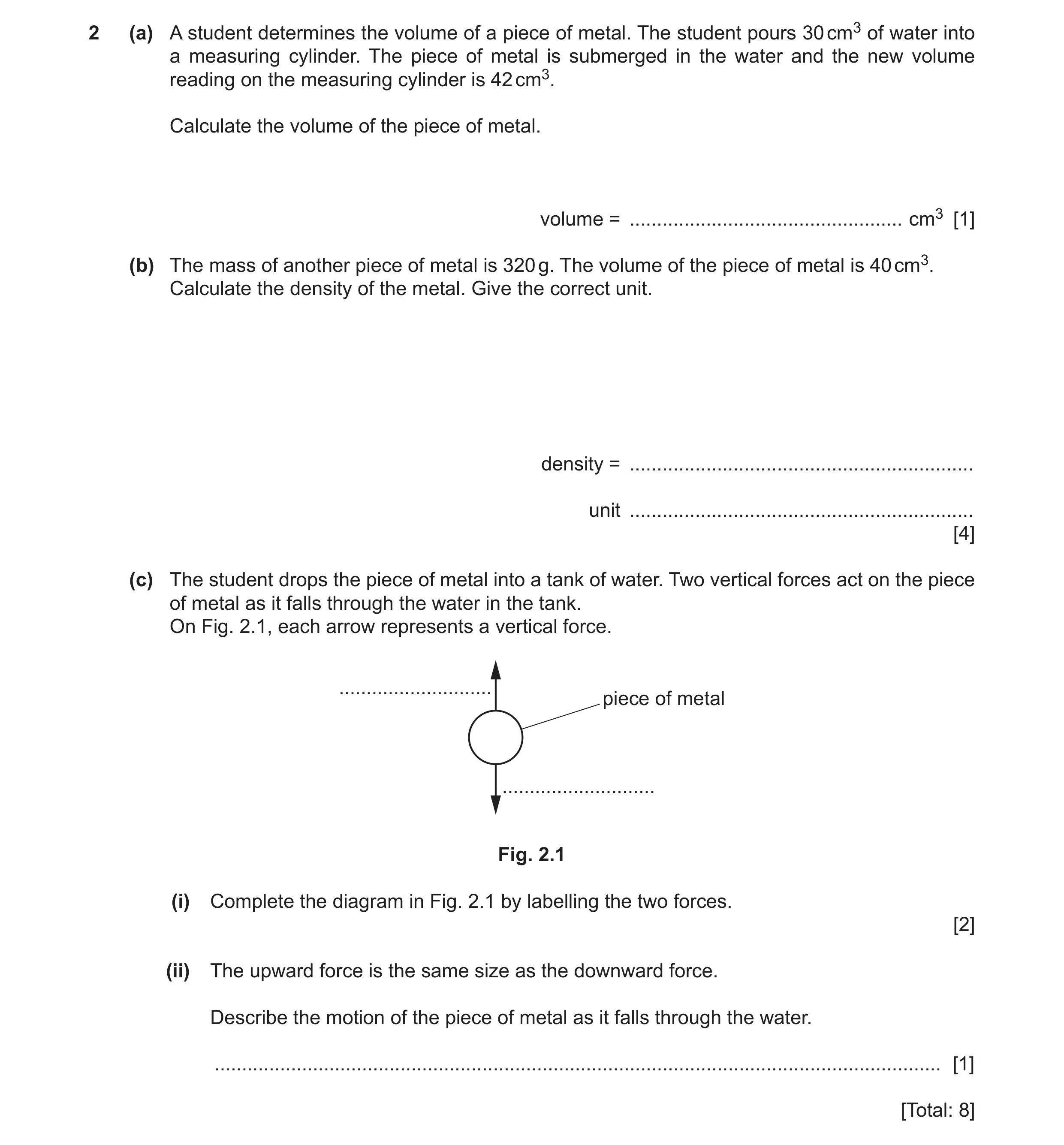
2 (a) A student determines the volume of a piece of metal. The student pours 30 cm3 of water into a measuring cylinder. The piece of metal is submerged in the water and the new volume reading on the measuring cylinder is 42 cm3. Calculate the volume of the piece of metal. volume = … cm3 [1] (b) The mass of another piece of metal is 320 g. The volume of the piece of metal is 40 cm3. Calculate the density of the metal. Give the correct unit. density = … unit … [4] (c) The student drops the piece of metal into a tank of water. Two vertical forces act on the piece of metal as it falls through the water in the tank. On Fig. 2.1, each arrow represents a vertical force. … piece of metal … Fig. 2.1 (i) Complete the diagram in Fig. 2.1 by labelling the two forces. [2] (ii) The upward force is the same size as the downward force. Describe the motion of the piece of metal as it falls through the water. … [1] [Total: 8]
8 marks
Mark scheme: 2(a) (42 – 30 = ) 12 (cm3) B1 2(b) (=) 8(.0) A3 (=) 320 ÷ 40 (C2) (density =) mass ÷ volume OR (=) m / V in any form (C1) g / cm3 B1 2(c)(i) friction / drag (upward arrow) B1 weight (downward arrow) B1 2(c)(ii) (falling with) {constant / steady / uniform} speed B1
This question in 0625/32 Feb/March 2024
Q31 · A student wants to find the volume of a piece of metal 0625/32 May/June 2024
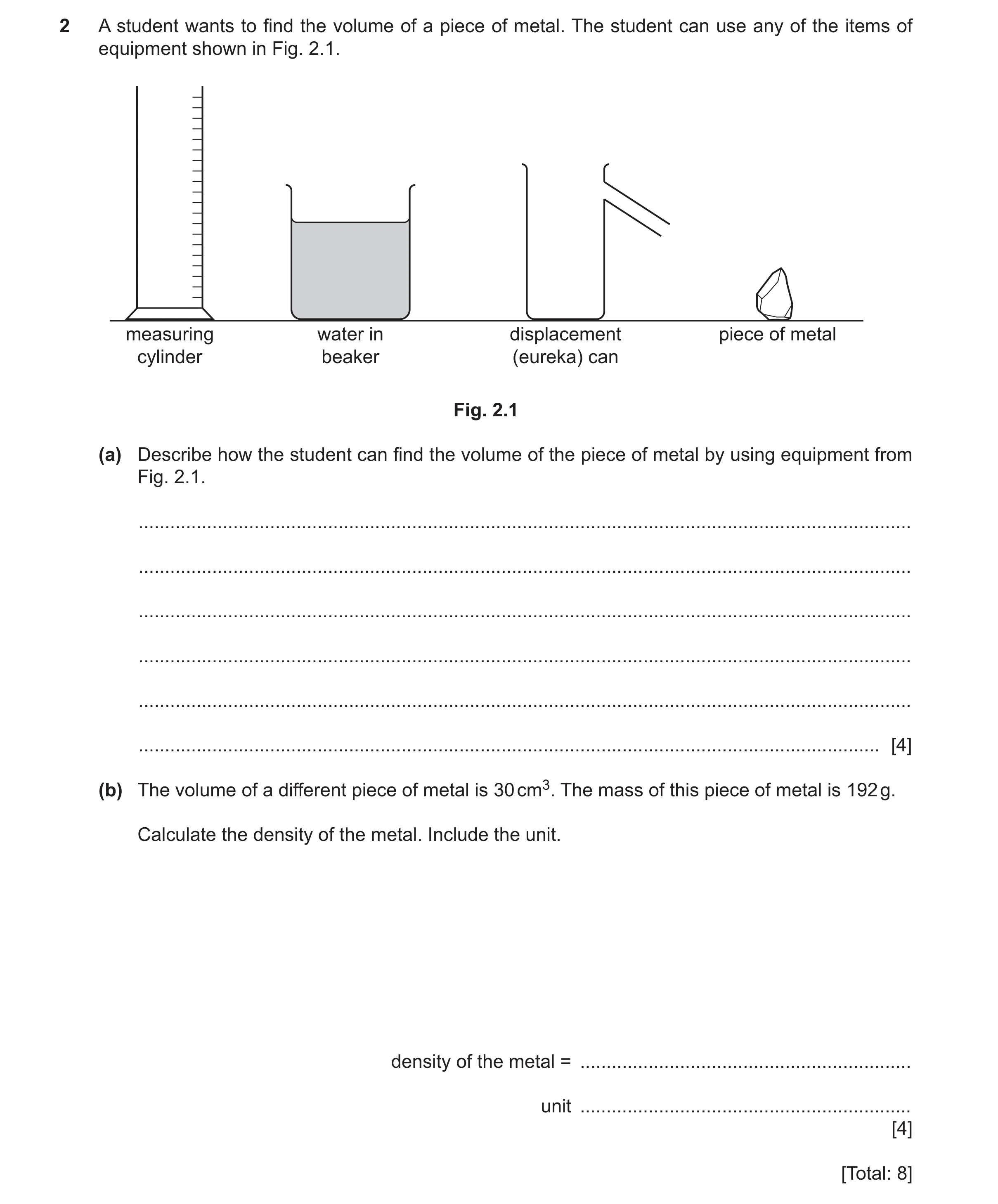
2 A student wants to find the volume of a piece of metal. The student can use any of the items of equipment shown in Fig. 2.1. measuring water in displacement piece of metal cylinder beaker (eureka) can Fig. 2.1 (a) Describe how the student can find the volume of the piece of metal by using equipment from Fig. 2.1. … … … … … … [4] (b) The volume of a different piece of metal is 30 cm3. The mass of this piece of metal is 192 g. Calculate the density of the metal. Include the unit. density of the metal = … unit … [4] [Total: 8]
8 marks
Mark scheme: 2(a) any three from: measuring cylinder (part) filled with water volume of water measured or recorded/noted/read metal submerged / placed in water owtte new volume read / noted / measured / recorded volume of metal = difference in volumes B1 2(b) ( =) 6 A3 ( =) 192 ÷ 30 (C2) (density =) mass ÷ volume OR ( =) m / V in any form (C1) g / cm3 B1
This question in 0625/32 May/June 2024
Q32 · A student determines the density of a metal 0625/31 Oct/Nov 2024
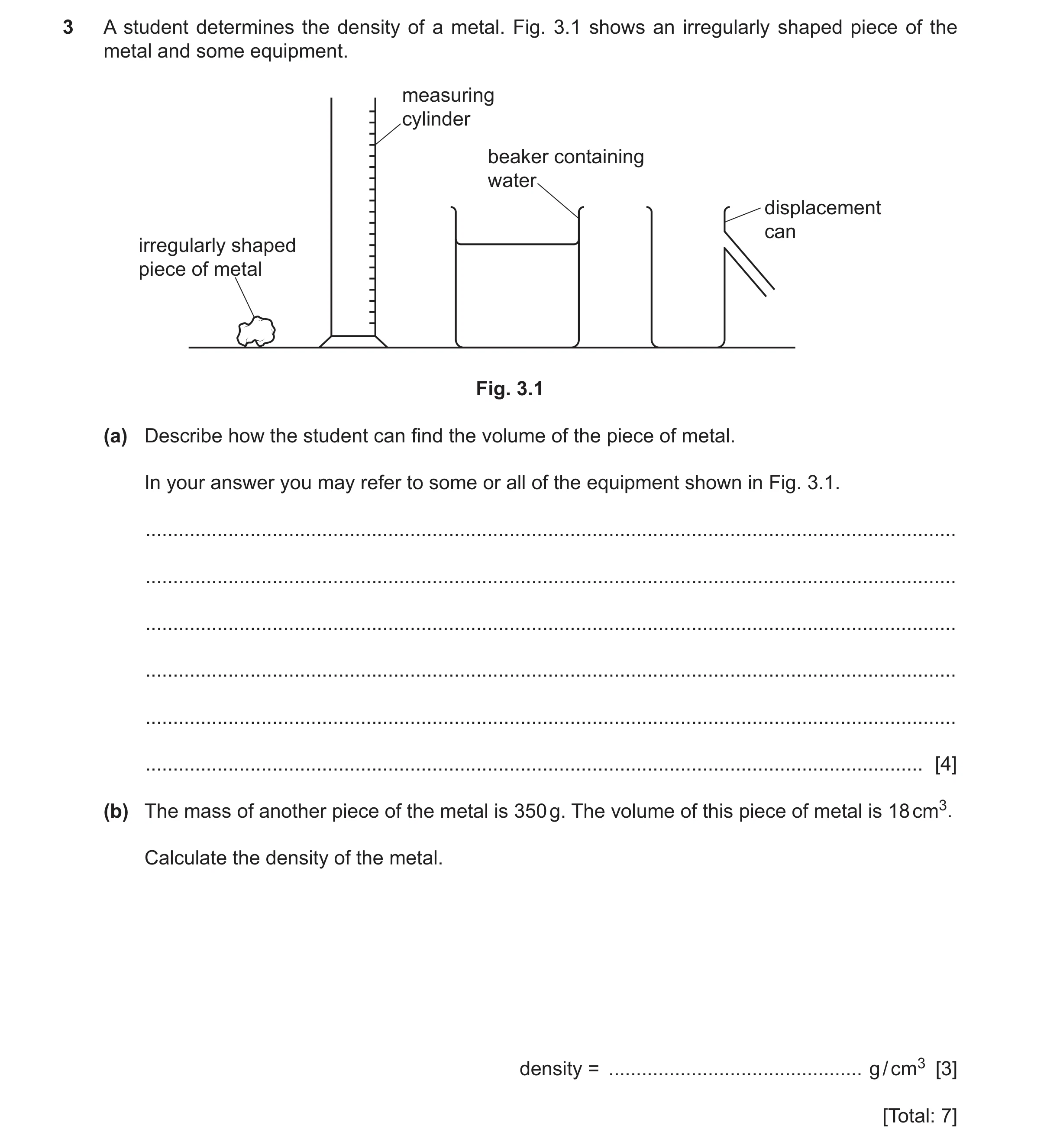
3 A student determines the density of a metal. Fig. 3.1 shows an irregularly shaped piece of the metal and some equipment. measuring cylinder beaker containing water displacement can irregularly shaped piece of metal Fig. 3.1 (a) Describe how the student can find the volume of the piece of metal. In your answer you may refer to some or all of the equipment shown in Fig. 3.1. … … … … … … [4] (b) The mass of another piece of the metal is 350 g. The volume of this piece of metal is 18 cm3. Calculate the density of the metal. density = … g / cm3 [3] [Total: 7]
7 marks
Mark scheme: 3(a) any three from: B3 • part fill measuring cylinder with water • measure / note volume (of water) B1 • submerge metal in measuring cylinder (B3) • determine increase in volume OR measure new volume of water (and metal) (B1) AND • find the difference in the two volumes OR increase in volume = volume of metal 3(b) 19 (g / cm3) A3 350 18 (C2) density = mass volume OR ρ = m V (C1)
This question in 0625/31 Oct/Nov 2024
Q33 · A student wants to measure the diameter of a wire 0625/32 Oct/Nov 2024
2 A student wants to measure the diameter of a wire. The wire is thinner than a single gradation on her ruler. She coils the wire carefully and makes 12 loops as shown in Fig. 2.1. coil of 12 loops Fig. 2.1 (a) Describe how she can use her ruler to determine the diameter of the wire accurately. You may draw on Fig. 2.1 as part of your answer. … … … … [3] (b) The student determines the density of the metal of the wire. She folds some of the wire into a small shape as shown in Fig. 2.2. small shape of wire Fig. 2.2 She then puts this small shape of wire into a measuring cylinder containing water. The measuring cylinder is on an electric balance. This procedure is shown in Fig. 2.3. 50 cm3 50 cm3 measuring cylinder 40 40 30 30 water wire 20 20 electric balance 10 10 67 g 112 g wire not in water wire in water Fig. 2.3 Using the information in Fig. 2.3, calculate: (i) the mass of the wire mass of the wire = … g [1] (ii) the volume of the wire. volume of the wire = … cm3 [2] (c) The mass of a different wire is 64 g. The volume of this wire is 7.2 cm3. Using this information, calculate the density of this wire. density = … g / cm3 [3] [Total: 9]
9 marks
Mark scheme: 2(a) measure the width of n loops with rule B1 n =10 or more loops B1 (diameter of one loop) = total width n if n 1 B1 2(b)(i) 45 (g) B1 2(b)(ii) 5(.0) (cm3) A2 32 – 27 (C1) 2(c) 8.9 (g / cm3) A3 64 7.2 (C2) (density = ) mass volume OR (ρ =) m V (C1)
This question in 0625/32 Oct/Nov 2024
Q34 · A student determines the density of a liquid, by using the equipment shown in Fig 0625/32 Feb/March 2025
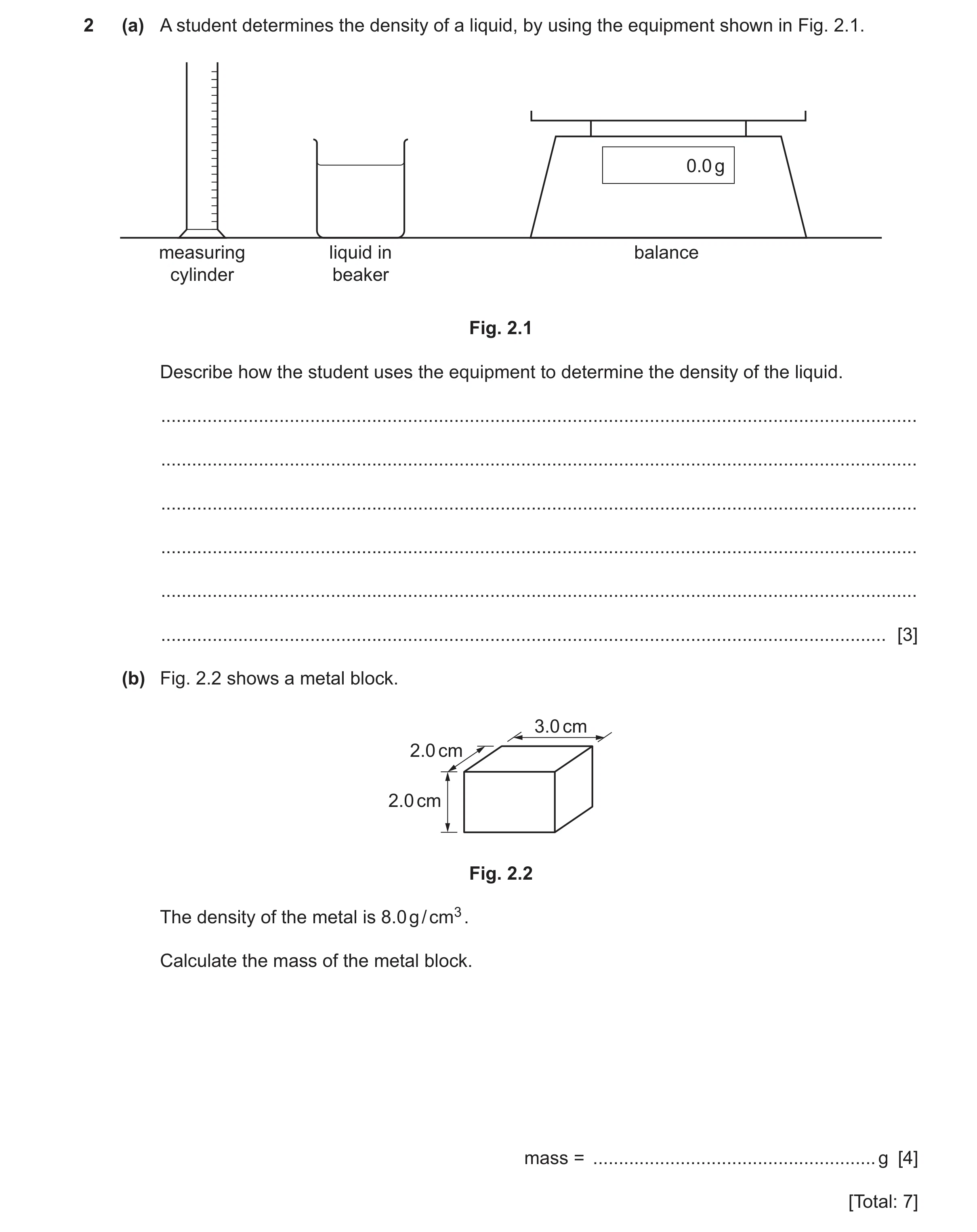
2 (a) A student determines the density of a liquid, by using the equipment shown in Fig. 2.1. 0.0 g measuring liquid in balance cylinder beaker Fig. 2.1 Describe how the student uses the equipment to determine the density of the liquid. … … … … … … [3] (b) Fig. 2.2 shows a metal block. 3.0 cm 2.0 cm 2.0 cm Fig. 2.2 The density of the metal is 8.0 g / cm3 . Calculate the mass of the metal block. mass = … g [4] [Total: 7]
7 marks
Mark scheme: 2(a) Any two from: B2 idea of using measuring cylinder to measure (liquid) volume measure mass of cylinder / beaker empty / with liquid measure (any) mass with balance Any one from: B1 idea of subtracting mass of empty beaker use of density = mass ÷ volume 2(b) (mass =) 96 (g) A4 (mass =) 8(.0) 12 (C3) (mass =) density volume (C1) (volume of block =) 2 2 3 OR 12 (cm3) (C1)
This question in 0625/32 Feb/March 2025
Q35 · Water is dripping slowly from a pipe 0625/31 Oct/Nov 2025
2 (a) Water is dripping slowly from a pipe. (i) A student collects some drops in a measuring cylinder. Fig. 2.1 shows the water collected by the student. cm3 25 20 15 water 10 5 Fig. 2.1 Determine the volume of water in the measuring cylinder. volume of water = … cm3 [1] (ii) A teacher plans to measure the average volume of one drop of water. The teacher collects some drops of water as they fall into a different measuring cylinder. All the drops of water are the same volume. Here is the teacher’s data: number of drops of water = 120 volume of water in the measuring cylinder = 24 cm3 Calculate the volume of one drop of water. volume of one drop of water = … cm3 [3] (b) A scientist places a piece of plastic in some water in a measuring cylinder. Fig. 2.2 shows the result. cm3 200 piece of plastic 100 water Fig. 2.2 Compare the density of the plastic with the density of the water in Fig. 2.2. State the evidence that supports your answer. density of the plastic is … evidence … [2] [Total: 6]
6 marks
Mark scheme: 2(a)(i) 20 (cm3) B1 2(a)(ii) (volume of one drop =) 0.20 (cm3) A3 (volume of one drop =) 24 ÷ 120 (C2) (volume of one drop =) volume of water ÷ number of drops (C1) 2(b) (density of plastic is) less OR lower (than water) B1 (because) plastic/it floats (on water) B1
This question in 0625/31 Oct/Nov 2025
Q36 · Small cubes of ice in a glass of water 0625/32 Oct/Nov 2025
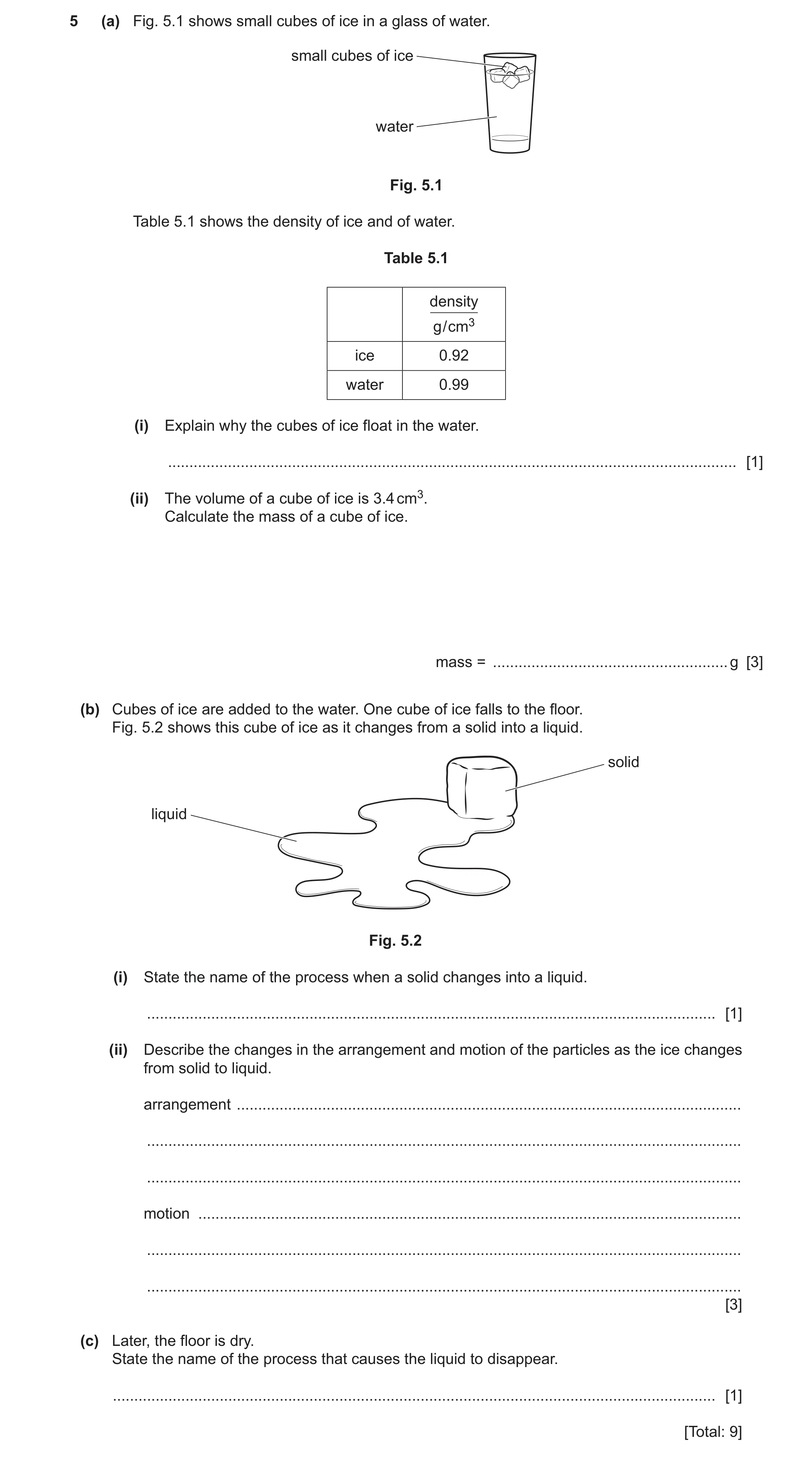
5 (a) Fig. 5.1 shows small cubes of ice in a glass of water. small cubes of ice water Fig. 5.1 Table 5.1 shows the density of ice and of water. Table 5.1 density g / cm3 ice 0.92 water 0.99 (i) Explain why the cubes of ice float in the water. … [1] (ii) The volume of a cube of ice is 3.4 cm3. Calculate the mass of a cube of ice. mass = … g [3] (b) Cubes of ice are added to the water. One cube of ice falls to the floor. Fig. 5.2 shows this cube of ice as it changes from a solid into a liquid. solid liquid Fig. 5.2 (i) State the name of the process when a solid changes into a liquid. … [1] (ii) Describe the changes in the arrangement and motion of the particles as the ice changes from solid to liquid. arrangement … … … motion … … … [3] (c) Later, the floor is dry. State the name of the process that causes the liquid to disappear. … [1] [Total: 9]
9 marks
Mark scheme: 5(a)(i) ice / it (is) less dense (than water) ora B1 5(a)(ii) 3.1 (g) A3 3.4 0.92 C2 (mass =) density volume C1 5(b)(i) Melting B1 5(b)(ii) any three from: B3 arrangement: regular in solid random in liquid motion: (particles only) vibrate in solid (particles) move around / flow over each other in liquid 5(c) evaporation B1
This question in 0625/32 Oct/Nov 2025
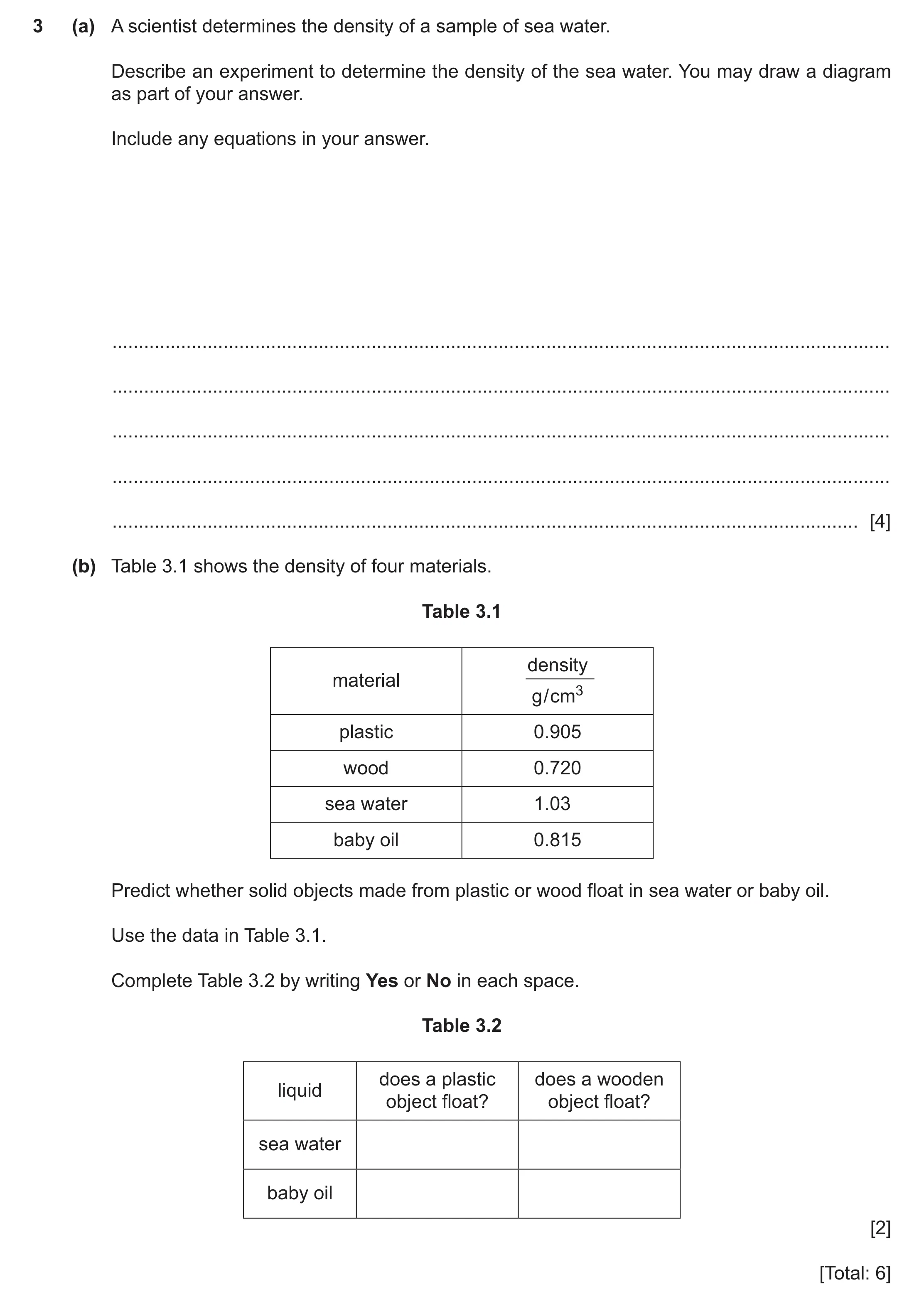
Q37 · A scientist determines the density of a sample of sea water 0625/33 Oct/Nov 2025
3 (a) A scientist determines the density of a sample of sea water. Describe an experiment to determine the density of the sea water. You may draw a diagram as part of your answer. Include any equations in your answer. … … … … … [4] (b) Table 3.1 shows the density of four materials. Table 3.1 density material g / cm3 plastic 0.905 wood 0.720 sea water 1.030 baby oil 0.815 Predict whether solid objects made from plastic or wood float in sea water or baby oil. Use the data in Table 3.1. Complete Table 3.2 by writing Yes or No in each space. Table 3.2 does a plastic does a wooden liquid object float? object float? sea water baby oil [2] [Total: 6]
6 marks
Mark scheme: 3(a) any two from: B2 • mass (measured on a) balance • volume (measured on a) measuring cylinder • (density =) mass / volume any two from: B2 • take / find volume of seawater • take / find mass of ‘container’ (M1) • take / find mass of seawater and ‘container’ (M2) • subtract masses or M2 – M1 3(b) B1 liquid does a plastic object float? does a wooden object float? B1 sea water yes yes baby oil no yes
This question in 0625/33 Oct/Nov 2025
 1 / 42
 2 / 42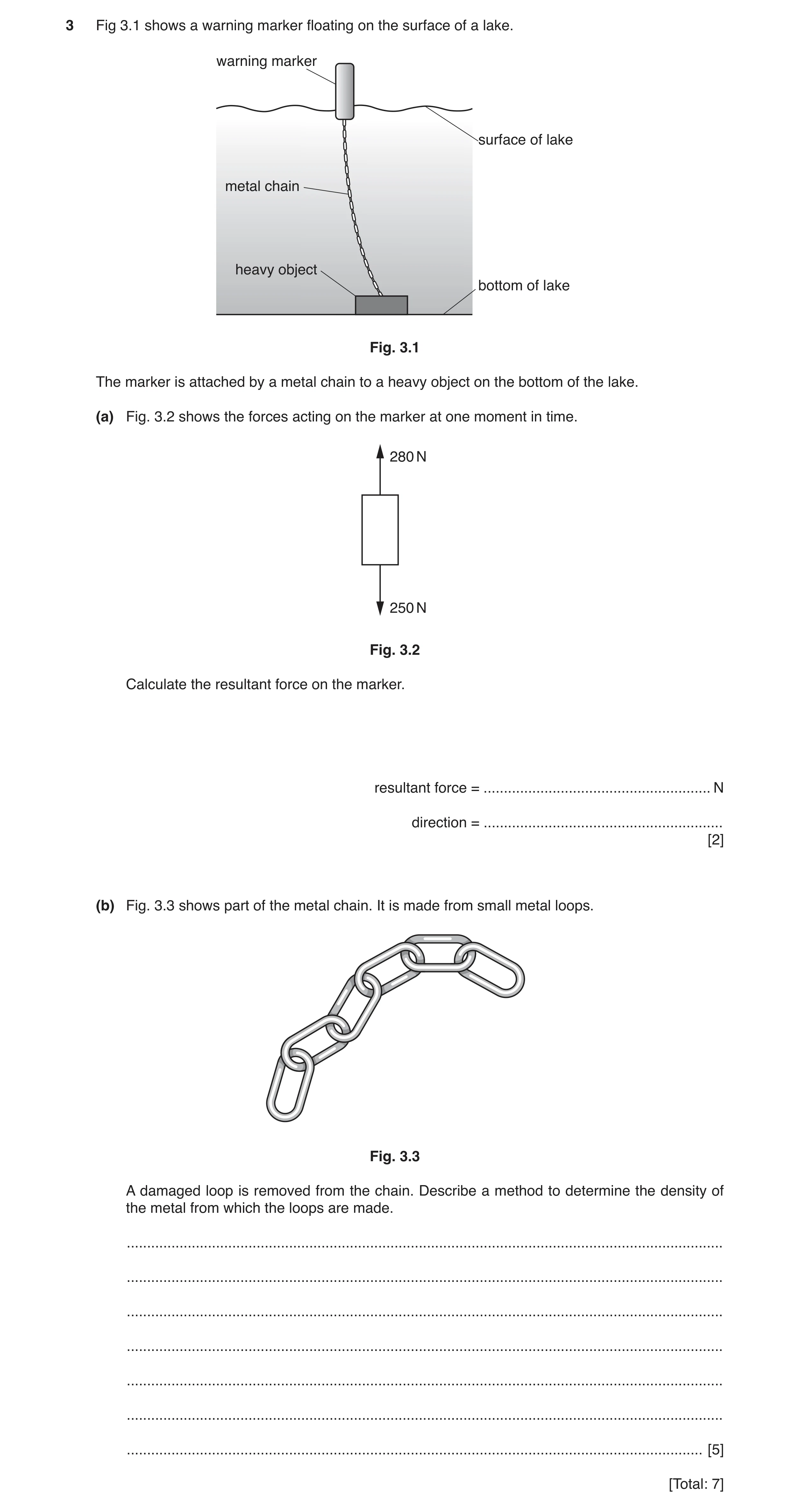
 4 / 42
 5 / 42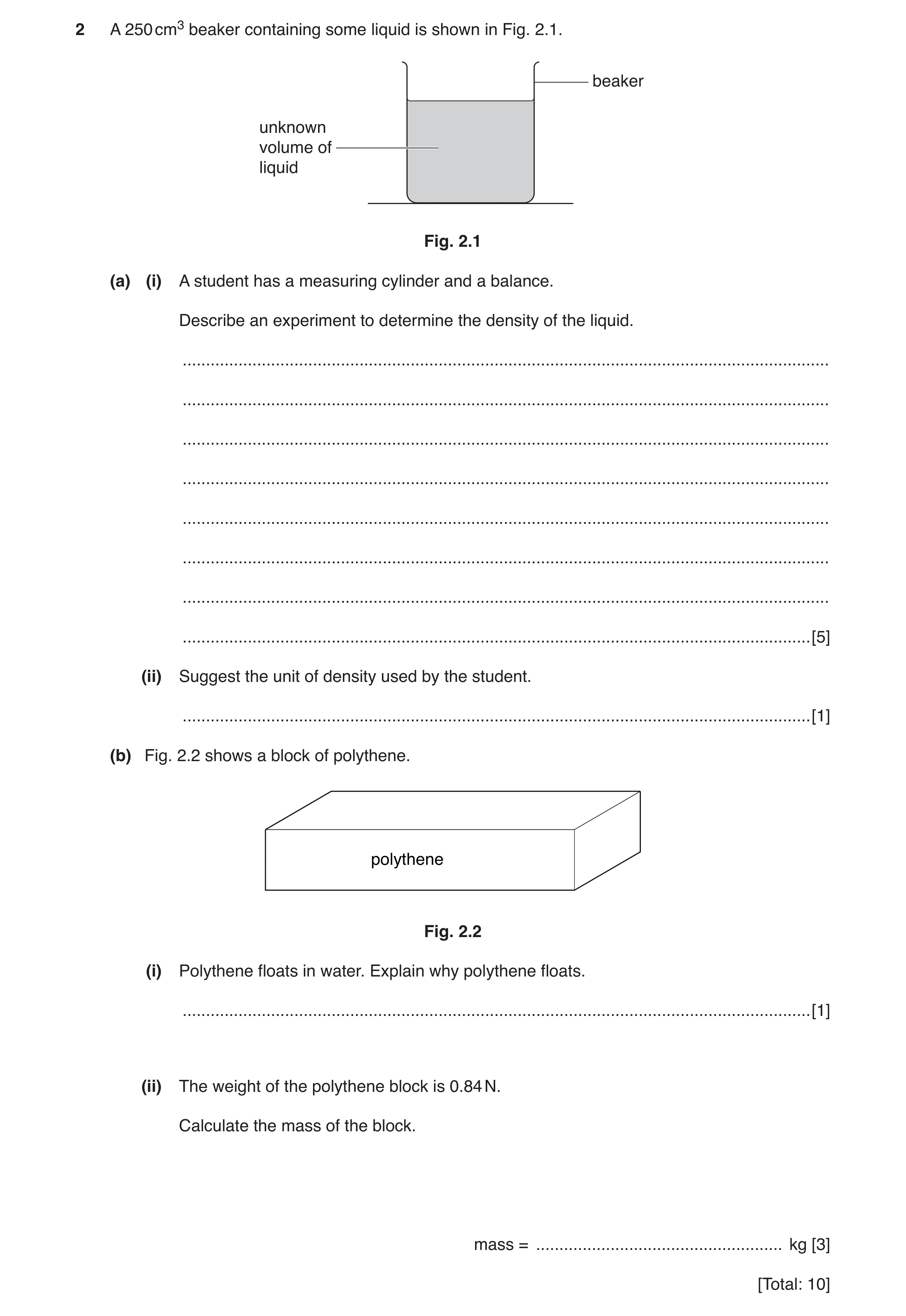
 7 / 42
 8 / 42
 9 / 42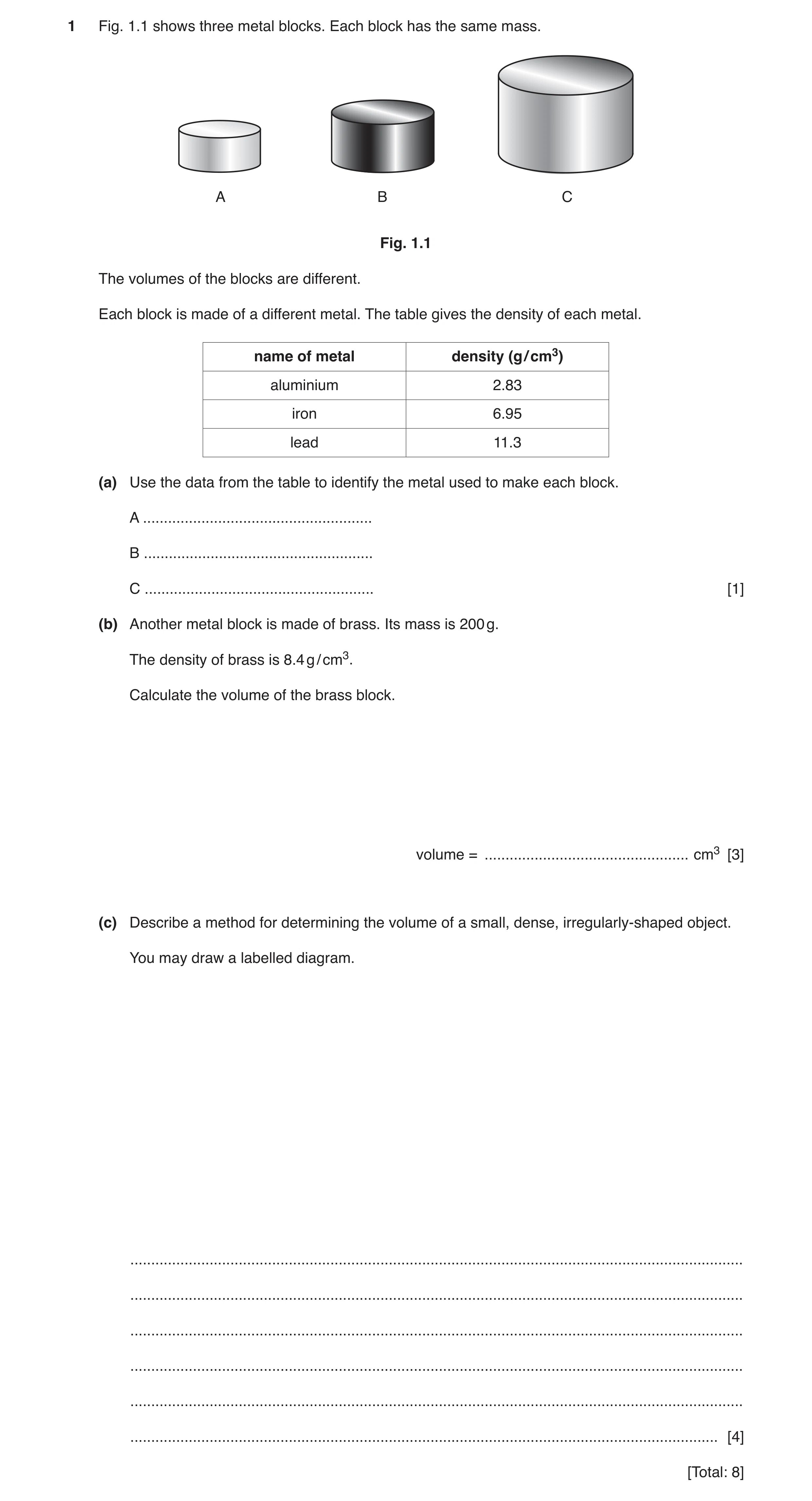
 11 / 42
 12 / 42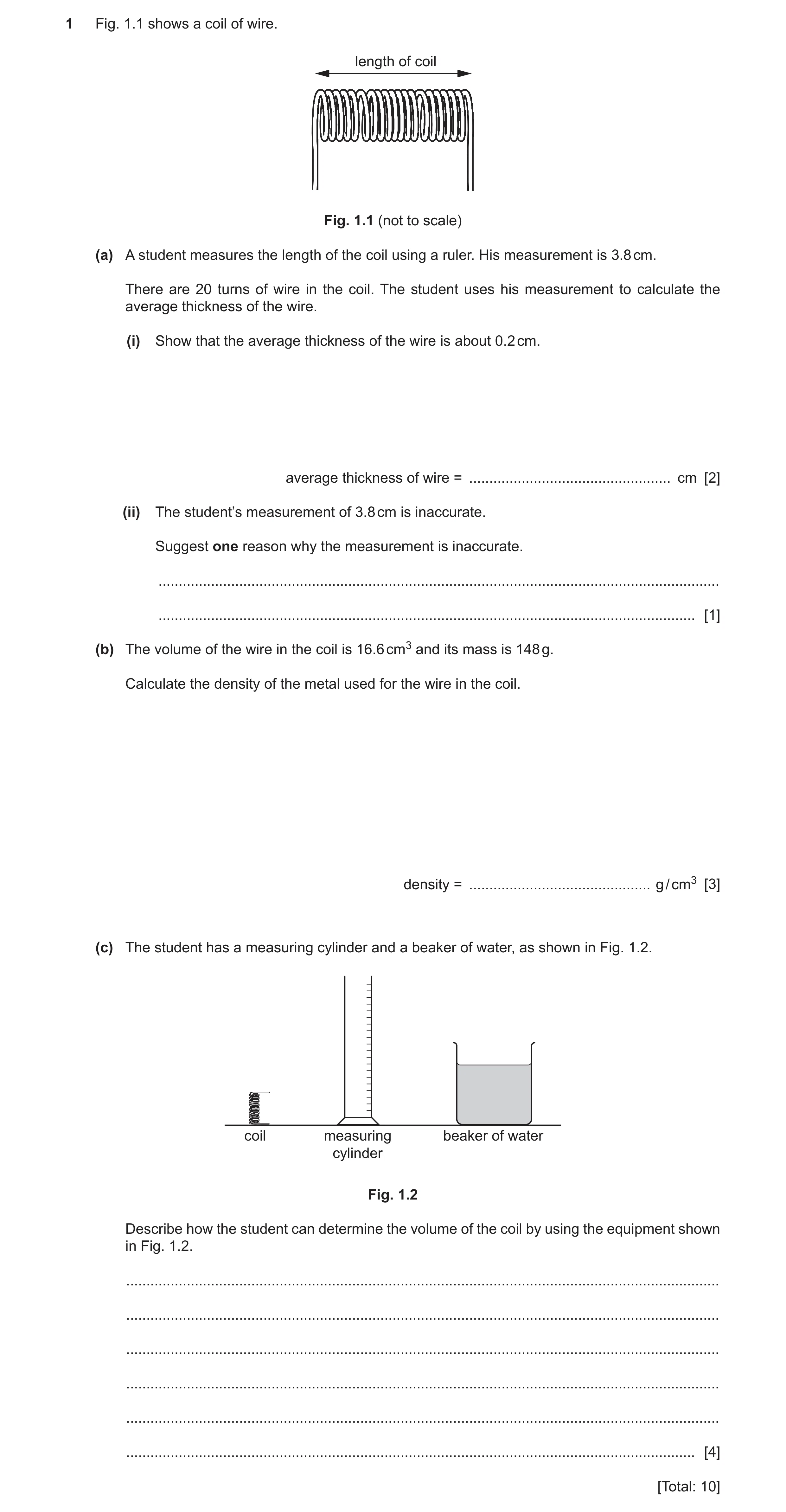
 14 / 42
 15 / 42
 16 / 42
 17 / 42
 18 / 42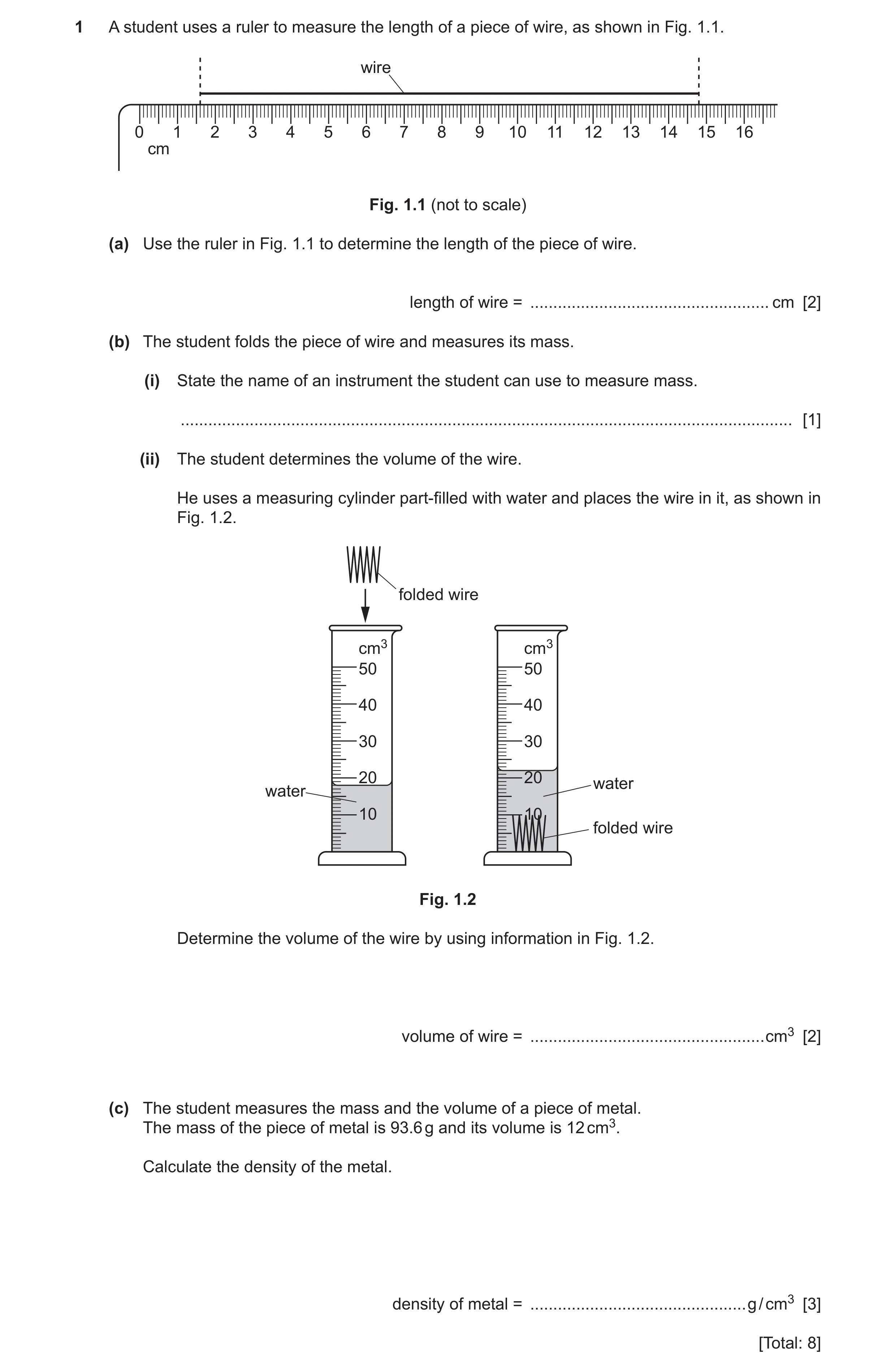
 23 / 42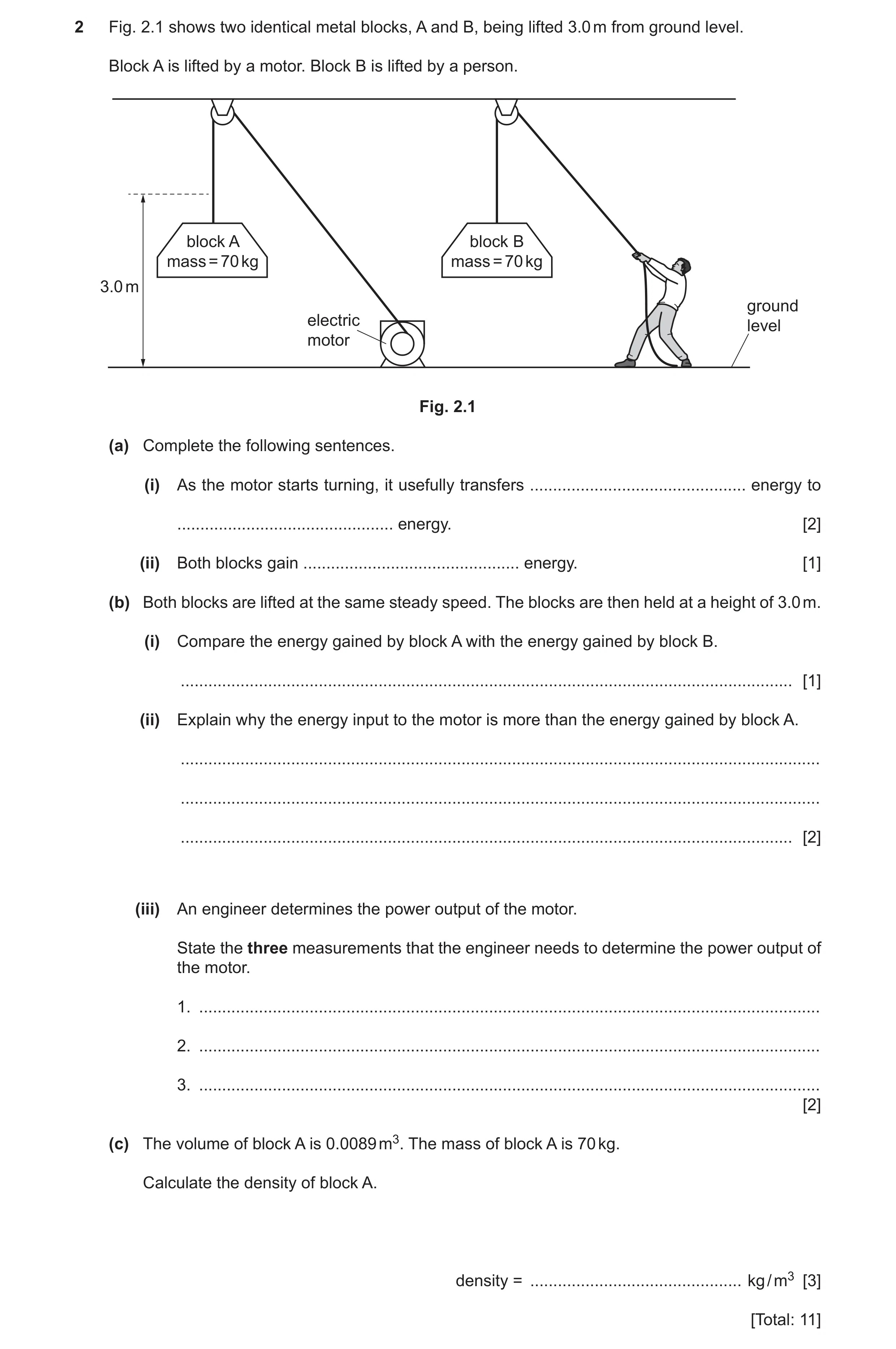
 27 / 42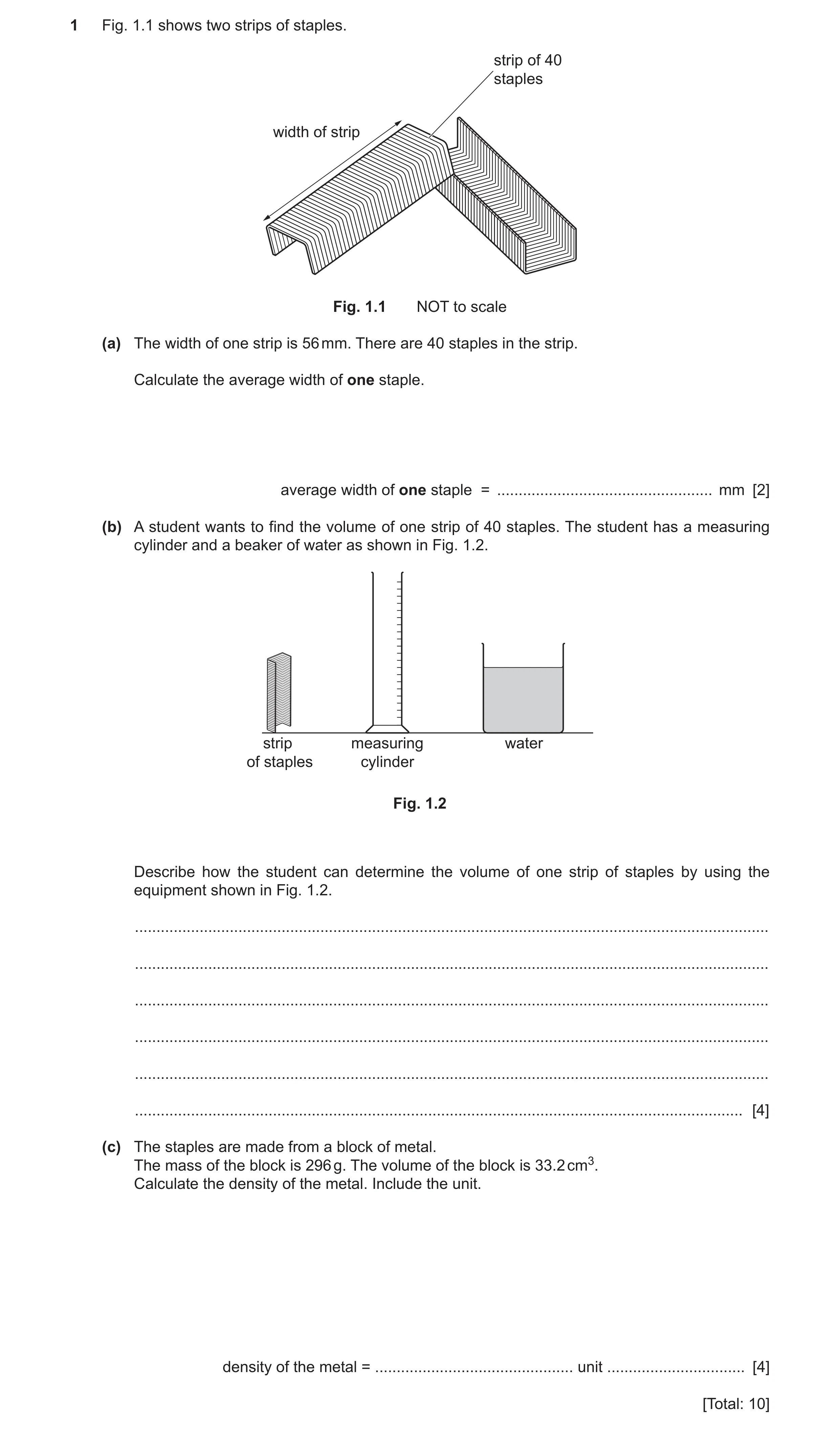
 29 / 42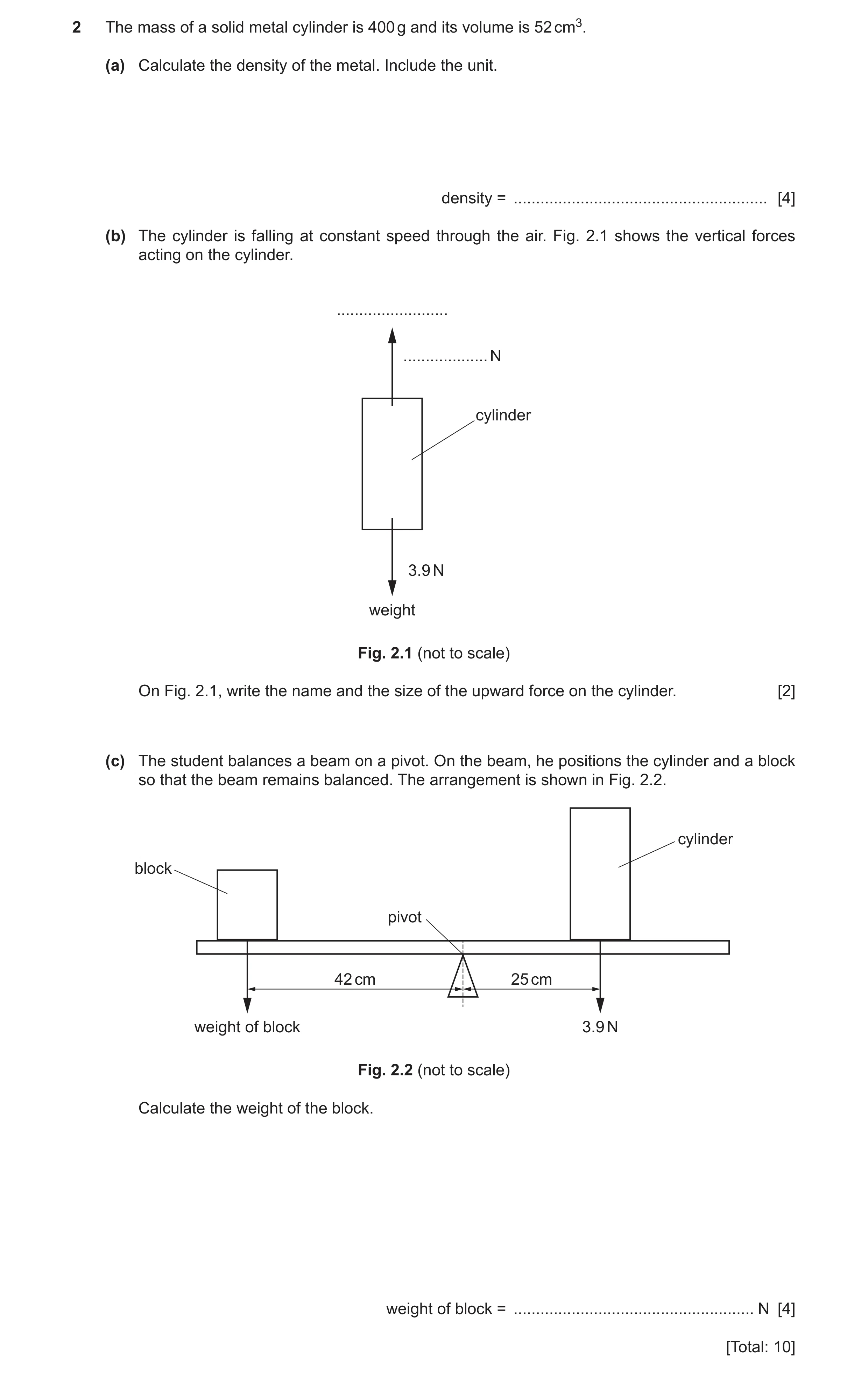
 32 / 42
 33 / 42
 34 / 42
 35 / 42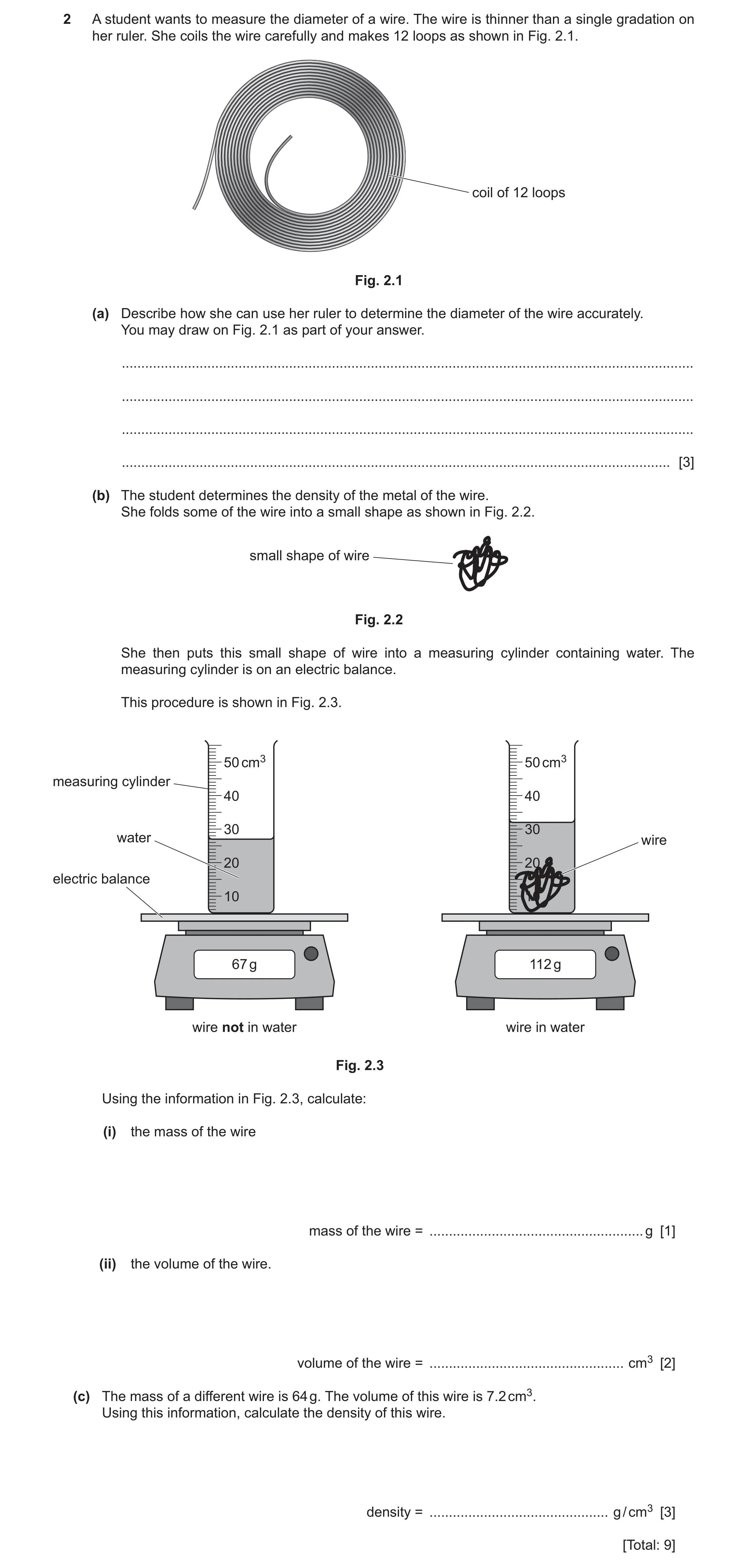
 38 / 42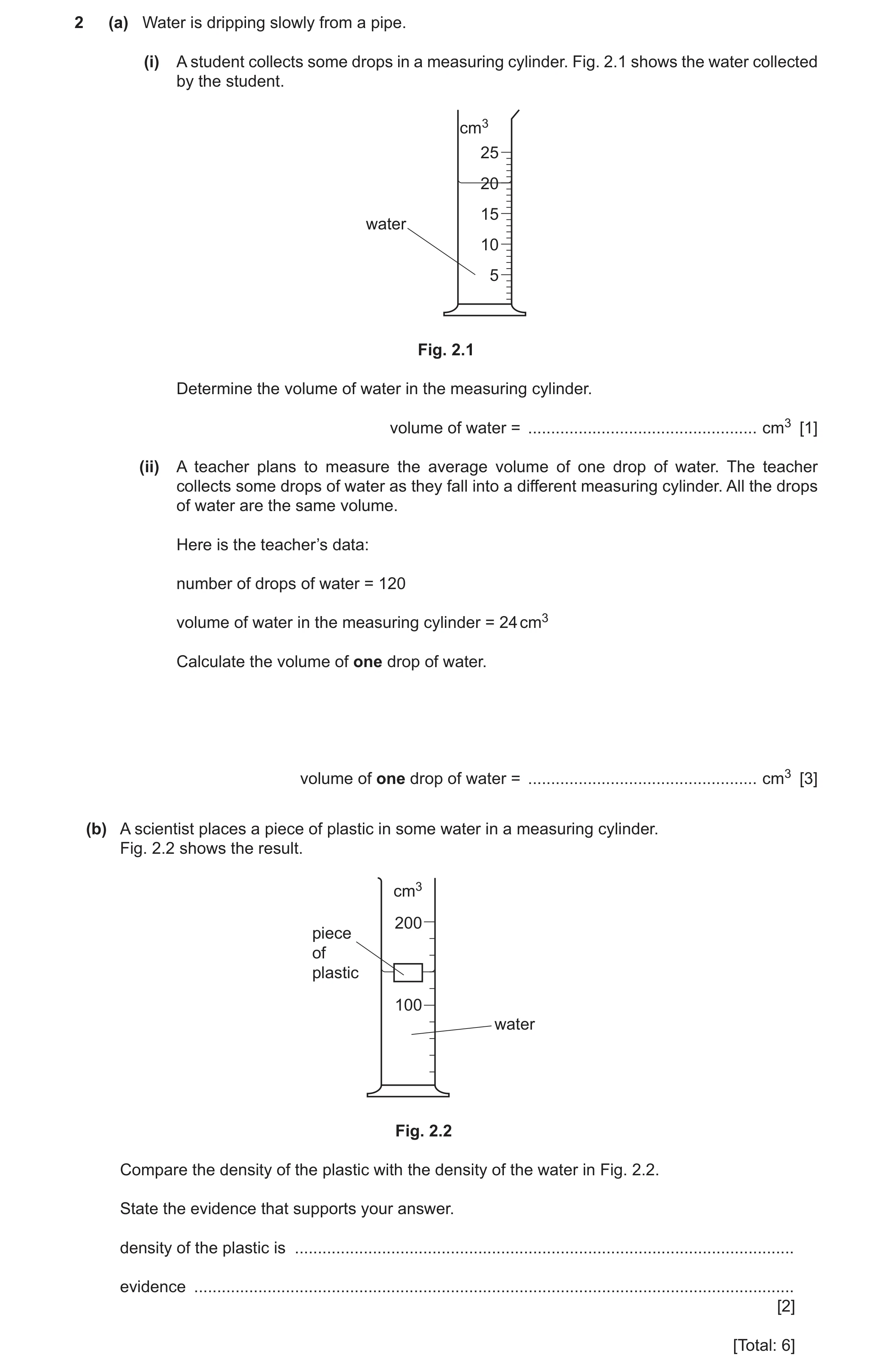
 42 / 42
 5
5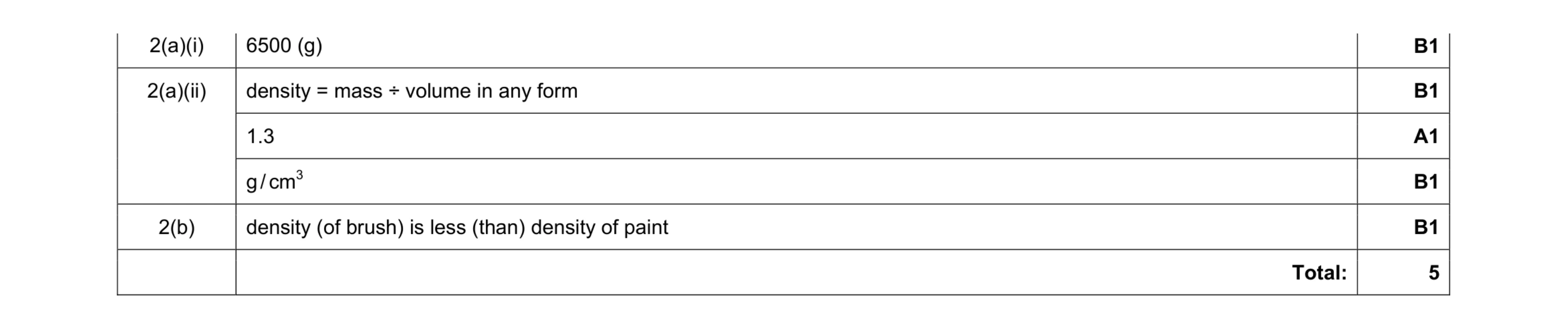 5
5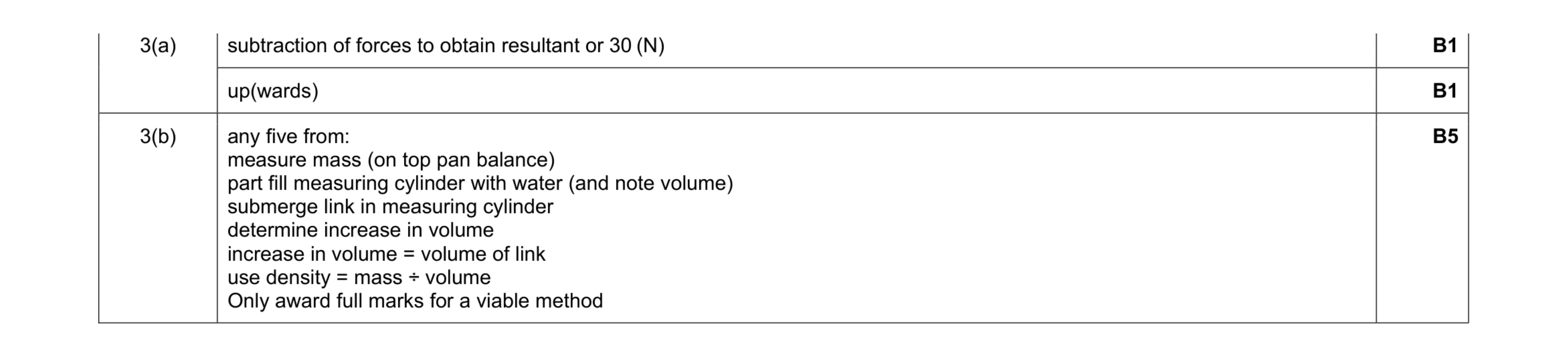 7
7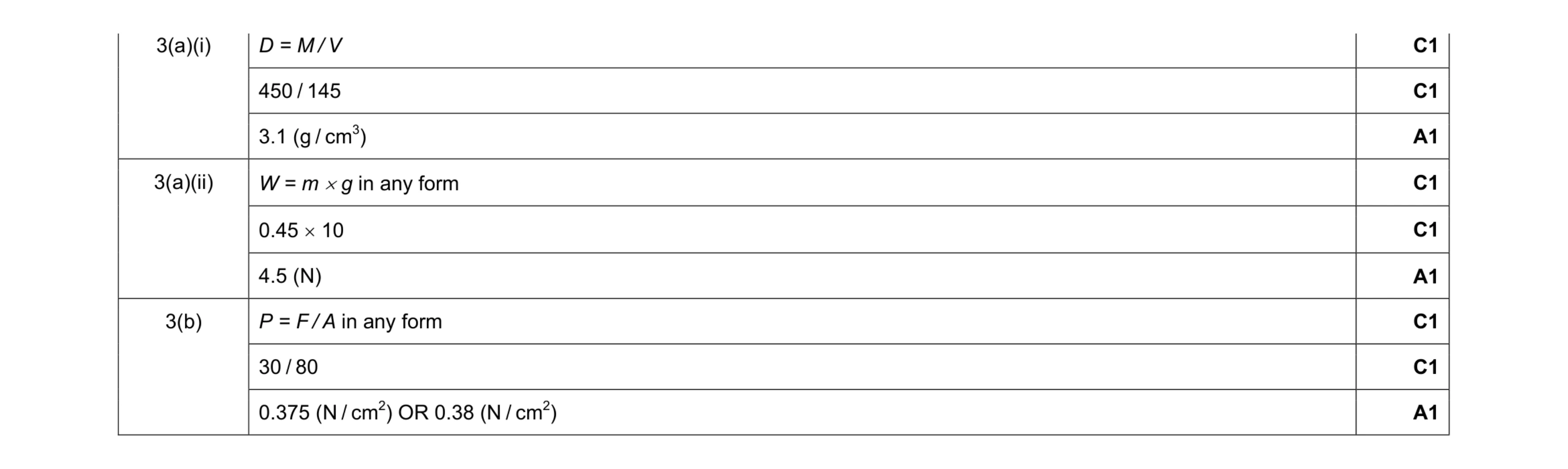 9
9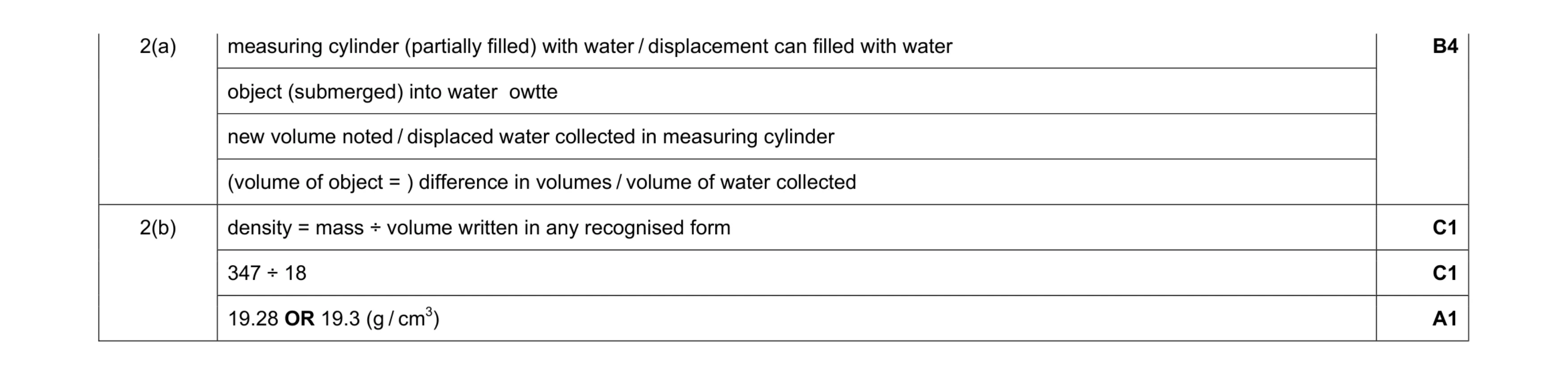 7
7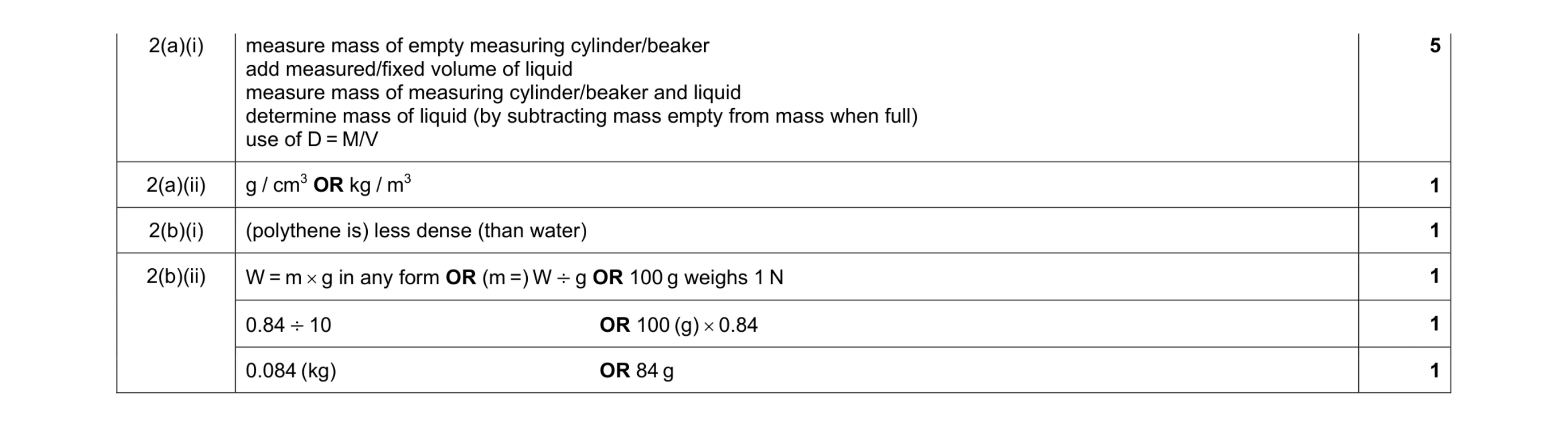 10
10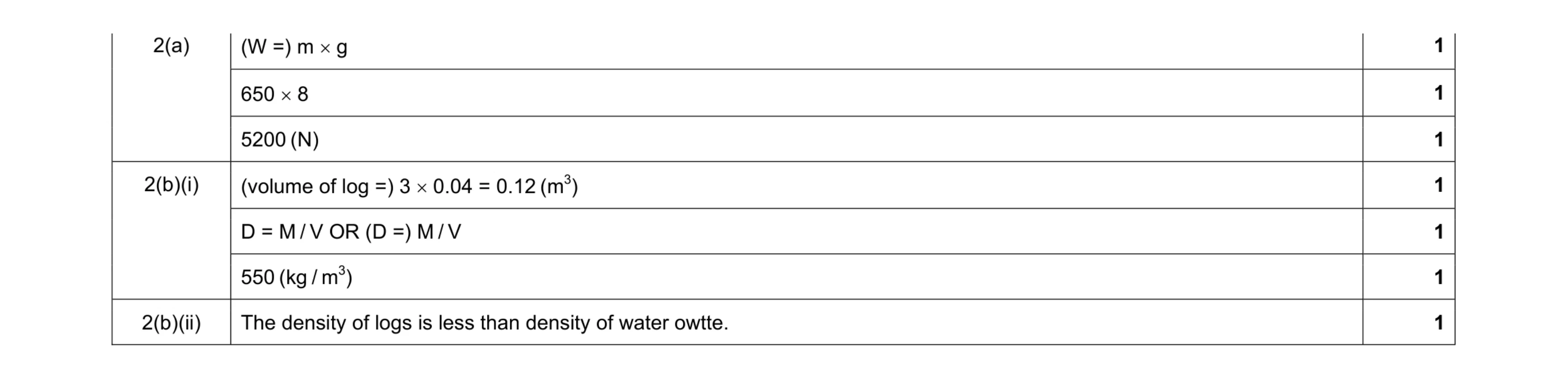 7
7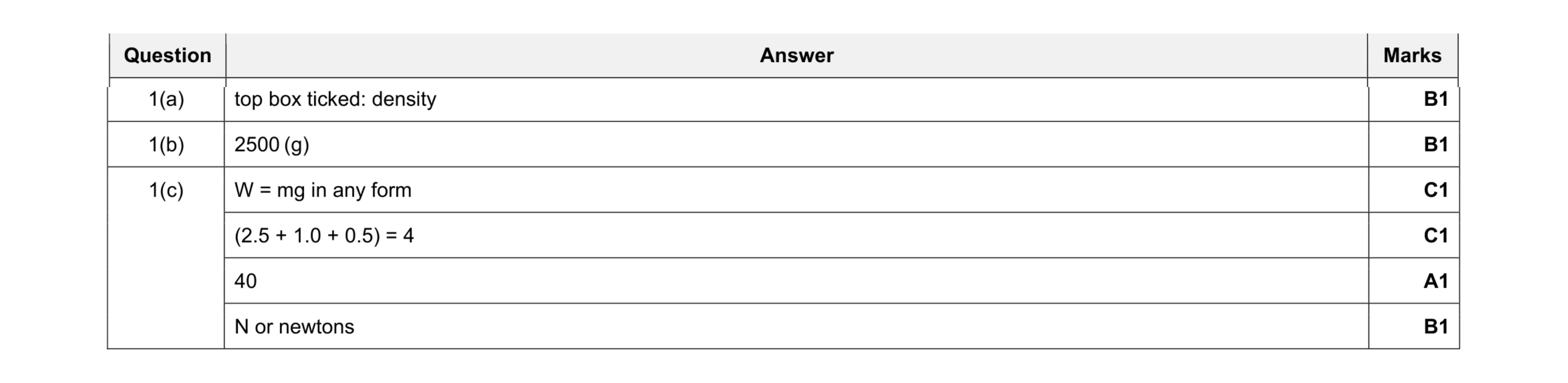 6
6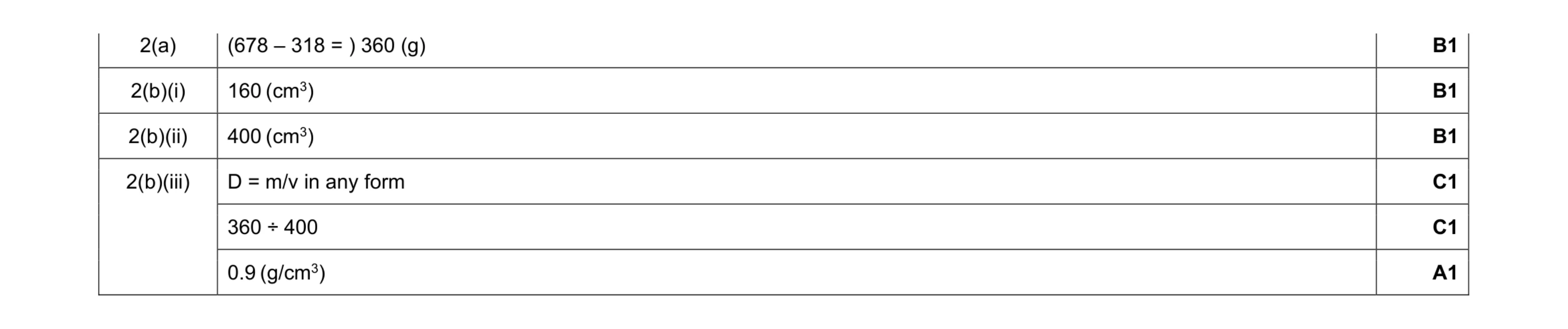 6
6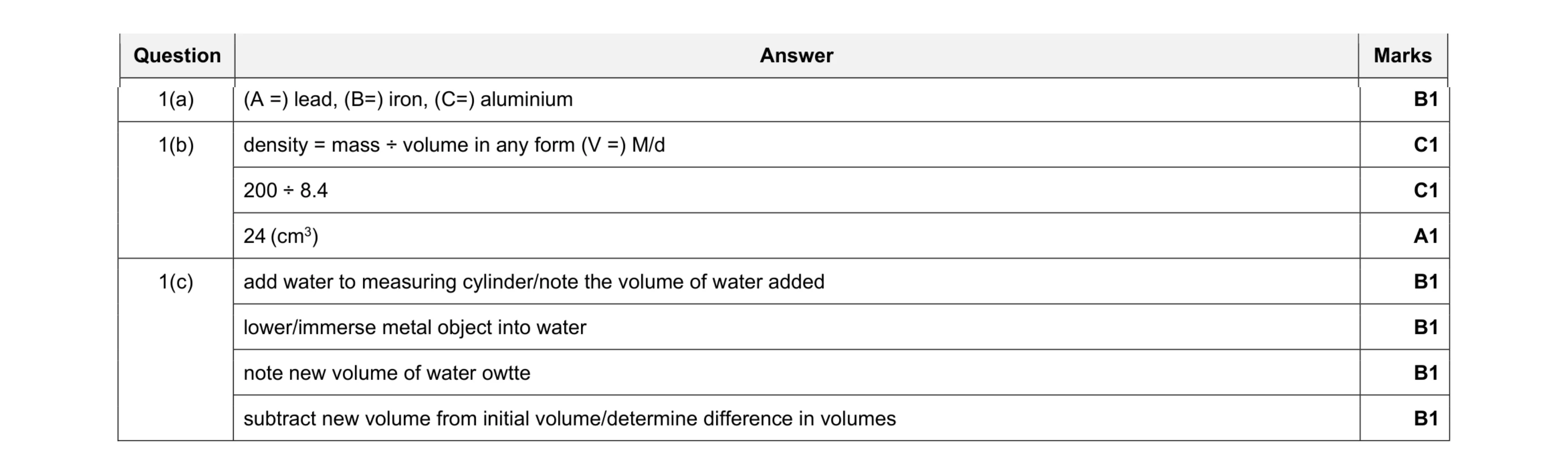 8
8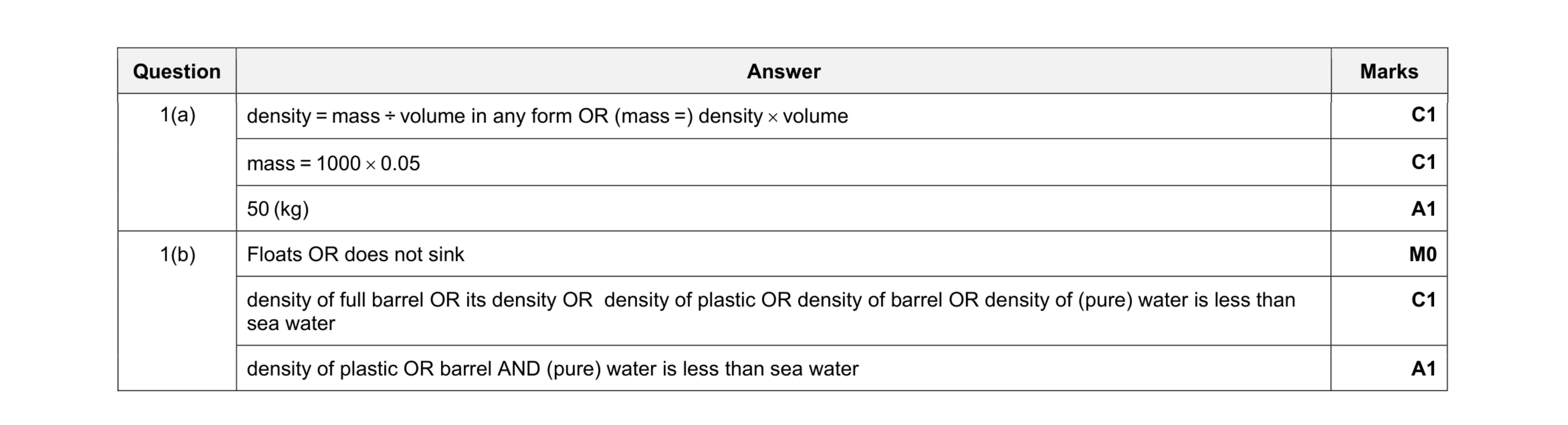 5
5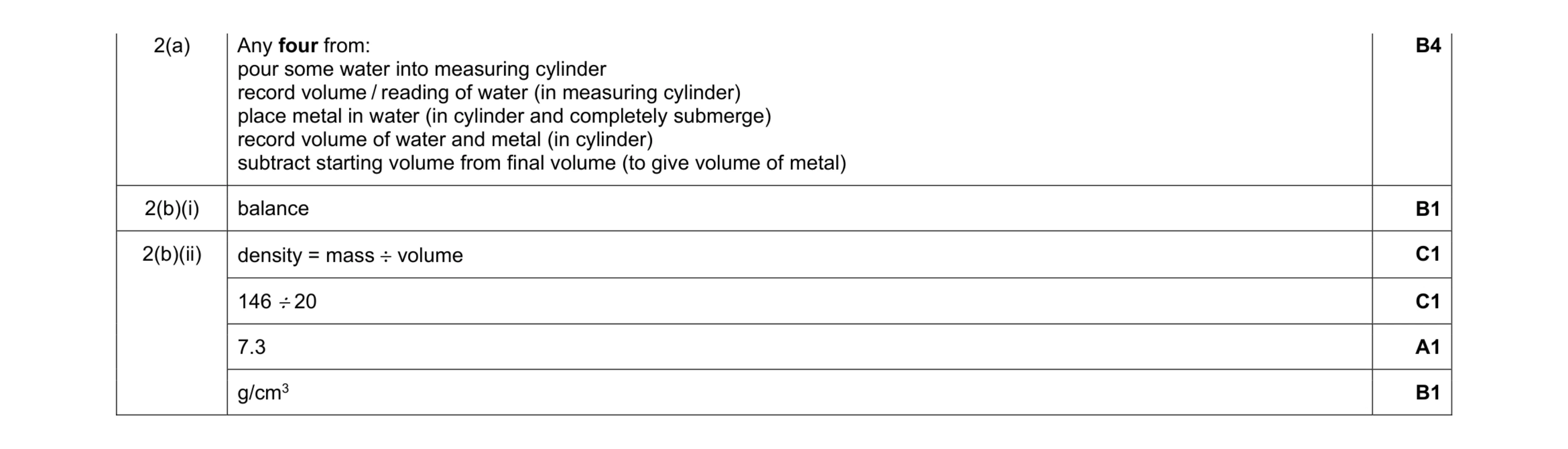 9
9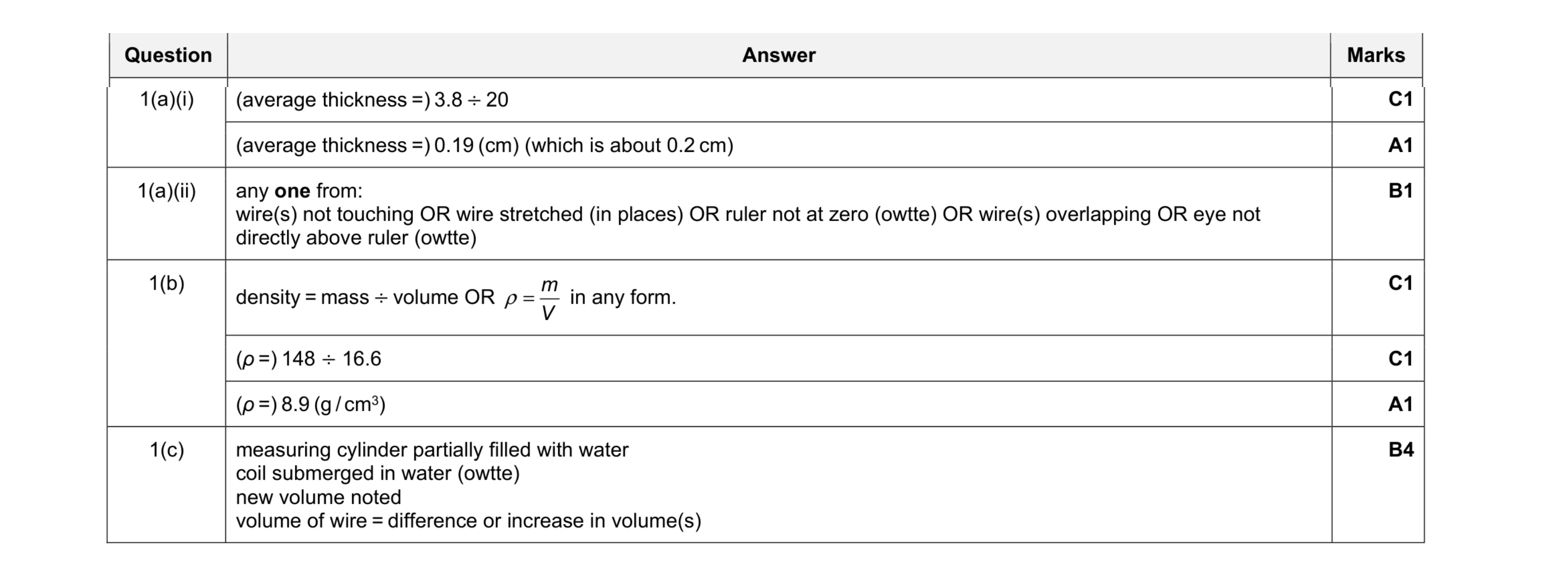 10
10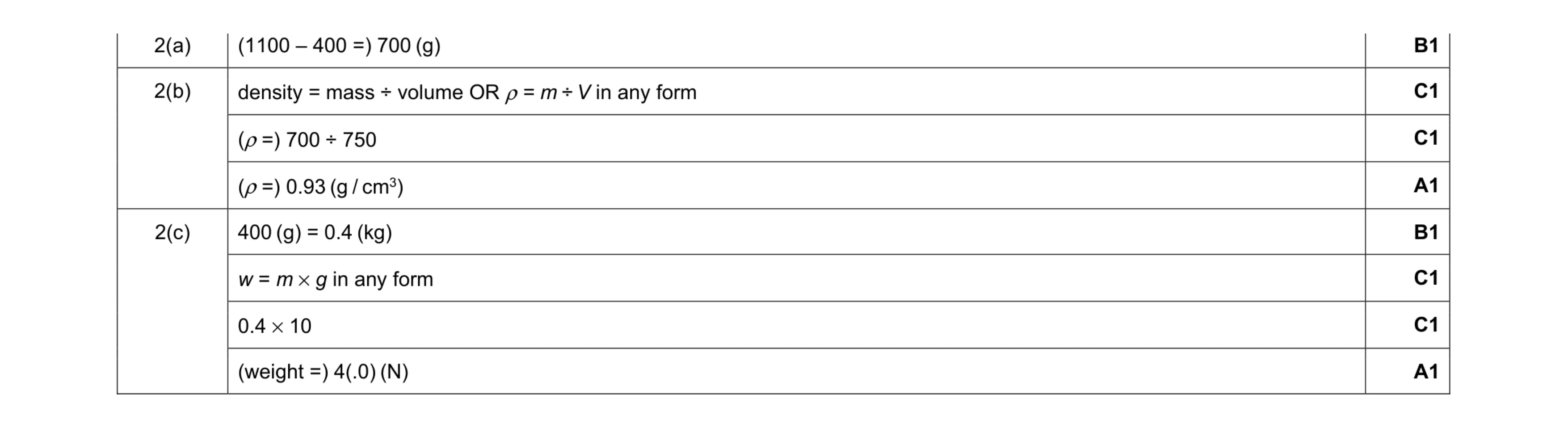 8
8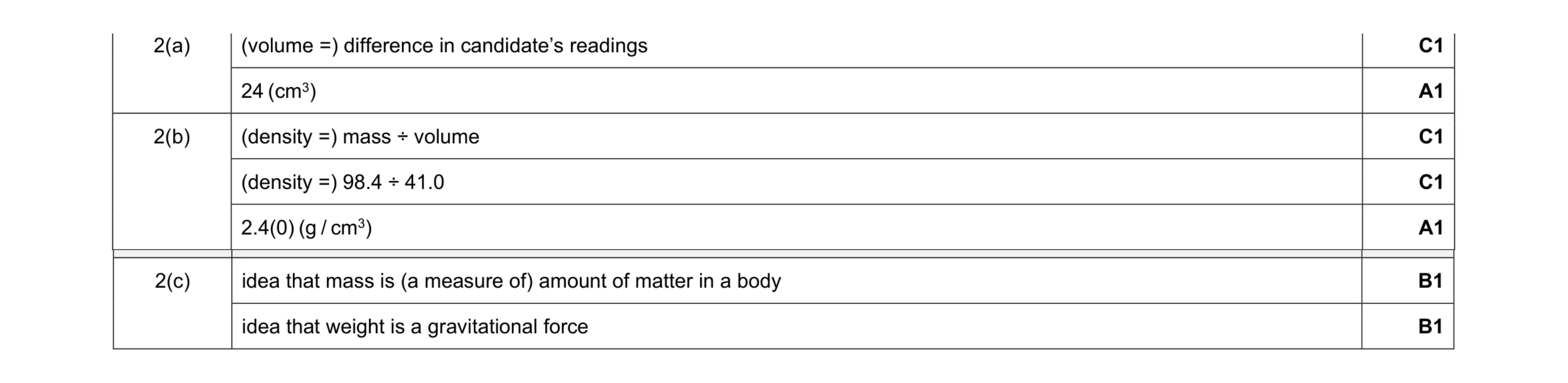 7
7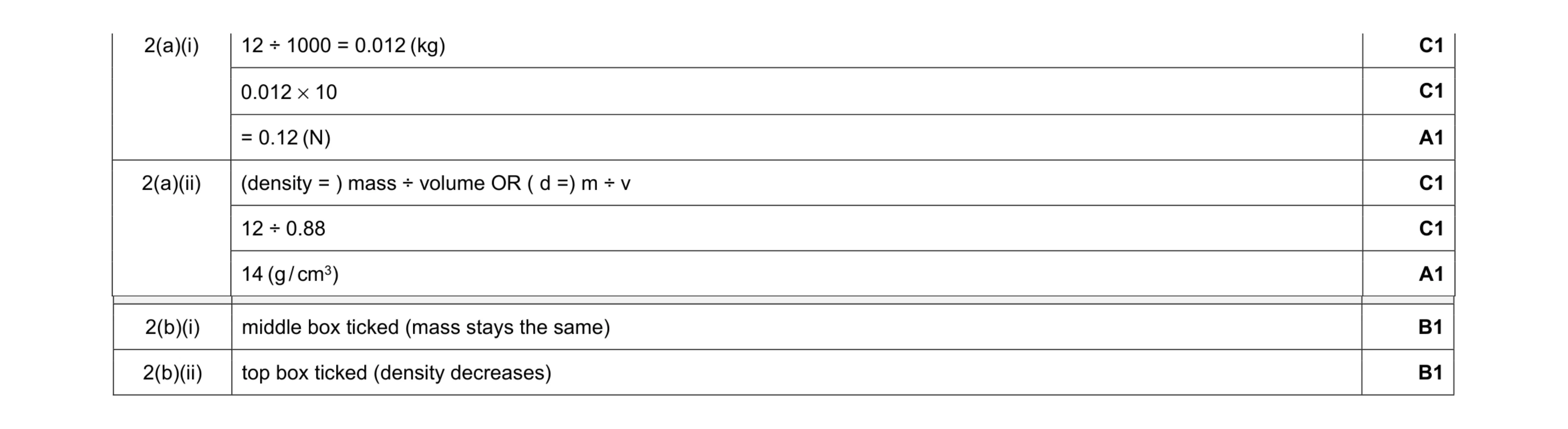 8
8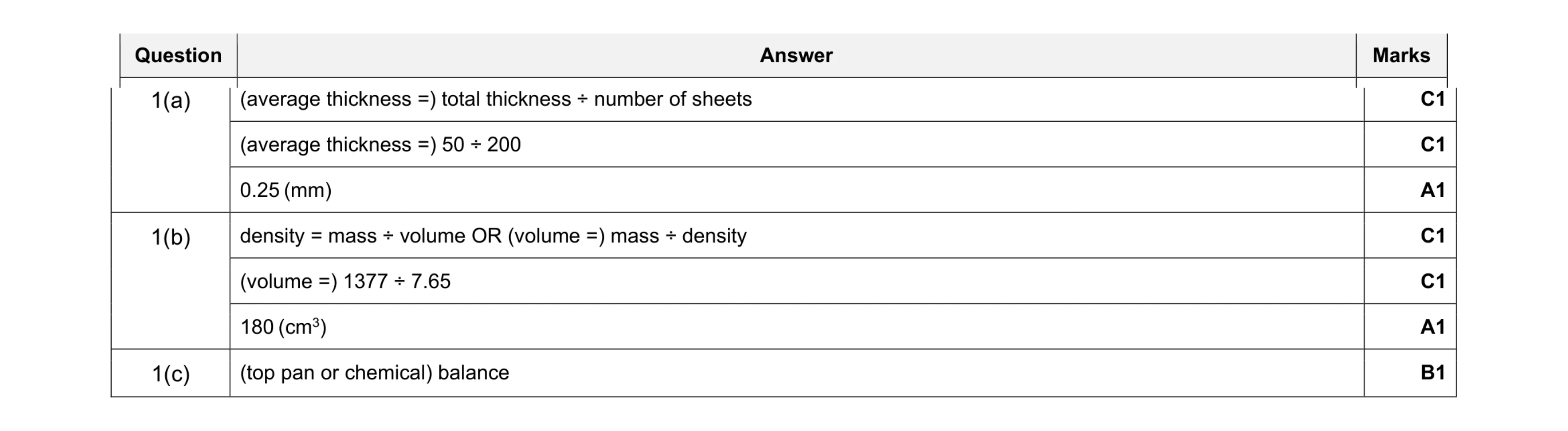 7
7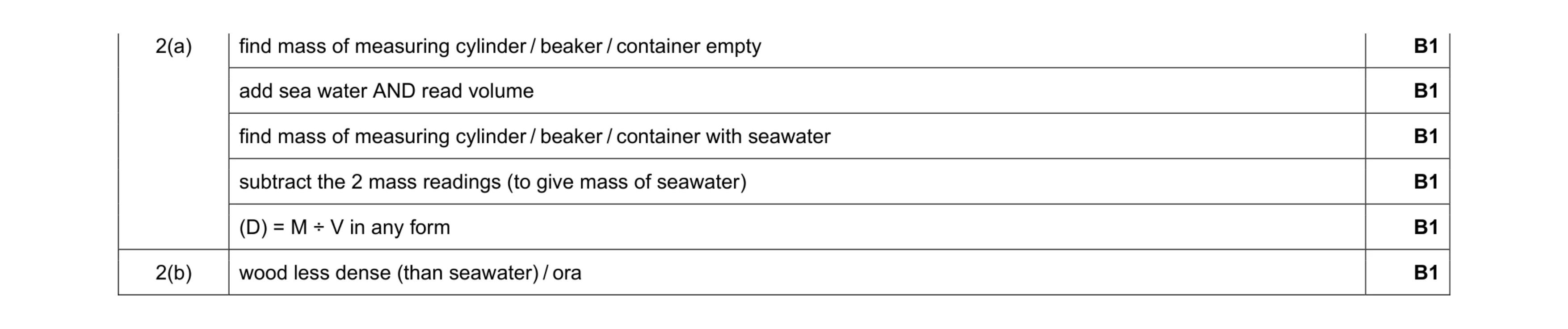 6
6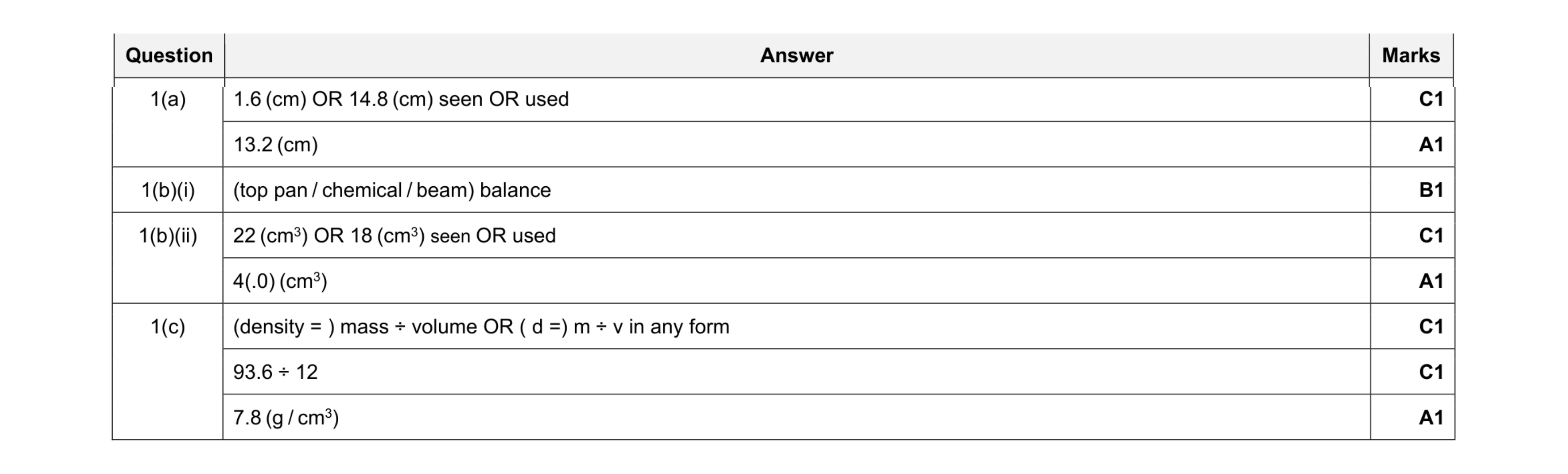 8
8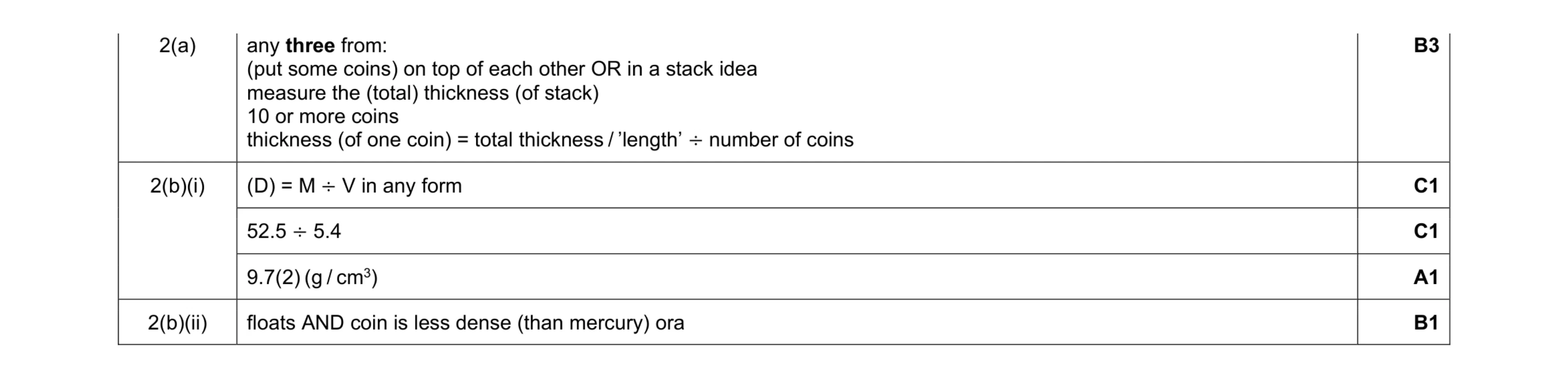 7
7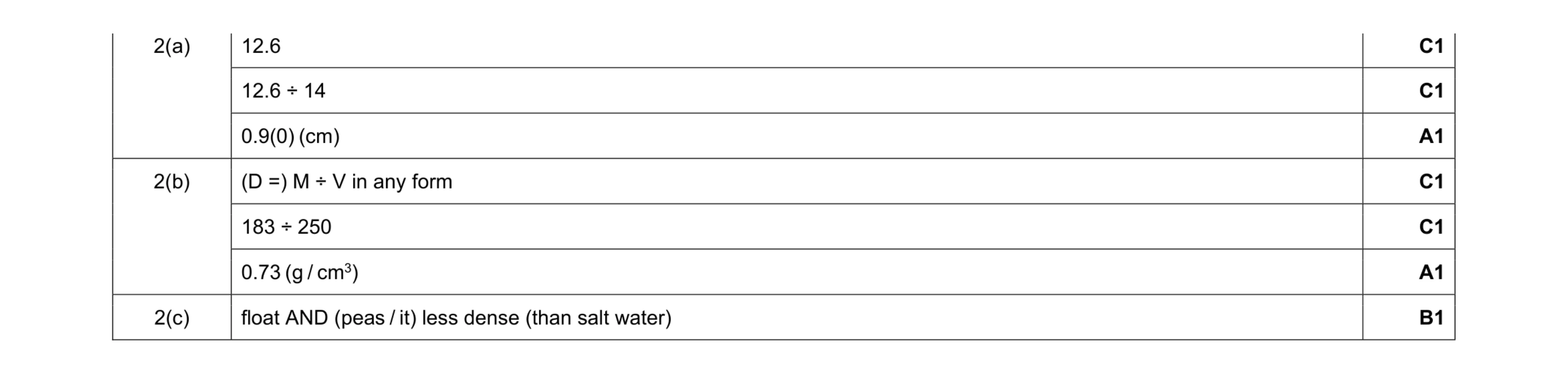 7
7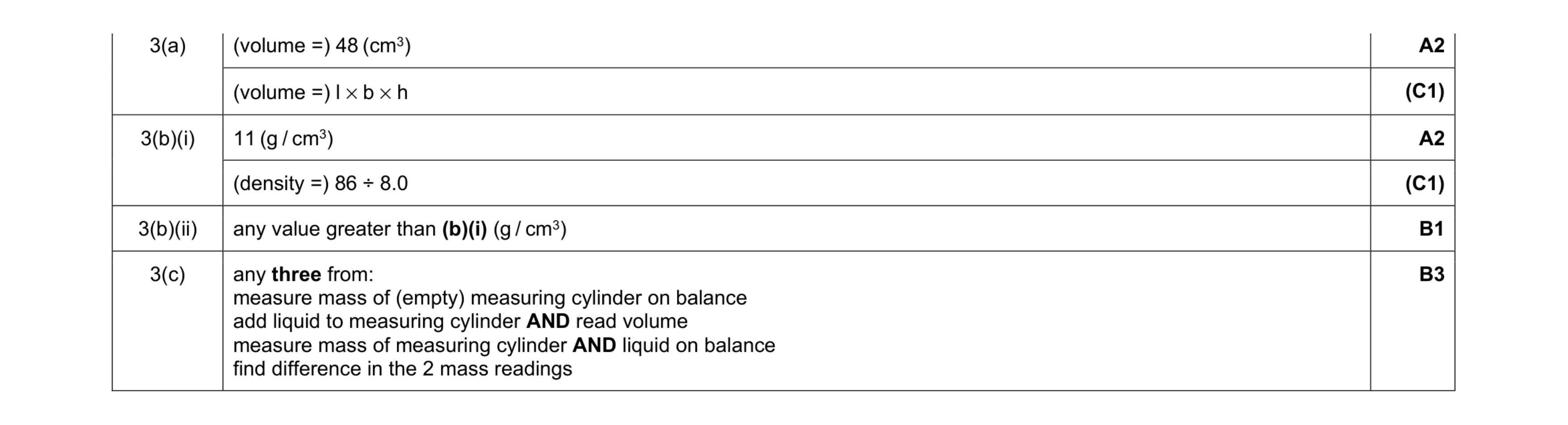 8
8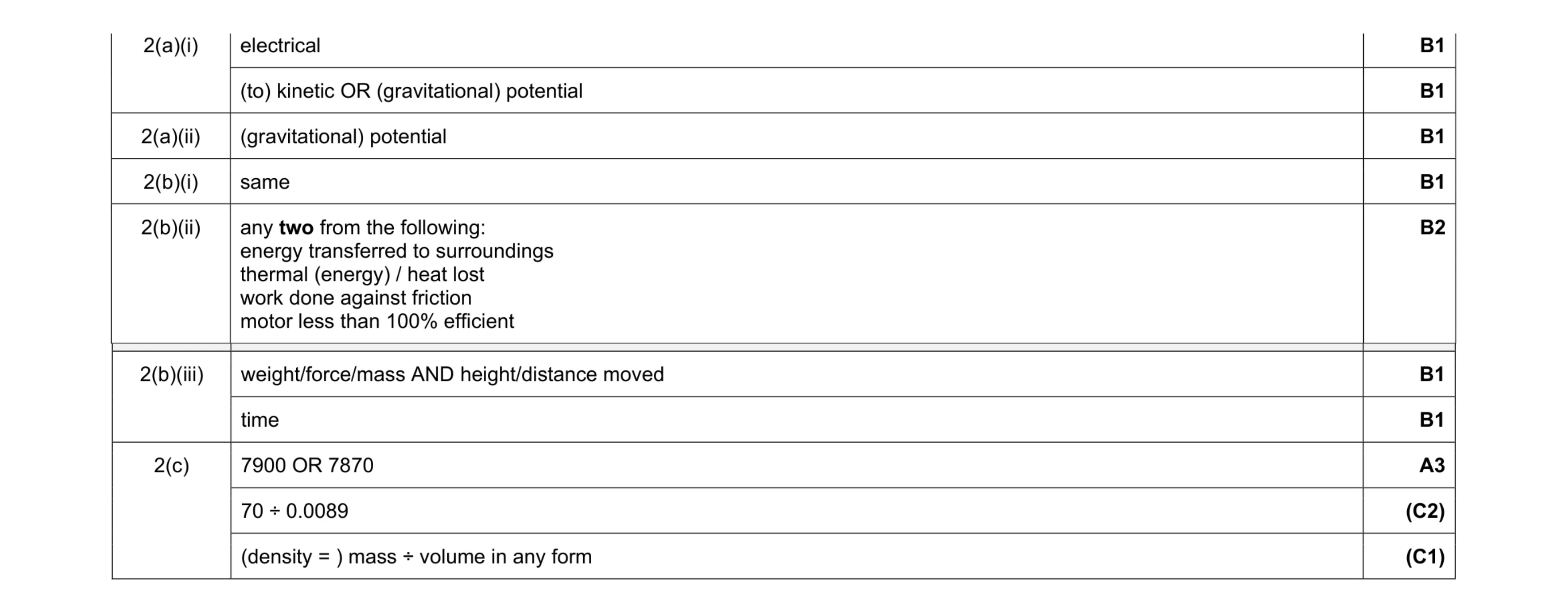 11
11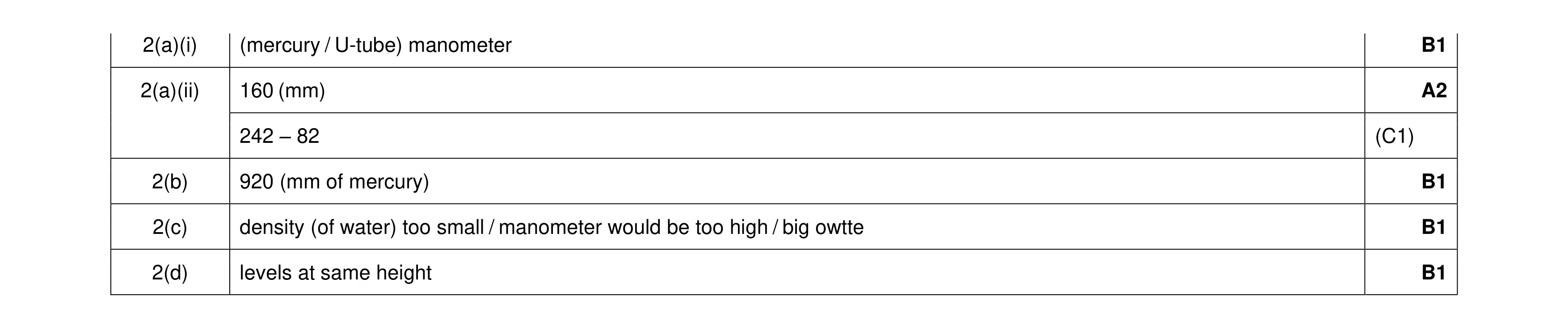 6
6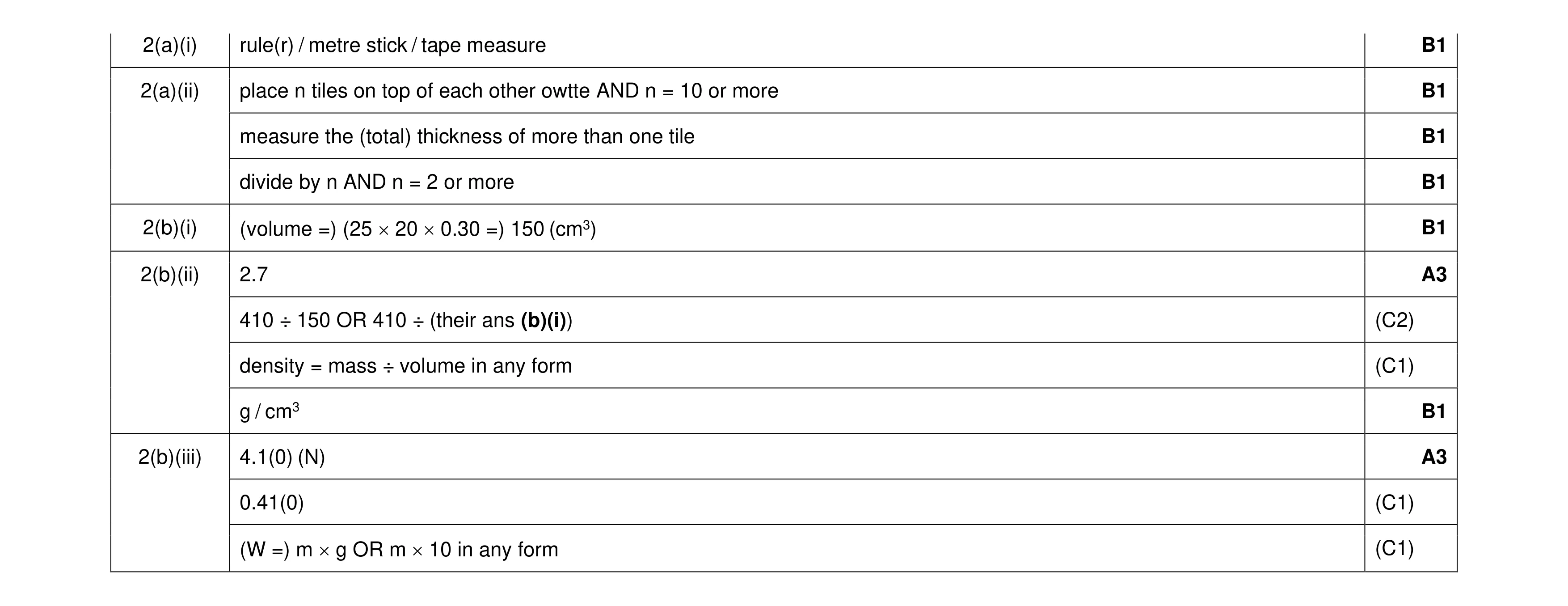 12
12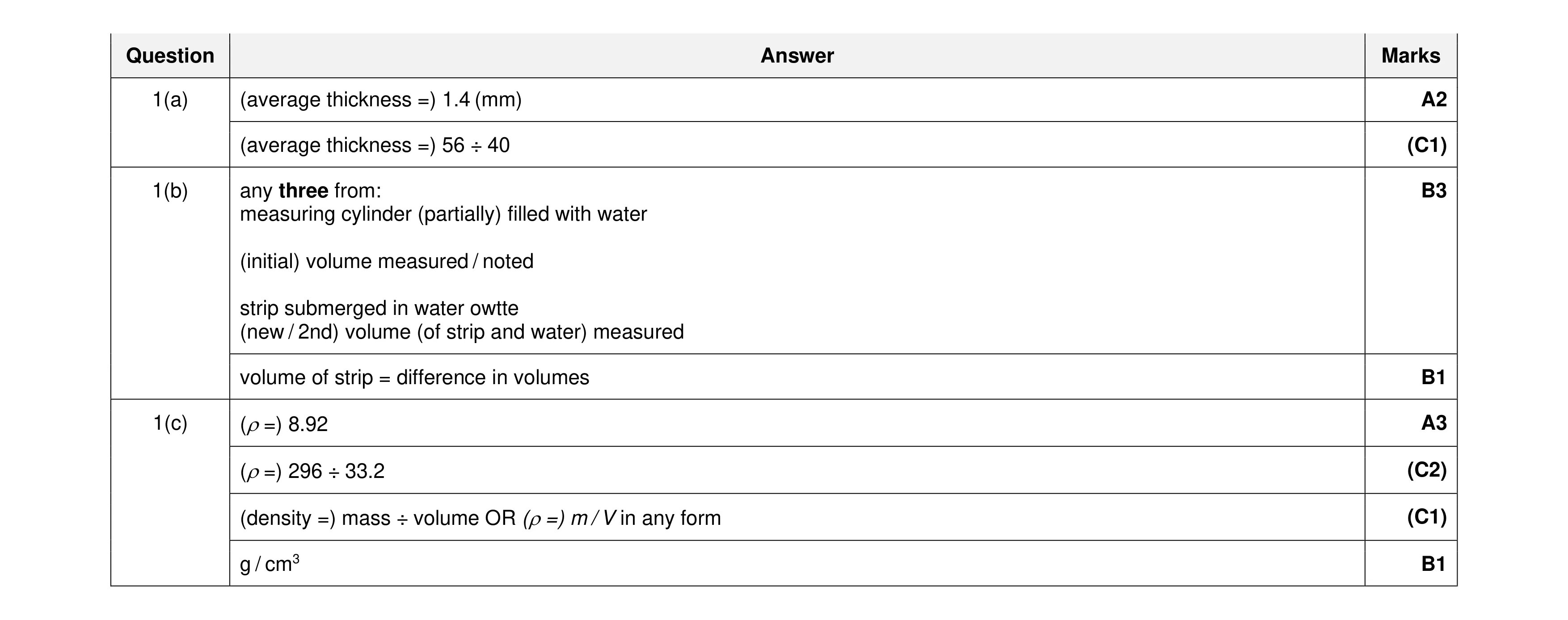 10
10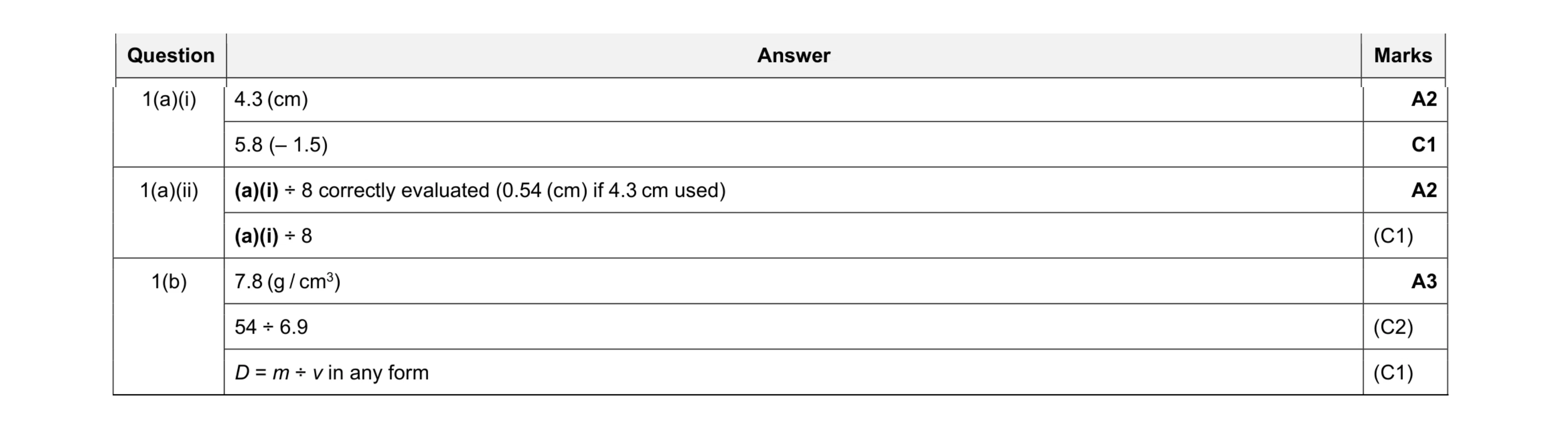 7
7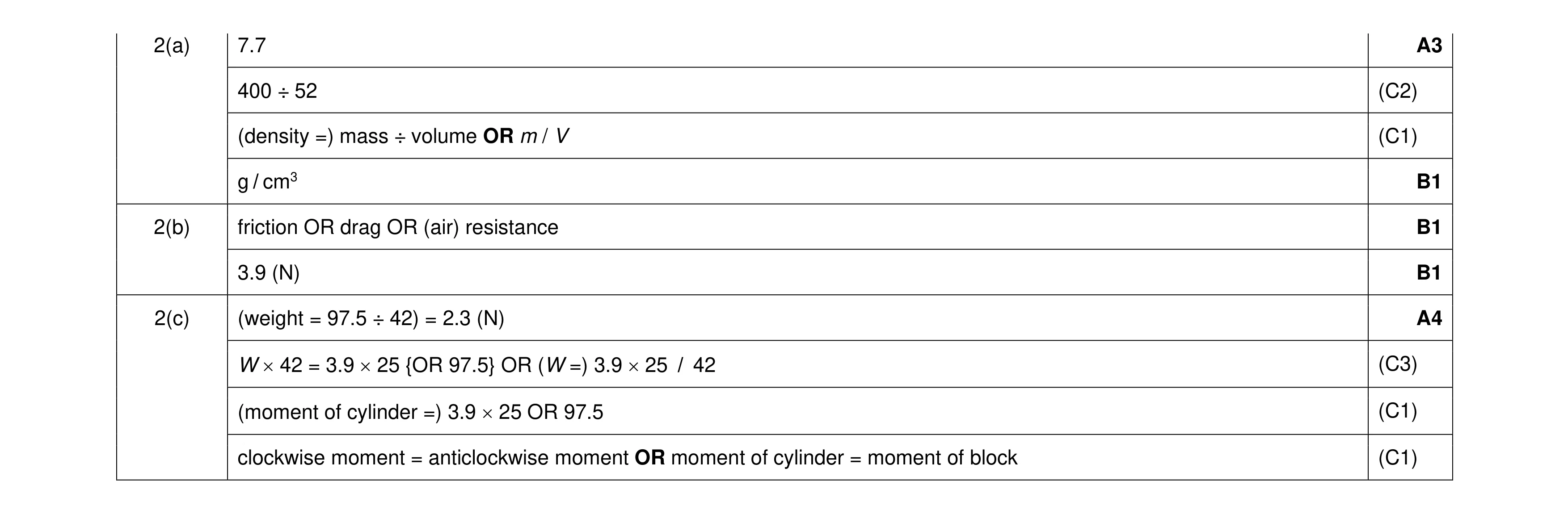 10
10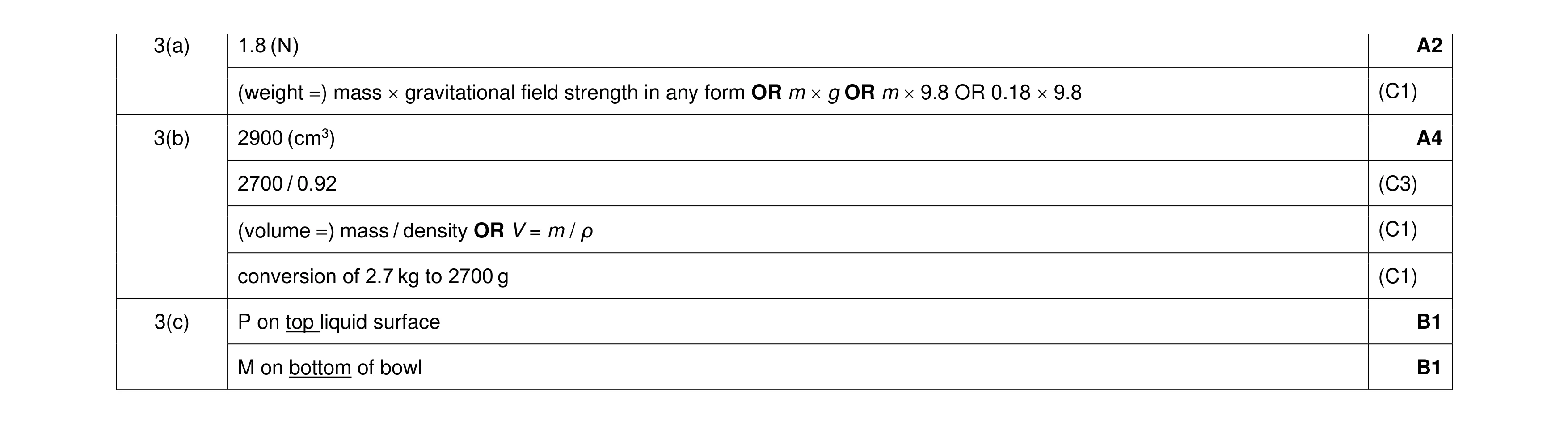 8
8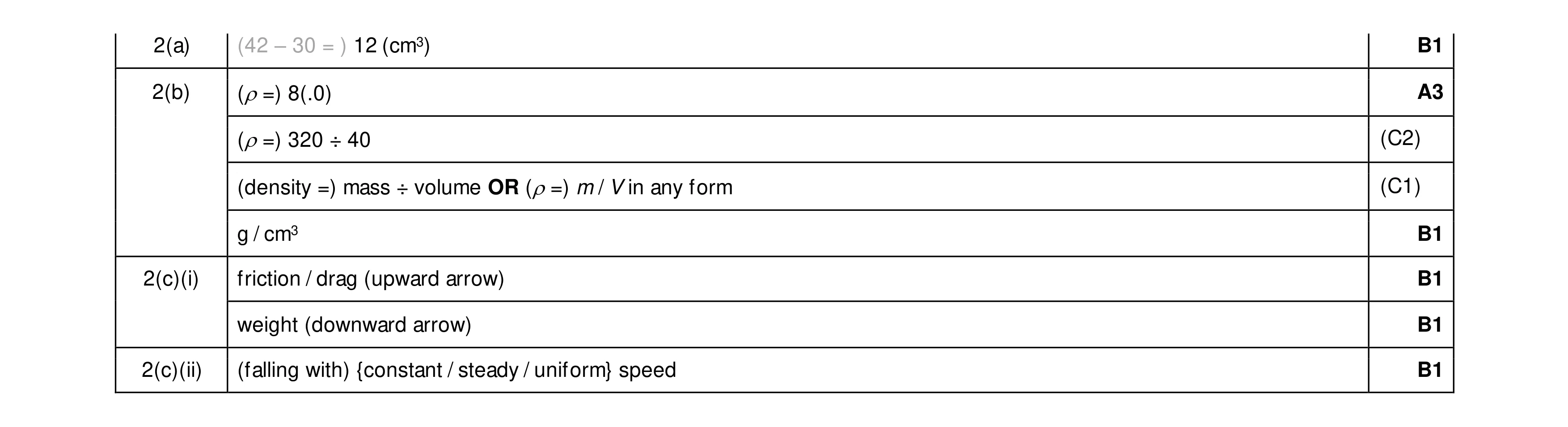 8
8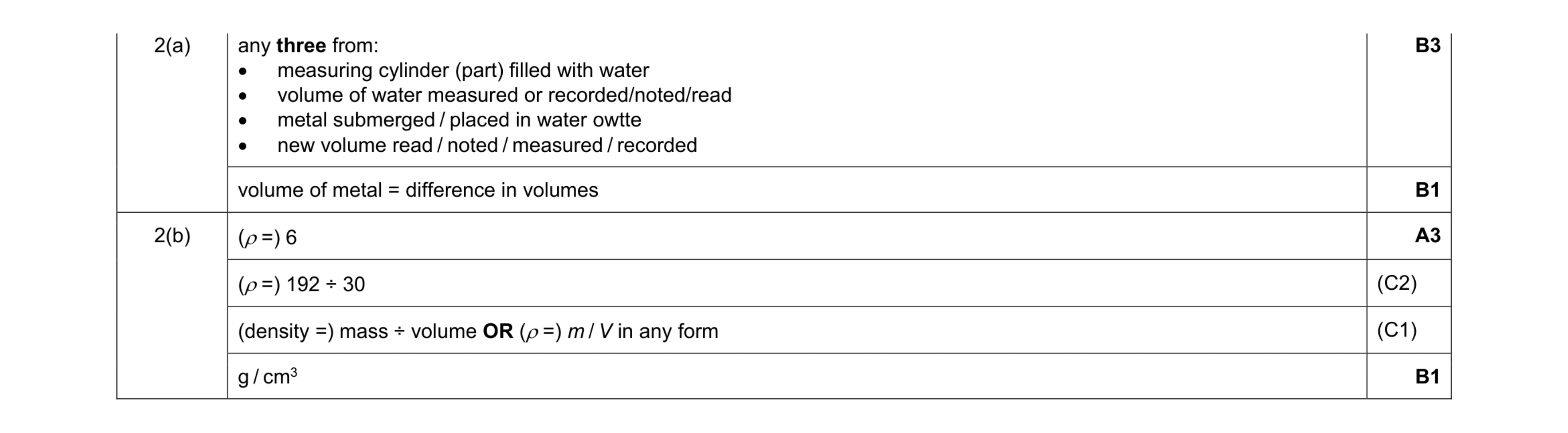 8
8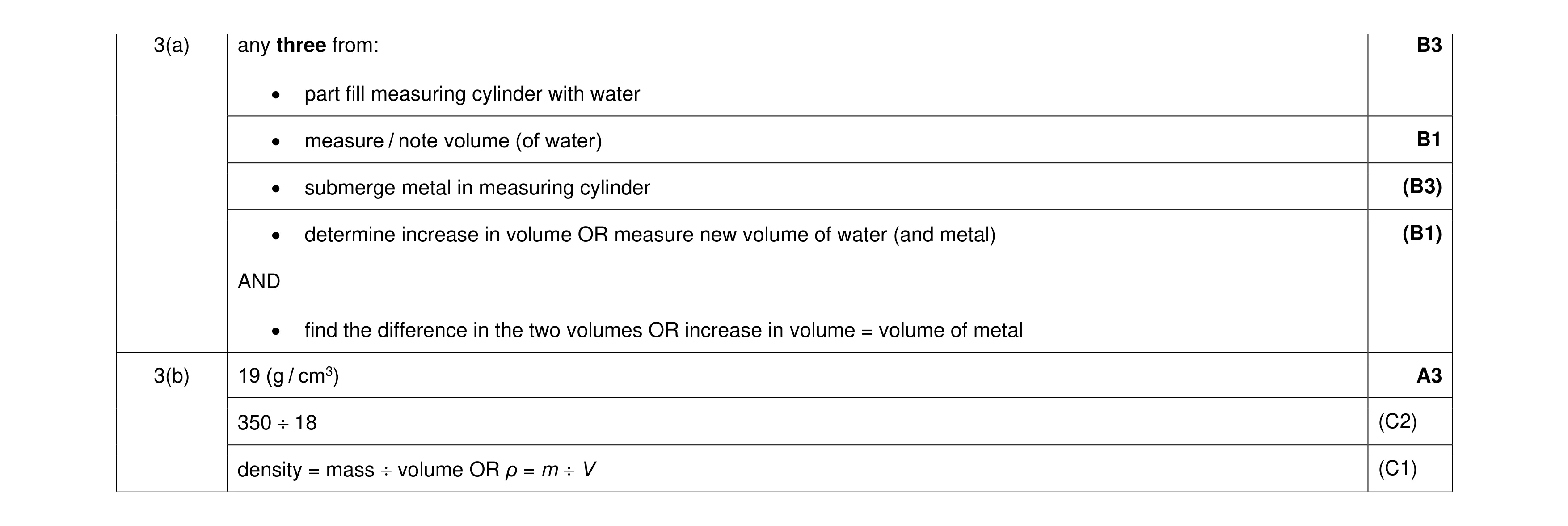 7
7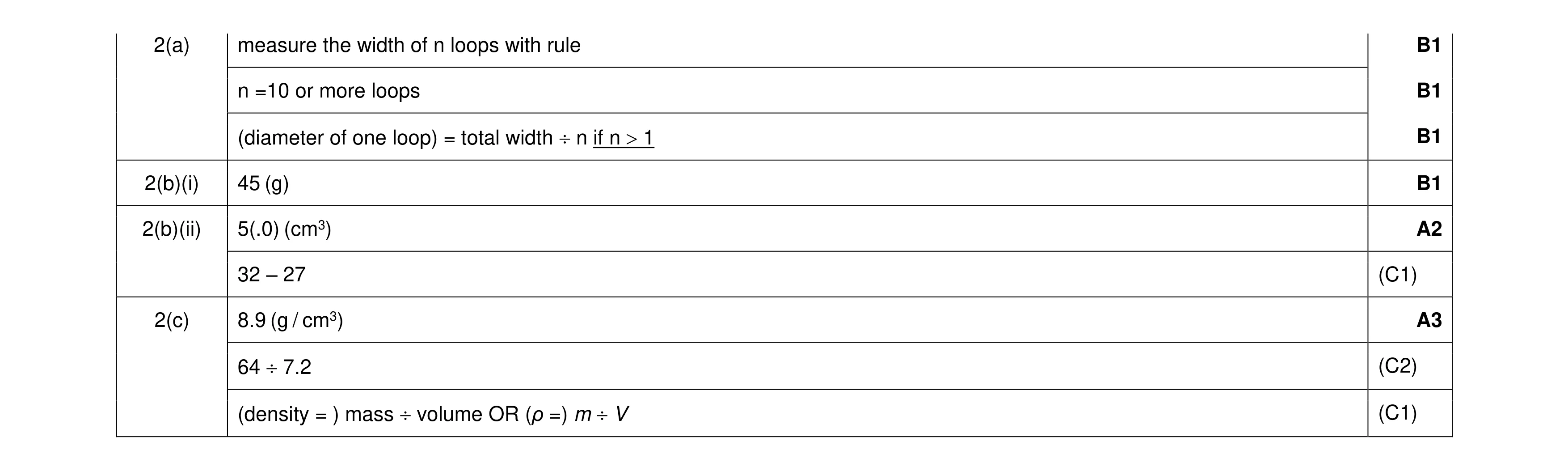 9
9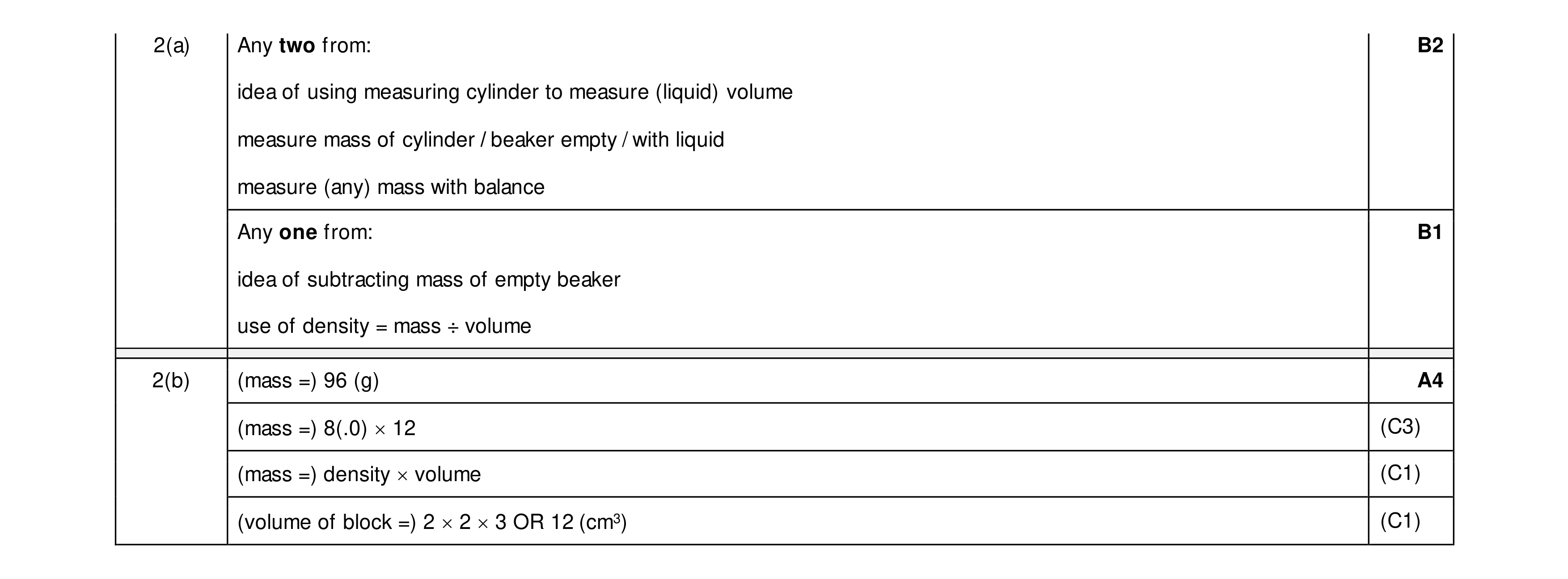 7
7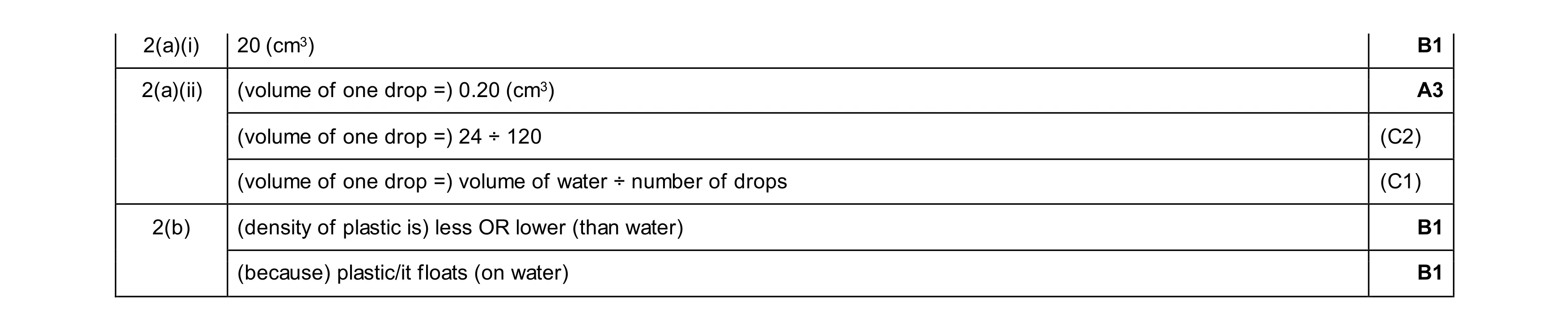 6
6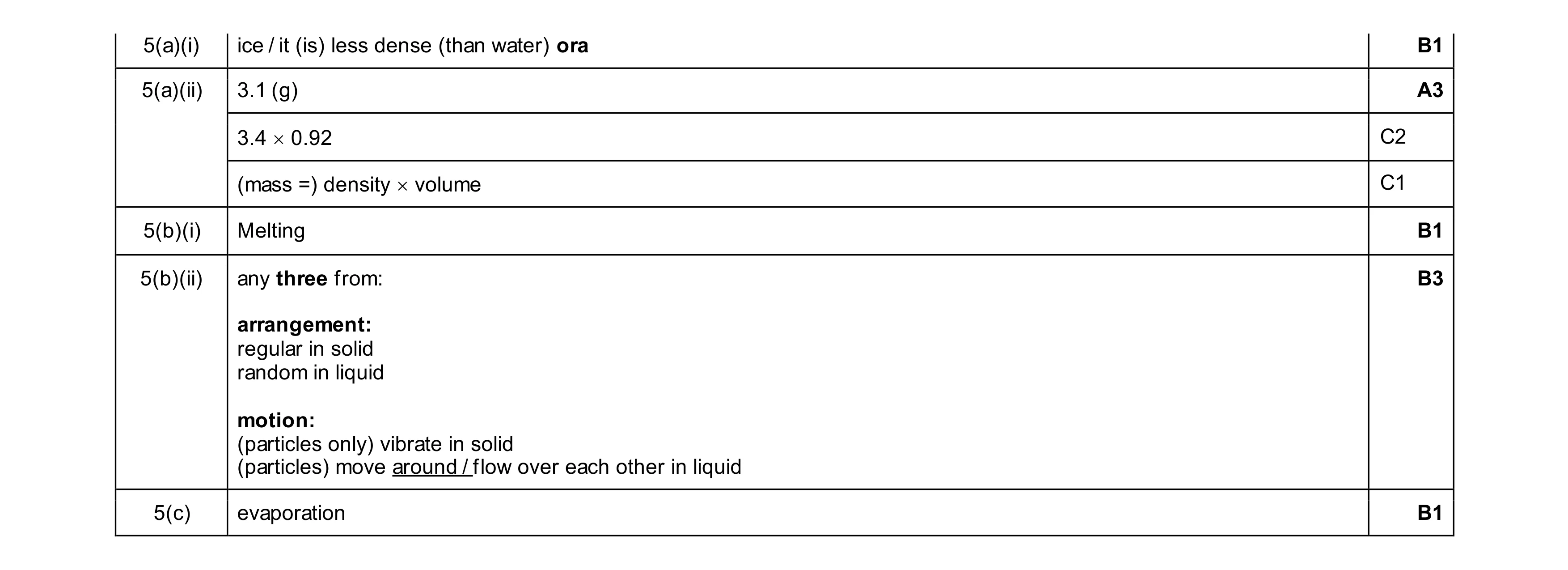 9
9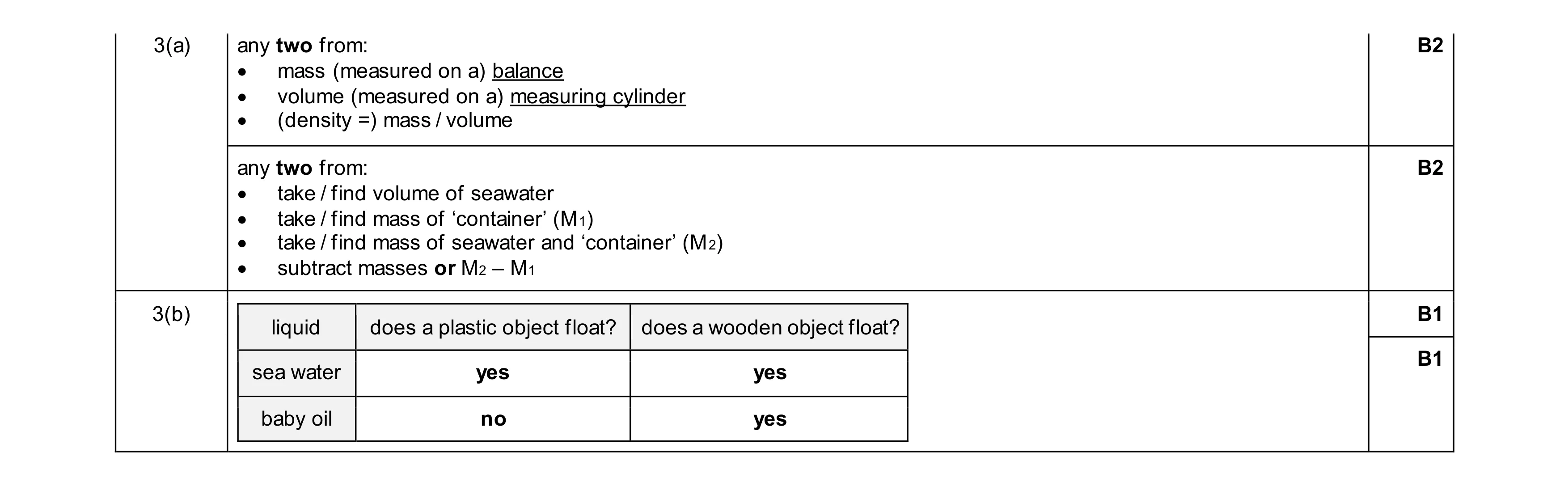 6
6