Questions as text
Question 1 0625/42 Feb/March 2017
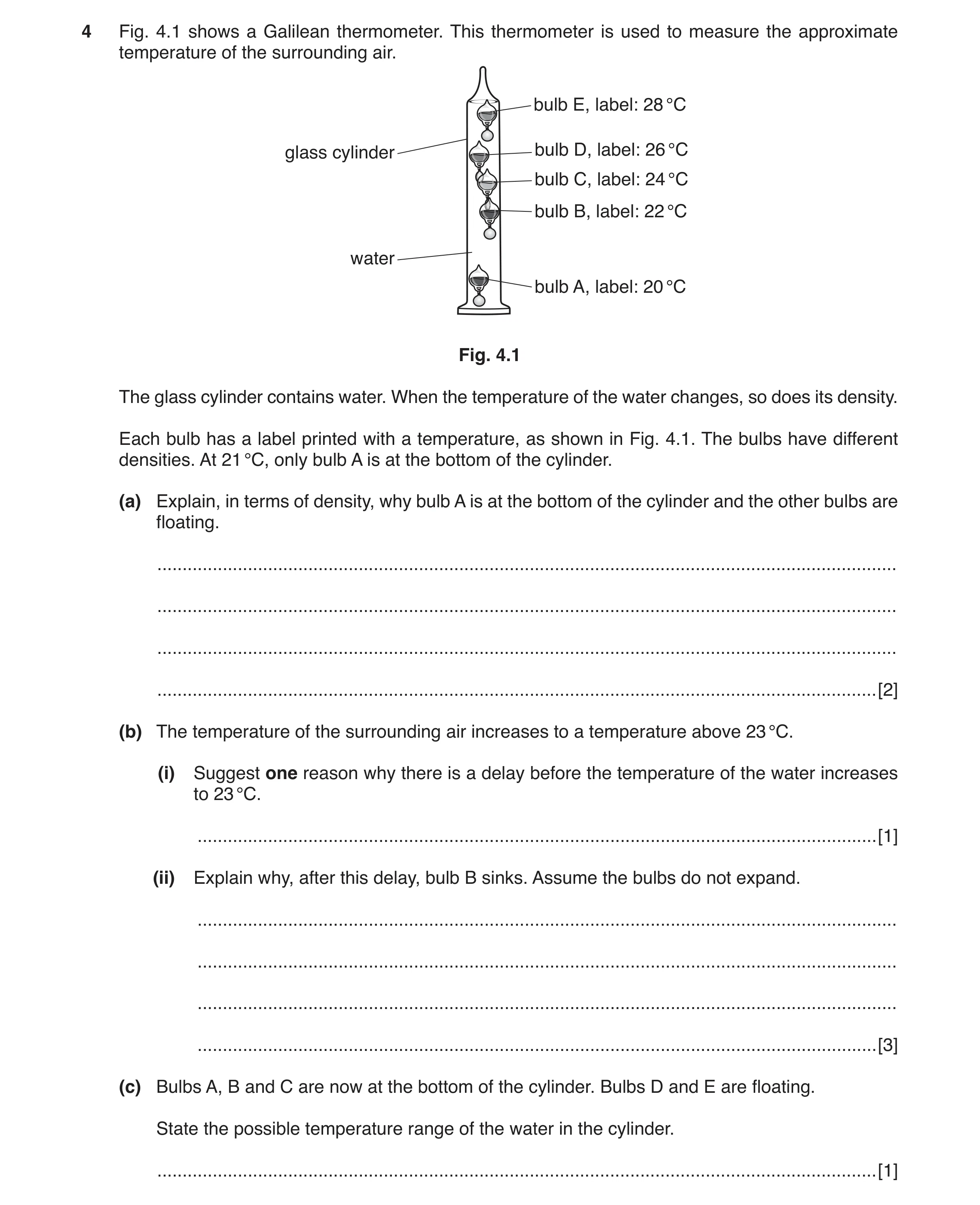
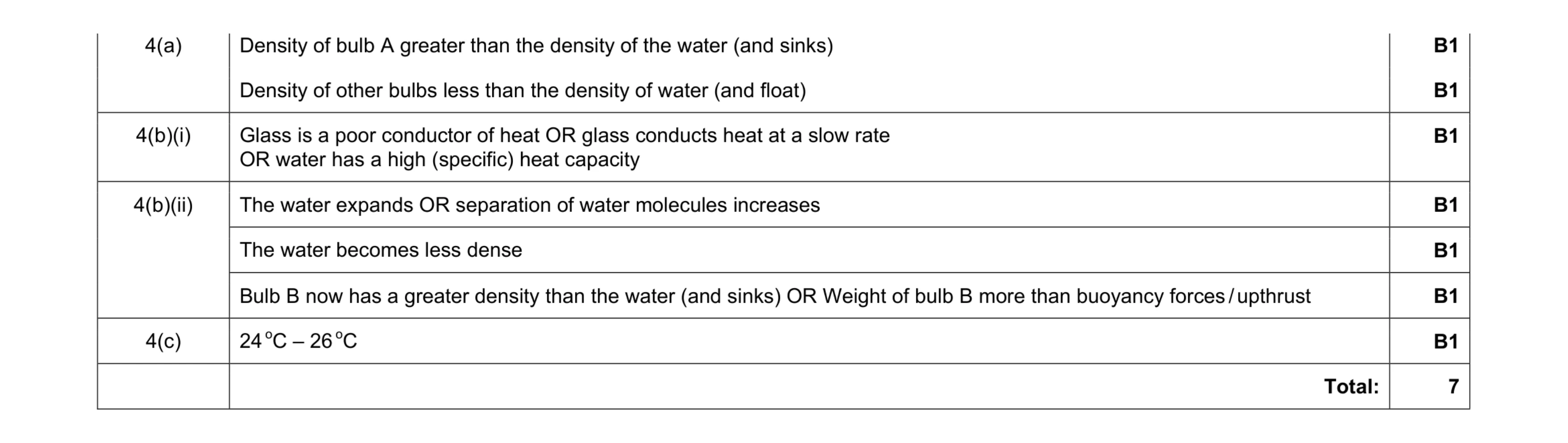
4 Fig. 4.1 shows a Galilean thermometer. This thermometer is used to measure the approximate temperature of the surrounding air. bulb E, label: 28 °C glass cylinder bulb D, label: 26 °C bulb C, label: 24 °C bulb B, label: 22 °C water bulb A, label: 20 °C Fig. 4.1 The glass cylinder contains water. When the temperature of the water changes, so does its density. Each bulb has a label printed with a temperature, as shown in Fig. 4.1. The bulbs have different densities. At 21 °C, only bulb A is at the bottom of the cylinder. (a) Explain, in terms of density, why bulb A is at the bottom of the cylinder and the other bulbs are floating. … … … … [2] (b) The temperature of the surrounding air increases to a temperature above 23 °C. (i) Suggest one reason why there is a delay before the temperature of the water increases to 23 °C. … [1] (ii) Explain why, after this delay, bulb B sinks. Assume the bulbs do not expand. … … … … [3] (c) Bulbs A, B and C are now at the bottom of the cylinder. Bulbs D and E are floating. State the possible temperature range of the water in the cylinder. … [1]
7 marks
Mark scheme: 4(a) Density of bulb A greater than the density of the water (and sinks) B1 Density of other bulbs less than the density of water (and float) B1 4(b)(i) Glass is a poor conductor of heat OR glass conducts heat at a slow rate OR water has a high (specific) heat capacity B1 4(b)(ii) The water expands OR separation of water molecules increases B1 The water becomes less dense B1 Bulb B now has a greater density than the water (and sinks) OR Weight of bulb B more than buoyancy forces / upthrust B1 4(c) 24 oC – 26 oC B1 Total: 7
This question in 0625/42 Feb/March 2017
Q2 · Remote sensing equipment on the surface of a distant planet 0625/41 May/June 2017
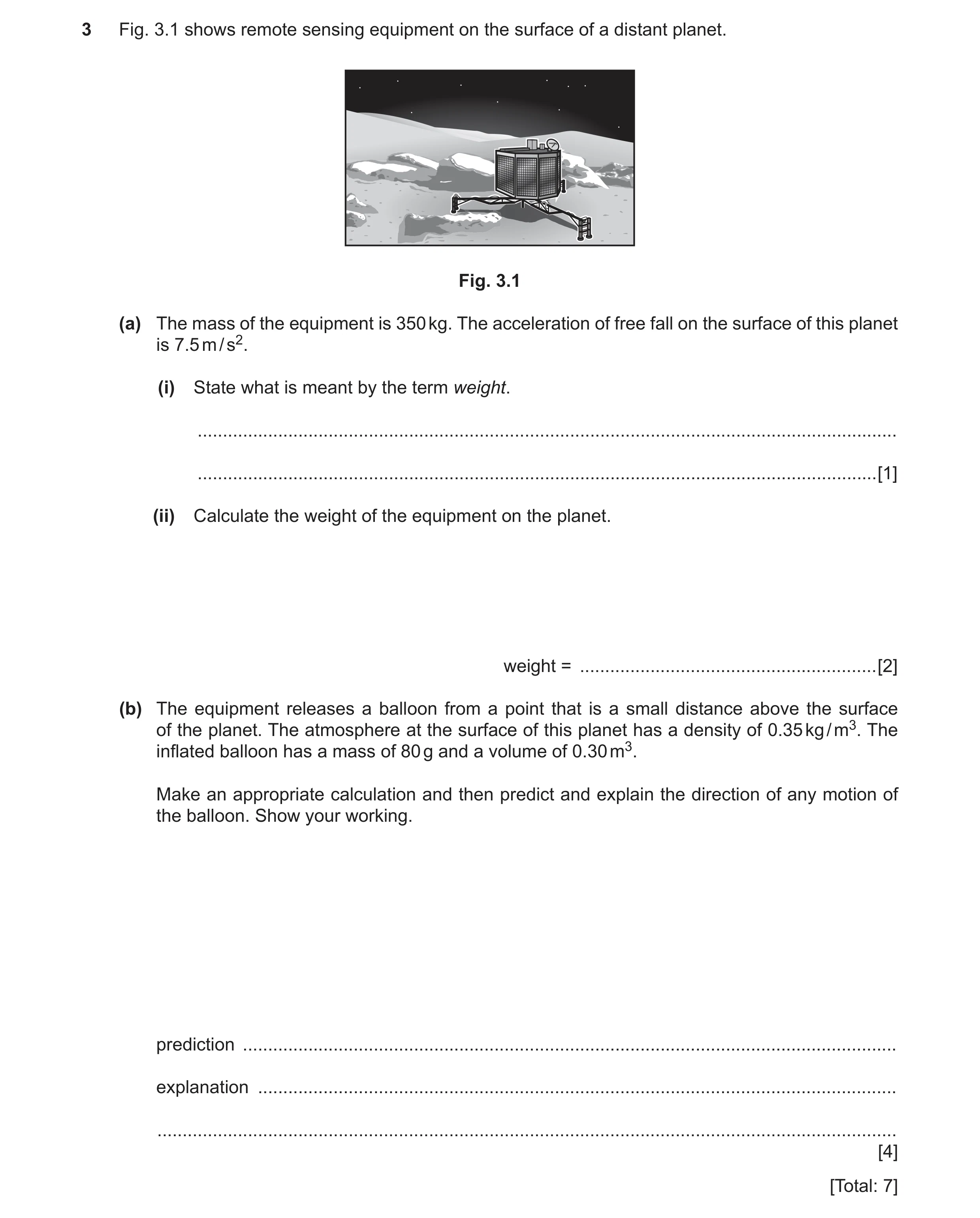
3 Fig. 3.1 shows remote sensing equipment on the surface of a distant planet. Fig. 3.1 (a) The mass of the equipment is 350 kg. The acceleration of free fall on the surface of this planet is 7.5 m / s2. (i) State what is meant by the term weight. … … [1] (ii) Calculate the weight of the equipment on the planet. weight = … [2] (b) The equipment releases a balloon from a point that is a small distance above the surface of the planet. The atmosphere at the surface of this planet has a density of 0.35 kg / m3. The inflated balloon has a mass of 80 g and a volume of 0.30 m3. Make an appropriate calculation and then predict and explain the direction of any motion of the balloon. Show your working. prediction … explanation … … [4] [Total: 7]
7 marks
Mark scheme: 3(a)(i) (Weight is) force/pull of gravity (acting on an object) B1 3(a)(ii) Mass × acceleration due to gravity OR mg OR 350 × 7.5 C1 2600 N A1 3(b) (ρ =) m / V in any form C1 0.27 (kg / m3) OR 270 (g / m3) A1 Balloon moves/floats up B1 (Floats when) density of balloon less than density of atmosphere OR (sinks when) density of balloon greater than atmosphere B1 OR (ρ =) m / V in any form (C1) 110 g (A1) Balloon rises (B1) (Floats when) mass/weight of balloon less than mass/weight of atmosphere (of same volume as balloon) (Sinks when) mass/weight of balloon greater than mass/weight of atmosphere (of same volume as balloon) (B1) Total: 7
This question in 0625/41 May/June 2017
Q3 · A block of wood has a volume of 210 cm3 and a mass of 180 g 0625/43 May/June 2017
3 A block of wood has a volume of 210 cm3 and a mass of 180 g. (a) Calculate the density of the block of wood. density = … [2] (b) The block is held just above the surface of a liquid of density 0.88 g / cm3. Predict and explain what happens when the block is released. … … … [2] [Total: 4]
4 marks
Mark scheme: 3(a) (ρ = ) m V OR 180 ÷ 210 OR 0.18 ÷ 210 C1 0.86 g / cm3 A1 3(b) floats OR words to the same effect B1 density of wood is less than density of liquid B1 Total: 4
This question in 0625/43 May/June 2017
Q4 · All the sides of a plastic cube are 8.0 cm long 0625/41 Oct/Nov 2017
3 All the sides of a plastic cube are 8.0 cm long. Fig. 3.1 shows the cube. 8.0 cm Fig. 3.1 (not to scale) The mass of the cube is 0.44 kg. (a) Explain what is meant by mass. … [1] (b) (i) Calculate the density of the plastic from which the cube is made. density = … [2] (ii) The density of one type of oil is 850 kg / m3. State and explain whether the cube floats or sinks when placed in a container of this oil. … … [1] (c) On the Moon, the weight of the cube is 0.70 N. (i) Calculate the gravitational field strength on the Moon. gravitational field strength = … [2] (ii) In a laboratory on the Moon, the plastic cube is held stationary, using a clamp, in a beaker of the oil of density 850 kg / m3. The arrangement is shown in Fig. 3.2. clamp cube 3.0 cm clamp stand oil bench Fig. 3.2 The lower face of the cube is 3.0 cm below the surface of the oil. Use your answer to (c)(i) to calculate the pressure due to the oil on the lower face of the cube. pressure = … [2] [Total: 8]
8 marks
Mark scheme: 3(a) (Measure of) quantity / amount of matter OR (property) that resists change in motion / speed / momentum OR measure of a body’s inertia B1 3(b)(i) d = m / V OR in words OR 0.44 / 0.0803 OR 0.44 / 5.12 × 10⁻⁴ OR 440 / 83 OR 440 / 512 OR 0.44 / 83 OR 0.44 / 512 C1 0.86 g / cm3 OR 860 kg / m3 OR 8.6 × 10⁻⁴ kg / cm3 A1 3(b)(ii) Sinks OR does not float AND (cube) denser (than oil) B1 3(c)(i) W = mg OR (g =) W / m OR 0.70 / 0.44 C1 1.6 N / kg A1 3(c)(ii) (P =) hdg OR 0.030 × 850 × 1.6 C1 41 Pa A1
This question in 0625/41 Oct/Nov 2017
Q5 · A cylinder made from copper of density 9000 kg / m3 0625/42 Oct/Nov 2017
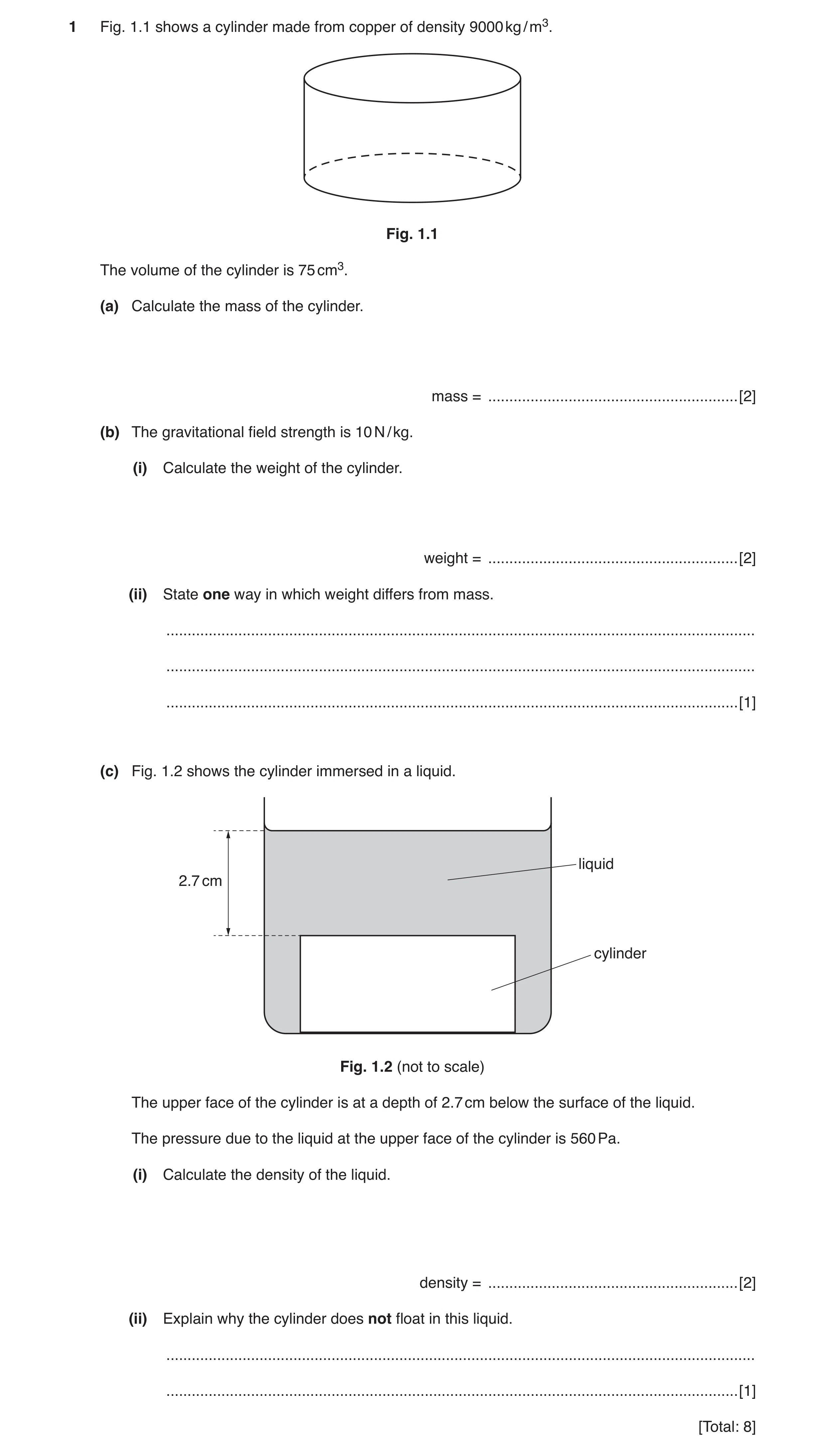
1 Fig. 1.1 shows a cylinder made from copper of density 9000 kg / m3. Fig. 1.1 The volume of the cylinder is 75 cm3. (a) Calculate the mass of the cylinder. mass = … [2] (b) The gravitational field strength is 10 N / kg. (i) Calculate the weight of the cylinder. weight = … [2] (ii) State one way in which weight differs from mass. … … … [1] (c) Fig. 1.2 shows the cylinder immersed in a liquid. liquid 2.7 cm cylinder Fig. 1.2 (not to scale) The upper face of the cylinder is at a depth of 2.7 cm below the surface of the liquid. The pressure due to the liquid at the upper face of the cylinder is 560 Pa. (i) Calculate the density of the liquid. density = … [2] (ii) Explain why the cylinder does not float in this liquid. … … [1] [Total: 8]
8 marks
Mark scheme: 1(a) OR (m =) 9000 × 7.5 × 10–5 C1 (m =) 0.68 kg accept 680 g A1 1(b)(i) W = m g in any form or (W = ) m g OR (W =) 0. 68 × 10 C1 (W =) 6.8 N A1 1(b)(ii) any one of: weight has direction / mass does not weight is a vector / mass is not weight varies / mass does not mass is amount of matter weight is a force / mass is not B1 1(c)(i) ρ = h ρ g in any form OR (ρ = ) ρ / h g OR (ρ =) 560 / (0.027 × 10) C1 (ρ =) 2.1 × 10³ kg / m3 A1 1(c)(ii) explains why there is a resultant downward force B1
This question in 0625/42 Oct/Nov 2017
Q6 · A measuring cylinder that contains a coloured liquid 0625/43 Oct/Nov 2017
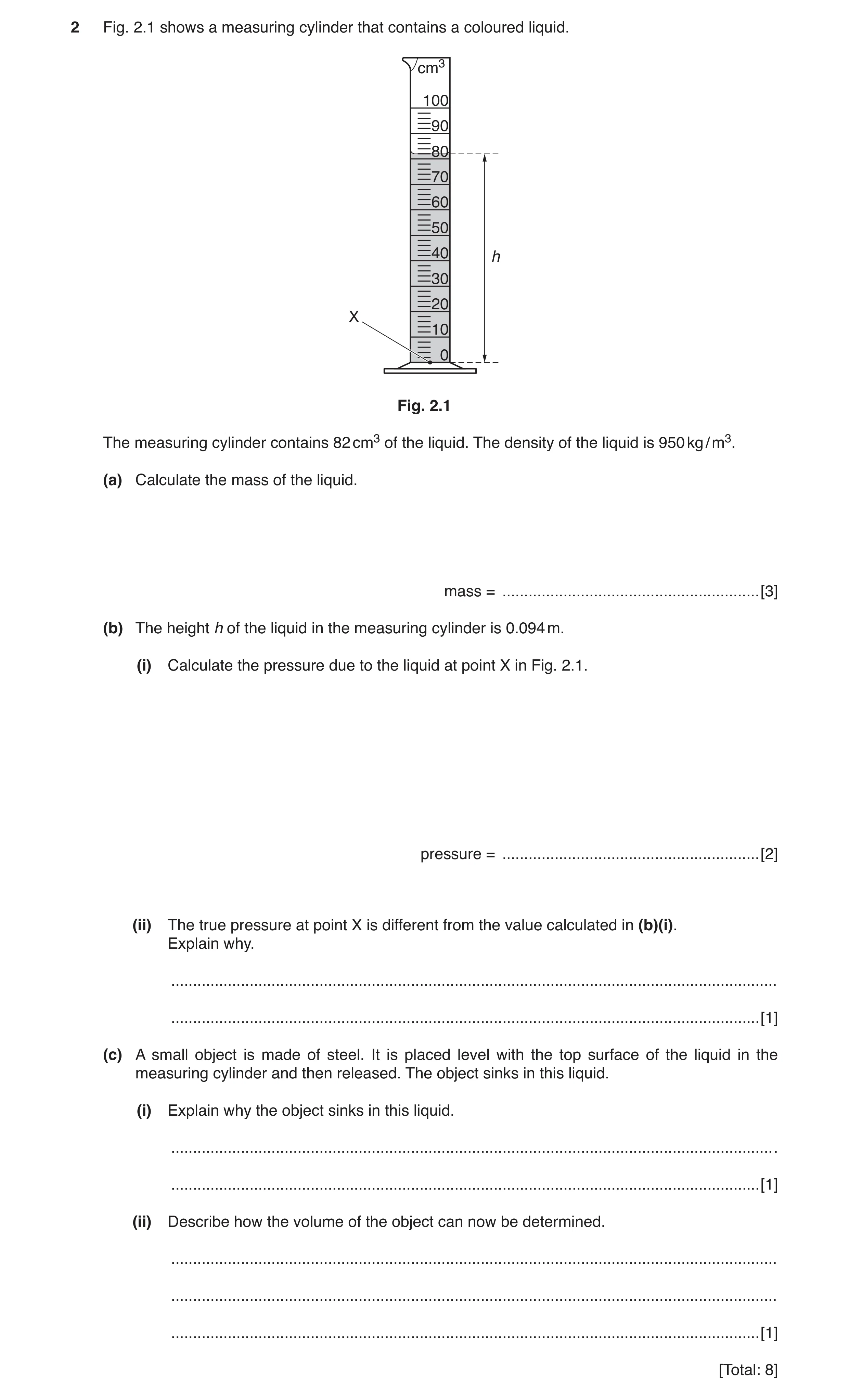
2 Fig. 2.1 shows a measuring cylinder that contains a coloured liquid. cm3 100 90 80 70 60 50 40 h 30 20 X 10 0 Fig. 2.1 The measuring cylinder contains 82 cm3 of the liquid. The density of the liquid is 950 kg / m3. (a) Calculate the mass of the liquid. mass = … [3] (b) The height h of the liquid in the measuring cylinder is 0.094 m. (i) Calculate the pressure due to the liquid at point X in Fig. 2.1. pressure = … [2] (ii) The true pressure at point X is different from the value calculated in (b)(i). Explain why. … … [1] (c) A small object is made of steel. It is placed level with the top surface of the liquid in the measuring cylinder and then released. The object sinks in this liquid. (i) Explain why the object sinks in this liquid. … … [1] (ii) Describe how the volume of the object can now be determined. … … … [1] [Total: 8]
8 marks
Mark scheme: 2(a) C1 7.8 / 7.79 × 10N (where N is a integer) C1 0.078 / 0.0779 kg or 78 / 77.9 g A1 2(b)(i) (p = )hρ g or 0.094 × 950 × 10 C1 890 / 893 Pa A1 2(b)(ii) atmospheric pressure (is acting) B1 2(c)(i) steel is denser (than liquid) or denser than 950 kg / m3 B1 2(c)(ii) take new reading and subtract 82 (cm3) / original reading B1
This question in 0625/43 Oct/Nov 2017
Q7 · A rectangular container has a base of dimensions 0.12 m × 0.16 m 0625/41 May/June 2018
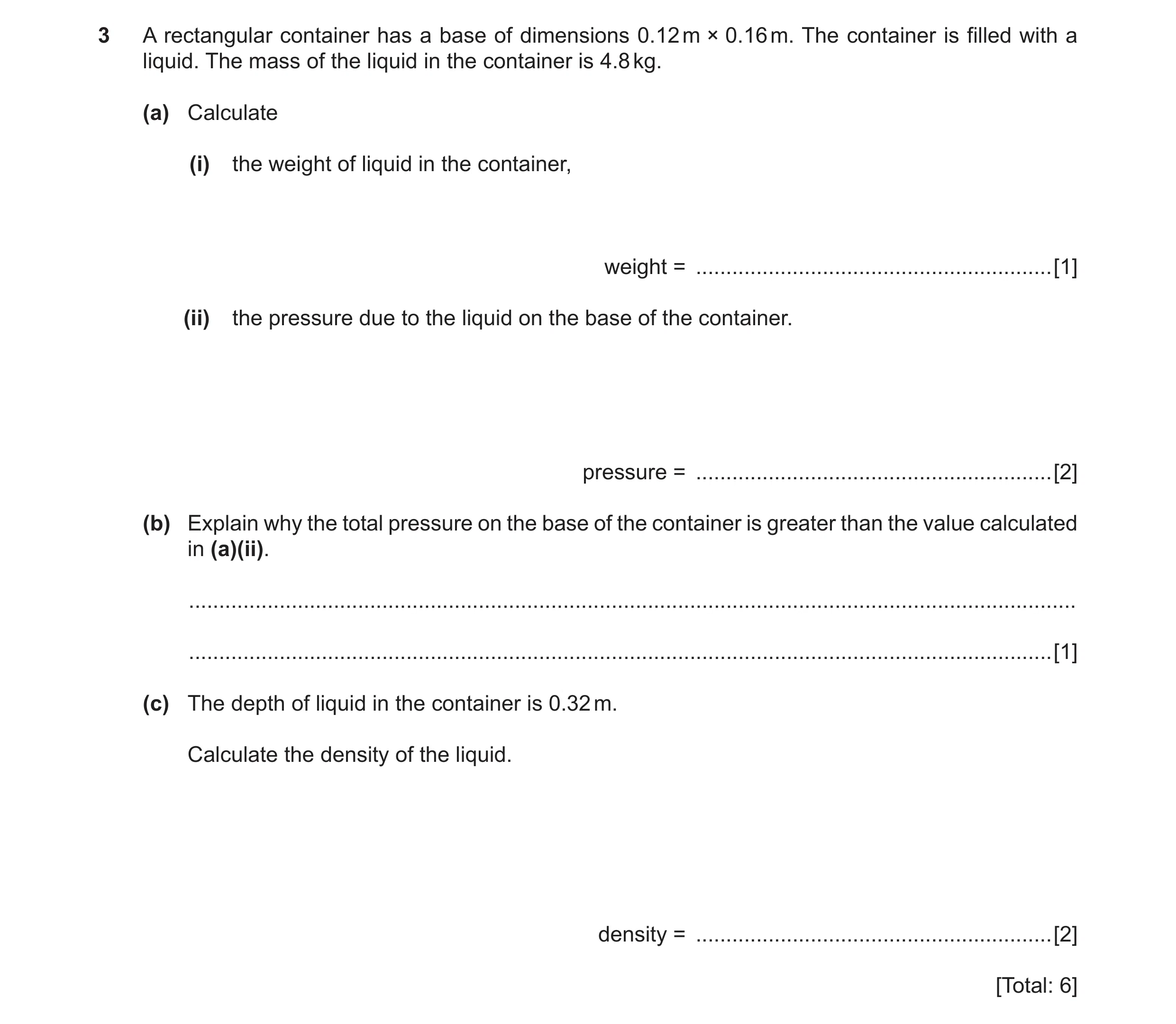
3 A rectangular container has a base of dimensions 0.12 m × 0.16 m. The container is filled with a liquid. The mass of the liquid in the container is 4.8 kg. (a) Calculate (i) the weight of liquid in the container, weight = … [1] (ii) the pressure due to the liquid on the base of the container. pressure = … [2] (b) Explain why the total pressure on the base of the container is greater than the value calculated in (a)(ii). … … [1] (c) The depth of liquid in the container is 0.32 m. Calculate the density of the liquid. density = … [2] [Total: 6]
6 marks
Mark scheme: 3(a)(i) 1 3(a)(ii) (P = ) F ÷ A OR 48 ÷ (0.12 × 0.16) 1 2500 Pa 1 3(b) Atmospheric pressure (in addition to liquid pressure) 1 3(c) P = hdg or in words OR (d =) P ÷ hg OR 2500 ÷ (0.32 × 10) 1 780 kg / m3 1 OR d = M ÷ V = 4.8 ÷ (0.12 × 0.16 × 0.32) (1) 780 kg / m3 (1)
This question in 0625/41 May/June 2018
Q8 · Liquid in a cylinder 0625/41 Oct/Nov 2018
4 (a) Fig. 4.1 shows liquid in a cylinder. cylinder liquid Fig. 4.1 The depth of the liquid is 10 cm and the radius of the cylinder is 3.0 cm. The weight of the liquid in the cylinder is 2.5 N. Calculate the density of the liquid. density = … [3] (b) Fig. 4.2 shows a device that measures the pressure of a gas supply. gas supply h liquid Fig. 4.2 (i) State the name of the device. … [1] (ii) The difference h between the two liquid levels is 2.0 cm. The density of the liquid is 800 kg / m3. Calculate the difference between the pressure of the gas and atmospheric pressure. pressure difference = … [2] (iii) A similar device with a tube of smaller cross-sectional area is connected to a gas supply at the same pressure. State and explain any effect on the value of h. … … … [2] [Total: 8]
8 marks
Mark scheme: 4(a) C1 volume = (π × 0.032 × 0.1 = 2.8 × 10⁻⁴ (m3)) C1 density = (0.25 / 2.8 × 10⁻⁴) = 890 kg / m3 A1 OR mass = 250 (g) OR ρ = m / V volume = (π × 32 × 10 =) 280 cm3 density = (250 / 280 =) 0.89 g / cm3 OR ρ = F / A = hρg ρ = F / Ahg OR 2.5 / π × 0.032 × 0.1 × 10 = 890 kg / m3 4(b)(i) manometer B1 4(b)(ii) (P =) hdg OR 0.02 × 800 × 10 C1 160 Pa A1 4(b)(iii) Value of h stays the same M1 Difference in height not dependent on cross-sectional area of tube OR Pressure of a liquid column depends only on values of h, d and g A1
This question in 0625/41 Oct/Nov 2018
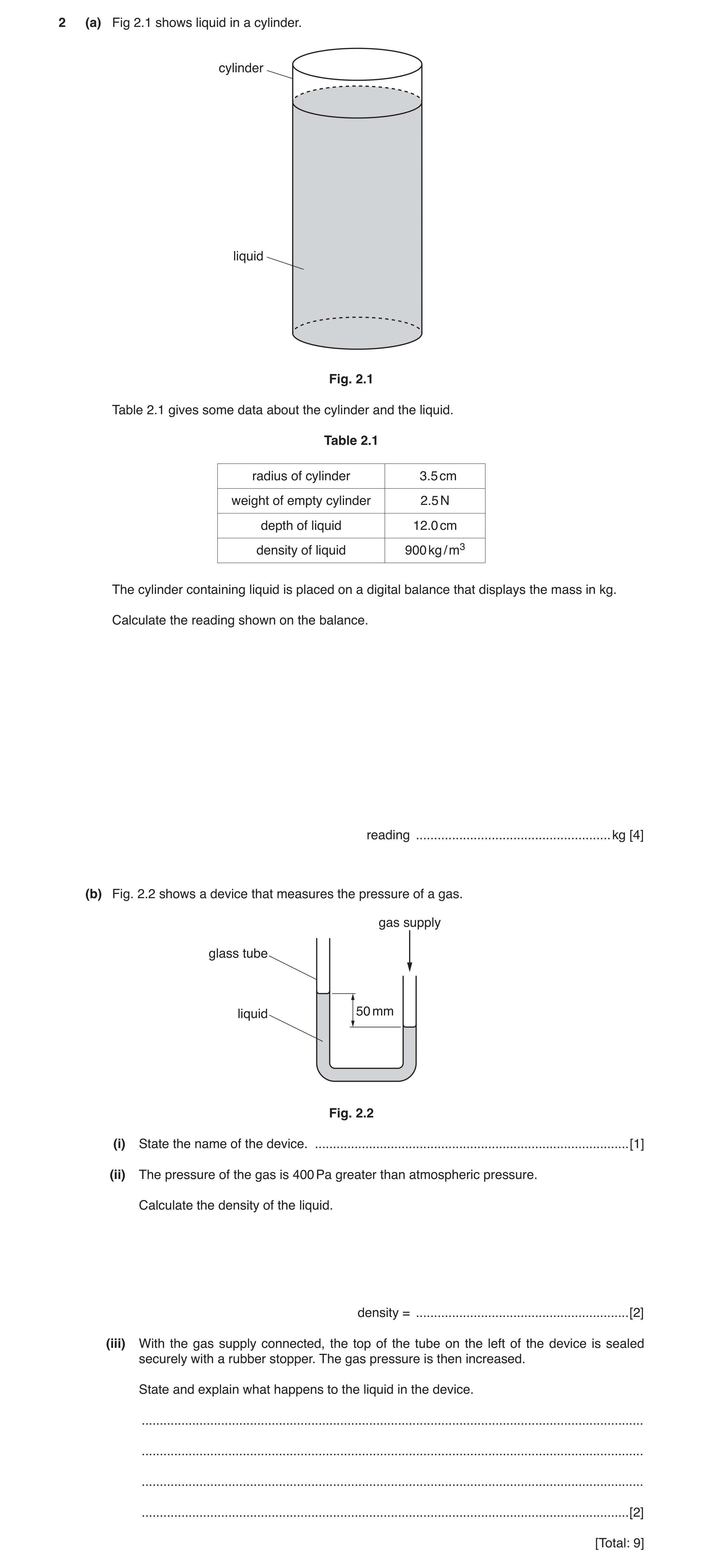
Q9 · Liquid in a cylinder 0625/42 Oct/Nov 2018
2 (a) Fig 2.1 shows liquid in a cylinder. cylinder liquid Fig. 2.1 Table 2.1 gives some data about the cylinder and the liquid. Table 2.1 radius of cylinder 3.5 cm weight of empty cylinder 2.5 N depth of liquid 12.0 cm density of liquid 900 kg / m3 The cylinder containing liquid is placed on a digital balance that displays the mass in kg. Calculate the reading shown on the balance. reading … kg [4] (b) Fig. 2.2 shows a device that measures the pressure of a gas. gas supply glass tube liquid 50 mm Fig. 2.2 (i) State the name of the device. … [1] (ii) The pressure of the gas is 400 Pa greater than atmospheric pressure. Calculate the density of the liquid. density = … [2] (iii) With the gas supply connected, the top of the tube on the left of the device is sealed securely with a rubber stopper. The gas pressure is then increased. State and explain what happens to the liquid in the device. … … … … [2] [Total: 9]
9 marks
Mark scheme: 2(a) C1 ρ = m / V in any form OR (m =) ρV C1 (mass = 900 × 4.62 × 10–4 = ) 0.41 (kg) A1 0.66 kg or 250 g or 0.25 kg correctly added to previous result B1 2(b)(i) manometer B1 2(b)(ii) P = ρgh in any form or (ρ =) P / gh C1 (ρ = 400 / (10 × 0.05) = ) 800 kg / m3 A1 2(b)(iii) liquid on left goes further up tube B1 pressure of gas greater than air pressure + pressure from liquid column B1
This question in 0625/42 Oct/Nov 2018
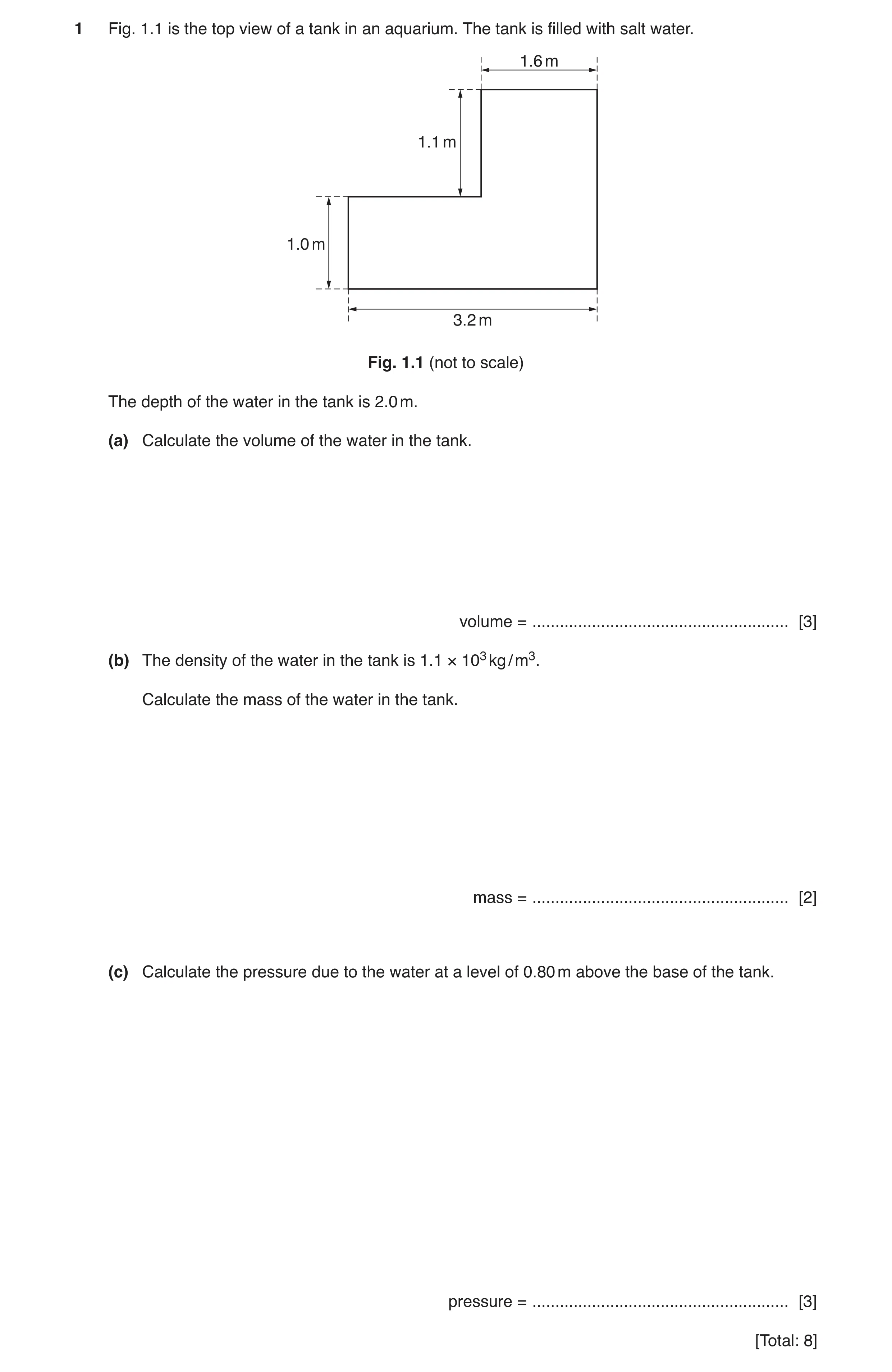
Q10 · The top view of a tank in an aquarium 0625/43 Oct/Nov 2019
1 Fig. 1.1 is the top view of a tank in an aquarium. The tank is filled with salt water. 1.6 m 1.1 m 1.0 m 3.2 m Fig. 1.1 (not to scale) The depth of the water in the tank is 2.0 m. (a) Calculate the volume of the water in the tank. volume = … [3] (b) The density of the water in the tank is 1.1 × 10³ kg / m3. Calculate the mass of the water in the tank. mass = … [2] (c) Calculate the pressure due to the water at a level of 0.80 m above the base of the tank. pressure = … [3] [Total: 8]
8 marks
Mark scheme: 1(a) attempt to use 2 rectangles for A C1 A = ((1 × 3.2) + (1.1 × 1.6) = 3.2 + 1.76 =) 4.96 (m2) C1 9.9 m3 A1 1(b) ρ = m / V OR m = ρV OR (m =) 9.9 × 1.1 × 103 C1 (m =) 1.1 × 10⁴ kg A1 1(c) depth of water = 1.2 m C1 (P =) ρgh OR (P = 1.1 × 103 × 10 × 1.2) C1 (P =) 1.3 × 10⁴ Pa A1
This question in 0625/43 Oct/Nov 2019
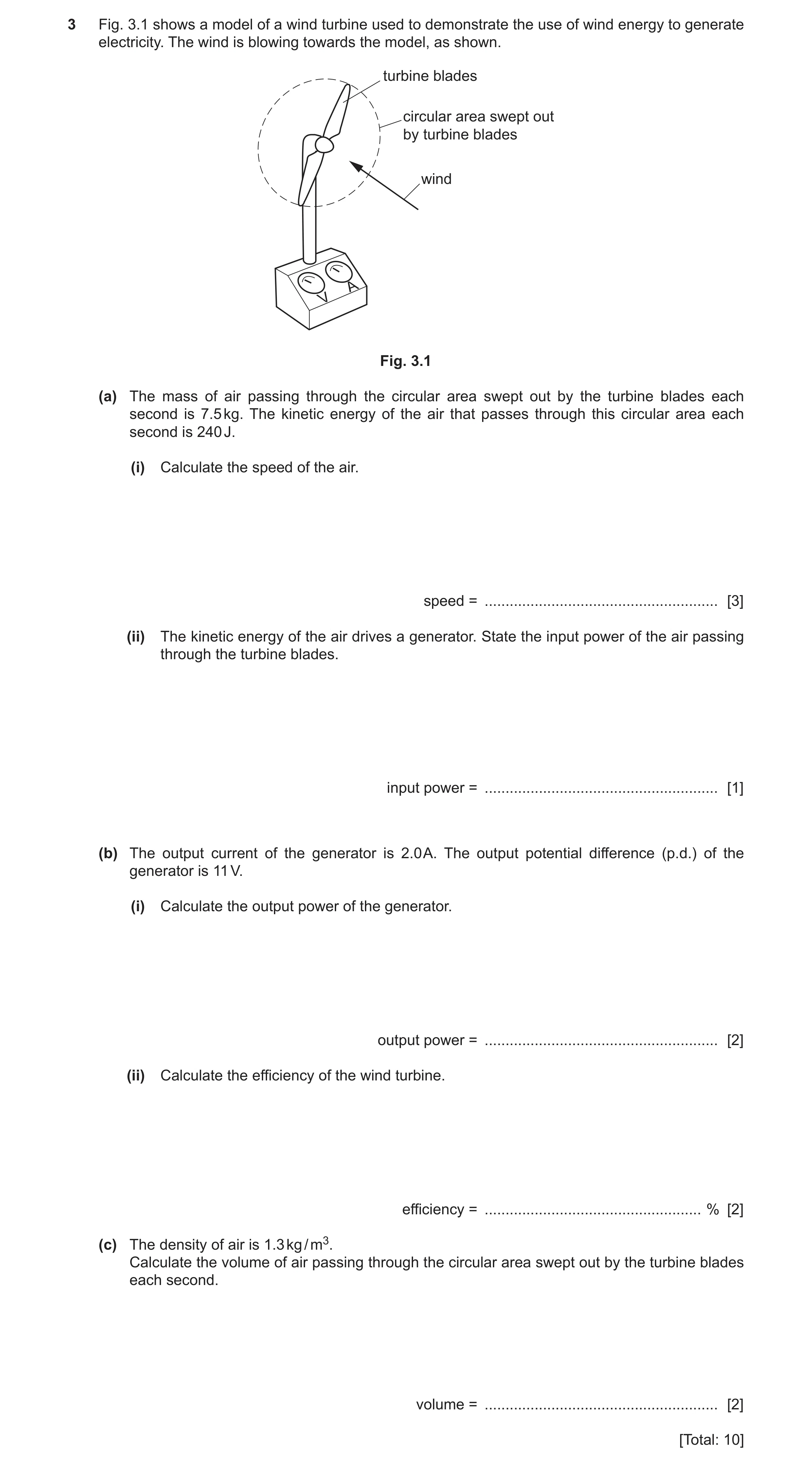
Q11 · A model of a wind turbine used to demonstrate the use of wind energy to generate… 0625/42 Feb/March 2020
3 Fig. 3.1 shows a model of a wind turbine used to demonstrate the use of wind energy to generate electricity. The wind is blowing towards the model, as shown. turbine blades circular area swept out by turbine blades wind A V Fig. 3.1 (a) The mass of air passing through the circular area swept out by the turbine blades each second is 7.5 kg. The kinetic energy of the air that passes through this circular area each second is 240 J. (i) Calculate the speed of the air. speed = … [3] (ii) The kinetic energy of the air drives a generator. State the input power of the air passing through the turbine blades. input power = … [1] (b) The output current of the generator is 2.0 A. The output potential difference (p.d.) of the generator is 11 V. (i) Calculate the output power of the generator. output power = … [2] (ii) Calculate the efficiency of the wind turbine. efficiency = … % [2] (c) The density of air is 1.3 kg / m3. Calculate the volume of air passing through the circular area swept out by the turbine blades each second. volume = … [2] [Total: 10]
10 marks
Mark scheme: 3(a)(i) KE = ½ mv2 in any form OR v2 = 2 × KE / m OR 240 = ½ × 7.5 v2 C1 v2 = 2 × 240 / 7.5 OR (v=) √{2 × 240 / 7.5 } OR (v=) √{2KE / m } C1 = 8.0 m / s A1 3(a)(ii) 240 W B1 3(b)(i) P = VI in any form OR 11 × 2 C1 22 W A1 3(b)(ii) (efficiency =) Po / Pi OR (efficiency =) Po / Pi OR (efficiency =) (11 × 2 / 240) × 100 C1 {efficiency = (11 × 2 / 240) × 100 =} 9.2 (%) A1 3(c) ρ = m / V in any form OR (V =) m / ρ OR (V = )7.5 / 1.3 C1 (V = 7.5 / 1.3 =) 5.8 m3 A1
This question in 0625/42 Feb/March 2020
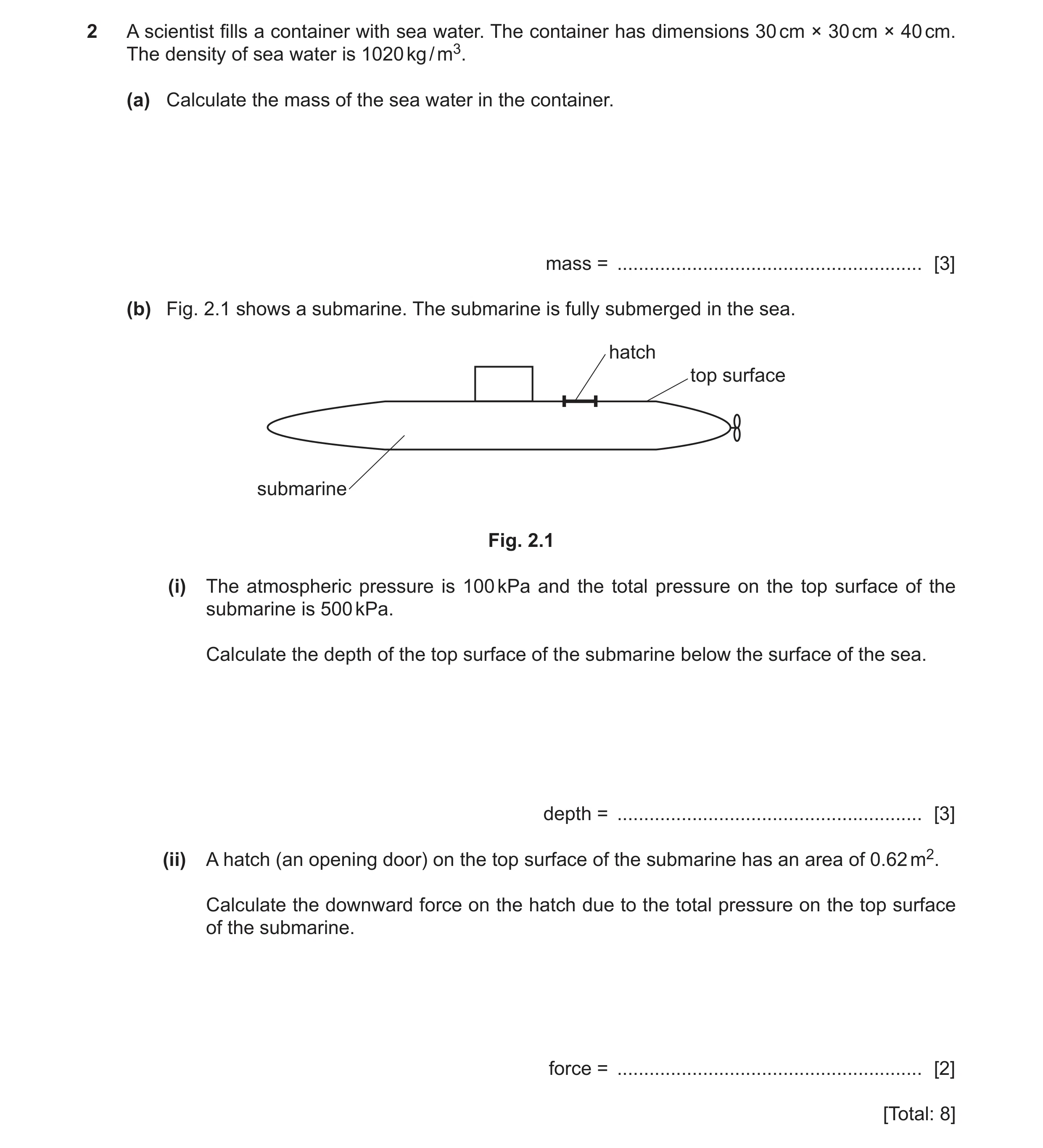
Q12 · A scientist fills a container with sea water 0625/43 May/June 2020
2 A scientist fills a container with sea water. The container has dimensions 30 cm × 30 cm × 40 cm. The density of sea water is 1020 kg / m3. (a) Calculate the mass of the sea water in the container. mass = … [3] (b) Fig. 2.1 shows a submarine. The submarine is fully submerged in the sea. hatch top surface submarine Fig. 2.1 (i) The atmospheric pressure is 100 kPa and the total pressure on the top surface of the submarine is 500 kPa. Calculate the depth of the top surface of the submarine below the surface of the sea. depth = … [3] (ii) A hatch (an opening door) on the top surface of the submarine has an area of 0.62 m2. Calculate the downward force on the hatch due to the total pressure on the top surface of the submarine. force = … [2] [Total: 8]
8 marks
Mark scheme: 2(a) V (= 0.3 × 0.3 × 0.4) = 0.036 (m3) C1 ρ = m / V in any form OR (m =) ρV OR 1020 × 0.036 C1 (m =) 37 kg A1 2(b)(i) P = ρgh in any form C1 (h =) 400 × 103 / (1020 × 10) C1 (h =) 39 m A1 2(b)(ii) P = F / A OR (F =) PA OR 500 × 103 × 0.62 C1 (F =) 310 000 N OR 310 kN A1
This question in 0625/43 May/June 2020
Q13 · A sealed weather balloon which is stationary in still air 0625/42 May/June 2021
1 (a) Fig. 1.1 shows a sealed weather balloon which is stationary in still air. weather balloon instruments Fig. 1.1 State whether the overall density of the balloon and its instruments is greater than, less than, or the same as the density of the surrounding air. … [1] (b) At night, the gas inside the balloon cools. The pressure of the air outside the balloon remains the same. (i) State whether the balloon rises, falls or remains stationary. … [1] (ii) Explain your answer. … … … [2] (c) An object is released from the balloon. It starts at rest and eventually reaches a constant speed. (i) On the axes of Fig. 1.2, sketch a speed–time graph to show this motion. speed 0 0 time Fig. 1.2 [3] (ii) State the values of the initial acceleration and the final acceleration of the object. initial acceleration … final acceleration … [2] [Total: 9]
9 marks
Mark scheme: 1(a) same (as density of surrounding air) B1 1(b)(i) falls B1 1(b)(ii) volume decreases B1 density increases B1 1(c)(i) starts at origin B1 finishes horizontal by eye B1 gradient decreasing smoothly to 0 B1 1(c)(ii) 10 m / s2 (down) B1 0 ignore any unit B1
This question in 0625/42 May/June 2021
Q14 · An aluminium saucepan and a steel saucepan have the same dimensions 0625/43 Oct/Nov 2021
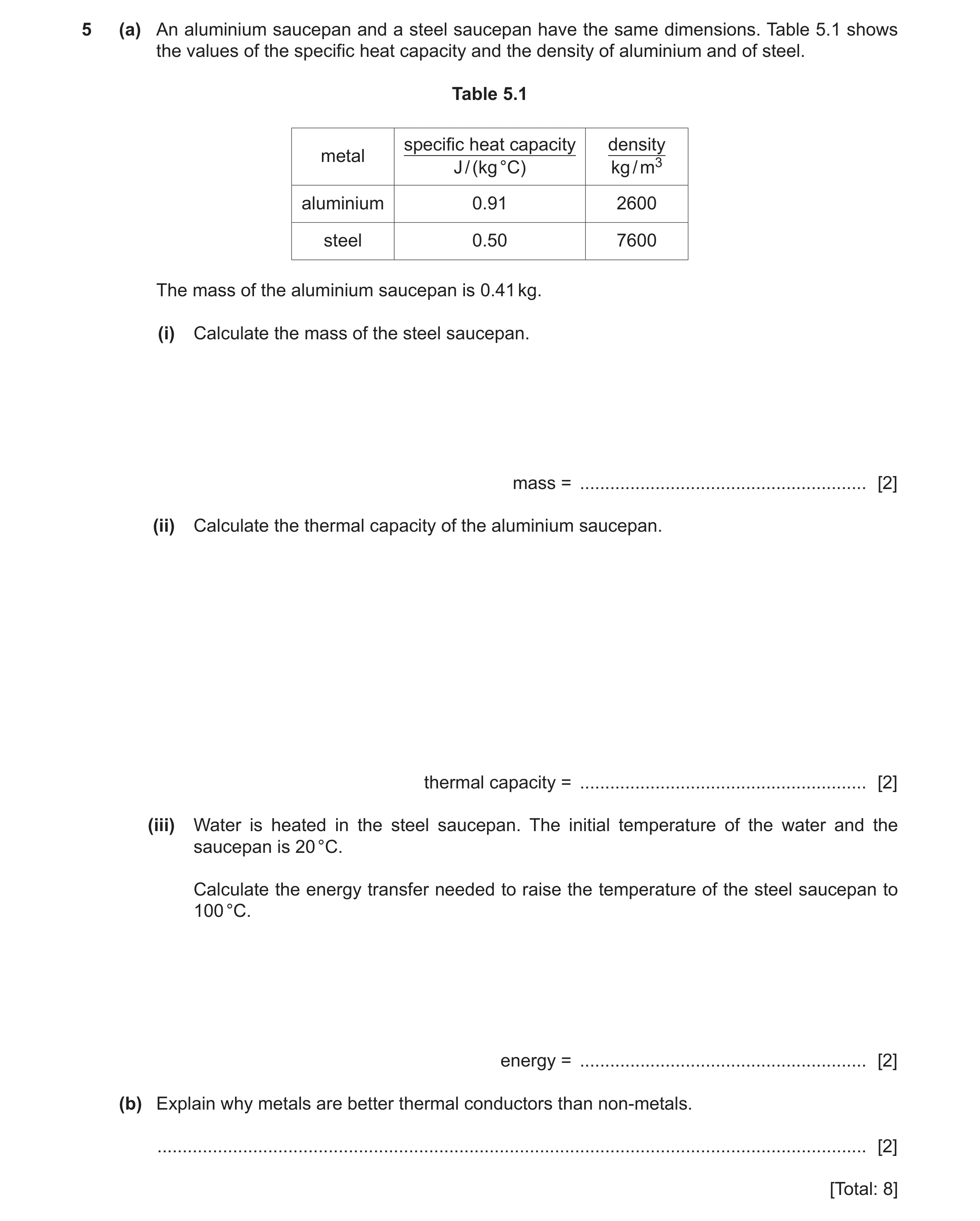
5 (a) An aluminium saucepan and a steel saucepan have the same dimensions. Table 5.1 shows the values of the specific heat capacity and the density of aluminium and of steel. Table 5.1 specific heat capacity density metal J / (kg °C) kg / m3 aluminium 0.91 2600 steel 0.50 7600 The mass of the aluminium saucepan is 0.41 kg. (i) Calculate the mass of the steel saucepan. mass = … [2] (ii) Calculate the thermal capacity of the aluminium saucepan. thermal capacity = … [2] (iii) Water is heated in the steel saucepan. The initial temperature of the water and the saucepan is 20 °C. Calculate the energy transfer needed to raise the temperature of the steel saucepan to 100 °C. energy = … [2] (b) Explain why metals are better thermal conductors than non-metals. … [2] [Total: 8]
8 marks
Mark scheme: 5(a)(i) 1.2 kg A2 ( ) 7600 0.41 2600 m × = volume constant so mass directly proportional to density C1 5(a)(ii) 0.37 J / °C A2 (thermal capacity =) mass × specific heat capacity C1 5(a)(iii) 48 J A2 (E =) mcΔT OR 1.2 × 0.50 × (100 – 20) in any form C1 5(b) electrons mentioned B1 (metals have) electrons free to move / delocalised (which transfer thermal energy) B1
This question in 0625/43 Oct/Nov 2021
Q15 · Define specific heat capacity 0625/43 May/June 2022
5 (a) Define specific heat capacity. … … [2] (b) A bowl contains 500 cm3 of water at a temperature of 5.0 °C. The bowl of water is placed in a freezer for several hours. When the bowl is removed from the freezer, it contains ice at a temperature of –18.0 °C. The density of water is 1000 kg / m3. (i) Calculate the mass of water in the bowl when it is placed in the freezer. mass = … [2] (ii) The specific heat capacity of water is 4200 J / (kg °C). The specific heat capacity of ice is 2100 J / (kg °C). The specific latent heat of fusion of water is 3.3 × 10⁵ J / kg. Calculate the energy given out as the water cools from 5.0 °C to ice at –18.0 °C. energy = … [5] [Total: 9]
9 marks
Mark scheme: 5(a) energy required to raise the temperature of 1 kg / 1 g / unit mass of a substance by 1 °C / unit temperature A2 energy required to raise the temperature of a substance by 1 °C C1 5(b)(i) 0.50 kg A2 = m/V in any form C1 5(b)(ii) 190 000J / 1.9 105 J / 190 kJ A5 (E=) mc∆T in any form C1 (E=) mL in any form C1 Use of c = 4200 (J / kg °C) AND ∆T = 5 C1 Use of c = 2100 AND ∆T = 18 C1
This question in 0625/43 May/June 2022
Q16 · A ship loaded with containers 0625/42 Feb/March 2023
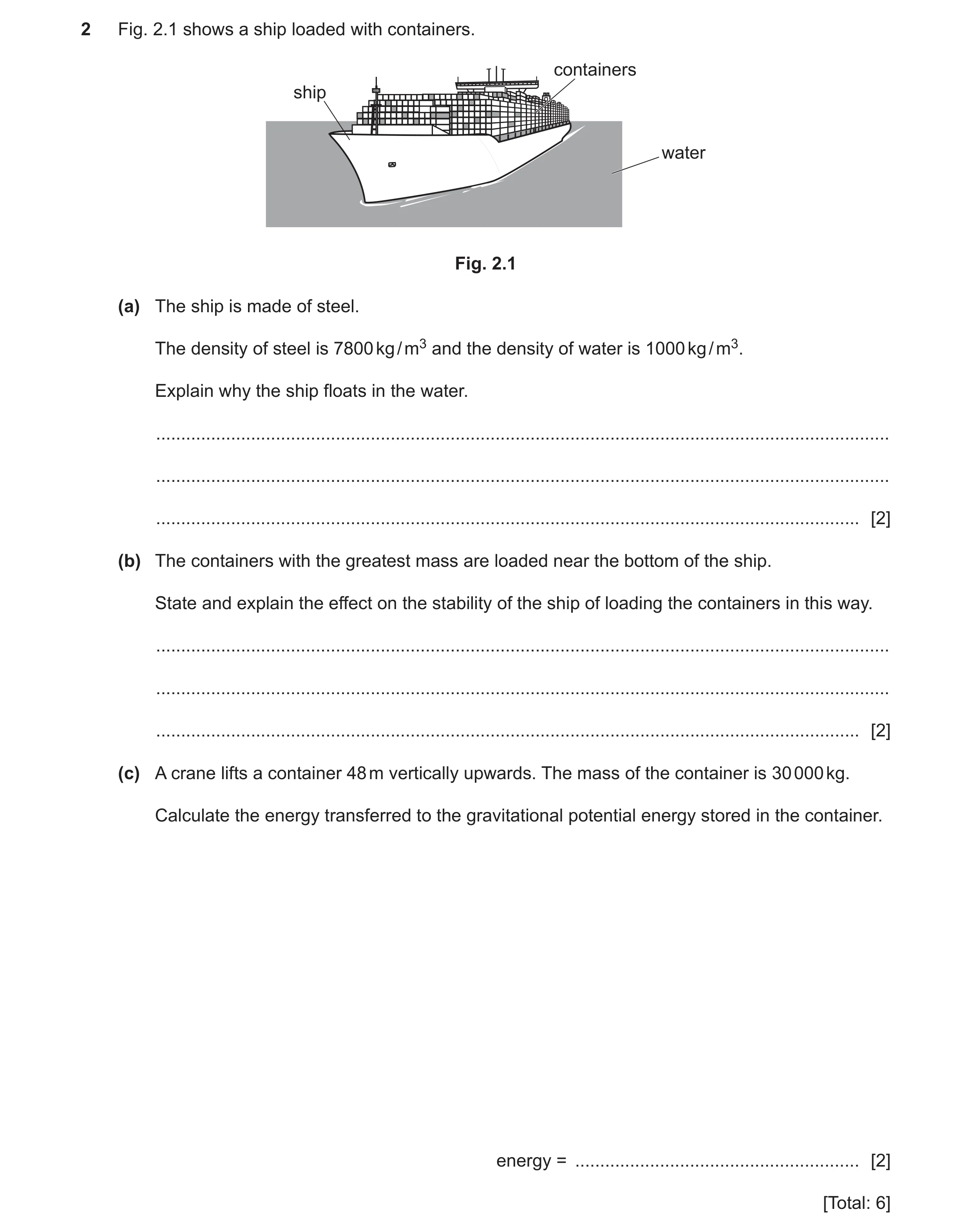
2 Fig. 2.1 shows a ship loaded with containers. containers ship water Fig. 2.1 (a) The ship is made of steel. The density of steel is 7800 kg / m3 and the density of water is 1000 kg / m3. Explain why the ship floats in the water. … … … [2] (b) The containers with the greatest mass are loaded near the bottom of the ship. State and explain the effect on the stability of the ship of loading the containers in this way. … … … [2] (c) A crane lifts a container 48 m vertically upwards. The mass of the container is 30 000 kg. Calculate the energy transferred to the gravitational potential energy stored in the container. energy = … [2] [Total: 6]
6 marks
Mark scheme: 2(a) ship is not solid steel / there are air spaces in ship B1 (average) density of ship is less than the density of the water B1 2(b) the centre of gravity is lower and (so) the ship is more stable A2 the centre of gravity is lower OR ship more stable (C1) 2(c) 1.4 107 J OR 14 MJ OR 14 000 kJ A2 ∆Ep= mg(∆)h OR (∆Ep= ) mg(∆)h OR 30 000 9.8 48 (C1)
This question in 0625/42 Feb/March 2023
Q17 · An electric heater used to heat a room 0625/42 May/June 2023
5 (a) Fig. 5.1 shows an electric heater used to heat a room. Fig. 5.1 The dimensions of the room are 4.5 m × 6.1 m × 2.4 m. The density of air is 1.2 kg / m3. (i) Show that the mass of air in the room is 79 kg. [2] (ii) The power of the heater is 1100 W. The specific heat capacity of air is 1000 J / (kg °C). Calculate the time taken to increase the temperature of the air in the room from 16.0 °C to 20.0 °C. time = … [4] (iii) Suggest one reason why the time calculated in (a)(ii) is the minimum time needed to increase the temperature of the air in the room from 16.0 °C to 20.0 °C. … … [1] (b) Fig. 5.2 shows a cross-section of a double-glazed window in the room. outer glass pane narrow air gap inner glass pane Fig. 5.2 State the main methods of thermal energy transfer from the room to outside which are reduced by this type of window. … [1] [Total: 8]
8 marks
Mark scheme: 5(a)(i) B1 (m =) 1.2 4.5 6.1 2.4 (= 79 kg) OR (m =) 79.056 (kg) B1 5(a)(ii) 290 s A4 c = (∆)E / m∆ OR (∆E =) mc∆ OR (∆E =) 79 1000 4(.0) OR (∆E =) 316 000 OR (∆ =) 4(.0) C1 P = (∆)E / t OR (∆E =) Pt OR (∆E =) 1100 t C1 (t =) mc∆ / P OR (t =) 79 1000 4(.0) / 1100 OR (t =) 316 000 / 1100 C1 5(a)(iii) any one from: (thermal) energy is transferred to furniture / walls / objects (in the room) (thermal) energy is transferred through windows / doors / floor / ceiling / from the room B1 5(b) conduction AND convection B1
This question in 0625/42 May/June 2023
Q18 · Define specific heat capacity 0625/42 Feb/March 2024
4 (a) Define specific heat capacity. … … … [2] (b) A volume of 0.0024 m3 of oil is heated in a pan for 7.0 min. The temperature of the oil increases from 20 °C to 180 °C. The density of the oil is 910 kg / m3. The specific heat capacity of the oil is 2000 J / (kg °C). (i) Calculate the mass of oil in the pan. mass = … [2] (ii) Calculate the energy required to increase the temperature of the oil. energy = … [2] (iii) Calculate the power required to supply the energy calculated in (b)(ii). power = … [2] [Total: 8]
8 marks
Mark scheme: 4(a) energy transferred per unit mass per unit temperature change A2 (thermal) energy (transferred) per unit temperature change (C1) 4(b)(i) (m =) 2.2 kg A2 m = V in any form OR 910 0.0024 (C1) 4(b)(ii) 7.0 105 J OR 700 000 J A2 c = ∆E / { m∆} OR (∆E =) mc∆OR 2.2 2000 160 OR 2.184 2000 160 (C1) 4(b)(iii) 1700 W A2 (P =) E / t OR 700 000 / 7 60 OR 704 000 / 7 60 OR 698 880 / 7 60 (C1)
This question in 0625/42 Feb/March 2024
Q19 · A stainless-steel saucepan being heated on an electric cooker 0625/43 May/June 2024
4 Fig. 4.1 shows a stainless-steel saucepan being heated on an electric cooker. The saucepan contains water. Fig. 4.1 (a) State what happens to the water particles as the water temperature increases. … [1] (b) The saucepan contains 250 cm3 of water. The specific heat capacity of water is 4200 J / (kg °C). The density of water is 1000 kg / m3. (i) Show that the mass of the water in the saucepan is 0.25 kg. [2] (ii) Calculate the energy required to increase the water temperature from 20 °C to 65 °C. energy = … [3] (iii) The heater supplies enough power to heat the water in 39 s. A student measures the time taken to heat the water as 115 s. Suggest why the actual time taken to heat the water is longer. Assume that the student takes accurate measurements. … … [1] (c) The stainless-steel saucepan is replaced with an aluminium saucepan of the same mass. It contains the same volume of water. The specific heat capacity of stainless steel is 500 J / (kg °C). The specific heat capacity of aluminium is 890 J / (kg °C). Explain how using an aluminium saucepan will affect the time taken to heat the water. … … … [2] [Total: 9]
9 marks
Mark scheme: 4(a) (average) KE of particles increases / particles move faster B1 4(b)(i) = m / v OR (m =) v M1 1 cm3 = 1 10–6 m3 OR 250 cm3 = 2.5 10–4 m3 OR 1000 2.5 10–4 (= 0.25 kg) A1 4(b)(ii) 47000 J A3 ( =) 65 – 20 °C OR ( =) 45 °C C1 E = mc OR (E =) mc OR (E =) 0.25 4200 45 C1 4(b)(iii) thermal energy also transferred to the pan / surroundings OR thermal energy escapes from the water (as it is being heated) B1 4(c) any two from: (aluminium saucepan) takes longer to heat the water more (thermal) energy is needed (with aluminium pan for the same increase in temperature) (because aluminium) has a higher specific heat capacity B2
This question in 0625/43 May/June 2024
Q20 · A balanced, uniform metre ruler made of wood 0625/42 May/June 2025
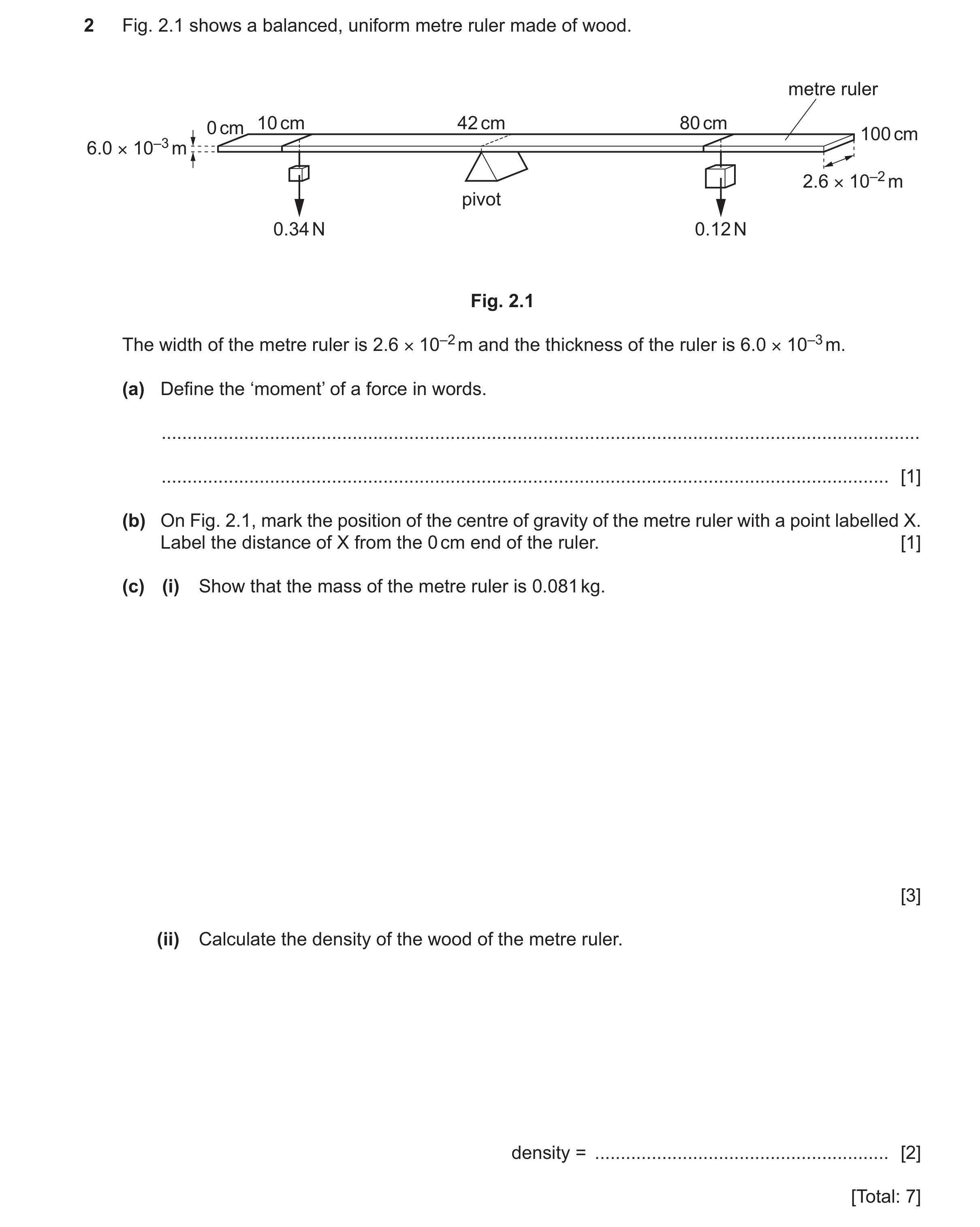
2 Fig. 2.1 shows a balanced, uniform metre ruler made of wood. metre ruler 0 cm 10 cm 42 cm 80 cm 100 cm 6.0 × 10⁻³ m 2.6 × 10⁻² m pivot 0.34 N 0.12 N Fig. 2.1 The width of the metre ruler is 2.6 × 10⁻² m and the thickness of the ruler is 6.0 × 10⁻³ m. (a) Define the ‘moment’ of a force in words. … … [1] (b) On Fig. 2.1, mark the position of the centre of gravity of the metre ruler with a point labelled X. Label the distance of X from the 0 cm end of the ruler. [1] (c) (i) Show that the mass of the metre ruler is 0.081 kg. [3] (ii) Calculate the density of the wood of the metre ruler. density = … [2] [Total: 7]
7 marks
Mark scheme: 2(a) (moment =) force perpendicular distance (from the pivot) B1 2(b) X AND 50 cm labelled to the right of the pivot AND left of 80 cm B1 2(c)(i) sum of clockwise moments = sum of anticlockwise moments B1 {mg 8} + {0.12 38} = {0.34 32} B1 any one from: B1 • mg = [{0.34 32} – {0.12 38}] ÷ 8 • mg = {10.88 – 4.56} ÷ 8 • mg = 6.32 ÷ 8 • mg = 0.79 • (mass =) 0.79 ÷ 9.8 2(c)(ii) 520 kg / m3 A2 (density =) mass ÷ volume OR 0.081 ÷ {1(.0) 2.6 10–2 6(.0) 10–3} C1
This question in 0625/42 May/June 2025
Q21 · Table 2.1 contains information about the planet Mars 0625/41 Oct/Nov 2025
2 Table 2.1 contains information about the planet Mars. Table 2.1 mass 6.4 × 10²³ kg gravitational field strength 3.7 N / kg at surface average density 3900 kg / m3 (a) Define gravitational field strength. … … [1] (b) (i) An object has a weight of 42 N at the surface of the Earth. Calculate the weight of the object at the surface of Mars. weight = … [2] (ii) Calculate the volume of Mars. volume = … [2] (c) Fig. 2.1 shows a space buggy that is tested on Earth. The buggy is travelling at a constant speed in a straight line. The driving force on the buggy is 30 N. 30N Fig. 2.1 (i) Draw and label one arrow on Fig. 2.1 to show the size and direction of the resistive forces on the buggy. [2] (ii) Air resistance on Mars is less than air resistance on Earth. The same driving force, 30 N, is exerted on the buggy on Mars. 1. State the effect this has on the resultant force on the buggy on Mars. … 2. State the relationship between resistive forces, driving force and resultant force. … [1] [Total: 8]
8 marks
Mark scheme: 2(a) (gravitational field strength is) force per unit mass (on an object in a gravitational field) B1 2(b)(i) 16 N A2 W = mg OR (m =) W÷g OR 42 / 9.8 OR (mass of object =) 4.3 (kg) C1 2(b)(ii) 1.6 1020 m3 A2 (V =) m / ρ OR (V =) 6.4 1023 / 3900 C1 2(c)(i) arrow parallel to driving force AND pointing to the right B1 2(c)(i) (arrow pointing to the right) labelled 30 N B1 2(c)(ii) 1 (resultant force) increases OR there is a resultant force (in the direction of the driving force) B1 OR 2 resultant force = driving force – resistive force(s)
This question in 0625/41 Oct/Nov 2025
 1 / 28
 2 / 28
 3 / 28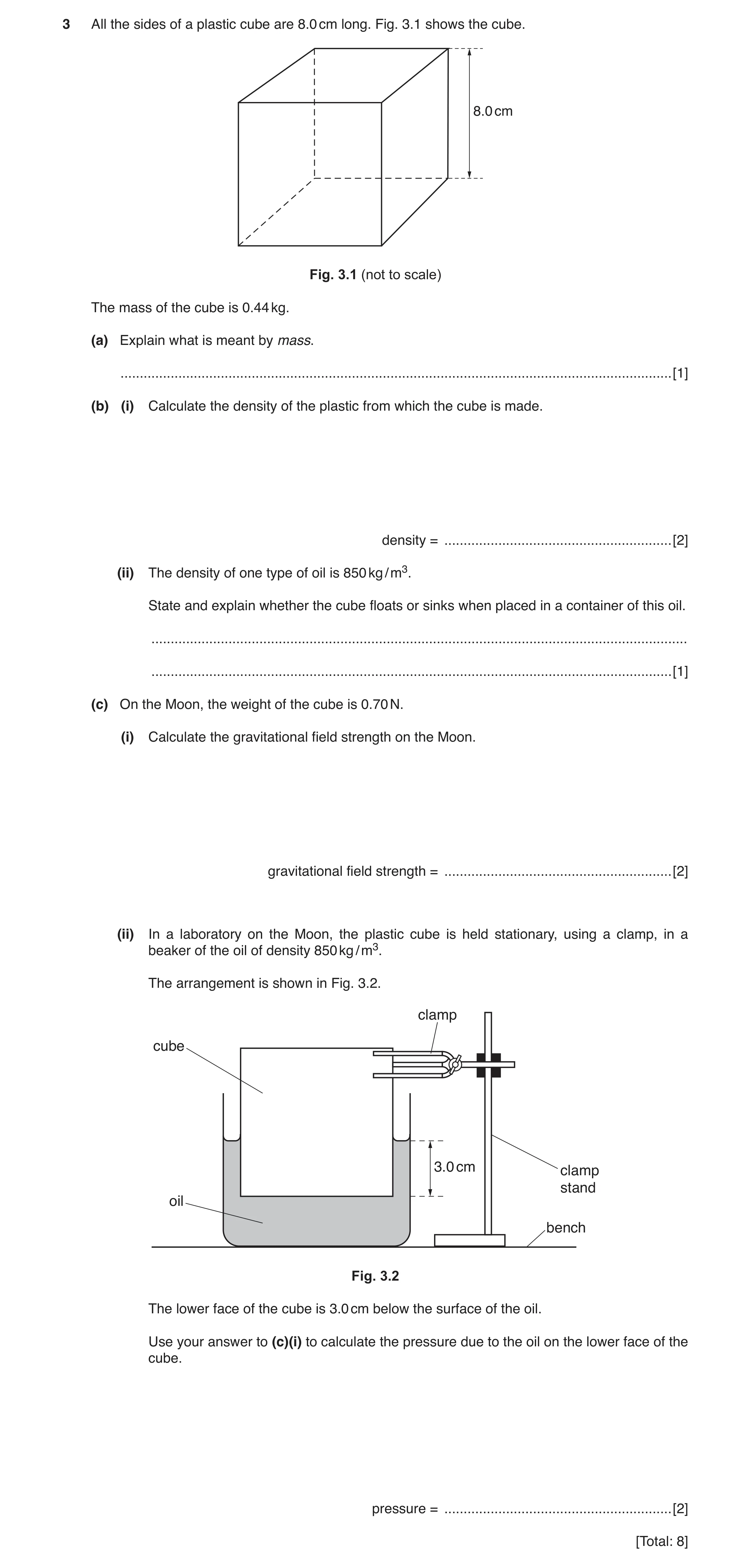
 8 / 28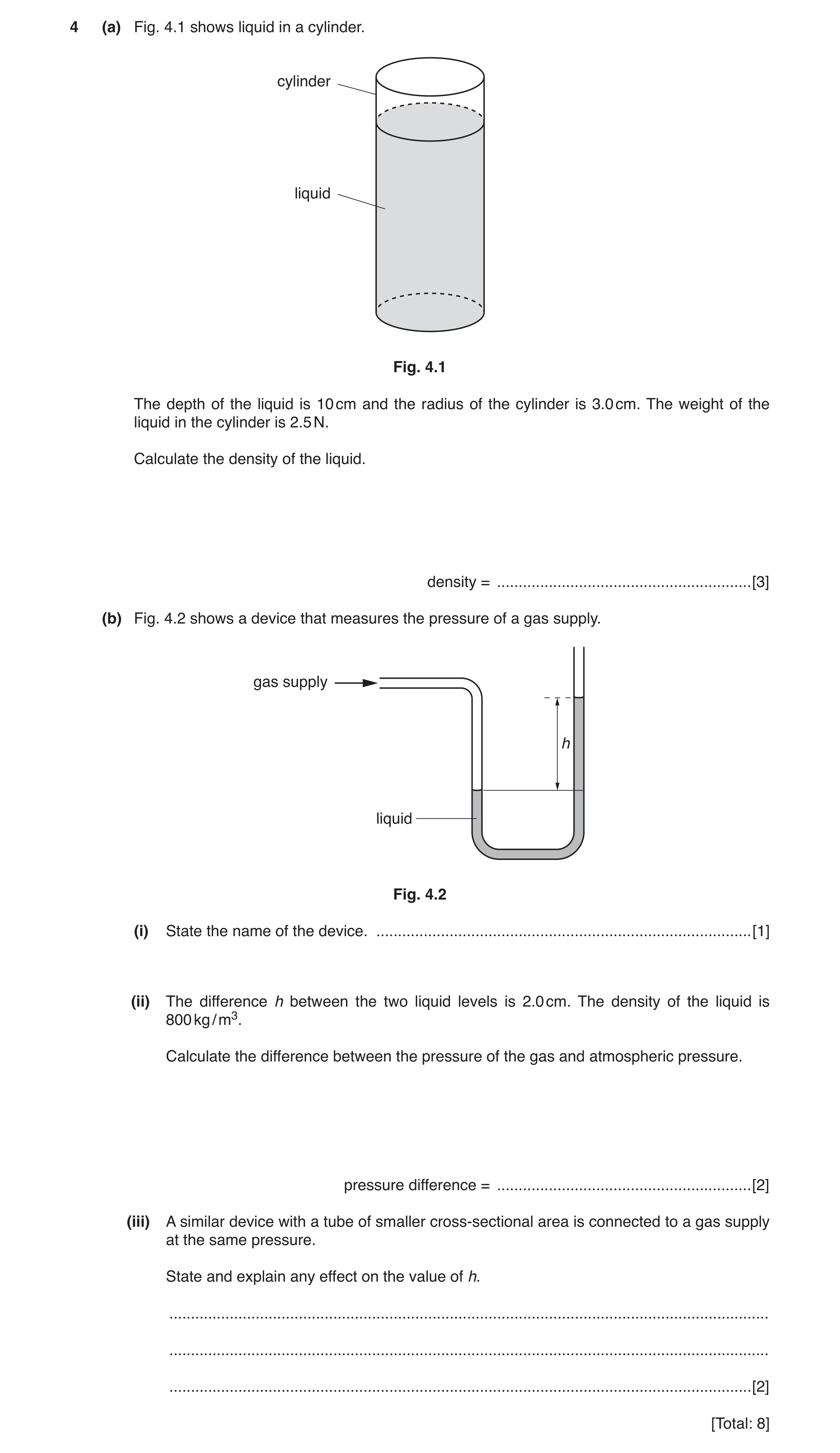
 15 / 28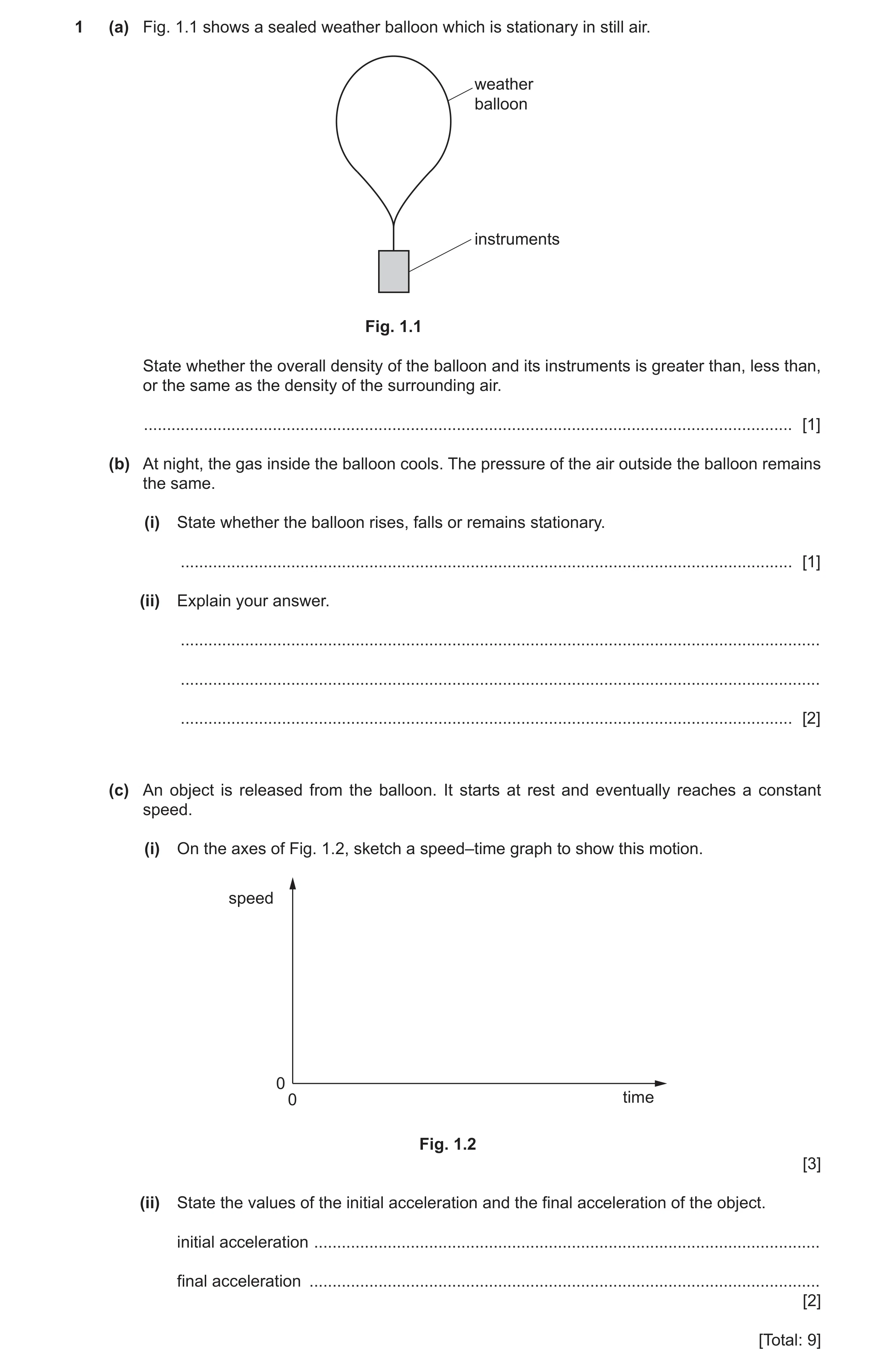
 18 / 28
 19 / 28
 20 / 28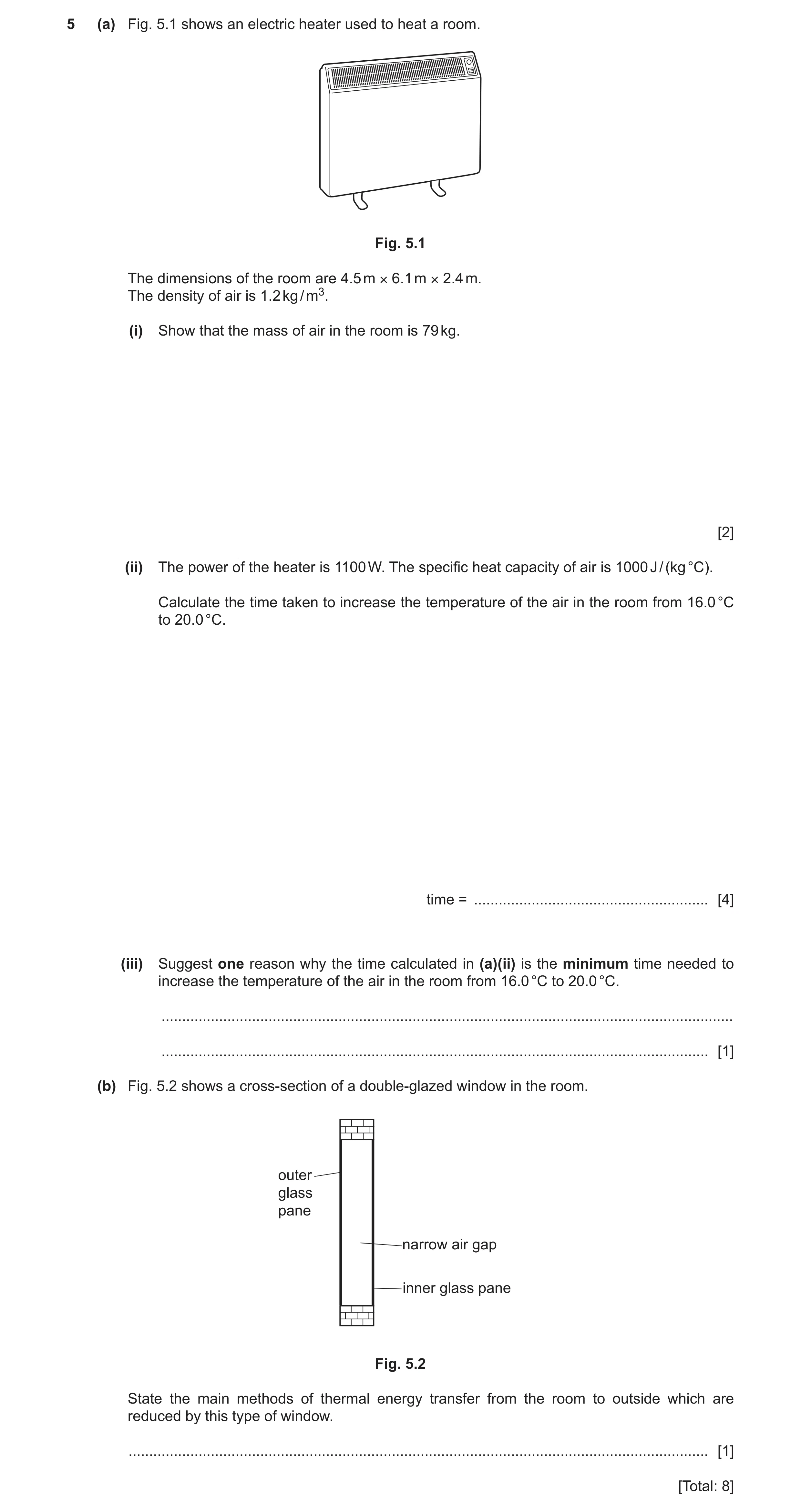
 23 / 28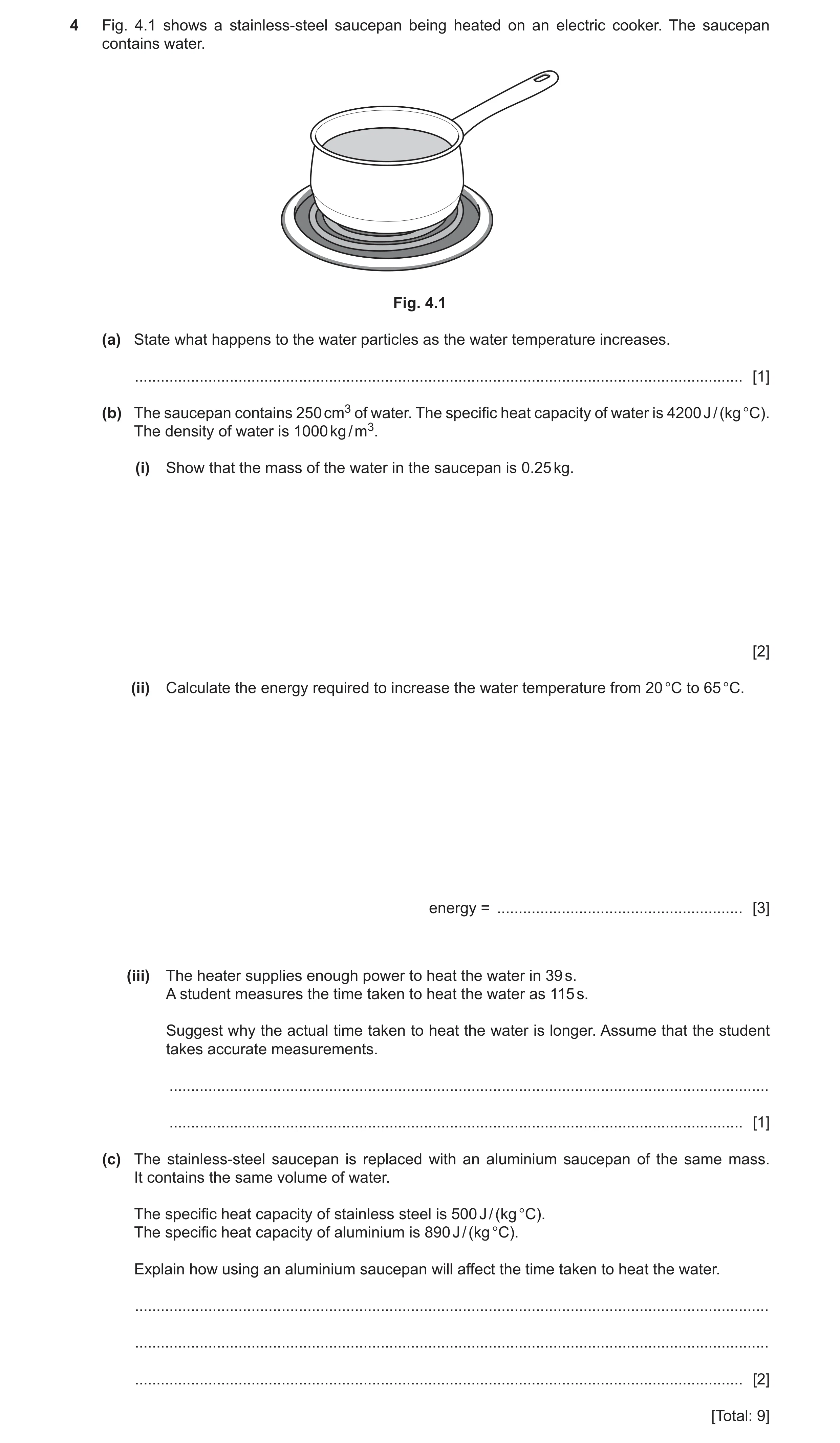
 26 / 28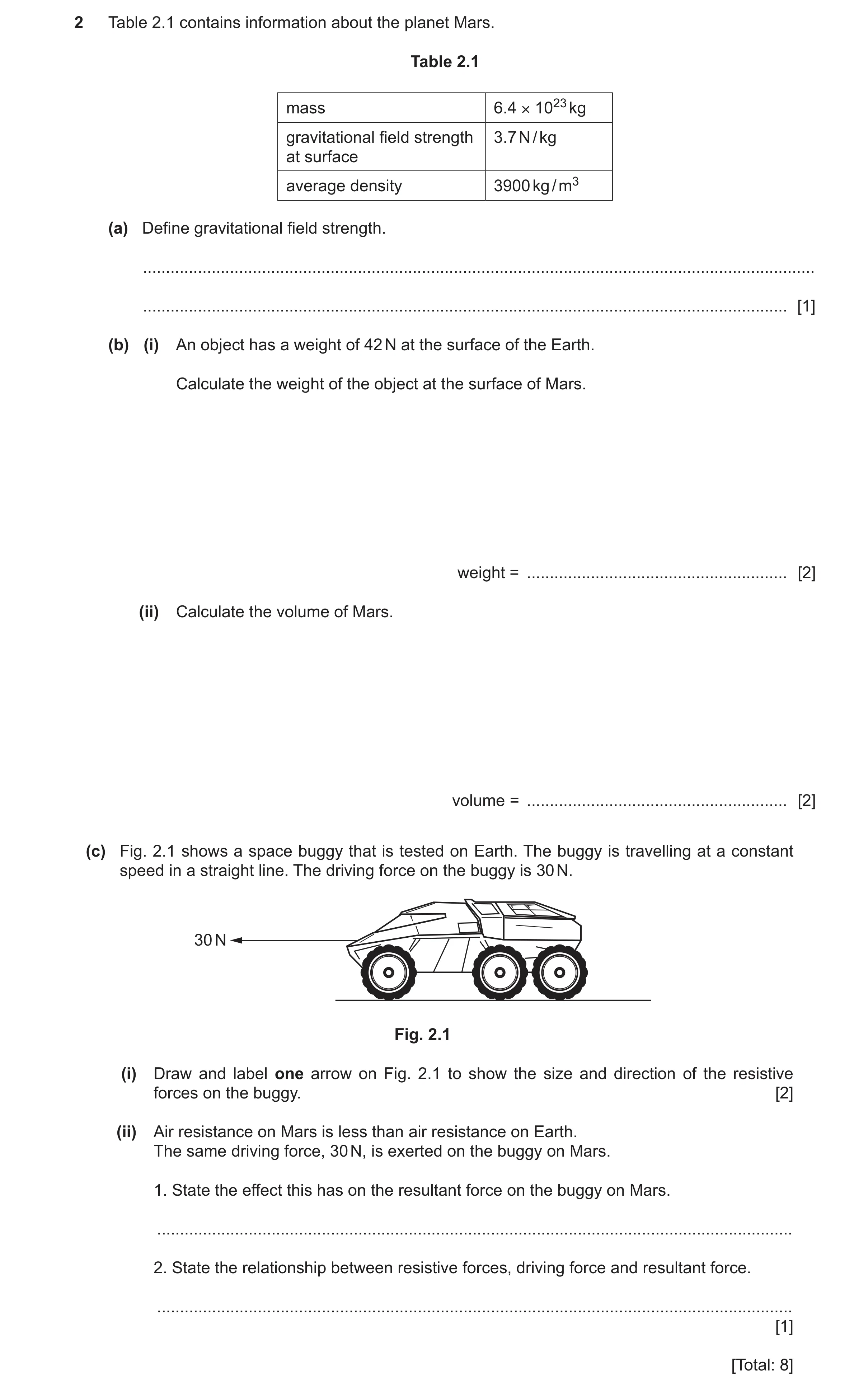
 7
7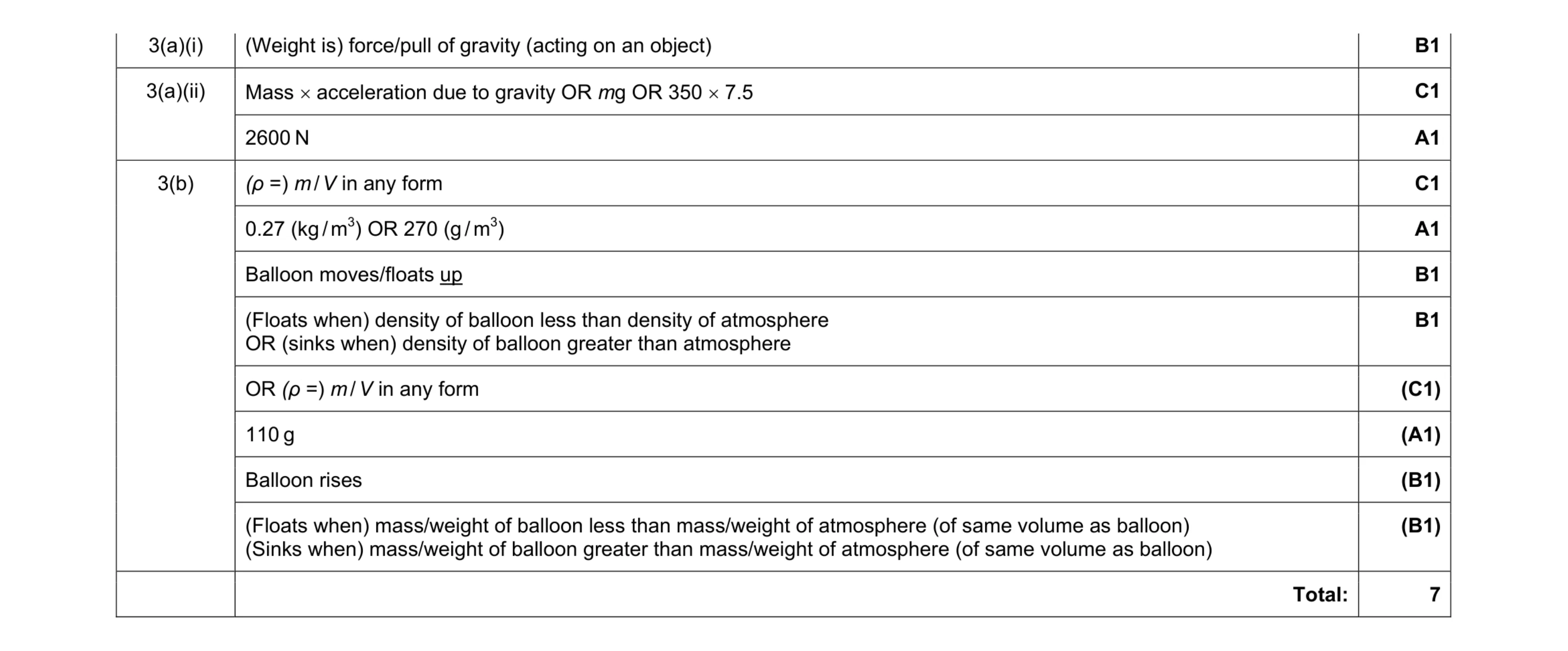 7
7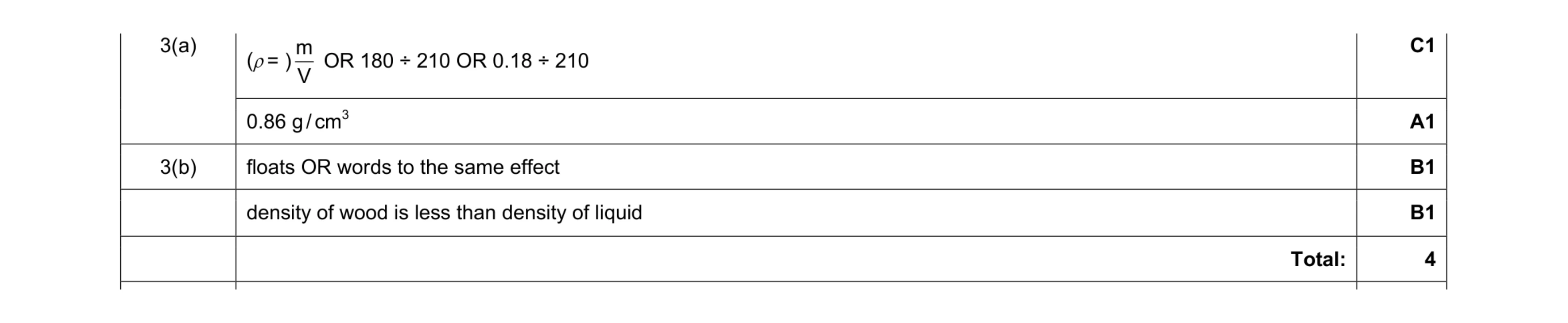 4
4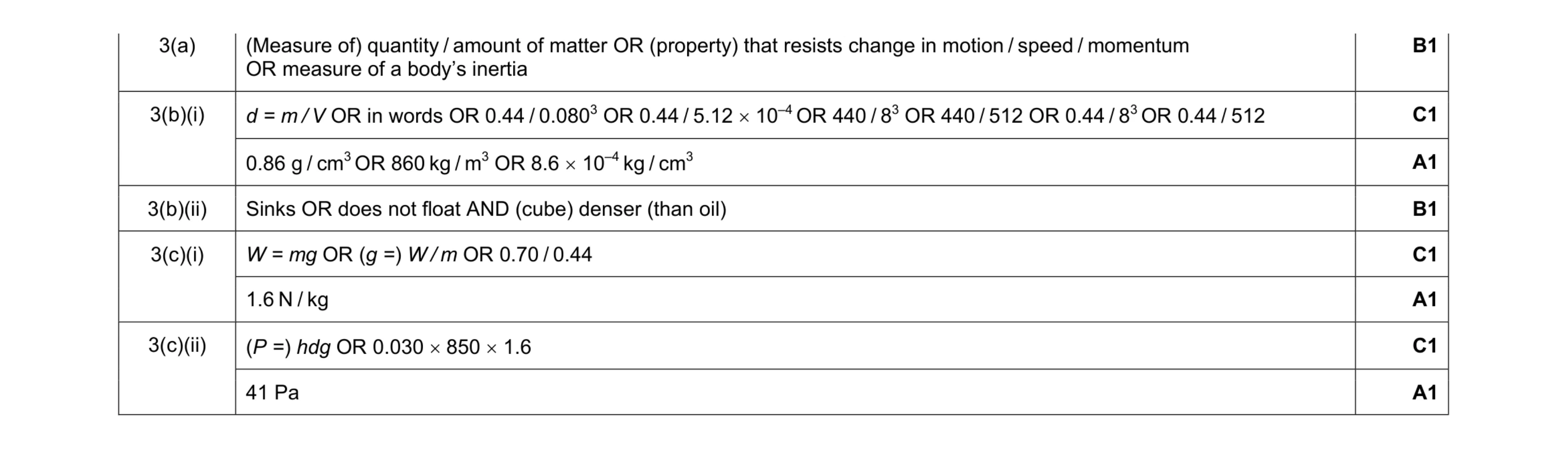 8
8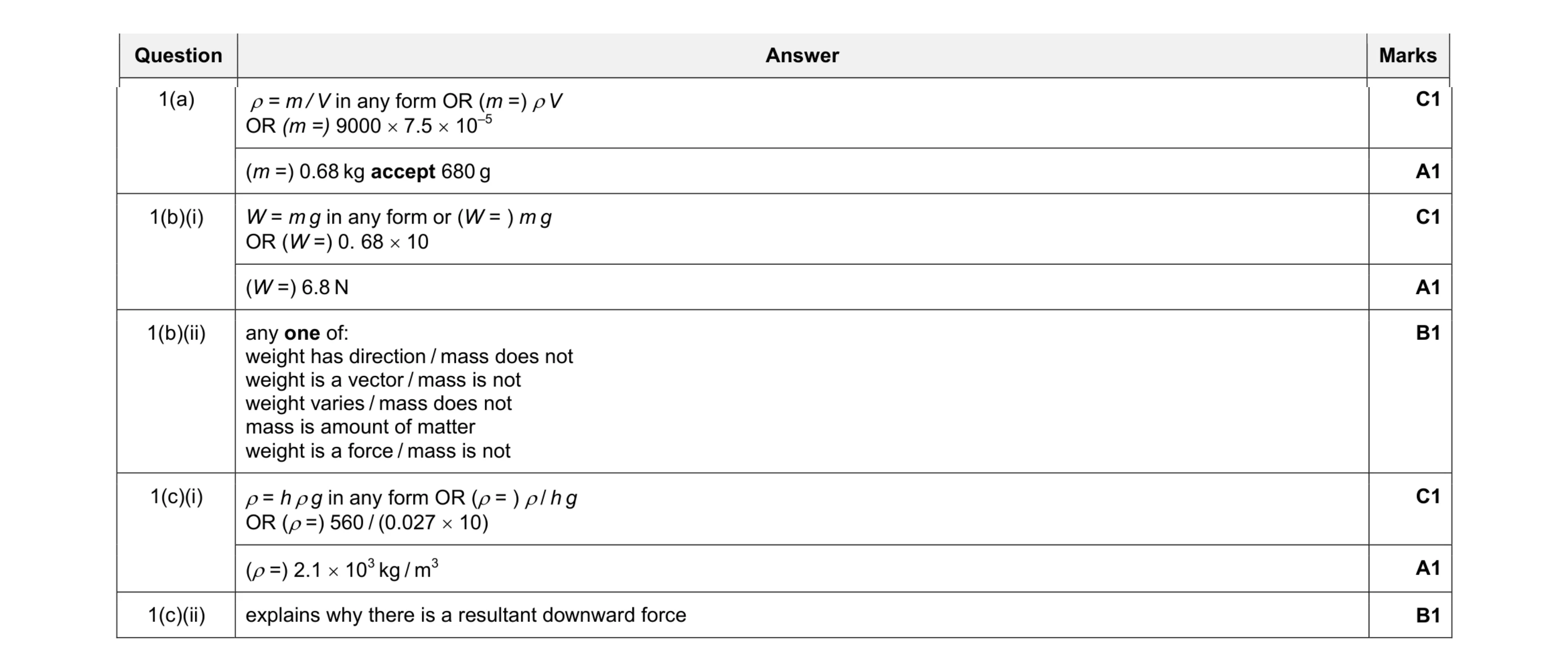 8
8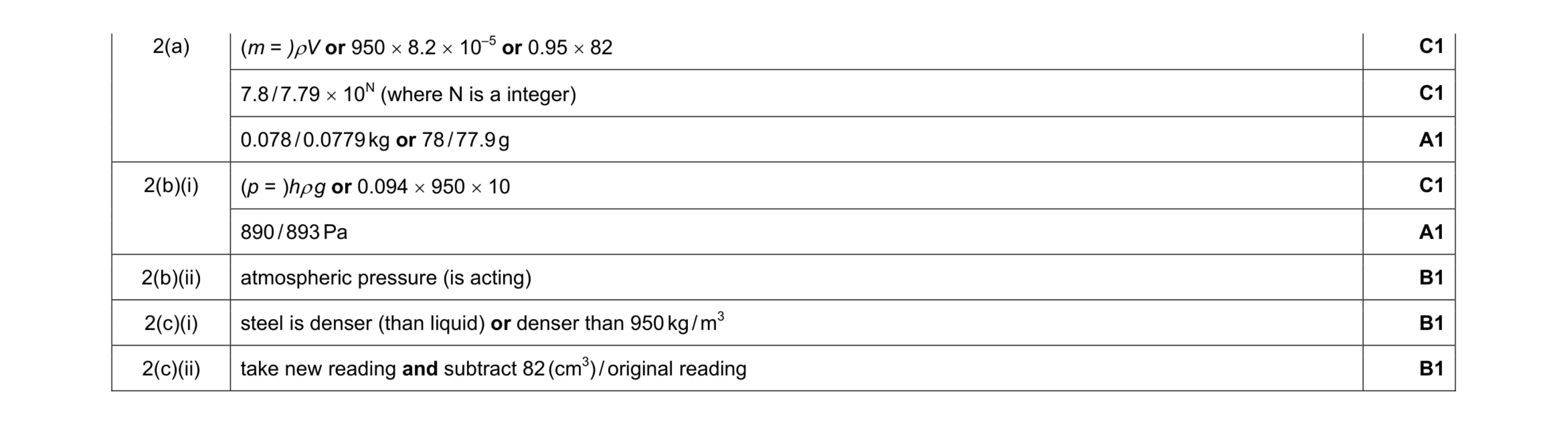 8
8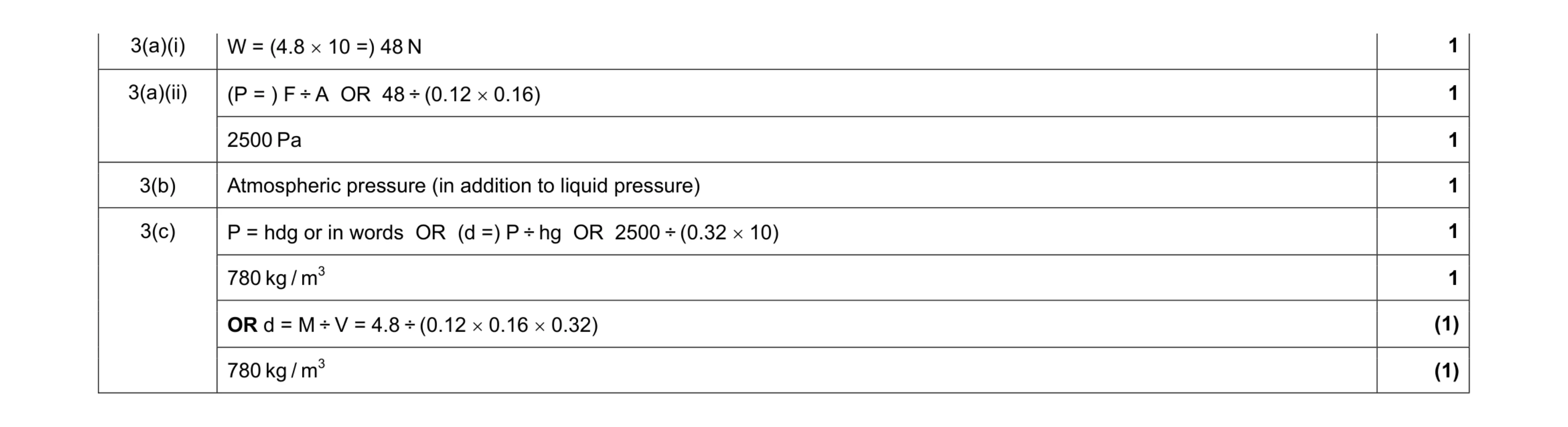 6
6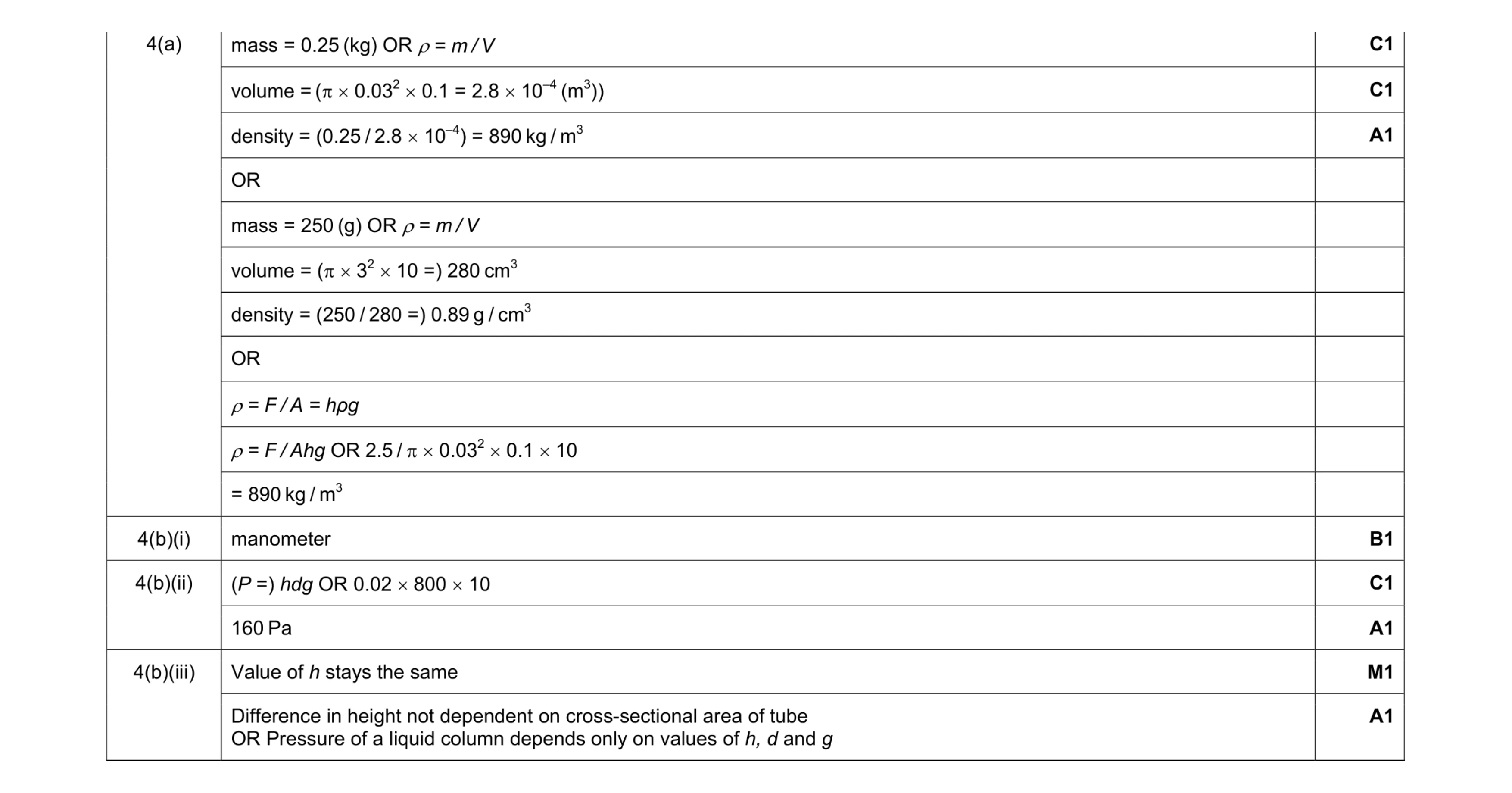 8
8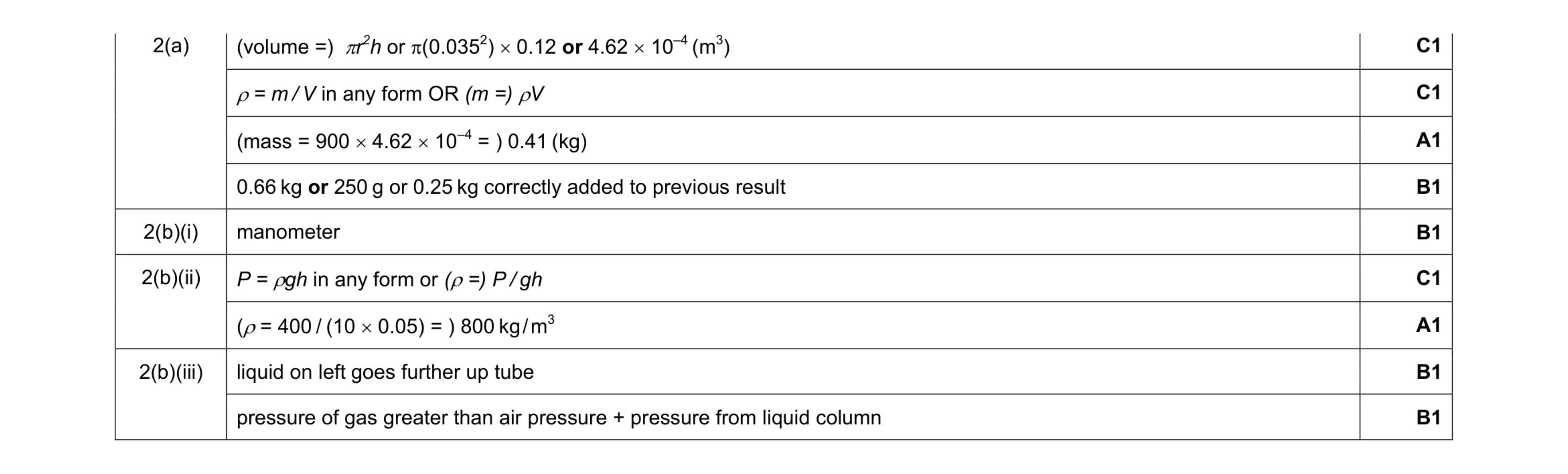 9
9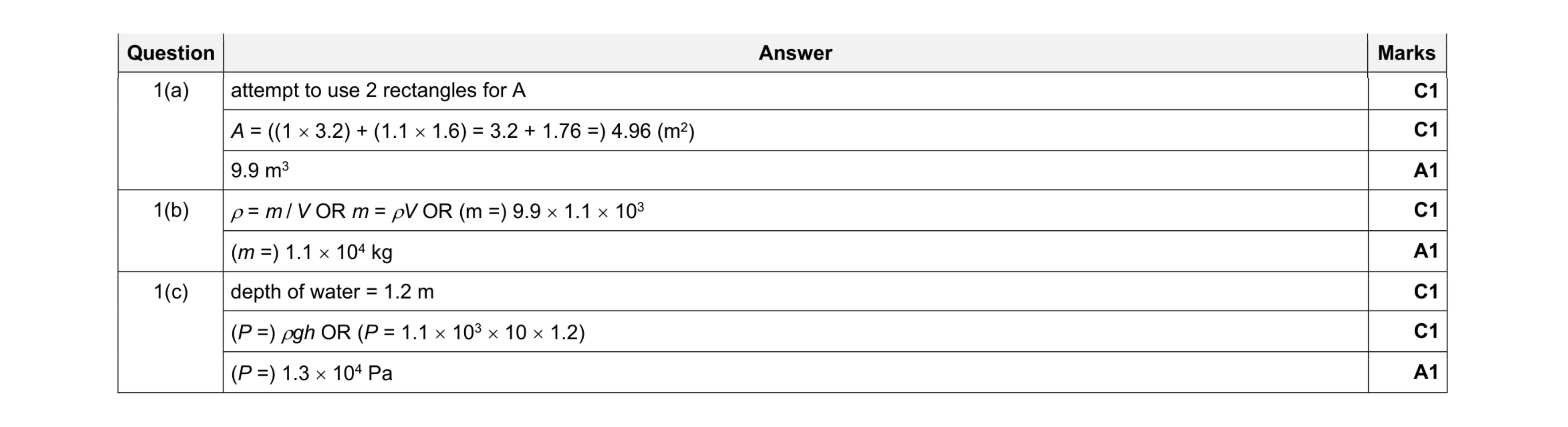 8
8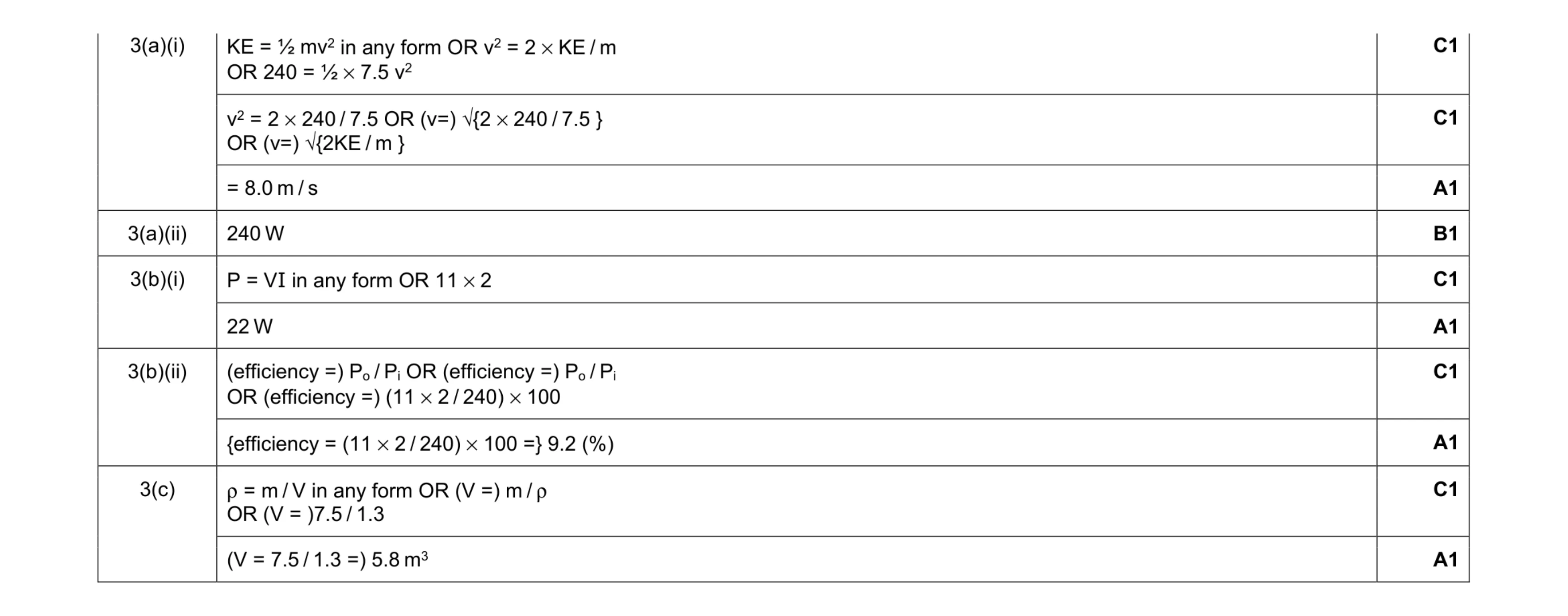 10
10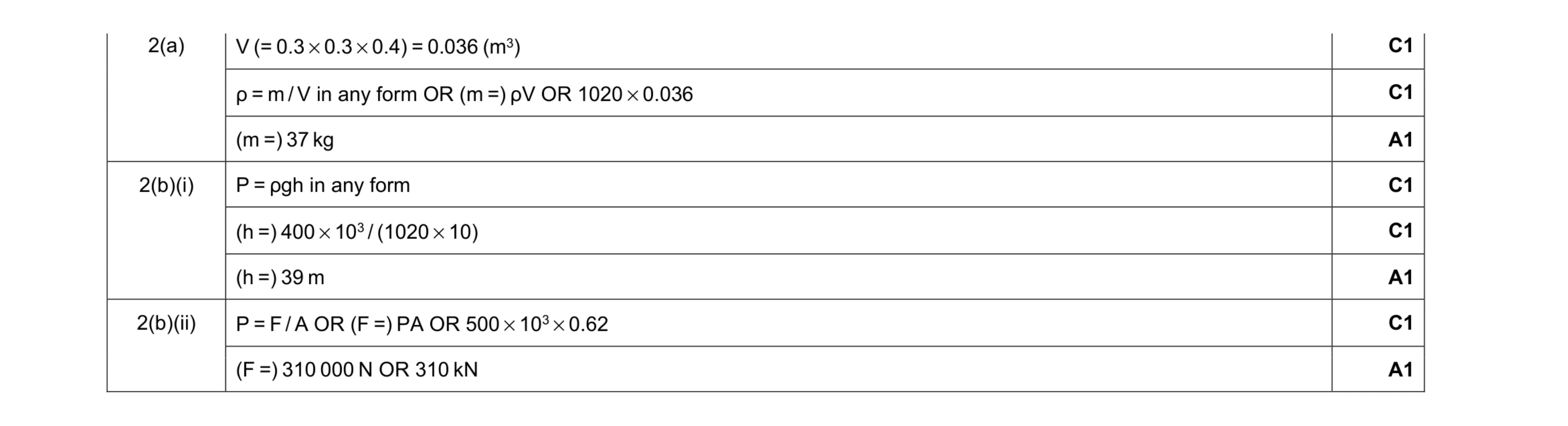 8
8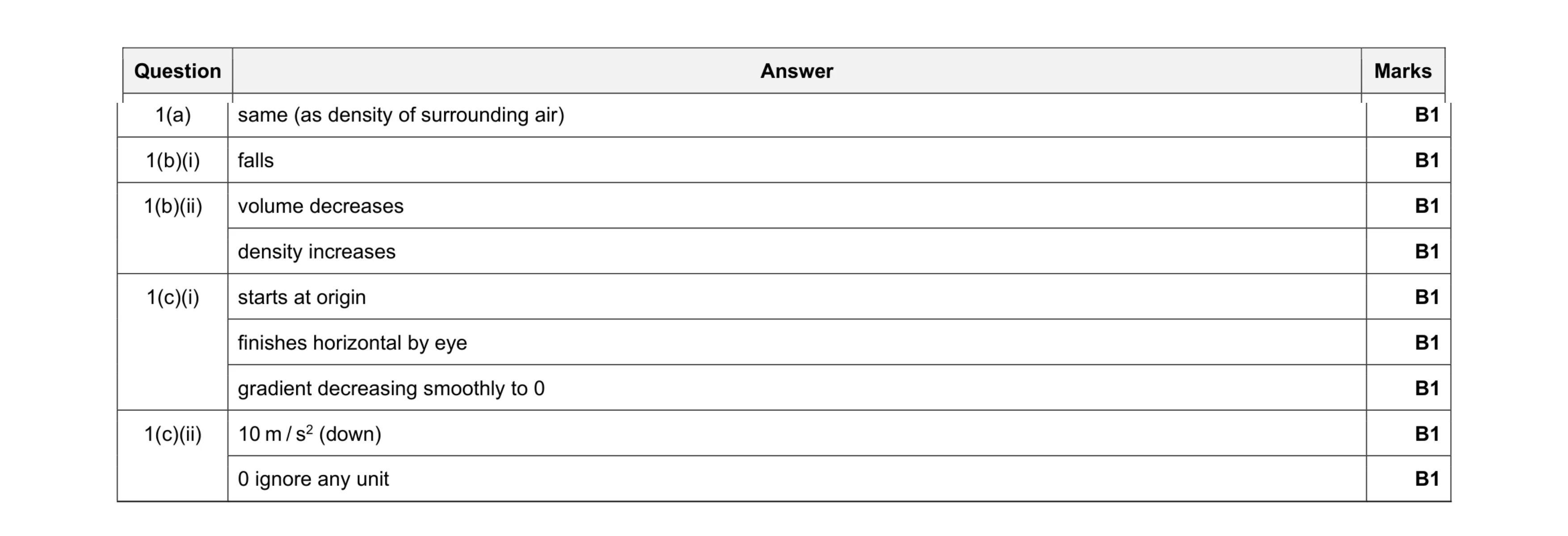 9
9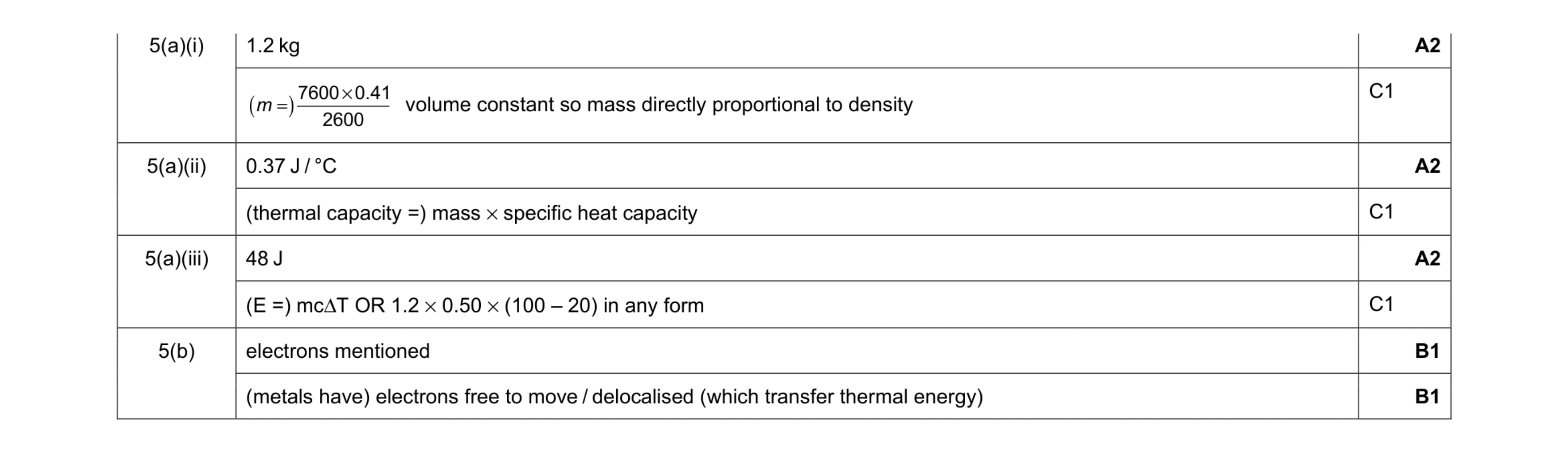 8
8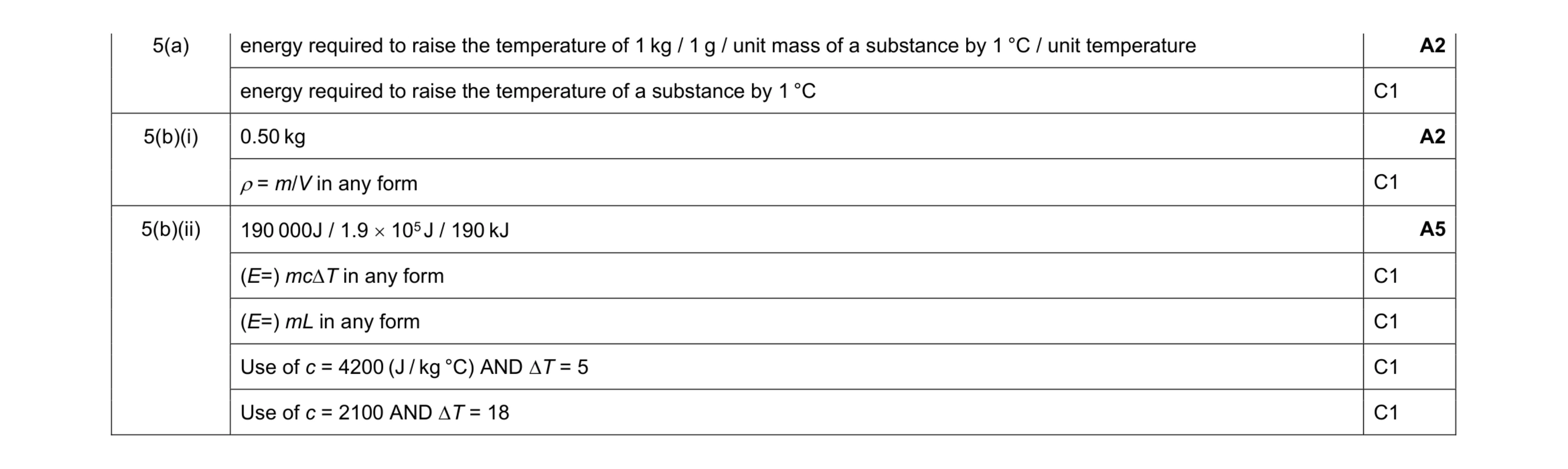 9
9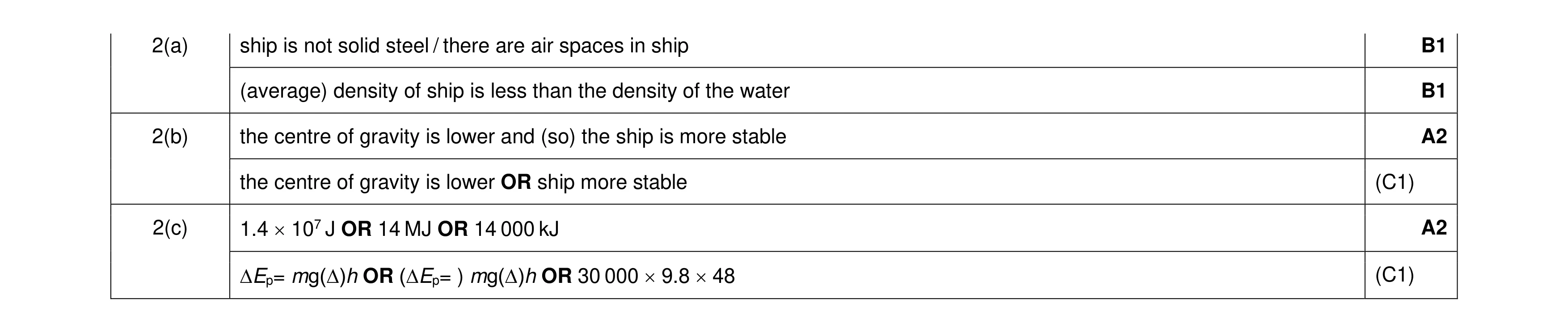 6
6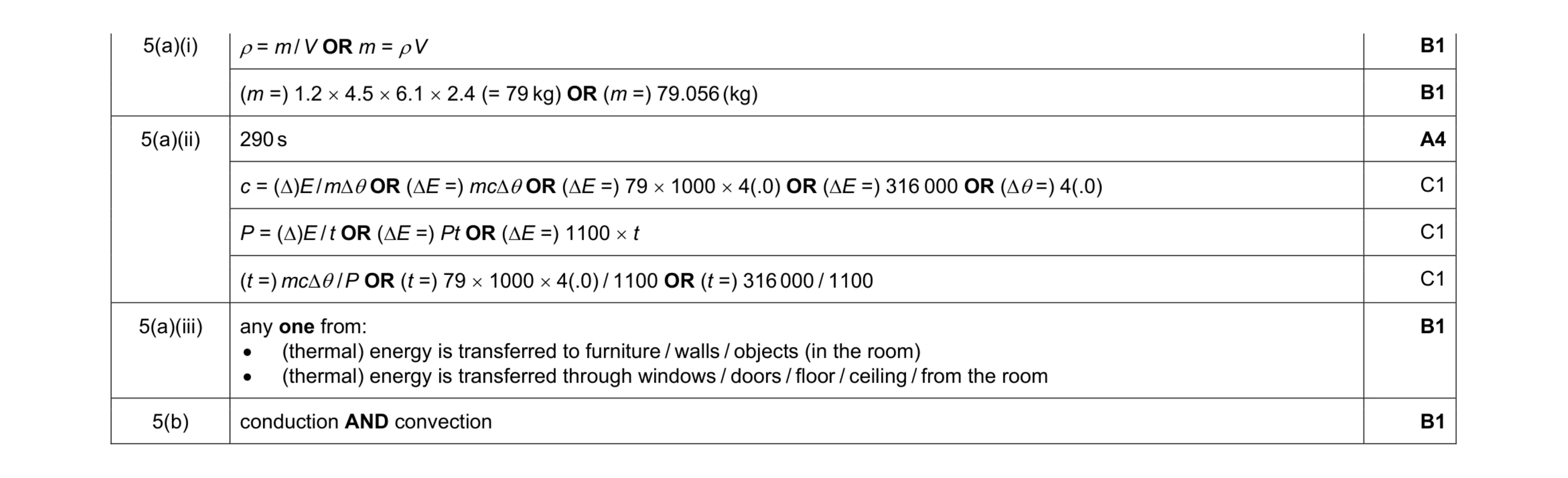 8
8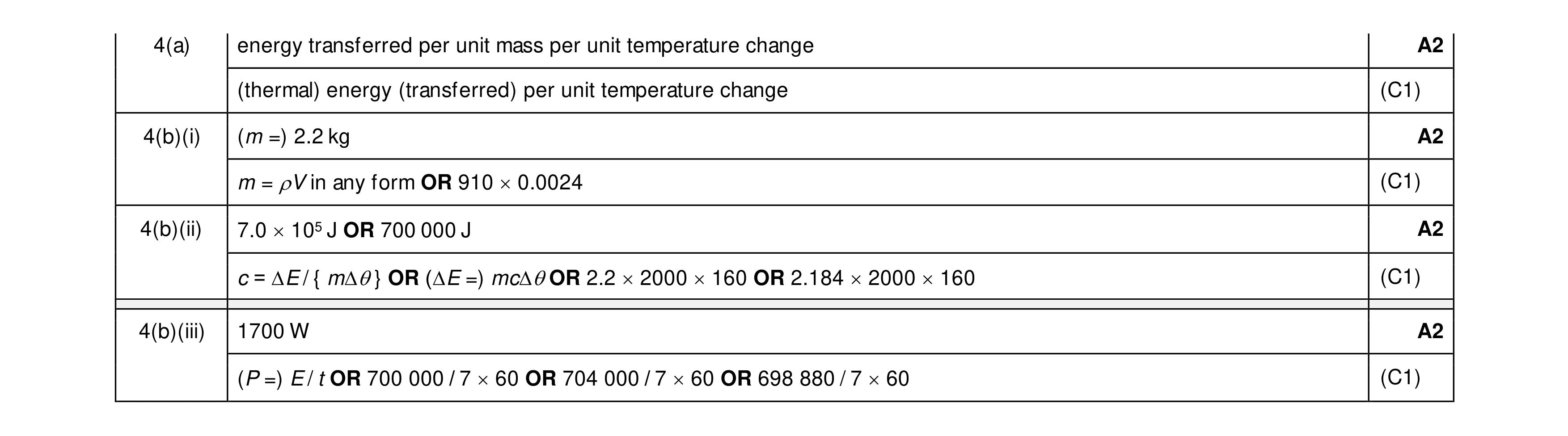 8
8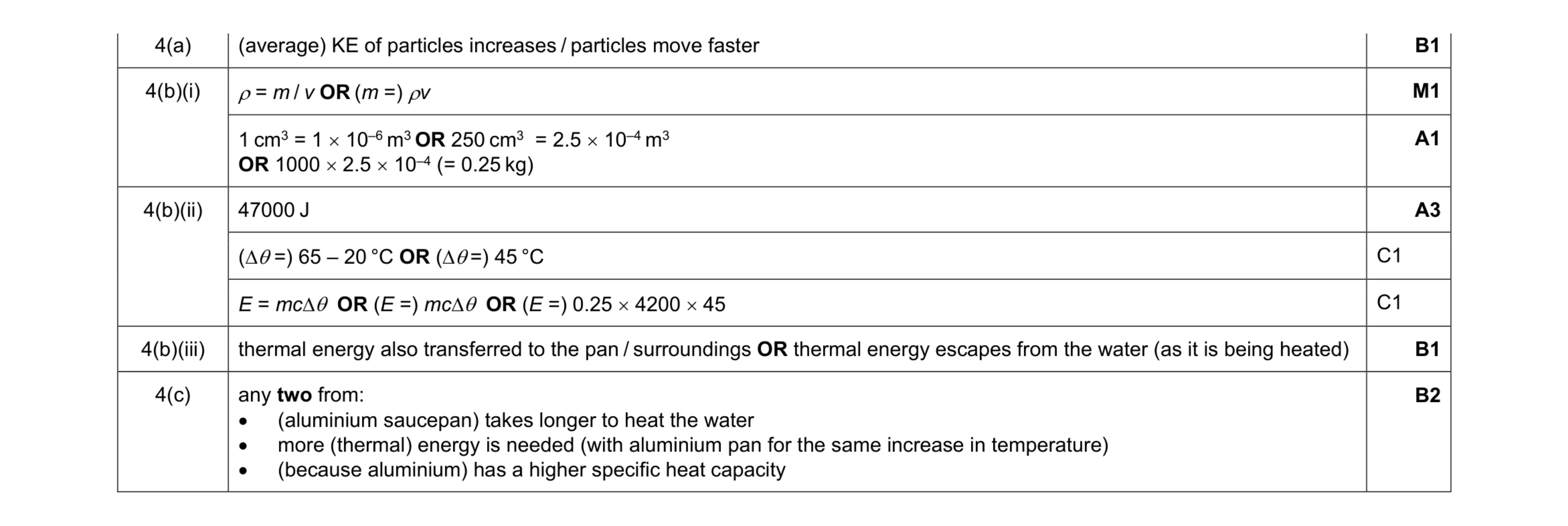 9
9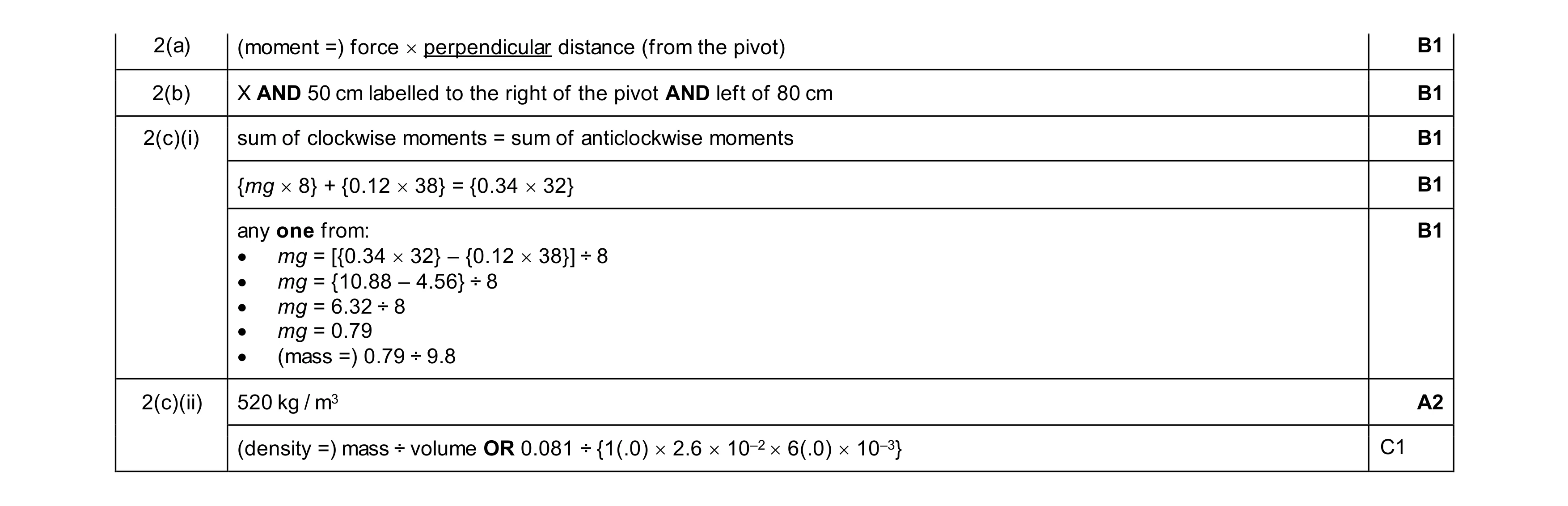 7
7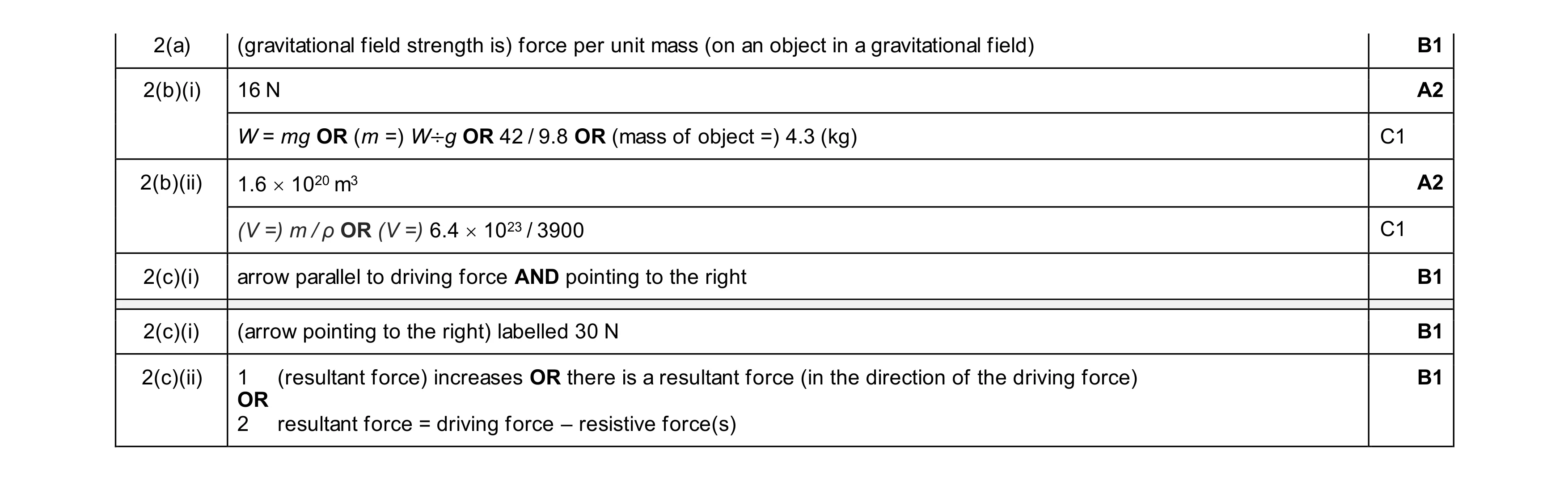 8
8