Questions as text
Q1 · A stone is projected horizontally in a vacuum and moves along a path as shown 9702/11 Oct/Nov 2005
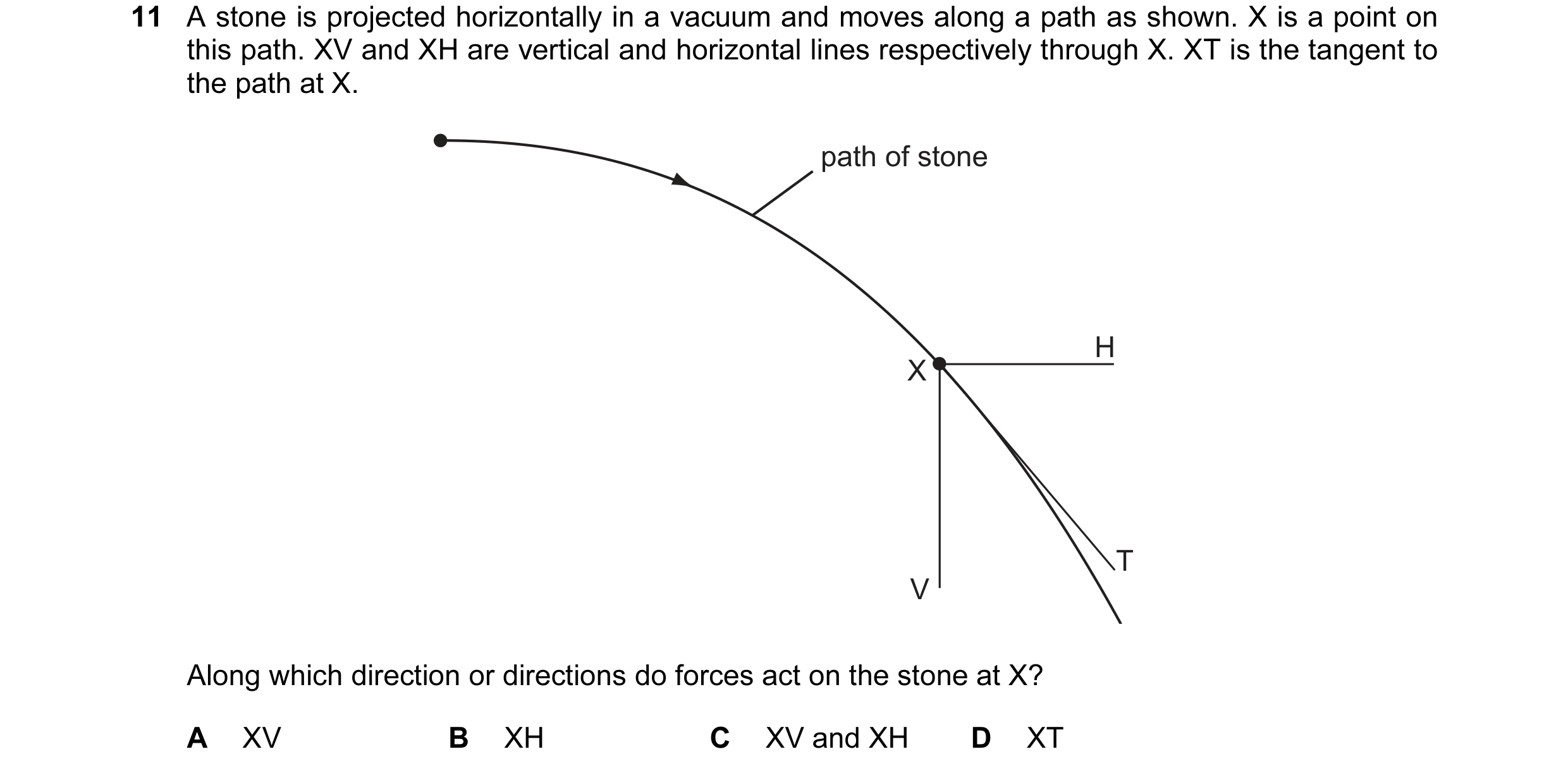
11 A stone is projected horizontally in a vacuum and moves along a path as shown. X is a point on this path. XV and XH are vertical and horizontal lines respectively through X. XT is the tangent to the path at X. path of stone H X T V Along which direction or directions do forces act on the stone at X? A XV B XH C XV and XH D XT
1 marks
Answer: A
This question in 9702/11 Oct/Nov 2005
Q2 · Which pair includes a vector quantity and a scalar quantity? 9702/11 May/June 2006
1 Which pair includes a vector quantity and a scalar quantity? A displacement; acceleration B force; kinetic energy C power; speed D work; potential energy
1 marks
Answer: B
This question in 9702/11 May/June 2006
Q3 · The following physical quantities can be either positive or negative 9702/11 May/June 2006
3 The following physical quantities can be either positive or negative. s : displacement of a particle along a straight line θ : temperature on the Celsius scale q : electric charge V : readings on a digital voltmeter Which of these quantities are vectors? A s, θ, q, V B s, q, V C θ, V D s only
1 marks
Answer: D
This question in 9702/11 May/June 2006
Q4 · A projectile is fired at an angle α to the horizontal at a speed u, as shown 9702/11 Oct/Nov 2006
9 A projectile is fired at an angle α to the horizontal at a speed u, as shown. u α What are the vertical and horizontal components of its velocity after a time t ? Assume that air resistance is negligible. The acceleration of free fall is g. vertical component horizontal component A u sin α u cos α B u sin α – gt u cos α – gt C u sin α – gt u cos α D u cos α u sin α – gt
1 marks
Answer: C
This question in 9702/11 Oct/Nov 2006
Q5 · An object has an initial velocity u 9702/11 May/June 2007
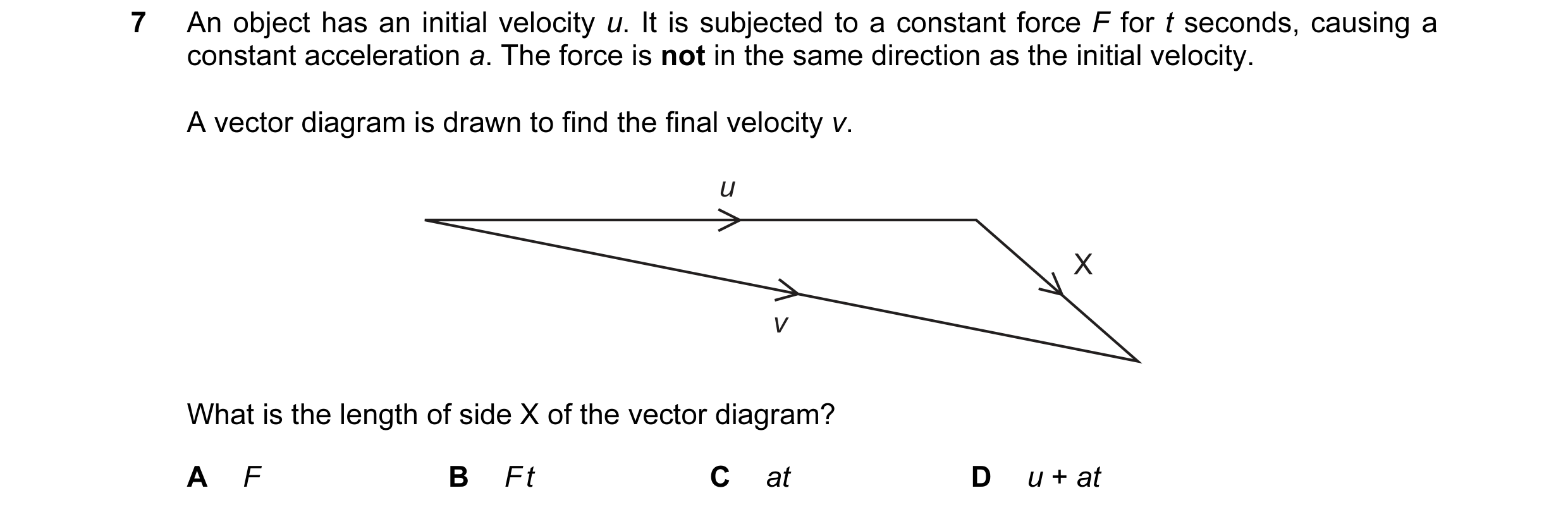
7 An object has an initial velocity u. It is subjected to a constant force F for t seconds, causing a constant acceleration a. The force is not in the same direction as the initial velocity. A vector diagram is drawn to find the final velocity v. u X v What is the length of side X of the vector diagram? A F B F t C at D u + at
1 marks
Answer: C
This question in 9702/11 May/June 2007
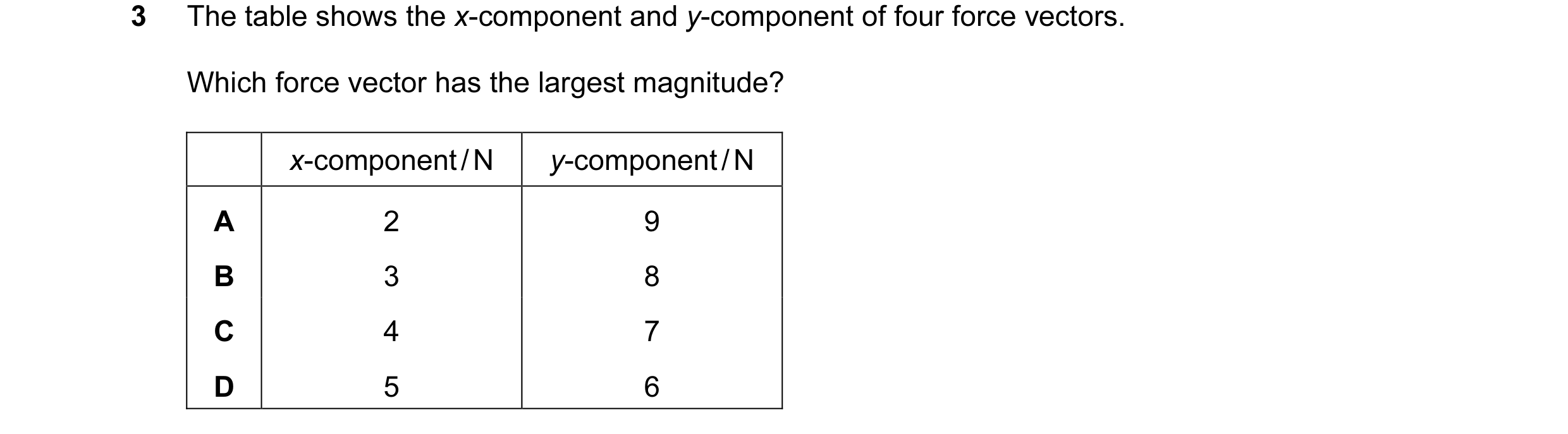
Q6 · The table shows the x-component and y-component of four force vectors 9702/11 Oct/Nov 2008
3 The table shows the x-component and y-component of four force vectors. Which force vector has the largest magnitude? x-component / N y-component / N A 2 9 B 3 8 C 4 7 D 5 6
1 marks
Answer: A
This question in 9702/11 Oct/Nov 2008
Q7 · The diagram shows a resultant force and its horizontal and vertical components 9702/11 May/June 2009
2 The diagram shows a resultant force and its horizontal and vertical components. vertical component resultant θ horizontal component The horizontal component is 20.0 N and θ = 30°. What is the vertical component? A 8.7 N B 10.0 N C 11.5 N D 17.3 N Space for working
1 marks
Answer: C
This question in 9702/11 May/June 2009
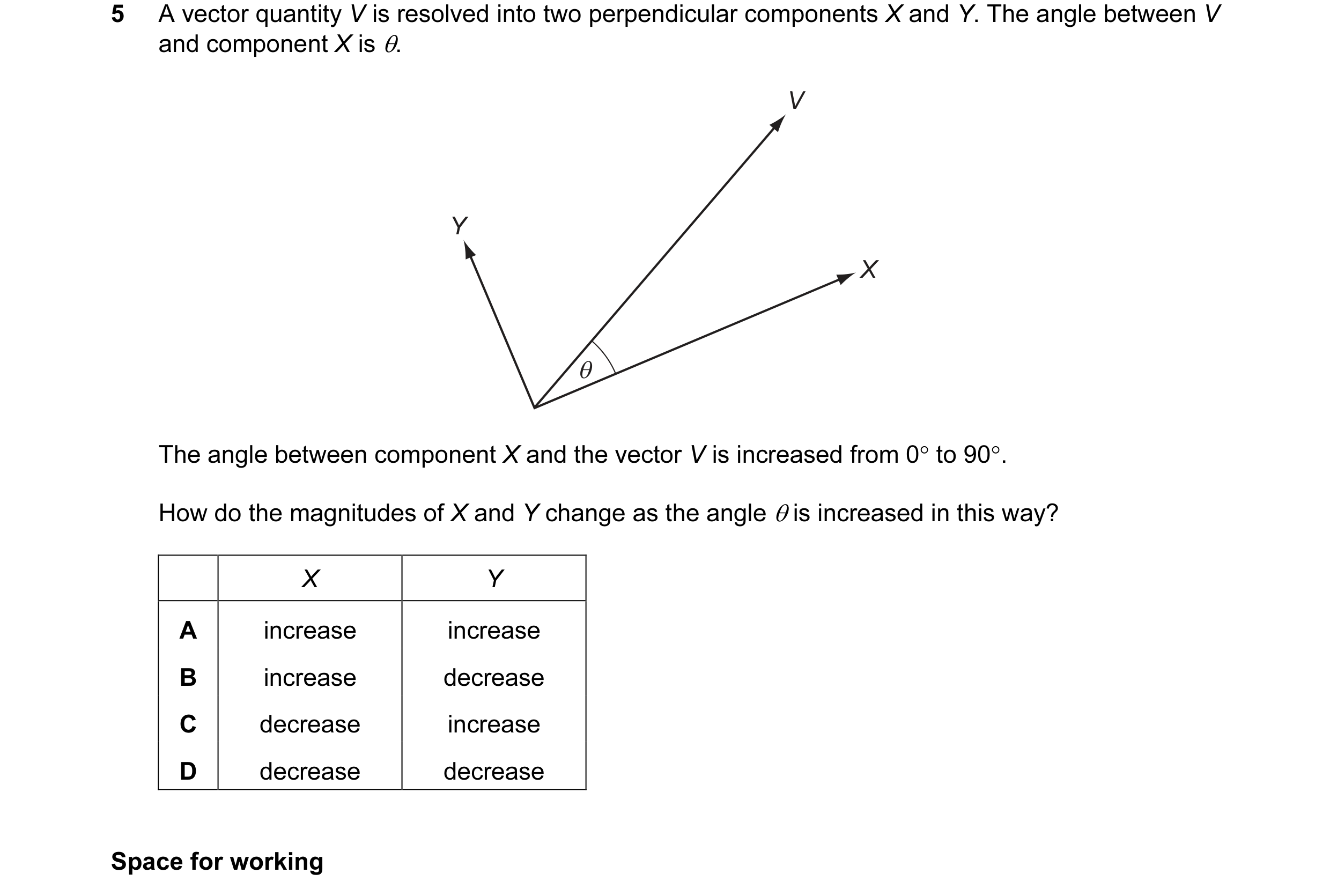
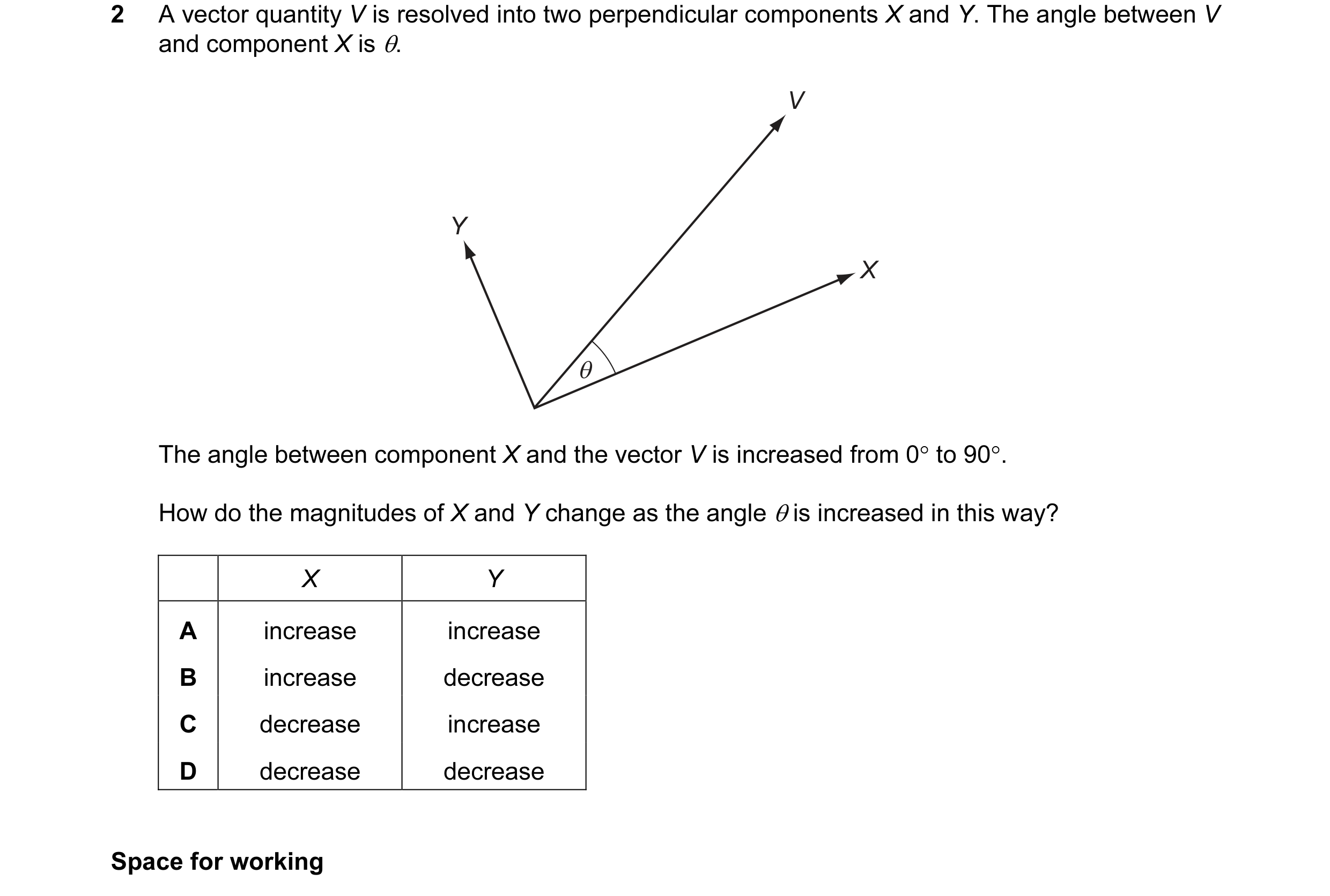
Q8 · A vector quantity V is resolved into two perpendicular components X and Y 9702/11 May/June 2010
5 A vector quantity V is resolved into two perpendicular components X and Y. The angle between V and component X is θ. V Y X θ The angle between component X and the vector V is increased from 0° to 90°. How do the magnitudes of X and Y change as the angle θ is increased in this way? X Y A increase increase B increase decrease C decrease increase D decrease decrease Space for working
1 marks
Answer: C
This question in 9702/11 May/June 2010
Q9 · Forces of 3 N, 4 N and 5 N act at one point on an object 9702/11 May/June 2010
13 Forces of 3 N, 4 N and 5 N act at one point on an object. The angles at which the forces act can vary. What is the value of the minimum resultant force of these forces? A 0 B between 0 and 2 N C 2 N D between 2 N and 4 N Space for working
1 marks
Answer: A
This question in 9702/11 May/June 2010
Q10 · A vector quantity V is resolved into two perpendicular components X and Y 9702/13 May/June 2010
2 A vector quantity V is resolved into two perpendicular components X and Y. The angle between V and component X is θ. V Y X θ The angle between component X and the vector V is increased from 0° to 90°. How do the magnitudes of X and Y change as the angle θ is increased in this way? X Y A increase increase B increase decrease C decrease increase D decrease decrease Space for working
1 marks
Answer: C
This question in 9702/13 May/June 2010
Q11 · Forces of 3 N, 4 N and 5 N act at one point on an object 9702/13 May/June 2010
11 Forces of 3 N, 4 N and 5 N act at one point on an object. The angles at which the forces act can vary. What is the value of the minimum resultant force of these forces? A 0 B between 0 and 2 N C 2 N D between 2 N and 4 N Space for working
1 marks
Answer: A
This question in 9702/13 May/June 2010
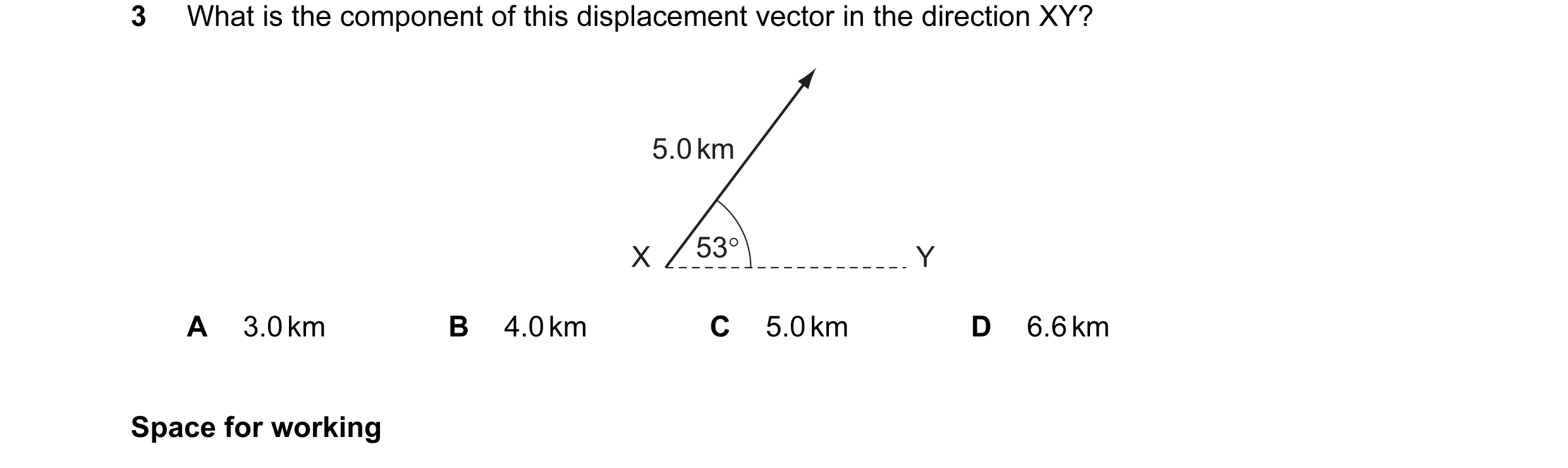
Q12 · What is the component of this displacement vector in the direction XY? 9702/12 Oct/Nov 2010
3 What is the component of this displacement vector in the direction XY? 5.0 km X 53° Y A 3.0 km B 4.0 km C 5.0 km D 6.6 km Space for working
1 marks
Answer: A
This question in 9702/12 Oct/Nov 2010
Q13 · A street lamp is fixed to a wall by a metal rod and a cable 9702/13 Oct/Nov 2010
13 A street lamp is fixed to a wall by a metal rod and a cable. cable wall P metal rod lamp Which vector triangle represents the forces acting at point P? A B C D Space for working
1 marks
Answer: D
This question in 9702/13 Oct/Nov 2010
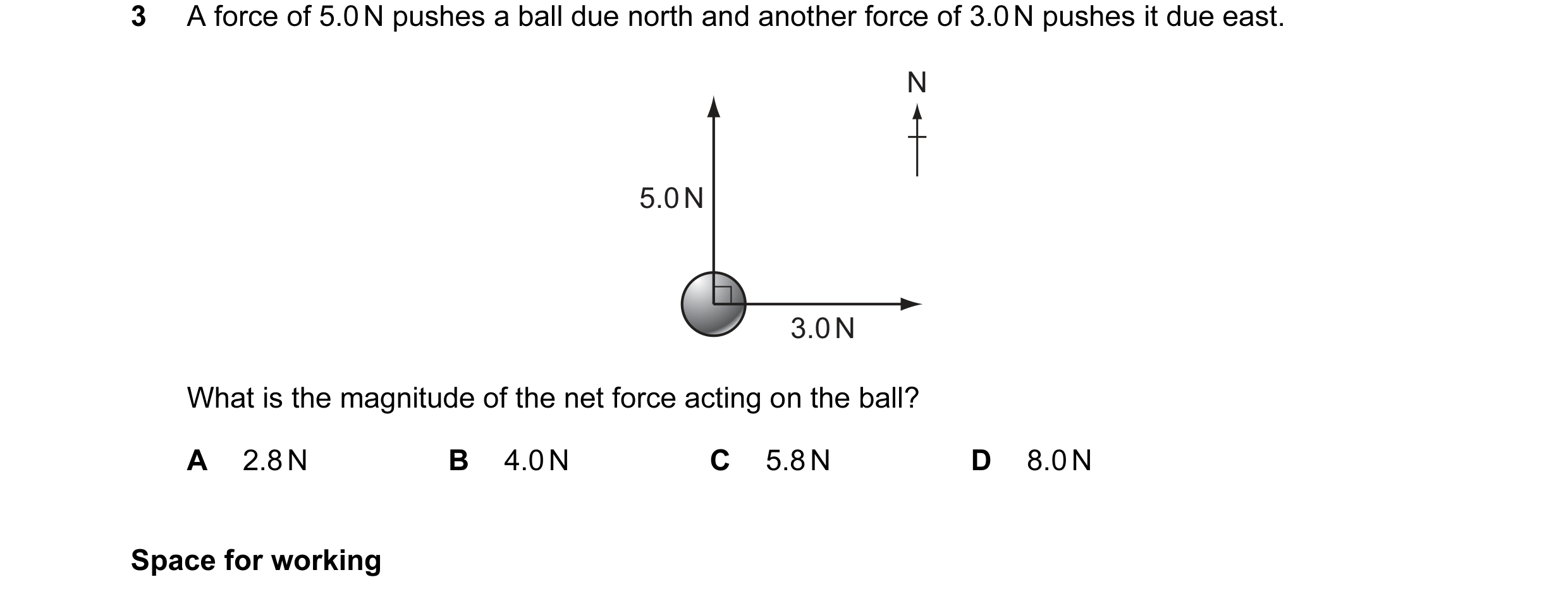
Q14 · A force of 5.0 N pushes a ball due north and another force of 3.0 N pushes it due east 9702/11 May/June 2011
3 A force of 5.0 N pushes a ball due north and another force of 3.0 N pushes it due east. N 5.0 N 3.0 N What is the magnitude of the net force acting on the ball? A 2.8 N B 4.0 N C 5.8 N D 8.0 N Space for working
1 marks
Answer: C
This question in 9702/11 May/June 2011
Q15 · A stone is projected horizontally in a vacuum and moves along the path shown 9702/12 May/June 2011
14 A stone is projected horizontally in a vacuum and moves along the path shown. path of stone H X T V X is a point on this path. XV and XH are vertical and horizontal lines respectively through X. XT is the tangent to the path at X. Along which directions do forces act on the stone at X? A XV only B XH only C XV and XH D XT only Space for working
1 marks
Answer: A
This question in 9702/12 May/June 2011
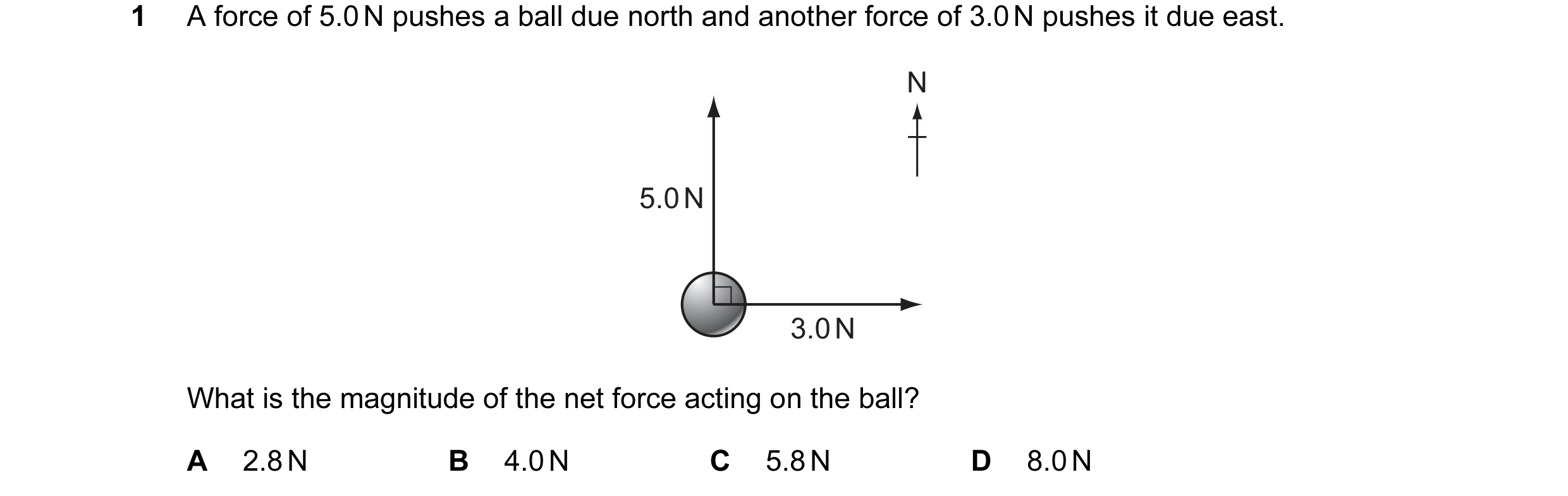
Q16 · A force of 5.0 N pushes a ball due north and another force of 3.0 N pushes it due east 9702/13 May/June 2011
1 A force of 5.0 N pushes a ball due north and another force of 3.0 N pushes it due east. N 5.0 N 3.0 N What is the magnitude of the net force acting on the ball? A 2.8 N B 4.0 N C 5.8 N D 8.0 N
1 marks
Answer: C
This question in 9702/13 May/June 2011
Q17 · Which group of quantities contains only vectors? 9702/11 Oct/Nov 2011
3 Which group of quantities contains only vectors? A acceleration, displacement, speed B acceleration, work, electric field strength C displacement, force, velocity D power, electric field strength, force Space for working
1 marks
Answer: C
This question in 9702/11 Oct/Nov 2011
Q18 · The following physical quantities can be either positive or negative 9702/12 Oct/Nov 2011
3 The following physical quantities can be either positive or negative. s : displacement of a particle along a straight line θ : temperature on the Celsius scale q : electric charge V : readings on a digital voltmeter Which of these quantities are vectors? A s, θ, q, V B s, q, V only C θ, V only D s only Space for working
1 marks
Answer: D
This question in 9702/12 Oct/Nov 2011
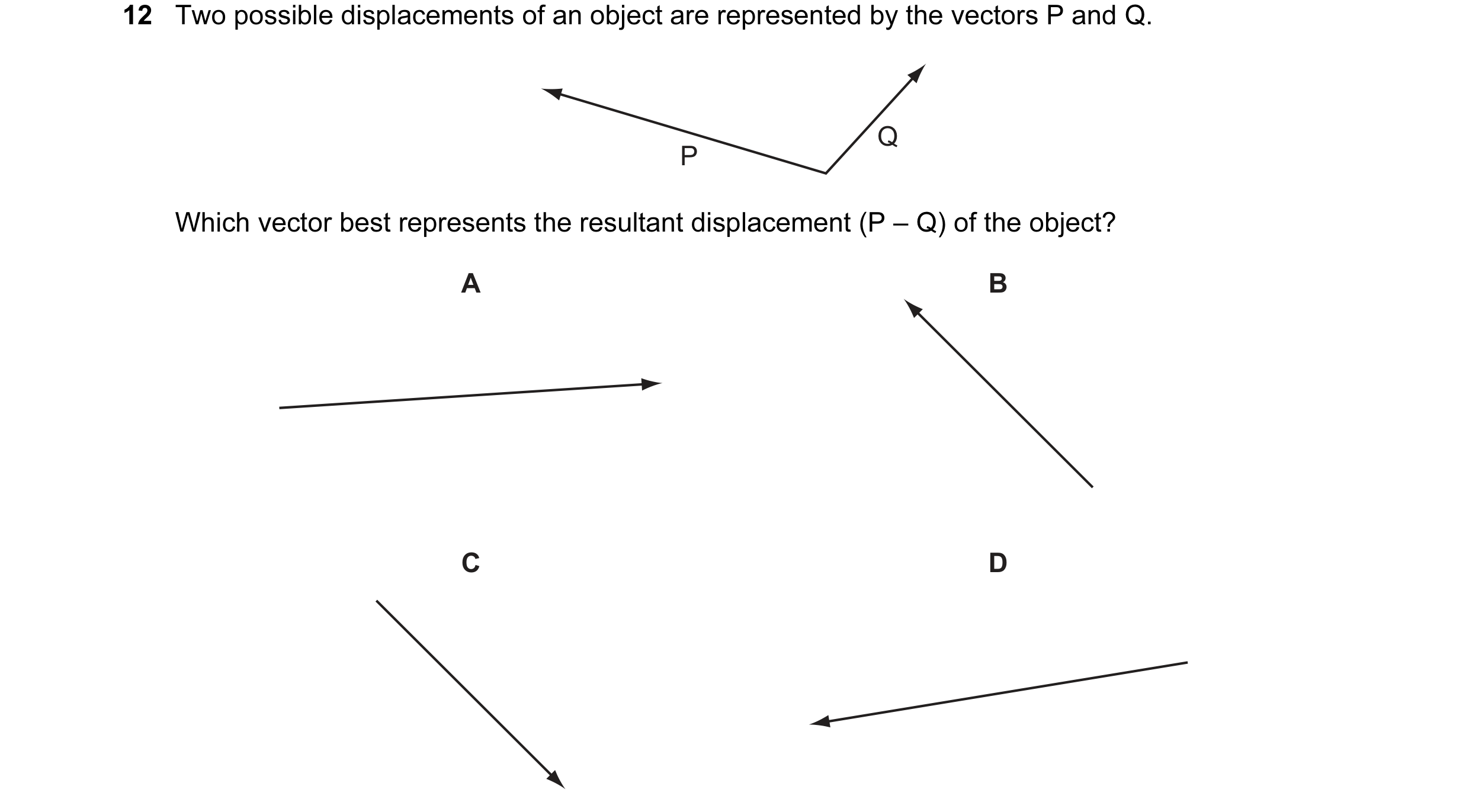
Q19 · Two possible displacements of an object are represented by the vectors P and Q 9702/12 Oct/Nov 2011
12 Two possible displacements of an object are represented by the vectors P and Q. Q P Which vector best represents the resultant displacement (P – Q) of the object? A B C D
1 marks
Answer: D
This question in 9702/12 Oct/Nov 2011
Q20 · Which group of quantities contains only vectors? 9702/13 Oct/Nov 2011
1 Which group of quantities contains only vectors? A acceleration, displacement, speed B acceleration, work, electric field strength C displacement, force, velocity D power, electric field strength, force
1 marks
Answer: C
This question in 9702/13 Oct/Nov 2011
Q21 · A vector has magnitude R and perpendicular components P and Q, as shown in the diagram 9702/12 May/June 2012
3 A vector has magnitude R and perpendicular components P and Q, as shown in the diagram. R vertical component Q θ horizontal component P Which row correctly describes the perpendicular components? vertical component horizontal component A Q R sinθ B R cosθ P C R cosθ R sinθ D R sinθ R cosθ Space for working
1 marks
Answer: D
This question in 9702/12 May/June 2012
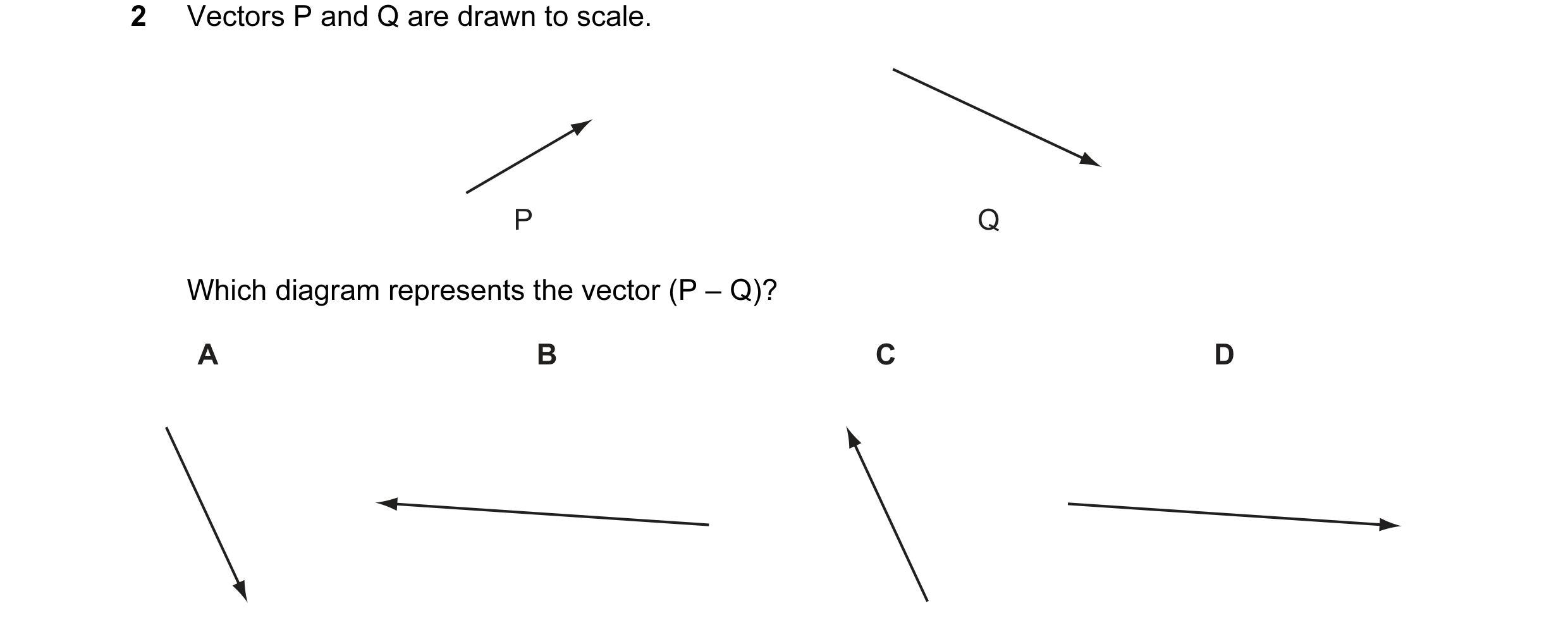
Q22 · Vectors P and Q are drawn to scale 9702/11 Oct/Nov 2012
2 Vectors P and Q are drawn to scale. P Q Which diagram represents the vector (P – Q)? A B C D
1 marks
Answer: C
This question in 9702/11 Oct/Nov 2012
Q23 · Which list contains only scalar quantities? 9702/11 Oct/Nov 2012
4 Which list contains only scalar quantities? A area, length, displacement B kinetic energy, speed, power C potential energy, momentum, time D velocity, distance, temperature
1 marks
Answer: B
This question in 9702/11 Oct/Nov 2012
Q24 · The diagram shows an experiment to measure the force exerted on a ball by a horizontal… 9702/11 Oct/Nov 2012
15 The diagram shows an experiment to measure the force exerted on a ball by a horizontal air flow. 30° air flow The ball is suspended by a light string and weighs 0.15 N. The deflection of the string from vertical is 30°. What is the force on the ball from the air flow? A 0.075 N B 0.087 N C 0.26 N D 0.30 N
1 marks
Answer: B
This question in 9702/11 Oct/Nov 2012
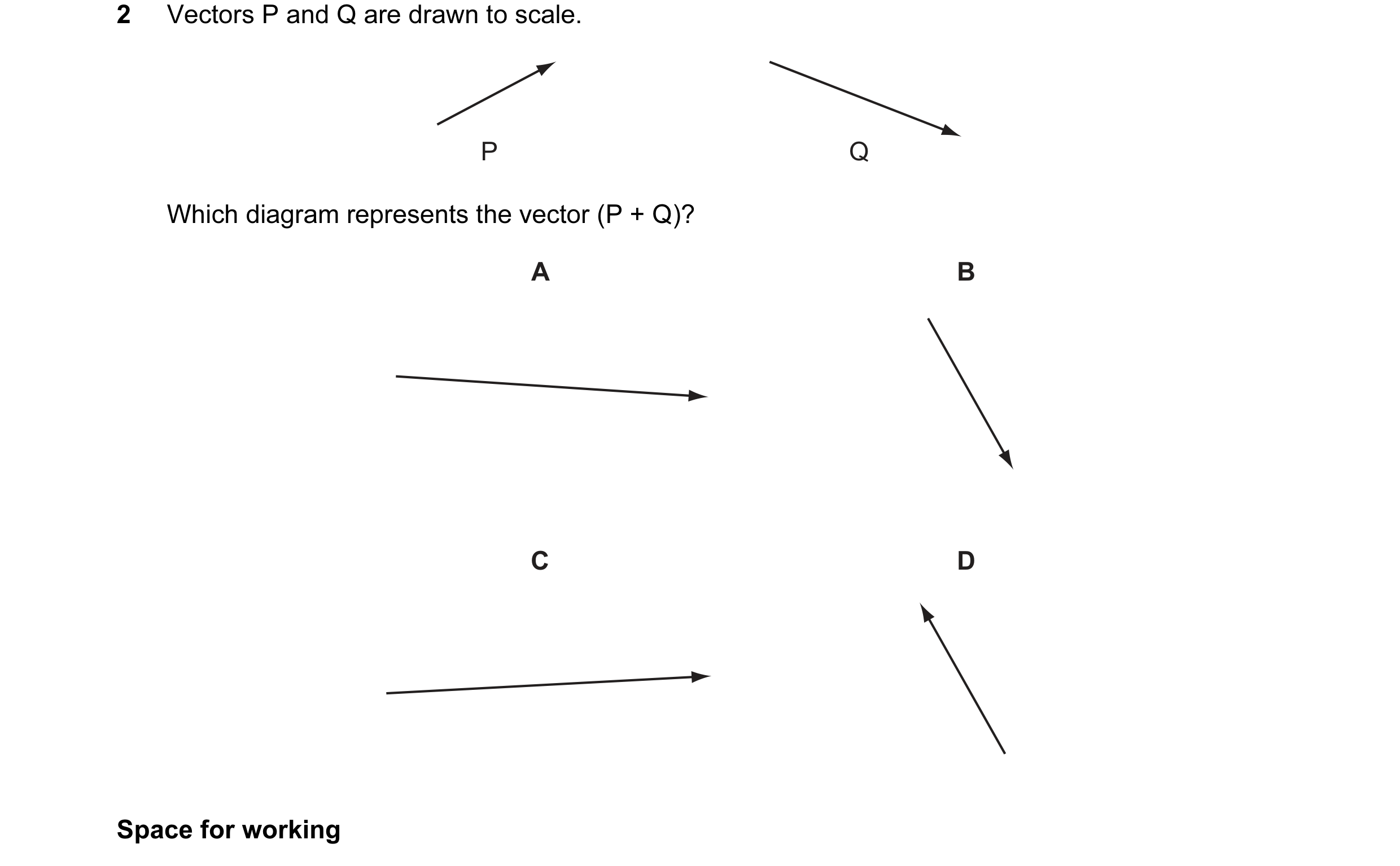
Q25 · Vectors P and Q are drawn to scale 9702/12 Oct/Nov 2012
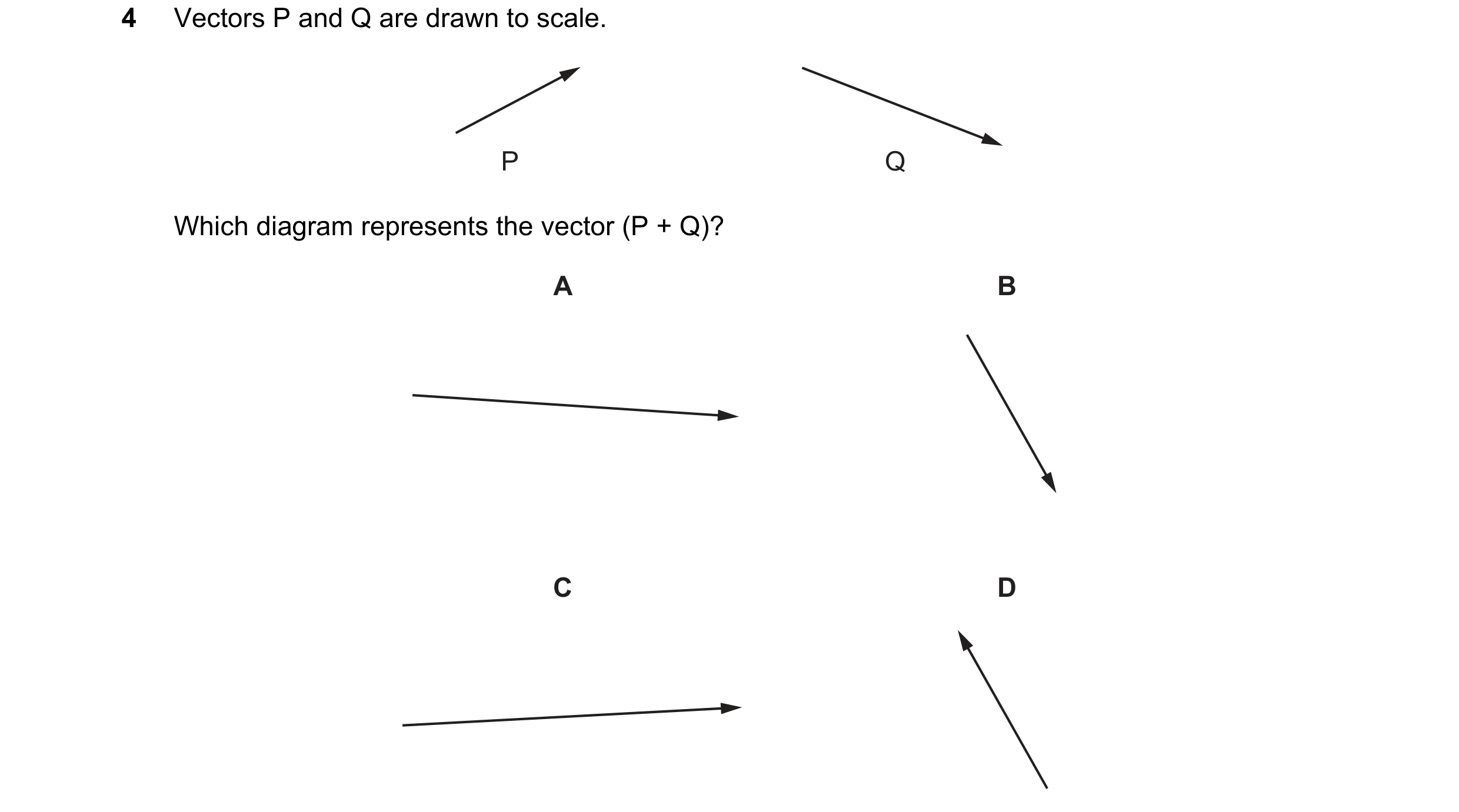
2 Vectors P and Q are drawn to scale. P Q Which diagram represents the vector (P + Q)? A B C D Space for working
1 marks
Answer: A
This question in 9702/12 Oct/Nov 2012
Q26 · Physical quantities can be classed as vectors or as scalars 9702/12 Oct/Nov 2012
4 Physical quantities can be classed as vectors or as scalars. Which pair of quantities are both vectors? A kinetic energy and elastic force B momentum and time C velocity and electric field strength D weight and temperature
1 marks
Answer: C
This question in 9702/12 Oct/Nov 2012
Q27 · Two physical quantities P and Q are added 9702/13 Oct/Nov 2012
2 Two physical quantities P and Q are added. The sum of P and Q is R, as shown. R P Q Which quantity could be represented by P and by Q? A kinetic energy B power C speed D velocity Space for working
1 marks
Answer: D
This question in 9702/13 Oct/Nov 2012
Q28 · Which pair of quantities contains one vector and one scalar quantity? 9702/11 May/June 2013
1 Which pair of quantities contains one vector and one scalar quantity? A displacement; force B kinetic energy; power C acceleration; momentum D velocity; distance
1 marks
Answer: D
This question in 9702/11 May/June 2013
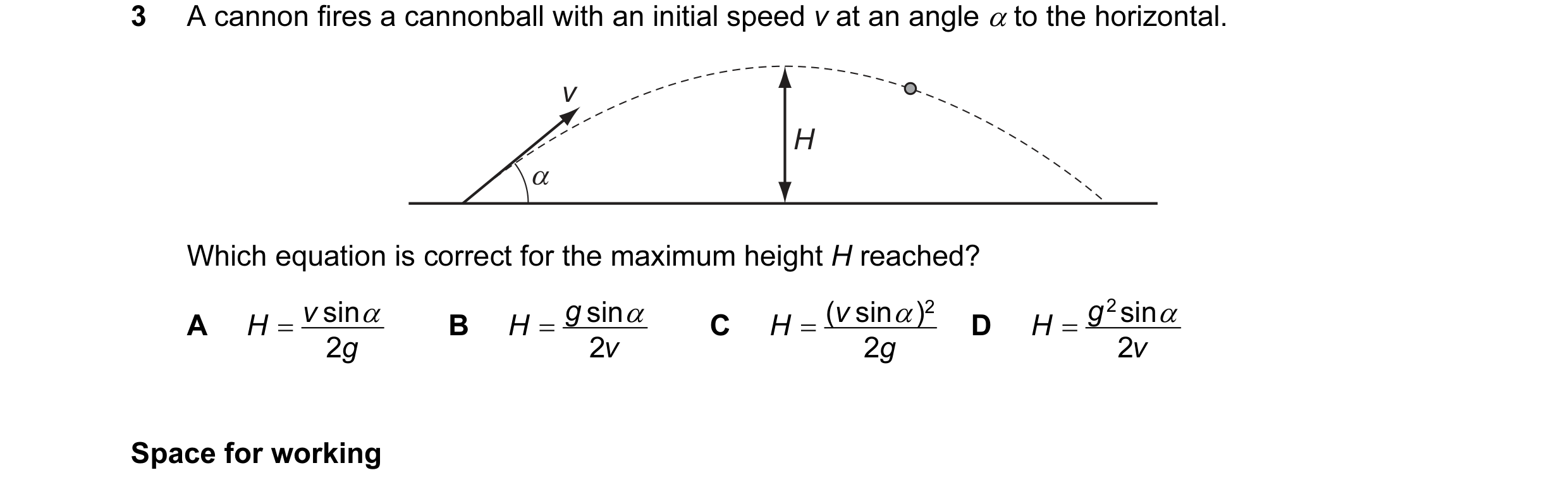
Q29 · A cannon fires a cannonball with an initial speed v at an angle α to the horizontal 9702/11 May/June 2013
3 A cannon fires a cannonball with an initial speed v at an angle α to the horizontal. v H α Which equation is correct for the maximum height H reached? v sinα g sinα ( v sin α ) 2 g 2 sin α A H = B H = C H = D H = 2 g 2 v 2 g 2 v Space for working
1 marks
Answer: C
This question in 9702/11 May/June 2013
Q30 · Which pair includes a vector quantity and a scalar quantity? 9702/12 May/June 2013
1 Which pair includes a vector quantity and a scalar quantity? A displacement; acceleration B force; kinetic energy C power; speed D work; potential energy
1 marks
Answer: B
This question in 9702/12 May/June 2013
Q31 · Two forces act on a circular disc as shown 9702/12 May/June 2013
3 Two forces act on a circular disc as shown. 3 N 4 N Which diagram shows the line of action of the resultant force? A B C D 5 N 5 N 5 N 5 N Space for working
1 marks
Answer: A
This question in 9702/12 May/June 2013
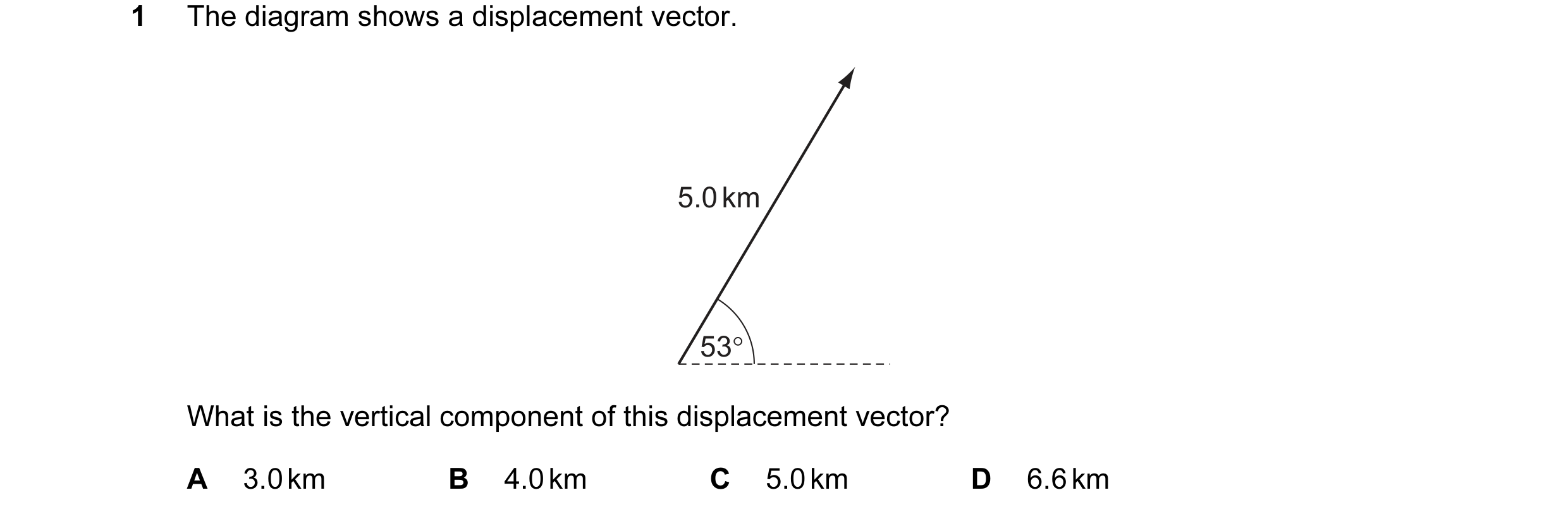
Q32 · The diagram shows a displacement vector 9702/13 May/June 2013
1 The diagram shows a displacement vector. 5.0 km 53° What is the vertical component of this displacement vector? A 3.0 km B 4.0 km C 5.0 km D 6.6 km
1 marks
Answer: B
This question in 9702/13 May/June 2013
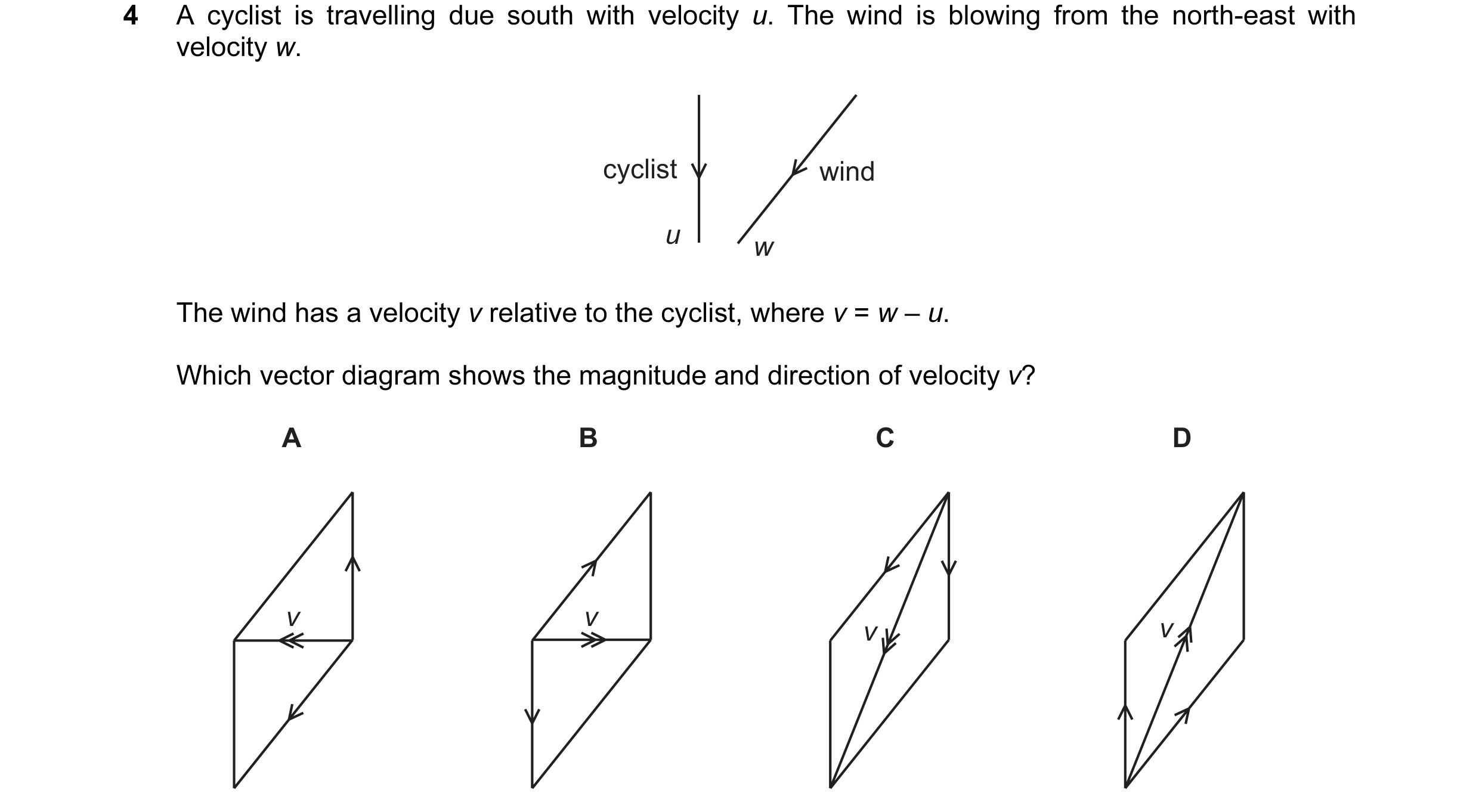
Q33 · A cyclist is travelling due south with velocity u 9702/13 May/June 2013
4 A cyclist is travelling due south with velocity u. The wind is blowing from the north-east with velocity w. cyclist wind u w The wind has a velocity v relative to the cyclist, where v = w – u. Which vector diagram shows the magnitude and direction of velocity v? A B C D v v v v
1 marks
Answer: A
This question in 9702/13 May/June 2013
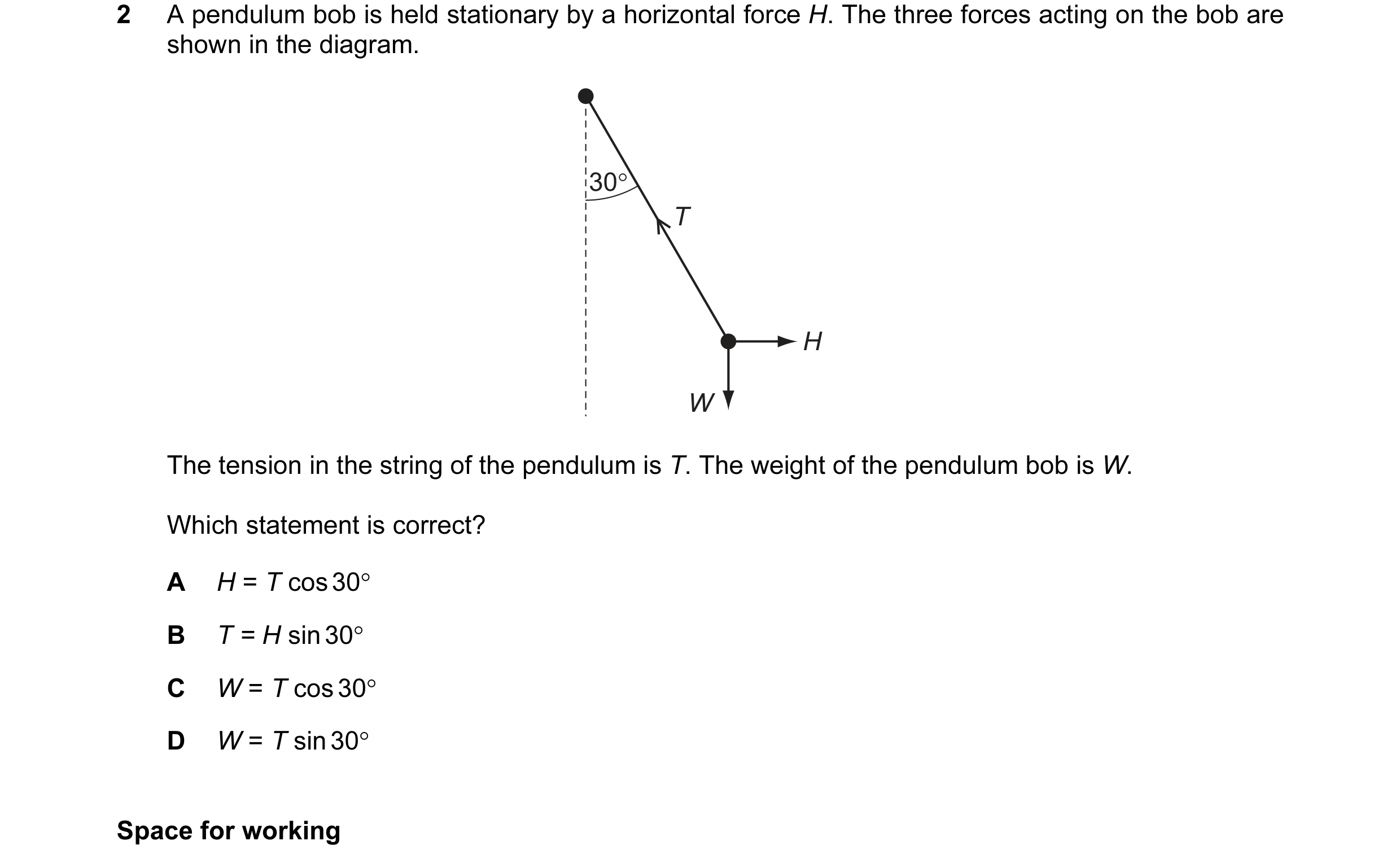
Q34 · A pendulum bob is held stationary by a horizontal force H 9702/11 Oct/Nov 2013
2 A pendulum bob is held stationary by a horizontal force H. The three forces acting on the bob are shown in the diagram. 30° T H W The tension in the string of the pendulum is T. The weight of the pendulum bob is W. Which statement is correct? A H = T cos 30° B T = H sin 30° C W = T cos 30° D W = T sin 30° Space for working
1 marks
Answer: C
This question in 9702/11 Oct/Nov 2013
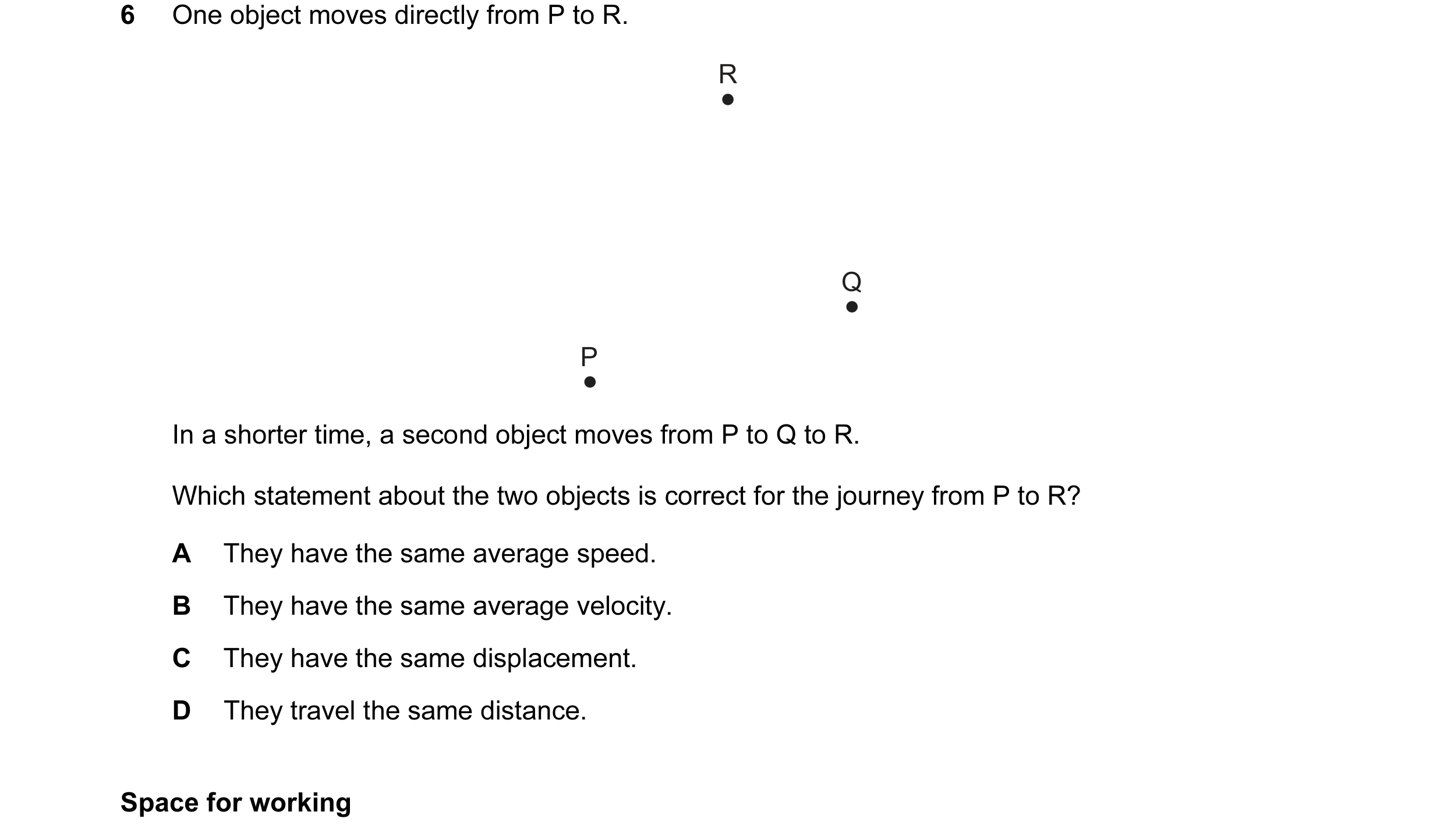
Q35 · One object moves directly from P to R 9702/11 Oct/Nov 2013
6 One object moves directly from P to R. R Q P In a shorter time, a second object moves from P to Q to R. Which statement about the two objects is correct for the journey from P to R? A They have the same average speed. B They have the same average velocity. C They have the same displacement. D They travel the same distance. Space for working
1 marks
Answer: C
This question in 9702/11 Oct/Nov 2013
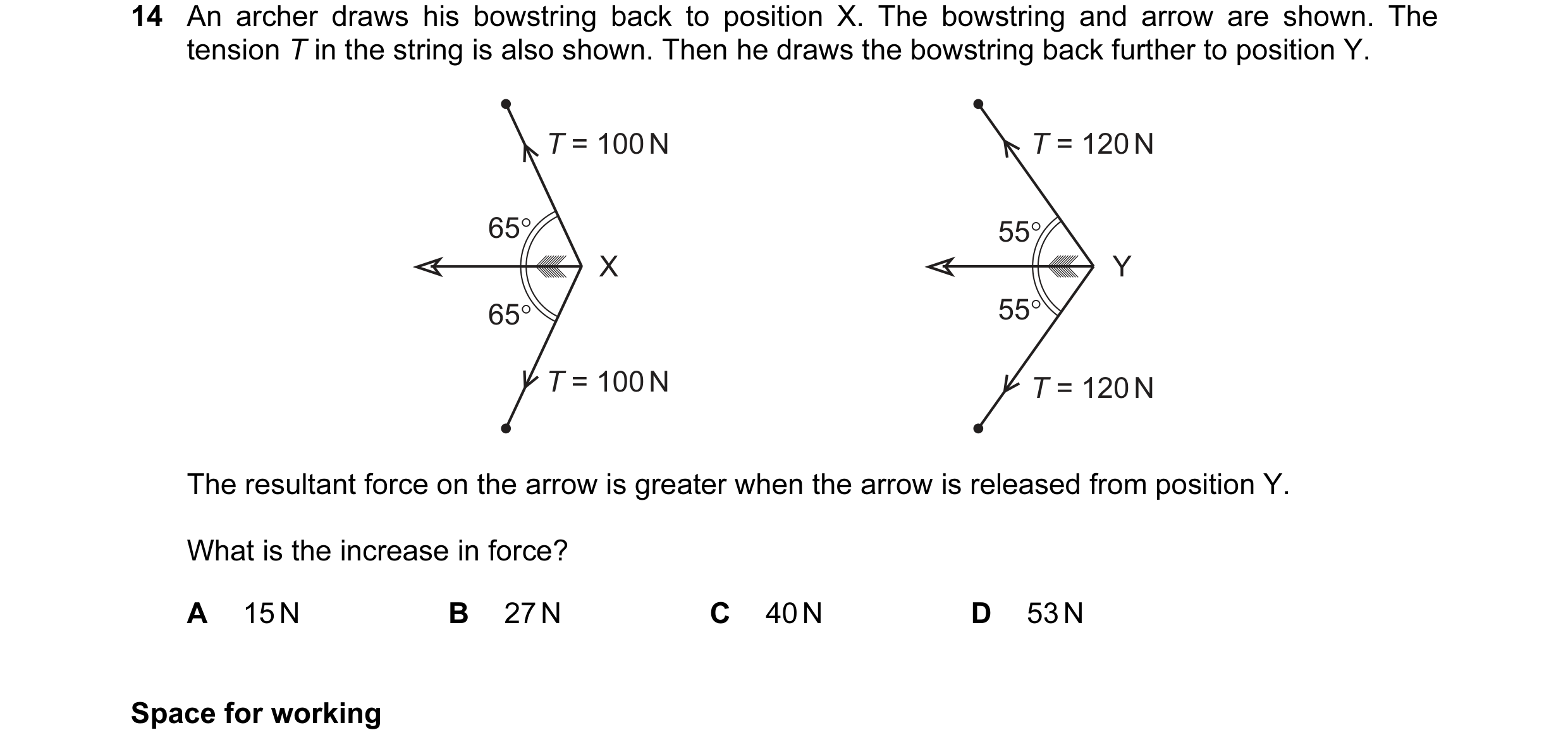
Q36 · An archer draws his bowstring back to position X 9702/11 Oct/Nov 2013
14 An archer draws his bowstring back to position X. The bowstring and arrow are shown. The tension T in the string is also shown. Then he draws the bowstring back further to position Y. T = 100 N T = 120 N 65° 55° X Y 65° 55° T = 100 N T = 120 N The resultant force on the arrow is greater when the arrow is released from position Y. What is the increase in force? A 15 N B 27 N C 40 N D 53 N Space for working
1 marks
Answer: D
This question in 9702/11 Oct/Nov 2013
Q37 · A pendulum bob is held stationary by a horizontal force H 9702/12 Oct/Nov 2013
2 A pendulum bob is held stationary by a horizontal force H. The three forces acting on the bob are shown in the diagram. 30° T H W The tension in the string of the pendulum is T. The weight of the pendulum bob is W. Which statement is correct? A H = T cos 30° B T = H sin 30° C W = T cos 30° D W = T sin 30° Space for working
1 marks
Answer: C
This question in 9702/12 Oct/Nov 2013
Q38 · One object moves directly from P to R 9702/12 Oct/Nov 2013
6 One object moves directly from P to R. R Q P In a shorter time, a second object moves from P to Q to R. Which statement about the two objects is correct for the journey from P to R? A They have the same average speed. B They have the same average velocity. C They have the same displacement. D They travel the same distance. Space for working
1 marks
Answer: C
This question in 9702/12 Oct/Nov 2013
Q39 · An archer draws his bowstring back to position X 9702/12 Oct/Nov 2013
14 An archer draws his bowstring back to position X. The bowstring and arrow are shown. The tension T in the string is also shown. Then he draws the bowstring back further to position Y. T = 100 N T = 120 N 65° 55° X Y 65° 55° T = 100 N T = 120 N The resultant force on the arrow is greater when the arrow is released from position Y. What is the increase in force? A 15 N B 27 N C 40 N D 53 N Space for working
1 marks
Answer: D
This question in 9702/12 Oct/Nov 2013
Q40 · Two forces of equal magnitude are represented by two coplanar vectors 9702/13 Oct/Nov 2013
3 Two forces of equal magnitude are represented by two coplanar vectors. One is directed eastwards and the other is directed northwards. What is the direction of a single force that will balance these two forces? A towards the north-east B towards the north-west C towards the south-east D towards the south-west Space for working
1 marks
Answer: D
This question in 9702/13 Oct/Nov 2013
Q41 · A tennis ball is thrown horizontally in air from the top of a tall building 9702/11 May/June 2014
6 A tennis ball is thrown horizontally in air from the top of a tall building. If the effect of air resistance is not negligible, what happens to the horizontal and vertical components of the ball’s velocity? horizontal component vertical component of velocity of velocity A constant constant B constant increases at a constant rate C decreases to zero increases at a constant rate D decreases to zero increases to a maximum value
1 marks
Answer: D
This question in 9702/11 May/June 2014
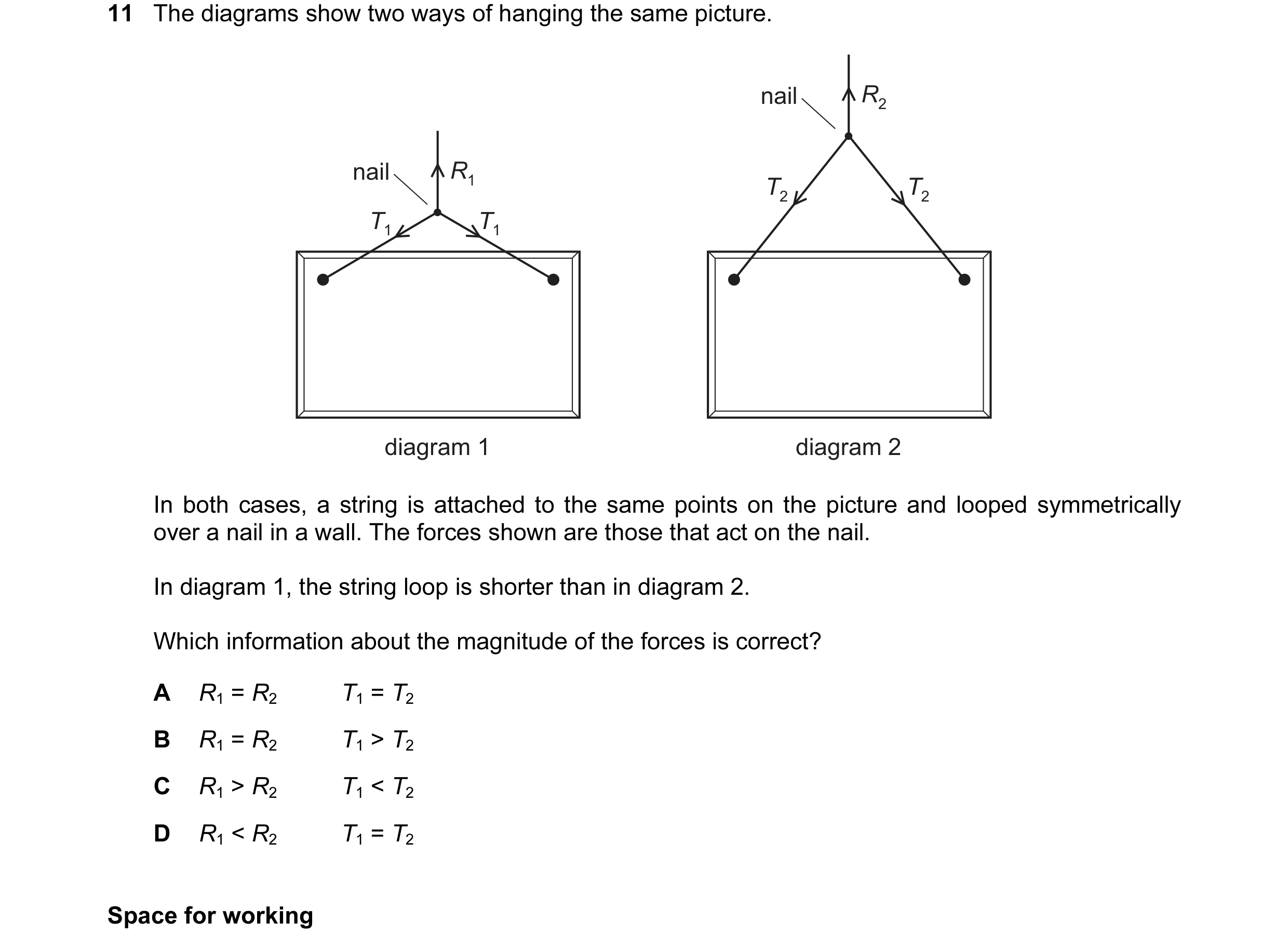
Q42 · The diagrams show two ways of hanging the same picture 9702/11 May/June 2014
11 The diagrams show two ways of hanging the same picture. nail R2 nail R1 T2 T2 T1 T1 diagram 1 diagram 2 In both cases, a string is attached to the same points on the picture and looped symmetrically over a nail in a wall. The forces shown are those that act on the nail. In diagram 1, the string loop is shorter than in diagram 2. Which information about the magnitude of the forces is correct? A R1 = R2 T1 = T2 B R1 = R2 T1 > T2 C R1 > R2 T1 < T2 D R1 < R2 T1 = T2 Space for working
1 marks
Answer: B
This question in 9702/11 May/June 2014
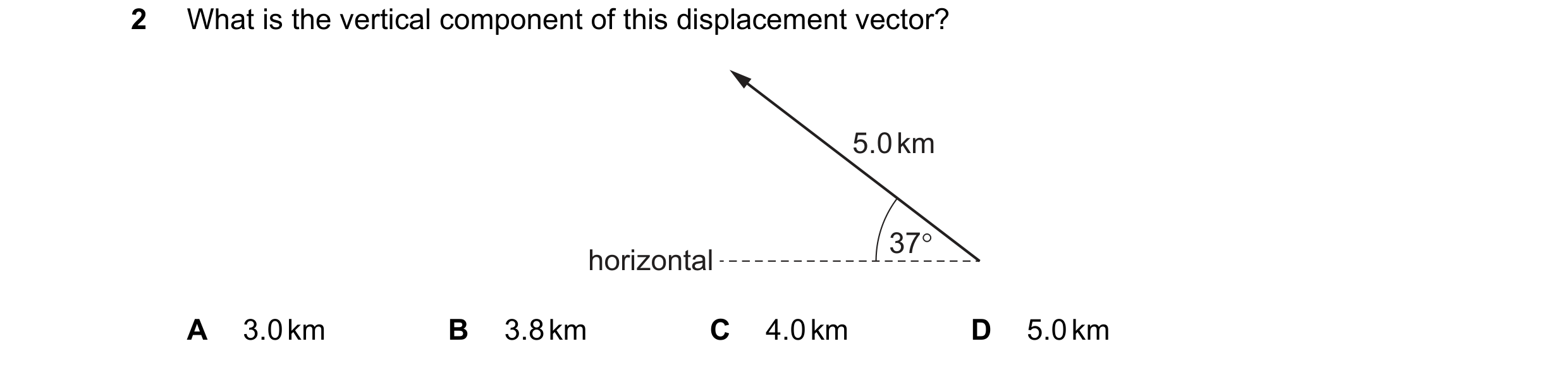
Q43 · What is the vertical component of this displacement vector? 9702/13 May/June 2014
3 What is the vertical component of this displacement vector? 5.0 km 37° horizontal A 3.0 km B 3.8 km C 4.0 km D 5.0 km Space for working
1 marks
Answer: A
This question in 9702/13 May/June 2014
Q44 · Which list contains one vector quantity and two scalar quantities? 9702/13 Oct/Nov 2014
2 Which list contains one vector quantity and two scalar quantities? A displacement, weight, velocity B force, acceleration, time C momentum, mass, speed D work, density, energy Space for working
1 marks
Answer: C
This question in 9702/13 Oct/Nov 2014
Q45 · Which pair contains one vector and one scalar quantity? 9702/11 May/June 2015
2 Which pair contains one vector and one scalar quantity? A displacement acceleration B force kinetic energy C momentum velocity D power speed
1 marks
Answer: B
This question in 9702/11 May/June 2015
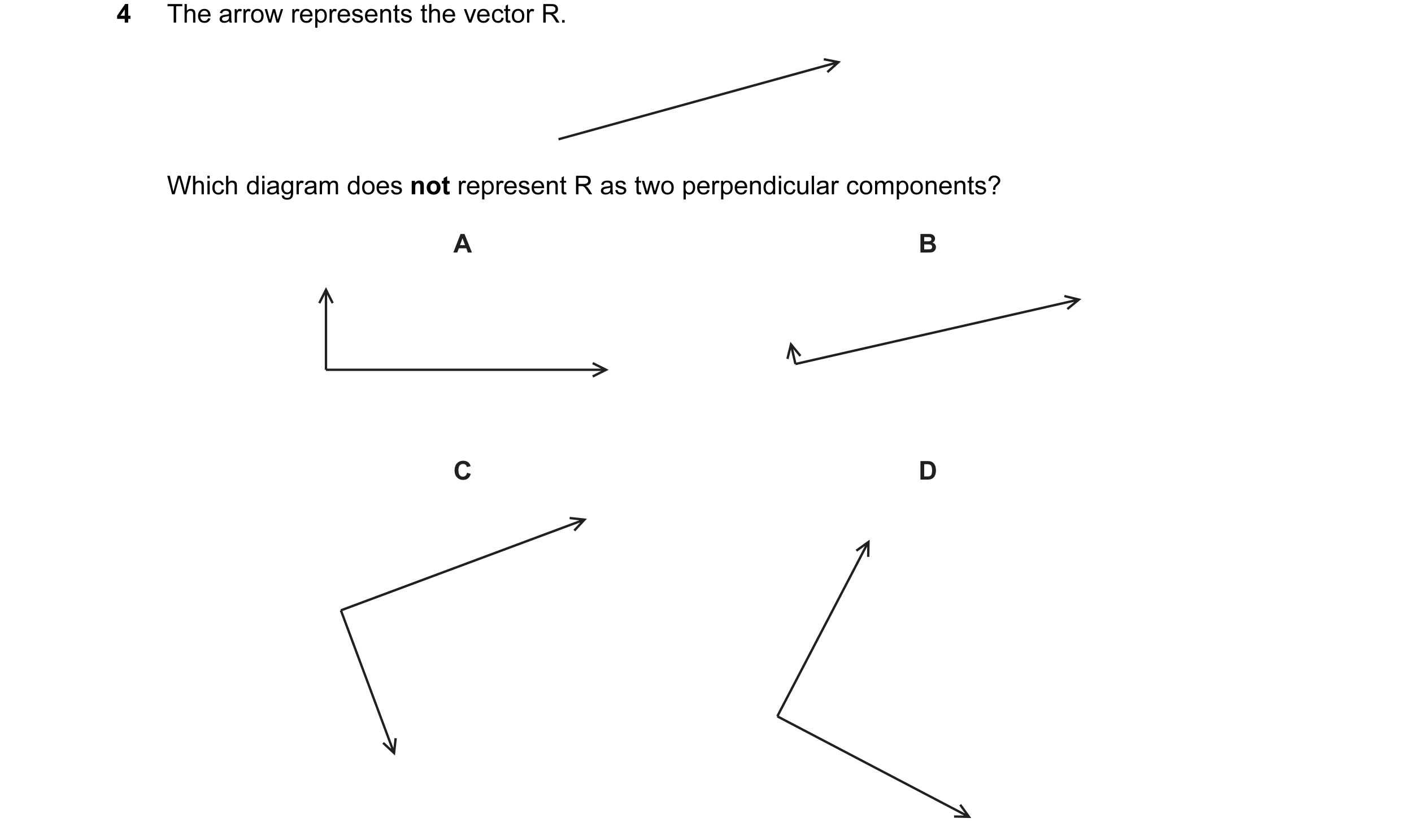
Q46 · The arrow represents the vector R 9702/12 May/June 2015
4 The arrow represents the vector R. Which diagram does not represent R as two perpendicular components? A B C D
1 marks
Answer: C
This question in 9702/12 May/June 2015
Q47 · The speed of an aeroplane in still air is 200 km h–1 9702/13 May/June 2015
3 The speed of an aeroplane in still air is 200 km h–1. The wind blows from the west at a speed of 85.0 km h–1. In which direction must the pilot steer the aeroplane in order to fly due north? A 23.0° east of north B 23.0° west of north C 25.2° east of north D 25.2° west of north
1 marks
Answer: D
This question in 9702/13 May/June 2015
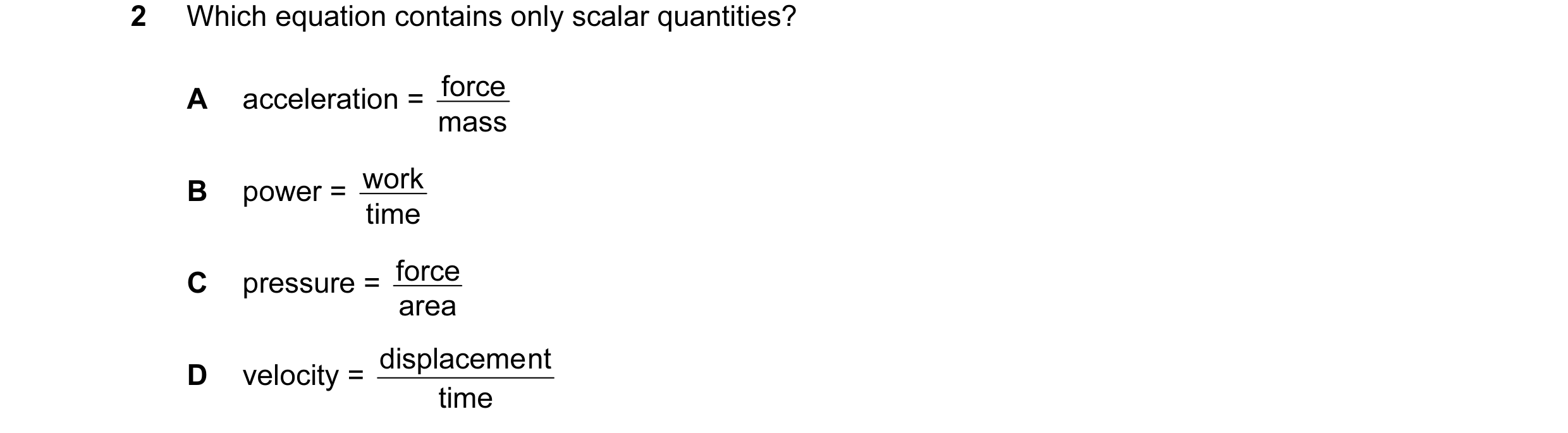
Q48 · Which equation contains only scalar quantities? 9702/12 Oct/Nov 2015
2 Which equation contains only scalar quantities? A acceleration = mass force B power = time work C pressure = area force displaceme nt D velocity = time
1 marks
Answer: B
This question in 9702/12 Oct/Nov 2015
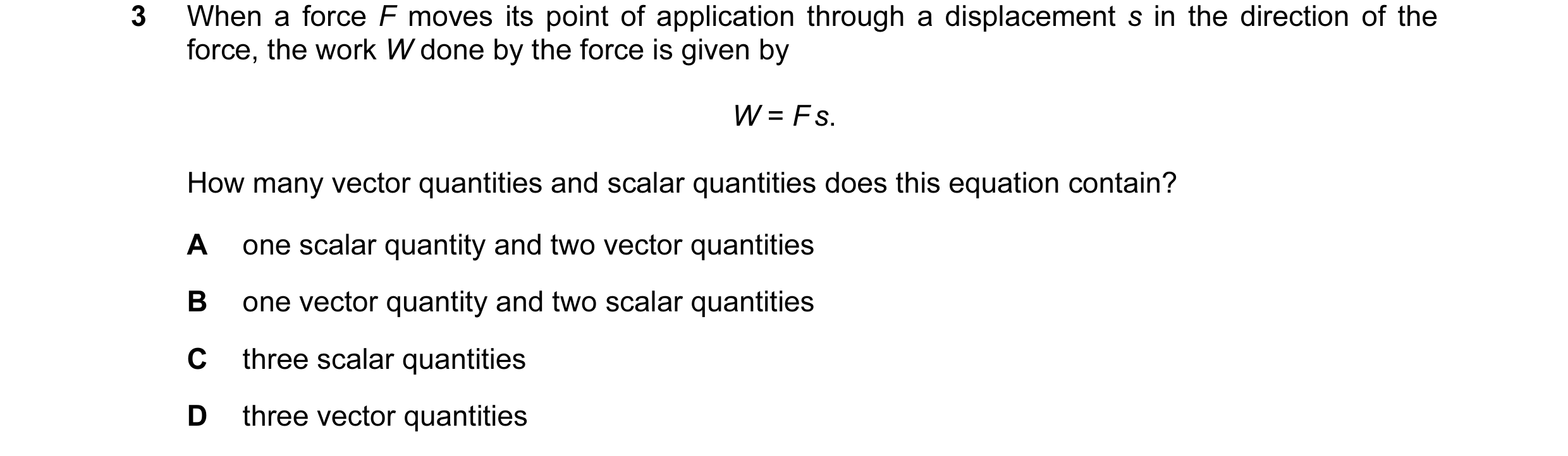
Q49 · When a force F moves its point of application through a displacement s in the direction… 9702/13 Oct/Nov 2015
3 When a force F moves its point of application through a displacement s in the direction of the force, the work W done by the force is given by W = F s. How many vector quantities and scalar quantities does this equation contain? A one scalar quantity and two vector quantities B one vector quantity and two scalar quantities C three scalar quantities D three vector quantities
1 marks
Answer: A
This question in 9702/13 Oct/Nov 2015
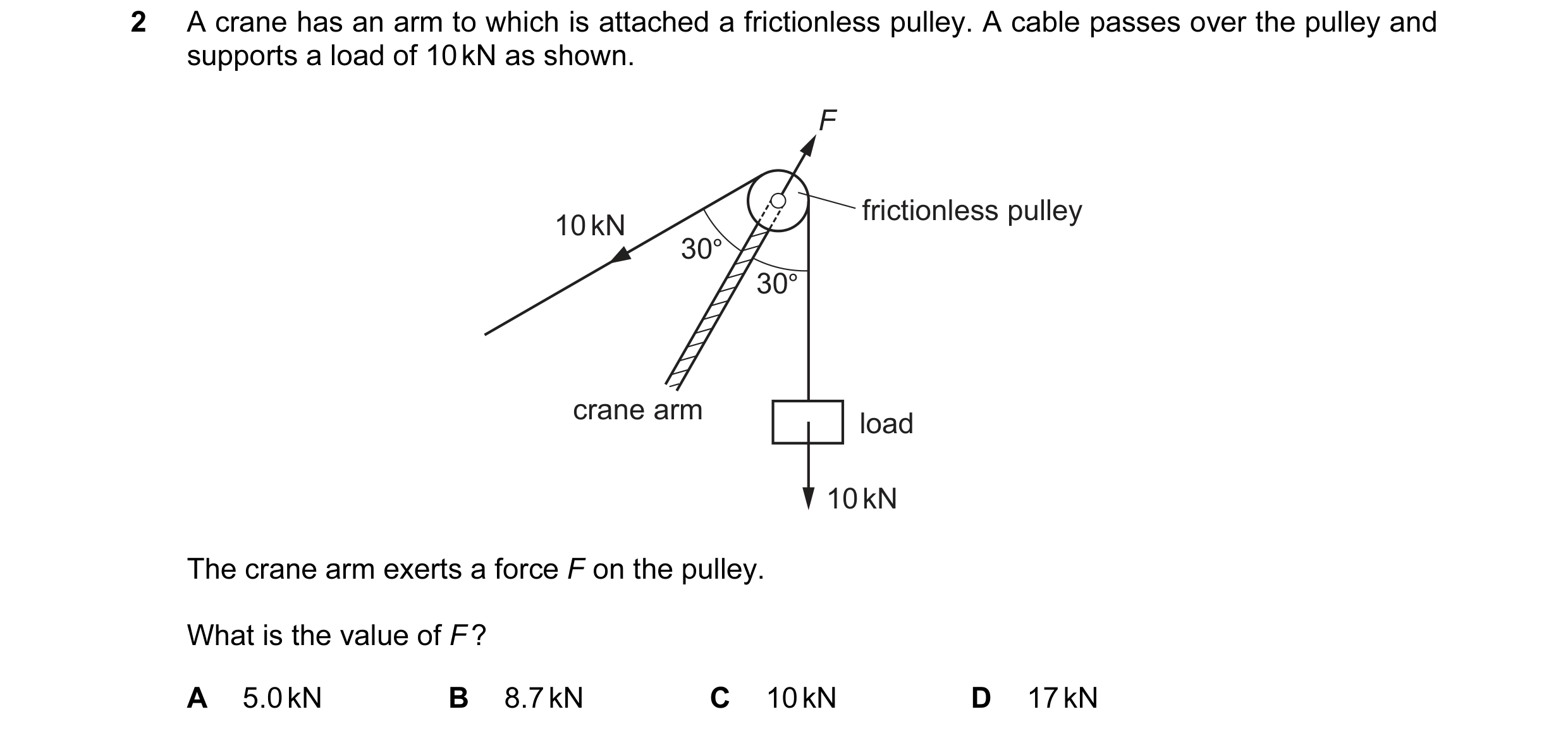
Q50 · A crane has an arm to which is attached a frictionless pulley 9702/12 Feb/March 2016
2 A crane has an arm to which is attached a frictionless pulley. A cable passes over the pulley and supports a load of 10 kN as shown. F frictionless pulley 10 kN 30° 30° crane arm load 10 kN The crane arm exerts a force F on the pulley. What is the value of F ? A 5.0 kN B 8.7 kN C 10 kN D 17 kN
1 marks
Answer: D
This question in 9702/12 Feb/March 2016
Q51 · A particle of mass m, travelling with speed u, collides with a stationary particle of… 9702/12 Feb/March 2016
10 A particle of mass m, travelling with speed u, collides with a stationary particle of mass M. The velocities of the two particles before and after the collision are shown. u 3 M u α m M β m u 2 before collision after collision Which vector diagram correctly shows the momenta before and after the collision? A B mu mu α β β α mu mu 2 Mu 2 Mu 3 3 C D mu mu α β β α mu mu 2 Mu 2 Mu 3 3
1 marks
Answer: B
This question in 9702/12 Feb/March 2016
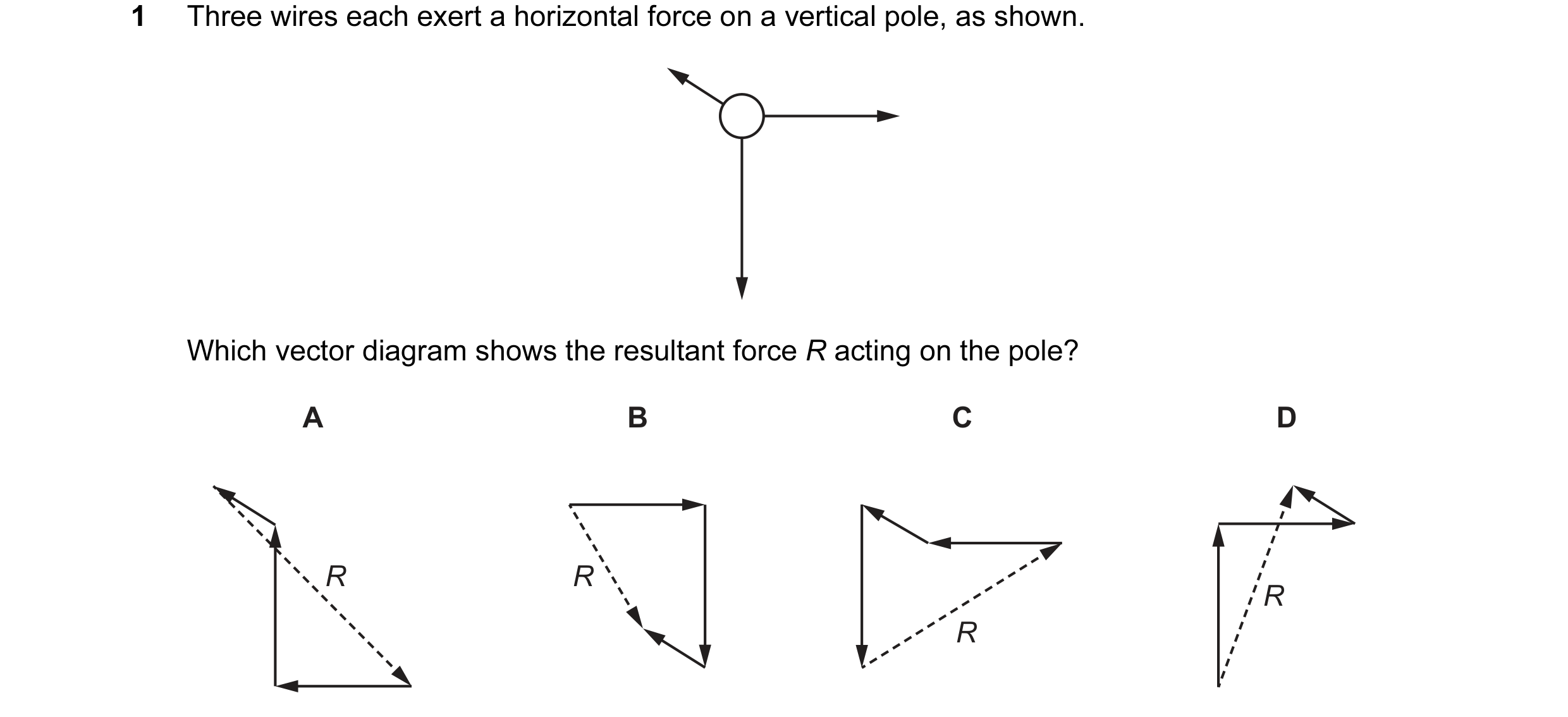
Q52 · Three wires each exert a horizontal force on a vertical pole, as shown 9702/11 May/June 2016
1 Three wires each exert a horizontal force on a vertical pole, as shown. Which vector diagram shows the resultant force R acting on the pole? A B C D R R R R
1 marks
Answer: B
This question in 9702/11 May/June 2016
Q53 · The diagram shows two vectors X and Y, drawn to scale 9702/12 May/June 2016
3 The diagram shows two vectors X and Y, drawn to scale. Y X If X = Y – Z, which diagram best represents the vector Z? A B C D
1 marks
Answer: A
This question in 9702/12 May/June 2016
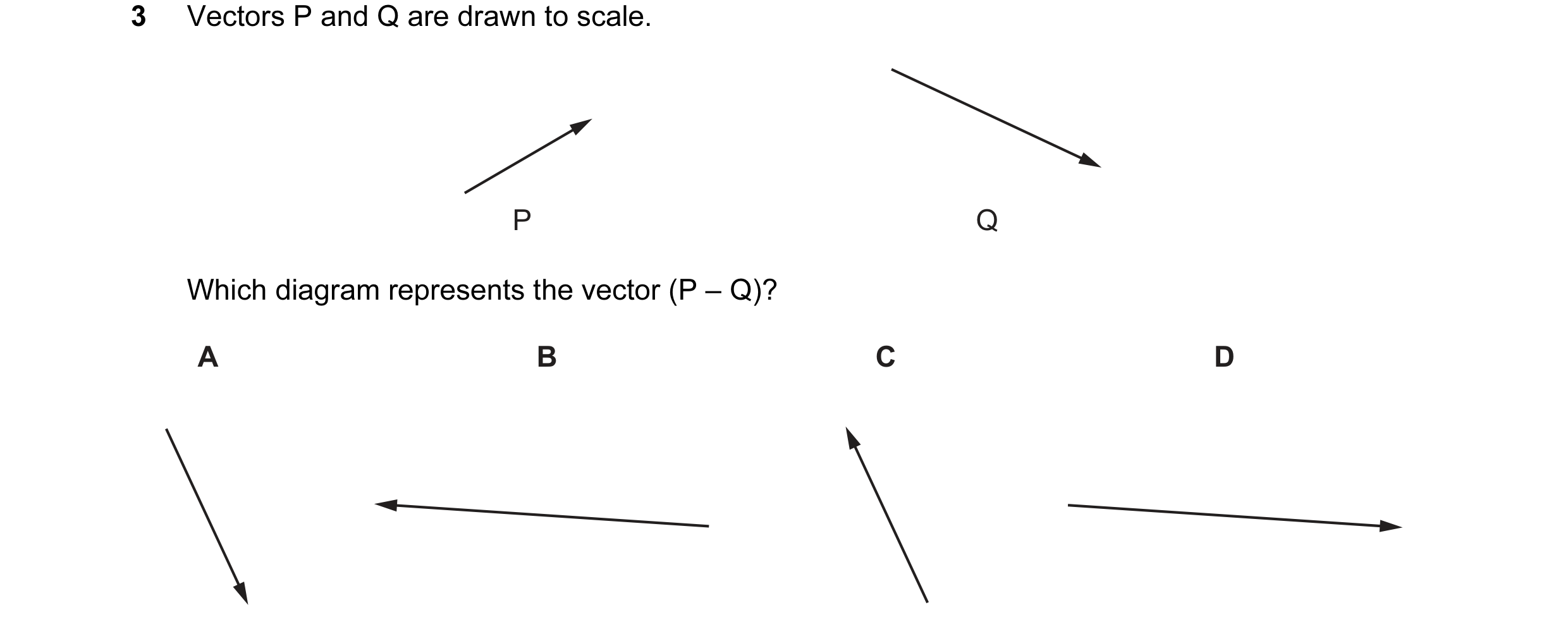
Q54 · Vectors P and Q are drawn to scale 9702/13 May/June 2016
3 Vectors P and Q are drawn to scale. P Q Which diagram represents the vector (P – Q)? A B C D
1 marks
Answer: C
This question in 9702/13 May/June 2016
Q55 · A ball is thrown with velocity V at an angle θ to the horizontal 9702/13 May/June 2016
7 A ball is thrown with velocity V at an angle θ to the horizontal. V y θ x The acceleration of free fall is g. Assume that air resistance is negligible. What are the horizontal displacement x and the vertical displacement y after time t? x y A Vt sin θ + 2 1 gt 2 Vt cos θ B Vt sin θ – 2 1 gt 2 Vt cos θ C Vt cos θ + 2 1 gt 2 Vt sin θ D Vt cos θ – 2 1 gt 2 Vt sin θ
1 marks
Answer: B
This question in 9702/13 May/June 2016
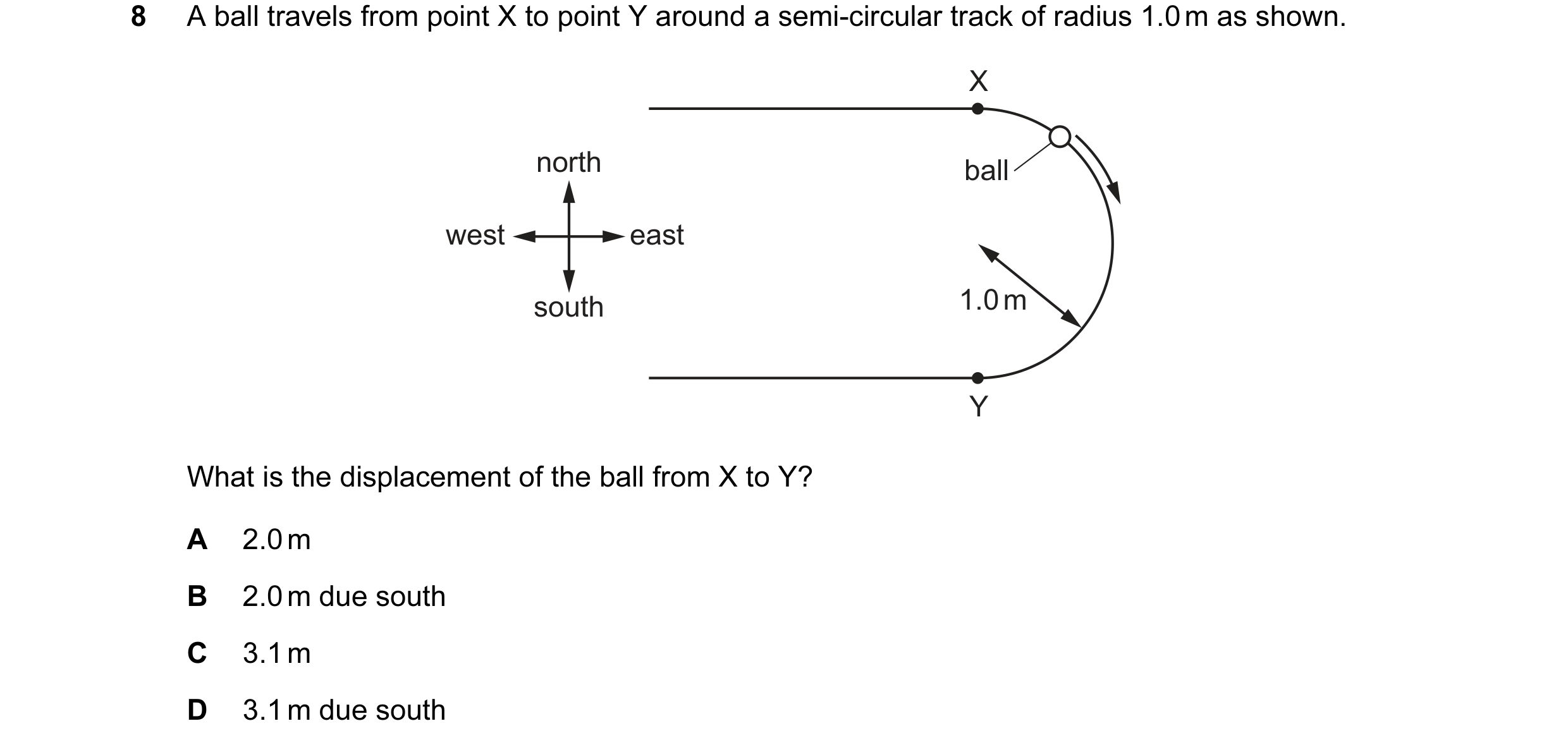
Q56 · A ball travels from point X to point Y around a semi-circular track of radius 1.0 m as… 9702/13 May/June 2016
8 A ball travels from point X to point Y around a semi-circular track of radius 1.0 m as shown. X north ball west east south 1.0 m Y What is the displacement of the ball from X to Y? A 2.0 m B 2.0 m due south C 3.1 m D 3.1 m due south
1 marks
Answer: B
This question in 9702/13 May/June 2016
Q57 · An aeroplane can fly at a velocity X when moving through still air 9702/11 Oct/Nov 2016
3 An aeroplane can fly at a velocity X when moving through still air. When flying in wind the aeroplane’s velocity relative to the ground is Y. Which vector diagram shows the magnitude and direction of the wind velocity W ? A B C D Y Y W Y W W X X Y X X W
1 marks
Answer: A
This question in 9702/11 Oct/Nov 2016
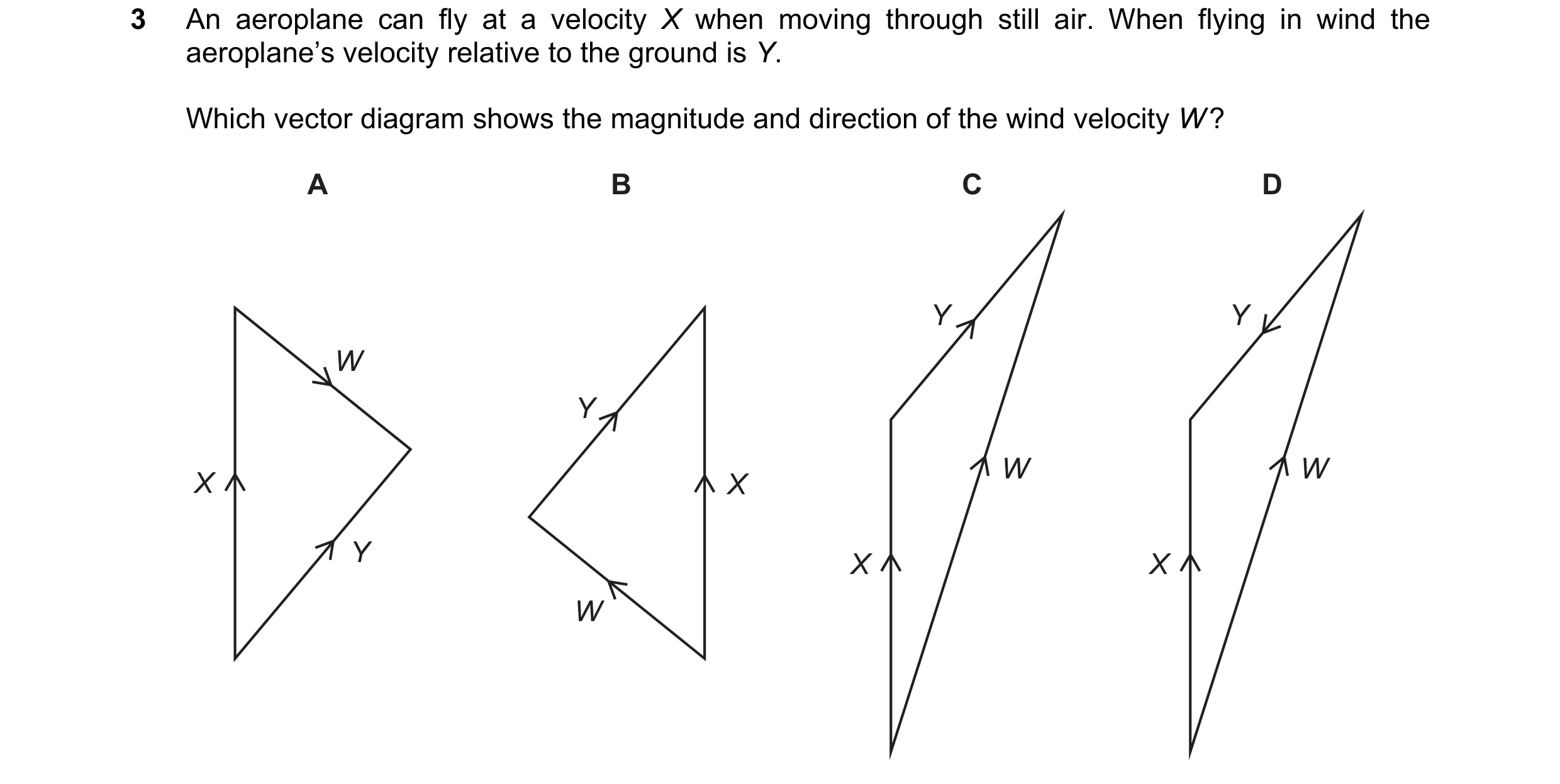
Q58 · An aeroplane can fly at a velocity X when moving through still air 9702/13 Oct/Nov 2016
3 An aeroplane can fly at a velocity X when moving through still air. When flying in wind the aeroplane’s velocity relative to the ground is Y. Which vector diagram shows the magnitude and direction of the wind velocity W ? A B C D Y Y W Y W W X X Y X X W
1 marks
Answer: A
This question in 9702/13 Oct/Nov 2016
Q59 · A pendulum bob is held stationary by a horizontal force H 9702/12 Feb/March 2017
3 A pendulum bob is held stationary by a horizontal force H. The three forces acting on the bob are shown in the diagram. 30° T H W The tension in the string of the pendulum is T. The weight of the pendulum bob is W. The string is held at an angle of 30° to the vertical. Which statement is correct? A H = T cos 30 B T = H sin 30 C W = T sin 30 D W = T cos 30
1 marks
Answer: D
This question in 9702/12 Feb/March 2017
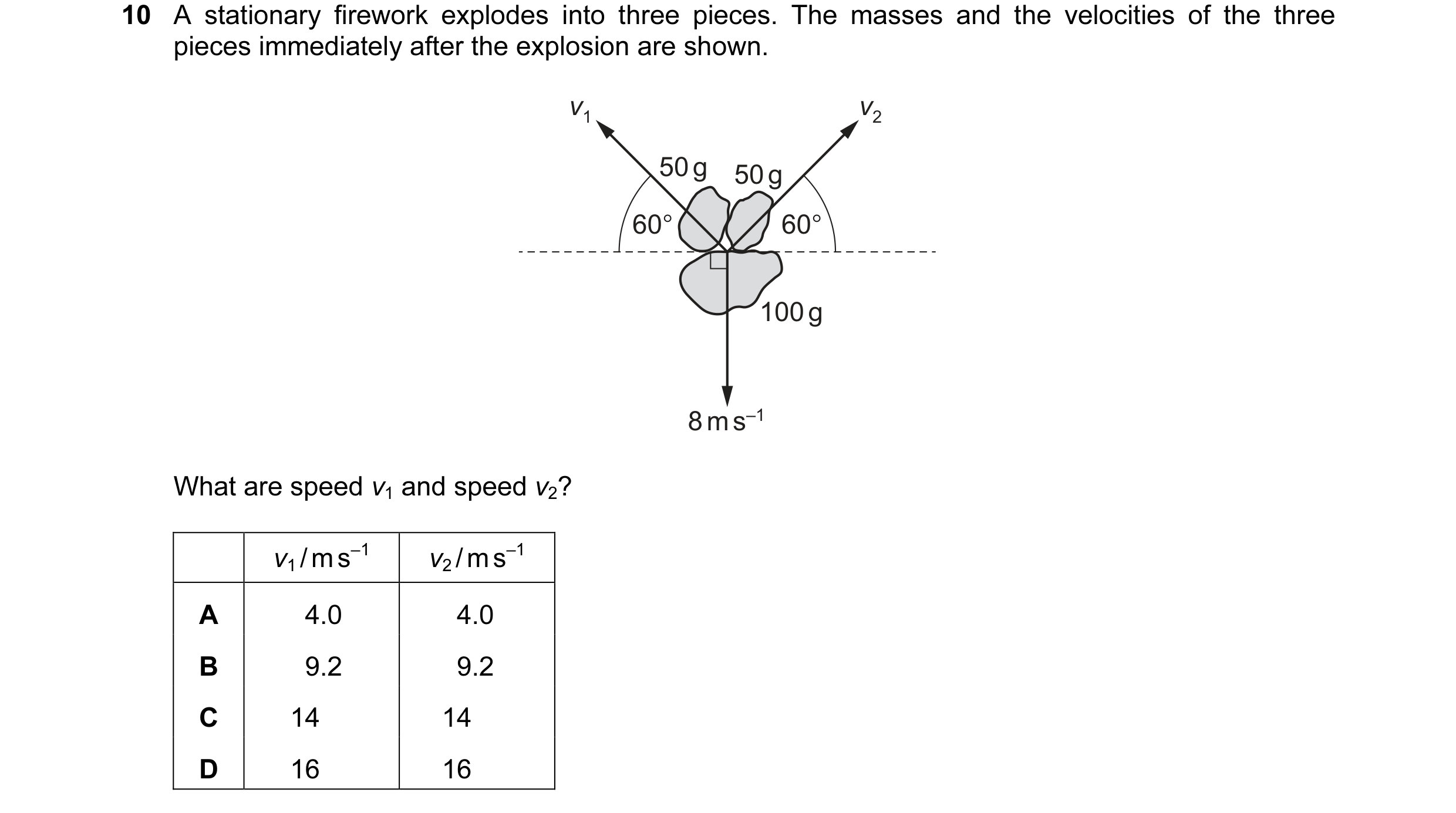
Q60 · A stationary firework explodes into three pieces 9702/12 Feb/March 2017
10 A stationary firework explodes into three pieces. The masses and the velocities of the three pieces immediately after the explosion are shown. v1 v2 50 g 50 g 60° 60° 100 g 8 m s–1 What are speed v1 and speed v2? v1 / m s–1 v2 / m s–1 A 4.0 4.0 B 9.2 9.2 C 14 14 D 16 16
1 marks
Answer: B
This question in 9702/12 Feb/March 2017
Q61 · An object hangs by means of two cords around two rods, as shown 9702/12 Feb/March 2017
14 An object hangs by means of two cords around two rods, as shown. rod rod θ F1 F2 object The object is held in equilibrium by the forces F1 and F2. The object weighs 10 N. There is negligible friction between the rods and cords. Angle θ is 90°. Which row of the table gives an angle θ of 90°? F1 / N F2 / N A 4.0 6.0 B 6.0 4.0 C 6.0 8.0 D 8.0 6.0
1 marks
Answer: C
This question in 9702/12 Feb/March 2017
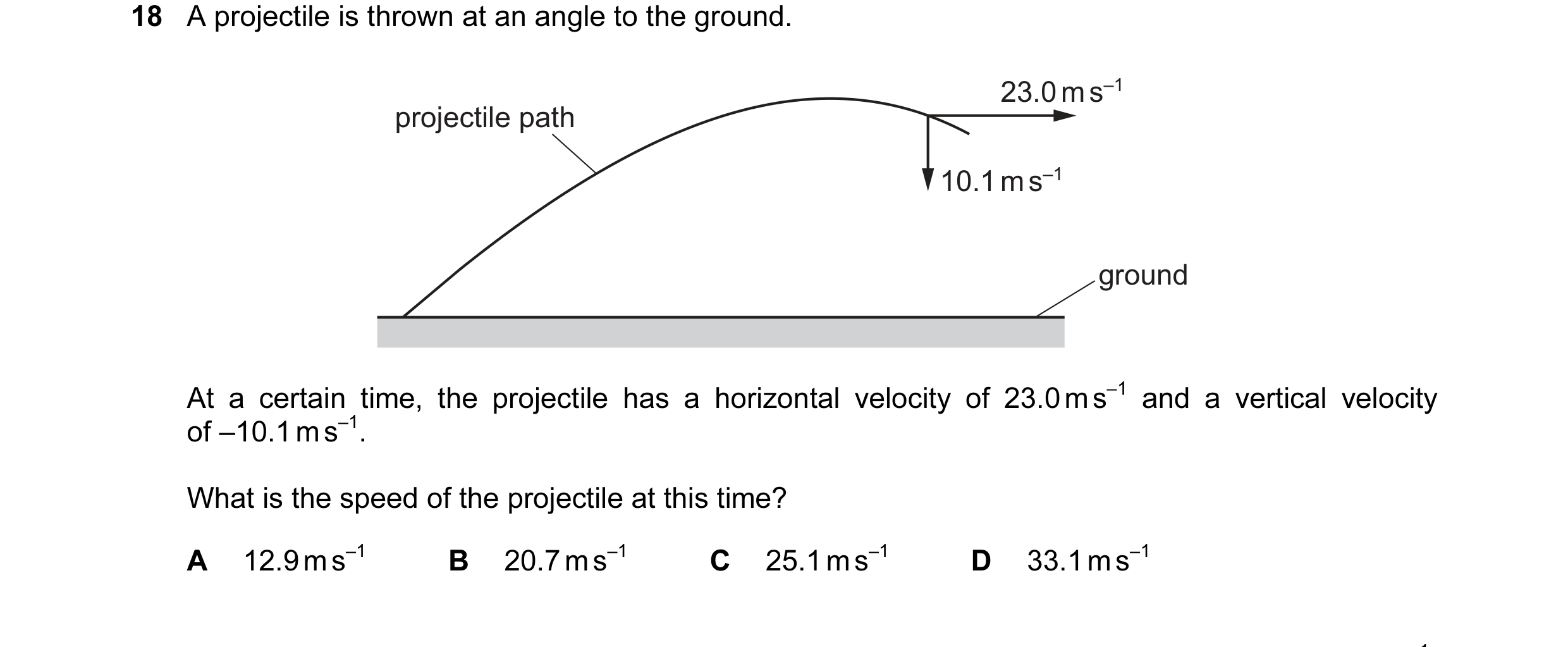
Q62 · A projectile is thrown at an angle to the ground 9702/12 Feb/March 2017
18 A projectile is thrown at an angle to the ground. 23.0 m s–1 projectile path 10.1 m s–1 ground At a certain time, the projectile has a horizontal velocity of 23.0 m s–1 and a vertical velocity of –10.1 m s–1. What is the speed of the projectile at this time? A 12.9 m s–1 B 20.7 m s–1 C 25.1 m s–1 D 33.1 m s–1
1 marks
Answer: C
This question in 9702/12 Feb/March 2017
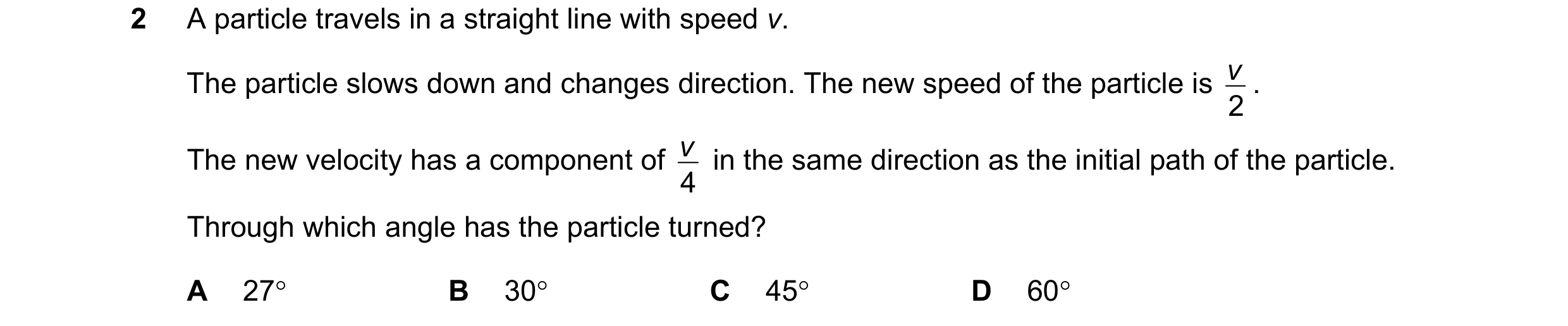
Q63 · A particle travels in a straight line with speed v 9702/11 May/June 2017
2 A particle travels in a straight line with speed v. v . The particle slows down and changes direction. The new speed of the particle is 2 v in the same direction as the initial path of the particle. The new velocity has a component of 4 Through which angle has the particle turned? A 27° B 30° C 45° D 60°
1 marks
Answer: D
This question in 9702/11 May/June 2017
Q64 · Two forces act on a circular disc as shown 9702/12 May/June 2017
2 Two forces act on a circular disc as shown. 3 N 4 N Which diagram shows the line of action of the resultant force? A B C D 5 N 5 N 5 N 5 N
1 marks
Answer: A
This question in 9702/12 May/June 2017
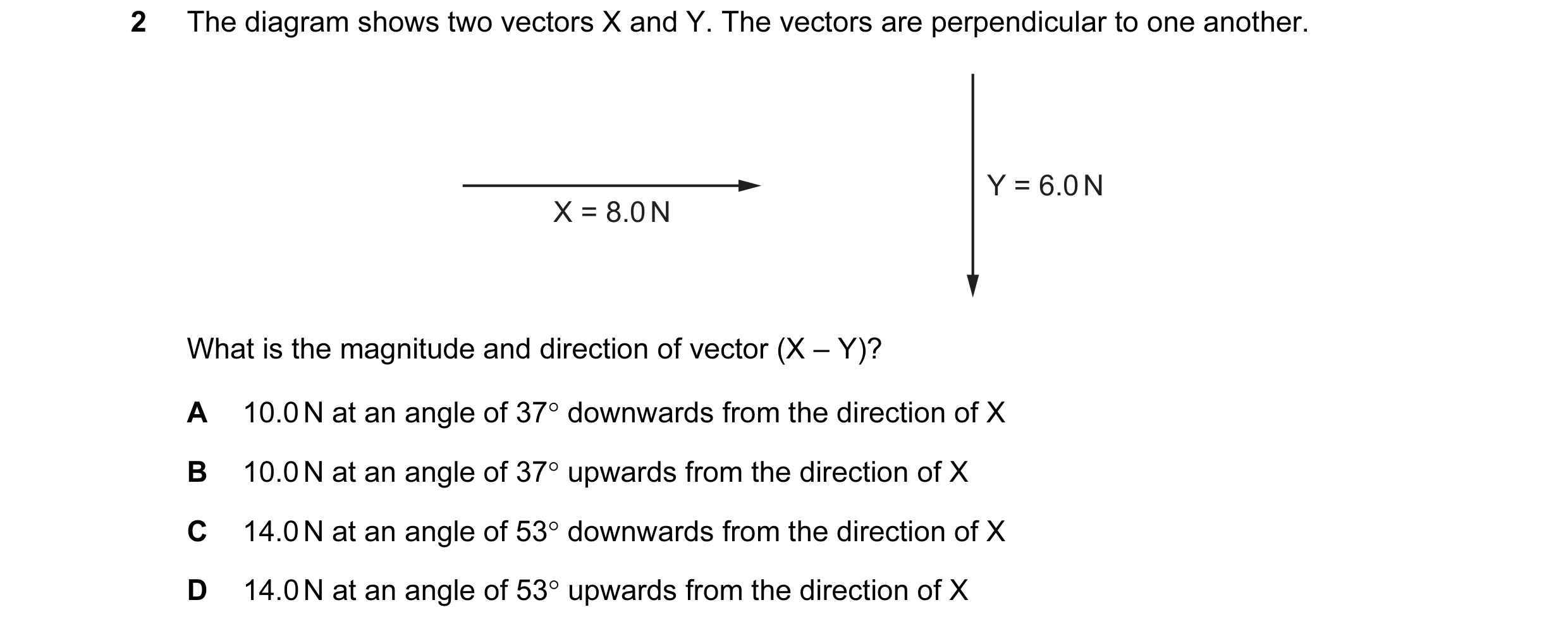
Q65 · The diagram shows two vectors X and Y 9702/13 May/June 2017
2 The diagram shows two vectors X and Y. The vectors are perpendicular to one another. Y = 6.0 N X = 8.0 N What is the magnitude and direction of vector (X – Y)? A 10.0 N at an angle of 37° downwards from the direction of X B 10.0 N at an angle of 37° upwards from the direction of X C 14.0 N at an angle of 53° downwards from the direction of X D 14.0 N at an angle of 53° upwards from the direction of X
1 marks
Answer: B
This question in 9702/13 May/June 2017
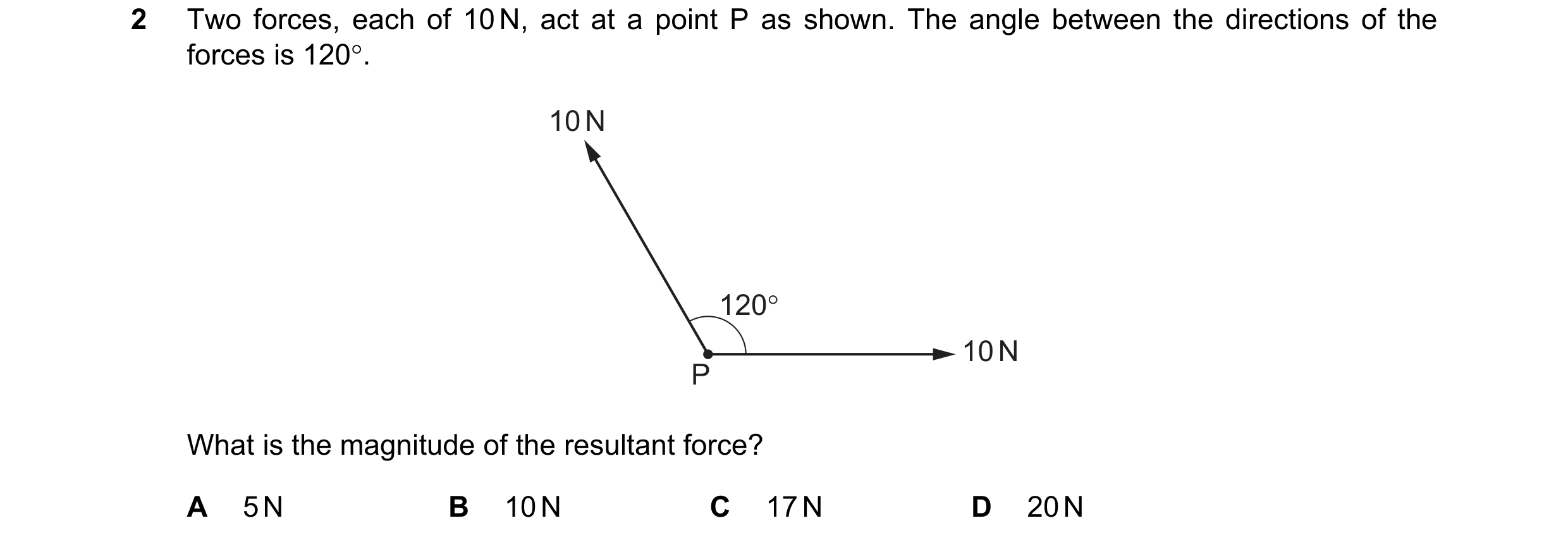
Q66 · Two forces, each of 10 N, act at a point P as shown 9702/11 Oct/Nov 2017
2 Two forces, each of 10 N, act at a point P as shown. The angle between the directions of the forces is 120°. 10 N 120° 10 N P What is the magnitude of the resultant force? A 5 N B 10 N C 17 N D 20 N
1 marks
Answer: B
This question in 9702/11 Oct/Nov 2017
Q67 · In still air, a bird can fly at a speed of 10 m s–1 9702/11 Oct/Nov 2017
6 In still air, a bird can fly at a speed of 10 m s–1. The wind is blowing from the east at 8.0 m s–1. In which direction must the bird fly in order to travel to a destination that is due north of the bird’s current location? A 37° east of north B 37° west of north C 53° east of north D 53° west of north
1 marks
Answer: C
This question in 9702/11 Oct/Nov 2017
Q68 · What is the vertical component of this displacement vector? 9702/12 Oct/Nov 2017
2 What is the vertical component of this displacement vector? 5.0 km 37° horizontal A 3.0 km B 3.8 km C 4.0 km D 5.0 km
1 marks
Answer: A
This question in 9702/12 Oct/Nov 2017
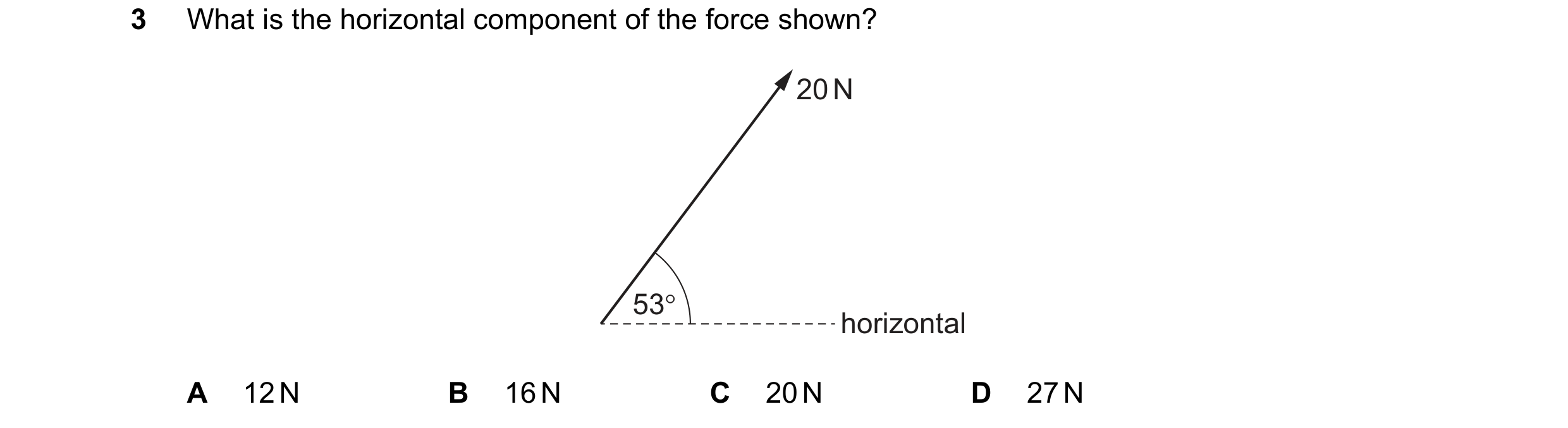
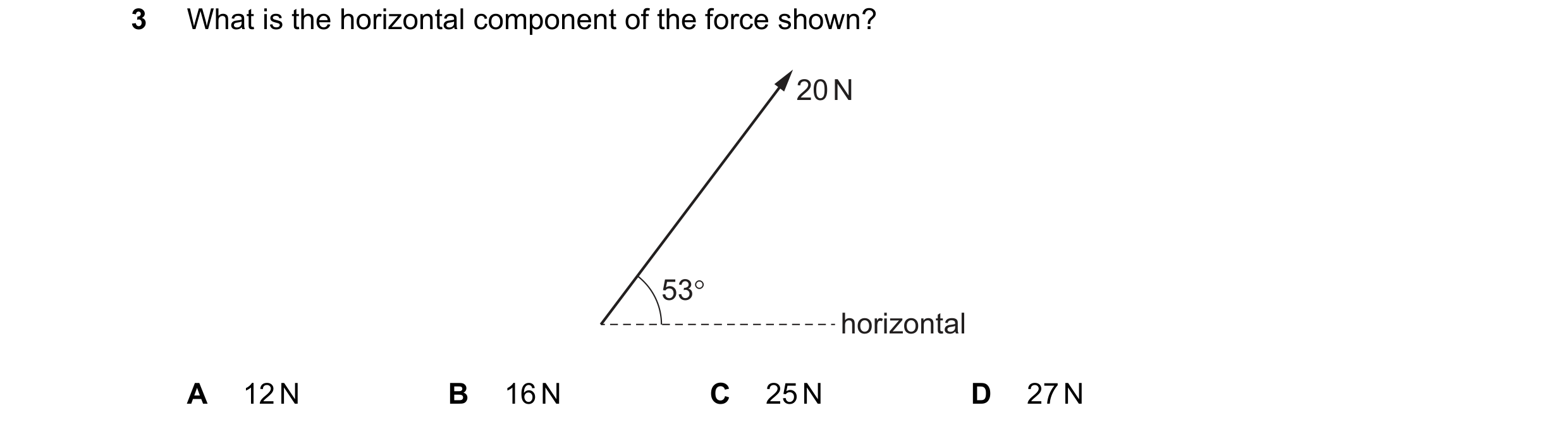
Q69 · What is the horizontal component of the force shown? 9702/13 Oct/Nov 2017
3 What is the horizontal component of the force shown? 20 N 53° horizontal A 12 N B 16 N C 20 N D 27 N
1 marks
Answer: A
This question in 9702/13 Oct/Nov 2017
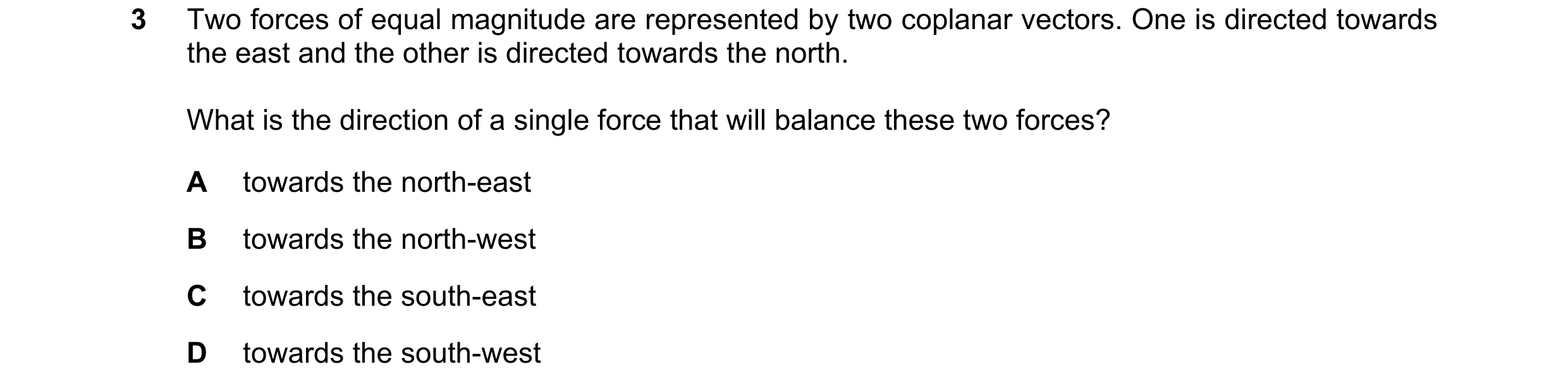
Q70 · Two forces of equal magnitude are represented by two coplanar vectors 9702/12 Feb/March 2018
3 Two forces of equal magnitude are represented by two coplanar vectors. One is directed towards the east and the other is directed towards the north. What is the direction of a single force that will balance these two forces? A towards the north-east B towards the north-west C towards the south-east D towards the south-west
1 marks
Answer: D
This question in 9702/12 Feb/March 2018
Q71 · Physical quantities can be classed as vectors or as scalars 9702/11 May/June 2018
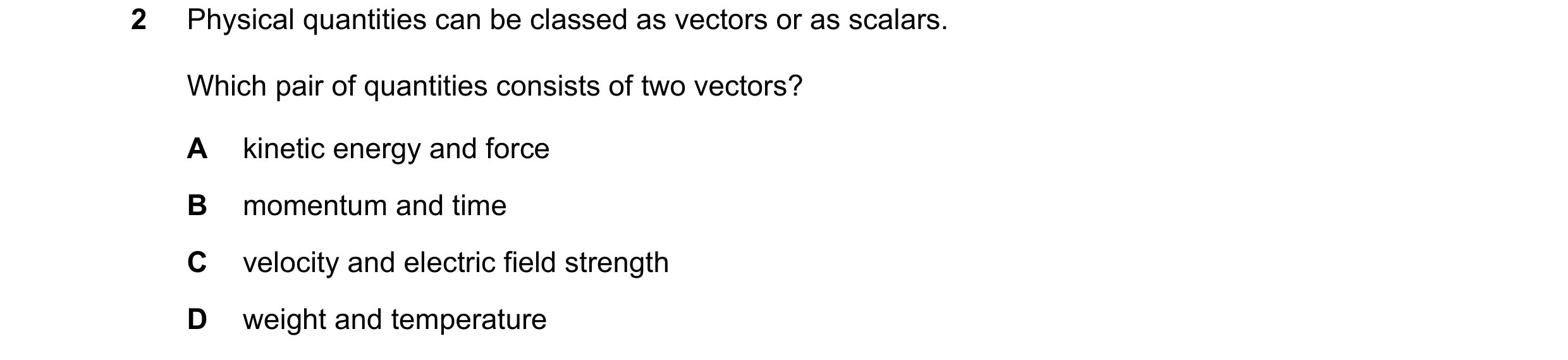
2 Physical quantities can be classed as vectors or as scalars. Which pair of quantities consists of two vectors? A kinetic energy and force B momentum and time C velocity and electric field strength D weight and temperature
1 marks
Answer: C
This question in 9702/11 May/June 2018
Q72 · Two dogs pull a sledge along an icy track, as shown 9702/11 May/June 2018
3 Two dogs pull a sledge along an icy track, as shown. dog X pulls with a force of 200 N 65° track forward sledge force 45° dog Y pulls with a force of 120 N Dog X pulls with a force of 200 N at an angle of 65° to the front edge of the sledge. Dog Y pulls with a force of 120 N at an angle of 45° to the front edge of the sledge. What is the resultant forward force on the sledge exerted by the two dogs? A 80 N B 170 N C 270 N D 320 N
1 marks
Answer: C
This question in 9702/11 May/June 2018
Q73 · The vector diagram shows three coplanar forces acting on an object at P 9702/12 May/June 2018
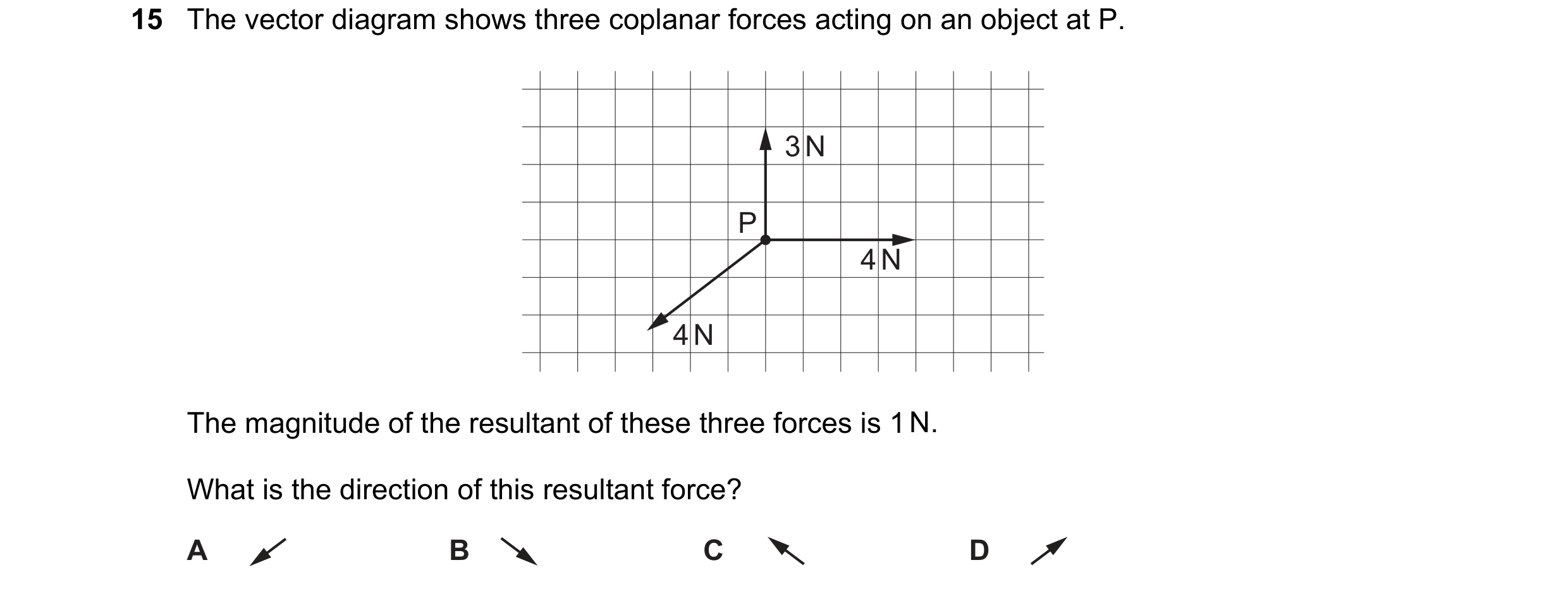
15 The vector diagram shows three coplanar forces acting on an object at P. 3 N P 4 N 4 N The magnitude of the resultant of these three forces is 1 N. What is the direction of this resultant force? A B C D
1 marks
Answer: D
This question in 9702/12 May/June 2018
Q74 · The diagram shows a ball of weight W hanging in equilibrium from a string 9702/12 May/June 2018
17 The diagram shows a ball of weight W hanging in equilibrium from a string. θ T string ball P rod W The string is at an angle θ to the vertical. The tension in the string is T. The ball is held away from the wall by a horizontal force P from a metal rod. What is the relationship between the magnitudes of T, P and W ? A P = T cosθ and W = T sinθ B T = P + W C T 2 = P 2 + W 2 D W = P tanθ and W = T cosθ
1 marks
Answer: C
This question in 9702/12 May/June 2018
Q75 · Which pair includes a vector quantity and a scalar quantity? 9702/13 May/June 2018
2 Which pair includes a vector quantity and a scalar quantity? A displacement and acceleration B force and kinetic energy C power and speed D work and potential energy
1 marks
Answer: B
This question in 9702/13 May/June 2018
Q76 · A force F acts at an angle θ to the horizontal 9702/13 May/June 2018
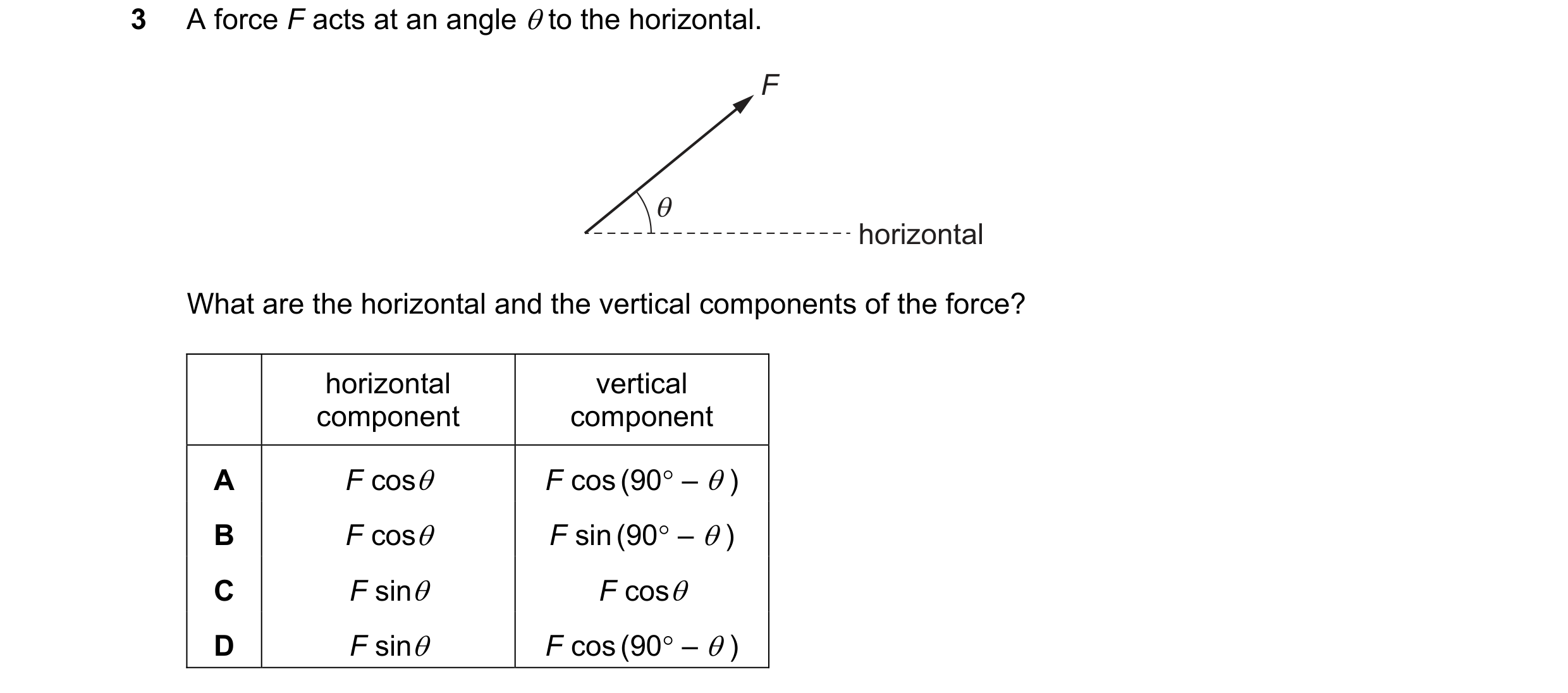
3 A force F acts at an angle θ to the horizontal. F θ horizontal What are the horizontal and the vertical components of the force? horizontal vertical component component A F cosθ F cos (90° – θ ) B F cosθ F sin (90° – θ ) C F sinθ F cosθ D F sinθ F cos (90° – θ )
1 marks
Answer: A
This question in 9702/13 May/June 2018
Q77 · A ship is travelling with a velocity of 8.0 km h–1 in a direction 30° east of north 9702/11 Oct/Nov 2018
3 A ship is travelling with a velocity of 8.0 km h–1 in a direction 30° east of north. What are the components of the ship’s velocity in the east and north directions? component of velocity component of velocity in east direction in north direction / km h–1 / km h–1 A 4.0 4.0 B 4.0 6.9 C 4.6 6.9 D 6.9 4.0
1 marks
Answer: B
This question in 9702/11 Oct/Nov 2018
Q78 · Which list contains both scalar and vector quantities? 9702/12 Oct/Nov 2018
3 Which list contains both scalar and vector quantities? A acceleration, momentum, velocity, weight B area, current, force, work C distance, kinetic energy, power, pressure D mass, temperature, time, speed
1 marks
Answer: B
This question in 9702/12 Oct/Nov 2018
Q79 · Vectors P and Q are drawn to scale 9702/12 Oct/Nov 2018
4 Vectors P and Q are drawn to scale. P Q Which diagram represents the vector (P + Q)? A B C D
1 marks
Answer: A
This question in 9702/12 Oct/Nov 2018
Q80 · Which group of quantities contains only vectors? 9702/13 Oct/Nov 2018
3 Which group of quantities contains only vectors? A acceleration, displacement, speed B acceleration, work, electric field strength C displacement, force, velocity D power, electric field strength, force
1 marks
Answer: C
This question in 9702/13 Oct/Nov 2018
Q81 · The speed of an aircraft in still air is 200 km h–1 9702/12 Feb/March 2019
3 The speed of an aircraft in still air is 200 km h–1. The wind blows from the west at a speed of 85.0 km h–1. In which direction must the pilot steer the aircraft in order to fly due north? A 23.0° east of north B 23.0° west of north C 25.2° east of north D 25.2° west of north
1 marks
Answer: D
This question in 9702/12 Feb/March 2019
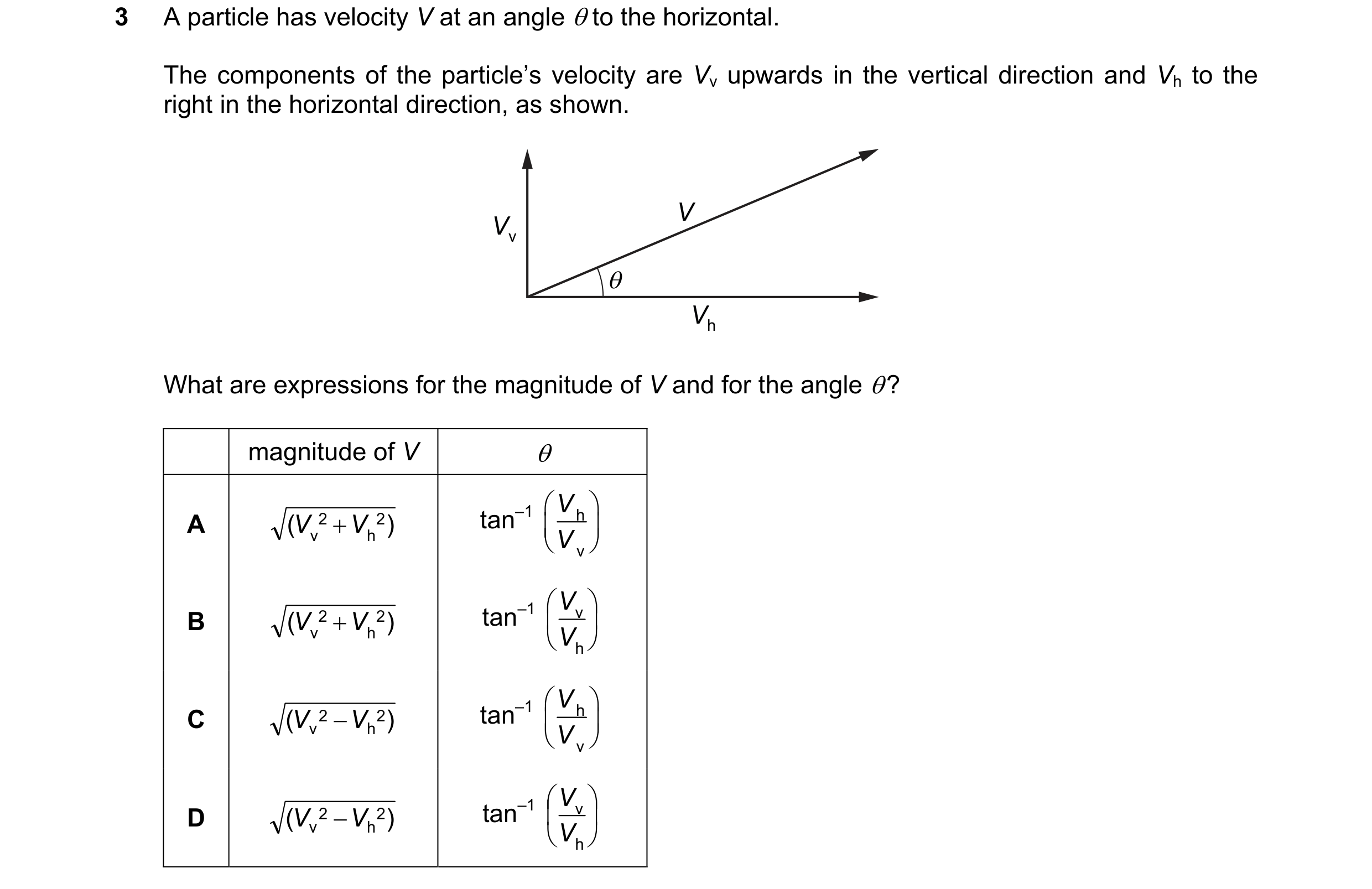
Q82 · A particle has velocity V at an angle θ to the horizontal 9702/11 May/June 2019
3 A particle has velocity V at an angle θ to the horizontal. The components of the particle’s velocity are Vv upwards in the vertical direction and Vh to the right in the horizontal direction, as shown. V Vv θ Vh What are expressions for the magnitude of V and for the angle θ ? magnitude of V θ tan–1 V A ( V 2 + V 2 ) v h V h v V B ( V 2 + V 2 ) tan–1 v v h V h tan–1 V C ( V 2 − V 2 ) v h V h v V D ( V 2 − V 2 ) tan–1 v v h V h
1 marks
Answer: B
This question in 9702/11 May/June 2019
Q83 · Two cables are attached to a bracket and exert forces as shown 9702/12 May/June 2019
4 Two cables are attached to a bracket and exert forces as shown. bracket 15.0 N 20.0° horizontal 6.00 N 40.0° vertical What are the magnitudes of the horizontal and vertical components of the resultant of the two forces? horizontal vertical component / N component / N A 9.73 0.534 B 9.73 10.2 C 18.0 0.534 D 18.0 10.2
1 marks
Answer: C
This question in 9702/12 May/June 2019
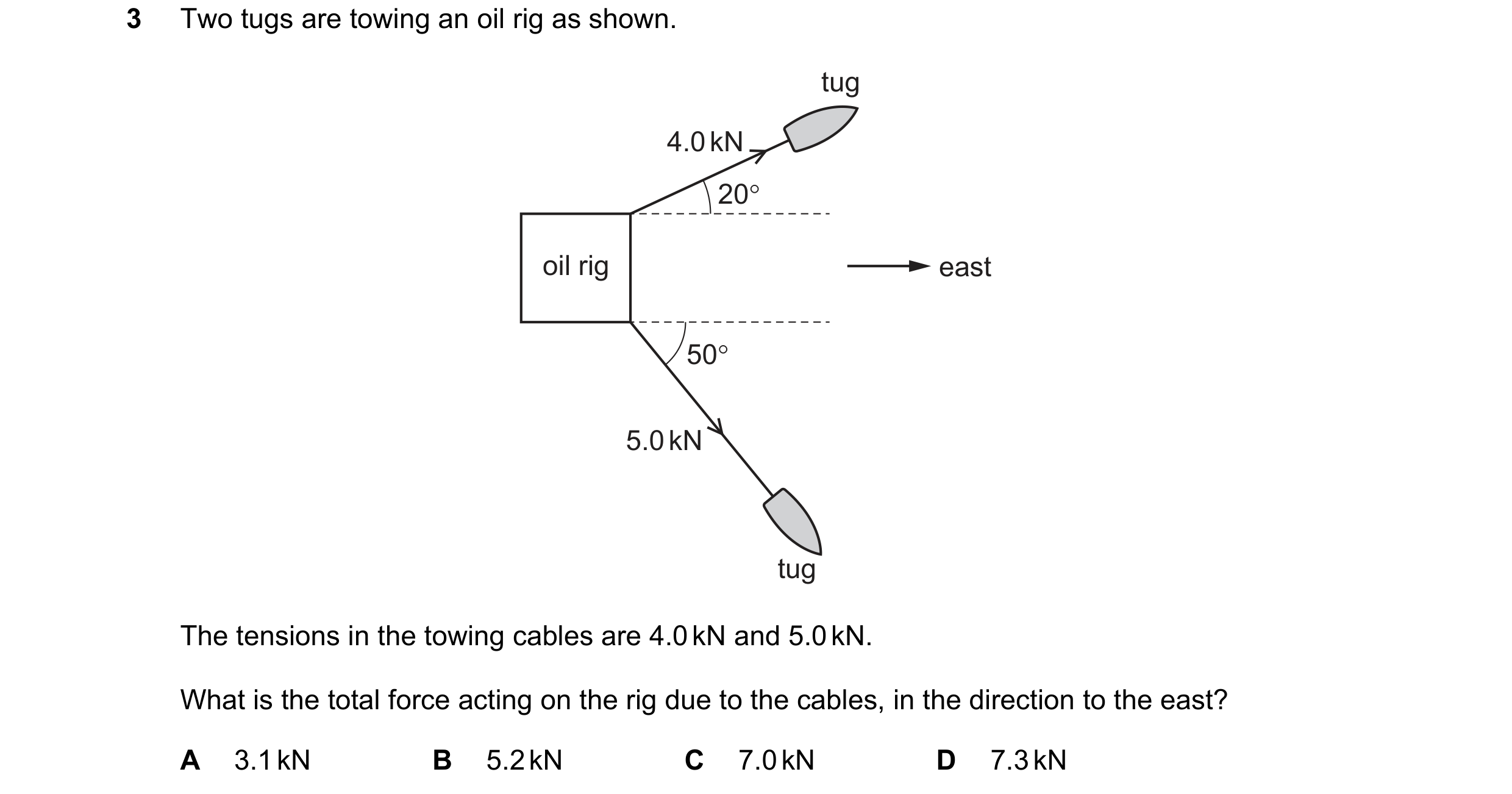
Q84 · Two tugs are towing an oil rig as shown 9702/13 May/June 2019
3 Two tugs are towing an oil rig as shown. tug 4.0 kN 20° oil rig east 50° 5.0 kN tug The tensions in the towing cables are 4.0 kN and 5.0 kN. What is the total force acting on the rig due to the cables, in the direction to the east? A 3.1 kN B 5.2 kN C 7.0 kN D 7.3 kN
1 marks
Answer: C
This question in 9702/13 May/June 2019
Q85 · The diagram shows two vectors X and Y, drawn to scale 9702/11 Oct/Nov 2019
3 The diagram shows two vectors X and Y, drawn to scale. Y X If X = Y – Z, which diagram best represents the vector Z? A B C D
1 marks
Answer: A
This question in 9702/11 Oct/Nov 2019
Q86 · Which list contains only scalar quantities? 9702/12 Oct/Nov 2019
3 Which list contains only scalar quantities? A area, length, displacement B kinetic energy, speed, power C potential energy, momentum, time D velocity, distance, temperature
1 marks
Answer: B
This question in 9702/12 Oct/Nov 2019
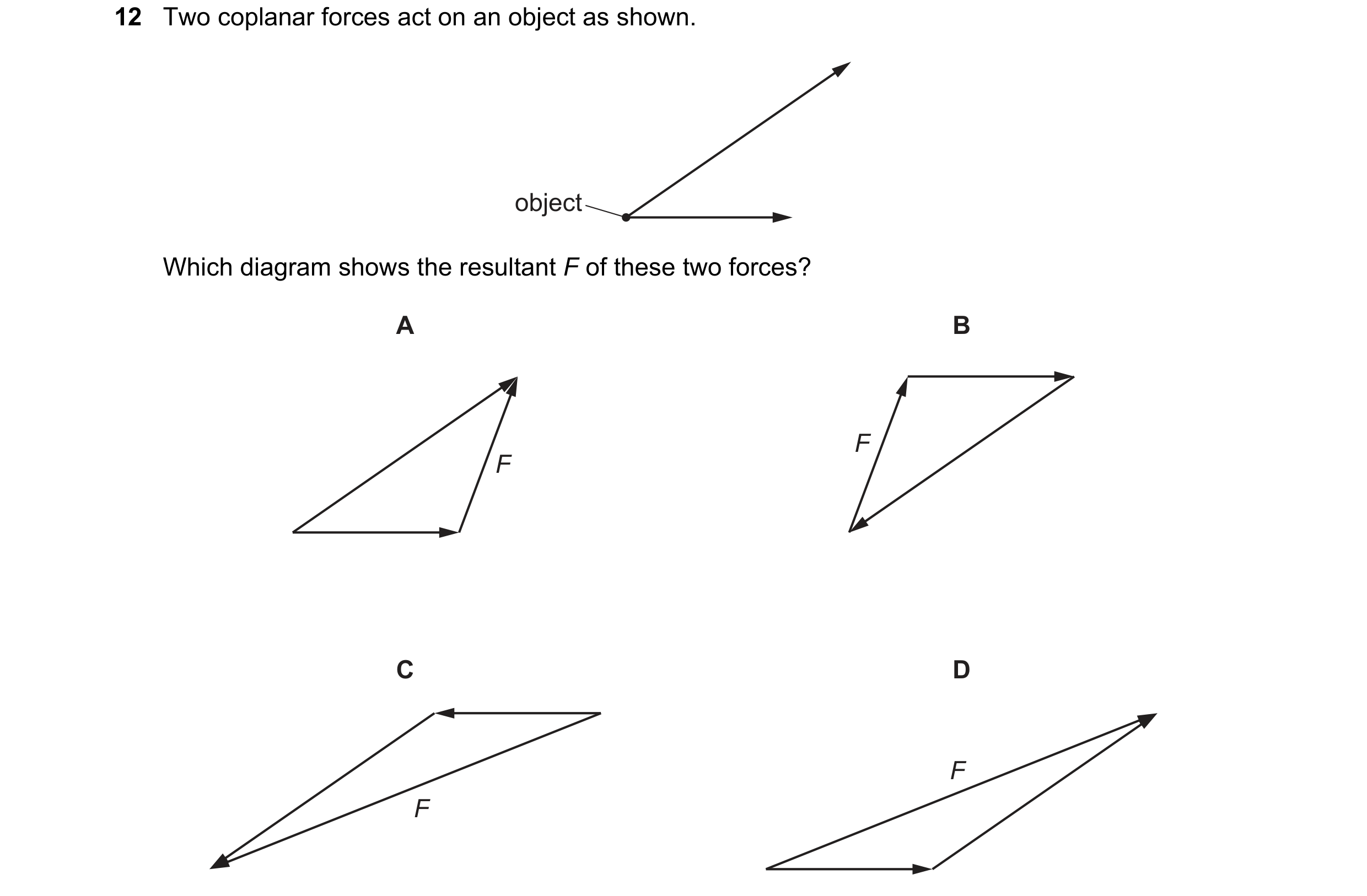
Q87 · Two coplanar forces act on an object as shown 9702/12 Oct/Nov 2019
12 Two coplanar forces act on an object as shown. object Which diagram shows the resultant F of these two forces? A B F F C D F F
1 marks
Answer: D
This question in 9702/12 Oct/Nov 2019
Q88 · The arrow represents a vector R 9702/13 Oct/Nov 2019
3 The arrow represents a vector R. Which diagram does not represent R as two perpendicular components? A B C D
1 marks
Answer: C
This question in 9702/13 Oct/Nov 2019
Q89 · Which pair of quantities contains both a scalar and a vector? 9702/12 Feb/March 2020
3 Which pair of quantities contains both a scalar and a vector? A acceleration and momentum B charge and resistance C kinetic energy and mass D temperature and velocity
1 marks
Answer: D
This question in 9702/12 Feb/March 2020
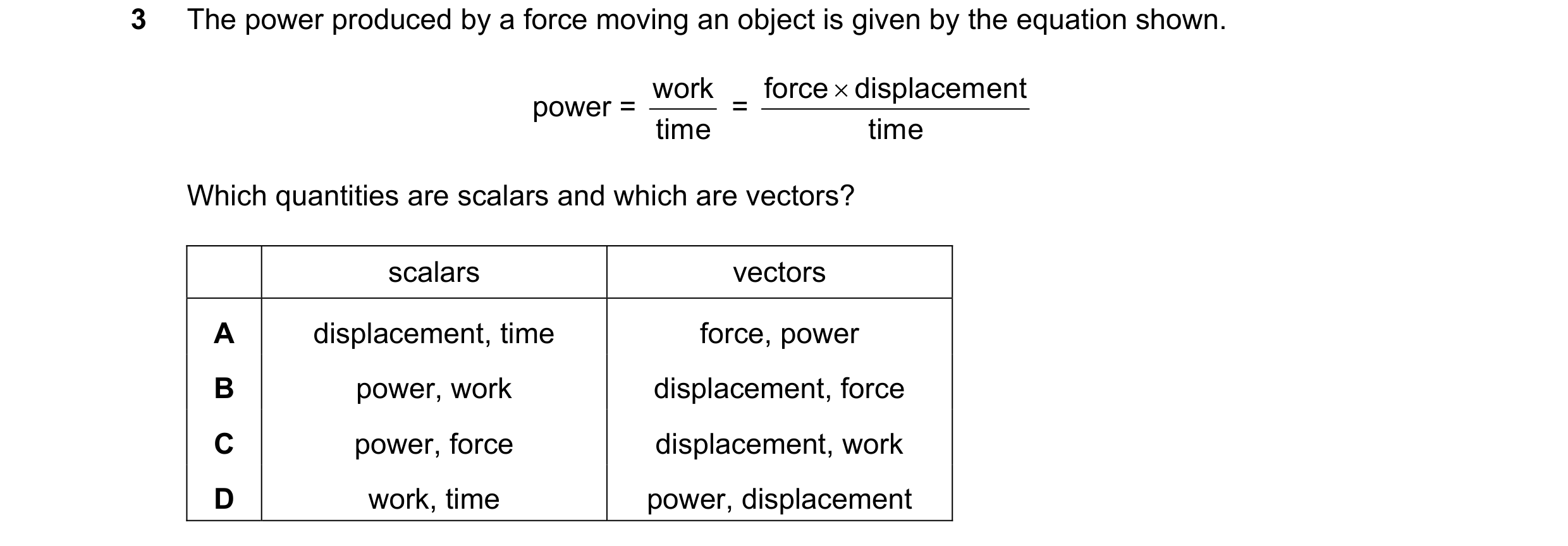
Q90 · The power produced by a force moving an object is given by the equation shown 9702/11 May/June 2020
3 The power produced by a force moving an object is given by the equation shown. power = work time = force displacement × time Which quantities are scalars and which are vectors? scalars vectors A displacement, time force, power B power, work displacement, force C power, force displacement, work D work, time power, displacement
1 marks
Answer: B
This question in 9702/11 May/June 2020
Q91 · Which quantity is a scalar? 9702/12 May/June 2020
2 Which quantity is a scalar? A acceleration B force C kinetic energy D momentum
1 marks
Answer: C
This question in 9702/12 May/June 2020
Q92 · Which characteristics are possessed by a vector quantity but not by a scalar quantity? 9702/13 May/June 2020
3 Which characteristics are possessed by a vector quantity but not by a scalar quantity? A direction only B magnitude and direction C magnitude and unit D unit only
1 marks
Answer: A
This question in 9702/13 May/June 2020
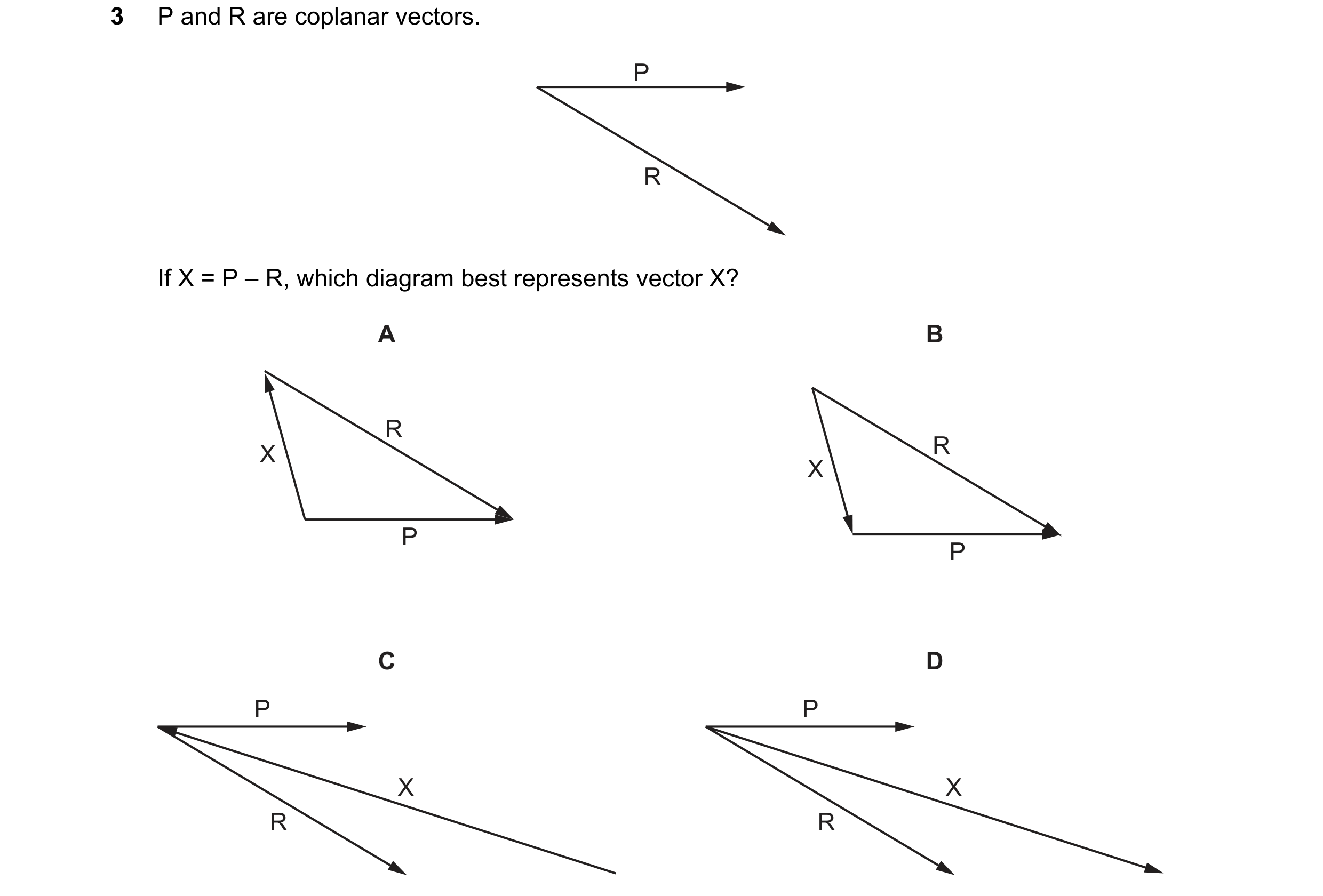
Q93 · P and R are coplanar vectors 9702/11 Oct/Nov 2020
3 P and R are coplanar vectors. P R If X = P – R, which diagram best represents vector X? A B R X R X P P C D P P X X R R
1 marks
Answer: A
This question in 9702/11 Oct/Nov 2020
Q94 · The diagram shows a force F 9702/12 Oct/Nov 2020
3 The diagram shows a force F. P is the horizontal component of F, at an angle to F. F θ P Which graph best shows the variation with of the magnitude of P ? A B P P 0 0 0 90 0 90 θ / ° θ / ° C D P P 0 0 0 90 0 90 θ / ° θ / °
1 marks
Answer: A
This question in 9702/12 Oct/Nov 2020
Q95 · Which two quantities are both vector quantities? 9702/13 Oct/Nov 2020
3 Which two quantities are both vector quantities? A displacement and distance B force and momentum C torque and time D weight and pressure
1 marks
Answer: B
This question in 9702/13 Oct/Nov 2020
Q96 · A glider is descending at constant speed at an angle of 15 to the horizontal 9702/13 Oct/Nov 2020
14 A glider is descending at constant speed at an angle of 15 to the horizontal. The diagram shows the directions of the lift L, air resistance R and weight W acting on the glider. L R 15° W Which vector triangle could represent the forces acting on the glider? A B C D
1 marks
Answer: D
This question in 9702/13 Oct/Nov 2020
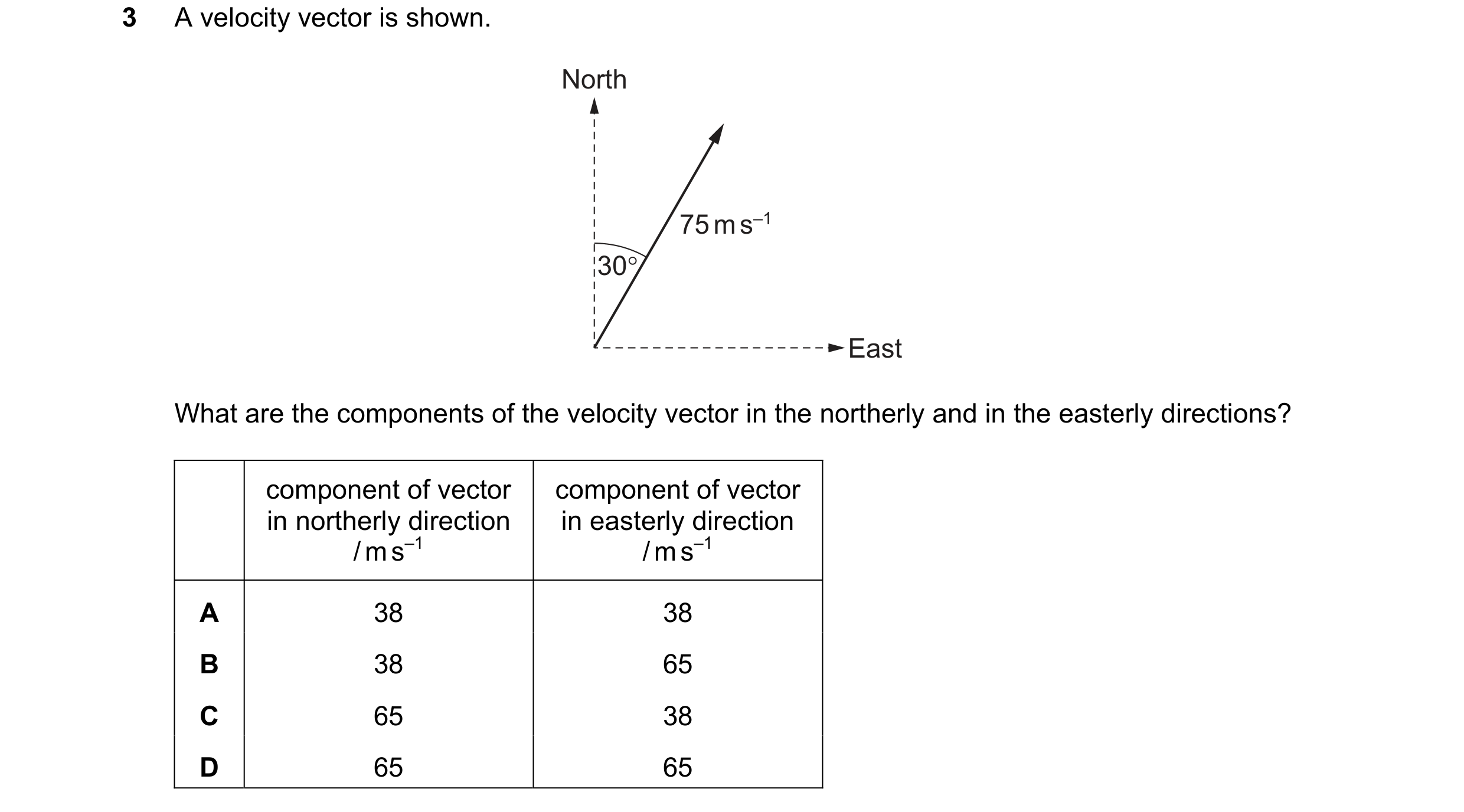
Q97 · A velocity vector is shown 9702/12 Feb/March 2021
3 A velocity vector is shown.
What are the components of the velocity vector in the northerly and in the easterly directions?
component of vector | component of vector
in northerly direction in easterly direction
/ms"' /ms"'
A 38 38
B 38 65
Cc 65 38
D 65 65
1 marks
Answer: C
This question in 9702/12 Feb/March 2021
Q98 · A force of 10 N and a force of 5 N act on an object 9702/11 May/June 2021
3 A force of 10 N and a force of 5 N act on an object. 10 N 150° 5 N object The angle between the forces is 150. The resultant force on the object can be resolved into a pair of perpendicular components. Which row shows numerical expressions for a possible pair of perpendicular components? force component / N force component / N A 10 cos 30 – 5 10 cos 30 B 10 sin 30 – 5 10 cos 30 C 10 – 5 cos 30 5 sin 30 D 10 – 5 sin 30 5 cos 30
1 marks
Answer: C
This question in 9702/11 May/June 2021
Q99 · What is the horizontal component of the force shown? 9702/13 May/June 2021
3. What is the horizontal component of the force shown?
20N
woo cba wane n nnn anne horizontal
A 12N B 16N C 25N D 27N
1 marks
Answer: A
This question in 9702/13 May/June 2021
Q100 · An aircraft heads in a direction at an angle @ east of north with a horizontal velocity… 9702/11 Oct/Nov 2021
3. An aircraft heads in a direction at an angle @ east of north with a horizontal velocity relative to the
air of 800kmh“‘. The wind blows with a horizontal velocity of 200kmh™ from east to west, as
shown.
N
NOT TO direction of resultant
SCALE velocity of aircraft
aircraft velocity relative
to air = 800kmh"
wind velocity = 200 kmh“ iy
WwW —+——E
The resultant velocity of the aircraft is in a direction due north.
What is angle @and what is the magnitude of the resultant velocity?
gle resultant |
velocity/kmh
14 770
14 820
76 770
76 820
1 marks
Answer: A
This question in 9702/11 Oct/Nov 2021
Q101 · Which list consists only of scalar quantities? 9702/13 Oct/Nov 2021
3 Which list consists only of scalar quantities? A acceleration, displacement, force, weight B density, energy, frequency, velocity C distance, pressure, temperature, time D momentum, power, volume, wavelength
1 marks
Answer: C
This question in 9702/13 Oct/Nov 2021
Q102 · Which statement about scalar and vector quantities is correct? 9702/12 Feb/March 2022
4 Which statement about scalar and vector quantities is correct? A A scalar quantity has direction but not magnitude. B A scalar quantity has magnitude but not direction. C A vector quantity has direction but not magnitude. D A vector quantity has magnitude but not direction.
1 marks
Answer: B
This question in 9702/12 Feb/March 2022
Q103 · Two cables are attached to a bracket and exert forces as shown 9702/11 May/June 2022
4 Two cables are attached to a bracket and exert forces as shown.
bracket
7 -----le2-22-------- horizontal
vertical
What are the magnitudes of the horizontal and vertical components of the resultant of the two
forces?
horizontal vertical
component/N component/N
0.534
10.2
0.534
10.2
1 marks
Answer: C
This question in 9702/11 May/June 2022
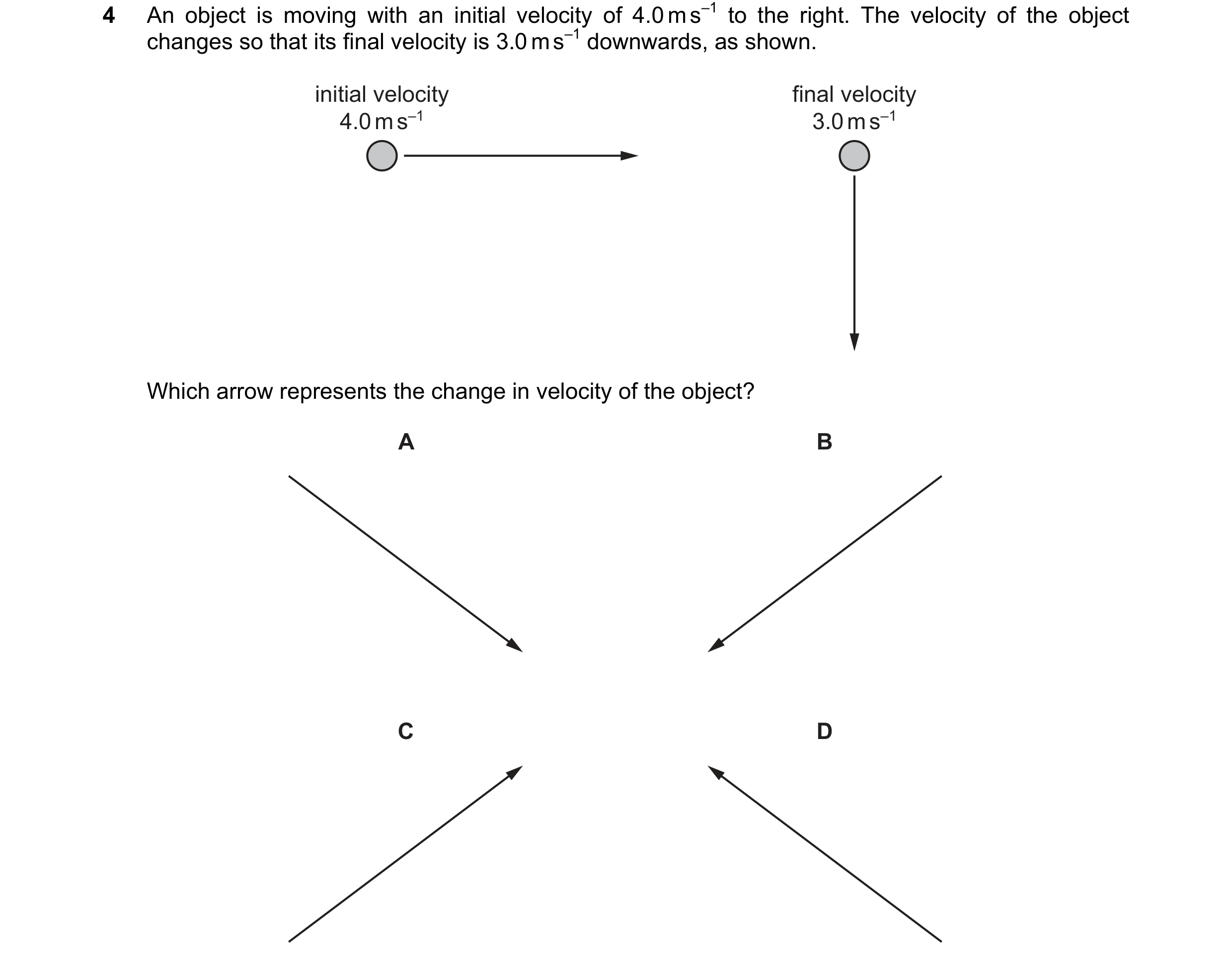
Q104 · An object is moving with an initial velocity of 4.0 m s–1 to the right 9702/12 May/June 2022
4 An object is moving with an initial velocity of 4.0 m s–1 to the right. The velocity of the object changes so that its final velocity is 3.0 m s–1 downwards, as shown. initial velocity final velocity 4.0 m s–1 3.0 m s–1 Which arrow represents the change in velocity of the object? A B C D
1 marks
Answer: B
This question in 9702/12 May/June 2022
Q105 · A car travels anticlockwise along a horizontal circular road of radius 12 m, as shown 9702/12 May/June 2022
5 A car travels anticlockwise along a horizontal circular road of radius 12 m, as shown. The car takes a time of 4.0 s to move from position P to position Q. direction of travel of car 12 m P road Q What is the magnitude of the average velocity of the car for the journey from P to Q? A 4.2 m s–1 B 4.7 m s–1 C 6.0 m s–1 D 14 m s–1
1 marks
Answer: A
This question in 9702/12 May/June 2022
Q106 · Which quantity is a vector? 9702/11 Oct/Nov 2022
4 Which quantity is a vector? A momentum B speed C temperature D Young modulus
1 marks
Answer: A
This question in 9702/11 Oct/Nov 2022
Q107 · What is the difference between a scalar quantity and a vector quantity? 9702/12 Oct/Nov 2022
4 What is the difference between a scalar quantity and a vector quantity? A A scalar quantity has direction but a vector quantity does not. B A scalar quantity has magnitude but a vector quantity does not. C A vector quantity has direction but a scalar quantity does not. D A vector quantity has magnitude but a scalar quantity does not.
1 marks
Answer: C
This question in 9702/12 Oct/Nov 2022
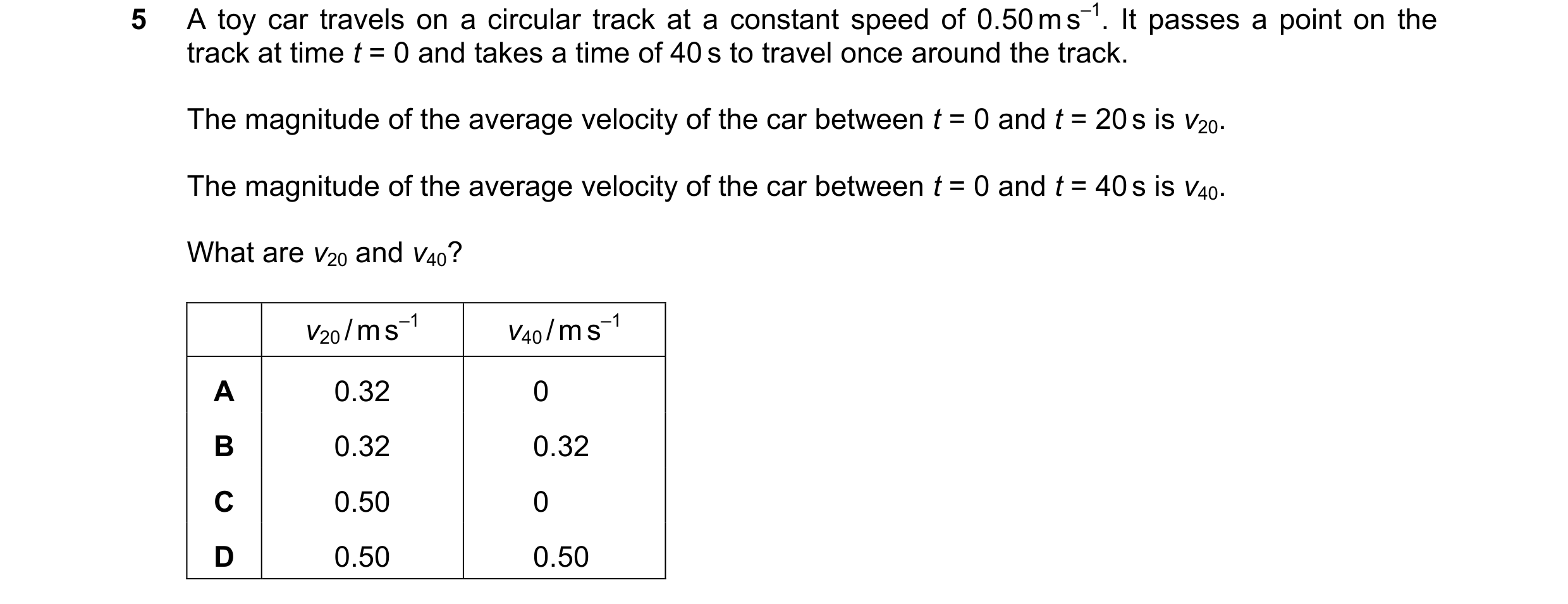
Q108 · A toy car travels on a circular track at a constant speed of 0.50 m s–1 9702/12 Oct/Nov 2022
5 A toy car travels on a circular track at a constant speed of 0.50 m s–1. It passes a point on the track at time t = 0 and takes a time of 40 s to travel once around the track. The magnitude of the average velocity of the car between t = 0 and t = 20 s is v20. The magnitude of the average velocity of the car between t = 0 and t = 40 s is v40. What are v20 and v40? v20 / m s–1 v40 / m s–1 A 0.32 0 B 0.32 0.32 C 0.50 0 D 0.50 0.50
1 marks
Answer: A
This question in 9702/12 Oct/Nov 2022
Q109 · An object is suspended by two ropes 9702/12 Oct/Nov 2022
14 An object is suspended by two ropes. One rope has a tension of 410N at an angle of 60° to the
horizontal. The other rope has a tension of 210 N at an angle of 10° to the horizontal.
410N
The object is in equilibrium.
What is the mass of the object?
A 40kg B 42kg C 390kg D 410kg
1 marks
Answer: A
This question in 9702/12 Oct/Nov 2022
Q110 · Which quantity is a vector quantity? 9702/13 Oct/Nov 2022
4 Which quantity is a vector quantity? A density B mass C volume D weight
1 marks
Answer: D
This question in 9702/13 Oct/Nov 2022
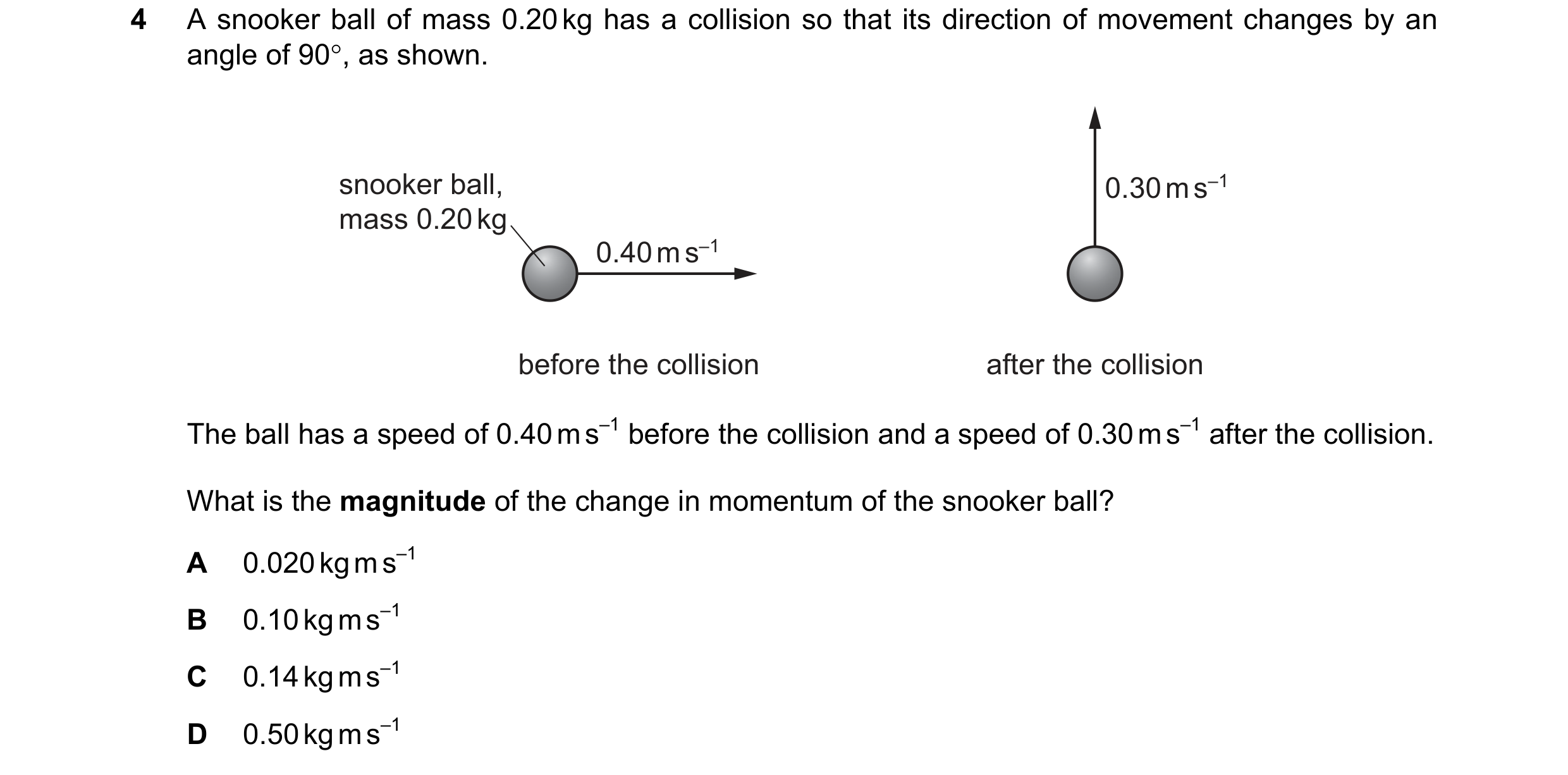
Q111 · A snooker ball of mass 0.20 kg has a collision so that its direction of movement changes… 9702/12 Feb/March 2023
4 A snooker ball of mass 0.20 kg has a collision so that its direction of movement changes by an angle of 90°, as shown. snooker ball, 0.30 m s–1 mass 0.20 kg 0.40 m s–1 before the collision after the collision The ball has a speed of 0.40 m s–1 before the collision and a speed of 0.30 m s–1 after the collision. What is the magnitude of the change in momentum of the snooker ball? A 0.020 kg m s–1 B 0.10 kg m s–1 C 0.14 kg m s–1 D 0.50 kg m s–1
1 marks
Answer: B
This question in 9702/12 Feb/March 2023
Q112 · Two forces, each of 10 N, act at a point P, as shown 9702/11 May/June 2023
4 Two forces, each of 10 N, act at a point P, as shown. The angle between the directions of the forces is 120. 10 N 120° 10 N P What is the magnitude of the resultant force? A 5 N B 10 N C 17 N D 20 N
1 marks
Answer: B
This question in 9702/11 May/June 2023
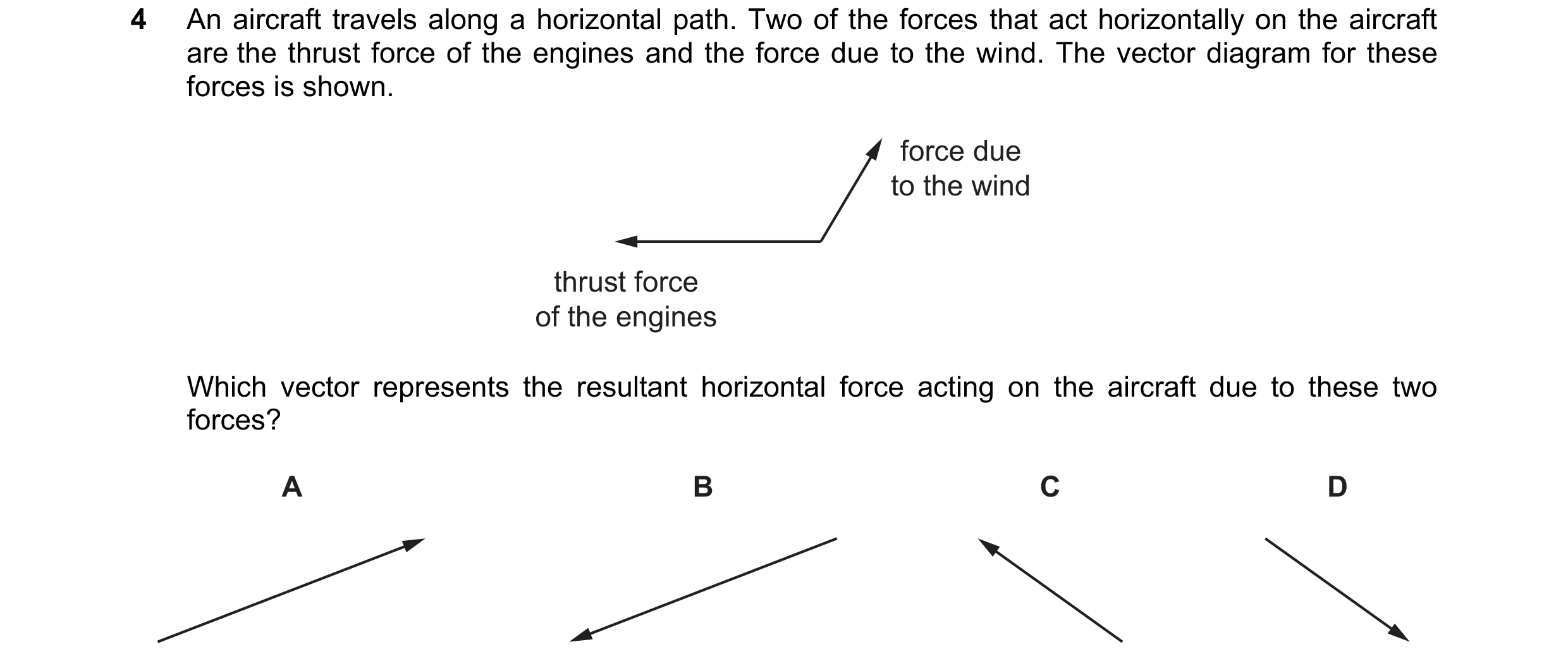
Q113 · An aircraft travels along a horizontal path 9702/12 May/June 2023
4 An aircraft travels along a horizontal path. Two of the forces that act horizontally on the aircraft are the thrust force of the engines and the force due to the wind. The vector diagram for these forces is shown. force due to the wind thrust force of the engines Which vector represents the resultant horizontal force acting on the aircraft due to these two forces? A B C D
1 marks
Answer: C
This question in 9702/12 May/June 2023
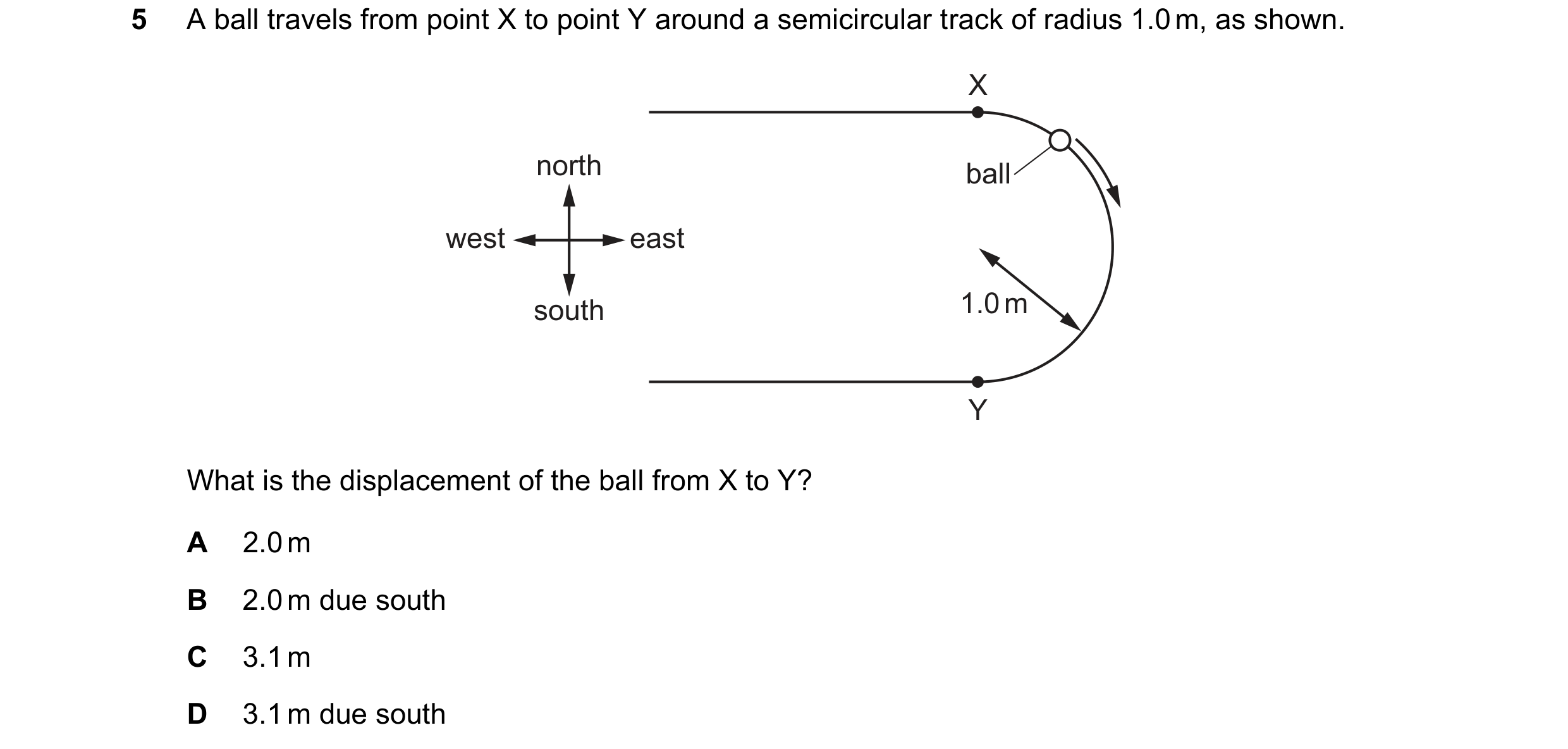
Q114 · A ball travels from point X to point Y around a semicircular track of radius 1.0 m, as… 9702/12 May/June 2023
5 A ball travels from point X to point Y around a semicircular track of radius 1.0 m, as shown. X north ball west east south 1.0 m Y What is the displacement of the ball from X to Y? A 2.0 m B 2.0 m due south C 3.1 m D 3.1 m due south
1 marks
Answer: B
This question in 9702/12 May/June 2023
Q115 · The diagram shows two vectors, X and Y, drawn to scale 9702/13 May/June 2023
4 The diagram shows two vectors, X and Y, drawn to scale. Y X If X = Y – Z, which diagram represents the vector Z? A B C D
1 marks
Answer: A
This question in 9702/13 May/June 2023
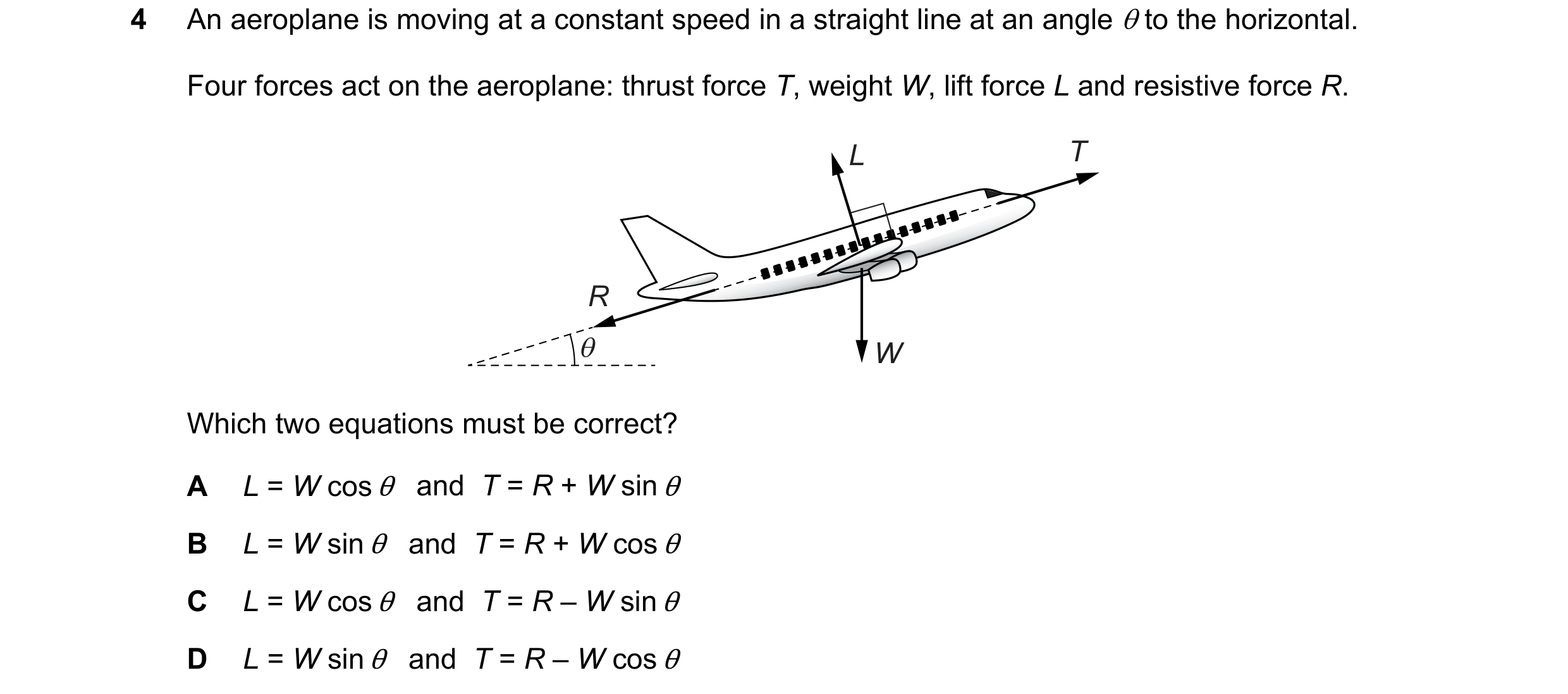
Q116 · Anaeroplane is moving at a constant speed in a straight line at an angle @ to the… 9702/12 Oct/Nov 2023
4 Anaeroplane is moving at a constant speed in a straight line at an angle @ to the horizontal.
Four forces act on the aeroplane: thrust force 7, weight W, lift force L and resistive force R.
L T
Which two equations must be correct?
A L=Wcos@ and T=R+Wsing
B L=Wsin@ and T=R+Wcos@
C L=Wcosé@ and T=R-Wsin#@
D L=Wsin@ and T=R-Wcos@
1 marks
Answer: A
This question in 9702/12 Oct/Nov 2023
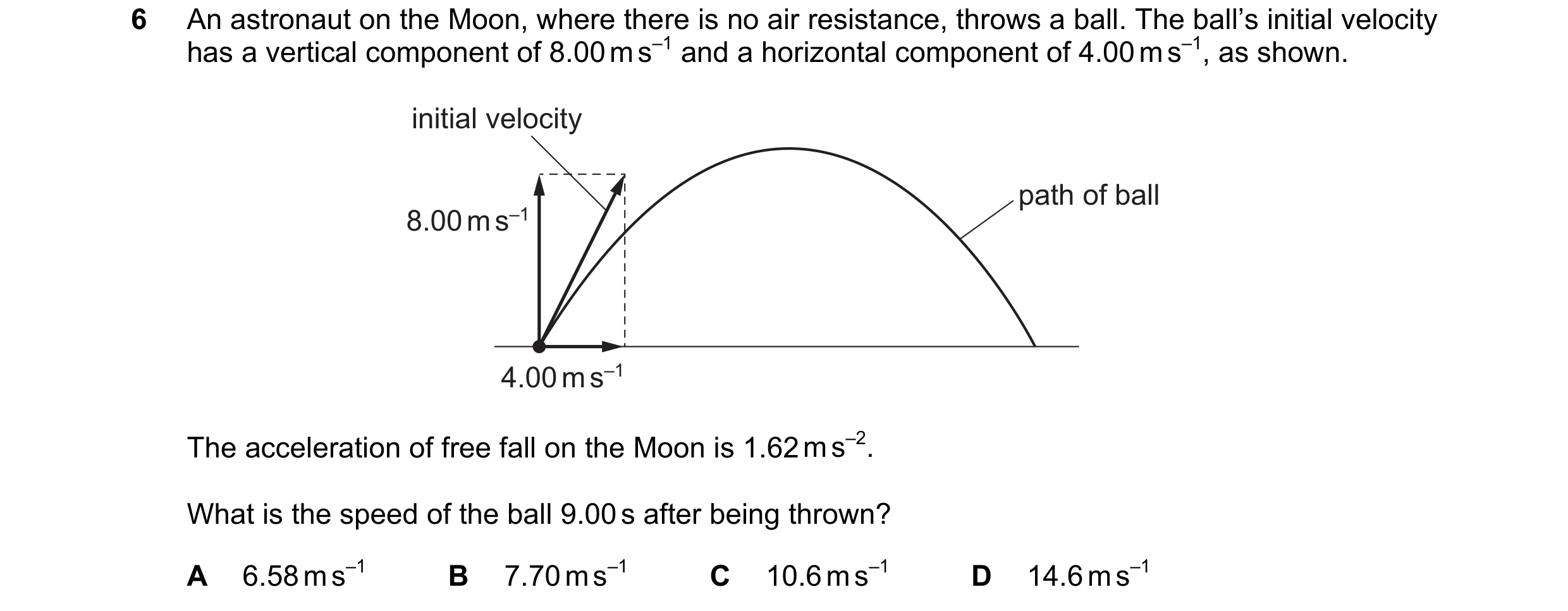
Q117 · An astronaut on the Moon, where there is no air resistance, throws a ball 9702/12 Oct/Nov 2023
6 An astronaut on the Moon, where there is no air resistance, throws a ball. The ball’s initial velocity has a vertical component of 8.00 m s–1 and a horizontal component of 4.00 m s–1, as shown. initial velocity path of ball 8.00 m s–1 4.00 m s–1 The acceleration of free fall on the Moon is 1.62 m s–2. What is the speed of the ball 9.00 s after being thrown? A 6.58 m s–1 B 7.70 m s–1 C 10.6 m s–1 D 14.6 m s–1
1 marks
Answer: B
This question in 9702/12 Oct/Nov 2023
Q118 · A force F is applied at an angle of 45° to a door handle at a distance d from the pivot… 9702/12 Oct/Nov 2023
11 A force F is applied at an angle of 45° to a door handle at a distance d from the pivot of the
handle, as shown.
° i t
48 handle pIvo
What is the moment of the force about the pivot?
Fd B Fd Cc FaV2 D 2Fd
J2
1 marks
Answer: A
This question in 9702/12 Oct/Nov 2023
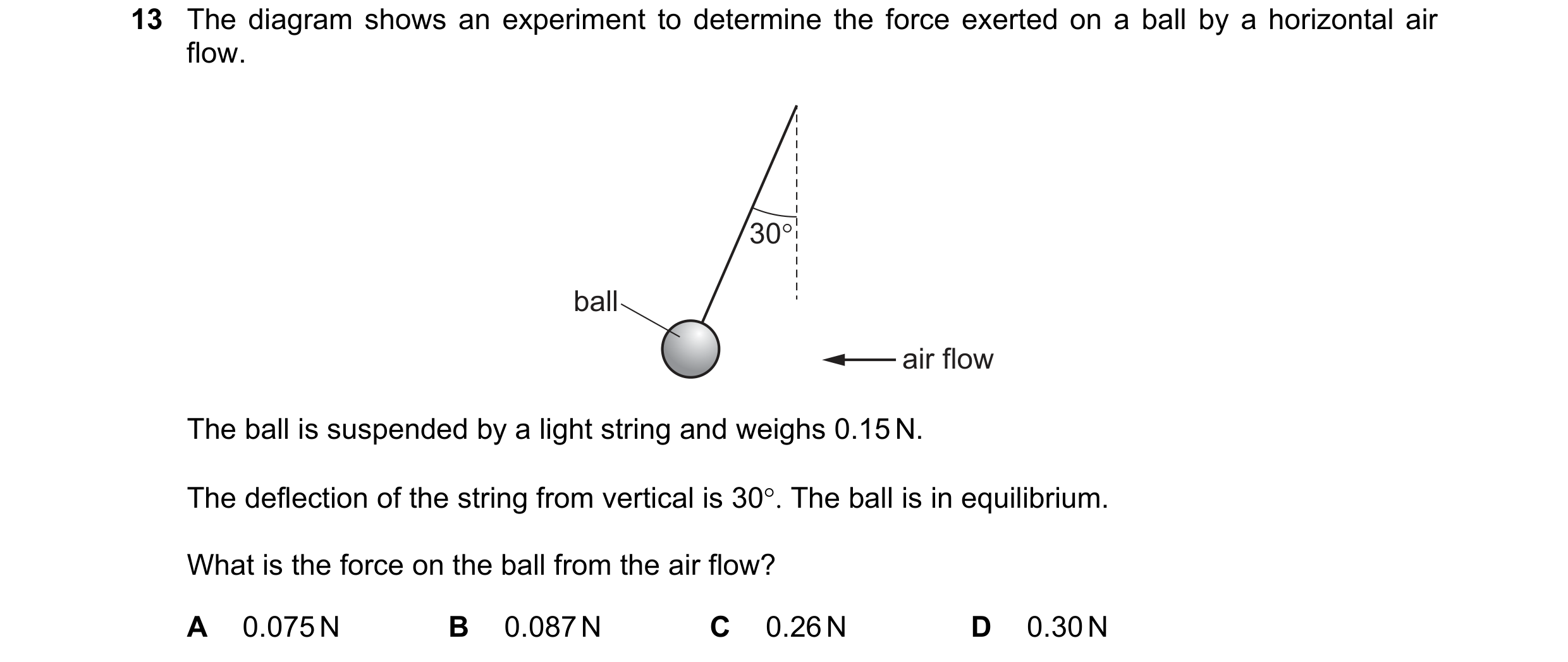
Q119 · The diagram shows an experiment to determine the force exerted on a ball by a horizontal… 9702/12 Oct/Nov 2023
13 The diagram shows an experiment to determine the force exerted on a ball by a horizontal air
flow.
= _ air flow
The ball is suspended by a light string and weighs 0.15N.
The deflection of the string from vertical is 30°. The ball is in equilibrium.
What is the force on the ball from the air flow?
A 0.075N B 0.087N C 0.26N D 0.30N
1 marks
Answer: B
This question in 9702/12 Oct/Nov 2023
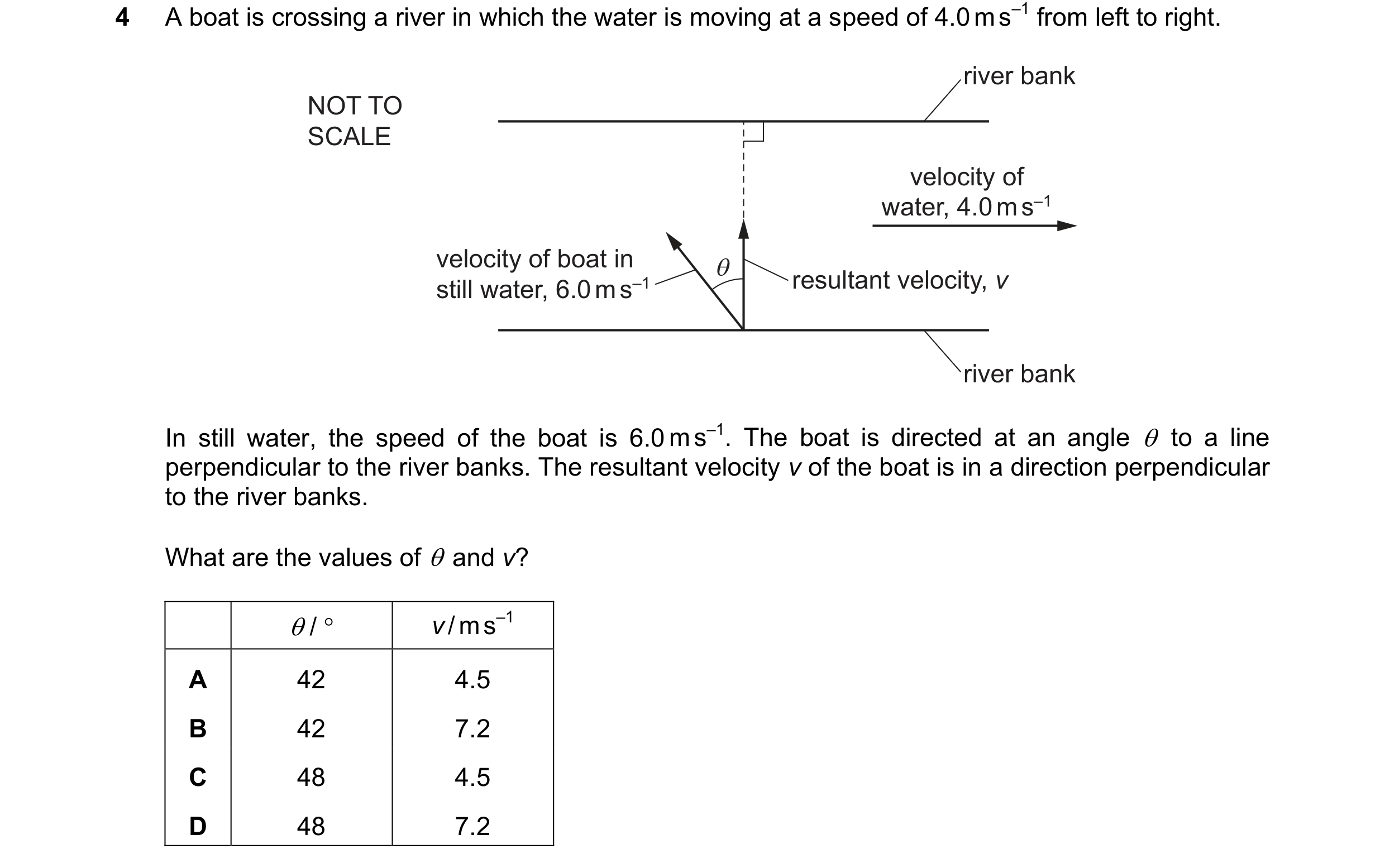
Q120 · A boat is crossing a river in which the water is moving at a speed of 4.0ms™ from left to… 9702/13 Oct/Nov 2023
4 A boat is crossing a river in which the water is moving at a speed of 4.0ms™ from left to right.
river bank
NOT TO VA
SCALE
velocity of
water, 4.0ms
— TT _£_§__=
velocity of boat in f)
still water. 6.0ms7 resultant velocity, v
river bank
In still water, the speed of the boat is 6.0ms™'. The boat is directed at an angle @ to a line
perpendicular to the river banks. The resultant velocity v of the boat is in a direction perpendicular
to the river banks.
What are the values of 0 and v?
gl° vims'
A 42 4.5
B 42 7.2
Cc 48 4.5
D 48 7.2
1 marks
Answer: A
This question in 9702/13 Oct/Nov 2023
Q121 · A projectile is launched at an angle of 25 to the horizontal with a horizontal component… 9702/12 Feb/March 2024
5 A projectile is launched at an angle of 25 to the horizontal with a horizontal component of velocity of 13 m s–1. What is the vertical component of the velocity of the projectile when it is launched? A 5.5 m s–1 B 6.1 m s–1 C 12 m s–1 D 14 m s–1
1 marks
Answer: B
This question in 9702/12 Feb/March 2024
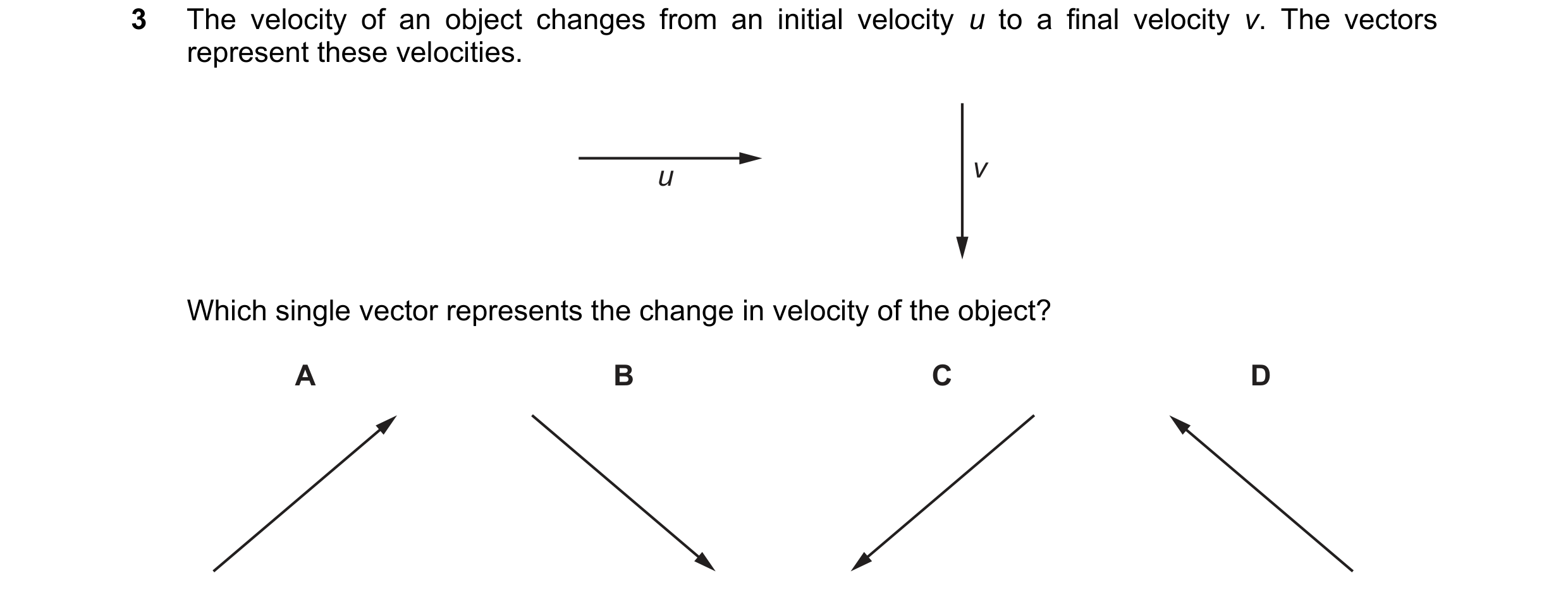
Q122 · The velocity of an object changes from an initial velocity u to a final velocity v 9702/11 May/June 2024
3 The velocity of an object changes from an initial velocity u to a final velocity v. The vectors represent these velocities. u v Which single vector represents the change in velocity of the object? A B C D
1 marks
Answer: C
This question in 9702/11 May/June 2024
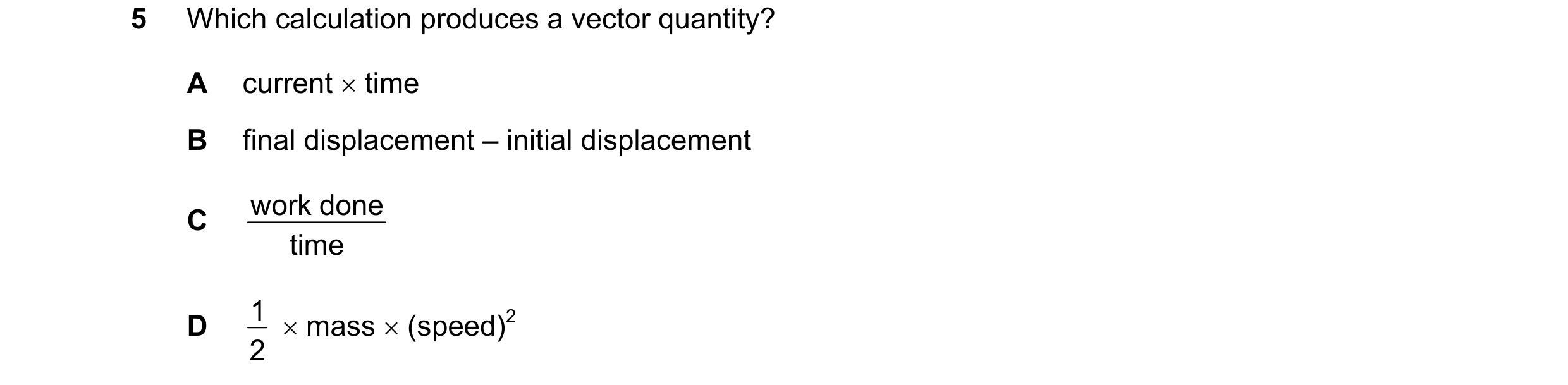
Q123 · Which calculation produces a vector quantity? 9702/11 May/June 2024
5 Which calculation produces a vector quantity? A current time B final displacement – initial displacement work done C time 1 mass (speed)2 D 2
1 marks
Answer: B
This question in 9702/11 May/June 2024
Q124 · What is a scalar quantity? 9702/12 May/June 2024
1 What is a scalar quantity? A a quantity that can be represented as two perpendicular components B a quantity that does not require a unit C a quantity without a direction D a quantity without a magnitude
1 marks
Answer: C
This question in 9702/12 May/June 2024
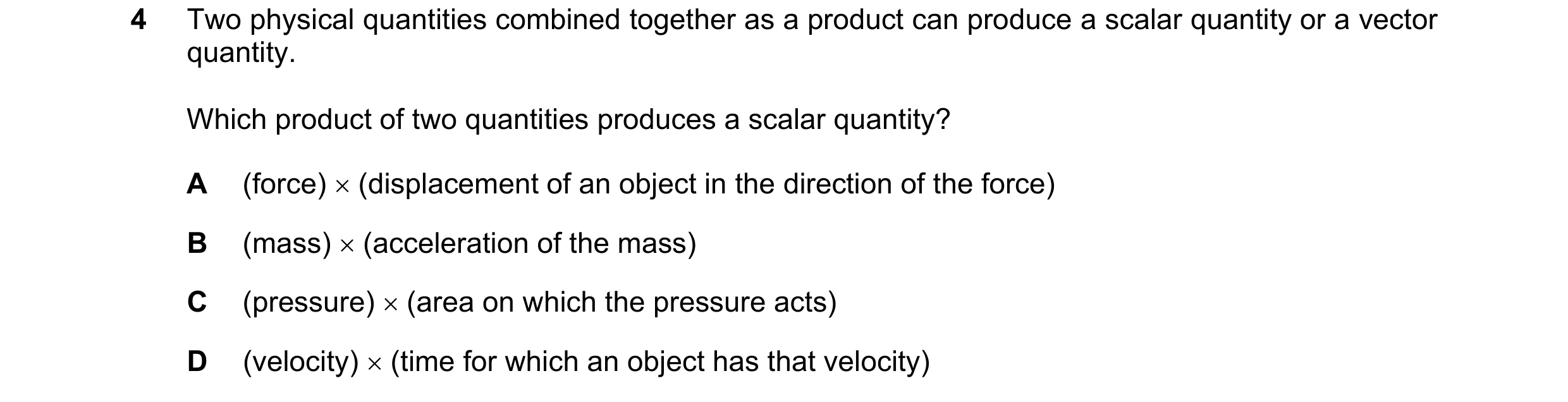
Q125 · Two physical quantities combined together as a product can produce a scalar quantity or a… 9702/13 May/June 2024
4 Two physical quantities combined together as a product can produce a scalar quantity or a vector quantity. Which product of two quantities produces a scalar quantity? A (force) (displacement of an object in the direction of the force) B (mass) (acceleration of the mass) C (pressure) (area on which the pressure acts) D (velocity) (time for which an object has that velocity)
1 marks
Answer: A
This question in 9702/13 May/June 2024
Q126 · Which statement about vector quantities is correct? 9702/11 Oct/Nov 2024
2 Which statement about vector quantities is correct? A Acceleration of free fall is a vector quantity because it has a constant magnitude. B Temperature in C is a vector quantity because it can be positive or negative. C Time is a vector quantity because it can only go in the forwards direction. D Weight is a vector quantity because it has a direction.
1 marks
Answer: D
This question in 9702/11 Oct/Nov 2024
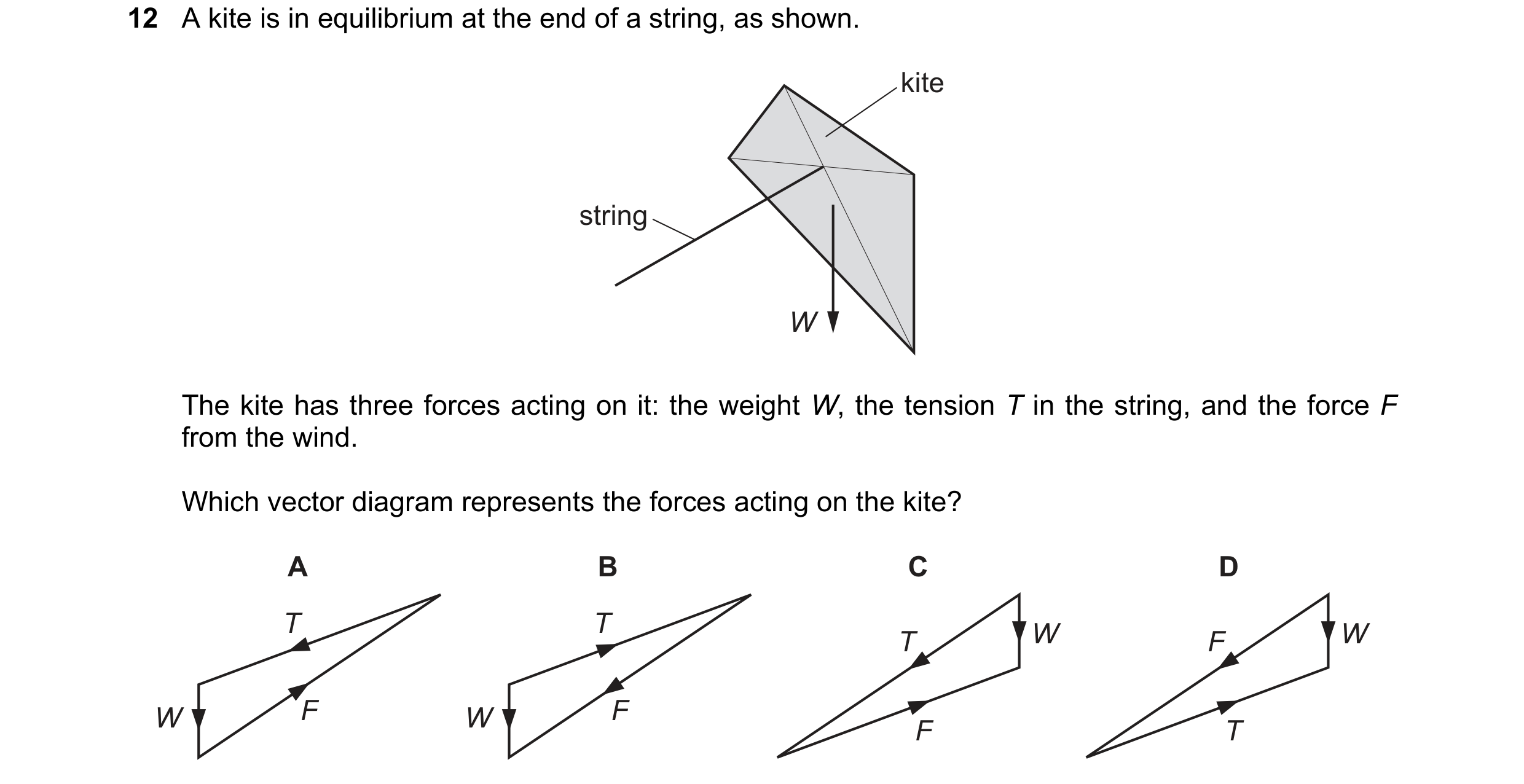
Q127 · A kite is in equilibrium at the end of a string, as shown 9702/12 Oct/Nov 2024
12 A kite is in equilibrium at the end of a string, as shown. kite string W The kite has three forces acting on it: the weight W, the tension T in the string, and the force F from the wind. Which vector diagram represents the forces acting on the kite? A B C D T T W W T F W F W F F T
1 marks
Answer: A
This question in 9702/12 Oct/Nov 2024
Q128 · Which quantity is a scalar quantity? 9702/12 Feb/March 2025
1 Which quantity is a scalar quantity? A force B momentum C velocity D work
1 marks
Answer: D
This question in 9702/12 Feb/March 2025
Q129 · Objects P and Q form an isolated system 9702/12 Feb/March 2025
7 Objects P and Q form an isolated system. Object P has mass 6.0 kg and is moving at a speed of 3.0 m s–1. Object Q has mass 2.0 kg and is moving at a speed of 4.2 m s–1 at an angle of 35° to the path of P. Q 2.0 kg 35° P 4.2 m s–1 6.0 kg 3.0 m s–1 Objects P and Q collide and stick together. What is the magnitude of the component of the final momentum of the combined objects in the original direction of P? A 9.6 kg m s–1 B 11 kg m s–1 C 13 kg m s–1 D 25 kg m s–1
1 marks
Answer: B
This question in 9702/12 Feb/March 2025
Q130 · Which quantity is a vector? 9702/11 May/June 2025
1 Which quantity is a vector? A pressure B temperature C weight D work
1 marks
Answer: C
This question in 9702/11 May/June 2025
Q131 · Two vectors, X and Y, are shown 9702/11 May/June 2025
4 Two vectors, X and Y, are shown. X Y What are the directions of X + Y and X – Y? X + Y X – Y A B C D
1 marks
Answer: B
This question in 9702/11 May/June 2025
Q132 · What represents a vector quantity? 9702/13 May/June 2025
1 What represents a vector quantity? A 1 N upwards B 2 kg decrease C 3 K cooler D 4 s later
1 marks
Answer: A
This question in 9702/13 May/June 2025
Q133 · The diagram shows two fixed pins, Y and Z 9702/14 May/June 2025
4 The diagram shows two fixed pins, Y and Z. A length of elastic is stretched between Y and Z and around pin X, which is attached to a trolley. Y 50 mm X 80 mm P trolley 30 mm Z X is at the centre of the elastic and the trolley is to be propelled in the direction P at right angles to YZ. The tension in the elastic is 4.0 N. What is the force accelerating the trolley in the direction P when the trolley is released? A 2.4 N B 3.2 N C 4.8 N D 6.4 N
1 marks
Answer: C
This question in 9702/14 May/June 2025
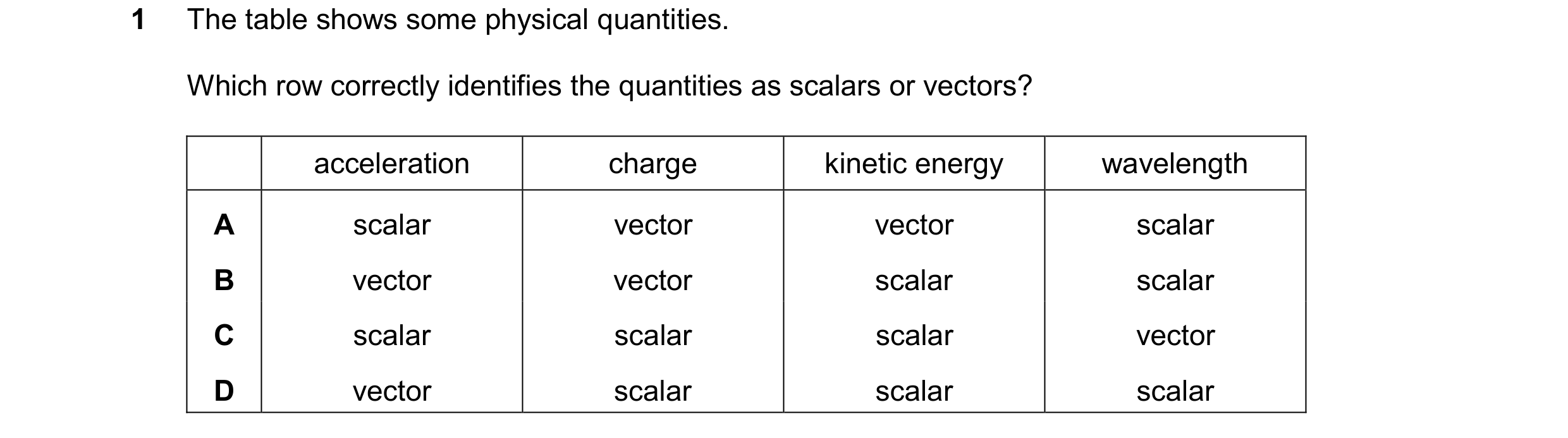
Q134 · The table shows some physical quantities 9702/11 Oct/Nov 2025
1 The table shows some physical quantities. Which row correctly identifies the quantities as scalars or vectors? acceleration charge kinetic energy wavelength A scalar vector vector scalar B vector vector scalar scalar C scalar scalar scalar vector D vector scalar scalar scalar
1 marks
Answer: D
This question in 9702/11 Oct/Nov 2025
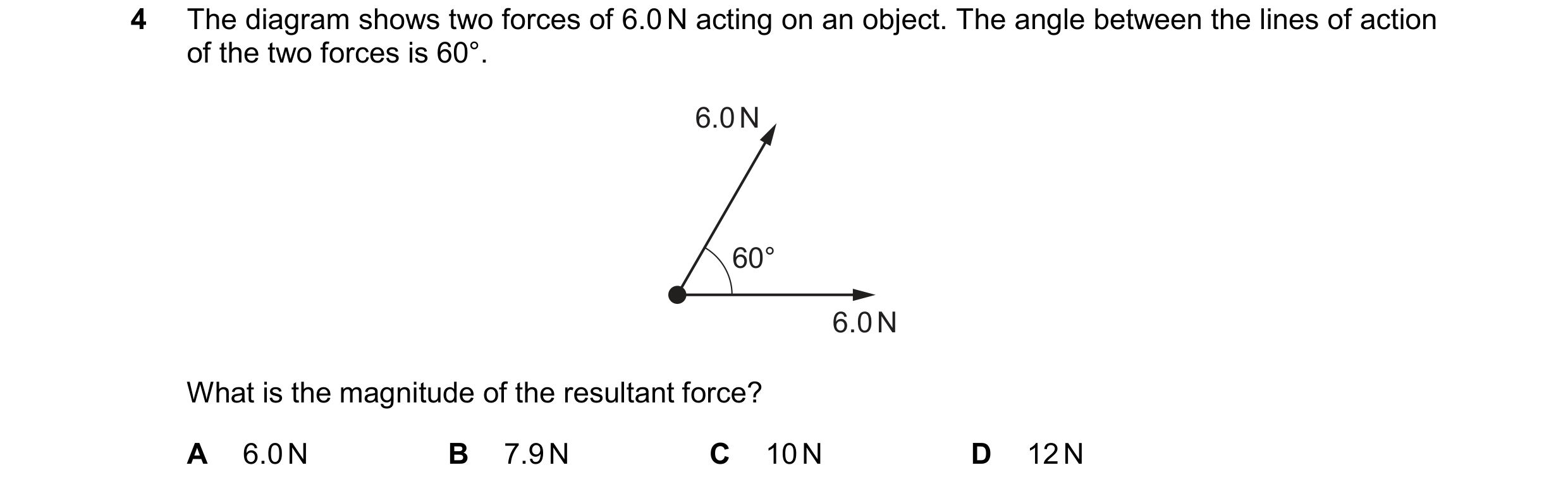
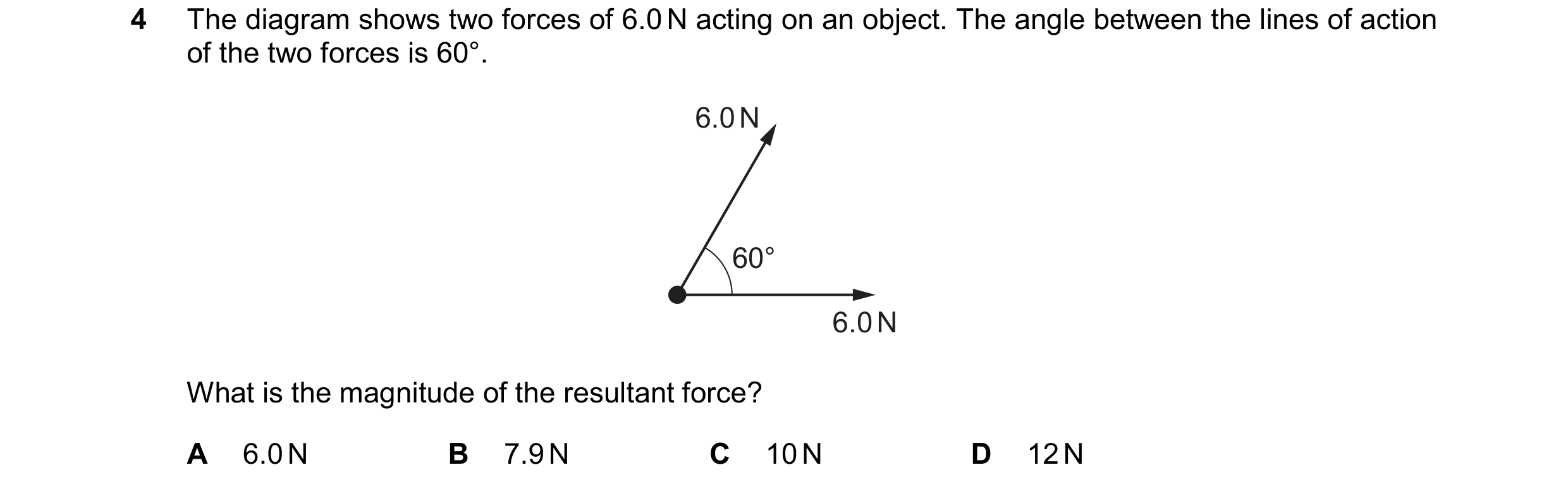
Q135 · The diagram shows two forces of 6.0 N acting on an object 9702/11 Oct/Nov 2025
4 The diagram shows two forces of 6.0 N acting on an object. The angle between the lines of action of the two forces is 60°. 6.0 N 60° 6.0 N What is the magnitude of the resultant force? A 6.0 N B 7.9 N C 10 N D 12 N
1 marks
Answer: C
This question in 9702/11 Oct/Nov 2025
Q136 · The diagram shows the view from above of two balls moving along a horizontal frictionless… 9702/12 Oct/Nov 2025
10 The diagram shows the view from above of two balls moving along a horizontal frictionless surface before they collide. The momentum of each ball is also shown. 4.0 N s 8.0 N s The balls stick together during the collision. Which vector diagram represents the combined momentum of the balls after the collision? A B C D
1 marks
Answer: B
This question in 9702/12 Oct/Nov 2025
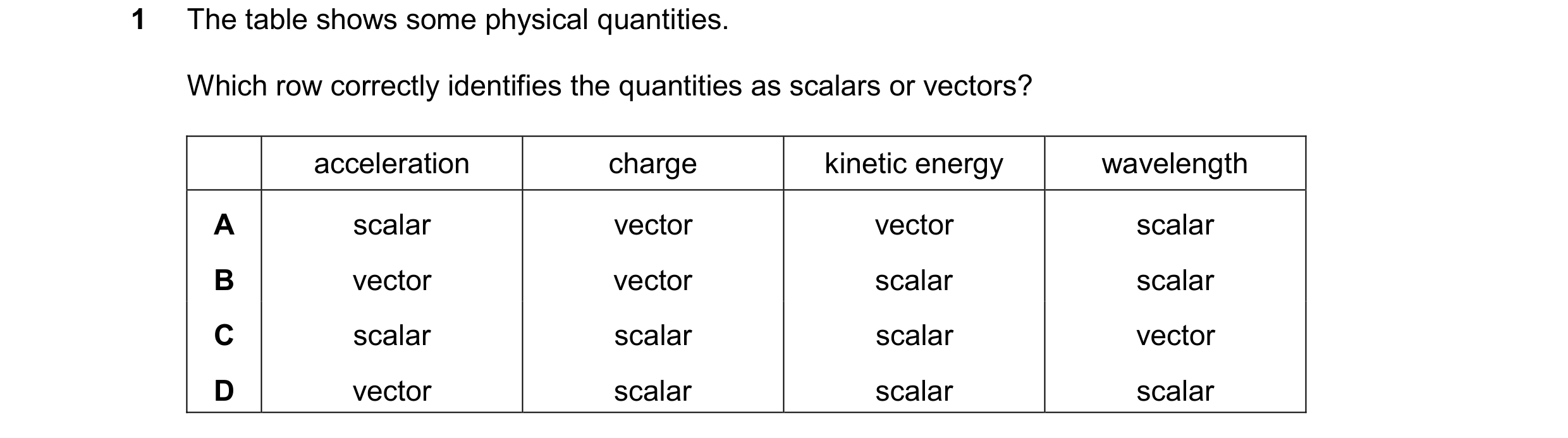
Q137 · The table shows some physical quantities 9702/13 Oct/Nov 2025
1 The table shows some physical quantities. Which row correctly identifies the quantities as scalars or vectors? acceleration charge kinetic energy wavelength A scalar vector vector scalar B vector vector scalar scalar C scalar scalar scalar vector D vector scalar scalar scalar
1 marks
Answer: D
This question in 9702/13 Oct/Nov 2025
Q138 · The diagram shows two forces of 6.0 N acting on an object 9702/13 Oct/Nov 2025
4 The diagram shows two forces of 6.0 N acting on an object. The angle between the lines of action of the two forces is 60°. 6.0 N 60° 6.0 N What is the magnitude of the resultant force? A 6.0 N B 7.9 N C 10 N D 12 N
1 marks
Answer: C
This question in 9702/13 Oct/Nov 2025
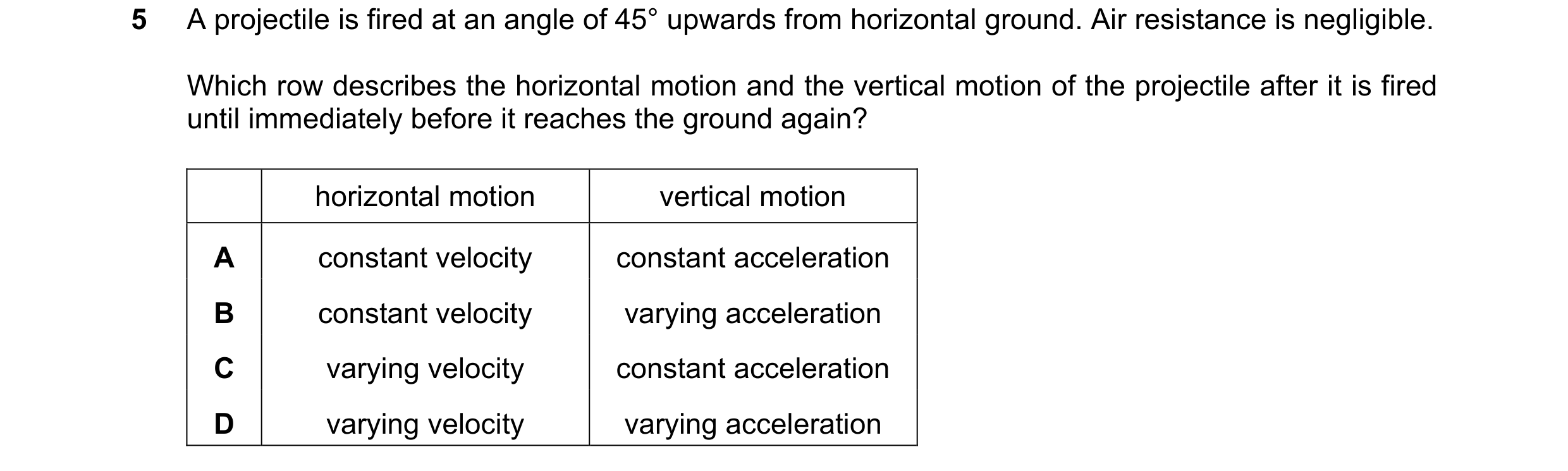
Q139 · A projectile is fired at an angle of 45° upwards from horizontal ground 9702/14 Oct/Nov 2025
5 A projectile is fired at an angle of 45° upwards from horizontal ground. Air resistance is negligible. Which row describes the horizontal motion and the vertical motion of the projectile after it is fired until immediately before it reaches the ground again? horizontal motion vertical motion A constant velocity constant acceleration B constant velocity varying acceleration C varying velocity constant acceleration D varying velocity varying acceleration
1 marks
Answer: A
This question in 9702/14 Oct/Nov 2025

 1 / 51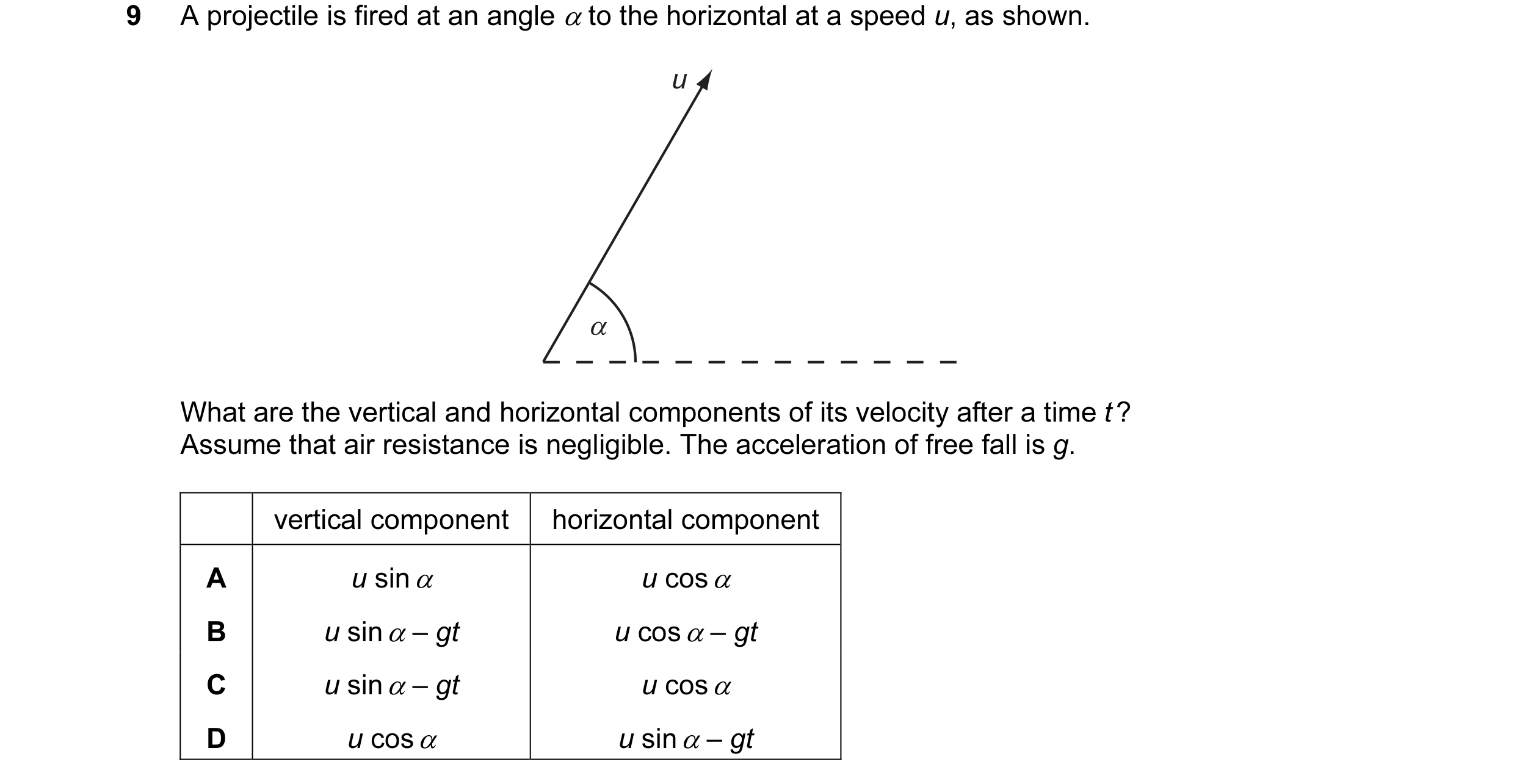
 2 / 51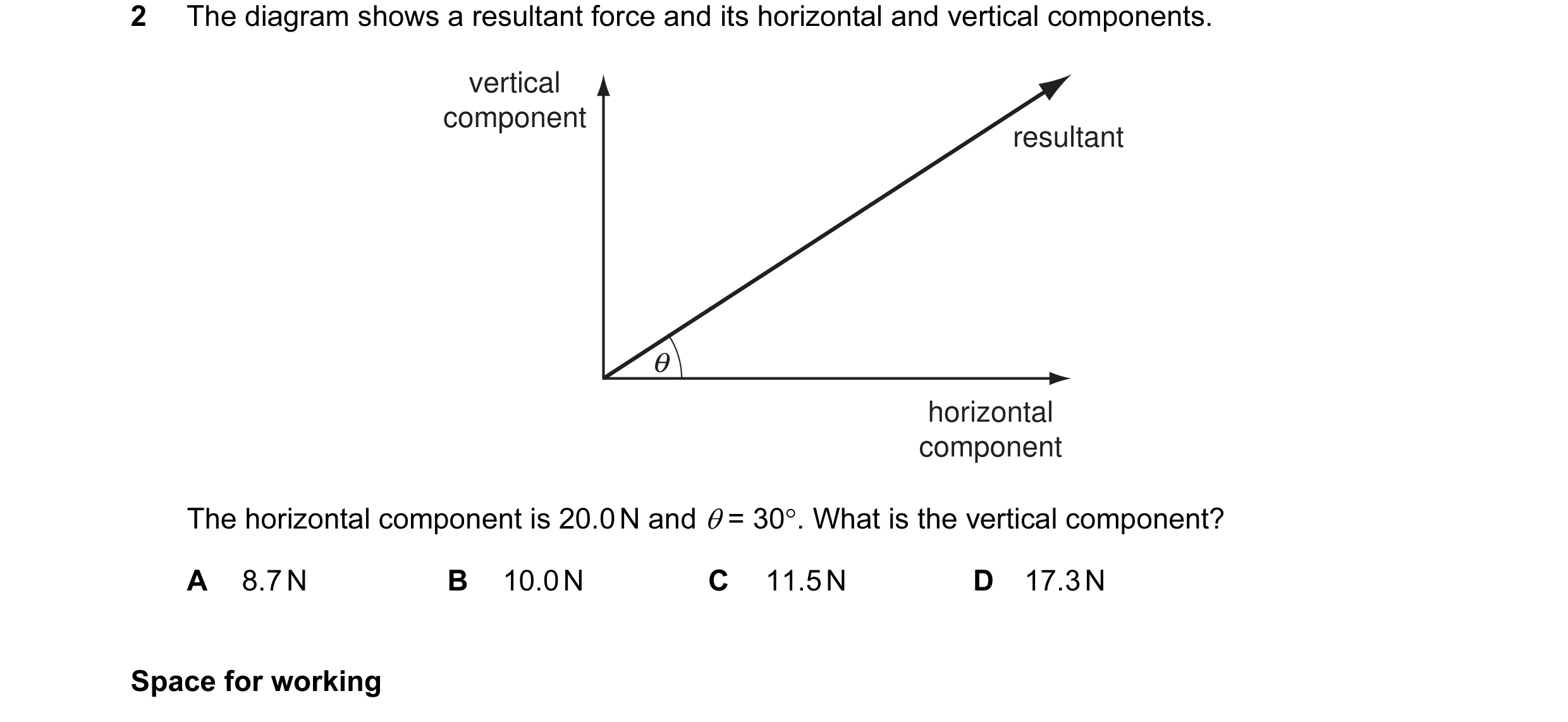
 3 / 51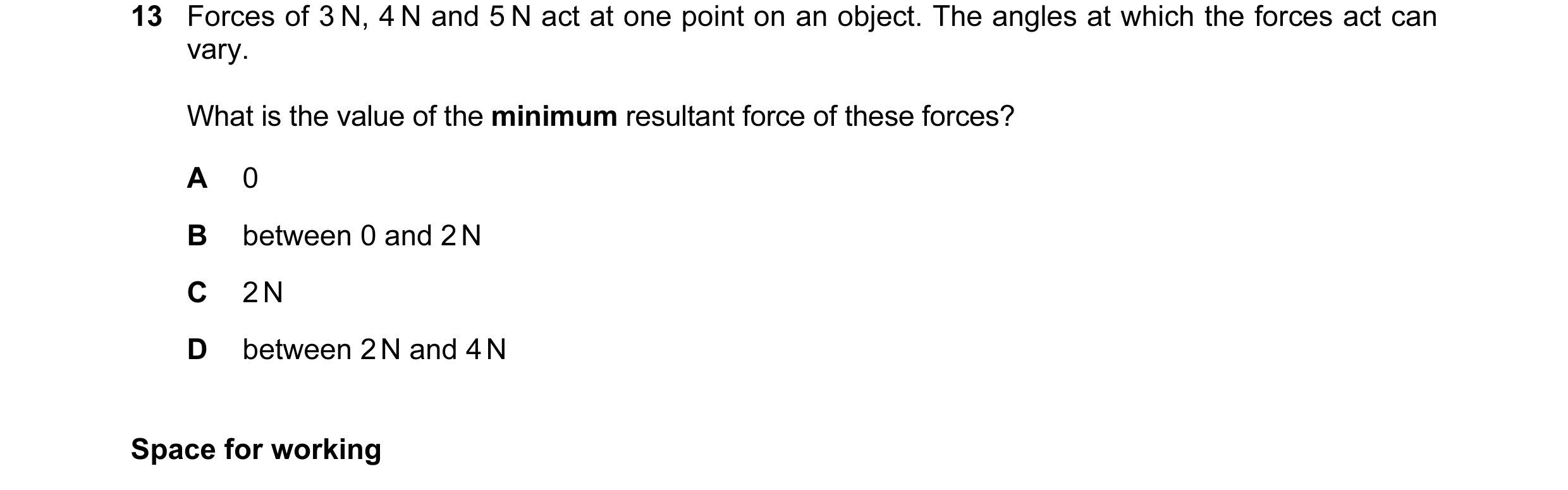
 4 / 51
 5 / 51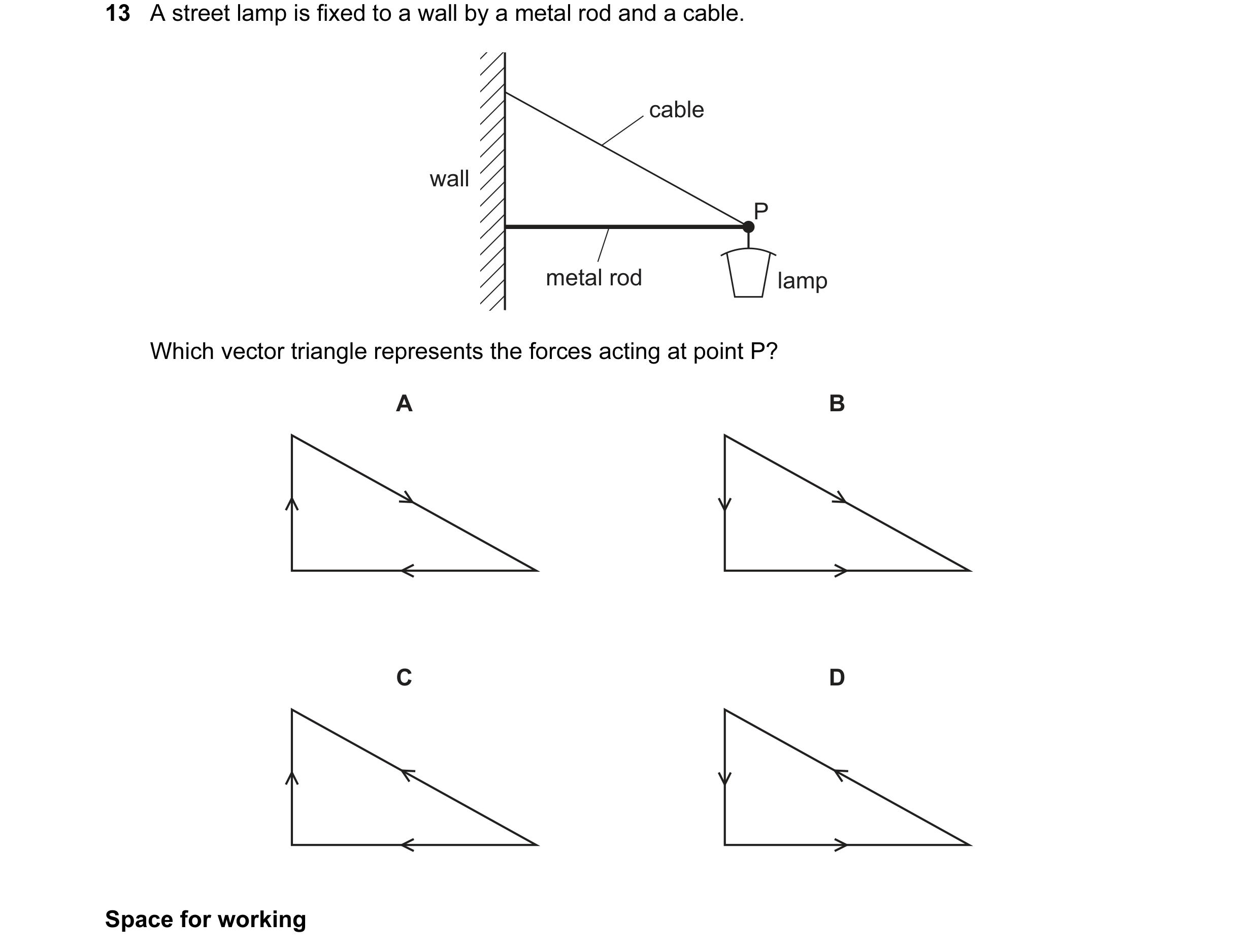
 6 / 51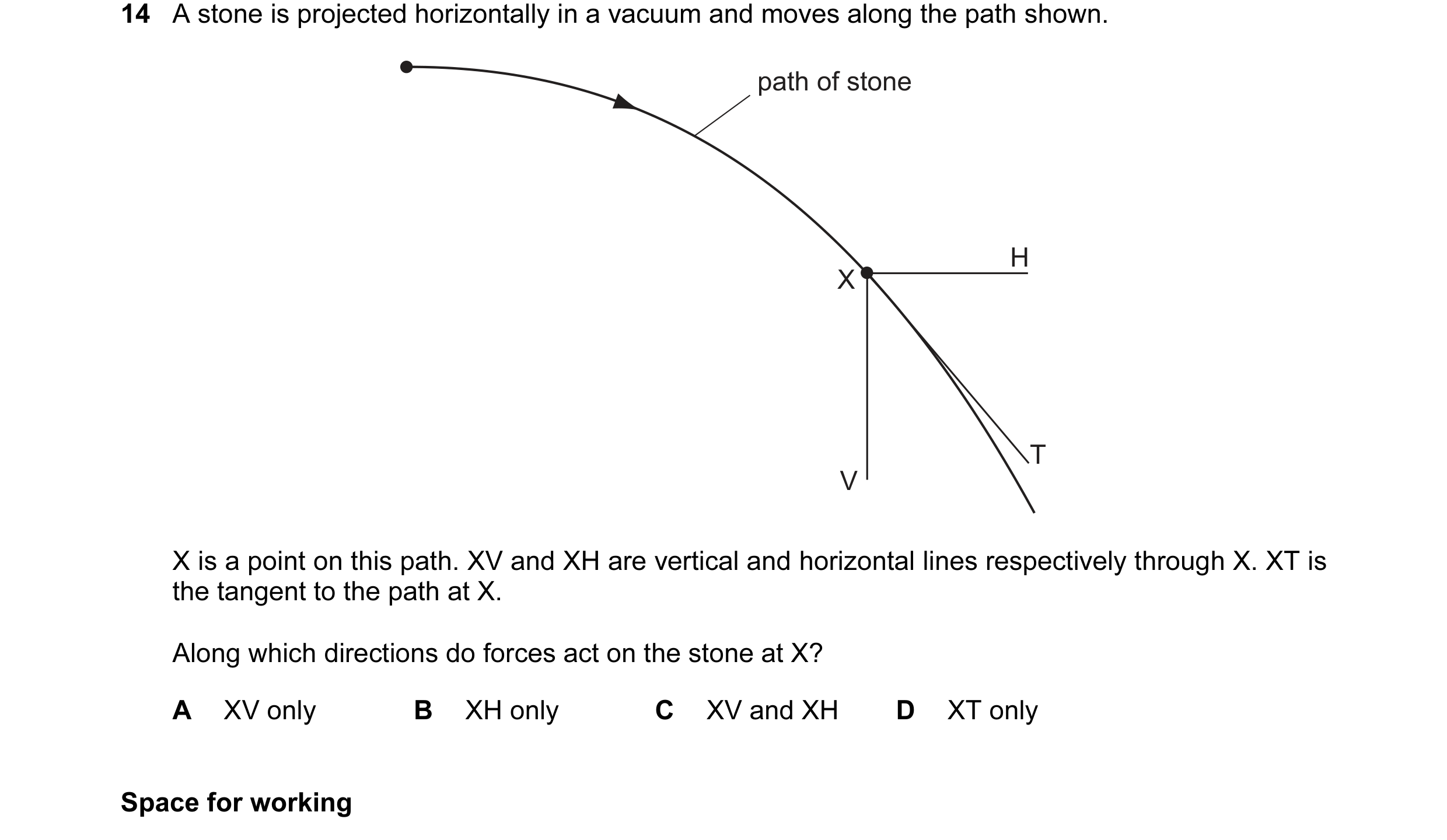
 7 / 51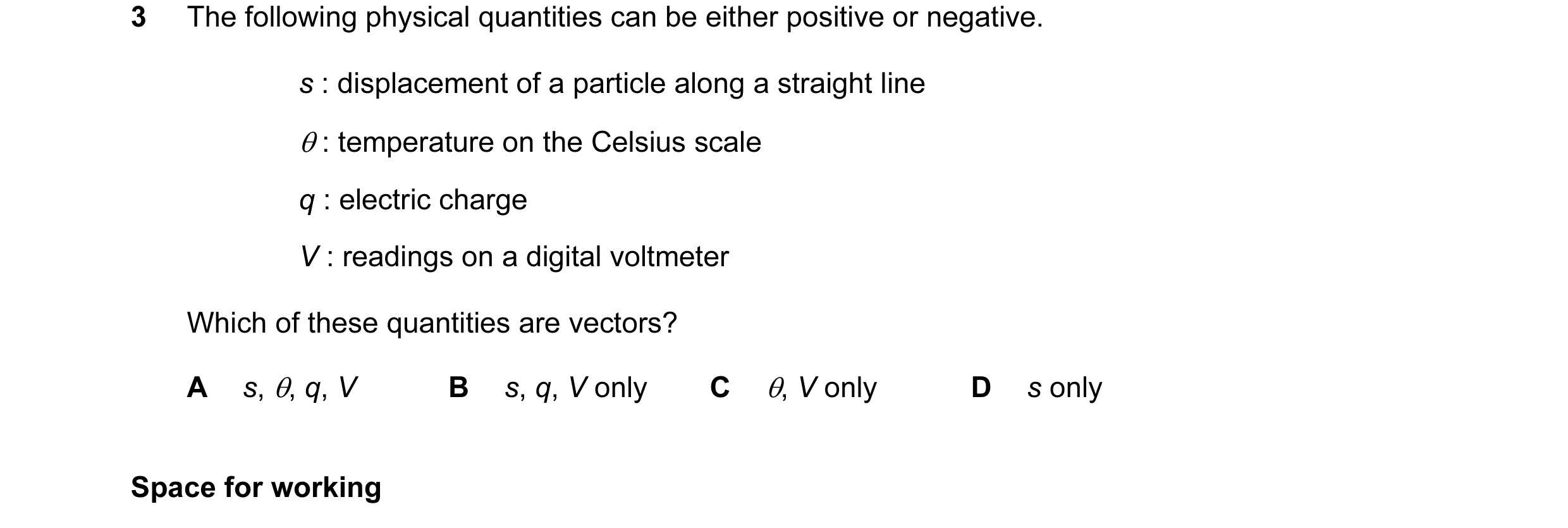
 8 / 51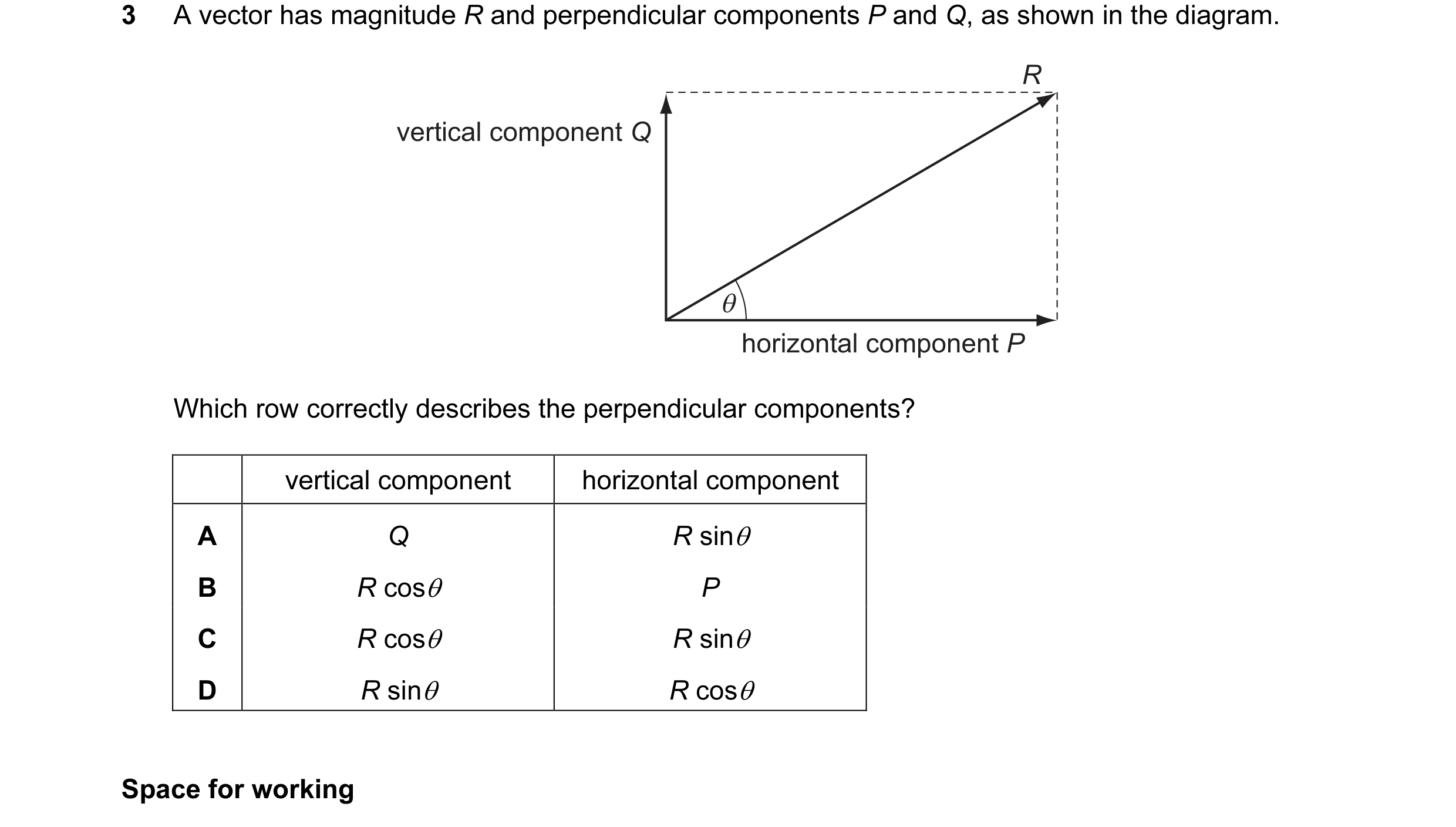
 9 / 51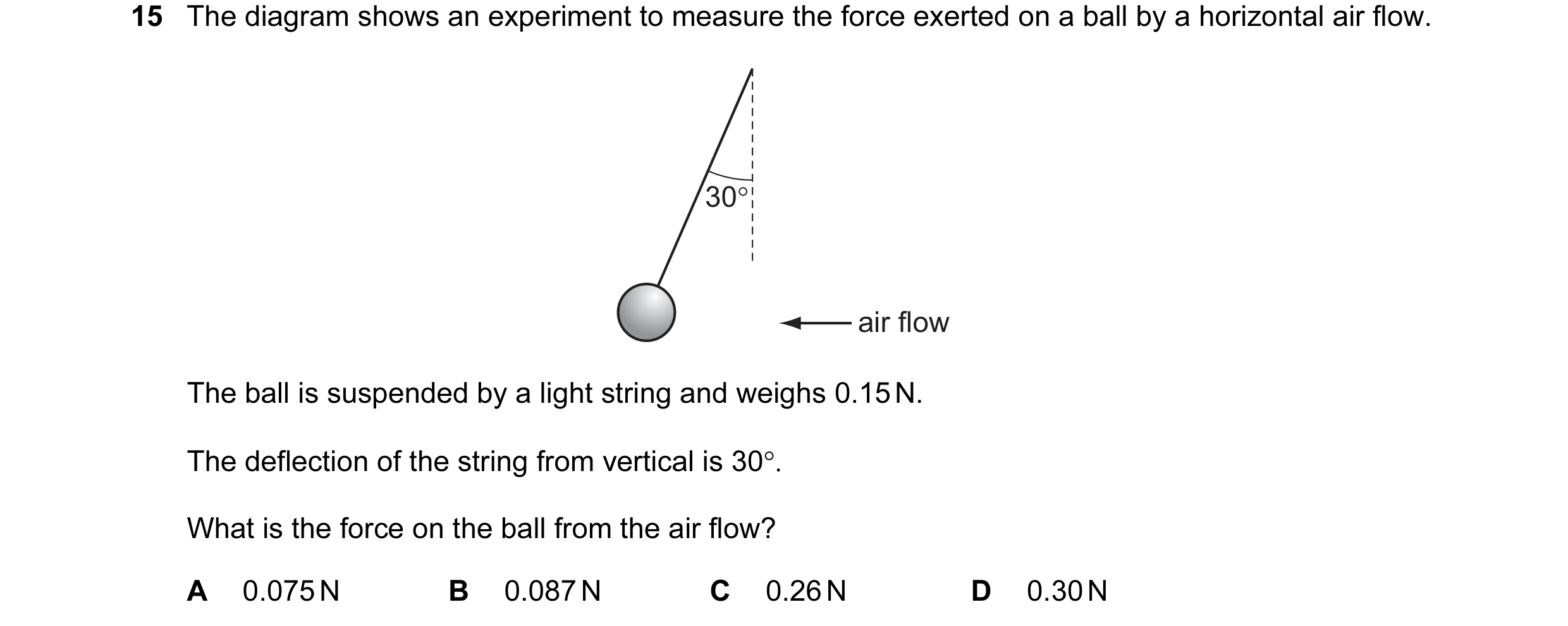
 10 / 51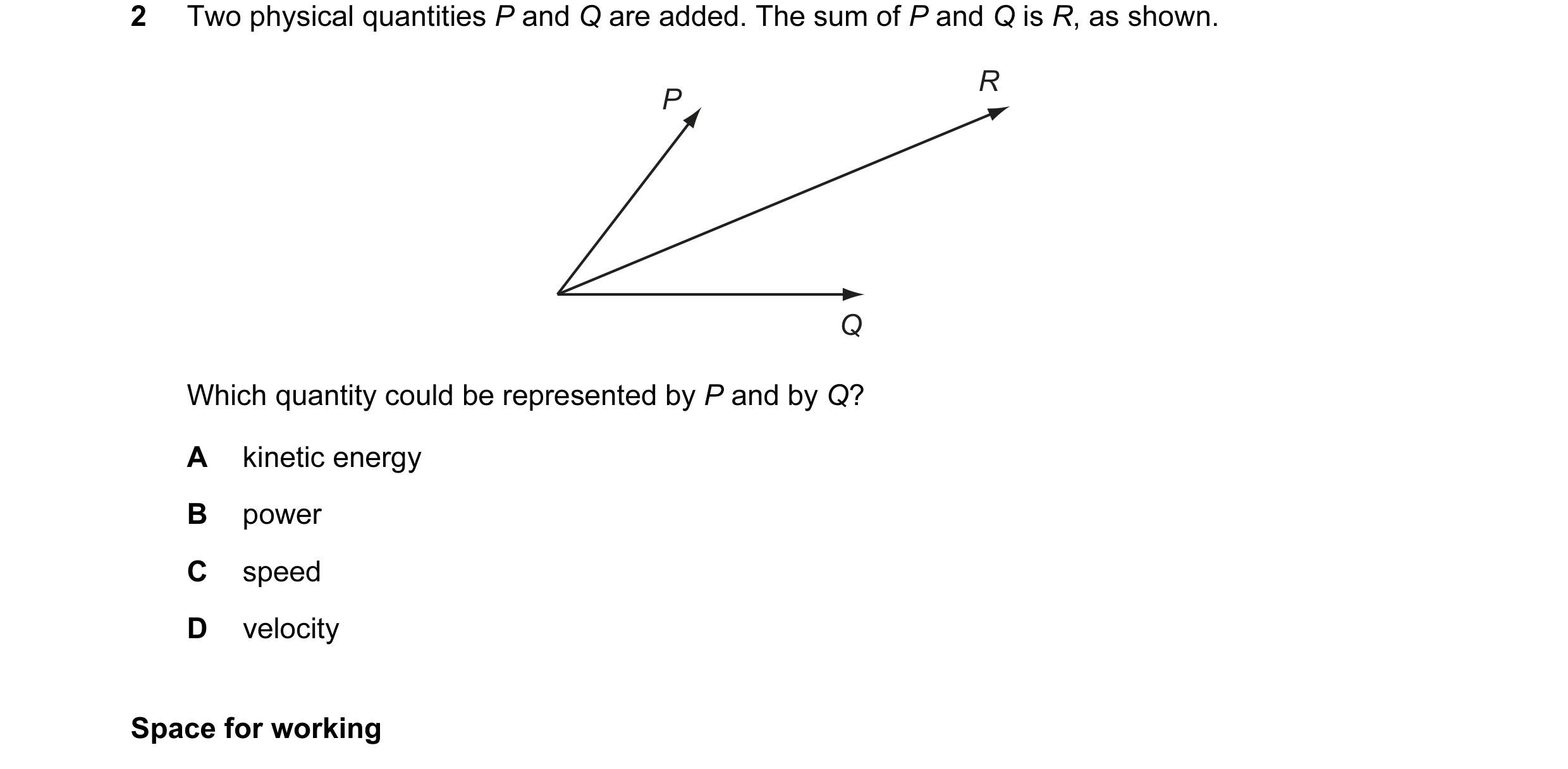

 11 / 51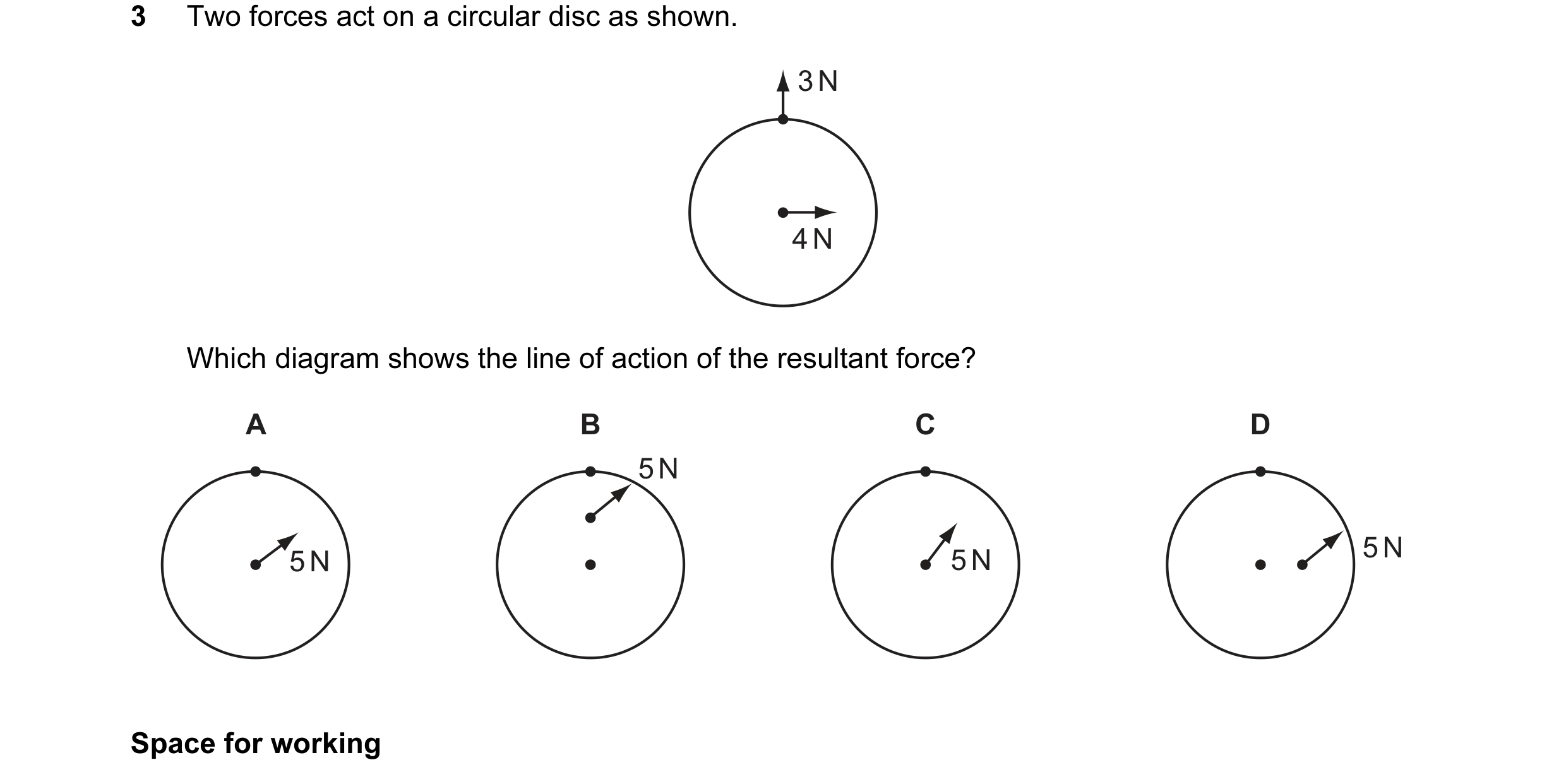
 12 / 51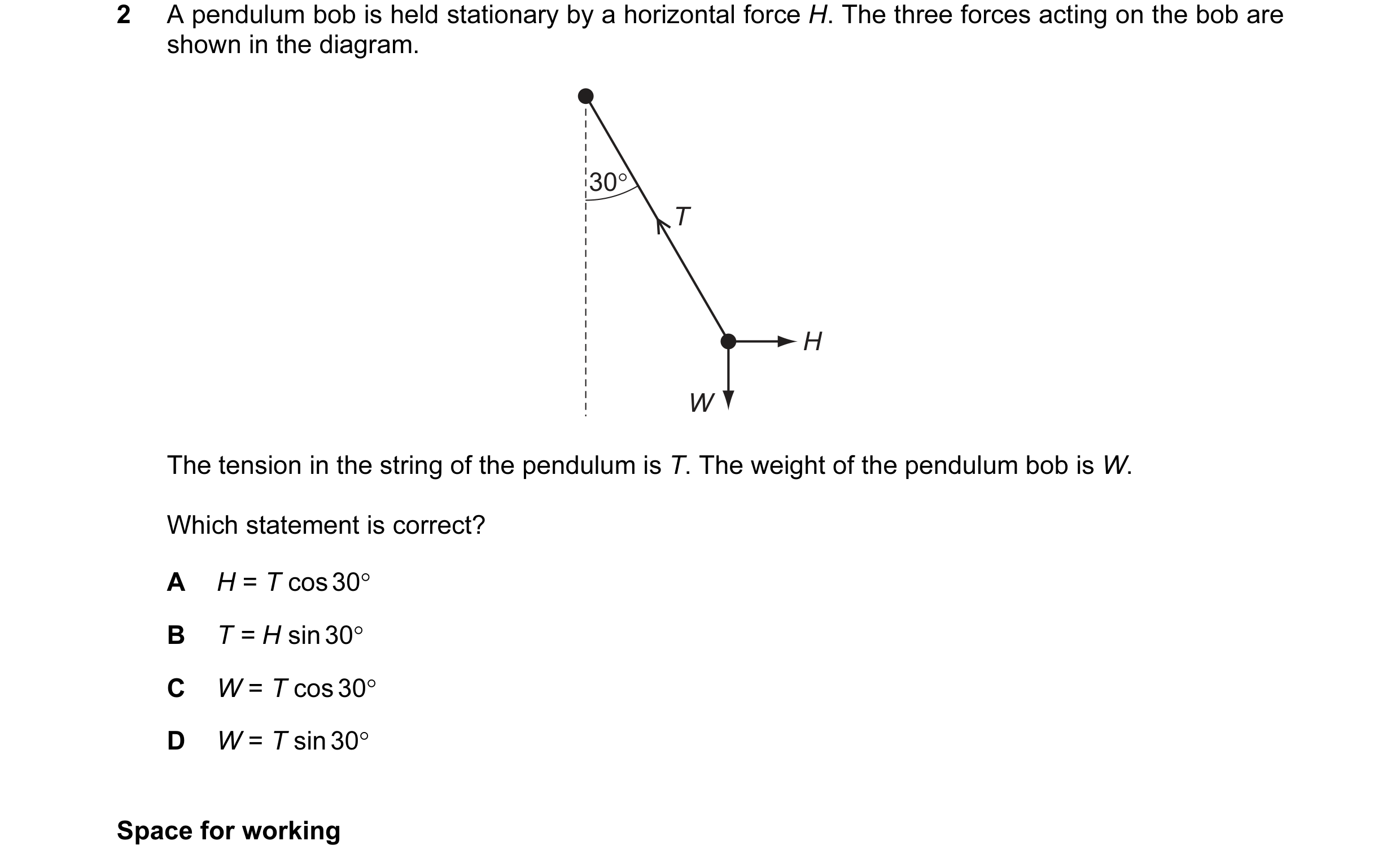
 13 / 51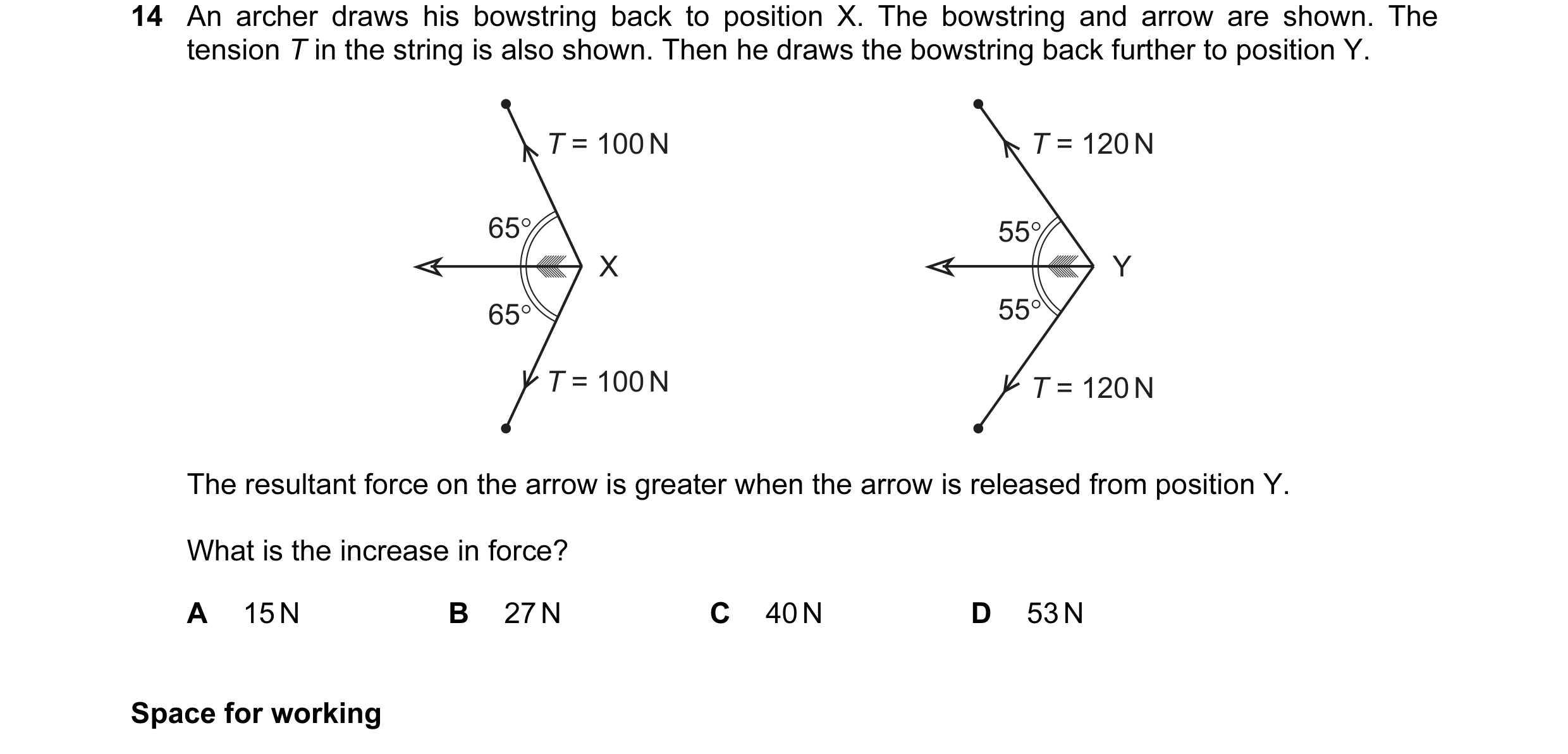
 14 / 51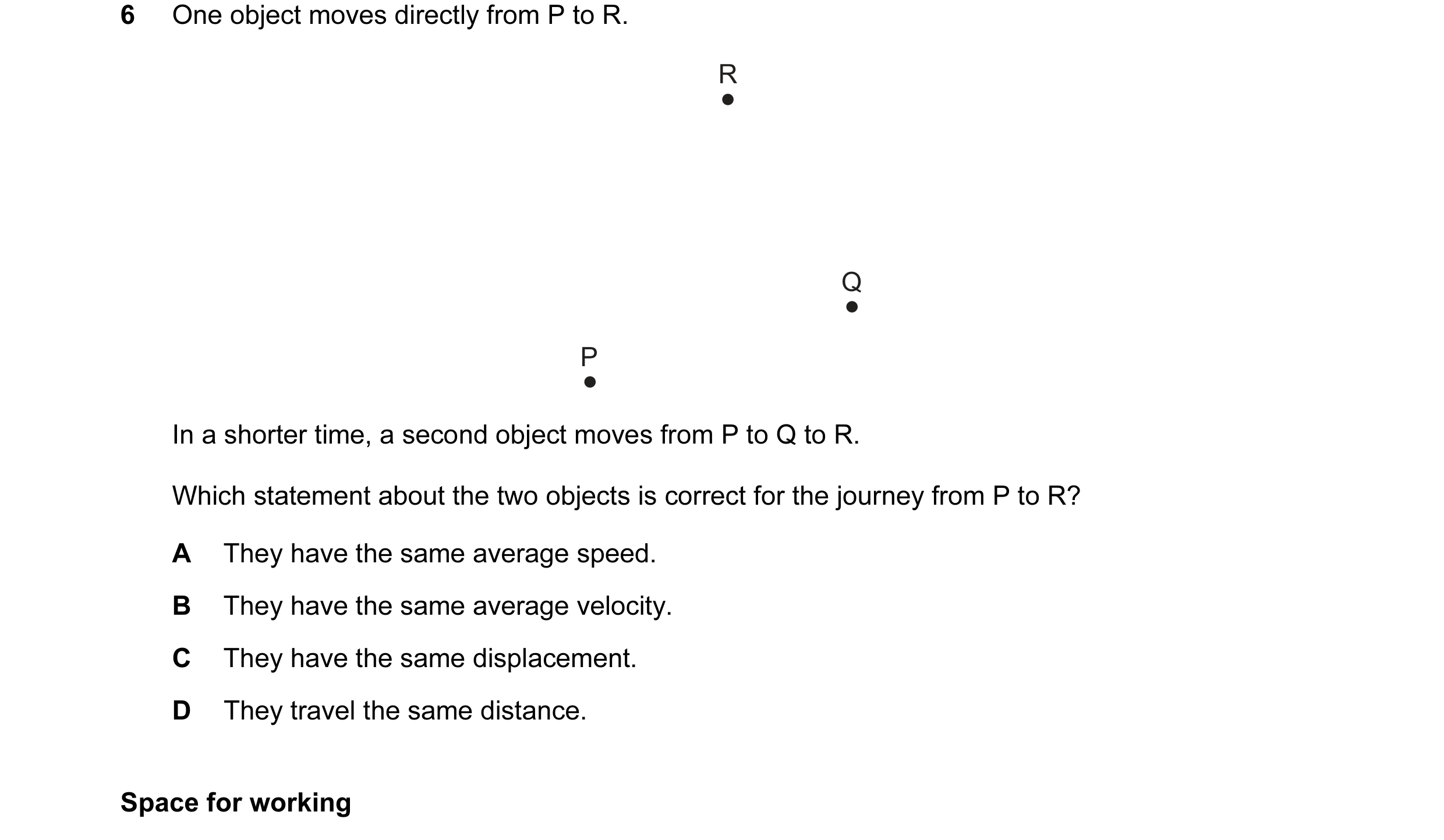
 15 / 51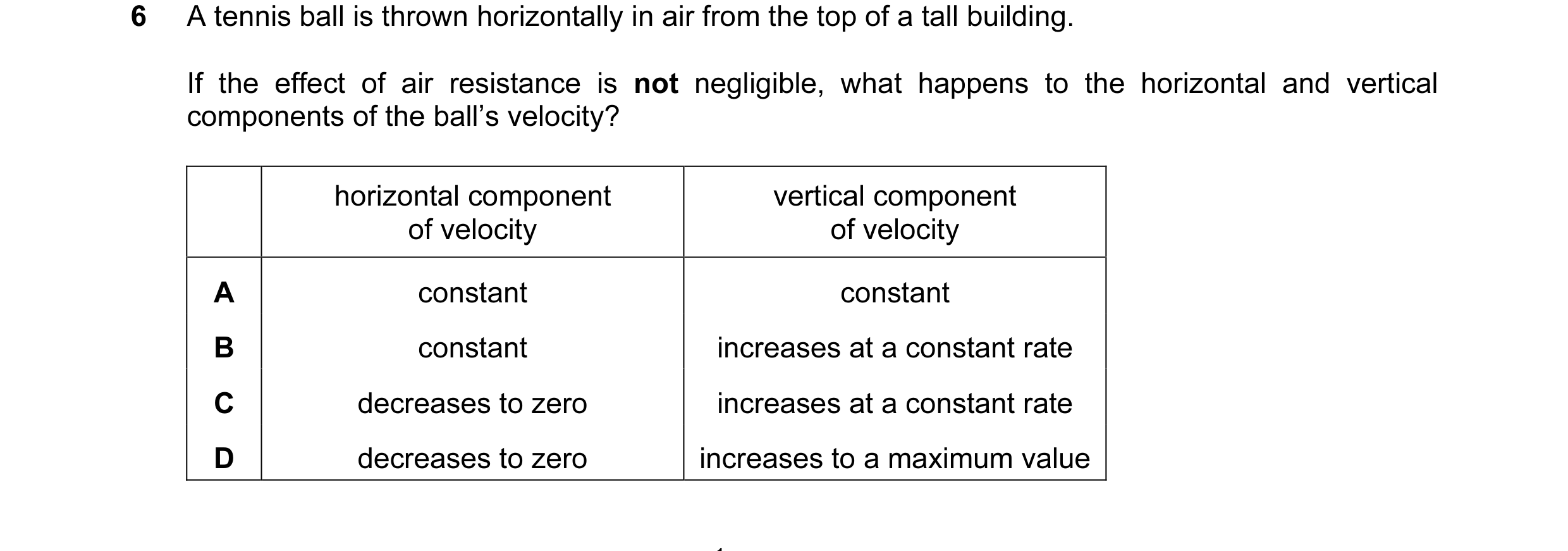
 16 / 51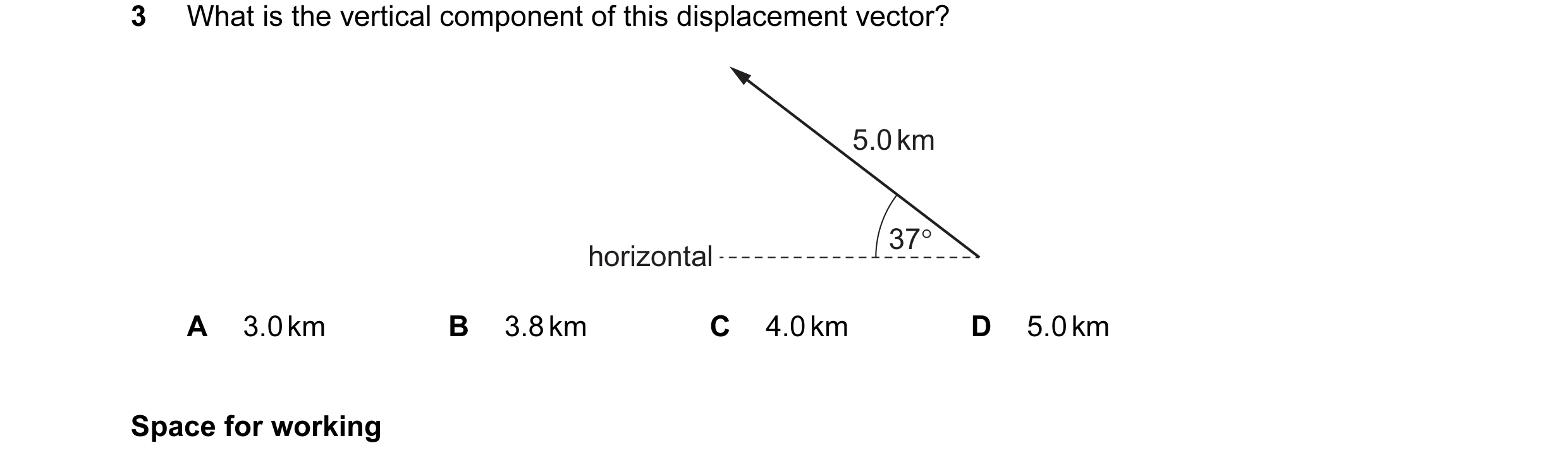

 17 / 51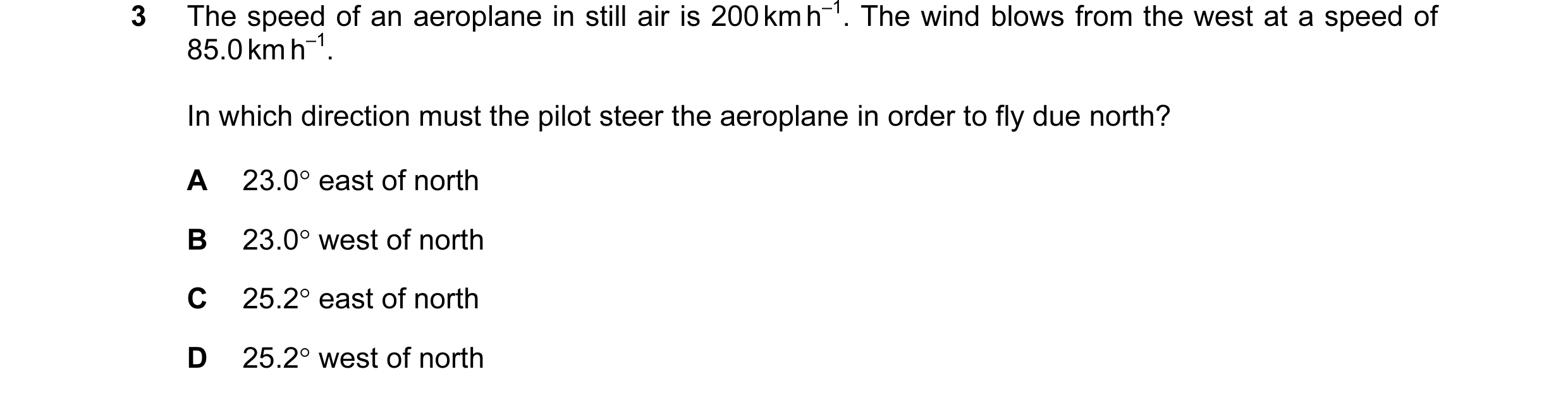
 18 / 51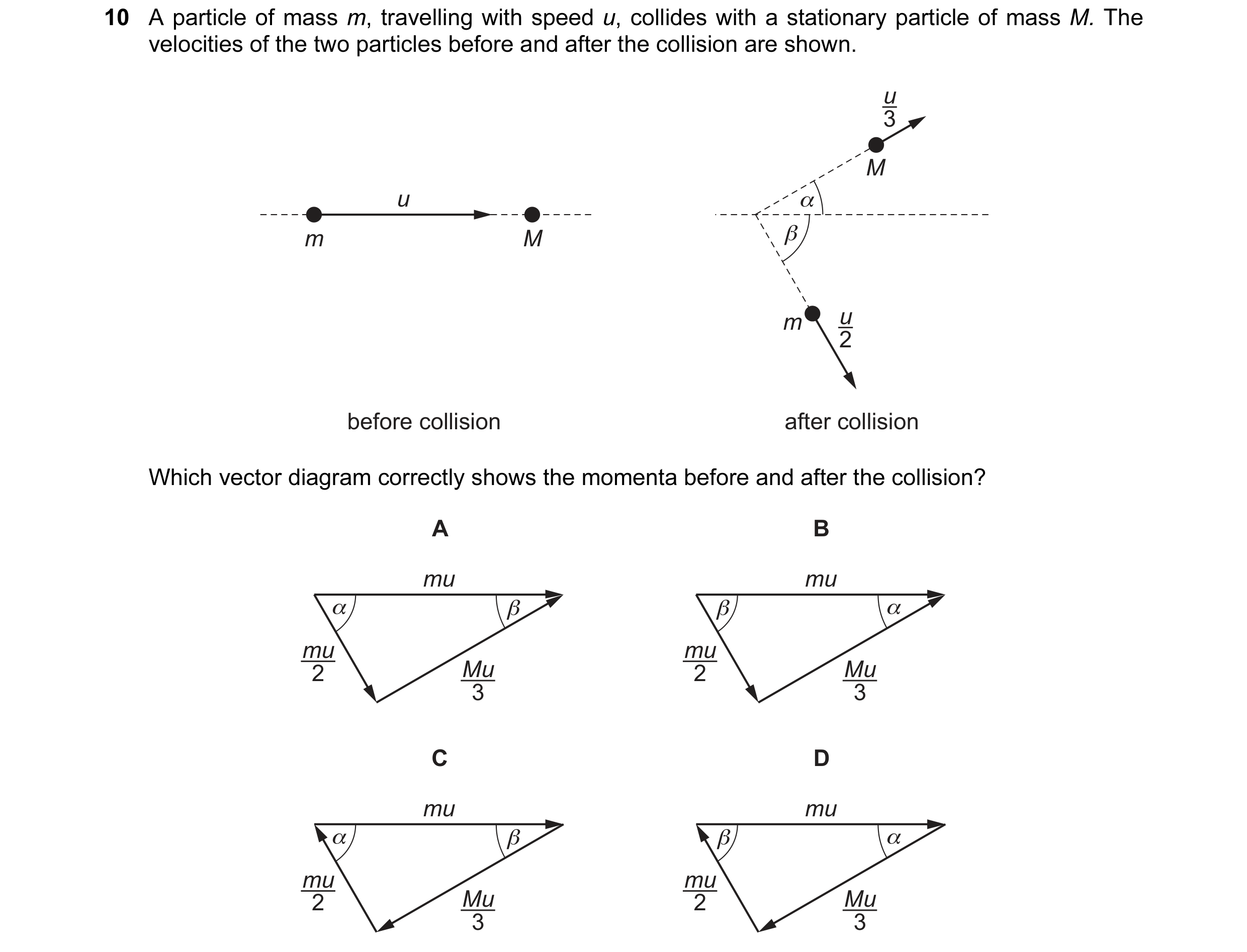
 19 / 51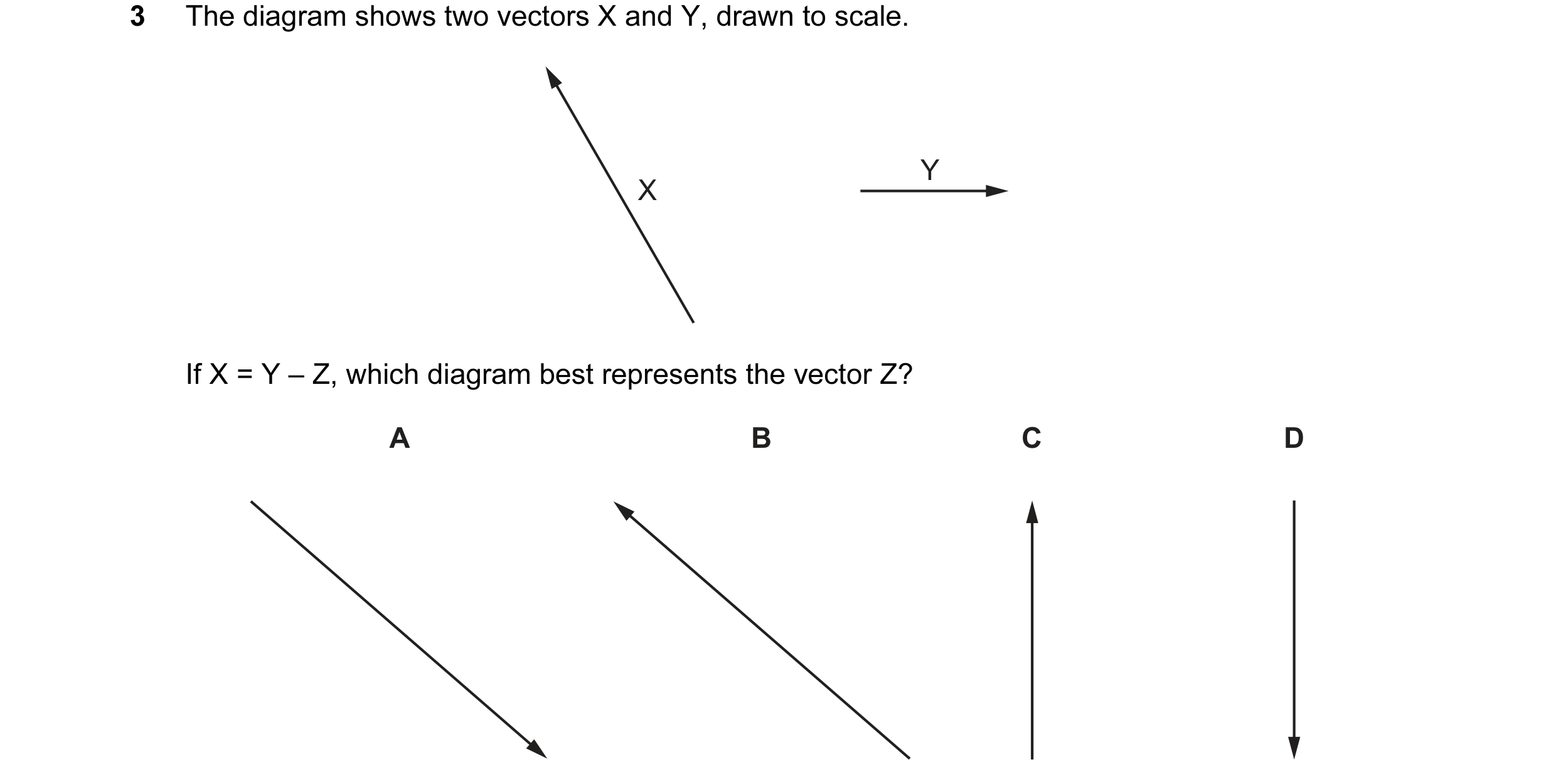
 20 / 51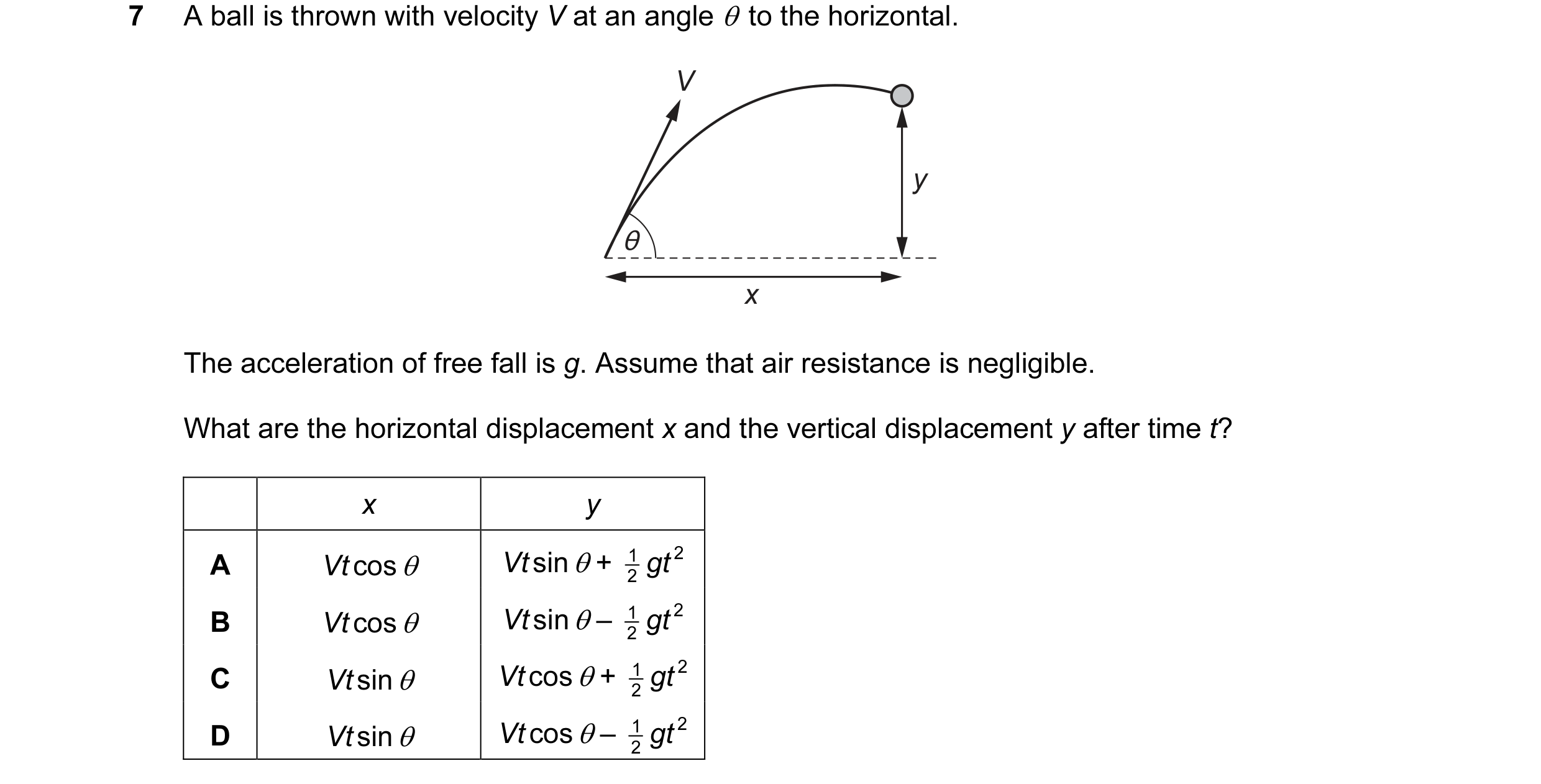
 21 / 51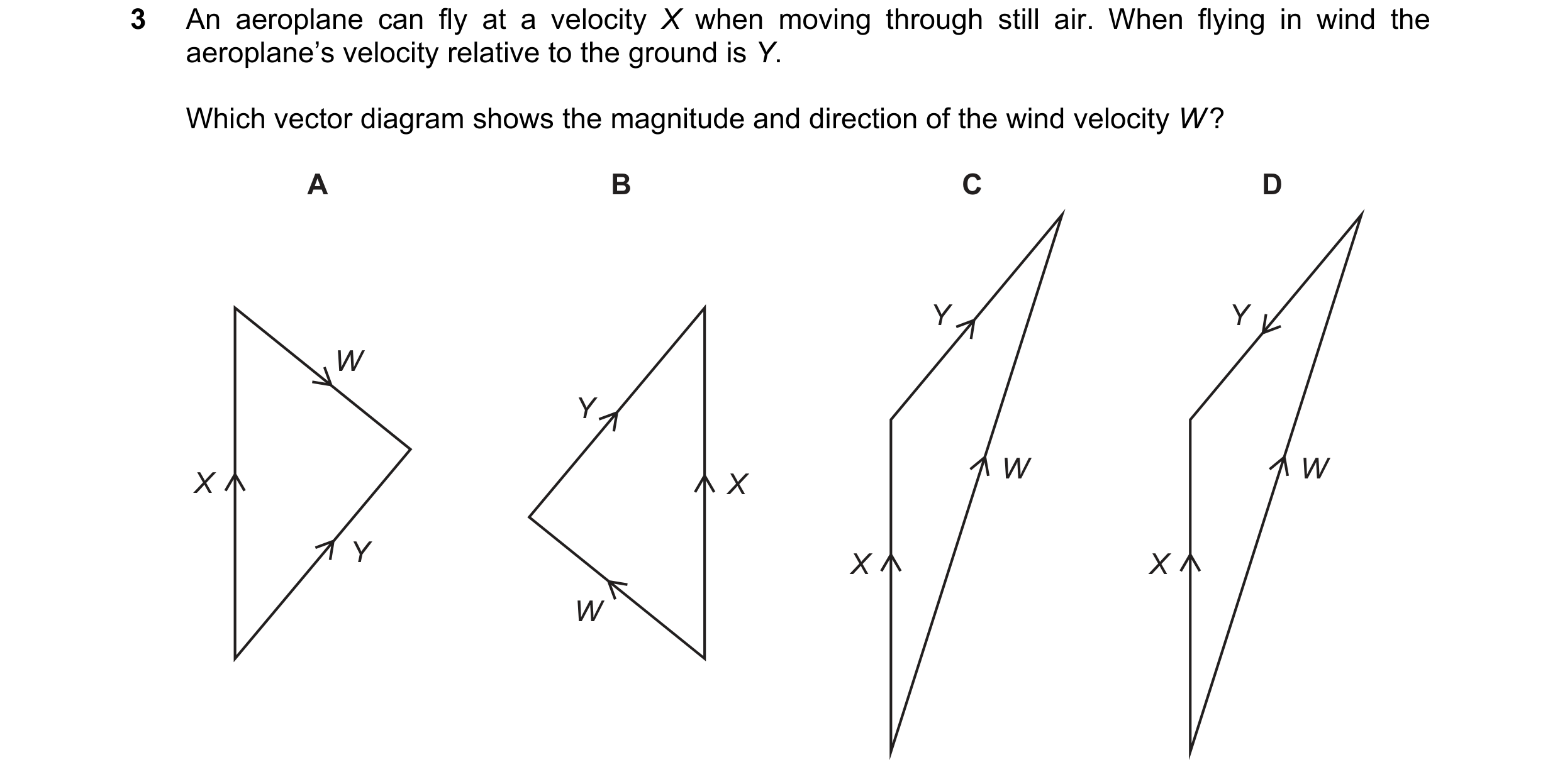
 22 / 51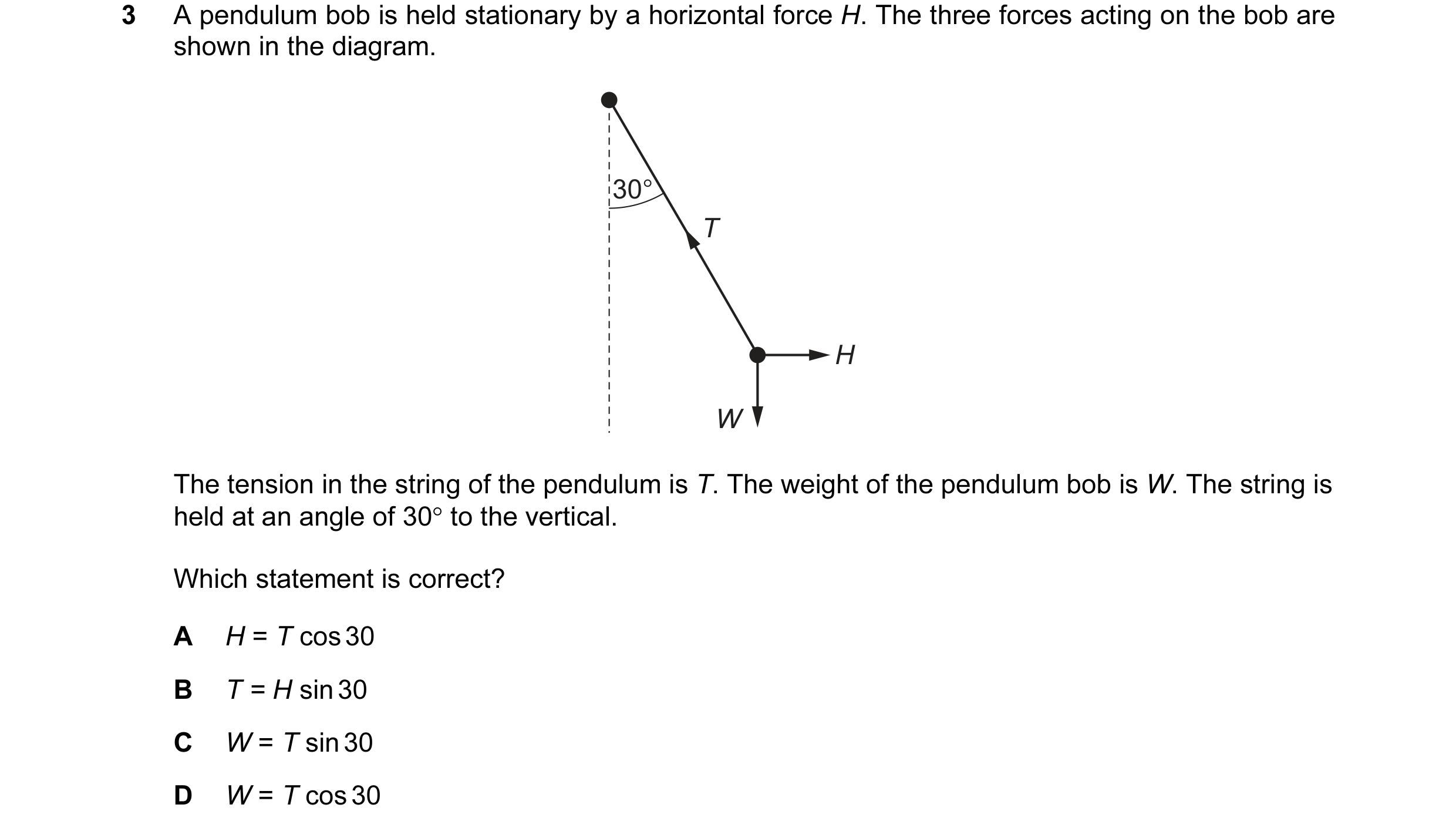
 23 / 51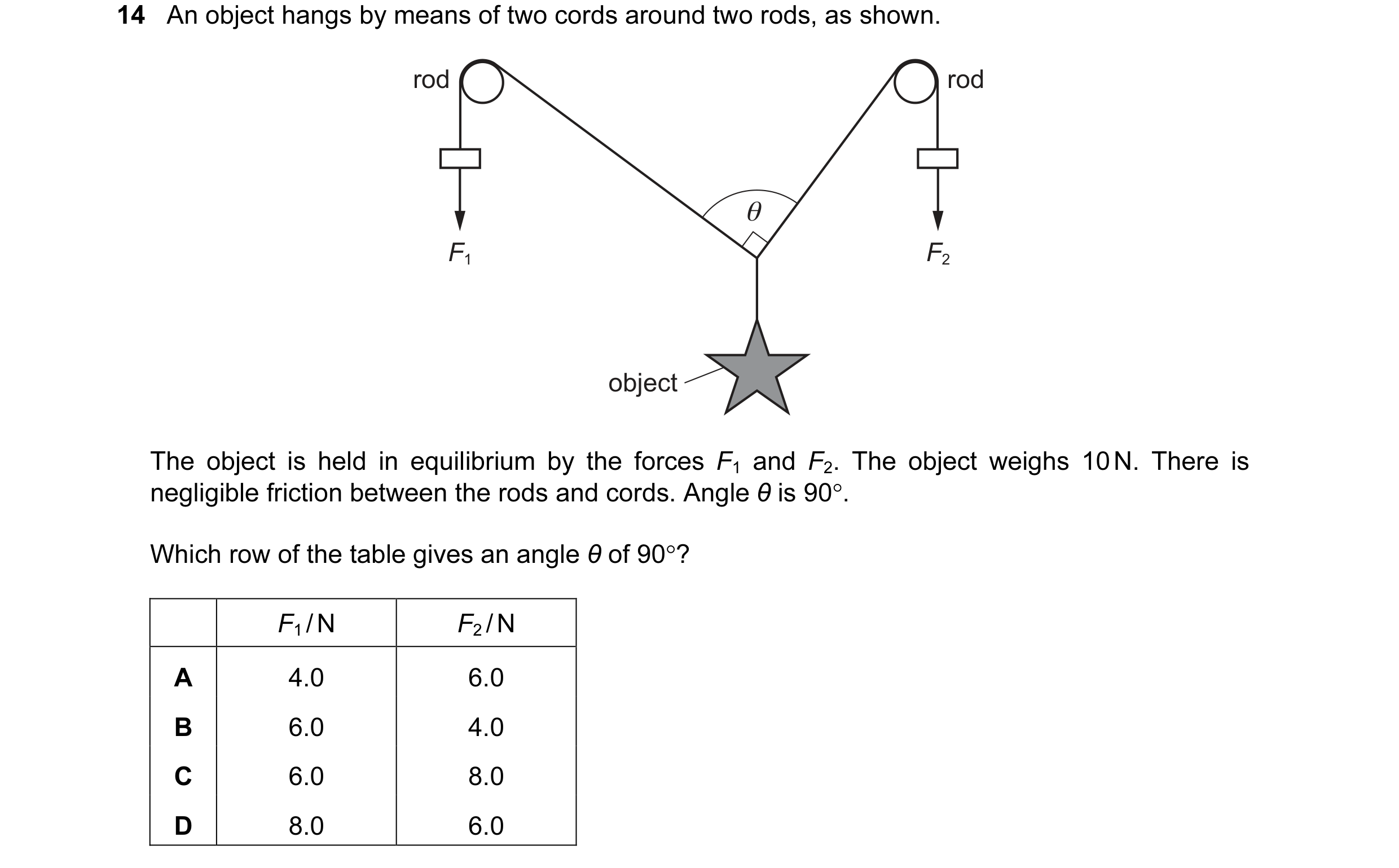
 24 / 51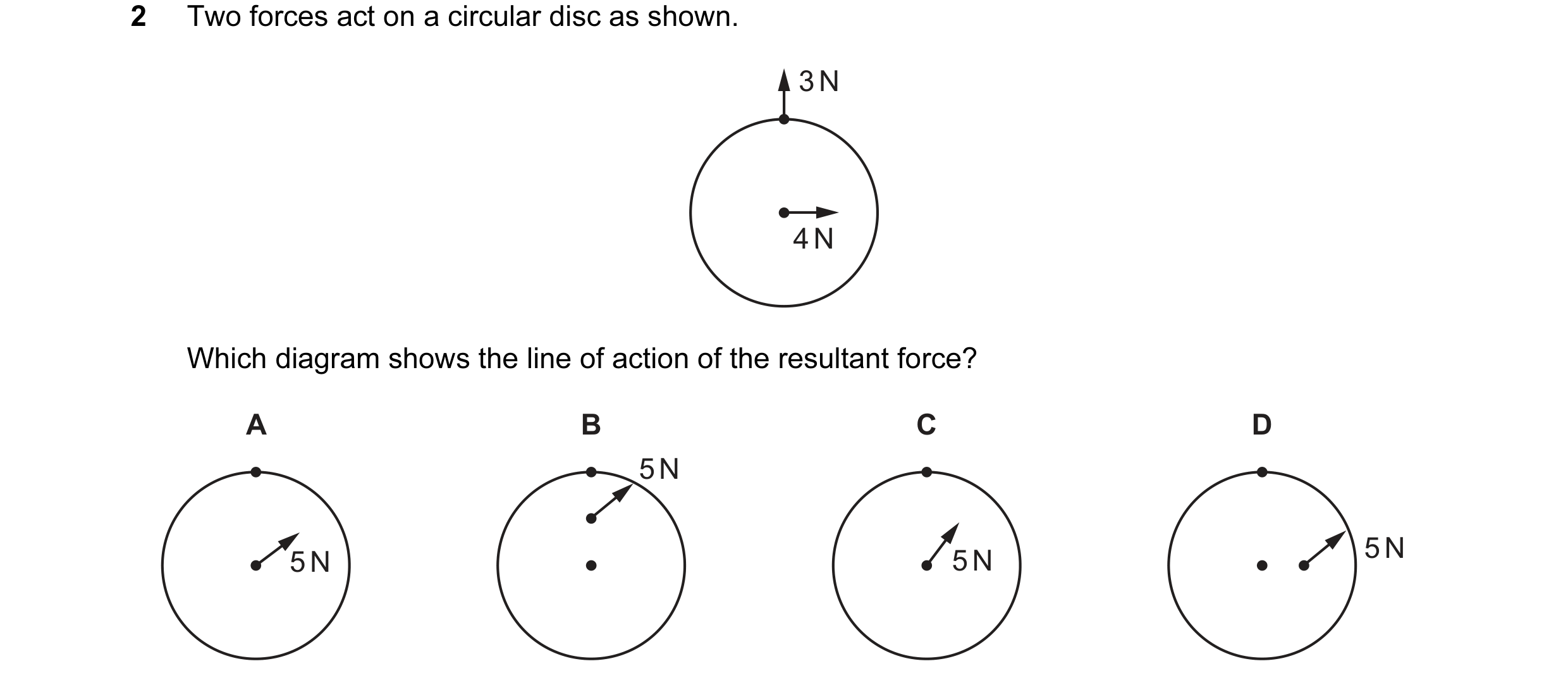
 25 / 51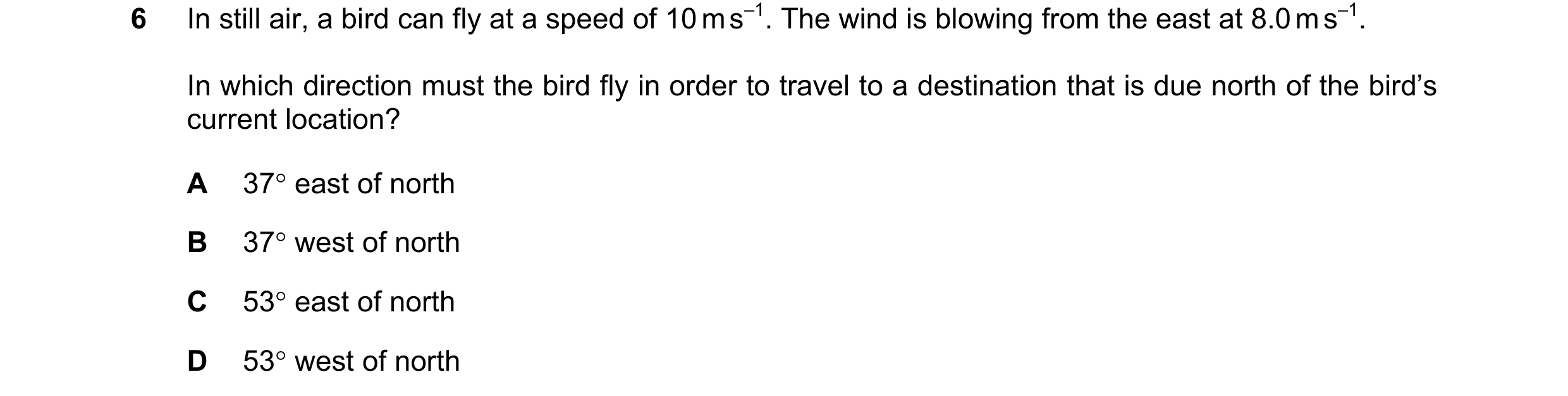
 26 / 51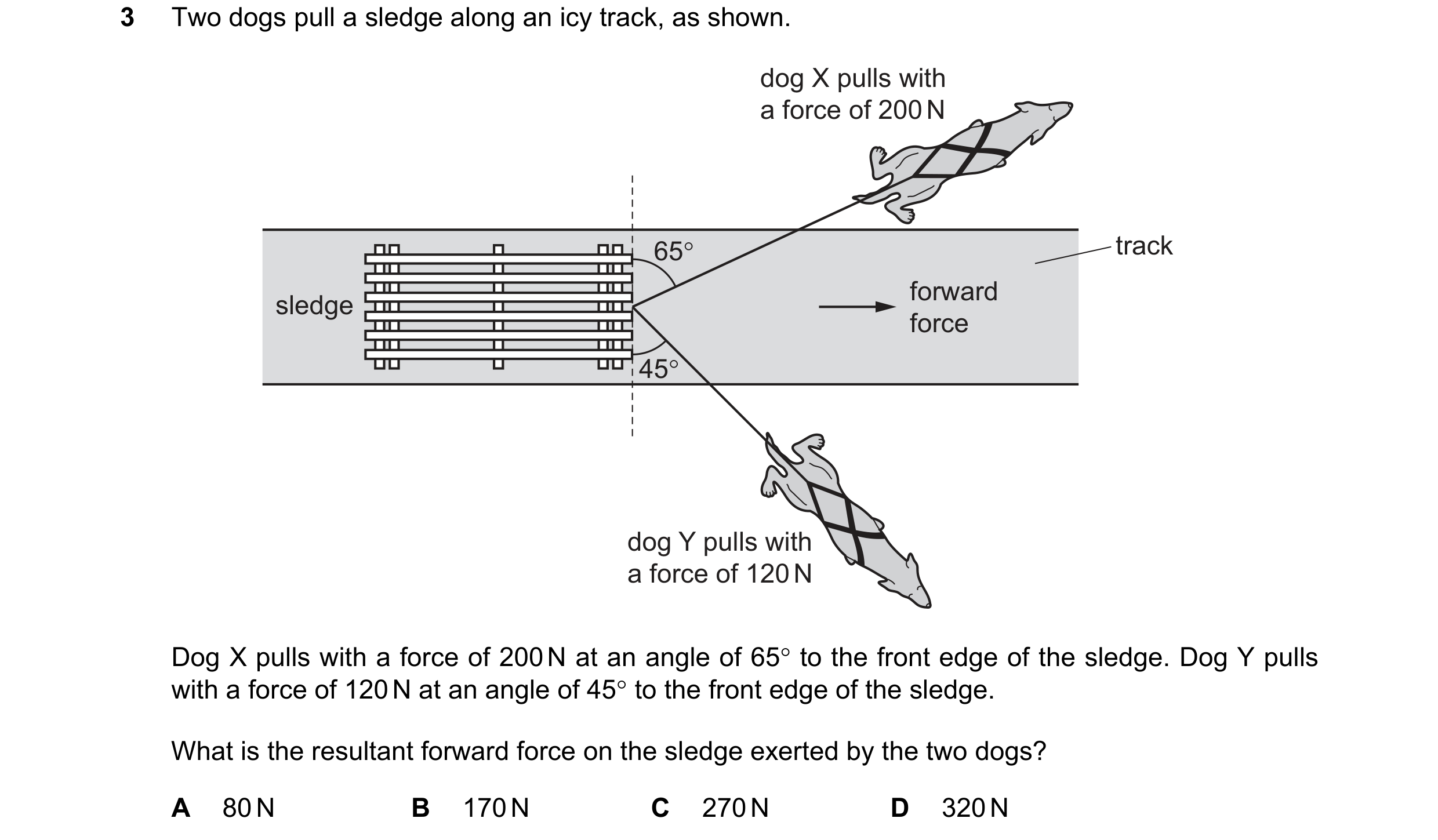
 27 / 51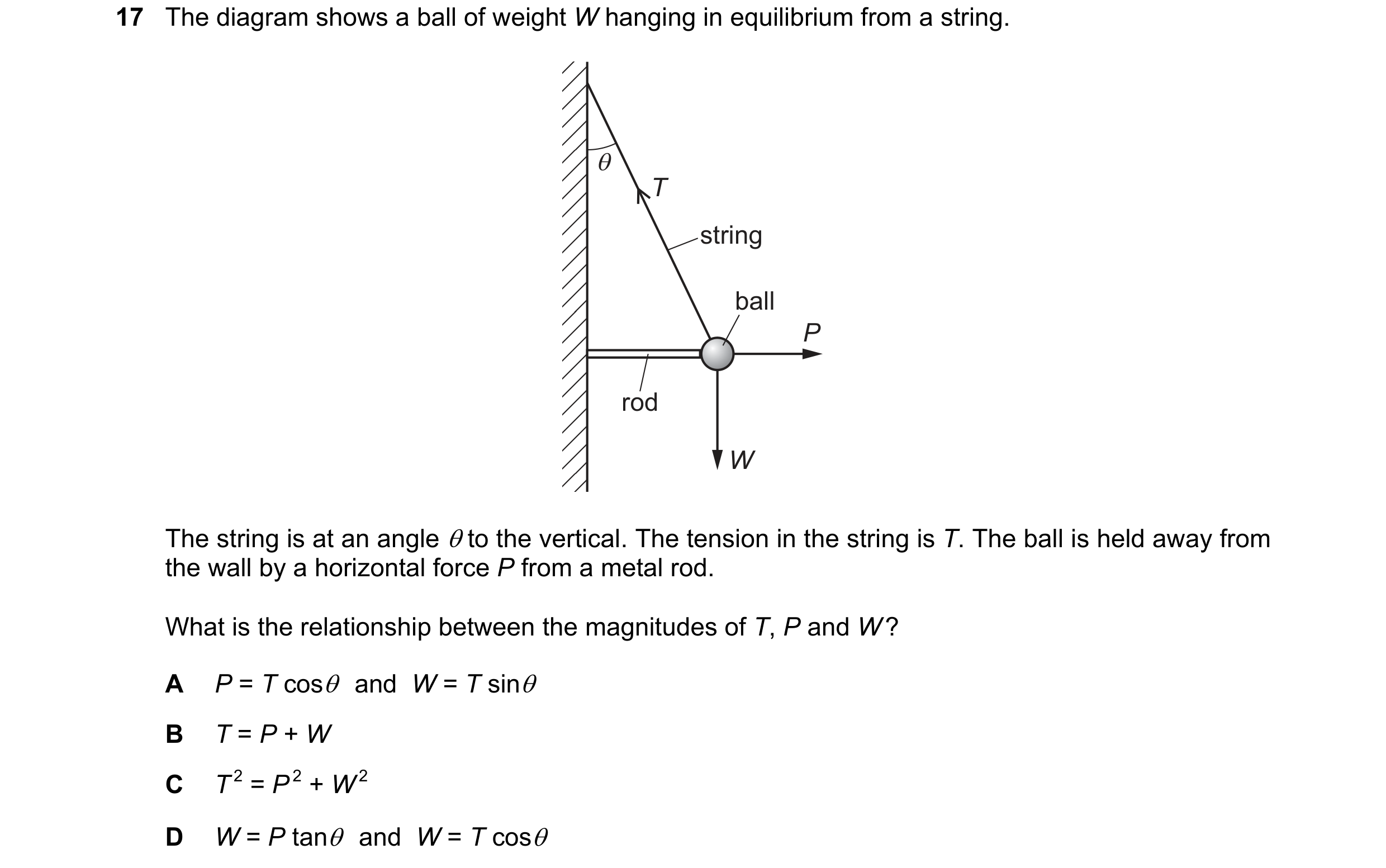

 28 / 51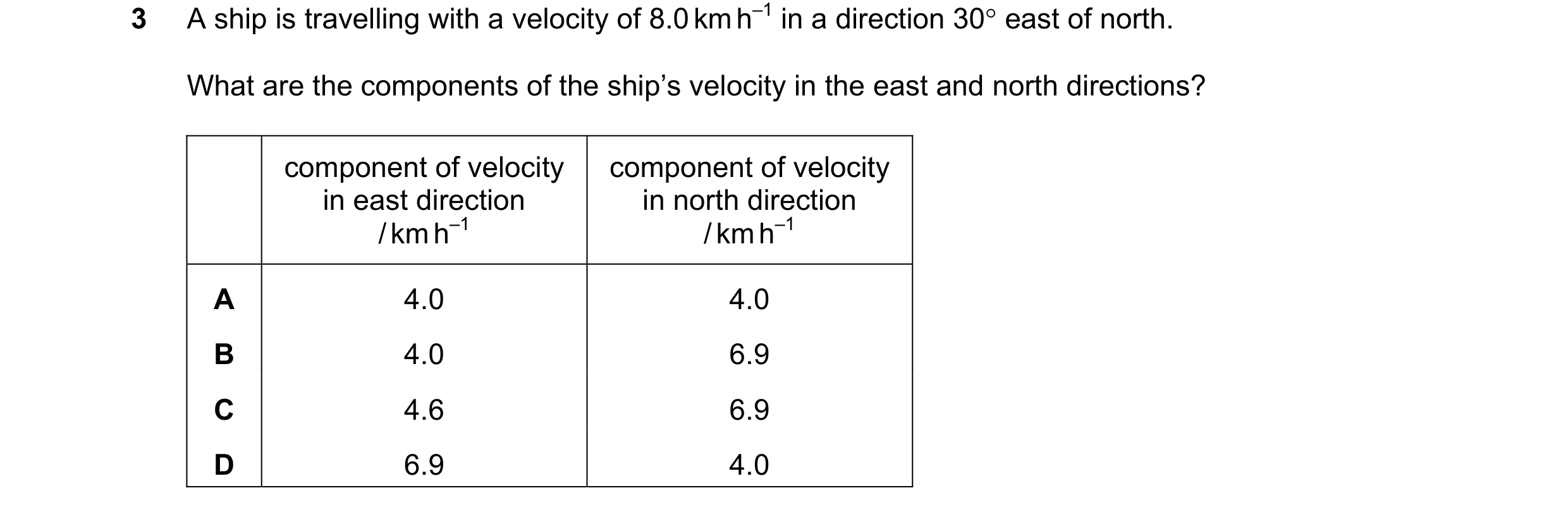

 29 / 51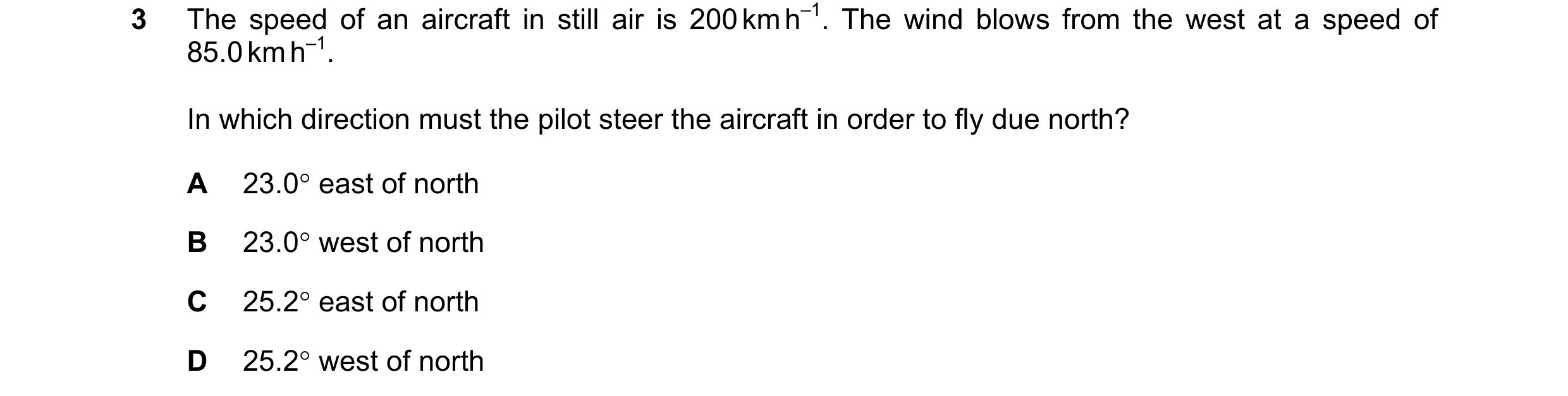
 30 / 51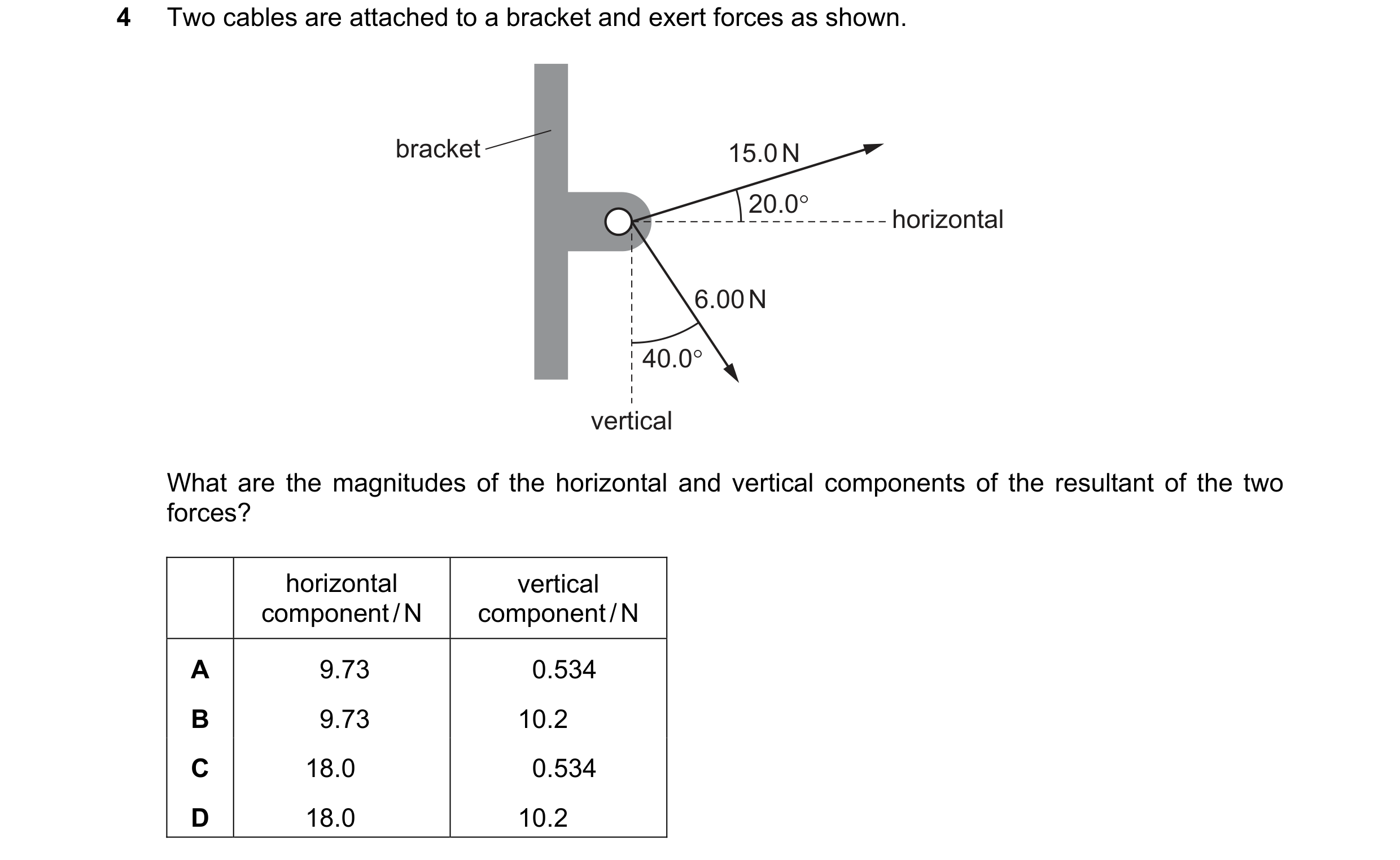
 31 / 51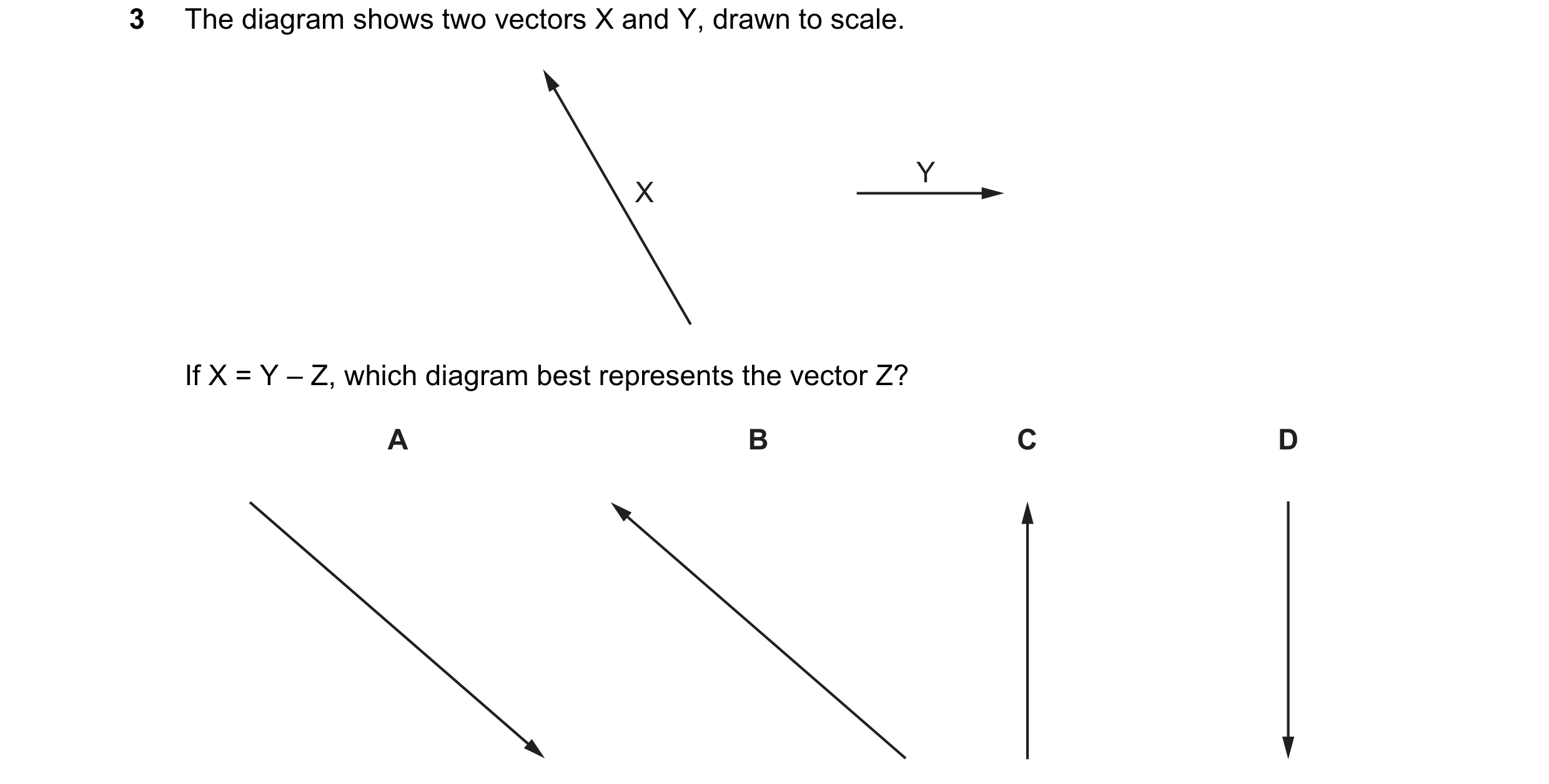

 32 / 51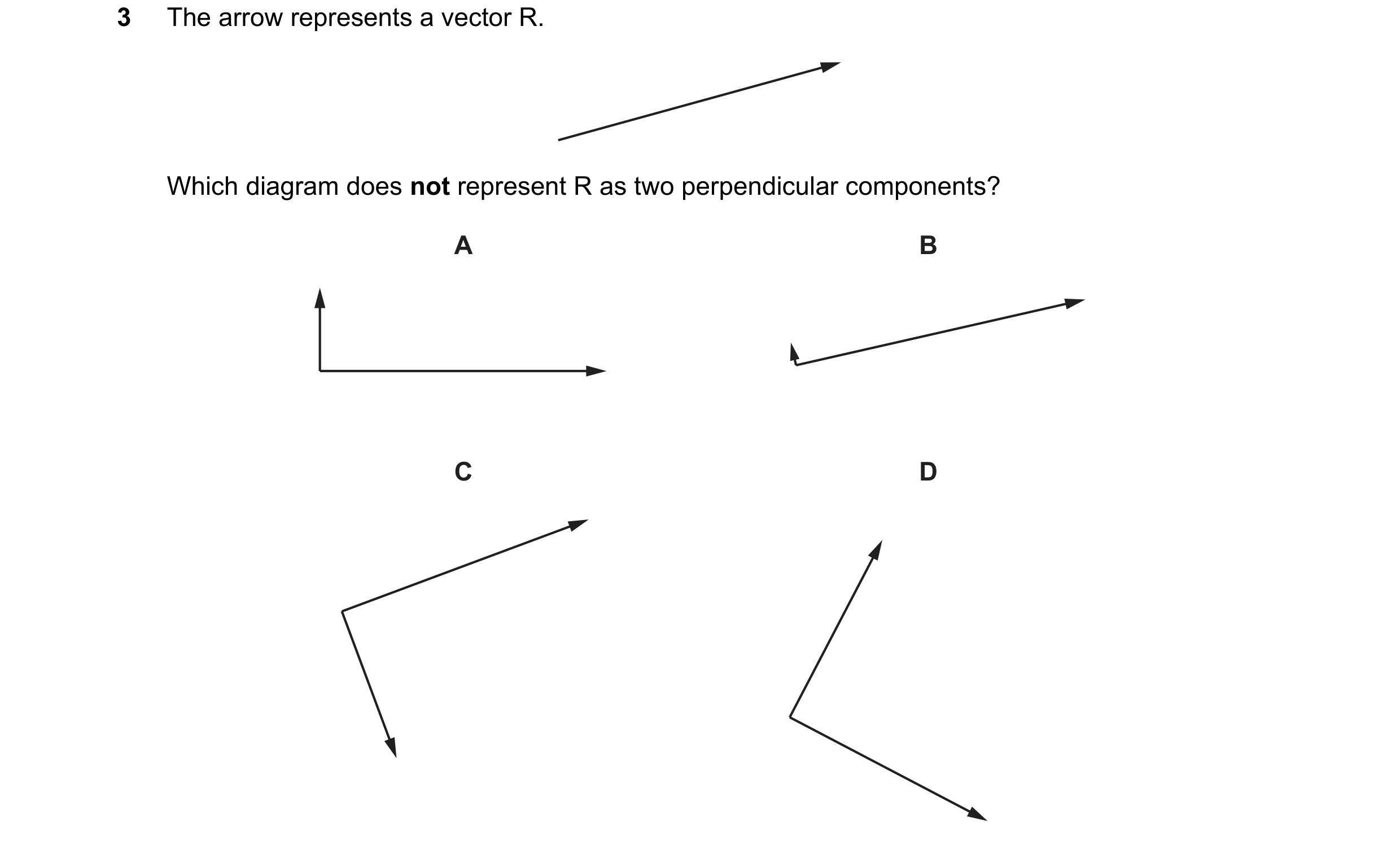

 33 / 51
 34 / 51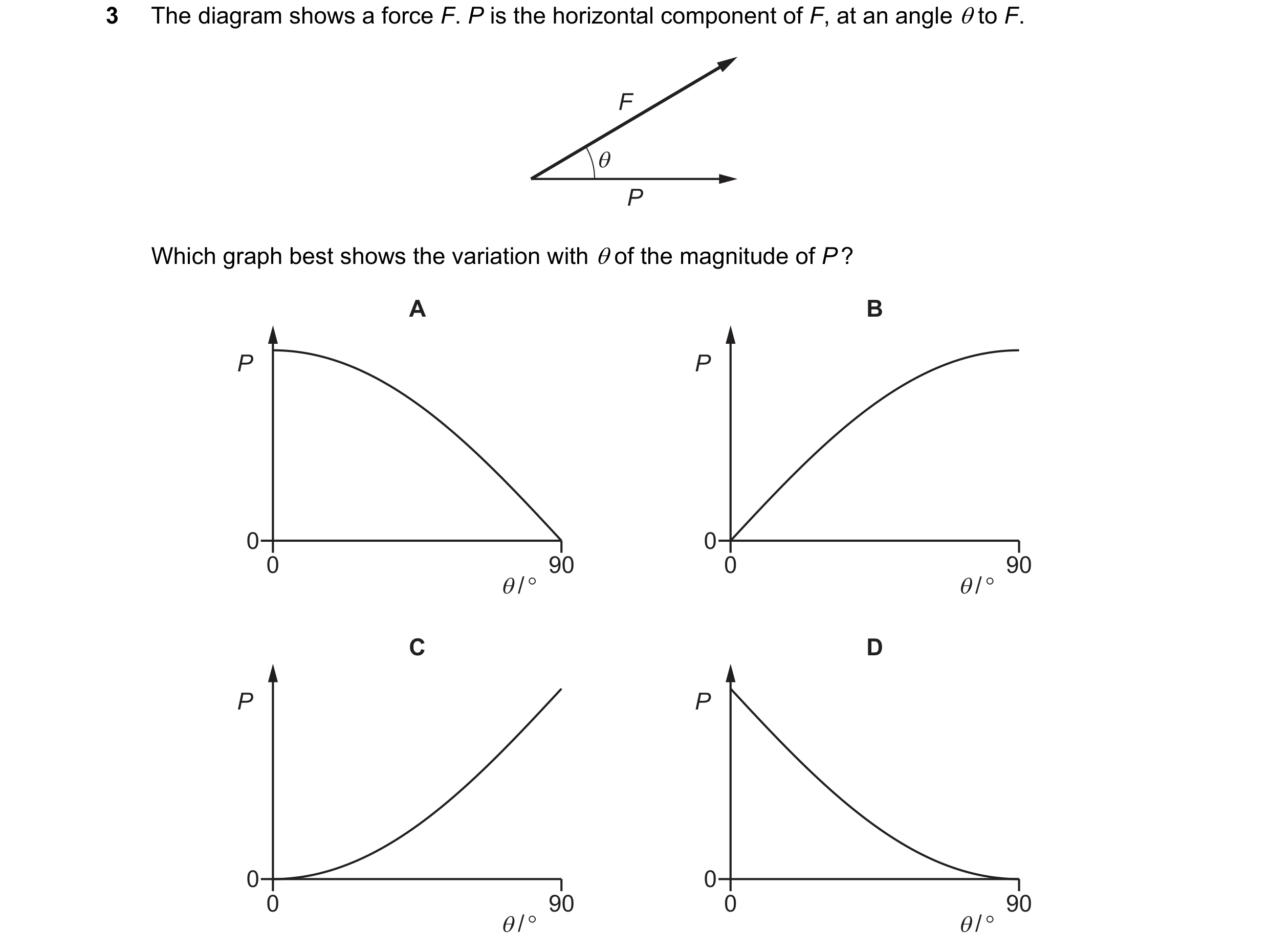
 35 / 51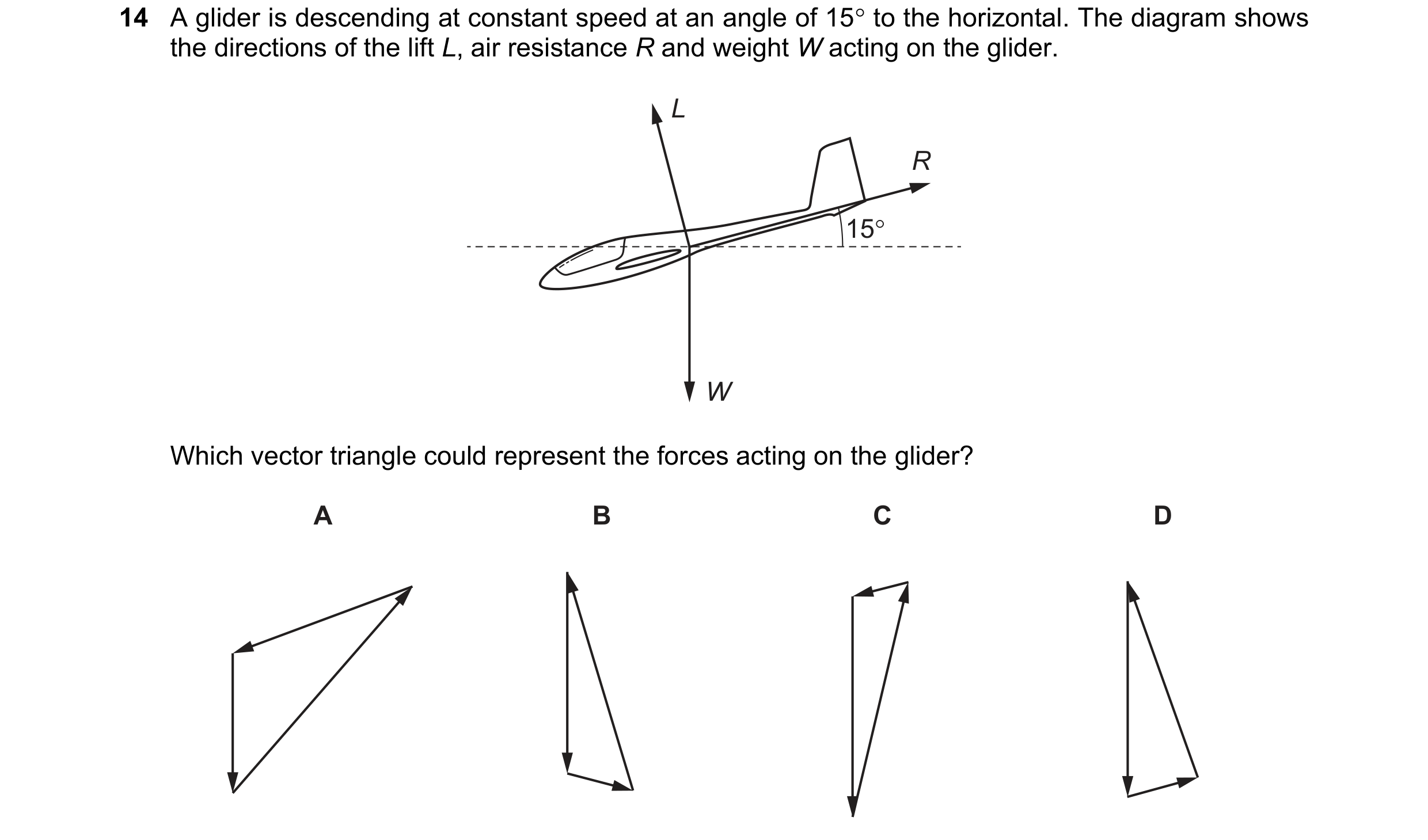
 36 / 51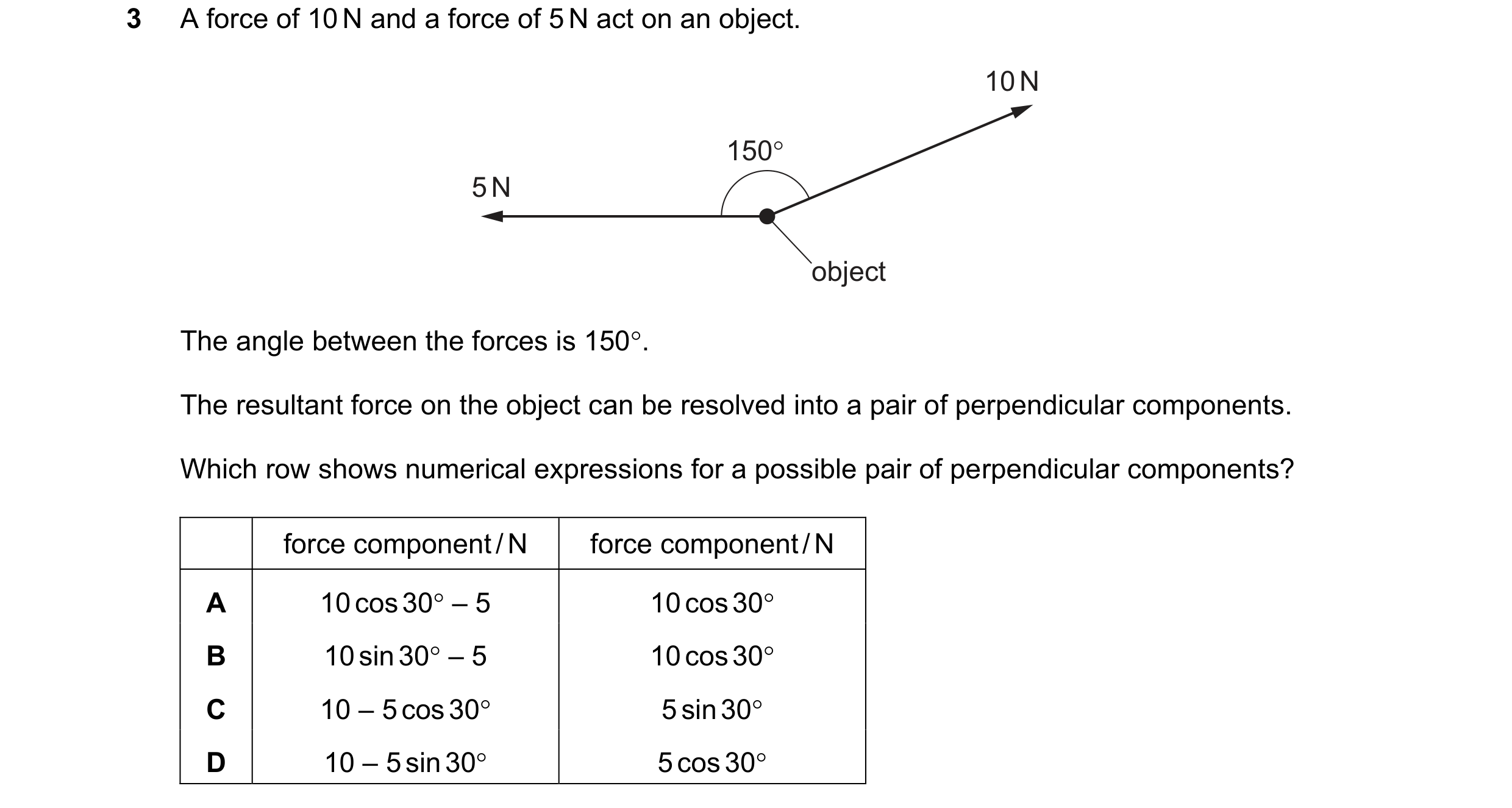
 37 / 51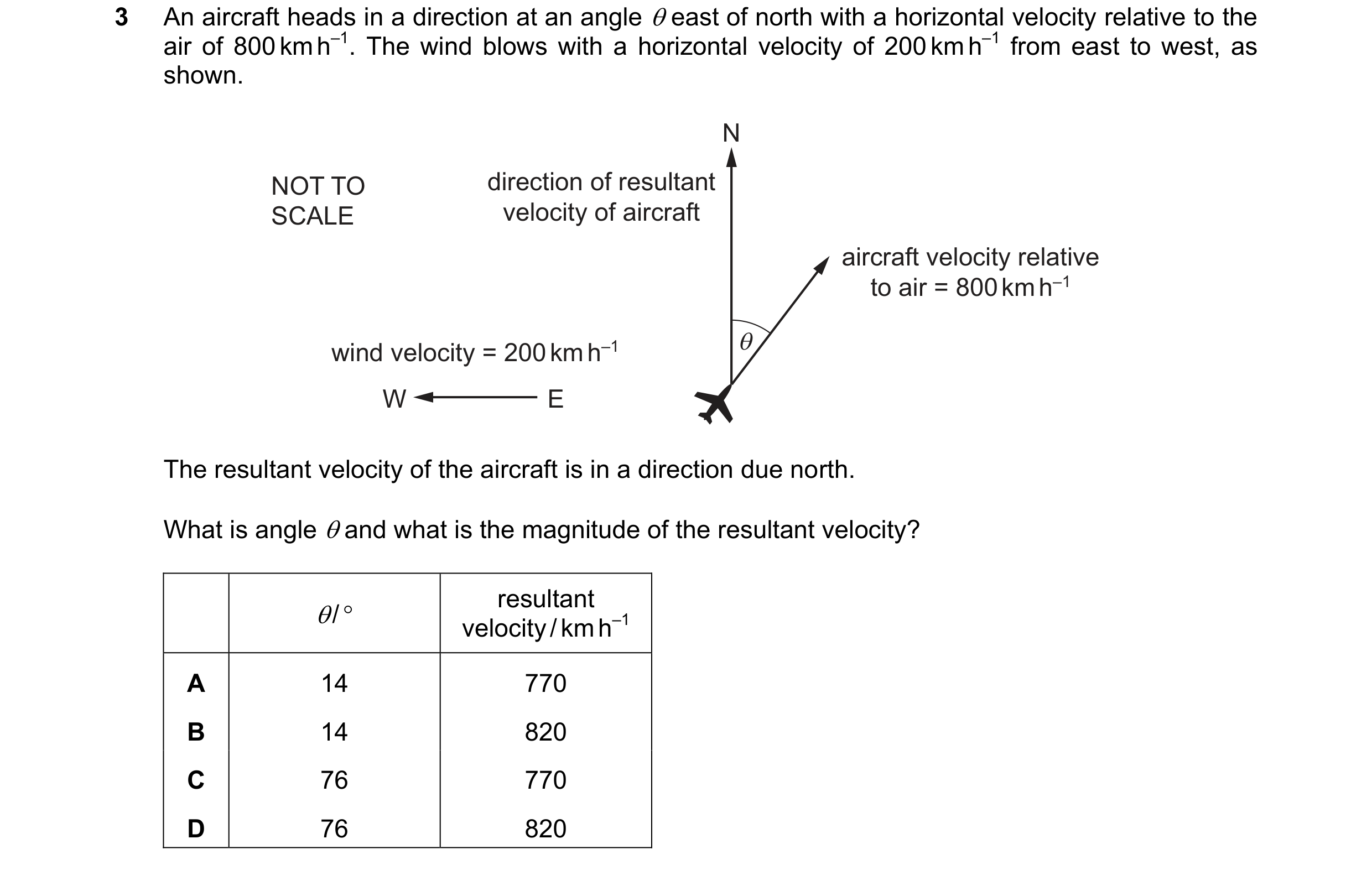

 38 / 51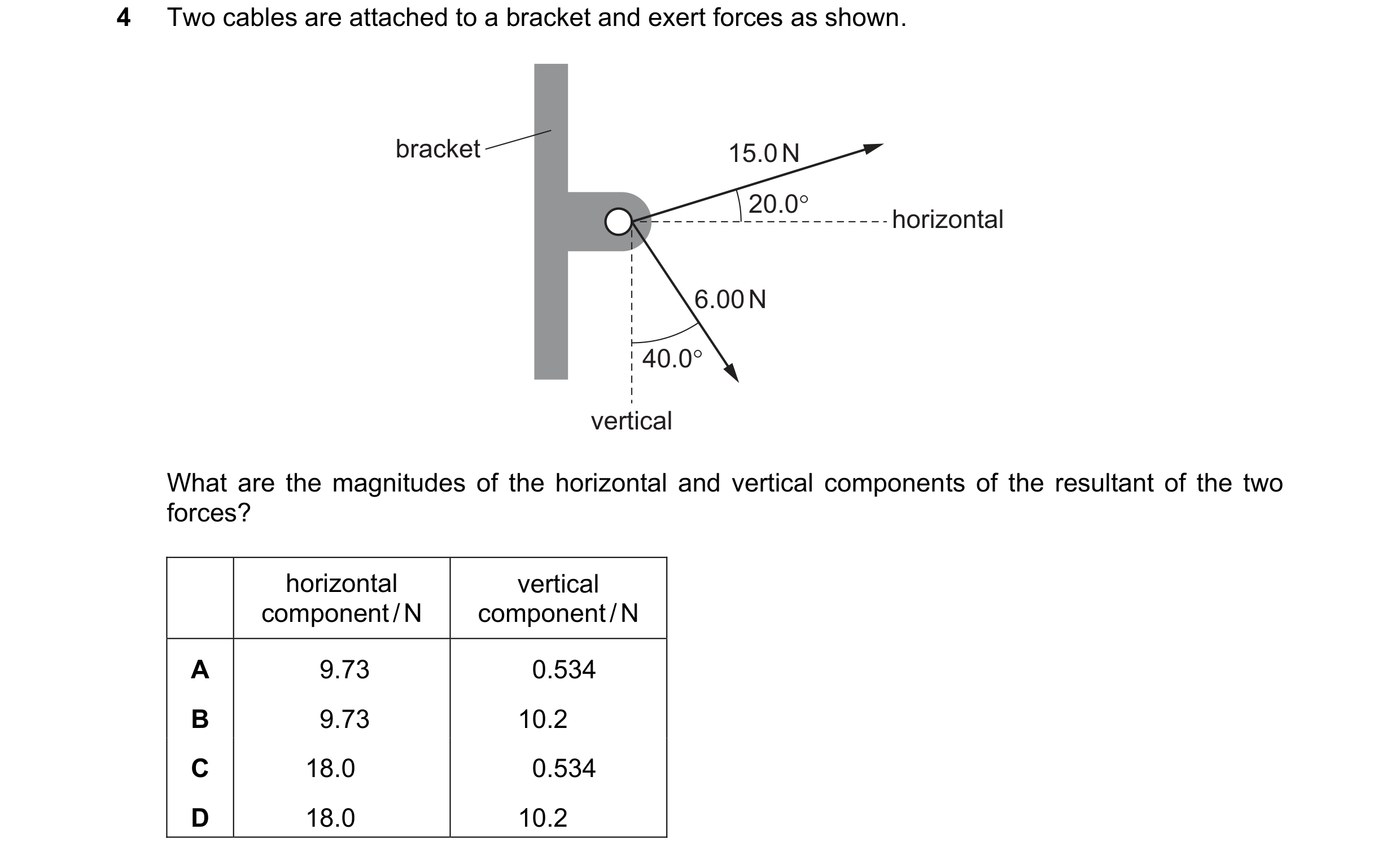
 39 / 51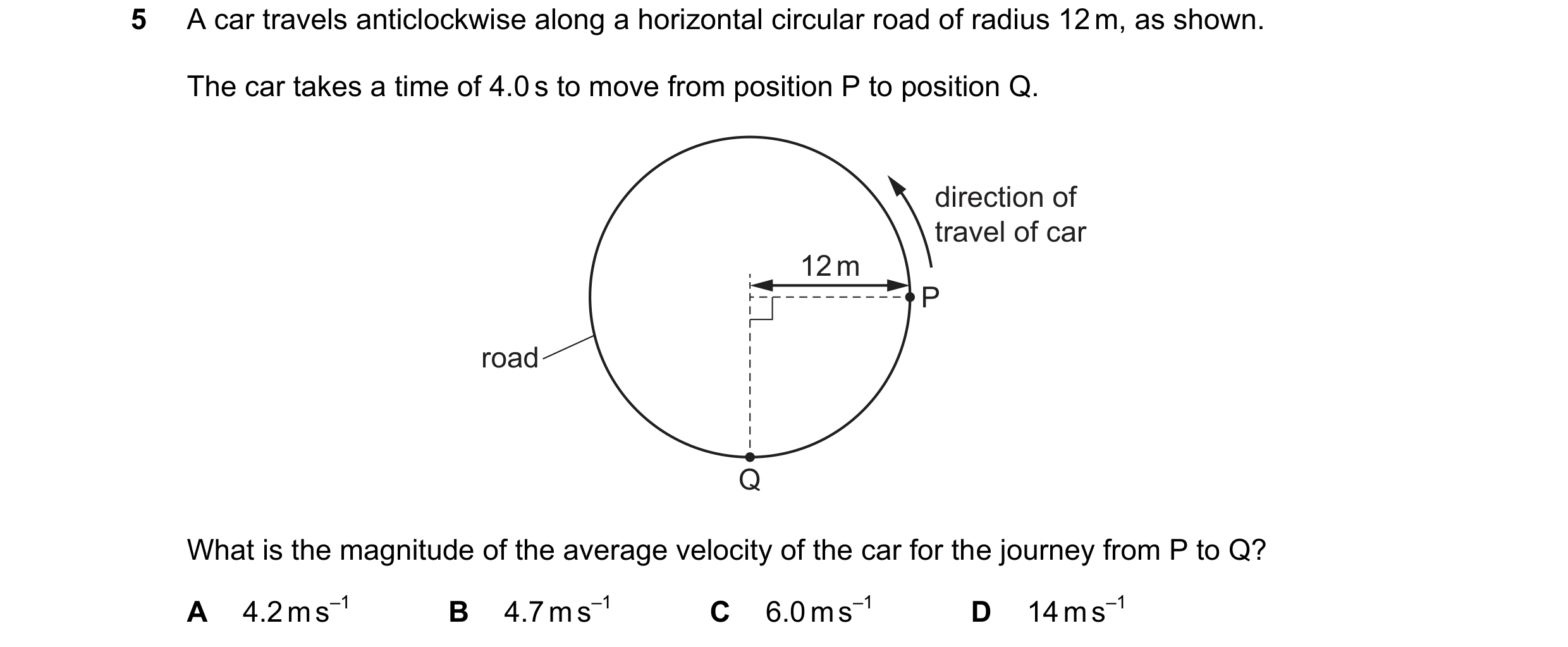


 40 / 51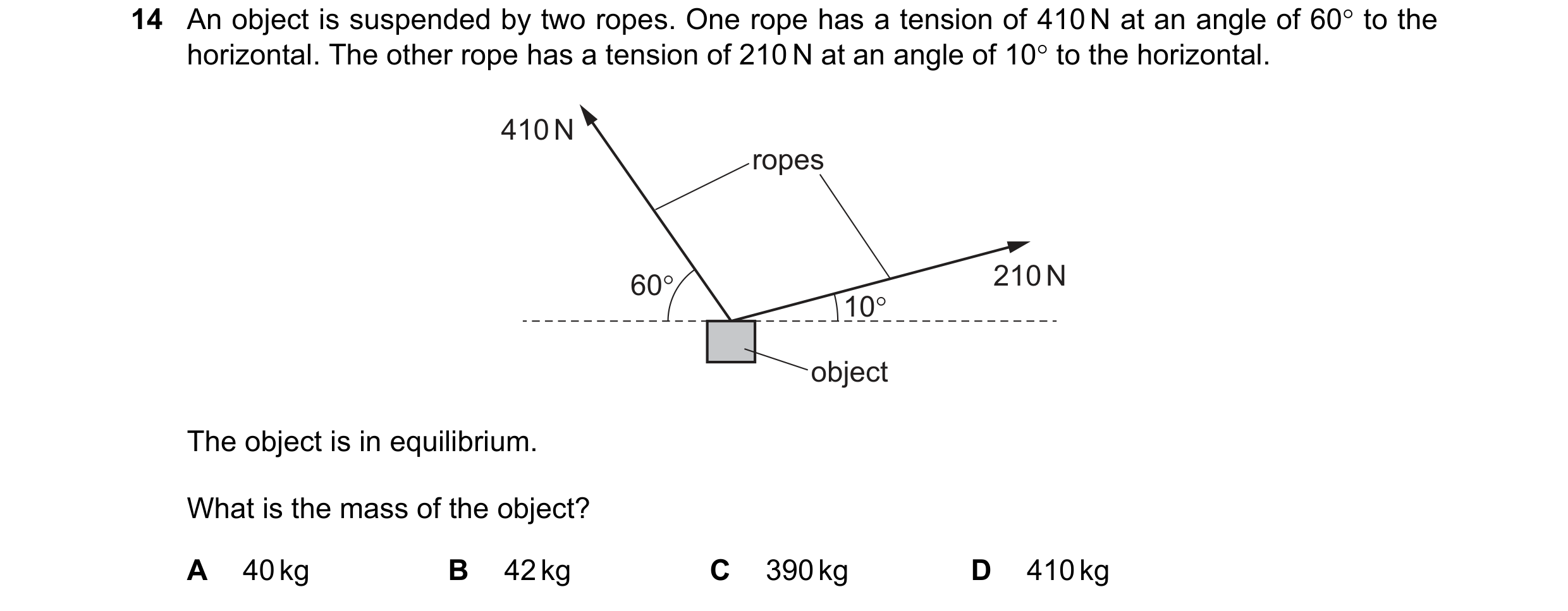

 41 / 51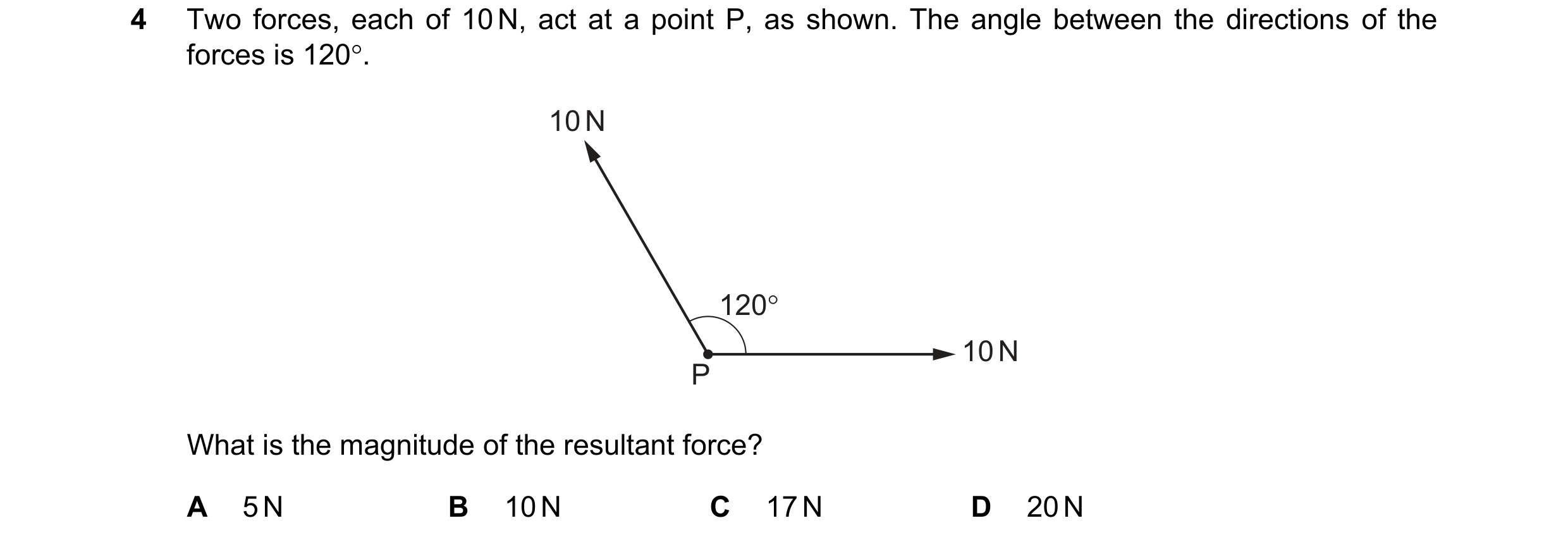
 42 / 51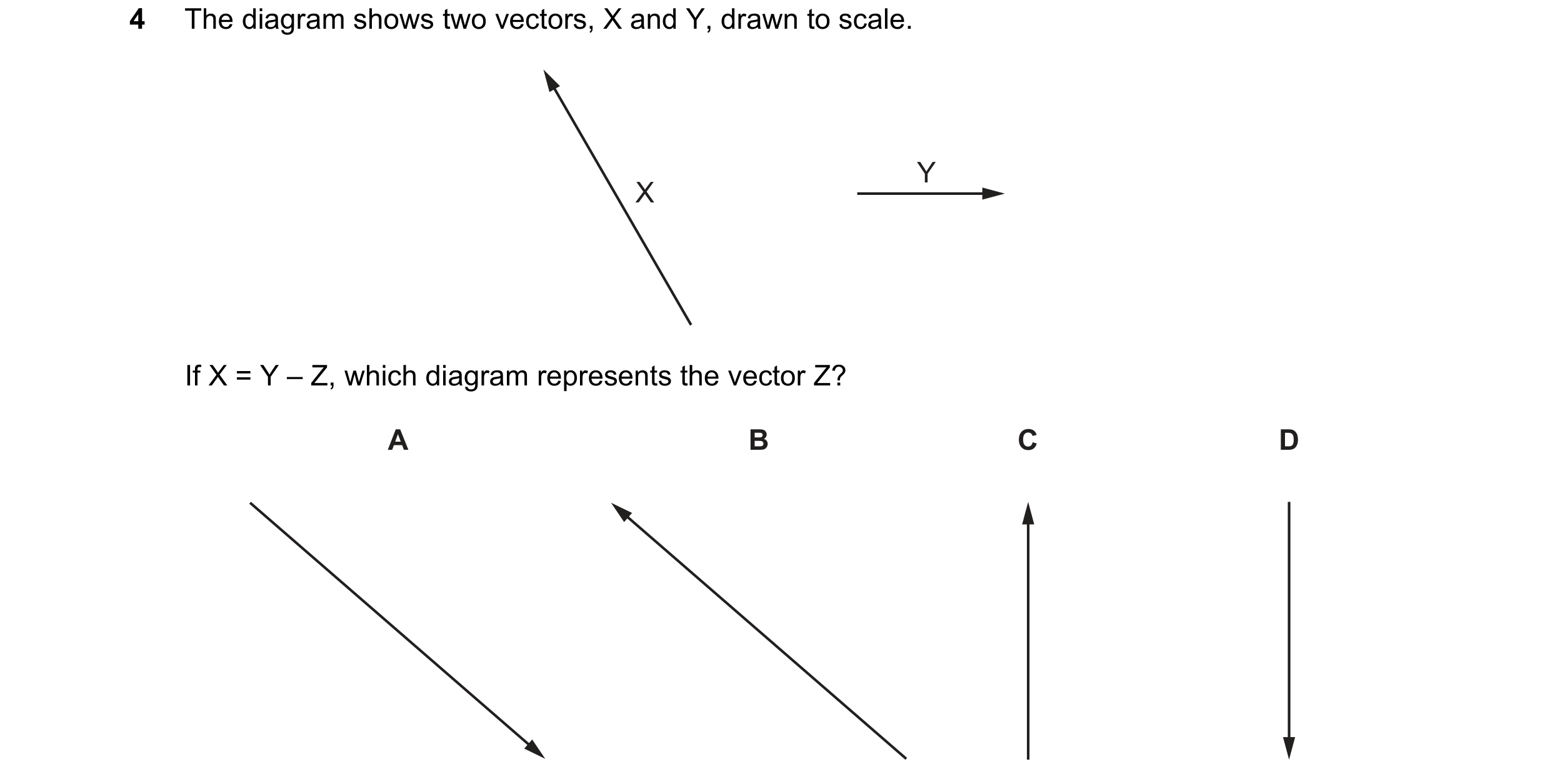
 43 / 51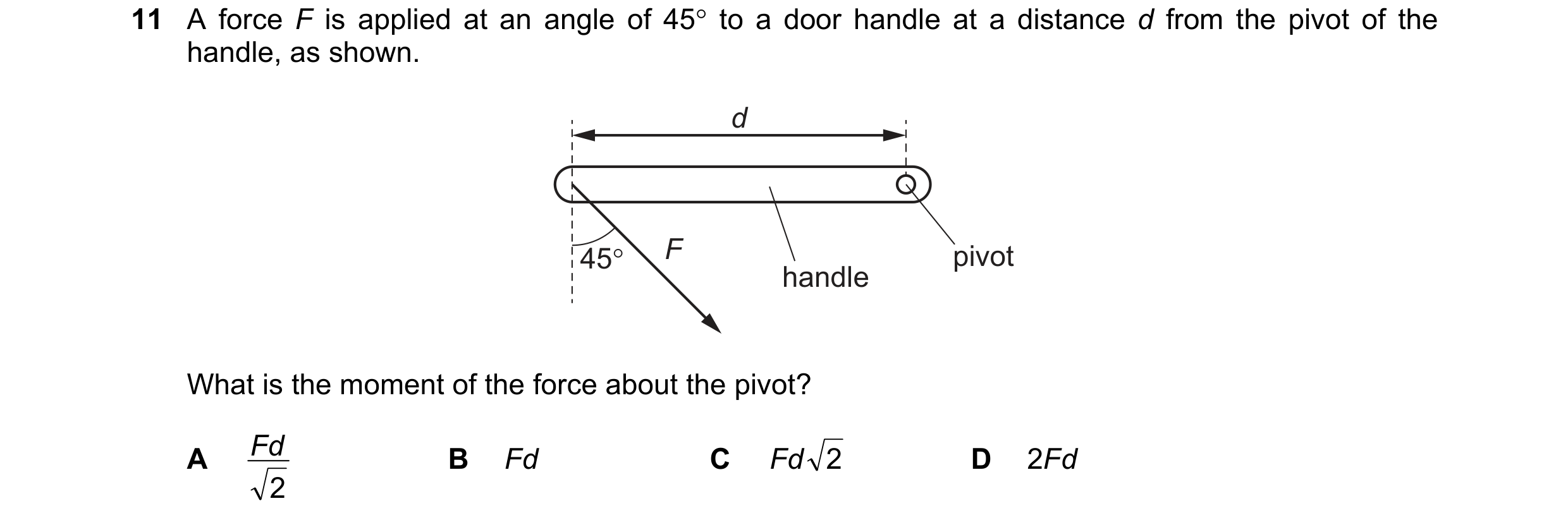
 44 / 51

 45 / 51
 46 / 51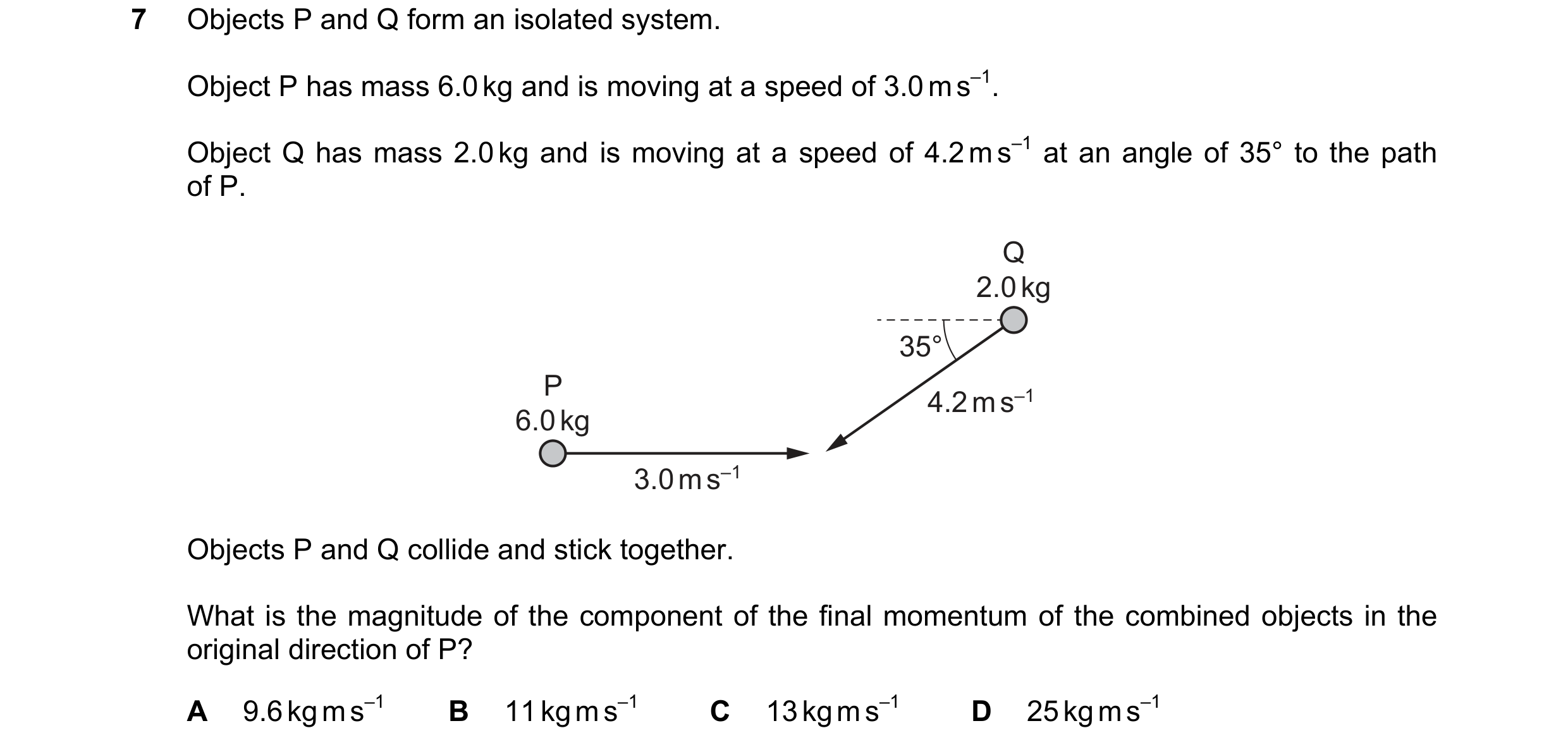
 47 / 51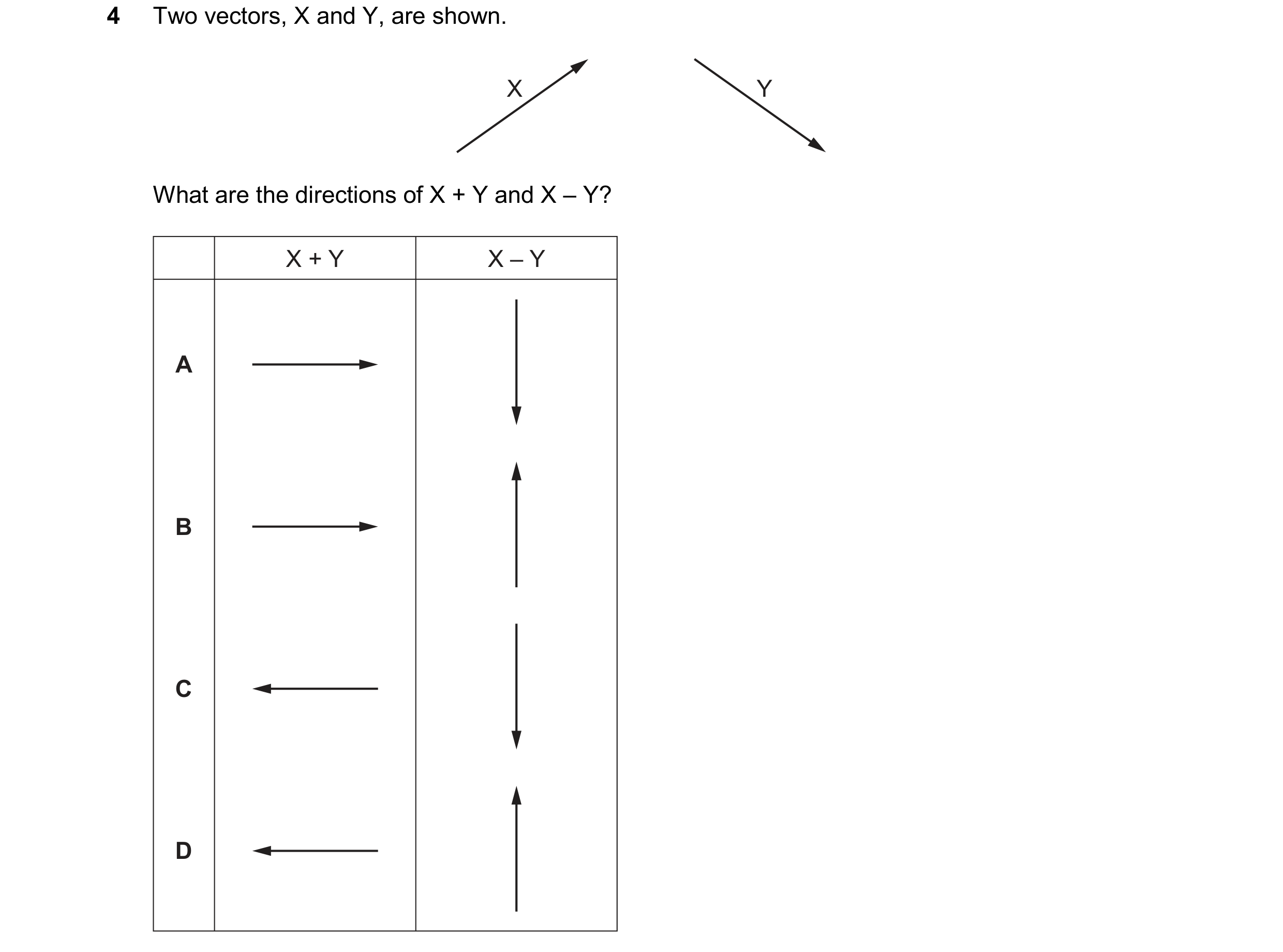
 48 / 51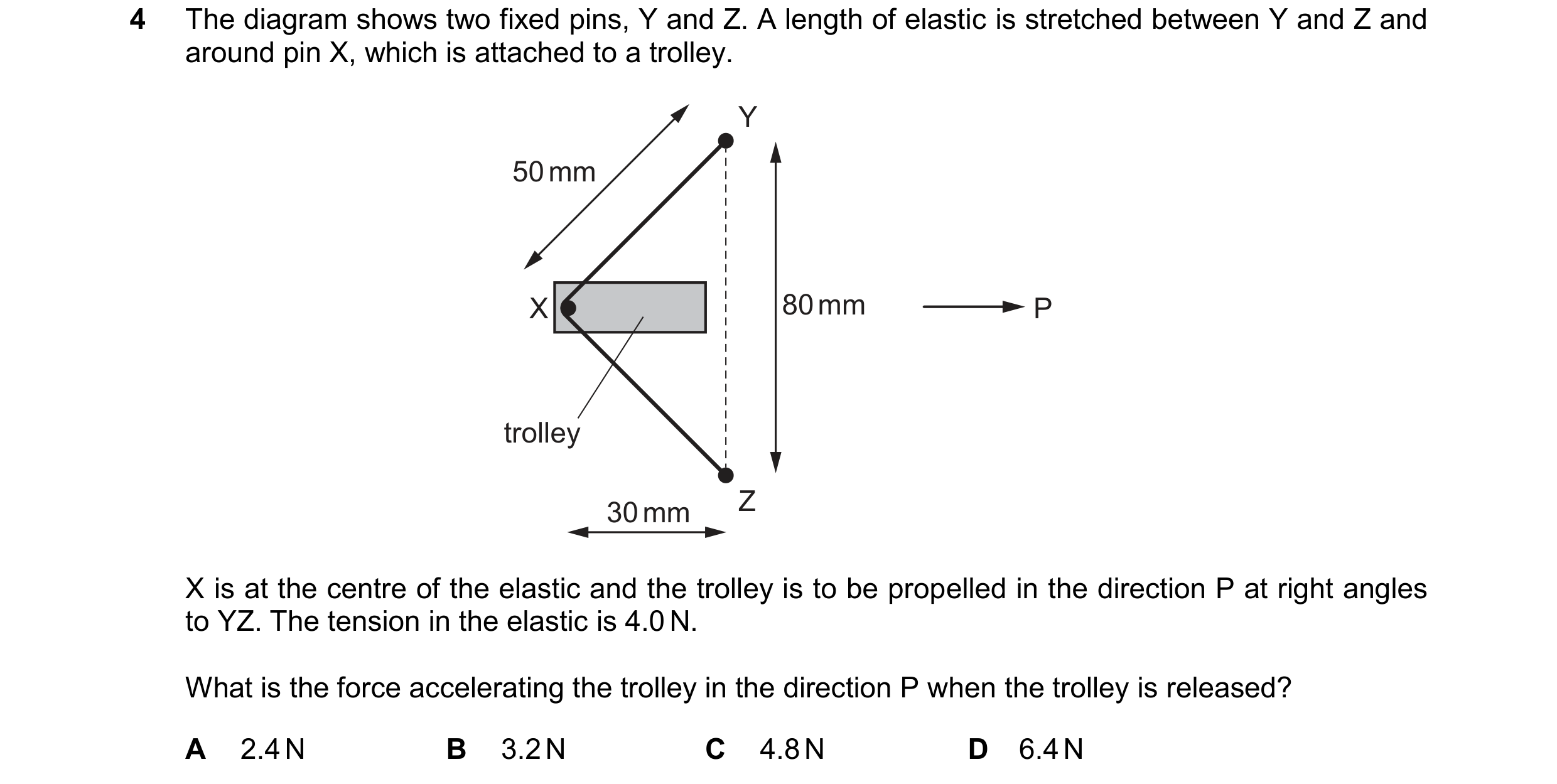
 49 / 51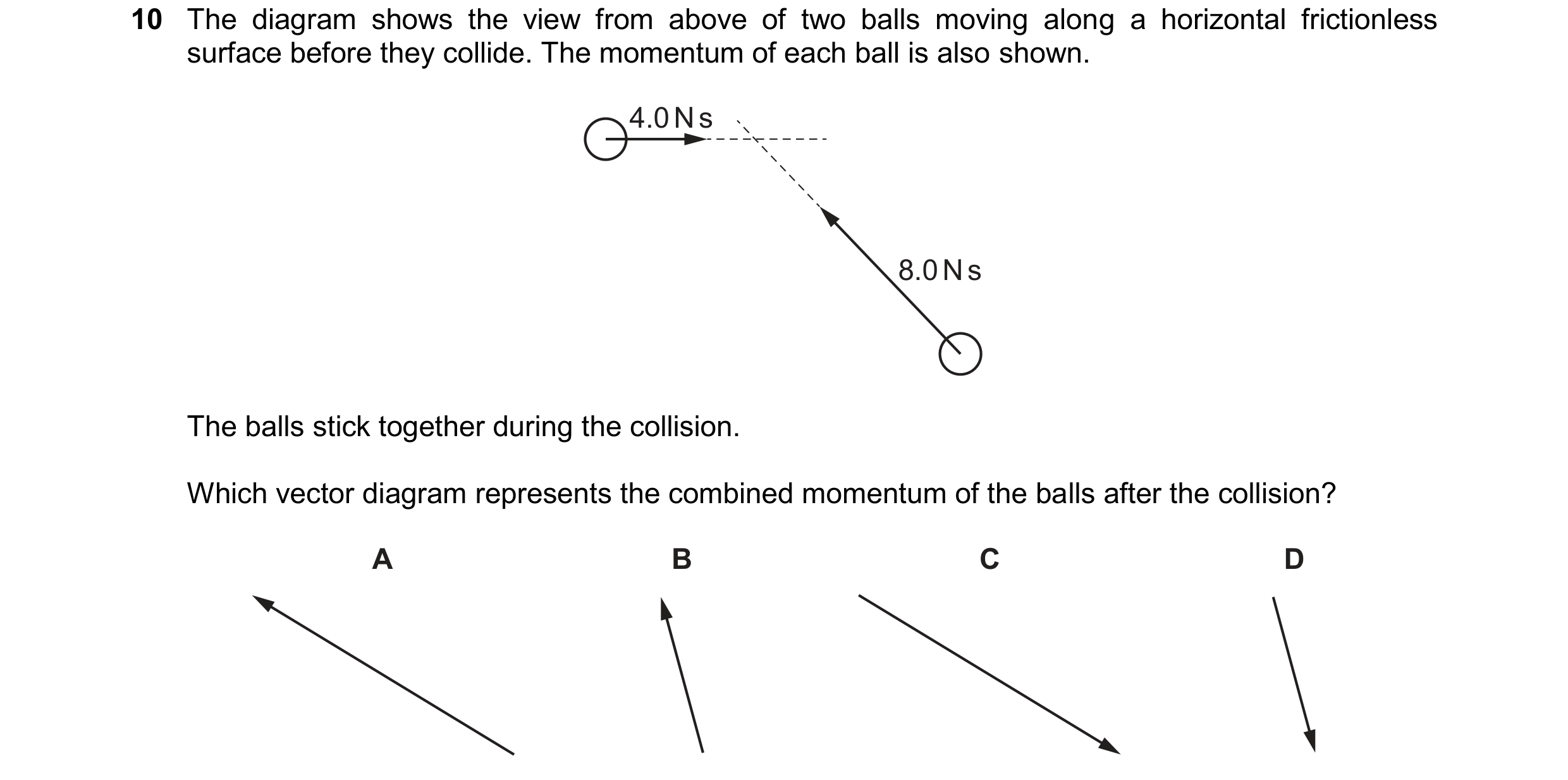
 50 / 51
 51 / 51