Questions as text
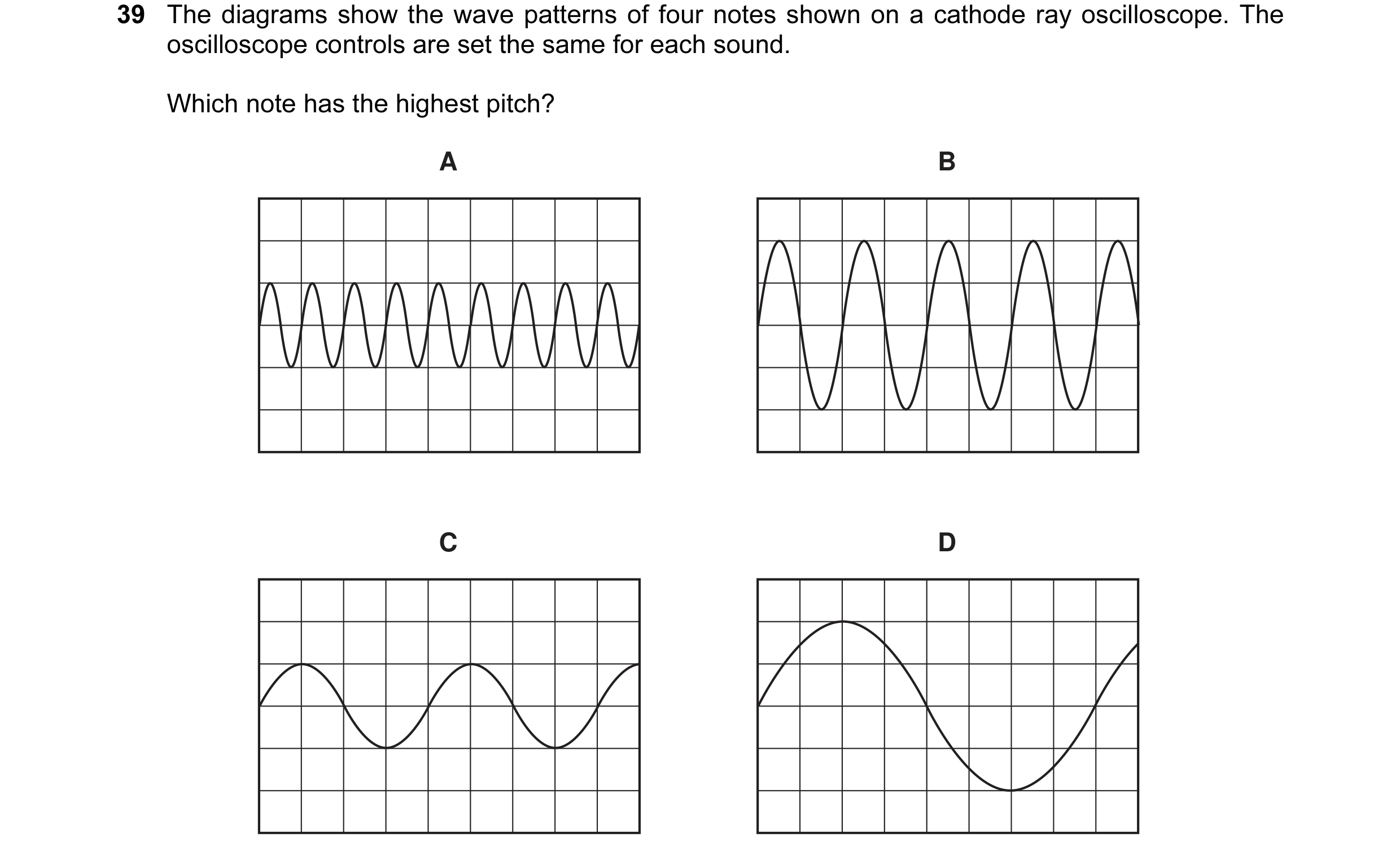
Q1 · The diagrams show the wave patterns of four notes shown on a cathode ray oscilloscope 0653/11 May/June 2010
39 The diagrams show the wave patterns of four notes shown on a cathode ray oscilloscope. The oscilloscope controls are set the same for each sound. Which note has the highest pitch? A B C D
1 marks
Answer: A
This question in 0653/11 May/June 2010
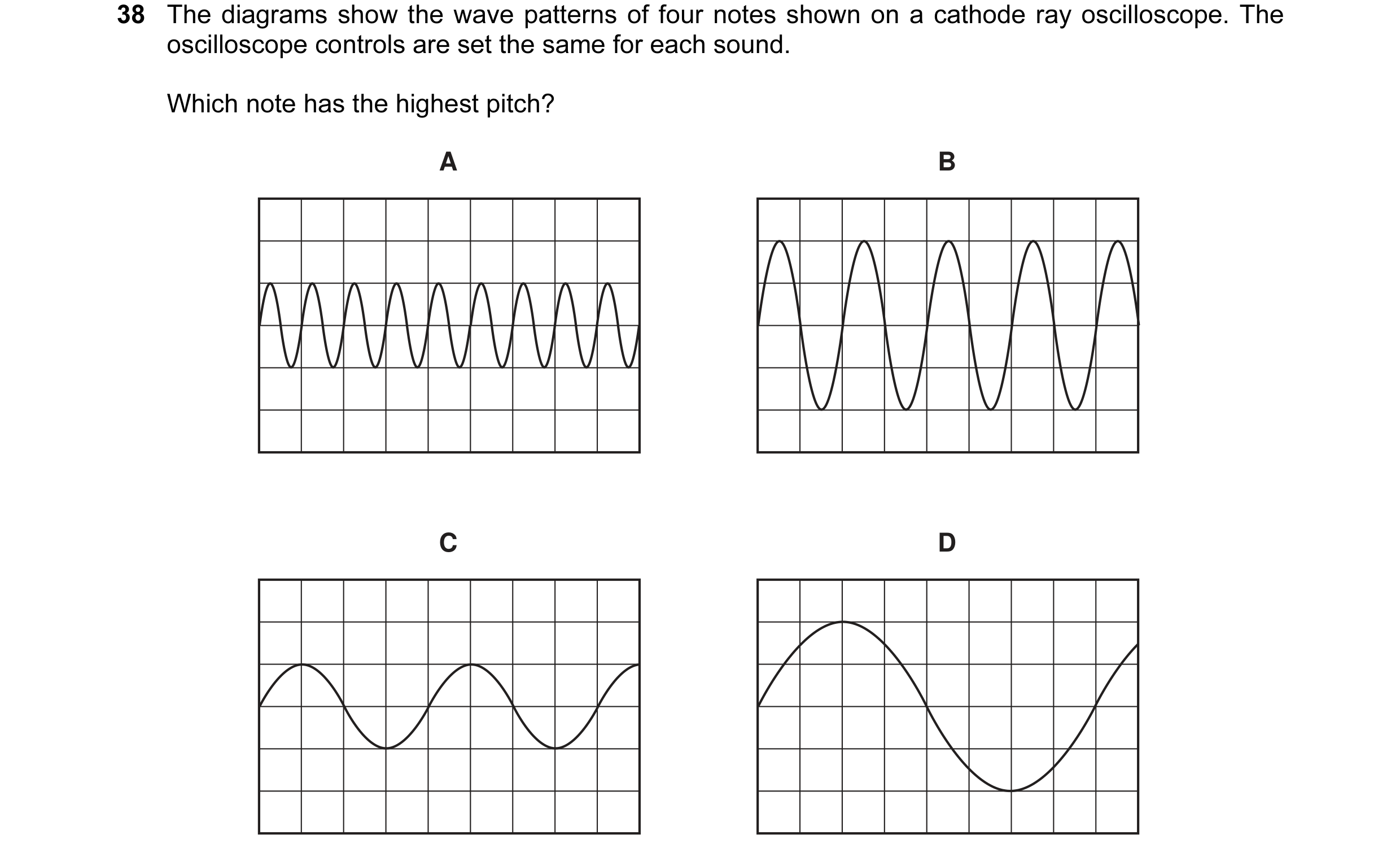
Q2 · The diagrams show the wave patterns of four notes shown on a cathode ray oscilloscope 0653/12 May/June 2010
38 The diagrams show the wave patterns of four notes shown on a cathode ray oscilloscope. The oscilloscope controls are set the same for each sound. Which note has the highest pitch? A B C D
1 marks
Answer: A
This question in 0653/12 May/June 2010
Q3 · The diagrams show the wave patterns of four notes shown on a cathode ray oscilloscope 0653/13 May/June 2010
38 The diagrams show the wave patterns of four notes shown on a cathode ray oscilloscope. The oscilloscope controls are set the same for each sound. Which note has the highest pitch? A B C D
1 marks
Answer: A
This question in 0653/13 May/June 2010
Q4 · Which is the best description of a wave that is a quiet, high-pitched sound? 0653/11 Oct/Nov 2011
37 Which is the best description of a wave that is a quiet, high-pitched sound? A large amplitude and high frequency. B large amplitude and low frequency. C small amplitude and high frequency. D small amplitude and low frequency.
1 marks
Answer: C
This question in 0653/11 Oct/Nov 2011
Q5 · Which is the best description of a wave that is a quiet, high-pitched sound? 0653/12 Oct/Nov 2011
39 Which is the best description of a wave that is a quiet, high-pitched sound? A large amplitude and high frequency. B large amplitude and low frequency. C small amplitude and high frequency. D small amplitude and low frequency.
1 marks
Answer: C
This question in 0653/12 Oct/Nov 2011
Q6 · Which is the best description of a wave that is a quiet, high-pitched sound? 0653/13 Oct/Nov 2011
38 Which is the best description of a wave that is a quiet, high-pitched sound? A large amplitude and high frequency. B large amplitude and low frequency. C small amplitude and high frequency. D small amplitude and low frequency.
1 marks
Answer: C
This question in 0653/13 Oct/Nov 2011
Q7 · The diagram shows the peaks and troughs of a water wave 0653/11 May/June 2012
33 The diagram shows the peaks and troughs of a water wave. peak peak peak wave direction trough trough trough What is the wavelength of the water wave? A the depth of one wave trough B the distance between one wave trough and the next C the distance travelled by one wave trough in one second D the number of wave troughs passing a point in one second
1 marks
This question in 0653/11 May/June 2012
Q8 · The diagram represents a wave 0653/12 May/June 2012
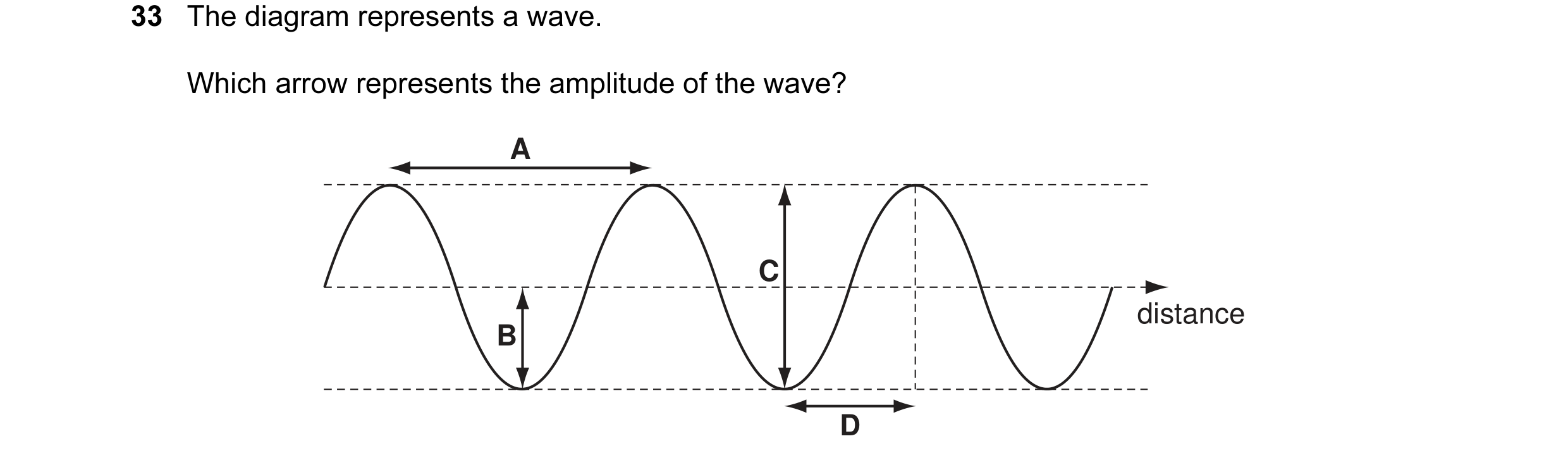
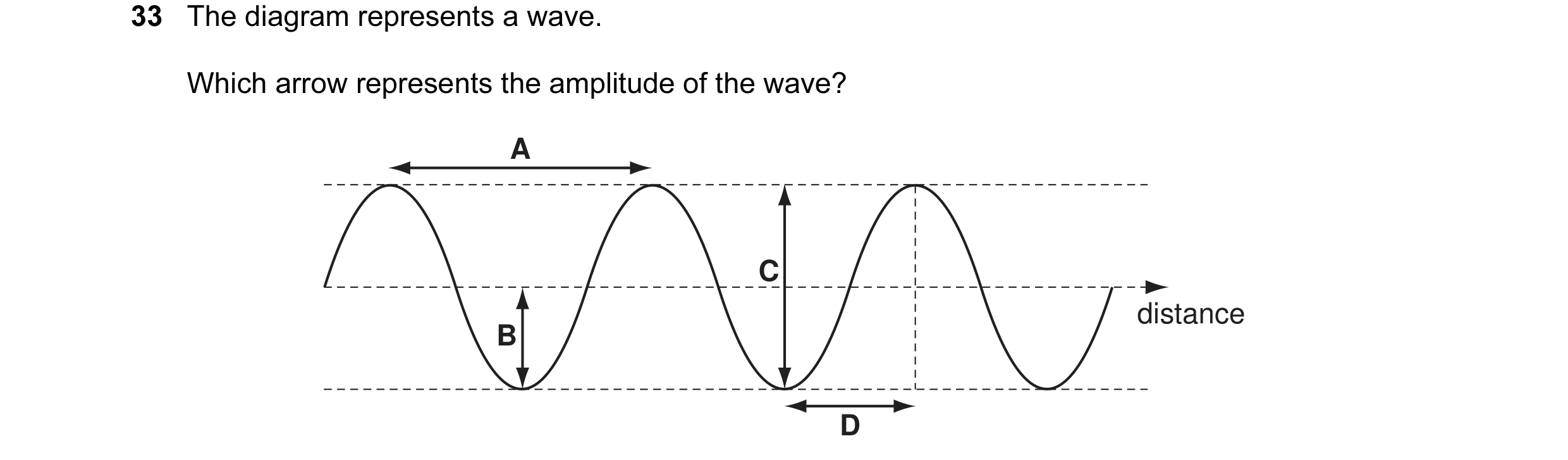
33 The diagram represents a wave. Which arrow represents the amplitude of the wave? A C distance B D
1 marks
Answer: B
This question in 0653/12 May/June 2012
Q9 · The diagram represents a wave 0653/13 May/June 2012
33 The diagram represents a wave. Which arrow represents the amplitude of the wave? A C distance B D
1 marks
Answer: B
This question in 0653/13 May/June 2012
Q10 · A student measures the distance a cork moves up and down on a wave in a tank of water 0653/12 May/June 2013
34 A student measures the distance a cork moves up and down on a wave in a tank of water. ruler cork direction of wave Which quantity can she obtain from this measurement? A amplitude B frequency C speed D wavelength
1 marks
Answer: A
This question in 0653/12 May/June 2013
Q11 · A student measures the distance a cork moves up and down on a wave in a tank of water 0653/13 May/June 2013
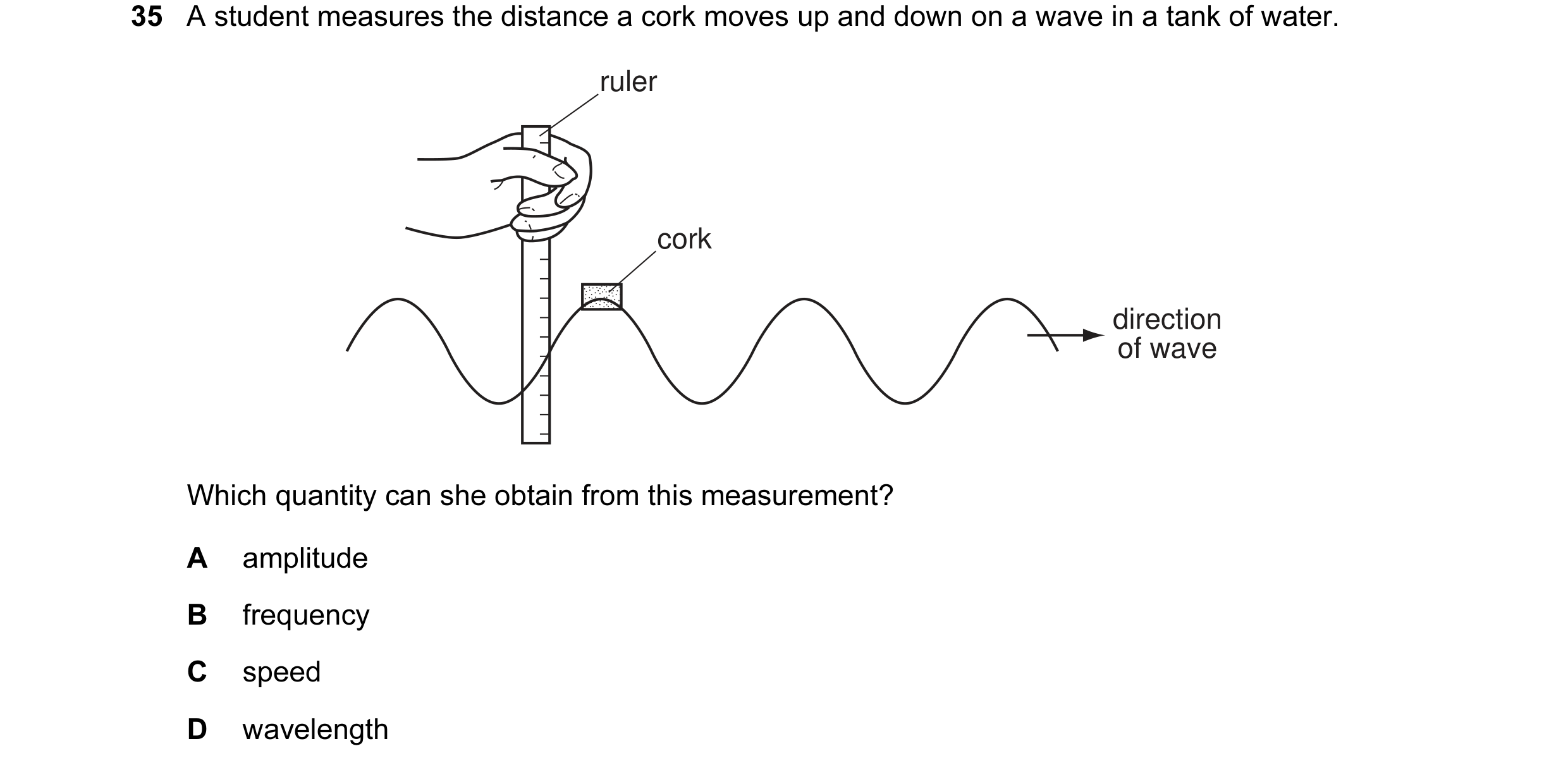
35 A student measures the distance a cork moves up and down on a wave in a tank of water. ruler cork direction of wave Which quantity can she obtain from this measurement? A amplitude B frequency C speed D wavelength
1 marks
Answer: A
This question in 0653/13 May/June 2013
Q12 · The diagram shows a rope with one end fixed to a wall 0653/11 Oct/Nov 2013
34 The diagram shows a rope with one end fixed to a wall. The end of the rope is moved up and down through a distance of 0.50 m twice every second. This makes a wave move along the rope. wall 0.50 m Which line in the table shows the amplitude and the frequency of the wave? amplitude / m frequency / Hz A 0.25 0.50 B 0.25 2.0 C 0.50 0.50 D 0.50 2.0
1 marks
Answer: B
This question in 0653/11 Oct/Nov 2013
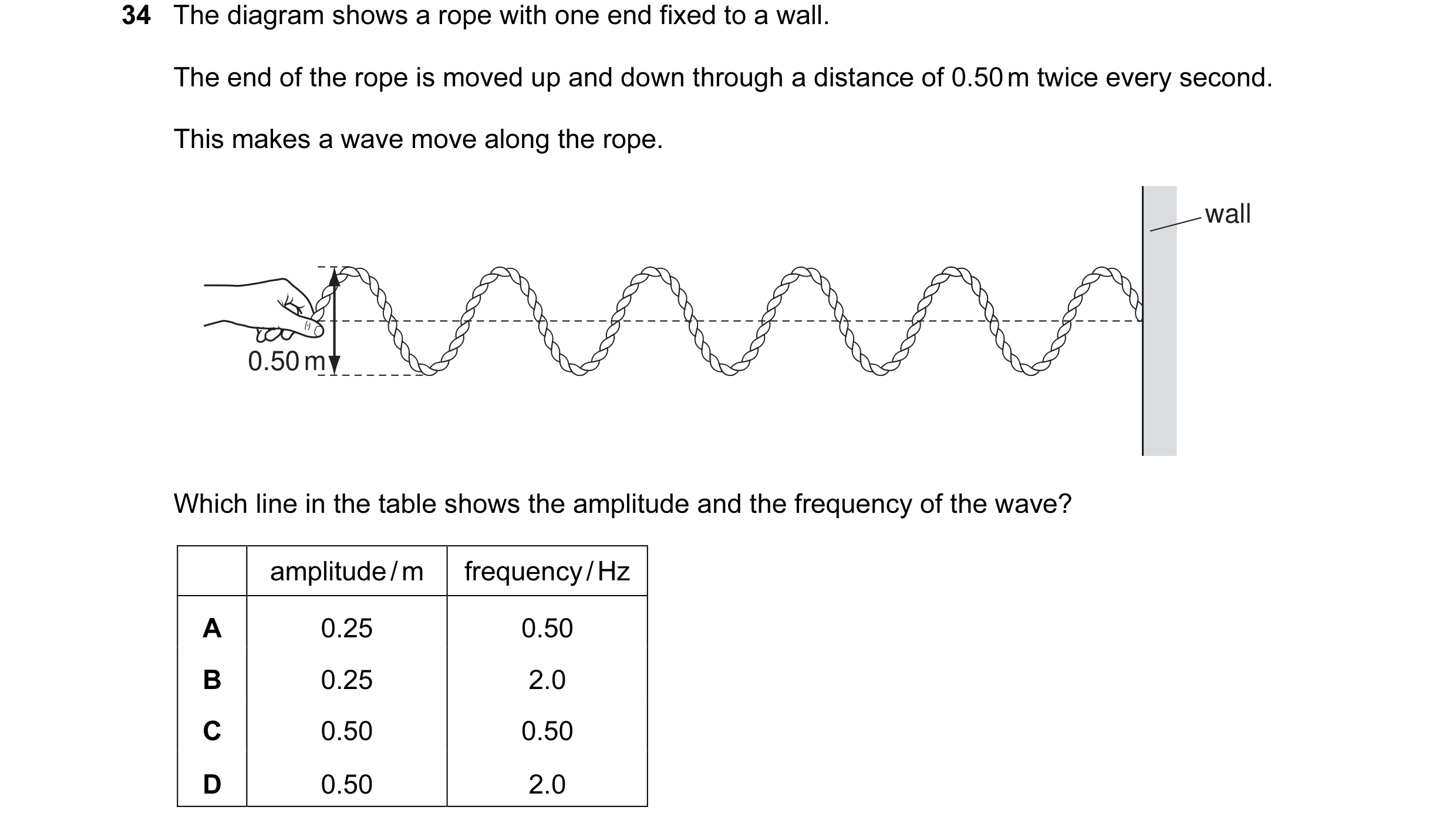
Q13 · The diagram shows a rope with one end fixed to a wall 0653/12 Oct/Nov 2013
34 The diagram shows a rope with one end fixed to a wall. The end of the rope is moved up and down through a distance of 0.50 m twice every second. This makes a wave move along the rope. wall 0.50 m Which line in the table shows the amplitude and the frequency of the wave? amplitude / m frequency / Hz A 0.25 0.50 B 0.25 2.0 C 0.50 0.50 D 0.50 2.0
1 marks
Answer: B
This question in 0653/12 Oct/Nov 2013
Q14 · A student vibrates the end of a horizontal rope and sends a wave along the rope 0653/13 Oct/Nov 2013
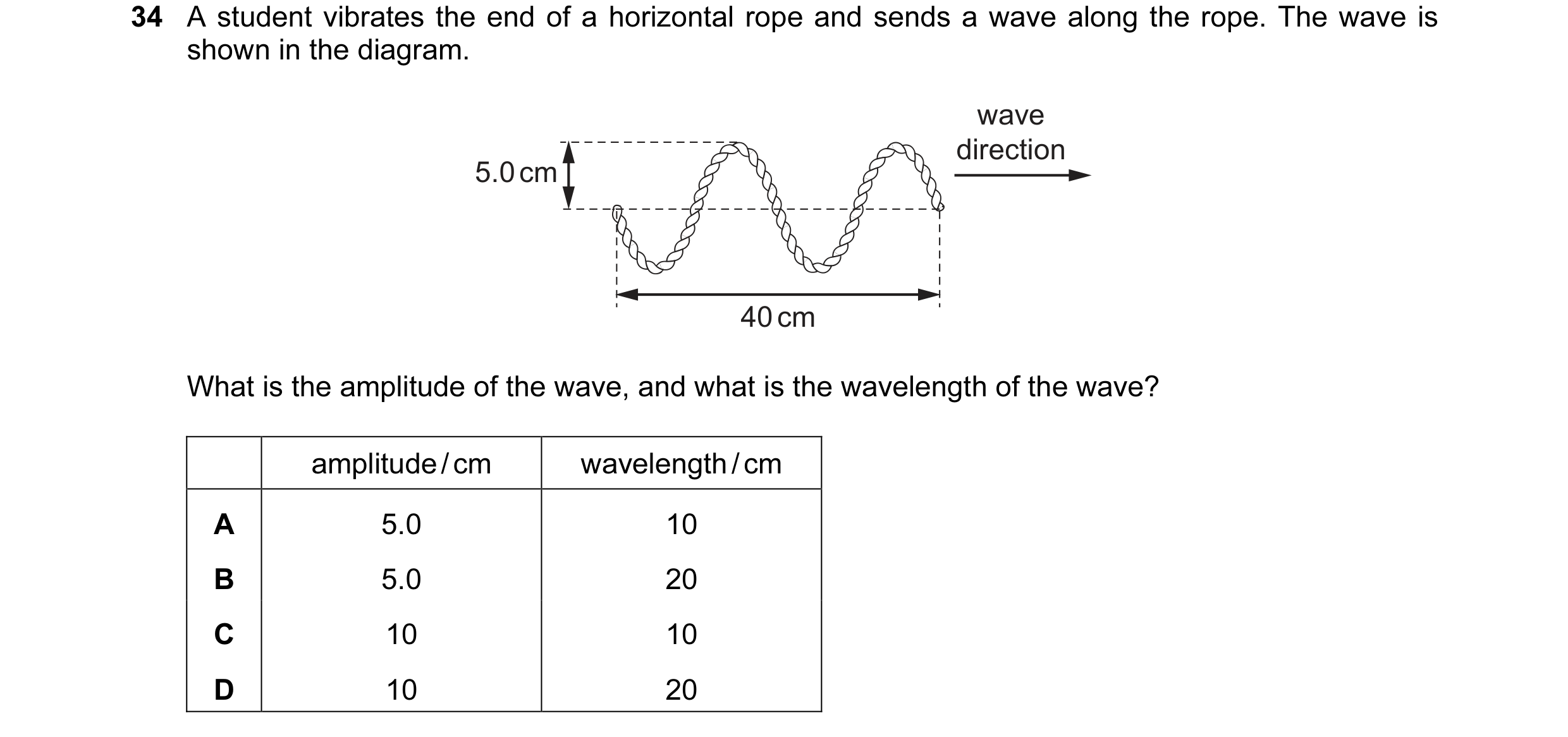
34 A student vibrates the end of a horizontal rope and sends a wave along the rope. The wave is shown in the diagram. wave direction 5.0 cm 40 cm What is the amplitude of the wave, and what is the wavelength of the wave? amplitude / cm wavelength / cm A 5.0 10 B 5.0 20 C 10 10 D 10 20
1 marks
Answer: B
This question in 0653/13 Oct/Nov 2013
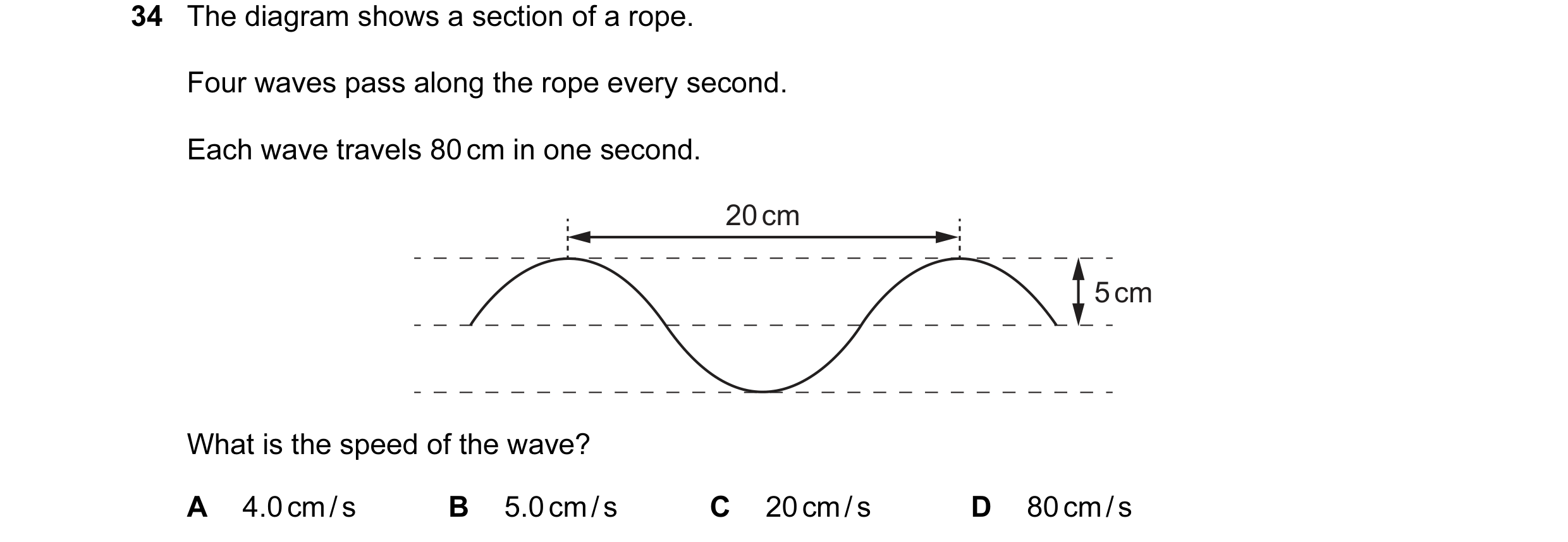
Q15 · The diagram shows a section of a rope 0653/11 May/June 2014
34 The diagram shows a section of a rope. Four waves pass along the rope every second. Each wave travels 80 cm in one second. 20 cm 5 cm What is the speed of the wave? A 4.0 cm / s B 5.0 cm / s C 20 cm / s D 80 cm / s
1 marks
Answer: D
This question in 0653/11 May/June 2014
Q16 · The diagram represents a wave 0653/12 May/June 2014
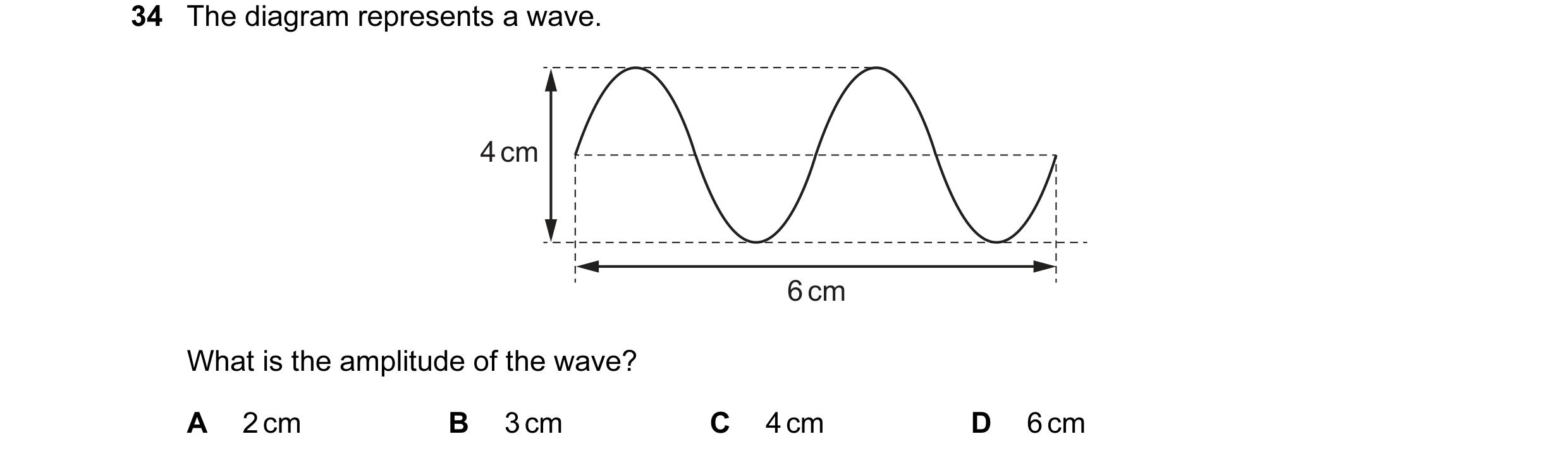
34 The diagram represents a wave. 4 cm 6 cm What is the amplitude of the wave? A 2 cm B 3 cm C 4 cm D 6 cm
1 marks
Answer: A
This question in 0653/12 May/June 2014
Q17 · The diagram shows a section of a rope 0653/13 May/June 2014
36 The diagram shows a section of a rope. Four waves pass along the rope every second. Each wave travels 80 cm in one second. 20 cm 5 cm What is the speed of the wave? A 4.0 cm / s B 5.0 cm / s C 20 cm / s D 80 cm / s
1 marks
Answer: D
This question in 0653/13 May/June 2014
Q18 · The diagram shows a section through waves on water 0653/11 Oct/Nov 2014
34 The diagram shows a section through waves on water. Which dotted line shows the position of the water surface before the wave reaches it? A B C D
1 marks
Answer: B
This question in 0653/11 Oct/Nov 2014
Q19 · The sound from a drum is loud and has a low pitch 0653/12 Oct/Nov 2014
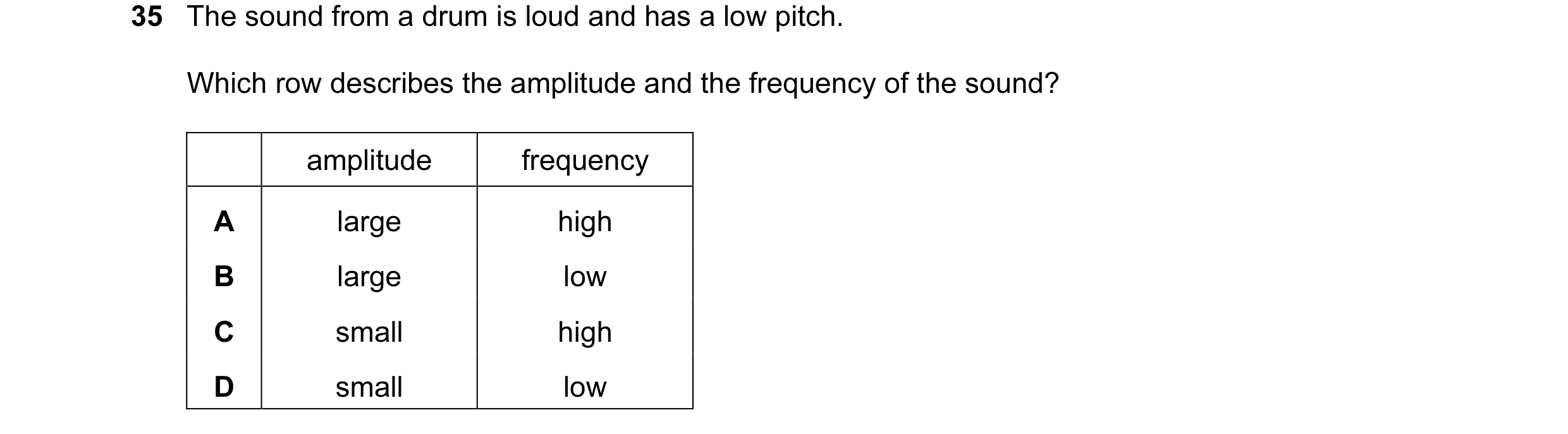
35 The sound from a drum is loud and has a low pitch. Which row describes the amplitude and the frequency of the sound? amplitude frequency A large high B large low C small high D small low
1 marks
Answer: B
This question in 0653/12 Oct/Nov 2014
Q20 · The diagram shows a section through waves on water 0653/12 Oct/Nov 2014
36 The diagram shows a section through waves on water. Which dotted line shows the position of the water surface before the wave reaches it? A B C D
1 marks
Answer: B
This question in 0653/12 Oct/Nov 2014
Q21 · The diagram shows a section through waves on water 0653/13 Oct/Nov 2014
34 The diagram shows a section through waves on water. Which dotted line shows the position of the water surface before the wave reaches it? A B C D
1 marks
Answer: B
This question in 0653/13 Oct/Nov 2014
Q22 · A student shakes one end of a long rope up and down 0653/11 May/June 2015
34 A student shakes one end of a long rope up and down. A wave travels along the rope in the direction shown. shaken up and down wave direction along rope a short distance The student now moves the rope up and down through a larger distance. He also shakes it fewer times each minute. Which row shows the effects of these two changes? amplitude of frequency of the wave the wave A decreases decreases B decreases increases C increases decreases D increases increases
1 marks
Answer: C
This question in 0653/11 May/June 2015
Q23 · A boat floats on the sea 0653/12 May/June 2015
34 A boat floats on the sea. The boat moves slowly up and down as a wave passes it. The amplitude of the wave is 0.50 m. What is the vertical distance between the highest and lowest positions of the boat as the wave passes it? A 0 m B 0.50 m C 1.0 m D 2.0 m
1 marks
Answer: C
This question in 0653/12 May/June 2015
Q24 · Waves cause a small boat to move regularly up and down 0653/13 May/June 2015
34 Waves cause a small boat to move regularly up and down. A student calculates the number of times that the boat moves up and down in one second. Which wave property has he calculated? A amplitude B frequency C speed D wavelength
1 marks
Answer: B
This question in 0653/13 May/June 2015
Q25 · A student vibrates the end of a horizontal rope and sends a wave along the rope 0653/11 May/June 2016
34 A student vibrates the end of a horizontal rope and sends a wave along the rope. The wave is shown in the diagram. wave direction 5.0 cm 40 cm What is the amplitude of the wave, and what is the wavelength of the wave? amplitude / cm wavelength / cm A 5.0 10 B 5.0 20 C 10 10 D 10 20
1 marks
Answer: B
This question in 0653/11 May/June 2016
Q26 · A student vibrates the end of a horizontal rope and sends a wave along the rope 0653/12 May/June 2016
34 A student vibrates the end of a horizontal rope and sends a wave along the rope. The wave is shown in the diagram. wave direction 5.0 cm 40 cm What is the amplitude of the wave, and what is the wavelength of the wave? amplitude / cm wavelength / cm A 5.0 10 B 5.0 20 C 10 10 D 10 20
1 marks
Answer: B
This question in 0653/12 May/June 2016
Q27 · A student vibrates the end of a horizontal rope and sends a wave along the rope 0653/13 May/June 2016
34 A student vibrates the end of a horizontal rope and sends a wave along the rope. The wave is shown in the diagram. wave direction 5.0 cm 40 cm What is the amplitude of the wave, and what is the wavelength of the wave? amplitude / cm wavelength / cm A 5.0 10 B 5.0 20 C 10 10 D 10 20
1 marks
Answer: B
This question in 0653/13 May/June 2016
Q28 · A navigation buoy floating on the sea oscillates up and down as a wave passes 0653/11 Oct/Nov 2016
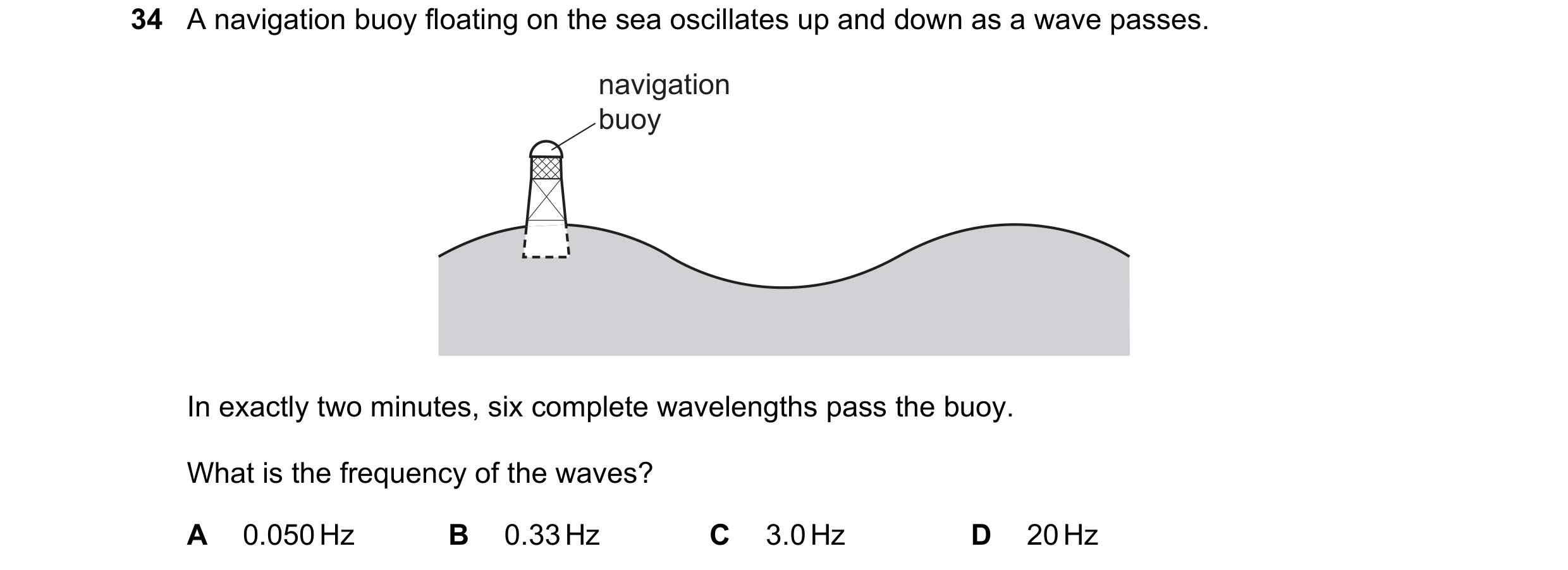
34 A navigation buoy floating on the sea oscillates up and down as a wave passes. navigation buoy In exactly two minutes, six complete wavelengths pass the buoy. What is the frequency of the waves? A 0.050 Hz B 0.33 Hz C 3.0 Hz D 20 Hz
1 marks
Answer: A
This question in 0653/11 Oct/Nov 2016
Q29 · The diagram represents a water wave 0653/12 Oct/Nov 2016
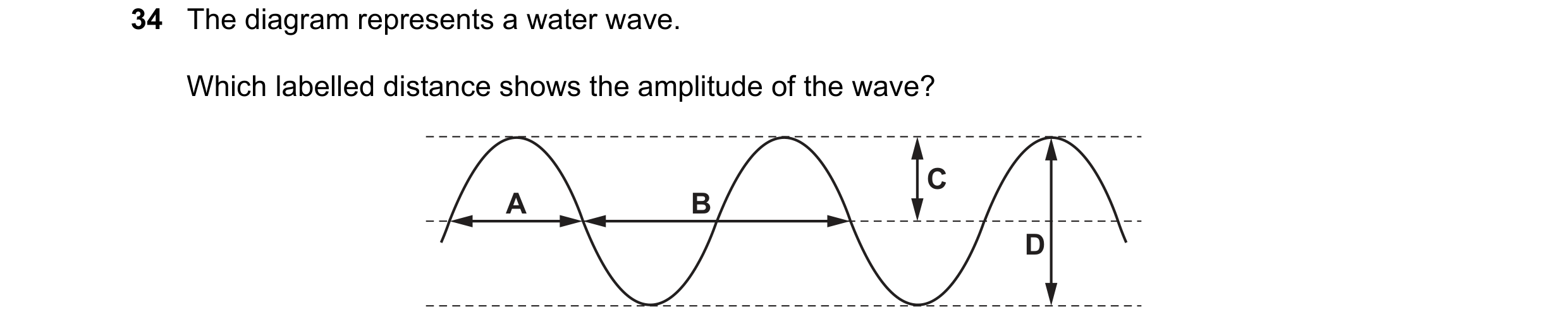
34 The diagram represents a water wave. Which labelled distance shows the amplitude of the wave? C A B D
1 marks
Answer: C
This question in 0653/12 Oct/Nov 2016
Q30 · The diagram represents a wave at one moment 0653/13 Oct/Nov 2016
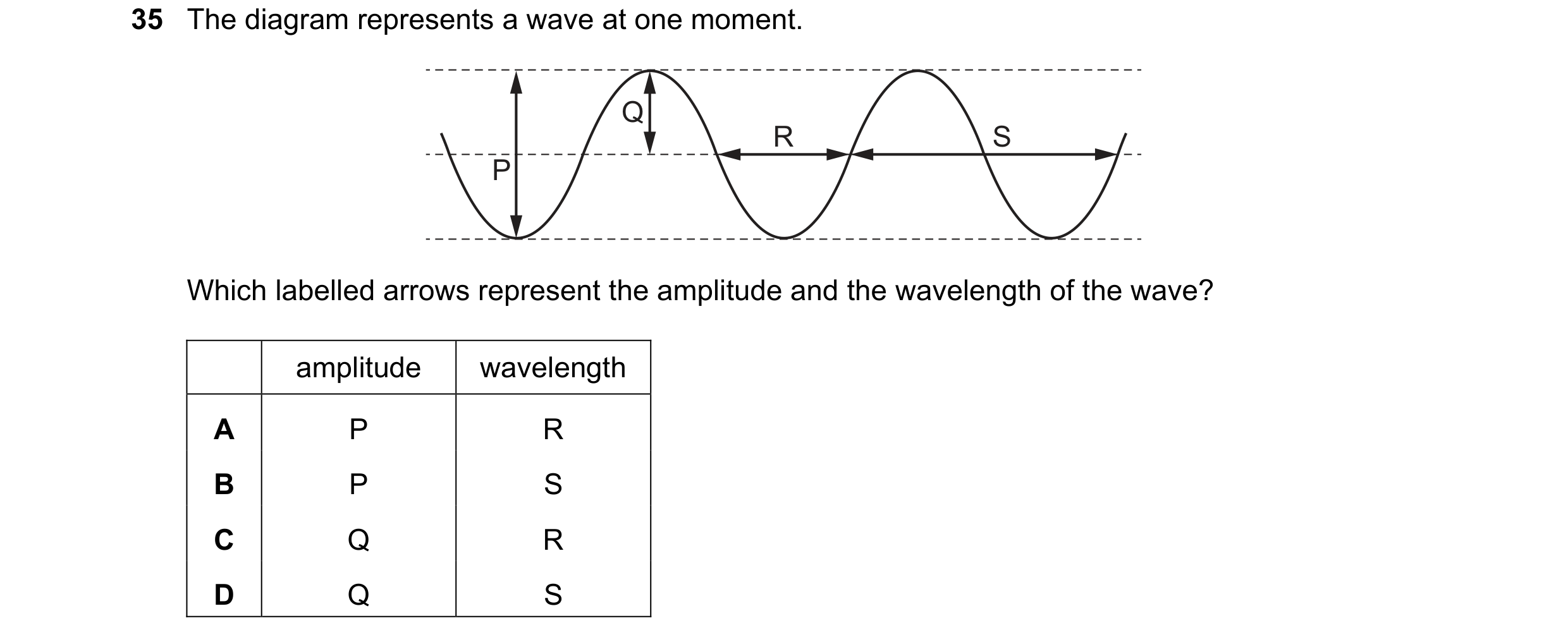
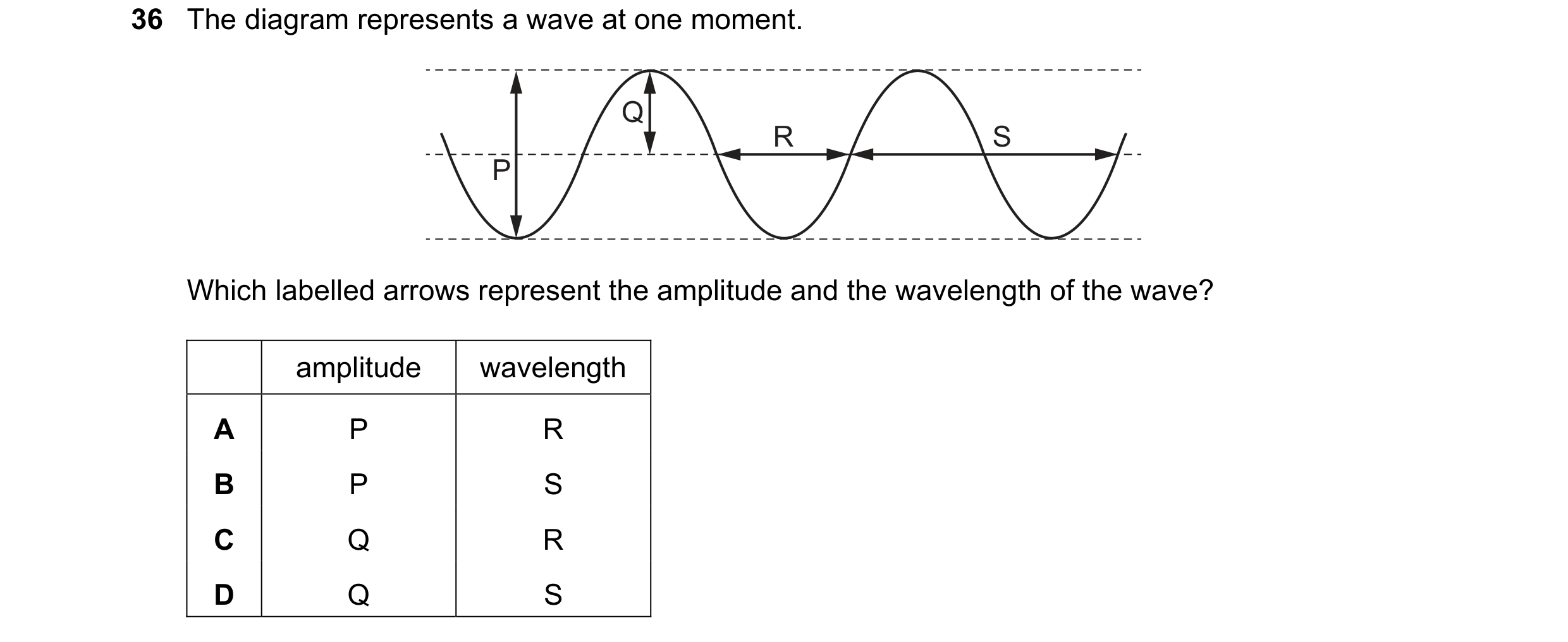
34 The diagram represents a wave at one moment. P R S Q Which labelled arrows represent the amplitude and the wavelength of the wave? amplitude wavelength A P R B P S C Q R D Q S
1 marks
Answer: B
This question in 0653/13 Oct/Nov 2016
Q31 · The diagram represents a wave, with two measurements given 0653/12 Feb/March 2017
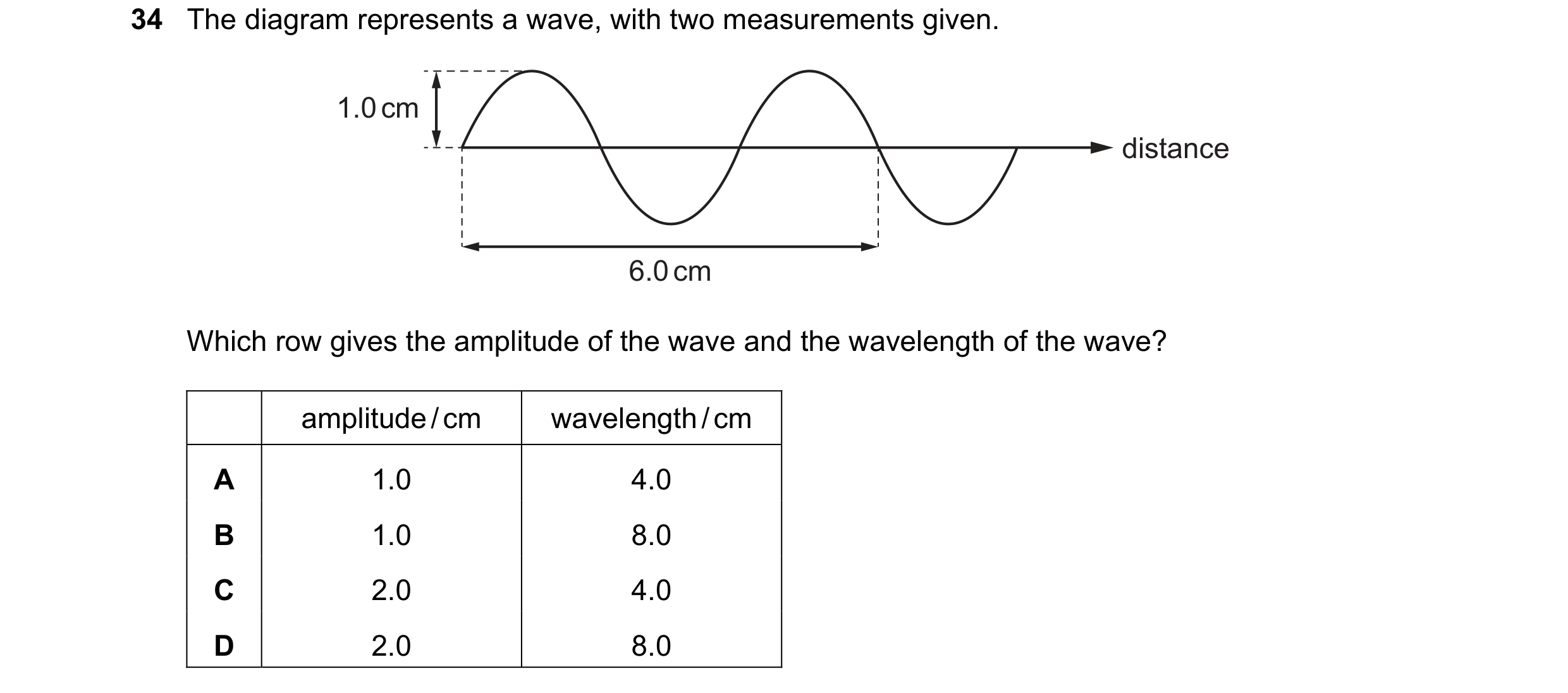
34 The diagram represents a wave, with two measurements given. 1.0 cm distance 6.0 cm Which row gives the amplitude of the wave and the wavelength of the wave? amplitude / cm wavelength / cm A 1.0 4.0 B 1.0 8.0 C 2.0 4.0 D 2.0 8.0
1 marks
Answer: A
This question in 0653/12 Feb/March 2017
Q32 · The diagram represents a wave on the surface of water 0653/11 May/June 2017
34 The diagram represents a wave on the surface of water. Some measurements are shown. 6.0 cm distance 4.0 cm Which row gives the amplitude and the wavelength of the wave? amplitude wavelength / cm / cm A 3.0 4.0 B 3.0 8.0 C 6.0 4.0 D 6.0 8.0
1 marks
Answer: B
This question in 0653/11 May/June 2017
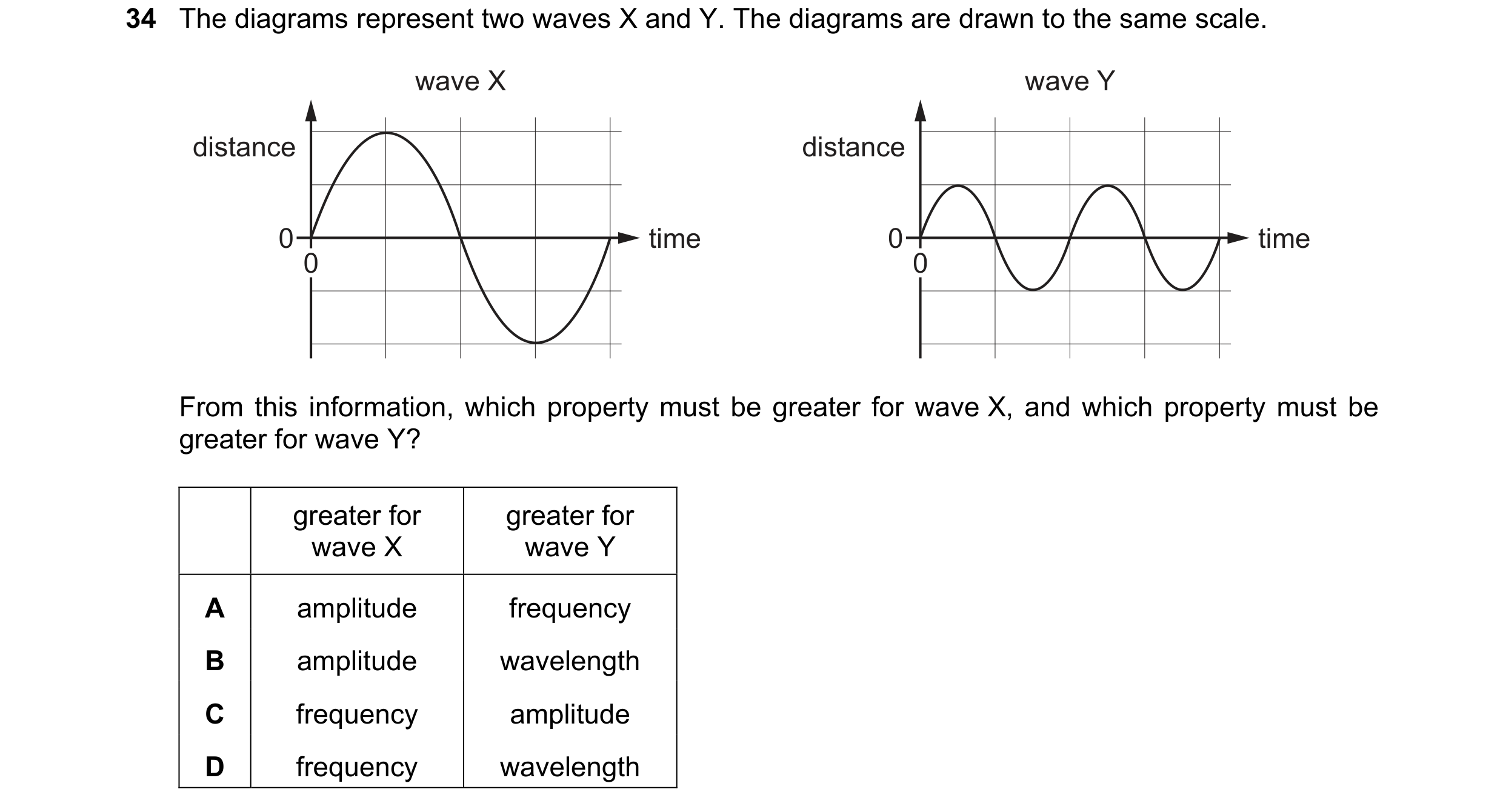
Q33 · The diagrams represent two waves X and Y 0653/12 May/June 2017
34 The diagrams represent two waves X and Y. The diagrams are drawn to the same scale. wave X wave Y distance distance 0 time 0 time 0 0 From this information, which property must be greater for wave X, and which property must be greater for wave Y? greater for greater for wave X wave Y A amplitude frequency B amplitude wavelength C frequency amplitude D frequency wavelength
1 marks
Answer: A
This question in 0653/12 May/June 2017
Q34 · The diagrams represent two waves X and Y 0653/13 May/June 2017
34 The diagrams represent two waves X and Y. The diagrams are drawn to the same scale. wave X wave Y distance distance 0 time 0 time 0 0 From this information, which property must be greater for wave X, and which property must be greater for wave Y? greater for greater for wave X wave Y A amplitude frequency B amplitude wavelength C frequency amplitude D frequency wavelength
1 marks
Answer: A
This question in 0653/13 May/June 2017
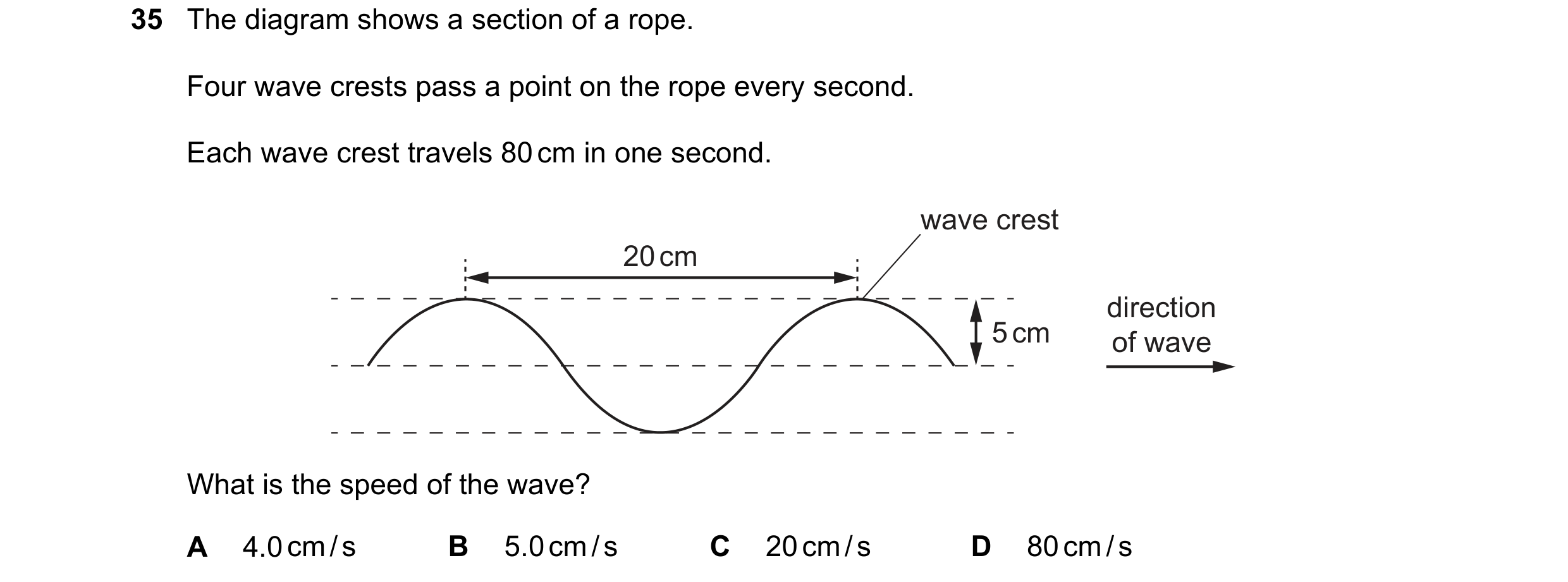
Q35 · The diagram shows a section of a rope 0653/11 Oct/Nov 2017
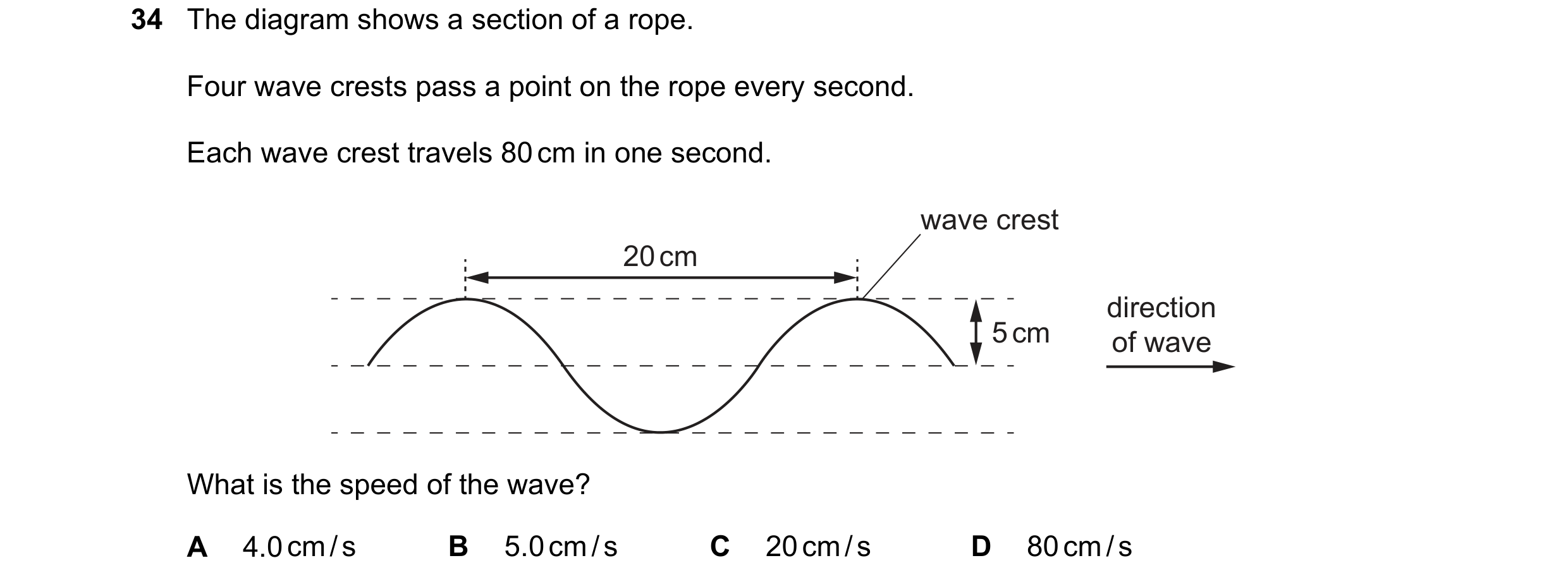
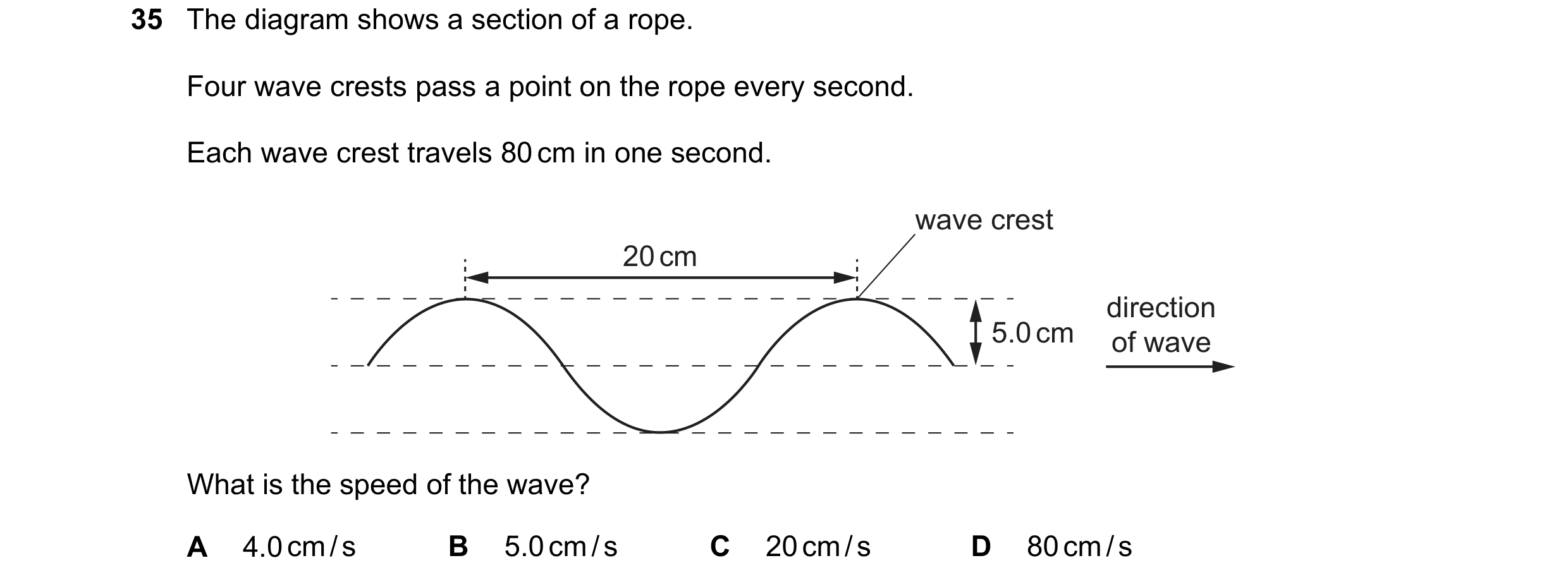
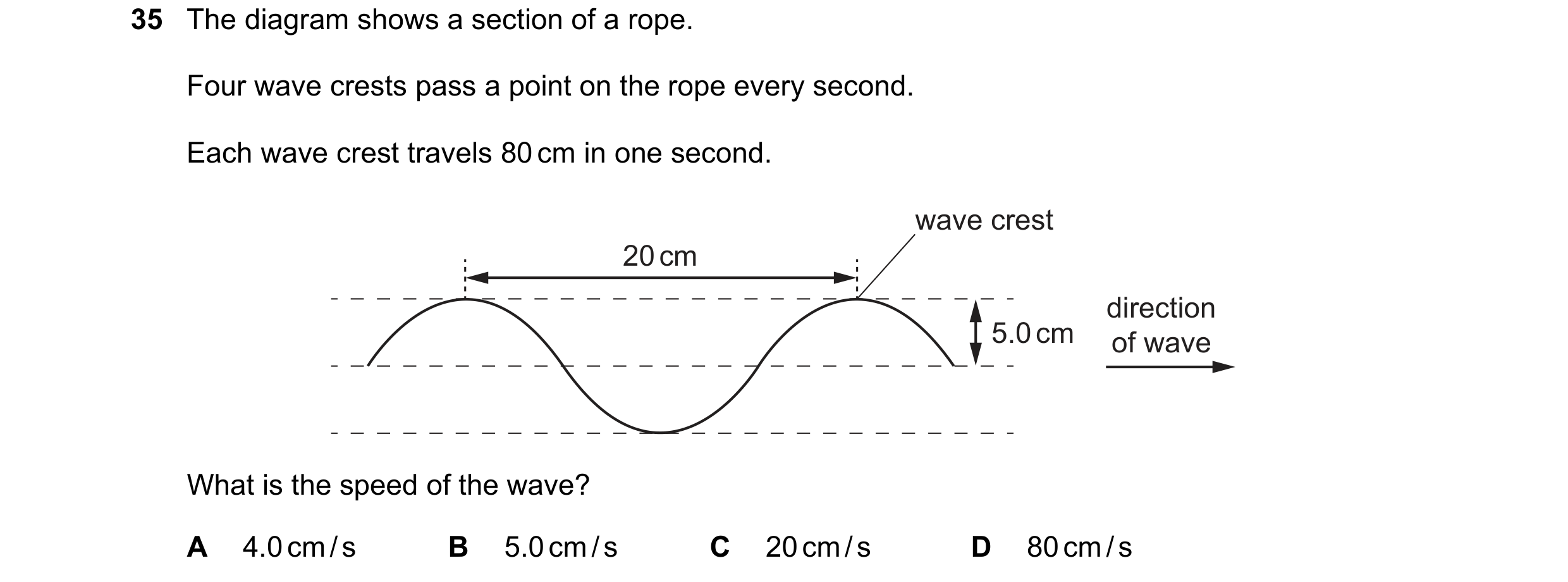
35 The diagram shows a section of a rope. Four wave crests pass a point on the rope every second. Each wave crest travels 80 cm in one second. wave crest 20 cm direction 5 cm of wave What is the speed of the wave? A 4.0 cm / s B 5.0 cm / s C 20 cm / s D 80 cm / s
1 marks
Answer: D
This question in 0653/11 Oct/Nov 2017
Q36 · The diagram shows a section of a rope 0653/12 Oct/Nov 2017
34 The diagram shows a section of a rope. Four wave crests pass a point on the rope every second. Each wave crest travels 80 cm in one second. wave crest 20 cm direction 5 cm of wave What is the speed of the wave? A 4.0 cm / s B 5.0 cm / s C 20 cm / s D 80 cm / s
1 marks
Answer: D
This question in 0653/12 Oct/Nov 2017
Q37 · The diagram shows a section of a rope 0653/13 Oct/Nov 2017
34 The diagram shows a section of a rope. Four wave crests pass a point on the rope every second. Each wave crest travels 80 cm in one second. wave crest 20 cm direction 5 cm of wave What is the speed of the wave? A 4.0 cm / s B 5.0 cm / s C 20 cm / s D 80 cm / s
1 marks
Answer: D
This question in 0653/13 Oct/Nov 2017
Q38 · What is the approximate range of frequencies of sound that can be heard by a human, and… 0653/13 Oct/Nov 2017
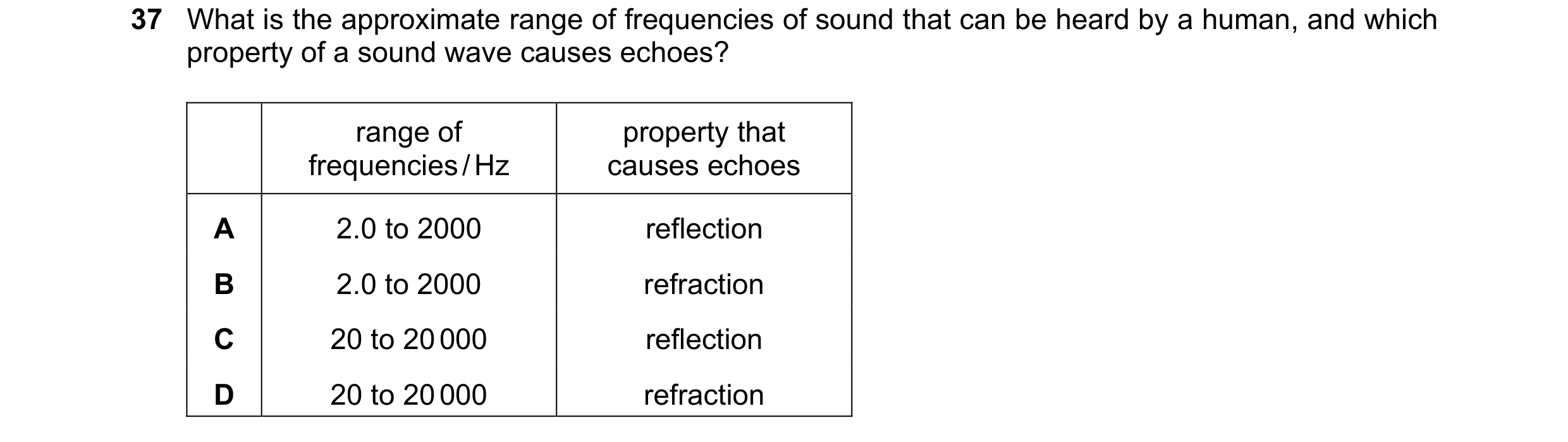
37 What is the approximate range of frequencies of sound that can be heard by a human, and which property of a sound wave causes echoes? range of property that frequencies / Hz causes echoes A 2.0 to 2000 reflection B 2.0 to 2000 refraction C 20 to 20 000 reflection D 20 to 20 000 refraction
1 marks
Answer: C
This question in 0653/13 Oct/Nov 2017
Q39 · The diagram represents a wave 0653/12 Feb/March 2018
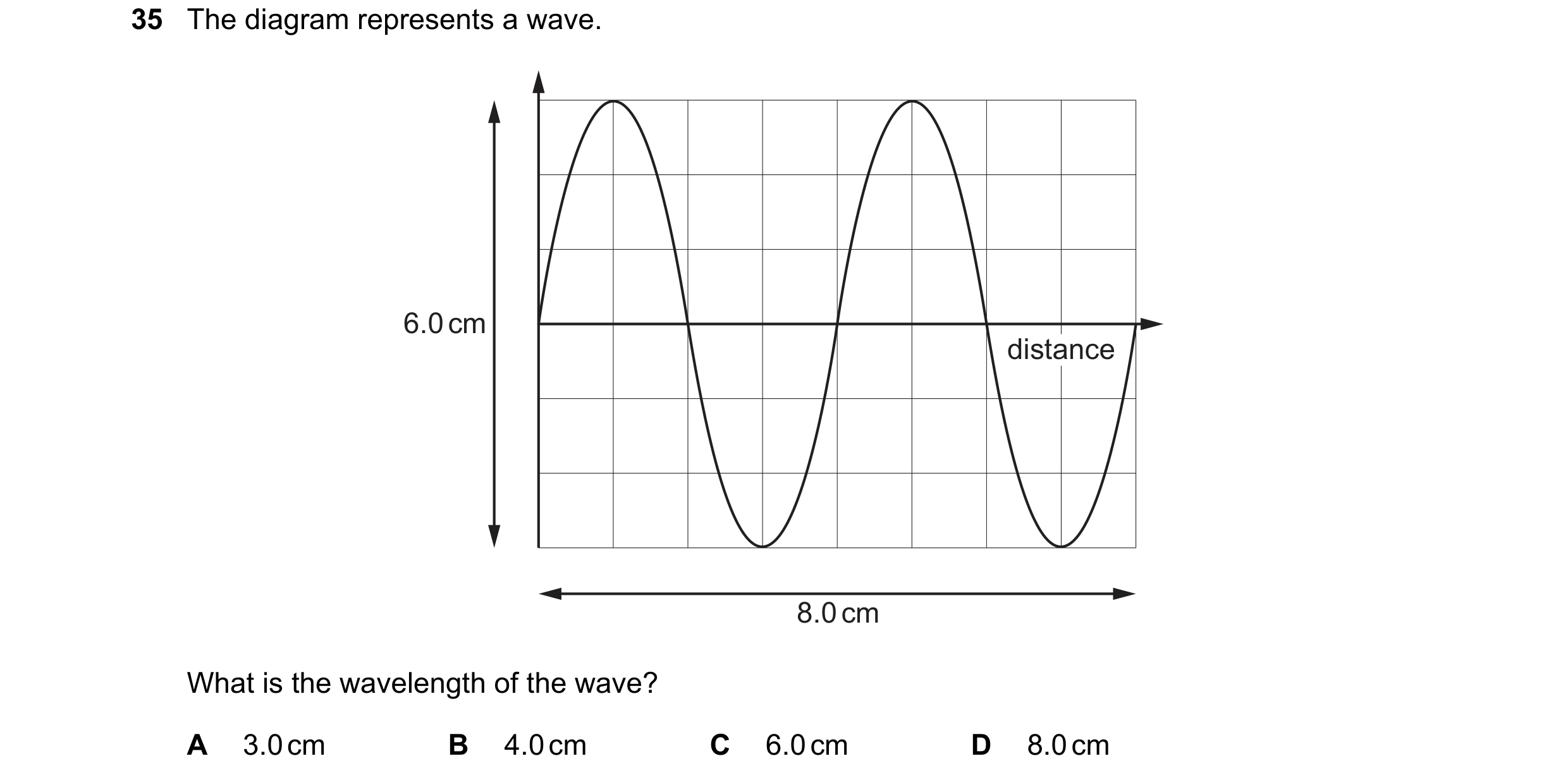
35 The diagram represents a wave. 6.0 cm distance 8.0 cm What is the wavelength of the wave? A 3.0 cm B 4.0 cm C 6.0 cm D 8.0 cm
1 marks
Answer: B
This question in 0653/12 Feb/March 2018
Q40 · The diagram represents a wave 0653/11 May/June 2018
34 The diagram represents a wave. 2.0 distance / cm 1.5 1.0 0.5 0 time / s 0 0.5 1.0 1.5 2.0 2.5 3.0 3.5 4.0 4.5 –0.5 –1.0 –1.5 –2.0 What is the amplitude of the wave, and what is the frequency of the wave? amplitude / cm frequency / Hz A 2.0 0.50 B 2.0 2.0 C 4.0 0.50 D 4.0 2.0
1 marks
Answer: A
This question in 0653/11 May/June 2018
Q41 · A student investigates a wave 0653/11 Oct/Nov 2018
34 A student investigates a wave. First he measures the distance between one wave crest and the next wave crest. Next, he counts the number of wave crests passing a fixed point in one second. Which properties of the wave has the student determined? A the amplitude and the frequency B the amplitude and the speed C the wavelength and the frequency D the wavelength and the speed
1 marks
Answer: C
This question in 0653/11 Oct/Nov 2018
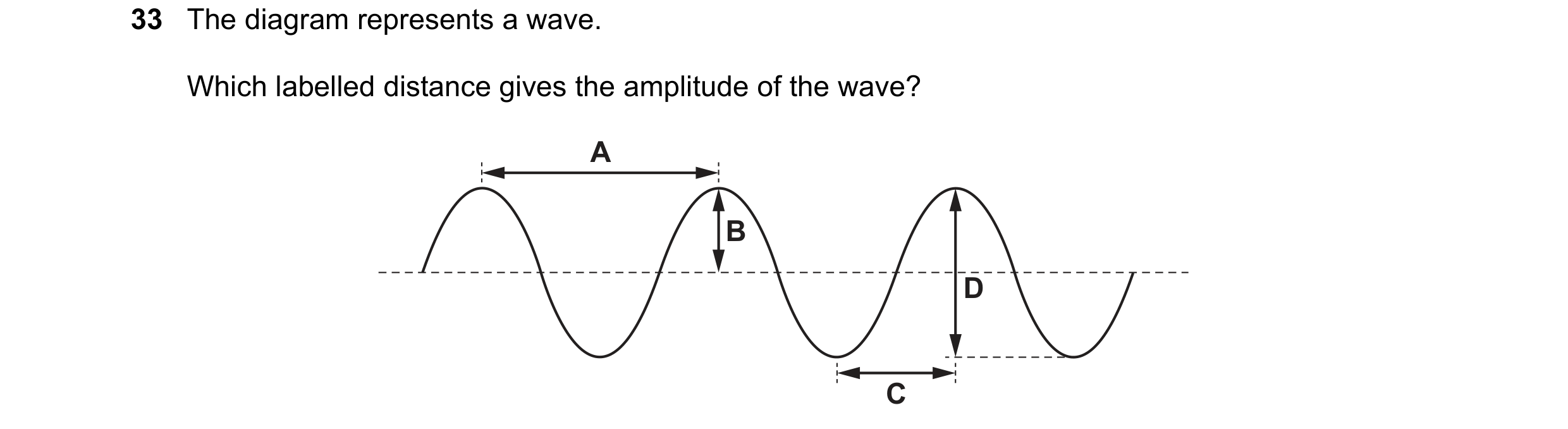
Q42 · The diagram represents a wave 0653/12 Oct/Nov 2018
33 The diagram represents a wave. Which labelled distance gives the amplitude of the wave? A B D C
1 marks
Answer: B
This question in 0653/12 Oct/Nov 2018
Q43 · The diagram shows a wave travelling along a rope 0653/13 Oct/Nov 2018
34 The diagram shows a wave travelling along a rope. Ten wave troughs pass the fixed point P in 2.0 seconds. wave crest wave direction P wave trough What does this indicate about the wave? A It has a frequency of 0.20 Hz. B It has a frequency of 5.0 Hz. C It has a speed of 0.50 m / s. D It has a speed of 5.0 m / s.
1 marks
Answer: B
This question in 0653/13 Oct/Nov 2018
Q44 · The diagram represents a wave at one moment 0653/11 May/June 2019
35 The diagram represents a wave at one moment. Q R S P Which labelled arrows represent the amplitude and the wavelength of the wave? amplitude wavelength A P R B P S C Q R D Q S
1 marks
Answer: D
This question in 0653/11 May/June 2019
Q45 · The diagram represents a wave at one moment 0653/12 May/June 2019
36 The diagram represents a wave at one moment. Q R S P Which labelled arrows represent the amplitude and the wavelength of the wave? amplitude wavelength A P R B P S C Q R D Q S
1 marks
Answer: D
This question in 0653/12 May/June 2019
Q46 · The diagram represents a wave at one moment 0653/13 May/June 2019
34 The diagram represents a wave at one moment. Q R S P Which labelled arrows represent the amplitude and the wavelength of the wave? amplitude wavelength A P R B P S C Q R D Q S
1 marks
Answer: D
This question in 0653/13 May/June 2019
Q47 · A student moves one end of a long rope up and down through a short distance 0653/12 Feb/March 2020
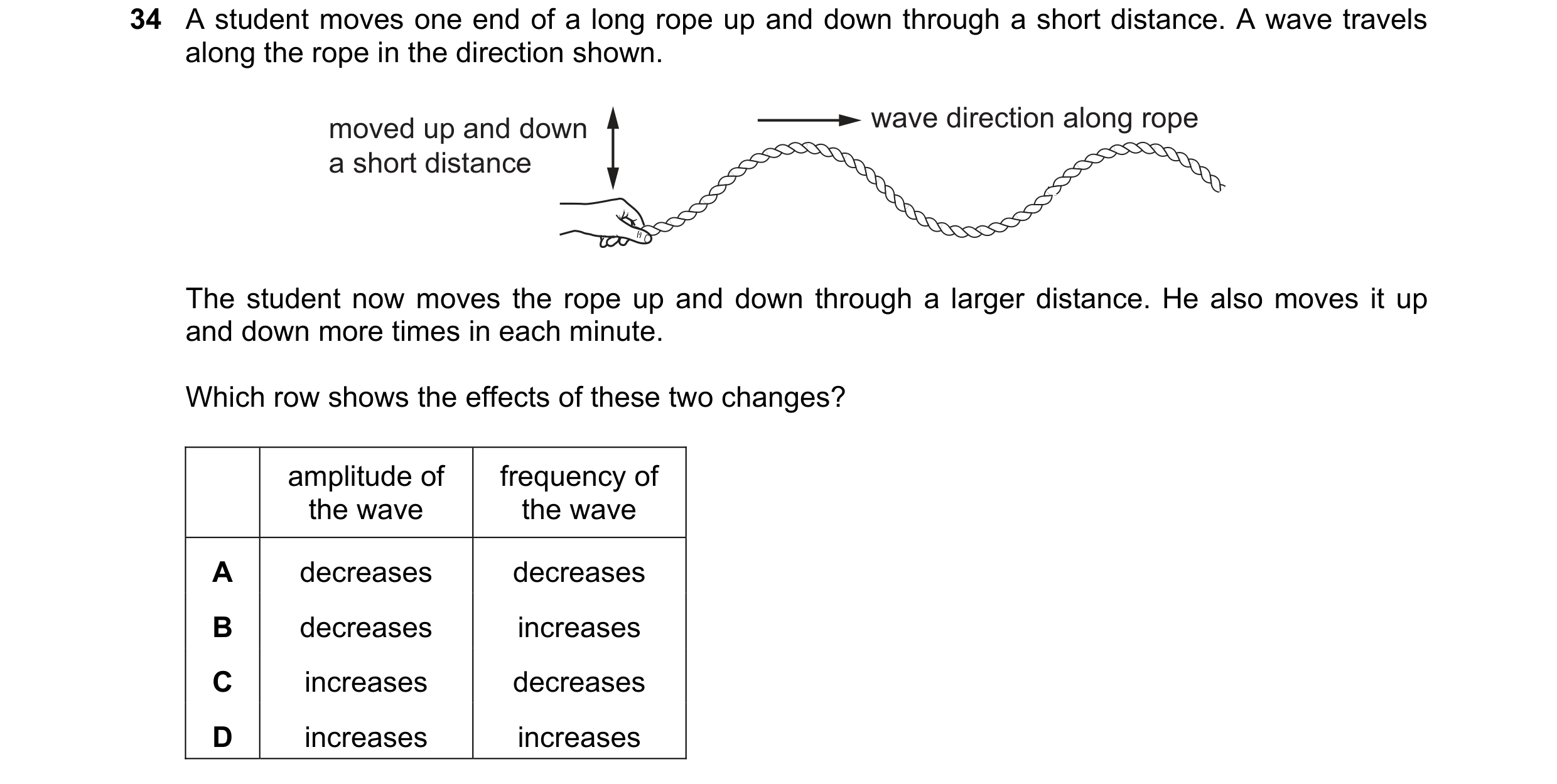
34 A student moves one end of a long rope up and down through a short distance. A wave travels along the rope in the direction shown. moved up and down wave direction along rope a short distance The student now moves the rope up and down through a larger distance. He also moves it up and down more times in each minute. Which row shows the effects of these two changes? amplitude of frequency of the wave the wave A decreases decreases B decreases increases C increases decreases D increases increases
1 marks
Answer: D
This question in 0653/12 Feb/March 2020
Q48 · The diagram shows a section of a rope 0653/11 Oct/Nov 2020
35 The diagram shows a section of a rope. Four wave crests pass a point on the rope every second. Each wave crest travels 80 cm in one second. wave crest 20 cm direction 5.0 cm of wave What is the speed of the wave? A 4.0 cm / s B 5.0 cm / s C 20 cm / s D 80 cm / s
1 marks
Answer: D
This question in 0653/11 Oct/Nov 2020
Q49 · The diagram shows a section of a rope 0653/12 Oct/Nov 2020
33 The diagram shows a section of a rope. Four wave crests pass a point on the rope every second. Each wave crest travels 80 cm in one second. wave crest 20 cm direction 5.0 cm of wave What is the speed of the wave? A 4.0 cm / s B 5.0 cm / s C 20 cm / s D 80 cm / s
1 marks
Answer: D
This question in 0653/12 Oct/Nov 2020
Q50 · The diagram shows a section of a rope 0653/13 Oct/Nov 2020
35 The diagram shows a section of a rope. Four wave crests pass a point on the rope every second. Each wave crest travels 80 cm in one second. wave crest 20 cm direction 5.0 cm of wave What is the speed of the wave? A 4.0 cm / s B 5.0 cm / s C 20 cm / s D 80 cm / s
1 marks
Answer: D
This question in 0653/13 Oct/Nov 2020
Q51 · The diagram represents a wave that travels from P to Q 0653/12 Feb/March 2021
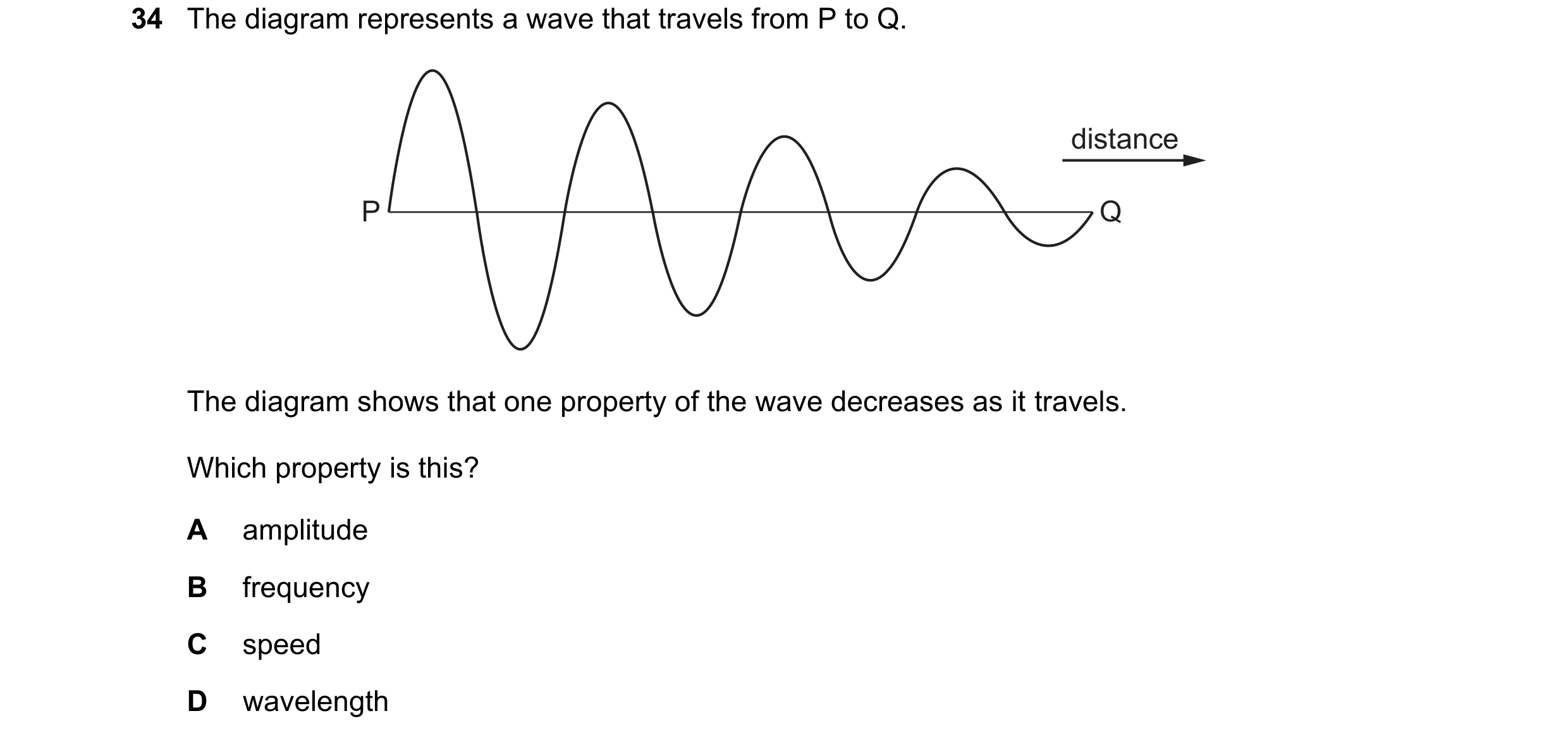
34 The diagram represents a wave that travels from P to Q. distance P Q The diagram shows that one property of the wave decreases as it travels. Which property is this? A amplitude B frequency C speed D wavelength
1 marks
Answer: A
This question in 0653/12 Feb/March 2021
Q52 · A navigation buoy floating on the sea oscillates up and down as a wave passes 0653/11 May/June 2021
34 A navigation buoy floating on the sea oscillates up and down as a wave passes. navigation buoy sea In 2.0 minutes, 6.0 wavelengths pass the buoy. What is the frequency of the waves? A 0.050 Hz B 0.33 Hz C 3.0 Hz D 20 Hz
1 marks
Answer: A
This question in 0653/11 May/June 2021
Q53 · A navigation buoy floating on the sea oscillates up and down as a wave passes 0653/12 May/June 2021
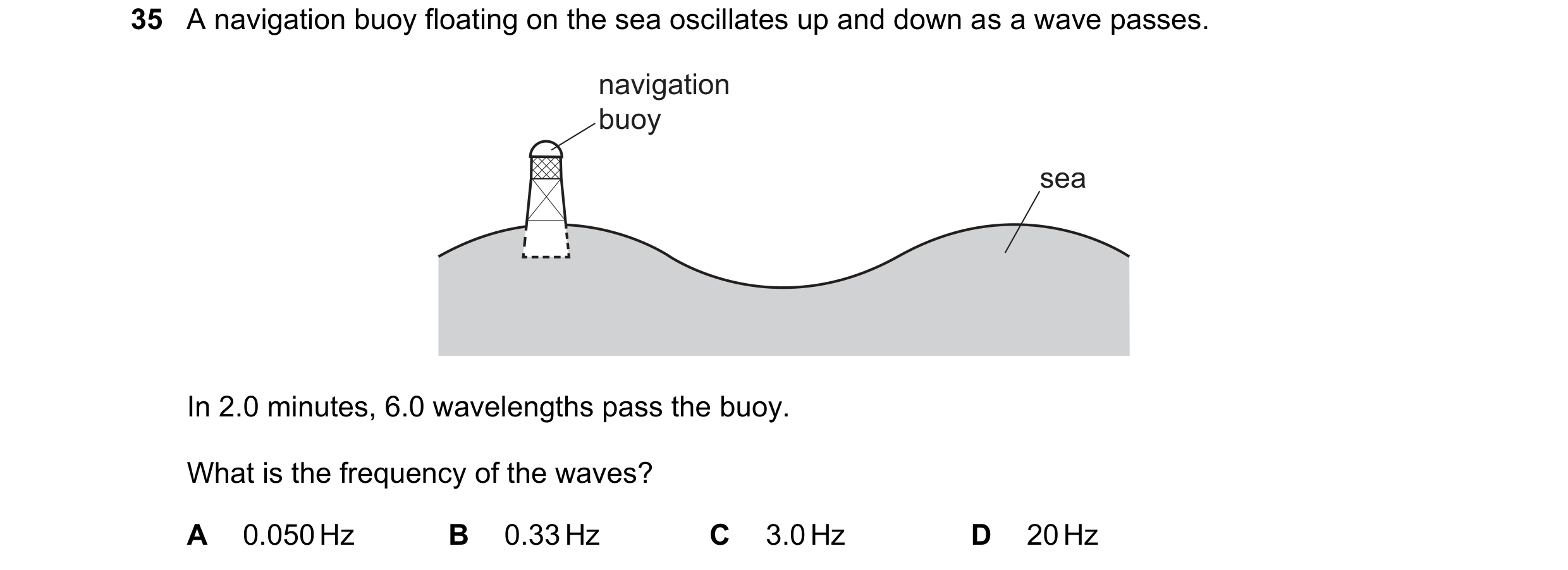
35 A navigation buoy floating on the sea oscillates up and down as a wave passes. navigation buoy sea In 2.0 minutes, 6.0 wavelengths pass the buoy. What is the frequency of the waves? A 0.050 Hz B 0.33 Hz C 3.0 Hz D 20 Hz
1 marks
Answer: A
This question in 0653/12 May/June 2021
Q54 · A navigation buoy floating on the sea oscillates up and down as a wave passes 0653/13 May/June 2021
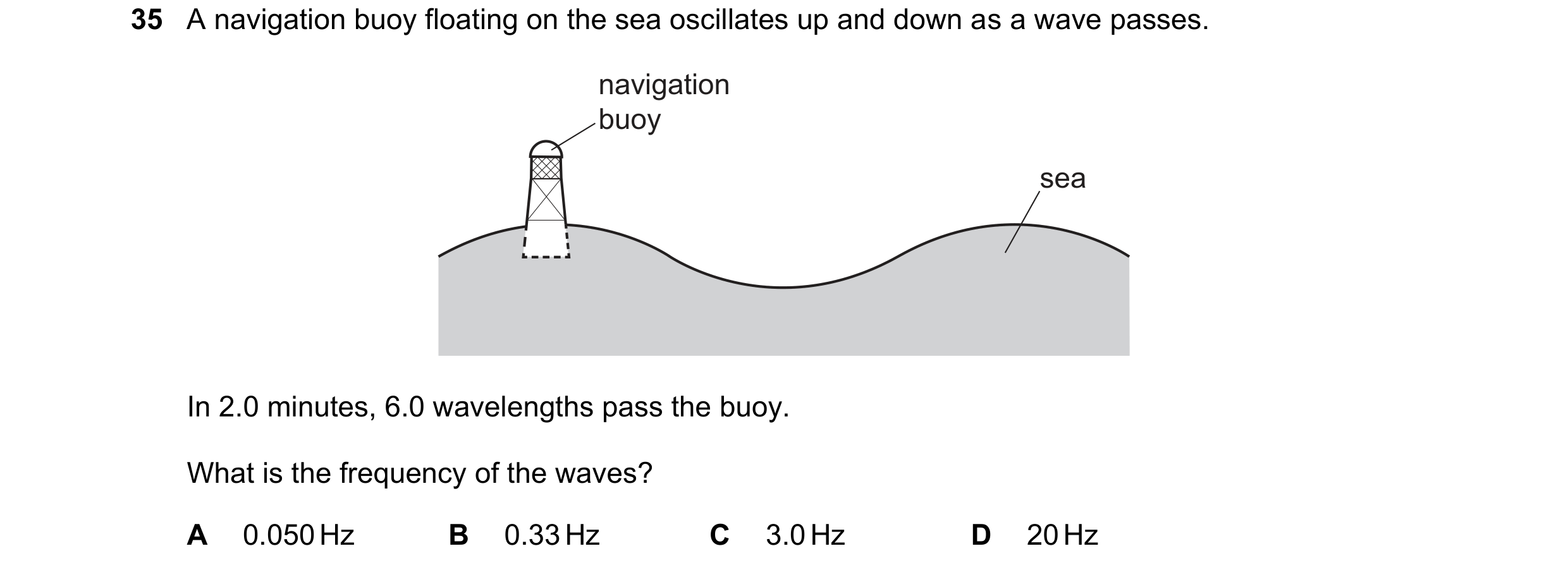
35 A navigation buoy floating on the sea oscillates up and down as a wave passes. navigation buoy sea In 2.0 minutes, 6.0 wavelengths pass the buoy. What is the frequency of the waves? A 0.050 Hz B 0.33 Hz C 3.0 Hz D 20 Hz
1 marks
Answer: A
This question in 0653/13 May/June 2021
Q55 · The diagram represents a wave 0653/12 May/June 2022
35 The diagram represents a wave. s r p q distance Which row shows the wavelength and the amplitude of the wave? wavelength amplitude A p q B p r C s q D s r
1 marks
Answer: C
This question in 0653/12 May/June 2022
Q56 · Which quantity is equal to the number of crests of a wave that pass a point in 1.0 s? 0653/11 Oct/Nov 2022
35 Which quantity is equal to the number of crests of a wave that pass a point in 1.0 s? A amplitude B frequency C speed D wavelength
1 marks
Answer: B
This question in 0653/11 Oct/Nov 2022
Q57 · The amplitude of a sound wave decreases and its frequency increases 0653/11 Oct/Nov 2023
37 The amplitude of a sound wave decreases and its frequency increases. What happens to the sound heard? A It becomes louder and its pitch becomes higher. B It becomes louder and its pitch becomes lower. C It becomes quieter and its pitch becomes higher. D It becomes quieter and its pitch becomes lower.
1 marks
Answer: C
This question in 0653/11 Oct/Nov 2023
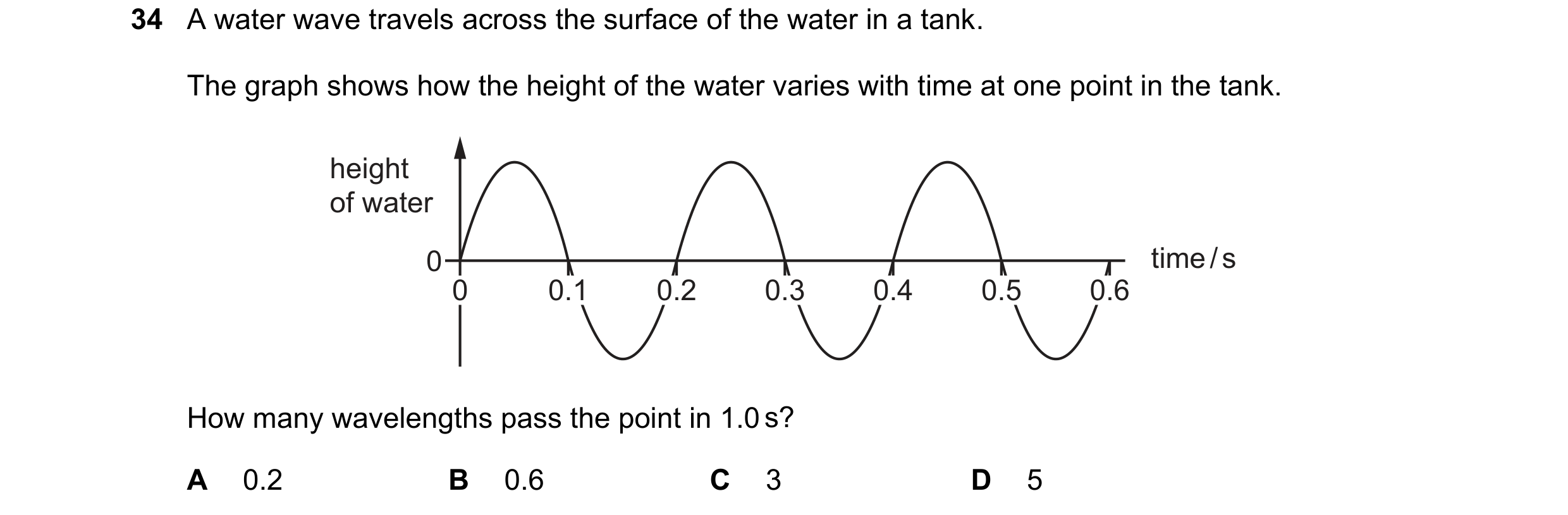
Q58 · A water wave travels across the surface of the water in a tank 0653/12 Feb/March 2024
34 A water wave travels across the surface of the water in a tank. The graph shows how the height of the water varies with time at one point in the tank. height of water 0 time / s 0 0.1 0.2 0.3 0.4 0.5 0.6 How many wavelengths pass the point in 1.0 s? A 0.2 B 0.6 C 3 D 5
1 marks
Answer: D
This question in 0653/12 Feb/March 2024
Q59 · The diagram represents a wave that travels from P to Q 0653/12 Feb/March 2024
35 The diagram represents a wave that travels from P to Q. distance P Q The diagram shows that one property of the wave decreases as it travels. Which property decreases? A amplitude B frequency C speed D wavelength
1 marks
Answer: A
This question in 0653/12 Feb/March 2024
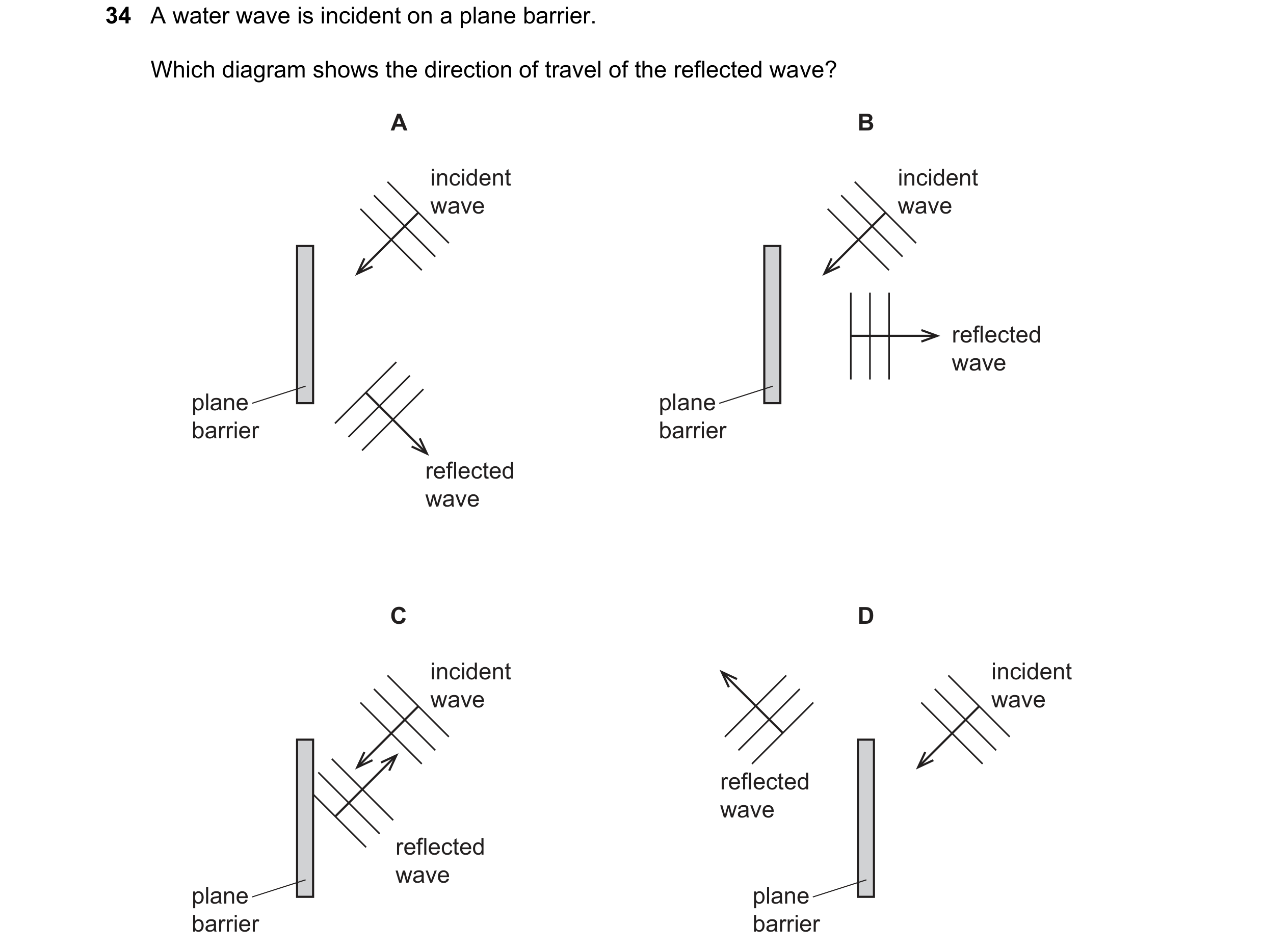
Q60 · A water wave is incident on a plane barrier 0653/12 Feb/March 2025
34 A water wave is incident on a plane barrier. Which diagram shows the direction of travel of the reflected wave? A B incident incident wave wave reflected wave plane plane barrier barrier reflected wave C D incident incident wave wave reflected wave reflected wave plane plane barrier barrier
1 marks
Answer: A
This question in 0653/12 Feb/March 2025
Q61 · The diagram shows part of a wave 0653/11 May/June 2025
34 The diagram shows part of a wave. Two points are labelled X and Y. displacement X Y 0 0 distance There are four wavelengths between X and Y. In 2.0 s, all four wavelengths pass point Y. What is the frequency of the wave? A 0.50 Hz B 2.0 Hz C 4.0 Hz D 8.0 Hz
1 marks
Answer: B
This question in 0653/11 May/June 2025
Q62 · A stone dropped into a pond produces 20 circular wave crests in 1.0 minute 0653/12 May/June 2025
36 A stone dropped into a pond produces 20 circular wave crests in 1.0 minute. What is the frequency of the wave? A 0.050 Hz B 0.33 Hz C 3.0 Hz D 20 Hz
1 marks
Answer: B
This question in 0653/12 May/June 2025
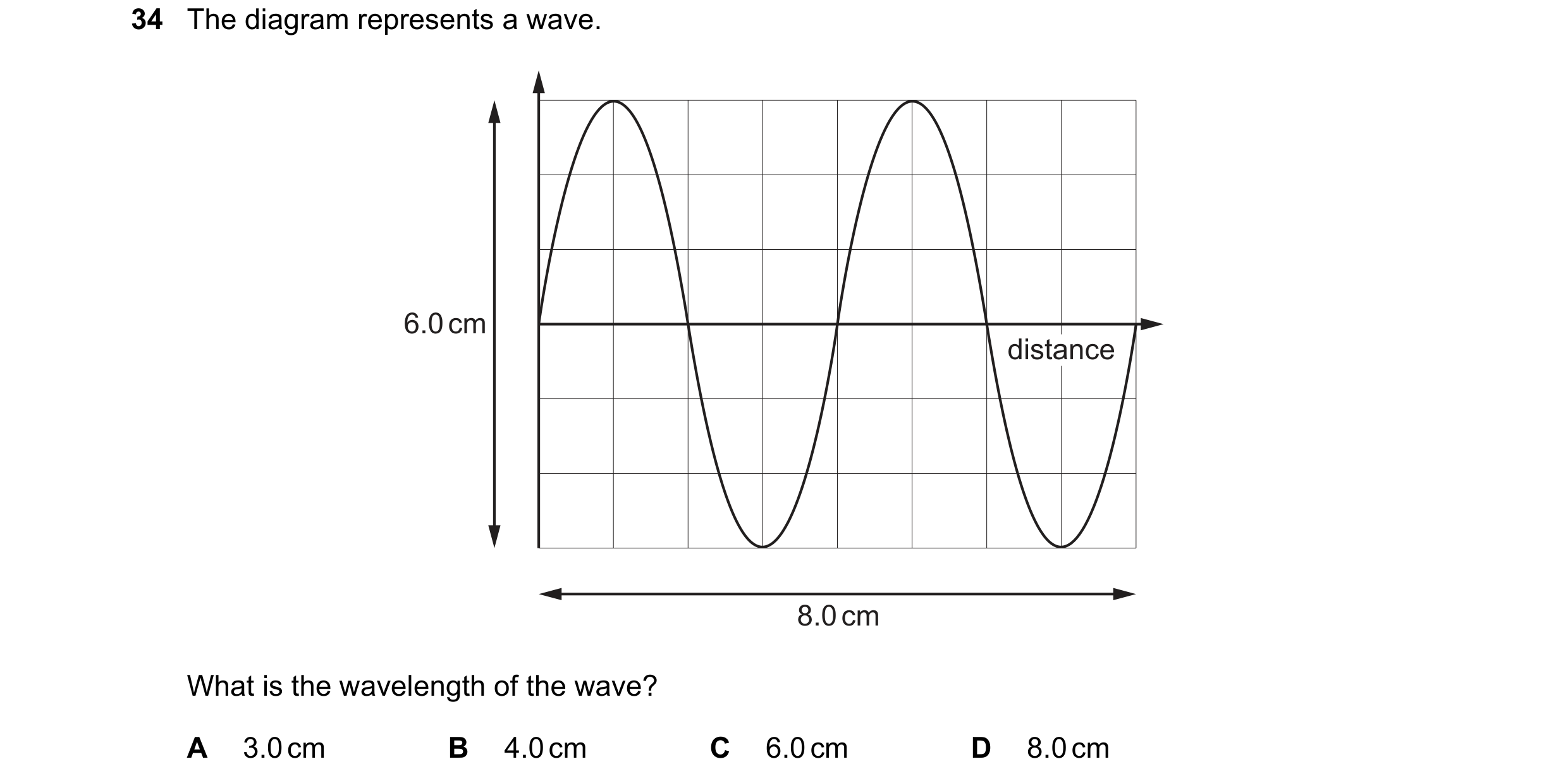
Q63 · The diagram represents a wave 0653/13 May/June 2025
34 The diagram represents a wave. 6.0 cm distance 8.0 cm What is the wavelength of the wave? A 3.0 cm B 4.0 cm C 6.0 cm D 8.0 cm
1 marks
Answer: B
This question in 0653/13 May/June 2025
Q64 · A cork moves up and down on a wave in a tank of water 0653/11 Oct/Nov 2025
34 A cork moves up and down on a wave in a tank of water. A student measures the distance moved up and down by the cork. ruler cork direction of wave Which quantity can be determined using only this measurement? A amplitude B frequency C speed D wavelength
1 marks
Answer: A
This question in 0653/11 Oct/Nov 2025
Q65 · A water wave travels across the surface of a pond 0653/12 Oct/Nov 2025
34 A water wave travels across the surface of a pond. The highest point on the wave is the crest (peak). What is the frequency of the water wave? A the distance between two neighbouring crests B the height of a crest above the surface of the pond C the number of crests passing a fixed point every second D the speed at which the crests move across the surface of the pond
1 marks
Answer: C
This question in 0653/12 Oct/Nov 2025
Q66 · A water wave travels across the surface of a pond 0653/13 Oct/Nov 2025
34 A water wave travels across the surface of a pond. The highest point on the wave is the crest (peak). What is the frequency of the water wave? A the distance between two neighbouring crests B the height of a crest above the surface of the pond C the number of crests passing a fixed point every second D the speed at which the crests move across the surface of the pond
1 marks
Answer: C
This question in 0653/13 Oct/Nov 2025
 1 / 23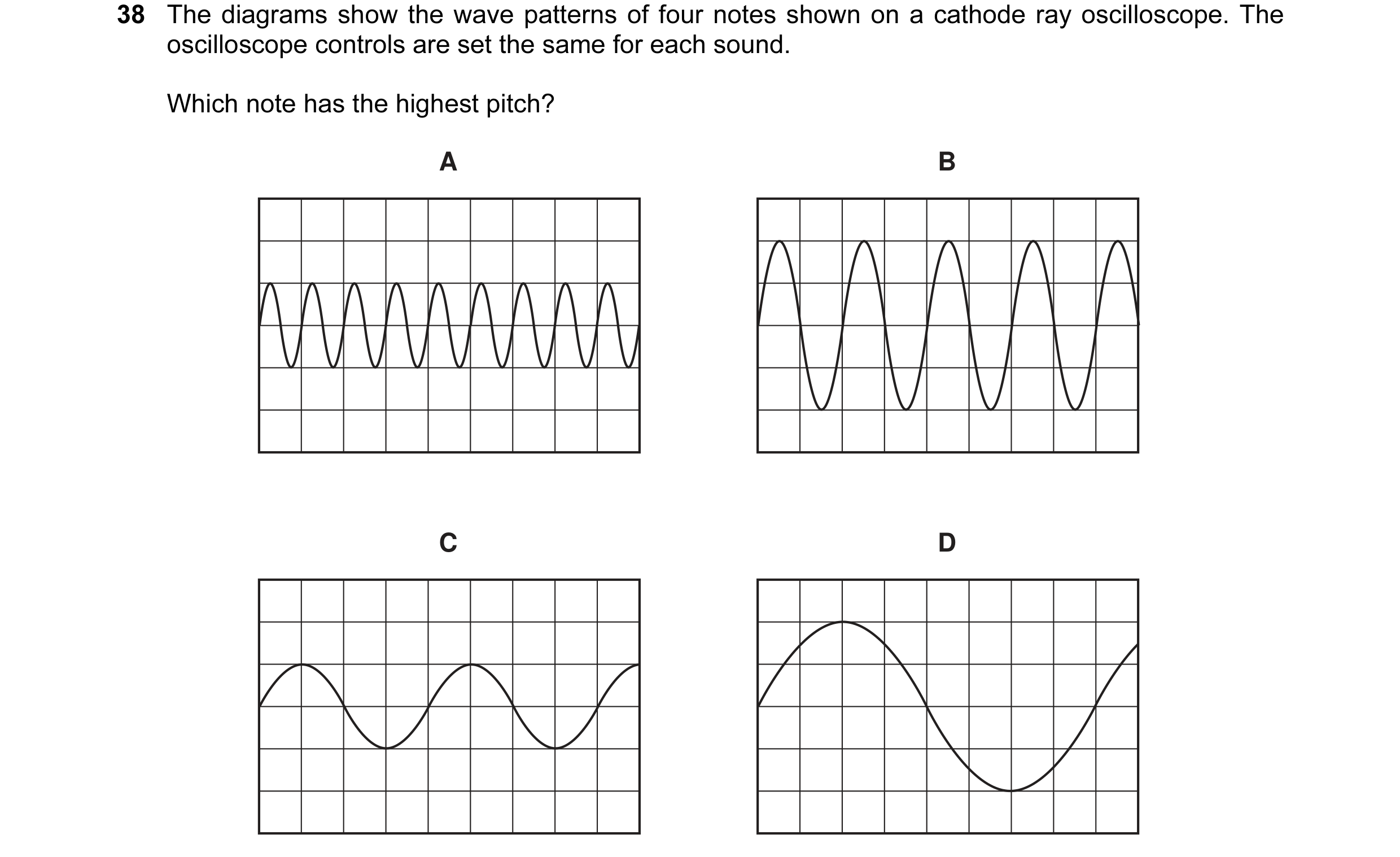


 2 / 23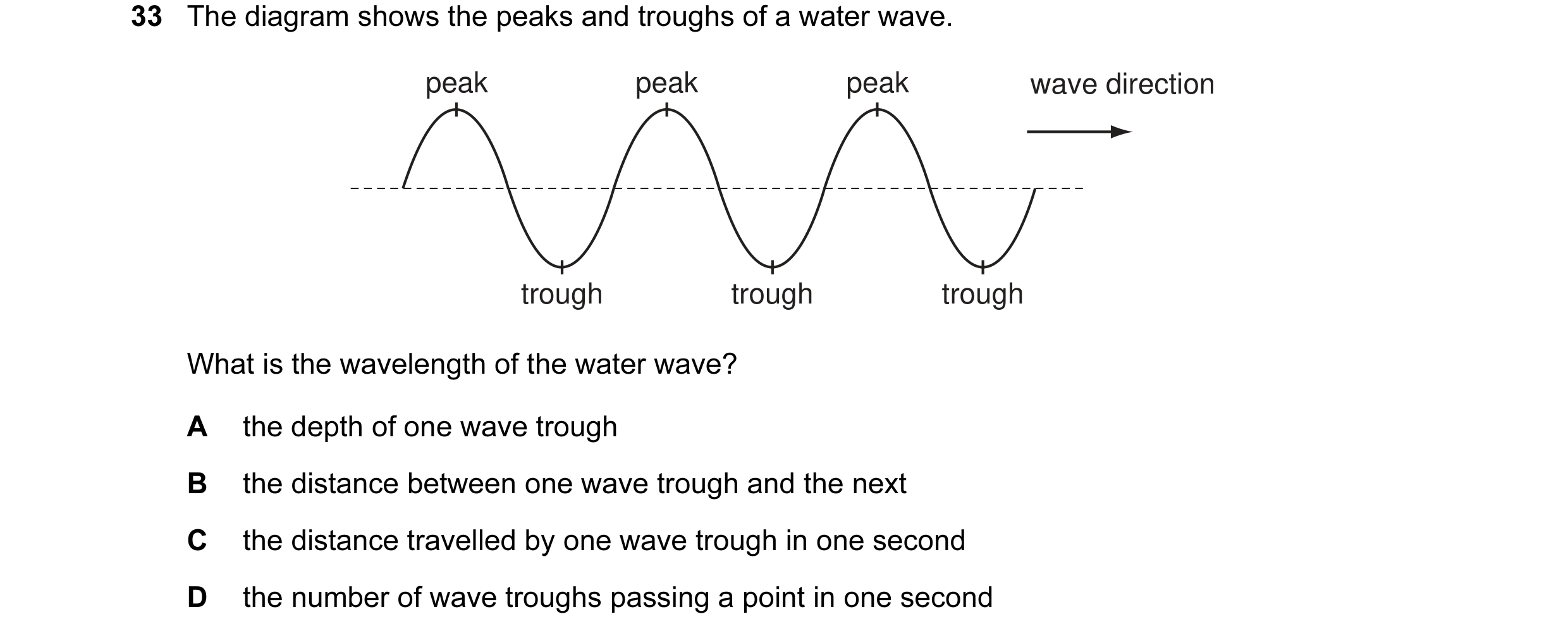
 3 / 23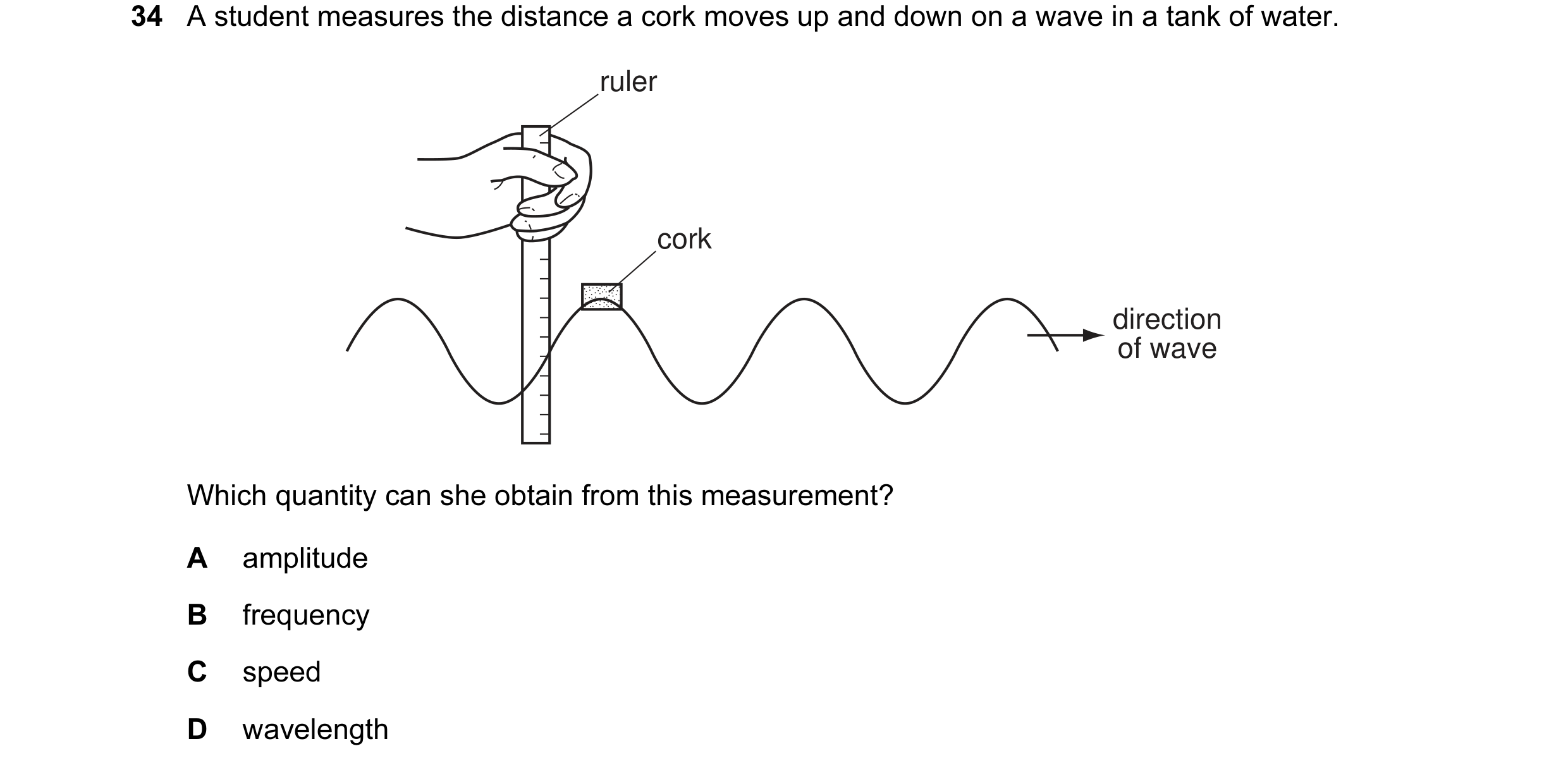
 4 / 23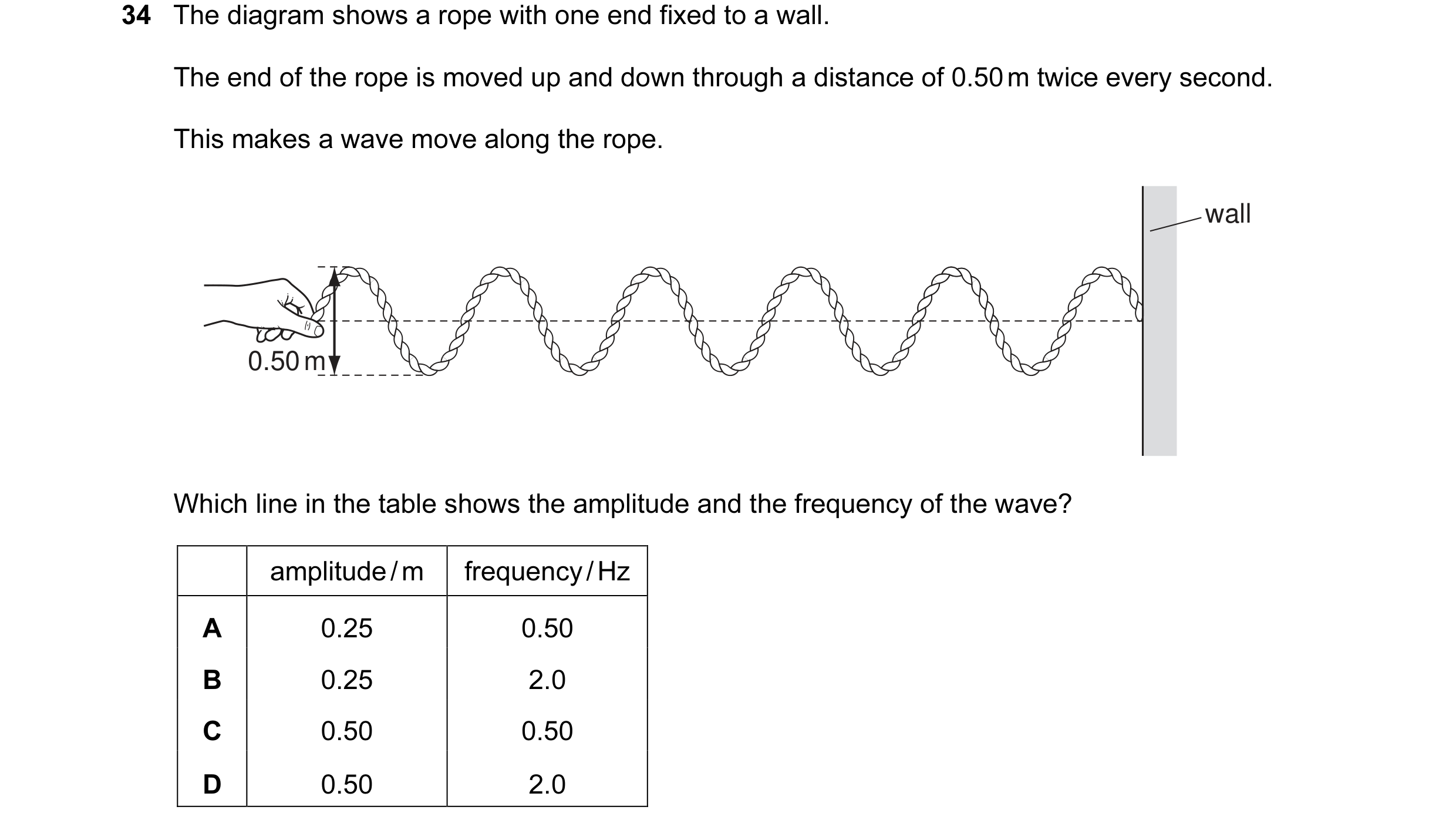
 5 / 23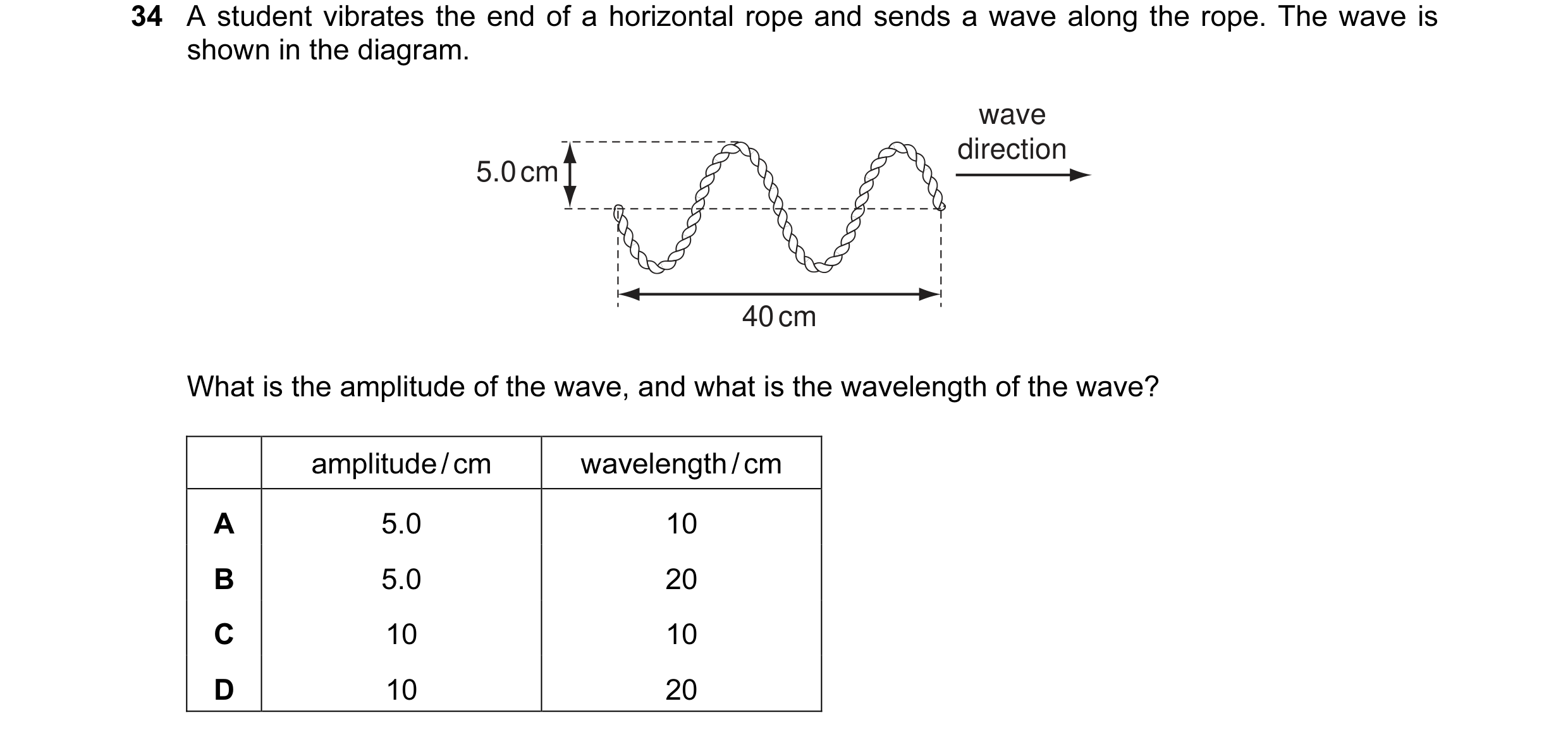
 6 / 23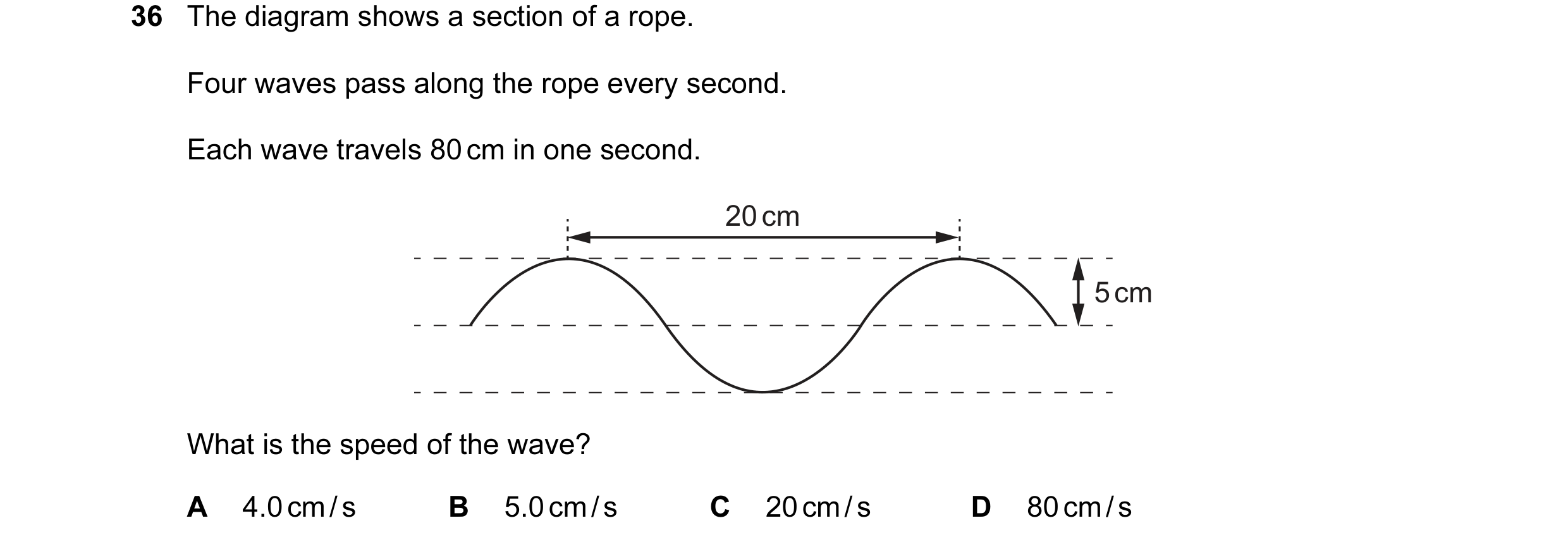


 7 / 23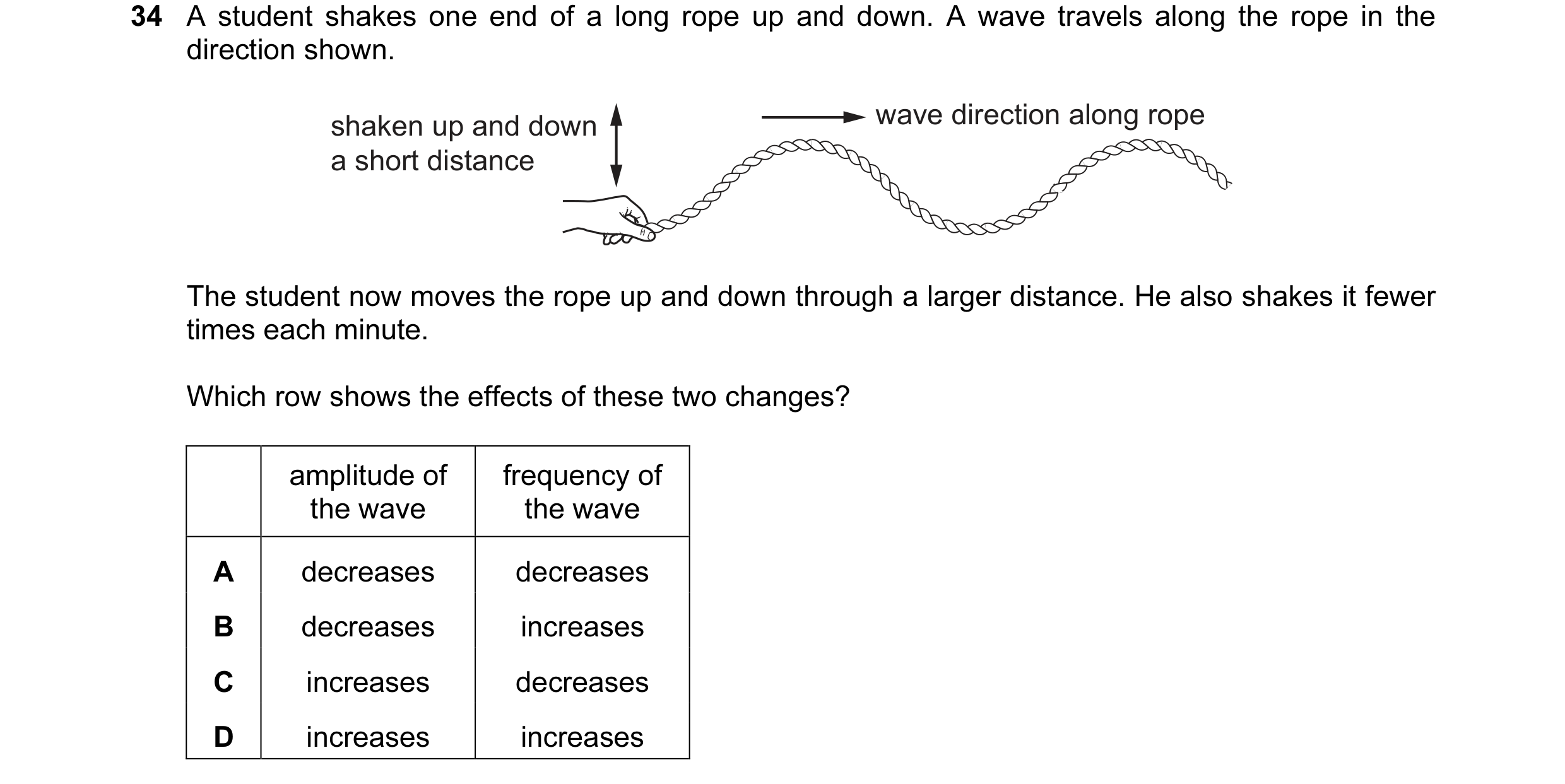

 8 / 23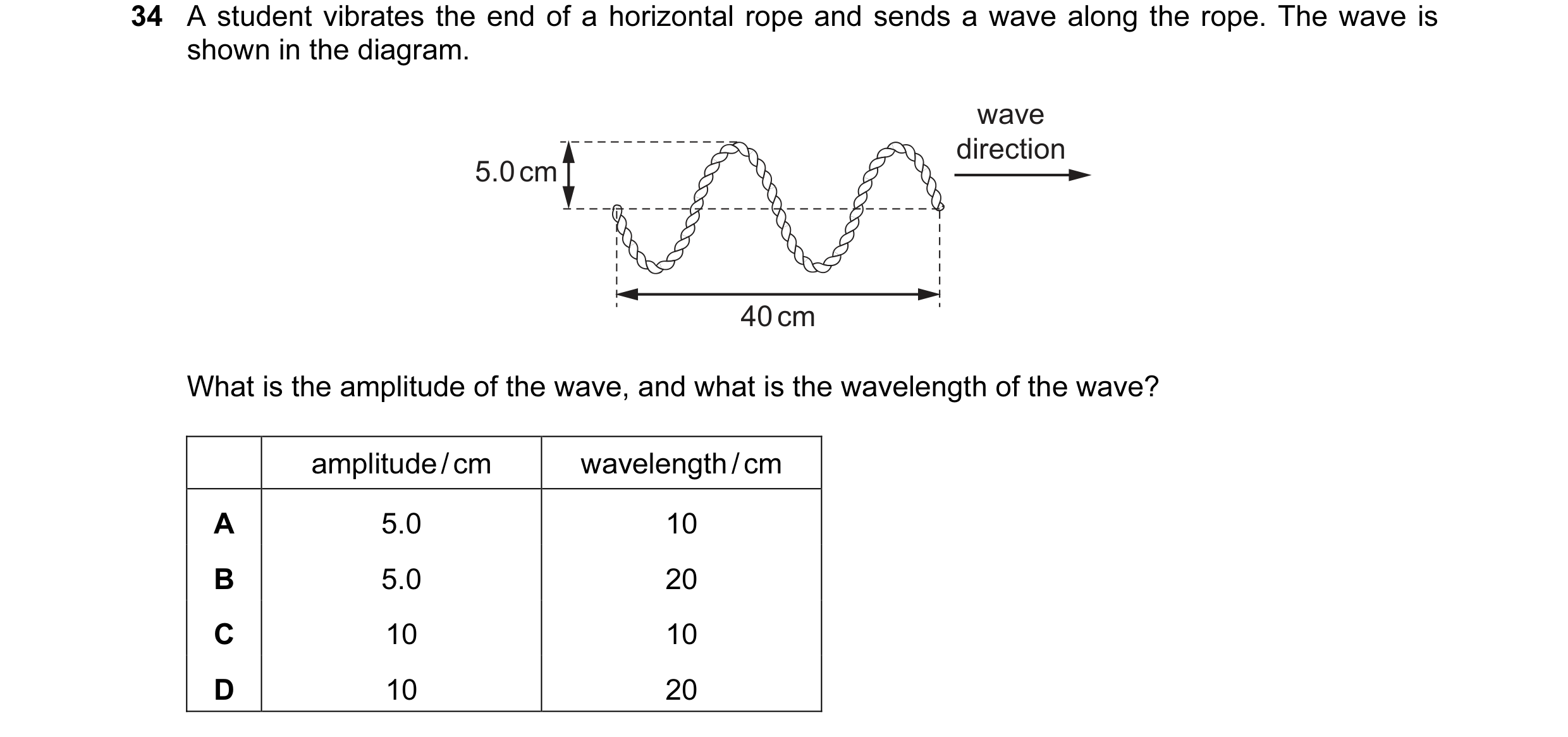
 9 / 23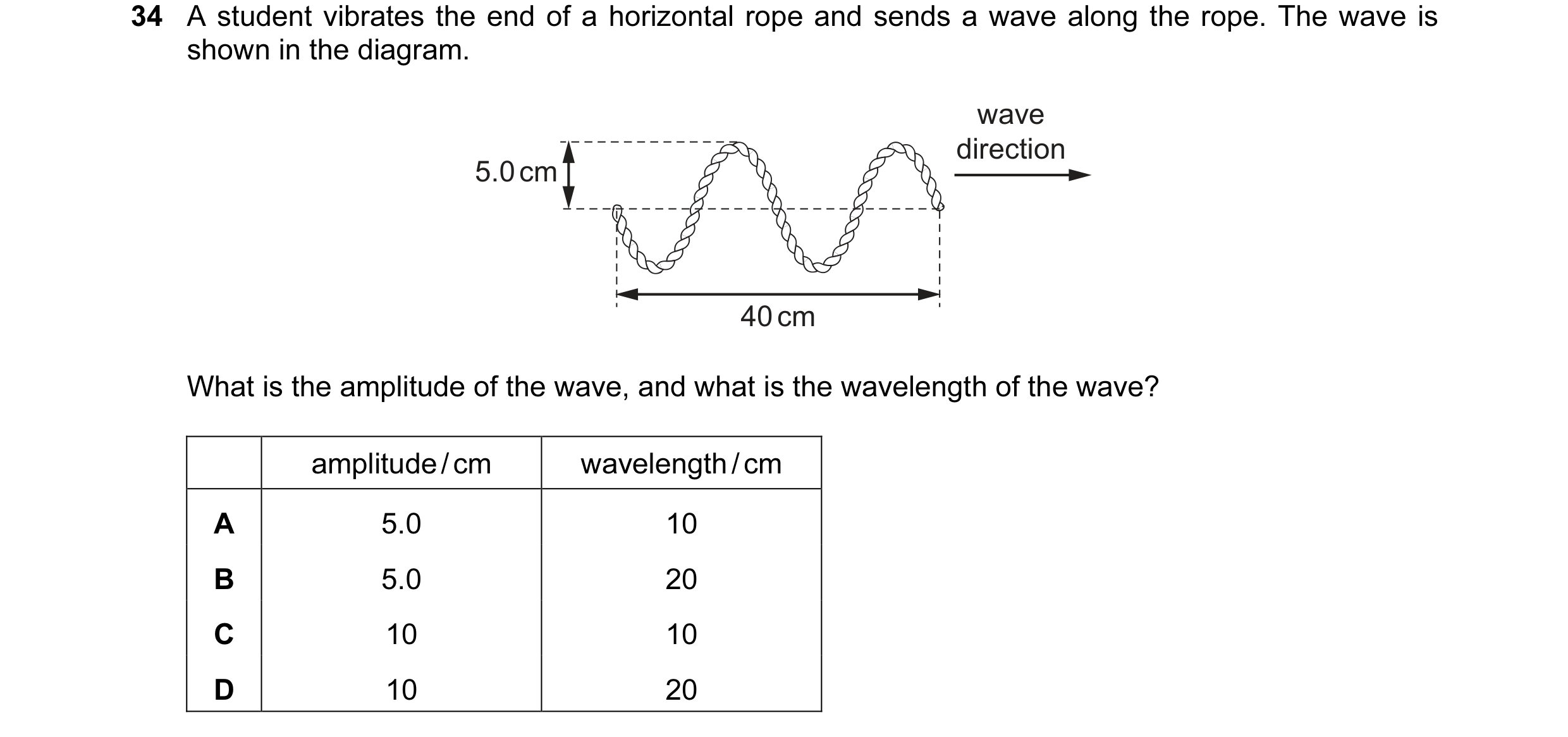
 10 / 23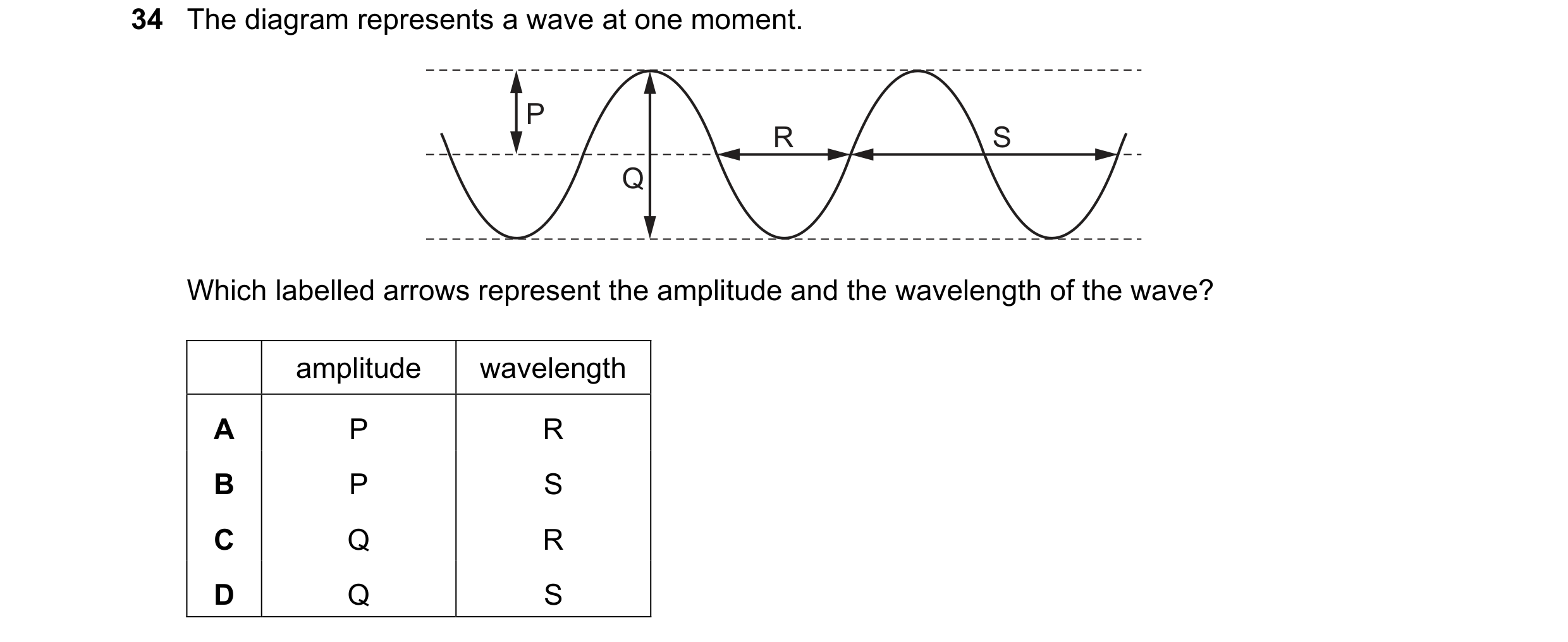
 11 / 23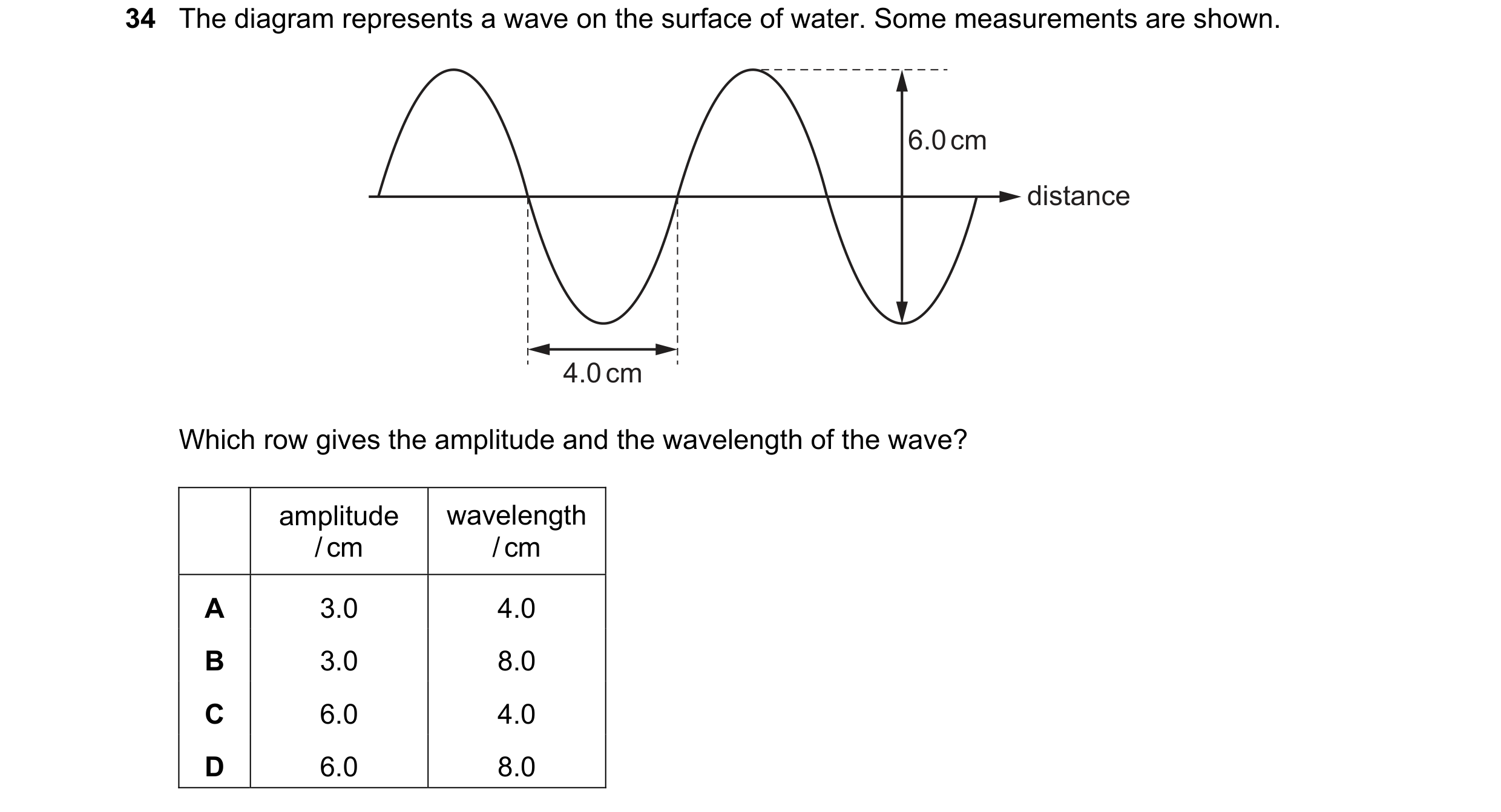
 12 / 23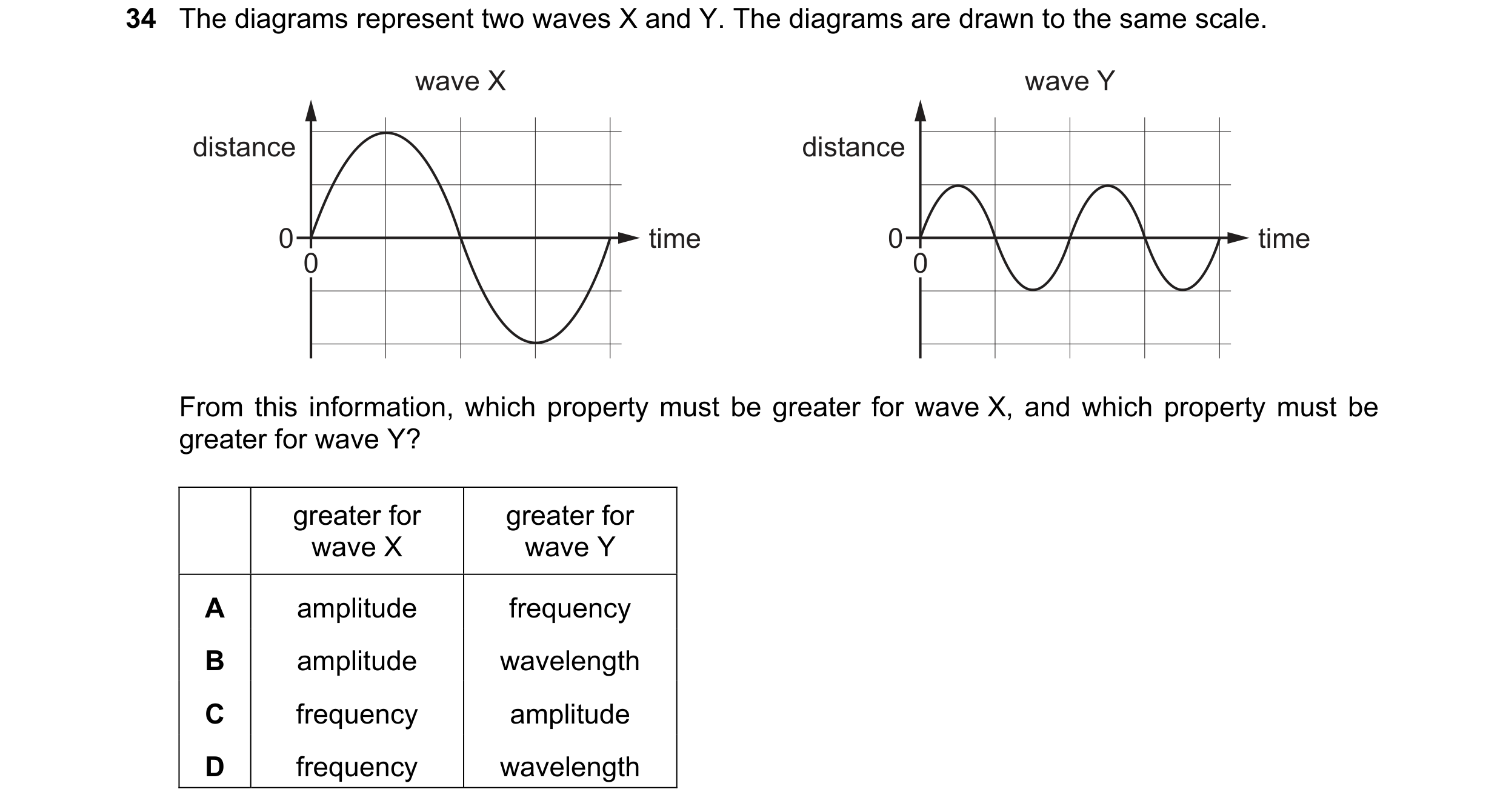
 13 / 23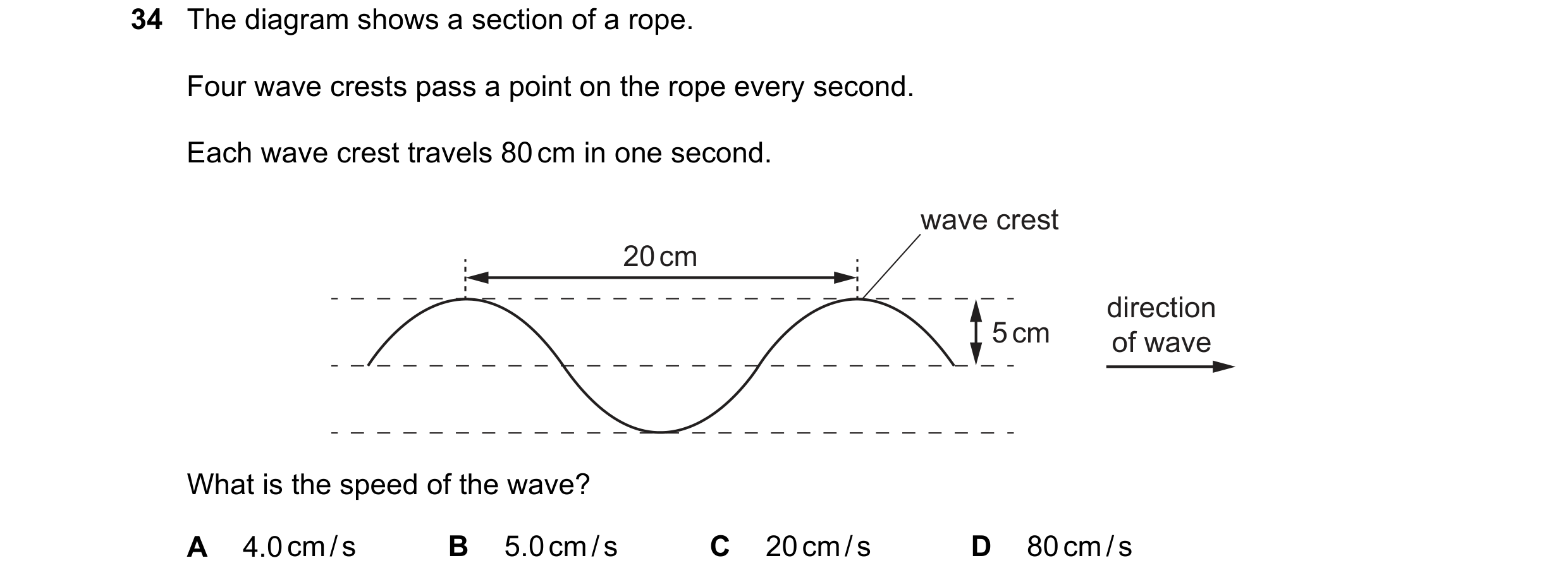
 14 / 23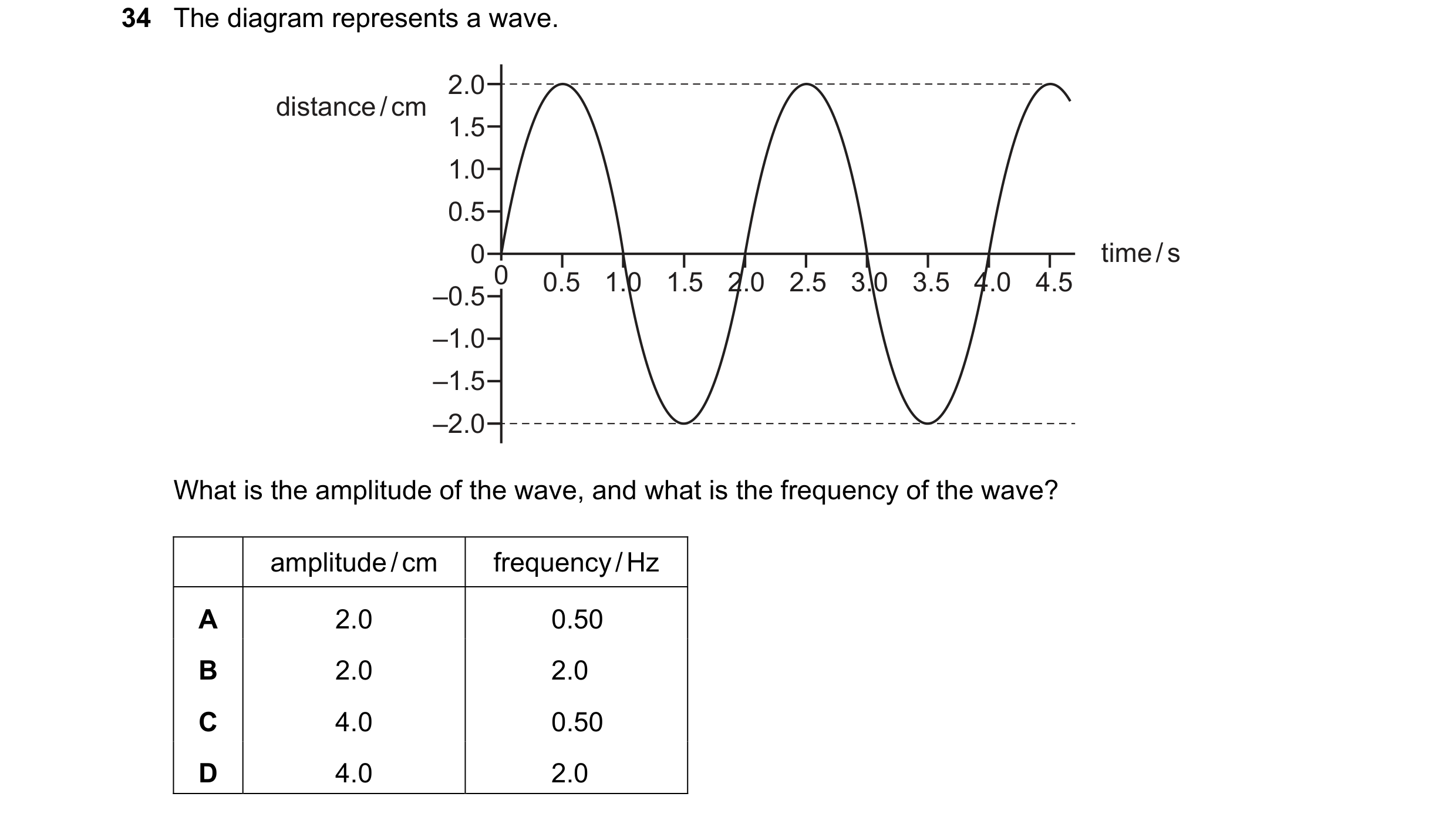
 15 / 23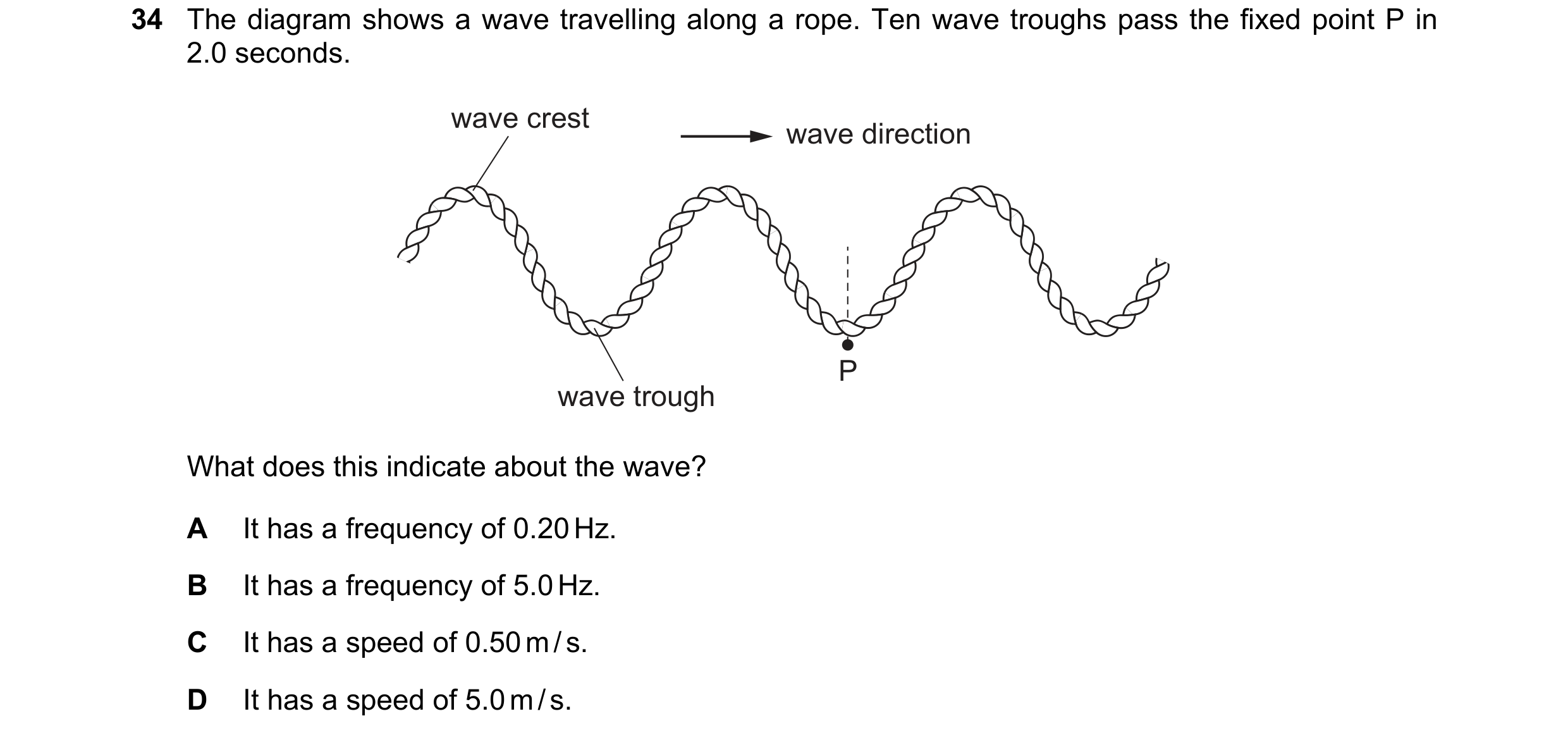
 16 / 23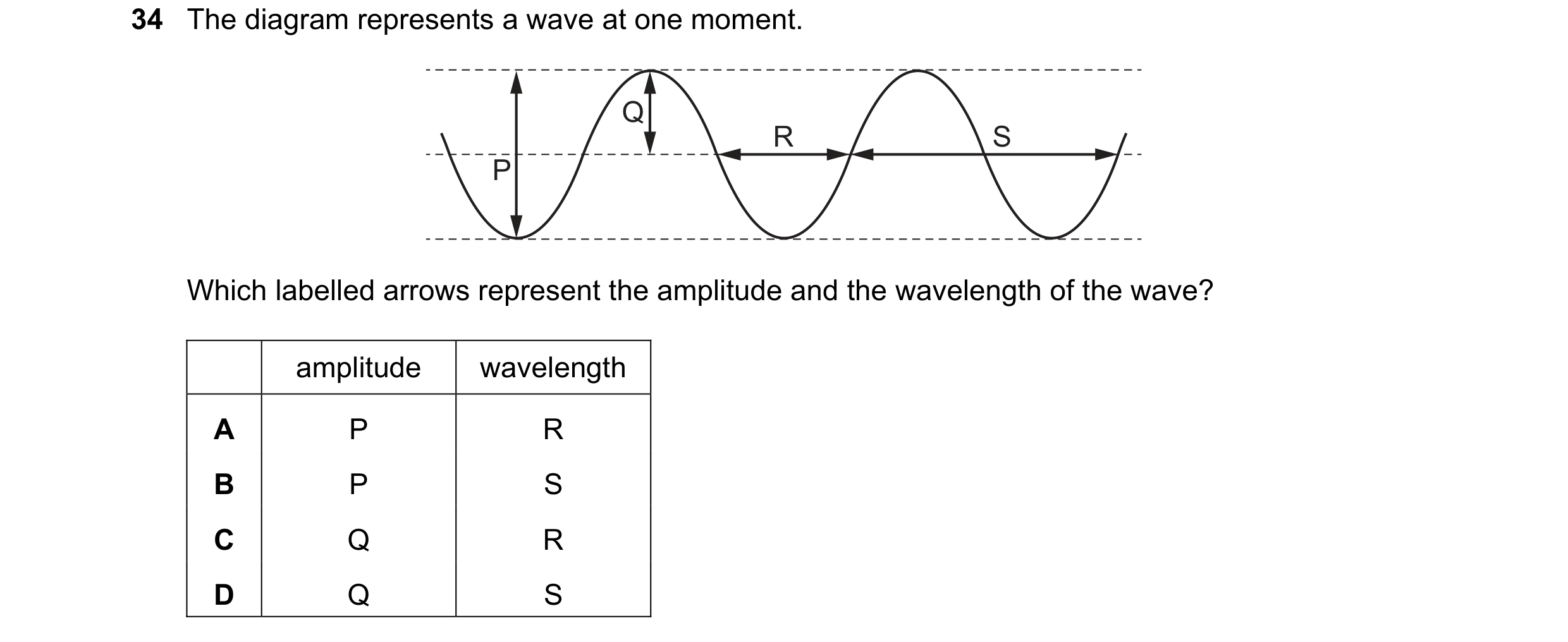
 17 / 23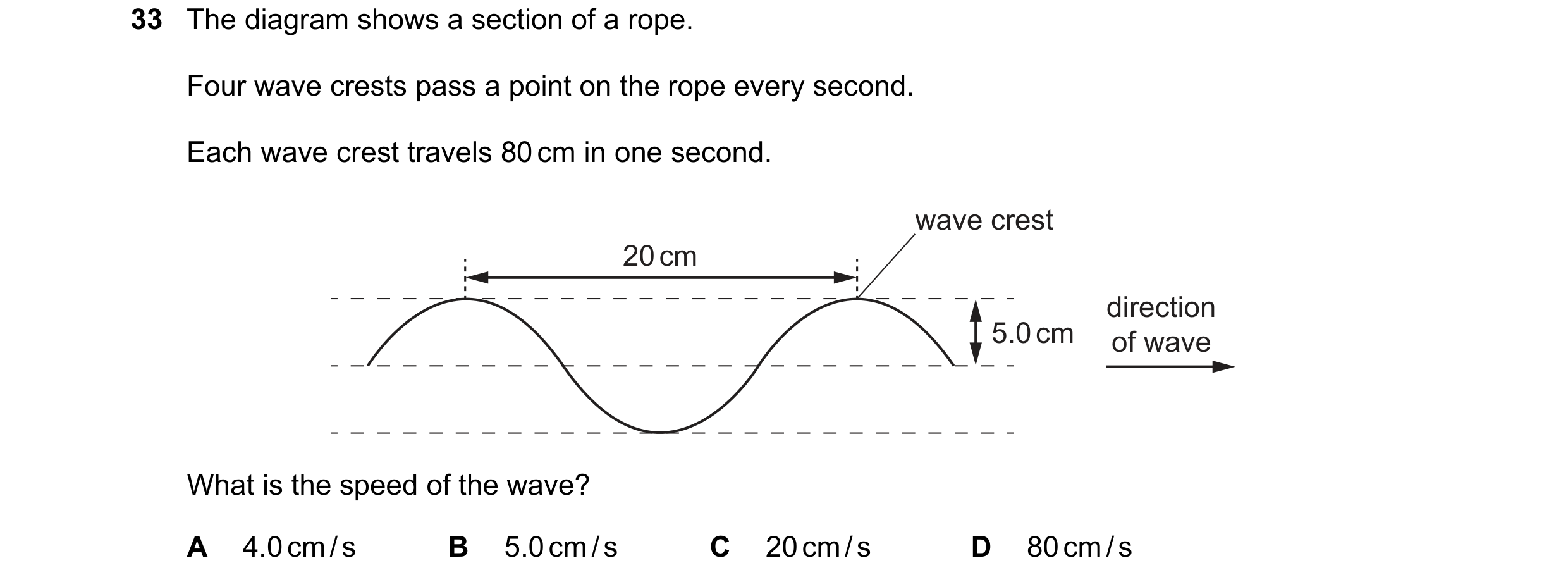
 18 / 23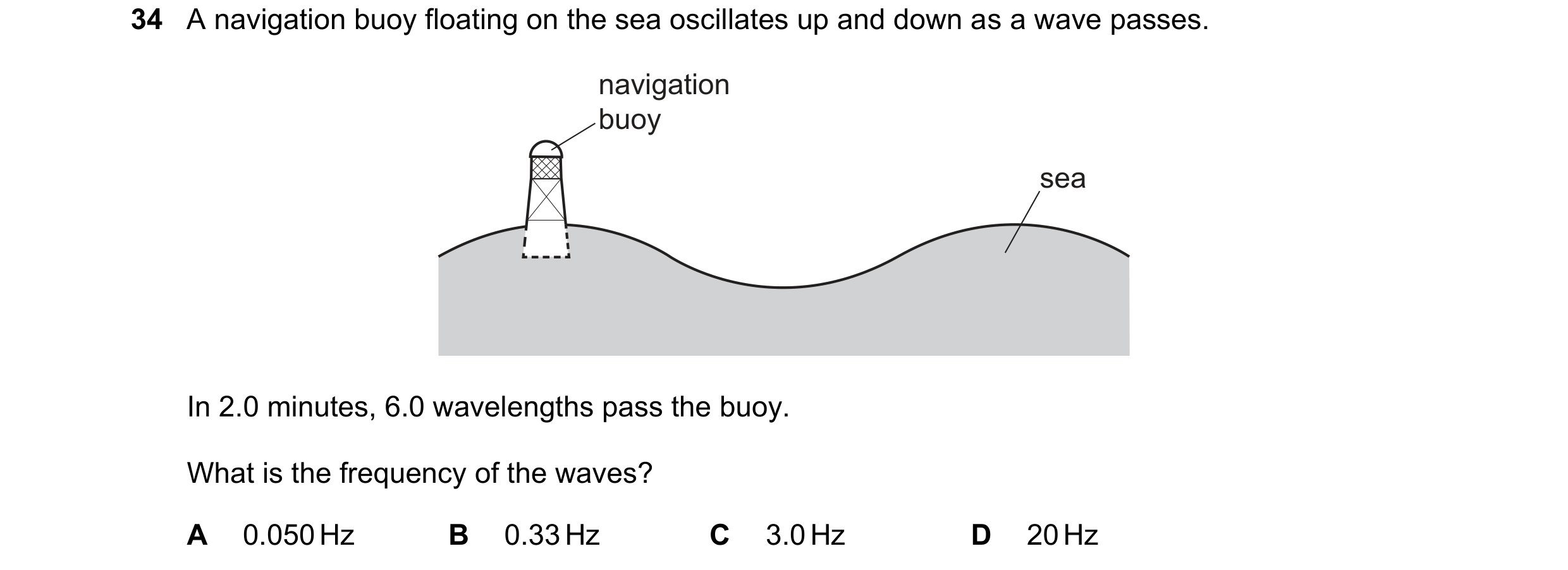
 19 / 23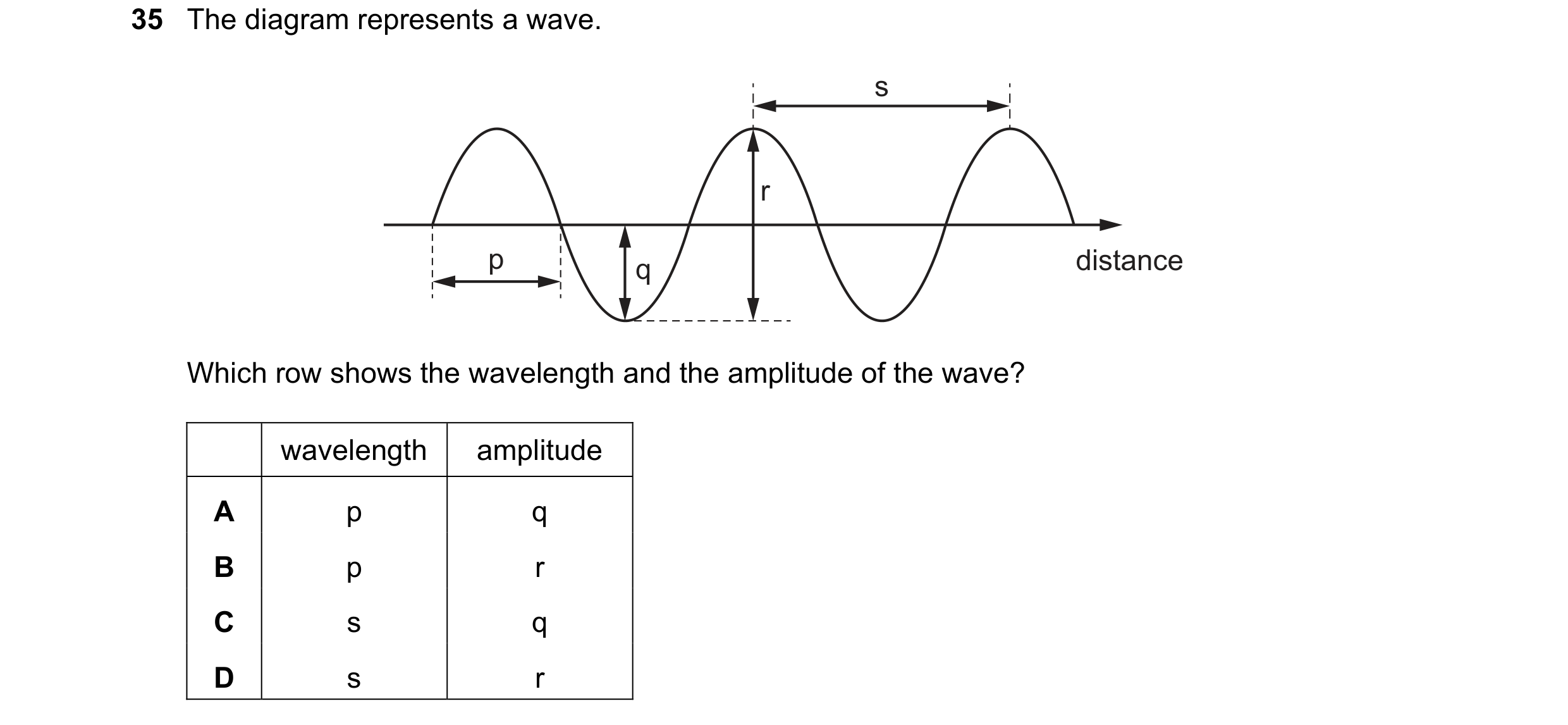

 20 / 23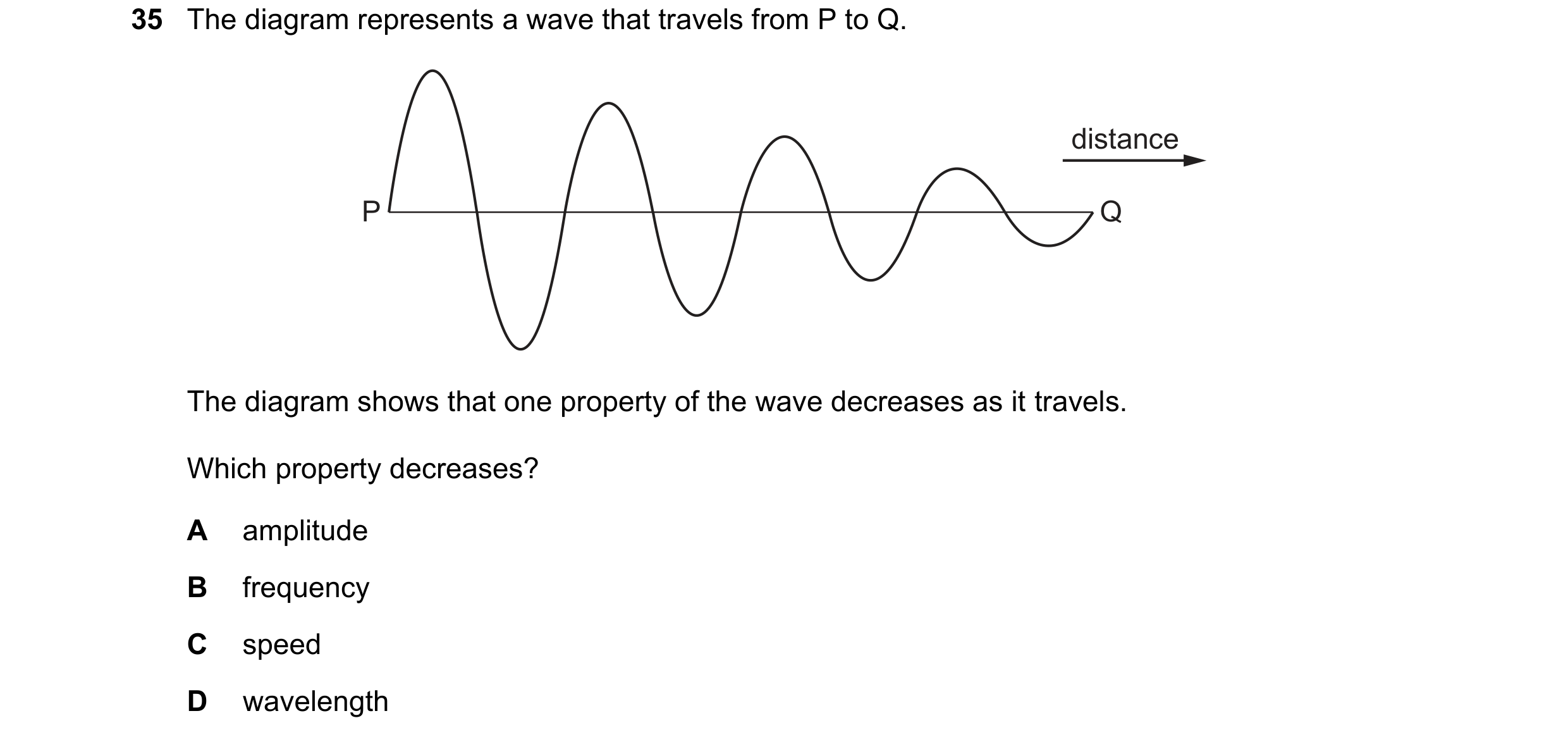
 21 / 23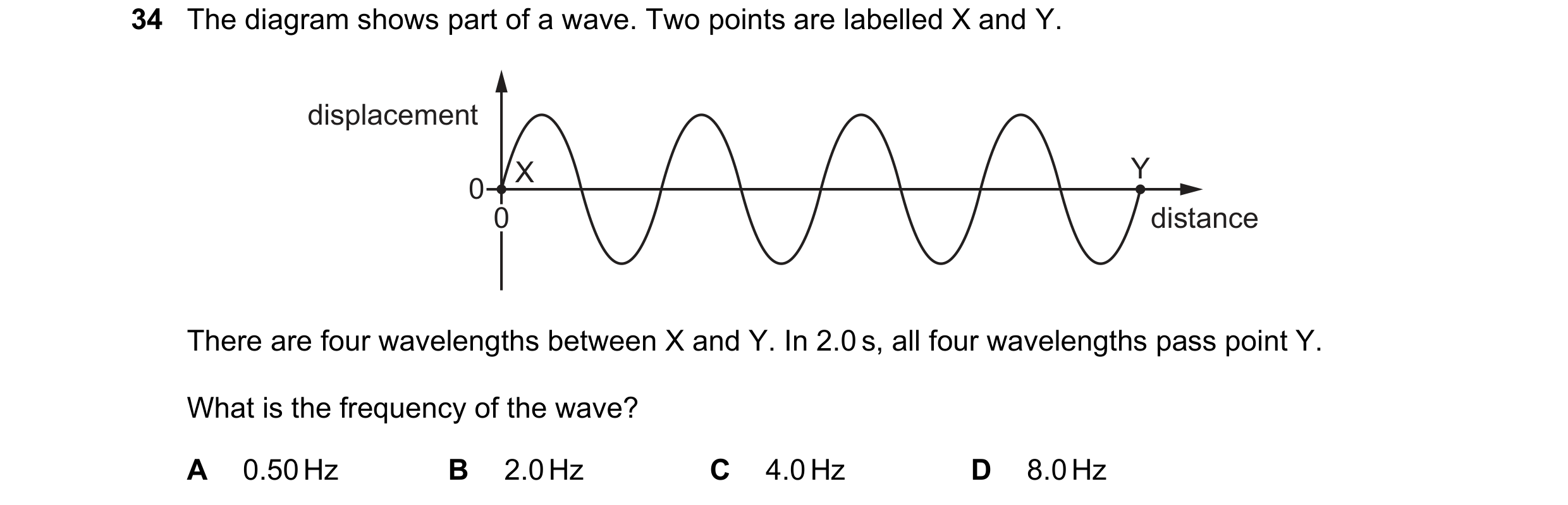

 22 / 23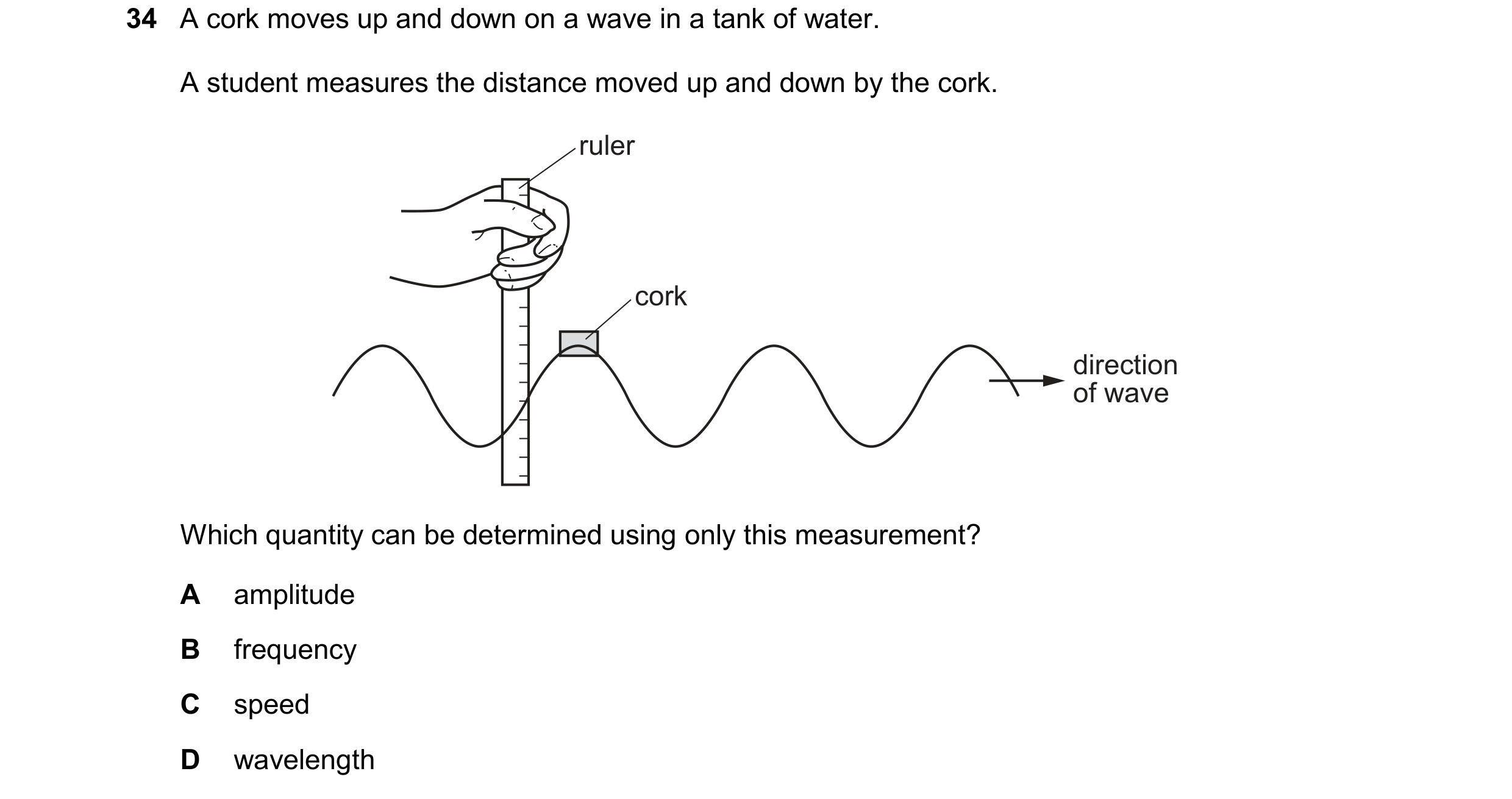
 23 / 23