Questions as text
Q1 · A boat sailing near a lighthouse at night 0653/42 Feb/March 2017
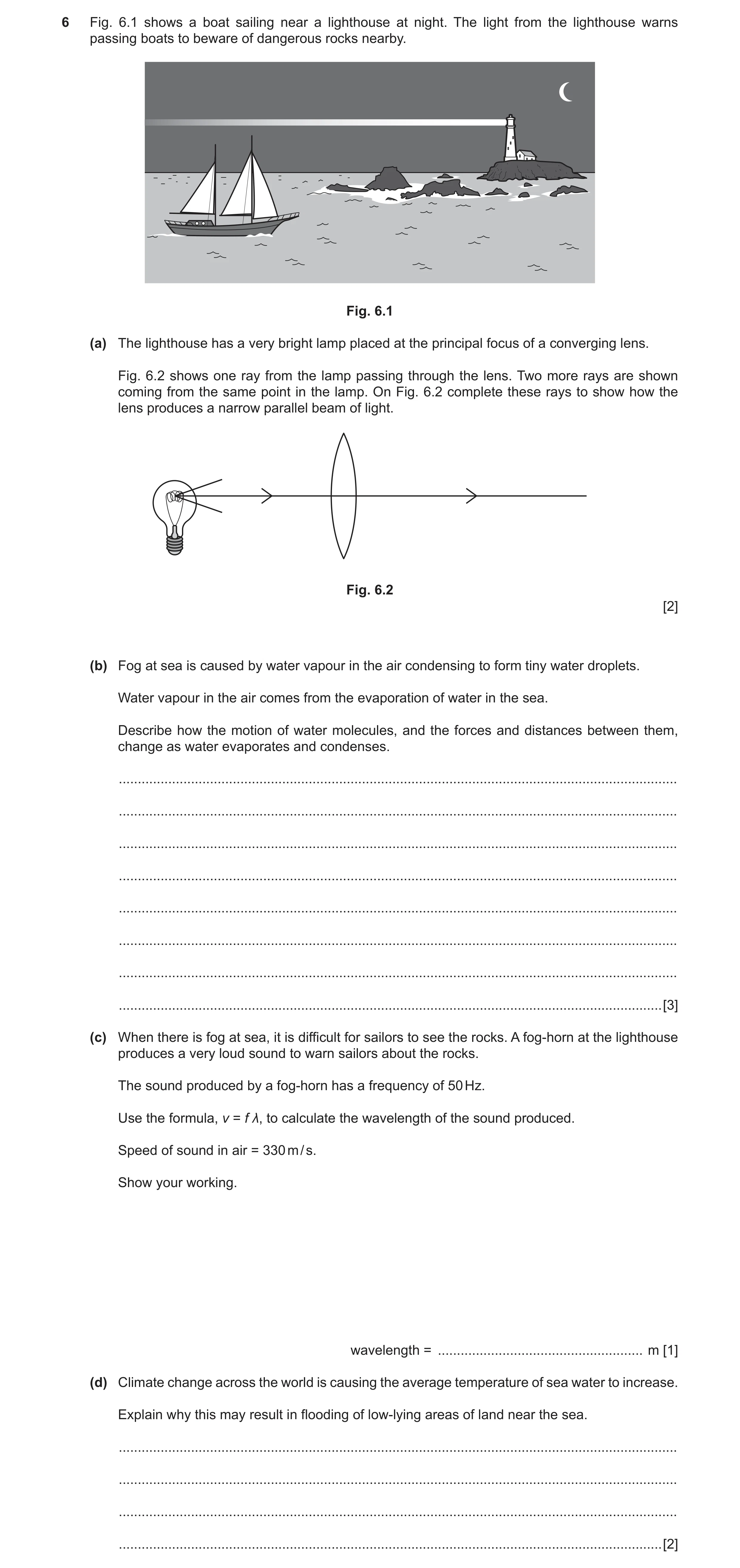
6 Fig. 6.1 shows a boat sailing near a lighthouse at night. The light from the lighthouse warns passing boats to beware of dangerous rocks nearby. Fig. 6.1 (a) The lighthouse has a very bright lamp placed at the principal focus of a converging lens. Fig. 6.2 shows one ray from the lamp passing through the lens. Two more rays are shown coming from the same point in the lamp. On Fig. 6.2 complete these rays to show how the lens produces a narrow parallel beam of light. Fig. 6.2 [2] (b) Fog at sea is caused by water vapour in the air condensing to form tiny water droplets. Water vapour in the air comes from the evaporation of water in the sea. Describe how the motion of water molecules, and the forces and distances between them, change as water evaporates and condenses. … … … … … … … … [3] (c) When there is fog at sea, it is difficult for sailors to see the rocks. A fog-horn at the lighthouse produces a very loud sound to warn sailors about the rocks. The sound produced by a fog-horn has a frequency of 50 Hz. Use the formula, v = f λ, to calculate the wavelength of the sound produced. Speed of sound in air = 330 m / s. Show your working. wavelength = … m [1] (d) Climate change across the world is causing the average temperature of sea water to increase. Explain why this may result in flooding of low-lying areas of land near the sea. … … … … [2]
8 marks
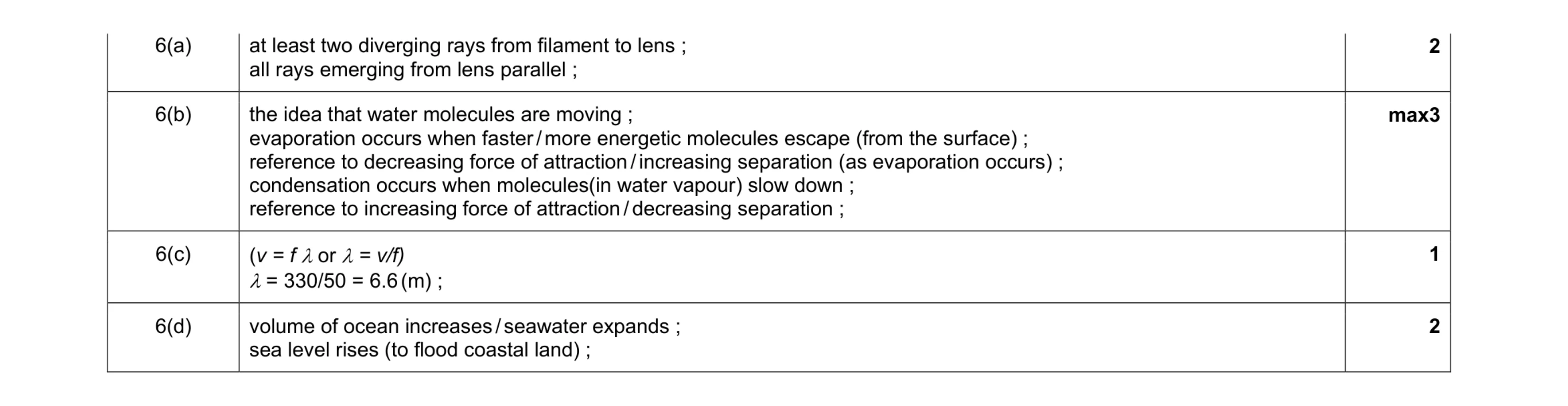
Mark scheme: 6(a) at least two diverging rays from filament to lens ; all rays emerging from lens parallel ; 2 6(b) the idea that water molecules are moving ; evaporation occurs when faster / more energetic molecules escape (from the surface) ; reference to decreasing force of attraction / increasing separation (as evaporation occurs) ; condensation occurs when molecules(in water vapour) slow down ; reference to increasing force of attraction / decreasing separation ; max3 6(c) (v = f λ or λ = v/f) λ = 330/50 = 6.6 (m) ; 1 6(d) volume of ocean increases / seawater expands ; sea level rises (to flood coastal land) ; 2
This question in 0653/42 Feb/March 2017
Q2 · A liquid-in-glass thermometer at room temperature 0653/41 Oct/Nov 2018
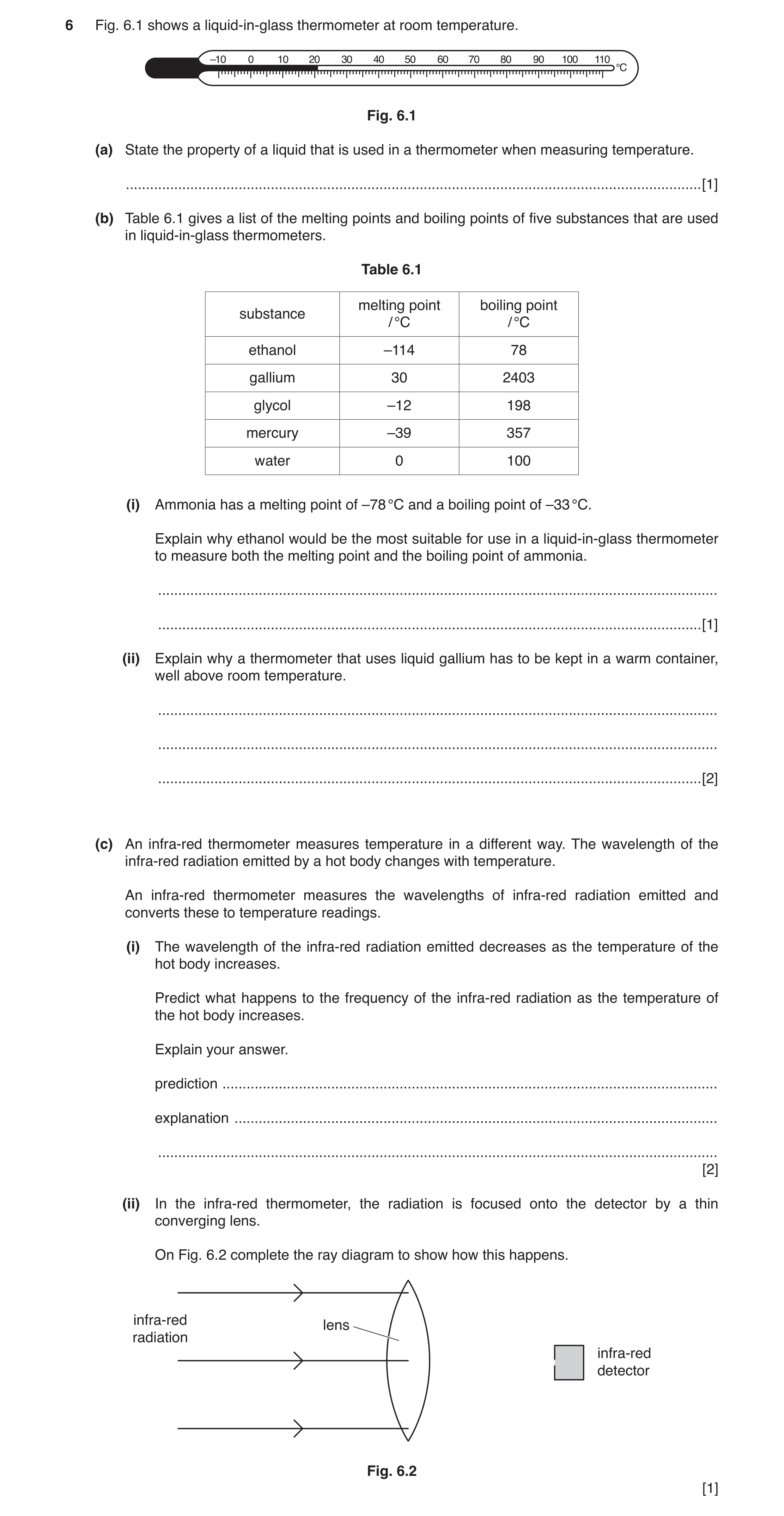
6 Fig. 6.1 shows a liquid-in-glass thermometer at room temperature. –10 0 10 20 30 40 50 60 70 80 90 100 110 °C Fig. 6.1 (a) State the property of a liquid that is used in a thermometer when measuring temperature. … [1] (b) Table 6.1 gives a list of the melting points and boiling points of five substances that are used in liquid-in-glass thermometers. Table 6.1 melting point boiling point substance / °C / °C ethanol –114 78 gallium 30 2403 glycol –12 198 mercury –39 357 water 0 100 (i) Ammonia has a melting point of –78 °C and a boiling point of –33 °C. Explain why ethanol would be the most suitable for use in a liquid-in-glass thermometer to measure both the melting point and the boiling point of ammonia. … … [1] (ii) Explain why a thermometer that uses liquid gallium has to be kept in a warm container, well above room temperature. … … … [2] (c) An infra-red thermometer measures temperature in a different way. The wavelength of the infra-red radiation emitted by a hot body changes with temperature. An infra-red thermometer measures the wavelengths of infra-red radiation emitted and converts these to temperature readings. (i) The wavelength of the infra-red radiation emitted decreases as the temperature of the hot body increases. Predict what happens to the frequency of the infra-red radiation as the temperature of the hot body increases. Explain your answer. prediction … explanation … … [2] (ii) In the infra-red thermometer, the radiation is focused onto the detector by a thin converging lens. On Fig. 6.2 complete the ray diagram to show how this happens. infra-red lens radiation infra-red detector Fig. 6.2 [1]
7 marks
Mark scheme: 6(a) (thermal) expansion / expansion on heating / owtte ; 1 6(b)(i) only ethanol is a liquid at both these temperatures / both fixed points of ammonia / all others are solid at mpt of ammonia / at 78 °C ; 1 6(b)(ii) typical room temperature / 21 °C is below 30 °C / m.pt. of gallium ; gallium would be a solid at that temperature / (kept above 30 ) so it does not freeze / owtte ; 2 6(c)(i) (frequency will) increase ; use of f = v / λ to explain increase / as λ decreases frequency increases ; 2 6(c)(ii) all three rays extended to meet at the same point at the detector ; (arrows on refracted rays not essential) 1
This question in 0653/41 Oct/Nov 2018
Q3 · In many cities, sodium street lamps are used at night 0653/42 Feb/March 2019
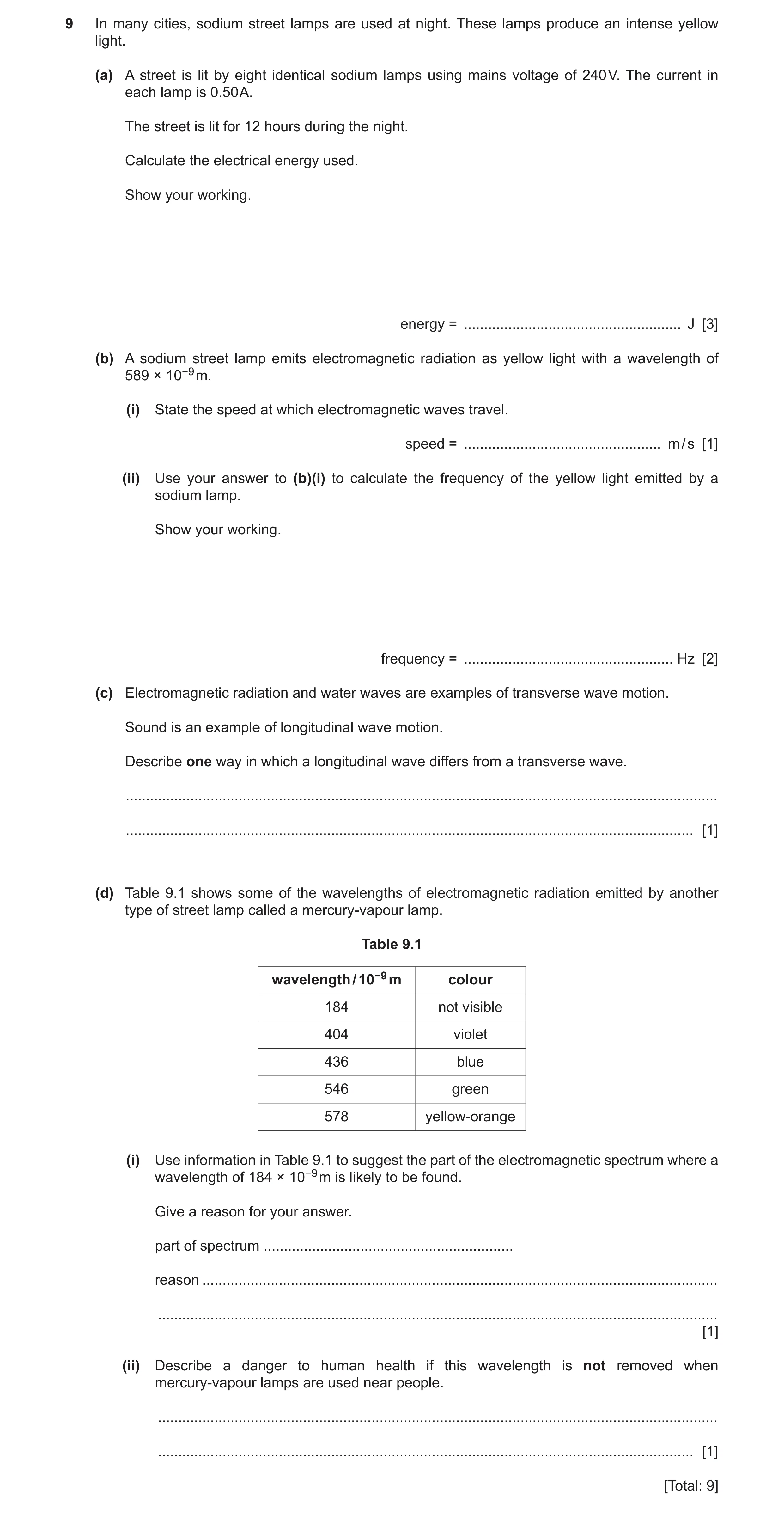
9 In many cities, sodium street lamps are used at night. These lamps produce an intense yellow light. (a) A street is lit by eight identical sodium lamps using mains voltage of 240 V. The current in each lamp is 0.50 A. The street is lit for 12 hours during the night. Calculate the electrical energy used. Show your working. energy = … J [3] (b) A sodium street lamp emits electromagnetic radiation as yellow light with a wavelength of 589 × 10−9 m. (i) State the speed at which electromagnetic waves travel. speed = … m / s [1] (ii) Use your answer to (b)(i) to calculate the frequency of the yellow light emitted by a sodium lamp. Show your working. frequency = … Hz [2] (c) Electromagnetic radiation and water waves are examples of transverse wave motion. Sound is an example of longitudinal wave motion. Describe one way in which a longitudinal wave differs from a transverse wave. … … [1] (d) Table 9.1 shows some of the wavelengths of electromagnetic radiation emitted by another type of street lamp called a mercury-vapour lamp. Table 9.1 wavelength / 10−9 m colour 184 not visible 404 violet 436 blue 546 green 578 yellow-orange (i) Use information in Table 9.1 to suggest the part of the electromagnetic spectrum where a wavelength of 184 × 10−9 m is likely to be found. Give a reason for your answer. part of spectrum … reason … … [1] (ii) Describe a danger to human health if this wavelength is not removed when mercury-vapour lamps are used near people. … … [1] [Total: 9]
9 marks
Mark scheme: 9(a) time in seconds = 60 × 60 × 12 / 43200 ; E = 240 × 0.5 × 8 × 60 × 60 × 12 = 41 472 000 J / 41(.5) MJ ; 3 9(b)(i) 3.0 × 10⁸ m / s ; 1 9(b)(ii) v = fλ ; f (= v / λ) = 3 × 10⁸ / 589 × 10–9 = 5.09 × 10¹⁴ (Hz) ; 2 9(c) transverse wave vibrations at right angles to direction of travel, longitudinal in same direction as direction of travel ; 1 9(d)(i) (ultraviolet) shorter wavelength than violet / visible ; 1 9(d)(ii) skin cancer / burning of skin / other known hazard ; 1
This question in 0653/42 Feb/March 2019
Q4 · An electrical device used in kitchens to kill insects 0653/41 May/June 2019
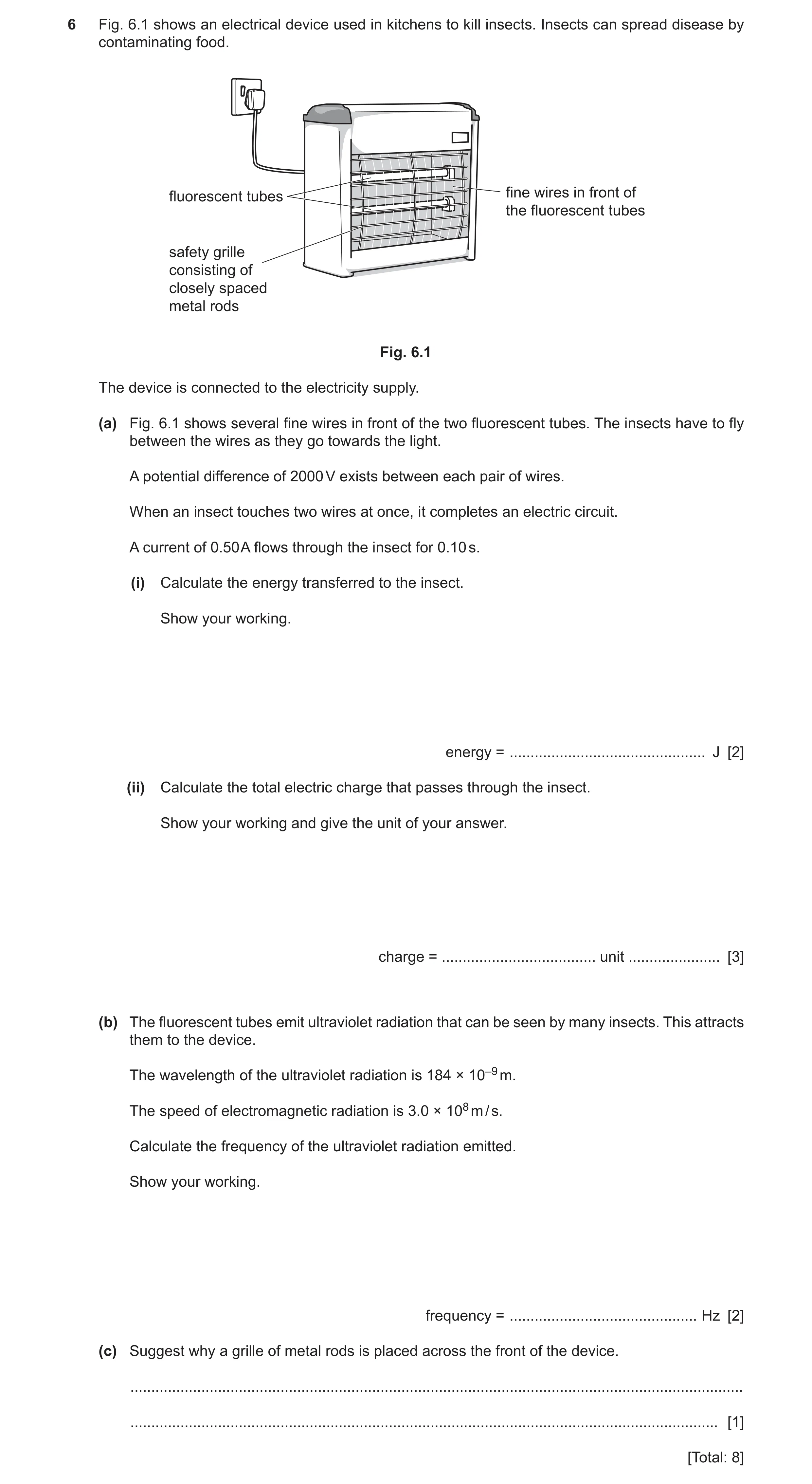
6 Fig. 6.1 shows an electrical device used in kitchens to kill insects. Insects can spread disease by contaminating food. fine wires in front of fluorescent tubes the fluorescent tubes safety grille consisting of closely spaced metal rods Fig. 6.1 The device is connected to the electricity supply. (a) Fig. 6.1 shows several fine wires in front of the two fluorescent tubes. The insects have to fly between the wires as they go towards the light. A potential difference of 2000 V exists between each pair of wires. When an insect touches two wires at once, it completes an electric circuit. A current of 0.50 A flows through the insect for 0.10 s. (i) Calculate the energy transferred to the insect. Show your working. energy = … J [2] (ii) Calculate the total electric charge that passes through the insect. Show your working and give the unit of your answer. charge = … unit … [3] (b) The fluorescent tubes emit ultraviolet radiation that can be seen by many insects. This attracts them to the device. The wavelength of the ultraviolet radiation is 184 × 10–9 m. The speed of electromagnetic radiation is 3.0 × 10⁸ m / s. Calculate the frequency of the ultraviolet radiation emitted. Show your working. frequency = … Hz [2] (c) Suggest why a grille of metal rods is placed across the front of the device. … … [1] [Total: 8]
8 marks
Mark scheme: 6(a)(i) = 100 (J) ; 2 6(a)(ii) (Q =) It = 0.5 × 0.1 ; = 0.05 ; coulomb(s) / C ; 3 6(b) v = fλ or f = v/λ or f = 3.0 × 10⁸ / 184 × 10-9 ; = 1.6(3) × 1015 (Hz) ; 2 Question Answer Marks 6(c) to protect humans from touching the high voltage wires / owtte ; 1
This question in 0653/41 May/June 2019
Q5 · A cylinder of compressed air (air at high pressure) used by a scuba diver in the sea 0653/43 May/June 2019
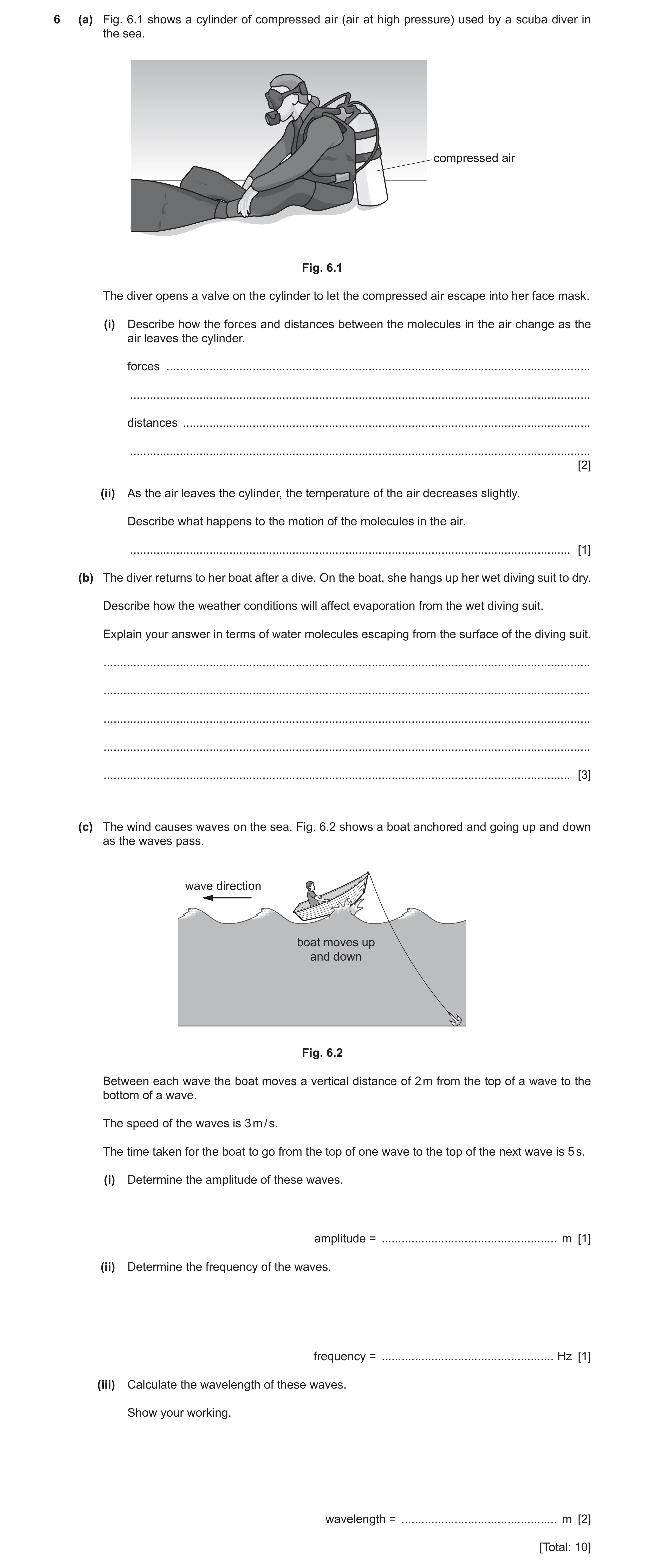
6 (a) Fig. 6.1 shows a cylinder of compressed air (air at high pressure) used by a scuba diver in the sea. compressed air Fig. 6.1 The diver opens a valve on the cylinder to let the compressed air escape into her face mask. (i) Describe how the forces and distances between the molecules in the air change as the air leaves the cylinder. forces … … distances … … [2] (ii) As the air leaves the cylinder, the temperature of the air decreases slightly. Describe what happens to the motion of the molecules in the air. … [1] (b) The diver returns to her boat after a dive. On the boat, she hangs up her wet diving suit to dry. Describe how the weather conditions will affect evaporation from the wet diving suit. Explain your answer in terms of water molecules escaping from the surface of the diving suit. … … … … … [3] (c) The wind causes waves on the sea. Fig. 6.2 shows a boat anchored and going up and down as the waves pass. wave direction boat moves up and down Fig. 6.2 Between each wave the boat moves a vertical distance of 2 m from the top of a wave to the bottom of a wave. The speed of the waves is 3 m / s. The time taken for the boat to go from the top of one wave to the top of the next wave is 5 s. (i) Determine the amplitude of these waves. amplitude = … m [1] (ii) Determine the frequency of the waves. frequency = … Hz [1] (iii) Calculate the wavelength of these waves. Show your working. wavelength = … m [2] [Total: 10]
10 marks
Mark scheme: 6(a)(i) forces decrease ; distances increase ; 2 6(a)(ii) (average) speed (of molecules) decreases ; 1 6(b) the higher the wind speed the higher the rate of evaporation / drying ; increased wind speed increases the rate at which molecules move away from suit / decreases the chances that escaped molecules return / owtte ; the higher the temperature the higher the rate of evaporation / drying ; increased temperature increases the energy / speed of molecules so they leave the surface at a higher rate / owtte ; max 3 6(c)(i) 1 (m) 1 6(c)(ii) f = (1 ÷ time between waves = 1 ÷ 5 ) = 0.2 (Hz) ; 1 6(c)(iii) v = f λ or λ = v / f or λ = 3 / 0.2 ; = 15 (m) ; 2
This question in 0653/43 May/June 2019
Question 6 0653/42 Feb/March 2020
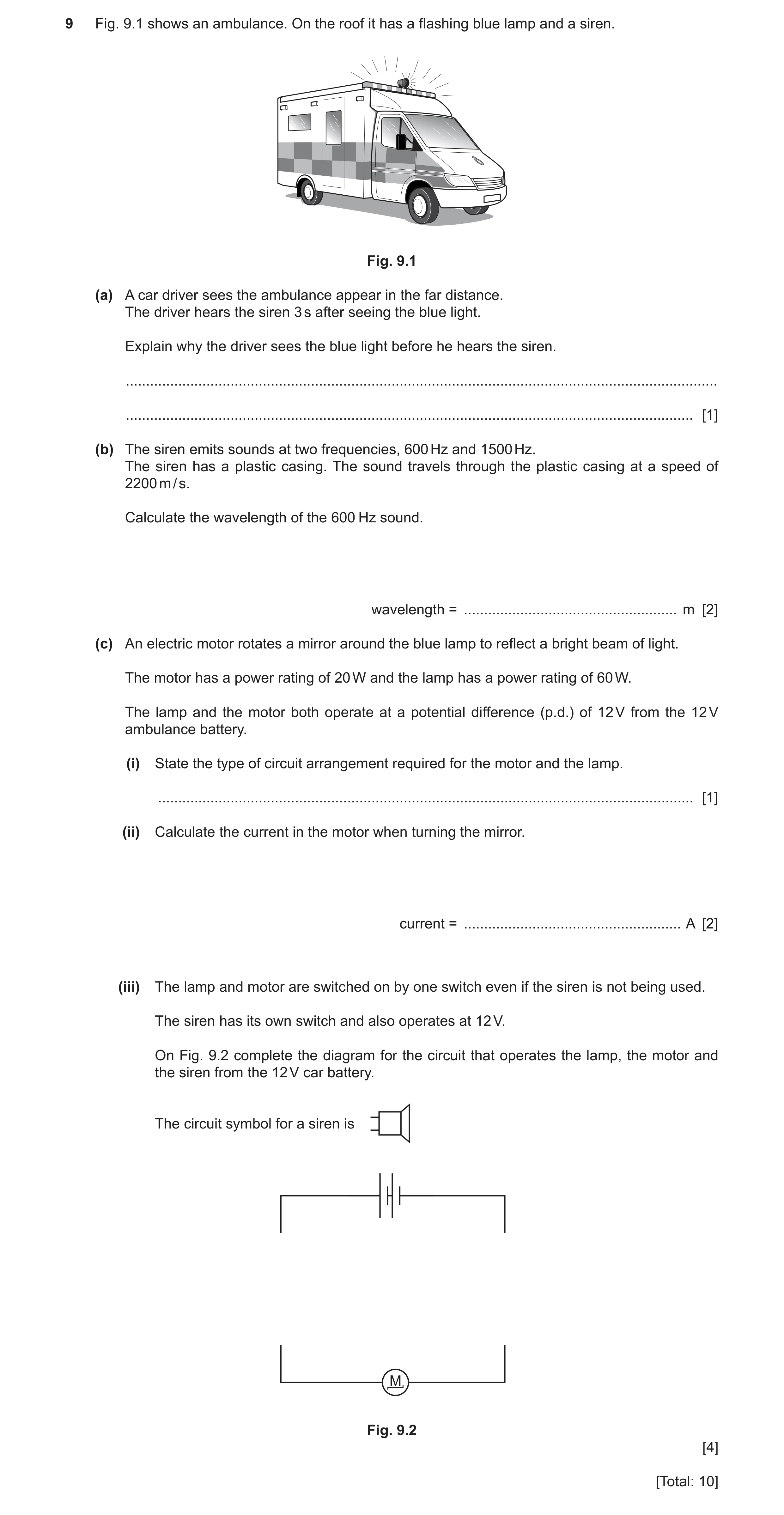
9 Fig. 9.1 shows an ambulance. On the roof it has a flashing blue lamp and a siren. Fig. 9.1 (a) A car driver sees the ambulance appear in the far distance. The driver hears the siren 3 s after seeing the blue light. Explain why the driver sees the blue light before he hears the siren. … … [1] (b) The siren emits sounds at two frequencies, 600 Hz and 1500 Hz. The siren has a plastic casing. The sound travels through the plastic casing at a speed of 2200 m / s. Calculate the wavelength of the 600 Hz sound. wavelength = … m [2] (c) An electric motor rotates a mirror around the blue lamp to reflect a bright beam of light. The motor has a power rating of 20 W and the lamp has a power rating of 60 W. The lamp and the motor both operate at a potential difference (p.d.) of 12 V from the 12 V ambulance battery. (i) State the type of circuit arrangement required for the motor and the lamp. … [1] (ii) Calculate the current in the motor when turning the mirror. current = … A [2] (iii) The lamp and motor are switched on by one switch even if the siren is not being used. The siren has its own switch and also operates at 12 V. On Fig. 9.2 complete the diagram for the circuit that operates the lamp, the motor and the siren from the 12 V car battery. The circuit symbol for a siren is M Fig. 9.2 [4] [Total: 10]
10 marks
Mark scheme: 9(a) light travels faster than sound ; 1 9(b) v = fλ / (λ =) v ÷ f / 2200 ÷ 600 ; = 3.67 / 3.7 (m) ; 2 9(c)(i) parallel ; 1 9(c)(ii) P = I V / (I =) P ÷ V / 20 ÷ 12 ; = 1.7 / 1.67 (A) ; 2 Question Answer Marks 9(c)(iii) correct symbols for lamp and switch ; lamp, siren and motor all in parallel ; switch for motor and lamp ; switch for siren only ; 4
This question in 0653/42 Feb/March 2020
Q7 · A microwave oven connected to a mains electricity supply 0653/41 May/June 2020
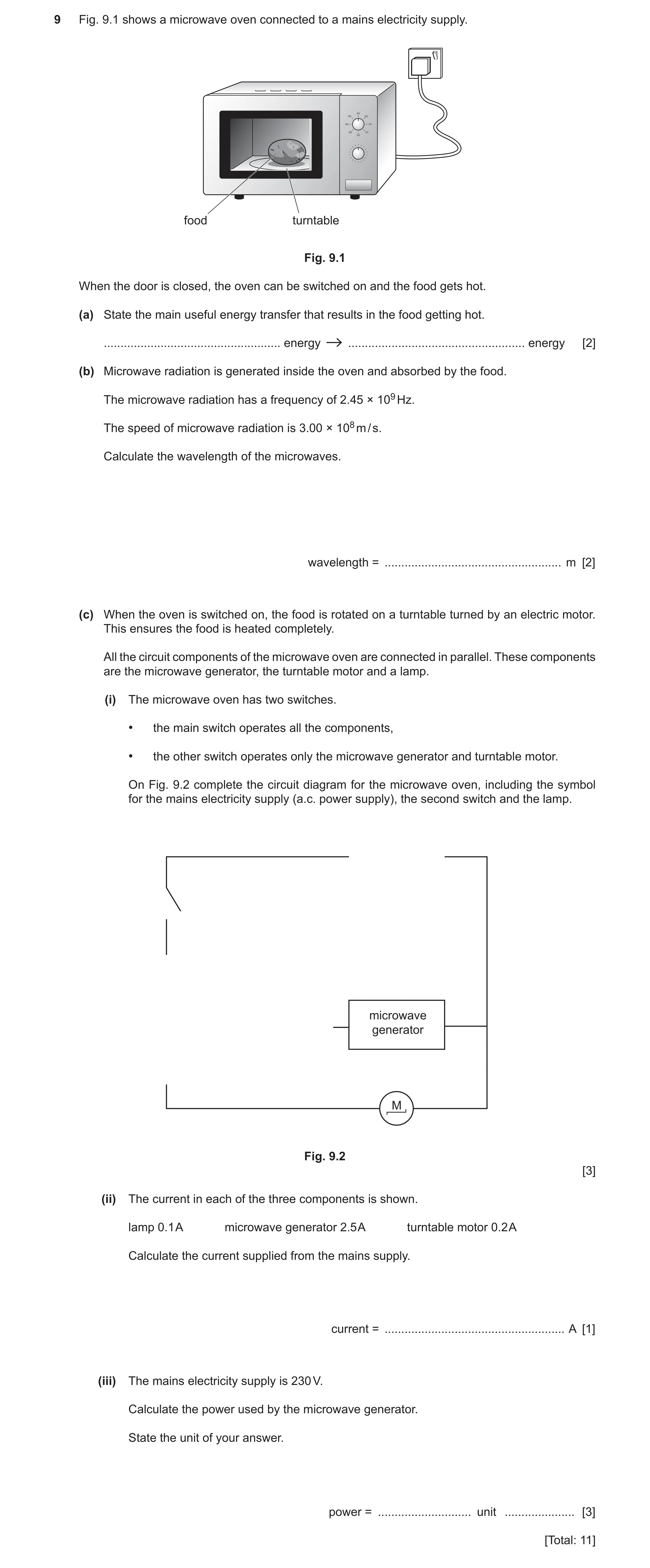
9 Fig. 9.1 shows a microwave oven connected to a mains electricity supply. food turntable Fig. 9.1 When the door is closed, the oven can be switched on and the food gets hot. (a) State the main useful energy transfer that results in the food getting hot. … energy … energy [2] (b) Microwave radiation is generated inside the oven and absorbed by the food. The microwave radiation has a frequency of 2.45 × 10⁹ Hz. The speed of microwave radiation is 3.00 × 10⁸ m / s. Calculate the wavelength of the microwaves. wavelength = … m [2] (c) When the oven is switched on, the food is rotated on a turntable turned by an electric motor. This ensures the food is heated completely. All the circuit components of the microwave oven are connected in parallel. These components are the microwave generator, the turntable motor and a lamp. (i) The microwave oven has two switches. • the main switch operates all the components, • the other switch operates only the microwave generator and turntable motor. On Fig. 9.2 complete the circuit diagram for the microwave oven, including the symbol for the mains electricity supply (a.c. power supply), the second switch and the lamp. microwave generator M Fig. 9.2 [3] (ii) The current in each of the three components is shown. lamp 0.1 A microwave generator 2.5 A turntable motor 0.2 A Calculate the current supplied from the mains supply. current = … A [1] (iii) The mains electricity supply is 230 V. Calculate the power used by the microwave generator. State the unit of your answer. power = … unit … [3] [Total: 11]
11 marks
Mark scheme: 9(a) electrical (energy) ; (→) thermal (energy) ; 2 9(b) v = fλ so λ = v/f = 3 × 10⁸ / 2.45 × 10⁹ ; wavelength = 0.12 / 0.122 (m) ; 2 9(c)(i) 3 9(c)(ii) (current = 0.1 + 2.5 + 0.2 =) 2.8 (A) ; 1 9(c)(iii) Power = V × I = 230 × 2.5 ; = 575 ; watts / W ; 3 a.c. mains symbol ; microwave generator in parallel with lamp and motor ; second switch in a position where it operates motor and microwave generator only ;
This question in 0653/41 May/June 2020
Q8 · A girl using a bicycle pump to ‘pump up’ (add air to) a bicycle tyre 0653/41 Oct/Nov 2020
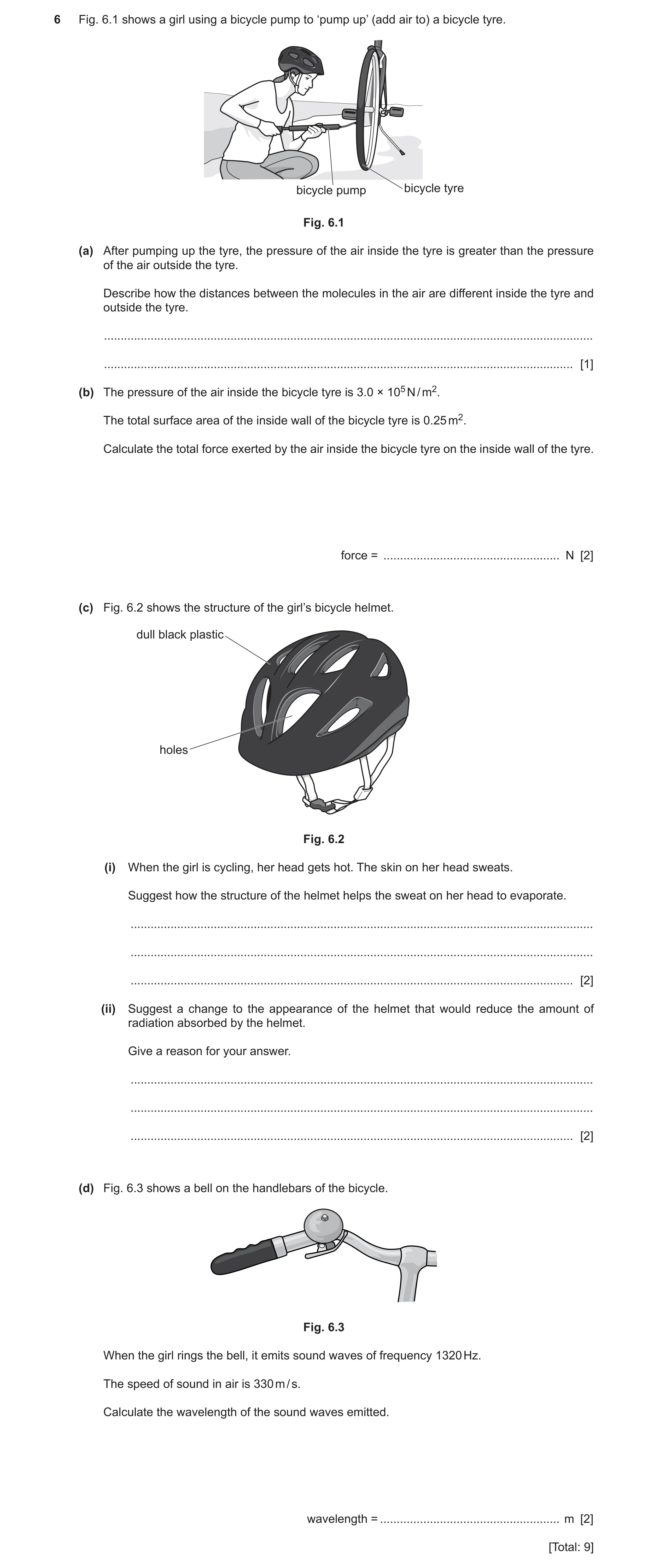
6 Fig. 6.1 shows a girl using a bicycle pump to ‘pump up’ (add air to) a bicycle tyre. bicycle pump bicycle tyre Fig. 6.1 (a) After pumping up the tyre, the pressure of the air inside the tyre is greater than the pressure of the air outside the tyre. Describe how the distances between the molecules in the air are different inside the tyre and outside the tyre. … … [1] (b) The pressure of the air inside the bicycle tyre is 3.0 × 10⁵ N / m2. The total surface area of the inside wall of the bicycle tyre is 0.25 m2. Calculate the total force exerted by the air inside the bicycle tyre on the inside wall of the tyre. force = … N [2] (c) Fig. 6.2 shows the structure of the girl’s bicycle helmet. dull black plastic holes Fig. 6.2 (i) When the girl is cycling, her head gets hot. The skin on her head sweats. Suggest how the structure of the helmet helps the sweat on her head to evaporate. … … … [2] (ii) Suggest a change to the appearance of the helmet that would reduce the amount of radiation absorbed by the helmet. Give a reason for your answer. … … … [2] (d) Fig. 6.3 shows a bell on the handlebars of the bicycle. Fig. 6.3 When the girl rings the bell, it emits sound waves of frequency 1320 Hz. The speed of sound in air is 330 m / s. Calculate the wavelength of the sound waves emitted. wavelength = … m [2] [Total: 9]
9 marks
Mark scheme: 6(a) distances between molecules inside the tyre are smaller / molecules inside tyre are closer together / ora ; 1 6(b) use of P = F / A ; (F = P × A = 3 × 105 × 0.25 =) 0.75 × 10⁵ / 75 000 (N) ; 2 6(c)(i) any two from: holes help air flow (over the surface of the skin on her head) ; holes allow water to escape ; which increases rate of evaporation ; 2 6(c)(ii) make, shiny / white / light in colour ; reflects (the Sun’s radiation) ; 2 6(d) v = f λ in any form / 330 ÷ 1320 ; 0.25 (m) ; 2
This question in 0653/41 Oct/Nov 2020
Q9 · The compressions and rarefactions of a sound wave in air 0653/41 Oct/Nov 2021
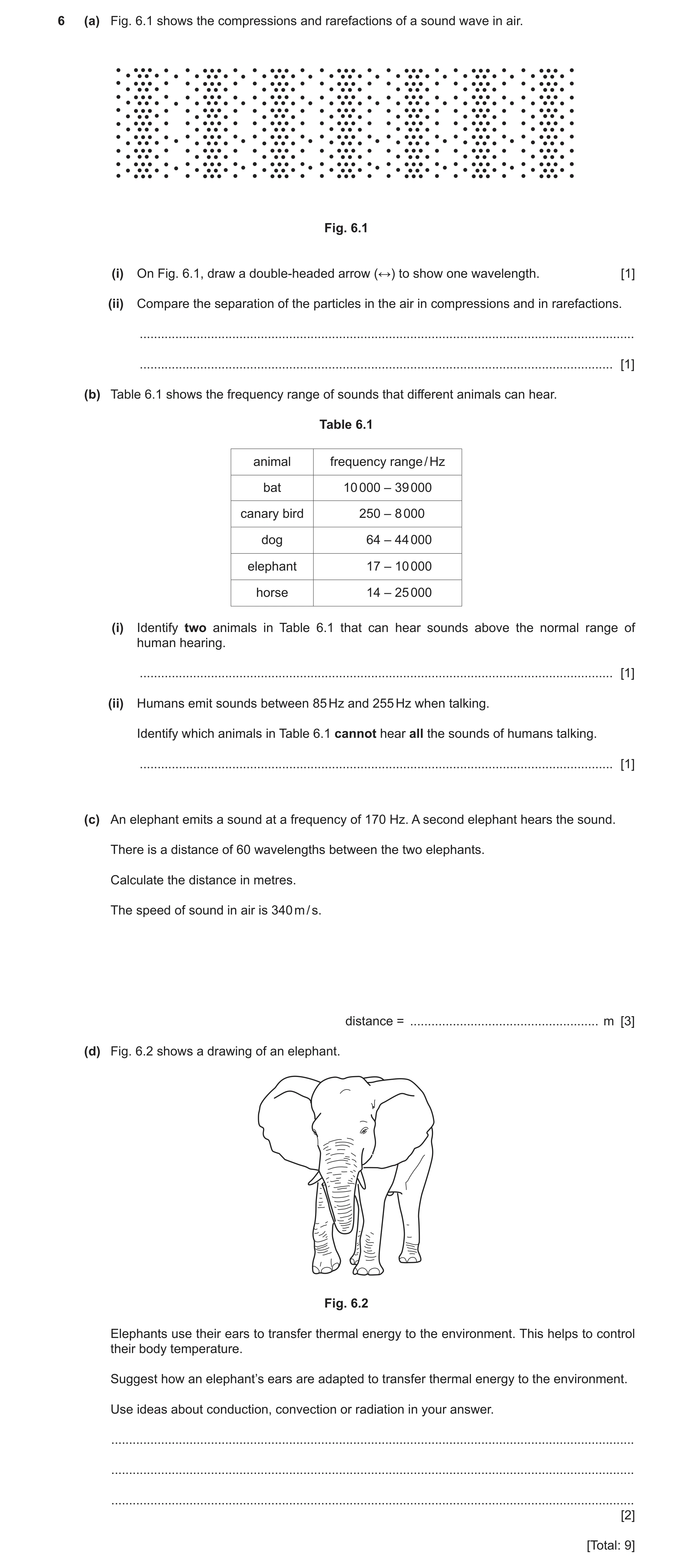
6 (a) Fig. 6.1 shows the compressions and rarefactions of a sound wave in air. Fig. 6.1 (i) On Fig. 6.1, draw a double-headed arrow (↔) to show one wavelength. [1] (ii) Compare the separation of the particles in the air in compressions and in rarefactions. … … [1] (b) Table 6.1 shows the frequency range of sounds that different animals can hear. Table 6.1 animal frequency range / Hz bat 10 000 – 39 000 canary bird 250 – 8 000 dog 64 – 44 000 elephant 17 – 10 000 horse 14 – 25 000 (i) Identify two animals in Table 6.1 that can hear sounds above the normal range of human hearing. … [1] (ii) Humans emit sounds between 85 Hz and 255 Hz when talking. Identify which animals in Table 6.1 cannot hear all the sounds of humans talking. … [1] (c) An elephant emits a sound at a frequency of 170 Hz. A second elephant hears the sound. There is a distance of 60 wavelengths between the two elephants. Calculate the distance in metres. The speed of sound in air is 340 m / s. distance = … m [3] (d) Fig. 6.2 shows a drawing of an elephant. Fig. 6.2 Elephants use their ears to transfer thermal energy to the environment. This helps to control their body temperature. Suggest how an elephant’s ears are adapted to transfer thermal energy to the environment. Use ideas about conduction, convection or radiation in your answer. … … … [2] [Total: 9]
9 marks
Mark scheme: 6(a)(i) arrow showing one complete wavelength ; 1 6(a)(ii) molecules clos(er) together in compressions / molecules further / (far) apart in rarefactions ; 1 6(b)(i) any two from: bat / dog / horse ; 1 6(b)(ii) bat AND canary bird ; 1 6(c) 𝑣 = 𝑓 in any form / 340 ÷ 170 ; ( =) 2 m ; (distance = 2 × 60 =) 120 (m) ; 3 6(d) adaptation stated, e.g. large surface area ; correctly matched to method of energy transfer, e.g. radiation ; 2
This question in 0653/41 Oct/Nov 2021
Q10 · Two beach balls are floating in the sea 0653/42 Oct/Nov 2021
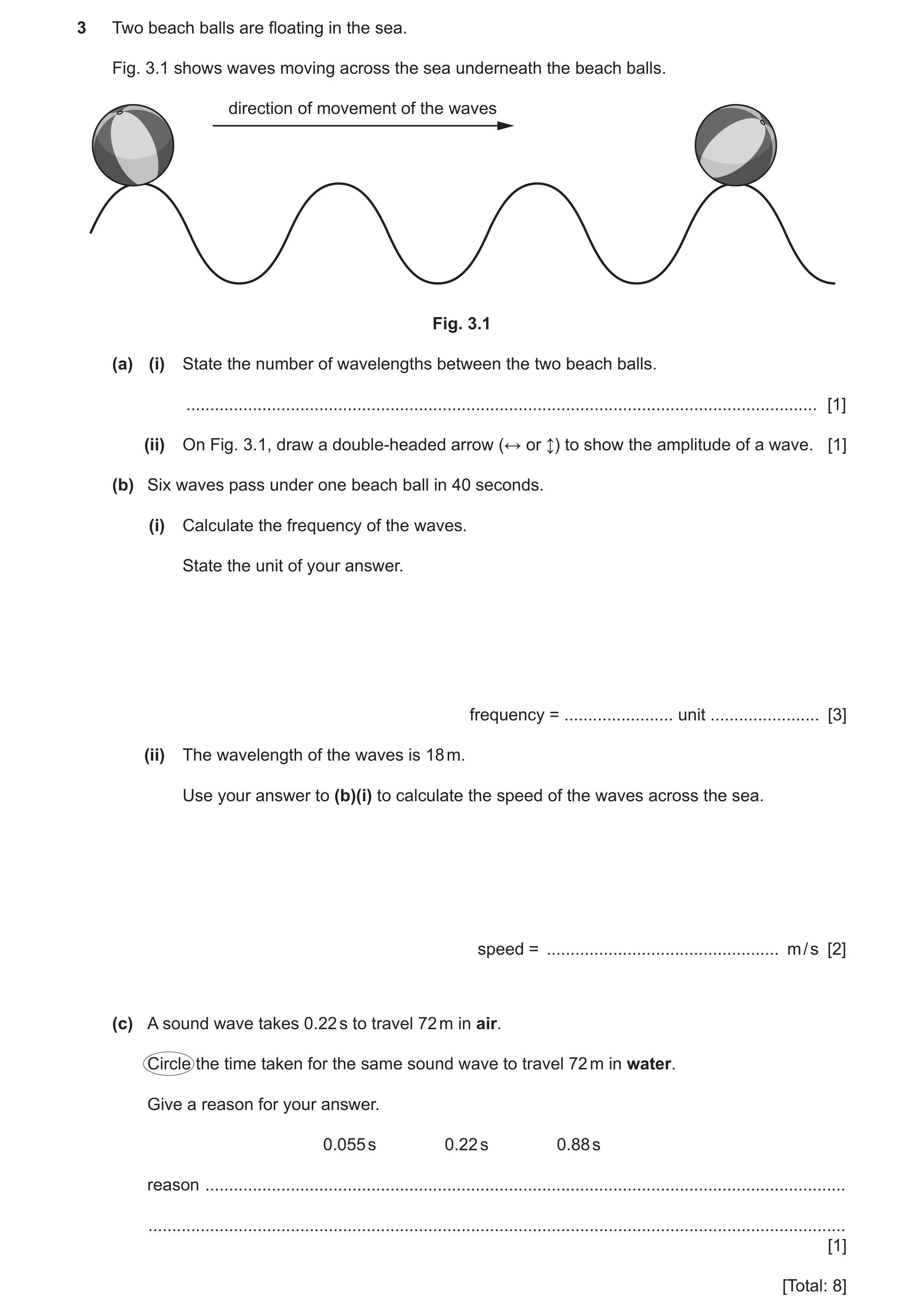
3 Two beach balls are floating in the sea. Fig. 3.1 shows waves moving across the sea underneath the beach balls. direction of movement of the waves Fig. 3.1 (a) (i) State the number of wavelengths between the two beach balls. … [1] (ii) On Fig. 3.1, draw a double-headed arrow (↔ or ↕) to show the amplitude of a wave. [1] (b) Six waves pass under one beach ball in 40 seconds. (i) Calculate the frequency of the waves. State the unit of your answer. frequency = … unit … [3] (ii) The wavelength of the waves is 18 m. Use your answer to (b)(i) to calculate the speed of the waves across the sea. speed = … m / s [2] (c) A sound wave takes 0.22 s to travel 72 m in air. Circle the time taken for the same sound wave to travel 72 m in water. Give a reason for your answer. 0.055 s 0.22 s 0.88 s reason … … [1] [Total: 8]
8 marks
Mark scheme: 3(a)(i) 3 ; 1 3(a)(ii) double-headed arrow between equilibrium position (mid-point) and any peak or trough ; 1 3(b)(i) frequency = number of waves per second / 6 ÷ 40 ; 0.15 ; Hz ; 3 3(b)(ii) 𝑣 = 𝑓 in any form / 0.15 × 18 ; 2.7 (m / s) ; 2 3(c) 0.055 s AND sound travels faster through, water / liquids (than in, air / gases) ORA ; 1
This question in 0653/42 Oct/Nov 2021
Q11 · Ultraviolet radiation and microwaves are part of the electromagnetic spectrum 0653/42 May/June 2022
6 Ultraviolet radiation and microwaves are part of the electromagnetic spectrum. (a) Fig. 6.1 shows an incomplete electromagnetic spectrum. On Fig. 6.1, write ultraviolet and microwaves in the correct places. increasing frequency gamma radio visible light radiation waves Fig. 6.1 [2] (b) State one danger of ultraviolet radiation. … [1] (c) State one use of microwaves. … [1] (d) Complete the sentences about ultraviolet radiation and microwaves. Circle the correct word or phrase to complete each sentence. Ultraviolet radiation and microwaves are audible / longitudinal / transverse waves. The speed of microwaves in a vacuum is equal to / faster than / slower than the speed of ultraviolet radiation in a vacuum. [2] (e) (i) The speed of ultraviolet radiation in a vacuum is 3.0 × 10⁸ m / s. An ultraviolet lamp emits ultraviolet radiation of wavelength 3.5 × 10⁻⁷ m. Calculate the frequency of ultraviolet radiation at this wavelength. Give the unit of your answer. frequency = … unit … [3] (ii) Three identical ultraviolet lamps are connected in parallel to a 230 V electricity supply. Each lamp uses a power of 150 W. Calculate the total current from the electricity supply. current = … A [3] [Total: 12]
12 marks
Mark scheme: 6(a) (gamma radiation) ultraviolet ; (visible light) micro-waves ; (radio waves) 2 6(b) burns / DNA damage / (skin) cancer ; 1 6(c) satellite television / (mobile) telephones ; 1 6(d) transverse ; equal to ; 2 6(e)(i) v = f (in any form) / (f =) 3 108 ÷ 3.5 10–7 ; = 8.6 1014 ; Hz ; 3 6(e)(ii) P = VI or I = P ÷ V OR 450 ÷ 230 ; and either: current in each lamp = 150 ÷ 230 / 0.652(174) ; (total currect = 3 0.652(174)) = 1.96 / 2.0 (A) ; OR (total power supply needed = 3 150) 450 (W) ; (total current = 450 / 230 =) 1.96 / 2.0 (A) ; 3
This question in 0653/42 May/June 2022
Q12 · A radar system in an airport uses microwaves to find and track an airplane in the sky 0653/41 Oct/Nov 2022
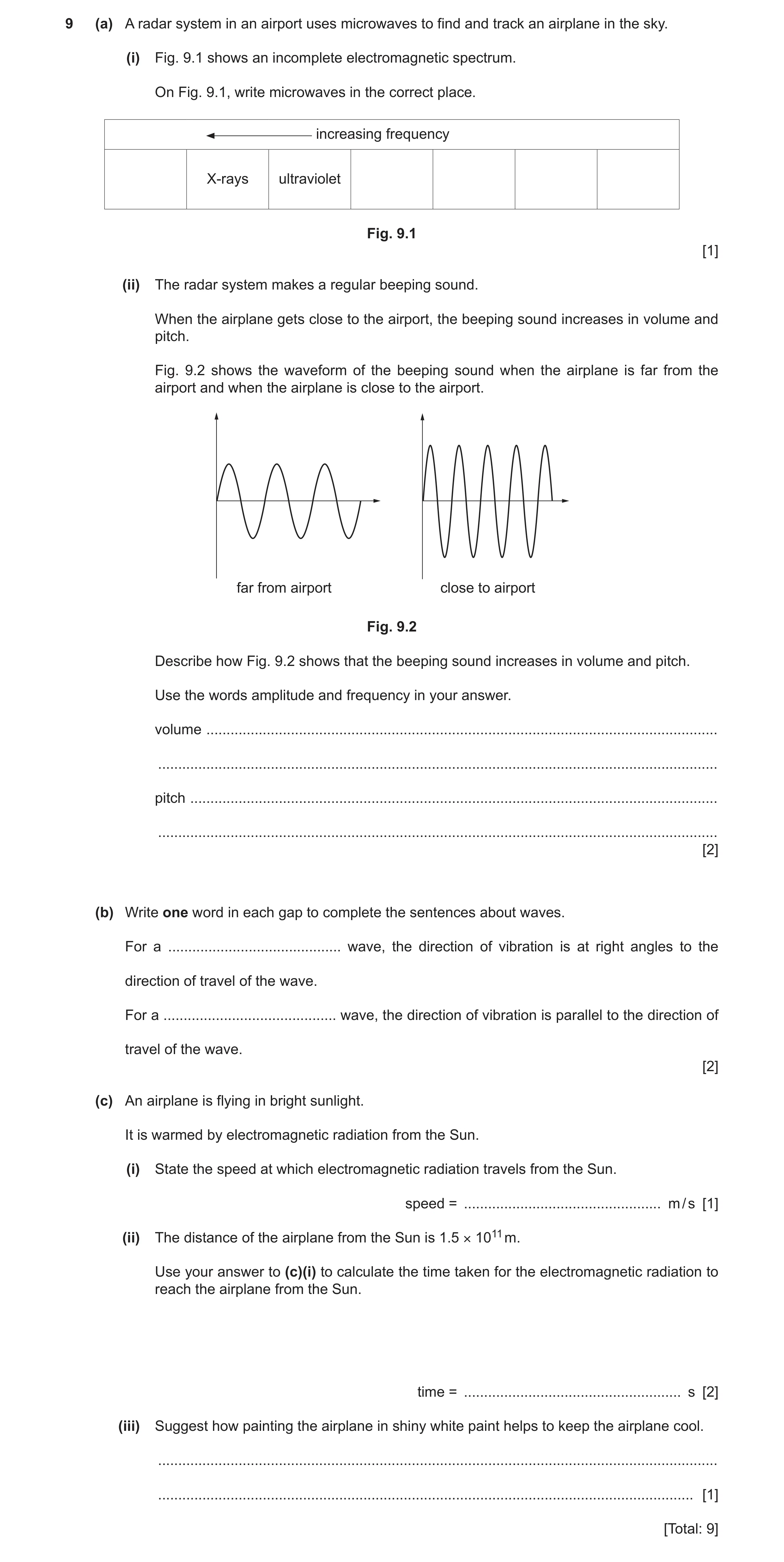
9 (a) A radar system in an airport uses microwaves to find and track an airplane in the sky. (i) Fig. 9.1 shows an incomplete electromagnetic spectrum. On Fig. 9.1, write microwaves in the correct place. increasing frequency X-rays ultraviolet Fig. 9.1 [1] (ii) The radar system makes a regular beeping sound. When the airplane gets close to the airport, the beeping sound increases in volume and pitch. Fig. 9.2 shows the waveform of the beeping sound when the airplane is far from the airport and when the airplane is close to the airport. far from airport close to airport Fig. 9.2 Describe how Fig. 9.2 shows that the beeping sound increases in volume and pitch. Use the words amplitude and frequency in your answer. volume … … pitch … … [2] (b) Write one word in each gap to complete the sentences about waves. For a … wave, the direction of vibration is at right angles to the direction of travel of the wave. For a … wave, the direction of vibration is parallel to the direction of travel of the wave. [2] (c) An airplane is flying in bright sunlight. It is warmed by electromagnetic radiation from the Sun. (i) State the speed at which electromagnetic radiation travels from the Sun. speed = … m / s [1] (ii) The distance of the airplane from the Sun is 1.5 × 10¹¹ m. Use your answer to (c)(i) to calculate the time taken for the electromagnetic radiation to reach the airplane from the Sun. time = … s [2] (iii) Suggest how painting the airplane in shiny white paint helps to keep the airplane cool. … … [1] [Total: 9]
9 marks
Mark scheme: 9(a)(i) 1 X-rays ultraviolet microwaves ; 9(a)(ii) volume large(r) amplitude ; 2 pitch high(er) frequency ; 9(b) transverse / named example ; 2 longitudinal / named example ; 9(c)(i) 3.0 108 / 300 000 000 (m / s) ; 1 9(c)(ii) evidence of, speed = distance ÷ time / 150 000 000 000 ÷ 300 000 000 ; 2 500 (s) (= 8 min 20 s) ; 9(c)(iii) a shiny white surface is a, poor absorber / (good) reflector (of radiation) ; 1
This question in 0653/41 Oct/Nov 2022
Q13 · A house in the Himalayan mountain range 0653/42 Feb/March 2023
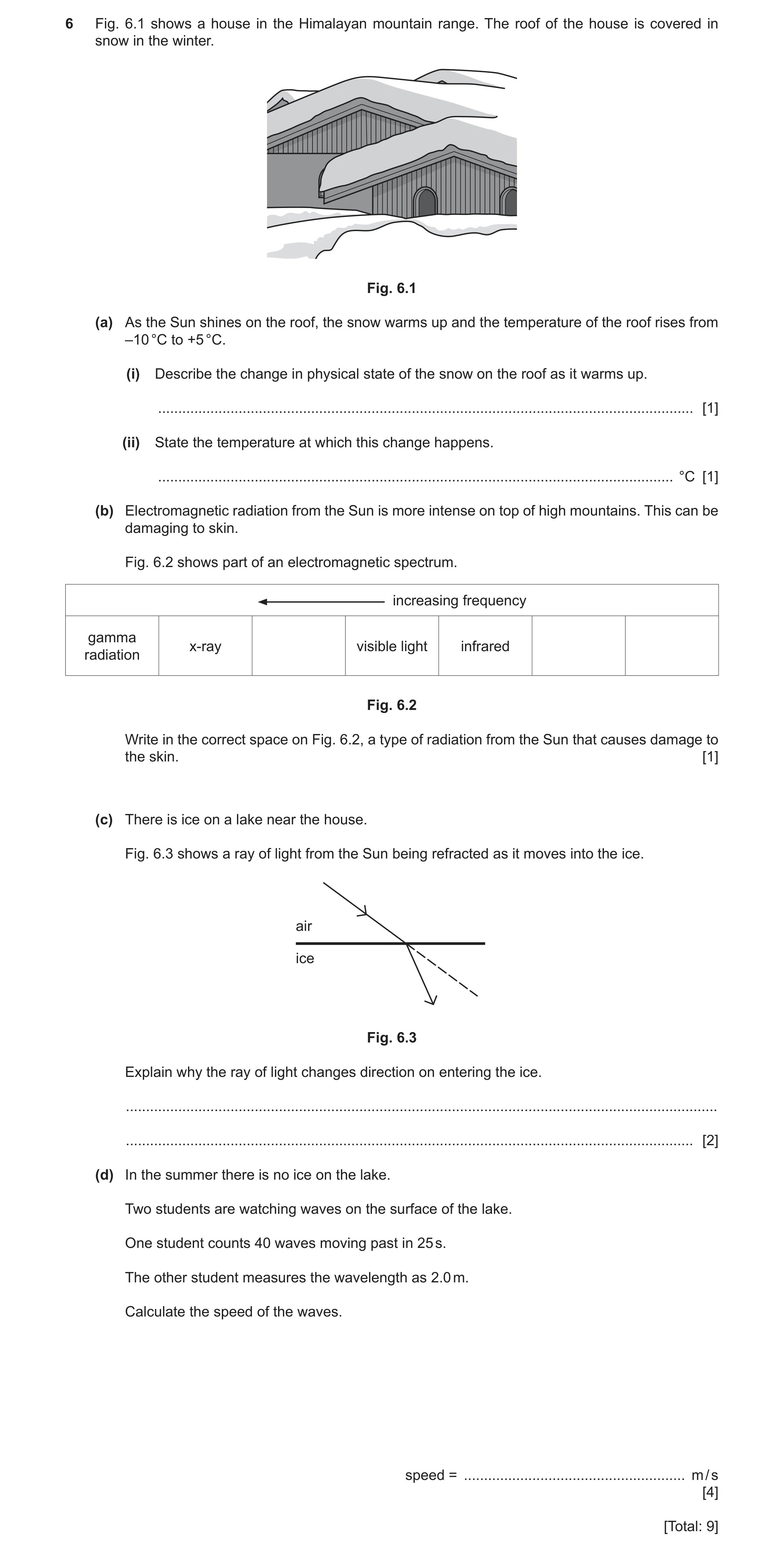
6 Fig. 6.1 shows a house in the Himalayan mountain range. The roof of the house is covered in snow in the winter. Fig. 6.1 (a) As the Sun shines on the roof, the snow warms up and the temperature of the roof rises from –10 °C to +5 °C. (i) Describe the change in physical state of the snow on the roof as it warms up. … [1] (ii) State the temperature at which this change happens. … °C [1] (b) Electromagnetic radiation from the Sun is more intense on top of high mountains. This can be damaging to skin. Fig. 6.2 shows part of an electromagnetic spectrum. increasing frequency gamma x-ray visible light infrared radiation Fig. 6.2 Write in the correct space on Fig. 6.2, a type of radiation from the Sun that causes damage to the skin. [1] (c) There is ice on a lake near the house. Fig. 6.3 shows a ray of light from the Sun being refracted as it moves into the ice. air ice Fig. 6.3 Explain why the ray of light changes direction on entering the ice. … … [2] (d) In the summer there is no ice on the lake. Two students are watching waves on the surface of the lake. One student counts 40 waves moving past in 25 s. The other student measures the wavelength as 2.0 m. Calculate the speed of the waves. speed = … m / s [4] [Total: 9]
9 marks
Mark scheme: 6(a)(i) solid to liquid / it melts ; 1 6(a)(ii) 0 (°C) ; 1 6(b) ultraviolet / UV in correct position ; 1 e.g., gamma x-ray ultraviolet visible light infrared radiation 6(c) speed of light, changes / decreases ; 2 ray moves into a, different / denser medium ; 6(d) frequency = number of waves time / 40 25 ; 4 1.6 (Hz) ; v = f / 1.6 2 ; 3.2 (m / s) ;
This question in 0653/42 Feb/March 2023
Q14 · A sound wave travelling through air between two people 0653/43 May/June 2023
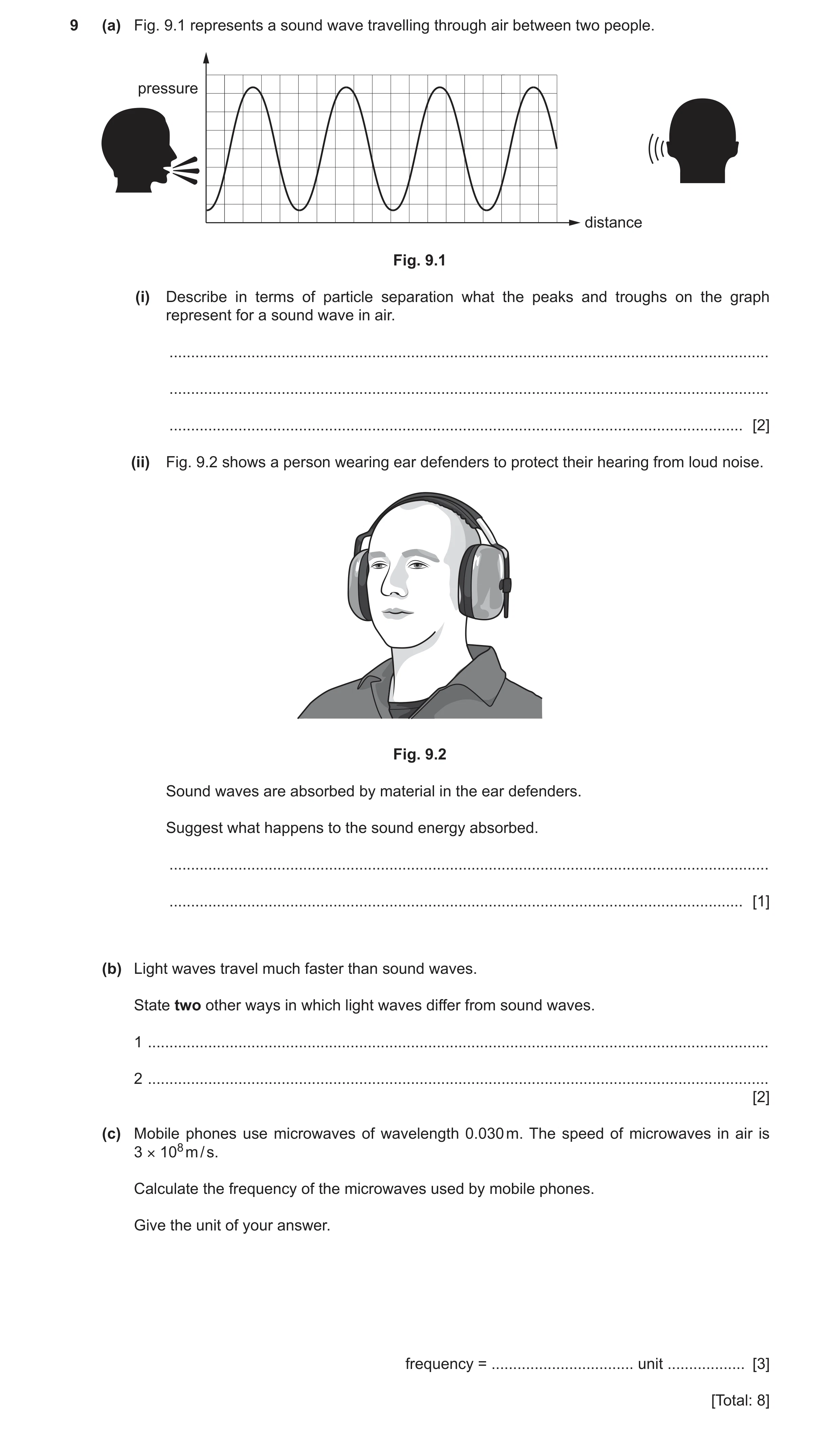
9 (a) Fig. 9.1 represents a sound wave travelling through air between two people. pressure distance Fig. 9.1 (i) Describe in terms of particle separation what the peaks and troughs on the graph represent for a sound wave in air. … … … [2] (ii) Fig. 9.2 shows a person wearing ear defenders to protect their hearing from loud noise. Fig. 9.2 Sound waves are absorbed by material in the ear defenders. Suggest what happens to the sound energy absorbed. … … [1] (b) Light waves travel much faster than sound waves. State two other ways in which light waves differ from sound waves. 1 … 2 … [2] (c) Mobile phones use microwaves of wavelength 0.030 m. The speed of microwaves in air is 3 × 10⁸ m / s. Calculate the frequency of the microwaves used by mobile phones. Give the unit of your answer. frequency = … unit … [3] [Total: 8]
8 marks
Mark scheme: 9(a)(i) (peaks represent) particles closer together ; (troughs represent) particles further apart ; 2 9(a)(ii) (transferred to) thermal energy ; 1 Question Answer Marks 9(b) any two from, and in any order: shorter wavelength ; higher frequency ; electromagnetic (as opposed to pressure waves) ; transverse ; can travel in a vacuum ; 2 9(c) speed = frequency wavelength / v = f λ OR f = 3 108 0.030 ; 1.0 1010 ; Hz ; 3
This question in 0653/43 May/June 2023
Q15 · A musical instrument called a glockenspiel 0653/41 Oct/Nov 2024
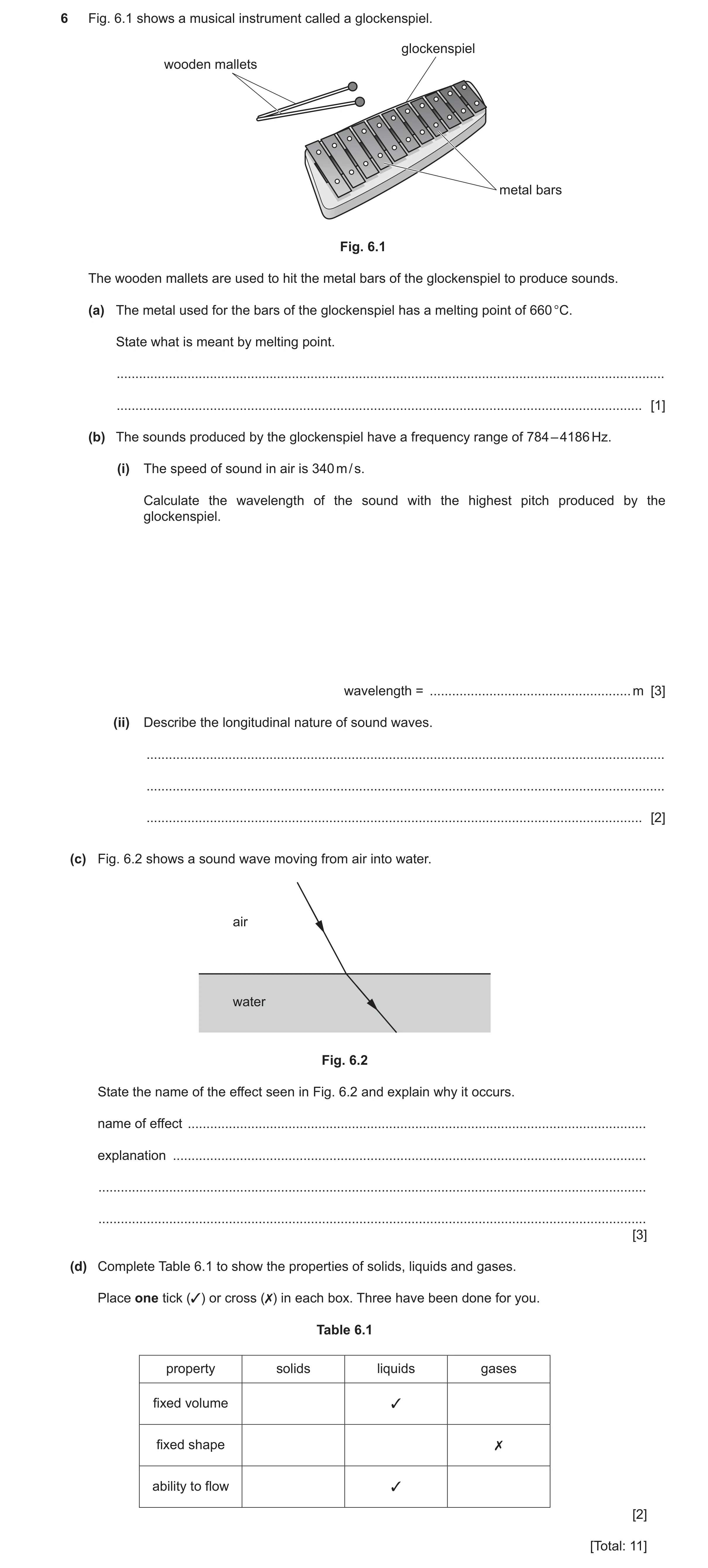
6 Fig. 6.1 shows a musical instrument called a glockenspiel. glockenspiel wooden mallets metal bars Fig. 6.1 The wooden mallets are used to hit the metal bars of the glockenspiel to produce sounds. (a) The metal used for the bars of the glockenspiel has a melting point of 660 °C. State what is meant by melting point. … … [1] (b) The sounds produced by the glockenspiel have a frequency range of 784 – 4186 Hz. (i) The speed of sound in air is 340 m / s. Calculate the wavelength of the sound with the highest pitch produced by the glockenspiel. wavelength = … m [3] (ii) Describe the longitudinal nature of sound waves. … … … [2] (c) Fig. 6.2 shows a sound wave moving from air into water. air water Fig. 6.2 State the name of the effect seen in Fig. 6.2 and explain why it occurs. name of effect … explanation … … … [3] (d) Complete Table 6.1 to show the properties of solids, liquids and gases. Place one tick (✓) or cross (✗) in each box. Three have been done for you. Table 6.1 property solids liquids gases fixed volume ✓ fixed shape ✗ ability to flow ✓ [2] [Total: 11]
11 marks
Mark scheme: 6(a) the temperature at which a substance changes state from solid to liquid / AW ; 1 6(b)(i) highest pitch = highest frequency / 4186 Hz ; 3 evidence of v = f / 340 ÷ 4186 ; 0.081(2) (m) ; 6(b)(ii) oscillations / vibrations (of the air / particles / molecules) ; 2 (motion of air / particles / molecules is) parallel to the direction of, energy transfer / travel / the wave ; 6(c) refraction ; 3 caused by change in speed / medium / density (of medium) ; sound wave moves faster in water / liquid / denser medium / ORA ; 6(d) 2 property solids liquids gases fixed volume ✓ (✓) × fixed shape ✓ × (✗) ability to flow × (✓) ✓ solids column correct ; liquids AND gases columns correct ;
This question in 0653/41 Oct/Nov 2024
Q16 · Complete the sentences about sound 0653/43 Oct/Nov 2024
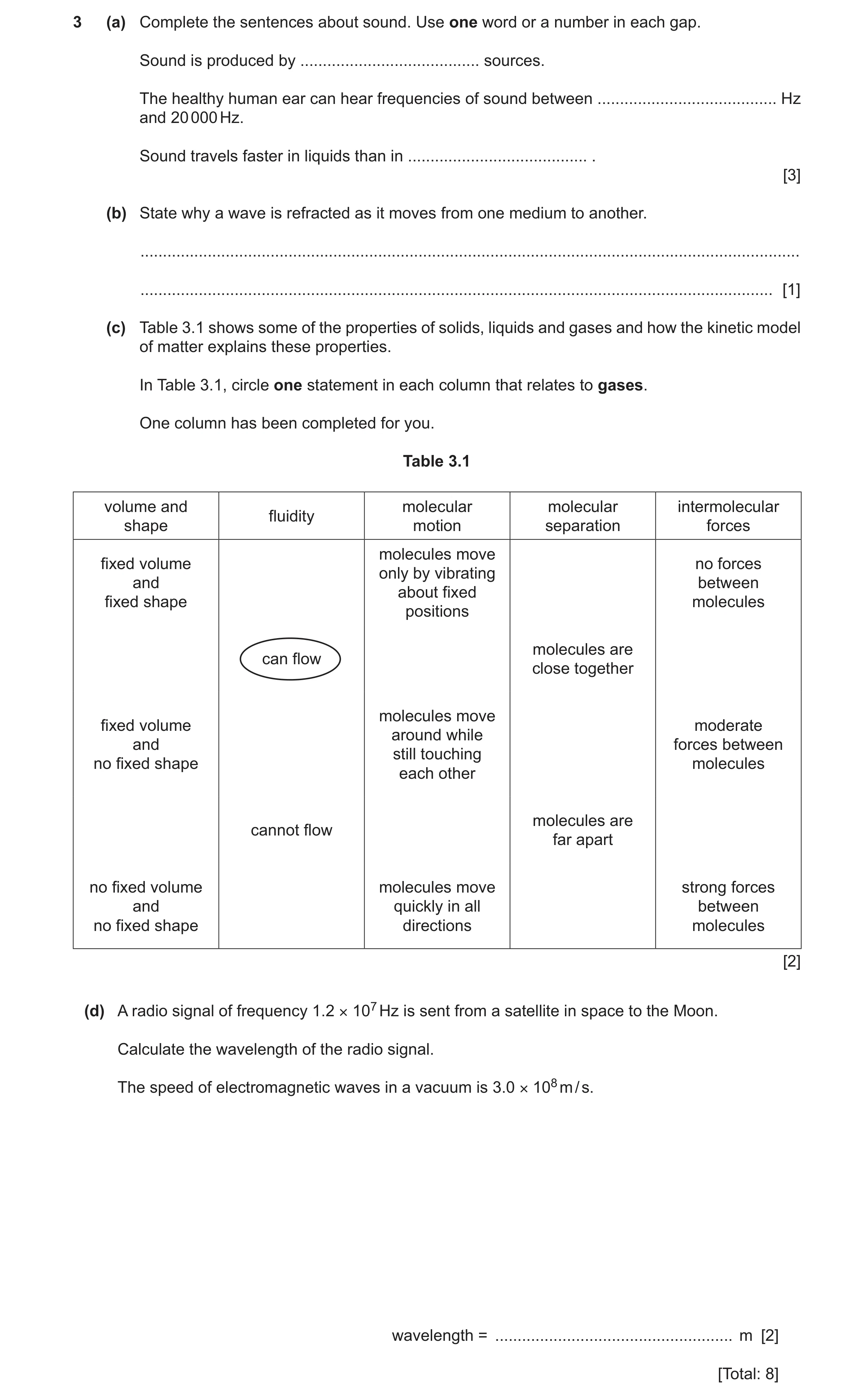
3 (a) Complete the sentences about sound. Use one word or a number in each gap. Sound is produced by … sources. The healthy human ear can hear frequencies of sound between … Hz and 20 000 Hz. Sound travels faster in liquids than in … . [3] (b) State why a wave is refracted as it moves from one medium to another. … … [1] (c) Table 3.1 shows some of the properties of solids, liquids and gases and how the kinetic model of matter explains these properties. In Table 3.1, circle one statement in each column that relates to gases. One column has been completed for you. Table 3.1 volume and molecular molecular intermolecular fluidity shape motion separation forces molecules move fixed volume no forces only by vibrating and between about fixed fixed shape molecules positions molecules are can flow close together molecules move fixed volume moderate around while and forces between still touching no fixed shape molecules each other molecules are cannot flow far apart no fixed volume molecules move strong forces and quickly in all between no fixed shape directions molecules [2] (d) A radio signal of frequency 1.2 × 10⁷ Hz is sent from a satellite in space to the Moon. Calculate the wavelength of the radio signal. The speed of electromagnetic waves in a vacuum is 3.0 × 10⁸ m / s. wavelength = … m [2] [Total: 8]
8 marks
Mark scheme: 3(a) vibrating ; 3 20 ; gases ; 3(b) (because of its) change in speed / different speeds ; 1 3(c) 2 two columns correct ; four columns correct ; 3(d) evidence of, v = f / 3.0 10 8 ÷ 1.2 10 7 ; 2 25 (m) ;
This question in 0653/43 Oct/Nov 2024
Q17 · This question is about the transfer of thermal energy 0653/41 Oct/Nov 2025
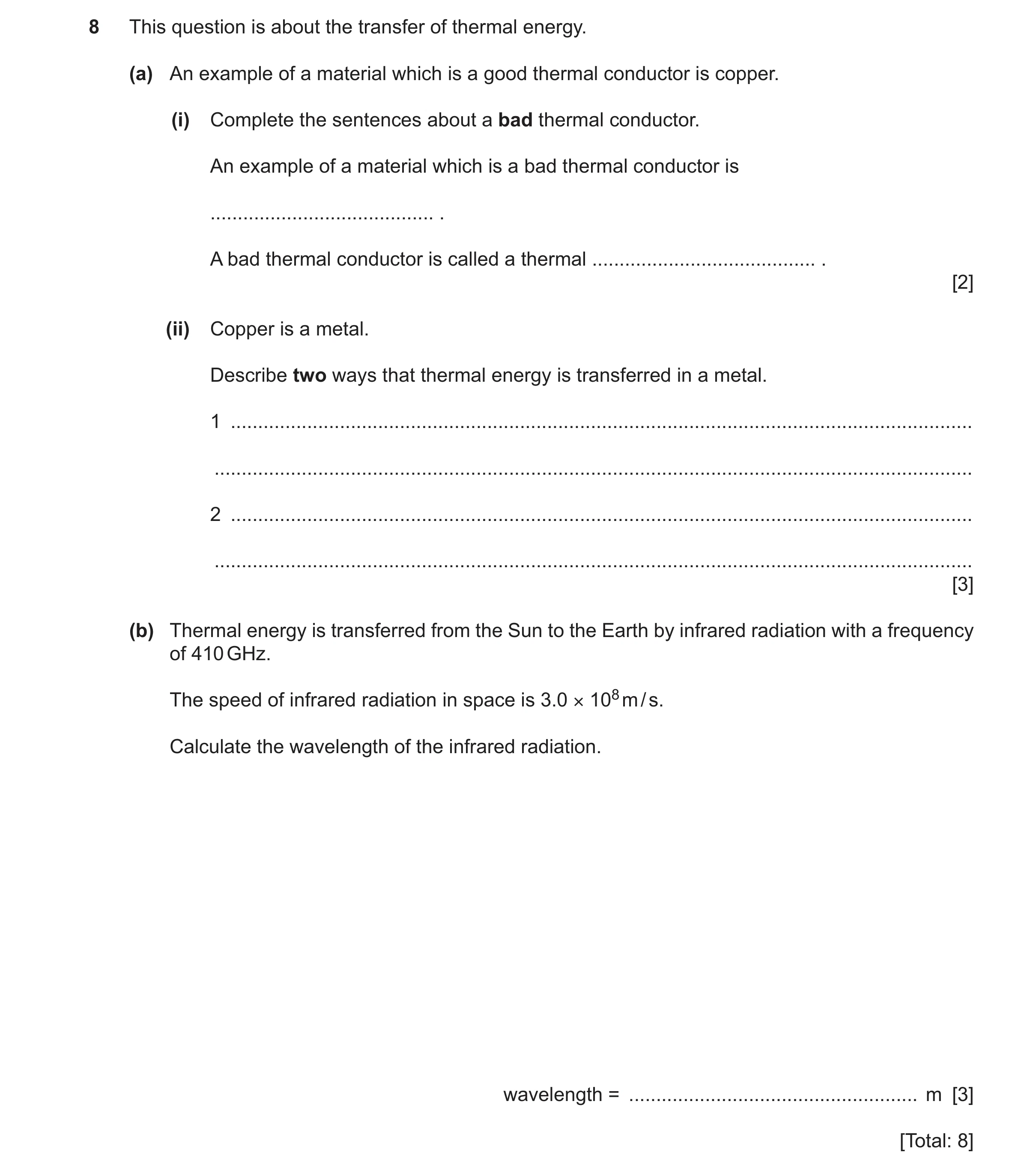
8 This question is about the transfer of thermal energy. (a) An example of a material which is a good thermal conductor is copper. (i) Complete the sentences about a bad thermal conductor. An example of a material which is a bad thermal conductor is … . A bad thermal conductor is called a thermal … . [2] (ii) Copper is a metal. Describe two ways that thermal energy is transferred in a metal. 1 … … 2 … … [3] (b) Thermal energy is transferred from the Sun to the Earth by infrared radiation with a frequency of 410 GHz. The speed of infrared radiation in space is 3.0 × 10⁸ m / s. Calculate the wavelength of the infrared radiation. wavelength = … m [3] [Total: 8]
8 marks
Mark scheme: 8(a)(i) any named insulator, e.g. (named) wood, (named) plastic ; 2 insulator ; 8(a)(ii) M1 vibrations of particles ; 3 M2 ref to movement / delocalised / free electrons ; M3 (energy transfer) by collisions between particles / contact between particles OR collisions between electrons and particles ; 8(b) unit conversion GHz to Hz / 4.10 1011 Hz ; 3 v = fOR 3.0 108 ÷ 4.10 1011 ; 7.3 10–4 (m) ;
This question in 0653/41 Oct/Nov 2025
Q18 · A convection heater in a closed room 0653/43 Oct/Nov 2025
9 (a) Fig. 9.1 shows a convection heater in a closed room. room air heater Fig. 9.1 The heater is on the floor on the left hand side of the room. The heater warms the room by convection. (i) State one other method of thermal energy transfer. … [1] (ii) Explain how the heater warms the room by convection. Use ideas about density in your answer. You may draw on Fig. 9.1 if you wish. … … … … [2] (iii) Explain why the air in the room exerts a greater pressure on the walls when the temperature of the air increases. Use ideas about particles in your answer. … … … … … … [3] (b) Complete Table 9.1 to describe the difference between a transverse wave and a longitudinal wave. Use one word in each gap. Table 9.1 wave direction of … compared to direction of propagation transverse at right angles longitudinal … [2] (c) The Big Bang Theory includes statements about the beginning of the Universe that are supported by astronomical observations. Give two statements about the beginning of the Universe included in the Big Bang Theory. 1 … … 2 … … [2] [Total: 10]
10 marks
Mark scheme: 9(a)(i) conduction / radiation 1 9(a)(ii) idea that warm air is less dense or cold air is more dense ; 2 warm air rises AND cold air falls ; 9(a)(iii) (air) particles collide with the walls ; 3 particle collisions (with walls) are more frequent (as temperature increases) or particles collide with greater, speed or kinetic energy or force ; idea that more force per unit area = increased pressure ; 9(b) vibration(s) ; 2 parallel ; 9(c) any two from: 2 (Universe) expanded/started from a (single) point ; (point had) high density and temperature ; (Universe began) 13.8 billion years ago ;
This question in 0653/43 Oct/Nov 2025
 16 / 28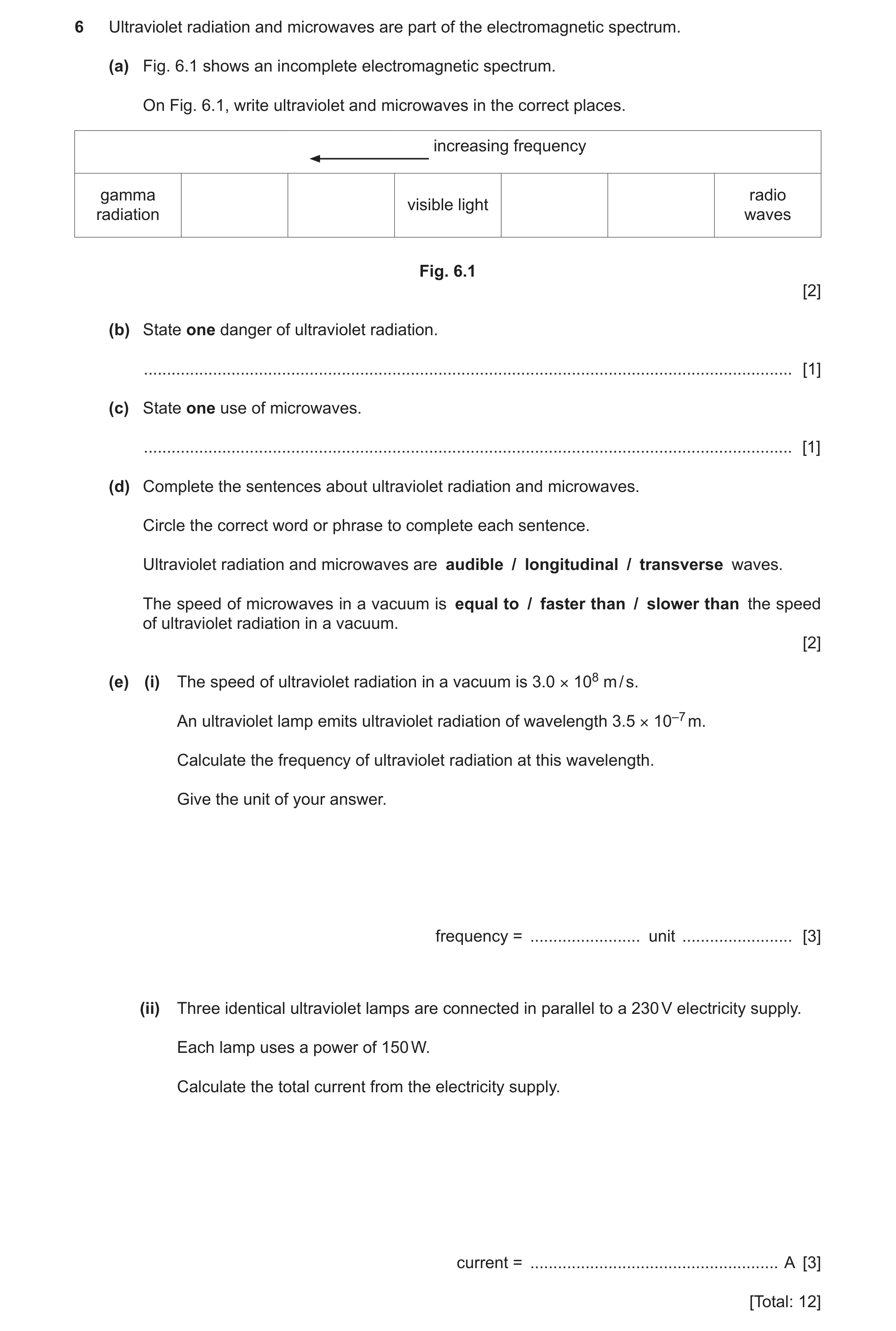
 26 / 28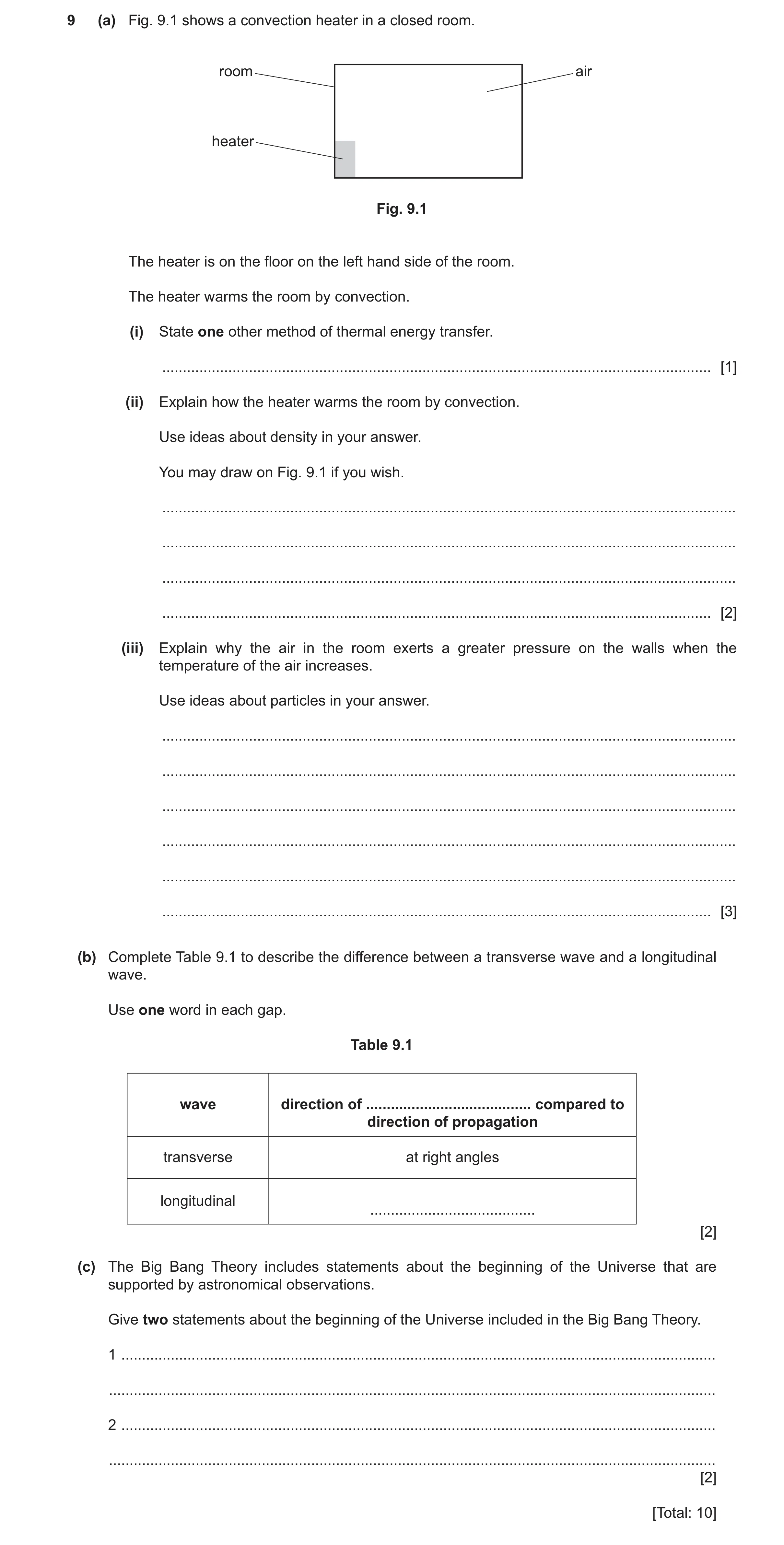
 8
8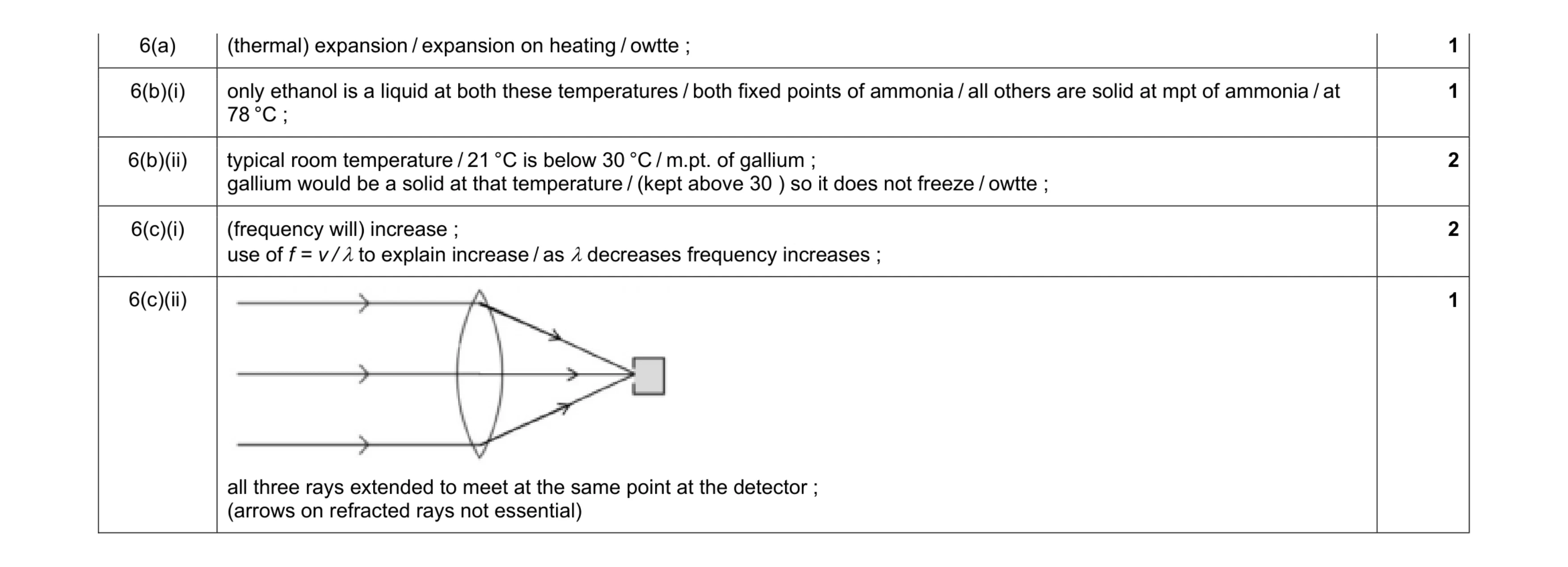 7
7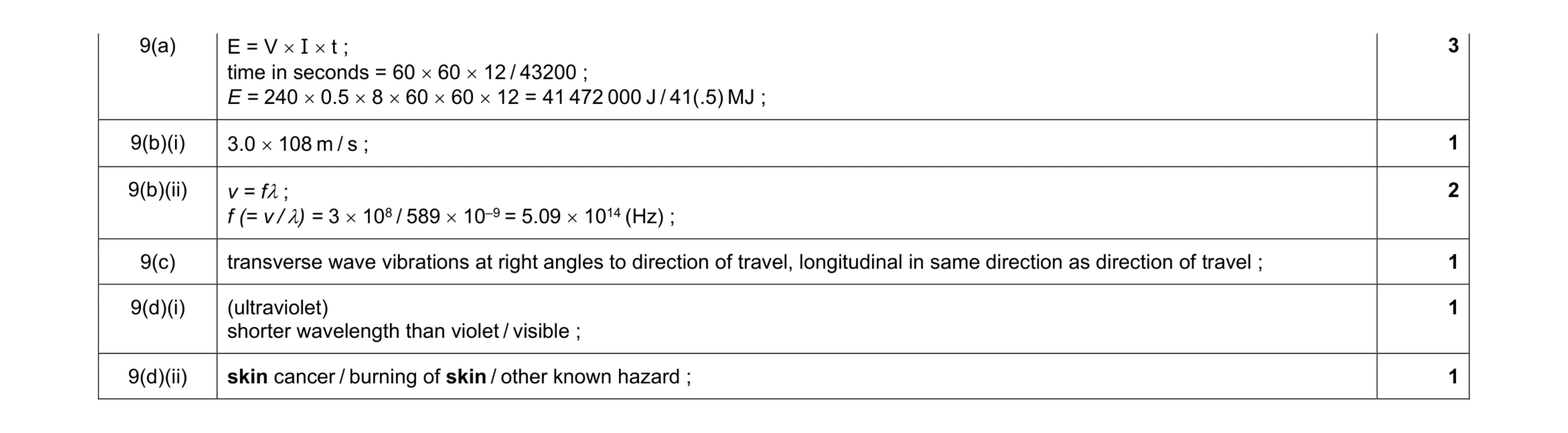 9
9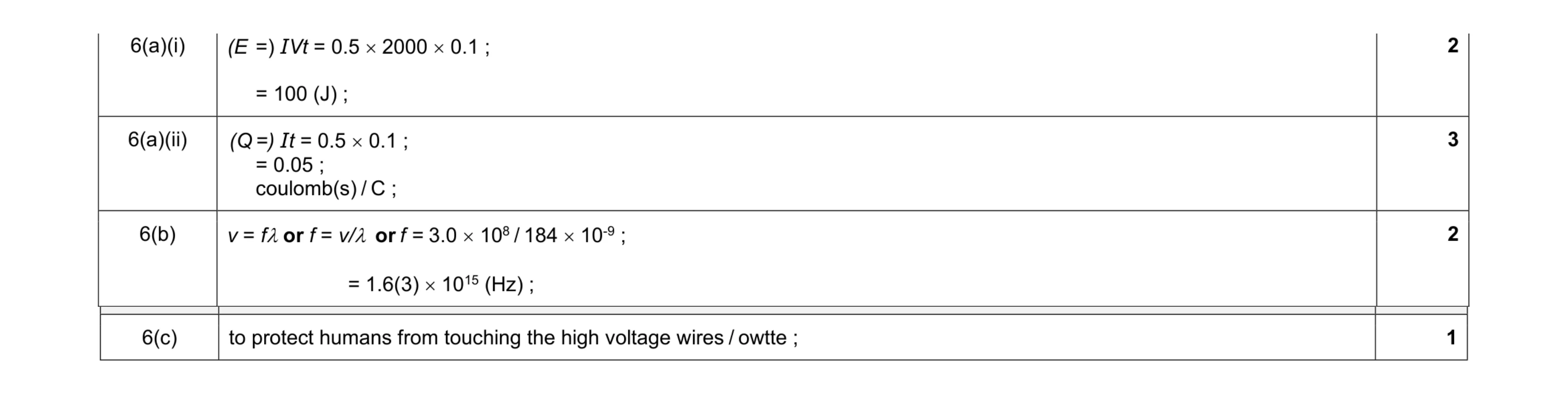 8
8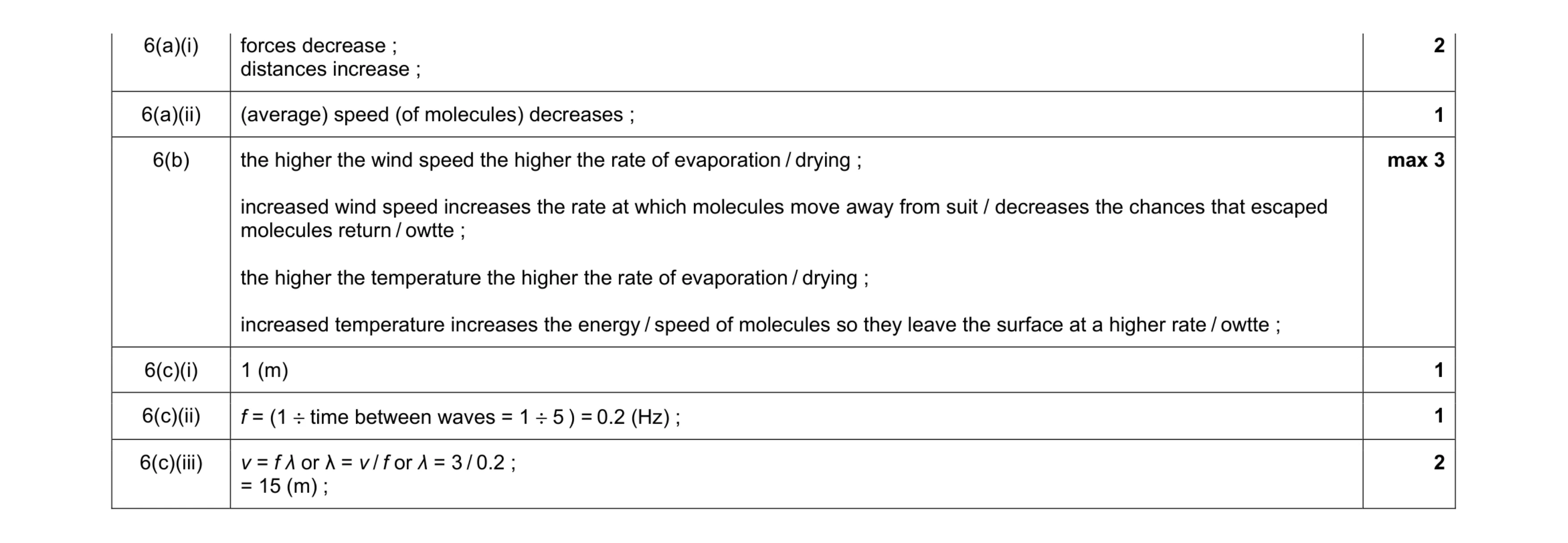 10
10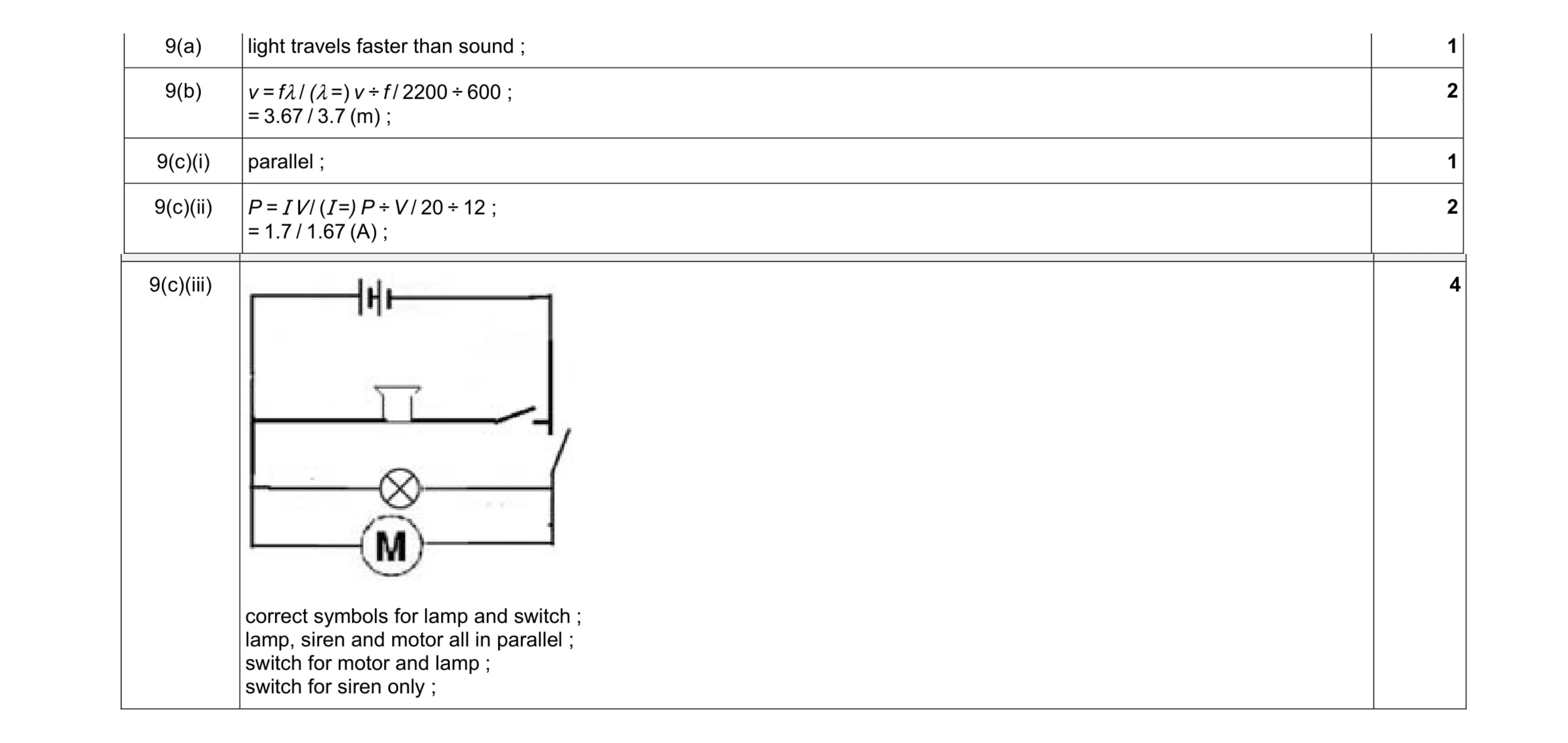 10
10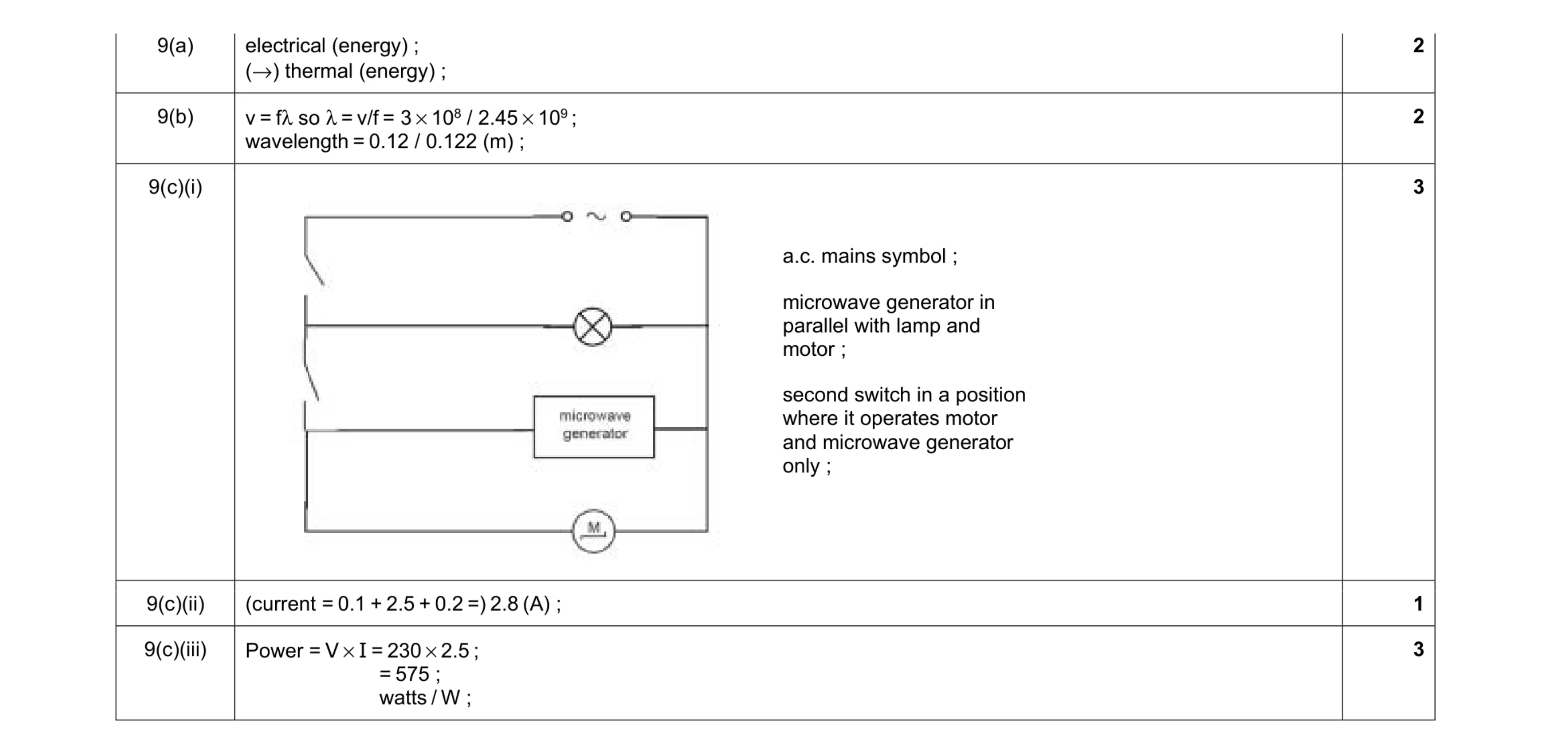 11
11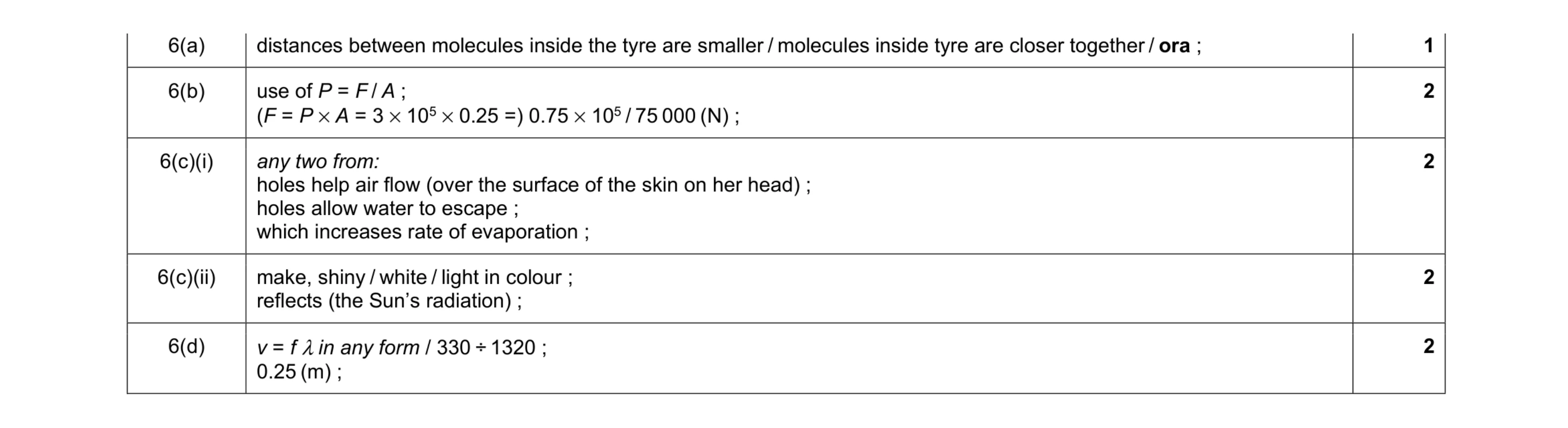 9
9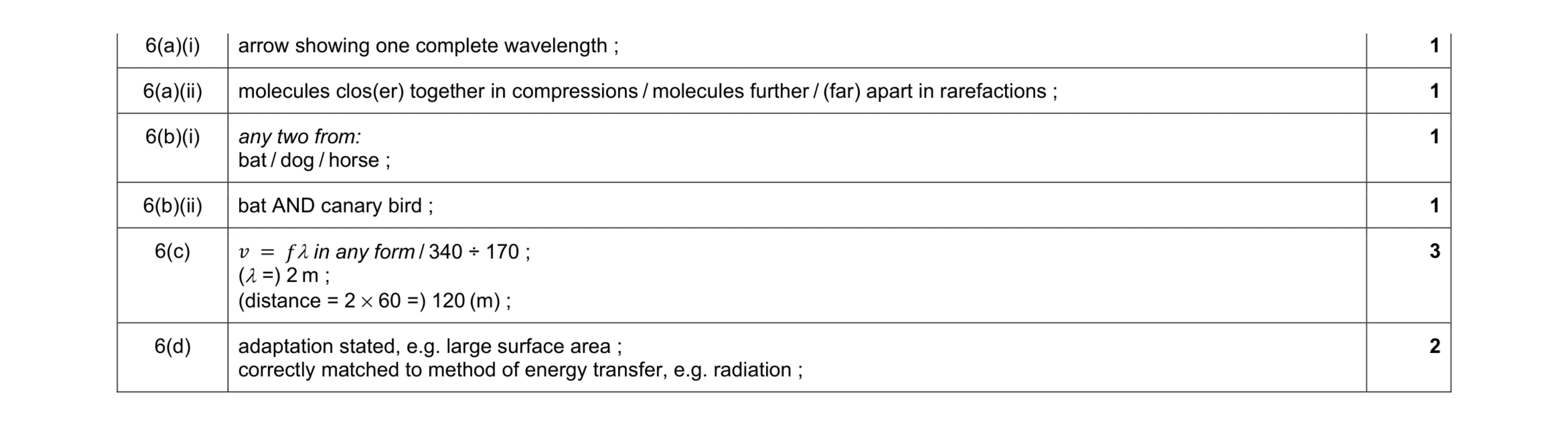 9
9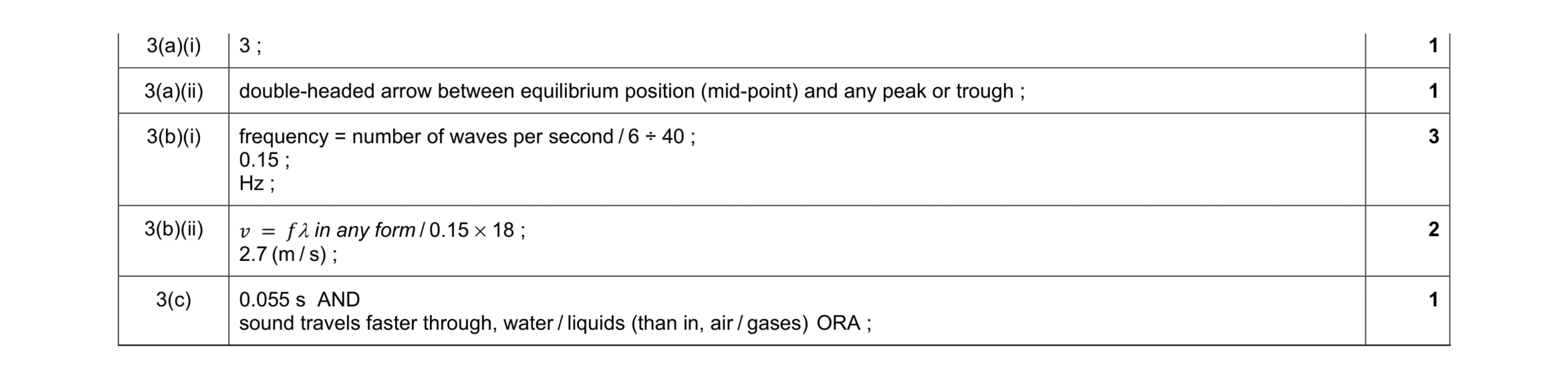 8
8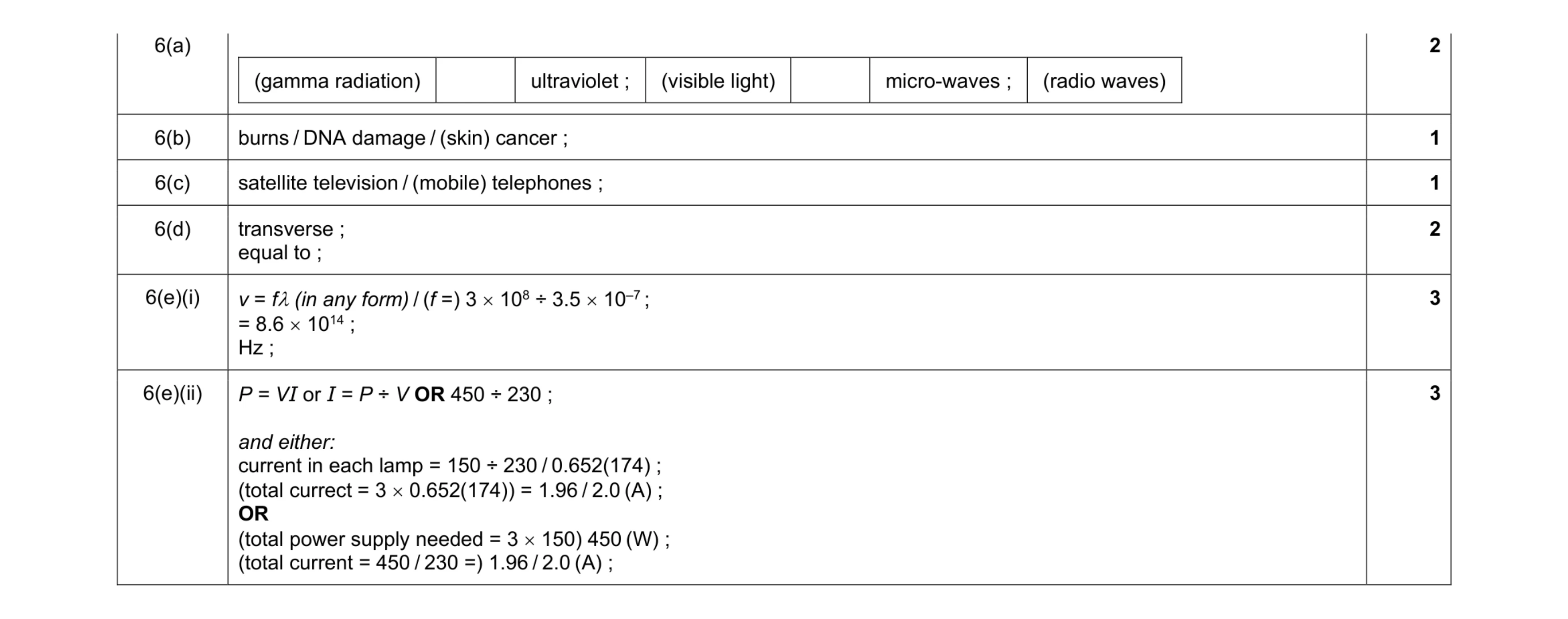 12
12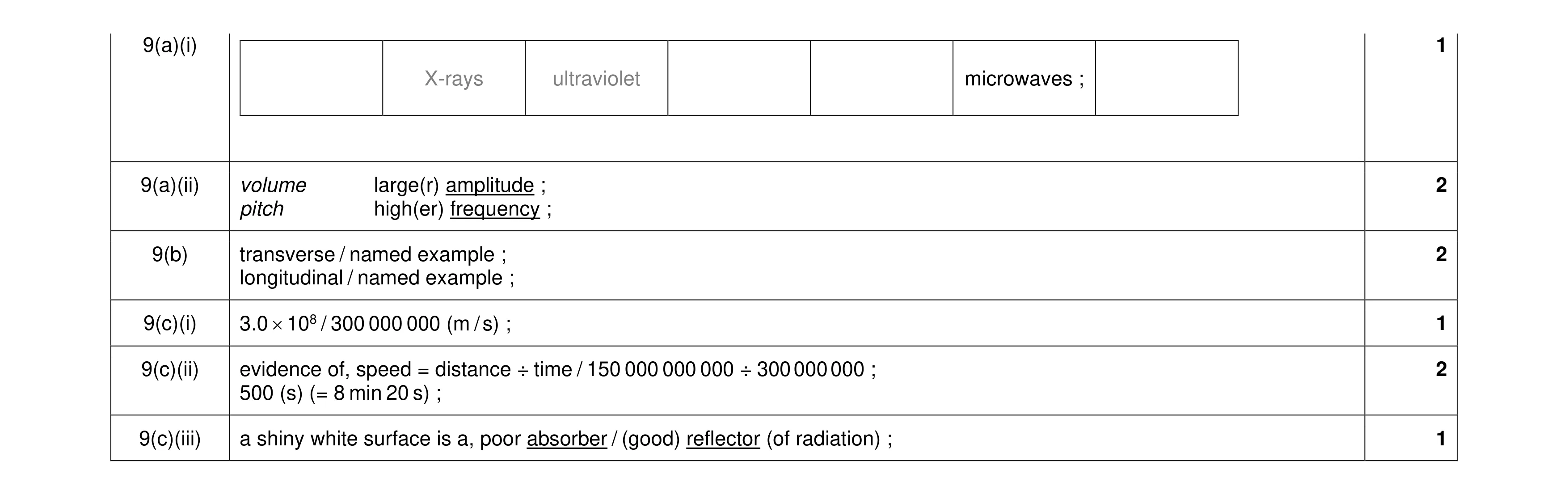 9
9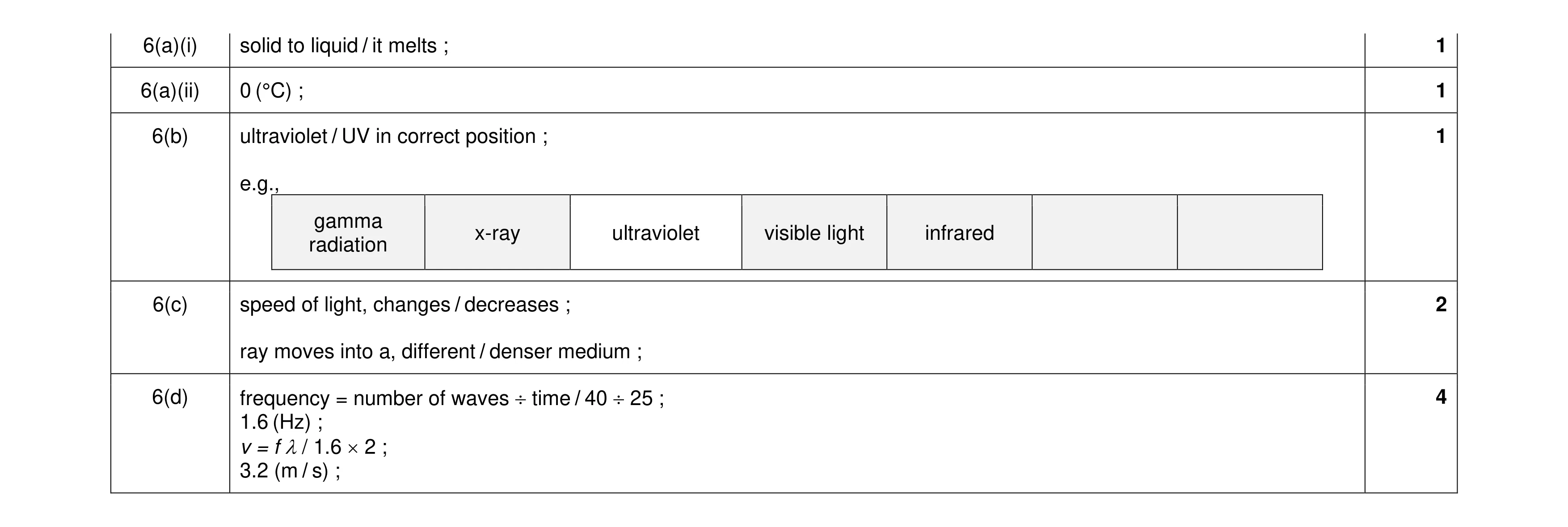 9
9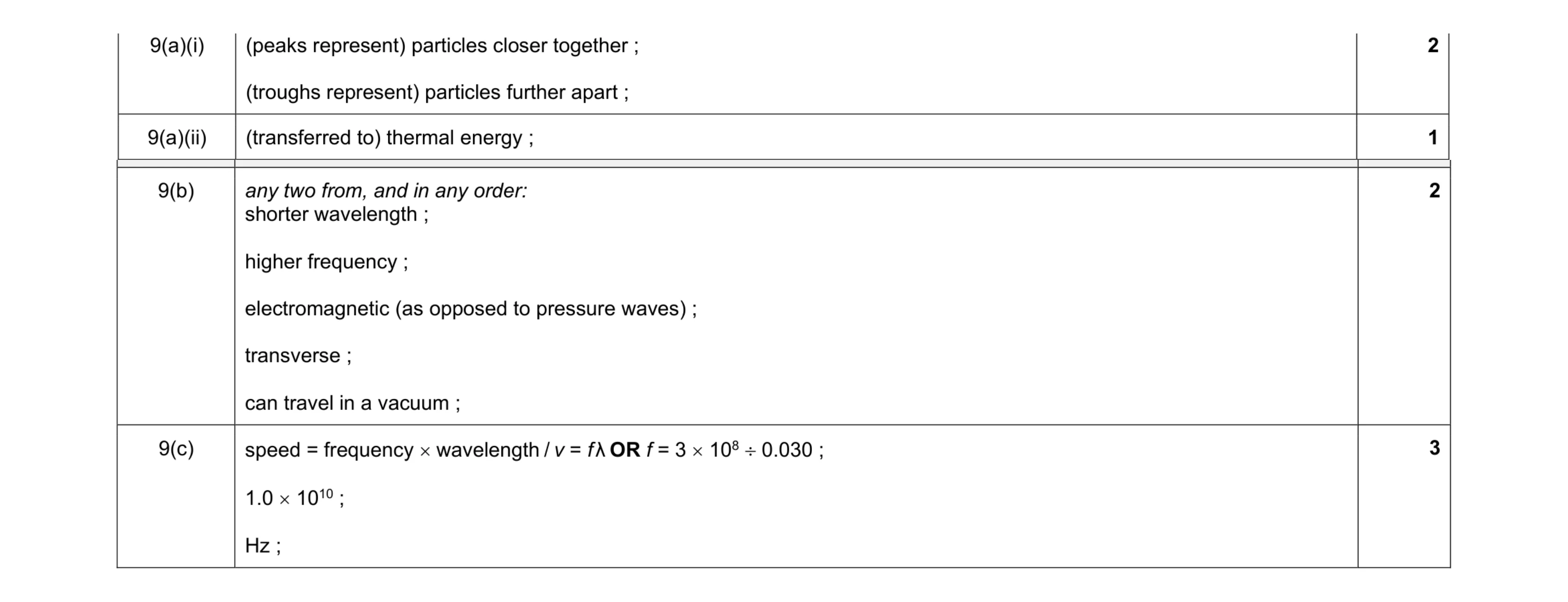 8
8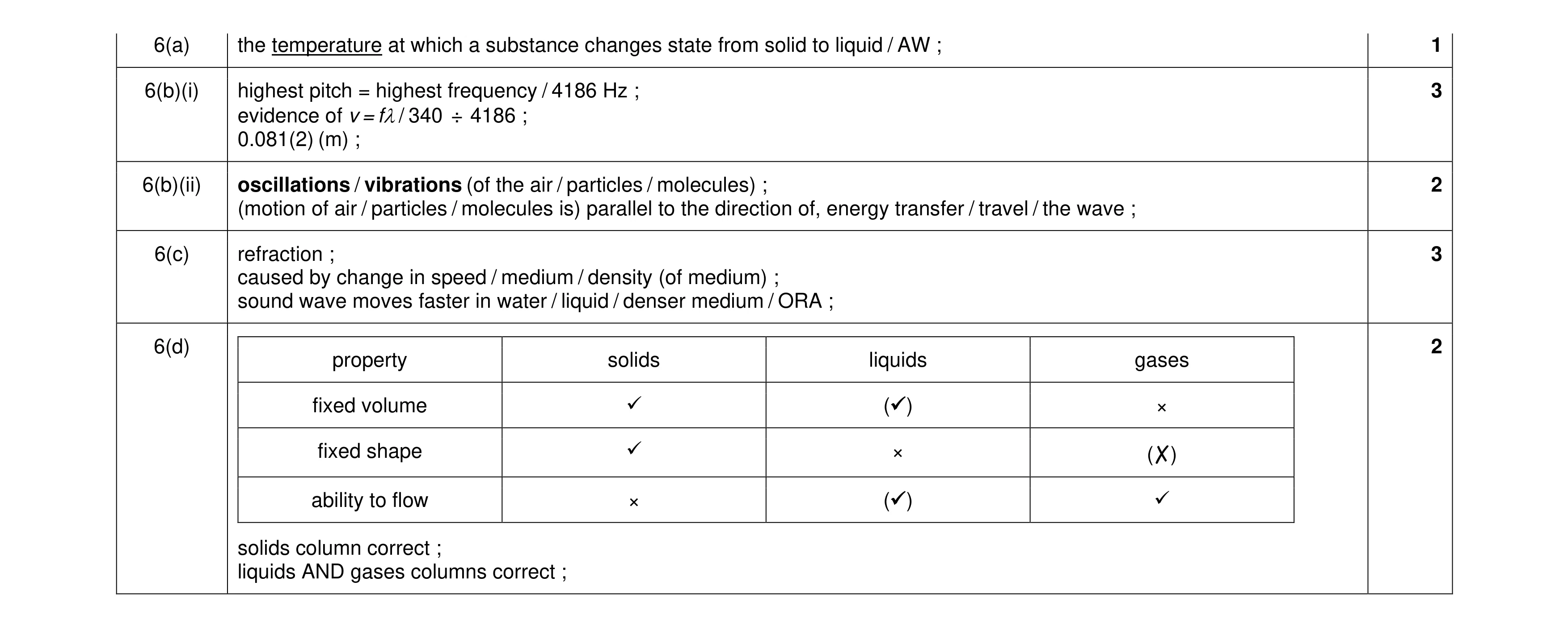 11
11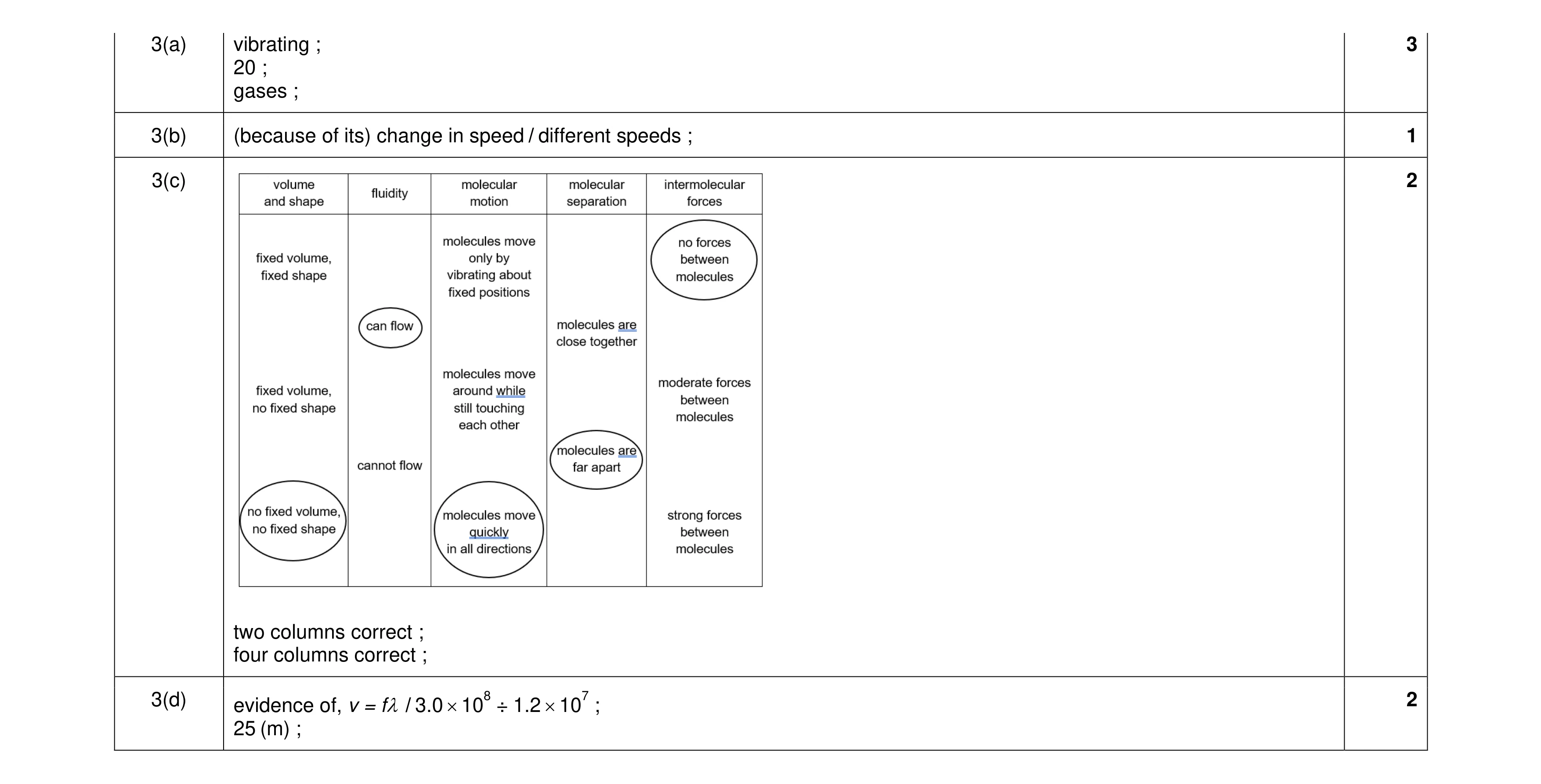 8
8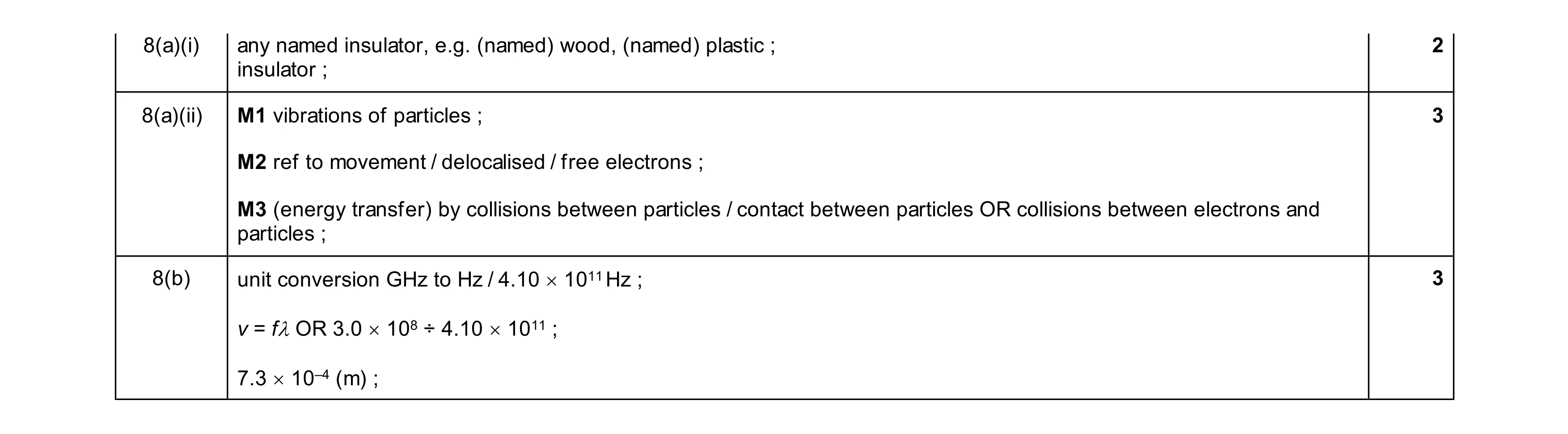 8
8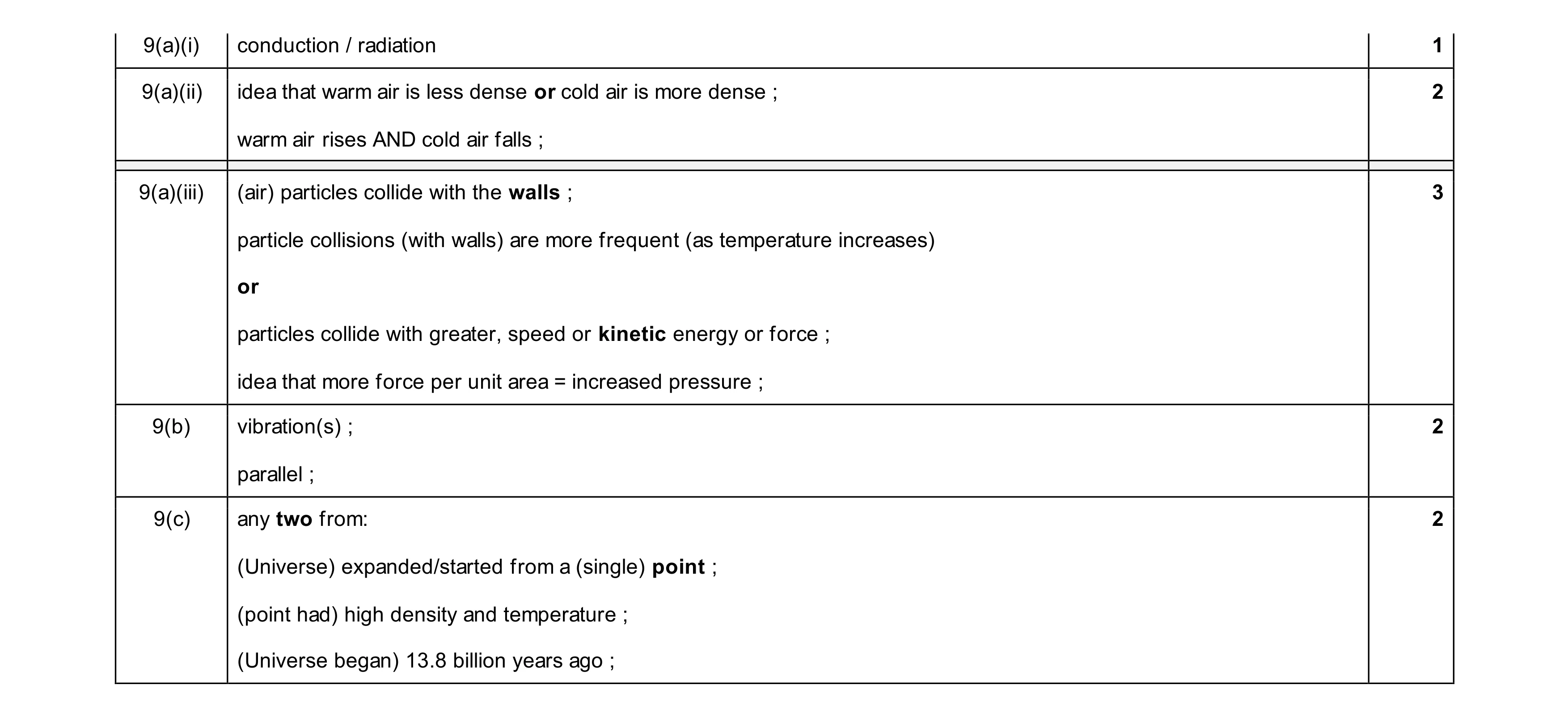 10
10