Questions as text
Q1 · In many cities, sodium street lamps are used at night 0653/32 Feb/March 2019
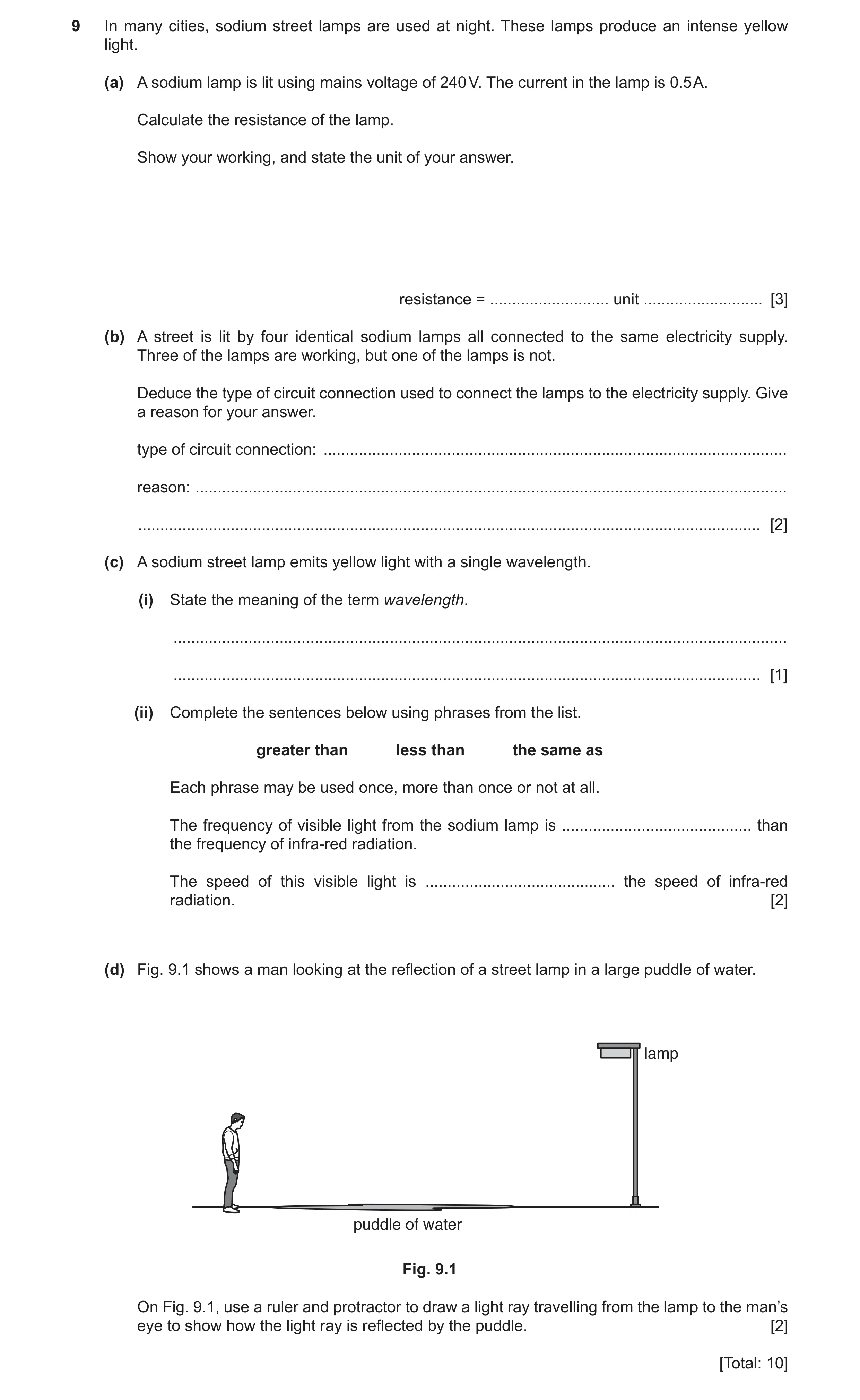
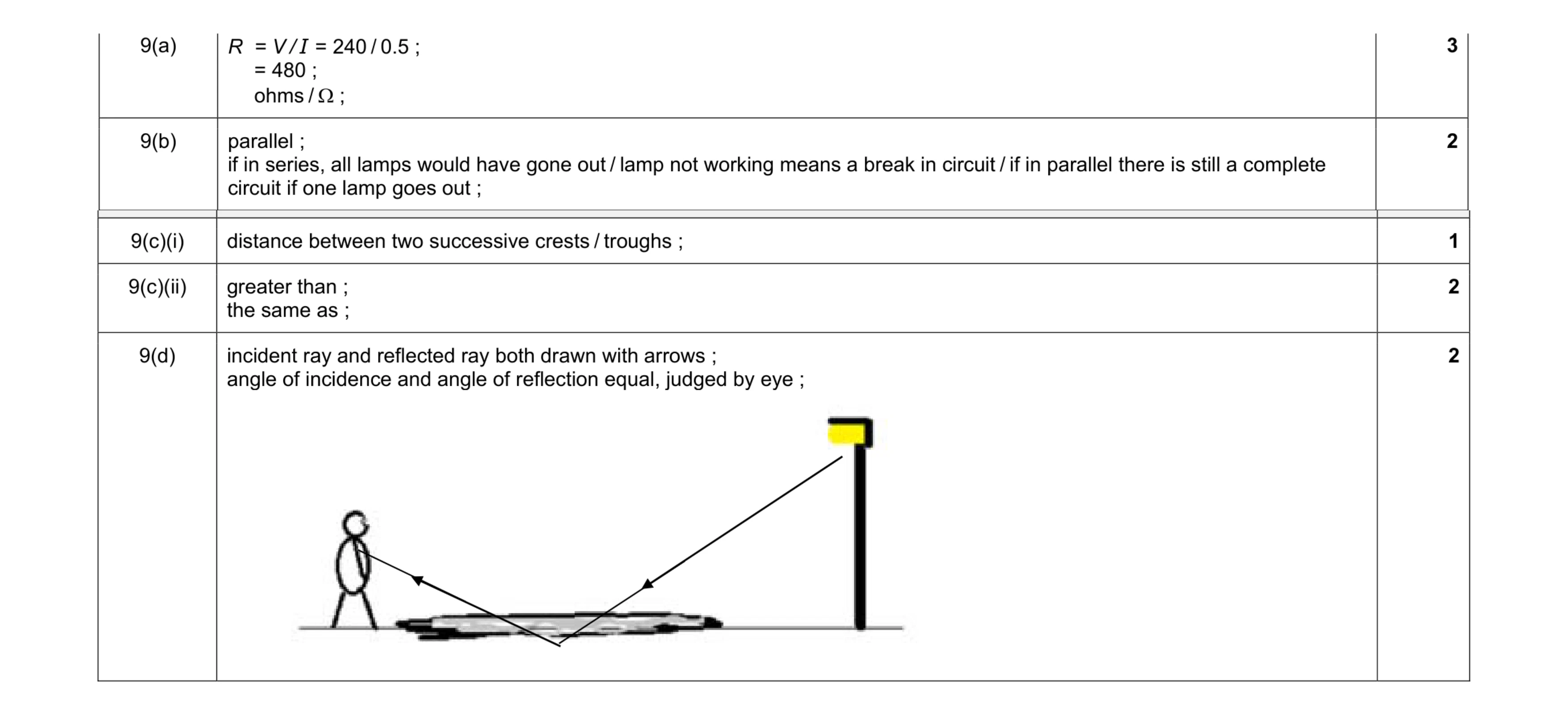
9 In many cities, sodium street lamps are used at night. These lamps produce an intense yellow light. (a) A sodium lamp is lit using mains voltage of 240 V. The current in the lamp is 0.5 A. Calculate the resistance of the lamp. Show your working, and state the unit of your answer. resistance = … unit … [3] (b) A street is lit by four identical sodium lamps all connected to the same electricity supply. Three of the lamps are working, but one of the lamps is not. Deduce the type of circuit connection used to connect the lamps to the electricity supply. Give a reason for your answer. type of circuit connection: … reason: … … [2] (c) A sodium street lamp emits yellow light with a single wavelength. (i) State the meaning of the term wavelength. … … [1] (ii) Complete the sentences below using phrases from the list. greater than less than the same as Each phrase may be used once, more than once or not at all. The frequency of visible light from the sodium lamp is … than the frequency of infra-red radiation. The speed of this visible light is … the speed of infra-red radiation. [2] (d) Fig. 9.1 shows a man looking at the reflection of a street lamp in a large puddle of water. lamp puddle of water Fig. 9.1 On Fig. 9.1, use a ruler and protractor to draw a light ray travelling from the lamp to the man’s eye to show how the light ray is reflected by the puddle. [2] [Total: 10]
10 marks
Mark scheme: 9(a) = 480 ; ohms / Ω ; 3 9(b) parallel ; if in series, all lamps would have gone out / lamp not working means a break in circuit / if in parallel there is still a complete circuit if one lamp goes out ; 2 Question Answer Marks 9(c)(i) distance between two successive crests / troughs ; 1 9(c)(ii) greater than ; the same as ; 2 9(d) incident ray and reflected ray both drawn with arrows ; angle of incidence and angle of reflection equal, judged by eye ; 2
This question in 0653/32 Feb/March 2019
Q2 · Below is a list of some types of wave 0653/32 May/June 2019
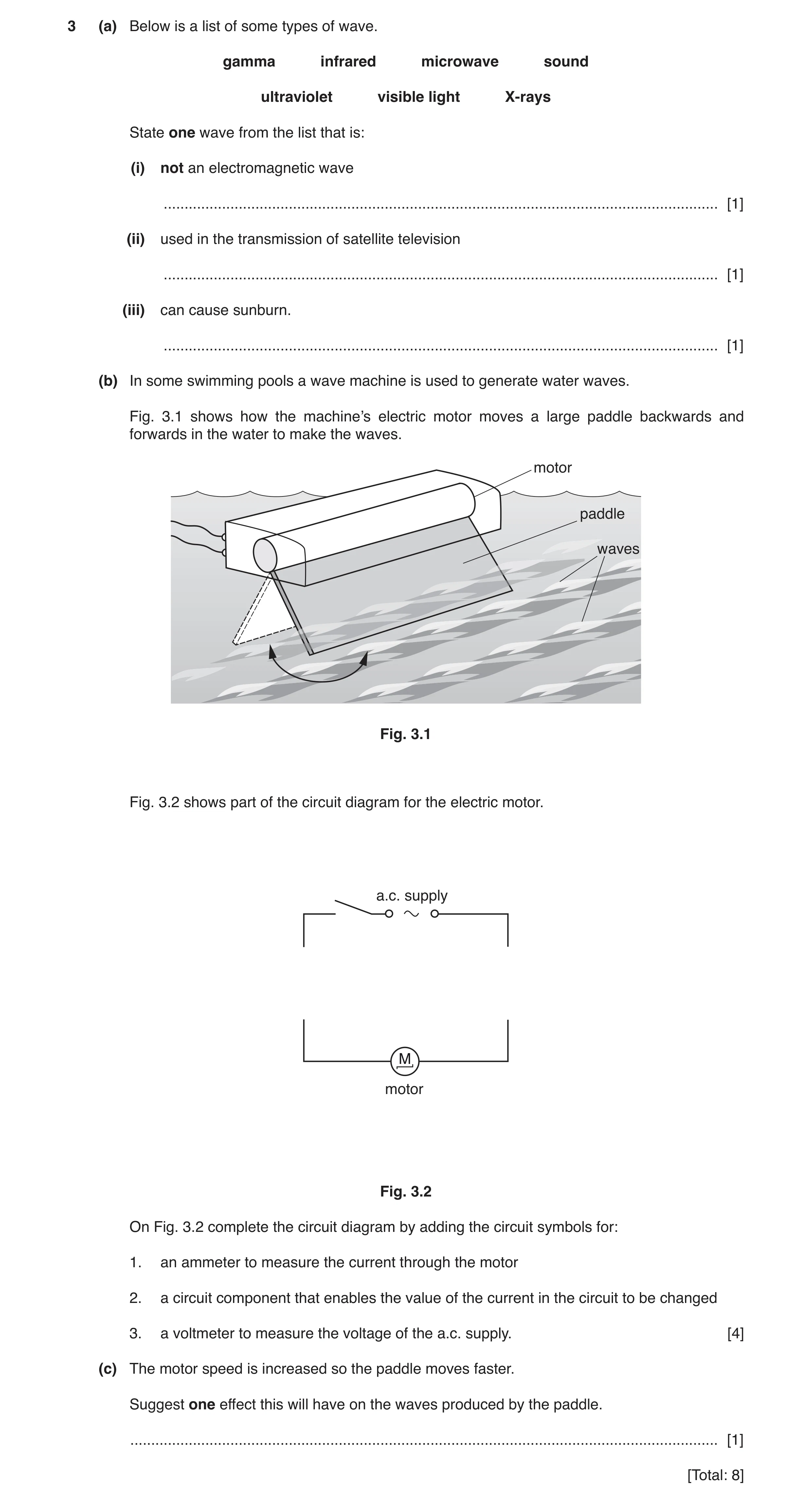
3 (a) Below is a list of some types of wave. gamma infrared microwave sound ultraviolet visible light X-rays State one wave from the list that is: (i) not an electromagnetic wave … [1] (ii) used in the transmission of satellite television … [1] (iii) can cause sunburn. … [1] (b) In some swimming pools a wave machine is used to generate water waves. Fig. 3.1 shows how the machine’s electric motor moves a large paddle backwards and forwards in the water to make the waves. motor paddle waves Fig. 3.1 Fig. 3.2 shows part of the circuit diagram for the electric motor. a.c. supply M motor Fig. 3.2 On Fig. 3.2 complete the circuit diagram by adding the circuit symbols for: 1. an ammeter to measure the current through the motor 2. a circuit component that enables the value of the current in the circuit to be changed 3. a voltmeter to measure the voltage of the a.c. supply. [4] (c) The motor speed is increased so the paddle moves faster. Suggest one effect this will have on the waves produced by the paddle. … [1] [Total: 8]
8 marks
Mark scheme: 3(a)(i) sound ; 1 3(a)(ii) microwave ; 1 3(a)(iii) ultraviolet ; 1 3(b) ammeter symbol ; variable resistor symbol ; voltmeter symbol ; voltmeter in parallel across a.c. supply only ; 4 3(c) increase frequency / decrease wavelength ; 1
This question in 0653/32 May/June 2019
Question 3 0653/32 Feb/March 2020
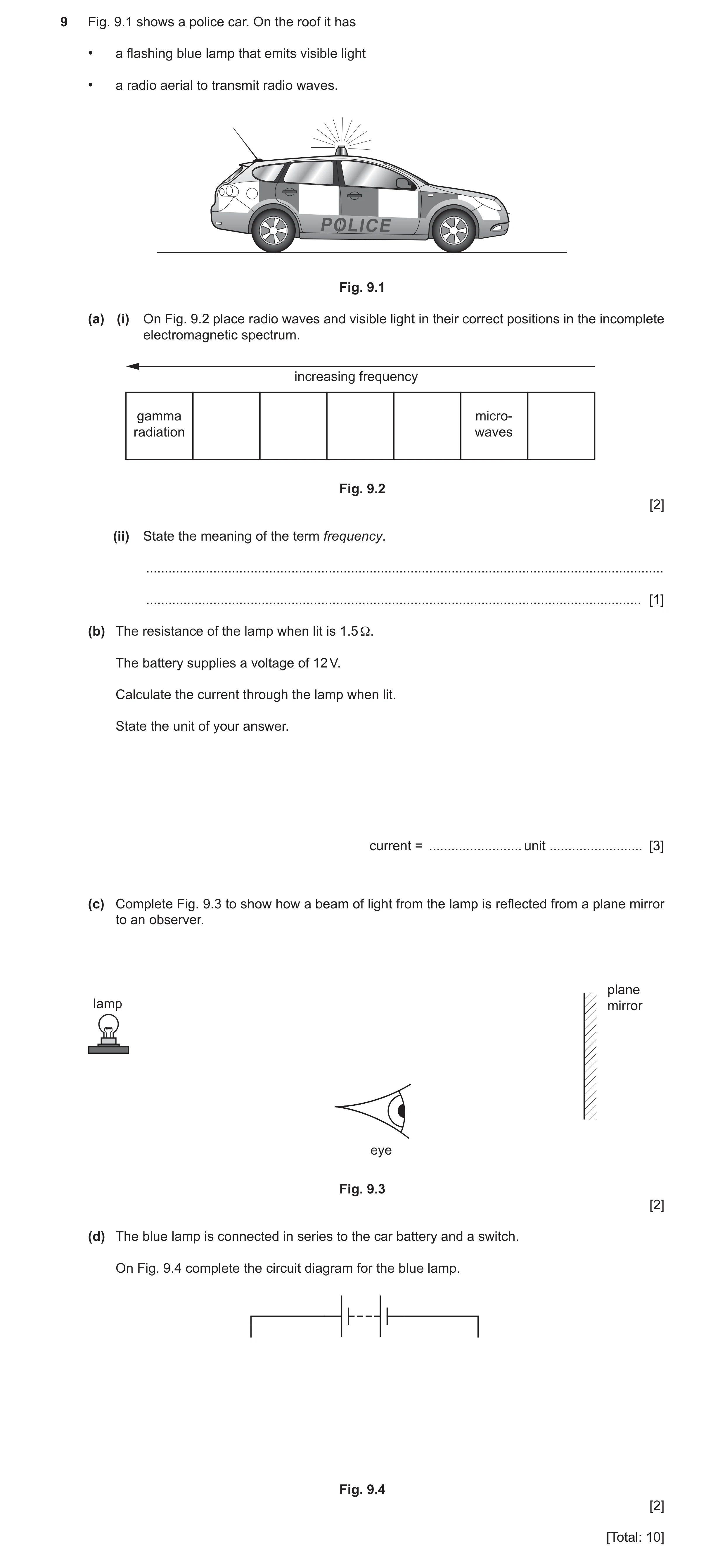
9 Fig. 9.1 shows a police car. On the roof it has • a flashing blue lamp that emits visible light • a radio aerial to transmit radio waves. P O L I C E Fig. 9.1 (a) (i) On Fig. 9.2 place radio waves and visible light in their correct positions in the incomplete electromagnetic spectrum. increasing frequency gamma micro- radiation waves Fig. 9.2 [2] (ii) State the meaning of the term frequency. … … [1] (b) The resistance of the lamp when lit is 1.5 Ω. The battery supplies a voltage of 12 V. Calculate the current through the lamp when lit. State the unit of your answer. current = … unit … [3] (c) Complete Fig. 9.3 to show how a beam of light from the lamp is reflected from a plane mirror to an observer. plane lamp mirror eye Fig. 9.3 [2] (d) The blue lamp is connected in series to the car battery and a switch. On Fig. 9.4 complete the circuit diagram for the blue lamp. Fig. 9.4 [2] [Total: 10]
10 marks
Mark scheme: 9(a)(i) gamma radiation (visible) light ; micro- waves radio waves ; 2 9(a)(ii) number of, vibrations / waves / oscillations per second ; 1 9(b) R = V / I or I = V / R = 12 / 1.5 ; = 8 ; (unit =) A ; 3 Question Answer Marks 9(c) 2 9(d) 2 ray from lamp to mirror to eye ; angle of incidence and angle of reflection at mirror judged by eye to be equal (normal not required) ; correct symbols for lamp and switch ; complete series circuit with no additional components ;
This question in 0653/32 Feb/March 2020
Q4 · A girl using a bicycle pump to add air to a bicycle tyre 0653/31 Oct/Nov 2020
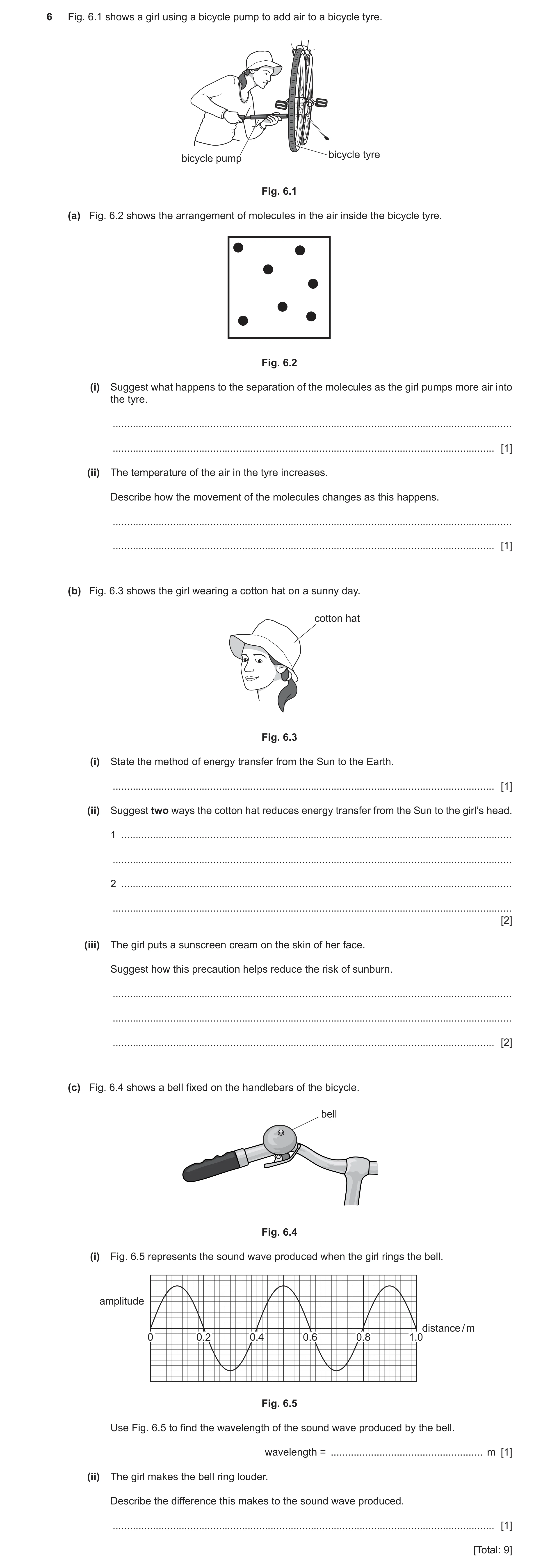
6 Fig. 6.1 shows a girl using a bicycle pump to add air to a bicycle tyre. bicycle tyre bicycle pump Fig. 6.1 (a) Fig. 6.2 shows the arrangement of molecules in the air inside the bicycle tyre. Fig. 6.2 (i) Suggest what happens to the separation of the molecules as the girl pumps more air into the tyre. … … [1] (ii) The temperature of the air in the tyre increases. Describe how the movement of the molecules changes as this happens. … … [1] (b) Fig. 6.3 shows the girl wearing a cotton hat on a sunny day. cotton hat Fig. 6.3 (i) State the method of energy transfer from the Sun to the Earth. … [1] (ii) Suggest two ways the cotton hat reduces energy transfer from the Sun to the girl’s head. 1 … … 2 … … [2] (iii) The girl puts a sunscreen cream on the skin of her face. Suggest how this precaution helps reduce the risk of sunburn. … … … [2] (c) Fig. 6.4 shows a bell fixed on the handlebars of the bicycle. bell Fig. 6.4 (i) Fig. 6.5 represents the sound wave produced when the girl rings the bell. amplitude distance / m 0 0.2 0.4 0.6 0.8 1.0 Fig. 6.5 Use Fig. 6.5 to find the wavelength of the sound wave produced by the bell. wavelength = … m [1] (ii) The girl makes the bell ring louder. Describe the difference this makes to the sound wave produced. … [1] [Total: 9]
9 marks
Mark scheme: 6(a)(i) (separation) decreases ; 1 6(a)(ii) (move) faster / speed up ; 1 6(b)(i) radiation ; 1 6(b)(ii) any two from: radiation reflected (off sun hat) ; cotton/hat is bad conductor / good insulator ; air (trapped) between hat and head is bad conductor / good insulator ; 2 6(b)(iii) ultraviolet / UV (radiation) (causes sunburn) ; (sunscreen,) filters out / reduces absorption (of UV) ; 2 6(c)(i) 0.4 (m) ; 1 6(c)(ii) larger amplitude / description of larger amplitude ; 1
This question in 0653/31 Oct/Nov 2020
Q5 · A motor boat moving forward across the sea 0653/31 May/June 2021
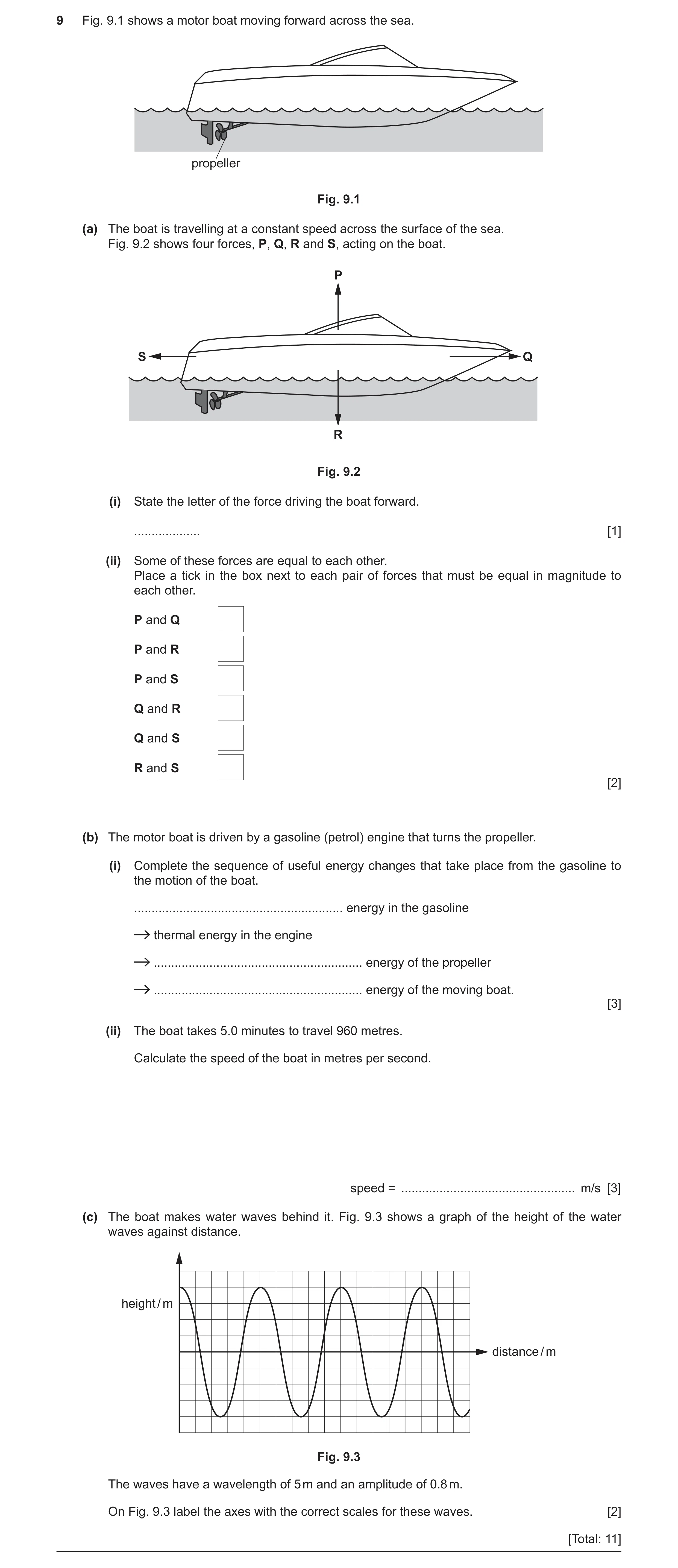
9 Fig. 9.1 shows a motor boat moving forward across the sea. propeller Fig. 9.1 (a) The boat is travelling at a constant speed across the surface of the sea. Fig. 9.2 shows four forces, P, Q, R and S, acting on the boat. P S Q R Fig. 9.2 (i) State the letter of the force driving the boat forward. … [1] (ii) Some of these forces are equal to each other. Place a tick in the box next to each pair of forces that must be equal in magnitude to each other. P and Q P and R P and S Q and R Q and S R and S [2] (b) The motor boat is driven by a gasoline (petrol) engine that turns the propeller. (i) Complete the sequence of useful energy changes that take place from the gasoline to the motion of the boat. … energy in the gasoline thermal energy in the engine … energy of the propeller … energy of the moving boat. [3] (ii) The boat takes 5.0 minutes to travel 960 metres. Calculate the speed of the boat in metres per second. speed = … m/s [3] (c) The boat makes water waves behind it. Fig. 9.3 shows a graph of the height of the water waves against distance. height / m distance / m Fig. 9.3 The waves have a wavelength of 5 m and an amplitude of 0.8 m. On Fig. 9.3 label the axes with the correct scales for these waves. [2] [Total: 11]
11 marks
Mark scheme: 9(a)(i) Q ; 1 9(a)(ii) P and R (ticked) ; Q and S (ticked) ; 2 9(b)(i) (potential) chemical ; kinetic ; kinetic ; 3 Question Answer Marks 9(b)(ii) 5.0 min = 300 s ; speed = distance / time = 960 / 300 ; (speed =) 3.2 (m / s) ; 3 9(c) x-axis scale correct ; y-axis scale correct ; 2
This question in 0653/31 May/June 2021
Question 6 0653/31 Oct/Nov 2021
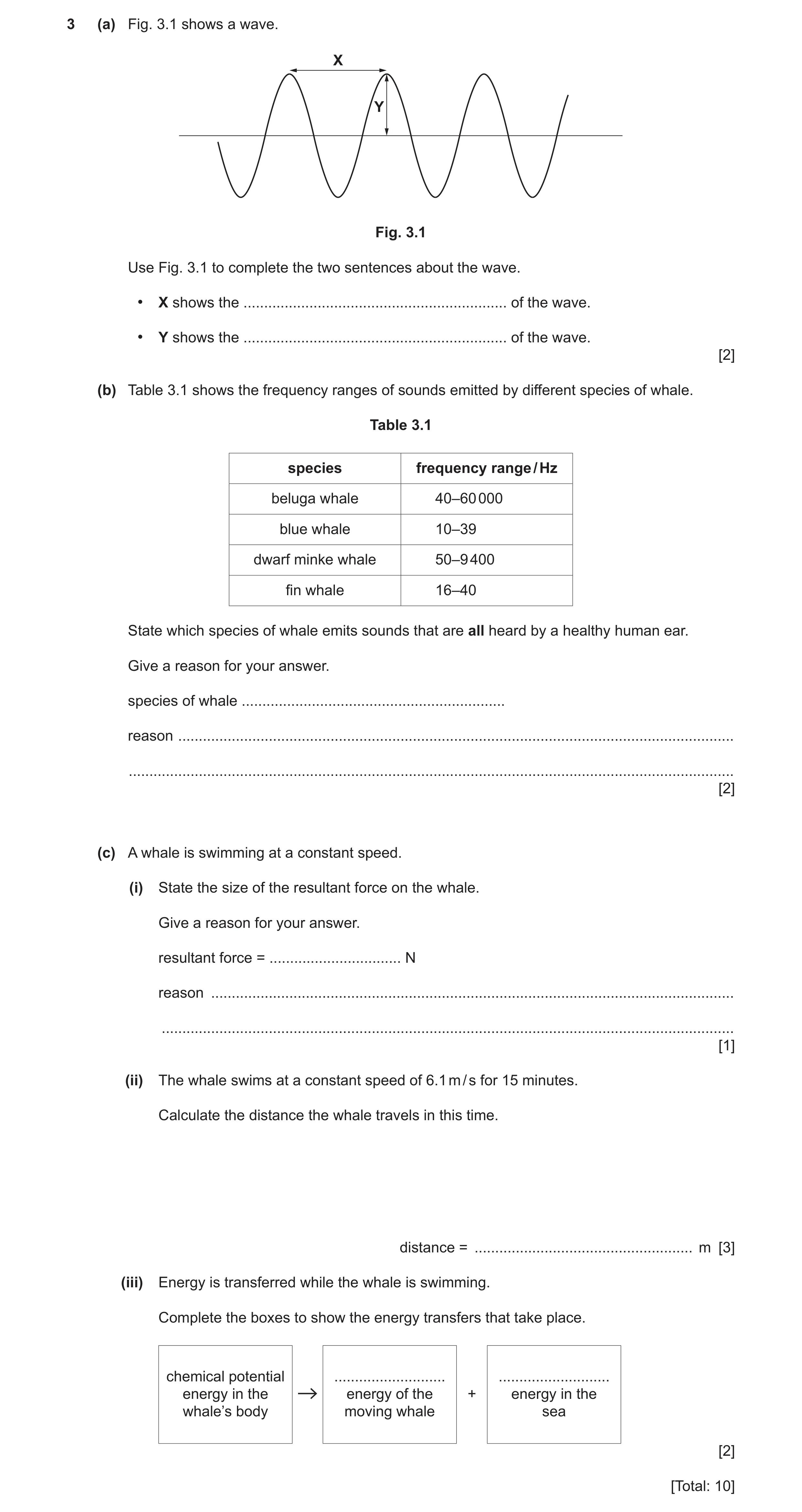
3 (a) Fig. 3.1 shows a wave. X Y Fig. 3.1 Use Fig. 3.1 to complete the two sentences about the wave. • X shows the … of the wave. • Y shows the … of the wave. [2] (b) Table 3.1 shows the frequency ranges of sounds emitted by different species of whale. Table 3.1 species frequency range / Hz beluga whale 40–60 000 blue whale 10–39 dwarf minke whale 50–9 400 fin whale 16–40 State which species of whale emits sounds that are all heard by a healthy human ear. Give a reason for your answer. species of whale … reason … … [2] (c) A whale is swimming at a constant speed. (i) State the size of the resultant force on the whale. Give a reason for your answer. resultant force = … N reason … … [1] (ii) The whale swims at a constant speed of 6.1 m / s for 15 minutes. Calculate the distance the whale travels in this time. distance = … m [3] (iii) Energy is transferred while the whale is swimming. Complete the boxes to show the energy transfers that take place. chemical potential … … energy in the energy of the + energy in the whale’s body moving whale sea [2] [Total: 10]
10 marks
Mark scheme: 3(a) X wavelength ; Y amplitude ; 2 3(b) dwarf minke (whale) ; all within audible frequency range of 20–20 000 Hz ; 2 3(c)(i) zero / 0 (N) AND (at constant speed there is) no resultant force ; 1 3(c)(ii) conversion of minutes to seconds / 15 × 60 = 900 ; distance = speed × time in any form / 6.1 × 900 ; 5500 (m); 3 3(c)(iii) kinetic ; thermal ; 2 Question Answer Marks
This question in 0653/31 Oct/Nov 2021
Q7 · The seven regions of the electromagnetic spectrum 0653/32 Oct/Nov 2021
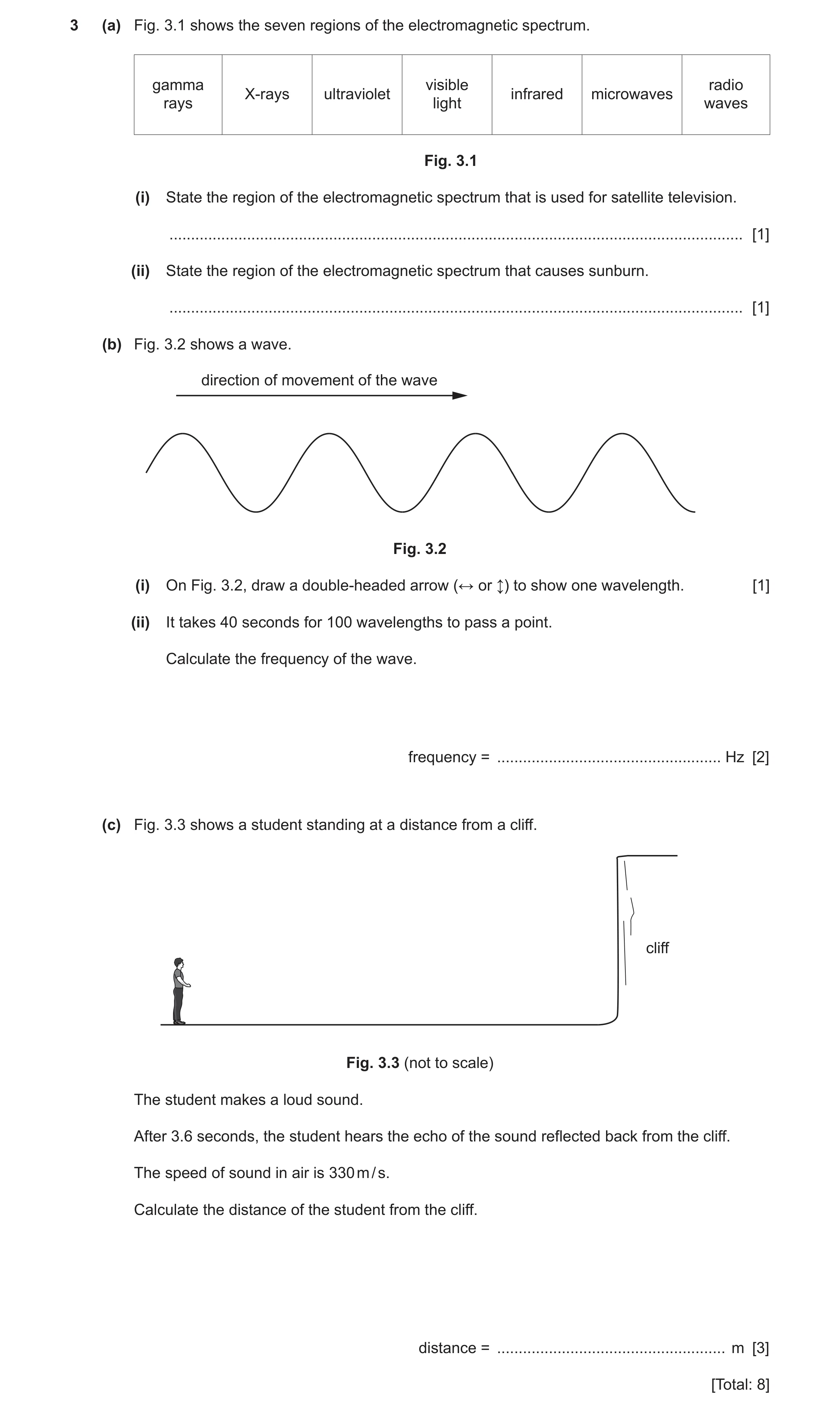
3 (a) Fig. 3.1 shows the seven regions of the electromagnetic spectrum. gamma visible radio X-rays ultraviolet infrared microwaves rays light waves Fig. 3.1 (i) State the region of the electromagnetic spectrum that is used for satellite television. … [1] (ii) State the region of the electromagnetic spectrum that causes sunburn. … [1] (b) Fig. 3.2 shows a wave. direction of movement of the wave Fig. 3.2 (i) On Fig. 3.2, draw a double-headed arrow (↔ or ↕) to show one wavelength. [1] (ii) It takes 40 seconds for 100 wavelengths to pass a point. Calculate the frequency of the wave. frequency = … Hz [2] (c) Fig. 3.3 shows a student standing at a distance from a cliff. cliff Fig. 3.3 (not to scale) The student makes a loud sound. After 3.6 seconds, the student hears the echo of the sound reflected back from the cliff. The speed of sound in air is 330 m / s. Calculate the distance of the student from the cliff. distance = … m [3] [Total: 8]
8 marks
Mark scheme: 3(a)(i) microwave(s) ; 1 3(a)(ii) ultraviolet ; 1 3(b)(i) double-headed arrow between any two equivalent points on adjacent waves, e.g. ; 1 3(b)(ii) frequency = number of waves per second / 100 ÷ 40 ; 2.5 (Hz) ; 2 3(c) speed = distance ÷ time in any form / 330 × 3.6 ; (total distance travelled =) 1188 OR idea of, distance / time, being halved ; 590 ; 3
This question in 0653/32 Oct/Nov 2021
Q8 · The seven regions of the electromagnetic spectrum 0653/33 Oct/Nov 2021
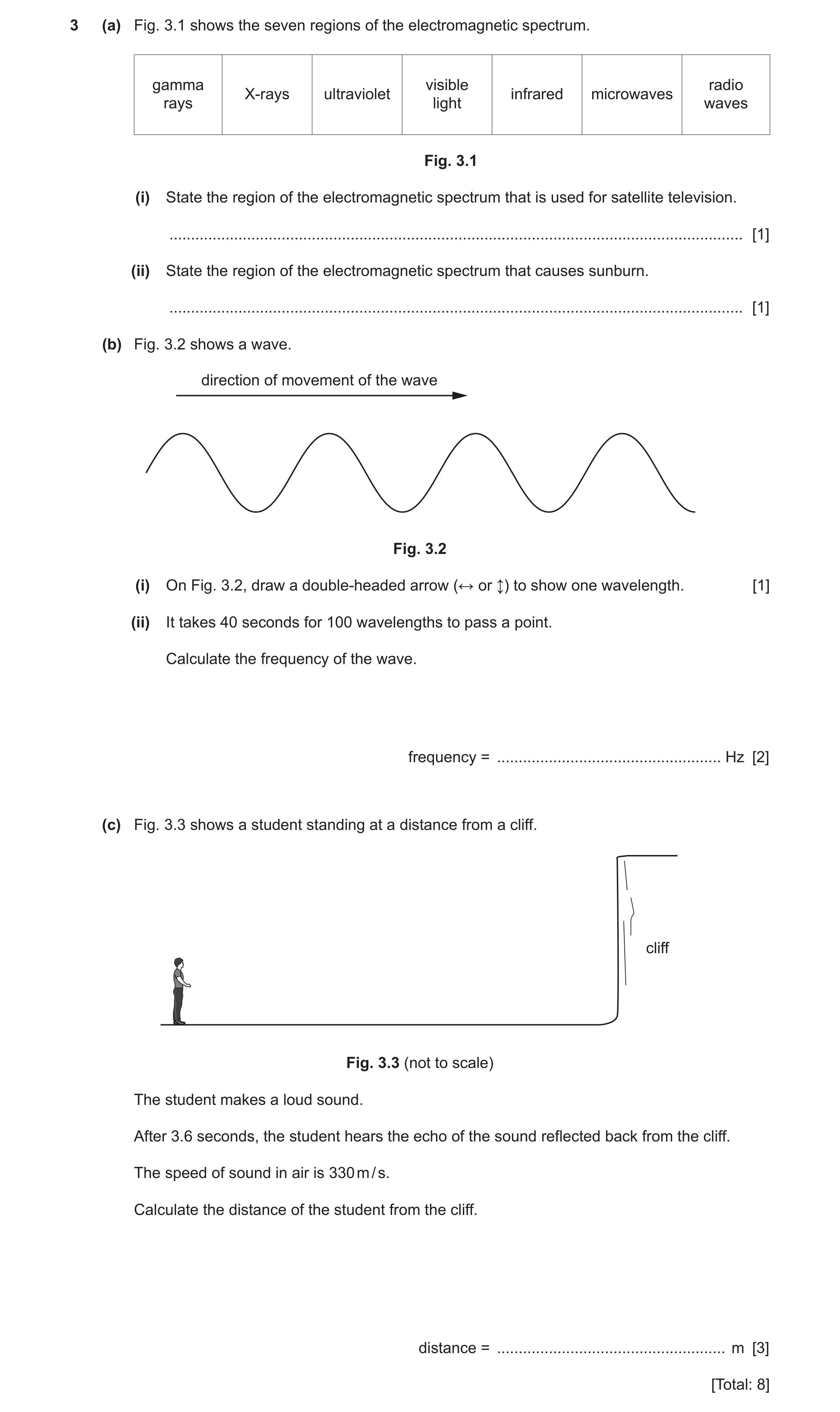
3 (a) Fig. 3.1 shows the seven regions of the electromagnetic spectrum. gamma visible radio X-rays ultraviolet infrared microwaves rays light waves Fig. 3.1 (i) State the region of the electromagnetic spectrum that is used for satellite television. … [1] (ii) State the region of the electromagnetic spectrum that causes sunburn. … [1] (b) Fig. 3.2 shows a wave. direction of movement of the wave Fig. 3.2 (i) On Fig. 3.2, draw a double-headed arrow (↔ or ↕) to show one wavelength. [1] (ii) It takes 40 seconds for 100 wavelengths to pass a point. Calculate the frequency of the wave. frequency = … Hz [2] (c) Fig. 3.3 shows a student standing at a distance from a cliff. cliff Fig. 3.3 (not to scale) The student makes a loud sound. After 3.6 seconds, the student hears the echo of the sound reflected back from the cliff. The speed of sound in air is 330 m / s. Calculate the distance of the student from the cliff. distance = … m [3] [Total: 8]
8 marks
Mark scheme: 3(a)(i) microwave(s) ; 1 3(a)(ii) ultraviolet ; 1 3(b)(i) double-headed arrow between any two equivalent points on adjacent waves, e.g. ; 1 3(b)(ii) frequency = number of waves per second / 100 ÷ 40 ; 2.5 (Hz) ; 2 3(c) speed = distance ÷ time in any form / 330 × 3.6 ; (total distance travelled =) 1188 OR idea of, distance / time, being halved ; 590 ; 3
This question in 0653/33 Oct/Nov 2021
Q9 · Draw one straight line from each word to its description 0653/31 Oct/Nov 2022
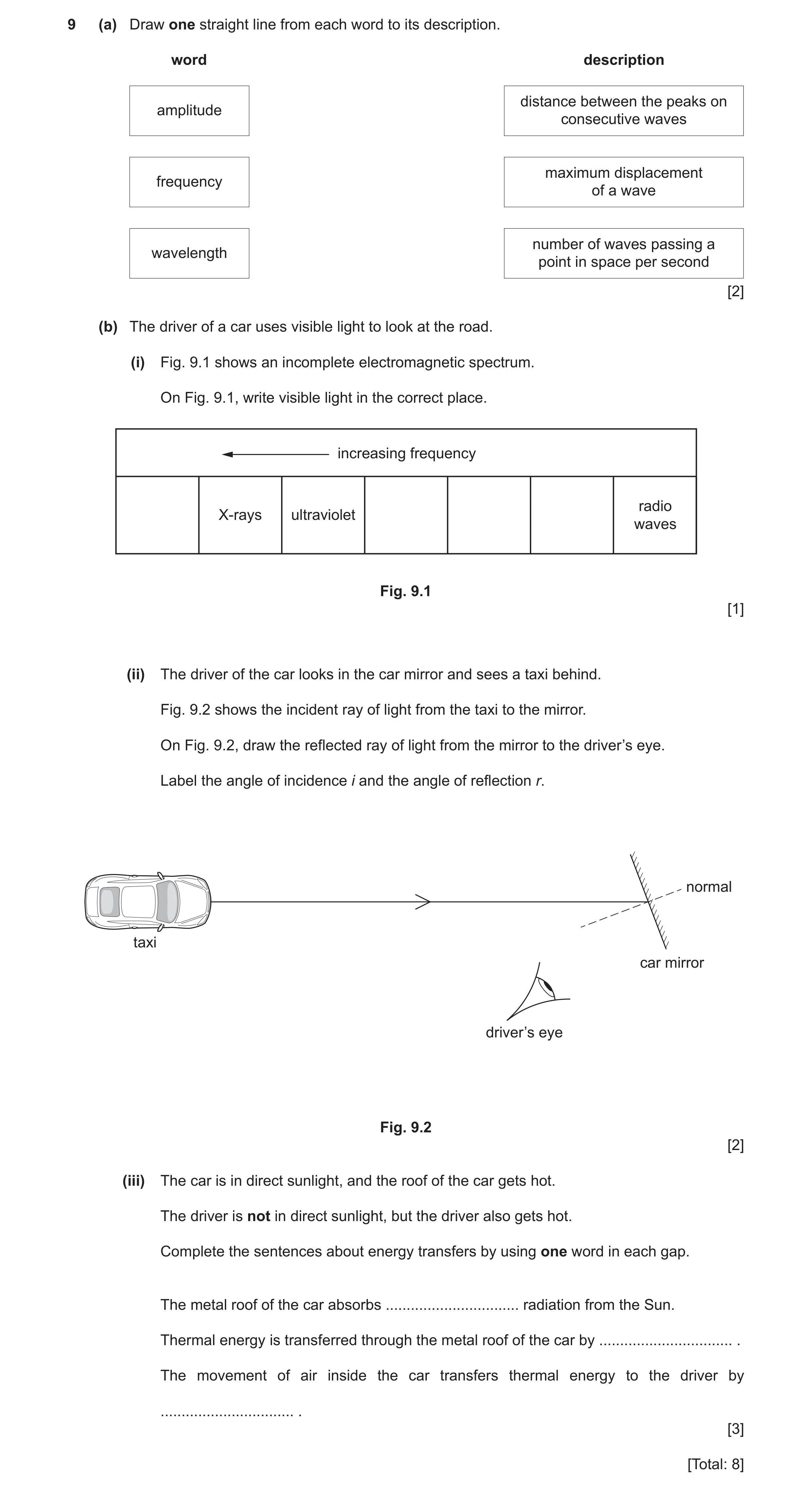
9 (a) Draw one straight line from each word to its description. word description distance between the peaks on amplitude consecutive waves maximum displacement frequency of a wave number of waves passing a wavelength point in space per second [2] (b) The driver of a car uses visible light to look at the road. (i) Fig. 9.1 shows an incomplete electromagnetic spectrum. On Fig. 9.1, write visible light in the correct place. increasing frequency radio X-rays ultraviolet waves Fig. 9.1 [1] (ii) The driver of the car looks in the car mirror and sees a taxi behind. Fig. 9.2 shows the incident ray of light from the taxi to the mirror. On Fig. 9.2, draw the reflected ray of light from the mirror to the driver’s eye. Label the angle of incidence i and the angle of reflection r. normal taxi car mirror driver’s eye Fig. 9.2 [2] (iii) The car is in direct sunlight, and the roof of the car gets hot. The driver is not in direct sunlight, but the driver also gets hot. Complete the sentences about energy transfers by using one word in each gap. The metal roof of the car absorbs … radiation from the Sun. Thermal energy is transferred through the metal roof of the car by … . The movement of air inside the car transfers thermal energy to the driver by … . [3] [Total: 8]
8 marks
Mark scheme: 9(a) 2 word description distance between the peaks on amplitude consecutive waves maximum displacement frequency of a wave number of waves passing a wavelength point in space per second one correct ; three correct ; 9(b)(i) 1 visible radio X-rays ultraviolet (light) ; waves 9(b)(ii) reflected ray drawn from mirror to driver’s eye AND angles of incidence and reflection equal (judged by eye) ; 2 angles i and r correctly labelled ; 9(b)(iii) infrared ; 3 conduction ; convection ;
This question in 0653/31 Oct/Nov 2022
Q10 · A house in the Himalayas 0653/32 Feb/March 2023
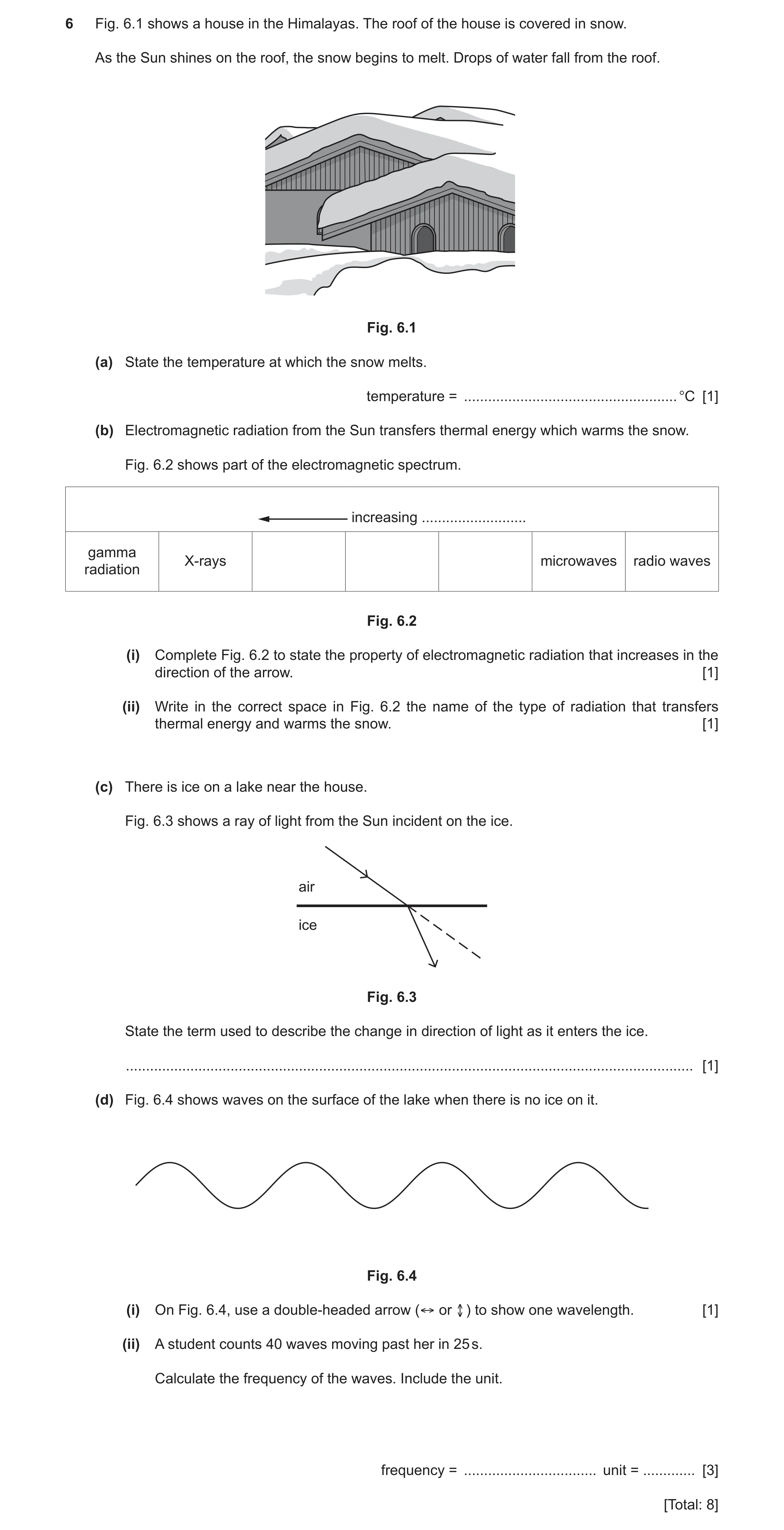
6 Fig. 6.1 shows a house in the Himalayas. The roof of the house is covered in snow. As the Sun shines on the roof, the snow begins to melt. Drops of water fall from the roof. Fig. 6.1 (a) State the temperature at which the snow melts. temperature = … °C [1] (b) Electromagnetic radiation from the Sun transfers thermal energy which warms the snow. Fig. 6.2 shows part of the electromagnetic spectrum. increasing … gamma X‑rays microwaves radio waves radiation Fig. 6.2 (i) Complete Fig. 6.2 to state the property of electromagnetic radiation that increases in the direction of the arrow. [1] (ii) Write in the correct space in Fig. 6.2 the name of the type of radiation that transfers thermal energy and warms the snow. [1] (c) There is ice on a lake near the house. Fig. 6.3 shows a ray of light from the Sun incident on the ice. air ice Fig. 6.3 State the term used to describe the change in direction of light as it enters the ice. … [1] (d) Fig. 6.4 shows waves on the surface of the lake when there is no ice on it. Fig. 6.4 (i) On Fig. 6.4, use a double‑headed arrow (↔ or↔) to show one wavelength. [1] (ii) A student counts 40 waves moving past her in 25 s. Calculate the frequency of the waves. Include the unit. frequency = … unit = … [3] [Total: 8]
8 marks
Mark scheme: 6(a) 0 (°C) ; 1 6(b)(i) 1 increasing frequency ; gamma radio X-rays microwaves radiation waves 6(b)(ii) 1 increasing frequency gamma radio X-rays infrared microwaves radiation waves infrared and in correct position ; 6(c) refraction ; 1 6(d)(i) horizontal arrow between two adjacent, peaks / troughs / other equivalent points on one oscillation ; 1 6(d)(ii) frequency = number of waves time ; 3 40 25 = 1.6 ; Hz ;
This question in 0653/32 Feb/March 2023
Q11 · A person’s voice emits sound in the form of longitudinal waves 0653/33 May/June 2023
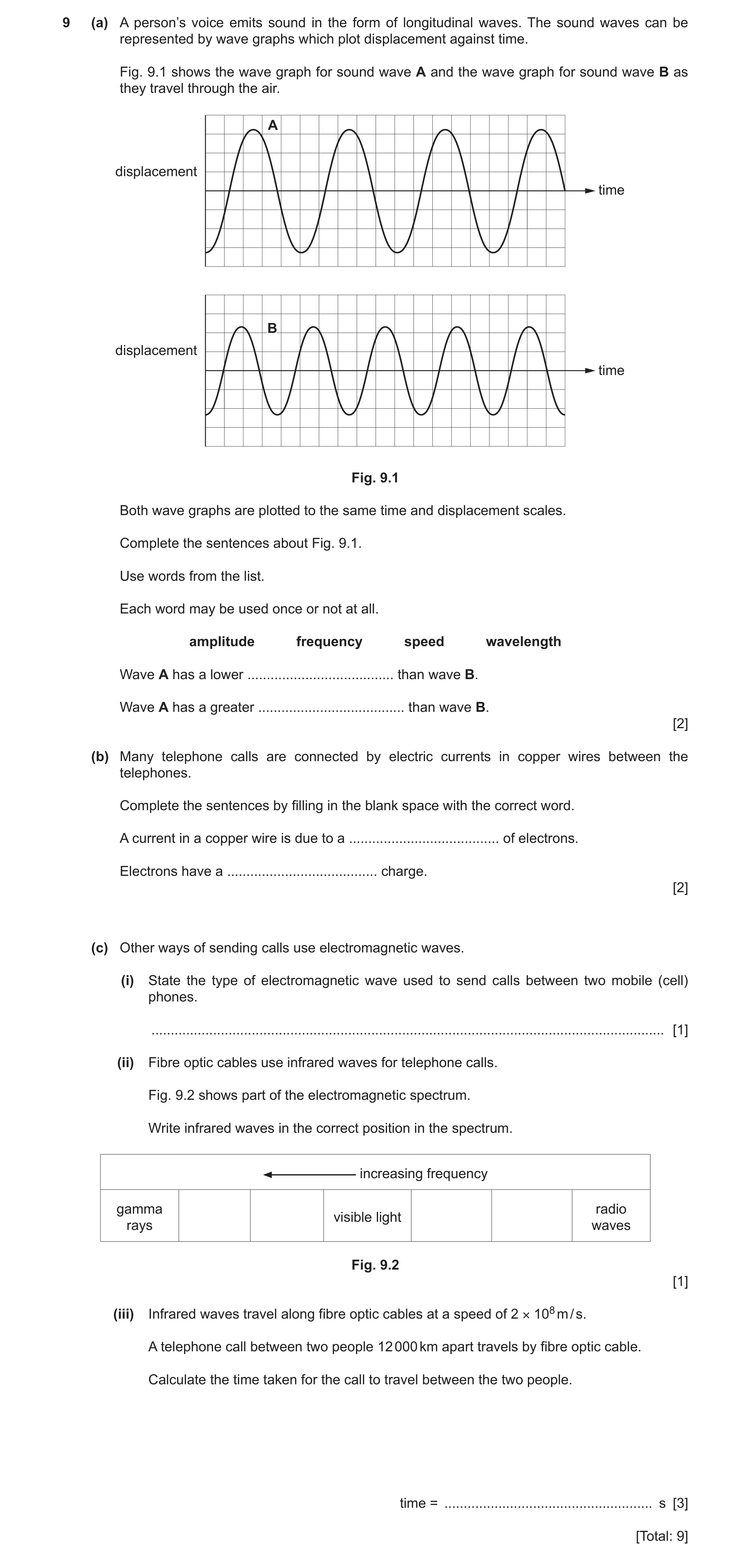
9 (a) A person’s voice emits sound in the form of longitudinal waves. The sound waves can be represented by wave graphs which plot displacement against time. Fig. 9.1 shows the wave graph for sound wave A and the wave graph for sound wave B as they travel through the air. A displacement time B displacement time Fig. 9.1 Both wave graphs are plotted to the same time and displacement scales. Complete the sentences about Fig. 9.1. Use words from the list. Each word may be used once or not at all. amplitude frequency speed wavelength Wave A has a lower … than wave B. Wave A has a greater … than wave B. [2] (b) Many telephone calls are connected by electric currents in copper wires between the telephones. Complete the sentences by filling in the blank space with the correct word. A current in a copper wire is due to a … of electrons. Electrons have a … charge. [2] (c) Other ways of sending calls use electromagnetic waves. (i) State the type of electromagnetic wave used to send calls between two mobile (cell) phones. … [1] (ii) Fibre optic cables use infrared waves for telephone calls. Fig. 9.2 shows part of the electromagnetic spectrum. Write infrared waves in the correct position in the spectrum. increasing frequency gamma radio visible light rays waves Fig. 9.2 [1] (iii) Infrared waves travel along fibre optic cables at a speed of 2 × 10⁸ m / s. A telephone call between two people 12 000 km apart travels by fibre optic cable. Calculate the time taken for the call to travel between the two people. time = … s [3] [Total: 9]
9 marks
Mark scheme: 9(a) frequency ; wavelength / amplitude ; 2 9(b) movement / flow ; negative ; 2 9(c)(i) microwave ; 1 9(c)(ii) gamma rays visible light infrared ; radio waves 1 9(c)(iii) unit conversion seen anywhere OR 12 000 km = 12 106 m ; speed = distance time (in any form) OR 12 106 2 108 ; 6(.0) 10–2 / 0.06(0) (s) ; 3
This question in 0653/33 May/June 2023
Q12 · A horse pulling a cart along a flat, horizontal road 0653/32 Oct/Nov 2024
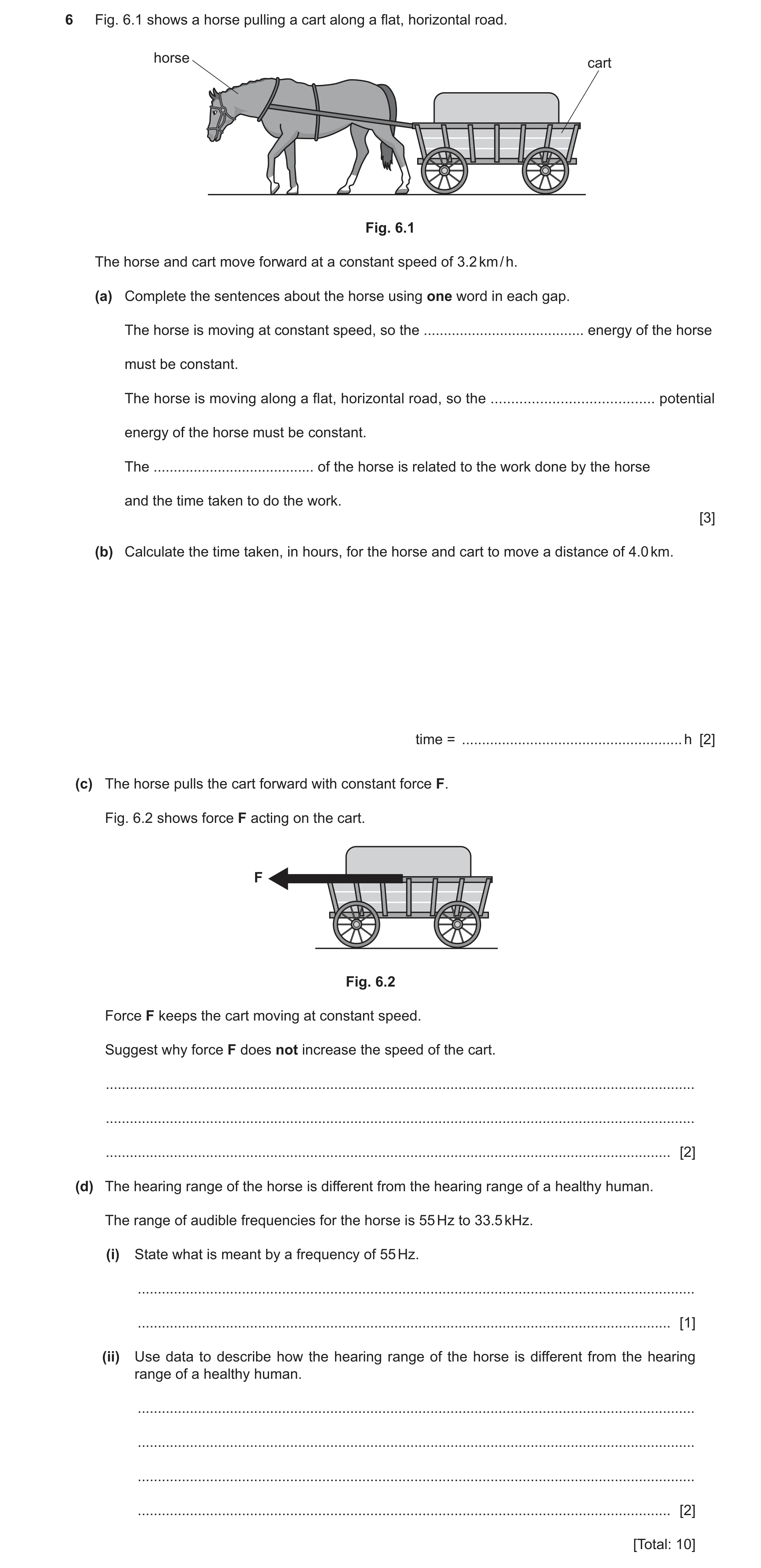
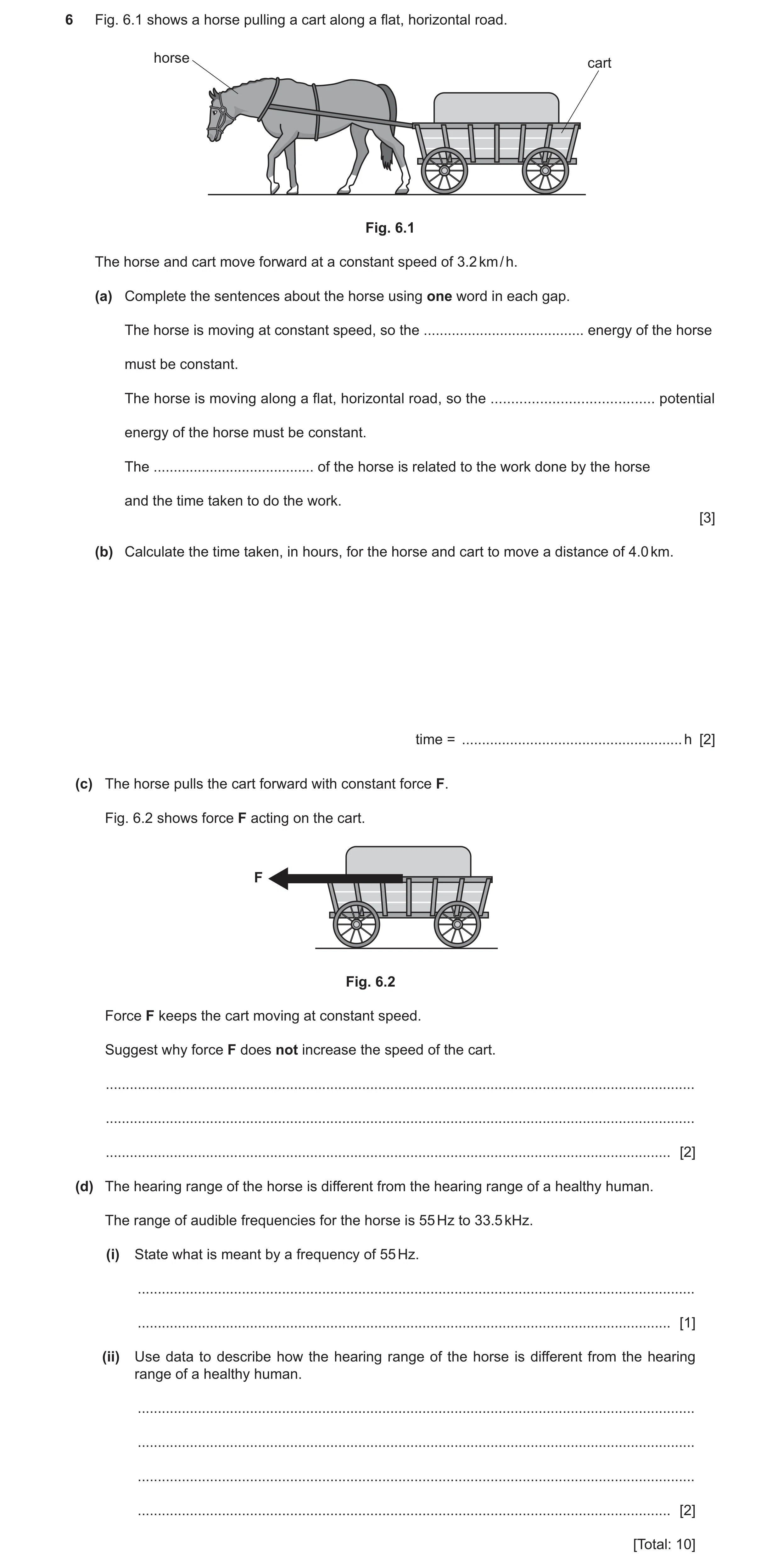
6 Fig. 6.1 shows a horse pulling a cart along a flat, horizontal road. horse cart Fig. 6.1 The horse and cart move forward at a constant speed of 3.2 km / h. (a) Complete the sentences about the horse using one word in each gap. The horse is moving at constant speed, so the … energy of the horse must be constant. The horse is moving along a flat, horizontal road, so the … potential energy of the horse must be constant. The … of the horse is related to the work done by the horse and the time taken to do the work. [3] (b) Calculate the time taken, in hours, for the horse and cart to move a distance of 4.0 km. time = … h [2] (c) The horse pulls the cart forward with constant force F. Fig. 6.2 shows force F acting on the cart. F Fig. 6.2 Force F keeps the cart moving at constant speed. Suggest why force F does not increase the speed of the cart. … … … [2] (d) The hearing range of the horse is different from the hearing range of a healthy human. The range of audible frequencies for the horse is 55 Hz to 33.5 kHz. (i) State what is meant by a frequency of 55 Hz. … … [1] (ii) Use data to describe how the hearing range of the horse is different from the hearing range of a healthy human. … … … … [2] [Total: 10]
10 marks
Mark scheme: 6(a) kinetic ; 3 gravitational ; power ; 6(b) evidence of speed = distance time / 4.0 3.2 ; 2 1.25 (h) ; 6(c) (there must be an) opposing force, e.g. friction ; 2 idea that, forces must be balanced / opposing force must be equal in magnitude to F ; 6(d)(i) 55, vibrations / oscillations, per second ; 1 6(d)(ii) any two from: 2 the horse can hear frequencies higher than 20 kHz ; the horse cannot hear frequencies as low as 20 Hz ; the horse has wider frequency range of 33 445 Hz (vs 19 980 Hz) ; the hearing range of the horse is 55 Hz to 33.5 kHz whereas the hearing range of a human is 20 Hz to 20k Hz ;
This question in 0653/32 Oct/Nov 2024
Q13 · A horse pulling a cart along a flat, horizontal road 0653/33 Oct/Nov 2024
6 Fig. 6.1 shows a horse pulling a cart along a flat, horizontal road. horse cart Fig. 6.1 The horse and cart move forward at a constant speed of 3.2 km / h. (a) Complete the sentences about the horse using one word in each gap. The horse is moving at constant speed, so the … energy of the horse must be constant. The horse is moving along a flat, horizontal road, so the … potential energy of the horse must be constant. The … of the horse is related to the work done by the horse and the time taken to do the work. [3] (b) Calculate the time taken, in hours, for the horse and cart to move a distance of 4.0 km. time = … h [2] (c) The horse pulls the cart forward with constant force F. Fig. 6.2 shows force F acting on the cart. F Fig. 6.2 Force F keeps the cart moving at constant speed. Suggest why force F does not increase the speed of the cart. … … … [2] (d) The hearing range of the horse is different from the hearing range of a healthy human. The range of audible frequencies for the horse is 55 Hz to 33.5 kHz. (i) State what is meant by a frequency of 55 Hz. … … [1] (ii) Use data to describe how the hearing range of the horse is different from the hearing range of a healthy human. … … … … [2] [Total: 10]
10 marks
Mark scheme: 6(a) kinetic ; 3 gravitational ; power ; 6(b) evidence of speed = distance time / 4.0 3.2 ; 2 1.25 (h) ; 6(c) (there must be an) opposing force, e.g. friction ; 2 idea that, forces must be balanced / opposing force must be equal in magnitude to F ; 6(d)(i) 55, vibrations / oscillations, per second ; 1 6(d)(ii) any two from: 2 the horse can hear frequencies higher than 20 kHz ; the horse cannot hear frequencies as low as 20 Hz ; the horse has wider frequency range of 33 445 Hz (vs 19 980 Hz) ; the hearing range of the horse is 55 Hz to 33.5 kHz whereas the hearing range of a human is 20 Hz to 20k Hz ;
This question in 0653/33 Oct/Nov 2024
Q14 · Some cars are powered by petrol (gasoline) engines made of iron 0653/31 May/June 2025
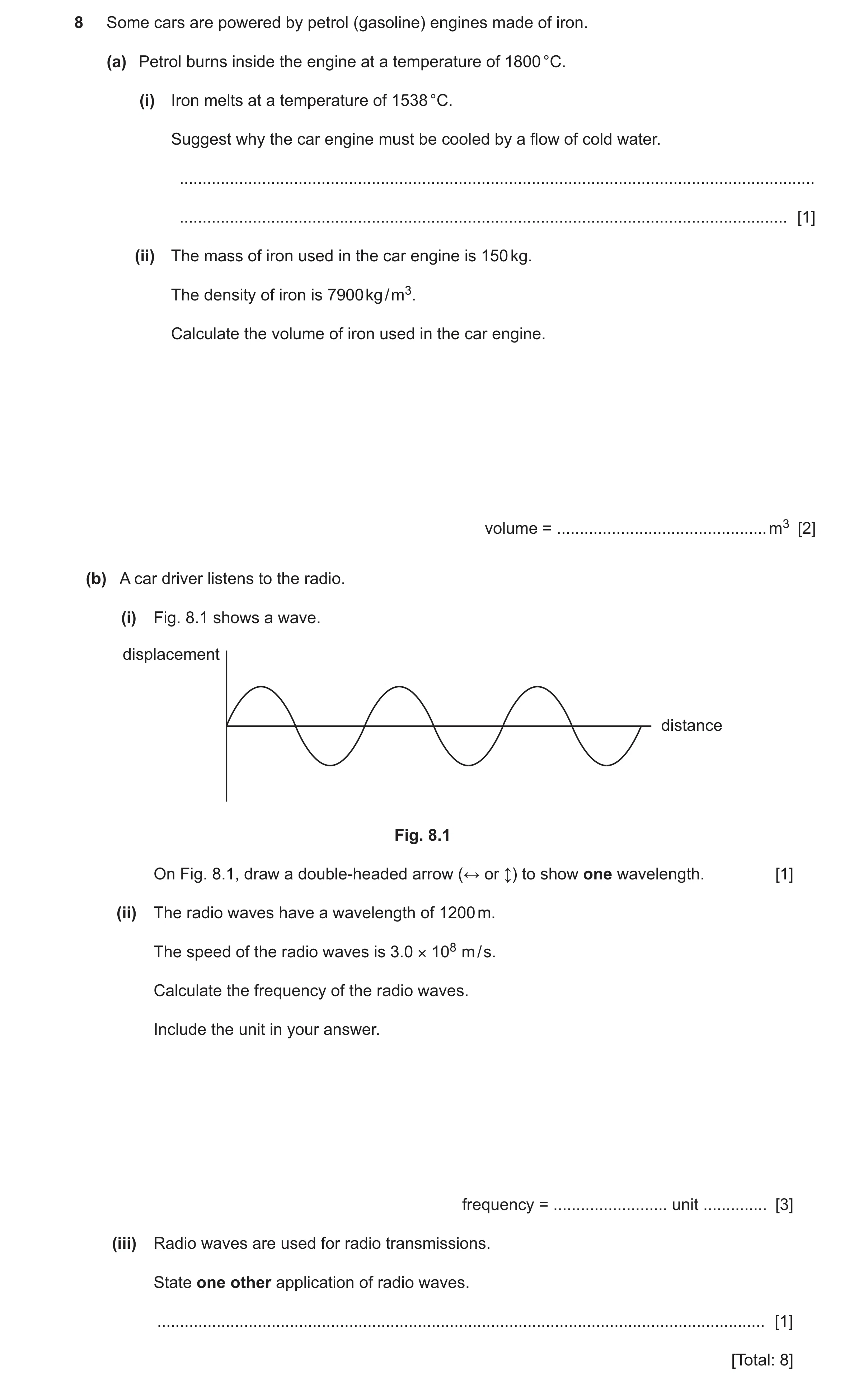
8 Some cars are powered by petrol (gasoline) engines made of iron. (a) Petrol burns inside the engine at a temperature of 1800 °C. (i) Iron melts at a temperature of 1538 °C. Suggest why the car engine must be cooled by a flow of cold water. … … [1] (ii) The mass of iron used in the car engine is 150 kg. The density of iron is 7900 kg / m3. Calculate the volume of iron used in the car engine. volume = … m3 [2] (b) A car driver listens to the radio. (i) Fig. 8.1 shows a wave. displacement distance Fig. 8.1 On Fig. 8.1, draw a double‑headed arrow (↔ or ↕) to show one wavelength. [1] (ii) The radio waves have a wavelength of 1200 m. The speed of the radio waves is 3.0 × 10⁸ m / s. Calculate the frequency of the radio waves. Include the unit in your answer. frequency = … unit … [3] (iii) Radio waves are used for radio transmissions. State one other application of radio waves. … [1] [Total: 8]
8 marks
Mark scheme: 8(a)(i) because temperature is higher than melting point (of iron) / to prevent the iron / engine, from melting ; 1 8(a)(ii) V = m ÷ / volume = mass ÷ density / 150 ÷ 7900 ; 2 0.019 (m3) ; 8(b)(i) horizontal double-headed arrow accurately showing one wavelength ; 1 8(b)(ii) f = v / / frequency = speed ÷ wavelength / 3.0 108 ÷ 1200 ; 3 2.5 105 / 250 000 ; Hz ; 8(b)(iii) television (transmissions) / radar ; 1
This question in 0653/31 May/June 2025
Question 15 0653/31 Oct/Nov 2025
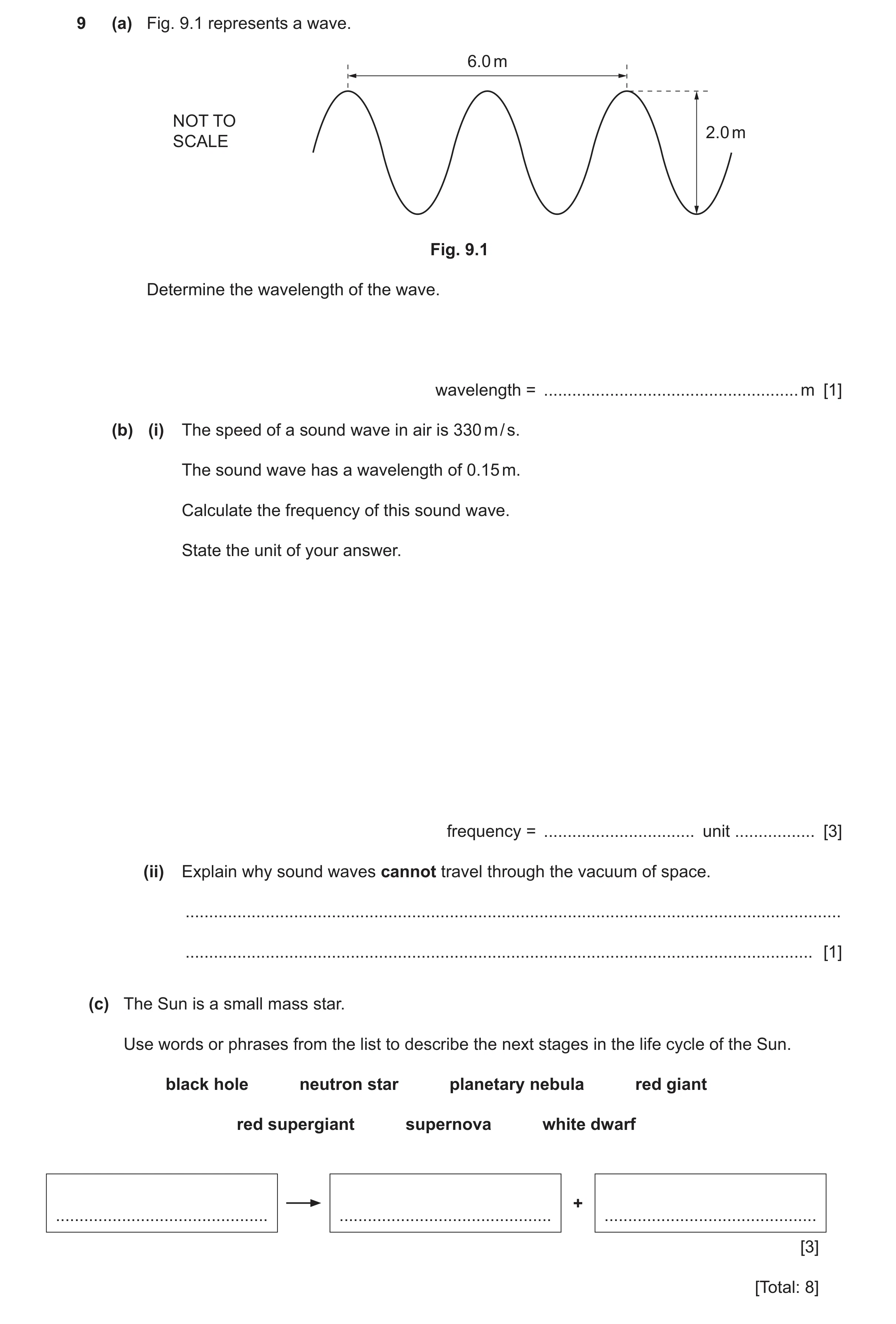
9 (a) Fig. 9.1 represents a wave. 6.0 m NOT TO 2.0 m SCALE Fig. 9.1 Determine the wavelength of the wave. wavelength = … m [1] (b) (i) The speed of a sound wave in air is 330 m / s. The sound wave has a wavelength of 0.15 m. Calculate the frequency of this sound wave. State the unit of your answer. frequency = … unit … [3] (ii) Explain why sound waves cannot travel through the vacuum of space. … … [1] (c) The Sun is a small mass star. Use words or phrases from the list to describe the next stages in the life cycle of the Sun. black hole neutron star planetary nebula red giant red supergiant supernova white dwarf + … … … [3] [Total: 8]
8 marks
Mark scheme: 9(a) 3(.0) (m) ; 1 9(b)(i) v = f / 330 ÷ 0.15 ; 3 2200 ; Hz ; 9(b)(ii) a medium is needed (to transmit sound waves) ; 1 9(c) red giant ; 3 white dwarf ; planetary nebula ;
This question in 0653/31 Oct/Nov 2025
 10
10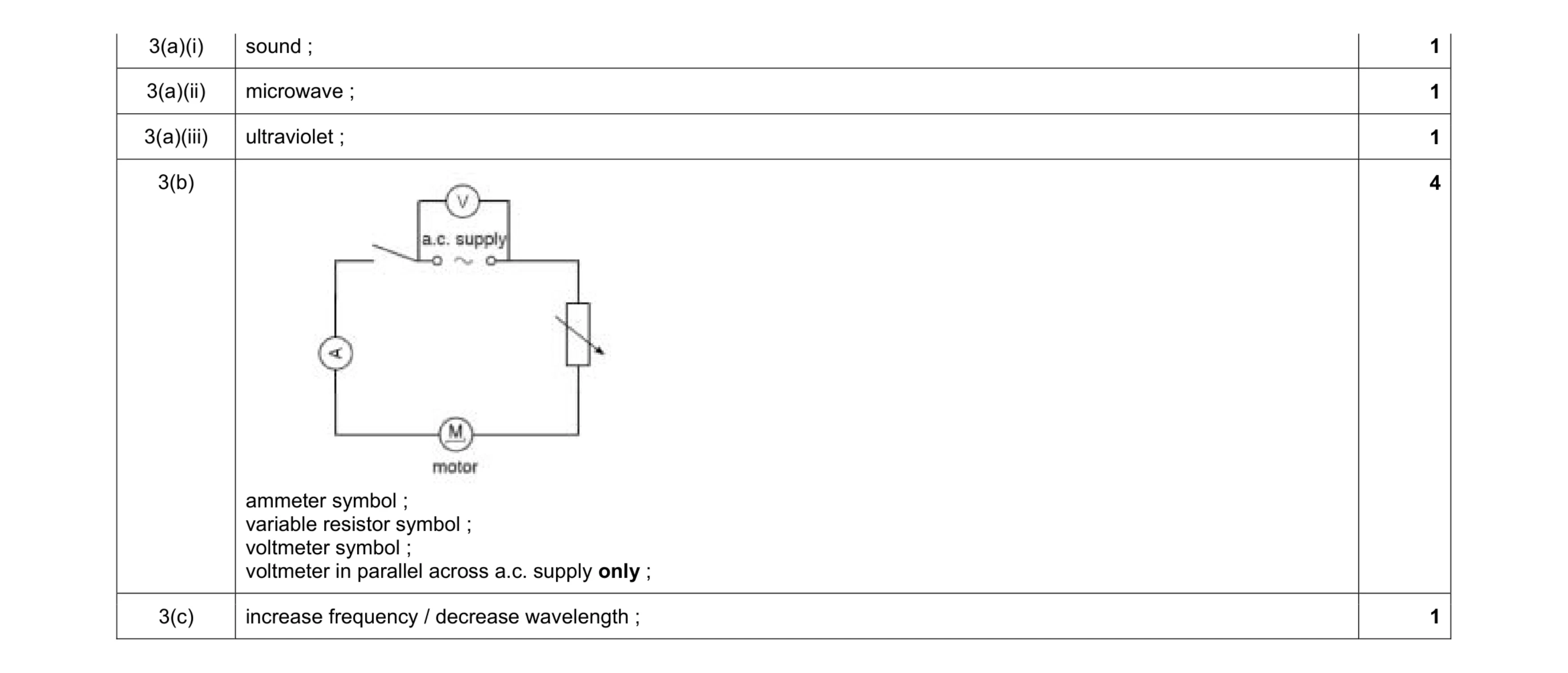 8
8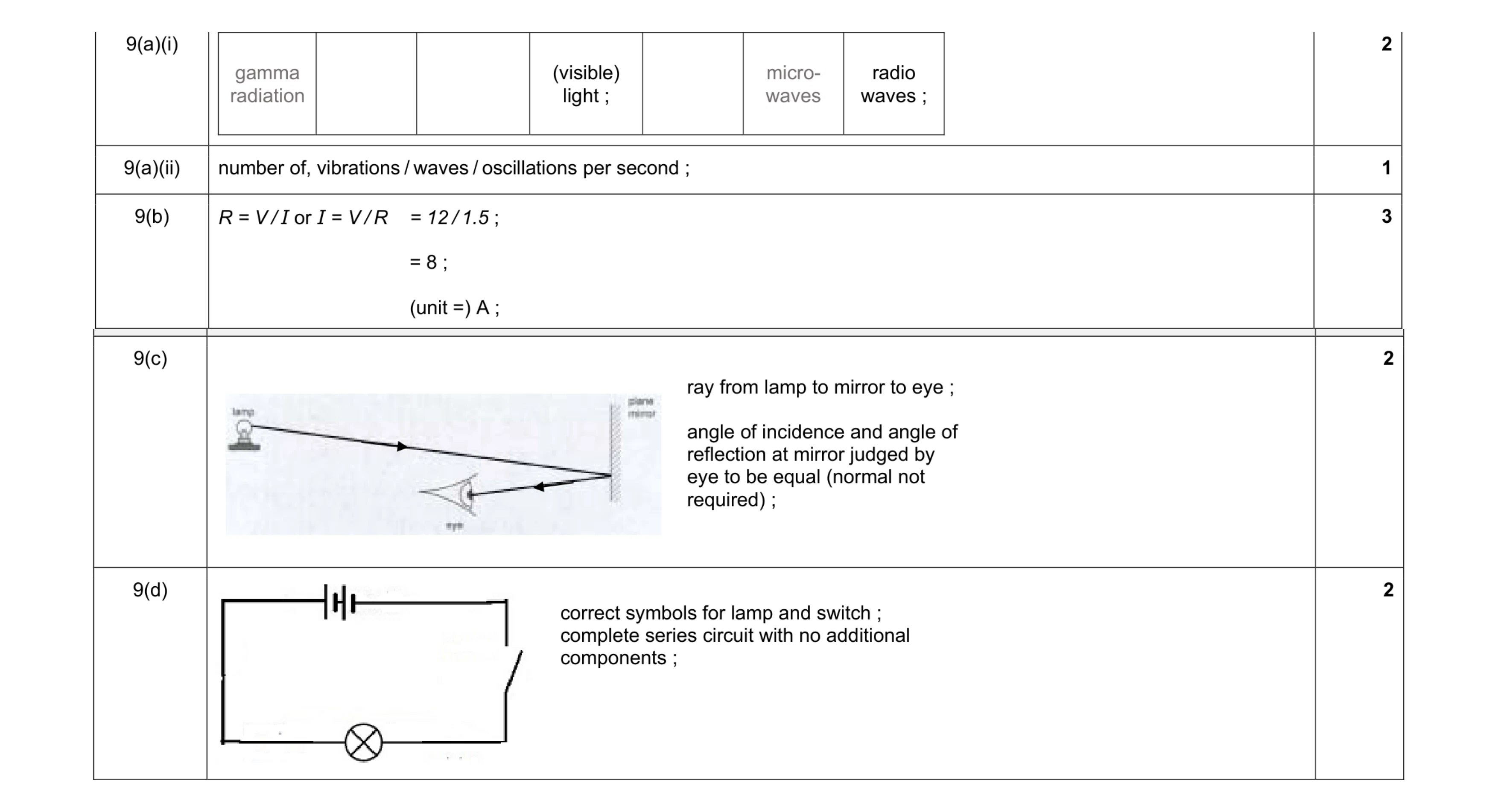 10
10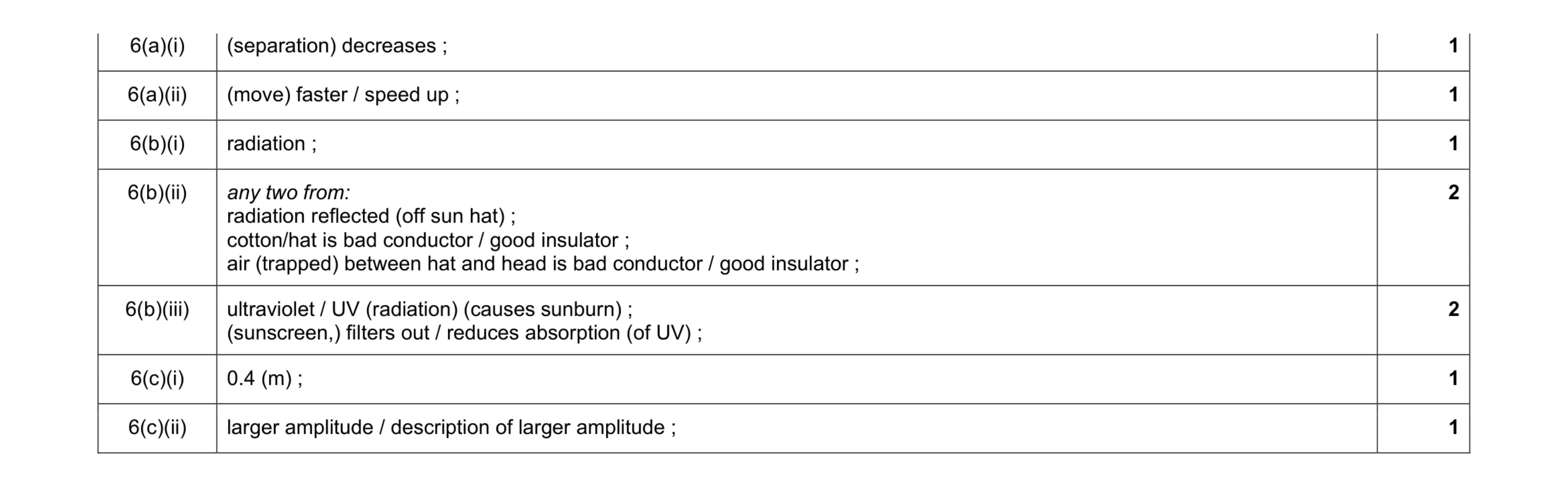 9
9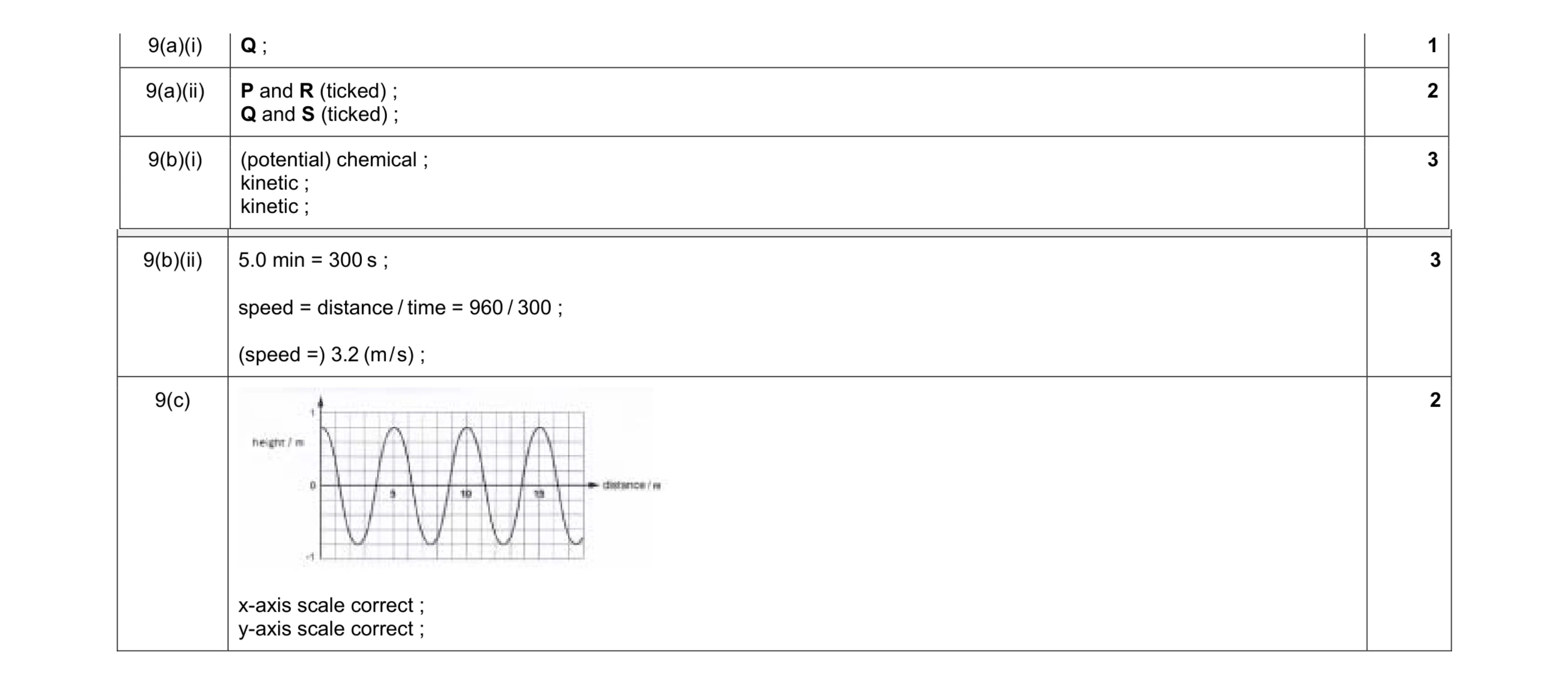 11
11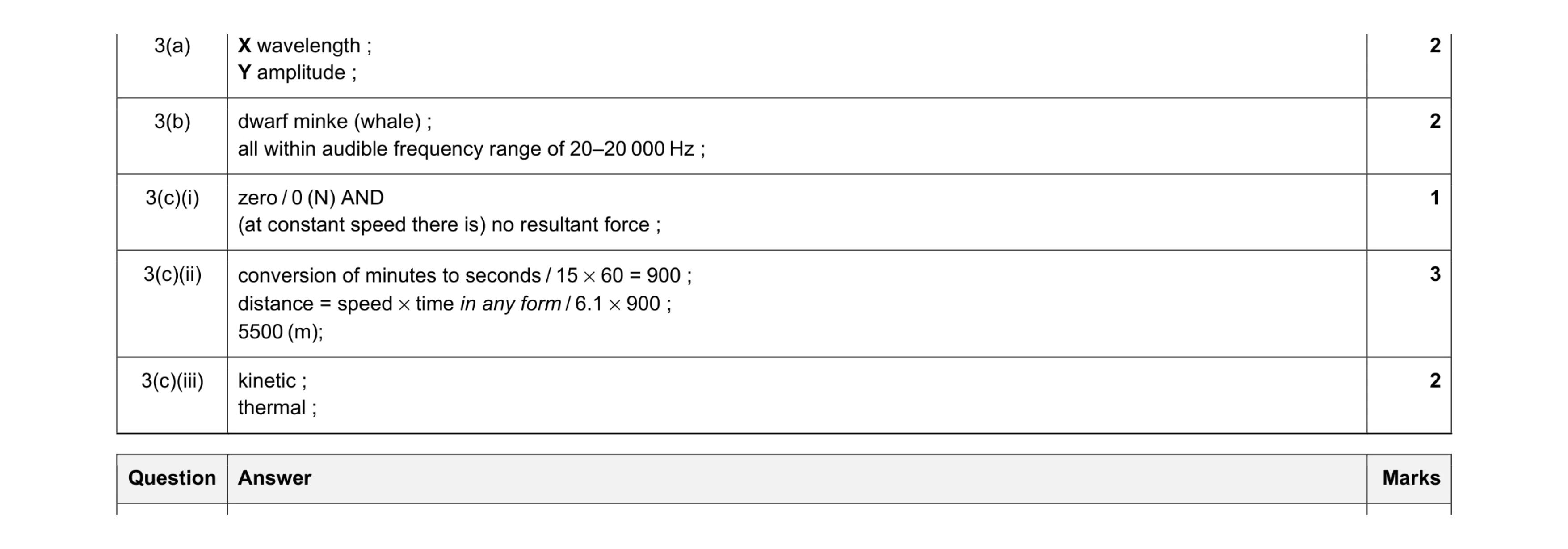 10
10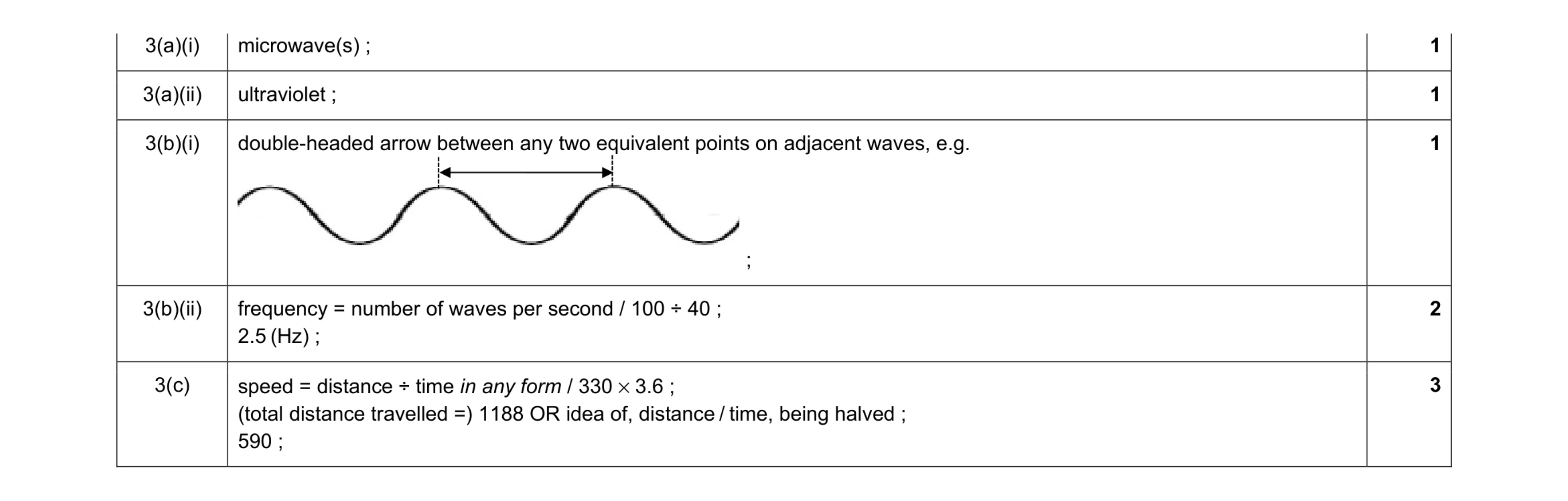 8
8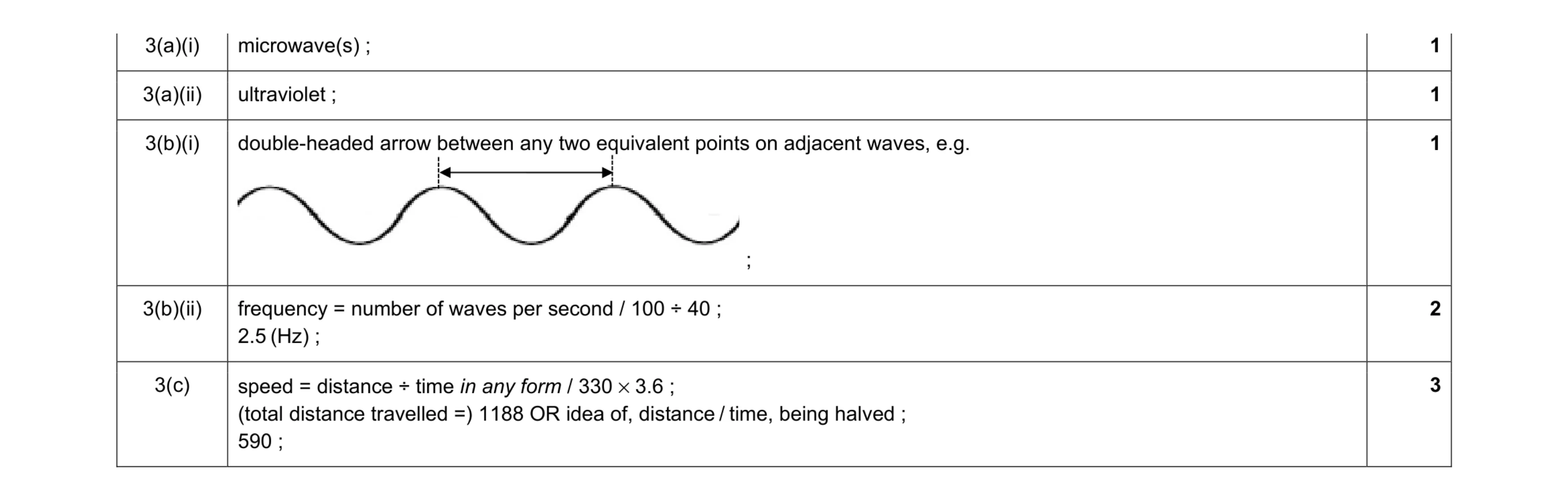 8
8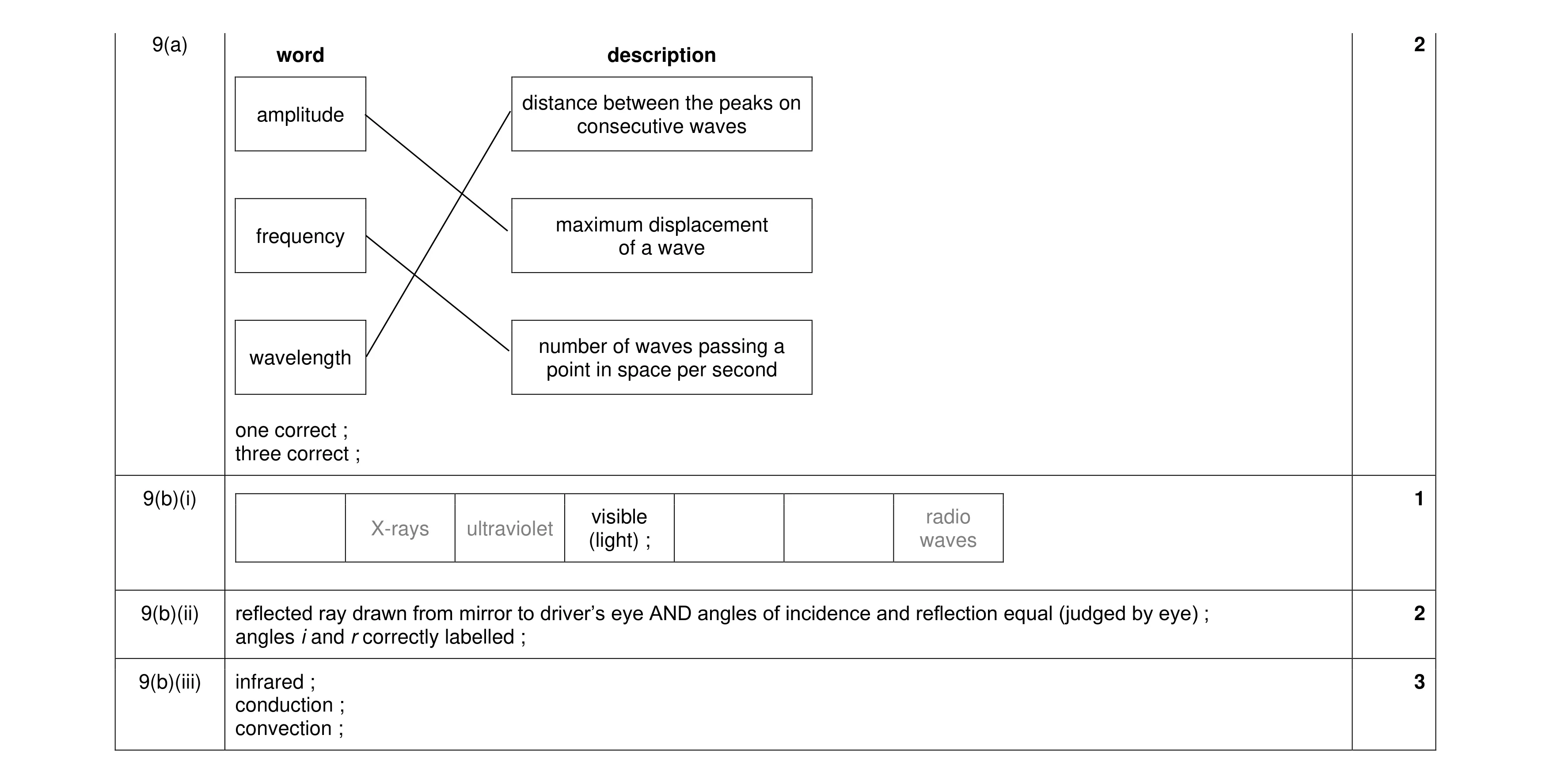 8
8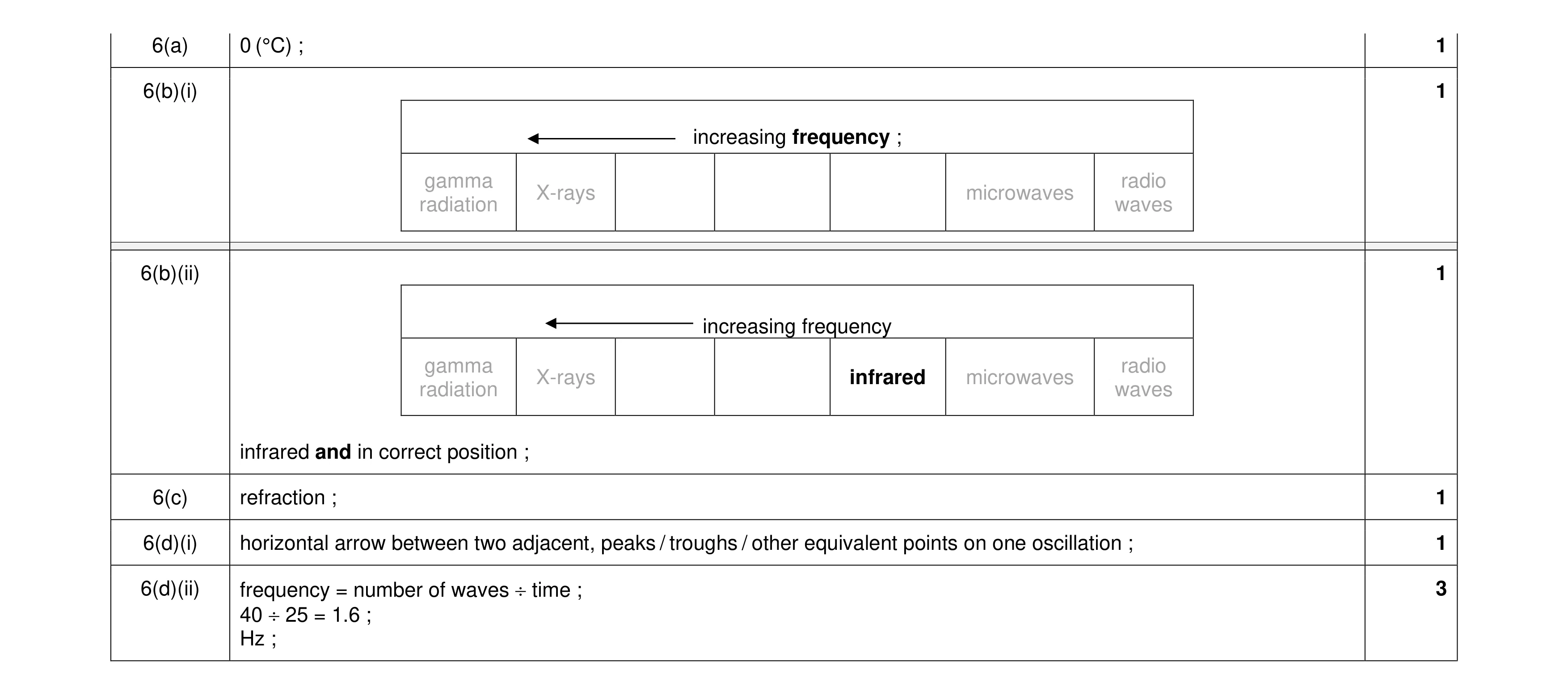 8
8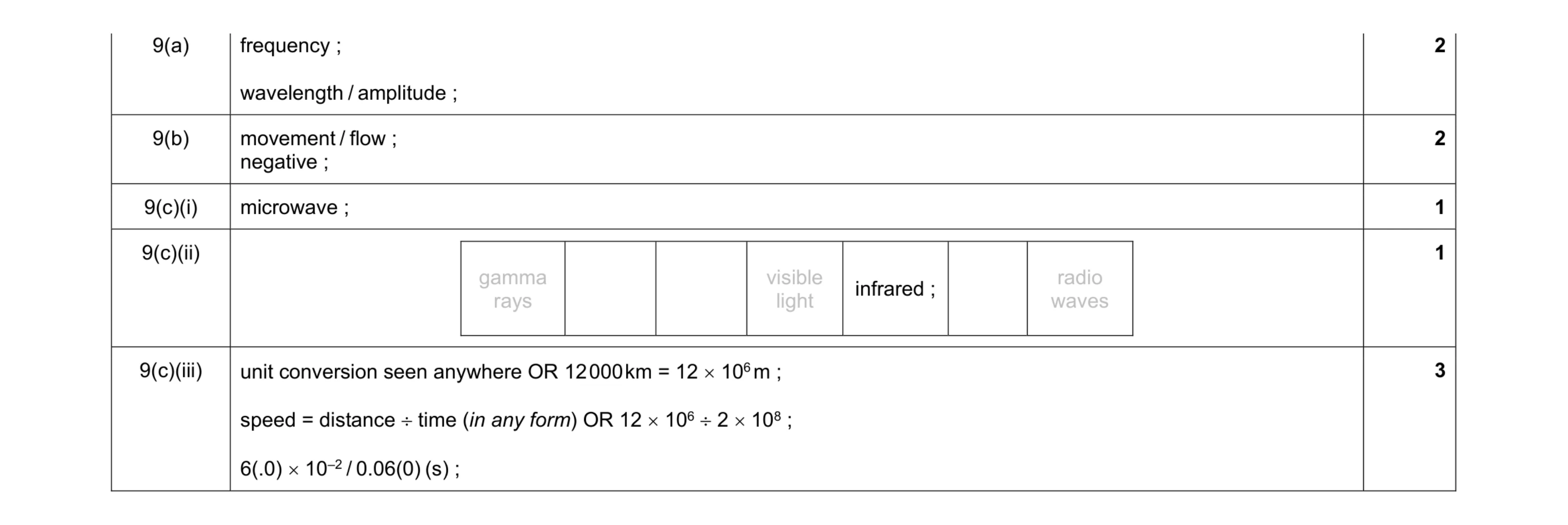 9
9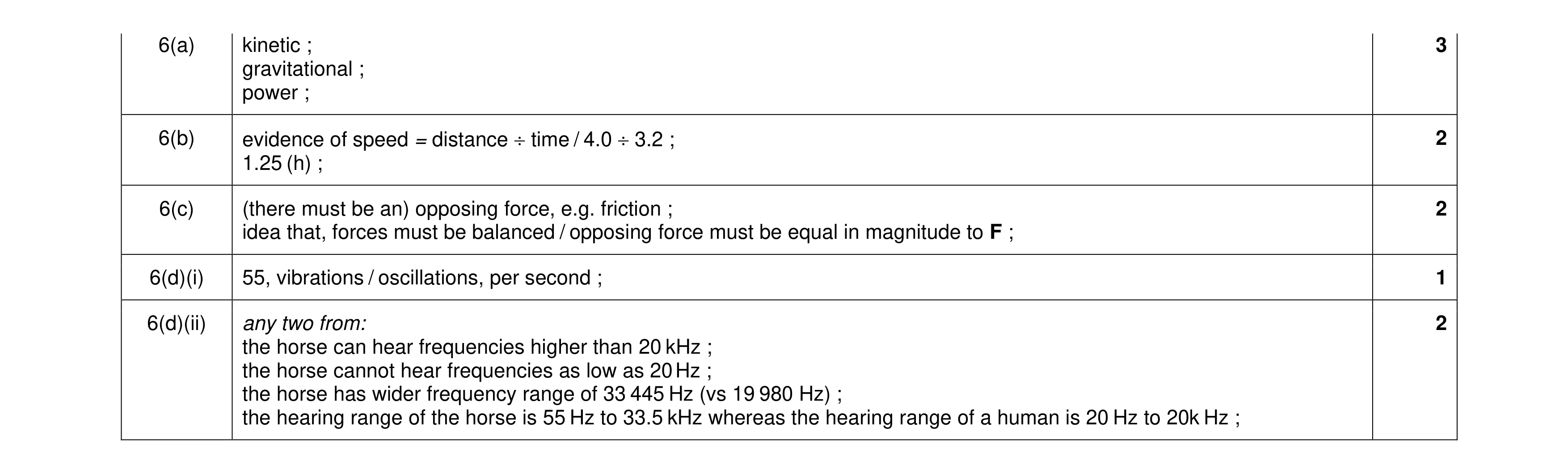 10
10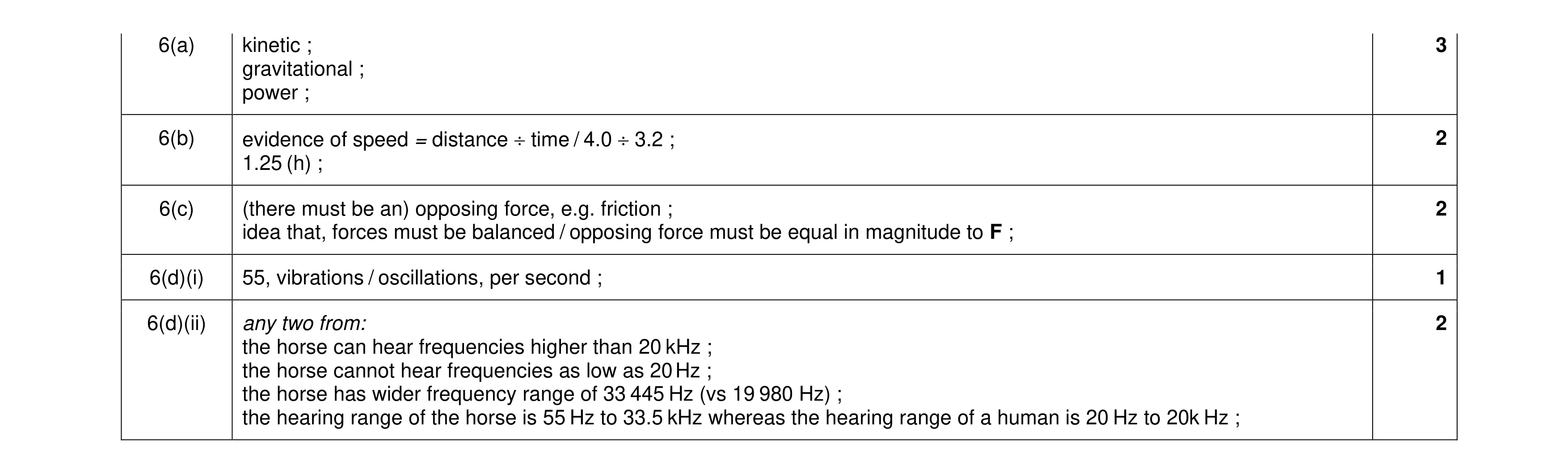 10
10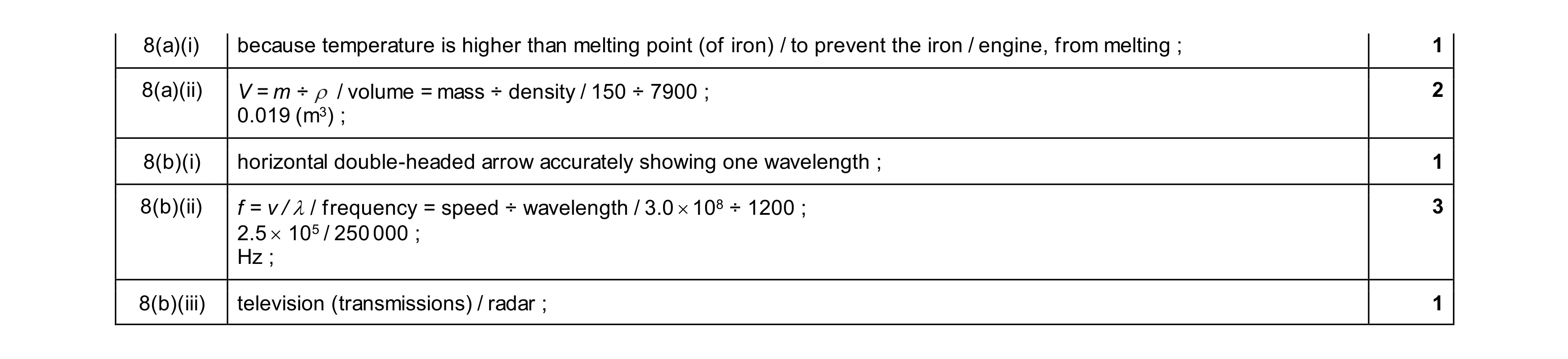 8
8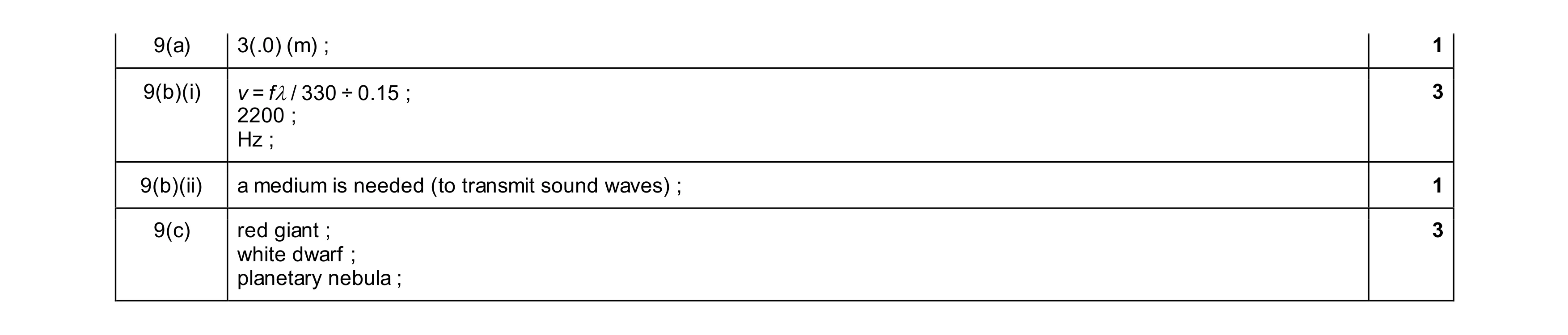 8
8