Cambridge IGCSE Physics 0625 — 2017 Oct/Nov Paper 2 · Variant 3
0625/23/O/N/17 · 40 questions · 40 marks · ≈45 min
The question paper and its mark scheme, free to read here and free to download. This is Cambridge’s own paper, exactly as it was sat.
Question paper20 pages
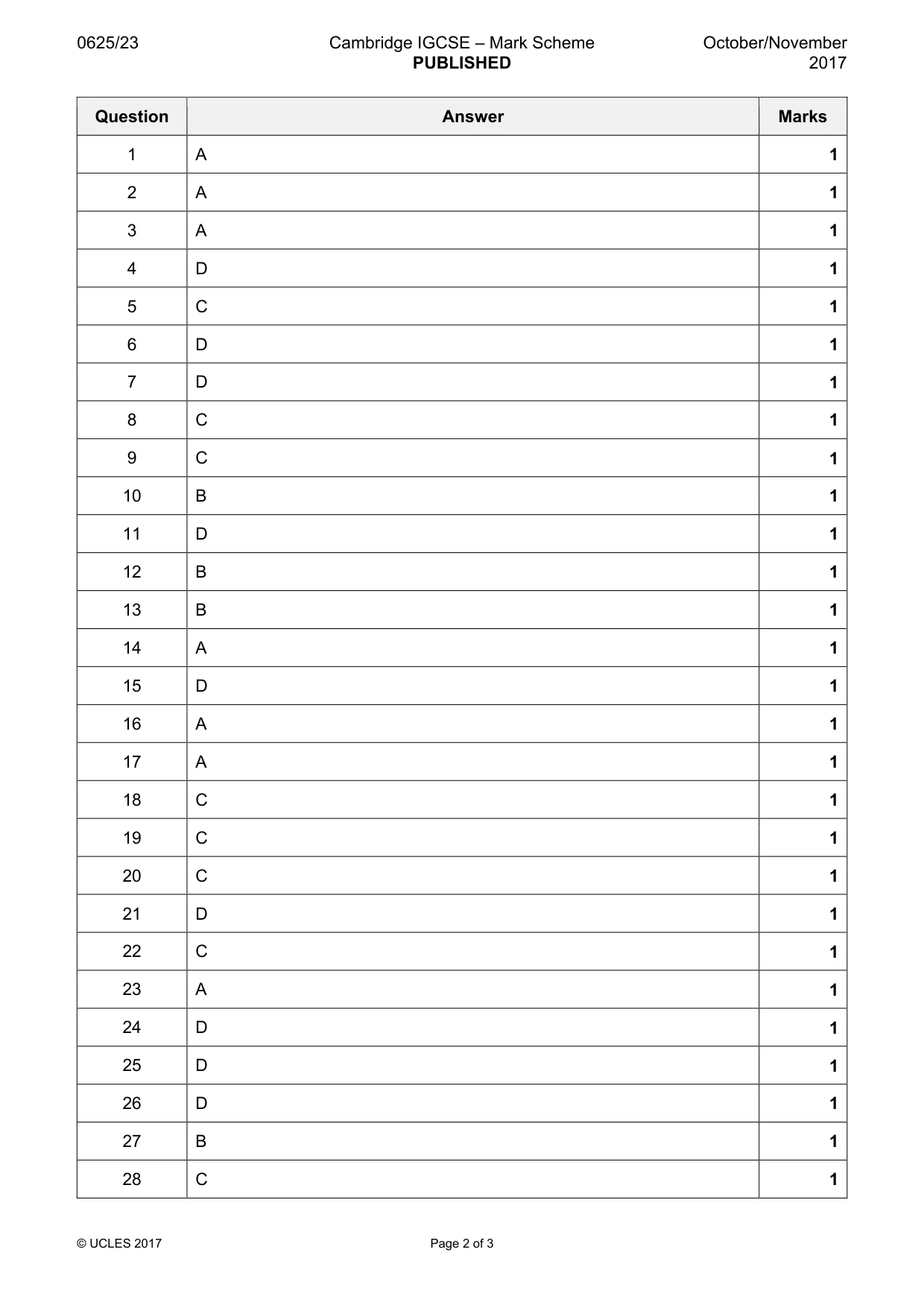
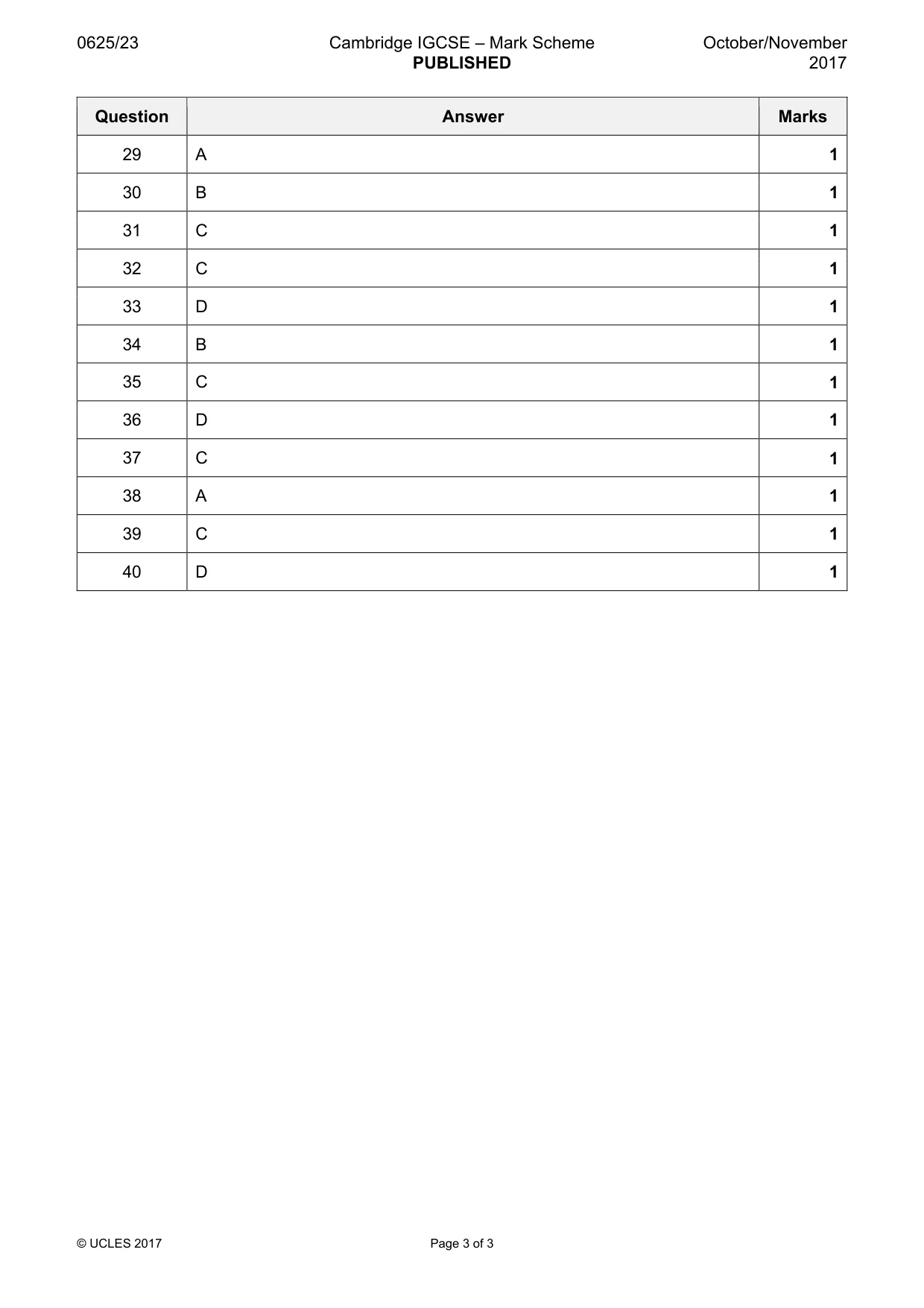
Mark scheme3 pages
Answers below. Sit the paper first if you are practising.
Questions as text
Q1 · A measuring cylinder contains some water
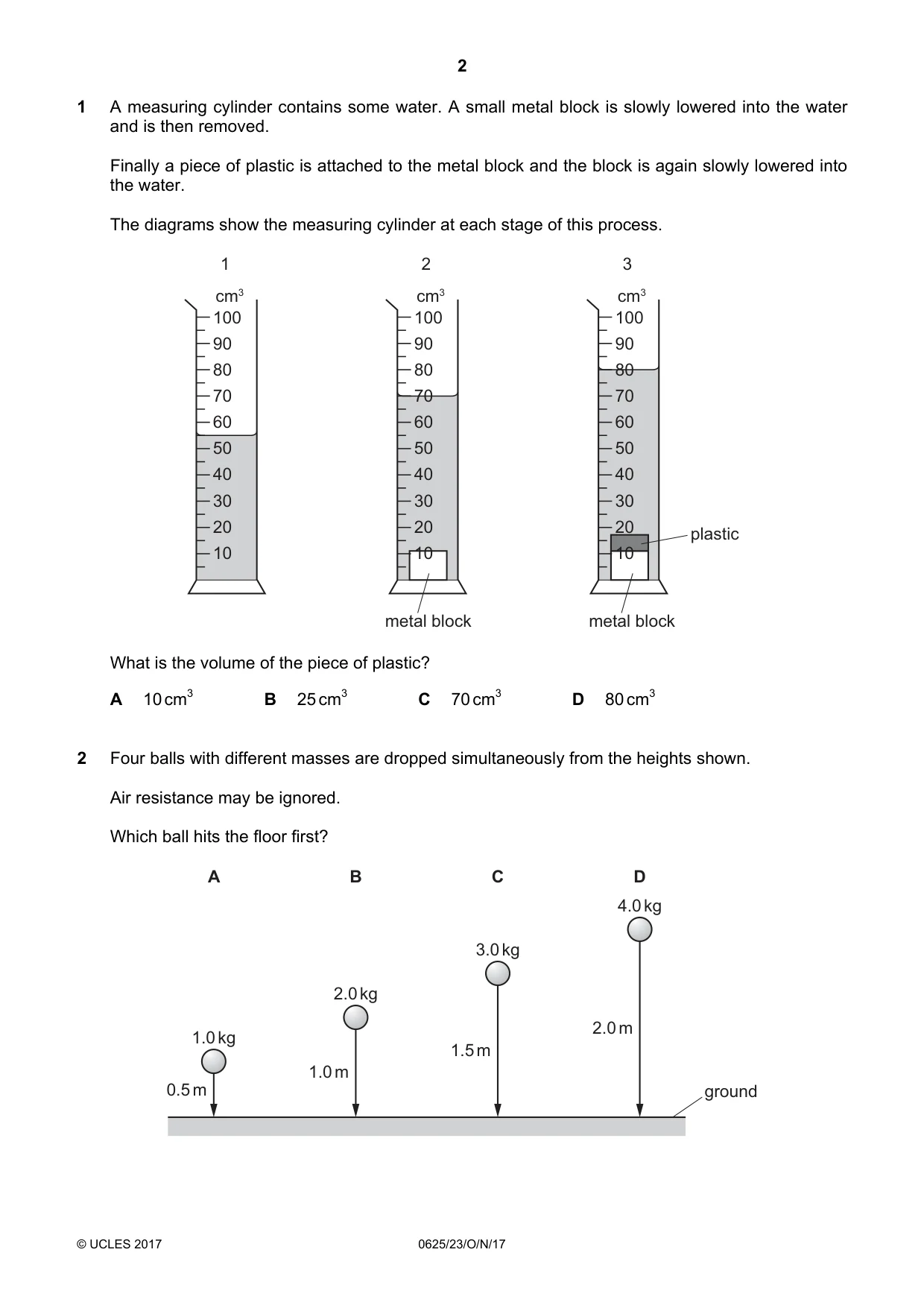
1 A measuring cylinder contains some water. A small metal block is slowly lowered into the water and is then removed. Finally a piece of plastic is attached to the metal block and the block is again slowly lowered into the water. The diagrams show the measuring cylinder at each stage of this process. 1 2 3 cm3 cm3 cm3 100 100 100 90 90 90 80 80 80 70 70 70 60 60 60 50 50 50 40 40 40 30 30 30 20 20 20 plastic 10 10 10 metal block metal block What is the volume of the piece of plastic? A 10 cm3 B 25 cm3 C 70 cm3 D 80 cm3
Mark scheme: A
More questions on Physical quantities and measurement techniques
Q2 · Four balls with different masses are dropped simultaneously from the heights shown
2 Four balls with different masses are dropped simultaneously from the heights shown. Air resistance may be ignored. Which ball hits the floor first? A B C D 4.0 kg 3.0 kg 2.0 kg 2.0 m 1.0 kg 1.5 m 1.0 m 0.5 m ground
Mark scheme: A
Q3 · The diagram shows the vertical forces acting on a ball as it falls vertically through the…
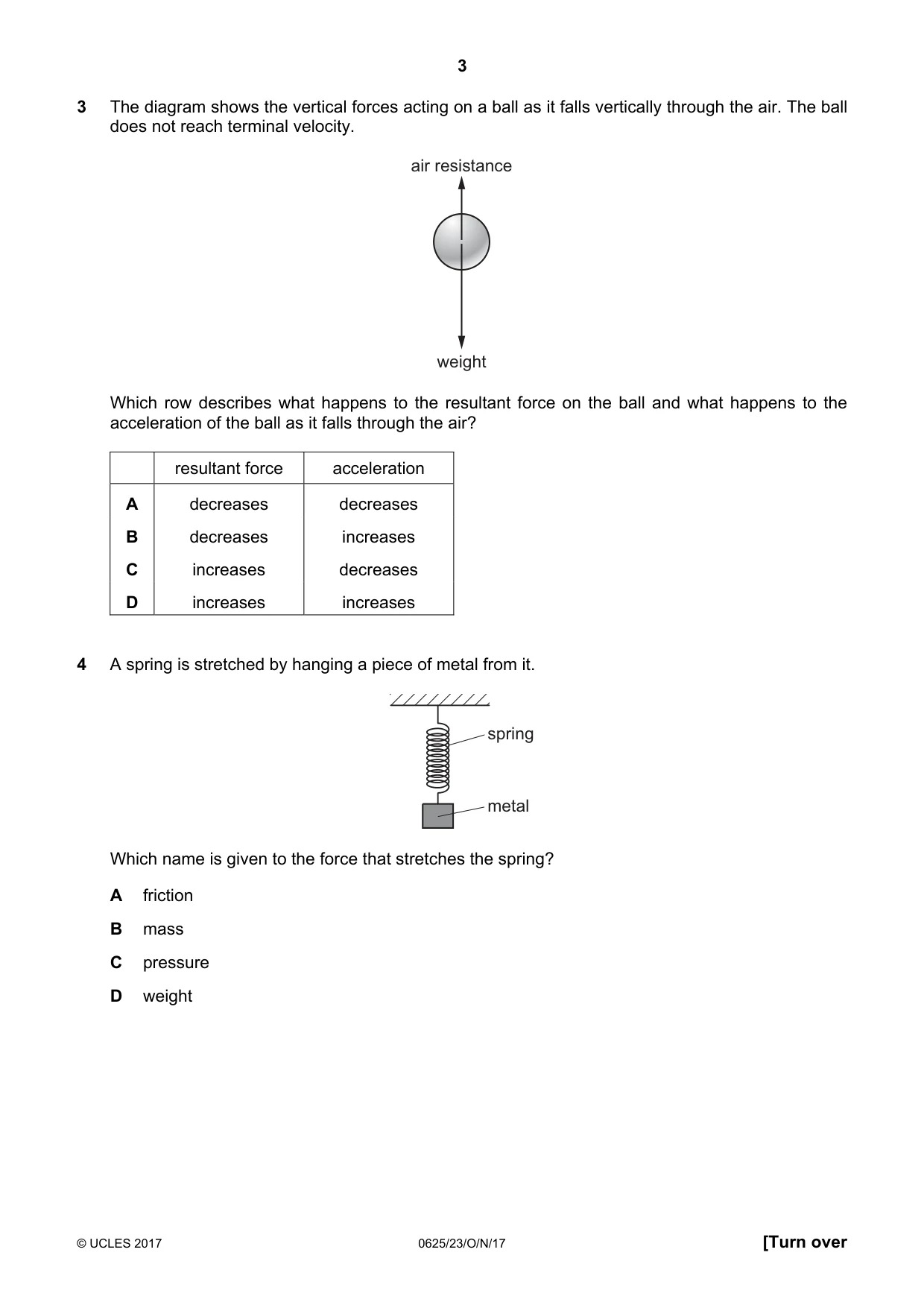
3 The diagram shows the vertical forces acting on a ball as it falls vertically through the air. The ball does not reach terminal velocity. air resistance weight Which row describes what happens to the resultant force on the ball and what happens to the acceleration of the ball as it falls through the air? resultant force acceleration A decreases decreases B decreases increases C increases decreases D increases increases
Mark scheme: A
Q4 · A spring is stretched by hanging a piece of metal from it
4 A spring is stretched by hanging a piece of metal from it. spring metal Which name is given to the force that stretches the spring? A friction B mass C pressure D weight
Mark scheme: D
Q5 · On the Moon, all objects fall with the same acceleration
5 On the Moon, all objects fall with the same acceleration. Which statement explains this? A On the Moon, all objects have the same weight. B The Moon has a smaller gravitational field strength than the Earth. C The weight of an object is directly proportional to its mass. D The weight of an object is inversely proportional to its mass.
Mark scheme: C
Q6 · A pair of cutters is used to cut a rope
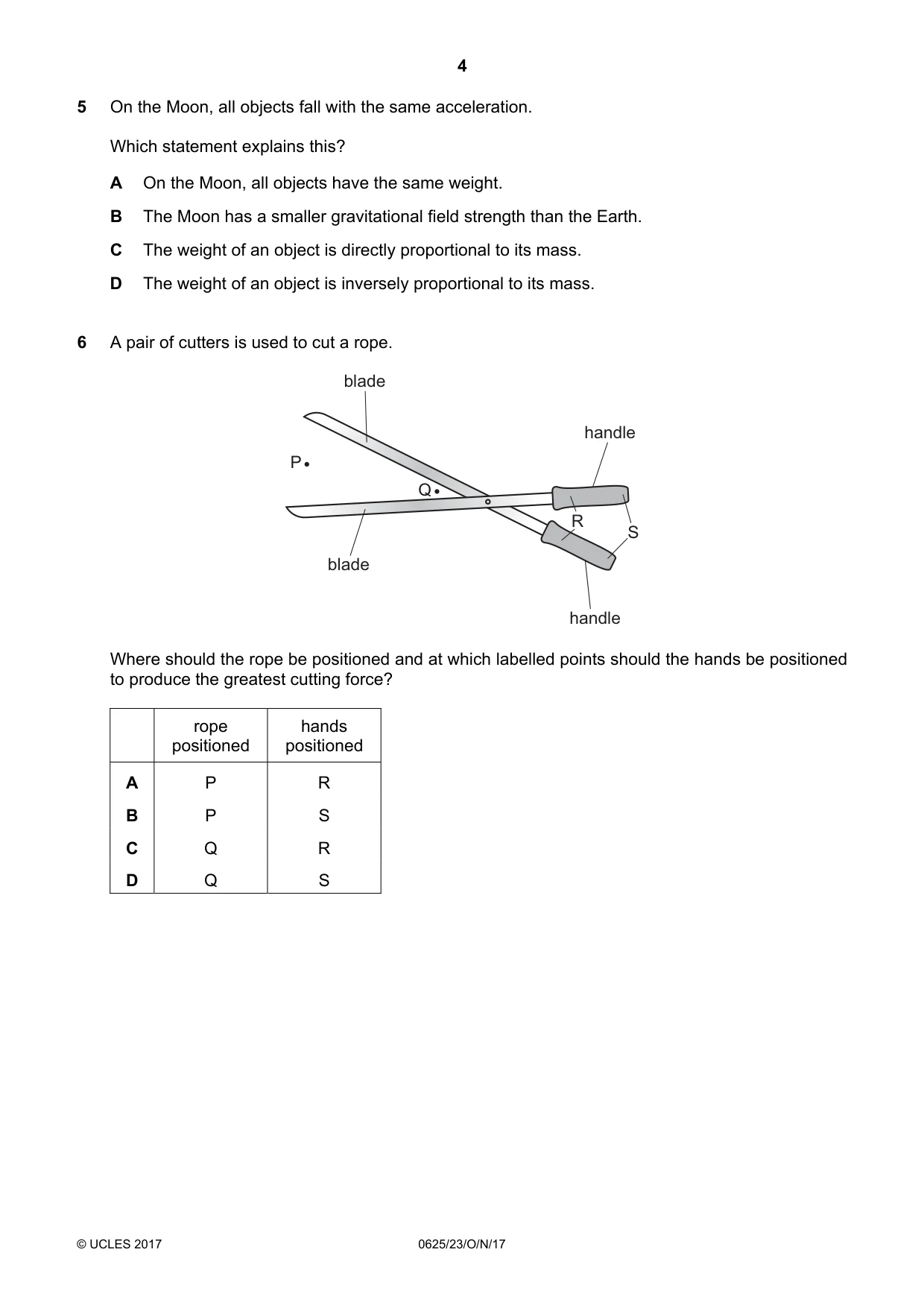
6 A pair of cutters is used to cut a rope. blade handle P Q R S blade handle Where should the rope be positioned and at which labelled points should the hands be positioned to produce the greatest cutting force? rope hands positioned positioned A P R B P S C Q R D Q S
Mark scheme: D
Q7 · The lamp in the diagram is not very stable and falls over easily
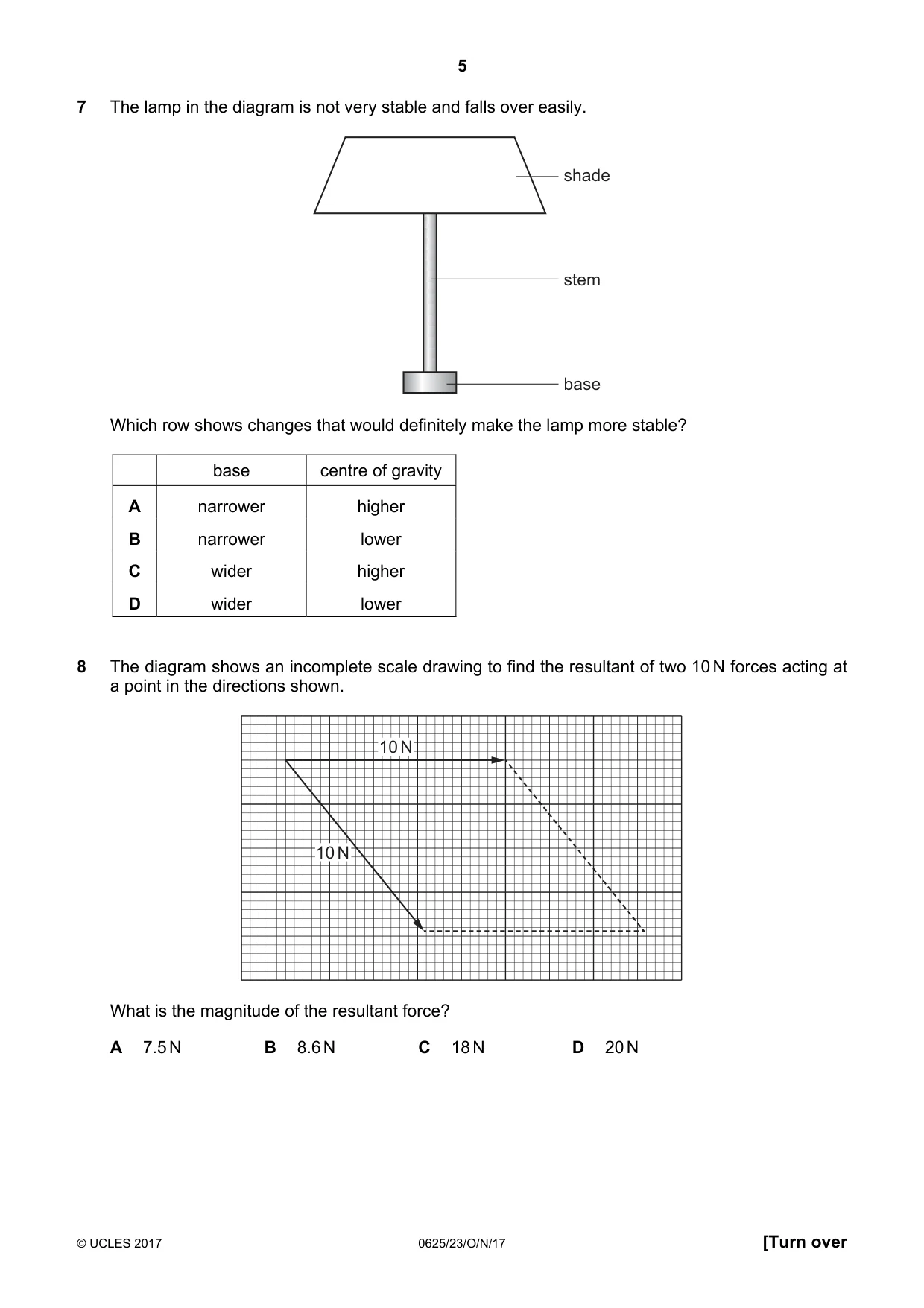
7 The lamp in the diagram is not very stable and falls over easily. shade stem base Which row shows changes that would definitely make the lamp more stable? base centre of gravity A narrower higher B narrower lower C wider higher D wider lower
Mark scheme: D
Q8 · The diagram shows an incomplete scale drawing to find the resultant of two 10 N forces…
8 The diagram shows an incomplete scale drawing to find the resultant of two 10 N forces acting at a point in the directions shown. 10 N 10 N What is the magnitude of the resultant force? A 7.5 N B 8.6 N C 18 N D 20 N
Mark scheme: C
Q9 · An object has a mass of 60 kg
9 An object has a mass of 60 kg. It decelerates from 50 m / s to 20 m / s when a resultant force of 300 N acts on it. For how long does the force act? A 0.071 s B 0.17 s C 6.0 s D 14 s
Mark scheme: C
Q10 · A car, starting from rest at position X, accelerates up a hill
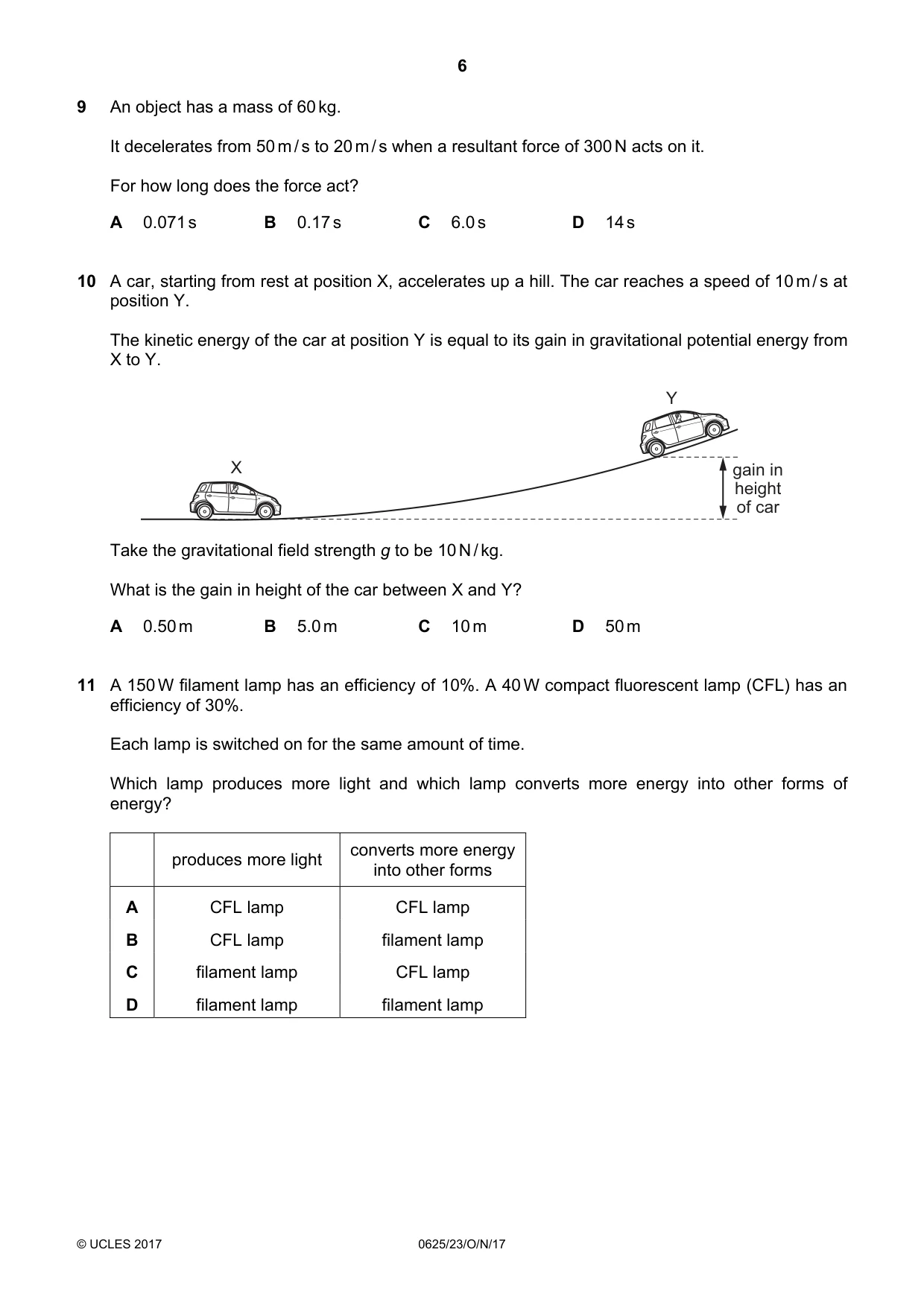
10 A car, starting from rest at position X, accelerates up a hill. The car reaches a speed of 10 m / s at position Y. The kinetic energy of the car at position Y is equal to its gain in gravitational potential energy from X to Y. Y X gain in height of car Take the gravitational field strength g to be 10 N / kg. What is the gain in height of the car between X and Y? A 0.50 m B 5.0 m C 10 m D 50 m
Mark scheme: B
Q11 · A 150 W filament lamp has an efficiency of 10%
11 A 150 W filament lamp has an efficiency of 10%. A 40 W compact fluorescent lamp (CFL) has an efficiency of 30%. Each lamp is switched on for the same amount of time. Which lamp produces more light and which lamp converts more energy into other forms of energy? converts more energy produces more light into other forms A CFL lamp CFL lamp B CFL lamp filament lamp C filament lamp CFL lamp D filament lamp filament lamp
Mark scheme: D
Q12 · A student runs up a flight of stairs
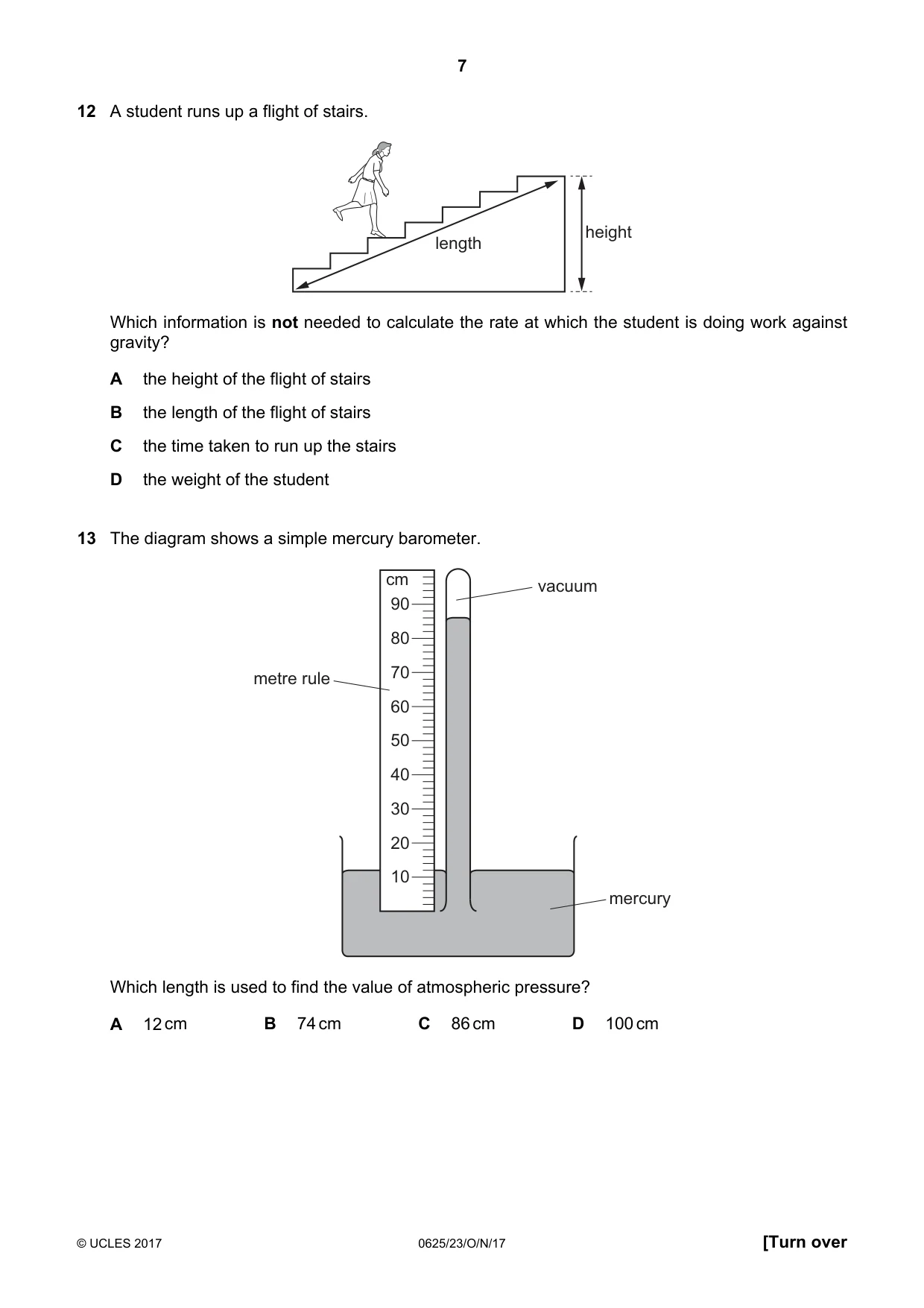
12 A student runs up a flight of stairs. height length Which information is not needed to calculate the rate at which the student is doing work against gravity? A the height of the flight of stairs B the length of the flight of stairs C the time taken to run up the stairs D the weight of the student
Mark scheme: B
Q13 · The diagram shows a simple mercury barometer
13 The diagram shows a simple mercury barometer. cm vacuum 90 80 metre rule 70 60 50 40 30 20 10 mercury Which length is used to find the value of atmospheric pressure? A 12 cm B 74 cm C 86 cm D 100 cm
Mark scheme: B
Q14 · A pollen grain in a beaker of still water is viewed through a microscope
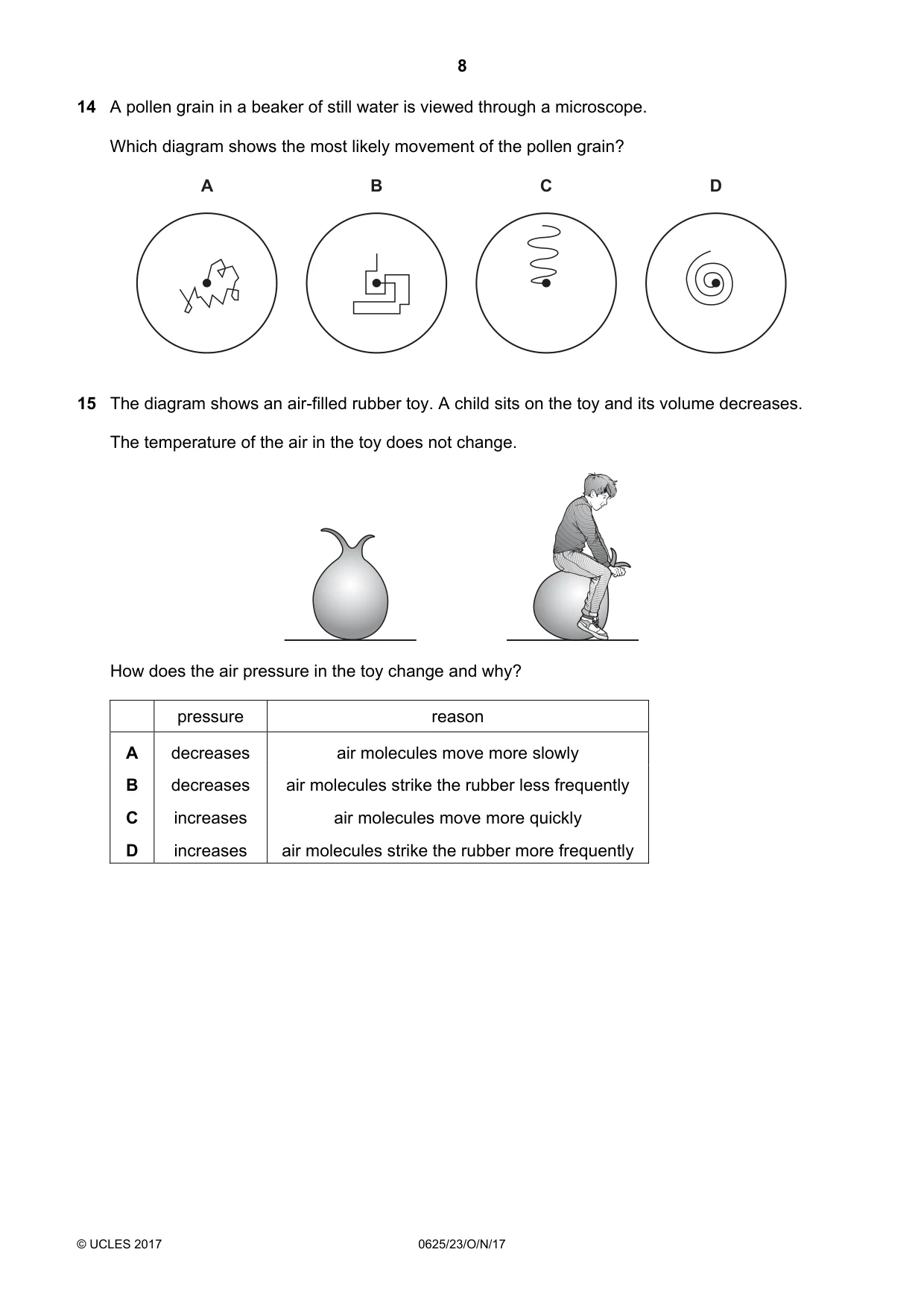
14 A pollen grain in a beaker of still water is viewed through a microscope. Which diagram shows the most likely movement of the pollen grain? A B C D
Mark scheme: A
Q15 · The diagram shows an air-filled rubber toy
15 The diagram shows an air-filled rubber toy. A child sits on the toy and its volume decreases. The temperature of the air in the toy does not change. How does the air pressure in the toy change and why? pressure reason A decreases air molecules move more slowly B decreases air molecules strike the rubber less frequently C increases air molecules move more quickly D increases air molecules strike the rubber more frequently
Mark scheme: D
Q16 · The diagram shows a glass flask, sealed with a small volume of mercury in a glass tube
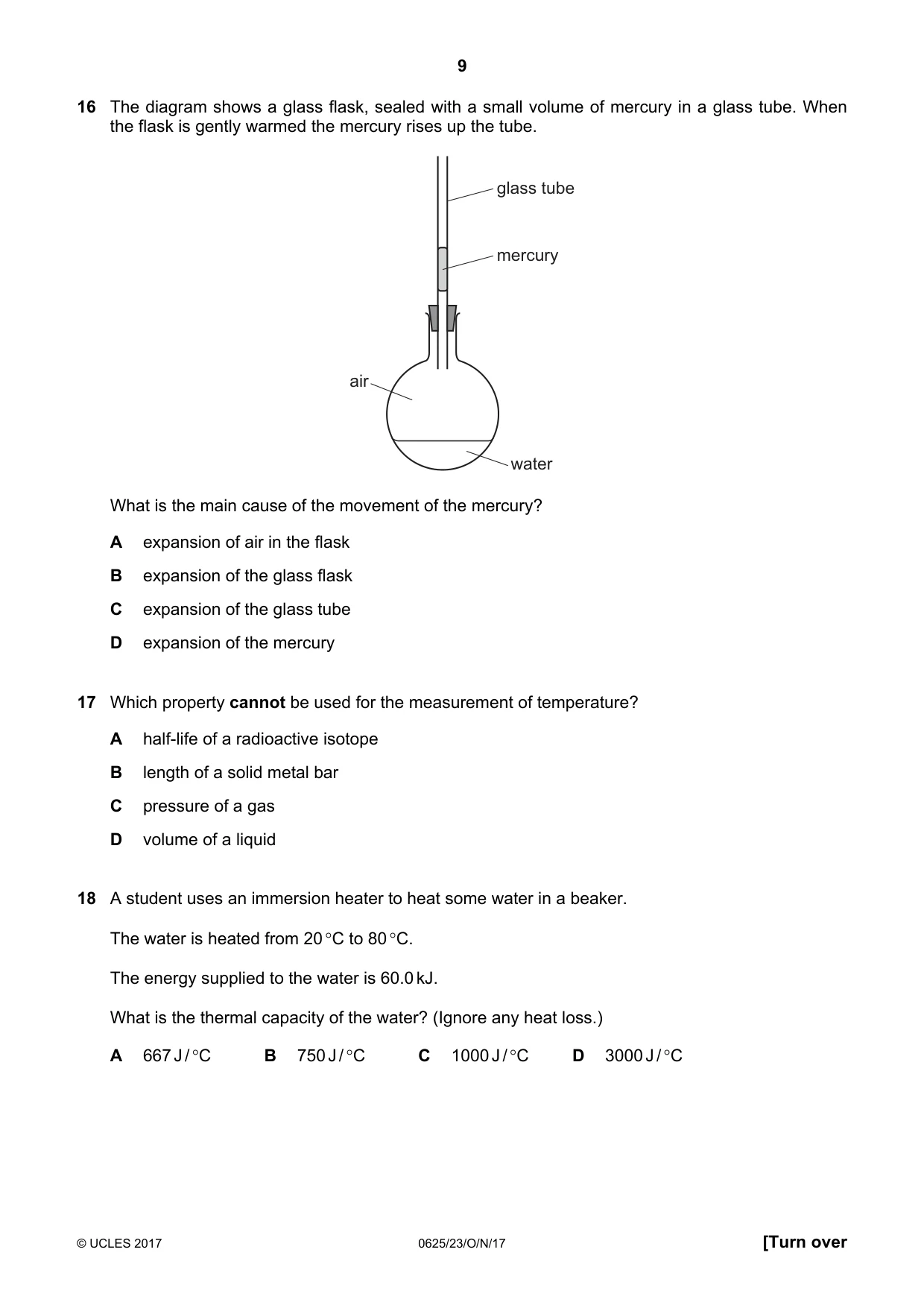
16 The diagram shows a glass flask, sealed with a small volume of mercury in a glass tube. When the flask is gently warmed the mercury rises up the tube. glass tube mercury air water What is the main cause of the movement of the mercury? A expansion of air in the flask B expansion of the glass flask C expansion of the glass tube D expansion of the mercury
Mark scheme: A
Q17 · Which property cannot be used for the measurement of temperature?
17 Which property cannot be used for the measurement of temperature? A half-life of a radioactive isotope B length of a solid metal bar C pressure of a gas D volume of a liquid
Mark scheme: A
More questions on Physical quantities and measurement techniques
Q18 · A student uses an immersion heater to heat some water in a beaker
18 A student uses an immersion heater to heat some water in a beaker. The water is heated from 20 °C to 80 °C. The energy supplied to the water is 60.0 kJ. What is the thermal capacity of the water? (Ignore any heat loss.) A 667 J / °C B 750 J / °C C 1000 J / °C D 3000 J / °C
Mark scheme: C
Q19 · Why is the heating coil of a domestic immersion heater placed at the bottom of the tank?
19 Why is the heating coil of a domestic immersion heater placed at the bottom of the tank? A Cold water is less dense than hot water and therefore sinks. B Cold water is more dense than hot water and therefore rises. C Hot water is less dense than cold water and therefore rises. D Hot water is more dense than cold water and therefore sinks.
Mark scheme: C
Q20 · The diagram represents plane wavefronts of a water wave about to strike a solid barrier
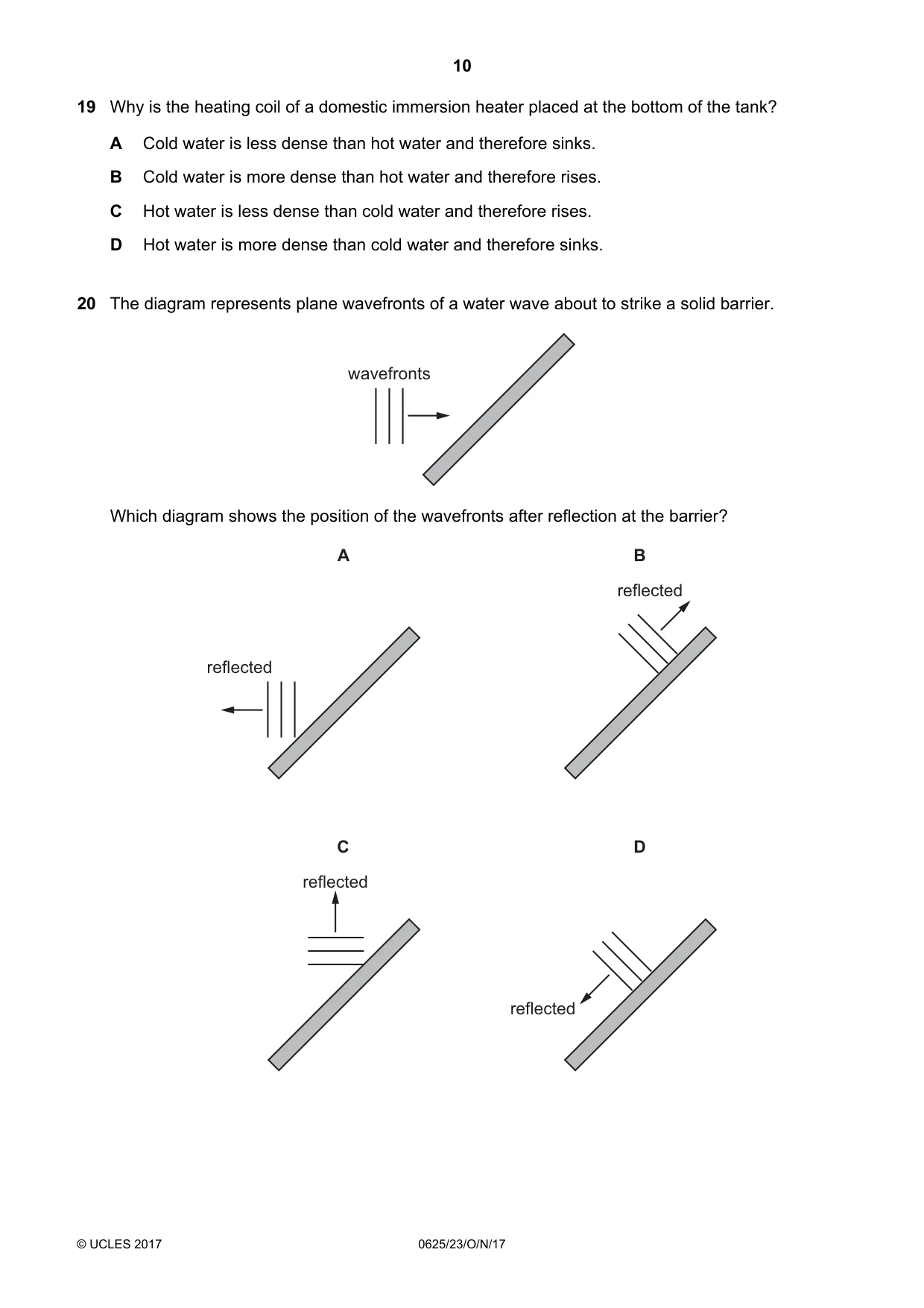
20 The diagram represents plane wavefronts of a water wave about to strike a solid barrier. wavefronts Which diagram shows the position of the wavefronts after reflection at the barrier? A B reflected reflected C D reflected reflected
Mark scheme: C
Q21 · The diagram shows a ray of light in glass
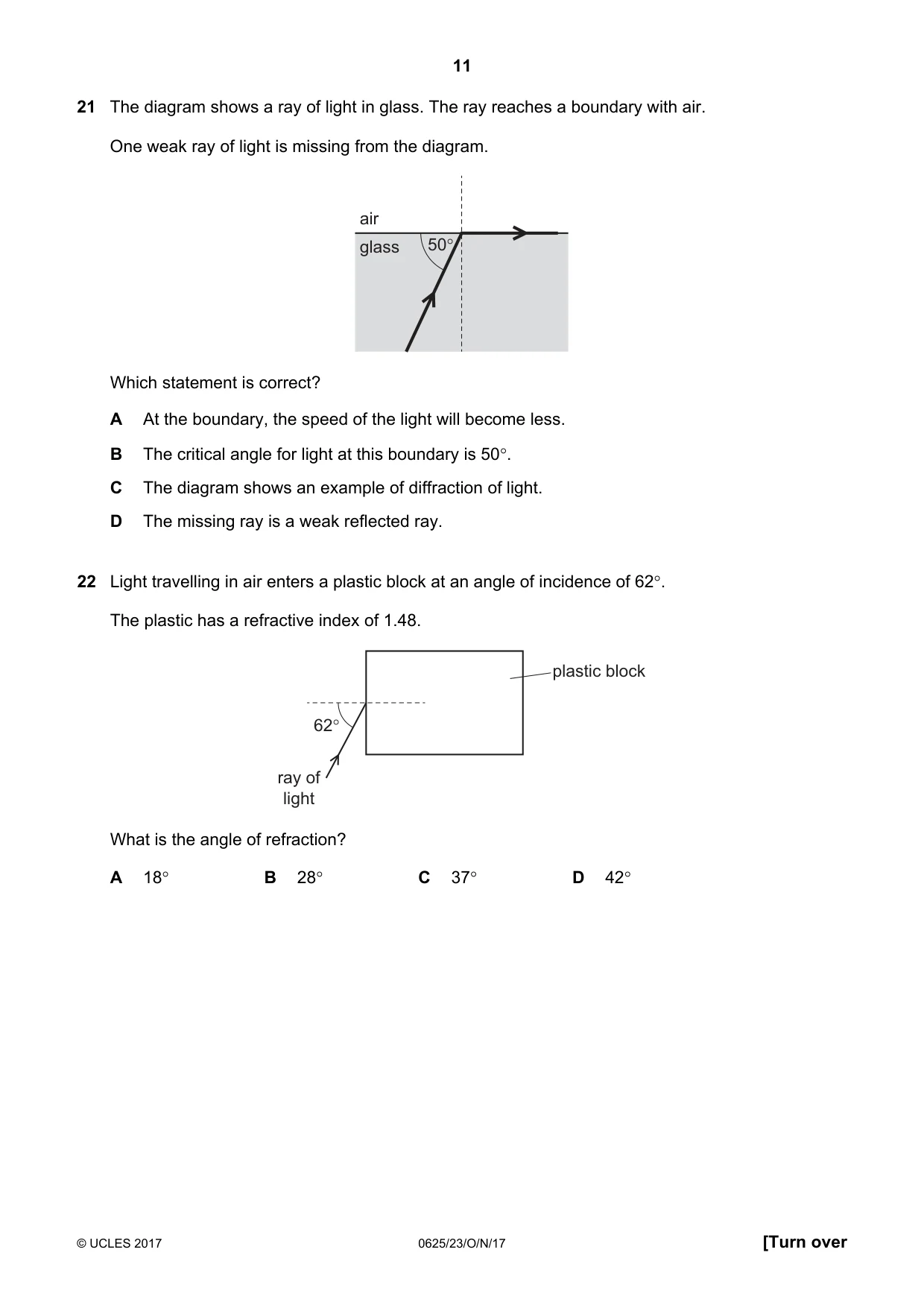
21 The diagram shows a ray of light in glass. The ray reaches a boundary with air. One weak ray of light is missing from the diagram. air glass 50° Which statement is correct? A At the boundary, the speed of the light will become less. B The critical angle for light at this boundary is 50°. C The diagram shows an example of diffraction of light. D The missing ray is a weak reflected ray.
Mark scheme: D
Q22 · Light travelling in air enters a plastic block at an angle of incidence of 62°
22 Light travelling in air enters a plastic block at an angle of incidence of 62°. The plastic has a refractive index of 1.48. plastic block 62° ray of light What is the angle of refraction? A 18° B 28° C 37° D 42°
Mark scheme: C
Q23 · A sound wave travels from a medium in one state into the same medium but in another state
23 A sound wave travels from a medium in one state into the same medium but in another state. This causes the speed of the wave to change from approximately 300 m / s to approximately 3000 m / s. Between which two states is the sound wave travelling? A gas to solid B liquid to gas C liquid to solid D solid to liquid
Mark scheme: A
Q24 · The Moon is 380 000 km from the Earth
24 The Moon is 380 000 km from the Earth. A laser light beam is directed from the Earth to the Moon. The beam is reflected back to the Earth. How long does it take for the light to travel to the Moon and back to the Earth? A 1.27 ms B 2.53 ms C 1.27 s D 2.53 s
Mark scheme: D
Q25 · Which statement about radio waves is correct?
25 Which statement about radio waves is correct? A They are used in television remote controllers. B They can be detected by the human eye. C They travel as longitudinal waves. D They have the same speed in a vacuum as ultraviolet waves.
Mark scheme: D
Q26 · The diagram shows the Earth and its surroundings
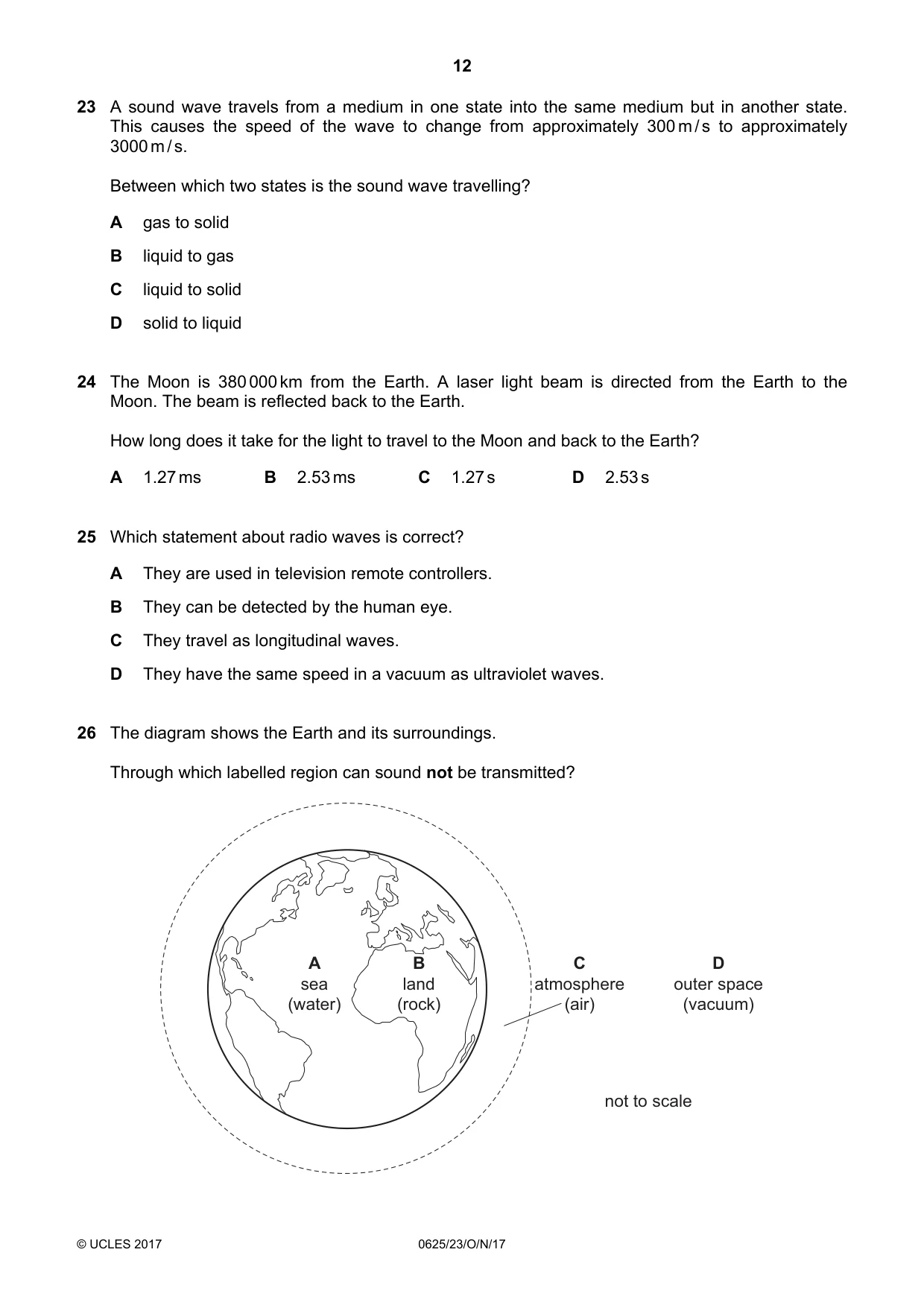
26 The diagram shows the Earth and its surroundings. Through which labelled region can sound not be transmitted? A B C D sea land atmosphere outer space (water) (rock) (air) (vacuum) not to scale
Mark scheme: D
Q27 · Different waves travel through air
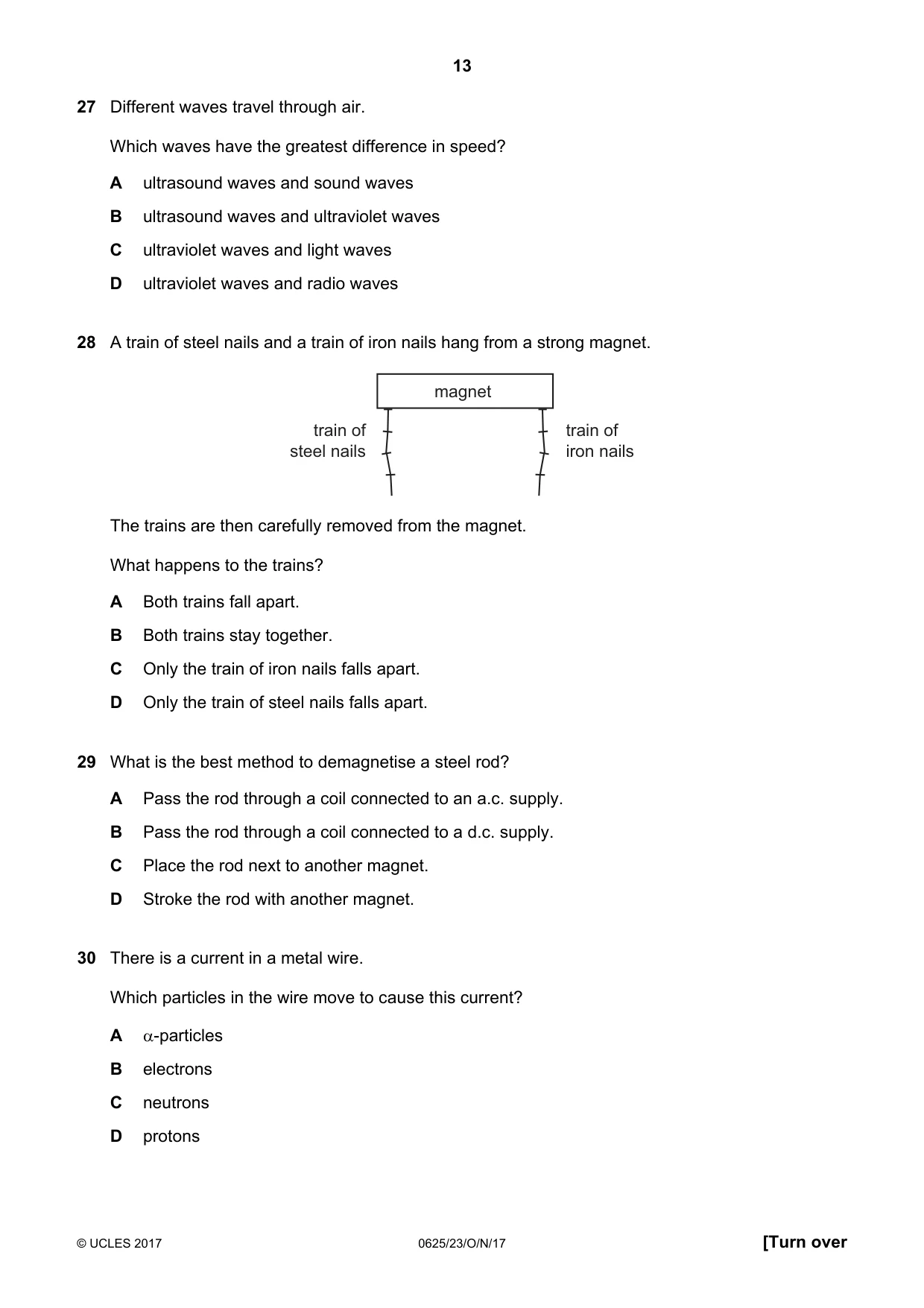
27 Different waves travel through air. Which waves have the greatest difference in speed? A ultrasound waves and sound waves B ultrasound waves and ultraviolet waves C ultraviolet waves and light waves D ultraviolet waves and radio waves
Mark scheme: B
Q28 · A train of steel nails and a train of iron nails hang from a strong magnet
28 A train of steel nails and a train of iron nails hang from a strong magnet. magnet train of train of steel nails iron nails The trains are then carefully removed from the magnet. What happens to the trains? A Both trains fall apart. B Both trains stay together. C Only the train of iron nails falls apart. D Only the train of steel nails falls apart.
Mark scheme: C
Q29 · What is the best method to demagnetise a steel rod?
29 What is the best method to demagnetise a steel rod? A Pass the rod through a coil connected to an a.c. supply. B Pass the rod through a coil connected to a d.c. supply. C Place the rod next to another magnet. D Stroke the rod with another magnet.
Mark scheme: A
Q30 · There is a current in a metal wire
30 There is a current in a metal wire. Which particles in the wire move to cause this current? A α-particles B electrons C neutrons D protons
Mark scheme: B
Q31 · The diagram shows a circuit with a gap between points P and Q
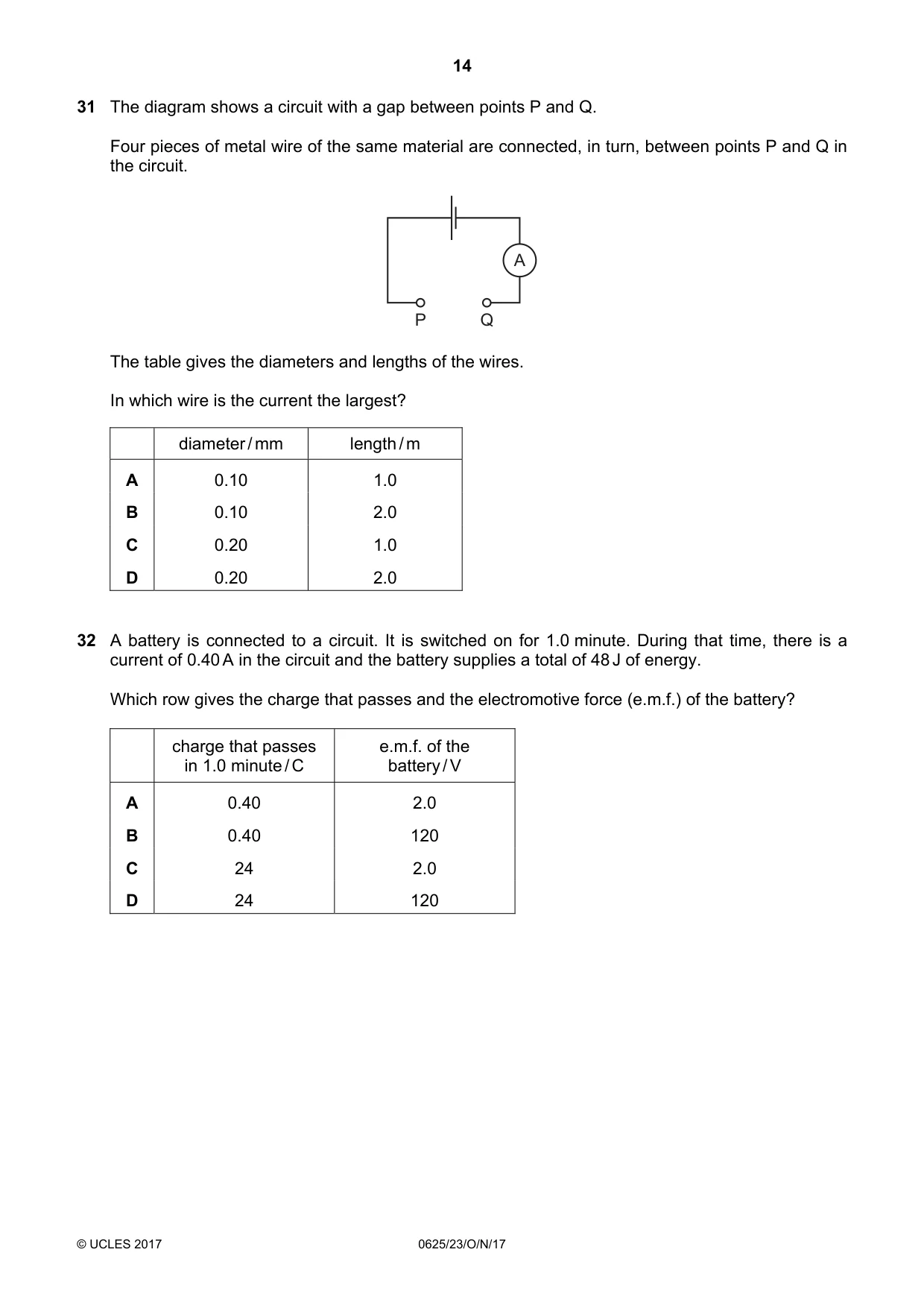
31 The diagram shows a circuit with a gap between points P and Q. Four pieces of metal wire of the same material are connected, in turn, between points P and Q in the circuit. A P Q The table gives the diameters and lengths of the wires. In which wire is the current the largest? diameter / mm length / m A 0.10 1.0 B 0.10 2.0 C 0.20 1.0 D 0.20 2.0
Mark scheme: C
Q32 · A battery is connected to a circuit
32 A battery is connected to a circuit. It is switched on for 1.0 minute. During that time, there is a current of 0.40 A in the circuit and the battery supplies a total of 48 J of energy. Which row gives the charge that passes and the electromotive force (e.m.f.) of the battery? charge that passes e.m.f. of the in 1.0 minute / C battery / V A 0.40 2.0 B 0.40 120 C 24 2.0 D 24 120
Mark scheme: C
Q33 · Identical cells and identical resistors are used to make the circuits shown
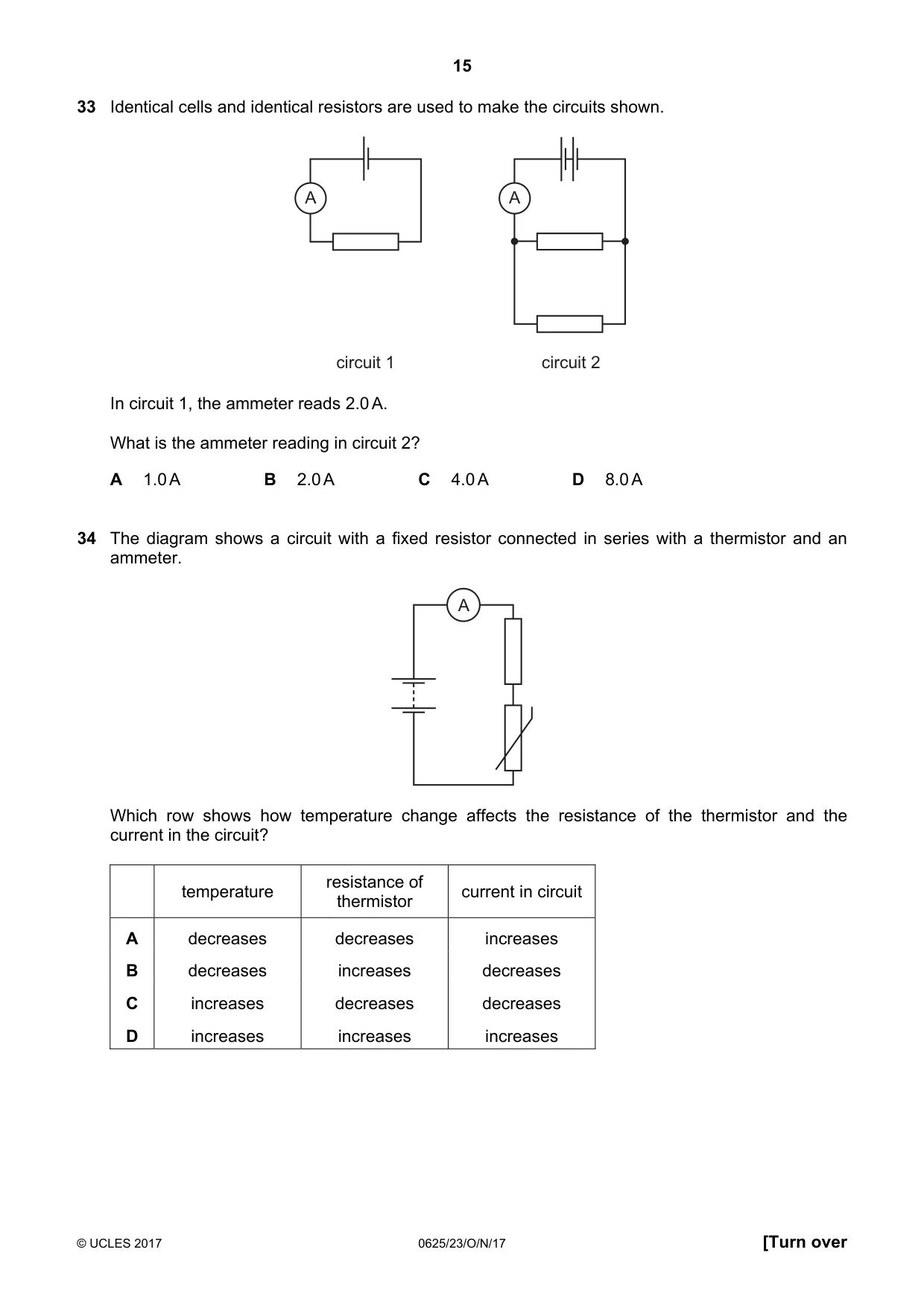
33 Identical cells and identical resistors are used to make the circuits shown. A A circuit 1 circuit 2 In circuit 1, the ammeter reads 2.0 A. What is the ammeter reading in circuit 2? A 1.0 A B 2.0 A C 4.0 A D 8.0 A
Mark scheme: D
Q34 · The diagram shows a circuit with a fixed resistor connected in series with a thermistor…
34 The diagram shows a circuit with a fixed resistor connected in series with a thermistor and an ammeter. A Which row shows how temperature change affects the resistance of the thermistor and the current in the circuit? resistance of temperature current in circuit thermistor A decreases decreases increases B decreases increases decreases C increases decreases decreases D increases increases increases
Mark scheme: B
Q35 · The diagram shows an AND gate and an OR gate connected together
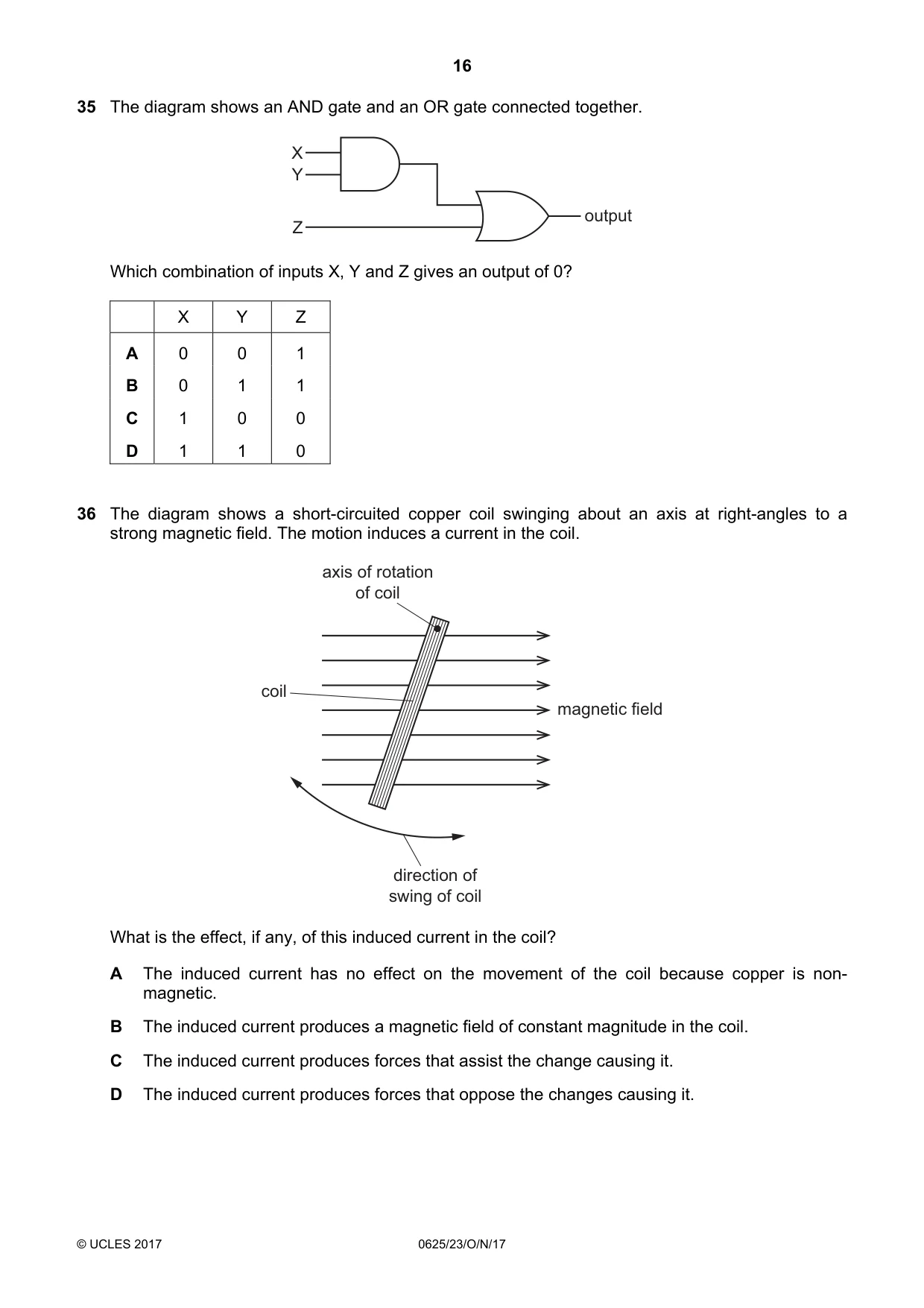
35 The diagram shows an AND gate and an OR gate connected together. X Y output Z Which combination of inputs X, Y and Z gives an output of 0? X Y Z A 0 0 1 B 0 1 1 C 1 0 0 D 1 1 0
Mark scheme: C
Q36 · The diagram shows a short-circuited copper coil swinging about an axis at right-angles to…
36 The diagram shows a short-circuited copper coil swinging about an axis at right-angles to a strong magnetic field. The motion induces a current in the coil. axis of rotation of coil coil magnetic field direction of swing of coil What is the effect, if any, of this induced current in the coil? A The induced current has no effect on the movement of the coil because copper is non- magnetic. B The induced current produces a magnetic field of constant magnitude in the coil. C The induced current produces forces that assist the change causing it. D The induced current produces forces that oppose the changes causing it.
Mark scheme: D
Q37 · A magnet being pushed into a coil that is connected to a centre-zero galvanometer
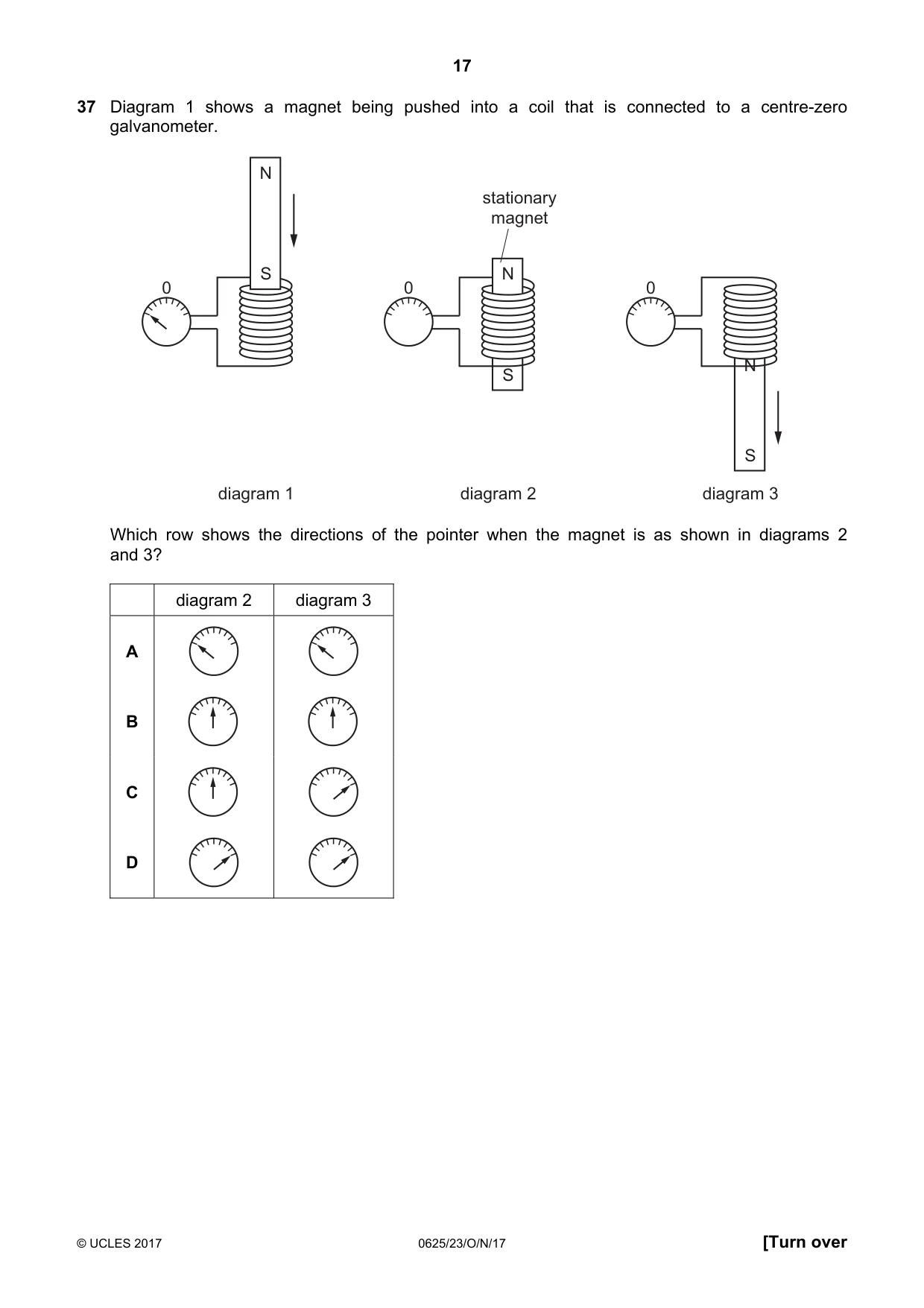
37 Diagram 1 shows a magnet being pushed into a coil that is connected to a centre-zero galvanometer. N stationary magnet S N 0 0 0 N S S diagram 1 diagram 2 diagram 3 Which row shows the directions of the pointer when the magnet is as shown in diagrams 2 and 3? diagram 2 diagram 3 A B C D
Mark scheme: C
Q38 · Radioactive carbon-14 decays to nitrogen-14 by the emission of a particle
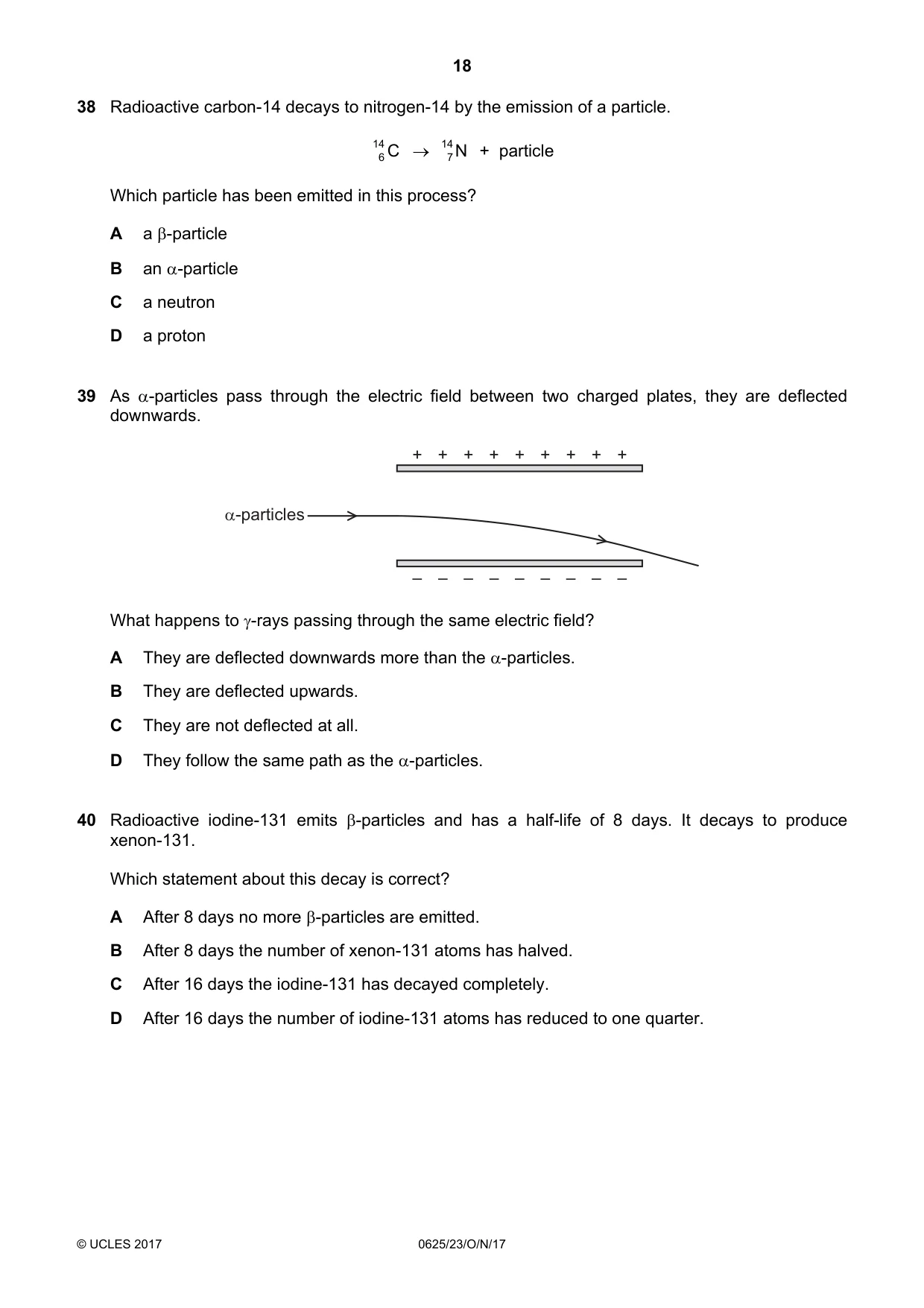
38 Radioactive carbon-14 decays to nitrogen-14 by the emission of a particle. 14 C → 14 N + particle 6 7 Which particle has been emitted in this process? A a β-particle B an α-particle C a neutron D a proton
Mark scheme: A
Q39 · As α-particles pass through the electric field between two charged plates, they are…
39 As α-particles pass through the electric field between two charged plates, they are deflected downwards. + + + + + + + + + α-particles – – – – – – – – – What happens to γ-rays passing through the same electric field? A They are deflected downwards more than the α-particles. B They are deflected upwards. C They are not deflected at all. D They follow the same path as the α-particles.
Mark scheme: C
Q40 · Radioactive iodine-131 emits β-particles and has a half-life of 8 days
40 Radioactive iodine-131 emits β-particles and has a half-life of 8 days. It decays to produce xenon-131. Which statement about this decay is correct? A After 8 days no more β-particles are emitted. B After 8 days the number of xenon-131 atoms has halved. C After 16 days the iodine-131 has decayed completely. D After 16 days the number of iodine-131 atoms has reduced to one quarter.
Mark scheme: D
What was in this paper
The subtopics covered by these 40 questions, and how many questions each got. Open one in a new tab to see every Cambridge question on it.
6Electric circuits3Electrical quantities3Energy, work and power3Light3Radioactivity3Electromagnetic effects2Electromagnetic spectrum2Physical quantities and measurement techniques2Pressure2Simple phenomena of magnetism2Sound2Thermal properties and temperature2General properties of waves1Kinetic particle model of matter1Mass and weight1Motion1Transfer of thermal energy1What you needed in this session
Cambridge’s own grade thresholds for 2017 Oct/Nov, Paper 2 · Variant 3. A higher threshold means an easier paper — the bar moves with how the cohort did.