Cambridge IGCSE Physics 0625 — 2022 May/June Paper 2 · Variant 2
0625/22/M/J/22 · 40 questions · 40 marks · ≈45 min
The question paper and its mark scheme, free to read here and free to download. This is Cambridge’s own paper, exactly as it was sat.
Question paper20 pages

Mark scheme3 pages
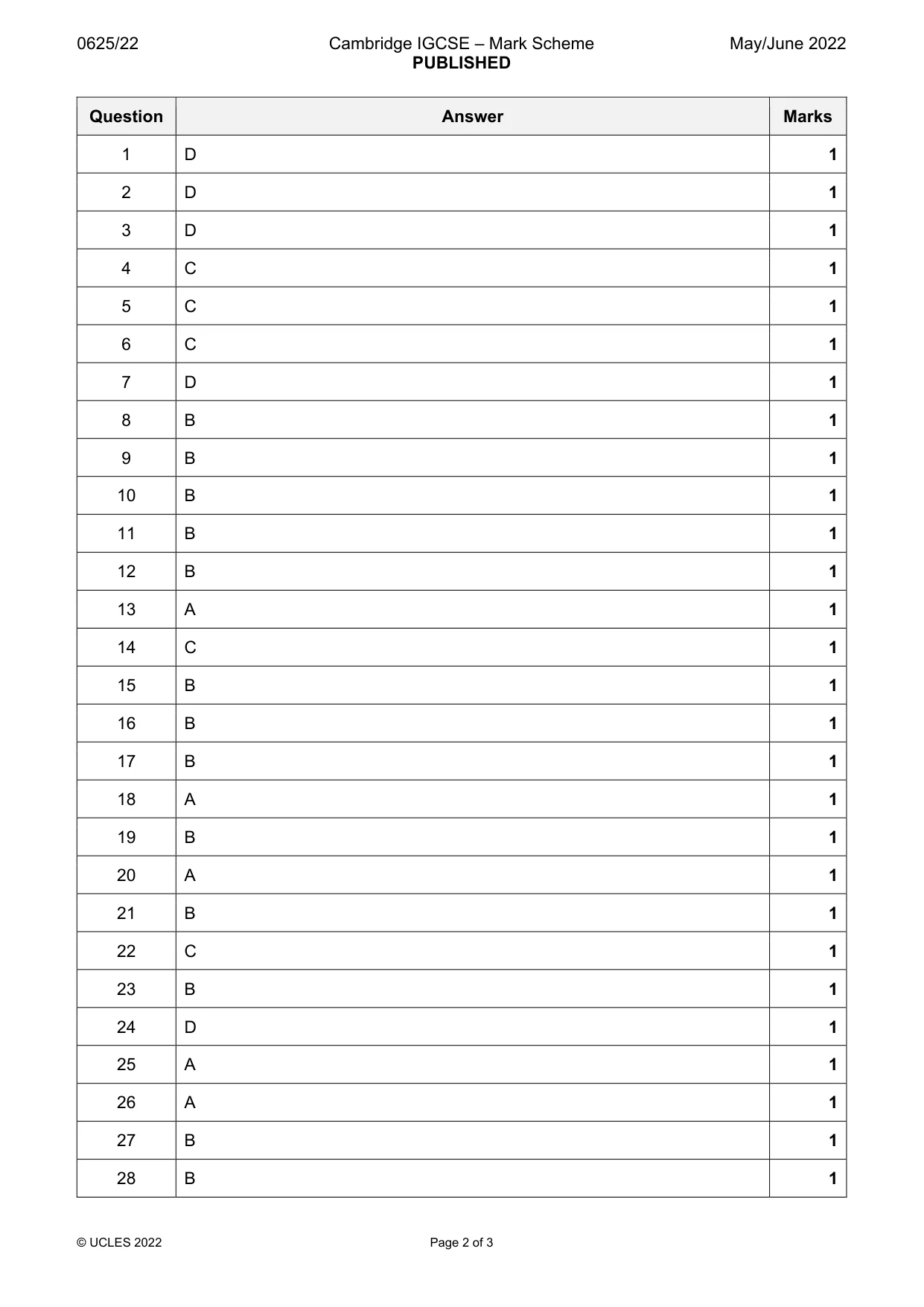
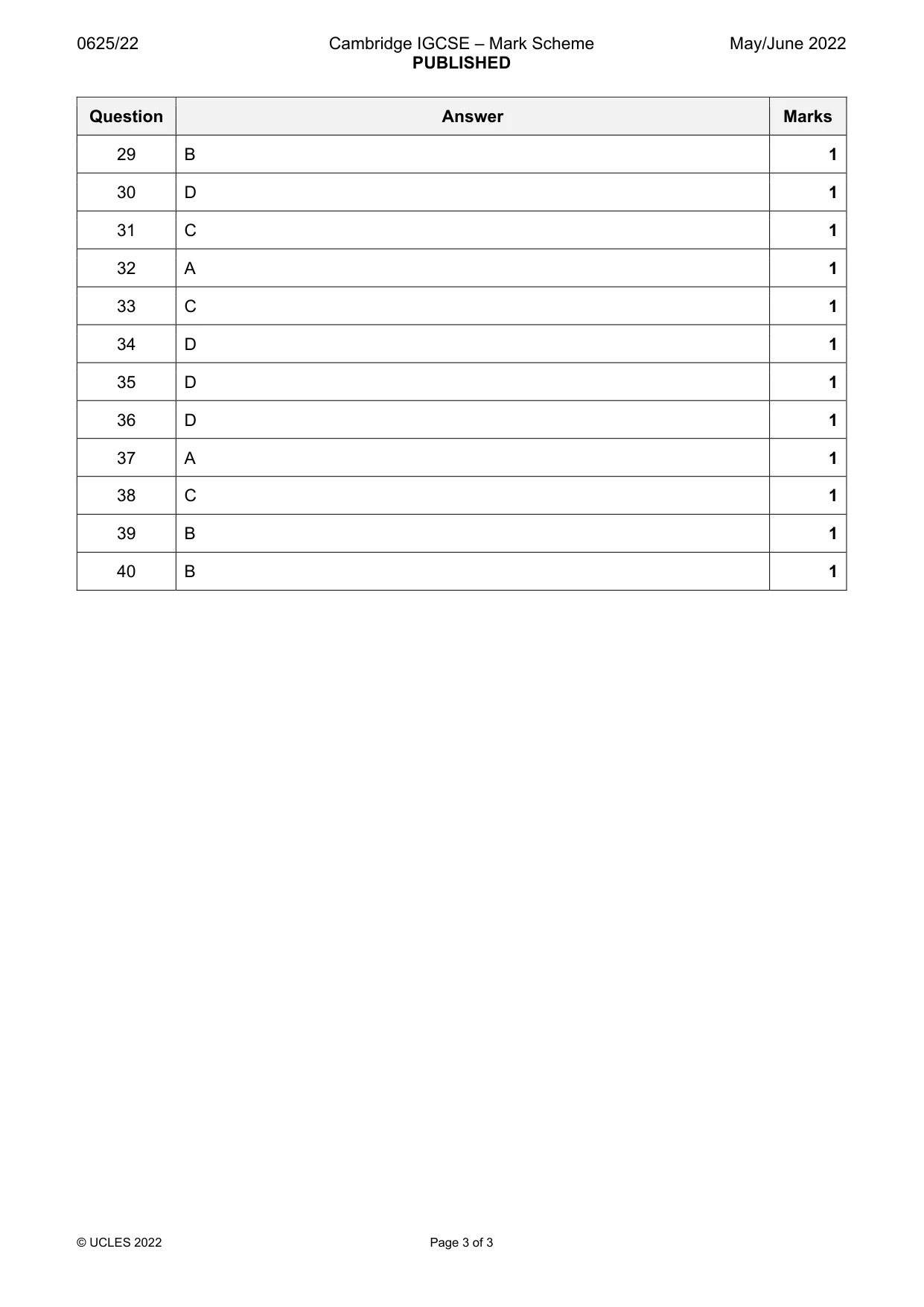
Answers below. Sit the paper first if you are practising.
Questions as text
Q1 · Very small values of which quantity are measured using a micrometer screw gauge?
1 Very small values of which quantity are measured using a micrometer screw gauge? A time B pressure C moment D distance
Mark scheme: D
More questions on Physical quantities and measurement techniques
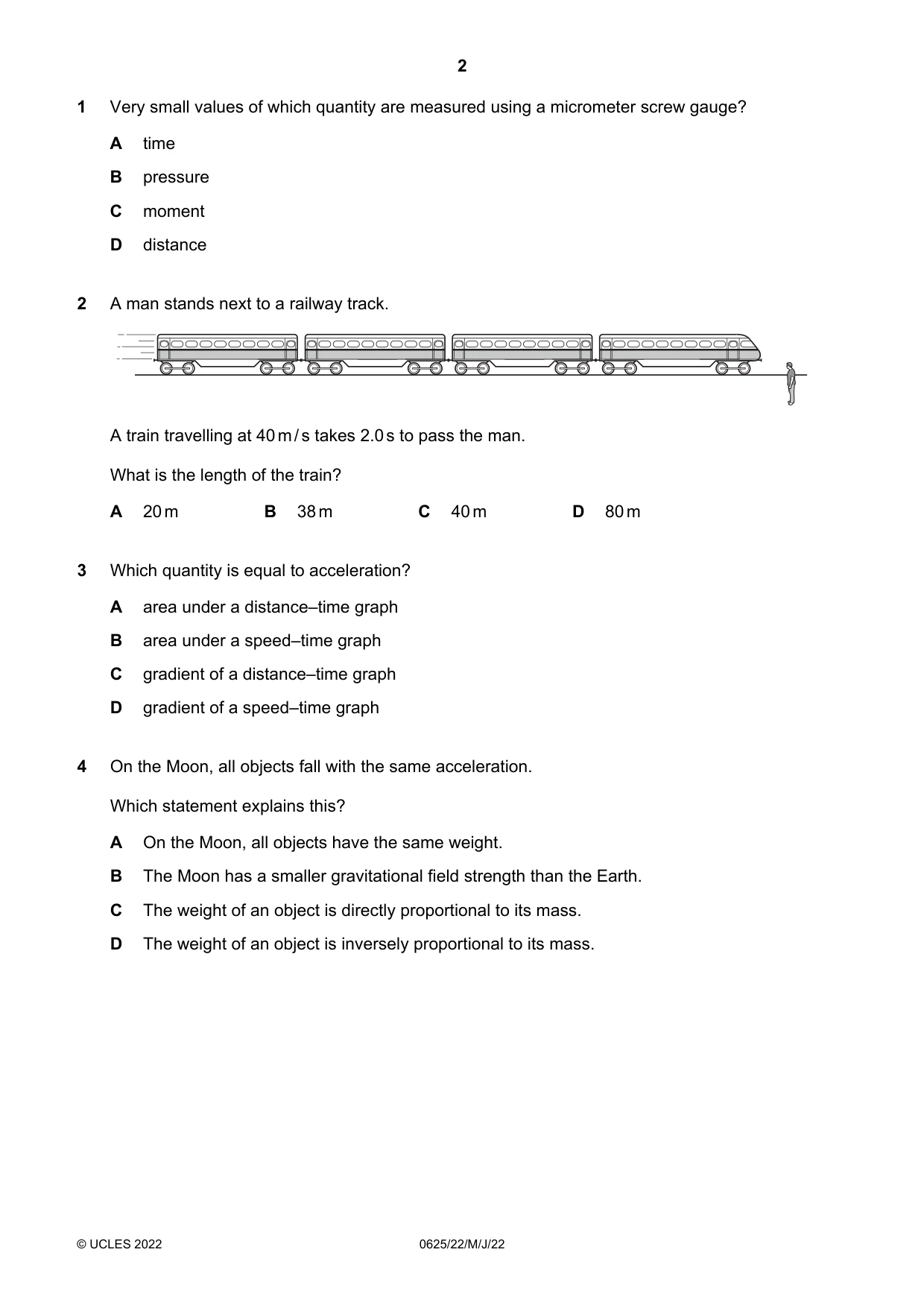
Q2 · A man stands next to a railway track
2 A man stands next to a railway track. A train travelling at 40 m / s takes 2.0 s to pass the man. What is the length of the train? A 20 m B 38 m C 40 m D 80 m
Mark scheme: D
Q3 · Which quantity is equal to acceleration?
3 Which quantity is equal to acceleration? A area under a distance–time graph B area under a speed–time graph C gradient of a distance–time graph D gradient of a speed–time graph
Mark scheme: D
Q4 · On the Moon, all objects fall with the same acceleration
4 On the Moon, all objects fall with the same acceleration. Which statement explains this? A On the Moon, all objects have the same weight. B The Moon has a smaller gravitational field strength than the Earth. C The weight of an object is directly proportional to its mass. D The weight of an object is inversely proportional to its mass.
Mark scheme: C
Q5 · A measuring cylinder contains 30 cm3 of a liquid
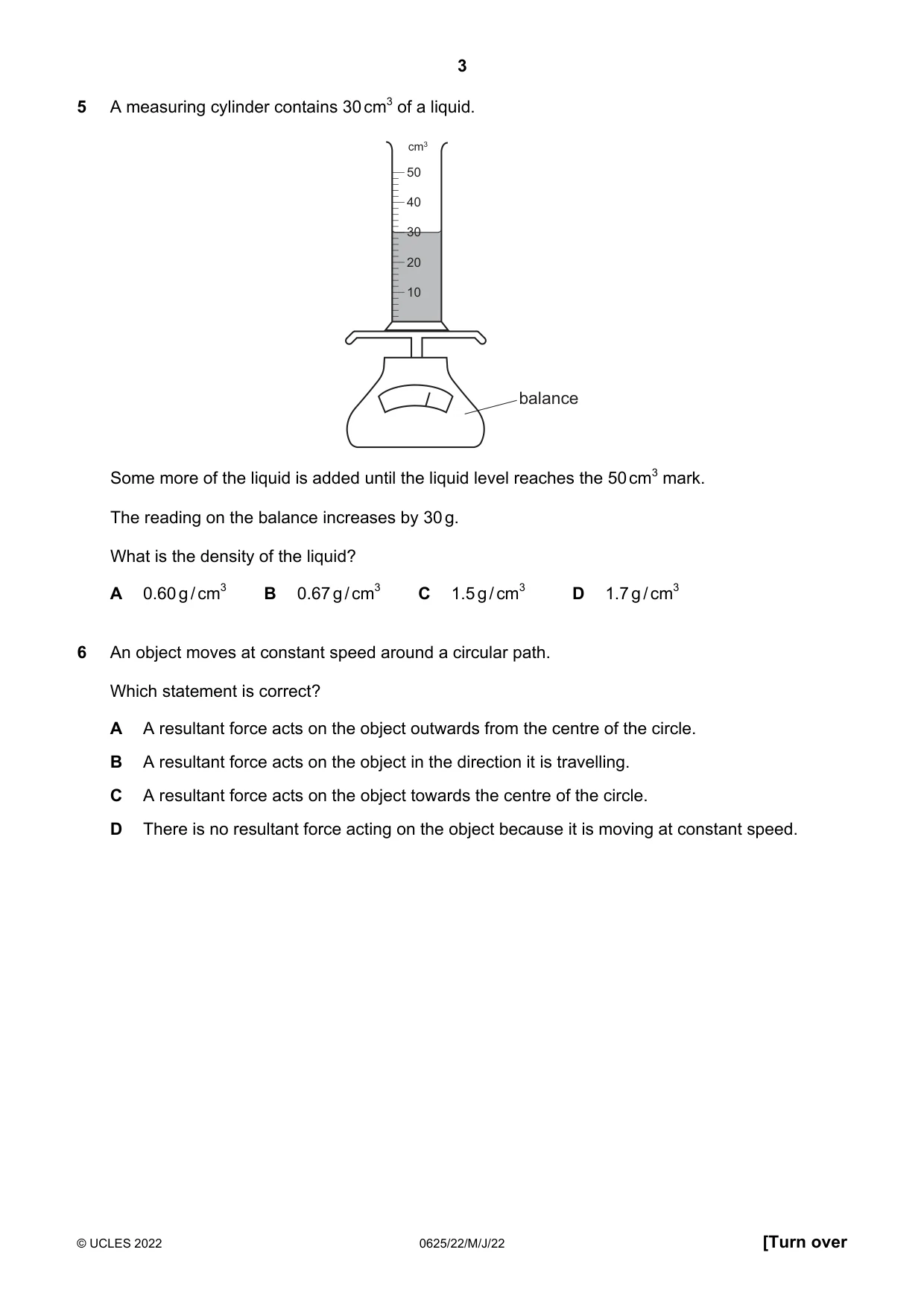
5 A measuring cylinder contains 30 cm3 of a liquid. cm3 50 40 30 20 10 balance Some more of the liquid is added until the liquid level reaches the 50 cm3 mark. The reading on the balance increases by 30 g. What is the density of the liquid? A 0.60 g / cm3 B 0.67 g / cm3 C 1.5 g / cm3 D 1.7 g / cm3
Mark scheme: C
Q6 · An object moves at constant speed around a circular path
6 An object moves at constant speed around a circular path. Which statement is correct? A A resultant force acts on the object outwards from the centre of the circle. B A resultant force acts on the object in the direction it is travelling. C A resultant force acts on the object towards the centre of the circle. D There is no resultant force acting on the object because it is moving at constant speed.
Mark scheme: C
Q7 · A beam is pivoted at one end, as shown
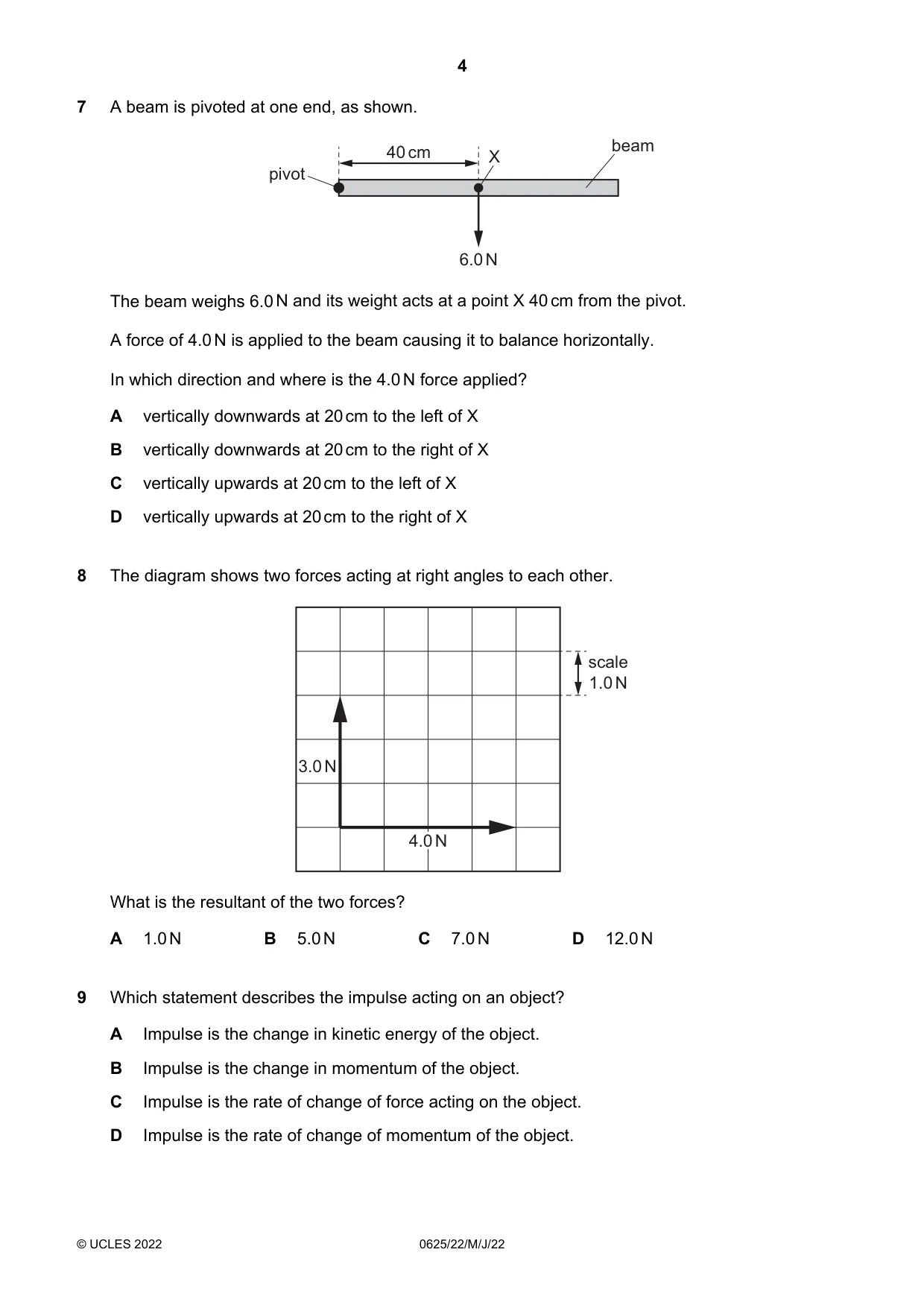
7 A beam is pivoted at one end, as shown. 40 cm beam X pivot 6.0 N The beam weighs 6.0 N and its weight acts at a point X 40 cm from the pivot. A force of 4.0 N is applied to the beam causing it to balance horizontally. In which direction and where is the 4.0 N force applied? A vertically downwards at 20 cm to the left of X B vertically downwards at 20 cm to the right of X C vertically upwards at 20 cm to the left of X D vertically upwards at 20 cm to the right of X
Mark scheme: D
Q8 · The diagram shows two forces acting at right angles to each other
8 The diagram shows two forces acting at right angles to each other. scale 1.0 N 3.0 N 4.0 N What is the resultant of the two forces? A 1.0 N B 5.0 N C 7.0 N D 12.0 N
Mark scheme: B
Q9 · Which statement describes the impulse acting on an object?
9 Which statement describes the impulse acting on an object? A Impulse is the change in kinetic energy of the object. B Impulse is the change in momentum of the object. C Impulse is the rate of change of force acting on the object. D Impulse is the rate of change of momentum of the object.
Mark scheme: B
Q10 · A ball of mass 0.16 kg is moving forwards at a speed of 0.50 m / s
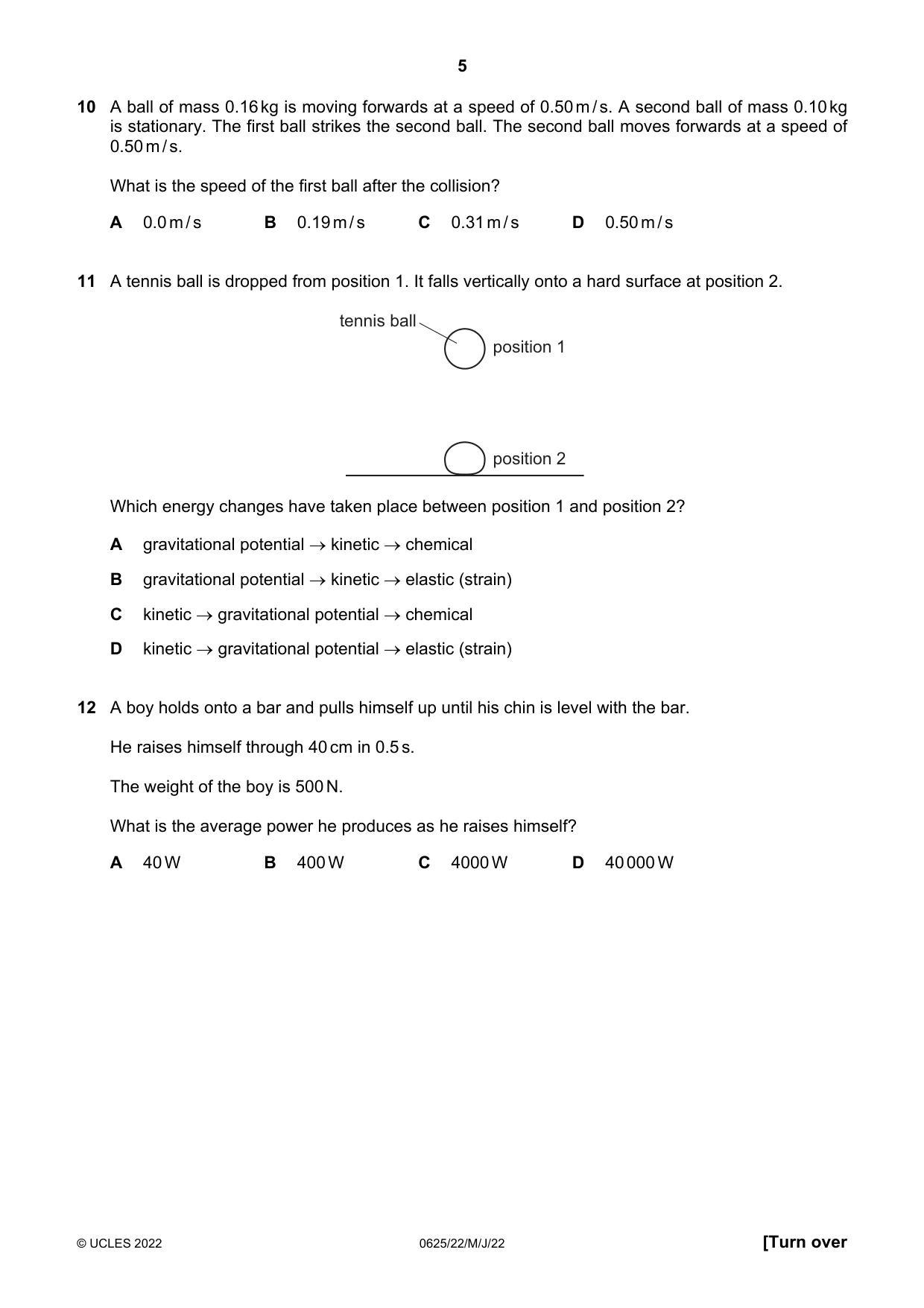
10 A ball of mass 0.16 kg is moving forwards at a speed of 0.50 m / s. A second ball of mass 0.10 kg is stationary. The first ball strikes the second ball. The second ball moves forwards at a speed of 0.50 m / s. What is the speed of the first ball after the collision? A 0.0 m / s B 0.19 m / s C 0.31 m / s D 0.50 m / s
Mark scheme: B
Q11 · A tennis ball is dropped from position 1
11 A tennis ball is dropped from position 1. It falls vertically onto a hard surface at position 2. tennis ball position 1 position 2 Which energy changes have taken place between position 1 and position 2? A gravitational potential → kinetic → chemical B gravitational potential → kinetic → elastic (strain) C kinetic → gravitational potential → chemical D kinetic → gravitational potential → elastic (strain)
Mark scheme: B
Q12 · A boy holds onto a bar and pulls himself up until his chin is level with the bar
12 A boy holds onto a bar and pulls himself up until his chin is level with the bar. He raises himself through 40 cm in 0.5 s. The weight of the boy is 500 N. What is the average power he produces as he raises himself? A 40 W B 400 W C 4000 W D 40 000 W
Mark scheme: B
Q13 · The diagram shows a deep reservoir formed by a dam
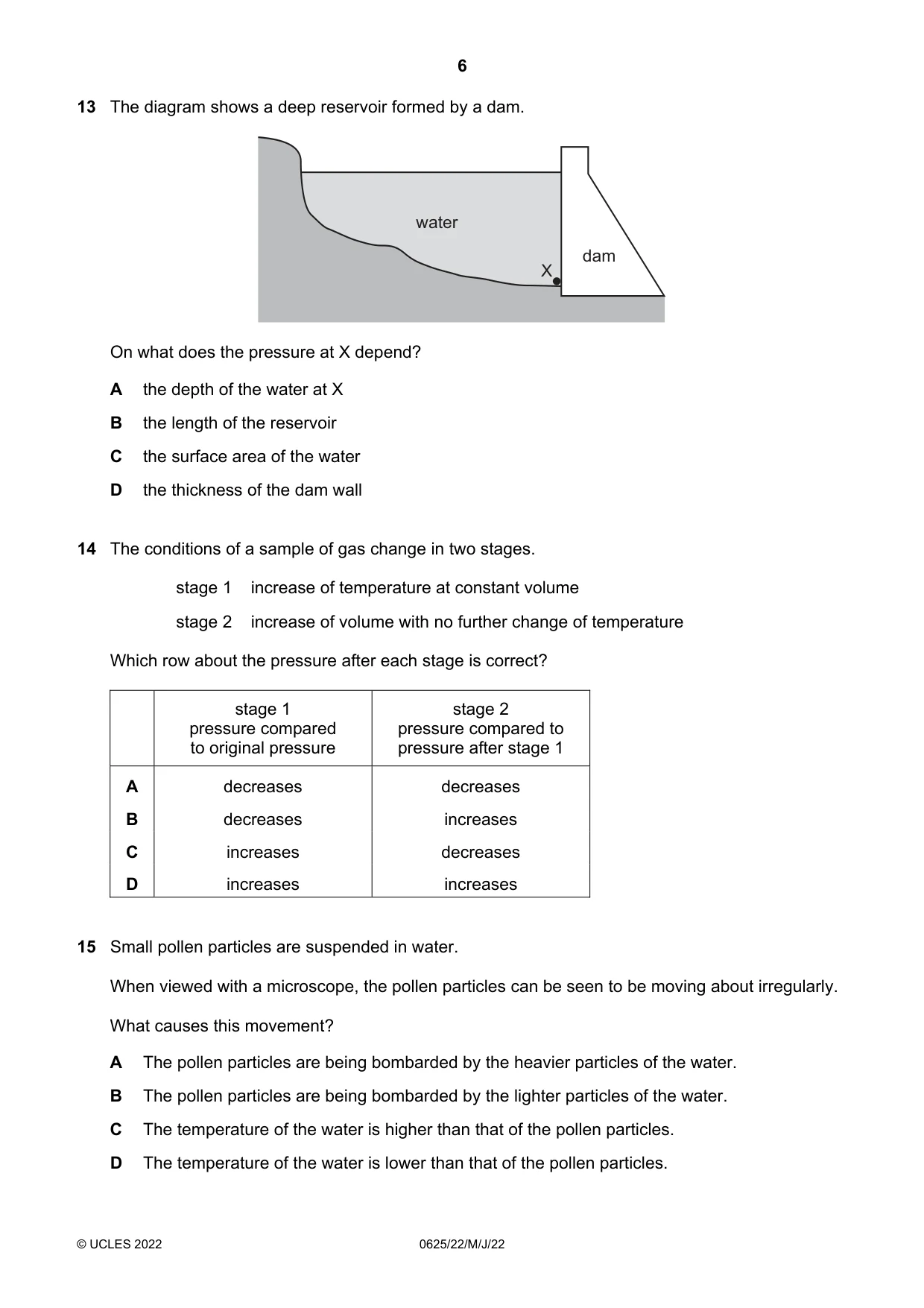
13 The diagram shows a deep reservoir formed by a dam. water dam X On what does the pressure at X depend? A the depth of the water at X B the length of the reservoir C the surface area of the water D the thickness of the dam wall
Mark scheme: A
Q14 · The conditions of a sample of gas change in two stages
14 The conditions of a sample of gas change in two stages. stage 1 increase of temperature at constant volume stage 2 increase of volume with no further change of temperature Which row about the pressure after each stage is correct? stage 1 stage 2 pressure compared pressure compared to to original pressure pressure after stage 1 A decreases decreases B decreases increases C increases decreases D increases increases
Mark scheme: C
Q15 · Small pollen particles are suspended in water
15 Small pollen particles are suspended in water. When viewed with a microscope, the pollen particles can be seen to be moving about irregularly. What causes this movement? A The pollen particles are being bombarded by the heavier particles of the water. B The pollen particles are being bombarded by the lighter particles of the water. C The temperature of the water is higher than that of the pollen particles. D The temperature of the water is lower than that of the pollen particles.
Mark scheme: B
Q16 · The diagram shows a liquid-in-glass thermometer
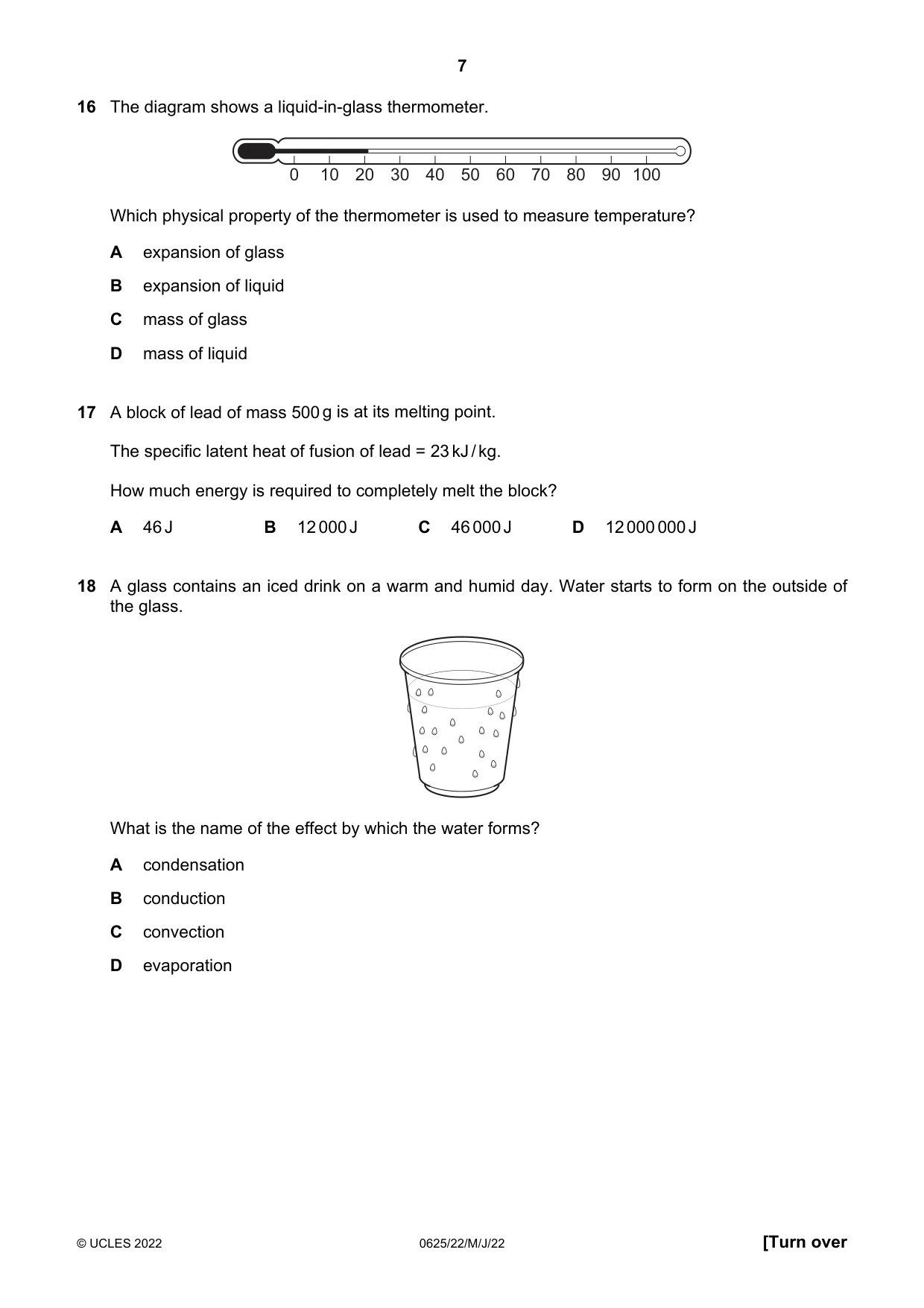
16 The diagram shows a liquid-in-glass thermometer. 0 10 20 30 40 50 60 70 80 90 100 Which physical property of the thermometer is used to measure temperature? A expansion of glass B expansion of liquid C mass of glass D mass of liquid
Mark scheme: B
Q17 · A block of lead of mass 500 g is at its melting point
17 A block of lead of mass 500 g is at its melting point. The specific latent heat of fusion of lead = 23 kJ / kg. How much energy is required to completely melt the block? A 46 J B 12 000 J C 46 000 J D 12 000 000 J
Mark scheme: B
Q18 · A glass contains an iced drink on a warm and humid day
18 A glass contains an iced drink on a warm and humid day. Water starts to form on the outside of the glass. What is the name of the effect by which the water forms? A condensation B conduction C convection D evaporation
Mark scheme: A
Q19 · One end of a copper bar is heated to a high temperature
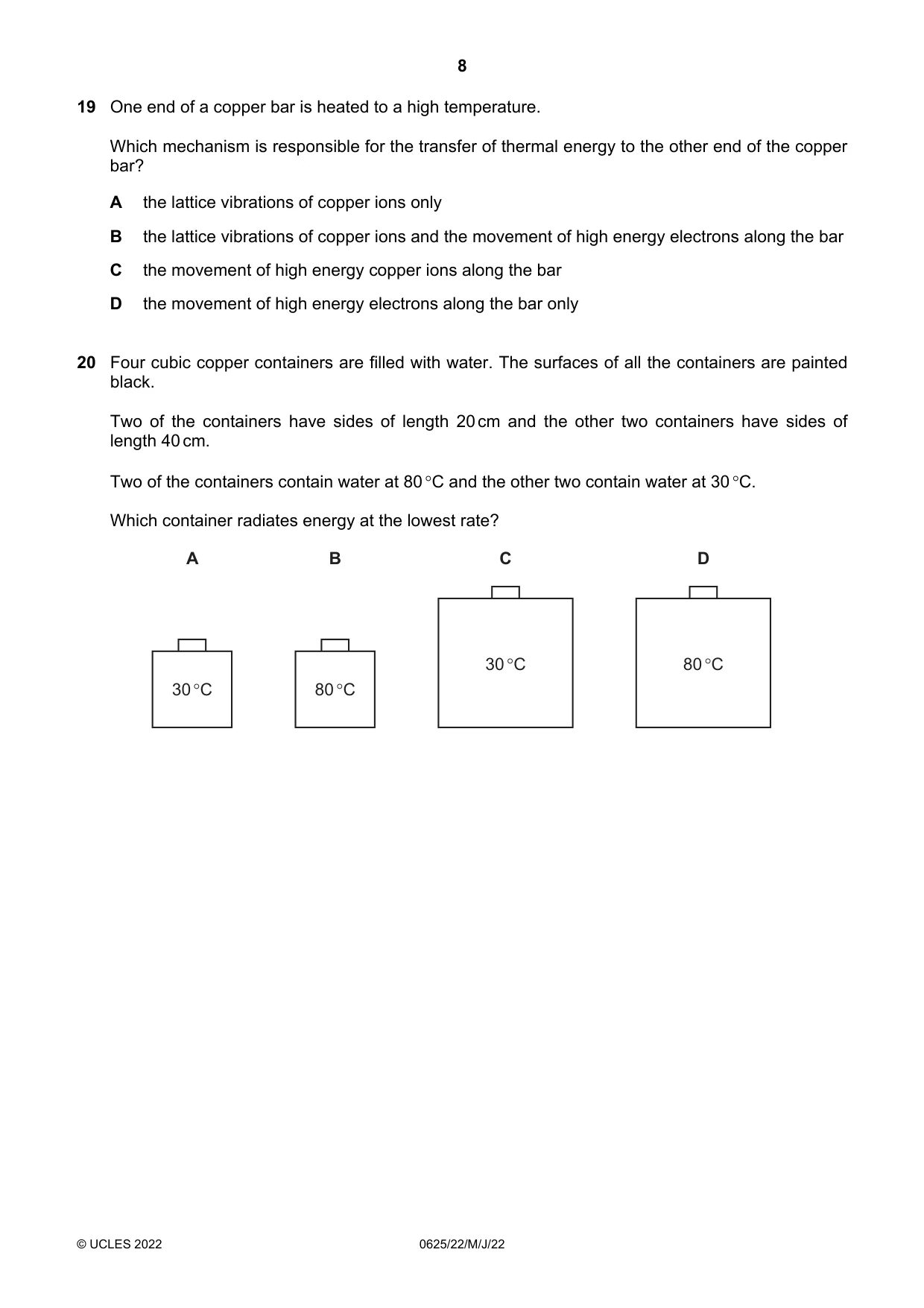
19 One end of a copper bar is heated to a high temperature. Which mechanism is responsible for the transfer of thermal energy to the other end of the copper bar? A the lattice vibrations of copper ions only B the lattice vibrations of copper ions and the movement of high energy electrons along the bar C the movement of high energy copper ions along the bar D the movement of high energy electrons along the bar only
Mark scheme: B
Q20 · Four cubic copper containers are filled with water
20 Four cubic copper containers are filled with water. The surfaces of all the containers are painted black. Two of the containers have sides of length 20cm and the other two containers have sides of length 40cm. Two of the containers contain water at 80°C and the other two contain water at 30°C. Which container radiates energy at the lowest rate? A B Cc D || | | | 30°C 80°C 30°C 80°C
Mark scheme: A
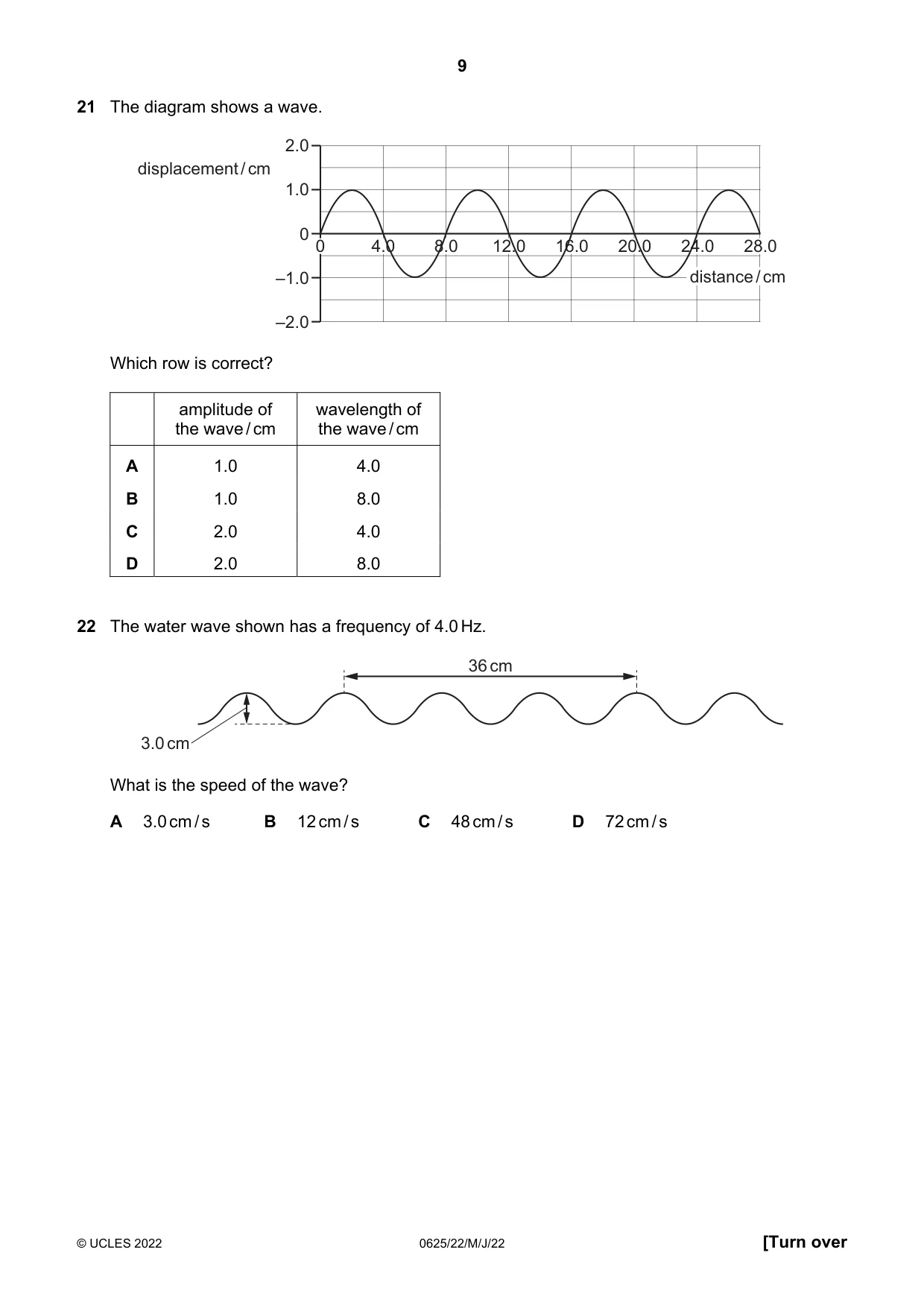
Q21 · The diagram shows a wave
21 The diagram shows a wave. 2.0 displacement / cm 1.0 0 0 4.0 8.0 12.0 16.0 20.0 24.0 28.0 –1.0 distance / cm –2.0 Which row is correct? amplitude of wavelength of the wave / cm the wave / cm A 1.0 4.0 B 1.0 8.0 C 2.0 4.0 D 2.0 8.0
Mark scheme: B
Q22 · The water wave shown has a frequency of 4.0 Hz
22 The water wave shown has a frequency of 4.0 Hz. 36 cm 3.0 cm What is the speed of the wave? A 3.0 cm / s B 12 cm / s C 48 cm / s D 72 cm / s
Mark scheme: C
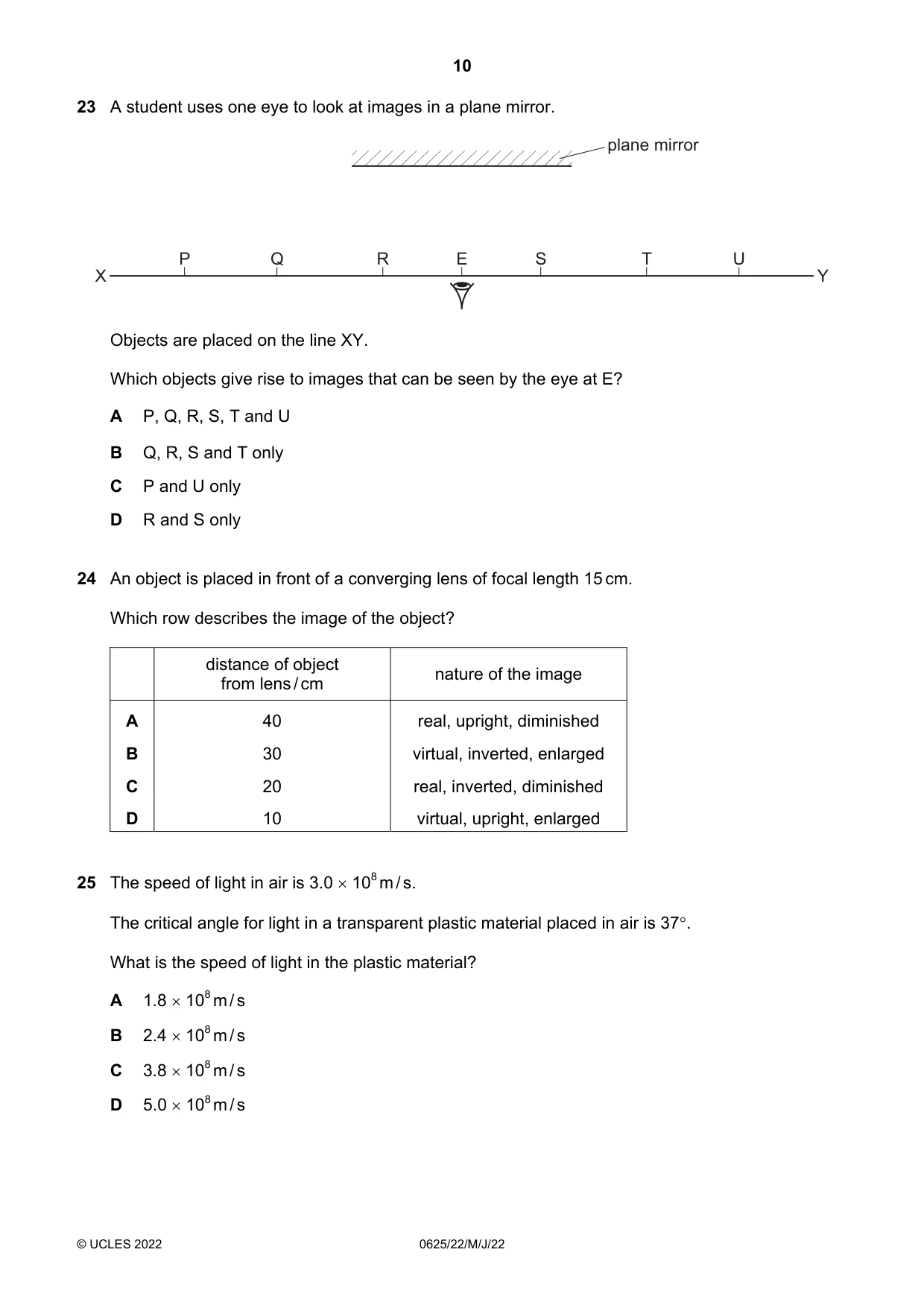
Q23 · A student uses one eye to look at images in a plane mirror
23 A student uses one eye to look at images in a plane mirror. plane mirror P Q R E S T U X Y Objects are placed on the line XY. Which objects give rise to images that can be seen by the eye at E? A P, Q, R, S, T and U B Q, R, S and T only C P and U only D R and S only
Mark scheme: B
Q24 · An object is placed in front of a converging lens of focal length 15 cm
24 An object is placed in front of a converging lens of focal length 15 cm. Which row describes the image of the object? distance of object nature of the image from lens / cm A 40 real, upright, diminished B 30 virtual, inverted, enlarged C 20 real, inverted, diminished D 10 virtual, upright, enlarged
Mark scheme: D
Q25 · The speed of light in air is 3.0 × 10⁸ m / s
25 The speed of light in air is 3.0 × 10⁸ m / s. The critical angle for light in a transparent plastic material placed in air is 37°. What is the speed of light in the plastic material? A 1.8 × 10⁸ m / s B 2.4 × 10⁸ m / s C 3.8 × 10⁸ m / s D 5.0 × 10⁸ m / s
Mark scheme: A
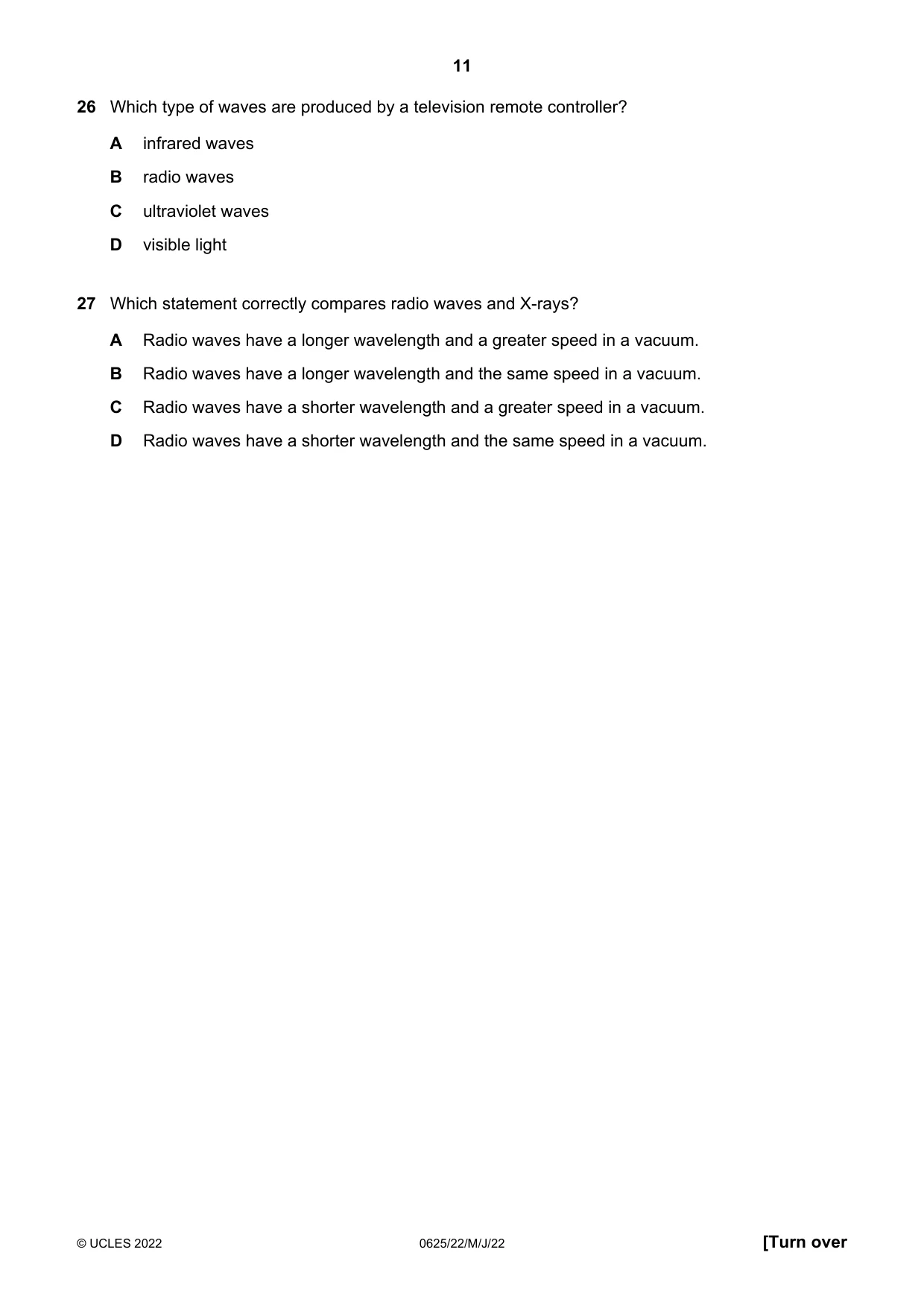
Q26 · Which type of waves are produced by a television remote controller?
26 Which type of waves are produced by a television remote controller? A infrared waves B radio waves C ultraviolet waves D visible light
Mark scheme: A
Q27 · Which statement correctly compares radio waves and X-rays?
27 Which statement correctly compares radio waves and X-rays? A Radio waves have a longer wavelength and a greater speed in a vacuum. B Radio waves have a longer wavelength and the same speed in a vacuum. C Radio waves have a shorter wavelength and a greater speed in a vacuum. D Radio waves have a shorter wavelength and the same speed in a vacuum.
Mark scheme: B
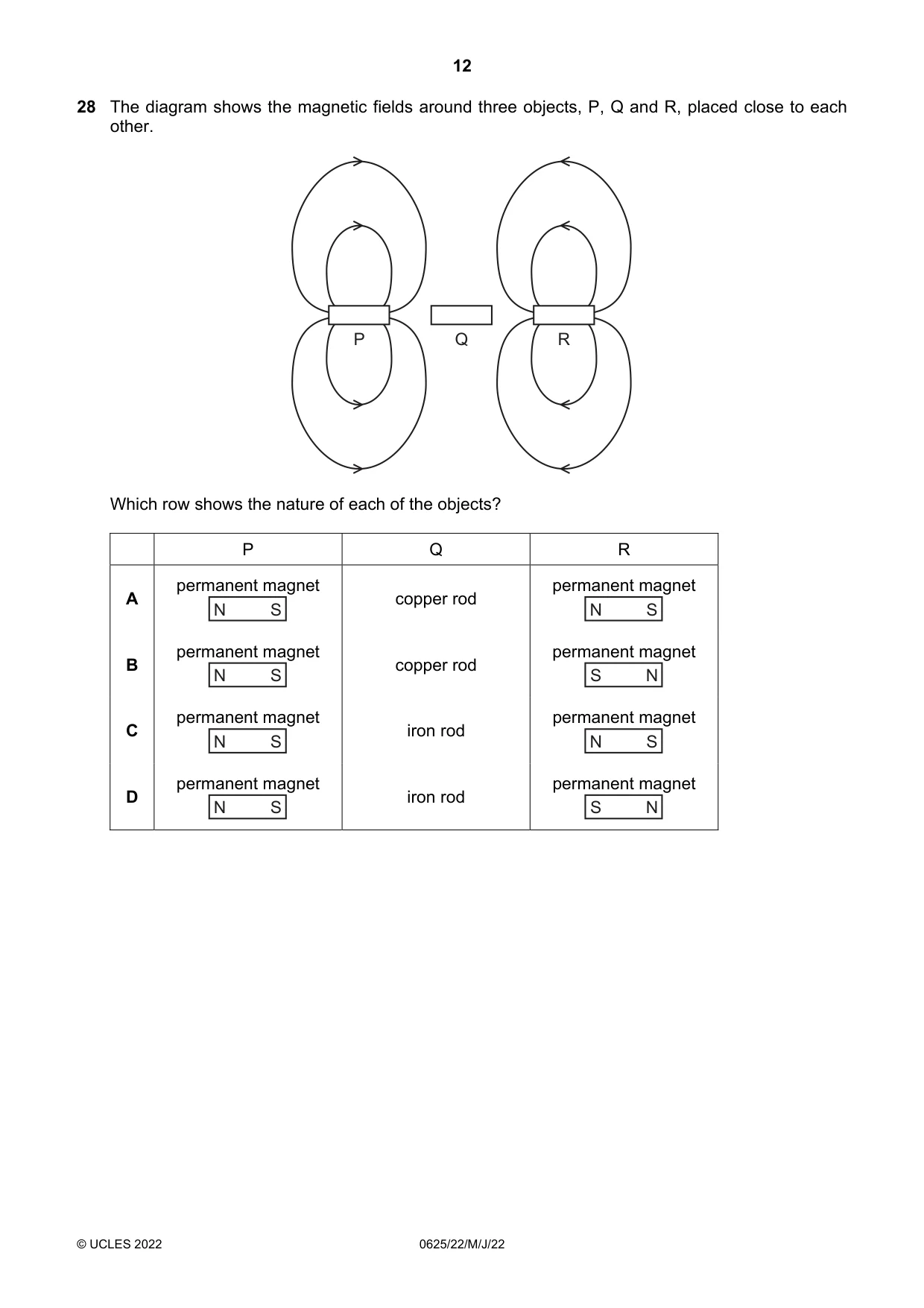
Q28 · The diagram shows the magnetic fields around three objects, P, Q and R, placed close to…
28 The diagram shows the magnetic fields around three objects, P, Q and R, placed close to each other. P Q R Which row shows the nature of each of the objects? P Q R permanent magnet permanent magnet A copper rod N S N S permanent magnet permanent magnet B copper rod N S S N permanent magnet permanent magnet C iron rod N S N S permanent magnet permanent magnet D iron rod N S S N
Mark scheme: B
Q29 · A negatively charged rod is brought near to an uncharged metal sphere that is placed on…
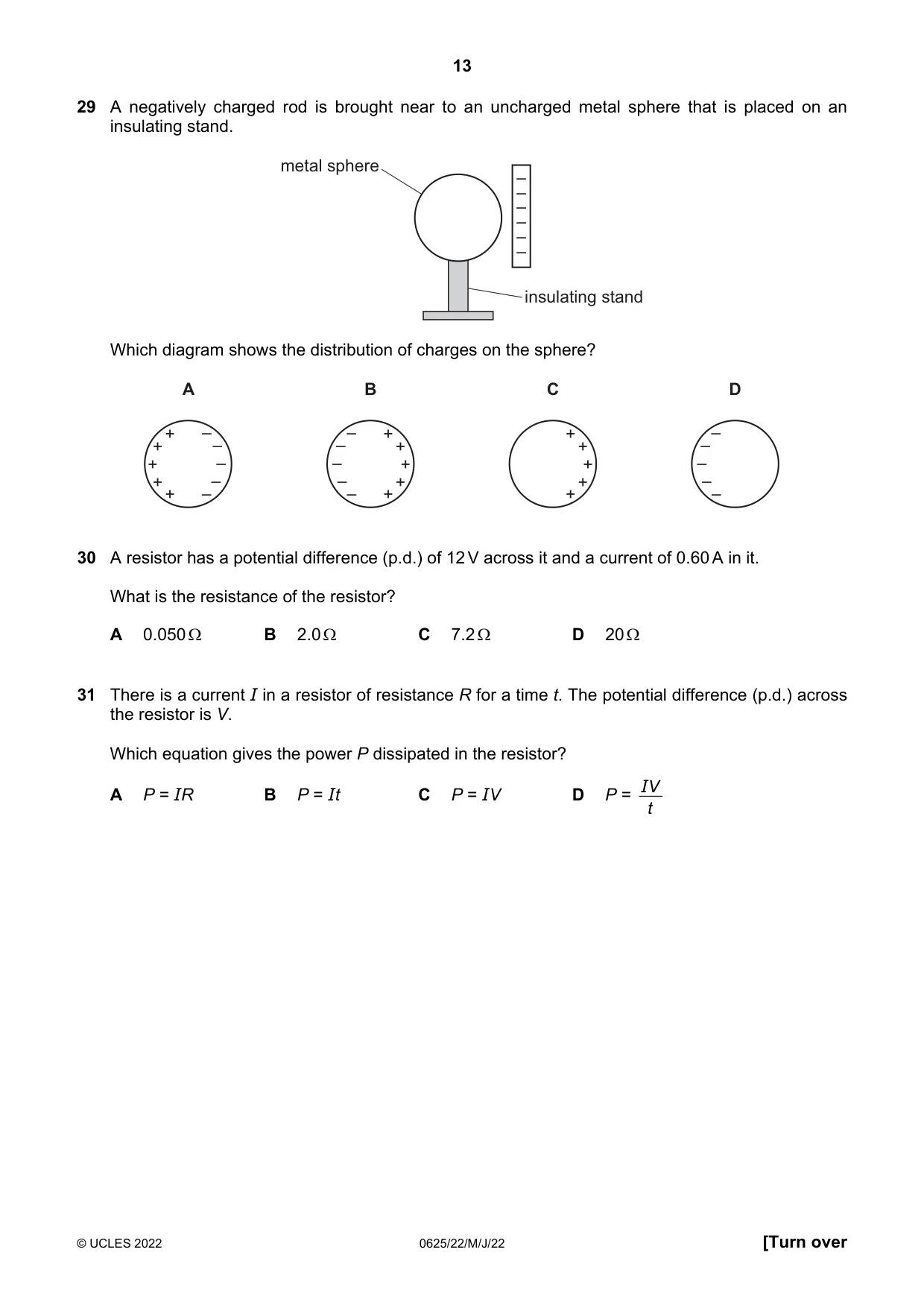
29 A negatively charged rod is brought near to an uncharged metal sphere that is placed on an insulating stand. metal sphere – – – – – – insulating stand Which diagram shows the distribution of charges on the sphere? A B C D + – – + + – + – – + + – + – – + + – + –– –– + + –– + + +
Mark scheme: B
Q30 · A resistor has a potential difference (p.d.) of 12 V across it and a current of 0.60 A in…
30 A resistor has a potential difference (p.d.) of 12 V across it and a current of 0.60 A in it. What is the resistance of the resistor? A 0.050 Ω B 2.0 Ω C 7.2 Ω D 20 Ω
Mark scheme: D
Q31 · There is a current I in a resistor of resistance R for a time t
31 There is a current I in a resistor of resistance R for a time t. The potential difference (p.d.) across the resistor is V. Which equation gives the power P dissipated in the resistor? I V A P = IR B P = It C P = IV D P = t
Mark scheme: C
Q32 · The four circuits shown each contain four diodes
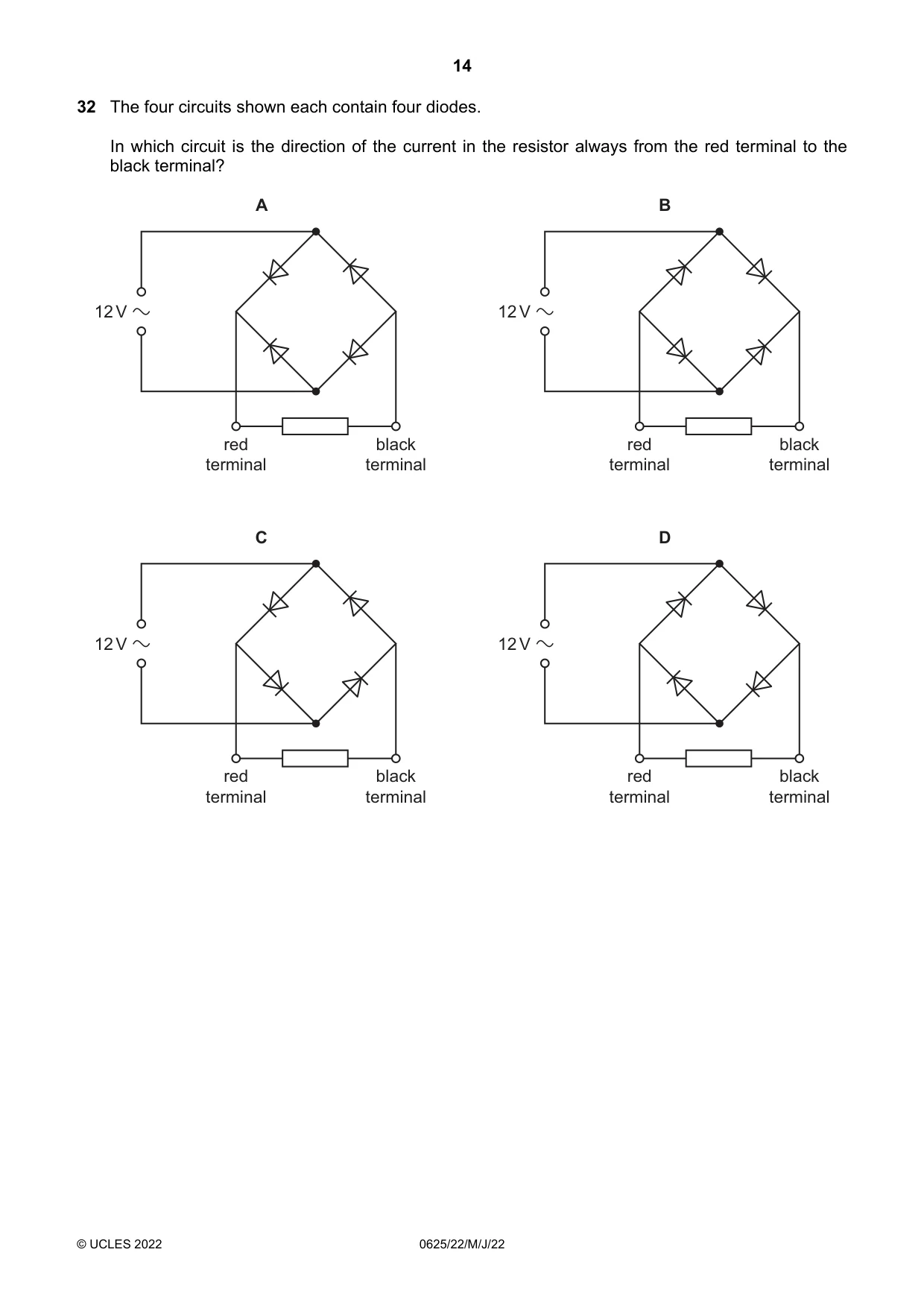
32 The four circuits shown each contain four diodes. In which circuit is the direction of the current in the resistor always from the red terminal to the black terminal? A B 12 V 12 V red black red black terminal terminal terminal terminal C D 12 V 12 V red black red black terminal terminal terminal terminal
Mark scheme: A
Q33 · The diagram shows a battery connected to a potential divider and to two lamps, P and Q
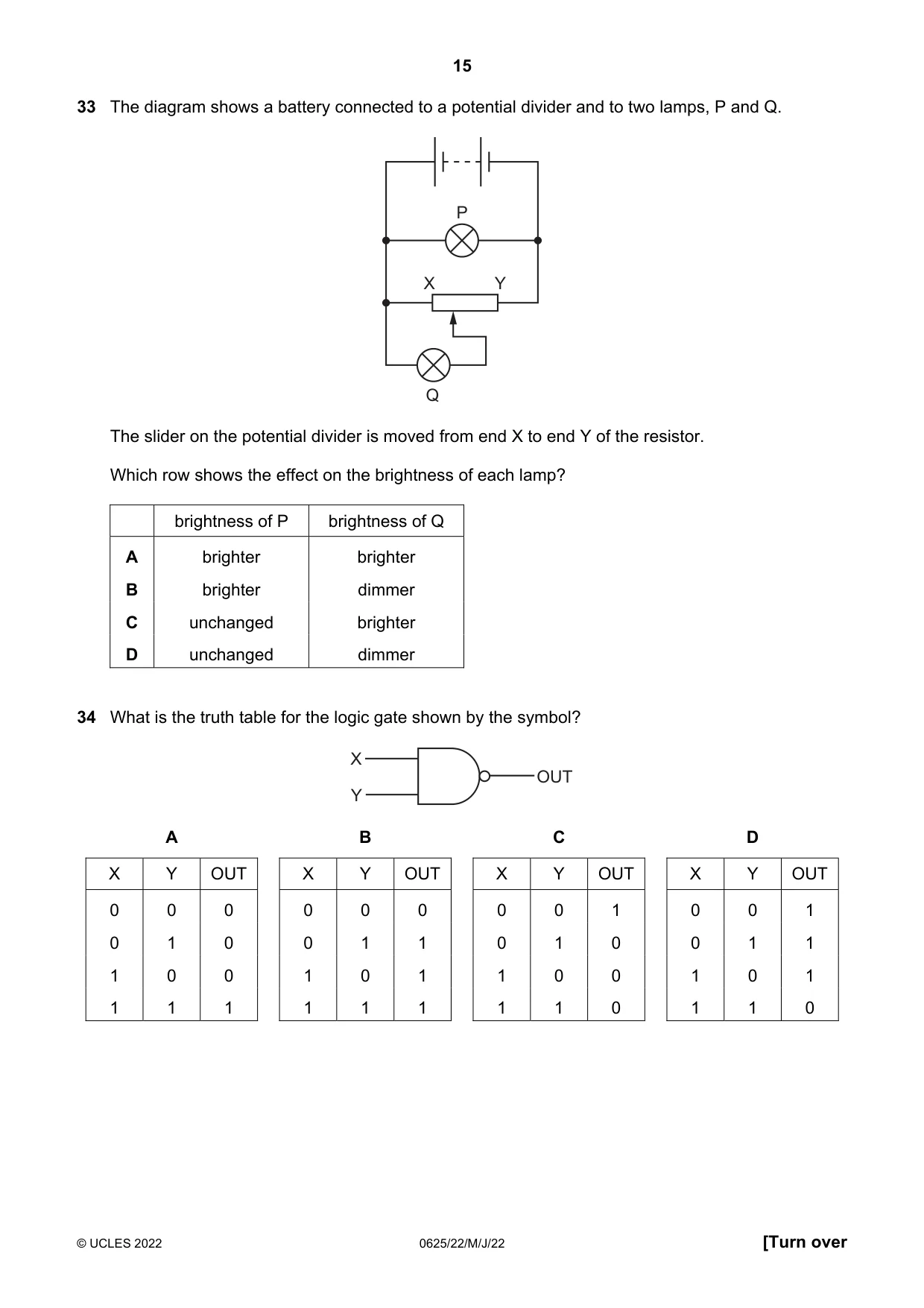
33 The diagram shows a battery connected to a potential divider and to two lamps, P and Q. P X Y Q The slider on the potential divider is moved from end X to end Y of the resistor. Which row shows the effect on the brightness of each lamp? brightness of P brightness of Q A brighter brighter B brighter dimmer C unchanged brighter D unchanged dimmer
Mark scheme: C
Q34 · What is the truth table for the logic gate shown by the symbol?
34 What is the truth table for the logic gate shown by the symbol? X OUT Y A B C D X Y OUT X Y OUT X Y OUT X Y OUT 0 0 0 0 0 0 0 0 1 0 0 1 0 1 0 0 1 1 0 1 0 0 1 1 1 0 0 1 0 1 1 0 0 1 0 1 1 1 1 1 1 1 1 1 0 1 1 0
Mark scheme: D
Q35 · A coil XY is wound around a cardboard tube
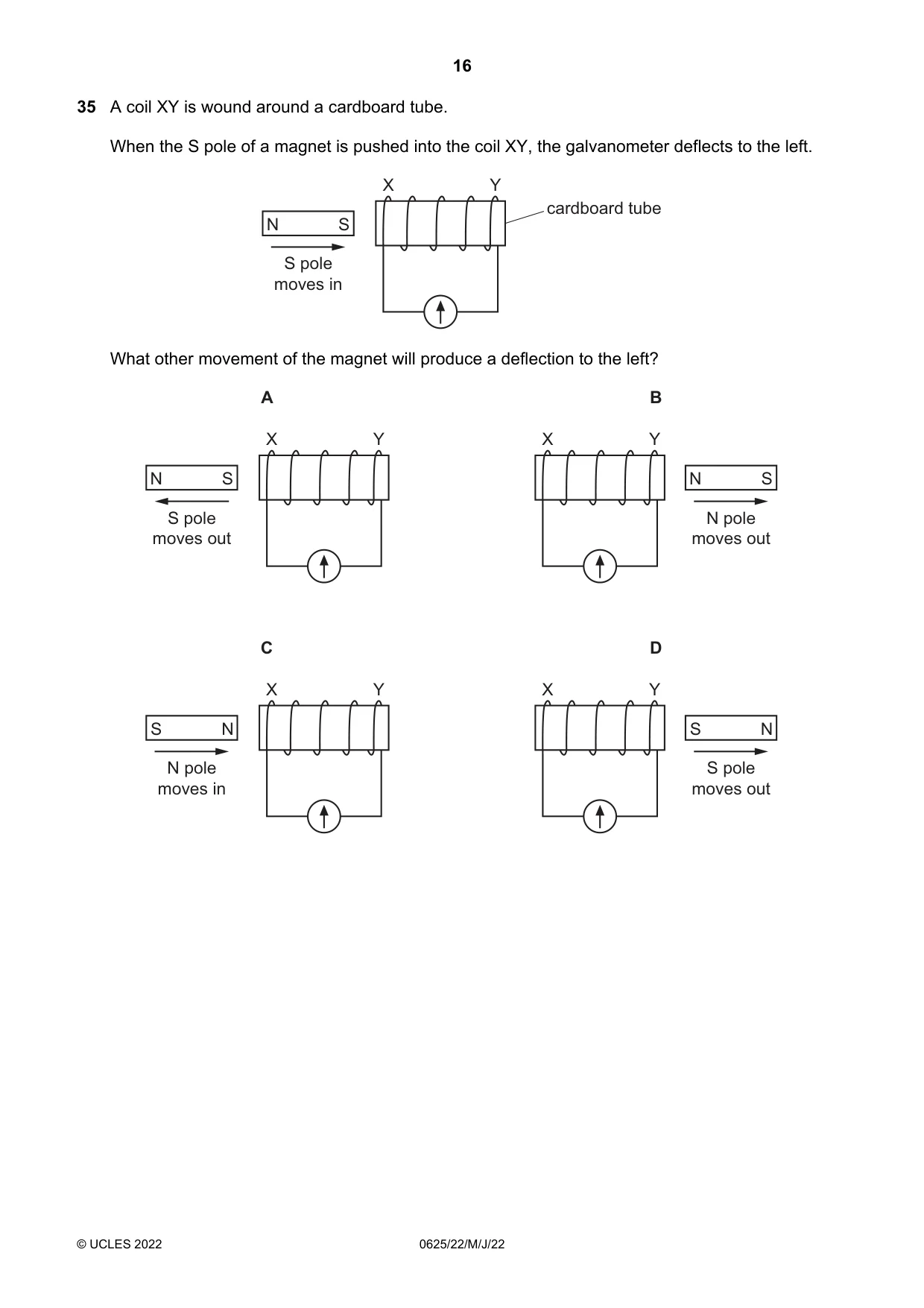
35 A coil XY is wound around a cardboard tube. When the S pole of a magnet is pushed into the coil XY, the galvanometer deflects to the left. X Y cardboard tube N S S pole moves in What other movement of the magnet will produce a deflection to the left? A B X Y X Y N S N S S pole N pole moves out moves out C D X Y X Y S N S N N pole S pole moves in moves out
Mark scheme: D
Q36 · Which transformer can change a 240 V a.c
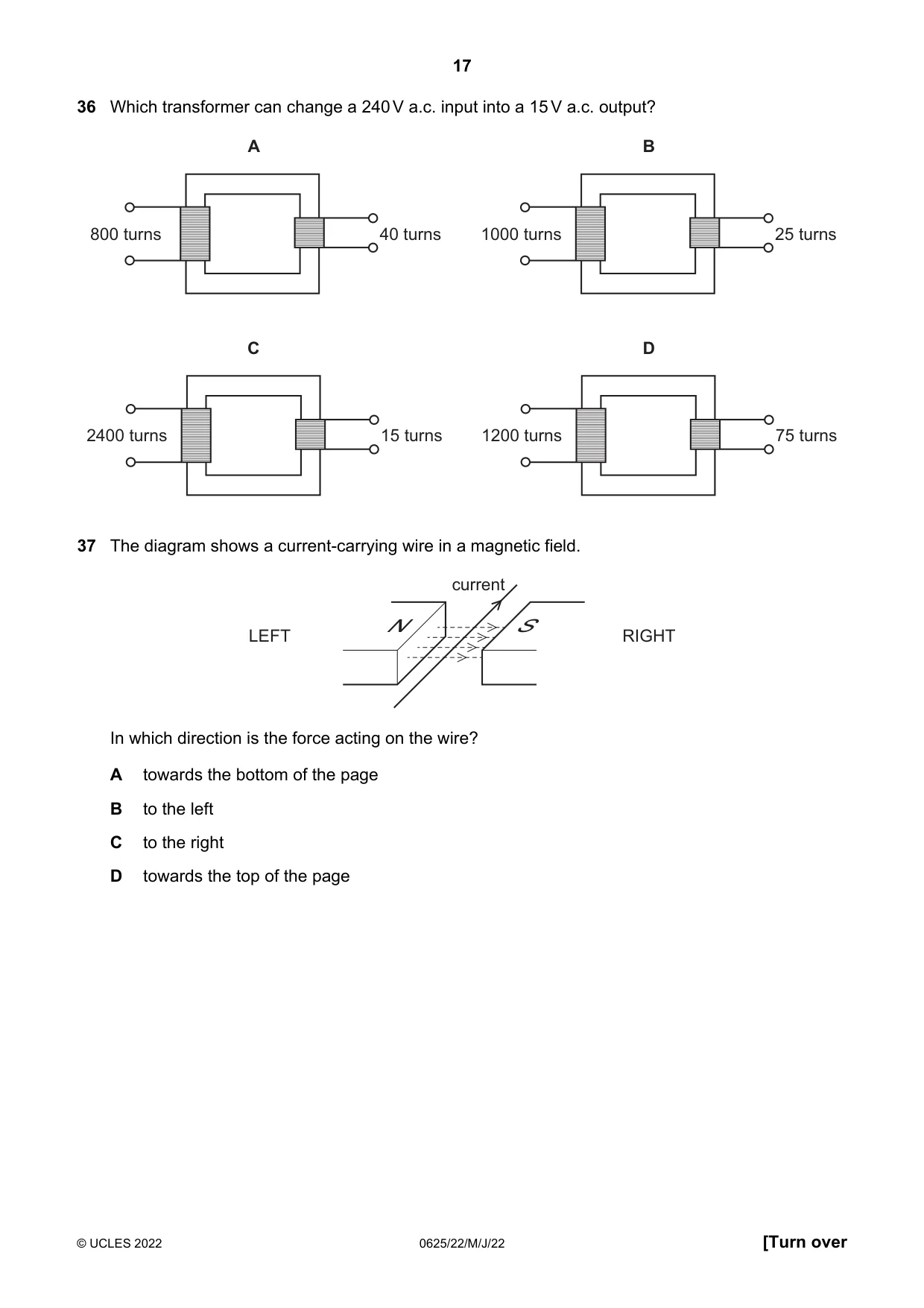
36 Which transformer can change a 240 V a.c. input into a 15 V a.c. output? A B 800 turns 40 turns 1000 turns 25 turns C D 2400 turns 15 turns 1200 turns 75 turns
Mark scheme: D
Q37 · The diagram shows a current-carrying wire in a magnetic field
37 The diagram shows a current-carrying wire in a magnetic field. current N S LEFT RIGHT In which direction is the force acting on the wire? A towards the bottom of the page B to the left C to the right D towards the top of the page
Mark scheme: A
Q38 · A scientist was asked to separate the following equations into two categories: nuclear…
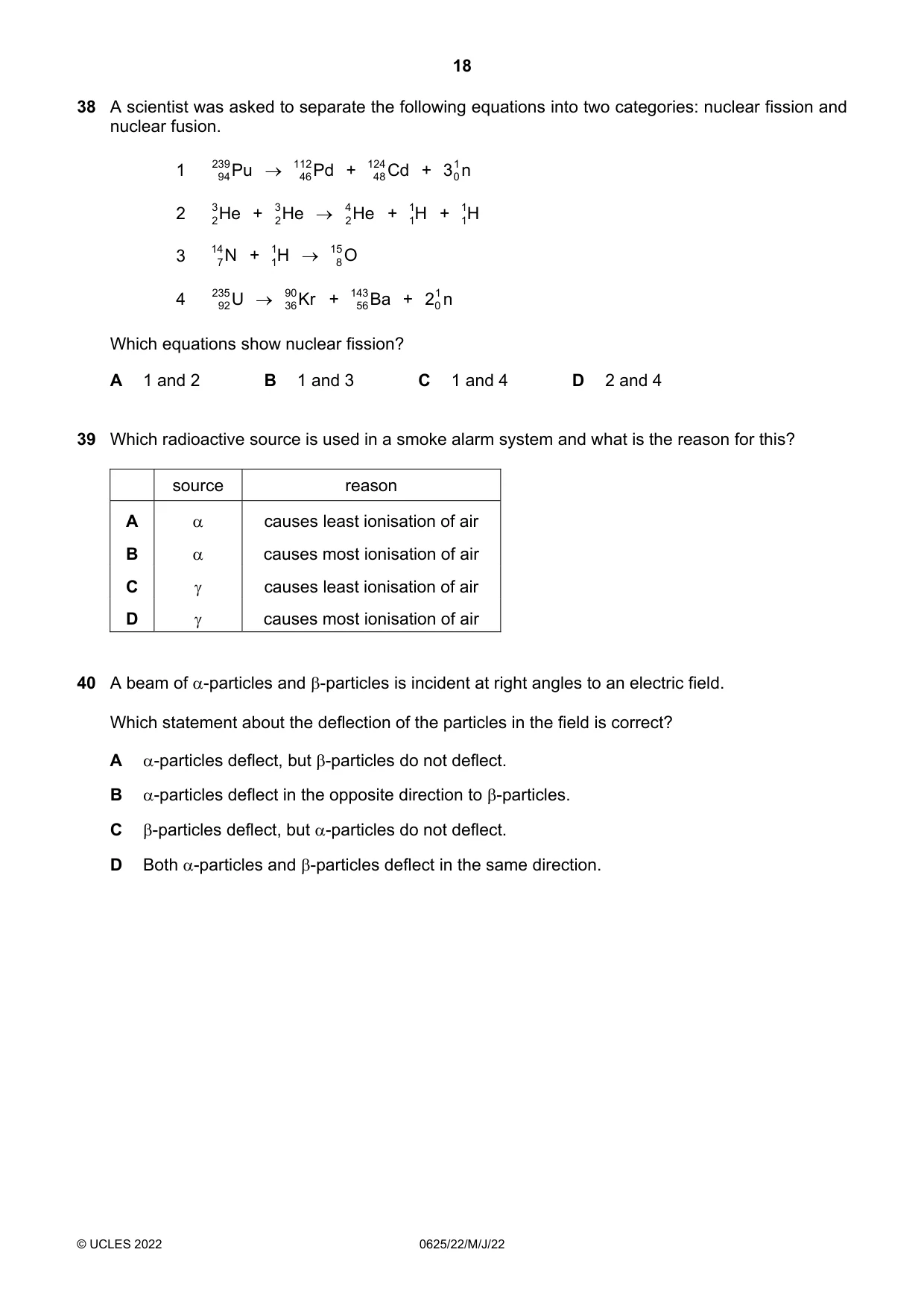
38 A scientist was asked to separate the following equations into two categories: nuclear fission and nuclear fusion. 1 239 Pu → 112 Pd + 124 Cd + 31 n 94 46 48 0 2 3 He + He 3 → He 4 + H 1 + H 1 2 2 2 1 1 3 14 N + H 1 → 15 O 7 1 8 4 235 U → 90 Kr + 143 Ba + 21 n 92 36 56 0 Which equations show nuclear fission? A 1 and 2 B 1 and 3 C 1 and 4 D 2 and 4
Mark scheme: C
Q39 · Which radioactive source is used in a smoke alarm system and what is the reason for this?
39 Which radioactive source is used in a smoke alarm system and what is the reason for this? source reason A α causes least ionisation of air B α causes most ionisation of air C γ causes least ionisation of air D γ causes most ionisation of air
Mark scheme: B
Q40 · A beam of α-particles and β-particles is incident at right angles to an electric field
40 A beam of α-particles and β-particles is incident at right angles to an electric field. Which statement about the deflection of the particles in the field is correct? A α-particles deflect, but β-particles do not deflect. B α-particles deflect in the opposite direction to β-particles. C β-particles deflect, but α-particles do not deflect. D Both α-particles and β-particles deflect in the same direction.
Mark scheme: B
What was in this paper
The subtopics covered by these 40 questions, and how many questions each got. Open one in a new tab to see every Cambridge question on it.
3Electromagnetic effects3Forces3Kinetic particle model of matter3Light3Electrical quantities2Electromagnetic spectrum2Energy, work and power2General properties of waves2Momentum2Motion2Radioactivity2Simple phenomena of magnetism2Thermal properties and temperature2Transfer of thermal energy2Density1Mass and weight1Physical quantities and measurement techniques1Pressure1The nuclear model of the atom1What you needed in this session
Cambridge’s own grade thresholds for 2022 May/June, Paper 2 · Variant 2. A higher threshold means an easier paper — the bar moves with how the cohort did.