Cambridge IGCSE Physics 0625 — 2017 Oct/Nov Paper 2 · Variant 1
0625/21/O/N/17 · 40 questions · 40 marks · ≈45 min
The question paper and its mark scheme, free to read here and free to download. This is Cambridge’s own paper, exactly as it was sat.
Question paper20 pages
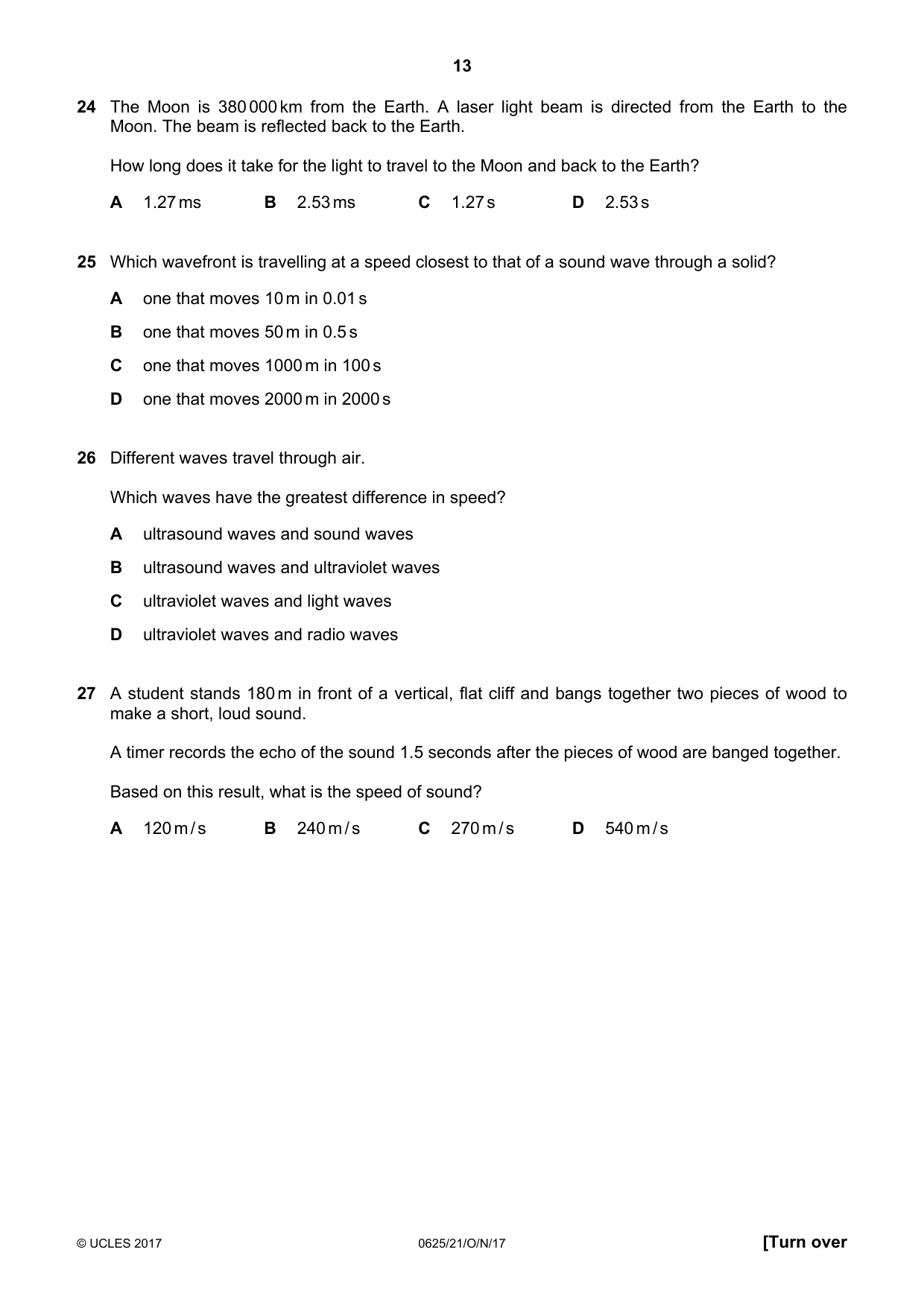
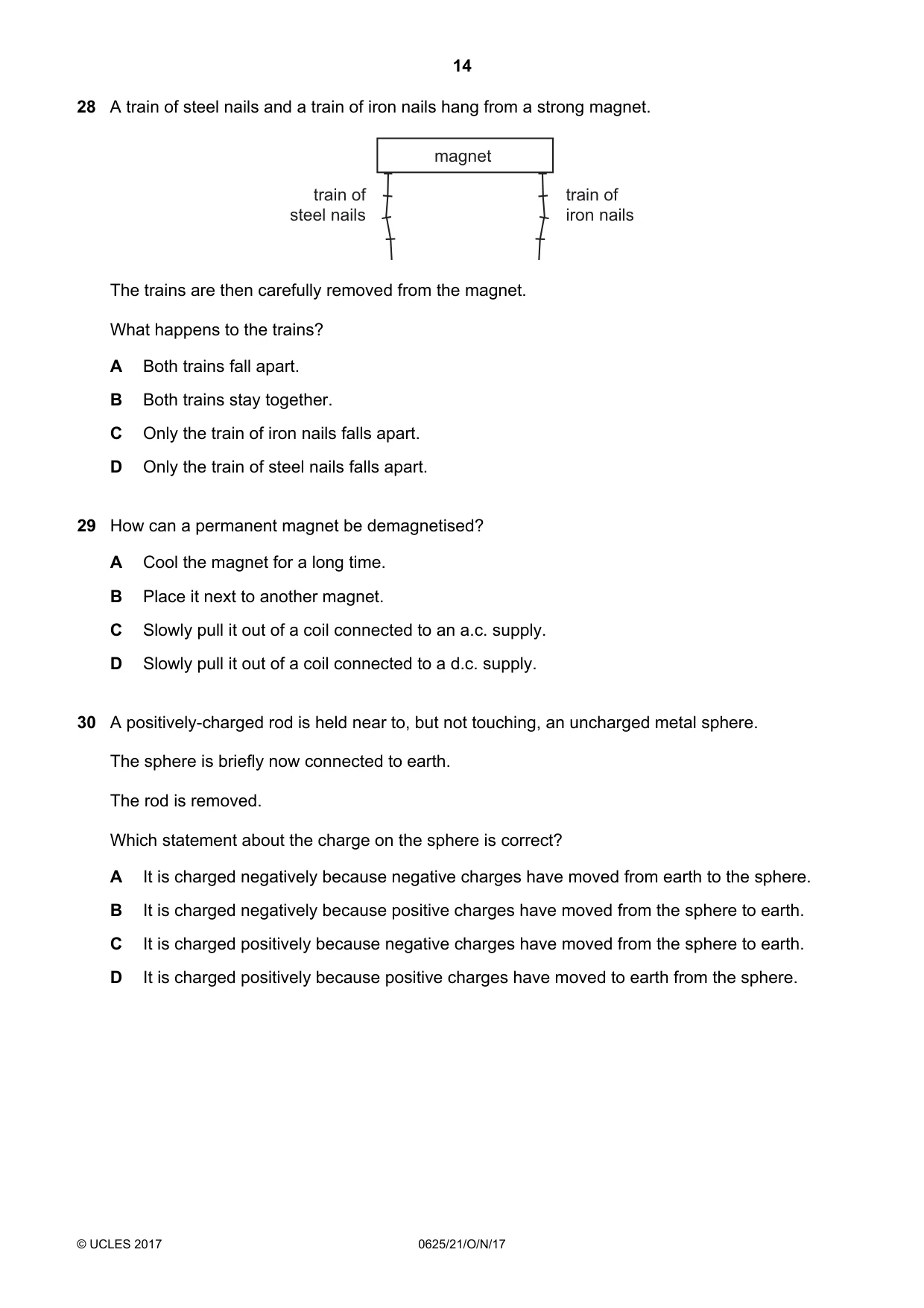
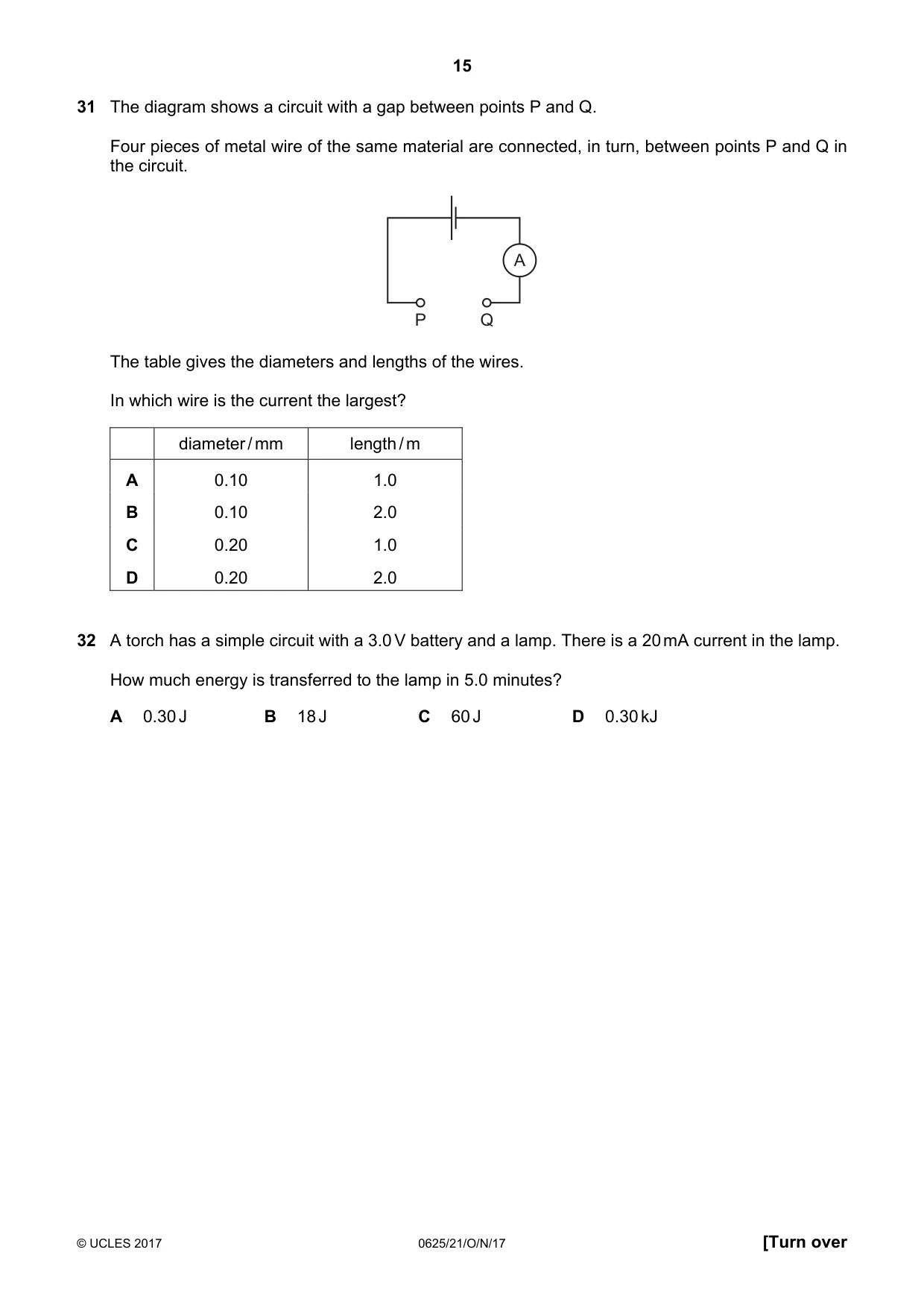
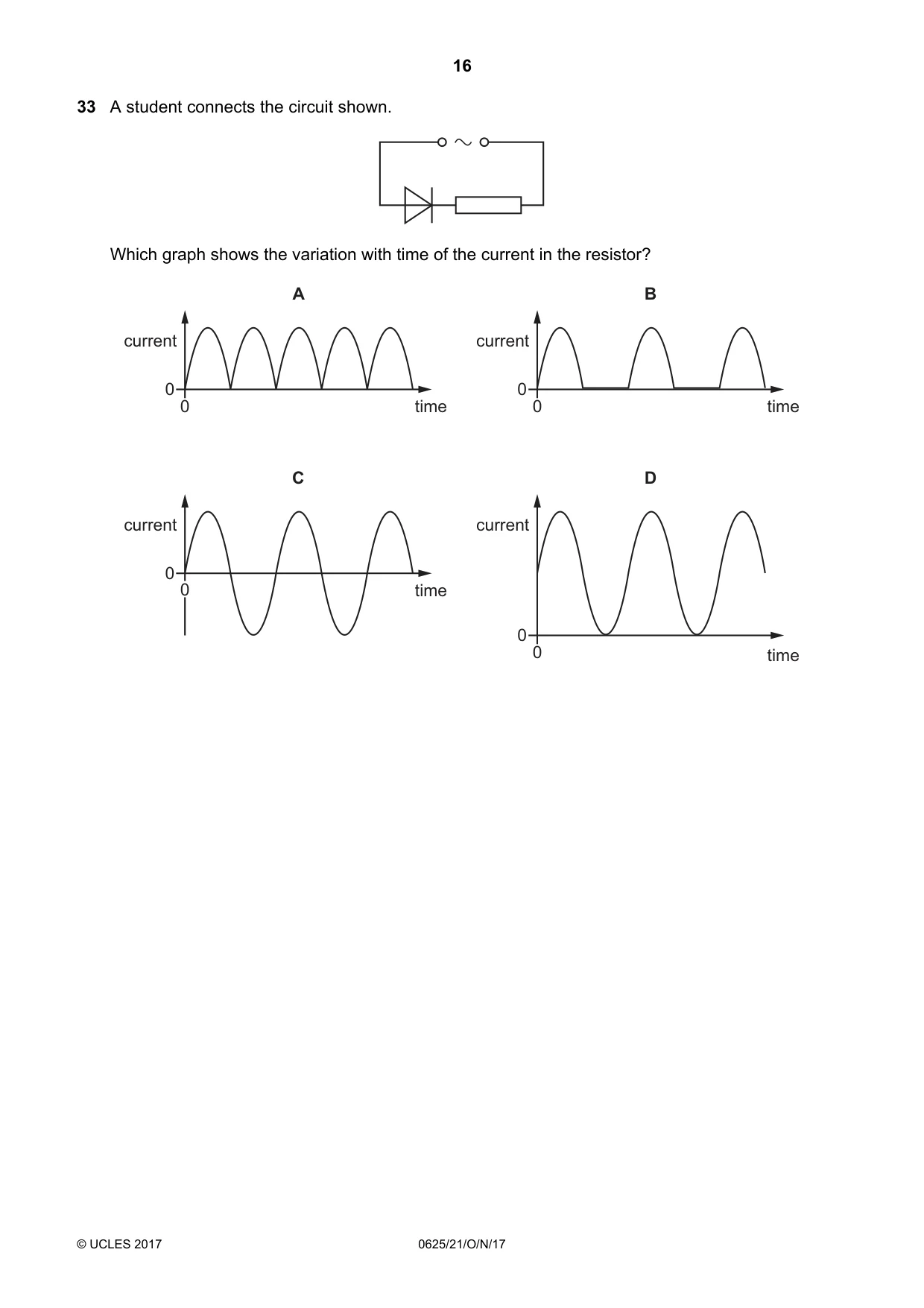
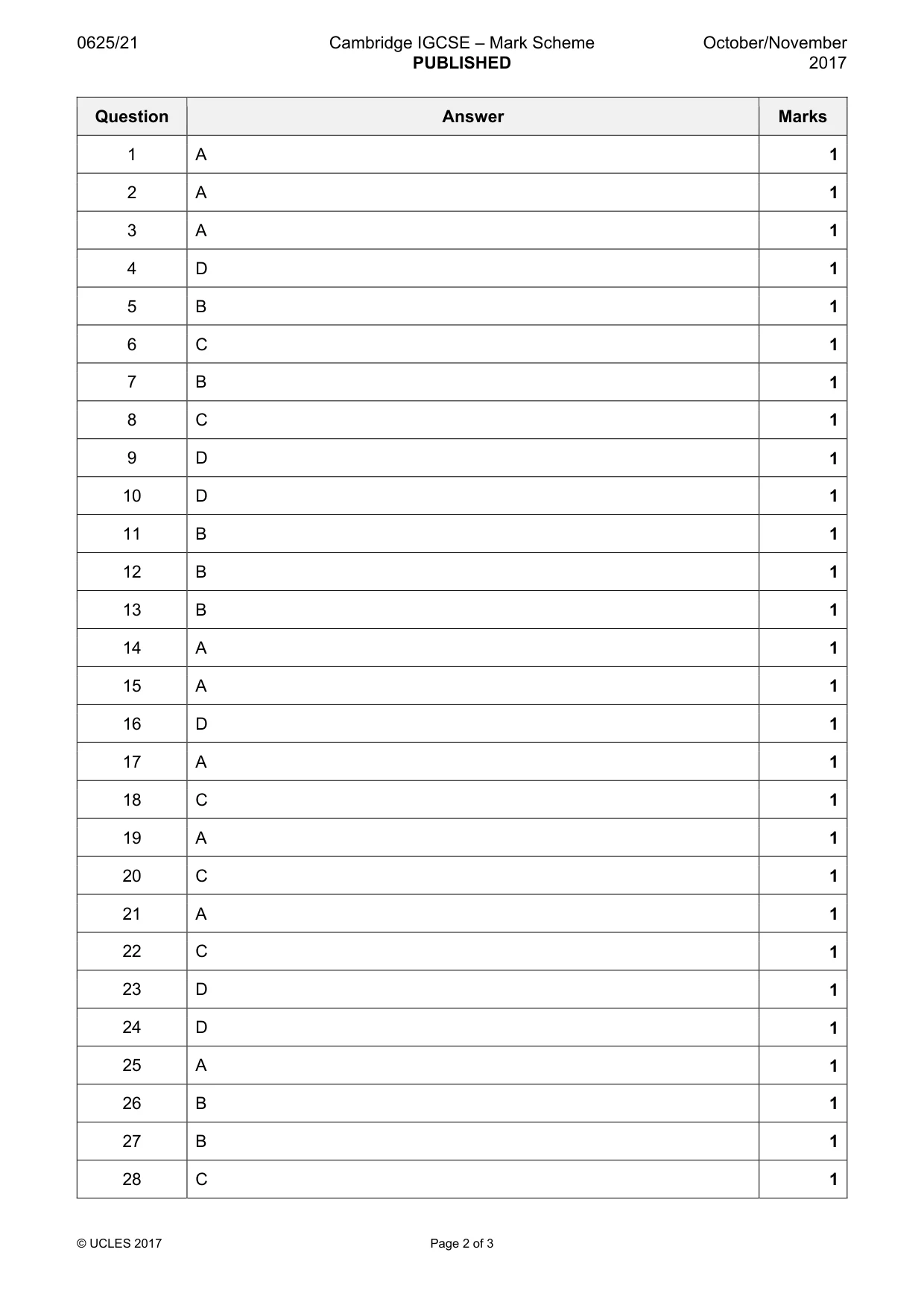
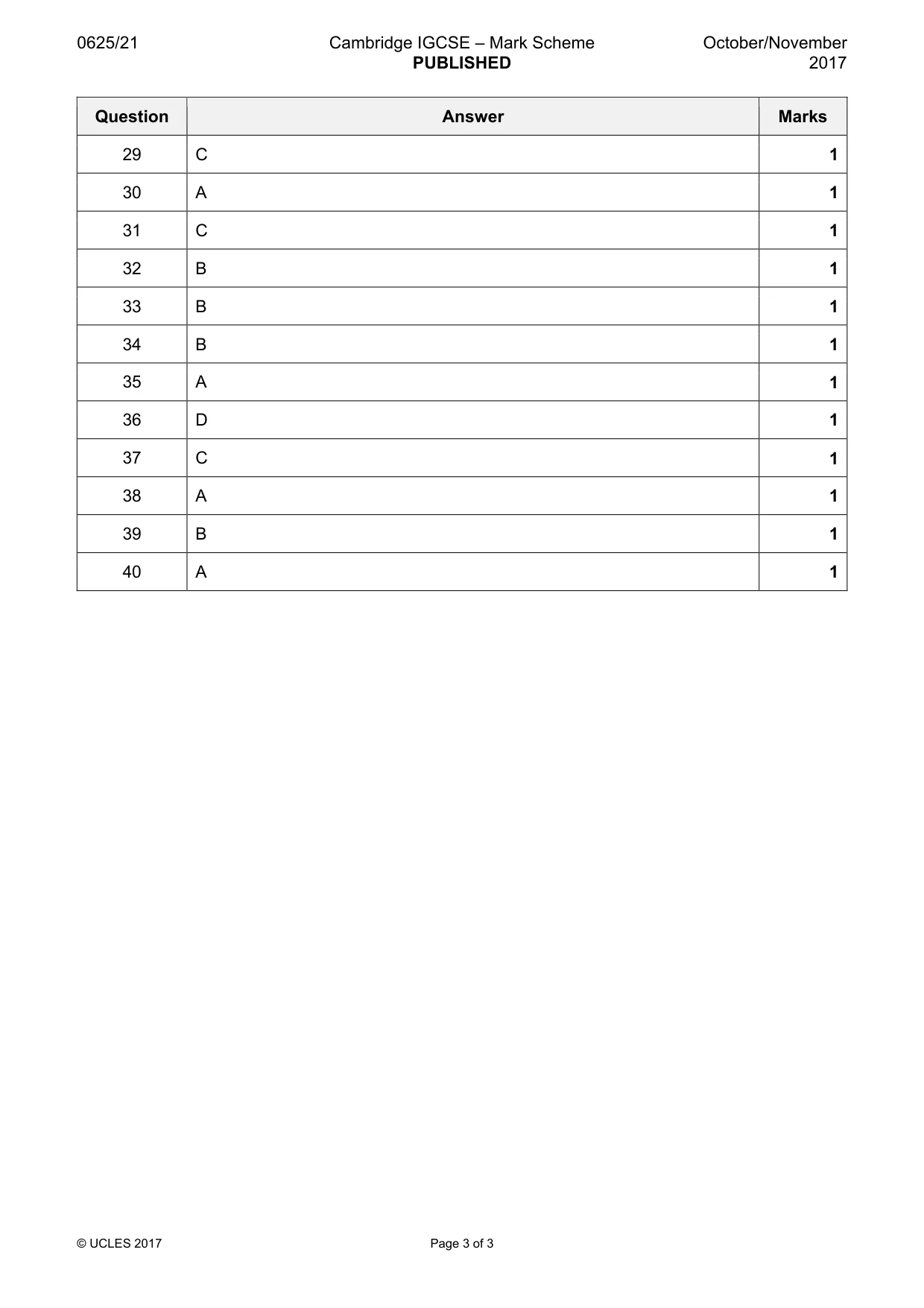
Mark scheme3 pages
Answers below. Sit the paper first if you are practising.
Questions as text
Q1 · A student measures the volume of a cork
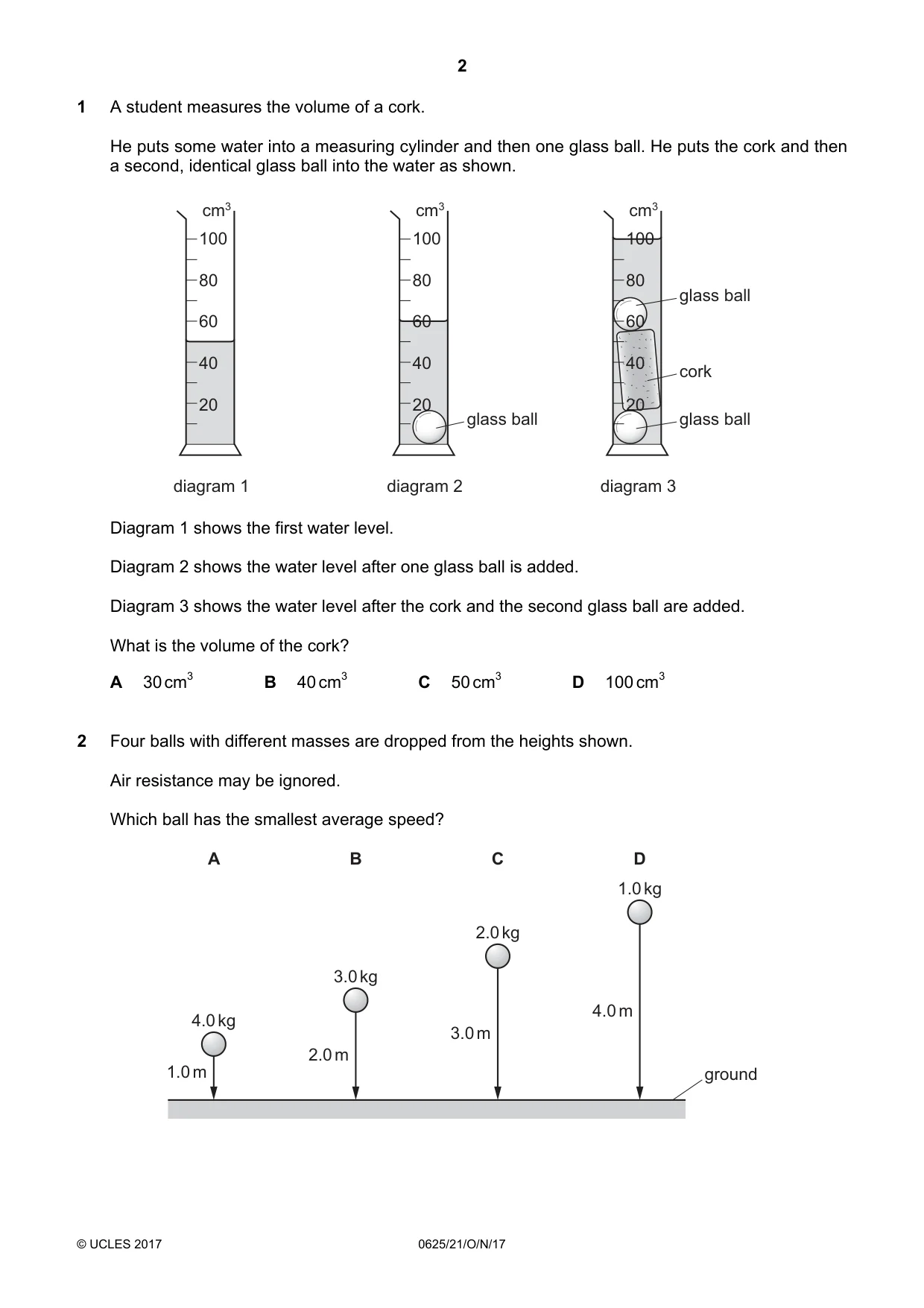
1 A student measures the volume of a cork. He puts some water into a measuring cylinder and then one glass ball. He puts the cork and then a second, identical glass ball into the water as shown. cm3 cm3 cm3 100 100 100 80 80 80 glass ball 60 60 60 40 40 40 cork 20 20 20 glass ball glass ball diagram 1 diagram 2 diagram 3 Diagram 1 shows the first water level. Diagram 2 shows the water level after one glass ball is added. Diagram 3 shows the water level after the cork and the second glass ball are added. What is the volume of the cork? A 30 cm3 B 40 cm3 C 50 cm3 D 100 cm3
Mark scheme: A
More questions on Physical quantities and measurement techniques
Q2 · Four balls with different masses are dropped from the heights shown
2 Four balls with different masses are dropped from the heights shown. Air resistance may be ignored. Which ball has the smallest average speed? A B C D 1.0 kg 2.0 kg 3.0 kg 4.0 m 4.0 kg 3.0 m 2.0 m 1.0 m ground
Mark scheme: A
Q3 · An ice crystal falls vertically from a cloud
3 An ice crystal falls vertically from a cloud. What happens to the acceleration of the ice crystal as it falls? A It decreases because of air resistance. B It decreases because of gravity. C It increases because of air resistance. D It increases because of gravity.
Mark scheme: A
Q4 · A spring is stretched by hanging a piece of metal from it
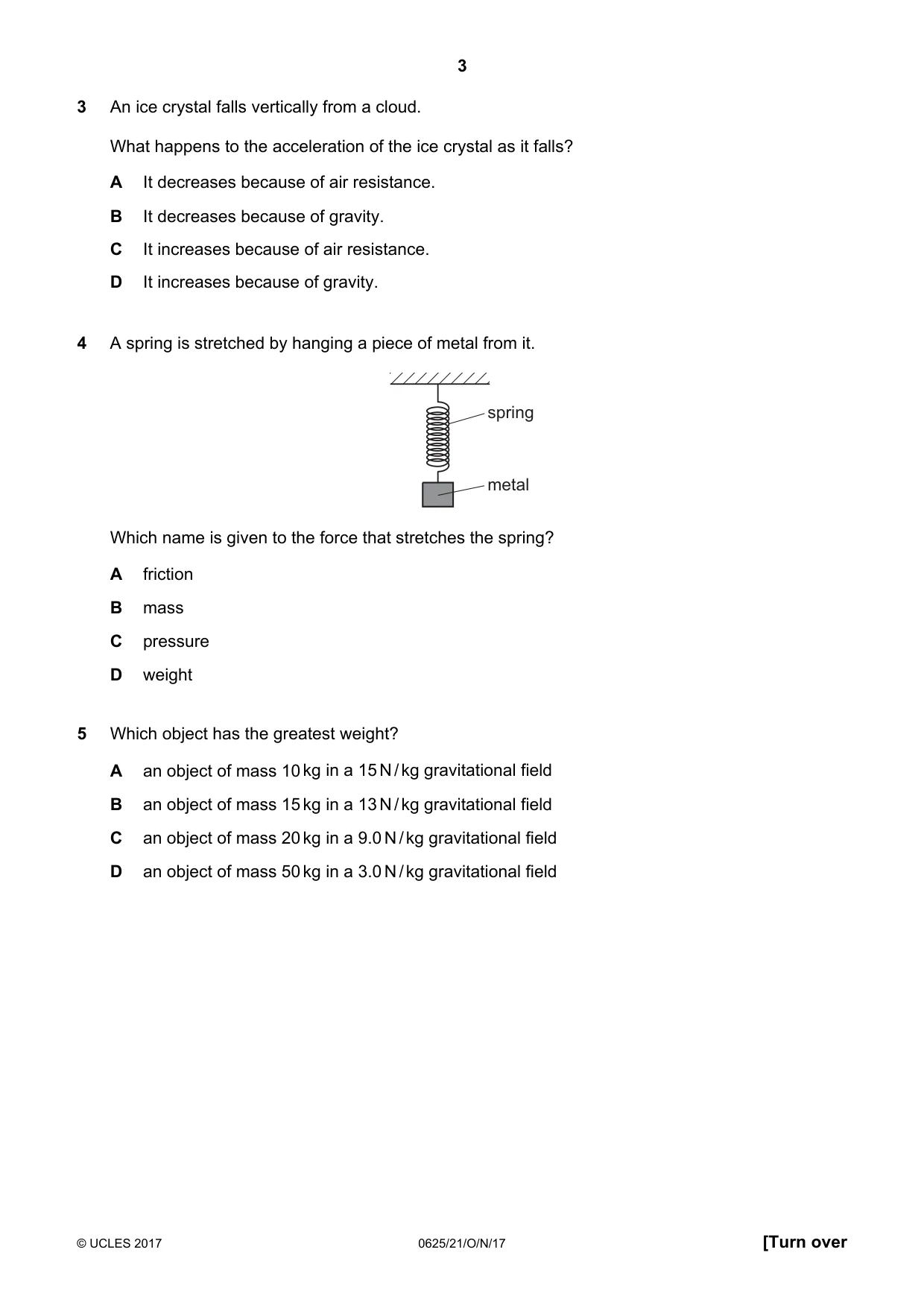
4 A spring is stretched by hanging a piece of metal from it. spring metal Which name is given to the force that stretches the spring? A friction B mass C pressure D weight
Mark scheme: D
Q5 · Which object has the greatest weight?
5 Which object has the greatest weight? A an object of mass 10 kg in a 15 N / kg gravitational field B an object of mass 15 kg in a 13 N / kg gravitational field C an object of mass 20 kg in a 9.0 N / kg gravitational field D an object of mass 50 kg in a 3.0 N / kg gravitational field
Mark scheme: B
Q6 · A uniform beam XY is 100 cm long and weighs 4.0 N
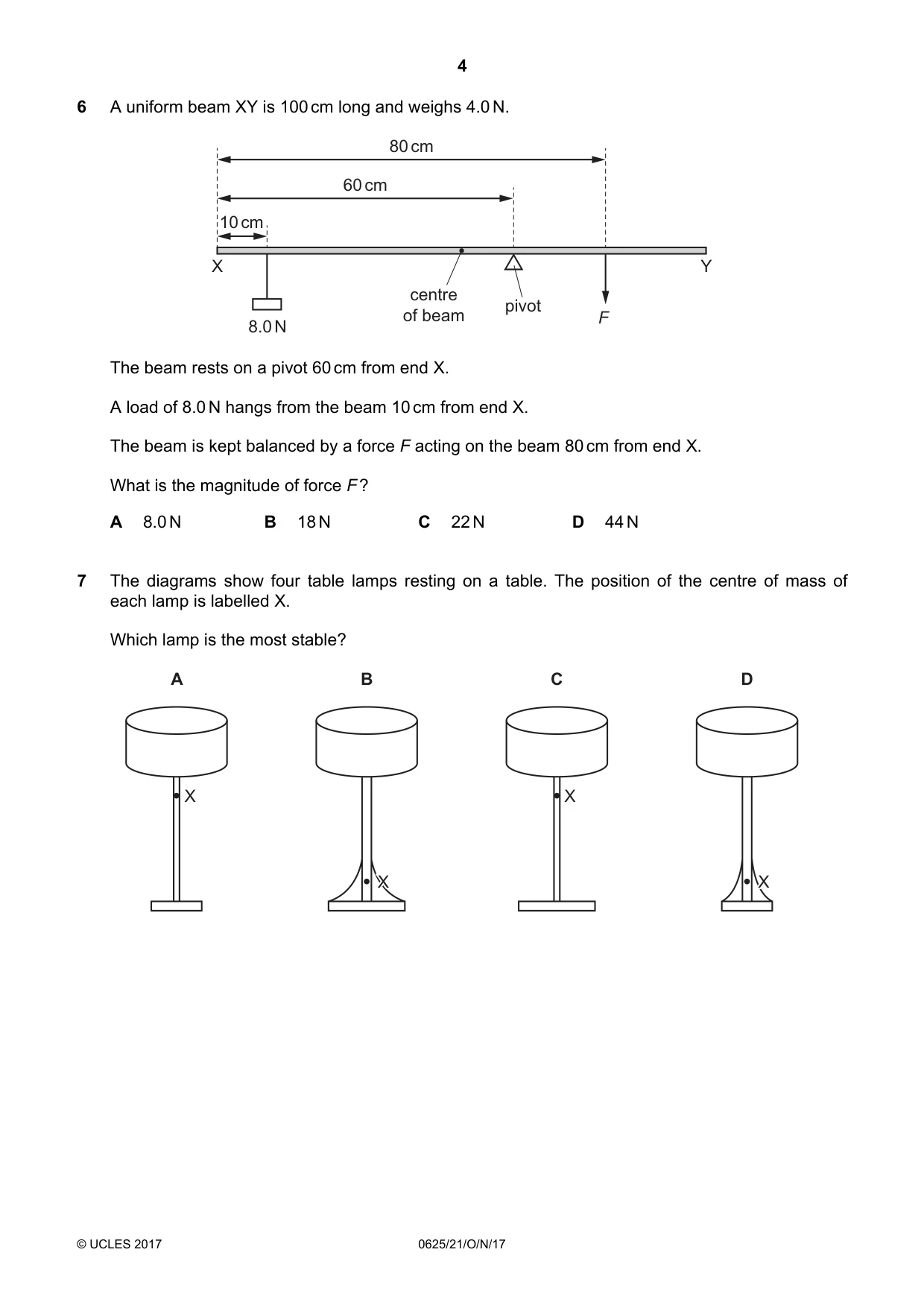
6 A uniform beam XY is 100 cm long and weighs 4.0 N. 80 cm 60 cm 10 cm X Y centre pivot of beam F 8.0 N The beam rests on a pivot 60 cm from end X. A load of 8.0 N hangs from the beam 10 cm from end X. The beam is kept balanced by a force F acting on the beam 80 cm from end X. What is the magnitude of force F ? A 8.0 N B 18 N C 22 N D 44 N
Mark scheme: C
Q7 · The diagrams show four table lamps resting on a table
7 The diagrams show four table lamps resting on a table. The position of the centre of mass of each lamp is labelled X. Which lamp is the most stable? A B C D X X X X
Mark scheme: B
Q8 · The diagram shows an incomplete scale drawing to find the resultant of two 10 N forces…
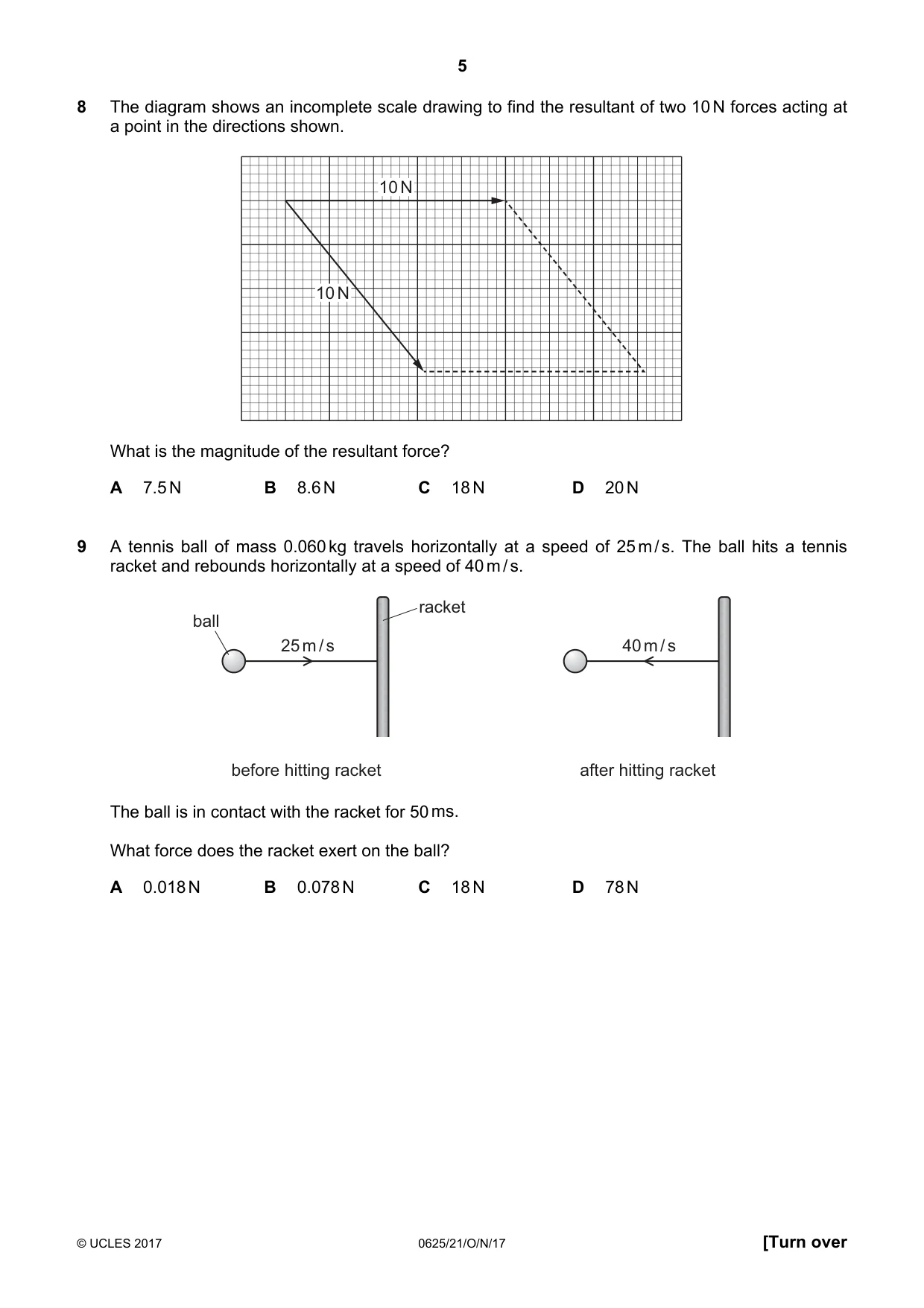
8 The diagram shows an incomplete scale drawing to find the resultant of two 10 N forces acting at a point in the directions shown. 10 N 10 N What is the magnitude of the resultant force? A 7.5 N B 8.6 N C 18 N D 20 N
Mark scheme: C
Q9 · A tennis ball of mass 0.060 kg travels horizontally at a speed of 25 m / s
9 A tennis ball of mass 0.060 kg travels horizontally at a speed of 25 m / s. The ball hits a tennis racket and rebounds horizontally at a speed of 40 m / s. racket ball 25 m / s 40 m / s before hitting racket after hitting racket The ball is in contact with the racket for 50 ms. What force does the racket exert on the ball? A 0.018 N B 0.078 N C 18 N D 78 N
Mark scheme: D
Q10 · The diagram shows the path of a stone that is thrown from X and reaches its maximum…
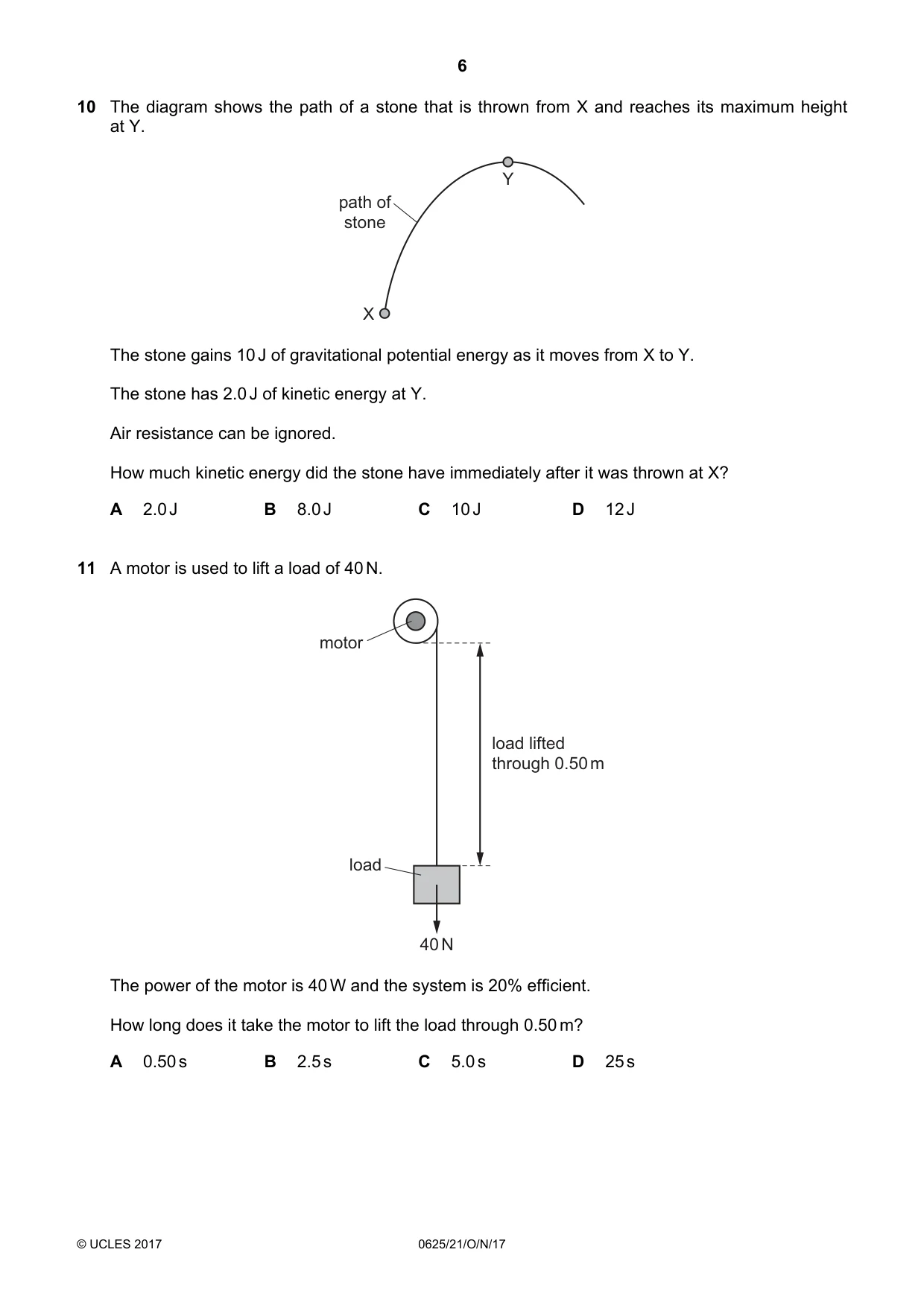
10 The diagram shows the path of a stone that is thrown from X and reaches its maximum height at Y. Y path of stone X The stone gains 10 J of gravitational potential energy as it moves from X to Y. The stone has 2.0 J of kinetic energy at Y. Air resistance can be ignored. How much kinetic energy did the stone have immediately after it was thrown at X? A 2.0 J B 8.0 J C 10 J D 12 J
Mark scheme: D
Q11 · A motor is used to lift a load of 40 N
11 A motor is used to lift a load of 40 N. motor load lifted through 0.50 m load 40 N The power of the motor is 40 W and the system is 20% efficient. How long does it take the motor to lift the load through 0.50 m? A 0.50 s B 2.5 s C 5.0 s D 25 s
Mark scheme: B
Q12 · A student runs up a flight of stairs
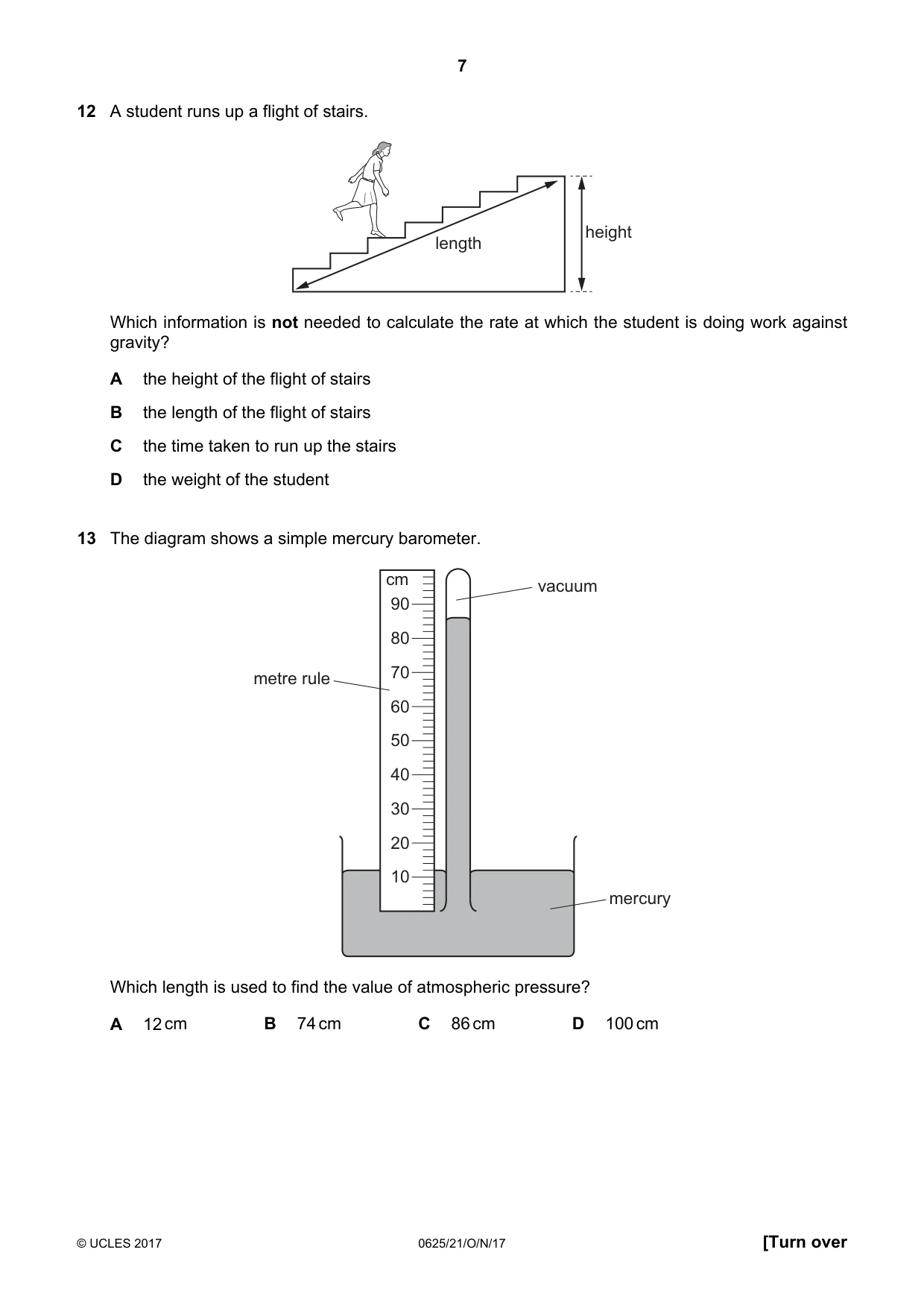
12 A student runs up a flight of stairs. height length Which information is not needed to calculate the rate at which the student is doing work against gravity? A the height of the flight of stairs B the length of the flight of stairs C the time taken to run up the stairs D the weight of the student
Mark scheme: B
Q13 · The diagram shows a simple mercury barometer
13 The diagram shows a simple mercury barometer. cm vacuum 90 80 metre rule 70 60 50 40 30 20 10 mercury Which length is used to find the value of atmospheric pressure? A 12 cm B 74 cm C 86 cm D 100 cm
Mark scheme: B
Q14 · The diagram shows a glass flask, sealed with a small volume of mercury in a glass tube
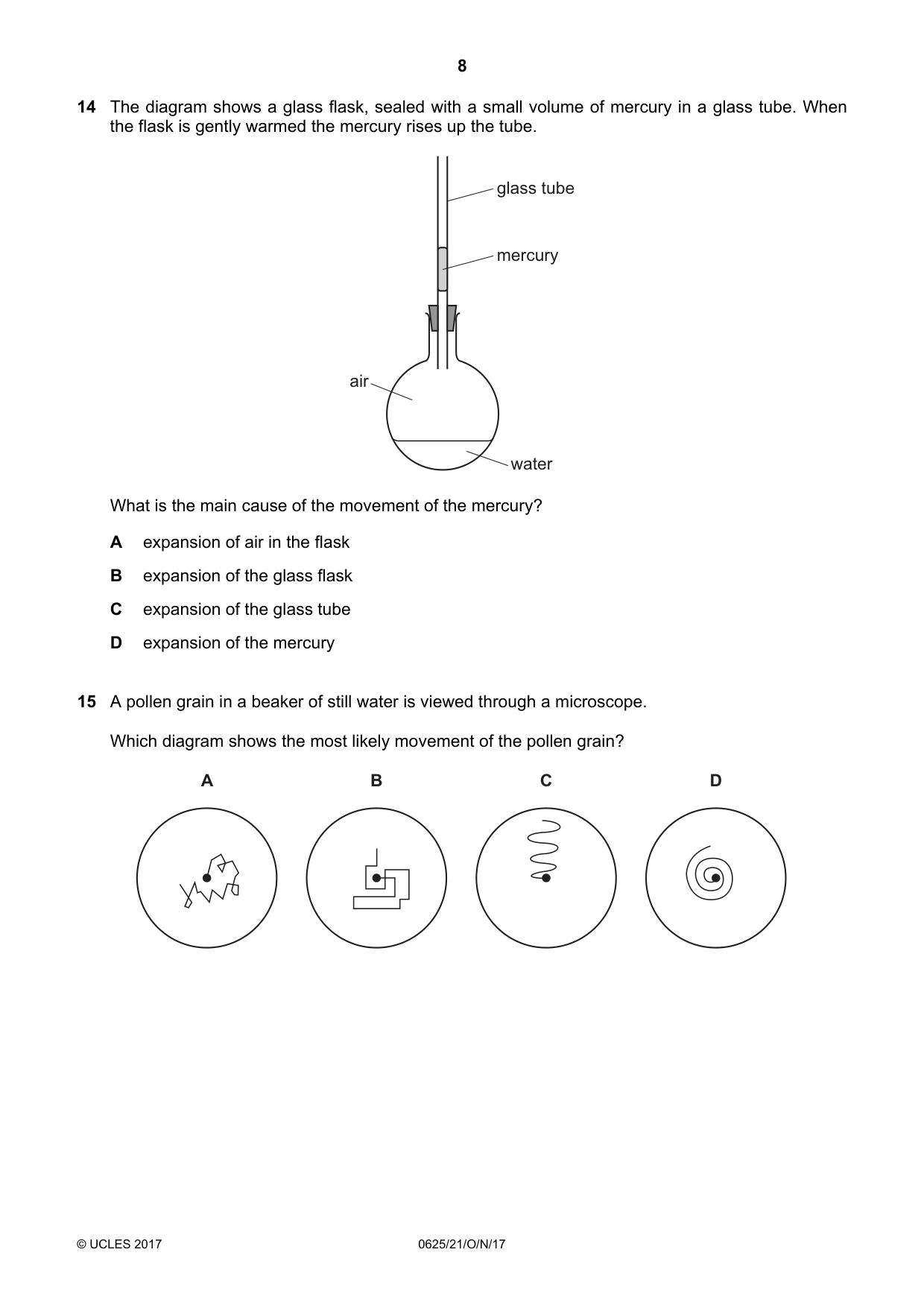
14 The diagram shows a glass flask, sealed with a small volume of mercury in a glass tube. When the flask is gently warmed the mercury rises up the tube. glass tube mercury air water What is the main cause of the movement of the mercury? A expansion of air in the flask B expansion of the glass flask C expansion of the glass tube D expansion of the mercury
Mark scheme: A
Q15 · A pollen grain in a beaker of still water is viewed through a microscope
15 A pollen grain in a beaker of still water is viewed through a microscope. Which diagram shows the most likely movement of the pollen grain? A B C D
Mark scheme: A
Q16 · The diagram shows an air-filled rubber toy
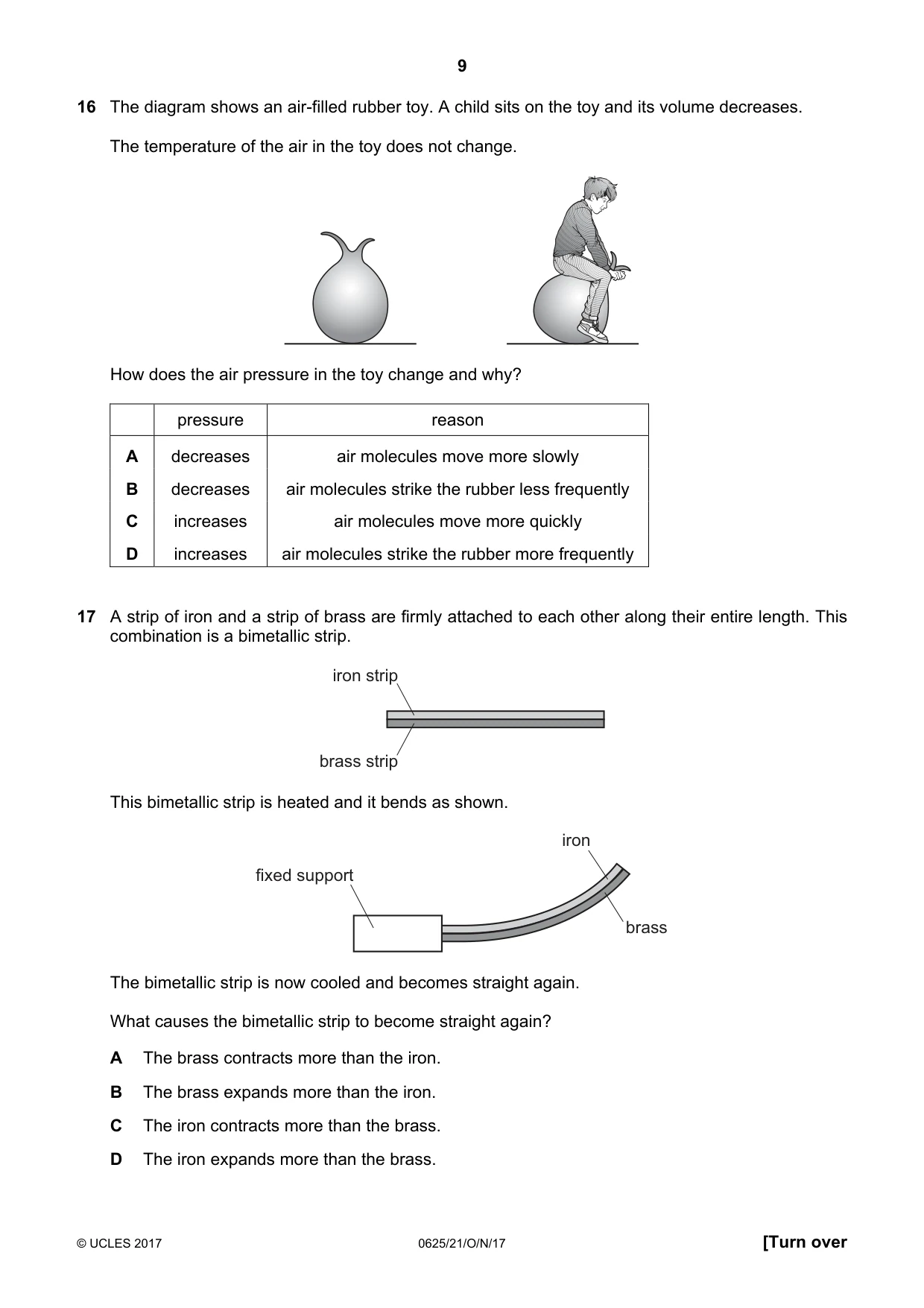
16 The diagram shows an air-filled rubber toy. A child sits on the toy and its volume decreases. The temperature of the air in the toy does not change. How does the air pressure in the toy change and why? pressure reason A decreases air molecules move more slowly B decreases air molecules strike the rubber less frequently C increases air molecules move more quickly D increases air molecules strike the rubber more frequently
Mark scheme: D
Q17 · A strip of iron and a strip of brass are firmly attached to each other along their entire…
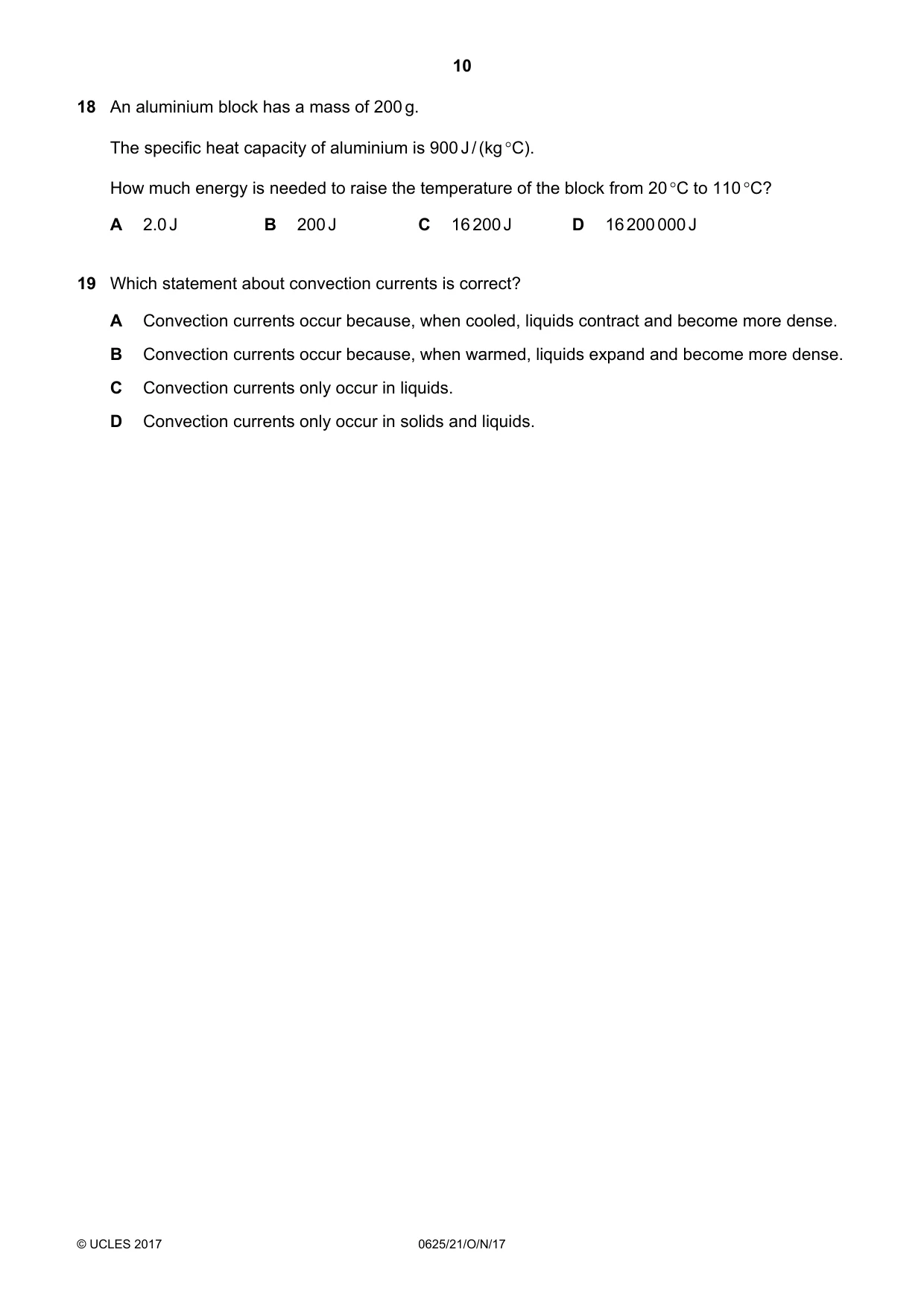
17 A strip of iron and a strip of brass are firmly attached to each other along their entire length. This combination is a bimetallic strip. iron strip brass strip This bimetallic strip is heated and it bends as shown. iron fixed support brass The bimetallic strip is now cooled and becomes straight again. What causes the bimetallic strip to become straight again? A The brass contracts more than the iron. B The brass expands more than the iron. C The iron contracts more than the brass. D The iron expands more than the brass.
Mark scheme: A
Q18 · An aluminium block has a mass of 200 g
18 An aluminium block has a mass of 200 g. The specific heat capacity of aluminium is 900 J / (kg °C). How much energy is needed to raise the temperature of the block from 20 °C to 110 °C? A 2.0 J B 200 J C 16 200 J D 16 200 000 J
Mark scheme: C
Q19 · Which statement about convection currents is correct?
19 Which statement about convection currents is correct? A Convection currents occur because, when cooled, liquids contract and become more dense. B Convection currents occur because, when warmed, liquids expand and become more dense. C Convection currents only occur in liquids. D Convection currents only occur in solids and liquids.
Mark scheme: A
Q20 · The diagram represents plane wavefronts of a water wave about to strike a solid barrier
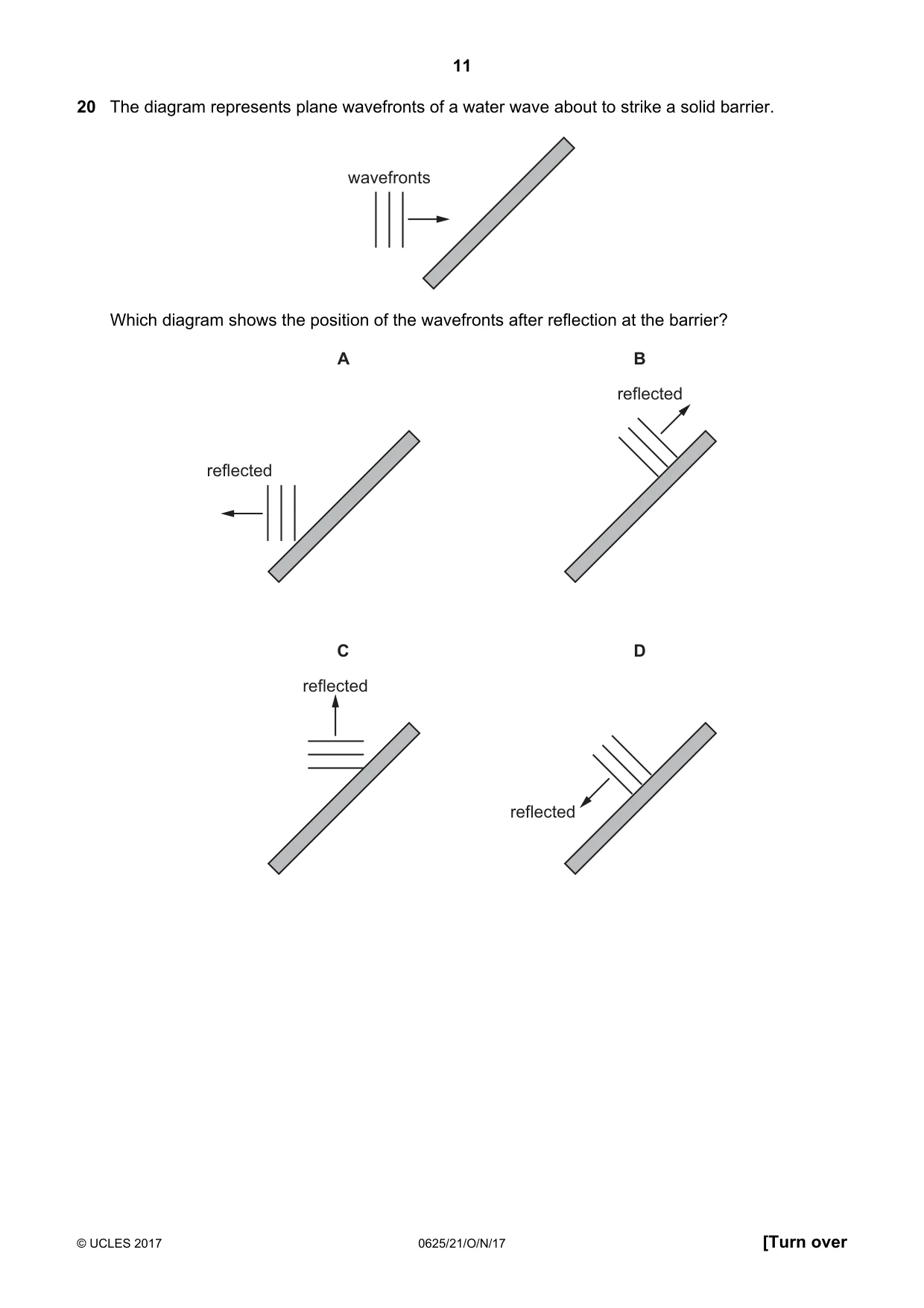
20 The diagram represents plane wavefronts of a water wave about to strike a solid barrier. wavefronts Which diagram shows the position of the wavefronts after reflection at the barrier? A B reflected reflected C D reflected reflected
Mark scheme: C
Q21 · The diagram shows an object in front of a plane mirror
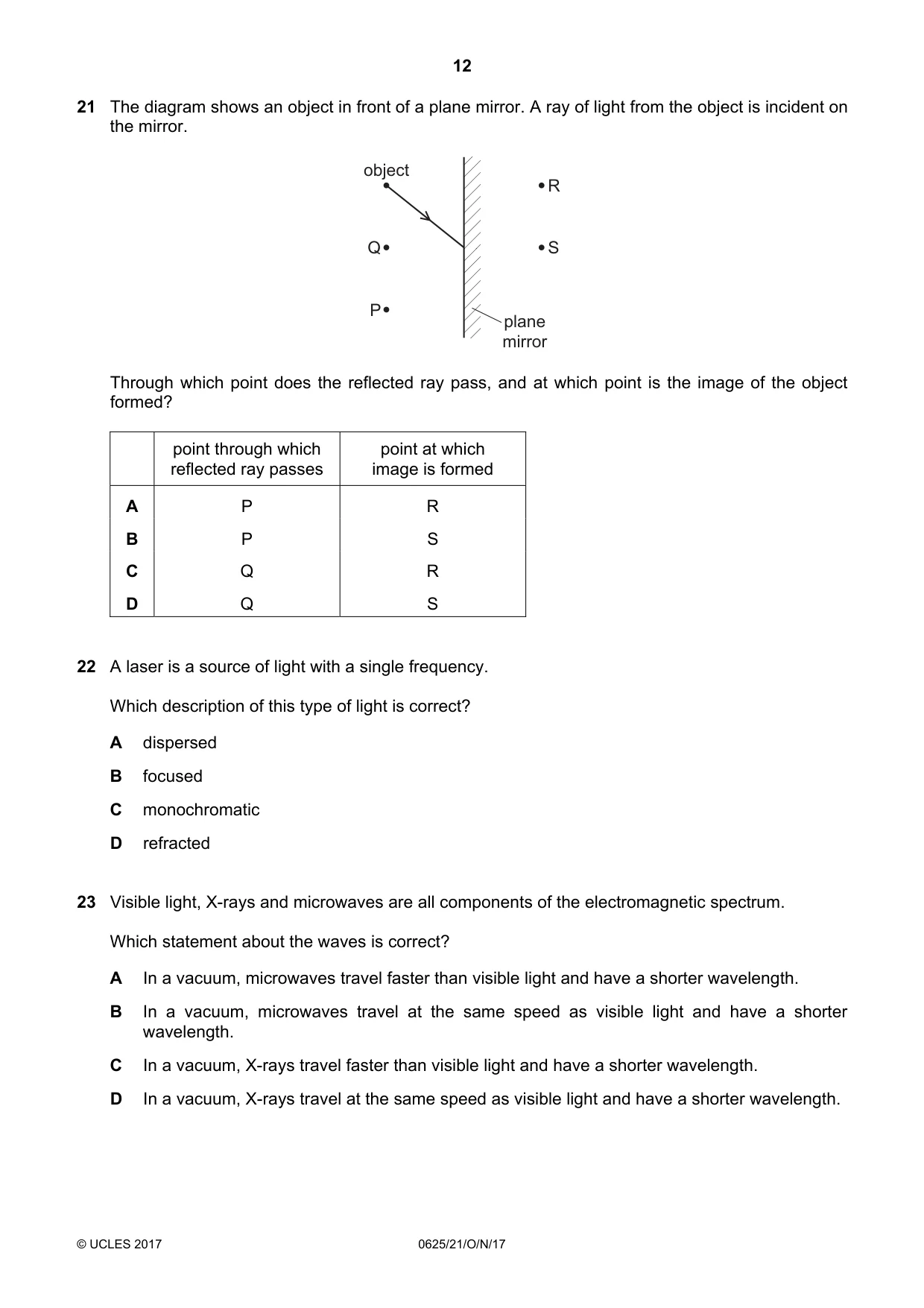
21 The diagram shows an object in front of a plane mirror. A ray of light from the object is incident on the mirror. object R Q S P plane mirror Through which point does the reflected ray pass, and at which point is the image of the object formed? point through which point at which reflected ray passes image is formed A P R B P S C Q R D Q S
Mark scheme: A
Q22 · A laser is a source of light with a single frequency
22 A laser is a source of light with a single frequency. Which description of this type of light is correct? A dispersed B focused C monochromatic D refracted
Mark scheme: C
Q23 · Visible light, X-rays and microwaves are all components of the electromagnetic spectrum
23 Visible light, X-rays and microwaves are all components of the electromagnetic spectrum. Which statement about the waves is correct? A In a vacuum, microwaves travel faster than visible light and have a shorter wavelength. B In a vacuum, microwaves travel at the same speed as visible light and have a shorter wavelength. C In a vacuum, X-rays travel faster than visible light and have a shorter wavelength. D In a vacuum, X-rays travel at the same speed as visible light and have a shorter wavelength.
Mark scheme: D
Q24 · The Moon is 380 000 km from the Earth
24 The Moon is 380 000 km from the Earth. A laser light beam is directed from the Earth to the Moon. The beam is reflected back to the Earth. How long does it take for the light to travel to the Moon and back to the Earth? A 1.27 ms B 2.53 ms C 1.27 s D 2.53 s
Mark scheme: D
Q25 · Which wavefront is travelling at a speed closest to that of a sound wave through a solid?
25 Which wavefront is travelling at a speed closest to that of a sound wave through a solid? A one that moves 10 m in 0.01 s B one that moves 50 m in 0.5 s C one that moves 1000 m in 100 s D one that moves 2000 m in 2000 s
Mark scheme: A
Q26 · Different waves travel through air
26 Different waves travel through air. Which waves have the greatest difference in speed? A ultrasound waves and sound waves B ultrasound waves and ultraviolet waves C ultraviolet waves and light waves D ultraviolet waves and radio waves
Mark scheme: B
Q27 · A student stands 180 m in front of a vertical, flat cliff and bangs together two pieces…
27 A student stands 180 m in front of a vertical, flat cliff and bangs together two pieces of wood to make a short, loud sound. A timer records the echo of the sound 1.5 seconds after the pieces of wood are banged together. Based on this result, what is the speed of sound? A 120 m / s B 240 m / s C 270 m / s D 540 m / s
Mark scheme: B
Q28 · A train of steel nails and a train of iron nails hang from a strong magnet
28 A train of steel nails and a train of iron nails hang from a strong magnet. magnet train of train of steel nails iron nails The trains are then carefully removed from the magnet. What happens to the trains? A Both trains fall apart. B Both trains stay together. C Only the train of iron nails falls apart. D Only the train of steel nails falls apart.
Mark scheme: C
Q29 · How can a permanent magnet be demagnetised?
29 How can a permanent magnet be demagnetised? A Cool the magnet for a long time. B Place it next to another magnet. C Slowly pull it out of a coil connected to an a.c. supply. D Slowly pull it out of a coil connected to a d.c. supply.
Mark scheme: C
Q30 · A positively-charged rod is held near to, but not touching, an uncharged metal sphere
30 A positively-charged rod is held near to, but not touching, an uncharged metal sphere. The sphere is briefly now connected to earth. The rod is removed. Which statement about the charge on the sphere is correct? A It is charged negatively because negative charges have moved from earth to the sphere. B It is charged negatively because positive charges have moved from the sphere to earth. C It is charged positively because negative charges have moved from the sphere to earth. D It is charged positively because positive charges have moved to earth from the sphere.
Mark scheme: A
Q31 · The diagram shows a circuit with a gap between points P and Q
31 The diagram shows a circuit with a gap between points P and Q. Four pieces of metal wire of the same material are connected, in turn, between points P and Q in the circuit. A P Q The table gives the diameters and lengths of the wires. In which wire is the current the largest? diameter / mm length / m A 0.10 1.0 B 0.10 2.0 C 0.20 1.0 D 0.20 2.0
Mark scheme: C
Q32 · A torch has a simple circuit with a 3.0 V battery and a lamp
32 A torch has a simple circuit with a 3.0 V battery and a lamp. There is a 20 mA current in the lamp. How much energy is transferred to the lamp in 5.0 minutes? A 0.30 J B 18 J C 60 J D 0.30 kJ
Mark scheme: B
Q33 · A student connects the circuit shown
33 A student connects the circuit shown. Which graph shows the variation with time of the current in the resistor? A B current current 0 0 0 time 0 time C D current current 0 0 time 0 0 time
Mark scheme: B
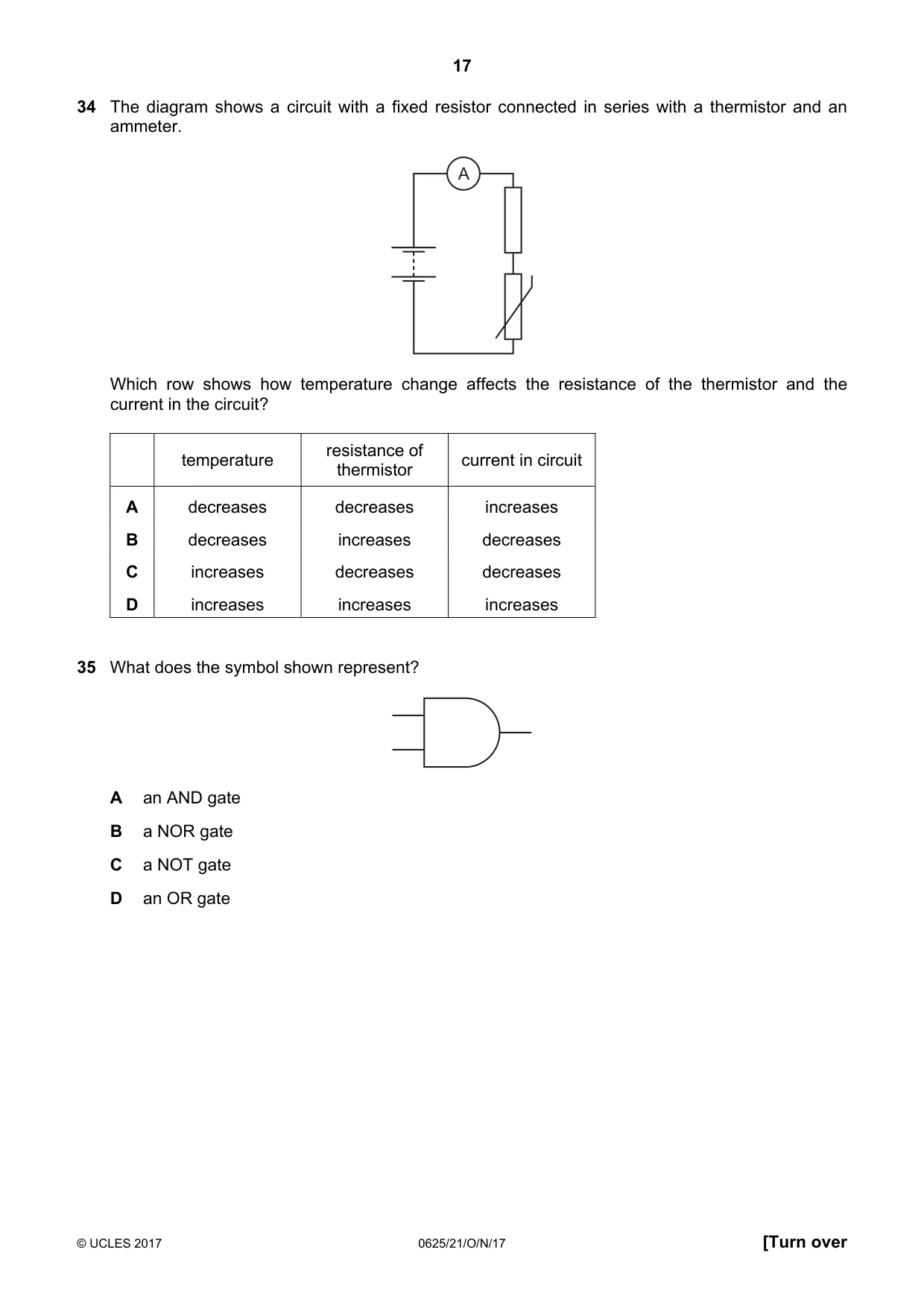
Q34 · The diagram shows a circuit with a fixed resistor connected in series with a thermistor…
34 The diagram shows a circuit with a fixed resistor connected in series with a thermistor and an ammeter. A Which row shows how temperature change affects the resistance of the thermistor and the current in the circuit? resistance of temperature current in circuit thermistor A decreases decreases increases B decreases increases decreases C increases decreases decreases D increases increases increases
Mark scheme: B
Q35 · What does the symbol shown represent?
35 What does the symbol shown represent? A an AND gate B a NOR gate C a NOT gate D an OR gate
Mark scheme: A
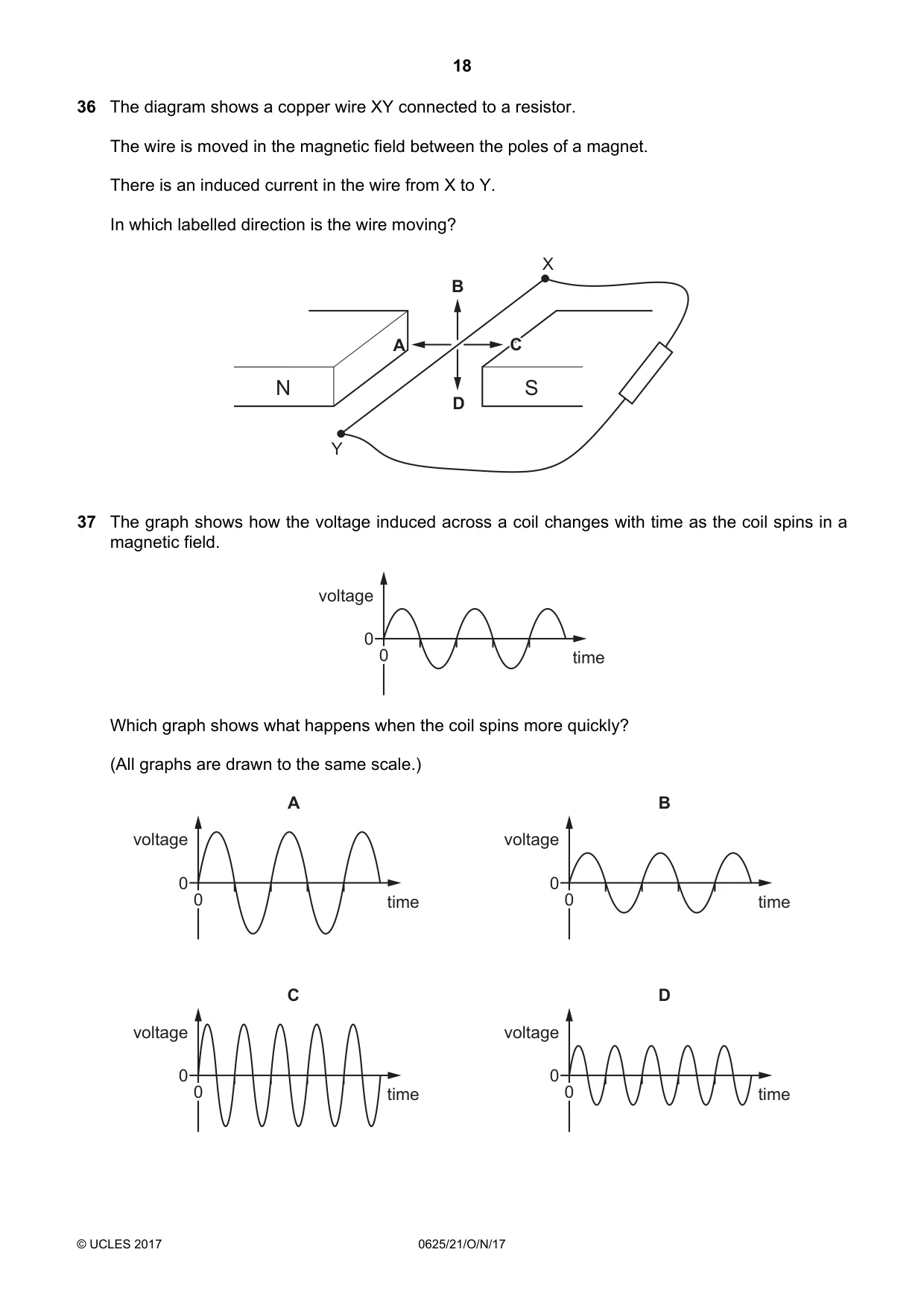
Q36 · The diagram shows a copper wire XY connected to a resistor
36 The diagram shows a copper wire XY connected to a resistor. The wire is moved in the magnetic field between the poles of a magnet. There is an induced current in the wire from X to Y. In which labelled direction is the wire moving? X B A C C N S D Y
Mark scheme: D
Q37 · The graph shows how the voltage induced across a coil changes with time as the coil spins…
37 The graph shows how the voltage induced across a coil changes with time as the coil spins in a magnetic field. voltage 0 0 time Which graph shows what happens when the coil spins more quickly? (All graphs are drawn to the same scale.) A B voltage voltage 0 0 0 time 0 time C D voltage voltage 0 0 0 time 0 time
Mark scheme: C
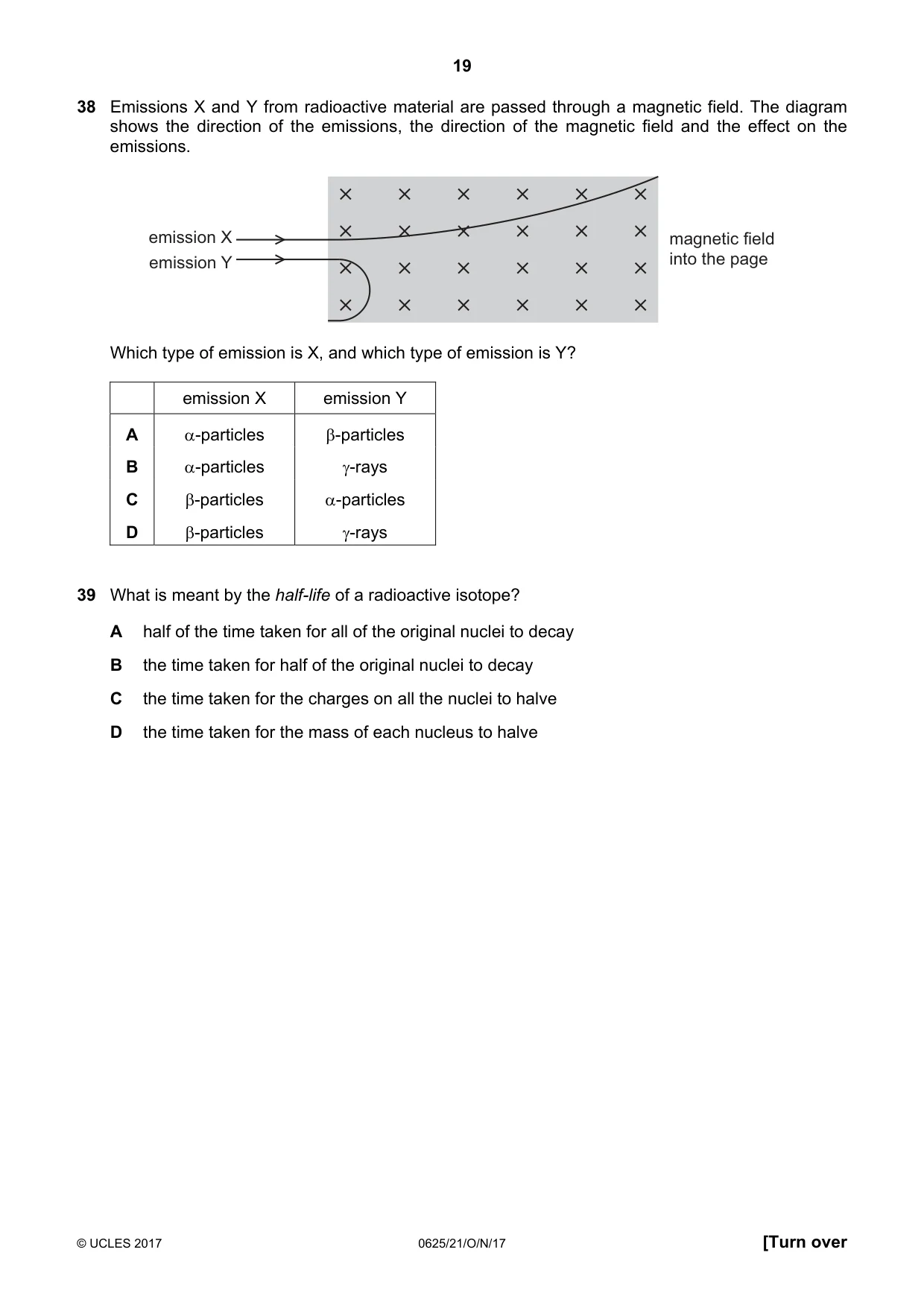
Q38 · Emissions X and Y from radioactive material are passed through a magnetic field
38 Emissions X and Y from radioactive material are passed through a magnetic field. The diagram shows the direction of the emissions, the direction of the magnetic field and the effect on the emissions. emission X magnetic field emission Y into the page Which type of emission is X, and which type of emission is Y? emission X emission Y A α-particles β-particles B α-particles γ-rays C β-particles α-particles D β-particles γ-rays
Mark scheme: A
Q39 · What is meant by the half-life of a radioactive isotope?
39 What is meant by the half-life of a radioactive isotope? A half of the time taken for all of the original nuclei to decay B the time taken for half of the original nuclei to decay C the time taken for the charges on all the nuclei to halve D the time taken for the mass of each nucleus to halve
Mark scheme: B
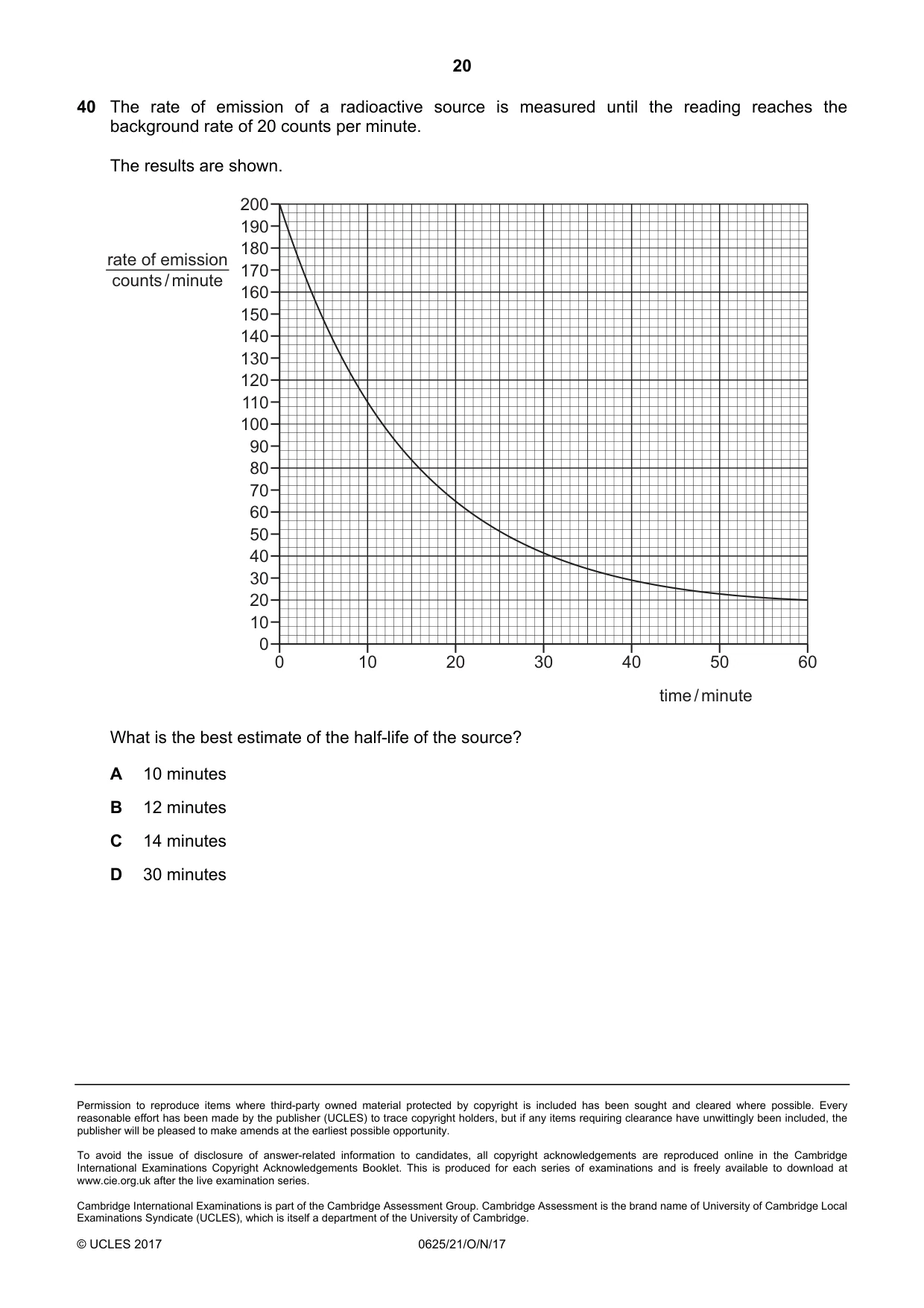
Q40 · The rate of emission of a radioactive source is measured until the reading reaches the…
40 The rate of emission of a radioactive source is measured until the reading reaches the background rate of 20 counts per minute. The results are shown. 200 190 180 rate of emission 170 counts / minute 160 150 140 130 120 110 100 90 80 70 60 50 40 30 20 10 0 0 10 20 30 40 50 60 time / minute What is the best estimate of the half-life of the source? A 10 minutes B 12 minutes C 14 minutes D 30 minutes
Mark scheme: A
What was in this paper
The subtopics covered by these 40 questions, and how many questions each got. Open one in a new tab to see every Cambridge question on it.
5Electric circuits3Energy, work and power3Light3Radioactivity3Simple phenomena of magnetism3Thermal properties and temperature3Electrical quantities2Electromagnetic effects2Electromagnetic spectrum2Kinetic particle model of matter2Sound2General properties of waves1Mass and weight1Momentum1Motion1Physical quantities and measurement techniques1Pressure1Transfer of thermal energy1What you needed in this session
Cambridge’s own grade thresholds for 2017 Oct/Nov, Paper 2 · Variant 1. A higher threshold means an easier paper — the bar moves with how the cohort did.