Cambridge IGCSE Physics 0625 — 2017 May/June Paper 2 · Variant 1
0625/21/M/J/17 · 40 questions · 40 marks · ≈45 min
The question paper and its mark scheme, free to read here and free to download. This is Cambridge’s own paper, exactly as it was sat.
Question paper20 pages

Mark scheme3 pages
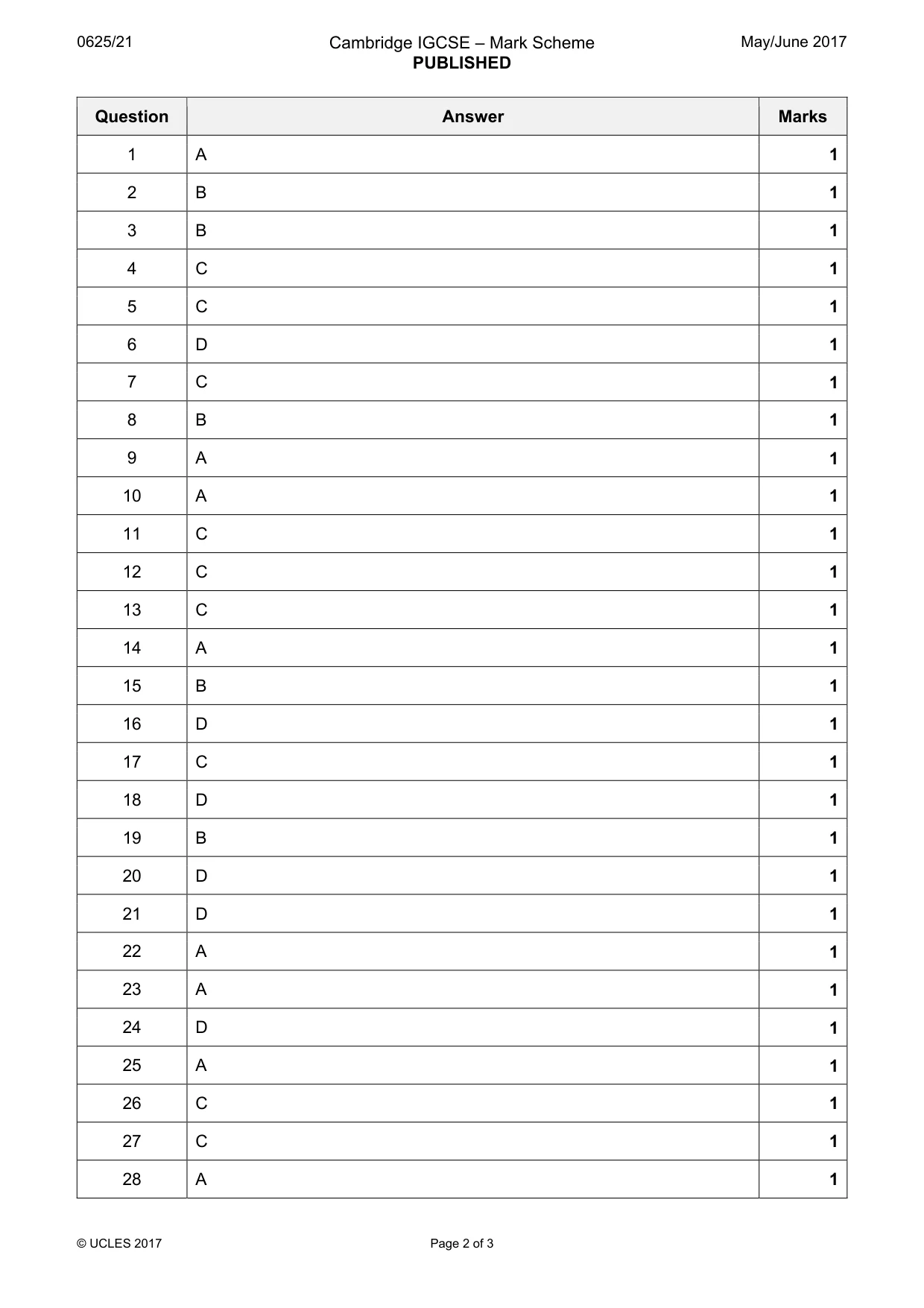
Answers below. Sit the paper first if you are practising.
Questions as text
Q1 · What is the most accurate and precise method to measure the thickness of a coin?
1 What is the most accurate and precise method to measure the thickness of a coin? A Use a micrometer screw gauge. B Use a ruler and look at the scale perpendicularly. C Use a top pan balance. D Use the displacement method with water in a measuring cylinder.
Mark scheme: A
More questions on Physical quantities and measurement techniques
Q2 · On Earth, a ball is dropped and falls 2.0 m in a vacuum
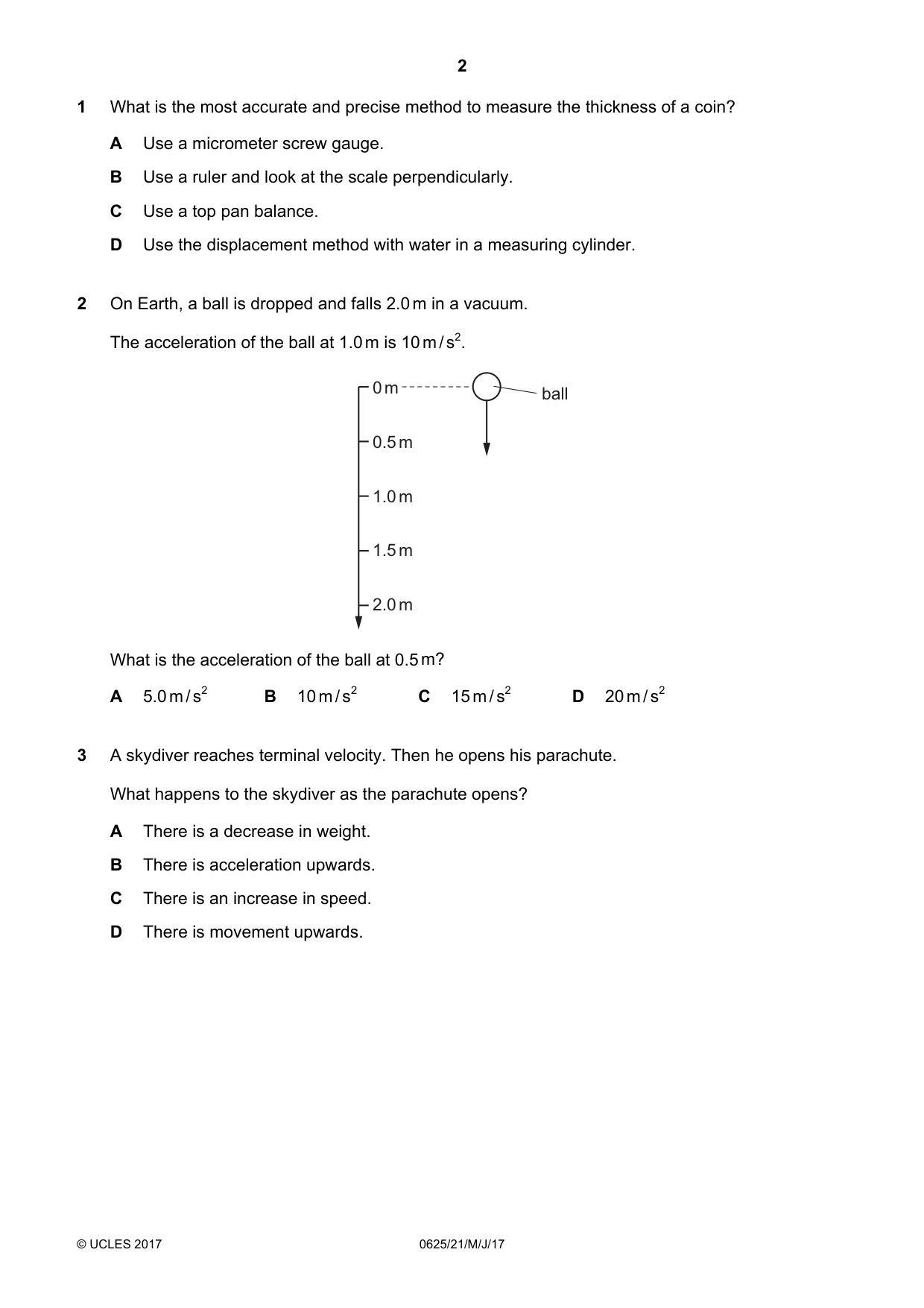
2 On Earth, a ball is dropped and falls 2.0 m in a vacuum. The acceleration of the ball at 1.0 m is 10 m / s2. 0 m ball 0.5 m 1.0 m 1.5 m 2.0 m What is the acceleration of the ball at 0.5 m? A 5.0 m / s2 B 10 m / s2 C 15 m / s2 D 20 m / s2
Mark scheme: B
Q3 · A skydiver reaches terminal velocity
3 A skydiver reaches terminal velocity. Then he opens his parachute. What happens to the skydiver as the parachute opens? A There is a decrease in weight. B There is acceleration upwards. C There is an increase in speed. D There is movement upwards.
Mark scheme: B
Q4 · A piece of steel is taken from the Earth to the Moon for an experiment
4 A piece of steel is taken from the Earth to the Moon for an experiment. The gravitational field strength on the Moon is smaller than on the Earth. Which statement about the piece of steel is correct? A It has less mass on the Moon than on the Earth. B It has more mass on the Moon than on the Earth. C It weighs less on the Moon than on the Earth. D It weighs more on the Moon than on the Earth.
Mark scheme: C
Q5 · A measuring cylinder containing only water is placed on an electronic balance
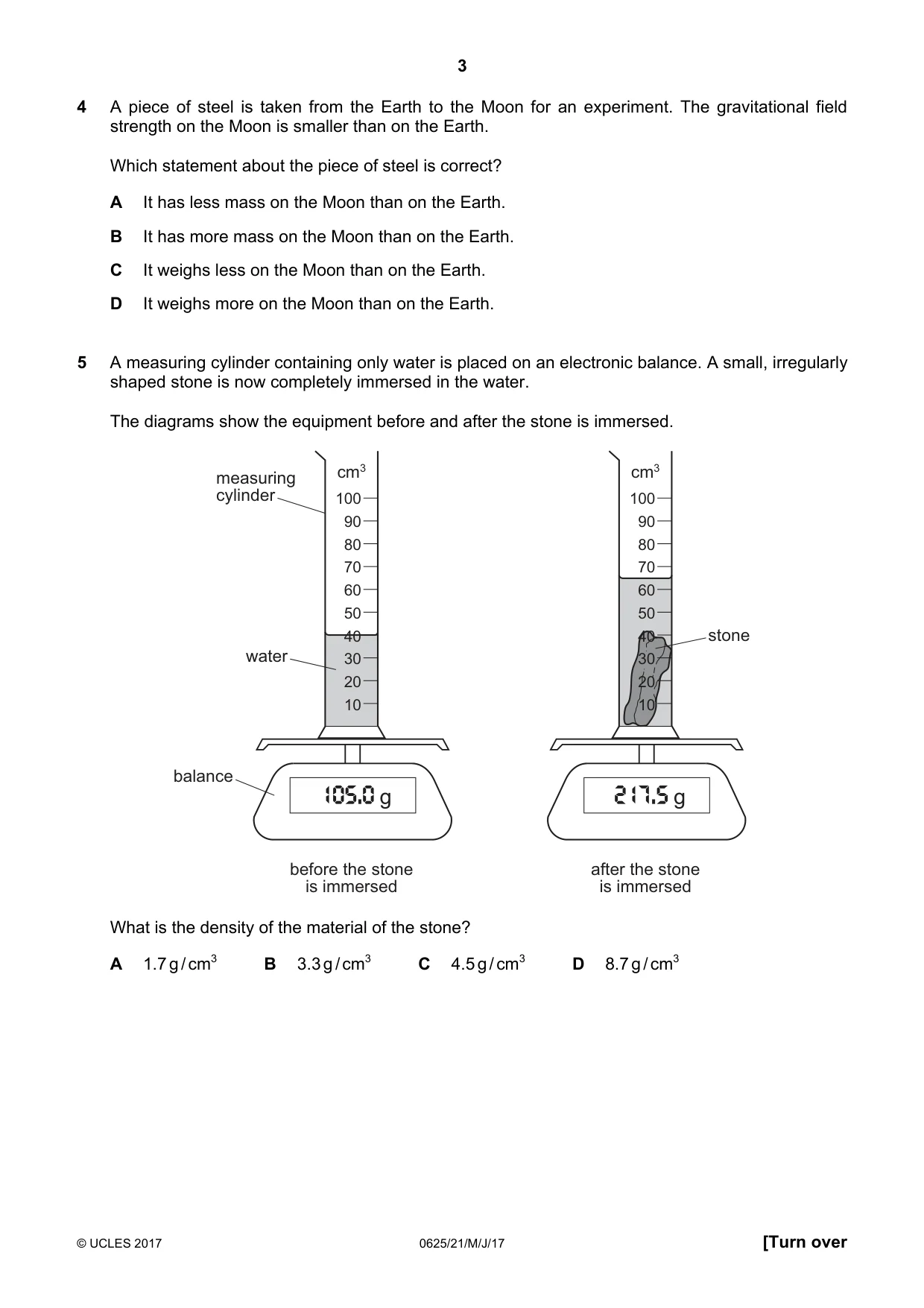
5 A measuring cylinder containing only water is placed on an electronic balance. A small, irregularly shaped stone is now completely immersed in the water. The diagrams show the equipment before and after the stone is immersed. measuring cm3 cm3 cylinder 100 100 90 90 80 80 70 70 60 60 50 50 40 40 stone water 30 30 20 20 10 10 balance g g before the stone after the stone is immersed is immersed What is the density of the material of the stone? A 1.7 g / cm3 B 3.3 g / cm3 C 4.5 g / cm3 D 8.7 g / cm3
Mark scheme: C
Q6 · A boat is travelling at a steady speed in a straight line across the surface of a lake
6 A boat is travelling at a steady speed in a straight line across the surface of a lake. Which statement about the boat is correct? A The resultant force on the boat is in the direction of motion. B The resultant force on the boat is in the opposite direction to its motion. C The resultant force on the boat is vertically downwards. D The resultant force on the boat is zero.
Mark scheme: D
Q7 · A ball of weight 1.2 N drops through the air at terminal velocity
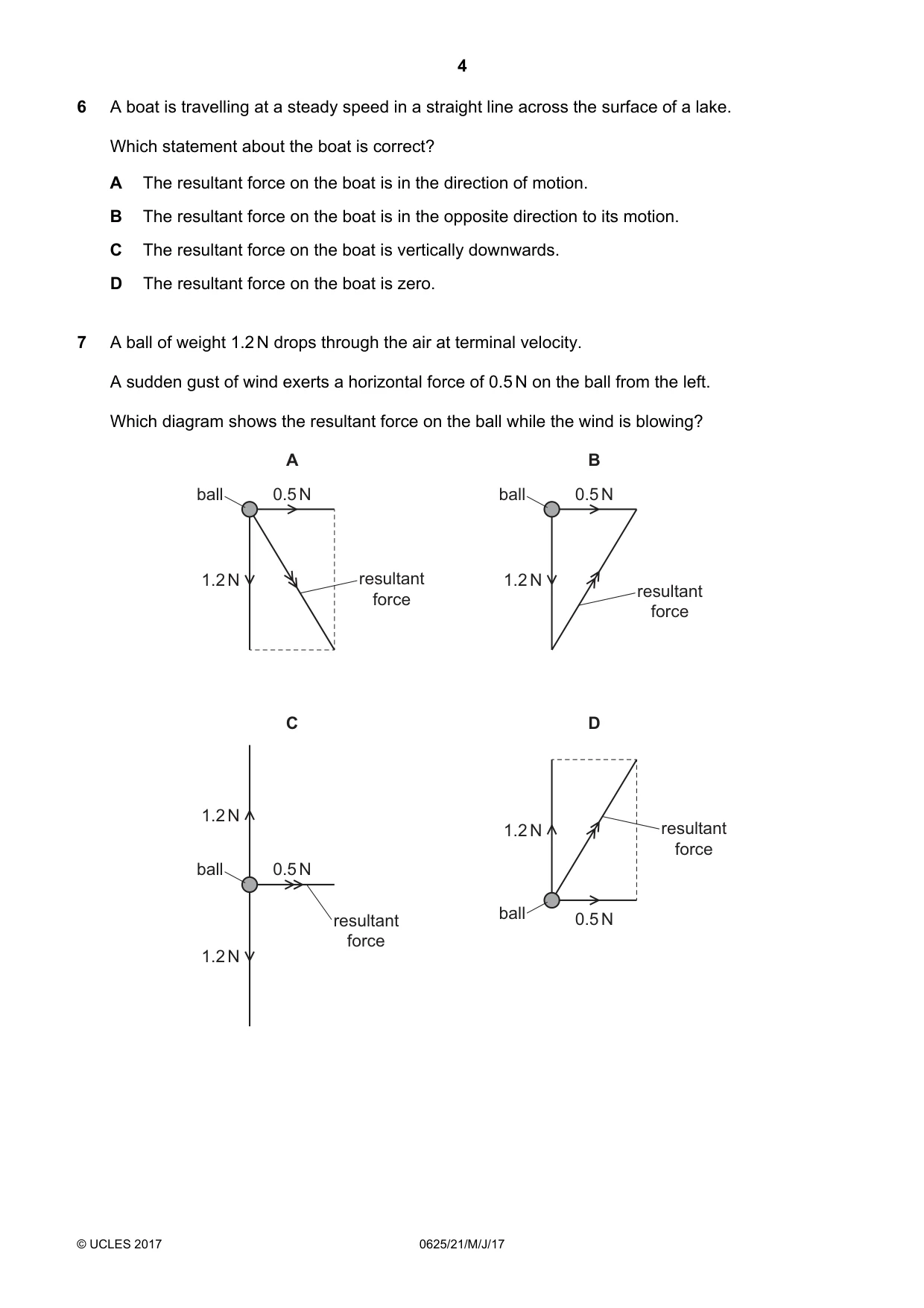
7 A ball of weight 1.2 N drops through the air at terminal velocity. A sudden gust of wind exerts a horizontal force of 0.5 N on the ball from the left. Which diagram shows the resultant force on the ball while the wind is blowing? A B ball 0.5 N ball 0.5 N 1.2 N resultant 1.2 N resultant force force C D 1.2 N 1.2 N resultant force ball 0.5 N resultant ball 0.5 N force 1.2 N
Mark scheme: C
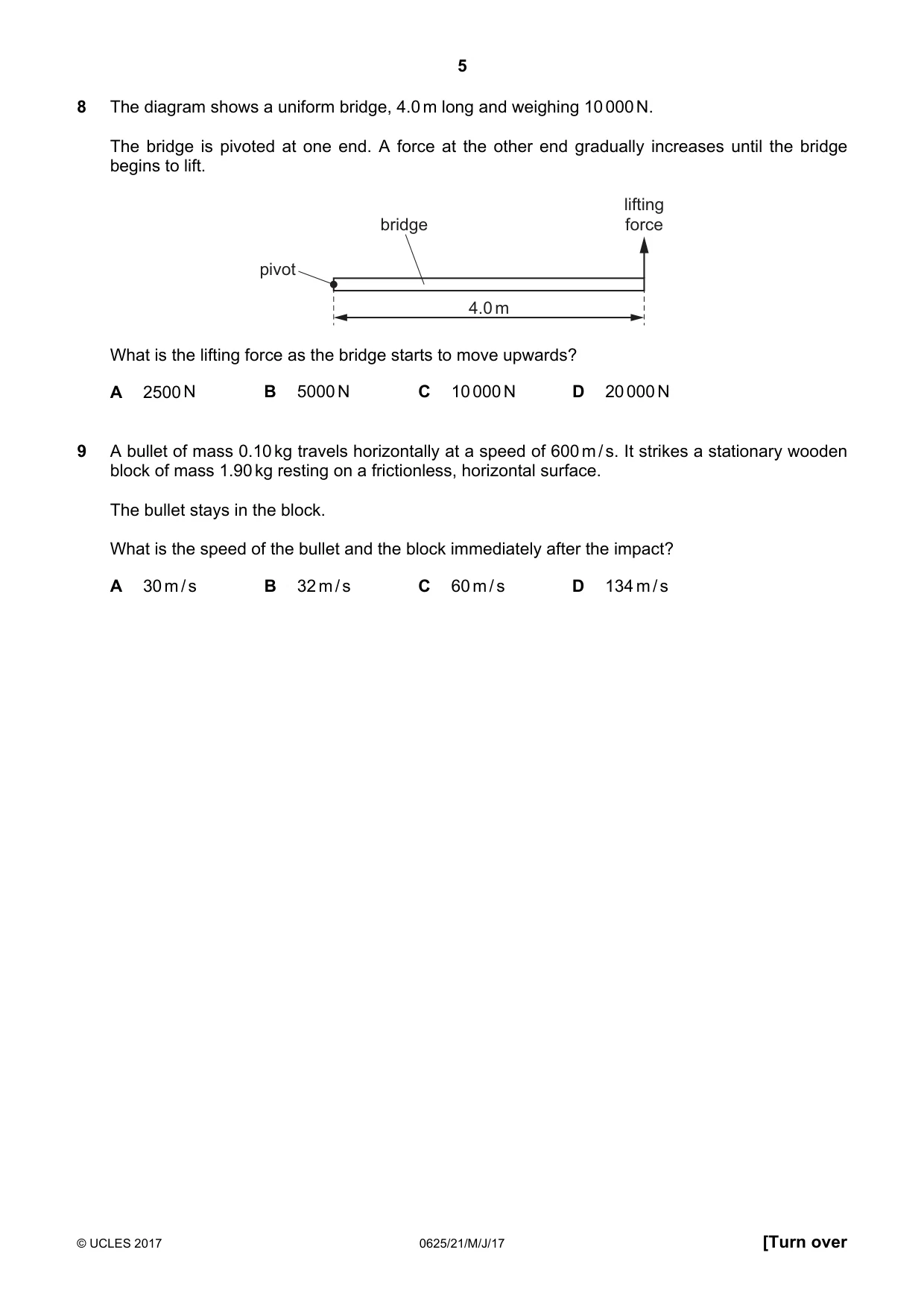
Q8 · The diagram shows a uniform bridge, 4.0 m long and weighing 10 000 N
8 The diagram shows a uniform bridge, 4.0 m long and weighing 10 000 N. The bridge is pivoted at one end. A force at the other end gradually increases until the bridge begins to lift. lifting bridge force pivot 4.0 m What is the lifting force as the bridge starts to move upwards? A 2500 N B 5000 N C 10 000 N D 20 000 N
Mark scheme: B
Q9 · A bullet of mass 0.10 kg travels horizontally at a speed of 600 m / s
9 A bullet of mass 0.10 kg travels horizontally at a speed of 600 m / s. It strikes a stationary wooden block of mass 1.90 kg resting on a frictionless, horizontal surface. The bullet stays in the block. What is the speed of the bullet and the block immediately after the impact? A 30 m / s B 32 m / s C 60 m / s D 134 m / s
Mark scheme: A
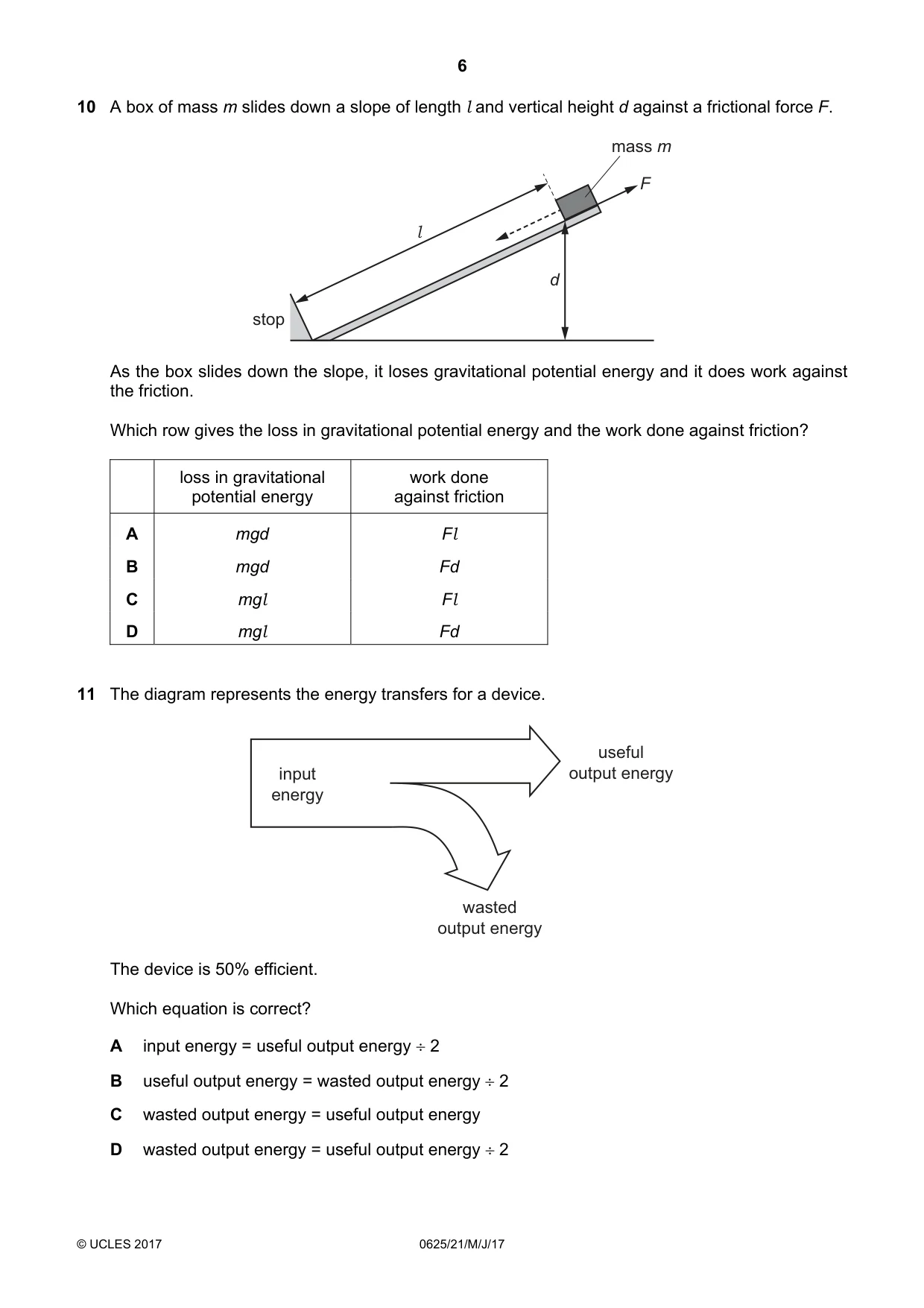
Q10 · A box of mass m slides down a slope of length l and vertical height d against a…
10 A box of mass m slides down a slope of length l and vertical height d against a frictional force F. mass m F l d stop As the box slides down the slope, it loses gravitational potential energy and it does work against the friction. Which row gives the loss in gravitational potential energy and the work done against friction? loss in gravitational work done potential energy against friction A mgd Fl B mgd Fd C mgl Fl D mgl Fd
Mark scheme: A
Q11 · The diagram represents the energy transfers for a device
11 The diagram represents the energy transfers for a device. useful input output energy energy wasted output energy The device is 50% efficient. Which equation is correct? A input energy = useful output energy ÷ 2 B useful output energy = wasted output energy ÷ 2 C wasted output energy = useful output energy D wasted output energy = useful output energy ÷ 2
Mark scheme: C
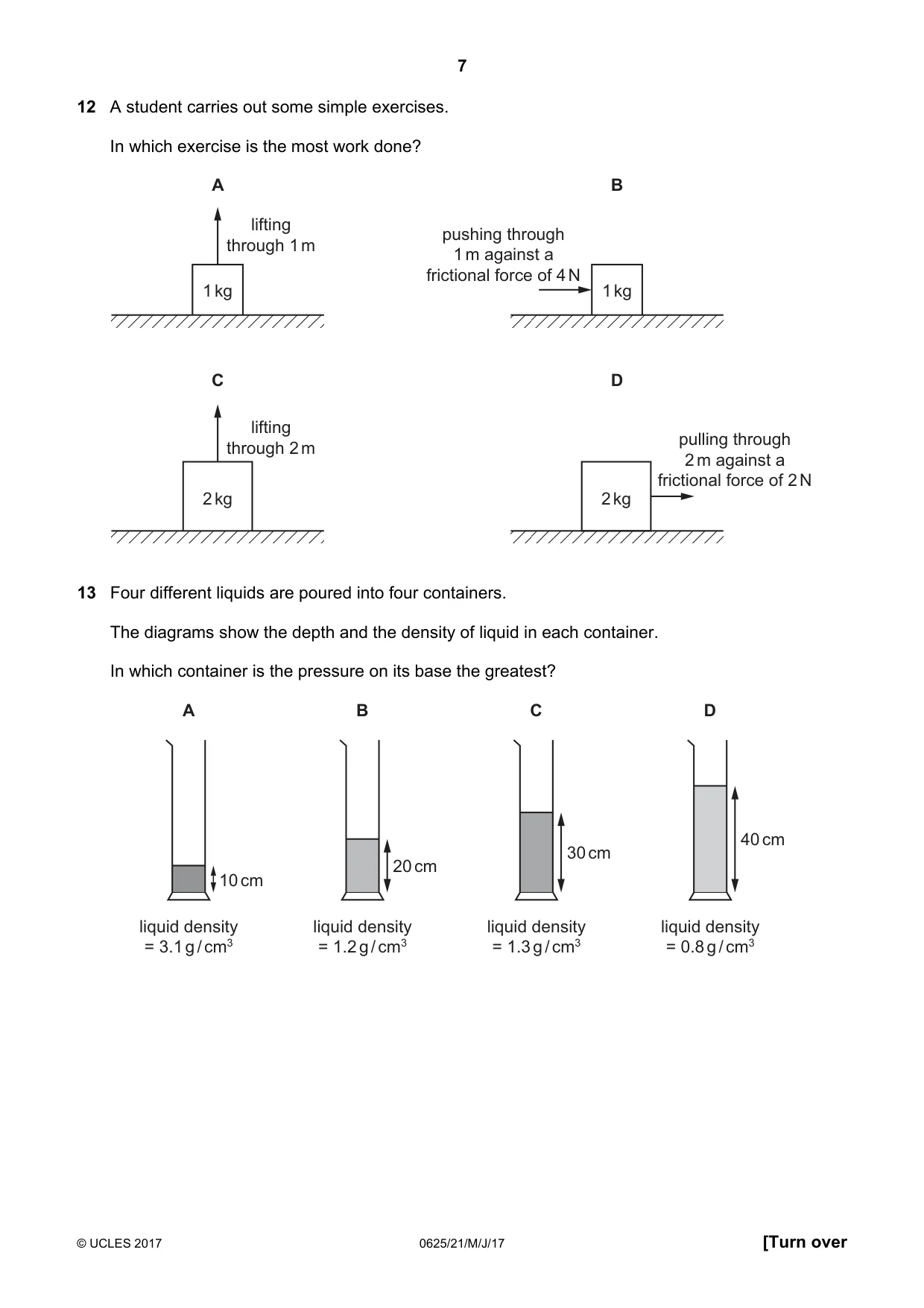
Q12 · A student carries out some simple exercises
12 A student carries out some simple exercises. In which exercise is the most work done? A B lifting pushing through through 1 m 1 m against a frictional force of 4 N 1 kg 1 kg C D lifting pulling through through 2 m 2 m against a frictional force of 2 N 2 kg 2 kg
Mark scheme: C
Q13 · Four different liquids are poured into four containers
13 Four different liquids are poured into four containers. The diagrams show the depth and the density of liquid in each container. In which container is the pressure on its base the greatest? A B C D 40 cm 30 cm 20 cm 10 cm liquid density liquid density liquid density liquid density = 3.1 g / cm3 = 1.2 g / cm3 = 1.3 g / cm3 = 0.8 g / cm3
Mark scheme: C
Q14 · Brownian motion is observed when using a microscope to look at smoke particles in air
14 Brownian motion is observed when using a microscope to look at smoke particles in air. What causes the smoke particles to move at random? A Smoke particles are hit by air molecules. B Smoke particles are moved by convection currents in the air. C Smoke particles have different weights and fall at different speeds. D Smoke particles hit the walls of the container.
Mark scheme: A
Q15 · Gas molecules striking a container wall cause a pressure to be exerted on the wall
15 Gas molecules striking a container wall cause a pressure to be exerted on the wall. Which statement explains this? A When a molecule rebounds there must be a change in its energy. B When a molecule rebounds there must be a change in its momentum. C When a molecule rebounds there must be a change in its speed. D When a molecule rebounds there must be a change in its temperature.
Mark scheme: B
Q16 · Equal masses of two different liquids are put into identical beakers
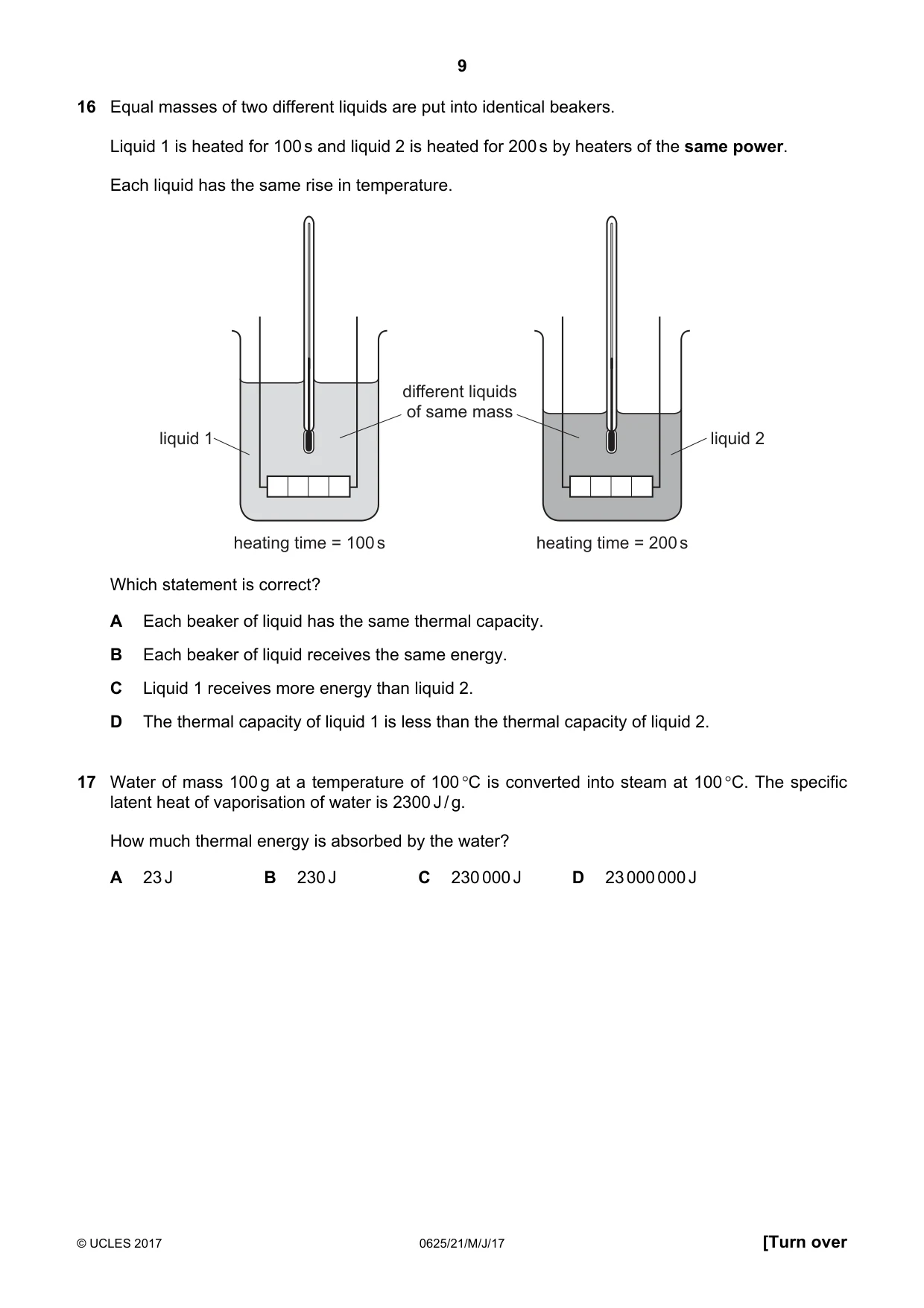
16 Equal masses of two different liquids are put into identical beakers. Liquid 1 is heated for 100 s and liquid 2 is heated for 200 s by heaters of the same power. Each liquid has the same rise in temperature. different liquids of same mass liquid 1 liquid 2 heating time = 100 s heating time = 200 s Which statement is correct? A Each beaker of liquid has the same thermal capacity. B Each beaker of liquid receives the same energy. C Liquid 1 receives more energy than liquid 2. D The thermal capacity of liquid 1 is less than the thermal capacity of liquid 2.
Mark scheme: D
Q17 · Water of mass 100 g at a temperature of 100 °C is converted into steam at 100 °C
17 Water of mass 100 g at a temperature of 100 °C is converted into steam at 100 °C. The specific latent heat of vaporisation of water is 2300 J / g. How much thermal energy is absorbed by the water? A 23 J B 230 J C 230 000 J D 23 000 000 J
Mark scheme: C
Q18 · A copper bar and a wooden bar are joined
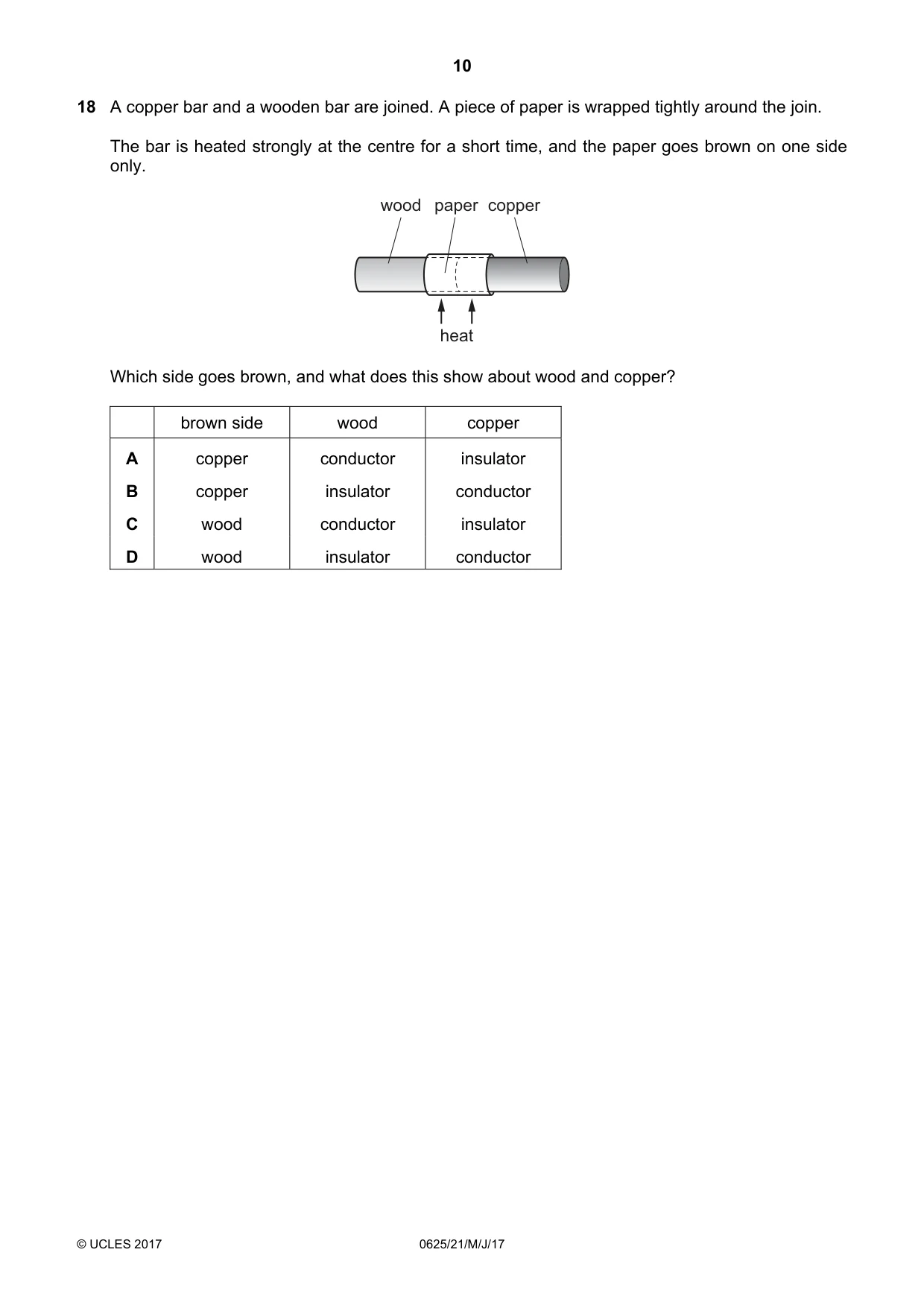
18 A copper bar and a wooden bar are joined. A piece of paper is wrapped tightly around the join. The bar is heated strongly at the centre for a short time, and the paper goes brown on one side only. wood paper copper heat Which side goes brown, and what does this show about wood and copper? brown side wood copper A copper conductor insulator B copper insulator conductor C wood conductor insulator D wood insulator conductor
Mark scheme: D
Q19 · Different waves hit barriers with different sized gaps
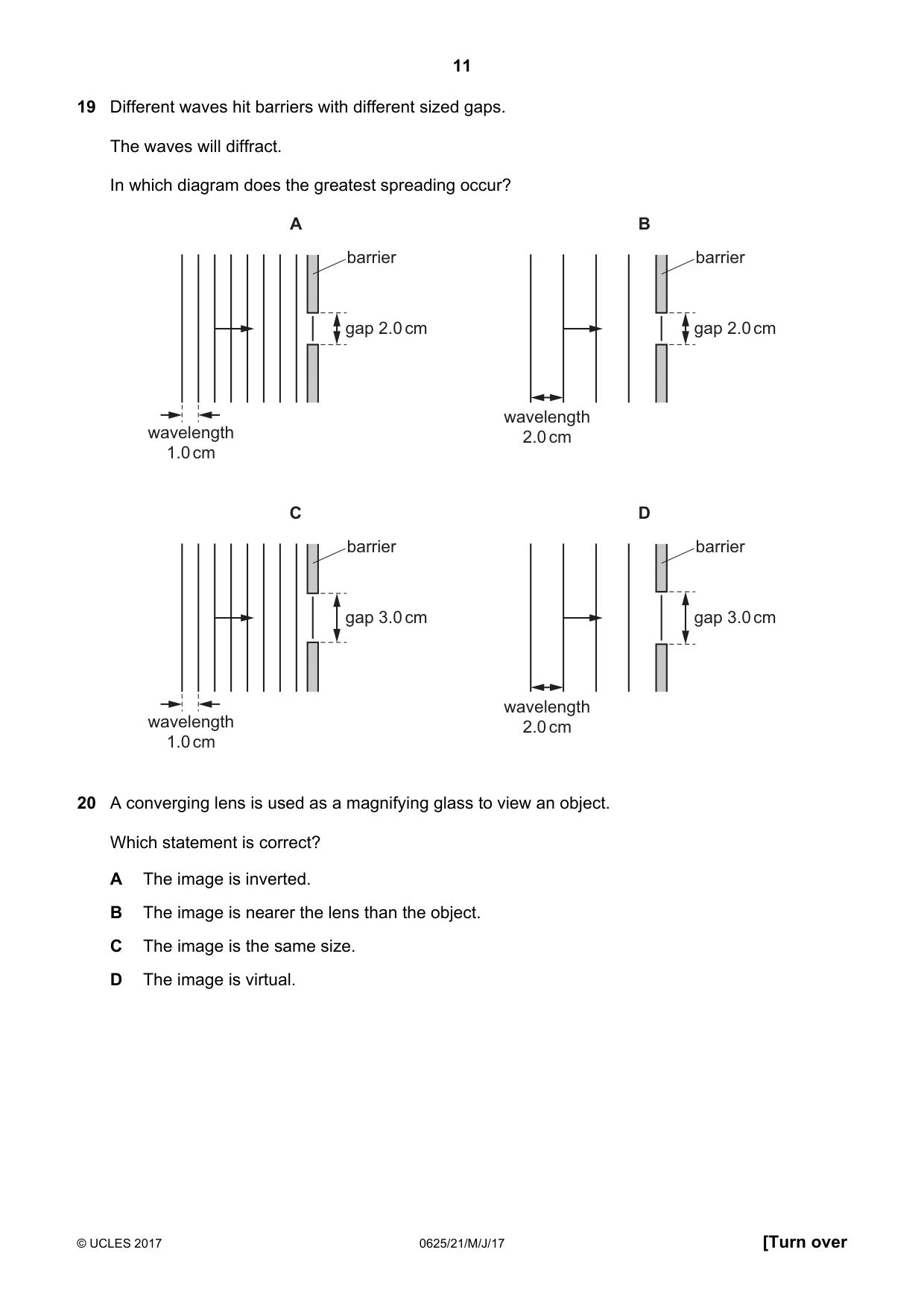
19 Different waves hit barriers with different sized gaps. The waves will diffract. In which diagram does the greatest spreading occur? A B barrier barrier gap 2.0 cm gap 2.0 cm wavelength wavelength 2.0 cm 1.0 cm C D barrier barrier gap 3.0 cm gap 3.0 cm wavelength wavelength 2.0 cm 1.0 cm
Mark scheme: B
Q20 · A converging lens is used as a magnifying glass to view an object
20 A converging lens is used as a magnifying glass to view an object. Which statement is correct? A The image is inverted. B The image is nearer the lens than the object. C The image is the same size. D The image is virtual.
Mark scheme: D
Q21 · Which diagram shows what happens when a ray of white light passes through a prism?
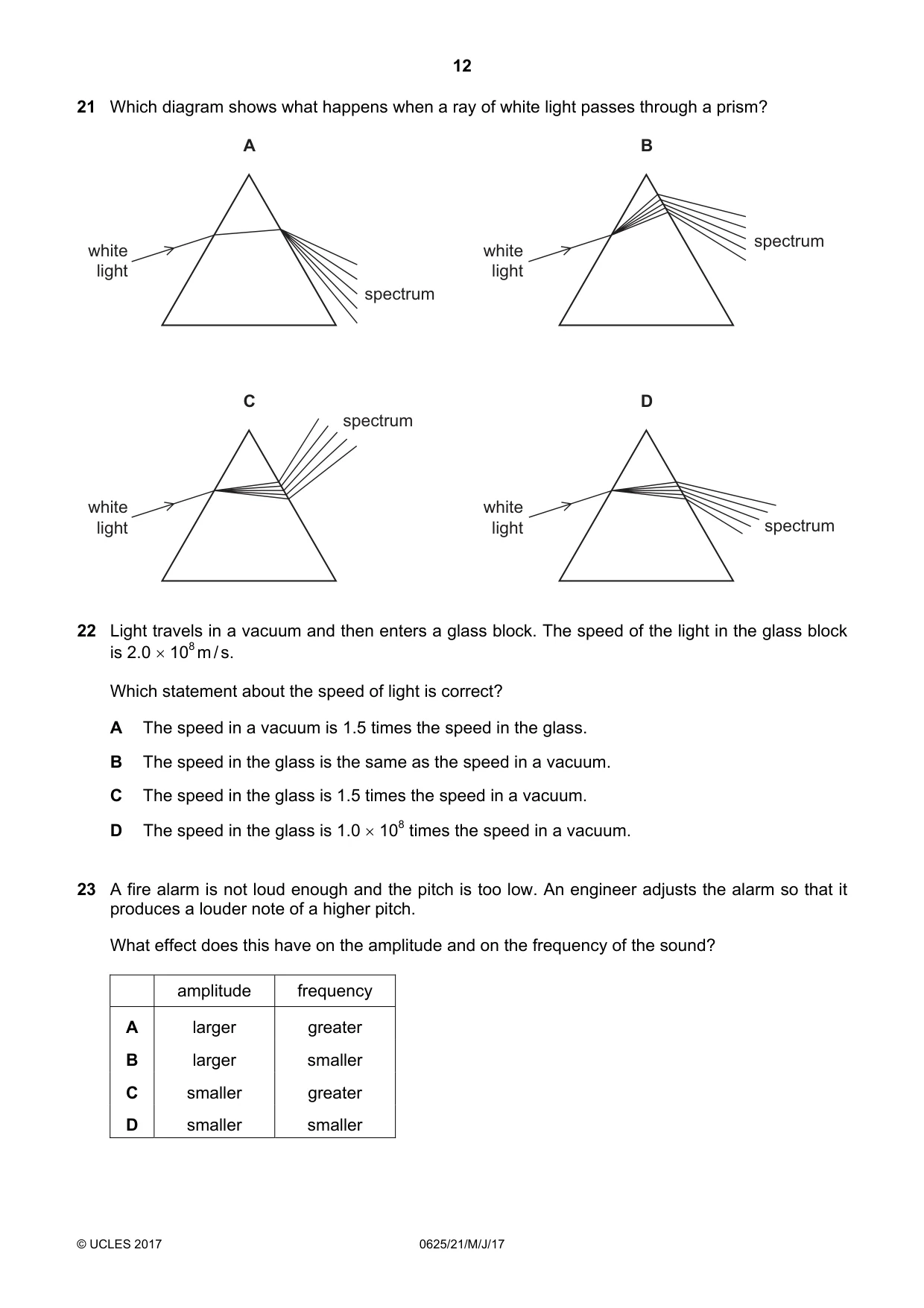
21 Which diagram shows what happens when a ray of white light passes through a prism? A B spectrum white white light light spectrum C D spectrum white white light light spectrum
Mark scheme: D
Q22 · Light travels in a vacuum and then enters a glass block
22 Light travels in a vacuum and then enters a glass block. The speed of the light in the glass block is 2.0 × 10⁸ m / s. Which statement about the speed of light is correct? A The speed in a vacuum is 1.5 times the speed in the glass. B The speed in the glass is the same as the speed in a vacuum. C The speed in the glass is 1.5 times the speed in a vacuum. D The speed in the glass is 1.0 × 10⁸ times the speed in a vacuum.
Mark scheme: A
Q23 · A fire alarm is not loud enough and the pitch is too low
23 A fire alarm is not loud enough and the pitch is too low. An engineer adjusts the alarm so that it produces a louder note of a higher pitch. What effect does this have on the amplitude and on the frequency of the sound? amplitude frequency A larger greater B larger smaller C smaller greater D smaller smaller
Mark scheme: A
Q24 · In a child’s toy, metal fish are lifted out of a toy pond using a metal rod
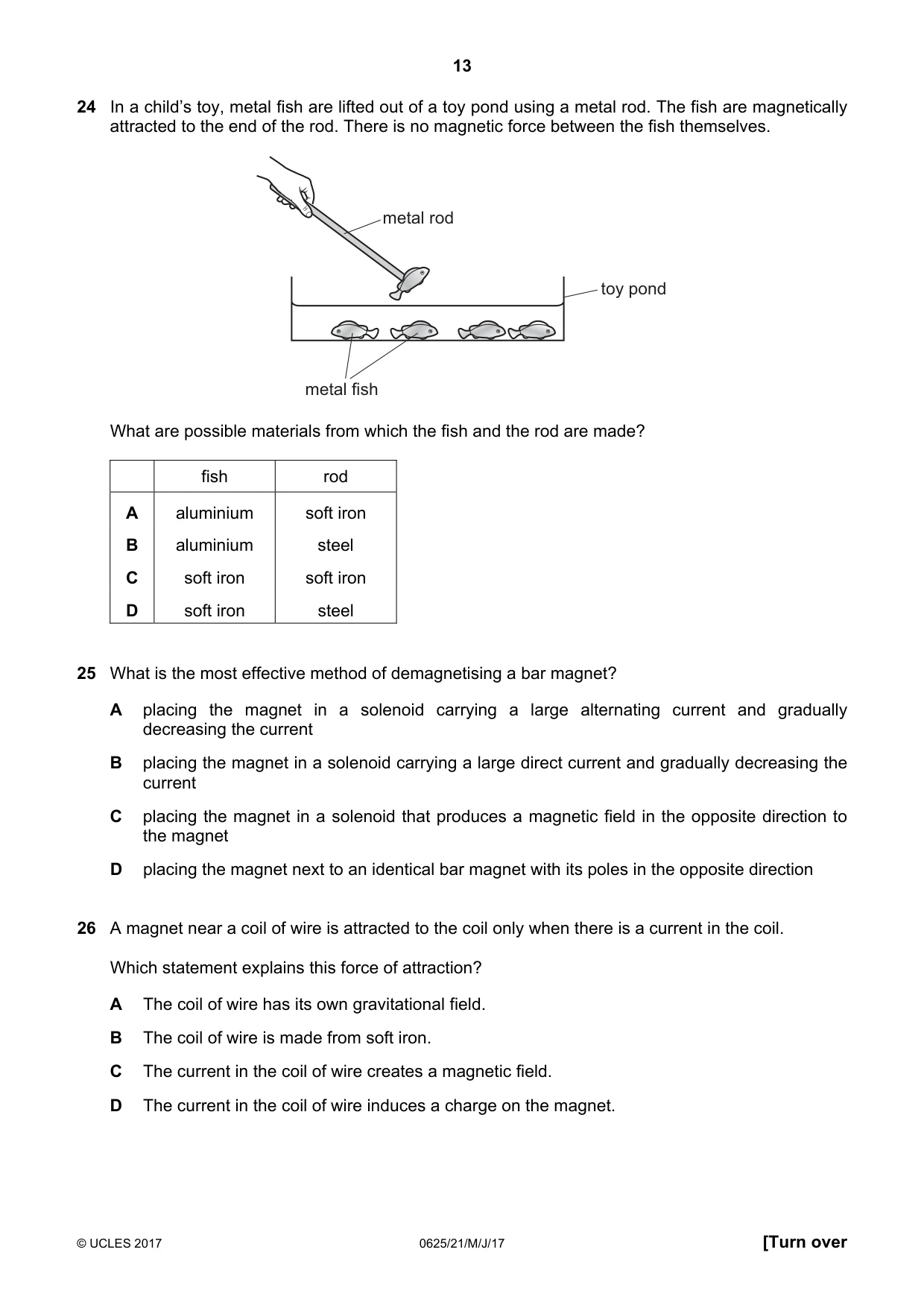
24 In a child’s toy, metal fish are lifted out of a toy pond using a metal rod. The fish are magnetically attracted to the end of the rod. There is no magnetic force between the fish themselves. metal rod toy pond metal fish What are possible materials from which the fish and the rod are made? fish rod A aluminium soft iron B aluminium steel C soft iron soft iron D soft iron steel
Mark scheme: D
Q25 · What is the most effective method of demagnetising a bar magnet?
25 What is the most effective method of demagnetising a bar magnet? A placing the magnet in a solenoid carrying a large alternating current and gradually decreasing the current B placing the magnet in a solenoid carrying a large direct current and gradually decreasing the current C placing the magnet in a solenoid that produces a magnetic field in the opposite direction to the magnet D placing the magnet next to an identical bar magnet with its poles in the opposite direction
Mark scheme: A
Q26 · A magnet near a coil of wire is attracted to the coil only when there is a current in the…
26 A magnet near a coil of wire is attracted to the coil only when there is a current in the coil. Which statement explains this force of attraction? A The coil of wire has its own gravitational field. B The coil of wire is made from soft iron. C The current in the coil of wire creates a magnetic field. D The current in the coil of wire induces a charge on the magnet.
Mark scheme: C
Q27 · A student rubs a plastic rod with a cloth
27 A student rubs a plastic rod with a cloth. The rod becomes positively charged. What has happened to the rod? A It has gained electrons. B It has gained protons. C It has lost electrons. D It has lost protons.
Mark scheme: C
Q28 · Which quantity is measured in coulombs?
28 Which quantity is measured in coulombs? A charge B current C electromotive force D power
Mark scheme: A
Q29 · A cylinder of conducting putty has length l, diameter d and resistance R
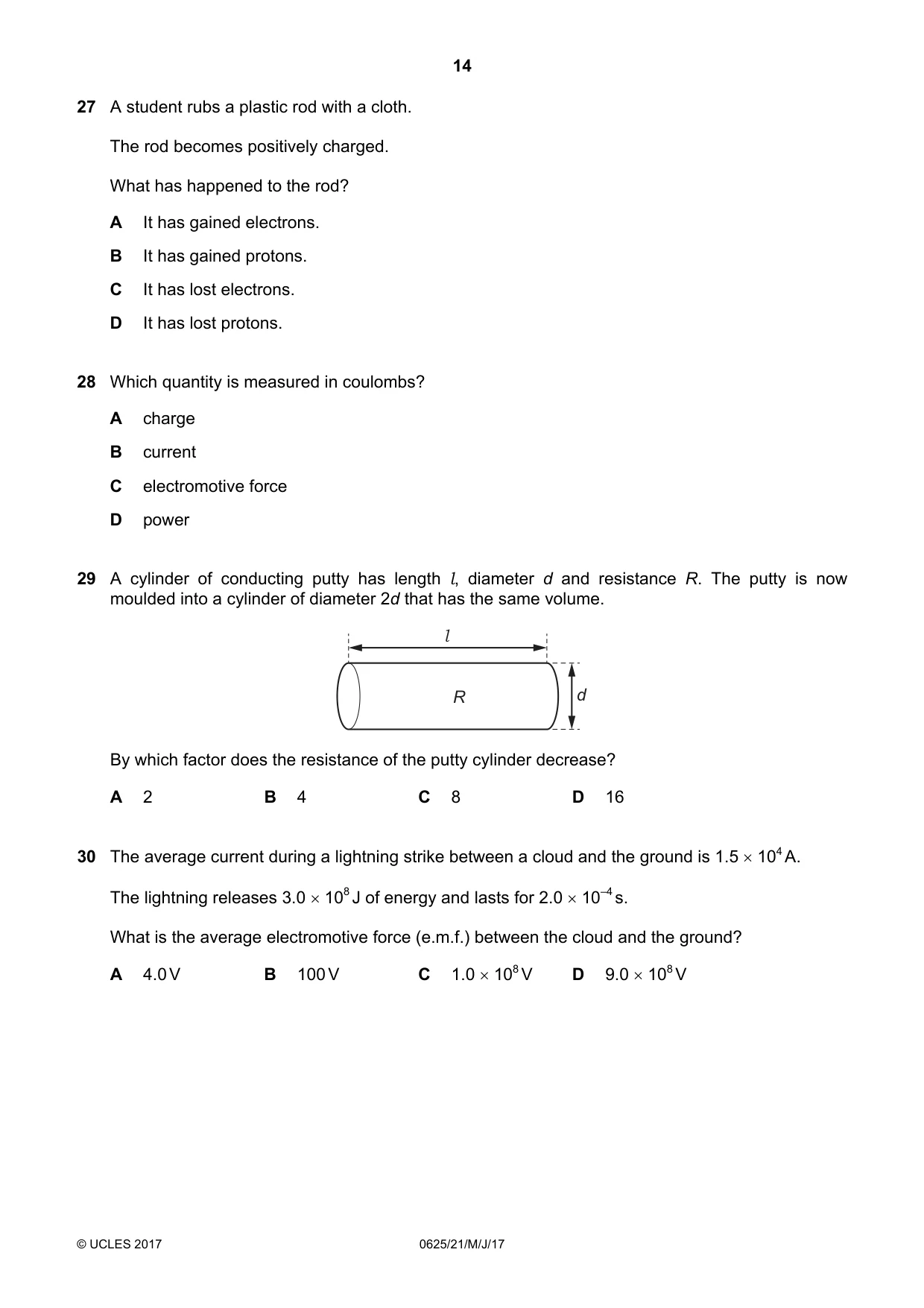
29 A cylinder of conducting putty has length l, diameter d and resistance R. The putty is now moulded into a cylinder of diameter 2d that has the same volume. l R d By which factor does the resistance of the putty cylinder decrease? A 2 B 4 C 8 D 16
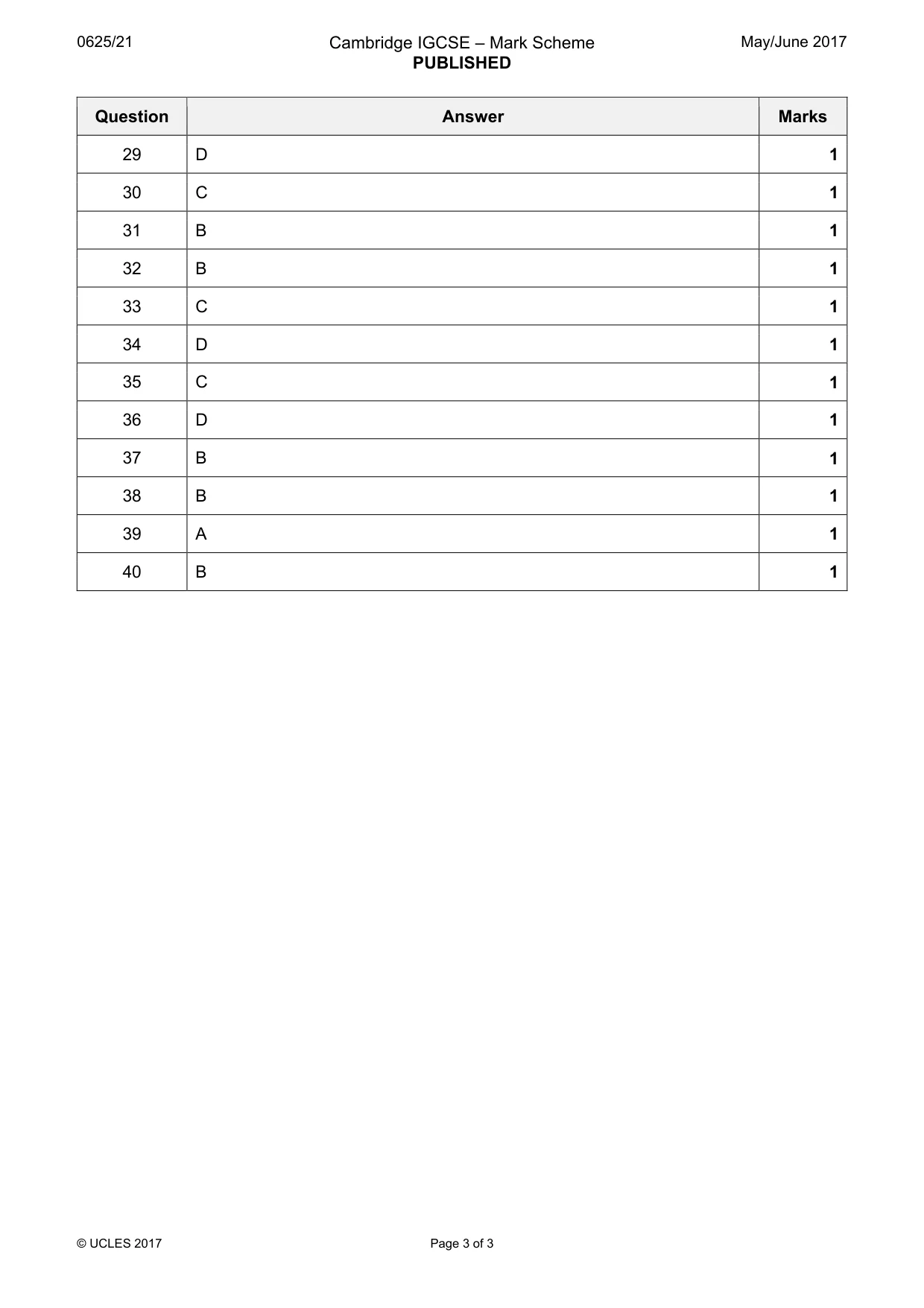
Mark scheme: D
Q30 · The average current during a lightning strike between a cloud and the ground is 1.5 × 10⁴…
30 The average current during a lightning strike between a cloud and the ground is 1.5 × 10⁴ A. The lightning releases 3.0 × 10⁸ J of energy and lasts for 2.0 × 10⁻⁴ s. What is the average electromotive force (e.m.f.) between the cloud and the ground? A 4.0 V B 100 V C 1.0 × 10⁸ V D 9.0 × 10⁸ V
Mark scheme: C
Q31 · A student connects a variable potential divider (potentiometer) circuit
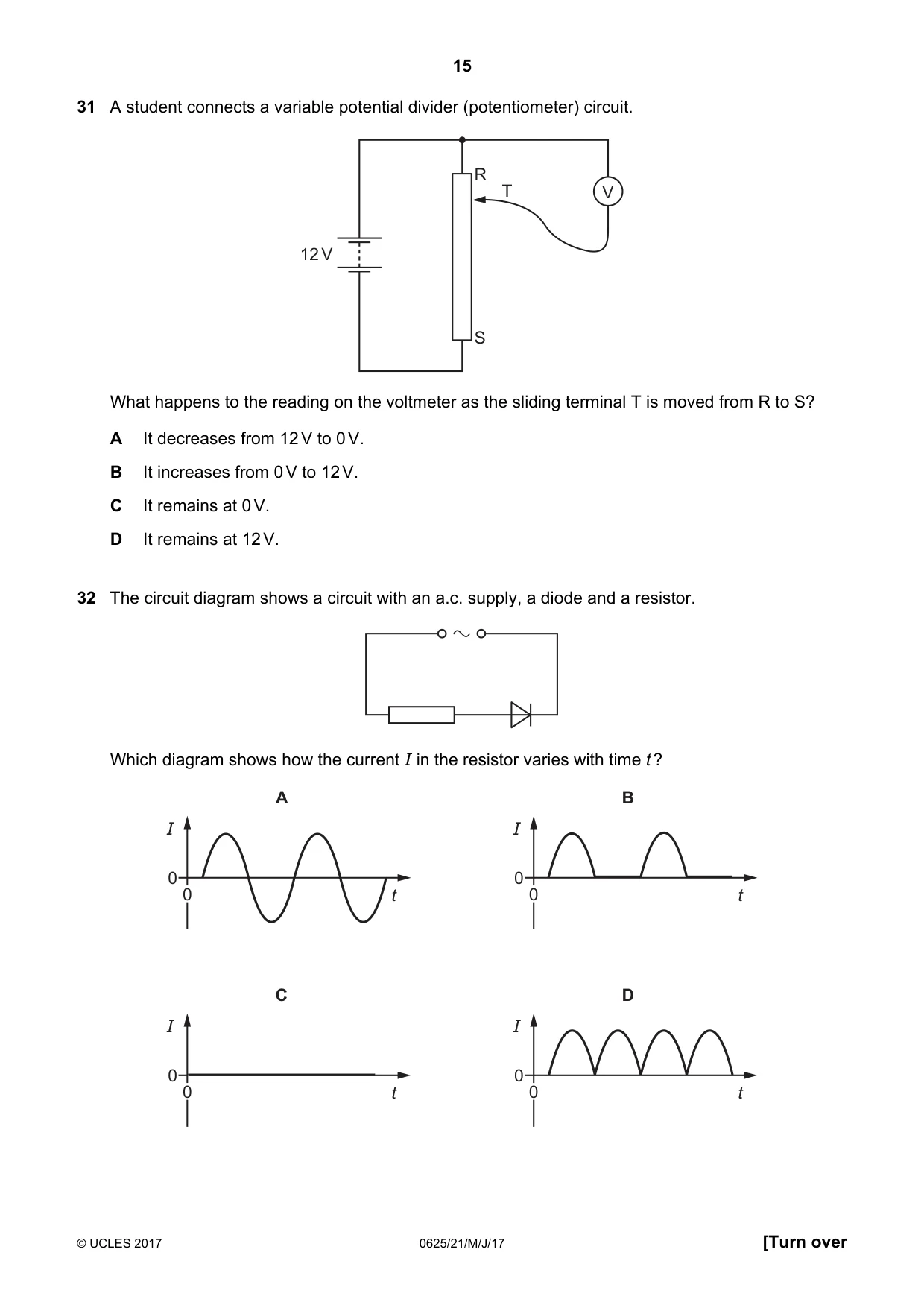
31 A student connects a variable potential divider (potentiometer) circuit. R T V 12 V S What happens to the reading on the voltmeter as the sliding terminal T is moved from R to S? A It decreases from 12 V to 0 V. B It increases from 0 V to 12 V. C It remains at 0 V. D It remains at 12 V.
Mark scheme: B
Q32 · The circuit diagram shows a circuit with an a.c
32 The circuit diagram shows a circuit with an a.c. supply, a diode and a resistor. Which diagram shows how the current I in the resistor varies with time t ? A B I I 0 0 0 t 0 t C D I I 0 0 0 t 0 t
Mark scheme: B
Q33 · A light-dependent resistor (LDR) and a resistor R are connected in a series circuit
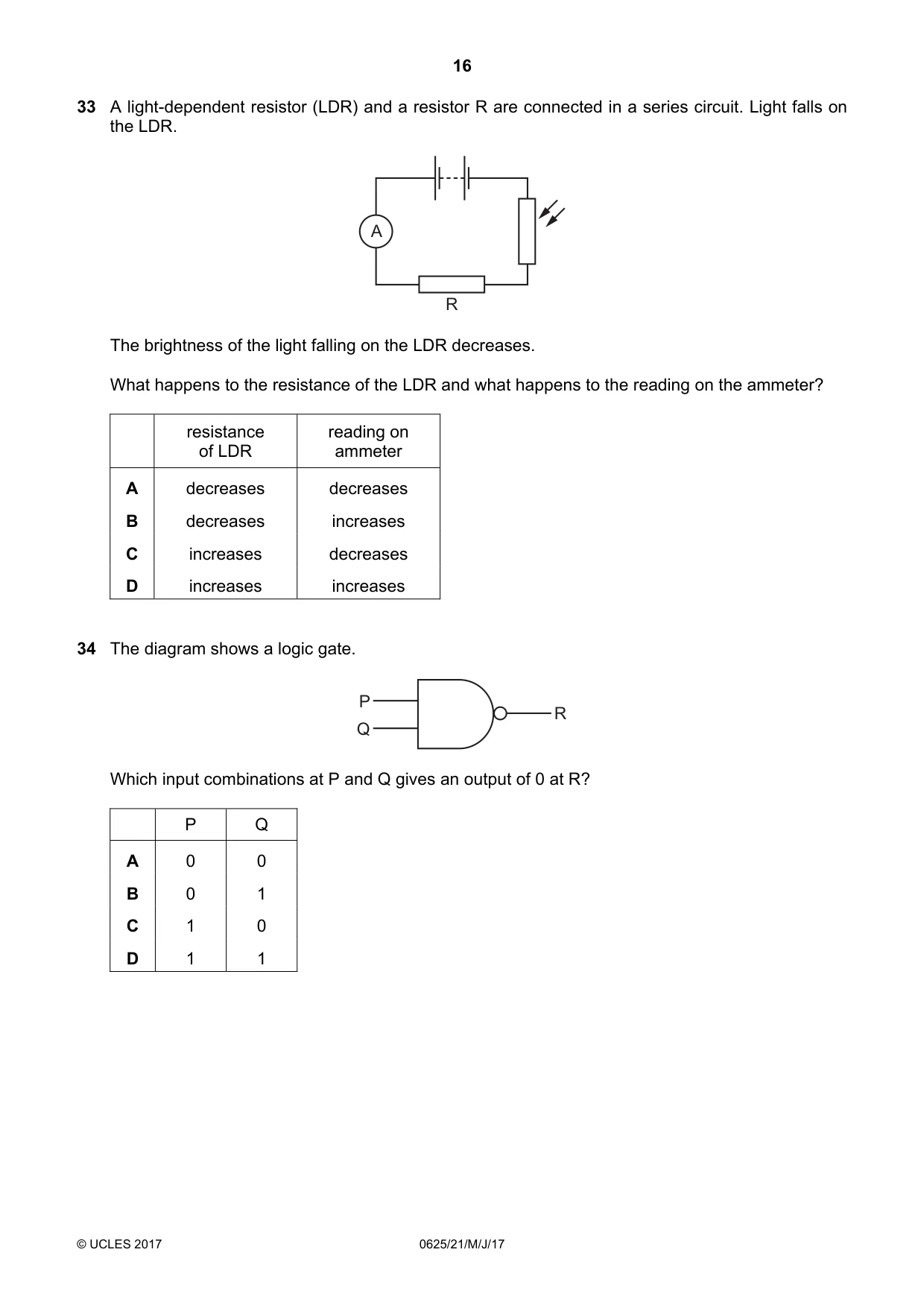
33 A light-dependent resistor (LDR) and a resistor R are connected in a series circuit. Light falls on the LDR. A R The brightness of the light falling on the LDR decreases. What happens to the resistance of the LDR and what happens to the reading on the ammeter? resistance reading on of LDR ammeter A decreases decreases B decreases increases C increases decreases D increases increases
Mark scheme: C
Q34 · The diagram shows a logic gate
34 The diagram shows a logic gate. P R Q Which input combinations at P and Q gives an output of 0 at R? P Q A 0 0 B 0 1 C 1 0 D 1 1
Mark scheme: D
Question 35
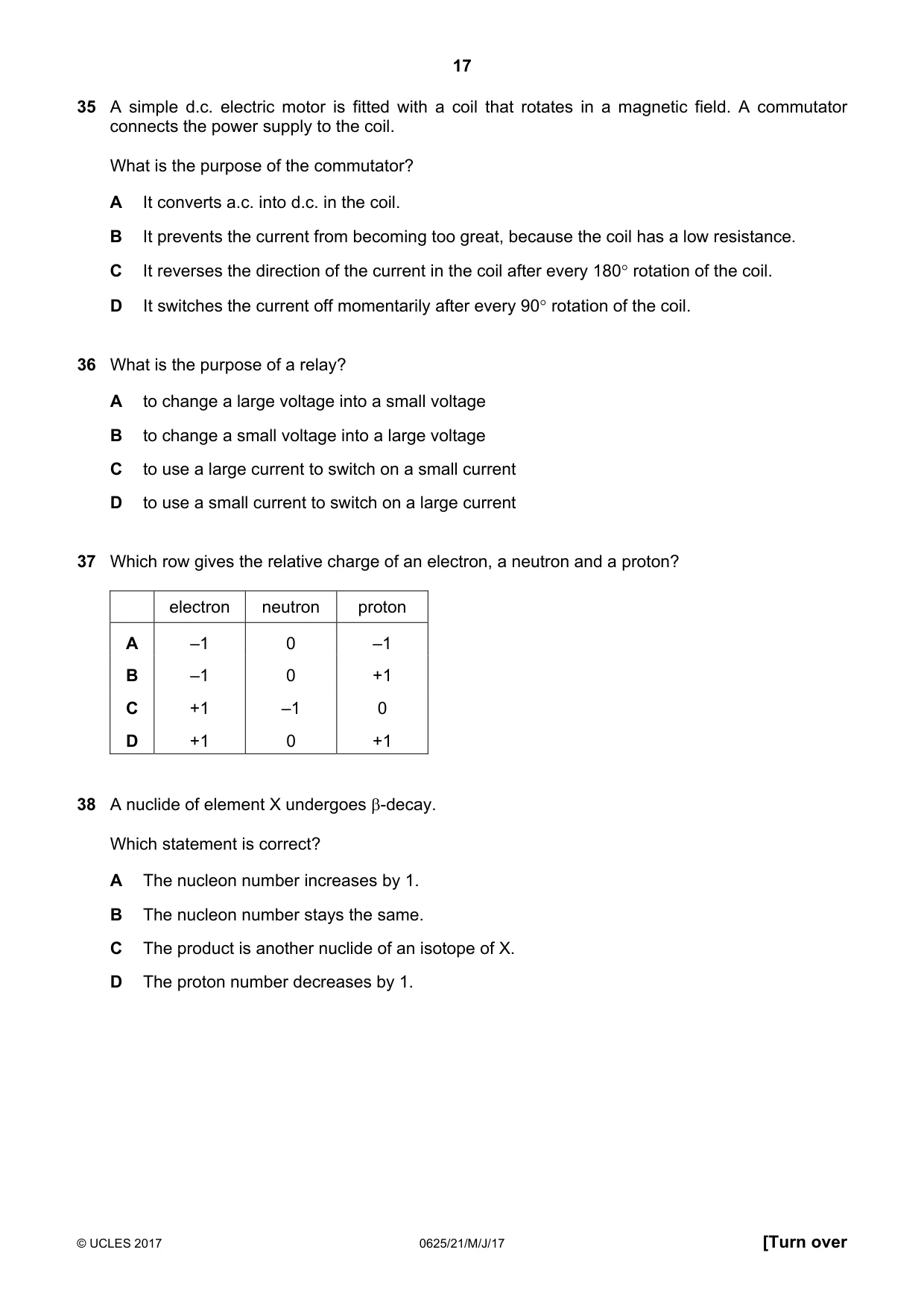
35 A simple d.c. electric motor is fitted with a coil that rotates in a magnetic field. A commutator connects the power supply to the coil. What is the purpose of the commutator? A It converts a.c. into d.c. in the coil. B It prevents the current from becoming too great, because the coil has a low resistance. C It reverses the direction of the current in the coil after every 180° rotation of the coil. D It switches the current off momentarily after every 90° rotation of the coil.
Mark scheme: C
Q36 · What is the purpose of a relay?
36 What is the purpose of a relay? A to change a large voltage into a small voltage B to change a small voltage into a large voltage C to use a large current to switch on a small current D to use a small current to switch on a large current
Mark scheme: D
Q37 · Which row gives the relative charge of an electron, a neutron and a proton?
37 Which row gives the relative charge of an electron, a neutron and a proton? electron neutron proton A –1 0 –1 B –1 0 +1 C +1 –1 0 D +1 0 +1
Mark scheme: B
Q38 · A nuclide of element X undergoes β-decay
38 A nuclide of element X undergoes β-decay. Which statement is correct? A The nucleon number increases by 1. B The nucleon number stays the same. C The product is another nuclide of an isotope of X. D The proton number decreases by 1.
Mark scheme: B
Q39 · A sample of radioactive isotope is decaying
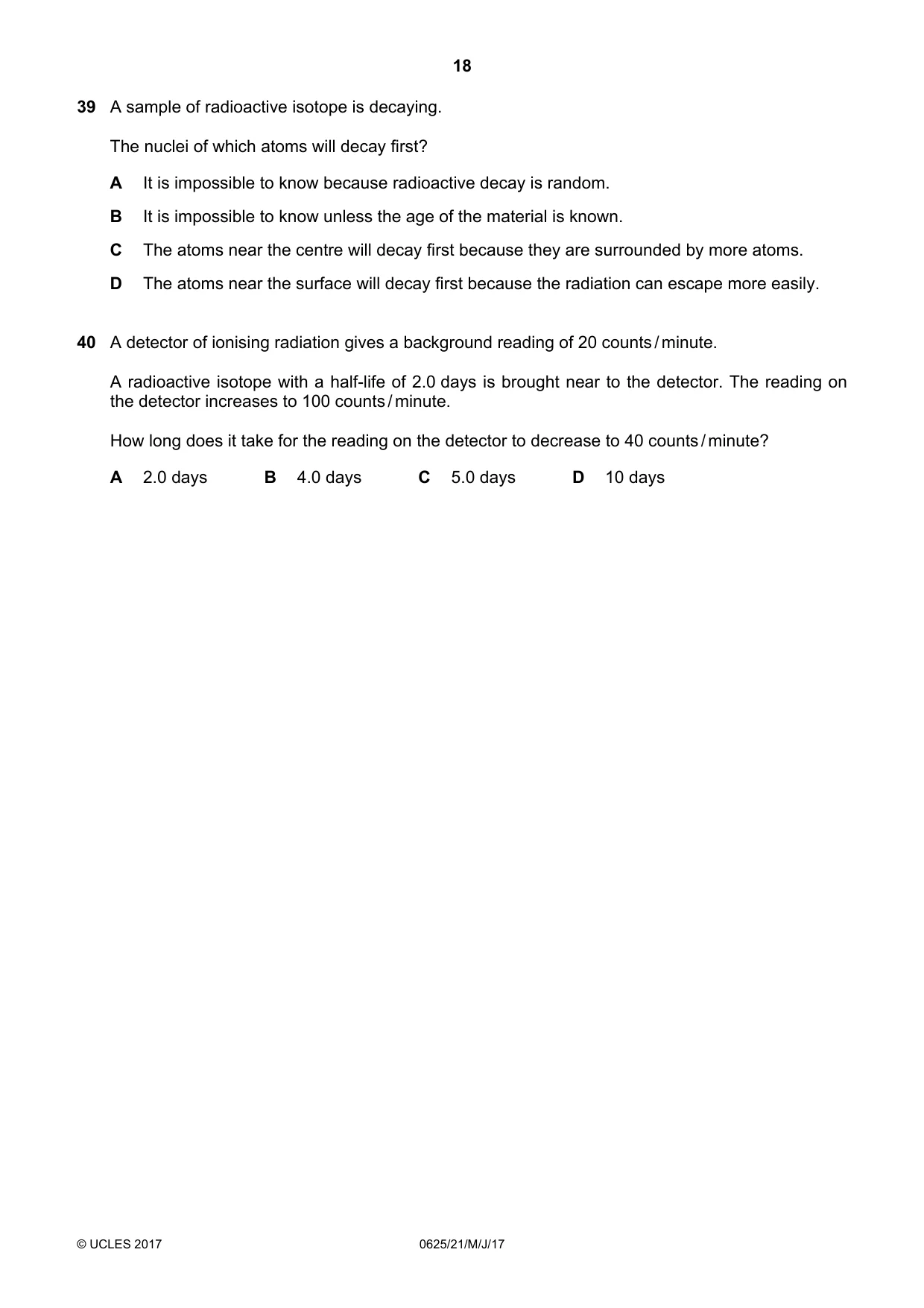
39 A sample of radioactive isotope is decaying. The nuclei of which atoms will decay first? A It is impossible to know because radioactive decay is random. B It is impossible to know unless the age of the material is known. C The atoms near the centre will decay first because they are surrounded by more atoms. D The atoms near the surface will decay first because the radiation can escape more easily.
Mark scheme: A
Q40 · A detector of ionising radiation gives a background reading of 20 counts / minute
40 A detector of ionising radiation gives a background reading of 20 counts / minute. A radioactive isotope with a half-life of 2.0 days is brought near to the detector. The reading on the detector increases to 100 counts / minute. How long does it take for the reading on the detector to decrease to 40 counts / minute? A 2.0 days B 4.0 days C 5.0 days D 10 days
Mark scheme: B
What was in this paper
The subtopics covered by these 40 questions, and how many questions each got. Open one in a new tab to see every Cambridge question on it.
5Electrical quantities4Forces4Energy, work and power3Light3Radioactivity3Electromagnetic effects2Kinetic particle model of matter2Simple phenomena of magnetism2Thermal properties and temperature2Density1General properties of waves1Mass and weight1Momentum1Motion1Physical quantities and measurement techniques1Pressure1Sound1The nuclear model of the atom1Transfer of thermal energy1What you needed in this session
Cambridge’s own grade thresholds for 2017 May/June, Paper 2 · Variant 1. A higher threshold means an easier paper — the bar moves with how the cohort did.