Cambridge IGCSE Physics 0625 — 2017 May/June Paper 2 · Variant 3
0625/23/M/J/17 · 40 questions · 40 marks · ≈45 min
The question paper and its mark scheme, free to read here and free to download. This is Cambridge’s own paper, exactly as it was sat.
Question paper20 pages
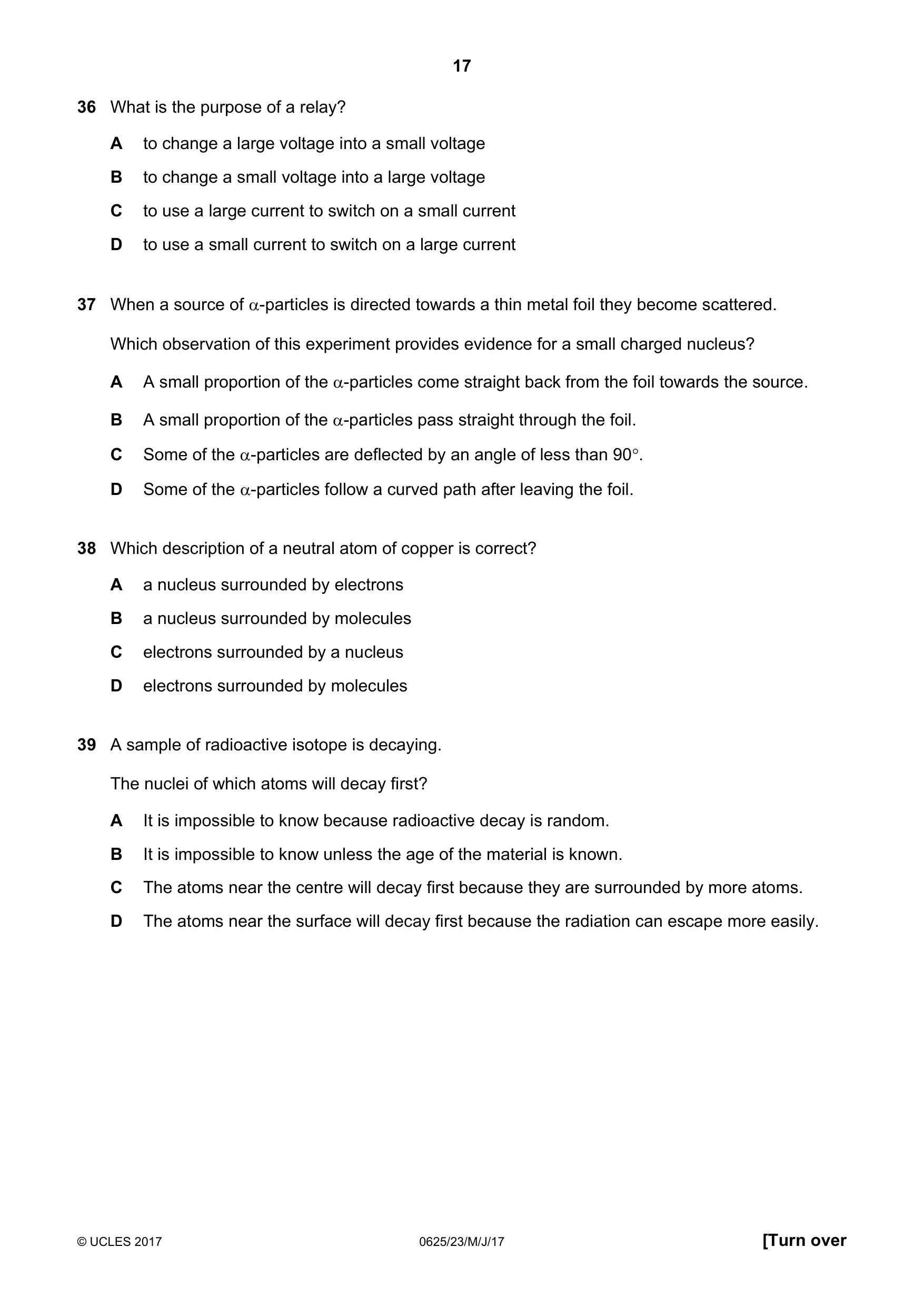
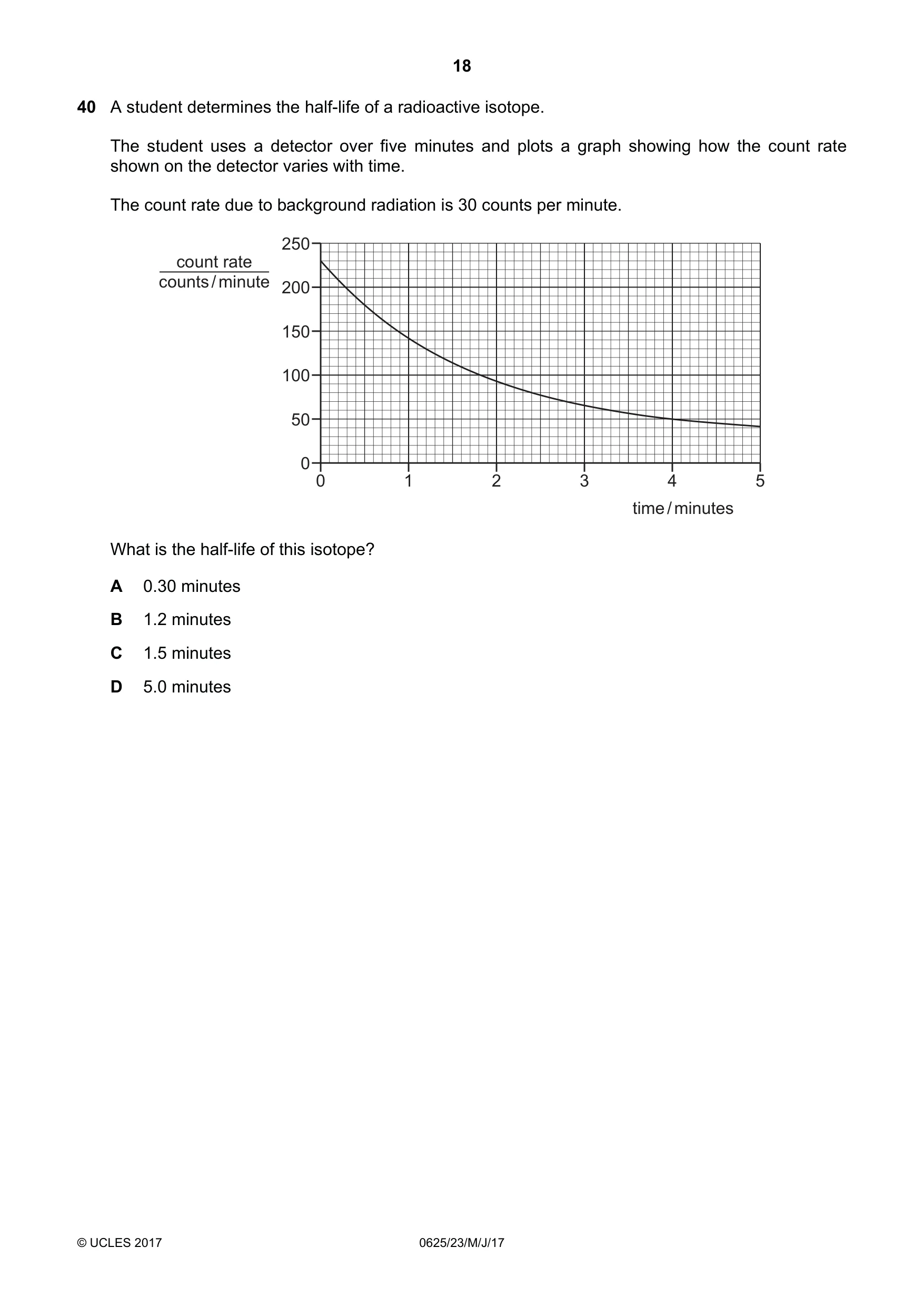

Mark scheme3 pages
Answers below. Sit the paper first if you are practising.
Questions as text
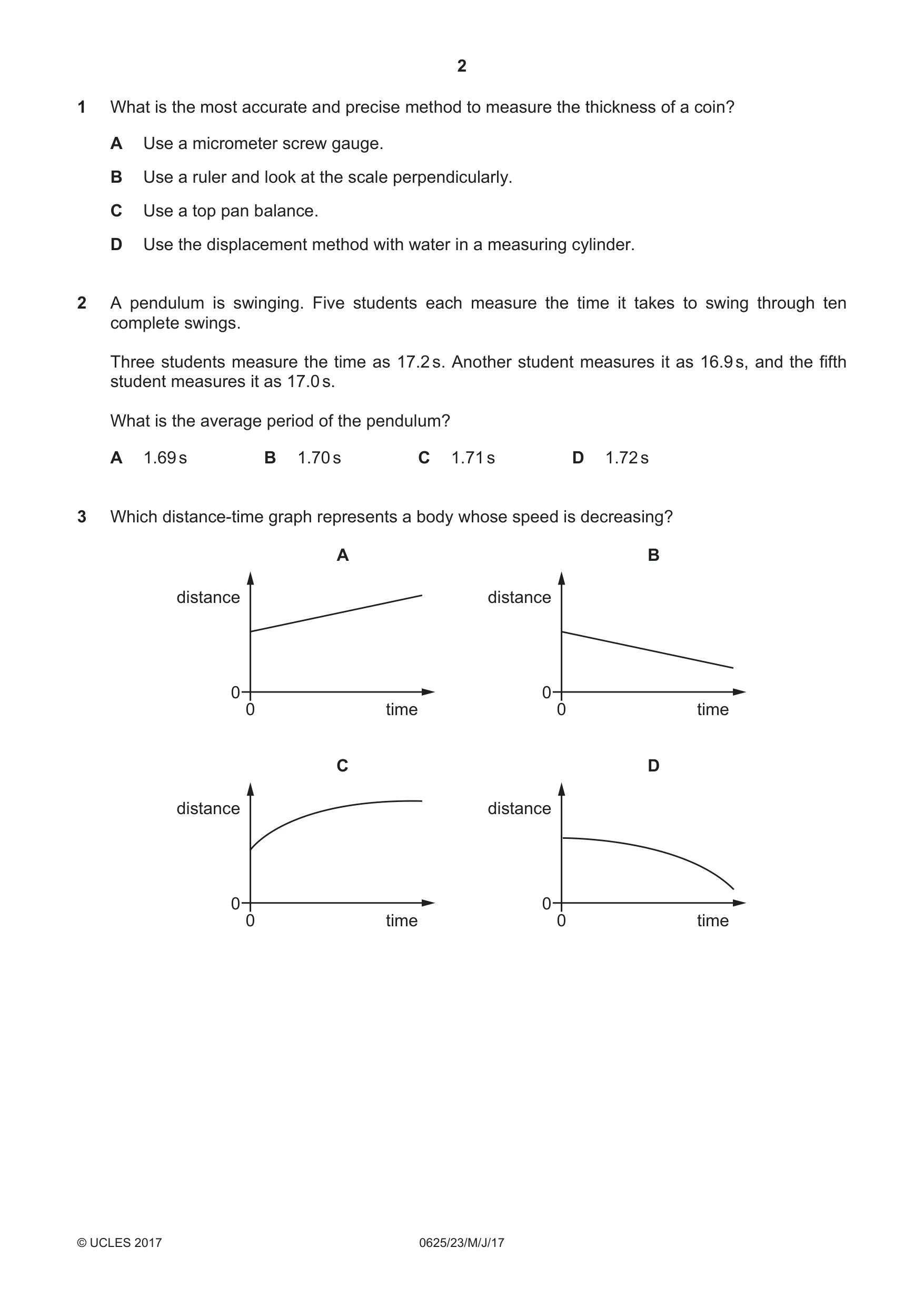
Q1 · What is the most accurate and precise method to measure the thickness of a coin?
1 What is the most accurate and precise method to measure the thickness of a coin? A Use a micrometer screw gauge. B Use a ruler and look at the scale perpendicularly. C Use a top pan balance. D Use the displacement method with water in a measuring cylinder.
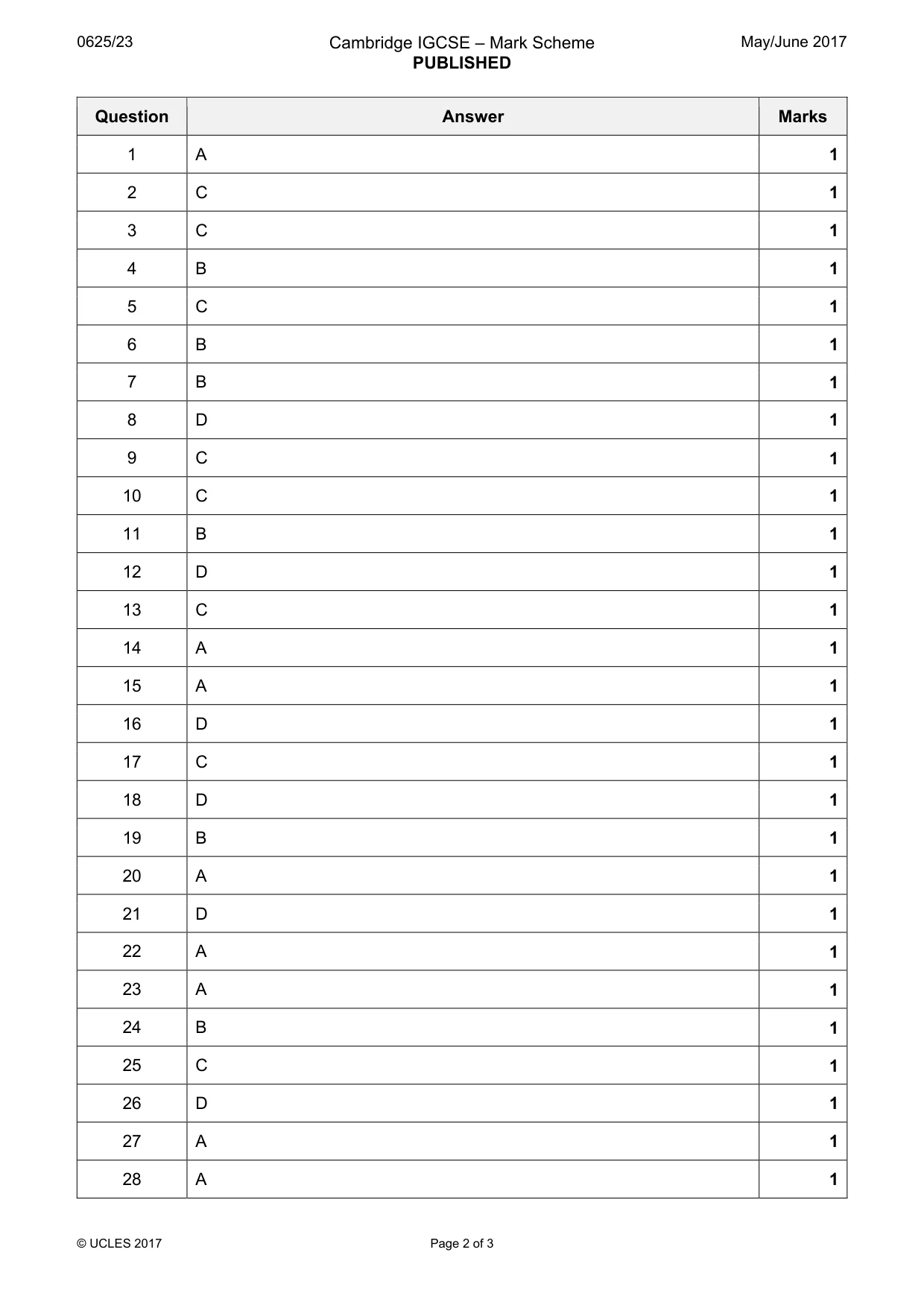
Mark scheme: A
More questions on Physical quantities and measurement techniques
Q2 · A pendulum is swinging
2 A pendulum is swinging. Five students each measure the time it takes to swing through ten complete swings. Three students measure the time as 17.2 s. Another student measures it as 16.9 s, and the fifth student measures it as 17.0 s. What is the average period of the pendulum? A 1.69 s B 1.70 s C 1.71 s D 1.72 s
Mark scheme: C
More questions on Physical quantities and measurement techniques
Q3 · Which distance-time graph represents a body whose speed is decreasing?
3 Which distance-time graph represents a body whose speed is decreasing? A B distance distance 0 0 0 time 0 time C D distance distance 0 0 0 time 0 time
Mark scheme: C
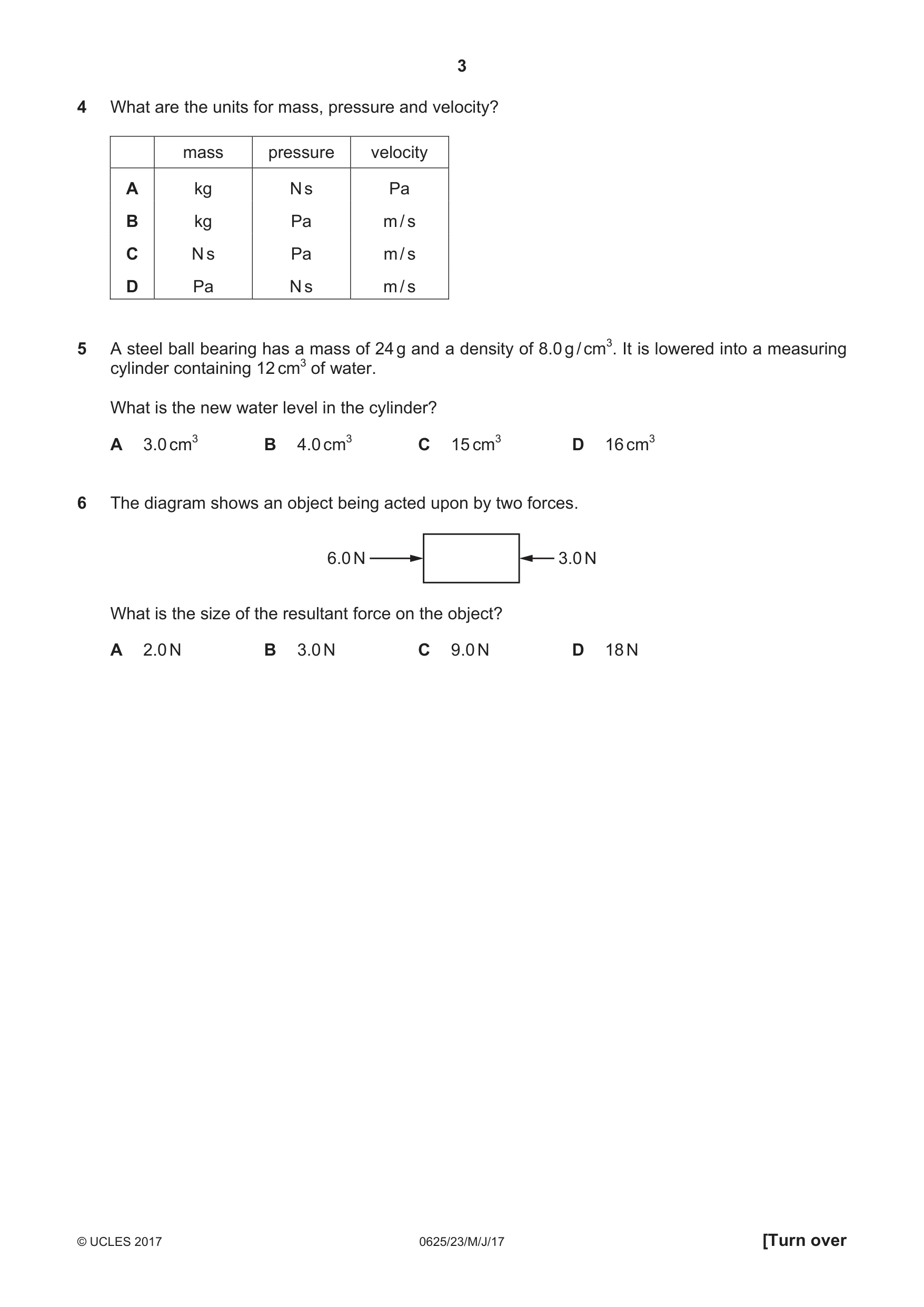
Q4 · What are the units for mass, pressure and velocity?
4 What are the units for mass, pressure and velocity? mass pressure velocity A kg N s Pa B kg Pa m / s C N s Pa m / s D Pa N s m / s
Mark scheme: B
More questions on Physical quantities and measurement techniques
Q5 · A steel ball bearing has a mass of 24 g and a density of 8.0 g / cm3
5 A steel ball bearing has a mass of 24 g and a density of 8.0 g / cm3. It is lowered into a measuring cylinder containing 12 cm3 of water. What is the new water level in the cylinder? A 3.0 cm3 B 4.0 cm3 C 15 cm3 D 16 cm3
Mark scheme: C
Q6 · The diagram shows an object being acted upon by two forces
6 The diagram shows an object being acted upon by two forces. 6.0 N 3.0 N What is the size of the resultant force on the object? A 2.0 N B 3.0 N C 9.0 N D 18 N
Mark scheme: B
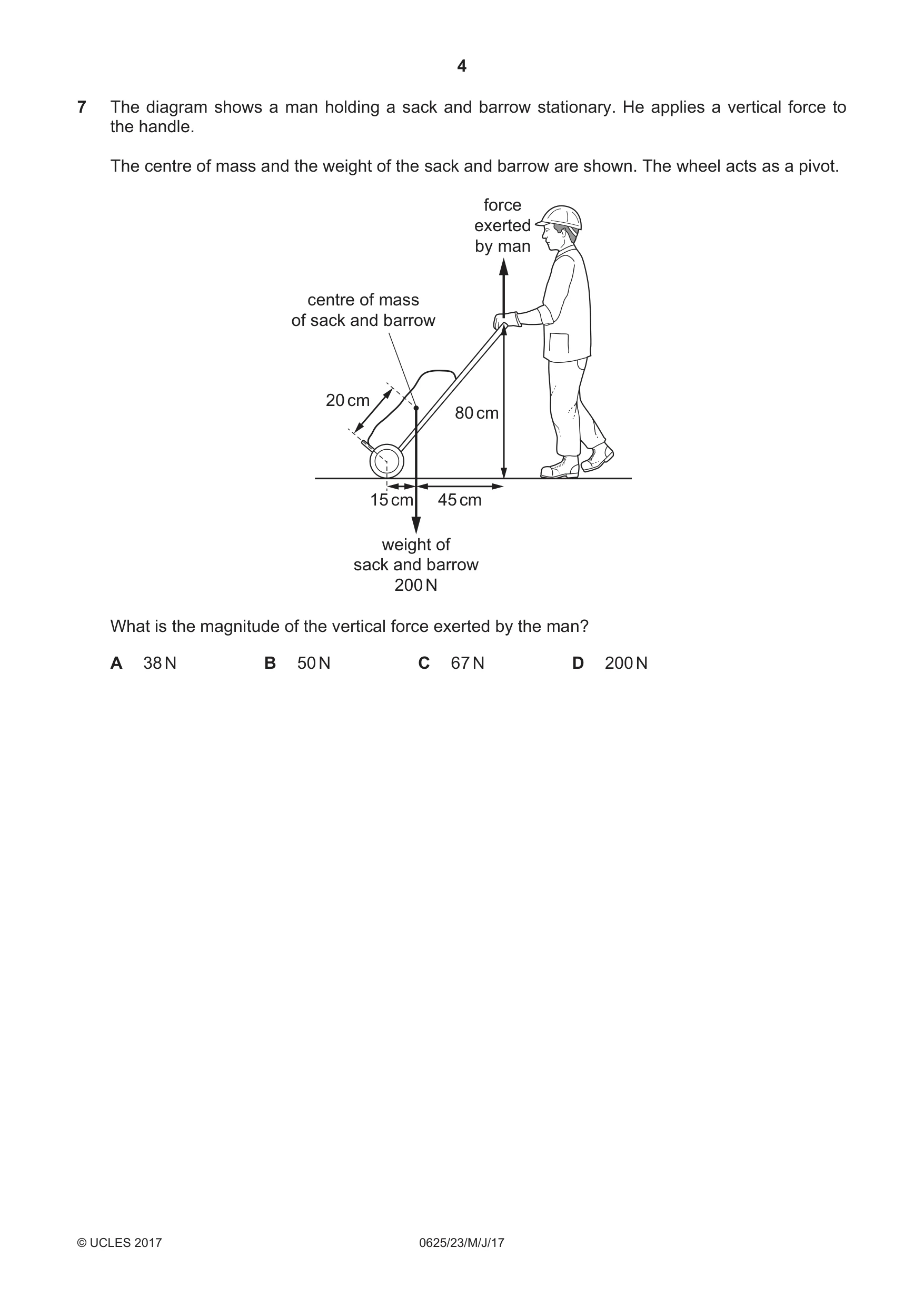
Q7 · The diagram shows a man holding a sack and barrow stationary
7 The diagram shows a man holding a sack and barrow stationary. He applies a vertical force to the handle. The centre of mass and the weight of the sack and barrow are shown. The wheel acts as a pivot. force exerted by man centre of mass of sack and barrow 20 cm 80 cm 15 cm 45 cm weight of sack and barrow 200 N What is the magnitude of the vertical force exerted by the man? A 38 N B 50 N C 67 N D 200 N
Mark scheme: B
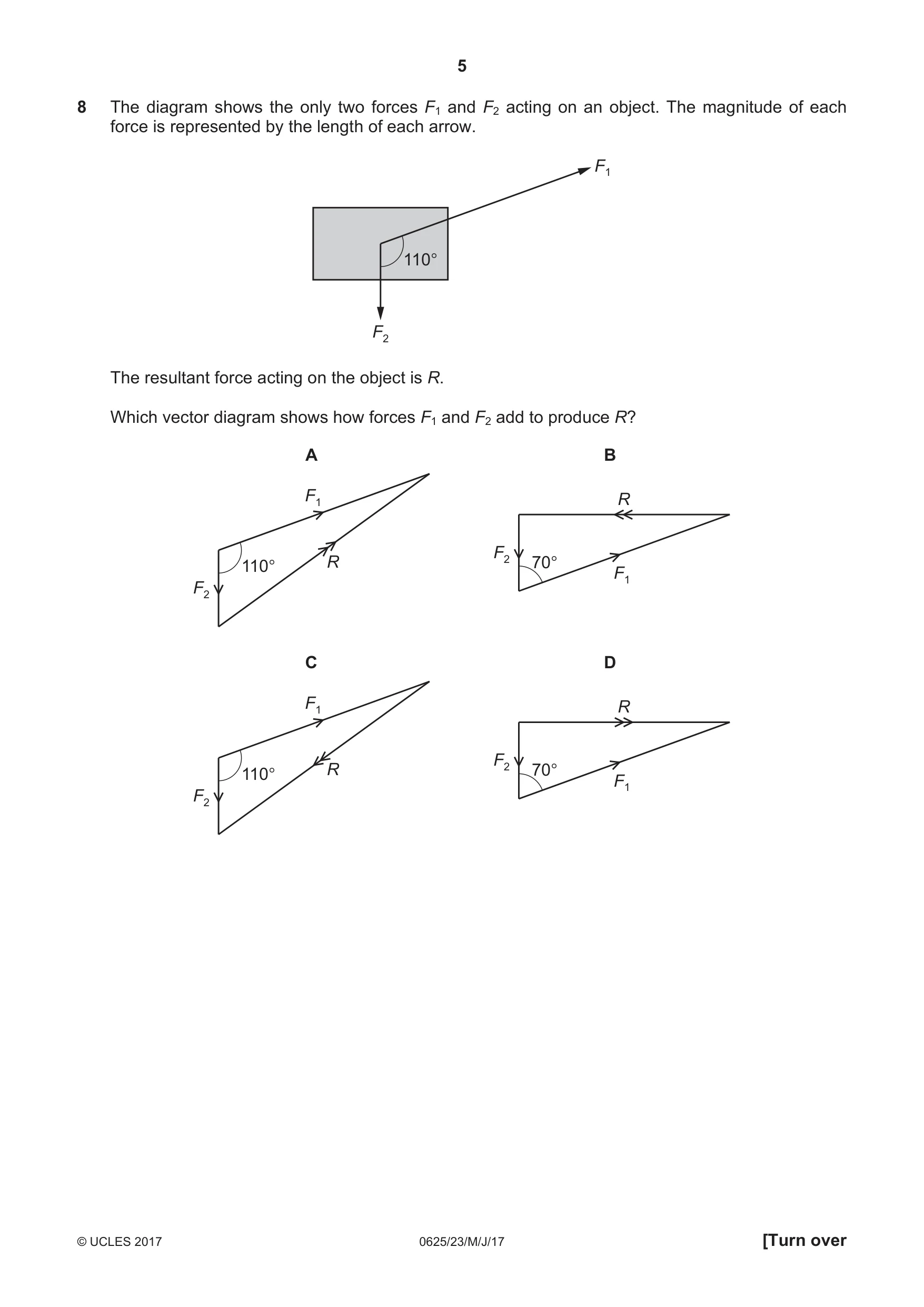
Q8 · The diagram shows the only two forces F1 and F2 acting on an object
8 The diagram shows the only two forces F1 and F2 acting on an object. The magnitude of each force is represented by the length of each arrow. F1 110° F2 The resultant force acting on the object is R. Which vector diagram shows how forces F1 and F2 add to produce R? A B F1 R F2 110° R 70° F1 F2 C D F1 R F2 110° R 70° F1 F2
Mark scheme: D
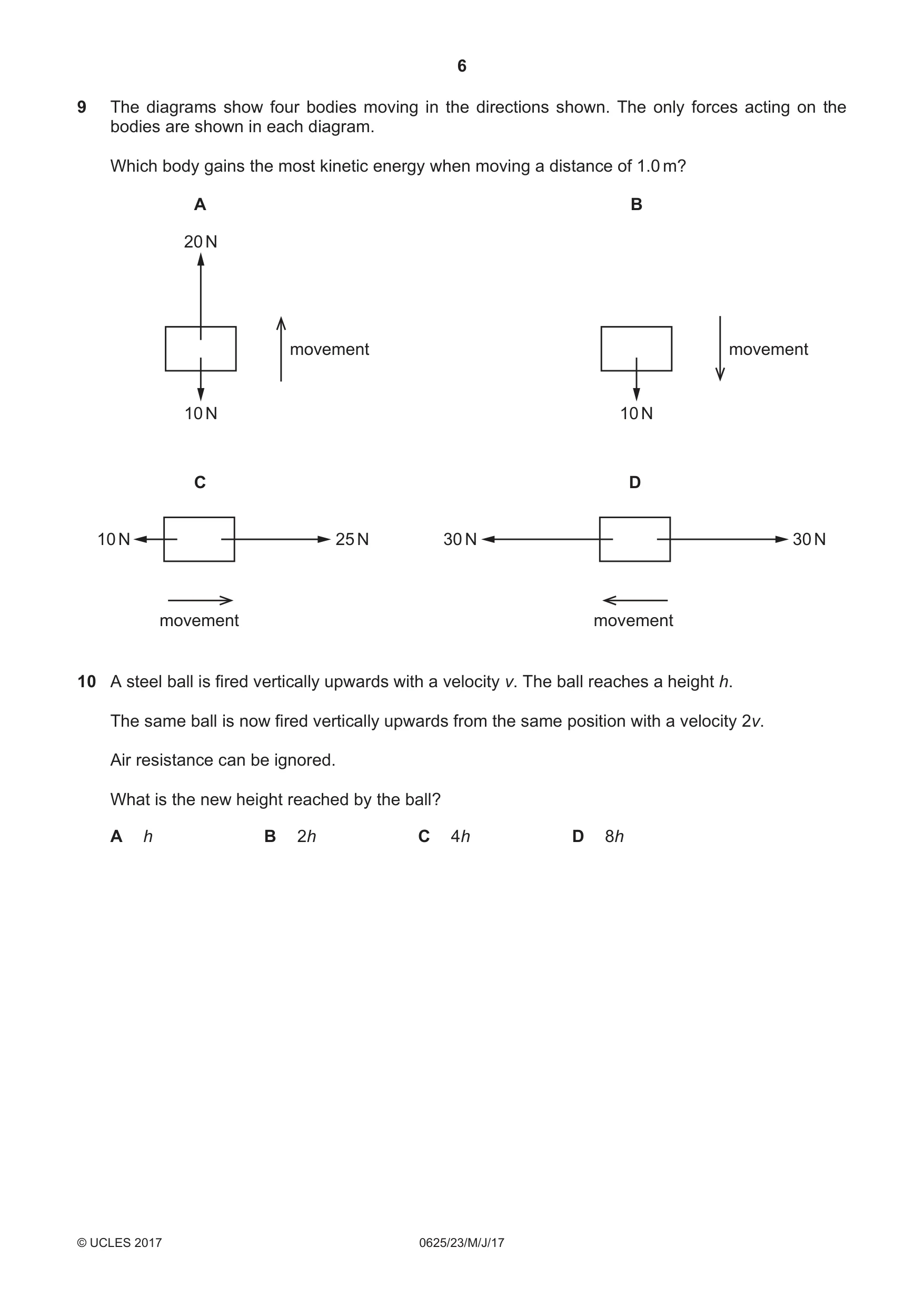
Q9 · The diagrams show four bodies moving in the directions shown
9 The diagrams show four bodies moving in the directions shown. The only forces acting on the bodies are shown in each diagram. Which body gains the most kinetic energy when moving a distance of 1.0 m? A B 20 N movement movement 10 N 10 N C D 10 N 25 N 30 N 30 N movement movement
Mark scheme: C
Q10 · A steel ball is fired vertically upwards with a velocity v
10 A steel ball is fired vertically upwards with a velocity v. The ball reaches a height h. The same ball is now fired vertically upwards from the same position with a velocity 2v. Air resistance can be ignored. What is the new height reached by the ball? A h B 2h C 4h D 8h
Mark scheme: C
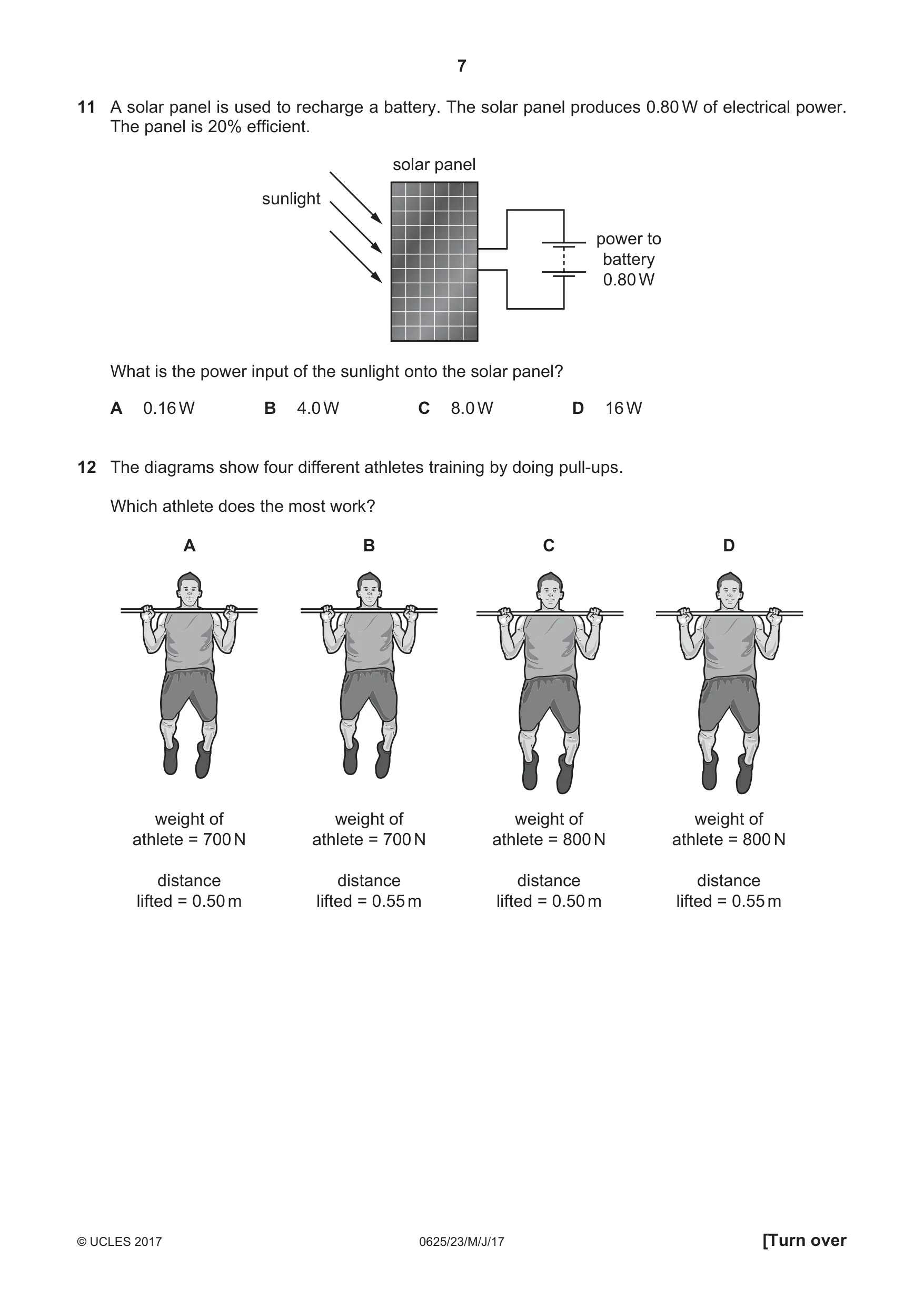
Q11 · A solar panel is used to recharge a battery
11 A solar panel is used to recharge a battery. The solar panel produces 0.80 W of electrical power. The panel is 20% efficient. solar panel sunlight power to battery 0.80 W What is the power input of the sunlight onto the solar panel? A 0.16 W B 4.0 W C 8.0 W D 16 W
Mark scheme: B
Q12 · The diagrams show four different athletes training by doing pull-ups
12 The diagrams show four different athletes training by doing pull-ups. Which athlete does the most work? A B C D weight of weight of weight of weight of athlete = 700 N athlete = 700 N athlete = 800 N athlete = 800 N distance distance distance distance lifted = 0.50 m lifted = 0.55 m lifted = 0.50 m lifted = 0.55 m
Mark scheme: D
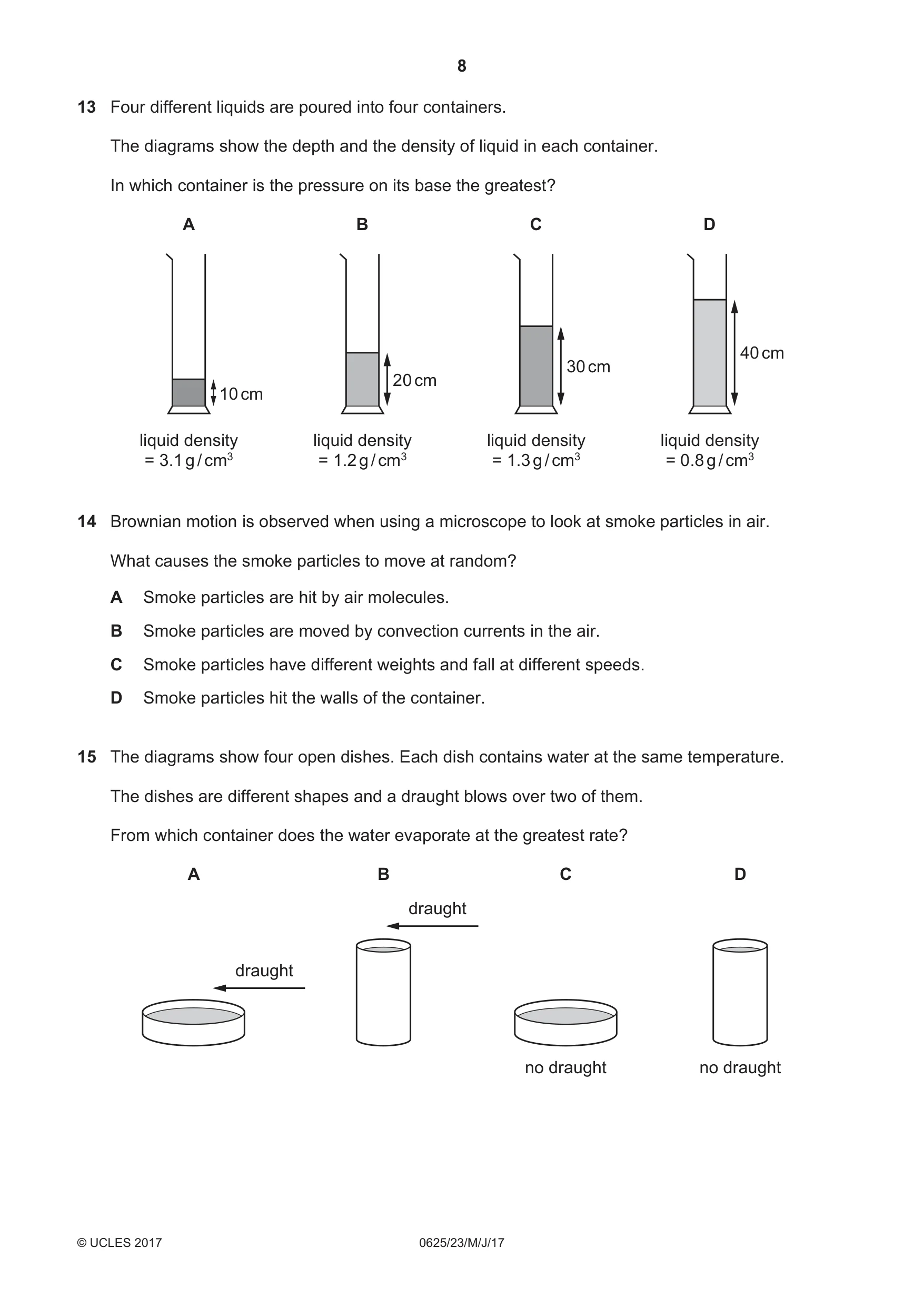
Q13 · Four different liquids are poured into four containers
13 Four different liquids are poured into four containers. The diagrams show the depth and the density of liquid in each container. In which container is the pressure on its base the greatest? A B C D 40 cm 30 cm 20 cm 10 cm liquid density liquid density liquid density liquid density = 3.1 g / cm3 = 1.2 g / cm3 = 1.3 g / cm3 = 0.8 g / cm3
Mark scheme: C
Q14 · Brownian motion is observed when using a microscope to look at smoke particles in air
14 Brownian motion is observed when using a microscope to look at smoke particles in air. What causes the smoke particles to move at random? A Smoke particles are hit by air molecules. B Smoke particles are moved by convection currents in the air. C Smoke particles have different weights and fall at different speeds. D Smoke particles hit the walls of the container.
Mark scheme: A
Q15 · The diagrams show four open dishes
15 The diagrams show four open dishes. Each dish contains water at the same temperature. The dishes are different shapes and a draught blows over two of them. From which container does the water evaporate at the greatest rate? A B C D draught draught no draught no draught
Mark scheme: A
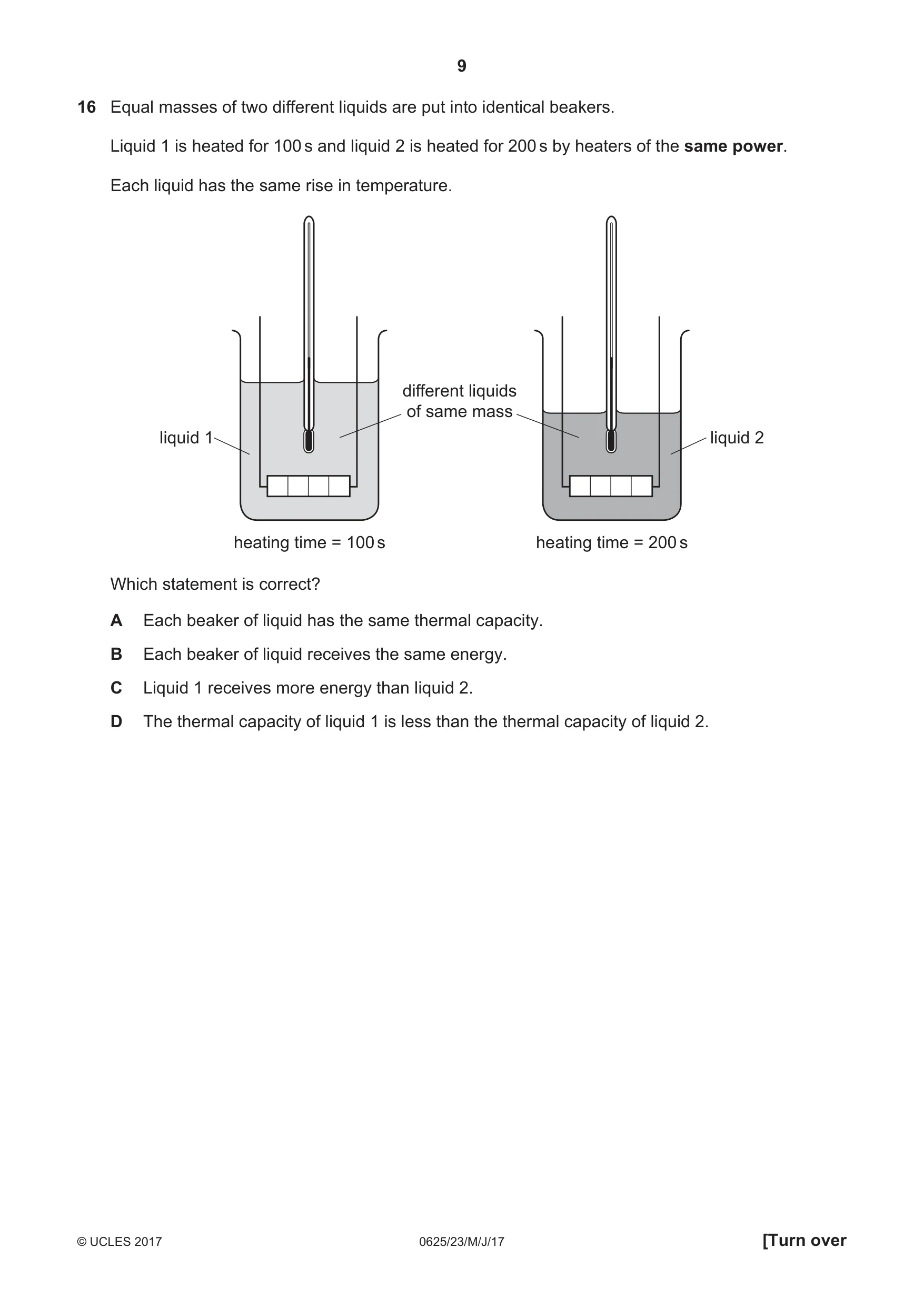
Q16 · Equal masses of two different liquids are put into identical beakers
16 Equal masses of two different liquids are put into identical beakers. Liquid 1 is heated for 100 s and liquid 2 is heated for 200 s by heaters of the same power. Each liquid has the same rise in temperature. different liquids of same mass liquid 1 liquid 2 heating time = 100 s heating time = 200 s Which statement is correct? A Each beaker of liquid has the same thermal capacity. B Each beaker of liquid receives the same energy. C Liquid 1 receives more energy than liquid 2. D The thermal capacity of liquid 1 is less than the thermal capacity of liquid 2.
Mark scheme: D
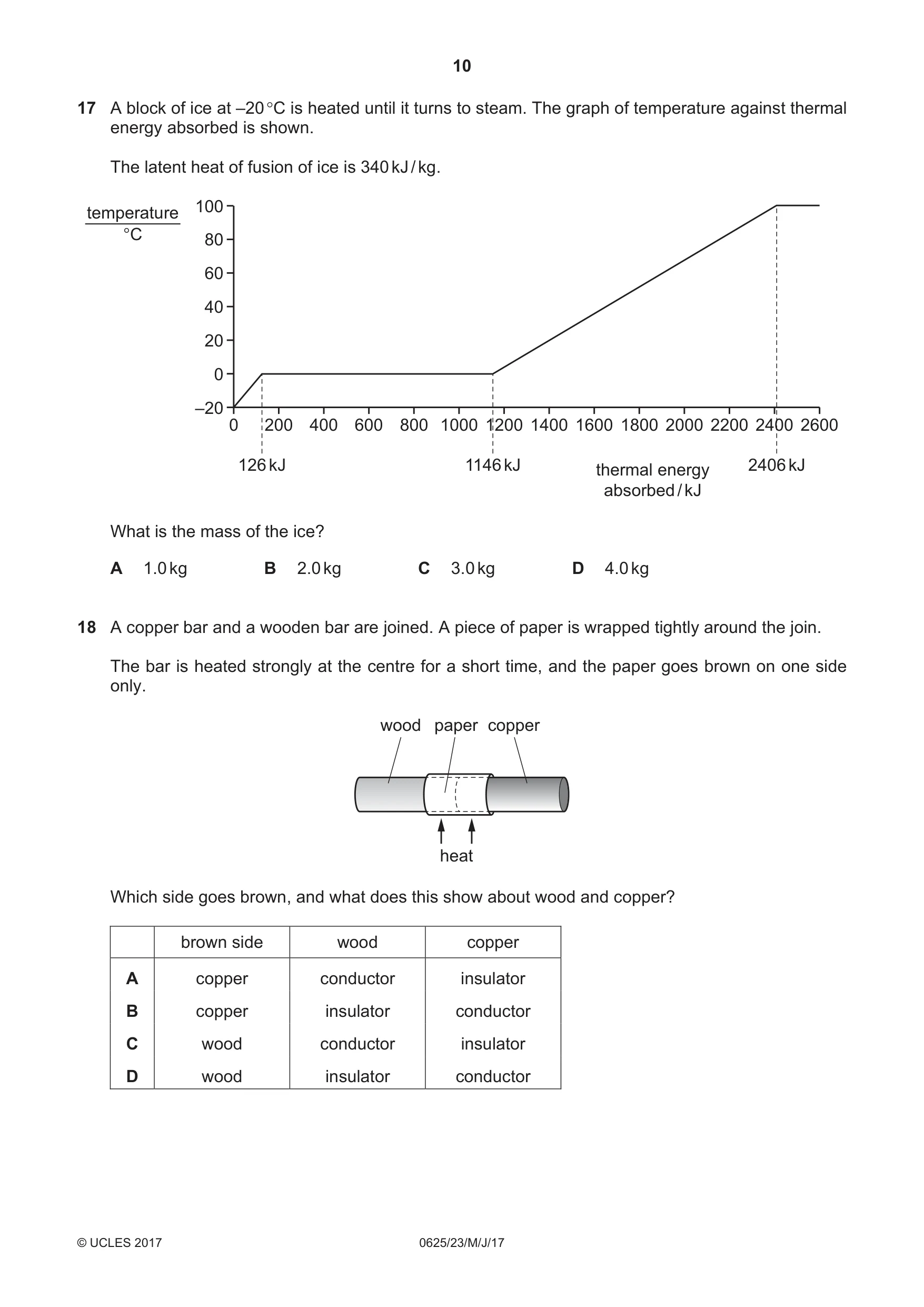
Q17 · A block of ice at –20 °C is heated until it turns to steam
17 A block of ice at –20 °C is heated until it turns to steam. The graph of temperature against thermal energy absorbed is shown. The latent heat of fusion of ice is 340 kJ / kg. 100 temperature °C 80 60 40 20 0 –20 0 200 400 600 800 1000 1200 1400 1600 1800 2000 2200 2400 2600 126 kJ 1146 kJ thermal energy 2406 kJ absorbed / kJ What is the mass of the ice? A 1.0 kg B 2.0 kg C 3.0 kg D 4.0 kg
Mark scheme: C
Q18 · A copper bar and a wooden bar are joined
18 A copper bar and a wooden bar are joined. A piece of paper is wrapped tightly around the join. The bar is heated strongly at the centre for a short time, and the paper goes brown on one side only. wood paper copper heat Which side goes brown, and what does this show about wood and copper? brown side wood copper A copper conductor insulator B copper insulator conductor C wood conductor insulator D wood insulator conductor
Mark scheme: D
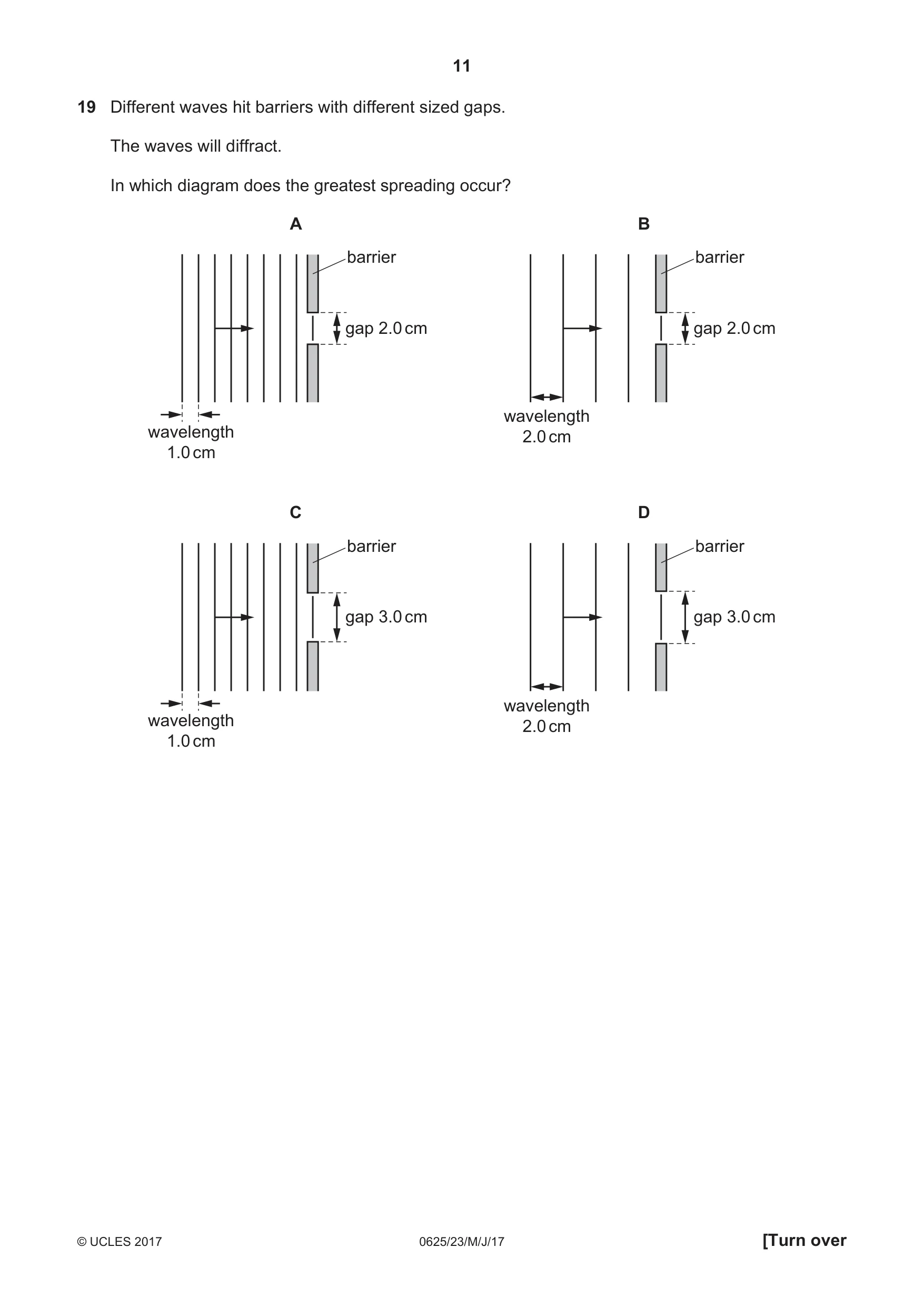
Q19 · Different waves hit barriers with different sized gaps
19 Different waves hit barriers with different sized gaps. The waves will diffract. In which diagram does the greatest spreading occur? A B barrier barrier gap 2.0 cm gap 2.0 cm wavelength wavelength 2.0 cm 1.0 cm C D barrier barrier gap 3.0 cm gap 3.0 cm wavelength wavelength 2.0 cm 1.0 cm
Mark scheme: B
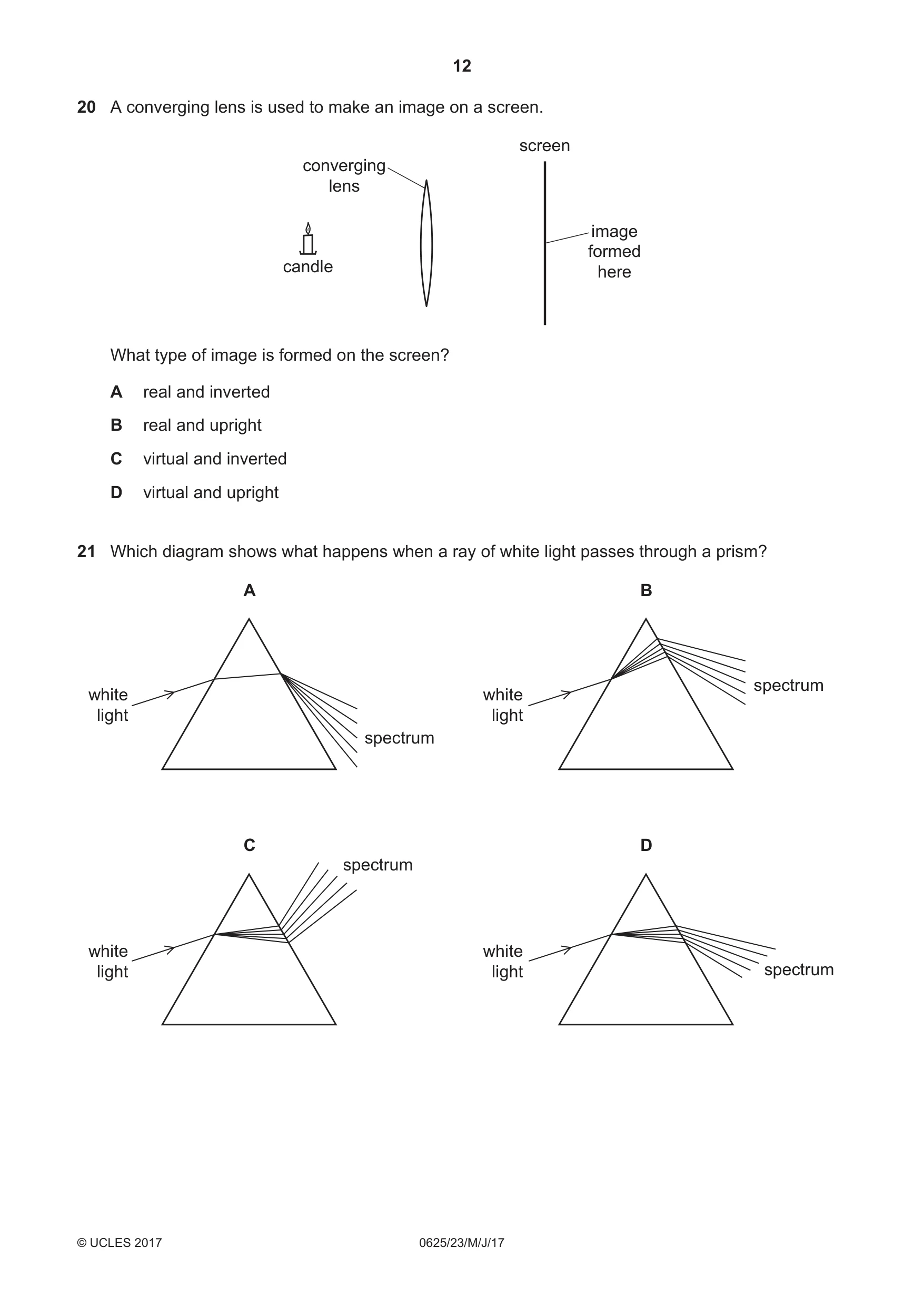
Q20 · A converging lens is used to make an image on a screen
20 A converging lens is used to make an image on a screen. screen converging lens image formed candle here What type of image is formed on the screen? A real and inverted B real and upright C virtual and inverted D virtual and upright
Mark scheme: A
Q21 · Which diagram shows what happens when a ray of white light passes through a prism?
21 Which diagram shows what happens when a ray of white light passes through a prism? A B spectrum white white light light spectrum C D spectrum white white light light spectrum
Mark scheme: D
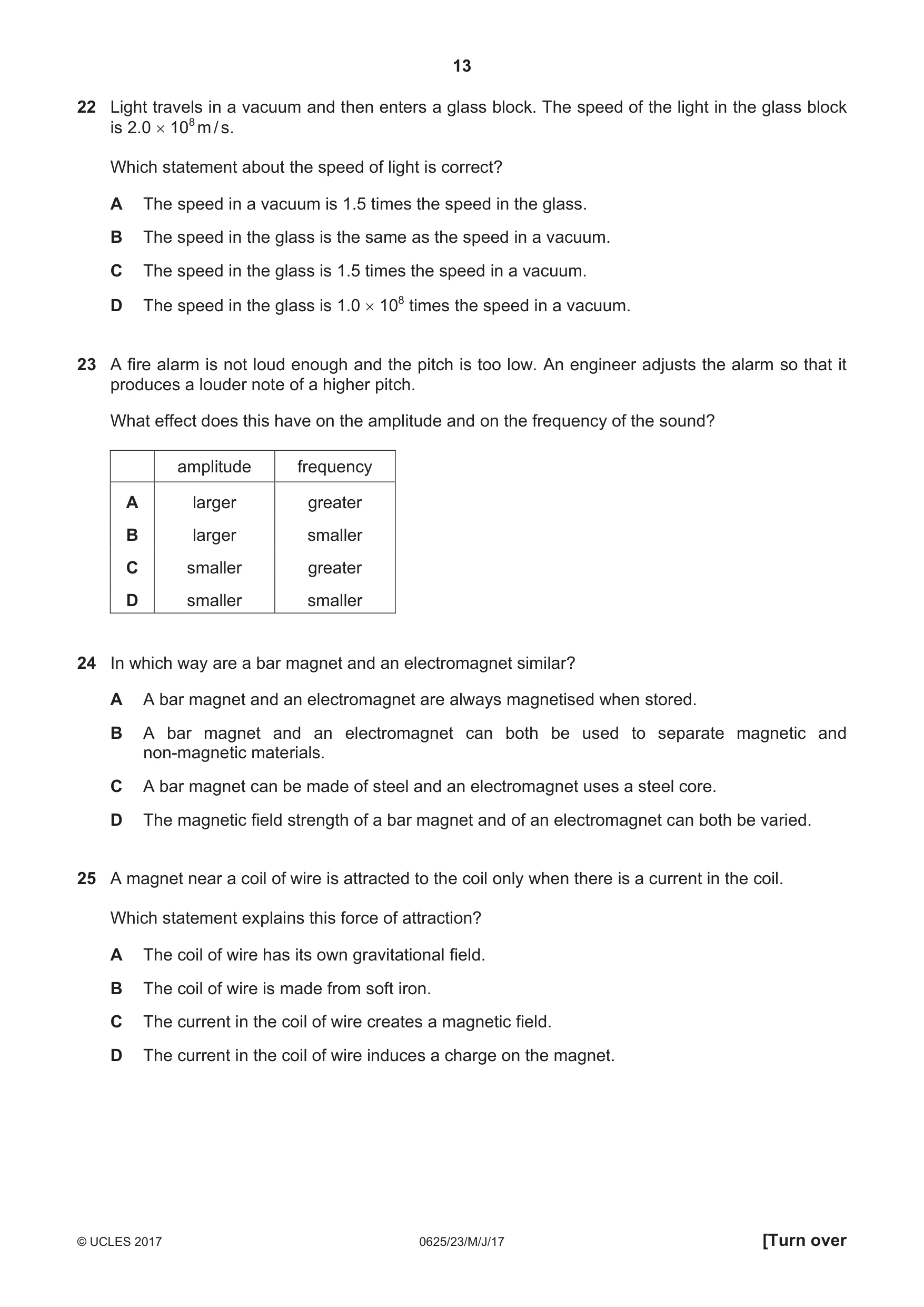
Q22 · Light travels in a vacuum and then enters a glass block
22 Light travels in a vacuum and then enters a glass block. The speed of the light in the glass block is 2.0 × 10⁸ m / s. Which statement about the speed of light is correct? A The speed in a vacuum is 1.5 times the speed in the glass. B The speed in the glass is the same as the speed in a vacuum. C The speed in the glass is 1.5 times the speed in a vacuum. D The speed in the glass is 1.0 × 10⁸ times the speed in a vacuum.
Mark scheme: A
Q23 · A fire alarm is not loud enough and the pitch is too low
23 A fire alarm is not loud enough and the pitch is too low. An engineer adjusts the alarm so that it produces a louder note of a higher pitch. What effect does this have on the amplitude and on the frequency of the sound? amplitude frequency A larger greater B larger smaller C smaller greater D smaller smaller
Mark scheme: A
Q24 · In which way are a bar magnet and an electromagnet similar?
24 In which way are a bar magnet and an electromagnet similar? A A bar magnet and an electromagnet are always magnetised when stored. B A bar magnet and an electromagnet can both be used to separate magnetic and non-magnetic materials. C A bar magnet can be made of steel and an electromagnet uses a steel core. D The magnetic field strength of a bar magnet and of an electromagnet can both be varied.
Mark scheme: B
Q25 · A magnet near a coil of wire is attracted to the coil only when there is a current in the…
25 A magnet near a coil of wire is attracted to the coil only when there is a current in the coil. Which statement explains this force of attraction? A The coil of wire has its own gravitational field. B The coil of wire is made from soft iron. C The current in the coil of wire creates a magnetic field. D The current in the coil of wire induces a charge on the magnet.
Mark scheme: C
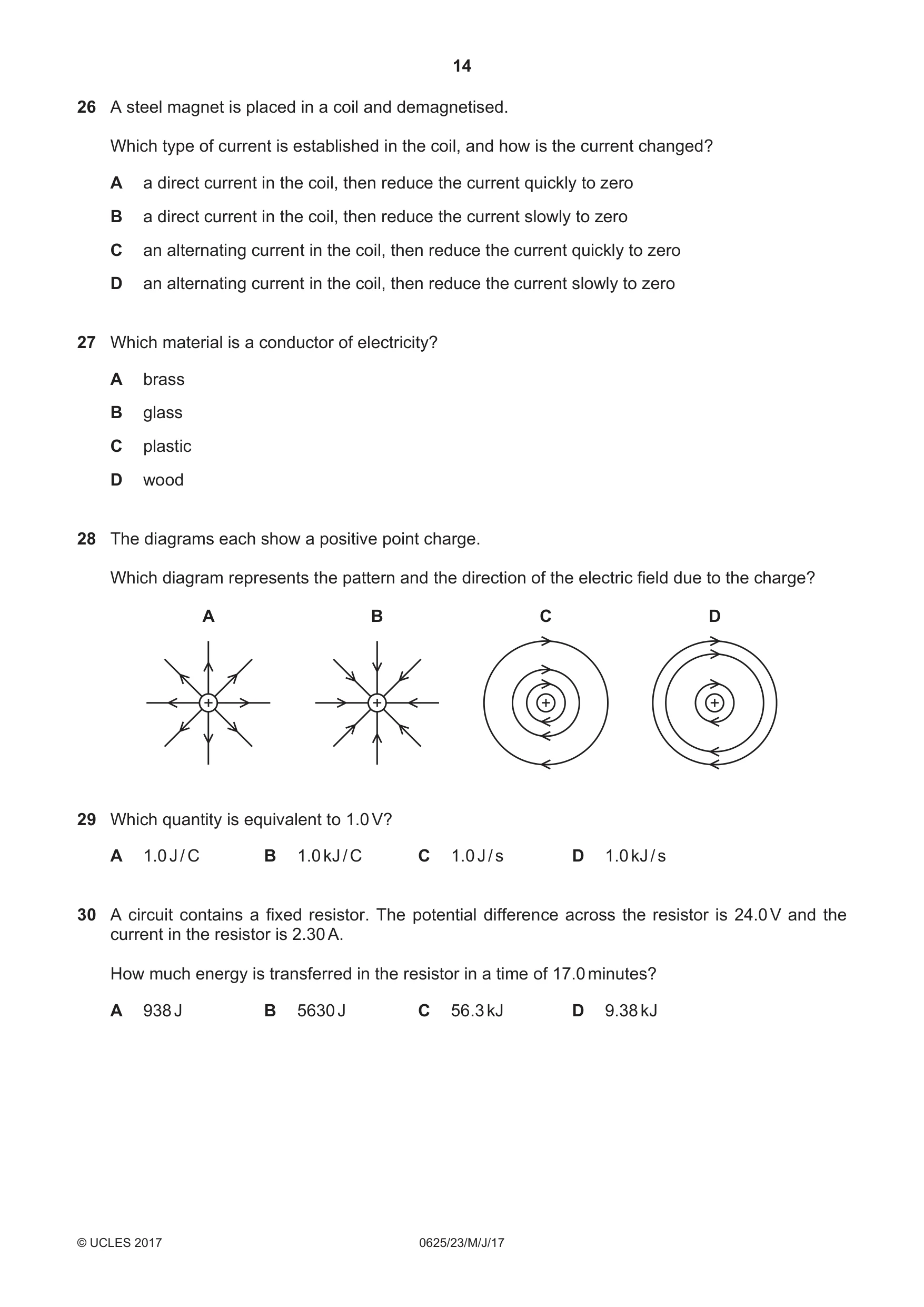
Q26 · A steel magnet is placed in a coil and demagnetised
26 A steel magnet is placed in a coil and demagnetised. Which type of current is established in the coil, and how is the current changed? A a direct current in the coil, then reduce the current quickly to zero B a direct current in the coil, then reduce the current slowly to zero C an alternating current in the coil, then reduce the current quickly to zero D an alternating current in the coil, then reduce the current slowly to zero
Mark scheme: D
Q27 · Which material is a conductor of electricity?
27 Which material is a conductor of electricity? A brass B glass C plastic D wood
Mark scheme: A
Q28 · The diagrams each show a positive point charge
28 The diagrams each show a positive point charge. Which diagram represents the pattern and the direction of the electric field due to the charge? A B C D + + + +
Mark scheme: A
Q29 · Which quantity is equivalent to 1.0 V?
29 Which quantity is equivalent to 1.0 V? A 1.0 J / C B 1.0 kJ / C C 1.0 J / s D 1.0 kJ / s
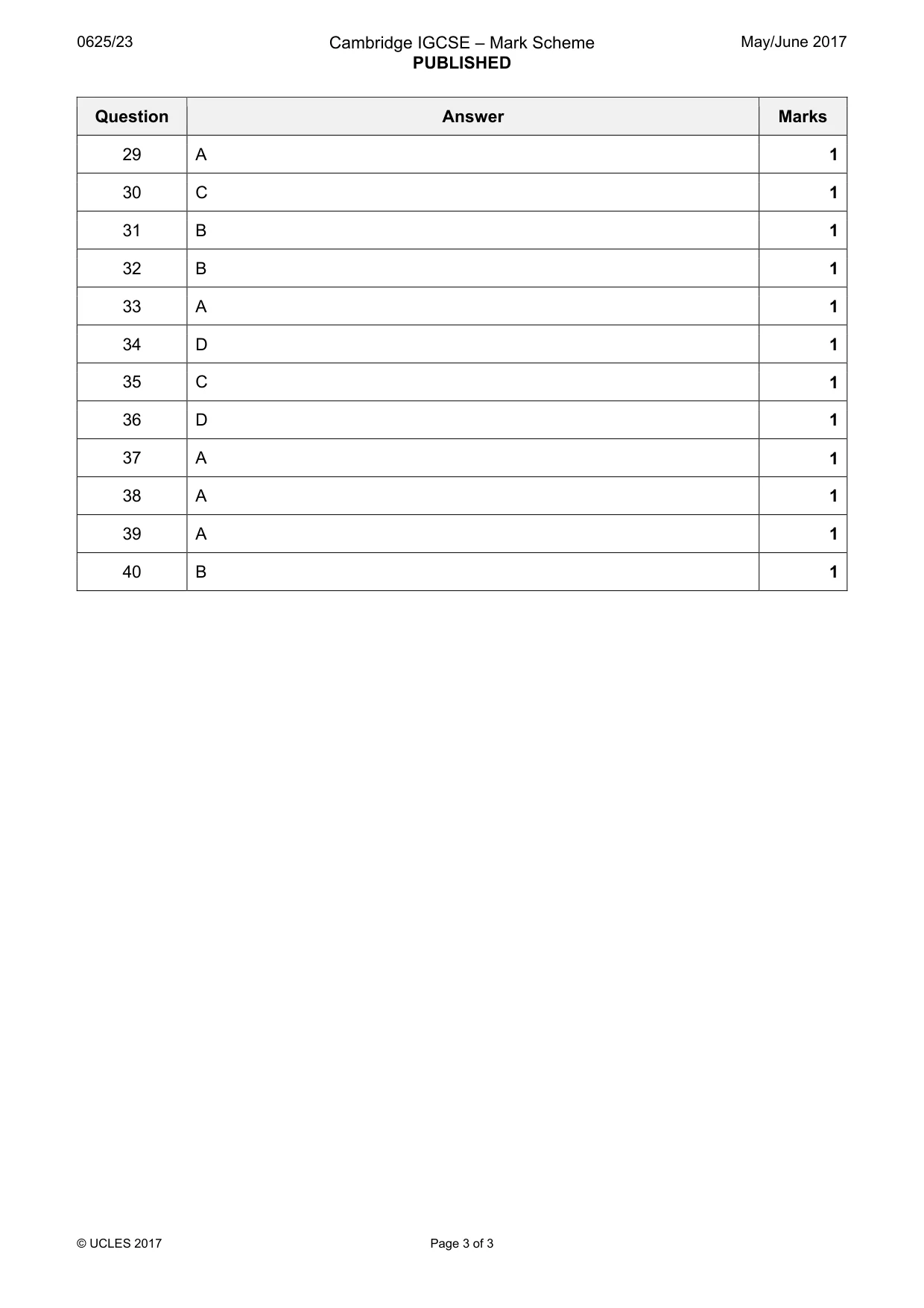
Mark scheme: A
Q30 · A circuit contains a fixed resistor
30 A circuit contains a fixed resistor. The potential difference across the resistor is 24.0 V and the current in the resistor is 2.30 A. How much energy is transferred in the resistor in a time of 17.0 minutes? A 938 J B 5630 J C 56.3 kJ D 9.38 kJ
Mark scheme: C
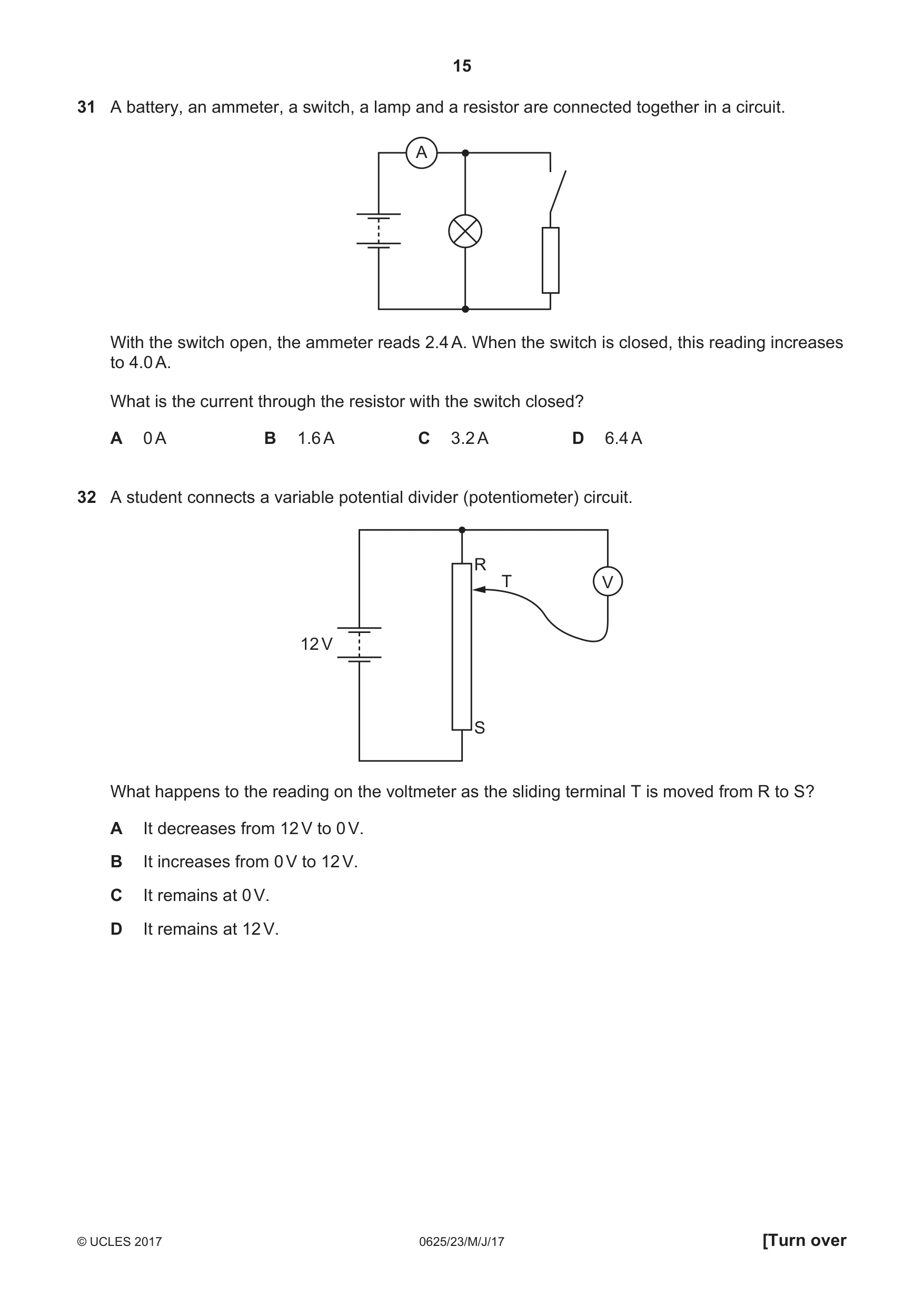
Q31 · A battery, an ammeter, a switch, a lamp and a resistor are connected together in a circuit
31 A battery, an ammeter, a switch, a lamp and a resistor are connected together in a circuit. A With the switch open, the ammeter reads 2.4 A. When the switch is closed, this reading increases to 4.0 A. What is the current through the resistor with the switch closed? A 0 A B 1.6 A C 3.2 A D 6.4 A
Mark scheme: B
Q32 · A student connects a variable potential divider (potentiometer) circuit
32 A student connects a variable potential divider (potentiometer) circuit. R T V 12 V S What happens to the reading on the voltmeter as the sliding terminal T is moved from R to S? A It decreases from 12 V to 0 V. B It increases from 0 V to 12 V. C It remains at 0 V. D It remains at 12 V.
Mark scheme: B
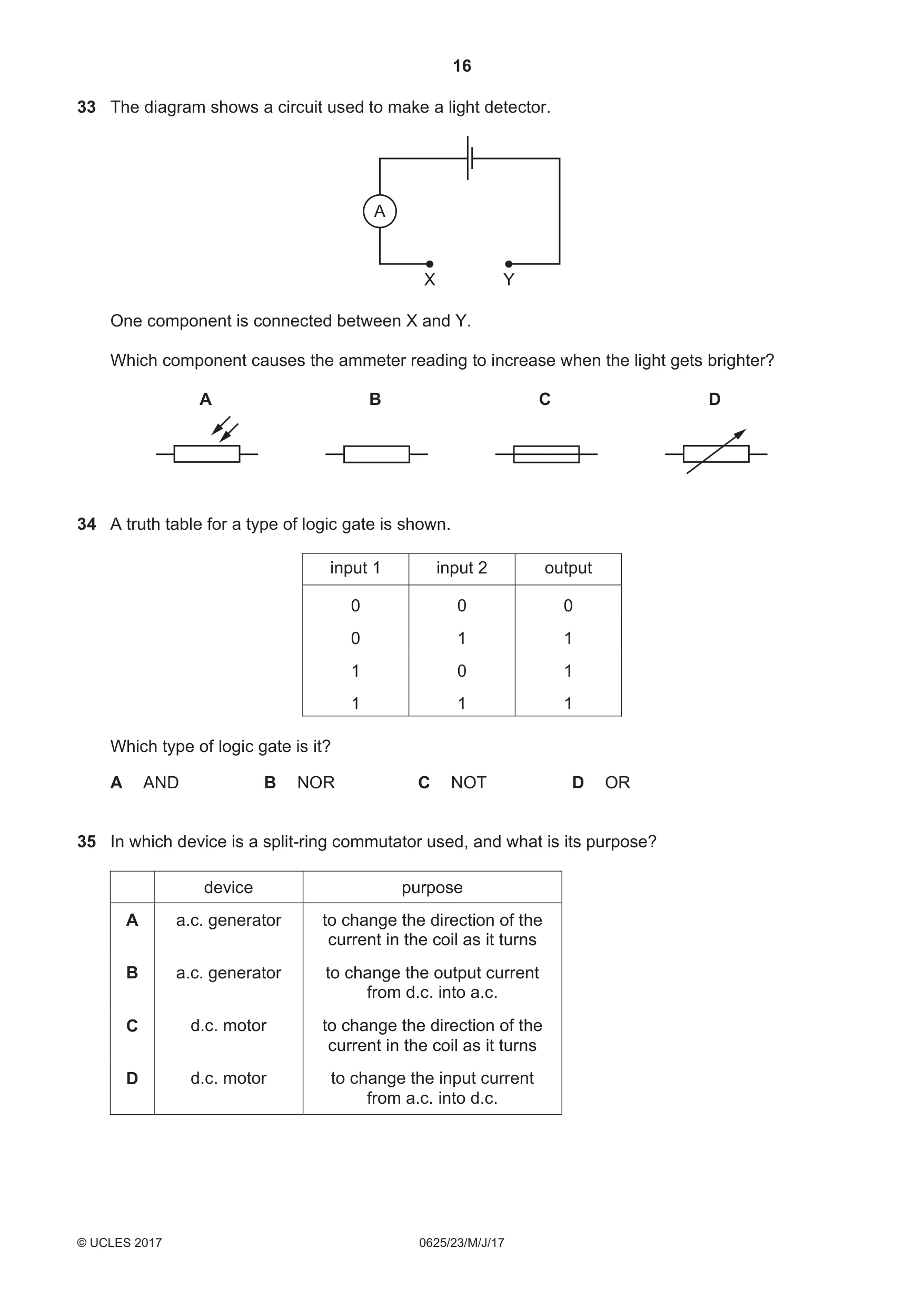
Q33 · The diagram shows a circuit used to make a light detector
33 The diagram shows a circuit used to make a light detector. A X Y One component is connected between X and Y. Which component causes the ammeter reading to increase when the light gets brighter? A B C D
Mark scheme: A
Q34 · A truth table for a type of logic gate is shown
34 A truth table for a type of logic gate is shown. input 1 input 2 output 0 0 0 0 1 1 1 0 1 1 1 1 Which type of logic gate is it? A AND B NOR C NOT D OR
Mark scheme: D
Q35 · In which device is a split-ring commutator used, and what is its purpose?
35 In which device is a split-ring commutator used, and what is its purpose? device purpose A a.c. generator to change the direction of the current in the coil as it turns B a.c. generator to change the output current from d.c. into a.c. C d.c. motor to change the direction of the current in the coil as it turns D d.c. motor to change the input current from a.c. into d.c.
Mark scheme: C
Q36 · What is the purpose of a relay?
36 What is the purpose of a relay? A to change a large voltage into a small voltage B to change a small voltage into a large voltage C to use a large current to switch on a small current D to use a small current to switch on a large current
Mark scheme: D
Q37 · When a source of D-particles is directed towards a thin metal foil they become scattered
37 When a source of D-particles is directed towards a thin metal foil they become scattered. Which observation of this experiment provides evidence for a small charged nucleus? A A small proportion of the D-particles come straight back from the foil towards the source. B A small proportion of the D-particles pass straight through the foil. C Some of the D-particles are deflected by an angle of less than 90°. D Some of the D-particles follow a curved path after leaving the foil.
Mark scheme: A
Q38 · Which description of a neutral atom of copper is correct?
38 Which description of a neutral atom of copper is correct? A a nucleus surrounded by electrons B a nucleus surrounded by molecules C electrons surrounded by a nucleus D electrons surrounded by molecules
Mark scheme: A
Q39 · A sample of radioactive isotope is decaying
39 A sample of radioactive isotope is decaying. The nuclei of which atoms will decay first? A It is impossible to know because radioactive decay is random. B It is impossible to know unless the age of the material is known. C The atoms near the centre will decay first because they are surrounded by more atoms. D The atoms near the surface will decay first because the radiation can escape more easily.
Mark scheme: A
Q40 · A student determines the half-life of a radioactive isotope
40 A student determines the half-life of a radioactive isotope. The student uses a detector over five minutes and plots a graph showing how the count rate shown on the detector varies with time. The count rate due to background radiation is 30 counts per minute. 250 count rate counts / minute 200 150 100 50 0 0 1 2 3 4 5 time / minutes What is the half-life of this isotope? A 0.30 minutes B 1.2 minutes C 1.5 minutes D 5.0 minutes
Mark scheme: B
What was in this paper
The subtopics covered by these 40 questions, and how many questions each got. Open one in a new tab to see every Cambridge question on it.
5Electrical quantities4Energy, work and power4Forces3Light3Physical quantities and measurement techniques3Electromagnetic effects2Kinetic particle model of matter2Radioactivity2Simple phenomena of magnetism2The nuclear model of the atom2Thermal properties and temperature2Density1General properties of waves1Motion1Pressure1Sound1Transfer of thermal energy1What you needed in this session
Cambridge’s own grade thresholds for 2017 May/June, Paper 2 · Variant 3. A higher threshold means an easier paper — the bar moves with how the cohort did.