Cambridge IGCSE Physics 0625 — 2018 Oct/Nov Paper 2 · Variant 3
0625/23/O/N/18 · 40 questions · 40 marks · ≈45 min
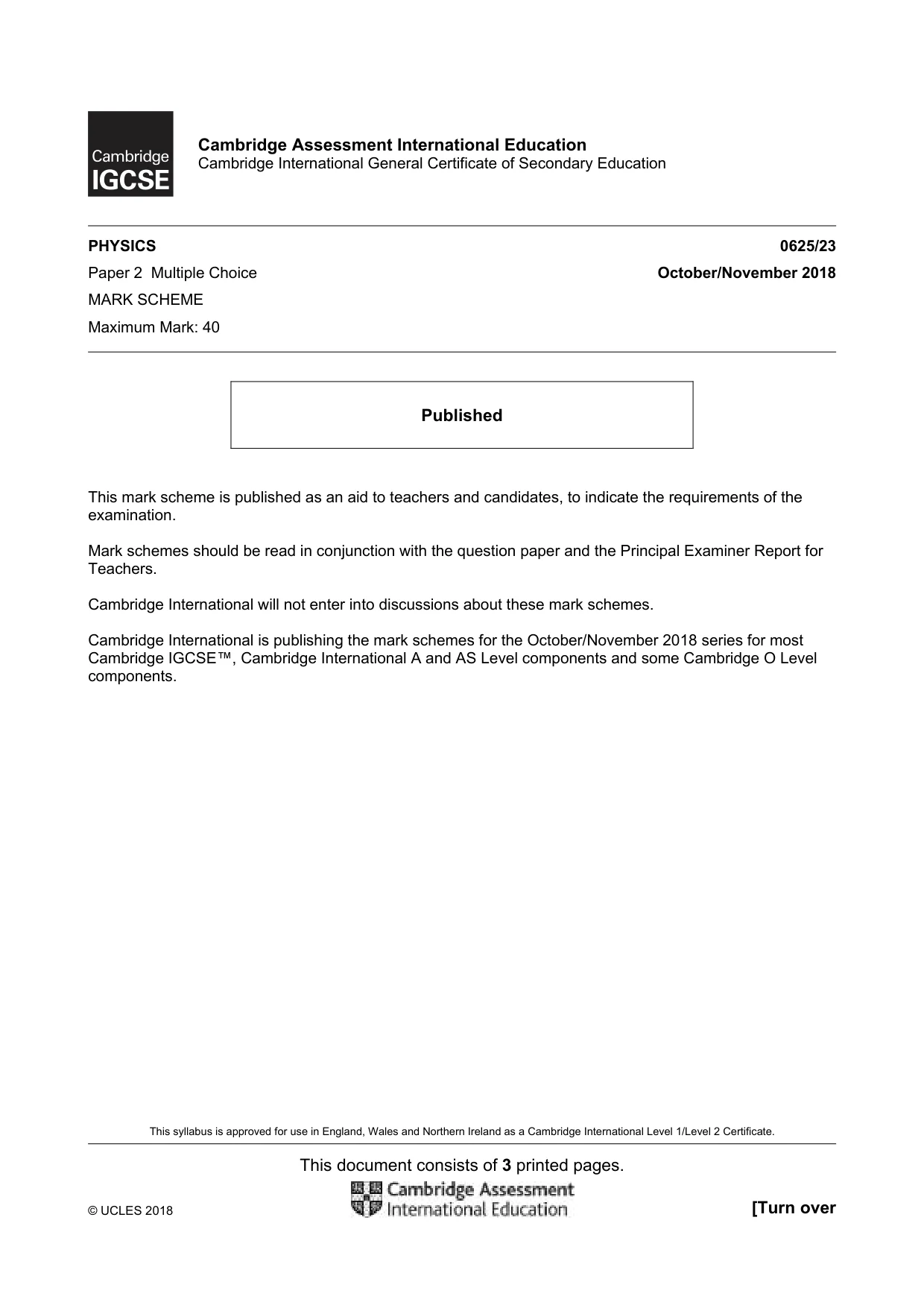
The question paper and its mark scheme, free to read here and free to download. This is Cambridge’s own paper, exactly as it was sat.
Question paper16 pages
Mark scheme3 pages
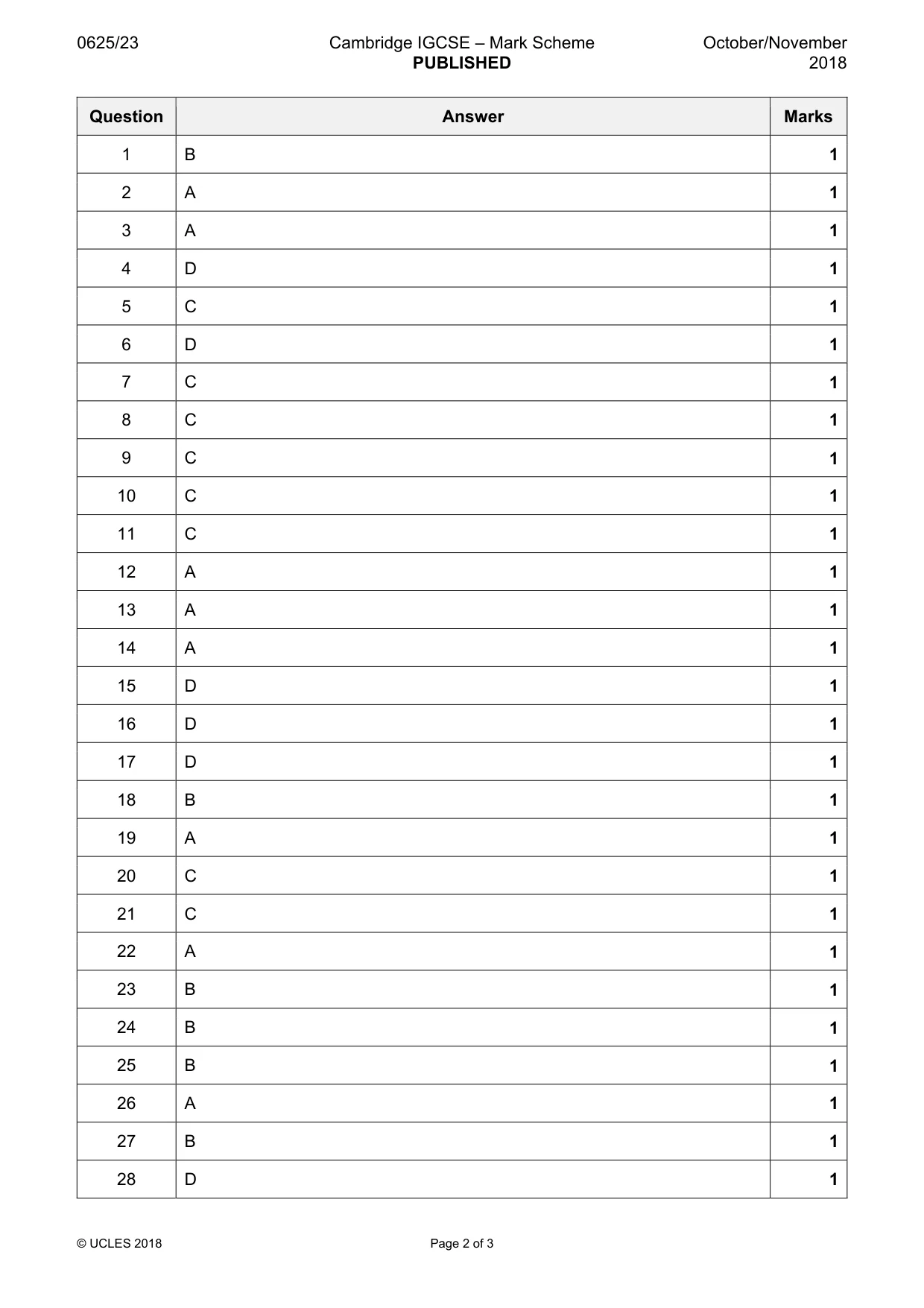
Answers below. Sit the paper first if you are practising.
Questions as text
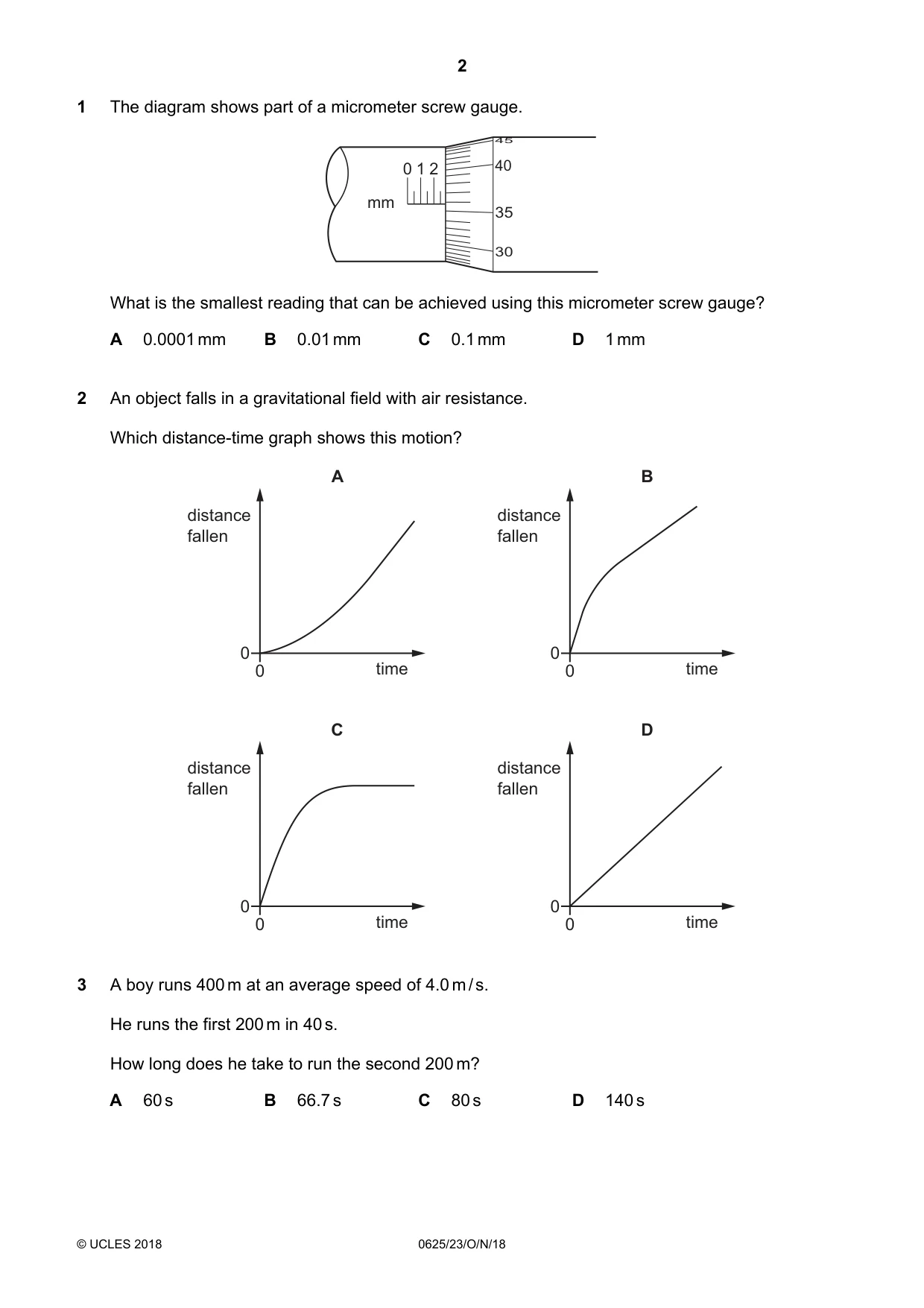
Q1 · The diagram shows part of a micrometer screw gauge
1 The diagram shows part of a micrometer screw gauge. 45 0 1 2 40 mm 35 30 What is the smallest reading that can be achieved using this micrometer screw gauge? A 0.0001 mm B 0.01 mm C 0.1 mm D 1 mm
Mark scheme: B
More questions on Physical quantities and measurement techniques
Q2 · An object falls in a gravitational field with air resistance
2 An object falls in a gravitational field with air resistance. Which distance-time graph shows this motion? A B distance distance fallen fallen 0 0 0 time 0 time C D distance distance fallen fallen 0 0 0 time 0 time
Mark scheme: A
Q3 · A boy runs 400 m at an average speed of 4.0 m / s
3 A boy runs 400 m at an average speed of 4.0 m / s. He runs the first 200 m in 40 s. How long does he take to run the second 200 m? A 60 s B 66.7 s C 80 s D 140 s
Mark scheme: A
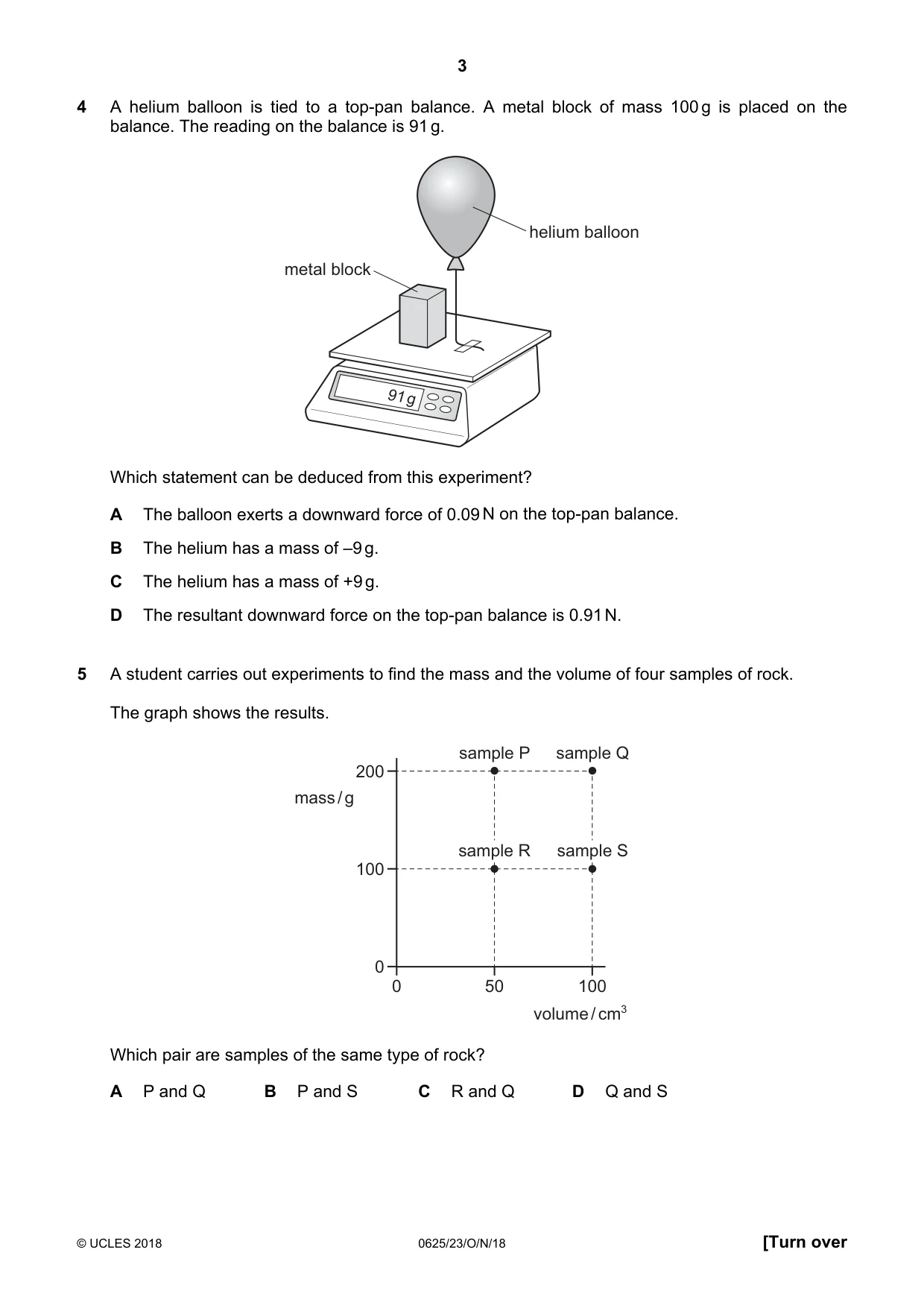
Q4 · A helium balloon is tied to a top-pan balance
4 A helium balloon is tied to a top-pan balance. A metal block of mass 100 g is placed on the balance. The reading on the balance is 91 g. helium balloon metal block 91 g Which statement can be deduced from this experiment? A The balloon exerts a downward force of 0.09 N on the top-pan balance. B The helium has a mass of –9 g. C The helium has a mass of +9 g. D The resultant downward force on the top-pan balance is 0.91 N.
Mark scheme: D
Q5 · A student carries out experiments to find the mass and the volume of four samples of rock
5 A student carries out experiments to find the mass and the volume of four samples of rock. The graph shows the results. sample P sample Q 200 mass / g sample R sample S 100 0 0 50 100 volume / cm3 Which pair are samples of the same type of rock? A P and Q B P and S C R and Q D Q and S
Mark scheme: C
Q6 · An object accelerates from 10 m / s to 30 m / s in 4.0 seconds
6 An object accelerates from 10 m / s to 30 m / s in 4.0 seconds. The accelerating force is 150 N. What is the mass of the object? A 0.033 kg B 5.0 kg C 7.5 kg D 30 kg
Mark scheme: D
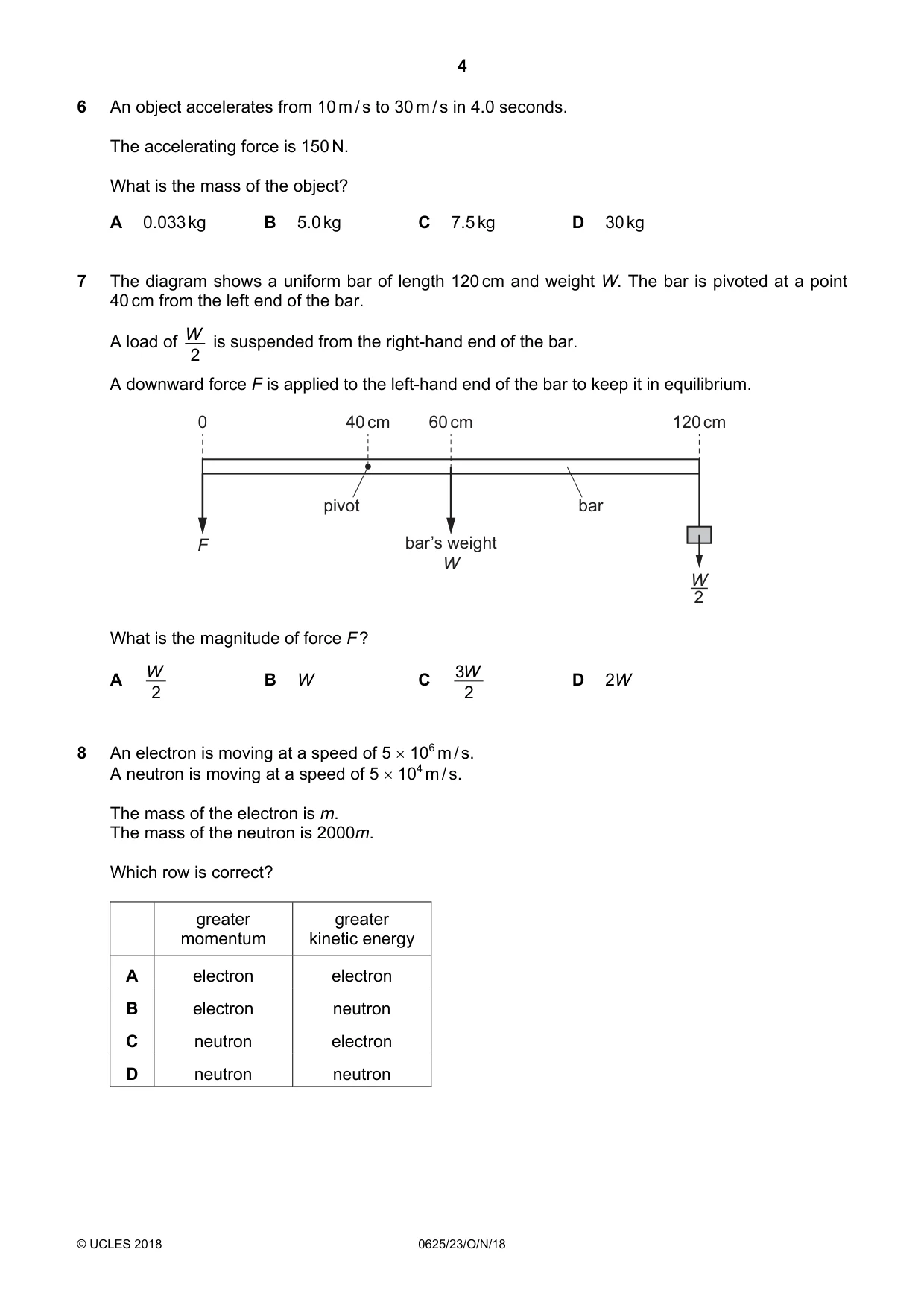
Q7 · The diagram shows a uniform bar of length 120 cm and weight W
7 The diagram shows a uniform bar of length 120 cm and weight W. The bar is pivoted at a point 40 cm from the left end of the bar. W is suspended from the right-hand end of the bar. A load of 2 A downward force F is applied to the left-hand end of the bar to keep it in equilibrium. 0 40 cm 60 cm 120 cm pivot bar F bar’s weight W W 2 What is the magnitude of force F ? W 3W A B W C D 2W 2 2
Mark scheme: C
Q8 · An electron is moving at a speed of 5 × 10⁶ m / s
8 An electron is moving at a speed of 5 × 10⁶ m / s. A neutron is moving at a speed of 5 × 10⁴ m / s. The mass of the electron is m. The mass of the neutron is 2000m. Which row is correct? greater greater momentum kinetic energy A electron electron B electron neutron C neutron electron D neutron neutron
Mark scheme: C
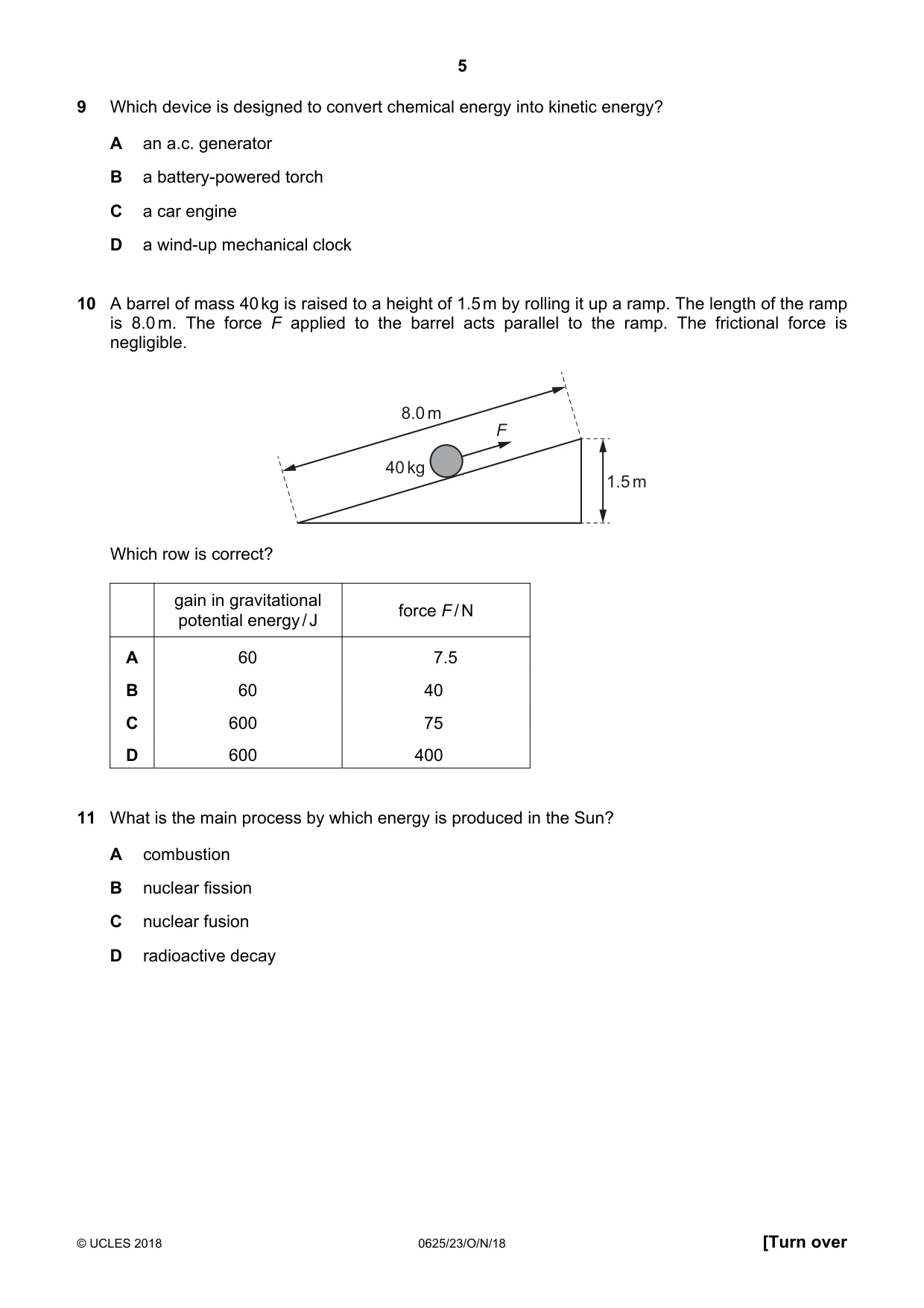
Q9 · Which device is designed to convert chemical energy into kinetic energy?
9 Which device is designed to convert chemical energy into kinetic energy? A an a.c. generator B a battery-powered torch C a car engine D a wind-up mechanical clock
Mark scheme: C
Q10 · A barrel of mass 40 kg is raised to a height of 1.5 m by rolling it up a ramp
10 A barrel of mass 40 kg is raised to a height of 1.5 m by rolling it up a ramp. The length of the ramp is 8.0 m. The force F applied to the barrel acts parallel to the ramp. The frictional force is negligible. 8.0 m F 40 kg 1.5 m Which row is correct? gain in gravitational force F / N potential energy / J A 60 7.5 B 60 40 C 600 75 D 600 400
Mark scheme: C
Q11 · What is the main process by which energy is produced in the Sun?
11 What is the main process by which energy is produced in the Sun? A combustion B nuclear fission C nuclear fusion D radioactive decay
Mark scheme: C
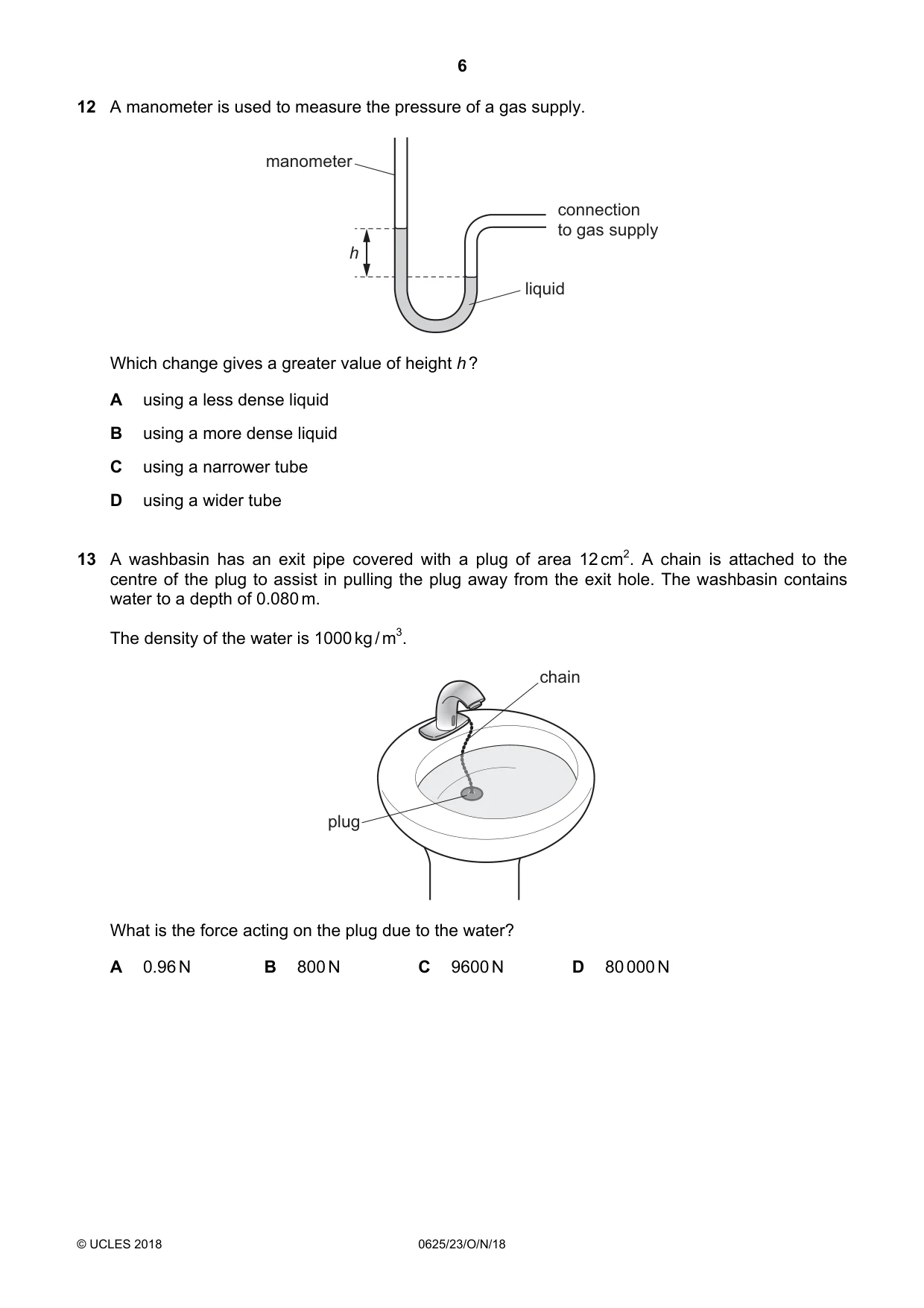
Q12 · A manometer is used to measure the pressure of a gas supply
12 A manometer is used to measure the pressure of a gas supply. manometer connection to gas supply h liquid Which change gives a greater value of height h ? A using a less dense liquid B using a more dense liquid C using a narrower tube D using a wider tube
Mark scheme: A
Q13 · A washbasin has an exit pipe covered with a plug of area 12 cm2
13 A washbasin has an exit pipe covered with a plug of area 12 cm2. A chain is attached to the centre of the plug to assist in pulling the plug away from the exit hole. The washbasin contains water to a depth of 0.080 m. The density of the water is 1000 kg / m3. chain plug What is the force acting on the plug due to the water? A 0.96 N B 800 N C 9600 N D 80 000 N
Mark scheme: A
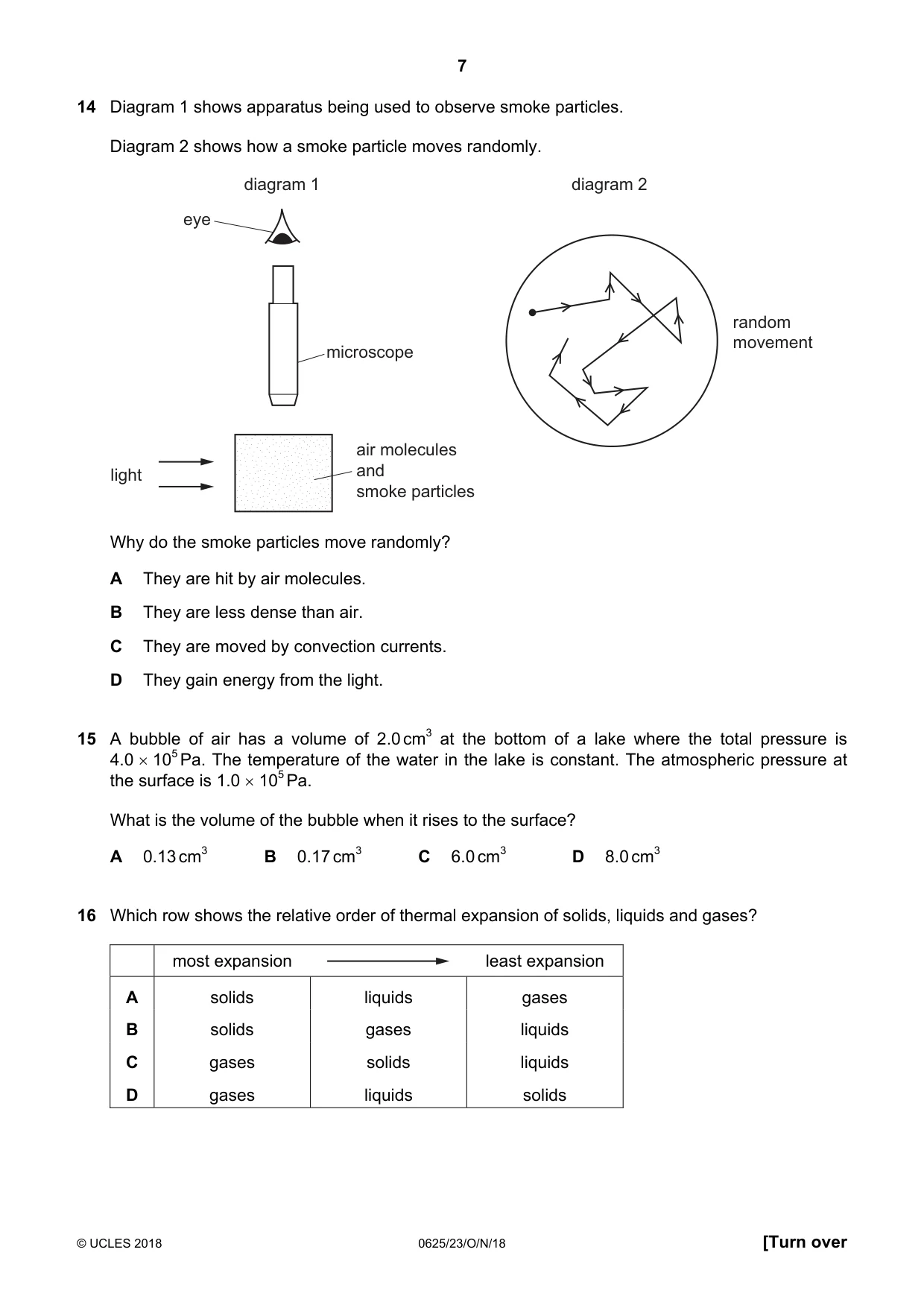
Q14 · Apparatus being used to observe smoke particles
14 Diagram 1 shows apparatus being used to observe smoke particles. Diagram 2 shows how a smoke particle moves randomly. diagram 1 diagram 2 eye random movement microscope air molecules light and smoke particles Why do the smoke particles move randomly? A They are hit by air molecules. B They are less dense than air. C They are moved by convection currents. D They gain energy from the light.
Mark scheme: A
Q15 · A bubble of air has a volume of 2.0 cm3 at the bottom of a lake where the total pressure…
15 A bubble of air has a volume of 2.0 cm3 at the bottom of a lake where the total pressure is 4.0 × 10⁵ Pa. The temperature of the water in the lake is constant. The atmospheric pressure at the surface is 1.0 × 10⁵ Pa. What is the volume of the bubble when it rises to the surface? A 0.13 cm3 B 0.17 cm3 C 6.0 cm3 D 8.0 cm3
Mark scheme: D
Q16 · Which row shows the relative order of thermal expansion of solids, liquids and gases?
16 Which row shows the relative order of thermal expansion of solids, liquids and gases? most expansion least expansion A solids liquids gases B solids gases liquids C gases solids liquids D gases liquids solids
Mark scheme: D
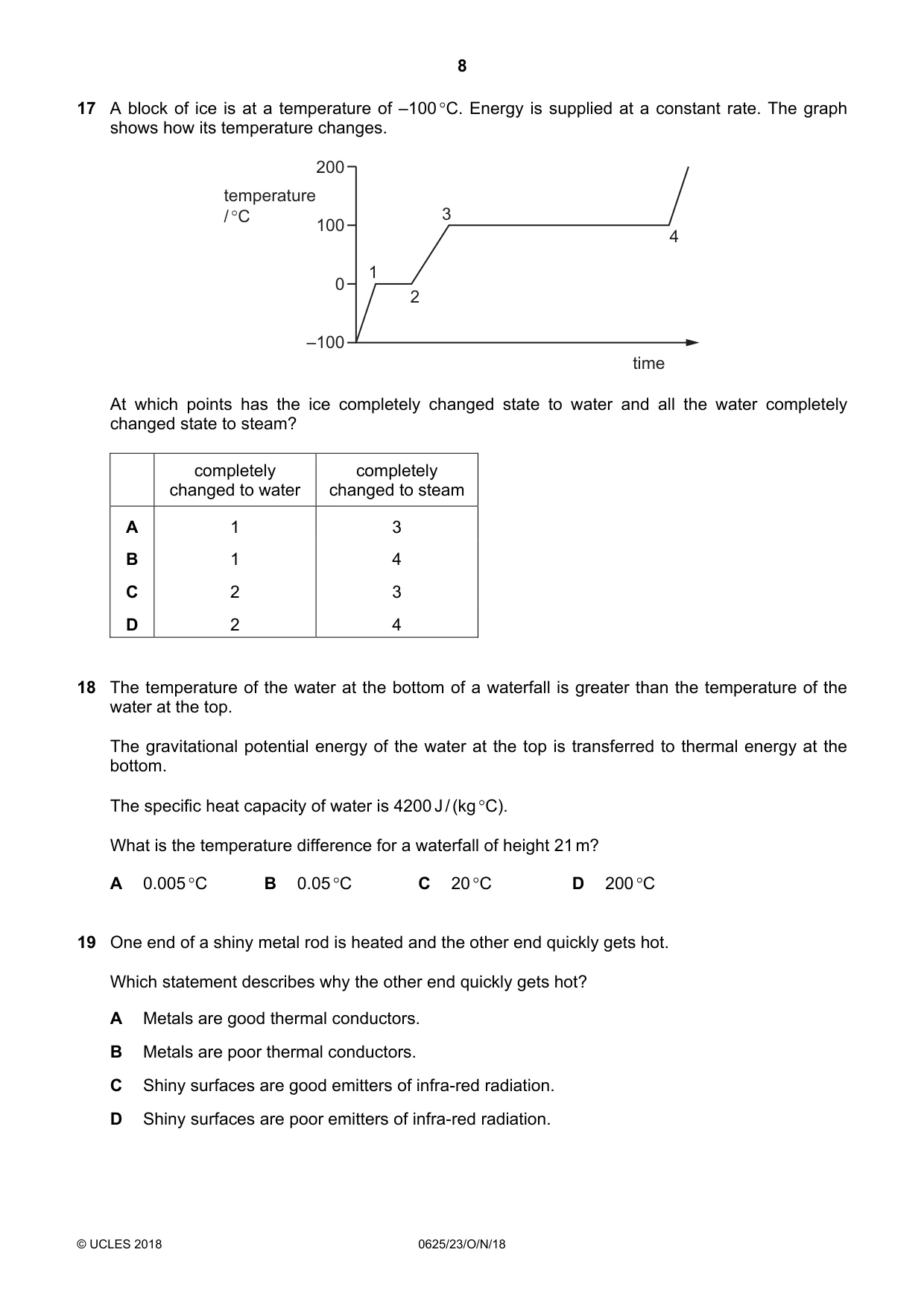
Q17 · A block of ice is at a temperature of –100 °C
17 A block of ice is at a temperature of –100 °C. Energy is supplied at a constant rate. The graph shows how its temperature changes. 200 temperature / °C 3 100 4 1 0 2 –100 time At which points has the ice completely changed state to water and all the water completely changed state to steam? completely completely changed to water changed to steam A 1 3 B 1 4 C 2 3 D 2 4
Mark scheme: D
Q18 · The temperature of the water at the bottom of a waterfall is greater than the temperature…
18 The temperature of the water at the bottom of a waterfall is greater than the temperature of the water at the top. The gravitational potential energy of the water at the top is transferred to thermal energy at the bottom. The specific heat capacity of water is 4200 J / (kg °C). What is the temperature difference for a waterfall of height 21 m? A 0.005 °C B 0.05 °C C 20 °C D 200 °C
Mark scheme: B
Q19 · One end of a shiny metal rod is heated and the other end quickly gets hot
19 One end of a shiny metal rod is heated and the other end quickly gets hot. Which statement describes why the other end quickly gets hot? A Metals are good thermal conductors. B Metals are poor thermal conductors. C Shiny surfaces are good emitters of infra-red radiation. D Shiny surfaces are poor emitters of infra-red radiation.
Mark scheme: A
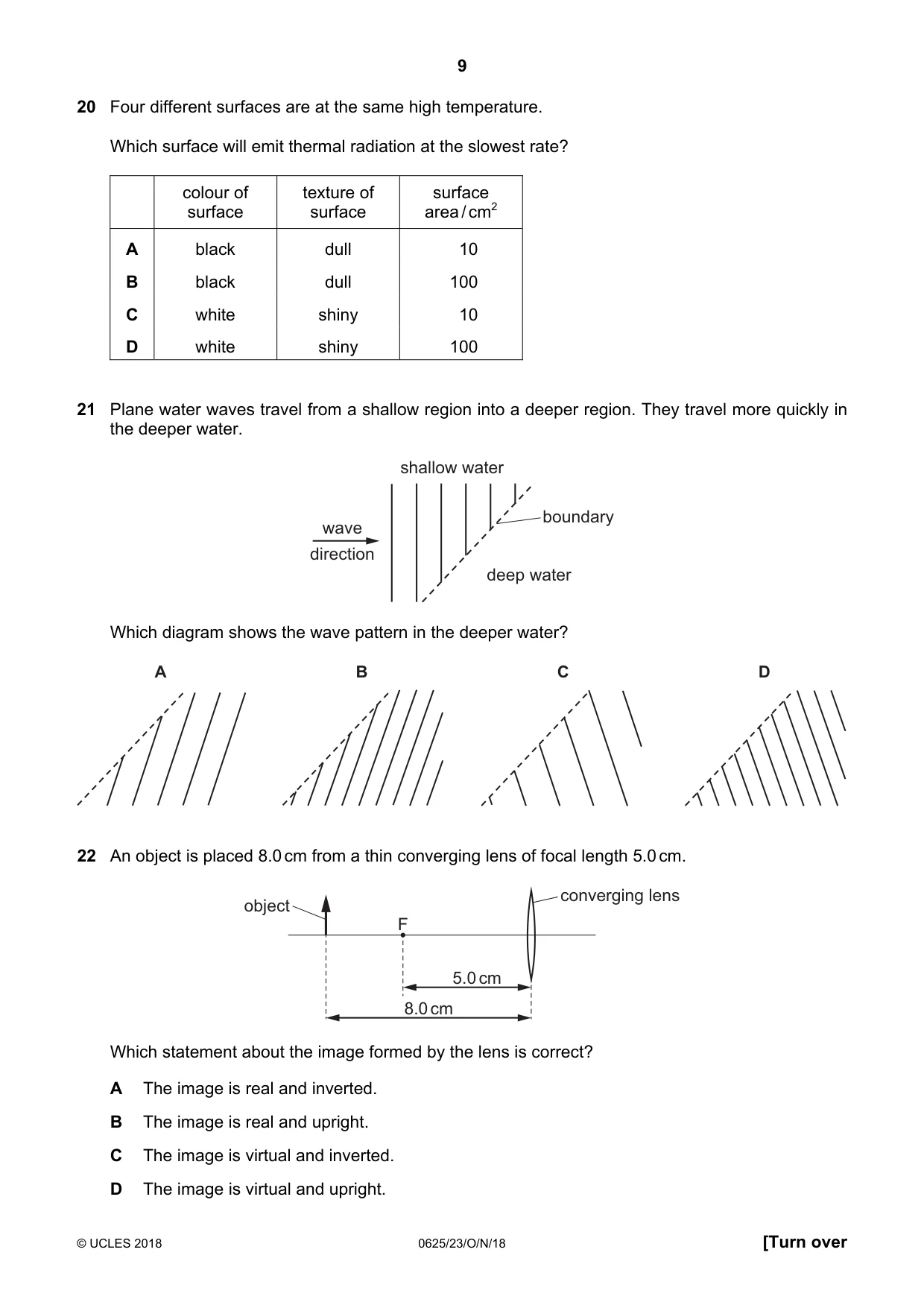
Q20 · Four different surfaces are at the same high temperature
20 Four different surfaces are at the same high temperature. Which surface will emit thermal radiation at the slowest rate? colour of texture of surface surface surface area / cm2 A black dull 10 B black dull 100 C white shiny 10 D white shiny 100
Mark scheme: C
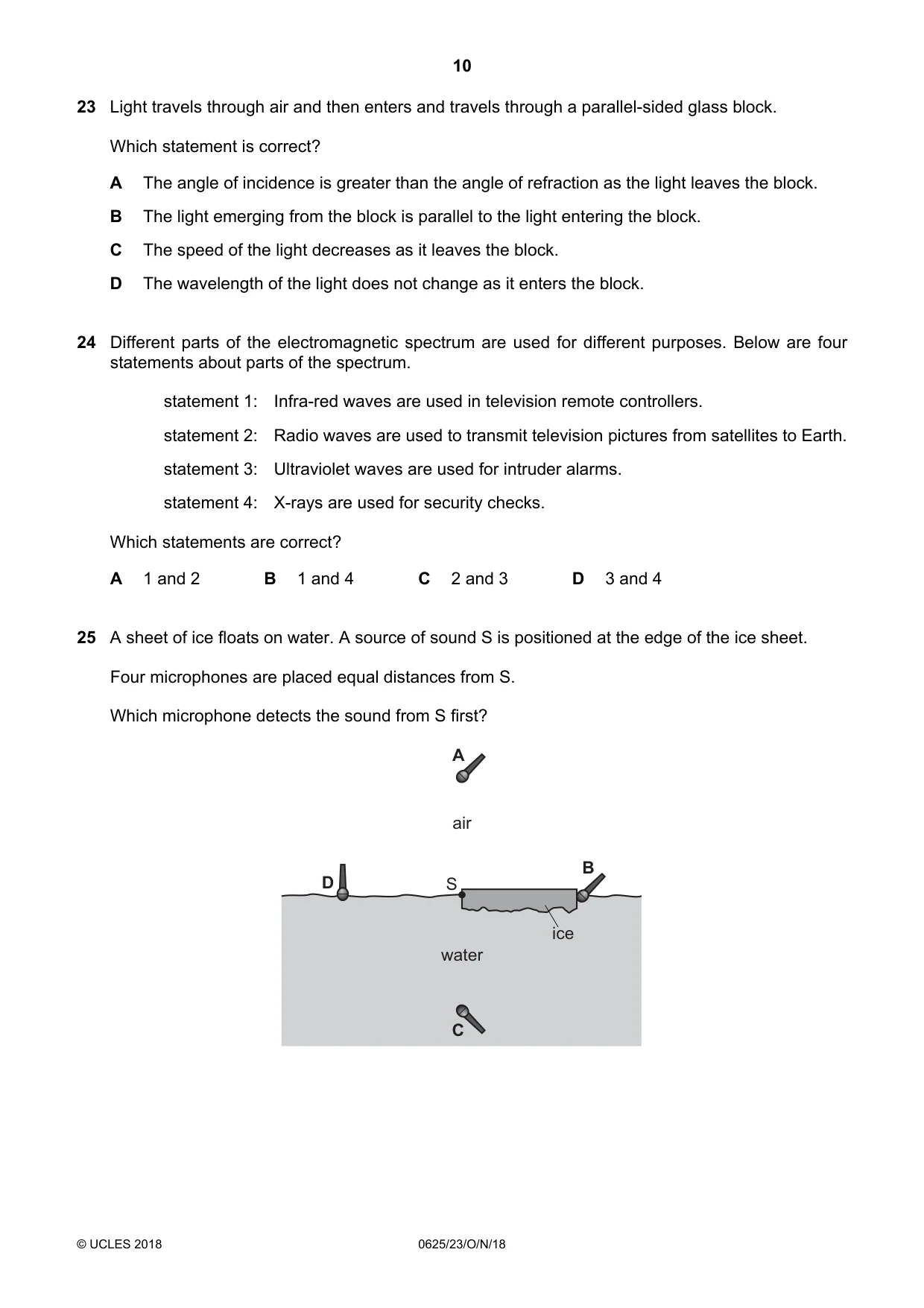
Q21 · Plane water waves travel from a shallow region into a deeper region
21 Plane water waves travel from a shallow region into a deeper region. They travel more quickly in the deeper water. shallow water boundary wave direction deep water Which diagram shows the wave pattern in the deeper water? A B C D
Mark scheme: C
Q22 · An object is placed 8.0 cm from a thin converging lens of focal length 5.0 cm
22 An object is placed 8.0 cm from a thin converging lens of focal length 5.0 cm. converging lens object F 5.0 cm 8.0 cm Which statement about the image formed by the lens is correct? A The image is real and inverted. B The image is real and upright. C The image is virtual and inverted. D The image is virtual and upright.
Mark scheme: A
Q23 · Light travels through air and then enters and travels through a parallel-sided glass block
23 Light travels through air and then enters and travels through a parallel-sided glass block. Which statement is correct? A The angle of incidence is greater than the angle of refraction as the light leaves the block. B The light emerging from the block is parallel to the light entering the block. C The speed of the light decreases as it leaves the block. D The wavelength of the light does not change as it enters the block.
Mark scheme: B
Q24 · Different parts of the electromagnetic spectrum are used for different purposes
24 Different parts of the electromagnetic spectrum are used for different purposes. Below are four statements about parts of the spectrum. statement 1: Infra-red waves are used in television remote controllers. statement 2: Radio waves are used to transmit television pictures from satellites to Earth. statement 3: Ultraviolet waves are used for intruder alarms. statement 4: X-rays are used for security checks. Which statements are correct? A 1 and 2 B 1 and 4 C 2 and 3 D 3 and 4
Mark scheme: B
Q25 · A sheet of ice floats on water
25 A sheet of ice floats on water. A source of sound S is positioned at the edge of the ice sheet. Four microphones are placed equal distances from S. Which microphone detects the sound from S first? A air B D S ice water C
Mark scheme: B
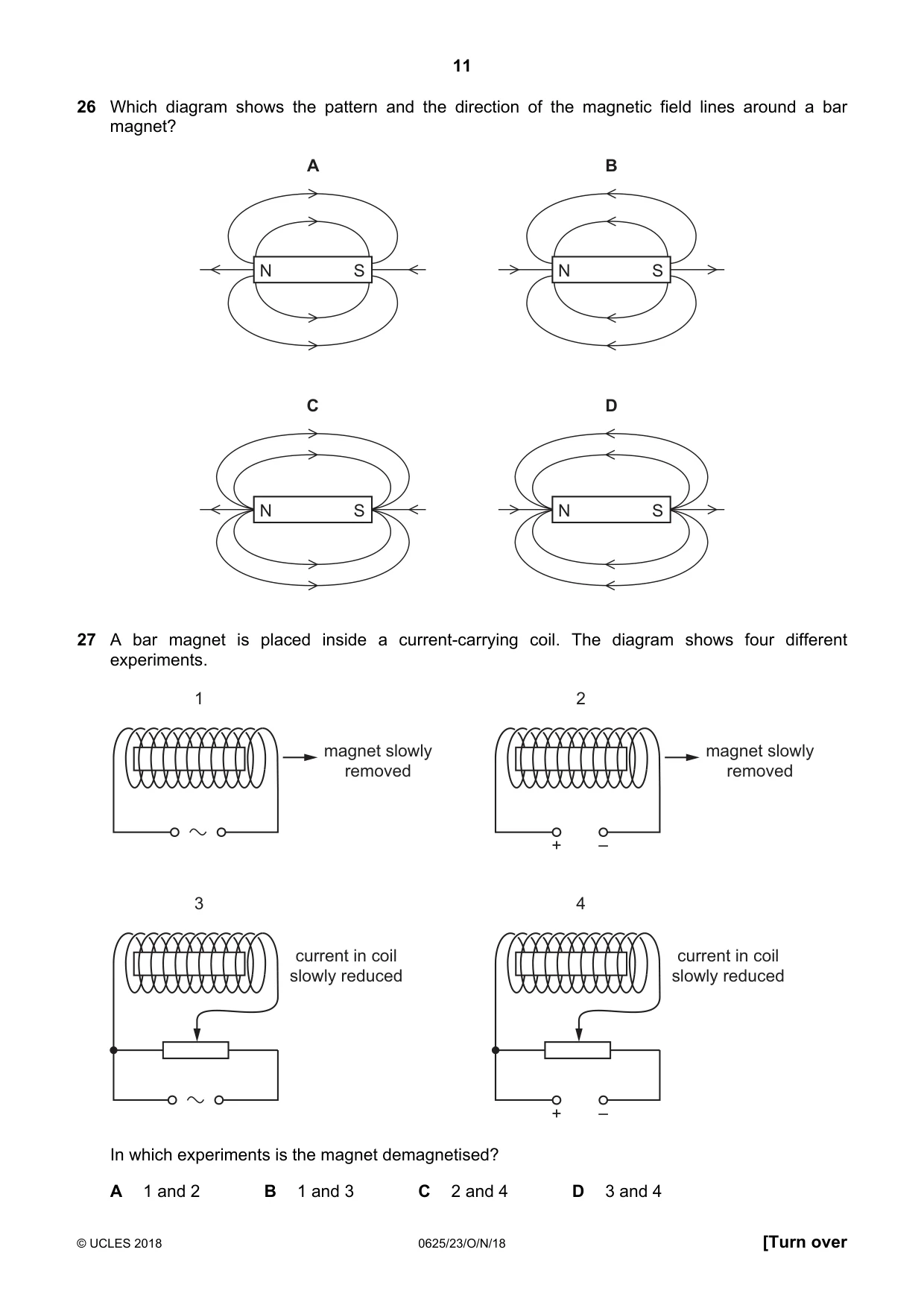
Q26 · Which diagram shows the pattern and the direction of the magnetic field lines around a…
26 Which diagram shows the pattern and the direction of the magnetic field lines around a bar magnet? A B N S N S C D N S N S
Mark scheme: A
Q27 · A bar magnet is placed inside a current-carrying coil
27 A bar magnet is placed inside a current-carrying coil. The diagram shows four different experiments. 1 2 magnet slowly magnet slowly removed removed + – 3 4 current in coil current in coil slowly reduced slowly reduced + – In which experiments is the magnet demagnetised? A 1 and 2 B 1 and 3 C 2 and 4 D 3 and 4
Mark scheme: B
Q28 · Which row shows the meaning of the quantity e.m.f
28 Which row shows the meaning of the quantity e.m.f. and the unit in which it is measured? meaning unit A electromagnetic force N B electromagnetic force V C electromotive force N D electromotive force V
Mark scheme: D
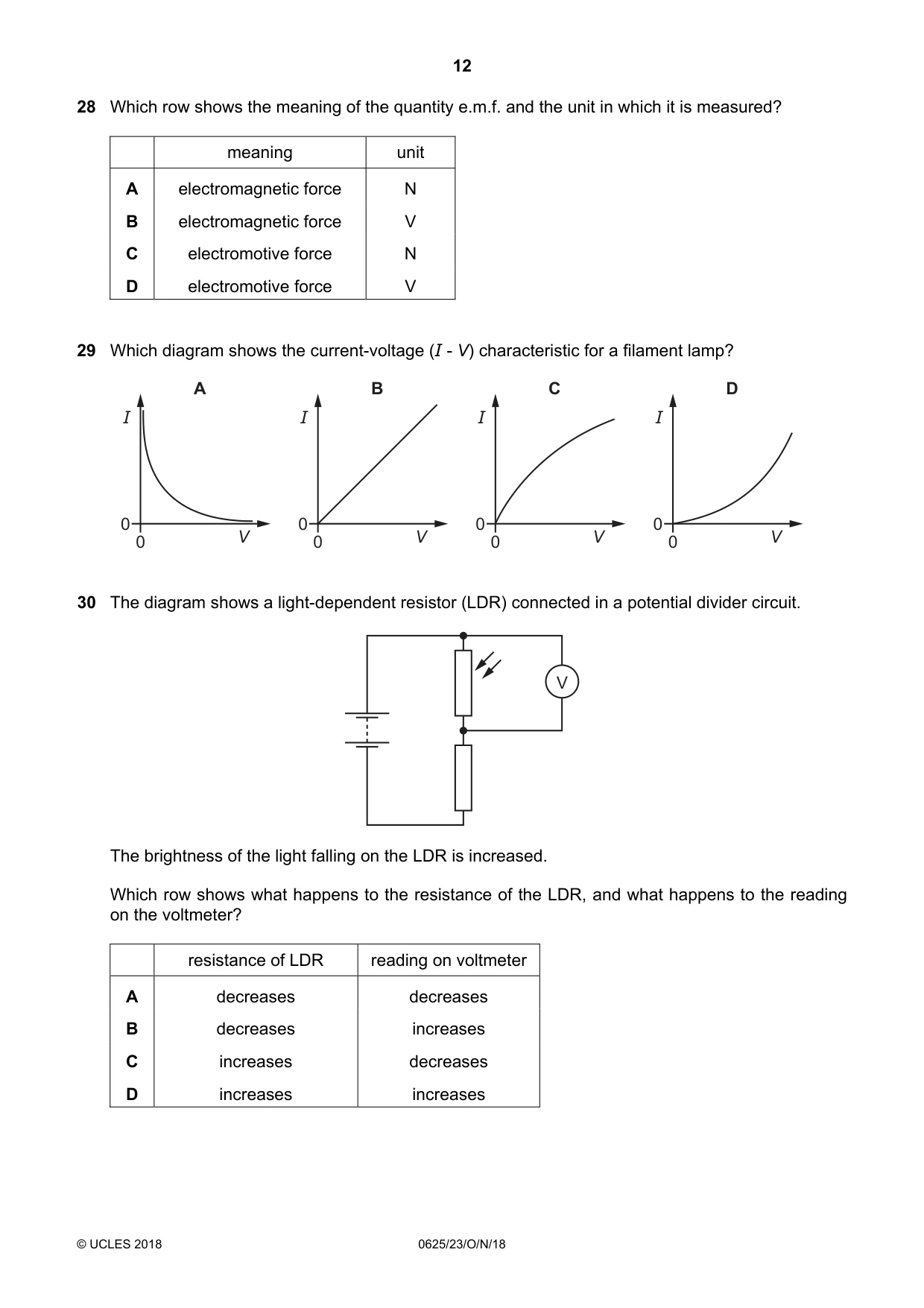
Q29 · Which diagram shows the current-voltage (I - V) characteristic for a filament lamp?
29 Which diagram shows the current-voltage (I - V) characteristic for a filament lamp? A B C D I I I I 0 0 0 0 0 V 0 V 0 V 0 V
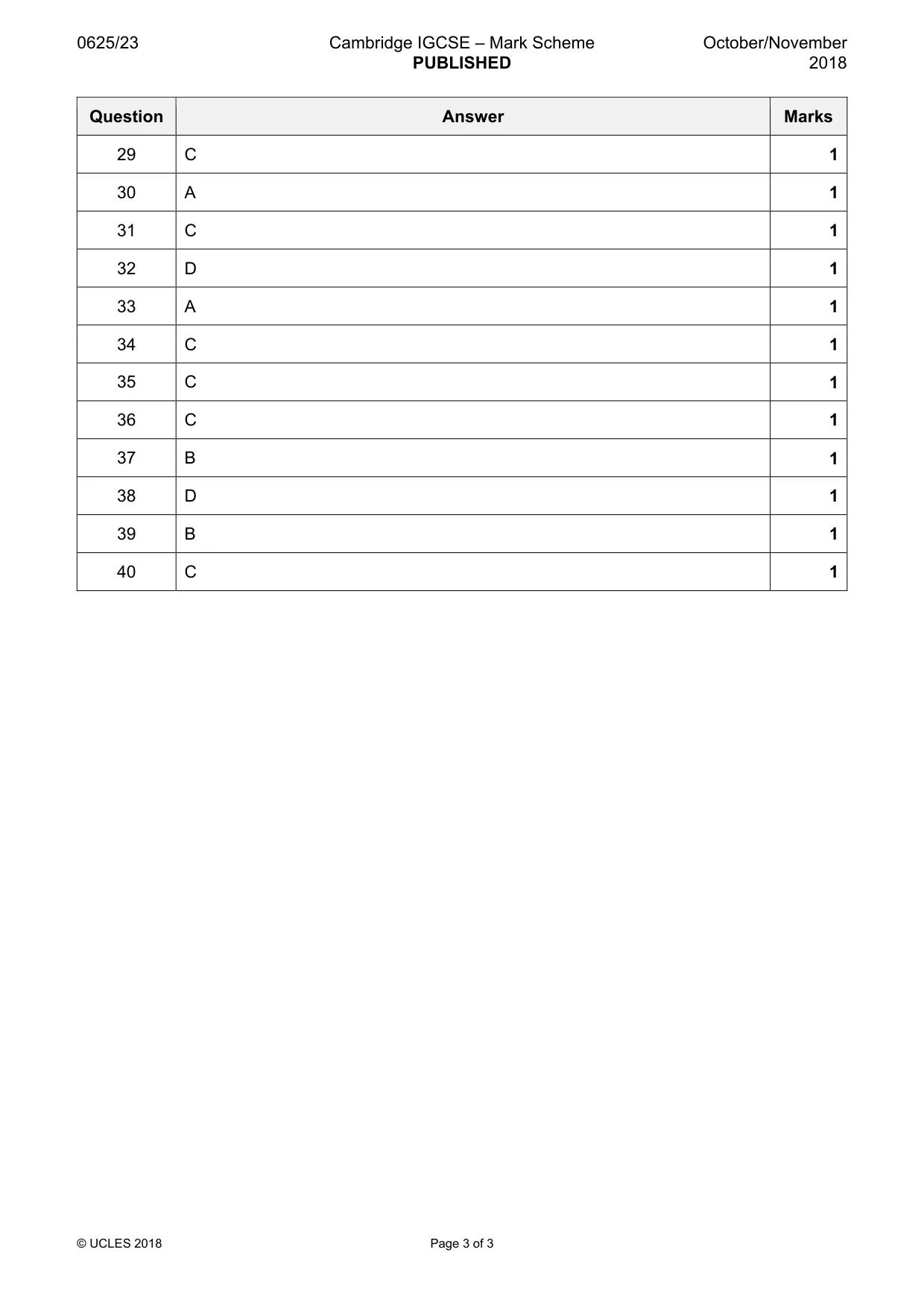
Mark scheme: C
Q30 · The diagram shows a light-dependent resistor (LDR) connected in a potential divider…
30 The diagram shows a light-dependent resistor (LDR) connected in a potential divider circuit. V The brightness of the light falling on the LDR is increased. Which row shows what happens to the resistance of the LDR, and what happens to the reading on the voltmeter? resistance of LDR reading on voltmeter A decreases decreases B decreases increases C increases decreases D increases increases
Mark scheme: A
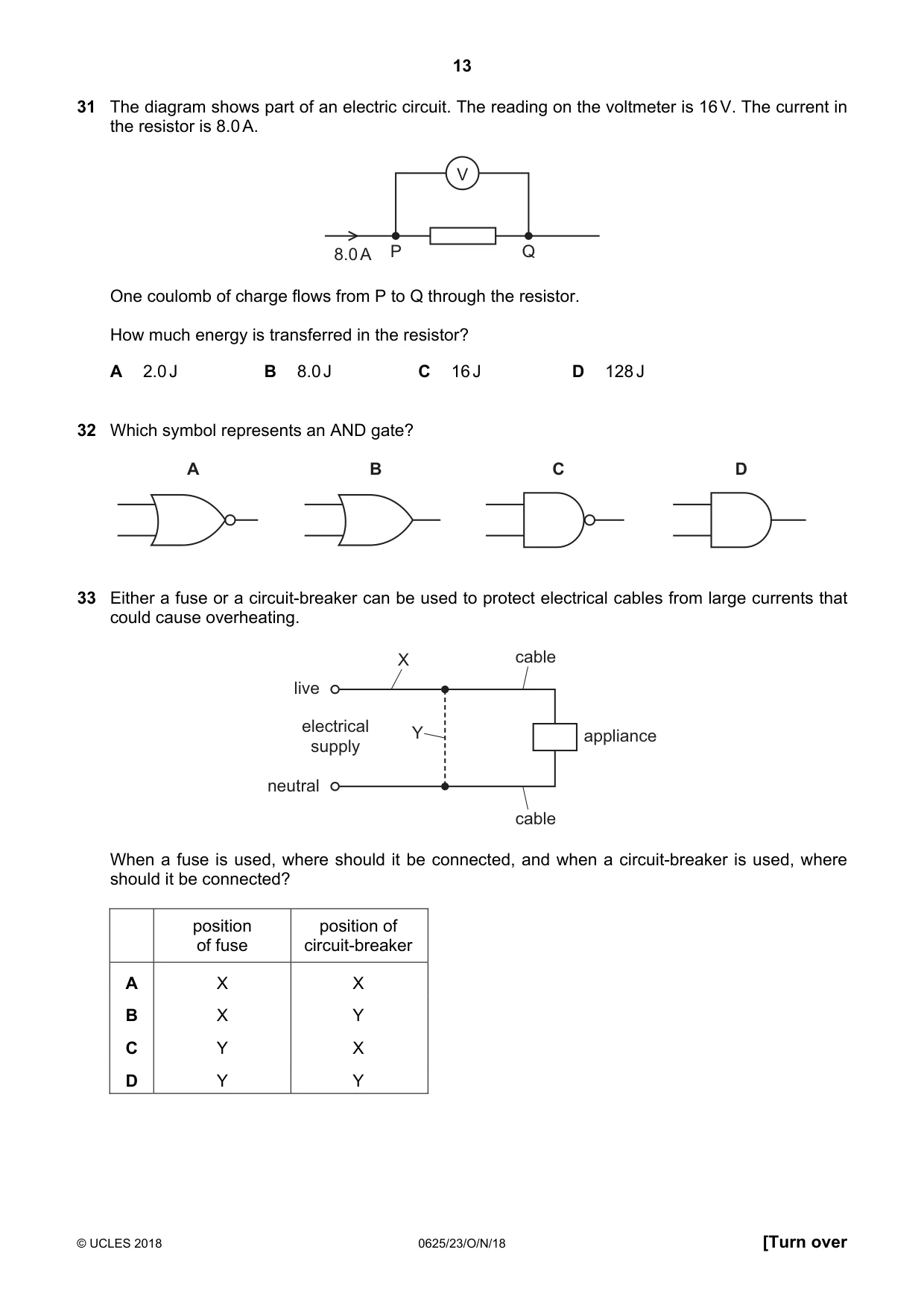
Q31 · The diagram shows part of an electric circuit
31 The diagram shows part of an electric circuit. The reading on the voltmeter is 16 V. The current in the resistor is 8.0 A. V 8.0 A P Q One coulomb of charge flows from P to Q through the resistor. How much energy is transferred in the resistor? A 2.0 J B 8.0 J C 16 J D 128 J
Mark scheme: C
Q32 · Which symbol represents an AND gate?
32 Which symbol represents an AND gate? A B C D
Mark scheme: D
Q33 · Either a fuse or a circuit-breaker can be used to protect electrical cables from large…
33 Either a fuse or a circuit-breaker can be used to protect electrical cables from large currents that could cause overheating. X cable live electrical Y appliance supply neutral cable When a fuse is used, where should it be connected, and when a circuit-breaker is used, where should it be connected? position position of of fuse circuit-breaker A X X B X Y C Y X D Y Y
Mark scheme: A
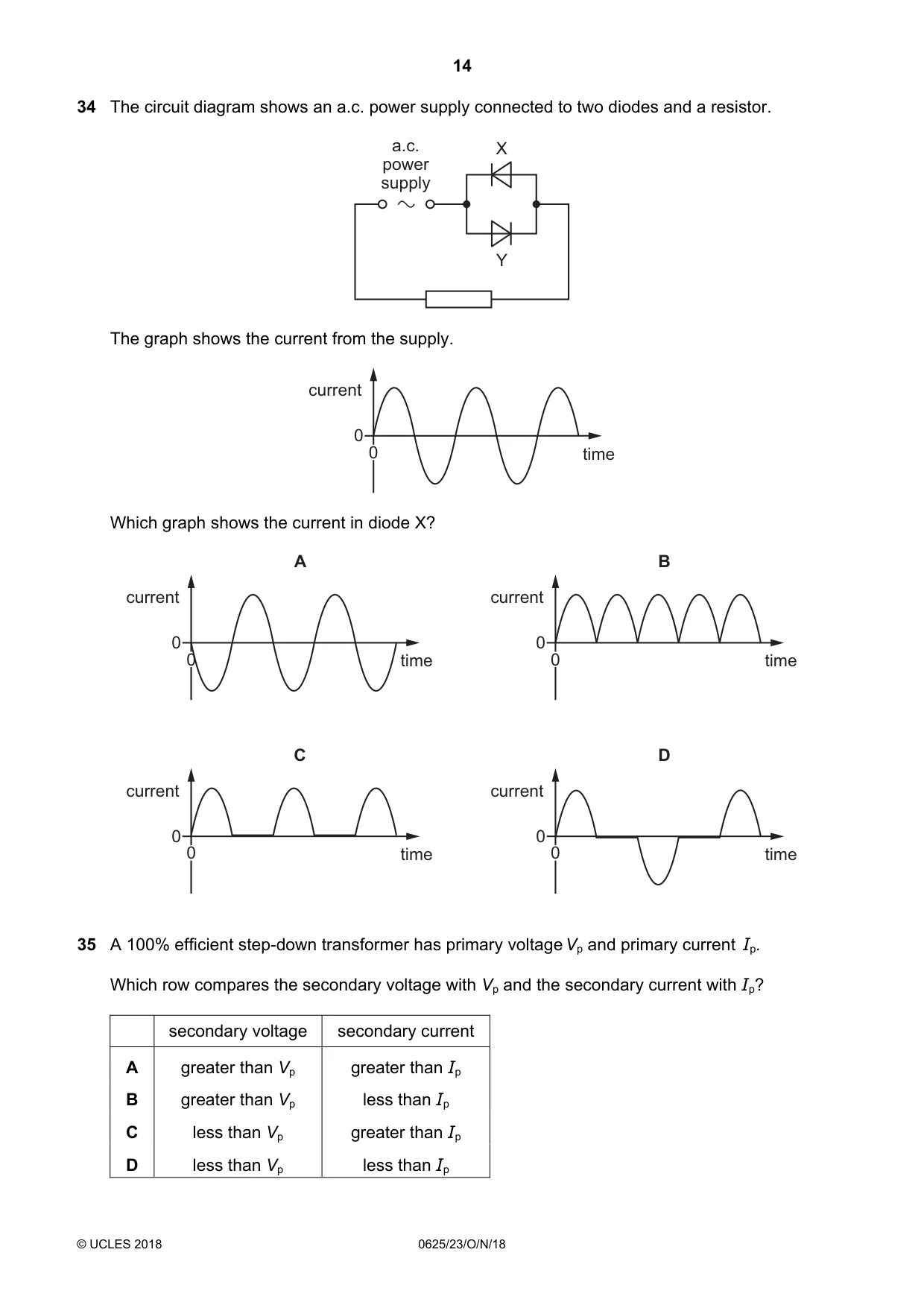
Q34 · The circuit diagram shows an a.c
34 The circuit diagram shows an a.c. power supply connected to two diodes and a resistor. a.c. X power supply Y The graph shows the current from the supply. current 0 0 time Which graph shows the current in diode X? A B current current 0 0 0 time 0 time C D current current 0 0 0 time 0 time
Mark scheme: C
Q35 · A 100% efficient step-down transformer has primary voltage Vp and primary current Ip
35 A 100% efficient step-down transformer has primary voltage Vp and primary current Ip. Which row compares the secondary voltage with Vp and the secondary current with Ip? secondary voltage secondary current A greater than Vp greater than Ip B greater than Vp less than Ip C less than Vp greater than Ip D less than Vp less than Ip
Mark scheme: C
Q36 · There is an electric current in a wire
36 There is an electric current in a wire. The wire is placed in a magnetic field. A force acts on the wire due to the current. Which statement is correct? A The magnetic field must be produced by a permanent magnet and not by an electromagnet. B The wire must be made from a magnetic material. C When both the current and the magnetic field are reversed, the direction of the force is unchanged. D When the current is reversed, but not the magnetic field, there will be no force on the wire.
Mark scheme: C
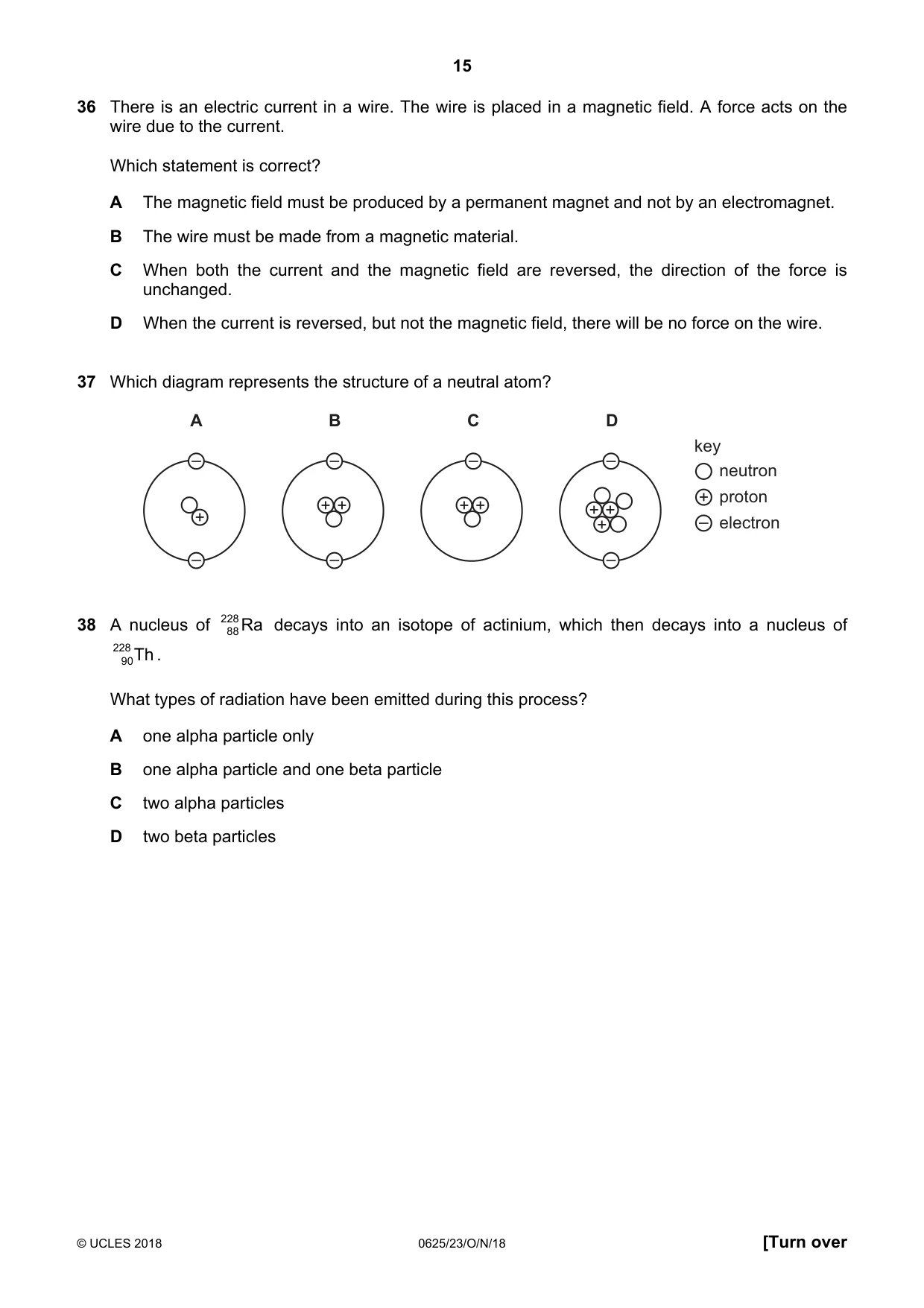
Q37 · Which diagram represents the structure of a neutral atom?
37 Which diagram represents the structure of a neutral atom? A B C D key – – – – neutron + proton + + + + + + + + – electron – – –
Mark scheme: B
Q38 · A nucleus of 228 Ra decays into an isotope of actinium, which then decays into a nucleus…
38 A nucleus of 228 Ra decays into an isotope of actinium, which then decays into a nucleus of 88 228 Th . 90 What types of radiation have been emitted during this process? A one alpha particle only B one alpha particle and one beta particle C two alpha particles D two beta particles
Mark scheme: D
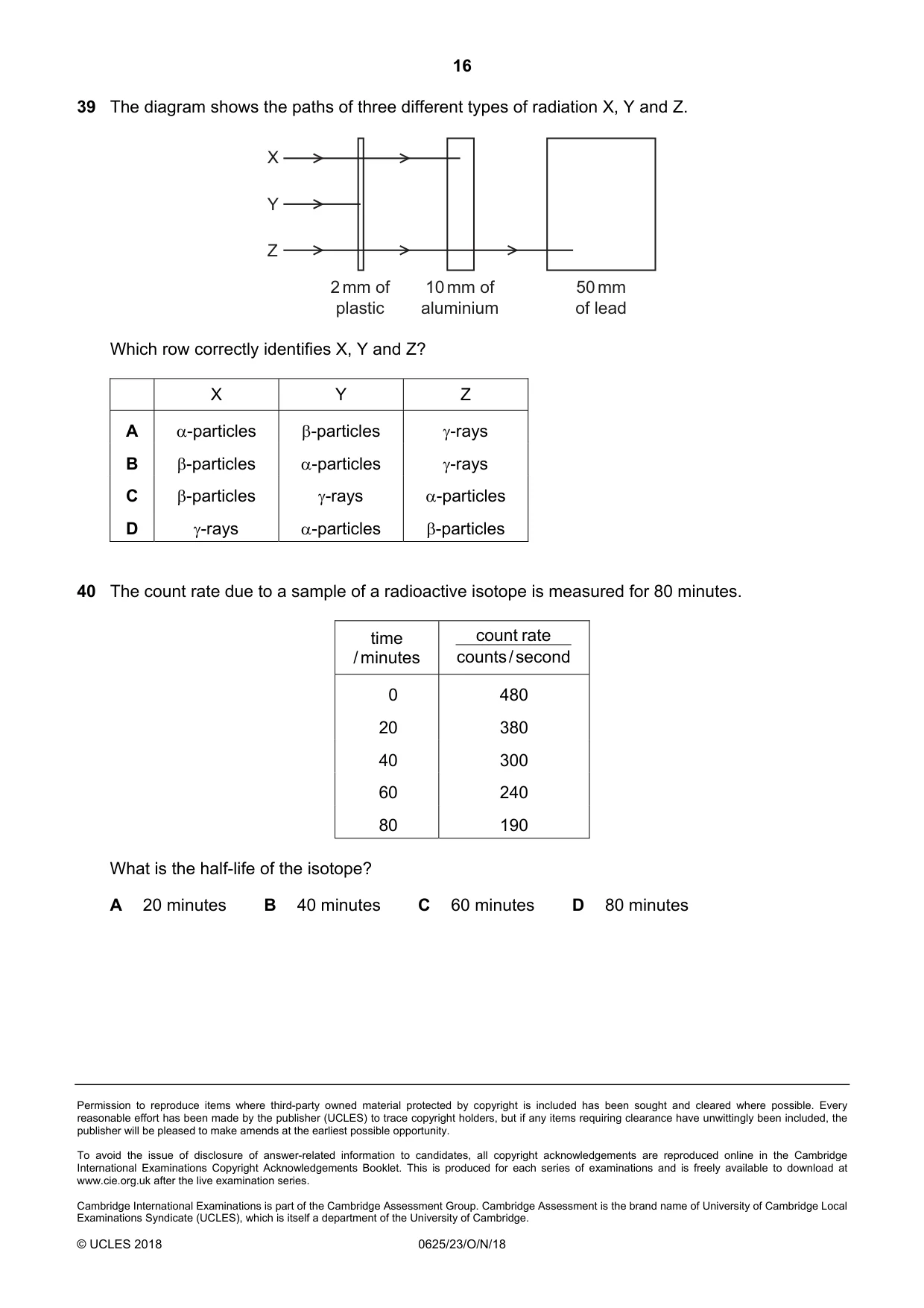
Q39 · The diagram shows the paths of three different types of radiation X, Y and Z
39 The diagram shows the paths of three different types of radiation X, Y and Z. X Y Z 2 mm of 10 mm of 50 mm plastic aluminium of lead Which row correctly identifies X, Y and Z? X Y Z A α-particles β-particles γ-rays B β-particles α-particles γ-rays C β-particles γ-rays α-particles D γ-rays α-particles β-particles
Mark scheme: B
Q40 · The count rate due to a sample of a radioactive isotope is measured for 80 minutes
40 The count rate due to a sample of a radioactive isotope is measured for 80 minutes. time count rate / minutes counts / second 0 480 20 380 40 300 60 240 80 190 What is the half-life of the isotope? A 20 minutes B 40 minutes C 60 minutes D 80 minutes
Mark scheme: C
What was in this paper
The subtopics covered by these 40 questions, and how many questions each got. Open one in a new tab to see every Cambridge question on it.
3Electromagnetic effects3Forces3Pressure3Radioactivity3Thermal properties and temperature3Electrical quantities2Energy, work and power2Light2Motion2Simple phenomena of magnetism2The nuclear model of the atom2Transfer of thermal energy2Density1Electrical safety1Electromagnetic spectrum1General properties of waves1Kinetic particle model of matter1Momentum1Physical quantities and measurement techniques1Sound1What you needed in this session
Cambridge’s own grade thresholds for 2018 Oct/Nov, Paper 2 · Variant 3. A higher threshold means an easier paper — the bar moves with how the cohort did.