Cambridge IGCSE Physics 0625 — 2020 Oct/Nov Paper 2 · Variant 3
0625/23/O/N/20 · 40 questions · 40 marks · ≈45 min
The question paper and its mark scheme, free to read here and free to download. This is Cambridge’s own paper, exactly as it was sat.
Question paper16 pages

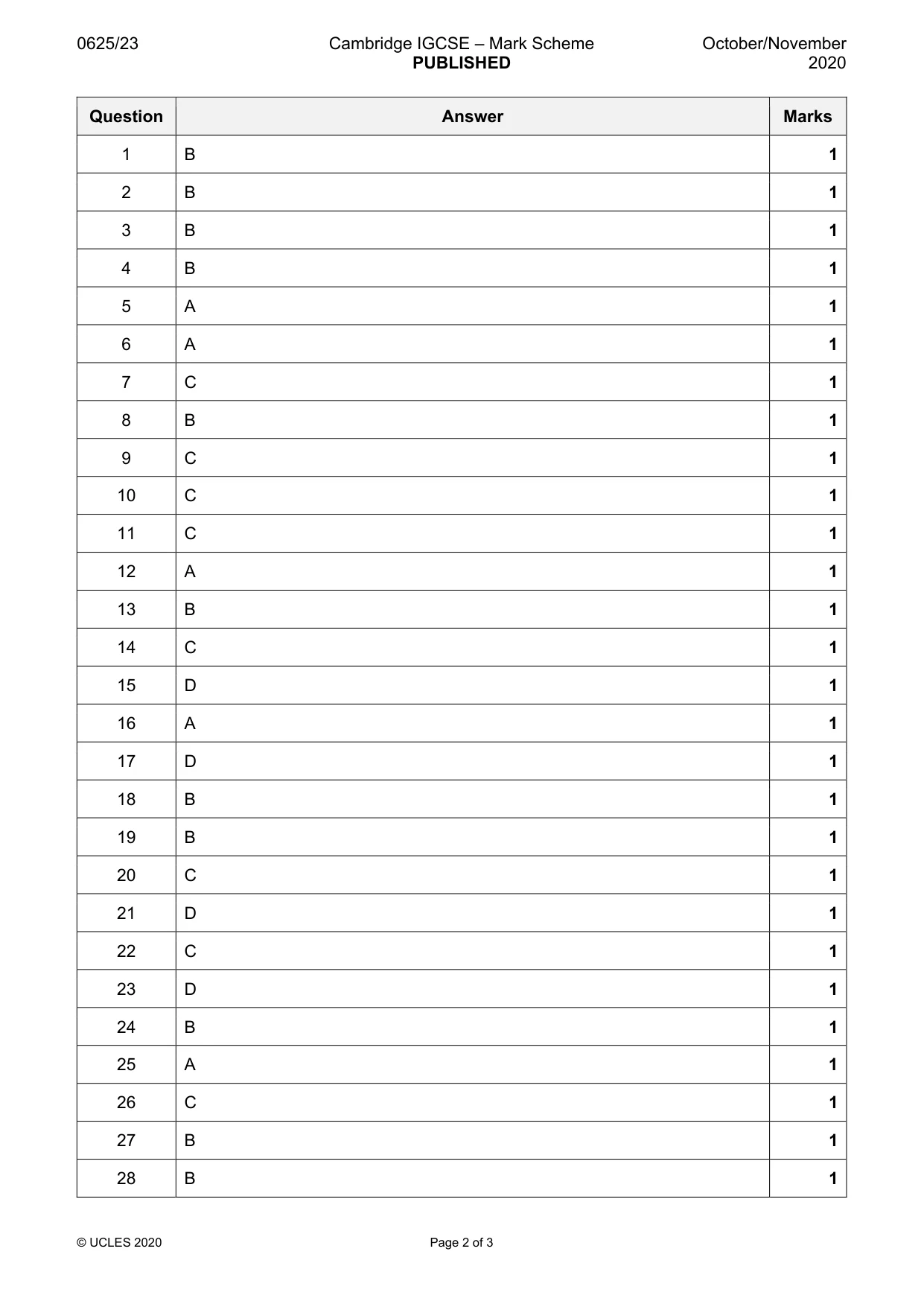
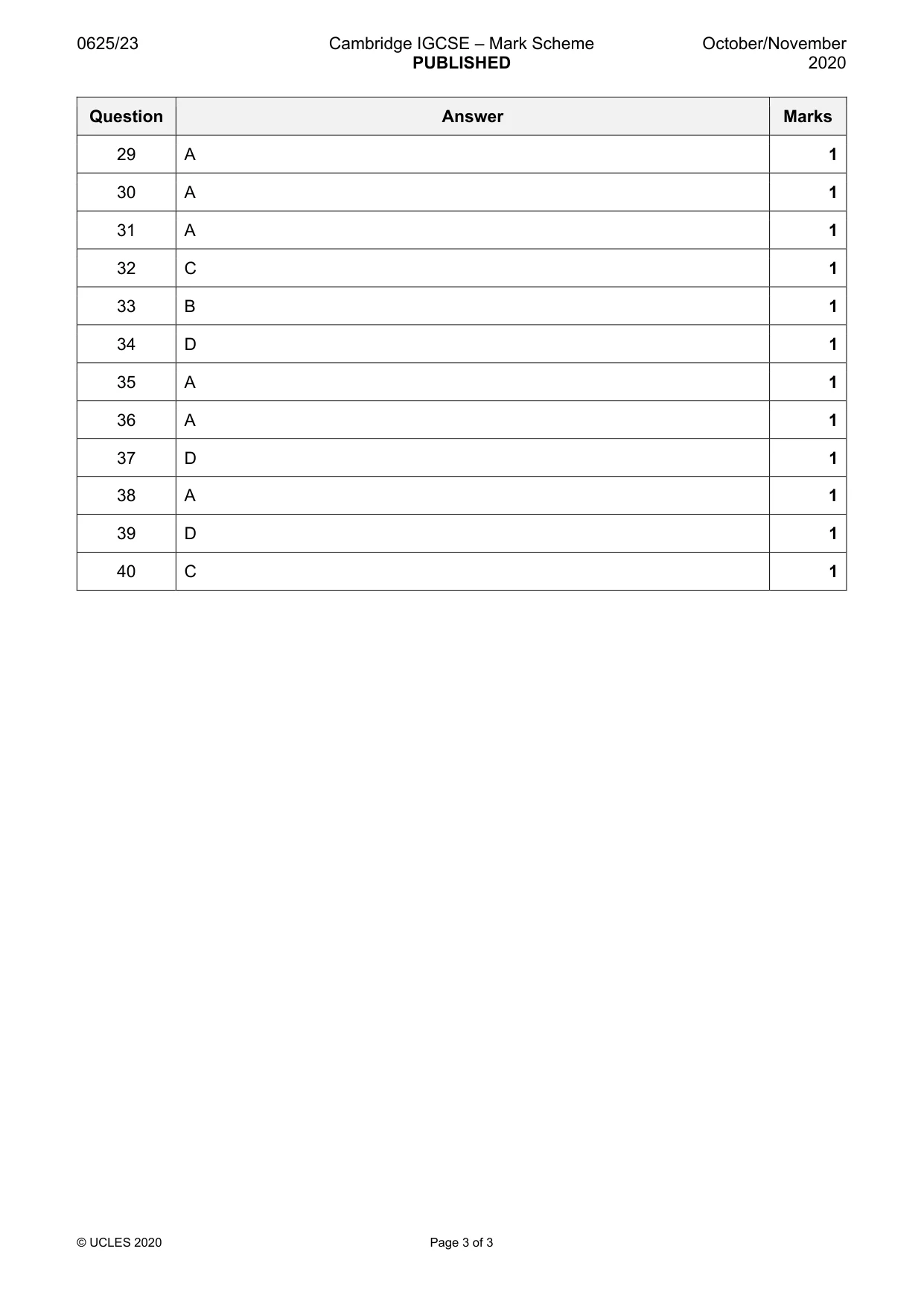
Mark scheme3 pages
Answers below. Sit the paper first if you are practising.
Questions as text
Q1 · A micrometer screw gauge reads 0.02 mm when the jaws are fully closed
1 A micrometer screw gauge reads 0.02 mm when the jaws are fully closed. It reads 0.56 mm when measuring the diameter of a metal wire. What is the diameter of the wire? A 0.36 mm B 0.54 mm C 0.56 mm D 0.58 mm
Mark scheme: B
More questions on Physical quantities and measurement techniques
Q2 · Object P moves at a constant speed of 5 m / s repeatedly backwards and forwards in a…
2 Object P moves at a constant speed of 5 m / s repeatedly backwards and forwards in a straight line. Object Q moves at a constant speed of 5 m / s vertically downwards. Object R moves at a constant speed of 5 m / s in a circle. Which objects are moving with uniform velocity? A P only B Q only C R only D Q and R
Mark scheme: B
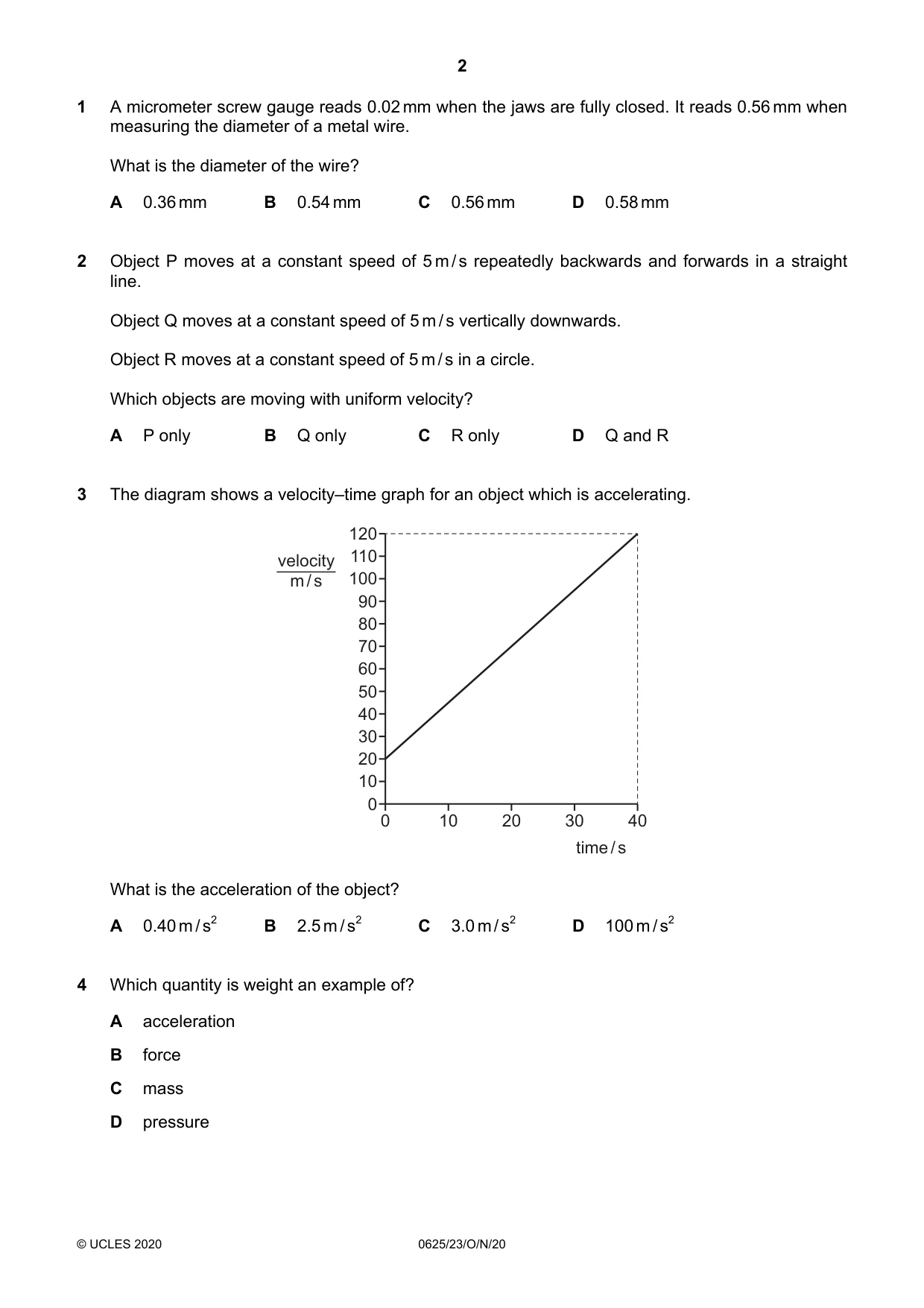
Q3 · The diagram shows a velocity–time graph for an object which is accelerating
3 The diagram shows a velocity–time graph for an object which is accelerating. 120 velocity 110 m / s 100 90 80 70 60 50 40 30 20 10 0 0 10 20 30 40 time / s What is the acceleration of the object? A 0.40 m / s2 B 2.5 m / s2 C 3.0 m / s2 D 100 m / s2
Mark scheme: B
Q4 · Which quantity is weight an example of?
4 Which quantity is weight an example of? A acceleration B force C mass D pressure
Mark scheme: B
Q5 · An object of mass 1.0 kg is at rest on Earth
5 An object of mass 1.0 kg is at rest on Earth. An identical object is at rest on a planet with a gravitational field strength of twice that on Earth. Which row correctly compares the object on the planet to the object on Earth? its acceleration when the same its weight horizontal force is applied A double equal to that on Earth B double half that on Earth C half equal to that on Earth D half half that on Earth
Mark scheme: A
Q6 · A square wooden raft floats on a lake
6 A square wooden raft floats on a lake. The density of the water in the lake is 1000 kg / m3. The sides of the raft are 2.0 m long and the thickness of the raft is 0.20 m. The mass of the raft is 700 kg. How many barrels, each of mass 100 kg, could be placed on the raft before its surface sinks to the surface of the water? A 1 B 7 C 8 D 15
Mark scheme: A
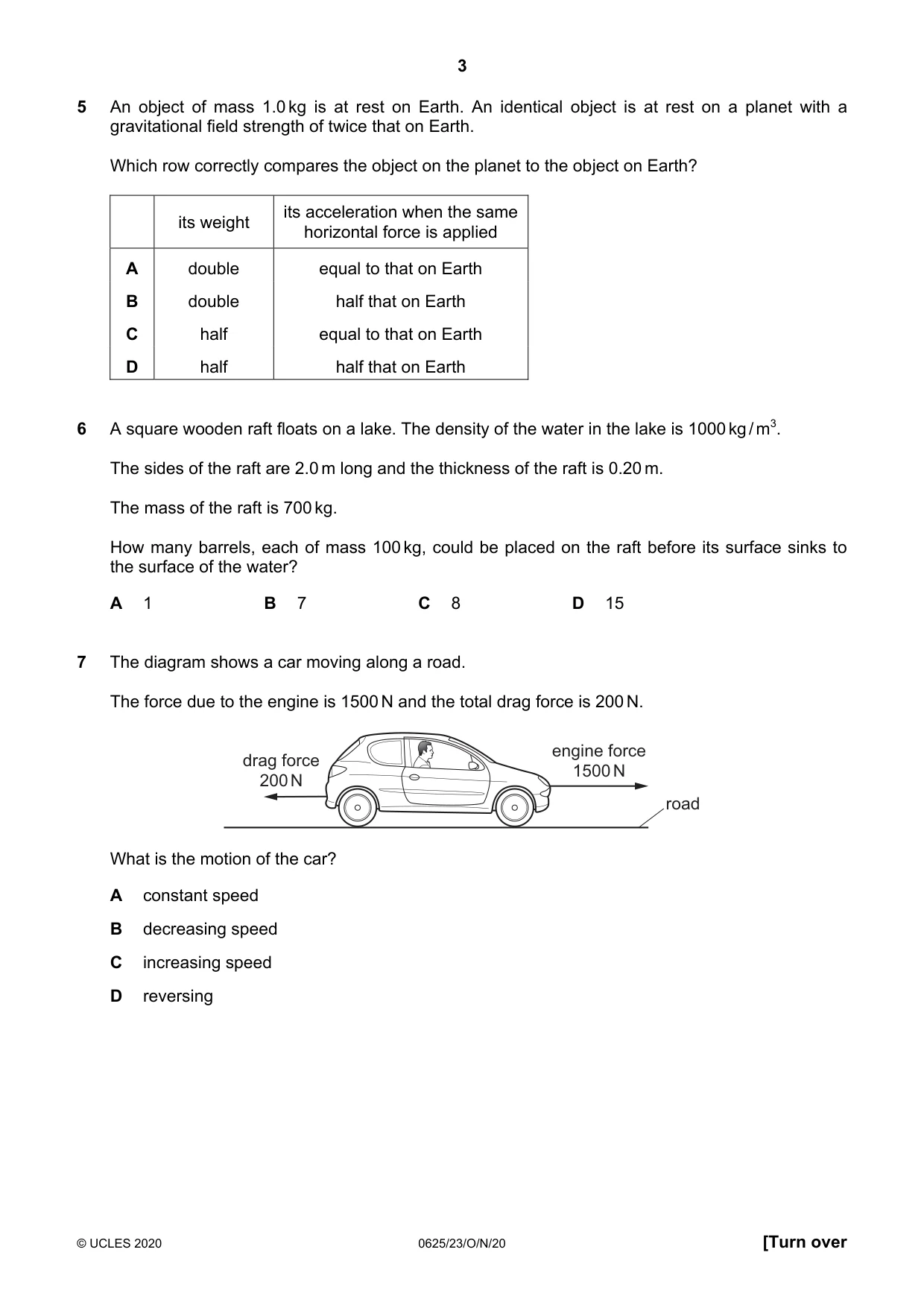
Q7 · The diagram shows a car moving along a road
7 The diagram shows a car moving along a road. The force due to the engine is 1500 N and the total drag force is 200 N. engine force drag force 1500 N 200 N road What is the motion of the car? A constant speed B decreasing speed C increasing speed D reversing
Mark scheme: C
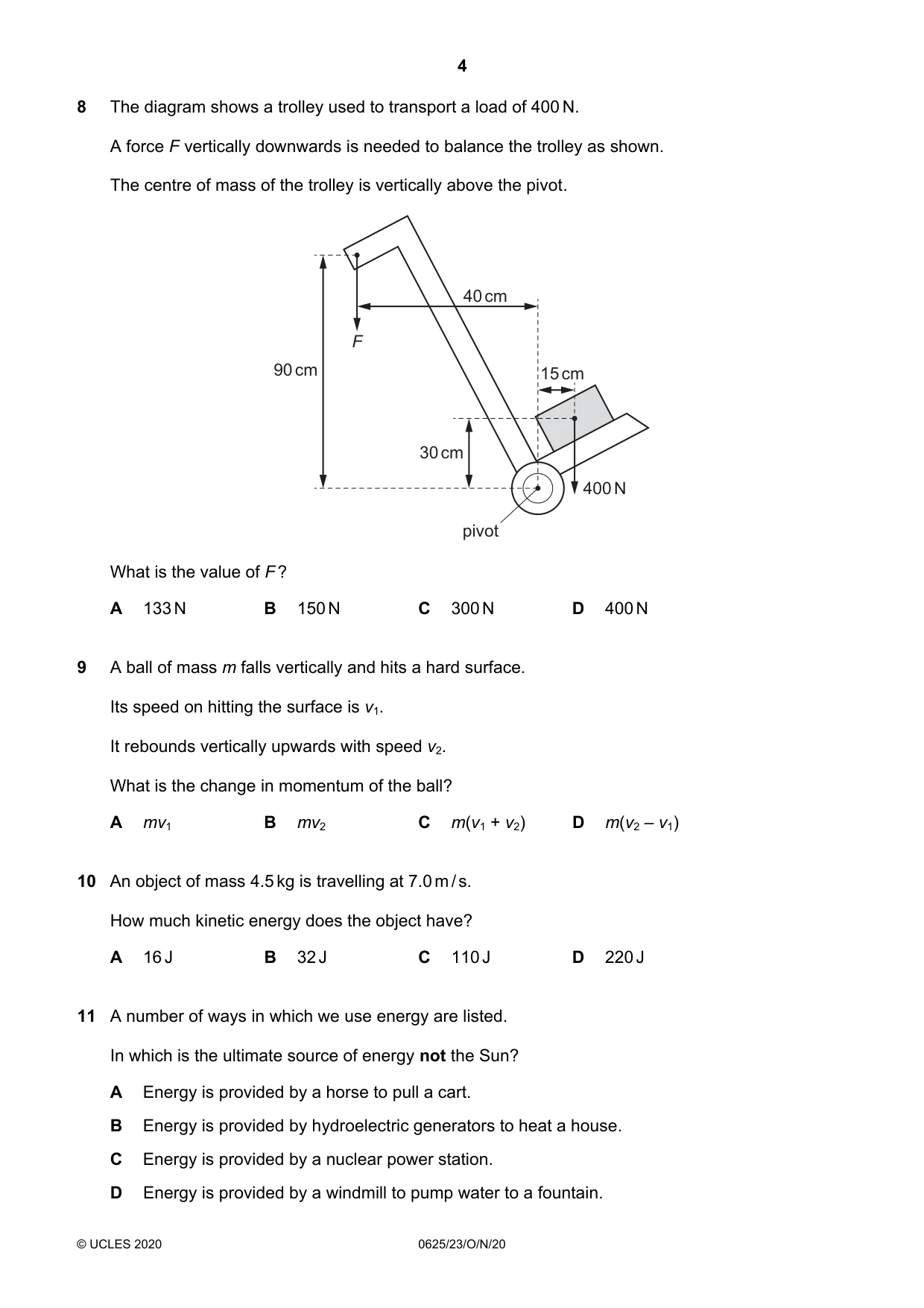
Q8 · The diagram shows a trolley used to transport a load of 400 N
8 The diagram shows a trolley used to transport a load of 400 N. A force F vertically downwards is needed to balance the trolley as shown. The centre of mass of the trolley is vertically above the pivot. 40 cm F 90 cm 15 cm 30 cm 400 N pivot What is the value of F ? A 133 N B 150 N C 300 N D 400 N
Mark scheme: B
Q9 · A ball of mass m falls vertically and hits a hard surface
9 A ball of mass m falls vertically and hits a hard surface. Its speed on hitting the surface is v1. It rebounds vertically upwards with speed v2. What is the change in momentum of the ball? A mv1 B mv2 C m(v1 + v2) D m(v2 – v1)
Mark scheme: C
Q10 · An object of mass 4.5 kg is travelling at 7.0 m / s
10 An object of mass 4.5 kg is travelling at 7.0 m / s. How much kinetic energy does the object have? A 16 J B 32 J C 110 J D 220 J
Mark scheme: C
Q11 · A number of ways in which we use energy are listed
11 A number of ways in which we use energy are listed. In which is the ultimate source of energy not the Sun? A Energy is provided by a horse to pull a cart. B Energy is provided by hydroelectric generators to heat a house. C Energy is provided by a nuclear power station. D Energy is provided by a windmill to pump water to a fountain.
Mark scheme: C
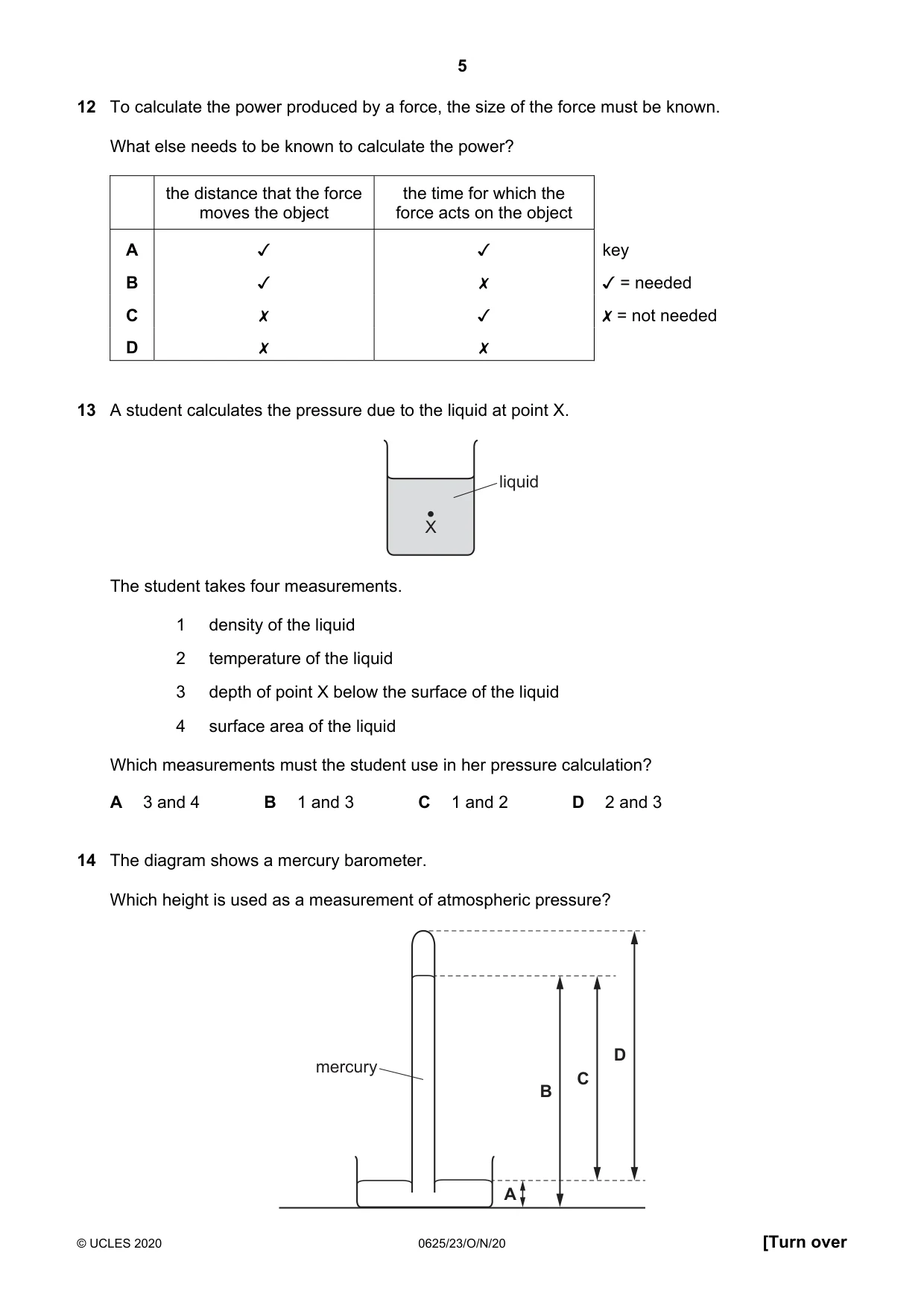
Q12 · To calculate the power produced by a force, the size of the force must be known
12 To calculate the power produced by a force, the size of the force must be known. What else needs to be known to calculate the power? the distance that the force moves the object the time for which the force acts on the object 0 0O WwW D> v v x x v x v x key Jv = needed X = not needed
Mark scheme: A
Q13 · A student calculates the pressure due to the liquid at point X
13 A student calculates the pressure due to the liquid at point X. liquid X The student takes four measurements. 1 density of the liquid 2 temperature of the liquid 3 depth of point X below the surface of the liquid 4 surface area of the liquid Which measurements must the student use in her pressure calculation? A 3 and 4 B 1 and 3 C 1 and 2 D 2 and 3
Mark scheme: B
Q14 · The diagram shows a mercury barometer
14 The diagram shows a mercury barometer. Which height is used as a measurement of atmospheric pressure? D mercury C B A
Mark scheme: C
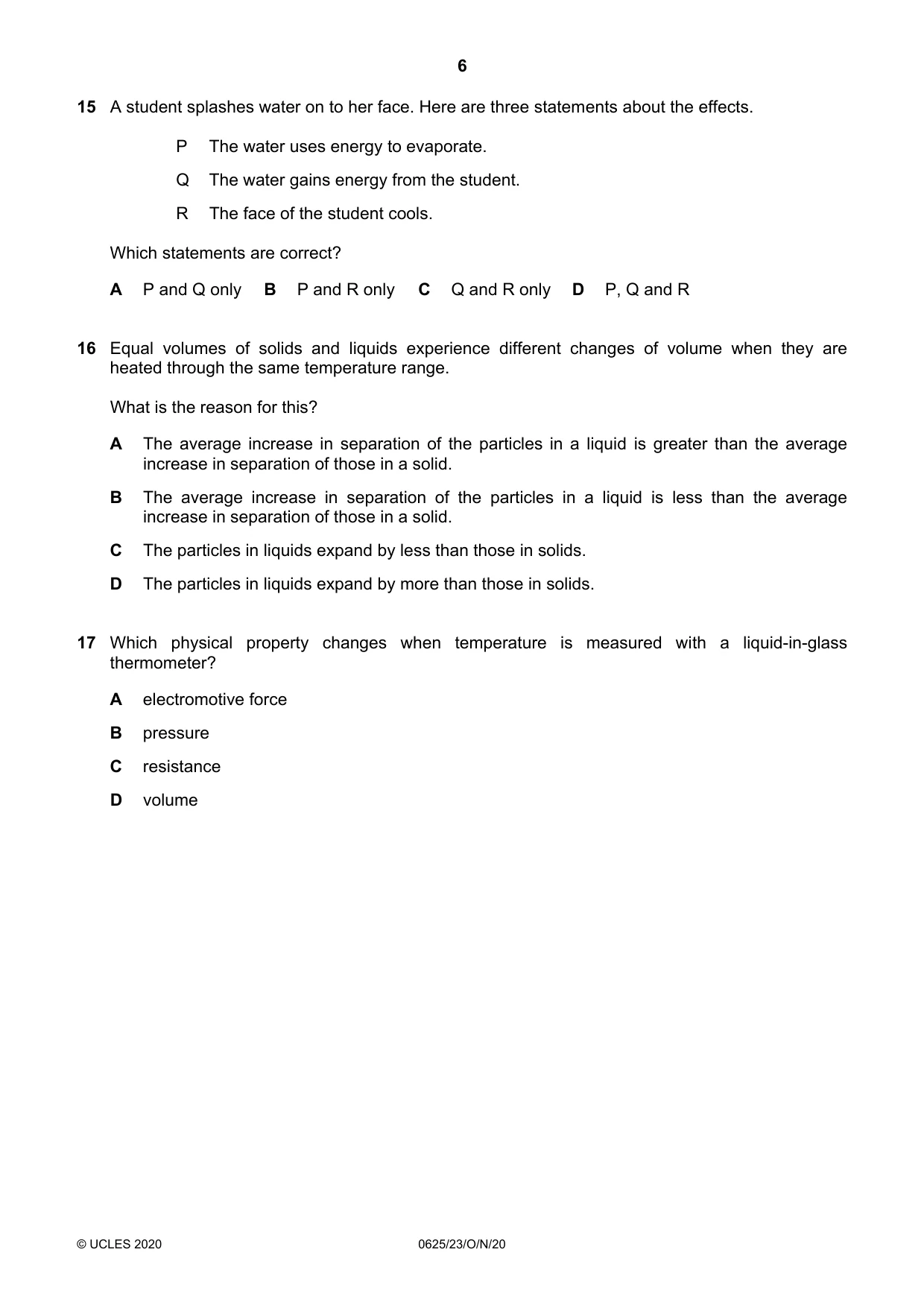
Q15 · A student splashes water on to her face
15 A student splashes water on to her face. Here are three statements about the effects. P The water uses energy to evaporate. Q The water gains energy from the student. R The face of the student cools. Which statements are correct? A P and Q only B P and R only C Q and R only D P, Q and R
Mark scheme: D
Q16 · Equal volumes of solids and liquids experience different changes of volume when they are…
16 Equal volumes of solids and liquids experience different changes of volume when they are heated through the same temperature range. What is the reason for this? A The average increase in separation of the particles in a liquid is greater than the average increase in separation of those in a solid. B The average increase in separation of the particles in a liquid is less than the average increase in separation of those in a solid. C The particles in liquids expand by less than those in solids. D The particles in liquids expand by more than those in solids.
Mark scheme: A
Q17 · Which physical property changes when temperature is measured with a liquid-in-glass…
17 Which physical property changes when temperature is measured with a liquid-in-glass thermometer? A electromotive force B pressure C resistance D volume
Mark scheme: D
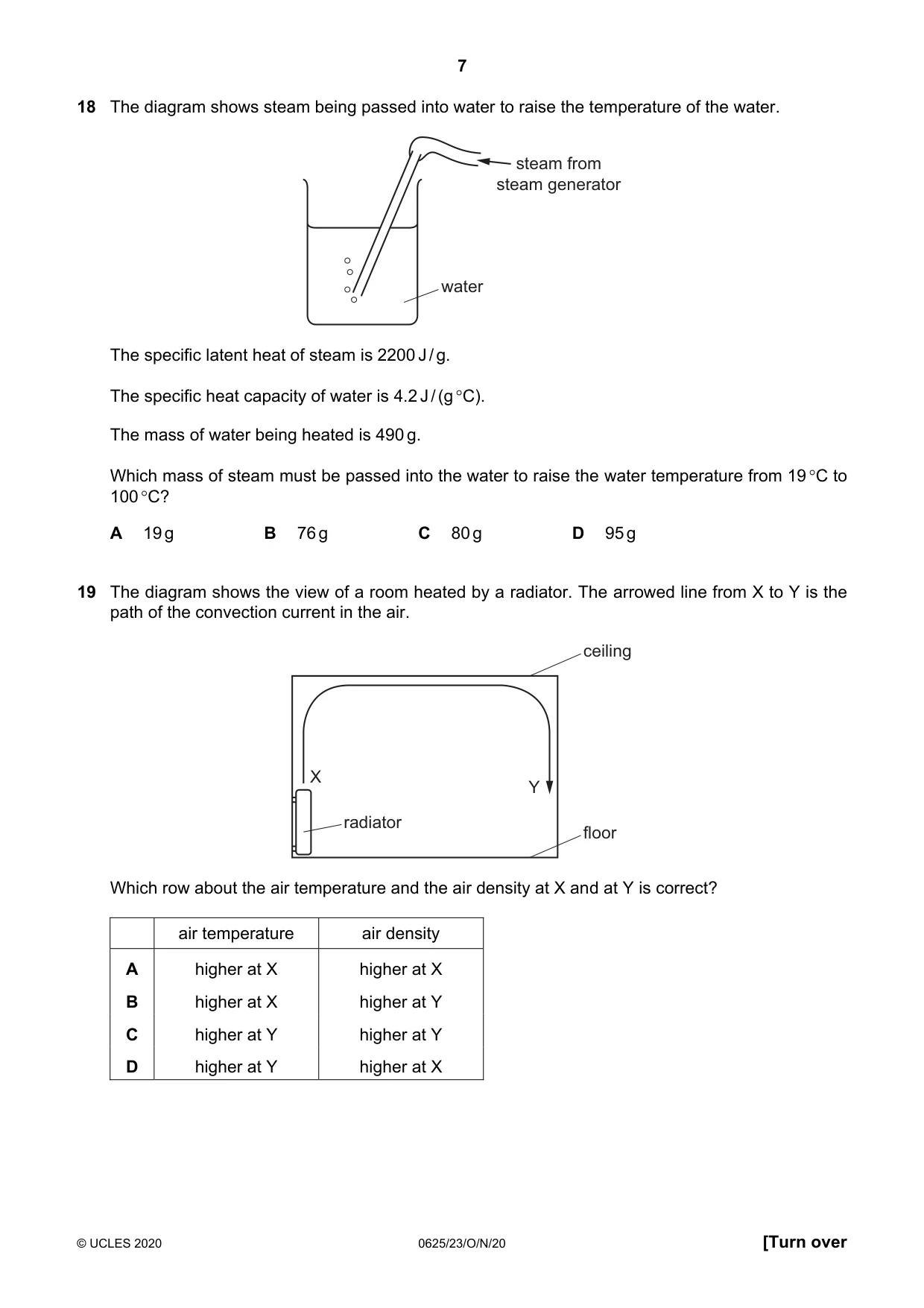
Q18 · The diagram shows steam being passed into water to raise the temperature of the water
18 The diagram shows steam being passed into water to raise the temperature of the water. steam from steam generator water The specific latent heat of steam is 2200 J / g. The specific heat capacity of water is 4.2 J / (g C). The mass of water being heated is 490 g. Which mass of steam must be passed into the water to raise the water temperature from 19 C to 100 C? A 19 g B 76 g C 80 g D 95 g
Mark scheme: B
Q19 · The diagram shows the view of a room heated by a radiator
19 The diagram shows the view of a room heated by a radiator. The arrowed line from X to Y is the path of the convection current in the air. ceiling X Y radiator floor Which row about the air temperature and the air density at X and at Y is correct? air temperature air density A higher at X higher at X B higher at X higher at Y C higher at Y higher at Y D higher at Y higher at X
Mark scheme: B
Q20 · A warm dark-coloured surface emits radiation
20 A warm dark-coloured surface emits radiation. It is decided to increase the amount of radiation produced. Three suggestions are made. 1 Make the surface hotter. 2 Colour the surface white. 3 Increase the area of the surface. Which suggestions are correct? A 1 only B 1 and 2 only C 1 and 3 only D 1, 2 and 3
Mark scheme: C
Q21 · Which row correctly describes light waves?
21 Which row correctly describes light waves? wave type direction of vibrations A longitudinal parallel to direction of wave travel B longitudinal perpendicular to direction of wave travel C transverse parallel to direction of wave travel D transverse perpendicular to direction of wave travel
Mark scheme: D
Q22 · A water wave has a speed of 2.0 m / s
22 A water wave has a speed of 2.0 m / s. 4.0 complete waves pass a point every 10 seconds. What is the wavelength of the wave? A 0.50 m B 0.80 m C 5.0 m D 8.0 m
Mark scheme: C
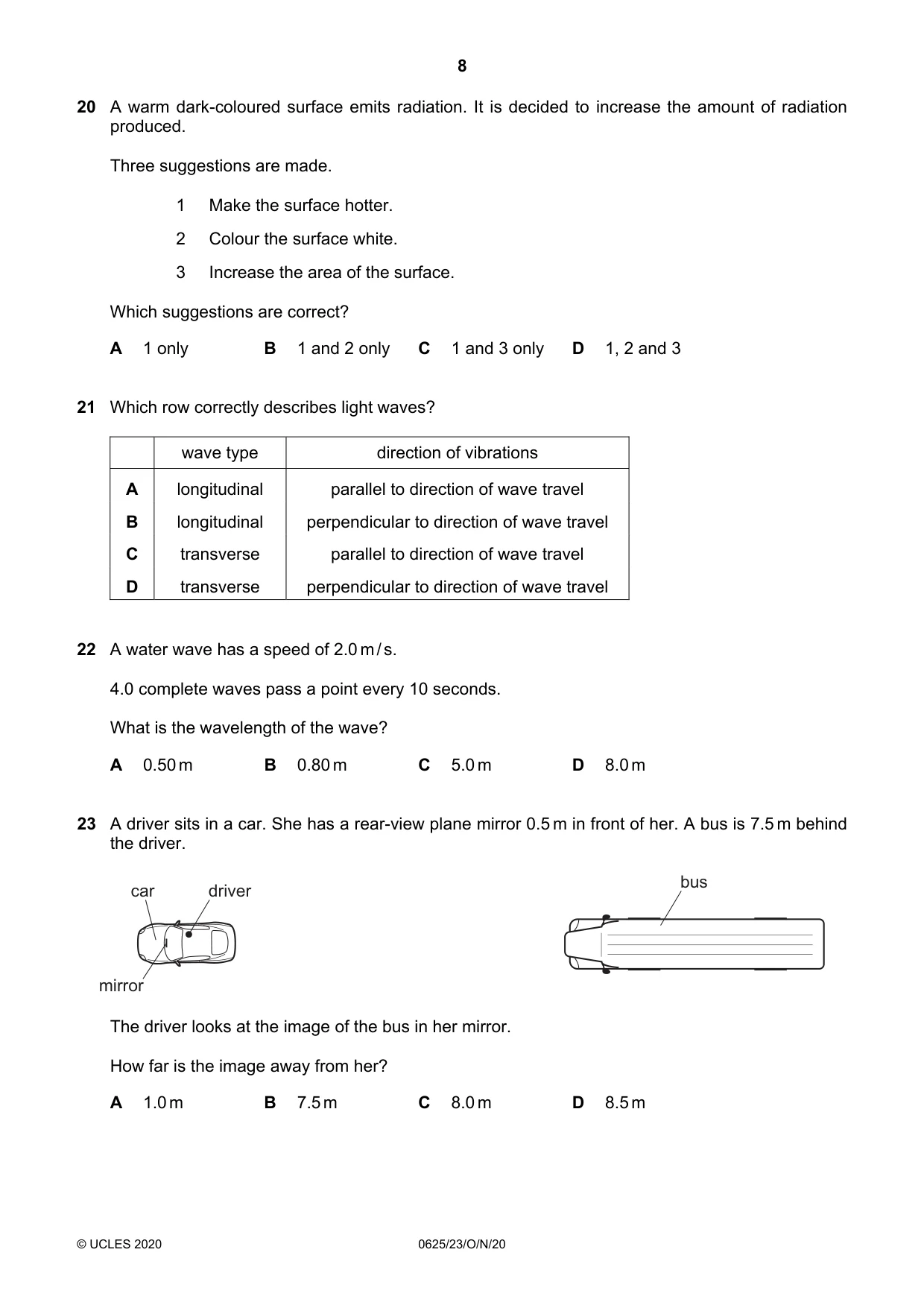
Q23 · A driver sits in a car
23 A driver sits in a car. She has a rear-view plane mirror 0.5 m in front of her. A bus is 7.5 m behind the driver. bus car driver mirror The driver looks at the image of the bus in her mirror. How far is the image away from her? A 1.0 m B 7.5 m C 8.0 m D 8.5 m
Mark scheme: D
Q24 · The diagram shows white light passing through a prism
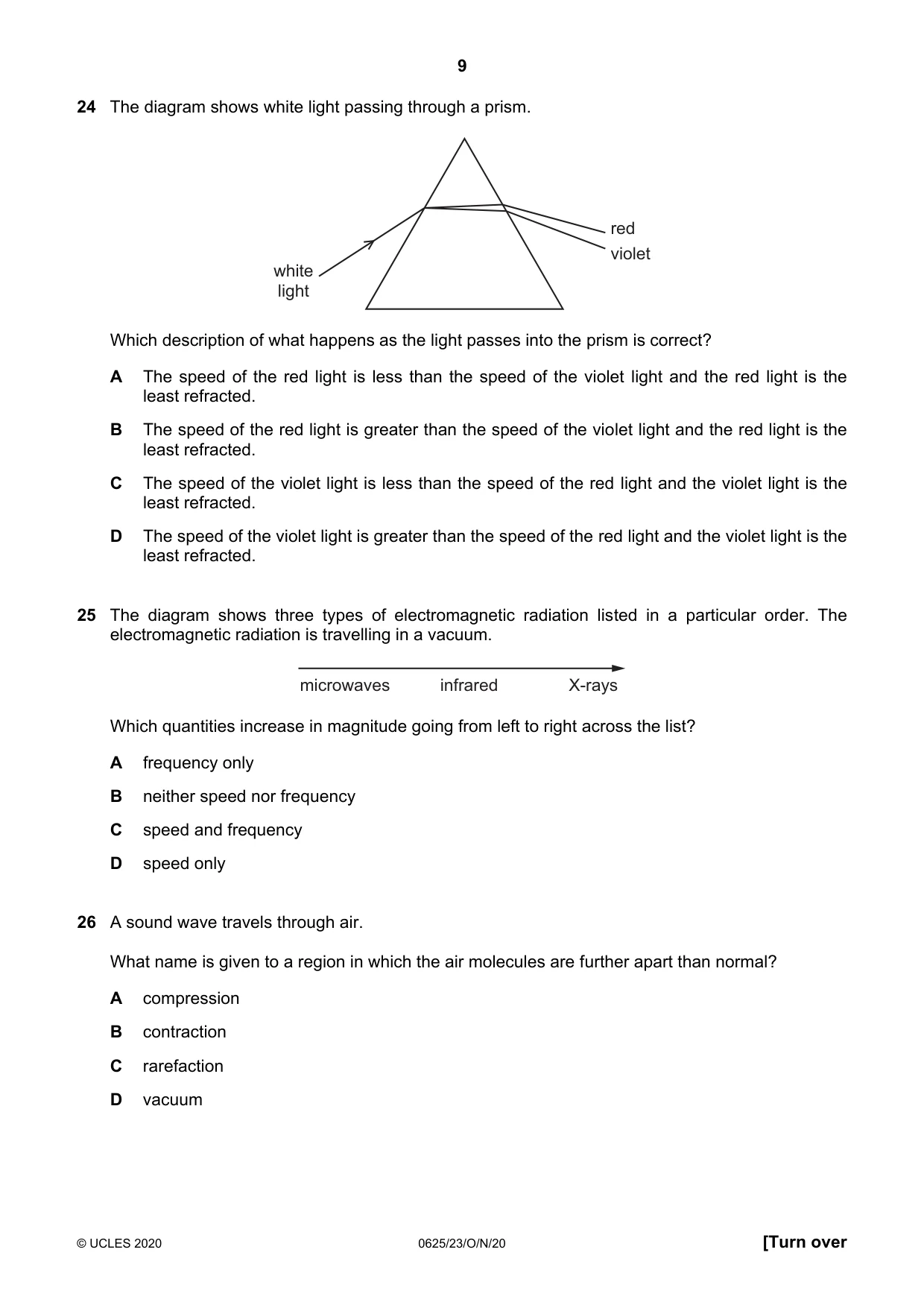
24 The diagram shows white light passing through a prism. red violet white light Which description of what happens as the light passes into the prism is correct? A The speed of the red light is less than the speed of the violet light and the red light is the least refracted. B The speed of the red light is greater than the speed of the violet light and the red light is the least refracted. C The speed of the violet light is less than the speed of the red light and the violet light is the least refracted. D The speed of the violet light is greater than the speed of the red light and the violet light is the least refracted.
Mark scheme: B
Q25 · The diagram shows three types of electromagnetic radiation listed in a particular order
25 The diagram shows three types of electromagnetic radiation listed in a particular order. The electromagnetic radiation is travelling in a vacuum. microwaves infrared X-rays Which quantities increase in magnitude going from left to right across the list? A frequency only B neither speed nor frequency C speed and frequency D speed only
Mark scheme: A
Q26 · A sound wave travels through air
26 A sound wave travels through air. What name is given to a region in which the air molecules are further apart than normal? A compression B contraction C rarefaction D vacuum
Mark scheme: C
Q27 · A police car with its siren sounding is stationary in heavy traffic
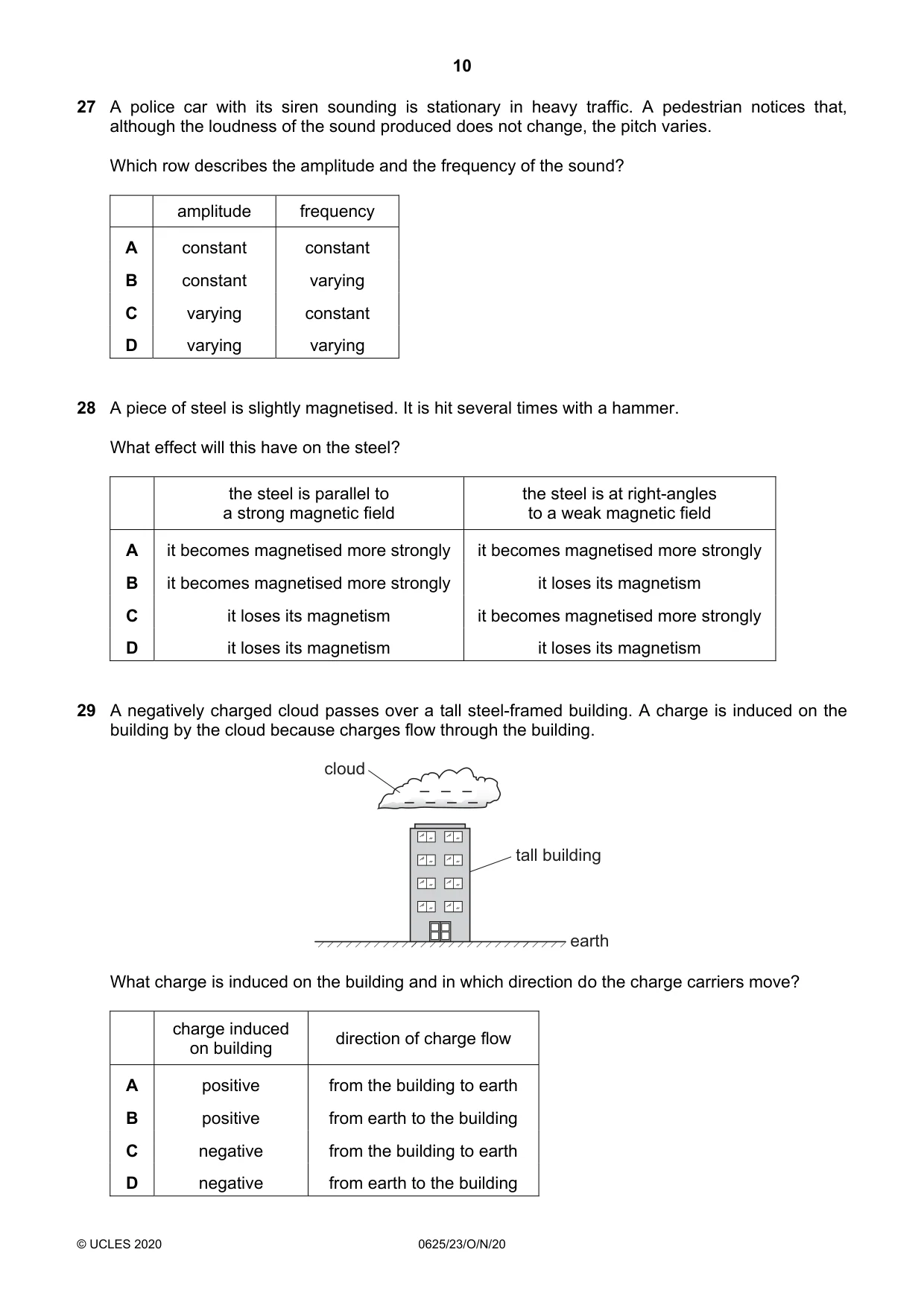
27 A police car with its siren sounding is stationary in heavy traffic. A pedestrian notices that, although the loudness of the sound produced does not change, the pitch varies. Which row describes the amplitude and the frequency of the sound? amplitude frequency A constant constant B constant varying C varying constant D varying varying
Mark scheme: B
Q28 · A piece of steel is slightly magnetised
28 A piece of steel is slightly magnetised. It is hit several times with a hammer. What effect will this have on the steel? the steel is parallel to the steel is at right-angles a strong magnetic field to a weak magnetic field A it becomes magnetised more strongly it becomes magnetised more strongly B it becomes magnetised more strongly it loses its magnetism C it loses its magnetism it becomes magnetised more strongly D it loses its magnetism it loses its magnetism
Mark scheme: B
Q29 · A negatively charged cloud passes over a tall steel-framed building
29 A negatively charged cloud passes over a tall steel-framed building. A charge is induced on the building by the cloud because charges flow through the building. cloud – – –– – – – tall building earth What charge is induced on the building and in which direction do the charge carriers move? charge induced direction of charge flow on building A positive from the building to earth B positive from earth to the building C negative from the building to earth D negative from earth to the building
Mark scheme: A
Q30 · Electromotive force (e.m.f.) is defined in terms of the energy supplied in driving which…
30 Electromotive force (e.m.f.) is defined in terms of the energy supplied in driving which physical quantity around a complete circuit? A charge B current C potential difference (p.d.) D power
Mark scheme: A
Q31 · A student uses four ammeters P, Q, R and S to measure the current in different parts of…
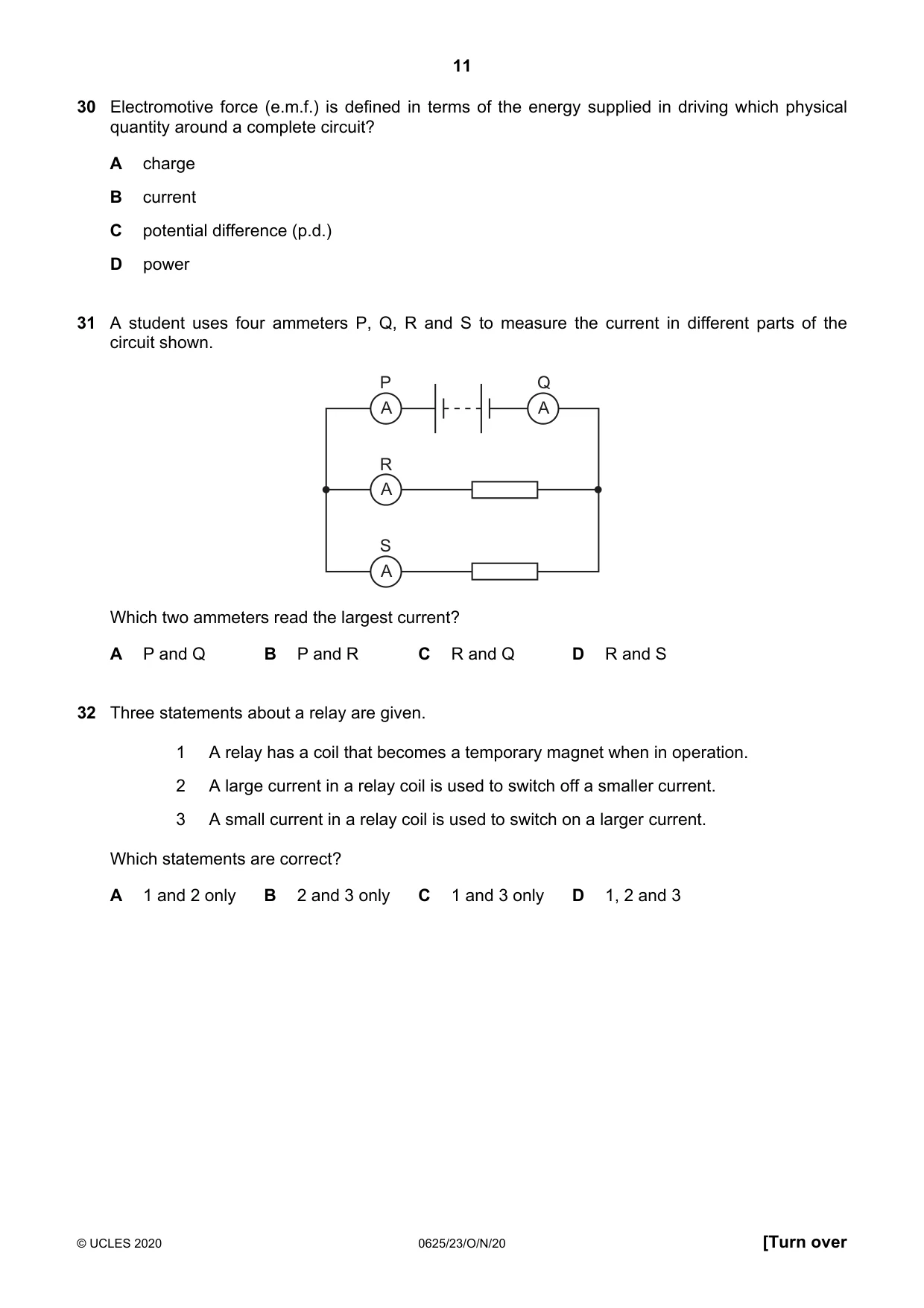
31 A student uses four ammeters P, Q, R and S to measure the current in different parts of the circuit shown. P Q A A R A S A Which two ammeters read the largest current? A P and Q B P and R C R and Q D R and S
Mark scheme: A
Q32 · Three statements about a relay are given
32 Three statements about a relay are given. 1 A relay has a coil that becomes a temporary magnet when in operation. 2 A large current in a relay coil is used to switch off a smaller current. 3 A small current in a relay coil is used to switch on a larger current. Which statements are correct? A 1 and 2 only B 2 and 3 only C 1 and 3 only D 1, 2 and 3
Mark scheme: C
Q33 · Which combination of logic gates gives the truth table shown?
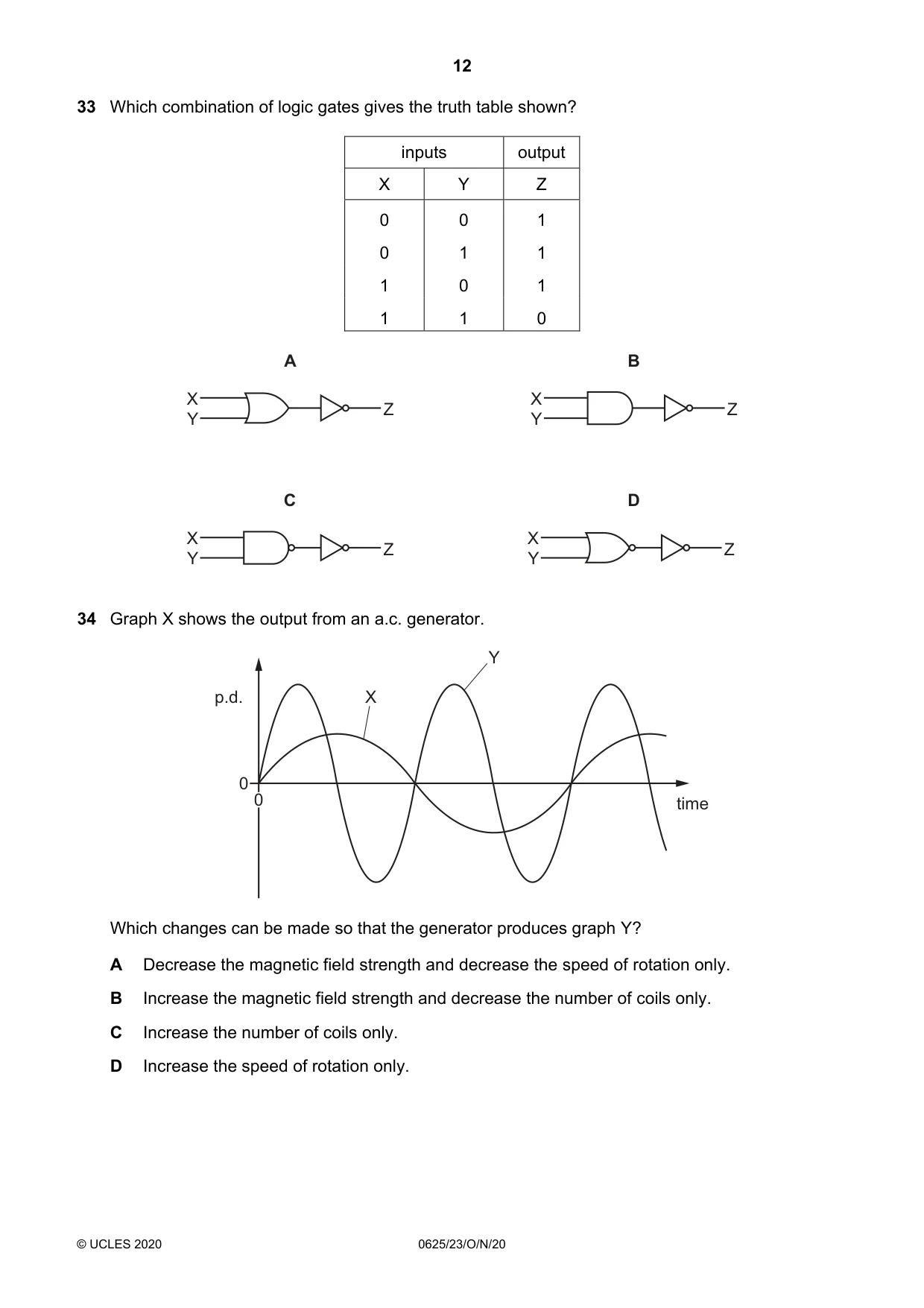
33 Which combination of logic gates gives the truth table shown? inputs output X Y Z 0 0 1 0 1 1 1 0 1 1 1 0 A B X X Z Z Y Y C D X X Z Z Y Y
Mark scheme: B
Q34 · Graph X shows the output from an a.c
34 Graph X shows the output from an a.c. generator. Y p.d. X 0 0 time Which changes can be made so that the generator produces graph Y? A Decrease the magnetic field strength and decrease the speed of rotation only. B Increase the magnetic field strength and decrease the number of coils only. C Increase the number of coils only. D Increase the speed of rotation only.
Mark scheme: D
Q35 · A transformer is needed to convert a supply of 240 V a.c
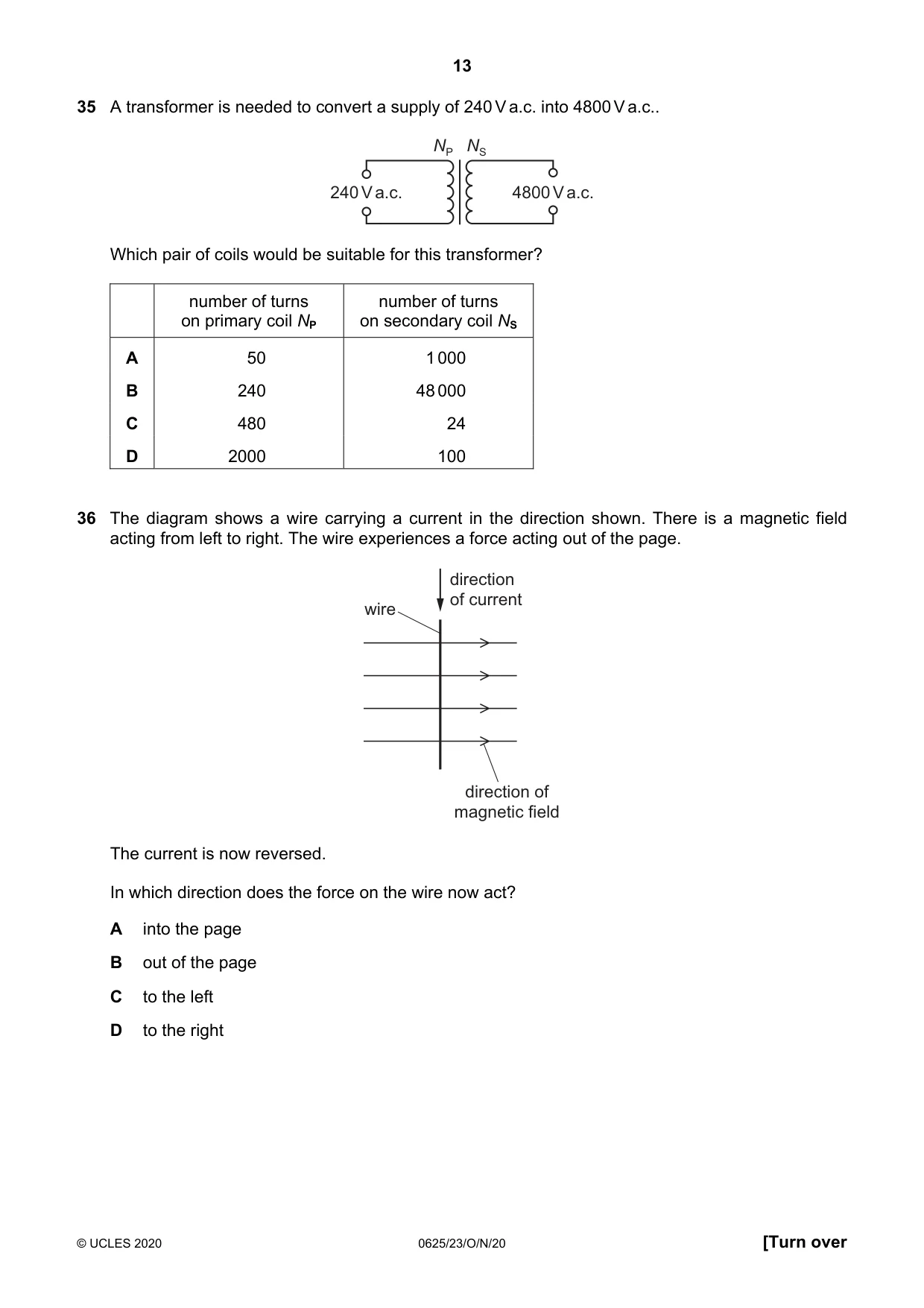
35 A transformer is needed to convert a supply of 240 V a.c. into 4800 V a.c.. NP NS 240 V a.c. 4800 V a.c. Which pair of coils would be suitable for this transformer? number of turns number of turns on primary coil NP on secondary coil NS A 50 1 000 B 240 48 000 C 480 24 D 2000 100
Mark scheme: A
Q36 · The diagram shows a wire carrying a current in the direction shown
36 The diagram shows a wire carrying a current in the direction shown. There is a magnetic field acting from left to right. The wire experiences a force acting out of the page. direction of current wire direction of magnetic field The current is now reversed. In which direction does the force on the wire now act? A into the page B out of the page C to the left D to the right
Mark scheme: A
Q37 · Which statement is correct for the nucleus of any atom?
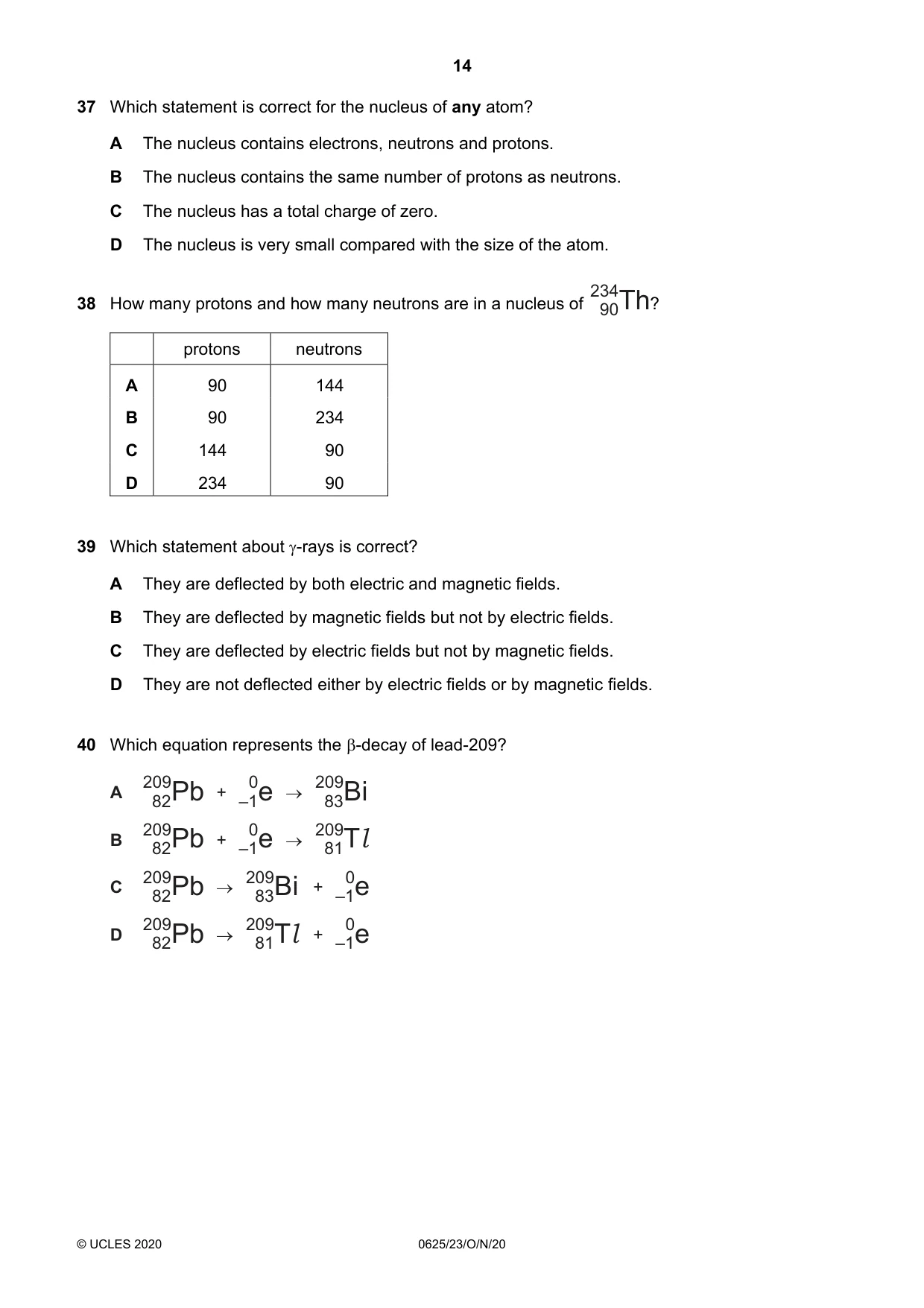
37 Which statement is correct for the nucleus of any atom? A The nucleus contains electrons, neutrons and protons. B The nucleus contains the same number of protons as neutrons. C The nucleus has a total charge of zero. D The nucleus is very small compared with the size of the atom. 234Th
Mark scheme: D
Q38 · How many protons and how many neutrons are in a nucleus of ?
38 How many protons and how many neutrons are in a nucleus of ? 90 protons neutrons A 90 144 B 90 234 C 144 90 D 234 90
Mark scheme: A
Q39 · Which statement about -rays is correct?
39 Which statement about -rays is correct? A They are deflected by both electric and magnetic fields. B They are deflected by magnetic fields but not by electric fields. C They are deflected by electric fields but not by magnetic fields. D They are not deflected either by electric fields or by magnetic fields.
Mark scheme: D
Q40 · Which equation represents the B-decay of lead-209?
40 Which equation represents the B-decay of lead-209? A B “ePb + je > 73,8 “32D + je > “9, Tl aePb > “3,Bi + Je oe 2P b > oT 1 + Je
Mark scheme: C
What was in this paper
The subtopics covered by these 40 questions, and how many questions each got. Open one in a new tab to see every Cambridge question on it.
4Energy, work and power3Thermal properties and temperature3Electric circuits2Forces2General properties of waves2Light2Mass and weight2Motion2Pressure2Radioactivity2Simple phenomena of magnetism2Sound2The nuclear model of the atom2Transfer of thermal energy2Density1Electrical quantities1Electromagnetic spectrum1Kinetic particle model of matter1Momentum1Physical quantities and measurement techniques1What you needed in this session
Cambridge’s own grade thresholds for 2020 Oct/Nov, Paper 2 · Variant 3. A higher threshold means an easier paper — the bar moves with how the cohort did.