Cambridge IGCSE Physics 0625 — 2018 May/June Paper 2 · Variant 3
0625/23/M/J/18 · 40 questions · 40 marks · ≈45 min
The question paper and its mark scheme, free to read here and free to download. This is Cambridge’s own paper, exactly as it was sat.
Question paper16 pages
Mark scheme3 pages
Answers below. Sit the paper first if you are practising.
Questions as text
Q1 · A length of cotton is measured between two points on a ruler
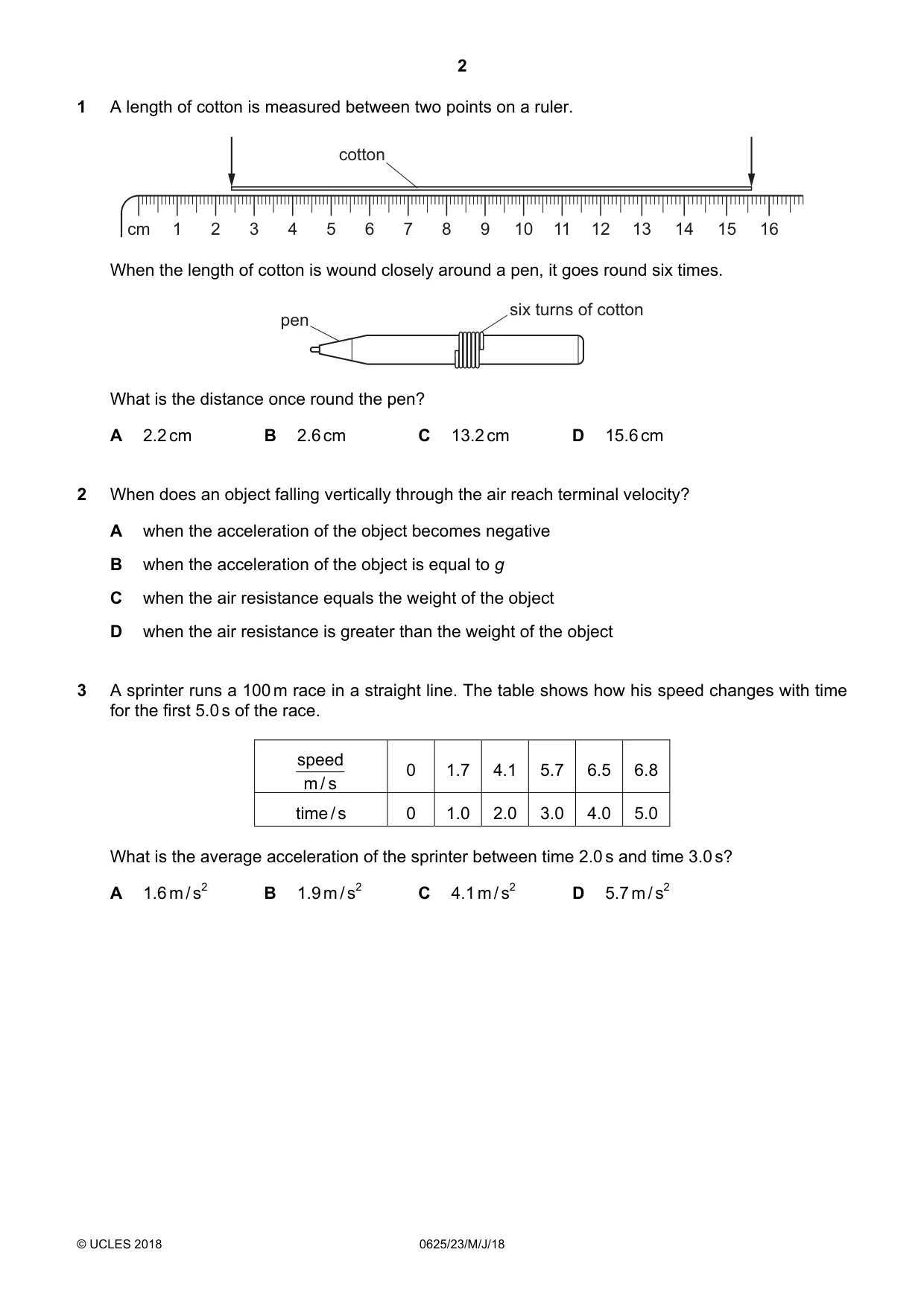
1 A length of cotton is measured between two points on a ruler. cotton cm 1 2 3 4 5 6 7 8 9 10 11 12 13 14 15 16 When the length of cotton is wound closely around a pen, it goes round six times. six turns of cotton pen What is the distance once round the pen? A 2.2 cm B 2.6 cm C 13.2 cm D 15.6 cm
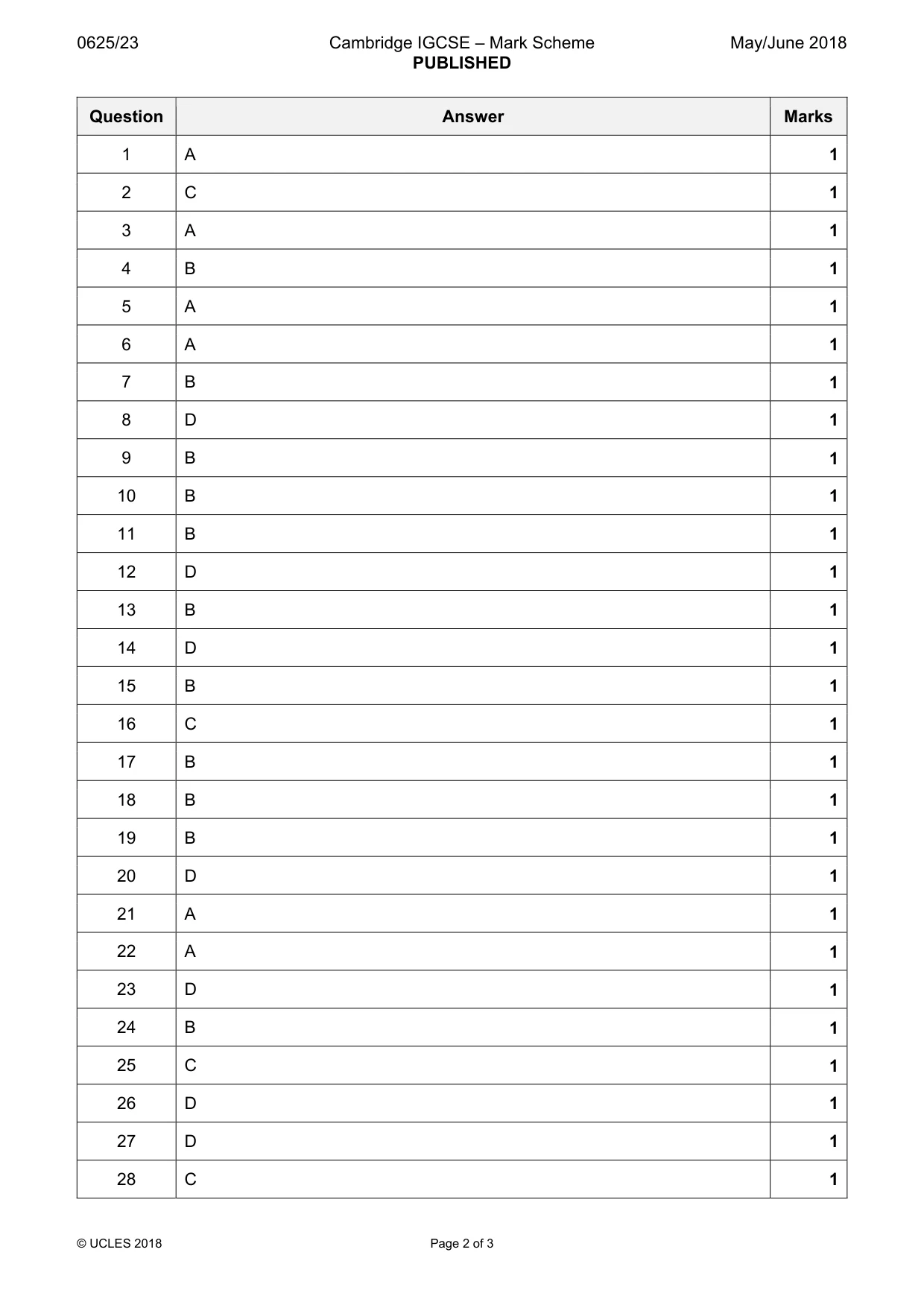
Mark scheme: A
More questions on Physical quantities and measurement techniques
Q2 · When does an object falling vertically through the air reach terminal velocity?
2 When does an object falling vertically through the air reach terminal velocity? A when the acceleration of the object becomes negative B when the acceleration of the object is equal to g C when the air resistance equals the weight of the object D when the air resistance is greater than the weight of the object
Mark scheme: C
Q3 · A sprinter runs a 100 m race in a straight line
3 A sprinter runs a 100 m race in a straight line. The table shows how his speed changes with time for the first 5.0 s of the race. speed 0 1.7 4.1 5.7 6.5 6.8 m / s time / s 0 1.0 2.0 3.0 4.0 5.0 What is the average acceleration of the sprinter between time 2.0 s and time 3.0 s? A 1.6 m / s2 B 1.9 m / s2 C 4.1 m / s2 D 5.7 m / s2
Mark scheme: A
Q4 · A person steps onto a bathroom scales
4 A person steps onto a bathroom scales. The bathroom scales records both mass and weight. Which row shows the readings on the scales? mass weight A 60 N 600 kg B 60 kg 600 N C 600 kg 60 N D 600 N 60 kg
Mark scheme: B
Q5 · An object has a weight of 7600 N in a gravitational field of strength 100 N / kg
5 An object has a weight of 7600 N in a gravitational field of strength 100 N / kg. What is the mass of the object? A 76 kg B 760 N C 7600 g D 76 000 N
Mark scheme: A
Q6 · A load is hung from a steel wire
6 A load is hung from a steel wire. The load is increased. The length of the wire increases until the limit of proportionality is reached. The load is now increased slightly. What happens? A The extension of the wire increases and the wire no longer obeys Hooke’s law. B The extension of the wire decreases and the wire no longer obeys Hooke’s law. C The extension of the wire increases and it obeys Hooke’s law. D The extension of the wire decreases and it obeys Hooke’s law.
Mark scheme: A
Q7 · The diagram shows a uniform metre rule pivoted at the 30 cm mark
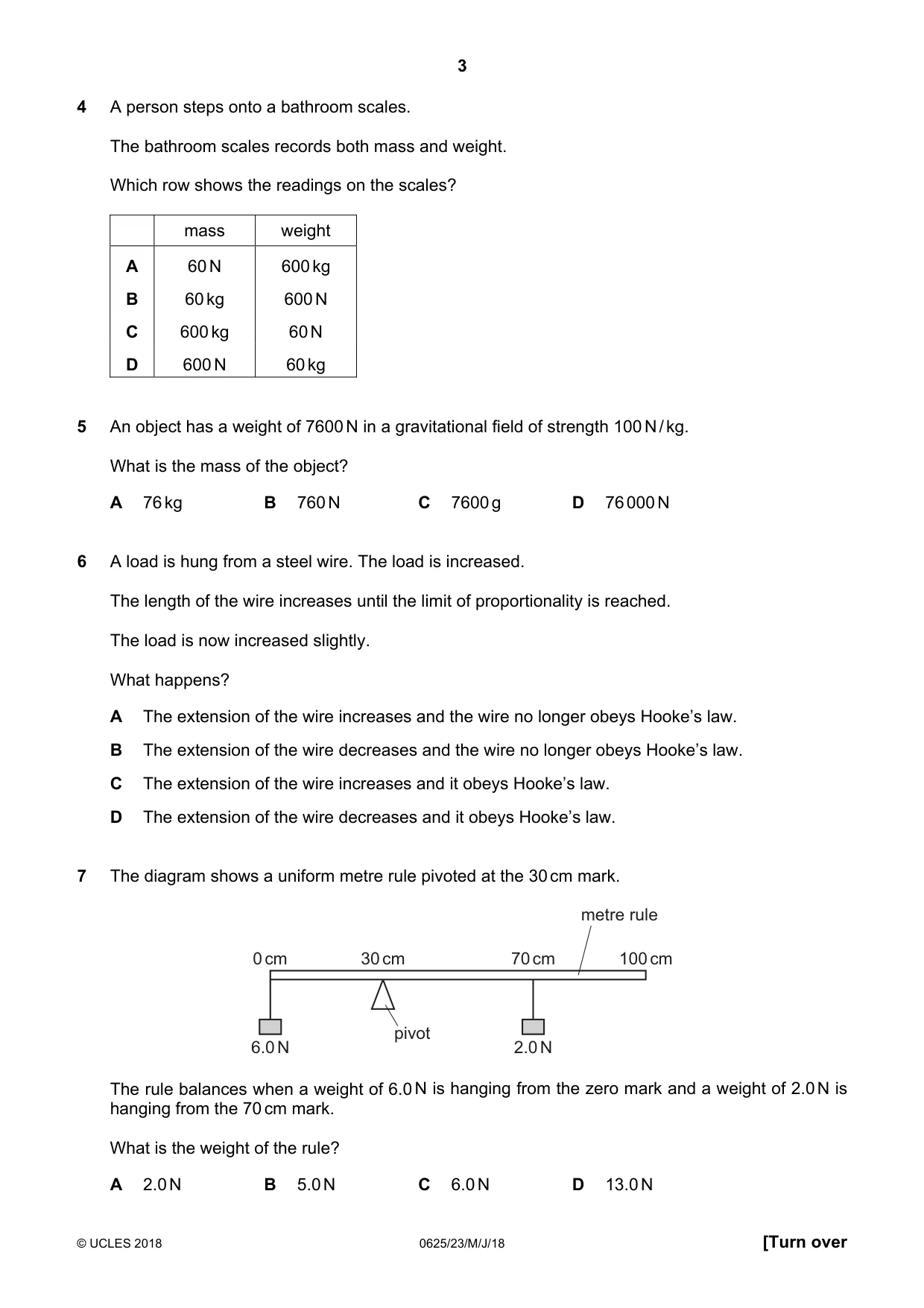
7 The diagram shows a uniform metre rule pivoted at the 30 cm mark. metre rule 0 cm 30 cm 70 cm 100 cm pivot 6.0 N 2.0 N The rule balances when a weight of 6.0 N is hanging from the zero mark and a weight of 2.0 N is hanging from the 70 cm mark. What is the weight of the rule? A 2.0 N B 5.0 N C 6.0 N D 13.0 N
Mark scheme: B
Q8 · An astronaut orbits the Earth in a space station
8 An astronaut orbits the Earth in a space station. Which is a vector quantity? A the mass of the astronaut B the speed of the satellite C the temperature inside the satellite D the weight of the astronaut
Mark scheme: D
More questions on Physical quantities and measurement techniques
Q9 · A visitor to a fairground throws a soft object of mass 0.12 kg at a coconut of mass 0.48…
9 A visitor to a fairground throws a soft object of mass 0.12 kg at a coconut of mass 0.48 kg. The soft object stops moving when it hits the coconut. In order to dislodge the coconut, it must be made to move at 0.10 m/s. What is the minimum speed with which the visitor should throw the soft object in order to dislodge the coconut? A 0.20 m/s B 0.40 m/s C 2.0 m/s D 4.0 m/s
Mark scheme: B
Q10 · An aircraft with a mass of 300 000 kg is flying at an altitude of 2000 m with a speed of…
10 An aircraft with a mass of 300 000 kg is flying at an altitude of 2000 m with a speed of 100 m / s. What is the kinetic energy of the aircraft? A 1.5 × 10⁴ kJ B 1.5 × 10⁶ kJ C 3.0 × 10⁶ kJ D 6.0 × 10⁶ kJ
Mark scheme: B
Q11 · Which method of drying clothes has the least impact on the environment?
11 Which method of drying clothes has the least impact on the environment? A Evaporate the water in them in an electrically heated tumble dryer. B Hang them on a washing line in direct sunlight. C Remove the water from them in an electric spin dryer. D Suspend them close to a coal fire.
Mark scheme: B
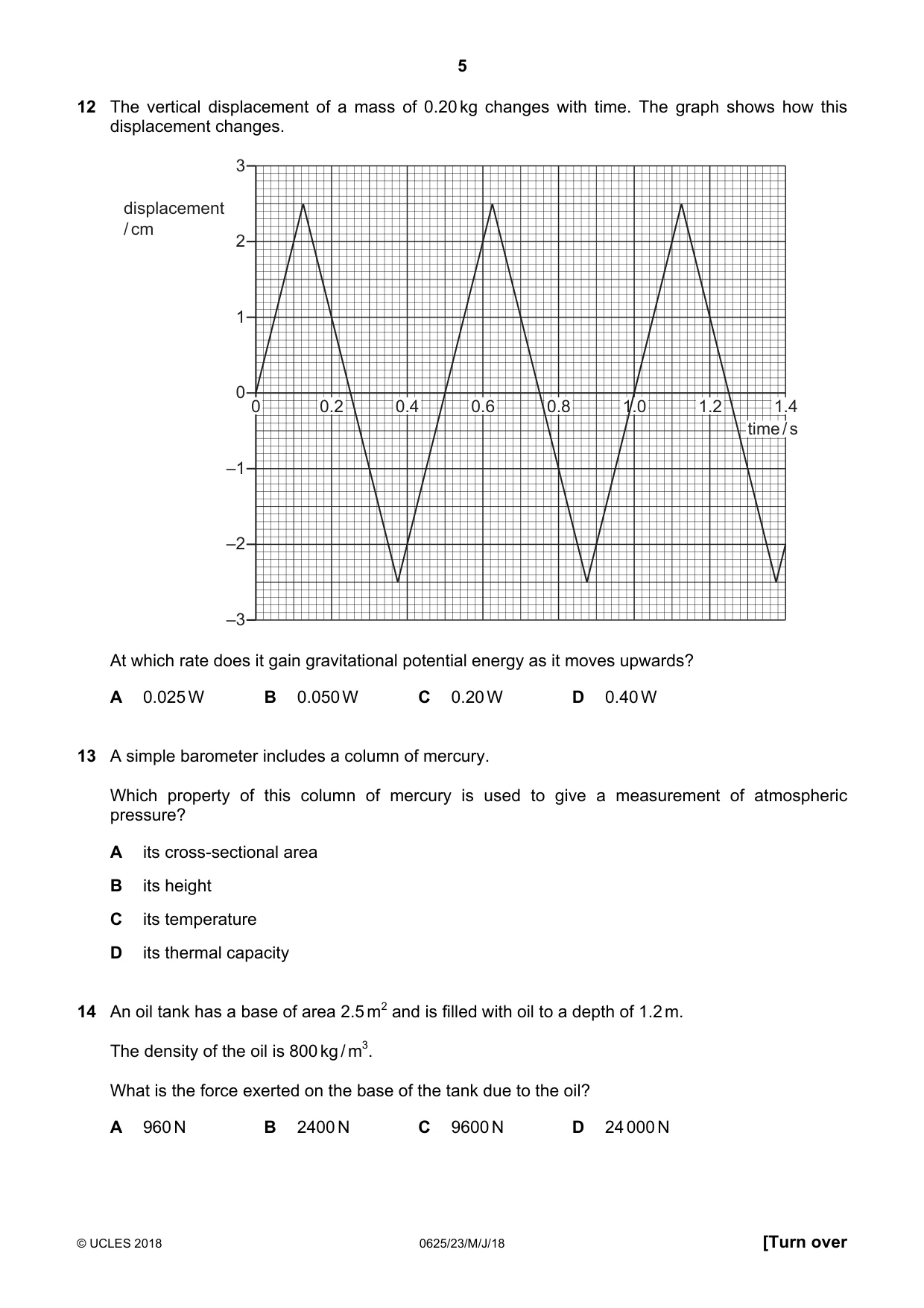
Q12 · The vertical displacement of a mass of 0.20 kg changes with time
12 The vertical displacement of a mass of 0.20 kg changes with time. The graph shows how this displacement changes. 3 displacement / cm 2 1 0 0 0.2 0.4 0.6 0.8 1.0 1.2 1.4 time / s –1 –2 –3 At which rate does it gain gravitational potential energy as it moves upwards? A 0.025 W B 0.050 W C 0.20 W D 0.40 W
Mark scheme: D
Q13 · A simple barometer includes a column of mercury
13 A simple barometer includes a column of mercury. Which property of this column of mercury is used to give a measurement of atmospheric pressure? A its cross-sectional area B its height C its temperature D its thermal capacity
Mark scheme: B
Q14 · An oil tank has a base of area 2.5 m2 and is filled with oil to a depth of 1.2 m
14 An oil tank has a base of area 2.5 m2 and is filled with oil to a depth of 1.2 m. The density of the oil is 800 kg / m3. What is the force exerted on the base of the tank due to the oil? A 960 N B 2400 N C 9600 N D 24 000 N
Mark scheme: D
Q15 · When molecules of a gas rebound from a wall of a container, the wall experiences a…
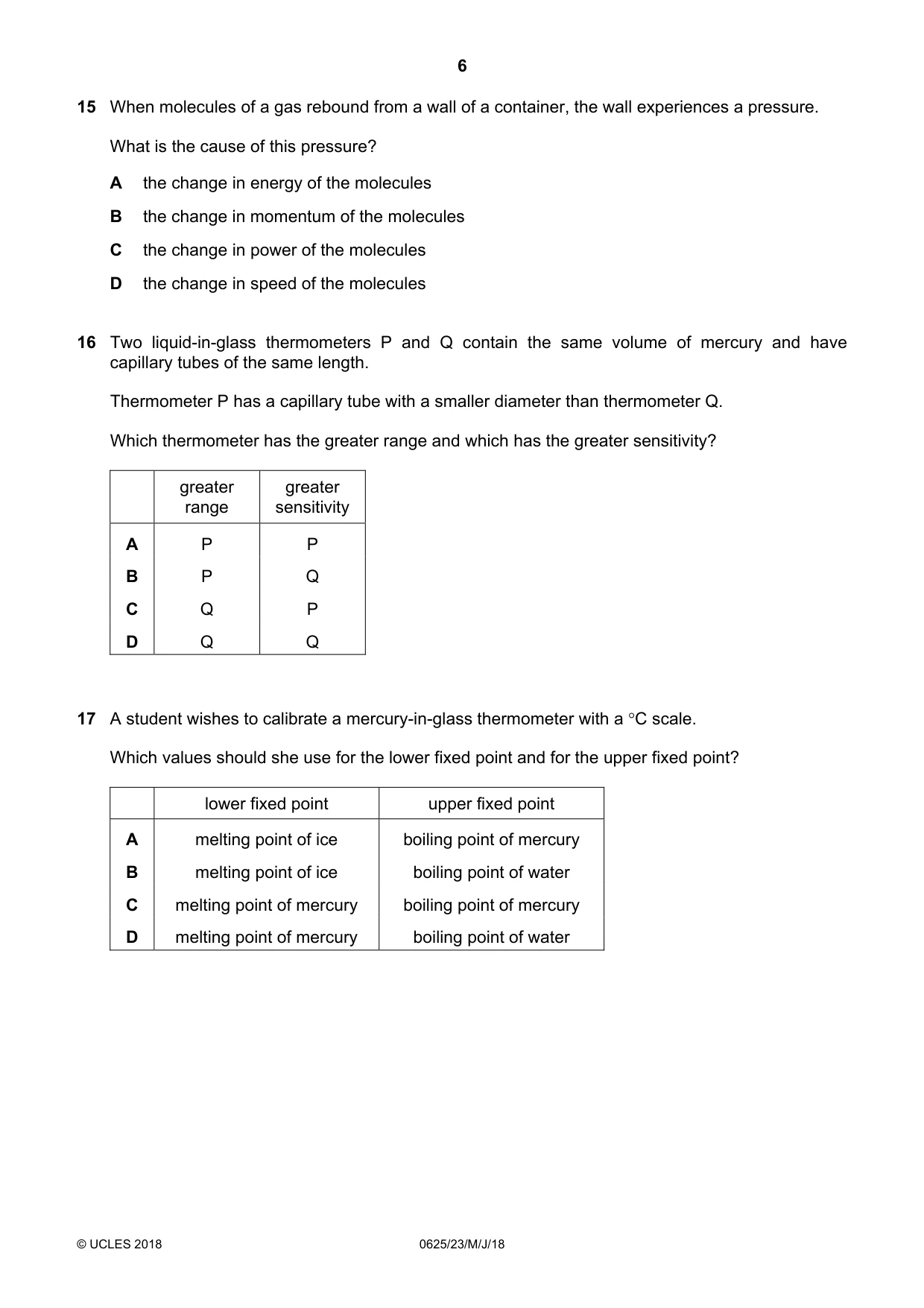
15 When molecules of a gas rebound from a wall of a container, the wall experiences a pressure. What is the cause of this pressure? A the change in energy of the molecules B the change in momentum of the molecules C the change in power of the molecules D the change in speed of the molecules
Mark scheme: B
Q16 · Two liquid-in-glass thermometers P and Q contain the same volume of mercury and have…
16 Two liquid-in-glass thermometers P and Q contain the same volume of mercury and have capillary tubes of the same length. Thermometer P has a capillary tube with a smaller diameter than thermometer Q. Which thermometer has the greater range and which has the greater sensitivity? greater greater range sensitivity A P P B P Q C Q P D Q Q
Mark scheme: C
Q17 · A student wishes to calibrate a mercury-in-glass thermometer with a °C scale
17 A student wishes to calibrate a mercury-in-glass thermometer with a °C scale. Which values should she use for the lower fixed point and for the upper fixed point? lower fixed point upper fixed point A melting point of ice boiling point of mercury B melting point of ice boiling point of water C melting point of mercury boiling point of mercury D melting point of mercury boiling point of water
Mark scheme: B
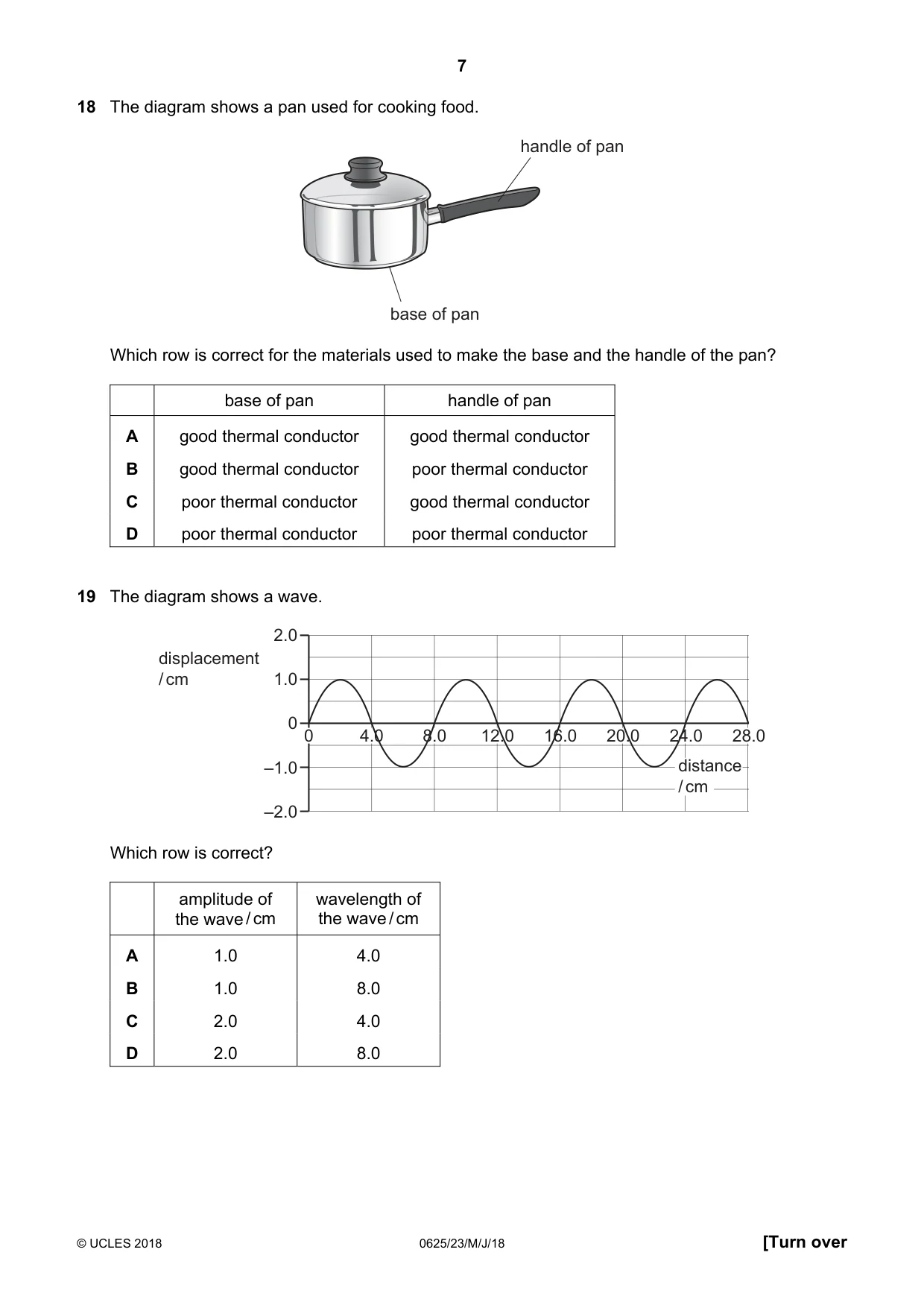
Q18 · The diagram shows a pan used for cooking food
18 The diagram shows a pan used for cooking food. handle of pan base of pan Which row is correct for the materials used to make the base and the handle of the pan? base of pan handle of pan A good thermal conductor good thermal conductor B good thermal conductor poor thermal conductor C poor thermal conductor good thermal conductor D poor thermal conductor poor thermal conductor
Mark scheme: B
Q19 · The diagram shows a wave
19 The diagram shows a wave. 2.0 displacement / cm 1.0 0 0 4.0 8.0 12.0 16.0 20.0 24.0 28.0 –1.0 distance / cm –2.0 Which row is correct? amplitude of wavelength of the wave / cm the wave / cm A 1.0 4.0 B 1.0 8.0 C 2.0 4.0 D 2.0 8.0
Mark scheme: B
Q20 · Light travels at a speed of 2.0 × 10⁸ m / s in a glass block
20 Light travels at a speed of 2.0 × 10⁸ m / s in a glass block. In the glass, the wavelength of the light is 4.0 × 10⁻⁷ m. What is the frequency of the light? A 2.0 × 10⁻¹⁵ Hz B 1.3 × 10⁻² Hz C 80 Hz D 5.0 × 10¹⁴ Hz
Mark scheme: D
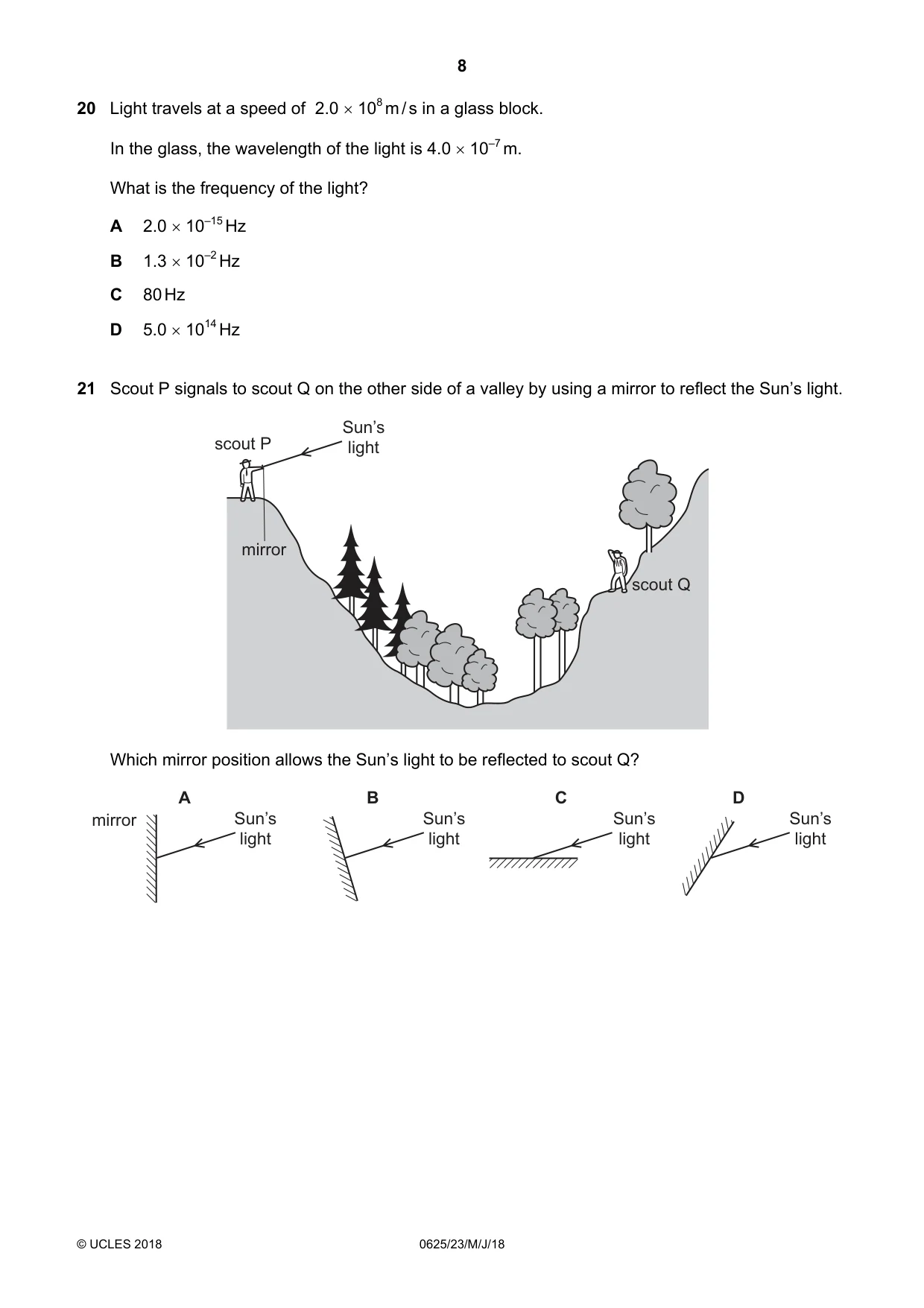
Q21 · Scout P signals to scout Q on the other side of a valley by using a mirror to reflect the…
21 Scout P signals to scout Q on the other side of a valley by using a mirror to reflect the Sun’s light. Sun’s scout P light mirror scout Q Which mirror position allows the Sun’s light to be reflected to scout Q? A B C D mirror Sun’s Sun’s Sun’s Sun’s light light light light
Mark scheme: A
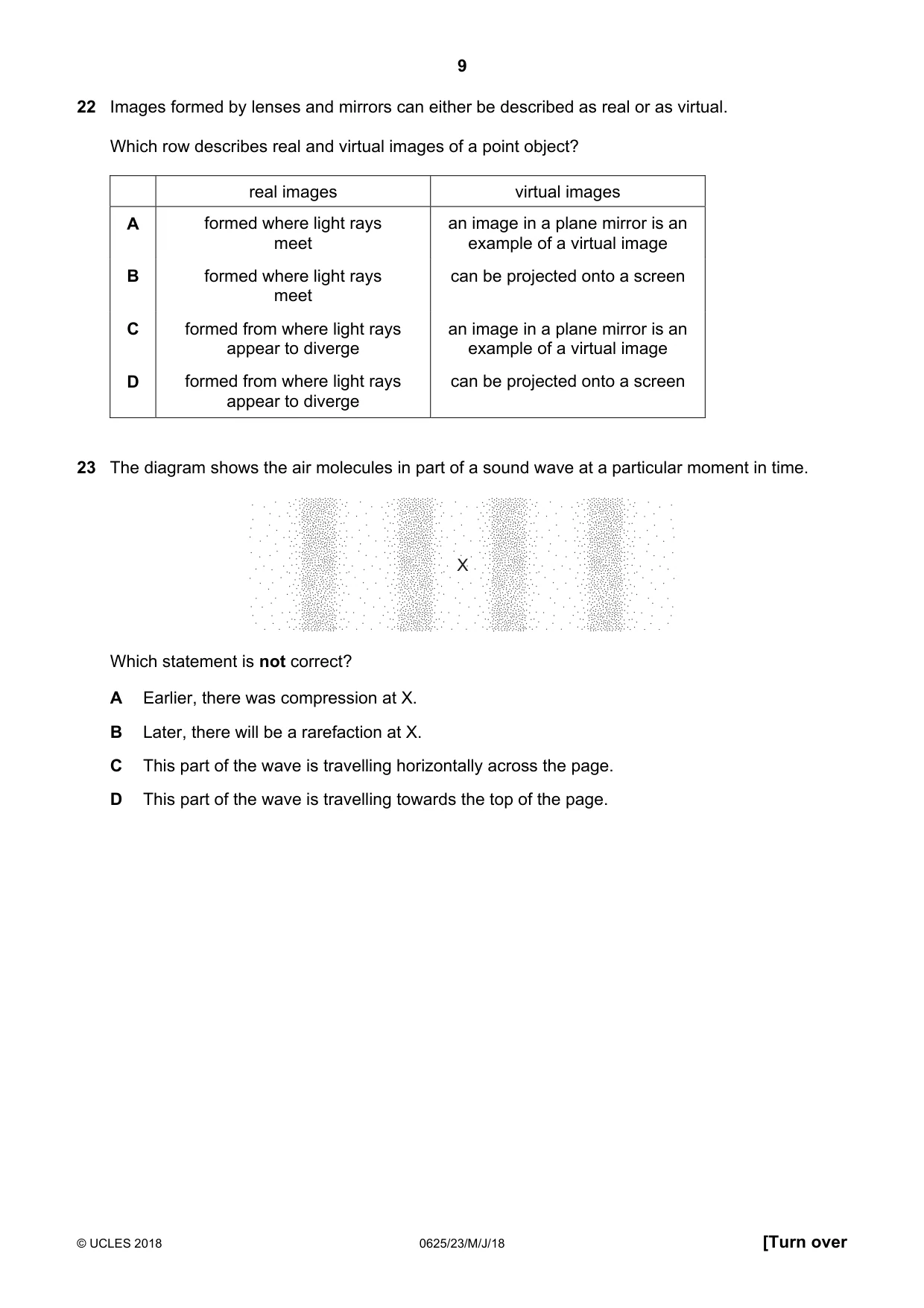
Q22 · Images formed by lenses and mirrors can either be described as real or as virtual
22 Images formed by lenses and mirrors can either be described as real or as virtual. Which row describes real and virtual images of a point object? real images virtual images A formed where light rays an image in a plane mirror is an meet example of a virtual image B formed where light rays can be projected onto a screen meet C formed from where light rays an image in a plane mirror is an appear to diverge example of a virtual image D formed from where light rays can be projected onto a screen appear to diverge
Mark scheme: A
Q23 · The diagram shows the air molecules in part of a sound wave at a particular moment in time
23 The diagram shows the air molecules in part of a sound wave at a particular moment in time. X Which statement is not correct? A Earlier, there was compression at X. B Later, there will be a rarefaction at X. C This part of the wave is travelling horizontally across the page. D This part of the wave is travelling towards the top of the page.
Mark scheme: D
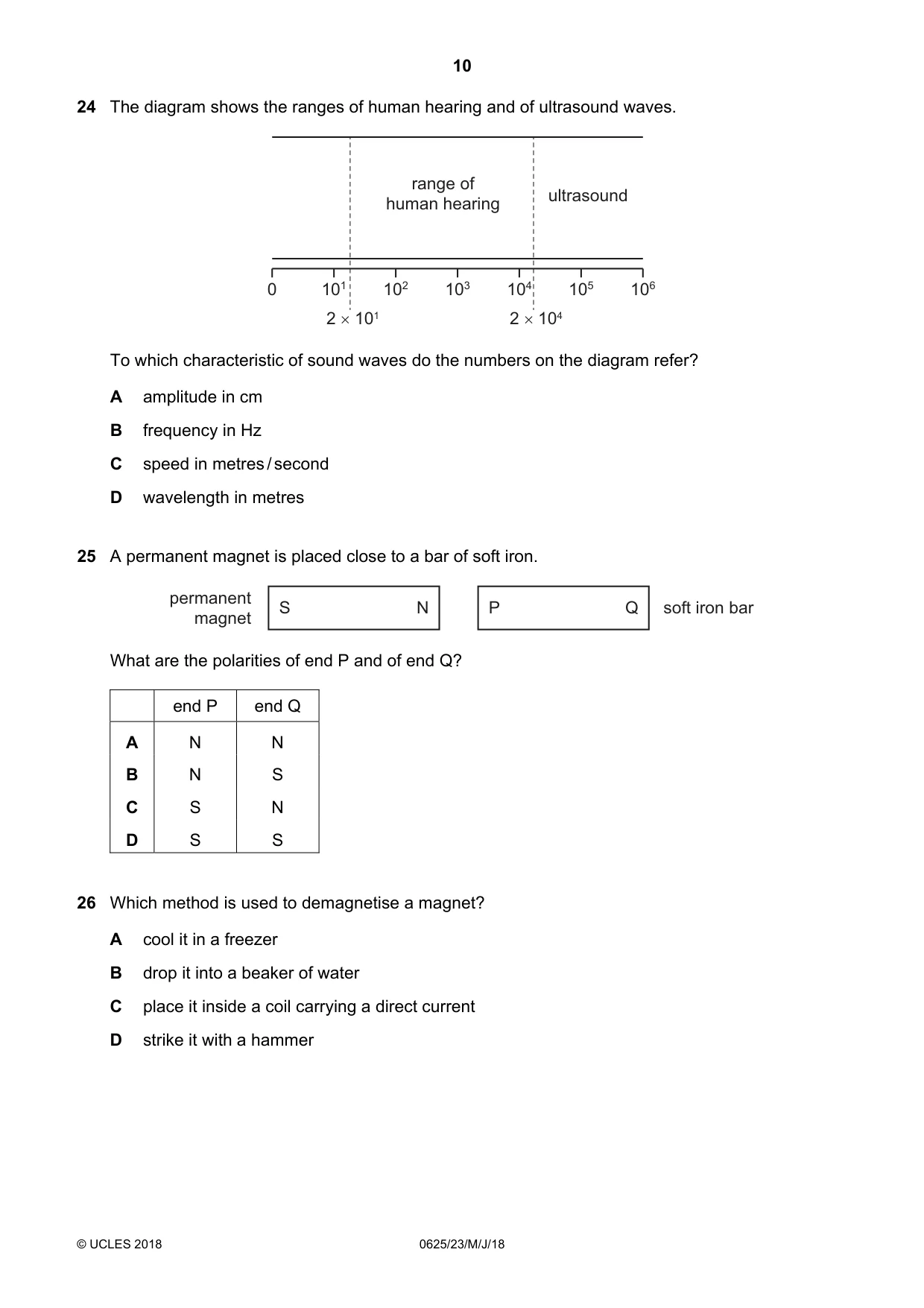
Q24 · The diagram shows the ranges of human hearing and of ultrasound waves
24 The diagram shows the ranges of human hearing and of ultrasound waves. range of ultrasound human hearing 0 101 102 103 104 105 106 2 × 101 2 × 10⁴ To which characteristic of sound waves do the numbers on the diagram refer? A amplitude in cm B frequency in Hz C speed in metres / second D wavelength in metres
Mark scheme: B
Q25 · A permanent magnet is placed close to a bar of soft iron
25 A permanent magnet is placed close to a bar of soft iron. permanent S N P Q soft iron bar magnet What are the polarities of end P and of end Q? end P end Q A N N B N S C S N D S S
Mark scheme: C
Q26 · Which method is used to demagnetise a magnet?
26 Which method is used to demagnetise a magnet? A cool it in a freezer B drop it into a beaker of water C place it inside a coil carrying a direct current D strike it with a hammer
Mark scheme: D
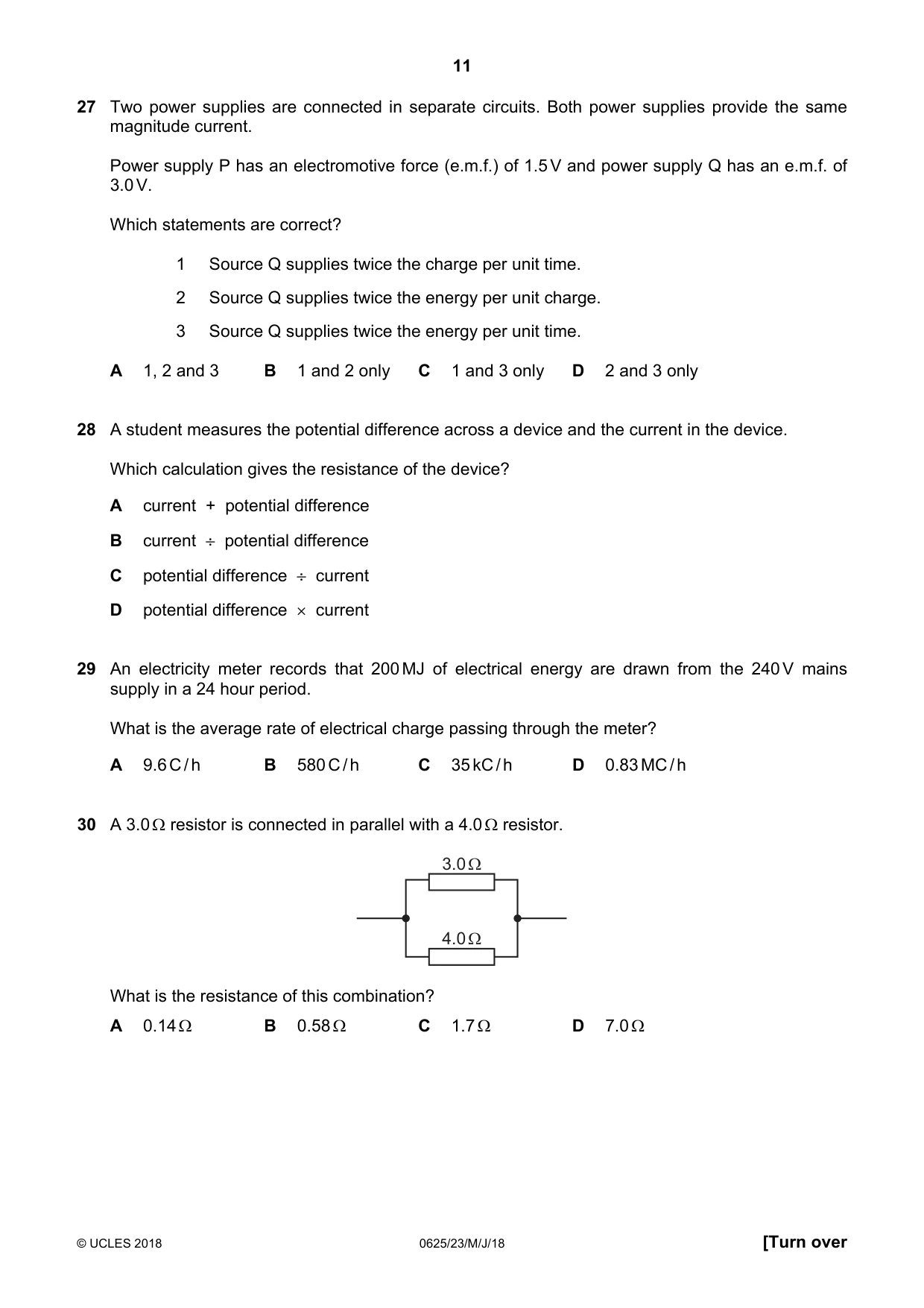
Q27 · Two power supplies are connected in separate circuits
27 Two power supplies are connected in separate circuits. Both power supplies provide the same magnitude current. Power supply P has an electromotive force (e.m.f.) of 1.5 V and power supply Q has an e.m.f. of 3.0 V. Which statements are correct? 1 Source Q supplies twice the charge per unit time. 2 Source Q supplies twice the energy per unit charge. 3 Source Q supplies twice the energy per unit time. A 1, 2 and 3 B 1 and 2 only C 1 and 3 only D 2 and 3 only
Mark scheme: D
Q28 · A student measures the potential difference across a device and the current in the device
28 A student measures the potential difference across a device and the current in the device. Which calculation gives the resistance of the device? A current + potential difference B current ÷ potential difference C potential difference ÷ current D potential difference × current
Mark scheme: C
Q29 · An electricity meter records that 200 MJ of electrical energy are drawn from the 240 V…
29 An electricity meter records that 200 MJ of electrical energy are drawn from the 240 V mains supply in a 24 hour period. What is the average rate of electrical charge passing through the meter? A 9.6 C / h B 580 C / h C 35 kC / h D 0.83 MC / h
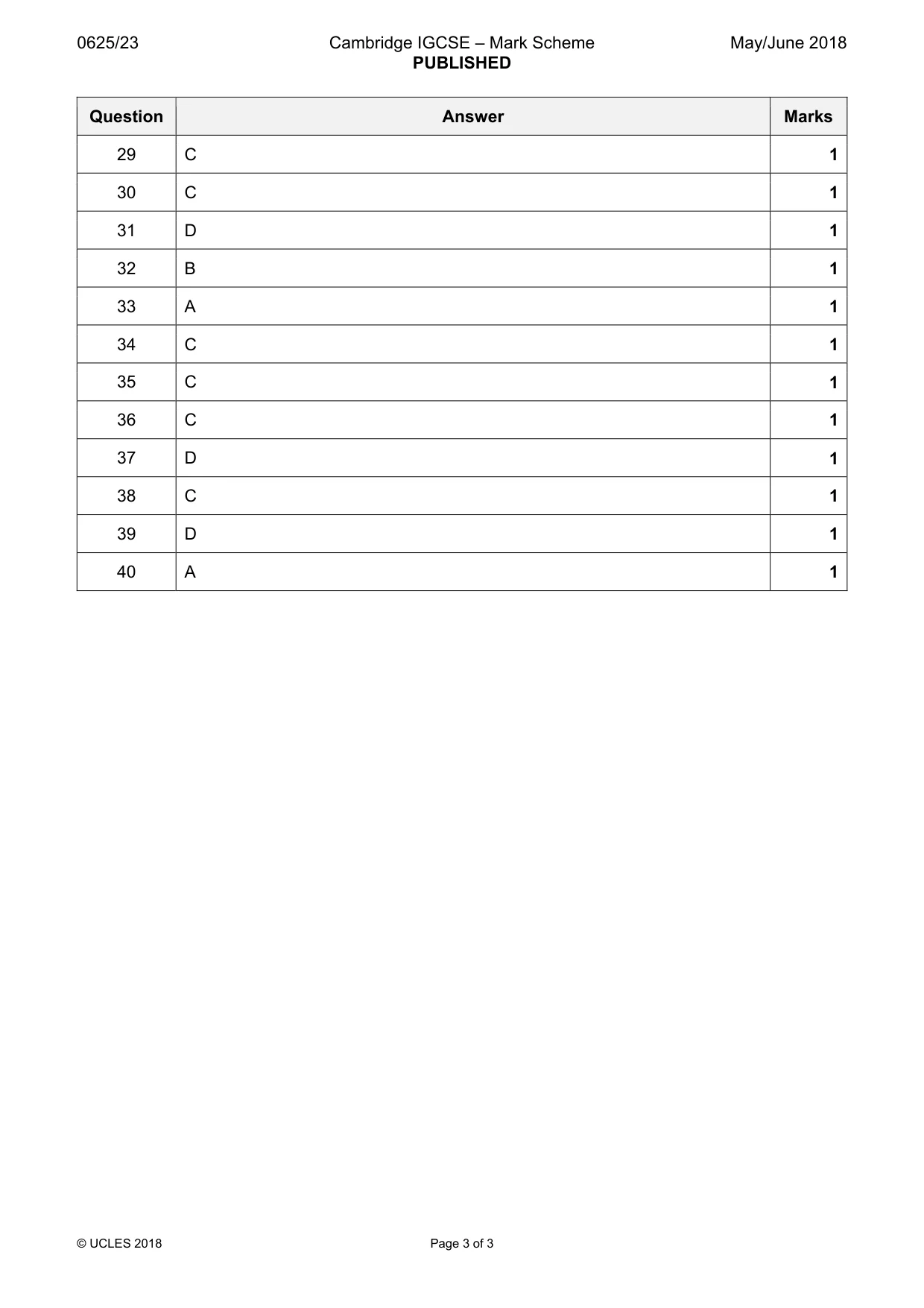
Mark scheme: C
Q30 · A 3.0 Ω resistor is connected in parallel with a 4.0 Ω resistor
30 A 3.0 Ω resistor is connected in parallel with a 4.0 Ω resistor. 3.0 Ω 4.0 Ω What is the resistance of this combination? A 0.14 Ω B 0.58 Ω C 1.7 Ω D 7.0 Ω
Mark scheme: C
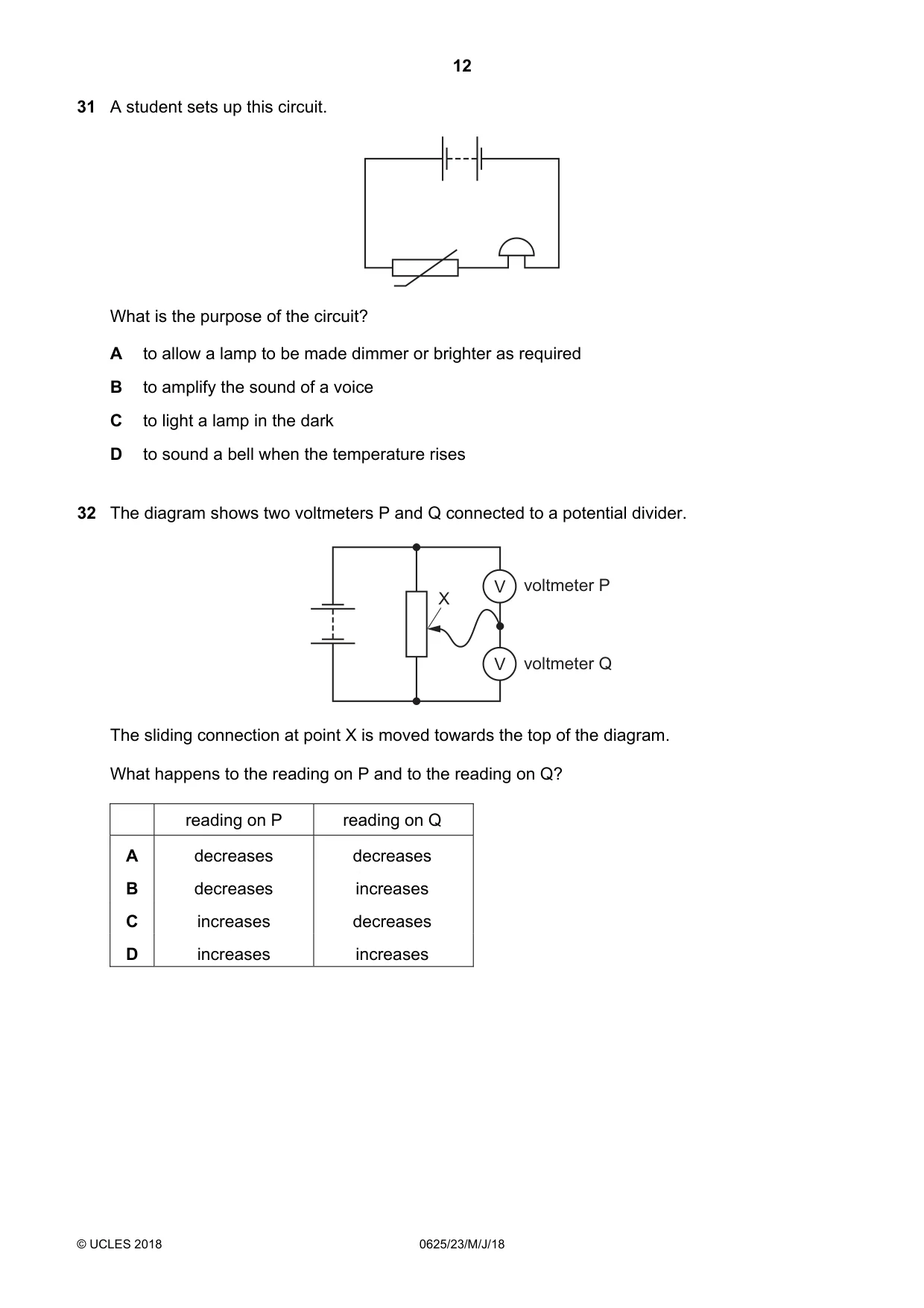
Q31 · A student sets up this circuit
31 A student sets up this circuit. What is the purpose of the circuit? A to allow a lamp to be made dimmer or brighter as required B to amplify the sound of a voice C to light a lamp in the dark D to sound a bell when the temperature rises
Mark scheme: D
Q32 · The diagram shows two voltmeters P and Q connected to a potential divider
32 The diagram shows two voltmeters P and Q connected to a potential divider. V voltmeter P X V voltmeter Q The sliding connection at point X is moved towards the top of the diagram. What happens to the reading on P and to the reading on Q? reading on P reading on Q A decreases decreases B decreases increases C increases decreases D increases increases
Mark scheme: B
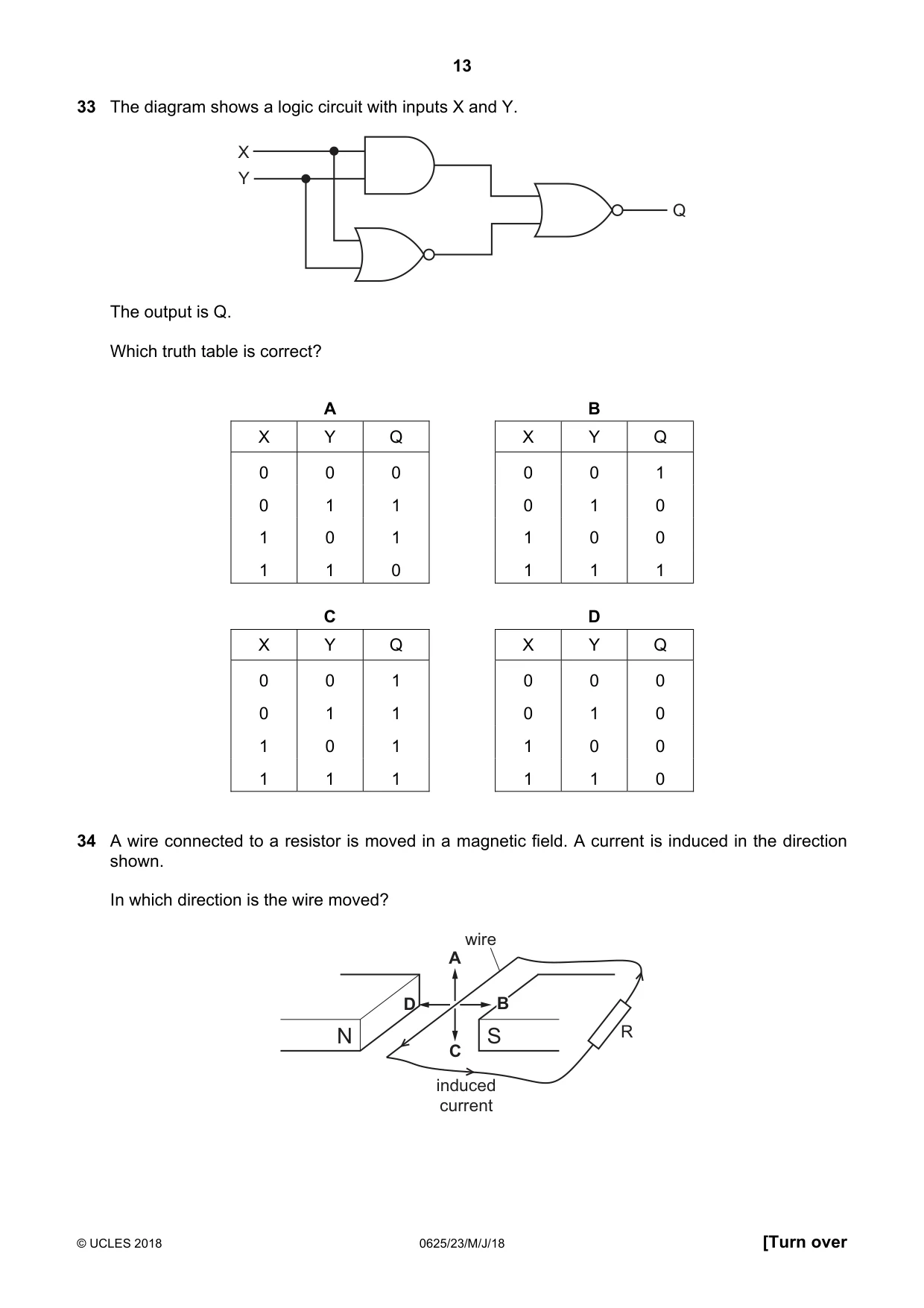
Q33 · The diagram shows a logic circuit with inputs X and Y
33 The diagram shows a logic circuit with inputs X and Y. X Y Q The output is Q. Which truth table is correct? A B X Y Q X Y Q 0 0 0 0 0 1 0 1 1 0 1 0 1 0 1 1 0 0 1 1 0 1 1 1 C D X Y Q X Y Q 0 0 1 0 0 0 0 1 1 0 1 0 1 0 1 1 0 0 1 1 1 1 1 0
Mark scheme: A
Q34 · A wire connected to a resistor is moved in a magnetic field
34 A wire connected to a resistor is moved in a magnetic field. A current is induced in the direction shown. In which direction is the wire moved? wire A D B B N S R C induced current
Mark scheme: C
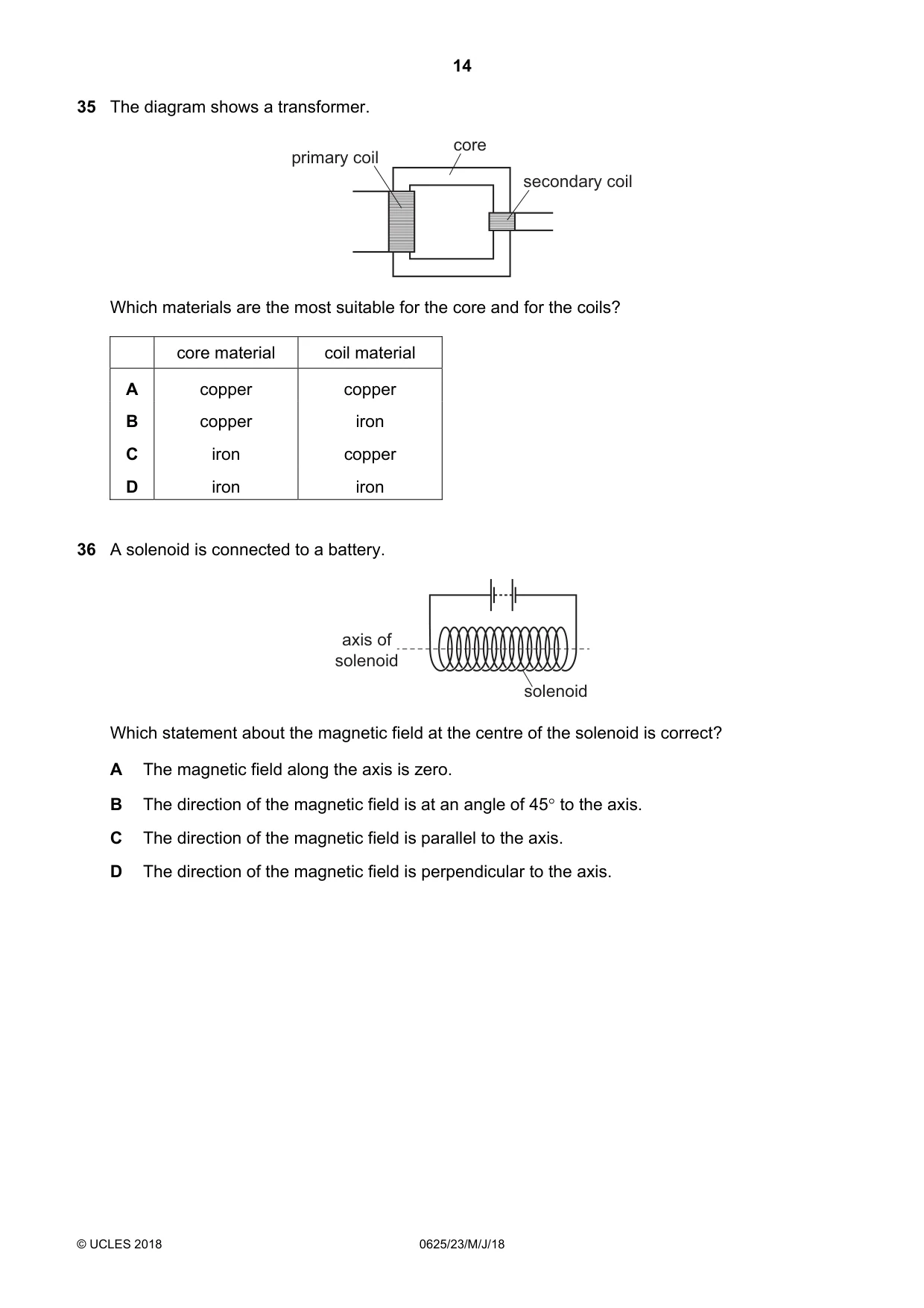
Q35 · The diagram shows a transformer
35 The diagram shows a transformer. core primary coil secondary coil Which materials are the most suitable for the core and for the coils? core material coil material A copper copper B copper iron C iron copper D iron iron
Mark scheme: C
Q36 · A solenoid is connected to a battery
36 A solenoid is connected to a battery. axis of solenoid solenoid Which statement about the magnetic field at the centre of the solenoid is correct? A The magnetic field along the axis is zero. B The direction of the magnetic field is at an angle of 45° to the axis. C The direction of the magnetic field is parallel to the axis. D The direction of the magnetic field is perpendicular to the axis.
Mark scheme: C
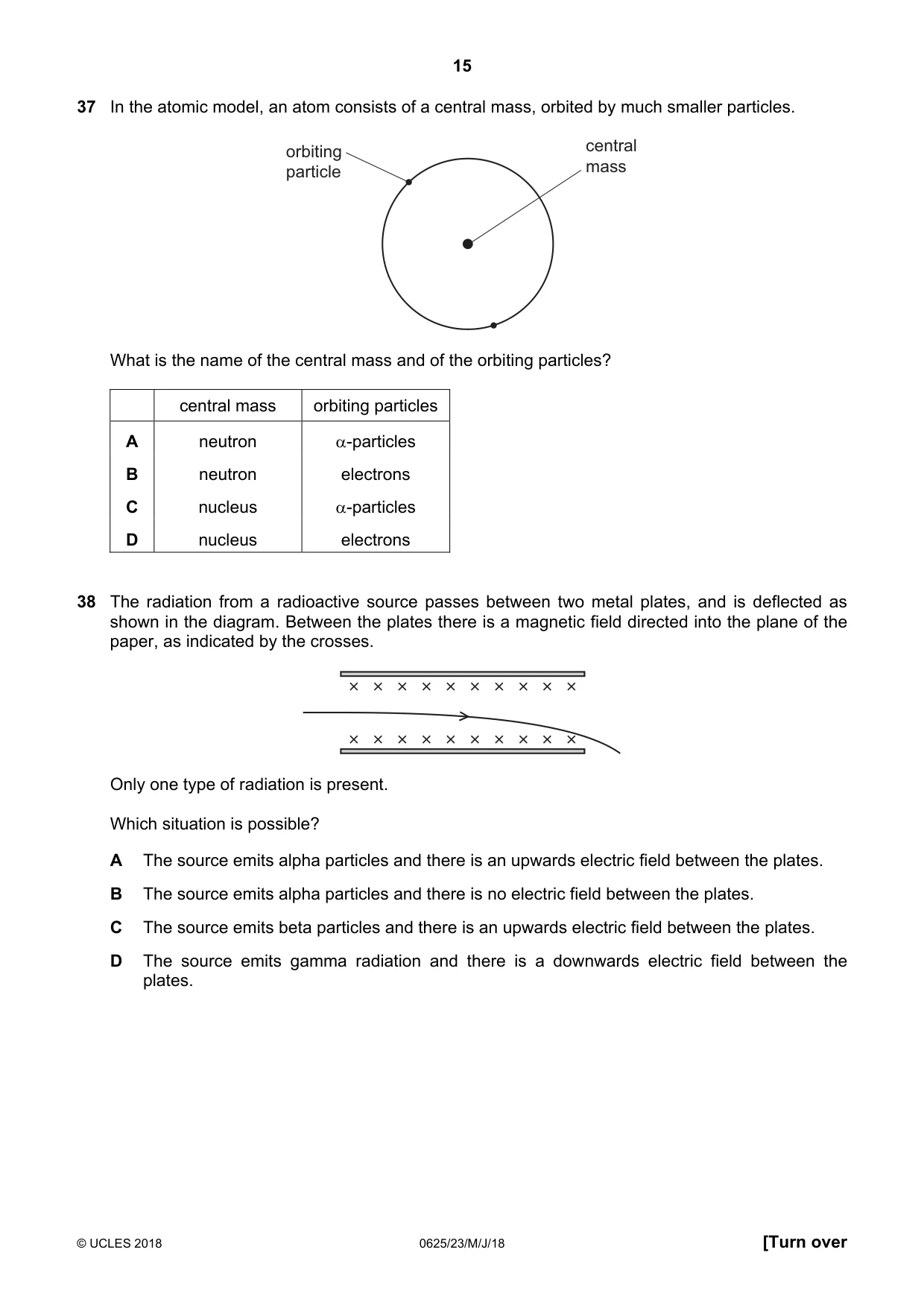
Q37 · In the atomic model, an atom consists of a central mass, orbited by much smaller particles
37 In the atomic model, an atom consists of a central mass, orbited by much smaller particles. orbiting central particle mass What is the name of the central mass and of the orbiting particles? central mass orbiting particles A neutron α-particles B neutron electrons C nucleus α-particles D nucleus electrons
Mark scheme: D
Q38 · The radiation from a radioactive source passes between two metal plates, and is deflected…
38 The radiation from a radioactive source passes between two metal plates, and is deflected as shown in the diagram. Between the plates there is a magnetic field directed into the plane of the paper, as indicated by the crosses. × × × × × × × × × × × × × × × × × × × × Only one type of radiation is present. Which situation is possible? A The source emits alpha particles and there is an upwards electric field between the plates. B The source emits alpha particles and there is no electric field between the plates. C The source emits beta particles and there is an upwards electric field between the plates. D The source emits gamma radiation and there is a downwards electric field between the plates.
Mark scheme: C
Q39 · The nucleus of an isotope of nitrogen (N) absorbs a neutron
39 The nucleus of an isotope of nitrogen (N) absorbs a neutron. It then decays into an isotope of carbon (C) and emits x. 1 0 + n 14 N → 14 C + x 7 6 What is x? A α-particle B β-particle C γ-radiation D proton
Mark scheme: D
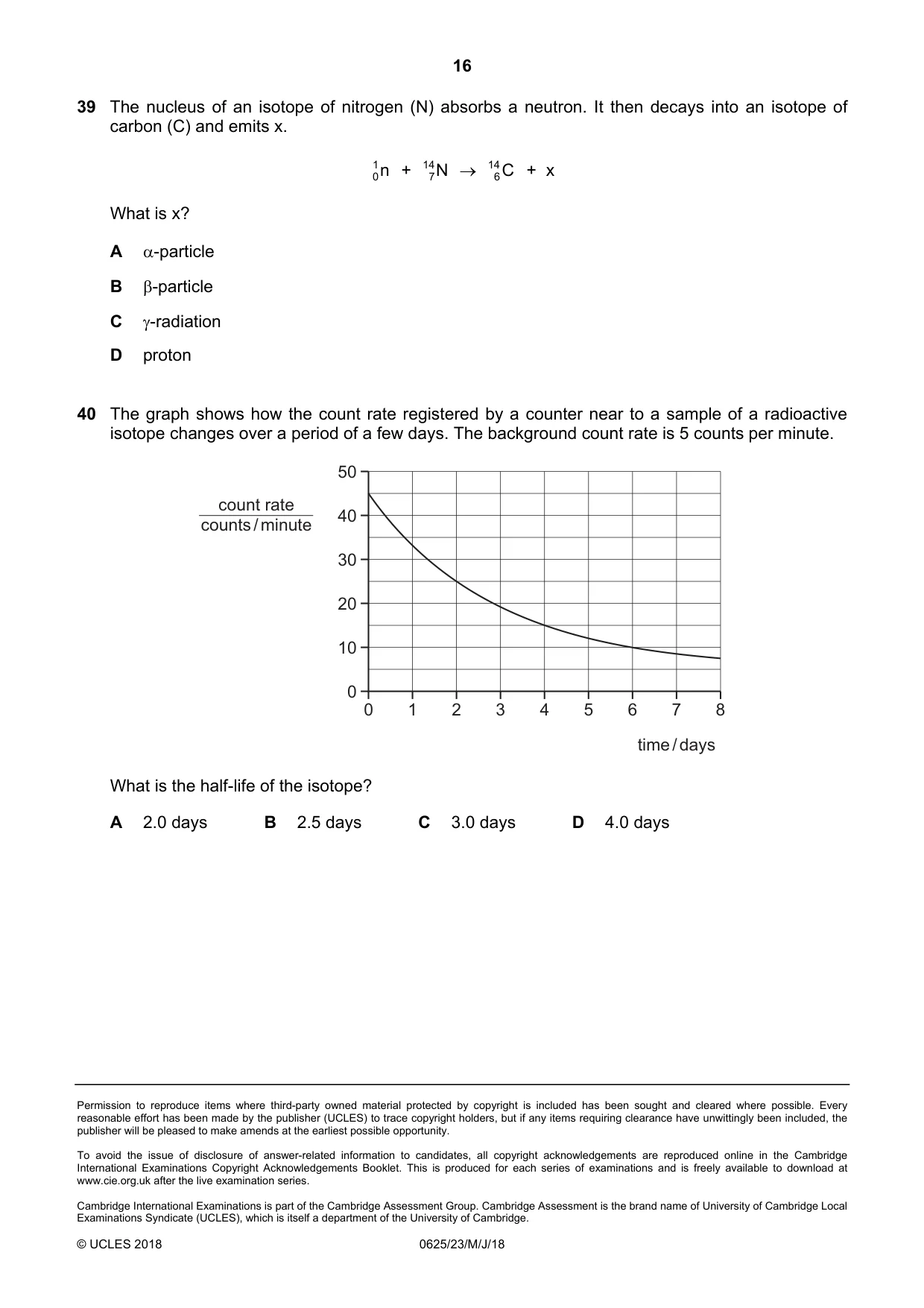
Q40 · The graph shows how the count rate registered by a counter near to a sample of a…
40 The graph shows how the count rate registered by a counter near to a sample of a radioactive isotope changes over a period of a few days. The background count rate is 5 counts per minute. 50 count rate 40 counts / minute 30 20 10 0 0 1 2 3 4 5 6 7 8 time / days What is the half-life of the isotope? A 2.0 days B 2.5 days C 3.0 days D 4.0 days
Mark scheme: A
What was in this paper
The subtopics covered by these 40 questions, and how many questions each got. Open one in a new tab to see every Cambridge question on it.
4Electrical quantities3Energy, work and power3Forces3Radioactivity3Simple phenomena of magnetism3Electromagnetic effects2General properties of waves2Light2Mass and weight2Physical quantities and measurement techniques2Pressure2Sound2Thermal properties and temperature2Kinetic particle model of matter1Momentum1Motion1The nuclear model of the atom1Transfer of thermal energy1What you needed in this session
Cambridge’s own grade thresholds for 2018 May/June, Paper 2 · Variant 3. A higher threshold means an easier paper — the bar moves with how the cohort did.