Cambridge IGCSE Physics 0625 — 2024 May/June Paper 2 · Variant 3
0625/23/M/J/24 · 40 questions · 40 marks · ≈45 min
The question paper and its mark scheme, free to read here and free to download. This is Cambridge’s own paper, exactly as it was sat.
Question paper16 pages
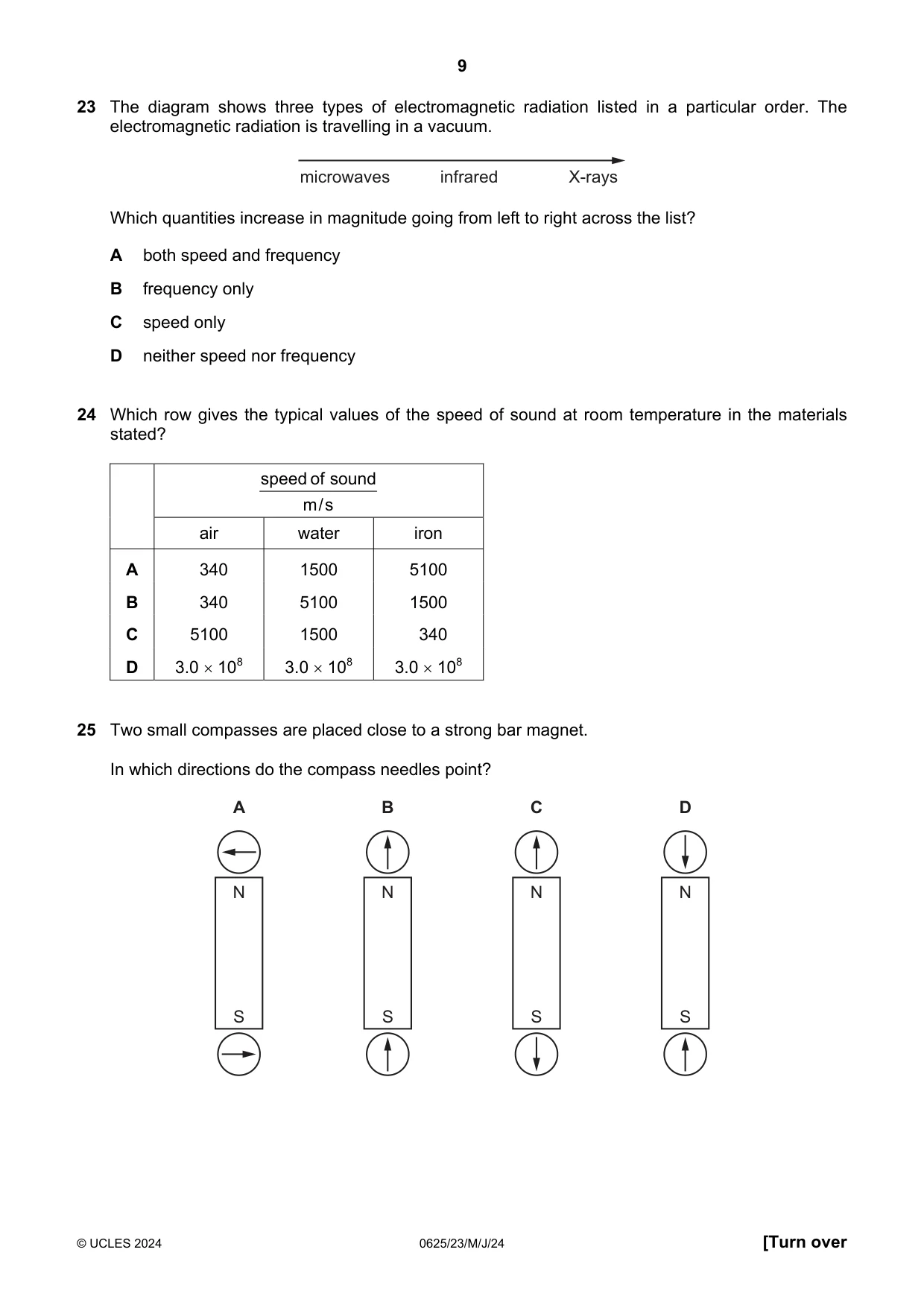
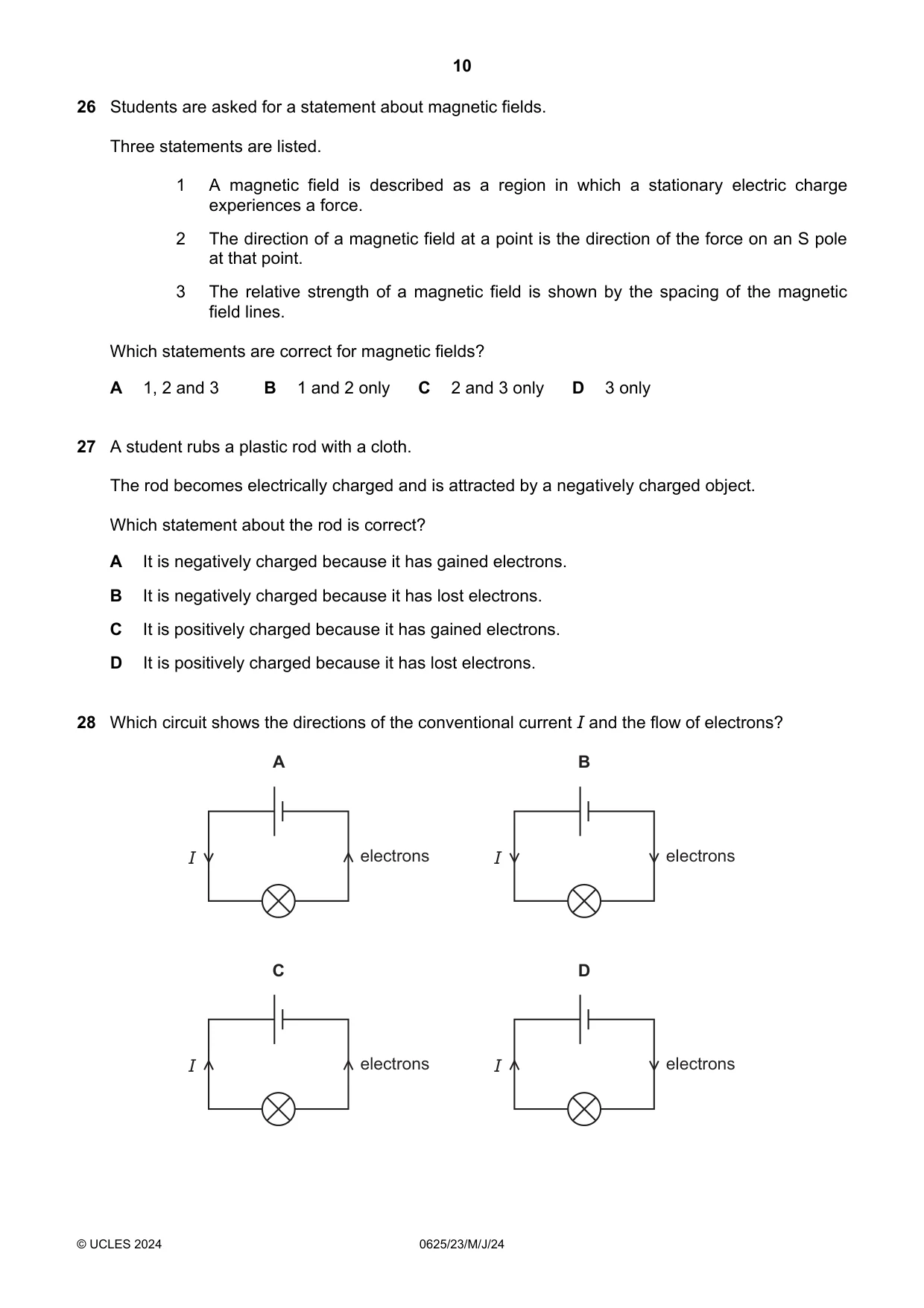
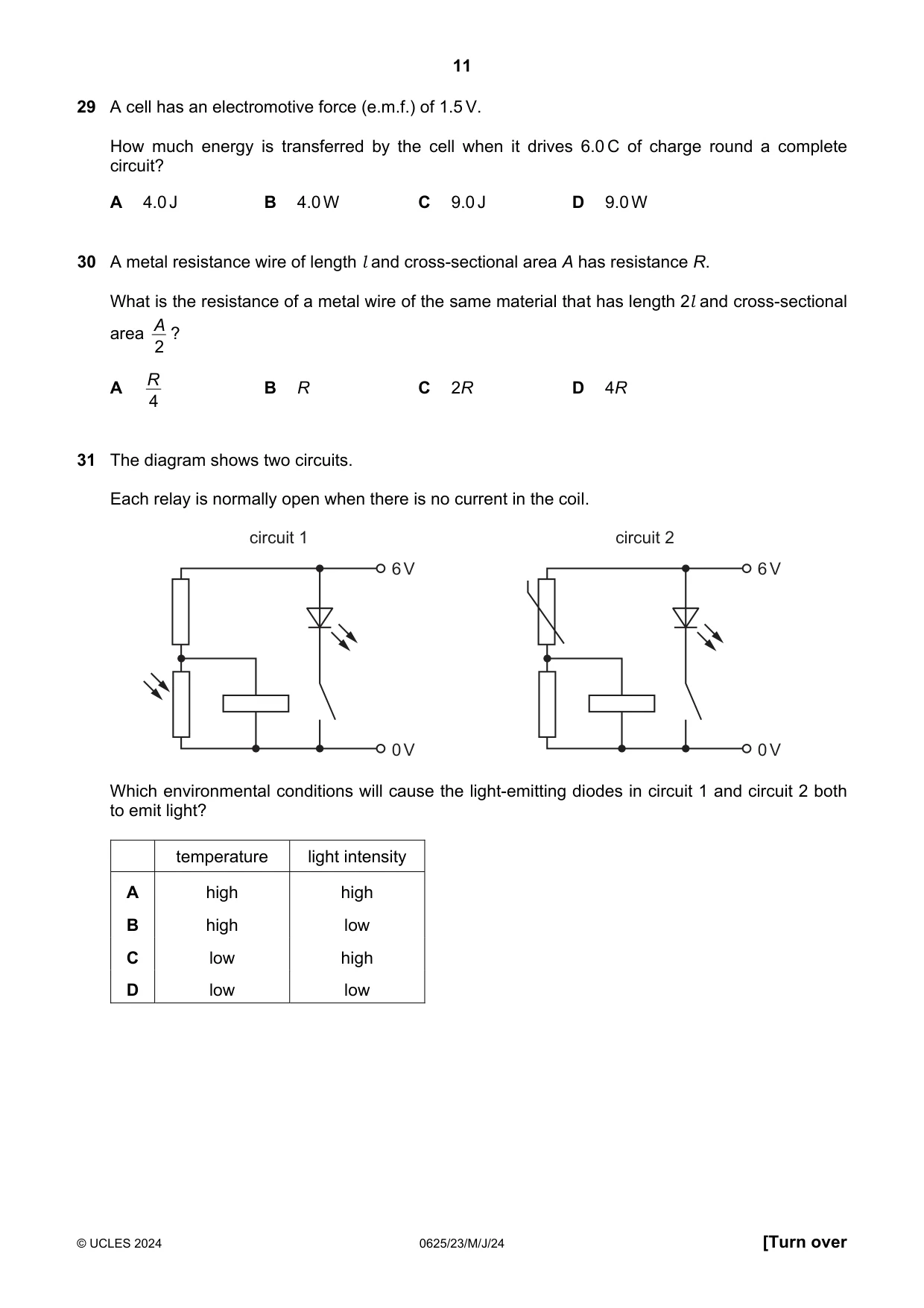
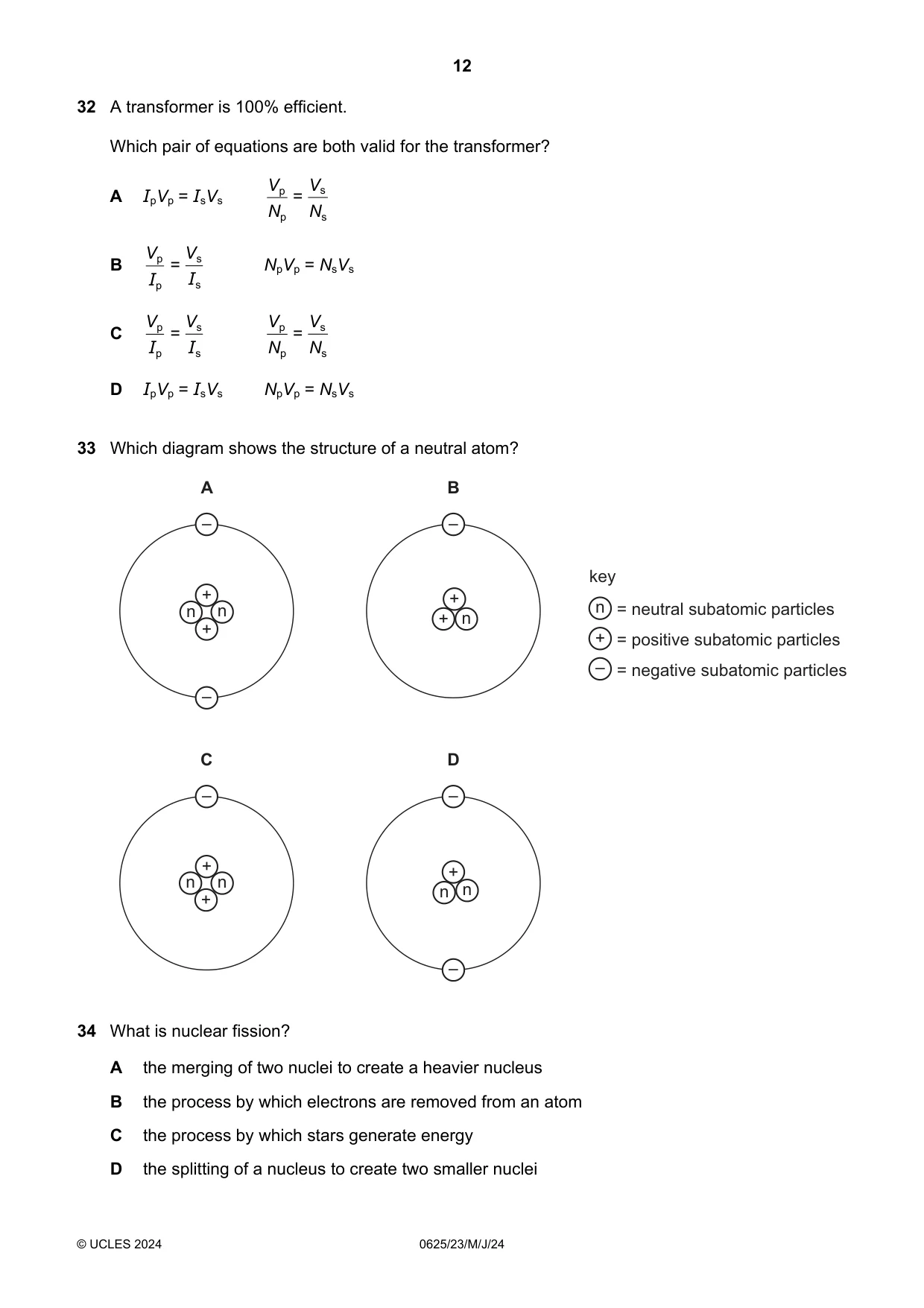

Mark scheme3 pages
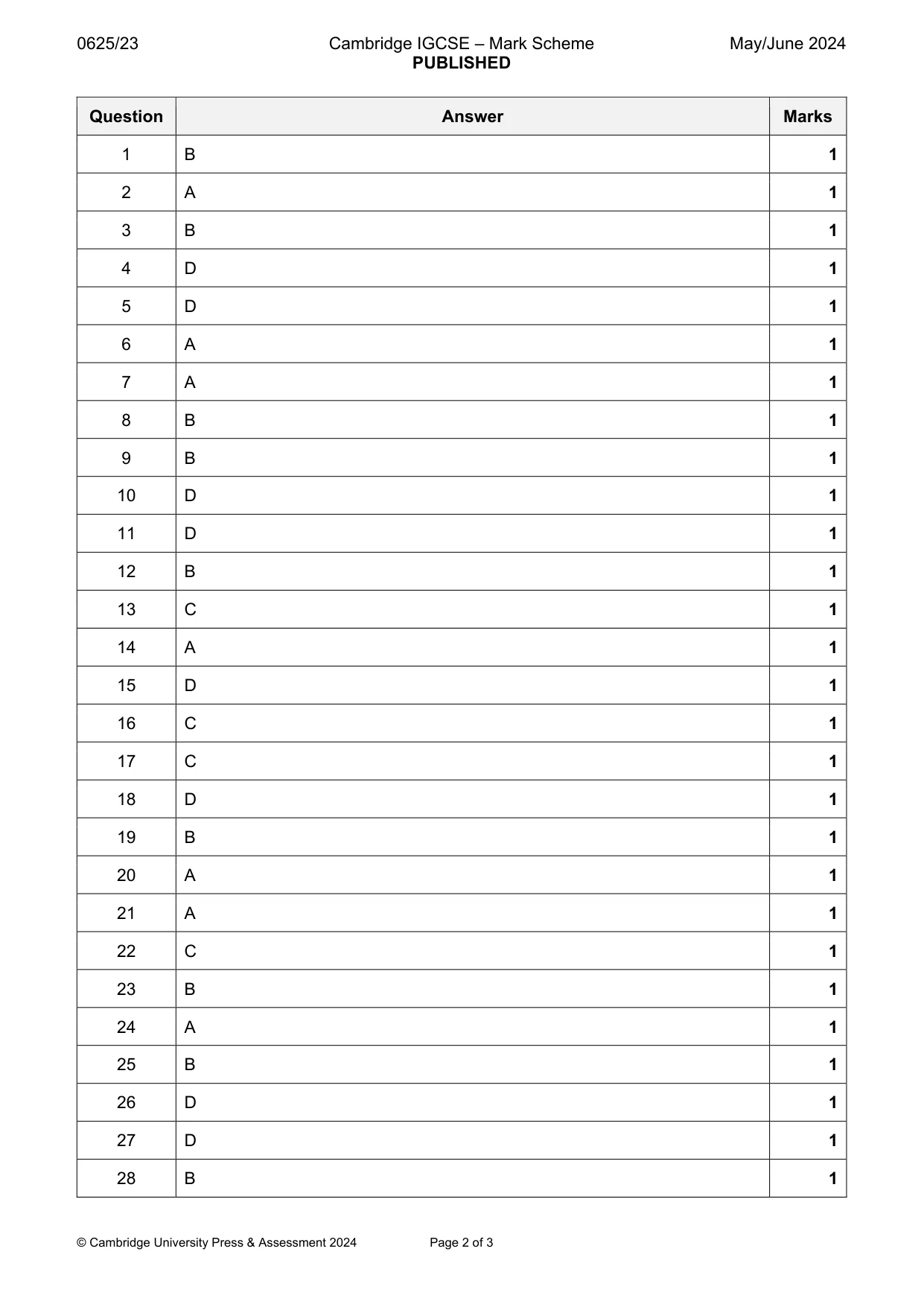
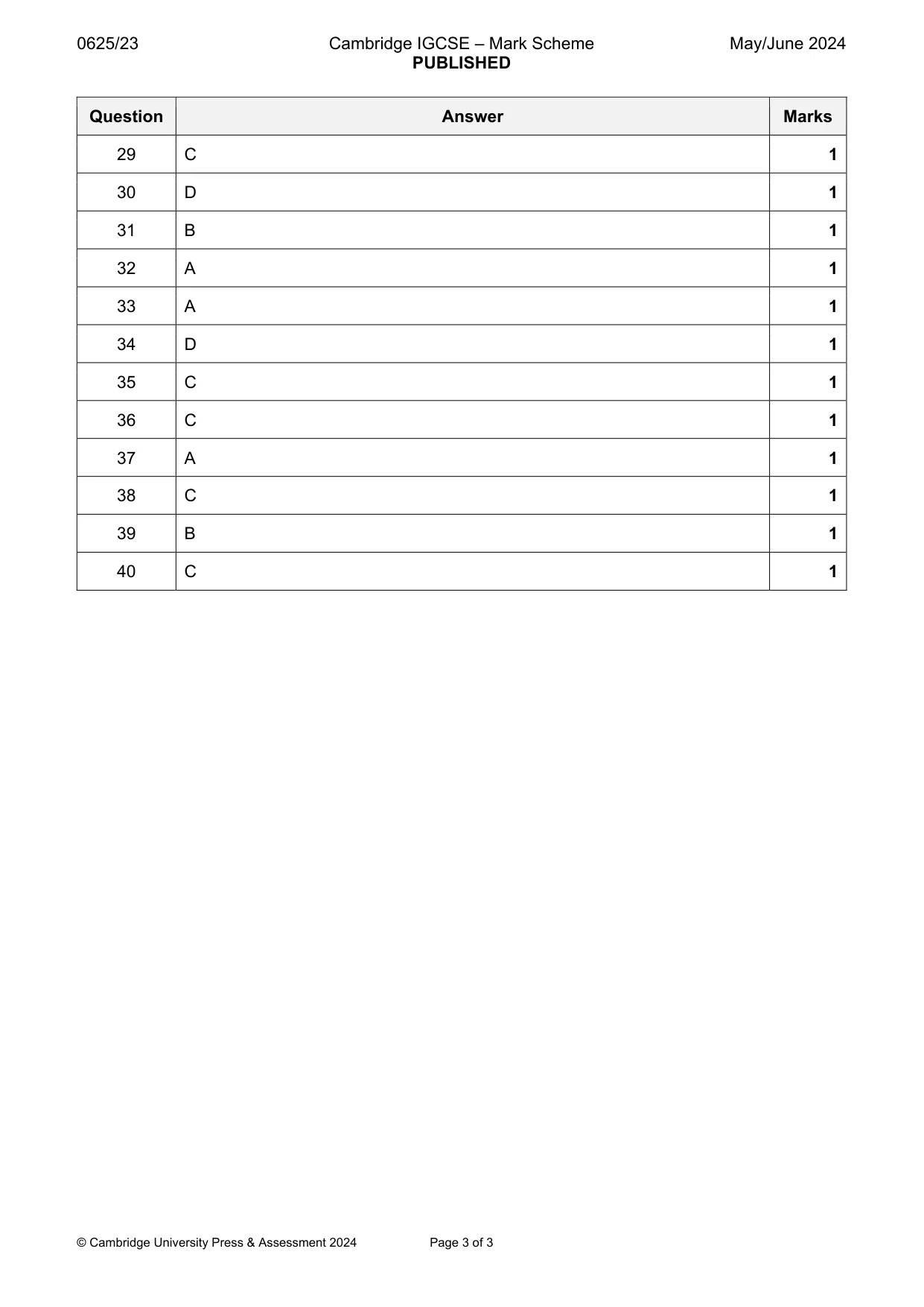
Answers below. Sit the paper first if you are practising.
Questions as text
Q1 · A student measures the volume of a small, irregularly shaped stone
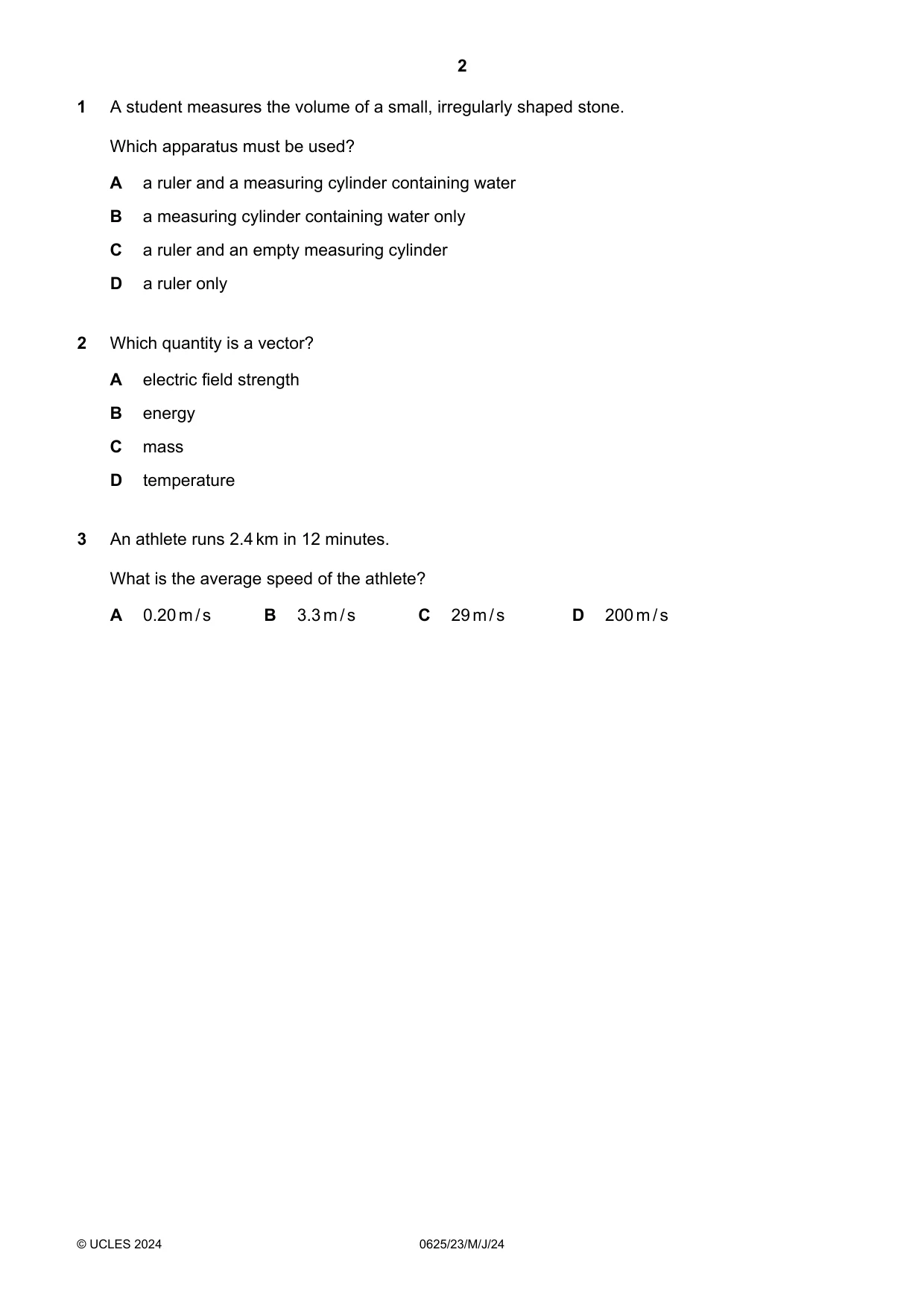
1 A student measures the volume of a small, irregularly shaped stone. Which apparatus must be used? A a ruler and a measuring cylinder containing water B a measuring cylinder containing water only C a ruler and an empty measuring cylinder D a ruler only
Mark scheme: B
More questions on Physical quantities and measurement techniques
Q2 · Which quantity is a vector?
2 Which quantity is a vector? A electric field strength B energy C mass D temperature
Mark scheme: A
Q3 · An athlete runs 2.4 km in 12 minutes
3 An athlete runs 2.4 km in 12 minutes. What is the average speed of the athlete? A 0.20 m / s B 3.3 m / s C 29 m / s D 200 m / s
Mark scheme: B
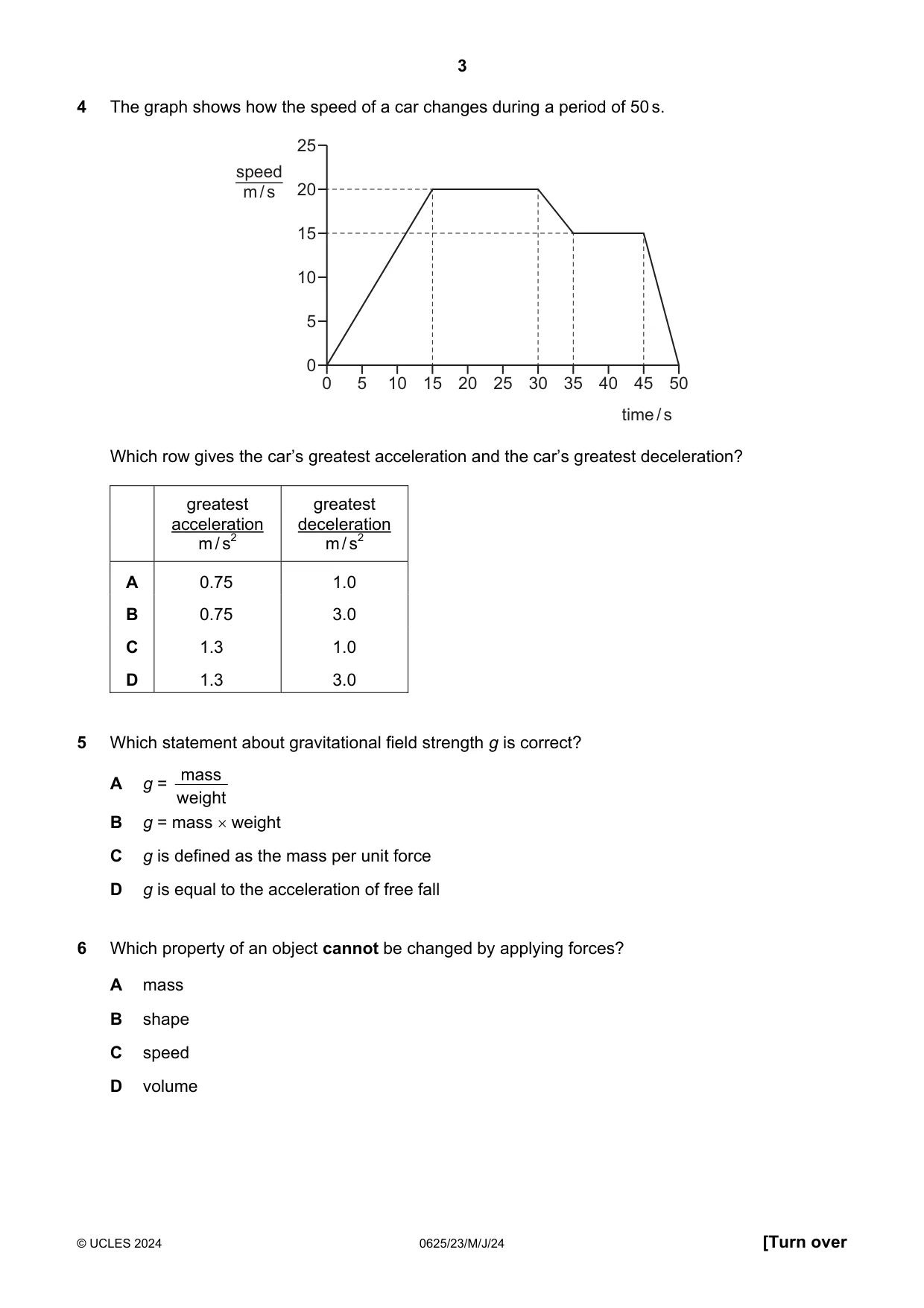
Q4 · The graph shows how the speed of a car changes during a period of 50 s
4 The graph shows how the speed of a car changes during a period of 50 s. 25 speed m / s 20 15 10 5 0 0 5 10 15 20 25 30 35 40 45 50 time / s Which row gives the car’s greatest acceleration and the car’s greatest deceleration? greatest greatest acceleration deceleration m / s2 m / s2 A 0.75 1.0 B 0.75 3.0 C 1.3 1.0 D 1.3 3.0
Mark scheme: D
Q5 · Which statement about gravitational field strength g is correct?
5 Which statement about gravitational field strength g is correct? mass A g = weight B g = mass weight C g is defined as the mass per unit force D g is equal to the acceleration of free fall
Mark scheme: D
Q6 · Which property of an object cannot be changed by applying forces?
6 Which property of an object cannot be changed by applying forces? A mass B shape C speed D volume
Mark scheme: A
Q7 · A small ball of mass 0.10 kg travels horizontally at a speed of 600 m / s
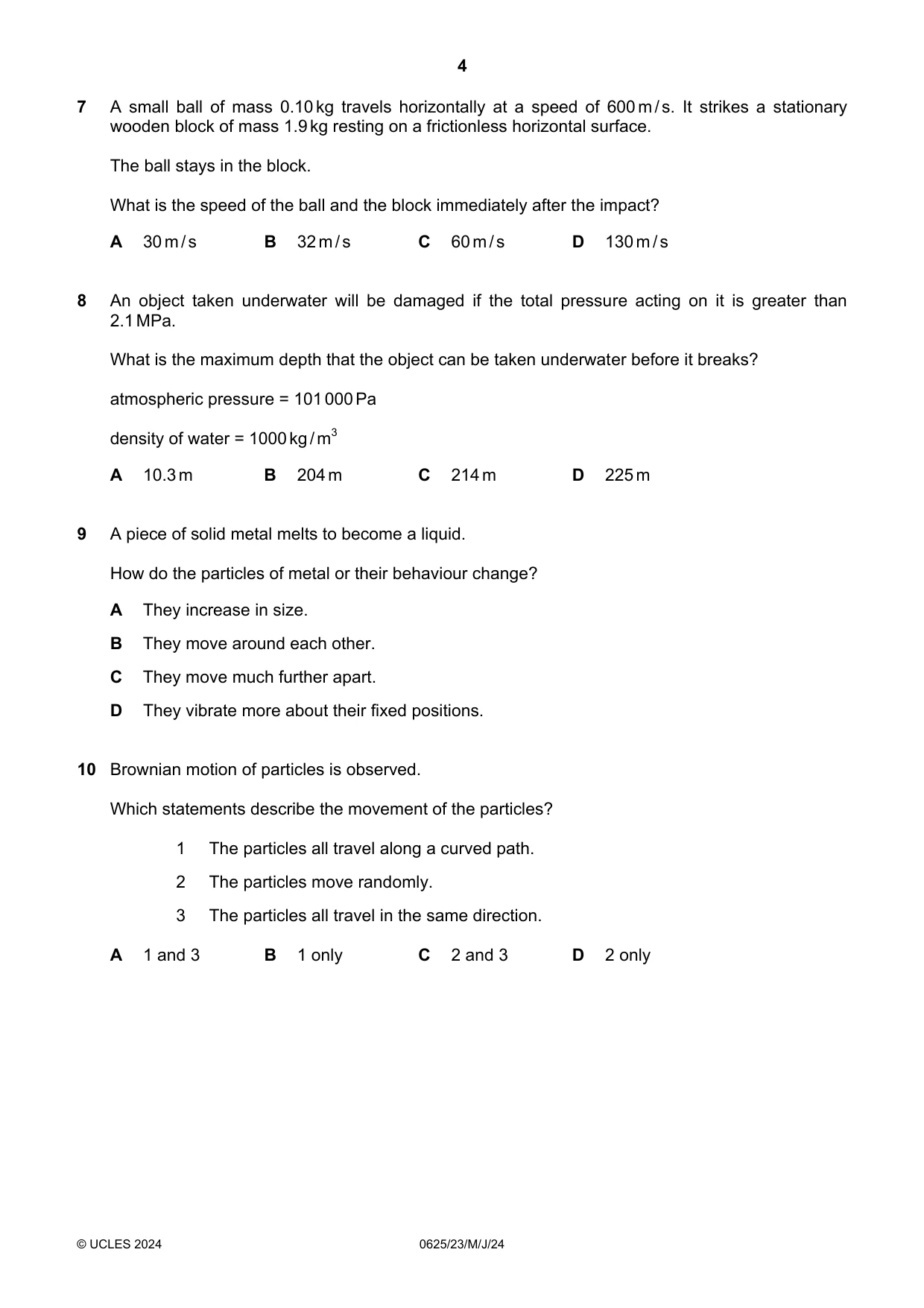
7 A small ball of mass 0.10 kg travels horizontally at a speed of 600 m / s. It strikes a stationary wooden block of mass 1.9 kg resting on a frictionless horizontal surface. The ball stays in the block. What is the speed of the ball and the block immediately after the impact? A 30 m / s B 32 m / s C 60 m / s D 130 m / s
Mark scheme: A
Q8 · An object taken underwater will be damaged if the total pressure acting on it is greater…
8 An object taken underwater will be damaged if the total pressure acting on it is greater than 2.1 MPa. What is the maximum depth that the object can be taken underwater before it breaks? atmospheric pressure = 101 000 Pa density of water = 1000 kg / m3 A 10.3 m B 204 m C 214 m D 225 m
Mark scheme: B
Q9 · A piece of solid metal melts to become a liquid
9 A piece of solid metal melts to become a liquid. How do the particles of metal or their behaviour change? A They increase in size. B They move around each other. C They move much further apart. D They vibrate more about their fixed positions.
Mark scheme: B
Q10 · Brownian motion of particles is observed
10 Brownian motion of particles is observed. Which statements describe the movement of the particles? 1 The particles all travel along a curved path. 2 The particles move randomly. 3 The particles all travel in the same direction. A 1 and 3 B 1 only C 2 and 3 D 2 only
Mark scheme: D
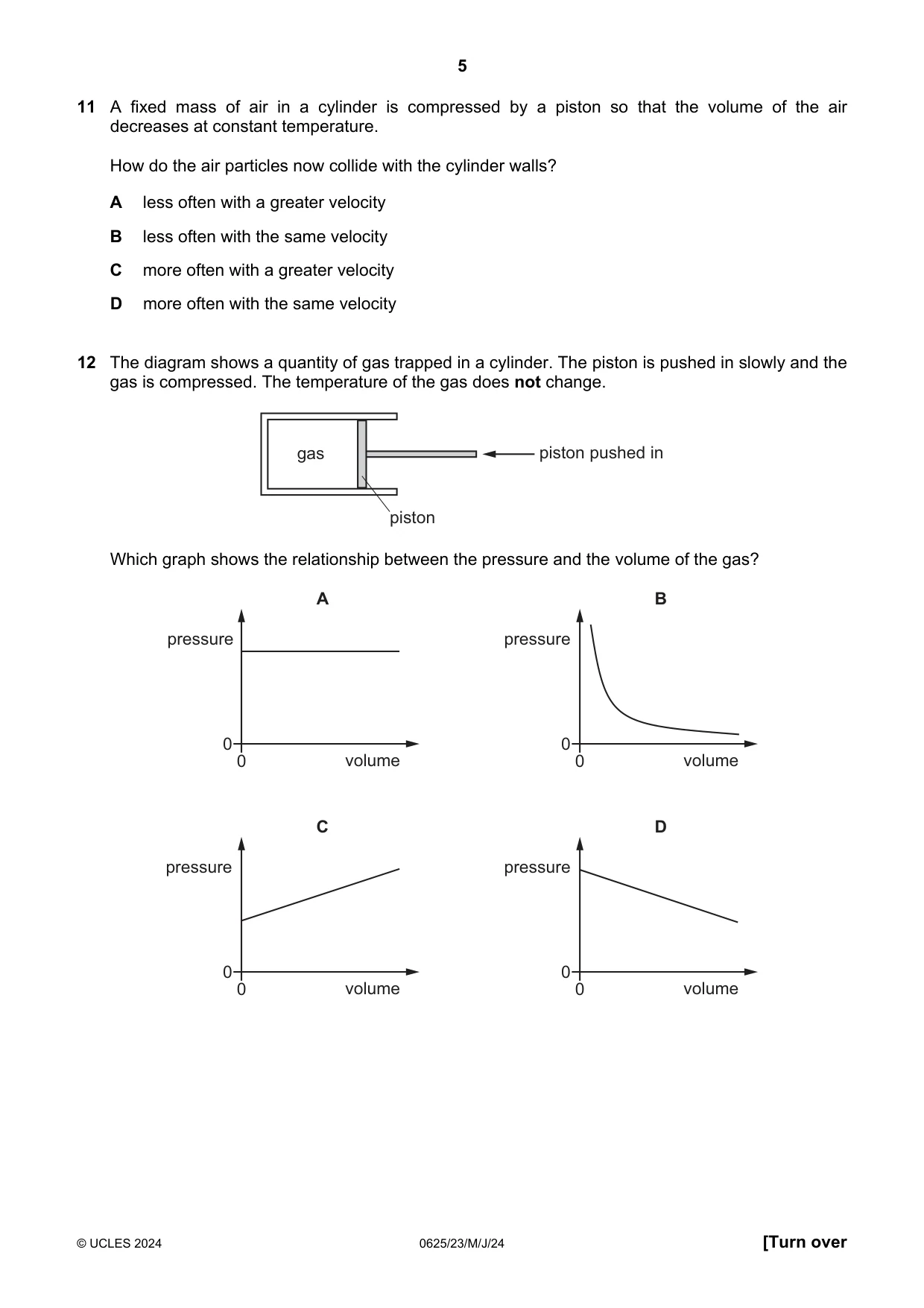
Q11 · A fixed mass of air in a cylinder is compressed by a piston so that the volume of the air…
11 A fixed mass of air in a cylinder is compressed by a piston so that the volume of the air decreases at constant temperature. How do the air particles now collide with the cylinder walls? A less often with a greater velocity B less often with the same velocity C more often with a greater velocity D more often with the same velocity
Mark scheme: D
Q12 · The diagram shows a quantity of gas trapped in a cylinder
12 The diagram shows a quantity of gas trapped in a cylinder. The piston is pushed in slowly and the gas is compressed. The temperature of the gas does not change. gas piston pushed in piston Which graph shows the relationship between the pressure and the volume of the gas? A B pressure pressure 0 0 0 volume 0 volume C D pressure pressure 0 0 0 volume 0 volume
Mark scheme: B
Q13 · The liquid level in a thermometer rises when the thermometer is placed in hot water
13 The liquid level in a thermometer rises when the thermometer is placed in hot water. What causes this? A The liquid contracts. B The liquid evaporates. C The liquid expands. D The liquid freezes.
Mark scheme: C
Q14 · Which statement describes what happens as ice at 0 C melts to become water?
14 Which statement describes what happens as ice at 0 C melts to become water? A Energy is absorbed and the temperature remains constant. B Energy is absorbed and the temperature rises. C Energy is released and the temperature remains constant. D Energy is released and the temperature rises.
Mark scheme: A
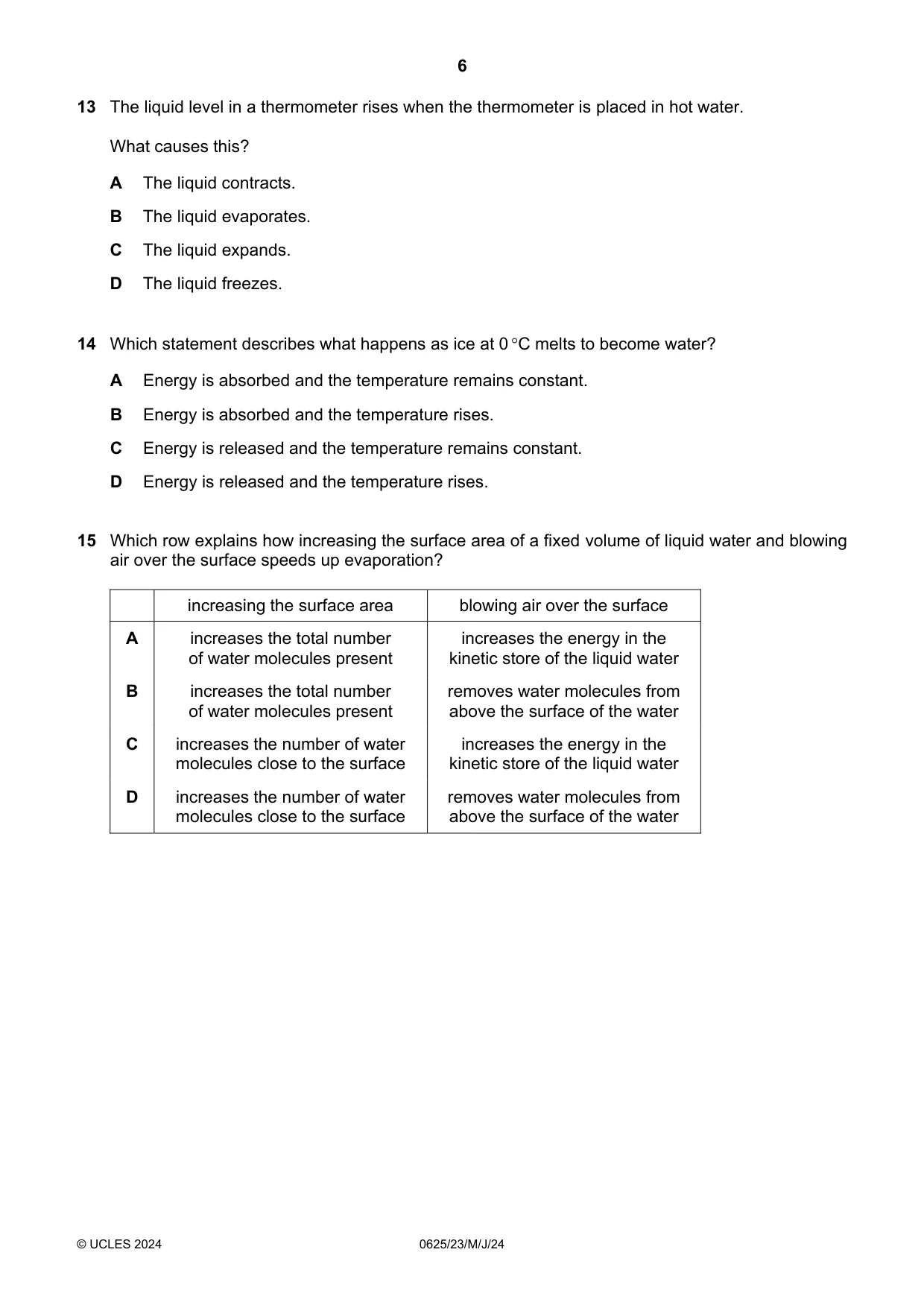
Q15 · Which row explains how increasing the surface area of a fixed volume of liquid water and…
15 Which row explains how increasing the surface area of a fixed volume of liquid water and blowing air over the surface speeds up evaporation? increasing the surface area blowing air over the surface A increases the total number increases the energy in the of water molecules present kinetic store of the liquid water B increases the total number removes water molecules from of water molecules present above the surface of the water C increases the number of water increases the energy in the molecules close to the surface kinetic store of the liquid water D increases the number of water removes water molecules from molecules close to the surface above the surface of the water
Mark scheme: D
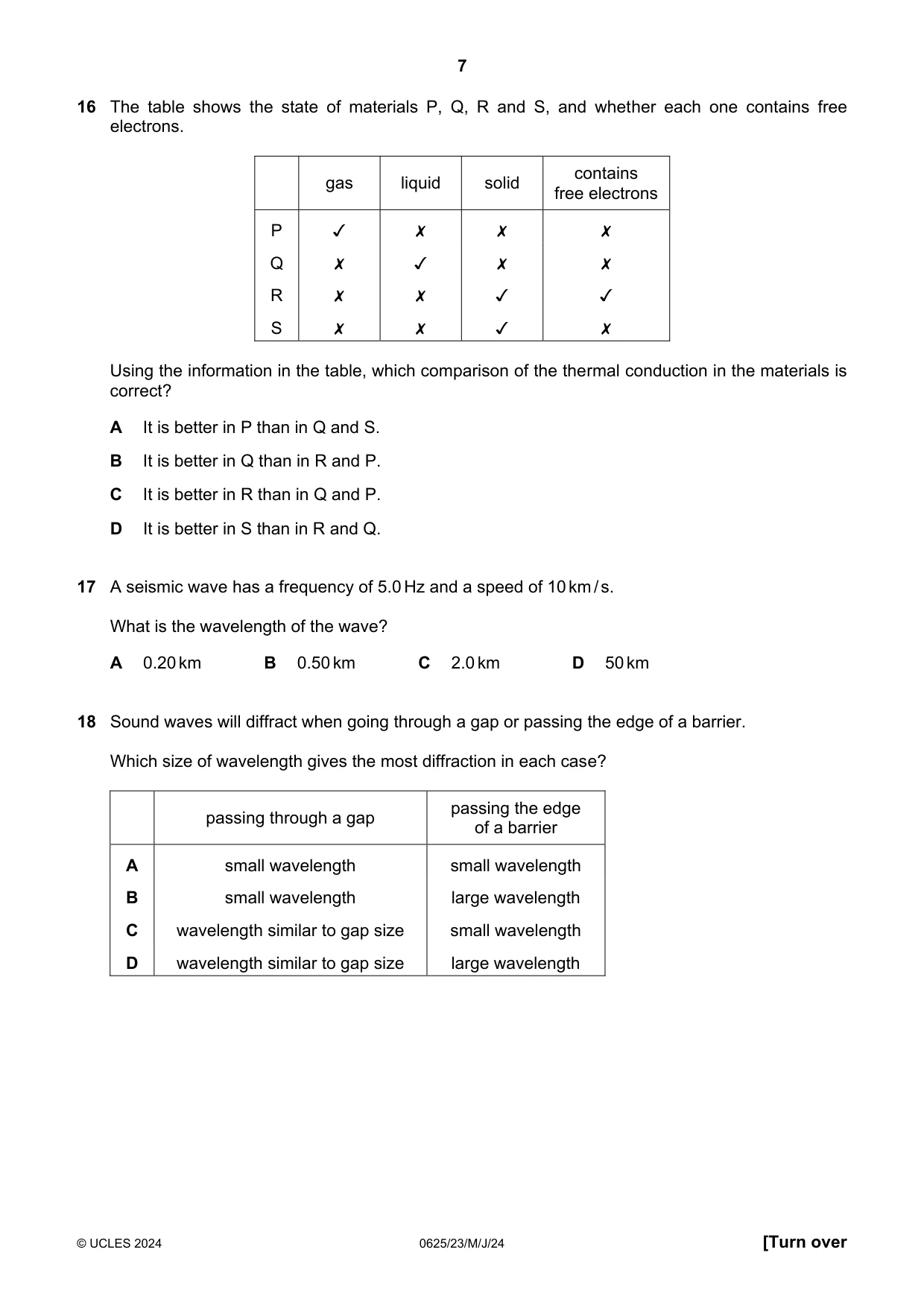
Q16 · The table shows the state of materials P, Q, R and S, and whether each one contains free…
16 The table shows the state of materials P, Q, R and S, and whether each one contains free electrons. gas liquid solid fee en ns P J x x x Q x Jv x x R x x Jv JV S) x x J x Using the information in the table, which comparison of the thermal conduction in the materials is correct? A _Itis better in P than in Q and S. B_Itis better in Q than in R and P. C_Itis better in R than in Q and P. D_Itis better in S than in R and Q.
Mark scheme: C
Q17 · A seismic wave has a frequency of 5.0 Hz and a speed of 10 km / s
17 A seismic wave has a frequency of 5.0 Hz and a speed of 10 km / s. What is the wavelength of the wave? A 0.20 km B 0.50 km C 2.0 km D 50 km
Mark scheme: C
Q18 · Sound waves will diffract when going through a gap or passing the edge of a barrier
18 Sound waves will diffract when going through a gap or passing the edge of a barrier. Which size of wavelength gives the most diffraction in each case? passing the edge passing through a gap of a barrier A small wavelength small wavelength B small wavelength large wavelength C wavelength similar to gap size small wavelength D wavelength similar to gap size large wavelength
Mark scheme: D
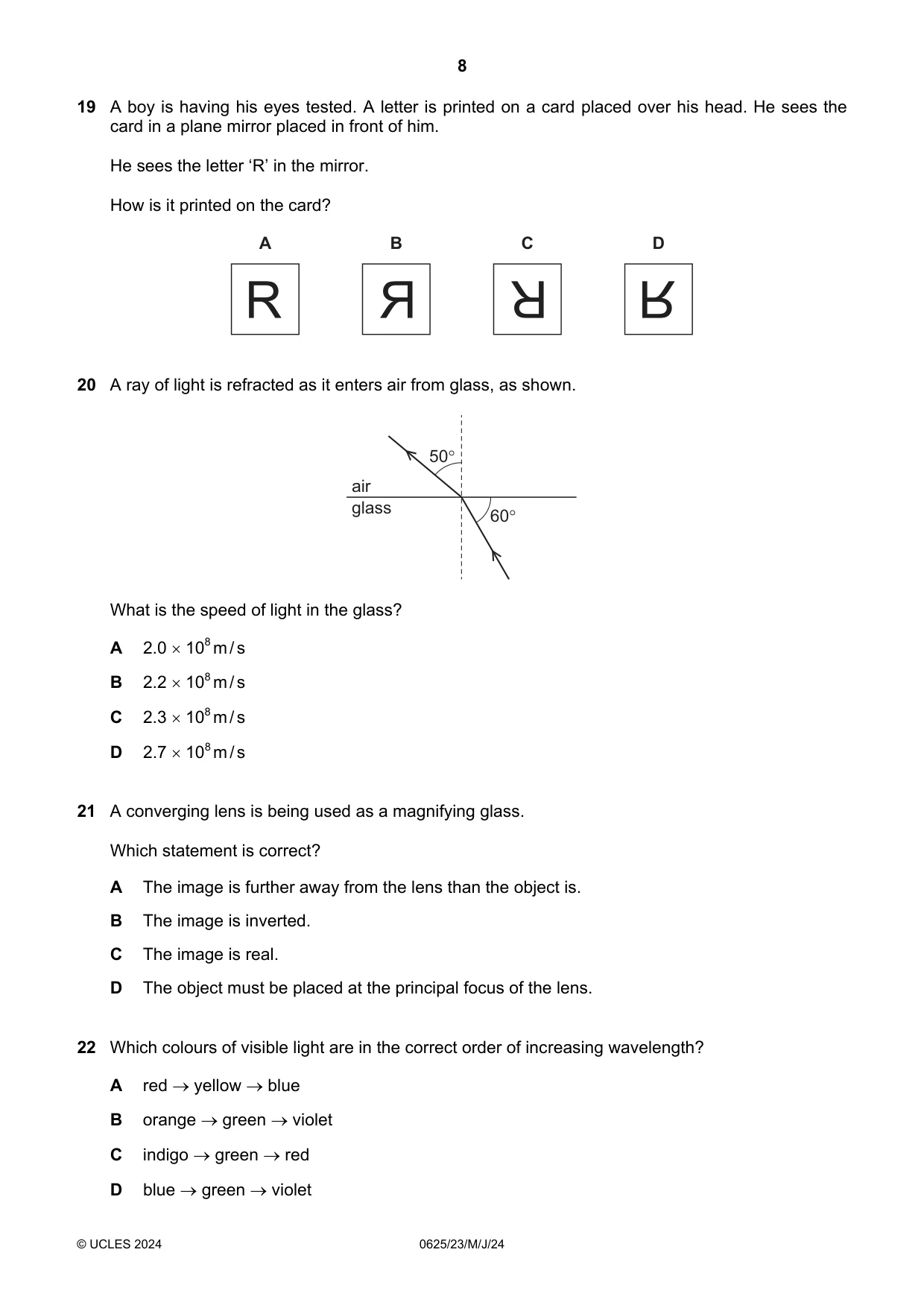
Q19 · A boy is having his eyes tested
19 A boy is having his eyes tested. A letter is printed on a card placed over his head. He sees the card in a plane mirror placed in front of him. He sees the letter ‘R’ in the mirror. How is it printed on the card? A B C D
Mark scheme: B
Q20 · A ray of light is refracted as it enters air from glass, as shown
20 A ray of light is refracted as it enters air from glass, as shown. 50°! air glass 60° What is the speed of light in the glass? A 2.0x10®m/s B 2.2x10°m/s C 2.3x10°m/s D 2.7x10°m/s
Mark scheme: A
Q21 · A converging lens is being used as a magnifying glass
21 A converging lens is being used as a magnifying glass. Which statement is correct? A The image is further away from the lens than the object is. B The image is inverted. C The image is real. D The object must be placed at the principal focus of the lens.
Mark scheme: A
Q22 · Which colours of visible light are in the correct order of increasing wavelength?
22 Which colours of visible light are in the correct order of increasing wavelength? A red yellow blue B orange green violet C indigo green red D blue green violet
Mark scheme: C
Q23 · The diagram shows three types of electromagnetic radiation listed in a particular order
23 The diagram shows three types of electromagnetic radiation listed in a particular order. The electromagnetic radiation is travelling in a vacuum. microwaves infrared X-rays Which quantities increase in magnitude going from left to right across the list? A both speed and frequency B frequency only C speed only D neither speed nor frequency
Mark scheme: B
Q24 · Which row gives the typical values of the speed of sound at room temperature in the…
24 Which row gives the typical values of the speed of sound at room temperature in the materials stated? speed of sound m / s air water iron A 340 1500 5100 B 340 5100 1500 C 5100 1500 340 D 3.0 108 3.0 108 3.0 108
Mark scheme: A
Q25 · Two small compasses are placed close to a strong bar magnet
25 Two small compasses are placed close to a strong bar magnet. In which directions do the compass needles point? A B C D N N N N S S S S
Mark scheme: B
Q26 · Students are asked for a statement about magnetic fields
26 Students are asked for a statement about magnetic fields. Three statements are listed. 1 A magnetic field is described as a region in which a stationary electric charge experiences a force. 2 The direction of a magnetic field at a point is the direction of the force on an S pole at that point. 3 The relative strength of a magnetic field is shown by the spacing of the magnetic field lines. Which statements are correct for magnetic fields? A 1, 2 and 3 B 1 and 2 only C 2 and 3 only D 3 only
Mark scheme: D
Q27 · A student rubs a plastic rod with a cloth
27 A student rubs a plastic rod with a cloth. The rod becomes electrically charged and is attracted by a negatively charged object. Which statement about the rod is correct? A It is negatively charged because it has gained electrons. B It is negatively charged because it has lost electrons. C It is positively charged because it has gained electrons. D It is positively charged because it has lost electrons.
Mark scheme: D
Q28 · Which circuit shows the directions of the conventional current I and the flow of…
28 Which circuit shows the directions of the conventional current I and the flow of electrons? A B I electrons I electrons C D I electrons I electrons
Mark scheme: B
Q29 · A cell has an electromotive force (e.m.f.) of 1.5 V
29 A cell has an electromotive force (e.m.f.) of 1.5 V. How much energy is transferred by the cell when it drives 6.0 C of charge round a complete circuit? A 4.0 J B 4.0 W C 9.0 J D 9.0 W
Mark scheme: C
Q30 · A metal resistance wire of length l and cross-sectional area A has resistance R
30 A metal resistance wire of length l and cross-sectional area A has resistance R. What is the resistance of a metal wire of the same material that has length 2l and cross-sectional A ? area 2 R A B R C 2R D 4R 4
Mark scheme: D
Q31 · The diagram shows two circuits
31 The diagram shows two circuits. Each relay is normally open when there is no current in the coil. circuit 1 circuit 2 6 V 6 V 0 V 0 V Which environmental conditions will cause the light-emitting diodes in circuit 1 and circuit 2 both to emit light? temperature light intensity A high high B high low C low high D low low
Mark scheme: B
Q32 · A transformer is 100% efficient
32 A transformer is 100% efficient. Which pair of equations are both valid for the transformer? V V A IpVp = IsVs p = s N N p s V V B p = s NpVp = NsVs I I p s V V V V C p = s p = s I I N N p s p s D IpVp = IsVs NpVp = NsVs
Mark scheme: A
Q33 · Which diagram shows the structure of a neutral atom?
33 Which diagram shows the structure of a neutral atom? A B – – key + + n n n = neutral subatomic particles + n + + = positive subatomic particles – = negative subatomic particles – C D – – + + n n n n + –
Mark scheme: A
Q34 · What is nuclear fission?
34 What is nuclear fission? A the merging of two nuclei to create a heavier nucleus B the process by which electrons are removed from an atom C the process by which stars generate energy D the splitting of a nucleus to create two smaller nuclei
Mark scheme: D
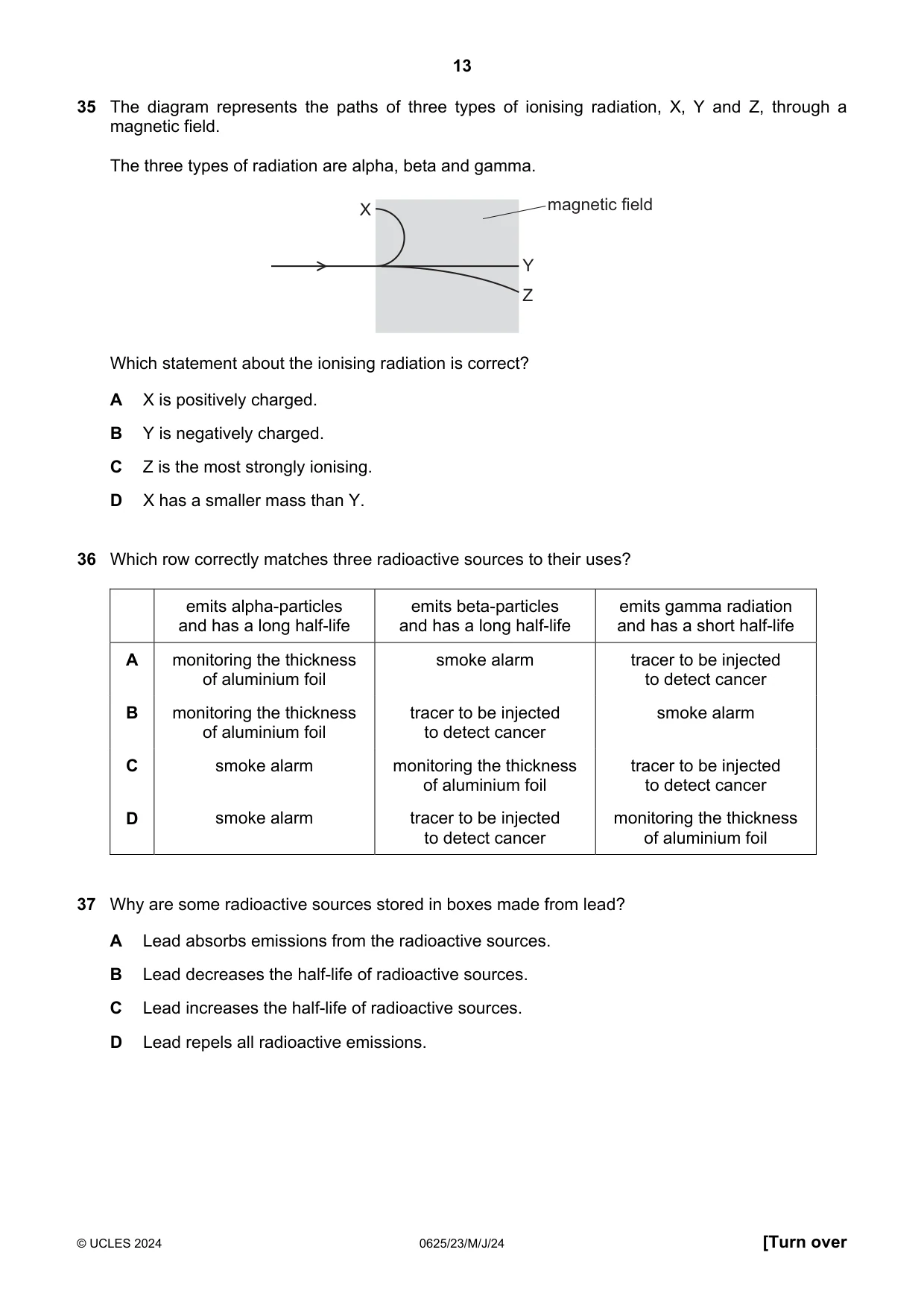
Q35 · The diagram represents the paths of three types of ionising radiation, X, Y and Z…
35 The diagram represents the paths of three types of ionising radiation, X, Y and Z, through a magnetic field. The three types of radiation are alpha, beta and gamma. X magnetic field Y Z Which statement about the ionising radiation is correct? A X is positively charged. B Y is negatively charged. C Z is the most strongly ionising. D X has a smaller mass than Y.
Mark scheme: C
Q36 · Which row correctly matches three radioactive sources to their uses?
36 Which row correctly matches three radioactive sources to their uses? emits alpha-particles emits beta-particles emits gamma radiation and has a long half-life and has a long half-life and has a short half-life A monitoring the thickness smoke alarm tracer to be injected of aluminium foil to detect cancer B monitoring the thickness tracer to be injected smoke alarm of aluminium foil to detect cancer C smoke alarm monitoring the thickness tracer to be injected of aluminium foil to detect cancer D smoke alarm tracer to be injected monitoring the thickness to detect cancer of aluminium foil
Mark scheme: C
Q37 · Why are some radioactive sources stored in boxes made from lead?
37 Why are some radioactive sources stored in boxes made from lead? A Lead absorbs emissions from the radioactive sources. B Lead decreases the half-life of radioactive sources. C Lead increases the half-life of radioactive sources. D Lead repels all radioactive emissions.
Mark scheme: A
Q38 · The average distance from the Earth to the Sun is 1.5 1011 m
38 The average distance from the Earth to the Sun is 1.5 1011 m. What is the orbital speed of the Earth? A 4.0 105 km / day B 1.3 106 km / day C 2.6 106 km / day D 1.9 1014 km / day
Mark scheme: C
Q39 · In which order are the objects listed formed during the life cycle of a star?
39 In which order are the objects listed formed during the life cycle of a star? A protostar red giant supernova stable star B protostar stable star red giant supernova C red giant stable star protostar supernova D red giant supernova protostar stable star
Mark scheme: B
Q40 · What is the distance travelled by light in one year?
40 What is the distance travelled by light in one year? A 5.9 1015 m B 5.9 1015 km C 9.5 1015 m D 9.5 1015 km
Mark scheme: C
What was in this paper
The subtopics covered by these 40 questions, and how many questions each got. Open one in a new tab to see every Cambridge question on it.
4Radioactivity4Kinetic particle model of matter3Light3Thermal properties and temperature3Electromagnetic spectrum2Forces2General properties of waves2Motion2Pressure2Simple phenomena of magnetism2Stars and the Universe2Electric circuits1Electromagnetic effects1Mass and weight1Momentum1Physical quantities and measurement techniques1Sound1The Earth and the Solar System1The nuclear model of the atom1Transfer of thermal energy1What you needed in this session
Cambridge’s own grade thresholds for 2024 May/June, Paper 2 · Variant 3. A higher threshold means an easier paper — the bar moves with how the cohort did.