Cambridge IGCSE Physics 0625 — 2016 May/June Paper 2 · Variant 3
0625/23/M/J/16 · 40 questions · 40 marks · ≈45 min
The question paper and its mark scheme, free to read here and free to download. This is Cambridge’s own paper, exactly as it was sat.
Question paper20 pages
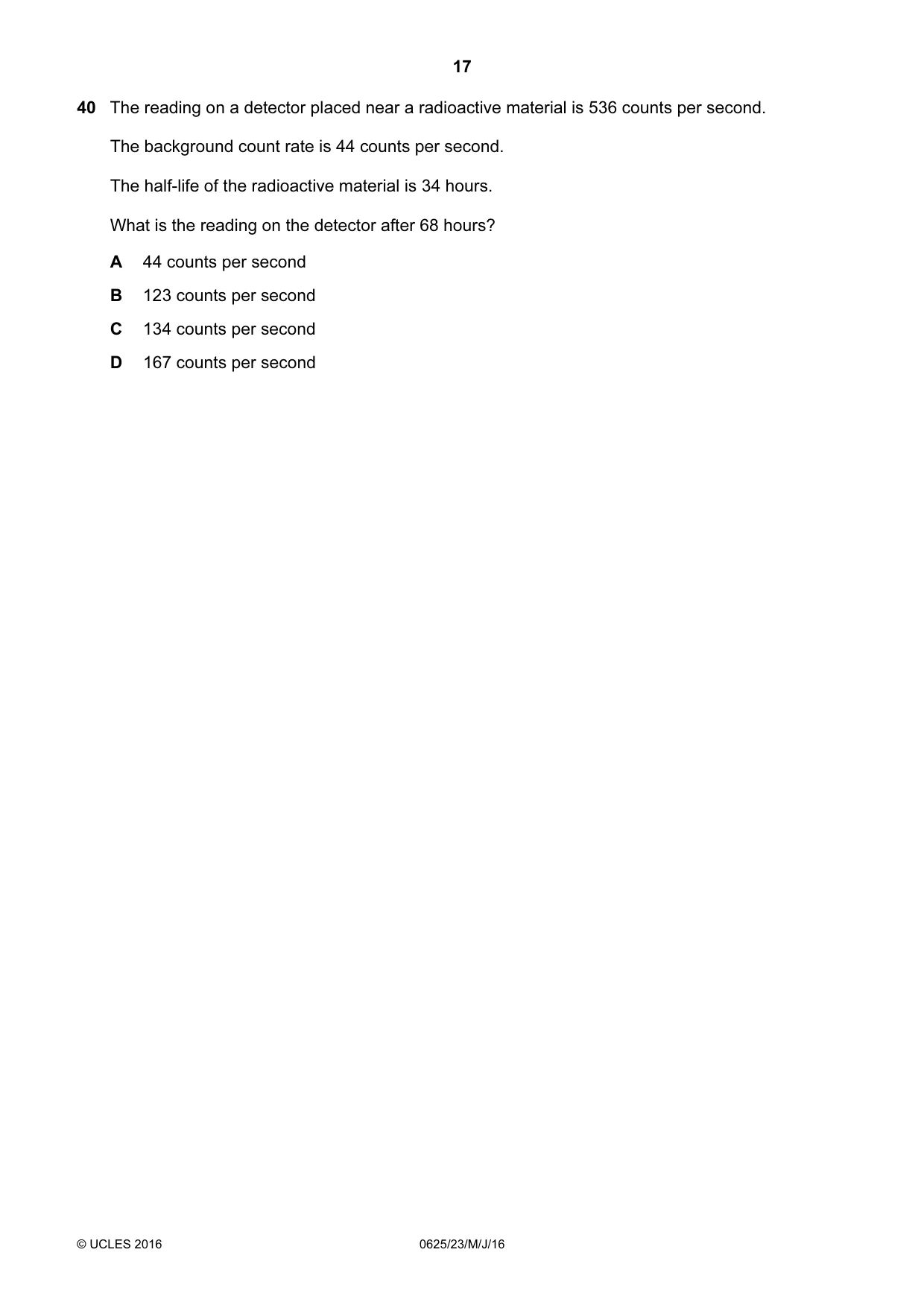


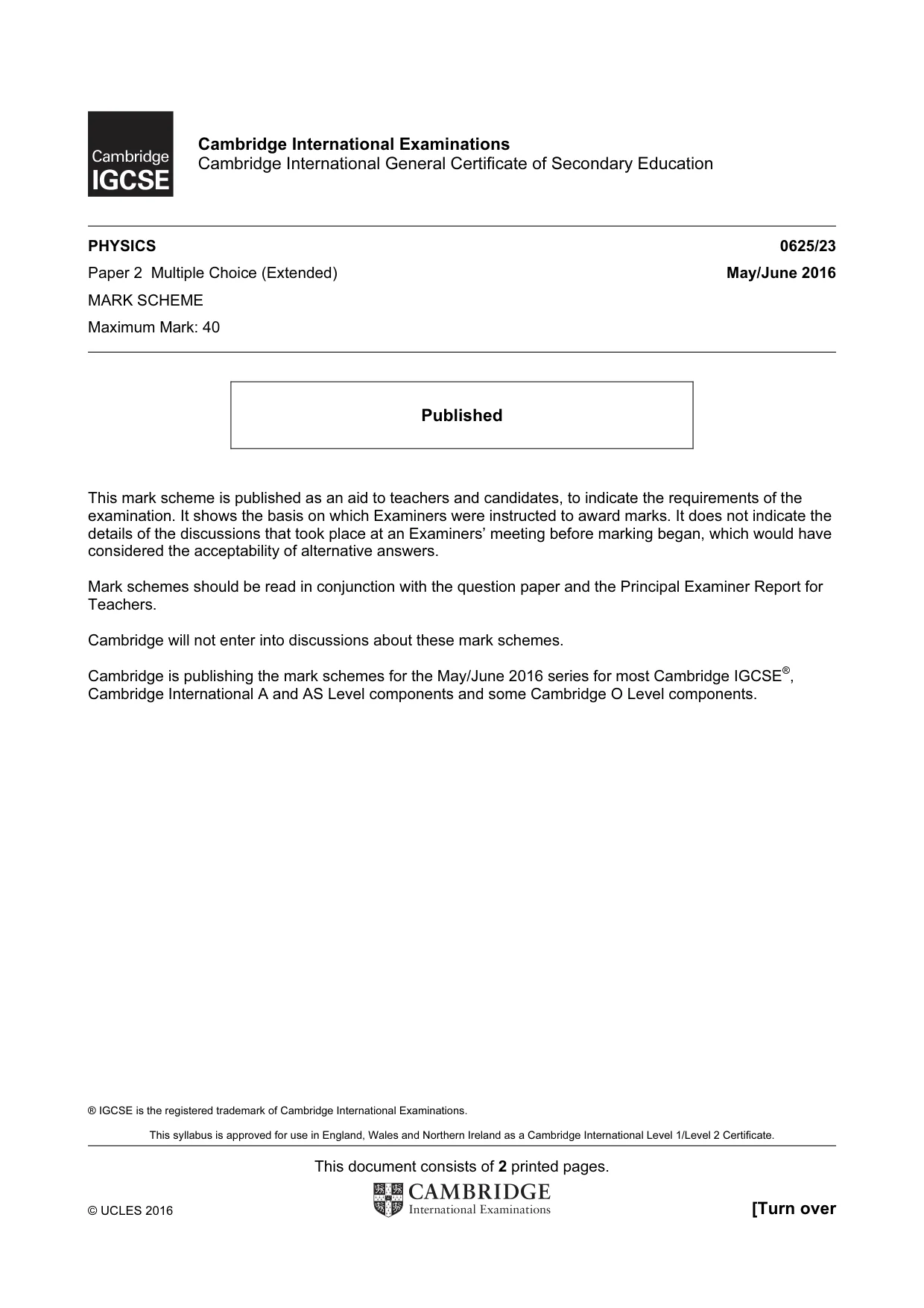
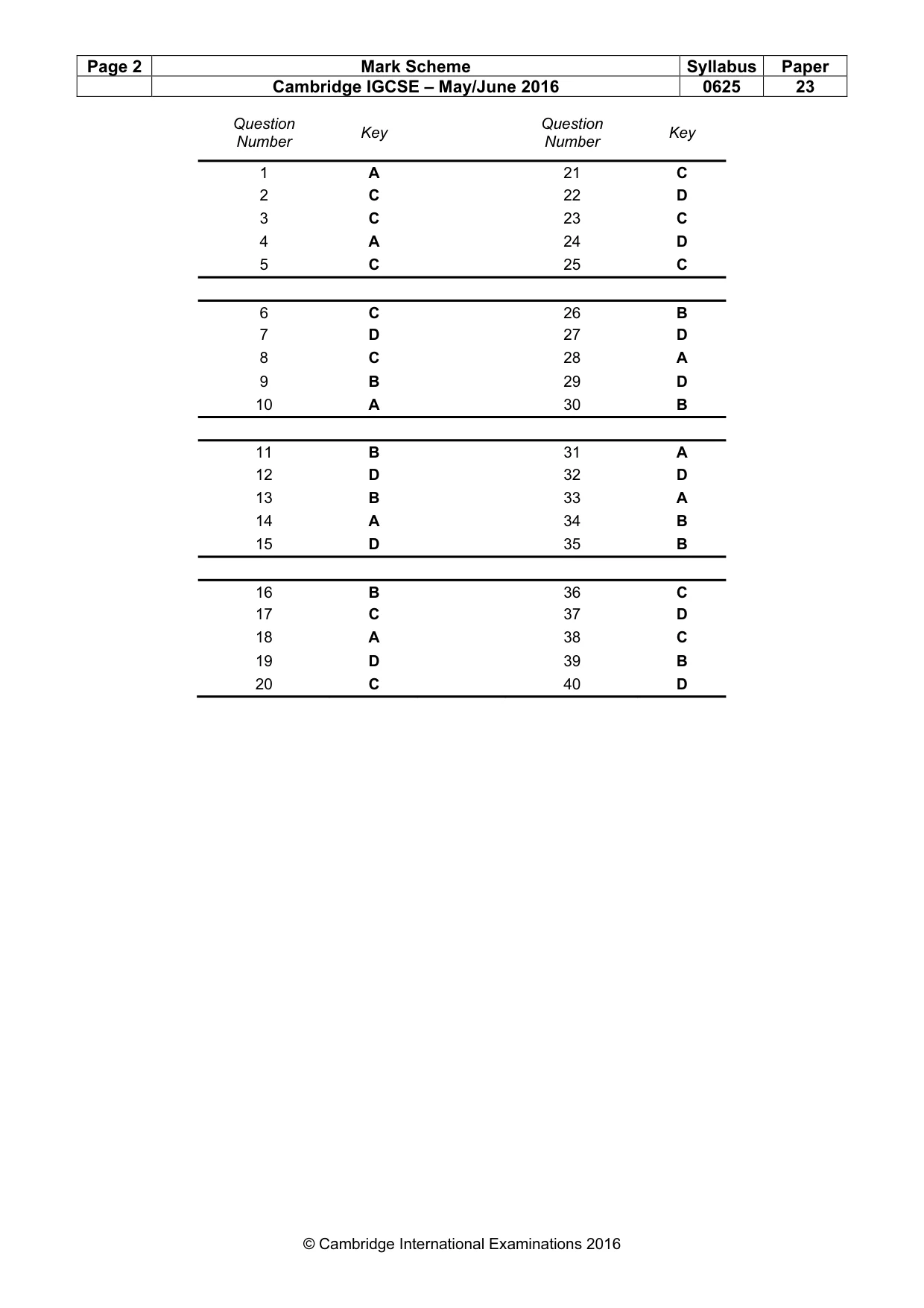
Mark scheme2 pages
Answers below. Sit the paper first if you are practising.
Questions as text
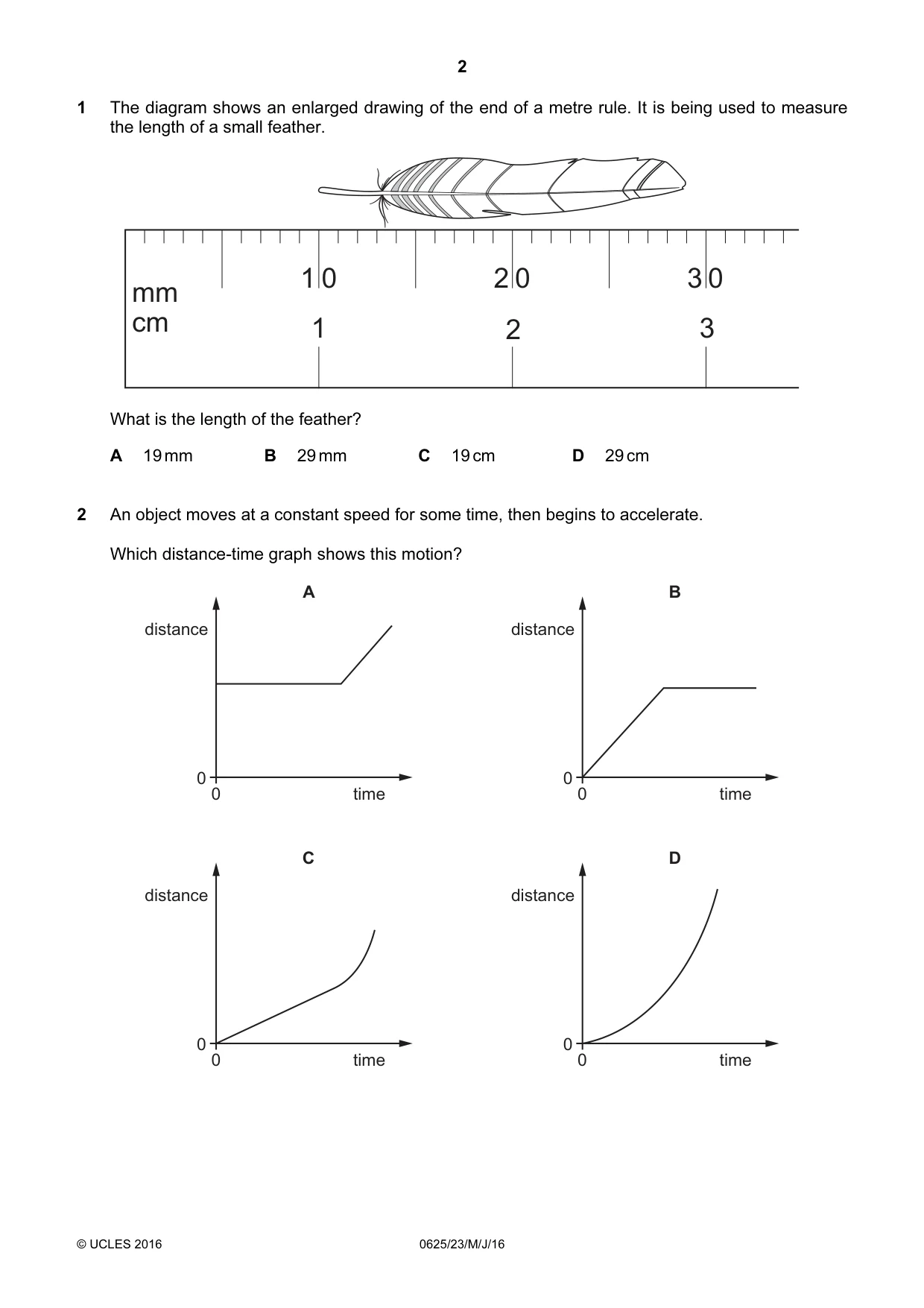
Q1 · The diagram shows an enlarged drawing of the end of a metre rule
1 The diagram shows an enlarged drawing of the end of a metre rule. It is being used to measure the length of a small feather. 1 0 2 0 3 0 mm cm 1 2 3 What is the length of the feather? A 19 mm B 29 mm C 19 cm D 29 cm
Mark scheme: A
More questions on Physical quantities and measurement techniques
Q2 · An object moves at a constant speed for some time, then begins to accelerate
2 An object moves at a constant speed for some time, then begins to accelerate. Which distance-time graph shows this motion? A B distance distance 0 0 0 time 0 time C D distance distance 0 0 0 time 0 time
Mark scheme: C
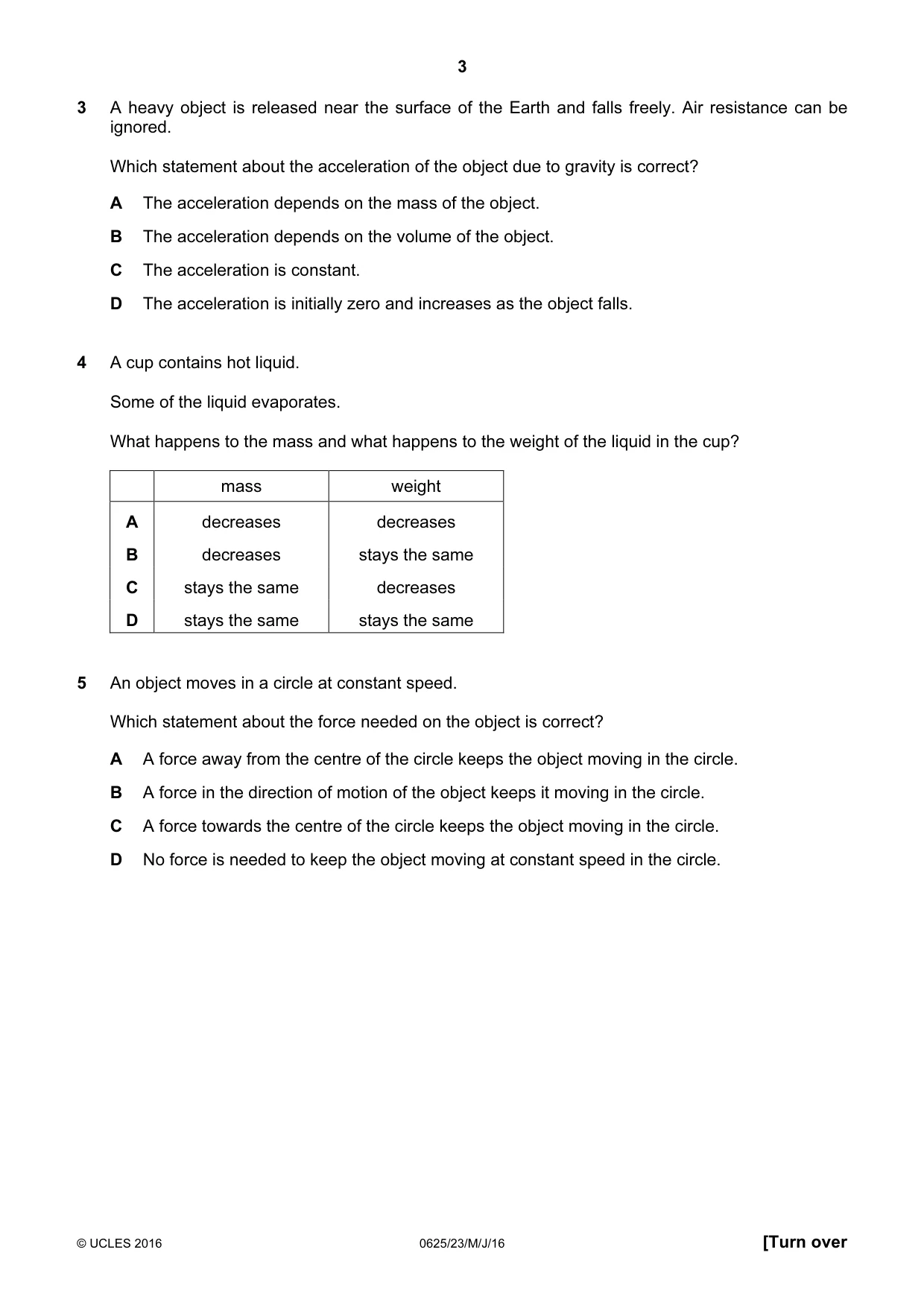
Q3 · A heavy object is released near the surface of the Earth and falls freely
3 A heavy object is released near the surface of the Earth and falls freely. Air resistance can be ignored. Which statement about the acceleration of the object due to gravity is correct? A The acceleration depends on the mass of the object. B The acceleration depends on the volume of the object. C The acceleration is constant. D The acceleration is initially zero and increases as the object falls.
Mark scheme: C
Q4 · A cup contains hot liquid
4 A cup contains hot liquid. Some of the liquid evaporates. What happens to the mass and what happens to the weight of the liquid in the cup? mass weight A decreases decreases B decreases stays the same C stays the same decreases D stays the same stays the same
Mark scheme: A
Q5 · An object moves in a circle at constant speed
5 An object moves in a circle at constant speed. Which statement about the force needed on the object is correct? A A force away from the centre of the circle keeps the object moving in the circle. B A force in the direction of motion of the object keeps it moving in the circle. C A force towards the centre of the circle keeps the object moving in the circle. D No force is needed to keep the object moving at constant speed in the circle.
Mark scheme: C
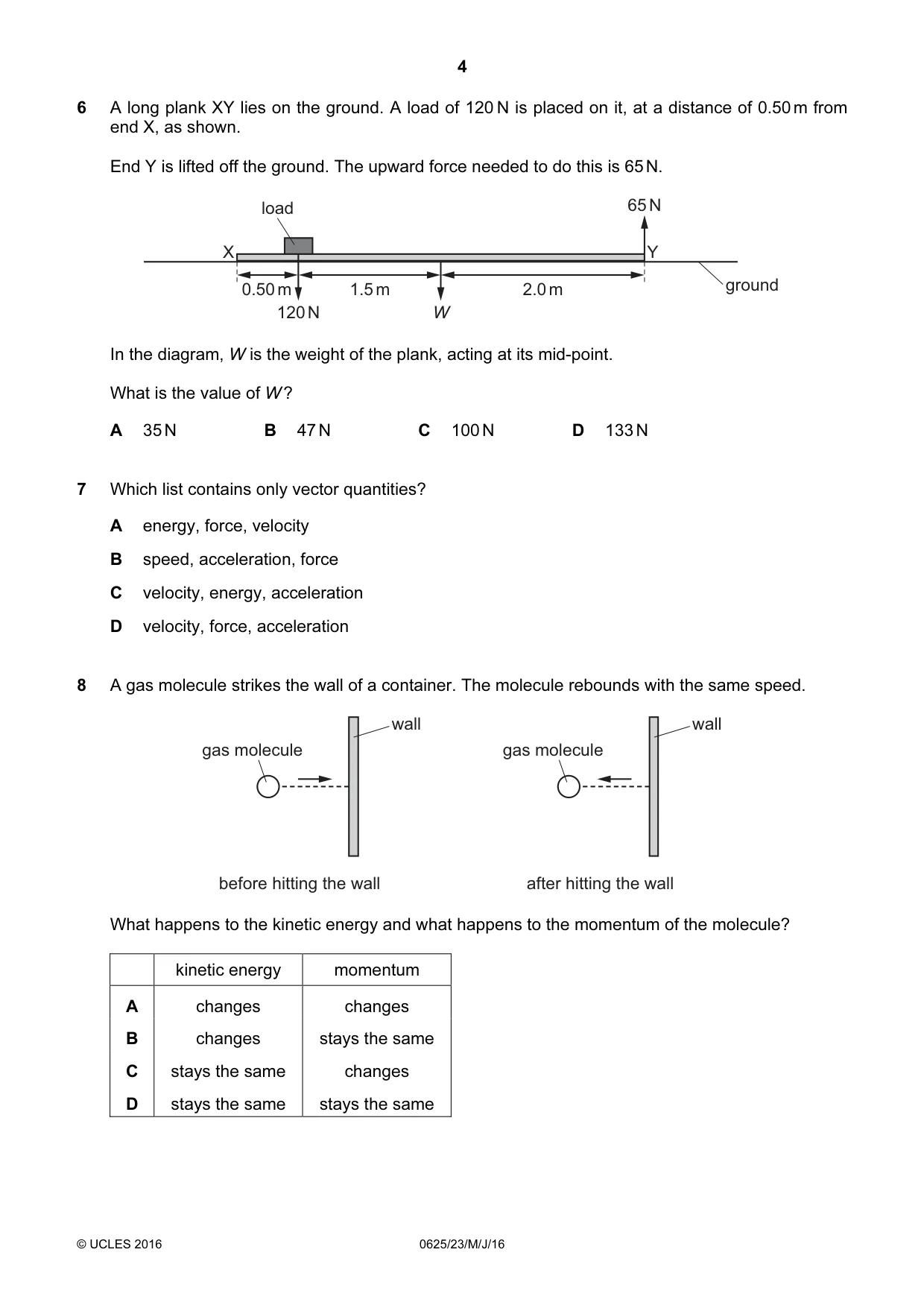
Q6 · A long plank XY lies on the ground
6 A long plank XY lies on the ground. A load of 120 N is placed on it, at a distance of 0.50 m from end X, as shown. End Y is lifted off the ground. The upward force needed to do this is 65 N. load 65 N X Y 0.50 m 1.5 m 2.0 m ground 120 N W In the diagram, W is the weight of the plank, acting at its mid-point. What is the value of W ? A 35 N B 47 N C 100 N D 133 N
Mark scheme: C
Q7 · Which list contains only vector quantities?
7 Which list contains only vector quantities? A energy, force, velocity B speed, acceleration, force C velocity, energy, acceleration D velocity, force, acceleration
Mark scheme: D
More questions on Physical quantities and measurement techniques
Q8 · A gas molecule strikes the wall of a container
8 A gas molecule strikes the wall of a container. The molecule rebounds with the same speed. wall wall gas molecule gas molecule before hitting the wall after hitting the wall What happens to the kinetic energy and what happens to the momentum of the molecule? kinetic energy momentum A changes changes B changes stays the same C stays the same changes D stays the same stays the same
Mark scheme: C
Q9 · Which energy resource does not derive its energy from the Sun?
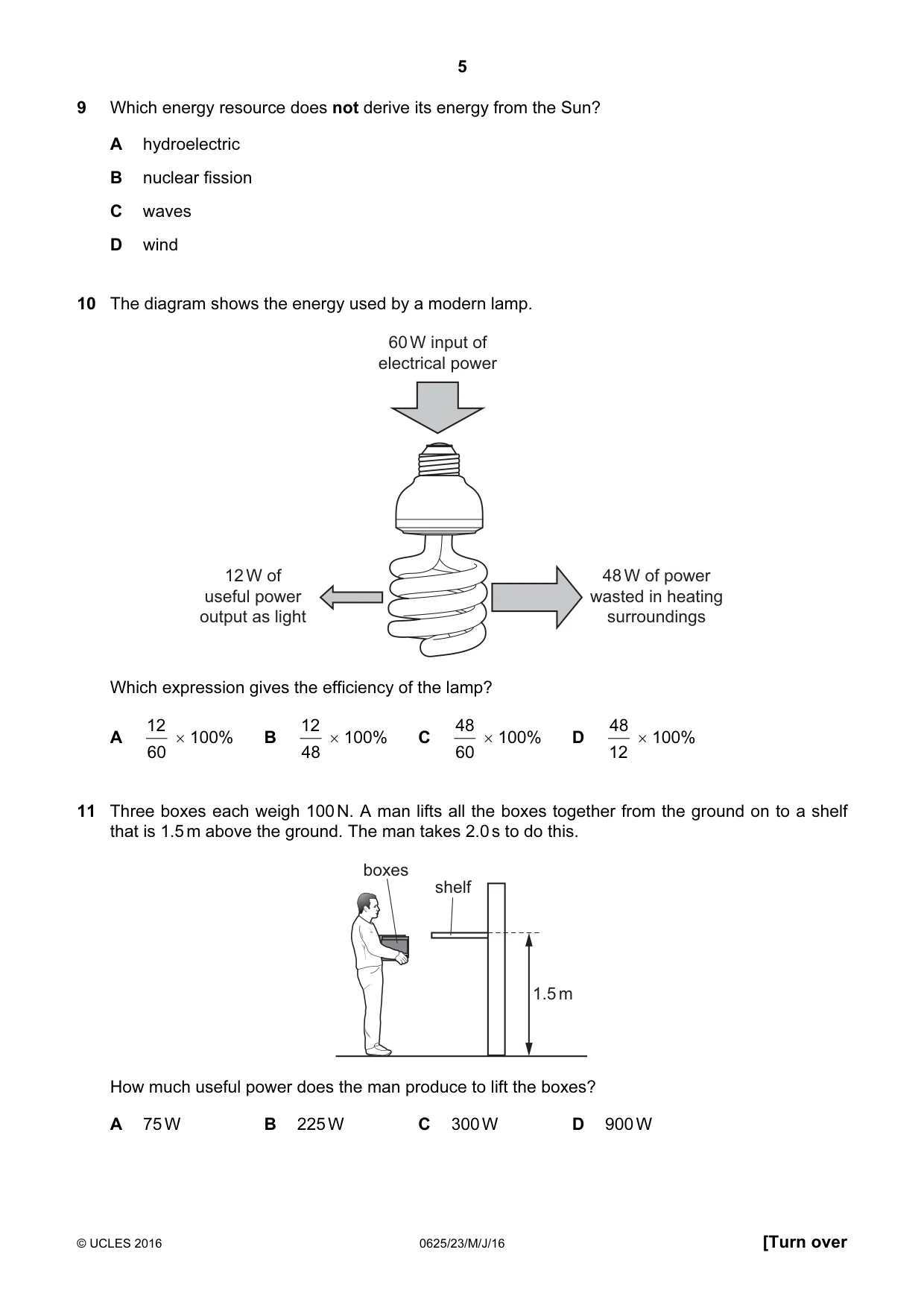
9 Which energy resource does not derive its energy from the Sun? A hydroelectric B nuclear fission C waves D wind
Mark scheme: B
Q10 · The diagram shows the energy used by a modern lamp
10 The diagram shows the energy used by a modern lamp. 60 W input of electrical power 12 W of 48 W of power useful power wasted in heating output as light surroundings Which expression gives the efficiency of the lamp? 12 × 100% 12 × 100% 48 × 100% 48 × 100% A B C D 60 48 60 12
Mark scheme: A
Q11 · Three boxes each weigh 100 N
11 Three boxes each weigh 100 N. A man lifts all the boxes together from the ground on to a shelf that is 1.5 m above the ground. The man takes 2.0 s to do this. boxes shelf 1.5 m How much useful power does the man produce to lift the boxes? A 75 W B 225 W C 300 W D 900 W
Mark scheme: B
Q12 · A diver under water uses breathing apparatus at a depth where the pressure is 1.25 × 10⁵…
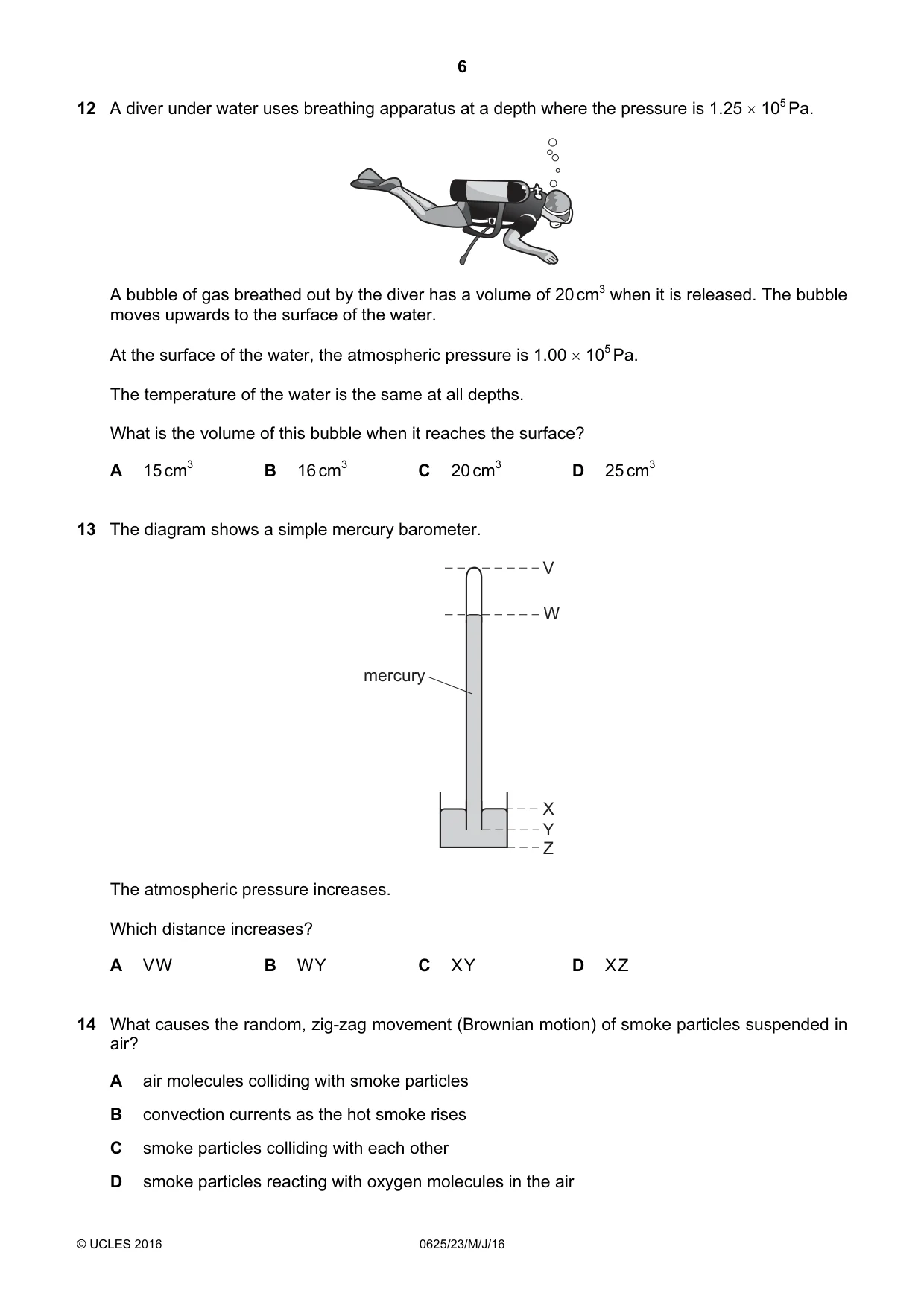
12 A diver under water uses breathing apparatus at a depth where the pressure is 1.25 × 10⁵ Pa. A bubble of gas breathed out by the diver has a volume of 20 cm3 when it is released. The bubble moves upwards to the surface of the water. At the surface of the water, the atmospheric pressure is 1.00 × 10⁵ Pa. The temperature of the water is the same at all depths. What is the volume of this bubble when it reaches the surface? A 15 cm3 B 16 cm3 C 20 cm3 D 25 cm3
Mark scheme: D
Q13 · The diagram shows a simple mercury barometer
13 The diagram shows a simple mercury barometer. V W mercury X Y Z The atmospheric pressure increases. Which distance increases? A VW B WY C XY D XZ
Mark scheme: B
Q14 · What causes the random, zig-zag movement (Brownian motion) of smoke particles suspended…
14 What causes the random, zig-zag movement (Brownian motion) of smoke particles suspended in air? A air molecules colliding with smoke particles B convection currents as the hot smoke rises C smoke particles colliding with each other D smoke particles reacting with oxygen molecules in the air
Mark scheme: A
Q15 · A sealed bottle of constant volume contains air
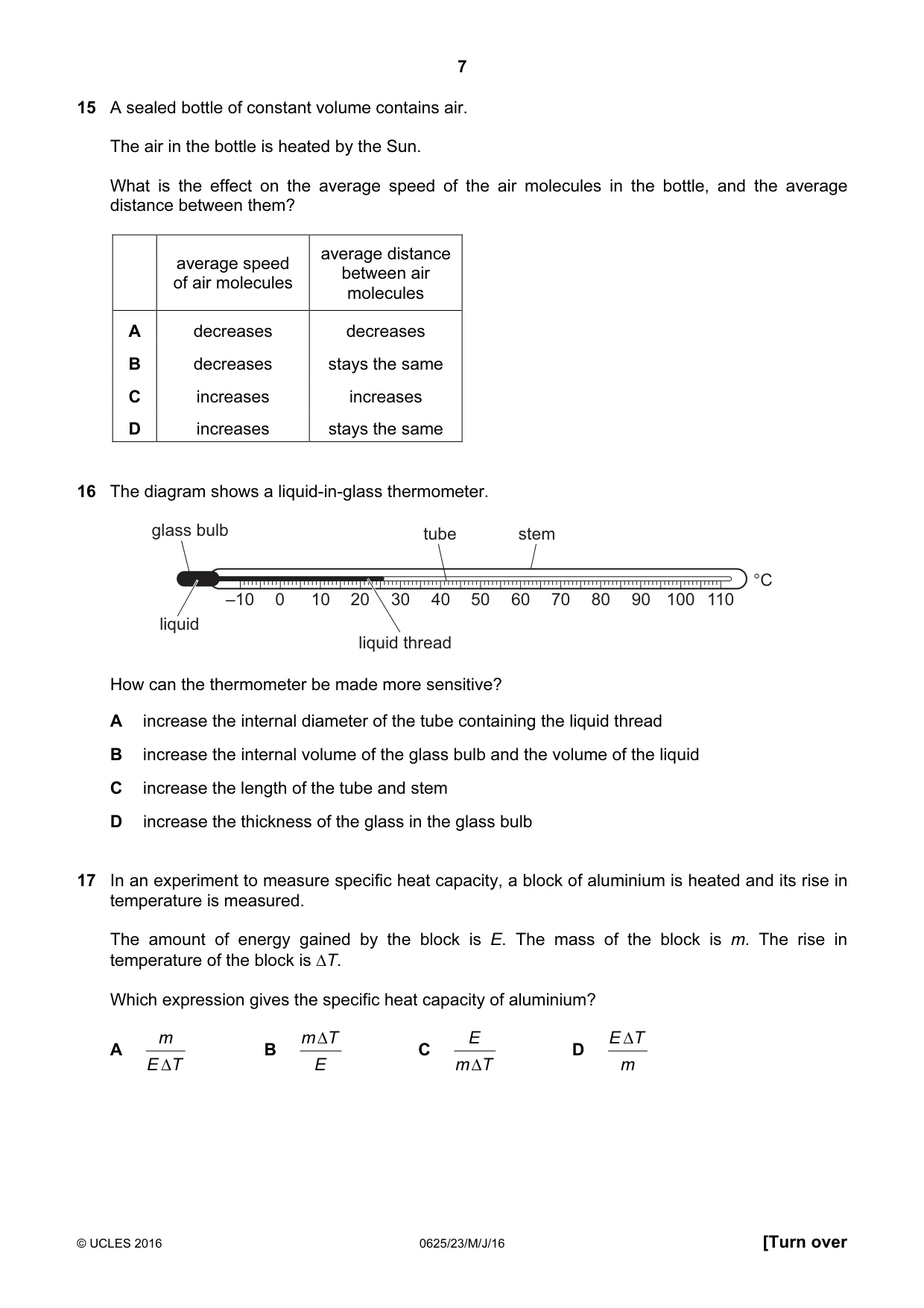
15 A sealed bottle of constant volume contains air. The air in the bottle is heated by the Sun. What is the effect on the average speed of the air molecules in the bottle, and the average distance between them? average distance average speed between air of air molecules molecules A decreases decreases B decreases stays the same C increases increases D increases stays the same
Mark scheme: D
Q16 · The diagram shows a liquid-in-glass thermometer
16 The diagram shows a liquid-in-glass thermometer. glass bulb tube stem °C –10 0 10 20 30 40 50 60 70 80 90 100 110 liquid liquid thread How can the thermometer be made more sensitive? A increase the internal diameter of the tube containing the liquid thread B increase the internal volume of the glass bulb and the volume of the liquid C increase the length of the tube and stem D increase the thickness of the glass in the glass bulb
Mark scheme: B
Q17 · In an experiment to measure specific heat capacity, a block of aluminium is heated and…
17 In an experiment to measure specific heat capacity, a block of aluminium is heated and its rise in temperature is measured. The amount of energy gained by the block is E. The mass of the block is m. The rise in temperature of the block is ∆T. Which expression gives the specific heat capacity of aluminium? m m∆ T E E ∆ T A B C D E ∆ T E m ∆ T m
Mark scheme: C
Q18 · Which row shows the surface that is the better absorber and the surface that is the…
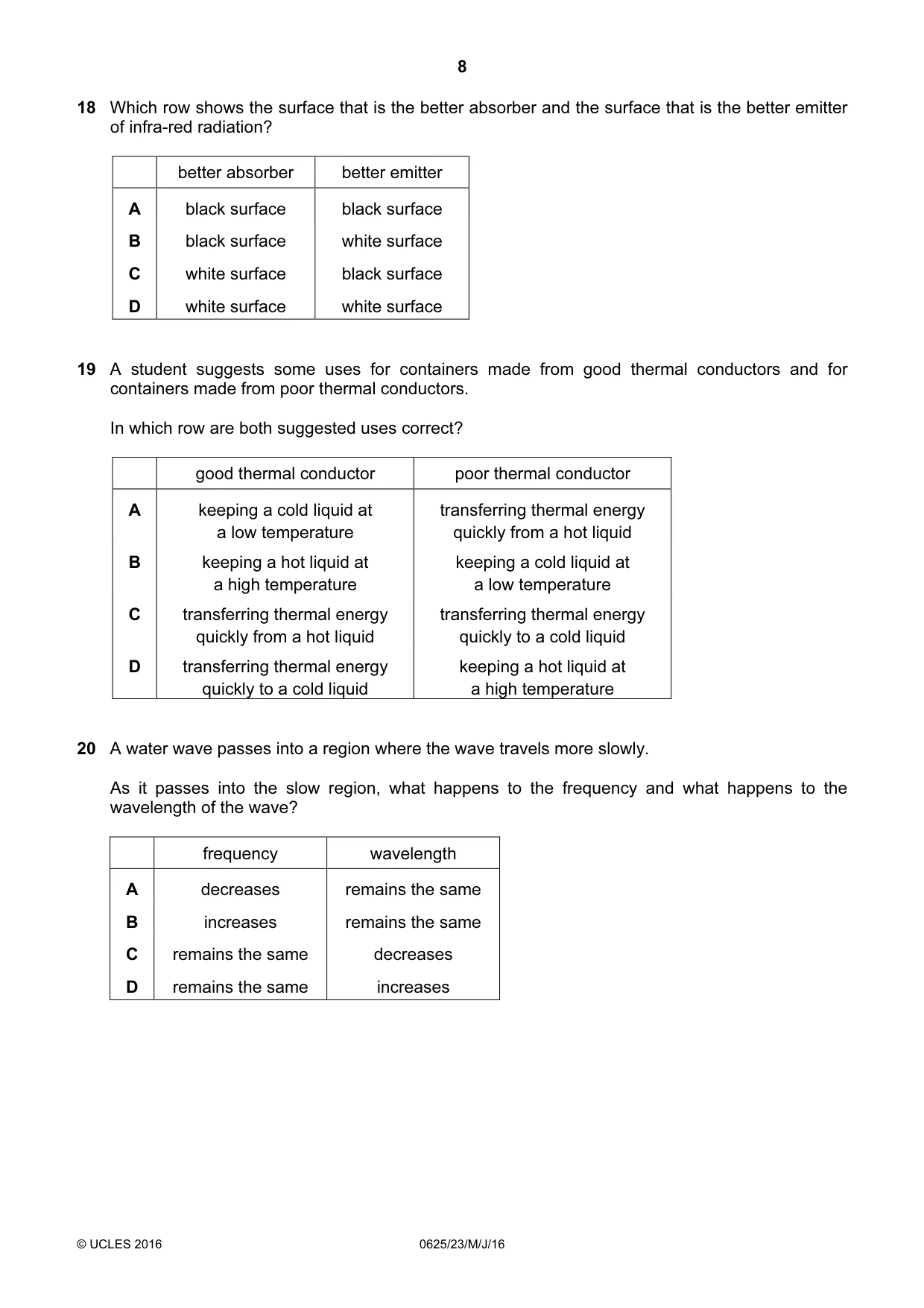
18 Which row shows the surface that is the better absorber and the surface that is the better emitter of infra-red radiation? better absorber better emitter A black surface black surface B black surface white surface C white surface black surface D white surface white surface
Mark scheme: A
Q19 · A student suggests some uses for containers made from good thermal conductors and for…
19 A student suggests some uses for containers made from good thermal conductors and for containers made from poor thermal conductors. In which row are both suggested uses correct? good thermal conductor poor thermal conductor A keeping a cold liquid at transferring thermal energy a low temperature quickly from a hot liquid B keeping a hot liquid at keeping a cold liquid at a high temperature a low temperature C transferring thermal energy transferring thermal energy quickly from a hot liquid quickly to a cold liquid D transferring thermal energy keeping a hot liquid at quickly to a cold liquid a high temperature
Mark scheme: D
Q20 · A water wave passes into a region where the wave travels more slowly
20 A water wave passes into a region where the wave travels more slowly. As it passes into the slow region, what happens to the frequency and what happens to the wavelength of the wave? frequency wavelength A decreases remains the same B increases remains the same C remains the same decreases D remains the same increases
Mark scheme: C
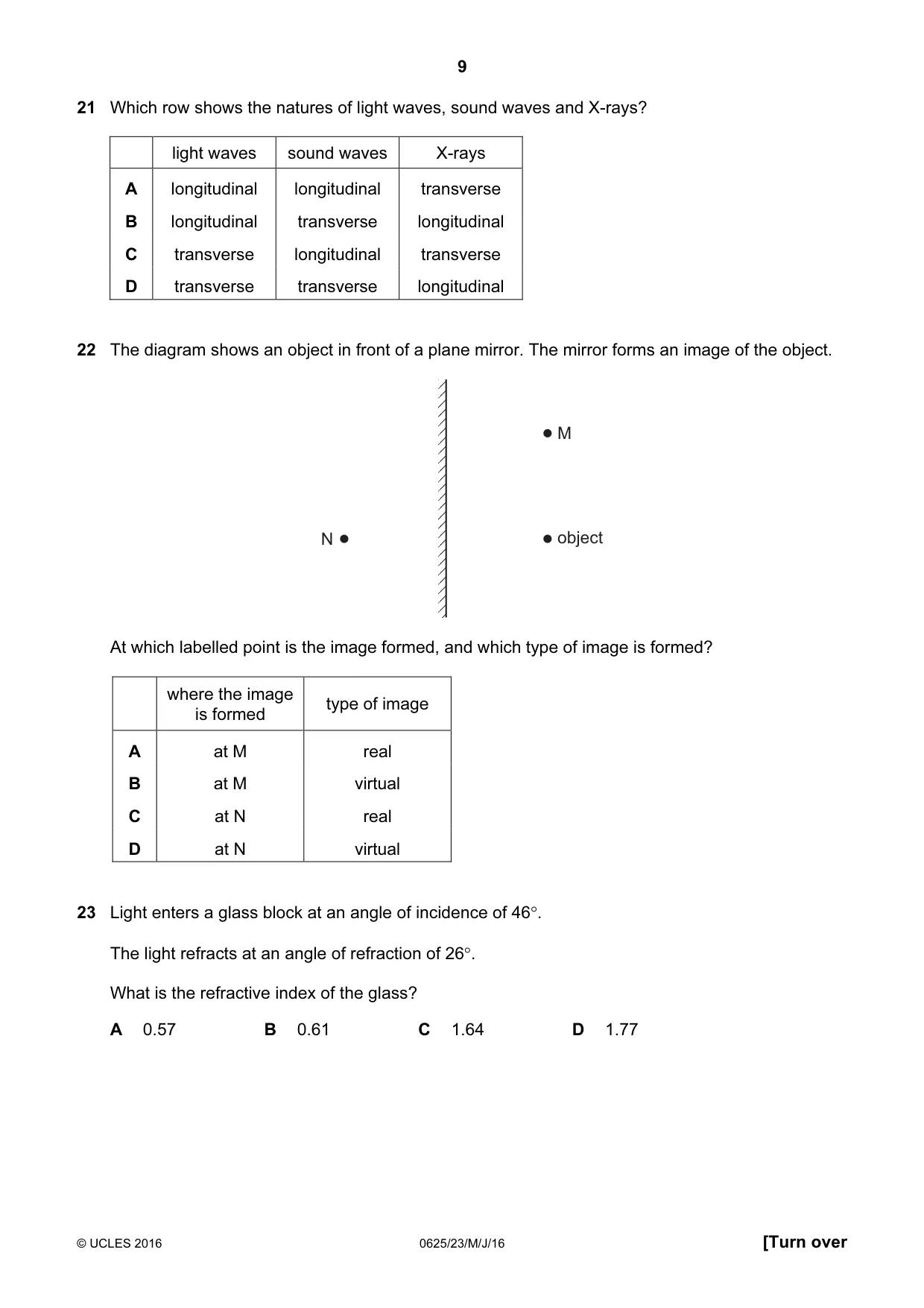
Q21 · Which row shows the natures of light waves, sound waves and X-rays?
21 Which row shows the natures of light waves, sound waves and X-rays? light waves sound waves X-rays A longitudinal longitudinal transverse B longitudinal transverse longitudinal C transverse longitudinal transverse D transverse transverse longitudinal
Mark scheme: C
Q22 · The diagram shows an object in front of a plane mirror
22 The diagram shows an object in front of a plane mirror. The mirror forms an image of the object. M N object At which labelled point is the image formed, and which type of image is formed? where the image type of image is formed A at M real B at M virtual C at N real D at N virtual
Mark scheme: D
Q23 · Light enters a glass block at an angle of incidence of 46°
23 Light enters a glass block at an angle of incidence of 46°. The light refracts at an angle of refraction of 26°. What is the refractive index of the glass? A 0.57 B 0.61 C 1.64 D 1.77
Mark scheme: C
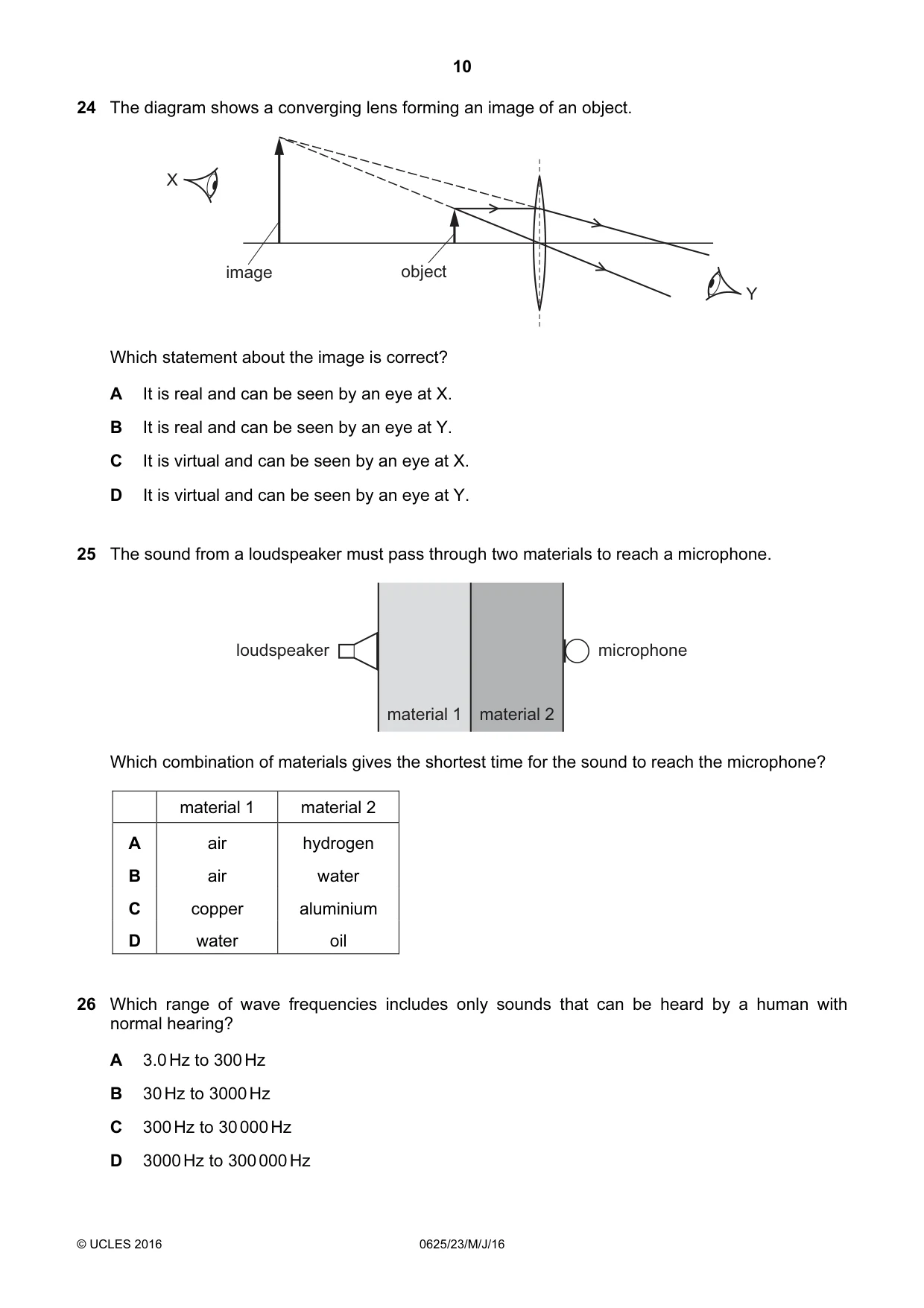
Q24 · The diagram shows a converging lens forming an image of an object
24 The diagram shows a converging lens forming an image of an object. X image object Y Which statement about the image is correct? A It is real and can be seen by an eye at X. B It is real and can be seen by an eye at Y. C It is virtual and can be seen by an eye at X. D It is virtual and can be seen by an eye at Y.
Mark scheme: D
Q25 · The sound from a loudspeaker must pass through two materials to reach a microphone
25 The sound from a loudspeaker must pass through two materials to reach a microphone. loudspeaker microphone material 1 material 2 Which combination of materials gives the shortest time for the sound to reach the microphone? material 1 material 2 A air hydrogen B air water C copper aluminium D water oil
Mark scheme: C
Q26 · Which range of wave frequencies includes only sounds that can be heard by a human with…
26 Which range of wave frequencies includes only sounds that can be heard by a human with normal hearing? A 3.0 Hz to 300 Hz B 30 Hz to 3000 Hz C 300 Hz to 30 000 Hz D 3000 Hz to 300 000 Hz
Mark scheme: B
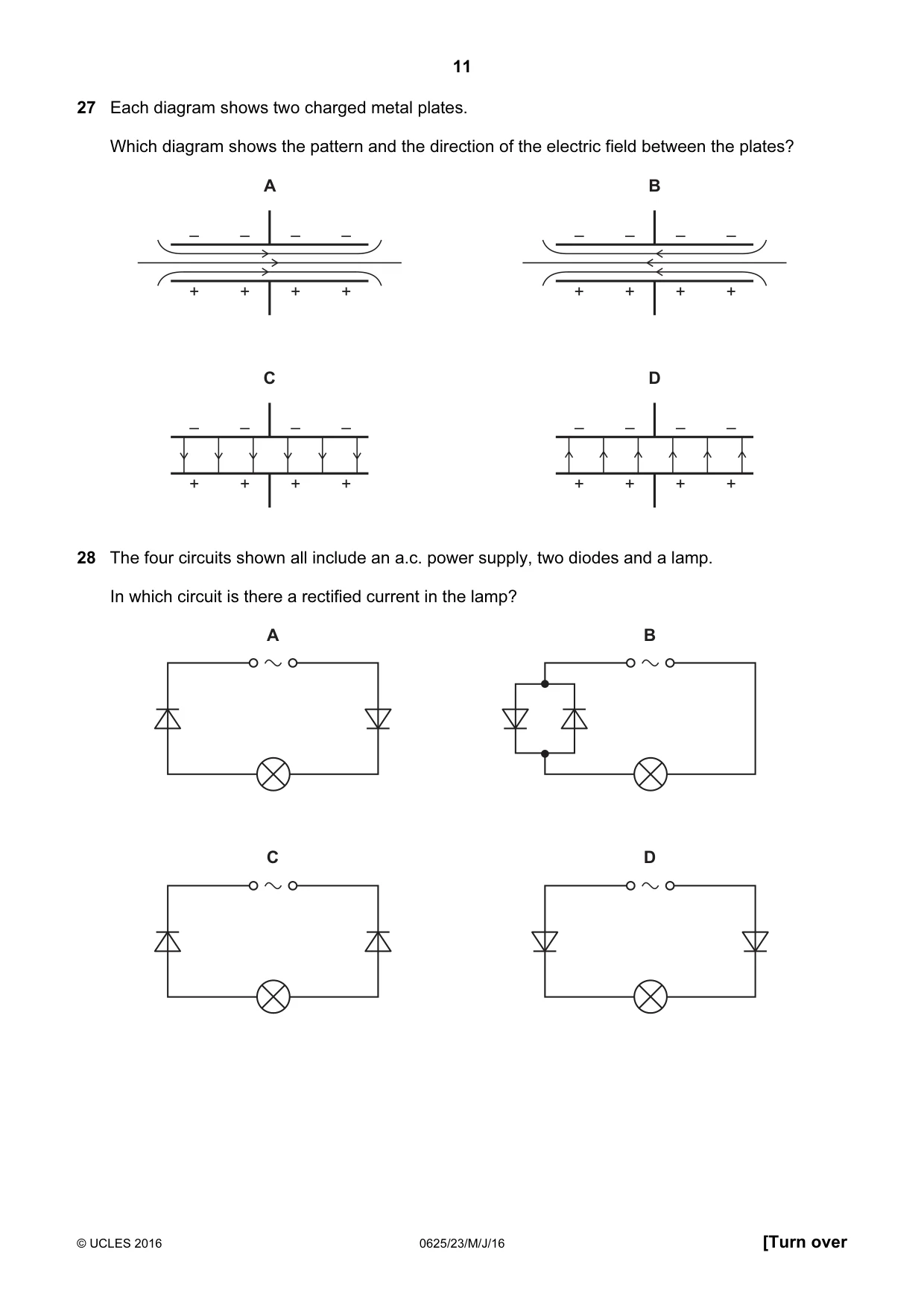
Q27 · Each diagram shows two charged metal plates
27 Each diagram shows two charged metal plates. Which diagram shows the pattern and the direction of the electric field between the plates? A B – – – – – – – – + + + + + + + + C D – – – – – – – – + + + + + + + +
Mark scheme: D
Q28 · The four circuits shown all include an a.c
28 The four circuits shown all include an a.c. power supply, two diodes and a lamp. In which circuit is there a rectified current in the lamp? A B C D
Mark scheme: A
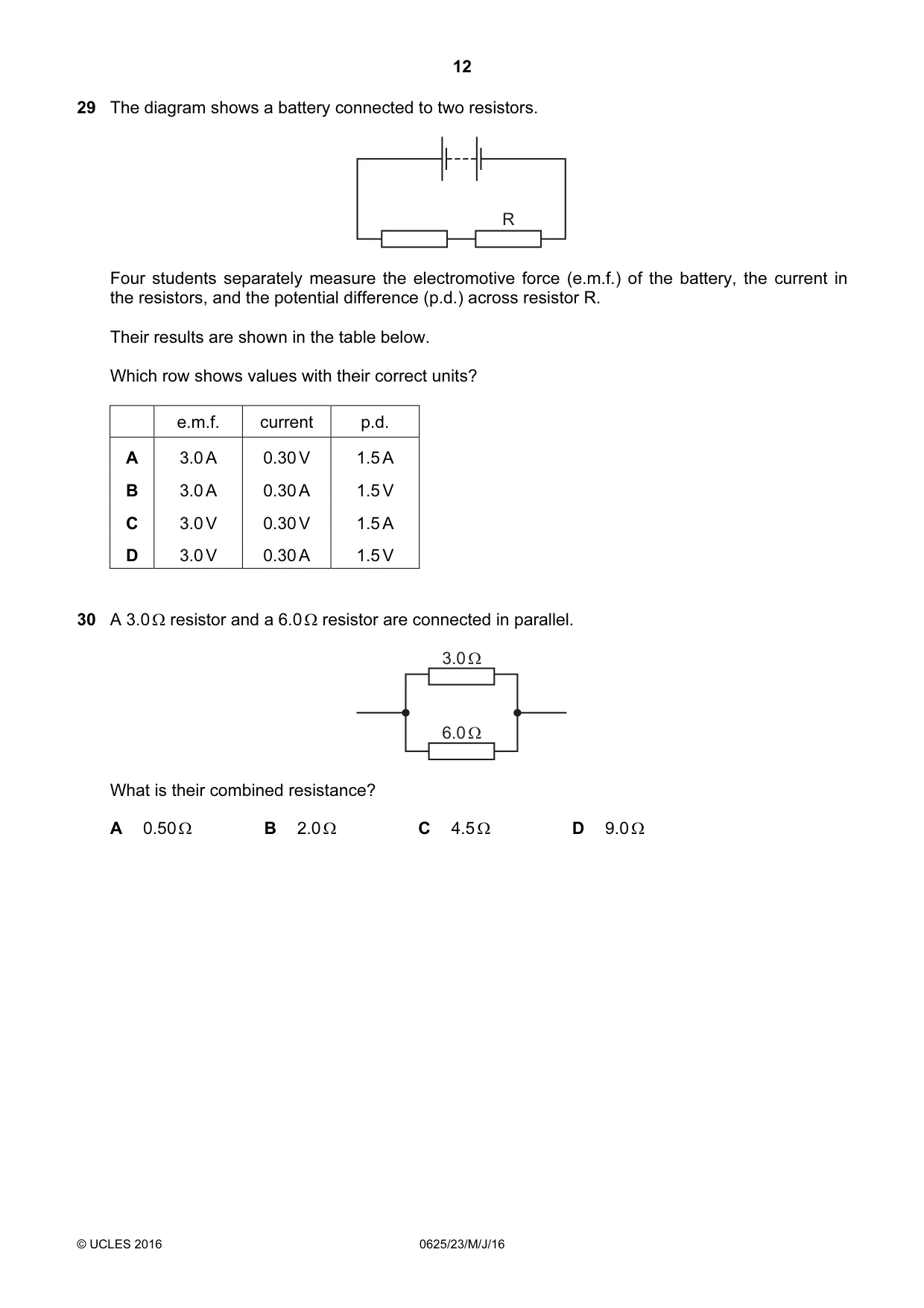
Q29 · The diagram shows a battery connected to two resistors
29 The diagram shows a battery connected to two resistors. R Four students separately measure the electromotive force (e.m.f.) of the battery, the current in the resistors, and the potential difference (p.d.) across resistor R. Their results are shown in the table below. Which row shows values with their correct units? e.m.f. current p.d. A 3.0 A 0.30 V 1.5 A B 3.0 A 0.30 A 1.5 V C 3.0 V 0.30 V 1.5 A D 3.0 V 0.30 A 1.5 V
Mark scheme: D
Q30 · A 3.0 Ω resistor and a 6.0 Ω resistor are connected in parallel
30 A 3.0 Ω resistor and a 6.0 Ω resistor are connected in parallel. 3.0 Ω 6.0 Ω What is their combined resistance? A 0.50 Ω B 2.0 Ω C 4.5 Ω D 9.0 Ω
Mark scheme: B
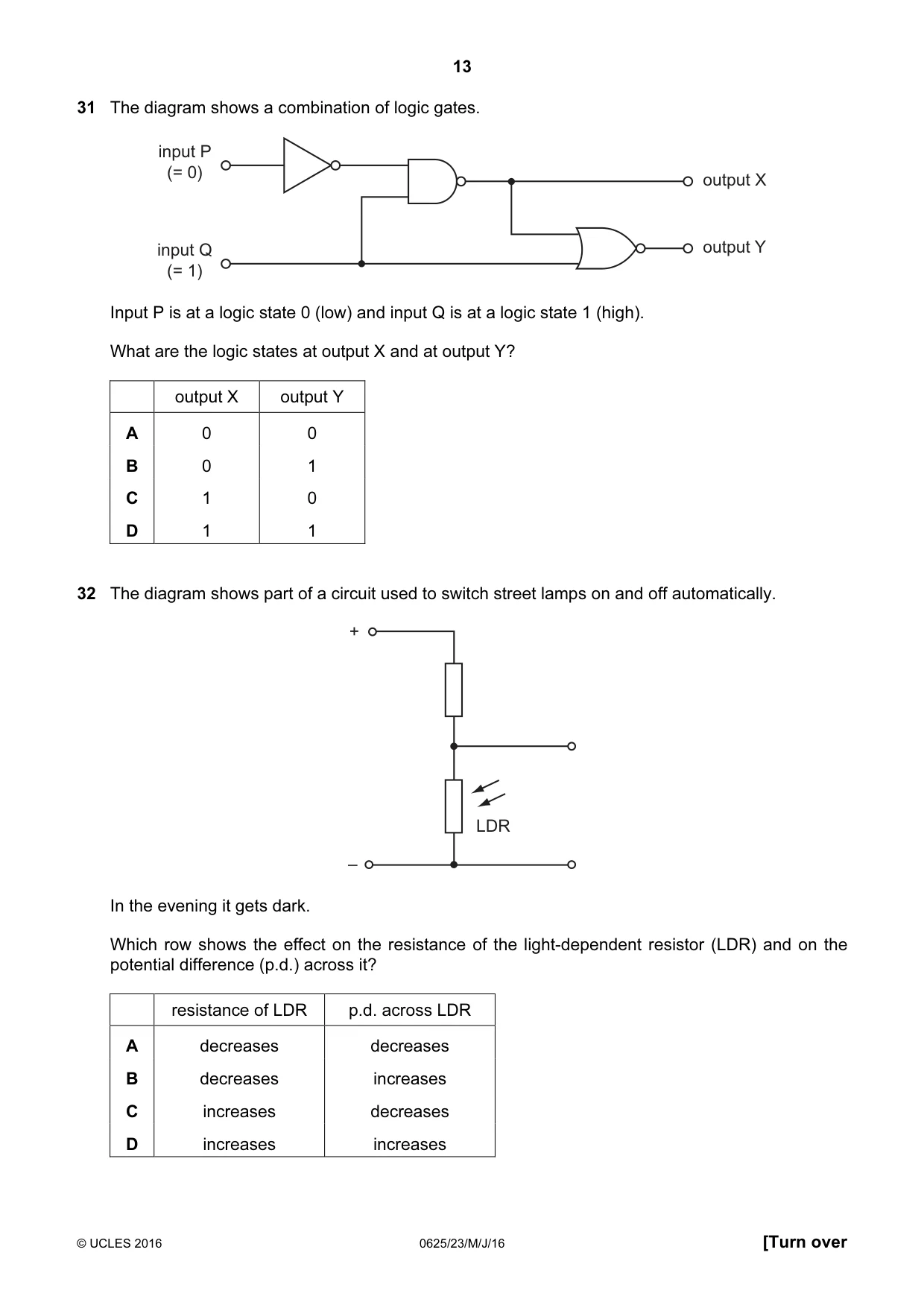
Q31 · The diagram shows a combination of logic gates
31 The diagram shows a combination of logic gates. input P (= 0) output X input Q output Y (= 1) Input P is at a logic state 0 (low) and input Q is at a logic state 1 (high). What are the logic states at output X and at output Y? output X output Y A 0 0 B 0 1 C 1 0 D 1 1
Mark scheme: A
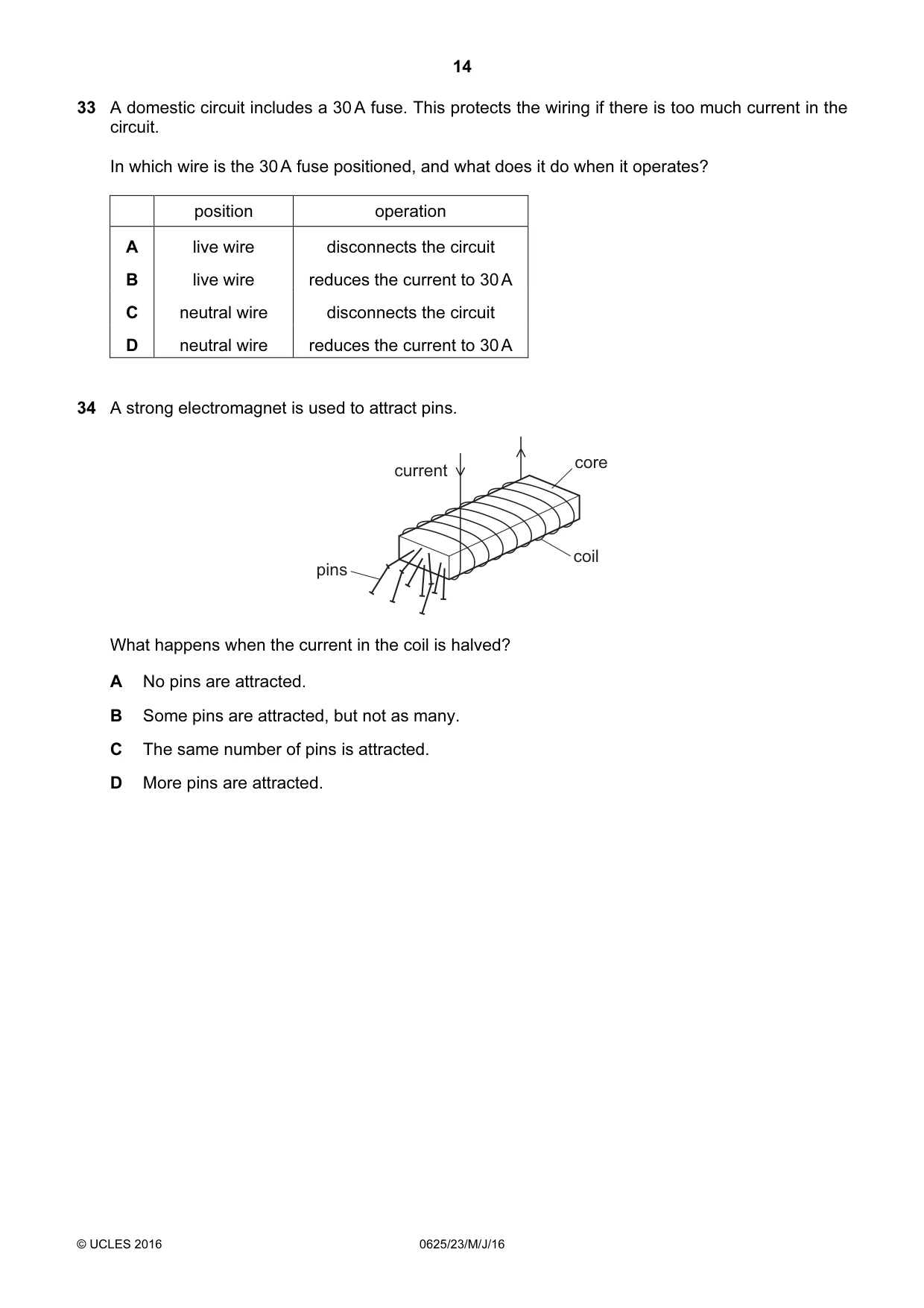
Q32 · The diagram shows part of a circuit used to switch street lamps on and off automatically
32 The diagram shows part of a circuit used to switch street lamps on and off automatically. + LDR – In the evening it gets dark. Which row shows the effect on the resistance of the light-dependent resistor (LDR) and on the potential difference (p.d.) across it? resistance of LDR p.d. across LDR A decreases decreases B decreases increases C increases decreases D increases increases
Mark scheme: D
Q33 · A domestic circuit includes a 30 A fuse
33 A domestic circuit includes a 30 A fuse. This protects the wiring if there is too much current in the circuit. In which wire is the 30 A fuse positioned, and what does it do when it operates? position operation A live wire disconnects the circuit B live wire reduces the current to 30 A C neutral wire disconnects the circuit D neutral wire reduces the current to 30 A
Mark scheme: A
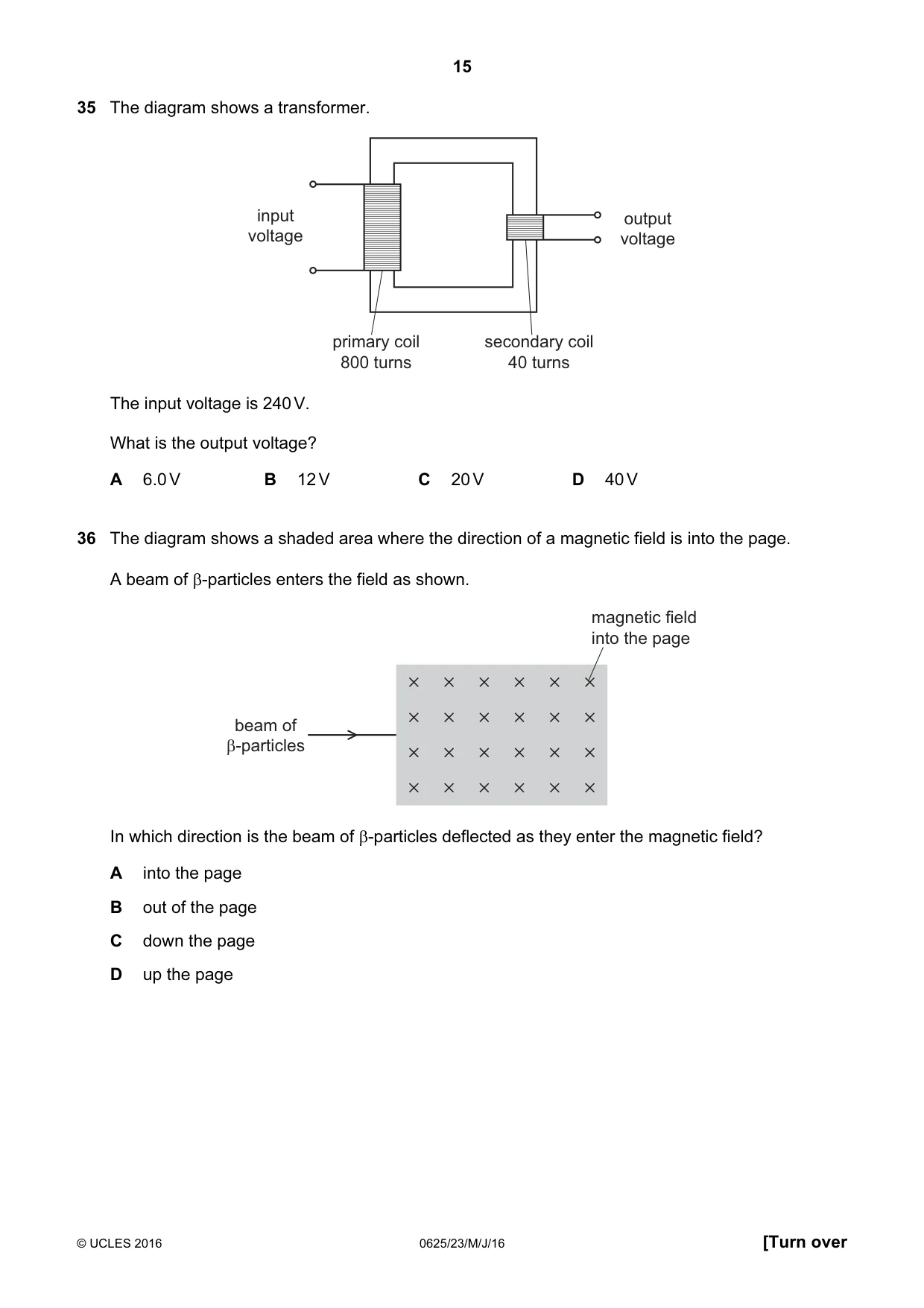
Q34 · A strong electromagnet is used to attract pins
34 A strong electromagnet is used to attract pins. core current coil pins What happens when the current in the coil is halved? A No pins are attracted. B Some pins are attracted, but not as many. C The same number of pins is attracted. D More pins are attracted.
Mark scheme: B
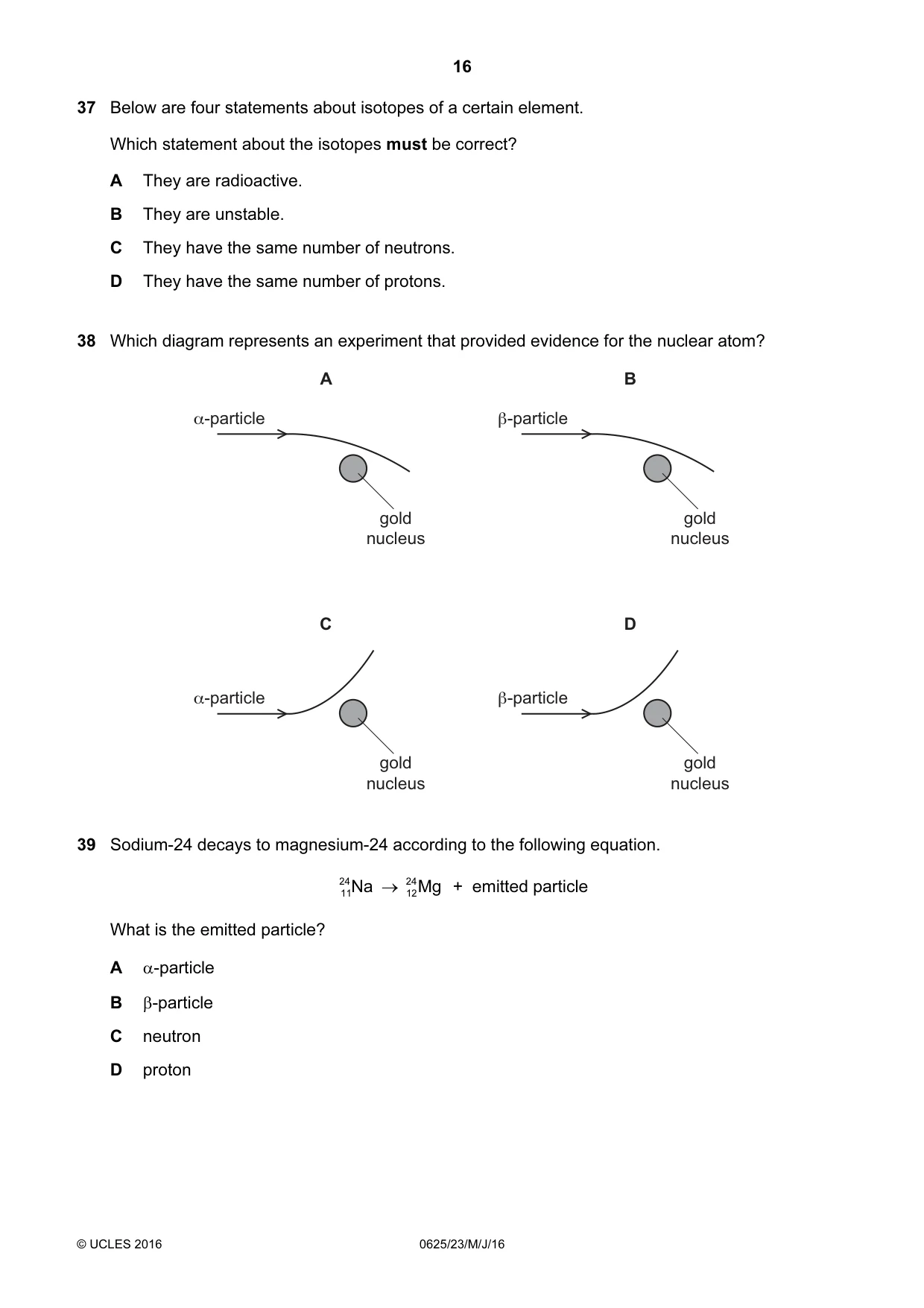
Q35 · The diagram shows a transformer
35 The diagram shows a transformer. input output voltage voltage primary coil secondary coil 800 turns 40 turns The input voltage is 240 V. What is the output voltage? A 6.0 V B 12 V C 20 V D 40 V
Mark scheme: B
Q36 · The diagram shows a shaded area where the direction of a magnetic field is into the page
36 The diagram shows a shaded area where the direction of a magnetic field is into the page. A beam of β-particles enters the field as shown. magnetic field into the page beam of β-particles In which direction is the beam of β-particles deflected as they enter the magnetic field? A into the page B out of the page C down the page D up the page
Mark scheme: C
Q37 · Below are four statements about isotopes of a certain element
37 Below are four statements about isotopes of a certain element. Which statement about the isotopes must be correct? A They are radioactive. B They are unstable. C They have the same number of neutrons. D They have the same number of protons.
Mark scheme: D
Q38 · Which diagram represents an experiment that provided evidence for the nuclear atom?
38 Which diagram represents an experiment that provided evidence for the nuclear atom? A B α-particle β-particle gold gold nucleus nucleus C D α-particle β-particle gold gold nucleus nucleus
Mark scheme: C
Q39 · Sodium-24 decays to magnesium-24 according to the following equation
39 Sodium-24 decays to magnesium-24 according to the following equation. 24 11Na → 24 12Mg + emitted particle What is the emitted particle? A α-particle B β-particle C neutron D proton
Mark scheme: B
Q40 · The reading on a detector placed near a radioactive material is 536 counts per second
40 The reading on a detector placed near a radioactive material is 536 counts per second. The background count rate is 44 counts per second. The half-life of the radioactive material is 34 hours. What is the reading on the detector after 68 hours? A 44 counts per second B 123 counts per second C 134 counts per second D 167 counts per second
Mark scheme: D
What was in this paper
The subtopics covered by these 40 questions, and how many questions each got. Open one in a new tab to see every Cambridge question on it.
4Energy, work and power3Kinetic particle model of matter3Light3Radioactivity3Electrical quantities2Forces2General properties of waves2Motion2Physical quantities and measurement techniques2Sound2The nuclear model of the atom2Thermal properties and temperature2Transfer of thermal energy2Electrical safety1Electromagnetic effects1Mass and weight1Momentum1Pressure1Simple phenomena of magnetism1What you needed in this session
Cambridge’s own grade thresholds for 2016 May/June, Paper 2 · Variant 3. A higher threshold means an easier paper — the bar moves with how the cohort did.