Cambridge IGCSE Physics 0625 — 2018 May/June Paper 2 · Variant 2
0625/22/M/J/18 · 40 questions · 40 marks · ≈45 min
The question paper and its mark scheme, free to read here and free to download. This is Cambridge’s own paper, exactly as it was sat.
Question paper16 pages
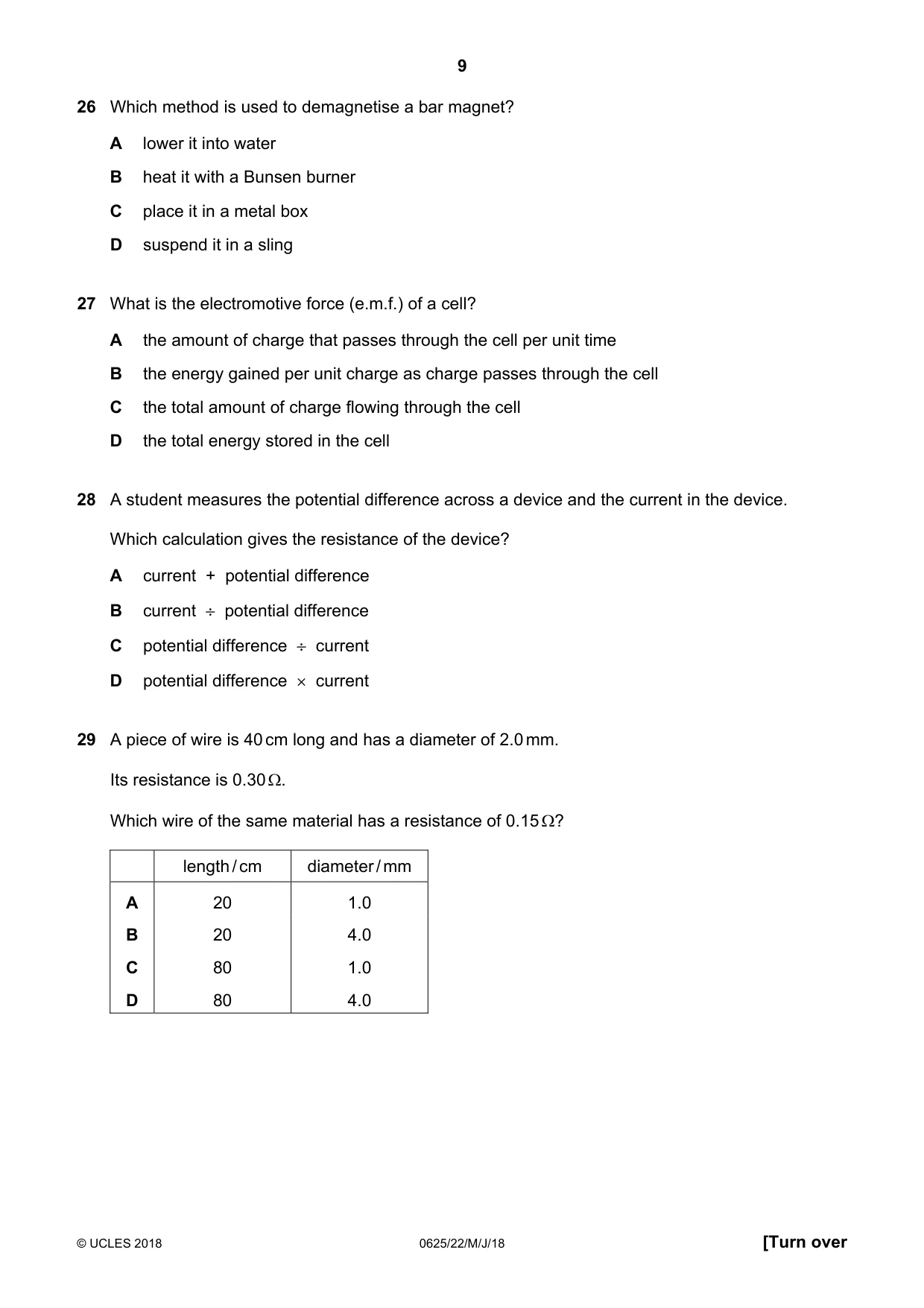
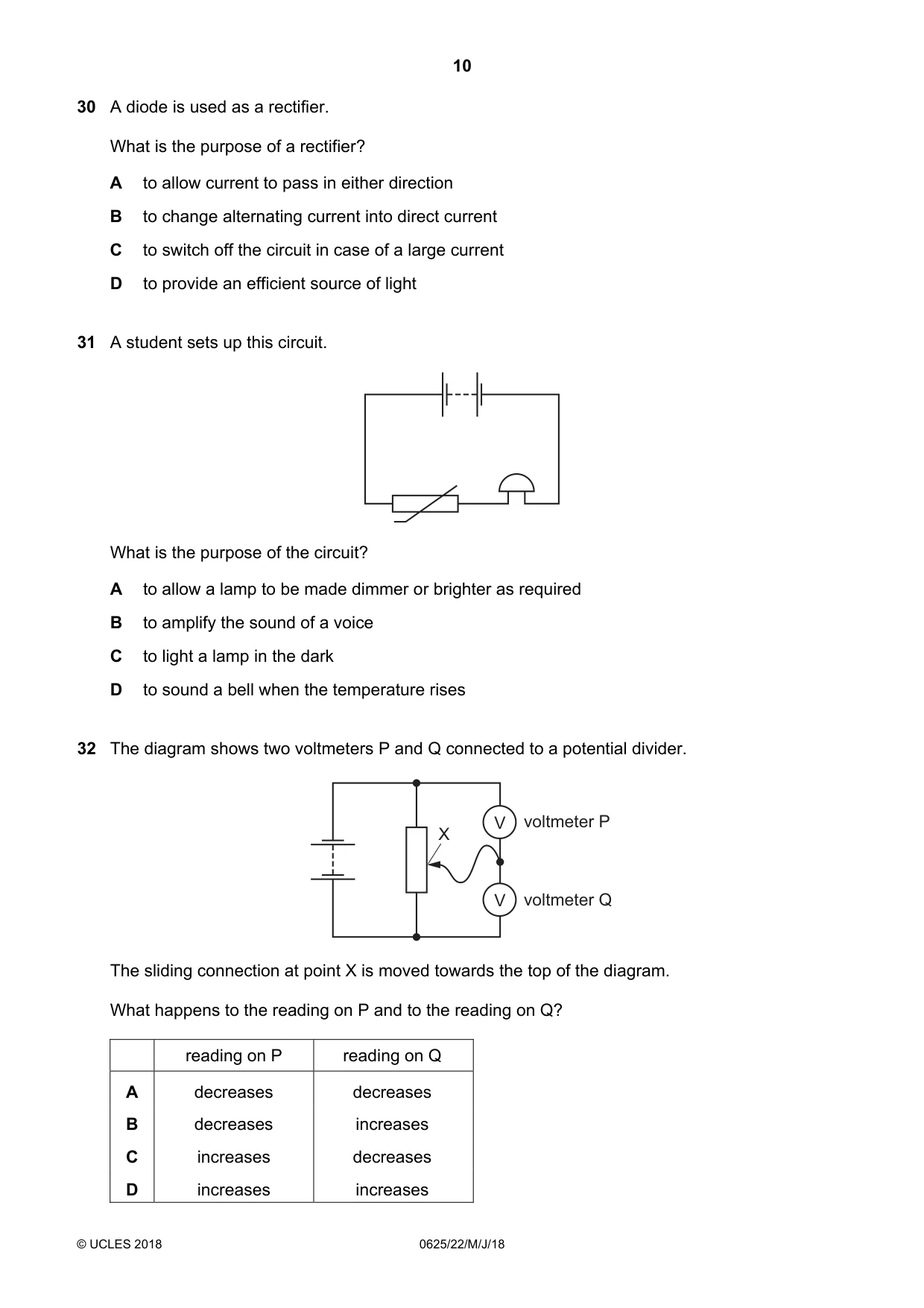
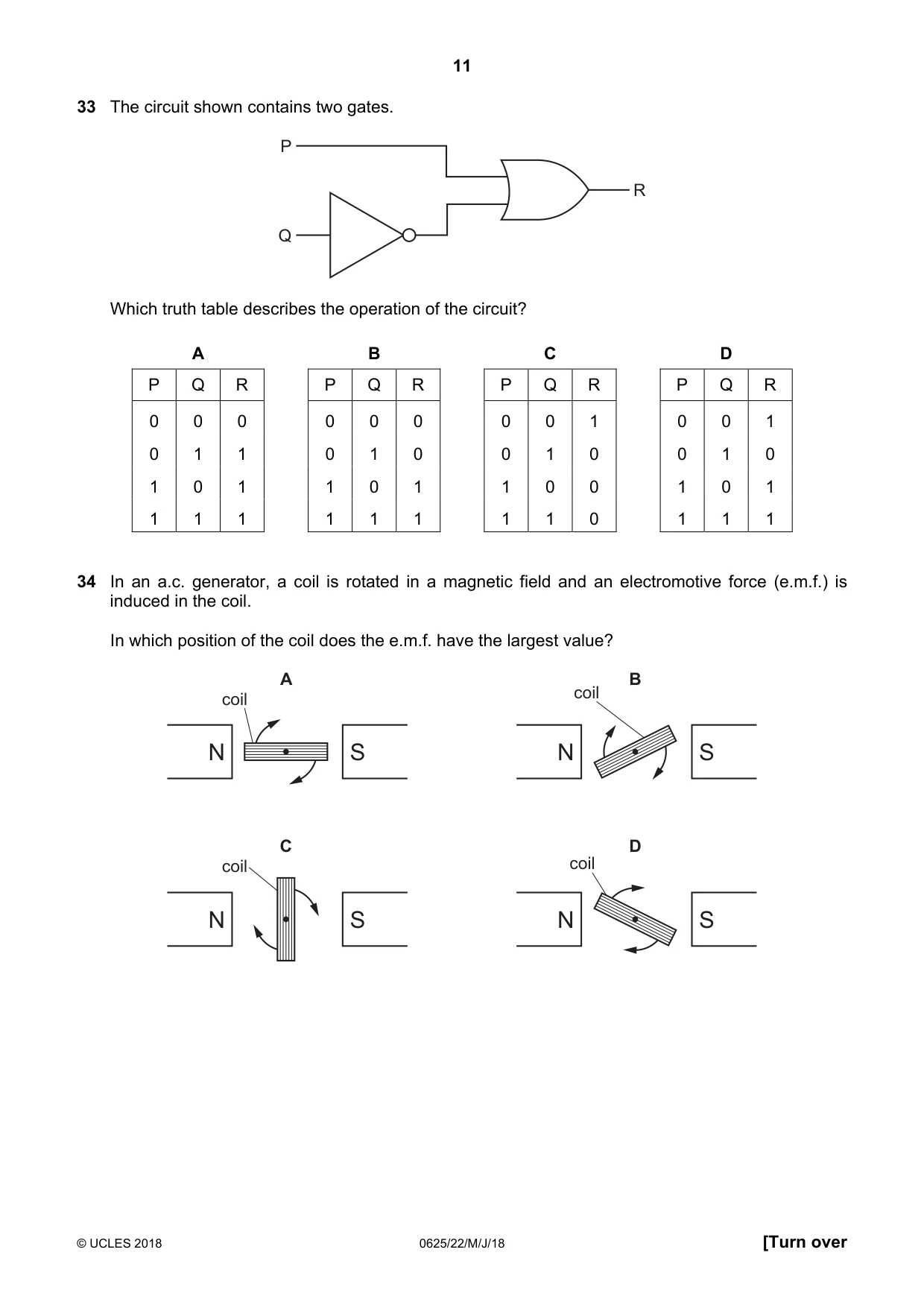
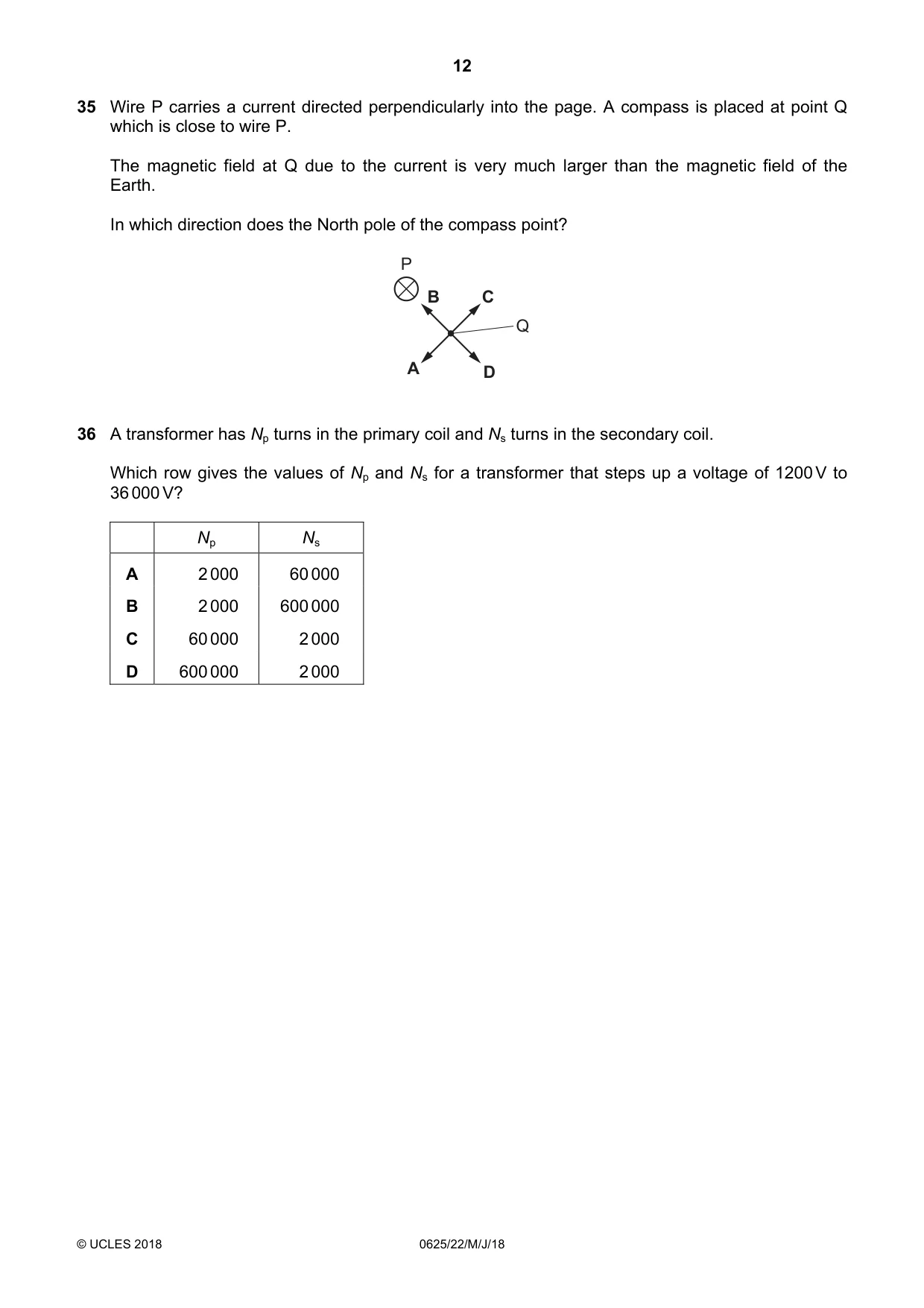

Mark scheme3 pages
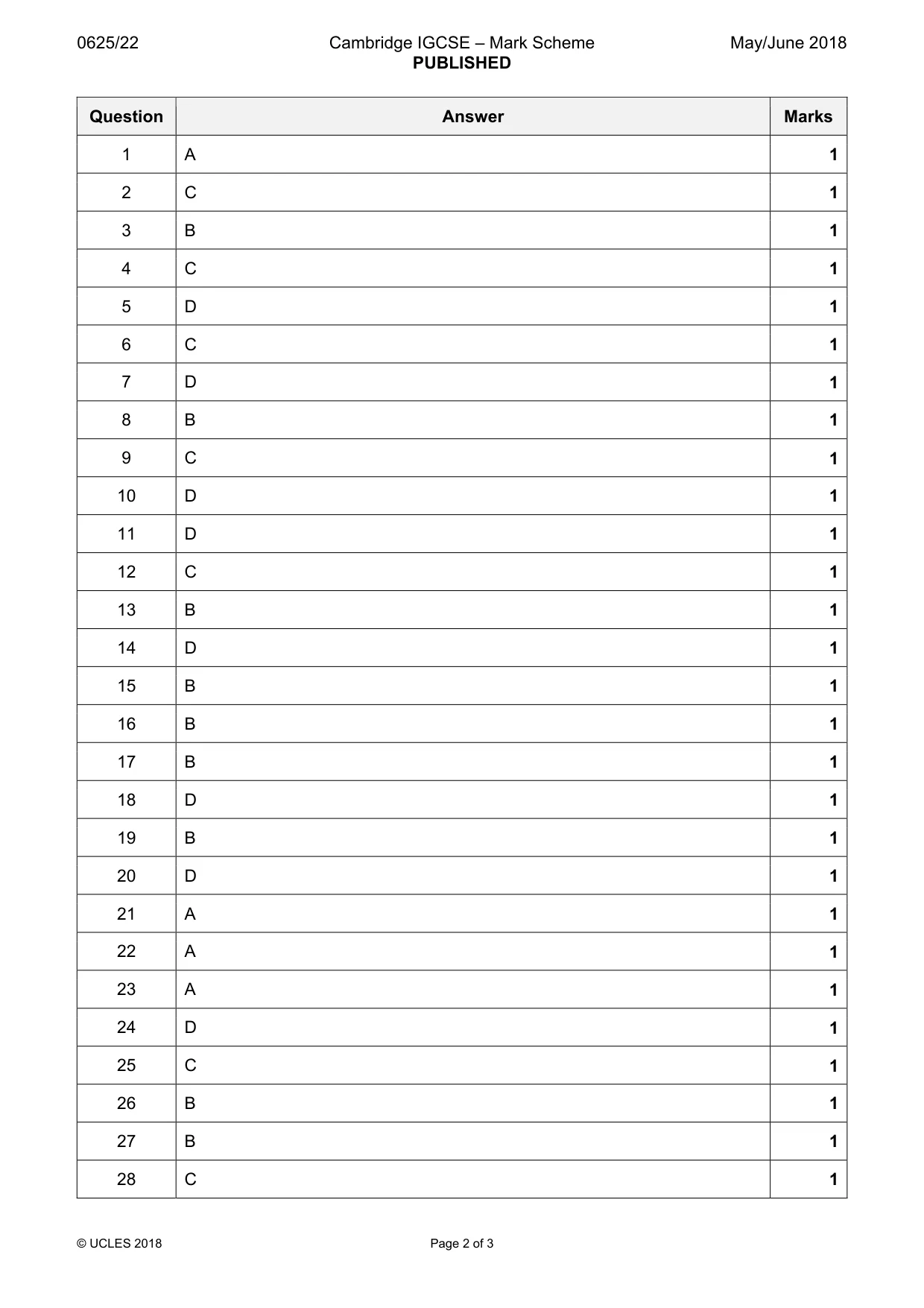
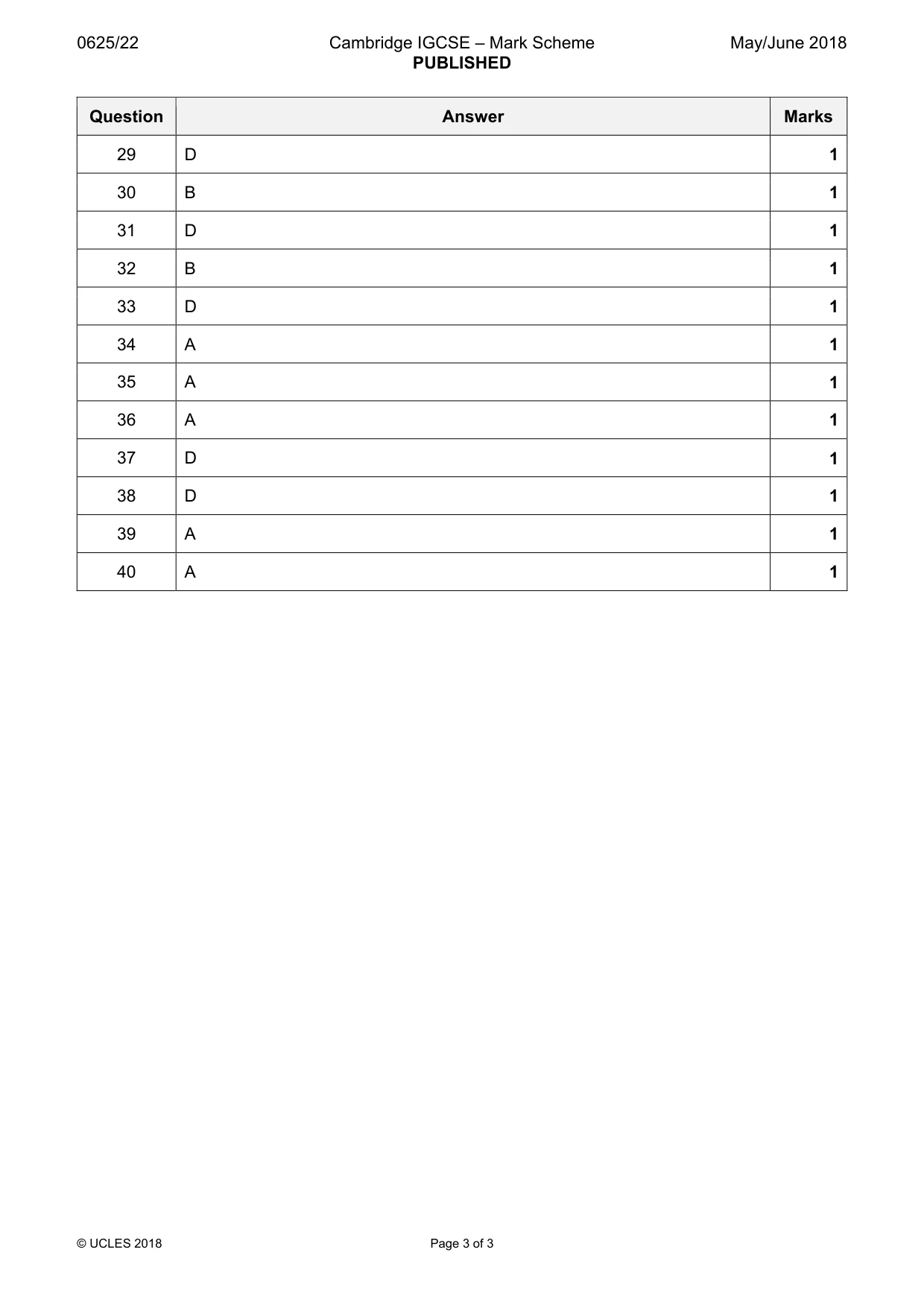
Answers below. Sit the paper first if you are practising.
Questions as text
Q1 · A length of cotton is measured between two points on a ruler
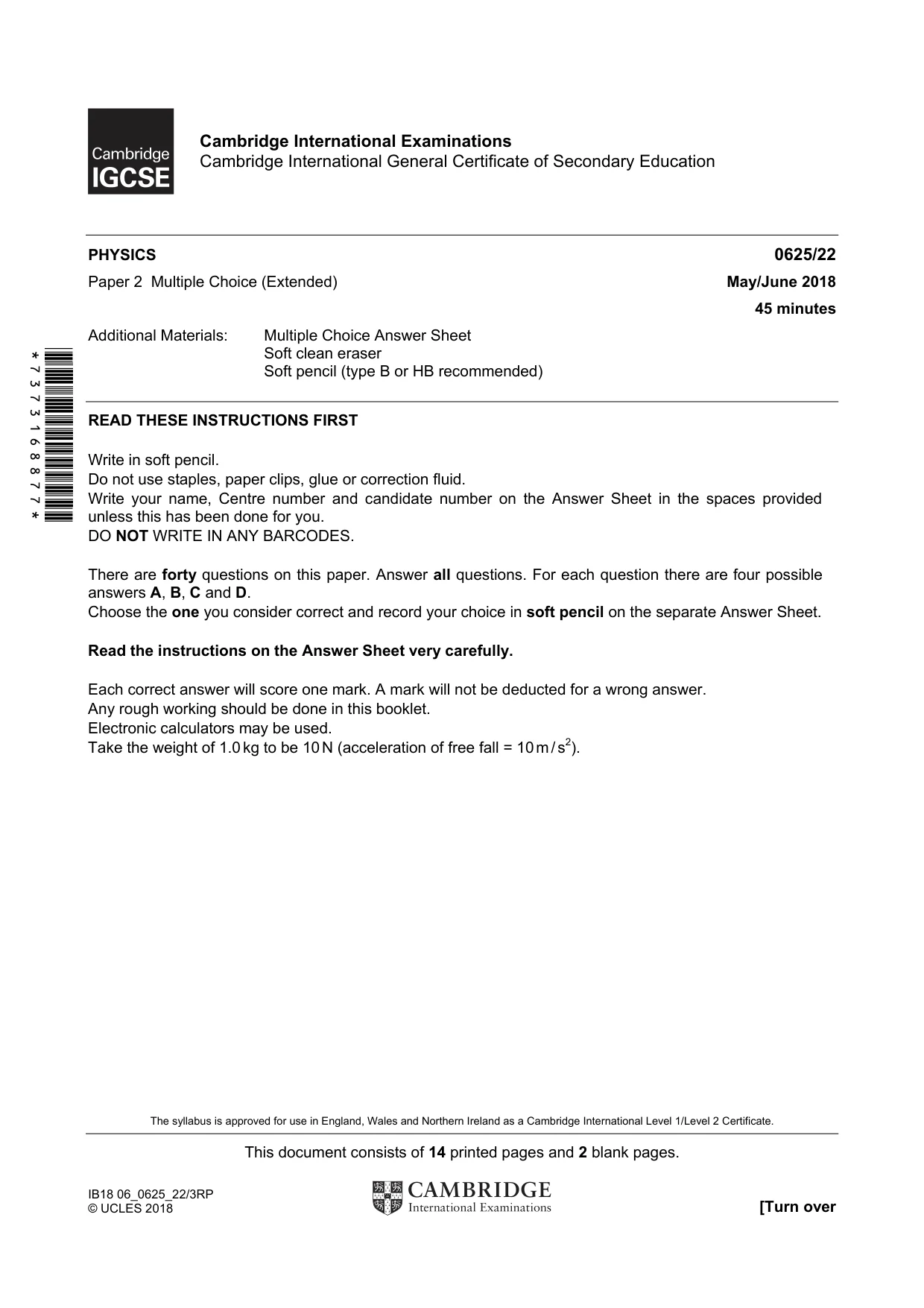
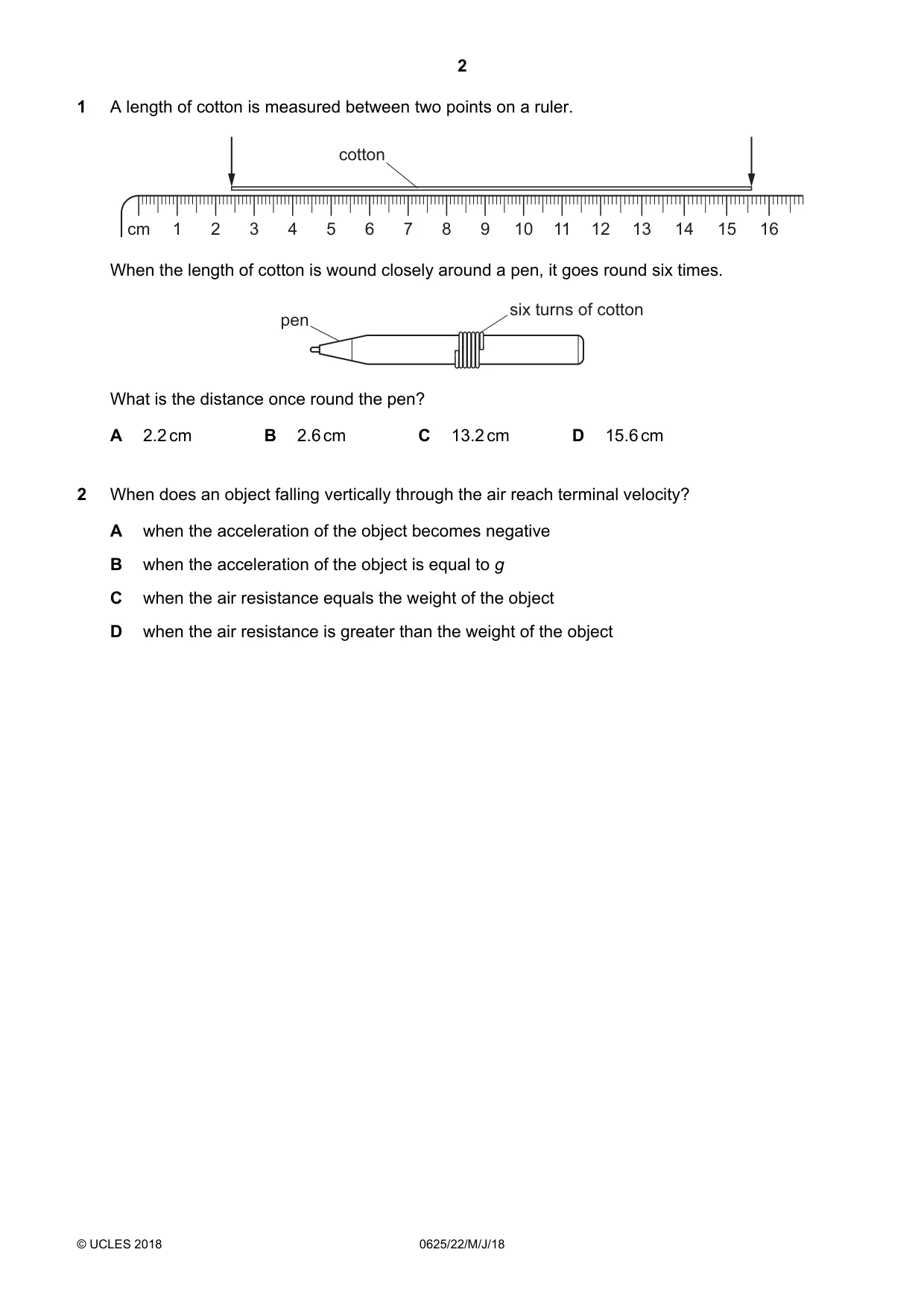
1 A length of cotton is measured between two points on a ruler. cotton cm 1 2 3 4 5 6 7 8 9 10 11 12 13 14 15 16 When the length of cotton is wound closely around a pen, it goes round six times. six turns of cotton pen What is the distance once round the pen? A 2.2 cm B 2.6 cm C 13.2 cm D 15.6 cm
Mark scheme: A
More questions on Physical quantities and measurement techniques
Q2 · When does an object falling vertically through the air reach terminal velocity?
2 When does an object falling vertically through the air reach terminal velocity? A when the acceleration of the object becomes negative B when the acceleration of the object is equal to g C when the air resistance equals the weight of the object D when the air resistance is greater than the weight of the object
Mark scheme: C
Q3 · A ball is dropped in an evacuated tube
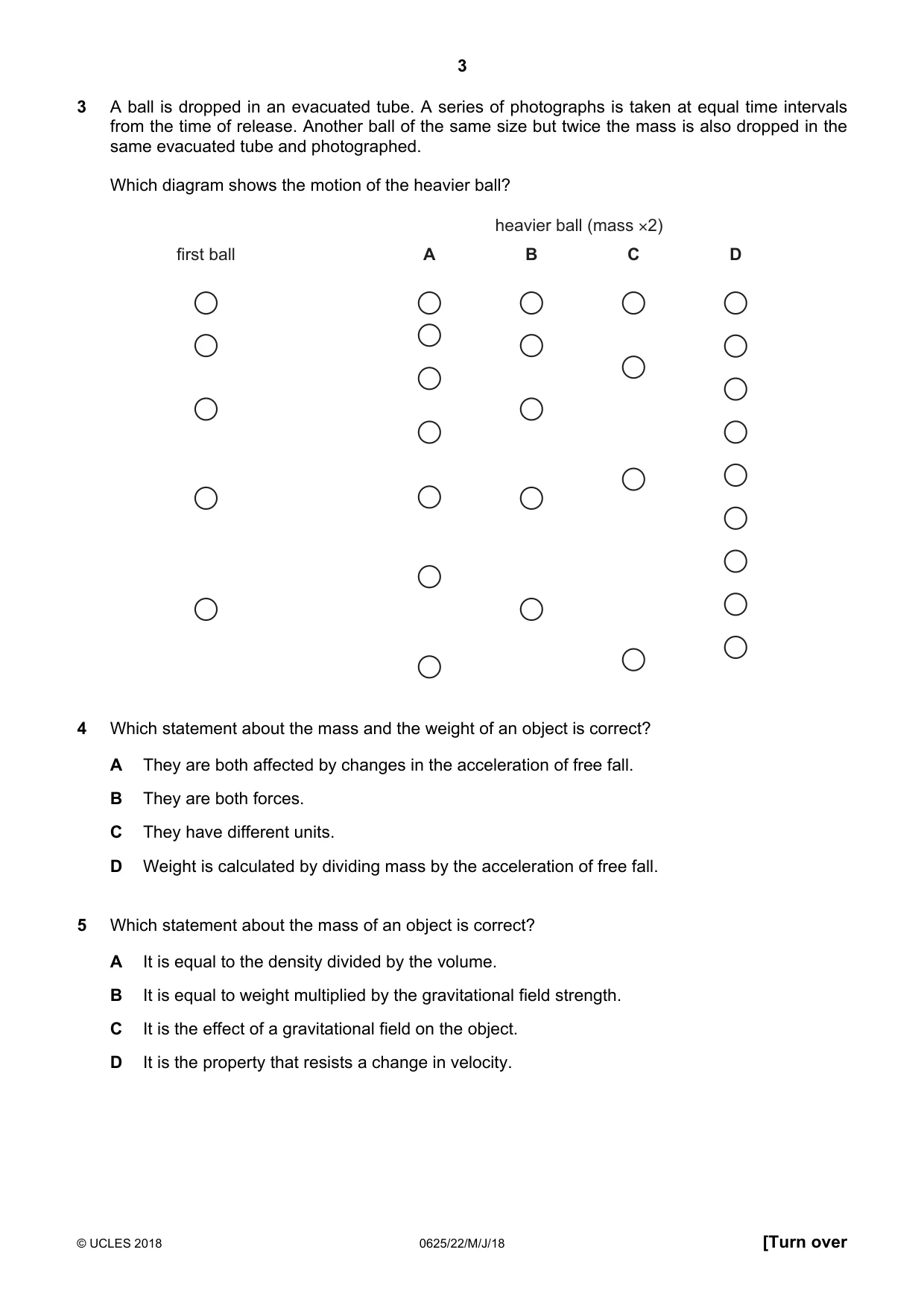
3 A ball is dropped in an evacuated tube. A series of photographs is taken at equal time intervals from the time of release. Another ball of the same size but twice the mass is also dropped in the same evacuated tube and photographed. Which diagram shows the motion of the heavier ball? heavier ball (mass ×2) first ball A B C D
Mark scheme: B
Q4 · Which statement about the mass and the weight of an object is correct?
4 Which statement about the mass and the weight of an object is correct? A They are both affected by changes in the acceleration of free fall. B They are both forces. C They have different units. D Weight is calculated by dividing mass by the acceleration of free fall.
Mark scheme: C
Q5 · Which statement about the mass of an object is correct?
5 Which statement about the mass of an object is correct? A It is equal to the density divided by the volume. B It is equal to weight multiplied by the gravitational field strength. C It is the effect of a gravitational field on the object. D It is the property that resists a change in velocity.
Mark scheme: D
Q6 · An object decelerates from 25.0 m / s to 5.0 m / s in a time of 4.0 s
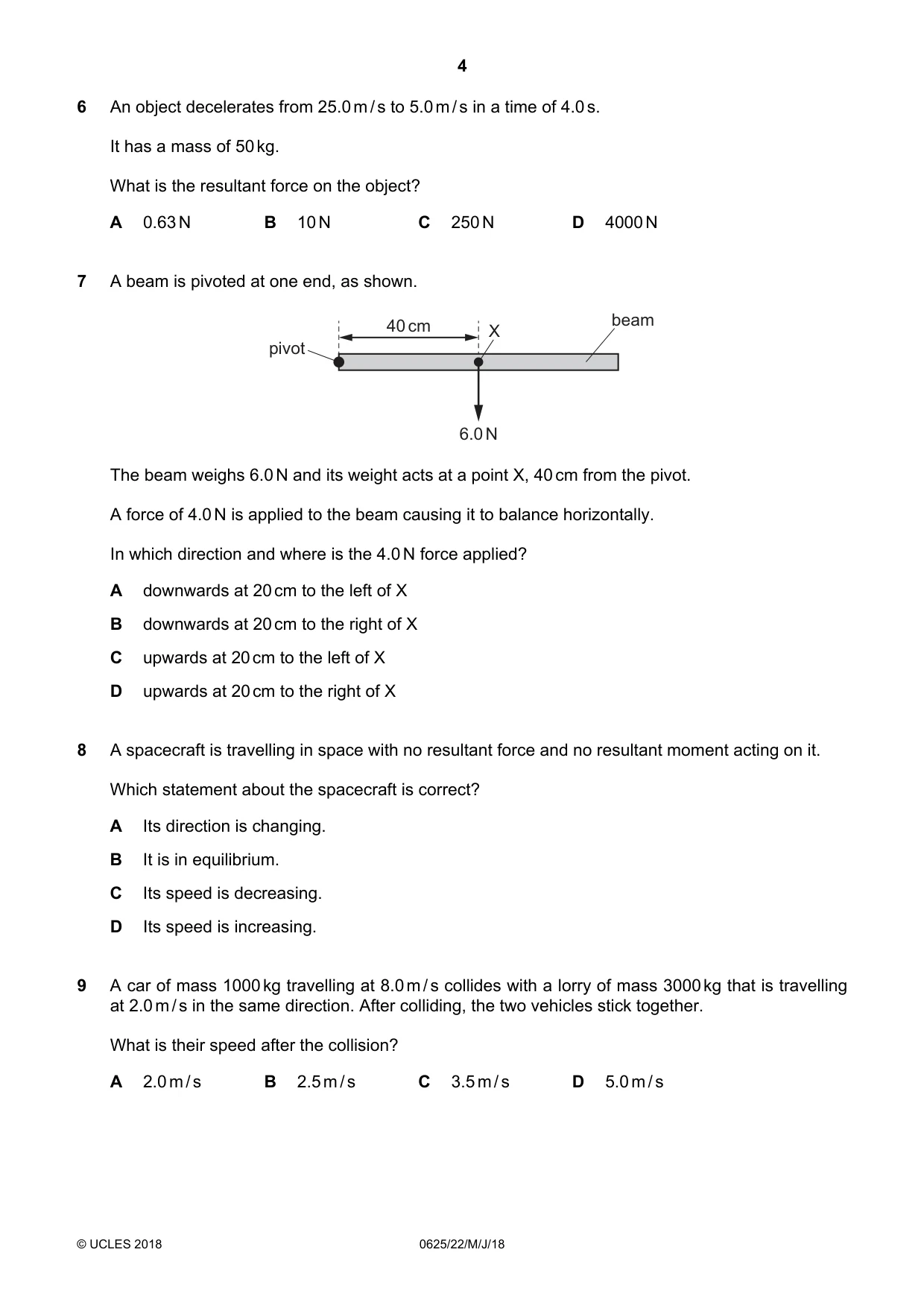
6 An object decelerates from 25.0 m / s to 5.0 m / s in a time of 4.0 s. It has a mass of 50 kg. What is the resultant force on the object? A 0.63 N B 10 N C 250 N D 4000 N
Mark scheme: C
Q7 · A beam is pivoted at one end, as shown
7 A beam is pivoted at one end, as shown. 40 cm beam X pivot 6.0 N The beam weighs 6.0 N and its weight acts at a point X, 40 cm from the pivot. A force of 4.0 N is applied to the beam causing it to balance horizontally. In which direction and where is the 4.0 N force applied? A downwards at 20 cm to the left of X B downwards at 20 cm to the right of X C upwards at 20 cm to the left of X D upwards at 20 cm to the right of X
Mark scheme: D
Q8 · A spacecraft is travelling in space with no resultant force and no resultant moment…
8 A spacecraft is travelling in space with no resultant force and no resultant moment acting on it. Which statement about the spacecraft is correct? A Its direction is changing. B It is in equilibrium. C Its speed is decreasing. D Its speed is increasing.
Mark scheme: B
Q9 · A car of mass 1000 kg travelling at 8.0 m / s collides with a lorry of mass 3000 kg that…
9 A car of mass 1000 kg travelling at 8.0 m / s collides with a lorry of mass 3000 kg that is travelling at 2.0 m / s in the same direction. After colliding, the two vehicles stick together. What is their speed after the collision? A 2.0 m / s B 2.5 m / s C 3.5 m / s D 5.0 m / s
Mark scheme: C
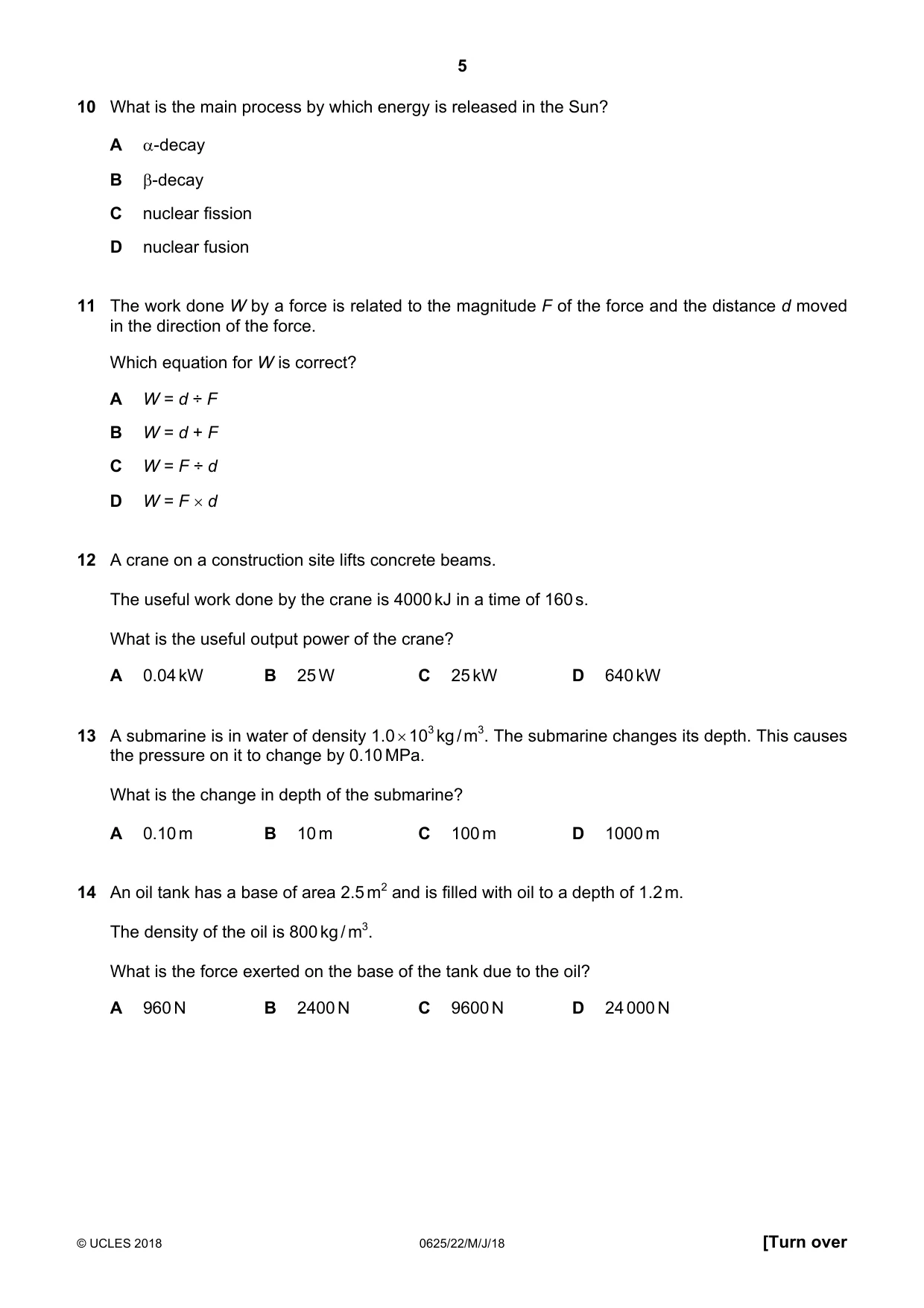
Q10 · What is the main process by which energy is released in the Sun?
10 What is the main process by which energy is released in the Sun? A α-decay B β-decay C nuclear fission D nuclear fusion
Mark scheme: D
Q11 · The work done W by a force is related to the magnitude F of the force and the distance d…
11 The work done W by a force is related to the magnitude F of the force and the distance d moved in the direction of the force. Which equation for W is correct? A W = d ÷ F B W = d + F C W = F ÷ d D W = F × d
Mark scheme: D
Q12 · A crane on a construction site lifts concrete beams
12 A crane on a construction site lifts concrete beams. The useful work done by the crane is 4000 kJ in a time of 160 s. What is the useful output power of the crane? A 0.04 kW B 25 W C 25 kW D 640 kW
Mark scheme: C
Q13 · A submarine is in water of density 1.0 × 10³ kg / m3
13 A submarine is in water of density 1.0 × 10³ kg / m3. The submarine changes its depth. This causes the pressure on it to change by 0.10 MPa. What is the change in depth of the submarine? A 0.10 m B 10 m C 100 m D 1000 m
Mark scheme: B
Q14 · An oil tank has a base of area 2.5 m2 and is filled with oil to a depth of 1.2 m
14 An oil tank has a base of area 2.5 m2 and is filled with oil to a depth of 1.2 m. The density of the oil is 800 kg / m3. What is the force exerted on the base of the tank due to the oil? A 960 N B 2400 N C 9600 N D 24 000 N
Mark scheme: D
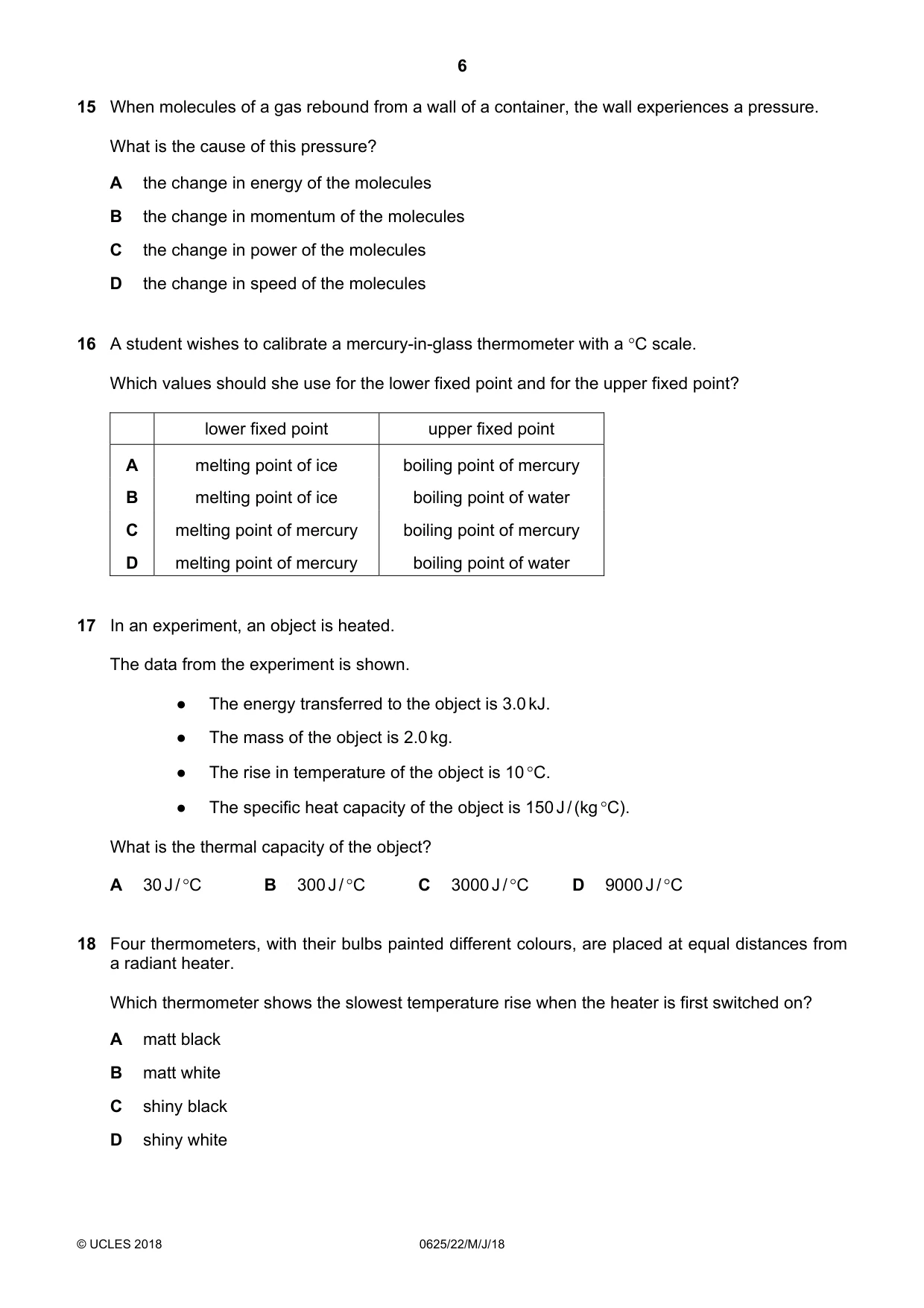
Q15 · When molecules of a gas rebound from a wall of a container, the wall experiences a…
15 When molecules of a gas rebound from a wall of a container, the wall experiences a pressure. What is the cause of this pressure? A the change in energy of the molecules B the change in momentum of the molecules C the change in power of the molecules D the change in speed of the molecules
Mark scheme: B
Q16 · A student wishes to calibrate a mercury-in-glass thermometer with a °C scale
16 A student wishes to calibrate a mercury-in-glass thermometer with a °C scale. Which values should she use for the lower fixed point and for the upper fixed point? lower fixed point upper fixed point A melting point of ice boiling point of mercury B melting point of ice boiling point of water C melting point of mercury boiling point of mercury D melting point of mercury boiling point of water
Mark scheme: B
Q17 · In an experiment, an object is heated
17 In an experiment, an object is heated. The data from the experiment is shown. ● The energy transferred to the object is 3.0 kJ. ● The mass of the object is 2.0 kg. ● The rise in temperature of the object is 10 °C. ● The specific heat capacity of the object is 150 J / (kg °C). What is the thermal capacity of the object? A 30 J / °C B 300 J / °C C 3000 J / °C D 9000 J / °C
Mark scheme: B
Q18 · Four thermometers, with their bulbs painted different colours, are placed at equal…
18 Four thermometers, with their bulbs painted different colours, are placed at equal distances from a radiant heater. Which thermometer shows the slowest temperature rise when the heater is first switched on? A matt black B matt white C shiny black D shiny white
Mark scheme: D
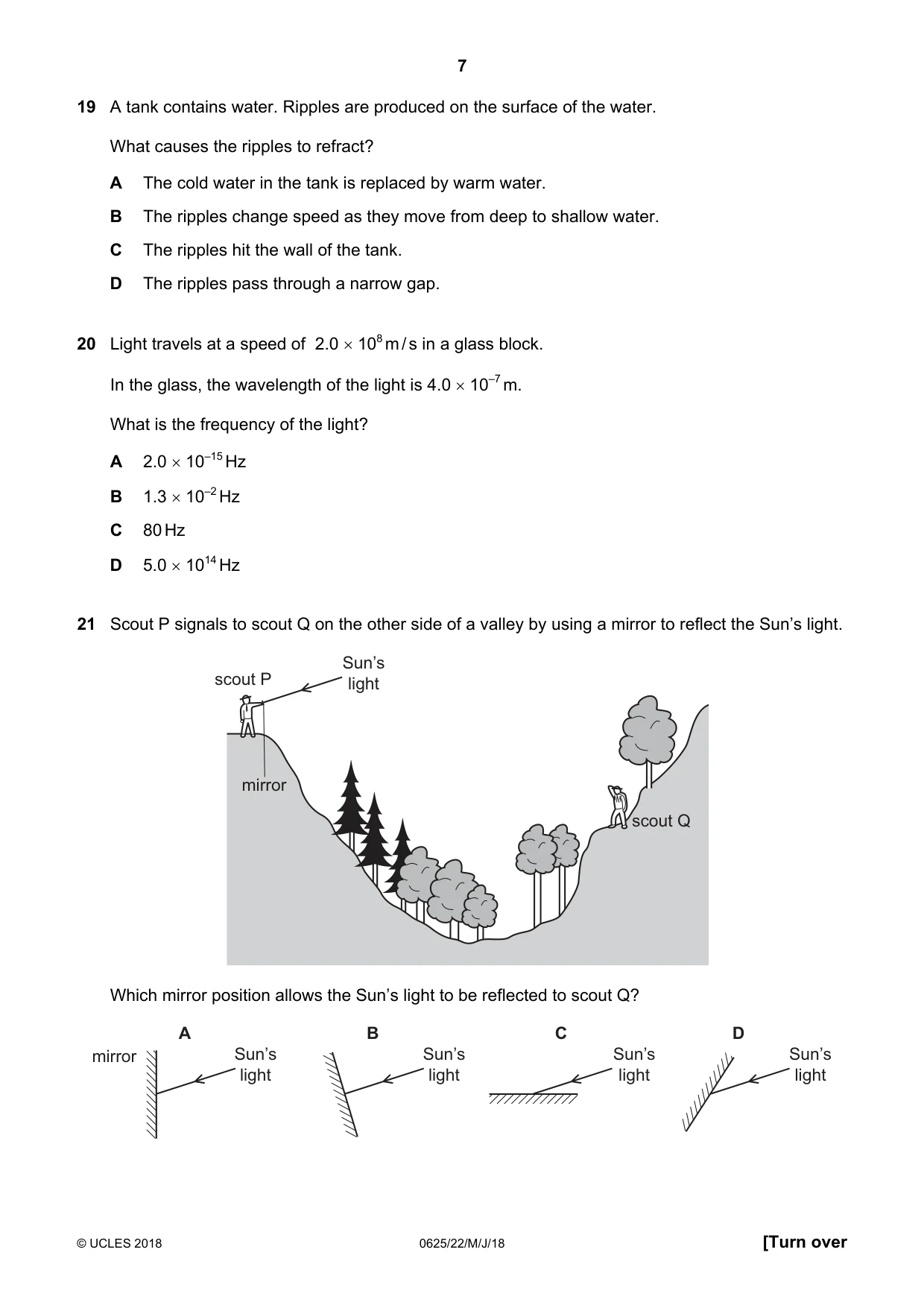
Q19 · A tank contains water
19 A tank contains water. Ripples are produced on the surface of the water. What causes the ripples to refract? A The cold water in the tank is replaced by warm water. B The ripples change speed as they move from deep to shallow water. C The ripples hit the wall of the tank. D The ripples pass through a narrow gap.
Mark scheme: B
Q20 · Light travels at a speed of 2.0 × 10⁸ m / s in a glass block
20 Light travels at a speed of 2.0 × 10⁸ m / s in a glass block. In the glass, the wavelength of the light is 4.0 × 10⁻⁷ m. What is the frequency of the light? A 2.0 × 10⁻¹⁵ Hz B 1.3 × 10⁻² Hz C 80 Hz D 5.0 × 10¹⁴ Hz
Mark scheme: D
Q21 · Scout P signals to scout Q on the other side of a valley by using a mirror to reflect the…
21 Scout P signals to scout Q on the other side of a valley by using a mirror to reflect the Sun’s light. Sun’s scout P light mirror scout Q Which mirror position allows the Sun’s light to be reflected to scout Q? A B C D mirror Sun’s Sun’s Sun’s Sun’s light light light light
Mark scheme: A
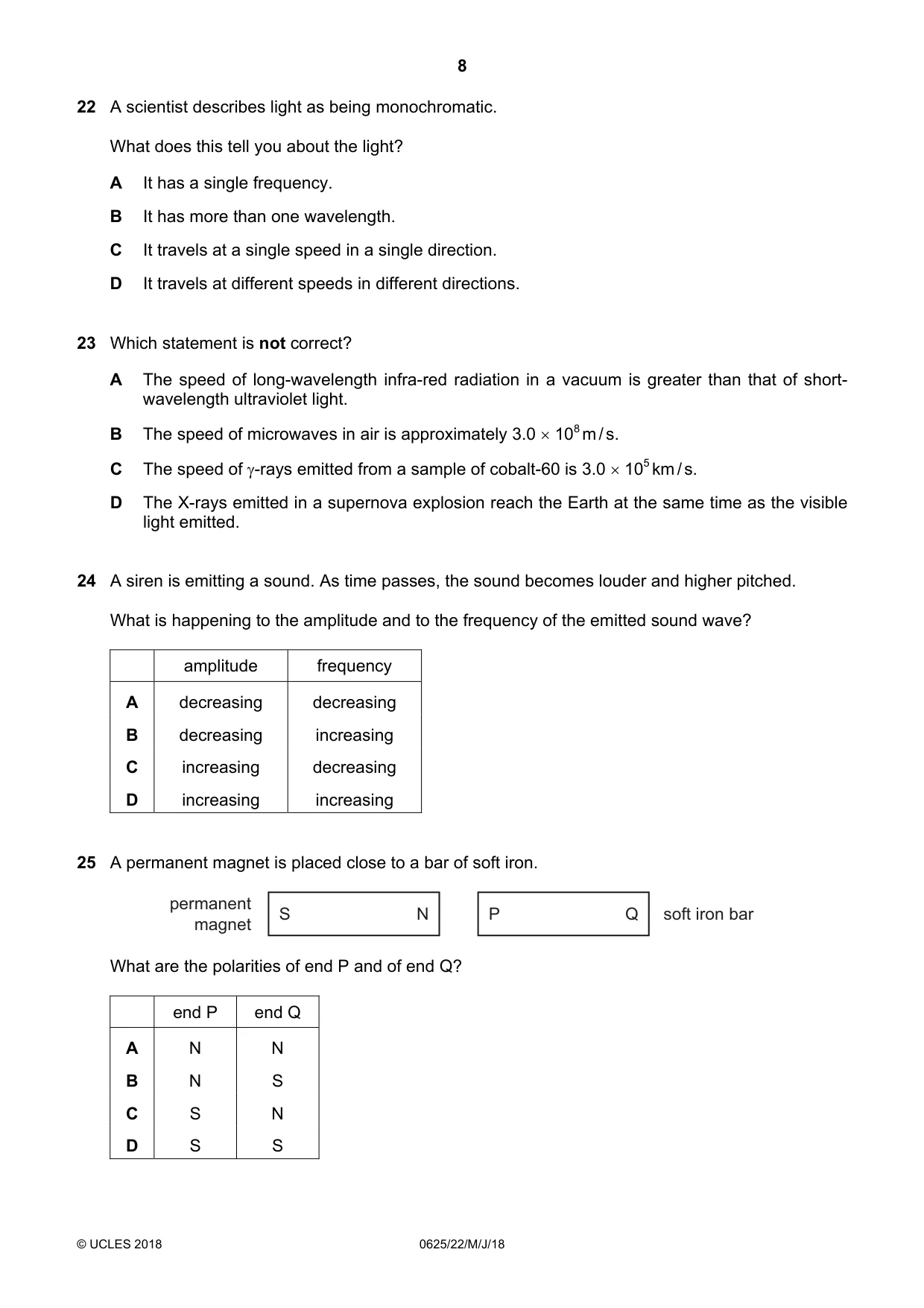
Q22 · A scientist describes light as being monochromatic
22 A scientist describes light as being monochromatic. What does this tell you about the light? A It has a single frequency. B It has more than one wavelength. C It travels at a single speed in a single direction. D It travels at different speeds in different directions.
Mark scheme: A
Q23 · Which statement is not correct?
23 Which statement is not correct? A The speed of long-wavelength infra-red radiation in a vacuum is greater than that of short- wavelength ultraviolet light. B The speed of microwaves in air is approximately 3.0 × 10⁸ m / s. C The speed of γ-rays emitted from a sample of cobalt-60 is 3.0 × 10⁵ km / s. D The X-rays emitted in a supernova explosion reach the Earth at the same time as the visible light emitted.
Mark scheme: A
Q24 · A siren is emitting a sound
24 A siren is emitting a sound. As time passes, the sound becomes louder and higher pitched. What is happening to the amplitude and to the frequency of the emitted sound wave? amplitude frequency A decreasing decreasing B decreasing increasing C increasing decreasing D increasing increasing
Mark scheme: D
Q25 · A permanent magnet is placed close to a bar of soft iron
25 A permanent magnet is placed close to a bar of soft iron. permanent S N P Q soft iron bar magnet What are the polarities of end P and of end Q? end P end Q A N N B N S C S N D S S
Mark scheme: C
Q26 · Which method is used to demagnetise a bar magnet?
26 Which method is used to demagnetise a bar magnet? A lower it into water B heat it with a Bunsen burner C place it in a metal box D suspend it in a sling
Mark scheme: B
Q27 · What is the electromotive force (e.m.f.) of a cell?
27 What is the electromotive force (e.m.f.) of a cell? A the amount of charge that passes through the cell per unit time B the energy gained per unit charge as charge passes through the cell C the total amount of charge flowing through the cell D the total energy stored in the cell
Mark scheme: B
Q28 · A student measures the potential difference across a device and the current in the device
28 A student measures the potential difference across a device and the current in the device. Which calculation gives the resistance of the device? A current + potential difference B current ÷ potential difference C potential difference ÷ current D potential difference × current
Mark scheme: C
Q29 · A piece of wire is 40 cm long and has a diameter of 2.0 mm
29 A piece of wire is 40 cm long and has a diameter of 2.0 mm. Its resistance is 0.30 Ω. Which wire of the same material has a resistance of 0.15 Ω? length / cm diameter / mm A 20 1.0 B 20 4.0 C 80 1.0 D 80 4.0
Mark scheme: D
Q30 · A diode is used as a rectifier
30 A diode is used as a rectifier. What is the purpose of a rectifier? A to allow current to pass in either direction B to change alternating current into direct current C to switch off the circuit in case of a large current D to provide an efficient source of light
Mark scheme: B
Q31 · A student sets up this circuit
31 A student sets up this circuit. What is the purpose of the circuit? A to allow a lamp to be made dimmer or brighter as required B to amplify the sound of a voice C to light a lamp in the dark D to sound a bell when the temperature rises
Mark scheme: D
Q32 · The diagram shows two voltmeters P and Q connected to a potential divider
32 The diagram shows two voltmeters P and Q connected to a potential divider. V voltmeter P X V voltmeter Q The sliding connection at point X is moved towards the top of the diagram. What happens to the reading on P and to the reading on Q? reading on P reading on Q A decreases decreases B decreases increases C increases decreases D increases increases
Mark scheme: B
Q33 · The circuit shown contains two gates
33 The circuit shown contains two gates. P R Q Which truth table describes the operation of the circuit? A B C D P Q R P Q R P Q R P Q R 0 0 0 0 0 0 0 0 1 0 0 1 0 1 1 0 1 0 0 1 0 0 1 0 1 0 1 1 0 1 1 0 0 1 0 1 1 1 1 1 1 1 1 1 0 1 1 1
Mark scheme: D
Question 34
34 In an a.c. generator, a coil is rotated in a magnetic field and an electromotive force (e.m.f.) is induced in the coil. In which position of the coil does the e.m.f. have the largest value? A B coil coil N S N S C D coil coil N S N S
Mark scheme: A
Q35 · Wire P carries a current directed perpendicularly into the page
35 Wire P carries a current directed perpendicularly into the page. A compass is placed at point Q which is close to wire P. The magnetic field at Q due to the current is very much larger than the magnetic field of the Earth. In which direction does the North pole of the compass point? P B C Q A D
Mark scheme: A
Q36 · A transformer has Np turns in the primary coil and Ns turns in the secondary coil
36 A transformer has Np turns in the primary coil and Ns turns in the secondary coil. Which row gives the values of Np and Ns for a transformer that steps up a voltage of 1200 V to 36 000 V? Np Ns A 2 000 60 000 B 2 000 600 000 C 60 000 2 000 D 600 000 2 000
Mark scheme: A
Q37 · In the atomic model, an atom consists of a central mass, orbited by much smaller particles
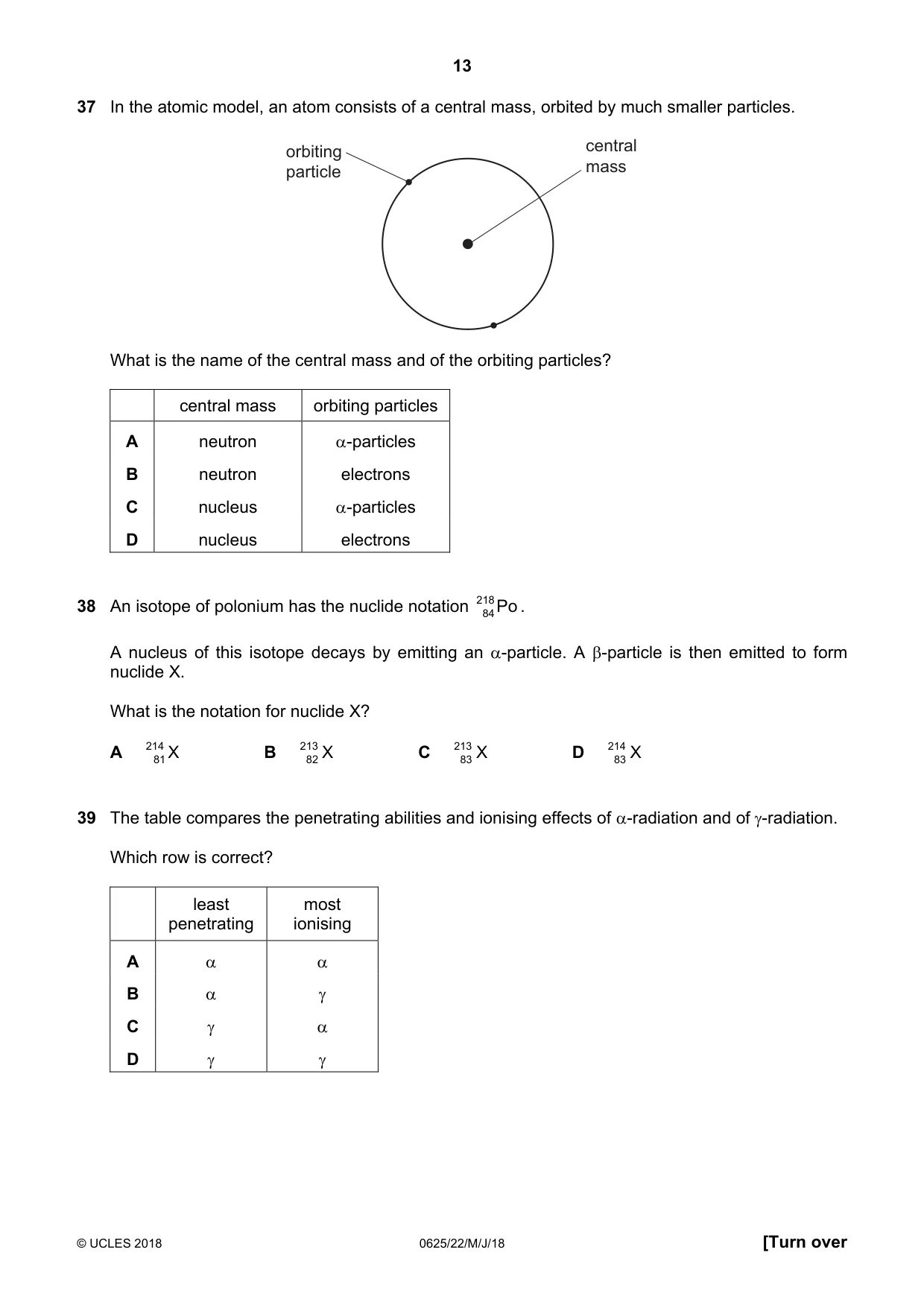
37 In the atomic model, an atom consists of a central mass, orbited by much smaller particles. orbiting central particle mass What is the name of the central mass and of the orbiting particles? central mass orbiting particles A neutron α-particles B neutron electrons C nucleus α-particles D nucleus electrons
Mark scheme: D
Q38 · An isotope of polonium has the nuclide notation 218 Po
38 An isotope of polonium has the nuclide notation 218 Po . 84 A nucleus of this isotope decays by emitting an α-particle. A β-particle is then emitted to form nuclide X. What is the notation for nuclide X? A 214 81X B 213 82 X C 213 83 X D 214 83 X
Mark scheme: D
Q39 · The table compares the penetrating abilities and ionising effects of α-radiation and of…
39 The table compares the penetrating abilities and ionising effects of α-radiation and of γ-radiation. Which row is correct? least most penetrating ionising A α α B α γ C γ α D γ γ
Mark scheme: A
Q40 · The graph shows how the count rate registered by a counter near to a sample of a…
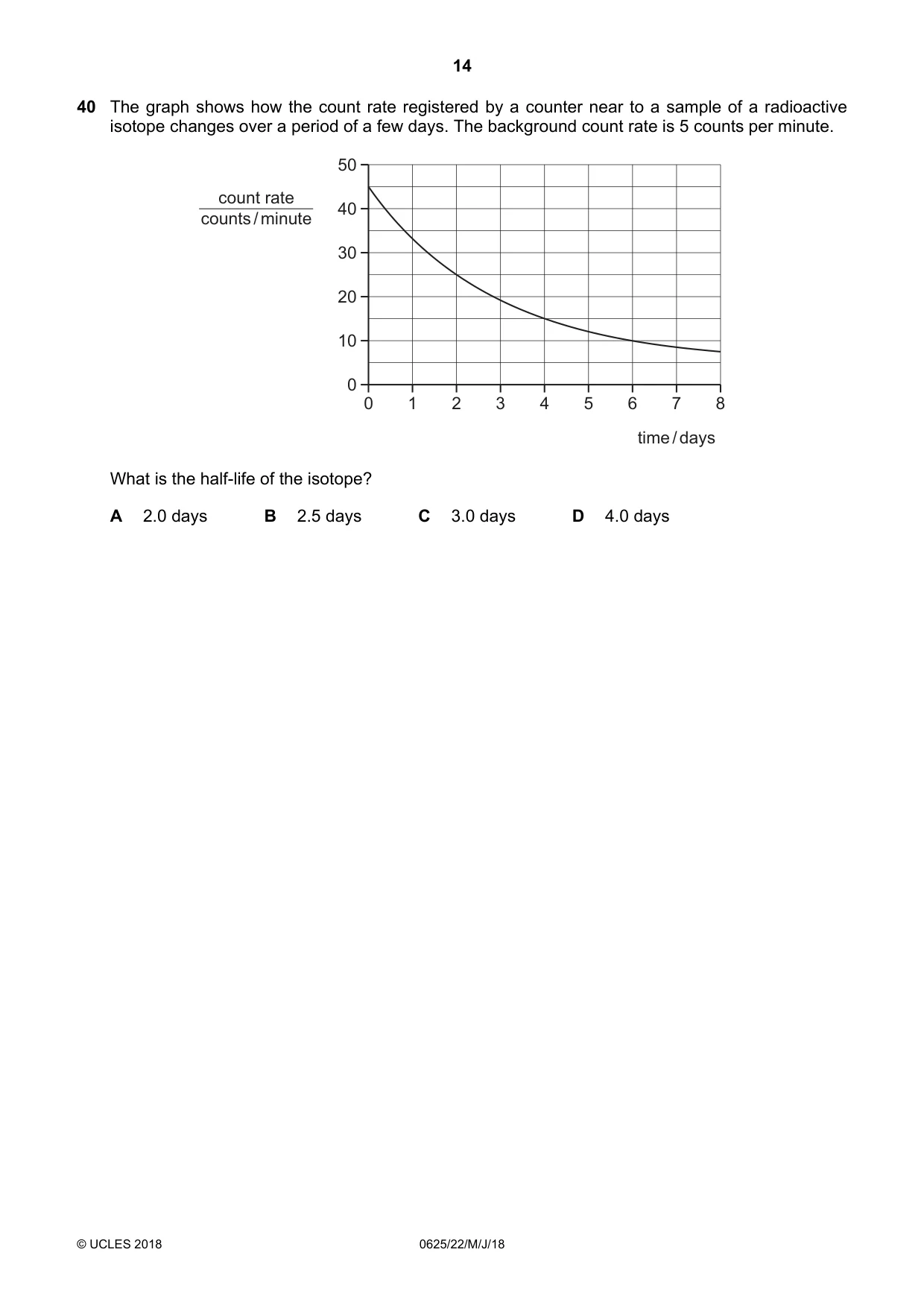
40 The graph shows how the count rate registered by a counter near to a sample of a radioactive isotope changes over a period of a few days. The background count rate is 5 counts per minute. 50 count rate 40 counts / minute 30 20 10 0 0 1 2 3 4 5 6 7 8 time / days What is the half-life of the isotope? A 2.0 days B 2.5 days C 3.0 days D 4.0 days
Mark scheme: A
What was in this paper
The subtopics covered by these 40 questions, and how many questions each got. Open one in a new tab to see every Cambridge question on it.
4Forces4Electrical quantities3Electromagnetic effects3Radioactivity3Energy, work and power2General properties of waves2Light2Mass and weight2Pressure2Simple phenomena of magnetism2The nuclear model of the atom2Thermal properties and temperature2Electromagnetic spectrum1Kinetic particle model of matter1Momentum1Motion1Physical quantities and measurement techniques1Sound1Transfer of thermal energy1What you needed in this session
Cambridge’s own grade thresholds for 2018 May/June, Paper 2 · Variant 2. A higher threshold means an easier paper — the bar moves with how the cohort did.