Cambridge IGCSE Physics 0625 — 2021 Oct/Nov Paper 2 · Variant 1
0625/21/O/N/21 · 40 questions · 40 marks · ≈45 min
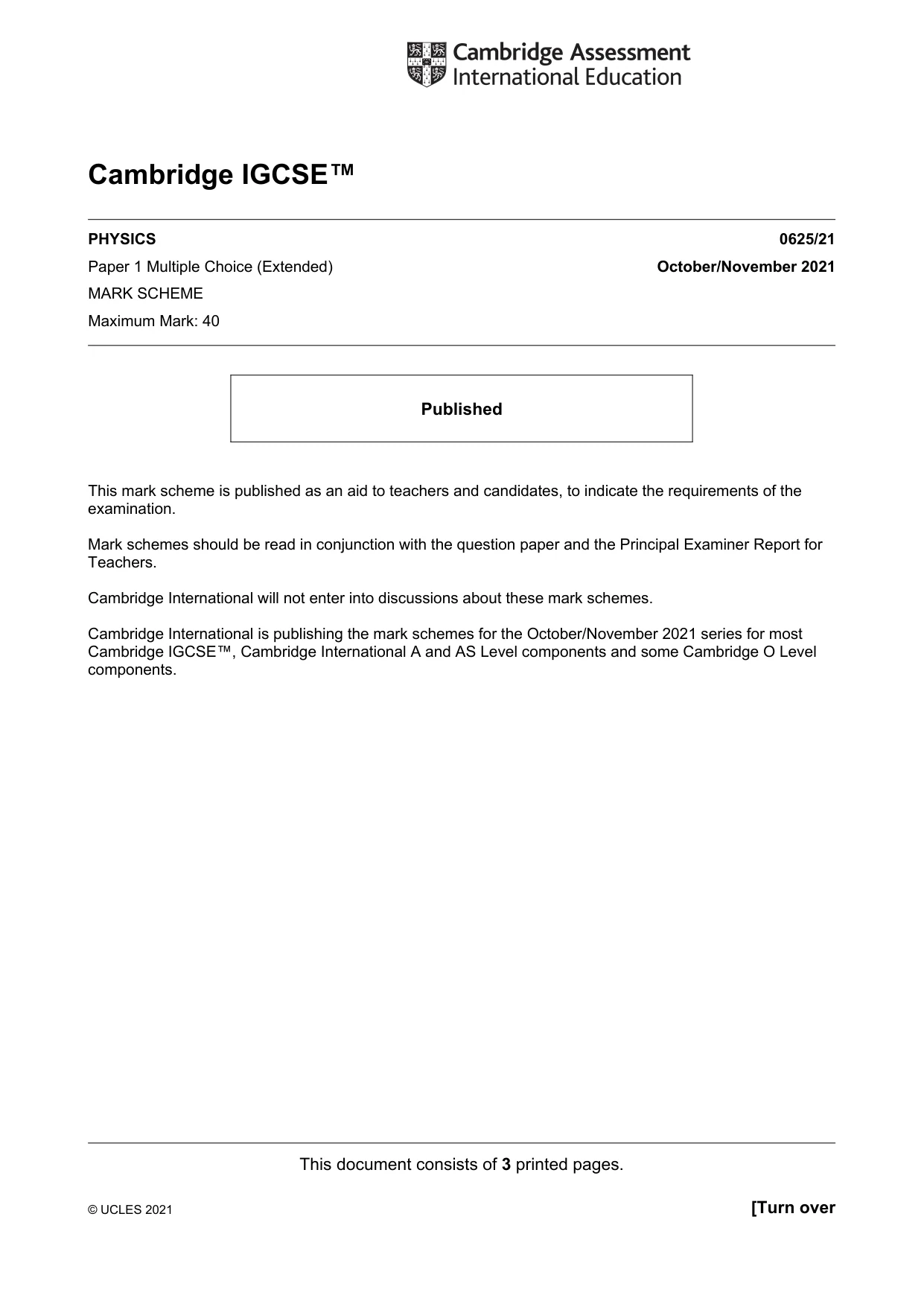
The question paper and its mark scheme, free to read here and free to download. This is Cambridge’s own paper, exactly as it was sat.
Question paper16 pages
Mark scheme3 pages
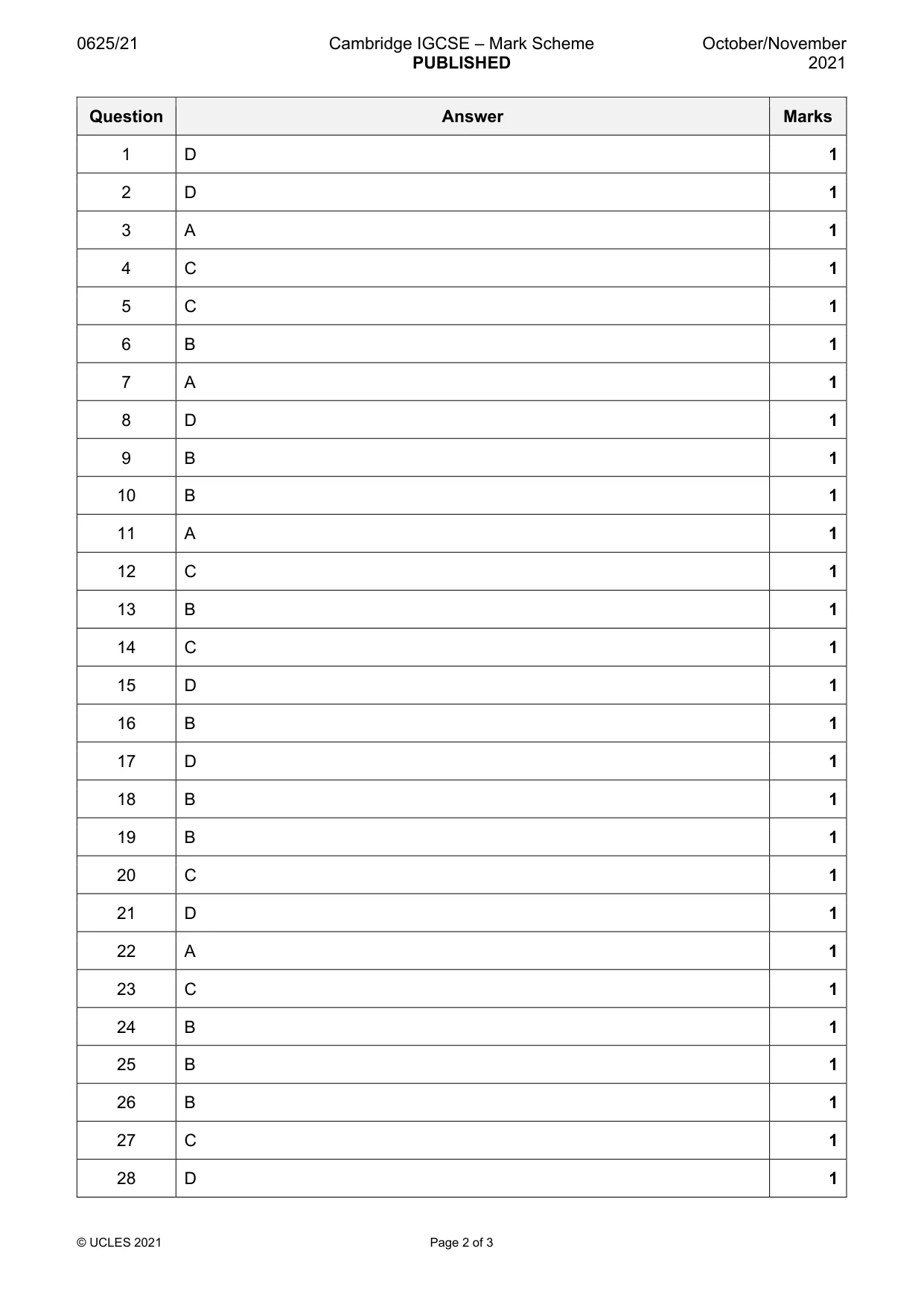
Answers below. Sit the paper first if you are practising.
Questions as text
Q1 · Which instrument is most suitable for measuring the thickness of a single sheet of paper?
1 Which instrument is most suitable for measuring the thickness of a single sheet of paper? A 15 cm rule B balance C metre rule D micrometer screw gauge
Mark scheme: D
More questions on Physical quantities and measurement techniques
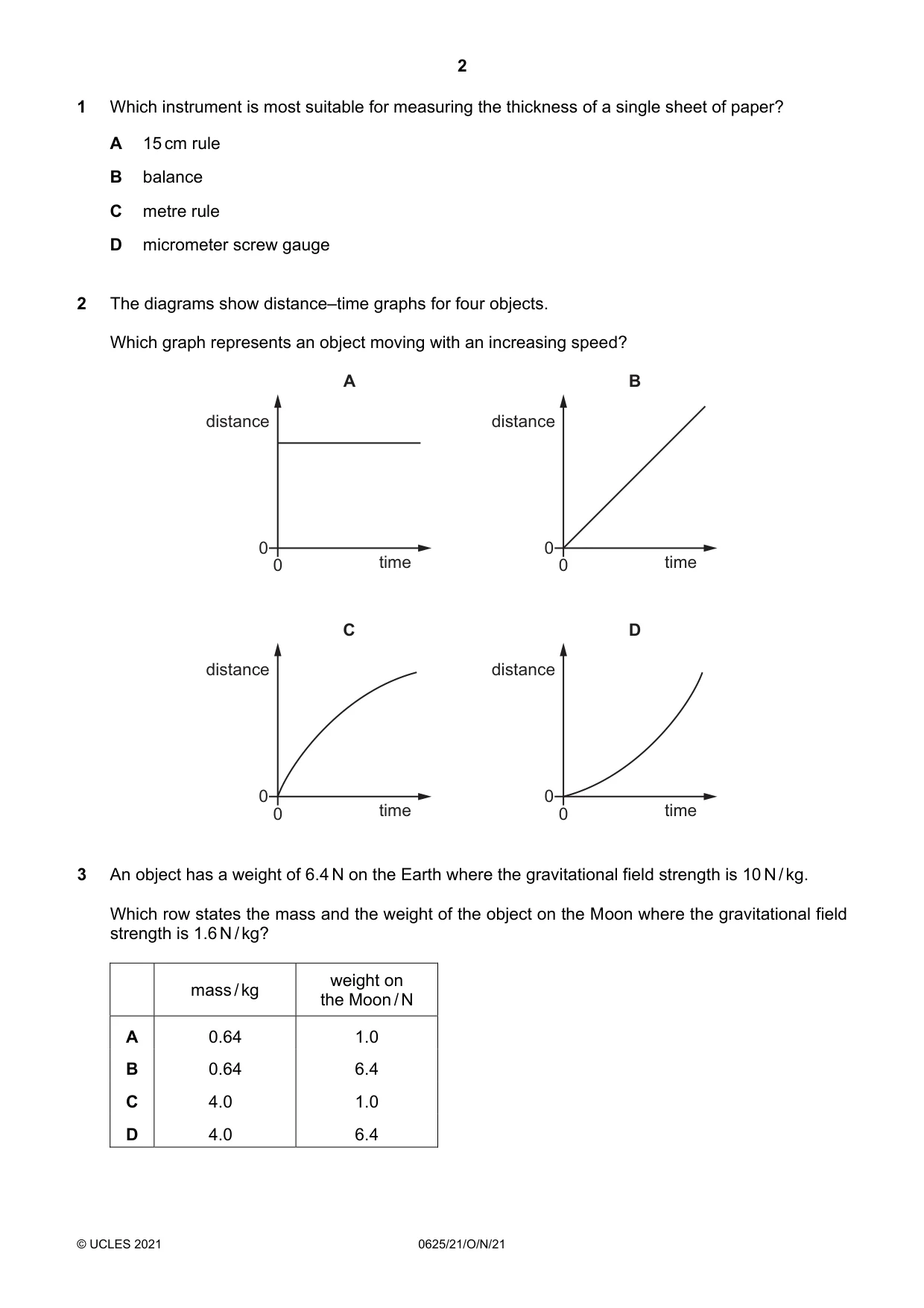
Q2 · The diagrams show distance–time graphs for four objects
2 The diagrams show distance–time graphs for four objects. Which graph represents an object moving with an increasing speed? A B distance distance 0 0 0 time 0 time C D distance distance 0 0 0 time 0 time
Mark scheme: D
Q3 · An object has a weight of 6.4 N on the Earth where the gravitational field strength is 10…
3 An object has a weight of 6.4 N on the Earth where the gravitational field strength is 10 N / kg. Which row states the mass and the weight of the object on the Moon where the gravitational field strength is 1.6 N / kg? weight on mass / kg the Moon / N A 0.64 1.0 B 0.64 6.4 C 4.0 1.0 D 4.0 6.4
Mark scheme: A
Q4 · Which substance in the table has the lowest density?
4 Which substance in the table has the lowest density? substance mass / g volume / cm3 A nylon 1.2 1.0 B cotton 1.5 1.0 C olive oil 1.8 2.0 D water 2.0 2.0
Mark scheme: C
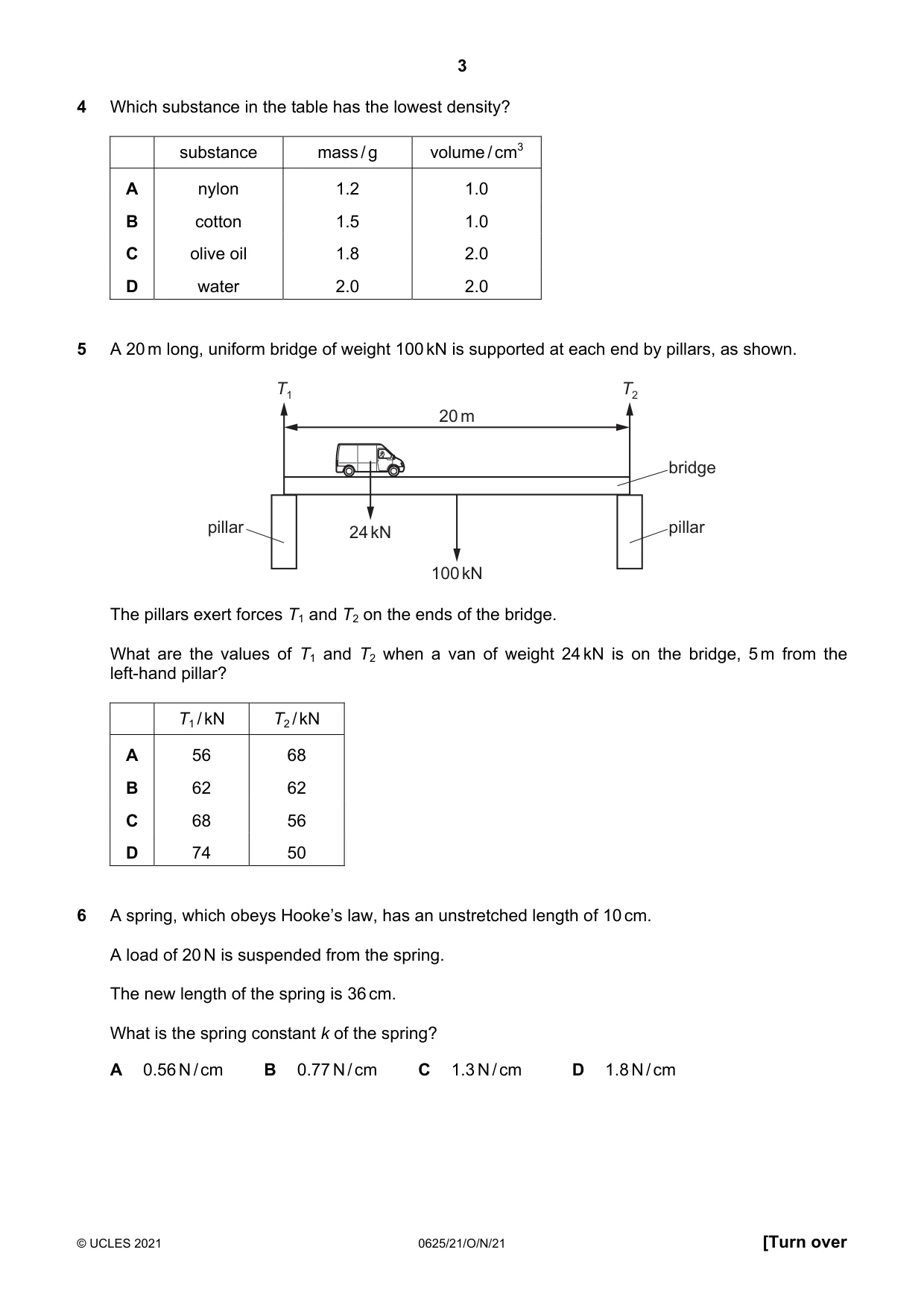
Q5 · A 20 m long, uniform bridge of weight 100 kN is supported at each end by pillars, as shown
5 A 20 m long, uniform bridge of weight 100 kN is supported at each end by pillars, as shown. T1 T2 20 m bridge pillar 24 kN pillar 100 kN The pillars exert forces T1 and T2 on the ends of the bridge. What are the values of T1 and T2 when a van of weight 24 kN is on the bridge, 5 m from the left-hand pillar? T1 / kN T2 / kN A 56 68 B 62 62 C 68 56 D 74 50
Mark scheme: C
Q6 · A spring, which obeys Hooke’s law, has an unstretched length of 10 cm
6 A spring, which obeys Hooke’s law, has an unstretched length of 10 cm. A load of 20 N is suspended from the spring. The new length of the spring is 36 cm. What is the spring constant k of the spring? A 0.56 N / cm B 0.77 N / cm C 1.3 N / cm D 1.8 N / cm
Mark scheme: B
Q7 · What is the relationship between the impulse acting on an object and the change in…
7 What is the relationship between the impulse acting on an object and the change in momentum of the object? A impulse = change in momentum B impulse = change in momentum time impulse = change in momentum C time impulse = change in momentum D mass
Mark scheme: A
Q8 · Electrical energy may be obtained from nuclear fission
8 Electrical energy may be obtained from nuclear fission. In which order is the energy transferred in this process? A nuclear fuel generator reactor and boiler turbines B nuclear fuel generator turbines reactor and boiler C nuclear fuel reactor and boiler generator turbines D nuclear fuel reactor and boiler turbines generator
Mark scheme: D
Q9 · A motor of power P exerts a force F on an object
9 A motor of power P exerts a force F on an object. The object moves a distance d during the time t that the force acts. Which equation is used to calculate the time t ? F Fd Pd P A t = Pd B t = P C t = F D t = Fd
Mark scheme: B
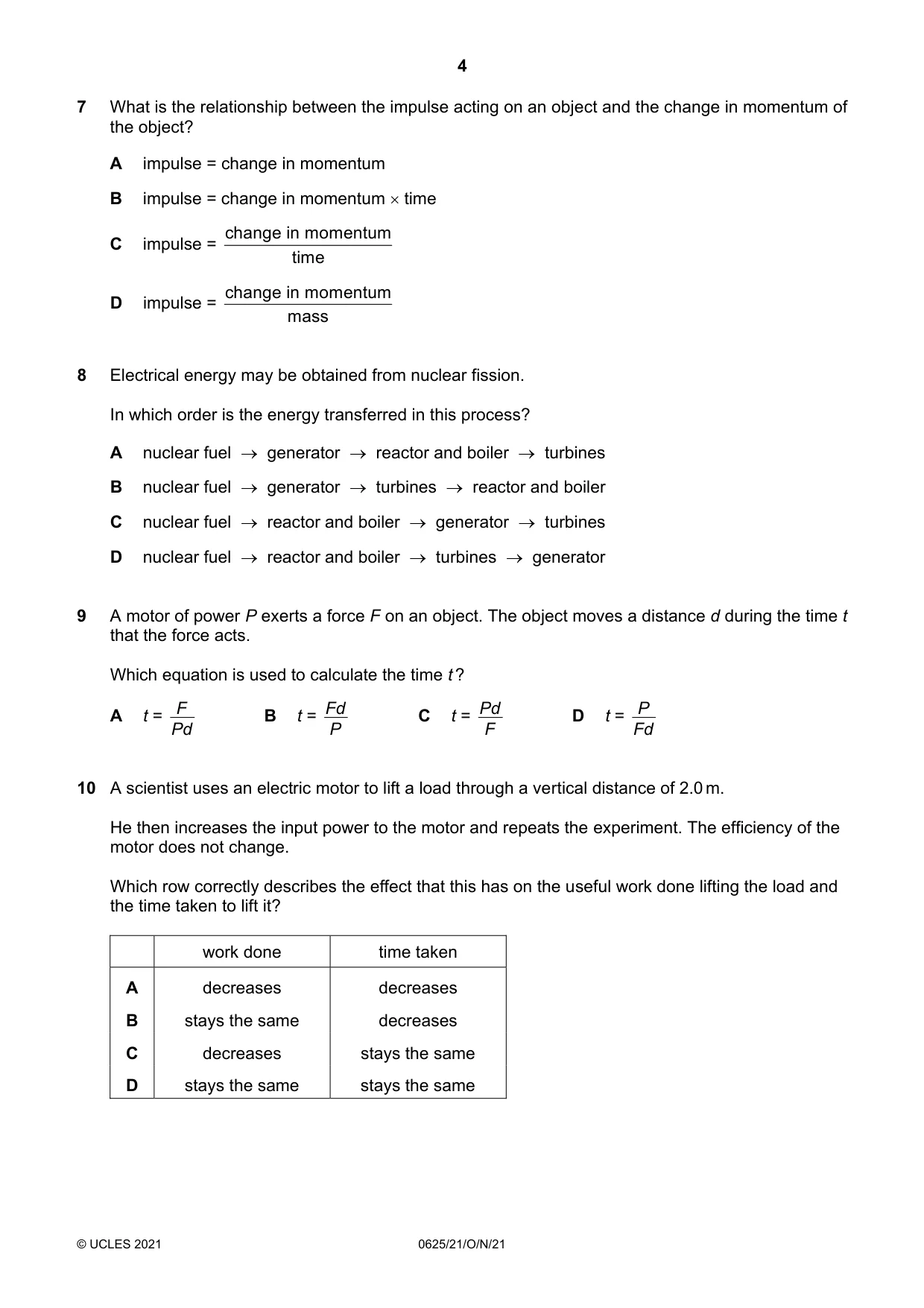
Q10 · A scientist uses an electric motor to lift a load through a vertical distance of 2.0 m
10 A scientist uses an electric motor to lift a load through a vertical distance of 2.0 m. He then increases the input power to the motor and repeats the experiment. The efficiency of the motor does not change. Which row correctly describes the effect that this has on the useful work done lifting the load and the time taken to lift it? work done time taken A decreases decreases B stays the same decreases C decreases stays the same D stays the same stays the same
Mark scheme: B
Q11 · Four containers are filled to the top with the same liquid
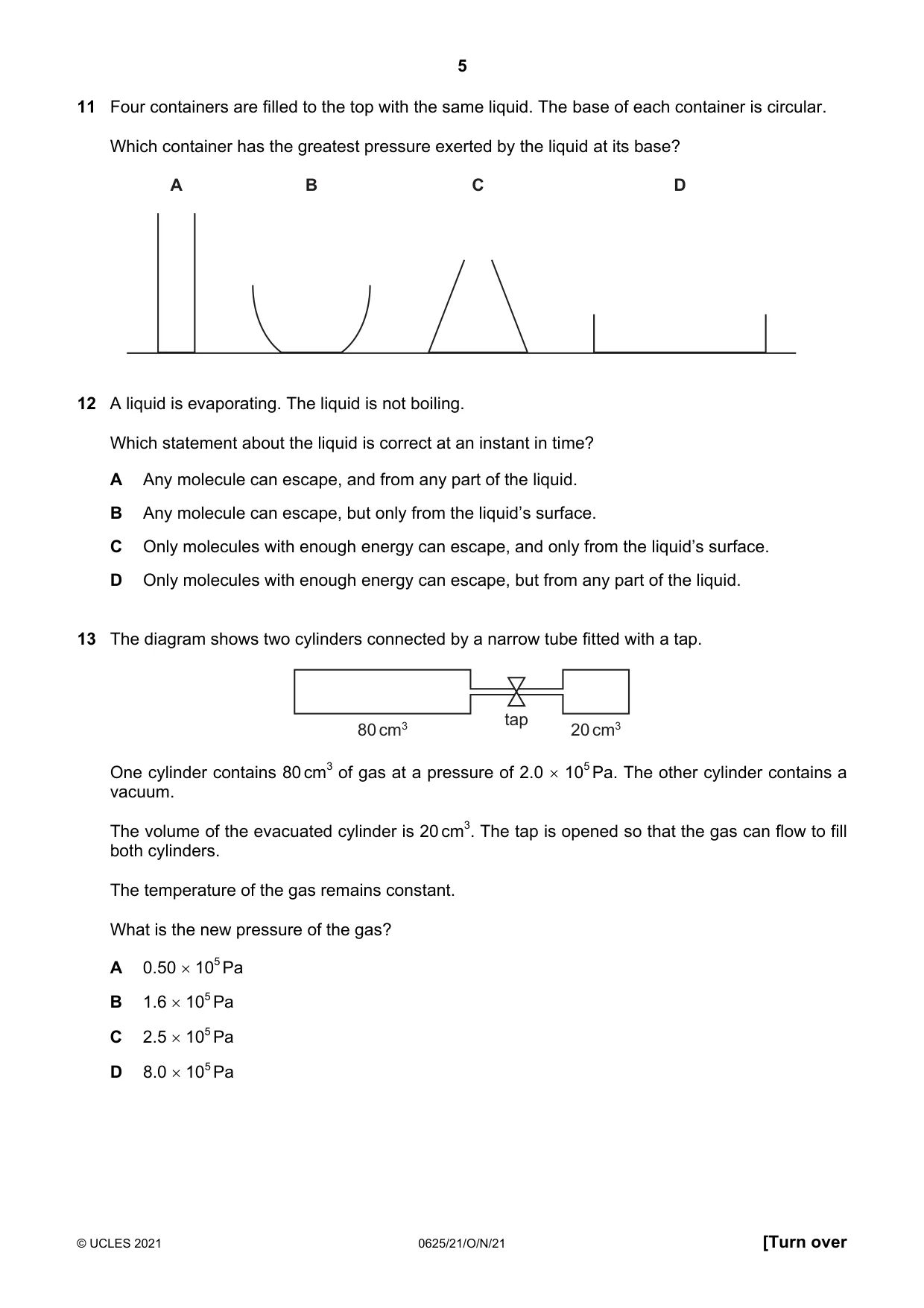
11 Four containers are filled to the top with the same liquid. The base of each container is circular. Which container has the greatest pressure exerted by the liquid at its base? A B C D
Mark scheme: A
Q12 · A liquid is evaporating
12 A liquid is evaporating. The liquid is not boiling. Which statement about the liquid is correct at an instant in time? A Any molecule can escape, and from any part of the liquid. B Any molecule can escape, but only from the liquid’s surface. C Only molecules with enough energy can escape, and only from the liquid’s surface. D Only molecules with enough energy can escape, but from any part of the liquid.
Mark scheme: C
Q13 · The diagram shows two cylinders connected by a narrow tube fitted with a tap
13 The diagram shows two cylinders connected by a narrow tube fitted with a tap. tap 80 cm3 20 cm3 One cylinder contains 80 cm3 of gas at a pressure of 2.0 105 Pa. The other cylinder contains a vacuum. The volume of the evacuated cylinder is 20 cm3. The tap is opened so that the gas can flow to fill both cylinders. The temperature of the gas remains constant. What is the new pressure of the gas? A 0.50 105 Pa B 1.6 105 Pa C 2.5 105 Pa D 8.0 105 Pa
Mark scheme: B
Q14 · An aluminium block has a mass of 200 g
14 An aluminium block has a mass of 200 g. The specific heat capacity of aluminium is 900 J / (kg C). How much energy is needed to increase the temperature of the block from 20 C to 110 C? A 2.0 J B 2000 J C 16 200 J D 16 200 000 J
Mark scheme: C
Q15 · The diagram shows a liquid-in-glass thermometer
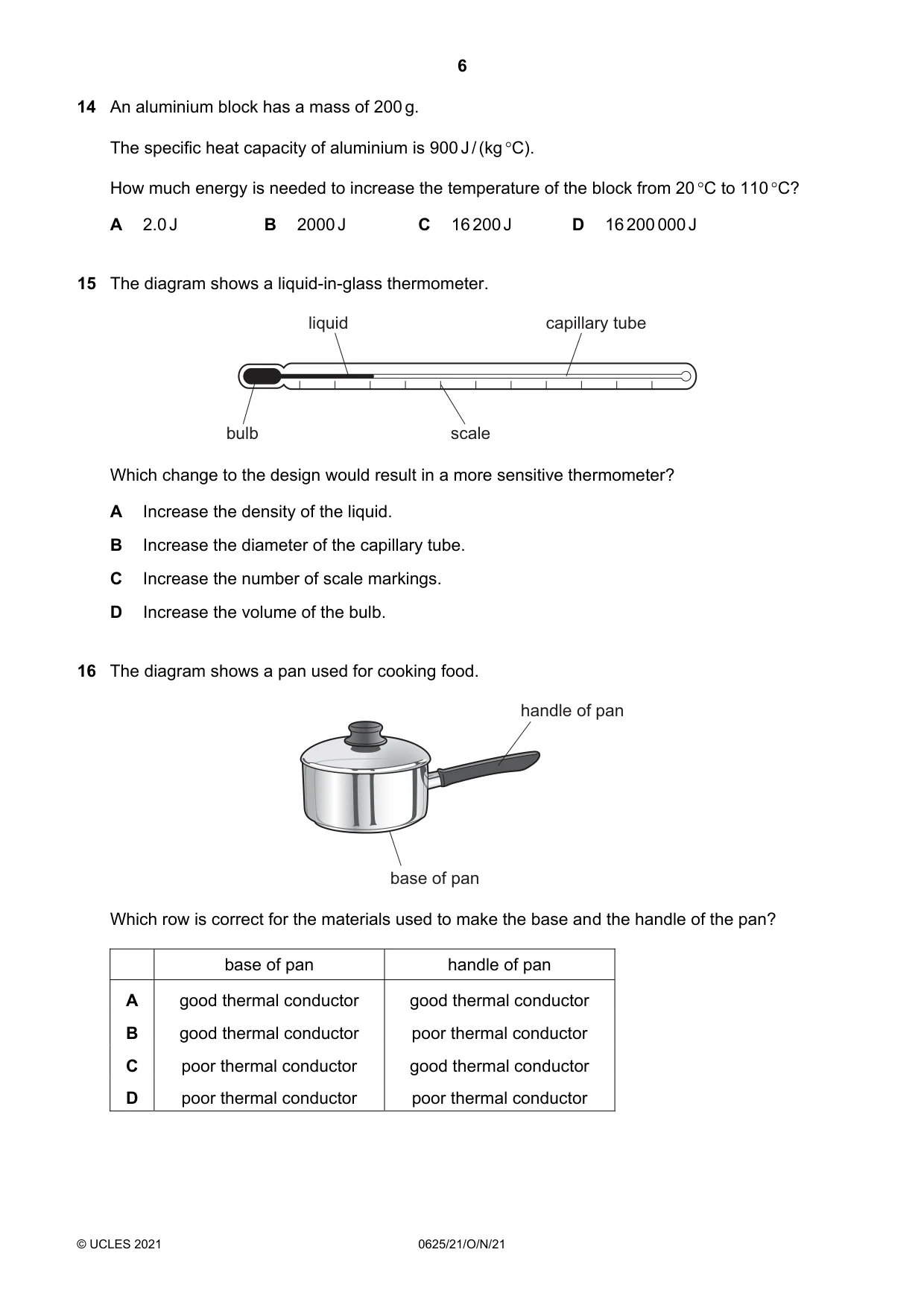
15 The diagram shows a liquid-in-glass thermometer. liquid capillary tube bulb scale Which change to the design would result in a more sensitive thermometer? A Increase the density of the liquid. B Increase the diameter of the capillary tube. C Increase the number of scale markings. D Increase the volume of the bulb.
Mark scheme: D
Q16 · The diagram shows a pan used for cooking food
16 The diagram shows a pan used for cooking food. handle of pan base of pan Which row is correct for the materials used to make the base and the handle of the pan? base of pan handle of pan A good thermal conductor good thermal conductor B good thermal conductor poor thermal conductor C poor thermal conductor good thermal conductor D poor thermal conductor poor thermal conductor
Mark scheme: B
Q17 · The diagram shows waves in a ripple tank containing water
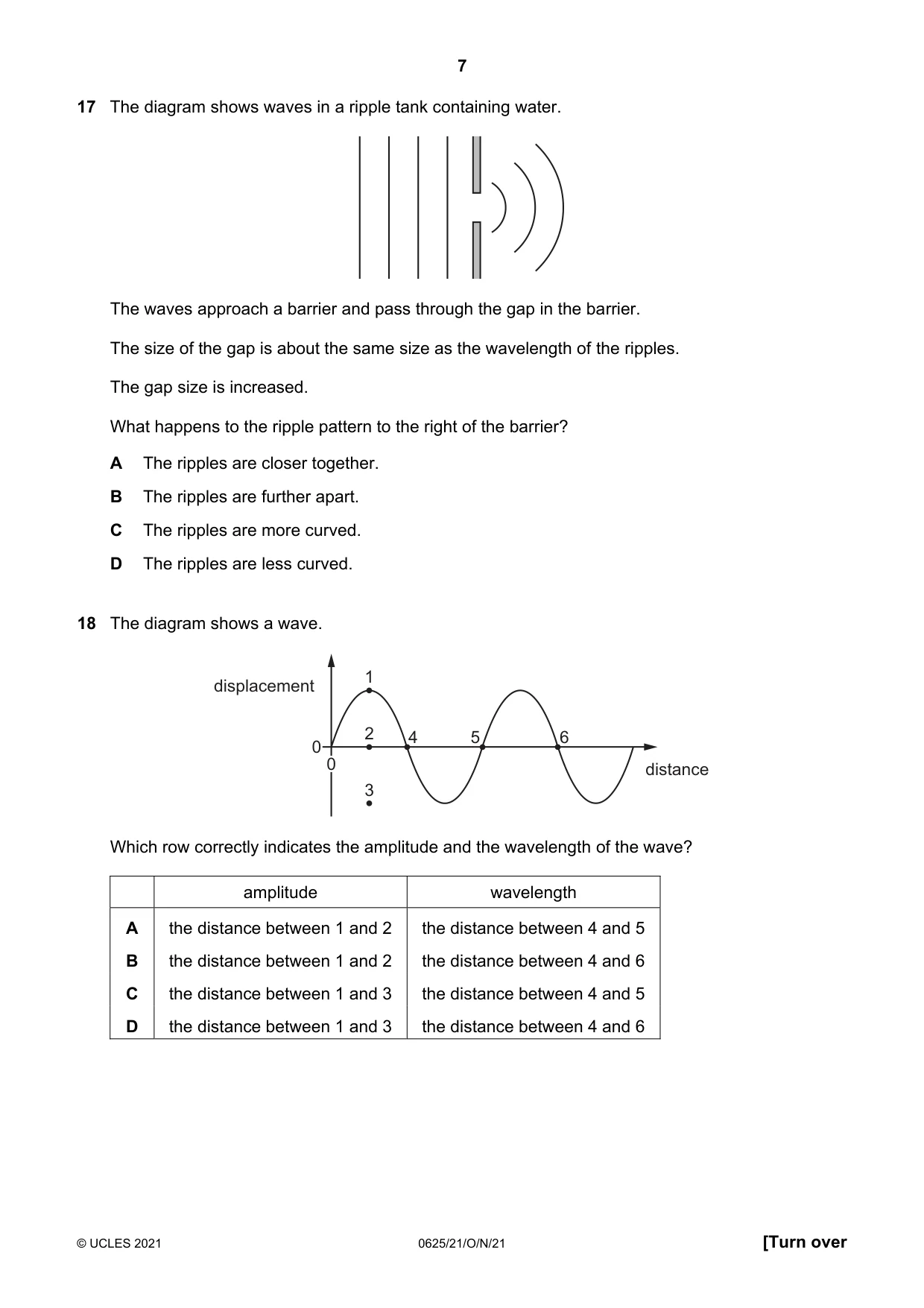
17 The diagram shows waves in a ripple tank containing water. The waves approach a barrier and pass through the gap in the barrier. The size of the gap is about the same size as the wavelength of the ripples. The gap size is increased. What happens to the ripple pattern to the right of the barrier? A The ripples are closer together. B The ripples are further apart. C The ripples are more curved. D The ripples are less curved.
Mark scheme: D
Q18 · The diagram shows a wave
18 The diagram shows a wave. 1 displacement 2 4 5 6 0 0 distance 3 Which row correctly indicates the amplitude and the wavelength of the wave? amplitude wavelength A the distance between 1 and 2 the distance between 4 and 5 B the distance between 1 and 2 the distance between 4 and 6 C the distance between 1 and 3 the distance between 4 and 5 D the distance between 1 and 3 the distance between 4 and 6
Mark scheme: B
Q19 · Two beams of light are both the same colour of red
19 Two beams of light are both the same colour of red. One beam is travelling through air. The other beam is travelling through water. Each beam has a different brightness. Which quantity is the same for both sets of waves? A amplitude B frequency C speed D wavelength
Mark scheme: B
Q20 · The diagram shows a ray of light in air incident on a glass block
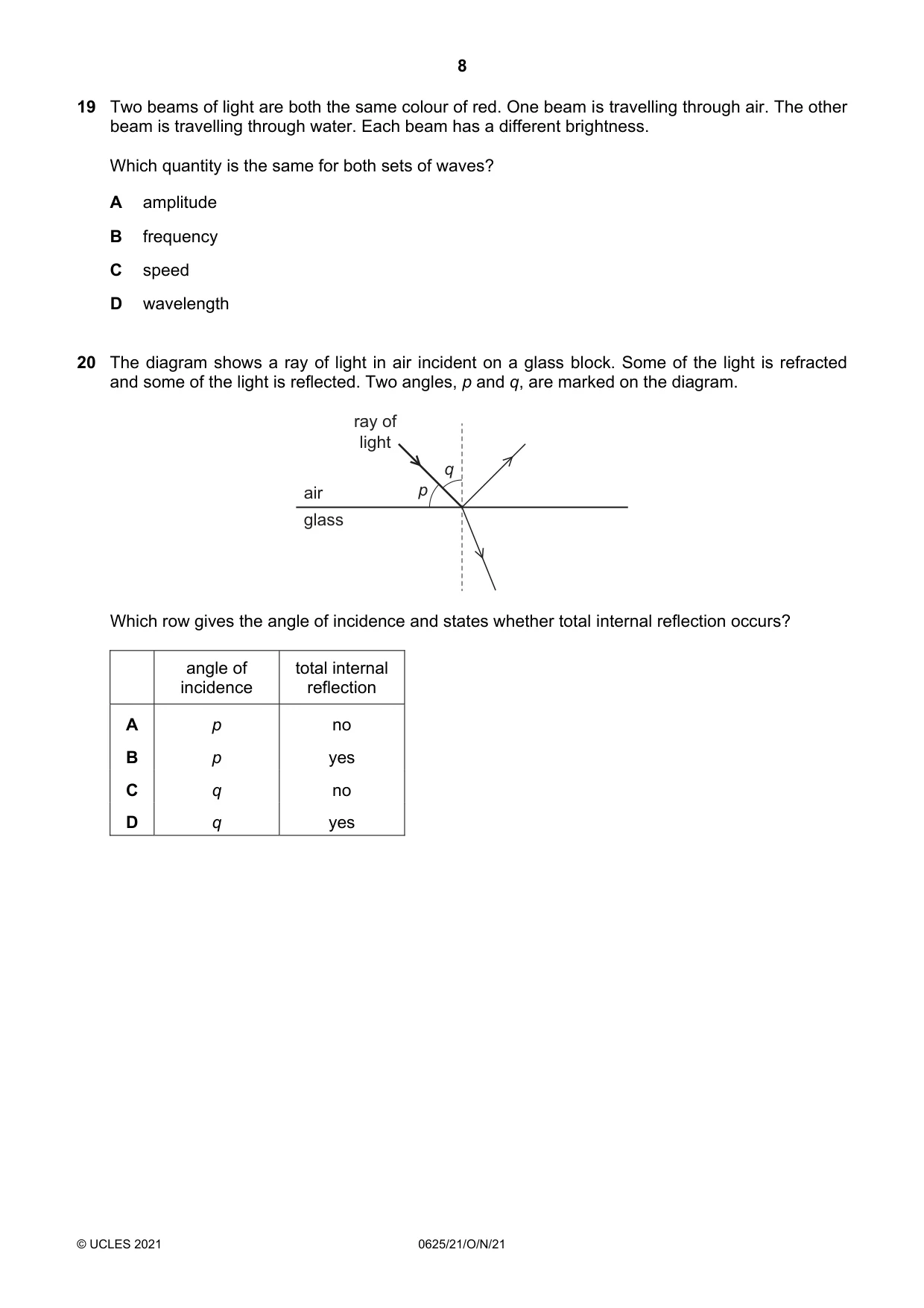
20 The diagram shows a ray of light in air incident on a glass block. Some of the light is refracted and some of the light is reflected. Two angles, p and q, are marked on the diagram. ray of light q air p glass Which row gives the angle of incidence and states whether total internal reflection occurs? angle of total internal incidence reflection A p no B p yes C q no D q yes
Mark scheme: C
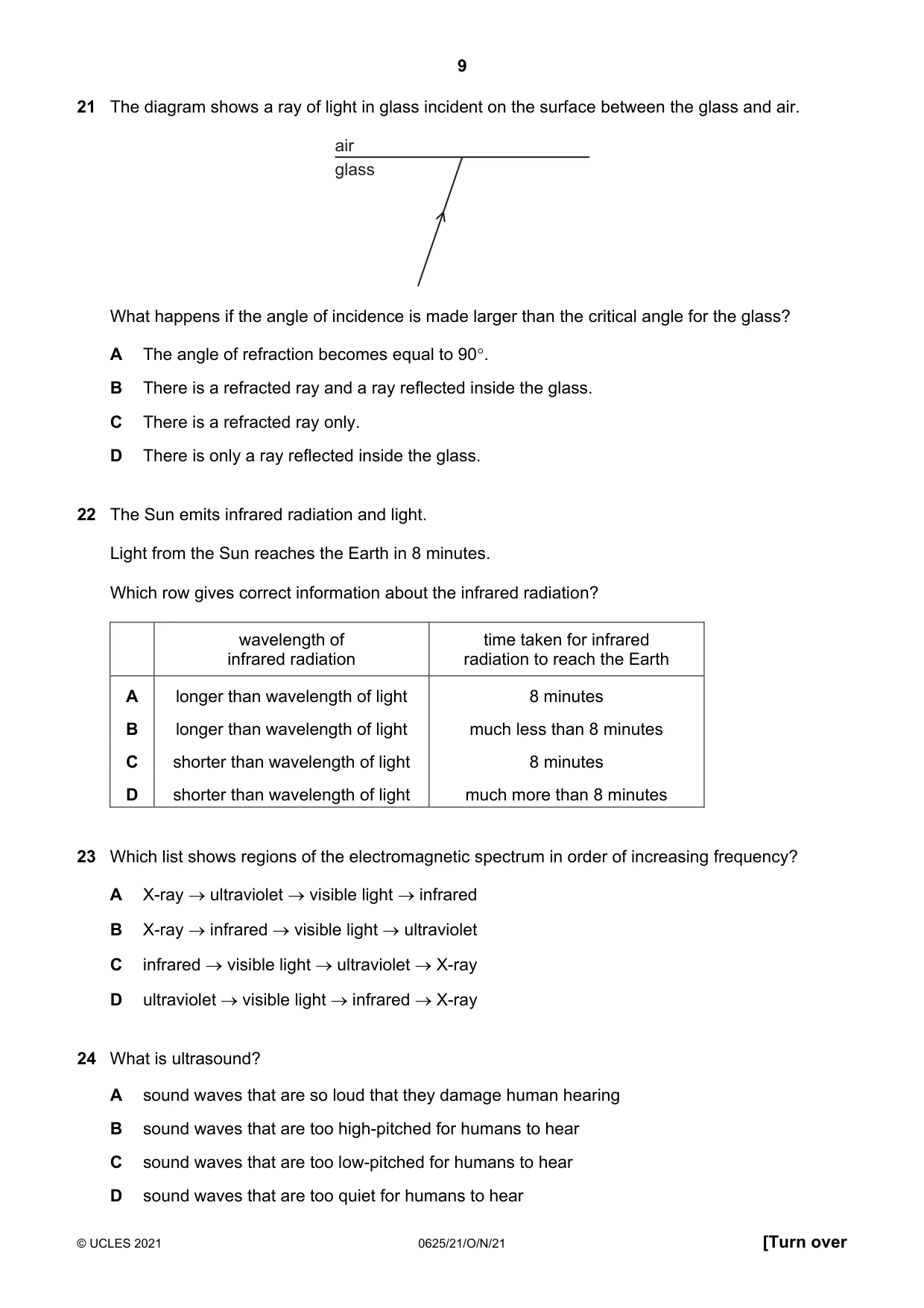
Q21 · The diagram shows a ray of light in glass incident on the surface between the glass and…
21 The diagram shows a ray of light in glass incident on the surface between the glass and air. air glass What happens if the angle of incidence is made larger than the critical angle for the glass? A The angle of refraction becomes equal to 90. B There is a refracted ray and a ray reflected inside the glass. C There is a refracted ray only. D There is only a ray reflected inside the glass.
Mark scheme: D
Q22 · The Sun emits infrared radiation and light
22 The Sun emits infrared radiation and light. Light from the Sun reaches the Earth in 8 minutes. Which row gives correct information about the infrared radiation? wavelength of time taken for infrared infrared radiation radiation to reach the Earth A longer than wavelength of light 8 minutes B longer than wavelength of light much less than 8 minutes C shorter than wavelength of light 8 minutes D shorter than wavelength of light much more than 8 minutes
Mark scheme: A
Q23 · Which list shows regions of the electromagnetic spectrum in order of increasing frequency?
23 Which list shows regions of the electromagnetic spectrum in order of increasing frequency? A X-ray ultraviolet visible light infrared B X-ray infrared visible light ultraviolet C infrared visible light ultraviolet X-ray D ultraviolet visible light infrared X-ray
Mark scheme: C
Question 24
24 What is ultrasound? A sound waves that are so loud that they damage human hearing B sound waves that are too high-pitched for humans to hear C sound waves that are too low-pitched for humans to hear D sound waves that are too quiet for humans to hear
Mark scheme: B
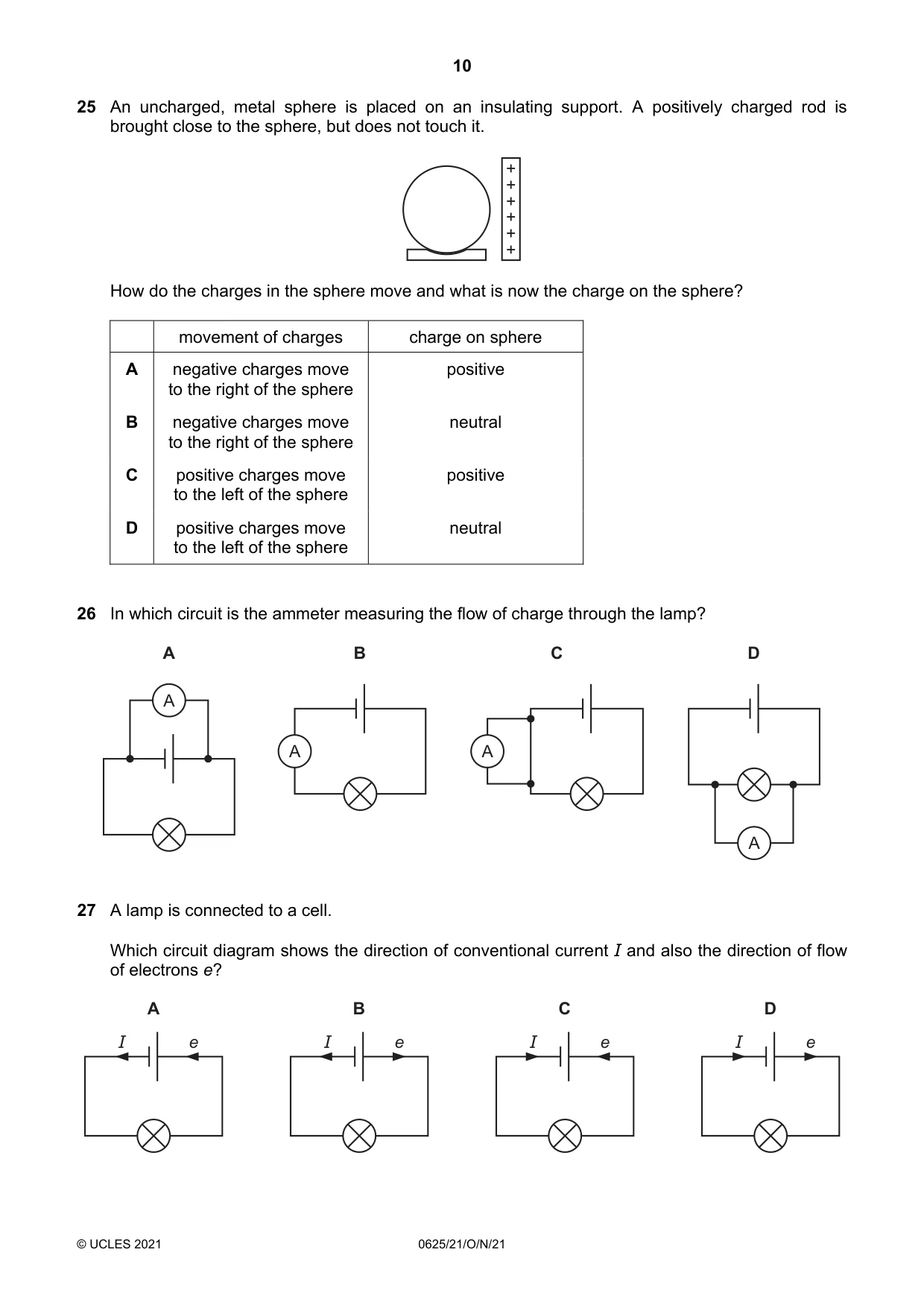
Q25 · An uncharged, metal sphere is placed on an insulating support
25 An uncharged, metal sphere is placed on an insulating support. A positively charged rod is brought close to the sphere, but does not touch it. + + + + + + How do the charges in the sphere move and what is now the charge on the sphere? movement of charges charge on sphere A negative charges move positive to the right of the sphere B negative charges move neutral to the right of the sphere C positive charges move positive to the left of the sphere D positive charges move neutral to the left of the sphere
Mark scheme: B
Q26 · In which circuit is the ammeter measuring the flow of charge through the lamp?
26 In which circuit is the ammeter measuring the flow of charge through the lamp? A B C D A A A A
Mark scheme: B
Q27 · A lamp is connected to a cell
27 A lamp is connected to a cell. Which circuit diagram shows the direction of conventional current I and also the direction of flow of electrons e? A B C D I e I e I e I e
Mark scheme: C
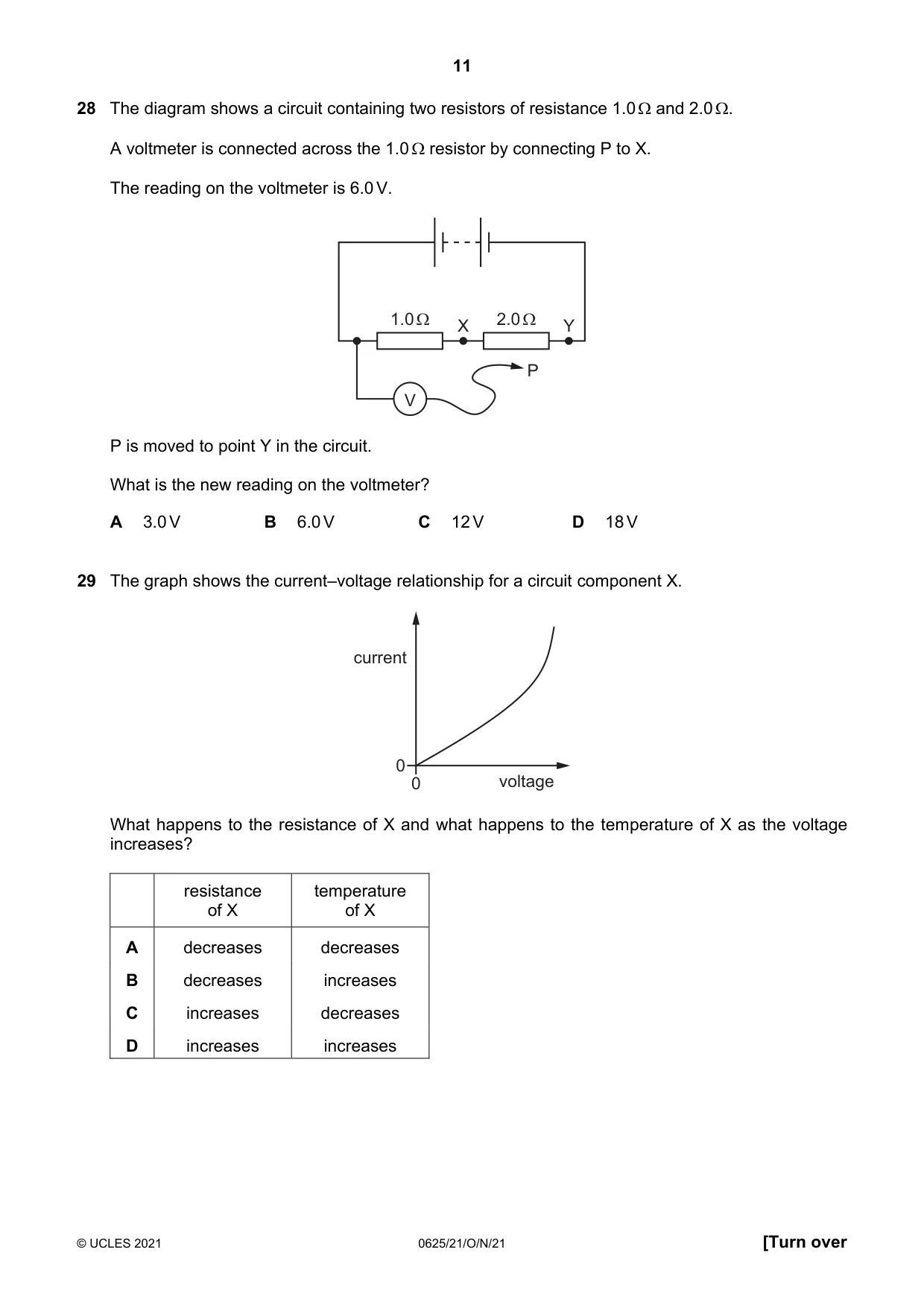
Q28 · The diagram shows a circuit containing two resistors of resistance 1.0 and 2.0
28 The diagram shows a circuit containing two resistors of resistance 1.0 and 2.0 . A voltmeter is connected across the 1.0 resistor by connecting P to X. The reading on the voltmeter is 6.0 V. 1.0 Ω X 2.0 Ω Y P V P is moved to point Y in the circuit. What is the new reading on the voltmeter? A 3.0 V B 6.0 V C 12 V D 18 V
Mark scheme: D
Q29 · The graph shows the current–voltage relationship for a circuit component X
29 The graph shows the current–voltage relationship for a circuit component X. current 0 0 voltage What happens to the resistance of X and what happens to the temperature of X as the voltage increases? resistance temperature of X of X A decreases decreases B decreases increases C increases decreases D increases increases
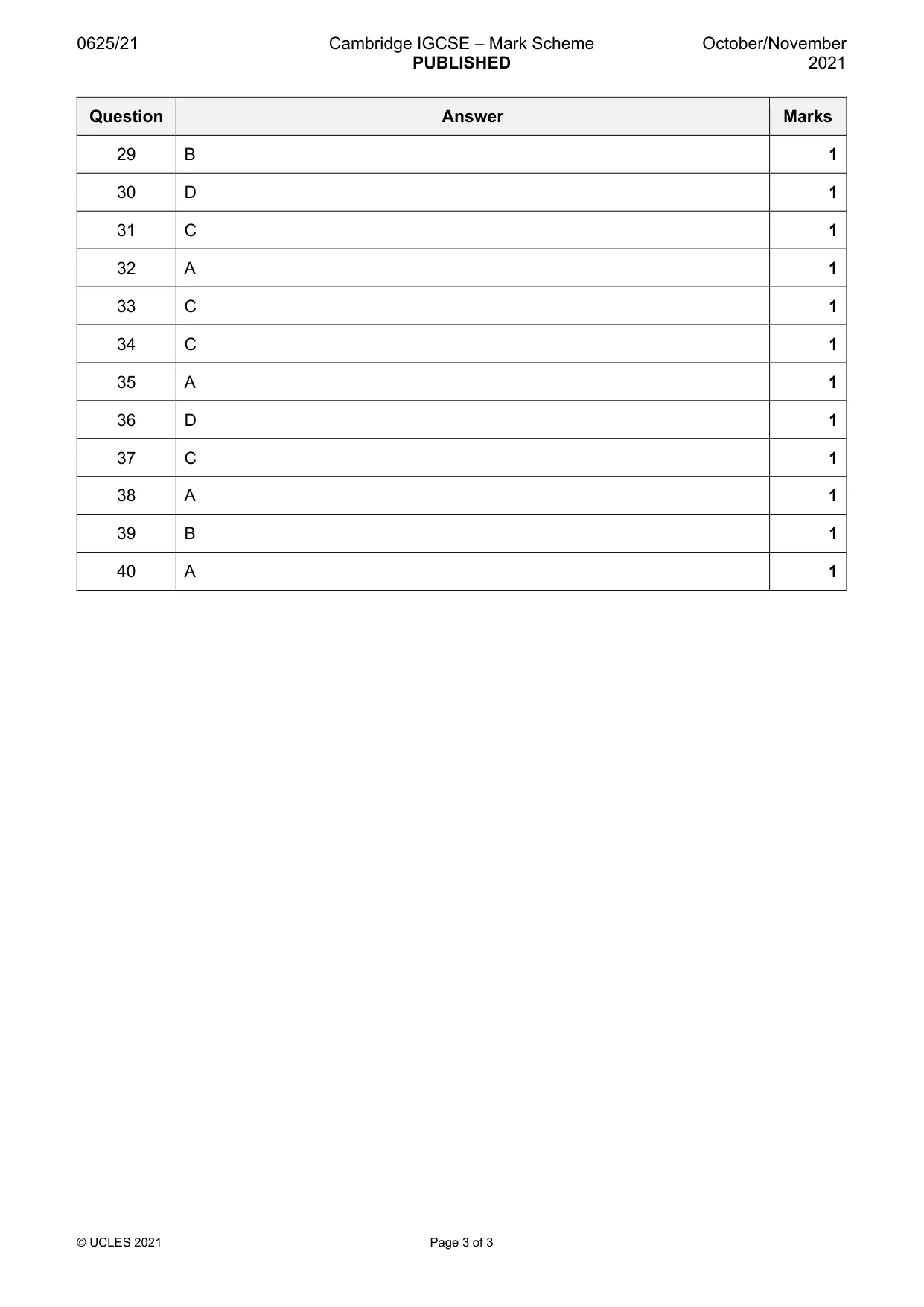
Mark scheme: B
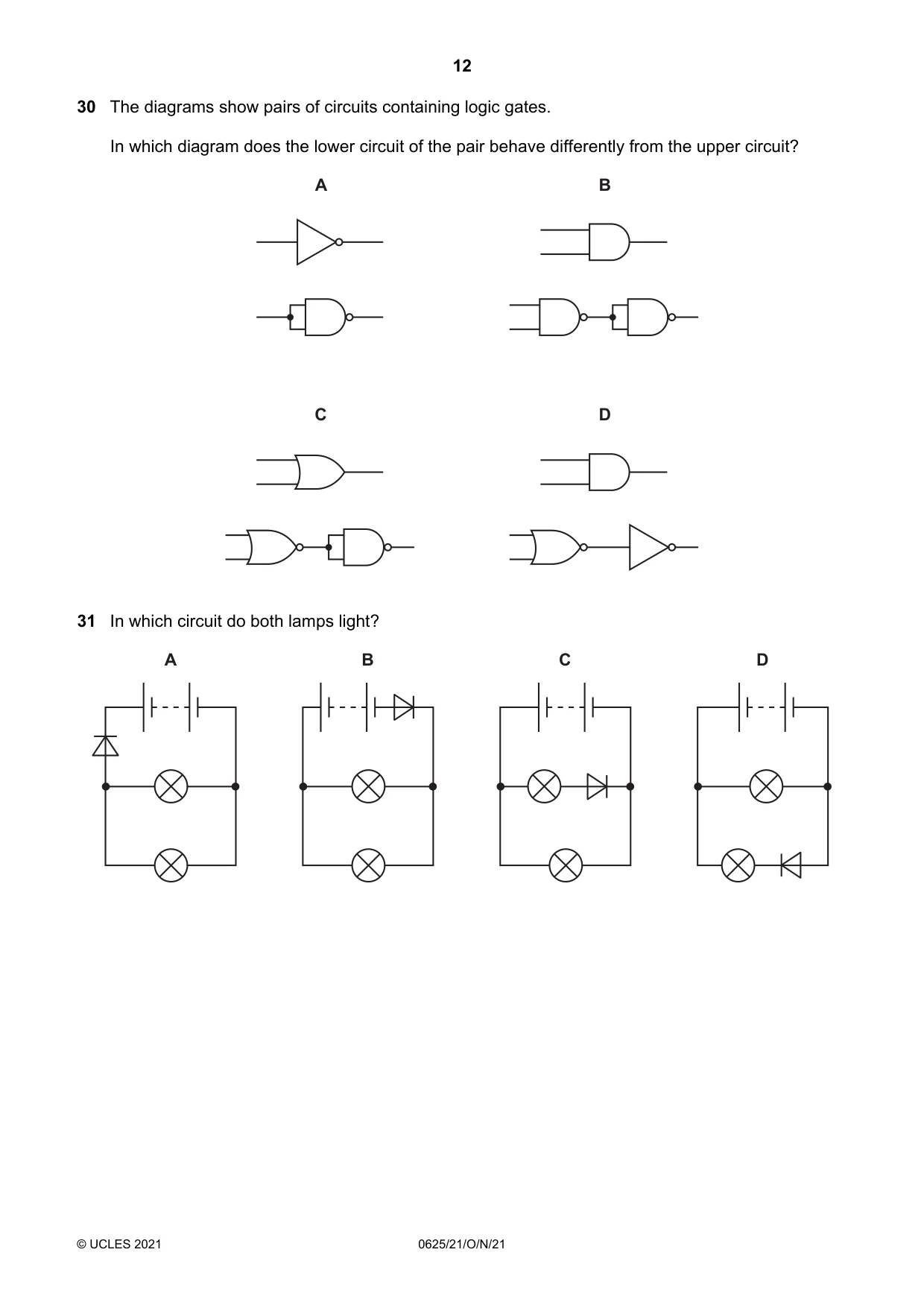
Q30 · The diagrams show pairs of circuits containing logic gates
30 The diagrams show pairs of circuits containing logic gates. In which diagram does the lower circuit of the pair behave differently from the upper circuit? A B C D
Mark scheme: D
Q31 · In which circuit do both lamps light?
31 In which circuit do both lamps light? A B C D
Mark scheme: C
Q32 · Two resistors, with resistances R1 and R2, are connected in parallel
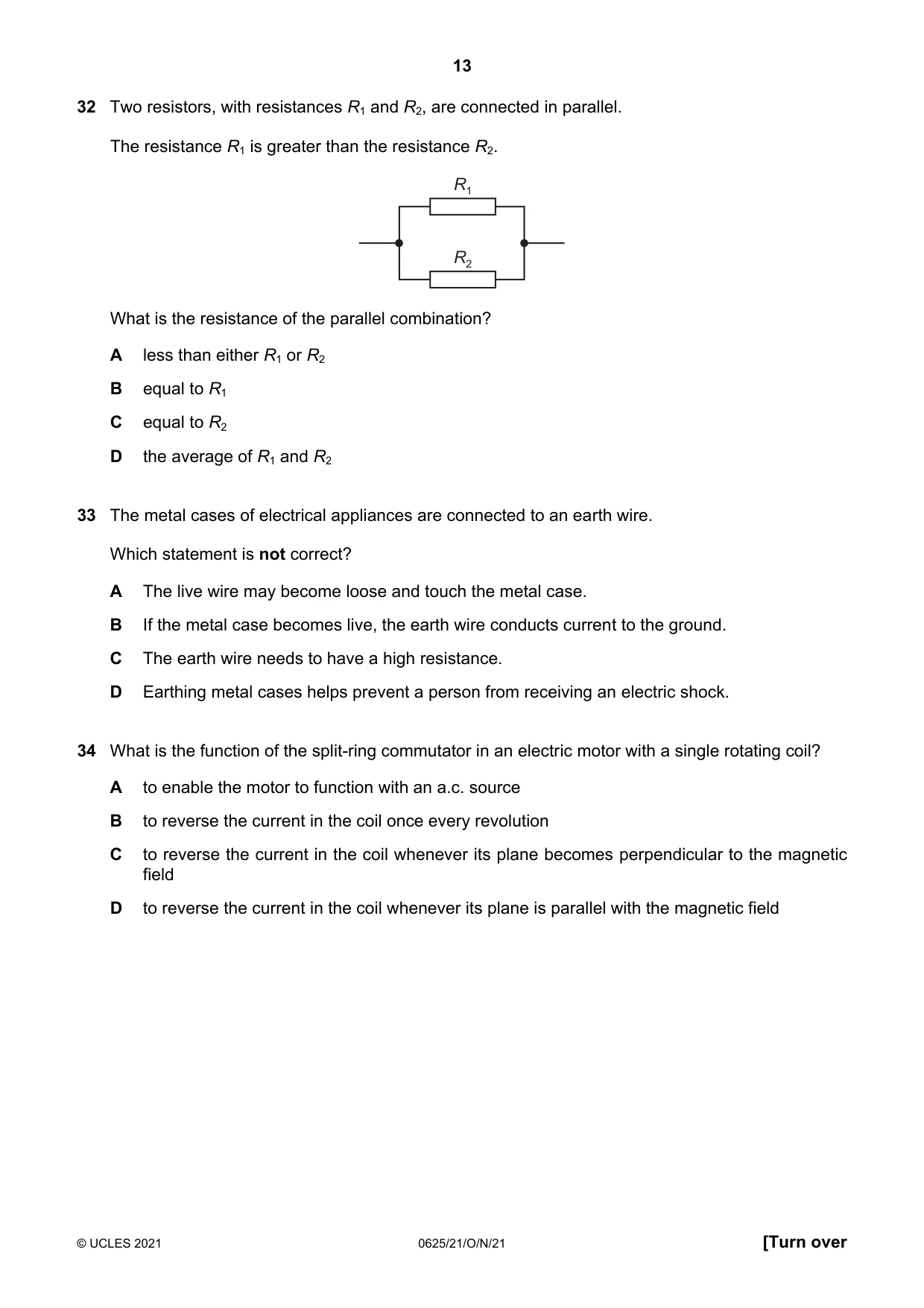
32 Two resistors, with resistances R1 and R2, are connected in parallel. The resistance R1 is greater than the resistance R2. R1 R2 What is the resistance of the parallel combination? A less than either R1 or R2 B equal to R1 C equal to R2 D the average of R1 and R2
Mark scheme: A
Q33 · The metal cases of electrical appliances are connected to an earth wire
33 The metal cases of electrical appliances are connected to an earth wire. Which statement is not correct? A The live wire may become loose and touch the metal case. B If the metal case becomes live, the earth wire conducts current to the ground. C The earth wire needs to have a high resistance. D Earthing metal cases helps prevent a person from receiving an electric shock.
Mark scheme: C
Q34 · What is the function of the split-ring commutator in an electric motor with a single…
34 What is the function of the split-ring commutator in an electric motor with a single rotating coil? A to enable the motor to function with an a.c. source B to reverse the current in the coil once every revolution C to reverse the current in the coil whenever its plane becomes perpendicular to the magnetic field D to reverse the current in the coil whenever its plane is parallel with the magnetic field
Mark scheme: C
Q35 · Which graph represents an alternating current (a.c.)?
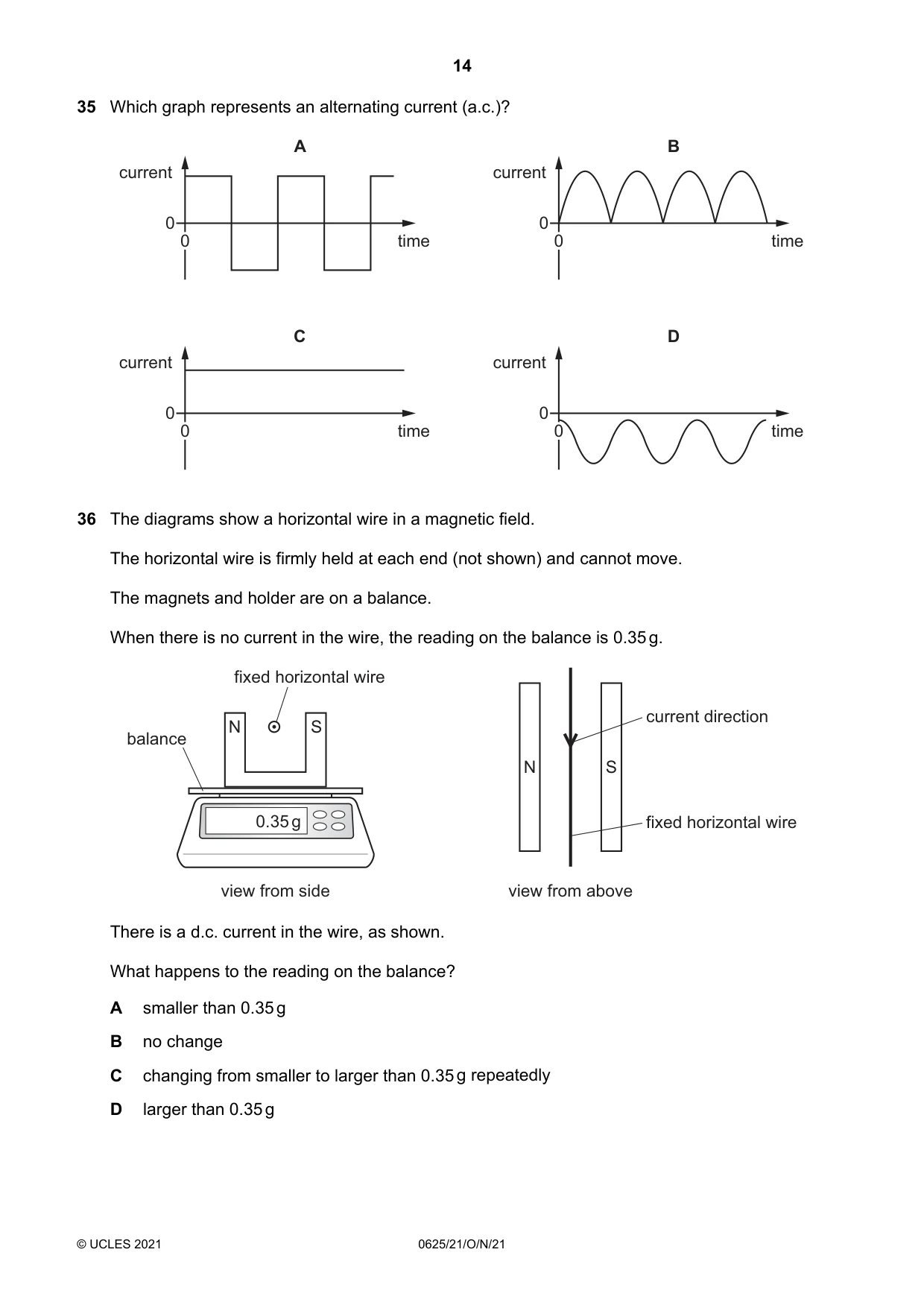
35 Which graph represents an alternating current (a.c.)? A B current current 0 0 0 time 0 time C D current current 0 0 0 time 0 time
Mark scheme: A
Q36 · The diagrams show a horizontal wire in a magnetic field
36 The diagrams show a horizontal wire in a magnetic field. The horizontal wire is firmly held at each end (not shown) and cannot move. The magnets and holder are on a balance. When there is no current in the wire, the reading on the balance is 0.35 g. fixed horizontal wire current direction N S balance N S 0.35 g fixed horizontal wire view from side view from above There is a d.c. current in the wire, as shown. What happens to the reading on the balance? A smaller than 0.35 g B no change C changing from smaller to larger than 0.35 g repeatedly D larger than 0.35 g
Mark scheme: D
Q37 · The nucleus of an americium atom contains 146 neutrons and 95 protons
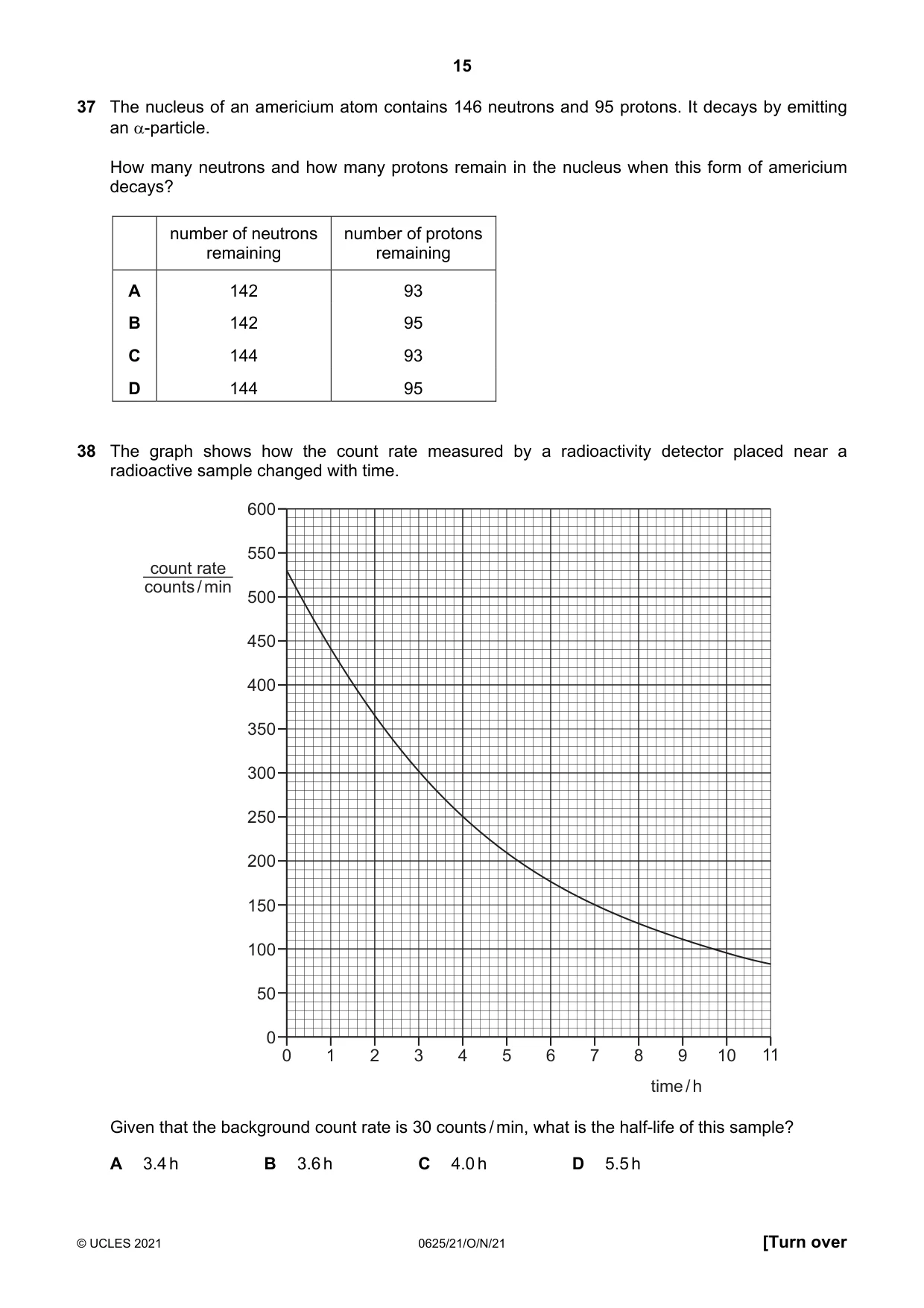
37 The nucleus of an americium atom contains 146 neutrons and 95 protons. It decays by emitting an -particle. How many neutrons and how many protons remain in the nucleus when this form of americium decays? number of neutrons number of protons remaining remaining A 142 93 B 142 95 C 144 93 D 144 95
Mark scheme: C
Q38 · The graph shows how the count rate measured by a radioactivity detector placed near a…
38 The graph shows how the count rate measured by a radioactivity detector placed near a radioactive sample changed with time. 600 550 count rate counts / min 500 450 400 350 300 250 200 150 100 50 0 0 1 2 3 4 5 6 7 8 9 10 11 time / h Given that the background count rate is 30 counts / min, what is the half-life of this sample? A 3.4 h B 3.6 h C 4.0 h D 5.5 h
Mark scheme: A
Q39 · A teacher holds a radioactive source near a detector
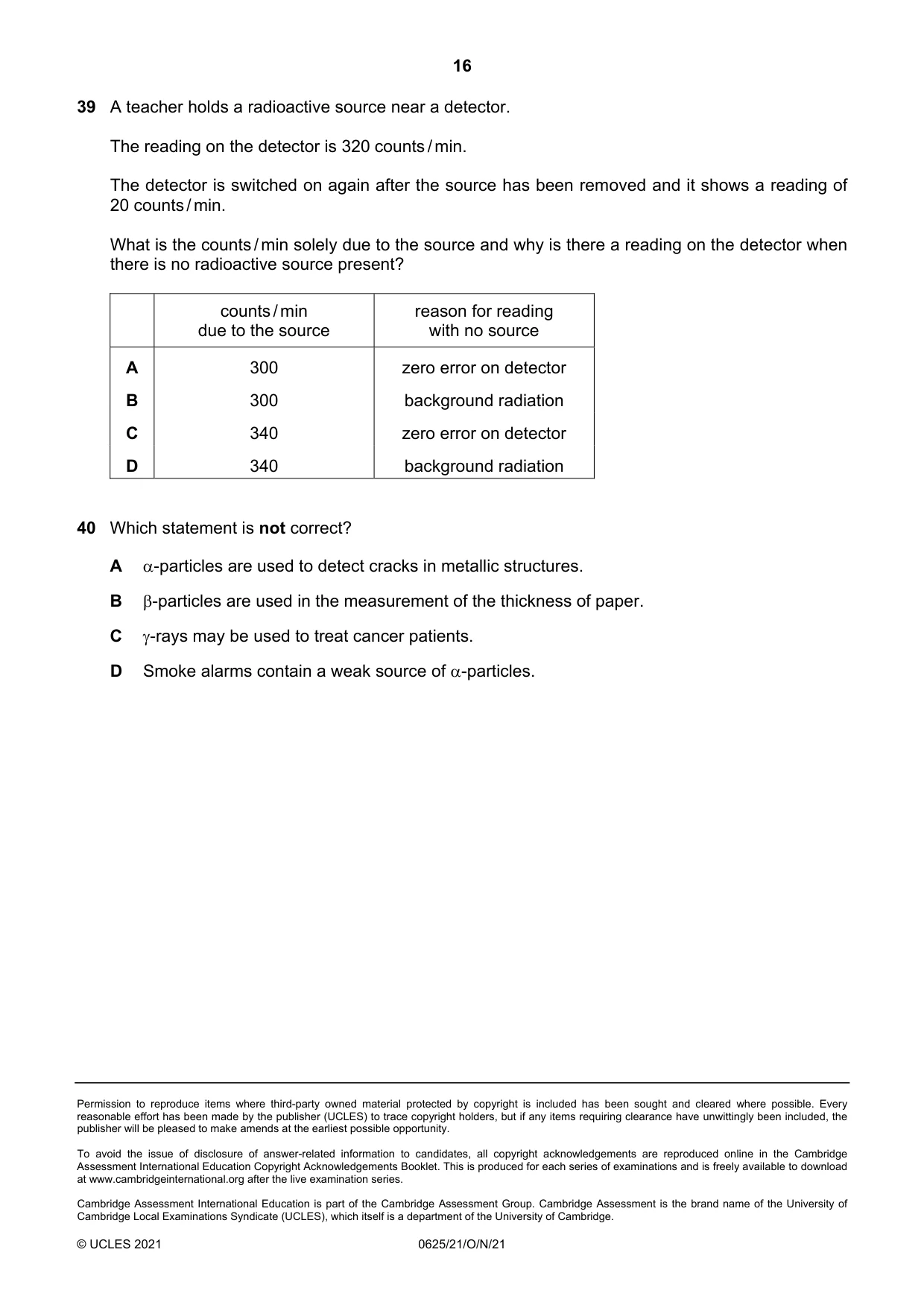
39 A teacher holds a radioactive source near a detector. The reading on the detector is 320 counts / min. The detector is switched on again after the source has been removed and it shows a reading of 20 counts / min. What is the counts / min solely due to the source and why is there a reading on the detector when there is no radioactive source present? counts / min reason for reading due to the source with no source A 300 zero error on detector B 300 background radiation C 340 zero error on detector D 340 background radiation
Mark scheme: B
Q40 · Which statement is not correct?
40 Which statement is not correct? A -particles are used to detect cracks in metallic structures. B -particles are used in the measurement of the thickness of paper. C -rays may be used to treat cancer patients. D Smoke alarms contain a weak source of -particles.
Mark scheme: A
What was in this paper
The subtopics covered by these 40 questions, and how many questions each got. Open one in a new tab to see every Cambridge question on it.
6Electromagnetic effects3Energy, work and power3Light3Radioactivity3Electromagnetic spectrum2Forces2General properties of waves2Pressure2Thermal properties and temperature2Density1Electrical quantities1Electrical safety1Kinetic particle model of matter1Mass and weight1Momentum1Motion1Physical quantities and measurement techniques1Simple phenomena of magnetism1Sound1The nuclear model of the atom1Transfer of thermal energy1What you needed in this session
Cambridge’s own grade thresholds for 2021 Oct/Nov, Paper 2 · Variant 1. A higher threshold means an easier paper — the bar moves with how the cohort did.