Cambridge IGCSE Physics 0625 — 2025 Oct/Nov Paper 2 · Variant 3
0625/23/O/N/25 · 40 questions · 40 marks · ≈45 min
The question paper and its mark scheme, free to read here and free to download. This is Cambridge’s own paper, exactly as it was sat.
Question paper16 pages
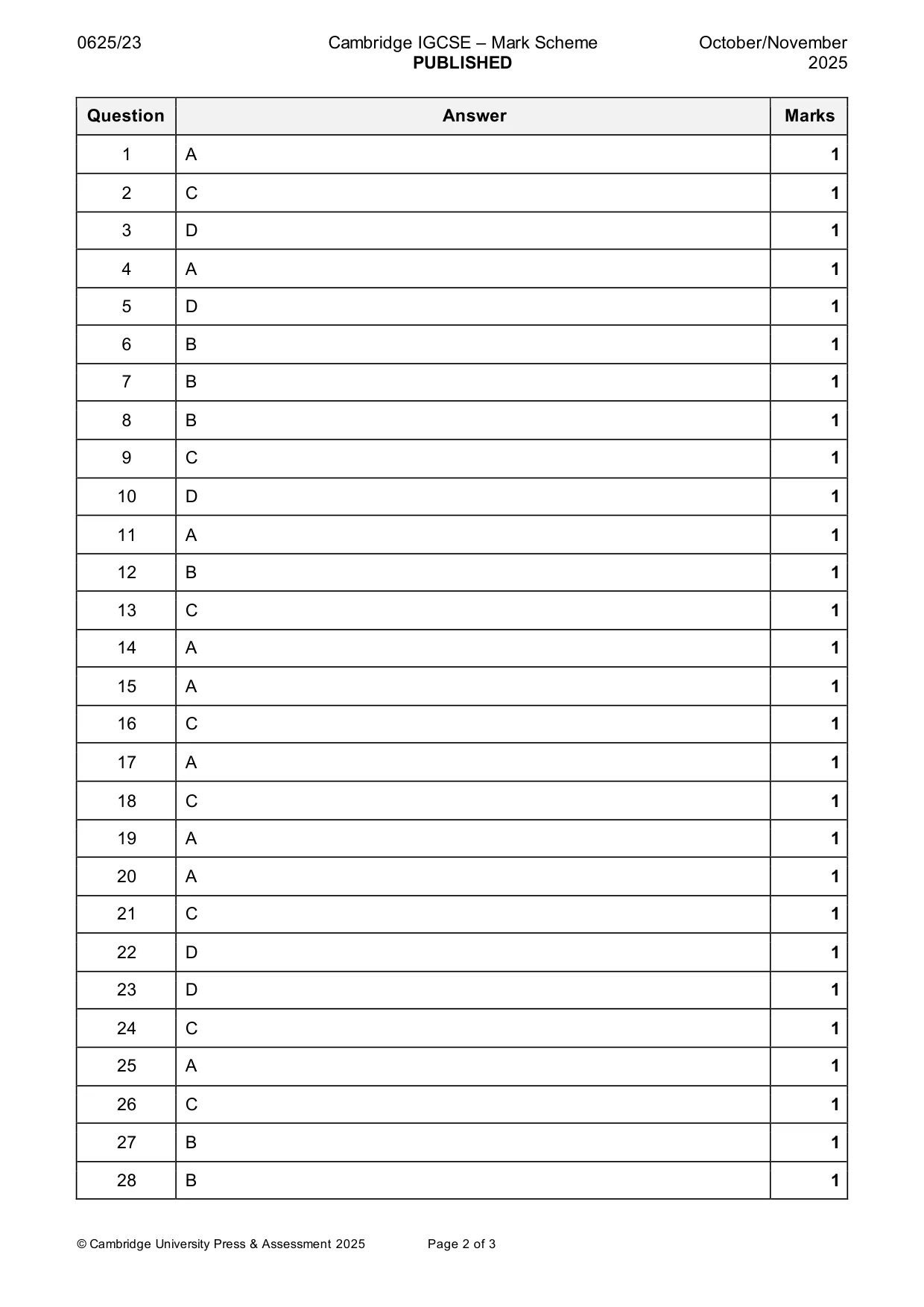
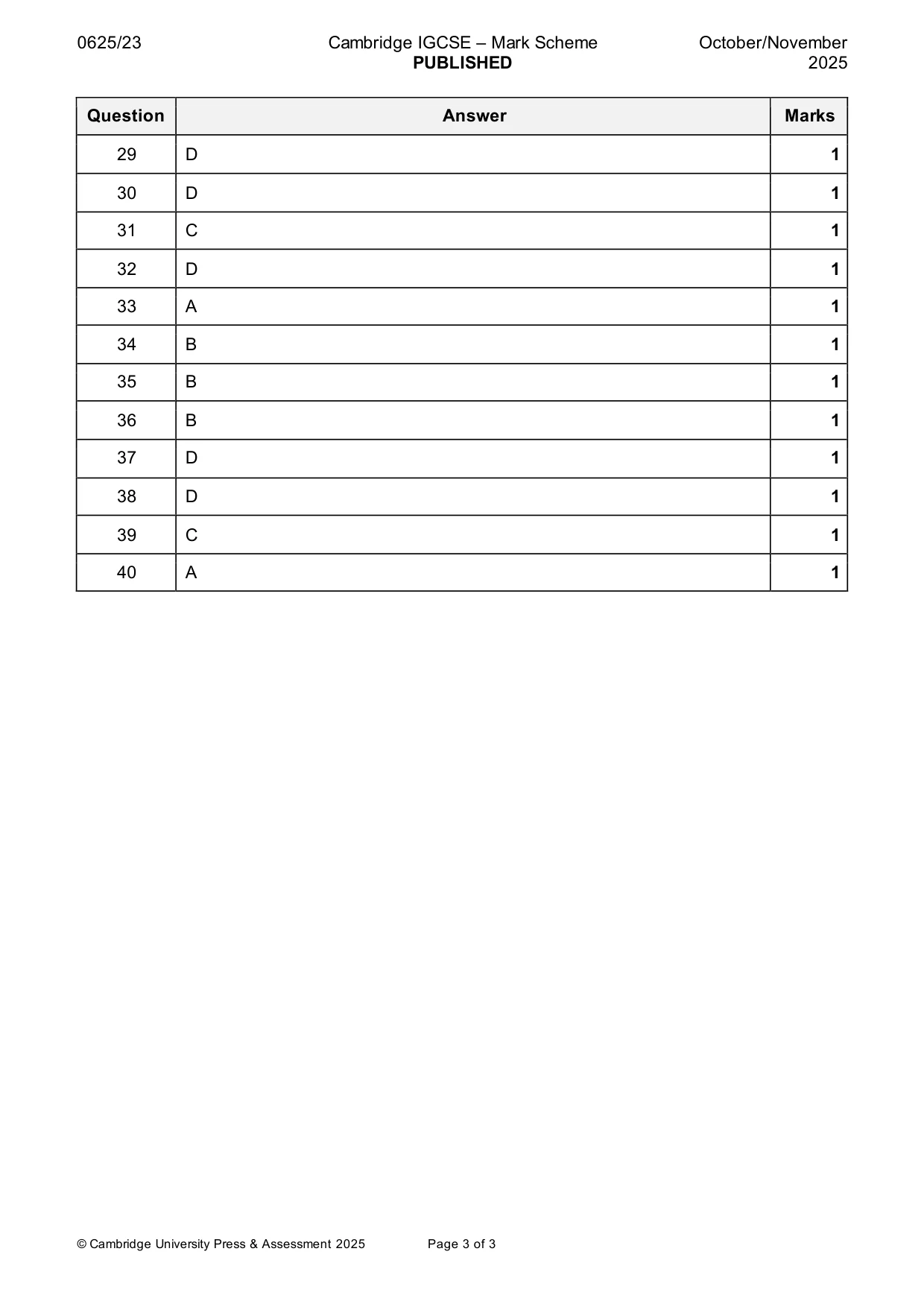
Mark scheme3 pages
Answers below. Sit the paper first if you are practising.
Questions as text
Q1 · When a pendulum passes a marker, a timer displays 1 minute 30 seconds
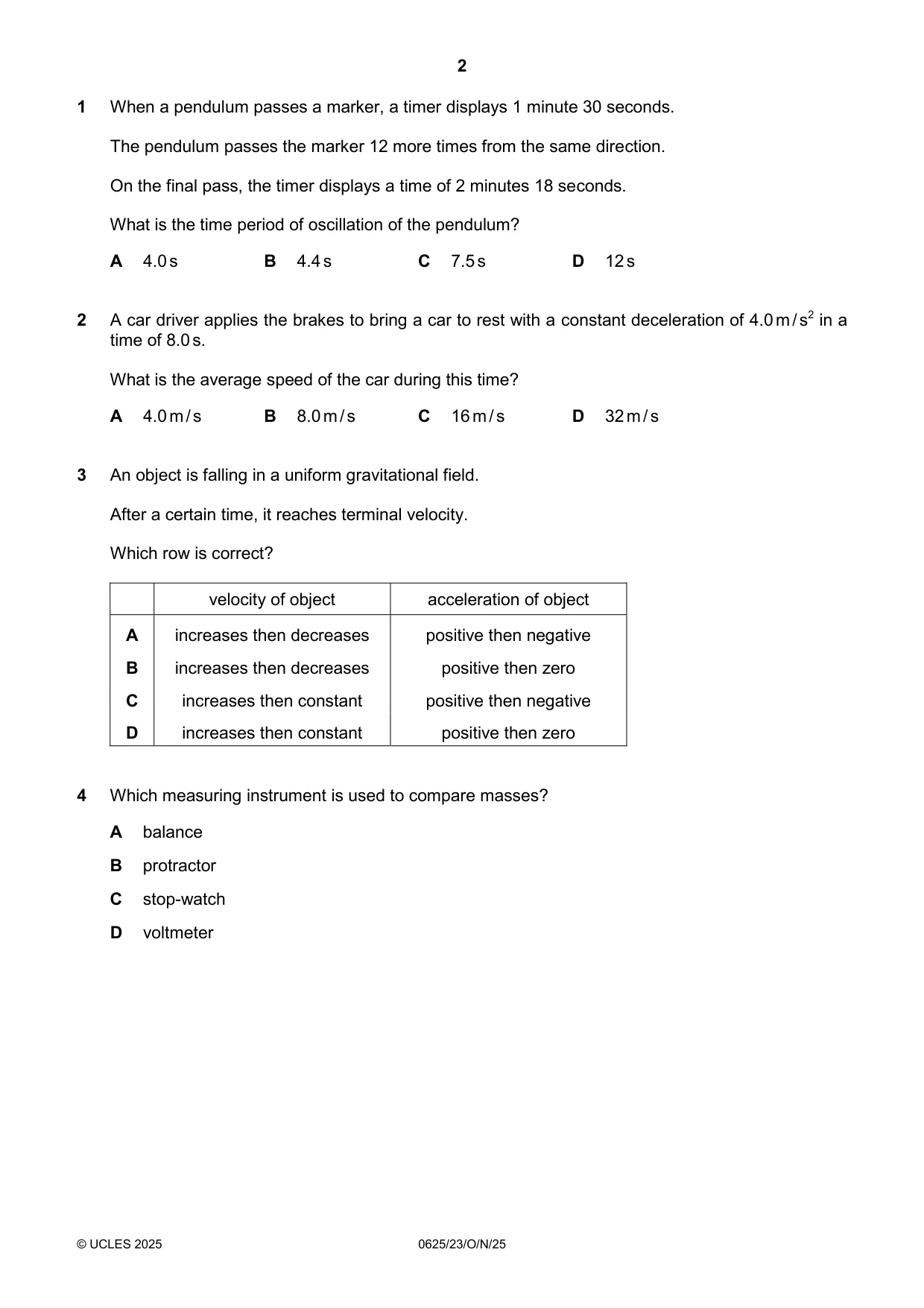
1 When a pendulum passes a marker, a timer displays 1 minute 30 seconds. The pendulum passes the marker 12 more times from the same direction. On the final pass, the timer displays a time of 2 minutes 18 seconds. What is the time period of oscillation of the pendulum? A 4.0 s B 4.4 s C 7.5 s D 12 s
Mark scheme: A
More questions on Physical quantities and measurement techniques
Q2 · A car driver applies the brakes to bring a car to rest with a constant deceleration of…
2 A car driver applies the brakes to bring a car to rest with a constant deceleration of 4.0 m / s2 in a time of 8.0 s. What is the average speed of the car during this time? A 4.0 m / s B 8.0 m / s C 16 m / s D 32 m / s
Mark scheme: C
Q3 · An object is falling in a uniform gravitational field
3 An object is falling in a uniform gravitational field. After a certain time, it reaches terminal velocity. Which row is correct? velocity of object acceleration of object A increases then decreases positive then negative B increases then decreases positive then zero C increases then constant positive then negative D increases then constant positive then zero
Mark scheme: D
Q4 · Which measuring instrument is used to compare masses?
4 Which measuring instrument is used to compare masses? A balance B protractor C stop-watch D voltmeter
Mark scheme: A
More questions on Physical quantities and measurement techniques
Q5 · Three different liquids are poured into a tall beaker
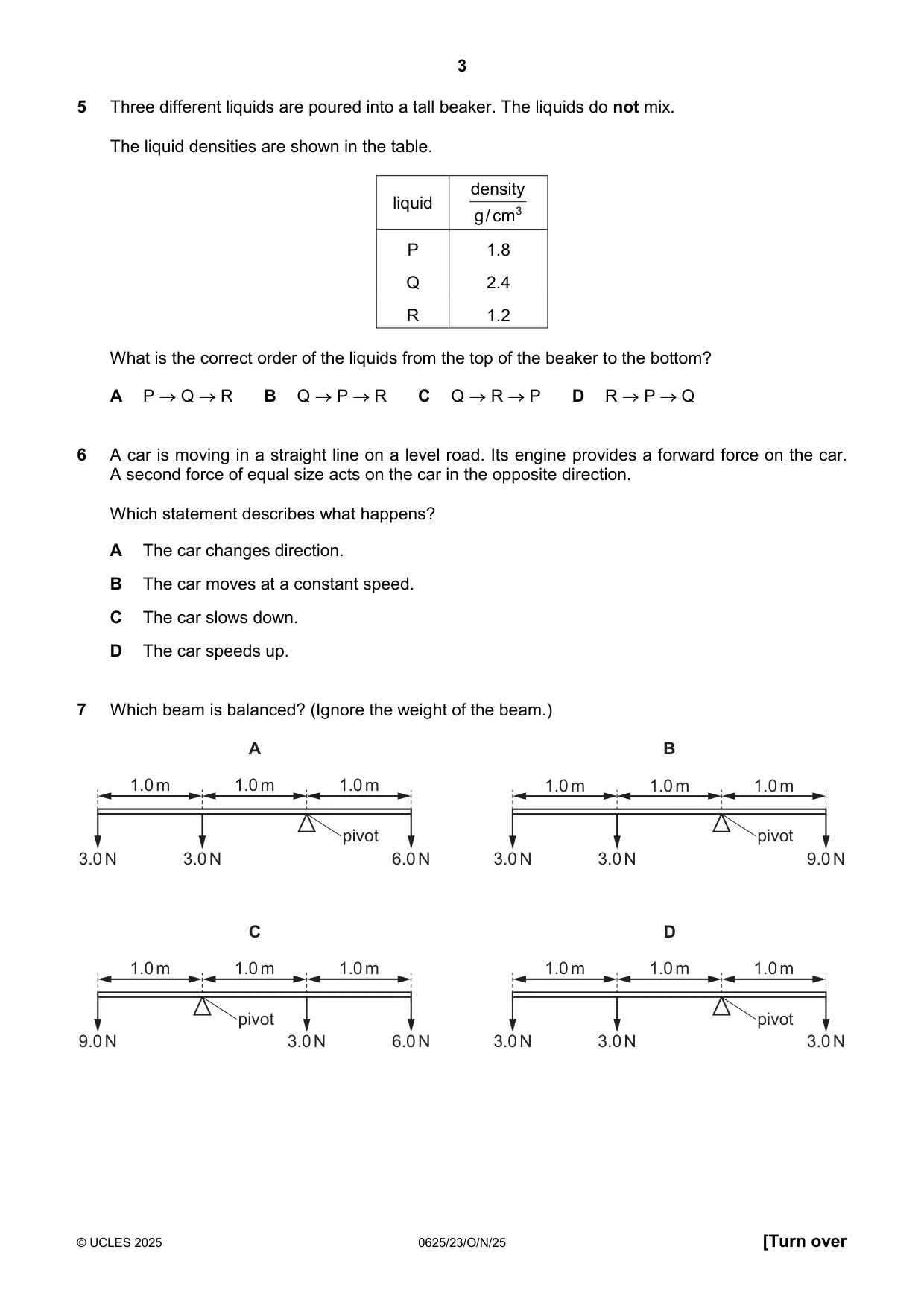
5 Three different liquids are poured into a tall beaker. The liquids do not mix. The liquid densities are shown in the table. density liquid g cm / 3 P 1.8 Q 2.4 R 1.2 What is the correct order of the liquids from the top of the beaker to the bottom? A P Q R B Q P R C Q R P D R P Q
Mark scheme: D
Q6 · A car is moving in a straight line on a level road
6 A car is moving in a straight line on a level road. Its engine provides a forward force on the car. A second force of equal size acts on the car in the opposite direction. Which statement describes what happens? A The car changes direction. B The car moves at a constant speed. C The car slows down. D The car speeds up.
Mark scheme: B
Q7 · Which beam is balanced?
7 Which beam is balanced? (Ignore the weight of the beam.) A B 1.0 m 1.0 m 1.0 m 1.0 m 1.0 m 1.0 m pivot pivot 3.0 N 3.0 N 6.0 N 3.0 N 3.0 N 9.0 N C D 1.0 m 1.0 m 1.0 m 1.0 m 1.0 m 1.0 m pivot pivot 9.0 N 3.0 N 6.0 N 3.0 N 3.0 N 3.0 N
Mark scheme: B
Q8 · A ball is at rest on the ground
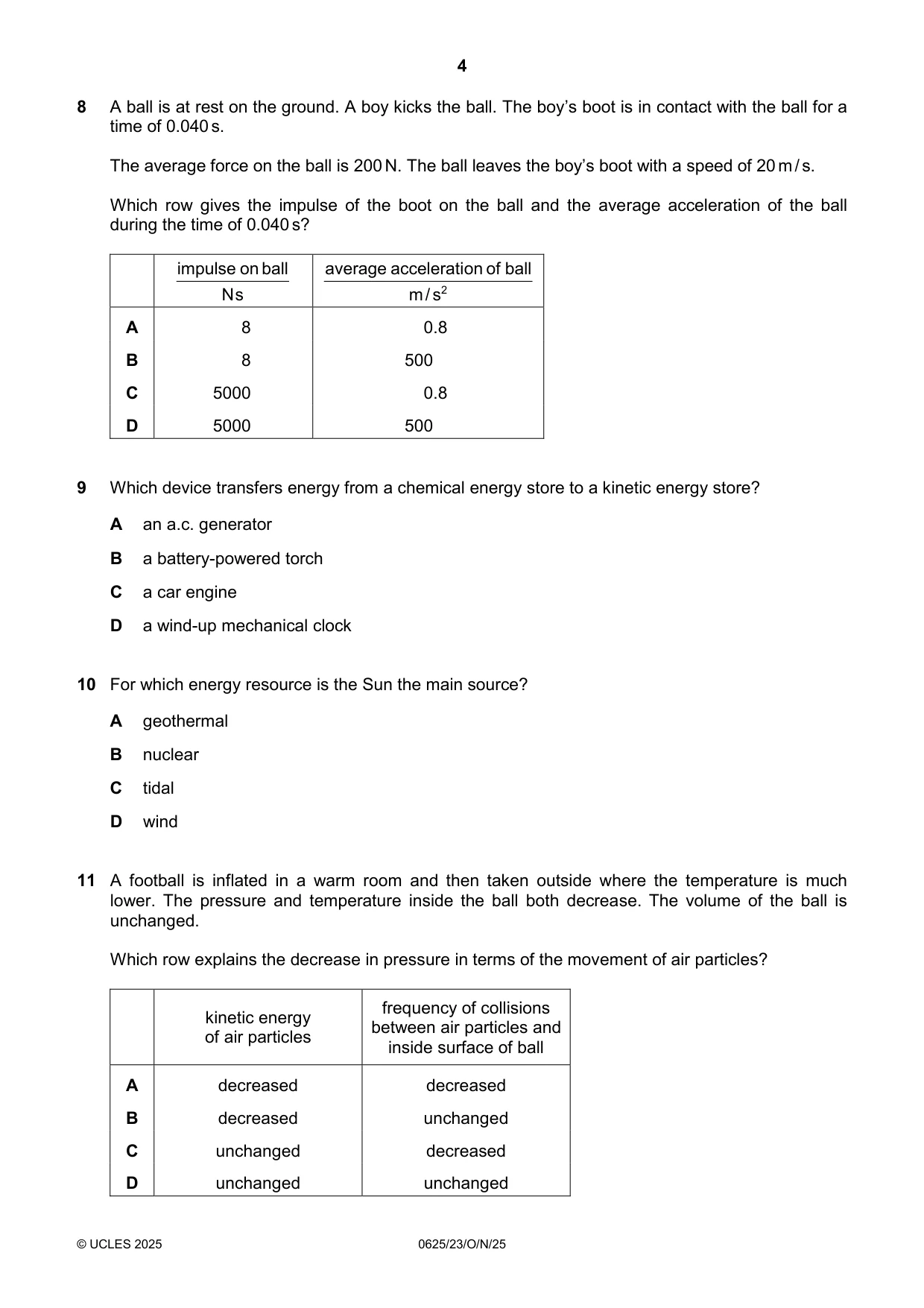
8 A ball is at rest on the ground. A boy kicks the ball. The boy’s boot is in contact with the ball for a time of 0.040 s. The average force on the ball is 200 N. The ball leaves the boy’s boot with a speed of 20 m / s. Which row gives the impulse of the boot on the ball and the average acceleration of the ball during the time of 0.040 s? impulse on ball average accelerati on of ball N s m s / 2 A 8 0.8 B 8 500 C 5000 0.8 D 5000 500
Mark scheme: B
Q9 · Which device transfers energy from a chemical energy store to a kinetic energy store?
9 Which device transfers energy from a chemical energy store to a kinetic energy store? A an a.c. generator B a battery-powered torch C a car engine D a wind-up mechanical clock
Mark scheme: C
Q10 · For which energy resource is the Sun the main source?
10 For which energy resource is the Sun the main source? A geothermal B nuclear C tidal D wind
Mark scheme: D
Q11 · A football is inflated in a warm room and then taken outside where the temperature is…
11 A football is inflated in a warm room and then taken outside where the temperature is much lower. The pressure and temperature inside the ball both decrease. The volume of the ball is unchanged. Which row explains the decrease in pressure in terms of the movement of air particles? frequency of collisions kinetic energy between air particles and of air particles inside surface of ball A decreased decreased B decreased unchanged C unchanged decreased D unchanged unchanged
Mark scheme: A
Q12 · A fixed mass of gas has a volume of 25 cm3
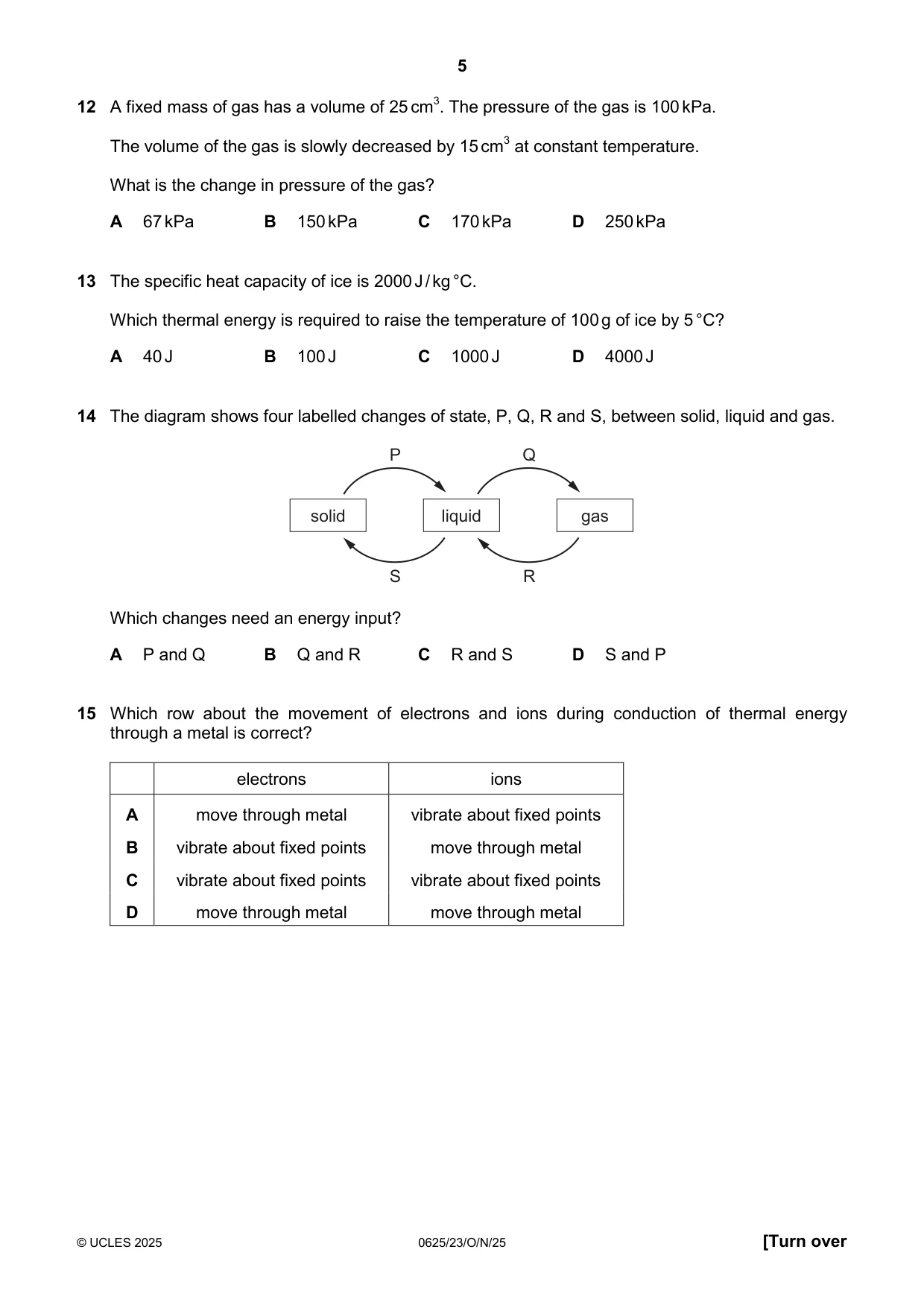
12 A fixed mass of gas has a volume of 25 cm3. The pressure of the gas is 100 kPa. The volume of the gas is slowly decreased by 15 cm3 at constant temperature. What is the change in pressure of the gas? A 67 kPa B 150 kPa C 170 kPa D 250 kPa
Mark scheme: B
Q13 · The specific heat capacity of ice is 2000 J / kg °C
13 The specific heat capacity of ice is 2000 J / kg °C. Which thermal energy is required to raise the temperature of 100 g of ice by 5 °C? A 40 J B 100 J C 1000 J D 4000 J
Mark scheme: C
Q14 · The diagram shows four labelled changes of state, P, Q, R and S, between solid, liquid…
14 The diagram shows four labelled changes of state, P, Q, R and S, between solid, liquid and gas. P Q solid liquid gas S R Which changes need an energy input? A P and Q B Q and R C R and S D S and P
Mark scheme: A
Q15 · Which row about the movement of electrons and ions during conduction of thermal energy…
15 Which row about the movement of electrons and ions during conduction of thermal energy through a metal is correct? electrons ions A move through metal vibrate about fixed points B vibrate about fixed points move through metal C vibrate about fixed points vibrate about fixed points D move through metal move through metal
Mark scheme: A
Q16 · A scientist measures the air temperature at different heights from the floor in a cave
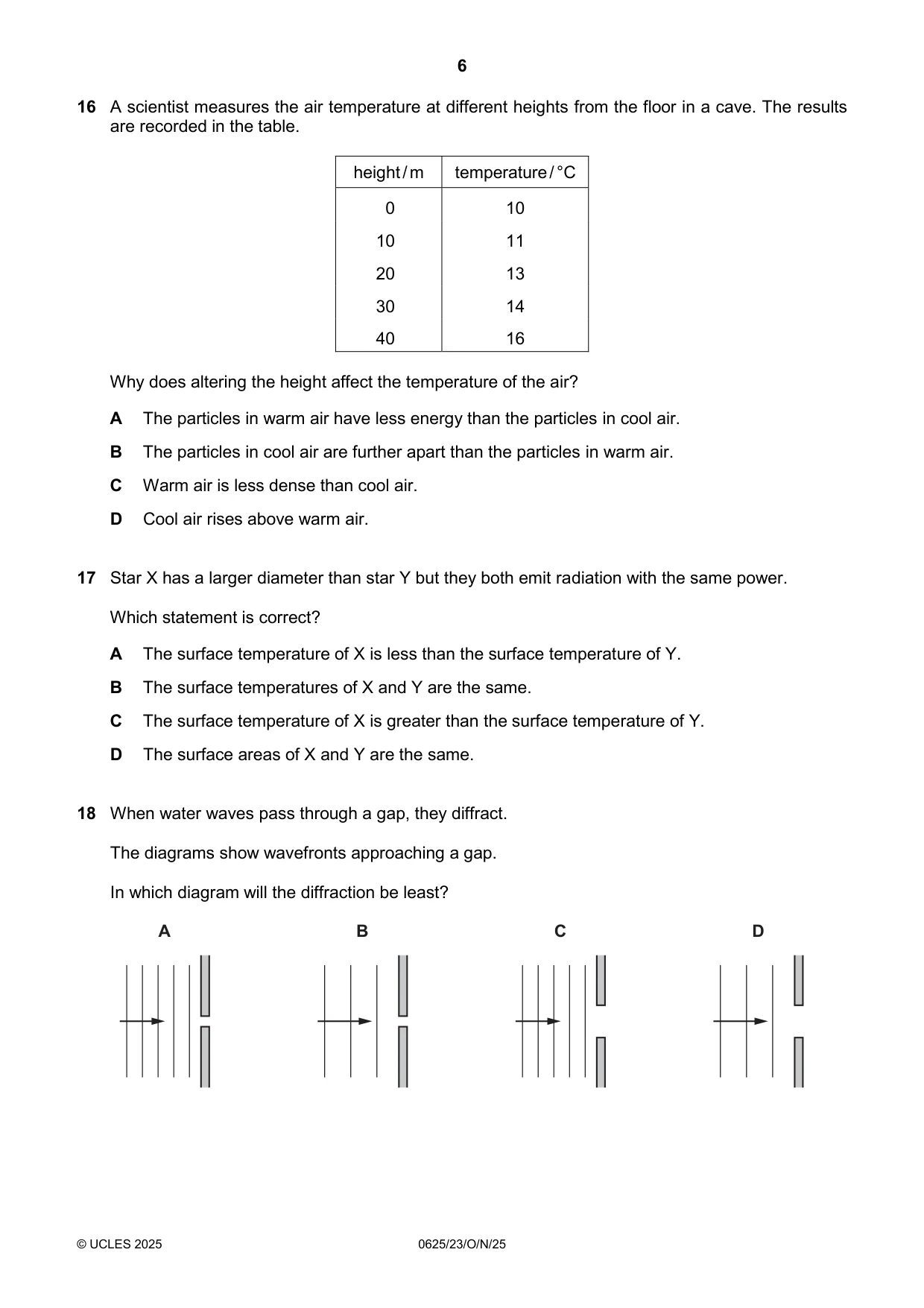
16 A scientist measures the air temperature at different heights from the floor in a cave. The results are recorded in the table. height / m temperature / °C 0 10 10 11 20 13 30 14 40 16 Why does altering the height affect the temperature of the air? A The particles in warm air have less energy than the particles in cool air. B The particles in cool air are further apart than the particles in warm air. C Warm air is less dense than cool air. D Cool air rises above warm air.
Mark scheme: C
Q17 · Star X has a larger diameter than star Y but they both emit radiation with the same power
17 Star X has a larger diameter than star Y but they both emit radiation with the same power. Which statement is correct? A The surface temperature of X is less than the surface temperature of Y. B The surface temperatures of X and Y are the same. C The surface temperature of X is greater than the surface temperature of Y. D The surface areas of X and Y are the same.
Mark scheme: A
Q18 · When water waves pass through a gap, they diffract
18 When water waves pass through a gap, they diffract. The diagrams show wavefronts approaching a gap. In which diagram will the diffraction be least? A B C D
Mark scheme: C
Q19 · The diagram shows a scale drawing of the formation of an image by the reflection of light…
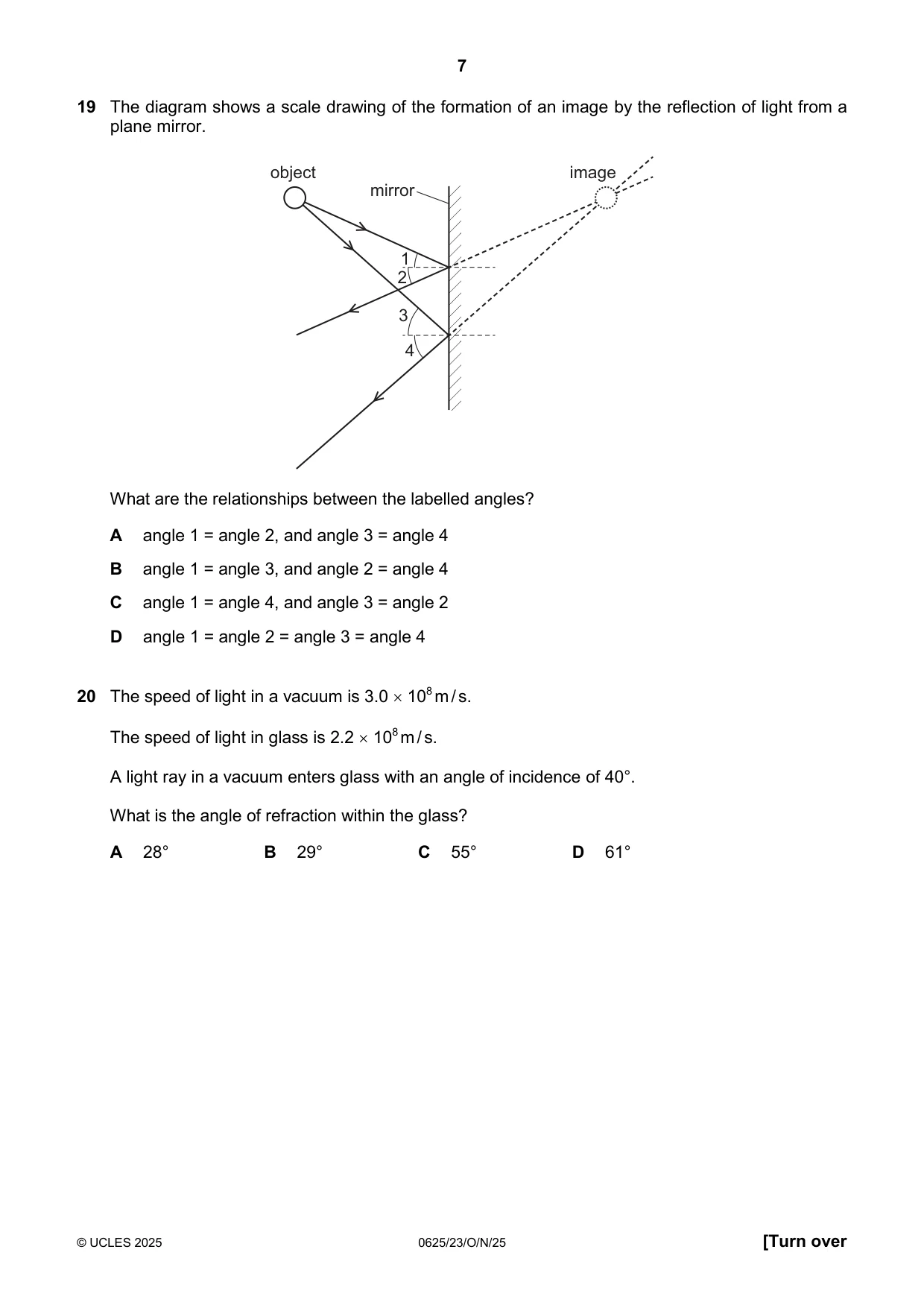
19 The diagram shows a scale drawing of the formation of an image by the reflection of light from a plane mirror. object image mirror 1 2 3 4 What are the relationships between the labelled angles? A angle 1 = angle 2, and angle 3 = angle 4 B angle 1 = angle 3, and angle 2 = angle 4 C angle 1 = angle 4, and angle 3 = angle 2 D angle 1 = angle 2 = angle 3 = angle 4
Mark scheme: A
Q20 · The speed of light in a vacuum is 3.0 108 m / s
20 The speed of light in a vacuum is 3.0 108 m / s. The speed of light in glass is 2.2 108 m / s. A light ray in a vacuum enters glass with an angle of incidence of 40°. What is the angle of refraction within the glass? A 28° B 29° C 55° D 61°
Mark scheme: A
Q21 · The diagram shows a human eye that correctly focuses the light on the retina
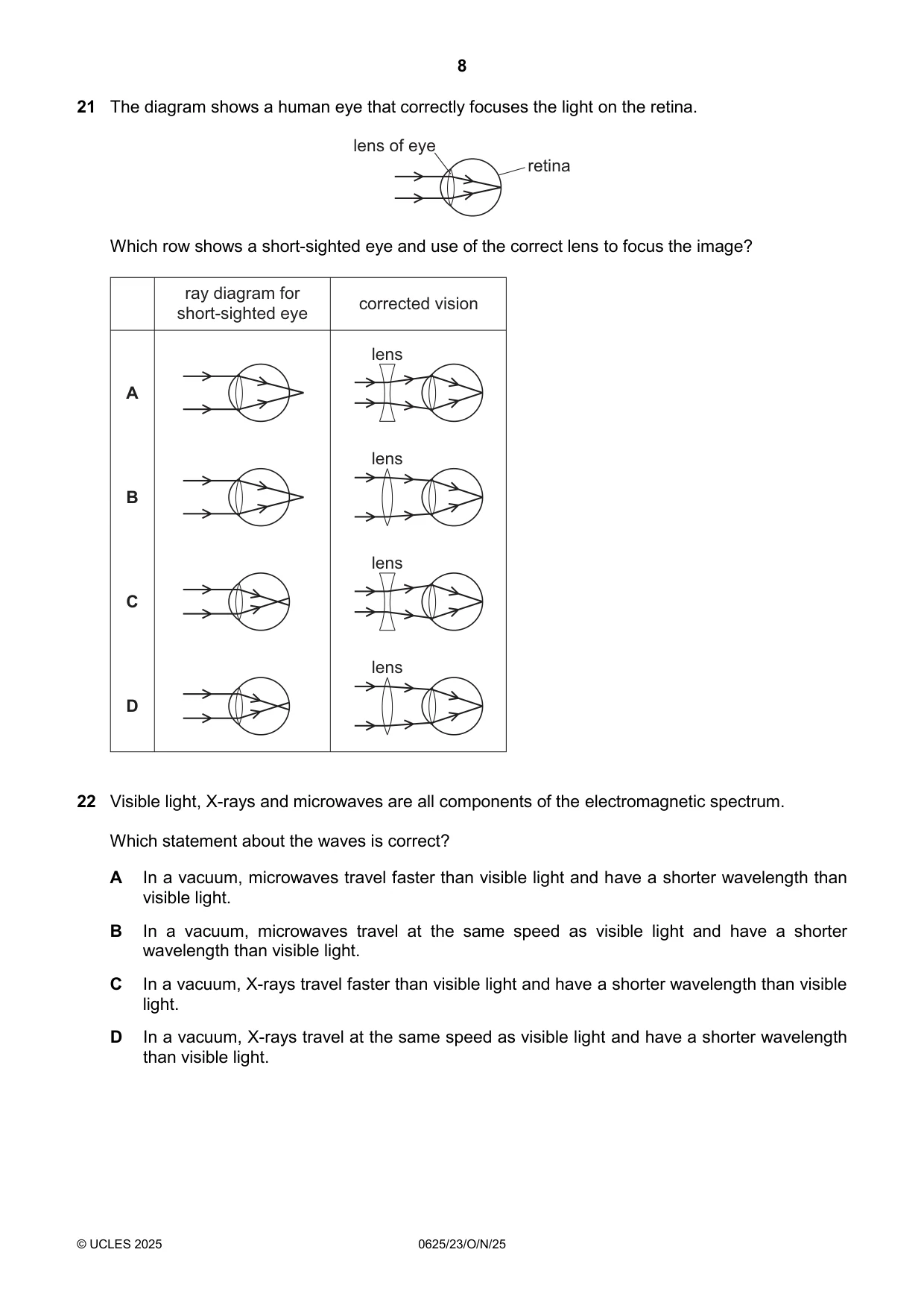
21 The diagram shows a human eye that correctly focuses the light on the retina. lens of eye retina Which row shows a short-sighted eye and use of the correct lens to focus the image? ray diagram for corrected vision short-sighted eye lens A lens B lens C lens D
Mark scheme: C
Q22 · Visible light, X-rays and microwaves are all components of the electromagnetic spectrum
22 Visible light, X-rays and microwaves are all components of the electromagnetic spectrum. Which statement about the waves is correct? A In a vacuum, microwaves travel faster than visible light and have a shorter wavelength than visible light. B In a vacuum, microwaves travel at the same speed as visible light and have a shorter wavelength than visible light. C In a vacuum, X-rays travel faster than visible light and have a shorter wavelength than visible light. D In a vacuum, X-rays travel at the same speed as visible light and have a shorter wavelength than visible light.
Mark scheme: D
Q23 · Both the amplitude and the frequency of a sound wave decrease
23 Both the amplitude and the frequency of a sound wave decrease. What happens to the sound that is heard? A The sound is louder and has a higher pitch. B The sound is louder and has a lower pitch. C The sound is quieter and has a higher pitch. D The sound is quieter and has a lower pitch.
Mark scheme: D
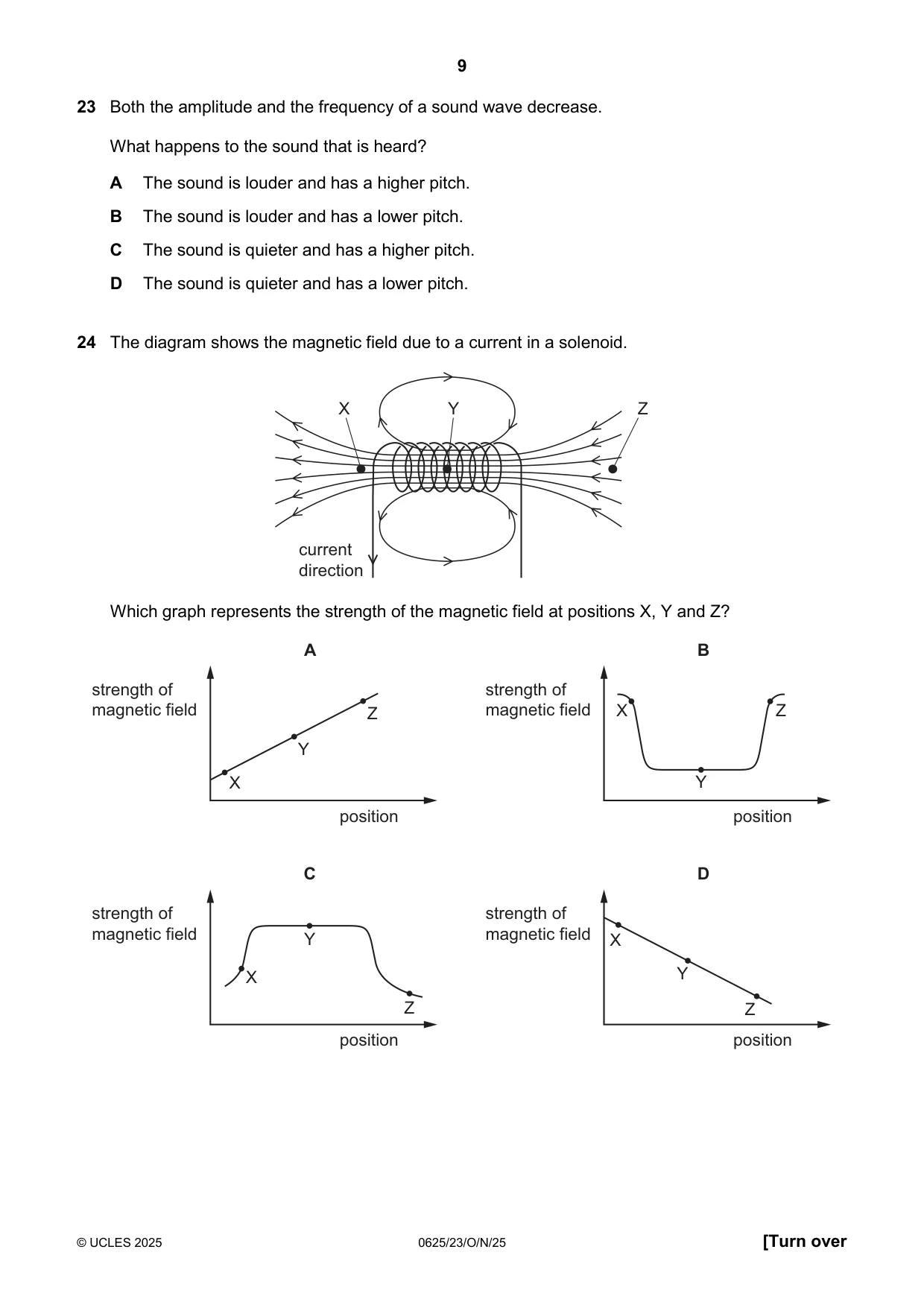
Q24 · The diagram shows the magnetic field due to a current in a solenoid
24 The diagram shows the magnetic field due to a current in a solenoid. X Y Z current direction Which graph represents the strength of the magnetic field at positions X, Y and Z? A B strength of strength of magnetic field Z magnetic field X Z Y X Y position position C D strength of strength of magnetic field Y magnetic field X X Y Z Z position position
Mark scheme: C
Q25 · Why does a plastic rod become negatively charged when it is rubbed with a cloth?
25 Why does a plastic rod become negatively charged when it is rubbed with a cloth? A The rod gains electrons. B The rod gains protons. C The rod loses electrons. D The rod loses protons.
Mark scheme: A
Q26 · There is an electric current in a circuit with a battery
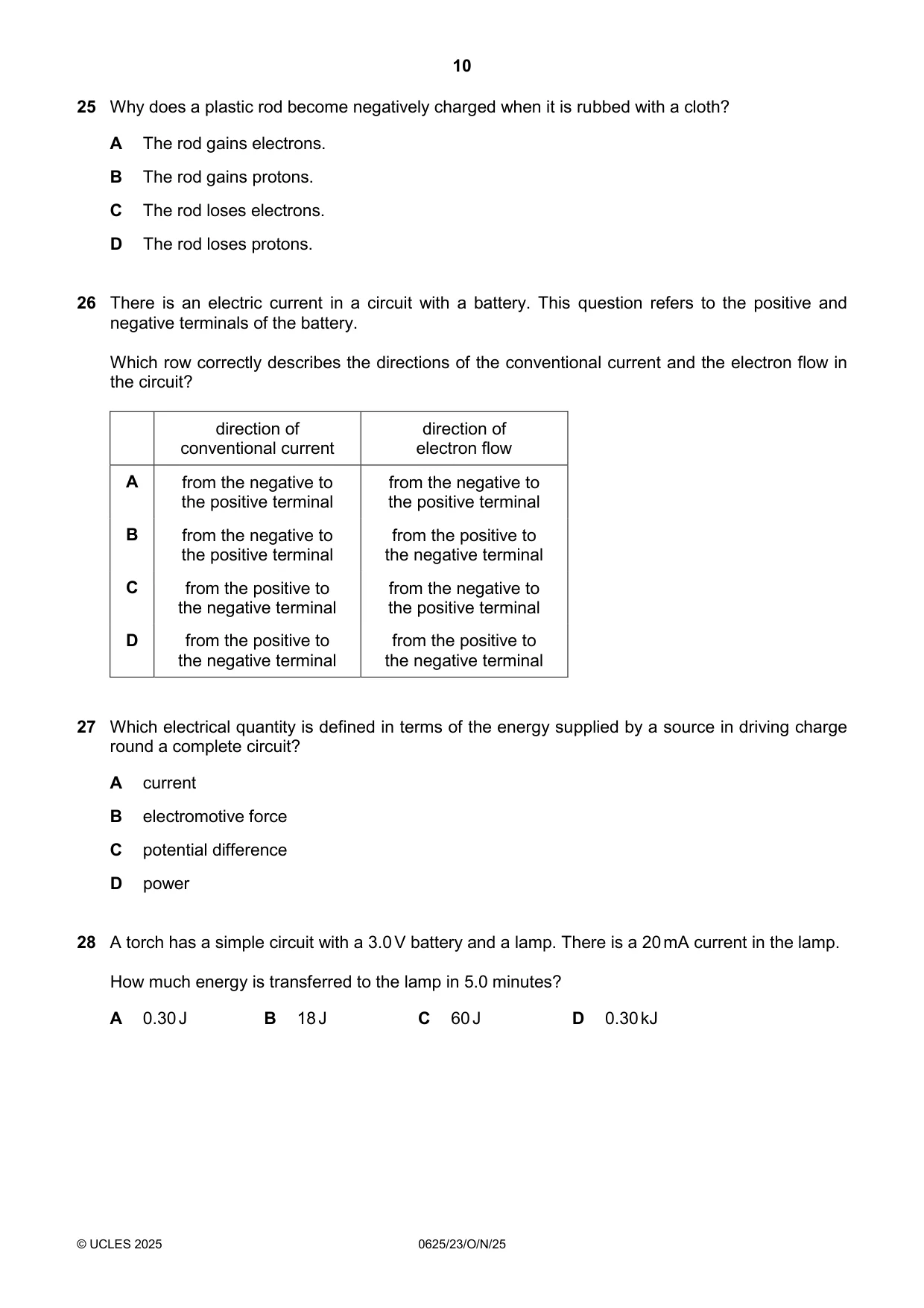
26 There is an electric current in a circuit with a battery. This question refers to the positive and negative terminals of the battery. Which row correctly describes the directions of the conventional current and the electron flow in the circuit? direction of direction of conventional current electron flow A from the negative to from the negative to the positive terminal the positive terminal B from the negative to from the positive to the positive terminal the negative terminal C from the positive to from the negative to the negative terminal the positive terminal D from the positive to from the positive to the negative terminal the negative terminal
Mark scheme: C
Q27 · Which electrical quantity is defined in terms of the energy supplied by a source in…
27 Which electrical quantity is defined in terms of the energy supplied by a source in driving charge round a complete circuit? A current B electromotive force C potential difference D power
Mark scheme: B
Q28 · A torch has a simple circuit with a 3.0 V battery and a lamp
28 A torch has a simple circuit with a 3.0 V battery and a lamp. There is a 20 mA current in the lamp. How much energy is transferred to the lamp in 5.0 minutes? A 0.30 J B 18 J C 60 J D 0.30 kJ
Mark scheme: B
Q29 · In which circuit does the lamp light?
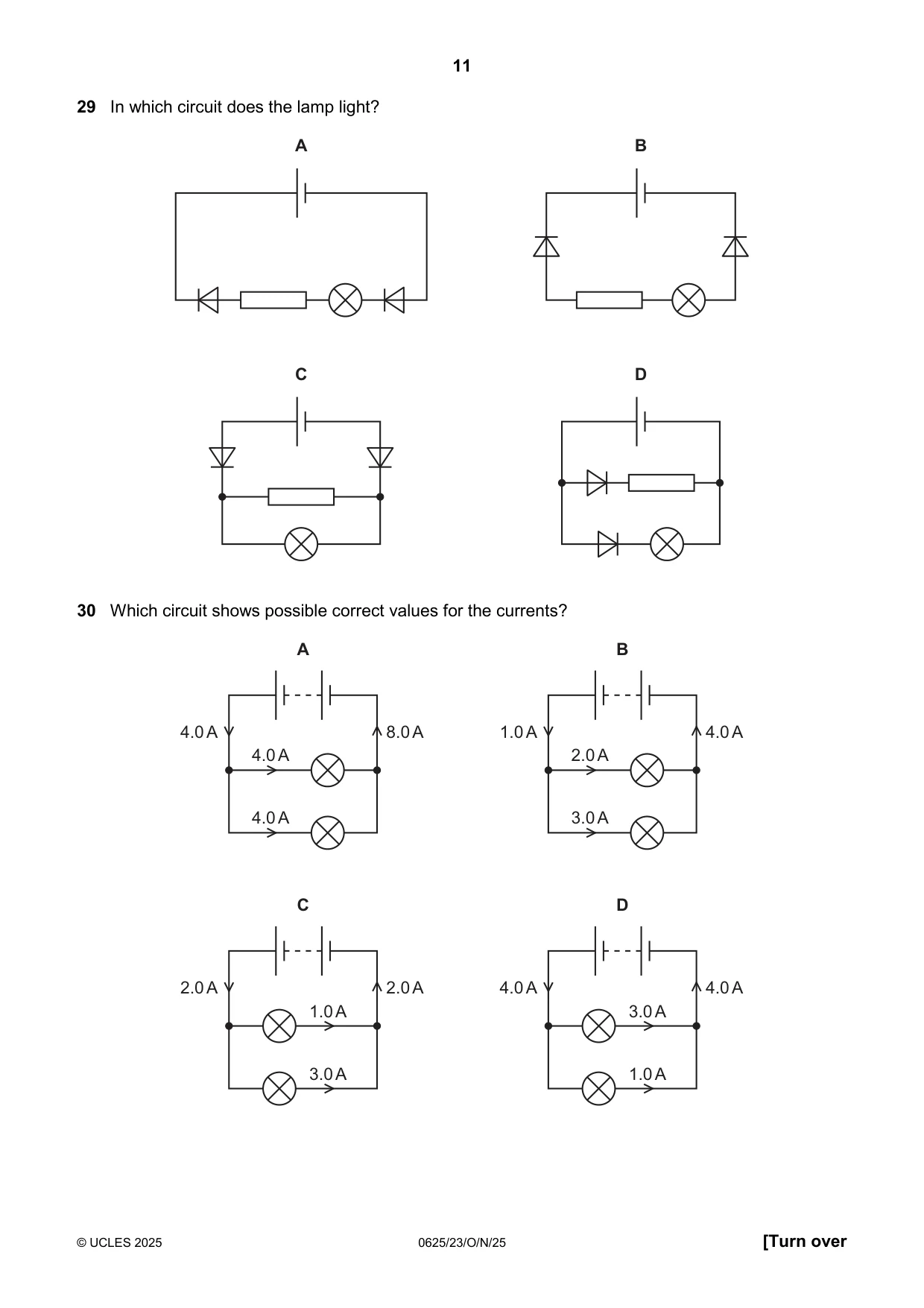
29 In which circuit does the lamp light? A B C D
Mark scheme: D
Q30 · Which circuit shows possible correct values for the currents?
30 Which circuit shows possible correct values for the currents? A B 4.0 A 8.0 A 1.0 A 4.0 A 4.0 A 2.0 A 4.0 A 3.0 A C D 2.0 A 2.0 A 4.0 A 4.0 A 1.0 A 3.0 A 3.0 A 1.0 A
Mark scheme: D
Q31 · The circuit diagrams show circuits that can control the potential difference (p.d.)…
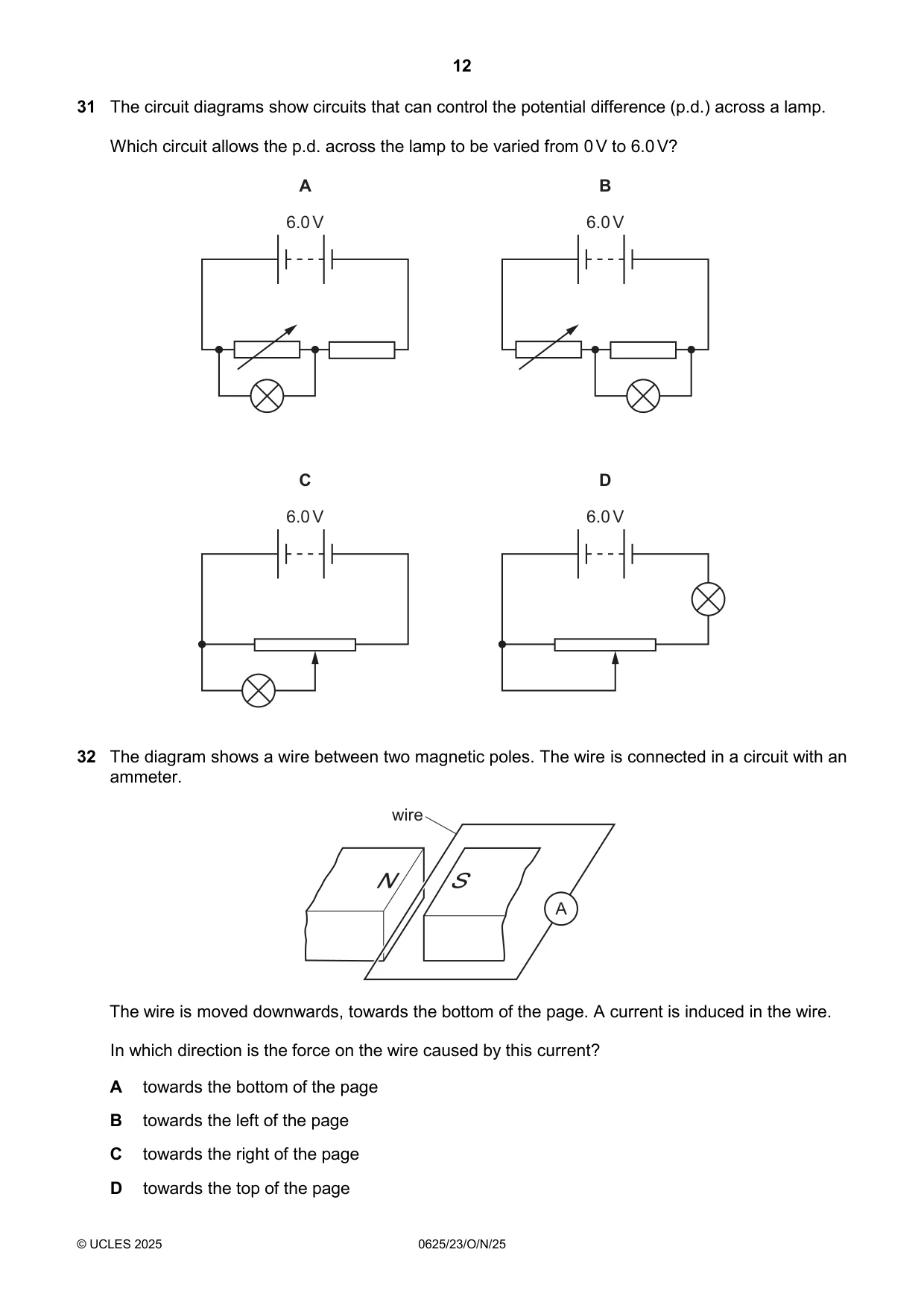
31 The circuit diagrams show circuits that can control the potential difference (p.d.) across a lamp. Which circuit allows the p.d. across the lamp to be varied from 0 V to 6.0 V? A B 6.0 V 6.0 V C D 6.0 V 6.0 V
Mark scheme: C
Q32 · The diagram shows a wire between two magnetic poles
32 The diagram shows a wire between two magnetic poles. The wire is connected in a circuit with an ammeter. wire N S A The wire is moved downwards, towards the bottom of the page. A current is induced in the wire. In which direction is the force on the wire caused by this current? A towards the bottom of the page B towards the left of the page C towards the right of the page D towards the top of the page
Mark scheme: D
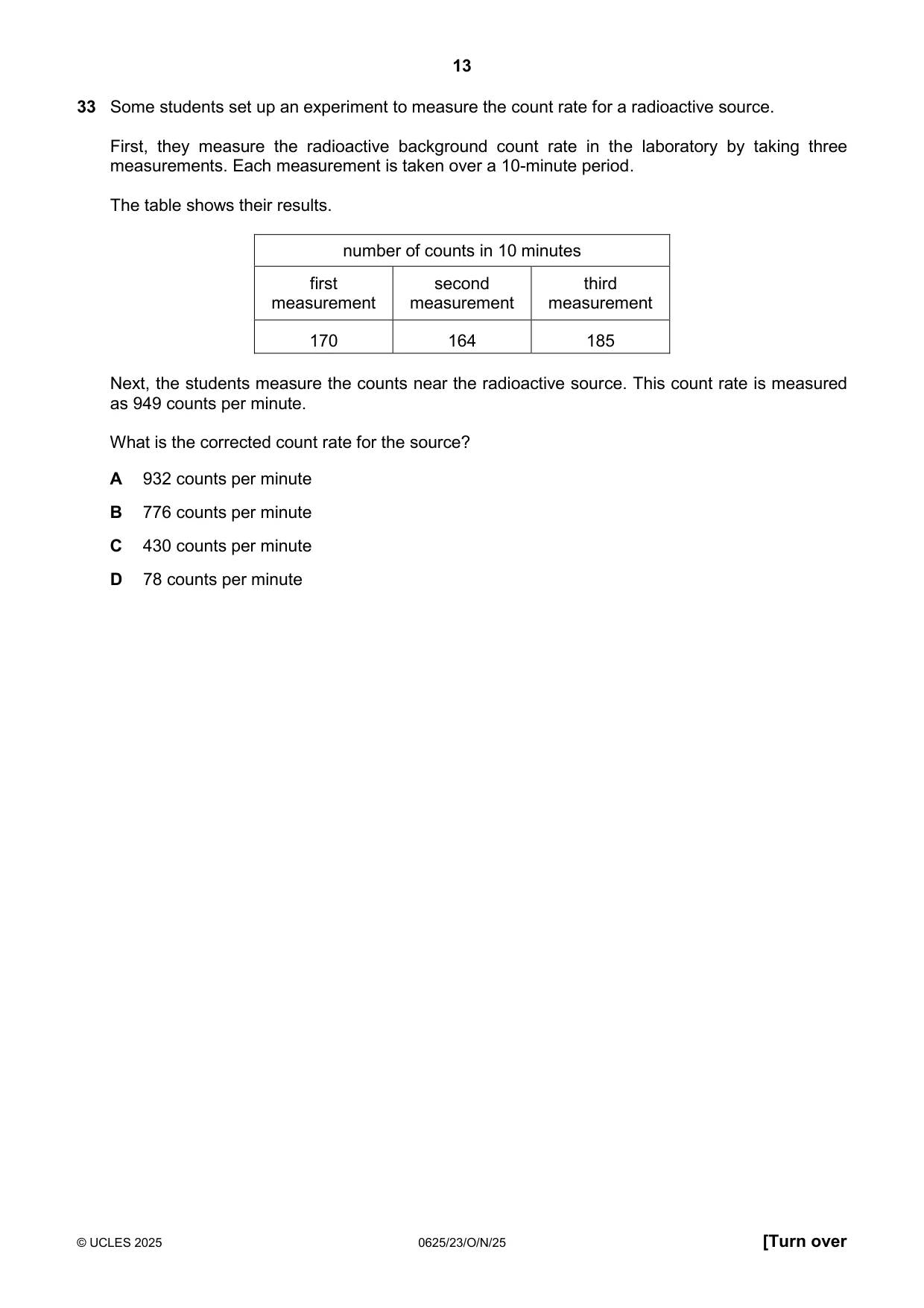
Q33 · Some students set up an experiment to measure the count rate for a radioactive source
33 Some students set up an experiment to measure the count rate for a radioactive source. First, they measure the radioactive background count rate in the laboratory by taking three measurements. Each measurement is taken over a 10-minute period. The table shows their results. number of counts in 10 minutes first second third measurement measurement measurement 170 164 185 Next, the students measure the counts near the radioactive source. This count rate is measured as 949 counts per minute. What is the corrected count rate for the source? A 932 counts per minute B 776 counts per minute C 430 counts per minute D 78 counts per minute
Mark scheme: A
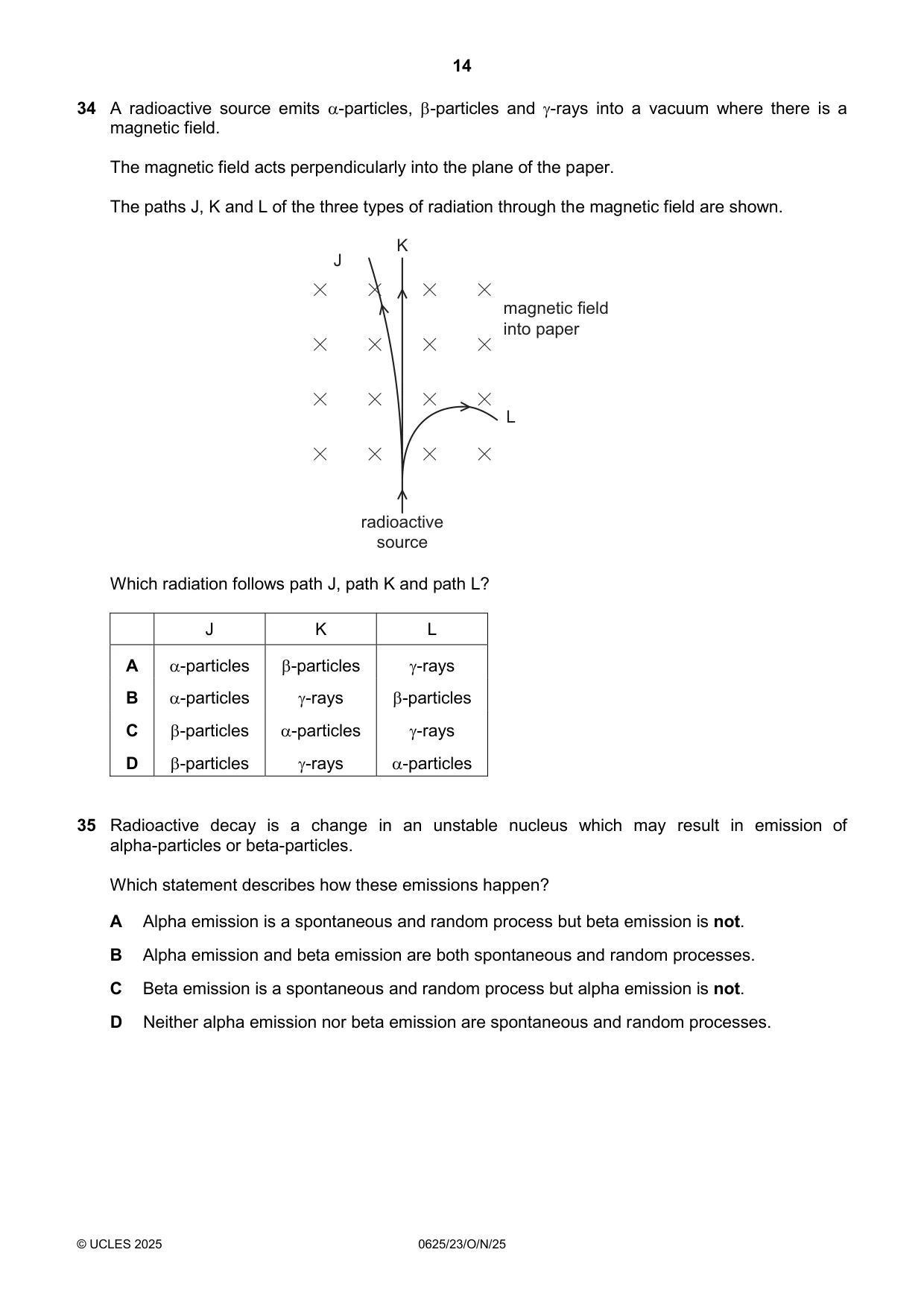
Q34 · A radioactive source emits -particles, -particles and -rays into a vacuum where there…
34 A radioactive source emits -particles, -particles and -rays into a vacuum where there is a magnetic field. The magnetic field acts perpendicularly into the plane of the paper. The paths J, K and L of the three types of radiation through the magnetic field are shown. K J magnetic field into paper L radioactive source Which radiation follows path J, path K and path L? J K L A -particles -particles -rays B -particles -rays -particles C -particles -particles -rays D -particles -rays -particles
Mark scheme: B
Q35 · Radioactive decay is a change in an unstable nucleus which may result in emission of…
35 Radioactive decay is a change in an unstable nucleus which may result in emission of alpha-particles or beta-particles. Which statement describes how these emissions happen? A Alpha emission is a spontaneous and random process but beta emission is not. B Alpha emission and beta emission are both spontaneous and random processes. C Beta emission is a spontaneous and random process but alpha emission is not. D Neither alpha emission nor beta emission are spontaneous and random processes.
Mark scheme: B
Q36 · Which change occurs in the nucleus of a radioactive atom when a beta-particle is emitted?
36 Which change occurs in the nucleus of a radioactive atom when a beta-particle is emitted? A neutron alpha-particle B neutron proton + electron C proton neutron D proton neutron + electron
Mark scheme: B
Q37 · A radioactive source that emits -particles, -particles and -radiation is stored safely…
37 A radioactive source that emits -particles, -particles and -radiation is stored safely in a container. From which material should the container be made? A alumimium B copper C paper D lead
Mark scheme: D
Q38 · An artificial satellite orbits planet X at a distance r = 7.0 106 m from the centre of…
38 An artificial satellite orbits planet X at a distance r = 7.0 106 m from the centre of planet X. The average orbital speed v of the satellite is 3500 m / s. What is the orbital period? A 21 minutes B 52 minutes C 1 hour and 45 minutes D 3 hours and 29 minutes
Mark scheme: D
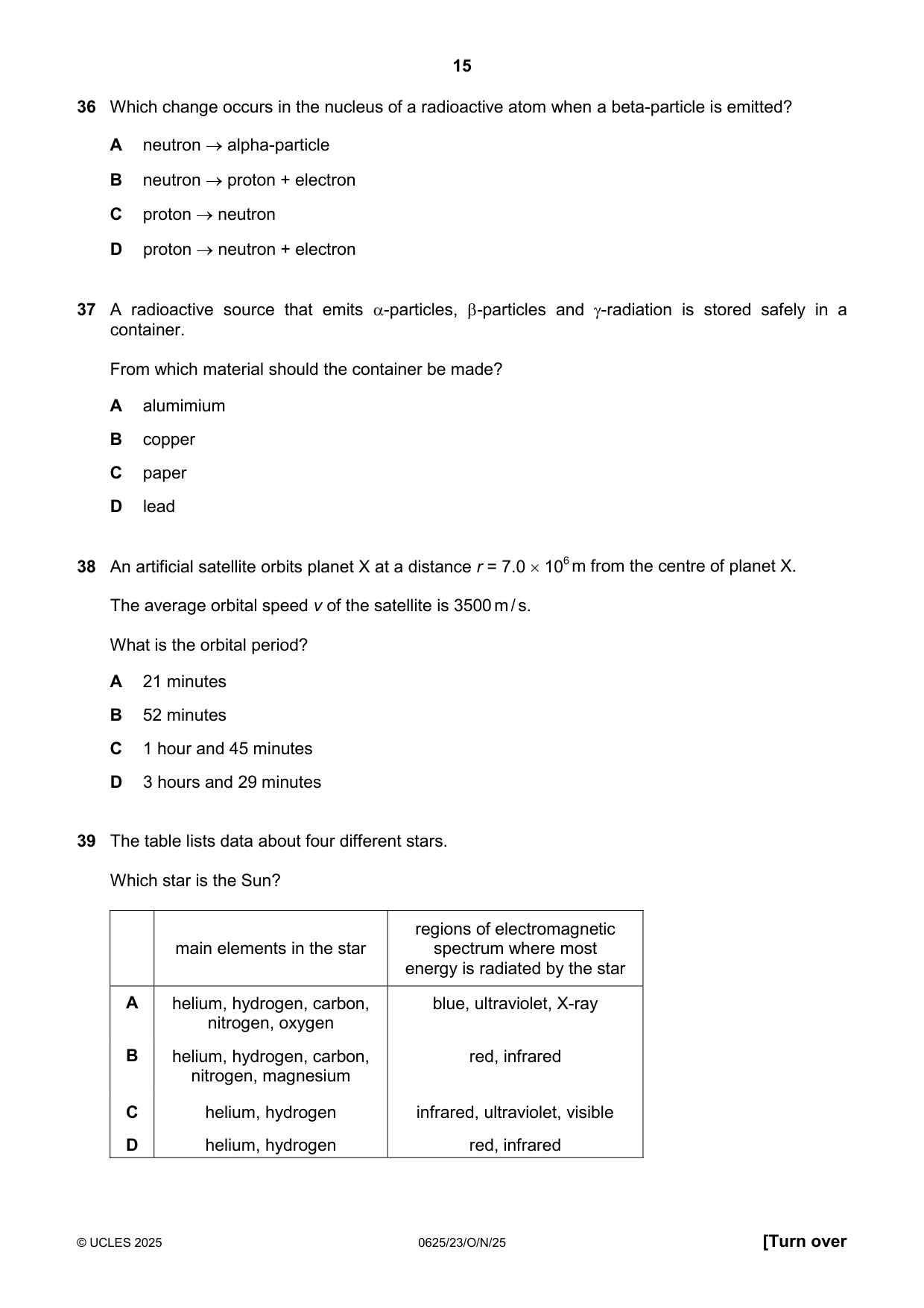
Q39 · The table lists data about four different stars
39 The table lists data about four different stars. Which star is the Sun? regions of electromagnetic main elements in the star spectrum where most energy is radiated by the star A helium, hydrogen, carbon, blue, ultraviolet, X-ray nitrogen, oxygen B helium, hydrogen, carbon, red, infrared nitrogen, magnesium C helium, hydrogen infrared, ultraviolet, visible D helium, hydrogen red, infrared
Mark scheme: C
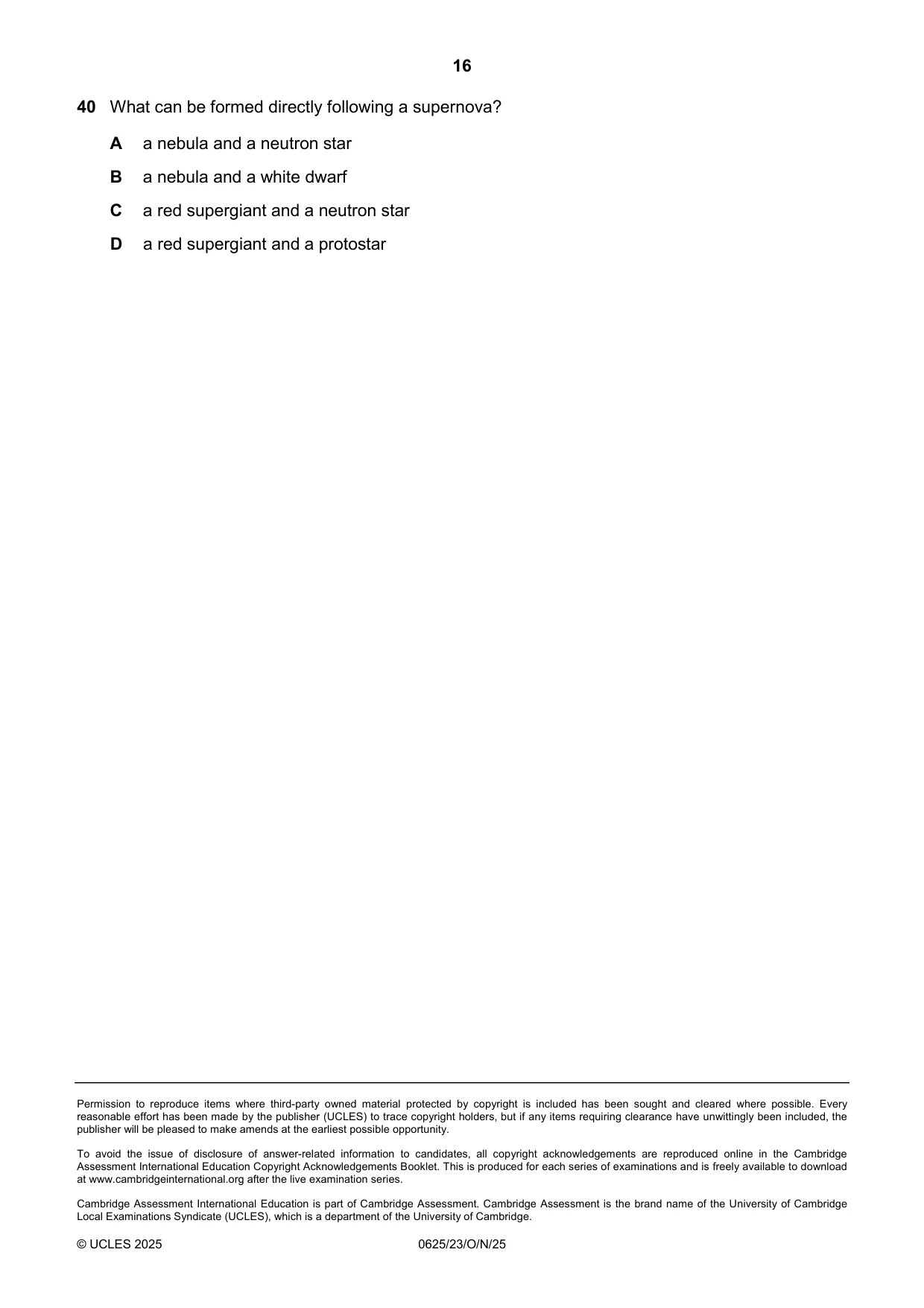
Q40 · What can be formed directly following a supernova?
40 What can be formed directly following a supernova? A a nebula and a neutron star B a nebula and a white dwarf C a red supergiant and a neutron star D a red supergiant and a protostar
Mark scheme: A
What was in this paper
The subtopics covered by these 40 questions, and how many questions each got. Open one in a new tab to see every Cambridge question on it.
5Electric circuits3Electrical quantities3Light3Stars and the Universe3Energy, work and power2Forces2Kinetic particle model of matter2Motion2Physical quantities and measurement techniques2Simple phenomena of magnetism2Transfer of thermal energy2Density1Electromagnetic effects1Electromagnetic spectrum1General properties of waves1Momentum1Pressure1Sound1The Earth and the Solar System1Thermal properties and temperature1What you needed in this session
Cambridge’s own grade thresholds for 2025 Oct/Nov, Paper 2 · Variant 3. A higher threshold means an easier paper — the bar moves with how the cohort did.