Cambridge IGCSE Physics 0625 — 2024 Oct/Nov Paper 2 · Variant 1
0625/21/O/N/24 · 40 questions · 40 marks · ≈45 min
The question paper and its mark scheme, free to read here and free to download. This is Cambridge’s own paper, exactly as it was sat.
Question paper20 pages


Mark scheme3 pages
Answers below. Sit the paper first if you are practising.
Questions as text
Q1 · A student uses a metre ruler to measure the length of a sheet of paper
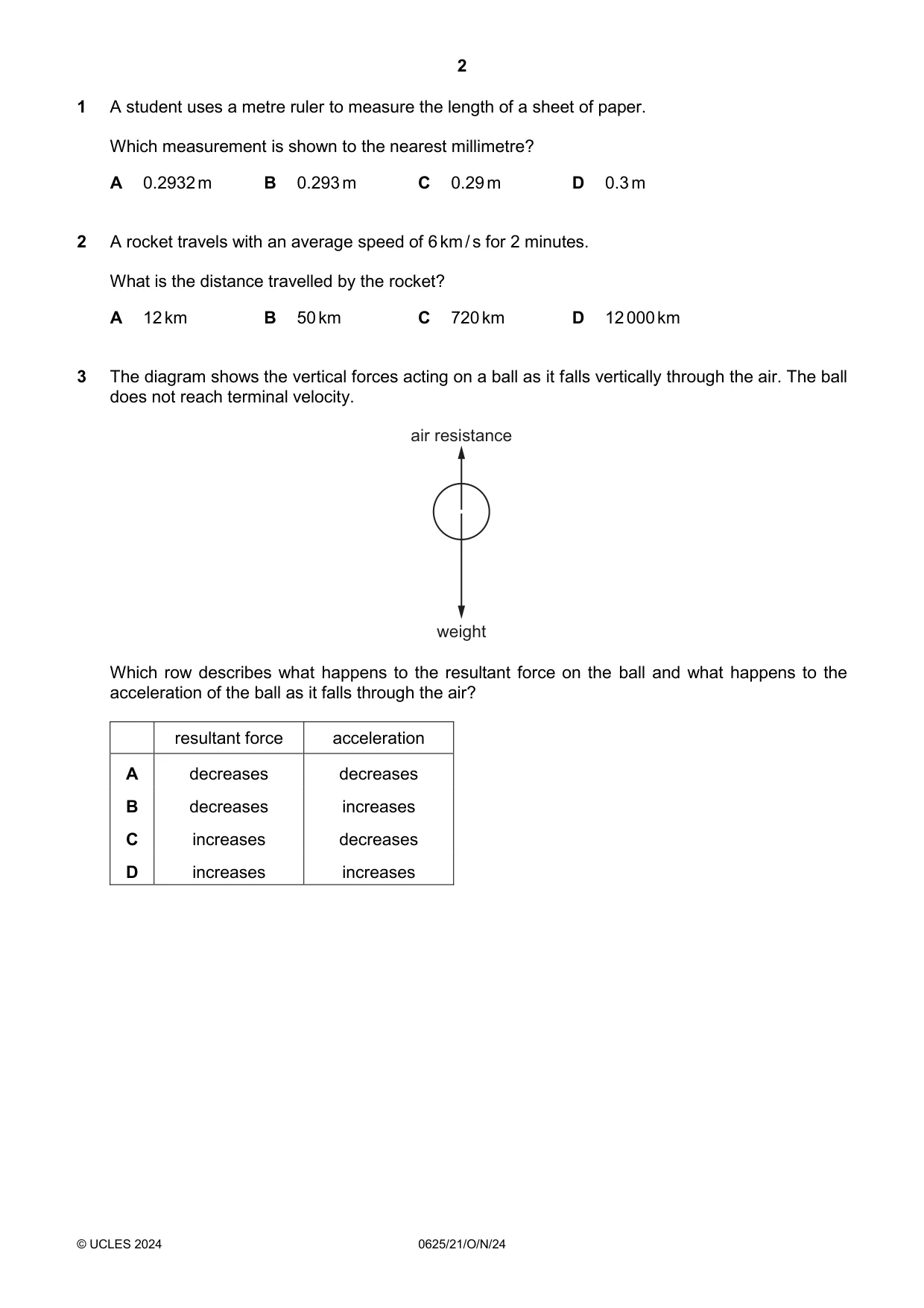
1 A student uses a metre ruler to measure the length of a sheet of paper. Which measurement is shown to the nearest millimetre? A 0.2932 m B 0.293 m C 0.29 m D 0.3 m
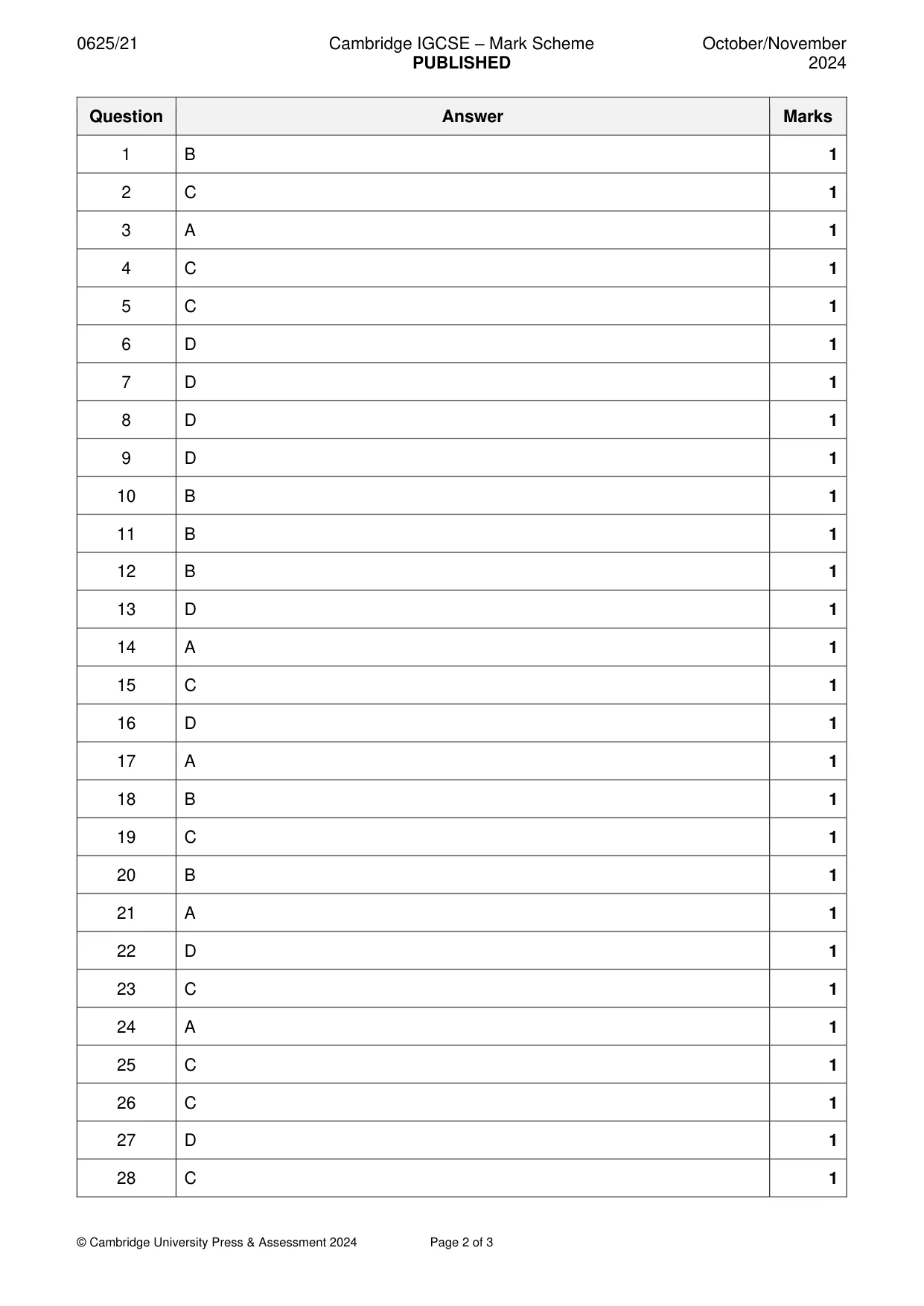
Mark scheme: B
More questions on Physical quantities and measurement techniques
Q2 · A rocket travels with an average speed of 6 km / s for 2 minutes
2 A rocket travels with an average speed of 6 km / s for 2 minutes. What is the distance travelled by the rocket? A 12 km B 50 km C 720 km D 12 000 km
Mark scheme: C
Q3 · The diagram shows the vertical forces acting on a ball as it falls vertically through the…
3 The diagram shows the vertical forces acting on a ball as it falls vertically through the air. The ball does not reach terminal velocity. air resistance weight Which row describes what happens to the resultant force on the ball and what happens to the acceleration of the ball as it falls through the air? resultant force acceleration A decreases decreases B decreases increases C increases decreases D increases increases
Mark scheme: A
Q4 · A coconut falls from a palm tree
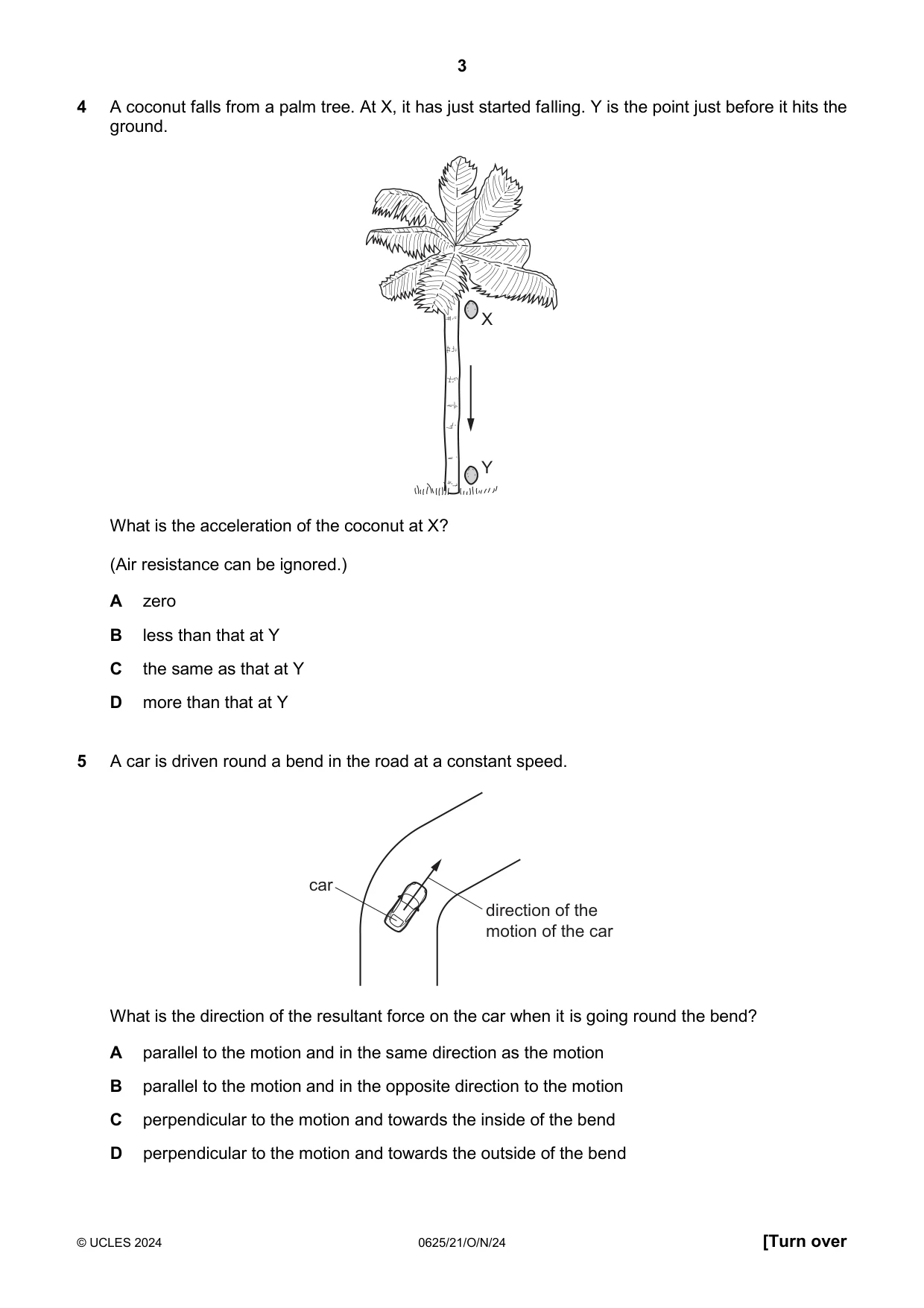
4 A coconut falls from a palm tree. At X, it has just started falling. Y is the point just before it hits the ground. X Y What is the acceleration of the coconut at X? (Air resistance can be ignored.) A zero B less than that at Y C the same as that at Y D more than that at Y
Mark scheme: C
Q5 · A car is driven round a bend in the road at a constant speed
5 A car is driven round a bend in the road at a constant speed. car direction of the motion of the car What is the direction of the resultant force on the car when it is going round the bend? A parallel to the motion and in the same direction as the motion B parallel to the motion and in the opposite direction to the motion C perpendicular to the motion and towards the inside of the bend D perpendicular to the motion and towards the outside of the bend
Mark scheme: C
Q6 · The diagram shows a drawbridge that is attached to a wall by a hinge at one end and a…
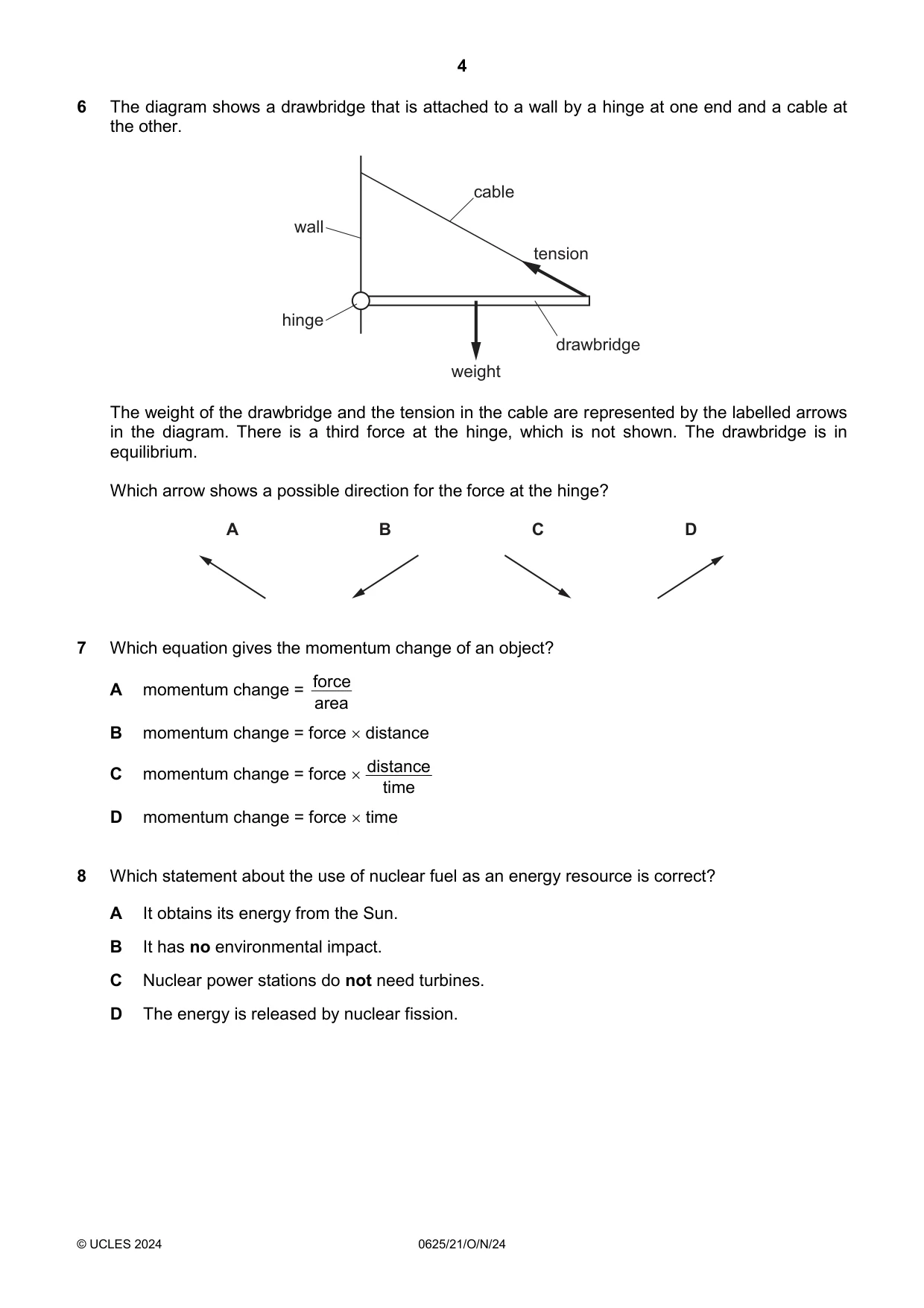
6 The diagram shows a drawbridge that is attached to a wall by a hinge at one end and a cable at the other. cable wall tension hinge drawbridge weight The weight of the drawbridge and the tension in the cable are represented by the labelled arrows in the diagram. There is a third force at the hinge, which is not shown. The drawbridge is in equilibrium. Which arrow shows a possible direction for the force at the hinge? A B C D
Mark scheme: D
Q7 · Which equation gives the momentum change of an object?
7 Which equation gives the momentum change of an object? force A momentum change = area B momentum change = force distance momentum change = force distance C time D momentum change = force time
Mark scheme: D
Q8 · Which statement about the use of nuclear fuel as an energy resource is correct?
8 Which statement about the use of nuclear fuel as an energy resource is correct? A It obtains its energy from the Sun. B It has no environmental impact. C Nuclear power stations do not need turbines. D The energy is released by nuclear fission.
Mark scheme: D
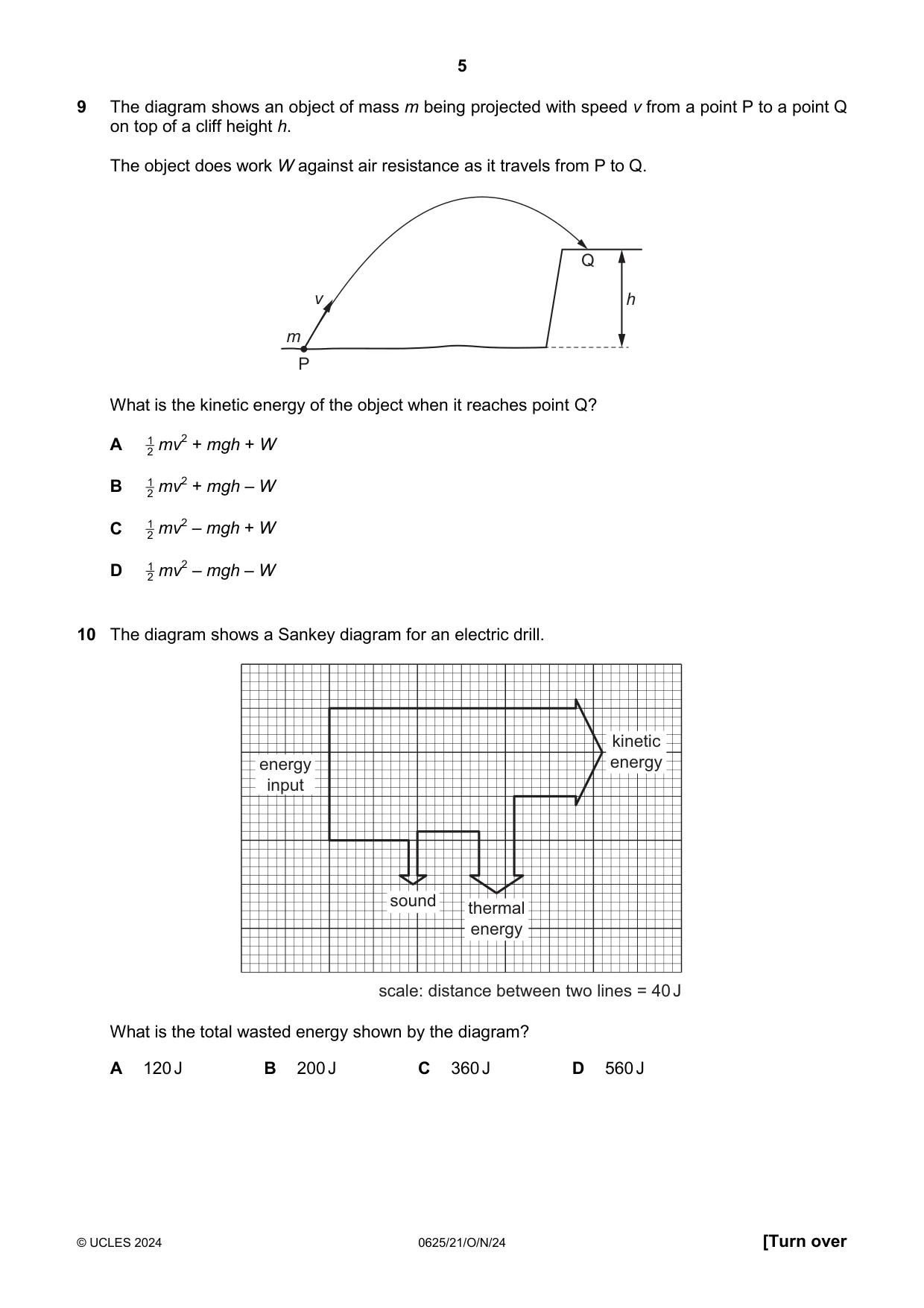
Q9 · The diagram shows an object of mass m being projected with speed v from a point P to a…
9 The diagram shows an object of mass m being projected with speed v from a point P to a point Q on top of a cliff height h. The object does work W against air resistance as it travels from P to Q. Q v h m P What is the kinetic energy of the object when it reaches point Q? A 1 mv2 + mgh + W 2 B 1 mv2 + mgh – W 2 C 1 mv2 – mgh + W 2 D 1 mv2 – mgh – W 2
Mark scheme: D
Q10 · The diagram shows a Sankey diagram for an electric drill
10 The diagram shows a Sankey diagram for an electric drill. kinetic energy energy input sound thermal energy scale: distance between two lines = 40 J What is the total wasted energy shown by the diagram? A 120 J B 200 J C 360 J D 560 J
Mark scheme: B
Q11 · An elephant of weight 45 000 N stands with all four feet on the floor
11 An elephant of weight 45 000 N stands with all four feet on the floor. The average pressure on the floor due to the elephant foot in contact with it is 34 000 Pa. What is the area of each foot of the elephant? A 0.19 m2 B 0.33 m2 C 0.76 m2 D 1.3 m2
Mark scheme: B
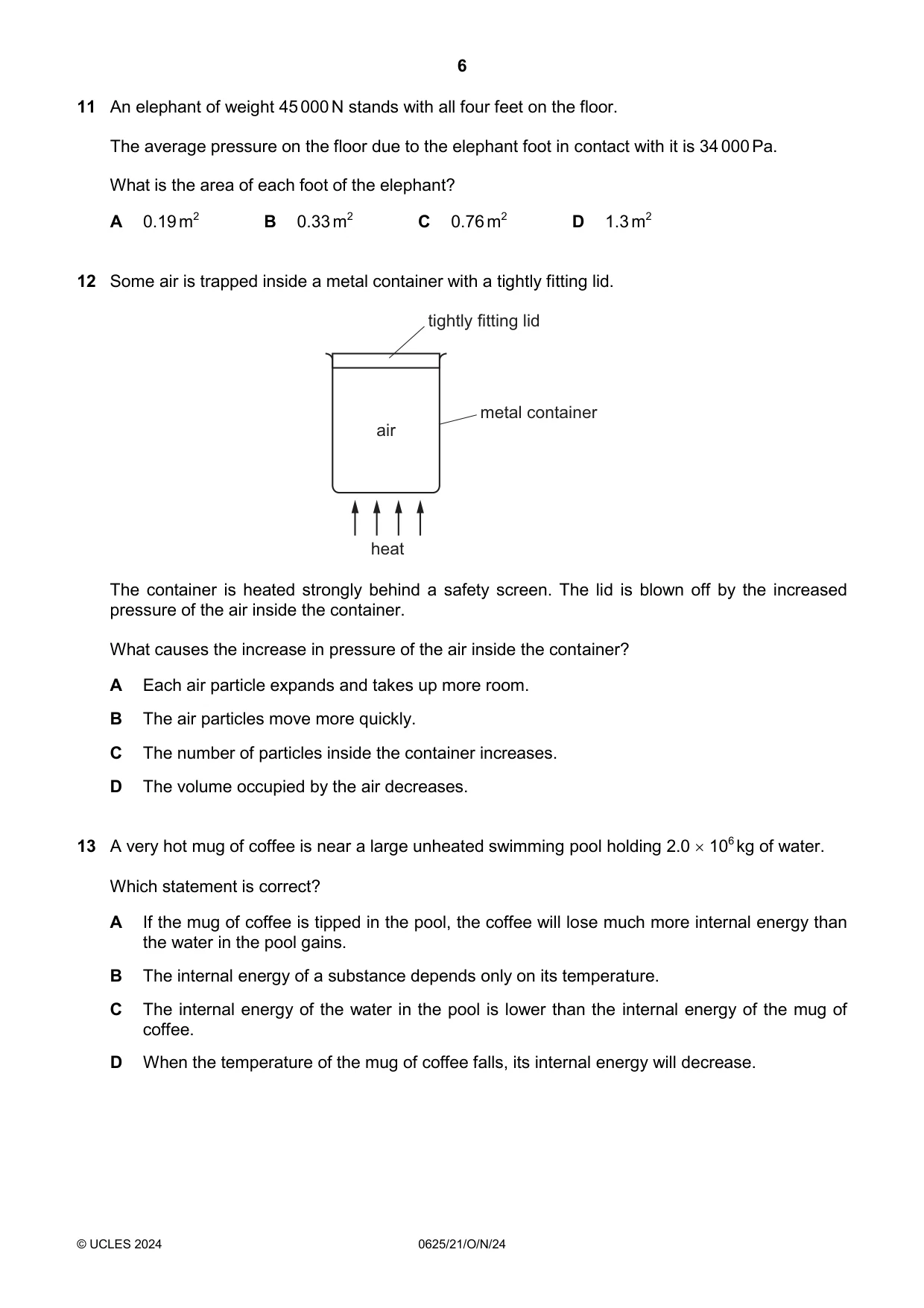
Q12 · Some air is trapped inside a metal container with a tightly fitting lid
12 Some air is trapped inside a metal container with a tightly fitting lid. tightly fitting lid metal container air heat The container is heated strongly behind a safety screen. The lid is blown off by the increased pressure of the air inside the container. What causes the increase in pressure of the air inside the container? A Each air particle expands and takes up more room. B The air particles move more quickly. C The number of particles inside the container increases. D The volume occupied by the air decreases.
Mark scheme: B
Q13 · A very hot mug of coffee is near a large unheated swimming pool holding 2.0 106 kg of…
13 A very hot mug of coffee is near a large unheated swimming pool holding 2.0 106 kg of water. Which statement is correct? A If the mug of coffee is tipped in the pool, the coffee will lose much more internal energy than the water in the pool gains. B The internal energy of a substance depends only on its temperature. C The internal energy of the water in the pool is lower than the internal energy of the mug of coffee. D When the temperature of the mug of coffee falls, its internal energy will decrease.
Mark scheme: D
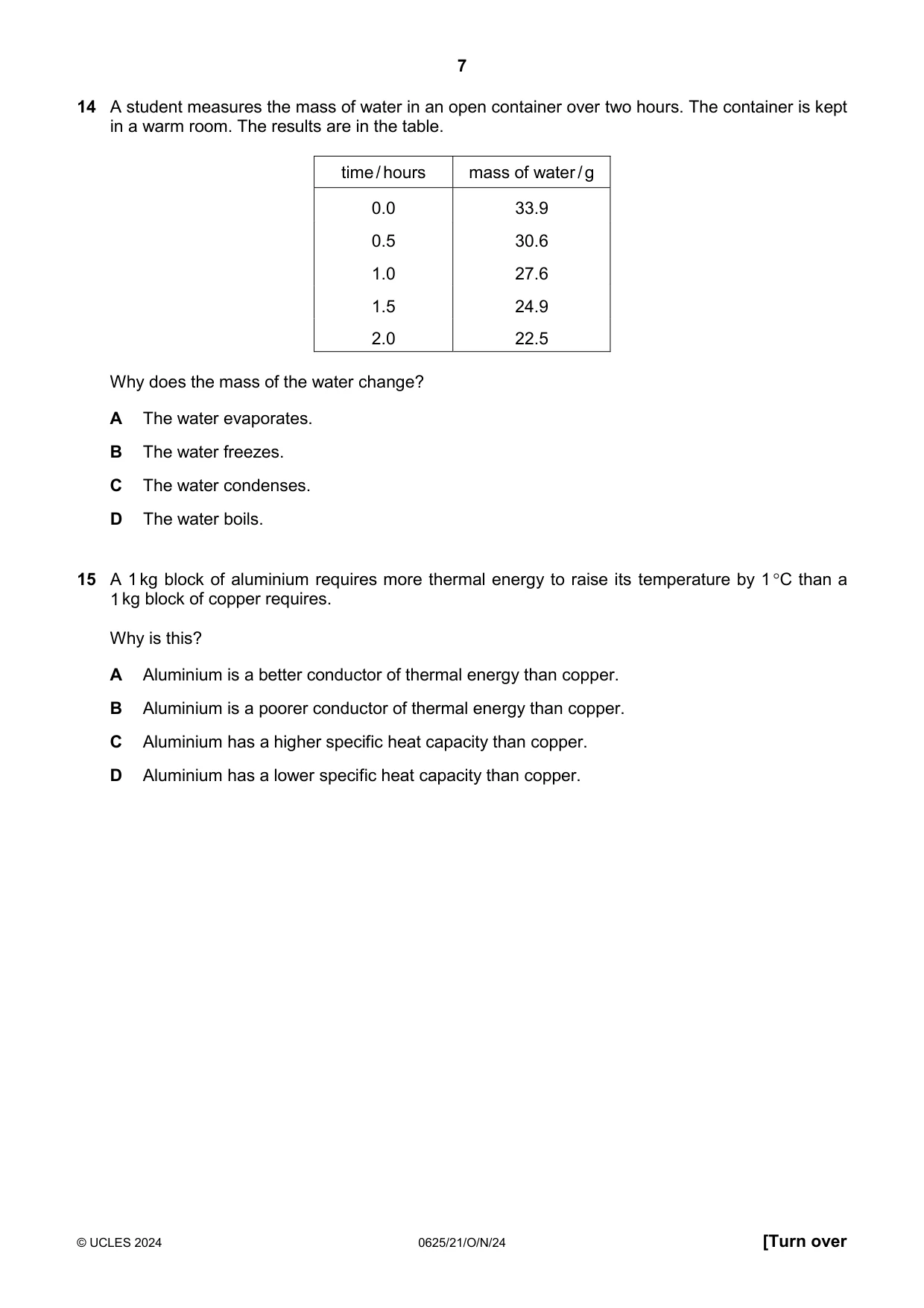
Q14 · A student measures the mass of water in an open container over two hours
14 A student measures the mass of water in an open container over two hours. The container is kept in a warm room. The results are in the table. time / hours mass of water / g 0.0 33.9 0.5 30.6 1.0 27.6 1.5 24.9 2.0 22.5 Why does the mass of the water change? A The water evaporates. B The water freezes. C The water condenses. D The water boils.
Mark scheme: A
Q15 · A 1 kg block of aluminium requires more thermal energy to raise its temperature by 1 C…
15 A 1 kg block of aluminium requires more thermal energy to raise its temperature by 1 C than a 1 kg block of copper requires. Why is this? A Aluminium is a better conductor of thermal energy than copper. B Aluminium is a poorer conductor of thermal energy than copper. C Aluminium has a higher specific heat capacity than copper. D Aluminium has a lower specific heat capacity than copper.
Mark scheme: C
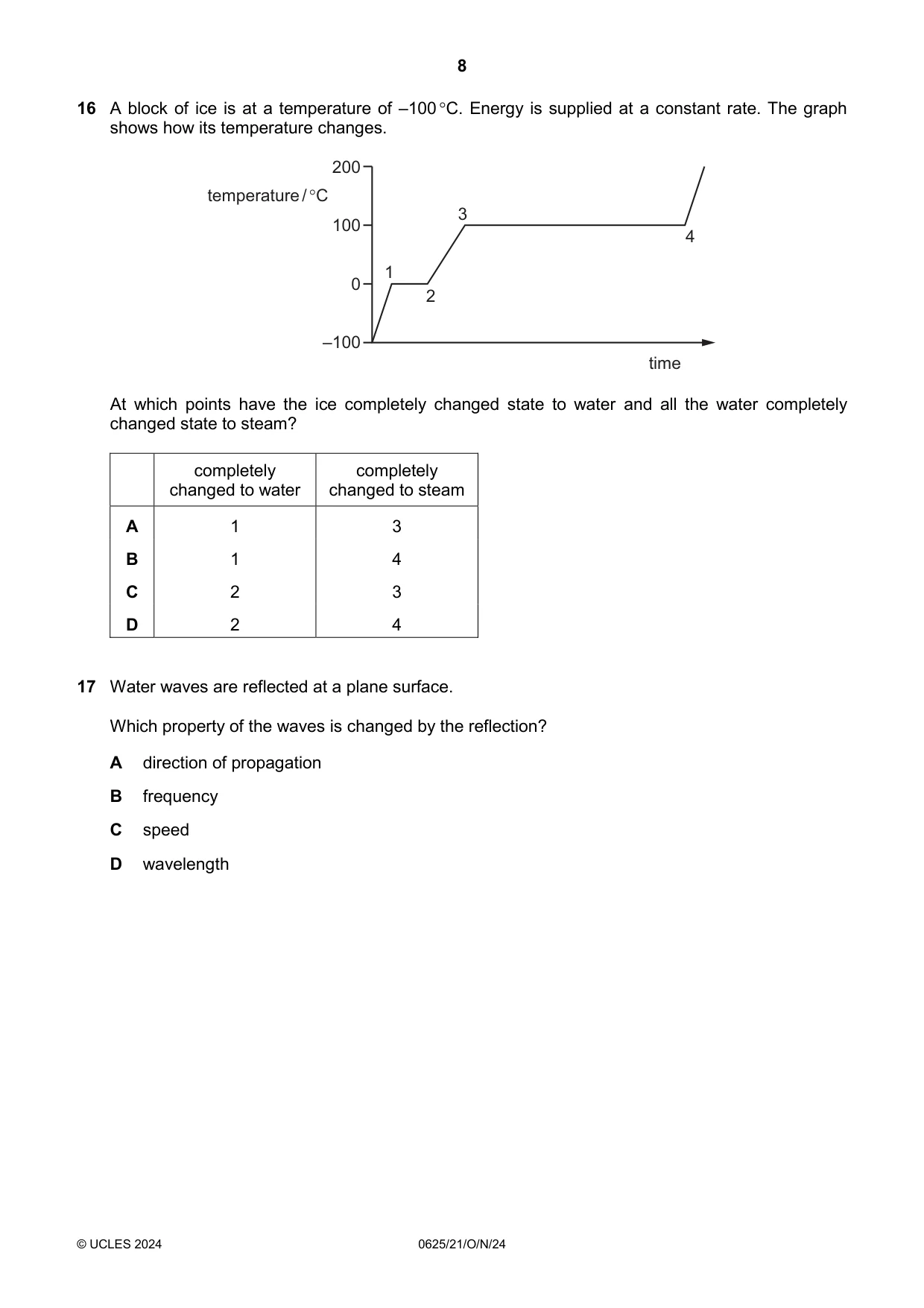
Q16 · A block of ice is at a temperature of -100°C
16 A block of ice is at a temperature of -100°C. Energy is supplied at a constant rate. The graph shows how its temperature changes. 200 temperature /°C 100 —100 time At which points have the ice completely changed state to water and all the water completely changed state to steam? completely completely changed to water | changed to steam 3 4 3 4
Mark scheme: D
Q17 · Water waves are reflected at a plane surface
17 Water waves are reflected at a plane surface. Which property of the waves is changed by the reflection? A direction of propagation B frequency C speed D wavelength
Mark scheme: A
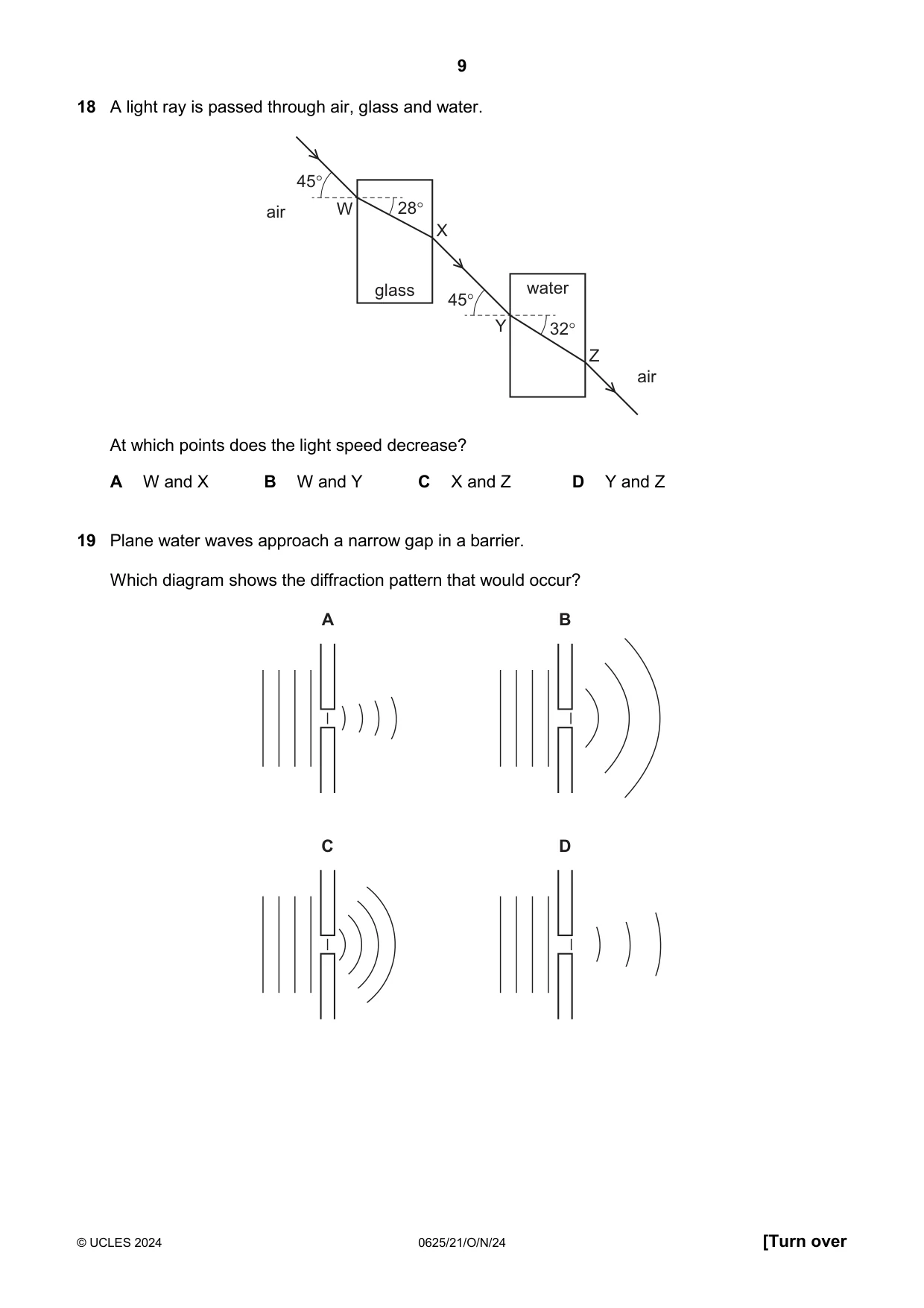
Q18 · A light ray is passed through air, glass and water
18 A light ray is passed through air, glass and water. air At which points does the light speed decrease? A Wand xX B WandyY C XandZ D YandZ
Mark scheme: B
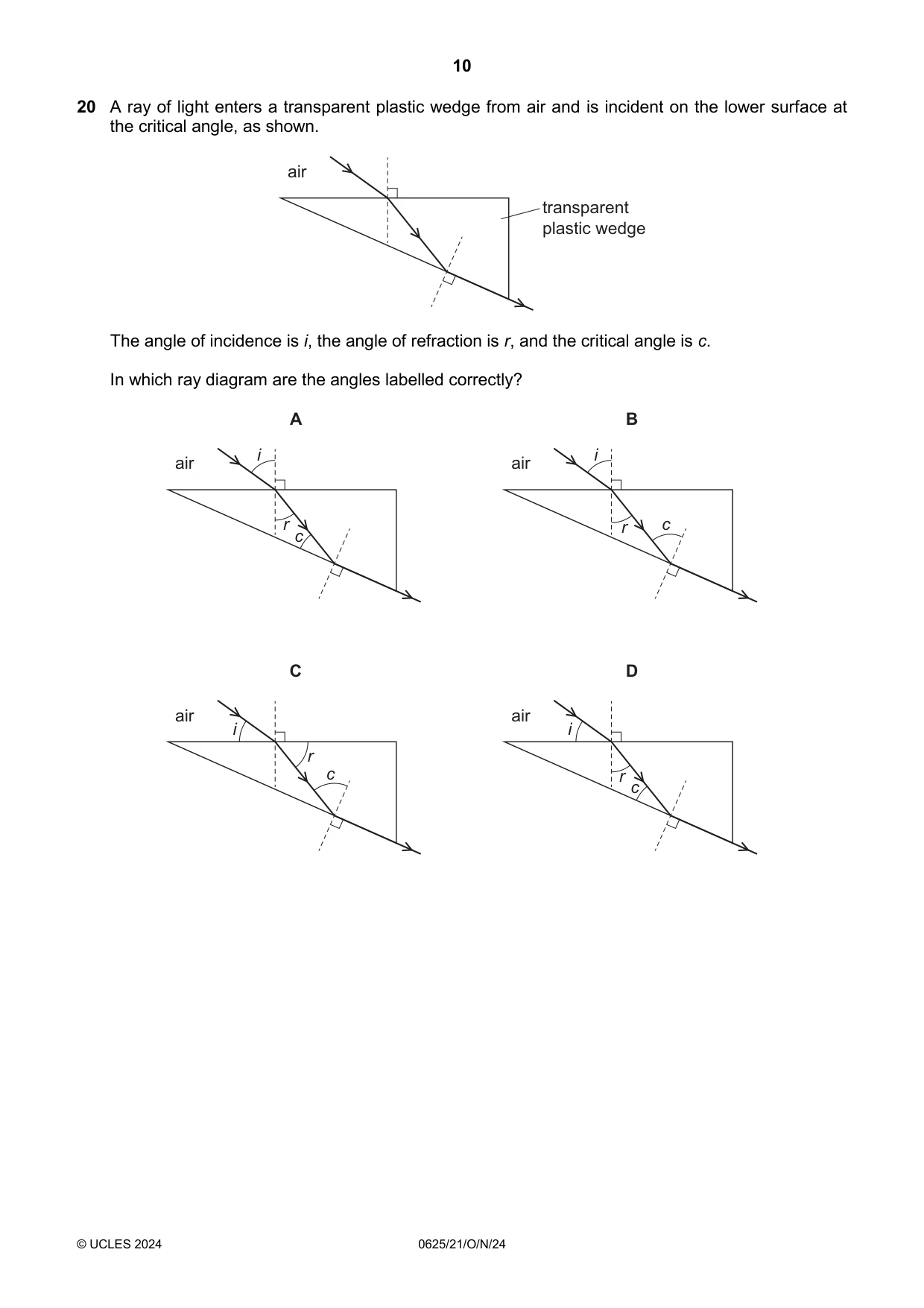
Q19 · Plane water waves approach a narrow gap in a barrier
19 Plane water waves approach a narrow gap in a barrier. Which diagram shows the diffraction pattern that would occur? A B C D
Mark scheme: C
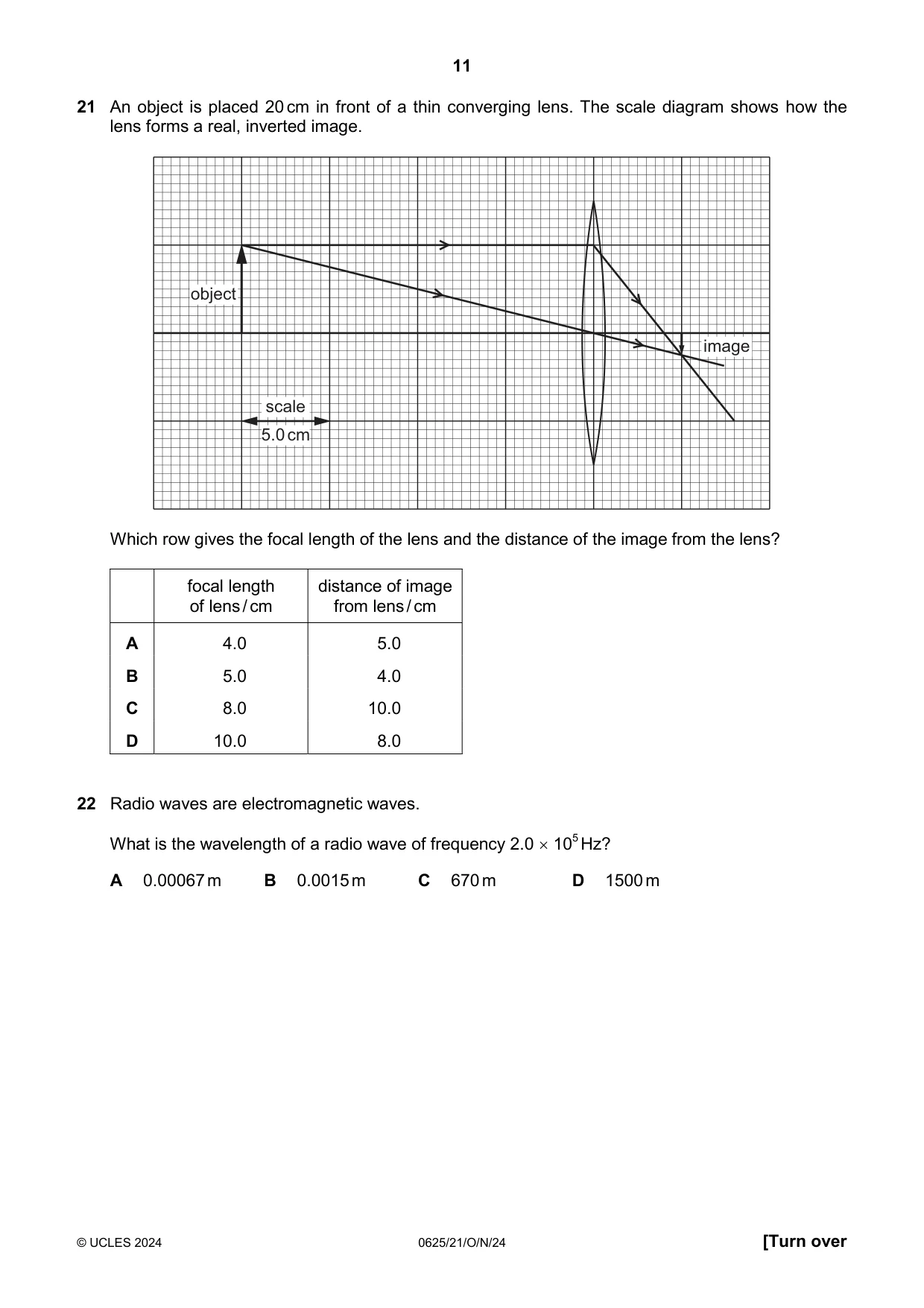
Q20 · A ray of light enters a transparent plastic wedge from air and is incident on the lower…
20 A ray of light enters a transparent plastic wedge from air and is incident on the lower surface at the critical angle, as shown. air transparent plastic wedge The angle of incidence is i, the angle of refraction is r, and the critical angle is c. In which ray diagram are the angles labelled correctly? A B i i air air r c r c C D air air i i r c r c
Mark scheme: B
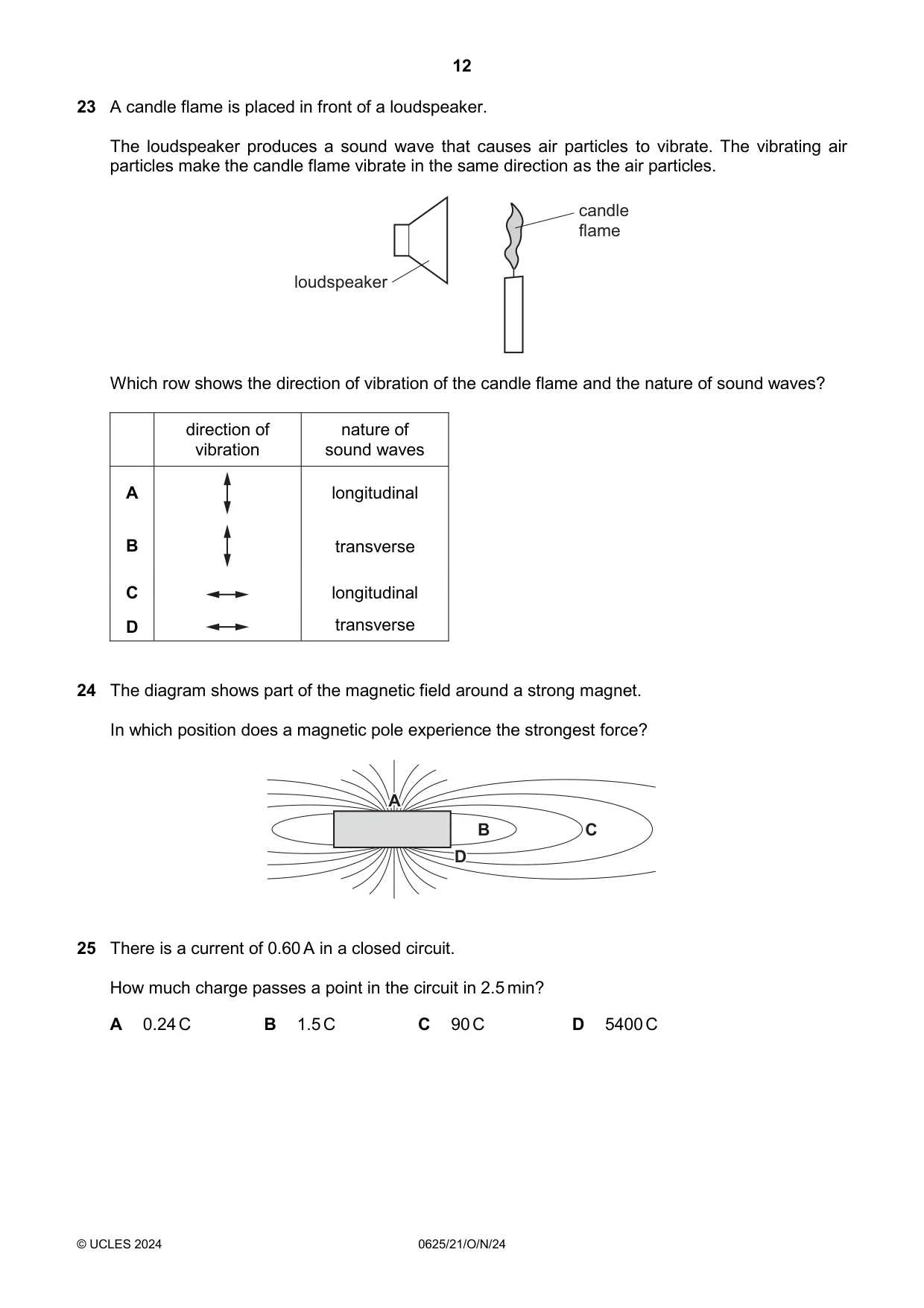
Q21 · An object is placed 20 cm in front of a thin converging lens
21 An object is placed 20 cm in front of a thin converging lens. The scale diagram shows how the lens forms a real, inverted image. object image scale 5.0 cm Which row gives the focal length of the lens and the distance of the image from the lens? focal length distance of image of lens / cm from lens / cm A 4.0 5.0 B 5.0 4.0 C 8.0 10.0 D 10.0 8.0
Mark scheme: A
Q22 · Radio waves are electromagnetic waves
22 Radio waves are electromagnetic waves. What is the wavelength of a radio wave of frequency 2.0 105 Hz? A 0.00067 m B 0.0015 m C 670 m D 1500 m
Mark scheme: D
Q23 · A candle flame is placed in front of a loudspeaker
23 A candle flame is placed in front of a loudspeaker. The loudspeaker produces a sound wave that causes air particles to vibrate. The vibrating air particles make the candle flame vibrate in the same direction as the air particles. candle flame loudspeaker Which row shows the direction of vibration of the candle flame and the nature of sound waves? direction of nature of vibration sound waves A longitudinal B transverse C longitudinal D transverse
Mark scheme: C
Q24 · The diagram shows part of the magnetic field around a strong magnet
24 The diagram shows part of the magnetic field around a strong magnet. In which position does a magnetic pole experience the strongest force? A B C D
Mark scheme: A
Q25 · There is a current of 0.60 A in a closed circuit
25 There is a current of 0.60 A in a closed circuit. How much charge passes a point in the circuit in 2.5 min? A 0.24 C B 1.5 C C 90 C D 5400 C
Mark scheme: C
Q26 · Which two physical quantities have the unit J / C?
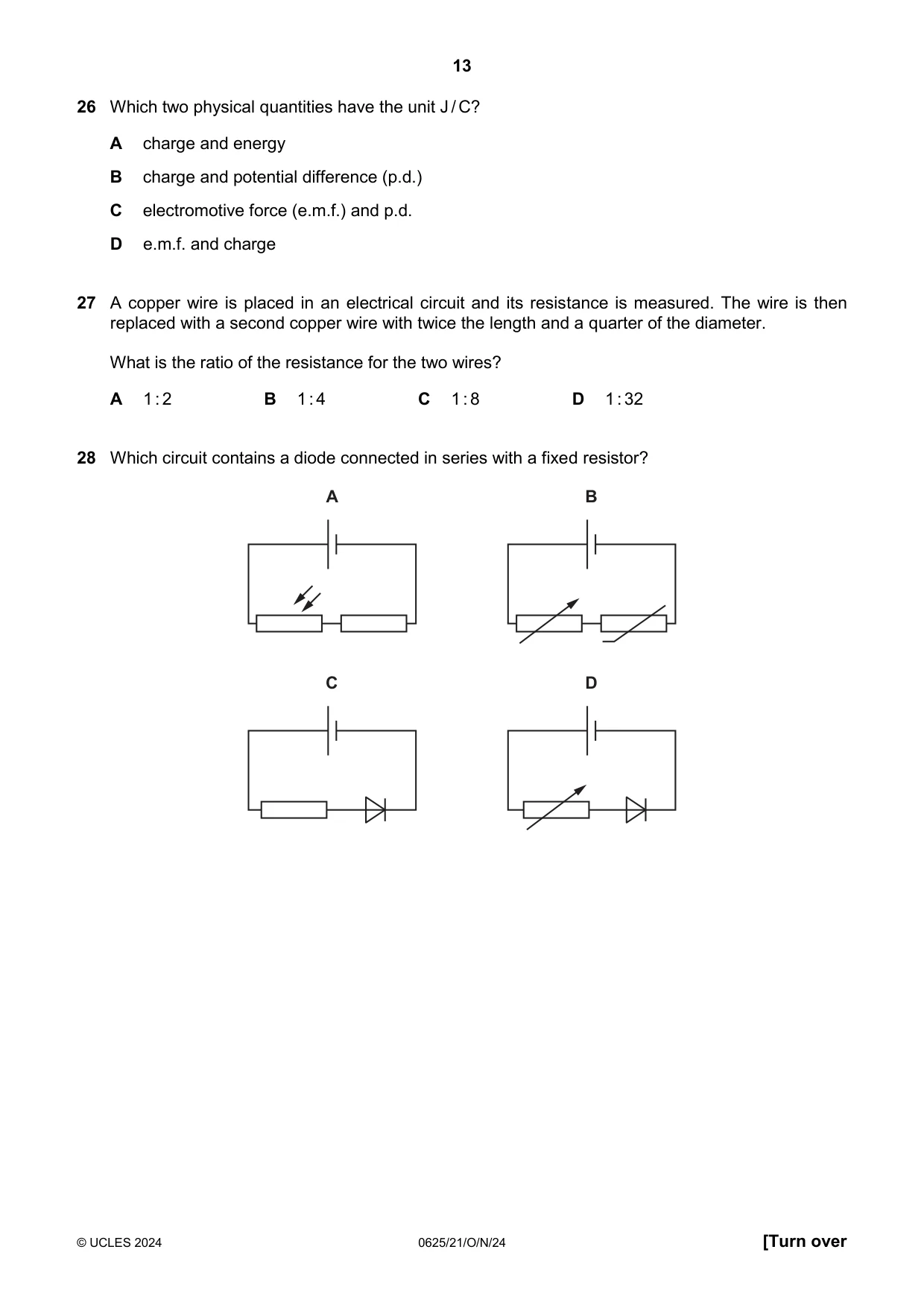
26 Which two physical quantities have the unit J / C? A charge and energy B charge and potential difference (p.d.) C electromotive force (e.m.f.) and p.d. D e.m.f. and charge
Mark scheme: C
Q27 · A copper wire is placed in an electrical circuit and its resistance is measured
27 A copper wire is placed in an electrical circuit and its resistance is measured. The wire is then replaced with a second copper wire with twice the length and a quarter of the diameter. What is the ratio of the resistance for the two wires? A 1 : 2 B 1 : 4 C 1 : 8 D 1 : 32
Mark scheme: D
Q28 · Which circuit contains a diode connected in series with a fixed resistor?
28 Which circuit contains a diode connected in series with a fixed resistor? A B C D
Mark scheme: C
Q29 · In the circuit shown, resistor X has twice the resistance of resistor Y
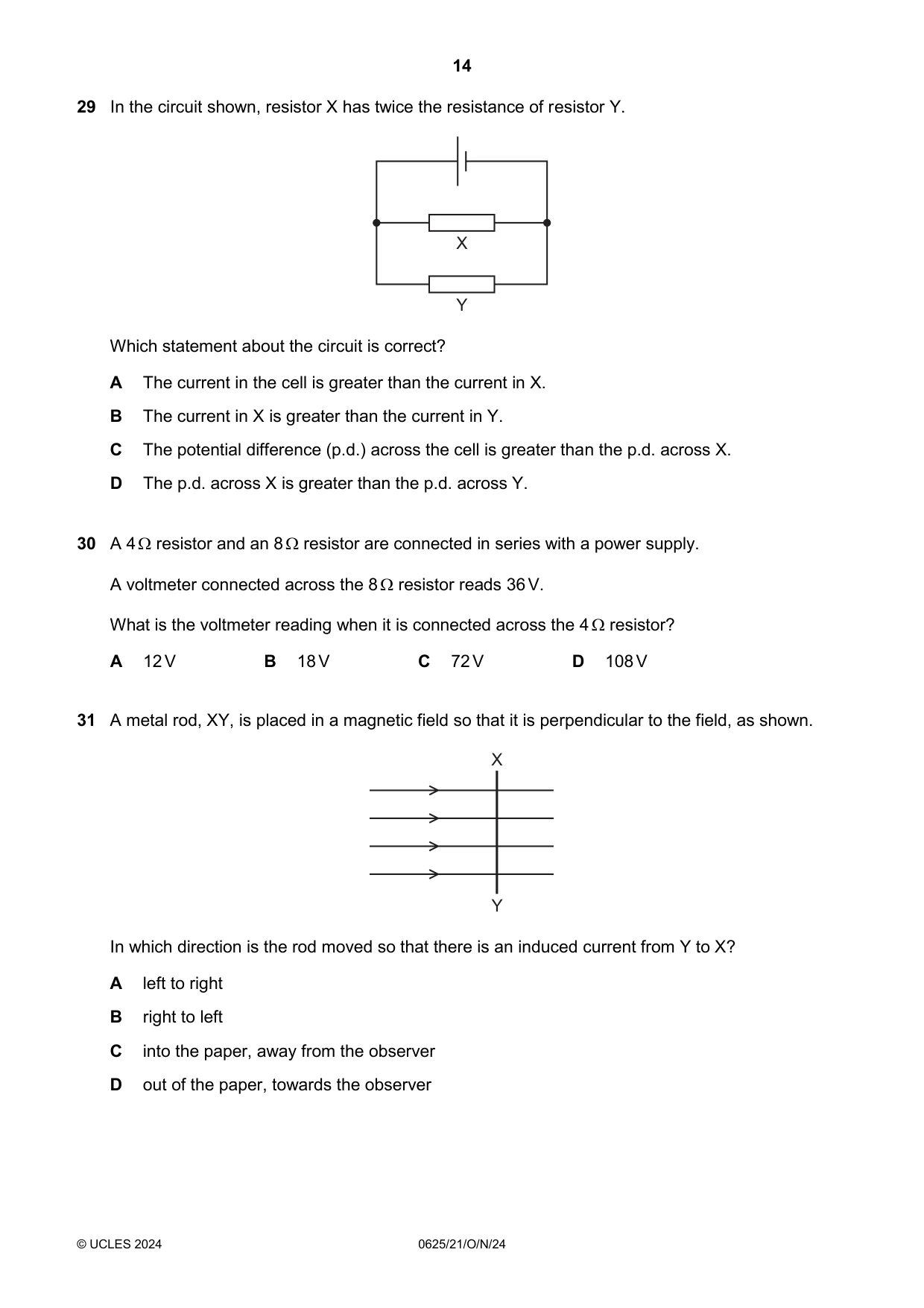
29 In the circuit shown, resistor X has twice the resistance of resistor Y. X Y Which statement about the circuit is correct? A The current in the cell is greater than the current in X. B The current in X is greater than the current in Y. C The potential difference (p.d.) across the cell is greater than the p.d. across X. D The p.d. across X is greater than the p.d. across Y.
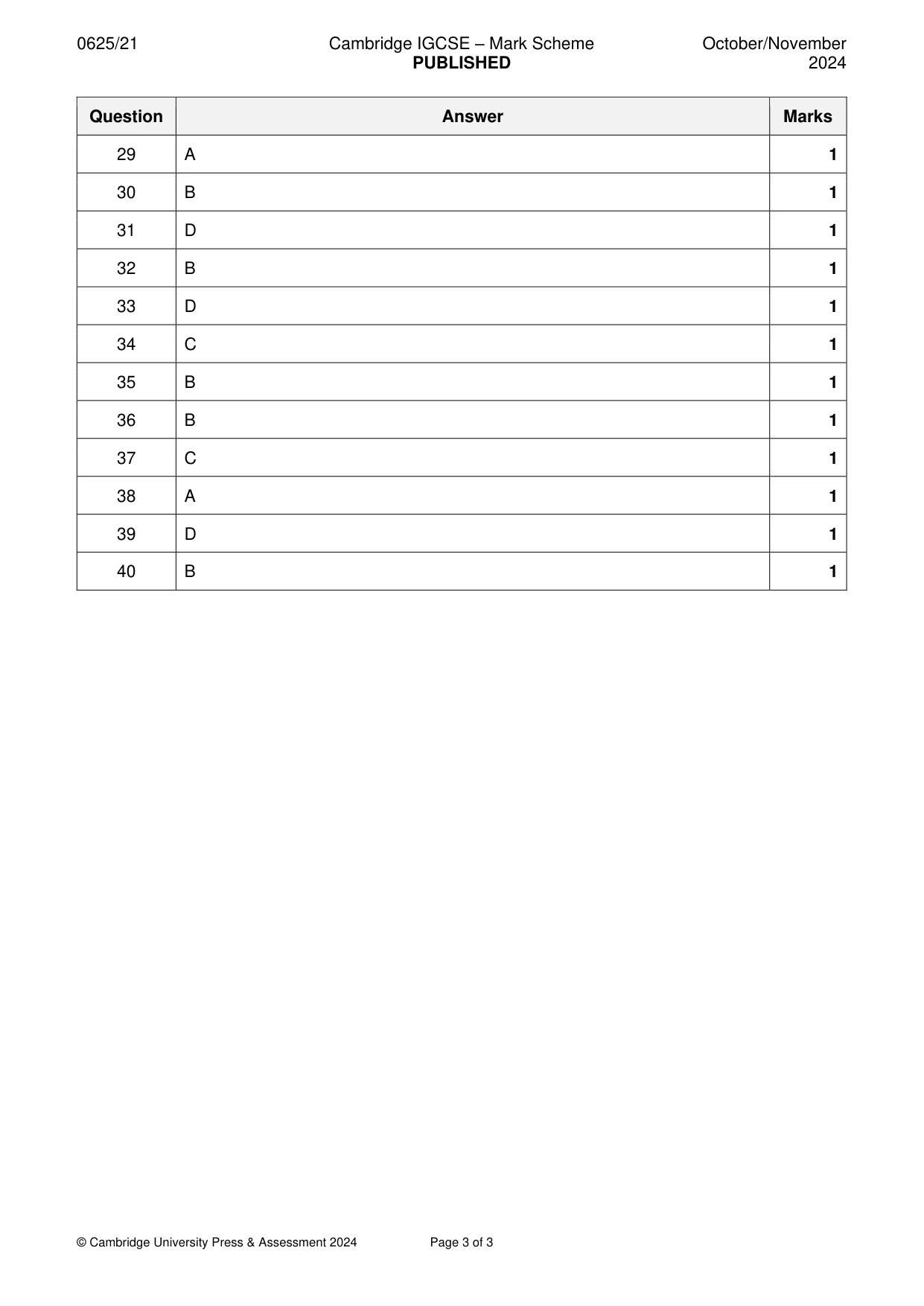
Mark scheme: A
Q30 · A 4 resistor and an 8 resistor are connected in series with a power supply
30 A 4 resistor and an 8 resistor are connected in series with a power supply. A voltmeter connected across the 8 resistor reads 36 V. What is the voltmeter reading when it is connected across the 4 resistor? A 12 V B 18 V C 72 V D 108 V
Mark scheme: B
Q31 · A metal rod, XY, is placed in a magnetic field so that it is perpendicular to the field…
31 A metal rod, XY, is placed in a magnetic field so that it is perpendicular to the field, as shown. X Y In which direction is the rod moved so that there is an induced current from Y to X? A left to right B right to left C into the paper, away from the observer D out of the paper, towards the observer
Mark scheme: D
Q32 · The diagram shows a basic electric motor
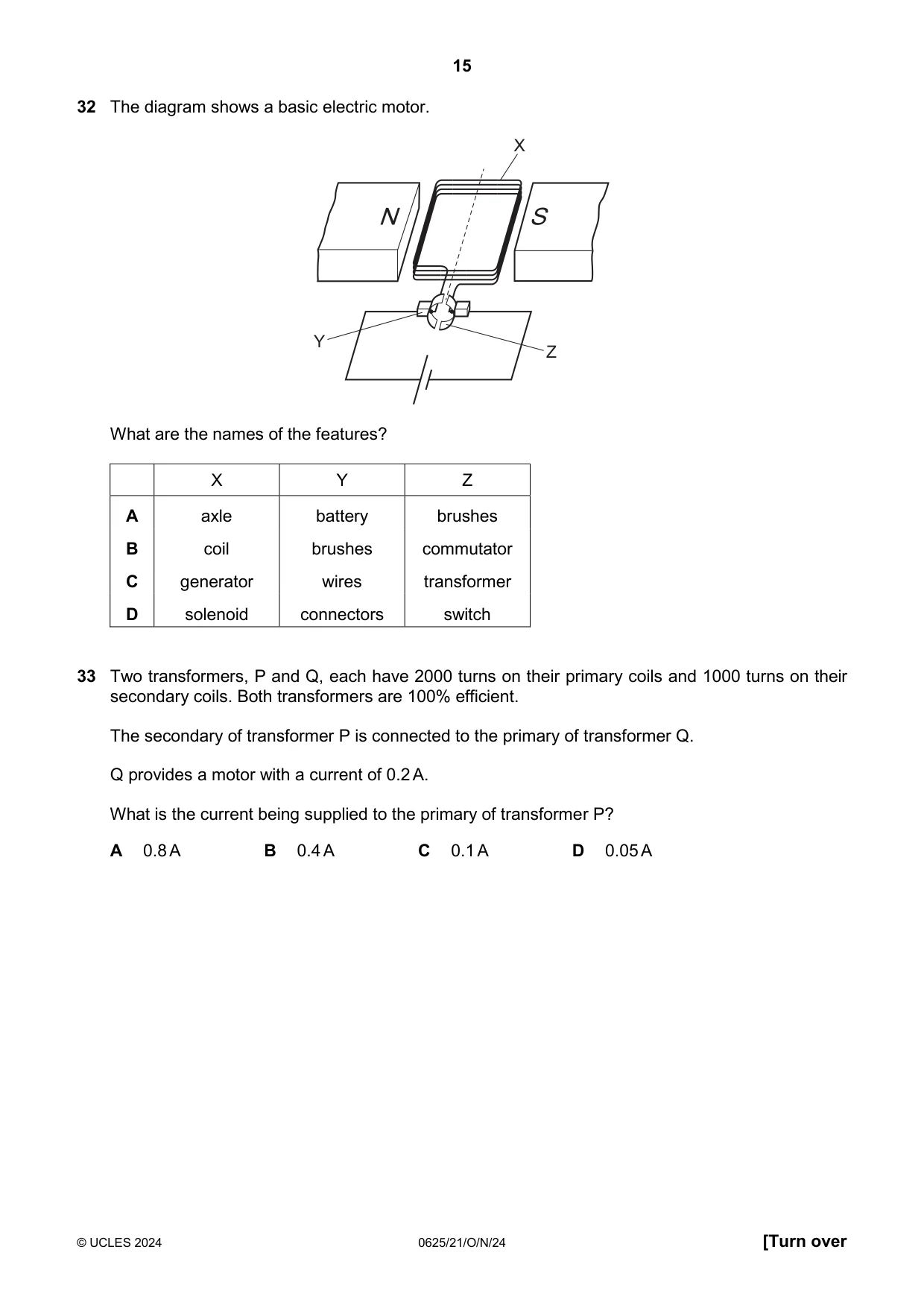
32 The diagram shows a basic electric motor. X N S Y Z What are the names of the features? X Y Z A axle battery brushes B coil brushes commutator C generator wires transformer D solenoid connectors switch
Mark scheme: B
Q33 · Two transformers, P and Q, each have 2000 turns on their primary coils and 1000 turns on…
33 Two transformers, P and Q, each have 2000 turns on their primary coils and 1000 turns on their secondary coils. Both transformers are 100% efficient. The secondary of transformer P is connected to the primary of transformer Q. Q provides a motor with a current of 0.2 A. What is the current being supplied to the primary of transformer P? A 0.8 A B 0.4 A C 0.1 A D 0.05 A
Mark scheme: D
Q34 · -particles are directed at a metal foil
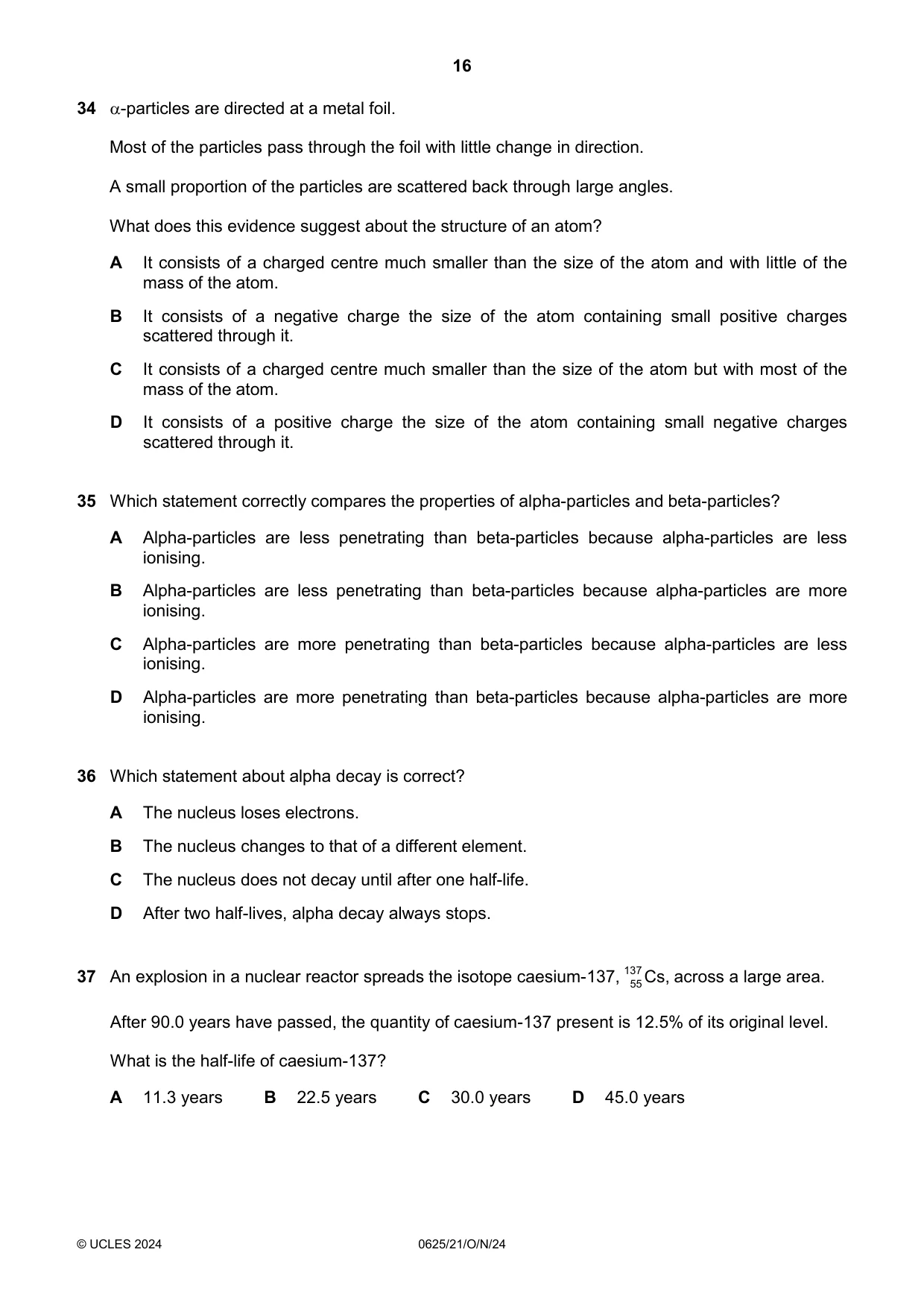
34 -particles are directed at a metal foil. Most of the particles pass through the foil with little change in direction. A small proportion of the particles are scattered back through large angles. What does this evidence suggest about the structure of an atom? A It consists of a charged centre much smaller than the size of the atom and with little of the mass of the atom. B It consists of a negative charge the size of the atom containing small positive charges scattered through it. C It consists of a charged centre much smaller than the size of the atom but with most of the mass of the atom. D It consists of a positive charge the size of the atom containing small negative charges scattered through it.
Mark scheme: C
Q35 · Which statement correctly compares the properties of alpha-particles and beta-particles?
35 Which statement correctly compares the properties of alpha-particles and beta-particles? A Alpha-particles are less penetrating than beta-particles because alpha-particles are less ionising. B Alpha-particles are less penetrating than beta-particles because alpha-particles are more ionising. C Alpha-particles are more penetrating than beta-particles because alpha-particles are less ionising. D Alpha-particles are more penetrating than beta-particles because alpha-particles are more ionising.
Mark scheme: B
Q36 · Which statement about alpha decay is correct?
36 Which statement about alpha decay is correct? A The nucleus loses electrons. B The nucleus changes to that of a different element. C The nucleus does not decay until after one half-life. D After two half-lives, alpha decay always stops.
Mark scheme: B
Q37 · An explosion in a nuclear reactor spreads the isotope caesium-137, 137 Cs, across a large…
37 An explosion in a nuclear reactor spreads the isotope caesium-137, 137 Cs, across a large area. 55 After 90.0 years have passed, the quantity of caesium-137 present is 12.5% of its original level. What is the half-life of caesium-137? A 11.3 years B 22.5 years C 30.0 years D 45.0 years
Mark scheme: C
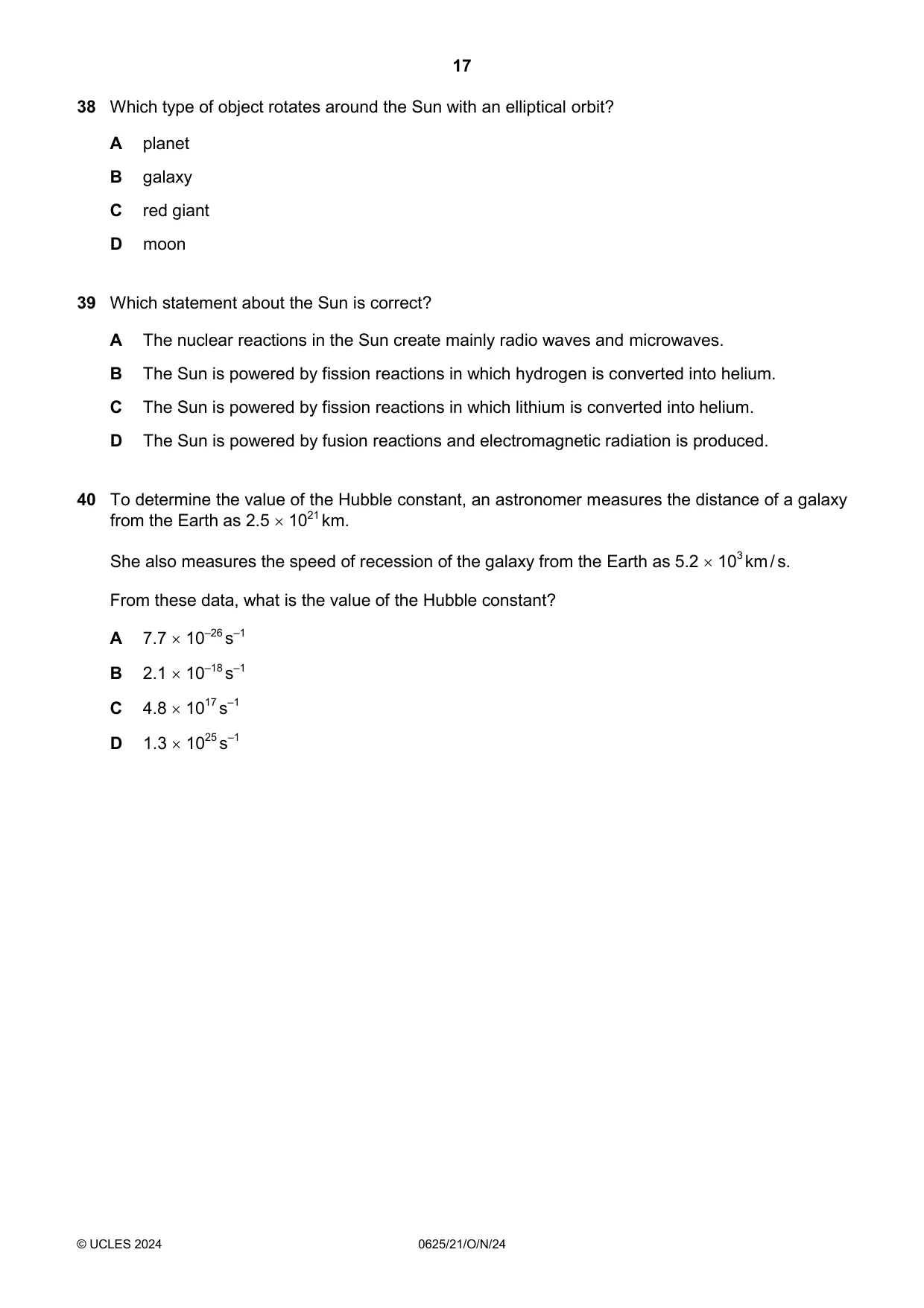
Q38 · Which type of object rotates around the Sun with an elliptical orbit?
38 Which type of object rotates around the Sun with an elliptical orbit? A planet B galaxy C red giant D moon
Mark scheme: A
Q39 · Which statement about the Sun is correct?
39 Which statement about the Sun is correct? A The nuclear reactions in the Sun create mainly radio waves and microwaves. B The Sun is powered by fission reactions in which hydrogen is converted into helium. C The Sun is powered by fission reactions in which lithium is converted into helium. D The Sun is powered by fusion reactions and electromagnetic radiation is produced.
Mark scheme: D
Q40 · To determine the value of the Hubble constant, an astronomer measures the distance of a…
40 To determine the value of the Hubble constant, an astronomer measures the distance of a galaxy from the Earth as 2.5 1021 km. She also measures the speed of recession of the galaxy from the Earth as 5.2 103 km / s. From these data, what is the value of the Hubble constant? A 7.7 10–26 s–1 B 2.1 10–18 s–1 C 4.8 1017 s–1 D 1.3 1025 s–1
Mark scheme: B
What was in this paper
The subtopics covered by these 40 questions, and how many questions each got. Open one in a new tab to see every Cambridge question on it.
3Electrical quantities3Electromagnetic effects3Energy, work and power3Forces3Light3Radioactivity3Thermal properties and temperature3General properties of waves2Kinetic particle model of matter2Motion2Stars and the Universe2Electromagnetic spectrum1Momentum1Physical quantities and measurement techniques1Pressure1Simple phenomena of magnetism1Sound1The Earth and the Solar System1The nuclear model of the atom1What you needed in this session
Cambridge’s own grade thresholds for 2024 Oct/Nov, Paper 2 · Variant 1. A higher threshold means an easier paper — the bar moves with how the cohort did.