Cambridge IGCSE Physics 0625 — 2023 Oct/Nov Paper 2 · Variant 1
0625/21/O/N/23 · 40 questions · 40 marks · ≈45 min
The question paper and its mark scheme, free to read here and free to download. This is Cambridge’s own paper, exactly as it was sat.
Question paper16 pages
Mark scheme3 pages
Answers below. Sit the paper first if you are practising.
Questions as text
Q1 · Which is a vector quantity?
1 Which is a vector quantity? A density B mass C pressure D weight
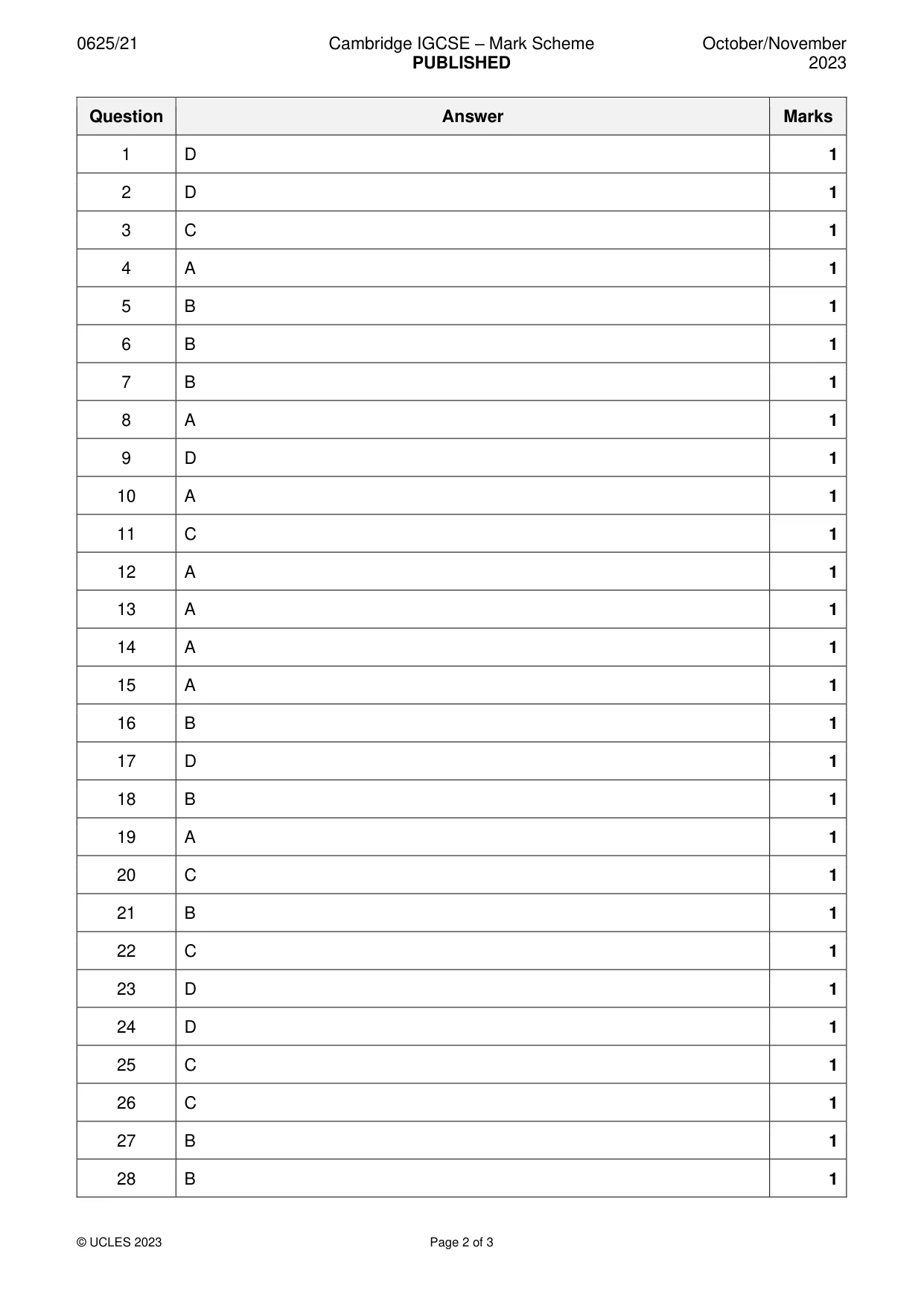
Mark scheme: D
More questions on Physical quantities and measurement techniques
Q2 · The graph shows the speed of a car travelling through a town
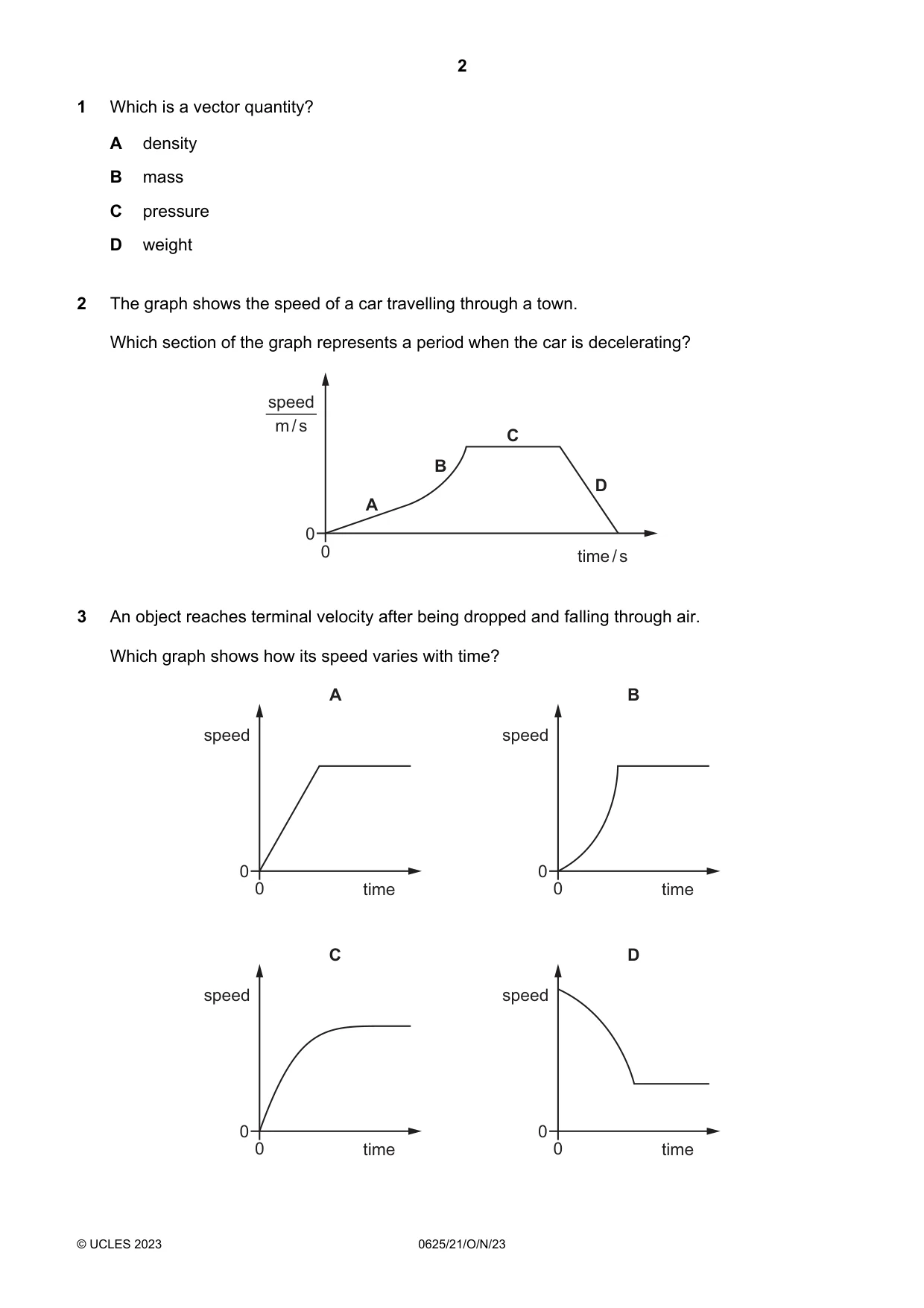
2 The graph shows the speed of a car travelling through a town. Which section of the graph represents a period when the car is decelerating? speed m / s C B D A 0 0 time / s
Mark scheme: D
Q3 · An object reaches terminal velocity after being dropped and falling through air
3 An object reaches terminal velocity after being dropped and falling through air. Which graph shows how its speed varies with time? A B speed speed 0 0 0 time 0 time C D speed speed 0 0 0 time 0 time
Mark scheme: C
Q4 · The table shows the mass and volume of three different liquids, X, Y and Z
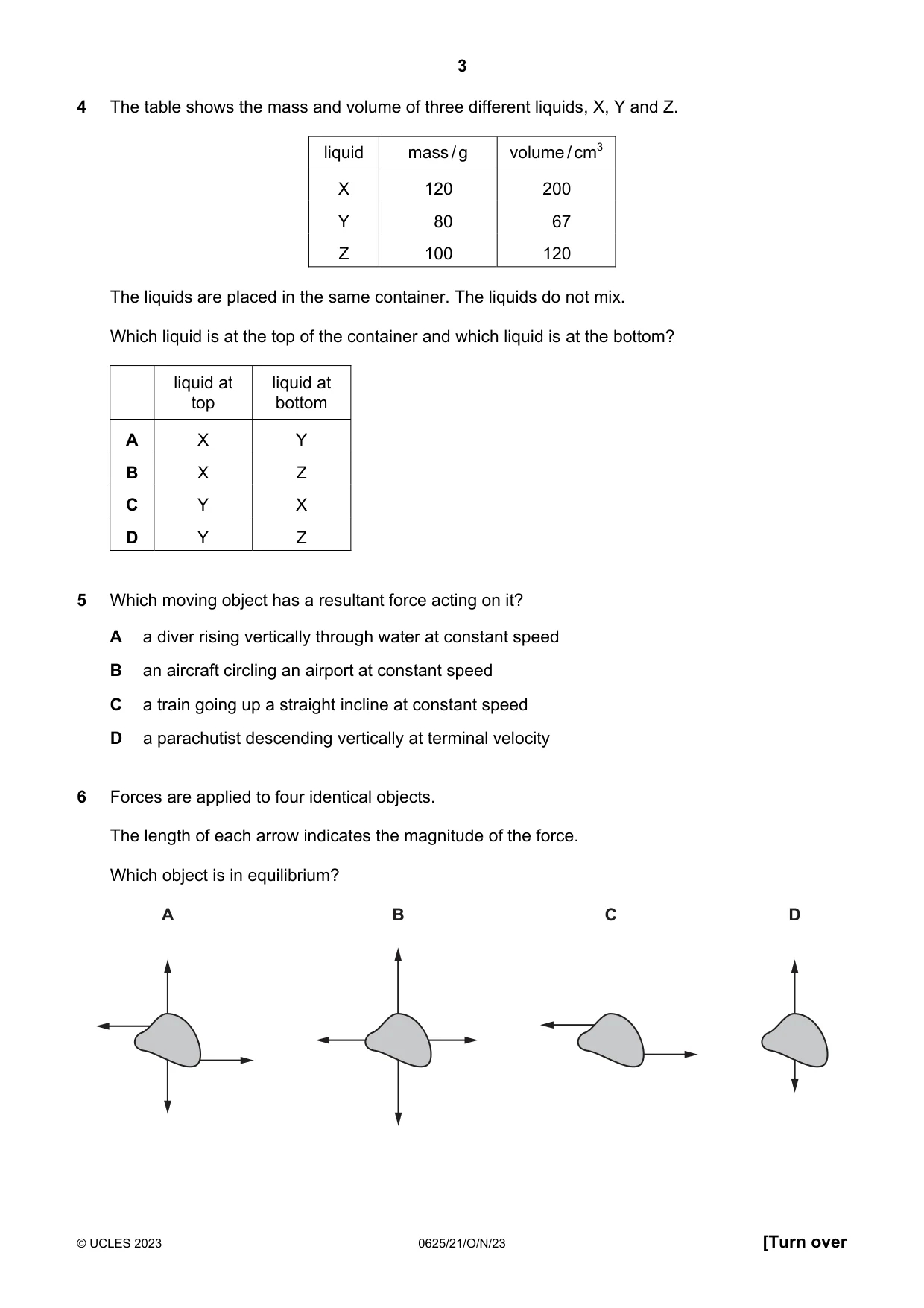
4 The table shows the mass and volume of three different liquids, X, Y and Z. liquid mass / g volume / cm3 X 120 200 Y 80 67 Z 100 120 The liquids are placed in the same container. The liquids do not mix. Which liquid is at the top of the container and which liquid is at the bottom? liquid at liquid at top bottom A X Y B X Z C Y X D Y Z
Mark scheme: A
Q5 · Which moving object has a resultant force acting on it?
5 Which moving object has a resultant force acting on it? A a diver rising vertically through water at constant speed B an aircraft circling an airport at constant speed C a train going up a straight incline at constant speed D a parachutist descending vertically at terminal velocity
Mark scheme: B
Q6 · Forces are applied to four identical objects
6 Forces are applied to four identical objects. The length of each arrow indicates the magnitude of the force. Which object is in equilibrium? A B C D
Mark scheme: B
Q7 · A sphere X collides head on with a second identical sphere Y which is stationary
7 A sphere X collides head on with a second identical sphere Y which is stationary. The mass of each sphere is 0.15 kg. Sphere X is travelling at a velocity of 2.0 m / s before the collision and produces an impulse of 0.21 N s on sphere Y. What is the velocity of sphere X after collision? A 0.60 m / s in the opposite direction to Y B 0.60 m / s in the same direction as Y C 1.4 m / s in the opposite direction to Y D 1.4 m / s in the same direction as Y
Mark scheme: B
Q8 · A cyclist travels down a hill from rest at point X without pedalling
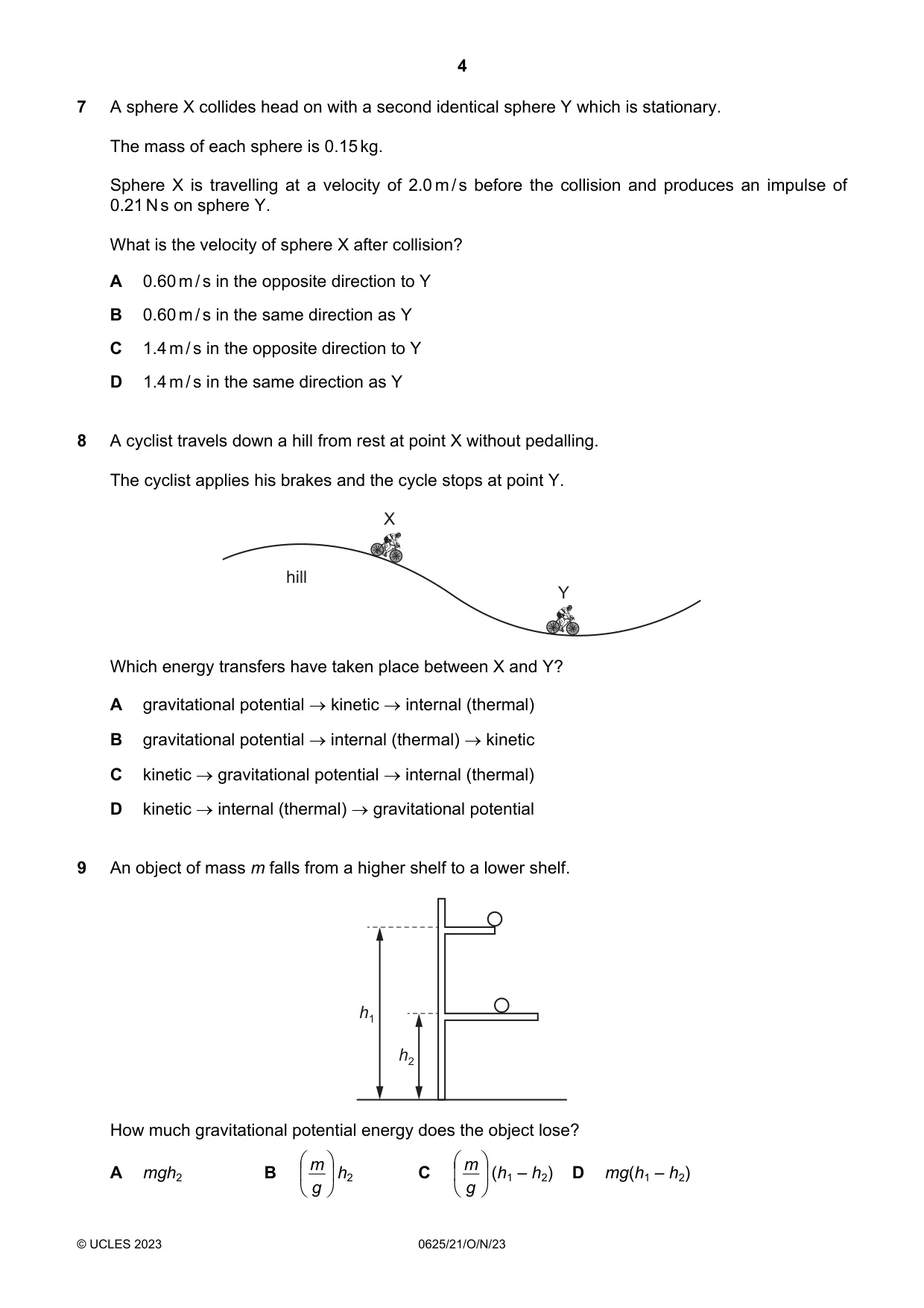
8 A cyclist travels down a hill from rest at point X without pedalling. The cyclist applies his brakes and the cycle stops at point Y. X hill Y Which energy transfers have taken place between X and Y? A gravitational potential kinetic internal (thermal) B gravitational potential internal (thermal) kinetic C kinetic gravitational potential internal (thermal) D kinetic internal (thermal) gravitational potential
Mark scheme: A
Q9 · An object of mass m falls from a higher shelf to a lower shelf
9 An object of mass m falls from a higher shelf to a lower shelf. h1 h2 How much gravitational potential energy does the object lose? m h2 m (h1 – h2) A mgh2 B C D mg(h1 – h2) g g
Mark scheme: D
Q10 · A pump does 460 000 J of work to raise water to fill a tank
10 A pump does 460 000 J of work to raise water to fill a tank. It takes 7 minutes to fill the tank. What is the power of the pump? A 1.1 kW B 66 kW C 3200 kW D 190 000 kW
Mark scheme: A
Q11 · The water in a swimming pool exerts a pressure at the bottom of the pool
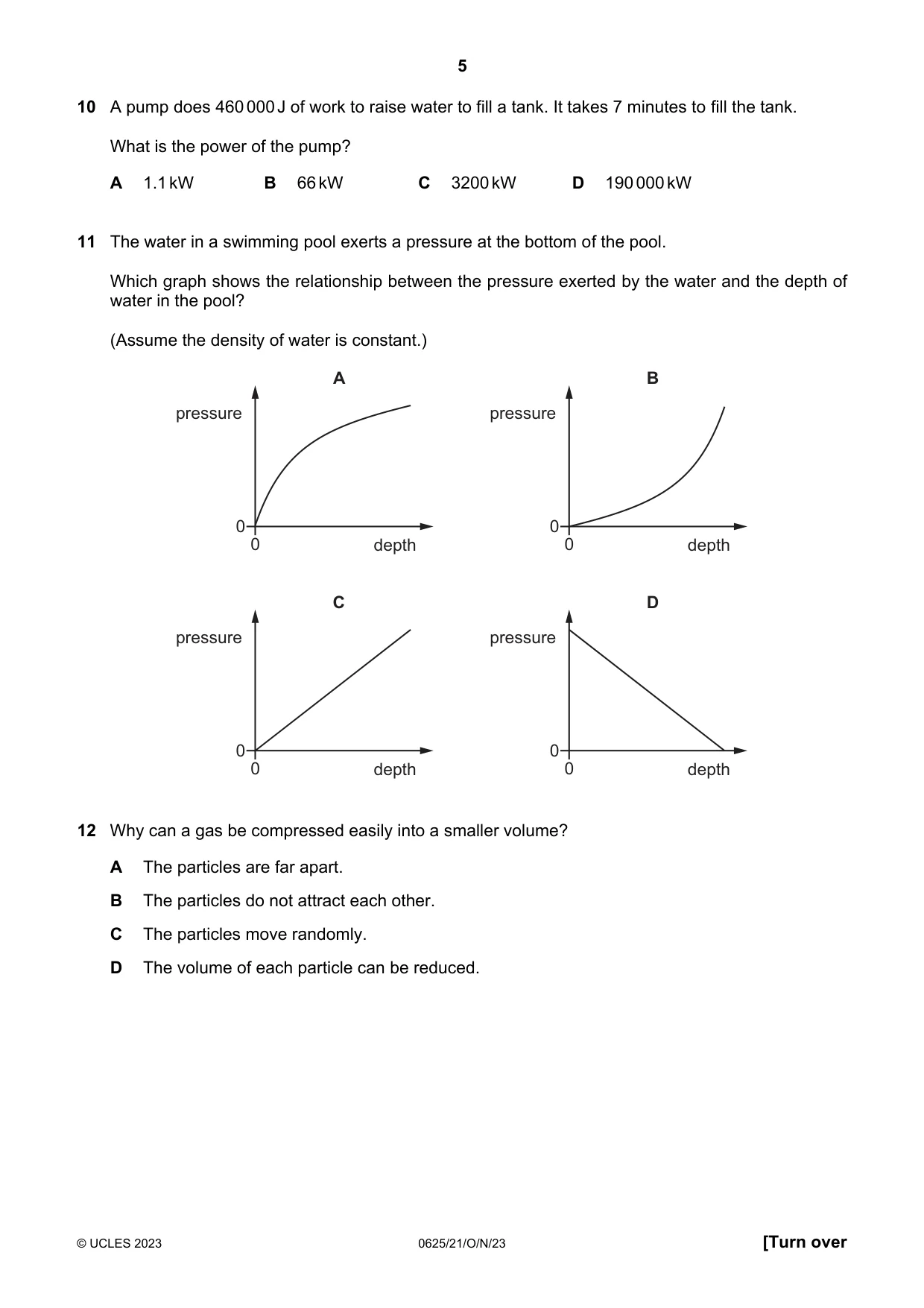
11 The water in a swimming pool exerts a pressure at the bottom of the pool. Which graph shows the relationship between the pressure exerted by the water and the depth of water in the pool? (Assume the density of water is constant.) A B pressure pressure 0 0 0 depth 0 depth C D pressure pressure 0 0 0 depth 0 depth
Mark scheme: C
Q12 · Why can a gas be compressed easily into a smaller volume?
12 Why can a gas be compressed easily into a smaller volume? A The particles are far apart. B The particles do not attract each other. C The particles move randomly. D The volume of each particle can be reduced.
Mark scheme: A
Q13 · A gas is contained in a cylinder by a movable piston
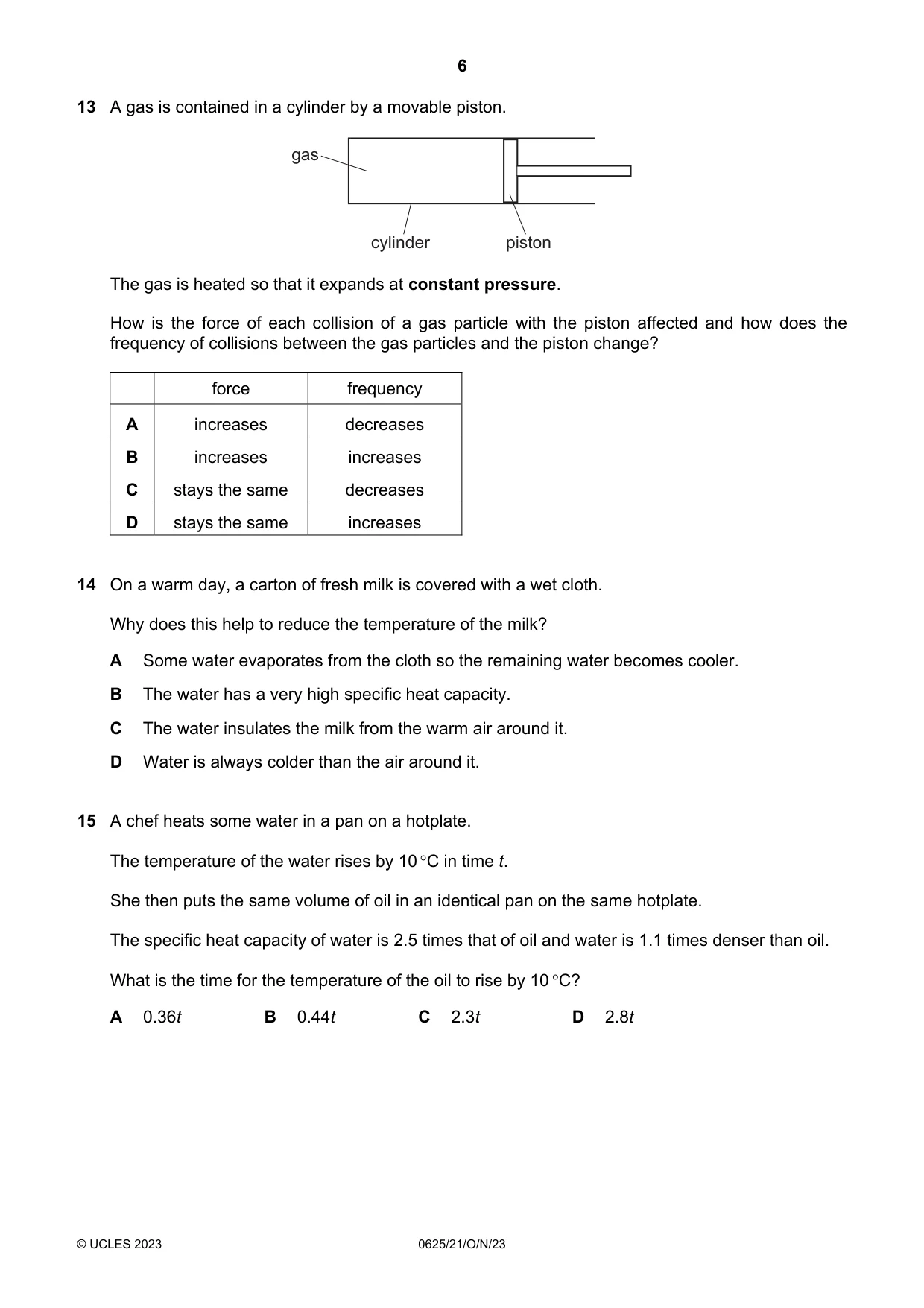
13 A gas is contained in a cylinder by a movable piston. gas cylinder piston The gas is heated so that it expands at constant pressure. How is the force of each collision of a gas particle with the piston affected and how does the frequency of collisions between the gas particles and the piston change? force frequency A increases decreases B increases increases C stays the same decreases D stays the same increases
Mark scheme: A
Q14 · On a warm day, a carton of fresh milk is covered with a wet cloth
14 On a warm day, a carton of fresh milk is covered with a wet cloth. Why does this help to reduce the temperature of the milk? A Some water evaporates from the cloth so the remaining water becomes cooler. B The water has a very high specific heat capacity. C The water insulates the milk from the warm air around it. D Water is always colder than the air around it.
Mark scheme: A
Q15 · A chef heats some water in a pan on a hotplate
15 A chef heats some water in a pan on a hotplate. The temperature of the water rises by 10 C in time t. She then puts the same volume of oil in an identical pan on the same hotplate. The specific heat capacity of water is 2.5 times that of oil and water is 1.1 times denser than oil. What is the time for the temperature of the oil to rise by 10 C? A 0.36t B 0.44t C 2.3t D 2.8t
Mark scheme: A
Q16 · The diagram shows the view of a room heated by a radiator
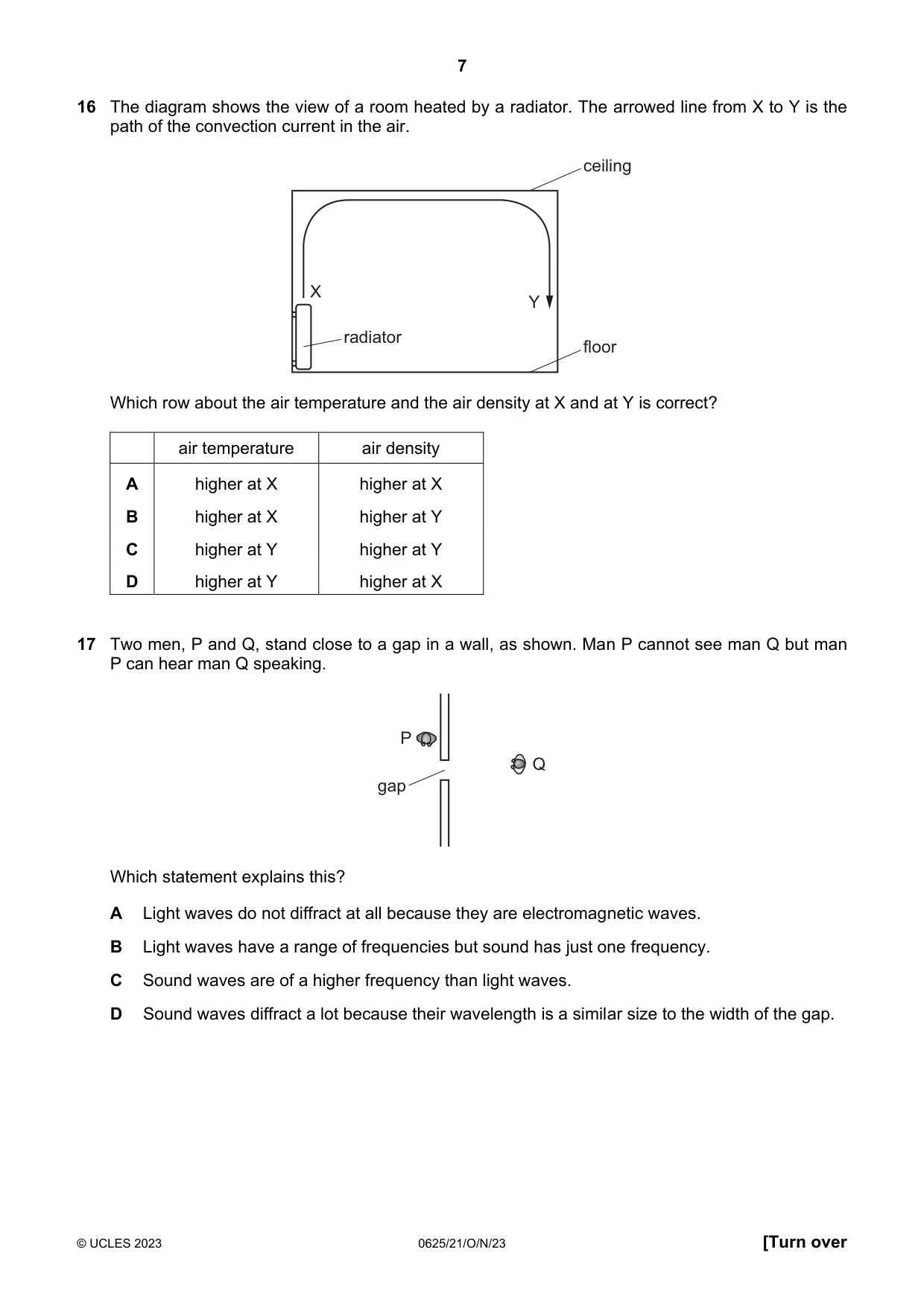
16 The diagram shows the view of a room heated by a radiator. The arrowed line from X to Y is the path of the convection current in the air. ceiling X Y radiator floor Which row about the air temperature and the air density at X and at Y is correct? air temperature air density A higher at X higher at X B higher at X higher at Y C higher at Y higher at Y D higher at Y higher at X
Mark scheme: B
Q17 · Two men, P and Q, stand close to a gap in a wall, as shown
17 Two men, P and Q, stand close to a gap in a wall, as shown. Man P cannot see man Q but man P can hear man Q speaking. P Q gap Which statement explains this? A Light waves do not diffract at all because they are electromagnetic waves. B Light waves have a range of frequencies but sound has just one frequency. C Sound waves are of a higher frequency than light waves. D Sound waves diffract a lot because their wavelength is a similar size to the width of the gap.
Mark scheme: D
Q18 · Which quantities relating to a wave on the surface of water can both be measured in…
18 Which quantities relating to a wave on the surface of water can both be measured in metres? A amplitude and frequency B amplitude and wavelength C amplitude and wave speed D frequency and wavelength
Mark scheme: B
Q19 · The diagram shows part of a ray diagram that demonstrates the formation of a virtual…
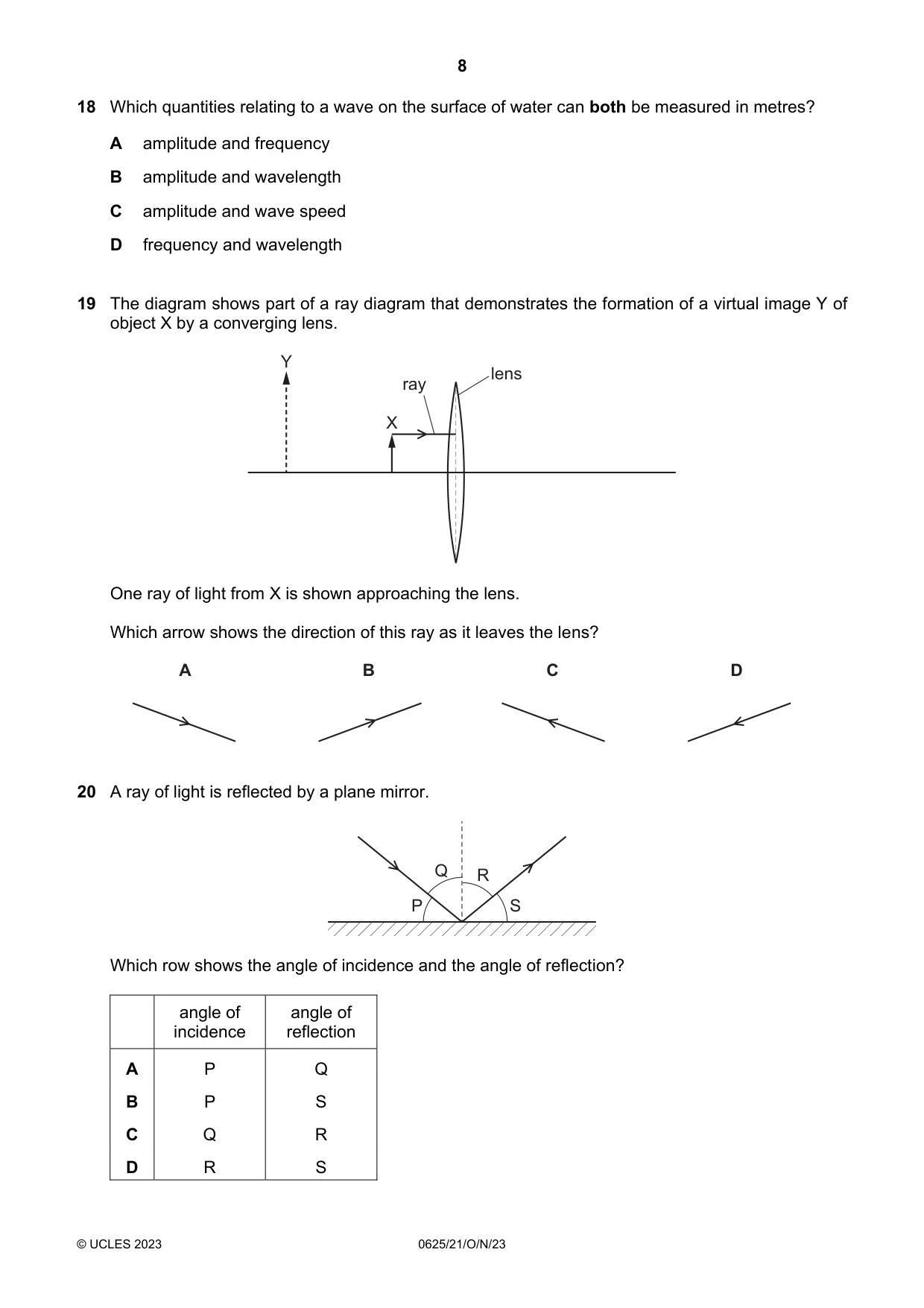
19 The diagram shows part of a ray diagram that demonstrates the formation of a virtual image Y of object X by a converging lens. Y lens ray X One ray of light from X is shown approaching the lens. Which arrow shows the direction of this ray as it leaves the lens? A B C D
Mark scheme: A
Q20 · A ray of light is reflected by a plane mirror
20 A ray of light is reflected by a plane mirror. Q R P S Which row shows the angle of incidence and the angle of reflection? angle of angle of incidence reflection A P Q B P S C Q R D R S
Mark scheme: C
Q21 · A thin converging lens is used to produce a real image of an object
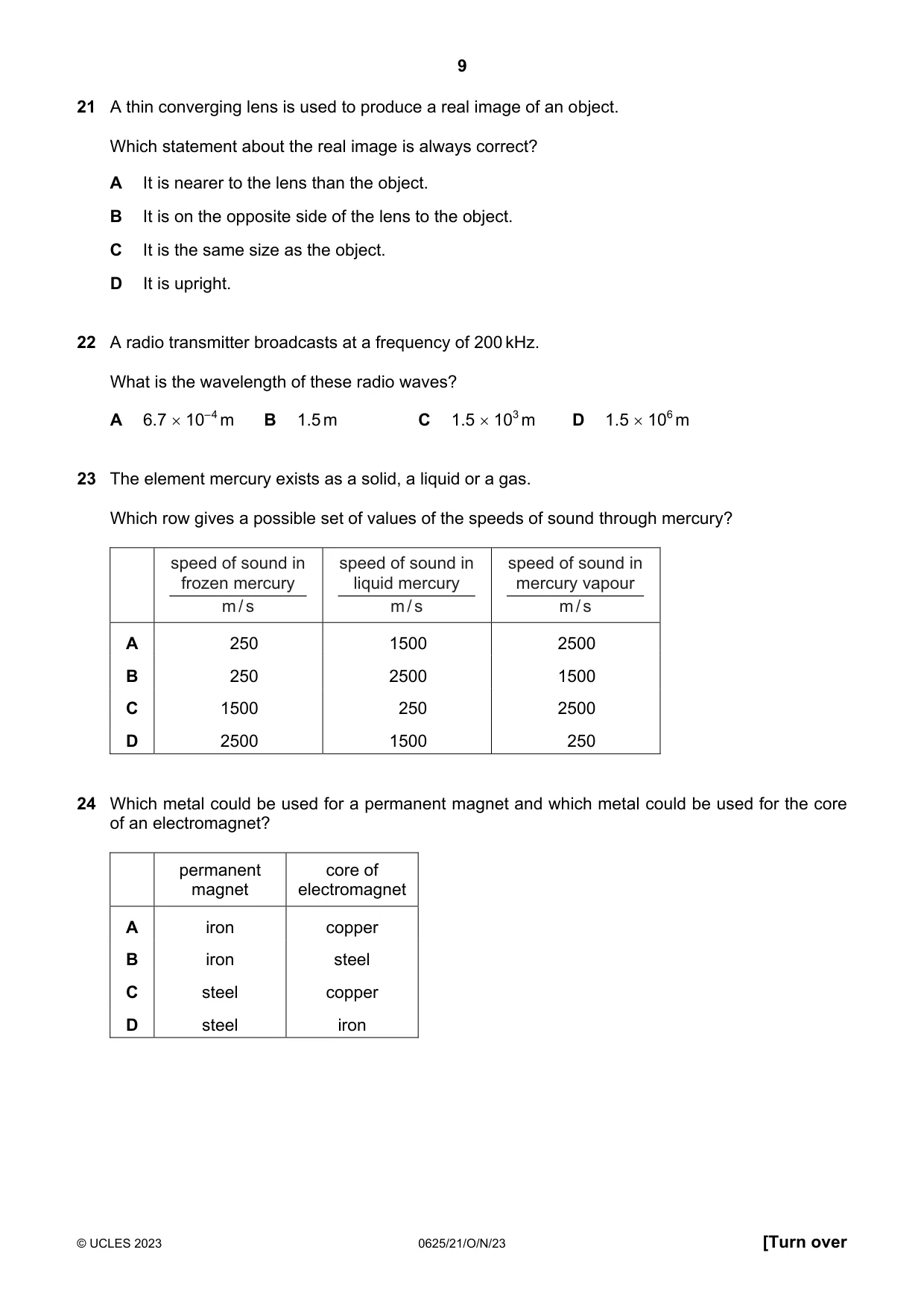
21 A thin converging lens is used to produce a real image of an object. Which statement about the real image is always correct? A It is nearer to the lens than the object. B It is on the opposite side of the lens to the object. C It is the same size as the object. D It is upright.
Mark scheme: B
Q22 · A radio transmitter broadcasts at a frequency of 200 kHz
22 A radio transmitter broadcasts at a frequency of 200 kHz. What is the wavelength of these radio waves? A 6.7 10– 4 m B 1.5 m C 1.5 103 m D 1.5 106 m
Mark scheme: C
Q23 · The element mercury exists as a solid, a liquid or a gas
23 The element mercury exists as a solid, a liquid or a gas. Which row gives a possible set of values of the speeds of sound through mercury? speed of sound in speed of sound in speed of sound in frozen mercury liquid mercury mercury vapour m / s m / s m / s A 250 1500 2500 B 250 2500 1500 C 1500 250 2500 D 2500 1500 250
Mark scheme: D
Q24 · Which metal could be used for a permanent magnet and which metal could be used for the…
24 Which metal could be used for a permanent magnet and which metal could be used for the core of an electromagnet? permanent core of magnet electromagnet A iron copper B iron steel C steel copper D steel iron
Mark scheme: D
Q25 · Which statement describes the direction of an electric field at a point?
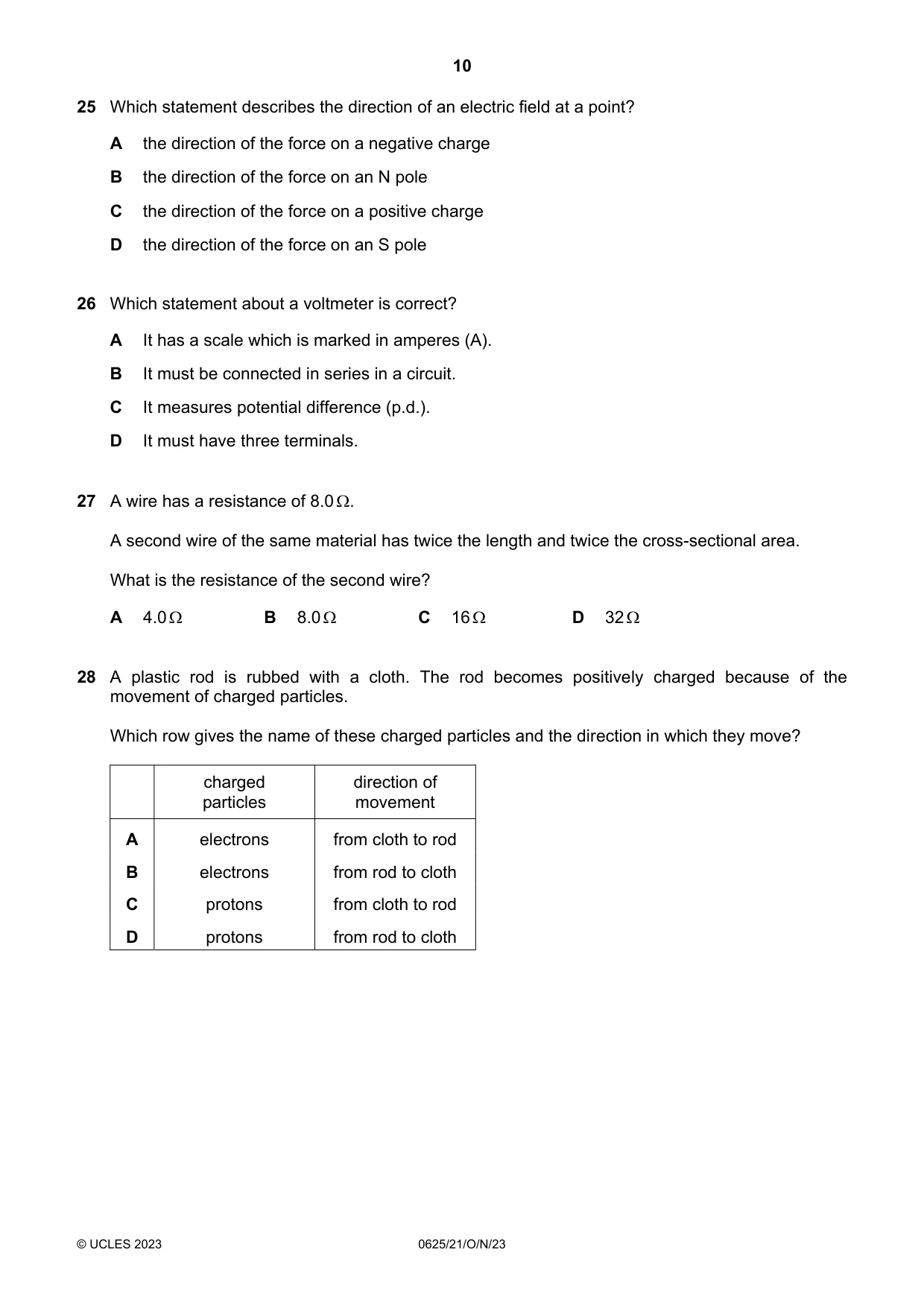
25 Which statement describes the direction of an electric field at a point? A the direction of the force on a negative charge B the direction of the force on an N pole C the direction of the force on a positive charge D the direction of the force on an S pole
Mark scheme: C
Q26 · Which statement about a voltmeter is correct?
26 Which statement about a voltmeter is correct? A It has a scale which is marked in amperes (A). B It must be connected in series in a circuit. C It measures potential difference (p.d.). D It must have three terminals.
Mark scheme: C
Q27 · A wire has a resistance of 8.0
27 A wire has a resistance of 8.0 . A second wire of the same material has twice the length and twice the cross-sectional area. What is the resistance of the second wire? A 4.0 B 8.0 C 16 D 32
Mark scheme: B
Q28 · A plastic rod is rubbed with a cloth
28 A plastic rod is rubbed with a cloth. The rod becomes positively charged because of the movement of charged particles. Which row gives the name of these charged particles and the direction in which they move? charged direction of particles movement A electrons from cloth to rod B electrons from rod to cloth C protons from cloth to rod D protons from rod to cloth
Mark scheme: B
Q29 · An alternating (a.c.) supply is connected to a diode and a resistor in series
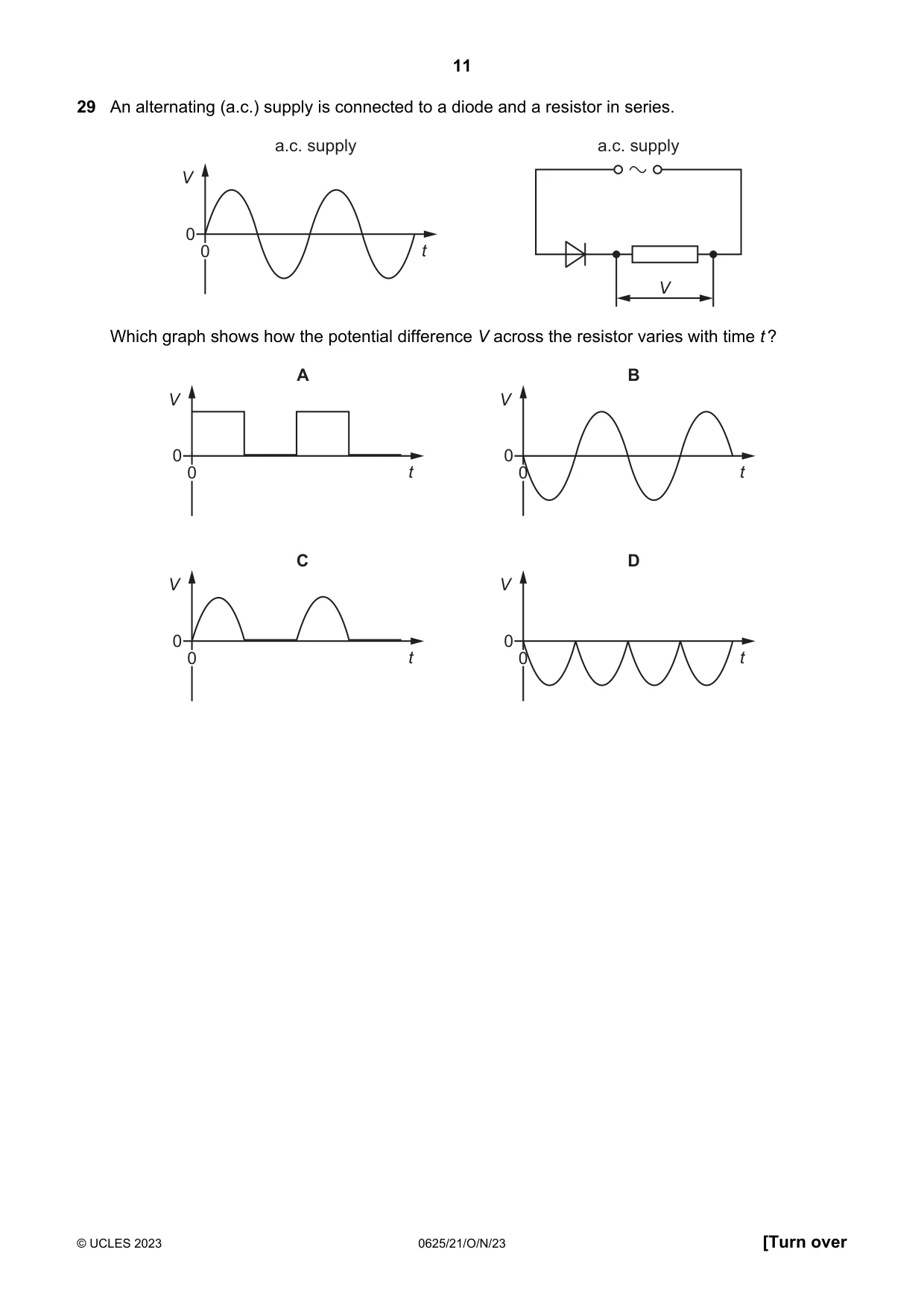
29 An alternating (a.c.) supply is connected to a diode and a resistor in series. a.c. supply a.c. supply V 0 0 t V Which graph shows how the potential difference V across the resistor varies with time t ? A B V V 0 0 0 t 0 t C D V V 0 0 0 t 0 t
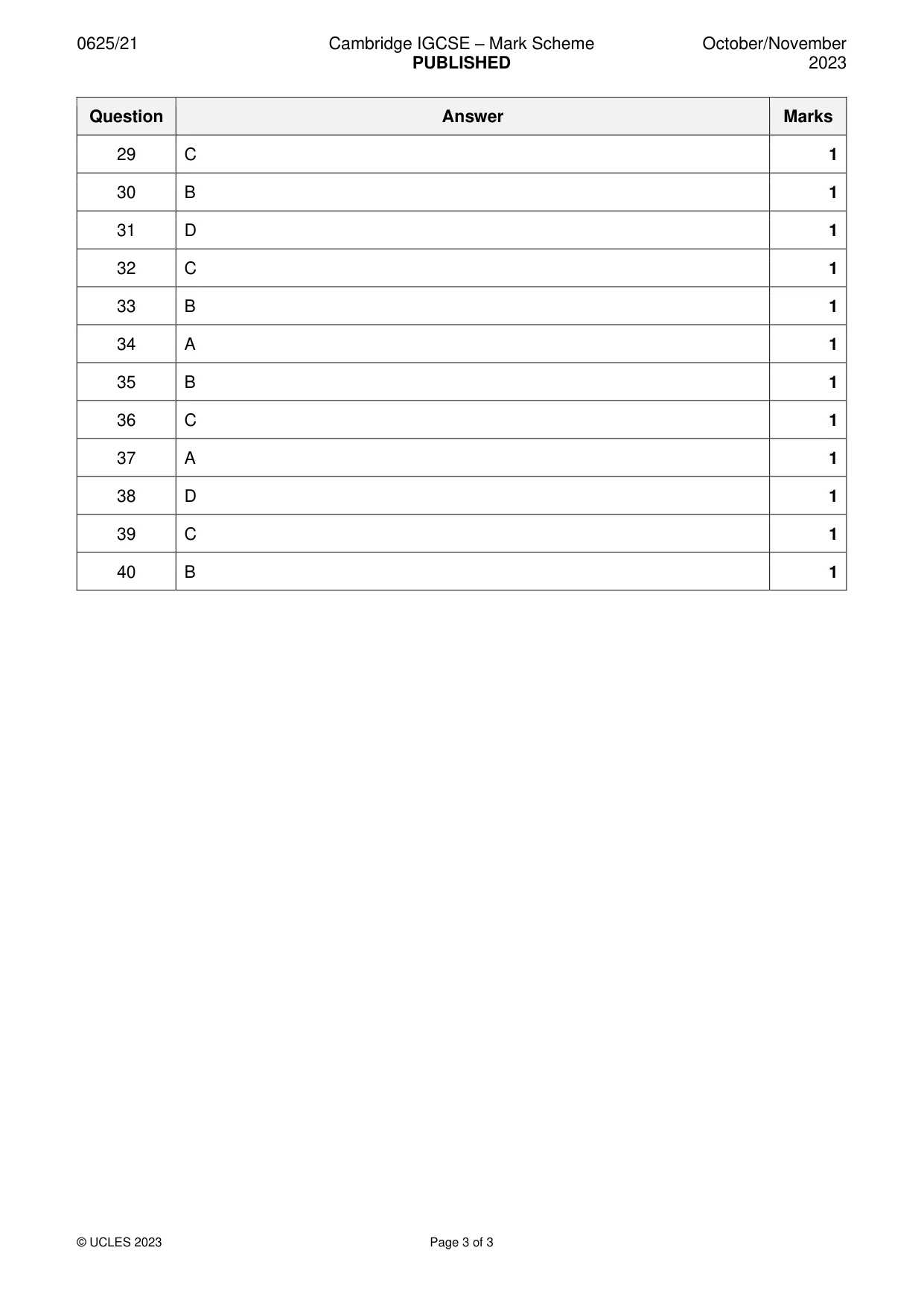
Mark scheme: C
Q30 · The diagram shows a circuit used to switch on a heater when the temperature drops below a…
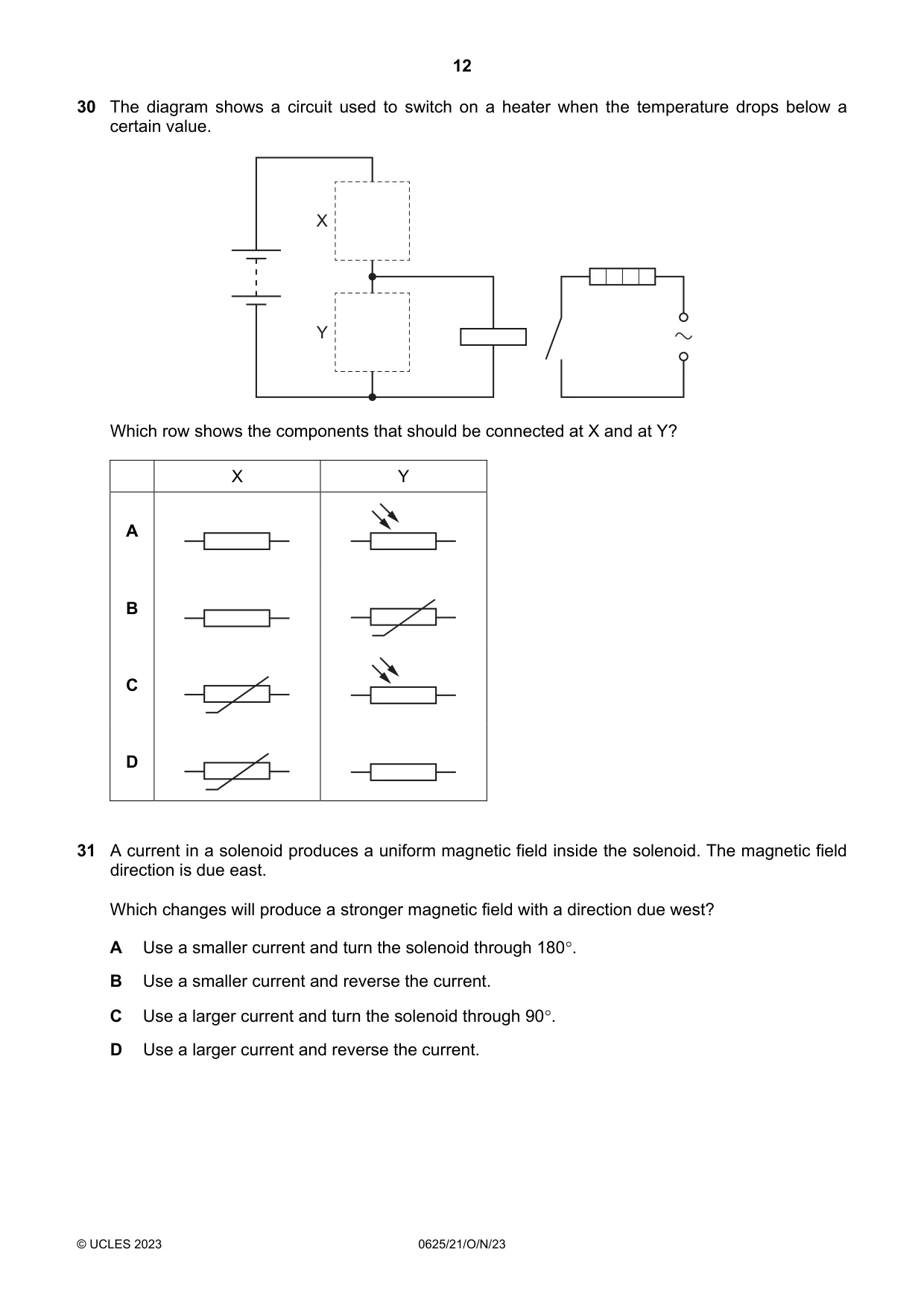
30 The diagram shows a circuit used to switch on a heater when the temperature drops below a certain value. X Y Which row shows the components that should be connected at X and at Y? X Y A B C D
Mark scheme: B
Q31 · A current in a solenoid produces a uniform magnetic field inside the solenoid
31 A current in a solenoid produces a uniform magnetic field inside the solenoid. The magnetic field direction is due east. Which changes will produce a stronger magnetic field with a direction due west? A Use a smaller current and turn the solenoid through 180. B Use a smaller current and reverse the current. C Use a larger current and turn the solenoid through 90. D Use a larger current and reverse the current.
Mark scheme: D
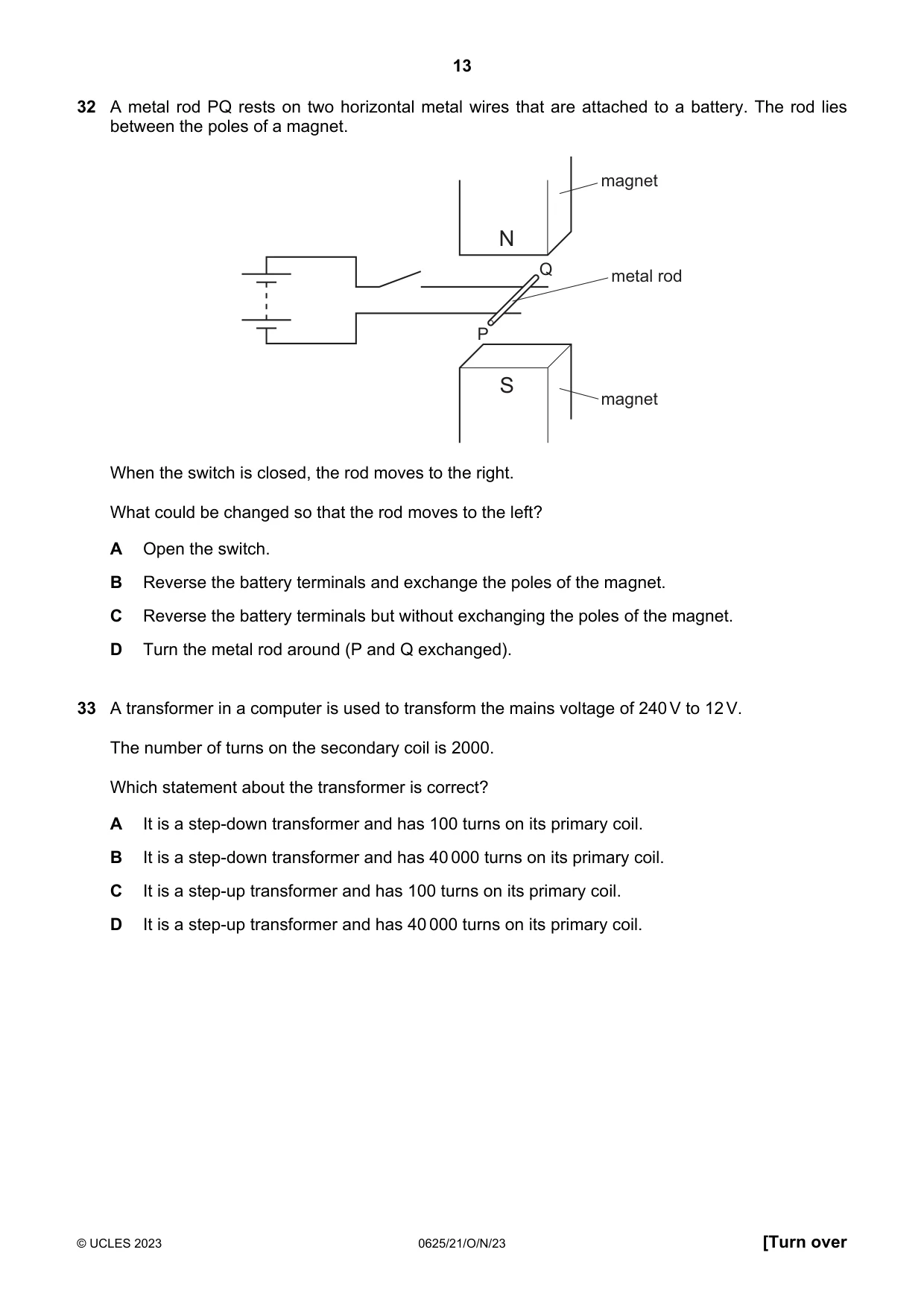
Q32 · A metal rod PQ rests on two horizontal metal wires that are attached to a battery
32 A metal rod PQ rests on two horizontal metal wires that are attached to a battery. The rod lies between the poles of a magnet. magnet N Q metal rod P S magnet When the switch is closed, the rod moves to the right. What could be changed so that the rod moves to the left? A Open the switch. B Reverse the battery terminals and exchange the poles of the magnet. C Reverse the battery terminals but without exchanging the poles of the magnet. D Turn the metal rod around (P and Q exchanged).
Mark scheme: C
Q33 · A transformer in a computer is used to transform the mains voltage of 240 V to 12 V
33 A transformer in a computer is used to transform the mains voltage of 240 V to 12 V. The number of turns on the secondary coil is 2000. Which statement about the transformer is correct? A It is a step-down transformer and has 100 turns on its primary coil. B It is a step-down transformer and has 40 000 turns on its primary coil. C It is a step-up transformer and has 100 turns on its primary coil. D It is a step-up transformer and has 40 000 turns on its primary coil.
Mark scheme: B
Q34 · In -particle scattering, -particles are incident on a thin metal foil
34 In -particle scattering, -particles are incident on a thin metal foil. Which row describes results from the experiment and a conclusion that the results lead to? results conclusion A most of the -particles most of the atom is empty space pass straight through the foil B most of the -particles the nucleus is very large pass straight through the foil C very few of the -particles most of the atom is empty space pass straight through the foil D very few of the -particles the nucleus is very large pass straight through the foil
Mark scheme: A
Q35 · -particles, -particles and -rays are emitted by radioactive nuclei when they decay
35 -particles, -particles and -rays are emitted by radioactive nuclei when they decay. Which emissions can be deflected by an electric field? A -particles, -particles and -rays B -particles and -particles only C -particles and -rays only D -rays and -particles only
Mark scheme: B
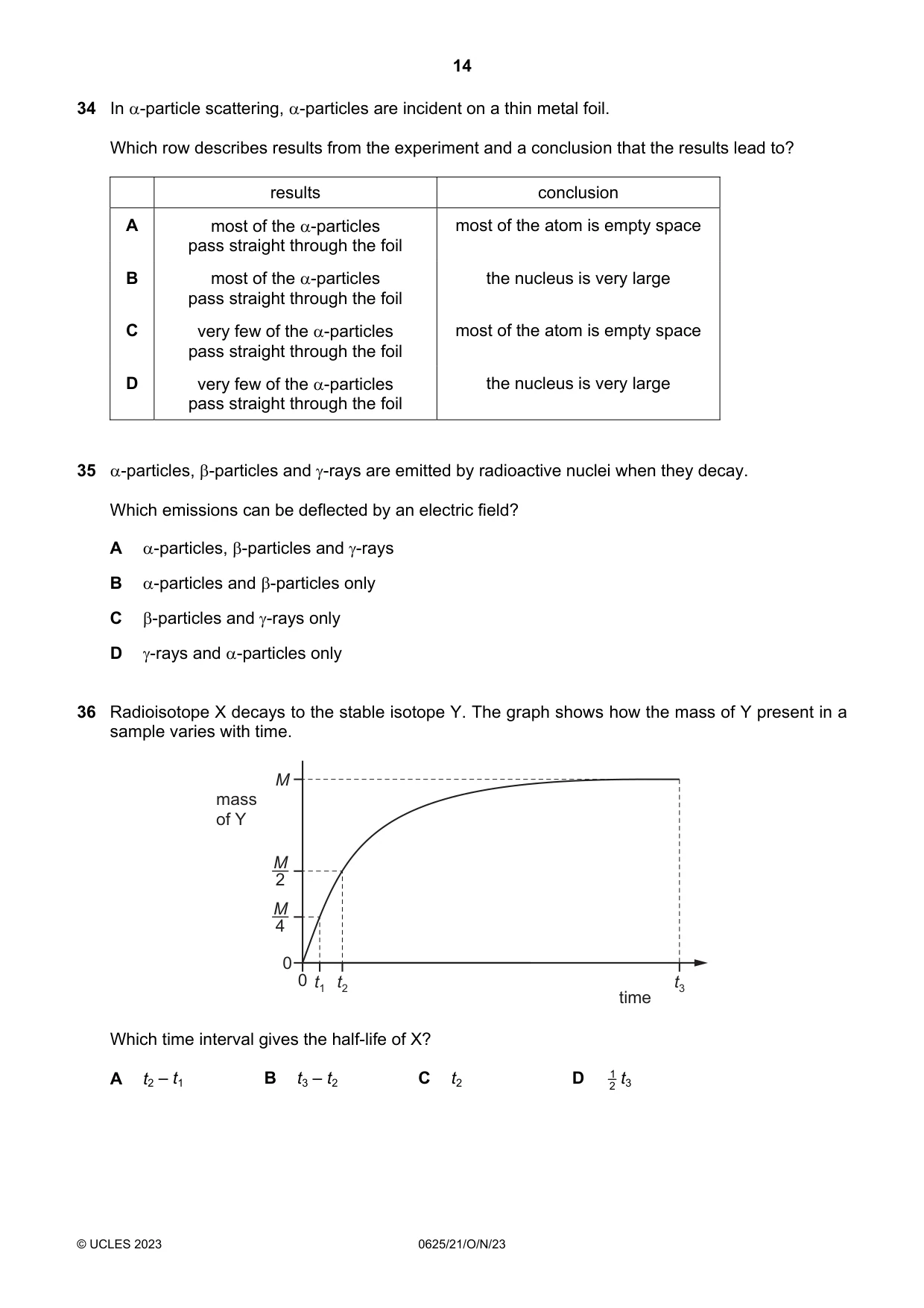
Q36 · Radioisotope X decays to the stable isotope Y
36 Radioisotope X decays to the stable isotope Y. The graph shows how the mass of Y present in a sample varies with time. M mass of Y M 2 M 4 0 0 t1 t2 t3 time Which time interval gives the half-life of X? A t2 – t1 B t3 – t2 C t2 D 2 t3 1
Mark scheme: C
Q37 · Which particle is absorbed by a nucleus to cause nuclear fission?
37 Which particle is absorbed by a nucleus to cause nuclear fission? A a neutron B a proton C an -particle D a -particle
Mark scheme: A
Q38 · It is summer in the northern hemisphere of the Earth in June
38 It is summer in the northern hemisphere of the Earth in June. Which statement explains why? A The Earth is closer to the Sun in June. B The Earth spins on its axis in the opposite direction to that in which it rotates around the Sun. C The Moon is full in June. D The north pole of the axis of the Earth’s rotation is tilted towards the Sun in June.
Mark scheme: D
Q39 · Which statement about the Sun is correct?
39 Which statement about the Sun is correct? A The Sun is a dwarf star consisting mostly of hydrogen and oxygen. B The Sun is a giant star consisting mostly of helium and carbon dioxide. C The Sun is a medium-sized star consisting mostly of hydrogen and helium. D The Sun is a medium-sized star consisting mostly of nitrogen and oxygen.
Mark scheme: C
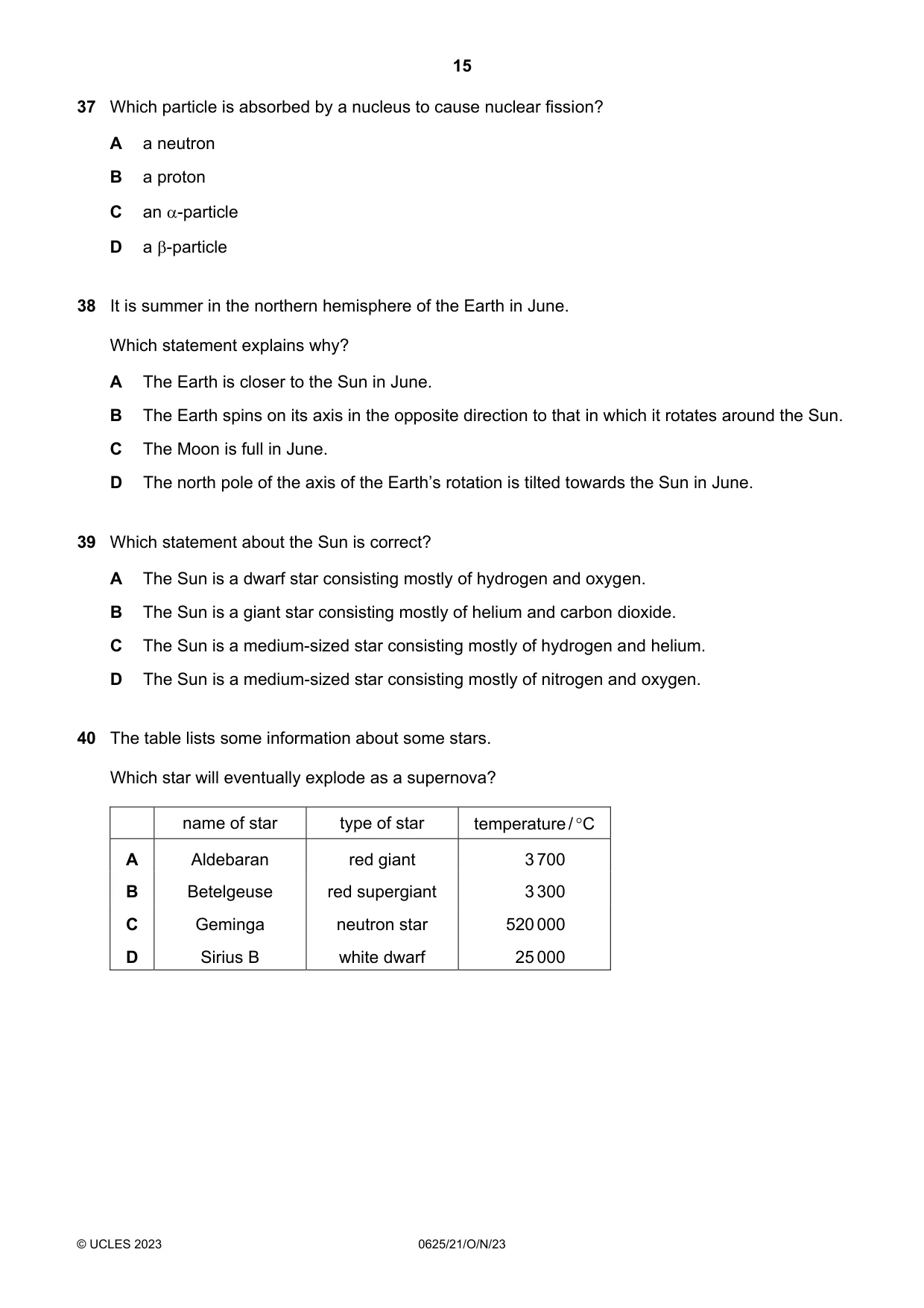
Q40 · The table lists some information about some stars
40 The table lists some information about some stars. Which star will eventually explode as a supernova? name of star type of star temperature / C A Aldebaran red giant 3 700 B Betelgeuse red supergiant 3 300 C Geminga neutron star 520 000 D Sirius B white dwarf 25 000
Mark scheme: B
What was in this paper
The subtopics covered by these 40 questions, and how many questions each got. Open one in a new tab to see every Cambridge question on it.
4Electromagnetic effects3Energy, work and power3Kinetic particle model of matter3Light3Electric circuits2Forces2General properties of waves2Motion2Radioactivity2Stars and the Universe2The nuclear model of the atom2Density1Electromagnetic spectrum1Momentum1Physical quantities and measurement techniques1Pressure1Simple phenomena of magnetism1Sound1The Earth and the Solar System1Thermal properties and temperature1Transfer of thermal energy1What you needed in this session
Cambridge’s own grade thresholds for 2023 Oct/Nov, Paper 2 · Variant 1. A higher threshold means an easier paper — the bar moves with how the cohort did.