Cambridge IGCSE Physics 0625 — 2024 May/June Paper 2 · Variant 1
0625/21/M/J/24 · 40 questions · 40 marks · ≈45 min
The question paper and its mark scheme, free to read here and free to download. This is Cambridge’s own paper, exactly as it was sat.
Question paper16 pages

Mark scheme3 pages
Answers below. Sit the paper first if you are practising.
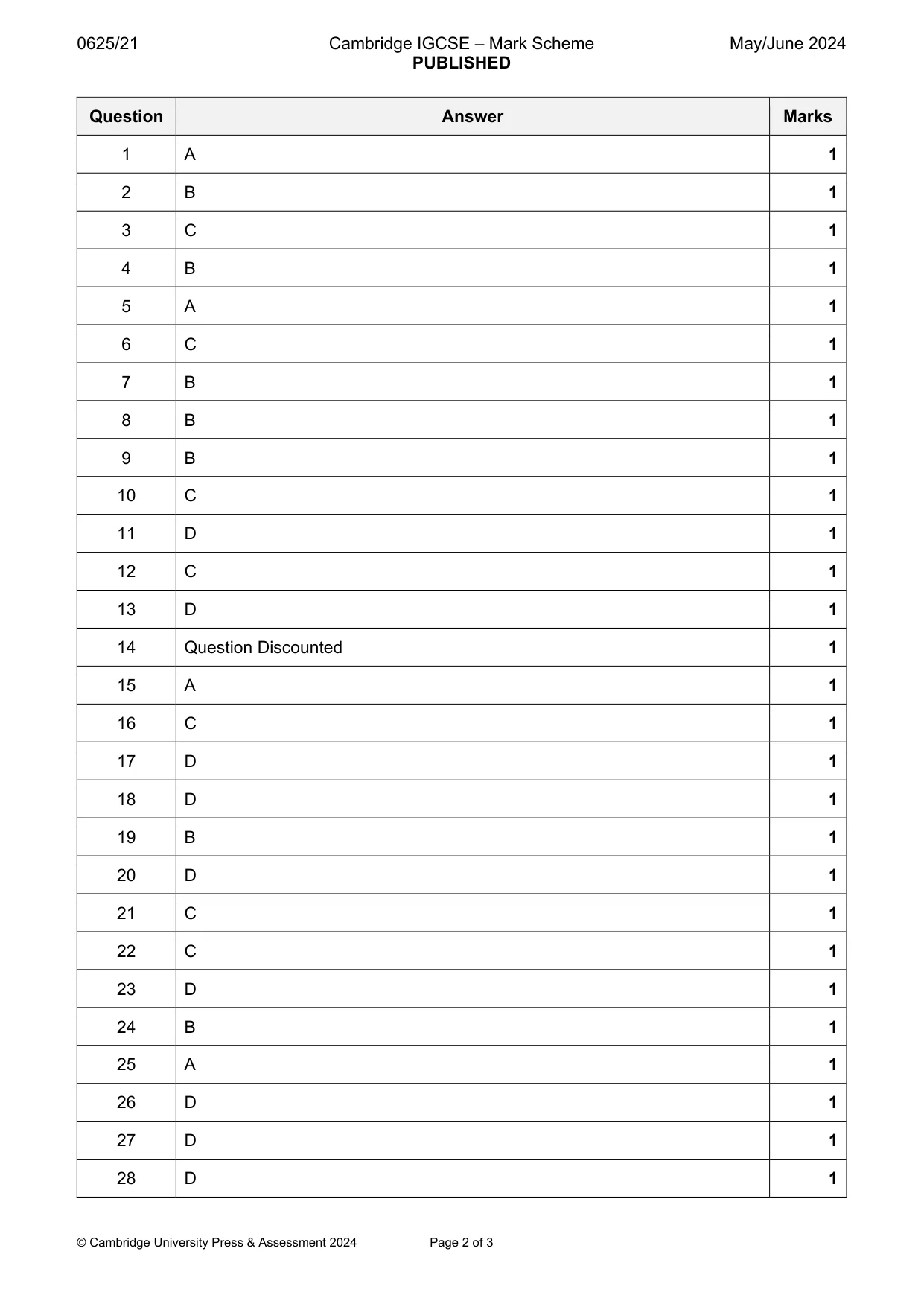
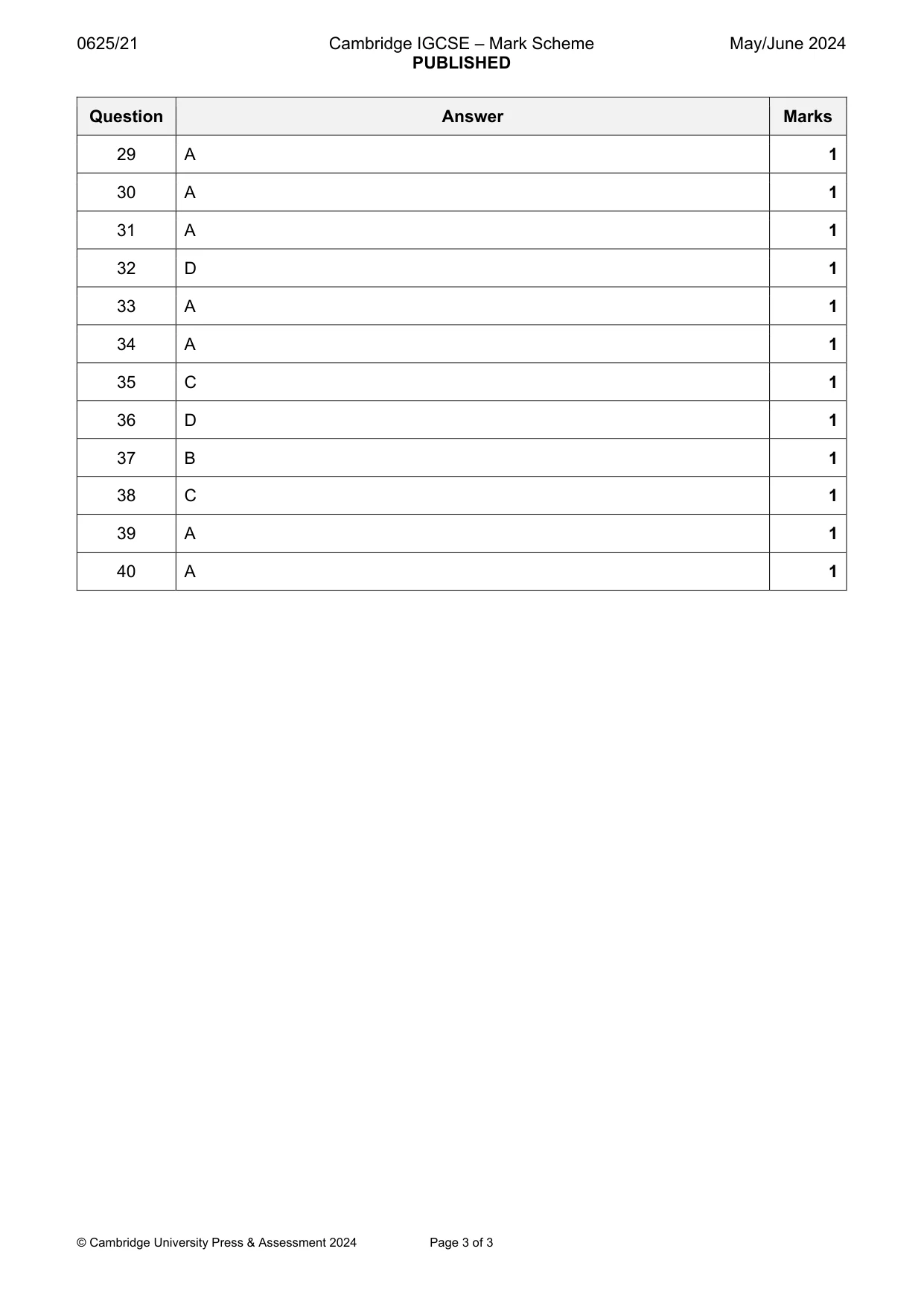
Questions as text
Q1 · In which row are quantities correctly categorised into scalar quantities and vector…
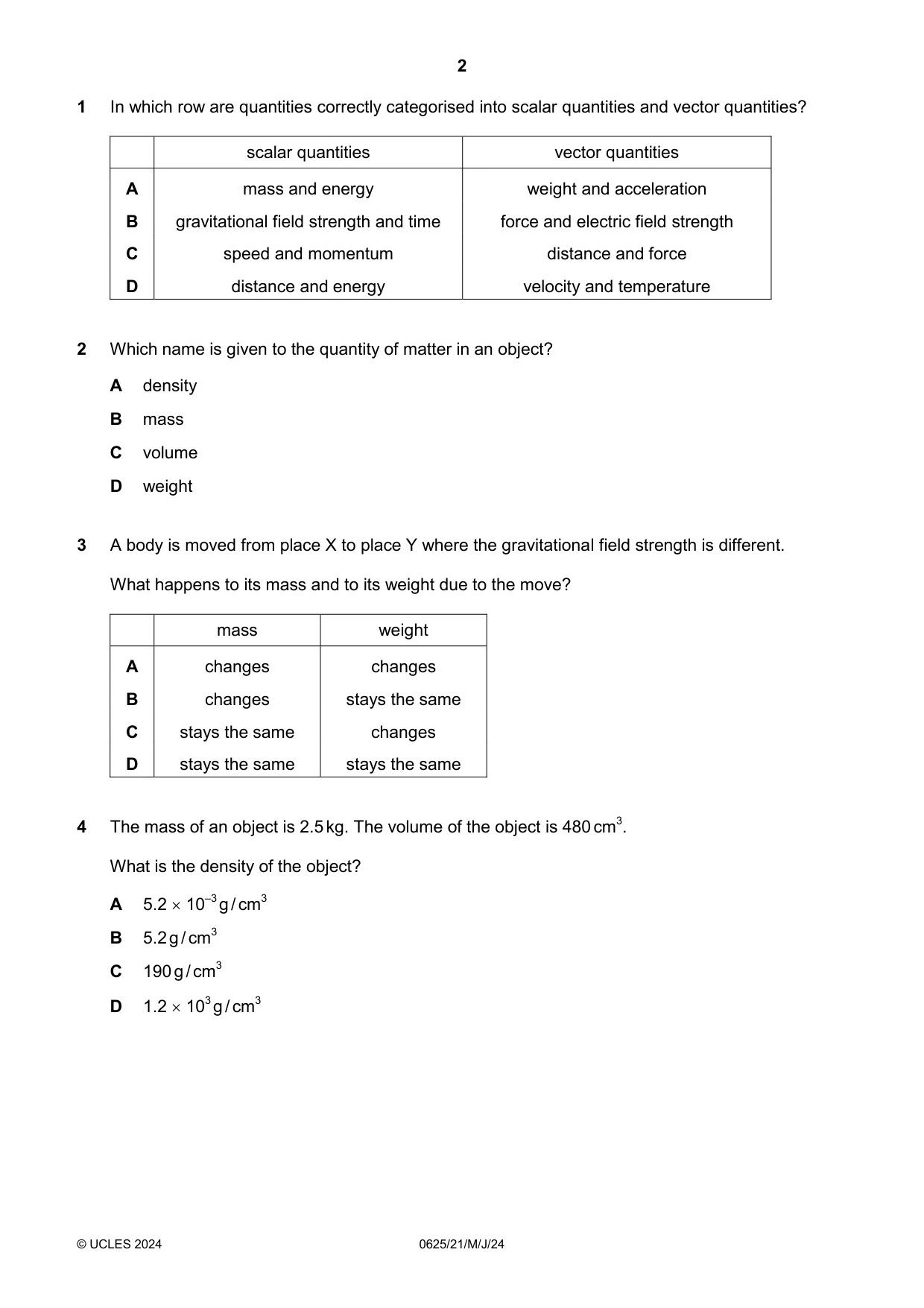
1 In which row are quantities correctly categorised into scalar quantities and vector quantities? scalar quantities vector quantities A mass and energy weight and acceleration B gravitational field strength and time force and electric field strength C speed and momentum distance and force D distance and energy velocity and temperature
Mark scheme: A
More questions on Physical quantities and measurement techniques
Q2 · Which name is given to the quantity of matter in an object?
2 Which name is given to the quantity of matter in an object? A density B mass C volume D weight
Mark scheme: B
Q3 · A body is moved from place X to place Y where the gravitational field strength is…
3 A body is moved from place X to place Y where the gravitational field strength is different. What happens to its mass and to its weight due to the move? mass weight A changes changes B changes stays the same C stays the same changes D stays the same stays the same
Mark scheme: C
Q4 · The mass of an object is 2.5 kg
4 The mass of an object is 2.5 kg. The volume of the object is 480 cm3. What is the density of the object? A 5.2 10–3 g / cm3 B 5.2 g / cm3 C 190 g / cm3 D 1.2 103 g / cm3
Mark scheme: B
Q5 · Four objects each have two forces acting on them
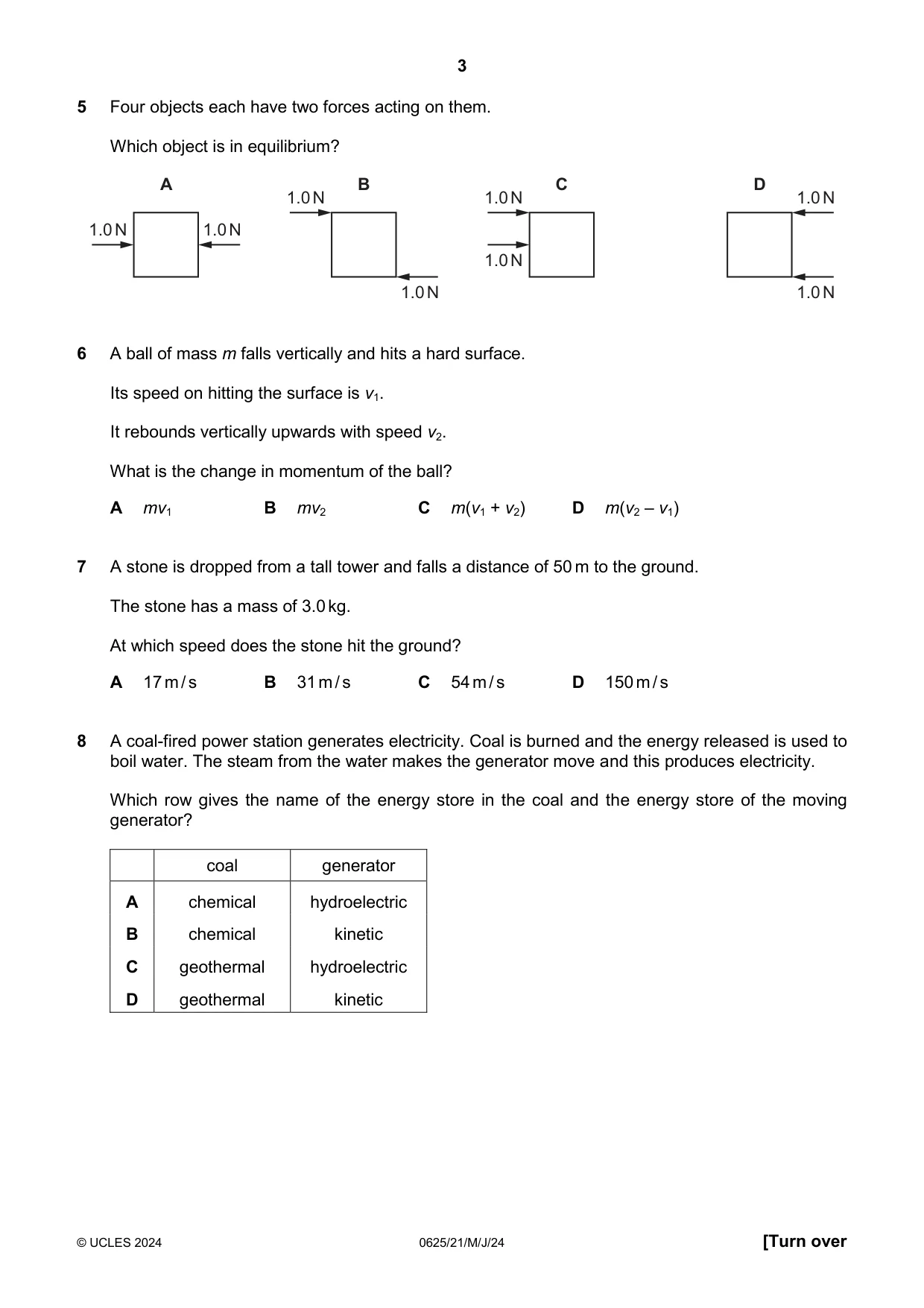
5 Four objects each have two forces acting on them. Which object is in equilibrium? A B C D 1.0 N 1.0 N 1.0 N 1.0 N 1.0 N 1.0 N 1.0 N 1.0 N
Mark scheme: A
Q6 · A ball of mass m falls vertically and hits a hard surface
6 A ball of mass m falls vertically and hits a hard surface. Its speed on hitting the surface is v1. It rebounds vertically upwards with speed v2. What is the change in momentum of the ball? A mv1 B mv2 C m(v1 + v2) D m(v2 – v1)
Mark scheme: C
Q7 · A stone is dropped from a tall tower and falls a distance of 50 m to the ground
7 A stone is dropped from a tall tower and falls a distance of 50 m to the ground. The stone has a mass of 3.0 kg. At which speed does the stone hit the ground? A 17 m / s B 31 m / s C 54 m / s D 150 m / s
Mark scheme: B
Q8 · A coal-fired power station generates electricity
8 A coal-fired power station generates electricity. Coal is burned and the energy released is used to boil water. The steam from the water makes the generator move and this produces electricity. Which row gives the name of the energy store in the coal and the energy store of the moving generator? coal generator A chemical hydroelectric B chemical kinetic C geothermal hydroelectric D geothermal kinetic
Mark scheme: B
Q9 · A man puts some ice into a glass of water on a warm day
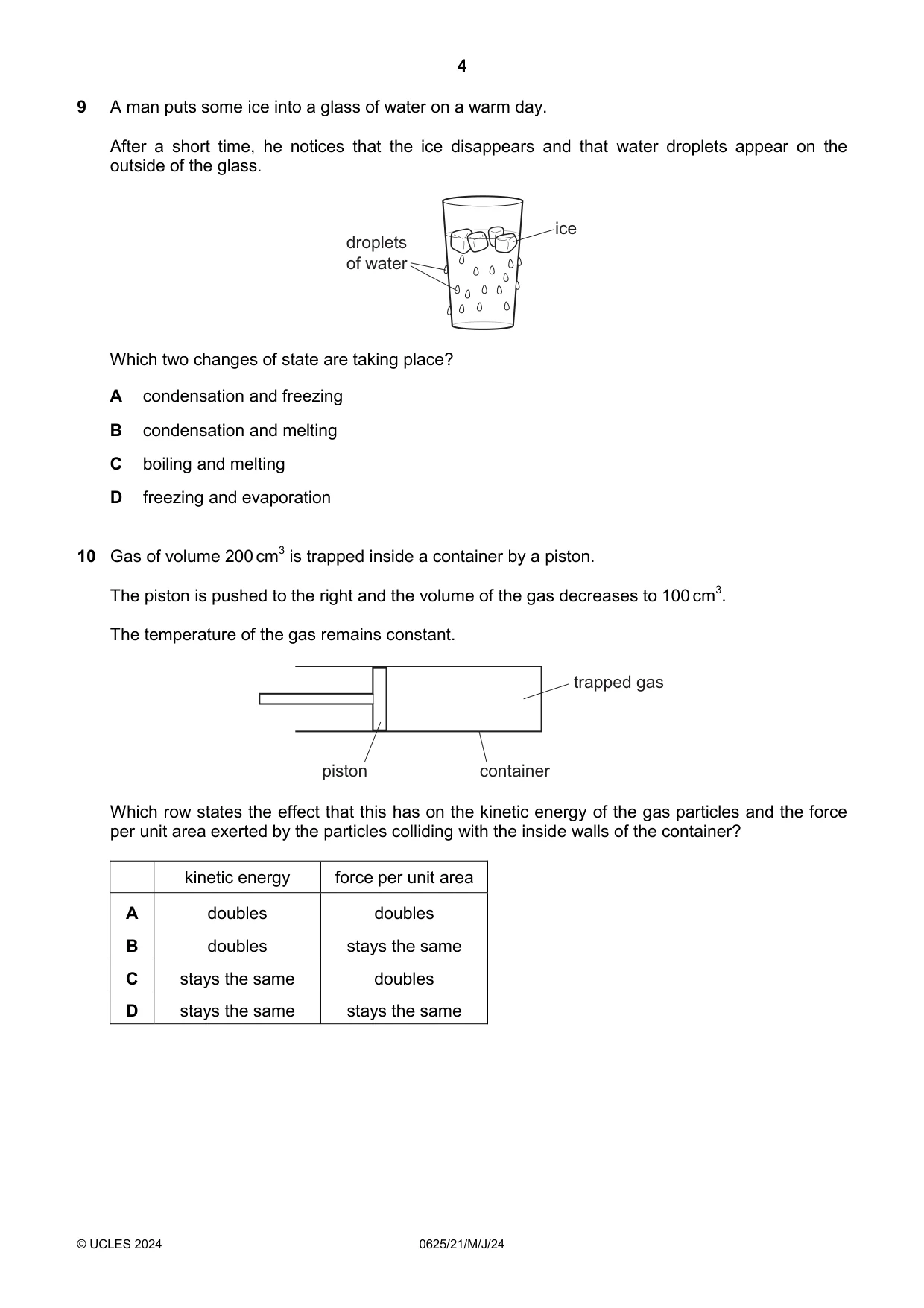
9 A man puts some ice into a glass of water on a warm day. After a short time, he notices that the ice disappears and that water droplets appear on the outside of the glass. ice droplets of water Which two changes of state are taking place? A condensation and freezing B condensation and melting C boiling and melting D freezing and evaporation
Mark scheme: B
Q10 · Gas of volume 200 cm3 is trapped inside a container by a piston
10 Gas of volume 200 cm3 is trapped inside a container by a piston. The piston is pushed to the right and the volume of the gas decreases to 100 cm3. The temperature of the gas remains constant. trapped gas piston container Which row states the effect that this has on the kinetic energy of the gas particles and the force per unit area exerted by the particles colliding with the inside walls of the container? kinetic energy force per unit area A doubles doubles B doubles stays the same C stays the same doubles D stays the same stays the same
Mark scheme: C
Q11 · Which graph shows the relationship between the pressure and volume of a fixed mass of gas…
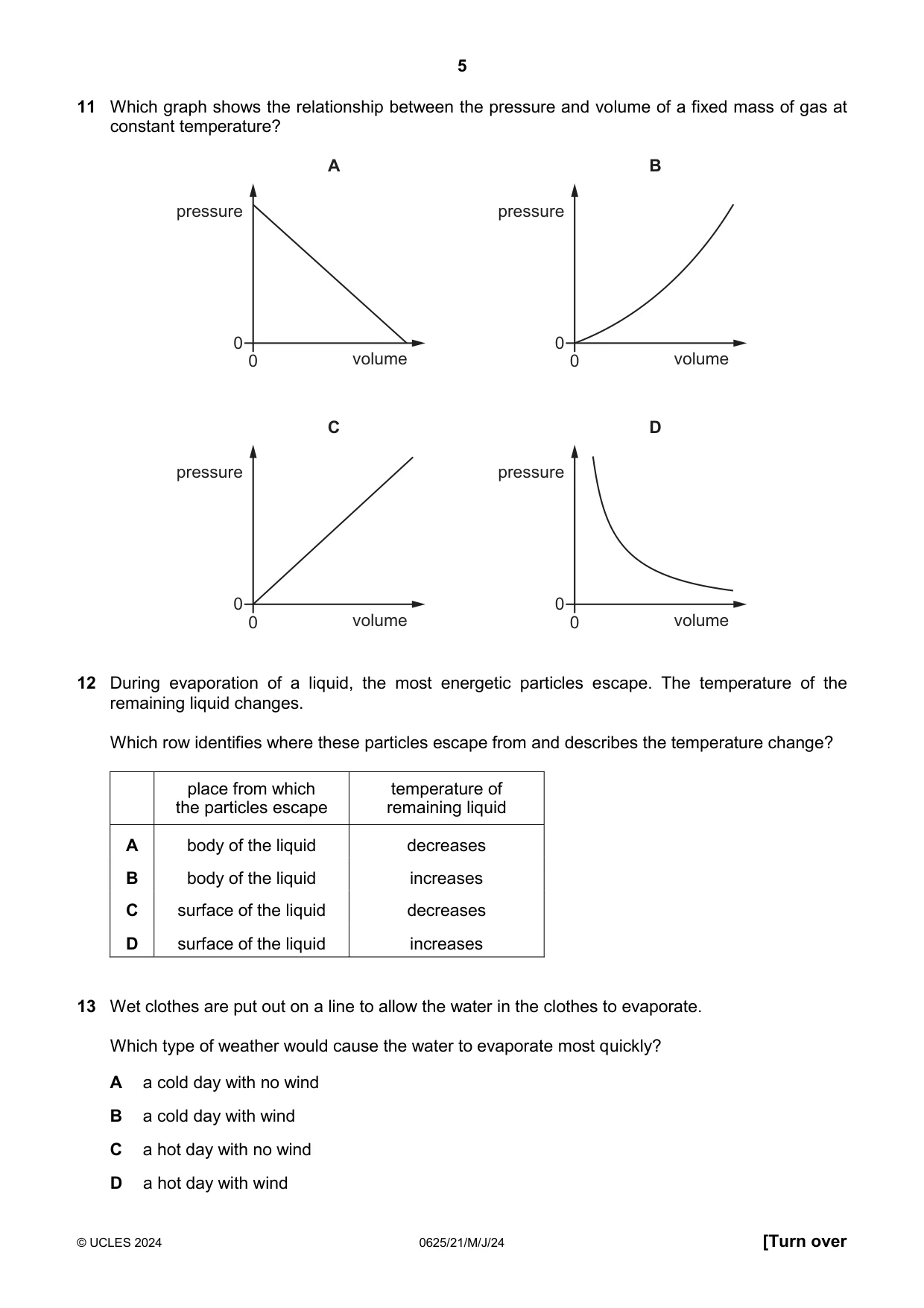
11 Which graph shows the relationship between the pressure and volume of a fixed mass of gas at constant temperature? A B pressure pressure 0 0 0 volume 0 volume C D pressure pressure 0 0 0 volume 0 volume
Mark scheme: D
Q12 · During evaporation of a liquid, the most energetic particles escape
12 During evaporation of a liquid, the most energetic particles escape. The temperature of the remaining liquid changes. Which row identifies where these particles escape from and describes the temperature change? place from which temperature of the particles escape remaining liquid A body of the liquid decreases B body of the liquid increases C surface of the liquid decreases D surface of the liquid increases
Mark scheme: C
Q13 · Wet clothes are put out on a line to allow the water in the clothes to evaporate
13 Wet clothes are put out on a line to allow the water in the clothes to evaporate. Which type of weather would cause the water to evaporate most quickly? A a cold day with no wind B a cold day with wind C a hot day with no wind D a hot day with wind
Mark scheme: D
Q14 · Due to an issue with question 14, the question has been removed from the question paper
14 Due to an issue with question 14, the question has been removed from the question paper.
More questions on Physical quantities and measurement techniques
Q15 · A solar water heater is designed to absorb energy from sunlight
15 A solar water heater is designed to absorb energy from sunlight. Which surface texture and colour would be best for the solar water heater? A dull black B shiny black C dull white D shiny white
Mark scheme: A
Q16 · Which statement about waves is correct?
16 Which statement about waves is correct? A Waves do not transfer either energy or matter. B Waves transfer both energy and matter. C Waves transfer energy without transferring matter. D Waves transfer matter without transferring energy.
Mark scheme: C
Q17 · The angle of incidence of a ray of light incident on a plane mirror is gradually increased
17 The angle of incidence of a ray of light incident on a plane mirror is gradually increased. To the nearest degree, what is the maximum possible angle between the incident and reflected rays? A 0 B 45 C 90 D 180
Mark scheme: D
Q18 · Which conditions are necessary for light to be totally internally reflected?
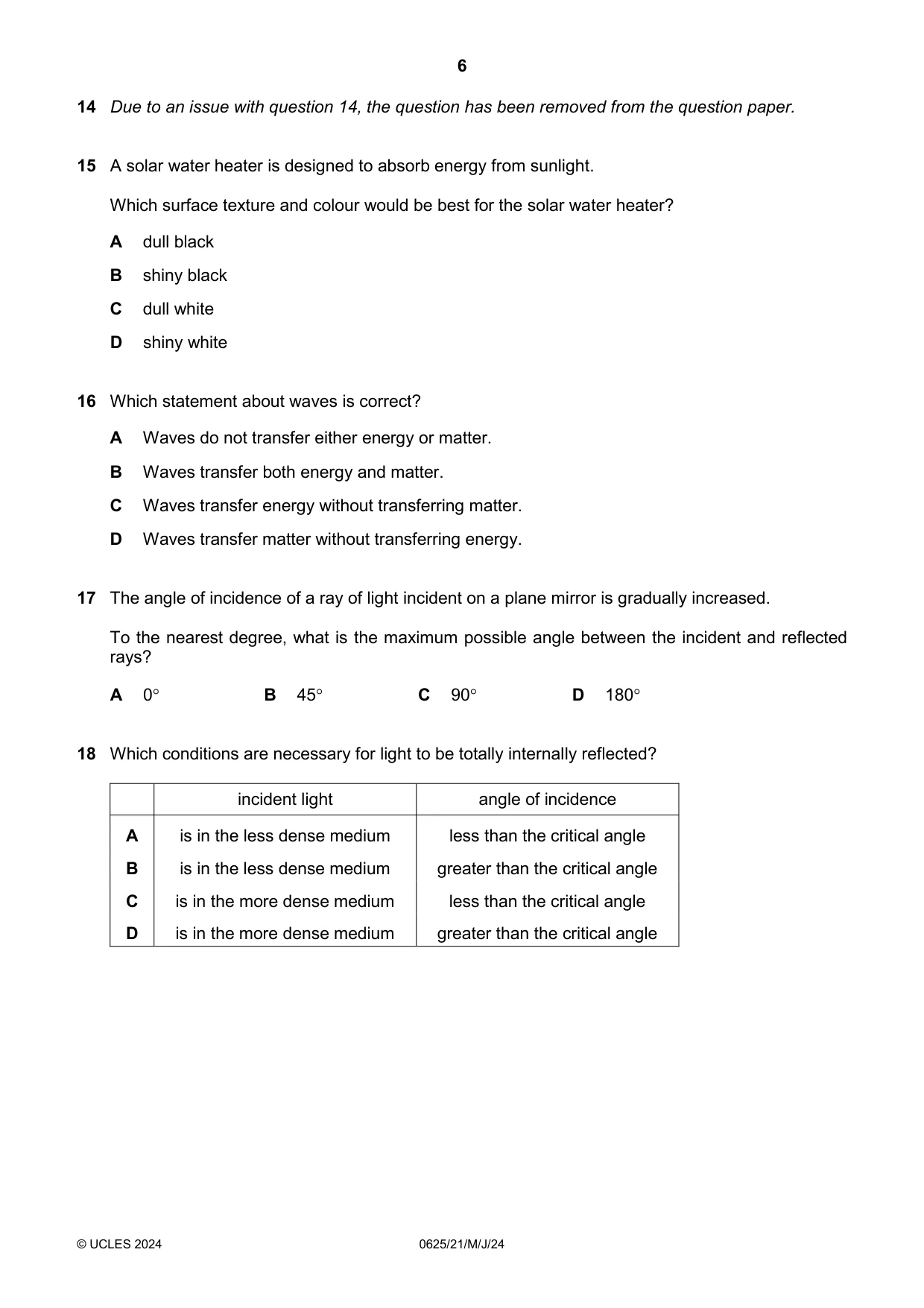
18 Which conditions are necessary for light to be totally internally reflected? incident light angle of incidence A is in the less dense medium less than the critical angle B is in the less dense medium greater than the critical angle C is in the more dense medium less than the critical angle D is in the more dense medium greater than the critical angle
Mark scheme: D
Q19 · The diagram shows a ray of light passing from air into a transparent substance
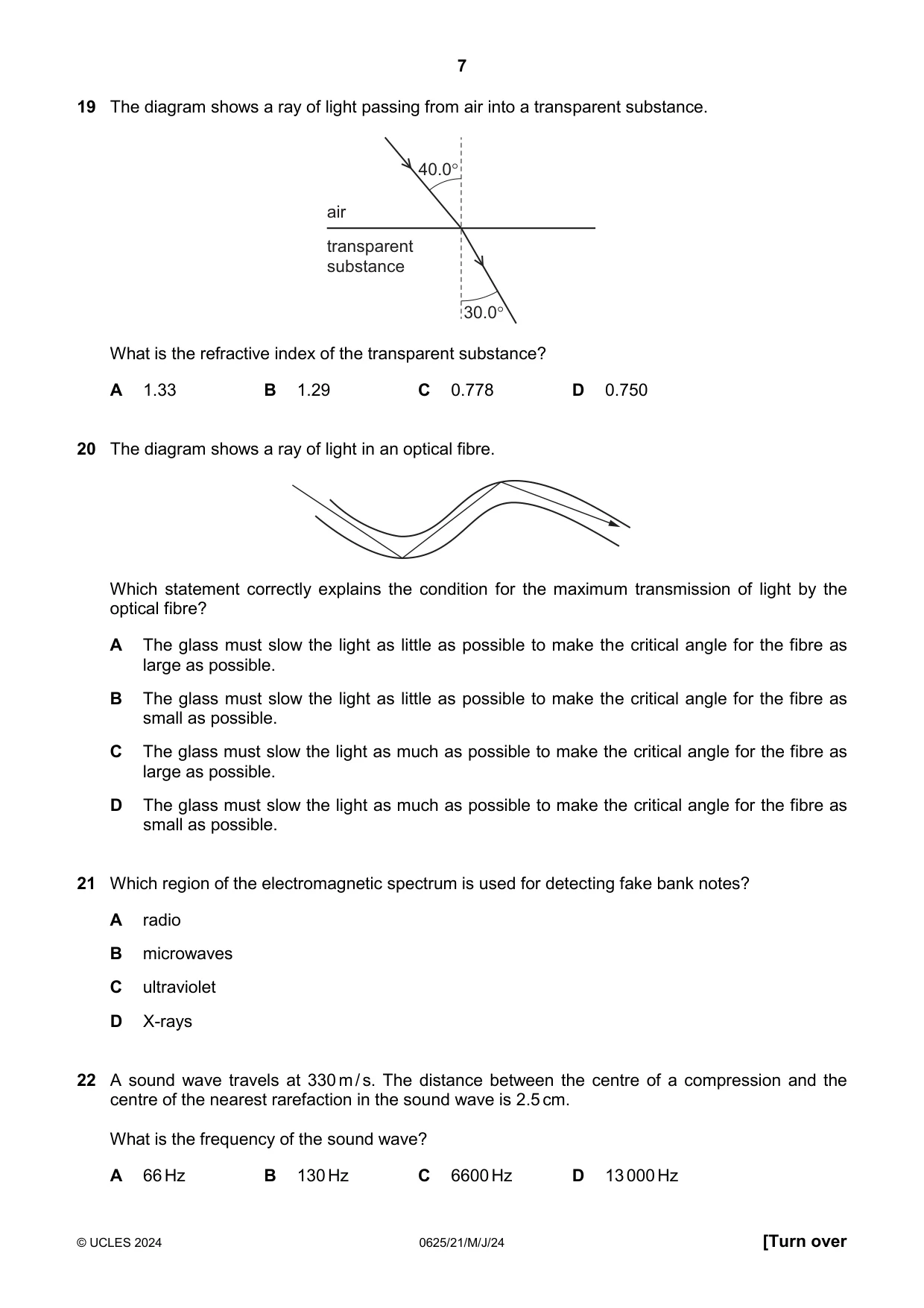
19 The diagram shows a ray of light passing from air into a transparent substance. transparent substance What is the refractive index of the transparent substance? A 1.33 B 1.29 C 0.778 D 0.750
Mark scheme: B
Q20 · The diagram shows a ray of light in an optical fibre
20 The diagram shows a ray of light in an optical fibre. Which statement correctly explains the condition for the maximum transmission of light by the optical fibre? A The glass must slow the light as little as possible to make the critical angle for the fibre as large as possible. B The glass must slow the light as little as possible to make the critical angle for the fibre as small as possible. C The glass must slow the light as much as possible to make the critical angle for the fibre as large as possible. D The glass must slow the light as much as possible to make the critical angle for the fibre as small as possible.
Mark scheme: D
Q21 · Which region of the electromagnetic spectrum is used for detecting fake bank notes?
21 Which region of the electromagnetic spectrum is used for detecting fake bank notes? A radio B microwaves C ultraviolet D X-rays
Mark scheme: C
Q22 · A sound wave travels at 330 m / s
22 A sound wave travels at 330 m / s. The distance between the centre of a compression and the centre of the nearest rarefaction in the sound wave is 2.5 cm. What is the frequency of the sound wave? A 66 Hz B 130 Hz C 6600 Hz D 13 000 Hz
Mark scheme: C
Q23 · Which waves are used in the medical scanning of soft tissue?
23 Which waves are used in the medical scanning of soft tissue? A gamma rays B infrared C microwaves D ultrasound
Mark scheme: D
Q24 · Which row describes suitable materials for use in a temporary magnet and in a permanent…
24 Which row describes suitable materials for use in a temporary magnet and in a permanent magnet? temporary permanent magnet magnet A soft iron soft iron B soft iron steel C steel soft iron D steel steel
Mark scheme: B
Q25 · A magnetic field is represented in the diagram by magnetic field lines
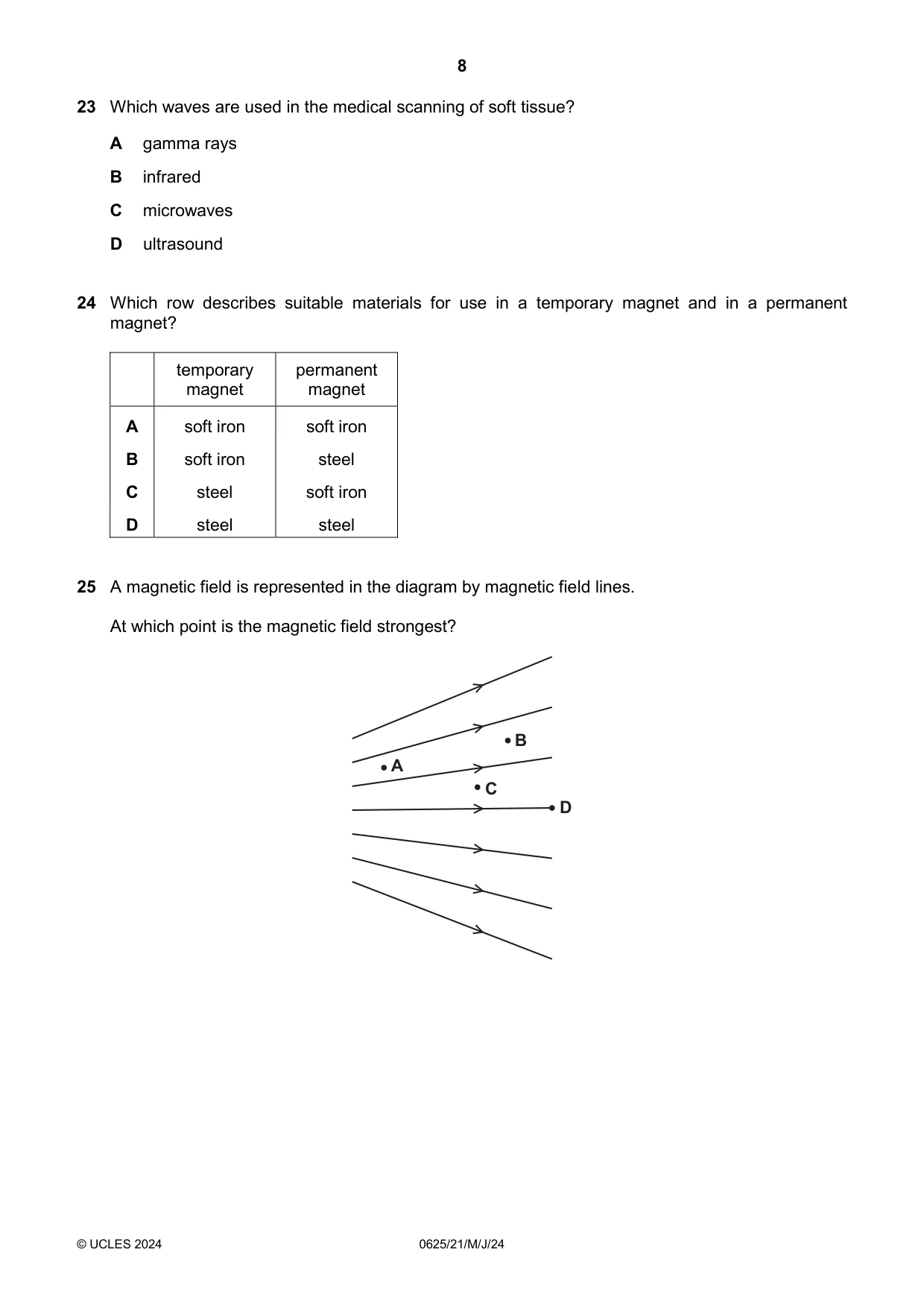
25 A magnetic field is represented in the diagram by magnetic field lines. At which point is the magnetic field strongest? B A C D
Mark scheme: A
Q26 · A student determines the resistance of resistor R
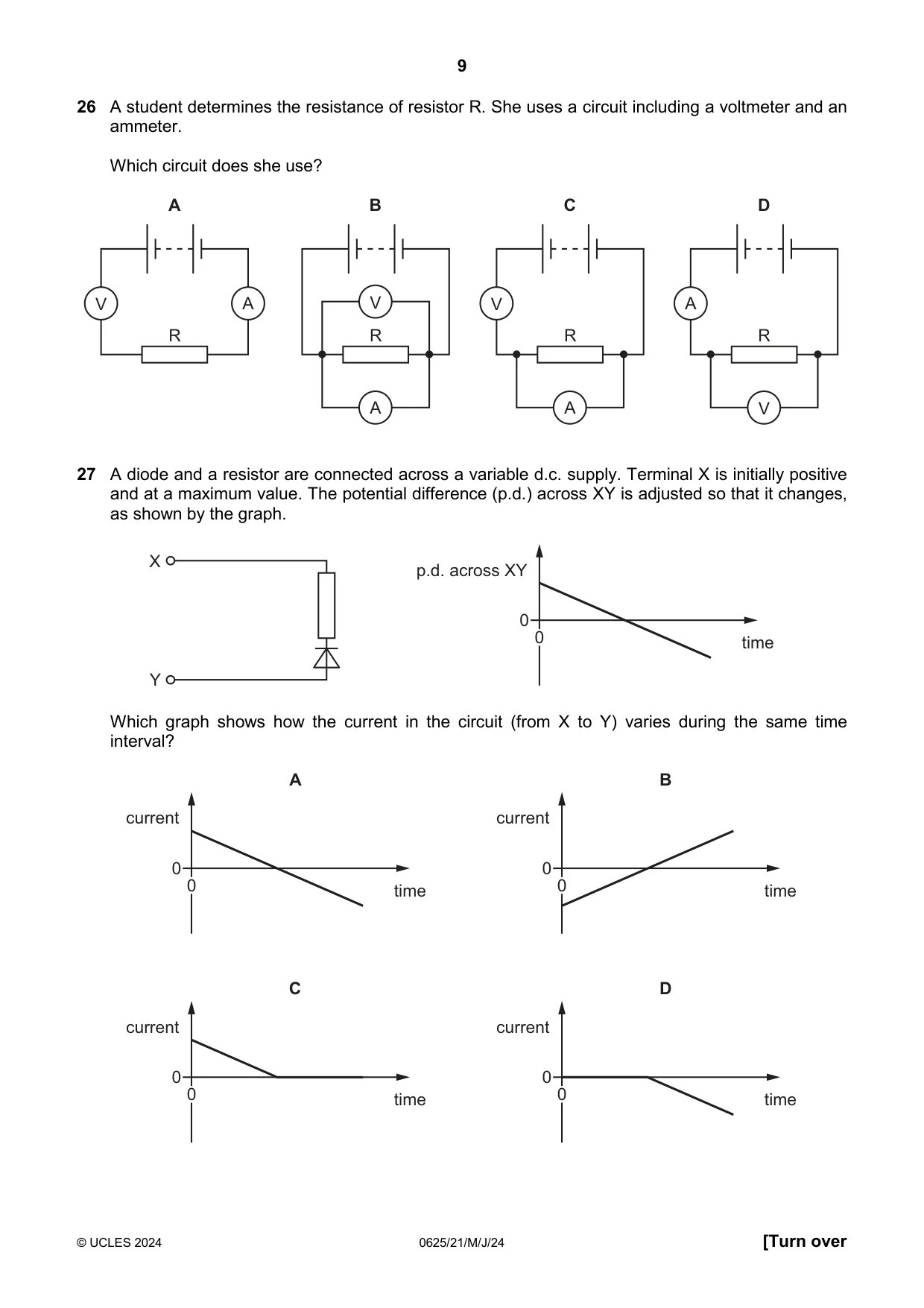
26 A student determines the resistance of resistor R. She uses a circuit including a voltmeter and an ammeter. Which circuit does she use? A B C D V A V V A R R R R A A V
Mark scheme: D
Q27 · A diode and a resistor are connected across a variable d.c
27 A diode and a resistor are connected across a variable d.c. supply. Terminal X is initially positive and at a maximum value. The potential difference (p.d.) across XY is adjusted so that it changes, as shown by the graph. X p.d. across XY 0 0 time Y Which graph shows how the current in the circuit (from X to Y) varies during the same time interval? A B current current 0 0 0 time 0 time C D current current 0 0 0 time 0 time
Mark scheme: D
Q28 · When a conductor in a complete circuit cuts across a magnetic field, a current is induced…
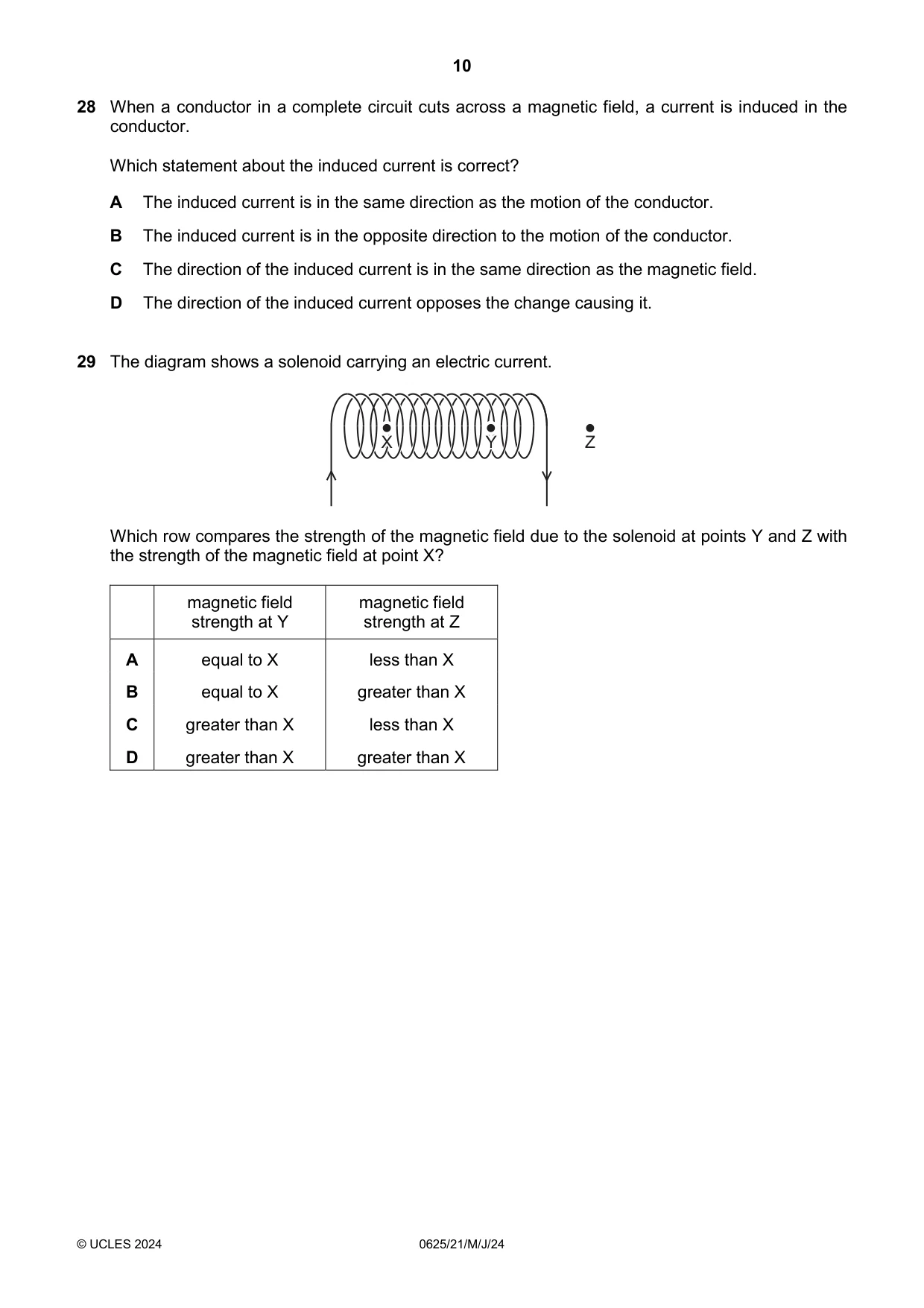
28 When a conductor in a complete circuit cuts across a magnetic field, a current is induced in the conductor. Which statement about the induced current is correct? A The induced current is in the same direction as the motion of the conductor. B The induced current is in the opposite direction to the motion of the conductor. C The direction of the induced current is in the same direction as the magnetic field. D The direction of the induced current opposes the change causing it.
Mark scheme: D
Q29 · The diagram shows a solenoid carrying an electric current
29 The diagram shows a solenoid carrying an electric current. X X Y Y Z Z Which row compares the strength of the magnetic field due to the solenoid at points Y and Z with the strength of the magnetic field at point X? magnetic field magnetic field strength at Y strength at Z A equal to X less than X B equal to X greater than X C greater than X less than X D greater than X greater than X
Mark scheme: A
Q30 · A conducting wire is placed between the poles of a magnet
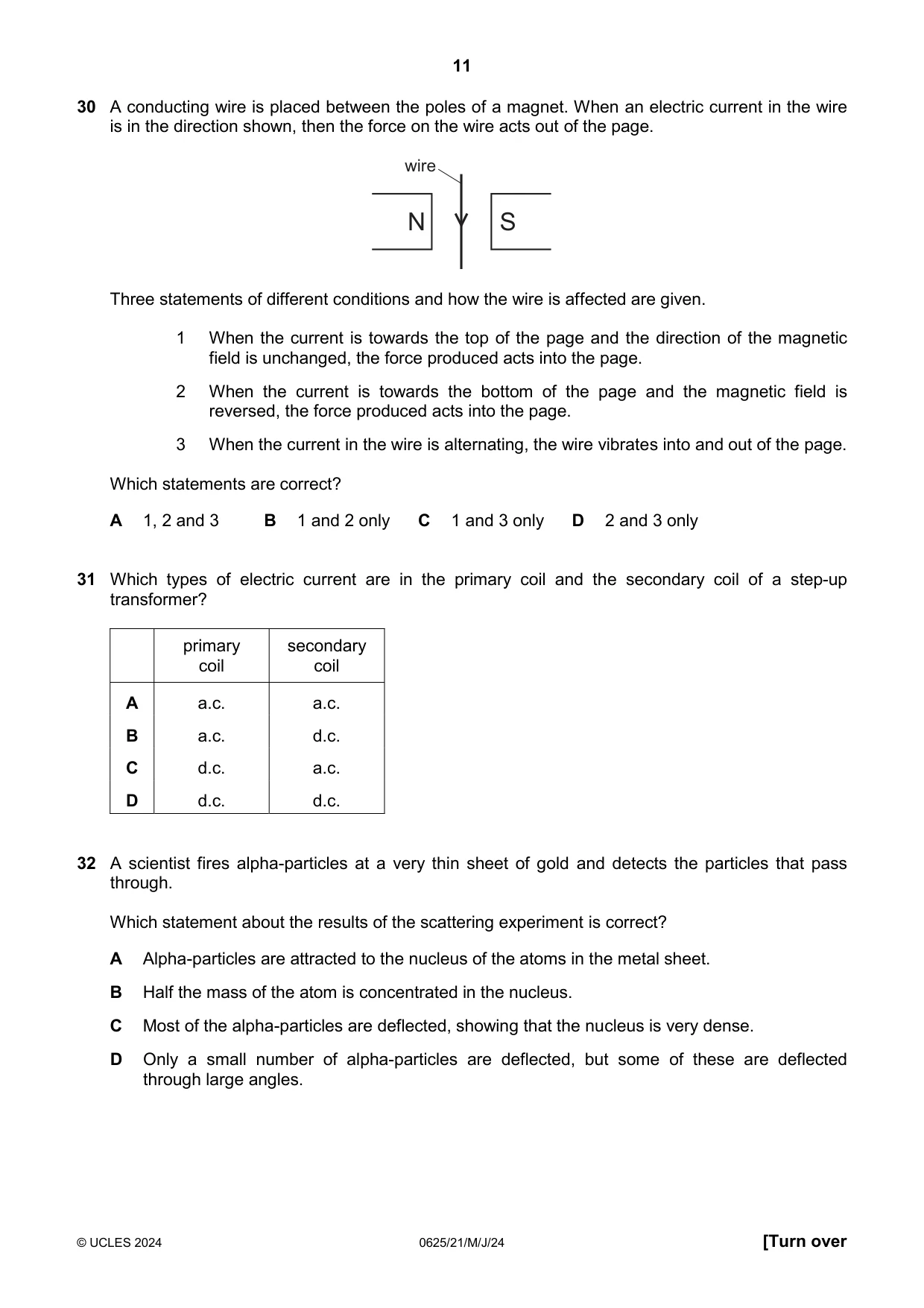
30 A conducting wire is placed between the poles of a magnet. When an electric current in the wire is in the direction shown, then the force on the wire acts out of the page. wire N S Three statements of different conditions and how the wire is affected are given. 1 When the current is towards the top of the page and the direction of the magnetic field is unchanged, the force produced acts into the page. 2 When the current is towards the bottom of the page and the magnetic field is reversed, the force produced acts into the page. 3 When the current in the wire is alternating, the wire vibrates into and out of the page. Which statements are correct? A 1, 2 and 3 B 1 and 2 only C 1 and 3 only D 2 and 3 only
Mark scheme: A
Q31 · Which types of electric current are in the primary coil and the secondary coil of a…
31 Which types of electric current are in the primary coil and the secondary coil of a step-up transformer? primary secondary coil coil A a.c. a.c. B a.c. d.c. C d.c. a.c. D d.c. d.c.
Mark scheme: A
Q32 · A scientist fires alpha-particles at a very thin sheet of gold and detects the particles…
32 A scientist fires alpha-particles at a very thin sheet of gold and detects the particles that pass through. Which statement about the results of the scattering experiment is correct? A Alpha-particles are attracted to the nucleus of the atoms in the metal sheet. B Half the mass of the atom is concentrated in the nucleus. C Most of the alpha-particles are deflected, showing that the nucleus is very dense. D Only a small number of alpha-particles are deflected, but some of these are deflected through large angles.
Mark scheme: D
Q33 · The notation represents the nucleus of a gold atom
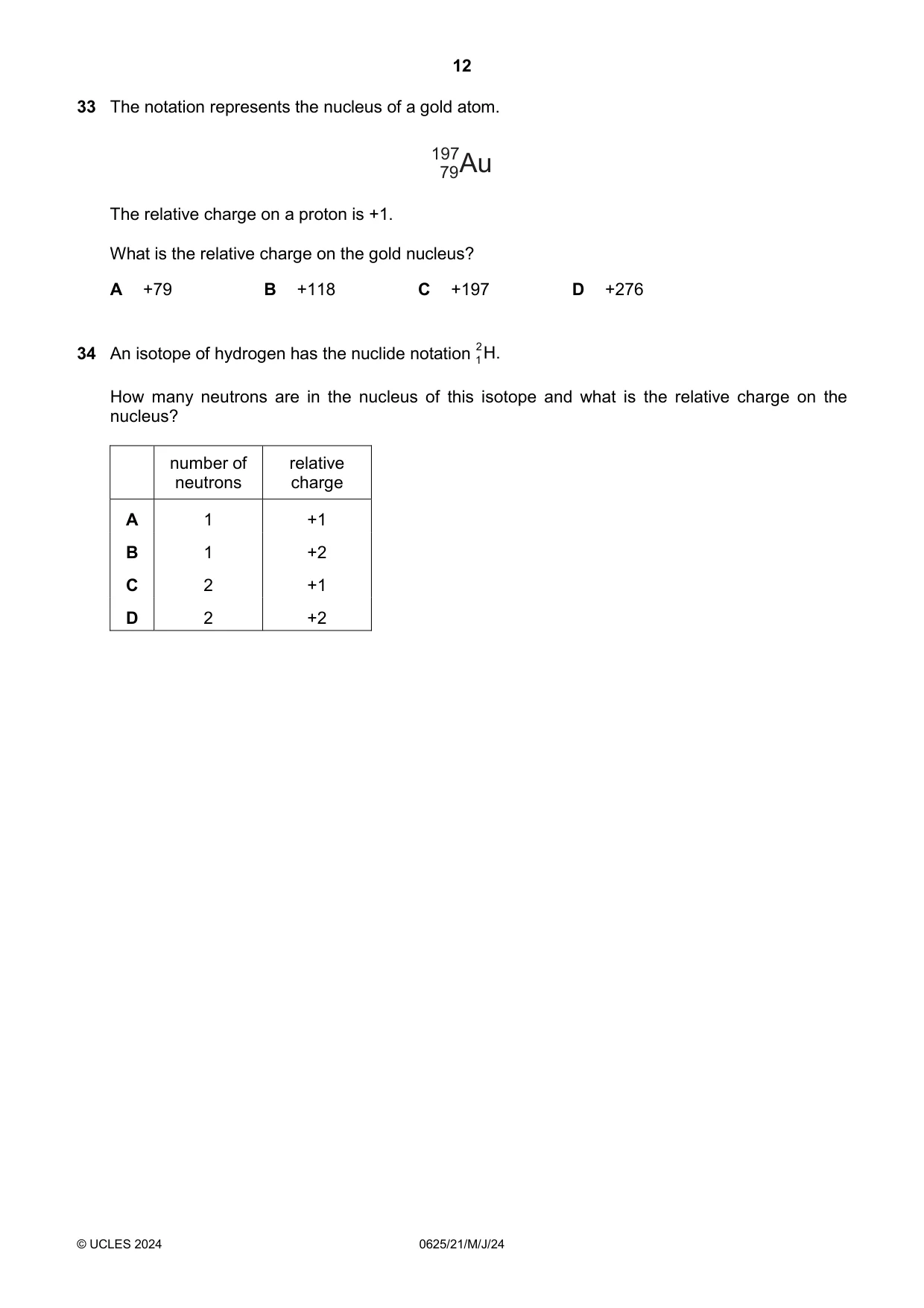
33 The notation represents the nucleus of a gold atom. 197Au 79 The relative charge on a proton is +1. What is the relative charge on the gold nucleus? A +79 B +118 C +197 D +276
Mark scheme: A
Q34 · An isotope of hydrogen has the nuclide notation H
34 An isotope of hydrogen has the nuclide notation H. 2 1 How many neutrons are in the nucleus of this isotope and what is the relative charge on the nucleus? number of relative neutrons charge A 1 +1 B 1 +2 C 2 +1 D 2 +2
Mark scheme: A
Q35 · A radioactive source is placed near a detector
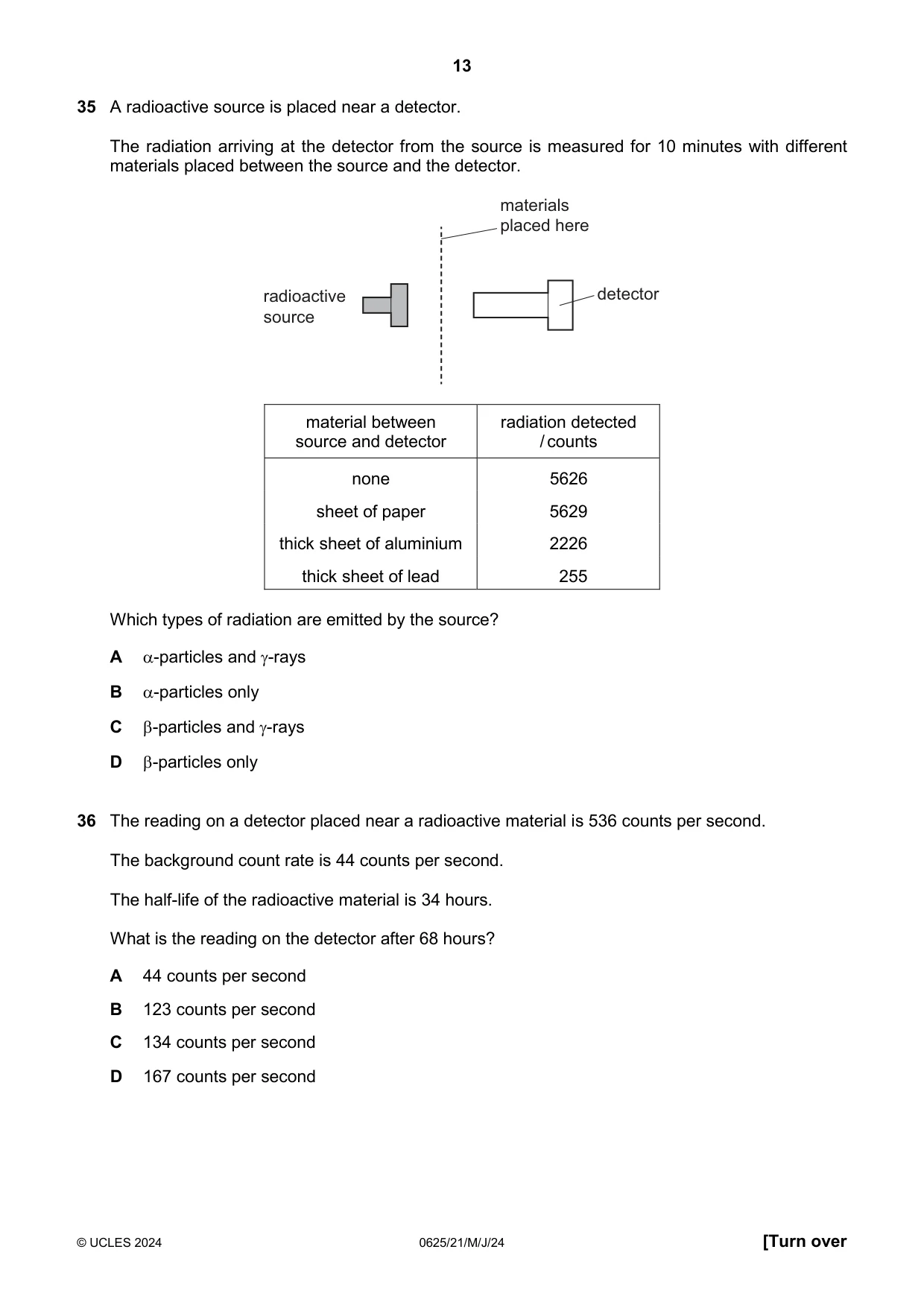
35 A radioactive source is placed near a detector. The radiation arriving at the detector from the source is measured for 10 minutes with different materials placed between the source and the detector. materials placed here radioactive detector source material between radiation detected source and detector / counts none 5626 sheet of paper 5629 thick sheet of aluminium 2226 thick sheet of lead 255 Which types of radiation are emitted by the source? A -particles and -rays B -particles only C -particles and -rays D -particles only
Mark scheme: C
Q36 · The reading on a detector placed near a radioactive material is 536 counts per second
36 The reading on a detector placed near a radioactive material is 536 counts per second. The background count rate is 44 counts per second. The half-life of the radioactive material is 34 hours. What is the reading on the detector after 68 hours? A 44 counts per second B 123 counts per second C 134 counts per second D 167 counts per second
Mark scheme: D
Q37 · A planet in the Solar System is at the point in its orbit where it is closest to the Sun
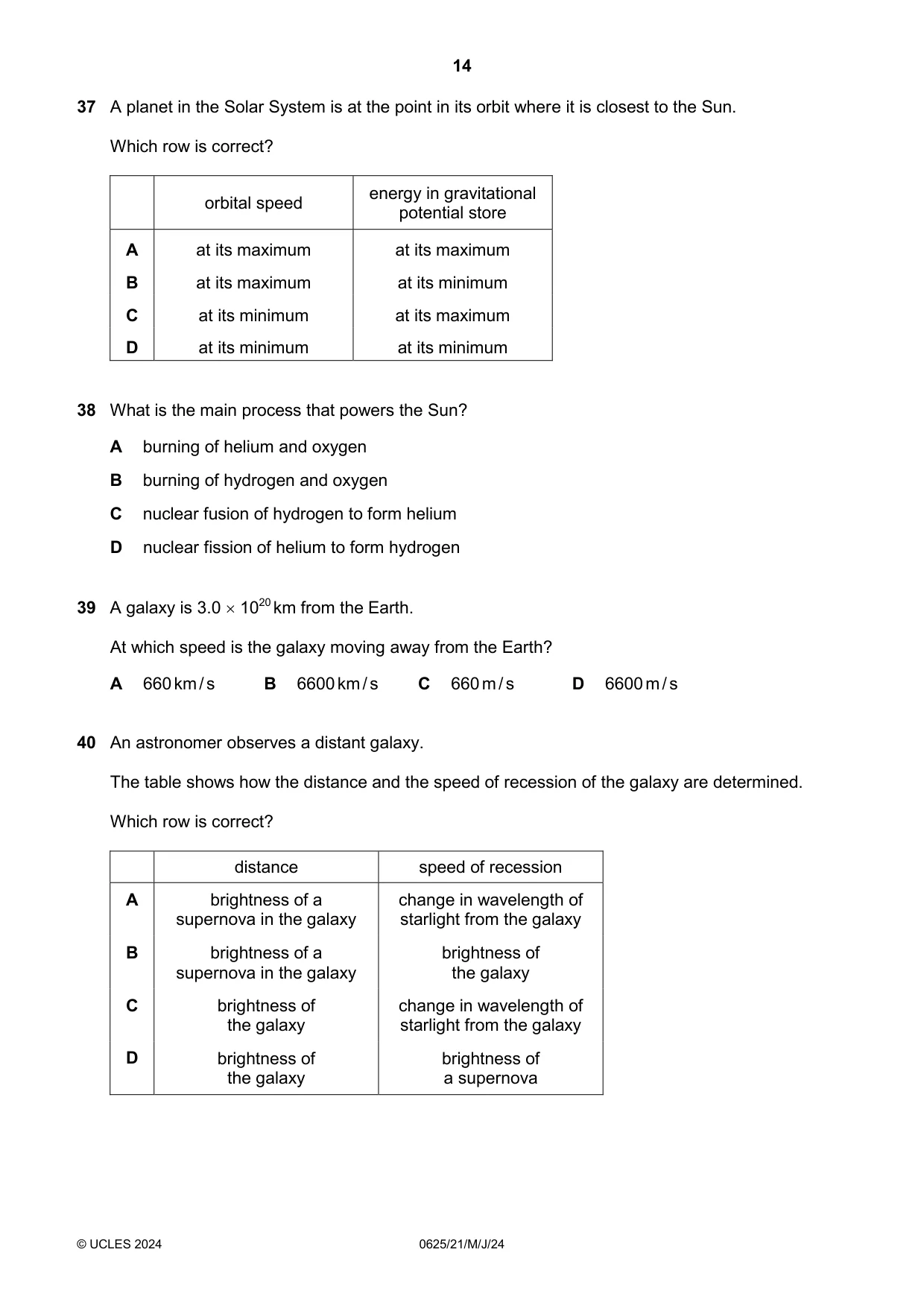
37 A planet in the Solar System is at the point in its orbit where it is closest to the Sun. Which row is correct? energy in gravitational orbital speed potential store A at its maximum at its maximum B at its maximum at its minimum C at its minimum at its maximum D at its minimum at its minimum
Mark scheme: B
Q38 · What is the main process that powers the Sun?
38 What is the main process that powers the Sun? A burning of helium and oxygen B burning of hydrogen and oxygen C nuclear fusion of hydrogen to form helium D nuclear fission of helium to form hydrogen
Mark scheme: C
Q39 · A galaxy is 3.0 1020 km from the Earth
39 A galaxy is 3.0 1020 km from the Earth. At which speed is the galaxy moving away from the Earth? A 660 km / s B 6600 km / s C 660 m / s D 6600 m / s
Mark scheme: A
Q40 · An astronomer observes a distant galaxy
40 An astronomer observes a distant galaxy. The table shows how the distance and the speed of recession of the galaxy are determined. Which row is correct? distance speed of recession A brightness of a change in wavelength of supernova in the galaxy starlight from the galaxy B brightness of a brightness of supernova in the galaxy the galaxy C brightness of change in wavelength of the galaxy starlight from the galaxy D brightness of brightness of the galaxy a supernova
Mark scheme: A
What was in this paper
The subtopics covered by these 40 questions, and how many questions each got. Open one in a new tab to see every Cambridge question on it.
5Electromagnetic effects4Light4Stars and the Universe3The nuclear model of the atom3Electric circuits2Energy, work and power2Mass and weight2Physical quantities and measurement techniques2Radioactivity2Simple phenomena of magnetism2Sound2Density1Electromagnetic spectrum1Forces1General properties of waves1Momentum1The Earth and the Solar System1Transfer of thermal energy1What you needed in this session
Cambridge’s own grade thresholds for 2024 May/June, Paper 2 · Variant 1. A higher threshold means an easier paper — the bar moves with how the cohort did.