Cambridge IGCSE Physics 0625 — 2016 Feb/March Paper 2 · Variant 2
0625/22/F/M/16 · 40 questions · 40 marks · ≈45 min
The question paper and its mark scheme, free to read here and free to download. This is Cambridge’s own paper, exactly as it was sat.
Question paper20 pages
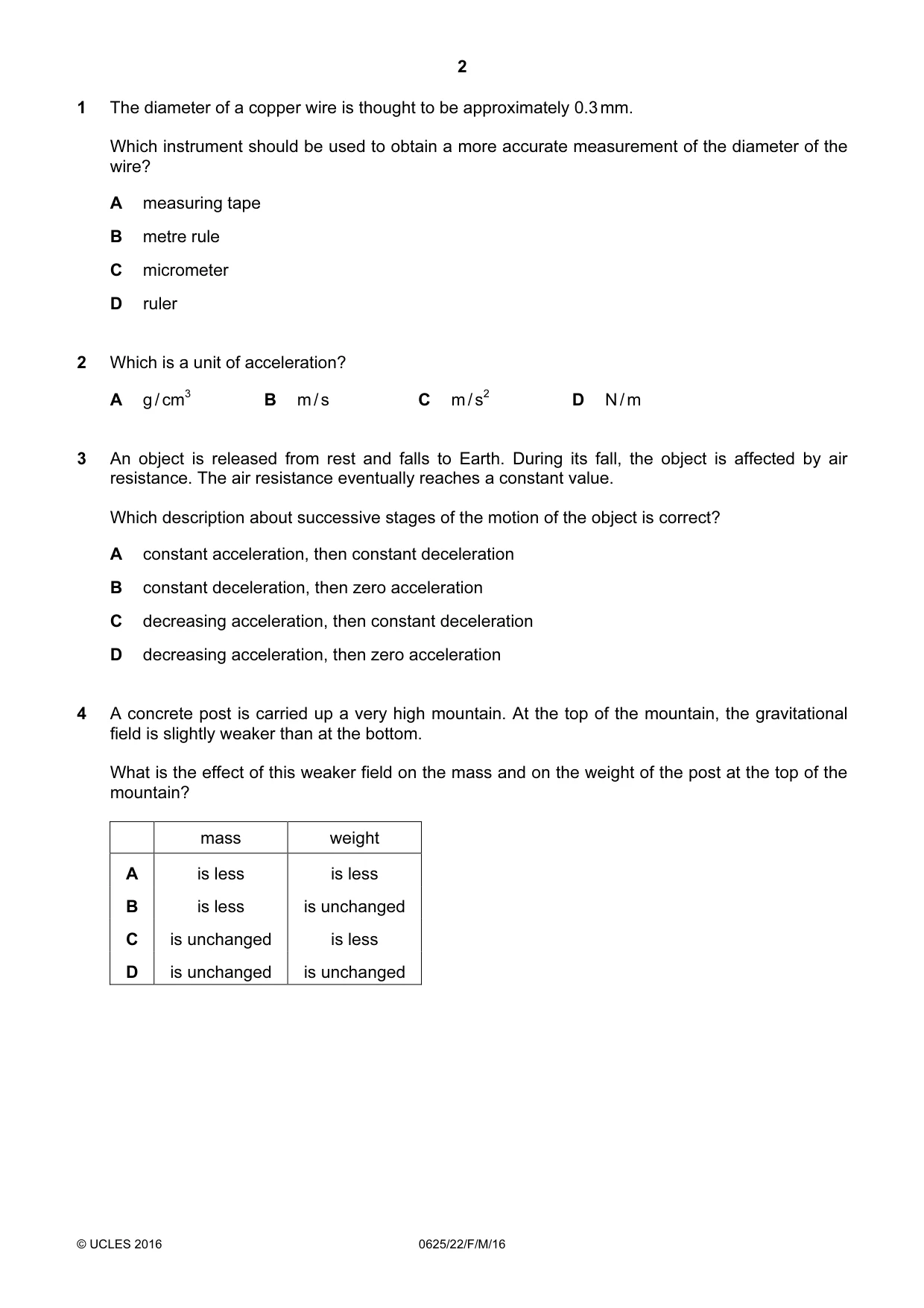


Mark scheme2 pages
Answers below. Sit the paper first if you are practising.
Questions as text
Q1 · The diameter of a copper wire is thought to be approximately 0.3 mm
1 The diameter of a copper wire is thought to be approximately 0.3 mm. Which instrument should be used to obtain a more accurate measurement of the diameter of the wire? A measuring tape B metre rule C micrometer D ruler
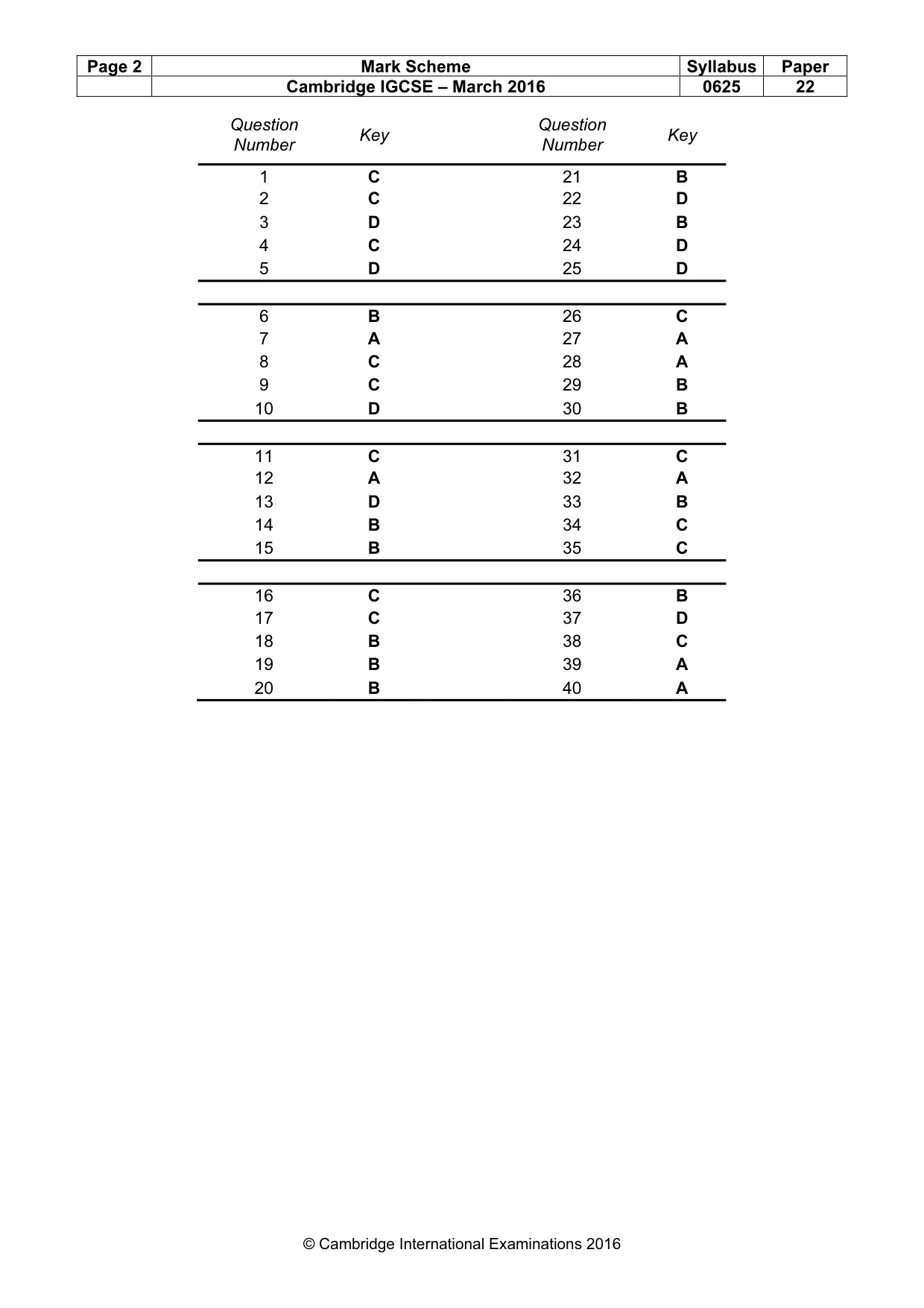
Mark scheme: C
More questions on Physical quantities and measurement techniques
Q2 · Which is a unit of acceleration?
2 Which is a unit of acceleration? A g / cm3 B m / s C m / s2 D N / m
Mark scheme: C
Q3 · An object is released from rest and falls to Earth
3 An object is released from rest and falls to Earth. During its fall, the object is affected by air resistance. The air resistance eventually reaches a constant value. Which description about successive stages of the motion of the object is correct? A constant acceleration, then constant deceleration B constant deceleration, then zero acceleration C decreasing acceleration, then constant deceleration D decreasing acceleration, then zero acceleration
Mark scheme: D
Q4 · A concrete post is carried up a very high mountain
4 A concrete post is carried up a very high mountain. At the top of the mountain, the gravitational field is slightly weaker than at the bottom. What is the effect of this weaker field on the mass and on the weight of the post at the top of the mountain? mass weight A is less is less B is less is unchanged C is unchanged is less D is unchanged is unchanged
Mark scheme: C
Q5 · The diagram shows a cuboid block made from a metal of density 2.5 g / cm3
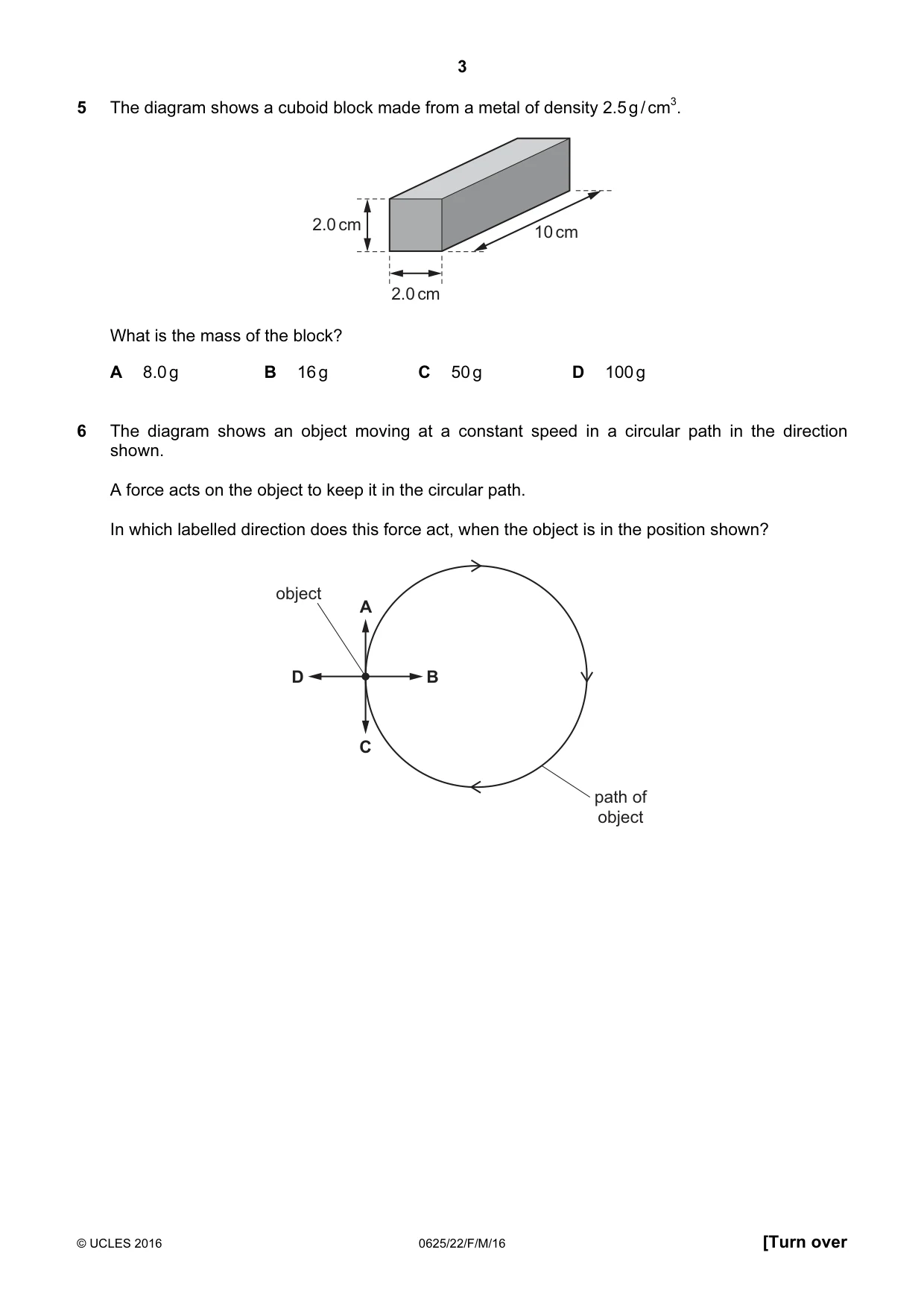
5 The diagram shows a cuboid block made from a metal of density 2.5 g / cm3. 2.0 cm 10 cm 2.0 cm What is the mass of the block? A 8.0 g B 16 g C 50 g D 100 g
Mark scheme: D
Q6 · The diagram shows an object moving at a constant speed in a circular path in the…
6 The diagram shows an object moving at a constant speed in a circular path in the direction shown. A force acts on the object to keep it in the circular path. In which labelled direction does this force act, when the object is in the position shown? object A D B C path of object
Mark scheme: B
Q7 · A spring obeys Hooke’s law
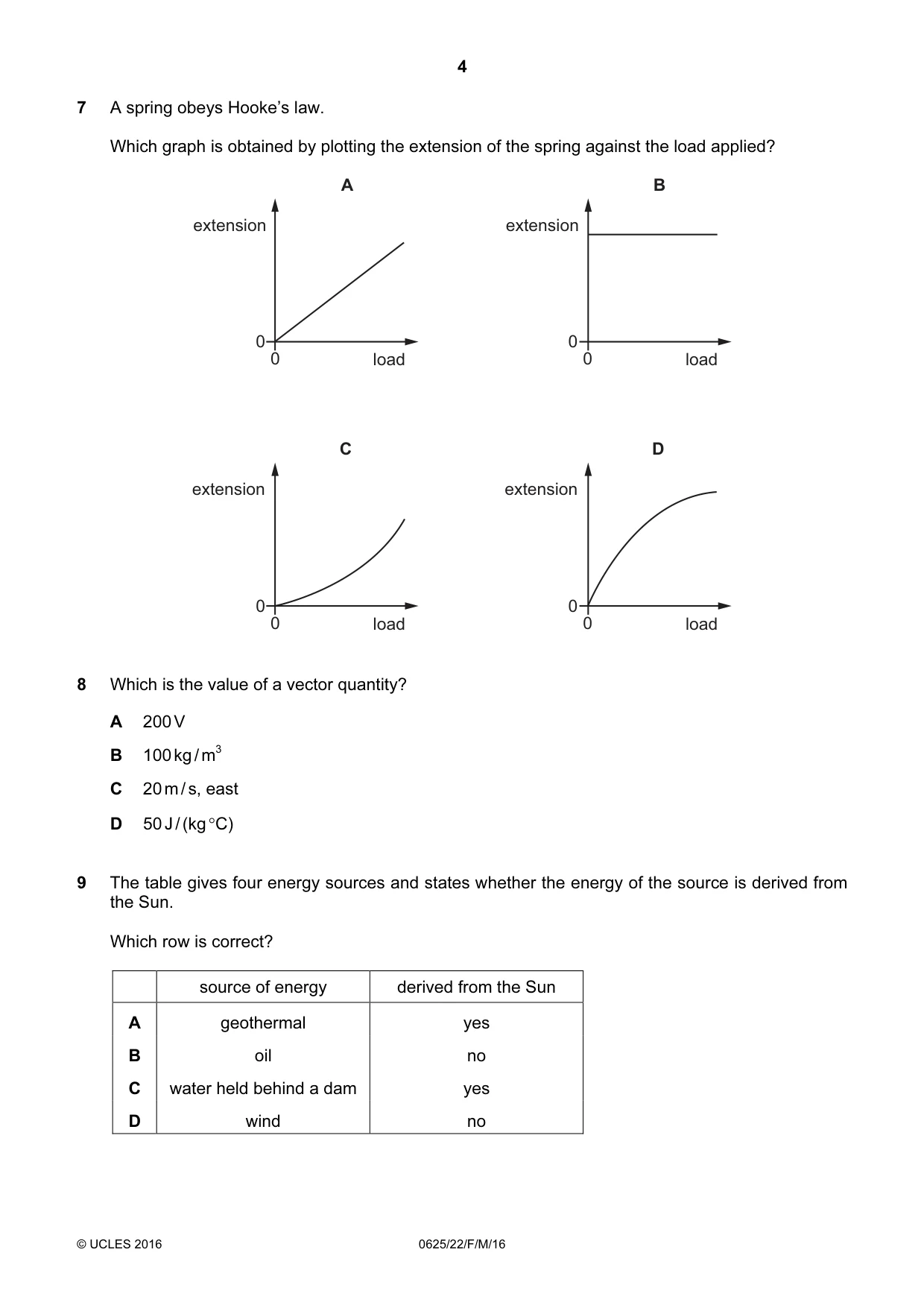
7 A spring obeys Hooke’s law. Which graph is obtained by plotting the extension of the spring against the load applied? A B extension extension 0 0 0 load 0 load C D extension extension 0 0 0 load 0 load
Mark scheme: A
Q8 · Which is the value of a vector quantity?
8 Which is the value of a vector quantity? A 200 V B 100 kg / m3 C 20 m / s, east D 50 J / (kg °C)
Mark scheme: C
More questions on Physical quantities and measurement techniques
Q9 · The table gives four energy sources and states whether the energy of the source is…
9 The table gives four energy sources and states whether the energy of the source is derived from the Sun. Which row is correct? source of energy derived from the Sun A geothermal yes B oil no C water held behind a dam yes D wind no
Mark scheme: C
Q10 · A weight-lifter raises a 2000 N weight through a vertical height of 2.0 m in 0.80 s
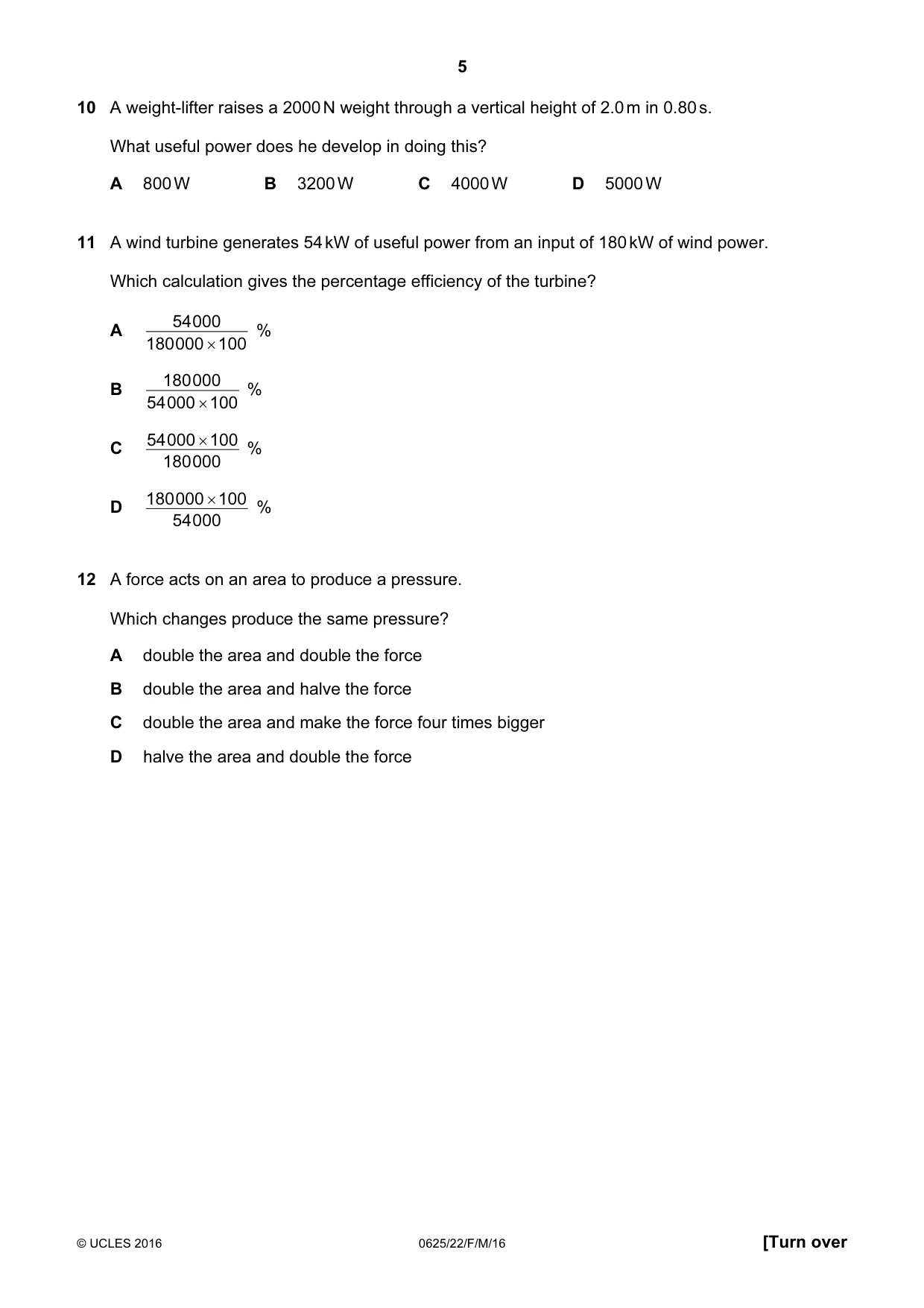
10 A weight-lifter raises a 2000 N weight through a vertical height of 2.0 m in 0.80 s. What useful power does he develop in doing this? A 800 W B 3200 W C 4000 W D 5000 W
Mark scheme: D
Q11 · A wind turbine generates 54 kW of useful power from an input of 180 kW of wind power
11 A wind turbine generates 54 kW of useful power from an input of 180 kW of wind power. Which calculation gives the percentage efficiency of the turbine? 54 000 A % 180 000 × 100 180 000 B % 54 000 × 100 54 000 × 100 C % 180 000 180 000 × 100 D % 54 000
Mark scheme: C
Q12 · A force acts on an area to produce a pressure
12 A force acts on an area to produce a pressure. Which changes produce the same pressure? A double the area and double the force B double the area and halve the force C double the area and make the force four times bigger D halve the area and double the force
Mark scheme: A
Q13 · Identical toy bricks are placed one on top of another to make a tower on a table
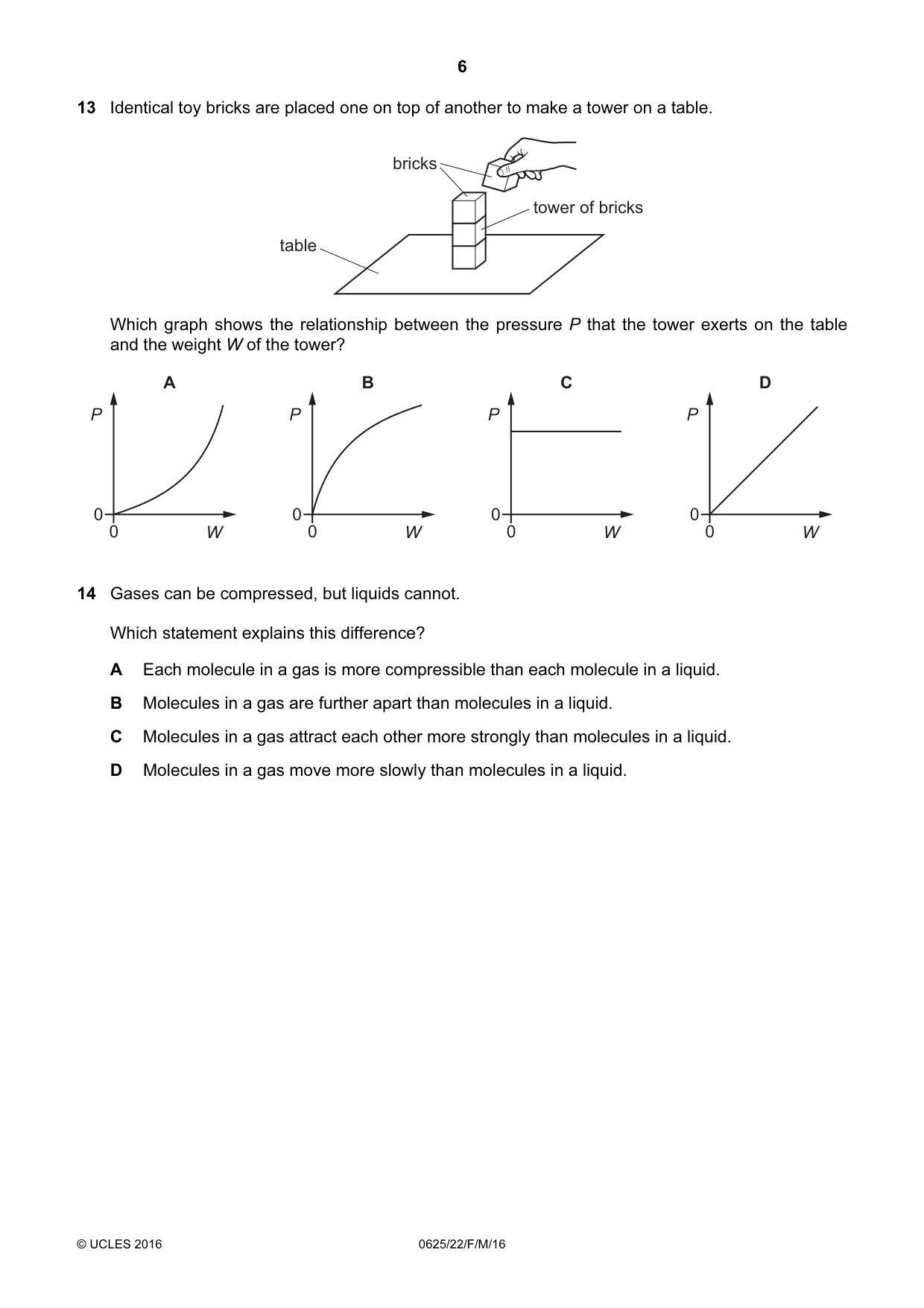
13 Identical toy bricks are placed one on top of another to make a tower on a table. bricks tower of bricks table Which graph shows the relationship between the pressure P that the tower exerts on the table and the weight W of the tower? A B C D P P P P 0 0 0 0 0 W 0 W 0 W 0 W
Mark scheme: D
Q14 · Gases can be compressed, but liquids cannot
14 Gases can be compressed, but liquids cannot. Which statement explains this difference? A Each molecule in a gas is more compressible than each molecule in a liquid. B Molecules in a gas are further apart than molecules in a liquid. C Molecules in a gas attract each other more strongly than molecules in a liquid. D Molecules in a gas move more slowly than molecules in a liquid.
Mark scheme: B
Q15 · The diagram shows a quantity of gas trapped in a cylinder
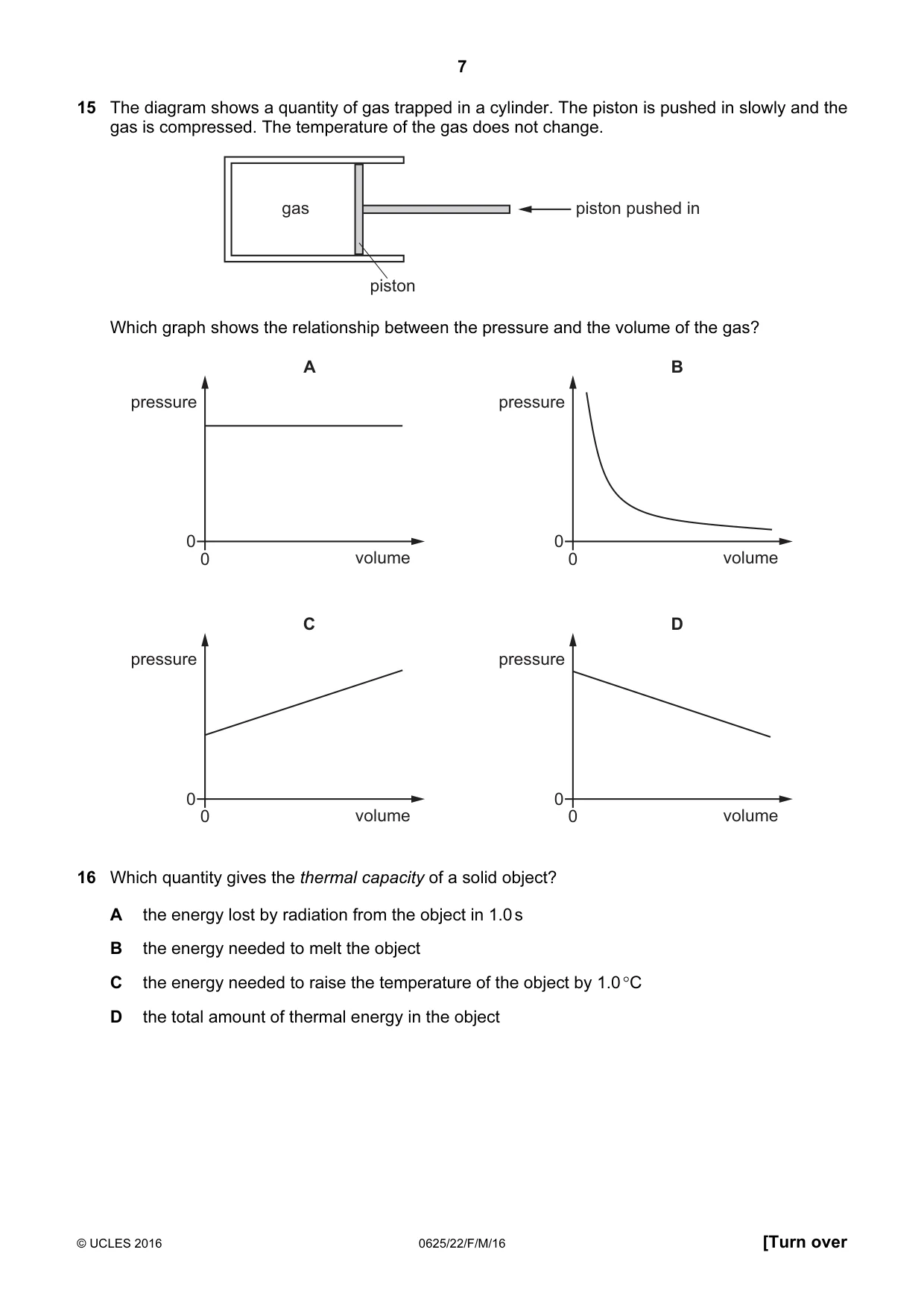
15 The diagram shows a quantity of gas trapped in a cylinder. The piston is pushed in slowly and the gas is compressed. The temperature of the gas does not change. gas piston pushed in piston Which graph shows the relationship between the pressure and the volume of the gas? A B pressure pressure 0 0 0 volume 0 volume C D pressure pressure 0 0 0 volume 0 volume
Mark scheme: B
Q16 · Which quantity gives the thermal capacity of a solid object?
16 Which quantity gives the thermal capacity of a solid object? A the energy lost by radiation from the object in 1.0 s B the energy needed to melt the object C the energy needed to raise the temperature of the object by 1.0 °C D the total amount of thermal energy in the object
Mark scheme: C
Q17 · To mark a temperature scale on a thermometer, standard temperatures known as fixed points…
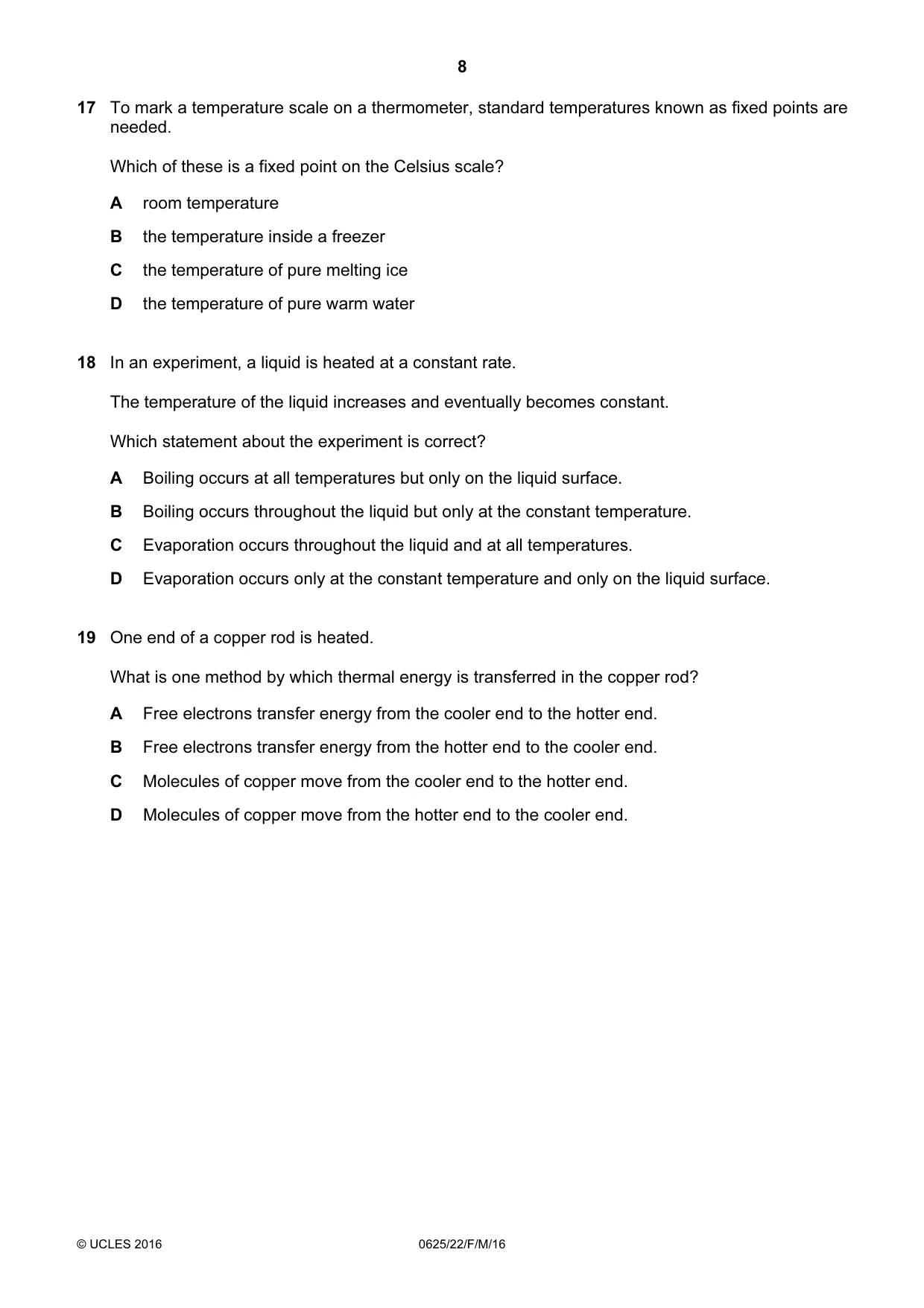
17 To mark a temperature scale on a thermometer, standard temperatures known as fixed points are needed. Which of these is a fixed point on the Celsius scale? A room temperature B the temperature inside a freezer C the temperature of pure melting ice D the temperature of pure warm water
Mark scheme: C
Q18 · In an experiment, a liquid is heated at a constant rate
18 In an experiment, a liquid is heated at a constant rate. The temperature of the liquid increases and eventually becomes constant. Which statement about the experiment is correct? A Boiling occurs at all temperatures but only on the liquid surface. B Boiling occurs throughout the liquid but only at the constant temperature. C Evaporation occurs throughout the liquid and at all temperatures. D Evaporation occurs only at the constant temperature and only on the liquid surface.
Mark scheme: B
Q19 · One end of a copper rod is heated
19 One end of a copper rod is heated. What is one method by which thermal energy is transferred in the copper rod? A Free electrons transfer energy from the cooler end to the hotter end. B Free electrons transfer energy from the hotter end to the cooler end. C Molecules of copper move from the cooler end to the hotter end. D Molecules of copper move from the hotter end to the cooler end.
Mark scheme: B
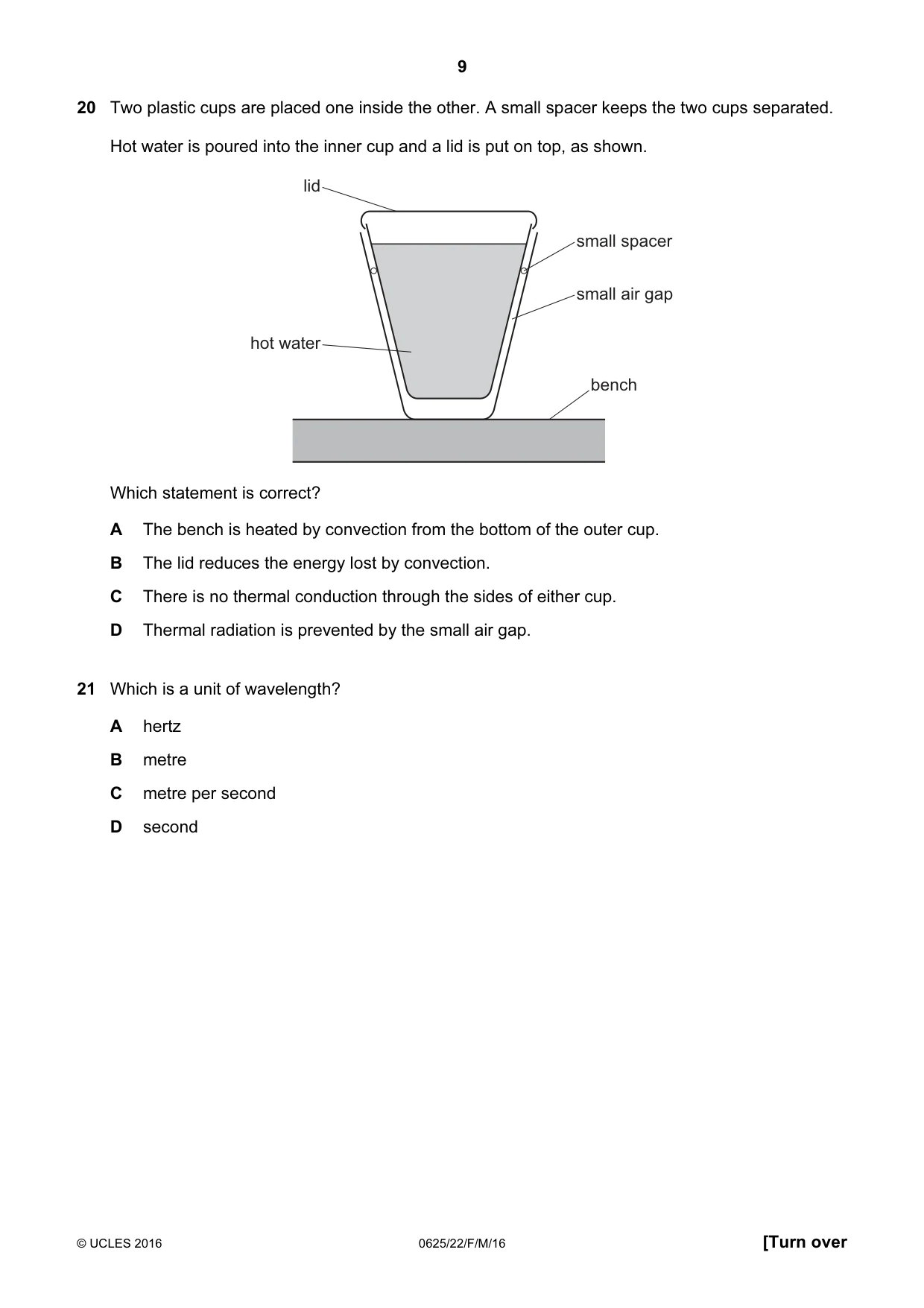
Q20 · Two plastic cups are placed one inside the other
20 Two plastic cups are placed one inside the other. A small spacer keeps the two cups separated. Hot water is poured into the inner cup and a lid is put on top, as shown. lid small spacer small air gap hot water bench Which statement is correct? A The bench is heated by convection from the bottom of the outer cup. B The lid reduces the energy lost by convection. C There is no thermal conduction through the sides of either cup. D Thermal radiation is prevented by the small air gap.
Mark scheme: B
Q21 · Which is a unit of wavelength?
21 Which is a unit of wavelength? A hertz B metre C metre per second D second
Mark scheme: B
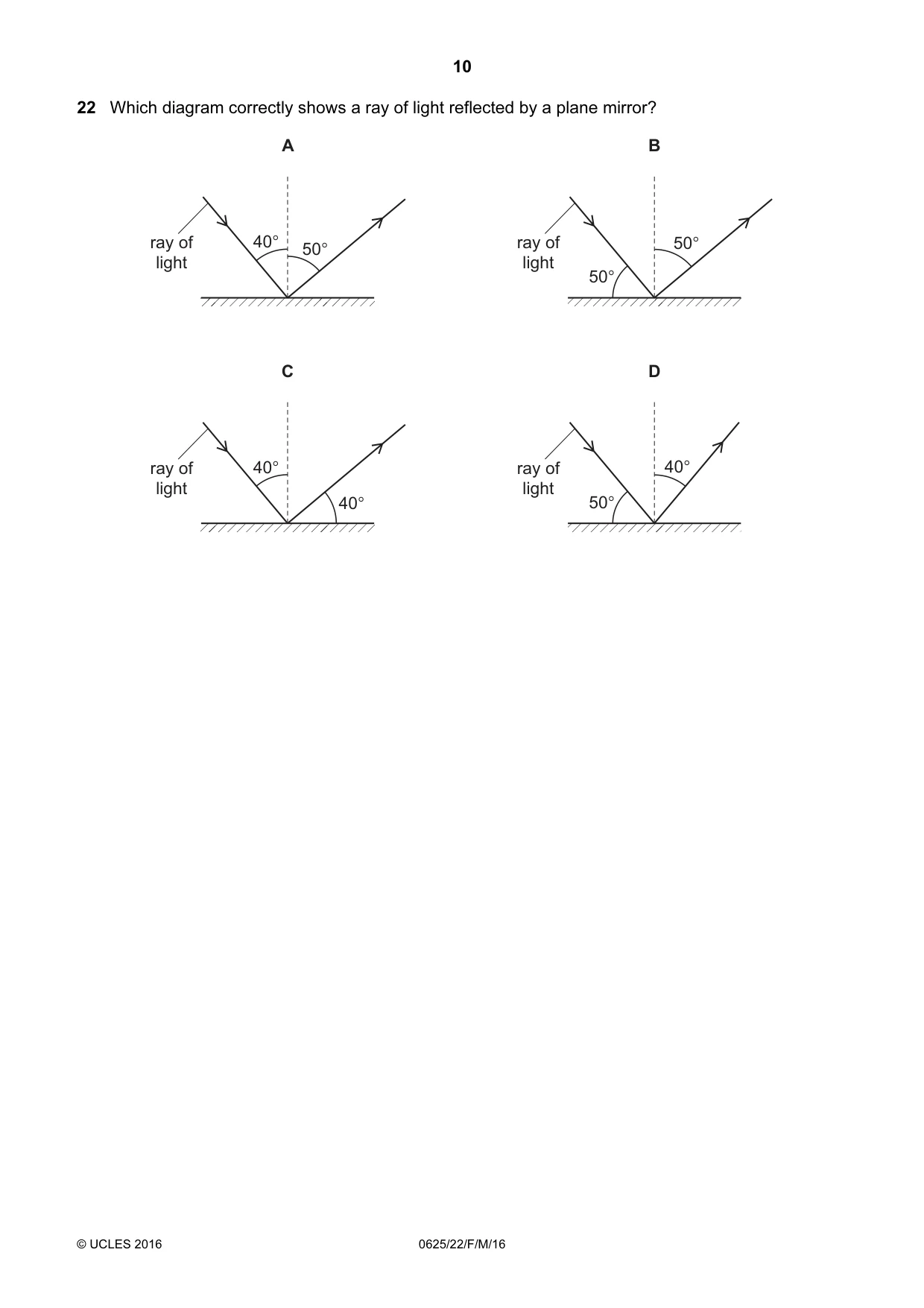
Q22 · Which diagram correctly shows a ray of light reflected by a plane mirror?
22 Which diagram correctly shows a ray of light reflected by a plane mirror? A B ray of 40° 50° ray of 50° light light 50° C D ray of 40° ray of 40° light light 40° 50°
Mark scheme: D
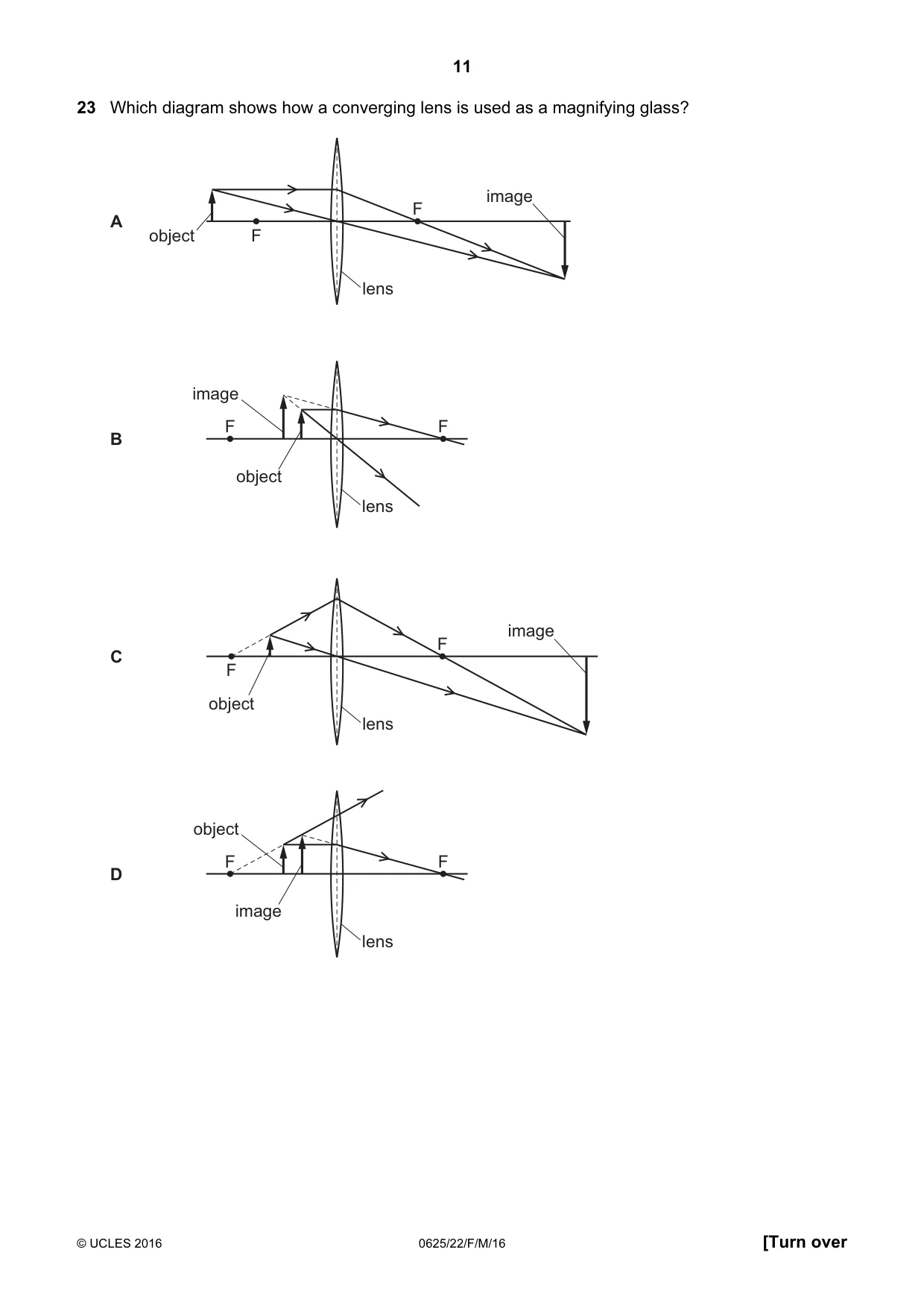
Q23 · Which diagram shows how a converging lens is used as a magnifying glass?
23 Which diagram shows how a converging lens is used as a magnifying glass? image F A object F lens image F F B object lens image F C F object lens object F F D image lens
Mark scheme: B
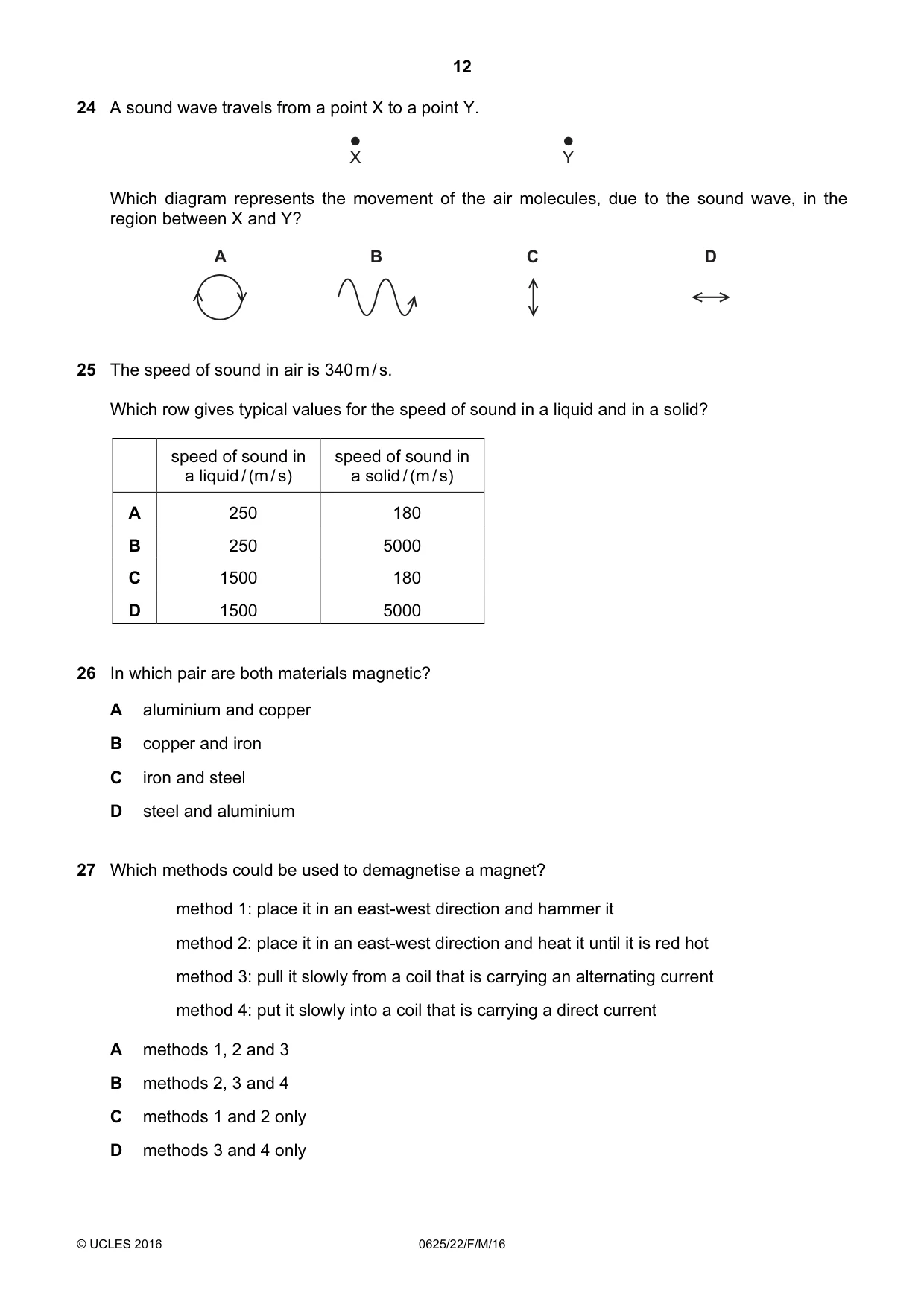
Q24 · A sound wave travels from a point X to a point Y
24 A sound wave travels from a point X to a point Y. X Y Which diagram represents the movement of the air molecules, due to the sound wave, in the region between X and Y? A B C D
Mark scheme: D
Q25 · The speed of sound in air is 340 m / s
25 The speed of sound in air is 340 m / s. Which row gives typical values for the speed of sound in a liquid and in a solid? speed of sound in speed of sound in a liquid / (m / s) a solid / (m / s) A 250 180 B 250 5000 C 1500 180 D 1500 5000
Mark scheme: D
Q26 · In which pair are both materials magnetic?
26 In which pair are both materials magnetic? A aluminium and copper B copper and iron C iron and steel D steel and aluminium
Mark scheme: C
Q27 · Which methods could be used to demagnetise a magnet?
27 Which methods could be used to demagnetise a magnet? method 1: place it in an east-west direction and hammer it method 2: place it in an east-west direction and heat it until it is red hot method 3: pull it slowly from a coil that is carrying an alternating current method 4: put it slowly into a coil that is carrying a direct current A methods 1, 2 and 3 B methods 2, 3 and 4 C methods 1 and 2 only D methods 3 and 4 only
Mark scheme: A
Q28 · Which produces an electromotive force (e.m.f.)?
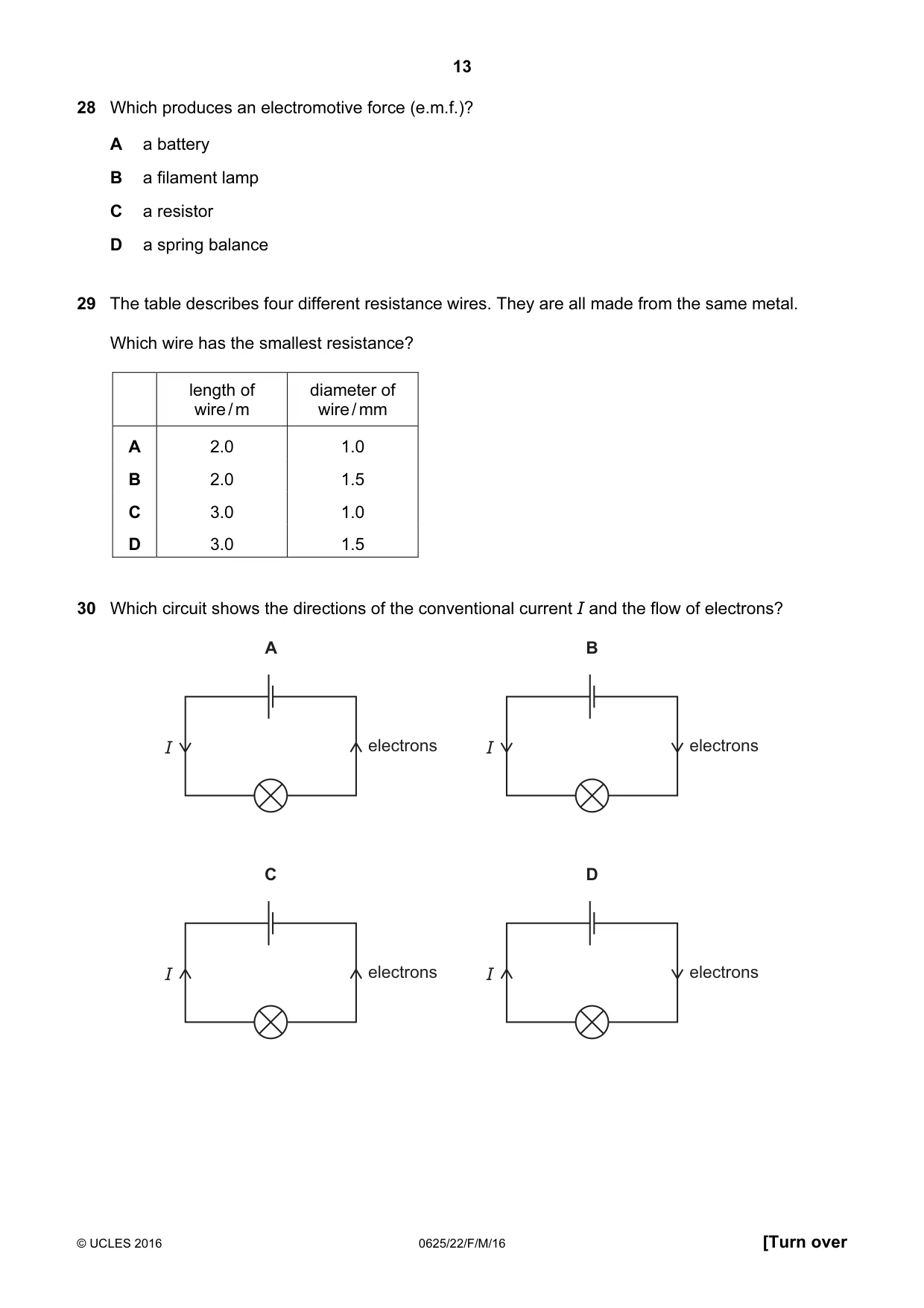
28 Which produces an electromotive force (e.m.f.)? A a battery B a filament lamp C a resistor D a spring balance
Mark scheme: A
Q29 · The table describes four different resistance wires
29 The table describes four different resistance wires. They are all made from the same metal. Which wire has the smallest resistance? length of diameter of wire / m wire / mm A 2.0 1.0 B 2.0 1.5 C 3.0 1.0 D 3.0 1.5
Mark scheme: B
Q30 · Which circuit shows the directions of the conventional current I and the flow of…
30 Which circuit shows the directions of the conventional current I and the flow of electrons? A B I electrons I electrons C D I electrons I electrons
Mark scheme: B
Q31 · Four lamps are each labelled 240 V
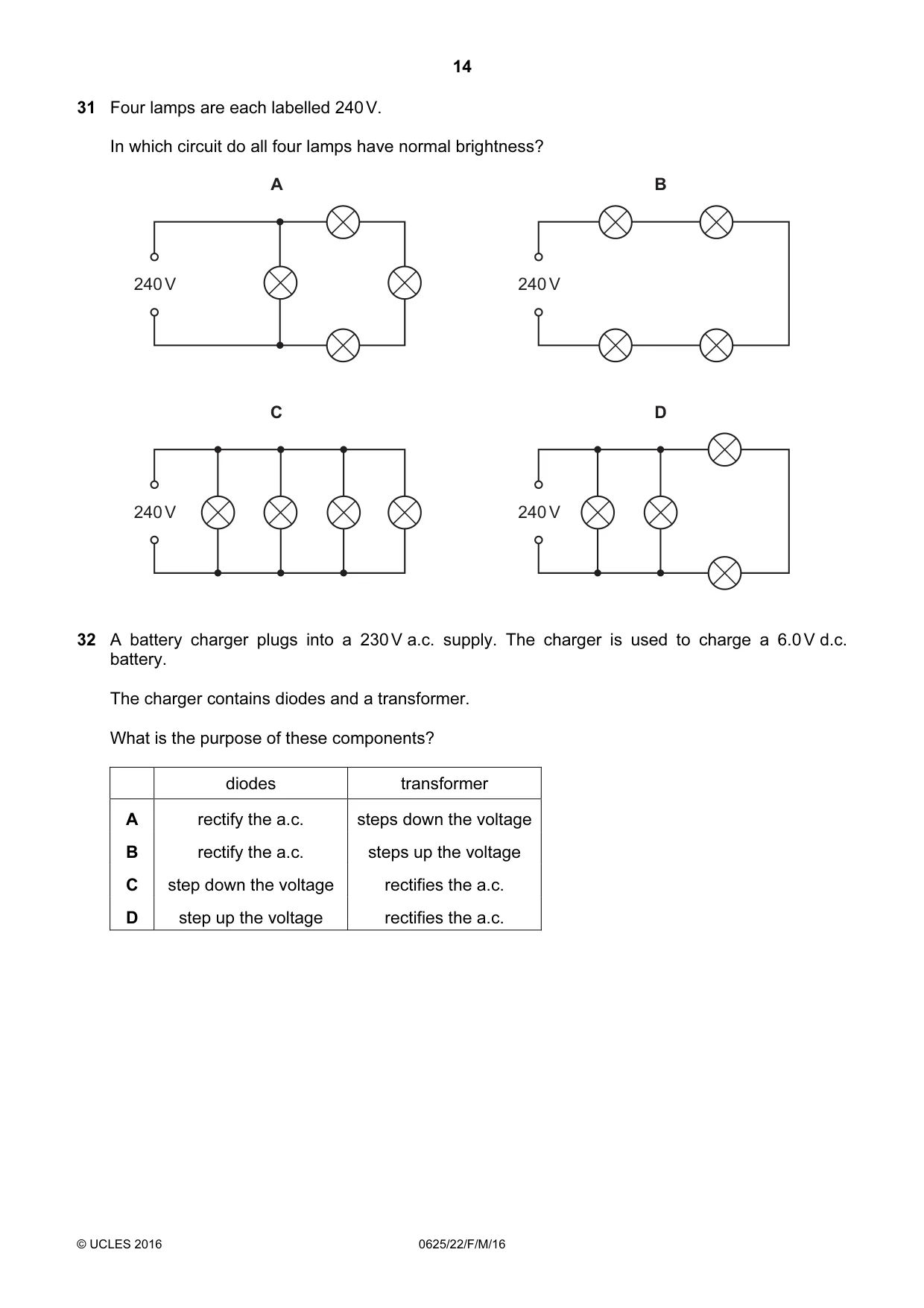
31 Four lamps are each labelled 240 V. In which circuit do all four lamps have normal brightness? A B 240 V 240 V C D 240 V 240 V
Mark scheme: C
Q32 · A battery charger plugs into a 230 V a.c
32 A battery charger plugs into a 230 V a.c. supply. The charger is used to charge a 6.0 V d.c. battery. The charger contains diodes and a transformer. What is the purpose of these components? diodes transformer A rectify the a.c. steps down the voltage B rectify the a.c. steps up the voltage C step down the voltage rectifies the a.c. D step up the voltage rectifies the a.c.
Mark scheme: A
Q33 · The diagram shows a potential divider connected to two voltmeters P and Q
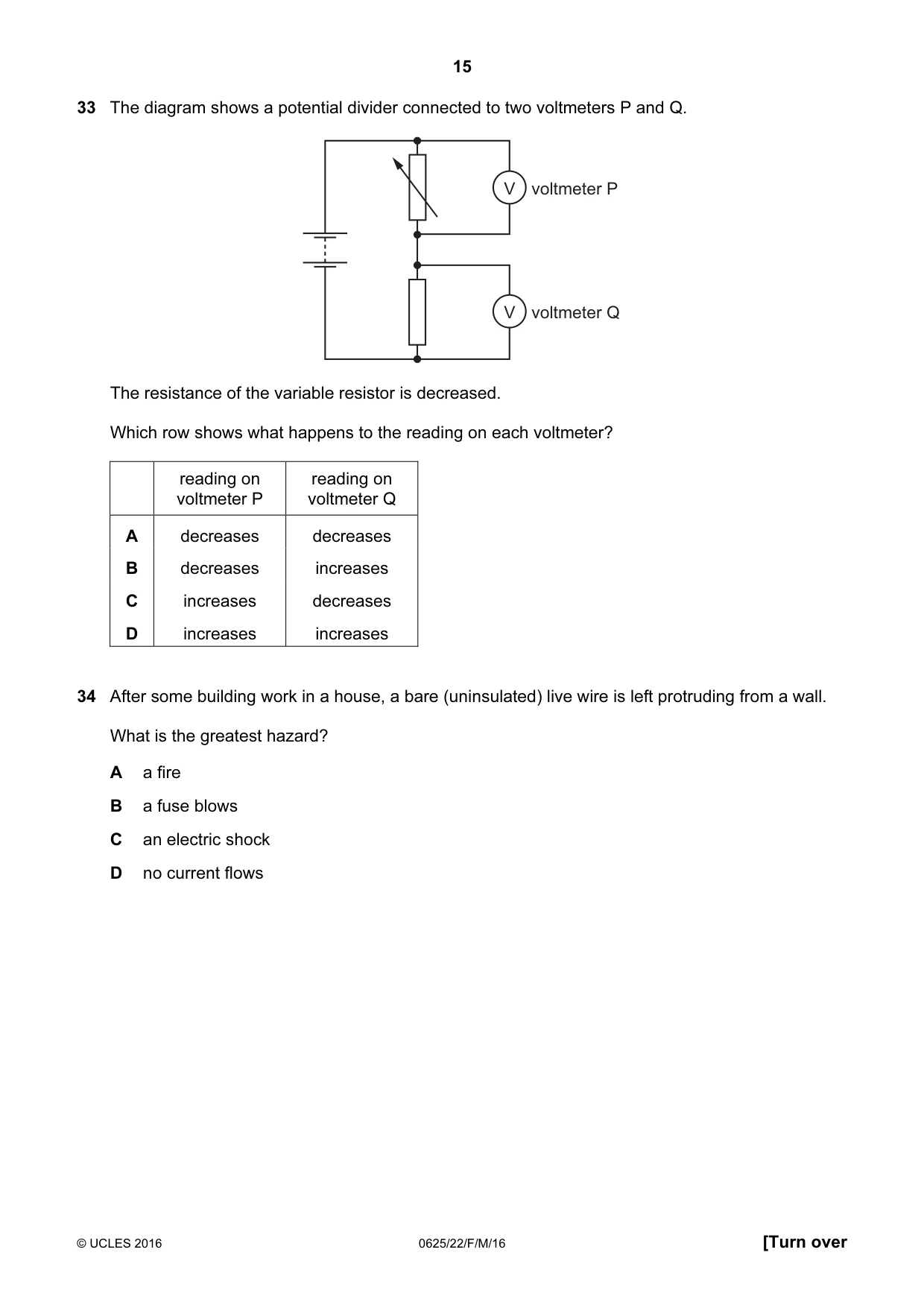
33 The diagram shows a potential divider connected to two voltmeters P and Q. V voltmeter P V voltmeter Q The resistance of the variable resistor is decreased. Which row shows what happens to the reading on each voltmeter? reading on reading on voltmeter P voltmeter Q A decreases decreases B decreases increases C increases decreases D increases increases
Mark scheme: B
Q34 · After some building work in a house, a bare (uninsulated) live wire is left protruding…
34 After some building work in a house, a bare (uninsulated) live wire is left protruding from a wall. What is the greatest hazard? A a fire B a fuse blows C an electric shock D no current flows
Mark scheme: C
Q35 · An electron moves into a uniform magnetic field
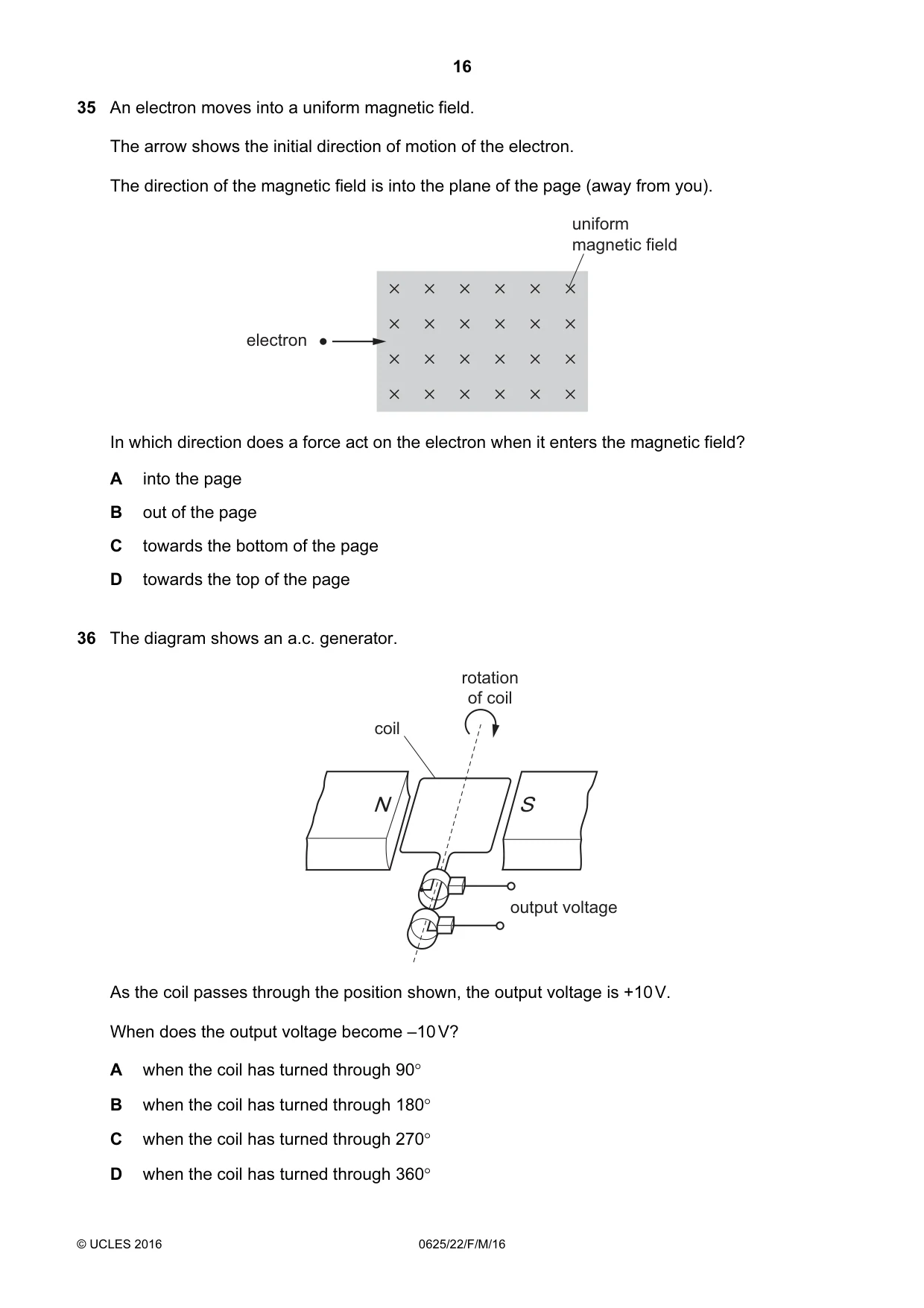
35 An electron moves into a uniform magnetic field. The arrow shows the initial direction of motion of the electron. The direction of the magnetic field is into the plane of the page (away from you). uniform magnetic field electron In which direction does a force act on the electron when it enters the magnetic field? A into the page B out of the page C towards the bottom of the page D towards the top of the page
Mark scheme: C
Q36 · The diagram shows an a.c
36 The diagram shows an a.c. generator. rotation of coil coil N S output voltage As the coil passes through the position shown, the output voltage is +10 V. When does the output voltage become –10 V? A when the coil has turned through 90° B when the coil has turned through 180° C when the coil has turned through 270° D when the coil has turned through 360°
Mark scheme: B
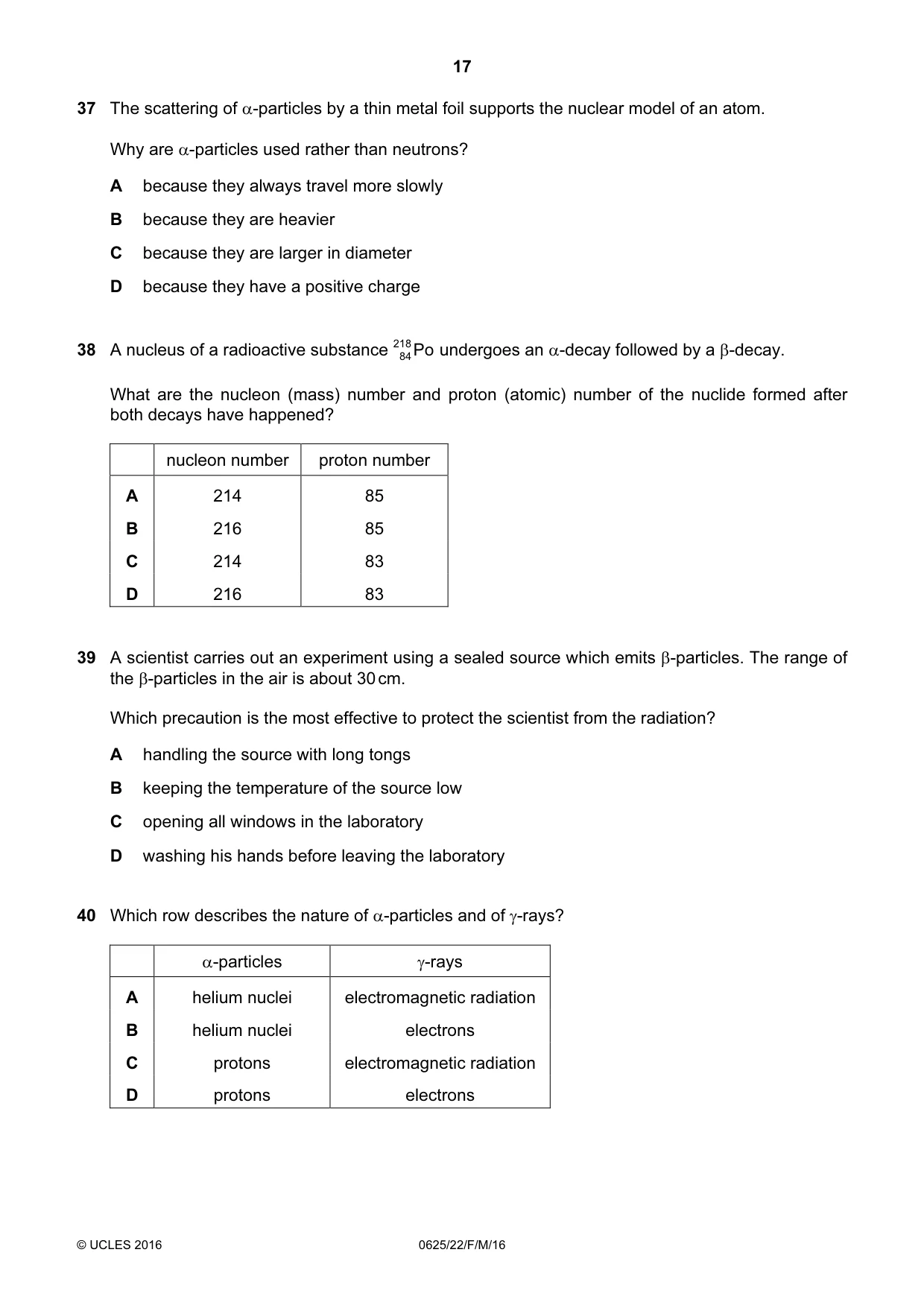
Q37 · The scattering of α-particles by a thin metal foil supports the nuclear model of an atom
37 The scattering of α-particles by a thin metal foil supports the nuclear model of an atom. Why are α-particles used rather than neutrons? A because they always travel more slowly B because they are heavier C because they are larger in diameter D because they have a positive charge
Mark scheme: D
Q38 · A nucleus of a radioactive substance 218 Po undergoes an α-decay followed by a β-decay
38 A nucleus of a radioactive substance 218 Po undergoes an α-decay followed by a β-decay. 84 What are the nucleon (mass) number and proton (atomic) number of the nuclide formed after both decays have happened? nucleon number proton number A 214 85 B 216 85 C 214 83 D 216 83
Mark scheme: C
Q39 · A scientist carries out an experiment using a sealed source which emits β-particles
39 A scientist carries out an experiment using a sealed source which emits β-particles. The range of the β-particles in the air is about 30 cm. Which precaution is the most effective to protect the scientist from the radiation? A handling the source with long tongs B keeping the temperature of the source low C opening all windows in the laboratory D washing his hands before leaving the laboratory
Mark scheme: A
Q40 · Which row describes the nature of α-particles and of γ-rays?
40 Which row describes the nature of α-particles and of γ-rays? α-particles γ-rays A helium nuclei electromagnetic radiation B helium nuclei electrons C protons electromagnetic radiation D protons electrons
Mark scheme: A
What was in this paper
The subtopics covered by these 40 questions, and how many questions each got. Open one in a new tab to see every Cambridge question on it.
3Electromagnetic effects3Energy, work and power3Kinetic particle model of matter3Radioactivity3Electric circuits2Forces2Light2Motion2Physical quantities and measurement techniques2Pressure2Simple phenomena of magnetism2Sound2Thermal properties and temperature2Transfer of thermal energy2Density1Electrical safety1General properties of waves1Mass and weight1The nuclear model of the atom1What you needed in this session
Cambridge’s own grade thresholds for 2016 Feb/March, Paper 2 · Variant 2. A higher threshold means an easier paper — the bar moves with how the cohort did.